Preprint
Review

This version is not peer-reviewed.

The Promise, Problem and Possibility of Timber Bamboo as a Sustainable Building Fiber

A peer-reviewed article of this preprint also exists.

Submitted:

01 January 2025

Posted:

02 January 2025

You are already at the latest version

Abstract

Despite improving operational efficiency of buildings, annual emissions from construction remain stubbornly high. The substitution of fast-growing biogenic materials for high-carbon footprint extractive materials is increasingly discussed as a mitigation tool. Here we identify the relative interest in timber bamboo as such a tool through literature and biobliometric analysis. We review the carbon capturing and structural properties of timber bamboo that underly bamboo’s growing research interest, which, however, has yet to translate to any material degree of adoption in mainstream construction. Given the near absence of subsidies, regulatory mandates and “green premiums”, timber bamboo must become fully cost competitive with existing materials to achieve adoption and provide its carbon mitigation promise. The main problems preventing timber bamboo’s cost competitiveness are analyzed with possible solutions proposed. Finally, the beneficial climate prospects of adopting timber bamboo buildings in substitution for 25% of new cement buildings is projected at over 10 billions tonnes of reduced carbon emissions from 2035 to 2050 and nearly 45 billion tonnes of reduced carbon emissions from 2035 to 2100.

Keywords: 
;  ;  ;  ;  ;  

1. Introduction

Since the 1960s, over 30,000 articles have highlighted the benefits of timber bamboo in alleviating rural poverty, providing a range of consumable and durable products, and addressing multiple UN Sustainable Development Goals (SDGs) [1,2,3,4,5,6,7]. More recently, because of its unique annual regeneration rate, timber bamboo has been identified as a key resource that can be harnessed in the global fight against climate change by rapidly absorbing atmospheric CO2 when that captured CO2 is durable stored long-term [8]. The earlier focus centered on bamboo harvested from natural stands, processed largely in cottage industry manufacturing and placed in use either in non-scalable naturalistic structures or in non-durable products. For timber bamboo to realistically mitigate climate change in the near term, either of two uses must be exploited at significant scale: (1) engineering a new generation of bamboo-based biogenic building components forming the semi-permanent structure of buildings that can be produced in mass or (2) pyrolyzing bamboo biomass into biochar that is then used as a soil amendment. In both uses, timber bamboo’s carbon can be durably stored for the critical next five or more decades as humanity attempts to navigate beyond the approaching climate tipping points. Here, we examine the promise laden in the first use, where timber bamboo can help decarbonize the built environment as a fully substitutable structural component to drive buildings toward their first generation of net zero carbon while also addressing multiple SDGs [9].
This review and analysis focuses on the case for engineered bamboo structural building materials for three reasons: first, given the massive and increasing demand for building globally, the potential incorporation of bamboo-captured carbon in the built environment can achieve a scale that meaningfully impacts climate change; second, using timber bamboo in the built environment can generate significant substitution benefits by lessening reliance on higher carbon footprint structural alternatives like masonry and steel; and third, even just substituting fast growing timber bamboo for slower growing wood-derived building materials, will accelerate carbon sequestration and storage while also increasing land-use efficiency, thereby reducing consumption of diminishing carbon-storing forest resources.
Despite the increased interest in and recognized potential of timber bamboo in construction over recent decades, it has yet to achieve a meaningful role as a global climate change solution, either in the large low-rise residential sector or in the smaller, but high-carbon footprint, high-rise and commercial building sectors. This underutilization raises significant questions about the barriers hindering bamboo’s broader adoption. We see three broader problems facing the widespread adoption of bamboo in global construction. First, unlike the technologically advanced wood and forestry products industry, the bamboo industry has yet to scale as it still depends largely on small-scale growing and harvesting enterprises comprised of rural farmer cooperatives and local artisans [10,11]. These small, disjointed networks of plantations and natural stands operate with limited capital investment in new harvesting technologies that address the idiosyncrasies of growing timber bamboo, requiring new levels of digitally smart mechanization [12,13]. Second, due largely to its tubular shape, processing and manufacturing with bamboo remains inefficient relative to the primary alternative, wood. The development of efficient processing and manufacturing techniques is essential to reduce production costs and increase the competitiveness of engineered bamboo products compared to wood and other traditional construction materials [14]. Third, the product-market fit of engineered bamboo building products has yet to capture timber bamboo’s most extraordinary mechanical properties in a way that positions bamboo in structural competition with steel products, thus taking it into the high-rise and commercial markets. For each problem we identify evident possibilities that can address, at least partially, the problem examined.
In the Section 2, we present a bibliometric review and analysis of the published researched to date that examines bamboo’s application in buildings, both in comparison to traditional materials of steel, concrete and wood as well as to the newer generation of biogenic materials derived from straw, hemp and mycelium. In Section 3, we summarize timber bamboo’s two most promising properties—fast regeneration resulting in high rates of atmospheric carbon removal and superior mechanical properties—and make comparisons of these properties to the same three traditional building products. As researchers and practitioners in the bamboo construction industry, we must go beyond extolling bamboo’s published virtues and work to critically analyze the problems that restrain bamboo’s broader use. Only then can we advance new products that can fulfill the promise of timber bamboo to rapidly capture and durably store atmospheric carbon in the full range of building typologies. In Section 4, we analyze these problems constraining the broader adoption of engineered bamboo products, focusing on the key drivers that ultimately limit the cost competitiveness of engineered bamboo versus alternative building materials while offering potential solutions to the identified challenges. Finally, we summarize projections of the possible climate benefits, when, as and if adoption of timber bamboo advances to fulfill its climate promise.

2. Review: Trends in Timber Bamboo Research

2.1. Comparative Analysis of Bamboo with Traditional Building Materials

Research and academic publications can serve as valuable indicators for assessing the commercialization of products and developing market activity. For example, an increase in the number of publications in a specific field can indicate growing interest and advancements, suggesting that the technology is maturing and approaching commercialization. To gain a context for trends in research covering bamboo building materials relative to published research covering the three traditional building materials of steel, concrete and wood, we conducted two rounds of searches across the Scopus database. Scopus is a database of abstracts and citations of peer-reviewed journals, books, and conference proceedings that now covers over 90,000,000 documents dating from 1940 to 2023. The search process identified any article in the Scopus database that contained the searched term in the title, abstract or identified keywords for the article. Figure 1a shows results from the first search covering articles that mentioned any of the four materials in any context. Figure 1b shows results from the second search where each material was constrained to results also including the word “building,” intending to select for “material AND building” (e.g., “bamboo AND building”).
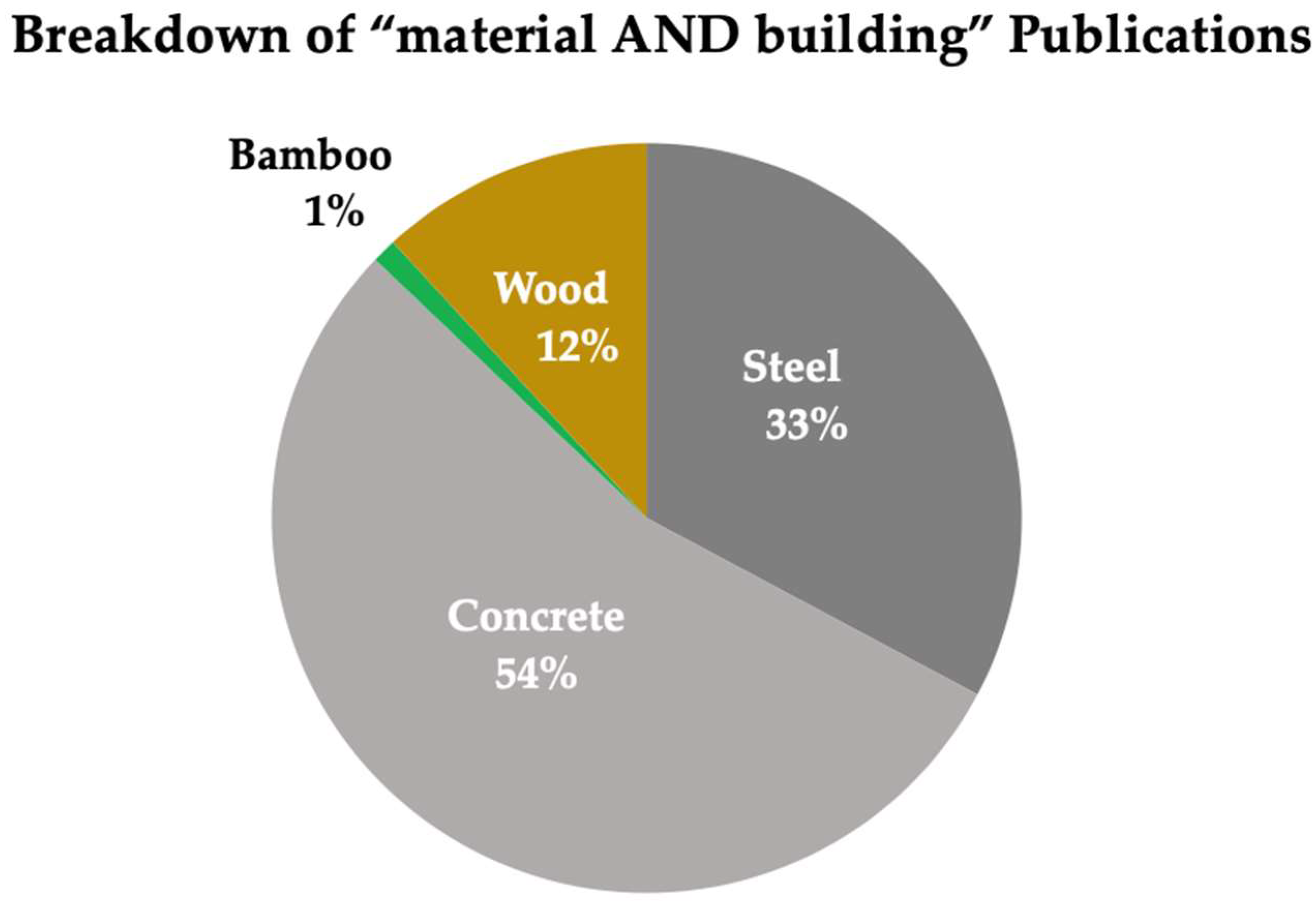
Of the 1,819,096 total articles identified for the four materials in Figure 1a, only 162,102 reflect that use of the material with “building[s]” in Figure 1b (i.e., only about 9% of articles suggest focus on one of the four materials for use in building as opposed to other uses). When comparing the total and “material AND building” for each material, bamboo, steel and wood each have “material AND building” percents that range between 6% and 7%, suggesting that each of these three materials have a wide range of non-building uses and thus research focus. In contrast, “concrete AND building” represented 16% of the total “concrete” articles, suggesting that concrete has fewer applications apart from building than do bamboo, steel and wood. Figure 1b also shows that articles addressing “bamboo AND building” produced only 1,710 titles over the full period, representing only 1% of “material AND building” publications. Figure 2 shows the relative proportion of publications for each “material AND building.” (Appendix One shows the comprehensive set of search results in a table.)
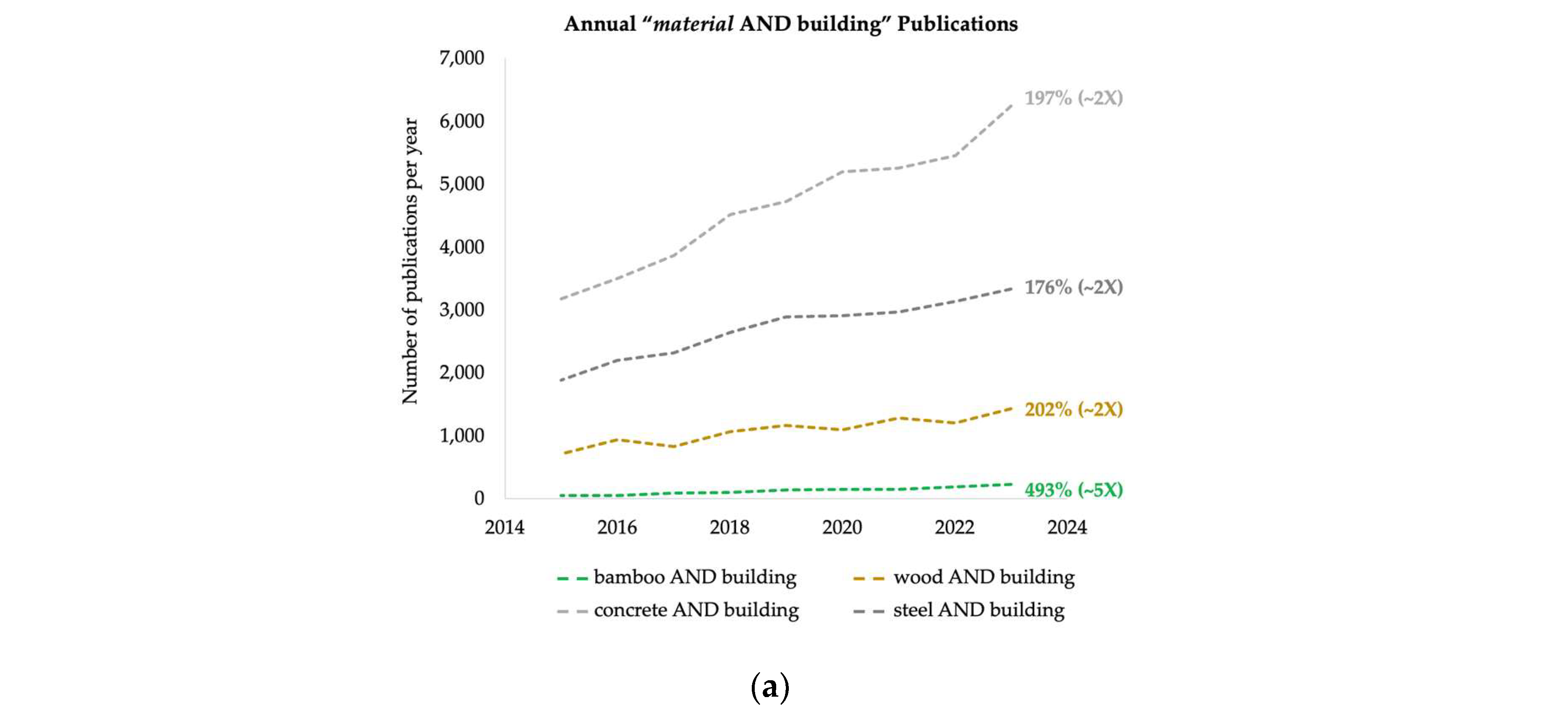
The relatively small proportion of bamboo-based building articles compared to that of the three conventional materials parallels the observed lack of widespread adoption of bamboo in the built environment today. If we use research as a forward-looking indicator of where market activity is occurring, this analysis aligns with what we are seeing in the real world today, i.e., limited acceptance of bamboo building materials. To understand how this picture has been changing over time, we examined the period that approximates the post-Paris Agreement period (2015 to 2023), where presumably focus on carbon friendly building would be rising. As seen in Figure 3, the total amount of new “bamboo AND building” research remains absolutely small compared to that of the three traditional materials. However, the year-over-year growth in the rate of publications of “bamboo AND building” over the approximate post-Paris Agreement period is more than double (5x) that of the other three traditional materials, which generally cluster around a 2x increase in publications.
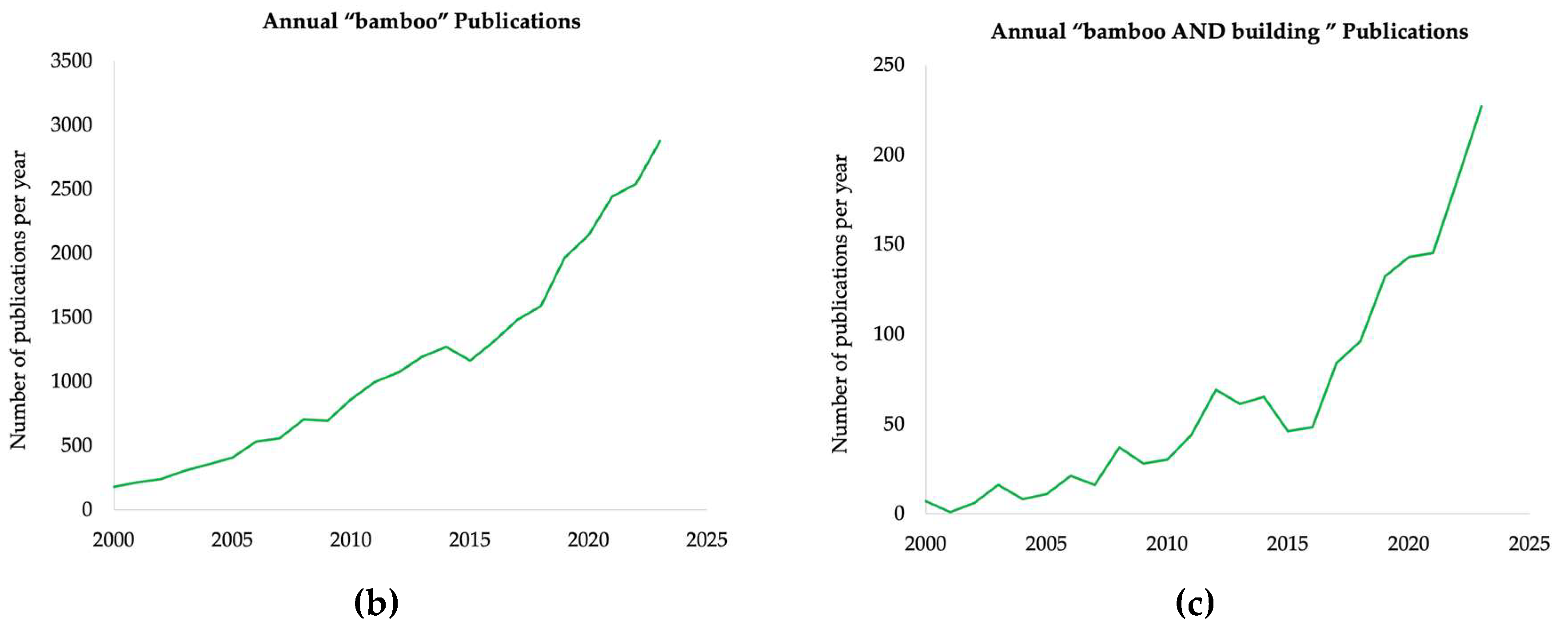
Figures 3b and 3c present the annual number of publications starting in 2000 for both “bamboo” (3a) and “bamboo AND building” (3c). Figure 3c shows a rapid increase in “bamboo AND building” starting in 2015. This outsized increase in the annual publication rate, relative to wood, steel and concrete, is worth noting and examining. Since the Paris Agreement, increasing attention has been placed on the built environment’s role in greenhouse gas production, responsible for 37% of total global greenhouse gas emissions [15]. Until now, most of the progress in the sector has been made on reducing the “operational carbon” of a building while solutions for reducing the “embodied” carbon emissions from the design, production and deployment of building materials have lagged far behind [16]. Fast-growing bamboo has emerged as a potential solution, as evidenced by the significant increase in research. From these observations two questions arise: (1) How does research interest in bamboo compare to interest in other biogenic building materials, which we address next. And (2) if bamboo shows so much promise, why haven’t we seen increasing adoption rates of the same proportion?

2.2. Comparative Analysis of Bamboo with Other Biogenic Building Materials

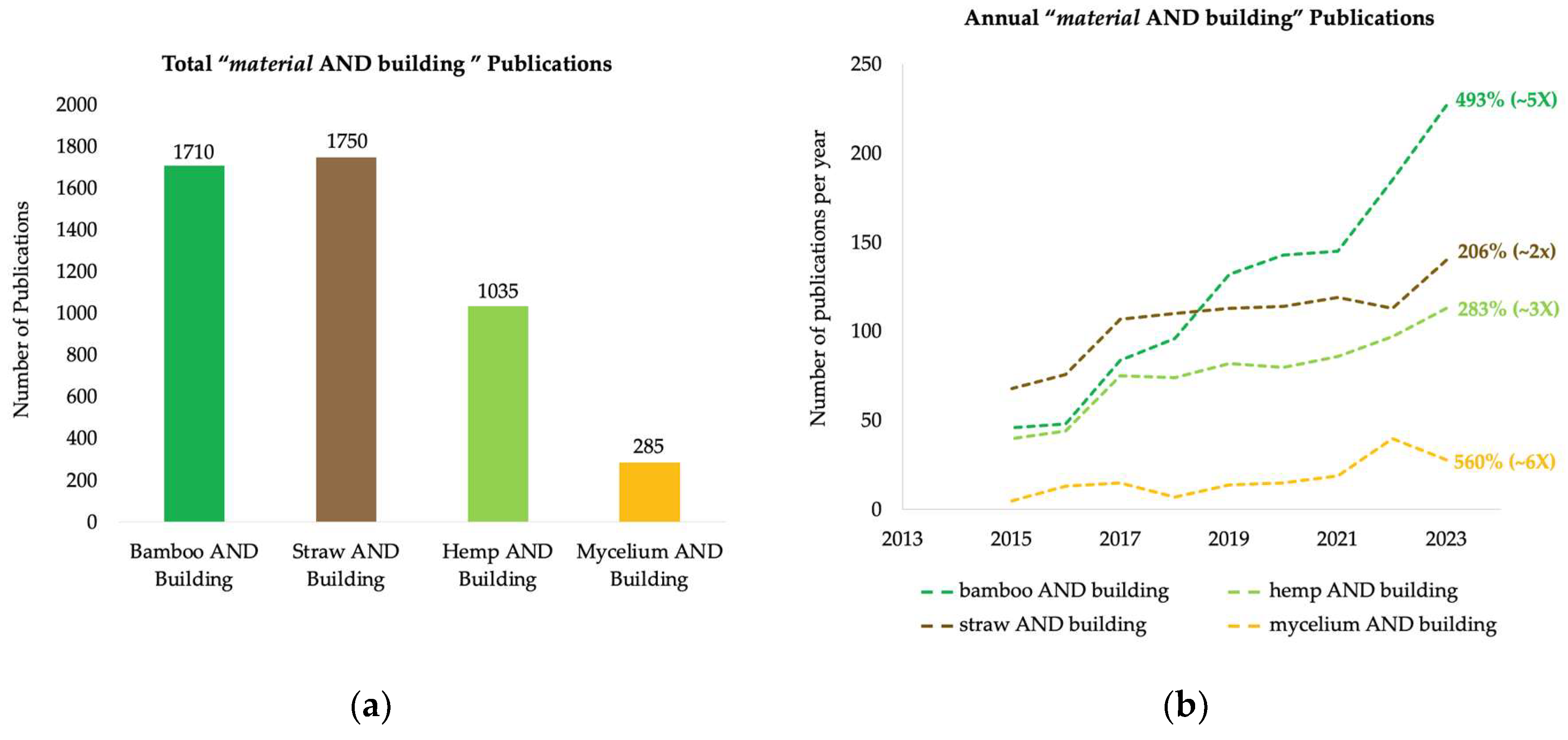
At least three biogenic materials, in addition to bamboo, are now being advanced to help decarbonize buildings. We completed an additional search of the Scopus database for publications related to straw, hemp and mycelium. Figure 4a shows total number of publications for each biogenic material with the “material AND building” search argument ” since 2015. The total articles published for “straw AND building” and “bamboo and building” in the post-Paris Agreement period are essentially equal. However, “hemp AND building” and “mycelium AND building” having progressively lower results.
All four biogenic materials can play meaningful roles in potential decarbonization of the built sector. First, in various fabrications, each of the four can serve as a low or negative embodied carbon insulation material. Second, bamboo, straw and hemp can also serve as basic load bearing components in low load/low-rise applications. Bamboo has figured in rural housing for centuries through whole-pole construction techniques. Straw bale use dates back to late 19th century in the United States with a revival starting in the 1970’s. Hemp also dates back to at least the 19th century and is now pursued largely as hempcrete, a biocomposite of hemp with a lime binder. Mycelium, when used as a filler in block or brick that grows out post installation, can also play a role in low-load structural applications, but to a more limited degree. The relatively small number of identified titles for “mycelium AND building” in Figure 4a suggests both limited application but also possibly growing interest for mycelium as a frontier building material.
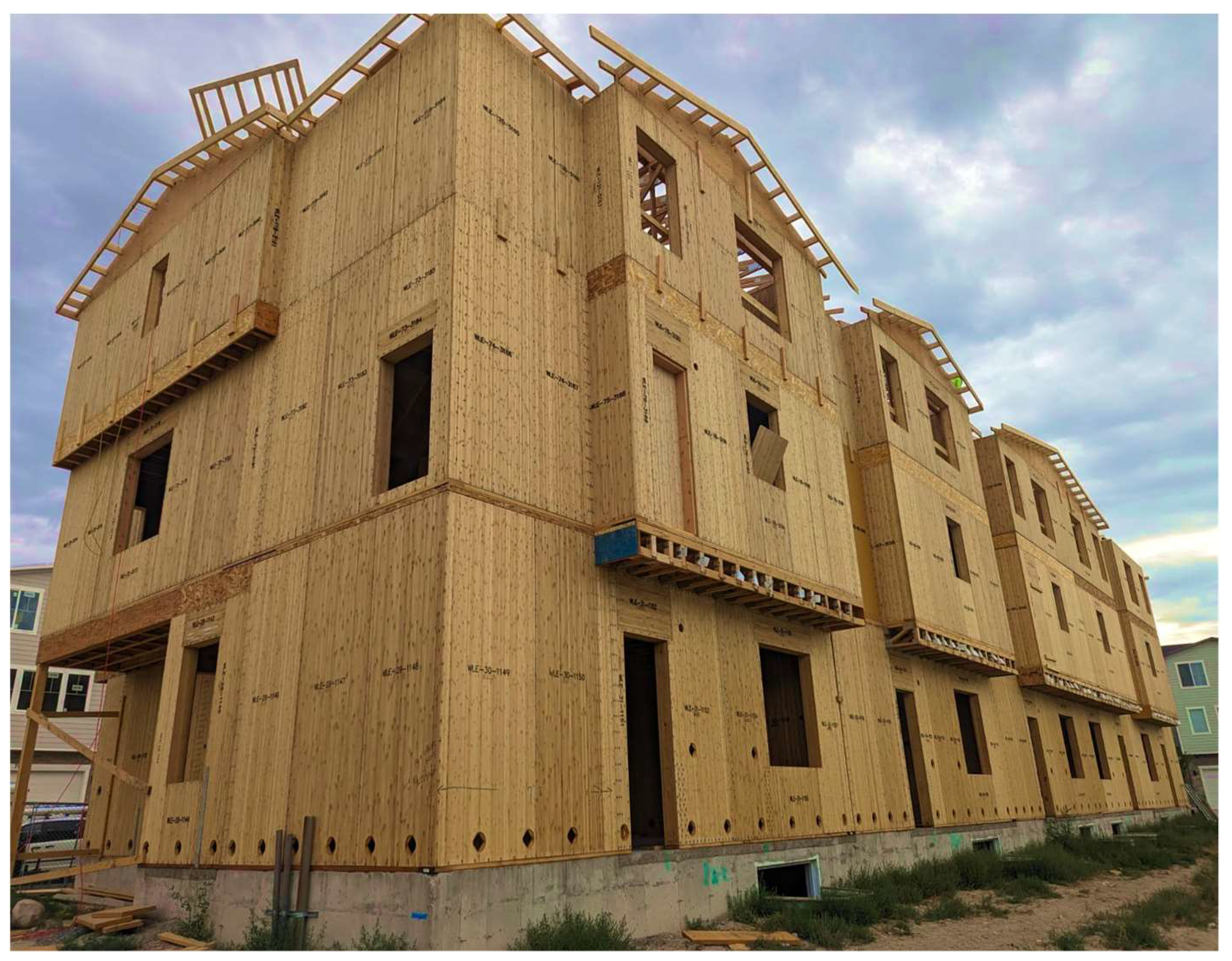
Of these newer biogenic materials, straw, hemp and mycelium are not well-suited for structural, load-bearing applications above 1 or 2 stories, requiring supportive timber frames when used in taller load bearing structures [17,18,19,20,21]. Only timber bamboo holds the promise for structural load bearing use in low-rise as well as mid-rise, high-rise and large span commercial structures, thereby representing a larger scale opportunity for contributing to decarbonization of buildings compared to staw, hemp and mycelium. Accordingly, the following review is limited to the comparison of wood and bamboo as the primary biogenic fibers. Figure 5 provides early evidence of bamboo’s full promise as a structural framing material in a three- story multifamily building. This structure uses an International Building Code and International Residential Code compliant product, approved for up to five stories, from Global Bamboo Technologies (doing business as BamCore).

2.3. Bibliometric Network Analysis Using VOSviewer

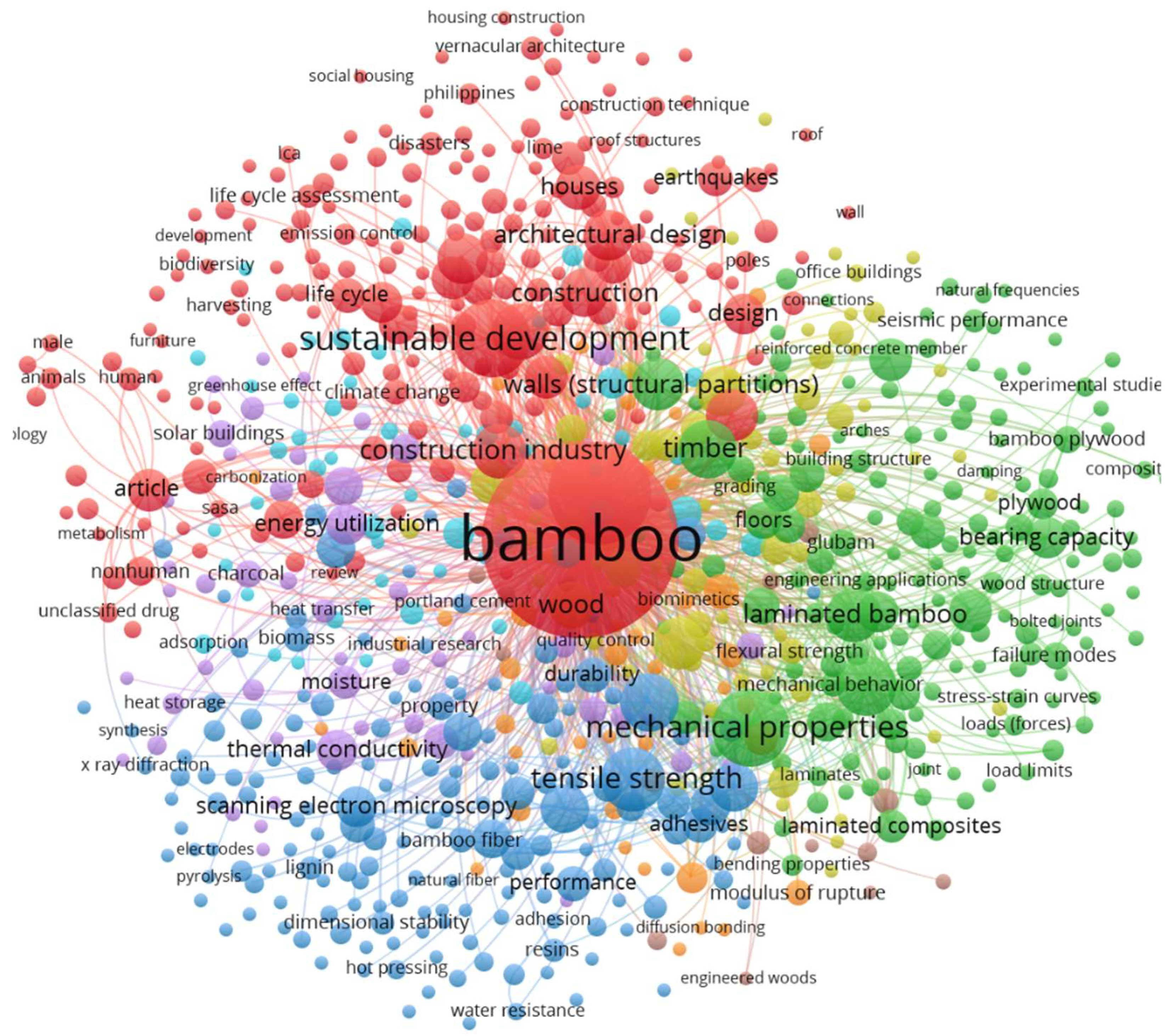
By conducting bibliometric network analysis, we are able to gain deeper insight into the additional research topics that co-present with the “bamboo AND buildings” search of the Scopus database. We used VOSviewer, a tool designed for constructing and visualizing bibliometric networks. VOSviewer facilitates the creation of bibliometric visualizations, enabling the analysis of research trends by mapping keywords from academic publications. In the visualizations, each node represents a keyword, with the size of the node (and its accompanying text) reflecting the frequency of the keyword’s occurrence within the documents; larger nodes indicate more frequently occurring keywords. Keywords like “construction industry,” “sustainable development,” and “mechanical properties” are larger, indicating their significant roles in the context of bamboo in building applications. The edges, or lines connecting the nodes, represent the co-occurrences of keywords within the same documents. While the thickness of these lines ideally indicates the strength of the co-occurrence—with thicker lines representing stronger relationships—this may not be easily discernible due to the large amount of data. The software quantifies these relationships, but for clarity, we present the overall network structure in the visualization.
The visualization is also color-coded into different clusters, where each color represents a group of keywords that are more closely related to each other based on their co-occurrence patterns. This clustering helps in identifying and interpreting the main research themes and trends within the field of building materials. In total, this methodology provides a visual representation of the research landscape, highlighting the interconnectedness of various research topics and identifying key areas of focus in building materials research.
Figure 6 presents the visualization of the “bamboo AND buildings” keyword analysis. Bamboo is located at the center with various networks surrounding it that display the keywords co-occurring within the color-specified networks. As mentioned, the colored clusters signify groups of related keywords that frequently appear together in the literature, suggesting strong linkages.
Sustainable Development and Construction (Red Cluster): This cluster, depicting topics related to bamboo’s role in sustainable development, includes 192 keywords with high link strength. Major sub nodes include construction and construction industry, architectural design, houses, life cycle, and life cycle assessment. Together, these sub nodes tie bamboo building materials to the broader context of sustainable development. It highlights bamboo’s application in building houses, walls, and other architectural elements, emphasizing sustainable and vernacular architecture. The environmental benefits and lifecycle considerations of using bamboo in construction are underscored, highlighted by keywords like emissions control and biodiversity.
Bamboo Products Characterization (Green Cluster): This cluster, broadly covering the mechanical properties of bamboo such as its strength, durability, and suitability for construction purposes, includes 166 items with high link strength. Major sub nodes include laminated bamboo, bearing capacity, plywood, timber, failure modes, seismic capacity, flexural strength, and mechanical behavior. Of the machinal properties, tensile strength appears the most prominent, likely due to the observation that at the microscopic level the tensile strength of bamboo exceeds that of steel, generally, which likely reflects bamboos relatively long crystalline sections of its alpha cellulose polymers. The visualization explores bamboo products such as glubam, plybamboo, or bamboo plywood and performance analysis such as bearing capacity, seismic performance, and tensile strength. Research in this cluster investigates the structural and framing applications of bamboo, understanding its strength and durability, and the various techniques to reinforce bamboo materials.
Adhesives, Resins, and Scientific Aspects (Blue Cluster): This cluster includes 165 items with high link strength. The node depicts topics related to adhesives and resins and the scientific aspects of bamboo, due likely to the necessary conversion of bamboo natural conical shape into rectangular dimension required for wide scale adoption. There are major sub nodes like performance, scanning electron microscope (SEM), bamboo fiber, and lignin. These sub nodes suggest research that delves into the importance of adhesives and resins in bamboo products, the study of lignin and fibers, and the microscopic analysis of bamboo’s properties, highlighting the impact of resins on its performance and structural integrity.
Energy Utilization (Purple Cluster): This cluster, including 88 items with high link strength, depicts topics clustered within energy utilization. Major sub nodes include thermal conductivity, charcoal, moisture, and solar buildings. Research in this cluster covers the thermal properties of bamboo, its use in energy-efficient buildings, and its potential as a renewable energy source, highlight bamboo’s role in energy conservation, from conserving energy in buildings to being used as a feedstock for charcoal. Additionally, X-ray techniques are frequently employed in this category to analyze the structural and thermal properties of bamboo, aiding in the development of more efficient energy utilization methods.
The bibliometric visualization shows various emerging topics and research areas, such as the use of bamboo in architectural design, its mechanical properties, and its role in sustainable development. The presence of terms related to modern construction materials and techniques, like “laminated bamboo” and “plywood,” indicates ongoing innovations in the use of bamboo.

3. The Climate and Load Bearing Promise of Timber Bamboo

3.1. Comparative Carbon Footprint of Timber Bamboo

The largest near-term opportunity to drive the built environment toward net zero is in the low-rise (one- to five-story) residential building sector (including single and multifamily housing), which is the largest segment of the buildings construction market [22]. Numerous recent studies have focused on the superior carbon footprint of wood as a biogenic building material when compared to the traditional extractive materials of steel, concrete, and other extractive masonry products [22,23,24,25]. However, when timber bamboo is placed alongside wood, the case for biogenic materials improves dramatically. The factual carbon benefit of using biogenic material comes not from storing previously harvested carbon in a building. Rather, it comes from regrowing the biogenic materials that were harvested. Prior growth is retrospective and provides no incremental carbon capturing benefit going forward. Regrowth provides the prospective benefit that recoups emissions from harvesting and manufacturing and can continue to reduce atmospheric CO2 into the future. The optimal case is to utilize biogenic fibers that regrow as fast as possible post harvest. When this is done in repeated annual cycles, the process becomes an efficient form of “carbon farming.”
The key to carbon farming with timber bamboo lies in the annual regeneration of harvested bamboo culms, which obviates the primary driver for clear-cutting practices in most silvacutlure. Once a natural bamboo forest or plantation is mature (+/- 6 to 9 years), up to 20% of the standing culms can be harvested annually. Simplistically, this results in a first rotation for timber bamboo to be the average of 6 to 9 years (7.5 years) plus that average of time to complete a harvest at 20% per year (2.5 yrs) for a first time to harvest of 10 years and then every 2.5 years thereafter, recognizing that timber bamboo is not seldom clear cut and each cut culm regenerates within one year. In contrast, wood resources take decades longer to reach harvestability, and the decades long rotation cycle of slower growing wood species is driven by fiber economics more than carbon storage. Thus, it is when tallying both the gross captured carbon of the plantation and the periodic stored building carbon that timber bamboo far surpasses the carbon storage benefit of traditional framing timber [26].
To secure the benefit of carbon farming with any biogenic material, the resulting harvested fiber must be durably stored, as is the case with structural building materials. While storing carbon in buildings for as short as 30 years can reduce the risk of hitting near-term climate tipping points, realistic service lives for newly constructed buildings, at least in the US, exceed 90 years or more [27]. Storage in buildings where the function is strictly architectural, such as flooring or wall coverings, is less reliably durable since these applications are subject to periodic updating and remodeling based on the current building’s owner and their tastes and objectives. In addition to non-structural applications, timber bamboo is also used as a feedstock for shorter lived products like pulp products, including paper and cardboard. While this has the benefit of sparing wood forest resources, it does not directly mitigate climate change by durably storing the sequestered carbon as is the case with long service life buildings.
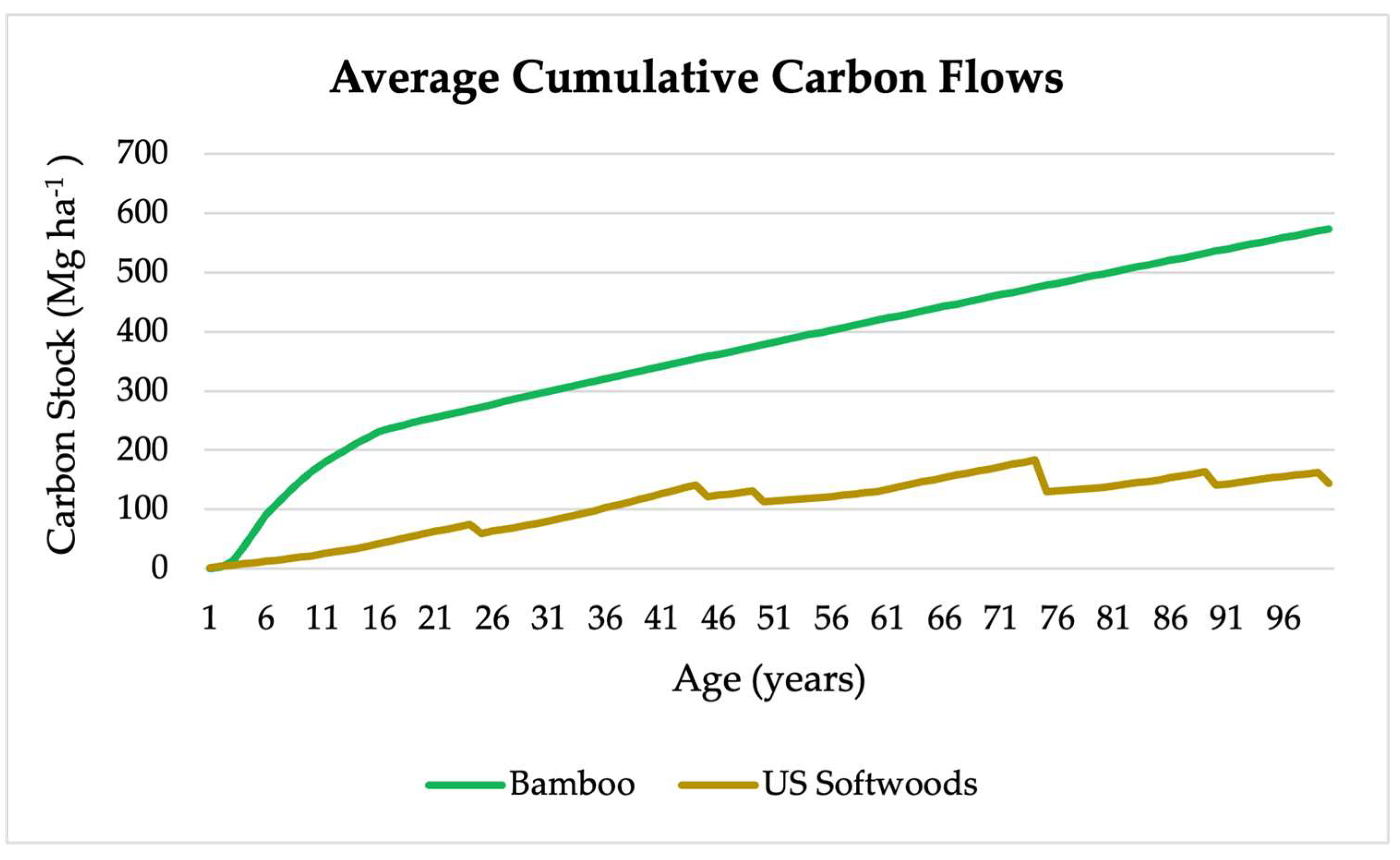
Our prior publication compared the carbon farming potential of three species of timber bamboo with three species of North American grown framing timber (Hinkle, 2019). This analysis converted the differential growth, production efficiencies and durable building component storage into a single Carbon Benefit Multiple. The results show that a collection of timber bamboo species, when incorporated into durable building materials, can provide a carbon benefit that was as much as 5x that of the collection of three commonly used North American softwoods. These cumulative carbon flows, averaged across the three species of each fiber, are illustrated in Figure 7. For timber bamboo, the accumulation begins early and is continuous due to the repeated practice of annual partial harvesting and production of harvested wood products (HWPs). For wood (with rotation periods ranging from 25 to 75 years), the accumulation of captured carbon takes far longer and remains a lower level than for timber bamboo. The periodic declines in cumulative carbon capture are the result of emissions that occur at harvest due to disruptive clear-cutting practices. Ultimately, our analysis concluded, on average, a hectare of timber bamboo can accumulate 429 Mg C ha-1 more than wood, nearly five times as much. Timber bamboo’s superior carbon benefit from fast, early growth and annual partial harvesting is visibly evident.
An earlier report comparing a single species of Chinese bamboo and fir reached a similar conclusion about the superiority of timber bamboo to sequester and store atmospheric carbon. The analysis compared a newly established Moso bamboo plantation to a Chinese Fir planation with two harvesting rotations over a 60-year period. Their analysis found after 60 years, the calculated total carbon accumulation for the Moso bamboo plantation was 217 t C/ha compared to only 178 t C/ha for the Chinese Fir [28]. They concluded that Moso bamboo can contribute to carbon sequestration in a similar way as Chinese Fir, provided that the harvested biomass is turned into durable structural building materials that continue to store carbon for long periods, which is not yet a common use practice for Chinese Moso bamboo.
As a consequence of its fast growth rate, timber bamboo achieves high amounts of annual carbon sequestratopm. Numerous studies have quantified and examined the annual carbon sequestration potential of bamboo forests and plantations without regard to the harvesting and durable storage, estimating rates as high as 24 Mg ha-1 yr-1 and showing annual carbon sequestration for some bamboo species can higher than some fast-growing tree species such as Acacia auriculiformis and Eucalyptus camaldulensis [29,30]. When considering the total accumulated stock of carbon, bamboo total ecosystem carbon (TEC) may exceed that of some wood forests, but not all forests in general. High estimates of TEC of bamboo land reaches 392 Mg C/ha while types of wood plantations reach 429 Mg C/ha and wood forests reach up to 699 Mg C/ha [31]. Critical to consider, however, is the silvacultural management practice. In an unmanaged bamboo plantation, the quantity of sequestered carbon can be half that of a rapid-growing tree plantation [32]. This leads us to consider an important distinction between (a) the accumulated standing stock of captured CO2 that is reached once a forest or plantation matures and (b) the repeated annual partial harvests that can consistently drive additional carbon sequestration. The key to successful the long-term carbon sequestration of bamboo is a combination of periodic harvesting and ensuring the harvested fibers are turned into long-lived products.

3.2. Comparative Mechanical Properties of Timber Bamboo

Given that the durability objectives of biogenic carbon removal and storage are best achieved in the load-bearing structure of a building, the more load a carbon storing biogenic material can bear, the more structural roles it can serve and therefore the more potential it has to remove and durably store atmospheric carbon. Load capacity requirements in a building are established by interaction of mechanical properties from the one or more components providing the structural frame. Each of the individual mechanical properties can vary by bamboo or wood species. For comparing timber bamboo to traditional building materials, we draw the mechanical properties from the literature covering a single species, Dendrocalamus asper, when processed via a slat based manufacturing. D. asper has generally superior mechanical properties and is widely grown around the globe. It is native to SouthEast Asia, naturalized in Africa and South America and now being introduce into Europe and North America. Dozens of studies have reported on its superior mechanical properties in the published literature [1,33,34,35,36,37].
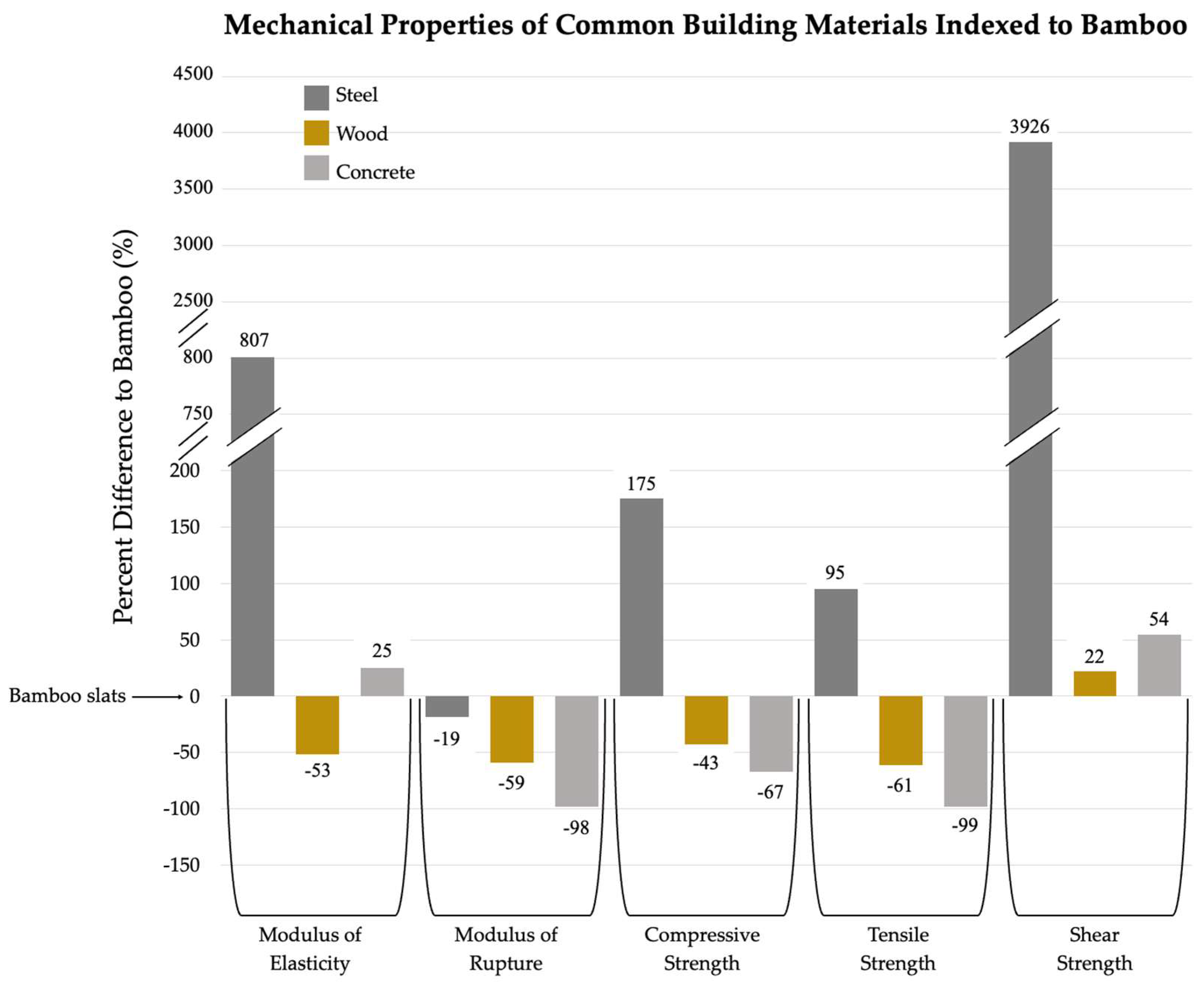
Figure 8 illustrates the relative values of five mechanical properties for steel, concrete and wood by indexing them to slat-formed D. asper. (See Appendix Two for a complete table of comparative mechanical values.) As shown, compared D. asper, wood possesses lower mechanical values ranging from 61% for tensile strength to 43% for compressive strength. Compared to concrete, D. asper possesses higher mechanical values across three of the five properties, with concrete’s Modulus of Rupture bineg 98% less than that of bamboo and tensile strength 99% less. Only for shear strength does timber bamboo possess a lower value. Despite bamboos broad superiority compared to wood and concrete, when compared to steel, D. asper as a slat formed material possesses significantly lower value for four of the five mechanical properties. However, several parties globally are exploring the remodeling of bamboo fibers at a molecular level in order to improve the structural capacity of bamboo relative to steel. A range of approaches is being actively researched, all of which are derived from the mostly unused practice of wood densification. As discussed below, this development may be a long-term key to unlocking the commercialization of bamboo.
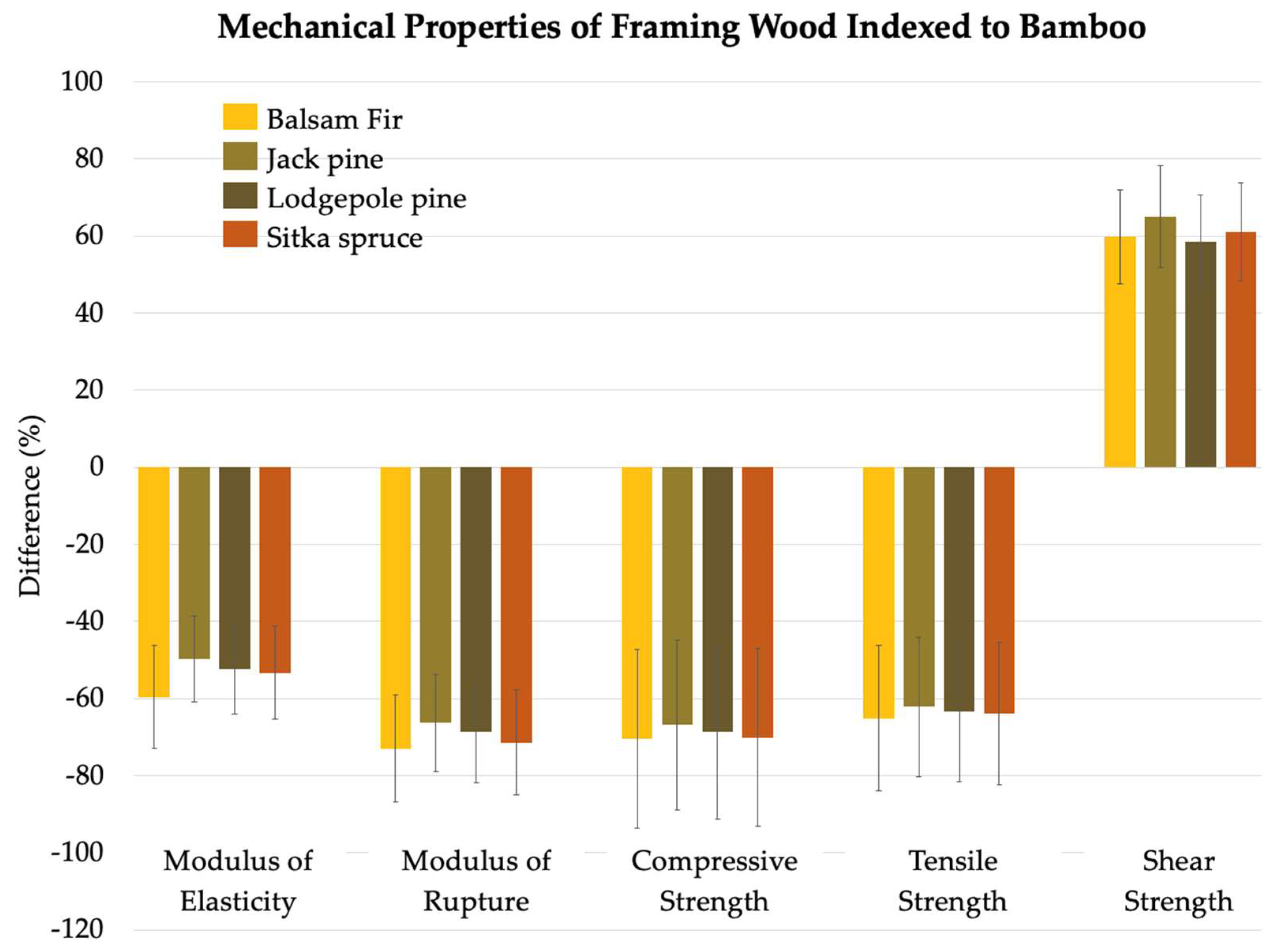
The largest decarbonization gains will be achieved by the substitution of biogenic building materials for extractive building materials. But decarbonization can still be furthered advanced by using those biogenic materials that favor lower carbon footprints when the alternative materials are each structurally adequate. Given that many different species of framing timber are used in the Northern Hemisphere, in Figure 9 we compare D. asper’s slat-derived mechanical properties to four species of commonly used framing lumber. As shown in Figure 9, compared to the wood species for four of the mechanical properties, D.asper provides superior performance by generally 50% to 70%. Only for in-plane shear are the four woods superior to D.asper, generally by about 60%. In structural design, a building component is usually providing more a single load bearing role. Thus, generally speaking, it is a combination of the property values, not a single value, that contributes structural utility. Thus, timber bamboo in the form of slat-derived D. asper, projects to a new generation of adequately strong, faster growing, biogenic building materials as a substitute for broadly used, slower growing framing species.
The excellent carbon and load bearing promise of timber bamboo reviewed above should be held in the context of the heterogeneity of all biogenic fiber. And in the case of the unique morphology of tubular timber bamboo culms (stalks), the precise location of the removed slat’s origin can impact the final mechanical properties. Table 1, reviews five morphological or environmental facts than can modify (up or down) the reported mechanical properties of a timber bamboo slat. Generally, these modifications are not more than 25%. Of note is the inclusion of the nodal section versus selective use of only the internodal section. In products that are engineered, most of these various impacts can be averaged out to little or no effect.
In Table 1, we have reviewed only the two main attributes (carbon and load capacity) that are required to drive building decarbonization with biogenic materials. Since our focus here is on the drawing from the published literature those factors generally that can drive adoption of biogenic fibers into durable buildings, Table 2, summarizes a fuller range of material advantages and disadvantages that can drive selection or substitution among the traditional building materials and bamboo, including: carbon footprint (above), mechanical properties (above), cost, installation and labor requirements, mouldability, locality of sources, fire resistance, and risk of degradation due to pests or moisture.
Importantly though, it is the hollow cylindrical shape of D. asper (and nearly all timber bamboo) that inherently limits the ready application of these superior mechanical values in conventional Western-styled building products [38,39]. Moreover, despite the promise of decarbonizing with timber bamboo, three broader commercial limitations, typical of new or developing products, must also be overcome.

4. Adoption of Engineered Structural Bamboo Building Products – Problems & Possibilities

Globally, neither timber bamboo building components specifically nor low-embodied carbon buildings generally are afforded any material subsidiary, or any significant benefit from favorable regulatory mandates and do not garner any ‘green premium’ to help subsidize production or adoption [40]. This analysis recognizes the advent of several carbon subsidizing organizations (e.g., Aureus Earth, Climate Vault and Built By Nature); yet, they remain in their infancy, have not yet, and potentially never will, become mainstream relative to size of the global built environment. Thus, despite timber bamboo’s beneficial carbon and mechanical attributes presented here, bamboo will not fulfill its carbon and sustainability promises without becoming a straightforward and fully cost-effective commercial substitute for current building components. That many building components do not fully price in their external climate costs, unfortunately, has no attenuating impact on their present and continuing usage. Based on our review, analysis and experience three overarching problems or constraints must be addressed for bamboo building components to become broadly adopted in order to fulfill bamboo’s climate promise: (1) extremely small and disbursed raw material feed stock with no efficient harvesting technology, (2) low-yielding and cost inefficient processing resulting in premium pricing relative competitive building products, and (3) the sub-optimal product-market fit that prevents bamboo from expanding it applications, in order to ultimately compete with steel.

4.1. Raw Material Acquisition

Globally there are 4 billion ha in wood forests and plantations, including boreal, temperate, subtropical and tropical domains [41]. Over 1 billion ha are used for primarily production, including 131 million ha of directly managed plantations. In addition, about 750 million ha are designated as multiple use which often includes production. Together over 40% of total forests are accessed and used as resources for humanity. For bamboo, just 35 million ha of total bamboo resources exist globally (FAO, 2020) with 2.4 million can be thought of as mixed use while less than 204,000 ha in total is identified as non-government commercial plantations [41,42]. (Note, Chinese participants did not provide data to this survey.) The difference between wood and bamboo active resources can be quantified in both absolute hectarage (bamboo is less than 1% of wood), production and mixed use hectarage (bamboo is 0.14% of wood) and direct commercial resource utilization hectarage (bamboo plantations are about 0.15% of wood plantations). This stark contrast highlights significant differences in the availability of commercial plantations and the efficient technologies to exploit them. Evident commercial opportunity has driven effective investment in harvesting and production efficiency relative to wood to date while generating only paltry investment interest to date relative to bamboo. Standardized wood construction is nearly 200 years old and now houses about 12% of humanity (urban and rural) [43].

4.1.a. Limited Commerical Plantations

Problems. The small absolute hectarage of commercially managed bamboo defeats the build-up of scale operations that is required for efficient operations. The above reported 204,000 hectares of commercial bamboo plantations globally was held across 330 entities with an average holding size of only about 620 hectares. In North America alone there are twenty non-government entities with wood holdings or management of ranging from 404,000 to 4.404 million hectares, with an average holding of about 987,000 hectares or 1600x the average size of the individual bamboo holdings [44]. These small holdings are spread across more than 20 countries, essentially defeating any scale operations or management as is found with wood forestry operations. Smallholder bamboo farmers face difficulties in selling their product due to problem of small scale economics, including limited bargaining power, poor market connectivity, and inadequate information on prices and quality standards [45]. Without consolidated commercial-scale feedstocks, dispersed harvested material must be transported and consolidated to central processing centers, further increasing costs from transportation and handling. Additionally, the possibly higher-valued bioproducts that can be produced from the parts of the culm not utilizable for engineered structural products, such as biochar, become too costly to collect and transport during the harvest if their processing machinery is not co-located at the harvest site.
Possibilities. Support to overcome small-sized plantation can now be seen from two areas. First, national commitments to use bamboo for land restoration has been reported twice by member states of International Bamboo and Rattan (INBAR). In November 2014, a first statement was released reporting that 40 member states of INBAR “pledged” at least 5 million ha of land restoration using bamboo to be completed by 2020 [46]. Subsequently, a second report was issued in 2021 indicating member states “planned” to restore up to 5.7 million ha using bamboo by 2030 [47]. To the extent that these restoration projects, if completed, are used to promote bamboo carbon capture followed by durable storage, these could produce significant scale opportunities to farm and store atmospheric carbon with bamboo. No updates since 2021 have been reported. Second, limited use of carbon credits is now supporting the establishment of larger timber bamboo plantation, as seen in the carbon credit scheme advanced by EcoPlanet Bamboo begun in Nicaragua in 2013 and reverified in 2021 with new projects underway in Rwanda, South Africa, Ghana and the Philippines, targeting in total to remove over 12,000,000 tons. Others are now following with smaller programs. These opportunities to expand plantation size will only improve the ultimate carbon storage to the extent that the plantations are harvested to produce products with durable carbon storage as in structural building components.

4.1.b. Harvesting Technology

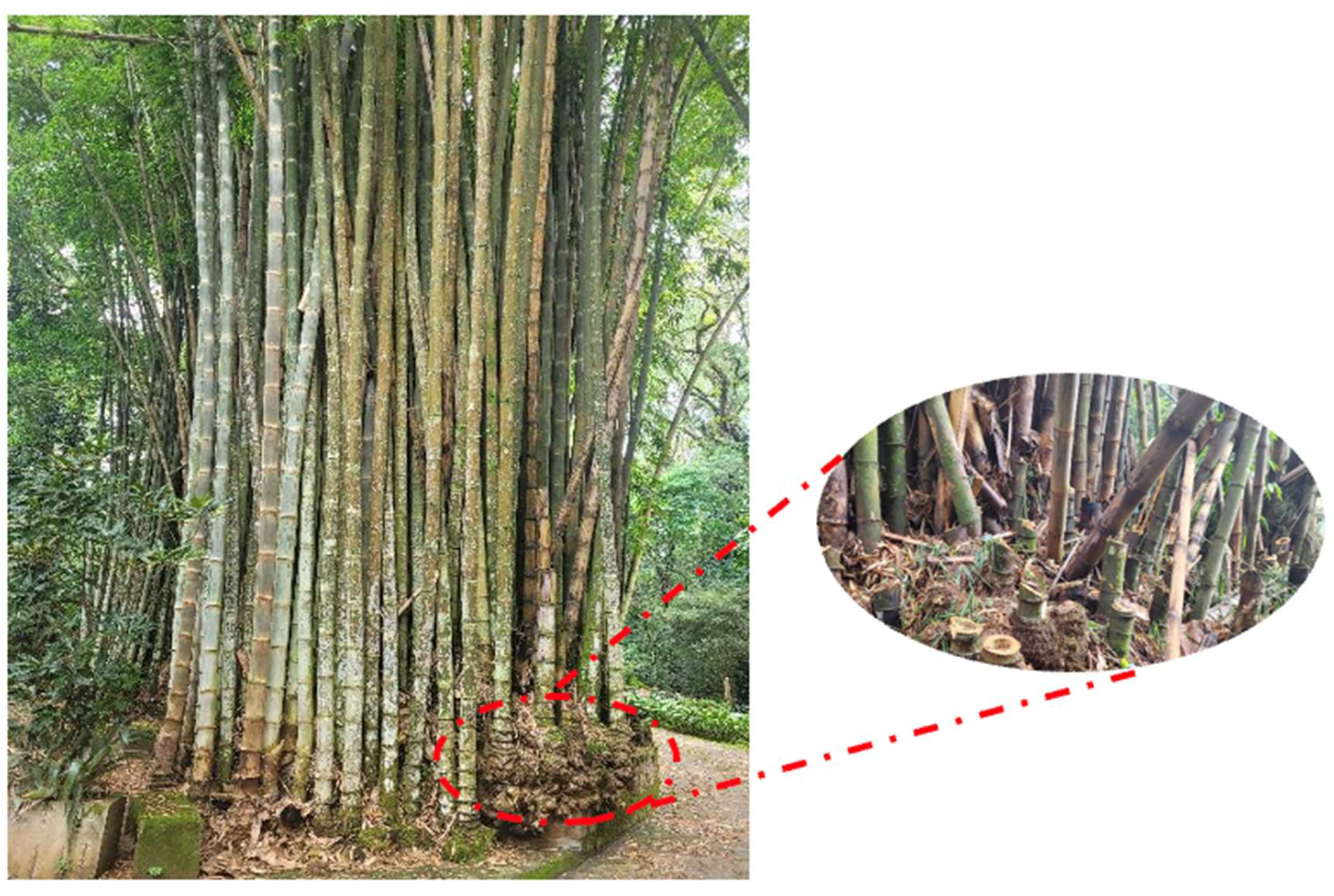
Problems. The lack of scale in commercial bamboo growing operations is accompanied by a lack of investment in harvesting technology, which is critical to achieve a cost effective raw material supply chain. Broadly, wood has enjoyed both the history and scale to drive continuing development of harvesting technologies resulting in mechanization that accomodates species, size (diameter and height), terrain, transport, stem v. non-stem selection and full automation, all of which is decreasing harvest cost and time and increasing yield recovery [48]. The technological development is now advancing fully autonomous harvesting machines capable of harvest multiple trees at the same time with human operation [49]. Unlike most commercial wood harvesting, bamboo is not clear-cut, rather it is selectively partially harvested each year, complicating the approach to harvesting. Today, bamboo harvesting remains almost exclusively manual. Effective and efficient harvesting of timber bamboo must accommodate the culm location while interharvesting, known growth patterns (clump v. runner), and identification of age by color (preferred harvesting ages generally 2-4 years). Moreover the skill and techniques of the harvesting and location of the harvested culms within a clump directly impacts following year harvest yields and final value [50]. Figure 10 illustrates an unharvested clump, which becomes difficult to partially harvest, and a poorly harvested clump which will produce reduced volumes in following years [51,52,53].
In conjunction with harvesting, initial processing (as with wood) should occur in the plantation where limbs, leaves and other biomass are stripped away from the main culm. The main culm is then cut to length for either transportation or product manufacturing. To achieve more efficient transport culms should also be split longitudinally to reduce the internal culm voids, which will significantly increase the transportation payload.
Possibilities. In conjunction with harvesting, initial processing (as with wood) occurs in the plantation where limbs, leaves and other biomass are stripped away from the main culm. The main culm is then frequently cut into transportable lengths. To achieve more efficient transport culms can also be split longitudinally to reduce the resultant shipping of the internal culm voids.
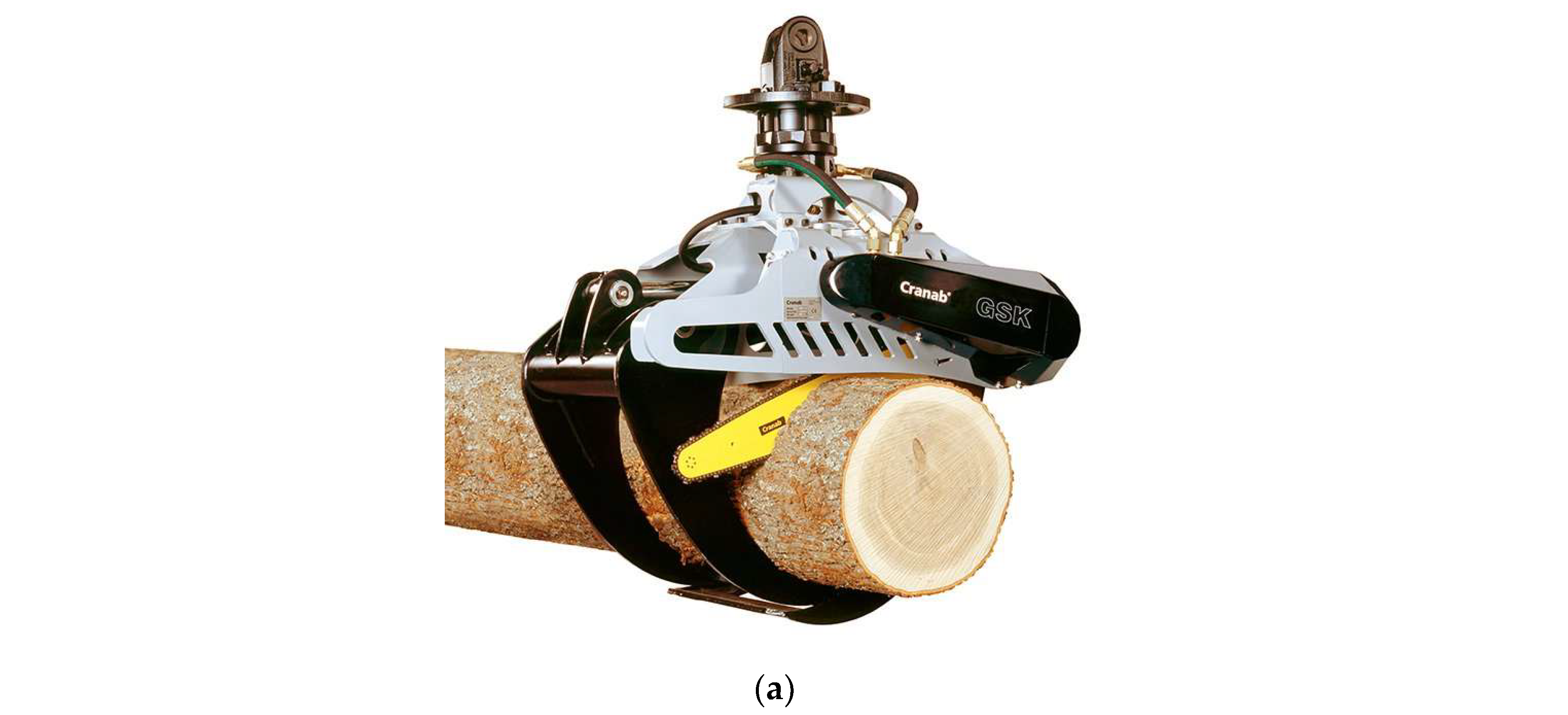
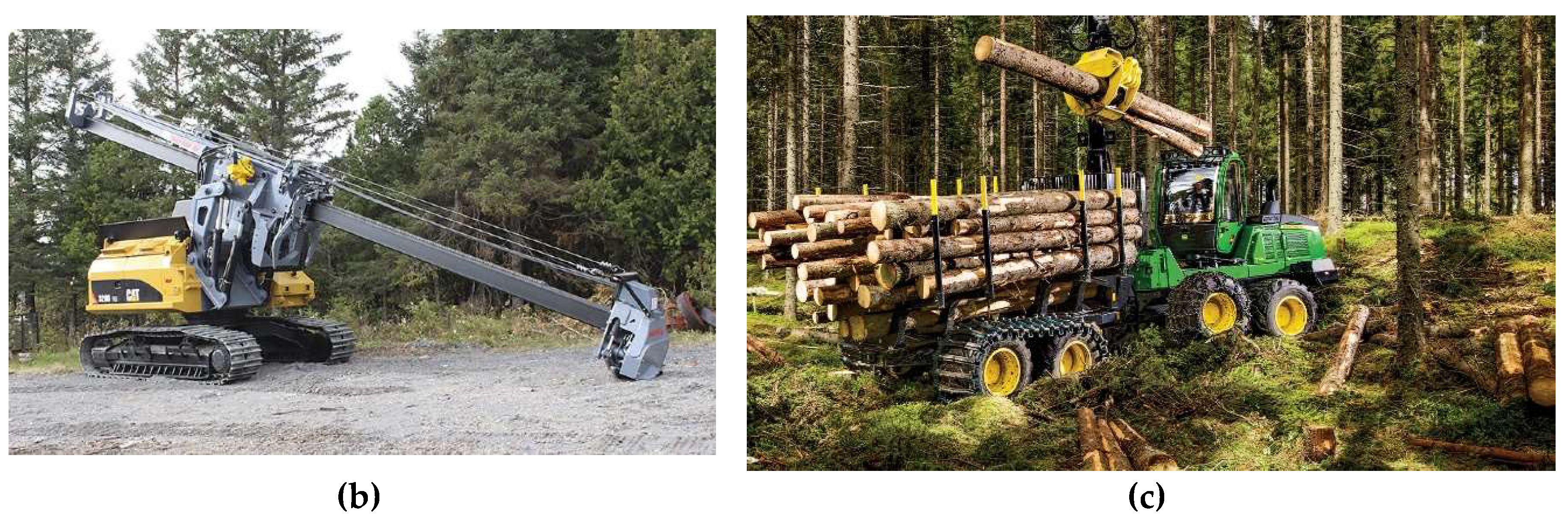
The possibility to improve harvesting techniques and efficiency derive from both re-tooling existing wood harvesting equipment and applying new evolving scanning technology [54]. Relative to re-tolling wood harvesting equipment, the three main candidates redesigning grapple saws, delimbers and forwarders to accommodate timber bamboo. In many forestry operations a grapple saw is used to hold and cut a tree stem or bole. A separate or attached delimber then pulls the cut bole through knives surrounding the shank of the bole to remove the limbs. The forwarder then hauls the cut and delimbed boles to the transfer point for transfer to the mill. Successful re-tooling of wood harvesting tools will need to accommodate five unique features of timber bamboo: (1) the culm’s maximum diameter would be in the range of 20-23 cm whereas plantation harvesting of wood will accommodate diameters far greater than 100 cm, (2) the culm, as a hollow tube, can be lighter than a solid wood bole, (3) for optimal harvesting practices the crosscut will usually be fairly close to the ground, just above the first or second node, (4) the limbs on a bamboo culm, like many but not all trees, are clustered at the top of the culm and unlike trees they are always small in diameter because timber bamboo does not grow subdominant leads off of the culm, and (5) the bamboo, with its high silica content epidermis and higher density, often will be harder to cut and produce faster dulling of the saw teeth. Redesigning or retooling for these differences generally will need to produce a smaller more precise grappling operation and crosscuts while tightly surrounded by other culms. With the branches clustered at the top and of small diameter, the delimbing can be run more quickly with less power. Finally, the forwarder can be fitted with a quartering star splitter to turn the empty tube into four quarter rounds for tight packing in the forwarded cargo bed.
In addition to redesigning physical harvesting equipment, two scanning technologies promise material increases in yield recovery, one at the clump level and one at the culm level. Productive bamboo clumps can be dense (see Figure 11a), even when well maintained. Identifying optimal culm targets will benefit from a combination of drone-based laser wavelength reflectance using terrestrial laser scanning (TLS) a derivative technology of Light Detection and Ranging (LiDAR) to determine culm age and a geo-spatial LiDAR application to determine accessibility within the clump. TLS has already been proposed for bamboo yet remains unadopted [55]. Spatial LiDAR is widely used in forestry but also has not been adopted in today’s small scall bamboo harvesting operations [56]. When the LiDAR data is saved for each clump within a plantation, an optimal harvest order map can inform harvesting decisions this year to optimize harvest results in later years. A harvest order map will include an optimized location/height for the crosscut including when the crosscut is placed higher than that which would optimize the cult culm for the purpose of optimize full clump value. It is expected that the optimizing mapping would be done as a recursive logistic regression. The harvest order map can then be fed to the forwarder, and its grapple saw to affect the optimal mechanization of the execution of the harvest order map. Since average biomass per cut unit is far less with timber bamboo than typical saw logs, the potential benefits from pursuing the harvest efficiency gains will provide larger results than in the context of wood.

4.2. Processing and Manufacturing

Problems. Challenges to processing structural engineered bamboo building components efficiently arise from three unique aspects of timber bamboo: high specific gravity impacting adhesion, physical shape and morphological properties that impact yield recover and small unit processing size impacting processing efficiency.
Relative to adhesion, bamboo’s high specific gravity (density), which presents as hardness, coupled with low porosity and permeability, increases the difficulty in achieving component bonding in the engineered products. Research has identified bamboo impact of resin content on the structure, water resistance, and mechanical properties of high-density bamboo scrimbers and highlighted the need for optimal adhesive ratios to achieve desired characteristics [57]. Additional studies emphasized the significance of adhesive engineering is necessary to overcome the surface properties, gluability, and bond quality challenges of bamboo materials [58,59]. Overall, adhesive percentage and resin rate play a critical role in shaping the properties and performance of bamboo and wood-based products.
Relative to physical shape and morphology, efficient processing or transforming timber bamboo into a dimensional wood-like material must overcome bamboo’s: (1) tubular structure, (2) hard waxy outer layer with high silica content, (3) significant tapering at the top, (4) bulges at the nodes, and (5) variable thickness of the culm wall. Based on today’s customary strip (or slat) producing technologies, the current yield recovery of timber bamboo is only around 40%, with the majority of the biomass the usually handled as low-value fuel [60]. A study of the impact of epidermis removal to improve bonding reports yield recovery (raw material to panel) for bamboo-based plywood at 35-48%, panel products at 50% and flooring at only 20-25% with each of these compared to composites made from wood at 60% [61].
Relative to unit processing, the conventional strip or slat processing to produce most engineered bamboo products today, relies on first milling and then adhering a much larger number of component pieces than is typical for engineered wood, thereby directly increasing the processing time and thus cost relative to wood products.
Possibilities. The opportunity to improve adhesion properties, like that of redesigning wood harvesting tools, is a reasonably direct application of continual product development that simply substitutes timber bamboo for wood in well understood specifications. Examples include manipulating resin and solids content to enhance the bonding interaction and overall quality [58,59].
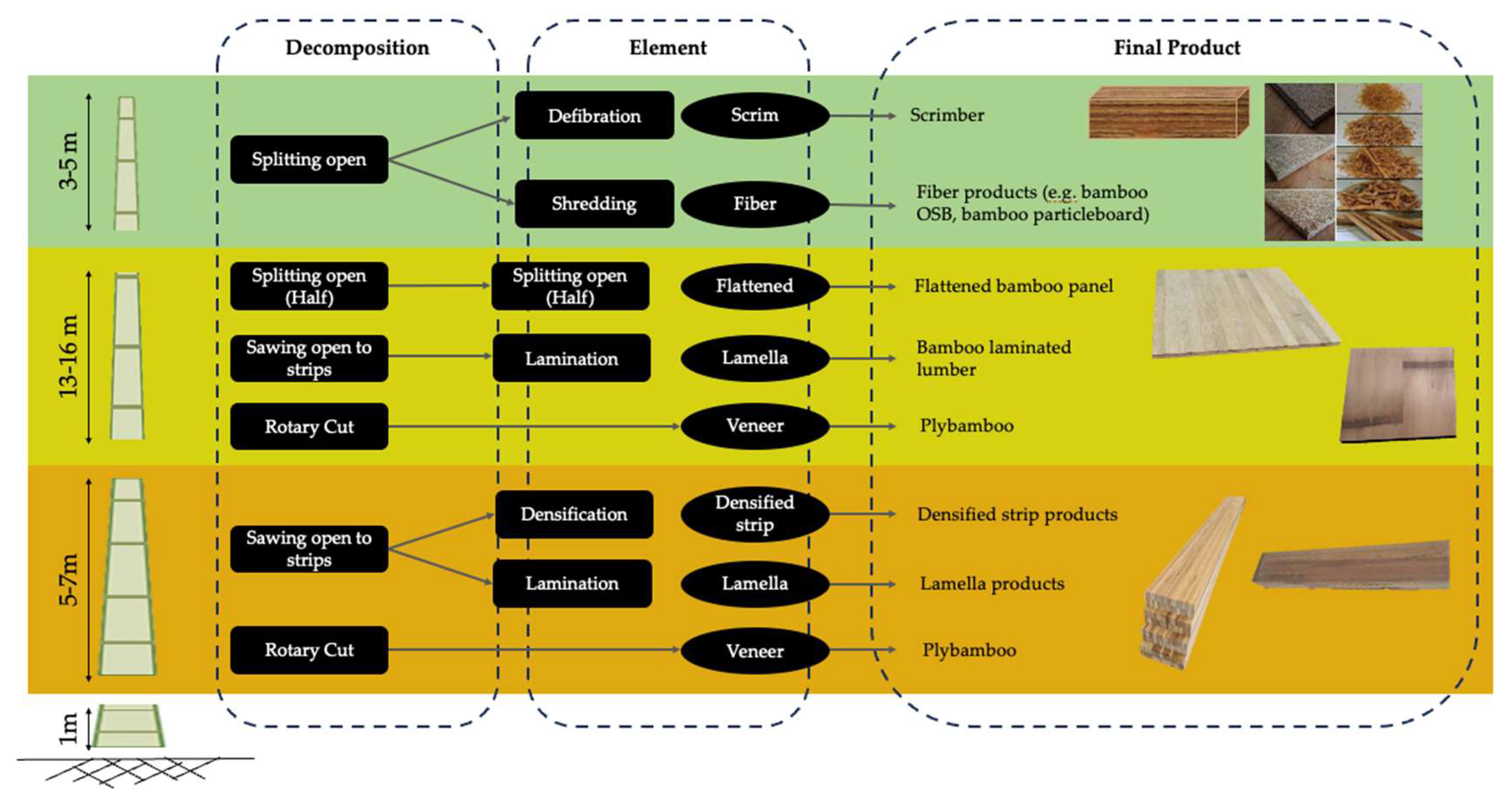
Given strip-based engineered bamboo’s low yield recovery, improvements addressing its unique physical shape and morphology may provide the largest gains in recovery and production efficiency. The use of species generic knowledge can drive a property-based multi-product recovery that either produces more products more efficient from a segmenting of the culm or by remodeling the fibers within bamboo to achieve a materially higher recover. Unlike trees that annually accrete secondary growth circumferentially with the spring sap wood, bamboo culms complete their primary growth in the first single growing season which establishes the final diameter of the culm producing a high degree of radial symmetry. Axially, from bottom to top the fiber density, culm wall thickness, density and circumference change differently based on the species. By decomposing these axial gradients, the highest yielding products can be produced from each section. It is also possible to shift from strip based milling processes to densification, fiber remodeling processes. We illustrate this multi-product and multi-process strategy for a three-section axial segmentation of Dendrocalamus asper, in Table 3.
This table provides a detailed breakdown of the optimal processing strategy for bamboo culms, dividing the culm into three distinct sections—top, middle, and bottom. Each section is characterized by its size, decomposition method, element extraction process, final product, and suitability for specific applications.
Section:
  • Top: 3-5 meters in length. This section is best suited for splitting open the bamboo culms, which are then defibrated or shredded to produce scrim and fiber. Due to its fibrous nature and high strength, the top section is ideal for producing scrimber and other fiber-based products.
  • Middle: 13-16 meters in length. This section can be split open, sawed into strips, or rotary cut. The resulting elements include flattened strips, laminated lamella, or veneer, which are then used to create laminated bamboo lumber (LBL) and veneers. The balanced properties of the middle section make it ideal for high-quality veneers and laminated products used in flooring, paneling, and furniture.
  • Bottom: 5-7 meters in length. This section is processed by sawing into strips or rotary cutting. The elements produced include densified strips or lamella, which are used to create structural components and densified strips for construction applications. The bottom section, being the densest and strongest, is best suited for structural components.
In our proposed property-based, multi-product, multi-process strategy, Dendrocalamus asper culms are processed based on their height and properties to produce a range of products, optimizing the utilization of bamboo and reducing the need for resin and other resources. The severe yield loss that occurs in mill processing of strips can be materially reduced via densification processing in place of strip-based mill processing. However, densified timber bamboo products have not yet been developed into standard structural building components. Still densification is identified as a possible remedy for yield loss and as a driver to expand timber bamboos target product-market fit. Figure 12 illustrates the decomposition, element extraction, and final products for different sections of the bamboo culm.
By decomposing the bamboo culms into specific sections and processing them according to their unique properties, this multi-product approach allows for the production of high-quality products while minimizing waste and resin usage. This optimized strategy enhances material efficiency, reduces costs, and improves the environmental footprint of bamboo processing. By utilizing the variation in properties along the bamboo culm, a multi-product approach can be developed to maximize the economic viability of bamboo processing. This strategy involves producing multiple products from different sections of the bamboo culm, each optimized for its specific properties.
However, while this multi-product approach can yield high-quality products and improve material utilization, it is not yet economically feasible to produce a wide range of products due to the need for diverse processing streams and the associated high investment costs. Instead, focusing on products that require similar processing techniques and equipment can streamline operations and reduce the capital expenditure required for machinery.

4.3. Sub-Optimal Market Application

Problem. If improvements in raw material and processing costs do not allow strip-based timber bamboo building components to directly compete with alternative low-cost, low-rise components from wood, masonry and concrete, then timber bamboo’s product-market fit must be re-positioned. Densifying bamboo, as mentioned above, may improve yield recovery, but it’s an underdeveloped technique possibly produce a new generation of extremely strong bamboo passed building components. Unfortunately, densification is in early development and most, formulations usually results in a toxic by-product waste stream produced in the process.
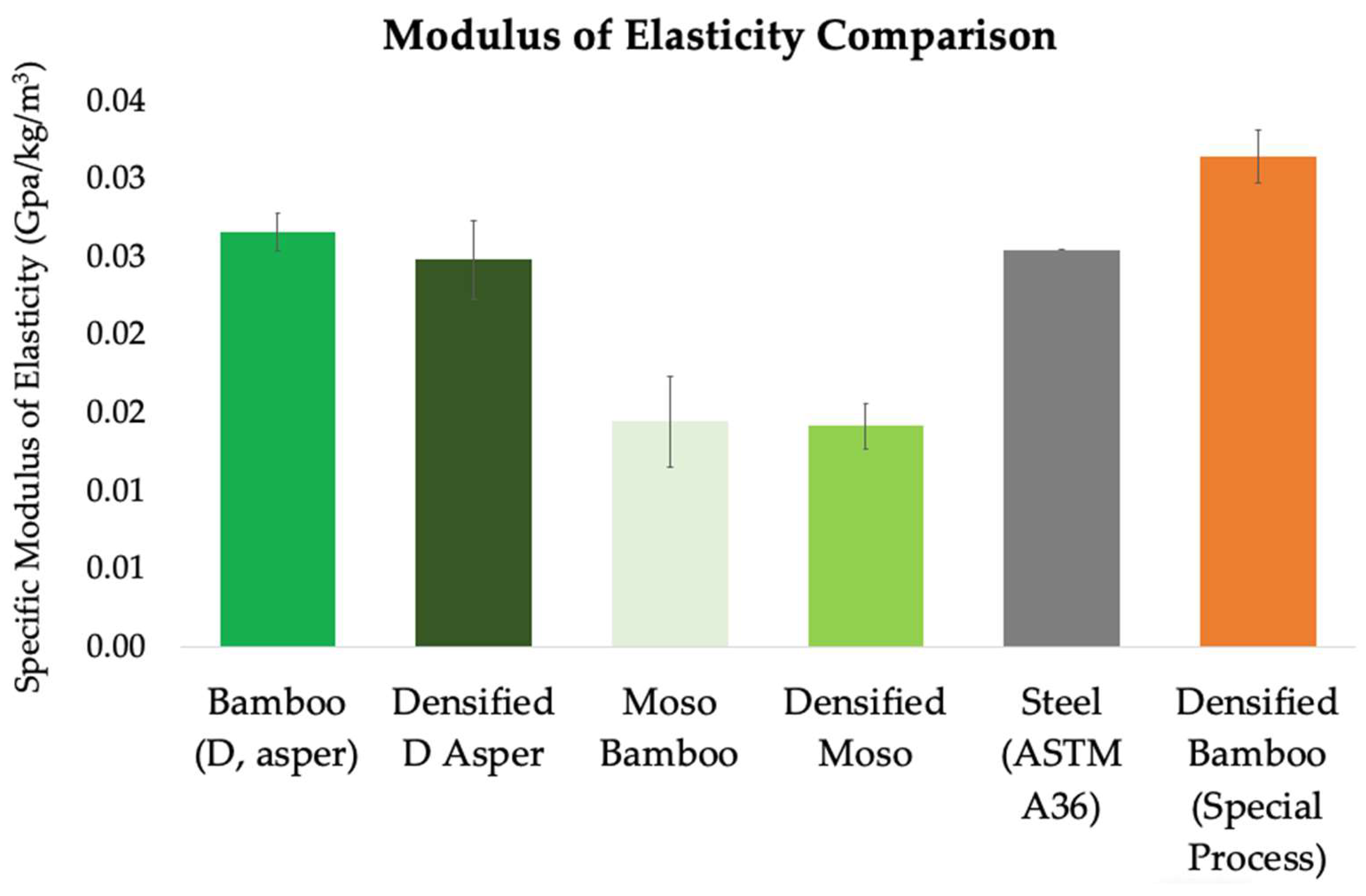
Possibilities. Bamboo’s superior mechanical properties generally are not fully utilized in the low-rise market. Densification not only improves yield recovery, but it can potentially remodel bamboo’s constituent polymers to exhibit significantly increased load capacity allowing it to compete outside the low-rise market, potentially with steel. Figure 13 displays the tested Modulus of Elasticity (MOE) for regular and densified Dendrocalmus asper and Moso bamboo species. The MOE for steel is shown second from the right and for a recently published densification process developed for Dendrocalamus asper. The new densification “special process” results in an MOE that is 15% greater than steel [62].
The process used for the “special process” involves three main steps: flattening, delignification, and hot compression. Initially, the bamboo stems were softened with high-pressure steam and then flattened using a horizontal pressing apparatus. This was followed by chemical treatment with a boiling aqueous solution of NaOH and Na₂SO₃ to partially remove lignin and hemicellulose from the bamboo’s cell walls. This treatment caused swelling and softening, leading to a well-aligned cellulose fiber structure. The final step was hot-pressing, which compressed the parenchyma cells and lumens, reducing the bamboo’s thickness by approximately 70%. This densified bamboo exhibited a tensile strength up to 1 GPa and a flexural strength of 400 MPa, surpassing the strength of natural wood, engineered steel, and metallic alloys. The process also led to a density increase from 0.80 to 1.35 g/cm³.
The remarkable improvement in biogenic mechanical properties due to this densification process positions bamboo as a possible alternative to traditional multi-rise and commercial construction materials like steel. If research and development into these new processing methods continue, bamboo could effectively compete with steel and other high-carbon footprint materials, significantly contributing to the decarbonization of the broader built environment. Still a caution remains as densification may have more similarities to pulp extraction than to mill processing suggesting a possible separate industrial structure from today’s strip-based mill processing.

5. Potential Carbon Impact

In the above we have identified the promise, problems and possibilities of adopting timber bamboo-based structural building components to help mitigate the high embodied carbon of the built sector. Finally, this section provides a preliminary projection for the prospects of climate change mitigation if timber bamboo adoption succeeds meaningfully. Globally, embodied carbon from annual construction produces around 11% of total carbon emissions [63], or 4.2 billion tonnes annually [64]. Combining sizes of urban and rural areas with corresponding occupancies by building typologies [43,65], we extrapolated an estimated 80% of new construction globally is variously cementitious based (masonry, cement block, and reinforced concrete), translating to roughly 3.4 billion tonnes of annual embodied carbon. If 850 million tonnes of this, approximately 25% of annual cementitious building, is converted to timber bamboo, the result would a reduction of 690 million tonnes per year (using cement block carbon intensity as the simplifying metric to represent the large and varied cementitious category). Assuming such a substitution does not begin until 2035 but then persists to either 2050 or 2100, the summed annual emission reductions would be approximately 10.3 billion tonnes and 44.6 billion tonnes, respectively. This represents an outstanding potential for bamboo to serve as a biobased building decarbonization solution.

6. Conclusions

The intractability of high embodied carbon in buildings is well recognized across the materials research, structural design and construction communities. Durable building components derived from four fast-growing biogenic materials--mycelia, hemp, straw and bamboo--are often cited as tools to help mitigate the built world’s high embodied carbon. In this article, we completed a bibliometric literature review showing that interest in timber bamboo and construction research is growing faster and now producing more publications annually than any of the other three biogenic materials. Driving this research interest, undoubtedly, is timber bamboo’s unique promise of potent carbon capture and superior structural capacities which are confirmed and then compared favorably to conventional building materials generally and to softwood framing timber specifically. Still, neither timber bamboo nor any of the other three biogenic fibers has achieved any material adoption into mainstream building. We examine the problems timber bamboo must overcome to begin meaningful adoption, including lack of scale in the supply chain, inefficient and costly production and suboptimal product-market fit. For each of these problems, we present possible solutions, none of which alone will be sufficient and all of which together may be necessary. Finally, to test the climate significance of adopting biogenic fibers to substitute for the conventional high embodied building components, we analyzed a 25% substitution of cementitious building for bamboo-based components assuming the substitution started in 2035 and continued either to 2050 or to 2100, two climate milestones. This necessarily abbreviated analysis suggests that 690 MT of CO2 might be saved annually by this substitution resulting in total annual emission reductions of 10 GT by 2050 and 45 GT by 2100.

Author Contributions

Conceptualization, H.H.; methodology, H.H. and M.K.; validation, H.H. and M.K.; formal analysis, H.H. and M.K.; investigation, H.H., M.K. and K.C.; resources, M.K. and K.C.; data curation, M.K. and K.C.; writing—original draft preparation, H.H. and M.K.; writing—review and editing, H.H. and K.C.; visualization, M.K. and K.C.; supervision, H.H.; project administration, K.C. All authors have read and agreed to the published version of the manuscript.

Funding

This research received no external funding.

Institutional Review Board Statement

Not applicable.

Informed Consent Statement

Not applicable.

Data Availability Statement

The data supporting the findings of this study are available in publicly accessible locations, as cited in the References section of this paper. These data sources include previously published and publicly available datasets. No new data were created specifically for this study. All data utilized can be obtained directly from the referenced publications and resources.

Acknowledgments

Not applicable.

Conflicts of Interest

The authors declare no conflicts of interest.

References

  1. Chaowana, P. (2013). Bamboo: An alternative raw material for wood and wood-based composites. Journal of Materials Science Research, 2(2), 90. [CrossRef]
  2. Prajapati, G., & Dua, S. (2022). A Critical Review of Bamboo as a Building Material for Sustainable Development. Journal of Sustainable Construction Engineering and Project Management, 4(3), 1-8.
  3. Kartono, B., Nik Ahmad Ariff, N. S., Purnomo, A., & Ezran, M. (2023). Bamboo material for sustainable development: A systematic review. E3S Web of Conferences, 444, Article 01011. [CrossRef]
  4. Sil, A. (2022). Bamboo – A green construction material for housing towards sustainable economic growth. International Journal of Civil Engineering and Technology (IJIET), 13(3), 1–9. [CrossRef]
  5. Manandhar, R., Kim, J.-H., & Kim, J.-T. (2019). Environmental, social and economic sustainability of bamboo and bamboo-based construction materials in buildings. Journal of Asian Architecture and Building Engineering, 18(2), 49–59. [CrossRef]
  6. Goh, Y., Yap, S. P., & Tong, T. (2019). Bamboo: The emerging renewable material for sustainable construction. In Elsevier (Ed.), Comprehensive renewable energy. [CrossRef]
  7. Adier, M. F. V., Sevilla, M. E. P., Valerio, D. N. R., & Ongpeng, J. M. C. (2023). Bamboo as Sustainable Building Materials: A Systematic Review of Properties, Treatment Methods, and Standards. Buildings, 13(10), 2449. [CrossRef]
  8. Bundi, T., Lopez, L. F., Habert, G., & Zea Escamilla, E. (2024). Bridging housing and climate needs: Bamboo construction in the Philippines. Sustainability, 16(2), 498. [CrossRef]
  9. Panti, C. A. T., Cañete, C. S., Navarra, A. R., Rubinas, K. D., Garciano, L. E. O., & López, L. F. (2024). Establishing the characteristic compressive strength parallel to fiber of four local Philippine bamboo species. Sustainability, 16(3845). [CrossRef]
  10. Levina, A. G., & Utomo, M. M. B. (2023). Performance and development challenges of micro–small bamboo enterprises in Gunungkidul, Indonesia. Advances in Bamboo Science, 4, 100037. [CrossRef]
  11. Li, W., & He, S. (2019). Research on the utilization and development of bamboo resources through problem analysis and assessment. IOP Conference Series: Earth and Environmental Science, 300(5), 052028. [CrossRef]
  12. Wang, G., Zhang, W., Diao, X., Ji, M., Fei, B., & Miao, H. (2023). Analysis of Harvesting Methods of Moso Bamboo. Buildings, 13(2), 365. [CrossRef]
  13. Guerra, S. P. S., Oguri, G., Eufrade, H. J., Melo, R. X., & Spinelli, R. (2016). Mechanized harvesting of bamboo plantations for energy production: Preliminary tests with a cut-and-shred harvester. Energy for Sustainable Development, 34, 62–66. [CrossRef]
  14. Madhushan, S., Buddika, S., Bandara, S., Navaratnam, S., & Abeysuriya, N. (2023). Uses of Bamboo for Sustainable Construction—A Structural and Durability Perspective—A Review. Sustainability, 15(14), 11137. [CrossRef]
  15. United Nations Environment Programme and Yale Center for Ecosystems + Architecture. (2023). Building materials and the climate: Constructing a new future. Retrieved July 17, 2024, from https://wedocs.unep.org/20.500.11822/43293.
  16. McKinsey & Company. (2022, October 17). Reducing embodied carbon in new construction. McKinsey & Company. Retrieved December 27, 2024, from https://www.mckinsey.com/industries/travel-logistics-and-infrastructure/how-we-help-clients/global-infrastructure-initiative/voices/reducing-embodied-carbon-in-new-construction.
  17. Bitting S, Derme T, Lee J, Van Mele T, Dillenburger B, Block P. Challenges and Opportunities in Scaling up Architectural Applications of Mycelium-Based Materials with Digital Fabrication. Biomimetics (Basel). 2022 Apr 14;7(2):44. [CrossRef] [PubMed] [PubMed Central]
  18. Dessi-Olive J. Strategies for Growing Large-Scale Mycelium Structures. Biomimetics (Basel). 2022 Sep 11;7(3):129. [CrossRef] [PubMed] [PubMed Central]
  19. Yadav, M., & Saini, A. (2022). Opportunities & challenges of hempcrete as a building material for construction: An overview. Materials Today: Proceedings, 65(Part 2), 2021–2028. [CrossRef]
  20. Di Sarno, L., Albuhairi, D., & Peres Medeiros, J. M. (2024). Exploring innovative resilient and sustainable bio-materials for structural applications: Hemp-fibre concrete. Structures, 68, 107096. [CrossRef]
  21. Lecompte, T., & Le Duigou, A. (2017). Mechanics of straw bales for building applications. Journal of Building Engineering, 9, 84–90. [CrossRef]
  22. The Business Research Company. (2023). Construction Global Market Opportunities and Strategies to 2032. [PDF]. Published October 2023.
  23. Kumar, V., Lo Ricco, M., Bergman, R. D., Nepal, P., & Poudyal, N. C. (2024). Environmental impact assessment of mass timber, structural steel, and reinforced concrete buildings based on the 2021 international building code provisions. Building and Environment, 251, 111195. [CrossRef]
  24. Younis, A., & Dodoo, A. (2022). Cross-laminated timber for building construction: A life-cycle-assessment overview. Journal of Building Engineering, 52, 104482. [CrossRef]
  25. Ryberg, M. W., Ohms, P. K., Møller, E., & Lading, T. (2021). Comparative life cycle assessment of four buildings in Greenland. Building and Environment, 204, 108130. [CrossRef]
  26. Hinkle, H., McGinley, M., Hargett, T., Dascher, S. (2019). Carbon Farming with Timber Bamboo: A Superior Sequestration System Compared to Wood. BamCore. https://www.bamcore.com/_files/ugd/77318d_568cbad9ac2e443e87d69011ce5f48b2.pdf?index=true.
  27. U.S. Department of Commerce, Bureau of Economic Analysis. (2003). Fixed assets and consumer durable goods in the United States, 1925–99. Washington, DC: U.S. Government Printing Office.
  28. Yiping, L., Yanxia, L., Buckingham, K., Henley, G., & Guomo, Z. (2010). Bamboo and Climate Change Mitigation. INBAR Technical Report 32. International Network for Bamboo and Rattan (INBAR).
  29. Nath, A. J., Lal, R., & Das, A. K. (2015). Managing woody bamboos for carbon farming and carbon trading. Global Ecology and Conservation, 3, 654-663. [CrossRef]
  30. slam Sohel, M. S., Alamgir, M., Akhter, S., & Rahman, M. (2015). Carbon storage in a bamboo (Bambusa vulgaris) plantation in the degraded tropical forests: Implications for policy development. Land Use Policy, 49, 142–151. [CrossRef]
  31. Yuen, J. Q., Fung, T., & Ziegler, A. D. (2017). Carbon stocks in bamboo ecosystems worldwide: Estimates and uncertainties. Forest Ecology and Management, 393, 113-138. [CrossRef]
  32. Kuehl, Y., Henley, G., & Yiping, L. (Eds.). (n.d.). The climate change challenge and bamboo: Mitigation and adaptation (INBAR Working Paper No. 65). Edited by A. Benton. International Network for Bamboo and Rattan (INBAR).
  33. Kadivar, M., Gauss, C., Mármol, G., de Sá, A. D., Fioroni, C., Ghavami, K., & Savastano Jr., H. (2019). The influence of the initial moisture content on densification process of D. asper bamboo: Physical-chemical and bending characterization. Construction and Building Materials, 229, Article 116896. [CrossRef]
  34. Kadivar, M., Gauss, C., Stanislas, T. T., Ahrar, A. J., Charca, S., & Savastano, H. (2022). Effect of bamboo species and pre-treatment method on physical and mechanical properties of bamboo processed by flattening-densification. Materials Chemistry and Physics, 291, Article 126746. [CrossRef]
  35. Adam, N., & Jusoh, I. (2019). Physical and mechanical properties of Dendrocalamus asper and Bambusa vulgaris. Transactions on Science and Technology, 6(1-2), 95–101.
  36. Zakikhani, P., Zahari, R., Sultan, M. T. b. H. H., & Majid, D. L. A. A. (2017). Morphological, mechanical, and physical properties of four bamboo species. BioResources, 12(2). [CrossRef]
  37. Awalluddin, D., Mohd Ariffin, M. A., Osman, M. H., Hussin, M. W., Ismail, M. A., Lee, H.-S., & Abdul Shukor Lim, N. H. (2017). Mechanical properties of different bamboo species. MATEC Web of Conferences, 138, 01024. [CrossRef]
  38. Glória, G. O., Margem, F. M., Ribeiro, C. G. D., de Moraes, Y. M., da Cruz, R. B., Silva, F. A., & Monteiro, S. N. (2015). Charpy impact tests of epoxy composites reinforced with giant bamboo fibers. Materials Research, 18(Suppl 2), 178-184. [CrossRef]
  39. Siam, N. A., Uyup, M. K. A., Hamdan, H., Mohmod, A. L., & Awalludin, M. F. (2019). Anatomical, physical, and mechanical properties of thirteen malaysian bamboo species. BioResources, 14(2), 3925-3943. [CrossRef]
  40. Russ, N. M., Hanid, M., & Ye, K. M. (2018). Literature review on green cost premium elements of sustainable building construction. International Journal of Technology, 9(8), 1715-1725. [CrossRef]
  41. FAO. 2020. Global Forest Resources Assessment 2020: Main report. Rome. [CrossRef]
  42. WBO (2024). 2024 Global Bamboo Plantation Resource Survey Results Report.
  43. Daniell, J., Wenzel, F., Khazai, B., & Vervaeck, A. (2011). A country-by-country building inventory and vulnerability index for earthquakes in comparison to historical CATDAT damaging earthquakes database losses. Paper presented at the Australian Earthquake Engineering Society 2011 Conference, November 18–20, Barossa Valley, South Australia.
  44. Forisk Consulting. (2024, May 9). North America’s top timberland owners and managers: 2024 update. Retrieved December 31, 2024, from https://forisk.com/blog/2024/05/09/north-americas-top-timberland-owners-and-managers-2024-update/.
  45. Travasso, S. M., Thomas, T., Makkar, S., John, A. T., Webb, P., & Swaminathan, S. (2023). Contextual factors influencing production, distribution, and consumption of nutrient-rich foods in bihar, india: a qualitative study of constraints and facilitators. Food and Nutrition Bulletin, 44(2), 100-115. [CrossRef]
  46. World Resources Institute. (December 23, 2014). Rebranding bamboo: The Bonn 5 million hectare restoration pledge. Retrieved December 31, 2024, from https://www.wri.org/insights/rebranding-bamboo-bonn-5-million-hectare-restoration-pledge.
  47. King, C., van der Lugt, P., Thang Long, T., & Yanxia, L. (2021). Integration of Bamboo Forestry into Carbon Markets. International Bamboo and Rattan Organisation (INBAR).
  48. Picchi, G., Sandak, J., Grigolato, S., Panzacchi, P., Tognetti, R. (2022). Smart Harvest Operations and Timber Processing for Improved Forest Management. In: Tognetti, R., Smith, M., Panzacchi, P. (eds) Climate-Smart Forestry in Mountain Regions. Managing Forest Ecosystems, vol 40. Springer, Cham. [CrossRef]
  49. Lindroos, O., La Hera, P. X., & Häggström, C. (2017). Drivers of advances in mechanized timber harvesting: A selective review of technological innovation. Croatian Journal of Forest Engineering, 38(2), 243–258.
  50. Darabant, A., Rai, P.B., Staudhammer, C.L. et al. Designing and Evaluating Bamboo Harvesting Methods for Local Needs: Integrating Local Ecological Knowledge and Science. Environmental Management 58, 312–322 (2016). [CrossRef]
  51. Guan, Y., Li, S., Xiong, J., Xu, B., Liu, P., & Li, H. (2021). Design of bamboo cutting mechanism based on crack propagation principle. BioResources, 16(3), 5890-5900. [CrossRef]
  52. Wang, X., & Cheng, K. J. (2020). Effect of glow-discharge plasma treatment on contact angle and micromorphology of bamboo green surface. Forests, 11(1293). [CrossRef]
  53. Wu, S., Liang, L., Chen, F., Yang, Z., Zheng, Y., Wu, Y., Li, L., Lou, G., Dai, J., Pang, Y., Chen, H., Fang, Q., & Shen, Z. (2022). Improving the wet adhesive bonding of bamboo urea-formaldehyde adhesive using styrene acrylate by controlling monomer ratios. Journal of Applied Polymer Science. [CrossRef]
  54. Scurlock, J. M. O., Dayton, D. C., & Hames, B. R. (2000). Bamboo: an overlooked biomass resource? Biomass and Bioenergy, 19(4), 229-244. [CrossRef]
  55. Xu, W., Fang, Z., Fan, S., & Deng, S. (2022). Evaluation of the Moso bamboo age determination based on laser echo intensity. Remote Sensing, 14(2550). [CrossRef]
  56. GIM International. (April 26, 2023). LiDAR technology for scalable forest inventory. Retrieved December 31, 2024, from https://www.gim-international.com/content/article/lidar-technology-for-scalable-forest-inventory.
  57. Yang, Z., Meng, X., Zeng, G., Wei, J., Wang, C., & Yu, W. (2024). Effect of resin content on the structure, water resistance, and mechanical properties of high-density bamboo scrimbers. Polymers, 16(6), Article 797. [CrossRef]
  58. Liang, L., Zheng, Y., Wu, Y., Yang, J., Wang, J., Tao, Y., Li, L., Ma, C., Pang, Y., Chen, H., & et al. (2021). Surfactant-induced reconfiguration of urea-formaldehyde resins enables improved surface properties and gluability of bamboo. Polymers, 13(3542). [CrossRef]
  59. Abidin, W. N. S. N. Z., Al-Edrus, S. S. O., Hua, L. S., Ghani, M. A. A., Bakar, B. F. A., Ishak, R., Qayyum Ahmad Faisal, F., Sabaruddin, F. A., Kristak, L., Lubis, M. A. R., & et al. (2023). Properties of phenol formaldehyde-bonded layered laminated woven bamboo mat boards made from Gigantochloa scortechinii. Applied Sciences, 13(47). [CrossRef]
  60. Zheng, J., Zhi, Z., Zhang, E., Yu, Y., & Wu, Q. (2022). Design and evaluation of bamboo-based elastic cushion by human pressure distribution. In Frontiers in Artificial Intelligence and Applications: Design Studies and Intelligence Engineering (Vol. 347, pp. 321-328). IOS Press. [CrossRef]
  61. Wang, X., & Cheng, K. J. (2020). Effect of Glow-Discharge Plasma Treatment on Contact Angle and Micromorphology of Bamboo Green Surface. Forests, 11(12), 1293. [CrossRef]
  62. Li, Z., Chen, C., Mi, R., Gan, W., Dai, J., Jiao, M., Xie, H., Yao, Y., Xiao, S., & Hu, L. (2020). A strong, tough, and scalable structural material from fast-growing bamboo. Advanced Materials, 32(8), Article 1906308. [CrossRef]
  63. World Green Building Council. (2019). Bringing embodied carbon upfront. https://worldgbc.org/advancing-net-zero/embodied-carbon/?utm_source=chatgpt.com.
  64. Ritchie, H., & Roser, M. (2020). CO₂ emissions. Our World in Data. Retrieved from https://ourworldindata.org/co2-emissions.
  65. Ritchie, H., & Roser, M. (2020). CO₂ emissions. Our World in Data. Retrieved from https://ourworldindata.org/co2-emissions.
  66. Cabeza, L. F., Boquera, L., Chàfer, M., & Vérez, D. (2021). Embodied energy and embodied carbon of structural building materials: Worldwide progress and barriers through literature map analysis. Energy and Buildings, 231, 110612lysis. [CrossRef]
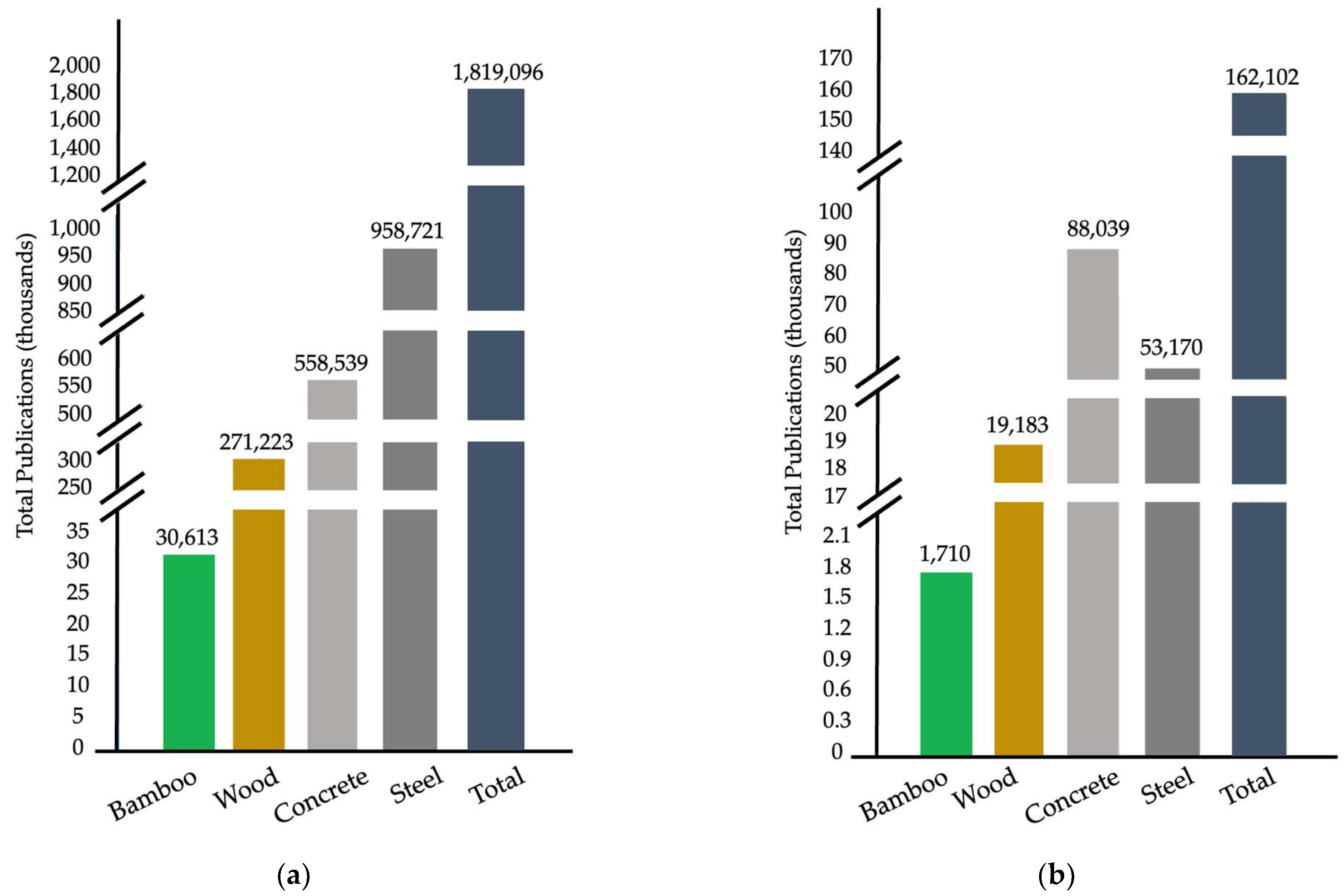
Figure 1. (a) The total number of publications for bamboo, wood, concrete, and steel up to June 15th, 2024, based on search arguments in the titles, abstracts, or identified keywords in the Scopus database. (b) The total number of publications for each material when the search argument includes “material AND building.”.
Preprints 144837 g001
Figure 2. Distribution of publications related to “material AND building” combined with specific materials (steel, concrete, wood, and bamboo) based on Scopus database search results.
Preprints 144837 g002
Figure 3. (a) Annualized rate of new publications for “material AND building” for period starting 2015 and ending 2023, based on Scopus database. (b) Annualized rate of new publications for “bamboo” and (c) “bamboo AND building” for period starting 2000 and ending 2023, based on Scopus database.
Preprints 144837 g003aPreprints 144837 g003b
Figure 4. (a) The total number of publications for bamboo, hemp, straw, and mycelium based on search argument “material AND building” in the titles, abstracts, or identified keywords in the Scopus database, for period starting 2015 and ending 2023. (b) Annualized rate of new publications for “material AND building” for period starting 2015 and ending 2023, based on Scopus database.
Preprints 144837 g004
Figure 5. Three-story, building code compliant, vertical framing system using a composite of bamboo and wood (Source, BamCore).
Preprints 144837 g005
Figure 6. Network visualization of keywords based on “bamboo AND building” search of Scopus starting December 12, 2024, as rendered by VOSviewer.
Preprints 144837 g006
Figure 7. The average accumulation of net annual carbon flows, including plantation growth, harvest and harvested wood product (HWP) production, and final disposition of HWP, for numerous timber bamboo and softwood species-location mixes.
Preprints 144837 g007
Figure 8. Five mechanical properties of steel, concrete and wood when indexed to D. asper, derived from traditional slat processing (i.e., no molecular level modifications). (See Appendix Two for source data.) .
Preprints 144837 g008
Figure 9. Five mechanical properties of four traditional North American framing species when indexed to D. asper (derived from traditional slat processing, i.e., no molecular level modifications). (See Appendix Three for source data.).
Preprints 144837 g009
Figure 10. Mature Clump of D. asper timber bamboo. .
Preprints 144837 g010
Figure 11. A (a) grapple saw (Cranab), (b) delimber (Pro Pac Industries) and (c) forwarder (John Deere).
Preprints 144837 g011aPreprints 144837 g011b
Figure 12. Optimized strategy for bamboo processing based on culm height and properties. .
Preprints 144837 g012
Figure 13. Specific Modulus of Elasticity (MOE) for bamboo and steel.
Preprints 144837 g013
Table 1. Factors affecting mechanical properties of bamboo culms.
Factor Property Affected
Variation in number of fibers in the culm wall Poisson’s ratio, density, creep, and deformation
Variation in cross-section along the length of the culm Density, elastic modulus, shrinkage, creep, deformation, and tensile strength
Moisture content Elastic modulus, compressive strength, bending strength, shear strength, shrinkage, creep, and deformation
Age of culm Shrinkage, creep and deformation
Environmental growth
conditions
Poisson’s ratio, elastic modulus, compressive strength, and tensile strength
Table 2. Factors affecting mechanical properties of bamboo culms.
Material Advantages Disadvantages
Structural Steel High Strength-to-Weight Ratio: Ideal for high-rise buildings and long-span bridges.
Ductility: Significant deformation before failure, providing reserve strength.
Predictable Properties: Reliable material properties for structural design.
Speed of Erection: Quick construction, reducing labor costs.
Ease of Repair: Easily repairable, minimizing downtime.
Adaptability: Suitable for prefabrication and mass production.
Reusability: Promotes sustainability and cost-effectiveness.
Fatigue Strength: Good fatigue resistance, ensuring long-term integrity.
Cost: Energy-intensive and relatively expensive production.
Fireproofing: Loses strength at high temperatures, requiring fireproofing.
Maintenance: Susceptible to corrosion, needing regular maintenance.
Buckling Susceptibility: Prone to buckling in compression members, needing careful design.
Reinforced Concrete Compressive Strength: High compressive strength for various applications.
Tensile Strength: Withstands considerable tensile stress when reinforced.
Fire Resistance: Effective fire protection for embedded steel.
Locally Sourced Materials: Promotes cost-effectiveness and sustainability.
Durability: Highly durable with minimal maintenance.
Moldability: Can be molded into various shapes.
Low Maintenance: Reduces long-term operational costs.
Rigidity: Minimal deflection for stability.
User-Friendliness: Requires less skilled labor compared to steel.
Long-Term Storage: Cannot be stored once mixed, affecting scheduling.
Curing Time: Requires significant curing period, delaying construction.
Cost of Forms: High formwork costs impacting budgets.
Shrinkage: Prone to shrinkage, leading to cracks and strength loss.
Traditional North American Framing Wood Tensile Strength: Outperforms steel in breaking length, allowing for larger spaces.
Electrical and Heat Resistance: Naturally resistant to electrical conduction and heat.
Sound Absorption: Minimizes echo for enhanced comfort.
Locally Sourced: Renewable and promotes sustainability.
Shrinkage and Swelling: Affected by moisture levels, impacting stability.
Deterioration: Prone to decay, mold, and insect damage, requiring maintenance.
Timber Bamboo Rapid Growth: Fast-growing renewable resource.
High Strength-to-Weight Ratio: Suitable for lightweight structures.
Flexibility: High flexibility and resilience under stress.
Eco-Friendly: Low environmental impact and carbon footprint.
Cost-Effective: Generally cheaper than steel and concrete.
Thermal Insulation: Provides good thermal insulation properties.
Durability: Susceptible to decay and pests without proper treatment.
Uniformity: Natural variability in quality and dimensions.
Moisture Sensitivity: Prone to swelling and shrinkage due to moisture.
Fire Resistance: Lower fire resistance compared to concrete.
Table 3. Optimal processing strategy for Dendrocalamus asper.
Section Top Middle Bottom
Size 3-5 meters 13-16 meters 5-7 meters
Decomposition Splitting open the bamboo culms Splitting open, sawing open to strips, or rotary cutting Sawing open to strips or rotatory cutting
Element Defibration or shredding to produce scrim and fiber Producing flattened strips, laminated lamella, or veneer Producing densified strips or lamella
Final Product Scrimber and fiber-based products Laminated bamboo lumber (LBL) and veneers Densified bamboo strips and structural elements
Suitability Best for producing scrimber due to its fibrous nature and high strength Ideal for producing high-quality veneers and laminated products used in floor, panelling, and furniture due to its balanced properties As the densest and strongest section, best for creating structural components and densified strips for construction applications
Disclaimer/Publisher’s Note: The statements, opinions and data contained in all publications are solely those of the individual author(s) and contributor(s) and not of MDPI and/or the editor(s). MDPI and/or the editor(s) disclaim responsibility for any injury to people or property resulting from any ideas, methods, instructions or products referred to in the content.
Copyright: This open access article is published under a Creative Commons CC BY 4.0 license, which permit the free download, distribution, and reuse, provided that the author and preprint are cited in any reuse.
Prerpints.org logo

Preprints.org is a free preprint server supported by MDPI in Basel, Switzerland.

Subscribe

Disclaimer

Terms of Use

Privacy Policy

Privacy Settings

© 2025 MDPI (Basel, Switzerland) unless otherwise stated