

Submitted:
25 December 2024
Posted:
26 December 2024
You are already at the latest version
Abstract
Wild emmer wheat (Triticum turgidum ssp. dicoccoides) is the ancestral species of cultivated tetraploid wheat with BBAA genomes. Because of its full interfertility with domesticated emmer wheat, this wild species can serve as one of the most important genetic resources to improve durum as well as bread wheat. To clarify the magnitude of genetic diversity between and within populations of Turkish wild emmer wheat, 169 genotypes of ssp. dicoccoides selected from the 38 populations collected from the three sub-regions (East-1, West-1, and West-2) of the Southeast Anatolia Region of Turkey were molecularly and morphologically characterized. The populations showed significant variation in plant height, peduncle length, flag leaf length and area, length of the uppermost awn in the spikelet, length of the lowermost awn in the spikelet, width and height of the glume, length and width of the anther, and 1000 seeds weight. According to the results of nuclear-SSR analysis, the populations collected from the sub-regions East-1 and West-2 were genetically most distant (0.539), while the populations collected from the sub-regions West-1 and West-2 were genetically most similar (0.788) populations. According to the results of AMOVA, there was a 84 % within the populations studied, while the variation between the populations of the three sub-regions was 16 %. In the dendrogram obtained by using nuclear-SSR data, the populations formed two main groups. Populations from the sub-region East-1 were in the first group, and the populations from the sub-regions West-1 and West-2 were in the second group. From the dendrogram, it appears that the populations from the sub-region East-1 were genetically distant from the populations from the sub-regions West-1 and West-2. The results highlight the potential diversity in the Southeast Anatolia for wild emmer discovery and utilization.
Keywords:
Wild emmer
; T. turgidum ssp. dicoccoides
; SSR
; Plant morphology
; Turkey
1. Introduction
Crop wild relatives are the primary sources of novel genetic diversity that is needed for crop improvement in all aspects [1]. A comprehensive evaluation of In-situ and Ex-situ resources as well as common cultivars to mine new alleles is a continuously needed process for crop improvement and agricultural sustainability [2]. The utilization of genetic resources not only requires a clear understanding of the allelic constitution of such species [3] but also requires the successful introduction of this diversity into the domesticated gene pool [4].
Wild emmer wheat (Triticum turgidum ssp. dicoccoides), as one of the closest known wild relatives of the domesticated tetraploid wheat, holds significant potential for wheat improvement [5,6,7]. It is the most likely ancestral species of cultivated tetraploid wheat with a genome constitution of BBAA. The geographical distribution area of wild emmer covers the Fertile Crescent in South-west Asia from Israel, Jordan, Lebanon, Syria, southern Turkey, northern Iraq to south/southwest Iran [8,9]. Due to its full interfertility with domesticated emmer wheat (T. turgidum subsp. dicoccum (Schrank ex Schübl.) Thell.), it can serve as one of the most important genetic resources to improve durum (Triticum turgidum L. ssp. durum (Desf.) as well as bread wheat (Triticum aestivum L.). Wild emmer has been used for the allele mining for many needs of wheat breeding, including but not limited to, drought tolerance [10,11], salinity stress tolerance [5,12], and for the biotic stress factors, fusarium head blight [13,14], stripe rust [15,16], root-lesion nematodes [17], and powdery mildew [18,19,20,21,22].
Due to its possible domestication in or near the Levant [6,9], there has been a high level of reports from Israel and vicinities in the Jordan Valley [23,24,25]. There were only a few studies on the accessions of wild emmer wheat from some locations out of Turkey [9,26,27,28], but there is not any comprehensive evaluation of In-situ or Ex-situ gene-pools from Southeast Anatolia. On the other hand, since the early 20th century, there has been a significant number of reports on the diversity and distribution of wild emmer wheat from the Levant and Jordan Valley, mostly Israel and Lebanon [23,24,29,30,31,32,33,34,35,36,37,38,39]. This concentrated evaluation of a specific region for wild emmer did continue in the following years [7,11,20,40,41,42,43,44,45,46,47,48,49,50,51,52,53]. Evaluation of the natural populations in the central Fertile Crescent, especially the Karacadağ region of Southeast Anatolia, is neglected. Even though this region is recently emphasized for its role in wheat domestication [9,54], there is no comprehensive report of the natural wild emmer diversity in this region and Turkey. Therefore, the purpose of this study was to document the phenotypic and genotypic diversity between and within 169 accessions of 38 In-situ populations of wild emmer wheat collected from the Karacadağ region of Southeast Anatolia.
2. Materials and Methods
In this study, 169 accessions of 38 wild emmer wheat populations recently collected from Southeast Anatolia were used (Table 1). The study was conducted in Adana, Turkey during 2020-2021 growing season. The seeds from each population were grown at the experimental area of Çukurova University, Adana, Turkey, for studying genotypic and phenotypic variation. Initially, ten seeds from each genotype were germinated in Petri dishes. Once the seedlings developed, they were transferred to small pots. Each seedling was then transplanted into a separate row, maintaining a spacing of 30 cm between and within the rows. To prevent damage from spike breakage and to ensure complete self-pollination while preserving seed purity, the main spikes of all wild emmer plants (Triticum turgidum subsp. dicoccoides) were bagged for self-pollination.
Total genomic DNA was isolated from young leaves according to cetyltrimethylammonium bromide (CTAB) protocol [55] with some modification of Ozkan, et al. [56]. The extracted DNA was evaluated qualitatively in addition to quantity, measured by 0.8% agarose gel electrophoresis. Before using DNA for molecular analysis, the DNA diluted to the required concentration for 10 ng/ml for SSR applications. Initially, 100 SSR primers mapped to the A and B genomes were first screened on eight wild emmer genotypes not only to detect their polymorphism level but also PCR amplification. After screening, 16 SSR primer was select for further work (Table 2). M13 tailed-primer PCR amplification of SSRs according to [57] was performed in a 12 µL PCR mix containing 1X buffer, 0.125 mM dNTPs, 0.4 pmol M13 sequences tailed forward primer, 0.3 pmol reverse primers, 3.0 pmol universal M13 primer labeled with one of four (6-FAM, VIC, NED or PET) fluorescent dyes, 0.12U Taq DNA polymerase, and approximately 50ng genomic DNA. PCR amplification was performed with an initial denaturation at 94°C for 5 min; 30 cycles of 94 °C for 1 min, 55 to 67 °C (annealing temperature depending on primers) for 1 min, 72 °C for 1 min; followed by 8 cycles of 94°C for 30 s, 53°C for 45 s, and 72°C for 45 s; and a final extension at 72°C for 10 min. A set of four PCR products (1 μl each) labeled with a different dye was combined with 0.25 μL GeneScan-400 LIZ® size standards (Applied Biosystems) and 9.86µL Hi-Di™ Formamide (Applied Biosystems), denatured at 94°C for 5min, chilled on ice, and separated on an ABI 3130xl Genetic Analyzer (Applied Biosystems). The SSR fragments were scored and checked twice using the Gene Mapper software v3.7 (Applied Biosystems) as described in the user manual.
The SSR was scored as binary data (1/0), indicating the presence or absence of a marker in the genomic representation of each sample. Several genetic diversity parameters were calculated for each locus and population using the GENALEX6.5 program [58]. Principal coordinate analysis (PCoA) used to explore multivariate relationships among inter-individual genetic distances within and among populations was also performed with the GENALEX6.5 program.
3. Results
3.1. Agro-Morphological Variation in Wild Emmer Populations
A total of 169 accessions, collected as 38 populations from the East and West Karacadağ region of Southeast Anatolia (Figure 1), were evaluated for agro-morphological and genetic diversity-related traits. According to the variance analysis (ANOVA), there were significant (p<0.05) differences between the evaluated panel of accessions for plant height, peduncle length, flag leaf length and area, length of the uppermost awn in the spikelet, length of the lowermost awn in the spikelet, width and height of the glume, length and width of the anther and 1000 grain weight (Data not shown). Out of 23 agro-morphological parameters evaluated, populations from Karacadag/EAST had the highest values in spike length (9.28 cm), spikelet number (20.69), glume hull thickness (0.26 mm), anther width (0.59 mm). On the other hand, Karadag-1/WEST populations had the highest agro-morphological trait values in heading date (170.38 days), flag leaf area (17.76 cm2), auriculas width (5.68 mm), length of the uppermost awn in the spikelet (68.41 mm), spikelet length (16.13 mm), lemma length (13.95 mm), palea length (12.88 mm). Finally, populations from Karadag-2/WEST had the highest values in plant height (128.31 cm), heading date (167.49 days), peduncle length (41.48 cm), auriculas length (4.65 mm), lemma width (2.62 mm), palea width (2.03 mm), glume length (12.61 mm), glume height (2.55 mm), anther length (4.10 mm) and maturation day (199.86 days). According to overall data Karadag-2/WEST was the region with the maximum agro-morphological diversity and the highest values in phenotypical traits (Table 3).
3.2. Genetic Diversity Within and Between the Populations and Sub-Regions
Genetic diversity of the evaluated accessions was assessed with analysis of molecular variance (AMOVA), and several diversity parameters including Nei genetic distance and identity values (Table 4 and Table 5). AMOVA was calculated to assess the variance within and between 38 populations of wild emmer wheat collected from three sub-regions of Karacadağ mountains (Table 4). There was a significant level of variation within the populations (84%), while variation among the populations was 16%. Nei genetic distance and identity values for the three sub-regions are given in Table 5. According to the results, the regions with the most distance were Karacadag/EAST and Karadag-2/WEST (0.539), while the ones with the closest identity values were Karadag-1/WEST and Karadag-2/WEST (0.788). The lowest distance was seen between two Karacadağ west sub-regions (0.214) and the lowest identity was between Karacadag/EAST and Karadag-2/WEST (0.463).
We have also calculated several genetic diversity parameters to estimate the variation within and between the populations. These parameters were the number of alleles per locus (Na), the number of effective alleles per locus (Ne), Shannon’s information index (I), expected heterozygosity (He), and unbiased heterozygosity (uHe). The highest number of alleles per locus was in Karacadag/EAST populations, while the lowest was in Karadag-1/WEST. Similarly, Karacadag/EAST populations had the highest values in Ne, I, He, and uHe compared to Karadag-1/WEST and Karadag-2/WEST populations (Table 6). In contrast, the lowest values in all parameters were obtained in Karadag-1/WEST populations. According to the above results, maximum and minimum genetic diversity was obtained in the populations from Karacadag/EAST and Karadag-1/WEST populations, respectively.
3.3. PCoA and Neighbor-Joining Grouping Patterns in Wild Emmer Populations
The PCoA analysis was applied to define the population interactions, and 169 accessions from 38 populations were separated into 2 major clusters, without any mixture between Karacadag/EAST and both Karadag-1/WEST and Karadag-2/WEST. The distinction between East and West was quite sharp and there was no mixture (Figure 1) between these regions. Two sub-sets of Karadağ/WEST (1 and 2) were almost entirely mixed. So, it was not possible to separate them further into smaller sub-sets. Of the sub-cluster in Karacadag/EAST, there were several accessions located far away from the rest of the accessions.
The relationships within and between the three regional groups were also evaluated using Neighbor-Joining analysis (Figure 2). Neighbor-Joining tree dendrograms produced a similar distribution to PCoA clustering. Two main branches were formed with accessions from WEST and EAST. These two main clusters did not have any admixture. There were several sub-clusters on the main clusters EAST and WEST. There were several sub-clusters in the main cluster WEST, which are almost entirely constituted from the mixed accessions of WEST-1 and WEST-2. There were only a few sub-clusters (WEST-uppermost branch) with a clear divergence from the rest of the group. Even though there were mixtures over the entire main cluster WEST, each small sub-set was formed with at least several accession from the same sub-region.
4. Discussion
Crop wild relatives are one of the main sources of allelic diversity, and so the hub for climate-resilient crop breeding. To “feed the billions” [59] and meet the pace of climate change and population increase, there is a continuous need for allele mining and germplasm screening [60,61,62,63,64]. Wild emmer wheat, one of the closest relatives of durum wheat [65], is a possible shortcut to the wide wild allelic gene pool in Triticum sp. [8,66,67,68]. As highlighted, there is a need for a “walk on the wild side” [61]. With this objective in mind, we characterized a set of In-situ germplasm accessions from the Southeast Anatolia, Karacadağ mountains, the home of Göbeklitepe, the oldest known temple, for genetic diversity assessment [69,70].
4.1. Agro-Morphological Diversity
As a result of germplasm collection from the three different sub-regions around Karacadağ mountains in Southeast Anatolia, 169 accessions within 38 populations were characterized. Agro-morphological characterization and genetic variation assessment through SSR markers were utilized to estimate the natural population diversity of this region. Wild emmer is thought to be domesticated near the southern Levant [6,9], and there has been intensity in the number of reports from the possible domestication center. However, it has a much wider species distribution [6,8,9] and the number of reports from other regions (Turkey and Iran) is quite limited [26,27,71]. In addition, none of the previous reports from Turkey built an in-depth agro-morphological and/or genetic diversity evaluation among natural (In-situ) populations.
Here we obtained significant agro-morphological and genetic diversity among and within the subsets of wild emmer wheat collected (Table 3 and Table 4). The main component of the traits we evaluated were spike, plant growth, and phenological traits.
Even though there were a vast number of studies in relation to biotic stress tolerance, such as powdery mildew [20,72], fusarium head blight [13], and stripe rust [15] in wild emmer, we did not find any reports concerning spike and phenology traits within this region. The results highlight the potential of In-situ populations and hidden gems in the wild [73] reports that several spike-related traits such as purple coleoptile, purple auricle, purple culm, hairy auricle, hairy rachilla, and fragility of spike were controlled by single dominant genes, making the transfer of such traits much straight-forward compared to quantitatively inherited traits. Further studies should try to utilize germplasm resources with novel allelic diversity into the common crops as candidates for abiotic and biotic stress tolerance as well as yield and growth-related traits [13,20,72,74,75].
4.2. Genetic Diversity of In-Situ Populations
To evaluate the genetic diversity within and between the populations, 16 specific SSR markers were applied (Table 2). According to the results of AMOVA and other genetic diversity parameters, there was significant diversity among the evaluated panel of In-situ accession. There were 84% within and 16% between populations diversity. The results were in a similar range with previous reports in tetraploid wheat. In similar studies, [76] reported 19 and 81% within and between population diversity, while Teklu, et al. [77] reported wider levels of diversity among 73 wild emmer accessions from 11 different geographic regions. Nei genetic distance values in this study ranged between 0.214 (between Karadag-1/WEST and Karadag-2/WEST) and 0.539 (between Karacadag/EAST and Karadag-2/WEST). The results showed a clear-cut separation between the EAST and WEST populations. Mountainous landscape of the region seems to reduce genetic drift and mixture even within a relatively close distance of about 200 km. The distance between WEST-1 and WEST-2 populations were closer, about 55 km and their genetic distance was quite small, compared to WEST-EAST distance (Table 5). According to Harlan and Zohary [78], Zohary and Hopf [79] and Ozkan, Willcox, Graner, Salamini and Kilian [9] wild emmer has a wide distribution from the Levant to Turkey and south/southwest Iran. The level of observed diversity within the Karacadağ region demonstrates the potential of this unexplored habitat for crop improvement [6,11,80].
The number of alleles per locus (Na) is an indicator of the diversity at the gene level [81]. Here, we observed a three-fold difference between three regional groups from 3.93 in Karadag-1/WEST to 9.93 in Karacadag/EAST. Since all accessions were from the same species within the same wider region, this level of difference may be due to unequal population size distribution among sub-sets or some other unknown reasons. Li, Roder, Fahima, Kirzhner, Beiles, Korol and Nevo [43] evaluated the number of microsatellites among 105 individuals from the Yehudiyya region of Israel, the Na values they obtained were lower than the current study. In their follow-up study, the same group obtained 1.88, 3.86, and 5.89 Na values at chromosome, genome, and genome x chromosome levels. In a similar study, on a different region, Li, Fahima, Peng, Roder, Kirzhner, Beiles, Korol and Nevo [39] reported an average of 7.1 Na value using 28 microsatellite markers among 155 individuals from two sub-regions of Tabigha, Israel. In our study, the number of effective alleles (Ne) followed the same trend with the Na values, which ranged between 2.75 and 5.50 per locus. The Ne values were higher than Arystanbekkyzy, Nadeem, Aktas, Yeken, Zencirci, Nawaz, Ali, Haider, Tunc, Chung and Baloch [26], who reported an average 1.962 Ne value among 29 wild and 4 cultivated emmer wheat collected from different regions of Turkey.
We obtained a Shannon index (I) between 1.030 (Karadag-1/WEST) and 1.692 (Karacadag/EAST). Expected heterozygosity (He) was between 0.561 and 0.725. The I and He values we obtained was significantly higher compared to Dong, Wei, Chen, Li, Wang, Nevo and Zheng [7] and Fahima, Sun, Beharav, Krugman, Beiles and Nevo [37], while it was in similar ranges with Fahima, Roder, Wendehake, Kirzhner and Nevo [42]. A similar study [28], compared accessions from Israel and Turkey (Diyarbakır region) for genetic diversity using AFLP markers. The He values they reported were much lower compared to the current study. Ozbek, et al. [82] evaluated a set of accessions (120) from Israel and also reported lower He values compared to our results. Here, Na, Ne, I, He, and uHe values we obtained, shows the genetic diversity of the natural wild emmer populations in the Karacadağ region.
4.3. PCoA and Neighbor-Joining Analysis
PCoA and Neighbor-Joining trees followed the same trend (Figure 1 and Figure 2). Both methods separated WEST and EAST populations and did not create any mixture zones. On the other hand, two sub-sets of WEST (1 &2) were almost entirely mixed and it was not possible to make a distinction between these two. Neighbor-Joining Dendrograms and PCoA clustering were similar to our previous report with AFLP markers [9], which distributed EAST and WEST populations in two separate clusters. When we closely looked at the Neighbor-Joining dendrogram for branching and genotypes positions (Figure 3), it was seen that most of the individuals from the specific populations were located closely on the same branch, with some exceptions that did not follow any trend.
5. Conclusions
Wild and domesticated emmer wheat are well-characterized and excessively utilized species for crop improvement, especially in biotic stress tolerance. Here, a panel of wild emmer wheat was characterized for agro-morphological traits and genetic diversity. According to genetic diversity values obtained, PCoA and Neighbor-Joining dendrograms, two regional groups with approximately 200 km distance had significantly different characteristics in terms of allelic distribution and some phenotypic traits. The screening and utilization of In-situ germplasm sources from this region would help widen the genetic diversity in durum as well as common wheat breeding.
Author Contributions
Conceptualization, E.Ç, H.Ö.; methodology, E.Ç.; software, E.Ç.; formal analysis, E.Ç, H.Ö.; investigation, E.Ç.; resources, H.Ö.; data curation, E.Ç, H.Ö.; writing—original draft preparation, E.S, H.Ö.; writing—review and editing, E.Ç, A.A., H.B., H.Ö.; visualization, E.Ç.; supervision, H.Ö.; project administration, H.Ö.; funding acquisition, H.Ö. All authors have read and agreed to the published version of the manuscript.
Funding
This research received no external funding.
Data Availability Statement
The original contributions presented in this study are included in the article/supplementary material. Further inquiries can be directed to the corresponding author(s).
References
- Maccaferri, M.; Harris, N.S.; Twardziok, S.O.; Pasam, R.K.; Gundlach, H.; Spannagl, M.; Ormanbekova, D.; Lux, T.; Prade, V.M.; Milner, S.G., et al. Durum wheat genome highlights past domestication signatures and future improvement targets. Nat Genet 2019, 51, 885-895. [CrossRef]
- Snowdon, R.J.; Wittkop, B.; Chen, T.-W.; Stahl, A. Crop adaptation to climate change as a consequence of long-term breeding. Theor. Appl. Genet. 2021, 134, 1613-1623. [CrossRef]
- Zhou, Y.; Bai, S.; Li, H.; Sun, G.; Zhang, D.; Ma, F.; Zhao, X.; Nie, F.; Li, J.; Chen, L., et al. Introgressing the Aegilops tauschii genome into wheat as a basis for cereal improvement. Nature Plants 2021, 10.1038/s41477-021-00934-w. [CrossRef]
- Varshney, R.K.; Bohra, A.; Roorkiwal, M.; Barmukh, R.; Cowling, W.; Chitikineni, A.; Lam, H.-M.; Hickey, L.T.; Croser, J.; Edwards, D., et al. Rapid delivery systems for future food security. Nature Biotechnology 2021, 10.1038/s41587-021-01079-z. [CrossRef]
- Feng, K.W.; Nie, X.J.; Cui, L.C.; Deng, P.C.; Wang, M.X.; Song, W.N. Genome-Wide Identification and Characterization of Salinity Stress-Responsive miRNAs in Wild Emmer Wheat (Triticum turgidum ssp dicoccoides). Genes 2017, 8. [CrossRef]
- Peng, J.H.; Sun, D.F.; Nevo, E. Wild emmer wheat, Triticum dicoccoides, occupies a pivotal position in wheat domestication process. Aust. J. Crop Sci. 2011, 5, 1127-1143.
- Dong, P.; Wei, Y.M.; Chen, G.Y.; Li, W.; Wang, J.R.; Nevo, E.; Zheng, Y.L. Sequence-related amplified polymorphism (SRAP) of wild emmer wheat (Triticum dicoccoides) in Israel and its ecological association. Biochem. Syst. Ecol. 2010, 38, 1-11. [CrossRef]
- Lack, H.W.; Van Slageren, M. The discovery, typification and rediscovery of wild emmer wheat, Triticum turgidum subsp. dicoccoides (Poaceae). Willdenowia 2020, 50, 207-216. [CrossRef]
- Ozkan, H.; Willcox, G.; Graner, A.; Salamini, F.; Kilian, B. Geographic distribution and domestication of wild emmer wheat (Triticum dicoccoides). Genetic Resources and Crop Evolution 2011, 58, 11-53. [CrossRef]
- Kantar, M.; Lucas, S.J.; Budak, H. miRNA expression patterns of Triticum dicoccoides in response to shock drought stress. Planta 2011, 233, 471-484. [CrossRef]
- Shavrukov, Y.; Langridge, P.; Tester, M.; Nevo, E. Wide genetic diversity of salinity tolerance, sodium exclusion and growth in wild emmer wheat, Triticum dicoccoides. Breed. Sci. 2010, 60, 426-435. [CrossRef]
- Feng, K.; Cui, L.; Lv, S.; Bian, J.; Wang, M.; Song, W.; Nie, X. Comprehensive evaluating of wild and cultivated emmer wheat (Triticum turgidum L.) genotypes response to salt stress. Plant Growth Regul 2017, 84, 261-273. [CrossRef]
- Soresi, D.; Bagnaresi, P.; Crescente, J.M.; Diaz, M.; Cattivelli, L.; Vanzetti, L.; Carrera, A. Genetic Characterization of a Fusarium Head Blight Resistance QTL from Triticum turgidum ssp. dicoccoides. Plant Mol. Biol. Rep. 2020, 10.1007/s11105-020-01277-0. [CrossRef]
- Soresi, D.; Zappacosta, D.; Garayalde, A.; Irigoyen, I.; Basualdo, J.; Carrera, A. A Valuable QTL for Fusarium Head Blight Resistance from Triticum turgidum L. ssp dicoccoides has a Stable Expression in Durum Wheat Cultivars. Cereal Res. Commun. 2017, 45, 234-247. [CrossRef]
- Zhang, H.; Zhang, L.; Wang, C.Y.; Wang, Y.J.; Zhou, X.L.; Lv, S.K.; Liu, X.L.; Kang, Z.S.; Ji, W.Q. Molecular mapping and marker development for the Triticum dicoccoides-derived stripe rust resistance gene YrSM139-1B in bread wheat cv. Shaanmai 139. Theor. Appl. Genet. 2016, 129, 369-376. [CrossRef]
- Sela, H.; Ezrati, S.; Ben-Yehuda, P.; Manisterski, J.; Akhunov, E.; Dvorak, J.; Breiman, A.; Korol, A. Linkage disequilibrium and association analysis of stripe rust resistance in wild emmer wheat (Triticum turgidum ssp. dicoccoides) population in Israel. TAG. Theoretical and applied genetics. Theoretische und angewandte Genetik 2014, 127, 2453-2463. [CrossRef]
- Toktay, H.; Imren, M.; Elekcioglu, I.H.; Dababat, A.A. Evaluation of Turkish wild Emmers (Triticum dicoccoides Koern.) and wheat varieties for resistance to the root lesion nematodes (Pratylenchus thornei and Pratylenchus neglectus). Turkiye Entomoloji Dergisi-Turkish Journal of Entomology 2015, 39, 219-227.
- Saidou, M.; Wang, C.Y.; Alam, M.A.; Chen, C.H.; Ji, W.Q. Genetic analysis of powdery mildew resistance gene using ssr markers in common wheat originated from wild emmer (Triticum dicoccoides Thell). Turkish Journal of Field Crops 2016, 21, 10-15. [CrossRef]
- Liang, Y.; Zhang, D.Y.; Ouyang, S.H.; Xie, J.Z.; Wu, Q.H.; Wang, Z.Z.; Cui, Y.; Lu, P.; Zhang, D.; Liu, Z.J., et al. Dynamic evolution of resistance gene analogs in the orthologous genomic regions of powdery mildew resistance gene MlIW170 in Triticum dicoccoides and Aegilops tauschii. Theor. Appl. Genet. 2015, 128, 1617-1629. [CrossRef]
- Qiu, L.N.; Liu, N.N.; Wang, H.F.; Shi, X.H.; Li, F.; Zhang, Q.; Wang, W.D.; Guo, W.L.; Hu, Z.R.; Li, H.J., et al. Fine mapping of a powdery mildew resistance gene MlIW39 derived from wild emmer wheat (Triticum turgidum ssp. dicoccoides). Theor. Appl. Genet. 2021, 134, 2469-2479. [CrossRef]
- Ouyang, S.H.; Zhang, D.; Han, J.; Zhao, X.J.; Cui, Y.; Song, W.; Huo, N.X.; Liang, Y.; Xie, J.Z.; Wang, Z.Z., et al. Fine Physical and Genetic Mapping of Powdery Mildew Resistance Gene MlIW172 Originating from Wild Emmer (Triticum dicoccoides). Plos One 2014, 9. [CrossRef]
- Xue, F.; Ji, W.Q.; Wang, C.Y.; Zhang, H.; Yang, B.J. High-density mapping and marker development for the powdery mildew resistance gene PmAS846 derived from wild emmer wheat (Triticum turgidum var. dicoccoides). Theor. Appl. Genet. 2012, 124, 1549-1560. [CrossRef]
- Nevo, E.; Golenberg, E.; Beiles, A.; Brown, A.H.D.; Zohary, D. Genetic diversity and environmental associations of wild wheat, Triticum-dicoccoides, IN ISRAEL. Theor. Appl. Genet. 1982, 62, 241-254. [CrossRef]
- Poyarkova, H.; Gerechteramitai, Z.K.; Genizi, A. 2 variants of wild emmer (Triticum-dicoccoides) native to israel - morphology and distribution. Can. J. Bot.-Rev. Can. Bot. 1991, 69, 2772-2789. [CrossRef]
- Chandrasekhar, K.; Nashef, K.; Ben-David, R. Agronomic and genetic characterization of wild emmer wheat (Triticum turgidum subsp. dicoccoides) introgression lines in a bread wheat genetic background. Genetic Resources and Crop Evolution 2017, 64, 1917-1926. [CrossRef]
- Arystanbekkyzy, M.; Nadeem, M.A.; Aktas, H.; Yeken, M.Z.; Zencirci, N.; Nawaz, M.A.; Ali, F.; Haider, M.S.; Tunc, K.; Chung, G., et al. Phylogenetic and Taxonomic Relationship of Turkish Wild and Cultivated Emmer (Triticum turgidum ssp. dicoccoides) Revealed by iPBS-Retrotransposons Markers. International Journal of Agriculture and Biology 2019, 21, 155-163.
- Shizuka, T.; Mori, N.; Ozkan, H.; Ohta, S. Chloroplast DNA haplotype variation within two natural populations of wild emmer wheat (Triticum turgidumssp.dicoccoides) in southern Turkey. Biotechnology & Biotechnological Equipment 2015, 29, 423-430. [CrossRef]
- Ozbek, O.; Millet, E.; Anikster, Y.; Arslan, O.; Feldman, M. Comparison of the genetic structure of populations of wild emmer wheat, Triticum turgidum ssp dicoccoides, from Israel and Turkey revealed by AFLP analysis. Genetic Resources and Crop Evolution 2007, 54, 1587-1598. [CrossRef]
- Gerechteramitai, Z.K.; Sharp, E.L.; Reinhold, M. Temperature Sensitive genes for stripe rust resistance in triticum-dicoccoides indigenous to Israel. Phytopathology 1981, 71, 218-218.
- Gerechteramitai, Z.K.; Vansilfhout, C.H.; Grama, A.; Kleitman, F. YR15 - A NEW GENE FOR RESISTANCE TO PUCCINIA-STRIIFORMIS IN TRITICUM-DICOCCOIDES SEL G-25. Euphytica 1989, 43, 187-190. [CrossRef]
- Nevo, E.; Beiles, A.; Gutterman, Y.; Storch, N.; Kaplan, D. Genetic-resources of wild cereals in israel and vicinity.1. phenotypic variation within and between populations of wild wheat, Triticum-dicoccoides. Euphytica 1984, 33, 717-735. [CrossRef]
- Silfhout, C.H.; Grama, A.; Gerechter-Amitai, Z.K.; Kleitman, F. Resistance to yellow rust in Triticum dicoccoides. I. Crosses with susceptible Triticum durum. Netherlands Journal of Plant Pathology 1989, 95, 73-78. [CrossRef]
- Poyarkova, H. Morphology, geography and infraspecific taxonomics of Triticum-dicoccoides korn - a retrospective of 80 years of research. Euphytica 1988, 38, 11-23. [CrossRef]
- Nevo, E.; Krugman, T.; Beiles, A. Genetic-resources for salt tolerance in the wild progenitors of wheat (triticum-dicoccoides) and barley (Hordeum-spontaneum) IN ISRAEL. Plant Breeding 1993, 110, 338-341. [CrossRef]
- Kato, K.; Mori, Y.; Beiles, A.; Nevo, E. Geographical variation in heading traits in wild emmer wheat, Triticum dicoccoides.1. Variation in vernalization response and ecological differentiation. Theor. Appl. Genet. 1997, 95, 546-552. [CrossRef]
- Kato, K.; Tanizoe, C.; Beiles, A.; Nevo, E. Geographical variation in heading traits in wild emmer wheat, Triticum dicoccoides. II. Variation in heading date and adaptation to diverse eco-geographical conditions. Hereditas 1998, 128, 33-39. [CrossRef]
- Fahima, T.; Sun, G.L.; Beharav, A.; Krugman, T.; Beiles, A.; Nevo, E. RAPD polymorphism of wild emmer wheat populations, Triticum dicoccoides, in Israel. Theor. Appl. Genet. 1999, 98, 434-447. [CrossRef]
- Belyayev, A.; Raskina, O.; Korol, A.; Nevo, E. Coevolution of A and B genomes in allotetraploid Triticum dicoccoides. Genome / National Research Council Canada = Genome / Conseil national de recherches Canada 2000, 43, 1021-1026. [CrossRef]
- Li, Y.C.; Fahima, T.; Peng, J.H.; Roder, M.S.; Kirzhner, V.M.; Beiles, A.; Korol, A.B.; Nevo, E. Edaphic microsatellite DNA divergence in wild emmer wheat, Triticum dicoccoides, at a microsite: Tabigha, Israel. Theor. Appl. Genet. 2000, 101, 1029-1038. [CrossRef]
- Peng, J.H.; Fahima, T.; Roder, M.S.; Huang, Q.Y.; Dahan, A.; Li, Y.C.; Grama, A.; Nevo, E. High-density molecular map of chromosome region harboring stripe-rust resistance genes YrH52 and Yr15 derived from wild emmer wheat, Triticum dicoccoides. Genetica 2000, 109, 199-210. [CrossRef]
- Li, Y.C.; Krugman, T.; Fahima, T.; Beiles, A.; Korol, A.B.; Nevo, E. Spatiotemporal allozyme divergence caused by aridity stress in a natural population of wild wheat, Triticum dicoccoides, at the Ammiad microsite, Israel. Theor. Appl. Genet. 2001, 102, 853-864. [CrossRef]
- Fahima, T.; Roder, M.S.; Wendehake, K.; Kirzhner, V.M.; Nevo, E. Microsatellite polymorphism in natural populations of wild emmer wheat, Triticum dicoccoides, in Israel. Theor. Appl. Genet. 2002, 104, 17-29. [CrossRef]
- Li, Y.C.; Roder, M.S.; Fahima, T.; Kirzhner, V.M.; Beiles, A.; Korol, A.B.; Nevo, E. Climatic effects on microsatellite diversity in wild emmer wheat (Triticum dicoccoides) at the Yehudiyya microsite, Israel. Heredity 2002, 89, 127-132. [CrossRef]
- Buerstmayr, H.; Stierschneider, M.; Steiner, B.; Lemmens, M.; Griesser, M.; Nevo, E.; Fahima, T. Variation for resistance to head blight caused by Fusarium graminearum in wild emmer (Triticum dicoccoides) originating from Israel. Euphytica 2003, 130, 17-23. [CrossRef]
- Li, Y.C.; Fahima, T.; Roder, M.S.; Kirzhner, V.M.; Beiles, A.; Korol, A.B.; Nevo, E. Genetic effects on microsatellite diversity in wild emmer wheat (Triticum dicoccoides) at the Yehudiyya microsite, Israel. Heredity 2003, 90, 150-156. [CrossRef]
- Xu, S.S.; Khan, K.; Klindworth, D.L.; Faris, J.D.; Nygard, G. Chromosomal location of genes for novel glutenin subunits and gliadins in wild emmer wheat (Triticum turgidum L. var. dicoccoides). Theor. Appl. Genet. 2004, 108, 1221-1228. [CrossRef]
- Anikster, Y.; Manisterski, J.; Long, D.L.; Leonard, K.J. Leaf rust and stem rust resistance in Triticum dicoccoides populations in Israel. Plant Dis. 2005, 89, 55-62. [CrossRef]
- Syouf, M.; Abu-Irmaileh, B.E.; Valkoun, J.; Bdour, S. Introgression from durum wheat landraces in wild emmer wheat (Triticum dicoccoides (Korn. ex Asch et Graebner) Schweinf). Genetic Resources and Crop Evolution 2006, 53, 1165-1172. [CrossRef]
- Hua, W.; Liu, Z.J.; Zhu, J.; Xie, C.J.; Yang, T.M.; Zhou, Y.L.; Duan, X.Y.; Sun, Q.X.; Liu, Z.Y. Identification and genetic mapping of pm42, a new recessive wheat powdery mildew resistance gene derived from wild emmer (Triticum turgidum var. dicoccoides). Theor. Appl. Genet. 2009, 119, 223-230. [CrossRef]
- Liu, Z.J.; Zhu, J.; Cui, Y.; Liang, Y.; Wu, H.B.; Song, W.; Liu, Q.; Yang, T.M.; Sun, Q.X.; Liu, Z.Y. Identification and comparative mapping of a powdery mildew resistance gene derived from wild emmer (Triticum turgidum var. dicoccoides) on chromosome 2BS. Theor. Appl. Genet. 2012, 124, 1041-1049. [CrossRef]
- Sela, H.; Ezrati, S.; Ben-Yehuda, P.; Manisterski, J.; Akhunov, E.; Dvorak, J.; Breiman, A.; Korol, A. Linkage disequilibrium and association analysis of stripe rust resistance in wild emmer wheat (Triticum turgidum ssp. dicoccoides) population in Israel. Theor. Appl. Genet. 2014, 127, 2453-2463. [CrossRef]
- Domb, K.; Keidar, D.; Yaakov, B.; Khasdan, V.; Kashkush, K. Transposable elements generate population-specific insertional patterns and allelic variation in genes of wild emmer wheat (Triticum turgidum ssp dicoccoides). BMC Plant Biol 2017, 17. [CrossRef]
- Vuorinen, A.L.; Kalendar, R.; Fahima, T.; Korpelainen, H.; Nevo, E.; Schulman, A.H. Retrotransposon-Based Genetic Diversity Assessment in Wild Emmer Wheat (Triticum turgidum ssp. dicoccoides). Agronomy-Basel 2018, 8. [CrossRef]
- Salamini, F.; Ozkan, H.; Brandolini, A.; Schafer-Pregl, R.; Martin, W. Genetics and geography of wild cereal domestication in the near east. Nat Rev Genet 2002, 3, 429-441. [CrossRef]
- Doyle, J.J.; Doyle, J.L. A rapid DNA isolation procedure for small quantities of fresh leaf tissue; 1987.
- Ozkan, H.; Kafkas, S.; Sertac Ozer, M.; Brandolini, A. Genetic relationships among South-East Turkey wild barley populations and sampling strategies of Hordeum spontaneum. Theor. Appl. Genet. 2005, 112, 12-20. [CrossRef]
- Schuelke, M. An economic method for the fluorescent labeling of PCR fragments. Nature biotechnology 2000, 18, 233-234. [CrossRef]
- Peakall, R.; Smouse, P.E. GENALEX 6: genetic analysis in Excel. Population genetic software for teaching and research. Mol. Ecol. Notes 2006, 6, 288-295. [CrossRef]
- Godfray, H.C.J.; Beddington, J.R.; Crute, I.R.; Haddad, L.; Lawrence, D.; Muir, J.F.; Pretty, J.; Robinson, S.; Thomas, S.M.; Toulmin, C. Food Security: The Challenge of Feeding 9 Billion People. Science 2010, 327, 812-818. [CrossRef]
- Gonzalez-Paleo, L.; Ravetta, D.A. Allocation patterns and phenology in wild and selected accessions of annual and perennial Physaria (Lesquerella, Brassicaceae). Euphytica 2012, 186, 289-302. [CrossRef]
- Feuillet, C.; Langridge, P.; Waugh, R. Cereal breeding takes a walk on the wild side. Trends in Genetics 2007, 24, 24-32. [CrossRef]
- Ortiz, R.; Sayre, K.D.; Govaerts, B.; Gupta, R.; Subbarao, G.V.; Ban, T.; Hodson, D.; Dixon, J.A.; Ortiz-Monasterio, J.I.; Reynolds, M. Climate change: Can wheat beat the heat? Agriculture Ecosystems & Environment 2008, 126, 46-58. [CrossRef]
- El Haddad, N.; Kabbaj, H.; Zaïm, M.; El Hassouni, K.; Tidiane Sall, A.; Azouz, M.; Ortiz, R.; Baum, M.; Amri, A.; Gamba, F., et al. Crop wild relatives in durum wheat breeding: Drift or thrift? Crop Science 2021, 61, 37-54. [CrossRef]
- Castaneda-Alvarez, N.P.; Khoury, C.K.; Achicanoy, H.A.; Bernau, V.; Dempewolf, H.; Eastwood, R.J.; Guarino, L.; Harker, R.H.; Jarvis, A.; Maxted, N., et al. Global conservation priorities for crop wild relatives. Nat Plants 2016, 2, 16022. [CrossRef]
- Harlan, J.R.; Wet, J.M.J. TOWARD A RATIONAL CLASSIFICATION OF CULTIVATED PLANTS. Taxon 1971, 20, 509-517. [CrossRef]
- Chhuneja, P.; Arora, J.K.; Kaur, P.; Kaur, S.; Singh, K. Characterization of wild emmer wheat Triticum dicoccoides germplasm for vernalization alleles. Journal of Plant Biochemistry and Biotechnology 2015, 24, 249-253. [CrossRef]
- Peng, J.H.; Sun, D.; Nevo, E. Domestication evolution, genetics and genomics in wheat. Molecular Breeding 2011, 28, 281-301. [CrossRef]
- Nevo, E. Genetic resources of wild emmer, Triticum dicoccoides, for wheat improvement in the third millennium. Isr. J. Plant Sci. 2001, 49, S77-S91. [CrossRef]
- Schmidt, K. Göbekli Tepe; Arkeoloji ve Sanat Yayınları: 2007.
- Dietrich, O.; Heun, M.; Notroff, J.; Schmidt, K.; Zarnkow, M. The role of cult and feasting in the emergence of Neolithic communities. New evidence from Göbekli Tepe, south-eastern Turkey. Antiquity 2012, 86, 674-695. [CrossRef]
- Jorgensen, C.; Luo, M.-C.; Ramasamy, R.; Dawson, M.; Gill, B.S.; Korol, A.B.; Distelfeld, A.; Dvorak, J. A High-Density Genetic Map of Wild Emmer Wheat from the Karaca Dağ Region Provides New Evidence on the Structure and Evolution of Wheat Chromosomes. Frontiers in Plant Science 2017, 8. [CrossRef]
- Zhang, D.Y.; Zhu, K.Y.; Dong, L.L.; Liang, Y.; Li, G.Q.; Fang, T.L.; Guo, G.H.; Wu, Q.H.; Xie, J.Z.; Chen, Y.X., et al. Wheat powdery mildew resistance gene Pm64 derived from wild emmer (Triticum turgidum var. dicoccoides) is tightly linked in repulsion with stripe rust resistance gene Yr5. Crop Journal 2019, 7, 761-770. [CrossRef]
- Ahmadi, H.; Nazarian, F. The inheritance and chromosomal location of morphological traits in wild wheat, Triticum turgidum L. ssp dicoccoides. Euphytica 2007, 158, 103-108. [CrossRef]
- Rawale, K.S.; Khan, M.A.; Gill, K.S. The novel function of the Ph1 gene to differentiate homologs from homoeologs evolved in Triticum turgidum ssp. dicoccoides via a dramatic meiosis-specific increase in the expression of the 5B copy of the C-Ph1 gene. Chromosoma 2019, 128, 561-570. [CrossRef]
- Zhang, Y.J.; Hu, X.; Islam, S.; She, M.Y.; Peng, Y.C.; Yu, Z.T.; Wylie, S.; Juhasz, A.; Dowla, M.; Yang, R.C., et al. New insights into the evolution of wheat avenin-like proteins in wild emmer wheat (Triticum dicoccoides). Proceedings of the National Academy of Sciences of the United States of America 2018, 115, 13312-13317. [CrossRef]
- Negisho, K.; Shibru, S.; Pillen, K.; Ordon, F.; Wehner, G. Genetic diversity of Ethiopian durum wheat landraces. PLOS ONE 2021, 16, e0247016. [CrossRef]
- Teklu, Y.; Hammer, K.; Röder, M.S. Simple sequence repeats marker polymorphism in emmer wheat (Triticum dicoccon Schrank): Analysis of genetic diversity and differentiation. Genetic Resources and Crop Evolution 2007, 54, 543-554. [CrossRef]
- Harlan, J.R.; Zohary, D. Distribution of wild wheats and barley. Science 1966, 153, 1074-1080. [CrossRef]
- Zohary, D.; Hopf, M. Domestication of plants in the Old World: The origin and spread of cultivated plants in West Asia, Europe and the Nile Valley; Oxford university press: 2000.
- Hegde, S.G.; Valkoun, J.; Waines, J.G. Genetic diversity in wild wheats and goat grass. Theor. Appl. Genet. 2000, 101, 309-316. [CrossRef]
- Lu, H.; Bernardo, R. Molecular marker diversity among current and historical maize inbreds. Theor. Appl. Genet. 2001, 103, 613-617. [CrossRef]
- Ozbek, O.; Millet, E.; Anikster, Y.; Arslan, O.; Feldman, M. Spatio-temporal genetic variation in populations of wild emmer wheat, Triticum turgidum ssp dicoccoides, as revealed by AFLP analysis. Theor. Appl. Genet. 2007, 115, 19-26. [CrossRef]
Figure 1.
PCoA clustering of 38 Triticum turgidum ssp. dicoccoides populations were collected from the Karacadağ region of Southeast Anatolia, central Fertile Crescent. Populations were; Karacadag/EAST, Karadag-1/WEST and Karadag-2/WEST.
Figure 1.
PCoA clustering of 38 Triticum turgidum ssp. dicoccoides populations were collected from the Karacadağ region of Southeast Anatolia, central Fertile Crescent. Populations were; Karacadag/EAST, Karadag-1/WEST and Karadag-2/WEST.
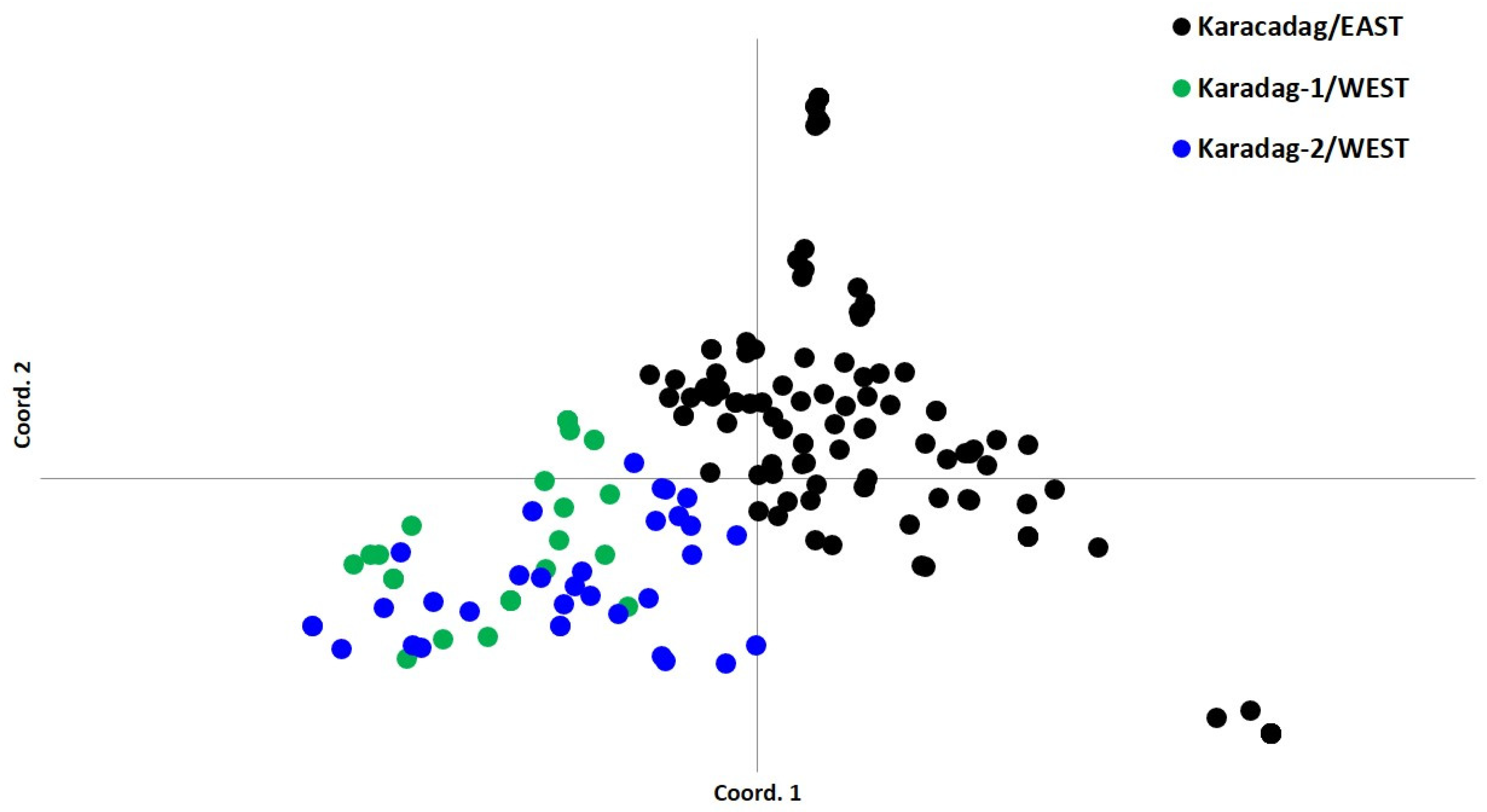
Figure 2.
Neighbor-Joining analysis of 38 Triticum turgidum ssp. dicoccoides populations were collected from the Karacadağ region of Southeast Anatolia, central Fertile Crescent.
Figure 2.
Neighbor-Joining analysis of 38 Triticum turgidum ssp. dicoccoides populations were collected from the Karacadağ region of Southeast Anatolia, central Fertile Crescent.
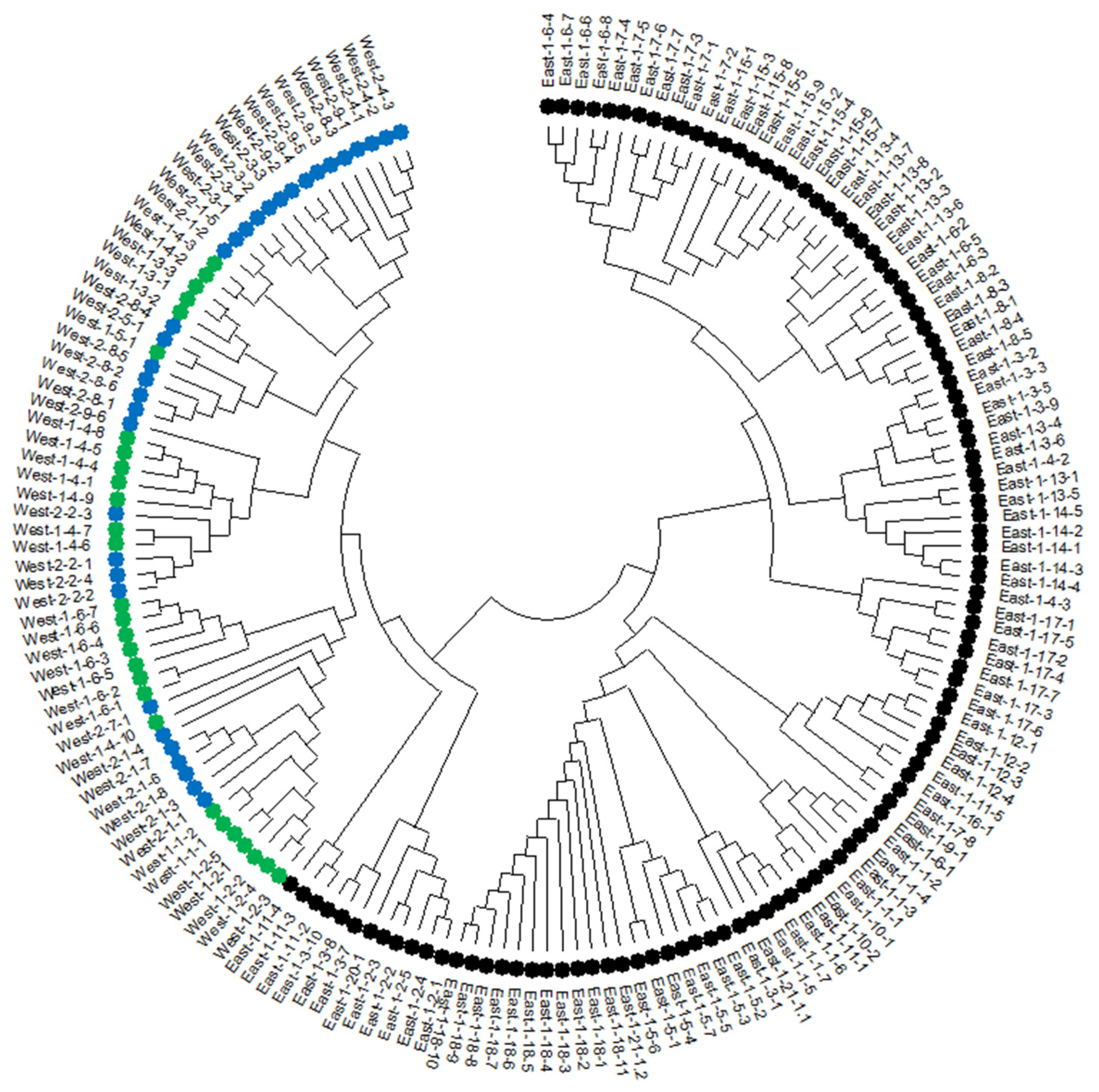

Table 1.
Collection site information about 38 wild emmer wheat (Triticum turgidum ssp. dicoccoides) populations.
Table 1.
Collection site information about 38 wild emmer wheat (Triticum turgidum ssp. dicoccoides) populations.
| Collection No | Collection Locality | Zone | Altitude (m) | Latitude (°N) | Longitude (°E) |
|---|---|---|---|---|---|
| 1 | 24.5 km SW from Diyarbakır to Ovadag | East1 | 780 | 37°47′38″ | 40°12′14″ |
| 2 | 12.9 km NW from Ovadag to Pirinçlik | East1 | 1007 | 37°47′31″ | 39°57′18″ |
| 3 | 18.5 km NW from Ovadag to Pirinçlik | East1 | 920 | 37°49′17″ | 39°59′34″ |
| 4 | 20.1 km SW from Pirinçlik | East1 | 1080 | 37°52′02″ | 39°51′05″ |
| 5 | 20 km SW from Pirinçlik | East1 | 1260 | 37°50′40″ | 39°47′58″ |
| 6 | 2.9 km NE from Karabahçe to Pirinçlik | East1 | 1300 | 37°49′12″ | 39°46′29″ |
| 7 | 41.2 km SW from Pirinçlik | East1 | 1250 | 37°46′42″ | 39°44′50″ |
| 8 | 6.3 km N from Karabahçe (42.9 km W from Diyarbakır to Siverek) | East1 | 1070 | 37°50′21″ | 39°43′23″ |
| 9 | 4.6 km SW from Karabahçe | East1 | 1180 | 37°46′19″ | 39°44′03″ |
| 10 | 17.9 km SW from Karabahçe | East1 | 1160 | 37°44′29″ | 39°42′50″ |
| 11 | 21.7 km SW from Karabahçe | East1 | 1235 | 37°42′51″ | 39°44′03″ |
| 12 | 37.9 km SW from Karabahçe | East1 | 1170 | 37°39′49″ | 39°42′49″ |
| 13 | 37.9 km SW from Karabahçe | East1 | 1180 | 37°36′27″ | 39°43′41″ |
| 14 | 41.6 km SW from Karabahçe | East1 | 1170 | 37°35′08″ | 39°44′36″ |
| 15 | 48.7 km SW from Karabahçe | East1 | 1030 | 37°33′09″ | 39°42′06″ |
| 16 | 27.6 km SW from Karacadag (69.6 km SW from Karabahçe) | East1 | 950 | 37°37′40″ | 39°33′40″ |
| 17 | 30.2 km SW from Çermik to Siverek | East1 | 800 | 38°00′56″ | 39°22′11″ |
| 18 | Siverek Karakeçi Road Azemi Village | East1 | 733 | 37°36′51″ | 39°20′12″ |
| 19 | Karakeçi road | East1 | 737 | 37°33′27″ | 39°20′35″ |
| 20 | Karakeçi grassland | East1 | 758 | 37°32′22″ | 39°21′52″ |
| 21 | 5km from Siverek to Siverek Hilvan Road | East1 | 645 | 37°42′23″ | 39°16′34″ |
| 22 | 72 km SE from Turkoglu SE (W of Karadag) | West1 | 800(853) | 37°19′′46″ | 37°16′29″ |
| 23 | 72 km SE from Turkoglu SE (W of Karadag) | West1 | 800(853) | 37°19′′46″ | 37°16′29″ |
| 24 | 34 km ESE from Narlı (WSW of Karadag) | West1 | 840 (877) | 37°18′53″ | 37°15′41″ |
| 25 | 34 km ESE from Narlı (WSW of Karadag) | West1 | 780 (813) | 37°20′12″ | 37°17′53″ |
| 26 | 39 km ESE from Narlı (SW of Karadag) | West1 | 760 (793) | 37°17′06″ | 37°17′39″ |
| 27 | 39 km ESE from Narlı (SW of Karadag) | West1 | 760 (793) | 37°17′06″ | 37°17′39″ |
| 28 | Between Kahramanmaraş Kelleş village and Yiğitce village | West1 | 791 | 37°20′25″ | 37°17′54″ |
| 29 | Between Gaziantep Tekirsin village and Dundarlı village | West1 | 882 | 37°15′20″ | 37°23′26″ |
| 30 | 37 km NE from Kilis to Gaziantep | West2 | 830 | 37°20′19″ | 37°16′50″ |
| 31 | 39 km NE from Kilis to Gaziantep | West2 | 920 | 37°19′50″ | 37°18′51″ |
| 32 | 41 km NE from Kilis to Gaziantep | West2 | 770 | 37°24′23″ | 37°25′47″ |
| 33 | 42 km NE from Kilis to Gaziantep | West2 | 750 | 37°24′58″ | 37°24′50″ |
| 34 | 58 km NE from Kilis to Gaziantep | West2 | 720 | 37°16′01″ | 37°30′52″ |
| 35 | 59 km NE from Kilis to Gaziantep | West2 | 770 | 37°15′33″ | 37°29′03″ |
| 36 | 21 km NE from Kilis to Gaziantep | West2 | 620 | 36°45′52″ | 37°15′04″ |
| 37 | 24 km NE from Kilis to Gaziantep | West2 | 700 | 36°52′20″ | 37°12′12″ |
| 38 | 25 km NE from Kilis to Gaziantep | West2 | 830 | 36°33′25″ | 37°11′57″ |
Table 2.
List of SSR primers used in the study with respective repeat motif and chromosome location.
Table 2.
List of SSR primers used in the study with respective repeat motif and chromosome location.
| Name | Ch | Motif | Forward Primer sequence | Reverse Primer sequence |
|---|---|---|---|---|
| cfa2219 | 1A | (GT)21 | TCTGCCGAGTCACTTCATTG | GACAAGGCCAGTCCAAAAGA |
| wmc312 | 1A | (GA)10 | TGTGCCCGCTGGTGCGAAG | CCGACGCAGGTGAGCGAAG |
| wmc658 | 2A | ---- | CTCATCGTCCTCCTCCACTTTG | GCCATCCGTTGACTTGAGGTTA |
| wmc313 | 4A | (CA)18 | GCAGTCTAATTATCTGCTGGCG | GGGTCCTTGTCTACTCATGTCT |
| wmc110 | 5A | (GT)11 | GCAGATGAGTTGAGTTGGATTG | GTACTTGGAAACTGTGTTTGGG |
| cfa2190 | 5A | (TC)31 | CAGTCTGCAATCCACTTTGC | AAAAGGAAACTAAAGCGATGGA |
| wmc626 | 1B | ---- | AGCCCATAAACATCCAACACGG | AGGTGGGCTTGGTTACGCTCTC |
| gwm498 | 1B | ---- | GGTGGTATGGACTATGGACACT | GGTGGTATGGACTATGGACACT |
| wmc128 | 1B | (GA)10 | CGGACAGCTACTGCTCTCCTTA | CTGTTGCTTGCTCTGCACCCTT |
| wmc149 | 2B | (CT)24 | ACAGACTTGGTTGGTGCCGAGC | ATGGGCGGGGGTGTAGAGTTTG |
| wmc332 | 2B | (CT)12 | CATTTACAAAGCGCATGAAGCC | GAAAACTTTGGGAACAAGAGCA |
| gwm335 | 5B | --- | CGTACTCCACTCCACACGG | CGGTCCAAGTGCTACCTTTC |
| gwm630 | 6B | (GT)16 | GTGCCTGTGCCATCGTC | CGAAAGTAACAGCGCAGTGA |
| gwm146 | 7B | --- | CCAAAAAAACTGCCTGCATG | CTCTGGCATTGCTCCTTGG |
| wmc76 | 7B | (GT)19 | CTTCAGAGCCTCTTTCTCTACA | CTGCTTCACTTGCTGATCTTTG |
| gwm333 | 7B | (GA)19 | GCCCGGTCATGTAAAACG | TTTCAGTTTGCGTTAAGCTTTG |
Table 3.
Mean values of agro-morphological traits of wild emmer wheat (Triticum turgidum ssp. dicoccoides) genotypes sampled from three different sub-regions of Southeast Anatolia.
Table 3.
Mean values of agro-morphological traits of wild emmer wheat (Triticum turgidum ssp. dicoccoides) genotypes sampled from three different sub-regions of Southeast Anatolia.
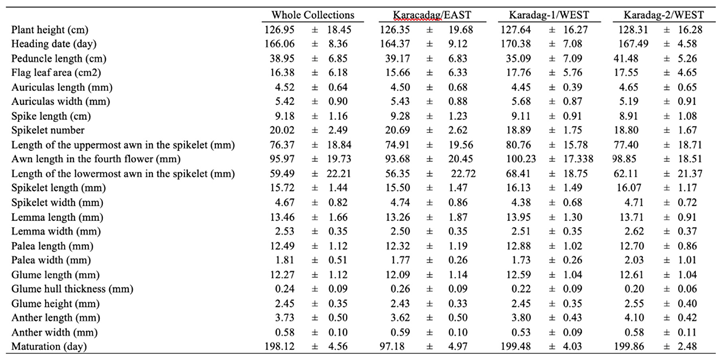
Table 4.
Analysis of molecular variance (AMOVA) summary for the variation within and between populations of Triticum turgidum ssp. dicoccoides.
Table 4.
Analysis of molecular variance (AMOVA) summary for the variation within and between populations of Triticum turgidum ssp. dicoccoides.
| Source | df | SS | MS | Est. Var. | % |
|---|---|---|---|---|---|
| Among Pops | 2 | 439.551 | 219.776 | 4.429 | 16 |
| Within Pops | 166 | 3803.206 | 22.911 | 22.911 | 84 |
| Total | 168 | 4242.757 | 27.340 | 100 |
Table 5.
Nei genetic distance (above diagonal) and Nei identity (below diagonal) values among 38 Triticum turgidum ssp. dicoccoides populations.
Table 5.
Nei genetic distance (above diagonal) and Nei identity (below diagonal) values among 38 Triticum turgidum ssp. dicoccoides populations.
| Population | Karacadag/EAST | Karacadag-1/WEST | Karacadag-2/WEST |
| Karacadag/EAST | --- | 0.518 | 0.539 |
| Karadag-1/WEST | 0.484 | --- | 0.214 |
| Karadag-2/WEST | 0.463 | 0.788 | --- |
Table 6.
Summary statistics of genetic variation among three different regions, Karacadag/EAST, Karadag-1/WEST, and Karadag-2/WEST. The number of alleles per locus (Na), number of effective alleles per locus (Ne), Shannon’s information index (I), expected heterozygosity (He), and unbiased heterozygosity (uHe) of 38 Triticum turgidum ssp. dicoccoides populations.
Table 6.
Summary statistics of genetic variation among three different regions, Karacadag/EAST, Karadag-1/WEST, and Karadag-2/WEST. The number of alleles per locus (Na), number of effective alleles per locus (Ne), Shannon’s information index (I), expected heterozygosity (He), and unbiased heterozygosity (uHe) of 38 Triticum turgidum ssp. dicoccoides populations.
| Pops | N | Na | Ne | I | He | uHe |
| Karacadag/EAST | 108 | 9.938 ± 1.871 | 5.470 ± 0.869 | 1.692 ± 0.177 | 0.725 ± 0.046 | 0.729± 0.046 |
| Karadag-1/WEST | 28 | 3.938 ± 0.470 | 2.747 ± 0.308 | 1.030 ± 0.118 | 0.561 ± 0.051 | 0.572 ± 0.052 |
| Karadag-2/WEST | 33 | 6.125 ± 0.861 | 4.135 ± 0.644 | 1.348 ± 0.181 | 0.621 ± 0.070 | 0.632 ± 0.071 |
Disclaimer/Publisher’s Note: The statements, opinions and data contained in all publications are solely those of the individual author(s) and contributor(s) and not of MDPI and/or the editor(s). MDPI and/or the editor(s) disclaim responsibility for any injury to people or property resulting from any ideas, methods, instructions or products referred to in the content. |
© 2024 by the authors. Licensee MDPI, Basel, Switzerland. This article is an open access article distributed under the terms and conditions of the Creative Commons Attribution (CC BY) license (http://creativecommons.org/licenses/by/4.0/).
Copyright: This open access article is published under a Creative Commons CC BY 4.0 license, which permit the free download, distribution, and reuse, provided that the author and preprint are cited in any reuse.


