
Submitted:
17 December 2024
Posted:
17 December 2024
You are already at the latest version
Abstract
Nanomaterials have gained significant attention in recent decades for their diverse applications, including energy storage devices like supercapacitors. Among these, cobalt oxide (Co3O4) nanostructures stand out due to their high theoretical capacitance, unique electrical properties, and tunable morphology. This study explores the hydrothermal synthesis of Co3O4, revealing that the molar ratio of cobalt nitrate to potassium hydroxide significantly influences the morphology, crystal structure, and electrochemical performance. An optimized 1:1 molar ratio (COK 11) yielded well-defined cubic nanostructures with uniform elemental distribution, as confirmed by SEM, TEM, and EDS analyses. Structural characterization through XRD, XPS, and FTIR validated the formation of the Co3O4 spinel phase with distinctive lattice and surface oxygen features. Electrochemical properties demonstrated the superior performance of the COK 11 electrode, achieving a high specific capacity of 412.8 C/g at current density of 1 A/g, a rate capability of 56.88%, and excellent cycle stability of 88% at 3 A/g after 10,000 cycles. These properties are attributed to the nano-cubic morphology and interconnected porosity, which enhanced ion transport and active surface area. This study highlights the importance of synthesis parameters in tailoring nanomaterials for energy storage, establishing COK 11 as a promising candidate for next-generation high-performance supercapacitor applications.
Keywords:
Co3O4 nanocubes
; Hydrothermal method
; Specific capacitance
; Morphology
; Supercapacitors
1. Introduction
Nanomaterials have been used in various applications in recent decades, including microelectronic circuits, sensors, energy storage devices, piezoelectric devices, and fuel cells. In particular, have sparked widespread interest in supercapacitor applications owing to their large surface area, unique electrical characteristics, and tuneable morphology. Material characteristics at the nanoscale are intimately related to supercapacitor performance, notably energy storage capacity, power density, and cycle life. Nanomaterials have a high surface-to-volume ratio, which implies they can store more electroactive sites for ion adsorption and allow for faster charge/discharge rates. This makes them ideal for use as electrodes in sophisticated supercapacitors [1,2,3,4,5,6,7,8]. Carbon nanotubes, graphene, and activated carbon are prevalent carbon nanomaterials. EDLCs often use these materials, storing energy by physical ion adsorption on their high-surface area architectures [9,10]. Transition metal oxides, including Co3O4, MnO2, and NiO, demonstrate pseudocapacitance by storing energy via reversible faradaic processes[11]. Nanostructuring of these oxides optimizes surface area and reduces diffusion distances, enhancing capacitance and cycle stability [12,13]. A multitude of individuals use conducting polymers such as polyaniline (PANI), polypyrrole (PPy), and polythiophene, which exhibit elevated capacitance via redox mechanisms. Wearable supercapacitors may include polymer nanostructures owing to their flexibility [14,15,16].
Cobalt oxide (Co3O4) has emerged as one of the most promising nanomaterials for supercapacitor applications due to its high theoretical specific capacitance (3560 F g-1), excellent electrochemical stability, and advantageous redox characteristics [17,18]. The Co3O4 adopts a typical spinel crystal structure in which Co2+ ions occupy the tetrahedral interstitial sites, while Co3+ ions are located at the octahedral interstitial sites within the cubic close-packed arrangement of oxygen anions [19]. This unique structural configuration imparts Co3O4 with advantageous electronic and ionic transport properties, making it an attractive material for energy storage applications. Considerable research efforts are currently directed toward developing efficient synthesis methodologies for fabricating Co3O4 nanostructures with diverse morphologies, as these morphological variations can significantly influence their electrochemical characteristics, particularly in supercapacitor applications [20].
A wide range of morphologies, including nanorods [21,22] nanotubes [23,24], nanoflowers [25], and nanowires [26,27], has been reported in the literature, showcasing the adaptability of Co3O4 in various structural forms. To achieve these morphologies, multiple synthesis techniques have been employed, such as co-precipitation, sol-gel, hydrothermal, solution combustion methods, and colloidal approaches [28,29]. Each of these techniques offers distinct advantages in terms of controlling particle size, surface area, and porosity, which are critical parameters affecting the electrochemical performance of Co3O4.
Extensive research has demonstrated the effectiveness of various methodologies in synthesizing Co3O4 nanostructures with enhanced functional properties. For example, Kalpana et al. conducted a comparative analysis of the supercapacitive performance of Co3O4 nanocrystals fabricated using co-precipitation (Co3O4-C) and hydrothermal (Co3O4-H) techniques. Both samples exhibited a spinel-type cubic crystal structure and pseudocapacitive behavior. Notably, the hydrothermally synthesized Co3O4-H, characterized by a distinctive flower-like morphology, achieved a significantly higher specific capacitance of 366 F/g at a current density of 0.5 A/g, compared to the spherical Co3O4-C particles, which exhibited a specific capacitance of 233 F/g at 0.5 A/g [25]. Kalyanjyoti et al. synthesized highly stable Co3O4 nanocrystals, including 0D nanospheres and 2D hexagonal platelets, through a solvothermal method. The morphology transition from nanospheres to platelets was found to be reaction time-dependent. Electrochemical analysis revealed that the hexagonal platelets exhibit exceptional capacitive performance, achieving a specific capacitance of 476 F/g at a current density of 0.5 A/g. This superior performance is attributed to their morphology, which enhances ion accessibility. Further improvements in capacitance could be achieved by incorporating large surface area supports or conductive fillers [30]. Co3O4 nanoparticles were synthesized by Shwetha et al. using the solution combustion method, with variations in the fuel-to-oxidizer ratio. The electrode produced with a F/O ratio of 1 demonstrated exceptional performance, achieving a specific capacitance of 205 F/g at a scan rate of 2 mV/s, 166 F/g at a current density of 0.5 A/g, and retaining 90% of its capacitance after 5,000 cycles. Its uniform particle distribution and high surface area make it a highly promising material for supercapacitor applications [31]. Rose Babu et al. synthesized cobalt oxide nanoparticles hydrothermally at various temperatures and analyzed their structural, optical and electrochemical properties. The material showed a specific capacitance of 450 F/g at 1 A/g and retained over 88% capacitance over 10,000 cycles at 20 A/g, indicating excellent stability and low charge transfer resistance [32]. The Co3O4@N-MWCNT composite was synthesized by Rajendra Kumar et al. through a sonication-assisted thermal reduction process, specifically tailored for enhanced supercapacitor performance. This method facilitated the integration of Co3O4 nanoparticles onto nitrogen-doped multi-walled carbon nanotubes, improving both the electrical conductivity and electrochemical stability of the composite. The electrode exhibited an impressive electrochemical capacitance of 225 F/g at a current density of 0.5 A/g [33]. Tao et al. developed a novel flexible Co3O4 electrode with an amorphous, hydroxyl-rich structure created through the electrochemical oxidation of a cobalt-based metal-organic framework. The electrode features large micro rods, small nanoparticles, and abundant mesopores, which enhance electron transfer, active interface exposure, and electrolyte ion penetration. The Co3O4 electrode demonstrates a high specific capacitance of 226.1 C/g and excellent rate performance, outperforming crystalline, hydroxyl-deficient Co3O4 electrodes [34].
Building on these advancements, the present study focuses on synthesizing Co3O4 nanocubes using a facile hydrothermal technique. Potassium hydroxide solution was employed as a reducing agent at varying molar ratios to explore its influence on microstructural and electrochemical properties of materials. The synthesized Co3O4 nanocube with a 1:1 molar ratio exhibited remarkable battery-type behavior, delivering a specific capacitance of 412 C/g at 1 A/g. Furthermore, they demonstrated excellent cyclic stability, retaining 88% of their capacitance at 3 A/g even after 10,000 cycles. These results underscore the potential of this approach for producing high-performance electrode materials tailored for advanced supercapacitor applications.
2. Materials and Methods
2.1. Raw Materials
Sigma-Aldrich provided cobalt(II) nitrate hexahydrate (Co(NO3)2.6H2O) and polyvinylidene fluoride (PVDF), while spectrochem chemicals and Thames-Baker provided potassium hydroxide (KOH)(99%) and N-methyl pyrrolidone (NMP). We utilized all of the compounds directly, without any additional purification. All synthesis methods were carried out using deionized water and ethanol.
2.2. Synthesis Procedure
In a typical synthesis (Scheme 1), cobalt nitrate hexahydrate and KOH were used as precursors in a stoichiometric ratio. Initially, a 1 M cobalt nitrate solution was prepared in 20 mL of deionized water and stirred for 1 h to ensure homogeneity. Then, 20 mL of 1 M KOH was added drop wise while continuously stirring with a magnetic stirrer for an additional hour. The resulting mixture was transferred to a 100 mL Teflon-lined autoclave, where the reaction was conducted at 200 °C for 24 h. After cooling the autoclave to room temperature, the resulting material was washed and rinsed four times with ethanol and distilled water to remove any impurities. The precipitate was then dried at 80 °C for 5 h and subsequently calcinated at 400 °C for 4 h with a heating rate of 3 °C/min. The sample synthesized with a 1:1 precursor ratio of cobalt nitrate and KOH is designated as COK 11. For comparison, samples prepared with different ratios of Co(NO₃)₂.6H₂O and KOH, specifically 1:3 and 1:5 are labeled COK 13, and COK 15, respectively.
2.3. Microstructural and Electrochemical Measurements
The microstructural properties of the Co3O4 nanocubes were analyzed using X-ray diffraction (XRD) using a Rigaku miniflex600 apparatus with the CuKα radiation (0.15406 nm). The morphology of the produced cobalt oxide was evaluated using a field emission scanning electron microscope (FE-SEM) equipped with energy dispersive X-ray analysis (EDAX), and a high-resolution transmission electron microscope (HR-TEM). The structural changes of porous Co3O4 nanocubes were explored using X-ray photoelectron spectroscopy (XPS, Thermo scientific) with Al Kα radiation under the pressure of 5×10⁻⁹ Torr and Fourier transform infrared (FTIR, Nicolet, IR300).
The electrochemical performance of the prepared cobalt oxide electrodes was evaluated in a 3 M KOH aqueous electrolyte within a voltage range of 0.0 to 0.5 V at room temperature, using a CHI 608C electrochemical workstation (Instrument Inc., USA) in a three-electrode glass cell. The working electrode was prepared by combining 80 wt.% active material, 10 wt.% PVDF, and 10 wt.% carbon black. After grinding these components for 3 h, a small amount of NMP solution was added to form a smooth slurry. Cleaned nickel foam pieces (1.5 cm²) were coated with the slurry through a drop-casting technique and dried overnight at 100 °C.
For electrode preparation, commercial nickel foam sheets were cut into 1.5 cm × 1 cm pieces. Some foam pieces were immersed in 3 M hydrochloric acid and then sonicated for 15 min to remove the NiO layer and any residual hydrocarbons on the surface. The cleaned foams were then rinsed with deionized water and ethanol in an ultrasonic bath and dried in a vacuum oven for later use. The electrode's mass loading was 2.02 mg/cm². The Ag/AgCl and a platinum strip were used as reference and counter electrodes, respectively.
3. Results and Discussion
The SEM micrographs shown in Figure 1(a)-Figure 1(c) illustrate the hydrothermal synthesis of COK-11 to COK-15 samples, using cobalt nitrate as the precursor and potassium hydroxide (KOH) as both a reducing agent and a morphological control agent. At an equimolar ratio of cobalt nitrate to KOH (COK-11), the resulting particles exhibit a well-defined cubic morphology (Figure 1a). Each cubic particle (Figure 1a-i) consists of smaller, approximately spherical grains that assemble to form mesoporous networks at the inter-grain junctions [35,36]. The morphology of the particles undergoes a substantial transformation with variations in KOH concentration. When the precursor-to-reducing agent ratio increases to 1:3 or 1:5, the morphology shifts predominantly to spherical particles (Figure 1b) or agglomerated particle clusters (Figure 1c), respectively. The measured particle size range of the prepared COK 11, COK 13, and COK 15 samples was found to be 200-250, 60-100, and 100-400 nm, respectively.
Energy dispersive X-ray spectroscopy (EDS) analysis (Figure S1) confirms the elemental composition of the synthesized COK-11 powder, with cobalt (41.20 at.%) and oxygen (58.80 at.%) present in a stoichiometric ratio consistent with the spinel cobalt oxide (Co3O4) phase. The elemental mapping of COK-11 also confirms the uniform distribution of cobalt and oxygen throughout the scanning area of the nanocubes, shown in Figure S2. Conversely, a lower ratio of 1:0.5 yields a heterogeneous mixture of irregularly shaped cubic particles interspersed with scattered grains, as shown in Figure S3.
Transmission electron microscopy analysis (Figure 2) provides additional insights into the morphology and crystallinity of the synthesized COK 11 nanomaterials. Figure 2(a) and Figure 2(b) reveal cubic nanoparticles, corroborating the SEM findings, with an average side length of approximately 250 nm and a calculated volume of 106 nm3. High-resolution TEM (HR-TEM) imaging shows distinct lattice fringes, with Figure 2c and the top and down insets in Figure 2c displaying a measured d-spacing of 0.245 nm, corresponding to the (311) crystallographic plane of the spinel Co3O4 structure. Furthermore, the uniform spatial distribution of cobalt (Co) signals from the L and K shells and oxygen (O) signals from the K shell in line scan (Figure 1d) further validate the successful formation of Co3O4 nanocube, with cobalt atoms in +2 and +3 oxidation states balanced by oxygen in a -2 oxidation state. Also, the size of the nanocube was found to be 250 nm.
The structural properties and phase composition of the synthesized powders were analyzed using X-ray diffraction (XRD), shown in Figure 3a. Distinct diffraction peaks were observed at angles of 18.8°, 31.1°, 36.6°, 38.4°, 44.6°, 55.5°, 59.2°, 65.1°, and 77.1°, corresponding to the crystallographic planes (111), (220), (331), (222), (400), (422), (333), (440), and (533), respectively. These peaks confirm the formation of Co3O4, consistent with previous reports [10,37]. Also, the XRD examination revealed a cubic structure with a space group of Fd-3m, which corresponds to the data reported on JCPDS card no. 42-1467. The synthesized material displayed moderate crystallinity, as evidenced by the intensity of the diffraction peaks. The calculated lattice parameters a = b = c = 8.0925 Å slightly exceed the theoretical value of 8.084 Å. This may be due to nanoscale effects, defect-induced strain, and synthesis conditions. These factors collectively modify the atomic arrangement, leading to a measurable expansion of the unit cell [38]. The average crystallite size (D) of the synthesized samples was estimated using Scherrer's equation [39,40]:
where k is a shape factor with a value of 0.9, λ represents the Cu Kα radiation wavelength, β is the full width at half-maximum (FWHM), and θ represents the Bragg angle. According to this computation, the average crystal sizes of COK 11, COK 13, and COK 15 were 30.6, 24.3, and 21.3 nm, respectively. Additionally, the micro-strain (ε) and dislocation density (δ) values of the obvious peaks were 0.00332 and 1.11×10¹⁵ for COK 11, 0.00435 and 2.39×10¹⁵ for COK 13 and 0.00472 and 2.70×10¹⁵ for COK 15. These values indicate that crystal size decreases as the ratio increases, and the micro-strain and dislocation density increase. This trend is typical in materials science whereas smaller crystal sizes often lead to higher strain and dislocation densities due to the increased surface area and defects.
Microstructural results concluded that under supercritical water conditions, the OH− ions from KOH serve a dual role as both reducing agent and saturation-inducing agents, facilitating the dissolution and recrystallization processes necessary for nucleation. The rapid precipitation of cobalt oxide nanoparticles occurs due to chemical interactions in the homogeneously hydrolyzed metal solutions. The nucleation and growth dynamics are primarily governed by the molar concentration of KOH relative to the cobalt precursor under hydrothermal reaction conditions. At 0.5 M KOH, a mixed morphology of scattered and cubic particles is observed (Figure S1). A uniform cubic morphology develops at 1.0 M KOH (Figure 1a and Figure 2a), whereas aggregated spherical particles dominate at concentrations of ≥3M KOH (Figure 1c and Figure 1d). These findings highlight the critical role of KOH concentration in determining particle morphology. The hydrothermal reaction leading to Co3O4 formation can be described by the following chemical equations (1) and (2), which outline the transformation from dissolved precursors to the crystalline spinel phase.
Figure 3 (b and c) shows Co 2p and O 1s XPS spectra. These depict the chemical and valence states at the surface of the COK 11 sample. The peaks at 780.81 and 796.63 eV correspond to Co 2p3/2 and Co 2p1/2, respectively, with a spin-orbit splitting of 15.82 eV [41,42]. This demonstrates the Co3O4 phase, a common cobalt oxide with mixed Co2+ and Co3+ oxidation states. The Co 2p3/2 spectrum is deconvoluted into two peaks at 780.55 and 781.98 eV, attributable to Co3+ and Co2+ on the surface, and two satellite peaks at 786.0 and 790.83 eV, revealing the distinctive electronic transitions inside cobalt oxides [43]. However, the Co 2p1/2 spectrum is deconvoluted into peaks at 796.2 and 797.47 eV, corresponding to Co3+ and Co2+ contributions, followed by satellite peaks at 802.50 and 806.29 eV, verifying the mixed oxidation states [44]. Figure 3c also shows a two-peak O 1s spectrum at 529.67 and 530.72 eV. The peak at 529.67 eV is attributed to lattice oxygen (Olatt., O2−), which is inherent in the crystalline structure of Co3O4. The signal at 530.72 eV indicates oxygen species adsorbed on surface vacancies (Osurf, O−, O22−, and OH−) [45,46]. These surface-adsorbed oxygen species are often the result of crystal lattice defects or vacancies, which play an important role in improving the electrochemical characteristics of the materials.
FTIR spectroscopy was employed to analyze the structure of the synthesized Co3O4 nanoparticles. Figure 3d shows their FTIR spectrum recorded at room temperature in the 500-4000 cm−1 range. Metal oxides generally exhibit characteristic FTIR peaks below 1000 cm−1, attributed to the intra-atomic vibrations. The FTIR spectrum of COK 11 nanoparticles reveals two prominent bands, corresponding to metal-oxygen bonds in its spinel structure. The band at ~660 cm-1 is linked to Co3+− O stretching vibrations in octahedral sites, while the band around 560 cm-1 is due to Co2+− O stretching in tetrahedral sites. These bands are crucial for identifying the Co3O4 phase and align well with the reported data in the literature [47,48].
The electrochemical performance of the synthesized cobalt oxide (Co3O4) electrodes was systematically evaluated using CV, GCD, and EIS analysis in a 3M aqueous potassium hydroxide (KOH) electrolyte at ambient temperature. Figure 4a illustrates the current response of the prepared electrode samples, along with a comparison to bare nickel foam, at a scan rate of 60 mV/s within a potential window of 0 to 0.5 V. All tested electrodes exhibited a distinct pair of redox peaks, an oxidative peak around 0.4 V and reduction peak near 0.3 V. These peaks correspond to the reversible redox transition between Co2+ and Co3+ oxidation states during the electrochemical reactions. The following equations can represent these redox processes [31]:
Notably, the COK 11 electrode demonstrated a significantly larger integral area in the CV curve than other samples, suggesting enhanced electrochemical activity. This improvement can be attributed to its unique surface morphology, characterized by nanocubic structures offering abundant electroactive sites and interconnected pores, facilitating efficient ion transport within the electrolyte. Figure 4(b-d) further confirms that, across all cobalt oxide electrodes, the current response and integral area of the CV curves increased proportionally with the applied scan rate. This behavior highlights the involvement of both surface-controlled and diffusion-controlled redox mechanisms in the charge storage process [49,50]. The relative contribution of these mechanisms was assessed using the power-law relationship (I = avb), where b serves as an indicator of the reaction kinetics [51,52]. For the COK 11-15 electrodes, the calculated b-values ranged from 0.41 to 0.52 (Figure 4e), indicating a predominant diffusion-controlled mechanism occurred during the charge storage process. The specific capacity (Qsp) of the electrode was derived from the CV data using the following equation [51,53]:
- where represents the integral area of the CV curve, ‘m’ is the mass of the active electrode material (in mg), and ‘ν’ is the scan rate (in mV/s). The calculated specific capacities of the COK 11 electrode were 440, 306, 210, 136, 104, 85, and 71.5 C/g at a scan rate of 5, 10, 20, 40, 60, 80, and 100 mV/s, respectively, as shown in Figure 4f. In comparison, the COK 13 and COK 15 electrodes exhibited lower specific capacities of 270, 230, 145, 105, 85, 72, and 64 C/g, and 250, 175, 132, 91, 74, 63, and 54 C/g, respectively, under the same scan rates.
Among all the electrodes studied, the COK 11 electrode displayed superior specific capacities, corroborating the results of CV measurements and the observed microstructural characteristics. Figure 4f also reveals a general decline in specific capacity with increasing scan rates. This decrease can be attributed to the limited interaction time available between the electrolyte ions and the electrode surface during rapid faradaic reactions, which constrains charge storage efficiency under high scan rates [54,55].
The galvanostatic charge-discharge (GCD) profiles of the cobalt oxide electrodes were recorded at varying current densities within the same potential window used for CV measurements. These GCD curves exhibited voltage plateaus at ~0.4 and ~0.3 V versus Ag/AgCl, consistent with the redox peaks observed in the CV curves. The non-linear shape of the GCD profiles confirmed the battery-type electrochemical behaviour of the electrodes. The specific capacity (Cs) of the electrode was calculated using the formula [56,57]:
Figure 5a illustrates the comparative GCD curves of COK 11, COK 13, and COK 15 samples at a current density of 1 A/g. Among these, the COK 11 electrode exhibited longer charge-discharge duration than COK 13, and COK 15, indicating superior charge storage capability. The specific capacities measured at 1 A/g were 412.8, 299.73, and 201.78 C/g for COK 11, COK 13, and COK 15, respectively. GCD profiles for these electrodes at current densities ranging from 1 to 4 A/g are presented in Figure 5 (b-d). The COK 11 electrode delivered specific capacities of 412.8, 350.22, 288, and 234.36 C/g at current densities of 1, 2, 3, and 4 A/g, respectively. Similarly, the COK 13 electrode achieved capacities of 299.73, 263.32, 212.58, and 169 C/g, while the COK 15 electrode yielded 201.78, 122.2, 71.82, and 52 C/g under the same current densities. These results demonstrate that the COK 11 electrode exhibited the highest rate capability (56.88%), outperforming COK 13 (54.71%) and COK 15 (25.77%).
To elucidate the electrochemical reaction kinetics, electrochemical impedance spectroscopy (EIS) was performed (Figure 5e). The Nyquist plots revealed two distinct regions: a high-frequency semicircle and a low-frequency linear tail. The semicircle corresponds to the charge-transfer resistance (Rct) associated with redox reactions between the electrode material and the electrolyte, while the intercept on the real axis represents the equivalent series resistance (Rs). The linear portion at low frequencies indicates the ion diffusion impedance (Warburg impedance, W) [58,59,60]. All Nyquist plots were well-fitted to an equivalent circuit model R(CR)(QR)(CR) (inset in Figure 5e) with χ2 values of 2.38×10⁻³ (COK 11), 1.57×10⁻³ (COK 13), and 1.74×10⁻² (COK 15). The Rs values for COK 11, COK 13, and COK 15 were 0.38, 0.53, and 0.94 Ω, respectively. Similarly, the charge transfer resistance (Rct) values for COK 11 and COK 13 were both 0.37 Ω, indicating the superior electrochemical conductivity of COK 11. Furthermore, the steep linear segment in the Nyquist plot of COK 11 confirmed its excellent ion-diffusion properties. Figure 5f displays the cycling stability of the COK 11 electrode at a current density of 3 A g-1. After 5000 cycles, the specific capacity retention is 93.67%, and after 10000 cycles, it retains 88% of its initial value, demonstrating exceptional long-term stability and durability. Furthermore, the specific capacity and cycling stability of the COK 11 electrode were compared with those of previously reported cobalt oxide electrodes, as presented in Table 1. The results demonstrate its superior electrochemical performance in a three-electrode system compared to the earlier cobalt oxide electrodes.
4. Conclusions
In summary, the hydrothermal synthesis of Co3O4 nanomaterials demonstrated that the morphology, crystal structure, and electrochemical properties of the particles are significantly influenced by the concentration of potassium hydroxide. The optimized 1:1 molar ratio of cobalt nitrate to KOH (COK 11) produced well-defined cubic nanostructures with uniform elemental distribution, as confirmed by SEM, TEM, and EDS analyses. The structural characterization through XRD, XPS, and FTIR further validated the formation of the Co3O4 spinel phase with characteristic lattice and surface oxygen features. Electrochemical evaluations revealed that the COK 11 electrode outperformed its counterparts in terms of specific capacity and electrochemical activity, attributable to its nano cubic morphology and interconnected porosity, which facilitated efficient ion transport and increased active surface area. The gradual decline in specific capacity with increased scan rates across all samples underscores the diffusion-controlled nature of the charge storage mechanism. The COK 11 electrode demonstrates a high specific capacity of 412.8 C/g (@ 1 A/g), remarkable rate capability (56.88%), and excellent cycle stability (88%) after 10000 cycles. It concludes that the critical role of synthesis parameters in tailoring the structural and electrochemical properties of cobalt oxide nanomaterials makes COK-11 a promising candidate for energy storage applications.
Supplementary Materials
The following supporting information can be downloaded at the website of this paper posted on Preprints.org, Figure S1: EDS spectrum of COK 11 sample; Figure S2: Elemental mapping of COK 11 sample with Co K, and O K elements; Figure S3: FE-SEM image of cobalt oxide sample with 1:0.5 ratio of cobalt nitrite and KOH.
Author Contributions
Conceptualization, O.M.H.; formal analysis, B.H. and M.D.; investigation, B.H. and M.D.; data curation, B.H. and M.D.; writing—original draft preparation, M.D. and O.M.H.; writing—review and editing, C.M.J; supervision, O.M.H. All authors have read and agreed to the published version of the manuscript.
Funding
This research received no funding.
Data Availability Statement
All data are contained in this article or Supplementary Materials.
Conflicts of Interest
The authors declare no conflicts of interest.
References
- Yoon, Y.; Truong, P.L.; Lee, D.; Ko, S.H. Metal-oxide Nanomaterials Synthesis and applications in flexible and wearable sensors. ACS Nanoscience Au 2022, 2, 64–92. [CrossRef]
- Goyal, M.; Singh, K.; Bhatnagar, N. Applications of nanomaterials for enhanced performance, and sustainability in energy storage devices: A review. ChemistrySelect 2024, 9, e202400543. [CrossRef]
- Singh, P.K.; Kaur, G.A.; Shandilya, M.; Rana, P.; Rai, R.; Mishra, Y.K.; Syväjärvi, M.; Tiwari, A. Trends in piezoelectric nanomaterials towards green energy scavenging nanodevices. Mater. Today Sustain. 2023, 24, 100583. [CrossRef]
- Saleh, H.M.; Hassan, A.I. Synthesis and characterization of nanomaterials for application in cost-effective electrochemical devices. Sustainability 2023, 15, 10891. [CrossRef]
- Al-Mahmud, M.Z. A Concise Review of nanoparticles utilized energy storage and conservation. J. Nanomaterials 2023, 2023, 1–14. [CrossRef]
- Pérez Mendoza, A.E.; Schmidt, A.; Zarbin, A.J.G.; Winnischofer, H. Review of nanoscale approaches for tailoring electrode materials for advanced energy storage systems. ACS Appl. Nano Mater. 2024, 7, 23295–23320. [CrossRef]
- Kumar, N.; Kim, S.-B.; Lee, S.-Y.; Park, S.-J. Recent advanced supercapacitor: A review of storage mechanisms, electrode materials, modification, and perspectives. Nanomaterials 2022, 12, 3708. [CrossRef]
- Ngidi, N.P.D.; Koekemoer, A.F.; Ndlela, S.S. Recent advancement in the electrochemical performance of electrochemical capacitors based on biomass-derived porous carbon: A review. J. Energy Storage 2024, 89, 111638. [CrossRef]
- Waris, M.S.; Chaudhary, A.H.; Anwer, S.; Sultana, P.P.; Ingole, S.A.A.; Nami, M.Z.; Khan, A. Review on development of carbon-based nanomaterials for energy storage devices: opportunities and challenges. Energy & Fuels 2023, 37, 19433–19460. [CrossRef]
- Kothandam, G.; Singh, G.; Guan, X.; Lee, J.M. Ramadass, K. Joseph, S. Benzigar, M. Karakoti, A. Yi, J. Kumar, P. Vinu, A. Recent advances in carbon-based electrodes for energy storage and conversion. Adv. Sci. 2023, 10, 2301045. [CrossRef]
- Jayakumar, S.; Santhosh, P.C.; Mohideen, M.M.; Radhamani, A.V. A comprehensive review of metal oxides (RuO2, Co3O4, MnO2 and NiO) for supercapacitor applications and global market trends. J. Alloys Compd. 2024, 976, 173170. [CrossRef]
- Pan, J.; Li, C.; Peng, Y.; Wang, L.; Li, B.; Zheng, G.; Song, M. Application of transition metal (Ni, Co and Zn) oxides based electrode materials for ion-batteries and supercapacitors. Int. J. Electrochem. Sci. 2023, 18, 100233. [CrossRef]
- Quispe-Garrido, V.; Cerron-Calle, G.A.; Bazan-Aguilar, A.; Ruiz-Montoya, J.G.; López, E.O.; Baena-Moncada, A.M. Advances in the design and application of transition metal oxide-based supercapacitors. Open Chem. 2021, 19, 709–725. [CrossRef]
- Tadesse, M.G.; Ahmmed, A.S.; Lübben, J.F. Review on conductive polymer composites for supercapacitor applications. J. Composites Sci. 2024, 8, 53. [CrossRef]
- Wang, Y.; Ding, Y.; Guo, X.; Yu, G. Conductive polymers for stretchable supercapacitors. Nano Res. 2019, 12, 1978–1987. [CrossRef]
- Alcaraz-Espinoza, J.J.; de Melo, C.P.; de Oliveira, H.P. Fabrication of highly flexible hierarchical polypyrrole/carbon nanotube on eggshell membranes for supercapacitors. ACS Omega 2017, 2, 2866–2877. [CrossRef]
- Liao, Q.; Li, N.; Jin, S.; Yang, G.; Wang, C. All-solid-state symmetric supercapacitor based on Co3O4 nanoparticles on vertically aligned graphene. ACS Nano 2015, 9, 5310–5317. [CrossRef]
- Xu, W.; Li, T.-T.; Zheng, Y.-Q. Porous Co3O4 nanoparticles derived from a Co( ii )-cyclohexanehexacarboxylate metal–organic framework and used in a supercapacitor with good cycling stability. RSC Adv. 2016, 6, 86447–86454. [CrossRef]
- Wiegmann, T.; Pacheco, I.; Reikowski, F.; Stettner, J.; Qiu, C.; Bouvier, M.; Bertram, M.; Faisal, F.; Brummel, O.; Libuda, J.; Drnec, J.; Allongue, P.; Maroun, F.; Magnussen, O.M. Operando identification of the reversible skin layer on Co3O4 as a three-dimensional reaction zone for oxygen evolution. ACS Catalysis 2022, 12, 3256–3268. [CrossRef]
- Velhal, N.B. Yun, T.H. Ahn, J. Kim, T. Kim, J. Yim, C. Tailoring cobalt oxide nanostructures for stable and high-performance energy storage applications. Ceram. Int. 2023, 49, 4889–4897. [CrossRef]
- Chen, M.; Ge, Q.; Qi, M.; Liang, X.; Wang, F.; Chen, Q. Cobalt oxides nanorods arrays as advanced electrode for high performance supercapacitor. Surf. Coatings Technol. 2019, 360, 73–77. [CrossRef]
- Kunhikrishnan, L.; Shanmugham, R. High electrochemical performance of morphologically controlled cobalt oxide for supercapacitor application. Mater. Character. 177 2021, 177, 111160. [CrossRef]
- Xu, J.; Gao, L.; Cao, J.; Wang, W.; Chen, Z. Preparation and electrochemical capacitance of cobalt oxide (Co3O4) nanotubes as supercapacitor material. Electrochim. Acta 2010, 56, 732–736. [CrossRef]
- More, S.; Joshi, B.; Khadka, A.; Samuel, E.; Il Kim, Y.; Aldalbahi, A.; El-Newehy, M.; Gurav, K.; Lee, H.-S.; Yoon, S.S. Oriented attachment of carbon/cobalt-cobalt oxide nanotubes on manganese-doped carbon nanofibers for flexible symmetric supercapacitors, Appl. Surf. Sci. 2023, 615, 156386. [CrossRef]
- Kalpana, S.; Bhat, V.S.; Hegde, G.; Niranjana Prabhu, T. Anantharamaiah, P.N.Morphology-dependent supercapacitive properties of Co3O4 nanomaterials synthesized via coprecipitation and hydrothermal methods. Inorg. Chem. Commun. 2023, 158, 111458. [CrossRef]
- Desai, R.S.; Jadhav, V.S.; Morankar, P.J.; Patil, S.B.; Sadale, S.B.; Pardeshi, S.R.; Lad, D.D.; Patil, P.S.; Jeon, C.-W.; Dalavi, D.S. Hydrothermal synthesis of self-supported hierarchical microflowers of Co3O4 nanowires for potential supercapacitor application. J. Electroanal. Chem. 2025, 976, 118800. [CrossRef]
- Wei, G.; Yan, L.; Huang, H.; Yan, F.; Liang, X.; Xu, S.; Lan, Z.; Zhou, W.; Guo, J. The hetero-structured nanoarray construction of Co3O4 nanowires anchored on nanoflakes as a high-performance electrode for supercapacitors. Appl. Surf. Sci. 2021, 538, 147932. [CrossRef]
- Waris, A.; Din, M.; Ali, A.; Afridi, S.; Baset, A.; Khan, A.U.; Ali, M. Green fabrication of Co and Co3O4 nanoparticles and their biomedical applications: A review. Open Life Sci. 2021, 16, 14–30. [CrossRef]
- Lu, C.; Liu, L.; Yang, Y.; Ma, Y.; Luo, Q.; Zhu, M. Recent progress in Co3O4-based nanomaterials for supercapacitors. ChemNanoMat 2023, 9, e202200537. [CrossRef]
- Deori, K.; Ujjain, S.K.; Sharma, R.K.; Deka, S. Morphology Controlled Synthesis of Nanoporous Co3O4 nanostructures and their charge storage characteristics in Supercapacitors. ACS Appl. Mater. Interfaces 2013, 5, 10665–10672. [CrossRef]
- Shwetha, K.P.; Manjunatha, C.; Sudha Kamath, M.K.; Vinaykumar; Radhika, M.G.R.; Khosla, A. Morphology-controlled synthesis and structural features of ultrafine nanoparticles of Co3O4 : An active electrode material for a supercapacitor. Appl. Res. 2022, 1, e202200031. [CrossRef]
- Babu, C.R.; Avani, A.V.; Shaji, S.; Anila, E.I. Electrochemical characteristics of Co3O4 nanoparticles synthesized via the hydrothermal approach for supercapacitor applications, J. Solid State Electrochem. 2024, 28, 2203–2210. [CrossRef]
- Nare, R.K. Ramesh, S. Basavi, P.K. Kakani, V. Bathula, C. Yadav, H.M. Dhanapal, P.B. Kotanka, R.K.R. Pasupuleti, V.R. Sonication-supported synthesis of cobalt oxide assembled on an N-MWCNT composite for electrochemical supercapacitors via three-electrode configuration. Sci. Rep. 2022, 12, 1998. [CrossRef]
- Tao, Y.; Wu, Y.; Chen, H.; Chen, W.; Wang, J.; Tong, Y.; Pei, G.; Shen, Z.; Guan, C. Synthesis of amorphous hydroxyl-rich Co3O4 for flexible high-rate supercapacitor. Chem. Eng. J. 2020, 396, 125364. [CrossRef]
- Hao, P.; Peng, B.; Shan, B.-Q.; Yang, T.-Q.; Zhang, K. Comprehensive understanding of the synthesis and formation mechanism of dendritic mesoporous silica nanospheres. Nanoscale Adv. 2020, 2, 1792–1810. [CrossRef]
- Quirk, J.; Rothmann, M.; Li, W.; Abou-Ras, D.; McKenna, K.P. Grain boundaries in polycrystalline materials for energy applications: First principles modeling and electron microscopy. Appl. Phys. Rev. 2024, 11, 011308. [CrossRef]
- Sun, J.; Wang, H.; Li, Y.; Zhao, M. Porous Co3O4 column as a high-performance Lithium anode material. J. Porous Mater. 2021, 28, 889–894. [CrossRef]
- Wei, Z.; Xia, T.; Ma, J.; Feng, W.; Dai, J.; Wang, Q.; Yan, P. Investigation of the lattice expansion for Ni nanoparticles. Mater. Character. 2007, 58, 1019–1024. [CrossRef]
- Merum, D.; Nallapureddy, R.R.; Pallavolu, M.R.; Mandal, T.K.; Gutturu, R.R.; Parvin, N.; Banerjee, A.N.; Joo, S.W. Pseudocapacitive performance of freestanding Ni3V2O8 nanosheets for high energy and power density asymmetric supercapacitors. ACS Appl. Energy Mater. 2022, 5, 5561–5578. [CrossRef]
- Nasiri, S.; Rabiei, M.; Palevicius, A.; Janusas, G.; Vilkauskas, A.; Nutalapati, V.; Monshi, A. Modified Scherrer equation to calculate crystal size by XRD with high accuracy, examples Fe2O3, TiO2 and V2O5. Nano Trends 2023, 3, 100015. [CrossRef]
- Supriya, S.; Das, S.; Senapati, S.; Naik, R. Cu2Te/CoTe nanoparticles with tuneable bandgaps: Implications for photovoltaic and optoelectronic devices. Surfaces and Interfaces 2024, 44, 103823. [CrossRef]
- Adesuji, E.T.; Guardado-Villegas, E.; Fuentes, K.M.; Sánchez-Domínguez, M.; Videa, M. Pt-Co3O4 superstructures by one-pot reduction/precipitation in bicontinuous microemulsion for electrocatalytic oxygen evolution reaction. Catalysts 2020, 10, 1311. [CrossRef]
- Cole, K.M.; Kirk, D.W.; Thorpe, S.J. Co3O4 nanoparticles characterized by XPS and UPS. Surf. Sci. Spectra 2021, 28, 014001. [CrossRef]
- Daza-Gómez, L.; Pérez Salas, K.Y.; Ruiz-Huerta, L.; García Peña, N.G.; Maturano Rojas, V.; Redón, R. Co3O4 @SiO2 3D monolith catalysts, additive manufactured structures for propane oxidation reaction. ChemistrySelect 2024, 9, e202304849. [CrossRef]
- Murugesan, R.A.; Chandar Nagamuthu Raja, K.; Devi, N.; Lin, H.-T.; Huang, C.-C.; Jiang, X.-Y.; Li, Y.-Y.; Arthanareeswaran, G.; Ponvijayakanthan, L.; Jaiswal, N.K.; Chen, Y.-S. Development of Ni-doped Co3O4 oxygen evolution catalysts for anion exchange membrane water electrolysis. Int. J. Hydrogen Energy 2024, 72, 677–686. [CrossRef]
- Urgunde, A.B.; Kamboj, V.; Kannattil, H.P.; Gupta, R. Layer-by-layer coating of cobalt-based ink for large-scale fabrication of OER electrocatalyst. Energy Technol. 2019, 7, 1900603. [CrossRef]
- Makhlouf, S.A.; Bakr, Z.H.; Aly, K.I.; Moustafa, M.S. Structural, electrical and optical properties of Co3O4 nanoparticles. Superlattices and Microstructures 2013, 64, 107–117. [CrossRef]
- Al-Senani, G.M.; Deraz, N.M.; Abd-Elkader, O.H. Magnetic and characterization studies of CoO/Co3O4 nanocomposite. Processes 2020, 8, 844. [CrossRef]
- Guragain, D.; Zequine, C.; Gupta, R.K.; Mishra, S.R. Facile synthesis of bio-template tubular MCo2O4 (M = Cr, Mn, Ni) microstructure and its electrochemical performance in aqueous electrolyte. Processes 2020, 8, 343. [CrossRef]
- Yamada, H.; Yoshii, K.; Asahi, M.; Chiku, M.; Kitazumi, Y. Cyclic voltammetry Part 2: Surface adsorption, electric double layer, and diffusion layer. Electrochemistry 2022, 90, 22–66084. [CrossRef]
- Merum, D.; Ambadi, L.N.; Mahammad, H.O.; Pallavolu, M.R.; Goddati, M.; Lee, J.; Al-Asbahi, B.A.; Pitcheri, R.; Banerjee, A.N.; Joo, S.W. Direct growth of cobalt-doped nickel vanadate shelf-like architectures on Ni foam electrodes for solid-state alkaline battery. J. Alloys Compd. 2023, 950, 169771. [CrossRef]
- Merum, D.; Arla, S.K.; Radhalayam, D.; Tighezza, A.M.; Mooni, S.P.; Joo, S.W. Garland-structured Bi2O2CO3@Ni(OH)2 as a battery-type electrode for high-performance electrochemical energy storage device applications. J. Energy Storage 2024, 99, 113189. [CrossRef]
- Thonge, P.N.; Dhas, S.D.; Waghmare, S.D.; Patil, A.H.; Patil, T.M.; Yewale, M.A.; Mendhe, A.C.; Kim, D. Facile hydrothermal synthesis of NiMn2O4/C nanosheets for solid-state asymmetric supercapacitor and electrocatalytic oxygen evolution reaction. ACS Appl. Nano Mater. 2024, 7, 18579–18589. [CrossRef]
- Sanayee, M.; Arvand, M. Synthesis and electrochemical properties of nanocubes Mn2SnS3 for high-performance supercapacitors. Sci. Rep. 2023, 13, 20838. [CrossRef]
- Merum, D.; Parvin, N.; Vattikuti, S.V.P.; Nallapureddy, R.R.; Pitcheri, R.; Shkir, M.; Manthrammel, M.A.; Banerjee, A.N.; Joo, S.W. Impact of Co-doping on the microstructural and electrochemical features of mesoporous 3D oval–shaped Ni3-xCoxV2O8 electrodes for high-performance hybrid supercapacitors. J. Energy Storage 2023, 61, 106674. [CrossRef]
- Chen, X.; Zhuang, Y. Sacrificial template synthesis of hollow-structured NiCoP microcubes as novel electrode materials for asymmetric supercapacitors. Dalton Trans. 2022, 51, 16017–16026. [CrossRef]
- Sethi, M.; Shenoy, U.S.; Bhat, D.K. A porous graphene–NiFe2O4 nanocomposite with high electrochemical performance and high cycling stability for energy storage applications. Nanoscale Adv. 2020, 2, 4229–4241. [CrossRef]
- Dhananjaya, M.; Lakshmi Narayana, A.; Guru Prakash, N.; Rosaiah, P.; Hussain, O.M. Intertwining network structured VnO2n+1-CNT/GO nanocomposite electrodes for supercapacitors. Mater. Chem. Phys. 2019, 237, 121825. [CrossRef]
- Lazanas, A.C.; Prodromidis, M.I. Electrochemical impedance spectroscopy─A tutorial. ACS Measurement Sci. Au. 2023, 3, 162–193. [CrossRef]
- Dhananjaya, M.; Guru Prakash, N.; Lakshmi Narayana, A.; Hussain, O.M. Electrochemical performance of nanocrystalline vanadium pentoxide thin films grown by RF magnetron sputtering. J. Electronic Mater. 2020, 49, 1922–1934. [CrossRef]
- Selvarajan, R.; Vadivel, S.; Saranya, A.; Baraneedharan, P.; Jayavel, R. Facile synthesis of rGO@ CoO nanocomposites electrode material for photocatalytic hydrogen generation and supercapacitor applications. Inorg. Chem. Commun. 2022, 139, 109345. [CrossRef]
- Zha, X.; Wu, Z.; Cheng, Z.; Yang, W.; Li, J.; Chen, Y.; He, L.; Zhou, E.; Yang, Y. High performance energy storage electrodes based on 3D Z-CoO/RGO nanostructures for supercapacitor applications. Energy 2021, 220, 119696. [CrossRef]
- Al-Jahdaly, B.A.; Abu-Rayyan, A.; Taher, M.M.; Shoueir, K. Phytosynthesis of Co3O4 nanoparticles as the high energy storage material of an activated carbon/Co3O4 symmetric supercapacitor device with excellent cyclic stability based on a Na2SO4 aqueous electrolyte. ACS Omega 2022, 7, 23673–23684. [CrossRef]
Scheme 1.
Illustration of the synthesis of the procedure of cobalt oxide nanoparticles.
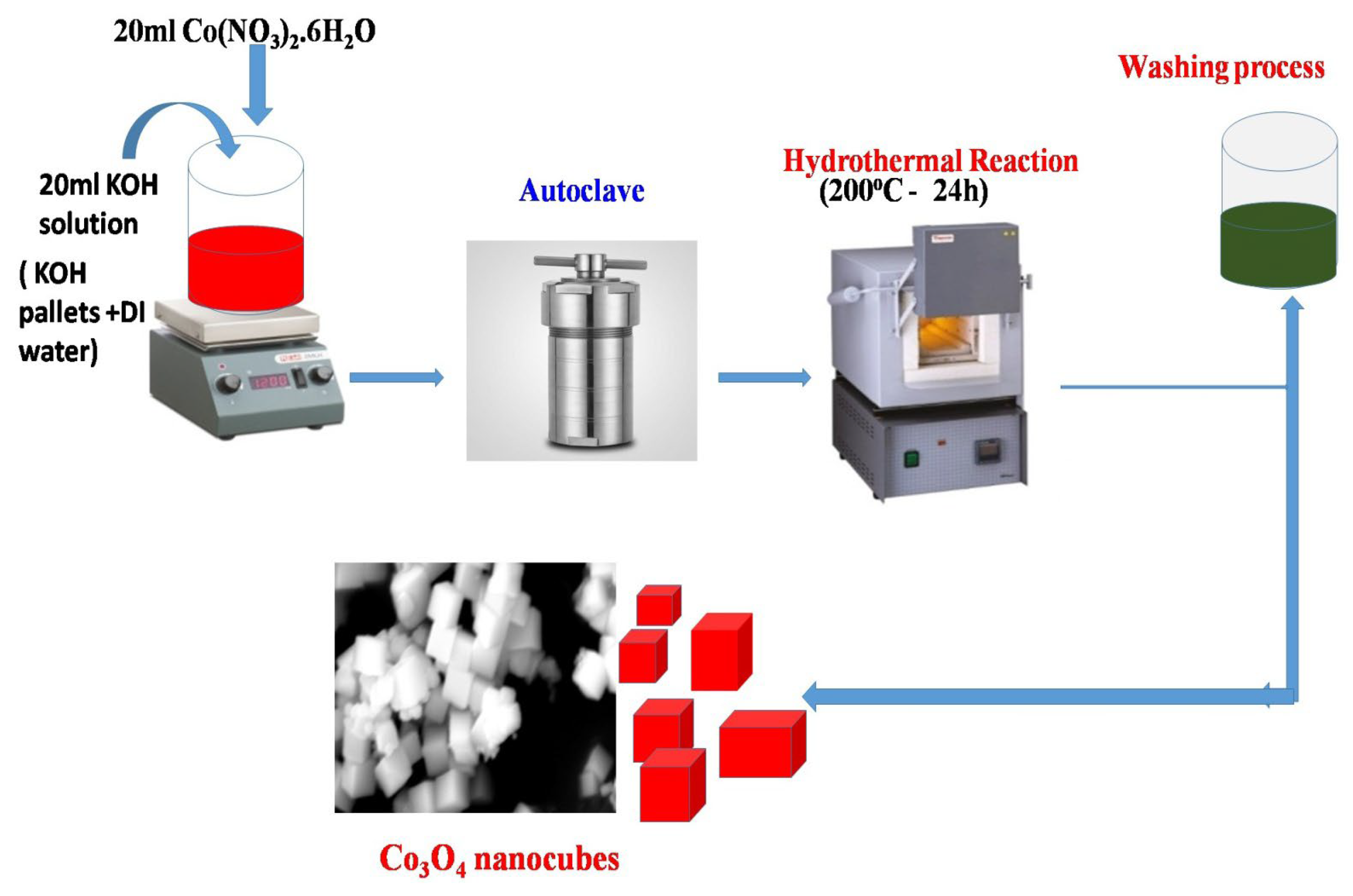
Figure 1.
FE-SEM images of COK 11 (a and a-i), COK 13 (b), and COK 15 (c) samples.
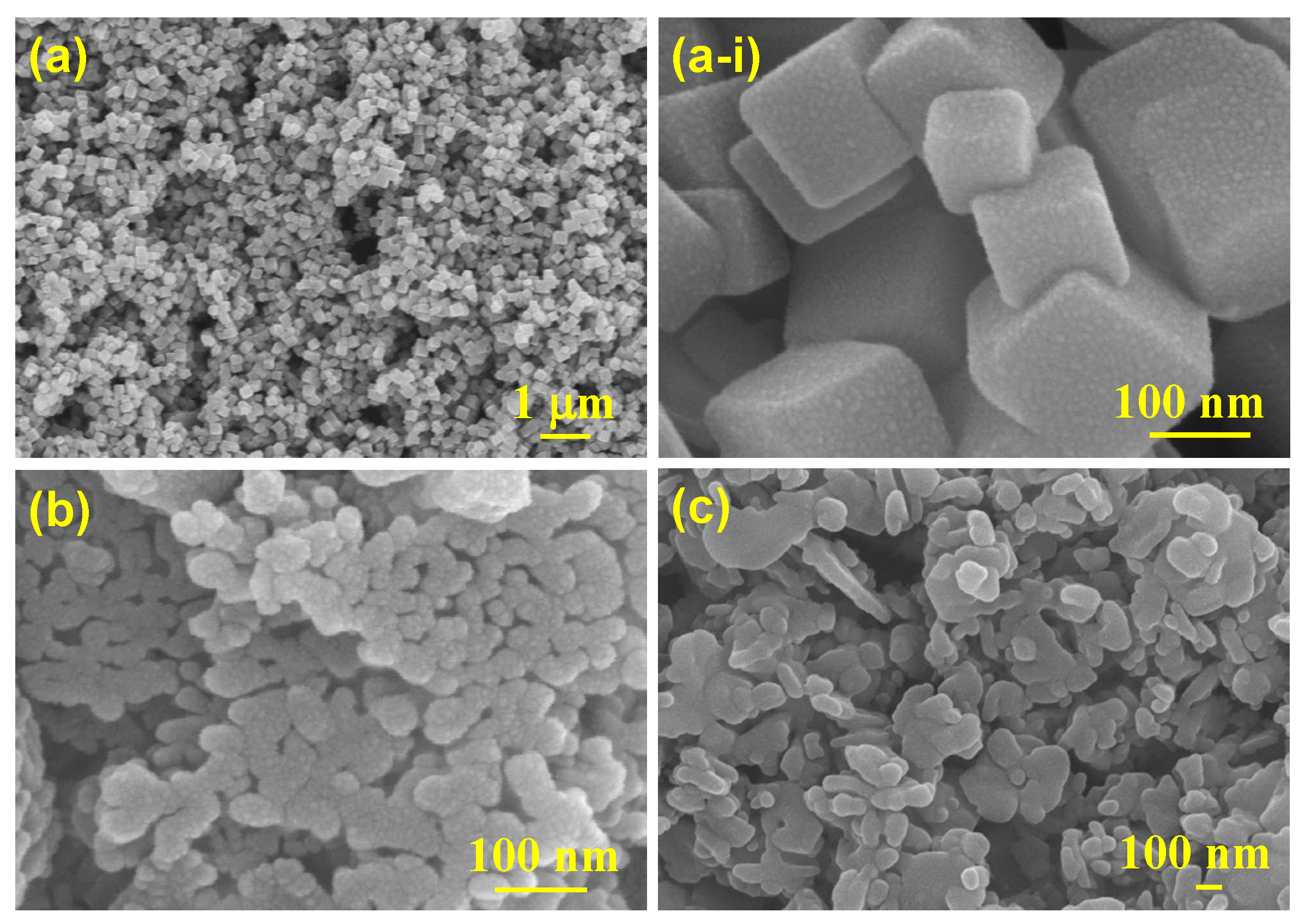
Figure 2.
(a, b) TEM images, (c) HRTEM images (top inset: d-spacing between the bright fringes, and down inset: interlayer d-spacing image), and (d) STEM and line scan of COK 11 sample.
Figure 2.
(a, b) TEM images, (c) HRTEM images (top inset: d-spacing between the bright fringes, and down inset: interlayer d-spacing image), and (d) STEM and line scan of COK 11 sample.
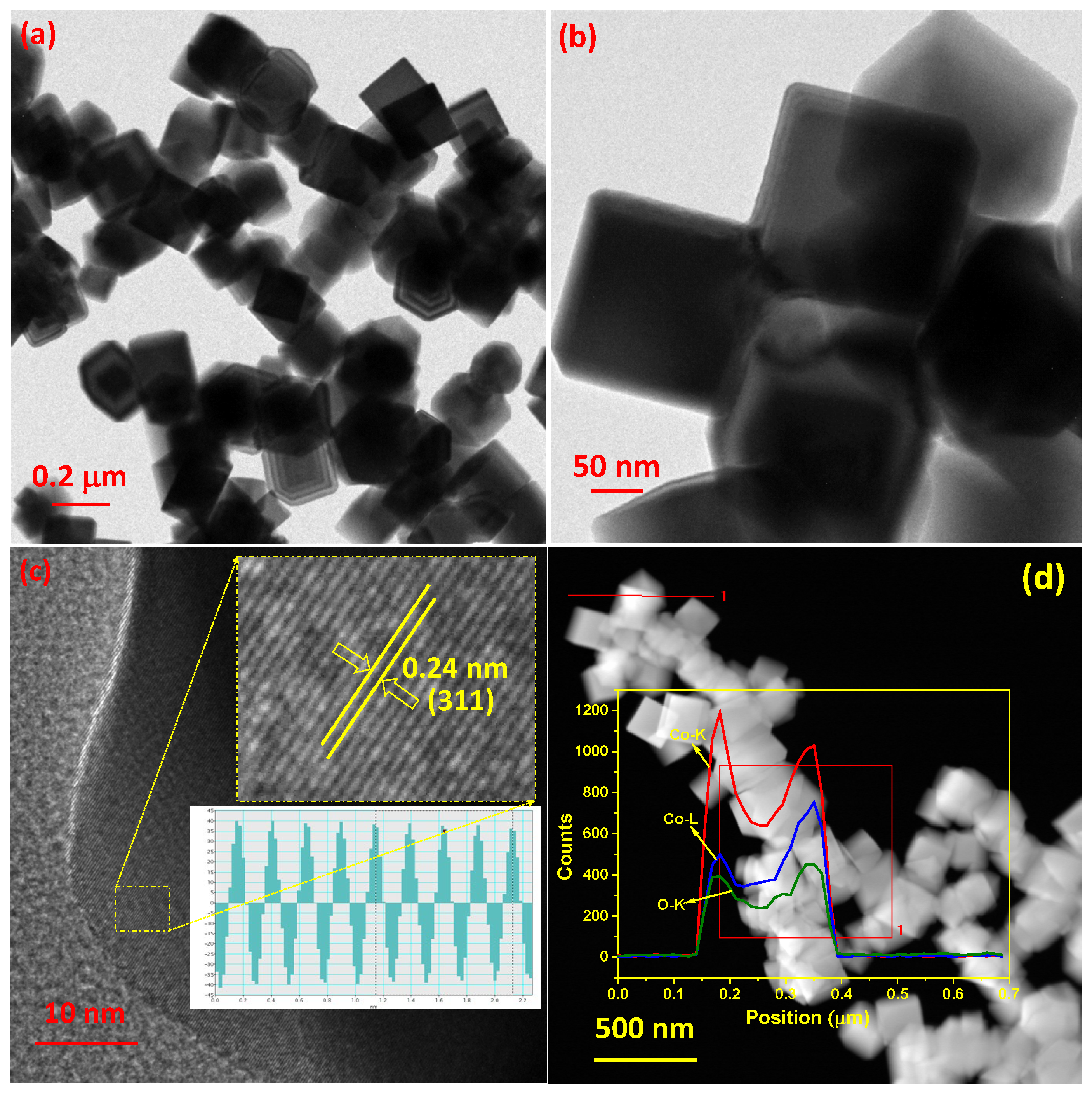
Figure 3.
(a) XRD spectra of the synthesized cobalt oxide nanoparticles. High-resolution XPS patterns of Co 2p (b) and O 1s (c) spectra of the COK 11 sample, and (d) FTIR spectrum of the COK 11 sample.
Figure 3.
(a) XRD spectra of the synthesized cobalt oxide nanoparticles. High-resolution XPS patterns of Co 2p (b) and O 1s (c) spectra of the COK 11 sample, and (d) FTIR spectrum of the COK 11 sample.
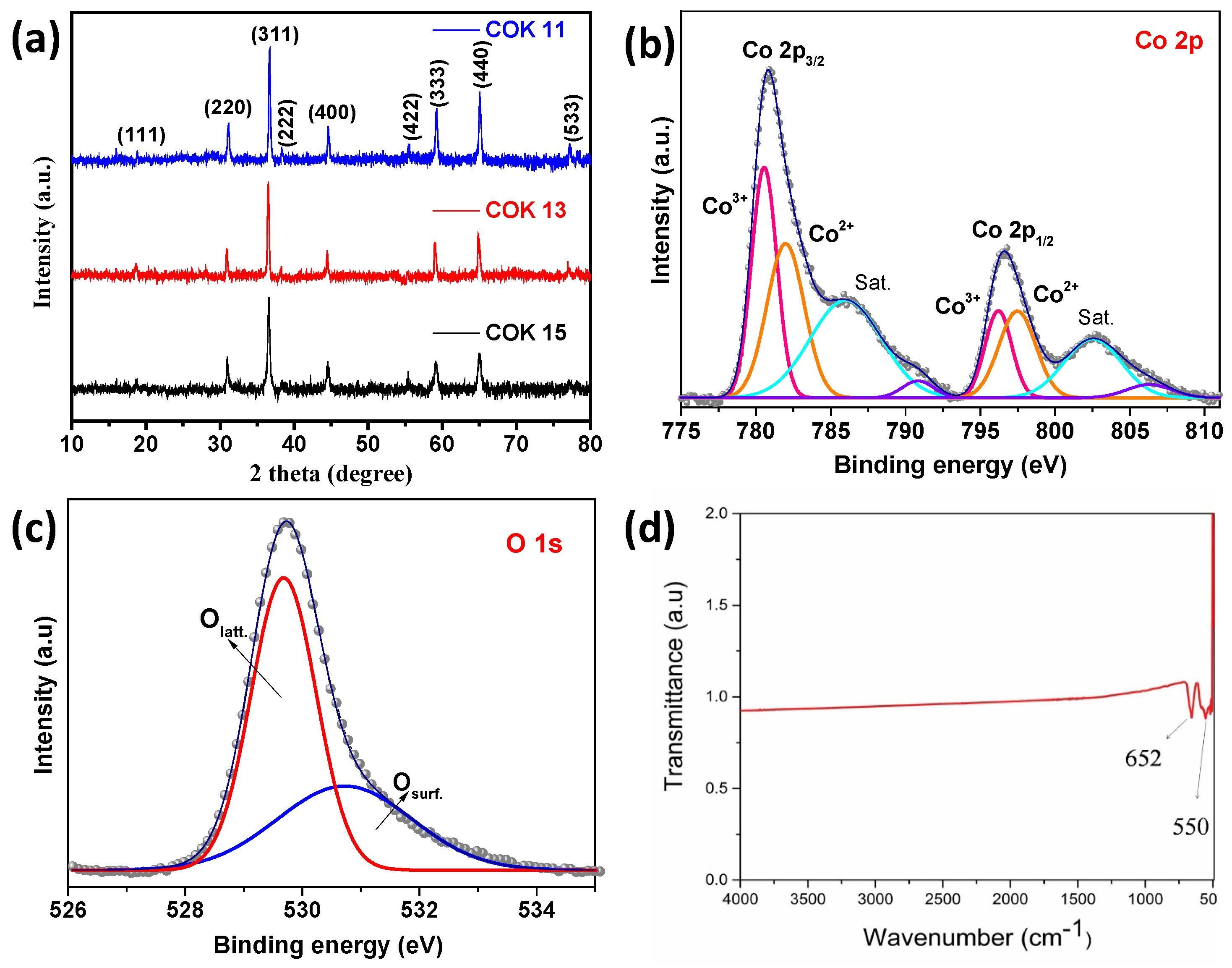
Figure 4.
(a) Cyclic Voltammetry (CV) curves comparing COK 11-15 and bare nickel foam electrodes at a scan rate of 60 mV/s; (b, c, d) CV curves of COK 11, COK 13, and COK 15 electrodes recorded at various scan rates (5-100 mV/s), (e) log (ip) vs. log (scan rate) graph; and (f) specific capacity values of the COK 11-15 electrodes at corresponding scan rates.
Figure 4.
(a) Cyclic Voltammetry (CV) curves comparing COK 11-15 and bare nickel foam electrodes at a scan rate of 60 mV/s; (b, c, d) CV curves of COK 11, COK 13, and COK 15 electrodes recorded at various scan rates (5-100 mV/s), (e) log (ip) vs. log (scan rate) graph; and (f) specific capacity values of the COK 11-15 electrodes at corresponding scan rates.
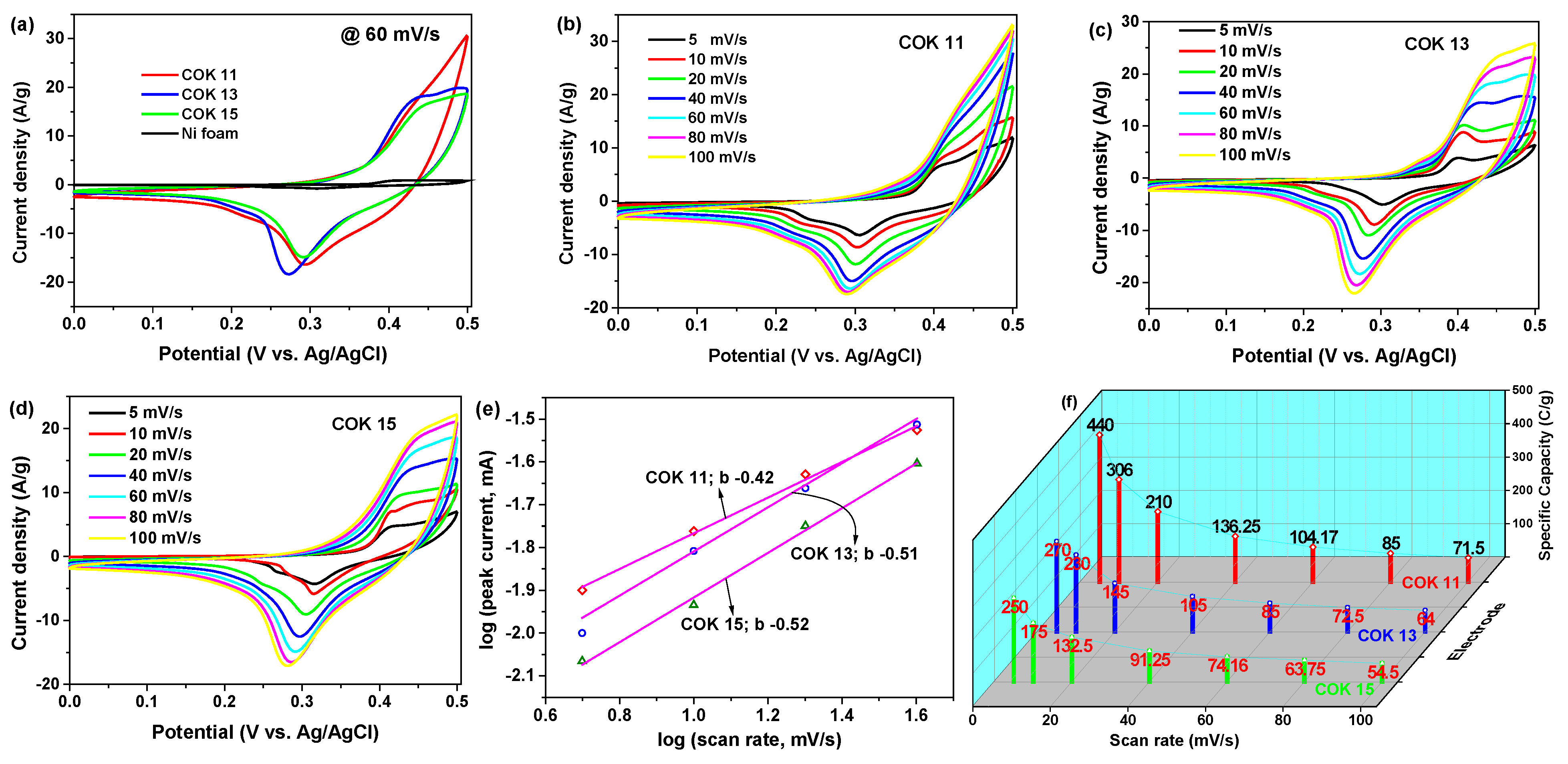
Figure 5.
(a) GCD curves comparing COK 11-15 electrodes at a current density of 1 A/g; (b, c, d) GCD curves of COK 11, COK 13, and COK 15 electrodes recorded at various current densities (1-4 A/g), (e) EIS spectra of COK 11-15 electrodes, inset: R(CR)(QR)(CR) equivalent circuit with enlarging Nyquist plots at higher frequency region; and (f) Cycling stability performance of the COK 11 electrode at a current density of 3 A/g.
Figure 5.
(a) GCD curves comparing COK 11-15 electrodes at a current density of 1 A/g; (b, c, d) GCD curves of COK 11, COK 13, and COK 15 electrodes recorded at various current densities (1-4 A/g), (e) EIS spectra of COK 11-15 electrodes, inset: R(CR)(QR)(CR) equivalent circuit with enlarging Nyquist plots at higher frequency region; and (f) Cycling stability performance of the COK 11 electrode at a current density of 3 A/g.
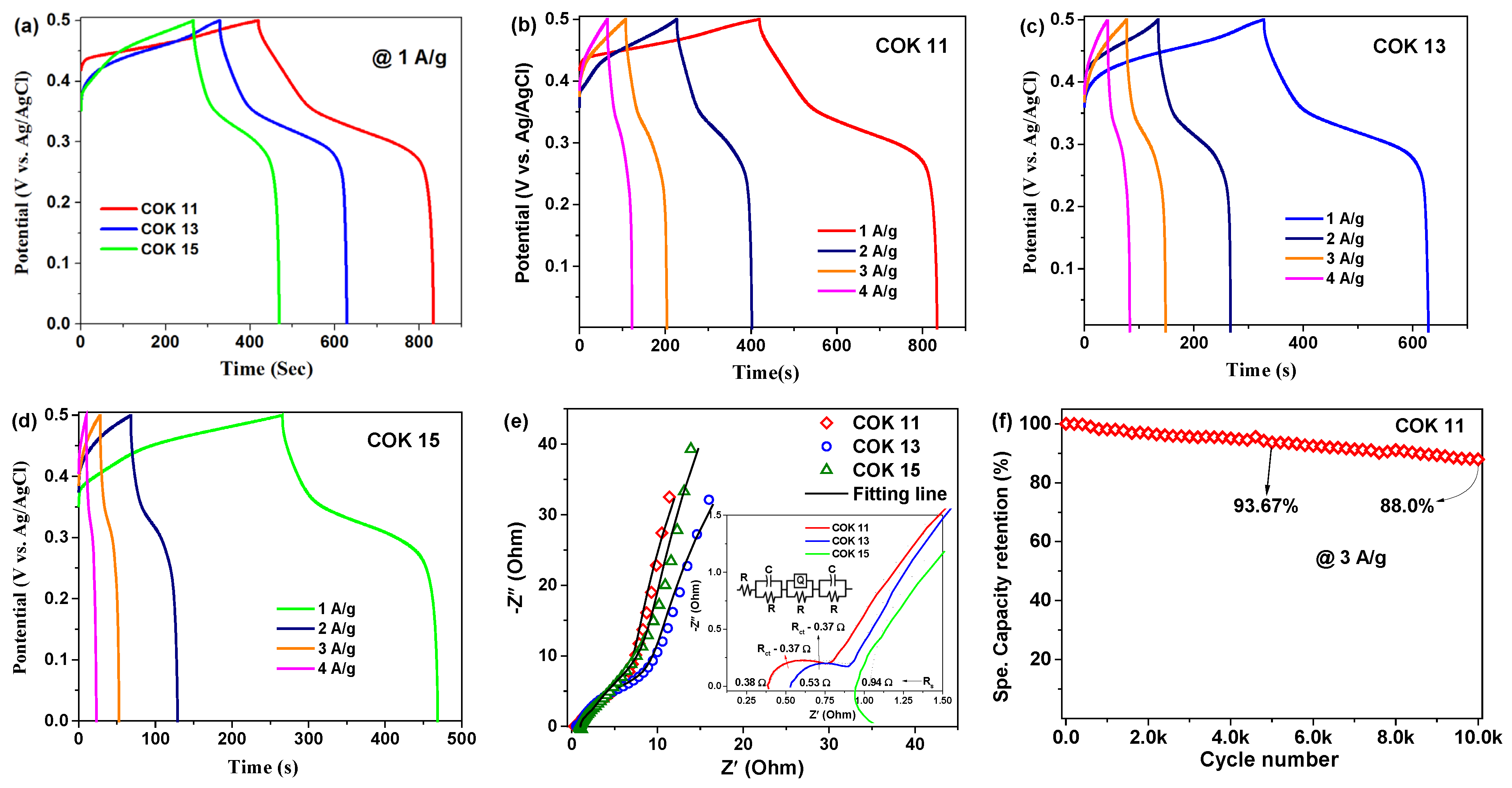

Table 1.
Comparison of the electrochemical performance of the COK 11 electrode with other recently reported cobalt oxide electrodes in a three-electrode system.
Table 1.
Comparison of the electrochemical performance of the COK 11 electrode with other recently reported cobalt oxide electrodes in a three-electrode system.
| Electrode material | Electrolyte | Specific capacity/capacitance (C/g or F/g) |
Current density (A/g) |
Cycling stability | Ref. |
|---|---|---|---|---|---|
| Co3O4 nanorod arrays | 3M KOH | 154.9 C/g (387.25 F/g) | 1 | 88% after 1000 cycles at 1 A/g | [21] |
| Hexagonal platelet Co3O4 particles | 2M KOH | 476 F/g | 0.5 | 82% after 2000 cycles at 2.5 A/g | [30] |
| Co3O4 nanoparticles | 2M KOH | 166 F/g | 0.5 | 90% after 5000 cycles at 5 A/g | [31] |
| Co3O4 nanoparticles | 3M KOH | 450 F/g | 1 | 88% over 10000 cycles at 20 A/g | [32] |
| Co3O4@N-MWCNT | 3M KOH | 225 F/g | 0.5 | 97.8% after 5000 cycles at 0.5 A/g | [33] |
| Hydroxyl-rich Co3O4 | 1M KOH | 226.1 C/g | 1.3 | 77% after 5000 cycles at 5 mA cm-2 | [34] |
| CoO/rGO nanocomposite | 1M KOH | 592 F/g | 2 | 90% after 3000 cycles at 5 A/g | [61] |
| ZIF-67-CoO/rGO | 6M KOH | 275 F/g | 1 | -- | [62] |
| AC/Co3O4 nanoparticles | 1M Na2SO4 | 182 F/g | 1 | 99.6% over 6000 cycles at 2.5 A/g | [63] |
| COK 11 or cobalt oxide nanocubes | 3M KOH | 412.8 C/g (825.6 F/g) | 1 | 88% after 10000 cycles @ 3 A/g | this work |
Disclaimer/Publisher’s Note: The statements, opinions and data contained in all publications are solely those of the individual author(s) and contributor(s) and not of MDPI and/or the editor(s). MDPI and/or the editor(s) disclaim responsibility for any injury to people or property resulting from any ideas, methods, instructions or products referred to in the content. |
© 2024 by the authors. Licensee MDPI, Basel, Switzerland. This article is an open access article distributed under the terms and conditions of the Creative Commons Attribution (CC BY) license (http://creativecommons.org/licenses/by/4.0/).
Copyright: This open access article is published under a Creative Commons CC BY 4.0 license, which permit the free download, distribution, and reuse, provided that the author and preprint are cited in any reuse.


