

Submitted:
22 May 2025
Posted:
23 May 2025
You are already at the latest version
Abstract
Nanostructured binary metal oxides have demonstrated the potential for increased electrochemical performance due to their structural stability, electronic conductivity, and various oxidation states. Li4Ti5O12 was successfully synthesized via a hydrothermal procedure with different reaction periods (12, 18, and 24 h), followed by microstructural and supercapacitive characteristics. The XRD and XPS studies verifies the Li4Ti5O12 pure phase after 24 h (LTO@12) of reaction time with computed average crystallite size of 13 nm. FESEM and HRTEM images reveal nanoflake surface morphology. Cyclic voltammetry, galvanostatic charge discharge, and electrochemical impedance spectroscopy were used to investigate the electrochemical performance of LTO@24 electrode material. The LTO@24 nanoflakes demonstrated impressive pseudocapacitive performance, with a specific capacitance of 357 Fg−1 at 1 Ag−1 and cyclic stability of 84% capacitance retention and 98.5% Coulombic efficiency after 2000 cycles at 5 Ag−1 and V-LTO@24 showed remarkable electrochemical properties with a high specific capacitance of 442 F/g with excellent rate capability and cycle stability that surpass those of pure LTO@24.
Keywords:
Li4Ti5O12 nanoflakes
; hydrothermal synthesis
; microstructure
; vanadium doping
; electrochemical properties
; supercapacitors
1. Introduction
The fast-increasing energy crisis and depletion of fossil fuel have instigated researchers for the exploration of efficient energy storage systems such as batteries and supercapacitors. Batteries have been the most utilized energy devices owing to high energy capacity, whereas the capacitors remain the suitable device even to date when substantial energy is required at high power. However, they have been encountering several bottlenecks such as short life cycles and shelf lives for the current solutions [1,2,3,4,5,6]. In recent times, supercapacitors, have been observed as fabulous consideration due to their high energy density, excellent reversibility, rapid charge-discharge capability and long cycling life. The development of flexible, light weight, environmentally friendly and efficient energy storage devices with high energy and power densities is mainly depending on the fabrication of suitable electrode material with required properties and is one of the key issues of current research [7,8,9].
Transition-metal oxides (TMOs) have been extensively studied as electrode materials due to their superior physicochemical properties such as multiple valences, electrical conductivity, fast ion/electron transport, good structural stability as electrodes in high efficiency lithium-ion batteries (LIBs) and supercapacitors (SCs). Though the transition-metal oxides have the advantages of avoiding the formation of Li dendrites, numerous challenges such as poor intrinsic electrical conductivity, electrode powdering resulting from significant volume alteration, voltage lag between charge –discharge and electrode decomposition are yet to be addressed [10,11,12]. Many transition-metal oxides (TMOs) such as RuO2, MnO2, NiO, Co3O4, MoO3, LiCoO2, LiMn2O4, NiCoO2, MnCoO2, M(OH)2 (M=Ni, Fe, Co, Mn), Li2TiO3, etc., have been commercially employed in LIBs and supercapacitors [13,14,15,16,17,18,19,20,21]. Among TMOs, lithium titanate (LTO) represents a significant member of the solid solution Li3+xTi6−xO12 (0 ≤ x ≤ 1) family. The crystal structure of the LTO belongs to the Fd3̅m space group, in which one part of the Li+ is located at 8a Wyckoff sites, all Ti-ions, and another part of Li+ are located at 16d sites with a ratio of Li:Ti = 1:5, and oxygen-ions occupy the 32e sites. In-light of these observations, it can be posited that LTO can be described as Li3(8a)[LiTi54+](16d)O12(32e). The spinel lithium titanate (LTO) is a potential anode material which can replace graphite anodes as it exhibits high full cell power density of ∼10 kW kg−1, two times greater than graphite anode. It exhibits outstanding structural stability and zero strain during intercalation, ensuring outstanding safety and capacity retention. It reveals high lithiation and delithiation voltage of ~ 1.55 V with Li insertion and effectively avoids the formation of Li dendroid. In addition, excellent pseudo capacitive behavior, a Faradaic process involving surface/near-surface redox reactions, has been detected in some modified LTO to surmount the limit of theoretical capacity by boosted lithium storage providing high power and energy densities in wide temperature range. However, the poor electronic conductivity due to lack of electrons in 3d orbital of Ti and low Li diffusion co-efficient impending the electrochemical performance of LTO for practical use in LIBs and SCs [22,23,24,25]. The pseudocapacitive response of LTO can be markedly enhanced by employing synergistic effects of multiple modifications by creating additional active sites. Intensive investigations have been made over the past one decade to improve reversible specific capacity and superior rate capability by adopting several strategies such as morphological engineering by optimizing the size and shape of nanoparticles, doping with a suitable metallic or non-metallic ions, formation of nano composite with carbonaceous materials (CNTs/rGO), heterogeneous phase control, etc. Several researchers synthesized LTO in various compositions and nano structural designs utilizing various fabrication techniques, to improve the electrochemical performance for utilization in high efficiency energy storage devices. Recently, to enhance the electrical conductivity of the Li4Ti5O12, many researchers reported the effect on the crystal and electro-chemical performance of Li4Ti5O12, by doping various transition metal cation into Li or Ti site such (Cr3+, V5+, Ta5+, Co3+, Cu2+, Ga3+, Sc3+, Fe3+, Mg2+, Mn4+, and Nb5+) in Li or Ti sites [26,27].
Among the potential dopants, vanadium is distinguished as a noteworthy candidate owing to its superior electrical conductivity and redox properties. Vanadium oxides have been extensively researched as electrochemical energy storage materials for supercapacitors and lithium-ion batteries due to their capacity for redox intercalation, attributed to the diverse oxidation states of vanadium (+2, +3, +4, and +5) and V is an exceptionally suitable dopant for LTO, as it maintains the integrity of its phase and lattice parameters. This result can be attributed to the compatibility between ionic radii of Ti4+ and V5+ [8]. Multiple reports discussed the electrochemical performance of LTO and vanadium-doped LTO in the context of Li-ion batteries and hybrid supercapacitors [28,29]. A detailed review on advanced pseudocapacitive lithium titanate towards next-generation energy storage devices was reported by Ge et al. [23]. Several researchers reported the synthesis of LTO in typical surface morphologies including nanoparticles, nanowires and nanosheets and demonstrated notable pseudocapacitive contributions. Batsukh et al. [30] synthesized LTO materials via solid-state method. The ideal stoichiometric ratio for doping lithium titanate was determined to be x = 0.075, as it produced the maximum specific capacitance of 3.59 F/g and a reduced band gap value of 3.13 eV. Consequently, this study offers additional support for the utilization of LTO electrodes in aqueous capacitors and electrical applications. Tian et al. [31] synthesized LTO consisting of ultrafine nanowires by ion exchange process in liquid phase environment and demonstrated specific capacity of ~178 mAh/g at 200 mA/g even after 2500 cycles. Xing et al. [26] synthesized three-dimensional flower shaped Li4Ti5O12-graphene hybrid micro/nanostructures and pine needles derived carbon nano-pores by effective hydrothermal process and demonstrated specific capacitance of 706 F/g and 314 F/g at 1 A/g, respectively, with good cycle retention of 90% after 2000 cycles. Lee et al. [32] reported a high specific capacitance of 63 F/g for the fabricated asymmetric hybrid supercapacitors composed of granule Li4Ti5O12 as an anode and activated carbon as cathode.
The current research work involves, the synthesis of Li4Ti5O12 nanoflakes by the hydrothermal technique at various reaction times and optimized with respect to the microstructural properties. The synthesized Li4Ti5O12 nanoflakes at a reaction period of 24 h, demonstrated exceptional pseudocapacitive performance, achieving a specific capacitance of 357 F/g at a current density of 1 A/g. For further enhancement of electrical conductivity and hence the specific capacitance, the Li4Ti5O12 is doped with vanadium and reported a high specific capacitance of 442 F/g at 1 A/g current density with excellent rate capability and cycle stability.
2. Materials and Methods
The Materials and Methods should be described with sufficient details to allow others to replicate and build on the published results. Please note that the publication of your manuscript implicates that you must make all materials, data, computer code, and protocols associated with the publication available to readers. Please disclose at the submission stage any restrictions on the availability of materials or information. New methods and protocols should be described in detail while well-established methods can be briefly described and appropriately cited.
2.1. Materials
The chemicals used during synthesis were lithium hydroxide monohydrate (LIOH.H2O USA), titanium(IV) butoxide (C16H36O4Ti, ≥97% Sigma-Aldrich, USA), ammonium metavanadate (NH₄VO₃, 99%, SDFCL), ethanol (C₂H₆O), and DI water. No additional purification procedures were implemented; all compounds were utilized entirely as received.
2.2. Preparation of Li4Ti5O12 Nanomaterial
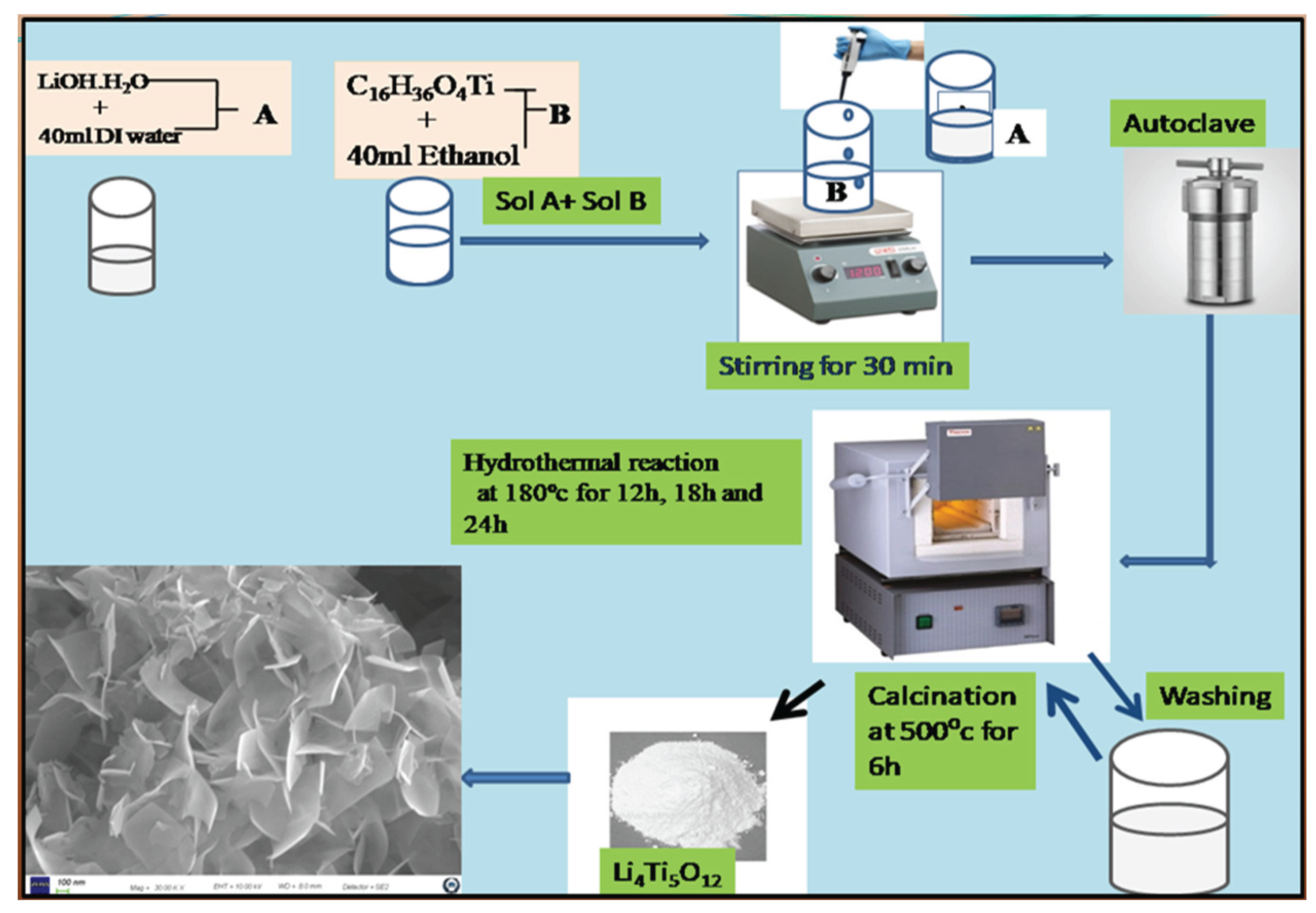
Nanostructured Li4Ti5O12 samples were synthesized utilizing the hydrothermal technique (see Scheme 1). In a typical synthesis method, 4.2 mM of lithium hydroxide monohydrate (LiOH·H2O) is dissolved in 40 mL of deionized water to make solution 1, while 5 mM of titanium(IV) butoxide is dissolved in 40 mL of ethanol to create solution 2. Both solutions are stirred continuously for 30 minutes separately. Subsequently, solution 1 is added dropwise to solution 2 while under magnetic stirring. Upon completion of stirring, the homogenous solution is transferred into a 100 mL autoclave (Teflon-lined). The temperature of the autoclave was maintained at 180 °C. The samples were prepared at various reaction durations (τ = 12, 18, and 24 h). The acquired material was purified and washed four times with distilled water and ethanol to ensure the solution free of impurities. The resultant precipitate was dried at 80 °C for 5 h. Further the final products were calcinated at 500 °C for 6 h, with a heating rate of 3 °C per minute, to yield Li4Ti5O12 nanopowders (hereinafter referred to as LTO@τ).
Scheme 1.
Schematic representation of the LTO synthesis via the hydrothermal method.
2.3. Preparation of V-LTO@24 (Li4Ti5-xVxO12)
A similar methodology has been employed for the synthesis of vanadium-doped Li4Ti5O12 nanoparticles. This involved the addition of stoichiometric amounts of ammonium meta vanadate at a concentration of 0.02% M, while maintaining a hydrothermal reaction time of 24 h. The products were subjected to calcination in a muffle furnace at 500 °C for a duration of 6 h to obtain the final products, designated as V-LTO@24.
2.4. Material Characterizations
The structural properties of the synthesized Li4Ti5O12 were examined using an X-ray diffractometer (XRD, MiniFlex II, Rigaku, Tokyo, Japan) with CuKα radiation (λ = 1.540598 Å). The microstructure and surface morphology of all synthesized Li4Ti5O12powder was analyzed using a field emission scanning electron microscope (FESEM, Merlin Compact, Carl Zeiss, Jena, Germany) and a high-resolution transmission electron microscope (TEM, Tecnai G2 F30, FEI Company, Oregon, USA). The elemental composition and valence state of the synthesized samples were analyzed using X-Ray photoelectron spectroscopy (XPS, AXIS–NOVA, Kratos). The evaluation of the electrochemical performance of the synthesized materials was performed via cyclic voltammetry (CV), galvanostatic charge and discharge (GCD), and electrochemical impedance spectroscopy (EIS) utilizing the commercial electrochemical workstation CHI 608C (Instrument Inc., USA). EIS data were collected over a frequency range from 1 Hz to 100 kHz at an amplitude of 5 mV.
2.5. Li4Ti5O12 Electrode Preparation
Electrochemical evaluations were conducted at room temperature using a three-electrode setup, with silver as the reference electrode and platinum as the counter electrode. For the preparation of the working electrode. Ni foam was utilized, which underwent cleaning with 6 mol/L HCl, deionized water, and 100% ethanol for 20 min each under ultrasonication to eliminate the surface layer of the Ni foam, followed by drying at 80 °C for 10 h. Subsequently, the composite comprising active material LTO@24 (80%), activated carbon black (10%), and PVDF binder (10%) was suspended in 0.5 mL of NMP solution. Activated material slurry is applied to cleaned Ni foam across an area of 0.7 × 1 cm² using a drop-casting technique and then dried at 80 °C for 8 h. A 1 mol/L KOH solution served as the electrolyte for all experiments.
3. Results and Discussion
3.1. Studies of Pristine Li4Ti5O12 Nanoflakes
3.1.1. XRD Analysis
The X-ray powder diffraction analysis was employed to confirm the crystalline structure and phase purity of the hydrothermally synthesized Li4Ti5O12 nanoflakes. Figure 1 illustrates the XRD spectra of Li4Ti5O12 nanopowders synthesized at various reaction time periods. The XRD spectra of Li4Ti5O12 synthesized for 12 and 18 h displayed an additional minor anatase (A) and rutile (R) phase of TiO2 at 2θ = 25.30° (JCPDS card 21-1272) and 2θ = 27.47° (JCPDS card 12-1276), respectively, alongside Li4Ti5O12 phase. This phenomenon may be attributed to inadequate reaction times, leading to incomplete phase transformation and the presence of residual TiO2 [33,34]. By extending the reaction time to 24 h, the XRD reflections associated with the TiO2 phases are no longer present, while peaks corresponding to the cubic spinel Li4Ti5O12 phase emerged. The diffraction peaks observed at 2θ values of 18.30°, 35.48°, 43.18°, 47.38°, 57.25°, 62.77°, and 66.13° correspond to the (111), (311), (400), (331), (333), (440), and (531) planes of cubic spinel Li4Ti5O12 (JCPDS card 49-0207) with the Fd3̅m space group [35,36,37]. The results indicated that the product progressively converted to the pure cubic spinel Li4Ti5O12by the extension of reaction time to 24 h.
The Debye-Scherrer formula (Equation 1) was used to determine the crystallite size (L) of the as-produced samples using all XRD reflections:
where k is equal to 0.9, λ is the wavelength of X-ray radiation, β is the full width at half-maximum (FWHM) and θ is the Bragg angle. Additionally, dislocation density (δ), microstrain (ε), and unit volume (V) values were calculated (see Table 1) based on the following relations [35,38]:
V = a3,
The results in Table 1 indicate that the size of the crystallites increases as the hydrothermal reaction time increases from 12 to 24 h. The unit cell volume of LTO synthesized at 24 h and the estimated lattice parameter value a deduced from Equations (4) and (5) are in good agreement with the reported value [39,40,41], indicating the formation of phase pure Li4Ti5O12. Nanoparticles of smaller crystallites have a higher surface area-to-volume ratio, which is important for strengthening the electrode/electrolyte interface, facilitating quicker ion diffusion, and increasing the material's charge storage capacity.
3.1.2. Surface Morphology Analysis
The morphology of the material plays a crucial role and an essential aspect that is intricately linked to the specific surface area, diffusion pathways, surface-to-volume ratios, and consequently, the performance of supercapacitors. The surface microstructure of hydrothermal -synthesized Li4Ti5O12 nanoparticles is characterized using FE-SEM. Figure 2 presents the SEM micrographs of Li4Ti5O12 nanoparticles at various magnifications, prepared through the hydrothermal method at different reaction times. The influence of reaction time on surface morphology is distinctly evident in the SEM micrograph. Figures 2(a,b) show a Li4Ti5O12 sample obtained by hydrothermal reaction at 12 h. The low magnification SEM images demonstrate the formation of interconnected nanoflakes forming three-dimensional flower like structures. In high magnification SEM images, the assembly of nanoparticles with nanoflake like structures having a rough surface, non-uniform size, and thinner nanoflakes with uneven edges, may be due to the short hydrothermal reaction times. The surface morphology was seen to alter when reaction time varied from 12 to 18 h. As growth improves, nanoflakes develop a smooth surface, uniform size, and well-defined edges, as seen in Figure 2(c,d). Furthermore, prolonging the reaction period to 24 h resulted in the formation of well-defined, smooth surface with assembly of relatively uniform length of the nanoflakes, which were about 60 nm long and 20 nm wide as shown in Figure 3(e,f). Because of the prolonged reaction time, the flakes became firmly packed together and eventually formed a micro-network. These results indicate that the reaction time has a significant impact on the surface morphology of nanostructures. The dimensional nanoflakes have porous nature and good surface area and this structure should significantly minimize the resistance associated with electrolyte penetration and diffusion, while facilitating rapid ion and electron transfer. Additionally, it offers an ample effective area for interactions between electrolyte ions and active materials, enhancing Faradaic reactions during electrochemical process [42,43,44,45].
HRTEM is used as a representative to further characterize the shape and structure of the Li4Ti5O12 nanoflakes. Figure 3 displays the typical TEM micrographs for the 24-h sample. The TEM image in Figure 3(a) demonstrates comparable structural characteristics of Li4Ti5O12 nanoflakes, consistent with the observations made in the SEM images. The HRTEM image presented in Figure 3(b) indicates that the interplanar distance between adjacent lattice fringes measures 0.48 nm, which aligns with the (111) interplanar spacing of spinel Li4Ti5O12. The Fourier transformation (FFT) derived from the HRTEM image of nanoflakes distinctly reveals a symmetrical pattern, as illustrated in the inset of Figure 3(b). The selected area electron diffraction (SAED) pattern is presented in Figure 3(c), which can be indexed to the diffraction planes of (111), (222), (331), and (531) of the spinel Li4Ti5O12 phase, indicating the polycrystalline nature of Li4Ti5O12. HRTEM pictures shown in Figures 4(b) and 4(c) confirm the phase purity of the produced Li4Ti5O12 nanoflakes.
3.1.3. XPS Analysis
The XPS studies were conducted to analyze the chemical composition and metal oxidation states of Li4Ti5O12@24 nanoflakes as shown in Figure 4
The presence of Li, Ti, and O elements is confirmed by the XPS survey spectrum presented in Figure 4(a) The Li 1s core level XPS spectrum shown in Figure 4(b) in the low binding energy region displays a Li 1s peak at 54.8 eV, which is attributed to the Li-O bond within the LTO spinel structure. The Ti 2p core level XPS spectrum, as illustrated in Figure 4(c) displays a distinct set of doublet peaks, with the Ti 2p1/2 and 2p3/2 lines observed at approximately 464.7 eV and 459 eV, respectively, which are indicative of the Ti4+ state. As shown in Figure 4(d) The O 1s peak is generally observed at approximately 530.4 eV, which corresponds to oxygen within the lattice, specifically in metal-oxygen bonds. The presence of core level binding energy peaks is in good agreement with the reported values and confirm the phase purity and chemical purity of the LTO spinel phase [26].
3.1.4. Electrochemical Analysis
The electrochemical properties of Li4Ti5O12 nanoflakes synthesized at the optimized reaction time of 24 h (LTO@24) were examined through cyclic voltammetry, galvanostatic charge-discharge, and electrochemical impedance spectroscopy (see Figure 5). The measurements are carried out by three-electrode system in 1 mol/L KOH aqueous electrolyte. Figure 5(a) shows the CV tests measured at different scan rates from 1 to 50 mV/s in the potential range of -0.3–0.6 V vs. Ag/AgCl. The CV curves of LTO@24 electrode showed the pseudocapacitive nature and observed CV curves exhibited similar shape with a couple of redox peaks and can be attributed to the reversible faradic reactions occurred on the surface and in the interlayer structure of the nanostructured LTO@24 electrode. The position of anodic and cathodic peaks is shifted as the scan rate increases, indicating outstanding high-rate performance and good electrochemical reversibility. This is beneficial for improving charge-discharge performance. Additionally, the total charge accumulated in the LTO@24 electrode as the result of the redox reaction was determined using the area under the current-voltage curve at a constant scan rate. The specific capacitance Cs of the electrode at each scan rate was calculated using the subsequent Equation (6) [46]:
where ν is the potential scanning rate, m denotes the mass of active material in the electrode, and ΔV = Vc – Va represents the potential window for the discharging process. The specific capacities of the LTO@24 electrode were determined to be 123, 92, 80, 64, and 57 F/g at scan rates of 1, 5, 10, 30, and 50 mV/s, respectively. The area enclosed by the cyclic voltammetry (CV) curves was used to evaluate the capacitive performance of the electrode samples, as it is directly proportional to their specific capacitance. As the scan rate increased from 1 to 50 mV/s, the specific capacitance decreased. This is because, at higher scan rates, the time available for the charging process is reduced, resulting in incomplete charge storage and a lower apparent capacitance.
The GCD measurements were conducted under identical experimental circumstances for the LTO@24 nanoflake electrodes. The GCD measurements are conducted from -0.3 to 0.4 V vs. Ag/AgCl at various current densities ranging from 1- 5 A/g, with the findings presented in Figure 5(b). The GCD curves exhibit non-linear behavior, indicating a pseudocapacitive charge storage mechanism resulting from fast faradic redox reactions in the LTO@24 nanoflakes of the electrodes. This demonstrates that the electrodes of LTO@24 nanoflakes validate the pseudocapacitive behavior, consistent with the CV curves. The specific capacitance Cs can be determined using the GCD curves using the following Equation (7) [46,47]:
where I is the discharge current, m is the mass of the active material, ΔV is the potential window, and ∆t is the discharge time. According to the data shown in Figure 5, the determined specific capacities of the LTO@24 nanoflakes electrode are 357, 128, 107, 85 and 40 F/g at current densities of 1, 2, 3, 4 and 5 A/g, respectively. It is evident that specific capacitance decreases as current density escalates. The observed decrease in capacitance can be ascribed to the restricted duration for electrolyte ions to infiltrate the active material when subjected to elevated current densities. At reduced current densities, the electrolyte ions are afforded ample time to distribute uniformly throughout both the interior and surface of the active material, leading to an enhancement in specific capacitance [48,49]. Consequently, the nanoflake-like architecture of LTO@24 not only reduces the ion diffusion distance but also enhances the available surface area for redox reactions.
In order to assess the ion diffusion, electrical conductivity, and electron transfer characteristics of the LTO@24 nanoflakes electrode, electrochemical impedance spectroscopy (EIS) measurements were conducted prior to and following 2000 cycles, across a frequency spectrum of 1Hz to 100KHzutilizing an alternating current voltage of 5 mV. Figure 5(c) illustrates the Nyquist plots of the LTO@24 electrode, characterized by the presence of a semicircular arc alongside a linear segment in the low-frequency range. It indicates the characteristics of capacitive behavior and rapid ion diffusion within the electrode. The intercept on the X-axis represents the solution resistance (Rs), which encompasses the ionic resistance in the electrolyte, the contact resistance of the current collector and active material, as well as the intrinsic resistance of the active material. The diameter of the semicircle is indicative of the charge transfer resistance (Rct) at the interface between the electrode and the solution. The slope of the straight line in the low frequency region indicates the Warburg impedance (Zw), which is linked to the diffusive resistance of OH. The diameter of the semicircle and the slope of the line were altered following 2000 cycles (inset of Figure 5(c)), which is probably a result of the repetitive mechanical stress occurring during the continuous charge-discharge process. The analogous electrical circuit is depicted in the inset of Figure 5(c). The Rs values are recorded at 0.7 and 0.8 Ω prior to and following cycling, whereas the Rct values show an increase from 2.18 to 4.8 Ω. The analysis demonstrates that the distinctive structure of Li4Ti5O12 nanoflakes has the potential to enhance the active sites for Faradic reactions while also reducing the transfer distance for ions and electrons. Therefore, enhanced kinetics and improved electrochemical performance of the electrode can be attained.
Figure 5(d) illustrates the long-cycle performance and Coulombic efficiency of the LTO@24. The cyclic stability holds significant importance for supercapacitor applications; therefore, an extensive examination of long-term cycling performance was conducted through charge-discharge cycling at a current density of 5 A/g. Additionally, Coulombic efficiency (η) serves as a crucial parameter for assessing the viability of the redox process, with the value of η derived from the subsequent Equation (8) [50]:
In this context, td and tc denote the times associated with discharge and charge, respectively. Throughout the 2000 charge-discharge cycling process, the η values remain remarkably stable at approximately 98.5% for the entire duration, signifying the exceptional electrochemical reversibility of the Faraday reactions. These results demonstrate that LTO@24 nanoflakes represent a promising electrode material, exhibiting improved physicochemical properties, and can be effectively utilized in electrochemical energy storage devices.
3.2. Vanadium-Doped Li4Ti5O12 (V-LTO@24)
The vanadium doped Li4Ti5O12 (V-LTO@24) nanopowder was prepared under simililar conditions as mentioned in Section 2.3 at low concentration (0.02 mol.%) and studied the microstrural and electrochemical properties.
3.2.1. Structural Studies
Figure 6(a) presents the X-ray diffraction patterns of V-LTO@24 (Li4Ti5-xVxO12; x=0.02 mol.%) compared with pure LTO@24. The diffraction peaks of pure and V-LTO@24 powders are attributed to the cubic spinel structure of Li4Ti5O12 (JCPDS No. 49-0207) with the Fd3̅m space group. No undesired impurities or new phases were observed in samples with a lower concentration of vanadium dopant (x = 0.02), thereby affirming the successful incorporation of the vanadium ion into the lattice of Li4Ti5O12 without the emergence of any additional phases. Moreover, upon magnifying the peak location of the (111) plane, as seen in Figure 6(b) the diffraction peak of V-LTO@24 nanoflakes exhibits a minor shift towards a higher angle, suggesting that the doping of V has infiltrated the lattice structure of LTO nanoflakes. The XRD of the V-LTO doped sample showed a slight shift in the diffraction peak towards larger θ values than that observed for the pure LTO sample. This peak shift is associated with the atomic radius disparity between Ti4+ and V5+ elements. In the coordination CN = VI, the atomic radius of V5+ (0.54 Å) is smaller than that of Ti4+ (0.605 Å) [8], leading to a diffraction shift towards a larger angle. These results indicate that the V5+ is successfully substituted Ti4+ in the spinel lattice structure of Li4Ti5O12.
The influence of doping on the structural modifications of LTO@24 and V-LTO@24, specifically focusing on lattice parameters, unit cell volume, and average crystallite size, using Equations (4), (5), and (6). The calculated structural parameters are listed in Table 1. The results show that the lattice parameters of V-LTO@24 are marginally smaller than those of LTO@24. Specifically, the lattice parameter of V-LTO@24 (a = 8.340 Å) is lower compared to that of LTO@24. This reduction suggests that V doping has induced a lattice shrinkage in the material. Such a phenomenon can be attributed to the substitution of Ti⁴⁺ ions (ri = 0.605 Å) by smaller V⁵⁺ ions (ri = 0.54 Å) within the spinel lattice structure of Li₄Ti₅O₁₂. The relatively close ionic radii facilitate the incorporation of V⁵⁺ into the Ti⁴⁺ sites with minimal distortion to the overall crystal framework. The replacement of Ti⁴⁺ with the smaller V⁵⁺ ions leads to a slight contraction of the lattice, consistent with the observed decrease in lattice parameters and unit cell volume. Furthermore, the effective incorporation of V⁵⁺ into the LTO spinel structure indicates successful doping, which is known to significantly influence the electrical conductivity of the host material. Such structural and electrical modifications can directly impact the electrochemical properties, potentially enhancing the material’s performance in supercapacitor applications, as supported by previous literature [28,29].
3.2.2. Surface Morphology
The surface morphology of V-LTO@24 is shown in Figure 7. The nanoflakes evidently aggregate to create a three-dimensional nanoflower-like structure. Nonetheless, upon vanadium introduction into LTO@24, an effect of doping was noted on the surface morphology. The addition of vanadium resulted in a tighter packing of nanoflakes and the emergence of micro-network-like structures from the recrystallisation of initially formed nanoflakes. The vertically orientated arrays cross and interpenetrate, creating porous network-like heterostructures. This would offer significantly elevated active surface sites, together with appropriate routes and reduced diffusion lengths for ionic transport, which would be very advantageous for enhancing the electrochemical characteristics of the samples.
3.2.3. Electrochemical Analysis of V-LTO@24
Figure 8 presents the comprehensive electrochemical performance of V-LTO@24 electrodes examined via typical three-electrode experiments using cyclic voltammetry, galvanostatic charge-discharge, and electrochemical impedance spectroscopy techniques, with a 1 mol/L KOH solution as the electrolyte. Figure 8(a) illustrates the CV curves of V-LTO@24 at scan rates of 1, 5, 10, 30, and 50 mV/s within a potential range of -0.3 to 0.6 V vs. Ag/AgCl. All the cyclic voltammetry curves display a pair of redox peaks with a characteristic pseudocapacitive behavior and an exceptional rate capacity. With an increase in scan rate, the region beneath the redox peaks expands, indicating an improvement in current responsiveness. Furthermore, as a result of the polarization of the electroactive material, the anodic peaks exhibit a substantial shift towards more positive potentials, whilst the cathodic peaks shift towards more negative potentials with an increased scan rate. This transition is due to the lower resistance and fast ion and electron movement within the electrode. The pronounced and distinct redox peaks are intricately linked to the chemical composition and form of the electrode material, which promote reversible faradaic redox processes. The specific capacitance (SC) of V-LTO@24 nanostructures was assessed at various scan rates in the range 1-50 mV/s using Equation (2) to quantitatively evaluate their electrochemical performance. The Cs values were found to be 413, 188, 135, 83, and 66 F/g at scan rates of 1, 5, 10, 30, and 50 mV/s, respectively. As the scan rate increased, a gradual decrease in specific capacitance was observed, which can be attributed to limited ion diffusion and reduced charge storage efficiency at higher scan rates.
The capacitive performance of the synthesized V-LTO@24 electrodes was thoroughly assessed using galvanostatic charge-discharge (GCD) measurements. Figure 8(b) represents the GCD curves recorded at current densities of 1, 2, 3, 4, and 5 A g⁻¹ within a potential window ranging from -0.3 to -0.4 V vs. Ag/AgCl. An in-depth examination of these curves demonstrated the outstanding capacitive properties of the V-LTO@24 electrodes. The specific capacitances were systematically calculated using Equation (7) and found to be 442, 285, 171, 142, and 80 F g⁻¹ at current densities of 1, 2, 3, 4, and 5 A g⁻¹, respectively. The results demonstrate the outstanding rate capability and strong electrochemical performance of the V-LTO@24 electrodes across a broad spectrum of current densities. Additionally, all GCD curves demonstrate a clear potential plateau and remarkable symmetry, affirming the high Coulombic efficiency and exceptional reversibility of the faradaic redox reactions involved.
To further investigate the electrical properties of the V-LTO@24 electrode, EIS measurements were carried out over a frequency range from 1 Hz to 100 kHz at an amplitude of 5 mV. This analysis provides critical insights into the electrode's ability to efficiently facilitate charge transfer and maintain stable performance across different frequencies. Figure 8(c) shows the Nyquist plot with the equivalent circuit of the sample for the 1st and 2000th cycle. After 2000 cycles, the solution resistance Rs (i.e., the intersection made on the horizontal axis) increased from 0.38 to 0.5 Ω, and charge transfer resistance Rct (i.e., the diameter of the semicircle in the high- to medium-frequency region) increased from 0.6 to 0.9 Ω. The specific capacitance decreases with the number of cycles, as the solution and charge transfer resistance increase after 2000 cycles.
The cycle performance of the V-LTO@24 electrode was evaluated using GCD profiles at a current density of 5 A/g over 2000 cycles (Figure 8(d)). The results revealed that 90% of the initial capacitance was retained after 2000 cycles at a current density of 5 A/g, with a remarkable Coulombic efficiency of 99.8%. This indicates the excellent cyclic stability of the V-LTO@24 electrode. The superior performance of the V-LTO@24 electrode, compared to pure LTO nanoflakes, can be attributed to the aggregation of vanadium-doped LTO into a micro-network structure. This unique structure not only improves the overall conductivity but also enhances the mechanical stability of the electrode during long-term cycling. The vanadium doping enhances the electrochemical reactivity, facilitates better ion diffusion, and minimizes structural degradation, which ultimately leads to better cycle stability and performance compared to pure LTO nanoflakes.
3.3. Charge Storage Mechanism in LTO-Based Electrodes
Figure 9 presents the specific capacitance of the LTO@24 and V-LTO@24 electrodes collected at different scanning rates. It is viewed that the specific capacitance Cs decreases as the scanning rate increases in the CV experiments. The decay in the specific capacitance is assigned to the presence of inner active sites that cannot completely sustain redox transitions at higher scan rates [51].
The reaction kinetics and charge storage mechanism in both hydrothermally prepared LTO@24 and V-LTO@24 electrodes was critically analyzed from cyclic voltammetry measurements data. The total contribution to capacitance arises from processes that are both diffusion-controlled and capacitive-controlled. Moreover, the kinetic reversibility of the electrode materials is clarified by the evident linear correlation between the peak current (ip) and the scan rate (ν) in the CV curves, adhering to a power-law relationship, as described in Equations (9 and 10) [52]:
where the modifiable parameters are 'a' and 'b'. The slope b of the straight line from the log(ip) and log(ν) of the plot indicates the charge storage kinetics of the ions. While the value of b equal to 1.0 suggests the capacitive process as a dominant process, the value of b equal to 0.5 suggests the diffusion control process as a dominating process. The determination of “b” values for the anodic peaks of the LTO@24 and V-LTO@24 electrodes are found to be 0.53 and 0.56, respectively (Figure 10(a,c)), indicating that the charge storage process is primarily governed by a diffusion-controlled battery-type behavior. Additionally, at various scanning speeds, the rate at which the diffusion process and surface capacitive-controlled reaction contributed to the capacitance was examined. The relative contributions of the above two processes on the overall charge storage performance are examined via Cottrell’s equation [53]:
where k1 and k2 are constants for specific sweep rates, ip(ν) denotes the peak current at a given potential value, and k1ν and k2ν1/2 are terms which stand for the capacitance-controlled and diffusion-controlled processes, respectively. The above Equation (11) can be expressed as:
ip = aνb,
log(ip) = log(a) + b log(ν),
ip(ν) = k1ν + k2ν1/2,
ip(ν) ν-1/2 = k1 ν1/2 + k2.
By only graphing the correlation between ip and ν, we may ascertain the slope k1. By determining the k1 value at varying voltages across different scan rates [54,55,56], the relative contributions of the battery-type (diffusion-controlled) and capacitive-type (surface-controlled) behaviors at various scan rates of 1, 5, 10, 30, and 50 mV/s for LTO@24 and V-LTO@24 electrodes are illustrated in Figure 10(b,d). The LTO@24 and V-LTO@24 electrodes clearly demonstrate a more significant level of diffusion-controlled charge storage at all scan rates. Additionally, it has been noted that the ratio of capacitive participation across all electrodes progressively rises from lower to higher scan speeds, which can be explained by the restricted time for ions to diffuse into the internal structure of the electroactive materials.
The detailed in-depth studies of electrochemical behavior and fundamental mechanisms of the V-LTO@24 electrode uncovered several critical factors that showed enhance supercapacitive performance, especially regarding ion transport, electron transfer processes, and microstructure. The distinctive morphology of the V-LTO@24 structure, featuring aggregated nanoflakes in a micro-network-like arrangement, is characterized by a large surface area that enhances ion transport efficiency. This configuration facilitates greater ion adsorption and desorption throughout electrochemical reactions and hence increased charge (or energy) storage within the electrode thereby improving the specific capacitance. Furthermore, the specific capacitance and cycling stability of the LTO@24 and V-LTO@24 materials were compared with those of previously reported LTO-based electrodes, as presented in Table 2. The results demonstrate its superior electrochemical performance in a three-electrode system compared to the earlier LTO-based electrodes.
4. Conclusion
In summary, Li4Ti5O12 nanoflakes were synthesized using the hydrothermal method with varying reaction durations. The XRD spectra validate the pure phase of Li4Ti5O12 nanocomposite when synthesized at 24-h hydrothermal reaction time. The results from SEM and TEM indicate that the LTO@24 exhibits a morphology characterized by nanoflakes with a uniform length of approximately 60 nm, a width of ~20 nm and a relatively smooth surface. The distinct nanostructures offer an extensive surface area and minimized diffusion length, making them exceptional candidates for energy storage and conversion systems. The electrochemical investigations were conducted on the LTO@24 nanoflakes electrode using CV, GCD, and EIS experiments using a 1 mol/L KOH aqueous solution. The CV curves with marked oxidation and reduction peaks reveal the pseudocapacitive nature of the LTO electrode and demonstrate an impressive specific capacitance of 357 F/g at the current density of 1 A/g, with 84% cycle stability and 98.5% Coulombic efficiency. Moreover, the vanadium-doped LTO@24 nanoflakes synthesized under similar conditions demonstrate an excellent specific capacitance of 442 F/g at 1 A/g current density, along with 90% cycle stability and a Coulombic efficiency of 99.8%. The LTO@24 and V-LTO@24 electrodes clearly show a more significant level of diffusion-controlled charge storage at all scan rates with significant capacitance and are found to be suitable electrodes for high performance supercapacitors.
Author Contributions
Conceptualization, O.M.H.; formal analysis, M.D.; investigation, M.D.; writing—original draft preparation, M.D. and O.M.H.; writing—review and editing, C.M.J. All authors have read and agreed to the published version of the manuscript.
Funding
This research received no funding.
Data Availability Statement
All data are contained in this article.
Conflicts of Interest
The authors declare no conflicts of interest.
References
- Peng, X.; Peng, L.; Wu, C.; Xie, Y. Two dimensional nanomaterials for flexible supercapacitors. Chem. Soc. Rev. 2014, 43, 3303-3323. [CrossRef]
- Wang, H.; Casalongue, H.S.; Liang, Y.; Dai, H. Ni(OH)2 nanoplates grown on graphene as advanced electrochemical pseudocapacitor materials. J. Am. Chem. Soc. 2010, 132, 7472–7477. [CrossRef]
- Shahid, M.; Katugampalage, T.R.; Khalid, M.; Ahmed, W.; Kaewsaneha, C.; Sreearunothai, P.; Opaprakasit, P. Microwave assisted synthesis of Mn3O4 nanograins intercalated into reduced graphene oxide layers as cathode material for alternative clean power generation energy device. Sci. Rep. 2022, 12, 19043. [CrossRef]
- Li, H.; Tao, Y.; Zheng, X.; Luo, J.; Kang, F.; Cheng, H.M.; Yang, Q.H. Ultra-thick graphene bulk supercapacitor electrodes for compact energy storage. Energy Environ. Sci. 2016, 9, 3135–3142. [CrossRef]
- Lv, W.; Li, Z.; Deng, Y.; Yang, Q.H.; Kang, F. Graphene-based materials for electrochemical energy storage devices: opportunities and challenges. Energy Storage Mater. 2016, 2, 107–138. [CrossRef]
- Sun, J.; Luo, B.; Li, H. A review on the conventional capacitors, supercapacitors, and emerging hybrid ion capacitors: past, present, and future. Adv. Energy Sustain. Res. 2022, 3, 2100191. [CrossRef]
- Wang, J.; Dong, S.; Ding, B.; Wang, Y.; Hao, X.; Dou, H.; Xia, Y.; Zhang, X. Pseudocapacitive materials for electrochemical capacitors: from rational synthesis to capacitance optimization. Natl. Sci. Rev. 2017, 4, 71–90. [CrossRef]
- Pallavolu, M.R.; Nallapureddy, J.; Nallapureddy, R.R.; Neelima, G.; Yedluri, A.K.; Mandal, T.K.; Pejjai, B.; Joo, S.W. Self-assembled and highly faceted growth of Mo and V doped ZnO nanoflowers for high-performance supercapacitors. J. Alloys Compd. 2021, 886, 161234. [CrossRef]
- Mai, L.Q.; Yang, F.; Zhao, Y.L.; Xu, X.; Xu, L.; Luo, Y.Z. Hierarchical MnMoO4/CoMoO4 heterostructured nanowires with enhanced supercapacitor performance. Nat. Commun. 2011, 2, 381.
- Julien, C.M.; Mauger, A. Fabrication of Li4Ti5O12 (LTO) as anode material for Li-ion batteries. Micromachines (Basel) 2024, 15, 310.
- Yu, L.; Chen, G.Z. Supercapatteries as high-performance electrochemical energy storage devices. Electrochem. Energy Rev. 2020, 3, 271–285. [CrossRef]
- Raut, B.; Ahmed, M.S.; Kim, H.Y.; Rahman Khan, M.M.; Bari, G.A.R.; Islam, M.; Nam, K.W. Battery-type transition metal oxides in hybrid supercapacitors: Synthesis and applications. Batteries 2025, 11, 60.
- Devadas, A.; Baranton, S.; Napporn, T.W.; Coutanceau, C. Tailoring of RuO2 nanoparticles by microwave assisted “Instant method” for energy storage applications. J. Power Sources 2011, 196, 4044–4053.
- Julien, C.M.; Mauger, A. Nanostructured MnO2 as electrode materials for energy storage. Nanomaterials 2017, 7, 396.
- Gunasekaran, S.S.; Gopalakrishnan, A.; Subashchandrabose, R.; Badhulika, S. Phytogenic generation of NiO nanoparticles as green-electrode material for high performance asymmetric supercapacitor applications. J. Energy Storage 2021, 37, 102412. [CrossRef]
- Haritha, B.; Deepak, M.; Hussain, O.M.; Julien, C.M. Morphological engineering of battery-type cobalt oxide electrodes for high-performance supercapacitors. Physchem, 2025, 5, 11. [CrossRef]
- Nunna, G.P.; Merum, D.; Ko, T.J.; Choi, J.; Hussain, O.M. High-performance MoO3 supercapacitor electrodes: Influence of reaction parameters on phase, microstructure, and electrochemical properties. Int. J. Energy Res. 2022, 46, 5973–5987.
- Zhang, J.C.; Liu, Z.D.; Zeng, C.H.; Luo, J.W.; Deng, Y.D.; Cui, X.Y.; Chen, Y.N. High-voltage LiCoO2 cathodes for high-energy-density lithium-ion battery. Rare Met. 2022, 41, 3946–3956. [CrossRef]
- Abou-Rjeily, J.; Bezza, I.; Laziz, N.A.; Autret-Lambert, C.; Sougrati, M.T.; Ghamouss, F. High-rate cyclability and stability of LiMn2O4 cathode materials for lithium-ion batteries from low-cost natural β− MnO2. Energy Storage Mater. 2020, 26, 423–432. [CrossRef]
- Borhani-Haghighi, S.; Kieschnick, M.; Motemani, Y.; Savan, A.; Rogalla, D.; Becker, H.W.; Meijer, J.; Ludwig, A. High-throughput compositional and structural evaluation of a Lia(NixMnyCoz)Or thin film battery materials library. ACS Combinatorial Sci. 2013, 15, 401–409.
- Lakshmi-Narayana, A.; Hussain, O.M.; Mauger, A.; Julien, C.M. Transport properties of nanostructured Li2TiO3 anode material synthesized by hydrothermal method. Sci (Basel), 1, 56.
- Ohzuku, T.; Ueda, A.; Yamamoto, N. Zero-strain insertion material of Li[Li1/3Ti5/3]O4 for rechargeable lithium cells. J. Electrochem. Soc. 1995, 142, 1431–1435. [CrossRef]
- Ge, H.; Xie, L.; Wang, C.; Pan, R.; Huang, B.; Sun, Z.; Cao, X.; Yang, T.; Wu, G. Advanced pseudocapacitive lithium titanate towards next-generation energy storage devices. J. Energy Chem. 2025, 103, 773–792. [CrossRef]
- Sun, C.; Ji, X.; Weng, S.; Li, R.; Huang, X.; Zhu, C.; Xiao, X.; Deng, T.; Fan, L.; Chen, L.; Wang, X. 50C fast-charge Li-ion batteries using a graphite anode. Adv. Mater. 2022, 34, 2206020.
- Wang, L.; Zhang, Z.; Cheng, Y.; Zhang, Y.; Liu, W.; Su, J.; Liu, N.; Gao, Y. Revealing the phase-transition dynamics and mechanism in a spinel Li4Ti5O12 anode material through in situ electron microscopy. ACS Appl. Mater. Interfaces 2020, 12, 20874–20881.
- Xing, L.L.; Wu, X.; Huang, K.J. High-performance supercapacitor based on three-dimensional flower-shaped Li4Ti5O12-graphene hybrid and pine needles derived honeycomb carbon. J. Colloid Interface Sci. 2018, 529, 171–179.
- Lee, B.; Yoon, J.R. Preparation and characteristics of Li4Ti5O12 with various dopants as anode electrode for hybrid supercapacitor. Curr. Appl. Phys. 2013, 13, 1350-1353. [CrossRef]
- Saxena, S.; Sil, A. Role of calcination atmosphere in vanadium doped Li4Ti5O12 for lithium ion battery anode material. Mater. Res. Bull. 2017, 96, 449–457. [CrossRef]
- Khairy, M.; Bayoumy, W.A.; Qasim, K.F.; El-Shereafy, E.; Mousa, M.A. Ternary V-doped Li4Ti5O12-polyaniline-graphene nanostructure with enhanced electrochemical capacitance performance. Mater. Sci. Eng. B 2021, 271, 115312.
- Batsukh, I.; Lkhagvajav, S.; Adiya, M.; Galsan, S.; Bat-Erdene, M.; Myagmarsereejid, P. Investigation of structural, optical, and electrochemical properties of niobium-doped Li4Ti5O12 for high-performance aqueous capacitor electrode. Ceram. Int. 2023, 49, 26313–26321. [CrossRef]
- Tian, Q.; Chen, P.; Zhang, Z.; Yang, L. Achievement of significantly improved lithium storage for novel clew-like Li4Ti5O12 anode assembled by ultrafine nanowires. J. Power Sources 2017, 350, 49–55. [CrossRef]
- Lee, S.H.; Kim, J.M. Improved performances of hybrid supercapacitors using granule Li4Ti5O12/activated carbon composite anode. Mater. Lett. 2018, 228, 220–223.
- Putjuso, T.; Putjuso, S.; Karaphun, A.; Swatsitang, E. Influence of Li concentration on structural, morphological and electrochemical properties of anatase-TiO2 nanoparticles. Sci. Rep. 2024, 14, 11200. [CrossRef]
- Khanna, S.; Marathey, P.; Paneliya, S.; Chaudhari, R.; Vora, J. Fabrication of rutile–TiO2 nanowire on shape memory alloy: A potential material for energy storage application. Mater. Today: Proc. 2022, 50, 11–16.
- Chandra Sekhar, J.; Merum, D.; Hussain, O.M. Microstructural and supercapacitive performance of cubic spinel Li4Ti5O12 nanocomposite. Eur. J. Mater. Sci. Eng. 2020, 5, 222–233.
- Xing, L.L.; Huang, K.J.; Cao, S.X.; Pang, H. Chestnut shell-like Li4Ti5O12 hollow spheres for high-performance aqueous asymmetric supercapacitors. Chem. Eng. J. 2018, 332, 253–259. [CrossRef]
- Sha, Y.; Zhao, B.; Ran, R.; Cai, R.; Shao, Z. Synthesis of well-crystallized Li4Ti5O12 nanoplates for lithium-ion batteries with outstanding rate capability and cycling stability. J. Mater. Chem. A 2013, 1, 13233–13243. [CrossRef]
- Kalawa, O.; Sichumsaeng, T.; Kidkhunthod, P.; Chanlek, N.; Maensiri, S. Ni-doped MnCo2O4 nanoparticles as electrode material for supercapacitors. J. Mater. Sci.: Mater. Electron. 2022, 33, 4869–4886. [CrossRef]
- Aldon, L.; Kubiak, P.; Womes, M.; Jumas, J.C.; Olivier-Fourcade, J.; Tirado, J.L.; Corredor, J.I.; Pérez Vicente, C. Chemical and electrochemical Li-insertion into the Li4Ti5O12 spinel. Chem. Mater. 2004, 16, 5721–5725.
- Yan, G.; Fang, H.; Zhao, H.; Li, G.; Yang, Y.; Li, L. Ball milling-assisted sol–gel route to Li4Ti5O12 and its electrochemical properties. J. Alloys Compd. 2009, 470, 544–547.
- Zaghib, K.; Simoneau, M.; Armand, M.; Gauthier, M., Electrochemical study of Li4Ti5O12 as negative electrode for Li-ion polymer rechargeable batteries. J. Power Sources 1999, 81, 300–305. [CrossRef]
- Shinde, S.K.; Jalak, M.B.; Ghodake, G.S.; Maile, N.C.; Kumbhar, V.S.; Lee, D.S.; Fulari, V.J.; Kim, D.Y. Chemically synthesized nanoflakes-like NiCo2S4 electrodes for high-performance supercapacitor application. Appl. Surface Sci. 2019, 466, 822–829.
- Xia, H.; Xu, Q.; Zhang, J. Recent progress on two-dimensional nanoflake ensembles for energy storage applications. Nano-Micro Lett. 2018, 10, 66. [CrossRef]
- Le, P.A.; Le, V.Q.; Tran, T.L.; Nguyen, N.T.; Phung, T.V.B.; Dinh, V.A. Two-dimensional NH4V3O8 nanoflakes as efficient energy conversion and storage materials for the hydrogen evolution reaction and supercapacitors. ACS Omega 2022, 7, 25433–25442.
- Pawar, S.M.; Kim, J.; Inamdar, A.I.; Woo, H.; Jo, Y.; Pawar, B.S.; Cho, S.; Kim, H.; Im, H. Multi-functional reactively-sputtered copper oxide electrodes for supercapacitor and electro-catalyst in direct methanol fuel cell applications. Sci. Rep. 2016, 6, 21310. [CrossRef]
- Zhu, J.; Song, D.; Pu, T.; Li, J.; Huang, B.; Wang, W.; Zhao, C.; Xie, L.; Chen, L. Two-dimensional porous ZnCo2O4 thin sheets assembled by 3D nanoflake array with enhanced performance for aqueous asymmetric supercapacitor. Chem. Eng. J. 2018, 336, 679–689.
- Naresh, B.; Kuchi, C.; Rajasekhar, D.; Reddy, P.S. Solvothermal synthesis of MnCo2O4 microspheres for high-performance electrochemical supercapacitors. Colloids Surf. A: Physicochem. Eng. Aspects 2022, 640, 128443. [CrossRef]
- Saraf, M.; Natarajan, K.; Mobin, S.M. Emerging robust heterostructure of MoS2–rGO for high-performance supercapacitors. ACS Appl. Mater. Interfaces 2018, 10, 16588–16595.
- Sheokand, S.; Kumar, P.; Jabeen, S.; Samra, K.S. 3D highly porous microspherical morphology of NiO nanoparticles for supercapacitor application. J. Solid State Electrochem. 2023, 27, 727–738.
- Shaik, D.P.; Kumar, M.S.; Reddy, P.N.K.; Hussain, O.M. High electrochemical performance of spinel Mn3O4 over Co3O4 nanocrystals. J. Molecular Struct. 2021, 1241, 130619.
- Pawar, S.M.; Inamdar, A.I.; Gurav, K.V.; Jo, Y.; Kim, H.; Kim, J.H.; Im, H. Effect of oxidant on the structural, morphological and supercapacitive properties of nickel hydroxide nanoflakes electrode films. Mater. Lett. 2015, 141, 336–339. [CrossRef]
- Xi, Y.; Xiao, Z.; Lv, H.; Sun, H.; Zhai, S.; An, Q. Construction of CuO/Cu-nanoflowers loaded on chitosan-derived porous carbon for high energy density supercapacitors. J. Colloid Interface Sci. 2023, 630, 525–534. [CrossRef]
- Merum, D.; Nallapureddy, R.R.; Pallavolu, M.R.; Mandal, T.K.; Gutturu, R.R.; Parvin, N.; Banerjee, A.N.; Joo, S.W. Pseudocapacitive performance of freestanding Ni3V2O8 nanosheets for high energy and power density asymmetric supercapacitors. ACS Appl. Energy Mater. 2022, 5, 5561–5578.
- Pallavolu, M.R.; Banerjee, A.N.; Joo, S.W. Battery-type behavior of Al-doped CuO nanoflakes to fabricate a high-performance hybrid supercapacitor device for superior energy storage applications. Coatings 2023, 13, 1337.
- Ajay, A.; Paravannoor, A.; Joseph, J., Anopp, A.V.; Nair, S.V.; Balakrishnan, A. 2 D amorphous frameworks of NiMoO4 for supercapacitors: defining the role of surface and bulk controlled diffusion processes. Appl. Surface Sci. 2015, 326, 39–47. [CrossRef]
- Hussain, M.N.; Inayat, A.; Ansir, R.; Naveed, A.; Abbas, S.M.; Haider, A.; Shah, S.M. Probing the synergy of Ni(OH)2/NiO nanoparticles supported on rGO for battery-type supercapacitors. Energy Technol. 2024, 12, 2300854.
- Gao, L.; Huang, D.; Shen, Y.; Wang, M. Rutile-TiO2 decorated Li4Ti5O12 nanosheet arrays with 3D interconnected architecture as anodes for high performance hybrid supercapacitors. J. Mater. Chem. A 2015, 3, 23570–23576.
- Ni, J.; Yang, L.; Wang, H.; Gao, L. A high-performance hybrid supercapacitor with Li4Ti5O12-C nano-composite prepared by in situ and ex situ carbon modification. J. Solid State Electrochem. 2012, 16, 2791-2796. [CrossRef]
- Zuo, W.; Wang, C.; Li, Y.; Liu, J. Directly grown nanostructured electrodes for high volumetric energy density binder-free hybrid supercapacitors: A case study of CNTs//Li4Ti5O12. Sci. Rep. 2015, 5, 7780. [CrossRef]
- Gangaja, B.; Nair, S.V.; Santhanagopalan, D. Interface-engineered Li4Ti5O12–TiO2 dual-phase nanoparticles and CNT additive for supercapacitor-like high-power Li-ion battery applications. Nanotechnology 2018, 29, 095402.
Figure 1.
XRD pattern of Li4Ti5O12 nanoflakes synthesized hydrothermally at various time periods. Marks ■ and ✴ indicate the presence of the A-TiO2 and R-TiO2 phases, respectively.
Figure 1.
XRD pattern of Li4Ti5O12 nanoflakes synthesized hydrothermally at various time periods. Marks ■ and ✴ indicate the presence of the A-TiO2 and R-TiO2 phases, respectively.
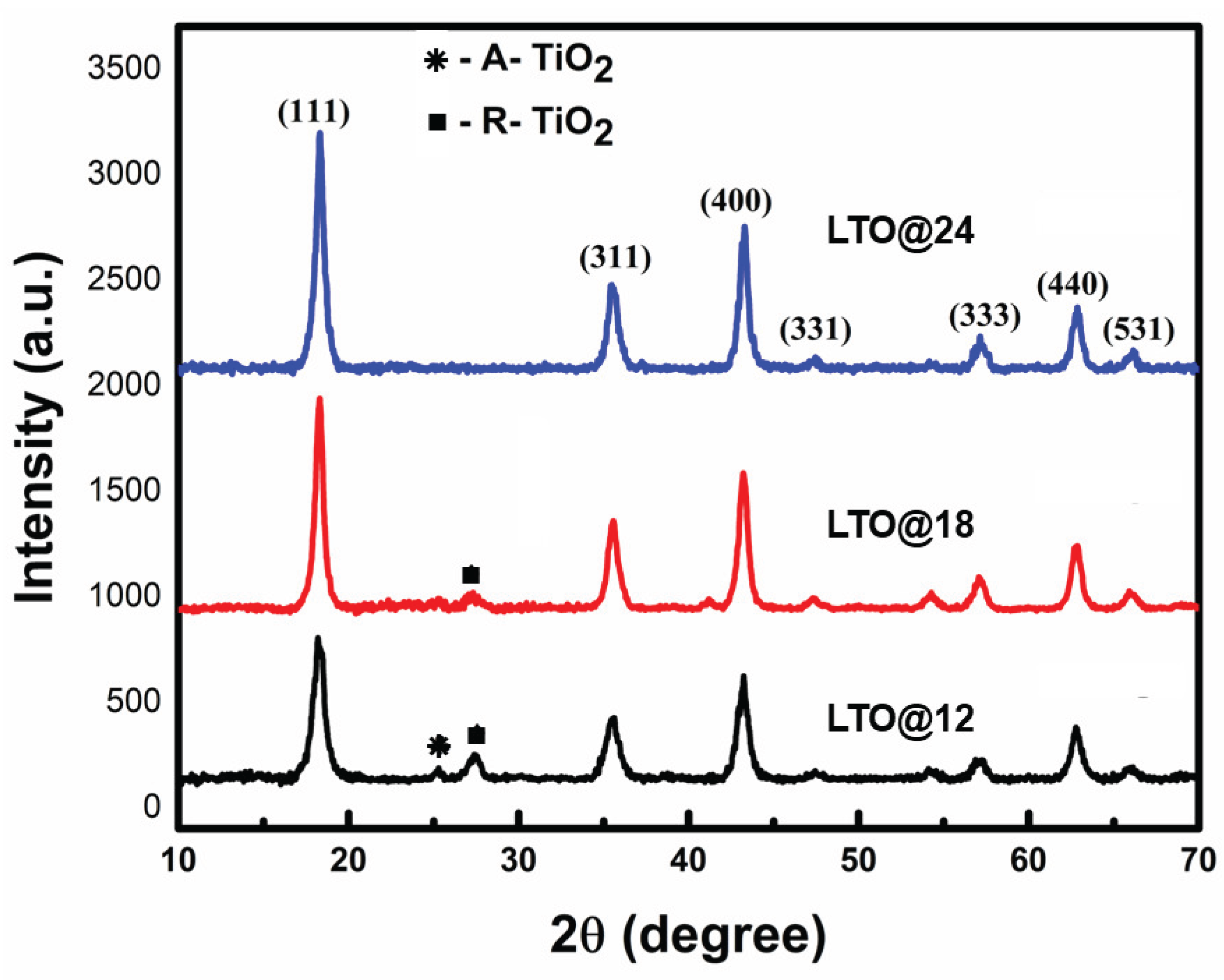
Figure 2.
FESEM images of Li4Ti5O12 synthesized at different reaction times: (a,b) 12 h, (c,d) 18 h, and (e,f), 24 h.
Figure 2.
FESEM images of Li4Ti5O12 synthesized at different reaction times: (a,b) 12 h, (c,d) 18 h, and (e,f), 24 h.
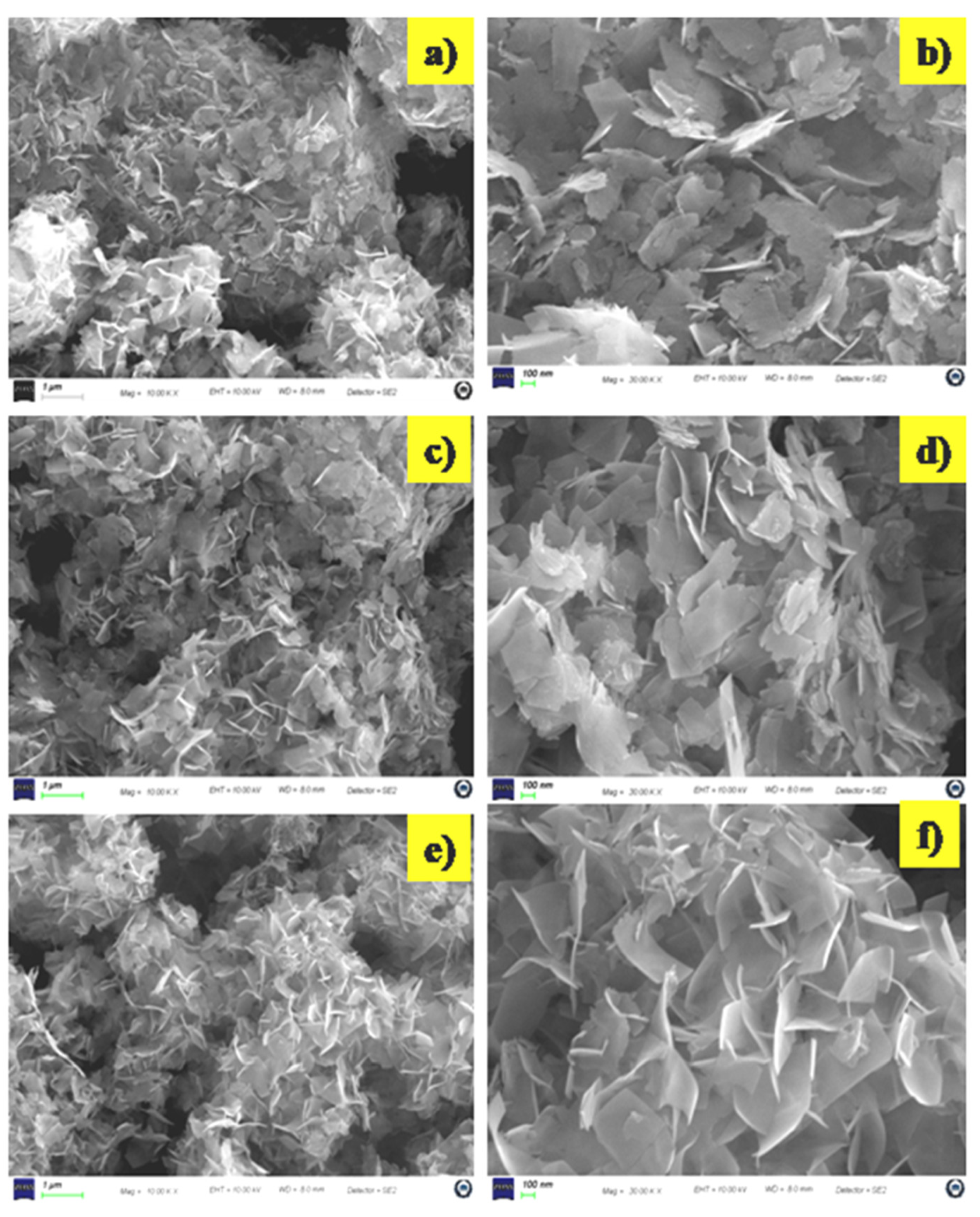
Figure 3.
Microstructural features of LTO@24: (a) TEM image, (b) HRTEM image showing the lattice fringe of 0.48 nm, and (c) SAED pattern.
Figure 3.
Microstructural features of LTO@24: (a) TEM image, (b) HRTEM image showing the lattice fringe of 0.48 nm, and (c) SAED pattern.
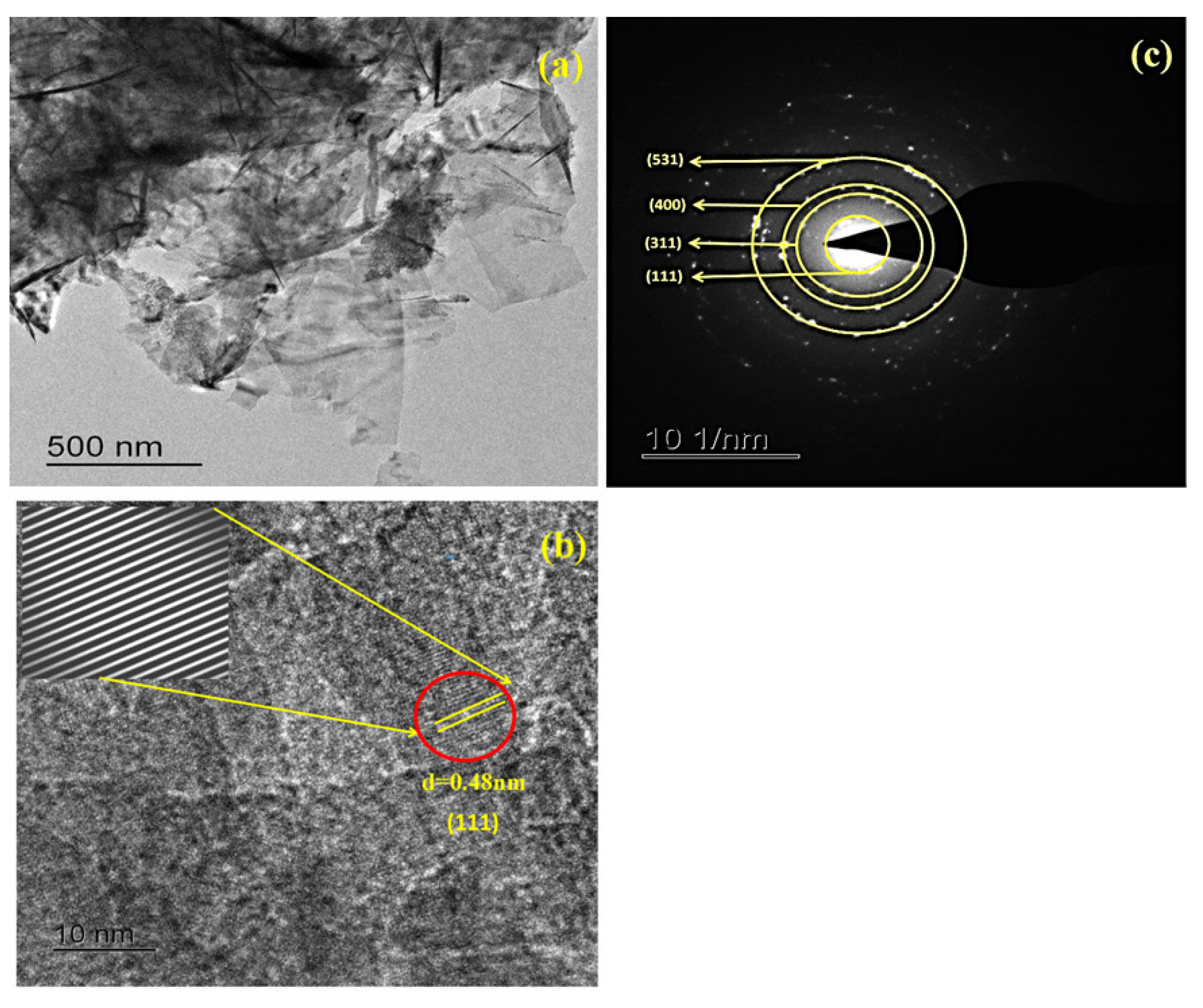
Figure 4.
(a) XPS survey of LTO@24, (b, d) High resolution XPS spectra of Li 1s, Ti 2p, and O-1s.
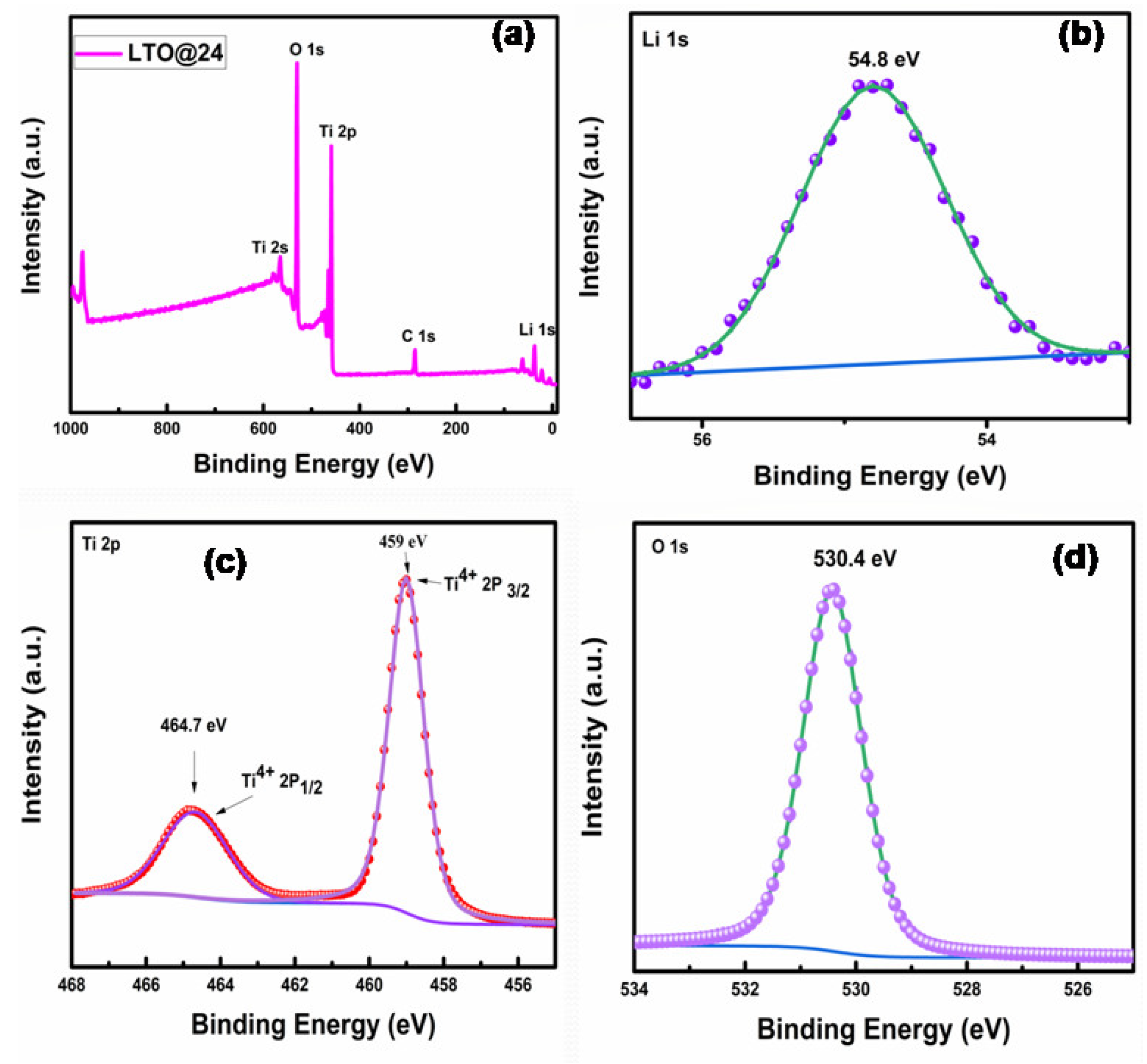
Figure 5.
Electrochemical characteristics of the LTO@24 nanoflakes. (a) Cyclic voltammetry curves recorded at different scan rates. (b) Galvanostatic charge discharge curves carried out at different current densities of 1-5 A/g in the potential range from -0.3 to 0.4 V vs. Ag/AgCl. (c) Nyquist plots before and after long-term cycling. Inset shows the equivalent circuit model. (d) Cycling stability performed at a current density of 5 A/g.
Figure 5.
Electrochemical characteristics of the LTO@24 nanoflakes. (a) Cyclic voltammetry curves recorded at different scan rates. (b) Galvanostatic charge discharge curves carried out at different current densities of 1-5 A/g in the potential range from -0.3 to 0.4 V vs. Ag/AgCl. (c) Nyquist plots before and after long-term cycling. Inset shows the equivalent circuit model. (d) Cycling stability performed at a current density of 5 A/g.
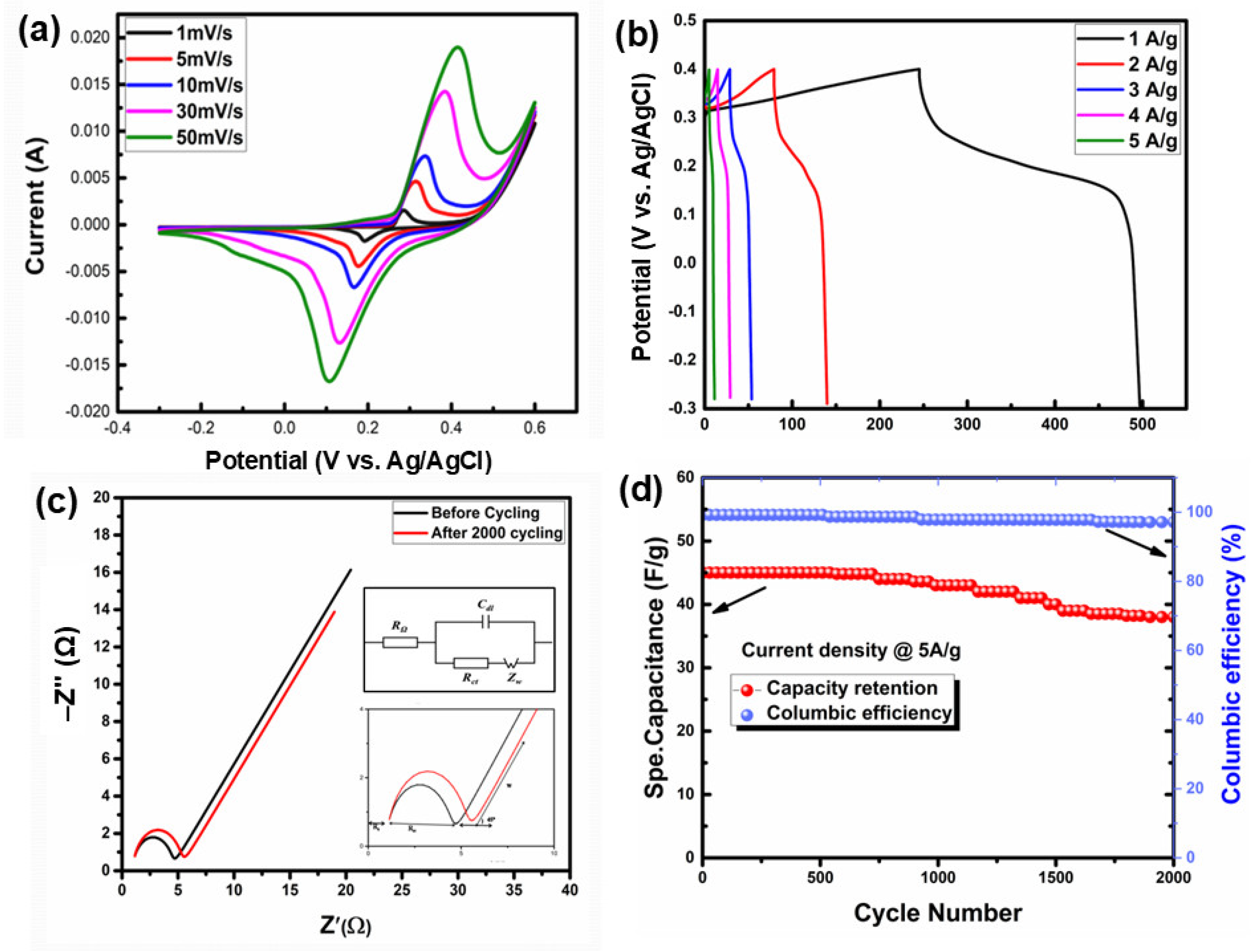
Figure 6.
(a) XRD pattern of LTO@24 and V-LTO@24 and (b) expanded XRD spectrum in the vicinity of the (111) reflection.
Figure 6.
(a) XRD pattern of LTO@24 and V-LTO@24 and (b) expanded XRD spectrum in the vicinity of the (111) reflection.
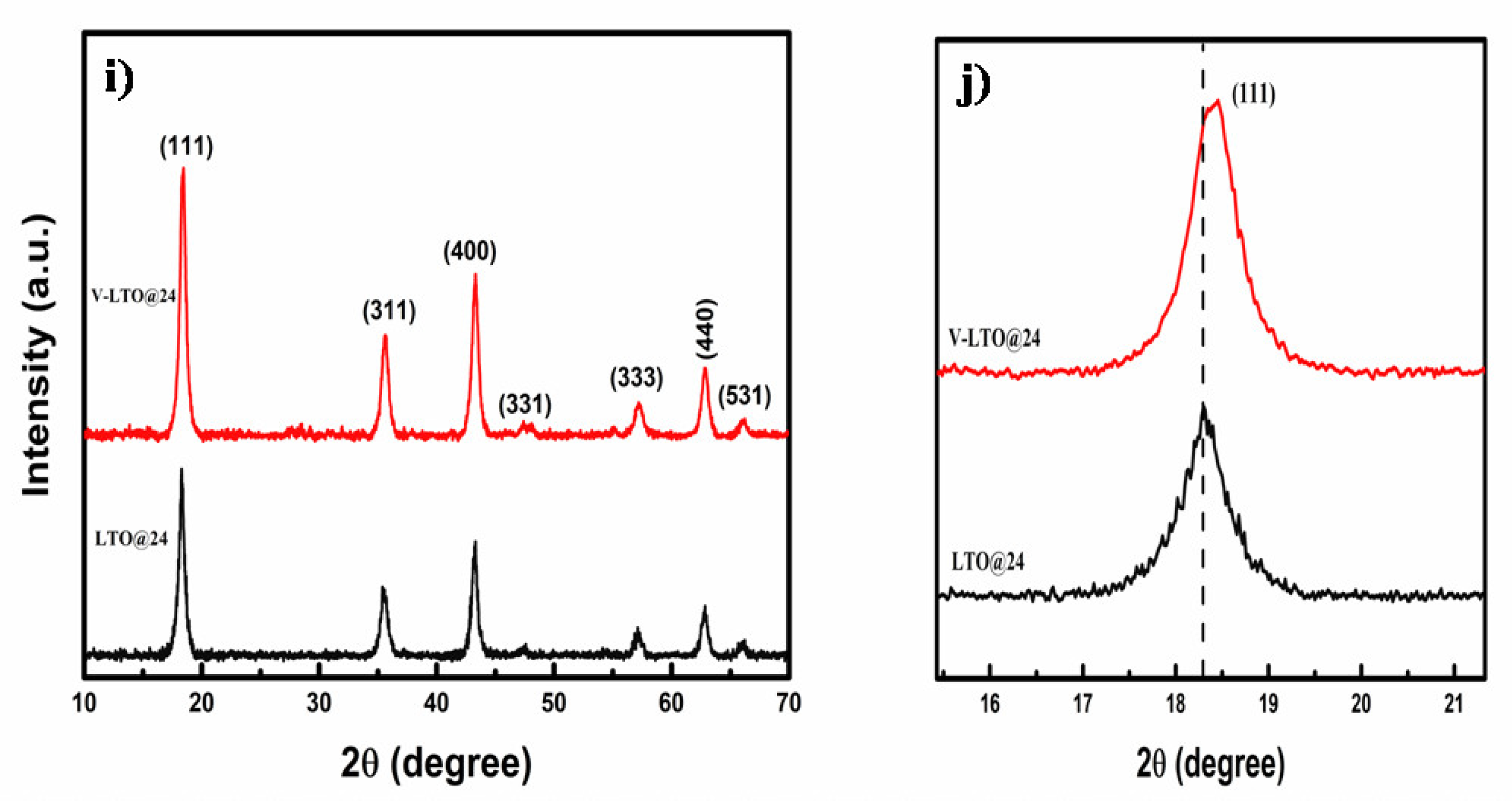
Figure 7.
FESEM images for V-LTO@24 nanoflakes at different magnifications: (a) 1 µm scale, (b) 100 nm scale.
Figure 7.
FESEM images for V-LTO@24 nanoflakes at different magnifications: (a) 1 µm scale, (b) 100 nm scale.
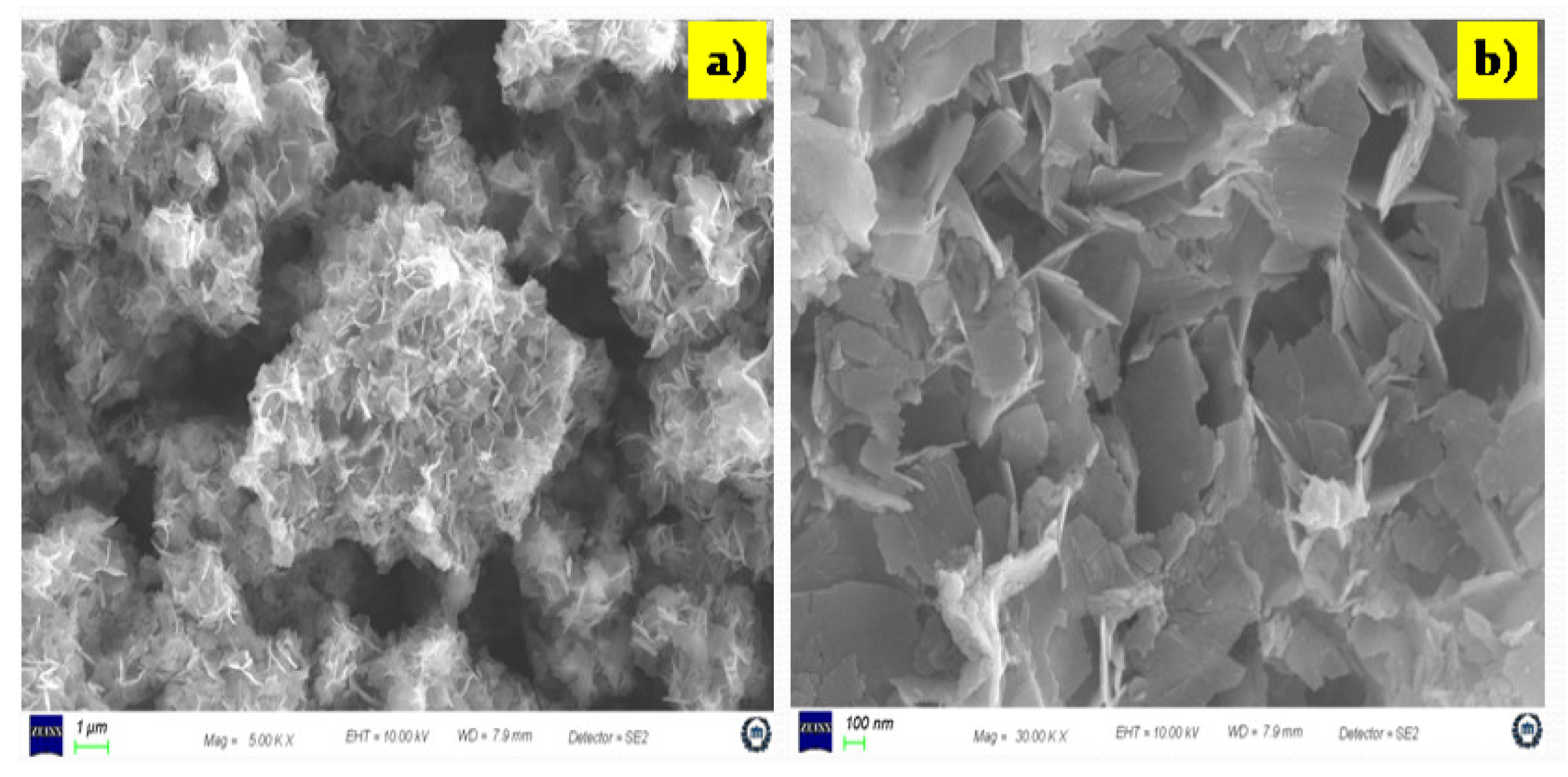
Figure 8.
Electrochemical characteristics of the V-LTO@24 nanoflake electrode. (a) CV curves recorded at different scan rates from 1 to 50 mV/s. (b) GCD profiles at different current densities. (c) Nyquist plots of before (black curve) and after (red curve) long-term cycling. (d) Cycling stability of the specific capacitance and Coulombic efficiency carried out over 2000 cycles at current density of 5 A/g.
Figure 8.
Electrochemical characteristics of the V-LTO@24 nanoflake electrode. (a) CV curves recorded at different scan rates from 1 to 50 mV/s. (b) GCD profiles at different current densities. (c) Nyquist plots of before (black curve) and after (red curve) long-term cycling. (d) Cycling stability of the specific capacitance and Coulombic efficiency carried out over 2000 cycles at current density of 5 A/g.
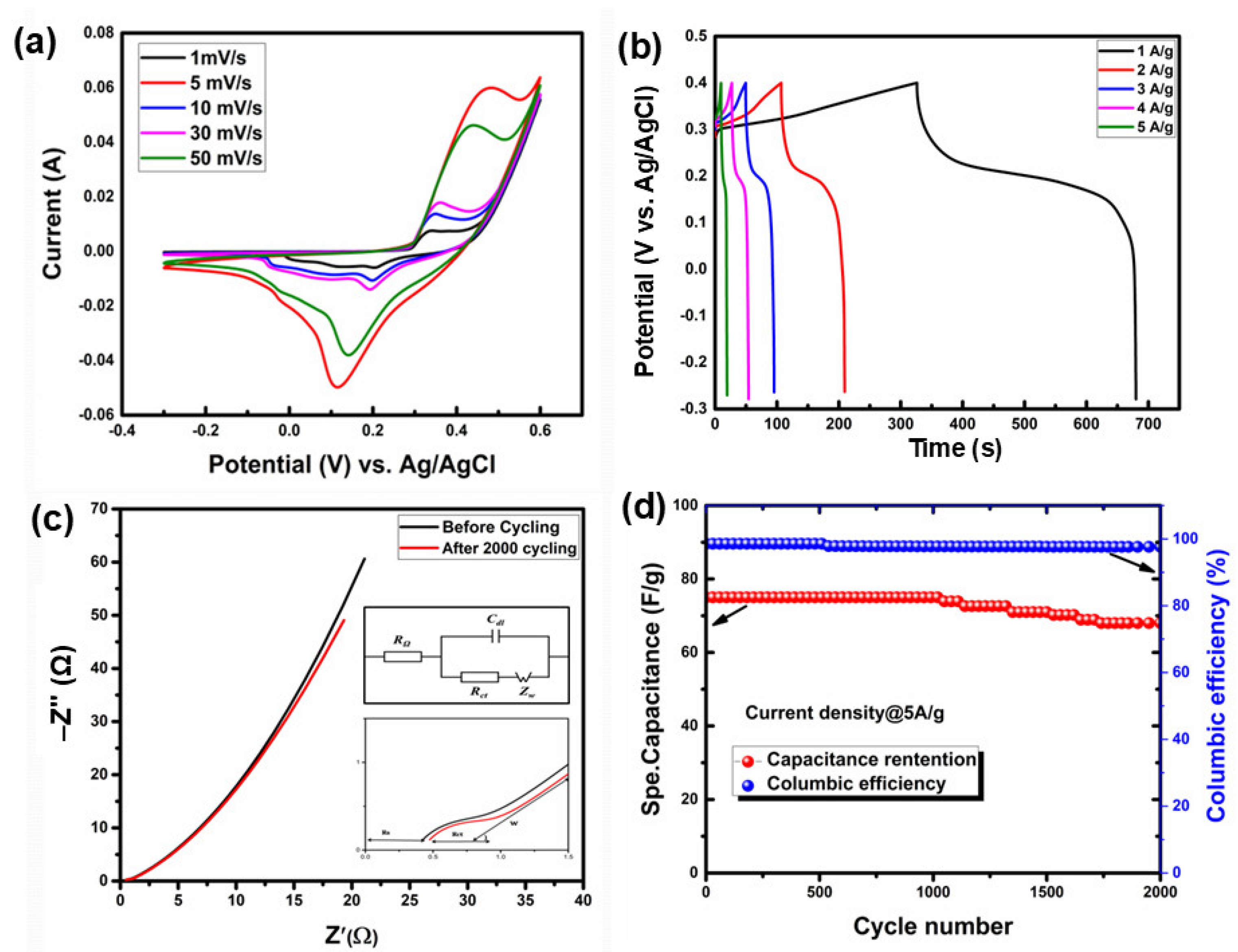
Figure 9.
Specific capacitance (Cs) calculated from the CV measurements as a function of scan rate.
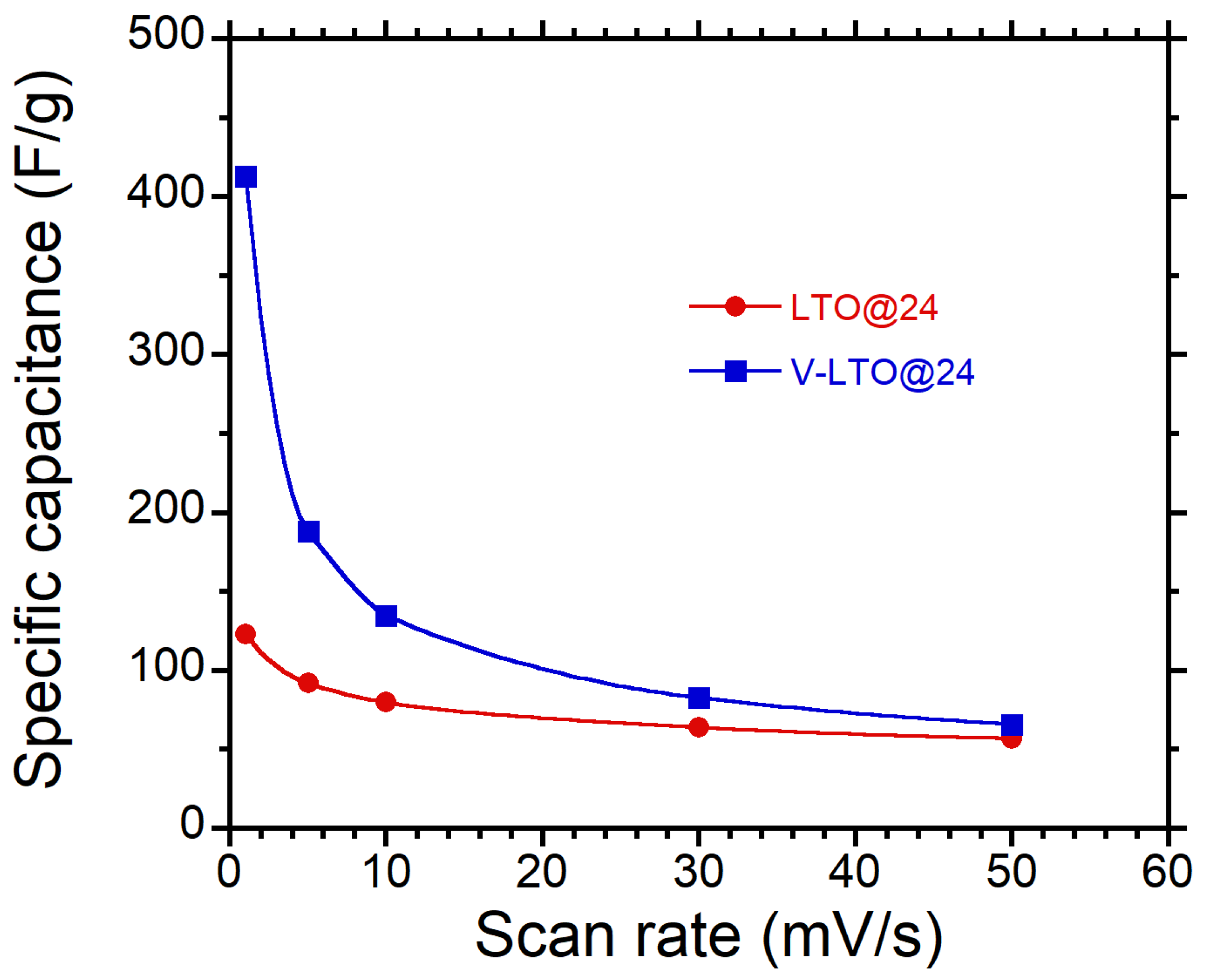
Figure 10.
(a,b) Plots of log(ip) vs. log(ν) and relative contributions of the capacitive and diffusion-controlled charge storage processes of LTO@24 electrode at different scan rates. (c,d) Plots of log(ip) vs. log(ν) and relative contributions of the capacitive and diffusion-controlled charge storage processes of V-LTO@24 electrode at different scan rates.
Figure 10.
(a,b) Plots of log(ip) vs. log(ν) and relative contributions of the capacitive and diffusion-controlled charge storage processes of LTO@24 electrode at different scan rates. (c,d) Plots of log(ip) vs. log(ν) and relative contributions of the capacitive and diffusion-controlled charge storage processes of V-LTO@24 electrode at different scan rates.
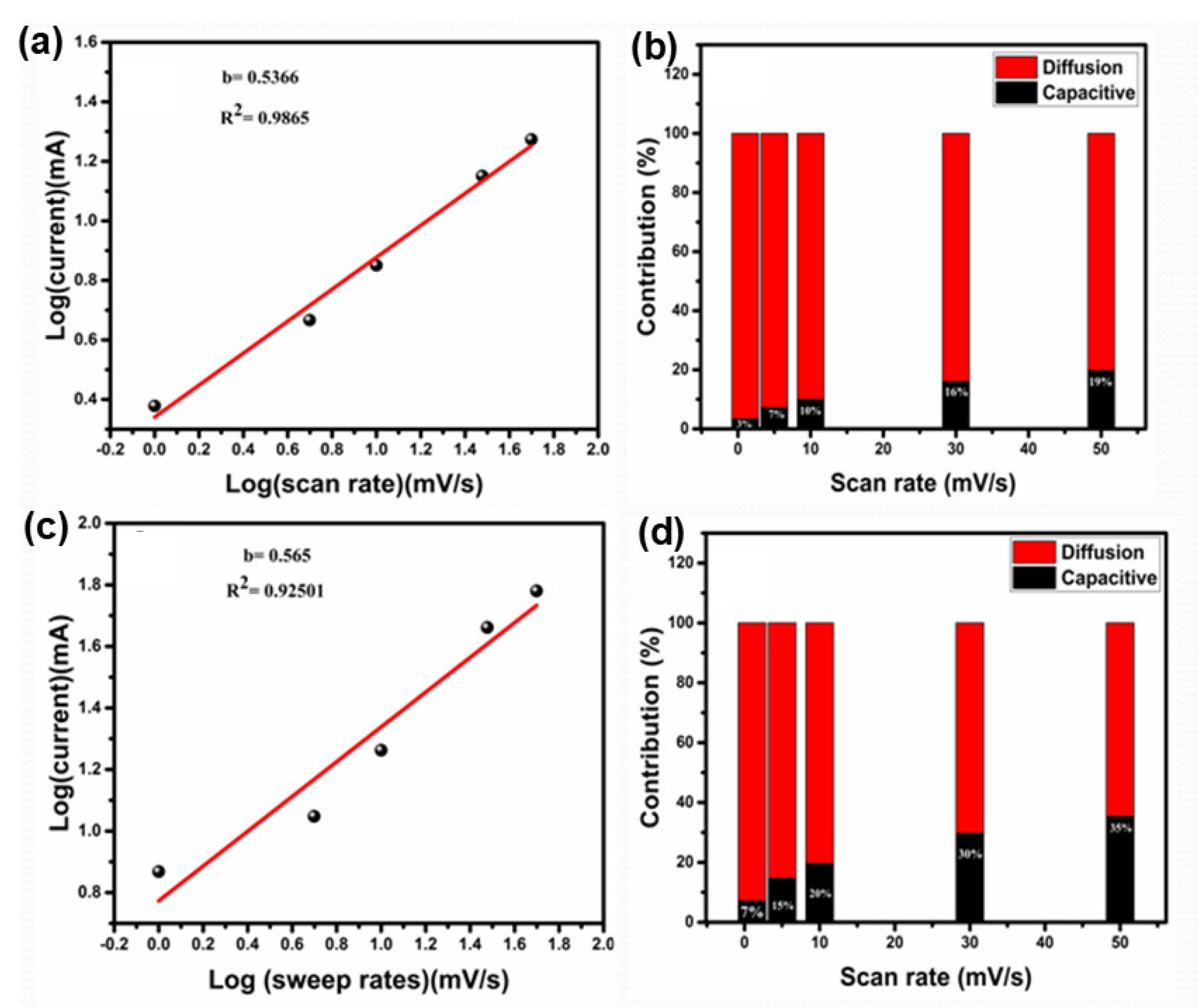

Table 1.
The structural parameters of LTO samples synthesized at various conditions.
| Sample | Crystallite size (nm) | Dislocation density(δ) | Microstrain (rd) | Lattice parameter (Å) |
Unit volume (Å3) |
|---|---|---|---|---|---|
| LTO@12 | 11 | 8.27652*1015 | 0.009933 | 8.4117(0) | 595.18 |
| LTO@18 | 12 | 6.98751*1015 | 0.008899 | 8.4018(2) | 593.08 |
| LTO@24 | 13 | 6.31196*1015 | 0.00827 | 8.3671(8) | 585.76 |
| V-LTO@24 | 11.8 | 7.7152*1015 | 0.0088 | 8.3401(2) | 580.11 |
Table 2.
Comparison of the electrochemical performance of hydrothermally prepared LTO@24 and V-LTO@24 electrodes with other LTO-based electrodes recently reported in the literature.
Table 2.
Comparison of the electrochemical performance of hydrothermally prepared LTO@24 and V-LTO@24 electrodes with other LTO-based electrodes recently reported in the literature.
| Sample | Capacitance | Retention over cycling | Ref. |
|---|---|---|---|
| V-doped LTO Granule-LTO powders SSR synthesized nano-LTO R-TiO2 decorated LTO 3D chestnut shell-like LTO C-modified LTO LTO nanowire LTO–TiO2 nanoparticles Hydrothermal LTO@24 Hydrothermal V-LTO@24 |
179 mAh/g @ 1C 63 F/g @ 0.5 A/g 265 F/g @ 0.5 A/g 143 mAh/g @30C 653 F/g @ 1 A/g 83 F/g @ 2C 125 F/g @ 0.55 mA/cm2 174 mAh/g @ 2 A/g 357 F/g @ 1 A/g 442 F/g @ 1 A/g |
95% (300) 92.8% (7000) @ 3 A/g 81% (5000) @ 0.5 A/g 92.3% (3000) 88.5 % (4000) 84% (9000) @0.98 A/g 95% (400) @ 0.4 mA/cm2 85% (3000) @ 2 A/g 98.5% (2000) @ 5 A/g 99.8% (2000) @ 5 A/g |
[29] [32] [35] [57] [36] [58] [59] [60] this work this work |
Disclaimer/Publisher’s Note: The statements, opinions and data contained in all publications are solely those of the individual author(s) and contributor(s) and not of MDPI and/or the editor(s). MDPI and/or the editor(s) disclaim responsibility for any injury to people or property resulting from any ideas, methods, instructions or products referred to in the content. |
© 2025 by the authors. Licensee MDPI, Basel, Switzerland. This article is an open access article distributed under the terms and conditions of the Creative Commons Attribution (CC BY) license (http://creativecommons.org/licenses/by/4.0/).
Copyright: This open access article is published under a Creative Commons CC BY 4.0 license, which permit the free download, distribution, and reuse, provided that the author and preprint are cited in any reuse.


