

Submitted:
16 December 2024
Posted:
17 December 2024
You are already at the latest version
Abstract
The purpose of this paper is to improve the fire management system framework in the Emirate of Sharjah by using artificial intelligence. After evaluating the current performance and proposing improvements through artificial intelligence (AI), 16 components were identified to implement the integration with AI to increase efficiency, reduce human intervention, mitigate fire hazards, and decrease fire accidents in the Emirate of Sharjah.
Keywords:
Civil Defense
; artificial intelligence
; fire accidents
1. Introduction
The Emirate of Sharjah is the third in terms of the number of high-rise buildings in the UAE, and it is classified as one of the emirates with rapid urban growth. The UAE ranks in third place in terms of number of skyscrapers in the world, and it is home to 251 buildings that are taller than 150 m. As the safety of high-rise buildings is a global concern, in this study, we review the factors that affect the fire prevention systems of HRBs and super-high-rise buildings in the Emirate of Sharjah.
The region of UAE has a dry subtropical weather with year-round sunny days and rare, shallow rainfall. The weather is extremely hot and humid along the shoreline. The summers from the month of June to September are extremely hot and humid, with temperatures reaching 48 °C (118 °F) and humidity as high as 80–90% “[1]”. The Emirate of Sharjah is considered the third emirate in the UAE in terms of area, which covers 2600 square kilometers; 19% of the UAE population live in Sharjah, and the emirate is home to people of 200 different nationalities. Moreover, 1.5 million tourists visit the Emirate of Sharjah annually.
By using industrial revolution 4.0 technology the fire management system in the Emirate of Sharjah will be more accurate and efficient to eliminate the fire hazards.
2. Methods
A literature review was carried out to identify the practices and theory used artificial intelligence in fire management system, extensive review to the Sharjah fire management system framework carried out to evaluate the need for improvements through artificial intelligence, the outcome validated through subject matter experts in the field
3. Literature Review
In general, artificial intelligence (AI) is suitable for identifying situations that are difficult to classify using the features extracted from the sensing data. For example, AI can determine the special characteristics set or special features of various fire situations using the collected data and apply them to make decisions in actual fire events [2], The first mention of artificial intelligence (AI) as a strategy to solve problems that defy solution through traditional computational techniques was noted at a workshop held in Dartmouth College in 1956. This concept mimics the cognition capability of the brain to exploit hidden patterns and implicit relations within data sets as to understand interaction between input parameters and then draw conclusions to physically represent a solution (or set of solutions) to a given problem or phenomenon [3], Fire is a chaotic and extreme phenomenon. While the past few years have witnessed the success of integrating machine intelligence (MI) to tackle equally complex problems in parallel fields [4], Over the last few years, artificial intelligence (AI) has emerged as a reliable method to tackle this engineering problem, ML is one of the most innovative methods in the material science area in recent years. This technique is different from conventional computing methods such as the fire dynamics simulator. As for traditional methods, the necessary information such as boundary conditions, functions, and computational requirements are transmitted into the software, and computers help to run that software [5], the artificial intelligence technology is used to construct an efficient and intelligent dynamic evacuation path solving model, and an intelligent mobile terminal fire evacuation system was built for large public buildings based on artificial intelligence technology. When a fire breaks out, the system can help guide people to evacuate from the building real-time and reach the safe exit quickly, so as to reduce casualties and economic losses [6].
4. Results
4.1. Performance Management Through Artificial Intelligence
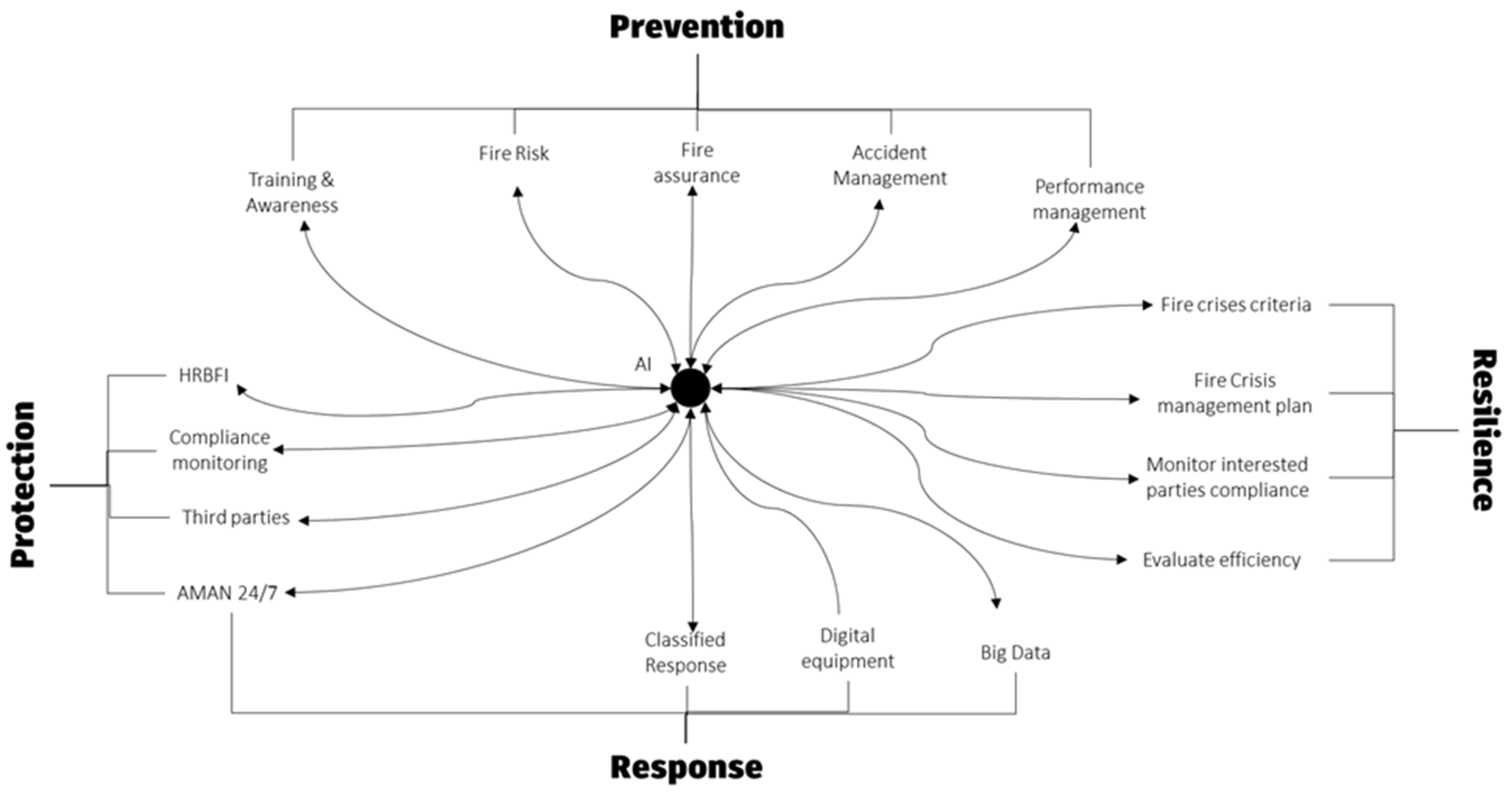
The data of the fire management system in the Emirate of Sharjah remains raw, overlapping, different, and dispersed unless it is collected in a unified format to be analyzed, processed, and utilized to understand the nature, trends, and focus of the fire, The nature of fire differs from one place to another, according to the nature of the weather, the method of construction, the culture of society, and the technology used, and according to the developed framework the main elements is Prevention, Protection, Response And Resilience, integrated together to share, process and receive the information based on the artificial intelligence as shown in Figure 1 artificial intelligence.
4.2. Fire Risk Management
Monitoring fire risks is a proactive method of identifying fire hazards. By evaluating the risks in residential buildings from the design stage, construction stage, operation stage, repurposing stage, or demolition stage, and identifying risks that need to be linked to artificial intelligence, By feeding the data required for processing, it may be data related to the manufacture of building materials, legislation, people, weather, fire systems, or equipment used in residential buildings, among other data that needs an accurate analysis process to determine the risk of fire. It also includes fire accident data and investigation, which is an important entry point for understanding the causes of accidents in order to address them when identifying risks; training and awareness data; and framework application procedures, all of which are data that should be fed into the risk identification element to be addressed and to contribute to building an effective risk assessment system.
4.3. Training and Awareness
Data on the number of employees, trainers, residents, special groups, the buildings to which they belong, their geographical areas, the category of buildings in terms of the number of floors, and the number of residents represent important information that can be utilised in the most efficient way through artificial intelligence. By comparing the data of buildings that have met the training requirements, with the number of fire incidents, it can provide important information about the effectiveness of training and about predicting the most dangerous buildings. The fire risk assessment process is a vital one, and the artificial intelligence system can help identify, evaluate, control, and review risks to ensure the validity of procedures applied control.
4.4. Fire Incident Management
All fire incidents, their investigation, monitoring of their apparent and root causes, the procedures used to ensure that they do not reoccur, the buildings where fires occurred and the number of trained workers in them, as well as the compliance rate monitored by the early warning system 24/7, This data can be made through the artificial intelligence system to provide predictions about buildings in which fires will occur in order to avoid their occurrence and treatment, the artificial intelligence system can also provide assistance in analysing accidents, identifying their causes, and proposing solutions that ensure that they do not recur.
4.5. Fire Assurance
The laws, legislations, standards, guidelines, and internal procedures used throughout the framework, the artificial intelligence program, and based on the data available from the framework, an assessment of their suitability for fire risk management in the Emirate of Sharjah and the assessment of the scope of the legislation and if any need to be amended are among the most important elements that must be evaluated. The scope of the legislation and the internal procedures include all procedures in place to implement the framework. There can be long and complex procedures that can be replaced by shorter and more effective procedures, or the effectiveness of the applied procedures can be evaluated based on the results.
4.6. Performance Monitoring System
One of the most important elements in the framework of fire management in the Emirate of Sharjah is the performance measurement system. Through the use of artificial intelligence, effective and accurate performance monitoring can be achieved to monitor gaps in the framework. Through this element, the application of the highest possible quality of operations can be ensured, and through corrective measures, it can be addressed. The gaps require an effective performance measurement system that contributes to making the framework effective in the maximum way, which contributes to reducing fire accidents to a minimum.
4.7. Early Warning System 24/7 Aman
The global trend in the use of artificial intelligence to monitor data, analyse and process it, and reuse it in an optimal way All smoke detectors installed in residential buildings, whether high-rise, villas, or low-rise, are linked to the early warning system and provide 24-hour security. Alarm system data provide an important base for measuring The extent of compliance with fire requirements, the validity of fire pumps and all extinguishing systems, the validity of alarm systems, and the security system provide a self-reporting mechanism for fires. The data provided by the early warning system, security 24/7, is massive and can be useful in reading the overall scene in the framework. fire management system in the Emirate of Sharjah.
4.8. High-Rise Building Fire Index (HRBFI)
HRBI is considered a system for measuring the level of compliance in residential towers, and at the same time, it sets minimum standards to meet the requirements of the fire fighting system, manage it, and ensure its validity around the clock. The system provides requirements according to multiple criteria, each of which covers a specific part of the fire legislation or standards. Data can be of great value to measure the compliance of high-rise residential towers if an artificial intelligence system is used and building data is fed into the HRBFI system with early warning system data.
4.9. Compliance Monitoring
The artificial intelligence system can play with the Internet of Things, a self-compliance monitoring system that monitors gaps in compliance, notifies the owners of residential buildings by itself, and takes punitive measures without human intervention. The system can also remove violations by itself or change the compliance rate after correcting faults. In the firefighting system, which works to reduce human intervention in the process of compliance monitoring and reduces errors, it increases the compliance of residential buildings with fire legislation.
4.10. Third-Party Companies
Artificial intelligence can monitor the performance of third parties very effectively by including their data in the system and tracking it to measure their compliance with the requirements by taking advantage of big data to ensure the approval of materials and equipment used, maintenance, installation, supply, training, and others.
4.11. Response
The response is a delicate process linked to critical decisions with short timelines. The response decision and its type must be taken according to the available data on the fire accident, the condition of the residential building, the condition of the road, and other vital data. This data can be provided by artificial intelligence in real time and help in making the appropriate decision. firefighting system and sending voice data to residents or carrying out evacuations before the arrival of the civil defence teams. Information that can be provided about the residential building can include the number of floors, number of residents, surrounding areas, arrival time, required equipment, exact location of the fire, fire condition, electricity, gas, and water availability, and response success rate.
4.12. Recovery
The procedures required to control the situation in the event that it gets out of control and develops into a disaster, the recovery procedures, begin with fire legislation, which must ensure the rapid recovery of the residential building in the event of a fire and its return to service as soon as possible. This legislation must start at the design stage to take specific structural requirements into accounts into a disaster, the recovery procedures, begin with fire legislation, which must ensure the rapid recovery of the residential building in the event of a fire and its return to service as soon as possible. This legislation must start at the design stage to take specific structural requirements into account. the materials used in its construction that preserve the building in the event of a fire, and then the procedures that include controlling the disaster to reduce its effects and control it through coordination with specific parties related to the fire. Artificial intelligence can manage a disaster by providing the necessary information and transmitting real-time data. The data provided by artificial intelligence can be a decisive element in controlling the disaster for other stakeholders and extracting the necessary information from them. In the case of the framework of the fire management system in the Emirate of Sharjah, the Sharjah Electricity, Water, and Gas Authority can be one of the important authorities in the event of disasters, as well as the Ministry of Health and Community Protection. through its health facilities spread throughout the emirate, the municipality of the Emirate of Sharjah, and insurance companies to arrange alternative housing for the affected population and other relevant parties.
5. Conclusions
According to the literature review and benchmarking with best practices, the fire management system framework consists of four main elements: prevention, protection, response, and resilience. These elements are required to be integrated together through artificial intelligence to share information processed and distributed through the machine learning process, which contributes to increasing the efficiency of the system to mitigate the fire hazards.
Author Contributions
M.O.: Writing—original draft, Visualization, Investigation, Data curation. DR. A.M.: Supervision, Methodology, Conceptualization. All authors have read and agreed to the published version of the manuscript.
Funding
This research received no external funding.
Informed Consent Statement
Study did not involve humans.
Data Availability Statement
The data presented in this study are available on reasonable request from the corresponding author.
Conflicts of Interest
The authors declare no conflict of interest.
References
- Salam, A. Climate change: the challenges for public health and environmental effects in UAE. WIT Transactions on Ecology and the Environment 2015, 193, 457–466. [Google Scholar]
- Park, J.H.; et al. Dependable fire detection system with multifunctional artificial intelligence framework. Sensors 2019, 19, 2025. [Google Scholar] [CrossRef] [PubMed]
- Naser, M. Fire resistance evaluation through artificial intelligence-A case for timber structures. Fire safety journal 2019, 105, 1–18. [Google Scholar] [CrossRef]
- Naser, M. Mechanistically informed machine learning and artificial intelligence in fire engineering and sciences. Fire Technology 2021, 57, 2741–2784. [Google Scholar] [CrossRef]
- Nguyen, H.T.; et al. Review on the use of artificial intelligence to predict fire performance of construction materials and their flame retardancy. Molecules 2021, 26, 1022. [Google Scholar] [CrossRef] [PubMed]
- Jiang, H. Mobile fire evacuation system for large public buildings based on artificial intelligence and IoT. IEEE Access 2019, 7, 64101–64109. [Google Scholar] [CrossRef]
Figure 1.
artificial intelligence.
Disclaimer/Publisher’s Note: The statements, opinions and data contained in all publications are solely those of the individual author(s) and contributor(s) and not of MDPI and/or the editor(s). MDPI and/or the editor(s) disclaim responsibility for any injury to people or property resulting from any ideas, methods, instructions or products referred to in the content. |
© 2024 by the authors. Licensee MDPI, Basel, Switzerland. This article is an open access article distributed under the terms and conditions of the Creative Commons Attribution (CC BY) license (http://creativecommons.org/licenses/by/4.0/).
Copyright: This open access article is published under a Creative Commons CC BY 4.0 license, which permit the free download, distribution, and reuse, provided that the author and preprint are cited in any reuse.


