1. Introduction
A fire accident is defined as the state of burning out of control in space and time. It is one of the most destructive disasters in modern society owing to its high frequency and severe harmfulness [
1]. Fire statistics can help identify the characteristics of fire accidents. Analyses of fire statistics play an important role in understanding the developmental trend of fire accidents [
2]. Accident analysis is an essential part of system safety management and forecast of fire accidents is an important component of fire-management decision-making process. However, fire accidents are influenced by many complex factors, such as environment, climate, and fire investment [
3]. Fires cause casualties and damage to properties, community, economy, environment, etc. [
4]. The main accident types that occur in the UAE can be identified in terms of frequency and severity. In a previous study, preventing falling from heights, heat exhaustion, fires, and accidents involving sharp edges and moving objects was identified as the top priority for civil safety improvement [
5].
The government of Sharjah has prioritised the reduction in fire accidents owing to the efforts made by the competent safety authorities in the emirate. Several measures have been taken to control the rate of fire accidents; some of these have contributed to reducing the frequency. However, the rate of fire accidents in the residential sector remains high compared with those in other sectors. A successful firefighting strategy cannot be implemented without thoroughly investigating the nature of fires in residential buildings; this necessitates the use of an efficient system for investigating accidents, identifying underlying causes, and implementing necessary corrective measures. The shortcomings of the accident investigation process may lead to accidents recurring in the same manner but in different places. The root cause of the accident may be related to the management, human, or technical error. In this study, we examine the effectiveness of the fire prevention management systems adopted by the Sharjah Civil Defence by reviewing the fire data collected in the Emirate of Sharjah during 2013–2021 using the iceberg theory.
2. Methods
The iceberg model is a tool for understanding global issues within a system. Analogous to an iceberg in the ocean, only 10% of the structure is visible. The submerged 90% causes the perceived issues and determines the visible outcomes [
6]. To investigate the performance of a fire prevention management system in the residential sector in the Emirate of Sharjah, we use the iceberg theory. Human interactions with the world occur at four levels. The first is the event level where people become aware of things in the world. Here, we identify the events affecting fire accidents in the Emirate of Sharjah. The next level is denoted as patterns where a larger set of events (or data points) are linked together. Patterns are considerably richer and more meaningful sources of information than events because they indicate the changes and trends in data over an extended period. In this study, we analyze the trend of fire accidents in 11 civil defence centers in the Emirate of Sharjah. The next level of the iceberg is denoted as systemic structures, which reveal how such trends and patterns relate to and affect one another. Accordingly, the factors that connect to establish the pattern should be identified. This represents a much deeper level of thinking that can demonstrate how the interactions between various factors yield the outcomes that are observed; a deeper level of thinking that is rarely observed. This is the mental model of individuals and organizations that influence why things function the way they do. Mental models reflect the beliefs, values, and assumptions that we personally hold, and they highlight our reasons for doing things the way we do [
7].
3. Results
According to the report published by the UAE Ministry of Interior, the annual average number of fire accidents from 2013 to 2018 in the Emirate of Sharjah was 722. The population of the Emirate of Sharjah in 2018 was 1.2 million, which corresponds to 624 fire accidents per million residents in 2018. This is considered a high rate compared with that of neighbouring Emirates.
3.1. Fire Death Pattern
When reviewing the overall rate of fires in the Emirate of Sharjah, we found that the number of deaths due to fires continued to increase from 2013 to 2018, despite the measures implemented by the safety authorities in the Emirate. The date rate was zero in 2019 and 2020 and increased in 2021.
3.2. Residential Fire Pattern
During 2013–2018, an increase in the number of fire accidents is observed, The number of fires in the residential sector is the highest compared with those in other sectors in the Emirate, such as the industrial sector. The percentage continues to increase until it reaches 67% of total fire accidents in the Emirate in 2021.
During 2013–2021, the average number of fire accidents in the residential sector accounts for 54% of all fire accidents in all sectors, Owing to the importance of the residential sector, understanding some of the challenges related to fire incident prevention in residential buildings is necessary, based on the economy of the Emirate of Sharjah, good reputation that has been built in the field of real estate development, and impact of fire incidents on the Emirate. This study contributes to this understanding.
3.3. Fire Accident According to the Area Patterns
For fire accidents, the concept of ‘prevention is better than cure’ has become a standard [
8]. According to
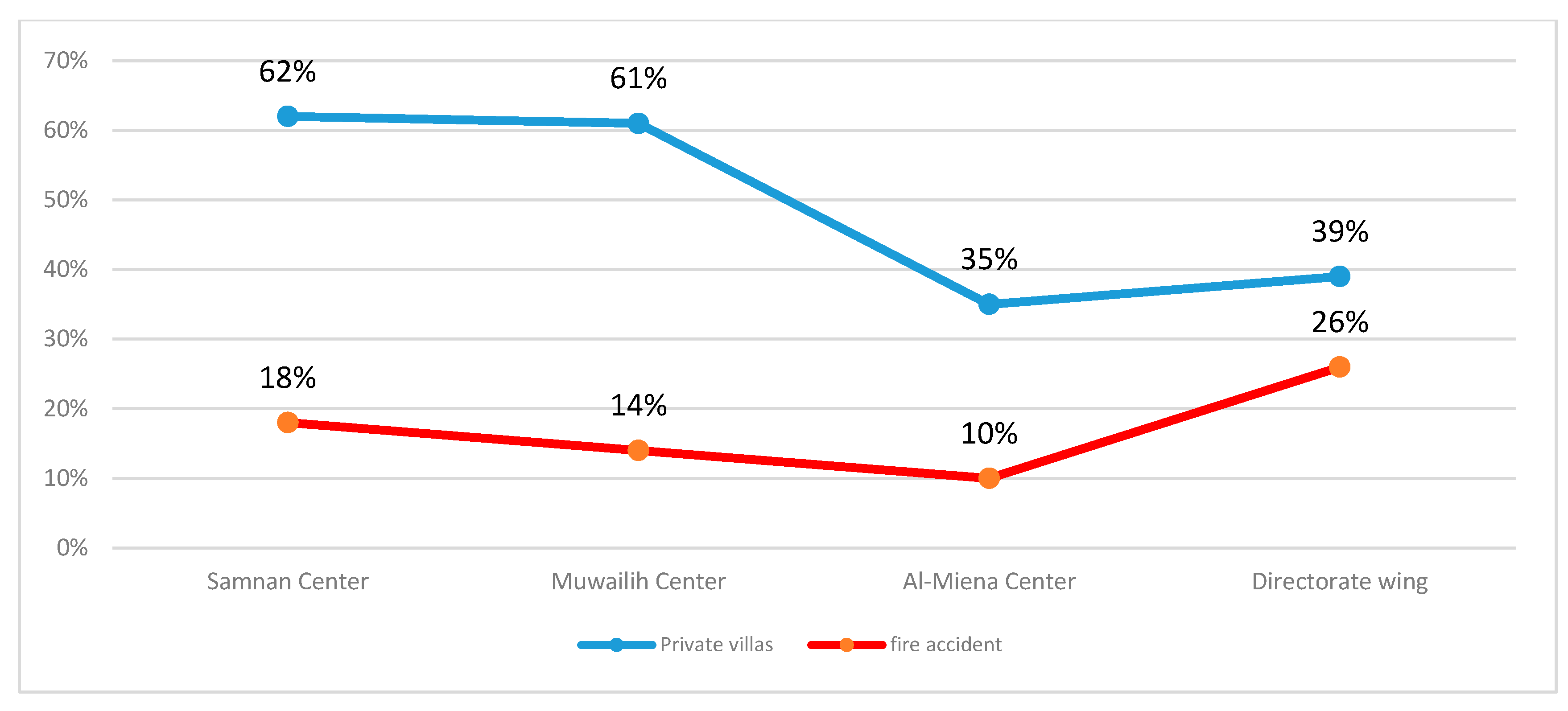
Table 1, during 2013–2021, 26% of average fires occur in Directorate wing geographical area, whereas 18% occur in Samnan, 14% in Muwailih centre, and 10% in Al Meena centre. All these centres are located in the city of Sharjah, where 76% of accidents occur; 24% of accidents occur in other cities in the Emirate. The number of accidents in the city of Sharjah decreases slightly, whereas the number of accidents in other cities increases slightly, a comprehensive investigation into the accidents can have a positive impact on reducing fire accidents in the Emirate of Sharjah.
3.4. Fire Accident Investigation Pattern
In 85% of the accidents that occur in the Emirate of Sharjah, the cause has not been determined, this indicates that the underlying causes have not been addressed, and the investigation process needs to be further improved. Although the rate of accidents in residential buildings has remained stable since 2013, the percentage of residential building fires has increased in 2021. Accordingly, procedures related to accident investigation should be further reviewed to achieve an acceptable rate. The percentage of accidents whose causes were not determined reached 95% of the accidents that occurred in the some civil defence centres. Improving the efficiency of civil defence centres, to be able to complete an effective investigation process, is necessary for effective fire prevention systems.
The civil defence centers logs indicate that the causes of fire increased due to heat sources, electrical malfunction, and arson. However, the highest percentages of accidents were those whose causes were not identified at all. The reasons identified can be remedied by corrective measures, such as inspection and awareness campaigns, reducing the recurrence possibility of fires. Moreover, building a unified system to investigate accidents in all civil defence centres and training civil defence employees, can lead to identifying more reasons and converting the results of the accident investigation into a work program to be implemented by the Sharjah Civil Defence Authority, Prevention and Safety Authority, and other authorities related to fire hazards.
3.5. Structure: Fire Accidents in Four Civil defence Centres
To better understand the nature of geographical areas, detailed analyses are performed on residential buildings to assess compliance with regulations and gaps that contribute to an increase in fire accidents in four civil defence centres, which account for 70% of fire accidents in the Emirate of Sharjah.
3.6. Structure: Directorate Wing
For this study, we consider Al Nahda centre part of the directorate wing. There are 44 areas classified under the geographical area of the directorate wing, where 26% of fires occur, and according to our analysis 39% of residential buildings are out of civil defence scope. Private villas are exempt from UAE fire regulations and are not covered by civil defence framework; however, it is permissible to use residential villas for commercial purposes in the Emirate of Sharjah.
3.7. Structure: Samnan Centre
Samnan centre and its civil defence geographical area are located in Sharjah city; 18% of the fire accidents occurred in this centre during 2013–2021. This centre contains 24 areas where most buildings are private villas, approximately 61% of the residential buildings; these are out of scope of civil defence.
3.8. Structure: Al-Meena Centre
Its geographical location is close to the Arabian Gulf, and it includes 8 residential areas, where 10% of the fire accidents occurred during 2013–2021. 35% of the buildings are private villas and 65% of buildings are residential towers, including high-rise buildings.
3.9. Structure: Muwailih Centre
This is considered a new district, containing 23 areas. Most of the area, approximately 61%, is occupied by private villas. The commercial buildings under the scope of civil defence amount to only 39% of residential buildings. 14% of residential fire accidents occurred in the Muwailih centre geographical area.
The residential buildings outside the scope of the civil defence authority in four centres account for 49% of the buildings, as reported in the
Table 2, which is considered very high and a direct reason for the high occurrence rate of fire accidents during 2013–2021.
The relationship between the numbers of residential villas and fire accidents is characterised by a direct proportionality. When the number of villas increased also the fire accidents increased, as shown in
Figure 1. The number of villas in a residential area is a critical factor affecting the frequency of fire accidents in the Emirate of Sharjah.
3.11. Mental Models
The prevailing belief is that preventive measures against fire risks are specific to high-rise residential buildings and that residential villas are free from the risk of fire hazards and do not need preventive measures against fire. This belief was translated into Civil Defence Law No. 24 of 2012 and its Executive Regulations No. 505, which excluded villas and private and independent homes. Accordingly, this category of buildings became more exposed to fire risks than other buildings. After the fire accidents that led to the deaths of UAE citizens, the Council of Ministers issued a decision to install smoke detectors in all residential villas and independent private homes. However, this decision contradicted the procedures enforced by the civil defence and the laws regulating them.
The procedures carried out by the civil defence include periodic visits to residential buildings and preventive maintenance of firefighting systems conducted by licensed companies. However, these procedures contradict the culture that does not allow strangers to enter private homes in the same manner that is applied in multi-floors residential buildings inhabited by numerous people. The civil defence needs to amend the procedures for controlling fire systems in villas so that they are line with the culture of the community.
4. Discussion
The risk of fire should be considered seriously in high-rise buildings and in villas, especially in a country like the UAE where the summer temperatures are very high. The scope of civil defence will be more efficient if it is extended to villas, which will directly affect the fire accident rates in the Emirate of Sharjah.
A fire prevention management system consists of several components, the most important of which are the firefighting and alarm systems. The firefighting wall is the first defence layer against the fire. In the event that the fire system in a building is not able to extinguish the fire owing to a malfunction, then the second firewall becomes crucial, which depends on the people who live or work in the residential building and must implement specific firefighting procedures. These procedures depend on the degree of awareness, training, and firefighting knowledge of the residents. If the residents have not received firefighting training, they may not be effective in fighting the fire. The last firewall is the competent authority that implements rescue and fire extinguishing operations. The UAE Fire and Life Safety Code of Practice chapter 2 clause 5, specifies a period of eight minutes as the distance between any centre of the civil defence authority and location of the fire. This time period can be less depending on the time of the accident and traffic conditions; however, the eight-minute period will not be enough to control a fire without control measures before the arrival of the firefighting teams. Therefore, the validity of the alarm and fire prevention systems and training of residents and workers are important. Moreover, understanding the root cause of accidents and effectively addressing them reduces the possibility of reoccurrence.
4.1. Structure of the Competent Authority
Having a body in the structure of the competent authority, whose task is to investigate accidents as necessary to find out the root causes of fire accidents in residential buildings, is fundamental. The Public Prosecution Office conducts its investigations to reach a verdict, guilty or not guilty. However, the investigation conducted by the competent authority must be separate from the investigation of the prosecution. The investigation of the Sharjah Civil Defence Authority aims to determine the root cause of an accident to avoid its recurrence in other residential buildings without linking the investigation procedures to any punitive measures. During the investigation process, the workers in the relevant department must be qualified as best as possible and necessary resources must be provided to them, so that they can identify all causes of fires, which will be reflected in the general accident rate in the Emirate.
4.2. Accident Investigations
Accident investigations are vital for improving the fire prevention systems of residential buildings in the Emirate of Sharjah. It is not possible to achieve effective fire control without an accurate understanding of the nature of fire, which differs from one country to another. The investigation into accidents provides the civil defence with a deep understanding of the root causes, so that the necessary corrections can be made to avoid a recurrence of the fire accident.
4.3. Minor Accidents and Near-Miss Reporting
Encouraging residential building owners and residents to report near-miss accidents is essential and helps monitor fire accidents. Moreover, accidents that were addressed without the need to ring the alarm or intervention of the civil defence should be reported as well. This type of accident is an important indicator of the effectiveness of the fire protection system. Investigating the near-miss and minor accidents is important to find out the root causes of fire accidents. If they are identified and treated, proactive measures can be taken to prevent a serious accident, and the competent authorities can be informed of the failures in the prevention system to address them.
4.4. Residential Building Owner Obligations
Obliging the residential building owners to implement safety management systems related to fire risks is very important. The presence of a professional safety officer who helps control the fire risks in a residential building and obligation of the residential building owners to conduct an internal investigation into the accidents is very important and contributes to integrating efforts with the competent authority. To control fire risks, the owners should be required to conduct periodic inspections of fire safety systems and keep records as evidence that they monitor the building against fire risks continuously. The accident investigation report conducted by the safety officer in residential buildings should be shared it with the competent authority, so that the authorities can benefit from it to understand the nature of fires and they can be prevented in other locations.
5. Conclusion
In this study, the performance of the Sharjah Civil Defence Centres during fire accidents in 2013–2021 was assessed. The performance was analysed in 11 civil defence centres to understand the applied mechanism and suggest improvements. For 49% of the residential building categories classified as ‘villa’, which fall outside the purview of civil defence, the civil defence is only involved in the construction phase to ensure that passive fire protection, such as fire-resistant materials, is in place. However, the civil defence is not responsible for monitoring or enforcing the fire resistance of a villa during its use. By comparing the percentage of fire accidents whose causes have been identified with those whose causes have not been determined, the impact of root causes analysis on the fire frequency in each centre is determined. Residential buildings: fire factors may be administrative, related to the Civil Defence Authority, and may be related to the management of residential buildings, which may be related to the human factor, namely, resident training and awareness. In a country where 200 different nationalities live, ensuring a training and awareness standard may be challenging. Other factors may be related to technical issues, namely, firefighting and alarm systems in residential buildings. For a deeper understanding, an effective investigation system must be applied to determine the root causes so that the recurrence of fires in the residential sector or other sectors can be avoided. Moreover, the investigation of accidents provides important data that can be used to make subsequent decisions.
Author Contributions
Musab Omar: Writing – original draft, Visualization, Investigation, Conceptualization, Data curation. DR.ABDELGADIR MAHMOUD: Supervision, Methodology, review & Validation, all authors have read and agreed to the published version of the manuscript.
Funding
This research received no external funding.
Informed Consent Statement
Study did not involve humans.
Data Availability Statement
The data presented in this study are available on reasonable request from the corresponding author.
Conflicts of Interest
The authors declare no conflict of interest.
References
- Wang, K. , et al., A POIs based method for determining spatial distribution of urban fire risk. Process Safety and Environmental Protection, 2021. 154: p. 447-457. [CrossRef]
- Luo, Y.-x. , et al., Analysis of Chinese Fire Statistics during the period 1997-2017. Fire Safety Journal, 2021: p. 103400. [CrossRef]
- Zhan-Li, M. and S. Jin-Hua, Application of Grey-Markov model in forecasting fire accidents. Procedia Engineering, 2011. 11: p. 314-318. [CrossRef]
- Baker, J., D. Bouchlaghem, and S. Emmitt, Categorisation of fire safety management: Results of a Delphi Panel. Fire safety journal, 2013. 59: p. 37-46. [CrossRef]
- Al Zarooni, M., M. Awad, and A. Alzaatreh, Confirmatory factor analysis of work-related accidents in UAE. Safety Science, 2022. 153: p. 105813. [CrossRef]
- Plack, P., M. Margaret, and R. Scott, Systems thinking in the healthcare professions: A guide for educators and clinicians. 2019.
- Bosch, O., K. Maani, and C. Smith, Systems thinking-Language of complexity for scientists and managers. 2007.
- Huang, Y.-H. and I. Yet-Pole, Development of a 3D risk analysis technique for fire disaster and its application on accident simulation of a public site. Journal of Loss Prevention in the Process Industries, 2021. 69: p. 104349. [CrossRef]
|
Disclaimer/Publisher’s Note: The statements, opinions and data contained in all publications are solely those of the individual author(s) and contributor(s) and not of MDPI and/or the editor(s). MDPI and/or the editor(s) disclaim responsibility for any injury to people or property resulting from any ideas, methods, instructions or products referred to in the content. |
© 2024 by the authors. Licensee MDPI, Basel, Switzerland. This article is an open access article distributed under the terms and conditions of the Creative Commons Attribution (CC BY) license (http://creativecommons.org/licenses/by/4.0/).