

Submitted:
15 December 2024
Posted:
16 December 2024
You are already at the latest version
Abstract
Phytosphingosine-based 1-O-acylceramide (CER 1-O-ENP) from the human stratum corneum (SC) has not been reported. A High-Resolution Mass Spectrometry was used to identify CER 1-O-ENP from the skin samples. A vehicle-controlled human study was performed to investigate the physiological interaction between CerNP and CER 1-O-ENP with respect to skin hydration, cohesion, and TEWL were measured. Twenty volunteers were treated with test creams containing CER 1-O-ENP together with CerNP, which significantly improved skin barrier parameters after four weeks of application: 1. Skin hydration was increased by 26% compared to that of CerNP alone and moisture retention was better than CerNP control. 2. SC cohesion was fostered significantly only formulated with CER 1-O-ENP. The results suggested a boosting effect of CER 1-O-ENP on the skin barrier functions exerted by CerNP since only a small amount is required, as low as 1/10 of CerNP. This is the first report on the identification of CER1-O-ENP in the human SC and its skin barrier activities in human skin. In conclusion, the combinatorial use of CER1-O-ENP and CerNP at an appropriate relative ratio could be a new normal in developing an ideal moisturizer for dry and atopic skin.
Keywords:
1-O-Acylceramide
; CER1-O-ENP
; Identification
; Skin barrier
; Boosting effect
1. Introduction
Ceramides (CER) form an essential permeability barrier in the human stratum corneum (SC) in combination with cholesterol and free fatty acids (FFA) [1,2]. A plethora of information on ceramides' biological and skin physiological functions has been published [3,4]. Among the three skin physiological lipids, the molecular diversity of ceramides is the most complicated. The permeability of the epidermal barrier varies depending on the amount of ceramides and compositional changes among different ceramide classes [5,6,7,8]. Classes of ceramides in the human stratum corneum are categorized depending on sphingoids and fatty acids binding to the amino group of sphingoids. The number of ceramide subclasses has increased with the advent of analytical methods [9,10,11]. Most recently, Suzuki M. reported that the total number of ceramide classes is 25 based on the newly identified sphingoid, 1,14-sphinganine, and a β-hydroxy fatty acid [12]. In addition to the ceramide classes, the chain length of ceramide is also an essential factor that determines the lipid lamellar organization's physical and chemical characteristics [13,14,15,16,17]. Since Mann et al. first showed that topically applied with ceramides could normalize abnormal skin barrier conditions, ceramide NP has been dominantly utilized over the last 30 years [18,19,20,21,22]. Recently, ceramide NS, NDS(NG), AP, and EOP have become available. Accordingly, the number of investigations on the effect of NS, NP, AP, and EOP, individually or in combination, on the barrier permeability, lipid organization, and interactions between specific ceramide classes increase [23,24,25,26,27].
1-O-acylceramide (1-OAC) was first identified in human and mouse epidermis in 2013 and named ceramide CER 1-O-ENS based on CER NS backbone and 1-O-EAS based on CER AS [28]. In 2017, the complexity of 1-OAC isolated from mouse epidermis was unveiled to find ceramide CER 1-O-ENS with C18-sphingosine as the major 1-OAC. As a minor class, ceramide CER 1-O-ENDS was also identified [29]. Another group also reported the presence of CER 1-O-ENS in fetal vernix caseosa and speculated a waterproof function of 1-OAC [30]. In addition, new 1-OAC having esterified ω-hydroxy acyl group such as CER 1-O-E(EO)S and CER 1-O-E(EO)H were identified in the reconstructed human epidermis obtained from the culture of human-derived epidermal keratinocytes [31]. However, the presence of 1-OAC having phytosphingosine as a sphingoid backbone (CER 1-O-ENP) has not been reported yet, though CER 1-O-EAP was found in cultured human keratinocytes [31].
The biological function of 1-OAC remains unknown. However, it is speculated that 1-OAC might play an essential role in the formation of lipid multilamellar organization although it consists of only 2~3% of the total ceramide. A report showed that 1-OAC affected skin permeability barrier function in mouse [32]. Identifying CER 1-O-ENS in fetal vernix caseosa would suggest the importance of 1-OAC in the epidermal permeability barrier function. The finding of a more than 2-fold increase of 1-OAC when the biosynthetic process of ω-esterified ceramides such as EOS and EOP was blocked in a mouse model further supports this notion [30]. This result suggested that 1-OAC could compensate for the deficiency of ω-esterified ceramides by forming an extended structure having C24 lignoceric acid esterified at the 1-O-position that can still support LPP phase in the lamellar organization [32]. However, the precise role of this new ceramide in lipid lamellar organization needs further investigation.
Previously, we reported the synthesis of 1-O-stearoyl ceramide NP [33]. The chemical structure of CER 1-O-ENP resembles an ‘anchor bolt’ having a hydrophilic head group in the center while bidirectionally splayed hydrophobic acyl groups. Based on this characteristic structure, we proposed a ‘Bidirectional Anchoring Model’ for the CER 1-O-ENP’s mode of action, which plays a role as a linker ceramide. To obtain a shred of evidence for this model, we performed physicochemical analyses and molecular dynamics (MD) simulations. Stratum corneum (SC) mimetic-nanovesicles (SCNVs) were prepared using CER NP/cholesterol/fatty acid (model SC lipids) in combination with CER 1-O-ENP. The result strongly suggested that CER 1-O-ENP tightened the multi-lamellar structure of SCNV, improving long-term stability [33]. All-atom MD simulation with the sandwich model framework of the LPP was conducted to gain more insight into the role of CER 1-O-ENP in lamellar organization and SC permeability. The results found that the presence of CER 1-O-ENP induces a compact lipid matrix in the lateral dimension of the SC model. In addition, the data demonstrated that CER 1-O-ENP retarded the penetration of ethanol through the lipid matrix [38]. When treated CER 1-O-ENP to a reconstructed epidermis (RHE), the integrity of the stratum corneum was well maintained while the untreated control was significantly disturbed [34]. The result again suggested that CER 1-O-ENP could foster the lipid lamellar structure.
Having these outcomes from in vitro characterizations and MD simulation, we wanted to identify the presence of CER 1-O-ENP in the human skin before investigating its influence on the human skin barrier functions in combination with CER NP. Identifying CER 1-O-ENP in the human epidermis should make it more physiologically meaningful when proven to positively affect the skin barrier function.
2. Materials and Methods
2.1. Identification of 1-O-Stearoyl-Ceramide NP (18:0-t18:1/18:0) in Human Stratum Corneum
Human stratum corneum samples were obtained by five tape strippings using D-squame standard tape (Cuderm, Dallas, TX, USA, diameter, 2.2 mm). Skin ceramides were extracted using methanol and the solvent extracts were dried under a nitrogen stream at 30oC. To analyze ceramides, the extracts were dissolved in 100 μL of chloroform/methanol (1/9, v/v). Aliquots were subjected to liquid chromatography-high resolution mass spectrometry (LC-HRMS) to determine the 1-O-stearoyl-ceramide NP (18:0-t18:1/18:0) in the human stratum corneum samples. A Vanquish LC system coupled with a Q Exactive Focus Orbitrap mass spectrometer (Thermo Fisher Scientific Inc, Waltham, MA, USA) was used. A Kinetex C18 column (100 x 2.1 mm, 2.6 μm particle size, Phenomenex, Torrance, CA, USA) was used to separate samples. The mobile phase consisted of 10 mM ammonium acetate in 90% methanol (A) and 10 mM ammonium acetate in isopropyl alcohol/methanol (1/1, v/v) mixtures (B), and was set as 30% B (0 min), 95% B (15-20 min), and 30% B (20.1-25 min). The flow rate was set to 0.2 mL/min. A full scan in positive mode was performed at 70,000 FWMH resolution (full width at half maximum) and MS/MS spectra were acquired at m/z 200–900 at a resolution of 17,500 in the daughter ion scan mode. Parallel reaction monitoring (PRM) was also employed, and the PRM transition m/z 848.8066 (MH+) was used for the detection of 1-O-stearoyl-ceramide NP (18:0-t18:0/18:1).
2.2. Ceramides and Test Creams
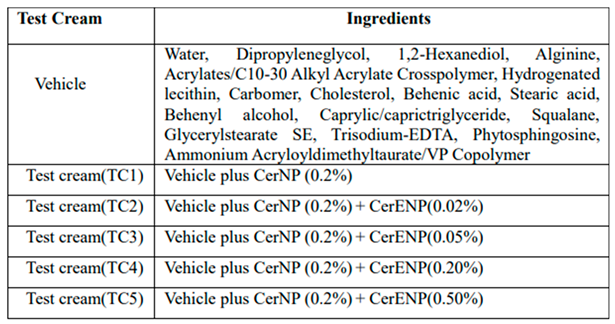
A CER NP (HP-EcoCeramide LCSTM) was produced using a process previously reported with some modifications to adjust the fatty acid compositions [33]. It was a mixture of ceramide NPs with different fatty acids that originated from 4 different natural oils, Shea butter, Moringa, Meadowfoam, and Macadamia. The percentile profiles of N-acyl moieties in the CER NP are C16(4.0), C16:1(0.9), C18:0(35.8), C18:1(44.1), C18:2(4.6), C20:0(1.9), C20:1(4.0), C22:0(0.9), C22:1(1.1), and C24(0.3). N-stearoyl phytosphingosine and N-oleoyl phytosphingosine are the two most abundant subclasses of this ceramide NP mixture. CER 1-O-ENP (Figure 1) was synthesized by conjugating stearic acid to the first hydroxyl group of the CER NP as described before. Test creams were prepared by mixing each ceramide with the base cream formulation to produce a targeted ceramide content. The base cream avoids glycerin and emollients as much as possible to minimize the effect on SC hydration measurement. 0.02%, 0.05%, 0.2%, and 0.5% of CER 1-O-ENP were formulated together with a vehicle cream containing 0.2% of CER NP as a control (Table 1).

Table 1.
Ingredients for vehicle cream and test creams.
2.3. Human Study
A double-blind intra-subject vehicle-controlled human study was performed. The human study aimed to investigate the effect of CER 1-O-ENP on the skin barrier functions in combination with the CER NP. Twenty women ages 20-29(3), 30-39(13), and 40-49(4) who volunteered for the study who had no history of previous abnormal skin conditions were recruited with written consent. The study scheme is outlined in Figure 2, and skin barrier parameters include SC hydration, retention of hydration, and SC cohesion. All procedures in studies involving human participants were performed by the ethical standards of the institutional research committee and the 1964 Declaration of Helsinki. This study was approved by the Institutional Review Board of Dongguk University Committee on Human Research (Approval no. DUIRB-2022051-01). Written consent of participation from each volunteer was documented according to the ethical standards.
2.4. Measurement of Skin Hydration, Retention of Hydration, and SC Cohesion
- The assessment of SC hydration
The assessment of SC hydration was also performed according to the previously described [32]. Samples were treated for 14 days in the case of the 1st dose-finding human study and 28 days for CER 1-O-ENP study. A Corneometer CM820 device (Courage & Khazaka, Cologne, Germany) was used for hydration measurement. The changed value of arbitrary units was calculated from each baseline and expressed as SEM.
- The SC cohesion
The SC cohesion was expressed as Δ TEWL between baseline and after four weeks of test cream application sites. The TEWL was measured to calculate SC cohesion immediately after tape-stripping 15 times with the D-Squame tape [36].
2.5. Microscopic Observations of Maltese Cross Appearance
Microscope images were observed for test creams formulated with CER 1-O-ENP and CER NP at two time points; immediately after the preparation and after 6 months of RT storage. The optical anisotropy was observed under the cross-polarized light microscope (Nikon Corporation, Tokyo, Japan).
2.6. Statistical Analysis
All data are represented as mean ± standard deviation (SD), with differences between means assessed with IBM SPSS Statistics for Windows version 23 (IBM Corp., Armonk, NY, USA). The data analysis was performed using ANOVA (one-way analysis of variance) followed by Tukey's honest significant difference. Significant was defined as a P-value less than 0.05
3. Results
3.1. Identification of 1-O-Stearoyl-Ceramide NP (18:0-t18:0/18:1) in Human Stratum Corneum
The MS/MS spectrum of 1-O-stearoyl-ceramide NP (18:0-t18:0/18:1) standard, which has a protonated molecular ion [M+H]+ at m/z 848.8066 yielded m/z 564.5334 (base peak) and m/z 282.2790, arising from the elimination of the 1-O-stearoyl group and further cleavage of the N-(9Z)-octadecenoyl substituent with loss water (Figure 3A), respectively. 1-O-Stearoyl-ceramide NP can also lose water, resulting in a fragment ion at m/z 830.7952. The part of the proposed fragmentation pathway of 1-O-stearoyl-ceramide NP (18:0-t18:0/18:1) standard is illustrated. 1-O-Stearoyl ceramide NP (18:0-t18:0/18:1) was also observed in human stratum corneum extracts. The MS/MS spectrum of m/z 848.8066 ion which was found in human stratum corneum extracts gave characteristic fragment ions at m/z 830.7919, 564.5336, and 282.2793 (mass error < 5 ppm) which are also observed in 1-O-stearoyl-ceramide NP (18:0-t18:1/18:0) standard (Figure 3B).
3.2. Profiling of 1-O-Acylceramide NP (CER 1-O-ENP) in Human Stratum Corneum
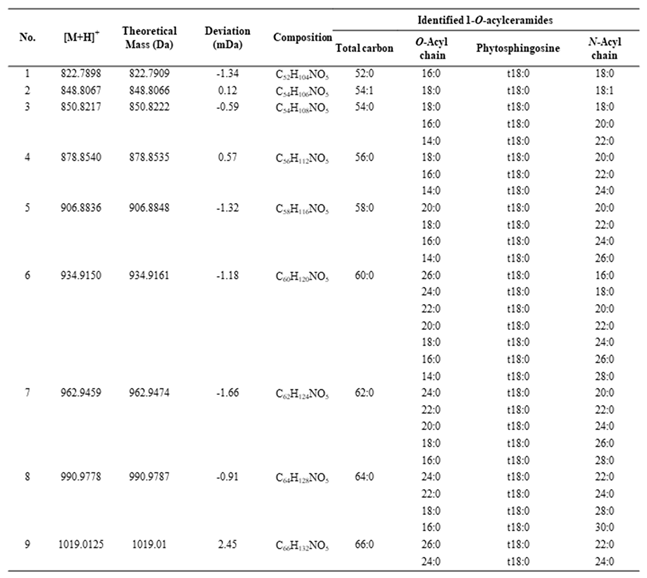
CER 1-O-ENP in the human stratum corneum was profiled using LC-HRMS. MS/MS spectra of CER 1-O-ENP were obtained from the parallel reaction monitoring (PRM) of the protonated adduct ion ([M+H]+) (Figure 4). The extracted ion chromatograms (EIC) for the detected CER 1-O-ENP were shown in Figure S1. Based on established mass fragmentation patterns of CER 1-O-ENP (18:0-t18:0/18:1), nine species of CER 1-O-ENP were identified in human stratum corneum (Table 2). Interestingly, CER 1-O-ENP with an elemental composition of CnH2nO5N1 (n= 52-66), suggesting that N-acyl substituents consist of saturated form were mainly observed in human SC. Analyzing the fragments revealed 1-O-ENP ceramide molecules that differ in ester- and amide-linked fatty acid chain lengths. Multiple isobaric isomers were observed for most CER 1-O-ENP species, which existed as a mixture of two or seven species in the MS/MS spectra. For example, the MS/MS spectra of the ions of m/z 878.8535 (Figure 4A) showed that it included three ceramide NP moieties (fragment ions at m/z 594.5800, 622.6125, and 650.6443 corresponding to the dehydrated NP (t18:0/20:0), NP (t18:0/22:0), and NP (t18:0/24:0), respectively, from the cleavage of the 1-O-acyl substituent) (Figure 4B). In addition, the observation of the fragment ion at m/z 264.2683, corresponding to the d18:1-long chain base, reflected the presence of phytosphingosine resulting from cleavage of the N-acyl substituent and two water molecules from ceramide NP moieties. The confirmation of the suggested structures is further supported by the elemental composition extracted by high-resolution mass spectrometry (deviation within 5 ppm). Therefore, CER 1-O-ENP species at m/z 878.8535 was identified as the mixture of 1-O-ENP (18:0-t18:0/20:0), (16:0-t18:0-22:0), and (14:0-t18:0/24:0). Based on these kinds of fragmentation patterns, the structures of other 1-O-ENP were additionally identified (Table 2).
Table 2.
Summary of l-O-acylceramide NP identified in the human stratum corneum.
3.3. Effect of CER 1-O-ENP on Multilamellar Formation and Its Stability
Once test creams were prepared, we assessed the effect of CER 1-O-ENP on forming a multilayer lamellar structure in combination with CER NP, and evaluated the long-term stability of multilamellar structure. Ingredients of test creams are listed in Table 1. A typical concentric lamellar structure could be observed as a Maltese cross appearance under a cross-polarized microscope when ceramide is formulated with cholesterol and free fatty acid. This Maltese cross appearance, optical anisotropy, indicates appropriate lipid lamellar formation. It is generally accepted that a moisturizer with a more typical cross pattern is better for repairing the skin barrier. A month after the preparation of test creams, TC1 containing 0.2% CER NP alone showed almost no Maltese cross formation; even if a few remained, their size became smaller. Test cream TC3, prepared with 0.2% CER NP and 0.05% CER 1-O-ENP, presented numerous typical Maltese crosses. With increasing CER 1-O-ENP (TC5) concentration, the Maltese cross became more prominent in size and higher order in the multilamellar organization. It indicated that CER 1-O-ENP enhanced the formation of multilamellar structure. (Figure 5). After six months of storage at RT, the Maltese cross of TC3 was maintained well but with minor deformation, while TC5 retained the Maltese cross fairly well at almost the same time as the preparation time. TC1 showed a few Maltese crosses.
3.3. The Influence of CER 1-O-ENP on the Skin Hydration
Having these results, we investigated the effect of CER 1-O-ENP in combination with CER NP on the human skin barrier function. The content of CER NP in test creams was set to be 0.2%. The concentration of CER 1-O-ENP in the test creams was adjusted to be 10 or 25% of the CER NP used in the test creams, respectively. It is known that the concentration of 1-O-acylceramide was estimated to be 2~3% of the total ceramide in the human SC. Meanwhile, Ceramide NP’s concentration in the human skin barrier was around 22%, indicating the relative CER 1-O-ENP concentration to NP ranges from 9~13%. The relative content ratio of CER NP and CER 1-O-ENP in the test creams was adjusted within the range that reflects the content ratio of the human skin. As shown in Figure 6A, after four weeks of application, significant enhancement of SC hydration was observed from all the skin sites applied with the test creams TC1, TC2, TC3, and TC4 by 32%, 50%, 54%, and 43%, respectively. The hydration level of the skin applied with TC1, formulated by using only 0.2% CER NP, was considerably increased, as expected. The addition of 0.02% or 0.05% of CER 1-O-ENP to the TC1 brought about a dramatic enhancement of SC hydration. More than 20% of enhancement, which is statistically significant, was induced by adding CER 1-O-ENP compared to the SC hydration enhanced by the TC1 application. The long-lasting moisturization effect, or retention of hydration, was found to be even greater when the CER 1-O-ENP was combined with CerNP (Figure 6B). The moisture contents of all three test creams formulated with CER 1-O-ENP and CerNP together, TC2, TC3, and TC4 were maintained significantly higher than that of the baseline containing except TC1 three days after stop application. This result clearly showed that CER 1-O-ENP in the test cream confers a long-lasting moisturizing effect when applied to the human skin.
3.4. CER 1-O-ENP Fostered the SC Cohesion
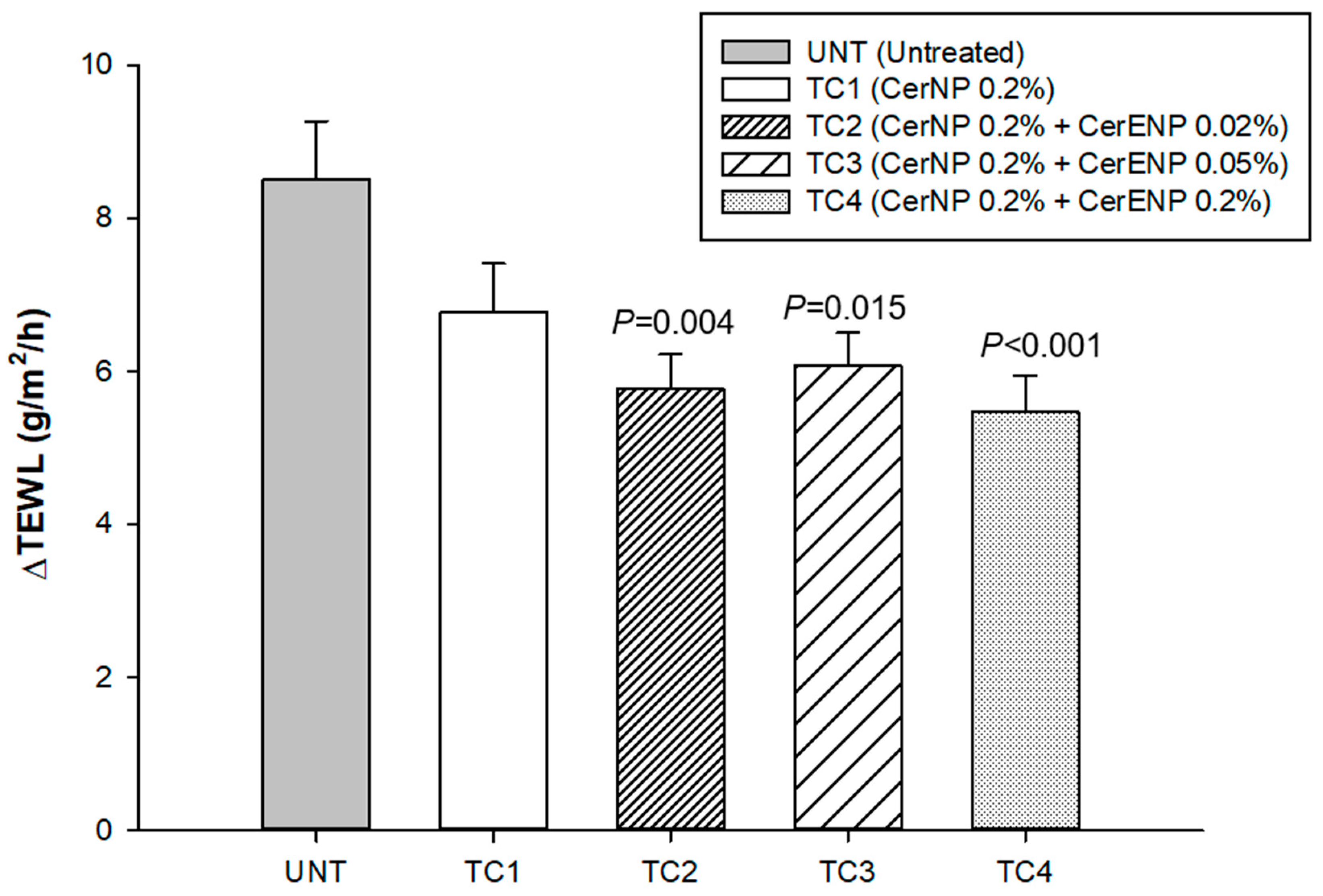
TEWL was measured to calculate Δ TEWL before and immediately after tape-stripping 15 times with Desquame disc tapes (CuDerm, Dallas, TX, USA). All the Δ TEWL values obtained from the skin sites applied with test creams containing CER 1-O-ENP (TC2, TC3, TC4) were significantly less than that of the control cream (TC1) containing only ceramide NP (Figure 7). The results indicated that the stratum corneum has become more resistant against a physical force of the tape stripping. However, no additional improvement of SC cohesion was observed from the concentration of CER 1-O-ENP higher than 0.02% (TC3 and TC4). The CER 1-O-ENP to CER NP ratio seems appropriate at 10 to 25%, similar to the ratio found in human skin. In conclusion, CER 1-O-ENP significantly boosted the SC cohesion in combination with CER NP and other ceramides.
4. Discussion
This study aimed to investigate the physiological role of CER 1-O-ENP in combination with CerNP for several skin barrier parameters, for example, hydration, moisture retention, and SC cohesion. Although CER 1-O-ENS was identified as the primary class of 1-O-acylceramide, we produced CER 1-O-ENP since phytosphingosine is only affordable on a large scale. So far, no reports on the identification of CER 1-O-ENP have been published. We report for the first time the presence of CER 1-O-ENP in the human stratum corneum, specifically focusing on a subspecies known as 1-O-stearoyl ceramide NP (18:0-t18:0/18:1). This subspecies is the primary component of the CER 1-O-ENP examined in this study. According to a separate ongoing study by Liu with another group, CER 1-O-ENP was estimated to be about 1/4 of CER 1-O-ENS (unpublished data). It was also reported that about 30% of sphingosine ceramides converted into CER 1-O-ENS and other sphingosine-based 1-OAS [28]. Identifying CER 1-O-ENP in the human epidermis should make it more physiologically meaningful when proven to positively affect the skin barrier function. With this finding, CER 1-O-ENP could be classified as a genuine human skin ceramide.
Multilamellar lipid organization as a permeability barrier is a typical feature of the intercellular space of the skin barrier. It is manifested as a Maltese cross under a polarized light microscope [37]. As shown in Figure 5, CER 1-O-ENP stimulated the formation of a typical Maltese cross compared to that of base cream and CER NP cream. With the increasing concentrations of CER 1-O-ENP, the Maltese cross became thicker and more prominent. This may indicate that the number of lamellar layers in the Maltese cross has increased. More importantly, the striking enhancement of the stability of the Maltese cross after six months of storage at RT was observed from the test cream containing CER 1-O-ENP. This observation aligned with previous findings from different multilamellar vesicle experiments; CER 1-O-ENP demonstrated that increasing the CER 1-O-ENP application could make the multilamellar vesicle (SCNV model) more stable [33]. This finding was further supported by results from a different multilamellar nanovesicle model, where the addition of CER 1-O-ENP significantly promoted the formation of multilamellar nanovesicles and enhanced their stability during repeated freeze-thaw cycles. [39]. Our study, which utilized the RHE skin model, provides further confirmation that CER 1-O-ENP exerts a stabilizing effect on the lipid multilamellar matrix of the RHE stratum corneum [34]. This additional evidence underscores the significant role of CER 1-O-ENP in enhancing skin barrier properties.
In this human study, the concentration of CER NP was fixed at 0.2% for every test cream with different CER 1-O-ENP contents because 0.2% of CER NP was the lowest concentration to present marginal yet marked enhancement of the skin barrier function. Therefore, we could expect that any CER 1-O-ENP was responsible for any changes from the topical application of test creams with varying concentrations. The results demonstrated that this is the case. Figure 6A shows that when 0.02% and 0.05% of CER 1-O-ENP were added to a control cream containing 0.2% CER NP, a significantly high skin moisturizing effect was observed compared to the control. However, no further improvement of skin barrier parameters was observed from the skin site treated with the test creams containing more than 0.05% CER 1-O-ENP. The results indicated that 0.02% or 0.05% of CER 1-O-ENP seemed appropriate in this formulation context, representing 1/10 ~1/4 of CER NP. This ratio is similar to that of the actual skin because 1-OAC only comprises less than 5% of the total ceramide in the skin barrier.
A significant decrease in the ΔTEWL (Figure 7) was observed only from test creams. CER 1-O-ENP suggested that CER 1-O-ENP fostered SC cohesion, most probably by increased corneodesmosomes. However, SC cohesion could also be strengthened by fostering the lipid multilamellar organization via the anchoring action of CER 1-O-ENP. Further study is required to elucidate whether CER 1-O-ENP can enhance the formation of corneodesmosomes.
Changes in CER composition concerning ceramide classes and chain lengths, commonly observed in abnormal skin, are also known to be the primary causes of impaired skin barrier function. However, more investigations are needed to elucidate molecular interactions among different ceramides in stratum corneum. Recently, Kono et al. reported a systematic review of the literature describing the effects of ceramide on human skin from clinical viewpoints and concluded that no report provided details of the composition of ceramide and concentrations of formulations [19,21,22]. In this study, we used defined dosages of ceramides with complete descriptions of their chemical nature. Some studies provided insights into the interactions between the individual ceramide classes, such as NS, AP, NP, and EOS, in forming lipid lamellar organization [25,26,27]. For example, CER NS was shown to have low miscibility with other lipids, and on the other hand, CER NP formed a strong in-plane H-bonding network [27]. Others reported that the ratio between CER NP and AP was critical concerning maintaining lamellar stability, and they found that a 2:1 ratio was optimal [25]. It is generally accepted that the presence of EO class ceramides such as EOS and EOP is required to establish a LPP organization [23,24]. In this study, we have shown a novel interaction between two individual ceramide classes, CER NP and CER 1-O-ENP, showing that a tiny amount of CER 1-O-ENP could significantly promote key skin barrier parameters by boosting the CER NP activity otherwise marginal. In this regard, our result, the boosting effect of CER 1-O-ENP on the skin barrier activity of CER NP, has provided new insight into the relative role of each specific ceramide class. It would be interesting to find if CER 1-O-ENP has similar boosting activity with other class of ceramide, such as CER NS or NG.
5. Conclusions
We identified 1-O-stearoyl ceramide NP (18:0/t18:0/18:1), a species of CER 1-O-ENP, along with other sub-species of diverse O-acyl and N-acyl chain length in the human stratum corneum. The results from the human study using a test cream co-formulated with the human skin-identical CER 1-O-ENP, and CER NP suggest there is a boosting effect of CER 1-O-ENP on the improvement of skin barrier functions by CER NP since a surprisingly small amount of CER 1-O-ENP is required. Our findings are the first report investigating the physiological role of CER 1-O-ENP in the human skin barrier.
6. Patents
KR 10-2621498
Supplementary Materials
The following supporting information can be downloaded at the website of this paper posted on Preprints.org, Figure S1: Representative extracted ion chromatograms of 1-O-acylceramide NP obtained from the liquid chromatography-high resolution mass spectrometric analysis of human stratum corneum extracts.
Author Contributions
BG Kang performed liquid chromatography-high resolution mass spectrometry (LC-HRMS), KH Liu did data analysis and interpretation of LC-HRMS data, HK Choi conducted human study and data processing, and SK Hong supervised the whole process of human study, JW Kim prepared test creams and observed Maltese cross formation, and EO Lee produced CER 1-O-ENP. CS Park supervised the project, designed the human study, and gave an interpretation of data, and prepared a manuscript. All authors have read and agreed to the published version of the manuscript.
Funding
This research was supported by a grant from the Korea Health Technology R&D Project through the Korea Health Industry Development Institute (KHIDI), funded by the Ministry of Health & Welfare (HP20C0018 and HP23C0129), and by Basic Science Research Program through the National Research Foundation of Korea (NRF) funded by the Ministry of Education (RS-2024-00411329), Republic of Korea (grant number: HP20C0018).
Institutional Review Board Statement
In this section, you should add the Institutional Review Board Statement and approval number, if relevant to your study. You might choose to exclude this statement if the study did not require ethical approval. Please note that the Editorial Office might ask you for further information. Please add “The study was conducted in accordance with the Declaration of Helsinki, and approved by the Institutional Review Board (or Ethics Committee) of NAME OF INSTITUTE (protocol code XXX and date of approval).” for studies involving humans. OR “The animal study protocol was approved by the Institutional Review Board (or Ethics Committee) of NAME OF INSTITUTE (protocol code XXX and date of approval).” for studies involving animals. OR “Ethical review and approval were waived for this study due to REASON (please provide a detailed justification).” OR “Not applicable” for studies not involving humans or animals.
Informed Consent Statement
Written informed consent was obtained from all subjects involved in the study.
Data Availability Statement
We encourage all authors of articles published in MDPI journals to share their research data. In this section, please provide details regarding where data supporting reported results can be found, including links to publicly archived datasets analyzed or generated during the study. Where no new data were created, or where data is unavailable due to privacy or ethical restrictions, a statement is still required. Suggested Data Availability Statements are available in section “MDPI Research Data Policies” at https://www.mdpi.com/ethics.
Acknowledgments
This research was supported by a grant from the Korea Health Technology R&D Project through the Korea Health Industry Development Institute (KHIDI), funded by the Ministry of Health & Welfare (HP20C0018 and HP23C0129), and by Basic Science Research Program through the National Research Foundation of Korea (NRF) funded by the Ministry of Education (RS-2024-00411329), Republic of Korea (grant number: HP20C0018).
Conflicts of Interest
The authors declare no conflicts of interest.
References
- Lampe, M.A.; Burlingame, A.L.; Whitney, J.; Williams, M.L.; Brown, B.E.; Roitman, E.; Elias, P.M. Human stratum corneum lipids: characterization and regional variations. J Lipid Res. 1983 24(2),120-30. ( PMID: 6833889). [CrossRef]
- Imokawa, G.; Abe, A.; Jin, K.; Higaki, Y.; Kawashima, M.; Hidano, A. Decreased level of ceramides in stratum corneum of atopic dermatitis: an etiologic factor in atopic dry skin? Journal of Investigative Dermatology. 1991 96(4), 523-6. (PMID: 2007790). [CrossRef]
- Bouwstra, J.A.; Ponec, M. The skin barrier in healthy and diseased state. Biochimica et biophysica acta. 2006 1758(12), 2080-95. (PMID: 16945325). [CrossRef]
- van Smeden, J.; Janssens, M.; Gooris, G.S.; Bouwstra, J.A. The important role of stratum corneum lipids for the cutaneous barrier function. Biochimica et biophysica acta. 2014 1841(3), 295-313. (PMID: 24252189). [CrossRef]
- van Smeden, J.; Hoppel, L.; van der Heijden, R.; Hankemeier, T.; Vreeken, R.J.; Bouwstra, J.A. LC/MS analysis of stratum corneum lipids: ceramide profiling and discovery. Journal of Lipid Research. 2011 52(6), 1211-21. (PMID: 21444759). [CrossRef]
- Zettersten, E.M.; Ghadially, R.; Feingold, K.R.; Crumrine, D.; Elias, P.M. Optimal ratios of topical stratum corneum lipids improve barrier recovery in chronologically aged skin. Journal of the American Academy of Dermatology. 1997 37(3 Pt 1), 403-8. (PMID: 9308554). [CrossRef]
- Kircik, L.H. Effect of skin barrier emulsion cream vs a conventional moisturizer on transepidermal water loss and corneometry in atopic dermatitis: a pilot study. Journal of Drugs in Dermatology. 2014 13(12), 1482-4. (PMID: 25607793).
- Danby, S.G.; Andrew, P.V.; Brown, K.; Chittock, J.; Kay, L.J.; Cork, M.J. An Investigation of the Skin Barrier Restoring Effects of a Cream and Lotion Containing Ceramides in a Multi-vesicular Emulsion in People with Dry, Eczema-Prone, Skin: The RESTORE Study Phase 1. Dermatology and Therapy. 2020 10(5), 1031-1041. (PMID: 34657996). [CrossRef]
- Masukawa, Y.; Narita, H.; Sato, H.; Naoe, A.; Kondo, N.; Sugai, Y.; Oba, T.; Homma, R.; Ishikawa, J.; Takagi, Y.; Kitahara, K. Comprehensive quantification of ceramide species in human stratum corneum. Journal of Lipid Research. 2009 50(8), 1708-19. (PMID: 19349641). [CrossRef]
- Masukawa, Y.; Narita, H.; Shimizu, E.; Kondo, N.; Sugai, Y.; Oba, T.; Homma, R.; Ishikawa, J.; Takagi, Y.; Kitahara, T.; Takema, Y.; Kita, K. Characterization of overall ceramide species in human stratum corneum. Journal of Lipid Research. 2008 49(7), 1466-76. (PMID: 18359959). [CrossRef]
- van Smeden, J.; Boiten, W.A.; Hankemeier, T.; Rissmann, R.; Bouwstra, J.A.; Vreeken, R.J. Combined LC/MS-platform for analysis of all major stratum corneum lipids, and the profiling of skin substitutes. Biochimica et Biophysica Acta. 2014, 1841, 70–79 (PMID: 24120918). [CrossRef]
- Suzuki, M.; Ohno, Y.; Kihara, A. Whole picture of human stratum corneum ceramides, including the chain-length diversity of long-chain bases. J Lipid Res. 2022 Jul 63(7), 100235. (PMID: 35654151). [CrossRef]
- Janssens, M.; van Smeden, J.; Gooris, G.S.; Bras, W.; Portale, G.; Caspers, P.J.; Vreeken, R.J.; Hankemeier, T.; Kezic, S.; Wolterbeek, R.; Lavrijsen, A.P.; Bouwstra, J.A. Increase in short-chain ceramides correlates with an altered lipid organization and decreased barrier function in atopic eczema patients. Journal of Lipid Research. 2012 53(12), 2755-66. (PMID: 23024286). [CrossRef]
- Oguri, M.; Gooris, G.S.; Bito, K.; Bouwstra, J.A. The effect of the chain length distribution of free fatty acids on the mixing properties of stratum corneum model membranes. Biochimica et biophysica acta. 2014 1838(7), 1851-61. (PMID: 24565794). [CrossRef]
- Moore, T.C.; Hartkamp, R.; Iacovella, C.R.; Bunge, A.L.; McCabe, C. Effect of Ceramide Tail Length on the Structure of Model Stratum Corneum Lipid Bilayers. Biophysical journal. 2018 114(1), 113-125. (PMID: 29320678). [CrossRef]
- Pullmannová, P.; Pavlíková, L.; Kováčik, A., Sochorová M, Školová B, Slepička P, Maixner J, Zbytovská J, Vávrová K.. Permeability and microstructure of model stratum corneum lipid membranes containing ceramides with long (C16) and very long (C24) acyl chains. Biophysical chemistry. 2017 224, 20-31. (PMID: 28363088). [CrossRef]
- Uche, L.E.; Gooris, G.S.; Bouwstra, J.A.; Beddoes, C.M. Increased Levels of Short-Chain Ceramides Modify the Lipid Organization and Reduce the Lipid Barrier of Skin Model Membranes. Langmuir : the ACS journal of surfaces and colloids. 2021 37(31), 9478-9489. (PMID: 34319754). [CrossRef]
- Mann, M-Q.; Brown, B.E.; Wu-Pong, S.; Feingold, K.R.; Elias, P.M. Exogenous nonphysiologic vs physiologic lipids. Divergent mechanisms for correction of permeability barrier dysfunction. Archives of dermatology. 1995 131(7), 809-16. (PMID: 7611797). [CrossRef]
- Kono, T.; Miyachi, Y.; Kawashima, M. Clinical significance of the water retention and barrier function-improving capabilities of ceramide-containing formulations: A qualitative review. J Dermatol. 2021 8(12), 1807-1816. Epub 2021 Oct 1. (PMID: 34596254). [CrossRef]
- Rawlings, A.V.; Lane, M.E. Letter to the Editor Regarding 'An Investigation of the Skin Barrier Restoring Effects of a Cream and Lotion Containing Ceramides in a Multi-Vesicular Emulsion in People with Dry, Eczema-Prone Skin: The RESTORE Study Phase 1'. Dermatol Ther (Heidelb). 2021 11(6), 2245-2248. Epub 2021 Oct 17. (PMID: 34657996). [CrossRef]
- Rawlings, A.V.; Lane, M.E. Comment on "Clinical significance of the water retention and barrier function-improving capabilities of ceramide-containing formulations: A qualitative review". J Dermatol. 2022 49(3), e121-e123. Epub 2021 Dec 3. ( PMID: 34862644 ). [CrossRef]
- van Smeden, J.; Bouwstra, J.A. Stratum Corneum Lipids: Their Role for the Skin Barrier Function in Healthy Subjects and Atopic Dermatitis Patients. Current Problems in Dermatology. 2016 49, 8-26. (PMID: 26844894). [CrossRef]
- Opálka, L.; Kováčik, A.; Maixner, J.; Vávrová, K. Omega-O-Acylceramides in Skin Lipid Membranes: Effects of Concentration, Sphingoid Base, and Model Complexity on Microstructure and Permeability. Langmuir: the ACS journal of surfaces and colloids. 2016 32(48), 12894-12904. (PMID: 27934529). [CrossRef]
- Nakaune-Iijima, A.; Sugishima, A.; Omura, G.; Kitaoka, H.; Tashiro, T.; Kageyama, S.; Hatta, I. Topical treatments with acylceramide dispersions restored stratum corneum lipid lamellar structures in a reconstructed human epidermis model. Chemistry and physics of lipids. 2018 215, 56-62. (PMID: 29802829). [CrossRef]
- Schmitt, T.; Lange, S.; Dobner, B.; Sonnenberger, S.; Hauß, T.; Neubert, R.H.H. Investigation of a CER[NP]- and [AP]-Based Stratum Corneum Modeling Membrane System: Using Specifically Deuterated CER Together with a Neutron Diffraction Approach. Langmuir: the ACS journal of surfaces and colloids. 2018 34(4), 1742-1749. (PMID: 28949139). [CrossRef]
- Uche, L.E.; Gooris, G.S.; Beddoes, C.M.; Bouwstra, J.A. New insight into phase behavior and permeability of skin lipid models based on sphingosine and phytosphingosine ceramides. Biochimica et biophysica acta Biomembranes. 2019 1861(7), 1317-1328. (PMID: 30991016). [CrossRef]
- Yokose, U.; Ishikawa, J.; Morokuma, Y.; Naoe, Y.; Inoue, Y.; Yasuda, Y. Tsujimura, H.; Fujimura, T.; Murase, T.; Hatamochi, A. The ceramide [NP]/[NS] ratio in the stratum corneum is a potential marker for skin properties and epidermal differentiation. BMC Dermatology. 2020 20(1), 6-. (PMID: 32867747). [CrossRef]
- Rabionet, M.; Bayerle, A.; Marsching, C.; Jennemann, R.; Gröne, H.J.; Yildiz, Y.; Wachten, D.; Shaw, W.; Shayman, J.A.; Sandhoff, R. 1-O-acylceramides are natural components of human and mouse epidermis. Journal of Lipid Research. 2013 54(12), 3312-21. (PMID: 24078707). [CrossRef]
- Lin, M-H.; Miner, J.H.; Turk, J.; Hsu, F-F. Linear ion-trap MSn with high-resolution MS reveals structural diversity of 1-O-acylceramide family in mouse epidermis. J Lipid Res. 2017 58(4), 772-782. (PMID: 28154204). [CrossRef]
- Harazim, E.; Vrkoslav, V.; Buděšínský, M.; Harazim, P.; Svoboda, M.; Plavka, R.; Bosáková, Z.; Cvačka, J. Nonhydroxylated 1- O-acylceramides in vernix caseosa, J Lipid Res. 2018 59(11), 2164-2173. (PMID: 30254076). [CrossRef]
- Assi, A.; Bakar, J.; Libong, D.; Sarkees, E.; Solgadi, A.; Baillet-Guffroy, A.; Michael-Jubeli, R.; Tfayli, A. Comprehensive characterization and simultaneous analysis of overall lipids in reconstructed human epidermis using NPLC/HR-MSn:1-O-E (EO) Cer, a new ceramide subclass. Analytical and Bioanalytical Chemistry. 2020 412, 777-793. (PMID: 31858168). [CrossRef]
- Rabionet, M.; Bernard, P.; Pichery, M.; Marsching, C.; Bayerle, A.; Dworski, S.; Kamani, M.A.; Chitraju, C.; Gluchowski, N.L.; Gabriel, K.R.; Asadi, A.; Ebel, P.; Hoekstra, M.; Dumas, S.; Ntambi, J.M.; Jacobsson, A.; Willecke, K.; Medin, J.A.; Jonca, N.; Sandhoff, R. Epidermal 1-O-acylceramides appear with the establishment of the water permeability barrier in mice and are produced by maturating keratinocytes Lipids. 2022 57(3), 183-195. (PMID: 35318678). [CrossRef]
- Lee, E.O.; Kim, J.W.; Liu, K.H.; Shin, K.; Nam, Y.S.; Kim, J-W.; Park, C.S. A Novel Phytosphingosine Based 1-O-Acylceramide: Synthesis, Physicochemical Characterization, and Role in the Lipid Lamellar Organization. Proceedings in 32nd IFSCC congress 2022 Poster 305.
- Park, C.S.; Lee, E.O.; Kim, J.W.; Liu, K.H.; Lee, S.; Lim, K.M. Synthesis and Characterization of a Novel Phytosphingosine-Based 1-O-Acylceramide. IFSCC Magazine. 2022 25(5), 359-362.
- Oh, M.J.; Cho, Y.H.; Cha, S.Y.; Lee, E.O.; Kim, J.W.; Kim, S.K.; Park, C.S. Novel phytoceramides containing fatty acids of diverse chain lengths are better than a single C18-ceramide N-stearoyl phytosphingosine to improve the physiological properties of human stratum corneum. Clinical, Cosmetic and Investigational Dermatology. 2017 10, 363-371. (PMID: 28979153). [CrossRef]
- Lim, S.H.; Kim, E.J.; Lee, C.H.; Park, G.H.; Yoo, K.M.; Nam, S.J.; Shin, K-O.; Park, K.; Choi E.H. A Lipid Mixture Enriched by Ceramide NP with Fatty Acids of Diverse Chain Lengths Contributes to Restore the Skin Barrier Function Impaired by Topical Corticosteroid. Skin pharmacology and physiology. 2022 35(2), 112-123 ; (PMID: 34348350). [CrossRef]
- Park, B.D.; Youm, J.K.; Jeong, S.K.; Choi, E.H.; Ahn, S.K.; Lee, S.H. The characterization of molecular organization of multilamellar emulsions containing pseudoceramide and type III synthetic ceramide. J Invest Dermatol. 2003 121(4), 794-801. ( PMID: 14632198). [CrossRef]
- Yang, M.Y.; Lee, E.; Park, C.S.; and Nam, Y.S. Molecular Dynamics Investigation into CerENP’s Effect on the Lipid Matrix of Stratum Corneum. J. Phys. Chem. B 2024, 128, 5378−5386. Epub 2024 May 28. (PMID: 38805566). [CrossRef]
- Koo, B.I.; Lee, D.J.; Rahman, R.T.; and Nam, Y.S. Biomimetic Multilayered Lipid Nanovesicles for Potent Protein Vaccination. Adv. Healthcare Mater. 2024 13, 2304109. Epub 2024 Jun 14. (PMID: 38849130). [CrossRef]
Figure 1.
1-O-Stearoyl Ceramide NP (CER 1-O-ENP).

Figure 2.
The scheme of human study.
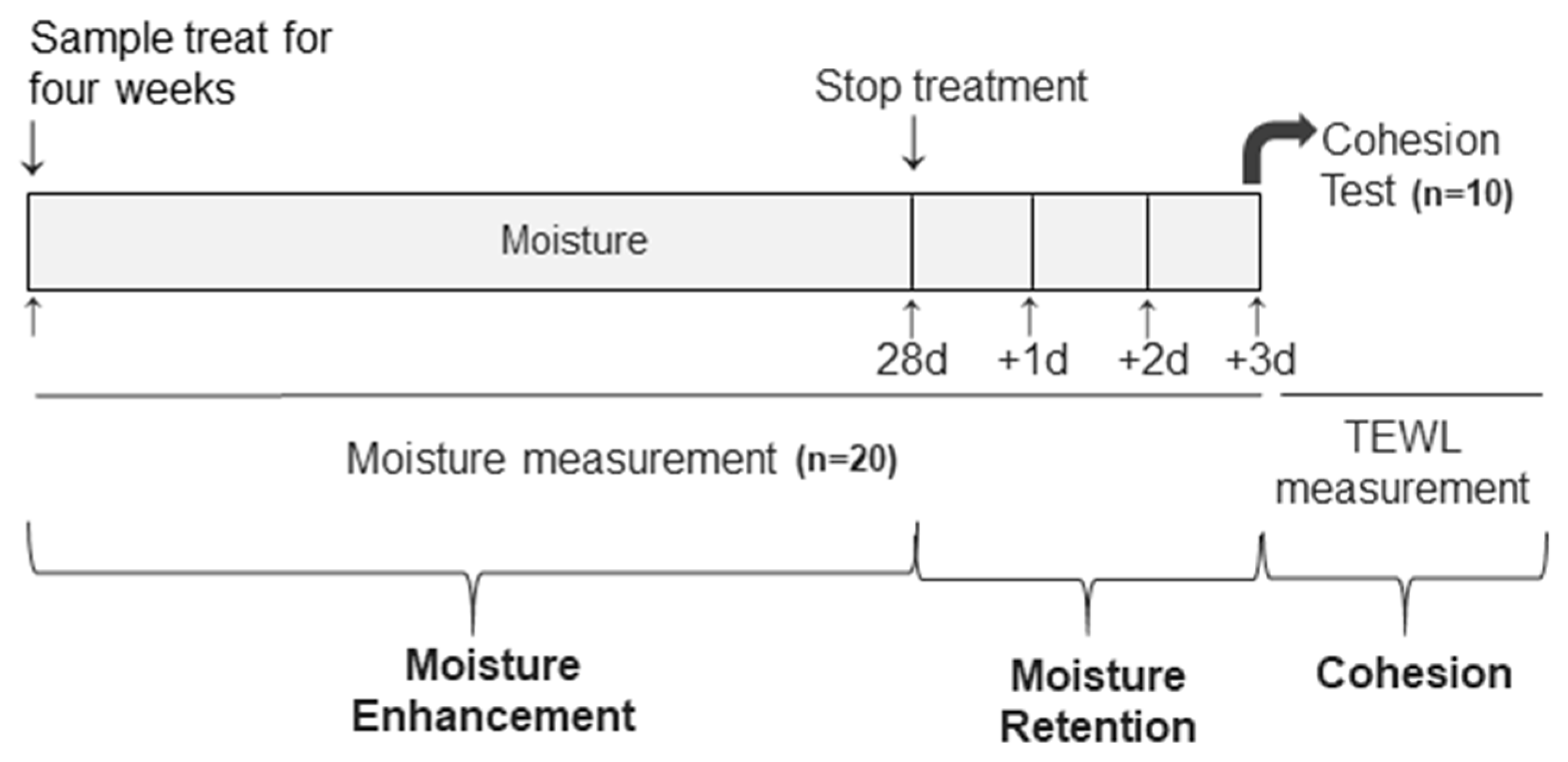
Figure 3.
Production scan mass spectra of 1-O-steraroyl ceramide NP (18:0-t18:0/18:1, m/z 848.8067) obtained by liquid chromatography-high resolution mass spectrometric analysis of 1-O-steraroyl ceramide NP (18:0-t18:0/18:1, m/z 848.8067) standard (A) and human stratum corneum extracts (B), and their proposed fragmentation scheme (C).
Figure 3.
Production scan mass spectra of 1-O-steraroyl ceramide NP (18:0-t18:0/18:1, m/z 848.8067) obtained by liquid chromatography-high resolution mass spectrometric analysis of 1-O-steraroyl ceramide NP (18:0-t18:0/18:1, m/z 848.8067) standard (A) and human stratum corneum extracts (B), and their proposed fragmentation scheme (C).
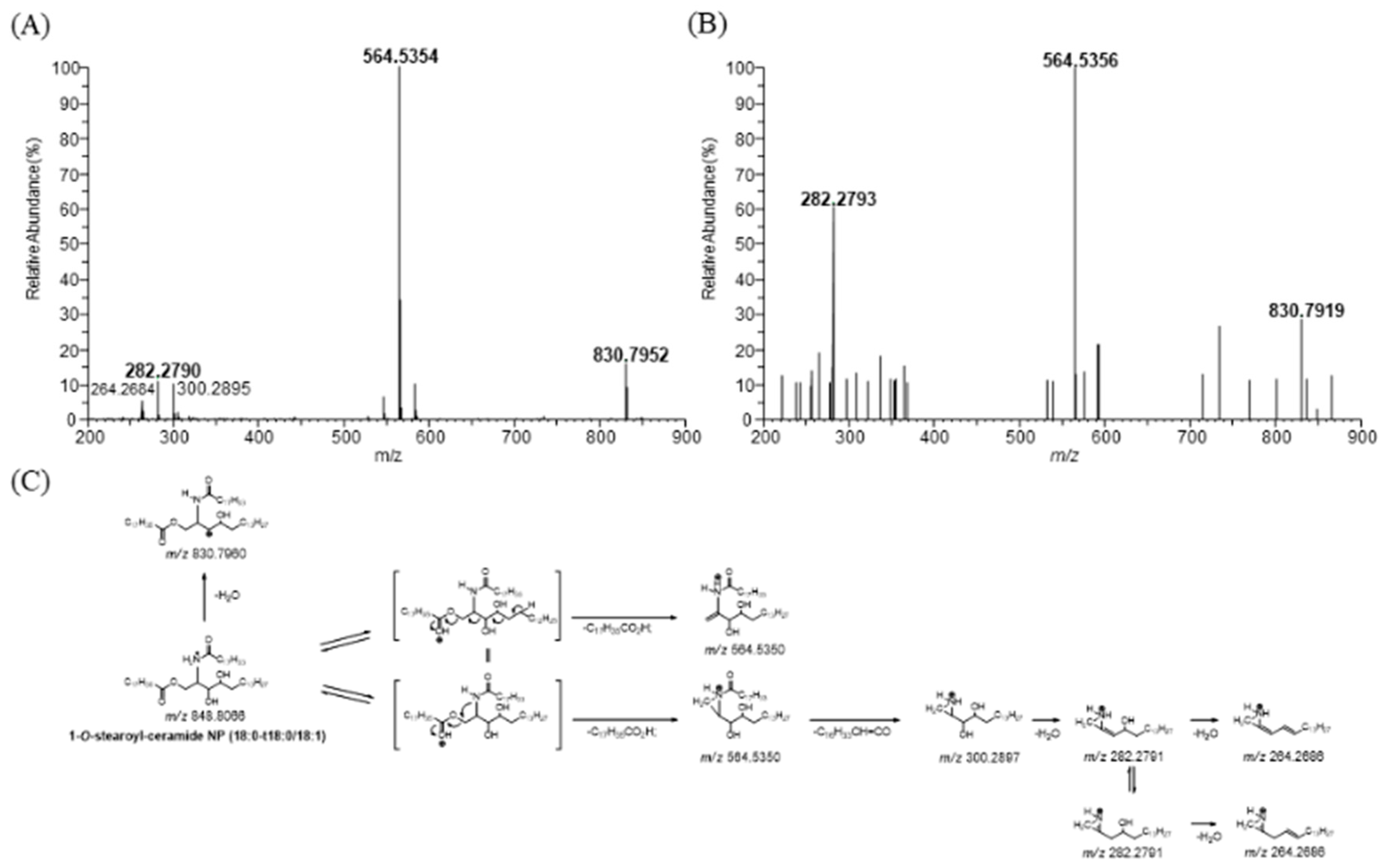
Figure 4.
Production scan mass spectra of 1-O-steraroyl ceramide NP (18:0-t18:0/18:1, m/z 848.8067) obtained by liquid chromatog-raphy-high resolution mass spectrometric analysis of human strtum corneum extracts (A), and their proposed fragmentation scheme (B).
Figure 4.
Production scan mass spectra of 1-O-steraroyl ceramide NP (18:0-t18:0/18:1, m/z 848.8067) obtained by liquid chromatog-raphy-high resolution mass spectrometric analysis of human strtum corneum extracts (A), and their proposed fragmentation scheme (B).
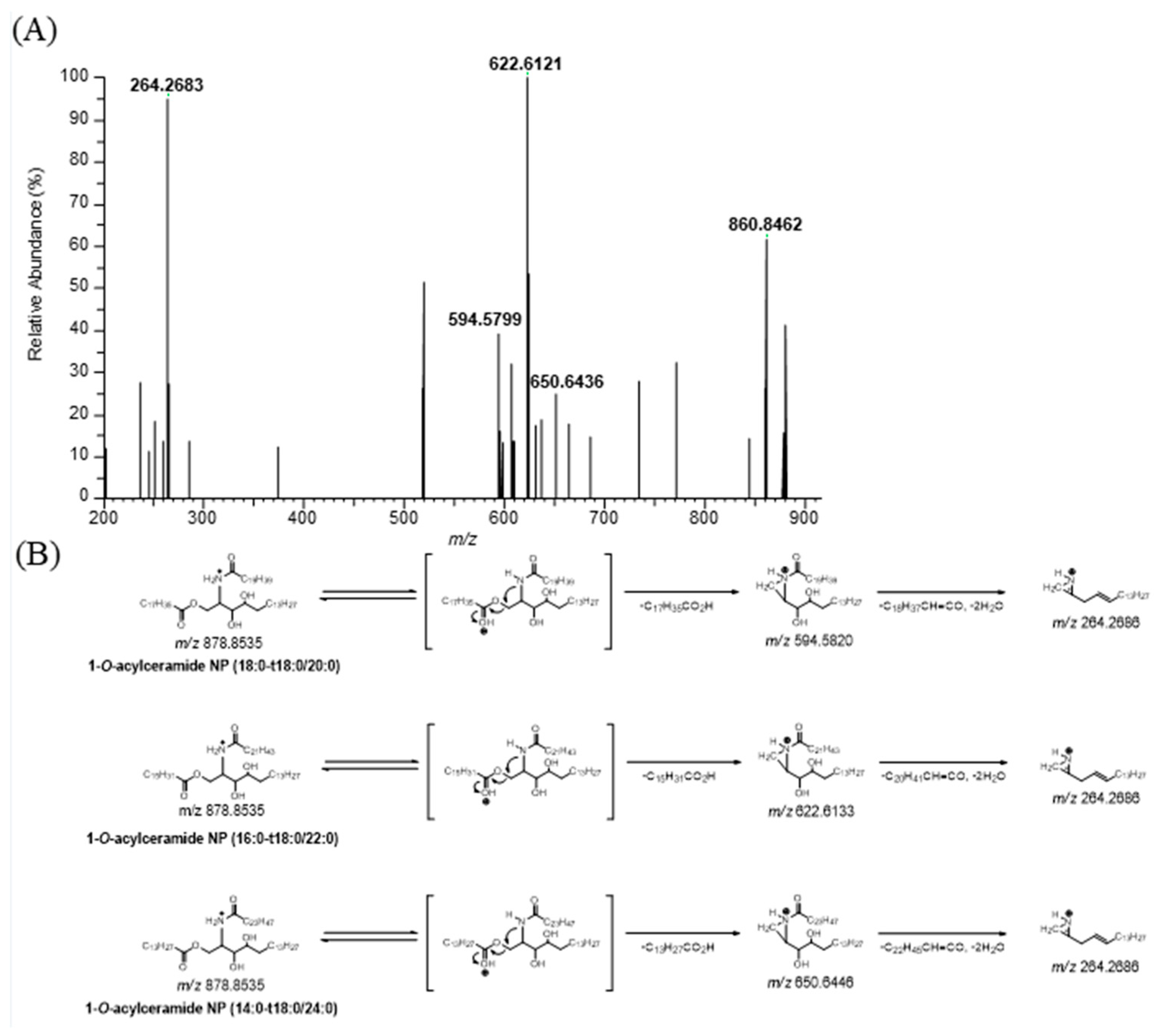
Figure 5.
A cross-polarized microscopic observation (500 x) of test creams containing CER 1-O-ENP in combination with CER NP was performed one month (M1) and six months (M6) after the preparation to analyze the formation of Maltese cross. Samples were kept at room temperature. Test creams were TC1 (0.2% CerNP), TC3 (0.2% CerNP plus 0.05% CER 1-O-ENP), and TC5 (0.2% CER NP plus 0.5% CER 1-O-ENP).
Figure 5.
A cross-polarized microscopic observation (500 x) of test creams containing CER 1-O-ENP in combination with CER NP was performed one month (M1) and six months (M6) after the preparation to analyze the formation of Maltese cross. Samples were kept at room temperature. Test creams were TC1 (0.2% CerNP), TC3 (0.2% CerNP plus 0.05% CER 1-O-ENP), and TC5 (0.2% CER NP plus 0.5% CER 1-O-ENP).
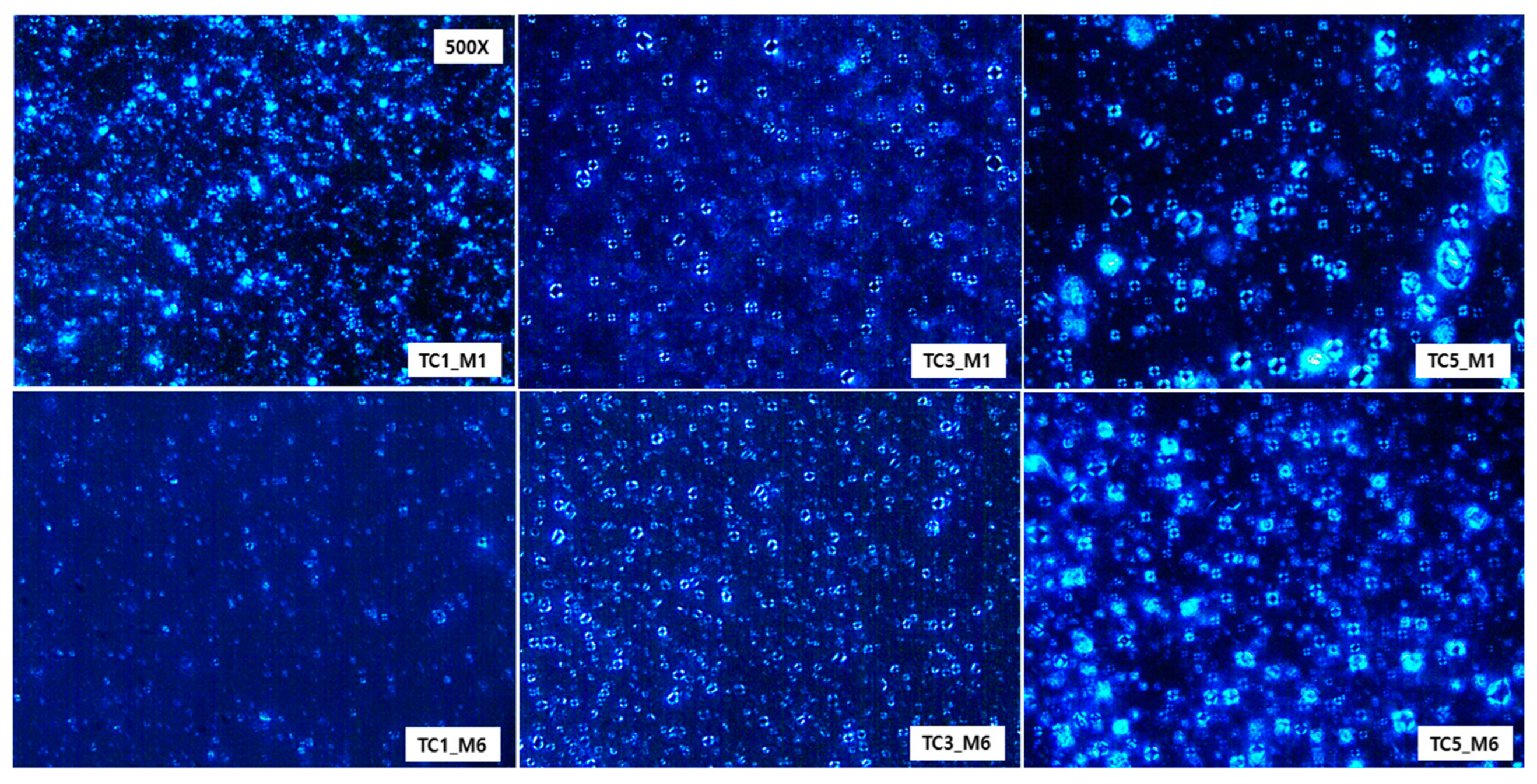
Figure 6.
Effects of CER 1-O-ENP on the moisture level in human skin were measured. The skin hydration level after four weeks of the application of test creams (A), and moisture retention for three days after stopping application (B) were measured. The hydration level was presented in arbitrary units for the capacitance measure by use of a Corneometer. The data are expressed as mean ± SD (n=20).
Figure 6.
Effects of CER 1-O-ENP on the moisture level in human skin were measured. The skin hydration level after four weeks of the application of test creams (A), and moisture retention for three days after stopping application (B) were measured. The hydration level was presented in arbitrary units for the capacitance measure by use of a Corneometer. The data are expressed as mean ± SD (n=20).
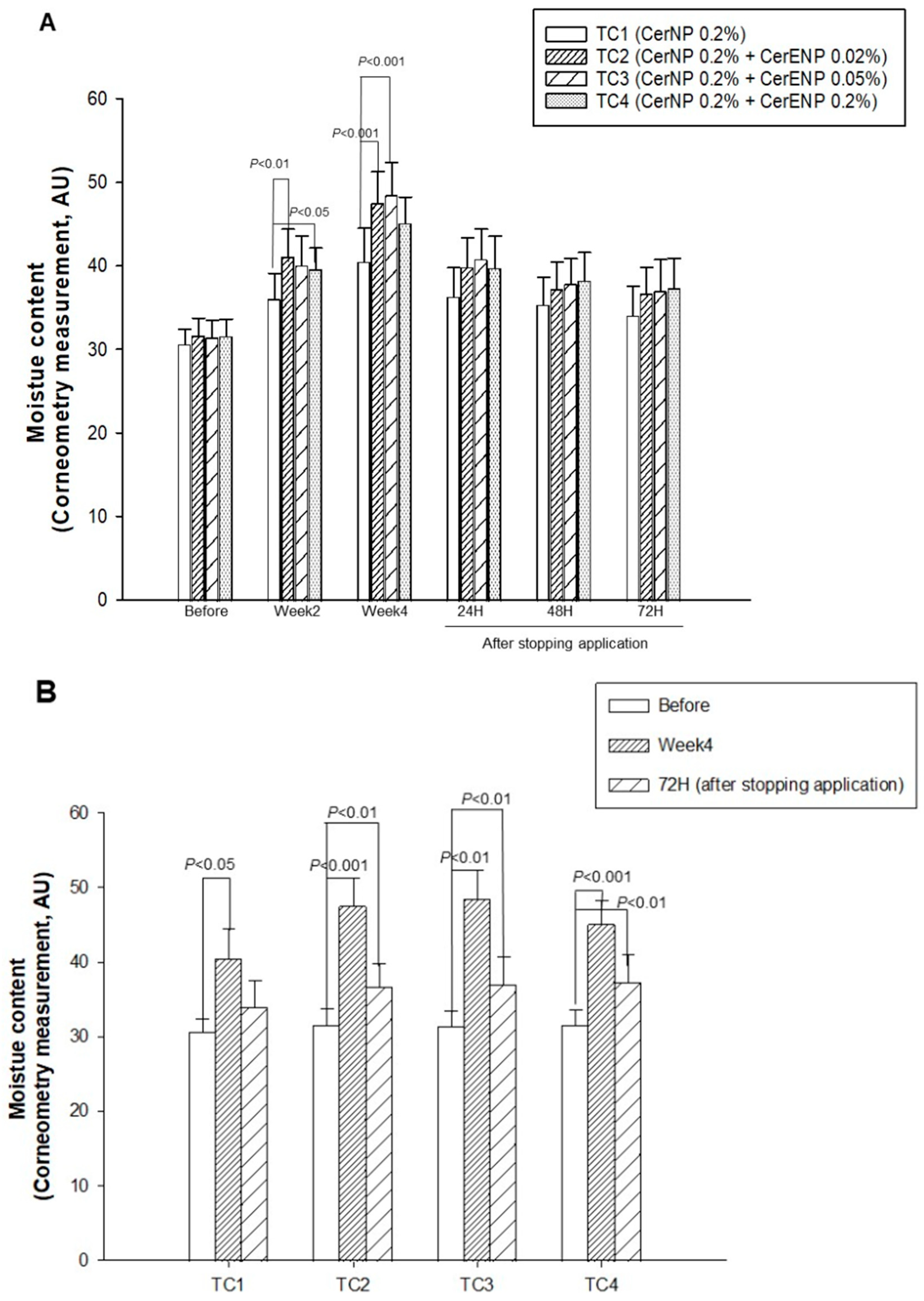
Figure 7.
CER 1-O-ENP fostered the SC cohesion. ΔTEWL was calculated between baseline TEWL and the TEWL measured after 15 tape-strippings after four weeks of application of a test cream containing the CER 1-O-ENP compared to the vehicle cream. Data represent mean ± SD (n= 20).
Figure 7.
CER 1-O-ENP fostered the SC cohesion. ΔTEWL was calculated between baseline TEWL and the TEWL measured after 15 tape-strippings after four weeks of application of a test cream containing the CER 1-O-ENP compared to the vehicle cream. Data represent mean ± SD (n= 20).
Disclaimer/Publisher’s Note: The statements, opinions and data contained in all publications are solely those of the individual author(s) and contributor(s) and not of MDPI and/or the editor(s). MDPI and/or the editor(s) disclaim responsibility for any injury to people or property resulting from any ideas, methods, instructions or products referred to in the content. |
© 2024 by the authors. Licensee MDPI, Basel, Switzerland. This article is an open access article distributed under the terms and conditions of the Creative Commons Attribution (CC BY) license (http://creativecommons.org/licenses/by/4.0/).
Copyright: This open access article is published under a Creative Commons CC BY 4.0 license, which permit the free download, distribution, and reuse, provided that the author and preprint are cited in any reuse.


