

Submitted:
06 December 2024
Posted:
10 December 2024
You are already at the latest version
Abstract
The research presented in the article deals with the application of artificial intelligence, specifically chatbots, in the process of optimizing 3D printing by Fused Deposition Modeling (FDM). Thanks to its widespread availability, 3D printing technology has gained popularity across various fields, but the process has been plagued with problems related to misprints due to improperly selected parameters. This study aimed to determine whether AI chatbots can identify and correct 3D printing defects. Additionally, it examined their ability to modify g-code to optimize print quality. The paper consists of two main parts: theoretical and design and research. The theoretical part discusses the development of artificial intelligence, 3D printing technology and vision systems used to evaluate the quality of prints. The role of AI in monitoring and optimizing the 3D printing process was emphasized. In the research part, experiments were conducted to evaluate the ability of selected chatbots to identify defects in 3D prints and suggest corrections. Various scenarios were analyzed in, which chatbots were expected to identify and suggest solutions for deliberately introduced defects in printing parameters, such as too high printing speed, improper temperature or defects in model geometry. The results of the study indicate that chatbots, despite some limitations, can significantly improve the quality of 3D prints, which opens up new prospects for automation and quality control in manufacturing processes.
Keywords:
1. Introduction
2. Research Methodology
- Gemini
- Gemini Advanced
- Chat GPT-4o
- Nozzle size – 0.4 [mm]
- Material type – PLA lub ABS
- Filament diameter – 1.75 [mm]
- Extruder temperature – from 200° to 220°C for PLA and from 220 to 250°C for ABS
- Platform temperature – 20°- 60°C for PLA and 90° - 110°C for ABS
- Layer height –0.2 [mm]
- First layer height – 0.3 [mm]
- Base print speed – 50 [mm/s]
- Number of perimeters – usually 2 – 3 perimeters
- Top solid layers – usally 4 layers
- Bottom solid layers – usally 3 layers
- Infill density –20%
- Raft inclusion – usually yes
- Cooling fan control – enabled (after printing the first layer)
- Tooth module (m): 1 [mm]
- Number of teeth (z): 20
- Pitch diameter (d): 20 [mm]
- Outer diameter (de): 22 [mm]
- Root diameter (df): 17.5 [mm]
- Gear thickness (b): 5 [mm]
- Tooth angle (α): 20o
- Tooth profile: involute
3. Results
4. Discussion
5. Results
Funding
Data availability statement
Appendix 1

| No. | Parameter Name | Default Value | Entered Value | ReReesponse from Gemini Advanced | Response from GPT-4o |
|---|---|---|---|---|---|
| 1. | Nozzle Size | 0.4 [mm] | 0.4 [mm] | 0.4 [mm] | 0.4 [mm] |
| 2. | Material Type | PLA | PLA | PLA | PLA |
| 3. | Filament Size | 1.75 [mm] | 1.75 [mm] | 1.75 [mm] | 1.75 [mm] |
| 4. | Extruder Temperature | 220°C | 220°C | 225–230 228°C |
200–210 205°C |
| 5. | Platform Temperature | 55°C | 0°C | 50–60 55°C |
50–60 55°C |
| 6. | Layer Height | 0.2 [mm] | 0.2 [mm] | 0.2 or 0.15 0.2 |
0.2 [mm] |
| 7. | First Layer Height | 0.3 [mm] | 0.3 [mm] | 0.3 [mm] | 0.2 [mm] |
| 8. | Base Print Speed | 50 [mm/s] | 150 [mm/s] | 120–130 125 [mm/s] |
40–60 50 [mm/s] |
| 9. | Number of Perimeters | 2 | 2 | 2 | 2 |
| 10. | Top Solid Layers | 4 | 4 | 4 | 4 |
| 11. | Bottom Solid Layers | 3 | 3 | 3 | 3 |
| 12. | Infill Density | 15% | 5% | 5% | 5% |
| 13. | Raft Inclusion | YES | NO | NO | NO |
| 14. | Cooling Fan Control | On (after first layer) | On (after first layer) | On (after first layer) | On (after first layer) |
| 15. | Travel Speed | 100 [mm/s] | 150 [mm/s] | 100–120 110 [mm/s] |
150 [mm/s] |
| 16. | Minimum Speed | 6 [mm/s] | 20 [mm/s] | 20 [mm/s] | 20 [mm/s] |
| 17. | First Layer Print Speed | 15 [mm/s] | 60 [mm/s] | 60 [mm/s] | 60 [mm/s] |
| 18. | First Layer Travel Speed | 70 [mm/s] | 190 [mm/s] | 100 [mm/s] | 190 [mm/s] |
| 19. | Maximum Speed for Initial Layers | 30 [mm/s] | 195 [mm/s] | 60–80 70 [mm/s] |
195 [mm/s] |
| No. | Parameter Name | Default Value | Entered Value | ReReesponse from Gemini Advanced | Response from GPT-4o | |
|---|---|---|---|---|---|---|
| 1. | Nozzle Size | 0.4 [mm] | 0.4 [mm] | 0.4 [mm] | 0.4 [mm] | |
| 2. | Material Type | PLA | ABS | ABS | ABS | |
| 3. | Filament Size | 1.75 [mm] | 1.75 [mm] | 1.75 [mm] | 1.75 [mm] | |
| 4. | Extruder Temperature | 240°C | 240°C | 245°C – 255°C 250°C |
240°C |
|
| 5. | Platform Temperature | 105°C | 105°C | 105°C | 1.75 [mm] | |
| 6. | Layer Height | 0.2 [mm] | 0.2 [mm] | 0.2 [mm] | 0.2 [mm] | |
| 7. | First Layer Height | 0.3 [mm] | 0.3 [mm] | 0.3 [mm] | 0.3 [mm] | |
| 8. | Base Print Speed | 50 [mm/s] | 120 [mm/s] | 80–100 90 [mm/s] |
40–60 50 [mm/s] |
|
| 9. | Number of Perimeters | 2 | 2 | 2 | 3 | |
| 10. | Top Solid Layers | 4 | 2 | 2 | 4–5 4 |
|
| 11. | Bottom Solid Layers | 3 | 0 | 2 | 1–2 | |
| 12. | Infill Density | 15% | 15% | 15% | 20–25 % 20% |
|
| 13. | Raft Inclusion | YES | YES | YES | YES | |
| 14. | Cooling Fan Control | On (after first layer) | On (after first layer) | On (after first layer) | On (after first layer) | |
| 15. | Support Distance form the Model (Height) | 0,15 [mm] | 0,17 [mm] | 0,17 [mm] | 0,17 [mm] | |
| 16. | Number of Middle Raft Layers | 1 | 2 | 2 | 2 | |
| 17. | Speed of the First Top Layer | 50% | 100% | 100% | 50–70% 60% |
|
| 18. | Overlapping of the Perimeter | 20% | 0% | 0% | 0% | |
| No. | Parameter Name | Default Value | Entered Value | ReReesponse from Gemini Advanced | Response from GPT-4o |
|---|---|---|---|---|---|
| 1. | Nozzle Size | 0.4 [mm] | 0.4 [mm] | 0.4 [mm] | 0.4 [mm] |
| 2. | Material Type | PLA | ABS | ABS | ABS |
| 3. | Filament Size | 1.75 [mm] | 1.75 [mm] | 1.75 [mm] | 1.75 [mm] |
| 4. | Extruder Temperature | 240°C | 265°C | 265°C | 240–250 245°C |
| 5. | Platform Temperature | 105°C | 105°C | 110°C | 105°C |
| 6. | Layer Height | 0.2 [mm] | 0.2 [mm] | 0.2 [mm] | 0.2 [mm] |
| 7. | First Layer Height | 0.3 [mm] | 0.3 [mm] | 0.3 [mm] | 0.3 [mm] |
| 8. | Base Print Speed | 50 [mm/s] | 20 [mm/s] | 15 [mm/s] | 40–60 50 [mm/s] |
| 9. | Number of Perimeters | 2 | 2 | 2 | 3 |
| 10. | Top Solid Layers | 4 | 4 | 4 | 4 |
| 11. | Bottom Solid Layers | 3 | 3 | 3 | 3 |
| 12. | Infill Density | 15% | 15% | 15% | 15% |
| 13. | Raft Inclusion | YES | NO | NO | YES |
| 14. | Retraction length | 6 [mm] | 3 [mm] | 6 | 5–7 6 [mm] |
| 15. | Retraction Speed | 30 [mm/s] | 15 [mm/s] | 40 [mm/s] | 30–35 30 [mm/s] |
| 16. | Extrusion Speed | 30 [mm/s] | 20 [mm/s] | 20 [mm/s] | 20 [mm/s] |
| No. | Parameter Name | Default Value | Entered Value | ReReesponse from Gemini Advanced | Response from GPT-4o |
|---|---|---|---|---|---|
| 1. | Nozzle Size | 0.4 [mm] | 0.4 [mm] | 0.4 [mm] | 0.4 [mm] |
| 2. | Material Type | PLA | ABS | ABS | ABS |
| 3. | Filament Size | 1.75 [mm] | 1.75 [mm] | 1.75 [mm] | 1.75 |
| 4. | Extruder Temperature | 240°C | 240°C | 250–255 253°C |
240°C |
| 5. | Platform Temperature | 105°C | 40°C | 90–110°C 100°C |
100°C |
| 6. | Layer Height | 0.2 [mm] | 0.2 [mm] | 0.2 [mm] | 0.2 [mm] |
| 7. | First Layer Height | 0.3 [mm] | 0.3 [mm] | 0.3 [mm] | 0.3 [mm] |
| 8. | Base Print Speed | 50 [mm/s] | 50 [mm/s] | 50 [mm/s] | 50 [mm/s] |
| 9. | Number of Perimeters | 2 | 2 | 2 | 3 |
| 10. | Top Solid Layers | 4 | 4 | 4 | 4 |
| 11. | Bottom Solid Layers | 3 | 3 | 3 | 5 |
| 12. | Infill Density | 15% | 15% | 15% | 15% |
| 13. | Raft Inclusion | YES | NO | YES | YES |
| 14. | Cooling Fan Control | On (after first layer) | On (after first layer) | On (after first layer) | Disabled |
| 15. | Infill Pattern | Hexagonal | Linear | Linear | Linear |
| 16. | Infill start angle | – | 45° | 45° | 45 |
| 17. | Cross Hatch Angle | – | 90° | 90° | 90 |
| No. | Parameter Name | Default Value | Entered Value | ReReesponse from Gemini Advanced | Response from GPT-4o |
|---|---|---|---|---|---|
| 1. | Nozzle Size | 0.4 [mm] | 0.4 [mm] | 0.4 [mm] | 0.4 [mm] |
| 2. | Material Type | PLA | ABS | ABS | ABS |
| 3. | Filament Size | 1.75 [mm] | 1.75 [mm] | 1.75 [mm] | 1.75 [mm] |
| 4. | Extruder Temperature | 240°C | 215°C | 230–240 235 °C |
230–240 235 °C |
| 5. | Platform Temperature | 105°C | 105°C | 110 °C | 110 °C |
| 6. | Layer Height | 0.2 [mm] | 0.2 [mm] | 0.2 [mm] | 0,1–0,15 0,15 [mm] |
| 7. | First Layer Height | 0.3 [mm] | 0.3 [mm] | 0.3 [mm] | 0.3 [mm] |
| 8. | Base Print Speed | 50 [mm/s] | 100 [mm/s] | 60–80 70 [mm/s] |
40–60 50 [mm/s] |
| 9. | Number of Perimeters | 2 | 2 | 2 | 3–4 3 |
| 10. | Top Solid Layers | 4 | 4 | 4 | 4 |
| 11. | Bottom Solid Layers | 3 | 3 | 3 | 3 |
| 12. | Infill Density | 15% | 15% | 20-25% 20% |
15% |
| 13. | Raft Inclusion | YES | YES | NO | YES |
| 14. | Cooling Fan Control | On (after first layer) | On (after first layer) | On (after first layer) | On (after first layer) |
| 15. | Support type | Linear | Tree-like | Tree-like | Tree-like |
| No. | Parameter Name | Default Value | Entered Value | ReReesponse from Gemini Advanced | Response from GPT-4o |
|---|---|---|---|---|---|
| 1. | Nozzle Size | 0.4 [mm] | 0.4 [mm] | 0.4 [mm] | 0.4 [mm] |
| 2. | Material Type | PLA | ABS | ABS | ABS |
| 3. | Filament Size | 1.75 [mm] | 1.75 [mm] | 1.75 [mm] | 1.75 [mm] |
| 4. | Extruder Temperature | 240°C | 255°C | 240–250 245 °C |
245–250 247 °C |
| 5. | Platform Temperature | 105°C | 105°C | 105°C | 105°C |
| 6. | Layer Height | 0.2 [mm] | 0.2 [mm] | 0.2 [mm] | 0.2 [mm] |
| 7. | First Layer Height | 0.3 [mm] | 0.3 [mm] | 0.3 [mm] | 0.3 [mm] |
| 8. | Base Print Speed | 50 [mm/s] | 50 [mm/s] | 40–45 43 [mm/s] |
40–50 45 [mm/s] |
| 9. | Number of Perimeters | 2 | 2 | 2 | 2 |
| 10. | Top Solid Layers | 4 | 4 | 4 | 5 |
| 11. | Bottom Solid Layers | 3 | 3 | 3 | 4 |
| 12. | Infill Density | 15% | 10% | 10% | 10% |
| 13. | Raft Inclusion | YES | YES | YES | YES |
| 14. | Cooling Fan Control | On (after first layer) | On (after first layer) | On (after first layer) | Off |
| 15. | Full Infill Layer Speed | 50% | 100% | 100% | 100% |
| No. | Parameter Name | Default Value | Entered Value | ReReesponse from Gemini Advanced | Response from GPT-4o |
|---|---|---|---|---|---|
| 1. | Nozzle Size | 0.4 [mm] | 0.4 [mm] | 0.4 [mm] | 0.4 [mm] |
| 2. | Material Type | PLA | ABS | ABS | ABS |
| 3. | Filament Size | 1.75 [mm] | 1.75 [mm] | 1.75 [mm] | 1.75 [mm] |
| 4. | Extruder Temperature | 240 °C | 265 °C | 230–250 240 °C |
240–250 245 °C |
| 5. | Platform Temperature | 110 °C | 110 °C | 90–100 95 °C |
110 °C |
| 6. | Layer Height | 0.2 [mm] | 0.2 [mm] | 0.2 [mm] | 0.2 [mm] |
| 7. | First Layer Height | 0.3 [mm] | 0.3 [mm] | 0.3 [mm] | 0.3 [mm] |
| 8. | Base Print Speed | 50 [mm/s] | 120 [mm/s] | 50–80 65 [mm/s] |
50 –60 55 [mm/s] |
| 9. | Number of Perimeters | 3 | 2 | 2 | 3–4 3 |
| 10. | Top Solid Layers | 4 | 4 | 4 | 4 |
| 11. | Bottom Solid Layers | 3 | 3 | 3 | 3 |
| 12. | Infill Density | 15% | 40% | 40% | 40% |
| 13. | Raft Inclusion | YES | NO | NO | YES |
| 14. | Cooling Fan Control | On (after first layer) | OFF | On (after first layer) | OFF |
| 15. | First Layer Print Speed | 10 [mm/s] | 20 [mm/s] | 20 [mm/s] | 20 [mm/s] |
| 16. | Retraction Length | 6 [mm] | 3 [mm] | 3 [mm] | 3 [mm] |
References
- „PKN - Drukowanie 3D: Wytwarzanie Przyrostowe,” PKN (Polski Komitet Normalizacyjny). Available online: https://www.pkn.pl/informacje/2019/06/drukowanie-3d-wytwarzanie-przyrostowe.
- B3D, „B3D,” [Online]. Available: https://b3d.com.pl/technologie-przyrostowe-podstawowe-informacje/. [Data uzyskania dostępu: 19 08 2024].
- Sung Mould & Plastic, „Sung Mould & Plastic,” [Online]. Available: https://sungplastic.com/pl/additive-method-subtractive-method-in-production/. [Data uzyskania dostępu: 19 08 2024].
- R. Mendaza-DeCal, S. R. Mendaza-DeCal, S. Peso-Fernandez i J. Rodriguez-Quiros, „Orthotics and prosthetics by 3D-printing: Accelerating its fabrication flow,” Research in Veterinary Science, 2023.
- „3D w praktyce,” [Online]. Available: https://3dwpraktyce.pl/. [Data uzyskania dostępu: 19 08 2024].
- „CADxpert,” [Online]. Available: https://cadxpert.pl/5-popularnych-technologii-druku-3d-fdm-sla-sls-polyjet-dmls/. [Data uzyskania dostępu: 19 08 2024].
- Z. Zhu, D.W.H. Z. Zhu, D.W.H. Ng, H.S. Park, M.C. McAlpine, „3D-printed multifunctional materials enabled by artificial-intelligence-assisted fabrication technologies,” Nat. Rev. Mater., pp. 27 - 47, 2020.
- Liang Ma, Shijie Yu, Xiaodong Xu, Sidney Moses Amadi, Jing Zhang, Zhifei Wang, „Application of Artificial Intelligence in 3D Printing Physical Organ Models,” College of Materials Science and Engineering, Zhejiang University of Technology, Hangzhou, 310000, China, 2023.
- J. Go, A.J. J. Go, A.J. Hart, „Fast desktop-scale extrusion additive manufacturing,” Addit. Manuf, p. 276–284, 2017.
- Hinton G, Deng L, Yu D, Dahl GE, et al., „Deep neural networks for acoustic modeling in speech recognition: the shared views of four research groups.,” IEEE Signal Process Mag, p. 82–97, 2012.
- He K, Zhang X, Ren S, Sun J., „Deep residual learning for image recognition.,” w Proceedings of the IEEE Conference on Computer Vision and Pattern Recognition., 2016.
- Palagi S, Fischer P, „Bioinspired microrobots,” Nature Reviews Materials (w skrócie “Nat Rev Mater”), pp. [CrossRef]
- Yu KH, Beam AL, Kohane S., „Artificial intelligence in healthcare,” Nat Biomed Eng, p. 719–31, 2018.
- Me A, Mc A, Fkhg A, et al., „Harnessing artificial intelligence for the next generation of 3D printed medicines.,” Adv Drug Deliv Rev, 2021.
- Stone P, Brooks R, Brynjolfsson E, et al., „Artificial Intelligence and Life in 2030. One hundred year study on artificial intelligence: report of the 2015–2016 study panel,” Stanford University, Stanford, 2016.
- Yuchen Jiang, Xiang Li, Hao Luo, Shen Yin, Okyak Kaynak, „Quo Vadis Artificial intelligence,” 2022.
- Menal Dahiya, „A Tool of Conversation: Chatbot,” A Tool of Conversation: Chatbot, 2017.
- C. R. Anik, C. C. R. Anik, C. Jacob, A. Mohanan, „A Survey on Web Based Conversational Bot Design,” JETIR, pp. 96-99, 2016.
- B. P. Kiptonui, „Chatbot Technology: A Possible Means of Unlocking Student Potential to Learn How to Learn,” Educational Research, pp. 218-221, 2013.
- R. S. Russell, „Language Use, Personality and True Conversational Interfaces,” AI and CS University of Edinburgh, Edinburgh, 2002.
- Hector Quintero, Elisa Elizabeth Mendieta, Cesar Pinzon-Acosta, „Identifying an Image Classification Model for Welding Defects Detection,” w Technological University of Panama, Central, Panama, 2024.
- B. Setiaji, F. W. B. Setiaji, F. W. Wibowo, „Chatbot Using A Knowledge in Database,” w IEEE 7th International Conference on Intelligent Systems, Modelling and Simulation, Thailand, 2016.
- J. Pereira, Ó. Díaz, „Using health chatbots for behavior change: A mapping study,” Journal of Medical Systems, 2019.
- Conversational AI: Dialogue Systems, Conversational Agents, and Chatbots, „M. McTear,” Synthesis Lectures on Human Language Technologies, 2020.
- E. Adamopoulou, L. E. Adamopoulou, L. Moussiades, „An Overview of Chatbot Technology,” w IFIP International Conference on Artificial Intelligence Applications and Innovations, Cham, 2020.
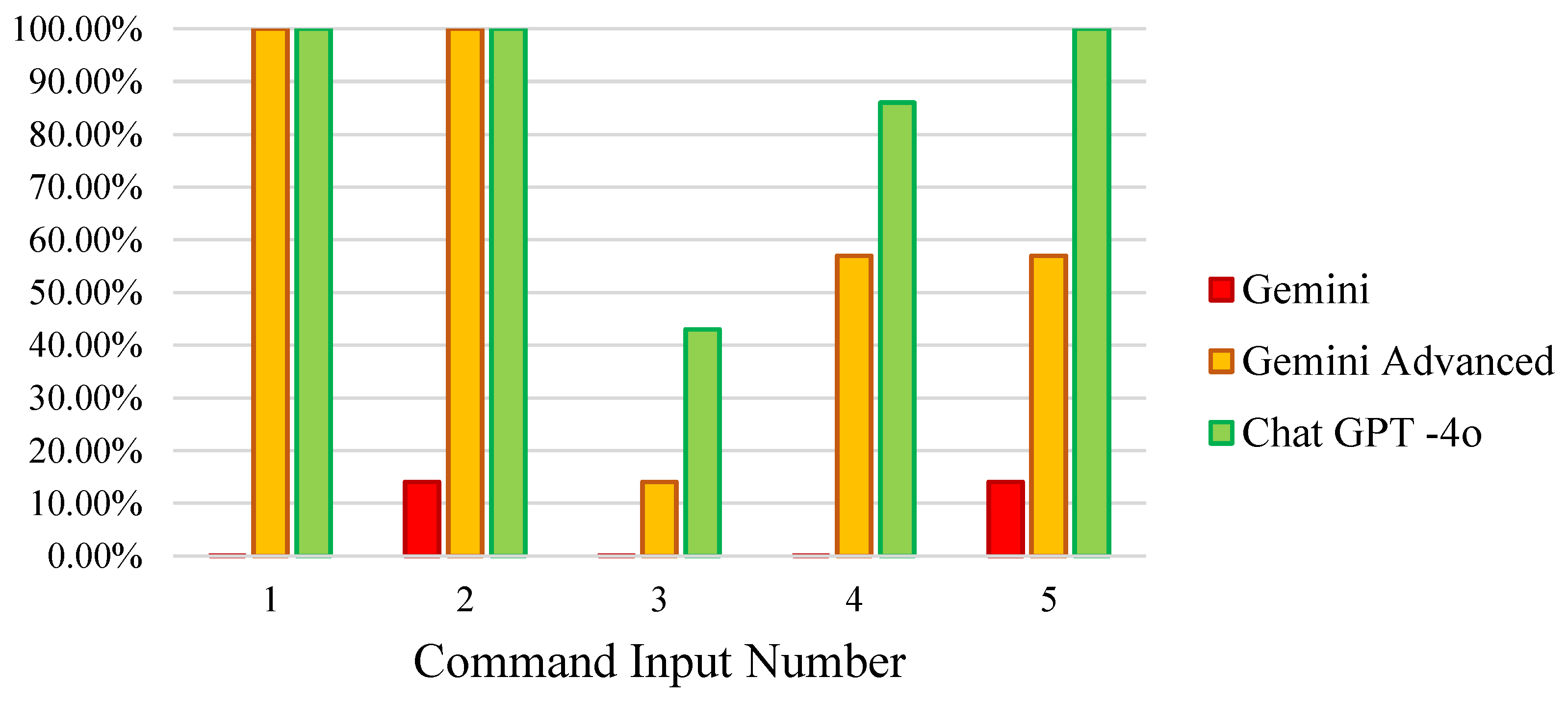
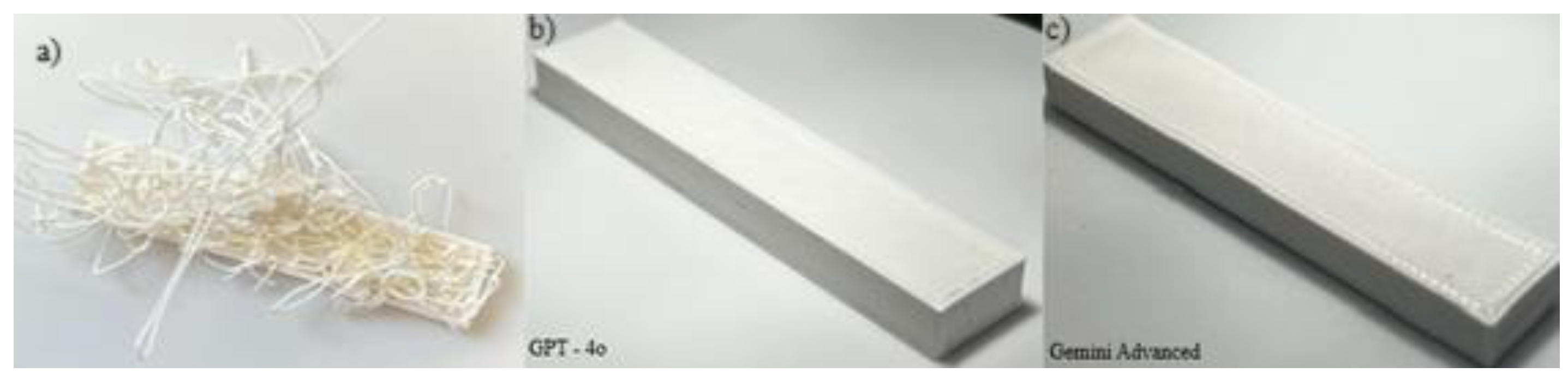
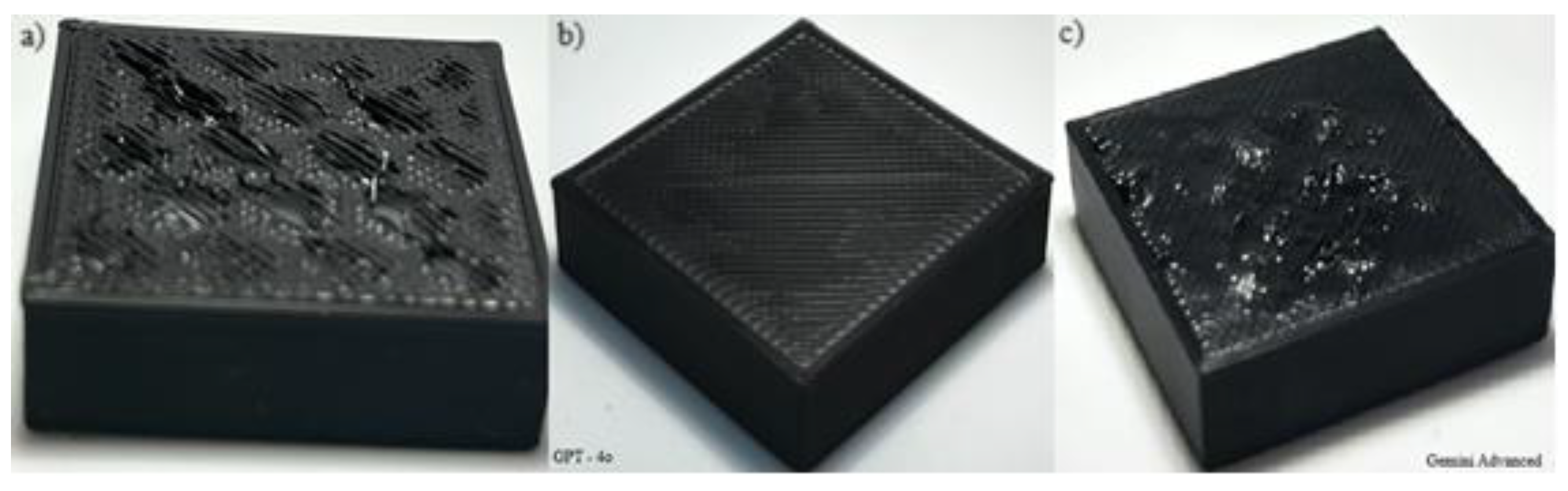
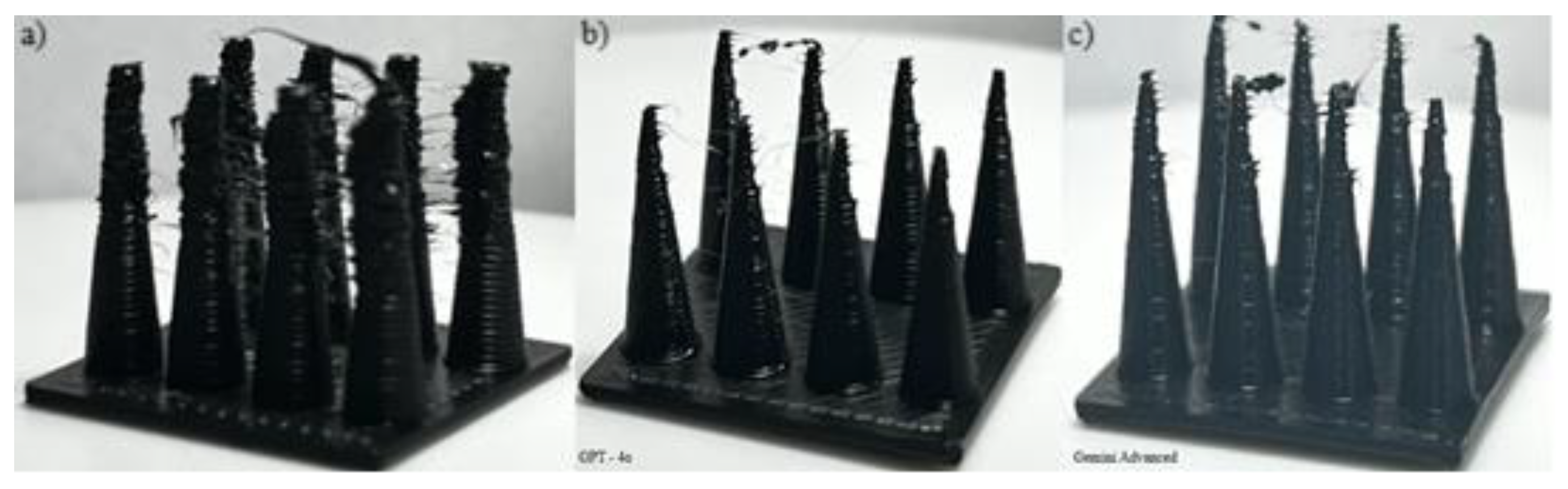
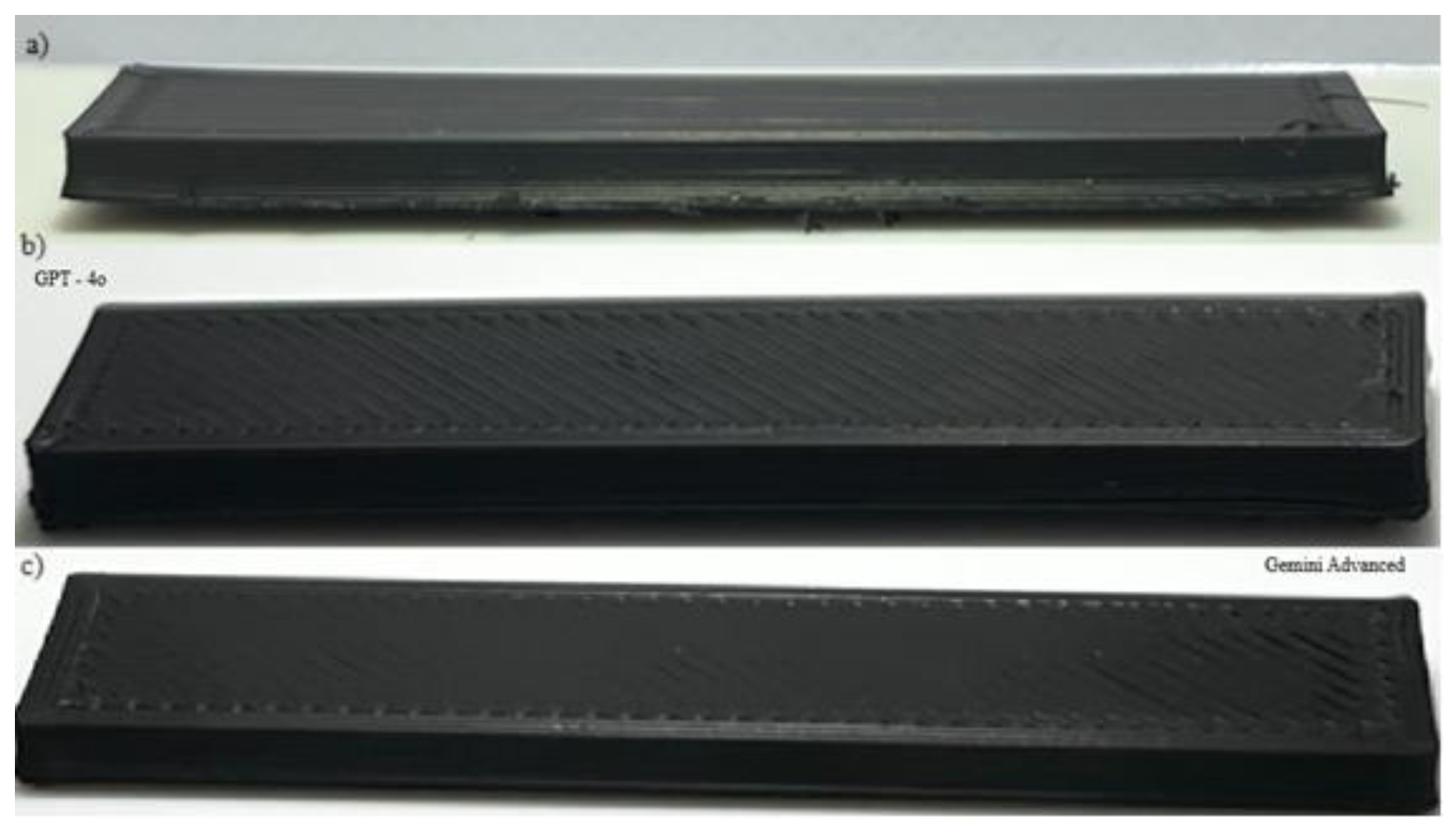
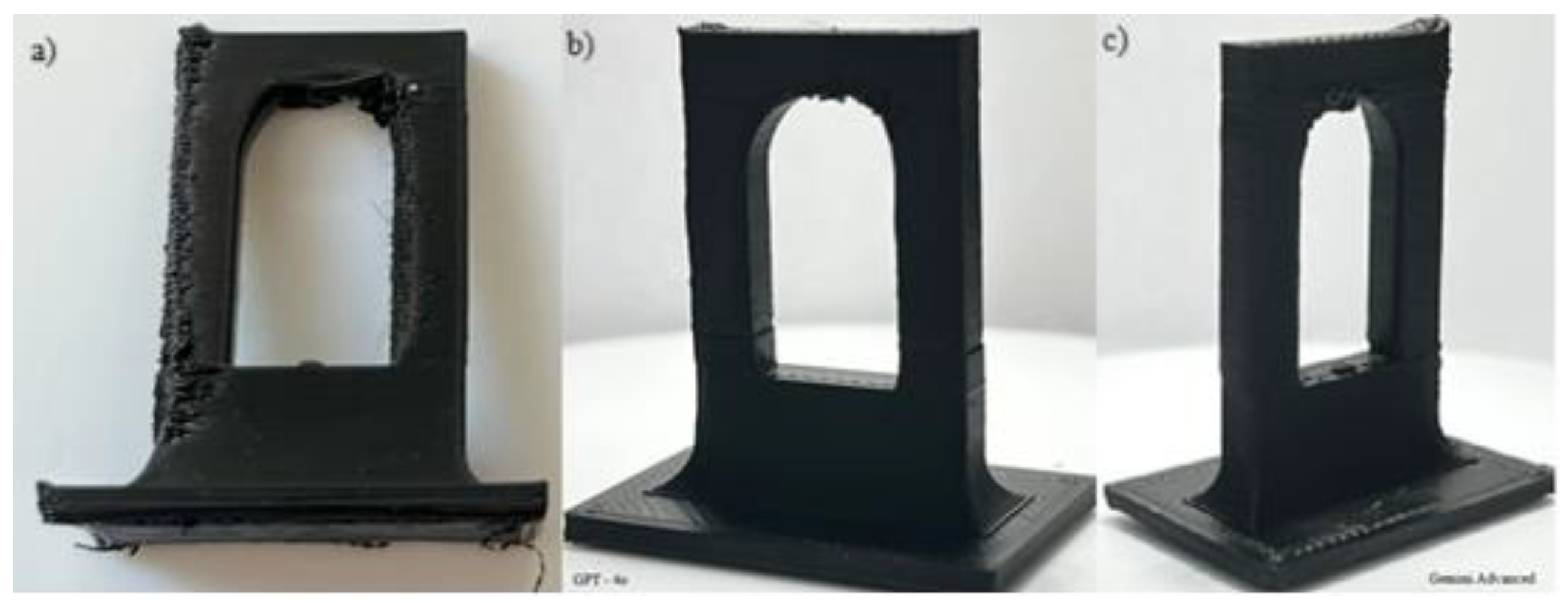
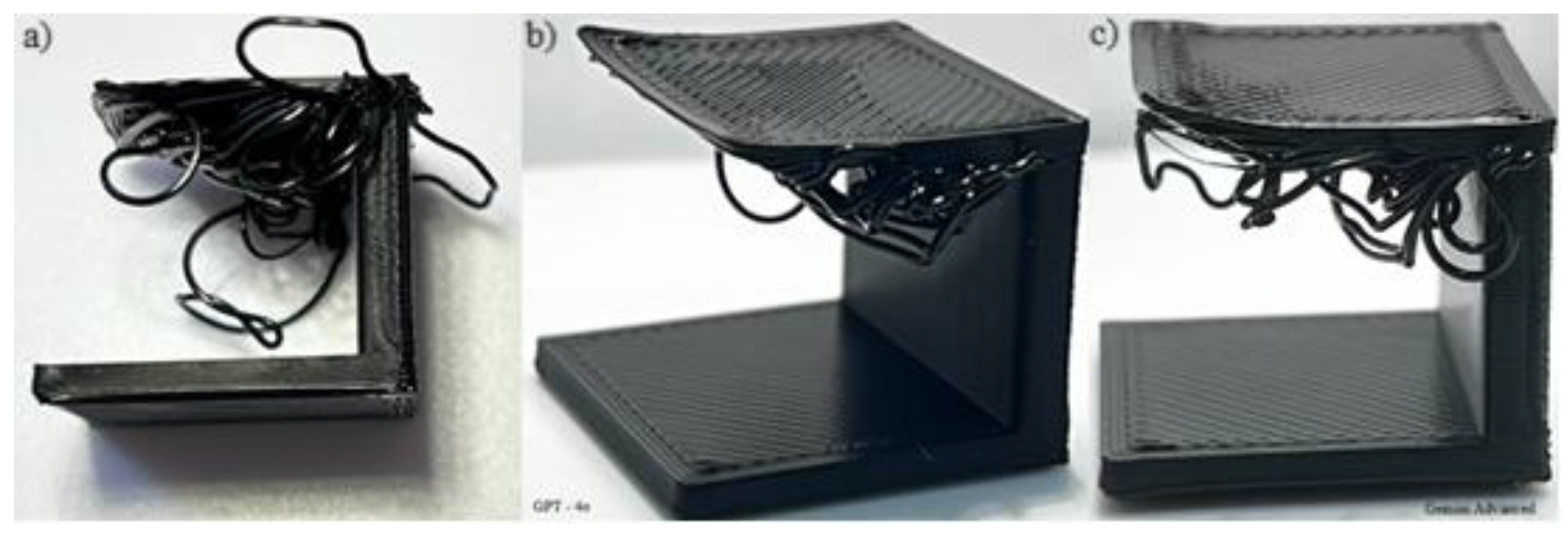
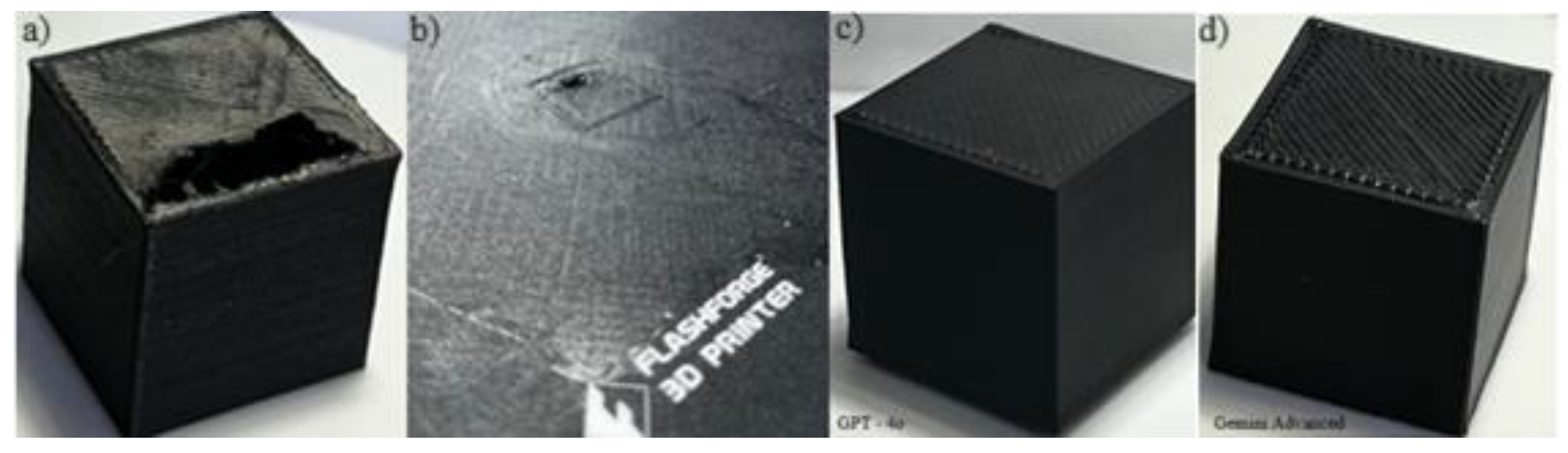
| No. | Question about modifying the model geometry |
|---|---|
| 1. | Please generate a file containing the modified g-code. Increase the height from 6 [mm] to 12 [mm]. |
| 2. | Please generate a file containing the modified g-code. Reduce the width from 30 [mm] to 20 [mm]. |
| 3. | Please generate a file containing the modified g-code. Reduce the width from 30 [mm] to 20 [mm]. |
Disclaimer/Publisher’s Note: The statements, opinions and data contained in all publications are solely those of the individual author(s) and contributor(s) and not of MDPI and/or the editor(s). MDPI and/or the editor(s) disclaim responsibility for any injury to people or property resulting from any ideas, methods, instructions or products referred to in the content. |
© 2024 by the authors. Licensee MDPI, Basel, Switzerland. This article is an open access article distributed under the terms and conditions of the Creative Commons Attribution (CC BY) license (http://creativecommons.org/licenses/by/4.0/).