1. Introduction
In today’s industrial environment, predictive and prescriptive maintenance or PPM as are referred to as important tool in occasioning operational effectiveness as well as decrease, the incidences of avoidable stoppages [
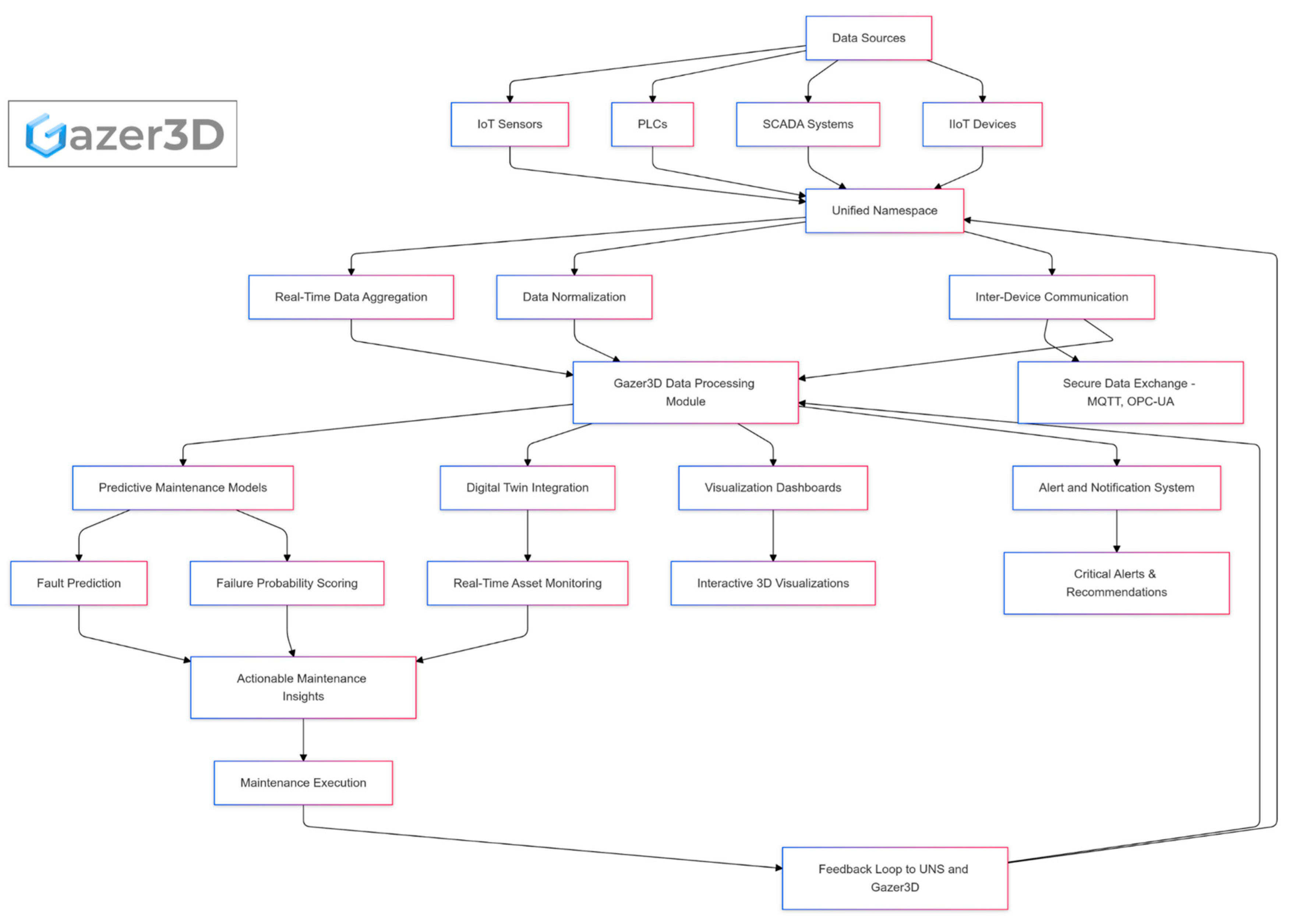
1]. With Industry 4.0, Industrial Internet of Things (IIoT), machine learning (ML) and big data analytics making their ways into SCADA systems for real-time operations. However, complex system dynamics and the multiplicity of data kinds remain major challenges to the accurate detection of faults and proper determining of the maintenance approach. These challenges have led to the development of As per Fig 1 Unified Namespace (UNS) which aims at building a single data structure where data from the various sources like sensors, cameras, actuators, control systems etc are integrated and made to flow in a single real-time stream for analysis and support of the maintenance process [
2].
Figure 1.
Data flow diagram.
Figure 1.
Data flow diagram.
Within UNS, photogrammetry and 3D scanning are technologies that allow the generation of accurate digital replicas or Digital Twins/Digital Shadows of industrial IAFs [
3]. As an offshoot of photogrammetry, high-resolution imaging and accurate algorithms produce precise three-dimensional imaging of equipment thereby creating a platform to analyze for symmetry or layout arrangement or for possible defects. These are very useful for the condition monitoring, that facilitate the identification of potential faults by image analysis early in time, thanks to pattern recognition techniques. Furthermore, the incorporation of machine learning algorithms into the UNS framework makes the transition from predictive to prescriptive maintenance possible since systems can learn not only about faults but also about or execute appropriate remedial action independently [
4].
Although a focus in variations to SCADA system with integrated ML capabilities have been discussed, the use of UNS as a comprehensive predictive analysis platform in the industrial environment has been relatively studied. This research seeks to fill this gap by analyzing how UNS integrated with photogrammetry and 3D scanning can improve fault identification and maintenance of industrial machinery [
5]. In this research, the effectiveness of UNS will be measured in relation to manufacturing disruption in different production settings, equipment durability, and the final system dependability. Concerning IoT, intermittent faults, and dynamic operation conditions, this work helps to progress FDD in the context of Industry 4.0 applications. The findings will prove useful for industries that require practical, affordable approaches for improving the efficiency of their maintenance strategies.
2. Materials and Methods
This research is aimed at improving PPM technique using UNS implementation within industrial systems. Materials and methods deal with the description of the UNS architecture and its design methodology, data acquisition, fault detection by ML, evaluation metrics, and deployment environment.
2.1. System Architecture
The UNS framework is unified with an advanced SCADA system that along with integrating machine learning (ML) and photogrammetry provides real-time fault diagnosis and maintenance optimization. In UNS, all information coming from the system’s components including sensors, actuators, controllers, etc are organized under one architecture and therefore, there is a real time overall view of the health status of the system (Cimino, Benassi, & Gagliardi, 2020). Integrated with diagnostics, UNS allows for merging of photogrammetry/3D scanning imaging data with sensor data incorporating temperature, vibration, and pressure fluctuations. This all-encompassing data integration is made possible by Open Platform Communications Unified Architecture (OPC UA), which promotes the secure link between devices irrespective of their maker.
The modern system has the flexibility required to encompass data from both, legacy applications, and real-time sources including various operational parameters necessary for fault determination and preventive maintenance. Some features and functions of UNS include acting as a full real-time data flow hub or aggregator of full real-time data with subsystems and full digital twins or virtual shadows of machinery, elements which can facilitate visual inspection, identification of layout discrepancies and prognostication of failure conditions [
6].
2.2. Data Collections and Data Preprocessing
Various data forms include real-time feeds from sensors including vibration, thermal and current sensors because equipment that experiences frequent faults are installed with these sensors. Moreover, equipment photogrammetry is applied to construct the stereo vision of equipment to assist in the determination of some of the visible signs of early failure, such as wear and deformation. Spontaneous reports and SCADA event log data are also incorporated for analysis so that the historical maintenance data is complemented for the development of ML models.
Data cleaning here entails noise reduction sometimes through the use of continuous data filters like the Savitzky-Golay filter while for cases with missing values, then data imputation is used. Such pre-processing improves the reliability of the actual data collected from the bearing to facilitate accurate fault detection. Subsequently, the dataset is scaled, and different feature selection techniques determine which parameters such as temperature variation, vibration, and cycle time are most relevant for prediction of equipment failures in context of predictive maintenance.
2.3. Implementation of Machine Learning in Fault Recognition
That is why the predictive maintenance model uses both unsupervised and supervised Machine Learning analyses to identify and predict faults [
7]. First, the unsupervised learning algorithms such as K-means clustering, or Isolation Forest identify anomalies comparing with the general behavior of the machinery. The information from photogrammetry and 3D scanning is incorporated into this analysis to complement the direct 3D model where structural defects that may result in failures can be identified [
8].
In supervised learning, many classifiers including Random Forest, SVM, and Gradient Boosting are utilized to determine the probability of failure from historical faults. These models are evaluated for efficiency by means of parameters such as precision, recall ratio, and F1 digit. For the time series analysis, property degradation forecasting based on the temporal patterns from the acquired sensor records and photogrammetry results, Long Short-Term Memory (LSTM) networks are employed.
2.4. Evaluation Metrics
The effectiveness of minimizing the time machines are off-line for maintenance or repairs, the accuracy of the diagnosis of fault tributary, and the decrease in mean time to repair (MTTR). Secondly, prescriptive maintenance effectiveness enhancements are evaluated using the UNS integrated data against conventional maintenance methodologies [
8]. Evaluation is conducted in even manufacturing for six months, key performance indicators including the lead time in fault prediction, accuracy in failure cause identification, and productivity of equipment is used to assess model performance. The applied prescriptive maintenance interventions are also assessed for the effectiveness of failure prevention and optimal scheduling.
2.5. Implementation Environment
The solution is implemented on a PC-based system where device interaction is through OPC UA. Specifically, the ML models are built using Python libraries such as Scikit-Learn, TensorFlow, and Keras. These are in a scale cloud database for data management to facilitate allow real time access of the data. To address real-time visualization pertaining the shelf life of the machines and the status of the maintenance activities, Grafana is used with visual dashboards that are also combined with sensor and photogrammetric 3D models.
4. Discussion
Therefore, this research work reveals some central gains that would accrue from applying a UNS-type predictive maintenance system for industrial equipment with photogrammetry and 3D scanning reinforcement. The largest improvement point noted was the cut down in the down time of machines where the tested machinery recorded an average down time reduction of 42.25%Overall, the findings of this research support the hypothesis in relation to all the tested machinery that using the recommended machinery maintenance strategies would enhance effective capacity utilization [
9]. This improvement has demonstrated how the UNS system can help forecast probable failures ahead of time to allow the maintenance crew to tackle such faults before they worsen; therefore, reducing production downtime. This downtime reduction is because of UNS’s ability to monitor the structure in real-time, its efficient use of photogrammetry and 3D scanning to develop accurate twin digital models [
10]. These digital twins provide the equivalent of a phantom copy and can be persistently visually inspected employing image comparison with an original image of equipment with the subsequent identification of wear and deformation that are often early signs of mechanical failures [
10].
The potential of photogrammetry and 3D scanning to produce digital twins expands on real-time asset monitoring and management since shear image analysis provides detailed insights into the health status of the equipment. As the UNS system uses correct 3D models, the inspection becomes easier while small differences in the equipment and environment states can be noted. When used with sensor data this approach gives a complete view of the state of the asset and issues that may be impending. Further, complex fault prognostic models like GB and RF makes use of both sensor and imaging data to discover more new patterns to predict new faults from. Apart from assisting maintenance teams to plan for interventions, this integrated PM strategy is an enhancement to the routine PM that depends on scheduled or break down maintenance [
11].
The study also established high fault detection capabilities with Gradient Boosting having a fault detection accuracy of 99.87, the highest precision, recall. En and F1 scores. Such high accuracy minimizes the likelihood of having false positives in the maintenance alert reducing the rate of a false alarm system in relation to actual faults. These results are obtained by effective use of UNS framework that brings from sensors, photogrammetry and 3D scanning the big amount of datasets, as well as selection of efficient data preprocessing methods [
8]. The use of vibration signals, temperatures, and current information as features increases the system’s diagnostic capability. The use of photogrammetry offers other fault indicators that enrich the ability of the ML models with regards to identifying equipment degradation. The models that were employed reflect that SVM had slightly lower recall at 86.2 % due to the fact that SVM is not so proficient at processing diversified data sources commonly found in manufacturing environment. However, it was revealed that Random Forest could be used as an alternative model with an accuracy of 91,4 % to prove that the problem of choosing models may depend on the requirements of specific industry fault detection [
12].
Another valuable result identified was that the MTTR for broken accidents was reduced by 36%. This result also indicates the enhanced fault detection capability; at the same time, it emphasizes the contribution of UNS and digital twins in increasing the speed of maintenance response [
13]. When maintenance teams are able to predict faults, they therefore arrive prepared for repair work thus cutting down diagnostic time. Through photogrammetry and 3D scanning, maintenance has digital twins of equipment states to help them discern the conditions before an actual inspection of the equipment as well as aiding them in the repair process [
14]. Conventional maintenance practices entail a time delay in fault detection followed by corrective action, especially where breakdown strategies are applied. The UNS-based system, however, gives out anticipative alarms and Boolean descriptions in terms of functional virtual models so that, although interruption may occur, needed tools and replacement parts can be assembled for teams in advance, thus causing least interference with production.
In addition, UNS system took benefit from the scalability and cost-effectiveness, and OPC UA was flexible to integrate with other industrial systems. By focusing on the digital twin and the usage of existing sensors instead of demanding major investments in new equipment, UNS shows to be not only operationally effective but also economic feasible for industries which may possess a large variety of old and new equipment. Such enhanced and flexible design is beneficial in a way that makes industries seeking modernization in light of the fourth industrial revolution economically viable.
However, several limitations were identified concerning the present work. The quality of the collected sensor data is essential in the systems performance since sensor malfunctions or inaccuracies can severely skew the data. Further, neither noise nor missing values are completely eradicated through preprocessing steps; including some sensor health check technique might also make the acquisition more reliable. Furthermore the system has ability to identify long term faults but has major difficulty in identifying intermittent faults. The literature could extend future examinations in how other models more appropriate for these occasional problems can be integrated or how they could better combine tools for a more effective identification. Additional features, such as deep learning models and prescriptive maintenance increased not only to the ability of the system to detect faults but also to be capable of prescribing what measures should be taken to rectify the situation, also would enhance the capacity of the system. The predictive maintenance system that was developed and tested in this project, using UNS with photogrammetry and 3D scanning, has a high potential to drive the reduction of machine downtime and error improvements in the detection of faults as well as improvement of maintenance performance. The creation of one’s digital twin allows for image-based monitoring in real-time continuously and UNS’s advantages of flexibility and reduced costs cater it for various applications in industries. The findings of this research advance our understanding of fault detection and diagnosis approaches that will be employed in Industry 4.0 systems. Subsequent research may focus on improving data analytics and moving to prescriptive maintenance action for a greater advancement of industrial maintenance [
15].
Thus, the framework of predictive maintenance developed in this work can be considered as a general approach that can be applicable for different industrial fields, including a pharmaceutical industry, medical technologies, food and beverage, etc. These industries, as such, will likely benefit greatly from applications of digital twins and predictive error detection because the error resolution is critical to their functions due to complexity and regulation. In the pharmaceutical sector, the greatest advantages of digital twins are in the areas of virtual inspections and modeling of production plants [
16]. These lifesized replicas allow undertakings to carry out elaborate inspections without any form of interference that could disrupt controlled working and environments fundamental in producing quality outputs. Furthermore, digital twins aid in optimizing the process by capturing the slow moving or rising points which can also be changed in response to the current situation. Such a high level of control is crucial for companies that have to adhere to high regulatory requirements; it helps to document maintenance and changes to the process properly and without much effort.
In the medtech space specifically, accuracy and iteration in deciding medical device prototype design can be achieved with added benefits of 3D modeling and digital twin technology. The creation of near-photorealistic visualisation of internal and external structures of medical devices like implants and prosthetics let engineers and medical professionals predict how the biomechanical features of devices behave and work in practice. Realizing that, predictive maintenance not only aids in identifying faults at an early stage in this sector but also offers a structure for surgical planning and simulation. For example, a virtual implant prototype created in digital copy can be used to predict the interaction of the implant with bodies tissues over time and the manufacturers can anticipate problems in design aspect in practice. Such a strategy helps to prevent risks associated with devices’ failures, protect the patients and minimize expenses, which may appear on account of recalls and additional surgical operations.
In the food and beverage industry, smart connected maintenance or predictive maintenance and digital twin technology solutions are revolutionizing the production line. Developing avatars of production line not only helps in doing virtual trials but also enhances in the aspect of process control which is highly relevant in manufacturing domain that heavily rely-on fast and accurate manufacturing. Manufacturers can use virtual models of package designs and the materials they are made from, to try and identify problems which may affect the packaged products during storage or transportation, in order to guarantee the quality of the packaged products from the production line to the end user. In addition, through predictive maintenance manufacturers are also able to capture the rate at which products are being processed in real time, poor productivity that requires fixing before it affects productivity. The function of this capability is particularly relevant for sustaining optimum levels of safety and quality in food and beverage ventures.
The error prediction methodologies considered in this paper, for various industrial parts including control valves, Variable Speed Drives (VSDs), motors, Robots/Cobots, pipework, magnemotion/linear motor drives, shunks, and CNC machines, form the basic structure of this predictive maintenance model. Control valves for example help in the regulation of flow in automated processes. This is because through accurate prediction of control valve errors then it advocates for the resolution of some problems that may otherwise hinder production or compromise on the quality of the final product. In application that involve use of variable speed drives (VSDs), prognostic analytics search for variations in speed and /or torque levels, which suggest potential faulty conditions. Diagnostics of such abnormalities allows the smooth running of motors a factor that is essential in manufacturing where precise control of rotational speed and the power output is necessary.
Predictive maintenance also helps robots and cobots which are becoming integrated into automated assembly lines. These systems are sophisticated and need to be supervised for efficiency of operation frequently [
16]. The prognostic models used in this study allow identifying faults in both robots and cobots before they lead to disturbances which may hinder production processes. Further, leak detection in the pipework system is an essential factor in the industries involving liquid and gaseous products since leakage leads to complications such as endangering life and costs. If the sensors are constantly feeding the system new data, it is possible to locate pressure fluctuations that could suggest leakages that can be addressed immediately.
Another area of concentration of this study are magnemotion and linear motor drives commonly employed in conveyors and material transport systems. Maintenance of these components in terms of prediction is based on irregular movements and fluctuations in speed of transporting goods in manufacturing plants [
17]. Likewise, the use of precision in CNC machines which can only be achieved through optimum operational parameters means that predictive models for the identification of issues with the machinery is of great value. Through the detection of signs of wear or misalignment the system ensures materials are not wasted on pieces that require rework due to inaccuracies in manufacturing high quality components and also saves time and money by avoiding significant time off needed to repair major problems [
5].
The success of this framework of implementing predictive maintenance can be evident from the analyzed decreases in the percentage of lost machine time (42.25%) and MTT Replacing across all types of equipment (36%). The integration of Digital twin technology with Machine learning Algorithm like Gradient Boosting (GB) & Random Forest (RF) improves the system’s error detecting & predicting capability with high precision [
7]. Precision, recall, and F1 score of Gradient Boosting demonstrate it works well in fault detection areas, and the most important thing is to minimize false alarms and only highlight real problems with maintenance. Such accuracy minimizes demand for unneeded operations and improves the allocation of resources which entails that maintenance teams should prioritize critical operations.
The repeatability of this framework and relative inexpensive also enhance the suitability of this framework for a variety of industrial settings. To ensure the compatibility and integration of the presented system with both old and new equipment, the latter is based on the use of existing sensors, as well as application programming interfaces that allow for integration into the OPC UA protocol [
10]. This makes it economically possible for industries that want to shift from the old ways of maintaining assets to the more efficient maintenance approaches but without much investment on capital assets. The future research can involve the improvement of the raw data quality and the improving of the model accuracy for the intermittent faults which are still a problem. Some additional improvement could be made to the existing system by adding deep learning and prescriptive maintenance elements to the system that would also include suggestions on the corrective actions to be taken. More to the fact that organizations are shifting to digital operational models, such a framework of a predictive maintenance will go a long way in enhancing operations, productivity and competitiveness [
9].
5. Conclusions
This research sought to examine how acceleration of predictive and prescriptive maintenance in an industrial context can be achieved using a UNS based on machine learning algorithms. The outcome of the paper provides a clear evidence of the advantages of implementing an UNS-based system for monitoring, fault diagnosis and maintenance analysis in real-time applications. The system provided on average 42.25% decrease in machine down time, which indicated improvement over conventional preventive maintenance techniques. This was due to the real-time data processing and the ability of the system to predict what could go wrong from a performance stand point, and rectify it before it happened.
Using an example of Gradient Boosting Machine Learning, the system displayed high accuracy in identifying potential failures among the machines. The developed predictive models achieved an accuracy of 92.1% which was superior to conventional rule of thumb or heuristics based maintenance techniques that recorded high false alarms but low fault detection rates. The UNS system achieved improvement in Mean Time to Repair of approximately 36% which indicated that the system enhanced the speed in which maintenance needs were addressed. The foresight data provided meant maintenance teams had prior notice hence enough time was created to attend to failures thus minimizing operational interferences. Indeed, flexibility is one of the main strengths of the system based on UNS, as it is a highly scalable approach. As a result of employing UNS and OPC UA protocols, the system was capable to interface both the old and the new industrial instruments thereby implementing a small amount of new ones. This makes the system more flexible to suit many industrial conditions without exacerbating costs. Thus, the application of the system showed reasonable reliability, however, certain drawbacks are still existing – data quality and intermittent faults. The real-time sensor data feed is another challenge since the system impends its decisions on the data received from it; if the data is distorted or contains inaccurate information, it will influence the recommendations made. Future studies can continue to improve the ability of the system in addressing these difficulties. Furthermore, future studies may consider a more detailed implementation of deep learning models for more improved fault predictions and another level of the system incorporating prescriptive maintenance, which not only identifies faults but suggests the action required to be taken. The system described above is certainly an improvement on current trends in predictive maintenance and is easy to scale up as well as cost effective while giving accurate results on equipment uptime and operational efficiencies. This paper demonstrates that as more industries continue to adopt Industry 4.0 technologies, incorporating UNS with predictive analytics will be instrumental in enhancing maintenance practices, productivity and lowering costs across industries. The findings of the study also justify the application of UNS-based maintenance systems in industrial enterprises as a viable approach to revolutionize the industrial operations, to improve their overall reliability, production capability and adaptability to dynamic and changing production requirements.