
Submitted:
30 November 2024
Posted:
02 December 2024
You are already at the latest version
Abstract
It has become a particularly important concept in the context of sustainable development, where many mountain communities face multiple socioecological vulnerabilities, including Tengger in Indonesia. This paper attempts to analyze how bonding, bridging, and linking forms of social capital support agricultural sustainability in the Tengger region. The data were collected with a qualitative descriptive approach through a case study method, including in-depth interviews, observations, and document analysis across two villages within the region of the Tengger Mountains. Results indicate that ecological, social, and economic dimensions of sustainability in agricultural practices have been explained with the help of all three dimensions of social capital. The findings contribute to the literature on how social capital contributes to agricultural sustainability in mountain communities and provide insights for developing more effective interventions. This work generally contributes significantly to an in-depth understanding of how social capital works within the resilience and sustainability of farming communities in mountainous areas.
Keywords:
Social capital
; Agricultural sustainability
; Mountain community
; Tengger
; Resilience
1. Introduction
The basic component of social capital plays an important role in reaching the goals of sustainable development among mountain communities, such as that of Tengger in Indonesia. There is a complex relationship between system exposure and sensitivity and its adaptive capacity that creates the socio-ecological vulnerability of mountain communities in very sensitive systems. Such interaction is facilitated through characteristics typical of mountains and through effects coming from the changes in the current climate. By [1]; [2]. The socio-economic profile of mountainous communities is likely to be shaped by high ethnic diversity, geographic and economic marginality, and migration. [3] Equally, the mountain communities are prone to natural disasters such as landslides and forest fires and have a higher prevalence of poverty when compared to the urban areas. In view of the vulnerabilities in mountain communities, it is urgent that strategies are put forward which first and foremost aim at the increase of community resilience to and adaptation against climate change [4]; [5]. The study demonstrated that mountainous areas are often associated with such issues as poverty, food insecurity, and degradation of natural resources. [6]; [7]. All these factors are interlinked in a vicious circle that serves to increase the vulnerability of such an area even further. Because of this, there is a further need to integrate ecosystem-based approaches that might help reduce the impacts of extreme events and hence make it more sustainable [8]; [9].
One such example is that of a community known as Tengger, which is located around the Bromo-Tengger-Semeru National Park and has established successful adaptation strategies in response to mountain challenges. They have developed ecological land management practices, which harmoniously link local wisdom to the modern economy's needs. "The Tengger community applies an agroforestry system in order to balance forest conservation and economic benefits. It also follows traditional rituals and the Tri Hita Karana principle, maintaining harmony between humans, nature, and the spiritual realm" [10]. Moreover, the Tengger farmers have adapted to their natural environment through farmhouse construction as [11] stated, and agricultural activity diversification into the tourism sector as [12] have stated.
Succesfulness in developing sustainable agricultural practices by the Tengger people is directly linked to effective social capital among this community. Social capital is constituted of trust, obligations, norms, and important attributes in maintaining social cohesiveness and supporting agricultural practices among the Tengger community. It is the leadership at the local level-particularly that by the traditional leaders popularly known as 'Dukun'-that plays an instrumental role in maintaining this community cohesive [13]. The extension system of agriculture in the Tengger community is also characterized by accommodation with local circumstances and draws on community social capital in order to gain efficiency in information and technology transfer [14] establish that agricultural extension in the Tengger community is accommodated to local circumstances and draws on community social capital in order to facilitate effective information and technology transfer.
Currently, people in Tengger are experiencing a severe threat toward sustainability in agriculture, which has been long conducted for generations on the agricultural land surrounding Bromo-Tengger Semeru National Park. The increasing pressures driven by population growth, limited land, climate change, and economic imperatives have led to overexploitation of the natural base, threatening environmental sustainability and local culture. Susanto [15] in this regard, the social capital already developed in the Tengger community could act as a pivotal factor in surmounting these problems and moving toward sustainable development with its strong social connection in terms of shared values, norms, and collaborative networks.
However, how social capital-that is, bonding, bridging, and linking-interacts within the influence of the Tengger community on the sustainability of agricultural land remains vague [15]. A key dynamic to such a realization in elaborating proper strategies lies in enhancing the ability to consolidate resilient sustainable agricultural practices among the Tengger community [16]. While attempting to fill these lacunas, the present research attempts to explain the role that diverse kinds of social capital play in enabling agricultural sustainability in Tengger, and how three forms of social capital-bonding, bridging, and linking-operate within this study context. Recent studies have shown how social capital enables sustainable agriculture and community resilience. For example, the empirical study conducted byZhao [17] showed that social capital enables farmers not only to enhance their productivity but also to adopt environmentally friendly farming in China. Other literature also showed that farmers' use of social capital, either in forms of farmer groups or cooperatives, is important in raising farmers' access to technology, agricultural inputs, and markets for further enhancement of sustainability in agricultural economics in Nigeria [18]; [19].
The latest studies took into consideration the interaction between different kinds of social capital. It indicates that the joint impact of bonding and bridging social capital on the farmers' adaptation capacities due to climate change is overwhelming, and the research conducted in Vietnam showed evidence of this fact [20]; [21]; [22]. Meanwhile, it has been deduced in the study of Pérez-Ramírez [23] that linking social capital, which helps farmers connect with different government and non-governmental institutions play an important role in promoting agroecological practices and strengthening socio-ecological resilience in Spain. While these new waves of research have indeed made useful contributions toward an understanding of the role that social capital may play in sustainable agriculture, little knowledge has been advanced regarding the interaction among bonding, bridging, and linking social capital in the context of mountain communities such as the Tengger. This paper, therefore, tries to fill this knowledge gap by analyzing the roles of bonding, bridging, and linking social capitals in supporting agricultural sustainability in Tengger, Indonesia, as well as exploring the interactions and dynamics that occur between them.
It will create a comprehensive understanding of the multidimensional role of social capital in agricultural sustainability within vulnerable mountainous regions. It focuses on bonding and bridging and linking social capital. The findings could contribute to the development of better interventions and effective policies which address the multi-dimensional challenges faced by the Tengger community, starting from food security and poverty alleviation, to climate change adaptation. This will be a foundational study for evidence-based decision-making and development planning in mountainous areas, therefore including extensive empirical evidence relating to the dynamics of grassroots social capital. It is thus a contribution to the major knowledge gap that also has direct practical relevance in terms of supporting sustainable agriculture and more resilient development processes in Tengger and other similar regions.
It could be proposed with some of the following questions: This paper attempts to find out how the bonding, bridging, and linking levels of social capital function to sustain farmland in Tengger, Indonesia, and attempts to assess what inter-relationships exist among the three levels of social capital.
2. Literature Review
The concept of social capital is a complex heuristic that encapsulates knowledge about social networks, reciprocity norms, and trust. Through this process, coordination and cooperation of people toward mutual ends are achieved. Social capital is the actual or potential resources in the network of relationships that an individual or social unit can access [24]; [25]. It highlights the importance of social connections and networks in the building up of cohesion, sustainability, and well-being within the community. Social capital, according to Villalonga-Olives and Rudito [26]; [27], provides for greater active participation of persons and groups, reduces uncertainty, boosts morale and motivation, increases dissemination of knowledge, and encourages bonding at the level of the community.
Social capital, precisely taken, has three dimensions: bonding, bridging, and linking social capital. The first refers to the strong ties within homogeneous groups with family or close friends-in which members provide emotional support and can trust one another. In contrast, the bridging social capital connects diverse groups, offering access to various resources and networks, hence potentially strengthening collective action and innovation. Linking social capital is an extension of this to include formal institutions and authorities, thereby providing the potential capability for individuals to utilize their social networks to bear greater influence and ultimately access resources [28]; [25]; [29]. The interrelation of these dimensions may lead to a change in trust in governance and organizational performance [30].
The bonding social capital is the development of strong bonds where members mutually hold identities, such as social class, ethnicity, or interests. Such social networks instill trust and support amongst the homogeneous people, building personal resilience along with community cohesion during times of crisis [30]. This was an observation made by Hawkins & Maurer [31] bridging social capital can be described by the connectivity between individual s emanating from dissimilar social backgrounds. This form of social capital-especially the network-fosters interactions across social cleavages, hence helps spur processes that embed inclusiveness and innovation in communities. Generally, Wang [32] attach social capital to the connections that individuals or communities make with institutions and persons in influential positions which allow access to resources and services not captured through horizontal networks. This differs from bonding and bridging social capital because of the asymmetrical nature of power in the variable. Linking social capital is vital in facilitating contacts that help integrate marginalized communities into institutional support structures.
Sustainable agriculture
It is an integrated system of agricultural practices that meets the current food and fibre needs without compromising on environmental quality or reducing economic viability for future generations. The concept encompasses a host of practices that range from organic farming to agroforestry, and to conservation agriculture; it ensures ecological balance, resource conservation, and social equity in all its dimensions. In determining the factors of adoption influenced by sustainable practices [33], identified attitudes, perceived behavioral control by farmers themselves, and socio-demographic factors such as age and education. For sure, sustainable agriculture is not a nonstatic process; it requires changeability and continuous learning in the face of emergent challenges such as climate change and resource limitation, as noted by Azman [34]. Therefore, the essence of sustainable agriculture is to bring about alignment in economic, social, and environmental objectives to improve food security and ecological health [35].
Ecologically, these practices not only enhance productivity but also reduce environmental degradation. This is one of the major points raised by Weiner [36], in emphasizing ecological knowledge as playing a core role in the creation of sustainable food systems. Economically, one major setback to the development of sustainable agriculture involves a lack of financial incentives and market access [37]. It is an important economic dimension that may affect farmers' ability to adopt sustainable agriculture. Socially, education and income among other factors may affect the practices of adopting sustainable agriculture [38]; [39]; [40]. In fact, most scholars have argued that this integration is of paramount importance. According to Hildeń [41], effective sustainability assessment shall be ecologically, economically, and socially balanced.
Ecological sustainability in agriculture refers to those methods that conserve natural resources, enhance biodiversity, and minimize environmental degradation. Comparison studies between organic and conventional farming methods indicate that organic farming often results in a reduction in environmental impact across a wide set of indicators, including soil health and the conservation of water [42]; [43] . However, diversified cropping practices will have to be employed for this efficiency; these can then reduce the yield gap between organic and conventional practices [44]. Additionally, there is a need to balance economic viability with ecological health in sustainable agriculture in view of increasing population pressure and climate change [5]. In addition to that, the supporting policies for the same, such as environmental regulations and supporting subsidies, also go a long way in increasing ecological efficiency in agriculture [45].
Social sustainability within agriculture can be defined by various sets of characteristics, which range from assuring the well-being of the community related to agricultural practices through integrated socio-economic principles with environmental concerns to the promotion of social equity and resilience building within a community. The achievement of these ideals, then, greatly relies on investment in alternative ways of farming, as well as international cooperation that aids in the realization of economic, social, and environmental sustainability [37]; [46]. Social capital plays an important role in enhancing sustainable agricultural practices because it influences farmers' decision-making and heightens community involvement [47]; [48]. Other major social indicators of sustainability mentioned include education, resource availability, and community involvement [49]; [50]; [51]. Thus, the call for a balance between the use and conservation of resources is an emphasis on practices that are socially acceptable in preserving the interest of future generations [52]; [53].
The term "economic sustainability in agriculture" could be explained as a sum of activities oriented toward the long-term possibility of conducting farming, which should cover not only profitability but also environmental and social aspects. Economic sustainability in agriculture is characterized by effective resource use, covering all costs related to farming, and earning sufficient income for farming families [54]; [55]. Investments in alternative farming methods, and international cooperation that can help attain sustainable agriculture, are also very crucial in terms of economic sustainability [37]. Such agricultural policies will render support and incentive for developing the economic sustainability of agriculture. Ecological concerns should be part of the considerations in economic planning. Sustainable agriculture, while being economically viable, would have to respect the environment and be socially just [56]; [57]; [46].
2. Materials and Methods
This research is a type of descriptive qualitative research study. Descriptive research refers to that which is planned and carried out with a view to explaining a phenomenon or social reality through the description of a number of variables concerned with the problem and unit being studied. A case study method was performed in order to explore how social capital can help support the sustainability of the Tengger area's agricultural land.
The research was done in the Tengger Mountains area, East Java Province, Indonesia, and includes several villages in each of the four districts: Probolinggo, Malang, Pasuruan, and Lumajang. This is the reason why the Tengger area was chosen: it is one of the regions that up to this day shows good, strong cultural values and traditions in managing agricultural land. This research was conducted from April 2023 until July 2024.
The respondents in this study were collected using a snowball sampling technique until the data was sufficiently comprehensive and valid. In this approach, the identification of one key informant usually initiates the study upon purposive selection. Additionally, the identification of the second informant is based on the utilization of data provided by the key informant [58]. The identification of informants to be selected in this study was based on the following criteria: having the required knowledge or information to meet the research objectives and being capable of delivering information. In total, 52 informants were interviewed in-depth, comprising 30 farmers, 9 tourism actors, 7 village officials, 4 Perhutani officers, and 2 middlemen. Meanwhile, observations also related to the respondents' agricultural land in the Tengger community. Besides, the data analysis was performed using qualitative descriptive analysis. Data analysis was facilitated by employing the nVivo software to analyze the interaction between three forms of social capital and dimensions of sustainable agriculture in its ecological, social, and economic aspects. The analyses were supported by the nVivo coding matrix.
4. Results
Bonding social capital of the Tengger community
In this respect, Tengger society has high social capital, as there is significantly stronger bonding within a homogeneous social group. It is manifested through the conduction of traditional rituals in pandemic conditions, continued communication of the community with the institutions, and maintenance of a sense of solidarity and belonging to the community. Strong social cohesion in the Tengger community enables the continuity of traditions, maintenance of shared values, and development of trusting relationships among residents and between the residents and related institutions.
Also, cooperation and mutual aid are valued highly in the Tengger community, therefore it shapes its bonding social capital. For example, this can be seen by the empowerment and participation of residents in tourism management, by using the labor of neighbors in farming, and by a strong spirit of collective action. In addition to that, frequent and varied contacts, formal and informal, facilitated by digital communication platforms, enable residents to maintain and develop their social relations. Contacts allow for an exchange of information, knowledge, experience, and problem-solving.
Social capital is profoundly rich in the Tengger community, which indicates shared norms and values with a high degree of common goals and interests, and active participation in group activities, and organizations. It is agriculture as the source of life, the shared perception of sustainability of agricultural produce through collective effort between middlemen and farmers, and active involvement in farmer group meetings held regularly that are shared values across members reflecting commitment, identity, and belonging to their group and community. These values strengthen social cohesiveness and enable the Tengger community to pursue common goals of improving collective welfare.

Table 1.
Characteristics of Bonding Social Capital.
| No. | Category of Bonding Characteristics | Bonding Aspects |
|---|---|---|
| 1. | The presence of robust social connections within homogenious groups | Traditional ritual continue during the pandemic Perhutani's communication with the community during the pandemic |
| 2. | Co-operation and helping each other | Tourism managers must be local residents Using neighbouring labour |
| 3. | Intens and regular interactions | Meetings are usually at the home of the head of the Farmer Group or the administrator of the Forest Village Community Organisation (LMDH) Non-formal meeting are more frequent: when meeting in the field |
| 4. | Sharing the same norms or values | Communication via WhatsApp No labor move from the village |
| 5. | Have a common goal or interest | As pandemic labor returns to agriculture Pattern of cooperation between middlemen and farmers |
| 6. | Participation in group activities or organizations | Farmer group meeting around once every 3-4 months |
Source: Primary data analysis, 2024.
Social capital bridging the Tengger community
Examples include the Tengger community, where much bridging social capital is evident within the strength of interlinkages across different groups. The collaboration between farmers and intermediaries, commercial entities, and the government, along with membership in associations like farmer groups and “Nundan Paguyuban”, illustrates this. Apart from this, the Tengger group also cooperates with people outside of their group, as in the cases of the acquisition of apple farming skills from other communities in Batu and Poncokusumo, the export of vegetables outside the island, and cooperation with travel agencies based in Jakarta. All these links could transfer information, knowledge, and resources within and between groups.
However, such bridging ties are generally characterized by the features of lack of durability, transience, and conditionality. This is corroborated by the irregular meetings among farmer groups and LMDH, temporary assistance given to construct HIPAM, and the change in management of Seruni tourism from the village to the local government. From the above, evidence suggests that the existing bridging social capital in the community of Tengger is neither sufficient nor sustainable. Hence, reinforcing connections can give way to the development and improvement of community well-being.
However, Tengger society also engages with a range of other diverse groups and agencies, for example, participating in the conservation activities of TNBTS and training programs that involve multiple stakeholders. It also emerges that Tengger people seek out opportunities and resources in an outward-looking orientation. This includes vegetable export in a pandemic, farming facilities and kiosks catering to farmers from various villages, and comparative studies for lessons from elsewhere. Tengger's involvement with heterogeneous groups and its outward orientation explains the community's involvement in the development and reinforcement of bridging social capital. They enable social network expansion and the gain of resources that may not be available within the boundaries of their own group.
Table 2.
Characteristics of Bridging Social Capital.
| No. | Category of Bridging Characteristics | Bridging Aspects |
| 1. | Bonding between groups with different backgrounds | Farmers cooperate with middlemen Farmers cooperate with the company PT Segar Laris Niaga The government provides garlic seedlings Farmers learned apple cultivation from other areas (Batu and Poncokusumo) Farmer group organizations with members from severalvillages Paguyuban ‘nundan’ (horse transport in Bromo crater) has members from 5 villages Vegetable marketing to other islands (Kalimantan and Papua) Division of tasks between Ladesta (Village Tourism Organisation) and Middleman ini apple-picking agro-tourism) Cooperation Agreement (PKS) between farmers and Perhutani Cooperation between Ladesta (Lembaga Desa Wisata) and Travel agents in Jakarta Farmer group meetings are only held once every 3-4 months |
| 2. | Weak bonds (temporary and conditional) | Forest Village Community Organisation (LMDH) meeting are no longer regular Assistance in the construction of HIPAM (Drinking Water Management Association) from the Govermentad community self-help Government agricultural extension officers are inactive Change in Seruni tourism management from village to local government |
| 3. | Participation in heterogeneous groups or organizations | Communities involved in conservation activities carried out by TNBTS (Bromo Tengger Semeru National Park) Training from TNBTS involves various stakeholders |
| 4. | Outward-looking | Shipping vegetables out of town during the pandemic Farming facilities kiosks serve farmers from 4 villages Communities are invited to study elsewhere to learn |
Source: Primary data analysis, 2024.
Social capital linking the Tengger community
The Tengger community exhibits a relatively robust form of social capital, as evidenced by its engagement in collaborative endeavors with external institutions and organizations. This cooperation encompasses the management of water sources between HIPAM and TNBTS and Perhutani, collaboration between LMDH and Perhutani, community engagement in conservation activities conducted by TNBTS, Ladesta's partnership with local government, and farmer collaboration with fertilizer companies. Such external cooperation enables the Tengger community to access resources, knowledge and support that are not available within their own community.
Nevertheless, this linking social capital also encompasses vertical relationships between the community and more powerful parties, particularly Perhutani and TNBTS. It is incumbent upon communities to comply with the rules and mechanisms set by these institutions. This encompasses a range of activities, including the application for permits pertaining to the utilisation of land and water resources, as well as the adherence to regulations governing the activities of pesanggem farmers, traders and paguyuban members. This vertical relationship reflects the existence of unequal power relations, whereby the community occupies a weaker position and is obliged to comply with the stipulations set forth by the more powerful parties.
Conversely, the establishment of social capital facilitates access to external resources for the Tengger people, particularly in the form of governmental assistance. Such assistance encompasses the provision of seeds, fertilisers and agricultural production facilities, as well as financial support for the development of tourist villages, the construction of clean water facilities and social assistance during the pandemic. Access to external resources can enhance the community's capacity and resilience in addressing developmental challenges and crises. Nevertheless, the dependence on external aid may also give rise to patron-client relationships between communities and the government or other aid agencies, which could have an impact on the social and political dynamics within the community.
Table 3.
Characteristics of Linking Social Capital.
| No. | Category of Linking Characteristic | Linking Aspects |
|---|---|---|
| 1. | Collaboration with institutions or organisations outside the community | Cooperation between HIPAM (Association of Drinking Water Managers), TNBTS (Bromo Tengger Semeru National Park and Perhutani in managing water source Cooperation between LMDH (Forest Village Community Organisation) and Perhutani Community cooperation with TNBTS in conservation activities Ladesta cooperation with local government Farmer cooperation with fertilizer company PT Gresik Cipta Sejahtera |
| 2. | Vertical relationship between the community and more powerful parties | Mechanism for applying for land and water resource utilization permits to Perhutani Mechanism for submitting water source proposals to TNBTS Perhutani regulations for ‘pesanggem’ farmers and traders Obligations of ‘nundan’ paguyuban members to TNBTS |
| 3. | Acsess to resources from outside the community | Assistance with seeds, fertilizers and agricultural inputs from the government APBN funding for tourism village development Assistance for the contruction of clean water facilities (HIPAM) from the Government Social assistance such as BLT (Direct Cash Assistance) and basic foodstuffs from the Government during a pandemic |
Source: Primary data analysis, 2024.
The following sunburst graph is colored according to the shades and variations in each of the dimensions and pinpoints what features are strongest in each. The graph below shows graphically how the dimensions of social capital may be represented in Tengger society. Each of these wedges represents one characteristic pertaining to one of the three main dimensions of social capital: bonding, bridging, and linking. The size of each wedge shows the percentage or relative importance of the particular characteristic. These described key findings of each dimension bring us to some important implications about our understanding of the dynamics of social capital in the Tengger society. The size of each wedge on the graph represents the percentage or relative importance of the specific characteristic it represents.
This graph enables one to see variations in the subtlety of each dimension of social capital.
Figure 1.
Number of Citations for Each Dimension of Social Capital.
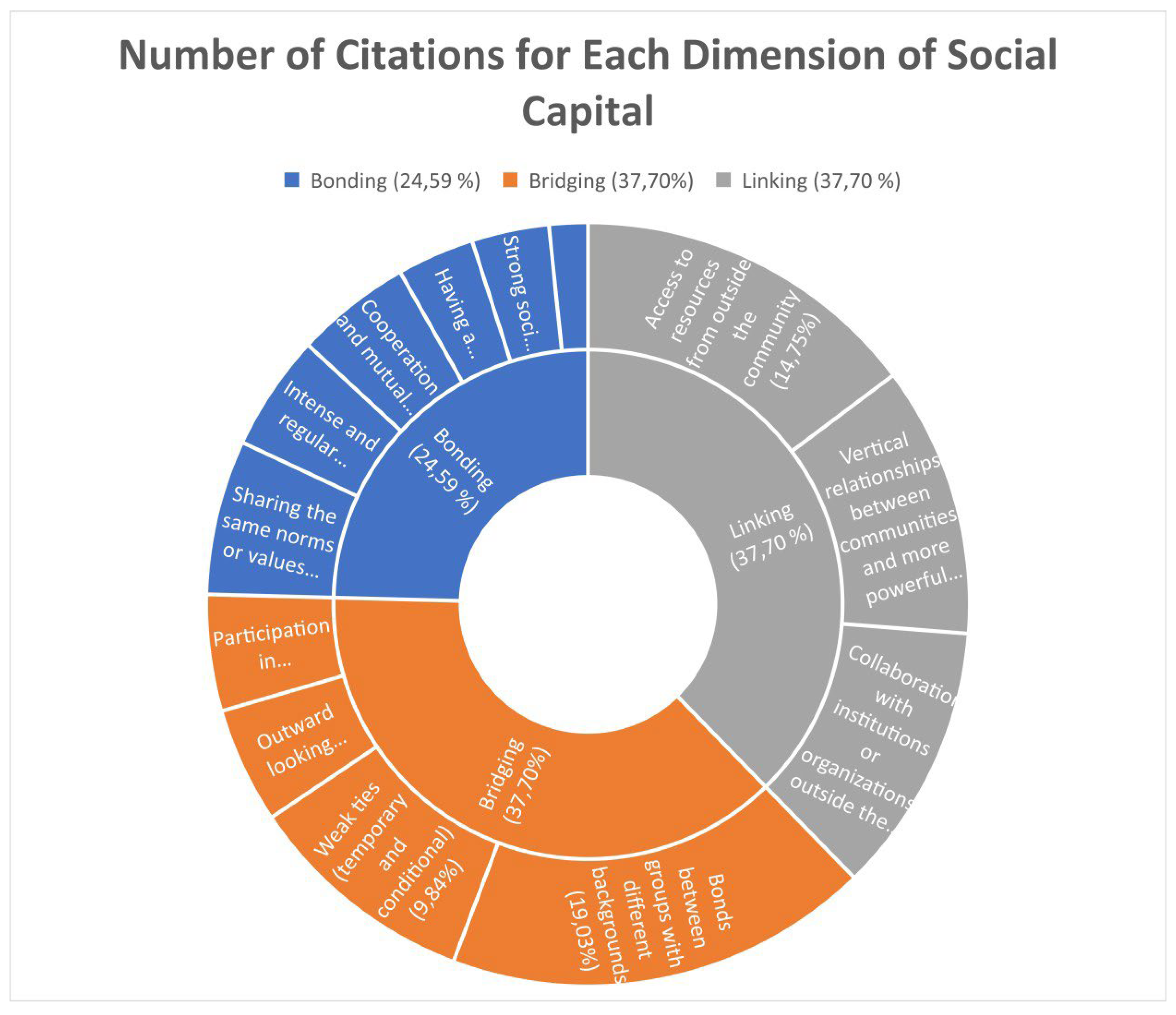
In the dimension of bonding, the topmost feature represents the sharing of norms or values, at 6.56 percent; this is followed by cooperation and mutual help at 4.92 percent; and intense and routine interaction also at 4.92 percent. On the bonding dimension, other determinants include a strong social tie in homogeneous groups at 3.28 percent, the same goal or interest that motivates members at 3.28 percent, and participation in group activities or organizations at 1.64 percent. This is a combination of traits that shows the intensity of social bonds and the feeling of cohesion in the homogeneous groups within Tengger.
On the other hand, ties across groups of different backgrounds characterize the bridging dimension, standing at 19.03% and indicating the relationship across groups that is very important to the people in Tengger society. Temporary and conditional ties are at 9.84%, participation in heterogeneous groupings or organizations at 4.92%, and an outward orientation also at 4.92% are other attributes defining the bridging dimension. All of these features indicate that the Tengger people are inclined to communicate with various groups and expand their social networks.
Regarding the linking dimension, access to resources from outside the community was most represented at 14.75%, followed by cooperation with institutions or organizations outside the community at 11.48%, and vertical relationships between the community and more powerful parties at 11.48%. This dimension shows how the aspects of the interconnectivity of the Tengger communities and their external linkages become important in terms of resources, influence, and power. Such networks allow the flow of resources, information, and support that are advantageous for community development and well-being.
The sunburst graph represents the multi-dimensional social capital of the Tengger community and the existence of several diverse layers. A balance between bonding, bridging, and linking represents an enabling social dynamic and points to a promise for inclusive development. One should, however, also consider the variations within each dimension and the particular characteristics that are most pronounced. The bonding dimension connotes the sharing of common norms and values, practicing cooperation, and mutual assistance as necessary ingredients for social cohesion. In relations between groups of dissimilar backgrounds, the bridging dimension remains crucial for network expansion and the creation of new opportunities. The linking dimension, where access and cooperation with extra-community institutions take place, has to be there for the development process to forge ahead. An appreciation of these nuances will go a long way in informing the design of more effective and sustainable interventions by policymakers, development practitioners, and other stakeholders that will strengthen social capital and holistically improve the welfare of the Tengger community.
Interactions between Social Capital and Sustainable Agriculture
The data presented in the table indicates a robust correlation between bonding, bridging, and linking social capital and the ecological, social, and economic dimensions of sustainable agriculture in Gubukklakah Village. The strong bonding social capital among the farmers of Gubukklakah has a beneficial impact on agricultural practices that give due consideration to ecological aspects. Ecological knowledge is transmitted between generations, natural resources are utilized and safeguarded wisely through collective action, and there is a value placed on mutual cooperation and sharing to ensure environmental sustainability. The existence of close social ties enables farmers to learn from one another, collaborate and organize themselves in the pursuit of sustainable agricultural practices. In terms of social capital, there is a notable strengthening of bonding relationships as a result of mutual assistance during the pandemic, the provision of self-help contributions for village ceremonies, and the equitable distribution of guests staying at private residences. In terms of economic aspects, bonding social capital facilitates the transfer of resources within the family, diversification of income based on family relations, and the sharing of information and capital among farmers.
Table 4.
Number of Interactions of Social Capital Dimensions and Sustainable Agriculture in Tengger Society.
Table 4.
Number of Interactions of Social Capital Dimensions and Sustainable Agriculture in Tengger Society.
| Ecology | Social | Economic | |
| Bonding | 26 | 27 | 29 |
| Bridging | 15 | 26 | 24 |
| Linking | 16 | 16 | 22 |
Source: Primary data analysis, 2024.
The development of social capital also constitutes an essential element in the pursuit of sustainable agriculture in Gubukklakah Village. From an ecological perspective, the concept of bridging is exemplified by water source conservation programs that encompass tree planting, the inspection of water pipes and discharge, and routine patrols to safeguard the forest. These initiatives are conducted in collaboration with governmental and Perhutani entities. However, the formation of weak bridging relationships, such as in the case of leasing apple land by individuals from outside the village who engage in exploitative cultivation practices, can have a detrimental impact on the long-term sustainability of the environment. From a social perspective, bridging relationships are established through regular coordination between the village forestry board and Perhutani, activities at the art studio, ‘nundan’ association meetings, and regular meetings of Ladesta members. In terms of economic matters, the establishment of bridging relationships has facilitated effective communication between the community and Perhutani during the pandemic, enabling the return to agricultural activities and the subsequent economic development of farmers through the formation of farmer groups. Furthermore, it has facilitated cooperation between middlemen and farmers in the provision of inputs and capital.
The concept of social capital is also of great importance in the context of sustainable agriculture, particularly in the case of Gubukklakah Village and its relationship to ecological issues. A collaborative effort is underway between Perhutani, the local community, and the National Park through HIPAM to conserve water sources. The allocation of Perhutani land use licenses is conducted through LMDH, with a profit-sharing system in place. Furthermore, regular meetings between Perhutani and relevant parties address ecological concerns, including the protection of water sources. In terms of social cohesion, there is a notable degree of coordination between Ladesta and Perhutani for events or traditional ceremonies, as well as joint reforestation activities between Perhutani and the community. In terms of the economy, government support is evident in the form of financial assistance for HIPAM, APBN funds for the development of tourism villages, and Perhutani's role in enabling communities to utilize specific zones within the TNBTS area for economic activities.
In conclusion, it can be stated that the three types of social capital (bonding, bridging, and linking) interact with each other and contribute to the realization of sustainable agriculture in Gubukklakah Village in terms of ecology, society, and economy. Bonding social capital provides a robust foundation for social cohesion, the transfer of knowledge and resources, and collective action. Bridging social capital facilitates the exchange of information and cooperation between groups and external parties. Conversely, linking social capital facilitates connections between communities and external support institutions, thereby facilitating access to external resources and encouraging multi-stakeholder synergies in agricultural and environmental management. However, it is essential to maintain equilibrium and regulate the interplay between these social modalities so that they can operate at their optimal level in supporting the sustainability of local agricultural systems.
From an ecological, social, and economic perspective, the data in Table 4 illustrates that bonding, bridging, and linking are three imperative dimensions of social capital for the realization of sustainable agriculture. The number of overlapping interview quotes for each dimension of social capital and sustainable agriculture gives an idea about the level of relevance and emphasis each aspect has been given with regard to the research conducted.
The Bonding dimension, therefore, seems quite vital in most aspects of sustainable agriculture, as it defines the density of connections within a group. Creating close ties in farming communities would easily enable the realization of feasible workable environmental management strategies, social cohesion, and economic collaboration that is symbiotic. Moreover, the Bridging dimension, which enables relationships among diverse groups, is instrumental in facilitating knowledge exchange, social inclusiveness, and economic opportunities. Finally, it has been argued that the Linking dimension-which connects farmers with supporting institutions to policy, research, empowerment, and access to capital and agricultural infrastructure.
The following table provides evidence that social capital is an important factor in the shift to more sustainable agriculture. These results therefore form a basis for designing interventions, such as strengthening farmer groups, partnerships among stakeholders, or increasing the involvement of supporting institutions. These nuances of social capital in sustainable agriculture will help both policymakers and practitioners move to ways of creating mechanisms that better allow the addressing of ecological, social, and economic goals within sustainable parameters.
Table 5.
Interaction of Social Capital Dimensions and Sustainable Agriculture in Tengger Society.
| Ecology | Social | Economic | |
| Bonding | The transfer of local agricultural and water management knowled ge through hereditary means The utilization of local labor (neighbors/ family) in agricultural activities The adoption of sustainable agricultural practices, including the use of organic fertilizer and intercropping The application of local wisdom for Environmental conservation, such as planting trees to prevent landslides |
Helping each other during the pandemic and the closure of tourist attractions Self-help contributions and gotong royon for village slametan Use of sufficient manure by apple farmers Hiring farm laborers from neighbours and families Equal distribution of homestay guests throughout the village |
Revenue sharing from homestay management and tour packages Joint land management by farmer groups Informal credit system for agricultural production facilities Division of tasks in the tourist village institution (Ladesta) Joint management of water resources (HIPAM) Cooperation between middlemen and farmers Tourism management by local villagers Association fees |
| Bridging | Regular coordination between Lawang Sari, LMDH, and Perhutani for land management Gubukklakah farmers learn apple cultivation from Nongkojajar and Poncokusumo farmers Community partnership with TNBTS through the Masyarakat Mitra Polhut and Masyarakat Peduli Api programmes Joint management of the Coban Pelangi water source by several villages 1000 tree planting program involving various parties Development of agro-tourism by LADESTA that connects agriculture with tourism LMDH and pine resin tappers The exchange of information between farmers on sustainable farming practices. |
The LMDH coordinates regularly with Perhutani, convening on Fridays for a legi meeting. The LMDH serves as a forum for villagers to engage with Perhutani. The Dance Studio "Lintang Pandu Sekar" facilitates children's activities. Nundan community meetings, held in five villages, address matters related to cleanliness and greening. Ladesta members convene regularly on Wednesdays to organize tourists |
Cooperation with over 40 travel agents in Jakarta Development of agro-tourism that connects local farmers with tourists Homestay system that connects local residents with tourists Cooperation with Perhutani through LMDH Marketing of agricultural products to Kalimantan and Papua Cooperation with investors outside the region Access to financial services such as KUR from BNI |
| Linking | Cooperation between TNBTS, Perhutani and the community to protect water sources through HIPAM Licensing system and profit sharing for farmers' use of Perhutani land through LMDH Annual monitoring of water sources by Perhutani and meetings with stakeholders Government support in the form of apple seed and storage facilities (cold storage) for farmers Management and evaluation of TNBTS with the community under the Ministry of Environment and Forestry Mechanism for Perhutani to apply for a water source extraction permit from the village government Collaboration between community and officials on forest fire management and prevention Support from the Department of Agriculture to develop apple products in the village |
Ladesta coordination with Perhutani regarding events or traditional ceremonies Perhutani meeting with related parties to discuss new water sources Joint reforestation activities between Perhutani and the community The existence of LMDH is a forum for coordinating vegetable farmers on Komplangan land related to Perhutani |
Access to BNI's KUR for business capital Government support for HIPAM APBN funds for the development of tourist villages Partnership between garlic farmers and companies Cultivation training from the Department of Agriculture and partner companies Government fertilizer subsidies Government support for homestay construction Perhutani permission to sell in tourist areas |
Source: Primary data analysis, 2024.
5. Discussion
The results of this study contribute to an in-depth awareness of the role of social capital in favoring agricultural sustainability in the Indonesian Tengger community. It is possible to highlight that the dimensions of bonding, bridging, and linking have a massive influence on ecological, social, and economic angles in sustainable agricultural practices. These findings confirm earlier studies that identified social capital as the very key to enabling sustainable natural resource management and the capacity to make farming communities resilient against foreseen impacts of climate change [59]; [60]; [61]. However, this research makes new contributions by elucidating complex interlinkages between diverse forms of social capital and their impacts on different dimensions of sustainability in mountain communities.
Social capital creation, marked by strong bonding amongst homogenous groups, appears to be an important driving force for sustaining eco-friendly farming and maintenance of social cohesion in Tengger groups. These groups are bound together with ties that help facilitate the intergenerational transfer of traditional ecological knowledge, judicious exploitation of natural resources, and the values of ‘gotong royong’ in environmental conservation. This finding also extends the previous studies that have identified bonding social capital as an important means through which problem-solving for collective action for conservation can be achieved [60]; [62]. On the other hand, this research also points to some negative effects of over-bonding, such as reluctance to implement exogenous innovations, that may need further consideration.
While on the other hand, social capital, as the building of bridges between groups, allows the differing groups to interact and promote better knowledge sharing for social cohesion, while fostering the development of economic opportunities within Tengger. Cooperation in the management of shared resources, such as water sources and forests, by villages and their involvement with cross-group organizations like LMDH and Ladesta demonstrate how significant bridging social capital is in uniting disparate groups in pursuit of common goals. These findings support previous studies that have identified bridging social capital as playing a positive role in the resilience of communities adapting to and coping with environmental and social change [63]; [64]; [59]. However, this study also demonstrated the challenges to maintaining bridging social capital by the decrease in frequency and intensity of group meetings and interest conflicts among stakeholders. These are the issues that must be resolved if the bridging of social capital is to be continued in the longer term.
The social capital bridging the communities with the outside institutions and resources brings in infrastructure development, capacity building, and access to markets for the farmers in Tengger. This was supplemented through collaboration with government agencies in the management of forests, such as Perhutani and TNBTS, and by the provision of the government itself through programs and funds for agricultural and tourism development-a portrait of how important these vertical linkages were. Indeed, these findings are supported by prior studies that have highlighted the critical role of linking social capital in providing access to resources, information, and support from formal institutions to the communities. Examples include [65]; [66]; [67]. This study also reveals tensions and power issues in the linking relationships that could potentially negatively impact community participation and empowerment if not addressed accordingly.
While this research provides important insights into how social capital has facilitated sustainable agriculture in the Tengger communities, this study does bear its limitations. This is first and foremost a single-case study within one geographic area. Thus, generalization of findings to the same or different contexts should be done with care. This study heavily relied on qualitative data from in-depth interviews that might be more prone to perception and social desirability biases. Future studies should use a mixed-method approach in which qualitative data is supplemented with quantitative data to give greater weight to their findings. After all, this is a cross-sectional study and represents only a point in time; as such, it cannot accurately reflect the dynamic features of social capital. Further, longitudinal studies can help better understand how social capital develops and impacts agricultural sustainability over time. The results of this study make its implications rather obvious for both theory and practice. From a purely theoretical point of view, the contribution is valuable for the fine-tuning of our knowledge about the role and interactions among different types of social capital in sustainable agriculture, with particular reference to mountain communities. The findings extend the conceptualization of social capital in the current literature by placing emphasis on the multi-dimensional and interconnected nature of bonding, bridging, and linking social capital [25]; [68]. This paper, in practical terms, draws from findings that can be used to develop better interventions and policies aimed at improving social capital and facilitating the transition toward sustainable agriculture. Such programs that focus more on the development of capacities in farmer groups, stakeholders cooperation, and linkages within the community, as well as support institutions, could be better approaches.
This paper has identified the critical role played by social capital in enabling agricultural sustainability amongst communities in Tengger, Indonesia. This research develops an in-depth understanding of complex dynamics and interlinkages among bonding, bridging, and linking social capital and how those affect different dimensions of sustainability. By so doing, it lays a sound basis for more holistic and contextualized intervention designs. Notwithstanding these constraints, the findings present a baseline from which further research and practical measures can be built on the potential of social capital to speed up the transition toward a more viable and resilient agricultural future.
6. Conclusions
This research has illustrated that social capital has played a decisive role in sustaining agriculture within the Indonesian Tengger community. The findings prove that bonding, bridging, and linking three dimensions of social capital play an indispensable role in enhancing sustainable agricultural practices from ecological, social, and economic perspectives. It is underlined that bonding social capital enables the transmission of traditional ecological knowledge and wise resource management practices. While bridging social capital provides a way of knowledge exchange among groups and escalates economic opportunities, linking social capital provides ways to access resources and obtain external institutional support. The findings develop an increasingly subtle understanding of the complex interrelations that exist among varied types of social capital and their impact on sustainability in mountain communities.
These findings have important implications both from a theoretical and practical point of view. Theoretically, this study contributes to new insights into the conceptualization of social capital in agricultural sustainability literature. Practically, such findings can be used in the elaboration of more efficient interventions and policies aimed at enhancing social capital in support of the transition to sustainable agriculture. The important contribution it makes is in building a better understanding of how social capital works to enhance resilience and sustainability across farming communities in mountainous regions, which generally face unique challenges related to socio-ecological vulnerability.
It would, however, be better if any follow-up studies use a comparative approach indeed suggested-embedding diverse geographical and socio-cultural contexts to enhance generalisability. Further, the use of a mixed-method approach with quantitative data would add greater validity to such findings. Such longitudinal studies may allow a more enhanced understanding of how the dynamics and social capital impact agricultural sustainability over time. It thus opens up possibilities for further investigations as to how social capital is harnessed towards bringing quicker transitions to more resilient and viable agriculture in diverse global contexts.
7. Patents
This section is not mandatory but may be added if there are patents resulting from the work reported in this manuscript.
Supplementary Materials
The following supporting information can be downloaded at the website of this paper posted on Preprints.org.
Author Contributions
Mas Ayu Ambayoen: developing ideas of research, coordinating research activities, data collection, analysis, writing; Kliwon Hidayat: developing ideas, supervising, analysis, writing: Yayuk Yuliati: analysis, writing, editing ; Edi Dwi Cahyono: writing, reviewing, editing and translating.
Funding
This research received no external funding.
Institutional Review Board Statement
The Ethical Clearance Letter of this study was approved by Faculty of Agriculture, Brawijaya University, No.3045/UN10.F04/TU/2023.
Informed Consent Statement
The approach of this article reports a qualitative study based on data collection through in-depth interviews, observations, and document analysis among different community members in the Tengger region. Informed consent was obtained from all participants before the commencement of the study. Further, participants were informed regarding the purpose, methodology, and expected outcomes of the research study, including assurance on confidentiality. Participation was strictly voluntary; moreover, an opportunity to withdraw at any time with no consequences was provided. No personal information identified participants in the publication of results so as not to violate privacy.
Data Availability Statement
The data presented in this study are available on request from Mas Ayu Ambayoen. The data are not publicly available due to ethical reasons.
Acknowledgments
Thank you to all Informants in Tengger who have been willing to provide the information needed during the research. In addition, thank you to Mr. Hery through the Scholar Lounge of the Brawijaya University Library who has provided assistance in writing journal articles.
Conflicts of Interest
The authors declare no conflicts of interest.
References
- Z. Yang, S. Yang, R. Yang, and Q. Wu, “A Study on Spatiotemporal Changes of Ecological Vulnerability in Yunnan Province Based on Interpretation of Remote Sensing Images,” Diversity, vol. 15, no. 9, 2023. [CrossRef]
- H. Li, Y. Hui, and J. Pan, “Evolution and Influencing Factors of Social-Ecological System Vulnerability in the Wuling Mountains Area,” Int. J. Environ. Res. Public Health, vol. 19, no. 18, 2022. [CrossRef]
- K. Thomas et al., “Explaining differential vulnerability to climate change: A social science review,” Wiley Interdiscip. Rev. Clim. Chang., vol. 10, no. 2, pp. 1–18, 2019. [CrossRef]
- H. A. Adrianto, D. V. Spracklen1, and S. R. Arnold, “Relationship between fire and forest cover loss in Riau Province, Indonesia between 2001 and 2012,” Forests, vol. 10, no. 10, pp. 1–19, 2019. [CrossRef]
- M. S. Rahman et al., “Climate Disasters and Subjective Well-Being among Urban and Rural Residents in Indonesia,” Sustain., vol. 14, no. 6, pp. 1–14, 2022. [CrossRef]
- B. Simane, B. F. Zaitchik, and J. D. Foltz, “Agroecosystem specific climate vulnerability analysis: application of the livelihood vulnerability index to a tropical highland region,” Mitig. Adapt. Strateg. Glob. Chang., vol. 21, no. 1, pp. 39–65, 2016. [CrossRef]
- H. Chen, J. Cao, H. Zhu, and Y. Wang, “Understanding Household Vulnerability and Relative Poverty in Forestry Transition: A Study on Forestry-Worker Families in China’s Greater Khingan Mountains State-Owned Forest Region,” Sustain., vol. 14, no. 9, 2022. [CrossRef]
- R. Vignola et al., “Ecosystem-Based Practices for Smallholders’ Adaptation to Climate Extremes: Evidence of Benefits and Knowledge Gaps in Latin America,” Agronomy, vol. 12, no. 10, 2022. [CrossRef]
- M. E. Conti, M. Battaglia, M. Calabrese, and C. Simone, “Fostering sustainable cities through resilience thinking: The role of nature-based solutions (NBSS): Lessons learned from two Italian case studies,” Sustain., vol. 13, no. 22, 2021. [CrossRef]
- Sumarmi, “Understanding the Forest Conservation Society actions ‘Tengger’ ethnic Based Local Wisdom ‘Sesanti Panca Setya’ in East Java - the Republic of Indonesia,” pp. 1623–1627, 2018. [CrossRef]
- S. Utami, Antariksa, and D. K. Santoso, “Local Wisdom of Farmers in Ngadas Village, Malang Regency in the Management of Agricultural Landscapes,” pp. 65–68, 2020. [CrossRef]
- M. Ismanto, N. Kumoro, H. Kadir, and I. Martias, “Continuity and Change in the Midst of Ecological and Livelihood Transformation in Tengger East Java,” Proc. 1st Int. Semin. Cult. Sci. ISCS 2020, 4 Novemb. 2020, Malang, Indones., 2021. [CrossRef]
- O. H. Nurcahyono, “Social Capital of Indigenous Village Communities in Maintaining Social Harmony (Case Study of The Tenggerese Indigenous Community, Tosari, Pasuruan, East Java),” Proc. Int. Conf. Rural Stud. Asia (ICoRSIA 2018), 2019. [CrossRef]
- U. Romadi, K. Hidayat, K. Sukesi, and Y. Yuliati, “Reconstruction of the Social Capital-Based Agricultural Extension System in the Tengger Tribe Society in Tosari, Pasuruan, East Java, Indonesia,” AGRIEKONOMIKA, 2021. [CrossRef]
- D. Susanto, P. Nugroho, and S. Numata, “Traditional ecological knowledge for monitoring Anaphalis javanica (DC.) Sch.Bip. (Asteraceae) in Bromo Tengger Semeru National Park, Indonesia,” Environ. Monit. Assess., vol. 196, no. 8, 2024. [CrossRef]
- D. N. Rahman et al., “Muslim-Hindu Cooperation in Addressing Social Problems in the Tengger Tribe in East Java, Indonesia,” J. Multidisiplin Madani, 2023. [CrossRef]
- Y. Zhao, X. Zhang, W. Jiang, and T. Feng, “Does second-order social capital matter to green innovation? The moderating role of governance ambidexterity,” Sustain. Prod. Consum., vol. 25, pp. 271–284, 2021. [CrossRef]
- K. O. Olagunju, A. I. Ogunniyi, Z. Oyetunde-Usman, A. O. Omotayo, and B. A. Awotide, “Does agricultural cooperative membership impact technical efficiency of maize production in Nigeria: An analysis correcting for biases from observed and unobserved attributes,” PLoS One, vol. 16, no. 1 January, pp. 1–22, 2021. [CrossRef]
- L. O. Olarinde et al., “The influence of social networking on food security status of cassava farming households in Nigeria,” Sustain., vol. 12, no. 13, pp. 1–35, 2020. [CrossRef]
- M. I. Nor Diana, N. A. Zulkepli, C. Siwar, and M. R. Zainol, “Farmers’ Adaptation Strategies to Climate Change in Southeast Asia: A Systematic Literature Review,” Sustain., vol. 14, no. 6, 2022. [CrossRef]
- E. Von Essen and M. P. Allen, “The republican zoopolis towards a new legitimation framework for relational animal ethics,” Ethics Environ., vol. 21, no. 1, pp. 61–88, 2016. [CrossRef]
- L. T. H. Phuong, T. D. Tuan, and N. T. N. Phuc, “Transformative social learning for agricultural sustainability and climate change adaptation in the Vietnam Mekong Delta,” Sustain., vol. 11, no. 23, 2019. [CrossRef]
- I. Pérez-Ramírez, M. García-Llorente, C. Saban de la Portilla, A. Benito, and A. J. Castro, “Participatory collective farming as a leverage point for fostering human-nature connectedness,” Ecosyst. People, vol. 17, no. 1, pp. 222–234, 2021. [CrossRef]
- I. Z. A. D. P. No, J. K. Hellerstein, and D. Neumark, “DISCUSSION PAPER SERIES Social Capital , Networks , and Economic Wellbeing Social Capital , Networks , and Economic Wellbeing,” no. 13413, 2020.
- T. Claridge, “Functions of social capital – bonding, bridging, linking,” Soc. Cap. Res., pp. 1–7, 2018. [CrossRef]
- E. Villalonga-Olives, E. Villalonga-Olives, and I. Kawachi, “The measurement of bridging social capital in population health research.,” Health Place, vol. 36, pp. 47–56, 2015. [CrossRef]
- B. Rudito, M. Famiola, and P. Anggahegari, “Corporate Social Responsibility and Social Capital: Journey of Community Engagement toward Community Empowerment Program in Developing Country,” Sustain., vol. 15, no. 1, 2023. [CrossRef]
- T. Claridge, “Introduction to Social Capital Theory,” Soc. Cap. Res., no. August, pp. 2–9, 2018, [Online]. Available: https://www.socialcapitalresearch.com/wp-content/uploads/edd/2018/08/Introduction-to-Social-Capital-Theory.pdf.
- D. Salman, K. Kasim, A. Ahmad, and N. Sirimorok, “Combination of bonding, bridging and linking social capital in a livelihood system: Nomadic duck herders amid the covid-19 pandemic in South Sulawesi, Indonesia,” For. Soc., vol. 5, no. 1, pp. 136–158, 2021. [CrossRef]
- S. Myeong and H. Seo, “Which type of social capital matters for building trust in government? Looking for a new type of social capital in the governance era,” Sustainability (Switzerland), vol. 8, no. 4. 2016. [CrossRef]
- R. L. Hawkins and K. Maurer, “Bonding, bridging and linking: How social capital operated in New Orleans following Hurricane Katrina,” Br. J. Soc. Work, vol. 40, no. 6, pp. 1777–1793, 2010. [CrossRef]
- Z. Wang, X. Deng, C. Wong, Z. Li, and J. Chen, “Learning urban resilience from a social-economic-ecological system perspective: A case study of Beijing from 1978 to 2015,” J. Clean. Prod., vol. 183, pp. 343–357, May 2018. [CrossRef]
- R. Terano, Z. Mohamed, M. N. Shamsudin, and I. A. Latif, “Factors influencing intention to adopt sustainable agriculture practices among paddy farmers in Kada, Malaysia,” Asian J. Agric. Res., vol. 9, no. 5, pp. 268–275, 2015. [CrossRef]
- A. Azman, J. L. D’Silva, B. A. Samah, N. Man, and H. A. M. Shaffril, “Relationship between attitude, knowledge, and support towards the acceptance of sustainable agriculture among contract farmers in Malaysia,” Asian Soc. Sci., vol. 9, no. 2, pp. 99–105, 2013. [CrossRef]
- F. Sikandar, V. Erokhin, L. Xin, M. Sidorova, A. Ivolga, and A. Bobryshev, “Sustainable Agriculture and Rural Poverty Eradication in Pakistan: The Role of Foreign Aid and Government Policies,” Sustainability (Switzerland), vol. 14, no. 22. 2022. [CrossRef]
- J. Weiner, “Applying plant ecological knowledge to increase agricultural sustainability,” J. Ecol., vol. 105, no. 4, pp. 865–870, 2017. [CrossRef]
- J. Cao and Y. A. Solangi, “Analyzing and Prioritizing the Barriers and Solutions of Sustainable Agriculture for Promoting Sustainable Development Goals in China,” Sustain., vol. 15, no. 10, 2023. [CrossRef]
- R. Waseem, G. E. Mwalupaso, F. Waseem, H. Khan, G. M. Panhwar, and Y. Shi, “Adoption of sustainable agriculture practices in banana farm production: A study from the Sindh Region of Pakistan,” Int. J. Environ. Res. Public Health, vol. 17, no. 10, 2020. [CrossRef]
- Q. Guo, O. Ola, and E. O. Benjamin, “Determinants of the adoption of sustainable intensification in southern african farming systems: A meta-analysis,” Sustain., vol. 12, no. 8, pp. 1–13, 2020. [CrossRef]
- S. C. Sharna, A. R. Anik, S. Rahman, and M. A. Salam, “Impact of Social, Institutional and Environmental Factors on the Adoption of Sustainable Soil Management Practices: An Empirical Analysis from Bangladesh,” Land, vol. 11, no. 12, 2022. [CrossRef]
- M. Hildeń, P. Jokinen, and J. Aakkula, “The sustainability of agriculture in a northern industrialized country - From controlling nature to rural development,” Sustainability, vol. 4, no. 12, pp. 3387–3403, 2012. [CrossRef]
- D. Tilman, M. Clark, D. R. Williams, K. Kimmel, S. Polasky, and C. Packer, “Future threats to biodiversity and pathways to their prevention,” Nature, vol. 546, no. 7656, pp. 73–81, 2017. [CrossRef]
- M. S. Meier, F. Stoessel, N. Jungbluth, R. Juraske, C. Schader, and M. Stolze, “Environmental impacts of organic and conventional agricultural products - Are the differences captured by life cycle assessment?,” J. Environ. Manage., vol. 149, pp. 193–208, 2015. [CrossRef]
- L. C. Ponisio, L. K. M’gonigle, K. C. Mace, J. Palomino, P. De Valpine, and C. Kremen, “Diversification practices reduce organic to conventional yield gap,” Proc. R. Soc. B Biol. Sci., vol. 282, no. 1799, 2015. [CrossRef]
- L. S. Rawat et al., “Rejuvenating ecosystem services through reclaiming degraded land for sustainable societal development: Implications for conservation and human wellbeing,” Land use policy, vol. 112, Jan. 2022. [CrossRef]
- S. H. Khwidzhili, R. H.2 & Worth, “THE SUSTAINABLE AGRICULTURE IMPERATIVE: IMPLICATIONS FOR SOUTH AFRICAN AGRICULTURAL EXTENSION,” South African J. Agric. Ext., vol. 44, 2016. [CrossRef]
- M. F. Ruslan and H. Khalid, “Unpacking Social Capital as a Determinant of Sustainable Agriculture Adoption: A Literature Review,” Int. J. Acad. Res. Bus. Soc. Sci., 2023. [CrossRef]
- L. Widjayanthi, “Learning From Community Practices: Social Capital of Farming Communities in Supporting Sustainable Agriculture,” J. La Lifesci, 2024. [CrossRef]
- P. Hinduja, R. F. Mohammad, S. Siddiqui, S. Noor, and A. Hussain, “Sustainability in Higher Education Institutions in Pakistan: A Systematic Review of Progress and Challenges,” Sustain., vol. 15, no. 4, pp. 1–19, 2023. [CrossRef]
- C. K. Lim, M. S. Haufiku, K. L. Tan, M. Farid Ahmed, and T. F. Ng, “Systematic Review of Education Sustainable Development in Higher Education Institutions,” Sustain., vol. 14, no. 20, pp. 1–22, 2022. [CrossRef]
- S. R. Al-Nuaimi and S. G. Al-Ghamdi, “Assessment of Knowledge, Attitude and Practice towards Sustainability Aspects among Higher Education Students in Qatar,” Sustain., vol. 14, no. 20, 2022. [CrossRef]
- V. M. Adams, R. L. Pressey, and J. G. Álvarez-Romero, “Using optimal land-use scenarios to assess trade-offs between conservation, development, and social values,” PLoS One, vol. 11, no. 6, pp. 1–20, 2016. [CrossRef]
- S. Kalogiannidis, D. Kalfas, G. Giannarakis, and M. Paschalidou, “Integration of Water Resources Management Strategies in Land Use Planning towards Environmental Conservation,” Sustain., vol. 15, no. 21, pp. 1–20, 2023. [CrossRef]
- M. M. Bayramoglu and A. I. Kadiogullari, “Analysis of land use change and forestation in response to demographic movement and reduction of forest crime,” Eurasia J. Math. Sci. Technol. Educ., vol. 14, no. 1, pp. 225–238, 2018. [CrossRef]
- Z. Hloušková, M. Lekešová, A. Prajerová, and T. Doucha, “Assessing the Economic Viability of Agricultural Holdings with the Inclusion of Opportunity Costs,” Sustainability (Switzerland), vol. 14, no. 22. 2022. [CrossRef]
- K. Smedzik-Ambrozy, M. Guth, S. Stepień, and A. Brelik, “The influence of the European union’s common agricultural policy on the socio-economic sustainability of farms (the case of Poland),” Sustain., vol. 11, no. 24, 2019. [CrossRef]
- C. Weng et al., “Assessing the vulnerability to climate change of a semi-arid pastoral social–ecological system: A case study in Hulunbuir, China,” Ecol. Inform., vol. 76, no. May, p. 102139, 2023. [CrossRef]
- M. Naderifar, H. Goli, and F. Ghaljaie, “Snowball Sampling: A Purposeful Method of Sampling in Qualitative Research,” Strides Dev. Med. Educ., vol. 14, no. 3, 2017. [CrossRef]
- D. Phelps and D. Kelly, “A call for collaboration: Linking local and non-local rangeland communities to build resilience,” Rangel. J., vol. 42, no. 5, pp. 265–275, 2020. [CrossRef]
- M. Call and P. Jagger, “Social capital, collective action, and communal grazing lands in Uganda,” Int. J. Commons, vol. 11, no. 2, pp. 854–876, 2017. [CrossRef]
- E. E. W. Termeer, K. Soma, N. Motovska, O. I. Ayuya, M. Kunz, and T. Koster, “Sustainable Development Ensued by Social Capital Impacts on Food Insecurity: The Case of Kibera, Nairobi,” Sustain., vol. 14, no. 9, 2022. [CrossRef]
- A. Hoppe, I. Fritsche, and P. Chokrai, “The ‘I’ and the ‘We’ in Nature Conservation—Investigating Personal and Collective Motives to Protect One’s Regional and Global Nature,” Sustain., vol. 15, no. 5, 2023. [CrossRef]
- F. A. Johnson, M. J. Eaton, J. Mikels-Carrasco, and D. Case, “Building adaptive capacity in a coastal region experiencing global change,” Ecol. Soc., vol. 25, no. 3, pp. 1–22, 2020. [CrossRef]
- J. C. Jordan, “Swimming alone? The role of social capital in enhancing local resilience to climate stress: a case study from Bangladesh,” Clim. Dev., vol. 7, no. 2, pp. 110–123, 2015. [CrossRef]
- T. Fu and S. Mao, “Individual Social Capital and Community Participation: An Empirical Analysis of Guangzhou, China,” Sustain., vol. 14, no. 12, pp. 1–14, 2022. [CrossRef]
- E. Giovannetti, P. Bertolini, and M. Russo, “Rights, commons, and social capital: The role of cooperation in an italian agri-food supply chain,” Sustain., vol. 13, no. 21, 2021. [CrossRef]
- P. Cheevapattananuwong, C. Baldwin, A. Lathouras, and N. Ike, “Social capital in community organizing for land protection and food security,” Land, vol. 9, no. 3, 2020. [CrossRef]
- G. H. Xie, L. P. Wang, and B. F. Lee, “Understanding the Impact of Social Capital on Entrepreneurship Performance: The Moderation Effects of Opportunity Recognition and Operational Competency,” Front. Psychol., vol. 12, no. June, 2021. [CrossRef]
Disclaimer/Publisher’s Note: The statements, opinions and data contained in all publications are solely those of the individual author(s) and contributor(s) and not of MDPI and/or the editor(s). MDPI and/or the editor(s) disclaim responsibility for any injury to people or property resulting from any ideas, methods, instructions or products referred to in the content. |
© 2024 by the authors. Licensee MDPI, Basel, Switzerland. This article is an open access article distributed under the terms and conditions of the Creative Commons Attribution (CC BY) license (http://creativecommons.org/licenses/by/4.0/).
Copyright: This open access article is published under a Creative Commons CC BY 4.0 license, which permit the free download, distribution, and reuse, provided that the author and preprint are cited in any reuse.


