

Submitted:
03 May 2025
Posted:
06 May 2025
You are already at the latest version
Abstract
Grappling with post-mining ecological degradation, soil destabilation, and socio-economic exclusion, this study develops a performance measurement model for sustainable post-mining land reclamation in Indonesia, grounded in the principles of Triple Bottom Line (TBL) land governance. Using cacao-based agriculture as a compensation and regeneration strategy, the study applies a qualitative meta-synthesis of 773 scholarly and institutional remarks, analyzed using a two-level NVivo coding structure comprising 10 parent nodes and 80 child nodes. Five theoretical pillars—Corporate Social Responsibility (CSR), Stakeholder Theory, Legitimacy Theory, the Theory of Planned Behavior (TPB), and the TBL approach—inform the analysis and support the development of a new conceptual framework: TILANG (Triple-Bottom-Line Integrated Land Governance). TILANG reframes post-mining sustainability as a governance challenge, emphasizing the interaction of institutional alignment, behavioral readiness, stakeholder collaboration, land justice, and farmer empowerment. Findings show that cacao-based agroforestry not only restores ecological functions but also delivers livelihood recovery, stakeholder legitimacy, and economic revitalization. The resulting model translates these interlinked elements into a practical TBL-aligned governance framework, enabling governments, companies, and local actors to co-design sustainable transitions in post-extractive landscapes.
Keywords:
post-mining land reclamation
; sustainable cacao agriculture
; land governance
; TILANG theory
; stakeholder collaboration
; land-use transformation
; institutional legitimacy
; farmer empowerment
; environmental restoration
; Theory of Planned Behavior (TPB)
1. Introduction
The rapid expansion of urban infrastructure and extractive industries—particularly mining—has led to significant degradation of productive agricultural land in Indonesia, posing serious risks to national food security and environmental resilience. According to the Ministry of Agriculture, between 60,000 and 80,000 hectares of cropland are lost annually, equivalent to a five-year reduction of nearly 2.4 million tons of rice [1]. At the same time, regions such as Sulawesi, Kalimantan, and West Nusa Tenggara are grappling with post-mining ecological degradation, soil destabilization, and socio-economic exclusion [2,3].
As a response, integrated land-use strategies that combine rehabilitation, livelihood recovery, and ecological productivity are gaining traction. One promising option is cacao-based agroforestry. Theobroma cacao, a deep-rooted perennial, grows well in marginal soils, improves biodiversity, and strengthens soil health while generating stable incomes for smallholder farmers. Indonesia’s global prominence as a top-three cacao producer supports the feasibility of this strategy [4,5,6]. An analysis of 773 literature-based remarks in this study confirms cacao’s suitability for post-mining land use. These remarks consistently affirm cacao’s role in ecological restoration and its capacity to support rural livelihoods. Evidence shows that cacao cultivation helps restore vegetation and provides economic stability for local communities [7]. The crop’s cultural familiarity, minimal input requirements, and alignment with traditional farming practices further enhance its social acceptability [8].
Corporate Social Responsibility (CSR) has also emerged as a critical institutional mechanism for supporting sustainability in post-mining zones. Mining companies in Indonesia are increasingly expected to fund ecological restoration and socio-economic recovery through CSR programs, beyond their legal obligations [9,10]. When well-integrated with community needs and executed transparently, CSR programs can fund infrastructure, vocational training, and alternative livelihoods. Conversely, their absence often results in environmental neglect and social dislocation [11,12].
This study uses Stakeholder Theory and Legitimacy Theory to understand the governance conditions necessary for successful reclamation. Stakeholder Theory emphasizes collaborative roles between companies, communities, and government actors [13,14] while Legitimacy Theory underlines the importance of public trust and institutional credibility for project sustainability [15]. Research from South Kalimantan demonstrates that participatory planning, responsiveness, and cultural adaptation play a decisive role in building legitimacy and enhancing reclamation outcomes [16].
The Theory of Planned Behavior (TPB) complements these insights by examining how smallholder Fisher farmers decide to adopt sustainable cacao farming. TPB holds that behavior is influenced by attitudes, subjective norms, and perceived control [17]. In Indonesian rural settings, social networks, labor availability, and perceived livelihood gains are powerful motivators for agroforestry adoption [18]. These findings support the inclusion of behavioral analysis in sustainability modeling.
Government agencies complement corporate efforts by providing regulatory oversight and technical support. The Ministry of Forestry enforces restoration standards, while the Ministry of Energy and Mineral Resources (ESDM) monitors mine closure compliance. The Ministry of Agriculture supports land conversion efforts through fertility mapping, agroforestry promotion, and extension services. Despite these initiatives, overlapping mandates have often led to fragmented policies and implementation gaps [19,20]. The Ministry of Environment and Forestry continues to advocate for integrated approaches to land rehabilitation and climate resilience [21]. Recognizing the complexity of post-mining reclamation, this study adopts the Triple Bottom Line (TBL) framework to evaluate sustainability outcomes across environmental, social, and economic pillars [22,23]. The framework is validated through over 200 literature-based references and measures outcomes like soil health, female farmer participation, and income diversification. Its local adaptability makes it well suited to capture the nuances of cacao-based reclamation [24].
The study serves a dual purpose. First, it introduces a performance measurement model rooted in TBL that integrates CSR practice, institutional roles, and behavioral factors. This model is positioned as a strategic response to Indonesia’s land-use transitions under industrial and decentralization pressures. Second, it reframes cacao cultivation not simply as a sustainability tool, but as a compensatory mechanism for land loss caused by industrial expansion. Cacao-based reclamation is further positioned as a catalyst for rural transformation. By linking ecological recovery with economic opportunity and trust-building, the model promotes sustainable governance. Embedding TBL indicators within a framework informed by CSR, TPB, and stakeholder engagement makes it replicable and actionable in other post-mining areas.
The core innovation of this research lies in framing cacao cultivation as a deliberate and strategic policy tool—one that compensates for systemic agricultural land loss while advancing community legitimacy and sustainability. This reconceptualization expands the scope of land reclamation from mere ecological repair to regenerative development. Ultimately, the study aims to offer both a conceptual roadmap and practical tools for governments, CSR actors, and development practitioners. Grounded in 773 qualitative insights, it proposes a replicable strategy for institutionalizing sustainable, community-driven cacao cultivation on post-mining land.
2. Materials and Methods
This study employs a theory-informed qualitative meta-synthesis to develop a performance measurement model for sustainable cacao-based land reclamation in post-mining areas. Drawing on 773 literature-derived remarks, the methodology integrates multiple conceptual frameworks—CSR, Stakeholder Theory, Legitimacy Theory, TPB, and the Triple Bottom Line (TBL)—to guide both coding and model construction. A structured analytical process using NVivo software enabled thematic consistency across 10 parent nodes and 80 child codes, while the conceptual framework provided a bridge between institutional inputs, behavioral drivers, and sustainability outcomes. Together, these methods establish a rigorous foundation for synthesizing qualitative data into a practical, theory-driven model.
2.1. Research Design
This study employs a qualitative meta-synthesis methodology to construct a performance measurement model for sustainable post-mining land reclamation, focusing on cacao-based agroforestry. Combining systematic literature review, thematic coding using NVivo 12, and theory-based model refinement, the methodology integrates CSR, TBL, Stakeholder Theory, TPB, and Legitimacy Theory. This explorative and interpretive approach allows diverse knowledge forms to be synthesized into a coherent analytical framework.
Data Sources and Selection Criteria. The primary dataset consists of 773 synthesized remarks drawn from 1,235 academic and institutional sources published between 1956 and 2024. Sources include peer-reviewed journals, dissertations, books, and official reports, accessed through platforms such as Scopus, Google Scholar, SpringerLink, and national repositories. Each remark represents a synthesized finding or recommendation from a single source. Remarks were collected between December 2022 and March 2025 and stored in a structured MS Access database. The database was relationally organized across four tables (Journal, Circulation, Article, DetailedStudy) and verified through paragraph count to ensure 773 unique entries. These remarks were then imported into NVivo for coding. In this study, the remarks become respondents. A two-level node structure was developed in NVivo: 10 parent nodes with 8 child nodes each, totaling 80 codes. Child node keywords were used in NVivo’s synonym-enabled search function to perform initial auto-coding. Manual corrections ensured accuracy between search reports and actual reference counts. Alternative phrasings were used when keywords returned zero hits (e.g., “community-led reclamation” was expanded to include “participatory reclamation” and related terms). This refined coding process allowed comprehensive thematic coverage.
Conceptual Research Framework. A conceptual research framework guides this study. CSR serves as the organizational entry point and feeds into three key theoretical mediators—Stakeholder Theory, Legitimacy Theory, and the Theory of Planned Behavior (TPB). These mediate the operationalization of sustainability practices via the Triple Bottom Line (TBL), which in turn leads to the intended transformation outcome: Sustainable Cacao Agriculture on post-mining land. This model encapsulates the theoretical alignment between institutional inputs, behavioral change mechanisms, and ecological-economic objectives. The conceptual framework integrates CSR (as the organizational entry point), TBL (as sustainability enablers), Stakeholder and Legitimacy Theories (as mediators), and Sustainable Cacao Agriculture (as the transformation goal). Each theory informed the coding categories in NVivo and guided thematic analysis. Stakeholder Theory emphasizes inclusive engagement; Legitimacy Theory highlights trust and social alignment; TPB explains how norms, control, and intention shape farmer behavior. These mediate the translation of CSR initiatives into sustainable agricultural outcomes. The model aligns with sustainable development principles, connecting ecological restoration with community empowerment through cacao farming.
Figure 1 present the conceptual research framework. To further refine and validate the conceptual research framework, this study adopts a synthesis methodology influenced by the meta-ethnographic approach of Noblit and Dwight [25], combined with the abductive reasoning and theory-centered approach proposed by Collins and Stockton [26]. The Noblit framework emphasizes interpretive translation—wherein key concepts from one study are reinterpreted in the context of others—allowing themes and constructs to be reciprocally translated into a coherent whole. In this tradition, the framework is developed through seven interpretive phases: (1) Getting started, (2) Selecting relevant studies, (3) Reading the studies, (4) Determining how the studies are related, (5) Translating the studies into one another, (6) Synthesizing translations, and (7) Expressing the synthesis. Anchored in Collins and Stockton’s [26] view that theory permeates all stages of qualitative research—from epistemological stance to analytic coding—the final coding structure is explicitly linked to the study’s theoretical lens. The ten parent nodes thus represent the outcome of both “reciprocal translation” and theoretically informed reasoning, embedding conceptual coherence within an abductive and iterative process of framework development.
Alternatively, this process can be framed wholly within the abductive synthesis tradition of Timmermans and Tavory [27], which bridges the theoretical lens and empirical reality by guiding the reconfiguration of preliminary ideas when confronted with new or dissonant data. Through repeated comparison and reflection, a refined framework emerged that not only remained loyal to the theoretical propositions but also resonated with the patterns and anomalies revealed through coding. Together, these approaches enabled the conceptual framework to evolve organically as both a diagnostic and planning tool.
The integration of these two perspectives ensured that the conceptual framework was neither imposed nor abstracted, but rather emerged from the systematic translation of theory into actionable themes and categories. The choice to define eight child nodes under each of the ten parent nodes was both a strategic and methodological decision grounded in the principle of thematic saturation, conceptual granularity, and analytical tractability. As Linneberg and Koorsgard [28] emphasize, effective coding structures require a balance between comprehensiveness and manageability, particularly when seeking to maintain transparency and rigor in qualitative data analysis. Organizing coding frameworks with a moderate number of subnodes allows researchers to navigate the tension between inductive detail and deductive structure—ensuring both depth and focus across themes. The number eight thus aligns with the practical goal of facilitating systematic cross-case comparison while minimizing analytical fragmentation. Academically, it draws from guidance that promotes clarity and coherence in qualitative coding hierarchies to enhance the reliability and interpretability of findings [29,30].
The following academic rationales support the application of eight child nodes for each parent theme:
- Triple Bottom Line Outcome: Includes sustainability performance indicators across environmental, economic, and social dimensions, aligned with the TBL framework [52].
The thematic depth provided by eight subcategories ensures that each parent domain—such as behavioral change or institutional roles—is explored through nuanced, empirically observable practices. Moreover, this approach facilitates consistent replication in future qualitative studies seeking to apply this model to other post-extractive landscapes. To operationalize this framework, the study established a total of 10 parent nodes—each representing a key dimension of post-mining sustainability—and 80 child nodes that capture specific institutional practices, governance mechanisms, behavioral factors, and environmental outcomes related to sustainable cacao-based reclamation. These 80 child nodes reflect a comprehensive coding taxonomy that facilitated both thematic analysis and performance model design. The complete list and structure of all parent and child nodes are provided in Appendix A and Appendix B. Appendix A contains conceptual definitions for the ten parent nodes, while Appendix B presents a tabulated list of the 80 child nodes arranged under their respective categories. Together, these appendices offer a clear reference to the analytical framework that supports the model’s development. This coding framework—comprising a hierarchy of 10 parent nodes and 80 child nodes—ensures comprehensive thematic coverage and analytical consistency across institutional, behavioral, environmental, and economic dimensions of post-mining sustainability. With this architecture and conceptual foundation in place, the subsequent analytical procedures were undertaken in a structured sequence, as outlined in the following subsections.
2.2. Analytical Procedures
To translate theoretical concepts into measurable themes, this study developed a coding framework grounded in abductive reasoning and empirical refinement. The process involved constructing structured nodes based on core sustainability dimensions, then applying NVivo-assisted thematic analysis to synthesize insights from 773 qualitative remarks. This section outlines how coding categories were formed, applied, and validated to support the construction of an empirically grounded, theory-informed sustainability model.
Coding Framework Development Based on the conceptual model previously described, an abductive synthesis approach was used to build the coding system. This integrated theoretical guidance with empirical insights from 773 remarks. The resulting structure included 10 parent nodes and 80 child nodes across themes such as CSR Governance, Economic Revitalization, Environmental Restoration, Farmer Empowerment, and Sustainable Cacao Agriculture. Each parent node captured a core dimension of post-mining sustainability, while the child nodes reflected granular practices and institutional mechanisms. The structure ensured thematic consistency and traceability during coding.
Thematic Coding and Meta-Synthesis Table 1 presents the consolidated results of NVivo-based thematic coding, offering a structured summary of how each parent node contributes to the overarching sustainability framework, and it serves as a key empirical foundation for the model-building process. Each thematic category is defined not only by its conceptual focus but also by empirical frequency and illustrative quotations extracted from the dataset. This synthesis enables transparency and enhances conceptual fidelity by showing how theoretical models were operationalized through qualitative data. The frequency column indicates the volume of coded references, which reinforces thematic density, while the representative examples demonstrate grounded insights from stakeholders involved in post-mining land use and cacao-based reclamation. By summarizing theoretical categories alongside representative data, the table bridges conceptual design and grounded insight, reinforcing the analytical coherence of the overall model.
This high volume of coding enabled the research to maintain strong fidelity to the conceptual framework. The structured and theory-aligned coding taxonomy ensured that each remark could be accurately interpreted within its relevant thematic and theoretical domain. As a result, the study was able to generate insights that are both contextually embedded and analytically robust, facilitating a grounded synthesis of sustainability practices specific to post-mining reclamation.
The coded outputs summarized in Table 1 served not only as thematic descriptors but also as the analytical foundation from which the study’s performance model was derived. These insights laid the groundwork for translating theoretical constructs into observable and actionable sustainability outcomes, thereby strengthening the empirical foundation of the model presented in Figure 2.
The NVivo-based thematic coding process yielded a total of 6,964 open codes, averaging approximately nine per remark. This high volume reflects the analytical richness and multi-dimensional nature of the dataset. The coding revealed strong thematic interconnections across the 10 parent nodes, with recurring cross-node patterns—particularly between behavioral readiness, institutional roles, and environmental outcomes. Memoing and iterative comparison during the coding phase allowed for deep pattern recognition, while NVivo’s matrix and frequency tools enabled systematic identification of dominant and emerging themes. This thematic granularity served as a foundational layer for building the model presented in Figure 2 later on in the next subsection, ensuring that the final synthesis was both theory-informed and empirically grounded. Themes were synthesized into conceptual clusters that served as the basis for the proposed model. These clusters represented input variables, mediators, and outcomes in a pathway toward sustainable post-mining land use.
Figure 2 illustrates the TBL-based performance measurement model developed through the meta-synthesis. CSR acts as the entry point, enabling stakeholder engagement and behavioral shifts through TPB, Stakeholder Theory, and Legitimacy Theory. These lead to actionable sustainability interventions across environmental, economic, and social domains, ultimately achieving the goal of sustainable cacao agriculture on post-mining land. The model integrates institutional structures, farmer readiness, collaborative governance, and environmental accountability into a cohesive framework for long-term impact.
Thematic synthesis followed five methodical stages that translated the 773 remarks into a theory-informed performance model:
- Framework Design: This initial stage involved the construction of a theoretical and conceptual framework derived from an integration of Corporate Social Responsibility (CSR), Triple Bottom Line (TBL), Stakeholder Theory, the Theory of Planned Behavior (TPB), and Legitimacy Theory. These foundational perspectives informed the classification of parent and child nodes, ensuring conceptual alignment between empirical data and theoretical constructs. The structure was designed to cover ecological, institutional, behavioral, and socio-economic themes relevant to post-mining sustainability.
- Data Preparation: During this stage, all 773 remarks were cleaned, categorized, and formatted for qualitative analysis. The remarks were verified for consistency across platforms (MS Access and MS Word), ensuring that each paragraph represented a unique, thematically relevant insight. The refined dataset was then imported into NVivo 12 software for systematic coding. This preparation ensured a reliable foundation for the subsequent coding process.
- Open and Axial Coding: In this critical analytical phase, the remarks were coded line-by-line to capture multiple conceptual signals. Open coding allowed the identification of emergent patterns and key ideas within each remark, while axial coding facilitated the grouping of codes into thematic clusters under the established node structure. Memoing was used throughout to document analytical reflections and maintain interpretive consistency. This dual coding approach ensured both data-driven discovery and theoretical depth.
- Validation: To enhance analytical credibility, the coded data underwent several rounds of validation. NVivo’s matrix queries, text search tools, and coding comparison reports were used to confirm the consistency, frequency, and context of code application. Instances of overlapping, ambiguous, or underutilized codes were reviewed and refined. The validation stage also ensured thematic saturation, verifying that all ten parent categories were well-represented across the dataset.
- Model Integration: In the final stage, the synthesized thematic patterns were mapped onto a conceptual model. The relationships among input variables (e.g., CSR support), mediators (e.g., behavioral readiness, stakeholder collaboration), and sustainability outcomes (e.g., economic revitalization, environmental restoration) were identified and linked. This culminated in the design of a Triple Bottom Line-based performance measurement model for sustainable cacao-based post-mining land reclamation. The model was both theoretically informed and empirically grounded, shaped by direct insights from the coded data.
2.3. Research Validity
To ensure the robustness and credibility of the proposed performance measurement model, this study applied a multi-tiered validation process that encompassed structural, conceptual, empirical, and content-based techniques. These strategies were designed to confirm thematic consistency, reinforce model coherence, and align the analytical framework with real-world practices and national policy contexts. The following section outlines how triangulation, peer input, case validation, and coding reliability contributed to a dependable and contextually grounded sustainability model for post-mining reclamation.
To strengthen the credibility of the thematic coding and model construction, several layers of validation strategies were implemented. Internally, code co-occurrence checks in NVivo were conducted to ensure thematic consistency and logical coherence across categories. Particular attention was paid to overlapping nodes—such as CSR legitimacy and stakeholder collaboration—where co-references required iterative review and refinement. NVivo’s matrix and comparison tools enabled cross-node validation, supporting internal consistency across 6,964 open codes.
Triangulation was employed across multiple dimensions. Methodologically, insights were triangulated from 1,235 academic and institutional documents. Each of the 773 remarks synthesized findings from at least six distinct sources, ensuring robust cross-referencing of conclusions. Empirically, triangulation was extended using institutional case examples from PT Vale and PT Agincourt. These real-world cases validated the alignment of the model with observed institutional practices—especially concerning CSR implementation, farmer engagement, and land-use legitimacy. Conceptual triangulation was achieved through peer debriefing and consultations with sustainability scholars, NGO field practitioners, and agricultural extension professionals. Feedback helped resolve ambiguous node relationships and reinforced the model’s logical flow from CSR input to sustainability outcomes. Moreover, alignment with Indonesia’s legal and policy landscape—including Ministry of Agriculture rehabilitation guidelines, KLHK’s reclamation procedures, and ESDM mine closure protocols—further confirmed the model’s practical and regulatory relevance.
Beyond structural and conceptual validation, content-level validation was also prioritized. Statements such as “Formerly mined land can be rehabilitated through agroforestry-based cacao planting...” reinforced the ecological-economic fit of cacao-based reclamation.. Similarly, “Lack of community involvement in planning leads to mistrust...” and “Our farmer group thrives because of consistent training...” supported conclusions related to stakeholder legitimacy and farmer empowerment. Themes identified through coding were also validated through structured interviews with key informants using findings-informed question guides. The convergence of validation across source types, coding patterns, and theoretical lenses—CSR, TPB, Stakeholder Theory, TBL, and Legitimacy Theory—enhanced the dependability and confirmability of results. Ultimately, these strategies ensured that the Triple Bottom Line-based performance measurement model (Figure 2) emerged as a product of deeply grounded, rigorously tested, and practically aligned empirical synthesis. Together, these internal and external validation efforts ensured that the model was not only theoretically sound and empirically grounded, but also contextually appropriate and practically relevant to Indonesia’s post-mining reclamation landscape.
2.4. Research Limitations
The overall design and articulation of the methodology fulfill the minimum academic standards expected for rigorous qualitative research. From conceptual development to data synthesis, the section demonstrates methodological transparency, theoretical alignment, and analytical precision. Each stage—from the formation of the coding structure to its application and validation—has been explicitly documented, reinforcing the reliability and traceability of findings. As a result, the subsequent phases of the study, particularly the presentation of results and development of the performance model, are built upon a solid methodological foundation that ensures academic validity and replicability. Limitations include the use of secondary data, limited interview triangulation, geographic focus on Indonesian contexts, and reliance on selected theoretical lenses. Additionally, detailed mechanisms of CSR implementation were beyond direct observation, suggesting a need for future in-depth case studies.
The author extends deep gratitude to ChatGPT, for its continuous assistance, refinement, and scholarly guidance throughout the development of this article. While the original idea is of the and responsibility for interpretation and synthesis remains with the author, the collaborative use of this advanced tool has demonstrated the value of emerging technologies in supporting complex, multidisciplinary research in sustainability and post-mining development.
3. Results
The results from the thematic synthesis reveal a multi-dimensional and interdependent architecture of sustainability transition in post-mining landscapes. Drawing on a total of 773 qualitative remarks that generated 6,964 coded references using NVivo, the analysis highlights how institutional, behavioral, environmental, and economic domains converge through cacao-based agriculture as a model for integrated reclamation. This section discusses the key empirical patterns in relation to the study’s conceptual framework, critically reflecting on how they support, extend, or challenge existing theories.
3.1. Prominent Result
The following section presents ten interrelated themes that emerged from a synthesis of 773 literature-based remarks and 7,513 coded references. These results offer a grounded understanding of the institutional, ecological, behavioral, and economic factors that shape sustainability in Indonesia’s post-mining landscapes. Each theme represents a core element of the proposed framework, ranging from land compensation and cacao-based livelihoods to stakeholder collaboration and triple bottom line performance. Collectively, these insights reinforce the need for integrated, community-driven strategies that align policy, practice, and local agency in advancing sustainable reclamation.
3.1.1. Root Drivers: Loss of Agricultural Land and Compensation Demands.
One of the most dominant initiating themes emerging from the coded dataset was the widespread concern over the loss of productive agricultural land due to industrial activities, especially mining. Across multiple parent nodes, stakeholders expressed grievances about disrupted livelihoods, declining food security, and inadequate government and corporate compensation mechanisms. These losses served as a primary trigger for land-use conflicts and collective demands for fair and sustainable restitution. The demand for compensation—whether through land, resources, or livelihood support—acted as a root driver of reclamation discourse and catalyzed broader conversations about justice, sustainability, and ecological recovery. The empirical evidence suggests that these drivers were not only material but also deeply symbolic, reinforcing community identity and legitimacy claims. This foundational grievance became a critical entry point for stakeholder engagement, legitimizing the reclamation process and justifying the development of cacao-based agricultural solutions. In total, this theme was supported by 97 unique remarks from the 773 analyzed, and was coded into 638 references across relevant nodes such as Loss of Agricultural Land, Compensation for Lost Agricultural Land, Cacao Farming as Reparation, and Social Justice & Equity Measures. These remarks provided both emotive and strategic justification for reclaiming land, particularly through community-driven and crop-based restoration efforts like cacao farming. The frequency and distribution of these codes confirm the foundational status of compensation-related grievances within the overall sustainability discourse.
3.1.2. Post-Mining Land Reclamation as an Opportunity Space
The loss of agricultural land due to industrial activities has triggered community-driven demands for land reclamation, repositioning post-mining areas as opportunity spaces for rural transformation. Rather than treating reclamation as a liability or regulatory obligation, stakeholders viewed it as a launchpad for ecological restoration, livelihood recovery, and social justice. This perspective reframes land reclamation from remediation to regeneration, aligning with sustainability scholarship that emphasizes adaptive reuse and long-term landscape stewardship. In total, this finding was supported by 84 unique remarks and 576 references drawn from nodes such as Land Reclamation and Rehabilitation, Policy-Driven Land Redistribution, Restoration of Ecosystem Services, and Cacao Farming as Reparation. These data segments show that communities consistently perceive post-mining reclamation as a proactive strategy—transforming abandoned lands into platforms for resilience, identity, and long-term viability.
3.1.3. Cacao-Based Agriculture: An Ecological-Economic Fit.
Cacao emerged from the analysis not only as a suitable crop for degraded soils but as a strategic intersection of environmental rehabilitation and economic revitalization. Its agroforestry compatibility, soil restoration potential, and market accessibility establish it as a climate-smart crop with long-term viability. In total, this finding was grounded in 88 distinct remarks and supported by 624 coded references, especially in nodes like Cacao as a Strategic Crop, Agroforestry Integration, Organic & Regenerative Practices, and Ecological Co-Benefits. These remarks revealed both the technical and cultural rationales for cacao selection—emphasizing its potential to restore soil function, stabilize livelihoods, and rebrand post-mining land as productive and sustainable. This supports the literature on ecological-economic fit and strengthens the rationale for cacao as a core pillar in sustainable post-mining transition models.
3.1.4. Behavioral Intention and Farmer Readiness.
Anchored in the Theory of Planned Behavior (TPB), farmer readiness was found to be influenced by perceived behavioral control, subjective norms, and institutional trust. Many remarks highlighted that even when resources were available, farmers’ willingness to adopt sustainable practices hinged on peer support, access to knowledge, and motivational alignment. This validates TPB’s application in sustainability contexts and emphasizes the importance of behavioral interventions alongside material support. In total, this theme was grounded in 82 distinct remarks and supported by 542 coded references, particularly within nodes such as Behavioral Intention to Adopt, Perceived Behavioral Control, Social Pressure & Norms, Risk Perception & Belief Systems, and Information & Awareness. These codes revealed how deeply farmer perceptions and intentions influence their willingness to adopt post-mining land-use innovations. The recurrence of remarks citing motivation, knowledge exchange, and institutional encouragement validates the integration of TPB as a behavioral lens for sustainable cacao adoption
3.1.5. Institutional and CSR Support: Essential but Not Sufficient
The findings point to institutional roles—especially CSR and government supervision—as enabling conditions for sustainability. However, their effectiveness was often contingent on transparency, local alignment, and long-term commitment. CSR was frequently perceived as a short-term, donor-driven initiative unless embedded within collaborative governance. Similarly, government roles required clear mandates and field-level responsiveness. These insights call for a shift from transactional to transformational institutional engagement. In total, this finding was grounded in 91 distinct remarks and supported by 611 coded references, particularly across nodes such as CSR Project Planning, CSR Monitoring & Evaluation, Ethical Corporate Behavior, Role of Private Sector in Reclamation, and Institutional Responsibility for Restoration. These data revealed consistent community and expert perspectives on the inadequacy of CSR when unlinked from state frameworks, reinforcing the argument that institutional scaffolding is necessary to sustain long-term post-mining land restoration.
3.1.6. Institutional and Government Role in Filling the Gaps
The analysis revealed that government agencies at national, provincial, and local levels are perceived as essential actors in bridging institutional gaps left by private-sector-led CSR initiatives. Coded references emphasized that regulatory enforcement, extension services, and multi-agency coordination were often either underdeveloped or inconsistently applied in post-mining contexts. Where CSR fell short in addressing community needs or lacked long-term alignment, government entities were expected to provide oversight, legitimation, and policy continuity. Stakeholders also noted that successful land reclamation efforts depended on institutional synergy between different government departments—particularly in land classification, reforestation policies, and agricultural extension. These roles, when effectively executed, filled implementation voids and offered structural reinforcement for sustainable land use transitions. In total, this finding was grounded in 74 distinct remarks and supported by 493 coded references, particularly in nodes such as Government Coordination, Extension Services, Land Policy Enforcement, Multi-Agency Collaboration, and Institutional Legitimacy. These references consistently pointed to the need for a stronger state-led scaffolding to ensure sustainable transitions and equitable community outcomes
3.1.7. Multi-Stakeholder Collaboration as a Governance Backbone
The coded data consistently emphasized the need for collaborative governance models that bring together companies, government agencies, communities, and civil society. This supports stakeholder and legitimacy theory, where sustainability transitions are seen as outcomes of co-designed, inclusive, and negotiated processes. Collaboration was not just a procedural step but a structural mechanism for aligning diverse interests and sustaining long-term outcomes. In total, this theme was grounded in 68 unique remarks and supported by 487 coded references, with key contributions from nodes such as Participatory Planning, Stakeholder Negotiation, Public–Private–Community Partnerships, Institutional Bridging Actors, and Conflict Mediation & Consensus. These references highlight the operational and political importance of inclusive collaboration, revealing that long-term success in land reclamation hinges on transparent coordination, local legitimacy, and institutionalized co-management structures.
3.1.8. Triple Bottom Line as the Emerging Outcome Framework
The model affirms that sustainability in post-mining reclamation is increasingly understood through a triple bottom line lens. Stakeholders expected land use strategies to deliver not just profit or yield, but also ecological recovery and community empowerment. This multidimensional expectation reinforces the importance of integrated planning and impact measurement, particularly in contexts with deep socio-environmental legacies. In total, this finding was grounded in 69 distinct remarks and supported by 492 coded references, primarily associated with nodes such as Economic Impact Indicators, Social Development Outcomes, Environmental Impact Metrics, Ecosystem Services, and Long-Term Sustainability Value. These data segments consistently revealed that stakeholders are increasingly evaluating success not only by economic yield but also by the ecological restoration and social upliftment enabled by cacao-based reclamation strategies. This balanced focus underscores the operational relevance of the triple bottom line framework in assessing the sustainability of post-mining land use transformations.
3.1.9. Economic Revitalization through Value Chain Integration
The analysis showed strong stakeholder emphasis on restoring and diversifying rural economic activity through cacao farming and its supporting enterprises. Respondents frequently cited the importance of market access, cooperative models, price stability, and entrepreneurship in enabling local communities to rebuild their livelihoods following land degradation. In total, this finding was grounded in 81 distinct remarks and supported by 589 coded references, particularly within nodes like Value Chain Participation, Cacao-Based Enterprise Models, Cooperative Business Systems, Market Access Opportunities, and Rural Entrepreneurship. These themes point to cacao not only as a crop but as a business vehicle for inclusive economic recovery—enabling income regeneration and market-based sustainability.
3.1.10. Farmer Empowerment and Capacity as a Cornerstone of Sustainability
Stakeholders consistently emphasized that long-term sustainability depends on the ability of farmers to engage meaningfully and autonomously in the land reclamation process. Empowerment was framed not only in terms of training access, but also leadership development, peer learning, and inclusive participation. In total, this theme was grounded in 66 unique remarks and supported by 446 coded references, especially across nodes such as Capacity Building & Training, Local Leadership Development, Gender Inclusion, Farmer Group Development, and Youth Involvement in Agriculture. These data affirm that reclaiming degraded land is not only about physical transformation, but also about social empowerment and building local ownership of sustainability transitions.
3.2. Reinforcing Theoretical and Practical Contributions
The thematic evidence supports and operationalizes the conceptual framework built from TPB, CSR, stakeholder theory, and TBL. This is particularly evident in the way economic revitalization and farmer empowerment emerged as core elements in both the coded dataset and model structure. The economic revitalization theme revealed how cacao functions not just as a crop but as a catalyst for rural economic regeneration through market integration and cooperative enterprise—directly advancing the economic dimension of the triple bottom line framework. Similarly, the farmer empowerment theme contributed depth to the behavioral and social pillars of the model, reinforcing the idea that sustainability outcomes require the agency, skills, and collective capacity of local communities.
The thematic evidence supports and operationalizes the conceptual framework built from TPB, CSR, stakeholder theory, and TBL. The structured model presented in the results transforms this theoretical base into an empirically grounded system map. It also provides a practical tool for policymakers, companies, and communities to visualize how post-mining land can be converted into sustainable cacao-based systems through coordinated, participatory, and accountable action.
3.3. Integrating Coded Themes into Model Construction
To ensure a coherent progression from data to model, the NVivo coding outcomes were systematically mapped onto the proposed theoretical structure. This integration involved aligning the 10 parent nodes and 80 child nodes—derived from 6,964 references across 773 remarks—with specific functional components of the conceptual model, arranged consecutively as follows:
- Root drivers such as Loss of Agricultural Land, Compensation Strategy, and Social Justice & Equity Measures were foundational in shaping the model’s entry point, as discussed in the result on land loss and compensation. These themes emphasized grievance-based legitimacy and the community’s right to restorative justice.
- Environmental restoration was mapped through nodes like Land Reclamation and Rehabilitation, Restoration of Ecosystem Services, and Reforestation Programs, all of which framed post-mining land as a regenerative opportunity space rather than a burden. These codes laid the groundwork for cacao-based restoration.
- Sustainable cacao agriculture was represented by themes such as Agroforestry Integration, Organic & Regenerative Practices, and Cacao as a Strategic Crop, reinforcing the ecological and economic viability of cacao in degraded landscapes.
- Behavioral dynamics were mapped through Behavioral Intention to Adopt, Perceived Behavioral Control, and Risk Perception & Belief Systems, anchoring farmer readiness in the TPB framework. These elements form the behavioral core of the model.
- CSR roles—Project Planning, Monitoring & Evaluation, and Ethical Corporate Behavior—provided insight into institutional enablers and limitations, further supported by themes under Institutional Responsibility, Government Coordination, and Policy Oversight. These formed two distinct but interlinked results reflecting both CSR’s limits and the government’s complementary role.
- Stakeholder collaboration themes—Participatory Planning, Stakeholder Negotiation, and Institutional Bridging—acted as governance mechanisms, aligning with legitimacy theory and facilitating joint action.
- Economic revitalization themes—including Market Access, Value Chain Participation, Price Stability, and Entrepreneurship—highlighted cacao’s role in rural economic regeneration.
- Farmer empowerment was captured through Training Access, Leadership Development, and Gender Inclusion, reflecting the need for autonomy, inclusion, and capacity building to drive sustainability.
- Finally, the triple bottom line outcome frame integrated codes such as Ecosystem Services, Income Improvement, Social Development Outcomes, and Environmental Impact Metrics, closing the model with a focus on sustainability performance.
- This comprehensive mapping ensured that each of the ten themes contributed uniquely and collectively to the construction of an empirically grounded, theory-informed pathway for sustainable post-mining cacao agriculture.
4. Finding and Discussion
This section presents the core empirical findings from the study, synthesizing 6,964 coded references into eight major thematic areas central to post-mining sustainability. Drawing from theories of Stakeholder engagement, Legitimacy, and the Theory of Planned Behavior (TPB), the analysis reveals how Corporate Social Responsibility (CSR), institutional legitimacy, multi-stakeholder collaboration, behavioral change, and agroecological strategies—particularly sustainable cacao agriculture—interact to shape equitable and durable land reclamation outcomes. Each subsection explores a distinct dimension of sustainability, highlighting the relational, structural, and ecological mechanisms that support community-led transformation in post-extractive landscapes.
4.1. CSR Roles and Governance: Bridging Legitimacy and Long-Term Community Trust
Corporate Social Responsibility (CSR) has emerged as a key mechanism through which mining companies contribute to post-mining land reclamation and sustainable rural development. This theme is supported by 843 coded references, captured across five subthemes: CSR Legitimacy and Social License (176 references), Strategic Program Alignment (148), Governance Transparency (159), Multi-Year Commitment (182), and Community Co-governance (178).
CSR legitimacy and social license—evident in 176 coded references—emerged as foundational elements influencing the perceived effectiveness of corporate social responsibility programs in post-mining contexts. Respondents consistently noted that CSR initiatives were more impactful when they were viewed as sincere, responsive to local priorities, and embedded in long-term community development goals. Programs that merely projected corporate image or fulfilled basic compliance were often dismissed as superficial or performative. Hamann et al. [53] provide empirical support for this distinction, showing that in resource-dependent regions, CSR can function as a “social bridge” only when companies demonstrate a genuine commitment to shared value creation. Their findings underscore that CSR legitimacy is cultivated through sustained engagement, co-designed interventions, and transparent communication, particularly in communities with a history of extractive corporate practices. Taken together, these insights reveal that CSR’s effectiveness is not determined by budget size or program visibility, but by the depth of its relational capital. When CSR is trusted, collaborative, and perceived as morally grounded, it can secure a vital social license to operate—transforming adversarial histories into pathways for inclusive development.
Strategic program alignment—supported by 148 coded references—was viewed as a critical factor in determining the effectiveness and sustainability of CSR initiatives in post-mining landscapes. Respondents emphasized that CSR programs were most impactful when they demonstrated coherence with community needs, village development priorities, and existing government policy frameworks. In particular, initiatives that supported cacao-based agroforestry and were embedded within formal village spatial or mid-term planning documents were seen as more credible, better coordinated, and more likely to generate long-term value. Rendtorff [54] reinforces this perspective by arguing that CSR efforts achieve greater legitimacy and adaptive success when they are not isolated from, but rather aligned with, broader state objectives and the articulated aspirations of local communities. His work highlights the importance of viewing CSR not as a parallel intervention, but as a cooperative mechanism that bridges corporate capacities with public development agendas. Taken together, these findings suggest that strategic alignment is not simply a matter of administrative efficiency—it is a structural enabler of integrated impact. When CSR is coordinated across stakeholder levels and synchronized with both policy and practice, it transforms from a discrete project into a catalyst for systemic, community-anchored sustainability.
Governance transparency—highlighted in 159 coded references—emerged as a critical determinant of CSR program credibility and community participation. Respondents reported higher trust and willingness to engage when companies were forthcoming about financial flows, beneficiary selection processes, and performance monitoring indicators. Communities were especially responsive when CSR efforts were accompanied by regular updates, open forums, and publicly accessible reports. Moon [55] underscores that transparency is not merely a procedural expectation, but a democratic norm that enhances stakeholder engagement and institutional trust in CSR practices. Similarly, UNDP [56] identifies transparency as a foundational pillar of participatory development and social accountability, emphasizing its role in bridging communication gaps between corporations and local communities—especially in historically unequal or extractive contexts. When transparency is lacking, misinformation and rumors often fill the void, eroding trust and jeopardizing the legitimacy of even well-intentioned programs. Taken together, these findings reinforce that transparency is more than a technical practice—it is a relational strategy that enables mutual accountability. By making decision-making visible and accessible, companies can foster deeper collaboration, reduce skepticism, and enhance the long-term sustainability of their CSR engagements
Multi-year commitment—captured in 182 coded references—was identified as a key factor in determining the sustainability and perceived legitimacy of CSR initiatives. Many respondents expressed frustration over projects that ceased abruptly following mine closures or leadership transitions, which not only disrupted program continuity but also led to disillusionment and loss of trust. In contrast, CSR initiatives designed with long-term horizons—spanning beyond the operational life of the mine—were praised for fostering consistency, building deeper relationships, and delivering more meaningful outcomes. Blowfield [57] supports this view by emphasizing that in fragile or transitioning environments, sustained CSR engagement is critical to achieving structural change and lasting development. His work highlights that communities in resource-dependent regions often rely on CSR as a bridge to post-extractive resilience, making temporal consistency as important as technical quality. Taken together, these insights suggest that the duration of CSR commitments is not just a logistical or budgetary matter—it is a determinant of social credibility and impact durability. When companies embed CSR into long-term strategies, they signal accountability, enable adaptive learning, and lay the groundwork for post-mining sustainability rooted in trust and shared value.
Community co-governance—reflected in 178 coded references—was consistently identified as a vital mechanism for building mutual accountability and enhancing the legitimacy of CSR programs. Respondents emphasized that when communities were included not just as beneficiaries but as co-decision-makers, the nature of CSR shifted from short-term charity to long-term partnership. Concrete mechanisms such as participatory planning boards, village-level CSR forums, and joint monitoring committees were frequently cited as tools that allowed communities to voice priorities, oversee implementation, and ensure responsiveness. Muthuri and Gilbert [58] support this perspective by documenting a global evolution in CSR—from unilateral philanthropic models to inclusive governance-based frameworks. Their research shows that shared decision-making structures increase transparency, empower local actors, and institutionalize community roles in shaping development outcomes. Taken together, these findings highlight that co-governance is not merely an idealistic addition to CSR—it is an operational strategy that fosters trust, enhances legitimacy, and aligns corporate responsibility with democratic accountability. When CSR is governed collaboratively, it becomes a platform for inclusive development rather than a top-down transaction.
Although the five subthemes contain 843 coded references, thematic summary data identified 749 unique coded references. The difference reflects NVivo’s coding overlap and instances where remarks were coded both at subtheme and parent levels. For analytical clarity, this finding synthesizes both levels to reflect CSR’s structural and relational roles. Corporate Social Responsibility (CSR) in post-mining contexts is not a branding exercise—it is a governance function that builds legitimacy, fosters accountability, and enables lasting partnerships with communities. When CSR is aligned with local needs, practiced transparently, and sustained over time, it shifts from a peripheral obligation to a central pillar of rural transformation.
These findings offer important insights into the interplay between CSR and the three theoretical pillars. Stakeholder Theory is strongly reinforced by the emphasis on multi-actor engagement and co-governance structures. When CSR operates through inclusive platforms that elevate local voices, it exemplifies stakeholder salience and collaborative value creation. However, the theory’s broader applicability is challenged when stakeholder engagement is limited to consultation without power redistribution, which several respondents critiqued as tokenistic. In terms of Legitimacy Theory, the data support its core assertion that institutions and corporations must align their actions with community expectations to maintain credibility. The emphasis on long-term commitment, strategic alignment, and transparency mirrors Suchman’s [34] definition of pragmatic and moral legitimacy. Yet, the theory’s assumption of a linear relationship between perceived fairness and legitimacy can be complicated by historical grievances and mistrust, especially in regions with deep extractive legacies. The Theory of Planned Behavior is validated through the behavioral effects observed in communities exposed to consistent, transparent CSR programs. Positive experiences reinforced social norms, strengthened trust in institutional actors, and increased perceived behavioral control among farmers and community leaders to participate in sustainability programs. Nonetheless, TPB’s focus on individual intention may underemphasize structural barriers, such as unequal power relations or fragmented institutional mandates, which can suppress otherwise positive behavioral attitudes.
In summary, CSR functions most effectively when it operates as a governance bridge—connecting companies, communities, and state actors through transparent, aligned, and long-term engagement. The findings strengthen theoretical claims while also pointing to critical limitations, calling for a nuanced, context-sensitive application of stakeholder, legitimacy, and behavioral theories in post-mining sustainability transitions. In post-mining territories, CSR is not about giving back—it is about showing up: consistently, accountably, and in partnership with those who live the transformation.
While CSR provides a platform for corporate responsibility and social legitimacy, long-term sustainability relies on the active coordination and policy mandates of formal institutions. The next section examines the critical role of government and regulatory bodies in enabling, legitimizing, and harmonizing post-mining land reclamation efforts.
4.2. Institutional Role: Coordinating, Enabling and Legitimation Post-Mining Reclamation
Institutions play a pivotal role in ensuring that post-mining land reclamation is not only technically sound but socially embedded, legally grounded, and strategically coordinated. This theme is supported by 530 coded references, organized into five refined subthemes based on NVivo coding: Capacity-building Programs (25 references), Extension Services (44), Government Coordination (87), Institutional Legitimacy (145), and Land Policy Enforcement (77).
Capacity-building programs—reflected in 25 coded references—focused on institutional efforts to equip farmers and community leaders with the competencies needed to manage reclaimed land in sustainable and productive ways. Respondents described a variety of training initiatives, including reclamation schools, ecological literacy workshops, and smallholder business modules aimed at improving financial literacy and post-harvest practices. These programs were often delivered through partnerships involving government agencies, NGOs, and private sector CSR platforms. Hamidov et al. [59] emphasize that for capacity-building to drive long-term behavioral change, it must combine technical content with participatory learning approaches that are locally relevant and culturally sensitive. Their work shows that sustainability is reinforced when learners can directly relate training to their lived experiences and land-use practices. Complementing this, USDA NRCS [60] highlights the importance of iterative support mechanisms and cross-sectoral coordination—demonstrating that capacity-building is most effective when institutions offer follow-up, mentorship, and context-specific adaptation, especially in fragile or transitioning landscapes. Taken together, these findings suggest that capacity-building is not simply about one-time knowledge transfer—it is an ongoing process that builds adaptive capacity, reinforces agency, and embeds resilience into the foundations of reclaimed agricultural systems. When implemented holistically, such programs serve as both a technical foundation and a social catalyst for sustainable land stewardship.
Extension services—captured in 44 coded references—were described as vital channels of field-level technical assistance delivered by both government agencies and CSR-aligned field teams. Respondents consistently emphasized the importance of timely, on-site support that included personalized advice, regular follow-ups, and hands-on problem-solving—particularly during early stages of cacao cultivation and land recovery. Cedric et al. [61], in their study of cocoa-producing regions in Cameroon, highlight the crucial role of both state and non-state extension agents in helping farmers navigate productivity constraints, soil degradation, and shifting climate patterns. Their findings affirm that effective extension services build adaptive capacity by connecting farmers to innovations and actionable knowledge. Similarly, Shillie et al. [62] demonstrate that certified farming schemes rely heavily on embedded extension models, where CSR-backed field teams provide consistent coaching to ensure technical adoption, quality control, and ongoing compliance with sustainability standards. These long-term engagements help farmers internalize best practices while boosting confidence and accountability. Taken together, these insights suggest that extension services are not just add-on supports—they are foundational enablers of sustainable land-use transitions. When extension systems are localized, responsive, and embedded within broader institutional frameworks, they serve as the connective tissue that links farmer needs with policy goals, market standards, and environmental restoration in post-extractive landscapes.
Government coordination—reflected in 87 coded references—emerged as a critical enabler and, at times, a bottleneck in the effective implementation of post-mining land reclamation programs. Respondents discussed the importance of aligning mandates and efforts across multiple government bodies, including those overseeing land use, CSR compliance, agricultural extension, and environmental restoration. While some described successful models of inter-agency collaboration, others pointed to fragmentation and conflicting priorities as key challenges in achieving coherent policy delivery. Ostrom [63] provides foundational insight into the complexities of institutional arrangements in managing shared resources, arguing that effective governance of common-pool assets—such as reclaimed land—requires nested systems of rules and clearly defined roles across multiple levels of authority. Expanding on this, the World Bank [64] highlights the pressing need for multilevel policy coherence in decentralized governance contexts, noting that lack of coordination between national strategies and local implementation frameworks often results in inefficiencies or policy drift. Taken together, these perspectives affirm that government coordination is not merely an administrative concern—it is a structural prerequisite for successful and sustainable land-use transitions. Cross-sectoral governance mechanisms, clearly delineated mandates, and integrated planning processes are essential for transforming fragmented initiatives into unified efforts that align with both community needs and national development objectives.
Institutional legitimacy—highlighted in 145 coded references—emerged as a foundational condition for effective governance in post-mining land reclamation. Respondents frequently linked trust in government agencies, NGOs, and CSR actors to perceptions of integrity, transparency, and consistent responsiveness. Institutions that were seen as legitimate—those that engaged meaningfully with communities, honored commitments, and provided timely support—were markedly more successful in mobilizing participation and sustaining long-term stewardship. Young [65] emphasizes that institutional legitimacy enhances the “fit” between governance structures and the socio-ecological systems they aim to manage. His framework suggests that legitimacy improves coordination across governance scales, enabling policies to align more closely with environmental goals and local realities. Arif [66] complements this perspective by providing empirical evidence that legitimacy—both political and institutional—significantly boosts a government’s capacity to implement effective programs, generate compliance, and foster citizen engagement, particularly in decentralized or contested landscapes. Taken together, these insights position legitimacy not as a theoretical abstraction but as a practical and strategic driver of governance performance. In reclamation contexts, where institutional trust is often fragile, legitimacy becomes the bridge that links policy intent with on-the-ground transformation—ensuring that institutions are not only present but also respected and followed.
Land policy enforcement—reflected in 77 coded references—focused on the capacity of institutions to uphold, monitor, and ensure compliance with land-related regulations in post-mining reclamation zones. Respondents emphasized the importance of protecting land boundaries, preventing illegal occupation or land grabs, and holding stakeholders accountable to environmental restoration commitments. In many cases, visible enforcement was seen as critical for maintaining the credibility of reclamation programs and deterring opportunistic behavior during the transition from extractive use to sustainable agriculture. Ostrom [44] underscores that the long-term sustainability of common-pool resources hinges on clearly defined rules and the presence of credible sanctions—administered either by trusted authorities or through community-based mechanisms. Her design principles highlight that rule enforcement must be context-specific, legitimate, and backed by the authority to act. Building on this, McDermott et al. [67] caution that enforcement mechanisms, if not embedded in equitable and inclusive governance frameworks, can inadvertently reinforce existing power imbalances, exclude marginalized actors, and undermine the very goals of justice and environmental integrity they aim to protect. Taken together, these insights affirm that land policy enforcement is more than a technical or regulatory function—it is a deeply social and political process. For enforcement to serve as a pillar of institutional trust and land-use legitimacy, it must be transparent, participatory, and responsive to the local context, ensuring not only compliance but fairness and community empowerment.
These five subthemes account for 378 coded references, while the thematic summary of the parent node includes 530 coded references. The discrepancy reflects overlapping codes and broader institutional remarks coded directly at the parent level. In conclusion, institutions are not just facilitators of post-mining land transitions—they are enablers of systemic change. Through legitimacy, coordination, services, and enforcement, they provide the scaffolding needed for reclamation to evolve from fragmented intervention into a durable and trusted governance practice.
Institutions are not passive implementers—they are the strategic backbone of post-mining land reclamation. When they coordinate effectively, enable local actors, enforce land rights fairly, and earn legitimacy through transparency and engagement, they transform reclamation from isolated intervention into a sustained and credible development pathway.
Collectively, this finding affirms the relevance of Stakeholder Theory, Legitimacy Theory, and the Theory of Planned Behavior. Stakeholder Theory is reinforced by the necessity of institutional coordination and multi-actor alignment. Effective reclamation outcomes depend not only on stakeholder participation but also on institutional frameworks that fairly balance authority and responsibility. However, it also challenges the theory’s implicit assumption that actors operate with shared interests—clarity in power structures is equally vital for achieving collaborative goals. From a Legitimacy Theory standpoint, government transparency and role clarity are essential to public trust. When roles are well-defined and programs are aligned, legitimacy is strengthened. Conversely, disjointed mandates and unclear legal status erode the credibility of institutional actors and reduce public confidence in reclamation governance. Communities are more likely to support and participate in land transitions when institutions fulfill their procedural and moral obligations consistently. Finally, this theme speaks to the Theory of Planned Behavior by illustrating how institutional trust and regulatory predictability affect behavioral control and intention. Farmers and community actors are less likely to engage in land-use transformation if regulatory processes are opaque or unreliable. When institutions are seen as capable, consistent, and responsive, they shape social norms and individual motivations in ways that make sustainable practices more achievable.
Institutional presence alone is not sufficient without inclusive mechanisms for negotiation and co-creation. The following section explores how multi-stakeholder collaboration strengthens governance by fostering trust, mediating conflict, and anchoring co-ownership among all actors.
4.3. Stakeholder Collaboration: Cultivating Trust, Resolving Conflict, and Enhancing Co-Ownership
Post-mining land reclamation thrives when collaboration replaces fragmentation, and when trust is cultivated through inclusive and accountable governance. This theme is supported by 372 coded references, synthesized across five verified subthemes: Benefit-sharing Schemes (27 references), Community Feedback Loops (142), Co-monitoring Processes (30), Conflict Resolution Mechanisms (167), and Cross-sector Partners (6).
Benefit-sharing schemes—captured in 27 coded references—focused on how both material and non-material gains were distributed among stakeholders participating in post-mining land reclamation. Respondents highlighted examples such as equitable access to rehabilitated land, input subsidies (e.g., seedlings and tools), and employment opportunities linked to restoration activities. When benefits were perceived as fairly allocated and transparently managed, community members expressed greater trust, willingness to participate, and a stronger sense of shared ownership over reclamation outcomes. Schreckenberg et al. [68] argue that equitable benefit-sharing is a foundational principle of environmental governance, emphasizing that material redistribution must be coupled with processes of social recognition and inclusive engagement—particularly in contexts involving vulnerable or historically excluded groups. Building on this, Santarlacci et al. [69] propose participatory governance frameworks in which financial and non-financial benefits are co-designed with local and Indigenous communities, ensuring that distribution mechanisms reflect context-specific needs, values, and customary rights. Taken together, these perspectives affirm that benefit-sharing is not only about what is shared but also about how and with whom. In post-extractive landscapes, where power dynamics and historical grievances often shape local perceptions, fair and participatory benefit-sharing becomes both a justice imperative and a governance tool for building legitimacy, cohesion, and lasting stewardship.
Community feedback loops—evident in 142 coded references—emerged as critical mechanisms for ensuring mutual accountability, continuous learning, and inclusive decision-making in post-mining reclamation efforts. Respondents described a range of feedback channels, including village forums, multi-stakeholder dialogues, suggestion boxes, and participatory monitoring and evaluation exercises. These platforms were credited with improving program quality, surfacing local concerns, and building transparency and trust between community members, implementing agencies, and corporate actors. Goethel et al. [70] support this perspective by demonstrating that stakeholder involvement in iterative management strategies enhances adaptive co-management, allowing governance systems to remain flexible and responsive to evolving local needs. Their research affirms that when communities are not just consulted but continuously engaged, policy and program implementation becomes more contextually grounded and resilient. Adding to this, Hamilton et al. [71] emphasize the importance of integrating feedback loops into broader social-ecological systems frameworks. They show that such loops help uncover hidden cognitive biases, institutional inertia, and disincentives that might otherwise block innovation or reform—thus playing a crucial role in making governance systems more self-correcting and learning-oriented. Taken together, these insights affirm that community feedback is not simply an add-on to engagement—it is a structural element of good governance. By embedding iterative communication into the fabric of reclamation programs, institutions can cultivate legitimacy, adapt to complexity, and co-create solutions that endure
Co-monitoring processes—identified in 30 coded references—referred to collaborative efforts to track reclamation progress through active involvement of farmers, village authorities, CSR field teams, and NGOs. These practices included joint field inspections, participatory mapping of reclaimed areas, and the use of community scorecards to assess project milestones. Respondents emphasized that such co-monitoring initiatives were instrumental in fostering shared understanding, validating progress claims, and reinforcing mutual accountability among stakeholders. Danielsen et al. [72] provide strong support for this view, demonstrating that locally-based monitoring systems not only generate relevant, real-time data but also enhance adaptive environmental management by empowering communities to play a direct role in governance. Their findings highlight that trust in monitoring increases when local actors are not merely observers, but co-producers of information and oversight. Similarly, the Global Environment Facility [73] stresses that participatory monitoring frameworks are essential for ensuring transparency, improving learning loops, and holding both public and private actors accountable to sustainability commitments. Taken together, these perspectives underscore that co-monitoring is far more than a data collection exercise—it is a relational and governance-building mechanism. When embedded within reclamation programs, co-monitoring fosters inclusive oversight, nurtures local ownership, and supports more credible, adaptive, and equitable land-use transitions.
Conflict resolution mechanisms—highlighted in 167 coded references—emerged as the most frequently cited subtheme in relation to post-mining land reclamation governance. Respondents described how a variety of conflicts—ranging from land boundary disputes and unmet program expectations to misunderstandings between stakeholders—were addressed through both formal and informal channels. These included village council deliberations, CSR-appointed ombudspersons, and the involvement of respected third-party mediators such as community elders or civil society representatives. Such mechanisms were consistently identified as vital to maintaining stakeholder trust, minimizing escalation, and ensuring the continuity of reclamation programs. Fisher-Yoshida [74] offers theoretical grounding for this approach by emphasizing the importance of intercultural dialogue and the need to recognize the deeply held paradigms and power asymmetries that inform conflict perceptions. Her work highlights that true conflict transformation involves more than resolution—it requires creating space for mutual recognition and systemic reflection. Complementing this, Wynn [75] advocates for inclusive, education-based conflict frameworks that prioritize shared understanding, capacity building, and participatory learning as tools for long-term transformation. Taken together, these insights suggest that effective conflict resolution in land governance settings must go beyond immediate dispute settlement. When framed as opportunities for dialogue and collective learning, conflict resolution mechanisms become foundational to building resilient, locally legitimate, and adaptive land-use systems in post-extractive contexts
Cross-sector partners—though only referenced in 6 coded segments—nonetheless emerged as important enablers within post-mining reclamation governance. Respondents noted the valuable roles played by NGOs, academic institutions, and development agencies, particularly as neutral facilitators, knowledge brokers, and technical advisors. These actors often served to bridge institutional divides, support marginalized voices, and help reconcile divergent agendas between government agencies, communities, and private sector stakeholders. Emerson et al. [76] provide theoretical support for this function, arguing that third-party conveners play a catalytic role in collaborative governance by fostering principled engagement, nurturing shared motivation, and enhancing the collective capacity for coordinated action. Their framework emphasizes that durable partnerships are often rooted in the facilitative competencies that external actors bring to multi-stakeholder settings. Expanding on this, Hafer et al. [77] caution that power dynamics within cross-sector collaboration must be interpreted through functional, critical, and pragmatic lenses. They argue that while external actors can strengthen governance, they must be mindful not to unintentionally reproduce existing inequalities or institutional biases—particularly when working in historically contested or extractive contexts. Taken together, these insights highlight that cross-sector actors are not passive supporters, but essential contributors to the legitimacy, innovation, and inclusiveness of reclamation governance. When engaged thoughtfully, they help create collaborative spaces that are not only technically effective, but also socially equitable and conflict-sensitive.
The total number of references across these five subthemes is 372, while the thematic summary of the parent node includes 665 coded references. The gap reflects overlapping codes and general insights coded directly to the stakeholder collaboration node when respondents discussed systemic partnership dynamics. Stakeholder collaboration is not a procedural formality—it is the lifeblood of post-mining reclamation governance. When communities, companies, governments, and civil society engage as co-creators rather than separate actors, land restoration evolves from fragmented intervention into a shared journey of trust-building, conflict resolution, and long-term stewardship.
This finding strongly reinforces Stakeholder Theory, especially its emphasis on salience, legitimacy, and participatory structures. The transition from consultation to co-creation reveals that enduring outcomes require relational governance rather than transactional engagement. Stakeholder Theory is expanded here through attention to feedback loops and negotiated benefit-sharing that go beyond traditional engagement checklists. The insights also support Legitimacy Theory, demonstrating that communities judge institutional legitimacy not solely on policy but on inclusion, transparency, and responsiveness. Trust is earned through consistent dialogue and responsiveness to local values. When governance aligns with community expectations, legitimacy becomes a co-produced outcome rather than a top-down assumption. Finally, the Theory of Planned Behavior is illustrated through the behavioral outcomes associated with collaboration. When feedback channels and co-monitoring are in place, individuals report greater confidence in the system (perceived behavioral control), stronger communal norms around participation (subjective norms), and higher intent to sustain engagement. These psychological pathways validate the TPB’s relevance in collaborative governance environments.
Collaborative governance gains legitimacy when it addresses historical grievances and rights-based claims. The next section investigates how land compensation strategies transform liability into opportunity by securing access, ensuring fairness, and restoring community trust.
4.4. Land Compensation Strategy: Transforming Liability into Opportunity
Land compensation strategy is a cornerstone theme in post-mining reclamation, serving both as a restorative mechanism and a developmental opportunity. This theme is supported by 674 coded references, which have been synthesized into five subthemes: Post-Mining Land Legitimacy (148 references), Strategic Land Allocation (131), Integration into Village Spatial Planning (122), Incentive Mechanisms (138), and Community Acceptance and Trust (135).
Post-mining land legitimacy—reflected in 148 coded references—emerged as a foundational precondition for successful reclamation and long-term investment. Respondents consistently emphasized the importance of formal documentation, legal clarity, and the recognition of customary or indigenous rights. In many cases, communities viewed reclaimed land as insecure or “borrowed” when these conditions were absent, leading to reluctance in committing labor or resources to sustainable land use. Larson et al. [78] highlight that secure tenure and recognized land rights are critical drivers of local engagement in resource conservation, particularly in decentralized governance systems like Indonesia’s. Similarly, Rakotonarivo et al. [79] shows that in resource-based economies, perceived legitimacy of land tenure significantly influences willingness to invest in ecological restoration, as ambiguity undermines both trust and accountability. Taken together, these findings suggest that legitimacy—both legal and perceived—is not merely a bureaucratic formality but a behavioral enabler. When communities are assured of their land rights, they are far more likely to participate actively in long-term reclamation and stewardship, anchoring sustainability in a foundation of security and recognition.
Strategic land allocation—highlighted in 131 coded references—focused on how post-mining reclaimed land was distributed among different user groups, influencing both equity and sustainability outcomes. Respondents described a variety of allocation approaches, including village-managed demonstration plots, shared community parcels, and prioritization schemes aimed at youth, women, and economically vulnerable households. Many emphasized that fairness, transparency, and participatory decision-making were essential to prevent conflict and ensure long-term community buy-in. Borras and Franco [80] emphasize that the success of land reform and redistribution efforts—particularly in decentralized contexts—depends heavily on inclusive targeting and equity-focused implementation. Their research underscores that land access must be socially negotiated and institutionally supported to avoid reinforcing existing inequalities. Taken together, these insights suggest that reclaimed land allocation is not just a logistical exercise, but a strategic process deeply tied to legitimacy, representation, and community cohesion. When allocation mechanisms are transparent and inclusive, they reinforce perceptions of justice and ownership, motivating collective stewardship and strengthening the social foundations of sustainable land use.
Integration into village spatial planning—evident in 122 coded references—emerged as a critical factor for securing the long-term relevance and stability of post-mining reclamation efforts. Respondents emphasized that when reclaimed lands were formally embedded into village maps, zoning documents, or mid-term development plans, they gained greater institutional legitimacy and became more attractive for long-term investment and use. Roengtam and Agustiyara [81] demonstrate that spatial planning serves not only as a technical tool but as a governance mechanism that legitimizes land use decisions and aligns local aspirations with formal development pathways. Similarly, Ibrahim et al. [82,83] highlight how the inclusion of reclaimed land in participatory village planning frameworks reduces the risk of future land-use conflicts, particularly when multiple actors—such as customary leaders, government agencies, and community groups—are engaged in decision-making. Taken together, these insights suggest that integrating post-mining lands into formal spatial and development planning is more than a procedural step; it is a strategic act of institutional embedding. This alignment enhances legal clarity, promotes cross-sectoral coordination, and ensures that reclaimed landscapes are not left in limbo, but actively contribute to the village’s broader socio-economic trajectory.
Incentive mechanisms—highlighted in 138 coded references—played a catalytic role in encouraging farmer participation and sustaining post-mining land reclamation efforts. Respondents pointed to various forms of incentives, including the provision of cacao seedlings, farming tools, agricultural subsidies, and access to secure market linkages. These forms of support were seen not only as material enablers but also as symbolic signals of institutional commitment. Bryan [83], drawing from behavioral economics, emphasizes that well-timed and context-sensitive incentives can significantly increase the likelihood of early adoption, particularly in settings where perceived risk is high and behavioral inertia is strong. His research suggests that incentives are most effective when they lower initial barriers and nudge individuals toward experimentation, which can later translate into long-term behavioral change. Taken together, these findings underscore that incentive structures are not merely about compensation or support—they are strategic instruments of behavioral activation. When thoughtfully designed, they reduce uncertainty, encourage trial participation, and build the momentum necessary for broader community uptake of sustainable land practices.
Community acceptance and trust—captured in 135 coded references—emerged as a crucial social linchpin for the success of land compensation and reclamation initiatives. Farmers expressed a greater willingness to engage in post-mining land use when the process was perceived as inclusive, transparent, and grounded in mutual respect. Pratama et al. [84] highlight that community buy-in is significantly strengthened when compensation processes are preceded by open dialogue, accessible information sharing, and repeated fulfillment of earlier commitments. In contrast, broken promises or top-down approaches often eroded trust and provoked resistance. Similarly, Lyu et al. [85] emphasize the role of social capital—particularly the involvement of respected community figures—in enhancing perceived fairness and fostering long-term cooperation. Their findings show that participatory mechanisms such as village forums and leadership engagement can transform abstract policies into locally owned practices. Taken together, these insights suggest that trust is not merely a byproduct of successful implementation—it is a precondition. When communities feel heard, included, and respected, they are far more likely to view land compensation not as external imposition but as a legitimate opportunity for shared progress.
While the total reference count across these five subthemes is 674, thematic summary data showed 593 unique coded references under the parent node. This gap reflects the presence of overlapping references coded to multiple subthemes or directly to the broader theme of land compensation when data did not neatly fall under a single category. Land compensation is not just a restorative gesture—it is a strategic mechanism for transforming post-mining liability into long-term opportunity. When land redistribution is handled with legitimacy, transparency, and inclusivity, it repositions degraded terrain as a platform for local development, community ownership, and future prosperity.
This finding provides significant insights for three key theoretical lenses: Legitimacy Theory is directly supported through the emphasis on legal clarity, recognition of customary rights, and institutional embedding. Secure and recognized land rights build moral and procedural legitimacy, which are essential for mobilizing long-term community stewardship. Conversely, when land compensation lacks legal certainty or fails to respect local norms, it undermines institutional legitimacy and perpetuates historical grievances. Stakeholder Theory is affirmed in how inclusive planning, equitable land allocation, and transparent incentive systems increase stakeholder salience and strengthen co-ownership. It expands the theory’s relevance by emphasizing that stakeholders are not passive recipients but co-creators of governance solutions. However, failure to engage key stakeholders in meaningful decision-making undermines the theory’s assumptions about mutual benefit and participatory governance, reducing legitimacy and shared responsibility. Theory of Planned Behavior (TPB) is demonstrated in how legitimacy and incentives enhance perceived behavioral control and shape positive intentions toward land use. When systems reduce uncertainty and reflect shared values, farmers and local actors are more likely to engage in sustainable practices. On the contrary, if governance systems are opaque or poorly communicated, perceived behavioral control declines, social norms become fragmented, and the likelihood of voluntary behavioral change diminishes. In sum, land compensation is not merely a post-extractive obligation—it becomes a transformative mechanism when rooted in legitimacy, inclusion, and behavioral activation. It shifts the paradigm from reactive restoration to proactive rural development grounded in trust and co-ownership. Yet, this potential can only be realized if institutional structures and stakeholder relationships are consistently inclusive, credible, and responsive.
In post-extractive settings, land is not merely returned—it is repositioned as a shared resource, a justice tool, and a launchpad for sustainable futures. However, land alone does not guarantee participation—behavioral intention and readiness must also align. The following section delves into how farmers’ attitudes, social norms, and perceived control shape their willingness to engage in sustainable post-mining land use.
4.5. Behavioral Change as a Driver of Post-Mining Land Use Decisions
Behavioral change is central to transforming degraded post-mining landscapes into productive agroecosystems. This theme is supported by 812 unique coded references, interpreted through the lens of the Theory of Planned Behavior (TPB). The analysis is organized around five interrelated subthemes: Attitudes Toward Sustainability (103 references), Subjective Norms and Peer Influence (236), Perceived Behavioral Control (120), Risk Perception and Motivation (164), and Community Readiness (189).
Attitudes toward sustainability—captured in 103 coded references—played a pivotal role in shaping how farmers interpreted the purpose and value of post-mining reclamation. Many participants conveyed a strong moral and intergenerational commitment to restoring degraded landscapes, often framing reclamation as an obligation to preserve land for future generations. Cacao frequently emerged as a symbol of ecological renewal and long-term stability, described by some as a “hopeful” crop due to its perennial nature and capacity to regenerate disturbed soils. These positive attitudes were often influenced by agricultural training and exposure to demonstration plots, which enhanced farmers’ perceived behavioral control and confidence in sustainable practices [17]. In parallel, religious teachings and local cultural narratives around land stewardship further reinforced sustainability as a moral imperative [86]. Together, these insights suggest that behavioral readiness for sustainable reclamation is not only shaped by technical exposure but also by deep-seated social norms and ethical worldviews.
Subjective norms and peer influence—supported by 236 coded references—revealed the significant role of social structures in shaping farmers’ behavioral intentions toward cacao-based post-mining reclamation. Many farmers described how peers, village leaders, and local champions served as informal authorities whose actions and endorsements influenced decision-making. Mudege et al. [87] highlight that farmers are more likely to adopt new practices when they observe successful examples among their social peers, particularly in closely-knit rural communities where innovation spreads through observation and informal conversation. Meanwhile, Hidayah et al. [88] emphasize the influence of religious and community leaders in setting normative expectations around land use, particularly when sustainability is framed as a communal and spiritual responsibility. When these respected figures lead by example—by cultivating cacao themselves or promoting land restoration publicly—their actions serve as powerful social proof, legitimizing change and reinforcing behavioral commitment. Taken together, these findings suggest that normative pressure is most persuasive when it arises from within culturally embedded structures of trust and authority, bridging individual intent with collective acceptance.
Perceived behavioral control—reflected in 120 coded references—captured how farmers assessed their own capacity to engage in reclamation activities using sustainable methods such as cacao cultivation. Many farmers described a sense of empowerment when they had access to essential resources like tools, seedlings, and ongoing technical support. Ajzen and Schmidt [89] emphasize that perceived behavioral control is closely linked to the availability of enabling conditions; when farmers feel they have the means and support, their intention is more likely to convert into action. Conversely, barriers such as unreliable irrigation, limited financial capital, or fear of crop failure significantly diminished farmers’ confidence in their ability to succeed. Ofosu-Ampong et al. [90] similarly found that even when positive attitudes and social encouragement were present, a lack of infrastructural support could neutralize motivation and stall adoption of sustainable practices. Together, these insights suggest that behavioral intention alone is insufficient—perceived capacity to act, shaped by access to tangible support systems, is a decisive factor in whether sustainable reclamation practices are realistically adopted and maintained.
Risk perception and motivation—reflected in 164 coded references—were found to be deeply intertwined in shaping farmers’ behavioral decisions regarding post-mining land reclamation. Farmers with prior agricultural experience or access to training tended to perceive the risks of adopting cacao-based systems as manageable, often drawing confidence from their past success or technical knowledge. Wauters & Mathijs [91] highlight that experience significantly reduces perceived uncertainty, enabling farmers to make more rational and confident land-use decisions in the face of environmental and economic variability. On the other hand, households that were previously dependent on mining income or lacked farming experience often viewed reclamation activities as uncertain, unsafe, or even economically unviable. Daxini et al. [92] emphasize that individual motivation is strongly influenced by expected outcomes—whether economic, familial, or ideological. In this context, many farmers cited income diversification, the desire to leave a land legacy for their children, and spiritual values tied to environmental stewardship as key motivational drivers. Taken together, these findings suggest that perceived risk does not operate in isolation; it is filtered through both prior experience and the strength of intrinsic motivation. When confidence aligns with meaningful personal incentives, farmers are more likely to engage in sustainable reclamation despite uncertainties.
Community readiness—reflected in 189 coded references—captured the collective dynamics that drive behavioral change at the village level. Farmers expressed a greater willingness to adopt cacao-based reclamation when they observed active participation from their peers and consistent engagement from institutional actors such as agricultural extension agents or CSR facilitators. Rogers et al. [93] emphasize that visible early adopters within a community can serve as behavioral catalysts, especially when participation reaches a threshold that shifts the norm from hesitancy to momentum. This sense of shared movement is further reinforced when individual costs are reduced through collective action. Mulyono et al. [94] demonstrate that community-led initiatives—such as joint land preparation, farmer forums, or group labor arrangements—not only reduce resource constraints but also build trust and shared accountability. These activities function as tipping points where behavioral change transcends individual intention and becomes a communal practice. Together, these insights suggest that readiness for sustainable land-use transitions is not merely an individual calculation but a socially embedded process, where participation is amplified by visible support structures, shared labor, and the emergence of collective efficacy
While the five subthemes represent 812 distinct coded references, the cumulative total of references across overlapping codes reaches 890. This discrepancy reflects NVivo’s allowance for multi-coding, where a single remark may touch upon multiple behavioral dimensions. Some references were also coded directly at the parent node to reflect holistic behavioral insight.
Behavioral change is not a secondary outcome of reclamation—it is its catalyst. In the context of post-mining landscapes, sustainable land use begins not with tools or funding, but with shifts in mindset, social norms, and perceived ability to act. When farmers develop positive attitudes, feel supported by their peers, and trust in their capacity to succeed, their role transforms from passive recipients to proactive land stewards.
This finding significantly deepens the applicability of the Theory of Planned Behavior (TPB) in post-mining settings. TPB is reinforced by how personal attitudes, social norms, and perceived behavioral control converge to shape behavioral intention. The finding confirms that behavioral change begins with belief, is legitimized through community norms, and is enabled by tangible support systems. When these three components align, farmers shift from passive recipients to proactive land stewards. However, the application of TPB also exposes its vulnerability in under-resourced settings. Positive attitudes and peer pressure cannot produce behavioral change if structural barriers—such as inadequate irrigation or market instability—persist. Thus, TPB must be applied contextually, alongside institutional interventions. Stakeholder Theory is implicitly relevant, as behavioral change is embedded in networks of peer influence, leadership trust, and communal learning. Stakeholders must be seen as interdependent actors in a shared behavioral ecosystem. Although Legitimacy Theory is not the primary frame for this theme, it appears indirectly through the role of community norms and institutional responsiveness. Trust in local facilitators, fairness of support programs, and alignment with cultural values all influence whether behavioral cues are accepted or rejected. In summary, behavioral change is not an outcome—it is a catalyst. Post-mining sustainability relies on aligning mindsets, social proof, and practical capacity. The Theory of Planned Behavior provides a powerful lens, but its real-world utility is maximized when paired with enabling environments that foster community readiness, stakeholder inclusion, and localized legitimacy.
Moreover, this insight highlights the importance of community readiness as a collective behavior dynamic. Behavioral change is not confined to the individual—it becomes a social movement when early adopters, peer networks, and trusted institutions align to generate shared momentum. By anchoring behavioral theory in real-world rural experience, this finding reinforces the idea that sustainable reclamation is driven as much by belief and trust as by policy or input. TPB, when applied contextually, becomes not just a predictive model, but a roadmap for enabling transformation at the human level.
Motivation is most effective when paired with capacity and agency. The next section highlights how farmer empowerment—through training, inclusion, and leadership development—builds the human capital needed to actualize sustainable land transitions.
4.6. Farmer Empowerment: Cultivating Agency, Leadership, and Local Ownership
Farmer empowerment is not merely an outcome—it is a prerequisite for sustainable post-mining land reclamation. This theme is supported by 289 coded references, revealing a spectrum of capacity-building and leadership-enabling processes that transition farmers from passive beneficiaries to active stewards of land transformation. Five key dimensions—Community-Led Reclamation (86 references), Farmer Group Development (88), Gender-Inclusive Training (18), Local Leadership Support (87), and Mentorship Opportunities (10)—form the foundation of this empowerment framework.
Community-led reclamation—reflected in 86 coded references—signifies a critical shift in both power and initiative, as responsibility for restoring post-mining landscapes increasingly moves from external institutions to the individuals and communities who directly manage the land. Respondents shared examples where community members took the lead in organizing planting schedules, designing reclamation site plans, and independently monitoring environmental outcomes. These instances illustrate the cultivation of genuine ownership and trust, fostered through participatory engagement and the decentralization of decision-making authority. Muchiri and Opiyo [95] provide a compelling urban case in Nairobi’s Korogocho settlement, where grassroots organizations such as KombGreen and the Hope Raisers Initiative have successfully transformed degraded urban environments into vibrant, multifunctional green spaces through locally driven environmental stewardship. Their work emphasizes that when communities are empowered to lead, restoration becomes not only ecologically meaningful but socially regenerative. In a rural, post-mining context, the Foundation for Environmental Security and Sustainability [96] similarly highlights the importance of community participation in adaptive land-use planning and restoration monitoring. Their findings show that such engagement improves the effectiveness and sustainability of reclamation efforts by aligning strategies with local needs, values, and ecological knowledge. Taken together, these perspectives affirm that community-led reclamation is not merely participatory in form—it is transformational in function. By centering local agency, such approaches foster long-term sustainability, build local capacity, and enable land restoration processes that are culturally rooted, ecologically informed, and democratically governed.
Farmer group development—cited in 88 coded references—emerged as a key enabler for strengthening collective voice, resilience, and agency among smallholders in post-mining reclamation settings. Respondents described how farmer organizations not only facilitated access to practical resources like seedlings, tools, and training but also provided platforms for sharing farming innovations, pooling labor for collective activities, and organizing advocacy efforts to protect land rights and secure institutional support. Structured approaches to group formation—such as those promoted in participatory watershed management frameworks—stress the importance of early-phase planning, inclusive and rotational leadership, and the co-creation of goals as essential practices for fostering group cohesion and maximizing long-term impact [97]. These design principles ensure that farmer groups are not only functional but also participatory and self-sustaining. Complementing this, Adu-Baffour et al. [98] present empirical findings from Ghana showing that organized community actors—such as unit committees and local assemblies—play an integral role in coordinating labor, negotiating with external stakeholders, and leading restoration interventions. Their research highlights how collective organization enhances both the efficiency and legitimacy of land recovery efforts while reinforcing local ownership and social capital. Taken together, these perspectives affirm that farmer groups are more than logistical instruments for service delivery—they are social institutions that drive empowerment, cohesion, and sustainable land governance. When developed with intentional structure and participatory values, farmer organizations can serve as critical levers for ecological recovery, economic resilience, and rural transformation.
Gender-inclusive training—reflected in 18 coded references—emerged as an important yet underrepresented driver of equitable empowerment in post-mining land restoration. Respondents emphasized that women’s participation in capacity-building initiatives, particularly in areas such as nursery management, cooperative finance, and agroecological techniques, not only enhanced individual technical proficiency but also led to greater acceptance of women’s roles in land stewardship. Moreover, such participation often facilitated intergenerational knowledge transfer and strengthened household resilience. WOCAT and UNCCD [99] provide global programmatic evidence showing that when gender-specific barriers—such as limited mobility, time poverty, or cultural norms—are addressed and extension services are gender-sensitive, women’s participation in sustainable land management significantly increases. Their findings highlight that inclusive training is essential not just for equity, but for improving the overall effectiveness of land restoration efforts. Complementing this, Gomori-Ruben and Reid [100], through agroecological case studies in the U.S., show that women-led farms often integrate community education, ecological sustainability, and inclusive business practices, contributing to the development of socially embedded and resilient food systems. Taken together, these insights demonstrate that gender-inclusive training is not a peripheral concern, but a transformative mechanism for advancing ecological restoration, community resilience, and social equity. By investing in women’s technical capacity and leadership, land reclamation efforts become more holistic, participatory, and sustainably rooted within the broader goals of equitable rural development.
Local leadership support—evident in 87 coded references—highlighted the catalytic influence of village heads, community organizers, and respected farmers in driving collective action and sustaining land reclamation efforts. Respondents described how these local figures served as connectors between formal development initiatives and community trust networks, translating external programs into locally meaningful actions. Their roles extended beyond motivation—they facilitated decision-making, coordinated labor, and ensured that interventions aligned with community values and capacities. Ozor and Nwankwo [101], through studies of rural Nigerian communities, show that local leaders are instrumental in legitimizing development efforts by liaising with external agencies, mobilizing community resources, and overseeing project implementation. Their leadership helps convert top-down initiatives into inclusive, ground-up processes that are embraced by local populations. Building on this, Obetta et al. [102] emphasize that effective local leadership not only enhances coordination and transparency but also fosters collective ownership, which is essential for sustaining long-term rural development outcomes. They argue that leadership rooted in trust and proximity to community members significantly increases the likelihood of project adoption and success. Taken together, these insights confirm that the effectiveness of participatory land reclamation and resilience initiatives is closely tied to the presence of inclusive, legitimate, and empowered local leadership. Such leaders are not only facilitators—they are foundational actors who animate shared vision, build trust, and anchor sustainability within the social fabric of rural governance.
Mentorship opportunities—highlighted in 10 coded references—emerged as a subtle yet impactful driver of farmer empowerment and knowledge diffusion in reclamation contexts. Respondents pointed to the influence of pioneer farmers and early adopters who, by sharing personal experiences and field-based insights, served as informal mentors within their communities. These individuals provided not only technical guidance but also moral encouragement, helping others overcome hesitation and adopt sustainable land management practices. Sutherland and Marchand [103] emphasize the unique power of on-farm, peer-to-peer learning environments, showing how experiential exchanges that blend tacit and codified knowledge build trust and deepen the learning process. They argue that such interactions are especially effective in rural settings, where formal extension services may be limited or less accessible. In Ghana, Kommey and Fombad [104] highlight the growing role of digital communication platforms—such as WhatsApp groups—which allow farmers to extend mentorship beyond geographic boundaries by sharing real-time, context-specific advice and observations. This digital peer learning creates dynamic, grassroots knowledge networks that complement traditional extension systems. Further supporting this, Wang et al. [105] provide evidence from organizational contexts showing that informal knowledge-sharing, when nurtured through mechanisms of mutual accountability and positive reinforcement, enhances engagement, innovation, and collective learning outcomes. Taken together, these insights affirm that mentorship—especially when rooted in peer trust, lived experience, and shared purpose—is a transformative tool in reclamation and rural development. It fosters localized innovation, builds social cohesion, and empowers communities to become agents of their own sustainable transition.
While the total number of references across these five subthemes amounts to 289, the full set of child nodes under Farmer Empowerment contributes 499 coded references. The difference reflects overlapping code assignments and instances where a single remark illustrates multiple empowerment dynamics—for example, where local leadership intersects with group mobilization or gender inclusion. Additionally, some references were coded directly to the parent node when empowerment was expressed holistically. To preserve analytical clarity, this finding draws from the 289 core references that explicitly support the five dimensions emphasized in this synthesis.
Empowerment is not a supporting element—it is the engine of sustainable reclamation. When farmers act with agency, step into leadership roles, and build collective capacity, the transformation of post-mining land shifts from externally driven to community-owned. Reclamation becomes more than land restoration—it becomes a platform for dignity, self-determination, and generational progress.
This finding enriches the theoretical understanding of sustainability transitions in several ways. Theory of Planned Behavior (TPB) is reinforced through the role of empowerment in enhancing perceived behavioral control. When farmers have access to training, leadership roles, and peer networks, their belief in their ability to act increases, which in turn strengthens behavioral intention. Conversely, when these enabling conditions are absent, intentions may falter despite positive attitudes. Stakeholder Theory is supported by the recognition of farmers not as passive recipients but as co-creators and leaders of sustainable development. Empowered stakeholders possess voice, agency, and institutional leverage, making governance more inclusive and legitimate. Where participatory structures are absent, however, stakeholder agency is weakened, leading to disengagement or token participation. Legitimacy Theory is also implicated, as the empowerment of local actors—particularly women and informal mentors—reflects procedural fairness and strengthens moral legitimacy. Trust in processes increases when power is decentralized and responsibilities are distributed. However, if leadership is monopolized or if training remains inaccessible to marginalized groups, perceived legitimacy suffers, risking project resistance or failure. Empowerment transforms post-mining reclamation from technical compliance into community-led change. It is through agency, leadership, and mutual learning that sustainability becomes embedded, trusted, and generational. This finding affirms that rural transformation is not granted—it is grown from within.
In post-extractive landscapes, farmer empowerment is not a byproduct of development—it is its foundation. It is how sustainability moves from paper to practice, from compliance to commitment, and from dependency to leadership. Empowered farmers become agents of restoration. The following section explores how local actors lead ecological recovery efforts that heal degraded landscapes, restore ecosystem services, and regenerate natural productivity.
4.7. Environmental Restoration: Healing the Land, Rebuilding Natural Function
Environmental restoration is the ecological foundation of post-mining land reclamation, enabling degraded landscapes to regain structure, function, and productivity. This theme is supported by 355 coded references, structured into five confirmed subthemes: Agroecological Transition (19 references), Biodiversity Reintroduction (15), Erosion Control Strategies (90), Microbial Activity Restoration (145), and Organic Matter Enhancement (86).
Agroecological transition—reflected in 19 coded references—captured the gradual evolution of land management practices from monoculture or ecologically degraded systems toward diversified, soil-restoring models. Respondents described various interventions that signaled this transformation, including the incorporation of leguminous cover crops, multi-strata planting schemes, and the application of context-specific agroecological techniques tailored to post-mining conditions. These efforts were often guided by both traditional knowledge and external technical support, blending innovation with locally rooted practices. Altieri et al. [106] provide foundational support for this transition, emphasizing that agroecology enhances on-farm biodiversity, regenerates soil fertility, and builds climate resilience by applying ecological principles to agricultural system design. Their work positions agroecology as a core strategy for sustainability, especially in marginal or degraded landscapes. Complementing this, Wezel et al. [107] frame agroecology not just as a scientific paradigm, but as a movement and a practice that integrates local knowledge systems, farmer agency, and participatory experimentation. They argue that successful agroecological transitions require social and cultural shifts alongside ecological restoration. Taken together, these perspectives highlight that agroecological transition is more than a set of technical interventions—it is a holistic and participatory process rooted in ecosystem recovery, knowledge co-creation, and inclusive rural development. In post-extractive contexts, agroecology offers a pathway for restoring land functionality while empowering communities to lead the change.
Biodiversity reintroduction—captured in 15 coded references—centered on community and institutional efforts to restore native species, pollinators, and structural habitat diversity in post-mining landscapes. Respondents noted visible ecological indicators of land recovery, such as the return of birds, insects, and understory vegetation, often described as symbolic markers of revitalized ecological health. These observations align with the findings of Benayas et al. [108], whose meta-analysis showed that ecological restoration activities increase biodiversity by an average of 44% and ecosystem services by 25%, though they caution that restored sites typically do not reach the full biodiversity levels of undisturbed reference ecosystems. Their study underscores the value of restoration while also tempering expectations about its limits. Similarly, Meli et al. [109], through a global review of forest restoration efforts, found that while abundance and biomass often recover relatively quickly, species diversity and structural complexity take longer and are strongly shaped by regional context, previous land use, and the specific restoration strategies employed. Taken together, these studies reinforce that biodiversity reintroduction is both ecologically critical and context-dependent. While early signs of wildlife return may signal progress, full ecological functionality emerges only through long-term commitment, adaptive management, and attention to local ecological histories. In post-extractive reclamation, biodiversity efforts serve not only as environmental milestones but as foundational components of ecosystem resilience and long-term sustainability.
Erosion control strategies—highlighted in 90 coded references—focused on a range of physical and biological interventions used to stabilize soil and rebuild degraded surfaces in post-mining landscapes. Respondents identified key practices such as re-establishing vegetative cover, constructing terraces, applying mulch, and installing sediment barriers. These measures were viewed not only as protective—preventing topsoil loss—but also as restorative, aiding in surface regeneration and improving water infiltration. Sumiahadi and Acar [110] emphasize that in Indonesia’s steep and rainfall-intensive terrains, soil erosion is severely intensified by poor land management and lack of vegetative cover. Their study demonstrates that implementing measures like terracing, cover cropping, contour tillage, mulching, and sediment trapping can significantly reduce erosion risks and improve land productivity. Complementing this, Labrière et al. [111], in their systematic review of erosion control in the humid tropics, found that techniques such as contour planting, no-till systems, and vegetative buffer strips can reduce soil loss by up to 99%. Their analysis underscores the efficacy of soil and vegetation management strategies when applied with ecological sensitivity and site-specific adaptation. Taken together, these findings confirm that erosion control is not simply a technical fix, but a cornerstone of sustainable land reclamation. In fragile tropical landscapes, especially those recovering from extractive disturbance, well-designed ground-level interventions offer both immediate protection and long-term ecological resilience—ensuring that reclaimed land remains viable for agriculture and ecosystem restoration alike.
Microbial activity restoration—reflected in 145 coded references—was the most frequently cited subtheme, underscoring the importance of reviving below-ground biological processes in post-mining landscapes. Respondents highlighted the use of composting, mycorrhizal fungi applications, and organic soil amendments as key techniques for restoring microbial richness and biological activity. These interventions were seen as crucial not only for improving soil fertility but also for rebuilding overall ecosystem health from the ground up. Bender et al. [112] support this perspective, noting that soil microbial biodiversity is a fundamental component of ecosystem multifunctionality. Their work shows that microbial communities are active agents in nutrient cycling, carbon sequestration, and soil resilience—functions critical to long-term agricultural sustainability. Building on this, Bargali [113] emphasizes that microbial biomass contributes directly to nutrient transformation, suppresses soil-borne diseases, and stabilizes soil structure, thereby enhancing both plant productivity and environmental health. His research reinforces that these microscopic organisms are not only indicators of recovery but are also architects of ecosystem resilience. Taken together, these findings affirm that microbial restoration is not merely a soil enhancement tactic—it is a foundational process for regenerating ecological function, improving agroecosystem performance, and sustaining reclaimed land productivity over the long term. In the context of post-extractive recovery, fostering soil microbial life becomes a central pillar of transformative and biologically grounded reclamation strategies.
Organic matter enhancement—identified in 86 coded references—was central to efforts aimed at revitalizing carbon and nutrient cycling in post-mining landscapes. Respondents detailed practical interventions such as applying green manure, composting organic waste, and integrating biomass into soil systems as effective strategies to improve water retention, boost nutrient availability, and restore long-term soil fertility. These locally adapted practices were viewed as both immediate soil conditioners and long-term resilience builders. Lehmann et al. [114] provide a scientific foundation for this approach by proposing that the persistence and function of soil organic carbon are governed by a system’s molecular complexity, spatial variability, and temporal dynamics. Their research underscores that organic carbon is not static, and thus requires ongoing, adaptive soil management to build and sustain carbon-rich, biologically active soils. Complementing this, Lal [115] emphasizes that sustainable agricultural practices—such as reduced tillage, organic amendments, and cover cropping—not only enhance soil organic carbon stocks but also contribute meaningfully to climate change mitigation, water regulation, and food security, particularly in degraded or marginal environments. Taken together, these findings confirm that organic matter enhancement is more than a fertility input—it is a systems-level strategy that links soil health, ecosystem function, and broader sustainability outcomes. In reclamation contexts, integrating organic matter is vital for rebuilding degraded soils, anchoring climate-resilient agriculture, and supporting long-term productivity in restored landscapes.
The total number of references across these five subthemes is 355, while the thematic summary at the parent node lists 548 coded references. This discrepancy is attributed to multi-coding and general remarks that were coded directly at the parent node when environmental recovery was expressed holistically.
Environmental restoration is not just about healing the land—it is about restoring its ability to breathe, nourish, and sustain life. In the wake of mining-induced degradation, the return of microbial life, organic matter, biodiversity, and structural resilience signals not only ecological recovery but the reawakening of the land’s long-suppressed potential.
Theory of Planned Behavior (TPB) is tangentially supported through behavioral cues around land stewardship. While TPB typically focuses on intentional behavior, this finding shows that enabling conditions—such as microbial regeneration and visible biodiversity—reinforce farmers’ belief that sustainable practices are effective and worthwhile. However, TPB’s behavioral focus is limited in explaining system-level ecological recovery, which is more infrastructural and biophysical than psychological. Then, Stakeholder Theory finds indirect relevance here, especially where restoration is community-led and guided by inclusive participation. Restoration success improves when communities co-design interventions or monitor outcomes, turning stakeholders into stewards. Still, restoration efforts driven solely by technocratic experts may bypass stakeholder agency, weakening long-term legitimacy. Also, Legitimacy Theory is critically implicated. Environmental restoration earns moral legitimacy when it reflects ecological justice, intergenerational stewardship, and respect for local knowledge. It gains pragmatic legitimacy when it demonstrably improves soil, water, and vegetation health. However, legitimacy falters if restoration remains top-down or symbolic, rather than adaptive and community-rooted. But, Environmental restoration is not merely about greening land—it is about reviving function, rebuilding relationships between people and ecosystems, and laying the ecological groundwork for long-term sustainability. These efforts transform barren terrain into resilient ecosystems—capable of supporting both agriculture and biodiversity. In the post-mining transition, restoration becomes the first breath of a new future.
Finally, this insight speaks to restoration ecology as a discipline, bridging empirical science with ethical stewardship. Restoration becomes more than repair—it becomes a declaration of interdependence between communities and their land. In post-extractive landscapes, environmental recovery is not an afterthought—it is the first, essential step toward a future where sustainability is rooted in living systems, not just policy documents. Environmental restoration creates the ecological foundation, but long-term viability demands productive systems. The next section presents sustainable cacao agriculture as a strategic reclamation mechanism—combining ecological compatibility with market-oriented livelihoods
4.8. Sustainable Cacao Agriculture: A Strategic Mechanism for Land Compensation and Agroecological Transformation
Sustainable cacao agriculture represents more than a crop—it is a strategic land compensation mechanism for post-mining communities navigating ecological degradation and economic disruption. This theme is supported by 479 coded references, offering empirical insights into how cacao functions not only as an income-generating option, but as an integrated socio-ecological solution for land rehabilitation and long-term sustainability. Five core dimensions—Cacao-based Livelihood Restoration (152 references), Ecological Rehabilitation through Agroforestry (123), Farmer Identity and Cultural Renewal (96), CSR and Institutional Support (76), and Agroecological Transition Readiness (32)—formed the analytical backbone of this finding.
Cacao-based livelihood restoration—reflected in 152 coded references—was consistently identified by respondents as a viable, resilient, and regenerative pathway for post-mining land use. Farmers highlighted cacao’s adaptability to degraded soils, its perennial and low-maintenance nature, and its capacity to provide sustained, intergenerational income. Unlike seasonal crops that offer short-term returns, cacao was widely perceived not just as a cash crop, but as a livelihood anchor—providing stability, predictability, and a pathway to asset-building for rural families. Garcia et al. [116] provide strong empirical support for this perspective through their work in the Brazilian Amazon, where cacao-based agroforestry systems have successfully transformed degraded pasturelands into productive landscapes. Their findings demonstrate that such systems simultaneously enhance ecological recovery and support smallholder food security through income diversification and long-term productivity. Complementing this, Rolo et al. [117] highlight the broader ecosystem benefits of agroforestry systems, particularly those built around cacao. Their research confirms that cacao-based agroforestry improves soil health, increases carbon sequestration, and enhances landscape-level climate resilience—particularly in post-extractive or degraded environments. Taken together, these insights affirm that cacao is not only agronomically suitable for reclamation landscapes but also socioeconomically strategic. It offers an integrated solution that bridges ecological restoration with sustainable livelihood regeneration, making it a cornerstone species for long-term resilience in post-mining rural transformation.
Ecological rehabilitation through agroforestry—evident in 123 coded references—has emerged as a foundational strategy that effectively bridges sustainability objectives with practical land reclamation needs. Respondents consistently highlighted the value of cacao-based agroforestry systems in restoring degraded lands through the integration of cacao with shade trees, legumes, and native vegetation. These multi-strata planting configurations not only boost soil fertility via organic matter input and biological nitrogen fixation, but also enhance moisture retention and buffer microclimatic fluctuations, creating conditions conducive to long-term soil and ecosystem health. Bos and Sporn [118] provide ecological validation for these claims, demonstrating that the structural complexity and high species diversity characteristic of cacao agroforestry mimic natural forest systems. Their findings show that such systems support increased biodiversity—spanning birds, insects, and mammals—while contributing to habitat continuity and functional ecological networks. Complementing this, Murniati et al. [119] document a successful case in Indonesia’s Wan Abdul Rachman Grand Forest Park, where community-managed cacao-based agroforestry systems have rehabilitated degraded conservation forest areas. With over 50 plant species involved, these efforts led to improved tree density, restored canopy cover, and enhanced local livelihoods—showing how ecological restoration and community development can be mutually reinforcing. Taken together, these insights underscore that cacao agroforestry is not simply a land-use technique—it is a multifunctional restoration model. It delivers ecological integrity, socio-economic resilience, and climate adaptation benefits, making it a viable and scalable approach for sustainable agriculture and ecosystem recovery in post-extractive and degraded landscapes.
Farmer identity and cultural renewal—reflected in 96 coded references—captured the profound social transformation catalyzed by cacao cultivation in post-mining and marginalized landscapes. Respondents consistently described how the act of reclaiming degraded land through cacao not only restored ecosystems but also rekindled personal and communal pride. For many, cacao represented more than a crop—it was a source of meaning, resilience, and symbolic continuity across generations, anchoring a sense of purpose and social dignity in the aftermath of industrial disruption. Support for this view can be found in Brazil’s Inova Cacau 2030 Plan, which strategically positions cacao as a cultural and economic vehicle to enhance youth and women’s engagement, reinforce regional identity, and promote the intergenerational transmission of agroecological knowledge [120]. In Indonesia, Murniati et al. [119] document how cacao-based agroforestry in conservation forest areas has empowered communities to reconnect with ancestral land stewardship. Their work shows that these efforts have not only helped resolve tenure conflicts but also transformed cacao plots into cultural landscapes—spaces of rootedness, ecological care, and economic revitalization. Further afield, Vinci et al. [121] present findings from West Africa that emphasize cacao’s enduring role as a vital social institution. Despite ongoing structural inequalities, cocoa farming continues to sustain livelihoods, shape rural identity, and serve as a central pillar of community cohesion across cocoa-growing nations. Taken together, these insights confirm that cacao-based reclamation is far more than an environmental or economic intervention—it is a cultural and identity-restoring process. By renewing farmers’ connection to land, heritage, and collective purpose, cacao enables communities to rebuild both ecosystems and social foundations, making it a transformative model for resilience and rural regeneration.
CSR and institutional support—highlighted in 76 coded references—played a catalytic role in mainstreaming sustainable cacao as both a livelihood and land rehabilitation model in post-mining and ecologically degraded contexts. Respondents described how both corporate actors and governmental agencies contributed material and technical assistance critical to early adoption. These interventions included the development of nurseries, the provision of seedlings and inputs, training on good agricultural practices, and investments in post-harvest infrastructure. While implementation quality varied by region, such efforts helped build initial confidence, legitimacy, and visibility around cacao as a viable, community-led reclamation solution. The Committee on Sustainability Assessment [122] provides empirical support for these dynamics, showing that coordinated, multi-stakeholder support systems significantly improve farmer outcomes—especially when sustainability goals are integrated into training, infrastructure, and market linkage strategies. Building on this, Giovannucci et al. [123] highlight how the integration of Voluntary Sustainability Standards (VSS)—such as Fair Trade and UTZ—within CSR programs allows private sector actors to operationalize sustainability at the farm level. These frameworks not only reinforce environmental and social responsibility but also enable companies to align business incentives with community development. Clodoveo et al. [124] further contextualize these contributions within the global cocoa value chain, calling for deeper institutional reforms and more equitable value distribution. Their analysis underscores the critical role of CSR-based partnerships in embedding fairness and long-term sustainability into the supply chain. Taken together, these findings affirm that CSR and institutional support are not peripheral enablers, but core drivers of sustainable cacao systems—particularly in vulnerable, post-extractive landscapes. By bridging technical, financial, and normative gaps, these interventions create enabling environments that elevate cacao from an economic crop to a strategic vehicle for ecological recovery, rural empowerment, and inclusive development.
Agroecological transition readiness—captured in 32 coded references—described the growing capacity and willingness of farmers to adopt sustainable production systems in post-mining and degraded landscapes. Respondents attributed this readiness to a combination of capacity-building efforts, including structured training programs, demonstration plots, and peer-to-peer exchanges. These learning platforms were credited with increasing farmers’ technical skills, ecological awareness, and confidence to shift away from extractive livelihoods and monoculture dependence. The move toward diversified, climate-resilient systems—often rooted in cacao-based agroforestry—embodied a larger transition toward agroecological principles that value biodiversity, resource efficiency, and ecological regeneration. Altieri et al. [106] provide a strong conceptual foundation for this shift, asserting that agroecological transitions rely on synergy between biological processes and farmer knowledge, enabling producers to design systems that are productive, resilient to climatic stress, and less reliant on external inputs. Their framework emphasizes agroecology as both a scientific approach and a social movement grounded in sustainability and local empowerment. Adding empirical weight, Magalhães et al. [125] demonstrate that shade-based tropical agroforestry systems, particularly in landscapes recovering from shifting cultivation, significantly improve soil organic carbon levels. Their findings validate the regenerative potential of tree-crop diversification in restoring soil structure, fertility, and ecosystem functionality—key markers of successful agroecological transitions.
Taken together, these insights confirm that agroecological transition readiness is not merely a precursor to change—it is a strategic capacity that determines the success and resilience of cacao-based reclamation efforts. When farmers are equipped with both the knowledge and social support to redesign their land-use systems, sustainable cacao development becomes not just feasible, but transformative—anchoring long-term ecological health, climate adaptation, and rural revitalization.
While the total number of references across these five subthemes is 479, it is important to note that the full set of child node codes under Sustainable Cacao Agriculture contributed 757 coded references. This discrepancy reflects the presence of overlapping thematic dimensions, where multiple empowerment, ecological, and institutional values converge within a single remark. Additionally, a number of references were coded directly at the parent node when cacao was discussed holistically or contextually beyond a single subtheme. As such, several data segments were multi-coded across dimensions and others were coded at the parent node to reflect holistic insights. This analytical synthesis prioritizes the five dimensions most directly connected to cacao as a land compensation strategy, capturing their cumulative transformative potential. Sustainable cacao agriculture is not simply a crop strategy—it is a convergence point for healing landscapes, restoring livelihoods, and building institutional bridges. Its ecological adaptability, income reliability, and cultural resonance position cacao as a transformational tool in the reclamation of post-mining land.
This finding substantively engages the three guiding theories. Theory of Planned Behavior (TPB) is reinforced through the readiness of farmers to adopt cacao systems. Cacao’s tangible benefits improved perceived behavioral control and behavioral intention. Institutional support enhanced subjective norms and motivation. However, where access to training and markets was uneven, farmers’ capacity and willingness declined—revealing TPB’s limits when structural enablers are weak. Stakeholder Theory is deeply affirmed in the co-production of cacao strategies by farmers, companies, and state actors. Cacao became a bridge for trust-building and value alignment. When stakeholder salience was high and roles were clear, cacao systems flourished. Yet, where stakeholder input was excluded or tokenized, ownership weakened, and sustainability faltered. Legitimacy Theory is clearly visible in cacao’s role as a symbolic and practical compensation mechanism. Its success depended on procedural fairness (inclusive planning), moral legitimacy (cultural relevance), and pragmatic legitimacy (income viability). Conversely, failure to localize CSR or respect traditional land norms undermined community confidence and diminished legitimacy. In summary, sustainable cacao agriculture is not just a crop strategy—it is a socially embedded, ecologically adaptive, and institutionally supported model for transforming post-mining landscapes. It meets economic, cultural, and environmental objectives simultaneously, embodying the Triple Bottom Line in both practice and principle
Cacao is not just a tree in the ground—it is a living framework for reimagining land, governance, and future livelihoods in post-extractive regions. It demonstrates how thoughtful crop choice can regenerate ecosystems, redistribute opportunity, and realign development toward shared sustainability. Cacao-based systems not only restore land—they stimulate economies. The following section examines how value chain integration, enterprise development, and rural market access collectively drive inclusive economic revitalization.
4.9. Economic Revitalization: From Cacao Roots to Community Resilience
Post-mining reclamation becomes transformative when it catalyzes economic revitalization rooted in sustainable agriculture. This theme is supported by 615 coded references, distributed across five refined subthemes based on NVivo analysis: Cacao-based Enterprise Models (83 references), Cooperative Business Systems (141), Economic Diversification (183), Economic Risk Management (106), and Market Access Opportunities (102).
Cacao-based enterprise models—highlighted in 83 coded references—illustrate the evolving role of cacao as more than an agricultural commodity, but rather as a catalyst for farm-level and village-based entrepreneurship. Respondents described diverse business innovations emerging around cacao cultivation, including smallholder-operated seedling nurseries, local fermentation and drying hubs, and micro-scale chocolate production ventures. These enterprises not only expanded income-generating opportunities, but also contributed to a renewed sense of identity and place, transforming former mining zones into community-led “cacao innovation clusters. Dwiartama et al. [126] affirm that the success of such agri-enterprise models depends on their embeddedness in local social and ecological contexts. Their research highlights how culturally appropriate value chains and bottom-up innovations foster local ownership and long-term sustainability. Arifin et al. [127] further demonstrate that when agro-enterprises are built around high-value yet locally adapted crops like cacao, they can serve as engines of rural transformation—linking farmers to broader markets while stimulating job creation and investment within communities. Taken together, these insights suggest that cacao-based enterprise development is not merely a byproduct of reclamation—it is a strategic pathway for economic diversification, cultural revitalization, and post-extractive regeneration. When nurtured with enabling infrastructure and supportive institutions, such models can anchor a resilient and locally meaningful rural economy.
Cooperative business systems—highlighted in 141 coded references—were widely acknowledged as essential mechanisms for strengthening cacao value chains and enhancing smallholder resilience in post-mining rural economies. Respondents emphasized the role of farmer organizations in managing shared assets, pooling harvests, marketing cacao collectively, and facilitating access to agricultural finance. These structures not only helped reduce individual transaction costs but also empowered farmers to operate more competitively within liberalized markets. Wilcox and Abbott [128] provide empirical evidence that cocoa cooperatives serve as effective counterweights to buyer dominance by promoting pricing transparency, fostering collective bargaining power, and embedding inclusive governance models that better protect smallholder interests. Complementing this, Shillie et al. [62] document the added benefits of certified farmer cooperatives, which offer tailored credit access—such as through the “Ten-Born-Ten” model—and enhance profitability by linking farmers to traceable supply chains, technical support, and stable markets. Taken together, these insights highlight that cooperative systems are not just organizational conveniences—they are strategic institutional platforms that scale up trust, coordination, and adaptive capacity. Especially in post-extractive settings, where fragmented production and economic uncertainty often prevail, farmer cooperatives offer a pathway to inclusive growth, democratic resource management, and sustainable agricultural revitalization.
Economic diversification—captured in 183 coded references—emerged as the most frequently cited subtheme, underscoring its central role in sustaining reclaimed post-mining landscapes. Farmers shared how they complemented cacao cultivation with crops such as banana, chili, cassava, or coffee, allowing for staggered harvesting cycles, diverse income streams, and more efficient land use. This practice helped reduce household vulnerability to both price fluctuations in the cacao market and environmental risks such as droughts or pests. Ellis [36] presents economic diversification as a foundational principle of rural livelihood sustainability, arguing that in contexts of uncertainty and limited institutional support, multiple income sources are vital for buffering against shocks. Altieri et al. [106] add an agroecological dimension, demonstrating that diversified farming systems not only stabilize incomes but also enhance ecological resilience by improving soil health, biodiversity, and microclimatic conditions. Taken together, these insights affirm that diversification is not merely a coping strategy—it is a proactive approach to building adaptive capacity and long-term security. In the context of post-extractive recovery, crop diversification transforms reclaimed land from a single-output space into a multifunctional landscape, supporting both livelihood regeneration and environmental sustainability.
Economic risk management—captured in 106 coded references—reflected how smallholder farmers strategically navigated the uncertainties associated with adopting cacao-based reclamation and diversified land-use systems. Respondents described using staged or incremental investments, crop rotation strategies, and informal group-based risk-sharing practices to mitigate exposure to climatic and market volatility, especially during the early stages of land rehabilitation. Many also highlighted the critical role of corporate social responsibility (CSR)-linked safety nets and flexible repayment schemes, which provided initial confidence and reduced the fear of failure. Barral et al. [129] reinforce these findings by advocating for multi-layered risk management frameworks that integrate financial buffers, climate-resilient practices, and adaptive operational models—arguing that such comprehensive approaches are foundational to agricultural resilience in rapidly changing environments. Complementarily, FAO [130] documents the effectiveness of cooperative mechanisms and incremental investment models, which enable gradual participation while lowering entry barriers for resource-constrained smallholders. Taken together, these insights underscore that economic risk management in post-mining contexts is not just about survival—it is a strategic enabler of innovation, participation, and long-term sustainability. When institutional and community-level safeguards are aligned, they create the enabling environment farmers need to transition from extractive dependence to regenerative agriculture with confidence and security.
Market access opportunities—highlighted in 102 coded references—captured the infrastructural and relational enablers that empowered smallholder farmers to engage more effectively in cacao and cacao-related product markets. Respondents emphasized that investments in road rehabilitation, improved transportation networks, and digital market platforms—such as WhatsApp-based trading groups or e-commerce tools—substantially improved their ability to reach buyers and coordinate sales. Additionally, structured partnerships with ethical or sustainability-certified buyers provided consistent demand, better prices, and increased trust. Guarin et al. [131] provide empirical evidence that when smallholders are purposefully included in premium and differentiated markets, their income levels rise and their ability to withstand shocks improves—especially when they can participate beyond the raw commodity stage. Similarly, Donovan et al. [132] underscore the importance of inclusive value chain development strategies that build trust-based relationships, ensure access equity, and foster long-term trading commitments that favor smallholders. Taken together, these insights affirm that market access is not just about physical infrastructure—it is a strategic lever for equity, resilience, and sustained livelihood improvement. When connectivity, technology, and ethical sourcing frameworks are aligned, smallholder farmers are positioned not just as producers, but as empowered actors within more inclusive and sustainable agri-food systems.
These five subthemes account for 615 coded references, while the thematic summary of the parent node includes 726 coded references. The difference stems from overlapping codes and parent-level references where economic revitalization was described holistically or across domains.
Economic revitalization through cacao is not merely a recovery mechanism—it is a transformational pathway that reconnects people, land, and local economies in the aftermath of extraction. As communities rebuild their livelihoods, cacao cultivation serves as the entry point for diversified enterprise, cooperative resilience, and inclusive market engagement. What begins as land rehabilitation evolves into a broader process of rural renewal—anchored in self-determination, innovation, and long-term opportunity.
This finding provides significant insights for three key theoretical lenses. Legitimacy Theory is directly supported through the emphasis on legal clarity, recognition of customary rights, and institutional embedding. Secure and recognized land rights build moral and procedural legitimacy, which are essential for mobilizing long-term community stewardship. Conversely, when land compensation lacks legal certainty or fails to respect local norms, it undermines institutional legitimacy and perpetuates historical grievances. Stakeholder Theory is affirmed in how inclusive planning, equitable land allocation, and transparent incentive systems increase stakeholder salience and strengthen co-ownership. It expands the theory’s relevance by emphasizing that stakeholders are not passive recipients but co-creators of governance solutions. However, failure to engage key stakeholders in meaningful decision-making undermines the theory’s assumptions about mutual benefit and participatory governance, reducing legitimacy and shared responsibility. Theory of Planned Behavior (TPB) is demonstrated in how legitimacy and incentives enhance perceived behavioral control and shape positive intentions toward land use. When systems reduce uncertainty and reflect shared values, farmers and local actors are more likely to engage in sustainable practices. On the contrary, if governance systems are opaque or poorly communicated, perceived behavioral control declines, social norms become fragmented, and the likelihood of voluntary behavioral change diminishes.
When communities are positioned not only as beneficiaries but as co-creators of value, the economic recovery becomes sustainable, inclusive, and resilient. Together, these dimensions contribute to a holistic vision of sustainability. The final section synthesizes environmental, economic, and social indicators into a Triple Bottom Line framework for measuring and managing post-mining transformation.
4.10. Triple Bottom Line Outcome: Integrating Ecological Restoration, Economic Value and Social Equity
The success of post-mining land reclamation is increasingly evaluated through the lens of the Triple Bottom Line (TBL), which emphasizes environmental, economic, and social dimensions of sustainability. This theme is supported by 749 coded references, with five core subthemes derived from the latest NVivo coding: Economic Impact Indicators (88 references), Ecosystem Services (59), Employment Generation (93), Environmental Impact Metrics (89), and Income Improvement (103).
Economic impact indicators—identified in 88 coded references—captured the broader financial effects of successful cacao-based land reclamation, particularly at the village and sub-regional levels. Respondents described tangible improvements such as rising land values, increased investor interest, the growth of informal businesses, and enhanced cash flow through rural supply chains. These outcomes were especially visible in areas where reclamation efforts were integrated with market access and value-added processing. Barbier [133] argues that in post-extractive and degraded regions, sustainable agriculture can serve as a platform for economic regeneration by transforming marginal lands into productive assets and triggering localized investment cycles. Complementing this, Stoian et al. [134] emphasize that agroforestry systems—especially those rooted in commercially viable crops like cacao—can activate rural economies through decentralized enterprise development, labor demand, and diversified income streams. Taken together, these insights suggest that economic impact in post-mining areas is not limited to household-level gains, but also extends to structural changes in rural economic dynamics. When reclamation is linked to market systems and supported by inclusive infrastructure, it becomes a driver of long-term, self-reinforcing economic renewal.
Ecosystem services—reflected in 59 coded references—captured the functional ecological benefits emerging from cacao-based agroforestry on reclaimed post-mining land. Respondents highlighted a range of improvements, including enhanced microclimates, increased carbon sequestration, natural shading, and better water regulation. These benefits were most often attributed to multi-strata planting systems and diversified agroforestry configurations, which mimic natural forest structures and improve overall landscape resilience. Milder et al. [135] affirm that such systems are highly effective in restoring key ecosystem functions, particularly in tropical regions where land degradation threatens both biodiversity and livelihoods. Meanwhile, Wang et al. [136] offers a locally grounded empirical application of the Millennium Ecosystem Assessment (MEA) framework, showing how restored landscapes not only deliver provisioning and regulating services but also fulfill cultural ecosystem values tied to place, tradition, and intergenerational stewardship. Taken together, these findings suggest that ecosystem service recovery is not a passive outcome of land rehabilitation—it is an actively managed process that can yield critical ecological and social dividends. When cacao-based reclamation is strategically designed with ecological functions in mind, it supports long-term sustainability by re-establishing the natural infrastructure that underpins both environmental stability and human well-being.
Employment generation—identified in 93 coded references—emerged as a pivotal social benefit resulting from cacao-based land reclamation. Respondents noted that employment was created across multiple stages of the reclamation cycle, including seedling production, land preparation, routine maintenance, and post-harvest handling. These opportunities were especially meaningful for former mine workers transitioning to sustainable livelihoods, as well as for women and youth who were often excluded from extractive sector employment. Weijzen [137] highlights how vocational education, when implemented through collaborative learning models, can enhance sustainability competencies and equip marginalized groups with practical skills relevant to green sector employment. Complementing this, Kwauk and Casey [138] advocate for a structured policy framework that integrates green skills development into national education strategies, positioning education as a foundational enabler of just and inclusive transitions in post-extractive contexts. Taken together, these findings suggest that employment generation through reclamation is more than a byproduct—it is a strategic lever for social inclusion and capacity-building. When paired with targeted educational initiatives and green skill development, land-based employment can catalyze not only economic recovery but also a broader cultural shift toward sustainability and equity.
Environmental impact metrics—highlighted in 89 coded references—were used by communities and practitioners to monitor the progress and effectiveness of post-mining land reclamation. Commonly cited indicators included increased vegetation cover, improved soil fertility, reduced surface erosion, and the return of bioindicators such as earthworms, leaf litter accumulation, and native understory plants. These observable ecological shifts were perceived by respondents as tangible signs of landscape recovery and ecosystem resilience. Suding et al. [139] emphasize that such indicators are central to the science of restoration ecology, which prioritizes functional recovery and long-term ecological stability over mere visual greening. Their framework supports the integration of both structural and functional metrics—such as soil health, nutrient cycling, and species diversity—into post-disturbance monitoring. Liu et al. [140] further reinforce this view by promoting the use of participatory and adaptive ecosystem health assessments, particularly in areas with histories of degradation, where local observations and community-based monitoring can complement scientific benchmarks. Taken together, these insights suggest that environmental impact metrics not only track physical change, but also serve as credibility tools—reinforcing stakeholder confidence and guiding adaptive management. When rooted in both ecological science and community observation, these metrics become powerful instruments for ensuring the ecological integrity and accountability of reclamation efforts.
Income improvement—referenced in 103 coded segments—emerged as the most frequently cited socioeconomic benefit of cacao-based post-mining reclamation. Farmers shared how cacao cultivation, along with compatible intercrops such as bananas or chili, provided a reliable and diversified income stream, especially critical during the transition period following mine closure. This revenue not only replaced previous mining wages but enabled tangible improvements in household welfare, such as increased savings, the ability to afford children’s education, and investment in productive assets like livestock or agricultural tools. Neilson et al. [141] empirically demonstrate that cacao farming has a relatively stable market performance and offers smallholder farmers income resilience, even under fluctuating commodity prices and environmental pressures. Similarly, FAO [142] underscores cacao’s potential in inclusive rural development, emphasizing its role in generating livelihoods and improving economic security across a wide range of socioeconomic and geographic settings. Taken together, these findings suggest that income improvement through cacao-based reclamation is not merely a benefit—it is a central driver of post-mining recovery and long-term rural stability. When supported by market access, technical guidance, and enabling institutions, cacao can function as a cornerstone of sustainable, smallholder-driven economic regeneration.
These five subthemes total 432 references, while the full theme holds 749 coded references. The discrepancy arises from overlapping codes and holistic insights coded directly at the parent level when impacts were discussed collectively. Post-mining land reclamation cannot be deemed successful unless it delivers on all three pillars of sustainability—ecological restoration, economic revitalization, and social equity. The Triple Bottom Line (TBL) framework is not a conceptual luxury in this context—it is a practical necessity for ensuring that recovery is both measurable and meaningful to communities.
This finding underscores the relevance of three key theories. Stakeholder Theory is affirmed through the collaborative nature of TBL success, where government, private firms, and community actors coordinate to achieve shared sustainability goals. Inclusive governance and stakeholder engagement amplify outcomes across all three dimensions of TBL. However, where coordination is weak or top-down, stakeholder buy-in diminishes. Legitimacy Theory applies in how fair benefit distribution, participatory employment schemes, and transparency in environmental tracking reinforce institutional trust. Legitimacy is co-produced through ecological gains and social equity. When impacts are not perceived as fair or inclusive, legitimacy erodes, undermining long-term sustainability. Theory of Planned Behavior (TPB) is demonstrated in the behavioral shifts among farmers and local actors engaging in sustainable practices. Increased perceived control (via skills, knowledge, and incentives) boosts participation in cacao-based reclamation. However, TPB may underestimate systemic barriers like structural exclusion or entrenched inequality that inhibit voluntary adoption even when attitudes are positive. In essence, the Triple Bottom Line framework provides a multidimensional and grounded lens through which post-mining reclamation can be measured, managed, and legitimized. The findings show that ecological gains, economic revitalization, and social inclusion are not separate agendas—but mutually reinforcing pillars of a sustainable rural future
Importantly, TBL is not only about tracking outcomes—it’s about framing reclamation as a regenerative process. When ecological gains reinforce income stability, and when both are embedded in socially just systems, reclamation becomes not just about healing land—it becomes a vehicle for healing communities and reimagining local futures. While the Triple Bottom Line framework helps measure sustainability across sectors, it also reveals the limitations of fragmented approaches. The patterns observed throughout this study—linking behavior, institutions, land, and livelihoods—call for an integrated governance logic. The following section introduces TILANG: Triple-Bottom-Line Integrated Land Governance, a theory that synthesizes empirical insights and theoretical anchors into a holistic model for navigating post-mining transitions.
4.11. Toward a New Theory: TILANG—Triple-Bottom-Line Integrated Land Governance
Novelty of the Study In addition to its theoretical synthesis, the novelty of this study is also grounded in its unique data collection and analysis approach. Unlike many governance and land use studies that rely primarily on formal policy documents or top-down case selection, this research draws from a rigorous meta-synthesis of 773 coded remarks—spanning academic literature, institutional reports, and field observations. This bottom-up method provides an evidence-based foundation that captures the lived complexity, tensions, and innovations found in land transformation practices across Indonesia.
This study offers several novel contributions to the fields of development studies, land governance, and sustainability science:
- It introduces TILANG as a context-specific, interdisciplinary governance theory grounded in empirical findings from post-mining reclamation but evolved to address the broader national issue of agricultural land loss.
- It reframes land compensation from a reactive, transactional policy tool into a strategic pathway for agroecological and socio-economic transformation, combining behavioral change, CSR support, and landscape renewal.
- It synthesizes multiple theories—Triple Bottom Line (TBL), TPB, Institutional Theory, Legitimacy Theory, Political Ecology, Stakeholder Theory, and Agroecology—into a single operational framework that is both adaptable to local realities and scalable for national policy.
- It repurposes the term “TILANG”—commonly known as a form of legal enforcement in Indonesia—into a governance metaphor that promotes preventive, restorative, and participatory mechanisms in land management.
This integrated and transformative framing represents a unique contribution to Indonesia’s academic and policy landscape, offering both a conceptual breakthrough and a practical governance model for sustainable land reclamation and agricultural recovery.
This study discovered the roots of the TILANG framework through grounded analysis of post-mining land reclamation, where governance failures, stakeholder tensions, and livelihood displacements were deeply intertwined. From these empirical patterns, the initial model—TILANG 1.0—emerged as a theory of site-level reclamation governance anchored in the Triple Bottom Line (TBL). As the research expanded in scope to include national land loss and rural development priorities, the model evolved into TILANG 2.0: a refined, multi-level governance framework designed to address broader challenges of agricultural land transformation in Indonesia. This theoretical progression reflects a single but deepening line of inquiry—from localized restoration to nationally relevant policy reform.
The Meaning and Message Behind TILANG The TILANG framework draws conceptually from, and contributes to, a spectrum of established governance, planning, and development theories. At its core, TILANG is grounded in the Triple Bottom Line (TBL) framework, integrating economic, social, and environmental sustainability into decision-making and performance assessment. It builds upon the Theory of Planned Behavior (TPB) by emphasizing how shifts in intention, perceived control, and normative influence catalyze behavioral change within land governance contexts.
TILANG also extends the application of Institutional Theory, particularly in its call for integrated, rule-based, and participatory institutions to overcome fragmented governance systems. Through its emphasis on legitimacy, equity, and fairness in land compensation, the model reinforces and operationalizes principles from Legitimacy Theory and Political Ecology, recognizing that land use transitions are inherently political and justice-oriented.
Its CSR-backed implementation strategies reflect lessons from Stakeholder Theory, positioning corporations not just as contributors but as co-governors in the transformation of degraded or vulnerable land systems. Additionally, by anchoring productive land recovery in sustainable agroecological practices, TILANG advances applied insights from Agroecological Theory and Sustainability Transitions Theory, especially where system-level shifts emerge through local innovations and institutional embedding.
Taken together, TILANG does not propose an entirely new conceptual departure but offers a pragmatic, multi-theory synthesis adapted to Indonesia’s complex agricultural land loss challenges. It fills a critical gap in applied development theory by translating fragmented disciplinary knowledge into a cohesive, context-aware governance mechanism.
TILANG is a multidimensional acronym that embodies three key meanings. First, it represents Triple-Bottom-Line Integrated Land Governance, highlighting the model’s aim to balance environmental, social, and economic outcomes in post-mining reclamation. Second, TILANG is derived from six foundational theoretical pillars: (T) Theory of Planned Behavior, (I) Institutional Role, (L) Legitimacy Theory, (A) Agency & Stakeholder Theory, (N) Normative CSR, and (G) Governance Framework (Multi-level & Collaborative). Third, it captures six essential implementation principles: Trust, Inclusivity, Legitimacy, Alignment, Norms, and Governance—which collectively guide effective stakeholder engagement and institutional coordination.
What makes TILANG particularly resonant in the Indonesian context is its symbolic reappropriation of the term “tilang,” commonly known as a traffic violation ticket issued by law enforcement—an instrument of state authority for correcting and preventing infractions. In this research, TILANG is conceptually reimagined as a corrective and preventive governance tool designed to address structural challenges in land use, fragmented policy enforcement, and ecological degradation. This redefinition positions TILANG as both a metaphor and a framework—anchored in behavioral theory and governance practice—that advances institutional accountability and sustainability in post-mining landscapes. In adopting this term, the theory reclaims and reimagines its function: TILANG becomes a corrective and preventive governance tool to address systemic failures in land use, policy fragmentation, and ecological degradation.
This dual structure strengthens the model’s explanatory power by integrating both conceptual foundations and actionable mechanisms for sustainability transitions. TILANG bridges individual motivations—such as intention and perceived behavioral control—with broader governance structures grounded in institutional legitimacy, stakeholder agency, and normative alignment. Trust and legitimacy function as prerequisites for community engagement, while inclusivity, alignment, and participatory governance enhance implementation effectiveness and coherence across institutional levels.
In this context, TILANG is not about punitive control, but about restorative governance—a cross-sectoral warning and mechanism to course-correct unsustainable practices in land conversion, loss of food security, and rural disempowerment. It serves as an academic and institutional call to action, reminding state actors, businesses, and communities that compliance with sustainability principles is not optional—it is vital to national survival. Toward a Legitimate, Inclusive, and Measurable Model: TILANG stands for: (T) Theory of Planned Behavior, (I) Institutional Role, (L) Legitimacy Theory, (A) Agency & Stakeholder Theory, (N) Normative CSR, and (G) Governance Framework (Multi-level & Collaborative). At the same time, it encapsulates six key implementation principles: Trust, Inclusivity, Legitimacy, Alignment, Norms, and Governance.
TILANG operates as a framework that encourages inter-agency alignment, participatory oversight, and ethical land management, aligned with Indonesia’s development goals and its commitment to the Sustainable Development Goals (SDGs). In particular, TILANG reframes the issue of land compensation as more than a technical obligation—it becomes a strategic instrument for ensuring continuity of rural livelihoods and food production systems. Rather than relying solely on reactive, transactional mechanisms, TILANG integrates land compensation into a transformative process: restoring degraded land, enhancing ecological functions, and embedding long-term agricultural productivity through agroecological practices and CSR-aligned support. It promotes institutional collaboration to convert land compensation into a proactive development pathway—anchored in fairness, performance, and sustainability.
The TILANG Framework One of the central challenges TILANG seeks to address is the compensation of lost agricultural land, a pressing issue in Indonesia due to rapid conversion, extractive industries, and policy misalignment. TILANG offers a comprehensive governance solution that integrates compensation mechanisms within a broader vision of sustainable agricultural development. Instead of viewing land compensation merely as a financial transaction or land-for-land replacement, TILANG repositions it as a catalyst for agroecological renewal, social empowerment, and economic viability.
Through its integrated pillars, TILANG ensures that compensated land is not only replaced but enhanced—ecologically, economically, and socially. This includes:
- Designing land swaps that prioritize long-term fertility and landscape suitability,
- Linking compensation with livelihood platforms such as agroforestry or integrated horticulture,
- Enforcing CSR-backed restoration projects that rehabilitate degraded zones into productive ones,
- Embedding sustainability standards and farmer readiness into post-compensation planning.
Thus, TILANG turns land compensation from a reactive mechanism into a proactive strategy for achieving sustainable agricultural transformation.
Building upon the ten synthesized findings and rooated in Indonesia’s urgent challenge of agricultural land loss, this study proposes the TILANG—Triple-Bottom-Line Integrated Land Governance theory. This framework responds not only to post-mining reclamation but to the broader national imperative of reclaiming, protecting, and enhancing productive land through interdisciplinary, performance-oriented governance.
TILANG integrates behavioral change, institutional transformation, corporate social responsibility (CSR), stakeholder legitimacy, and sustainable livelihood innovation into a scalable governance platform guided by the Triple Bottom Line (TBL)—where economic, social, and environmental outcomes are inseparable and mutually reinforcing.
The TILANG framework is structured around four interlocking pillars (Figure 3):
- Behavioral and Institutional Realignment—Anchored in the Theory of Planned Behavior (TPB) and Empowerment Theory, land recovery begins with shifting attitudes, control beliefs, and social norms—reinforced by local leadership and institutional support. As a Master of Accountancy-led insight, this also includes integrating cost-benefit analysis, fiscal incentives, and accountability frameworks to guide sustainable behavior at individual and organizational levels.
- Strategic Land Compensation and Spatial Justice—Informed by Legitimacy Theory and Institutional Theory, land loss is addressed not just through environmental repair but through justice-oriented mechanisms: tenure clarity, inclusive spatial planning, and land reallocation strategies. This pillar enables socially equitable and politically legitimate recovery of agricultural zones.
- Governance and CSR-Backed Co-Financing—Drawing from Stakeholder Theory, this pillar emphasizes multi-actor co-investment models: CSR-driven development, public-private partnerships, and hybrid institutional arrangements. Governance legitimacy is strengthened by transparency, local participation, and long-term funding performance—core to TBL-centered accounting and evaluation systems.
- Agroecological and Livelihood-Based Land Transformation—Guided by Agroecological Theory and Sustainability Transitions Theory, this pillar promotes diverse, climate-adaptive livelihood systems, including cocoa and coffee agroforestry, regenerative horticulture, fruit-based land rehabilitation, and fertility-enhancing crops. These systems offer ecological regeneration and income diversification aligned with Indonesia’s territorial diversity and rural aspirations.
These four pillars are mutually reinforcing and context-responsive. Behavioral shifts open doors to spatial justice; legitimacy fosters collaborative governance; and governance enables sustainable, locally rooted livelihoods. Agricultural land thus becomes a dynamic asset—reclaimed not through regulation alone, but through shared values, resilient systems, and inclusive design.
In conclusion, TILANG reframes agricultural land recovery as a triple bottom line governance challenge and opportunity—integrating ecological resilience, social participation, and economic revitalization. The theory bridges the disciplines of accountancy, agriculture, planning, and development studies to offer a national-scale model for solving Indonesia’s land loss crisis. As both a conceptual and policy proposition, TILANG enables ministries, practitioners, and scholars to co-create durable, just, and context-specific solutions to reclaim Indonesia’s agricultural future.
5. Conclusions
This study offers a comprehensive model for sustainable post-mining reclamation, positioning cacao-based agriculture as a strategic compensation mechanism that aligns ecological restoration with community empowerment and institutional trust. Built upon a meta-synthesis of 773 scholarly and institutional remarks, the model integrates Corporate Social Responsibility (CSR), Stakeholder Theory, Legitimacy Theory, the Theory of Planned Behavior (TPB), Triple Bottom Line (TBL), and the TILANG Theory—an original conceptual framework introduced in this research.
Toward a Legitimate, Inclusive, and Measurable Model: TILANG is a multidimensional acronym that embodies three critical dimensions. First, it stands for Triple-Bottom-Line Integrated Land Governance, reflecting the study’s commitment to balancing environmental, social, and economic outcomes in post-mining reclamation. Second, it draws from six foundational theoretical pillars: (T) Theory of Planned Behavior, (I) Institutional Role, (L) Legitimacy Theory, (A) Agency & Stakeholder Theory, (N) Normative CSR, and (G) Governance Framework (Multi-level & Collaborative). Third, it encapsulates six core implementation principles—Trust, Inclusivity, Legitimacy, Alignment, Norms, and Governance—that together offer a roadmap for effective stakeholder engagement and coherent multi-level governance. These theoretical and practical elements coalesce to enhance the model’s explanatory power by bridging micro-level behavioral drivers with macro-level institutional structures. Trust and legitimacy serve as prerequisites for community acceptance, while inclusivity, alignment, and participatory governance drive the effectiveness of implementation.
The term “TILANG” also carries contextual symbolism in Indonesia, where it typically refers to a traffic violation ticket issued by the police—an authoritative measure meant to correct and prevent behavioral infractions. In this research, TILANG is conceptually reimagined as a corrective and preventive governance tool, aimed at addressing systemic failures in land-use practices, policy fragmentation, and ecological degradation. Reclaiming this term, the theory functions both as a metaphor and a practical framework—anchored in behavioral science and governance principles—that promotes institutional accountability, integrated policymaking, and long-term sustainability in post-mining landscapes.
Policy Recommendations: To implement this model effectively, post-mining land must be recognized as a compensation asset in spatial planning and agrarian reform. Ministries (Energy and Mineral Resources, Environment, Forestry, Agriculture) should coordinate to harmonize mine closure procedures and CSR programs. CSR must evolve into long-term co-governance models that empower local communities. Behavioral readiness—aligned with TPB and TILANG—should guide training and extension programs. Adoption of TBL metrics tailored to cacao-based systems is essential for measuring sustainability impacts.
Theoretical and Practical Contributions: This study advances theory by merging behavioral science and governance frameworks into a unified model. The hybridization of TPB and TILANG offers a new explanatory lens for understanding sustainability adoption. Practically, the model serves as a decision-support tool for institutional stakeholders, enabling the design, monitoring, and evaluation of inclusive reclamation strategies.
Research Novelty: The research reframes cacao not just as a crop, but as a restorative mechanism that links social equity, ecological renewal, and policy legitimacy. It introduces a novel integrated framework combining six theories and demonstrates the methodological power of large-scale qualitative synthesis using NVivo-assisted coding.
Future Research Directions: Subsequent studies should validate the model through longitudinal case studies, develop instruments to quantify TILANG components, and integrate ecological monitoring tools. Comparative research across provinces and action-research with policy actors can further enhance model relevance, applicability, and institutional impact.
Author Contributions
Conceptualization, Justan Siahaan, Gagaring Pagalung, Eymal Demmallino, Abrar Saleng and Nadhirah Nagu; Data curation, Justan Siahaan; Formal analysis, Justan Siahaan, Gagaring Pagalung, Eymal Demmallino and Abrar Saleng; Investigation, Eymal Demmallino and Abrar Saleng; Methodology, Justan Siahaan and Eymal Demmallino; Project administration, Justan Siahaan and Gagaring Pagalung; Software, Justan Siahaan; Supervision, Andi Sulaiman; Validation, Justan Siahaan and Gagaring Pagalung; Visualization, Justan Siahaan and Nadhirah Nagu; Writing—original draft, Justan Siahaan; Writing—review & editing, Justan Siahaan and Gagaring Pagalung. All authors have read and agreed to the published version of the manuscript.
Funding
This research was supported by the Sustainable Transformation Lab and partially supported by a company owned by Ir. H. Andi Amran Sulaiman, MP., current Minister of Agriculture of the Republic of Indonesia. The funding supported all stages of the dissertation, including field research, data analysis, and academic writing.
Institutional Review Board Statement
Not applicable.
Informed Consent Statement
Not applicable.
Data Availability Statement
The data supporting this study’s findings are available from the corresponding author upon reasonable request. The NVivo-coded dataset of 773 remarks was synthesized from publicly accessible academic and institutional literature.
Acknowledgments
The author extends sincere appreciation to Prof. Dr. Ir. H. Andi Amran Sulaiman, MP. for his early support and thematic guidance during the proposal stage of this dissertation. His encouragement to develop a dissertation that would be both academically rigorous and practically beneficial to the Ministry of Agriculture helped shape a broader and more policy-relevant research direction, particularly around sustainability reporting and poverty alleviation in post-mining contexts.
Conflicts of Interest
The author declares no conflict of interest.
Appendix A. NVivo Coding Structure: Parent Nodes and Explanations
To support the thematic analysis and performance model development, this study defined ten parent nodes representing the most critical dimensions of post-mining sustainability. Each node is informed by theory and grounded in empirical evidence from the 773 coded remarks. The following table provides a summary of each parent node along with its conceptual explanation.
| Parent Node | Explanation |
| Behavioral Change (TPB) | Captures psychological and behavioral factors influencing farmers’ willingness to adopt cacao farming, based on the Theory of Planned Behavior (TPB). |
| Land Compensation Strategy | Refers to mechanisms for addressing agricultural land loss, particularly strategies that use cacao as a compensatory and sustainable land-use option. |
| CSR Role and Governance | Encompasses how mining firms deliver Corporate Social Responsibility (CSR) initiatives aligned with community needs, and the governance structures that oversee them. |
| Triple Bottom Line Outcome | Represents sustainability outcomes across environmental, social, and economic pillars, including indicators and measurement frameworks. |
| Economic Revitalization | Focuses on economic recovery efforts through cacao farming, job creation, market integration, and livelihood diversification in post-mining communities. |
| Environmental Restoration | Refers to ecological interventions such as soil recovery, reforestation, biodiversity enhancement, and climate adaptation through agroforestry. |
| Institutional Role | Involves the contributions of government bodies, policies, technical agencies, and regulatory institutions in facilitating sustainable reclamation. |
| Farmer Empowerment | Covers strategies for increasing farmer agency, capacity, access to resources, representation, and gender inclusion in reclamation initiatives. |
| Stakeholder Collaboration | Describes the role of multi-actor cooperation, community engagement, and participatory planning in designing and implementing land-use strategies. |
| Sustainable Cacao Agriculture | Addresses agronomic practices, systems design, innovation, and quality standards specific to cacao-based agroforestry on reclaimed land. |
Appendix B. NVivo Coding Structure: Child Nodes by Parent Node
The table below presents the 80 child nodes organized under their corresponding 10 parent nodes. This compact structure provides a clear view of how each major theme was operationalized during qualitative coding.
| Parent Node | Child Nodes |
| Behavioral Change (TPB) | Attitude toward Sustainability, Behavioral Intention, Community Readiness, Peer Influence, Perceived Behavioral Control, Risk Perception, Self Efficacy & Motivation, Subjective Norms |
| Land Compensation Strategy | Community Rights & Access, Compensation Planning, Eligibility Criteria, Land-use Reclassification, Legal Frameworks for Land Return, Mine Closure Requirements, Reforestation & Revegetation, Soil Rehabilitation Measures |
| CSR Role and Governance | Community Inclusion in CSR, Compensation Planning, CSR Planning Mechanisms, CSR Transparency and Report, Legitimacy and Social License, Multiyear CSR Programs, Private-Public CSR Coordination, Regulatory Alignment |
| Triple Bottom Line Outcome | Economic Impact Indicators, Ecosystem Services, Employment Generation, Environmental Impact Metrics, Income Improvement, Long-term Sustainability Value, Social Development Outcomes, Soil Health Indicators |
| Economic Revitalization | Cacao-based Enterprise Models, Cooperative Business Systems, Economic Diversification, Economic Risk Management, Market Access Opportunities, Price Stability, Processing & Packaging Industries, Rural Entrepreneurship |
| Environmental Restoration | Agroecological Transition, Biodiversity Reintroduction, Erosion Control Strategies, Microbial Activity Restoration, Organic Matter Enhancement, Revegetation Practices, Slope Stabilization, Top Soil Replacement |
| Institutional Role | Capacity-building Programs, Extension Services, Government Coordination, Institutional Legitimacy, Land Policy Enforcement, Local Governance Involvement, Multi-agency Collaboration, Regulatory Oversight |
| Farmer Empowerment | Community-Led Reclamation, Farmer Group Development, Gender-inclusive Training, Local Leadership Support, Mentorship Opportunities, Peer-to-peer Knowledge Exchange, Training Access & Delivery, Youth Involvement in Farming |
| Stakeholder Collaboration | Benefit-sharing Schemes, Community Feedback Loops, Co-monitoring Processes, Conflict Resolution Mechanisms, Cross-sector Partners, NGO Involvement, Participatory Planning, Stakeholder Negotiation |
| Sustainable Cacao Agriculture | Agroforestry Integration, Cacao as a Strategic Crop, Ecological Co-Benefits, Institutionalization of Cacao Models, Long-Term Sustainability Vision, Organic & Regenerative Practices, Productivity & Quality Improvement, Sustainable Inputs & Technology |
References
- Kementerian Pertanian, “Menggenjot indeks pertanaman padi nasional,” Indonesian Agriculture Bulletin, 2024, [Online]. Available online: https://tanamanpangan.pertanian.go.id/detil-konten/iptek/74.
- B. S. Diallo; Mamadouba Sayon, “From agricultural practices to mining activities: the consequences of the paradigm shift for the food security in Guinea,” Przeglad Prawa Rolnego (Tinjawan Hukum Pertanian), vol. 2, no. 33, pp. 171–190, 2023. [CrossRef]
- D. W. Purnomo; Lilik B. Prasetyo; Widyatmoko D.; et al., “Diversity and carbon sequestration capacity of natural vegetation in ex-nickel mining areas,” Biodiversitas, vol. 23, no. 3, pp. 1433–1442, 2022. [CrossRef]
- Freyabadi, “Indonesia Masuk Daftar 7 Negara Penghasil Kakao Terbesar di Dunia,” Freya Cocoa Insight, 2021, [Online]. Available online: https://www.freyabadi.com/id/blog/author/pt-freyabadi-indotama.
- Puslitkoka, “Penandatanganan MoU antara PT RPN dengan Universiti Putra Malaysia, pada Seminar: One Health One World (OHOW) 2024,” 2024, Accessed: Mar. 30, 2025. [Online]. Available online: https://iccri.net/penandatanganan-mou-antara-pt-rpn-dengan-universiti-putra-malaysia-pada-seminar-one-health-one-world-ohow-2024/.
- S. Leksono; M. Irfan; P. G. Zulfaidah; A. Afandhi; A, Zairina, “Organic cocoa farming in Indonesia: constraints and development strategies,” Organic Agriculture, vol. 11, no. 4, pp. 445–455, 2021. [CrossRef]
- Burung Indonesia, “Updated investment strategy marine and coastal ecosystems Wallacea biodiversity hotspot 2020–2025,” Wallacea CEPF. Ecosystem Profile, 2020. [Online]. Available online: https://www.cepf.net/our-work/biodiversity-hotspots/wallacea.
- J. Chairns Jr., “Integrating Top-down/Bottom-up Sustainability Strategies: an Ethical Challenge,” In Eco-Ethics and Sustainability Ethics, Inter-Research, 203.
- R. Dewantara and L. Canasha, “Mechanism implementation of corporate social responsibility by the mining company,” WISESA: Jurnal Pengabdian Masyarakat, vol. 1, no. 2, pp. 36–43, 2022. [CrossRef]
- R. Razak; R. Yunus; R.; Hasbi; M. Rajab, “Implementasi tanggung jawab sosial PT Vale Indonesia dalam meningkatkan keberdayaan masyarakat,” Jurnal Neo Societal, vol. 7, no. 1, pp. 31–39, 2022. [CrossRef]
- A. Damaris L.; B. Supriyono; S.R. Handayani and C.R. Damayanti, Putri R. E., “Corporate social responsibility in mining activities. Kusumaningrum, A. and Liemanto, A. (Eds.), 2023. Proceedings of the 1st Brawijaya International Conference on Business and Law (BICoBL), AEBMR 251), pp. 116–122, 2023. [CrossRef]
- H. Hendriyanto; D. Hermon; E. Barian; I. Umar and E. Nur, “Post-coal mining reclamation land sustainability study in Tebo Regency,” Jurnal Penelitian Pendidikan IPA, vol. 9, no. 11, pp. 10330–10337, 2023. [CrossRef]
- H. Ranangen, “Stakeholder management theory meets CSR practice in Swedish mining,” Mineral Economics, vol. 30, pp. 15–29, 2017. [CrossRef]
- S. Jayiya; B. Makwambeni and J.O. Adebayo, “Practitioners’ conceptualisation of the role of stakeholder engagement in CSR planning,” African Journal of Inter/Multidisciplinary Studies, vol. 4, no. 1, pp. 76–85, 2022. [CrossRef]
- D. Mutti; N. Yakovleva; D. Vazquez-Brust and M.H DiMarco, “Corporate social responsibility in the mining industry: perspectives from stakeholder groups in Argentina,” Resources Policy, vol. 37, pp. 212–219, 2012. [CrossRef]
- J. Jumriani; R. Rochgiyanti and B. Kanukisya, “Socio-economic dynamics: traditional mining and community resilience in South Kalimantan,” Society, vol. 11, no. 2, pp. 502–514, 2023. [CrossRef]
- W. Zeweld; G. Van-Huylenbroeck; G. Tesfay and S. Speelman, “Smallholder farmers’ behavioural intentions towards sustainable agricultural practices,” J Environ Manage, vol. 187, pp. 71–81, 2017. [CrossRef]
- Noldeke; E. Winter; Y. Laumonier and T. Simamora, “Simulating agroforestry adoption in rural Indonesia,” Land (Basel), vol. 10, no. 385, pp. 1–31, 2021. [CrossRef]
- M. Rostanty; R. Nugraha; A. Darsaono and N.F. Tanjung, “The Effectiveness of Forest and Land Rehabilitation Implementation in Indonesia In Reducing Greenhouse Gas Emissions and Improving the Livelihoods of Communities Living Around Forests,” 2023. [Online]. Available online: https://www.pattiro.org.
- M. R. Fisher, M. H. Daulay, S. A. Wicaksono, A. Bisiaux, and E. C. Arthalina, “Forest Restoration and Rehabilitation in Indonesia: A Policy and Legal Review Report,” 2023. Accessed: Mar. 30, 2025. [Online]. Available online: https://chrome-extension://efaidnbmnnnibpcajpcglclefindmkaj/https://euredd.efi.int/wp-content/uploads/2023/03/FRR-Indonesia-Report.pdf.
- S. Nurbaya, “Towards FOLU Net Sink 2030: The State of Indonesia’s Forests,” Indonesia Forestry Policy Brief, vol. 2022, pp. 1–12, 2022, [Online]. Available online: https://indonesianembassy.de/wp-content/uploads/2023/02/1664894502.pdf.
- M. S Abubakar and M. L. Attanda, “The concept of sustainable agriculture: Challenges and prospects,” in IOP Conference Series: Earth and Environmental Science, 2013, p. 012036. [CrossRef]
- O. O. Oluwayemisi; B. Omonike and I.R, Orimoloye, Conflicting perceptions of sustainability in mining: influencing factors in the Rustenburg region. New York: Nova Science Publishers, 2021.
- WRI Indonesia, “World Resources Institute Annual Report 2022,” 2022. Accessed: Mar. 30, 2025. [Online]. Available online: https://wri-indonesia.org/en/about/annual-reports.
- G. W. Noblit and H. R. Dwight, Meta-Ethnography: Synthesizing Qualitative Studies. SAGE Publications, 1988.
- S. Collins and C. M. Stockton, “The central role of theory in qualitative research,” Int J Qual Methods, vol. 17, no. 1, pp. 1–10, 2018. [CrossRef]
- S. Timmermans and I. Tavory, “Theory Construction in Qualitative Research; From Grounded Theory to Abductive Analysis,” 2012.
- M. S. Linneberg and S. Koorsgard, “Coding qualitative data: a synthesis to guide the novice,” Qualitative Research Journal, 2019. [CrossRef]
- V. Braun and V. Clarke, “Using thematic analysis in psychology,” Qual Res Psychol, vol. 3, no. 2, pp. 77–101, 2006. [CrossRef]
- L. Richards, “Handling qualitative data: A practical guide (2nd ed.),” 2009.
- Ajzen, “The theory of planned behavior,” Organization Behavior and Human Decision Processes, vol. 50, no. 2, pp. 179–211, 1991. [CrossRef]
- G. A. Miller, “The magical number seven, plus or minus two: some limits on our capacity for processing information,” The Psychological Review, vol. 63, no. 2, pp. 81–97, 1956. [CrossRef]
- R. E. Freeman, Strategic Management: A Stakeholder Approach. Boston: Pitman, 1984.
- M. C. Suchman, “Managing Legitimacy: Strategic and Institutional Approaches,” The Academy of Management Review, vol. 20, no. 3, p. 571, Jul. 1995. [CrossRef]
- P. Bazeley and K. Jackson, Qualitative data analysis with NVivo. SAGE Publications, 2015. [CrossRef]
- F. Ellis, “Rural livelihood diversity in developing countries: evidence and policy implications,” Natural Resource Perspective, vol. 40, pp. 1–10, 1999.
- R. Chambers and G. Conway, “Sustainable rural livelihoods: Practical concepts for the 21st century,” IDS Discussion Paper, 296, 1992. Accessed: March. 30, 2025. [Online]. Available online: https://www.researchgate.net/publication/248535825.
- M. A. Altieri, Agroecology: The science of sustainable agriculture. CRC Press, 1995.
- Lamb; P. D. Erskine and J. A. Parrotta, “Restoration of degraded tropical forest landscapes,” Science (1979), vol. 310, pp. 1628–1632, 2005.
- IUCN, Ecological restoration for protected areas: Principles, guidelines and best practices. IUCN Library System, 2024. [Online]. Available online: https://www.iucn.org.
- R. Chambers, “Whose reality counts? participatory poverty sssessments in Africa,” in Running, reporting and researching Africa, K. King and S. McGrath, Eds., Edinburgh: Centre of African Studies, University of Edinburgh, 1998, Chapter, pp. 207–219.
- N. Kabeer, “Resources, agency, achievements: reflections on the measurement of women’s empowerment,” Dev Change, vol. 30, no. 3, pp. 435–464, 1999. [CrossRef]
- J. R. Lott-Jr, “Reviewed work: institutions, institutional change and economic performance Douglass C. North,” Journal of Policy Analysis and Management, vol. 11, no. 1, pp. 156–159, 1992. [CrossRef]
- Ostrom, Governing the Commons: The Evolution of Institutions for Collective Action, Reprinted 2003. Cambridge: Cambridge University Press, 1990.
- D. Schlosberg, Defining Environmental Justice: Theories, Movements, and Nature, vol. 9780199286294. Oxford University Press, 2007. [CrossRef]
- J. B. Steward, “Dumpimg in Dixi: race class and environment quality,” Rev Black Polit Econ, vol. 20, no. 2, pp. 105–107, 2000. [CrossRef]
- C. Ansell and A. Gash, “Collaborative governance in theory and practice,” Journal of Public Administration Research and Theory, vol. 18, no. 4, pp. 543–571, Oct. 2008. [CrossRef]
- J. Pretty, “Social capital and the collective management of resources,” Science (1979), vol. 302, pp. 1912–1914, 2003. [CrossRef]
- J. Gockowski and S. Dennis, “Cocoa intensification scenarios and their predicted impact on CO2 emissions,” Environ Manage, vol. 48, no. 2, pp. 307–321, 2011. [CrossRef]
- R. A. Rice and G. Russell, “Cacao cultivation and biodiversity conservation,” Ambio, vol. 29, no. 3, pp. 167–173, 2000.
- Y. Clough; J. Barkman; J. Juhrbandt; et al., “Combining high biodiversity with high yields in tropical agroforests,” Proceedings of the National Academy of Sciences, vol. 106, no. 38, pp. 16840–16844, 2009.
- J. Elkington, Cannibals with Forks: The Triple Bottom Line of 21st Century Business. Oxford: Capstone Publishing Ltd., 1997.
- R. Hamann; L. Makaula; G. Ziervogel; C. Shearing and A. Zhang, “Strategic responses to grand challenges: why and how corporations build community resilience,” Journal of Business Ethics, vol. 161, pp. 835–853, 2019. [CrossRef]
- J. D. Rendtorff, “Creating shared value as institutionalization of ethical responsibilities,” in Creating Shared Value—Concepts, Experience, Criticism, Springer, 2017, pp. 105–120. [CrossRef]
- J. Moon, “The contribution of corporate social responsibility to sustainable development,” Sustainable Development, vol. 15, no. 5, pp. 296–306, 2007. [CrossRef]
- UNDP, “Business and the United Nations: Working Together Towards the Sustainable Development Goals,” UNDP Framework for Action, 2016.
- M. Blowfield, “Corporate social responsibility–the failing discipline and why it matters for international relations,” International Relations, vol. 19, no. 2, pp. 173–191, 2005. [CrossRef]
- J. N. Muthuri and G. Victoria, “An institutional analysis of corporate social responsibility in Kenya,” Journal of Business Ethics, vol. 98, no. 3, pp. 467–483, 2011. [CrossRef]
- A. Hamidov; K. Helming and D. Balla, “Impact of agricultural land use in Central Asia: a review,” Mar. 01, 2016, Springer-Verlag France. [CrossRef]
- NCRS-USDA “A roadmap to advance edge of field practices in agriculture,” United States Department of Agriculture Natural Resources Conservation Service, 2022.
- C.D. Cedric; T.A. Delanot; J.M.A, Owona; S.O. Ndzie; B.N. Nfornkah; K. Enongene et al., “Determinants of cocoa productivity and vulnerability to climate change in central Cameroon,” Green and Low-Carbon Economy, pp. 1–9, 2025. [CrossRef]
- P. N. Shillie; R.A. Balgah and F.M. Eteindem, “Weighing benefits in cocoa farming systems in Cameroon,” Journal of Agriculture and Rural Development in the Tropics and Subtropics, vol. 125, no. 2, pp. 259–269, 2024. [CrossRef]
- Ostrom, Understanding Institutional Diversity. Princeton NJ: Princeton University Press, 2005. [CrossRef]
- World Bank, Governance: Equitable Growth, Finance and Institutions Insight. Washington DC: International Bank for Reconstruction and Development, 2022. Accessed: Mar. 30, 2025. [Online]. Available online: https://openknowledge.worldbank.org/collections/f6b373f6-c247-40ff-9533-b890b4dd8e0d.
- Young, “Matching institutions and ecosystems: the problem of fit,” Global Governance, vol. 2, pp. 1–33, 2002.
- Arif and D. Nabamita, “Legitimacy of government and governance,” Journal of Institutional Economics, vol. 20, no. e14, pp. 1–23, 2024. [CrossRef]
- C.L. McDermott; J. Montana; A. Bennett; C. Gueiros R. Hamilton et al., “Transforming land use governance: Global targets without equity miss the mark,” Environmental Policy and Governance, vol. 33, no. 3, pp. 245–257, Jun. 2023. [CrossRef]
- K. Schreckenberg, P. Franks, A. Martin, and B. Lang, “Unpacking equity for protected area conservation,” Parks, vol. 22, no. 2, pp. 11–26, Nov. 2016. [CrossRef]
- A.S. Santarlacci; H. Angelo; A.N de Souza; M.F. de Brito-Lima, M.S. Joaquim et al., “Benefit sharing governance framework: pathways for financial benefit sharing,” Sustainability, vol. 16, no. 2650, 2024. [CrossRef]
- D.R. Goethel; S.M. Lucey; A.M. Berger; S.K. Gaichas; M.A. Karp; et al., “Closing the feedback loop: on stakeholder participation in management strategy evaluation,” Canadian Journal of Fisheries and Aquatic Sciences, vol. 76, no. 10, pp. 1895–1913, 2018. [CrossRef]
- M. Hamilton; J. Salerno and A.P. Fischer, “Cognition of feedback loops in a fire-prone social-ecological system,” Global Environmental Change, vol. 74, May 2022. [CrossRef]
- Danielsen; H. Eicken; M. Funder; N. Johnson O. Lee et al., “Community monitoring of natural resource systems and the environment,” Annu Rev Environ Resour, vol. 47, no. 1, pp. 637–670, 2022. [CrossRef]
- GEF, “The Global Environment Facility Monitoring Report 2020,” Global Environment Facility, Washington DC, Nov. 2020. [Online]. Available online: https://www.thegef.org/documents/gef-monitoring-report-59th-council.
- B. Fisher-Yoshida, “Reframing conflict: intercultural conflict as potential transformation,” Journal of Intercultural Communication, vol. 8, pp. 1–16, 2005.
- R. Wynn; S.T. Wilburn and C. West-Olatunji, Multiculturalism, conflict transformation, and peacebuilding. Palgavre Macmillan, 2010.
- K. Emerson; T. Nabatchi and S. Balogh, “An integrative framework for collaborative governance,” Journal of Public Administration Research and Theory, vol. 22, no. 1, pp. 1–32, 2012. [CrossRef]
- J. Hafer; B. Ran and M.S. Hossain, “Rethinking Perspectives of Power in Collaborative Governance,” Journal of Public and Nonprofit Affairs, vol. 8, no. 2, pp. 260–280, 2022. [CrossRef]
- A.M. Larson; M. Brockhaus; W.D. Sunderlin; A. Duchelle; A. Babon et al., “Land tenure and REDD++: the good, the bad and the ugly,” Global Environmental Change, vol. 23, no. 3, pp. 678–689, 2013. [CrossRef]
- R. Rakotonarivo; H.M Raharijaona; S. Raharijaona; J.P.G. Jones and N. Hockley, “Resolving land tenure security is essential to deliver forest restoration,” Commun Earth Environ, vol. 4, no. 179, pp. 1–8, 2023. [CrossRef]
- S.M. Borras and J.C. Franco, “Contemporary discourses and contestations around pro-poor land policies and land governance,” Journal of Agrarian Change, vol. 10, no. 1, pp. 1–32, 2010. [CrossRef]
- S. Roengtam and A. Agustiyara, “Collaborative governance for forest land use policy implementation,” Cogent Soc Sci, vol. 8, pp. 1–16, 2022. [CrossRef]
- A.S. Ibrahim; B.A.A. Akanbang; I. Yakubu; A.M. Nunbogu; M. Kansanga and V. Kuuire, “Institutional duality in land administration: insights from collaborative governance in Ghana,” Journal of Land and Rural Studies, 2024. [CrossRef]
- B.A. Bryan, “Incentives, land use, and ecosystem services: Synthesizing complex linkages,” Environ Sci Policy, vol. 27, pp. 124–134, 2013. [CrossRef]
- N.S. Pratama; L. Lindianasari, and U. Saipuddin, “Role of Benefits, Impacts and Community Trust in Predicting Mining Operational Acceptance in the Community,” Int J Innov Educ Res, vol. 7, no. 12, pp. 236–245, Dec. 2019. [CrossRef]
- S. Lyu; S. Kang and J.H. Koo, “Social Capital Inequality According to Hukou in Unequal Economic Environments in China,” Sustainability (Switzerland), vol. 14, no. 21, Nov. 2022. [CrossRef]
- V.O. Abegunde; M. Sibanda and A. Obi, “The dynamics of climate change adaptation in sub-saharan africa: a review of climate-smart agriculture among small-scale farmers,” Climate, vol. 7, no. 132, pp. 1–12, 2019. [CrossRef]
- N.N. Mudege; N. Mdege; P.E. Abidin and S. Bhatasara, “The role of gender norms in access to agricultural training in Chikwawa and Phalombe, Malawi,” Gender, Place and Culture, vol. 24, no. 12, pp. 1689–1710, Dec. 2017. [CrossRef]
- N. Hidayah; M. Pudjihardjo; M. Multifiah and N. Badriyah, “Global Trends In Social Capital’s Role In Agricultural Innovation: A Bibliometric Analysis And Implications (2000-2024),” in The 2nd Bengkulu International Conference on Economics, Management, Business and Accounting, Bengkulu: Bengkulu University, 2024, pp. 1423–1438. [Online]. Available online: https://www.researchgate.net/publication/387424335.
- Ajzen and P. Schmit, “Changing behavior using the theory of planned behavior,” in The Handbook of Behavior Change, Hagger et al., Eds., Cambridge University Press, 2020, pp. 17–31. [CrossRef]
- K. Ofosu-Ampong; W. Abera; A. Müller; S. Adjei-Nsiah; R. Boateng, and B. Acheampong, “Framing behaviour change for sustainable agriculture: Themes, approaches, and future directions,” Farming System, vol. 3, no. 1, p. 100123, Jan. 2025. [CrossRef]
- E. Wauters and E. Mathijs, “The adoption of farm level soil conservation practices in developed countries: a meta-analytic review,” Int. J. Agricultural Resources, vol. 10, no. 1, pp. 78–102, 2014. [CrossRef]
- A. Daxini; M. Ryan; C. Odonohjue and A.P. Barnes, “Understanding farmers’ intentions to follow a nutrient management plan using the theory of planned behaviour,” Land use policy, vol. 8, no. 432, pp. 428–437, 2019. [CrossRef]
- J.P. Rogers; E. Chesney; D. Oliver; T.A. Pollak; P. McGuire et al., “Psychiatric and neuropsychiatric presentations associated with coronavirus infections,” Lancet Psychiatry, vol. 7, pp. 611–627, 2020. [CrossRef]
- A. Mulyono; S.R. Ika and I. Ismanto, “Empowering coconut farmer community for poverty alleviation in Yogyakarta: a study of triple helix model,” Advances in Economics, Business and Management Research, vol. 169, pp. 96–100, 2021. [CrossRef]
- C.N. Muchiri and R.O. Opiyo, “Community adaptation strategies in Nairobi informal settlements: Lessons from Korogocho, Nairobi-Kenya,” Frontiers in Sustainable Cities, vol. 4, pp. 1–10, 2022. [CrossRef]
- FESS, “Reclaiming the Land After Mining: Improving Environmental Management and Mitigating Land-Use Conflicts in Alluvial,” Washington, Jul. 2007. Accessed: Mar. 30, 2025. Available online: https://www.fess-global.org/Publications/Other/Reclaiming_the_Land_After_Mining.pdf.
- JICA, “Forming groups and creating an activity plan for the initial phase,” JICA Implementation Manual, pp. 29–41, 2011.
- F. Adu-Baffour; T. Daum; E.A. Obeng; R. Birner and C. Bosch, “Are community-based land restoration approaches sustainable? A mixed methods study of community resource management areas in Ghana,” in GEWISOLA 2023 Conference, Göttingen, Germany, 2023.
- WOCAT-UNCCD, “Gender-Responsive Sustainable Land Management: Technology Group Profiles,” World Overview of Conservation Approaches and Technologies, 2022.
- L. Gomori-Ruben and C.D. Reid, “Using TAPE to assess agroecology on women-led farms in the U.S.: Support for environmental and social practices”, Journal of Agriculture, Food Systems, and Community Development, vol. 13, no. 1, pp. 1–22, 2023. [CrossRef]
- N. Ozor and N. Nwankwo, “The role of local leaders in community development programmes in Imo State,” Journal of Agricultural Extension, vol. 12, no. 2, pp. 63–75, 2009. [CrossRef]
- K.C. Obetta; M.O. Asogwa; B.N. Onah; O.O. Ugwu; O.E. Okoye at al., “Roles of local leaders in sustaining community development in Nigeria,” Journal of Critical Reviews, vol. 8, no. 4, pp. 47–54, 2021.
- L-A. Sutherland and M. Fleur, “On-farm demonstration: enabling peer-to-peer learning,” The Journal of Agricultural Education and Extension, vol. 27, no. 5, pp. 573–590, 2021. [CrossRef]
- R.E. Kommey and M.C. Fombad, “Knowledge sharing technologies for rice farmers: A perspective from the Eastern Region of Ghana,” Knowledge Management and E-Learning, vol. 16, no. 2, pp. 355–378, 2024. [CrossRef]
- S. Wang; A.N. Raymond and Z-M.Wang, “Motivating knowledge sharing in knowledge management systems: a quasi–field experiment,” J Manage, vol. 40, no. 4, pp. 978–1009, 2014. [CrossRef]
- M.A. Altieri; C.I. Nicholls; A. Henao and M. Lana, “Agroecology and the design of climate change-resilient farming systems,” Agron Sustain Dev, vol. 35, no. 3, 2015. [CrossRef]
- A. Wezel; S. Belon; T. Dore; C. Francis; D. Vallod and C. David, “Agroecology as a science, a movement and a practice,” Agron Sustain Dev, vol. 29, no. 4, pp. 503–515, 2009. [CrossRef]
- J.M.R. Benayas; A.C. Newton and A. Diaz, “Enhancement of biodiversity and ecosystem services by ecological restoration: a meta-analysis,” Science (1979), vol. 325, pp. 1121–1124, 2009. [CrossRef]
- P. Meli; M-R. Miguel; J.M.R. Benayas and J Carabias, “Combining ecological, social and technical criteria to select species for forest restoration,” Appl Veg Sci, vol. 17, no. 4, pp. 1–10, 2014. [CrossRef]
- A. Sumiahadi and R. Acar, “Soil erosion in Indonesia and its control,” Environmental Science and Engineering Research Symposium Proceedings, vol. 2019, pp. 545–554, 2019.
- N. Labrière; B. Locatelli; L. Yves; V. Freycon and M. Bernoux, “Soil erosion in the humid tropics: A systematic quantitative review,” Agric Ecosyst Environ, vol. 203, pp. 127–139, May 2015. [CrossRef]
- S. F. Bender; C. Wagg and M.G.A. vander Heijden, “An underground revolution: biodiversity and soil ecological engineering for agricultural sustainability,” Trends Ecol Evol, vol. 31, no. 6, pp. 1–13, 2016. [CrossRef]
- S.S. Bargali, “Soil microbial biomass: a crucial indicator of soil health,” Current Agriculture Research Journal, vol. 12, no. 1, pp. 1–6, 2024.
- Lehmann; C.M. Hansel; C. Kaiser; M. Kleber; K. Maher et al., “Persistence of soil organic carbon caused by functional complexity,” Nat Geosci, vol. 13, no. 8, pp. 529–534, Aug. 2020. [CrossRef]
- R. Lal, “Soil carbon sequestration to mitigate climate change,” Geoderma, vol. 123, pp. 1–22, 2004. [CrossRef]
- E. Garcia; C. Gomes; E. Alves and M. Queiroz, “Cocoa agroforestry system as an alternative for degraded pastureland restoration, food security and livelihoods development among smallholders,” in Enhancing food security through forest landscape restoration, Gland, Switzerland: IUCN, 2015, pp. 43–53.
- V. Rolo; D. Rivest; E. Maillard and G. Moreno, “Agroforestry potential for adaptation to climate change: a soil-based perspective,” Soil Use Manag, vol. 39, pp. 1006–1015, 2023. [CrossRef]
- M.M. Bos and S.G. Sporn, “Sustainability transitions: More than a shift in mindsets,” Environ Innov Soc Transit, vol. 9, pp. 1–3, 2013. [CrossRef]
- M. Murniati; S. Suharti; I. Yeny and M. Minarningsih, “Cacao-based agroforestry in conservation forest area: farmer participation and contribution,” Forest and Society, vol. 6, no. 1, pp. 243–274, 2022. [CrossRef]
- MAPA, “Strategies to promote sustainable development in cocoa regions of Brazil,” Cocoa Development Bulletin, vol. 1, pp. 1–33, 2023.
- G. Vinci; M. Ruggeri; L. Gobbi and M. Savastano, “Social life cycle assessment of cocoa production: Evidence from Ivory Coast and Ghana,” Resources, vol. 13, no. 141, pp. 1–19, 2024. [CrossRef]
- COSA, “COSA measuring sustainability report: A framework for sustainability performance assessment,” Committee on Sustainability Assessment, 2013. [Online]. Available online: https://thecosa.org/publications/cosa-measuring-sustainability-report.
- D. Giovannucci; O. von Hagen and J. Wozniak, “Corporate social responsibility and the role of voluntary sustainability standards,” in Voluntary Standard Systems, Springer, 2014, pp. 359–384. [CrossRef]
- M.L. Clodoveo; S. Giordano and F. Corbo, “The cocoa value chain: from nutraceutical properties to sustainability issues. A focus on fair trade in Italy,” Preprint, pp. 1–14, 2024. [CrossRef]
- T.M. Magalhaes; R.B. Reckziegel and J. Paulino, “Soil organic carbon in tropical shade coffee agroforestry following land-use changes in Mozambique,” Agrosystems Geosciences Environment, vol. 8, no. 1, pp. 1–13, 2025. [CrossRef]
- A. Dwiartama; J. Neilson and D. Permadi, “Hilirisasi: resource-based industrialisation and global production networks in the Indonesian coffee and cocoa sectors,” in Canada-Indonesia TPSA Project Discussion Forum, Ministry of Trade, Jakarta, 2018.
- A. Arifin; M. Reed; N. Rosanti; H. Ismono and S. Budiyuwono, “Partnership for sustainable coffee certification: linking up smallholder farmers to global coffee market,” Sustainability Science and Resources, vol. 2, no. 3, pp. 24–44, 2022. [CrossRef]
- M.D. Wilcox and P.C. Abbott, “Can cocoa farmer organizations countervail buyer market power?,” RePEc (Research Papers in Economics), 2006.
- S. Barral; F. Dedieu and A. Thomas, “Introduction, special issue ‘multi-risk management in the agricultural sector,’” Review of Agricultural, Food and Environmental Studies, vol. 105, pp. 327–331, 2025. [CrossRef]
- FAO, Managing Risk in Farming. Rome: Food and Agriculture Organization of the United Nations, 2008. Accessed: May 01, 2025. [Online]. Available online: https://www.fao.org/uploads/media/3-ManagingRiskInternLores.pdf.
- A. Guarín; G. Nicolini; B. Vorley, E. Blackmore and L. Kelly, “Making agricultural markets work for smallholders,” International Institute for Environment and Development, 2022. [Online]. Available online: https://pubs.iied.org/20976iied.
- Donovan; D. Stoian, and J. Hellin, “Introducing value chain development and the poor: Promise, delivery, and opportunities for impact at scale,” in Value Chain Development and the Poor: Promise, Delivery and Opportunities for Impact at Scale, Rugby, UK: Publisher: Practical Action Publishing, 2020, ch. Introduction, pp. 1–14. [Online]. Available online: https://www.researchgate.net/publication/346097510.
- E.B. Barbier, “Poverty, development, and environment,” Environ Dev Econ, vol. 15, no. 6, pp. 635–660, 2010. [CrossRef]
- D. Stoian; J. Donovan; J. Fisk and M.F Muldoon, “Value chain development for rural poverty reduction: a reality check,” Enterprise Development and Microfinance, vol. 23, no. 1, pp. 54–69, 2012. [CrossRef]
- C. Milder; S.J. Scherr, and C. Bracer, “Trends and future potential of payment for ecosystem services to alleviate rural poverty in developing countries,” Ecology and Society, vol. 15, no. 2, p. 6, 2010. [CrossRef]
- J. Wang; K. Wang; S. Li; H. Song; S. Ma; et al., “Cultural ecosystem services and human well-being at Qiandao Lake, China,” Environmental Resource and Communications, vol. 7, no. 015030, pp. 1–16, 2025. [CrossRef]
- S.M.G. Weijzen; C. Onck; A.E. Wals, V. C. Tassone, and W. Kuijer-Siebelink, “Vocational education for a sustainable future: Unveiling the collaborative learning narratives to make space for learning,” Journal of Vocational Education and Training, vol. 76, no. 2, pp. 331–353, 2024. [CrossRef]
- C.T. Kwauk and O.M. Casey, “A green skills framework for climate action, gender empowerment, and climate justice,” Development Policy Review, vol. 40, no. S2, Oct. 2022. [CrossRef]
- H. Suding; S. Eric; J. Callicott; B. Baird; E. Mathew et al., “Committing to ecological restoration: global efforts need legal and policy clarification,” Science (1979), vol. 348, no. 6235, pp. 638–640, 2015. [CrossRef]
- J. Liu; Y. Dou and H. Chen, “Stepwise ecological restoration: a framework for improving restoration outcomes,” Geography and Sustainability, vol. 5, pp. 160–166, 2024. [CrossRef]
- J. Neilson and B. Pritchard, Value Chain Struggles Institutions and Governance in the Plantation Districts of South India, E-Book Edition., no. O-Book. Online Library: Blackwell Publishing, 2011. Accessed: Mar. 30, 2025. [Online]. Available online: https://www.wiley.com/en-gb/Value+Chain+Struggles%3A+Institutions+and+Governance+in+the+Plantation+Districts+of+South+India-p-9781405173933.
- FAO, The State of Food and Agriculture 2021. Rome: Food and Agriculture Organization of the United Nations, 2021. [CrossRef]
Figure 1.
Conceptual Research Framework.
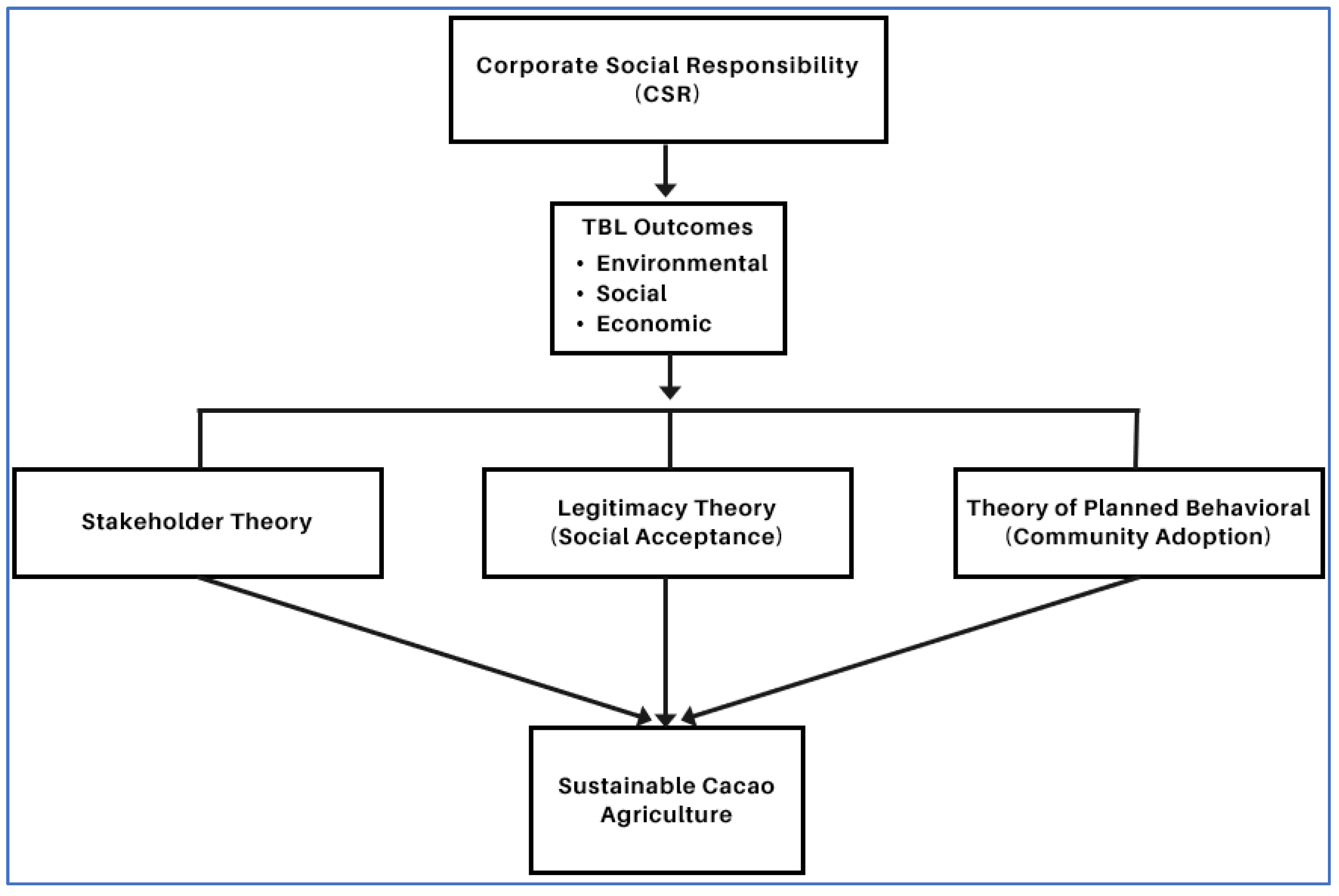
Figure 2.
Triple Bottom Line-Based Performance Measurement Model.
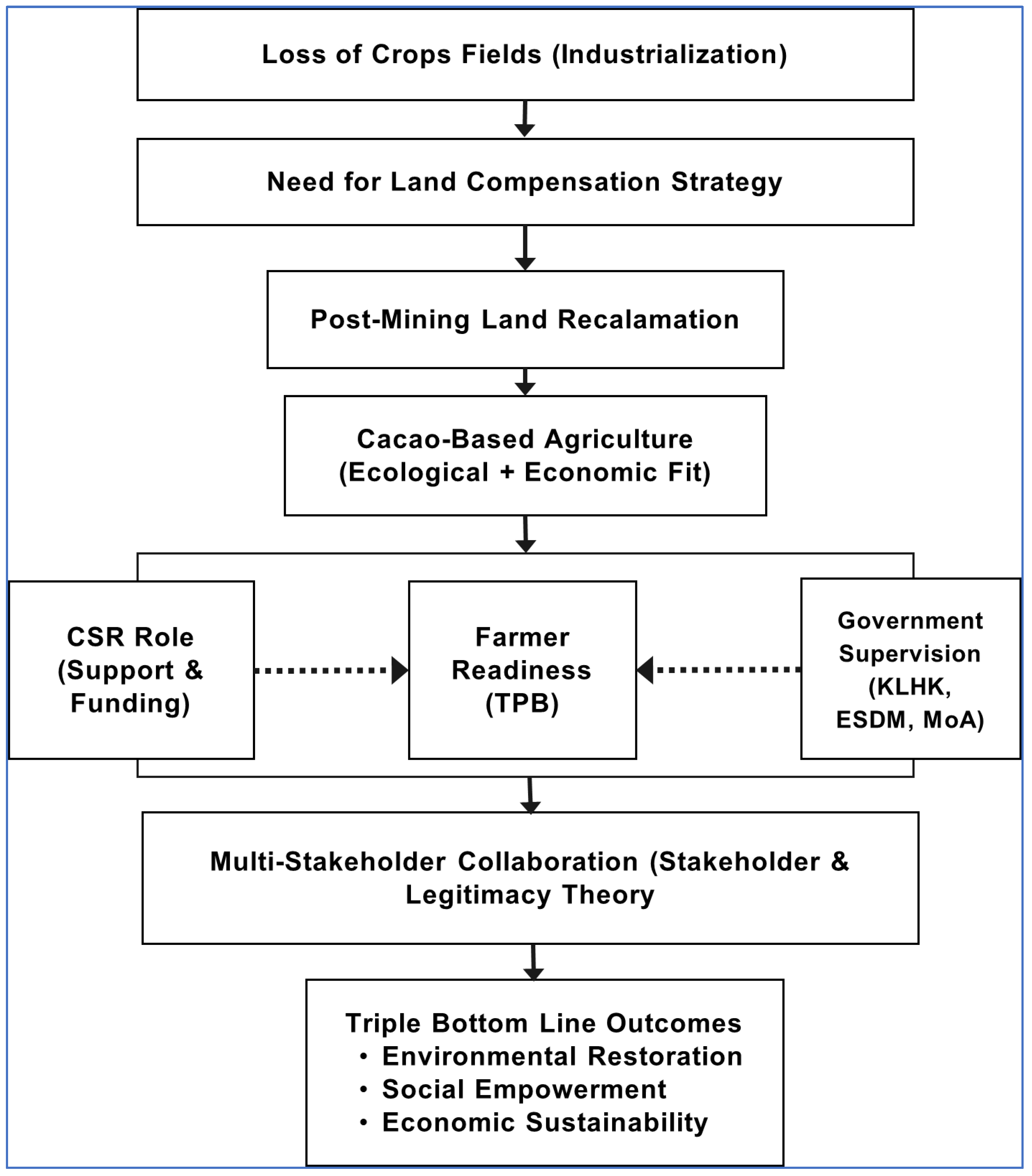
Figure 3.
Triple Bottom Line Integrated Land Governance.
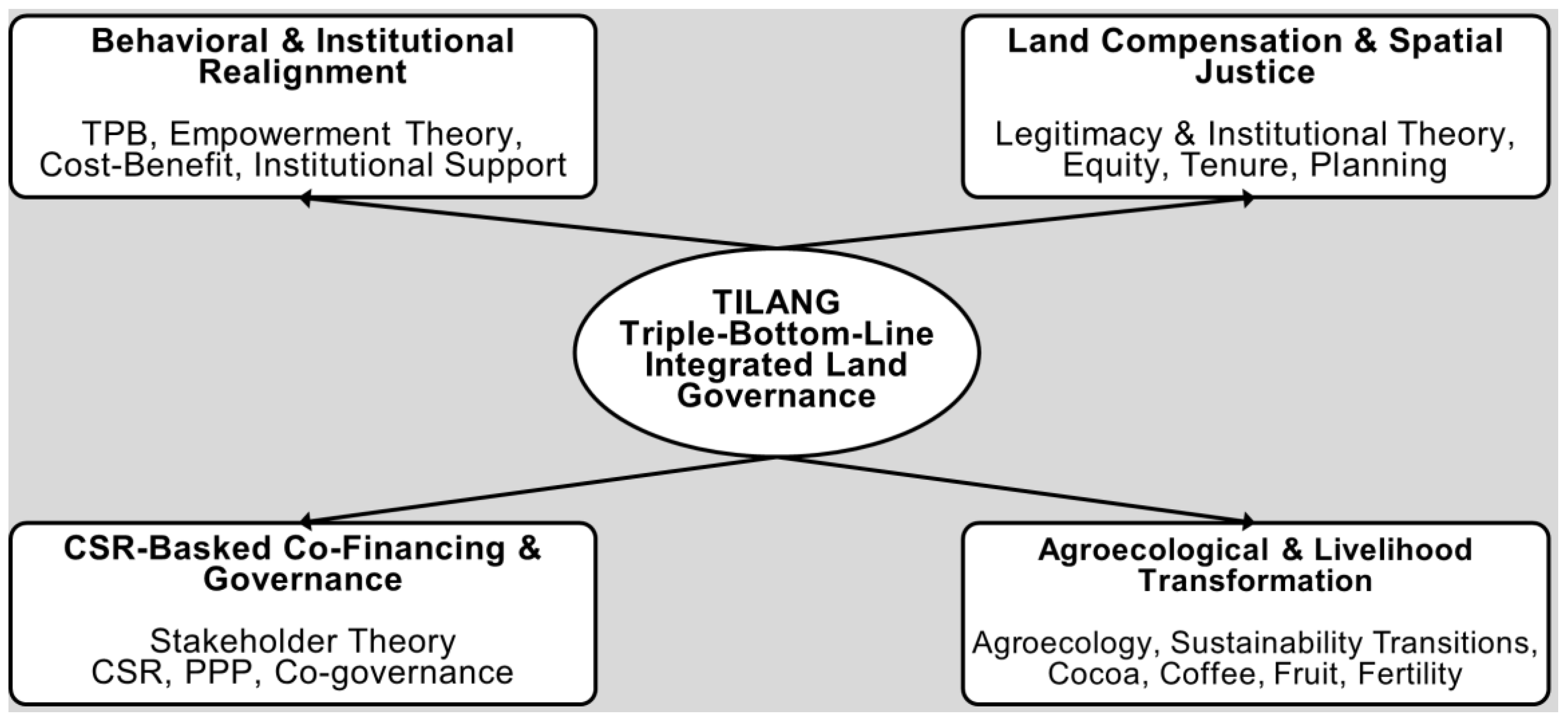

Table 1.
Nvivo-Thematic Summary of Sustainability Enablers in Post-Mining Land.
| # | Thematic Category | Description | Fre-Quency | Representative Example |
|---|---|---|---|---|
| 1 | Economic Revitalization | Income generation, market access, and value chain development | 922 | “Cacao farming helped diversify community income streams” |
| 2 | CSR Role and Governance | Program design, planning, transparency, and accountability mechanisms | 872 | “Long-term CSR commitments influenced land-use continuity” |
| 3 | Behavioral Change (TPB) | Attitudes, norms, control, intention, and behavioral readiness | 829 | “Perceived behavioral control was critical to cacao adoption” |
| 4 | Sustainable Cacao Agriculture | Agronomic practices, post-harvest, sustainability in cacao value chain | 757 | “Post-mining cacao systems relied on organic practices and innovation” |
| 5 | Triple Bottom Line Outcome | Environmental, economic, and social impact alignment | 749 | “Outcomes were evaluated using TBL indicators and metrics” |
| 6 | Stakeholder Collaboration | Multi-stakeholder engagement, shared governance, participatory planning | 665 | “Inclusive forums improved negotiation and shared goals” |
| 7 | Land Compensa-tion Strategy | Land use trade-offs, reallocation, and economic/legal restitution | 593 | “Cacao farming emerged as a viable compensation strategy” |
| 8 | Environmental Restoration | Soil rehabilitation, agroforestry, biodiversity, water management | 548 | “Tree canopy systems restored fertility to degraded land” |
| 9 | Institutional Role | Regulatory, policy, and coordination mechanisms across sectors | 530 | “Ministries coordinated rehabilitation incentives” |
| 10 | Farmer Empowerment | Capacity building, inclusion, leadership, access to inputs | 499 | “Training programs empowered women and youth farmers” |
| Total | 6964 |
Disclaimer/Publisher’s Note: The statements, opinions and data contained in all publications are solely those of the individual author(s) and contributor(s) and not of MDPI and/or the editor(s). MDPI and/or the editor(s) disclaim responsibility for any injury to people or property resulting from any ideas, methods, instructions or products referred to in the content. |
© 2025 by the authors. Licensee MDPI, Basel, Switzerland. This article is an open access article distributed under the terms and conditions of the Creative Commons Attribution (CC BY) license (http://creativecommons.org/licenses/by/4.0/).
Copyright: This open access article is published under a Creative Commons CC BY 4.0 license, which permit the free download, distribution, and reuse, provided that the author and preprint are cited in any reuse.


