

Submitted:
31 May 2025
Posted:
03 June 2025
You are already at the latest version
Abstract
Sustainability in post-mining landscapes has left a critical governance challenge in resource-rich countries such as Indonesia, where extraction leaves communities economically vulnerable and environments degraded. This study aims to develop and validate a dual-pathway framework for post-mining sustainability by analyzing the intersection between institutional mechanisms and behavioral readiness. Drawing from a qualitative meta-synthesis of 1,339 stakeholder-derived remarks coded across 80 thematic nodes, the framework identifies ten key dimensions including land compensation, corporate social responsibility (CSR) co-financing, agroecological livelihoods, stakeholder engagement, social norms, and perceived legitimacy. Anchored in Stakeholder Theory and Legitimacy Theory, the findings reveal that sustainability is contingent not solely on technical rehabilitation, but on the synergy between policy reform, community empowerment, and cultural acceptance. While this study is grounded in secondary data synthesis, further field validation is recommended to enhance generalizability across diverse mining regions. The resulting model offers both a conceptual and operational guide for participatory governance and behavioral integration in complex post-extractive contexts with policy recommendations for inclusive, multi-actor planning in Indonesia’s mining regions.
Keywords:
post-mining sustainability
; institutional legitimacy
; stakeholder engagement
; CSR co-financing
; agroecological livelihoods
1. Introduction
Sustainable development in Indonesia’s nickel mining regions remains a complex challenge, characterized by ongoing environmental degradation, socio-economic disruption, and governance fragmentation. While the mining sector drives national economic gains, its long-term consequences—ranging from ecological damage and displacement to rural disempowerment—demand a more systemic and future-oriented sustainability framework. Addressing these challenges requires a dual focus: reconfiguring institutional arrangements and fostering behavioral shifts that support post-mining recovery and the development of resilient, community-based livelihoods. This article builds on recent research emphasizing the role of behavioral competence in sustainability transitions [1], extending it into the context of post-mining landscape governance in Indonesia.
This article introduces a dual-pathway framework to reframe post-mining sustainability by integrating two critical dimensions: institutional alignment and behavioral readiness. Drawing on a meta-synthesis of 1,339 stakeholder-derived remarks from academic and institutional literature, the study identifies ten core themes including land compensation, agroecological livelihoods, CSR co-financing, stakeholder engagement, and social norms.
The proposed framework is grounded in a qualitative meta-synthesis of 1,339 coded remarks drawn from academic and institutional literature, systematically categorized into ten parent themes and eighty sub-themes. This empirical structure supports a unified analytical lens for advancing sustainability theory and practice in Indonesia’s post-extractive landscapes.
This article seeks to reframe the discourse in post-mining sustainability by moving beyond fragmented, compliance-based approaches toward an integrated, participatory, and transformation-oriented strategy. Grounded in Stakeholder Theory [2], Legitimacy Theory [3], and the Theory of Planned Behavior (TPB) [4], the proposed framework emphasizes the dual necessity of institutional alignment and behavioral readiness. Rather than treating sustainability as a function of regulatory compliance or technical rehabilitation alone, this framework highlights the co-evolution of governance structures and community agency as essential to achieving long-term institutional legitimacy, stakeholder engagement, and socially grounded transformation.
The theoretical framework conceptualizes sustainability as the outcome of intertwined institutional reform and behavioral transformation. It argues that meaningful outcomes arise only when top-down governance mechanisms align with bottom-up community behavior. This integrated approach offers a strategic perspective to analyze how formal policy structures and local agency interact to foster resilience in rehabilitated post-mining landscapes.
The framework is grounded in a comprehensive literature review that spans sustainability science, governance systems, community empowerment, and agroecological transitions. The review incorporates both global and Indonesian sources that examine challenges such as environmental degradation [5,6], socio-economic instability [7,8] and fragmented implementation of corporate social responsibility (CSR) programs [9,10]. Collectively, these studies reveal a critical gap in existing models–namely the absence of integrative frameworks that simultaneously address institutional mechanisms and behavioral dynamics in post-mining sustainability efforts.
The institutional integration pathway emphasizes the policy frameworks and structural conditions necessary to enable sustainable transitions. Key components include aligning land compensation mechanisms with local needs [11], fostering governance legitimacy through transparency and participatory decision-making process [2,12], and mobilizing CSR funding to support long-term community development [13,14]. Agroecological strategies—particularly cocoa-based farming—are also highlighted for their dual function in ecological restoration and sustainable livelihood generation [15,16].
In parallel, the behavioral integration pathway focuses on the psychological and cultural drivers of sustainable practice. Guided by the Theory of Planned Behavior (TPB), it emphasizes the importance of fostering pro-sustainability attitudes, strengthening social norms, building trust, encouraging stakeholder participation, and enhancing skills and motivation [4,17,18]. The coded remarks consistently identified behavioral intention and community readiness as critical factors in the adoption and long-term success of sustainability initiatives, thereby reinforcing the framework’s emphasis on social inclusion and participatory governance.
The strength of the proposed model lies in its fusion of empirical insight and theoretical rigor, enabling the identification of key mechanisms that support sustainability in post-mining contexts. Within the institutional domain, themes such as Land Compensation and Planning highlight the importance of aligning compensation strategies with community aspirations [4,19]. Governance legitimacy is also central, as fragmented or extractive systems often erode trust and institutional accountability [3,7,20]. CSR co-financing is reframed not as philanthropic giving, but as a strategic instrument for delivering long-term public goods [13,14,21]. Agroecological livelihoods—particularly those based on cocoa farming—are positioned as transformative land-use models that support both soil restoration and farmer empowerment [14,15,16].
The behavioral dimension complements the institutional pathway by emphasizing attitudes, trust, social norms, and intrinsic motivation. Attitude toward Sustainability reflects the extent to which sustainability principles are internalized and translated into action [4,8,22]. Norms and Social Trust explores how peer expectations and social cohesion shape both compliance and innovation in sustainable practices [23,24]. Stakeholder Engagement calls for inclusive participation, positioning farmers and Indigenous communities as active co-creators rather than passive recipients [9,10,18]. Finally, Motivation and Empowerment captures the psychological readiness to transition from extractive to sustainable livelihoods, emphasizing the belief in one’s capacity to enact meaningful change [16,25].
In summary, achieving sustainability in Indonesia’s post-mining regions requires coordinated progress on two interdependent fronts: institutional redesign and behavioral transformation. The framework developed in this study illustrates how legal structures, CSR co-financing mechanisms, and agroecological planning must be integrated with cultural values, social trust, and community empowerment [13,15,19,21]. The interaction of these institutional and behavioral forces reveals that sustainability is not the result of linear processes, but of mutually reinforcing dynamics. This integrated approach signals a paradigm shift—from extractive legacies toward regenerative, community-driven futures in post-mining landscapes.
The novelty of this study lies in its conceptual and methodological integration across multiple knowledge domains, employing a qualitative meta-synthesis of 1,339 literature-derived remarks to construct a unified and empirically grounded sustainability framework. Whereas prior research has often addressed post-mining governance, environmental rehabilitation, or social impact in isolation, this study synthesizes institutional and behavioral dimensions into a single foundational model. Unlike conventional performance evaluations or CSR audits, the framework incorporates stakeholder intention, social trust, and community empowerment alongside structural mechanisms such as CSR financing, legitimacy-building, and agroecological planning. This dual-lens approach not only contributes theoretically through the triangulation of Stakeholder Theory, Legitimacy Theory, and the Theory of Planned Behavior (TPB), but also offers a practical roadmap for integrated sustainability transitions in Indonesia’s mining regions—marking a departure from fragmented interventions toward a holistic, participatory architecture.
The purpose of this study is to develop a foundational framework for reframing sustainability in post-mining landscapes through the integration of institutional mechanisms and behavioral readiness. The object of this study is the sustainability of post-mining landscapes in Indonesia, while the subject concerns the institutional and behavioral drivers that shape this sustainability. Specifically, the study aims to: (1) identify core themes that link institutional policy, community behavior, and sustainability outcomes; (2) construct a dual-pathway model grounded in empirical evidence and theory; and (3) provide a conceptual and operational basis for future sustainability interventions. The central research question guiding this inquiry is: How can institutional and behavioral integration be framed to achieve sustainable transformation in Indonesia’s post-mining landscapes? While the study does not test a formal hypothesis, it is informed by the theoretical proposition that sustainable outcomes arise when governance mechanisms and behavioral drivers are aligned and mutually reinforcing.
2. Materials and Methods
This study adopts a qualitative meta-synthesis approach to develop an empirically grounded framework for post-mining sustainability in Indonesia. Rather than proposing an entirely new theoretical construct, the method operationalizes existing sustainability frameworks by extracting and coding 1,339 literature-based stakeholder remarks. The analytical process emphasizes structured use of NVivo software, supported by domain-informed theories and systematic thematic coding. The following subsections outline the research design, coding strategy, framework development, and contextual foundations in detail.
2.1. Research Design and Theoretical Foundation
This study applies a theory-informed qualitative meta-synthesis to reframe sustainability in Indonesia’s post-mining landscapes. The research is anchored in a dual-pathway conceptual framework that integrates institutional mechanisms and behavioral drivers. This model guided both the construction of the coding architecture and the selection of theoretical perspectives, aiming to capture the dynamic interplay between governance structures and community behaviors in post-mining transformation.
The theoretical foundation draws upon five interrelated frameworks. Stakeholder Theory emphasizes inclusive decision-making and participatory governance, both critical for sustainability initiatives involving diverse actors. Legitimacy Theory underscores the importance of institutional trust, legal clarity, and social acceptability in sustaining governance interventions. The Theory of Planned Behavior (TPB) offers a behavioral lens, explaining how attitudes, social norms, and perceived behavioral control shape individual and collective actions related to sustainability. Additionally, Corporate Social Responsibility (CSR) and the Triple Bottom Line (TBL) frameworks provide operational and evaluative tools to align economic, social, and environmental objectives.
These frameworks were intentionally selected for their complementarity and alignment with the empirical patterns that emerged from the 1,339 stakeholder-derived remarks analyzed in this study. While broader perspectives such as Political Ecology and Institutional Analysis provide valuable macro-level insights, they were less appropriate for the mid-level integration of institutional design and behavioral readiness targeted here. In contrast, the selected theories support a multi-scalar analysis—bridging abstract governance principles with actionable community-level practices. This alignment enabled the construction of a dual-pathway model that is both conceptually grounded and practically implementable.
The dual-pathway conceptual model, presented in Figure 1, serves as the study’s analytical foundation. The institutional pathway, positioned on the left, consists of four core pillars: land compensation and planning, legitimacy and governance alignment, CSR co-financing mechanisms, and agroecological livelihoods. These pillars are informed by Legitimacy Theory and represent governance-level strategies for enabling sustainable land transformation. Meanwhile, the behavioral pathway, positioned on the right, includes attitudes toward sustainability, social norms and trust, stakeholder engagement, and motivation and empowerment—dimensions rooted in Stakeholder Theory and TPB. The convergence of these two pathways underscores the study’s central proposition: that post-mining sustainability relies not only on regulatory design, but equally on community readiness and active participation.
The overall methodology bridges conceptual clarity with empirical grounding by aligning the dual-pathway model to a structured, theory-informed coding system. This integration allowed for the systematic organization of stakeholder discourse into actionable themes—ensuring both analytical traceability and theoretical coherence. The design serves as a middle-range framework, linking institutional reform with community behavior without losing interpretive depth.
Through this approach, the study provides a replicable analytic framework capable of guiding sustainability initiatives in post-mining contexts. By combining meta-synthesis techniques with theory-driven analysis, the model not only captures the logic embedded in existing literature but also operationalizes it in a form that is practically usable for governance, policy design, and future interdisciplinary research.
2.2. Data Collection and Analitical Strategy
This study draws upon 1,339 validated remarks as its core dataset, with each serving as a proxy unit of meaning derived from 1,352 academic and institutional sources published between 1956 and 2025. These remarks capture stakeholder patterns, insights, and reasoning embedded in peer-reviewed articles, dissertations, books, and official reports—collected via databases such as Scopus, Google Scholar, SpringerLink, and national repositories.
The remarks were gathered between December 2022 and March 2025, and stored in a structured MS Access database, relationally organized across four tables—Journal, Circulation, Article, and DetailedStudy—to ensure uniqueness and traceability. Final verification was conducted using paragraph-level counting, resulting in a confirmed set of 1,339 remarks.
Following database compilation, the remarks were imported into NVivo 12 for thematic analysis using a two-level coding architecture: ten parent nodes and eighty child nodes. Initial child node keywords were developed using domain-informed synonyms, and NVivo’s synonym-enabled auto-coding was applied. This was followed by rigorous manual refinement to eliminate false positives and recover valid remarks overlooked due to phrasing variations. This iterative process ensured semantic accuracy and thematic saturation.
The coding strategy was aligned with the study’s dual-pathway conceptual framework, distinguishing between institutional integration (e.g., “land compensation,” “legitimacy,” “CSR”) and behavioral readiness (e.g., “trust,” “motivation,” “norms”). Patterns of co-occurrence across thematic clusters reinforced the empirical foundation for model construction.
Although the data are not field-based, the interpretive approach follows accepted meta-synthesis conventions [26], treating literature-derived remarks as analytically valid reflections of stakeholder discourse. While not equivalent to lived experience, these remarks function as reliable proxies—capturing multi-contextual observations and synthesized insights from the original sources.
2.3. Coding Framework Development and NVivo Analysis
The analytical foundation of this study is built on a dual-level NVivo coding architecture, comprising 10 parent nodes and 80 child nodes. This structure is intentionally aligned with the dual-pathway conceptual framework introduced earlier, which distinguishes between institutional mechanisms (e.g., governance legitimacy, CSR provision, land compensation) and behavioral drivers (e.g., motivation, trust, norms).
The development of child nodes was informed by both theoretical frameworks and emergent patterns within the literature-derived remarks. Initial keyword lists for each child node were constructed using domain-specific synonyms and conceptual anchors grounded in Stakeholder Theory, Legitimacy Theory, and the Theory of Planned Behavior (TPB). These keywords guided NVivo’s synonym-enabled auto-coding process, which was then followed by rigorous manual refinement to eliminate false positives and capture relevant remarks missed due to phrasing variation.
Rather than relying solely on keyword frequency, the coding process prioritized co-occurrence patterns across thematic clusters. For instance, frequent associations between “land rights,” “compensation,” and “governance legitimacy” contributed to the formation of an institutional pillar. Similarly, the repeated linkage of “empowerment,” “trust,” and “norms” reinforced the structure of behavioral themes. These relational patterns helped validate the overall framework and provided conceptual convergence across data segments.
This multi-stage process, grounded in both deductive and inductive reasoning, ensured semantic alignment, thematic saturation, and traceability within the NVivo environment. The resulting node architecture is cross-referenced in Appendix A, with detailed technical descriptors in Appendix B, and thematic–environmental linkages outlined in Appendix C.
2.4. Operationalizing the Dual-Pathway Framework
The dual-pathway framework developed in this study synthesizes two critical dimensions of post-mining sustainability: institutional integration and behavioral readiness. As summarized in Table 1 and further detailed in Appendix A, Appendix B, Appendix C, the institutional pathway comprises themes such as land compensation and planning, CSR co-financing, governance alignment, and agroecological livelihoods. In parallel, the behavioral pathway captures stakeholder trust, social norms, empowerment, and sustainability attitudes. Together, these dimensions form the backbone of eight core integration themes that emerged from the coded literature-derived remarks.
To operationalize this framework, NVivo 12 software was employed to organize 1,339 remarks into a structured two-level node architecture, consisting of ten parent nodes and eighty child nodes. This structure was deliberately aligned with the conceptual model and guided by both theoretical constructs and data-informed keyword clusters. Auto-coding was initially conducted using synonym-enabled keyword searches and subsequently refined through manual verification to ensure conceptual accuracy and thematic coherence.
Rather than prioritizing keyword frequency in isolation, the coding strategy emphasized thematic convergence. For example, consistent co-occurrence of terms such as “land rights,” “compensation,” and “governance legitimacy” reinforced the institutional integration theme. Similarly, clusters featuring “trust,” “empowerment,” and “norms” informed the behavioral pillar. Through this iterative and interpretive process, the framework translated a large volume of qualitative data into an integrated model that reflects both structural reform and behavioral transformation within post-mining landscapes.
2.5. Contextual Framing: The Post-Mining Problem in Indonesia
Indonesia’s mining sector continues to expand, contributing significantly to national GDP while simultaneously exacerbating environmental degradation and social risk in extraction zones [27,28]. As the extraction of nickel, coal, and gold intensifies, mounting pressure is placed on land, water resources, and local livelihoods. Reports from the Ministry of Environment and Forestry indicate widespread non-compliance among mining companies—particularly regarding land reclamation and post-mining restoration obligations. Although legal frameworks mandate companies to prepare, implement, and report reclamation plans, enforcement remains inconsistent and weakly regulated across provinces, largely due to capacity gaps at the local level [29].
Local governments often lack the technical capacity, legal clarity, and institutional coordination required to ensure corporate accountability. In some instances, decentralization policies have widened the governance gap between national regulations and local enforcement. These challenges are especially acute in regions such as Southeast Sulawesi, East Kalimantan, and West Papua, where extractive operations overlap with ecologically fragile and socially vulnerable territories. As noted in the World Bank’s Mining Sector Diagnostic Report, the performance of mining sector management in Indonesia is uneven, with most weaknesses arising from poor implementation of otherwise sound policies. The report also highlights that decentralization has contributed to legal ambiguity and institutional fragmentation, limiting the ability of local governments to enforce reclamation obligations effectively [29].
Academic and institutional reviews have consistently highlighted the fragmented nature of post-mining interventions in Indonesia. Technical assessments, environmental audits, and sustainability reports are frequently conducted in isolation, with minimal integration between spatial planning, social inclusion, and community participation. This fragmentation stems from overlapping mandates and conflicting sectoral regulations, particularly between forestry, mining, and regional development authorities—resulting in weak coordination and spatial disharmony [30]. Moreover, efforts to include local communities through participatory planning, such as community mapping or localized land-use claims, have remained limited, further marginalizing affected populations [31]. As a result, post-mining lands are frequently left dormant or become the subject of contested claims, failing to deliver either ecological restoration or socio-economic revitalization.
2.6. Research Validity and Analytical Rigor
To ensure the credibility and rigor of this qualitative meta-synthesis, multiple validation strategies were applied throughout the research process. First, the study adhered to systematic review protocols that prioritize transparency, reproducibility, and methodological coherence. By combining pre-defined inclusion criteria, iterative coding procedures, and intersubjective checks, the research design minimizes bias and strengthens internal validity.
Second, the NVivo-based coding process underwent multiple rounds of refinement. Parent and child nodes were calibrated against theoretical constructs derived from Stakeholder Theory, Legitimacy Theory, the Theory of Planned Behavior (TPB), and the Triple Bottom Line (TBL) framework. This alignment ensured conceptual consistency and thematic saturation. Regular cross-checks between researchers were conducted to enhance coding reliability and avoid interpretive drift.
Third, data triangulation was achieved through the integration of diverse literature sources, including academic journals, policy reports, NGO evaluations, and government documentation. These sources were not treated uniformly but were critically examined for credibility, context, and representativeness.
Finally, theoretical validation was embedded in the model-building process. Rather than simply aggregating remarks, the study used abductive reasoning to interpret patterns, identify causal logics, and articulate plausible pathways for sustainability transformation. This interpretive rigor reinforces the transferability and theoretical robustness of the resulting model.
2.7. Research Limitations and Methodological Reflection
As with all qualitative meta-synthesis studies, this research is subject to several methodological and interpretive limitations. Firstly, the analysis relies exclusively on secondary data derived from academic and institutional literature. While the use of 1,339 coded remarks provides a substantial foundation, the findings may not fully capture the lived experiences of local communities in post-mining areas. These literature-derived remarks, although analytically robust, function as proxies rather than direct empirical accounts [32].
Secondly, the validity of NVivo coding depends on the subjective interpretation of the researchers. Despite efforts to ensure consistency through iterative reviews and theoretical alignment, some degree of coder bias remains inevitable. Coding decisions were based on textual expressions rather than contextual field observations, potentially limiting the nuance of certain themes [33].
Thirdly, the study's reliance on English and Bahasa Indonesia literature may have excluded relevant sources published in local dialects or in less accessible repositories. This linguistic boundary introduces the possibility of publication bias, especially in underrepresented regions like West Papua or inland Central Sulawesi [34].
Lastly, reflexivity is acknowledged in the role of the researchers themselves, particularly concerning the framing of sustainability and institutional transformation. Prior professional experience in sustainability governance and auditing may have subtly influenced the prioritization of certain themes or the construction of the proposed framework [35].
Despite these limitations, the study offers a transparent, theoretically grounded, and methodologically rigorous pathway for understanding and reframing sustainability in Indonesia’s post-mining landscapes.
3. Results
The results presented in this section—also referred to as the study’s key findings—reflect how the dual-pathway framework (illustrated in Figure 1) guided the structuring and interpretation of data across institutional and behavioral dimensions of sustainability. Rather than separating results from discussion, each subsection interweaves empirical patterns with conceptual reflection, emphasizing both the frequency and functional significance of dominant themes. These findings were systematically derived from NVivo-assisted coding of 1,339 stakeholder-derived remarks, which were thematically organized into 10 parent nodes and 80 child nodes, as detailed in Appendix A and Appendix B, respectively. This structured node architecture not only ensured analytical rigor and traceability, but also directly reinforced the dual-pathway logic—bridging governance mechanisms with behavioral transformation as visualized in the conceptual structure of the study.
3.1. Empirical Overview of Thematic Patterns
This study analyzed 1,339 stakeholder-derived remarks from 1,352 academic and institutional sources to uncover recurring patterns, governance gaps, and behavioral dynamics relevant to sustainable post-mining transitions in Indonesia. These remarks were systematically coded using NVivo 12 into a dual-layered structure consisting of 10 parent nodes and 80 child nodes—as summarized in Table 1 and visually represented through the conceptual logic in Figure 1. This structure aligns with the study’s dual-pathway model, which bridges institutional integration (e.g., governance legitimacy, CSR co-financing, land compensation) and behavioral transformation (e.g., empowerment, trust, and sustainability norms).
The development of this coding framework was both conceptually grounded and empirically informed. As detailed in Appendix A, parent nodes were designed based on theoretical foundations from Stakeholder Theory [2], Legitimacy Theory [3], and the Theory of Planned Behavior [4]. Meanwhile, Appendix B elaborates on the operational definitions and frequencies of all 80 child nodes, which were derived through iterative interpretation of the literature-based remarks. This layered structure enabled both thematic saturation and cross-node pattern recognition, revealing how interrelated themes—such as trust, motivation, institutional coherence, and CSR effectiveness—form the cognitive infrastructure of post-mining governance discourse [36,37].
Quantitatively, the node frequencies indicate a balanced emphasis between behavioral and institutional domains, with the highest densities observed in Motivation and Empowerment (913), Stakeholder Engagement (818), and Legitimacy Theory Application (808). These values illustrate a complex interplay between community agency and regulatory structure—consistent with contemporary calls for agroecological transformation and community-led reclamation [38,39].
More critically, Figure 1 serves as a conceptual map linking the coded themes to the overall model of sustainability transformation. It illustrates how node families act as inputs feeding into transformation mechanisms and sustainability outcomes. In this model, recurring concerns about governance exclusion, trust deficits, and stakeholder conflict emerged as analytically dominant clusters. These high-frequency issues serve as entry points for the next level of interpretation, where the analysis shifts from description to theory-driven reflection—exploring why these issues persist and how they shape Indonesia’s post-mining sustainability landscape.
Finally, Figure 2 provides a refined visualization of the dual-pathway logic underpinning this study’s analytical design. It categorizes the ten parent nodes under two overarching dimensions: behavioral transformation and institutional integration. This visual synthesis reinforces the NVivo data structure and the theoretical foundation of the study. For readers seeking technical clarity, Appendix A and Appendix B provide complementary details on node architecture and definitions, supporting the empirical and conceptual coherence represented in the figure. The color-coded structure in Figure 2 further emphasizes that sustainable transitions require synchronized shifts in personal motivation, community norms, and structural governance mechanisms.
As shown in Figure 2, the NVivo-based thematic structure reflects the study’s dual-pathway analytical model, organizing the 10 parent nodes into two overarching domains. The institutional integration pathway encompasses themes related to land governance, policy legitimacy, CSR mechanisms, and institutional planning—each coded based on both regulatory documents and field-based insights. Meanwhile, the behavioral transformation pathway captures individual and community-level dynamics such as motivation, attitudes, trust, and participation. This node architecture not only guided the coding process but also operationalizes the conceptual logic of the study, ensuring that empirical findings are consistently linked to both structural and behavioral foundations. Together, the categories enable a multidimensional understanding of sustainability transitions in post-mining landscapes, as further elaborated in Appendix A, Appendix B, Appendix C.
Building on the thematic architecture outlined above, the following two subsections delve deeper into the core pillars of the study’s dual-pathway model: institutional integration and behavioral transformation. These pathways not only reflect distinct theoretical dimensions but also represent interdependent drivers of post-mining sustainability. The next section (3.2) interprets patterns related to governance legitimacy, CSR-based land management, and institutional coherence—framing them under the broader theme of institutional readiness and integration. This is followed by [Section 3.3, which explores behavioral dynamics such as motivation, empowerment, norms, and perceived value—critical for fostering sustainable mindsets and collective agency within mining-affected communities. Together, these interpretive layers move beyond what the data revealed to why those patterns persist, and how they co-construct Indonesia’s post-mining transformation potential.
3.2. Institutional Integration Themes
This subsection interprets the institutional dimensions of sustainability as reflected in the 1,339 coded remarks. Four thematic pillars emerged under the institutional pathway: Land Compensation and Planning, Legitimacy and Governance Alignment, CSR Co-Financing Mechanisms, and Agroecological Livelihoods. As visualized in Figure 2, these pillars collectively represent the left-hand stream of the dual-pathway framework, focused on formal structures, policies, and regulatory instruments necessary for post-mining transformation. They correspond directly to four of the ten parent nodes outlined in Appendix A, each supported by multiple child nodes that detail the granular institutional factors—ranging from spatial zoning to CSR budgeting schemes.
The interpretation of these institutional themes is guided by theoretical constructs from Legitimacy Theory [3] and Stakeholder Theory [2], which emphasize the importance of regulatory coherence, stakeholder alignment, and public trust in ensuring sustainable governance outcomes. Further supported by the Theory of Planned Behavior [4], this framework recognizes that institutional effectiveness is not merely a matter of compliance, but also of legitimacy and coordinated delivery. The NVivo-based coding architecture operationalized these ideas by classifying institutional remarks under nodes that address policy misalignment, governance credibility, CSR co-financing dynamics, and the institutional enablers of agroecological transition—providing a structured foundation for deeper thematic discussion in the paragraphs that follow [37].
To operationalize the institutional integration pathway identified in the dual-pathway model, this subsection unpacks four interrelated parent nodes that form the structural backbone of post-mining sustainability: Land Compensation and Planning, Legitimacy and Governance Alignment, CSR Co-Financing Mechanisms, and Agroecological Livelihoods. These thematic domains—illustrated in Figure 2 and classified under institutional integration in Appendix A—collectively represent the regulatory, financial, and policy-based frameworks through which transformation is intended to occur. Each node reflects a distinct yet interconnected layer of institutional readiness: from resolving land tenure disputes and rebuilding governance legitimacy, to activating corporate financial commitments and enabling sustainable agricultural alternatives. What follows is a detailed examination of these institutional pillars, grounded in coded stakeholder remarks and framed by relevant sustainability and governance theories.
3.2.1. Land Compensation and Planning
Unclear land status, delayed compensation, and contested boundaries remain persistent institutional bottlenecks in Indonesia’s post-mining regions. Although national regulations mandate land compensation and reclamation [40,41], implementation on the ground often lacks spatial justice—defined as the equitable distribution of land access and inclusive decision-making processes [42]. Field-based narratives, especially from Sulawesi, highlight how participatory planning is routinely bypassed, sidelining customary landowners, indigenous communities, and smallholder farmers, while disproportionately favoring politically connected elites [43]. These patterns mirror global land governance failures, where insecure tenure and fragmented administration hinder transformation in resource-rich areas [44,45].
NVivo-coded findings reinforce these insights by clustering critical subthemes—such as conflict resolution (85 references), customary land rights recognition (83), spatial zoning for post-mining use (86), and participatory land mapping (89)—under the “Land Compensation and Planning” node (Appendix B). These frequencies underscore how consistently these institutional concerns emerged across the coded remarks. As visualized in Figure 1, these elements represent core institutional inputs that influence post-mining sustainability transitions. Figure 2 further situates this node within the broader institutional integration pathway, one of two foundational components of the dual-pathway architecture structuring the study’s analytical framework.
Before individually discussing the remaining institutional pillars, Figure 3 introduces the study’s refined theoretical model: the Dual-Pathway Framework for Post-Mining Sustainability in Indonesia. This conceptual framework integrates institutional levers—land compensation, legitimacy, CSR, and agroecological systems—with behavioral drivers such as empowerment, trust, and norms. Institutional mechanisms (left side of Figure 3) shape the enabling environment for transformation, while behavioral integration (right side) ensures its social uptake and continuity. The NVivo-based structure (Appendix A, Appendix B, Appendix C) underpins this model, illustrating how policy and psychological dimensions co-produce long-term sustainability outcomes in Indonesia’s post-mining contexts.
To deepen the theoretical coherence of these institutional themes, Figure 3 presents the Dual-Pathway Framework for Post-Mining Sustainability in Indonesia, which integrates insights from both governance structures and community behavior. Building on the coded data structure shown in Figure 1, and the behavioral–institutional grouping in Figure 2, this model illustrates how institutional mechanisms—such as land compensation, CSR co-financing, and agroecological planning—interact with psychological and social drivers like trust, norms, and empowerment. This dual-pathway integration forms the foundation for sustainability transitions in post-mining contexts and will be further discussed throughout Section 3, with references to the node architecture detailed in Appendix A and Appendix C.
3.2.2. Legitimacy and Governance Alignment
Concerns about legitimacy and institutional alignment emerged as a dominant theme across the NVivo-coded dataset, with numerous remarks highlighting mismatches between regulatory frameworks and on-the-ground enforcement. While Indonesia’s mining governance has made strides in establishing national mandates, implementation at the local level often suffers from fragmented authority, weak oversight, and diminished public trust [46,47]. In regions like Morowali and Konawe, participants described mining licenses being granted with minimal stakeholder consultation, resulting in perceived illegitimacy, land conflicts, and recurring community protest. These patterns are echoed in government reviews, which note that monitoring gaps, legal inconsistencies, and weak participatory mechanisms continue to undermine sustainable governance [48]. This aligns with global discourse on extractive governance, where legitimacy is not only a legal requirement but also a function of transparency, procedural fairness, and community recognition [3,49].
The “Legitimacy and Governance Alignment” node in NVivo captures a range of child-level codes—such as policy coherence across agencies (94 references), compliance with EIA/AMDAL (30), institutional trust building (90), and community consultation mechanisms (92)—that reflect these institutional vulnerabilities (Appendix B). These frequencies demonstrate both the prominence and variation in how legitimacy-related themes are discussed across stakeholder narratives. As mapped in Figure 1, legitimacy deficits serve as critical friction points within the broader transformation system, reducing the effectiveness of land use, reclamation, and community development policies. Figure 2 further situates this node within the institutional integration pathway, emphasizing its foundational role in the dual-pathway model.
Moreover, the framework in Figure 3 includes legitimacy as a core enabler of effective sustainability transitions. Institutional reforms that lack public legitimacy or local alignment risk becoming symbolic rather than substantive. Strengthening governance alignment, regulatory credibility, and stakeholder trust is not only a technical priority but a structural necessity—one that defines the feedback loops between policy enforcement and behavioral response. These dynamics are further explored in Section 3, supported by the node architecture in Appendix A and Appendix C
3.2.3. CSR Co-Financing Mechanisms
Corporate Social Responsibility (CSR) emerged as one of the most debated institutional levers within the NVivo-coded materials, revealing widespread concerns about its fragmentation, symbolic deployment, and limited developmental utility. Although Indonesia’s mining law (UU No. 40/2007) legally mandates CSR, the implementation across post-mining areas remains inconsistent and often performs a reputational function rather than catalyzing long-term community development [50,51]. Stakeholder remarks emphasized that many CSR programs lack transparent targeting, community participation, and accountability mechanisms, reinforcing perceptions of elite capture and short-term project cycles.
Despite these limitations, there is a discernible shift in national policy narratives, where CSR is increasingly reframed as a potential co-financing engine for sustainable land reclamation, agroecological transition, and poverty reduction [52]. This reconceptualization is visible in recent planning documents by BAPPENAS and ESDM, which advocate for a performance-based CSR framework aligned with measurable sustainability outcomes. However, field data suggest that the institutional readiness, legal enforcement, and inter-ministerial coordination necessary to activate this shift are still underdeveloped.
The NVivo-coded node on “CSR Co-Financing Mechanisms” captures a range of child themes—including allocation of CSR funds (93 references), monitoring CSR outcomes (86), public-private partnerships (93), and CSR for livelihood transition (95)—which reflect both systemic constraints and emerging innovations (Appendix B). These frequencies point to a growing yet uneven emphasis on using CSR as a strategic tool rather than a symbolic gesture. As shown in Figure 1, this node functions as a structural input within the sustainability transformation model. Figure 2 positions CSR within the institutional integration pathway, highlighting its role as a funding mechanism that can bridge corporate duty and community need.
Further elaborated in Figure 3, the proposed Dual-Pathway Framework for Post-Mining Sustainability explicitly identifies CSR as one of four core institutional pillars that interact with behavioral drivers like empowerment and trust. By improving governance frameworks, evaluation tools, and participatory accountability systems, CSR can evolve from a symbolic gesture into a strategic pillar of post-mining transformation. These interactions are further interpreted throughout Section 3 with reference to the node hierarchy and cross-thematic insights found in Appendix A, Appendix B, Appendix C.
3.2.4. Agroecological Livelihoods
Among the most cited institutional themes in the NVivo-coded dataset was the challenge of scaling agroecological livelihoods, particularly those based on cocoa agroforestry. While institutional support for these transitions is growing, field-level implementation remains highly uneven, constrained by fragmented mandates, inconsistent extension services, and the absence of a unified land tenure framework [49,53]. Pilot projects supported by donor agencies and NGOs—particularly in Sulawesi—highlight the potential of cocoa-based systems to rehabilitate degraded lands while generating income. Yet their long-term viability is frequently undermined by siloed policy frameworks and poor cross-sectoral coordination between the Ministries of Agriculture, Environment, and Energy and Mineral Resources [40,52].
The NVivo node on “Agroecological Livelihoods” revealed subthemes such as soil health restoration (78 references), organic certification programs (88), market access support (73), and climate-resilient agriculture (74)—all of which point to a strategic opportunity for post-mining transition if institutional bottlenecks are addressed (Appendix B). These frequencies indicate moderate but meaningful emphasis on the technical and institutional readiness required to scale agroecology beyond pilot programs. As presented in Figure 1, agroecology functions not only as a land use solution but also as a mechanism of integration, linking institutional policy with grassroots innovation. Figure 2 situates this node within the institutional integration pathway, emphasizing its structural role in achieving sustainability outcomes alongside land planning, governance legitimacy, and CSR co-financing.
Critically, Figure 3—the Dual-Pathway Framework for Post-Mining Sustainability—captures this agroecological theme as a feedback mechanism, where institutional support enables behavioral shifts (e.g., empowerment, local norms) and vice versa. The model underscores that without institutional clarity, long-term funding, and inter-ministerial collaboration, agroecological solutions risk remaining at the pilot stage, rather than being embedded into national land recovery and poverty reduction strategies. As with the previous institutional themes, further analysis of this domain draws on the NVivo-coded structure detailed in Appendix A, Appendix B, Appendix C, reinforcing its centrality to the sustainable transformation of Indonesia’s post-mining landscapes.
Table 2 presents empirical illustrations that anchor the four institutional themes in specific post-mining contexts across Indonesia. In Southeast Sulawesi, delayed land compensation led to protests from excluded landowners, driven by elite-controlled mapping processes [41]. In Morowali, overlapping mining licenses and a lack of consultation in permitting decisions have eroded community trust [47]. In Kolaka, CSR allocations funded infrastructure that remained unused due to limited community involvement and weak participatory frameworks [50]. Meanwhile, in Central Sulawesi, cacao-based livelihood programs stalled as a result of fragmented coordination between the Ministries of Agriculture and Environment [52,53]. These grounded examples not only validate the thematic structure developed through NVivo coding but also reinforce the dual-pathway framework’s institutional integration pillar (Figure 3), affirming the need for multi-level policy alignment and structural reform.
Table 2 synthesizes four institutional themes through real-world illustrations drawn from Indonesia’s post-mining regions. In Southeast Sulawesi, contested land mapping and elite-controlled compensation have sparked protests and deepened spatial injustice [41]. In Morowali, overlapping permits and lack of consultation have undermined local trust in governance [47]. CSR in Kolaka, while well-funded, failed to produce meaningful impact due to insufficient stakeholder participation [50]. Meanwhile, in Central Sulawesi, promising agroecological livelihood efforts stalled due to institutional fragmentation between ministries [52,53]. These cases reinforce the institutional barriers highlighted in the dual-pathway framework (Figure 3) and illustrate how grounded experiences validate the need for structural alignment, inclusive governance, and integrative policy mechanisms.
While institutional mechanisms such as land compensation, governance alignment, CSR financing, and agroecological planning provide the structural scaffolding for sustainable reclamation, they are insufficient on their own. Lasting transformation also requires shifts in behavior, values, and perceptions among stakeholders. The next section turns to these behavioral dimensions, which are equally critical in the dual-pathway framework (Figure 3). Drawing from the NVivo-coded data, four additional thematic pillars are explored: Motivation and Empowerment, Norms and Attitudes, Stakeholder Trust and Engagement, and Behavioral Readiness for Change. These themes reveal how psychological drivers and social interactions shape the adoption, legitimacy, and effectiveness of post-mining sustainability initiatives. When integrated with institutional interventions, they complete the dual engine necessary for transformation—demonstrating that sustainability outcomes are co-produced through both system-level structures and individual agency.
3.3. Behavioral Integration Themes
This subsection interprets the behavioral dimensions of sustainability as reflected in the 1,339 coded stakeholder remarks. Four thematic pillars emerged under the behavioral pathway: Attitude Toward Sustainability, Norms and Social Trust, Stakeholder Engagement, and Motivation and Empowerment. As visualized in Figure 2, these four pillars represent the right-hand stream of the dual-pathway framework introduced in Figure 3, emphasizing the psychosocial and relational mechanisms that influence sustainability transitions in post-mining regions. Each of these pillars corresponds to a distinct parent node described in Appendix A, with granular subthemes elaborated in Appendix C—ranging from normative alignment and trust-building to empowerment gaps and stakeholder fatigue.
The theoretical framing for these behavioral themes is anchored in the Theory of Planned Behavior [4], which emphasizes the role of attitudes, perceived social norms, and behavioral intention in shaping pro-sustainability actions. These insights are further reinforced by Stakeholder Theory [2], which foregrounds engagement and co-responsibility, and by Legitimacy Theory [3], which links trust, shared values, and public acceptance as behavioral precursors to sustainable governance. The NVivo-coded structure operationalized these frameworks by systematically identifying behavioral remarks tied to attitudes, social cohesion, stakeholder inclusion, and intrinsic motivation.
To activate the behavioral integration pathway within the dual-pathway model (Figure 3), this subsection unpacks four interdependent parent nodes that together form the psychosocial foundation for post-mining sustainability: Attitude Toward Sustainability, Norms and Social Trust, Stakeholder Engagement, and Motivation and Empowerment. These thematic categories—classified under behavioral integration in Appendix A and Appendix C—highlight how transformation requires more than structural reform; it depends on shifting beliefs, reinforcing shared norms, rebuilding participatory confidence, and enhancing community agency. The following sections explore each of these themes in detail, combining stakeholder-based evidence with behavioral theory to illustrate how local transformation is cognitively and culturally enabled.
3.3.1. Attitude Toward Sustainability
The NVivo-coded theme “Attitude Toward Sustainability” captures a complex and diverse range of stakeholder perceptions, reflecting varying levels of behavioral readiness across post-mining communities. Some respondents demonstrated a strong emotional connection to land (90 references) and a perceived value of restoration (90), indicating intrinsic motivation toward ecological recovery. These positive sentiments were often reinforced by optimism about post-mining life (84) and a sense of economic security (84), suggesting that when sustainability is seen as aligned with livelihood goals, it garners stronger support. However, these perspectives coexist with more skeptical views, particularly in contexts where ecological principles are perceived as externally imposed or in conflict with immediate economic survival [52,54].
Further child nodes such as youth engagement in sustainability (80 references), willingness to conserve land (77), belief in sustainable agriculture (59), and long-term vision of livelihoods (27) reflect both generational and attitudinal divides. In some instances, sustainability was regarded as a donor-driven or top-down narrative, diminishing feelings of local ownership and commitment. These dynamics are especially pronounced where stakeholders perceive restoration programs as detached from their lived experiences or lacking tangible short-term benefits. These findings resonate with the Theory of Planned Behavior [4], which posits that individual action is influenced by attitudes, subjective norms, and perceived behavioral control—factors clearly visible in this thematic cluster.
As illustrated in Figure 1 and embedded within the behavioral stream of the dual-pathway architecture in Figure 2, the Attitude Toward Sustainability node functions as a foundational psychological lever for downstream transformation. Figure 3 further maps this theme to broader sustainability outcomes, positioning it as a key behavioral determinant. The thematic classification of this node, along with its eight child-level components, is detailed in Appendix A, while the number of coded references supporting each child node is reported in Appendix B. Without reinforcing internalized and locally meaningful sustainability attitudes, institutional and policy-level interventions may remain underutilized or resisted at the community level.
3.3.2. Norms and Social Trust
The NVivo-coded node “Norms and Social Trust” encapsulates deeply rooted behavioral structures that either reinforce or inhibit sustainability efforts within post-mining communities. Central child-level themes—such as social sanctions (98 references), intergenerational knowledge (95), and trust in external institutions (93)—indicate that social norms are powerful mechanisms of behavioral alignment. Where community rule adherence and local leadership influence (92) are strong, sustainable practices tend to be more readily accepted and diffused through informal social networks. These findings echo longstanding arguments in behavioral theory that trust and culturally embedded norms serve as critical preconditions for participatory environmental action [49,55]
Other child nodes such as norms of environmental care (91), community rule adherence (87), and reciprocity in group behavior (72) underscore the importance of horizontal social structures in sustaining environmental commitments. When communities operate with strong shared values on land use (66), there tends to be more cohesion in enforcing sustainable behaviors, even in the absence of formal regulatory oversight. This bottom-up dynamic reflects the Theory of Planned Behavior’s emphasis on subjective norms and collective belief systems [4], which can either reinforce or counter institutional interventions depending on the perceived legitimacy of actors and initiatives.
As visualized in Figure 1, the Norms and Social Trust node occupies a central role in the behavioral integration stream, providing the cultural and relational substrate upon which other changes must build. In Figure 3, it is positioned as a behavioral enabler, deeply interlinked with motivation, engagement, and long-term attitude change. The internal architecture of this node—comprising eight interrelated child codes—is fully described in Appendix A, with corresponding reference frequencies detailed in Appendix B. Together, these insights reveal that successful post-mining transitions cannot rely solely on formal mandates or funding but must also leverage the informal governance of trust, values, and social coherence.
3.3.3. Stakeholder Engagement
Stakeholder engagement emerged as a critical behavioral dimension in the post-mining sustainability discourse. Numerous coded remarks highlighted not only the formal presence of community forums and feedback systems but also concerns about the quality and authenticity of those engagements. While instruments such as grievance redressal systems, participatory forums, and NGO facilitation are frequently deployed, many stakeholders reported that final decisions—especially those concerning land use, compensation, and agricultural support—were made without genuine community consent. These asymmetries reduce trust and weaken long-term buy-in [56,57,58].
The NVivo-coded node “Stakeholder Engagement” consists of eight interrelated child codes, each highlighting a different aspect of participatory behavior. These include gender-inclusive representation (186 references), engagement mapping (93), grievance redressal systems (93), farmer cooperatives' role (92), multi-stakeholder forums (90), NGO involvement (89), participation in planning (88), and dialogues with Indigenous communities (87). Together, these subthemes represent a rich landscape of inclusion and deliberation, but one that is often undermined by top-down implementation or a lack of responsiveness from corporate and governmental actors [52,59].
As illustrated in Figure 3, stakeholder engagement is positioned as a core behavioral node within the dual-pathway model. It functions not just as a community relations mechanism, but as a behavioral driver of transformation. Effective stakeholder engagement has been shown to correlate with improved legitimacy, conflict mitigation, and the adoption of sustainable practices. Appendix B provides the empirical node structure and frequency counts, while Appendix C reveals linkages between high-quality engagement—such as Indigenous dialogue and farmer cooperative strengthening—and positive project outcomes in pilot sites across Southeast Sulawesi, Kolaka, and Central Sulawesi.
3.3.4. Motivation and Empowerment
Motivational factors and empowerment mechanisms emerged as vital enablers of community readiness in the face of post-mining transitions. Coded remarks consistently revealed that the presence of livelihood alternatives alone was insufficient to drive behavioral change—what mattered equally were psychosocial support systems, recognition mechanisms, and a sense of agency among local actors. Stakeholders repeatedly pointed to the role of self-efficacy, trust in one’s future, and freedom in making livelihood decisions as critical to sustained engagement in environmental stewardship and agri-based transformation [60,61].
The NVivo node “Motivation and Empowerment” consists of eight behavioral subthemes, each grounded in community-based aspirations. These include: local entrepreneurship incentives (195 references), access to microfinance (151), recognition and reward mechanisms (121), psychological resilience (95), visioning and goal setting (94), community-led initiatives (90), training and skills development (84), and decision-making autonomy (83). These subthemes represent not only tools of empowerment but cultural and emotional signals that communities are being trusted, equipped, and encouraged to lead their own transformation [52,62].
As visualized in Figure 3, Motivation and Empowerment is situated as a cornerstone of the behavioral integration pathway in the dual-pathway framework. It interfaces directly with stakeholder participation and sustainability attitudes by fostering internal drive and social momentum toward ecological and economic resilience. Appendix B outlines the node’s detailed substructure, while Appendix C highlights its correlation with improved outcomes in cocoa rehabilitation, microfinance adoption, and farmer training programs in regions like Matarape and Bombana. These empirical patterns suggest that post-mining sustainability is most achievable when external support aligns with internal motivation, resulting in durable community-led action.
Table 3 provides illustrative examples that link the thematic codes to real-world dynamics observed in Indonesia’s post-mining regions. These cases—drawn from Central Sulawesi, Morowali, Kolaka, and South Konawe—demonstrate how behavioral factors such as skepticism toward sustainability, social trust deficits, elite-dominated engagement, and fluctuating motivation manifest in practice. These grounded narratives reinforce the empirical basis of the study’s dual-pathway framework and emphasize the critical role of behavioral readiness in shaping sustainability outcomes [43,47,52,54,63].
Table 3 presents selected field-based illustrations that anchor the behavioral integration themes within tangible realities of Indonesia’s post-mining landscapes. Drawing from Central Sulawesi, Morowali, Kolaka, and South Konawe, the examples reveal how attitudes, social norms, stakeholder participation, and empowerment are shaped by community experience, trust history, and institutional support. Each case underscores a specific behavioral barrier or enabler—such as skepticism toward sustainability due to insecure markets, or improved motivation following targeted government support—thereby validating the four behavioral pillars identified in Figure 3 and Appendix C. These grounded examples serve to contextualize NVivo-coded patterns and highlight the critical role of behavioral readiness in determining the success of post-mining sustainability transitions.
Having examined the institutional frameworks and behavioral dynamics underpinning sustainability in post-mining landscapes, the analysis now turns to the cross-cutting tensions and stakeholder contradictions that complicate the transformation process. While the dual-pathway model provides a structured lens for interpreting readiness, real-world implementation is often hindered by overlapping mandates, misaligned incentives, and conflicting stakeholder interests. These frictions do not sit neatly within either institutional or behavioral domains, but rather emerge at their intersections—where policies encounter practice, expectations clash with capacity, and legitimacy is tested by performance. Section 3.4 explores these areas of tension, drawing on NVivo-coded remarks that reveal how fragmented governance, elite capture, trust deficits, and procedural inconsistencies disrupt the coherence and sustainability of post-mining development efforts.
3.4. Cross-Cutting Tensions and Stakeholder Contradictions
Although the institutional and behavioral pathways offer structured insights into sustainability transitions, real-world application reveals significant points of tension, misalignment, and contradiction between them. NVivo-coded analysis uncovered that many post-mining interventions—while grounded in sound policy or community participation frameworks—struggle in practice due to unresolved frictions that span both domains. These cross-cutting issues not only dilute the impact of transformation efforts but also highlight the need for more coherent, co-produced approaches to sustainability governance.
This subsection unpacks four critical tensions observed across field narratives and coded literature: (1) fragmented institutional intent versus behavioral reality, (2) top-down policies undermining local agency, (3) symbolic participation and institutional distrust, and (4) institutional rigidity versus behavioral adaptation. Each of these tensions reveals how disconnected governance structures and fragile social readiness can weaken sustainability outcomes—reinforcing the study’s dual-pathway argument for integrated, reflexive transformation strategies.
These thematic contradictions serve three interpretive roles. First, they synthesize the institutional and behavioral pathways by revealing how surface-level compliance, when not matched by behavioral legitimacy, contributes to persistent distrust. Second, they illuminate the complex reality of post-mining transformation, where success depends not only on delivery mechanisms but also on shared perceptions of fairness, transparency, and intent. Third, they lay the conceptual foundation for Figure 3, which visualizes sustainability as a reinforcing system in which legitimacy, agency, and co-production continuously interact. Collectively, these tensions demand a fundamental rethinking of CSR and governance—from top-down delivery to trust-centered, collaborative transformation.
3.4.1. Fragmented Institutional Intent vs. Behavioral Reality
One of the most persistent contradictions arises when formal compliance with sustainability policies fails to translate into community legitimacy. In regions like Morowali and Kolaka, mining companies were reported to fulfill their CSR quotas in procedural terms, yet communities viewed these efforts as extractive or superficial due to their lack of embeddedness in local priorities. As noted in a field report, “CSR activities are present on paper, but they rarely resonate with the community’s actual development needs, creating resentment instead of engagement” [64]. Another analysis observed that “many CSR initiatives are top-down, lacking meaningful dialogue or participation, which results in low ownership by local stakeholders” [65]. This mismatch points to a behavioral gap: institutional performance is often assessed by technical delivery, while community acceptance hinges on trust, inclusion, and perceived fairness.
A related issue is the disconnect between short-term project cycles and the long-term vision required for post-mining sustainability. While most corporate programs focus on visible outputs—such as building roads or offering training—stakeholders often describe these efforts as “event-based” rather than “process-based,” lacking continuity, follow-up, or integration into broader regional development plans [66]. Community members in Konawe and Central Sulawesi criticized such programs as being performative, with little transparency regarding budget allocation or long-term development outcomes [67].
In parallel, institutional fragmentation intensifies this tension. Overlapping mandates and inconsistent regulatory frameworks between local and national governments create ambiguity and room for manipulation [68]. In many cases, informal power dynamics outweigh formal procedures, marginalizing community voices in CSR allocation and project design [69]. Even where participatory mechanisms exist on paper, they often fail to produce meaningful influence, leading to structural disempowerment.
A final concern is the lack of robust, performance-based accountability systems. While reporting is often mandatory, it rarely incorporates community feedback or independent evaluation. As a result, trust deficits deepen—especially in areas with a legacy of extractive and transactional corporate relations [70].
3.4.2. Top-Down Policies Undermining Local Agency
A recurring tension in post-mining landscapes is the dominance of top-down governance models that marginalize local agency. Even when community participation is formally mandated, the design and execution of development initiatives often reflect the priorities of external actors—be they corporations or centralized government agencies—rather than the lived realities of affected communities. In Southeast Sulawesi, for example, communities have described planning meetings as “one-directional,” with predetermined agendas and little space for critical input [71]. This mismatch leads to low ownership and a sense of imposed development, particularly when projects are implemented without consulting customary leaders or local farmer groups [72].
These top-down patterns are especially problematic when CSR initiatives and livelihood programs disregard community knowledge, seasonal practices, or land use traditions. One report from Kolaka notes that infrastructure built through CSR funding remained unused because it was located far from village centers and not aligned with farmers’ actual needs [50]. Similarly, a cacao initiative in Central Sulawesi failed to take root because the government failed to engage trusted local facilitators, leading to suspicion and limited farmer participation [73]. These examples underscore that program design without local co-authorship risks inefficacy and resistance—even if the funding and intentions appear sound.
Beyond program design, power asymmetries between institutions and communities further constrain meaningful engagement. Mining-affected villages frequently face legal and procedural barriers that inhibit their influence in formal decision-making forums. For instance, licensing and land conversion policies are typically handled at the district or provincial level, with minimal transparency or representation from the communities directly impacted [47]. In some cases, elected village officials are bypassed entirely during permit approvals, reinforcing perceptions of exclusion and reinforcing local disengagement [74].
This institutional bias toward centralized control erodes trust and stifles innovation at the local level. Community-based governance structures—such as cooperatives, farmer groups, or adat councils—are often sidelined, even though they possess deep contextual knowledge and the ability to anchor sustainability in cultural norms. The failure to recognize these local actors not only weakens program legitimacy but also delays behavioral transformation, as communities perceive interventions as externally imposed rather than collaboratively developed. As the dual-pathway model later visualized in Figure 3 suggests, restoring local agency is essential to ensuring that behavioral transformation accompanies institutional reform.
3.4.3. Symbolic Participation and Distrust
This dynamic is compounded by the lack of accessible information and procedural clarity around CSR implementation. Budget allocations, target indicators, and program evaluations are rarely disclosed in a manner communities can understand or audit [75]. When decision-making is opaque and dominated by corporate or government actors, community members begin to see participatory spaces as tokenistic, reinforcing feelings of exclusion. In Central Sulawesi, farmers expressed frustration that cacao livelihood programs were introduced without proper discussion about land suitability or crop preference—leading to poor uptake and project failure [73].
Moreover, past experiences with broken promises and underdelivered programs have eroded trust. In several cases, communities reported that promised facilities or training never materialized or were poorly maintained. This history of unmet commitments contributes to what several scholars describe as “legitimacy fatigue”—a condition where communities no longer engage even when new participatory opportunities are offered, due to entrenched mistrust [71,76]. As trust deteriorates, behavioral change becomes more difficult to initiate, and institutional efforts risk being perceived as insincere or extractive.
The implications of symbolic participation are far-reaching. Without authentic community engagement, even technically sound programs fail to achieve local relevance or acceptance. The behavioral pathway—grounded in trust, perceived fairness, and co-production—cannot be activated if institutional efforts are viewed with suspicion. As the dual-pathway model in Figure 3 will emphasize, genuine participation is not merely a procedural step, but a foundational mechanism through which legitimacy, motivation, and accountability are built.
3.4.4. Institutional Rigidity vs. Behavioral Adaptation
The final tension explored in this subsection centers on the mismatch between institutional rigidity and the adaptive capacities of local communities. While many regulatory frameworks governing post-mining sustainability are standardized and compliance-driven, community responses tend to be dynamic, evolving through lived experience, experimentation, and informal innovation. In Morowali and Matarape, villagers have adapted their farming practices and land use in response to degraded soils, seasonal changes, and market fluctuations—yet these adaptive behaviors often remain unrecognized or unsupported by institutional programs [77,78].
This rigidity manifests most clearly in planning, permitting, and CSR implementation, where standardized templates and inflexible timelines leave little room for local adjustment. For example, CSR funding cycles often operate on annual disbursement schemes, limiting the potential for multiyear, community-led projects that require incubation and trust-building [66]. Additionally, extension services tend to prioritize universal training modules over context-specific problem-solving, marginalizing the experiential knowledge of local farmers and cooperatives [79]. These structural constraints reduce the responsiveness of formal institutions to the nuanced realities of post-mining livelihoods.
Another source of friction lies in the lack of institutional capacity to accommodate experimentation and learning. Field reports from North Konawe and Central Sulawesi note that when local innovations—such as composting initiatives or indigenous soil restoration techniques—were proposed, they were often dismissed for lacking formal validation or failing to align with departmental mandates [18,80]. This technocratic bias undermines trust and stifles locally driven adaptation, despite empirical evidence showing that such innovations are often more sustainable and better accepted.
Institutional actors themselves face barriers to adaptation, including bureaucratic silos, legal constraints, and narrow performance metrics. Officials are often evaluated based on disbursement targets or project completion rates, rather than on meaningful engagement or long-term outcomes [46]. This creates disincentives for flexibility or iterative planning, even when ground realities demand it. Without a shift toward adaptive governance—where policies are revised in light of emerging evidence and stakeholder input—post-mining sustainability efforts risk becoming procedural rather than transformative.
As emphasized in Figure 3, the dual-pathway model recognizes adaptation not as a peripheral issue, but as a central axis of behavioral transformation. Sustainable outcomes require institutions to move beyond rigidity, enabling communities to co-create and recalibrate solutions in real time. Only by aligning institutional mechanisms with grassroots adaptability can transformation pathways remain responsive, resilient, and equitable in rapidly changing post-mining contexts.
3.4.5. Toward a Reinforcing Model of Sustainability Integration
These four tensions—fragmented intent, top-down delivery, symbolic participation, and institutional rigidity—collectively affirm the central insight of this study: that post-mining sustainability cannot be achieved through structural reform alone. Rather, it demands a co-produced approach, where institutional mechanisms and behavioral dynamics are developed in tandem. To capture this dynamic interplay, Figure 3 introduces a refined conceptual model that reframes sustainability not as a linear end-state, but as a reinforcing system in which governance structures and social readiness continually shape and stabilize one another.
At the heart of this model is the principle of dual integration. On the left, the institutional pathway reflects structural levers such as land compensation, governance alignment, CSR co-financing, and agroecological planning—anchored in legitimacy and stakeholder theory. On the right, the behavioral pathway highlights the psychosocial infrastructure of transformation: trust, motivation, participation, and empowerment. These two pathways do not operate in isolation. Instead, they function as mutually reinforcing feedback loops, where institutional credibility enables behavioral commitment, and community engagement, in turn, improves policy relevance and implementation fidelity.
The model labels this reciprocal process as “sustainability reinforcement”—a feedback mechanism through which iterative learning, norm internalization, and collaborative governance stabilize long-term change. By positioning sustainability as the co-produced outcome of evolving institutional design and behavioral empowerment, the model offers both a diagnostic and strategic tool for practitioners and policymakers navigating the complexities of post-mining transitions.
Figure 3, Dual Integration Model for Reframing Sustainability in Post-Mining Landscapes, illustrates how sustainability is reinforced through the interaction between institutional integration (e.g., compensation, governance, CSR, agroecology) and behavioral integration (e.g., trust, participation, empowerment). It introduces a feedback loop—“Sustainability Reinforcement”—to capture how reciprocal learning and evolving legitimacy stabilize long-term transformation in post-mining landscapes.
The dual-pathway model presented in Figure 3 consolidates the study’s core argument: that sustainable post-mining transformation arises from the interplay of institutional legitimacy and behavioral empowerment. By unpacking the contradictions between policy intent and local experience, the preceding analysis has revealed the systemic misalignments that undermine transformation—even when regulatory frameworks and funding streams are in place. What remains essential now is to draw these findings into a unified synthesis—clarifying how these thematic tensions and feedback loops inform broader policy, governance, and community development implications. The next subsection (3.5) consolidates these lessons into a forward-facing agenda for sustainable, co-produced change in Indonesia’s post-mining landscapes.
3.5. Strategic Insights, Limitations, and Future Pathways
The findings from this study offer several critical implications for policy, governance, and sustainability practice in post-mining contexts. First and foremost, the analysis reinforces the need to move beyond compliance-based governance frameworks toward more integrative, co-produced models of transformation. As demonstrated in Figure 3, sustainability in post-mining landscapes is not a product of technical delivery alone, but a reinforcing outcome of structural legitimacy, behavioral readiness, and collaborative engagement. Policymakers must therefore prioritize institutional mechanisms that are both procedurally sound and socially resonant—ensuring that land compensation, CSR provision, and agroecological planning are deeply embedded in local realities [71,78].
Second, the behavioral dimension of transformation—often marginalized in policy discourse—emerges here as a critical enabler of long-term sustainability. Motivation, trust, participatory engagement, and perceived fairness are not ancillary concerns; they are structural prerequisites for effective institutional uptake. Programs designed without attention to these behavioral drivers risk being rejected, underutilized, or co-opted by elites. As noted by Zeweld et al. [81], adoption of sustainable practices is driven more by social norms and motivation than by access alone. Consequently, future interventions must invest in mechanisms that build trust and facilitate horizontal accountability—such as participatory monitoring, feedback loops, and capacity building for community governance [82,83].
Third, the empirical and theoretical synthesis reveals that fragmentation and symbolic compliance remain central barriers. Many institutional initiatives are designed in silos, operate on short-term logic, and treat community participation as procedural rather than strategic. In South Sumatra, for example, CSR programs were found to foster dependency and failed to deliver lasting empowerment due to lack of community participation [76]. Similar cases of reputational CSR were observed in Kolaka and North Konawe, where programs were poorly targeted and lacked participatory mechanisms [9]. Overcoming these patterns will require cross-sectoral policy alignment, multi-year planning horizons, and new accountability instruments that integrate community perspectives into program evaluation frameworks [75,84].
However, the study also acknowledges key limitations. While the NVivo-coded analysis is grounded in 1,339 stakeholder-derived remarks from literature and field-based insights, it does not include direct interviews or ethnographic fieldwork from affected communities. As such, future research should incorporate participatory action research, longitudinal community studies, or grounded field validation to test and adapt the dual-pathway model across diverse post-mining settings [17,77]. Additionally, while the coding framework was carefully designed, interpretive bias may influence thematic emphasis, and ongoing refinement through peer collaboration and empirical testing is encouraged.
Lastly, the future pathways suggested by this study call for a deeper institutional and academic commitment to sustainability co-production. This includes embedding the dual-pathway model into governance reform efforts, creating pilot projects that operationalize sustainability reinforcement, and institutionalizing feedback-based evaluation metrics. As argued by Clodoveo et al. [85], equitable transformation depends on empowering stakeholders to co-shape the systems that affect them. By placing behavioral and institutional integration at the core of sustainability strategies, Indonesia—and other resource-rich nations—can transition from extractive development to resilient, inclusive, and community-driven transformation.
3.6. Policy and Governance Implications
The findings from this study point to urgent policy and governance shifts needed to achieve sustainable transformation in Indonesia’s post-mining landscapes. Institutional performance alone—anchored in reporting frameworks and budget delivery—has proven insufficient without a parallel commitment to behavioral legitimacy and local empowerment. A central implication is that CSR governance must evolve from a company-driven obligation to a multi-stakeholder, co-financed system, where communities, local governments, and independent evaluators co-design and assess development outcomes [84,86].
This demands a reform of existing CSR regulations, which currently focus on allocation quotas and procedural documentation rather than meaningful development impact. As observed in South Sulawesi, the disbursement of CSR funds often lacked transparency, independent oversight, and participatory needs assessments—undermining legitimacy and fueling mistrust [9]. A revised regulatory framework should establish mandatory community consultations, baseline social audits, and integrated development scorecards co-developed with civil society actors.
Second, the study underscores the need for institutional coordination mechanisms that overcome fragmentation between local, regional, and national stakeholders. Contradictory land-use permits, overlapping mandates, and vertical decision-making have contributed to policy paralysis and project delays in areas such as Kolaka and Morowali [87]. Decentralization efforts must be accompanied by capacity-building and clear role divisions to prevent accountability diffusion. Inter-agency working groups or transformation task forces—co-led by provincial governments—can help align planning processes, permitting, CSR distribution, and post-mining land allocation.
Third, the integration of behavioral insights into governance design is essential. Many sustainability interventions fail because they disregard community trust dynamics, value systems, or historical grievances. For instance, policies that prioritize infrastructure without investing in social capital or local leadership development tend to be perceived as extractive, even if well-resourced [64]. Embedding participatory planning, grievance mechanisms, and local norms into governance instruments can strengthen program ownership and adaptive policy responses.
Additionally, the transition toward sustainability requires investment in horizontal accountability infrastructure. This includes participatory monitoring frameworks, third-party evaluation mandates, and digital platforms for transparency. Successful models in Ghana and South Kalimantan have demonstrated that when communities can access budget data, track progress, and report grievances, CSR programs shift from tokenism to legitimacy [83,88].
Lastly, this study introduces the TULANG framework—short for Transformative, Unified, Legitimate, Accountable, and Networked Governance—as a strategic model for sustainable post-mining transformation [89]. The framework emphasizes that meaningful change can only emerge when institutional design and behavioral transformation are co-produced through trust-building, shared decision-making, and iterative feedback. It calls for a policy paradigm where ministries, corporations, and local leaders move away from isolated mandates toward collaborative governance, in which structural reforms are directly shaped by community engagement and social legitimacy. This shift requires a fundamental change in how laws, budget rules, and development plans are conceived—not simply for communities, but with them.
3.7. Practical Implications for Community Empowerment
Community empowerment in post-mining areas cannot be achieved solely through top-down interventions or one-time CSR projects. Instead, empowerment must be approached as a long-term, iterative process of strengthening agency, capabilities, and collective voice. This study highlights three actionable domains where practical strategies can be anchored: local entrepreneurship and livelihood diversification, institutional inclusion, and social capital building.
First, entrepreneurship-based empowerment—particularly in cocoa-based agriculture—offers a promising pathway for post-mining economic revitalization. As shown in Morowali and Kolaka, community-managed cocoa cooperatives enabled local farmers to establish market linkages and increase household incomes, especially when paired with technical support and microfinance access. Empowerment is more sustainable when tied to productive assets and livelihood systems that communities can manage and scale over time [90].
Second, community agency increases when local actors are actively included in decision-making and implementation processes. While many mining regions establish formal participation mechanisms, real empowerment emerges only when these bodies influence project design, budget planning, and benefit-sharing rules. Evidence from Konawe illustrates that when community representatives were part of village forums with decision authority, CSR outcomes were more aligned with actual needs and development priorities.
Third, social capital—especially trust, leadership, and collective efficacy—is a cornerstone of empowerment. Without trust in institutions and among community members, even well-funded programs struggle to generate behavioral transformation. Several remarks emphasize the role of local facilitators, customary institutions, and farmer-to-farmer mentoring in fostering empowerment rooted in social learning and local legitimacy [91,92]. Programs that strengthen these endogenous capacities tend to be more resilient, adaptive, and locally owned.
However, significant barriers persist. These include elite capture of CSR funds, lack of long-term vision, and minimal investment in local institutional capacity. Overcoming these constraints requires multi-scalar interventions: district-level governance reforms, corporate behavior change, and community-based accountability platforms. Importantly, empowerment is not simply the absence of marginalization, but the presence of enabling conditions for self-determination in planning, production, and policy.
Taken together, these findings reaffirm that community empowerment is not a secondary outcome but a central pillar of post-mining transformation. By prioritizing skills development, participatory governance, and trust-building alongside technical infrastructure, future programs can lay the foundation for self-sustaining, inclusive development trajectories in post-extractive regions.
While this study presents a robust framework for reframing post-mining sustainability through institutional and behavioral integration, several limitations should be acknowledged. The reliance on literature-based qualitative meta-synthesis, while enabling comprehensive thematic mapping, lacks the granularity of direct community narratives and local policy dynamics. Future research should build on this foundation through field-based validation, participatory modeling, and longitudinal tracking of transformation initiatives. Furthermore, the proposed frameworks—TULANG (Transformative, Unified, Legitimate, Accountable, and Networked Governance) [89], TILANG (Triple Bottom Line for Integrated Land Governance) [46], and TUMBUH (Transformative, Unified Motivation-Based Uplift for Humanity) [52]—require institutional testing through real-time planning instruments, CSR audits, and policy co-design at the district level. These field applications will not only refine the models but also test their utility as tools for aligning stakeholder interests and operationalizing sustainability reinforcement loops. Thus, this study serves as both a conceptual contribution and a strategic roadmap for researchers, practitioners, and policymakers seeking to transform post-mining landscapes into inclusive, resilient systems.
Building on the empirical insights and structural patterns discussed in this section, the next section synthesizes these themes into an integrated performance model. Section 4 formalizes the relationship between institutional mechanisms, behavioral readiness, and sustainability outcomes, offering a layered framework to guide future interventions in post-mining governance, community empowerment, and CSR-based transformation.
4. Conclusions and Policy Recommendation
This section consolidates the article’s core contributions by synthesizing the key empirical patterns, theoretical insights, and strategic policy implications derived from the study. Anchored in a dual-pathway framework, it highlights the interplay between institutional integration and behavioral readiness in shaping post-mining sustainability. It also outlines forward-looking directions for research, governance, and practice.
Summary of Key Findings. The findings affirm that sustainability in post-mining landscapes is not achieved through isolated technical interventions but through the synergistic integration of institutional design and behavioral transformation. Drawing on a qualitative meta-synthesis of 1,339 literature-based stakeholder remarks, the study developed a dual-pathway model grounded in both theory and field-oriented observations. Case insights from Sulawesi illustrate recurring challenges—such as land legitimacy disputes, procedural CSR implementation, and community mistrust—that consistently undermine sustainability goals. Conversely, the study also revealed how participatory governance, co-produced planning, and community-based agroecological livelihoods (particularly cacao farming) act as restorative mechanisms that rebuild trust, legitimacy, and empowerment from the ground up.
Theoretical Contributions. This study contributes to sustainability theory by refining and applying a dual-pathway integration model, rooted in Stakeholder Theory, Legitimacy Theory, and the Theory of Planned Behavior (TPB). The framework advances beyond conventional linear models of post-mining recovery by proposing a dynamic, co-produced model that integrates governance structures with psychosocial enablers such as motivation, trust, and perceived fairness. It formalizes how institutional instruments—like CSR co-financing, land compensation, and governance alignment—must interact with behavioral factors such as agency, participation, and norm internalization to enable transformation. The result is a scalable, multidimensional framework applicable to post-mining reclamation, sustainable development, and community empowerment in diverse contexts.
Practical Policy Recommendations. The study proposes the following actionable strategies for policymakers, CSR planners, and development agencies:
- Anchor post-mining recovery in agroecological and community-driven livelihood systems, such as cacao-based cooperatives, to generate economic and environmental resilience.
- Align land compensation mechanisms with legitimacy frameworks, ensuring transparency, consent, and spatial justice in post-mining land redistribution.
- Co-design CSR initiatives through inclusive, multi-stakeholder processes, minimizing elite capture and enhancing community ownership.
- Establish local empowerment institutions (e.g., cooperatives, training centers, or participatory councils) as long-term platforms for behavioral transformation and livelihood restoration.
These recommendations support a shift from extractive to regenerative development, positioning post-mining landscapes as engines of inclusive, sustainable growth.
Research Limitations and Future Directions. While the study's strength lies in its comprehensive synthesis of 1,339 coded stakeholder insights, its main limitation is the reliance on secondary data from literature-based sources, rather than primary fieldwork. To enhance external validity and operational depth, future research should include ethnographic case studies, participatory action research, and institutional experiments to test and adapt the proposed models in real-world contexts. Moreover, the TULANG, TILANG, and TUMBUH frameworks introduced in this study warrant further application across diverse geographic and governance settings to assess their adaptability, performance, and impact on policy innovation.
Author Contributions
Conceptualization, Justan Siahaan, Gagaring Pagalung, Eymal Demmallino, Abrar Saleng and Nadhirah Nagu; Data curation, Justan Siahaan; Formal analysis, Justan Siahaan, Gagaring Pagalung, Eymal Demmallino and Abrar Saleng; Investigation, Gagaring Pagalung and Abrar Saleng; Methodology, Justan Siahaan and Eymal Demmallino; Project administration, Justan Siahaan; Resources, Justan Siahaan; Software, Justan Siahaan; Supervision, Andi Sulaiman; Validation, Justan Siahaan, Gagaring Pagalung and Abrar Saleng; Visualization, Justan Siahaan and Nadhirah Nagu; Writing – original draft, Justan Siahaan; Writing – review & editing, Justan Siahaan, Gagaring Pagalung and Eymal Demmallino. Justan Siahaan and Gagaring Pagalung contributed equally to the coordination and communication of this work. All authors have read and agreed to the published version of the manuscript.
Funding
This research was financially supported by a company owned by Prof. Dr. Ir. H. Andi Amran Sulaiman, MP., current Minister of Agriculture of the Republic of Indonesia. The funding supported all stages of the dissertation, including field research, data analysis, and academic writing.
Institutional Review Board Statement
Not applicable.
Informed Consent Statement
Not applicable.
Data Availability Statement
The data supporting this study’s findings are available from the corresponding author upon reasonable request. The NVivo-coded dataset of 1339 remarks were synthesized from publicly accessible academic and institutional literature.
Acknowledgments
The author extends sincere appreciation to Prof. Dr. Ir. H. Andi Amran Sulaiman, MP. for his early support and thematic guidance during the proposal stage of this dissertation. His encouragement to develop a dissertation that would be both academically rigorous and practically beneficial to the Ministry of Agriculture helped shape a broader and more policy-relevant research direction, particularly around sustainability reporting and poverty alleviation in post-mining contexts.
Conflicts of Interest
The author declares no conflict of interest.
Appendix A outlines ten key parent nodes used in the thematic analysis, each with a clear conceptual definition. These definitions clarify the meaning and analytical role of each node, forming the foundation for organizing related child nodes in the study of post-mining sustainability.
| # | Parent Nodes | Conceptual Definition |
| 1 | Land Compensation and Planning | Refers to inclusive and participatory mechanisms to ensure fair and transparent land redistribution, compensation, and use planning in post-mining contexts. This includes recognizing customary rights, participatory mapping, and integrating community livelihoods into spatial strategies. |
| 2 | Legitimacy and Governance Alignment | Focuses on aligning institutional structures and governance procedures with community expectations, regulatory transparency, and policy legitimacy. It emphasizes trust-building, transparency in licensing, and participatory regulatory reform. |
| 3 | CSR Co-Financing Mechanism | Denotes the strategic use of CSR resources as co-financing instruments for sustainable recovery in post-mining regions, ensuring alignment between company initiatives and community needs through accountable, inclusive, and long-term funding models. |
| 4 | Agroecological Livelihoods | Refers to ecological and culturally grounded farming practices such as cacao-based systems, agroforestry, and intercropping that provide sustainable income, restore ecosystems, and empower communities in post-mining areas. |
| 5 | Attitude toward Sustainability | Captures community perceptions, beliefs, and behavioral intentions toward sustainable land use, emphasizing willingness to adopt restoration practices, long-term stewardship, and environmental identity transformation. |
| 6 | Norms and Social Trust | Highlights the cultural, ethical, and social norms that guide behavior in land reclamation, including adherence to communal rules, trust in institutions, and the role of adat (customary) systems in shaping sustainable transitions. |
| 7 | Stakeholder Engagement | Encompasses mechanisms for meaningful and continuous interaction among diverse stakeholders—government, private sector, communities, and indigenous groups—through dialogue, partnership, and collaborative planning in post-mining development. |
| 8 | Motivation and Empowerment | Refers to the internal and external drivers of change that enhance individuals' and communities' capabilities to act, including access to training, resources, recognition, and support systems that foster transformation agency. |
| 9 | Legitimacy Theory Application | Explores how various forms of legitimacy—pragmatic, moral, and cognitive—are constructed and perceived in post-mining governance, affecting institutional trust, policy acceptance, and social license to operate. |
| 10 | Stakeholder Theory Application | Applies stakeholder theory to understand how diverse interests are identified, prioritized, and integrated into decision-making, highlighting power dynamics, engagement strategies, and the distribution of benefits and responsibilities. |
Appendix B. Parent Nodes and Child Nodes
This appendix B presents the complete classification of 80 child nodes, developed through NVivo-assisted qualitative meta-synthesis of 1,339 stakeholder-derived remarks. These nodes are organized under ten parent categories representing both institutional mechanisms and behavioral enablers within the dual-pathway framework proposed in this study. Each child node includes a precise operational definition to ensure consistency in interpretation and coding, along with frequency counts reflecting the prevalence of each concept across the analyzed dataset. Together, this coding structure serves as the empirical foundation for the study’s performance model of post-mining sustainability and offers a replicable analytical framework for future research and field application.
| # | Child Node | Child Node Definition | Fre-quencies |
| 1.1 | Access to microfinance | Access to small loans and financial services | 151 |
| 1.2 | Community-led initiatives | Initiatives led by local actors without external mandates | 90 |
| 1.3 | Decision-making autonomy | Freedom and capacity to make decisions about land use | 83 |
| 1.4 | Local entrepreneurship incentives | Support for creating small local businesses post-mining | 195 |
| 1.5 | Psychological resilience | Psychological strength to cope with transition and risks | 95 |
| 1.6 | Recognition and reward mechanisms | Acknowledgement of community achievements and contributions | 121 |
| 1.7 | Training and skills development | Skill-building initiatives supporting post-mining livelihoods | 84 |
| 1.8 | Visioning and goal setting | Envisioning a desirable future and setting goals for it | 94 |
| 2.1 | Dialogues with Indigenous communities | Consultation and negotiations with Indigenous communities | 87 |
| 2.2 | Engagement mapping | Mapping and understanding stakeholders’ interests and influence | 93 |
| 2.3 | Farmer cooperatives role | Role of farmer groups in mobilizing and implementing programs | 92 |
| 2.4 | Gender-inclusive representation | Ensuring gender balance in participation and benefits | 186 |
| 2.5 | Grievance redressal systems | Systems for addressing grievances and resolving complaints | 93 |
| 2.6 | Multi-stakeholder forums | Structured forums involving multiple stakeholder groups | 90 |
| 2.7 | NGO involvement | NGO participation in planning, advocacy, and oversight | 89 |
| 2.8 | Participation in planning | Inclusive decision-making in local development planning | 88 |
| 3.1 | Cognitive legitimacy patterns | Public comprehension of organizational roles and actions | 91 |
| 3.2 | Institutional credibility | Belief in the reliability and performance of institutions | 98 |
| 3.3 | Legitimacy crises | Breakdowns in legitimacy due to failures or crises | 93 |
| 3.4 | Moral legitimacy indicators | Moral judgment of the rightness of institutional behavior | 92 |
| 3.5 | Perception of fairness | Perceived fairness in decisions and treatment by institutions | 152 |
| 3.6 | Pragmatic legitimacy cues | Tangible signs of usefulness in institutional performance | 95 |
| 3.7 | Reputation management | Management of public image and institutional reputation | 92 |
| 3.8 | Role of transparency | Use of transparency as a legitimacy-enhancing practice | 95 |
| 4.1 | Allocation of CSR funds | Budget allocation strategies for CSR to support reclamation and livelihoods | 93 |
| 4.2 | Cross-sector CSR alignment | Coordination between different sectors to enhance CSR effectiveness | 87 |
| 4.3 | CSR for livelihood transition | Use of CSR funds to support vocational training and farming transitions | 95 |
| 4.4 | CSR reporting standards | Standards used to evaluate CSR practices and sustainability impact | 147 |
| 4.5 | Linking CSR to SDGs | Aligning CSR activities with Sustainable Development Goals (SDGs) | 92 |
| 4.6 | Monitoring CSR outcomes | Tracking the results and impacts of CSR-funded projects | 86 |
| 4.7 | Multi-year budgeting schemes | Planning CSR funds across multiple years to support continuity | 93 |
| 4.8 | Public-private partnerships | Collaborative funding models between corporations and public bodies | 93 |
| 5.1 | Conflict resolution over land | Processes to resolve disputes over overlapping or contested land claims | 85 |
| 5.2 | Customary land rights recognition | Recognition of traditional land rights based on local customs (adat) and indigenous claims | 83 |
| 5.3 | Land asset valuation | Assessment of land value for fair compensation and reclamation planning | 89 |
| 5.4 | Legal harmonization for land status | Legal synchronization between customary and formal land regulations | 90 |
| 5.5 | Long-term land use strategy | Strategic planning for sustainable and long-term use of reclaimed land | 63 |
| 5.6 | Participatory land mapping | Mapping land use collaboratively with communities to define post-mining allocations | 89 |
| 5.7 | Resettlement planning | Planning and implementation of equitable resettlement programs | 181 |
| 5.8 | Spatial zoning for post-mining use | Designating zones for agriculture, housing, conservation in reclaimed mining areas | 86 |
| 6.1 | Balancing stakeholder claims | Strategies for equitably addressing conflicting stakeholder needs | 93 |
| 6.2 | Conflict mediation strategies | Techniques for resolving stakeholder-related disputes | 92 |
| 6.3 | Institutional responsiveness | Institutional ability to respond to stakeholder input | 96 |
| 6.4 | Managing stakeholder expectations | Efforts to manage and align stakeholder expectations | 89 |
| 6.5 | Power-legitimacy-urgency typology | Framework assessing power, legitimacy, and urgency of actors | 97 |
| 6.6 | Salience-based prioritization | Prioritization of stakeholders based on legitimacy and urgency | 94 |
| 6.7 | Stakeholder dialogue frameworks | Protocols for inclusive dialogue and consensus-building | 89 |
| 6.8 | Stakeholder mapping tools | Tools for mapping influence and role of stakeholders | 97 |
| 7.1 | Anti-corruption safeguards | Measures to prevent corruption in mining and reclamation programs | 133 |
| 7.2 | Community consultation mechanisms | Mechanisms for engaging local communities in project planning stages | 92 |
| 7.3 | Compliance with EIA or AMDAL | Ensuring compliance with EIA (AMDAL) and environmental safeguards | 30 |
| 7.4 | Institutional trust building | Efforts to rebuild institutional credibility and public trust | 90 |
| 7.5 | Policy coherence across agencies | Harmonization of regulations and planning across multiple government agencies | 94 |
| 7.6 | Regulatory enforcement capacity | Capacity of institutions to enforce environmental and land-use policies | 91 |
| 7.7 | Role of local government | Local government roles in monitoring, planning, and enforcing land rehabilitation | 89 |
| 7.8 | Transparent permitting process | Openness and accountability in the process of issuing mining permits | 92 |
| 8.1 | Community rule adherence | Respecting traditional norms and social rules in land matters | 87 |
| 8.2 | Intergenerational knowledge | Transferring knowledge across generations about land and nature | 95 |
| 8.3 | Local leadership influence | Influence of local leaders on land and governance decisions | 92 |
| 8.4 | Norms of environmental care | Social expectations regarding care for environment | 91 |
| 8.5 | Reciprocity in group behavior | Mutual aid and social reciprocity in sustainability practices | 72 |
| 8.6 | Shared values on land use | Culturally shared principles for appropriate land use | 66 |
| 8.7 | Social sanctions | Community-imposed sanctions for violating sustainability norms | 98 |
| 8.8 | Trust in external institutions | Trust in external institutions such as government or NGOs | 93 |
| 9.1 | Agroforestry practices | Land rehabilitation through tree planting and ecological restoration | 93 |
| 9.2 | Climate-resilient agriculture | Farming systems resilient to climate variability and shocks | 74 |
| 9.3 | Cocoa-based rehabilitation models | Agroforestry-based land rehabilitation integrating cocoa crops | 92 |
| 9.4 | Farmer field schools | Field-based learning for sustainable farming among smallholders | 87 |
| 9.5 | Intercropping systems | Combining multiple crops to maximize land productivity | 94 |
| 9.6 | Market access support | Support for marketing and logistics of post-mining agricultural products | 73 |
| 9.7 | Organic certification programs | Programs ensuring organic compliance in production systems | 88 |
| 9.8 | Soil health restoration | Improving physical, chemical, and biological health of soil | 78 |
| 10.1 | Belief in sustainable agriculture | Belief in farming or ecological alternatives to mining | 59 |
| 10.2 | Economic security perception | Sense of economic security from sustainable land use | 84 |
| 10.3 | Emotional connection to land | Personal or cultural attachment to land and place | 90 |
| 10.4 | Long-term vision of livelihoods | Future-oriented planning for livelihoods after mining closure | 27 |
| 10.5 | Optimism about post-mining life | Hopefulness and confidence in future land-based outcomes | 84 |
| 10.6 | Perceived value of restoration | Community-perceived importance of restoring degraded land | 90 |
| 10.7 | Willingness to conserve land | Willingness of residents to preserve rehabilitated land | 77 |
| 10.8 | Youth engagement in sustainability | Youth participation and interest in sustainability actions | 80 |
| Total | 7513 |
Appendix C. Environmental Themes and NVivo Coding Map
This table presents a structured mapping of key environmental issues commonly addressed in post-mining sustainability discourse and aligns them with the thematic coding structure used in the NVivo-based meta-synthesis. Each row identifies a critical environmental theme—ranging from soil degradation to biodiversity protection and environmental compliance—and traces how these issues are reflected in the literature through specific NVivo nodes. The sources informing these themes span sustainable agriculture reports, regulatory studies, disaster risk frameworks, and environmental psychology. The table links each theme to its corresponding parent and sub-node(s) within the NVivo architecture, showing how empirical insights from diverse literature types were categorized under broader analytical categories such as Agroecological Livelihoods, Legitimacy and Governance Alignment, and Norms and Social Trust. This mapping reinforces the thematic integrity of the coding process while highlighting the multi-dimensional nature of environmental governance in post-mining contexts.
| # | Environmental Theme / Issue | Addressed Through NVivo Node(s) | Literature Source Type | Linked NVivo Parent Node(s) | Mapped NVivo Node(s) |
| 1 | Soil degradation and rehabilitation | Soil health restoration, Agroforestry practices, Organic certification programs | Sustainable agriculture reports, Soil science in community studies | Agroecological Livelihoods | Agroecological Livelihoods → Soil health restoration |
| 2 | Water management in post-mining areas | Climate-resilient agriculture, Farmer field schools, Market access support | Post-mining recovery planning, Institutional environmental reviews | Agroecological Livelihoods | Agroecological Livelihoods → Climate-resilient agriculture |
| 3 | Ecosystem restoration | Cocoa-based rehabilitation models, Agroecological Livelihoods, Biodiversity values (coded subnode) | NGO project evaluations, agroecology studies | Agroecological Livelihoods, Environmental Preparedness | Agroecological Livelihoods → Cocoa-based rehabilitation models; Environmental Preparedness → Biodiversity protection |
| 4 | Climate resilience | Climate-resilient agriculture, Sustainability belief systems | Resilience literature, institutional adaptation frameworks | Attitude toward Sustainability, Agroecological Livelihoods | Agroecological Livelihoods → Climate-resilient agriculture; Attitude toward Sustainability → Sustainability belief systems |
| 5 | Land use planning | Spatial zoning for post-mining use, Long-term land use strategy | Spatial justice research, participatory planning articles | Land Compensation and Planning | Land Compensation and Planning → Spatial zoning for post-mining use; Long-term land use strategy |
| 6 | Erosion control and revegetation | Revegetation practices (coded under Agroforestry), Soil health restoration | Community forestry and land rehabilitation studies | Agroecological Livelihoods, Environmental Preparedness | Agroecological Livelihoods → Agroforestry practices; Soil health restoration |
| 7 | Risk and disaster preparedness | Institutional trust building, Risk management (cross-coded under Governance Alignment) | Disaster risk management and community preparedness literature | Legitimacy and Governance Alignment | Legitimacy and Governance Alignment → Institutional trust building; Risk and disaster preparedness |
| 8 | Biodiversity protection | Agroforestry practices, Sustainable pest control, Biodiversity restoration (embedded theme) | Biodiversity conservation through sustainable land use | Agroecological Livelihoods, Environmental Preparedness | Agroecological Livelihoods → Sustainable pest control; Environmental Preparedness → Biodiversity protection |
| 9 | Environmental awareness and norms | Norms of environmental care, Intergenerational knowledge, Local leadership influence | Environmental psychology, local norms studies | Norms and Social Trust | Norms and Social Trust → Norms of environmental care; Intergenerational knowledge |
| 10 | Environmental regulation compliance | Compliance with EIA/AMDAL, Regulatory enforcement capacity | Environmental governance and mining law literature | Legitimacy and Governance Alignment | Legitimacy and Governance Alignment → Compliance with EIA/AMDAL; Regulatory enforcement capacity |
| Note: This table selectively highlights the NVivo parent–child nodes that specifically address environmental and technical issues. While the full coding framework includes 10 parent nodes, only those directly relevant to ecological and reclamation themes are included here for clarity and thematic precision. | |||||
References
- A. Tomassi, A. Falegnami, L. Meleo, and E. Romano, “The greenSCENT competence framework,” in The European Green Deal in Education, 1st Edition., S. A. McDonagh, A. Caforio, and A. Pollini, Eds., London: Routledge, 2024, ch. 2, pp. 8–27. Accessed: May 25, 2025. [Online]. Available: Tomassi, A., Falegnami, A., Meleo, L., & Romano, E. (2024). The GreenSCENT competence frameworks. In The European Green Deal in Education (pp. 25–44). Routledge.
- R. E. Freeman, Strategic Management: A Stakeholder Approach. New York: Cambridge University Press, 2010.
- Suchman and Mark C, “Managing legitimacy: Strategic and institutional approaches,” The Academy of Management Review, vol. 20, no. 3, pp. 571–610, Jul. 1995.
- I. Ajzen, “The theory of planned behavior,” Organ Behav Hum Decis Process, vol. 50, no. 2, pp. 179–211, Dec. 1991. [CrossRef]
- R. R. Leinfelder, W. S. Iramina, and S. M. de Eston, “Mining as a tool for reclamation of a degraded area,” Revista Escola de Minas Oura Preto, vol. 68, no. 2, pp. 215–220, 2015. [CrossRef]
- K. Khobragade, “Impact of mining activity on environment: An overview,” International Journal of Scientific and Research Publications (IJSRP), vol. 10, no. 5, pp. 784–791, May 2020. [CrossRef]
- K. Karsadi and L. Aso, “Multidimensional Impacts of Nickel Mining Exploitation towards the Lives of the Local Community,” Jurnal Ilmu Sosial dan Humaniora, vol. 12, no. 2, pp. 222–227, Aug. 2023. [CrossRef]
- R. M. Marsaoly, M. Zais, M. Samiun, N. I. Muhammad, and Y. S. Kalengkongan, “Dampak alih fungsi lahan pertanian ke pertambangan terhadap kehidupan sosial ekonomi masyarakat di Desa Lelilef Waibulen Kabupaten Halmahera Tengah,” Jurnal Ekonomi Pembangunan Unkhair, vol. 15, no. 2, pp. 1–26, Oct. 2024.
- A. Putera, E. Sukotjo, T. Dharmawati, and E. A. Mokodompit, “Model of community empowerment based on local wisdom through corporate social responsibility in North Konawe District,” Asia Pacific Journal of Management and Education, vol. 3, no. 2, pp. 1–10, Jul. 2020. [CrossRef]
- A. Saleh and A. H. Dalimunthe, “Model of corporate social responsibility (CSR) gold mining for community empowerment Batangtoru District of South Tapanuli in North Sumatra Province,” Budapest International Research and Critics Institute-Journal (BIRCI-Journal, vol. I, no. 3, pp. 144–152, Oct. 2018, [Online]. Available: www.birci-journal.com.
- D. Adei, I. Addei, and H. A. Kwadjosse, “A study of the effects of mining activities on the health status of people: a case study,” Research Journal of Applied Sciences, Engineering and Technology, vol. 3, no. 2, pp. 99–104, Feb. 2011, [Online]. Available: https://www.researchgate.net/publication/294794859.
- Q. Hu et al., “Evaluation and analysis of the gross ecosystem product towards the sustainable development goals: A case study of Fujian Province, China,” Sustainability (Switzerland), vol. 15, no. 5, pp. 1–14, Feb. 2023. [CrossRef]
- V. Bhukya, “Corporate social responsibility practices in the top ten Indian companies and its impact on community development,” International Journal of Humanities, Management and Social Science (IJ-HuMaSS), vol. 6, no. 1, pp. 33–48, Jun. 2023. [CrossRef]
- R. C. Dewantara Lavinia, “Mechanism implementation of corporate social responsibility by the mining company,” WISESA: Jurnal Pengabdian Masyarakat, vol. 1, no. 2, pp. 36–43, 2022. [CrossRef]
- A. Dariah, A. Abdurachman, and D. Subardja, “Reclamation of ex-mining land for agricultural extensification,” Jurnal Sumberdaya Lahan, vol. 4, no. 1, pp. 1–12, Jul. 2010.
- J. G. Kindangen, A. N. Kairupan, G. H. Joseph, J. B. M. Rawung, and R. Indrasti, “Sustainable agricultural development through agribusiness approach and provision of location specific technology in North Sulawesi,” E3S Web of Conferences, vol. 444, no. 01003, pp. 1–14, Nov. 2023. [CrossRef]
- L. D. Landicho and M. A. J. P. Ramirez, “Strengthening adaptive capacity of rural farming communities in Southeast Asia: experiences, best practices and lessons for scaling-up,” APN Science Bulletin, vol. 2023, no. 13, pp. 13–24, 2023. [CrossRef]
- J. S. Adiansyah et al., “Pemberdayaan masyarakat lingkar tambang dalam pengolahan limbah organik,” Jurnal Pengabdian Magister Pendidikan IPA, vol. 7, no. 3, pp. 961–967, 2018.
- S. Amirshenava, “Post-mining land-use planning: An integration of mined land suitability assessment and SWOT analysis in Chadormalu iron ore mine of Iran,” in 27th International Mining Congress and Exhibition of Turkey, Antalya 22-25 March 2022, IMCET 2022 - Antalya, Mar. 2022, pp. 726–741. [Online]. Available: https://www.researchgate.net/publication/359439072.
- S. Lockie, M. Franettovich, V. Petkova-Timmer, J. Rolfe, and G. Ivanova, “Coal mining and the resource community cycle: A longitudinal assessment of the social impacts of the Coppabella coal mine,” Environ Impact Assess Rev, vol. 29, pp. 330–339, Sep. 2009. [CrossRef]
- I. Gillo, O. Bilame, and E. Anthony Assenga, “Corporate social responsibility practices: Insights from North Mara gold mine, Tanzania,” International Journal of Research in Business and Social Science (2147- 4478), vol. 12, no. 6, pp. 79–90, Sep. 2023. [CrossRef]
- J. E. Ikerd, “The need for a systems approach to sustainable agriculture,” Agric Ecosyst Environ, vol. 46, pp. 147–160, 1993.
- M. Fayiah and M. S. Fayiah, “Long and short term implications of mineral mining operations in Sierra Leone: A review,” Natural Resources Conservation and Research, vol. 7, no. 1, pp. 44–52, Apr. 2024. [CrossRef]
- F. R. Valle Díaz et al., “Sustainability of informal artisanal mining in the peruvian andean region,” Sustainability (Switzerland), vol. 15, no. 21, pp. 1–17, Nov. 2023. [CrossRef]
- K. Kostetska, M. Laurinaitis, I. Savenko, I. Sedikova, and S. Sylenko, “Mining management based on inclusive economic approach,” E3S Web of Conferences, vol. 201, no. 01009, pp. 1–13, Oct. 2020. [CrossRef]
- B. L. Paterson et al., “Conducting qualitative metasynthesis research: Insights from a metasynthesis project,” Int J Qual Methods, vol. 8, no. 3, pp. 22–33, 2009.
- N. Bainton, D. Kemp, E. Lèbre, J. R. Owen, and G. Marston, “The energy-extractives nexus and the just transition,” Sustainable Development, vol. 29, no. 4, pp. 624–634, Jul. 2021. [CrossRef]
- H. Mason, J. C King, A. E Peden, and R. C Franklin, “Systematic review of the impact of heatwaves on health service demand in Australia,” BMC Health Serv Res, vol. 22, no. 1, pp. 1–13, Dec. 2022. [CrossRef]
- Indonesian Mining Institute, “Report on Indonesia Mining Sector Diagnostic,” Washington DC, Nov. 2018.
- I. G. N. P. Widiatedja, “Fragmented Approach to spatial management in Indonesia: When it will be ended?,” Kertha Patrika, vol. 43, no. 2, pp. 145–166, Jun. 2021. [CrossRef]
- B. S. Sulistyawan et al., “Integrating participatory GIS into spatial planning regulation: The case of Merauke District, Papua, Indonesia,” Int J Commons, vol. 12, no. 1, pp. 26–59, 2018. [CrossRef]
- E. Barnett-Page and J. Thomas, “Methods for the synthesis of qualitative research: A critical review,” BMC Med Res Methodol, vol. 9, no. 59, pp. 1–11, Aug. 2009. [CrossRef]
- D. Dhuria and P. Chetty, “Explaining validity and reliability of qualitative data in Nvivo,” Project Guru. Accessed: May 31, 2025. [Online]. Available: https://www.projectguru.in/explaining-validity-reliability-qualitative-data-nvivo/.
- F. Song et al., “Dissemination and publication of research findings: An updated review of related biases,” Southampton, 2010. [CrossRef]
- M. Olmos-Vega, R. E. Stalmeijer, L. Varpio, and R. Kahlke, “A practical guide to reflexivity in qualitative research: AMEE Guide No. 149,” Med Teach, vol. 45, no. 3, pp. 241–251, Apr. 2022. [CrossRef]
- F. J. W. Creswell and C. N. Poth, Qualitative Inquiry & Research Design: Choosing among Five Approaches, 4th ed. Los Angeles: Sage Publications, 2018. [Online]. Available: https://searchworks.stanford.edu/view/11934622.
- UNEP, “Making Peace with Nature: A Scientific Blueprint to Tackle the Climate, Biodiversity and Pollution Emergencies,” United Nations, Nairobi, 2021. Accessed: May 29, 2025. [Online]. Available: https://www.unep.org/resources/making-peace-nature.
- M. Montenegro de Wit, “What grows from a pandemic? Toward an abolitionist agroecology,” Journal of Peasant Studies, vol. 48, no. 1, pp. 99–136, Dec. 2020. [CrossRef]
- J. D. Sachs, G. Lafortune, C. Kroll, G. Fuller, and F. Woelm, “Sustainable Development Report 2022,” Cornwall, 2022. [CrossRef]
- BPS-Statistics Indonesia, “Keadaan Angkatan Kerja di Indonesia (Labor Force Situation in Indonesia),” Jakarta, 2023.
- A. Afrizal and W. Berenschot, “Resolving Land Conflicts in Indonesia,” Bijdragen tot de taal-, land- en volkenkunde / Journal of the Humanities and Social Sciences of Southeast Asia, vol. 176, no. 4, pp. 561–574, Nov. 2020. [CrossRef]
- E. W. Soja, Seeking Spatial Justice: An innovative new way of understanding and changing the unjust geographies in which we live, Minnesota. University of Minnesota Press, 2010. Accessed: May 30, 2025. [Online]. Available: https://www.upress.umn.edu/9780816666683/seeking-spatial-justice/.
- Down to Earth, “Business, human rights and climate in the UK-Indonesia relationship,” Down to Earth: International Campaign for Ecological Justice in Indonesia. [Online]. Available: http://www.forestpeoples.org/topics/climat.
- L. A. Wily, “The tragedy of public lands : the fate of the commons under global commerical pressure,” International Land Coalition, Rome, Jan. 2011. Accessed: May 30, 2025. [Online]. Available: chrome-extension://efaidnbmnnnibpcajpcglclefindmkaj/https://www.iccaconsortium.org/wp-content/uploads/2015/08/legal-example-the-tragedy-of-public-lands-2011.pdf.
- A. M. Larson, Tenure rights and access to forests: A training manual for research issues. Bogor: Center for International Forestry Research, 2012. Accessed: May 30, 2025. [Online]. Available: chrome-extension://efaidnbmnnnibpcajpcglclefindmkaj/https://www.cifor-icraf.org/publications/pdf_files/Books/BLarson1201.pdf.
- J. R. Siahaan, G. Pagalung, E. B. Demmallino, A. Saleng, A. A. Sulaiman, and N. Nagu, “A TBL performance measurement model for the sustainability of post-mining landscapes of Indonesia,” Apr. 2025, Hasanuddin University, Makassar.
- W. C. Mandagie, K. P. Susanto, E. Endri, and A. Wiwaha, “Corporate governance, financial performance and sustainability disclosure: Evidence from Indonesian energy companies,” Uncertain Supply Chain Management, vol. 12, no. 3, pp. 1791–1800, Jun. 2024. [CrossRef]
- World Bank, “Feasibility Study: Systematic Disclosures of Extractive Industries Transparency Initiative (EITI) Data in Indonesia,” Jakarta, Jul. 2021.
- UNDP, “Building resilience through livelihoods and economic recovery,” New York, 2022. Accessed: May 02, 2025. [Online]. Available: https://www.undp.org/sites/g/files/zskgke326/files/2023-06/livelihoods_and_economic_recovery.pdf.
- Kementerian ESDM, “Laporan Kinerja Kementerian Energi dan Sumber Daya Mineral Republik Indonesia Tahun 2023,” Jakarta, Feb. 2024. Accessed: May 30, 2025. [Online]. Available: https://www.esdm.go.id/assets/media/content/content-laporan-kinerja-kementerian-esdm-tahun-2023.pdf.
- Z. Zulpahmi et al., “Enhancing corporate social responsibility (CSR) transparency: the role of corporate governance in Indonesia mining sector,” Library Progress International|, vol. 44, no. 3, pp. 2140–2156, Dec. 2024.
- J. R. Siahaan, G. Pagalung, E. B. Demmallino, A. Saleng, A. A. Sulaiman, and N. Nagu, “A community development performance model for the sustainability of post-mining landscapes of Indonesia,” Apr. 2025, Hasanuddin University, Makassar.
- FAO, “The State of Food and Agriculture 2020,” FAO, Rome, Nov. 2020. [CrossRef]
- E. L. Yuliani, W. T. de Groot, L. Knippenberg, and D. O. Bakara, “Forest or oil palm plantation? Interpretation of local responses to the oil palm promises in Kalimantan, Indonesia,” Land use policy, vol. 96, pp. 1–12, Jul. 2020. [CrossRef]
- E. Ostrom, Understanding Institutional Diversity. Princeton NJ: Princeton University Press, 2005. [CrossRef]
- R. Davis and D. Franks, “Costs of Company-Community Conflict in the Extractive Sector,” Cambridge, 2014.
- J. R. Owen and D. Kemp, “Social licence and mining: A critical perspective,” Resources Policy, vol. 38, no. 1, pp. 29–35, Mar. 2013. [CrossRef]
- J. E. Prasetio, S. Sabihaini, W. T. Astuti, A. A. Susanto, and S. G. Pradessa, “Integration of CSR and SDGs in realizing village values Sambirejo, Sleman Regency,” SHS Web of Conferences, vol. 212, pp. 1–9, Mar. 2025. [CrossRef]
- Bappenas, “Pedoman Teknis Penyusunan Rencana Aksi Tujuan Pembangunan Berkelanjutan (TPB)/ Sustainable Development Goals (SDGs),” Jakarta, 2020.
- A. Bandura, “Self-efficacy mechanism in human agency,” Psihologìâ ì suspìlʹstvo, vol. 90, no. 2, pp. 63–94, Dec. 2024. [CrossRef]
- A. P. Nugroho, A. Hidayat, and H. Kusuma, “The influence of religiosity and self-efficacy on the saving behavior of the slamic banks,” Banks and Bank Systems, vol. 12, no. 3, pp. 35–47, 2017. [CrossRef]
- Kementerian Pertanian, “Laporan Tahunan Kementerian Pertanian 2021,” Jakarta, Apr. 2022.
- Kementerian Pertanian, “Statistik Ketenagakerjaan Sektor Pertanian,” Jakarta, 2023.
- S. Ashurov, O. S. Hassan Musse, and T. Abdelhak, “Evaluating corporate social responsibility in achieving sustainable development and social welfare,” BRICS Journal of Economics, vol. 5, no. 2, pp. 77–102, Jun. 2024. [CrossRef]
- J. A. Lassa, G. E. Nappoe, and S. B. Sulistyo, “Creating an institutional ecosystem for cash transfer programming in post-disaster settings: A Case from Indonesia,” General Economics, no. 04811, pp. 1–21, Feb. 2022. [CrossRef]
- R. R. Sinaga, “Corporate social responsibility as strategy in Indonesia context,” SAKI: Studi Akuntansi dan Keuangan Indonesia, vol. 7, no. 2, pp. 139–153, 2024.
- A. Rahim, A. Malik, D. R. D. Hastuti, W. Sabar, and I. Irwandi, “Fishermen’s exchange rate on capture fisheries business in the coastal area,” in Research Trends in Fisheries and Aquatic Sciences (Volume - 16), vol. 16, J. K. Sundaray, Ed., New Delhi: AkiNik Publications, 2023, ch. 2, pp. 19–34. [CrossRef]
- S. D. I Gusti Putu and M. N. Majid, “Optimising green industry development to strengthen the national economy,” Jurnal Lemhannas RI, vol. 12, no. 3, pp. 373–390, Sep. 2024. [CrossRef]
- K. Obidzinski, I. Takahashi, A. Dermawan, H. Komarudin, and A. Andrianto, “Can large scale land acquisition for agro-development in Indonesia be managed sustainably?,” Land use policy, vol. 30, no. 1, pp. 952–965, Jan. 2013.
- F. Qonita, “Dynamic governance in bureaucratic reform: A case study of Dispendukcapil Surabaya,” Jurnal Mengkaji Indonesia, vol. 3, no. 2, pp. 243–266, Sep. 2024. [CrossRef]
- H. Amin and S. Fachruddin, “Regulation Model of Southeast Sulawesi Provincial Government on community empowerment and development through corporate social and responsibility (CSR) in mining sector,” International Journal of Qualitative Research, vol. 1, no. 3, pp. 164–169, Mar. 2022. [CrossRef]
- I. Z. Rela et al., “Formation of farming community resilience models for sustainable agricultural development at the mining neighborhood in Southeast Sulawesi Indonesia,” Sustainability (Switzerland), vol. 13, no. 2, pp. 1–17, Jan. 2021. [CrossRef]
- Puslitkoka, “Penandatanganan MOU pengembangan kakao di daerah tambang,” Puslitkoka. Accessed: May 13, 2025. [Online]. Available: https://rpn.co.id/beta/penandatanganan-mou-antara-puslitkoka-pt-rpn-dan-pt-berau-coal-untuk-pengembangan-kakao-di-daerah-tambang/#:~:text=Program-program%20akan%20dikembangkan%20bersama%20antara%20PT%20Berau%20Coal,industri%20kakao%20di%20Indonesia%20dengan%20produksi%20yang%20tinggi.
- A. Savirani and I. S. Wardhani, “Local social movements and local democracy: tin and gold mining in Indonesia,” Taylor & Francis Publication Cover Journal homepage South East Asia Research, vol. 30, no. 4, pp. 489–505, Dec. 2022.
- L. Darmawan, R. Jamil, and C. J. Rees, “Human resource management and corporate social responsibility: A case study of a vocational and education training (VET) programme in Indonesia,” Industrial and Commercial Training, vol. 55, no. 4, pp. 457–469, Aug. 2023. [CrossRef]
- R. Resnawaty and R. Rivani, “Empowered community vs dependent community: Corporate social responsibility (CSR) implications by mining companies in South Sumatra Province,” Mediterr J Soc Sci, vol. 8, no. 5, pp. 69–78, Sep. 2017. [CrossRef]
- W. Chandra, “Ketika tren kakao di Sulawesi gerus pertanian tanaman pangan,” Mongabay (Situs Berita Lingkungan). Accessed: May 13, 2025. [Online]. Available: https://www.mongabay.co.id/2022/01/19/ketika-tren-kakao-di-sulawesi-gerus-pertanian-tanaman-pangan/.
- M. E. Sitepu, D. Hariandi, and T. Septirosya, “Effectiveness test of local arbuscular mycorrhizal fungi (AMF) and cocoa waste compost on the growth of cocoa seedlings (Theobroma cacao. L) in former mining sites,” vol. 6, no. 2, pp. 55–62, Feb. 2024.
- A. Rosmana, R. Sakrabani, S. Sjam, N. Nasaruddin, A. Asman, and B. Y. S. Pandin, “Plant residue based-composts applied in combinationwith trichoderma asperellum improve cacao seedling growth in soil derived from nickel mine area,” The Journal of Animal and Plant Sciences, vol. 29, no. 1, pp. 291–298, 2019, [Online]. Available: http://www.thejaps.org.pk/docs/V-29-01/34.pdf.
- R. Mirasari, “Pemanfaatan rumput sebagai kompos untuk kesuburan tanah bekas tambang batu dengan uji bibit tanaman kakao (theobroma cacao l.),” Buletin Poltanesa, vol. 21, no. 1, pp. 1–6, Jun. 2020.
- W. V. H. Zeweld Guido; Tesfay Girmay; Speelman Stijn, “Smallholder farmers’ behavioural intentions towards sustainable agricultural practices,” J Environ Manage, vol. 187, pp. 71–81, 2017. [CrossRef]
- F. Danielsen, H. Eicken, M. Funder, N. Johnson, O. Lee, and et al., “Community monitoring of natural resource systems and the environment,” Annu Rev Environ Resour, vol. 47, no. 1, pp. 637–670, 2022. [CrossRef]
- Ofosu-Ampong, W. Abera, A. Müller, S. Adjei-Nsiah, R. Boateng, and B. Acheampong, “Framing behaviour change for sustainable agriculture: Themes, approaches, and future directions,” Farming System, vol. 3, no. 1, p. 100123, Jan. 2025. [CrossRef]
- N. S. Pratama, L. Lindrianasari, and U. Saipuddin, “Role of Benefits, Impacts and Community Trust in Predicting Mining Operational Acceptance in the Community,” Int J Innov Educ Res, vol. 7, no. 12, pp. 236–245, Dec. 2019. [CrossRef]
- M. L. G. Clodoveo Simona; Corbo Filomena, “The cocoa value chain: from nutraceutical properties to sustainability issues. A focus on fair trade in Italy,” Preprint, pp. 1–14, 2024. [CrossRef]
- T. Prasetyawati, G. S. Al-Habib, and M. Mukhtaruddin, “Corporate social responsibility (CSR): Insights from a systematic literature review,” International Journal of Education and Social Science Research, vol. 3, no. 4, pp. 226–237, Dec. 2024, [Online]. Available: https://www.researchgate.net/publication/386748000.
- S. Santoso, E. W. Kasih, and R. M. Saputra, “Analysis of implemented policy strategies and innovations in legal management of natural resources and renewable energy in Indonesia,” Jurnal Riset dan Inovasi Manajemen, vol. 1, no. 4, pp. 306–320, Nov. 2023.
- R. E. Putra and M. F. Syafiola, “Corporate social responsibility and coastal community transformation: a structuration perspective on livelihood diversification and environmental resilience in Indonesia,” Society, vol. 13, no. 2, pp. 648–664, May 2025. [CrossRef]
- J. R. Siahaan, G. Pagalung, E. B. Demmallino, A. Saleng, A. A. Sulaiman, and N. Nagu, “A transformation-readiness model for the sustainability of post-mining landscapes of Indonesia,” Apr. 2025, Hasanuddin University, Makassar.
- N. P. Sukanteri, P. F. K. Lestari, I. G. A. D. Yuniti, and I. M. Tamba, “Policy and competitiveness of integrated agricultural-based technology for cocoa production in Indonesia: application of a policy analysis matrix,” Revista de Gestao Social e Ambiental, vol. 18, no. 9, pp. 1–22, Mar. 2024. [CrossRef]
- D. Wulandari, C. Agus, R. Rosita, I. Mansur, and A. F. Maulana, “Impact of tin mining on soil physio-chemical properties in Bangka, Indonesia,” Jurnal Sains dan Teknologi Lingkungan, vol. 14, no. 2, pp. 114–121, Jun. 2022. [CrossRef]
- Z. A. Hamid, P. Kunasekaran, and M. Alam, “The role of social capital and social media in tourism development towards the wellbeing of the Mah Meri community in Carey Island, Malaysia,” Pertanika Journal of Social Sciences and Humanities, vol. 33, no. 51, pp. 113–128, Feb. 2025. [CrossRef]
Figure 1.
Dual-Pathway Framework for Post-Mining Sustainability. This figure illustrates the dual-pathway conceptual framework developed in this study. The institutional pathway (left) includes land compensation, governance alignment, CSR co-financing, and agroecological livelihoods, supported by Legitimacy Theory. The behavioral pathway (right) encompasses attitudes toward sustainability, social trust, stakeholder engagement, and empowerment, framed by Stakeholder Theory. Both pathways converge into a unified strategy to reframe sustainability in Indonesia’s post-mining contexts.
Figure 1.
Dual-Pathway Framework for Post-Mining Sustainability. This figure illustrates the dual-pathway conceptual framework developed in this study. The institutional pathway (left) includes land compensation, governance alignment, CSR co-financing, and agroecological livelihoods, supported by Legitimacy Theory. The behavioral pathway (right) encompasses attitudes toward sustainability, social trust, stakeholder engagement, and empowerment, framed by Stakeholder Theory. Both pathways converge into a unified strategy to reframe sustainability in Indonesia’s post-mining contexts.
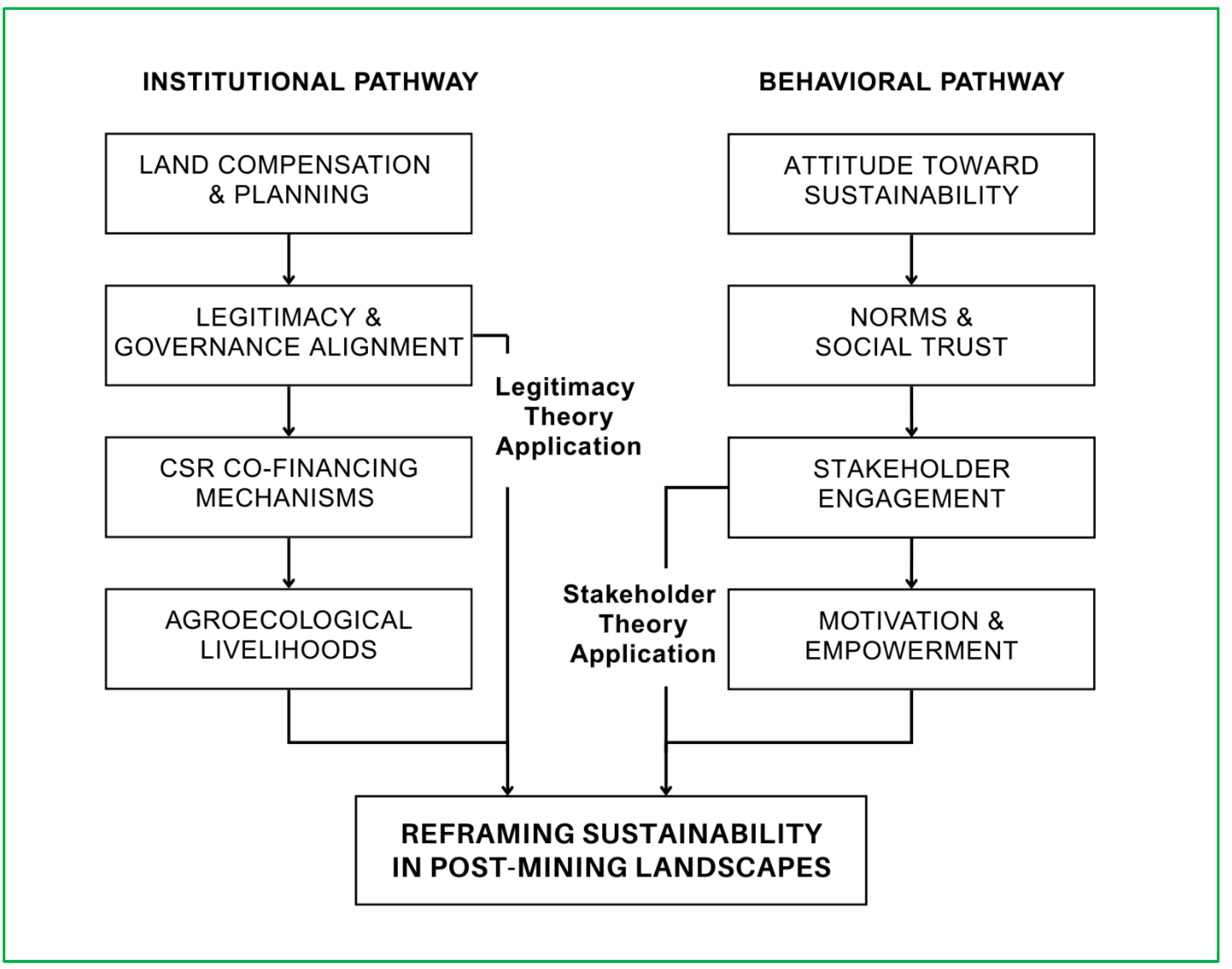
Figure 2.
Dual-Pathway Logic of Behavioral Transformation and Institutional Integration. The diagram presents the NVivo-coded structure of 10 parent nodes, grouped into institutional and behavioral pathways that underpin the dual-pathway framework for post-mining sustainability.
Figure 2.
Dual-Pathway Logic of Behavioral Transformation and Institutional Integration. The diagram presents the NVivo-coded structure of 10 parent nodes, grouped into institutional and behavioral pathways that underpin the dual-pathway framework for post-mining sustainability.
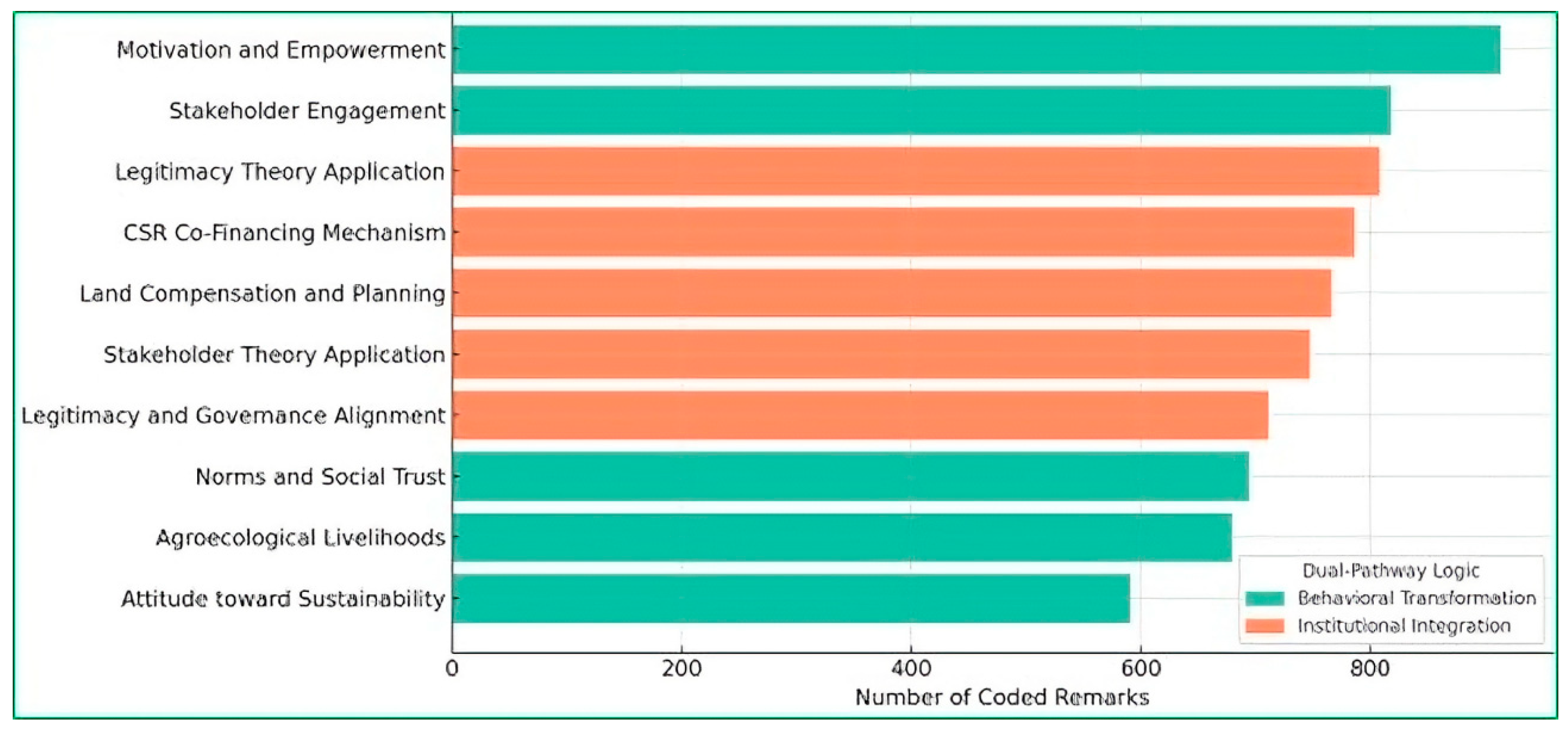
Figure 3.
Dual-Pathway Framework for Post-Mining Sustainability. This framework depicts the dual-pathway model of post-mining sustainability, integrating institutional drivers (e.g., compensation, CSR, planning) with behavioral drivers (e.g., empowerment, norms, trust) to collectively support long-term transformation.
Figure 3.
Dual-Pathway Framework for Post-Mining Sustainability. This framework depicts the dual-pathway model of post-mining sustainability, integrating institutional drivers (e.g., compensation, CSR, planning) with behavioral drivers (e.g., empowerment, norms, trust) to collectively support long-term transformation.
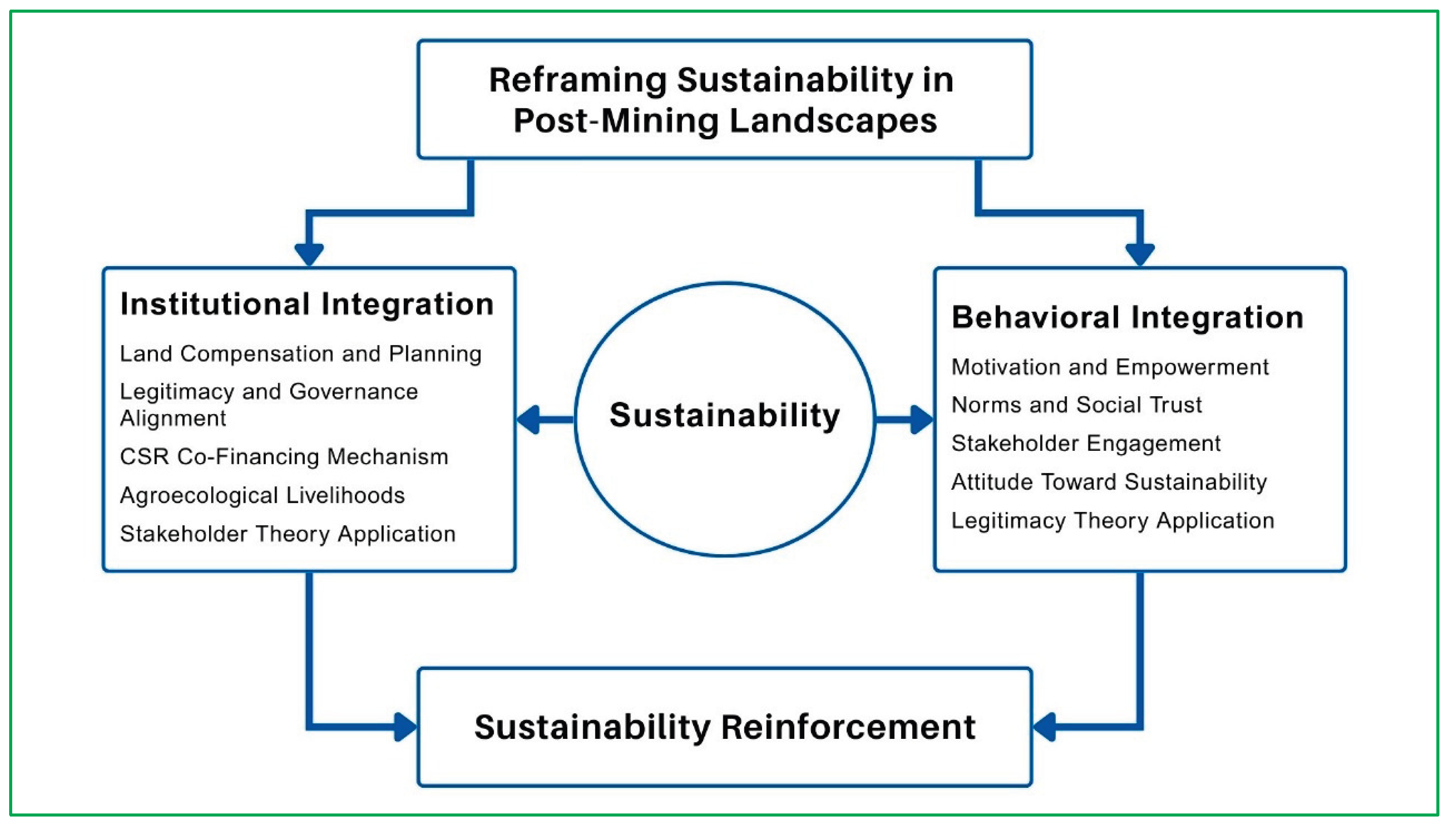

Table 1.
Thematic summary of Institutional and Behavioral Domain in Post-Mining Landscapes.
| Parent Node | Child Node | Fre-quency |
| Motivation and Empowerment | Access to microfinance, Community-led initiatives, Decision-making autonomy, Local entrepreneurship incentives, Psychological resilience, Recognition and reward mechanisms, Training and skills development, Visioning and goal setting | 913 |
| Stakeholder Engagement | Dialogues with Indigenous communities, Engagement mapping, Farmer cooperative role, Gender-inclusive representation, Grievance redressal systems, Multi-stakeholder forums, NGO involvement, Participation in planning | 818 |
| Legitimacy Theory Application | Cognitive legitimacy patterns, Institutional credibility, Legitimacy crises, Moral legitimacy indicators, Perception of fairness, Pragmatic legitimacy cues, Reputation management, Role of transparency | 808 |
| CSR Co-Financing Mechanism | Allocation of CSR funds, Cross-sector CSR alignment, CSR for livelihood transition, CSR reporting standards, Linking CSR to SDGs, Monitoring CSR outcomes, Multi-year budgeting schemes, Public-private partnerships | 786 |
| Land Compensation and Planning | Conflict resolution over land, Customary land rights recognition, Land asset valuation, Legal harmonization for land status, Long-term land use strategy, Participatory land mapping, Resettlement planning, Spatial zoning for post-mining use | 766 |
| Stakeholder Theory Application | Balancing stakeholder claims, Conflict mediation strategies, Institutional responsiveness, Managing stakeholder expectations, Power-legitimacy-urgency typology, Salience-based prioritization, Stakeholder dialogue frameworks, Stakeholder mapping tools | 747 |
| Legitimacy and Governance Alignment | Anti-corruption safeguards, Community consultation mechanisms, Compliance with EIA or AMDAL, Institutional trust building, Policy coherence across agencies, Regulatory enforcement capacity, Role of local government, Transparent permitting process | 711 |
| Norms and Social Trust | Community rule adherence, Intergenerational knowledge, Local leadership influence, Norms of environmental care, Reciprocity in group behavior, Shared values on land use, Social sanctions, Trust in external institutions | 694 |
| Agroecological Livelihoods | Agroforestry practices, Climate-resilient agriculture, Cocoa-based rehabilitation models, Farmer field schools, Intercropping systemsMarket access support, Organic certification programs, Soil health restoration | 679 |
| Attitude toward Sustainability | Belief in sustainable agriculture, Economic security perception, Emotional connection to land, Long-term vision of livelihoods, Optimism about post-mining life, Perceived value of restoration, Willingness to conserve land, Youth engagement in sustainability | 591 |
Table 2.
Institutional Barriers in Post-Mining Sustainability.
| # | Institutional Theme | Observed Issue | Real-World Example |
| 1 | Land Compensation and Planning | Unclear land status and elite-dominated compensation processes. | In Southeast Sulawesi, delayed compensation led to protests from landowners excluded from formal mapping. |
| 2 | Legitimacy and Governance Alignment | Regulatory misalignment between national and local governance. | In Morowali, communities reported overlapping licenses issued without public consultation. |
| 3 | CSR Co-Financing Mechanisms | CSR used more for image than co-financed development. | In Kolaka, CSR funds were used to build unutilized infrastructure without stakeholder input. |
| 4 | Agroecological Livelihoods | Pilot programs lack institutional coordination for scale-up. | In Central Sulawesi, cacao programs stalled due to poor coordination between environment and agriculture ministries. |
Table 3.
Behavioral Patterns in Indonesian Post-Mining Areas.
| # | Behavioral Theme | Observed Issue | Real-World Example |
| 1 | Attitude Toward Sustainability | Skepticism toward sustainability due to focus on short-term economic gain. | In Central Sulawesi, farmers questioned the value of replanting degraded land without secure access to markets. |
| 2 | Norms and Social Trust | Erosion of trust in post-mining areas like Morowali due to unfulfilled promises. | In Morowali, multiple villages refused CSR aid after prior projects failed to deliver promised outcomes. |
| 3 | Stakeholder Engagement | Tokenistic participation in CSR planning processes; elite capture reported. | In Kolaka, CSR forums were attended mainly by subdistrict leaders and lacked farmer representation. |
| 4 | Motivation and Empowerment | Decline in motivation where training/support was inconsistent. | In South Konawe, empowerment levels rose when cacao cooperatives received government extension support. |
Disclaimer/Publisher’s Note: The statements, opinions and data contained in all publications are solely those of the individual author(s) and contributor(s) and not of MDPI and/or the editor(s). MDPI and/or the editor(s) disclaim responsibility for any injury to people or property resulting from any ideas, methods, instructions or products referred to in the content. |
© 2025 by the authors. Licensee MDPI, Basel, Switzerland. This article is an open access article distributed under the terms and conditions of the Creative Commons Attribution (CC BY) license (http://creativecommons.org/licenses/by/4.0/).
Copyright: This open access article is published under a Creative Commons CC BY 4.0 license, which permit the free download, distribution, and reuse, provided that the author and preprint are cited in any reuse.


