
Submitted:
26 May 2024
Posted:
27 May 2024
You are already at the latest version
Abstract
Sustainable development can only be realised when the social, economic and environmental dimensions are considered altogether. Social capital and local wisdom offer important contributions to the development process and the capabilities of individuals and groups as development actors. This study analyses the role of social capital and local wisdom in managing business partnerships between farmers and palm oil plantation companies in North Konawe, Indonesia. Data were collected via in-depth interviews, field observations and focus group discussions and were analysed descriptively and qualitatively. Results underscore the importance of social capital and local wisdom in organising institutional programmes for strengthening palm oil business partnerships. Trust, social networks and participation negatively affect the sustainability of these partnerships, whilst local wisdom and social solidarity positively influence institutional strengthening. Inconsistency and lack of openness by companies can lead to a trust crisis that can threaten the sustainable operations of palm oil companies. Building a good cooperative commitment and maintaining collaboration play key roles in enhancing community welfare and increasing company profits. The social capital and local wisdom of farmer institutions in villages are expected to significantly contribute to the establishment of sustainable palm oil business partnerships.
Keywords:
Social Capital
; Local Wisdom
; Farmer Institutions
; Oil Palm Plantations
; Sustainable Development.
1. Introduction
Palm oil manufacturing is of the main industries that drive the economic development of Indonesia. Apart from shaping environmental sustainability [1,2,3], palm oil companies also significantly contribute to people’s welfare by increasing their income and offering job opportunities [4,5]. However, these companies negatively affect the environment [4,6], disrupt water use in communities (Silalertruksa et al., 2017), shape smallholders’ perceptions of land restoration activities [7], trigger changes in land cover [8], generate CO2 emissions [9], threaten biodiversity [10] and negatively affect other ecosystem services [11,12].
To exert positive impacts, these companies should build harmonious relationships with local communities [13], organise training programmes [14] (Dompreh et al., 2021) and aim for economic empowerment [15]. Cooperation, mutual trust between parties and mutual support are key indicators of social capital [16,17] that promote individual and group solidarity [18]. [19] Putnam (1994) defines social capital as features of social organisations, such as networks, norms and trust, that facilitate coordination and cooperation to make profit. As a valuable resource, social capital facilitates collective action and supports a harmonious social life. Therefore, social capital is important in building and maintaining a cooperative and mutually supportive society.
Jia et al. (2020) state that social capital builds the proactive and reactive resilience of organisations by fostering knowledge collaboration [21]. Social capital also fosters a sense of self-confidence in taking action towards other parties. During the COVID-19 pandemic, social capital promoted public acceptance and adherence to control measures by building trust and norms at the individual level. Social capital can also facilitate collective action and mobilise network resources at the neighbourhood level [22]. High trust, community involvement and personal relationships with others are also considered important in the agricultural sector [23].
Local wisdom is critical to solving community problems [24] through its various environmental protection benefits. Hatu et al. (2019) and Rahmah and Sulistyono, (2024) explore the role of local wisdom as a social capital in remote indigenous communities and demonstrate how such wisdom helps build strong social bonds and overcome potential conflicts. Grossmann (2017) explore how wisdom, including intellectual humility, contributes to improved leadership, sustainability and civil discourse. Local wisdom also benefits cultural preservation and strengthens social relations [28].
Southeast Sulawesi has suitable land for palm oil manufacturing. North Konawe Regency is a central company comprising three palm oil plantations, namely, PT Sultra Prima Lestari (PT.SPL), which includes Andowia, Asera, Langgikima and Oheo and has a total planting area of 5,950 ha, PT Damai Jaya Lestari (PT.DJL), which includes Landawe, Wiwirano and Langgikima and has a total planting area of 6,989 ha, and PT Perkebunan Nusantara XIV (Persero or PT.PN-14), which includes Wiwirano and Landawe and has a total planting area of 4,455 ha. These three plantations partner with landowning farmers in the form of one-roof and core-plasma partnerships.
However, these partnerships have not significantly improved the welfare of farmers. Until now, these farmers have not yet established farmer groups or associations as the starting point for the institutional management of palm oil plantations. These farmers are generally dissatisfied with their current capacity and the company's performance in developing institutions. The partnerships between the company and these farmers are also not built on the principle of equality.
The social capital of farmers in North Konawe tends to be ignored by palm oil plantation managers and has not yet formed a basis for strengthening these farmers' capacity to build partnerships with palm oil plantations.
Several obstacles continue to prevent institutional development from achieving community empowerment. The institutional formation of landowning farmers must be based on a full understanding of the variety and nature of their social capital [23]. A recent study shows that social capital is an important factor in community empowerment efforts; therefore, realising social capital can accelerate community empowerment [29]. Social capital is an important factor that actors must consider to maintain their partnerships and obtain mutual benefits. Local wisdom is just as equally important in establishing effective partnerships between farmers and palm oil plantations and in empowering the former [30]. Local wisdom includes the knowledge, values and practices developed by local communities throughout generations that can support their environmental, social and economic sustainability.
Saleh (2022) investigates the role of social capital in promoting the welfare of farmers, especially rice farmers, and finds that showing respect and mutual appreciation, responsibility and mutual support increases community competence and improves farming skills, whilst promoting agricultural diversity can ultimately increase farming income. Rocca and Zielinski (2022) state that social capital contributes to human development and welfare and highlight the importance of social capital, human capital and environmental factors.
In the context of institutional strengthening, trust, good relationships and social networks serve not only as determinants of the sustainability of institutional goals but also as manifestations of the implementation of social capital [33,34,35,36,37,38]. Societies with a low level of mutual trust are products of cultural patterns in a very limited environment [39]. These societies tend to have a weak social capital and continue to adhere to traditional ways of living.
This study focuses on the factors of social capital and local wisdom, which strengthen the institutional management capability of landowning farmers in their business partnerships with palm oil plantations. This study aims the following: (1) to analyse the characteristics of the social capital of landowning farmers as business partners of palm oil plantations in North Konawe; and (2) to analyse the role of social capital and local wisdom in managing these business partnerships.
2. Materials and Methods
The research focused on the three palm oil plantations of North Konawe Regency, namely, PT.SPL, PT.DJL and PT.PN-14. These plantations are all privately owned and started their operations on land owned by local farmers. The respondents were selected via purposive sampling, and only those farmers who own land for palm oil manufacturing were considered. A total of 320 respondents were selected to evaluate the business partnerships in their area. Several respondents were also recruited from local communities, NGOs, farmer groups, companies, the Plantation Service, academics, regional legislative members and Farmer Youth (young generation of farmers). The opinions of these respondents regarding the role or contribution of palm oil plantations were collected through focus group discussions (FGDs) and interviews. The profiles of these respondents are shown in Table 1.
This study specifically focused on (1) the characteristics and practices of farmers’ social capital, (2) the dimensions of social capital in palm oil business partnerships, (3) the role of social capital in these partnerships and 4) the role and contributions of social capital in sustaining these partnerships. The data were analysed via qualitative descriptive analysis.
3. Results
3.1. Profile of Palm Oil Plantations in the Study Area
3.3.1. A Brief History of Palm Oil Companies
This research identified three palm oil plantations operating in Southeast Sulawesi, whose locations, initial year of operation, planting area and palm oil production (in tonnes) are tabulated in Table 2.
Despite the fluctuating trend between 2020 and 2022 as shown in Table 2, PT.SPL reached its highest palm oil production during these years. Amongst the three plantations, PT.PN14 reported the highest production value of 87,425 tonnes in 2022, followed by PT.DJL (48,000 tonnes) and PT.SPL (47,000 tonnes). The differences in these palm oil production figures may be attributed to the soil fertility and natural factors in the locations of these plantations [40], their cultivation treatments [41] and socio-political factors [42,43].
3.3.2. Managing Business Partnerships between Plantations and Farmers/Landowners
PT.SPL and PT.DJL engage in a ‘one-roof management’ partnership with landowners. In terms of profit sharing, PT.PN-14 divides its profits as 20% for the company and 80% for the landowners. Given that PT.PN-14 does not have a factory, the harvested (Tandang Buah Segar) TBS is sold directly to the company that owns the factory. The terms of agreement governing the partnerships between these companies and farmers/landowners are tabulated in Table 3.
Meanwhile, PT.TBS divides its profits as 40% for landowners and 60% for the company, whilst PT.DJL allocates 20% of its profits to landowners and keeps the rest. These profit sharing patterns are discussed in detail as follows:
- The produced TBS, which belongs to the landowner and the company, is sold to the company’s commitment at market price, and the proceeds from this sale are called ‘gross income’.
- 40% of the TBS sales price, called ‘operational costs’, are deducted from the gross income, and the difference is called ‘operating results’.
- PT.SPL, the landowner and the company will jointly return investment costs by deducting 30% of their operating results in the first year, 40% in the second year, 50% in the third year and so on. The remaining profit, called ‘net income’, will be divided between the landowner (40%) and the company (60%).
- PT.DJL divides its investment and operational costs as 60% for the company and 40% for the landowners. As for net income, the landowner receives 20%, whilst the company receives 80%. PT.SPL decides its profit sharing pattern based only on land area and not on land productivity. By contrast, PT.DJL takes land productivity into consideration when dividing its profits.
- After paying off the cost of building the plantations (investment cost), the operating results described in point 3 above will no longer be deducted by 50%. Therefore, the operating results become the net income of each party.
- The following rules that govern investment costs are regulated in Article 3 of the agreement:
- The company agrees that building the plantations costs IDR 35,000,000,00 per hectare.
- The landowner bears 40% of this cost (IDR 14,000,000,00 per hectare), whilst the company bears 60% (IDR 21,000,000,00 per hectare)
- The investment costs use the financial facilities of the company at an annual interest of 12%.
- The repayment period for the investment costs will be determined based on the production results of the plantation, which will be monitored. The remaining debt for each party will also be calculated every month.
However, these terms and conditions fail to explain the responsibilities of each party towards the environment and determine which facilities the company will provide to landowners aside from profit sharing, such as coaching or counselling on palm oil cultivation. Offering guidance and counselling regarding the development and cultivation of palm oil is critical to the sustainability of plantations because landowners are expected to help in development as local workers. Results show that the respondents have not received any counselling regarding palm oil development. Whilst the investment cost is specified as IDR 35,000,000,00, no further details are given, including the expenses and the investment costs, for which the landowners are charged an interest of 12% per year. These costs only increase the financial burden for landowners, especially during the first year when palm oil is yet to be produced after being planted. After four years, the landowners continue to receive small profits because larger profits correspond to larger incurred costs, and the accumulated interest on investment costs increases every year.
Communication is critical in partnerships, especially under the one-roof management pattern. The respondents commented that the intensity of communication between the company and landowners should be improved by increasing the frequency of their meetings. Over the last three months, 72.88% of the respondents claimed that they had never met with the company. Most of them also complained that the company never helped landowners or farmers with their plantation problems. Some respondents also claimed that landowners and companies never communicated with each other.
3.3.3. Partner Institutions
Cooperative institutions aim to develop the potential and abilities of their members in particular and the society in general. In other words, these institutions exist to improve the economic level of society. Cooperatives also contribute to the realisation of an economic life characterised by togetherness, kinship and openness [44]. Cooperatives serve as mediums for economic transformation that accelerate the transfer of information and innovation [45]. FGD results show that the company has established a cooperative to increase the capacity and empower its members. However, this cooperative faced some operational problems associated with the management of the company and its members (i.e. farmers). As these problems were not resolved properly, the cooperative eventually ceased to operate. Other problems mentioned in the FGD include lack of transparency in the reported TBS production and the mismatch between the total price of TBS and the actual conditions in the field. Some landowners claimed that farmers were selling palm oil products elsewhere, which violated the agreed commitments. The company and landowners also did not trust each other, thus discouraging participation from some members. Hunecke et al. (2017) define trust as the main aspect of social capital given its key role in building relationships. Trust is closely related to member participation, and member participation plays a major role in cooperative institutions.
The FGDs carried out at the sub-district level were attended by farmers/landowners, company elements, academics, governments, the People’s Representative Council/DPR, media and NGOs. These FGDs resulted in proposals to reactivate the cooperatives, establish village-owned business entities (BUMDES) in the village as effective communication channels for increasing the capacity of land-owning farmers [47,48] and optimise the role of extension workers in building farmers’ capacity.
3.2. Social Capital Practice
Social capital refers to the amalgamation of potential resources related to the ownership of a network of institutional relationships that are based on mutual acquaintance and recognition [49,50]. Landowners and palm oil plantations should maintain a good relationship to realise their expectations. A good social capital corresponds to favourable relationship quality, trust, norms and networks [51]. This dimension also contributes to the construction of high-quality relationships between individuals and groups [52,53,54].
3.2.1. Trust
The lack of trust of landowners towards the company may be due to the lack of communication between these parties. Communication plays a key role in achieving the goals of both parties. The relationship between landowners/farmers and the company needs to be improved by promoting openness or communication. One landowner commented,
‘In the past, when the company started clearing land and planting palm oil, it always engaged in socialisation with the local community. However, the company stopped socialising with the community after it started producing palm. The company was not open, and the production results did not meet the conditions agreed upon by both parties’.
Most of the landowners (73%) believed that they have the same goals in this partnership. Whilst the majority of them no longer trust the company, a small percentage (27%) still showed confidence in the company. Due to their dissatisfaction, some farmers started staging demonstrations, which reflect the lack of trust of the community towards the company. The local government acts as a facilitator in resolving this matter. One respondent shared,
‘The community often reports to the government, but the government only listens and accepts the concerns of the community. The community waits for a response from the government, but the government takes no action. So, the community immediately went to the field to demonstrate at the company and shut down is operations. The company only responded to the community after the demonstration. But now, people must wait for the results from the company because they are tired of reporting to the government and holding demonstrations’.
Communication breakdowns and weakened mutual trust have a reciprocal relationship. Specifically, lack of communication weakens mutual trust, and a weakened mutual trust creates communication barriers. In other words, minimal or interrupted communication leads to minimal trust, which in turn hinders the formation of social networks and affects community participation. Therefore, the company should create a space to communicate with landowners and openly discuss their problems. As partners, landowners should also participate in the activities of the company, especially those related to land productivity. Yue et al. (2019) describe trust as a bridge that transforms people into leaders whose success greatly relies on communication. They also confirm that transformational leadership and transparent communication are positively related to organisational trust, which in turn influences openness.
Trust also determines leadership success and business agility [56], and lack of trust in the public can lead to failure [57]. Kolot et al. (2020) find that trust, as a dominant structure of social wealth, is significantly related to socioeconomic development.
The low level of trust of farmers towards the company may be ascribed to their lack of communication and education regarding the technical and economic aspects of palm oil manufacturing. However, the company communicated with landowners from time to time, such as at the beginning of palm oil production and when informing landowners that they still owe money to the company. Landowning farmers should be able to measure the productivity of their land, and the company should prioritise its business whilst improving the knowledge and skills of landowning farmers. Improving such capacity can also enhance the capabilities of farmers to achieve equality with the company and the government. Having rich resources also promotes the trust of farmers in their partner company. Besley and Dray (2022) argue that trust in government leads to greater policy compliance, thereby increasing state capacity, whilst Manoj et al. (2020) emphasise the importance of trust within and between institutions in capacity building. In sum, trust is one of the keys to enhancing community and institutional capacity.
3.2.2. Social Networking and Participation
Scherp et al. (2009) define a social network as a social structure of actors tied by specific relationships or interdependencies. Thilagam (2010) proposes various types of social networks, including friendship, collaboration and business. Trust is an important component of close friendships on social networking sites that are established through similar activities and signals [63]. Carchiolo et al. (2007) propose an approach for building trust in social networks that highlights the importance of gathering information and opinions from friends to build trust towards new acquaintances. Paletto et al. (2015) emphasise the significance of similarity and trust in forming groups on social networks, with trust being more valuable than similarity in the group formation process.
Farmers have very weak social networks for managing palm oil business partnerships, especially in partnerships that adopt the profit-sharing model. Data from the FGD show that the weakness of these social networks and farmers’ participation is due to economic, social and institutional dimensions. As for the economic dimension, farmers do not have the power to market their palm oil production given their contractual obligations with the company , and they accumulate with debt from investment and operational costs. As for the social dimension, landowners/farmers do not have a strong social network to work together with individuals and groups, and they have no leader to whom they can turn to whenever they have a problem. Their individual capacity also influences how they build networks amongst themselves. As for the institutional dimension, community leaders and village heads do not function optimally given the absence of farmer groups or combinations of farmer groups, village-owned enterprises or cooperatives.
Palm oil farmers also do not have good relationships with their fellow farmers. They tend to go their own way, thus discouraging collaborative actions against the company. They are also not informed about the amount of palm oil being produced and the presence or absence of any assistance.
‘There are no farmer groups, so we have no one to talk to if there is a problem. We have no leader or chairperson, and the village government is unreliable. We hope that a farmer group will be formed to help its members. We are unable to communicate with the company when we have a problem’.
A good social network is characterised by good interaction, communication and community [66]. Interaction is an important aspect of a good social network [67,68]. Cramton and Doyle (2017) discuss the concept of open access markets, which can help manage the growing demand and remove the barriers for service providers, thus allowing for increased competition and access to market resources. Soria (2015) highlights the benefits of social networks for small and medium-sized businesses and emphasise the ease of accessing information and the marketing potential they offer.

Table 4.
Table 4. Respondents’ assessment of Social Networks and stakeholder participation in the Sustainability of Partnership Model Palm Oil Plantation Businesses.
Table 4.
Table 4. Respondents’ assessment of Social Networks and stakeholder participation in the Sustainability of Partnership Model Palm Oil Plantation Businesses.
|
Respondents’ Social Networks and Participation |
Respondents’ Assessments (Score=1-5) |
||
|---|---|---|---|
| SPL DJL (N=100) | DJL (N=109) |
PTPN 14 (N=111) | |
| Economics | Score/(N) | Score/(N) | Score/(N) |
| Access to companies related to employment opportunities Productivity transparency of plasma/community palm oil plantations Access market price information Family participation in savings and loan cooperatives |
4 (95) 3 (100) 2 (85) 2 (50) |
4 (105) 3 (43) 2 (60) 2 (15) |
4 (80) 2 (77) 2 (55) 2 (35) |
| Ecology | Score /(N) | Score /(N) | Score /(N) |
| Involvement of environmental NGOs Government attention to the environment Farmer participation in protecting environmental pollution Cooperate in preventing land damage |
4 (81) 3 (83) 3 (75) 3 (97) |
4 (89) 3 (92) 3 (105) 3 (87) |
3 (50) 3 (90) 3 (75) 3 (93) |
| Social | Score/(N) | Score/(N) | Score/(N) |
| The education level of farmer families increases Intensity of agricultural extension There is communication between farmers Communication between the community and the company Communication between farmers and community leaders |
4 (85) 3 (72) 3 (85) 2 (70) 4 (98) |
4 (60) 2 (68) 3 (78) 2 (39) 4 (92) |
4 (60) 3 (70) 4 (82) 2 (41) 4 (90) |
Source: Data from research results after processing. Description: value 1 (bad); score 2 (not good); score 3 (fairly good); value 4 (good); score 5 (very good), N=Total of Respondents’.
Social Networks and Participation Respondents in economic sustainability showed varying values; generally, the farmer’s assessment was quite good, and the respondents generally agreed that the presence of the company introduced employment opportunities in the community. However, the company shows poor transparency in disclosing prices and its production results to landowners. The participation of landowners in cooperatives is also low. Regarding ecological sustainability, social networks and farmer participation can be ranked as good, and farmers always participate and collaborate in protecting the environment. NGOs also positively contribute to environmental issues. With regard to social sustainability, the existence of the company has benefitted farming families by increasing their access to education, their income and the availability of employment opportunities.
The communications between farmers and companies and amongst landowners, the government and community leaders are all positive. However, the three aspects of sustainability still warrant improvement to contribute to the implementation of social capital.
Ruggeri and Samoggia (2018) identify several factors that influence the social networks and participation of palm oil farmers. One of these factors is access to information. Palm oil farmers generally access the latest information about cultivation techniques, market prices and innovation technology from their social networks. Improving their access to information can thus increase their production efficiency and support their economic sustainability. Social networks also provide farmers with better access to financial services, including credit and insurance, which are essential for their investment in innovation and risk mitigation. Peng et al. (2021) and Rizal and Nordin (2022) argue that leadership, organisation and communication technology all influence the social networks and participation of palm oil farmers in economic sustainability. These results highlight the importance of the centrality of communication networks and other aspects, such as individual perception, political engagement, involvement in affiliations and sustainable use of natural resources [74,75].
3.2.3. Social Solidarity
Social solidarity refers to the reciprocal relationship amongst individuals [76]. This type of solidarity is often observed in groups characterised by respect, reciprocal feelings, trust, selflessness, pride and suffering from loss or betrayal [77]. In other words, social solidarity refers to an act of cooperation based on a mutually beneficial relationship. The establishment of the company in the study area did not change the habits of the local community; residents remained open and continued helping one another and working together in their local language. This form of social solidarity is called ‘Pepekoaso/Meronga-Meronga’, which is particularly evident at times of natural disasters, deaths and marriages. The palm oil company offered many contributions to the community, to which the local community reacted favourably. In other words, companies that respect the community receive favourable treatment from the community in return. By maintaining the culture or norms of indigenous communities, companies can engage in their business sustainably. Results show that public openness to what is expected from the Company, which will be an input in making operational decisions for the future.
Table 5.
Stakeholder statements are expected to receive a good response from the Company.
| No | Stakeholder | Stakeholder Statement of Solidarity in Palm Oil Plantation Business |
|---|---|---|
| 1 | Land Owners (Farmers) | Landowners/farmers hope for support or facilities from companies to be facilitated by the government |
| 2 | NGOs | NGOs hope that the role of palm oil companies can protect the environment and ensure fair welfare for land owners/farmers. |
| 3 | The Government | The Government of the Regent of North Konawe, through the Plantation and Horticulture Service, instructed the Company to commit to fulfilling permits as a condition for building the factory. The parties need to help investors continue to operate. |
| 4 | Academics | Provide support so that companies are committed to realizing the welfare of farmers/land owners who are their partners while still paying attention to institutional strengthening, improving cultivation technology and waste management for the benefit of increasing palm oil productivity, Provide a role in managing palm oil processing factories, providing labor wages and capacity-building training to farmers/land owners. Moreover, the sustainability aspect should not be ignored from an ecological perspective. Recommend that the government really strengthen the position of farmers, especially in terms of implementing regional minimum wages for workers, disclosing information on palm oil prices, and launching Regional Regulations on Sustainable Palm Oil Management. |
| Regional Legislative Member | Increase awareness of environmental issues and strengthen institutions. The existence of an oil palm plantation company shows its commitment to realizing the welfare of partner farmers, utilizing palm oil products from the North Konawe Regency. . |
|
| Youth Farmers (Young generation) | The younger generation (land-owning families) specifically want their parents to improve their skills in managing oil palm plantations |
Source: Data from research results after processing on FGD meeting.
Stakeholder statement refers to the commitment of stakeholders towards working together to achieve their goals, such as improving community welfare and protecting the environment. Maintaining the environment is a duty for all stakeholders [78,79,80]. Through CSR, the company can contribute to improving the local economy and ensuring environmental sustainability [81,82].
3.2.4. Reciprocal Benefits
As a social construct of the agrarian society in North Konawe, reciprocal benefits involve the provision of mutual benefits and building of intimate relationships. This concept has been equated to the main principle of cooperation (‘medulu-medulu’ in local language). The partnerships amongst the company, plantations and landowners/farmers are expected to produce reciprocal benefits. Christiawan and Limaho (2020) state that palm oil companies provide new insights and skills for the community, whilst Snashall and Poulos (2023) suggest that the social responsibility of these companies is considered a reciprocal benefit for the community.
Results of the interviews and FGD show that the company and the landowners/farmers need to improve their understanding of the importance of maintaining equal position and justice to receive benefits. These parties need to show their concrete efforts and commitment towards achieving open, equal communication patterns that are based on transparency and accountability, especially regarding production costs, production and prices. Data from the FGD highlight the importance of mediators, who also act as independent supervisors and auditors. Relying on the government may lead to biased perceptions for both parties. Stakeholders have different opinions regarding palm oil plantations in North Konawe and generally hold favourable perceptions towards the benefits they offer to the community. Some statements from these stakeholders as revealed in the FGD are tabulated in Table 1.
Table 6.
Record of FGD results related to the mutual benefits of farmers/land owners and palm oil plantation companies in North Konawe.
Table 6.
Record of FGD results related to the mutual benefits of farmers/land owners and palm oil plantation companies in North Konawe.
| No. | Stakeholder | Informant statement |
|---|---|---|
| 1 | Land Owner 01 | I feel that from the first year to 2019, almost the same results, or there is no increase in results There are still fewer employees in companies who get BPJS for employment. |
| 2 | Land Owner 02 | Company PT. SPL and PT. DJL operate because of the kindness of the landowners, in this case, the farmers, who do not own the core land until now. Care or maintenance of oil palm plants should be done seriously Improvement of garden roads to facilitate the transportation of palm oil. Not consistent in revenue sharing and should be by the agreement. |
| 3 | Land Owner 03 (Land in Wiwirano Village) |
The oil palm industry promised a factory, but so far, it has not been realized The workforce is a concern for the Company Forming BUMDES as a medium for increasing the capacity of farmers, |
| 4 | Village Head in Mantasole Village | The price is the first point we should pay attention to; far from what is expected. The price is not negotiable. There is a need for training for farmers by companies and extension workers |
| 5 | Land Owner 04 | I am very grateful to the PTPN XIV oil palm company because my son’s school, which was stopped for a while, can return to school again. By reactivating cooperatives, farmers can help each other overcome existing problems. |
| 6 | PTPN Nusantara XIV Kebun Asera Unit |
There is no factory yet for the sale of Tandang Buah Segar (TBS) from farmers; we work with partner companies SPL and DJL to buy TBS from us, but there are farmers who jointly do not sell to their partner companies, and as a result, credit instalments are not smooth. |
| 8 | Public Relation PT. SPL | The system used is for profit, Another problem with the Company is that this community freely cuts palm oil on the ground to be used as a vegetable at the festival. Even though the palm oil they cut is still productive The Company PT. SPL is about to share a small yield from year to year due to natural factors or a large harvest in the rainy season, but the road is damaged, so it cannot be reached, and the fruit rots. |
| 9 | Public Relation PT. DJL | a. There is no core garden yet b. The soil is not fertile, so production is low |
| 10 | Head of North Konawe Horticulture and Horticulture Department |
The need for consistency on both sides (businesses and farmers) related to the MOU that was agreed upon. The Company must transparently convey related costs, namely a) investment costs, b) general costs, and c) operational costs. Optimizing the role of agricultural extension |
| 11 | Executive Director of WALHI Sultra | The flood was caused by the impact of plantations and mining. The good Company will follow the process by the existing provisions and rules. There is injustice and a lack of transparency in the Company . d. In developed countries, farmers are respected. We are here; being a farm labourer has no honour. Entrepreneurs use the centralized autonomy of this region to invest in stakeholders and those stakeholders to exploit the region. |
| 12 | Lepmil) /NGO |
If the regulations are not changed, the community’s well-being will remain unchanged. Why did mines dare to change the regulations? Why didn’t oil palm plantations issue a revision of the law so that they could no longer send CPOs abroad? Why don’t we make the industry in Indonesia? Should Southeast Sulawesi farmers send to their own industry, or should they send to India or Malaysia? We are laborer’s forever. There is no government control over fertilizers and prices. No government controls the community and always loses in negotiations. The principle is that if the old paradigm is still used and the method used is still a dream, it will not be achieved |
| 13 | North Konawe DPRD Member) |
In the House of Representatives, the people are devising regional regulations regarding recognizing territories elsewhere. If in Konawe Utara’s “Customary rights to land,” it is true that he is almost marginalized in North Konawe as a whole because his land is handed over to companies whose contracts will dominate for 30 years. So, this society needs to be in a stronger position. Companies that invest in North Konawe to be cooperative with the regional government |
| 14 |
North Konawe DPRD Member |
There is a need for proper socialization because Malaysia can develop its country with oil palm, so why not us? We must encourage the birth of a regional regulation, especially in North Konawe. There is no clear legal basis that provides protection to oil palm companies and farmers so that they both benefit equally. I have had many discussions with farmers. They desire to plant oil palm, but they are thinking about where our oil palm products will be marketed. d. Farmer institutions at the level of BUMDES have become a media source of information and capacity building for farmers. |
| 15 | Academic from North Konawe | The benefits of palm oil for the community include: The openness of the community’s vision and mindset so that many sons and daughters are sent out of the district for school, It used to be a remote region (difficult access). Now the access is better, Dormant land (unproductive) becomes cultivated/open, and The community obtains a permanent job (as an employee) who previously cultivates the fields (suitable for cash crops and long-term crops) and searches for rattan (locally called pa ratan) and hunts jong (deer).” Farmers’ Farmers’ institutions are needed to increase farmers’ capacity. |
3.3. Local Wisdom Practices
Dahliani (2010) discusses the impact of globalisation on local wisdom in the built environment and highlights the need to adapt local knowledge whilst maintaining its meaning and connection with local character. Local wisdom values are very important in protecting and managing the environment and can solve related problems in the community [24]. Hatu et al. (2019) explore the role of local wisdom as social capital in remote indigenous communities and show how local wisdom helps build strong social bonds and overcome potential conflict. Grossmann (2017) discusses the contributions of wisdom, including intellectual humility and consideration of diverse viewpoints, to improved leadership, sustainability and civil discourse and shows that local wisdom benefits environmental protection, cultural preservation and strengthened social relations.
The population of North Konawe generally comprises the Tolaki tribe, a society with an agricultural typology. People of the Tolaki tribe are very harmonious with nature or forest areas and have a very close tradition of cooperation amongst communities (Tolaki language: medu-medulu). Before the establishment of the palm oil company in North Konawe, the local populace earned their living by harvesting rattan or cutting wood in forest areas and selling them to collectors, which would require them to leave their families behind in the village for several days or months. Some people would hunt deer/jonga or buffalo in the forest area and sell them either alive or as meat. Some people engage in farming food crops, whilst others would engage in farming plantation crops (e.g. cocoa, cashew nuts cocoa coconuts) without intensive maintenance. Others would hunt for freshwater fish in the Lasolo and Lalindu rivers or engage in contractual work for constructing roads and other government infrastructure. However, farming and gardening activities eventually faded in North Konawe as people started working for the palm oil company. In developing societies, the term ‘retire as a farmer’ means that an employee waits for his/her share of profits as a form of pension.
Based on this livelihood pattern, new norms emerged in North Konawe related to the control of natural resources, such as ‘Ulayat Rights to Land’ based on sub-ethnic ownership (Sambadete, Hialu, Walandawe and Landawe) as well as various forms of local wisdom, including buffalo grazing fields or cows (Tolaki language: rano), a source of staple food, especially sago plants, and the Jonga deer conservation area as a hunting ground.
The social relations amongst farmers that were established through mutual cooperation activities also started to fade, especially in agricultural activities. Before oil palm plantations were constructed, farming activities in North Konawe were always carried out jointly amongst farming families. Nowadays, these forms of cooperation can only be observed in weddings and funerals.
The construction of oil palm plantations in North Konawe changed the habits, ways of thinking and living behaviour of the local people. Some of them considered working for the company to increase their family income whilst continuing their usual work, such as gardening and harvesting rattan in the forest. Some scholars also observe how the presence of palm oil companies hurts local livelihoods and biodiversity. For instance, Sunkar (2019) finds that the expansion of palm oil plantations does not significantly impact the livelihood strategies of local communities. Obie and Pakaya (2020) find that palm oil plantations expose the vulnerability of rural communities’ livelihoods. The development of these plantations also leads to deforestation, land conflicts and other negative environmental impacts. McCarthy et al. (2012) and Schoneveld et al. (2019) discuss how the governance of palm oil production networks influences local outcomes and the ability to overcome related problems. In sum, the presence of palm oil companies impacts local wisdom (Andrianto et al., 2019) and livelihoods [42,88].
The local people’s social habits also helped the company interact or socialise with the community. Approaching village leaders and respecting the local customs allowed the company to operate smoothly. The company also carried out cooperation activities targeting environment preservation, which had positive consequences for the company and the community. In other words, showing respect for community customs and norms also supports the goals of the company. Therefore, local wisdom and community engagement contribute to the well-being of palm oil companies and local communities [75]. One landowner commented the following:
‘The local community is enthusiastic about working together on environmental issues, and this has been their habit since ancient times’.
3.3. Social Capital in the Sustainability Dimension of Palm Oil Plantations
The agricultural community in North Konawe shows distinctive characteristics that still apply today. Firstly, kinship relations in North Konawe remain strong and intimate after the establishment of the company due to the fact that the heads of families are related by blood and marriage even though they come from different ethnicities, such as Tolaki, Bugis/Makassar, Java/Bali and Muna/Buton. The residents in each village know one another very well. Secondly, the livelihoods of people in the local community are almost similar, including farmers (e.g. sedentary farmers, agriculturalists, forest product gatherers and labourers), and their work is greatly influenced by nature (e.g. weather and climate). Thirdly, these people have a harmonious relationship with nature (e.g. forests, rivers and seas) and depend on their natural surroundings to support their economy. They often use technology or simple agricultural equipment to adapt to natural conditions. This characteristic starkly contrasts those observed in industrial societies (including the plantation industry with the use of advanced (modern) technology). Fourthly, given the small population, the settlements in North Konawe are not dense. Lastly, the village community is homogeneous, where people have similar livelihoods, religions and customs even though they are of different ethnicities. However, cultural acculturation is also observed in the community due to co-residence relationships and inter-ethnic marriages. As previously explained, people of North Konawe represent a typology of agricultural society.
Based on the information presented in Table 2, the social capital practices of the community in North Konawe serve as important attributes in each dimension of sustainability as a characteristic of the social capital inherent in business partnerships between farmers/landowners and the company.
Table 7.
Social Capital in the Sustainability Dimension Attributes of Partnership Model Palm Oil Plantation Businesses.
Table 7.
Social Capital in the Sustainability Dimension Attributes of Partnership Model Palm Oil Plantation Businesses.
| Variables | Social Capital Indicator | Information Related to Sustainability Dimensions of Palm Oil Management Partnership Models | Information Source |
|---|---|---|---|
| Social Capital |
Economic | ||
| Trust | Transparency of palm oil TBS prices Management of oil palm land Palm oil production |
Farmers (land owners) Company |
|
| Social Networks and Participation | Productivity of plasma/community oil palm plantations Farmer participation in cooperatives Influence of external information on palm oil TBS |
Farmers (land owners) Company |
|
| Local Wisdom |
Employment recruitment Community and government cooperation Involvement of community leaders |
Farmers (land owners) Company Local government |
|
| Social Solidarity | Determination of profit-sharing Maintain good communication with the Company Support company programs Help fellow farmers |
Farmers (land owners) Company |
|
| Reciprocity | Job opportunities TBS payments on time Farmer's income level |
Farmers (land owners) Company |
|
| Ecology | |||
| Trust | River water quality management CSR environmental care program The Company continues to maintain the fertility of the land |
Local Government Farmers (land owners) |
|
|
Social Networks and Farmer Participation |
There is involvement of environmental NGOs Farmer participation in environmentally friendly farming. Cooperation between farmers is lacking in the management of pam Oil; |
NGOs Local government Farmers (land owners) |
|
| Local Wisdom | Soil fertility treatment Proportion of forest area to plantation land Has a tradition of maintaining plantation and food crops, animal husbandry, and fisheries. |
Farmers (land owners) Local government |
|
| Social Solidarity |
Help preserve river borders Help each other in dealing with flood disasters Support company environmental programs • |
Department of Agriculture Farmer Academic |
|
| Mutual Benefits |
Reduced negative environmental impacts Public health and environmental sustainability |
NGOs Local government Academic |
|
| Social | |||
| Trust | Institutional management of farmers Land ownership status Company leadership |
Farmers (land owners) Company |
|
| Social Networks and Participation |
Farmer education level Participation of agricultural extension workers Participation in farming management • Farmers (land owners). |
Farmers (land owners) | |
| Local Wisdom | Livelihood Farmer cooperation |
Farmers (land owners) | |
| Social Solidarity |
Protection of farmers and environmental issues Attention of government agencies Implementation of CSR |
Farmers (land owners) government |
|
| Reciprocal | Availability of labour Assistance with public facilities Social assistance |
Farmers (land owners) Company Local government |
Source: Research results data after processing, 2023.
Local wisdom in the community is reflected in the positive cooperation between formers and the company and the former’s support for the latter’s programmes. Community involvement as employees in the company by showing good performance and motivation from old habits that have a tradition of maintaining plantation and food crops as well as animal husbandry and fisheries. Being one of the driving factors for helping and collaborating with companies is a positive element and reciprocal benefit.
Social solidarity in the community is reflected in the people’s actions and the government’s support for environmental protection. Given its concern for the community and various environmental issues, the company organised different activities that focused on environmental aspects. The government also supervises the environmental management of companies in accordance with the existing regulations. One way for the company to demonstrate its commitment to social, economic and environmental responsibility and carry out environmental management practices is by arranging CSR programmes, which involve different stakeholders, including the community, government and NGOs. The benefits of these programmes, albeit not optimal, are also enjoyed by local communities. The success of CSR programmes is generally determined by the current production profits and the commitment of the company. When engaging in CSR, companies introduce job opportunities, commit to timely payments and increase the income of farmers. The positive impact obtained by local communities from farmer solidarity actions greatly benefits the company and the farmers themselves.
3.4. Role of Social Capital in the Sustainability of the Palm Oil Business Partnerships
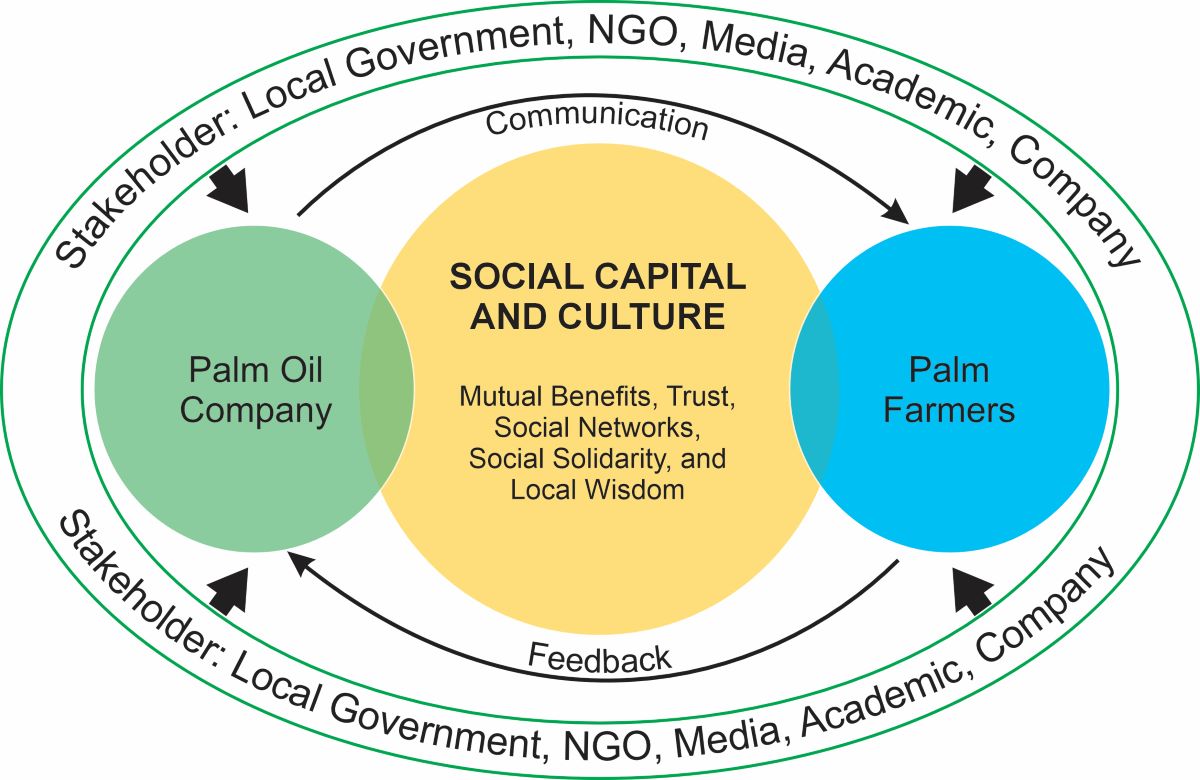
Social capital refers to the network of social relationships, norms and beliefs amongst individuals or groups in a society. In the institutional context of palm oil farmers, social capital plays an important role in influencing the success and sustainability of their businesses [89,90,91]. Social capital is built from the behavioural characteristics of individuals and local communities as illustrated in Figure 1. Social capital has five aspects, namely, trust and social networks, participation, reciprocal social capital, local wisdom and solidarity, each having unique characteristics and roles in sustaining business partnerships between farmers and palm oil plantations. These five aspects also differ in their nature. For instance, trust and social networks and participation do not optimally contribute to the partnership between farmers and plantation companies and thereby require additional efforts from the parties involved. Local wisdom and solidarity offer positive support for these partnerships, whilst reciprocal social capital only plays a neutral role.
3.4.1. Role of Trust
The landowners/farmers and the company generally share a feeling of distrust. Some farmers did not trust the company, who they believed was not fully committed to fulfilling their agreement and lacked transparency regarding TBS production. Nupueng et al. (2022) stated that trust is an important aspect of building and maintaining partnerships between farmers and palm oil plantations. A strong trust between these parties plays a key role in maintaining the sustainability of their partnership and strengthening a mutually beneficial relationship [93].
Trust influences the ability of farmers and plantations to work together to achieve their common goals. Each party must be confident that the other will fulfil the agreed commitments. Specifically, farmers must be confident that the company will provide technical support, purchase crops at a fair price and offer land security, whilst the company must ensure that the farmers will follow the established cultivation guidelines, maintain the quality of harvest and actively participate in its programmes. With strong trust, partnerships can run smoothly and sustainably. Trust also strengthens the communication between farmers and the company. A high level of trust allows the farmers and the company to comfortably share information, their problems and their hopes with each other.
An effective and transparent communication helps these parties easily identify problems, resolve conflicts and make better decisions. For example, when pests or diseases threaten the cultivation of palm oil, those farmers who trust the company will immediately report the incident, and the company will quickly act on the problem and provide technical support to farmers.
Trust also plays an important role in maintaining the long-term sustainability of partnerships. A strong sense of trust enables the creation of long-term commitments, joint investments and sustainable programmes. A company with a high trust in farmers tends to provide the latter with financial assistance or training to increase their capacity, whilst those farmers who have high trust in the company will remain loyal and motivated to carry out agricultural activities following the sustainability principles set by the company.
3.4.2. Role of Social Networks and Participation
Social networks refer to relationships amongst individuals or groups that are established through social interactions [94]. These networks can take on various forms either directly or through social media [95,96]. Participation refers to an individual’s involvement in certain activities or processes. In a social context, social participation refers to the active involvement of individuals in activities and processes in society [97].
The relationship between the company and the landowning farmers in North Konawe remains weak. The farmers are often excluded from discussions about palm oil prices and production, and the agreed mechanism has not yet been implemented, thus leading to suboptimal interaction between the parties involved.
Trust between the company and farmers also strengthens their interaction. However, farmers rarely interact with one another due to differences in their perceptions, which affect their attitudes and behaviour. Therefore, the social networks and involvement of these farmers in partnerships need to be improved.
Social networks are also important in strengthening the cooperation and communication between farmers and the company. Farmers can share their knowledge, experience and information related to sustainable agricultural practices through social networks. They can also build strong relationships with palm oil plantations and other relevant parties, such as research institutions or NGOs, to gain support and access the necessary resources.
Social networks and participation are important dimensions of social capital in business partnerships between farmers and palm oil companies [98]. Apart from sharing their knowledge through social networks and building strong relationships with the company [99,100], farmers may also engage in decision making and policy implementation to improve the sustainability of their partnerships. By strengthening social capital, farmers and palm oil companies can work together effectively and achieve sustainable agricultural goals.
3.4.2. Role of Reciprocal Social Capital
Reciprocal social capital refers to mutually beneficial relationships amongst individuals, groups or entities that are based on mutual trust, cooperation and assistance. The establishment of the company in North Konawe positively benefited the community by introducing employment opportunities, increasing the income of farmers and facilitating the development of infrastructure in villages. However, the company also introduced relatively negative impacts, such as environmental pollution. The collaboration between the company and the community can help amplify these positive impacts whilst managing the negative impacts.
Reciprocal social capital plays an important role in maintaining the sustainability of relationships between farmers and palm oil plantations and in achieving their common goals [16,101]. With reciprocal social capital, farmers and palm oil plantations can share their knowledge, experiences and resources to increase agricultural productivity [102]. Reciprocal social capital also empowers farmers by giving them access to trainings, education and resources for developing their skills and capacities. In other words, reciprocal social capital helps farmers increase their economic independence and strengthen their bargaining position in partnerships with palm oil plantations [103]. Reciprocal social capital also allows farmers and palm oil plantations to work together to overcome the social and economic challenges being faced in the local community, hence positively affecting the social and economic welfare of the surrounding community [89,104].
Reciprocal social capital also plays an important role in environmental conservation efforts [105]. Farmers and palm oil plantations can work together to implement environmentally friendly and sustainable agricultural practices, such as waste management, water conservation or use of organic fertilisers. They can achieve environmental sustainability goals together by supporting and sharing knowledge.
3.4.4. Role of Social Solidarity
Social solidarity refers to the bonds formed in society that enable individuals and groups to work together and support one another [106]. Social solidarity strengthens the relationships between farmers and palm oil plantations by encouraging them to work together towards common goals. The social solidarity of farmers in North Konawe is in a positive state as they continue to support the operations of the palm oil company. For example, they maintain good communication and relationships with the company, receive trainings to increase their capacity and promote a sense of unity and cohesion whenever they encounter difficulties. The company also helps these farmers in constructing public facilities and provides them with training and education programmes to increase their knowledge of sustainable agricultural practices. Farmers are also given access to superior seeds, fertilisers and modern agricultural equipment [107]. Social solidarity can encourage companies to provide fair financing to farmers to develop their agricultural businesses. In this case, if social solidarity can be implemented in practice, then the sustainability of business partnerships between farmers and palm oil companies can be improved. Alexandro et al. (2023) highlighted the importance of social solidarity in creating fair partnerships between these parties.
3.5. Role of Local Wisdom in the Sustainability of Palm Oil Plantation Business Partnerships
Having local wisdom or a good understanding of the local environment, including the soil, climate, flora and fauna, is very important in maintaining the sustainability of agricultural business partnerships between farmers and palm oil companies. Farmers who know about the local soil and climate characteristics can adopt appropriate agricultural practices, such as efficient water management, organic fertilisers and environmentally friendly pest control. Syahza and Irianti (2021) state that local wisdom plays a role in minimising negative environmental impacts and maintaining the sustainability of the ecosystem around palm oil plantations. Local wisdom also positively supports natural resources and local community habits, norms and behaviour, such as people’s closeness to nature (plants, water and soil) and gardening habits. The behaviour and habits of local communities support the programmes of palm oil companies; technically, it is not that difficult to do and is supported by accompanying staff from the company. Farmers have been involved in partnerships with the company and have applied their local wisdom in managing land and other natural resources. For example, they adopt agroforestry practices, where palm oil plants are planted together with other plants with ecological benefits, such as shade trees, ground cover crops or medicinal plants. Local wisdom also involves the wise utilisation of natural resources, such as water and energy, and effective management of waste from oil palm plantations [88,109]. Local wisdom also involves maintaining the local culture and traditional wisdom in agricultural practices. Those farmers who partner with palm oil companies can maintain sustainable agricultural practices based on their cultural values and traditions, such as by selecting palm varieties suited to the local environment, using traditional fertilisation and pest control techniques and sharing their local knowledge about maintaining biodiversity. By maintaining local wisdom in agricultural practices, business partnerships between farmers and palm oil companies can simultaneously strengthen cultural and environmental sustainability.
3.6. Efforts to Sustain Business Partnerships through Social Capital
Social capital affects the management of palm oil business partnerships. Each aspect of social capital offers a unique contribution, where trust and social networks and participation show a negative response and thus need to be improved. Meanwhile, social solidarity and local wisdom positively contribute to the establishment of partnerships between farmers and palm oil companies. One issue identified from the FGDs with stakeholders was the need to establish and optimise farmer institutions, such as BUMDES and cooperatives at the village level.
The contribution of social capital in supporting the business partnerships between farmers and palm oil companies can be realised by implementing institutional processes at the village and sub-district levels that comprise social networks. These institutions are expected to strengthen the bargaining position of farmers in BUMDES, which involves the main stakeholders in managing palm oil plantations, namely, farmers/landowners, palm oil companies, universities or research institutions, regional and central governments and the Regional Palm Oil Working Group (with the Plantation Service as the secretariat).
Stakeholder collaboration and commitment can provide social, economic and environmental benefits and ensure the sustainability of palm oil businesses. Astuti and McGregor (2017) argue that good partnerships amongst palm oil plantation companies, local governments and indigenous communities can improve the welfare of surrounding communities by increasing their access to education and health services and developing better village infrastructure. This collaboration not only improves the quality of life of local communities but also strengthens the social relations and trust amongst the parties involved.
From an economic perspective, partnerships in managing oil palm plantations can also bring significant benefits. Brandi et al. (2015) show that certification schemes involving various stakeholders, including small farmers, can increase productivity and income. Access to the global market for sustainable palm products is also facilitated through certification recognition. In sum, an effective collaboration can lead to added economic value, thereby directly affecting the welfare of farmers and workers in the palm oil plantation sector.
From the environmental perspective, the collaboration amongst stakeholders in sustainable palm oil plantation management has shown progress in environmental conservation. According to Carlson et al. (2018), the sustainable management practices that are implemented through partnerships amongst companies, governments and environmental institutions can reduce deforestation and habitat degradation. Certain initiatives, such as efficient land use and reducing greenhouse gas emissions from palm oil plantations, also contribute to climate change mitigation. In sum, a strong collaboration amongst various parties can produce effective solutions to the environmental challenges being faced by the palm oil industry. =
4. Conclusions
The key problems related to social capital as identified in this study include the low trust, weak social networks and limited participation of farmers/landowners in the sustainable management of palm oil business partnerships. These problems are likely to introduce and ultimately terminate the existing partnerships between farmers and palm oil companies. However, the other elements of social capital, namely, local wisdom and social solidarity, can be optimised to support the sustainability of these partnerships.
Social capital plays a critical role in maintaining the sustainability of plantation businesses. Amongst the three plantations investigated in this study, PT.DJL produces the largest amount of mutual benefits for all parties involved.
The role model and contribution of social capital to the oil palm plantation business management program through partnerships between farmers and land owners are described as direct relationships, namely trust, social networks and participation, which are still considered negative. Meanwhile, local wisdom and solidarity support positively contribute to the strengthening of future partnerships. Social capital in the form of neutral reciprocal benefits towards the Partnership. The inconsistency and lack of openness of the company in providing benefits can lead to distrust amongst farmers. However, these farmers cannot deny the benefits they obtain from the company although these benefits are suboptimal.
Efforts to sustain partnerships between landowners and plantation companies should carry out institutional strengthening at the village and sub-district levels and optimise the role of social capital in every process of palm oil business management. The involved parties should commit themselves to their respective roles in order to receive mutual benefits.
References
- Saswattecha, K.; Kroeze, C.; Jawjit, W.; Hein, L. Assessing the Environmental Impact of Palm Oil Produced in Thailand. J. Clean. Prod. 2015, 100, 150–169. [Google Scholar] [CrossRef]
- Silalertruksa, T.; Gheewala, S.H.; Pongpat, P.; Kaenchan, P.; Permpool, N.; Lecksiwilai, N.; Mungkung, R. Environmental Sustainability of Oil Palm Cultivation in Different Regions of Thailand: Greenhouse Gases and Water Use Impact. J. Clean. Prod. 2017, 167, 1009–1019. [Google Scholar] [CrossRef]
- Limaho, H.; Sugiarto; Pramono, R. ; Christiawan, R. The Need for Global Green Marketing for the Palm Oil Industry in Indonesia. Sustainability 2022, 14, 8621. [Google Scholar] [CrossRef]
- Ayompe, L.M.; Schaafsma, M.; Egoh, B.N. Towards Sustainable Palm Oil Production: The Positive and Negative Impacts on Ecosystem Services and Human Wellbeing. J. Clean. Prod. 2021, 278, 123914. [Google Scholar] [CrossRef]
- Syahza, A.; Irianti, M. Formulation of Control Strategy on the Environmental Impact Potential as a Result of the Development of Palm Oil Plantation. J. Sci. Technol. Policy Manag. 2021, 12, 106–116. [Google Scholar] [CrossRef]
- Mesmin, T.; Miaro III, L.; Mboringong, F.; Etoga, G.; Voundi, E.; Ngom, E.P.J. Environmental Impacts of the Oil Palm Cultivation in Cameroon. In Elaeis guineensis; IntechOpen, 2021 ISBN 183962762X.
- Ward, C.; Stringer, L.C.; Warren-Thomas, E.; Agus, F.; Crowson, M.; Hamer, K.; Hariyadi, B.; Kartika, W.D.; Lucey, J.; McClean, C. Smallholder Perceptions of Land Restoration Activities: Rewetting Tropical Peatland Oil Palm Areas in Sumatra, Indonesia. Reg. Environ. Chang. 2021, 21, 1–17. [Google Scholar] [CrossRef] [PubMed]
- Chang, X.; Xing, Y.; Wang, J.; Yang, H.; Gong, W. Effects of Land Use and Cover Change (LUCC) on Terrestrial Carbon Stocks in China between 2000 and 2018. Resour. Conserv. Recycl. 2022, 182, 106333. [Google Scholar] [CrossRef]
- Kotowska, M.M.; Leuschner, C.; Triadiati, T.; Meriem, S.; Hertel, D. Quantifying Above-and Belowground Biomass Carbon Loss with Forest Conversion in Tropical Lowlands of S Umatra (I Ndonesia). Glob. Chang. Biol. 2015, 21, 3620–3634. [Google Scholar] [CrossRef] [PubMed]
- Koh, L.P.; Wilcove, D.S. Is Oil Palm Agriculture Really Destroying Tropical Biodiversity? Conserv. Lett. 2008, 1, 60–64. [Google Scholar] [CrossRef]
- Comte, I.; Colin, F.; Whalen, J.K.; Grünberger, O.; Caliman, J.-P. Agricultural Practices in Oil Palm Plantations and Their Impact on Hydrological Changes, Nutrient Fluxes and Water Quality in Indonesia: A Review. Adv. Agron. 2012, 116, 71–124. [Google Scholar]
- Ganser, D.; Denmead, L.H.; Clough, Y.; Buchori, D.; Tscharntke, T. Local and Landscape Drivers of Arthropod Diversity and Decomposition Processes in Oil Palm Leaf Axils. Agric. For. Entomol. 2017, 19, 60–69. [Google Scholar] [CrossRef]
- Chao, S. The Beetle or the Bug? Multispecies Politics in a West Papuan Oil Palm Plantation. Am. Anthropol. 2021, 123, 476–489. [Google Scholar] [CrossRef]
- Dompreh, E.B.; Asare, R.; Gasparatos, A. Stakeholder Perceptions about the Drivers, Impacts and Barriers of Certification in the Ghanaian Cocoa and Oil Palm Sectors. Sustain. Sci. 2021, 16, 2101–2122. [Google Scholar] [CrossRef]
- Syahza, A.; Asmit, B. Regional Economic Empowerment through Oil Palm Economic Institutional Development. Manag. Environ. Qual. An Int. J. 2019, 30, 1256–1278. [Google Scholar] [CrossRef]
- Cancino, N.; Rubiños, C.; Vargas, S. Social Capital and Soil Conservation: Is There a Connection? Evidence from Peruvian Cocoa Farms. J. Rural Stud. 2022, 94, 462–476. [Google Scholar] [CrossRef]
- Koomson, F.; Enu-Kwesi, F. Social Capital: The Missing Link in Ghana’s Development: Social Capital: The Missing Link in Ghana’s Development. Oguaa J. Soc. Sci. 2020, 9, 51–62. [Google Scholar] [CrossRef]
- Himanshu, H.; Arokiasamy, P.; Talukdar, B. Illustrative Effects of Social Capital on Health and Quality of Life among Older Adult in India: Results from WHO-SAGE India. Arch. Gerontol. Geriatr. 2019, 82, 15–21. [Google Scholar] [CrossRef] [PubMed]
- Putnam, R.D. Making Democracy Work: Civic Traditions in Modern Italy. 1994.
- Jia, X.; Chowdhury, M.; Prayag, G.; Chowdhury, M.M.H. The Role of Social Capital on Proactive and Reactive Resilience of Organizations Post-Disaster. Int. J. Disaster Risk Reduct. 2020, 48, 101614. [Google Scholar] [CrossRef]
- Al-Omoush, K.S.; Simón-Moya, V.; Sendra-García, J. The Impact of Social Capital and Collaborative Knowledge Creation on E-Business Proactiveness and Organizational Agility in Responding to the COVID-19 Crisis. J. Innov. Knowl. 2020, 5, 279–288. [Google Scholar] [CrossRef]
- Wu, C. Social Capital and COVID-19: A Multidimensional and Multilevel Approach. Chin. Sociol. Rev. 2021, 53, 27–54. [Google Scholar] [CrossRef]
- Saptutyningsih, E.; Diswandi, D.; Jaung, W. Does Social Capital Matter in Climate Change Adaptation? A Lesson from Agricultural Sector in Yogyakarta, Indonesia. Land use policy 2020, 95, 104189. [Google Scholar] [CrossRef]
- Jundiani, J. Globalisasi: Tantangan Dalam Penyediaan Ruang Terbuka Hijau Dan Konservasi Sumber Daya Air. Bina Huk. Lingkung. 2018, 3, 127–136. [Google Scholar]
- Rahmah, M.; Sulistyono, A. The Integration of Traditional Knowledge and Local Wisdom in Mitigating and Adapting Climate Change: Different Perspectives of Indigenous Peoples from Java and Bali Island. In Traditional Knowledge and Climate Change: An Environmental Impact on Landscape and Communities; Springer, 2024; pp. 61–80.
- Hatu, D.R.R.; Wisadhirana, D.; Susilo, E. The Role of Local Wisdom as Social Capital of Remote Indigenous Communities (RIC). Politico 2019, 19, 67–86. [Google Scholar] [CrossRef]
- Grossmann, I. Wisdom in Context. Perspect. Psychol. Sci. 2017, 12, 233–257. [Google Scholar] [CrossRef] [PubMed]
- Kohsaka, R.; Rogel, M. Traditional and Local Knowledge for Sustainable Development: Empowering the Indigenous and Local Communities of the World. In Partnerships for the Goals; Springer, 2021; pp. 1261–1273.
- Halstead, J.M.; Deller, S.C.; Leyden, K.M. Social Capital and Community Development: Where Do We Go from Here? Community Dev. 2022, 53, 92–108. [Google Scholar] [CrossRef]
- Ogahara, Z.; Jespersen, K.; Theilade, I.; Nielsen, M.R. Review of Smallholder Palm Oil Sustainability Reveals Limited Positive Impacts and Identifies Key Implementation and Knowledge Gaps. Land use policy 2022, 120, 106258. [Google Scholar] [CrossRef]
- Saleh, K. The Role of Social Capital in Improving the Welfare of Rice Farmers in Tangerang Banten Regency. Budapest Int. Res. Critics Institute-Journal 2022, 5, 29648–29657. [Google Scholar]
- Rocca, L.H.D.; Zielinski, S. Community-Based Tourism, Social Capital, and Governance of Post-Conflict Rural Tourism Destinations: The Case of Minca, Sierra Nevada de Santa Marta, Colombia. Tour. Manag. Perspect. 2022, 43, 100985. [Google Scholar] [CrossRef]
- King, B.; Fielke, S.; Bayne, K.; Klerkx, L.; Nettle, R. Navigating Shades of Social Capital and Trust to Leverage Opportunities for Rural Innovation. J. Rural Stud. 2019, 68, 123–134. [Google Scholar] [CrossRef]
- Saz-Gil, I.; Bretos, I.; Díaz-Foncea, M. Cooperatives and Social Capital: A Narrative Literature Review and Directions for Future Research. Sustainability 2021, 13, 534. [Google Scholar] [CrossRef]
- Hrytsaienko, M.; Hrytsaienko, H.; Andrieieva, L.; Boltianska, L. The Role of Social Capital in Development of Agricultural Entrepreneurship. In Modern Development Paths of Agricultural Production: Trends and Innovations; Springer, 2019; pp. 427–440.
- Alghababsheh, M.; Gallear, D. Socially Sustainable Supply Chain Management and Suppliers’ Social Performance: The Role of Social Capital. J. Bus. Ethics 2021, 173, 855–875. [Google Scholar] [CrossRef]
- Shibli, R.; Saifan, S.; Ab Yajid, M.S.; Khatibi, A.; Azam, S.M.F. Social Capital, Agriculture Extension Services and Access of Resources toward Innovation Adoption in Household Farming in Malaysia. AgBioForum 2021, 23, 102–112. [Google Scholar]
- Grabs, J.; Garrett, R.D. Goal-Based Private Sustainability Governance and Its Paradoxes in the Indonesian Palm Oil Sector. J. Bus. Ethics 2023, 188, 467–507. [Google Scholar] [CrossRef] [PubMed]
- Ng, K.Y.N. Effects of Organizational Culture, Affective Commitment and Trust on Knowledge-Sharing Tendency. J. Knowl. Manag. 2022, 27, 1140–1164. [Google Scholar] [CrossRef]
- Paterson, R.R.M.; Lima, N. Climate Change Affecting Oil Palm Agronomy, and Oil Palm Cultivation Increasing Climate Change, Require Amelioration. Ecol. Evol. 2018, 8, 452–461. [Google Scholar] [CrossRef] [PubMed]
- Merten, J.; Röll, A.; Guillaume, T.; Meijide, A.; Tarigan, S.; Agusta, H.; Dislich, C.; Dittrich, C.; Faust, H.; Gunawan, D. Water Scarcity and Oil Palm Expansion: Social Views and Environmental Processes. Ecol. Soc. 2016, 21. [Google Scholar] [CrossRef]
- Santika, T.; Wilson, K.A.; Meijaard, E.; Budiharta, S.; Law, E.E.; Sabri, M.; Struebig, M.; Ancrenaz, M.; Poh, T.-M. Changing Landscapes, Livelihoods and Village Welfare in the Context of Oil Palm Development. Land use policy 2019, 87, 104073. [Google Scholar] [CrossRef]
- Gatto, M.C.; Zerboni, A. Holocene Supra-Regional Environmental Changes as Trigger for Major Socio-Cultural Processes in Northeastern Africa and the Sahara. African Archaeol. Rev. 2015, 32, 301–333. [Google Scholar] [CrossRef]
- Suparnyo Cooperatives in the Indonesian Constitution and the Role in Empowering Members: A Case Study. J. Leg. Ethical Regul. Isses 2019, 22, 1.
- Butarbutar, D.D.; Wijaya, M.M. Cooperative And Msme Empowerment Strategies in Economic Recovery During The Covid-19 Pandemic in Bogor Regency Indonesia. 2021.
- Hunecke, C.; Engler, A.; Jara-Rojas, R.; Poortvliet, P.M. Understanding the Role of Social Capital in Adoption Decisions: An Application to Irrigation Technology. Agric. Syst. 2017, 153, 221–231. [Google Scholar] [CrossRef]
- Karim, A.; Musa, C.I.; Romansyah Sahabuddin, M.A. Regional Economic Growth the Role of BUMDes Institutions in Enrekang Regency. Int. J. Creat. Res. Thoughts 2020, 8, 225–229. [Google Scholar]
- Sufi, W.; Saputra, T. Implementation of Village Empower Program in Supporting Form of Institutions of Village Business Institutions (BUMDes)(Study on Dayang Suri Village Bungaraya Sub District Siak Regency Riau Province). J. Perspekt. Pembiayaan dan Pembang. Drh. 2017, 5, 91–98. [Google Scholar] [CrossRef]
- Toyon, M.A.S. The Three’R’s of Social Capital: A Retrospective. FWU J. Soc. Sci. 2022, 16, 1–15. [Google Scholar]
- Jackson, T.M. We Have to Leverage Those Relationships: How Black Women Business Owners Respond to Limited Social Capital. Sociol. Spectr. 2021, 41, 137–153. [Google Scholar] [CrossRef]
- Gannon, B.; Roberts, J. Social Capital: Exploring the Theory and Empirical Divide. Empir. Econ. 2020, 58, 899–919. [Google Scholar] [CrossRef]
- Calcagnini, G.; Perugini, F. Social Capital and Well-Being in the Italian Provinces. Socioecon. Plann. Sci. 2019, 68, 100668. [Google Scholar] [CrossRef]
- Yan, J.; Leidner, D.E.; Benbya, H.; Zou, W. Social Capital and Knowledge Contribution in Online User Communities: One-Way or Two-Way Relationship? Decis. Support Syst. 2019, 127, 113131. [Google Scholar] [CrossRef]
- Chetty, R.; Jackson, M.O.; Kuchler, T.; Stroebel, J.; Hendren, N.; Fluegge, R.B.; Gong, S.; Gonzalez, F.; Grondin, A.; Jacob, M. Social Capital I: Measurement and Associations with Economic Mobility. Nature 2022, 608, 108–121. [Google Scholar] [CrossRef]
- Yue, C.A.; Men, L.R.; Ferguson, M.A. Bridging Transformational Leadership, Transparent Communication, and Employee Openness to Change: The Mediating Role of Trust. Public Relat. Rev. 2019, 45, 101779. [Google Scholar] [CrossRef]
- Akkaya, B.; Bagieńska, A. The Role of Agile Women Leadership in Achieving Team Effectiveness through Interpersonal Trust for Business Agility. Sustainability 2022, 14, 4070. [Google Scholar] [CrossRef]
- Dwyer, J.; Bidwell, D. Chains of Trust: Energy Justice, Public Engagement, and the First Offshore Wind Farm in the United States. Energy Res. Soc. Sci. 2019, 47, 166–176. [Google Scholar] [CrossRef]
- Kolot, A.; Kozmenko, S.; Herasymenko, O.; Štreimikienė, D. Development of a Decent Work Institute as a Social Quality Imperative: Lessons for Ukraine. Econ. Sociol. 2020, 13, 70–85. [Google Scholar] [CrossRef]
- Besley, T.; Dray, S. Trust as State Capacity: The Political Economy of Compliance; WIDER Working Paper, 2022; ISBN 9292672681.
- Manoj, M.; Brough, R.; Kalbarczyk, A. Exploring the Role and Nature of Trust in Institutional Capacity Building in Low-and Middle-Income Countries: A Systematic Review. 2020.
- Scherp, A.; Schwagereit, F.; Ireson, N.; Lanfranchi, V.; Papadopoulos, S.; Kritikos, A.; Kopatsiaris, Y.; Smrs, P. Leveraging Web 2.0 Communities in Professional Organisations. In Proceedings of the W3C workshop on the future of social networking; 2009.
- Thilagam, P.S. Applications of Social Network Analysis. Handb. Soc. Netw. Technol. Appl. 2010, 637–649. [Google Scholar]
- Olavarria-Gambi, M. Poverty and Social Programs in Chile. J. Poverty 2009, 13, 99–129. [Google Scholar] [CrossRef]
- Carchiolo, V.; Longheu, A.; Malgeri, M.; Mangioni, G.; Nicosia, V. An Approach to Trust Based on Social Networks. In Proceedings of the Web Information Systems Engineering–WISE 2007: 8th International Conference on Web Information Systems Engineering Nancy, France, 2007 Proceedings 8; Springer, 2007, December 3-7; pp. 50–61.
- Paletto, A.; Hamunen, K.; De Meo, I. Social Network Analysis to Support Stakeholder Analysis in Participatory Forest Planning. Soc. Nat. Resour. 2015, 28, 1108–1125. [Google Scholar] [CrossRef]
- Williams, H.T.P.; McMurray, J.R.; Kurz, T.; Lambert, F.H. Network Analysis Reveals Open Forums and Echo Chambers in Social Media Discussions of Climate Change. Glob. Environ. Chang. 2015, 32, 126–138. [Google Scholar] [CrossRef]
- Felmlee, D.; Faris, R. Interaction in Social Networks. In Handbook of social psychology; Springer, 2013; pp. 439–464.
- Frank, K.A.; Penuel, W.R.; Krause, A. What Is a “Good” Social Network for Policy Implementation? The Flow of Know-how for Organizational Change. J. Policy Anal. Manag. 2015, 34, 378–402. [Google Scholar] [CrossRef]
- Cramton, P.; Doyle, L. Open Access Wireless Markets. Telecomm. Policy 2017, 41, 379–390. [Google Scholar] [CrossRef]
- Soria, K.M. Welcoming Blue-Collar Scholars into the Ivory Tower: Developing Class-Conscious Strategies for Student Success. Series on Special Student Populations.; ERIC, 2015; ISBN 1889271969.
- Ruggeri, A.; Samoggia, A. Twitter Communication of Agri-food Chain Actors on Palm Oil Environmental, Socio-economic, and Health Sustainability. J. Consum. Behav. 2018, 17, 75–93. [Google Scholar] [CrossRef]
- Peng, J.; Li, M.; Wang, Z.; Lin, Y. Transformational Leadership and Employees’ Reactions to Organizational Change: Evidence from a Meta-Analysis. J. Appl. Behav. Sci. 2021, 57, 369–397. [Google Scholar] [CrossRef]
- Rizal, A.R.A.; Nordin, S.M. Smallholders Participation in Sustainable Certification: The Mediating Impact of Deliberative Communication and Responsible Leadership. Front. Psychol. 2022, 13, 978993. [Google Scholar] [CrossRef] [PubMed]
- Vamuloh, V.V.; Kozak, R.A.; Panwar, R. Voices Unheard: Barriers to and Opportunities for Small Farmers’ Participation in Oil Palm Contract Farming. J. Clean. Prod. 2020, 275, 121955. [Google Scholar] [CrossRef]
- Pasaribu, S.I.; Vanclay, F.; Zhao, Y. Challenges to Implementing Socially-Sustainable Community Development in Oil Palm and Forestry Operations in Indonesia. Land 2020, 9, 61. [Google Scholar] [CrossRef]
- Balwin, T.; Ford, J.K. Transfer of Training: A Review and Directions for Future Research. Personal Psychology, 41 (1), 63-105 1988.
- Doktorova, D.S. Theoretical Review of Manifestations and Features of Social Solidarity. Наукoвo-теoретичний альманах Грані 2018, 21, 73–80. [Google Scholar] [CrossRef]
- Wardhani, R.; Rahadian, Y. Sustainability Strategy of Indonesian and Malaysian Palm Oil Industry: A Qualitative Analysis. Sustain. Accounting, Manag. Policy J. 2021, 12, 1077–1107. [Google Scholar] [CrossRef]
- Dewi, G.D.P. Multi-Stakeholder Engagement in the Indonesian Sustainable Palm Oil (ISPO) Framework. In Proceedings of the IOP Conference Series: Earth and Environmental Science; IOP Publishing, 2021; Vol. 729; p. 12085. [Google Scholar]
- Imbiri, S.; Rameezdeen, R.; Chileshe, N.; Statsenko, L. Stakeholder Perspectives on Supply Chain Risks: The Case of Indonesian Palm Oil Industry in West Papua. Sustainability 2023, 15, 9605. [Google Scholar] [CrossRef]
- Septiyarini, D.; Kusrini, N.; Kurniati, D. Sustainability of Palm Oil Company CSR in Supporting Village Status Change. Econ. Dev. Anal. J. 2022, 11, 165–181. [Google Scholar] [CrossRef]
- Christiawan, R.; Limaho, H. The Importance of Co-Opetition of Corporate Social Responsibility in the Palm Oil Industry in Indonesia. Corp. Trade Law Rev. 2020, 1, 68–79. [Google Scholar] [CrossRef]
- Snashall, G.B.; Poulos, H.M. ‘Smallholding for Whom?’: The Effect of Human Capital Appropriation on Smallholder Palm Farmers. Agric. Human Values 2023, 40, 1599–1619. [Google Scholar] [CrossRef]
- Dahliani, D. Local Wisdom Inbuilt Environment in Globalization Era. Local Wisdom Inbuilt Environ. Era 2010, 3. [Google Scholar]
- Obie, M.; Pakaya, M. Oil Palm Expansion And Livelihood Vulnerability On Rural Communities (A Case In Pohuwato Regency-Indonesia). Humanit. Soc. Sci. Rev. 2020, 8, 1–12. [Google Scholar]
- Schoneveld, G.C.; Van Der Haar, S.; Ekowati, D.; Andrianto, A.; Komarudin, H.; Okarda, B.; Jelsma, I.; Pacheco, P. Certification, Good Agricultural Practice and Smallholder Heterogeneity: Differentiated Pathways for Resolving Compliance Gaps in the Indonesian Oil Palm Sector. Glob. Environ. Chang. 2019, 57, 101933. [Google Scholar] [CrossRef]
- McCarthy, J.F.; Gillespie, P.; Zen, Z. Swimming Upstream: Local Indonesian Production Networks in “Globalized” Palm Oil Production. World Dev. 2012, 40, 555–569. [Google Scholar] [CrossRef]
- Syahza, A. The Potential of Environmental Impact as a Result of the Development of Palm Oil Plantation. Manag. Environ. Qual. An Int. J. 2019, 30, 1072–1094. [Google Scholar] [CrossRef]
- Yunus, S.; Jalil, F. Government Policy in Strengthening Social Capital for Poverty Reduction of Farmers. J. Posit. Psychol. Wellbeing 2021, 5, 1011–1025. [Google Scholar]
- Cofré-Bravo, G.; Klerkx, L.; Engler, A. Combinations of Bonding, Bridging, and Linking Social Capital for Farm Innovation: How Farmers Configure Different Support Networks. J. Rural Stud. 2019, 69, 53–64. [Google Scholar] [CrossRef]
- Martin, S.; Rieple, A.; Chang, J.; Boniface, B.; Ahmed, A. Small Farmers and Sustainability: Institutional Barriers to Investment and Innovation in the Malaysian Palm Oil Industry in Sabah. J. Rural Stud. 2015, 40, 46–58. [Google Scholar] [CrossRef]
- Nupueng, S.; Oosterveer, P.; Mol, A.P.J. Governing Sustainability in the Thai Palm Oil-Supply Chain: The Role of Private Actors. Sustain. Sci. Pract. Policy 2022, 18, 37–54. [Google Scholar] [CrossRef]
- Awan, U.; Kraslawski, A.; Huiskonen, J. Governing Interfirm Relationships for Social Sustainability: The Relationship between Governance Mechanisms, Sustainable Collaboration, and Cultural Intelligence. Sustainability 2018, 10, 4473. [Google Scholar] [CrossRef]
- Kelly, M.E.; Duff, H.; Kelly, S.; McHugh Power, J.E.; Brennan, S.; Lawlor, B.A.; Loughrey, D.G. The Impact of Social Activities, Social Networks, Social Support and Social Relationships on the Cognitive Functioning of Healthy Older Adults: A Systematic Review. Syst. Rev. 2017, 6, 1–18. [Google Scholar] [CrossRef]
- Bayrakdar, S.; Yucedag, I.; Simsek, M.; Dogru, I.A. Semantic Analysis on Social Networks: A Survey. Int. J. Commun. Syst. 2020, 33, e4424. [Google Scholar] [CrossRef]
- Vallor, S. Social Networking Technology and the Virtues. In The ethics of information technologies; Routledge, 2020; pp. 447–460.
- Araújo, L.; Teixeira, L.; Ribeiro, O.; Paul, C. Social Participation, Occupational Activities and Quality of Life in Older Europeans: A Focus on the Oldest Old. Handb. Act. ageing Qual. life From concepts to Appl. 2021, 537–547. [Google Scholar]
- Jalil, A.; Yesi, Y.; Sugiyanto, S.; Puspitaloka, D.; Purnomo, H. The Role of Social Capital of Riau Women Farmer Groups in Building Collective Action for Tropical Peatland Restoration. For. Soc. 2021, 5, 341–351. [Google Scholar] [CrossRef]
- Skaalsveen, K.; Ingram, J.; Urquhart, J. The Role of Farmers’ Social Networks in the Implementation of No-till Farming Practices. Agric. Syst. 2020, 181, 102824. [Google Scholar] [CrossRef]
- Chaudhuri, S.; Roy, M.; McDonald, L.M.; Emendack, Y. Reflections on Farmers’ Social Networks: A Means for Sustainable Agricultural Development? Environ. Dev. Sustain. 2021, 23, 2973–3008. [Google Scholar] [CrossRef]
- Yuliani, E.L.; De Groot, W.T.; Knippenberg, L.; Bakara, D.O. Forest or Oil Palm Plantation? Interpretation of Local Responses to the Oil Palm Promises in Kalimantan, Indonesia. Land use policy 2020, 96, 104616. [Google Scholar] [CrossRef]
- Futemma, C.; De Castro, F.; Brondizio, E.S. Farmers and Social Innovations in Rural Development: Collaborative Arrangements in Eastern Brazilian Amazon. Land use policy 2020, 99, 104999. [Google Scholar] [CrossRef]
- Charatsari, C.; Lioutas, E.D.; Koutsouris, A. Farmer Field Schools and the Co-Creation of Knowledge and Innovation: The Mediating Role of Social Capital. In Social innovation and sustainability transition; Springer, 2022; pp. 205–220.
- Nawipa, S.; Ramandei, L. The Impact of the Existence of Palm Oil Company (PT. Sinar Mas) on the Community Social Welfare in Mansaburi Village Masni District Manokwari Regency West Papua Province. Int J Arts Huma Soc. Stud. 2022, 4, 9–16. [Google Scholar]
- Apresian, S.R.; Tyson, A.; Varkkey, H.; Choiruzzad, S.A.B.; Indraswari, R. Palm Oil Development in Riau, Indonesia: Balancing Economic Growth and Environmental Protection. Nusantara 2020, 2, 1–29. [Google Scholar]
- Morgan, G.; Pulignano, V. Solidarity at Work: Concepts, Levels and Challenges. Work. Employ. Soc. 2020, 34, 18–34. [Google Scholar] [CrossRef]
- Pye, O. Commodifying Sustainability: Development, Nature and Politics in the Palm Oil Industry. World Dev. 2019, 121, 218–228. [Google Scholar] [CrossRef]
- Alexandro, R.; Haridison, A.; Thomas, O.; Simpun, S.; Hariatama, F. Dissociative Social Interaction of Plasma Farmers and Palm Oil Companies in East Kotawaringin. J. Ilmu Sos. dan Hum. 2023, 12, 474–486. [Google Scholar] [CrossRef]
- Kamal, M.A.; Utomo, M.R.; Hakim, M.L.; Qurbani, I.D.; Ikram, A.D. Peatland Management Based on Local Wisdom Through Rural Governance Improvement and Agroindustry. Int. J. Environ. Sustain. Soc. Sci. 2023, 4, 774–787. [Google Scholar] [CrossRef]
- Astuti, R.; McGregor, A. Indigenous Land Claims or Green Grabs? Inclusions and Exclusions within Forest Carbon Politics in Indonesia. J. Peasant Stud. 2017, 44, 445–466. [Google Scholar] [CrossRef]
- Brandi, C.; Cabani, T.; Hosang, C.; Schirmbeck, S.; Westermann, L.; Wiese, H. Sustainability Standards for Palm Oil: Challenges for Smallholder Certification under the RSPO. J. Environ. Dev. 2015, 24, 292–314. [Google Scholar] [CrossRef]
- Carlson, K.M.; Heilmayr, R.; Gibbs, H.K.; Noojipady, P.; Burns, D.N.; Morton, D.C.; Walker, N.F.; Paoli, G.D.; Kremen, C. Effect of Oil Palm Sustainability Certification on Deforestation and Fire in Indonesia. Proc. Natl. Acad. Sci. 2018, 115, 121–126. [Google Scholar] [CrossRef]
Figure 1.
Efforts to Sustain Palm Oil Plantation Management Partnerships through the Contribution and Role of Social Capital of the Parties.
Figure 1.
Efforts to Sustain Palm Oil Plantation Management Partnerships through the Contribution and Role of Social Capital of the Parties.
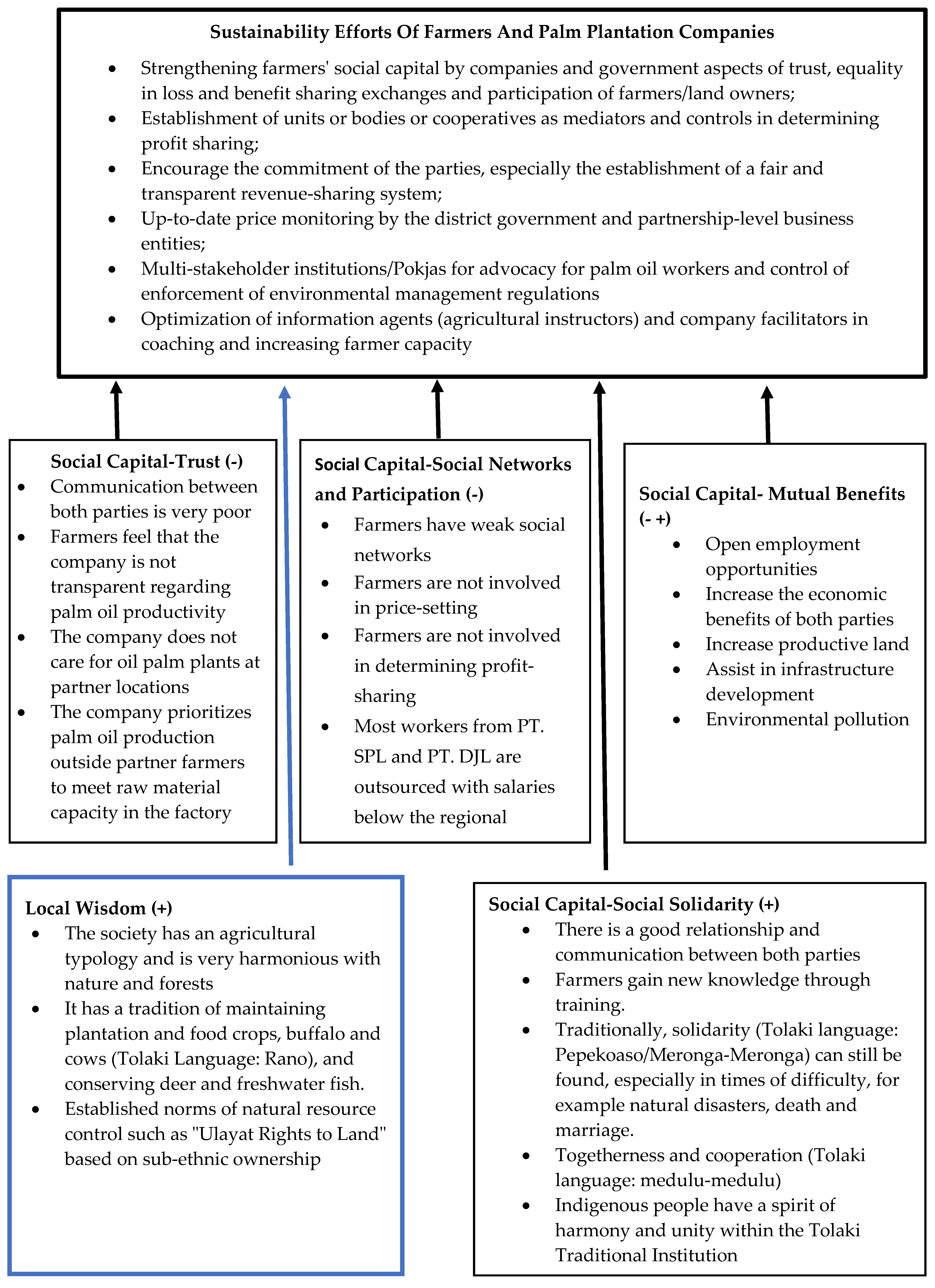
Table 1.
Profile of informants/respondents in data collection.
| No | Stakeholders/Informants | Number of Informants (people/respondents | Data Collection |
|
|---|---|---|---|---|
| 1 | Company | PTPN-14 | 2 | Interview, FGD |
| PT.DJL | 2 | Interview, FGD | ||
| PT. SPL, | 2 | Interview, FGD | ||
| 2 | Government | North Konawe People's Representative Council | Interview, FGD | |
| Head of the North Konawe Plantation and Horticulture Service | 1 | Interview, FGD | ||
| Village Heads | 11 | Interview, FGD | ||
| 3 | Academics | Higher Education | 2 | FGD |
| 4 | Community (land owners) | Land owner representatives | 5 | Interview, FGD |
| 5 | NGO | LEPMIL | 1 | FGD |
| 6 | Media/NGO | Executive director WALHI Sultra | 1 | FGD |
| 7 | Communities Surrounding Oil Palm | Palm Farmers (owners, managers and workers) | 321 | Survey |
Table 2.
State of palm oil production based on the size of company operations in the study area.
| Company Name | Initial Year of Operation |
Location | Area (Ha) | Production (Ton) | ||
|---|---|---|---|---|---|---|
| 2020 | 2021 | 2022 | ||||
| PT. Sultra Prima Lestari (factory available) | 2006 | Andowia, Asera, Langgikima, Oheo | 6.900 | 32.000 | 41.000 | 47.000 |
| PT. Damai Jaya Lestari (factory available) | 2006 | Landawe, Wiwirano | 6.989 | 28.000 | 42.000 | 48.000 |
| PT. Perkebunan Nusantara XIV (no factory) | 1994 | Wawontoaho, Wiwirano, | 6.500 | 51.870 | 84.435 | 87.425 |
Source: Primary Data, 2022.
Table 3.
Terms of Agreement between Company and Farmer/Land Owner.
| Terms of Agreement between Company and Farmer/Land Owner | ||
|---|---|---|
| PT.SPL | PT.DJL | PTPN XIV |
| The land owner hands over the land/soil and the growing plants without compensating the company. During the term of this agreement, the company will manage the entire land area handed over entirely. |
PTPN XIV has a nucleus and plasma plantations on farmers' land with a credit system. |
|
| For farmers/land owners who lend land to the company, 60% (sixty per cent) is used for the company's interests, and 40% (forty per cent) is returned to the land owner in the form of oil palm plantation products during one oil palm production cycle (+/- 30 years). | Farmers who own land lend land to the company, the land owner gets a profit share of 80 percent for the company and the land owner 20 percent. |
Providing capital assistance to plasma farmers, which is returned in the form of business credit, |
| ||
Disclaimer/Publisher’s Note: The statements, opinions and data contained in all publications are solely those of the individual author(s) and contributor(s) and not of MDPI and/or the editor(s). MDPI and/or the editor(s) disclaim responsibility for any injury to people or property resulting from any ideas, methods, instructions or products referred to in the content. |
© 2024 by the authors. Licensee MDPI, Basel, Switzerland. This article is an open access article distributed under the terms and conditions of the Creative Commons Attribution (CC BY) license (http://creativecommons.org/licenses/by/4.0/).
Copyright: This open access article is published under a Creative Commons CC BY 4.0 license, which permit the free download, distribution, and reuse, provided that the author and preprint are cited in any reuse.


