

Submitted:
27 October 2025
Posted:
29 October 2025
You are already at the latest version
Abstract
The agrarian sector, as the key source of livelihood in Sub-Saharan Africa (SSA), has become highly vulnerable to changes in extension service deliveries. Limited access to technical advice, financial loans and farming input mixed with environmental challenges require an understanding of how multi-functional actor relationships determine agricultural knowledge and exchange of information. This study contributes to filling this gap by characterizing horizontal and vertical interactions. By applying a social network analysis, we mapped actor relations along public-private-community co-operations to provide insights into structural dependencies at different administrative levels. Related to three sites distributed over Burkina Faso and Ghana, local perceptions were collected in stakeholder workshops to generate social network narratives. These narratives were analyzed by various metrics to identify patterns of partnerships and key actors. Study results reveal for Burkina Faso a slight shared network topology, while both sites in Ghana reflect a top-down flow of knowledge and information. The statistical findings indicate that agricultural extension services are primarily delivered to farmers through a few key actors such as NGOs and farm-based organizations/ cooperatives. Especially at the community level, the results show many reciprocal links between farmers, business actors and NGOs. This highlights a shift toward a pluralistic agricultural extension service system and underpins the demand for policies to support the long-term viability of these actors, in particular for regions where public extension agents are under-represented.
Keywords:
agriculture
; extension service
; social network analysis
; land management
; Burkina Faso
; Ghana
; Sub-Saharan Africa
1. Introduction
Agricultural production represents the major source of livelihood and backbone of national economies in SSA. However, farm yield has become highly vulnerable due to massive socio-economic and environmental challenges. Limited access to technical advice, financial loans, poor transport and marketing infrastructure together with land degradation and rapid climate changes hamper the sustainable management of farmland [1-3]. Despite these impacts, the agrarian sector in SSA employs approximately 60% of the population and contributes one-third to the Gross Domestic Product [4]. Further, the majority of farmland is owned by small-scale farmers in SSA with traditional subsistence farming methods and an over-dependence on rain-fed systems. For instance, and in order to combat environmental challenges, smallholders in Ghana are changing agricultural practices such as diversifying crops or cultivating early maturing varieties [5].
However, adaptation processes to strengthen crop production often remain poorly equipped in SSA [6]. A study by [7] highlighted that there are rising doubts about the positive impacts on agriculture due to climate adaptation measures. Thus, many countries offer agricultural extension services that include farm training programs, information dissemination such as weather forecasts and linkages to markets, in order to support the development of sustainable strategies [8]. But the traditional advisory systems mainly rely on top-down approaches to disseminate agricultural knowledge and information [9]. This centralized methodology often prioritizes a selected group of farmers without considering feedback information. Studies from Ethiopia [10] and Senegal [11, 12] reported that such linear agricultural extension models fail to include bottom-up experiences. Therefore, [13] highlighted a shift from pure teaching to learning and from individual knowledge provision to collective sharing of farming information. Indeed, participatory-oriented and demand-driven extensions foster the involvement of smallholder farmers to offer agricultural solutions based on local diversified needs. According to this fact, moving to a pluralistic approach underscores the role of extension agents as brokers and facilitators to link research, extension services and farmers [14].
Several Studies in West Africa indicated that governmental extension services have changed toward partnerships with private and NGO-based services [15]. These partnerships concentrate on sharing agricultural information, building farmers’ capacity, fostering partnerships and transforming local markets [16]. A study by [17] observed that farmers in northern Ghana who participated in extension services had a statistically positive impact on both improved rice varieties and farm income. However, farmers’ perceptions vary due to the involvement of multiple actors in delivering extension services. [18] reported for Nigeria that, even with improved access to agricultural information, farmers do not perceive an increase in their crop productivity. [19] found for Malawi that the perceived quality of an extension service correlates with on-farm production and food security. A study from Burkina Faso demonstrated that farmers rated the quality of extension services provided by the private sector better than public advisory services [20]. These examples reveal the challenge of harmonizing the private and public sectors. While the business domain aims to maximize their profits, governmental actors intend to effectuate an improvement in public extension services [21]. In this context, most studies evaluate the performance of agricultural extension services related to intervention programs [22], rather than to focus on multi-actor collaborations [23]. To better understand how these diverse actors interact, it is essential to move beyond assessing individual providers and instead examine the broader network of relationships that shape service delivery.
A social network analysis helps to explore relationships between actors (such as individuals, groups of individuals or organizations) who are involved in providing extension services. A graph-based approach maps connections among actors and assesses how those interactions facilitate knowledge sharing or influence the behavior of actors [24]. The position of actors within the network structure influences the diffusion of agricultural-related knowledge and information to resource-poor farmers [25]. In this regard, studies in Ghana [26, 27] and Mali [28] revealed how patterns of connectivity among actors encourage effective farm management practices. Despite recent advances, more research is needed on multi-actor perspectives between public and private partnerships [29], requiring a multi-level analysis to understand network structures and the actor’s role in extension service delivery.
This study aims to analyze agricultural knowledge and information exchanges among network actors in providing extension services across Burkina Faso and Ghana. However, the aforementioned gaps in access extension services make it difficult to improve management practices within the agricultural sector. Many smallholders are not able to use the full potential of their land resources due to challenges based on a lack of farming knowledge, skills or resources that are required to improve their management practices [6]. To understand the dynamics of extension service deliveries in both countries, we identified three study regions with a different agricultural development context, policy impact and environmental conditions. Hence, the objective of this social network study is structured two-fold. First, we identified and mapped the key actors from the agricultural sector within the existing social network structure. We utilized statistical network metrics to evaluate patterns of vertical and horizontal interactions among actors, as well as their complexity to understand barriers within the network characteristics. Second, we will discuss how the private business sector may complement governmental activities for a more pluralistic provision of agricultural extension services. The findings of this study provide insights for policy-makers and planners to design strategies that increase access to extension services and promote sustainable adaptations of agricultural practices in Burkina Faso and Ghana.
2. Materials and Methods
In this section, three study sites (e.g. Dano catchment, the administrative areas Bolgatanga/ Bongo and the three districts Nzema East/ Ellembelle/ Jomoro) situated along an agro-ecological gradient from Burkina Faso to Ghana are introduced. Subsequently, the design of the used framework is presented which consists of qualitative and quantitative approaches to gain insights as to how agricultural extension services are provided within the different social networks.
2.1. Study Sites
The study was conducted in three different regions from southwestern Burkina Faso to southwestern Ghana (Figure 1). The transect represents different socio-economic and environmental drivers with various interdependencies among agricultural activities. The Dano catchment, as one of the experimental sites of the West African Science Service Center on Climate Change and Adapted Land Use (WASCAL), is centered in the Ioba province of Burkina Faso. In Ghana, both districts Bolgatanga/ Bongo are located in the Upper East Region, while the administrative areas Nzema East/ Ellembelle/ Jomoro belong to the Western Region of the country.
Along the different agro-ecological zones, Dano and Bolgatanga/ Bongo share similar environmental characteristics in which cereals, in particular maize and rice production, play an important role. Both regions cultivate a variety of cash crops such as cotton, cowpea or groundnuts while the cotton sector plays an important role in Burkina Faso [30]. In contrast, Ghana supported cotton production until early 2000 as companies exited this sector [31]. The two study sites fall within the same unimodal rainfall regime that is determined by one rainy season from April/ May to October with a mean annual rainfall between 800 mm to 1,200 mm [32, 33]. The remaining months are characterized by a dry season, accompanied by the cold and dusty winds known as Harmattan. The temperature ranges from 20.1 °C to 38.4 °C [34].
The rainfall season in southwestern Ghana is classified as Equatorial Monsoon with two peaks from March/ April to July with a shorter period from September to November and separated by one dryer month. The average of the annual rainfall ranges from 1200 mm to 1400 mm and the temperature lies between 25 °C and 29 °C [35]. According to [36], farmers in the Western Region mainly cultivate five major staple crops such as maize, rice, yam, cassava and plantain, aggregated as rain-fed cropland (Figure 1). The principle cash crops in southwestern Ghana are dominated by cocoa, rubber as well as palm oil.
2.2. Selection of Actors
The selection of agricultural-related actors in each of the three case areas relied on a snowball sampling method [37]. This non-random sampling represents an approach in which enrolled actors help to recruit new participants who are hard to reach. To create an initial list of key actors in agricultural management practices and decision-making, past research studies were reviewed and analyzed by [ 34, 38, 39]. However, the method lacked control over a suitable composition of actors, their representativeness in conjunction with valid responses [40]. Hence, we complemented our literature review with experiences of local partners and invited actors from the regional farming sector, public authorities, private non-profit and private for-profit organizations as well as sectoral agencies. In this context, farmers have significant impact on agricultural landscapes linked to many cropping activities such as land changes or fertilizer usage. However, the role of farmers in influencing agricultural policy-making at the provincial or district level is very low in both countries. Farm-based organizations such as associations or cooperatives provide services to either access markets, build farmers skills, or consider local needs and knowledge to reinforce the influential power of farmers.
Actors in the private non-profit and private for-profit sector mainly focus on local farming actions to promote sustainable management strategies including low input technologies or access to micro loans for labor intensification. These practices are monitored through agricultural extension agents who play a crucial role in linking diverse actors, facilitating advisory services and supporting farmers to make decisions leading to optimal use of their farmland. In this context, extension agents act as a mediator between local farm producers, stakeholders and public authorities. However, their services often lack governmental funding to coordinate agricultural training that results in limited responsiveness to local demands. As a consequence, agricultural extension agents need to cooperate with other actor groups to initiate new field programs with institutional support. Their activities are principally governed by governmental bodies such as the Ministry of Food and Agriculture (MOFA) located in Ghana or the Ministry of Agriculture, Hydraulic Development and Mechanization (MAAHM) in Burkina Faso. Additional sectoral agencies are indirectly associated with the agricultural sector by impacting farm management decisions through forest and water regulations or supporting programs.
2.3. Mixed-Method Social Network Analysis
This study utilized a mixed-method framework that integrates qualitative and quantitative approaches to generate data, analyzing findings as well as drawing interferences. The collection of qualitative data, as the first step, was accompanied by a statistical explanatory analysis to interpret network characteristics and interrelationships between actors.
The qualitative analysis is based on three workshops conducted in March and November 2020 to gain an understanding of knowledge and information sharing between key actors in relation to the perspective of farmers. The number of participants varied from 27 in Dano, 15 in Bolgatanga to 20 for the site in the Western Region of Ghana. To ensure a comparison for both sites in Ghana, the social network maps were controlled in individual follow-up discussions. The majority of participants were invited from public sectors (such as agriculture, forestry or hydrology), followed by NGOs and informants from local communities as well as cooperatives. Few actors from the private for-profit sector (such as Union Provinciale des Professionnels Agricoles or Ghana Rubber Estates Limited) attended the workshops in Dano and southwestern Ghana.
Corresponding to the pen-and-paper concept developed by [41], the workshop participants were asked to reflect on who influences farming knowledge as well as information sharing. To design the narrative networks, the workshop participants were encouraged to identify and write up three key agricultural-related actors on post-it cards. These notes were grouped and posted on a white board. Subsequently, the actors classified the relationships between the proposed network actors by drawing arrows to connect the post-it cards with categories subdivided into strong, moderate and weak. The stepwise conceptualization of social networks lasted approximately one day depending on the participants’ level of engagement. The final narrative maps represented the exchange of knowledge and information between actors as perceived by the workshop participants. After the workshops, the second step involved using the open-source tool SocNetV (https://socnetv.org/) to visualize and digitize the conceived social network maps. The software computes different structural metrics such as centralization in order to analyze the network pattern and connectivity between actors. Network density, a commonly used statistic, describes the general social cohesion defined as the proportion of actors tied into the network relative to all potential connections. Higher density scores underpin the assumption of close communication and cooperation, while a low number of ties indicates a fragmented network structure with missing connections [42]. The density metric ranges between 0 and 1.
Degree centrality, a simple concept, was used to measure the extent to which social coherence is organized around influential actors. In-degree centrality counts the number of incoming links that an actor receives and out-degree centrality describes the number of links leaving an actor. High in-degree scores demonstrate a possible attractiveness of actors that tend to generate actions for receiving information [43]. Actors with many out-going connections create opportunities to make available diverse knowledge in a network.
Betweeneess centrality (BC) measures the dominance that an actor has over the flow of information within a network. The metric quantifies the number of times an actor lies on the shortest path between other actors:
where the index BC is the sum of the ratio of all geodesics passing through an actor (nj, σijk) linking the source (j) and target nodes (k). High values mean that a network member who sits in-between has the capability to bridge relationships or link disconnected node components. This gatekeeper role acts as a measure to disseminate knowledge and information between others who positively influence individual decision-making.
In the third step, the identification of key network actors is based on the method of [44]. The approach classifies essential members of a network whose statistical metrics are higher or equal to the third quartile. This threshold allows one to specify primary actors who influence and control sharing of knowledge and information exchanges within the network.
3. Results
The network analysis identified actors who facilitate agricultural-related knowledge and information exchanges from the perspective of farmers. For each study site, social network maps were visualized as direct and unweighted graphs linked with workshop participants’ experience to distinguish relationships between actor pairs. Afterwards, the social narrative findings with density as well as centrality statistics to characterize key actors within the network boundaries were complemented.
3.1. Actor Network of Dano
Workshop respondents listed 13 different members of the social network with producers (encompassing farmers, livestock herders and foresters) as the most important actors. Miners, researchers and artisanal workers were named once during the group discussion. The remaining actors of the network were mentioned between 2 to 7 times. A visual analysis of the network graph shows 76 relationships with 13 weak, 33 moderate and 30 strong ties (Figure 2). The node-link pattern involves producers at the center surrounded by moderate to strong tie linkages to public-private partners including cooperatives, technical services, artisanal as well as agricultural processors. These local interconnectivities are mostly characterized by mutual relationships. Workshop participants evaluated the activities of financial institutions regarding to various actors with low reciprocal influence.
This statistical analysis portrays an overall density ratio of 0.487 indicating functioning actor exchanges in sharing knowledge and information without isolated network members. In-degree connections varied from 1 to 10 where producers have the most incoming connections, followed by service providers and NGOs (Table 1). Out-degree counts range from 1 to 9 with highest values for producers and NGOs. A comparison of both metrics demonstrates a significant imbalance between in-degree and out-degree scores for financial institutions as well as artisanal workers. NGOs, governmental institutions, ministries and local authorities reveal equal in-degree and out-degree values. These findings are underpinned by a range of betweenness scores from 0 to 25.60 (Table 1). Based on the centralization statistics, agricultural producers and NGOs were classified as key actors because their statistical values were equal or higher to the third quartile.
3.2. Actor Network of Bolgatanga/ Bongo
The network analysis relied on 13 post-it cards with essential actors positioned from local to national scale. Due to an incorrect system-level assignment of actors by a few workshop participants, 2 post-it sheets could not be considered in the development of the social network map. A socio-metric error might erroneously represent a biased reality of actor relationships. To improve the readability of the graph, similar actors were grouped together, such as ministries, local governments and traditional authorities. In subsequent discussions, the social network map was extended by private (e.g. agro-industries, donors/ external) and public actors (e.g. Ghana Irrigation Development Authority, agricultural control officers, training schools). The final output consisted of 23 actors with 73 linkages including 19 strong, 37 moderate and 17 weak ties (Figure 3).
The low network density of 0.144 confirms the visual findings of disrupted knowledge and information flows when few key actors control farming interventions. Actor relationships at the regional or national scale are mostly oriented top-down related to the number of prevailing out-degree values. For instance, governmental bodies or donors/ external financiers mainly coordinate the agricultural sector, while local key actors are predominated by incoming actions (Table 2). In this context, farm-based organizations/ cooperatives and extension agents involve the bulk of mutual ties. Both actors represent a hub-and-spoke pattern that indicates a centralized cluster of knowledge and information exchanges. These network members and farmers act as gatekeepers to transmit agricultural-related services with high betweenness values ranging from 0 to 219.92. The absolute values of the betweenness index underpin the hierarchical structure where only a small number of actors support the flow of knowledge and information exchanges within the network. Taking centrality metrics together, farmers, agricultural extension officers, farm-based organizations/ cooperatives, the environmental protection agency and the government are detected as key actors. because their statistical values were equal or higher to the third quartile.
3.3. Actor Network of Nzema East/ Ellembelle/ Jomoro
Due to similar agricultural-related stakeholder groups across Ghana and in conjunction with the participants, the social network drawn at the workshop in Bolgatanga/ Bongo was assessed. The respondents disentangled the role of each actor and their relationships at each administrative level for the study side in the Western Region of Ghana. The actor network was complemented by adding land owners, universities as well as meteorological services. In contrast, actors such as water use association, agricultural control officers and cooperative advisors are not represented in the study area. Workshop informants suggested to specify training schools as agricultural training schools and to replace the Council for Scientific and Industrial Research with research institutions. Donors/ external financiers as well as credit institutions were combined in one node. The final network shows a quite different perspective on actor-pair relationships with 109 ties consisting of 77 strong, 20 moderate and 12 weak links (Figure 4).
The low-density ratio of 0.236 indicates a network without any social isolation and a small group of actors play an influential role to transmit agricultural knowledge and information services. For instance, relationships of public bodies are perceived by workshop participants as not working well. At the local scale, NGOs and farm-based organizations/ cooperatives reveal a network typology with mainly mutual connections. Degree centrality counts mostly reciprocal relationships with a prevailing number of equal in-degree and out-degree values (Table 3). The betweenness scores are in a range from 0 to 97.26. Based on the centrality measures, three key actors such as farmers, NGOs and farm-based organizations/ cooperatives were identified at the local scale while research institutions, ministries and the government act as important network members at the national administrative level.
4. Discussion
This section provides a discussion on actor relationships and what these meant for the sharing of agricultural knowledge and information within each social network. To do this, the study characterized a variety of actors with different roles and interrelationships such as social tensions or coalitions that impact the availability of extension services. We will discuss horizontal and vertical collaborations between public agencies, private non-profit, private for-profit and farmers to grasp partnerships at similar hierarchical levels. Vertical relations refer to two or more administrative entities that allow to shed light on how top-down policies might be balanced with bottom-up needs.
4.1. Network Characteristics of Dano
Centrality statistics demonstrated a shared network topology for Dano with slightly dense relationships and various levels of knowledge-information diffusion. Reciprocal links among specific actors underpin a functioning infrastructure to provide extension services. However, the findings of this study are inconsistent with results by [20] who reported that farmers perceived available public extension services at a low level. To sufficiently reach farmers, [45] identified financial constraints as a key challenge. The workshop participants stated a similar argument of weak interactions between financial institutions and other network actors. Limited credit provisions influence adaptation processes of farming practices to climate changes and policy-making programs [46].
Strong connections were indicated by workshop participants between technical agents and actors such as producers, cooperatives, researchers and governmental institutions. Except governmental institutions, these actors reveal high degree centrality values that represent a significant involvement in agricultural activities. In line with our statistical findings, [47] highlighted the essential role of technical service agents to support training sessions for public authorities, advisors from rural communities or farmers’ organizations where agribusiness are highly active. Also, cooperatives play a vital role in managing the distribution of farming inputs, facilitating access to loans and delivering technical support [48]. This enables on-farm processors to run a market-oriented manufacturing business that helps to generate benefits for their members. These findings align with the Maputo (2003-2015) and Malabo (2014-2025) declarations, which intend to accelerate agricultural growth for shared prosperity and enhanced livelihood. Although the governmental expenditures of Burkina Faso have been more than 10 % as declared in the Maputo commitment, investments mainly focused on the cotton sector [49]. The high betweenness value of the governmental institution indicates an actor who coordinates exchanges of agricultural-related knowledge and information. The 2010 released national framework “Systeme National Vulgarisation et d’Appui Conseil Agricoles” represents the main policy to structure extension service deliveries in Burkina Faso. It aims to respond to local needs by involving additional actors such as private advisors, universities, NGOs or farm-based organizations while the governmental participation should be reduced [50]. The government is merely responsible for regulating and monitoring extension services. However, and due to limited resources, the national authority only fosters agriculture-related actors to clarify their role and to start initiatives [51].
At the science-community interface, workshop results indicated strong connections between technical service actors and researchers. A recent study by [52] identified same collaborations to actively support technology transfer and advisories to rural communities. In relation to the private non-profit sector, NGOs act as influential hubs to advise farming producers by distributing climate data, agricultural inputs or testing sustainable management strategies [53]. Despite the favored network position to encourage exchanges of knowledge and information, workshop participants perceived many interactions as weak or moderate that limit the ability to provide extension-related services. Studies by [54] and [55] confirmed similar barriers to financial institutions, public as well as private bodies that hamper effective co-development of farm management strategies.
Although public bodies (such as ministries, governmental institutions and local government) indicated high centrality statistics, workshop participants perceived their network activities at different qualitative levels. [56] reported that privatizing state obligations have led to partnerships between NGOs, agribusiness, service providers and producers. These collaborations substantiate a local capacity building to foster environmentally sound farming. In this regard, [57] emphasized the fact that the participation of farmers in the co-design of advisory tools is much more effective compared to the linear sharing of farming knowledge in farmer field schools. This clearly presents how the implementation process determines the performance of agricultural processes at the community scale.
4.2. Network Characteristics of Bolgatanga/ Bongo and Nzema East/ Ellembelle/ Jomoro
The centralized brokered structures of both study sites point out a top-down pattern of social interactions. Dominant actors range from local to national state authorities, private and non-profit organizations. The investigated network structures showed a hierarchical pattern that reflects different social roles in sharing agricultural knowledge-information. From northeast to southwest Ghana, workshop participants noted an increasing reciprocal relationship between key actors with high levels of trust and goal consensus. A study by [58] highlighted trust and personal interactions as an essential social condition to make farmer-to-farmer extensions more effective. Also, results by [59] revealed gender inequalities in which mainly women are excluded from farming advice, particularly in northern Ghana.
Extension officers at the research-extension-farmer interface have been perceived by workshop participants as weak influential in Bolgatanga/ Bongo. In line with a study by [60] for northern Ghana, access to farming services is limited because of a large geographical extent with low population density that leads to difficulties in reaching remote communities. Additionally, public budgetary constraints often determine the availability of extension advisories [61]. A challenge at both study sites consists of negatively perceived relationships between agricultural extension agents and research institutions or universities. Our findings agree with studies by [62] and [63] who reported mismatches between science-related activities and economic goals that affect feedback flows to academics as well as non-academics. Agricultural knowledge provided by scientific institutions often lack adequate responsiveness to the demands of rural communities. As a consequence of weak science-farmer connections in northern Ghana, Research and Extension Linkage Committees were established to boost regional dialogues to address local needs.
The private non-profit sector in southwestern Ghana represents an effective actor confirmed through high centrality scores with an intermediary network position. A study by [64] reported that collaborations between NGOs and technology promoters or extension officers’ matter in addressing adaptation gaps among farmers to improve cassava value chains. Workshop participants emphasized similar strong relationships between sectoral agencies, agricultural extension officers and farm-based organizations/ cooperatives.
Centrality measures of farm-based organizations/ cooperatives demonstrated high in-degree values for Bolgatanga/ Bongo, while in- and out-degree statistics are equal for Nzema East/ Ellembelle/ Jomoro. Participants of the workshop in Bolgatanga/ Bongo described tensions between same actors and donors, governmental bodies as well as agricultural distributors. In southwestern Ghana, workshop results revealed strong horizontal and vertical partnerships between farm-based organizations/ cooperatives and other network actors. This is influenced by the interests of public and private investors in plantation management dominated by cocoa, rubber or oil palm. A study by [65] highlighted the essential role of farm-based organizations in providing extension advisories for the cocoa sector.
At the regional scale, centrality statistics mixed with qualitative information by workshop participants emphasized the Environmental Protection Agency as a key actor in northern Ghana. In line with [66], the study accentuated the important role of the Environmental Protection Agency to organize educational programs on proper agricultural management or climate adaptation campaigns. However, weak relationships with farmers and research institutes provoke conflicts in land use transitions from forest or grassland to farmland. A study by [67] concluded for northern Ghana a massive expansion of cropland, while natural vegetation, grassland and woodland decreased.
The central government was characterized as a key national actor with high out-degree values in both sites. This suggests that extension services are mainly routed through policies developed and coordinated by governmental agencies. However, workshop participants evaluated these farming services differently across the country. For instance, Bolgatanga/ Bongo revealed fewer working relationships with farm-based organizations/ cooperatives and donors/ external financiers. Research findings by [68] reported that a high rate of illiteracy in northern Ghana limits the members of farm-based organizations/ cooperatives to implement group formation concepts. As a consequence, farmers often focus on short-term benefits rather than long-term effects that discourage them in collective actions. Limited credit services through public interventions reinforce the challenge because a rising number of smallholders rely on commercial sources [60]. Our statistical findings underpin a disrupted flow of knowledge-information in which neither direct nor adequate exchanges exist between national and community actors. [69] provided the general notion that decentralization of the extension service system is mainly restricted to delegation of only a few technical and implementation functions at the lower level.
4.3. Enhancing the provision of extension services
Study findings reveal that public authorities are highly active in providing on-farm services, while the private for-profit and private non-profit sectors deliver knowledge and information sources. However, many governmental extension services are one-directional structured without considering local feedback. At the community level, results of the social network analysis indicated reciprocal links between farmers, private business actors and NGOs. This is consistent with [70] because structural changes in agriculture encompass new types of farming technologies, communication infrastructures and efforts. As a result, the investigated study sites demonstrate a trend to shift from a production-centric toward a pluralistic market-oriented extension system. According to [71], effective actions within the public, private and rural community domain revolve around various partnerships such as public-private, private-social and public-community.
Public-private partnership: In both countries, public-private partnerships play an essential role in mobilizing financial resources and enhancing technical capacities. For instance, our study findings indicated a lack of access to credit services for farmers. [20] reported for Burkina Faso that public extension agents mostly focus on agricultural interventions to support farm production rather than considering financial extensions. To overcome this constraint, [72] proposed an inventory credit approach to boost agricultural productivity and food security. The major benefit consists in storing harvested grain over a period of several months in exchange for a loan. This allows farmers to increase their investments in farmland activities, such as buying fertilizer or seeds, and labor. Another benefit of the micro-financing scheme is based on the flexibility of farmers to react to fluctuating commodity prices or socio-economic insecurities. In contrast, [73] highlighted financial barriers of the private sector in Ghana to guide cocoa farmers in their agricultural activities. The public intervention Microfinance and Small Loans Centre (MASLOC) intends to respond to financial barriers of small and medium enterprises. A study by [74] demonstrated how MASLOC encapsulates the government’s commitment to fostering various sectors such as food banking, small-scale farming or agro-processing.
Private-social partnership: Streamlining different actor’s interests requires the implementation of a strategic communication between public institutions and entrepreneurships. E-agriculture, including information and communication technologies (ICT), provides one way for both countries to overcome barriers, as shown in Figure 2, Figure 3 and Figure 4. Mobile and web services help to render extension services to reach more farmers while also collecting their feedback. Projects such as “Agri-Yaar” (https://agriyaar.com) or “Yam-Pukri” (https://yam-pukri.org) in Burkina Faso and “TechShelta” (https://techshelta.com) in Ghana are based on ICT to offer farm trainings, crop planting information and to connect rural agricultural supply and demand. However, the Mobile Connectivity Index, which is normalized to a range between 0 and 100, reveals for Burkina Faso a score of 31.2 and for Ghana a score of 55.1 [75] in 2023. For all 173 monitored countries, the average value is around 63. Despite the significant gap in accessibility to mobile phones, Burkina Faso started, in 2018, an initiative to develop a digital economy by 2027 with big data, barcoding and block-chain as promising e-technologies [76]. Similar initiatives were initiated in Ghana such as the Ghana Agricultural Investment Plan from 2018 to 2021 [77] or the program Planting for Food and Jobs Phase 2 [78]. Also, the promising potential of artificial intelligence presents a way to provide context-specific agricultural advice to remote farming communities.
Public-community partnerships: In addition to public-private partnerships, the community will benefit from these collaborations by receiving improved crop management skills or farming knowledge. This cooperation will provide feedback of delivered agricultural services to transform supply driven services towards needs. In line with findings of mutual linkages at the community level in Ghana, [79] argued that small-scale companies such as input dealers offer agricultural services to farmers. Private business actors often compensate with their (research-) expertise governmental advisory services [80]. At the research-extension interface, our social network results exhibited for both countries either weak relationships between the actors or absent linkages. However, [81] emphasized for Ghana that bottom-up relationships between extension officers, universities and farmers allow a co-development of knowledge. Bringing together scientists, extension agents and local actors in training schools facilitates the education of the frontline staff concerning agricultural demand-driven solutions. Cooperatives and NGOs may complement the transfer of knowledge to guide capacity-building training programs. This underpins the demand for policies to support the long-term viability of these actors, in particular for regions where public extension agents are under-represented.
Concretely, these multi-scale partnerships will lead to a pluralistic extension service system between the respected actors that will provide space for consideration of demand-driven and market-oriented objectives. Horizontal private-community coalitions contribute to communication processes by bringing together agriculture and rural development. These relationships will assist public extension services in delivering effective dissemination and training strategies to enhance the capacity of farmers.
5. Conclusions
This study revealed how a social network analysis provides a promising method for mapping out the flow of knowledge and information that determines the provision of agricultural extension services. We characterized few key actors such as NGOs and farm-based organizations/ cooperatives along public-private-community partnerships. Our findings demonstrated that the provision of extension services are confronted with many barriers including the lack of financial loans or mismatches between the demand and needs at the science-extension-farmer interface in both countries. At the community level, statistical results highlighted that private actors may complement public extension services, especially in remote areas. Privatizing governmental obligations have led to partnerships between state bodies, agri-business and processors as well as NGOs. Although the actor cooperations are slightly linked at the community level, we identified a shift from production-centric services to a pluralistic market-oriented extension system.
It is recommended that the government in Burkina Faso and Ghana should provide more financial, human and logistical resources to improve the availability of extension services. However, to focus only on the strengthening of public extension services is not sufficient. Bringing together public and private bodies might boost the provision of agricultural services by offering financial extension. Farmer field schools will help to enhance the acceptance of innovative technologies such as mobile services or artificial intelligence to better manage the farmland. In addition, regular workshops should be organized across public-private-community partnerships to educate the skills of the frontline staff, but also to evaluate the needs of extension agents.
Author Contributions
Conceptualization, M.S.; methodology, M.S.; software, M.S.; formal analysis, M.S.; investigation, M.S.; writing-original draft preparation, M.S.; writing—review and editing, S.K., S.S. and C.F.; visualization, M.S. and S.K.; supervision, C.F.; funding acquisition, M.S. and C.F. All authors have read and agreed to the published version of the manuscript.
Funding
This research was funded by the German Federal Ministry of Education and Research (BMBF) through the LEAP-Agri (A Long term EU–Africa research and innovation Partnership on food and nutrition security and sustainable Agriculture) initiative under the grant number at Martin-Luther Universität Halle-Wittenberg [01DG18020].
Data Availability Statement
Data are contained within the article.
Acknowledgments
The authors are grateful for encouragement by the Dreyer Foundation in Burkina Faso, Hen Mpoano and Cape Coast University, both located in Ghana, for their support of organizing stakeholder workshops and collection of data. Further, we are thankful to all who participated in the meetings for providing information regarding the local study sites.
Conflicts of Interest
The authors declare no conflicts of interest.
References
- Callo-Concha, D.; Gaiser, T.; Webber, H.; Tischbein, B.; Müller, M.; Ewert, F. Farming in the West African Sudan Savanna: Insights in the context of climate change. Afr. J. Agric. Res. 2013, 8, 4693–4705. [Google Scholar] [CrossRef]
- Alliance for a Green Revolution in Africa (AGRA) Africa Agriculture Status Report: Catalyzing Government Capacity to Drive Agricultural Transformation (Issue 6). Nairobi, Kenya. Available online https://agra.org/wp-content/uploads/2018/10/AASR-2018.pdf. (accessed on 24 Feb 2025).
- Zougmoré, R.B.; Partey, S.T.; Ouédraogo, M.; Torquebiau, E.; Campbell, B.M. Facing climate variability in sub-Saharan Africa: analysis of climate-smart agriculture opportunities to manage climate-related risks. Cah. Agric. 2018, 27, 34001. [Google Scholar] [CrossRef]
- Juju, D.; Baffoe, G.; Dam Lam, R.; Karanja, A.; Naidoo, M.; Ahmed, A.; Jarzebski, M.P.; Saito, O.; Fukushi, K.; Takeuchi, K.; et al. Sustainability Challenges in Sub-Saharan Africa in the Context of the Sustainable Development Goals (SDGs). In Sustainability Challenges in Sub-Saharan Africa I. Continental Perspectives and Insights from Western and Central Africa, 1st ed.; Gasparatos, A., Ahmed, A., Naidoo, M., Karanja, A., Fukushi, K., Saito, O., Takeuchi, K., Eds.; Springer: Singapore, 2020; pp. 3–50. [Google Scholar] [CrossRef]
- Antwi-Agyei, P.; Nyantakyi-Frimpong, H. Evidence of Climate Change Coping and Adaptation Practices by Smallholder Farmers in Northern Ghana. Sustainability 2021, 13, 1308. [Google Scholar] [CrossRef]
- Danjumah, P.M.; Asiamah, M.T.; Tham-Agyekum, E.K.; Ibraham, S.A.; Mensah, L.K. Dynamics of agricultural extension delivery services to rice farmers in Ghana. Heliyon 2024, 10, e26753. [Google Scholar] [CrossRef]
- Magesa, B.A.; Mohan, G.; Matsuda, H.; Melts, I.; Kefi, M.; Fukushi, K. Understanding the farmers’ choices and adoption of adaptation strategies, and plans to climate change impact in Africa: A systematic review. Clim. Serv. 2023, 30, 100362. [Google Scholar] [CrossRef]
- Sanfo, S.; Salack, S.; Saley, I.A.; Daku, E.K.; Worou, N.O.; Savadogo, A.; Barro, H.; Guug, S.; Koné, H.; Ibrahim, B.; Rojas, A.; Raimond, C.; Ogunjobi, K.O. Effects of customized climate services on land and labor productivity in Burkina Faso and Ghana. Clim. Serv. 2022, 25, 100280. [Google Scholar] [CrossRef]
- Anandajayasekeram, P.; Puskur, R.; Workneh, S.; Hoekstra, D. Concepts and practices in agricultural extension in developing countries: A source book. IFPRI (International Food Policy Research Institute), Washington, DC, and ILRI (International Livestock Research Institute), Nairobi, Kenya. https://www.researchgate.net/publication/259999090_Concepts_and_practices_in_agricultural_extension_in_developing_countries_A_source_book. (accessed on 23 Mar 2025).
- Deneke, T.T.; Gulti, D. Agricultural Research and extension Linkages in the Amhara Region, Ethiopia. In Technological and Institutional Innovations for Marginalized Smallholders in Agricultural Development, 1st ed.; Gatzweiler, F.; von Braun, J. Eds.; Springer, Cham, pp 113-124. [CrossRef]
- Sanogo, D.; Ndour, B.Y.; Sall, M.; Toure, K.; Diop, M.; Camara, B.A.; N’Diaye, O.; Thiam, D. Participatory diagnosis and development of climate change adaptive capacity in the groundnut basin of Senegal: building a climate-smart village model. Agric. & Food Secur. 2017, 6, 13. [Google Scholar] [CrossRef]
- Chiputwa, B.; Wainaina, P.; Nakelse, T.; Makui, P.; Zougmoré, R.B.; Ndiaye, O.; Minang, P.A. Transforming climate science into usable services: The effectiveness of co-production in promoting uptake of climate information by smallholder farmers in Senegal. Clim. Serv. 2020, 20, 100203. [Google Scholar] [CrossRef]
- Agwu, A.E.; Suvedi, M.; Chanza, C.; Davis, K.; Oywaya-Nkurumwa, A.; Najjingo Mangheni, M.; Sasidhar, P.V.K. Agricultural Extension and Advisory Services in Nigeria, Malawi, South Africa, Uganda, and Kenya. Partnerships for Innovative Research in Africa (PIRA) Research Report. Alliance for African Partnership, Michigan State University, East Lansing, Michigan, USA. https://aap.isp.msu.edu/files/2116/8383/7679/2._Agricultural_Extension_and_Advisory_Services_in_Sub-Saharan_Africa.pdf. (accessed on 17 Apr 2025).
- Mapiye, O.; Dzama, K. Strengthening research-extension-farmer-input linkage system for sustainable smallholder luivestock farming in Africa: progress and prospects. Trop Anim Health Prod 2024, 56, 363. [Google Scholar] [CrossRef]
- Abdu-Raheem, K.A.; Worth, S.H. Suggesting a new paradigm for agricultural extension policy: the case of West African Countries. S. Afr. J. Agric. Ext. 2016, 44, 216–230. [Google Scholar] [CrossRef]
- Mangeni, B. The Role of Public-Private Partnerships (PPP) in Ensuring Technology Access for Farmers in sub-Saharan Africa. Afr. J. Food Agric. Nutr. Dev. 2019, 19, 14137–14155. [Google Scholar] [CrossRef]
- Anang, B.T.; Bäckman, S.; Sipiläinen, T. Adoption and income effects of agricultural extension in northern Ghana. Sci. Afr. 2020, 7, e00219. [Google Scholar] [CrossRef]
- Sani, B.M.; Omenesa, Z.; Sambo, I.; Abdullahi, J.; Yuguda, M. Effect of Targeted Agricultural Information Delivery Approach on Farmers’ Access to Agricultural Information in Nigeria. J. Agric. Food Inf. 2015, 16, 72–79. [Google Scholar] [CrossRef]
- Ragasa, C.; Mazunda, J. The impact of agricultural extension service in the context of a heavily subsidized input system: The case of Malawi. World Dev. 2018, 105, 25–47. [Google Scholar] [CrossRef]
- Sylla, A.Y.; Al-Hassan, R.M.; Egyir, I.S.; Anim-Somuah, H. Perceptions about quality of public and private agricultural extension in Africa: Evidence from farmers in Burkina Faso. Cogent Food Agric. 2019, 5, 1685861. [Google Scholar] [CrossRef]
- Bruce, K.; Costa, H. Enabling environment for PPPs in agricultural extension projects: Policy imperatives for impact. J. Rural Stud. 2019, 70, 87–95. [Google Scholar] [CrossRef]
- Buehren, N.; Goldstein, M.; Molina, E.; Vaillant, J. The impact of strengthening agricultural extension services: evidence from Ethiopia. World Bank Policy Research Working Paper No. 8169. Available online https://ssrn.com/abstract=3023696. (accessed on 12 Mar 2025).
- Jawoko, H.O.; Opio, A.; Mwesigye, A.; Bariyo, R. Understanding pluralistic agriculture extension services through a social governance lens in Northern Uganda. J. Agric. Ext. Rural Dev. 2023, 15, 36–45. [Google Scholar] [CrossRef]
- Chaudhary, A.K.; Warner, L.A. (2015): Introduction to Social Network Research: General Introduction and Major Terminology. AEC533 WC195, 2. EDIS (3). Gainesville, FL:5. [CrossRef]
- Muange, E.N.; Schwarze, S.; Qaim, M. (2014): Social networks and farmer exposure to improved crop varieties in Tanzania. No. 45, GlobalFood Discussion Papers. Available online https://www.econstor.eu/bitstream/10419/103993/1/79638844X.pdf. (accessed on 10 Mar 2025).
- Isaac, M.E. Agricultural information exchange and organizational ties: The effect of network topology on managing agrodiversity. Agric. Syst. 2012, 109, 9–15. [Google Scholar] [CrossRef]
- Cadger, K.; Quaicoo, A.K.; Dawoe, E.; Isaac, M.E. Development Interventions and Agriculture Adaptation: A Social Network Analysis of Farmer Knowledge Transfer in Ghana. Agric. 2016, 6, 32. [Google Scholar] [CrossRef]
- Beaman, L.; Dillon, A. Diffusion of agricultural information within social networks: Evidence on gender inequalities from Mali. J. Dev. Econ. 2018, 133, 147–161. [Google Scholar] [CrossRef]
- Kidane, T.T.; Worth, S.H. Different Agricultural Extension Systems Implemented in Africa: A Review. J. Hum. Ecol. 2016, 55, 183–195. [Google Scholar] [CrossRef]
- Jarzebski, M.P.; Ahmed, A.; Karanja, A.; Boafo, Y.A.; Balde, B.S.; Chinangwa, L.; Degefa, S.; Dompreh, E.B.; Saito, O.; Gasparatos, A. Linking Industrial Crop Production and Food Security in Sub-Saharan Africa: Local, National and Continental Perspectives. In Sustainability Challenges in Sub-Saharan Africa I. Continental Perspectives and Insights from Western and Central Africa, 1st ed.; Gasparatos A, Ahmed A, Naidoo M, Karanja A, Fukushi K, Saito O, Takeuchi K Eds.; Springer, Singapore, pp 81-136. [CrossRef]
- Boafo, Y.A.; Siddighi Balde, B.; Saito, O.; Gasparatos, A.; Dam Lam, R.; Ouedraogo, N.; Chamba, E.; Moussa, Z.P. Stakeholder perceptions of the outcomes of reforms on the performance and sustainability of the cotton sector in Ghana and Burkina Faso: A tale of two countries. Cogent Food Agric. 2018, 4, 1477541. [Google Scholar] [CrossRef]
- Op de Hipt, F.; Diekkrüger, B.; Steup, G.; Yira, Y.; Hoffmann, T.; Rode, M. Applying SHETRAN in a Tropical West African Catchment (Dano, Burkina Faso)-Calibration, Validation, Uncertainty Assessment. Water 2017, 9, 101. [Google Scholar] [CrossRef]
- Yaméogo, T.B.; Bossa, A.Y.; Torou, B.M.; Fusillier, J.L.; Da, D.E.C.; Yira, Y.; Serpantié, G.; Somé, F.; Dama-Balima, M.M. Socio-Economic Factors Influencing Small-Scale Farmers’ Market Participation: Case of Rice Producers in Dano. Sustainability 2018, 10, 4354. [Google Scholar] [CrossRef]
- Callo-Concha, D. Farmer Perceptions and Climate Change Adaptation in the West Africa Sudan Savannah: Reality Check in Dassari, Benin, and Dano, Burkina Faso. Clim. 2018, 6, 44. [Google Scholar] [CrossRef]
- Chiti, T.; Grieco, E.; Perugini, L.; Rey, A.; Valentini, R. Effect of the replacement of tropical forests with tree plantations on soil organic carbon levels in the Jomoro district, Ghana. Plant Soil 2014, 375, 47–59. [Google Scholar] [CrossRef]
- Doso Jnr, S.; Ayensu-Ntim, A.; Twumasi-Ankrah, B.; Twum Barimah, P. Effects of Loss of Agricultural Land Due to Large-Scale Gold Mining on Agriculture in Ghana: The Case of the Western Region. Br. J. Res. 2015, 2, 196–221. [Google Scholar]
- Biernacki, P.; Waldorf, D. Snowball sampling: problems and techniques of chain referral sampling. Sociol. Methods Res. 1981, 10, 141–163. [Google Scholar] [CrossRef]
- Koo, H.; Kleemann, J.; Fürst, C. Impact assessment of land use changes using local knowledge for the provision of ecosystem services in northern Ghana, West Africa. Ecol. Indic. 2019, 103, 156–172. [Google Scholar] [CrossRef]
- Wortmann-Kolundžija, E. Empowering Smallholder Farmers through Farmer Organizations: Insights from Kenya and Burkina Faso. ZEF Working Paper 190. [CrossRef]
- Ting, H.; Memon, M.A.; Thurasamy, R.; Cheah, J.H. Snowball Sampling: A Review and Guidelines for Survey Research. AJBR 2025, 15. https://10.14707/ajbr.250186.
- Schiffer, E.; Hauck, J. Net-Map: Collecting Social Network Data and Facilitating Network Learning through Participatory Influence Network Mapping. Field Methods 2010, 22, 231–249. [Google Scholar] [CrossRef]
- Provan KG, Kenis P Modes of Network Governance: Structure, Management, and Effectiveness. J. Public Adm. Res. Theory 2008, 18, 229–252. [CrossRef]
- Simpson, H.C.; de Loë, R.C. The Agricultural Community as a Social Network in a Collaborative, Multi-Stakeholder Problem-Solving Process. Water 2017, 9, 750. [Google Scholar] [CrossRef]
- Grilli, G.; Garegnani, G.; Polijanec, A.; Ficko, A.; Vettorato, D.; de Meo, I.; Paletto, A. Stakeholder analysis in the biomass energy development based on the experts’ opinions: the example of Triglav National Park in Slovenia. Folia For Pol 2015, 57, 173–186. [Google Scholar] [CrossRef]
- Theriault, V.; Smale, M.; Haider, H. How Does Gender Affect Sustainable Intensification of Cereal Production in the West African Sahel? Evidence from Burkina Faso. World Dev. 2017, 92, 177–191. [Google Scholar] [CrossRef]
- Eguavoen, I.; Wahren, J. Climate change adaptation in Burkina Faso: aid dependency and obstacles to political participation. ZEF Working Paper 140. https://www.econstor.eu/bitstream/10419/121437/1/834092573.pdf (accessed 21 Apr 2025).
- Groupe de Recherche et d’Action sur le Foncier (GRAF) Agrobusiness au Burkina Faso. Quels effets sur le foncier et la modernisation agricole?. https://www.alimenterre.org/system/files/ressources/pdf/252-agrobusiness-burkina_graf.pdf (accessed 27 Jun 2025).
- Gleisberg-Gerber K Livelihoods and land management in the Ioba Province in south-western Burkina Faso. ZEF Working Paper Series 91. https://www.econstor.eu/bitstream/10419/88343/1/773375279.pdf (accessed ). 19 May.
- Ministry of Foreign Affairs of Denmark (MFA) Burkina Faso Strategic Framework 2021-2025. Copenhagen. https://um.dk/-/media/websites/umdk/danish-site/danida/lande-og-regioner/prioritets-landepolitik/dokumenter/strategic-framework-for-burkina-faso-2021-2025.ashx. (accessed on 14 Dec 2024).
- Sare L Le conseil agricole dans les politiques publiques au Burkina Faso. Inter-Réseaux Développement rural. Fert. Paris. https://www.inter-reseaux.org/wp-content/uploads/Fiche_Conseil_et_politique_Burkina__8-11-2012_mise_en_page.pdf. (accessed on 23 Jan 2025).
- Toillier, A. Faso. In Coexistence and Confrontation of Agricultural and Food Models, 1st ed.; Gasselin, P., Lardon, S., Cerdan, C., Loudiyi, S., Sautier, D., Eds.; Springer: Dordrecht, 2023. [Google Scholar] [CrossRef]
- Santuah, N.; Abazaami, J.; Kaunza-nu-dem Millar, K.; Amikuzuno, J. An overview of agricultural extension in ghana and Burkina Faso and implications for sustainable agriculture in West Africa. J. Agric. Ext. Rural Dev. 2022, 14, 113–119. [Google Scholar] [CrossRef]
- Harvey, B.; Singh, R. Climate services for resilience: the changing roles of NGOs in Burkina Faso. [CrossRef]
- Koudougou S, Stiem L La Gestion Durable des Terres au Burkina Faso: une analyse d'expériences de projets dans le Houet, le Tuy et le Ioba. IASS Working Paper. [CrossRef]
- Yameogo, B.T.; Kabore/Bontogho, P.E.; Torou, B.M.; Bagagnan, A.R.; Barry, B. Barriers to uptake of climate-smart agriculture practices: a case study of Dano and Ouahigouya farmers, Burkina Faso. Int. J. Agric. Environ. Res. 2017, 3, 3409–3428. [Google Scholar]
- Harvey, B.; Jones, L.; Cochrane, L.; Singh, R. The evolving landscape of climate services in sub-Saharan Africa: What roles have NGOs played? . Clim. Change 2019, 157, 81–98. [Google Scholar] [CrossRef]
- Bakker, T.; Dugué, P.; de Tourdonnet, S. Assessing the effects of Farmer Field Schools on farmers’ trajectories of change in practices. ASD 2021, 41, 18. [Google Scholar] [CrossRef]
- Etwire, P.M.; Buah, S.; Ouédraogo, M.; Zougmoré, R.; Partey, S.T.; Martey, E.; Dayamba, S.D.; Bayala, J. An assessment of mobile phone-based dissemination of weather and market information in the Upper West Region of Ghana. Agric & Food Secur 2017, 6, 8. [Google Scholar] [CrossRef]
- Emmanuel, D.; Owusu-Sekyere, E.; Owusu, V.; Jordaan, H. Impact of agricultural extension service on adoption of chemical fertilizer: Implications for rice productivity and development in Ghana. NJAS: Wageningen Journal of Life Sciences 2016, 79, 41–49. [Google Scholar] [CrossRef]
- Anang, B.T.; Owusu Asante, B. Farm household access to agricultural services in northern Ghana. Heliyon 2020, 6, e05517. [Google Scholar] [CrossRef]
- Aremu, T.; Baye, R.S.; Onyina, K.; Abijah, P. Agricultural extension services and household welfare: evidence from Ghana socioeconomic panel survey. Agric Econ 2025, 13, 58. [Google Scholar] [CrossRef]
- Amankwah-Amoah, J. The evolution of science, technology and innovation policies: A review of the Ghanaian experience. Technol. Forecast. Soc. Change 2016, 110, 134–142. [Google Scholar] [CrossRef]
- Mensah, M.S.B.; Enu-Kwesi, F.; Boohene, R. (2019) Challenges of Research Collaboration in Ghana’s Knowledge-based Economy. J. Knowl. Econ. 2019, 10, 186–204. [Google Scholar] [CrossRef]
- Dadzie, S.K.N. ; Ndebugri; J. ; Inkoom, E.W.; Akuamoah-Boateng, S. Social networking and risk attitudes nexus: implication for technology adoption among smallholder cassava farmers in Ghana. Agric & Food Secur 2022, 11, 41. [Google Scholar] [CrossRef]
- Onumah, J.A.; Asante, F.A.; Osei, R.D. Actor roles and linkages in the agricultural innovation system: options for establishing a cocoa innovation platform in Ghana. Innov. Dev. 2023, 13, 301–322. [Google Scholar] [CrossRef]
- Fagariba, C.; Song, S.; Soule, S. Factors influencing climate change adaptation in Northern Ghana: Evidence from subsistence farmers. JESAM 2018, 21, 61–73. [Google Scholar] [CrossRef]
- Shoyama, K.; Braimoh, A.K.; Avtar, R.; Saito, O. Land Transition and Intensity Analysis of Cropland Expansion in Northern Ghana. Environ. Manag. 2018, 62, 892–905. [Google Scholar] [CrossRef]
- Abokyi, M.G. Exploring the Farmer Based Organisation (FBO) extension approach: a case study of an NGO in Northern Ghana. Student report. https://library.wur.nl/WebQuery/titel/2040625 (accessed on 21st 24). 20 November.
- Rivera, W.; Alex, G. Volume 1. Decentralized Systems. Case Studies of International Initiatives. Agriculture and Rural Development Discussion Paper 8 Extension Reform for Rural Development. The World Bank. http://documents1.worldbank.org/curated/en/170431468291370533/pdf/318900Extension1Reform1V1.pdf. (accessed on 27 Jan 2025).
- Norton, G.W.; Alwang, J. Changes in Agricultural Extension and Implications for Farmer Adoption of New Practices. Appl. Econ. Perspect. Policy 2020, 42, 1–13. [Google Scholar] [CrossRef]
- Abid, M. ; Ngaruiya; G. ; Scheffran, J.; Zulfiqar, F. The Role of Social Networks in Agricultural Adaptation to Climate Change: implications for Sustainable Agriculture in Pakistan. Climate 2017, 5, 85. [Google Scholar] [CrossRef]
- Le Cotty, T.; Maître d’Hôtel, E.; Subervie, J. Inventory credit to enhance food security in Burkina Faso. World Dev. 2023, 161, 106092. [Google Scholar] [CrossRef]
- Tham-Agyekum, E.K.; Abourden, G.A.; Bakang, J.E.A.; Juantoa, B. Cocoa farmers’ perspective on the quality of public and private agricultural extension delivery in Southern Ghana. Heliyon 2024, 10, e30797. [Google Scholar] [CrossRef]
- Sulemana, M.; Fuseini, M.N.; Abdulai, I.A. Effects of microfinance and small loans centre on poverty reduction in Wa West District, Ghana. Heliyon 2023, 9, e22685. [Google Scholar] [CrossRef]
- GSMA. The Mobile Connectivity Index. Available online https://www.mobileconnectivityindex.com/index.html. (accessed on 18 March 2025).
- Degila, J.; Sodedji, F.A.K.; Avakoudjo, H.G.G.; Tahi, S.P.G.; Houetohossou, S.C.A.; Honfoga, A.C.; Tognisse, I.S.; Assogbadjo, A.E. Digital agriculture policies and strategies for innovations in the agri-food systems – cases of five West African countries. Sustainability 2023, 15, 9192. [Google Scholar] [CrossRef]
- MOFA (2018): Ghana Agricultural Investment Plan (GhAIP) 2018-2021. Accra, GH. MOFA (2018): Ghana Agricultural Investment Plan (GhAIP) 2018-2021. Accra, GH. Available online https://mofa.gov.gh/site/publications/policies-plans/316-national-agriculture-investment-plan-ifj. (accessed on 04 March 2025).
- MOFA (2023): Planting for Food and Jobs Phase II (PFJ 2.0): A Five-Year Master Plan for the Renewal of Agriculture in Ghana (2024 – 2028). Accra, GH. MOFA (2023): Planting for Food and Jobs Phase II (PFJ 2.0): A Five-Year Master Plan for the Renewal of Agriculture in Ghana (2024 – 2028). Accra, GH. Available online https://mofa.gov.gh/site/publications/policies-plans/475-planting-for-food-and-jobs-phase-ii. (accessed on 04 March 2025).
- Moore, A.; Ferguson, O.; Lolig, V. Assessment of Extension and Advisory Services in Ghana’s Feed the Future Zone of Influence. MEAS Project (Modernizing Extension and Advisory services), USAID. Available online https://meas.illinois.edu/wp-content/uploads/2016/07/MEAS-EVAL-2015-Ghana-ZOI-Moore-et-al-July-2015.pdf (accessed on 14 Nov 2024). (accessed on 14 Nov 2024).
- Weyori, A.; Amare, M.; Garming, H.; Waibel, H. Agricultural innovation systems and farm technology adoption: findings from a study of the Ghanaian plantain sector. J. Agric. Educ. Ext. 2017, 24, 65–87. [Google Scholar] [CrossRef]
- Mensah, A.M.; Gordon, C. Strategic Partnerships Between Universities and Non-academic Institutions for Sustainability and Innovation: Insights from the University of Ghana. In Sustainability Challenges in Sub-Saharan Africa I. Continental Perspectives and Insights from Western and Central Africa, 1st ed.; Gasparatos A, Ahmed A, Naidoo M, Ed.; Springer: Singapore, 2020; pp. 245–278. [Google Scholar] [CrossRef]
Figure 1.
Study areas in Sub-Saharan Africa
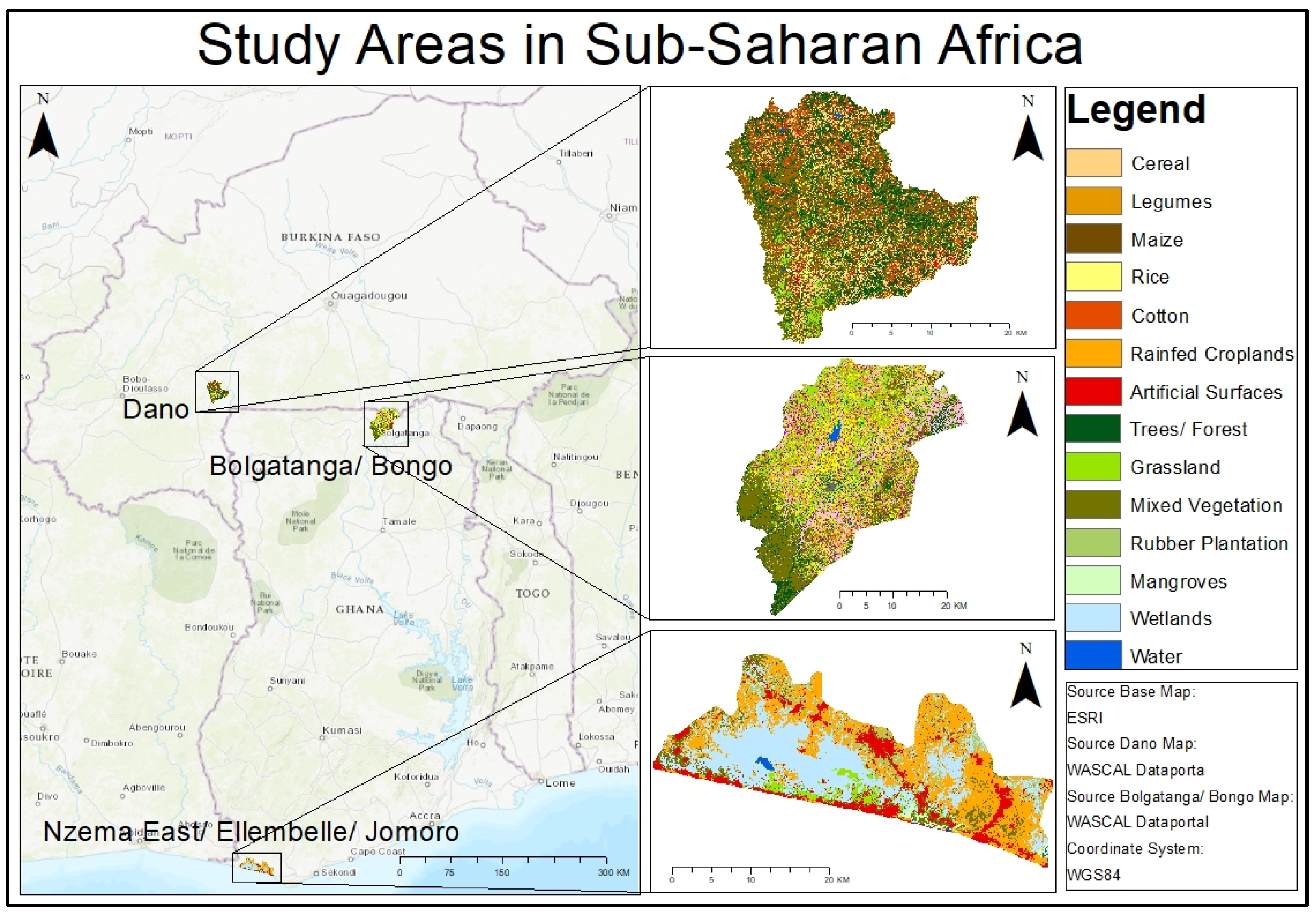
Figure 2.
Actor network of Dano (red ties: weak; grey ties: moderate; black ties: strong; red-square: key actors).
Figure 2.
Actor network of Dano (red ties: weak; grey ties: moderate; black ties: strong; red-square: key actors).
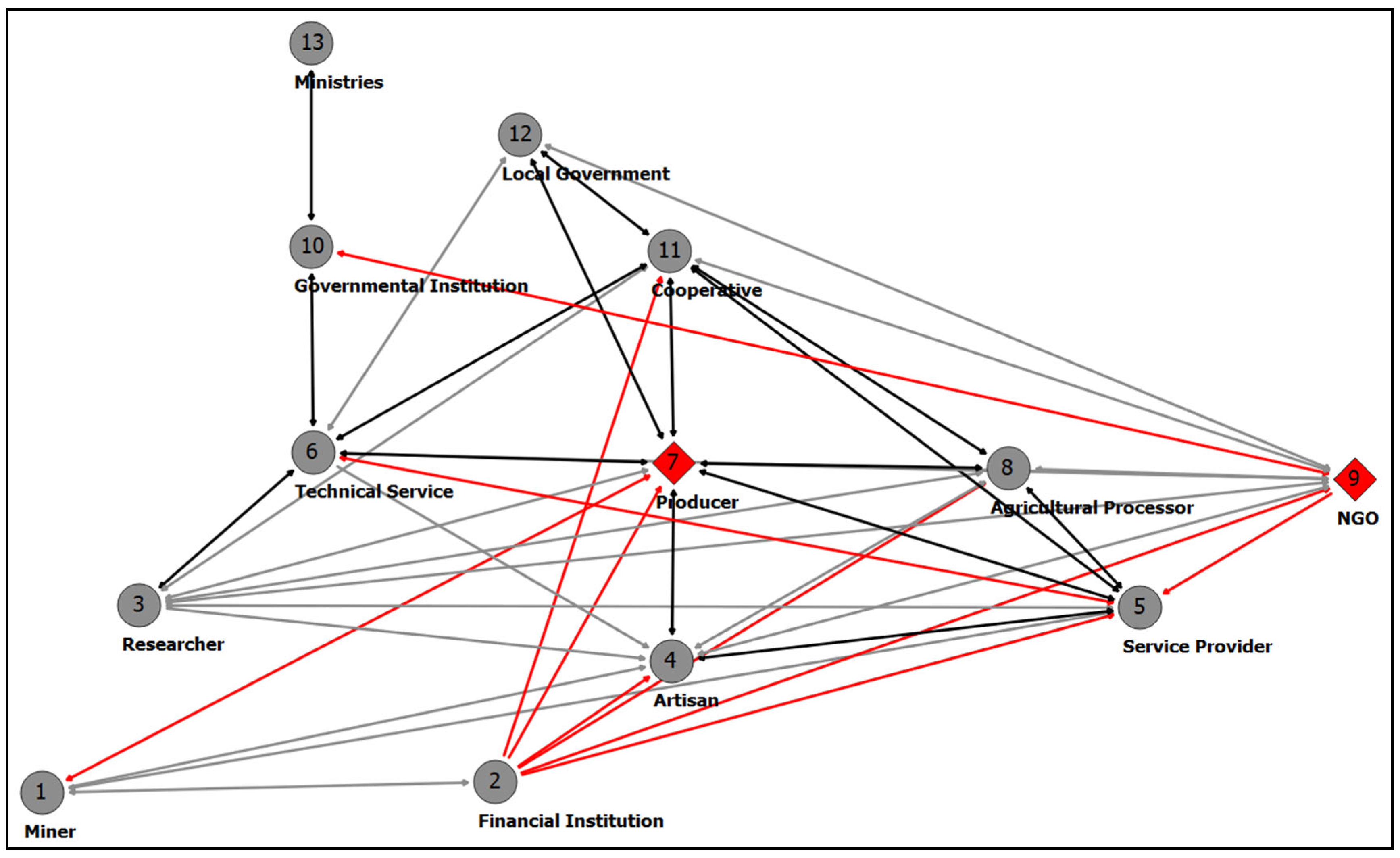
Figure 3.
Actor network of Bolgatanga/ Bongo (red ties: weak; grey ties: moderate; black ties: strong; red-square: key actors).
Figure 3.
Actor network of Bolgatanga/ Bongo (red ties: weak; grey ties: moderate; black ties: strong; red-square: key actors).
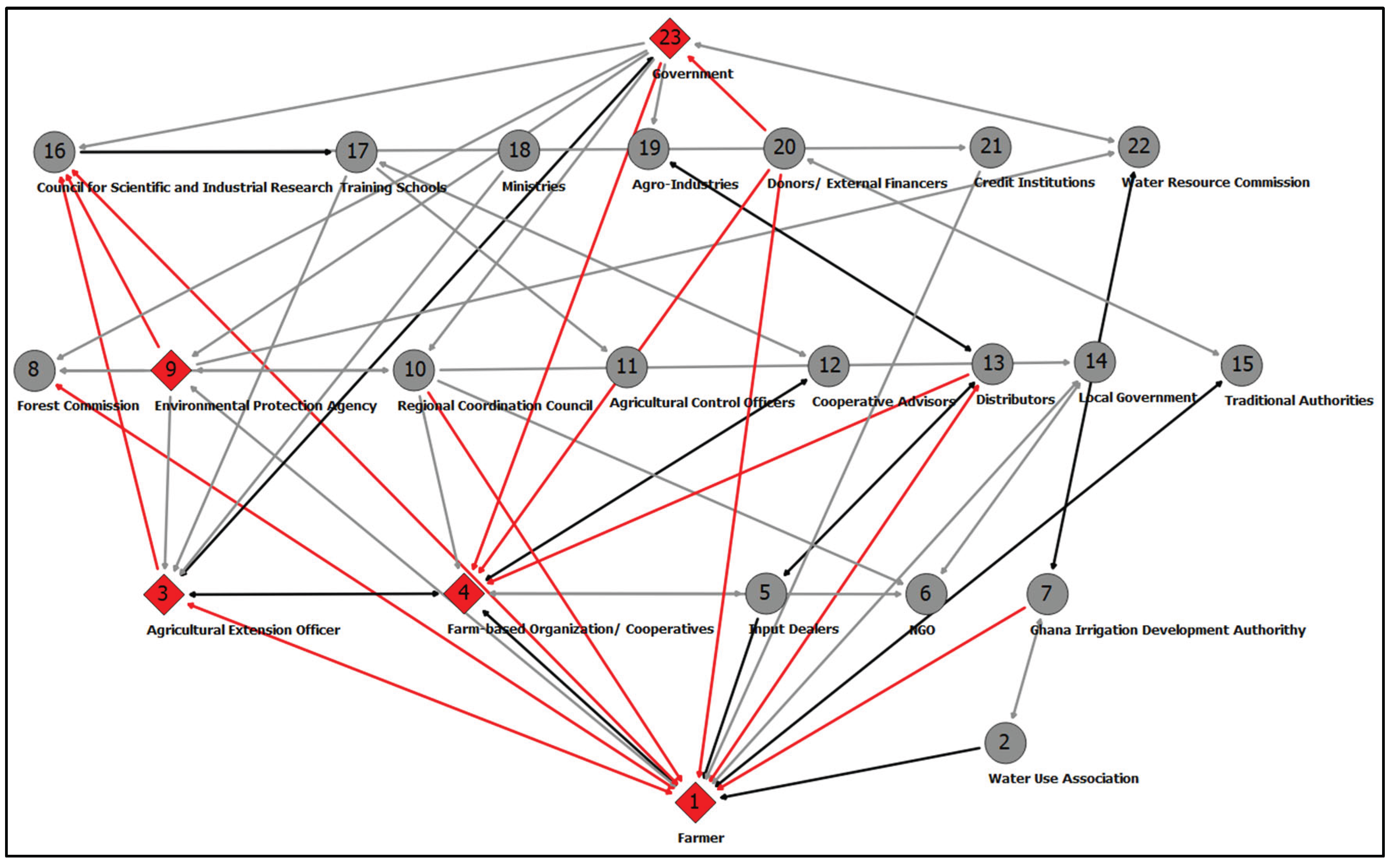
Figure 4.
Actor network of Nzema East/ Ellembelle/ Jomoro (red ties: weak; gray ties: moderate; black ties: strong; red-square: key actors).
Figure 4.
Actor network of Nzema East/ Ellembelle/ Jomoro (red ties: weak; gray ties: moderate; black ties: strong; red-square: key actors).
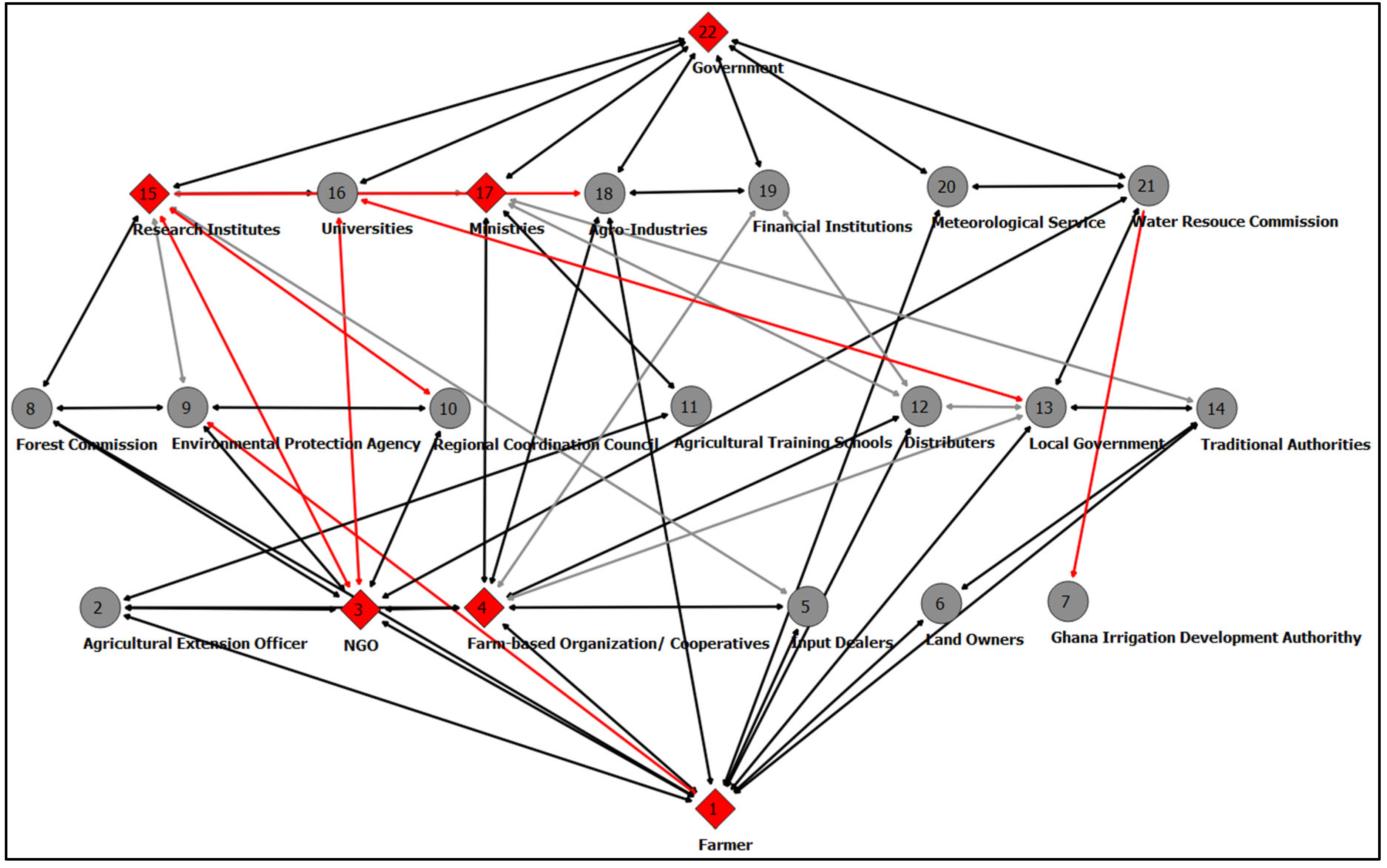

Table 1.
Centrality statistics and network actors in Dano (ID: in-degree; OD: out-degree; BC: betweenness centrality).
Table 1.
Centrality statistics and network actors in Dano (ID: in-degree; OD: out-degree; BC: betweenness centrality).
| Nodes | Actors | Responses | IDs | ODs | BCs |
|---|---|---|---|---|---|
| 1 | Miner | 1 | 3 | 4 | 11.00 |
| 2 | Financial Institution | 2 | 1 | 7 | 1.32 |
| 3 | Researcher | 1 | 6 | 7 | 0.70 |
| 4 | Artisan | 1 | 8 | 4 | 1.32 |
| 5 | Service Provider | 4 | 9 | 7 | 11.80 |
| 6 | Technical Service | 6 | 7 | 8 | 16.55 |
| 7 | Producer | 12 | 10 | 9 | 18.62 |
| 8 | Agricultural Processor | 3 | 7 | 6 | 1.03 |
| 9 | NGO | 6 | 9 | 9 | 25.60 |
| 10 | Governmental Institution | 6 | 3 | 3 | 22.00 |
| 11 | Cooperative | 7 | 8 | 7 | 3.07 |
| 12 | Local Government | 6 | 4 | 4 | 0.00 |
| 13 | Ministries | 7 | 1 | 1 | 0.00 |
Table 2.
Centrality statistics and network actors in Bolgatanga/ Bongo (ID: in-degree; OD: out-degree; BC: betweenness centrality).
Table 2.
Centrality statistics and network actors in Bolgatanga/ Bongo (ID: in-degree; OD: out-degree; BC: betweenness centrality).
| Nodes | Actors | Responses | IDs | ODs | BCs |
|---|---|---|---|---|---|
| 1 | Farmer | 5 | 14 | 8 | 219.92 |
| 2 | Water Use Association | 4 | 1 | 2 | 2.00 |
| 3 | Agricultural Extension Officers | 3 | 6 | 4 | 62.00 |
| 4 | Farm-based organizations/ cooperative | 1 | 9 | 5 | 77.92 |
| 5 | Input Dealers | 6 | 2 | 3 | 2.17 |
| 6 | NGO’s | 2 | 3 | 2 | 2.33 |
| 7 | Ghana Irrigation Development Authority | 0 | 2 | 3 | 25.50 |
| 8 | Forest Commission | 1 | 4 | 1 | 0.50 |
| 9 | Environmental Protection Agency | 3 | 3 | 6 | 47.50 |
| 10 | Regional Coordination Council | 3 | 2 | 6 | 5.33 |
| 11 | Agricultural Control Officers | 0 | 1 | 0 | 0.00 |
| 12 | Cooperative Advisors | 1 | 2 | 2 | 9.83 |
| 13 | Distributors | 1 | 3 | 4 | 35.17 |
| 14 | Local Government | 9 | 3 | 2 | 8.42 |
| 15 | Traditional Authorities | 7 | 2 | 2 | 20.00 |
| 16 | Council for Scientific and Industrial Research | 2 | 4 | 3 | 50.42 |
| 17 | Training Schools | 0 | 2 | 3 | 26.50 |
| 18 | Ministries | 18 | 0 | 1 | 0.00 |
| 19 | Agro-Industries | 0 | 2 | 1 | 1.50 |
| 20 | Donors/ External Financers | 0 | 1 | 4 | 5.17 |
| 21 | Credit Institutions | 2 | 1 | 1 | 0.00 |
| 22 | Water Resource Commission | 3 | 3 | 2 | 41.58 |
| 23 | Government | 1 | 3 | 8 | 51.25 |
Table 3.
Centrality statistics and network actors in Nzema East/ Ellembelle/ Jomoro (ID: in-degree; OD: out-degree; BC: betweenness centrality).
Table 3.
Centrality statistics and network actors in Nzema East/ Ellembelle/ Jomoro (ID: in-degree; OD: out-degree; BC: betweenness centrality).
| Nodes | Actors | IDs | ODs | BCs |
|---|---|---|---|---|
| 1 | Farmer | 12 | 11 | 97.26 |
| 2 | Agricultural Extension Officer | 4 | 4 | 15.87 |
| 3 | NGO | 9 | 9 | 57.10 |
| 4 | Farm-based Organization/ Cooperatives | 9 | 9 | 35.79 |
| 5 | Input Dealers | 3 | 3 | 1.53 |
| 6 | Land Owners | 2 | 2 | 0.00 |
| 7 | Ghana Irrigation Development Authority | 1 | 0 | 0.00 |
| 8 | Forest Commission | 3 | 4 | 0.37 |
| 9 | Environmental Protection Agency | 5 | 5 | 8.12 |
| 10 | Regional Coordination Council | 3 | 3 | 0.00 |
| 11 | Agricultural Training Schools | 2 | 2 | 1.22 |
| 12 | Distributers | 5 | 5 | 6.52 |
| 13 | Local Government | 6 | 6 | 21.02 |
| 14 | Traditional Authorities | 4 | 4 | 8.23 |
| 15 | Research Institutes | 8 | 9 | 42.98 |
| 16 | Universities | 4 | 4 | 5.39 |
| 17 | Ministries | 6 | 6 | 34.74 |
| 18 | Agro-Industries | 5 | 4 | 6.68 |
| 19 | Financial Institutions | 4 | 4 | 2.56 |
| 20 | Meteorological Service | 3 | 3 | 4.07 |
| 21 | Water Resource Commission | 4 | 5 | 25.64 |
| 22 | Government | 7 | 7 | 36.91 |
Disclaimer/Publisher’s Note: The statements, opinions and data contained in all publications are solely those of the individual author(s) and contributor(s) and not of MDPI and/or the editor(s). MDPI and/or the editor(s) disclaim responsibility for any injury to people or property resulting from any ideas, methods, instructions or products referred to in the content. |
© 2025 by the authors. Licensee MDPI, Basel, Switzerland. This article is an open access article distributed under the terms and conditions of the Creative Commons Attribution (CC BY) license (http://creativecommons.org/licenses/by/4.0/).
Copyright: This open access article is published under a Creative Commons CC BY 4.0 license, which permit the free download, distribution, and reuse, provided that the author and preprint are cited in any reuse.


