

Submitted:
06 December 2023
Posted:
06 December 2023
You are already at the latest version
Abstract
Spatio-temporal variability and dynamics in Sahelian agro-pastoral zones make each local situation a special case. These specificities must be considered to guide the dissemination of agricultural options with a view to sustainable development. The territorial scale of municipalities is not sufficient for this necessary contextualization; the scale of the “village terroir” seems to be a better option. This is the hypothesis put forward by the Global Collaboration for Resilient Food Systems program. By analyzing the links between farm managers and their cultivated land, as well as the spatio-temporal dynamics of “village terroirs” in three regions of Niger (Maradi, Dosso and Tillabéri), this study provides evidence of the existence and functional usefulness of the village terroir for farmers, their land management and their activities. It demonstrates the usefulness of contextualizing agricultural options at this scale. It is based on data collected through participatory mapping and surveys. Their analysis elucidates the links between “terroirs village” and the specific functioning of the agro-socio-ecosystems acting on each of them, thus laying the systemic and geographical foundations for a model of the spatio-temporal dynamics of “village terroirs”. This initial work has opened up new perspectives in modeling and sustainable development.
Keywords:
Niger
; option by context
; local condition
; complex system
; multiscale
; conceptual modeling.
1. Introduction
In semi-arid Sahelian zones, researchers, development professionals and farmers in countries affected by desertification, as well as their international partners, are working on technical solutions to improve the agronomic, ecological and social performance of agricultural production systems. They innovate within existing systems or introduce new systems [1,2,3,4,5]. Since the shock of the droughts of the 1970s and 1980s and with population growth and climate change, these stakeholders have been working to meet the major social and environmental challenges facing this part of the world. These challenges are food and land security, even autonomy, for rural and urban populations, the fight against poverty and social injustice, adaptation to climate change, and rehabilitation of land and biodiversity. Their approach is becoming increasingly participatory [6,7,8], combining academic knowledge with the various players’ know-how and technical skills. The participatory approach aims to better respond to the expectations of local populations and to take into account some of their biophysical and socioeconomic realities. Despite their efforts, rural populations may reject or quickly abandon proposed solutions, mainly because they are not sufficiently tailored to local realities.
Local biophysical and socioeconomic realities are closely linked to a multi-scale “territorial context” [9] that conditions or affects the implementation of initiatives. Olivier de Sardan [10] (p. 59) distinguishes between the “structural context of implementation” and the “pragmatic context”. Mathevet et al. [11] distinguish between the “social and environmental context” and the “social context of intervention”. In both cases, these contexts condition or affect local implementation in each particular situation. The first focus on what surrounds the initiative, whereas the latter focus on the initiatives themselves, the stakeholders and their relationships. The territorial context encompasses both of these. Each local situation is related to a single, potentially multi-scale territorial context. This “specific, local situation linked to a specific, territorial context” is what the academic and non-academic community of the international Global Collaboration for Resilient Food System (GCRFS: https://www.ccrp.org/about-us/) program groups under the term “local context”.
This multidisciplinary, multi-stakeholder community aims to improve how cowpea varietal diversity is used, notably by putting the proposed options into context. Its objective is to reduce the gap between the suggested options and local biophysical and socioeconomic realities. Each option must demonstrate performance suited to one or more specific social and environmental situations. A package of several options must be proposed for a given situation to allow potential users to choose those that best respond to their needs in terms of cowpea production (grains, haulms) and transformation (food, fodder) while taking into account the resources they have (the first hypothesis). This community has also observed technological transitions made by farmers in the Maradi region of Niger. Observations by the National Institute of Agronomic Research of Niger (INRAN) have revealed, for example, the transition from the half-moon technique (shan wata in Hausa; [12]) to the plank technique (hongalay in Hausa) on degraded heavy soils. Unlike the classic half-moon model (300 units/ha), hongalays can produce 700 to 1,000 units/ha, thereby optimizing the water supply. What’s more, in these structures designed by rural producers, grains along the edges are combined with legumes in the mini-troughs to optimize space in a setting where micro-landholding is rife due to demographic pressure. These observations in the Maradi region have led this community to make a second hypothesis: when producers adopt the techniques introduced in a given area (cf. half-moon), they can modify them (cf. hongalay) to adapt them to specific local situations (micro-landholdings and soils with water reserves in the case of hongalays). However, this adaptive capacity characteristic of Sahelian populations [2] sometimes clashes with the speed of the climate and socioenvironmental changes around them. This can create a gap between the actions implemented on site and their new territorial context. This highlights the importance of taking into account the local dynamics and the territorial context from which they derive within the framework of this study.
In Niger, where 80% of the economy is based on farming [13], the link between land management and the family and village is strong in rural areas. This link remains strong despite the transformation of some villages into small towns (defined as a population between 2,000 and 10,000) and successive reforms of the rural code since its adoption in 1993. By creating land ownership commissions [14], these reforms sought to move land and natural resource management away from local, religious and customary chieftains. The aim was to make management more collegial, fair and equitable, and to secure land rights. In 2002, Nigerien decentralization laws created regions, departments and communes: laws of 06/11/2002, no. 2002-012 (fundamental principles of the free administration of regions, departments and communes, as well as their powers and resources), no. 2002-014 (creation of communes with their capital). They established communes as the smallest administrative unit and consider as cities all agglomerations of more than 2,000 administratively attached persons (usually residents). One commune comprises a main settlement and other settlements administratively recognized by decree and acknowledged by a village chief, whatever their population size. This decentralization process led to the creation of communal land commissions (cofocom) and departmental land commissions (cofodep), which are distinct from village land commissions (cofob): cf. Art. 118 to 121, Order no. 93-015; Order no. 098/MDA/CNCR/SP of November 25, 2005, on the organization, powers and operating procedures of commune, village or tribal land commissions. However, since the complementary nature of their roles and the intended collegiality are still not functioning well [14], rural populations continue to refer to their local chiefdoms for land management. Farmers continue to acquire their land and decide what activities they will carry out on it according to the rules of their family and village communities and inherited practices adapted to specific local realities. Local chiefdoms enforce and preserve the memory of local rules. Other regulatory mechanisms (notably land tenure; [15]) exist at other levels of social organization, but the diversity of regulations is not the focus of this work. From generation to generation, they record and preserve knowledge of the local situation and its biophysical and socioeconomic diversity. While only 4.5% of Niger’s population had formal land rights in 2022 [16] at communal, departmental and regional levels, the chief of the land ensures local protection of their customary rights and land transactions, as well as playing a conciliatory role in the event of conflict.
Thus, in 2023, communes are still relatively recent territorial entities (18 years old, less than a generation), relatively large (a median of 16,5500 ha for the whole of Niger [17]), which may contain a hundred or so agglomerations, and whose land commissions function poorly. Local people rarely refer to this territory and to elected local officials for the day-to-day management of their land in a particular local situation and for decision-making within their farm or village community. The rural agglomeration and its associated farmland remain the territorial entity to which each farmer refers to manage their land and which is referred to as the “village terroir”. In villages with fewer than 2,000 inhabitants and in small towns, this management is carried out by the chief of lands.
The geographical boundaries of the village terroir are known, but only the oldest members of the village have complete, detailed knowledge of these boundaries. This knowledge is passed on orally to subsequent generations. Varying in size from a few hundred to several thousand hectares, the size and shape of a village terroir evolves over the course of human occupation and use of the land. The same applies to the (small) number and size of the agglomerations it contains and to the spatial and social relationships between terroirs [18]. The fact that this process usually takes place over several generations is perhaps the reason why there is no map of village terroirs in Niger in 2023.
The territory that rural populations know, the one whose resources they exploit and share collectively (community land) and individually (family land) is the village terroir. The territory is considered as a socio-spatial entity with a triple nature (spatial reality, social reality and a complex system of representations) on which the territorial identity of the stakeholders attached to this territory will depend [19]. Thinking about packaging agricultural options at the level of village terroirs seems a promising path to sustainability. The proposed options’ diversity and specificity would allow them to be adapted to the diversity and specificity of the village terroir’s biophysical realities as well as the socioeconomic realities of the people who work the land (cf. structural context). The implementation of the villagers’ chosen options could be based on accepted family and village rules (cf. pragmatic context). By analyzing village terroirs’ spatial and temporal realities, this study aims to provide evidence of the existence and functional utility of the village terroir for farmers, their land management and their activities, and, in doing so, lay the systemic and geographical foundations of a dynamic model of village terroirs.
2. Materials and Methods
2.1. Study Area (Sites)
The present study is based mainly on fieldwork carried out in 2017 in the three main cowpea-producing regions of Niger, targeted by the transdisciplinary and decentralized varietal selection project, CowpeaSquare, one of the GCRFS projects in Burkina Faso and Niger (https://www.ccrp.org/grants/cowpea-square-ii/). These include the Maradi region in south-central Niger, and the Dosso and Tillabéri regions in the west of the country [20].
Geographically, these three regions are located between 2°28′0″ and 9°4′40″ East longitudes, and between 11°48′40″ and 17°60′00″ North latitudes. They share a Sahelian-type climate characterized by a long dry season lasting eight to nine months (from October to May) and a wet season lasting three to four months (from June to October). Their productive activities are essentially based on agriculture and livestock [2]. In fact, around 85% of the total population of these three regions depends on agriculture, and over 90% on livestock [27]. Average annual precipitation ranges from 300 mm in the north to 600 mm in the south of the zone of study (Figure 1). Six main soil types can be distinguished according to the regions studied: (1) leached tropical ferruginous soils (ferralic arenosols, gueza in Hausa); and lightly leached tropical ferruginous silty-sandy or sandy-loam soils (jigawa in Hausa; [21,22]), on sandy plateaus (dunes) and glacis in the Maradi and Tillabéri regions, and on river terraces and dallols [23], in the Dosso region; (2) alluvial soils or hydromorphic gleysols (fadama in Hausa) in inter-dune depressions and bed (goulbi in Hausa) of the Maradi valley and the Niger River in the Tillabéri region, and along the dallols in the Dosso region; (3) ferralitic soils on sandy clays or lixisols on the sandy plateaus of the south (between the Maouri dallol and the river valley in the Dosso and Tillabéri regions), sometimes associated with leached tropical ferruginous soils [24]; (4) brown-red subarid soils located in the dry valleys of the pastoral and agropastoral zone in the Tillabéri region; (5) heavy hydromorphic black soils or deep vertisols, sometimes natronized in places, rich in swelling clay and organic matter, located along the dallols in the Dosso region and in the river valley in the Tillabéri region; (6) and temporarily hydromorphic silty-clay soils found in the lowlands where market gardening and fruit growing are developed in the Tillabéri region [25].These three regions thus offer different soil and climate conditions for agropastoral practices, such as the silty-clay to temporarily hydromorphic soils found in the lowlands where market garden crops and fruit trees are grown [25].
To analyze neighborhood relations between village terroirs, we focused on the Maradi valley, centering on the northern part of the Tibiri Gobir commune but also including the neighboring communes of Guidan Sori and Chadakori. This rural area has a very high population density (214 inhabitants/km2). By way of comparison, the population density is 12.4 per km2 for the whole of Niger, ranging from an average of less than 1 per km2 in the Saharan zone, to an average of 100 per km2 in the Sudanian zone, and an average of around 10 per km2 in the intermediate Sahelian zone [17]. This results in land saturation with very little cultivated land per household [26]. Micro-landholding is the result of land fragmentation due to demographic growth and the way land is acquired through inheritance. Average annual rainfall is 477 mm with a relatively high average annual temperature (28°C) [26,27]. Four geomorphological units stand out: plateau, slope, glacis and valley [12] (p. 15). In terms of water resources, the area has a semi-permanent stream in the Maradi valley that irrigates its eastern part for around 15 km, and a few temporary pools in the Maradi goulbi [27,28]. Agroforestry parks and village forests along the valley are the two main types of forest formation.
To achieve the study’s objectives, a total of 28 agglomerations were sampled in these three regions, including 21 in Maradi, six in Dosso and one in Tillabéri (Figure 1a).
In the Maradi region, eight of the 21 agglomerations are located in the Maradi goulbi valley (Figure 1b). These agglomerations (Figure 1c) are all located above the valley bed, mostly on dune plateaus (22) or on slopes (6). The population of the agglomerations in the Maradi region is predominantly Hausa; that of the Dosso region is mainly Zarma, except for Karakara in the south, while that of the only agglomeration in the Tillabéri region is predominantly Tuareg. In 2017, 78% of agglomerations had fewer than 2,000 people and could, strictly speaking, be considered villages (values in 2017 estimated on the basis of the 2012 census and an annual growth rate of 4%). The maximum size of the remaining 22% is 6,346 people in Tsouloulou. This sampling was designed to provide evidence of the spatial reality of village terroirs in different regional situations, taking into account the spatial and functional heterogeneity of soils and the spatial and temporal distribution of rainfall. These two criteria led to the agro-climatic zoning of Niger’s Sahelian zones, from agroforestry zones in the south to pastoral zones in the north, passing through agricultural and agropastoral zones in the center. Another aim was to select politically stable agglomerations, where unions of farmers’ organizations such as Fuma Gaskia in the Maradi region and Mooribeen in the Dosso and Tillabéri regions are active. This choice allowed us to work with farmers with experience of working with research institutions, a certain enthusiasm for testing new cowpea varieties, and a willingness to make land available for agronomic trials. Finally, we wanted to understand the local complexity of neighboring village terroirs, hence the eight villages in the Maradi valley.
In 1994, some fifteen villages were selected in the commune of Dantiandou in the Tillabéri region to analyze the dynamics of village terroirs [18]. We refer to the results of this work carried out a generation earlier (23 years) to support the analysis in part 3.
2.2. Protocol for Collecting Field Data
The field data collected in September 2017 in the 28 sample agglomerations is based on stakeholder feedback and GPS coordinates.
The demarcation of village terroirs (19 in total) was carried out using a participatory field method (Figure 2). Given the need to mobilize local residents over a long period of time, 12 terroirs were identified (Figure 4) in the 21 agglomerations in the Maradi region (cf. Figure 1). In the Maradi valley, where some villages still share the same terroir, seven terroirs were identified for the eight villages concerned (Figure 6). A team was set up in each village. It included between four and six resource people who were well acquainted with the boundaries of their terroir, as well as the project’s scientists, who facilitated group work to help materialize the boundaries. During discussions in each village, participants identified landscape features [19] that they considered to be characteristic and consensual of the boundaries of their terroir (Figure 2a). In some cases, lines on the ground were used to facilitate exchanges (Figure 2b). The team then travelled to the boundaries themselves (Figure 2c) to confirm the prominent landscape features identified and to record their GPS coordinates.
The terroirs were marked out village by village, with groups made up of people from the same village and without reference to the boundaries given by neighboring villages. The aim was to avoid any risk of creating or re-igniting conflicts, to avoid influencing the process, and to give each village the opportunity to fully express its views on the extent of the space in which the local population recognizes the land it manages.
In the villages of the Maradi valley, the data collected was supplemented with group and individual interviews. Each of the eight “focus group” interviews involved 10 to 15 participants, including both researchers and producers. In each village, residents aged 30 and over, whether farm managers or members of the farm, were specifically identified to increase the chances of them knowing the boundaries of the terroir. A sample of around 20% of this parent population was then randomly drawn from each village, for a total of 161 households surveyed. The specific numbers included 20 households for Atchiré, Janjouna Dan Tanine, Fagagaou, Kalgon Waraou, Waraou, and Garin Yari Idi 2, 19 for Garin Yari Idi 1, and 22 for Mamawa.
All interviews, whether group or individual, centered on four topics: 1) perception of the village terroir, 2) the criteria used to demarcate the terroir, 3) the mechanisms for creating or changing boundaries, 4) the history of the village. The questions were open-ended, allowing participants to express themselves freely and interact in the group interviews. Only a few additional closed questions were asked in the individual interviews, concerning the number of dependents, the surface area of the fields worked and their mode of acquisition.
2.3. Creation of Three Data Sets
Three bodies of data, [A], [B] and [C], were prepared from the field data and analyzed (3.1) to lay the foundations for the dynamic model of village terroirs (3.2).
- Set [A]: Data on the reality of farm managers
This is a table of data on the modes of acquisition of cultivated land, the surface areas cultivated, and the family burden of the 161 households surveyed individually. Data was collected specifically for each field worked, aggregated by farm manager, then averaged by village terroir or for all villages. This data set covers villages in the Maradi valley.
- Set [B]: Data on the spatial reality of village terroirs
This data set includes village terroir maps for the years 1994 and 2017, with associated geometric data for 2017 only. In the Tillabéri region, GPS data from 1994 was lost, saved at the time on floppy disks that have since been damaged. For the 19 terroirs delimited in 2017 in the regions of Maradi, Dosso and Tillabéri, the GPS coordinates of the landmarks that mark the village terroir boundaries, collected in the field, were digitized using the cartographic software QGIS 2.18. The terroir boundaries were vectorized by joining the digitized points. After these mapping actions, geometric data was calculated in a GIS for each terroir, i.e., surface area and perimeter. In the Maradi valley, the percentage of overlapping areas between neighboring terroirs was calculated for the seven terroirs (eight villages).
This data set also includes all the information on the spatial realities of the terroirs collected from stakeholders during individual and group interviews. This information covers the terroir boundaries and the factors that explain their demarcation, including in 1994 in the Tillabéri region.
- Set [C]: Data on the temporal reality of village terroirs
Some of the historical features relating to the creation of villages have left a deep mark on their inhabitants’ consciousness and remain inscribed in the collective memory. In the target communes in the Maradi valley and in the commune of Dantiandou in the Tillabéri region, these historical features were meticulously traced through group and individual interviews. They play a decisive role in the occupation of space in the Sahelian agropastoral zone and shed valuable light on the dynamic processes underlying how terroirs are demarcated.
2.4. Data Analysis Method
The foundations of the spatiotemporal dynamics model for village terroirs were built by progressively formalizing the rules uncovered by two analyses: 1) an analysis focused on data set [A], dealing with the relationships between farm managers and the land they cultivate (3.1.1), and 2) an analysis focused on data sets [B] and [C], looking at the relationships between the spatiotemporal realities of terroirs and the agro-socio-ecosystemic factors that influence them (3.1.2 and 3.1.3).
The knowledge acquired in section 3.1 was used to describe the spatiotemporal dynamics of village terroirs and to represent them on a map system, a kind of virtual model based on so-called chorematic symbols and signs (3.2.1). The general principles of chorematic modeling [29,30] were used to represent the structure, functioning and dynamics of a given space. Given the wealth of knowledge acquired, R. Brunet’s [29] 28 choremes have not been used to their full potential.
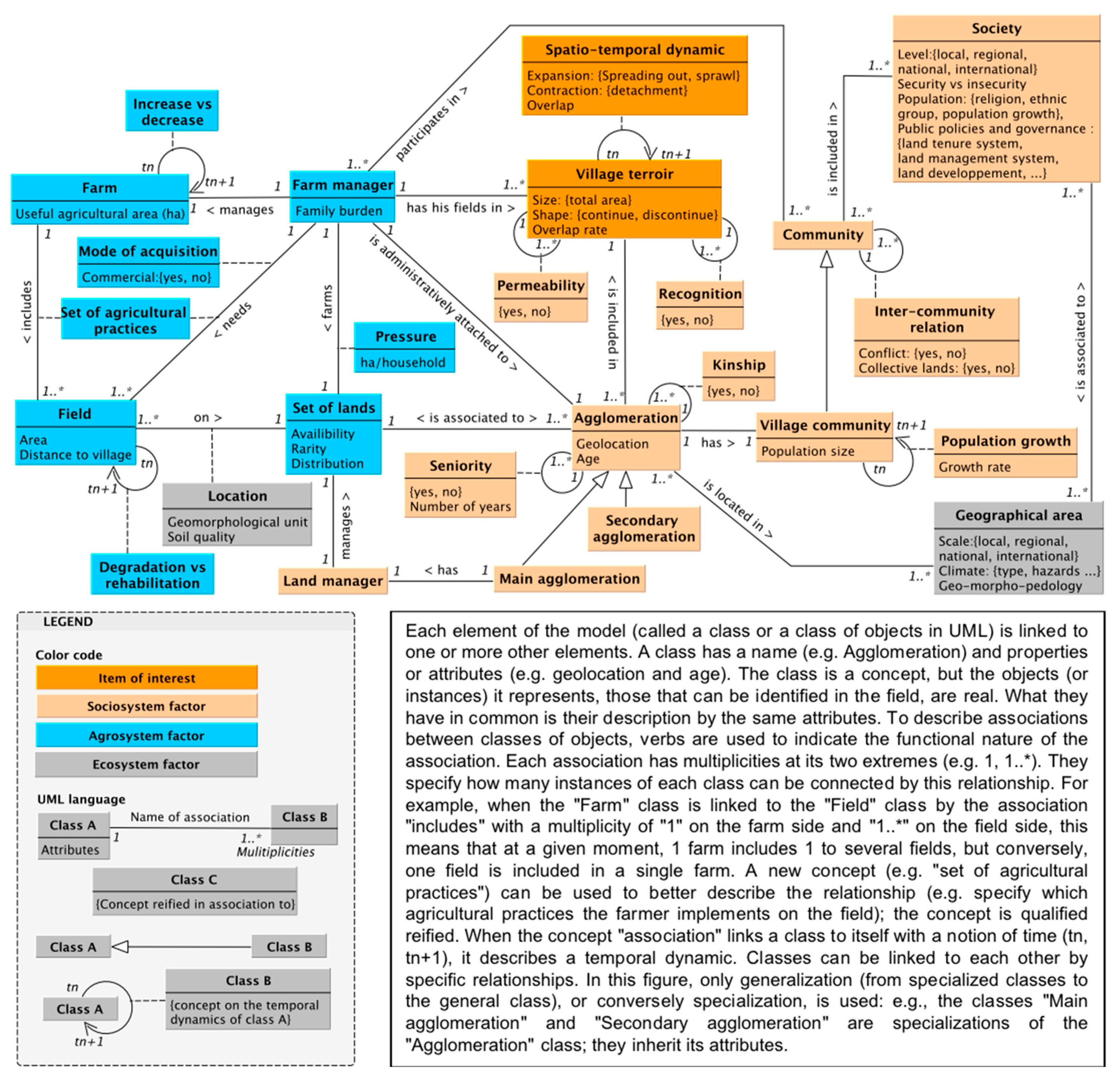
Later (3.2.2), the knowledge acquired helps to organize the agro-socio-environmental determinants of these dynamics into a conceptual model written in Unified Modeling Language (UML) [31]. This language is used in its most basic version, sufficient for this first stage of eliciting the spatiotemporal dynamics of village terroirs, the subject of the study.
3. Results
3.1. Knowledge Gained Helpful for Conceptualizing the Model
3.1.1. The Reality of the Relationship between Farm Managers and Their Farmland
In the Maradi goulbi valley, individual interviews confirm the importance of the relationship between people and land as the basis of production in Niger’s agropastoral systems [20]. The food and social needs (e.g., weddings, christenings) of farm managers’ households are essentially covered by produce from cultivated land. However, in this area under socio-demographic pressure, a household cultivates an average of 2.9 ha, irrespective of how it accesses cultivated land (Figure 3b,c). Although this average conceals significant disparities (Figure 3a) between terroirs (standard deviation of 1.2) and between households (standard deviation of 2.5), it remains low overall compared with the average family burden of each head of household (13, with a standard deviation of 7 between households and 2.5 between terroirs). Thus, each dependent member of a farm manager has an average of 0.3 ha to support themselves. A few farm managers have large cultivated areas compared to the overall local context. In Janjouna Dan Tanine, one works 18 ha and another 12.5 ha. In Garin Yari Idi2, one cultivates 14.75 ha, and in Kalgon Waraou another cultivates 10 ha. These four cases, where the farm manager cultivates more than 10 ha, are the only ones among the 161 households sampled; their land was mainly acquired by inheritance or purchase. The one who owns 18 ha had bought it all, spread over just two fields. The one with 14.75 ha cultivates four fields purchased out of six.
In this context of land saturation, land takes on a market value. It is worth noting that this commodification of land gives new authority to land chiefs to guarantee the validity of transactions [14]. Although inheritance remains the main mode of land acquisition (78% on average across all terroirs, ranging from 58% in Mamawa to 84% in Atchiré; Figure 3a,b), other modes of acquisition (loan, gift, purchase, lease, pledge) facilitate the acquisition of fields in village terroirs other than the one to which the farmer is attached. This explains a certain permeability between terroirs, at least temporarily. When a field is donated or purchased in another village terroir, the acquisition is permanent. In other cases, it is limited in time, ephemeral. Sometimes, however, a person who has benefited from a loan or pledge without a witness claims to have bought the land to keep it for themselves. With the exception of inheritance and gifts, these modes of acquisition all involve market transactions. Pledging agricultural land is a financial mechanism that allows farmers to use their land as collateral to obtain a loan or financing. If the loan is not repaid, the lender can take possession of the pledged land. This provides security for the lender, while allowing the farmer to obtain funds to invest in their business. How the pledge works in detail may vary according to local laws and regulations. The leasing of agricultural land is not generally considered as a loan, but rather as a rental contract or land lease. This arrangement allows the landowner to provide the tenant’s farmland for a fee. Unlike a loan, the tenant does not borrow money from the landowner, but obtains the right to use the land for farming activities in exchange for the agreed payment. An agreement or contract is usually drawn up to govern the terms and conditions of an agricultural lease. This contract specifies the duration of the lease, the amount of rent, the tenant’s obligations in terms of land maintenance, the conditions for terminating the lease, etc. This clearly sets out the rights and responsibilities of each party. In Maradi, where land is a scarce and precious resource, buying, renting and pledging prevail over lending and giving.
The motivation of farmers to acquire new land in a neighboring terroir can stem from several factors. Firstly, the farmer may be motivated by the need to compensate for the scarcity of the land at their disposal, especially when the surface area per mouth to feed becomes insufficient. This is often exacerbated by population growth and a lack of job opportunities for young people in sectors other than agriculture. The farmer may also be motivated by the need to cultivate land that is better than their own, which no longer produces enough and in sufficient quality to meet the household’s needs. Lastly, farmers may want to compensate for land that has been taken over by others after a well-executed sale. This process often results from external pressure to which the farmer gives in, or a one-off need for cash to meet exceptional expenses (e.g. hospitalization of a family member).
When a farmer acquires new land in a terroir other than their home terroir, they may do so in a neighboring terroir to limit the spatial dispersion of their fields and optimize their travel. They may also acquire land in more distant terroirs, especially if family members have settled there, thus facilitating access to land. Farming these fields outside the home village terroir can be temporary, meeting specific needs, or long-term, depending on the farmer’s circumstances and objectives.
3.1.2. Spatial Realities of Village Terroirs
Each of the 19 agglomerations sampled in the Maradi, Dosso and Tillabéri regions (Figure 4) knows the boundaries of its village terroir, as do the eight neighboring villages in the Maradi goulbi valley (Figure 6) and the fifteen or so villages sampled in 1994 in the Tillabéri region (commune of Dantiandou: Figure 7). Lively discussions with local residents reveal their determination to present and explain the limits of their terroir, an attitude that prevails even in small towns.
Moving along the boundaries themselves reveals the diversity of factors that influence how terroirs are delimited and which are reflected in observable landscape features. An initial list of landscape features was drawn up. While unlikely to be exhaustive, each item on the list serves as an indicator of the landscape productive socio-ecosystem. The feature may be community land under state ownership (e.g., a transhumance corridor related to grazing; a forest for foraging, wood gathering and hunting), a thoroughfare (e.g., a track related to land use planning), a resource (e.g., a living hedge or an old tree used for land boundaries and a protected, even sacred, wood resource), a geomorphological unit border (e.g., plateau edge), a transition between land management modes (e.g., sultanate boundary), or a change in agricultural practices (e.g., the use or non-use of land rehabilitation techniques).
Figure 4, Figure 6 and Figure 7 illustrate the variations in the size and shape of village terroirs. They range in size from 400 to 7,300 ha and in perimeter from 12 to 39 km. In particular, Figure 6 shows how a village terroir can be made up of several spatial entities. The Atchiré terroir is made up of the “Atchiré Fadama” entity, located at the bottom of the valley where the old village stood, and the “Atchiré Tudu” entity, located on the dune plateau where the village moved in 1945 (3.1.3).
Figure 4.
Nineteen village terroirs demarcated in 2017 using the regional sampling approach: Maradi (A), Dosso (B), and Tillabéri (C).
Figure 4.
Nineteen village terroirs demarcated in 2017 using the regional sampling approach: Maradi (A), Dosso (B), and Tillabéri (C).
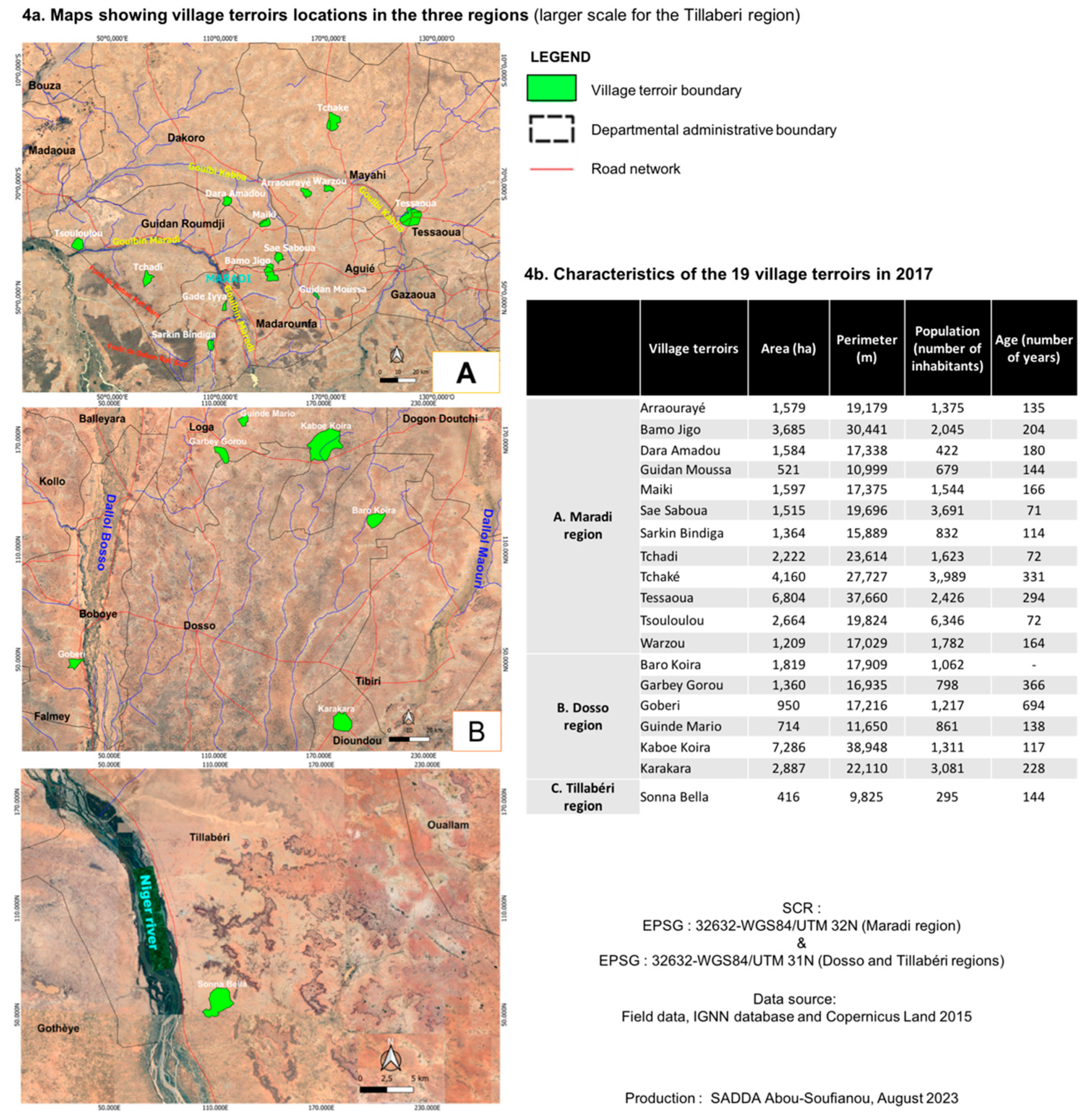
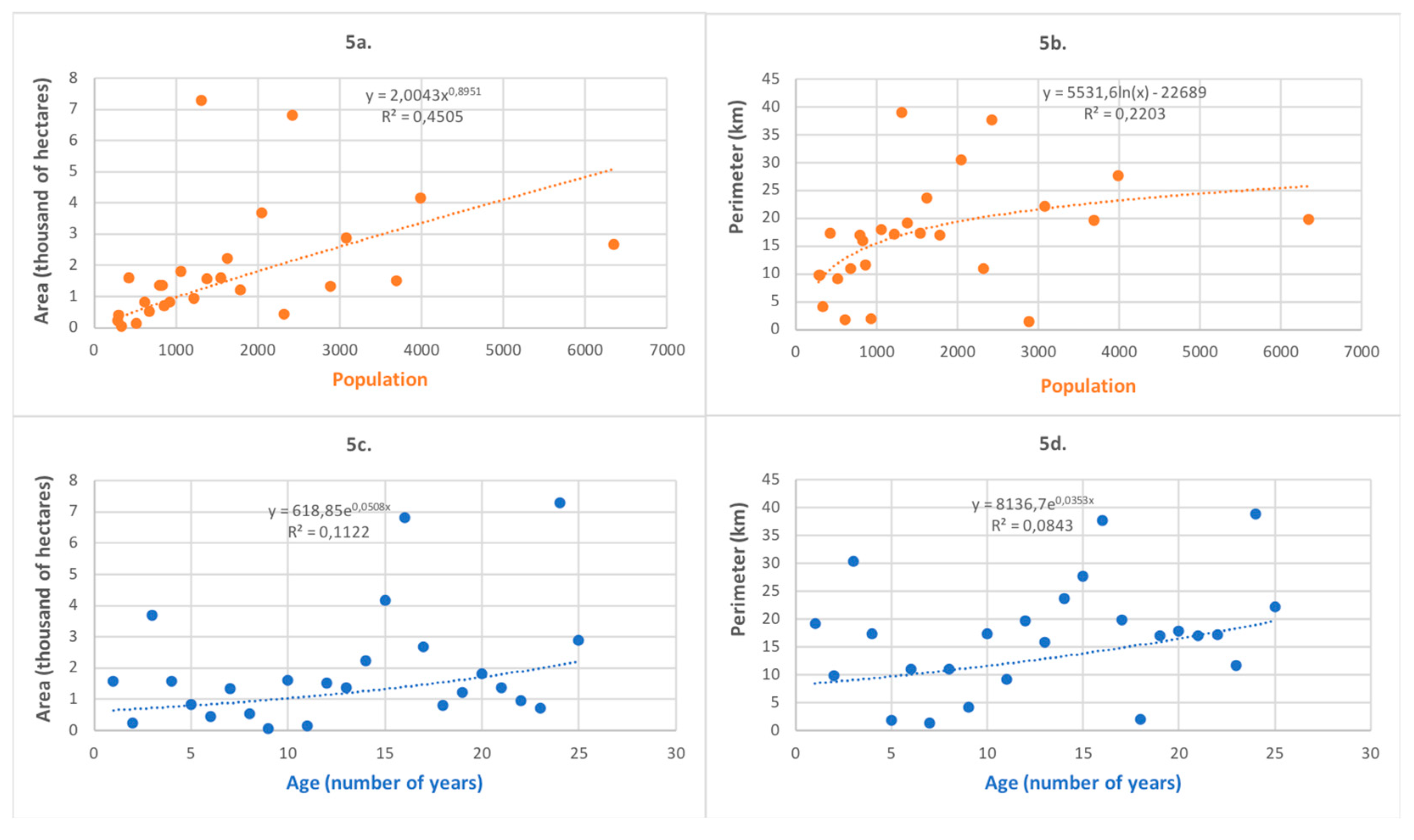
Examination of the sample of 26 terroirs demarcated in 2017 reveals no obvious correlations between spatial realities (in this case, area and perimeter) and social realities (in this case, population size and age of the agglomeration). Figure 5a shows the most notable correlation (following a “power” curve), with a low R2 value (0.45); it concerns the correlation between terroir area and population size. There is no relationship between perimeter and social realities, either in terms of population size or agglomeration age (Figure 5b,d), nor between surface area and age (5c). The sample size and regional distribution do not allow for further statistical analysis to confirm or deny the lack of relationship between terroir size and population size. For example, we cannot explore whether there is a threshold effect linked to population size or age, or a regional effect.
Figure 5.
Relationship between spatial realities of terroirs (surface area, perimeter) and social realities of terroirs (population size and age) in 2017.
Figure 5.
Relationship between spatial realities of terroirs (surface area, perimeter) and social realities of terroirs (population size and age) in 2017.
On the other hand, comparing the terroirs’ spatial realities with the realities of the links between farm managers and their cultivated land (3.1.1) or with the terroirs’ temporal realities (3.1.3) offers some explanations for this lack of correlation and suggests determining factors. An older village terroir such as Garin Yari Idi 1 and 2 (55 years old) may have a larger surface area (1338.1 ha) than a more recent terroir such as Kalgon Waraou (32 years old; 56.1 ha). In this example (Figure 6), the disparity may result from lower land pressure (cf. Figure 3) in Garin Yari Idi 1 and 2 (3.7 ha/household, above the average of 2.9 ha/household for the eight villages sampled) compared to Kalgon Waraou (2.7 ha/household). So, although the terroir of Garin Yari Idi 1 and 2 encompasses two villages, the newer village (Garin Yari Idi 2, 45 years old) and its associated lands have not broken away from the older mother village (Garin Yari idi 1, 55 years old) and its associated lands to create a new terroir. A similar case can be found in the commune of Dantiandou, where the Samadey terroir (over 200 years old), which still encompassed the villages of Samadey and Banikoubey in 1994, is larger than the Banizoubou terroir (between 100 and 200 years old). Conversely, an older terroir may be smaller than a more recent one if some of its villagers and land have been detached on one or more occasions. For example, in the Tibiri Gobir commune, Atchiré (83 years old) is smaller in size (241.2 ha) than the Waraou terroir (70 years old; 811.1 ha). However, land pressure is lower in Atchiré (2.6 ha/household) than in Waraou (1.6 ha/household). This situation can be explained by the settlement history of the inhabitants of Atchiré (3.1.3), which suggests that part of the population moved from Atchiré to Kalgon Waraou, creating a new village and cultivating a new patch of land. As a result, each of the terroirs, Atchiré and Kalgon Waraou, has returned to a level of land pressure close to the area average (2.9 ha/household).
Figure 6 and Figure 7 show that, in both 1994 and 2017 (a generation later), village terroir boundaries are not fixed; they evolve over time. The process of detachment from the terroir of origin can be either slow, as in the case of the two Maourey in the Tillabéri region, with a gap of a century and a half in 1994 (Figure 7), or fast, as in the case of the two Garin Yari Idi (1 and 2; Figure 6) in the Maradi region, with a gap of just 10 years in 2017. In the first case, land pressure was still moderate, while in the second, pressure on arable land reached its peak.
Figure 6.
A focus on the boundaries of the seven neighboring village terroirs centered on the northern commune of Tibiri Gobir, Maradi region, Niger, 2017.
Figure 6.
A focus on the boundaries of the seven neighboring village terroirs centered on the northern commune of Tibiri Gobir, Maradi region, Niger, 2017.
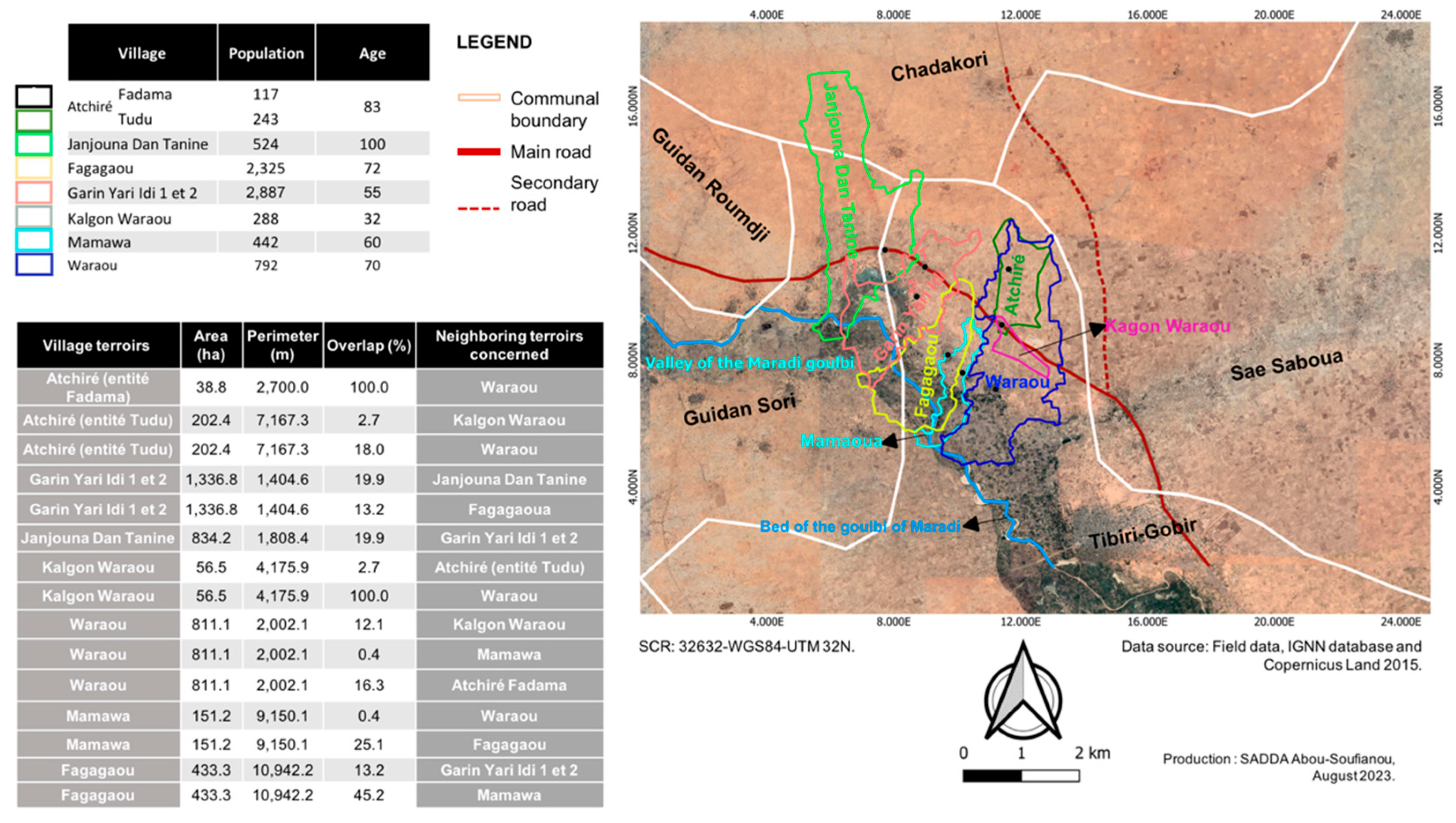
Figure 7.
Age map of village terroirs in the commune of Dantiandou, Tillabéri region, Niger, 1994 (drawing adapted from [27] (p. 59)).
Figure 7.
Age map of village terroirs in the commune of Dantiandou, Tillabéri region, Niger, 1994 (drawing adapted from [27] (p. 59)).
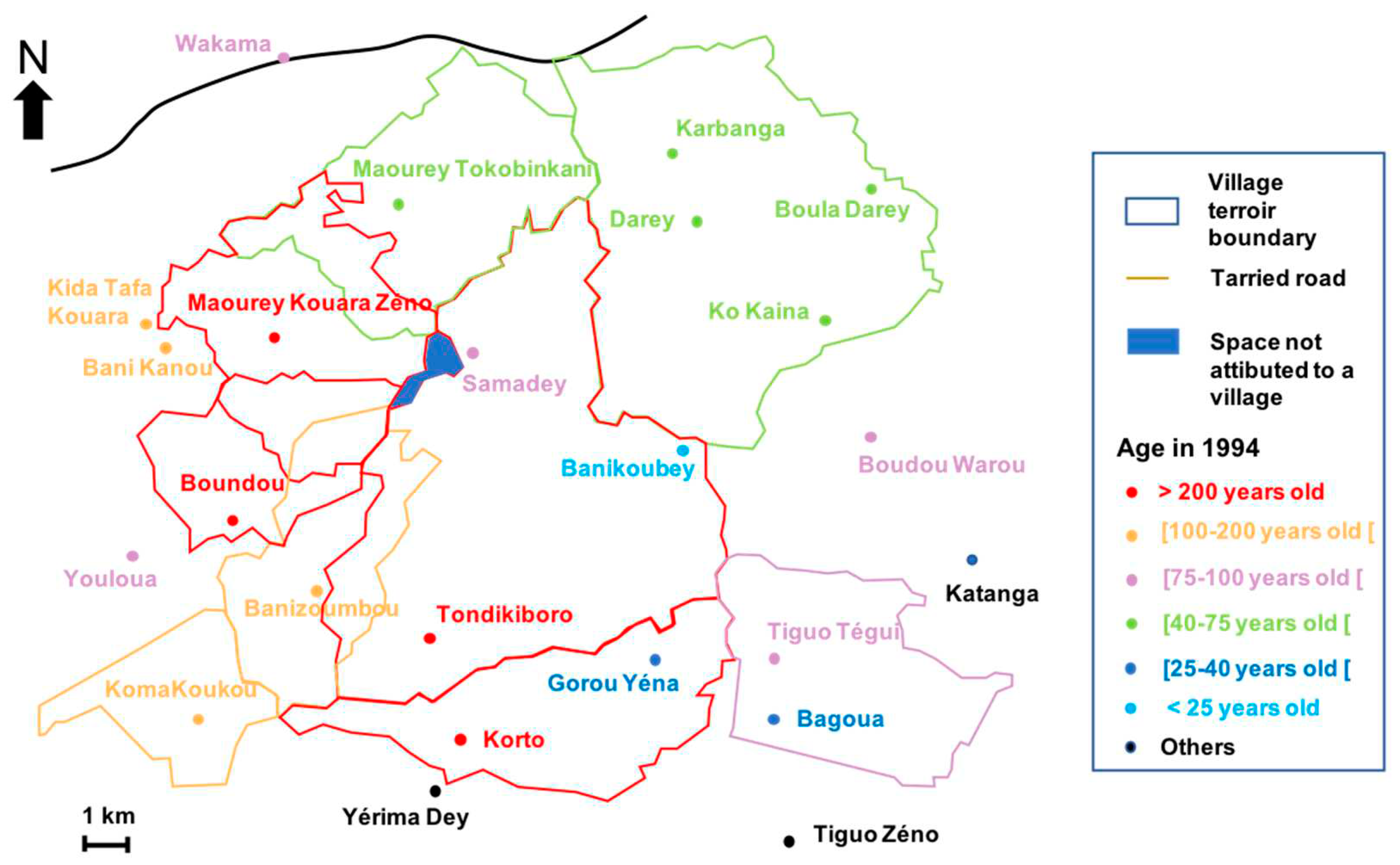
Figure 6 (e.g., between Fagagaou and Mamawa) and Figure 7 (e.g., between Korto and Banizoumbou) also show that neighboring terroirs can have overlapping boundaries, regardless of the villages’ age. The boundaries are relative and differ depending on the points of view from one village to another. The overlap can be total (100%) when one terroir does not recognize the existence of the other, as in the case of the Waraou terroir, which does not recognize the Atchiré and Kalgon Waraou terroirs (Figure 6).
The overlapping areas can be attributed to orally transmitted boundaries forgotten by new generations, as well as to a certain permeability between terroirs due to social relationships such as marriage or the acquisition of new land by purchase, gift, loan, pledge or lease; without ruling out possible bias caused by the withholding of information during demarcation in the field, since some informants may fear that their land will be withdrawn by the government, or that a land tax will be levied. This is why, most of the time, these areas claimed by everyone are cultivated by families from one village or the other, without tension. These areas are the most dynamic in terms of land use and access. In the Maradi valley, all terroirs overlap, even if the Waraou and Mamawa terroirs could be considered contiguous with a 0.4% overlap rate, while in the commune of Dantiandou, some neighboring terroirs share common boundaries (e.g., between Tondikiboro and Darey, Figure 7). The history of settlement in the first instance goes back more than two centuries, while in the second it dates back only a century. In 2017, land scarcity was more pronounced in the Maradi region than in 1994 in the Tillabéri region.
Finally, Figure 6 and Figure 7 show that some areas may not be attributed to a village when they are not used for agricultural purposes and are managed collectively: e.g., between Waraou and Mamawa in the commune of Tibiri Gobir, or between Tondikiboro, Maourey Kouara Zéno and Maourey Tokobinkani in the commune of Dantiandou. Although specific surveys have not been carried out to gain a detailed understanding of family and village land ownership mechanisms, group interviews indicated that a cemetery exists in the unattributed area between Waraou and Mamawa, where the inhabitants of Waraou bury their dead, making this space a sacred place that cannot be cultivated. In the commune of Dantiandou, the unallocated area is a cuirassed plateau that was still covered in 1994 by tiger bush. This area and its resources were managed collectively for wood collection, drinking water for herds (a temporary waterhole is sometimes present) and grazing, without being assigned to a particular village.
3.1.3. Temporal Realities of Village Terroirs
- In the zone of study centered on the valley of the Maradi goulbi, north of the commune of Tibiri Gobir, Maradi region
Step 1. The present-day town of Tibiri, located slightly to the south of the zone of study, on the right bank of the Maradi goulbi valley, was founded in 1835, following the destruction of the former capital of Gobir, Alkalawa by Fulani fanatics. Before settling in Tibiri, the Gobirawa (the Gobir people) had briefly lived in the village of Tudun Uwa, located on a dune plateau in the zone of study. This elevated position (tudu in Hausa), which made the village vulnerable in times of war, led its inhabitants to abandon it. It was only in 1917 that other inhabitants returned to the site and founded the village of Janjouna Dan Tanine (cf. Figure 6). Janjouna Dan Tanine is the oldest village in the zone (106 years old in 2017). Otherwise, most of the zone’s inhabitants used to live in villages in the bed of the Maradi valley on clay soils, all of which have now been abandoned. The old, abandoned sites are called kuhwai in Hausa. The first of these inhabitants to leave the valley floor founded the village of Atchiré (Figure 6) on the dune plateau in 1934.
Step 2. Following a major flood in 1945, all the other inhabitants located in the bed of the Maradi valley were forced to leave their homes and settle on the higher ground above the bed. They chose the sandy soils of the dune plateaus or the slopes just below. This is how the villages of Waraou, Fagagaou, Atchiré, Mamawa, and then Garin Yari Idi 1 came into being, ranging from the oldest (76 years) to the most recent (55 years) (cf. Figure 6; recall that villages’ ages are given for the year of the field study, in 2017).
Step 3. Gradually, more recent villages emerged (cf. Figure 6) further and further from the valley bed, such as Garin Yari Idi 2 (45 years old) and Mamawa, in response to the demographic growth of the parent villages (Garin Yari 1 and Fagagaou, respectively), forcing the inhabitants to look for new arable land. The village of Kalgon Waraou was created even more recently (38 years in 2017). Inhabitants from Atchiré founded this village in 1986 along the tarried road at the request of a Gobir king (Sarkin Gobir in Hausa), who wanted a stronger human presence along the roads to improve security. Although initially attached to Atchiré, the inhabitants of Kalgon Waraou eventually created a new terroir recognized by Atchiré, but not by Waraou.
The past history of the terroirs, stemming from the population of Atchiré, can be summarized in two complex stages: 1) An initial migration of part of the population from the clay and wetlands (fadama in Hausa) of the goulbi located further north and the founding of the village of Atchiré, its terroir demarcated with two blocks of cultivated land, one in the sandy zone (tudu in Hausa) around the village and one in the wet clay zone (fadama in Hausa) at the floor of the valley; 2) relocation of part of the Atchiré population to the roadside for security reasons, imposed by the traditional religious authority; founding of the village of Kalgon Waraou and demarcation of a new islet of cultivated land; detachment of the Kalgon Waraou terroir from that of Atchiré, a new terroir recognized by Atchiré but not by Waraou. The terroir dynamic that originated in the village of Atchiré continues to this day. Some of the Atchiré population is farming a new patch of land, some twenty hectares as of 2017, in the neighboring terroirs of Garin Samailla and Barammaka (outside the zone of study).
- In the commune of Dantiandou, Tillabéri region, Niger (adapted from [18])
Step 1. The oldest villages (Korto, Tondikiboro, Boundou, Maourey Kouara Zéno: cf. Figure 7) were founded between the 16th and 18th centuries (over 200 years ago) in the areas most suitable for traditional rainfed farming in terms of soil quality and availability of arable land. These areas have mainly sandy soils and few lateritic soils on cuirassed plateaus. These villages are closely linked to the physical realities of their environment, which is associated with a legend in the collective memory. For example, the village of Tondikiboro takes its name from the Zarma for “stone person”: from tondi for stone and kiboro for person. According to legend, during a great famine in the last century, a peasant asked one of his cousins for millet. The latter reportedly refused, claiming that he no longer had any himself. Eventually, however, the peasant discovered that his cousin was hiding in his own granary full of millet. In a fit of rage, he allegedly said, ‘since this is how it is, let him and his granary become stone forever’. And so it was. Today, a rocky peak stands right next to the village. [18] (p. 56).
Step 2. A second wave of migration between the 18th and 19th centuries, coinciding with a long period of resistance against the nomads, gave rise to new villages such as Kida Tafa Kouara, Bani Kanou, Banizoumbou and Komakoukou. For example, most of the inhabitants of Banizoumbou, which means “peace descends” in Zarma, come from a group of dissidents originally from Dantiandou. The decision to settle them there was apparently taken by the canton chief. The fact that this decision was taken by the canton chief may explain why the boundaries of the Banizoumbou terroir were still little or poorly recognized by neighboring terroirs in 1994.
Step 3. The population of the villages established in the 21st century has its origins in these pioneering villages of the first and second waves. These new villages more closely reflect local demographic growth, prompting residents to seek new arable land elsewhere. For example, all the inhabitants of Sama Dey come from Tondikiboro. Given the great distance between the two places, they were forced to drink from neighboring ponds until they all caught Guinea-worm disease (bilharzia). They decided to dig a well, and they no longer needed to go back to Tondikiboro, hence the founding of Samadey: ‘Sama’ is the name of the one who dug the well and ‘dey’ means ‘well’ in Zarma. [18] (p. 57). The same story links Tiguo Tégui and Tiguo Zéno. The villagers of Tigui Zéno, most of whose cultivated fields (cf. land saturation) were increasingly far from the village, decided to dig a well to avoid having to go back and forth and to settle temporarily as close as possible to their fields during the farming season. They ultimately decided to settle permanently, appointing a new chief. The process of detachment from the former terroir was well underway in 1993-1994, although it was not yet complete since the two terroirs had not yet been separated. This was likely not far off since the elders of Tiguo Zeno were already beginning to lose their memory of the boundaries of their terroir on the Tiguo Tégui side.
Step 4. The villages between 40 and 75 years old in 1994 settled where the proportion of cuirassed plateaus was highest and, thus, the proportion of arable land lowest. The history of settlement in these villages is often linked to family quarrels and disputes over land access. According to the village chief of Tondikiboro, the family of Adamou Marou (chief of Karbanga) is originally from TondiKiboro. During a major drought a long time ago (presumably in 1912-14), his older brother and his family moved to another terroir in Taghazar canton (to the east of Baleyara). There, they were unable to integrate into a foreign terroir, realized their mistake and decided to return to their home region in present-day Darey. Their uncles from Fandou Béri, who owned the land, gave them permission to dig a well and settle down. Older brother D’tidamou then became chief of the new village. However, once the well had been dug, cousins from Fandou Béri also began to settle in Darey and lay claim to their land. Quarrels broke out, and Adamou’s older brother is said to have been placed under a spell and went mad. To cure him, his whole family reportedly spent a year in Samadey. When they tried to return to Darey, the quarrels became even more heated. With the agreement of the canton chief, they moved to what is now Karbanga. Adamou Marou remained village chief, even though all the land had always been cleared and farmed by his cousins from Fandou Béri. [18] (p. 57). Villages less than 40 years old in 1994 (Bagoua, Gorou Yéna) are attached to larger villages (Tiguo Tégui and Korto respectively), with no recognized village chief. Banikoubey, 4 years old in 1994, was the most recent village in the area. Tired of the quarrels in Darey and Karbanga, some of the Karbanga chief’s brothers are said to have gone to settle legitimately in Banikoubey, in their original terroir, Tondikiboro.
Thus, during the first wave of settlement in the area, the main determinant was the availability of land; the land most suitable for rain-fed cultivation was the first to be used for farming. For the second wave, land marking was the main determining factor. The third wave was influenced by demographic pressure and land fragmentation through inheritance. Finally, for the fourth and last wave, the combination of demographic pressure (high growth rate) and conflict resolution were key determinants.
3.2. Model of the Spatiotemporal Dynamics of Village Terroirs in Agropastoral Areas
3.2.1. Spatiotemporal Dynamics
The knowledge gained on the realities of the links between farm managers and their cultivated land (cf. 3.1.1) and on the spatial and temporal realities of village terroirs (cf. 3.1.2 and 3.1.3) allows us to formulate three principles.
- The village terroir is a fine, irregular, non-contiguous spatial division.
The space may not be totally discretized; there are spaces that are not attributed to a village. The shape (e.g., surface area and perimeter) of spatial entities varies from one terroir to another. A terroir can be composed of a single spatial entity or of several non-contiguous entities in the case of patches of cultivated land far from the village, making the terroir discontinuous. Two neighboring village terroirs may have shared or differing boundaries, resulting in an overlap between terroirs.
- The relationship between village terroir and villages is complex and evolving.
A terroir is created around a village with a chief of the land. Secondary, more recent villages can be created in the original terroir or another, often neighboring terroir. The young village and its associated lands can become a new terroir distinct from the first. A village may not recognize the boundaries of neighboring terroirs (cf. overlapping terroirs).
- There are generic rules for the spatiotemporal dynamics of village terroirs.
A terroir saturated with farms, with a growing population, will seek to expand into another terroir or onto as yet unallocated arable land. If it owns uncultivated land while seeking to expand, this is because that land is reserved for other use, has deteriorated with no plans to rehabilitate it in the short term, or is not accessible to private individuals. An expanding terroir will see the creation of secondary villages (smaller than the mother village), eventually triggering the creation of new terroirs as the secondary villages and their associated patches of land break away from the original terroir. These terroirs have kinship relationships. The more the land acquisition process is commoditized, the more permeable the boundaries between terroirs and the more frequent the overlap between terroirs.
This results in two types of spatiotemporal dynamics in village terroirs, territorial expansion and contraction, comparable to a breathing lung.
- Territorial expansion
A terroir with family land (for agricultural use) and community land (for pastoral and forestry use) can expand (increase its surface area) into another terroir thanks to the various ways in which heads of household acquire new land. This acquisition takes place within the private domain of Niger’s land tenure system; it is usually commercial, or noncommercial (donation), which is increasingly rare. If the area is not saturated from a land point of view for family farming, the terroir may also extend over land not yet allocated to a village. In any case, expansion can be achieved by spreading out from the original terroir, eating into neighboring lands and gradually pushing back its boundaries. Expansion can also take place through the creation of isolated patches of cultivated family land within other, usually neighboring, terroirs, in this case not contiguous to the original terroir. We call this sprawl. Expansion of one terroir into another may or may not be recognized by the latter. Recognition or non-recognition can be partial or total. Non-recognition leads to overlaps between the terroirs. Expansion is often permanent, but it can be temporary.
- Territorial contraction
When a village terroir has expanded and includes one or more secondary villages, the boundary of the land it manages becomes blurred in the memories of both the inhabitants of the mother village and its traditional chief. One of the secondary villages can then become autonomous in terms of land management, with the appointment of a land chief, and thus break away from the original terroir to create a new, independent terroir. The former terroir shrinks in size and territory. This detachment can be quicker if another local authority so decides, as in the case of Kalgon Waraou’s detachment from Atchiré in the Maradi valley.
Figure 8 illustrates the expansion of terroir A, by spreading into terroirs B and D, and by sprawl into terroirs E and F. It also shows the expansion of terroir B by sprawl into terroirs A and C. The patch of land resulting from the expansion of terroir A into terroir E to the north-west, with its secondary village, is detached from terroir A to create a new terroir A’. The southern part of extended terroir B, with its secondary village, is detached from terroir B to create the new terroir B’.
3.2.2. Determinants of the Spatial and Temporal Dynamics of Village Terroirs
The analysis in 3.1 highlighted various determinant factors of village terroir spatiotemporal dynamics, grouped and organized below into three types:
- Sociosystem factors: inter-community relations (conflict vs. harmony), level of security (vs. insecurity), population growth, land tenure system, land management system (e.g., sultanate), land development (e.g. road network), kinship between villages, and consequently, between village terroirs, settlement history (cf. seniority from one agglomeration over another), permeability between terroirs, and recognition between terroirs,
- Agrosystem factors: mode of land acquisition (commercial or non-commercial), availability of arable land in private ownership, pressure on agricultural land (ha/household), cropping systems, with or without land restoration techniques,
- Ecosystem factors: climate hazards (e.g., flooding, drought) and geo-morpho-pedological determinants (e.g., wet clay soils in the flood-prone goulbi valley of Maradi, uncultivable lateritic soils on cuirassed plateaus).
These different factors define the multi-scale territorial context from which the local realities of a village terroir derive. They are organized according to a functional logic in Figure 9.
Figure 9 shows the basic elements of the agro-socio-ecosystem to be considered in village terroir spatiotemporal dynamics, from the most local to the most global: 1) farm managers: their farms and the fields they cultivate, the communities in which they participate, 2) agglomerations (main or secondary): all the land associated with each of them and managed by a land chief, the land that can be cultivated, the village communities they represent, and 3) the societies and geographical areas in which they are embedded, at any level of organization or geographical scale, respectively.
The set of fields cultivated by the farms does not necessarily correspond to the set of lands managed by the chief of lands associated with the main agglomeration of the terroir, since some of them may be acquired in other terroirs (cf. permeability between terroirs and overlap between terroirs). Village communities’ demographic dynamics are reflected in the creation and settlement of villages (cf. seniority of the mother village) on blocks of land, attached to the village of origin (cf. kinship links). This leads to the creation of new terroirs, detached from the original terroir, recognized or not by the others (cf. recognition and overlap between terroirs). The expansion or contraction of a terroir will depend on: (1) the dynamics of land acquisition by farmers administratively attached to these agglomerations (primary or secondary), dictated by their family responsibilities, (2) their agricultural practices, which will optimize (e.g., the hongalays described in the introduction) or reduce (e.g., land degraded by a lack of fallow periods between cropping years) production per hectare, and (3) the pressure (in ha/household) exerted by villagers on available private land, given that collective land tends to be reserved for uses other than agriculture. Degraded land is no longer available as arable land until it is restored using appropriate techniques.
4. Discussion
The results of this study show that people in a village terroir know the limit of their terroir based on the land they own. Th elements and mechanisms of agro-socio-ecosystems impacting local village terroir realities can range from the smallest scale (e.g., the field for cropping practices) to the largest (e.g., the planet for climate). The difference in surface area and number of agglomerations between village terroirs and communes, despite being the smallest administrative units, illustrates the local aspect of terroir, with its proximity to rural populations and the land they use. In fact, the median size of terroirs in the three regions of the zone of study (Maradi, Dosso and Tillabéri) is 1360 ha, with a number of agglomerations per terroir less or equal to 3, while the size for communes is 77880 ha (therefore 57 times greater than for terroirs) with 124 agglomerations [18].
By starting with the realities of the links between farm managers and their cultivated land, as well as the spatiotemporal realities of the terroirs, the effort made in this generalization and formalization work constitutes the agro-socio-ecosystemic and geographical basis of a dynamic model of local context. The analysis identified the model’s parameters and the initial generic rules for the spatial configuration of village terroirs. The summary and formalization in Figure 9 (conceptual representation) gives a clear orientation on the field data to be collected in real-life situations to identify the specific biophysical and socioeconomic characteristics and to assess the intrinsic diversity of each terroir. To reinforce the conceptual model’s generic nature, its relevance and applicability in a variety of situations, further studies, for example focusing on the link with the land tenure system, and data collection extended to other eco-climatic zones, could reveal any adjustments or clarifications that need to be made to the model.
This conceptual model could be translated into a relational database model, on the basis of which a physical model (in the IT sense) could be programmed, linking a relational spatial reference database and processing chains. The aim of a concrete model would be to map the terroirs of an area based on acquired knowledge, without the need to involve stakeholder mapping in the field. This approach would allow terroirs to be mapped over large areas or in several regions. It would also allow their boundaries to be updated in line with changes in the relevant parameters (e.g., agglomeration population size). Future work along these lines will require a wide range of skills and time. This work falls into two categories:
- 1
- laboratory work, where mathematicians, geomaticians and computer scientists would liaise with agro-socio-ecosystemicians. This participatory approach is a way to understand each other across disciplines, to identify what needs to be clarified in the conceptual model, to choose the best mathematical, geomatic and computing options, and ultimately to correctly translate the conceptual model into a mathematical model (rules clarification and mathematical translation) and an IT model (programming in a dedicated language within a software environment chosen according to the defined specifications).
At this stage the scientist have to deal with dynamical characteristics of the local context boundaries. However, our works show that some of them are overlapping based on the population considerations. How to conceptualize this considerations and how to find characteristics elements which will help in this conceptualization? However, some limits are based on the resilience of a spatial perception created in the past or to the transposition, in the form of distance [32].
- 2
- fieldwork by thematic specialists, aimed at collecting new data to calibrate the rules highlighted by agro-climatic zone.
For example, initial survey data suggests that when the cultivated surface area per household is below the local average, the terroir seeks to expand (cf. 3.1.2). However, the sample size needs to be increased to confirm this parameterization and extend it to the eco-climatic region.
Once the mathematical and physical model has been developed and the field data analyzed, the model can be fed and simulate the mapping of village terroirs by agro-climatic zone. Landscape features that can be seen in the field and which act as markers of terroir boundaries could be integrated into the model as elements of pre-defined spatial constraints. They could also be used retrospectively, i.e., once the terroirs have been simulated by dynamic modeling, as data to confirm the terroir boundaries produced by the model. Of course, the same elements should not be used before and after modeling to maintain the independence of the datasets. If landscape features were “remotely detectable”, this would facilitate both these uses.
The spatiotemporal dynamics model for village terroirs resulting from this research goes beyond the “Terroirs Potentiel d’Exploitation” (TPE) demarcation model in seen as the village terroir [18] in the SIEL desertification risk assessment model [33]. The TPE model is based on the principle of competition for space as a function of 1) the geographical position of the villages around which practices are organized, and 2) their relative weight (characteristics of the groups of farmers who belong to them). The aim is to create an irregular spatial mesh, which precludes generating areas not assigned to a terroir or overlapping zones. It proposes a weight calculation method based on a limited number of criteria (up to three), including population and village age. By contrast, the model proposed here is dynamic: it introduces the evolution of terroirs, with changing characteristics and boundaries, and considers the overlap between terroirs. This model questions the determining role of population size and village age in the agropastoral zone of Niger, which was used in the first versions of the TPE model. This determinism was further qualified as the TPE model was implemented in different circum-Saharan settings, by incorporating the option of setting a threshold (set by the user, beyond which population size was less determinant) for the “population size” factor and not using the “seniority” factor if it was not determinant.
5. Conclusions
The study gives a spatial and physical definition of “local context” conceptually defined by the Global Collaboration for Resilient Food System. It shows the intrinsic links between the spatiotemporal dynamics of village terroirs in the agropastoral zones of Niger and the functioning of agro-socio-ecosystems affecting the communities and spaces that define them. A terroir’s size and shape, its overlaps with neighboring terroirs, and the kinship relationships between terroirs are the reflection of these dynamics at a specific time. Having specific information on each specific context represented by the village terroir, can help guide the implementation of sustainable agricultural solutions; this is the starting hypothesis of the Global Collaboration for Resilient Food System program community. Following this study, we can put forward three additional hypotheses: (1) monitoring terroir dynamics could help to update knowledge before disseminating options, or even to adjust it later in the event of major changes; (2) introducing new agricultural options into a village terroir could accelerate or slow down the spatiotemporal dynamics of village terroirs; (3) certain areas, such as overlap between village terroirs, deserve special attention to test whether they are more conducive or, conversely, less conducive to the spread of new agricultural options. For example, how can the spread of hongalays would reduce the pressure on all the land attached to the terroir and therefore its expansion process?
The reality and dynamics of local context being defined, in perspective trials with different cowpea varieties with known performance characteristics will be carried out. These trials will take place in their respective geo-located fields, and the multi-scale territorial context of the actions carried out in each field will be characterized.
Author Contributions
Conceptualization, M.L. and N.S.J.; data collection, N.S.J., A.-S.S., S.M.0., A.-A.S. and H.B.-A.I., methodology, N.S.J., M.L., H.B.-A.I. and A.-S.S.; formal analysis, N.S.J., M.L., A.-S.S., H.B.-A.I.; writing—original draft preparation, M.L. and N.S.J.; writing—review and editing, A.-S.S., A.-A.S. and H.B.-A.I.; project administration, A.-A.S. All authors have read and agreed to the published version of the manuscript.
Funding
This research was mainly funded by Mcknight foundation (CowpeaSquare, one of the GCRFS projects in Burkina Faso and Niger: https://www.ccrp.org/grants/cowpea-square-ii/. Additional funding was provided by UDDM and IRD under international joint laboratory “AVENIR-Sahel”.
Data Availability Statement
The data presented in this study are public and available on request from corresponding author. The data are not publicly due to the fact that all have not been published.
Conflicts of Interest
The authors declare no conflict of interest.
References
- Bosco, K.; Vodounou, J.; Onibon Doubogan, Y. Agriculture paysanne et stratégies d’adaptation au changement climatique au Nord-Bénin. In Cybergeo: European Journal of Geography, Environnement, Nature, Paysage, 2016, document 794 ; Disponible en ligne. http://journals.openedition.org/cybergeo/27836. [CrossRef]
- Sultan, B. (dir.); et al. Les sociétés rurales face aux changements climatiques et environnementaux en Afrique de l’Ouest. Marseille: IRD Éditions, 2015; http://books.openedition.org/irdeditions/8914; ISBN 9782709921473. [Google Scholar] [CrossRef]
- Camara, A.; Dieng, A.; Mergeai, G. Amélioration des systèmes de production mixtes en Afrique soudano-sahélienne. Rôle de l’espèce Stylosanthes hamata (L.) Taub. (Synthèse bibliographique). In BASE- Biotechnologie, Agronomie, Société et Environnement, 2015, Volume 19, numéro 3 ; ISSN 1370-6233 ; ISBN 1780-4507.
- Basquin, H.; Charhon, F.; Cissokho, M.; Le Gauyer, G.; Rouillé d’Orfeuil, H; Vielajus, J.-L. Nourrir les villes, défi de l’agriculture familiale : des innovations locales et paysannes en Afrique de l’Ouest, CFSI, Roppa, Fondation de France, 2014, 112 p.; Disponible en ligne; Available online: https://www.alimenterre.org/nourrir-les-villes-defi-de-l-agriculture-familiale.
- Yamba, B. Les mutations des systèmes agraires et des modes d’usage des ressources naturelles dans la zone centrale du Niger. In Revue de géographie alpine, tome 92, n°1, 2004 : De part et d’autre du Sahara, sous la direction de Ibrahim Bouzou-Moussa, 97-110.
- Barreteau, O.; Bots, P. W. G.; Daniell K., A. A Framework for Clarifying “Participation” in Participatory Research to Prevent its Rejection for the Wrong Reasons. Ecology and Society, 2010; 15. Available online: http://www.jstor.org/stable/26268144.
- Maussang, K.; Jouguet, H.; Jouneau, T.; Martin, J-F.; Larrousse, N. Données et recherches participatives : Enjeux et recommandations issues d’exemples de projets de recherches participatives; Comité pour la science ouverte; 2023; hal-04221292. [Google Scholar]
- Carbonneau, H; Castonguay, J.; Fortier, J.; Fortier, M.; Sévigny, A. La recherche participative : Mieux comprendre la démarche pour mieux travailler ensemble; La participation sociale des aînés : des savoirs à l’action, 2017, 7 p.; Disponible en ligne. chrome-extension://efaidnbmnnnibpcajpcglclefindmkaj/https://www.ivpsa.ulaval.ca/sites/ivpsa.ulaval.ca/files/la_recherche_participative_-_f.pdf; 2017. [Google Scholar]
- Loireau, M.; Fargette M. (co-premier auteur); Dieng, M.; Sall, M. Cadre conceptuel pour l’étude de la relation société-milieu : attache et insertion au monde. In BASE- Biotechnologie, Agronomie, Société et Environnement; 2023; Volume 27, Numéro : Colloque Agroforesterie en Afrique de l’Ouest; Disponible en ligne; Available online: https://popups.uliege.be/1780-4507/index.php?id=20308.
- Olivier de Sardan, J.-P. La revanche des contextes. Des mésaventures en ingénierie sociale en Afrique et au-delà, Karthala, « Hommes et sociétés », 2021, ISBN : 9782811123628. URL:. Available online: https://www.cairn.info/la-revanche-des-contextes--9782811123628.htm.
- Mathevet, R.; Antona, M.; Barnaud, C.; Fourage, C.; Tul, G.; Aubert, S. Contextes et dépendances des processus d’accompagnement. In Etienne M. (Coord.), La modélisation d’accompagnement : une démarche participative en appui au développement durable, Éditions Quae, collection Update Sciences et Technologies, 2010, chapitre 4, 103-123.
- Dorlöchter-Sulser, S.; Nill, D. Bonnes pratiques de CES/DRS. Contribution à l’adaptation au changement climatique et à la résilience des producteurs : Les expériences de quelques projets au Sahel. Publié par Deutsche Gesellschaft für Internationale Zusammenarbeit (GIZ) GmbH, 2012, 57 p; Disponible en ligne. Available online: https://reca-niger.org/spip.php?article566.
- Cherlet, M.; et al. World Atlas of Desertification. Publication Office of the European Union, 2018, Luxembourg.
- Bron-Saïdatou, F. La gouvernance foncière au Niger : malgré des acquis, de nombreuses difficultés. Fiche pays n°7 : Niger, Comité technique Foncier et développement, coordonnée par le GRET, 2015, 37 p.; Disponible en ligne. Available online: https://www.foncier-developpement.fr/wp-content/uploads/fiche-pays-7-Niger_Version-finale.pdf.
- Papazian, H.; D’Aquino, P. La diversité des perceptions d’acteurs comme essence d’un pluralisme de régulation foncière au Sahel rural. In Espaces et sociétés, 2017/1-2 (n° 168-169), 235-250. Disponible en ligne. Available online: https://www.cairn.info/revue-espaces-et-societes-2017-1-page-235.htm. [CrossRef]
- Gagné, M.; Ousseini, I. Niger - Contexte et Gouvernance Foncière, 2022. Disponible en ligne. Available online: https://landportal.org/fr/book/narratives/2022/niger.
- INS. Institut Statistique National du Niger, 2012. Available online: https://niger.opendataforafrica.org/tpnyole/repertoire-national-des-localites-du-niger-rgph-2012.
- Loireau, M. ESPACE-RESSOURCES-USAGES : Spatialisation des interactions dynamiques entre les systèmes sociaux et les systèmes écologiques au Sahel nigérien. Thèse de Doctorat en Géographie, Université Paul Valéry, Montpellier III, 1998, 411 p.; Disponible en ligne. Available online: http://horizon.documentation.ird.fr/exl-doc/pleins_textes/divers4/010018607.pdf.
- Dérioz, P. L’apparence des choses : analyser les paysages pour comprendre les systèmes territoriaux. Habilitation à Diriger des Recherches, 2012, Lyon, E.N.S. 371 p.
- Sadda, A-S.; Lawali, S.; Diouf, A.; Ouédraogo, M.; Bogaert, J.; Mahamane, A. Pression anthropique et dynamique paysagère en zone rurale semi-aride : cas de la commune de Tibiri - région de Maradi (Niger). In Tropicultura; 2016; Volume 34, pp. 127–139.
- Ambouta, K.J.-M. Contribution à l’édaphologie de la brousse tigrée de l’Ouest Nigérien. Thèse de Docteur d’Ingénieur, Université de Nancy, France, 1984, 115 p.
- Karimou, B.M.S.; Ambouta, K.J.-M.; Tidjani, A.D. Cartographie des potentialités agricoles et forestières de la région Maradi. In Maradi Kwalliya, La coexistence intercommunautaire et la construction de la paix dans l’Histoire de la région de Maradi, Colloque scientifique international, Maradi, Niger, 2015, 12-15.
- Dambo, L. Usages de l’eau à Gaya (Niger) : entre fortes potentialités et contraintes majeures. Thèse de doctorat, 2007, Université de Lausanne.
- Ambouta, K.J.-M.; Amadou, I.; Souley, I. Gestion de la fertilité et évolution des sols de Gakudi (Maradi, Niger). Cahiers Agricultures 1998, 7, 395–400. [Google Scholar]
- Daouda, A.; Tarchiani, V.; Tiepolo. Milieu-physique-peuplement-et-exposition-aux-aleas-hydro-climatiques-dans-la-region-Tillaberi-Niger. In Risque et adaptation climatique dans la région Tillabéri, Niger. Pour renforcer les capacités d’analyse et d’évaluation, 2016, 27–50; Études africaines ; L’Harmattan, Paris.
- Sitou, L,M; Dynamique des transactions foncières et vulnérabilité rurale au Niger : cas des communes rurales de Tchadoua et Yaouri. Thèse de doctorat en Sciences; Université de Liège; 2011; p 252. Available online: https://orbi.uliege.be/handle/2268/98614.
- Conseil régional de Maradi. Schéma d’Aménagement Foncier (SAF) de la Région de Maradi, 2020, 155p ; https://duddal.org/files/original/f9f3fafb2dd88a543dbe3c25084e95984a8f607d.pdf.
- Issaharou Matchi, I.; Yamba, B.; Yansheng Gu, G. Land-Use and Land-Cover Change in Semi-Arid Zone: The Case of Waro-Souloulou Area in Goulbi Maradi Watershed in the Republic of Niger. Environment and Natural Resources Research 2012, 2, 47–62. [Google Scholar]
- Brunet, R. La carte-modèle et les chorèmes. In Mappemonde, 1986, n°4/86, 2-6.
- Cheylan, J.-P.; Deffontaines, J.-P.; Lardon, S.; Théry, H. Les Chorèmes : un outil pour l’étude de l’activité agricole dans l’espace rural ? In Mappemonde, 1990, n°4/90, 2-4.
- 31. Booch, G; Rumbaugh, J; Jacobson, I. Unified modeling language user guide. Addison-Wesley Professional, Object Technology Series, 2005, 2nd Ed. 2005.
- Gautier D., Merle C., &Mathieu B. Quand les périphéries territoriales deviennent centrales pour les villageois du Nord-Cameroun. Actes du colloque international, 25-27 février 2003. Présenté à Umr Sagert, Cnearc. Montpellier, France. 7 pages. Available online: http://agritrop.cirad.fr/514605/.
- Loireau, M.; Sghaier, M.; Guerrero, B.; Chouikhi, F.; Fétoui, M.; Leibovici, D.; Debard, S.; Desconnets, JC ; Ben Khatra, N. SIEL : système intégré pour la modélisation et l’évaluation du risque de désertification. In Libourel T, Miralles A., Pinet F. Système d’information pour l’environnement, nouvelles avancées. In RSTI série Ingénierie des Système d’Information - ISI, Volume 20 - n°3/2015., 117-142 ; ISSN 1633 – 1311 ; ISBN 978-2-7462-4714-7. [CrossRef]
Figure 1.
Location and characteristics (geomorphological position, main ethnic group, population size) of the 28 agglomerations studied in the Maradi, Dosso and Tillabéri regions, Niger.
Figure 1.
Location and characteristics (geomorphological position, main ethnic group, population size) of the 28 agglomerations studied in the Maradi, Dosso and Tillabéri regions, Niger.
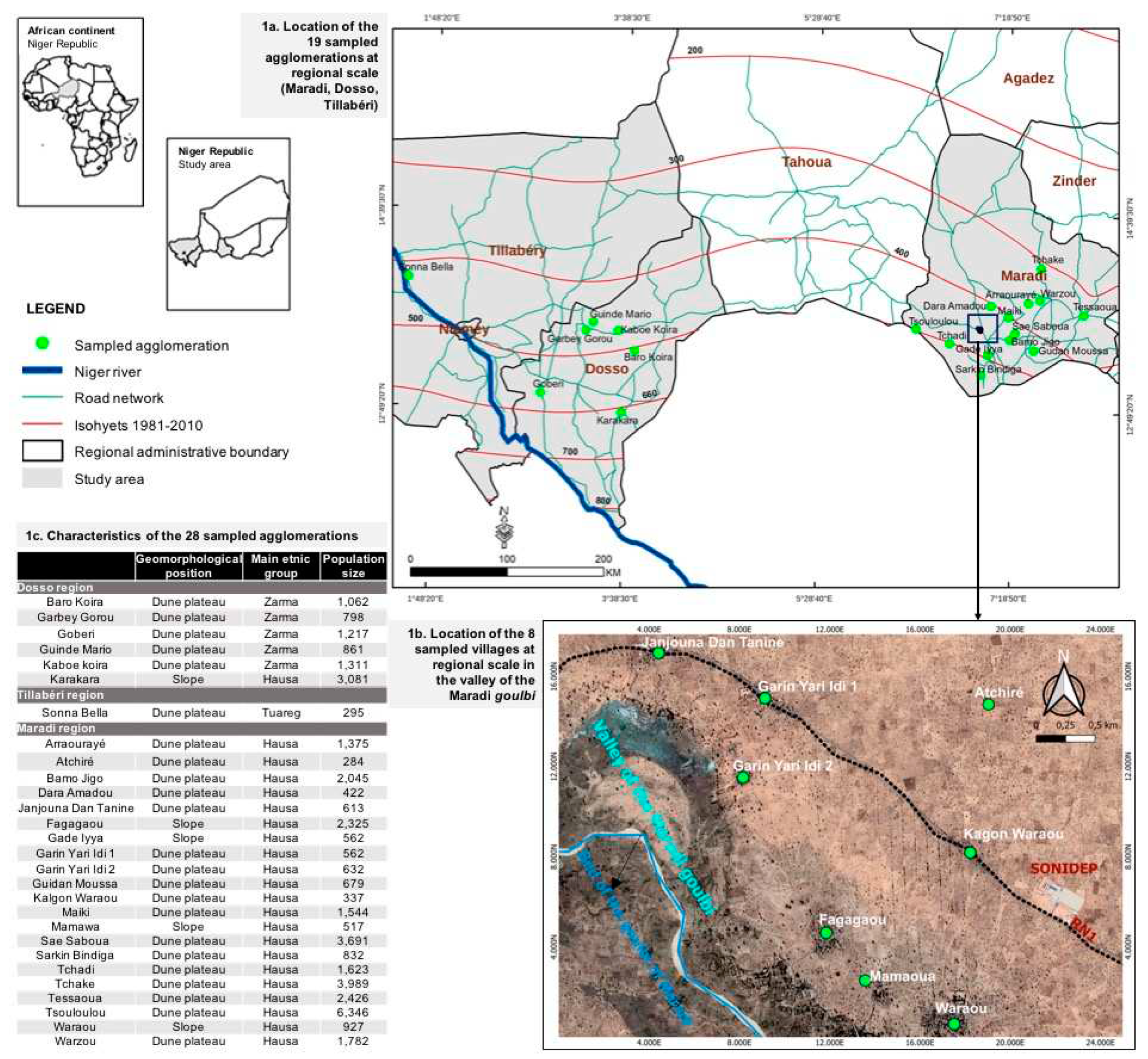
Figure 2.
Demarcation of village terroirs using a participatory approach in the Maradi valley, Niger.
Figure 2.
Demarcation of village terroirs using a participatory approach in the Maradi valley, Niger.
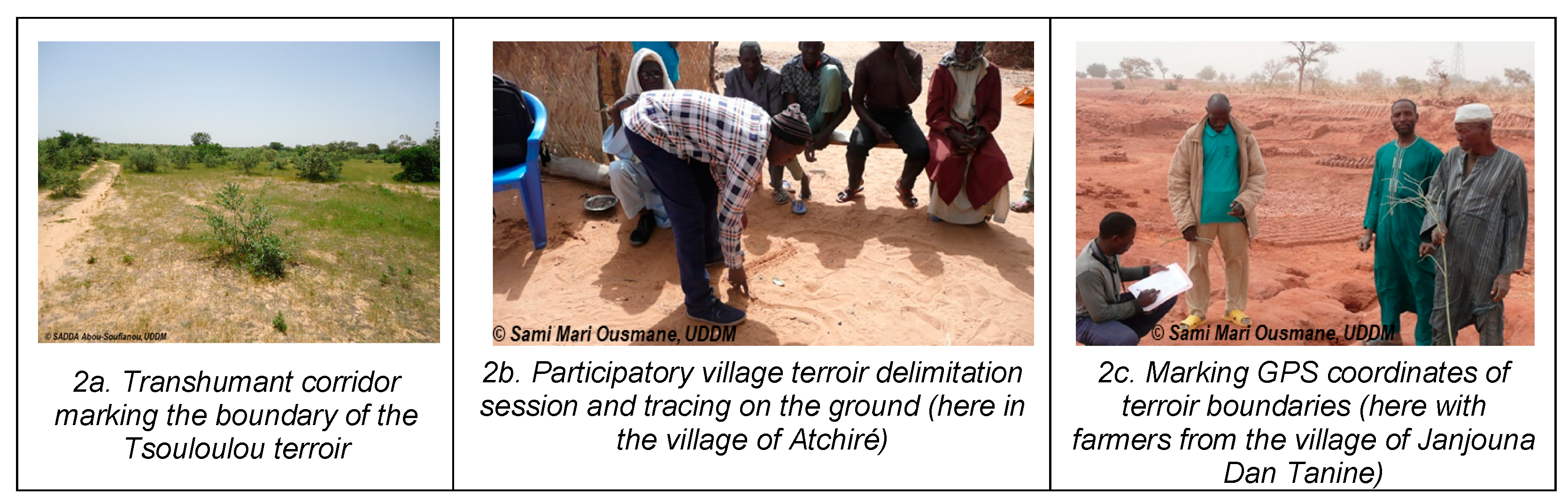
Figure 3.
Characteristics of farm managers’ households in the villages of the Maradi goulbi valley, centered on the commune of Tibiri Gobir, Niger.
Figure 3.
Characteristics of farm managers’ households in the villages of the Maradi goulbi valley, centered on the commune of Tibiri Gobir, Niger.
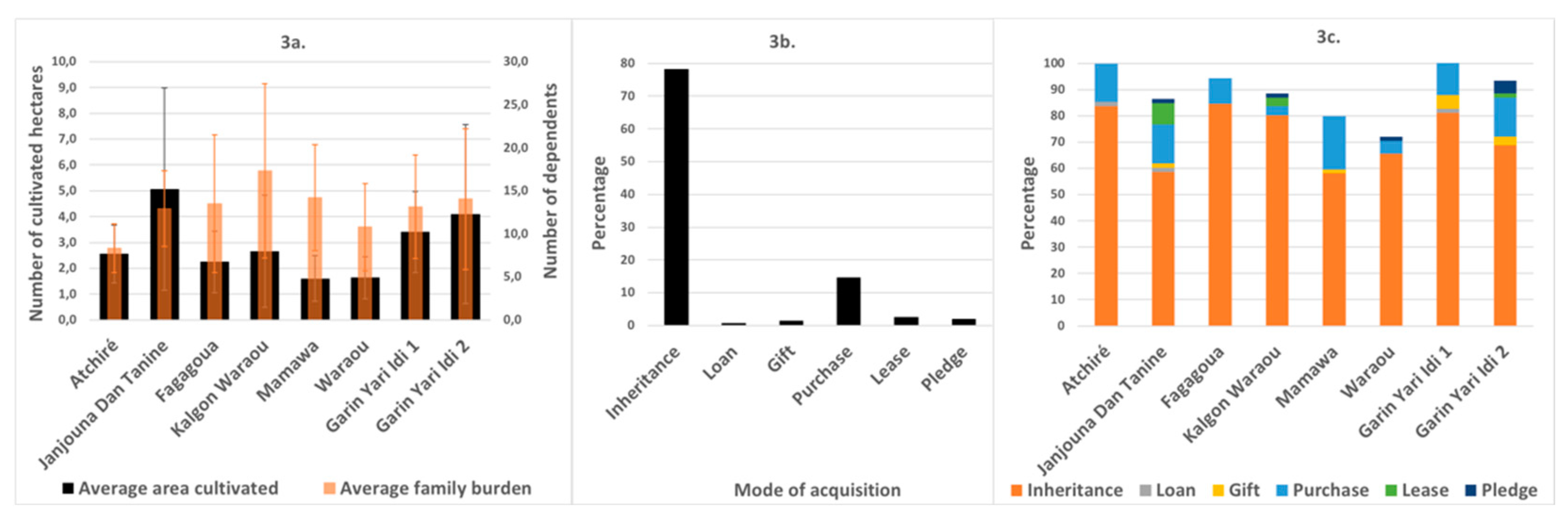
Figure 8.
Chorematic model of the spatiotemporal dynamics of village terroirs in Niger’s agropastoral zones.
Figure 8.
Chorematic model of the spatiotemporal dynamics of village terroirs in Niger’s agropastoral zones.
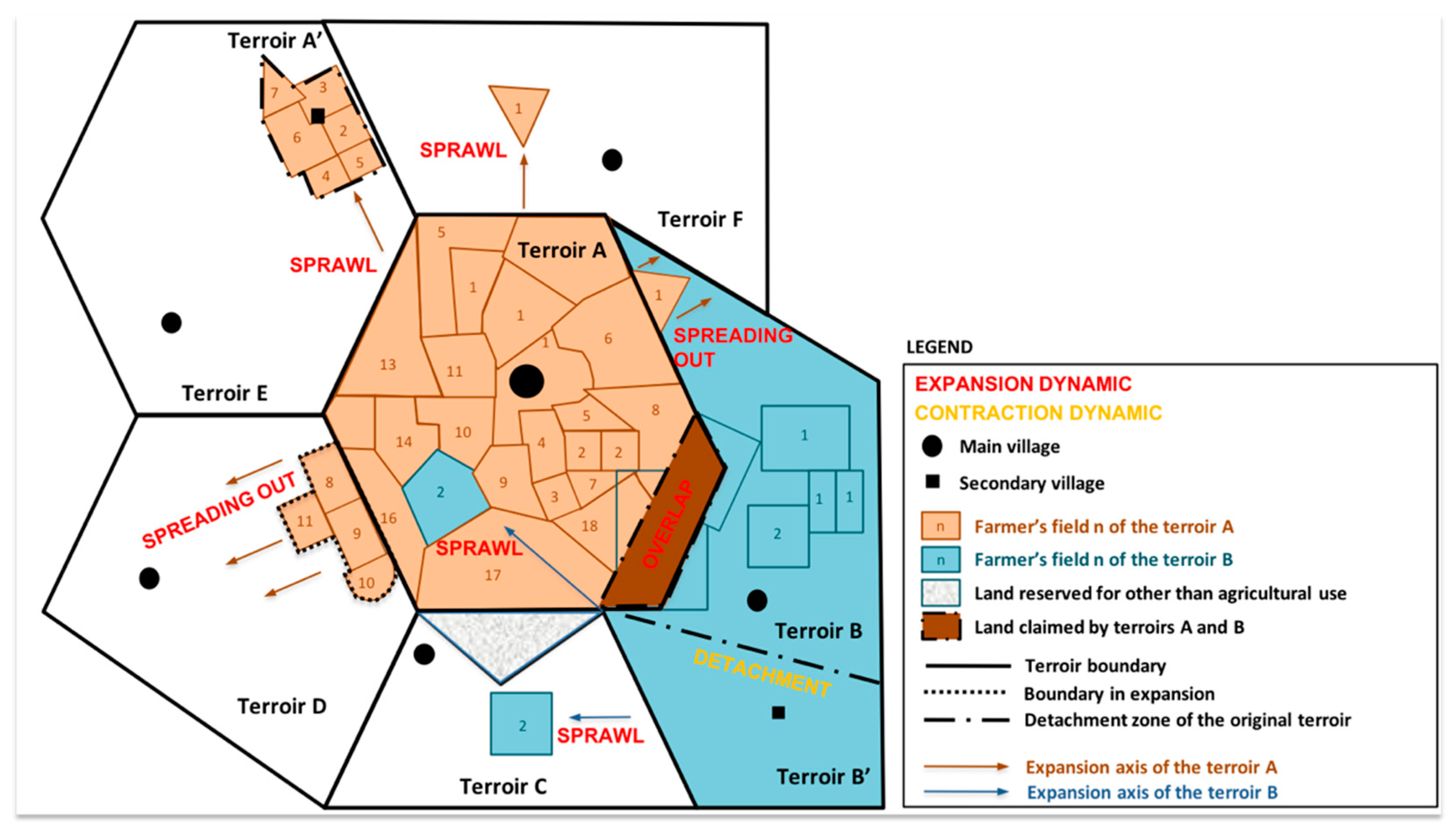
Figure 9.
Factors determining the spatiotemporal dynamics of village terroirs (representation in UML: Unified Modeling Language).
Figure 9.
Factors determining the spatiotemporal dynamics of village terroirs (representation in UML: Unified Modeling Language).
Disclaimer/Publisher’s Note: The statements, opinions and data contained in all publications are solely those of the individual author(s) and contributor(s) and not of MDPI and/or the editor(s). MDPI and/or the editor(s) disclaim responsibility for any injury to people or property resulting from any ideas, methods, instructions or products referred to in the content. |
© 2023 by the authors. Licensee MDPI, Basel, Switzerland. This article is an open access article distributed under the terms and conditions of the Creative Commons Attribution (CC BY) license (http://creativecommons.org/licenses/by/4.0/).
Copyright: This open access article is published under a Creative Commons CC BY 4.0 license, which permit the free download, distribution, and reuse, provided that the author and preprint are cited in any reuse.


