

Submitted:
24 July 2024
Posted:
25 July 2024
You are already at the latest version
Abstract
Agroecology refers to the greening of agrosystems with the mobilization of ecosystem services in order to limit exogenous inputs, enhance biodiversity and moderate the exploitation of natural resources (Tibi A. and Therond O., 2017). Agroecological practices offer pathways for transformation and transition not only of agricultural systems but of entire food systems. Through its objectives, agroecology aims at both sustainable land management and the strengthening of the livelihoods of producers and rural people, and thus contributes to the fight against desertification.
To date, there is little scientific literature on the characteristics of agroecology in the Maghreb region. However, we can cite the work of Lattre-Gasquet M. de et al. (2017), Ameur et al. (2020), Akakpo et al. (2021). These studies, although they provide important information on the problem of agroecology in the region, on its different forms and perspectives, do not allow us to draw up a global panorama. The proposed article highlights general characteristics of agroecology in North Africa from a review of 88 sustainable agriculture projects, which it analyzes, through an inventory of agroecological practices supported by these projects, from the frameworks of the High Level Panel of Experts on Food Security and Nutrition, (HLPE, 2019), on the principles of agroecology and the transition levels approach developed by Gliessman and colleagues (Gliessman, 2007; Gliessman and Rosemeyer, 2010; FAO, 2015; Gliessman, 2016).
The results show significant differences and evolution in the practices observed at the plot and on the farm, depending on the agrosystems considered. The majority of the agroecological innovations identified are at the plot and farm scales, with the exception of those found in oasis and mountain agrosystems, where practices integrate the scales of the territory and value chains in a more complete way.
Keywords:
agroecology
; North Africa
; Practices
; sustainable agriculture projects
; transition
1. Introduction
In the countries of the North African region, agriculture has often been a pillar of development policies. It is for example the case of Egypt, Morocco and Algeria (Akesbi N., 2013; Aboul-Naga A. et al., 2017) Depending on the country, between 20 and 45% of the population is rural, and agricultural activity employs 10 to 35% of the working population (data from (FAO; World Bank)). The agricultural sector is characterized by the predominance of family farming, with many small to medium-sized farms (Bessaoud O. et al., 2017). Locally, agro-climatic and demographic contexts, topography and water availability affect the occupation of space by agriculture as well as the types of production systems. In land systems, there are trends towards both land concentration (Jouili et al., 2013; Ameur et al., 2018) and land fragmentation (Marzin J. et al., 2016; Chohin Kuper et al., 2023).
The strong population growth and rapid increase in the urban population in recent decades (Rastoin J.-L., 2015) have led to sustained growth in the demand for food. According to (Marty P. et al., 2015), the demand for food products has "increased fivefold in the space of fifty years". This increase in demand mainly concerns cereal products, vegetable oils, sugar plants and livestock feed, particularly oilcake.
To meet these growing needs and limit food imports, particularly of cereals, which weigh heavily on national budgets, agricultural production has been intensified in the region, in the wake of the Green Revolution, with the increased use of chemical inputs that were previously little used. Intensification has led to an increase in productivity per hectare, limited by a high variability in the yields of rainfed crops, which occupy the majority of agricultural areas in the region, with the exception of Egypt. Intensification has also resulted in excessive pressure on water resources, particularly underground and fossil resources, with the creation of irrigated perimeters and the multiplication of boreholes. Finally, intensification results in a significant degradation of soil resources, their erosion by the cultivation of marginal and unsuitable soils and their salinization by inappropriate irrigation practices.
The economic costs of desertification and land degradation are documented by a series of studies, including by the World Bank since the 2000s (Croitoru and Sarraf, 2010, 2017) Those highlight losses in soil productivity linked to forms of erosion. The main causes, in terms of anthropogenic uses, are linked to overgrazing, marginal land cultivation and irrigation, but also to deforestation and the loss of fertile land linked to urban sprawl (Hervieu et al., 2009; Requier-Desjardins M. et al., 2009). The average annual value of the economic losses generated, which in the early 2000s varied from 0.44% (Tunisia) to more than 1% of GDP (Algeria, Egypt), represents mainly the environmental cost of the growth of the primary sector, based on the intensification and cultivation of new and more vulnerable land.
Recently, the challenges related to climate change in the region "with a scarcity of rainfall and the multiplication of drought episodes" (Marty P. et al., 2015) question the relevance of the conventional intensification path and may open the door to alternatives for the agricultural and rural future of the region, including the development and dissemination of agroecology. Agroecology refers to the greening of agrosystems with the mobilization of ecosystem services to limit exogenous inputs, enhance biodiversity, and moderate the exploitation of natural resources (Tibi A. and Therond O., 2017). Agroecological practices, whether endogenous or introduced, offer pathways for transitioning and transforming agriculture and food systems towards sustainability1.
These practices are numerous, diversified and contextual and the study chooses to approach them according to the major agrosystems of the region. An agrosystem is an ecosystem modified and controlled by humans and dedicated to the exercise of agriculture (crops, livestock, product exchanges, etc.). It is an agricultural unit that is coherent from a geographical and climatic point of view as well as from an agronomic and human point of view2. The agrosystem can correspond to the scale of projects, as well as to that of the territory, but it can also be restricted to the farm or the plot.
The available work on agroecology in North Africa (Lattre-Gasquet M. de et al., 2017; Ameur et al., 2020; Akakpo et al., 2021), although growing in number, does not allow for a systematic treatment of the characteristics of agroecology in the region. This is why, in the absence of an empirical survey, the entry chosen to document this first state of agroecological practices and transition in North Africa is that of an analysis of development projects relating to sustainable agriculture.
At the regional level, the study leaves out pastoral and agropastoral systems. Livestock farming is considered here only from the point of view of its integration into agriculture. The diversity of agricultural systems is then approximated according to pedoclimatic characteristics, major land uses and demography (Dufumier, 2009). Five main types of agrosystems are identified: cereal plains, arboreal mountains, oases and peri-urban areas, and a group of irrigated valleys and new developed land using groundwaters. A corpus of 88 sustainable agriculture projects is collected, through a systematic web investigation, to address the potential for agroecological transition in these agrosystems.
The first section introduces the notion of agroecological transition, exposes the main frameworks for analyzing this transition, and discusses them from the point of view of the types of sustainable agriculture and the characteristics of the region studied. The second section explains the methodology adopted for the selection and analysis of projects, presenting their diversity. In a third part, the results obtained are presented. The fourth part develops the main elements of discussion, resulting from the identification and characterization of the agroecological practices promoted by these sustainable agriculture projects.
- Part 1 – Principles and levels of agroecological transition, types of sustainable agriculture
Agroecology, a concept that emerged in the 1930s, has become a holistic, multidisciplinary and multidimensional notion, according to (Wezel et al., 2009). At the international level, the number of referenced publications in the field of agroecology has increased 10-fold in the space of 20 years (Brym and Reeve, 2016). Agroecology is at once a scientific discipline, a set of agricultural practices and a social movement (Wezel et al., 2009). It is presented as an agriculture able to support food systems that target the promotion of ecosystem services, regenerative use of natural resources, as well as economic diversification and social equity (HLPE, 2019). It is also qualified as a relevant adaptation in a context of worsening climate uncertainties (Ameur et al., 2020). Finally, it is perceived as a systemic transformation of the current conventional food system3 (Duru et al., 2015).
As a result, agroecology represents a paradigm shift for the entire agricultural and food chain, from producers and their suppliers to consumers. It involves changes in values and behaviors within societies and involves the development of new interactions (Hubert and Couvet, 2021). These are environmental and ecological interactions between producers and their land and, more broadly, with the ecosystems that surround them. It is also human and social interactions between producers, researchers and more broadly agricultural expertise, as well as between producers and consumers, which makes it possible to design sustainable alternative food systems "from farm to fork" (Gliessman, 2016). Thus, agroecology is a multidimensional process summarized in the expression "agroecological transition".
This fundamental change is presented as a necessary process to guarantee food security: it is expressed at different scales and is based on ecological and social principles (or elements) (FAO, 2018; HLPE, 2019): ecological principles through the enhancement of natural production methods that promote inclusive and circular systems, by limiting chemical inputs and negative externalities (Nicholls et al., 2016); and social principles through the valorisation of local knowledge and contextualized knowledge and the promotion of participatory modes of governance in food systems. (Gliessman, 2020). According to (Malassis L., 1994) "A food system is the way in which humans organize themselves in space and time to obtain and consume their food". This definition includes the consumer, of course, but also all actors in the food chain, not from farm to fork, but rather from plant or animal seed to molecules from waste treatment units.
This reflection is reflected in the integration of the agricultural, environmental, socioeconomic, cultural and political dimensions (Migliorini and Wezel, 2017).
These principles and elements listed by HLPE and FAO are summarized in Table 1. They make it possible to characterize the realities and potentials of agroecological transitions. The proposed categories do not directly address the political dimension of agroecology, except through the notion of responsible governance, and insist on the social and cultural dimensions of agroecology.
Social principles (equity, social responsibility) appear to be the most numerous (6 principles) along with those of resilience (building resilience, 5 principles). 2 principles characterize the direct improvement of efficiency in the use of resources (recycling and reduction of inputs).
In reality, all of these principles integrate ecological and social dimensions: for example, the governance of land and natural resources has a direct impact on the ways in which resources are used, on their availability and ultimately on their quality; The principle of recycling has an ecological dimension (improving the use of resources by using collected rainwater, using crop or soil cover plant residues and certain non-conventional water previously analysed or purified) but also a social dimension (recycling of equipment within the farm, commercial recovery of by-products, remobilisation of know-how).
These principles all apply at the farm level, with the exception of two of them: soil health applies at plot level, and participation is mainly mobilized at the level of food value chains. Eight (8) principles ultimately apply at the level of food systems: participation, governance of land and natural resources, justice, social values and diets, co-creation, diversity, and reduction of inputs. These 8 principles are also relevant for a territorial analysis of the transition.
The holistic model of transition (Gliessman, 2007) characterises 5 levels of transition, each associated with major types of practices, mainly at the scales of plots, farms, and value chains. The process of transition is not linear: different levels of transition can coexist in space and time. The literature recognizes, for example, that the four main types of sustainable agriculture can fall within one or more of these levels of transition (Gliessman, 1990; Hill and MacRae, 1996; Gliessman and Rosemeyer, 2010; FAO, 2015; Gliessman, 2016). They insist on the passage from one level to another through the use of the term transition, but also on the coexistence of several levels. On the other hand, the question of possible antagonisms or conflicts between different levels or models is not addressed.
At the level of the plot or farm, there are according to (Hill and MacRae, 1996), three levels of consecutive classification of practices that can guarantee an agroecological transition: efficiency, substitution and redesign. These levels are presented below and related to different types of sustainable agriculture, and discussed from a North African perspective.
The first step (or level) entitled "Efficiency" aims to "Improve the efficiency of conventional practices to reduce the use of inputs". In the literature, it is often based on the use of cutting-edge technologies or knowledge: pest monitoring for better use of pesticides, optimal use of fertilizers according to technical itineraries, efficient irrigation or micro-irrigation to reduce water and fertilizer consumption. These practices are part of the so-called “precision agriculture” to deal with the intra- and inter-plot heterogeneity of soil and crops by using new computer or spatial technologies (Jullien and Huet, 2005). In fact, any action that reduces the use of inputs and water without compromising production can be considered an efficiency practice. In North Africa, such practices exist without necessarily being part of precision agriculture: in fact, producers seek to minimize production costs, and therefore to reduce the use of chemical inputs for primarily economic reasons. The spread of drip irrigation on irrigated farms, promoted by public policies in these countries, is also part of the efficiency effort. Efforts to reduce the use of pesticides through the careful management of pests, diseases and crop auxiliaries and the privileged use of a range of natural solutions (pest management or integrated pest management) also fall under this level. These integrated pest management techniques have been promoted by FAO in North Africa, through farmer field school approaches, involving producers around practical field experiences.
The second stage is the substitution of conventional practices that are harmful to the environment (because they pollute or consume resources) and chemical inputs. Conservation agriculture (CA) is a mode of agricultural production that can prevent the loss of arable land while regenerating the physical qualities and organic matter content of degraded land. It provides for the maintenance of permanent soil cover, minimum tillage and the diversification of cultivated plant species. This includes replacing tillage with no-till, rotations, and the permanent maintenance of vegetation cover (Tittonell, 2014). While some CA practices are part of substitution, other farm-level approaches based on diversification show that this type of agriculture can also be part of the third stage, that of redesign.
The third step, redesign, consists of a complete transformation of the agrosystem with fundamental changes in the design of the production system, mainly based on the recognition of ecosystem services. It aims to create integrated systems benefiting from diversification and biodiversity.
CA is often criticized for its use of herbicides to facilitate the management of weeds without tillage. However, recent developments in the CA model suggest replacing herbicides with shallow tillage if the climate is drying, as well as, for areas of cereals and perennial crops, the use of herd grazing. In North Africa, for example, the integration of livestock farming into the CA model shows that the CA farm can be part of a circular management and recycling model, which goes beyond substitution, towards redesign.
The investments required at these first two levels can be significant, particularly in terms of learning and equipment. CA systems may require on-farm investment and testing over several years, and result in temporary yield losses while the system is stabilized e.g. during development and adaptation stages, to identify appropriate equipment and cover crops, construct soil permeability, etc. The stages of transition are thus part of a continuum of practices and associations of practices rather than fixed standalone modalities.
The redesign of agrosystems based on ecological processes goes beyond the farm and requires a broader understanding of the ecological and geographical context.
Integrated agriculture is an example of a production approach that integrates the farm into its natural environment. Resulting from the development of the systemic approach in agronomy (Girardin et al., 2000), it establishes a general framework anchored in biological control (crop auxiliaries, crop associations, etc.) and in work on integrated crop protection for one part; on the other hand, it is based on the notion of integrated production, which designates a coherent set of practices at the service of agriculture and nature (Bonny, 1997): diversification, combination of agriculture and livestock, simplification of tillage, choice of varieties, reduction of chemical inputs, etc. but also the search for yield levels compatible with soil preservation. Integrated agriculture thus promotes product quality and the sustainability of agriculture. Finally, it recognizes the importance of agroecological infrastructures (hedges, low walls, etc.) on a scale that goes beyond the scale of the plot, and depend on the topographical and ecological context of the farm. It values the complementarity of agricultural and natural areas, for example in the case of agropastoralism.
Traditional forms of integrated agriculture are found in the Mediterranean region, particularly in mountain agrosystems and oases. Their characteristics are analysed as adaptations to local constraints, for example to climate variability, landlockedness, or to the seasonality of resources. The systems of tiered crops in the oases, or mountain agropastoralism, promote synergies and complementarities between crops, between agriculture and livestock, or between seasonal resource areas. These systems minimize the use of chemical inputs, often for economic reasons, and favor crop diversity both for food security objectives and soil protection or biological diversity. They have a territorial and collective dimension, in particular through water management, rangeland management or because they organize the transformation of agricultural production through the action of cooperatives. Despite those multiple benefits, this integrated agriculture in North Africa is often presented as a local heritage and more rarely as a model for redesigning existing systems.
(Gliessman and Rosemeyer, 2010) introduced a 4th level of agroecological transition to reconceptualize food systems from farm to fork. The 4th level focuses on the links between producers and consumers and the changes introduced in local value chains, to encourage local producers who are part of the agroecological transition (steps 1, 2 and 3 previously described) and to ensure to consumers the availability and accessibility of healthy and quality products. This reconceptualization objective invites us to cross-reference research works that characterizes the agroecology of farms with others that focus on local value chains, territorial food systems (Rastoin J.-L., 2015) as well as on (local) consumers. At this stage, the reconceptualization goes beyond the framework of the farm, and that of the territory, to encompass agroecological (quality) value chains, including value chains for organic agriculture oriented towards export or national markets. Studying the sustainability of value chains as well as food consumption patterns is necessary to improve the understanding of this level.
According to (Migliorini and Wezel, 2017), organic farming advocates agroecological production practices: substitution practices (by replacing chemical inputs with organic products and biopesticides) and redesign practices by enhancing synergies and fostering recycling (for example, between different plants, crops, crops and animal breeding and etc.). Organic agriculture is certified (IFOAM, 2019), which aims to remunerate environmental services provided by its producers. It is now the leading benchmark for a quality food system with global reach. Its commercial dimension and its development lead to place it on level 4 of the agroecological transition according to Gliessman.
Finally, the 5th and final step of the transition aims to achieve sustainable global food systems based on equity, participation and justice, and that contribute to the conservation and restoration of agrosystems. This involves a change in our value and belief systems. This level is presented as the culmination of the transition and its ideal.
This approach to transition levels ultimately makes it possible to move from the scales of the plot and the farm to those of the territory and value chains. It makes it possible to rethink the main types of sustainable agriculture according to their agroecological characteristics, based on an essentially ecological analysis of their agricultural practices in the natural environment (levels 1 to 3), then, on the analysis of the food systems in which these types of agriculture are inserted (levels 3 to 4). The approach of the levels of agroecological transition developed by Gliessman only reintegrates social issues into the most successful forms of transition, but it does not detail these issues.
The last stage envisages renewed agricultural spaces and sectors on a global scale, as the result of a global transformation, including in its socio-political dimensions. The plot-to-farm scales correspond to levels 1 to 3 (reduction, substitution and redesign), while the land and project scales are more relevant to levels 3 (natural environment) and 4 (local value chains).
Conversely, the FAO and HLPE agroecological approach includes from its first step the entire food system, including agricultural production systems, in their natural, human and economic components. It allows to question at the same time the agro-greening of agricultural and food practices. It integrates knowledge and the value of agricultural employment into the principles of co-creation and justice.
Both approaches are relevant for the analysis of contextual or territorial situations as well as for an analysis of agroecology in sustainable agriculture projects. Our objective here is to understand agroecological realities through the examination of a set of projects. The study therefore proposes to apply these two frameworks to a corpus of pre-identified sustainable agriculture projects in North Africa.
2. Methodology
2.1. Identification of Projects
North Africa covers a great diversity of agro-climatic zones with very different agricultural production systems. Climatic and geographical contexts, and in particular access to water, as well as demographic and cultural contexts, determine the main orientations on farms, such as the choice of dominant crops, the level of diversification, and cultural and organisational practices. On this basis, five main types of agroecosystems were distinguished to organize the characterization of agroecological practices in the projects reviewed: oases, mountains, rainfed plains, irrigated valleys, and peri-urban agroecosystems.
The projects were reviewed through keyword searches on the websites of major development cooperation organisations and research centres known for their interest in agroecology, as well as websites of major operators such as NGOs in the beneficiary countries. As the search for the term agroecology only identified 8 projects, the list of keywords finally used was extended to include sustainable agriculture projects (in the broad sense). It is presented in Box 1.
Box 1. List and combination of keywords used to identify relevant project
Agroecology, sustainable agriculture,
conservation agriculture, organic farming, integrated agriculture, precision
agriculture, agricultural adaptation to climate change, ingenious heritage
systems, quality agriculture, conservation of natural resources, sustainable
water management, water and soil conservation, family farming, traditional
agriculture, rehabilitation of oases, fight against desertification.
Combination of keywords: Agricultural
development, local, territorial, WITH mountain agriculture, oases, plains,
peri-urban, irrigated valleys and agricultural development, local,
territorial WITH field crops, arboriculture, agroforestry, arboricultural
orchards, vegetable crops
A first objective was to obtain an equivalent panel of projects for each type of agrosystem in order to build a quantified inventory of the types of practices promoted by agrosystem, whether those practices are introduced or strengthened. A second objective was to collect relevant projects over a long period of time to identify practices and analyse their evolution over time.
The projects considered are heterogeneous in terms of nature, size, volume of funding and operators. Several projects cover multiple countries and some the entire North African region while others focus on a specific site (pilot farm, territory). Most of them are the result of international cooperation, but there are also national agricultural development projects carried out by the ministries of agriculture of each country. A number of them are led by civil society organisations. Finally, it is also worth noting the presence of national, regional and international scientific projects involving a variety of research organizations in the field of agronomy.
A set of 88 projects was finally identified over a 45-year period from 1977 to 2022. 67 projects were classified by agrosystem with unequal representation (Table 2): 21 concern oases, 13 non-irrigated cereal plains and 12 peri-urban sites. Only 3 projects could be identified for mountain agrosystems. 19 projects focus either on irrigated valleys, or agricultural areas irrigated by groundwater (outside oases), in Egypt and elsewhere.
Of the remaining 21 cross-cutting projects, 8 refer to agroecology in their objectives or approach and 7 deal with the adaptation of agriculture and rural territories to climate change. The 8 projects that target agroecology are among the most recent in our sample. The first dates from 2016 (a project led by civil society on seeds), the others are research and development projects implemented from 2021 and often ongoing: they test (entry into experiments) crop associations in agroforestry (e.g. olive trees, cereals, fodder and citrus fruits / aromatic plants), explicitly place themselves in a biodiversity objective or are part of agroecological approaches at territorial scale (rural development) and develop applied training for the benefit of producers (academic and vocational training). Most of these projects are implemented in Morocco. It is interesting to note that water resources issues do not appear or appear marginally in the summary and the website of these projects.
The 7 projects that enter agroecology from the point of view of adaptation to climate change mainly deal with seeds, varieties and cultivars resistant to water stress (improvement, testing, preservation), as well as territorial vulnerability (flooding, marine submersion).
For the remaining 6 projects, 2 are interested in the development and dissemination of integrated farm models, with the aim of efficiently managing water and energy (high-tech precision agriculture and use of photovoltaic renewable energies). Finally, 2 projects target the development of the organic farming sector and 2 are training projects in precision agriculture.
These data finally led us to a descriptive analysis of practices by type of agrosystem, which can illustrate transition levels and principles of agroecology.
2.2. Qualitative Presentation of the Sample by Agrosystem
For the projects that could be classified by type of agrosystem, the following elements stand out:
In the rainfed cereal plains, conservation agriculture characterized by no-till and minimum tillage is at the heart of the projects identified to preserve land against erosion and desertification, sustainably manage water resources and reduce working hours.
The corpus of projects on irrigated crop production is divided into two: on the one hand, projects taking place in the Nile Valley, and on the other hand, those concerning irrigated areas (outside oases) from groundwater in Tunisia, Morocco and Egypt. These projects share a common central concern around water resources: to ensure a rationalization of water use and to limit its pollution by chemical inputs. Thus, the projects identified are mainly based on precision agriculture (technical dimension) combined with institutional water management (organizational dimension): they ultimately deal in a rather marginal way with the issue of the ecology of agricultural practices.
In peri-urban areas where the challenge is to ensure food security for nearby cities, the projects first developed precision practices in irrigated areas. They have evolved and propose, for the most recent, practices with a higher level of agroecological transition by emphasizing the development and management of plots (rotations, intercropping, agroforestry, windbreaks), the integration of livestock farming (recycling, diversification) as well as the organization and promotion of short circuits.
In the mountains and oases (24 projects), projects focus on the conservation of specific agro-biodiversity as well as the promotion and sustainable territorial development of integrated agriculture for certification purposes, particularly in organic farming. In these territories, to cope with pedoclimatic conditions and diversify economic incomes, several endogenous practices are used: under cropping, agroforestry, equitable sharing of water by seguias and integration of livestock farming with crop production (Clouet, 1995). It has been possible to identify projects that promote these agrosystems by strengthening local and inherited know-how, sometimes by mobilizing international labels such as the Ingenious Systems of Agriculture (FAO) or the Intangible Cultural Heritage (UNESCO).
2.3. Analysis of Practices
To constitute a corpus of practices to be analysed by type of agrosystem, we carried out a systematic survey of the actions and practices encountered in the projects.
This collection first made it possible to note which principles of agroecology were present in the projects, by agrosystem. The practices collected were then analysed from the point of view of the levels of transition. Finally, a chronological approach to the implementation of the different practices was also developed for each agrosystem (Figure 1).
3. Results
3.1. Analysis of Projects by Agrosystem according to the Principles of the HLPE
The projects identified were first analysed from the point of view of their degree of consideration of the principles of the HLPE (Table 4).
The principles of resource efficiency and especially those associated with resilience (soil health, synergies and diversification criteria) are more represented in all agrosystems than the principles of social responsibility.
The criteria of justice and governance of natural resources are rarely addressed. The governance of natural resources refers to collective action allowing the proper management of these resources. Several precision agriculture projects are based on the creation and strengthening of water user associations. Feedback on these experiences remains mixed, with many governance structures not having survived the end of the project. As projects focused on livestock farming have not been retained in our sample, the question of common pastures and their management, which is central to the governance of natural resources, does not appear. As for the criterion of justice, it is mainly linked to the nature of the projects: some sustainable agricultural development projects are intended to fight against rural poverty and are based on the idea of social justice, others projects are based on a gender approach aimed at integrating women producers and promoting their practices and knowledge in quality value chains.
It is difficult to assess the criteria of participation and co-creation of knowledge in relation to agrosystems. Participation does indeed appear in most of the projects over the last thirty years, but it is impossible to know, from the information collected, how this principle is implemented. Many projects of the last decade consider local knowledge and the co-construction of more resilient systems are interrelated.
Finally, Table 4 below highlights that projects in oases and mountain agrosystems apply the most complete and diversified set of principles in terms of resilience, resource efficiency, and even social responsibility. The territorial dimension, which is explicit among those projects certainly contributes to this particularity.

Table 4.
The principles of HLPE by agrosystem, priorities in the projects studied.
| Cereal plains | Irrigated valleys | Mountains | Oasis | Peri-urban | |
|---|---|---|---|---|---|
| Improve resource efficiency | |||||
| Recycling | + | + | ++ | ++ | ++ |
| Reduction of chemical inputs | + | ++ | + | + | ++ |
| Resilience | |||||
| Soil health | ++ | + | ++ | + | + |
| Animal Health * | |||||
| Biodiversity | + | ++ | ++ | + | |
| Synergies | + | + | ++ | ++ | + |
| Diversification | + | + | ++ | ++ | ++ |
| Social responsibility | |||||
| Co-creation of knowledge | + | + | ++ | ++ | ++ |
| Social values and diets | + | + | + | ||
| Connectivity | + | + | + | ||
| Justice | |||||
| Land and Natural Resource Governance | + | ||||
| Participation | + | + | + | + | + |
*: not dealt with in this analysis, which relates to mainly agricultural projects; +: relevant; ++: quite relevant.
3.2. Main Practices Encountered by Agrosystem, by Level of Transition and Scale
Table 5 summarizes all the practices encountered by agrosystem. It differentiates practices according to the 3 levels of transition centred on the plot and farm (levels 1 to 3); Then, it differentiates between practices at the level of the value chain and those relating to the territory (collective development and capacity building).
The analysis shows that:
In cereal systems and irrigated valleys, the projects mostly introduced practices to improve input efficiency at the plot level (level 1) mainly through the establishment of water-efficient irrigation systems and inputs reduction; as well as substitution practices (level 2) to replace intensive cultivation methods (e.g. practices such as ploughing, which erode the soil), with combinations of resource-conserving practices (rotation, no-till, cover crops).
In mountains and oases, the projects reviewed sought to maintain, disseminate, strengthen and improve traditional practices for resilient systems (level 3). They are based on the integration of crops and livestock, the recycling of biomass, the limitation of inputs and the synergy between crop layers (protection), between productions (agricultural calendars), or through specific crops and landscaping at the edge of the plot and on slopes (crop auxiliaries, erosion control).
In peri-urban systems, practices have evolved from projects aimed mainly at improving the input efficiency (level 1) to projects focused on the preservation of endogenous practices and their combinations (levels 2 and 3).
Finally, in mountain areas, oases and more recently peri-urban systems, projects include many practices for structuring local value chains. These value chains are also national and export-oriented in the case of oases and mountains, with organic farming labels (level 4).
The changes observed over 40 years can be detailed by agrosystem and at different scales, highlighting both the practices observed and improved: agronomic practices, but also other regarding landscaping (the edges of plots in particular) were recorded, as well as practices related to the development of agroecological value chains (Table 5).
Table 5.
Inventory of agroecological practices by agrosystem, according to the levels of transitions and scale-ups (main practices are set in grad font).
Table 5.
Inventory of agroecological practices by agrosystem, according to the levels of transitions and scale-ups (main practices are set in grad font).
| Agrosystems | Plot/Farm | Scaling up Territory/Food System | |||
|---|---|---|---|---|---|
| Efficiency | Substitution | Redesign (including through the adoption/integration of "traditional" practices) | Value chains: Reconnecting with consumers | Territory: Developments and actors’ networks | |
| Rainfed cereal plains | Rational use of pesticides Integrated pest management |
No-till Crop rotation Permanent Coverage Introduction (or reintroduction) of pulses into rotations |
Integration of crops and livestock activities Mulch, manure |
Creation of producer associations Training and extension Advisory services Fertilization agreement between landless herders and cereal farmers Regional networking of project stakeholders and capitalization Efforts to build or adapt agricultural equipment locally (in particular for no-till seeding) |
|
| Irrigated valleys |
Drip Supplemental irrigation Rational and localized use of pesticides Integrated pest management Reuse of runoff water (drainage) |
Crop associations (and intercropping) Crop rotation and crop rotation (forage species in rotations) Manure Incorporation Biological control. Crop auxiliaries: Monitoring and account, Use of biopesticides, sulphur and microbial fungicides, Bait and insect traps. Cover: Mulch |
Crop diversification: association of medicinal and aromatic plants Agroforestry Dry rice Integration of crops and livestock activities: Adaptation of the crop calendar for livestock feed Beekeeping (integrated into crop production) |
Creation of associations for the promotion of production (access to the market) Development of short circuits and digital marketing |
Landscaping: land levelling (raised beds, clay amendment, soil restoration) to facilitate the reuse of runoff water downstream of irrigated fields (drainage) Creation and strengthening of user associations for local water management Introduction of water accountingFarmer field school, training and extension (good cultural practices, post-harvest conservation) |
| Peri-urban |
Drip irrigation Rational use of pesticides Integrated pest management Windbreaks |
Crop rotation Crop auxiliaries Manual weed management Use of manure Use of crop residues, liquid organic fertilizer, soil amendment Biological control Manufacture of natural inputs, biopesticides Reuse of treated non-conventional water (phyto-purification, etc.) |
Crop associations Intercropping Relay cultures Grass strips around the plots Multi-purpose hedges Agroforestry Integrated breeding Breeding/production of local varieties and seeds Crops on mounds, vegetable gardens on roofs |
Short value chains: direct sales at the farm, contracts between producers and consumers, food hubs Local, national and international labelling: Valorisation of medicinal and aromatic plants and dairy products Agrotourism |
Farmer field school, experimental farms Structuring cooperatives Participation in fairs, regional events |
| Mountains | Rational and localized use of pesticides Integrated pest management |
Manufacture of natural inputs, biopesticides Crop combination: arboriculture, vegetable crops and legumes Use of manure Use of auxiliary plants as natural repellents |
Agroforestry: gardens, orchards (arboriculture and forest trees) Terraced crops Integrated livestock farming Medicinal and aromatic plants (wild and cultivated) Beekeeping Selection of local varieties and seeds |
Organic labelling Valorisation of aromatic and medicinal plant products Local labelling: Valorisation of dairy products Short value chains: Direct sale at the farm |
Landscaping: Terraced crops, gardens, orchards Promotion and development of women associations and cooperatives Training in good practices Organisation of events: festivals around local products |
| Oasis | Rational and localized use of pesticides Integrated pest management Drip irrigation Windbreak |
No tillage Biological and non-chemical pest control (coarse salt, ash, lime, forage cabbage) Rotation: introduction of alfalfa and corn (to feed animals and enhance soil protection) Composting, use of manure Cover: mulch |
Multi-layer cropping Diversification of crop varieties (palm groves) and management of local seeds Integrated livestock farming Beekeeping Fertilization by dry palms and alluvium Reuse of poor-quality dates (livestock feed) |
Organic labelling Local and international labelling Valorisation of date by-products (paste, vinegar, etc.) Tables d'hôte and short platforms (= digital marketing) Valorisation of aromatic and medicinal plant products Valorisation of agri-food products such as dairy products, jams (processing), etc. |
Landscaping: Construction of bunds (flood water retention basin), banks and terraces, revegetation of banks and sandy areas, management of peri oasian rangelands Rehabilitation of traditional irrigation systems and reorganization of the water turns Reuse of non-conventional water Creation of training centres (composting …). Strengthening the socio-economic and solidarity structures of rural women Consolidation of the Oasis' sustainable development associative networks |
3.3. Evolution of Practices in the Identified Projects and Levels of Transition
The agroecological practices were identified in chronological order. Several phases of introduction and strengthening of agroecological practices can be distinguished, indicating different levels of transition and different scales of intervention and dissemination.
3.3.1. In the Rainfed Cereal Plains
As mentioned above, conservation agriculture with the combination of "no-till, rotation, permanent cover crops" practices were introduced in the 1980s by public policies supported by ICARDA on large farms. The development of these practices encountered several obstacles: at the plot level, weed management has led to a significant use of chemical herbicides, and at the territorial level to the exclusion and marginalization of the majority of small and medium-sized farmers that make up for most of the agrarian landscape of the region. Indeed, for farmers with an area of less than 100 ha, these practices (especially no-till) remain costly given the high price of the planter. As a result, small producers did not have access to it. The complicated use and settings of these planters also pose a problem of adoption. Finally, this first generation of direct seeders is generally not adapted to the size of the farms and the organization of their production, which allows, for example, to cultivate between olive trees.
During the 2000s, associations were developed for the collective management of seeders made available by public agricultural structures (participation). There is also the development of alternative practices to direct seeding: simplified cultivation technique without turning the soil.
After 2010, CA actors increased their initiatives with smallholder farmers and integrated other complementary practices to address some of the recurring barriers such as overgrazing and unsuccessful grazing. Precision seed drills are also appearing. The new CA guidelines are based on the promotion of the following practices, some of which are pre-existing in family cereal systems, and which are part of the redesign (level 3): in particular the principles of synergy and diversification
- Integration of livestock and crop production: synergies, diversification
- Permanent living vegetation cover, e.g. alfalfa; Synergy, diversification
- Introduction of forage mixtures in rotations: diversification
- Adaptation of direct seeders to small areas.
- At the research level, in 2018 and 2019, three scientific projects funded by the PRIMA program specify these improvements by:
- The introduction of new permanent plant cover such as camelina as a "cash crop" (trials by ICARDA, ARVALIS, INRAT, CAMELINA, etc.) Synergy (Level 3)
- Stubble Pasture Management for Integrated Livestock Management: Diversification (Level 3)
- Management of low-input weeds in response to the massive use of herbicides such as glyphosate through the integration of integrated agriculture practices: selection of legume varieties (vetches, balansa clover, field peas, pea and fava beans), mixture of legumes and cereals, replacement of weed shoots by annual forage legumes and for summer grazing by annual legumes (Testing techniques by ICARDA, INGC INAT [Tunisia], IAV HASSAN II [Morocco], Justus Liebig Giessen University [Germany]: efficiency (level 1)
- The development of innovative methods related to precision agriculture to carry out a "diagchamp" diagnosis in order to analyse the nitrogen residue, model the maximum potential of the plot and propose appropriate technical itineraries [ARVALIS] efficiency (level 1).
Some of these experimentations are hampered by recent recurrent droughts and heat waves, which make it difficult to maintain permanent vegetation cover. Climatic conditions therefore delay or compromise certain project trials.
3.3.2. In the irrigated valleys and the new irrigated perimeters of the arid zones
As early as the 1970s, some agricultural projects supported targeted practices:
- Agricultural Household Economic Development and Diversification Projects (1970-2010)
These projects promoted an integrated agriculture approach (FAO, MTT Agrifood Research Finland) corresponding to level 3 of the agroecological transition. These projects, which remained pilot, presented a model of support for small-scale agriculture through research. The practices supported combined crop diversification, particularly through cash crops, and the association of livestock in production systems. These projects have also introduced a territorial dimension of collective animation of innovative farmers in a network, by developing the approach of farmer field schools, particularly in Egypt (Ismalia, Kafr el Cheikh).
- Projects to modernize and rationalize irrigation in the valleys (1977-2014)
The management of the Nile's water resources occupies a prominent place in the projects because of the alarming situation (sea level rise, pollution of the Nile and conflicts of use). These projects aim to introduce new practices that consume less water. These practices replace flood irrigation, which consists of pumping water in the Nile and distributing large quantities of water through canals to flood the land, without assessing losses through infiltration and evapotranspiration (Ferraton, 2004). In addition to overconsumption, flood irrigation has led to social conflicts linked to the inequitable supply of water between the head and tail of a mesqa (tertiary canal). Issues are also associated to lack of maintenance of collective irrigation infrastructure (Ferraton, 2004).
Public authorities have clearly identified the need for improvement. This is evidenced by several national strategies, including the Egyptian Water Use and Management Project (EWUMP) (1977), the National Strategy for the Multiple Reuse of Drainage Water (1993) and the Irrigation Improvement Programme (1993). Policymakers since the time of Nasser have also shown their willingness to conquer the desert and develop agriculture in arid regions. This desire has given rise to the spread of new techniques, sometimes described as modern or hybrid, such as drip irrigation or sprinkling, made possible by land development and drilling equipment, often exploiting deep or fossil aquifers.
Several projects have been developed by international cooperation actors - FAO, French Agency for Development, World Bank, etc.) - to support these political orientations. The practices introduced at the plot and territory levels belong to precision agriculture (Beheira Governorate in Egypt) and apply technological innovations to increase the efficiency of inputs and water management (level 1 of the agroecological transition).
In addition to these practices, the projects have introduced several interventions at the territorial level, for capacity building through the training of farmers.
- Projects to reduce agricultural pollution (2004-2018)
The intensification of irrigated agriculture in the Nile Valley has led to the massive use of pesticides, which is the leading cause of pollution of the Nile waters (Dahshan et al., 2016). Several international actors, such as FAO with the project "Regional Integrated Pest Management programme in the Near East" (Kafr El-Zaya, Ismailia), the Agricultural Research Center of Egypt and the MTT Agrifood Research of Finland, have developed integrated pest management practices, both in precision agriculture and in the substitution of chemical control methods by biological or mechanical approaches.
For FAO, Integrated Pest Management (IPM) is defined as "the consideration of all available control techniques and the integration of appropriate measures that discourage the development of pest populations and keep pesticides and other interventions at economically justified levels and reduce or minimize risks to human health and the environment". The techniques are usually tailored to specific pests. For example, Egypt has been part of FAO's programme to control Fall armyworm4 through integrated pest management methods since 2021. In this particular case, approaches aim at testing pheromone-based traps and baits, and supporting research (particularly in entomology) to identify natural enemies. These practices use agroecological principles such as synergy (resilience principle), efficiency and substitution, positioning themselves near level 3 of agroecological transition (redesign).
Other practices are being introduced to reduce pollution from burning straw from rice cultivation, for example, by incorporating stubble and straw into the soil, using it in the form of mulch, recycling it into agrofuel, composting it or using it in animal feed. These recycling practices (circularity principle) and synergies correspond to level 3 of the agroecological transition (redesign).
- Projects developed between 2016 and 2021
During this period, 10 new projects were identified, including 3 scientific projects funded by the European Union's PRIMA and Horizon 2020 programmes. These projects have pursued the objectives of previous projects, namely to reduce the use of pesticides, to develop integrated pest management, to modernize irrigation systems, to improve water efficiency and to promote the economic development of agriculture. However, the approach has changed towards more multidisciplinarity and multidimensionality, through the development of practices at the level of value chains and territories, including certification and the development of short value chains, at level 4 of the agroecological transition (reconceptualization).
3.3.3. In peri-Urban Areas
In North Africa, rural society has rapidly evolved into an urban society, with the expansion of cities and urbanized areas. This urbanization led to a considerable decrease in the agricultural land that supplied city dwellers. In the countries of the region, agriculture is mainly considered by politicians as a rural issue and the place of agriculture in urban planning (urban agriculture) is not a subject of attention.
According to (Chattou and Abdellaoui, 2022) peri-urban agriculture "… is found on the outskirts of the city, regardless of the nature of these production systems. This agriculture may just be adjunct to the city, or it may maintain reciprocal functional links”. According to the FAO, peri-urban agriculture remains a solution to ensure food security and the resilience of urban food systems (FAO, 2012). Peri-urban agriculture often focuses on the production of fruits and vegetables, as well as aromatic and medicinal plants. It also produces a wide variety of crops and animals, as well as non-food plants. Access to water is also a strategic factor for the development of this agriculture on the outskirts of cities.
In the Maghreb, peri-urban agriculture has therefore been the subject of several programmes to rationalise water resources and modernise irrigation in the face of urbanisation pressure and resource scarcity. Drip irrigation (Level 1) was introduced in the 1980s and 1990s (Kuper and Benouniche, 2017; Akakpo et al., 2021).
Some areas of intensive monoculture are observed (e.g. with onion cultivation around Meknes). Other peri-urban systems are integrated agriculture systems with crop associations combining arboriculture, cereal production and market gardening. Although these systems have sometimes recently introduced drip irrigation, lots of them are also based on endogenous agroecological practices such as developing and maintaining green belts, combining orchards (olive, almond, lemon, etc.) and cereal fields (Arianna, Monastir, Fez, Meknes, Algiers, Oran, etc.), like it was implemented in the VIANA project (CIRAD). The strategies currently developed by some peri-urban farmers today combine the practices of integrated agriculture (intercropping, use of windbreaks, integrated livestock farming) and more precise agriculture based on observation: diversification of phytosanitary products to limit the appearance of resistance, use of manual weeding as a substitute for chemical treatments to limit the reappearance of weeds (Ameur et al., 2020). These practices correspond to the 3 levels of agroecological transition: efficiency, substitution, redesign.
After the 2000s, practices went beyond the scale of the plot and the farm. Recent projects attach great importance to the territorial level through the development of agritourism activities (Fez, Meknes), support to associations of farmers, environment and sustainable development awareness.
At the level of the value chain, an effort to develop and enhance the value chains through labelling appeared in the early 2000s with the development of short value chains, processing and direct sales on farms after 2010. These level 4 of agroecological transition and practices have been mainly introduced by donors (European Union, FAO) in support of civil society.
3.3.4. In the Mountains
The mountains on the southern Mediterranean shore are mainly mountains of low and medium altitude (500-1500 m), with some massifs reaching 4000 m. These areas with a forest vocation are mainly covered of matorrals (scrubland and scrubland) and degraded forest formations. The clearings and meadows are agrosilvopastoral areas combining the cultivation of cereals, fruit trees, livestock farming and forest species. Mountain agriculture is an example of integrated agriculture that combining agriculture, livestock and forestry, although these activities sometimes compete with each other.
These areas have a specific local, territorial and peasant agricultural richness and bear witness to local ingenuity and know-how that consist in adapting family farming to difficult pedoclimatic conditions. A key agroecological practice is terraced cultivation, which protect the slopes, retains the soil and facilitates the infiltration of rainwater. It is associated with agroforestry, integrated livestock farming and traditional beekeeping. We have identified few projects (3) operating in these areas. These were based on practices stemming from local farmers' know-how and sought to strengthen them, particularly from a territorial and value chain perspective with the objectives of promoting agricultural products originated from the mountains since the 2000s. The promotion of agricultural products from mountain areas involves organic labelling, improved processing, as well as the organisation of collective events aimed at mobilising associative actors and small farmers. At the plot level, the projects identified aimed to develop and manage terraces sustainably as well as to promote wild plants in integrated pest management (a fairly recent practice). All three projects show the existence of type 3 and 4 transition levels (redesign and reconceptualization).
3.3.5. In the Oases
The oases are agro-socio-cultural entities that bear witness to ancestral know-how and local ingenuity to overcome difficulties associated to the harshness of the climate and environment. Agriculture in the desertic areas has been made possible by local water sources and the knowledge of local communities. These human-shaped landscapes bear witness to the interaction between humans, the desert and their environment: "cultivated spaces and domesticated ecosystems" (Bouaziz A. et al., 2018). Agricultural practices are based on the mobilization and sharing of water (gravity and groundwater) and on a highly integrated agriculture with a system of mixed multilayer cropping integrated into livestock farming (Toutain, 1987).
For several scientists, institutions and environmental NGOs, such as CIRAD, CARI, or RADDO (Network of Associations for the Sustainable Development of Oases), these spaces represent a true agroecological example that meets agroecological several principles: biodiversity, synergy, efficiency and recycling. Several combinations of ancestral practices are considered agroecological: with the addition of organic amendment for soil fertility, rational water management, the association of multiple layers cropping, the selection of local seeds, etc. Traditionally, farmers use little chemical inputs, which are very expensive for small-scale family farmers. Given their territorial and ecological importance, oases have been at the heart of several initiatives, involving public institutions, civil society and international organizations to preserve these territories facing anthropogenic and climatic threats, to ensure their economic, social and food sustainability and improvement. These projects aimed in particular to remedy unsustainable agricultural intensification, combining monoculture, excessive ploughing, massive use of chemical inputs, etc., through actions to rehabilitate traditional irrigation systems, combat soil degradation and desertification, as well as some actions to strengthen integrated agricultural practices based on local know-how and enhance the value of oasis products. Combinations of practices associating the scales of the plot, the territory and the value chain can be identified in oases doing organic farming. Since the early 2000s, organic farming has been at the heart of projects to promote oasis agricultural products, particularly dates, carried out by public, private and international institutions.
The rehabilitation of irrigation systems has also evolved, with the introduction of drip irrigation for crops that are grown in palm groves, and the promotion of the use of solar energy by several NGOs and associations, such as the association “Les Amis du Palmier” for the development and strengthening of capacities and adaptation to climate change, ASOC in Tunisia, or CARI in several North African countries. These projects highlight the strengthening of innovative or ancestral biological control practices by CARI, with the use of fodder cabbage, coarse salt and ash.
Over the period 2000-2010, several practices at the territorial level were developed to strengthen the value of oases, including practices that bring farmers closer to consumers and diversify activities associated with agriculture, such as agritourism and “table d'hôtes”. These practices are developed by local associations in the Maghreb countries. The development of specialised value chains is also supported by cooperatives: cheese, honey, aromatic and medicinal plants (PAM) and even vinegar to promote poor quality dates impacted by severe droughts.
Finally, over the period 2010-2020, actions at the territorial level were developed to conserve and preserve these territories for and with the local population: raising awareness among farmers to strengthen their knowledge and technicalities, but also among the inhabitants, through environmental and sustainable development education, particularly for school children. This awareness-raising effort emphasizes the importance of oases and illustrates it.
Thanks to the development of associative networks, a real dynamic has been established in these territories where we can also observe regional and interregional exchange projects at the scale of North Africa (Associative Network for the Sustainable Development of Oases, RADDO). Finally, the diversity of the projects studied shows that the transition levels sought out are variable, from the search for efficiency and synergy (level 2) to the integration of phoenicicultural products into value chains (level 4)
4. Discussion and Limitations
This systematic exploration of agroecological practices implemented through projects in different agrosystems in North Africa shows that there is a great diversity, as well as different levels of transition depending on the project. The territorial dimension, and that of collective value chains, also emerge from this inventory of practices. However, the exploration of these 88 projects provides insight on only a very limited portion of agricultural land in North Africa and ignores major trends such as Saharan agriculture (in Egypt and Algeria), which is not very economical in inputs.
The methodological choice to study agroecology from project perspective is a constraint for the analysis because this survey based only on projects, that are often pilot, concern restricted areas of implementation. It does not inform on the importance nor on the wider dissemination of identified practices. It is then difficult to conclude on the relative importance of these practices in the region.
However, many practices are common to all agrosystems: diversification in particular, but also rotations, integration of agriculture and livestock, and to a lesser extent agroforestry. It is then all the more reasonable to believe that these are the practices that are most common in the region as they are also traditional.
Thanks to the combination of transition model (Gliessman) and the principles of agroecology (HLPE, FAO), we have been able to work both on practices that are broadly related to landscaping and sustainable land management (SLM) and on agroeconomic practices that concern plot and farm scales and irrigation. This interlocking of practices throughout different scales introduces the need for a geographical, territorial and collective joint-interpretation of these practices5.
The collective and organizational dimension of practices is present in each agrosystem, for example, though the management of seeders in conservation agriculture, water management in valleys and irrigated areas of arid zones, and oases, but also, in some cases, with processing, certification and marketing.
Water has a central dimension: as a scarce resource, it is systematically the subject of resource-saving practices in projects on irrigated systems. It is also present in rainwater and mixed system projects, where the challenge is to maintain the soil (against erosion) and its moisture (through biodiversity), or even to retain water (collection systems). The diversity of projects and agrosystems does not allow for a clearer typology of water-related issues and practices in agroecology.
Irrigation systems remain diversified, in particular because of the geographical particularities of the agrosystems, even if the use of drip irrigation is mentioned quite systematically. Collective land developments at the farm level and more broadly at the territorial level are present, particularly in oases, mountains and irrigated valleys with water and soil conservation actions, such as the construction of bunds, terraces or the levelling of cropland. At the family and farm level, the vegetation of the edges of plots is mainly mentioned for oasis projects, peri-urban projects and in irrigated valleys (hedges, windbreaks or crops on the edge of plots intended to promote auxiliaries, or edibles).
The analysis entry by practices and levels of transition (Gliessman) emphasizes above all agronomic dimensions, and finally apart from participation, which is a principle and an omnipresent mode of action of the projects studied, few social principles of agroecology (HLPE) are present: social and food values and connectivity are nevertheless noted in level 4 projects, as well as the co-creation of innovations and knowledge, particularly in demonstration projects such as farmer field schools. The case of mountain and oasis systems, which best meet these principles, shows that the economic valorisation of these inherited integrated practices, via certification, is possible and requires a collective recognition of these practices as local heritage. Peri-urban agrosystems projects that combine agroecology and agrotourism are also close to the idea of a natural and cultural heritage to be valued as a green belt around cities. This development of recreational agrotourism on the outskirts of certain cities invites politicians to take agricultural heritage into account in urban land development.
In our sample, the practices inventoried are both inherited or improved practices and practices introduced or disseminated by the projects. The fact that many of these practices are rooted in local history leads, based on the model of the levels of transition, to the conclusion that an agroecology redesigning conventional agriculture is based on the local agricultural heritage, involving the cultural dimensions of the principles and elements of agroecology (HLPE, FAO).
Collective recognition of agroecology, whether political or social, remains in an embryonic state. In agricultural circles and among the majority of farmers, the use of chemical inputs is socially valued compared to the use of alternative practices. However, the systematic minimization of production costs in the majority of cases leads de facto to moderate use, due to a lack of resources, thus responding to the principle of efficiency, by default. Consumers are poorly informed about the benefits of agroecological products, political administrations are unfamiliar with this notion, and national research and education institutes lack incentives to explore agroecological models that are adapted or adaptable locally.
The participation of women in the projects is not visible at the scale of our sample. Many projects have an inclusive approach, but few projects, apart from some located in oasis and mountain agrosystems, target female beneficiaries. Similarly, the pluriactive dimension of agroecological farms is never mentioned in the projects (principle of diversification).
In the sample studied, it is civil society actors who appear to be the most advanced in their knowledge of the agroecological transition, as they are often the driving force behind the level 4 (reconceptualization) projects in the sample.
When applied to the North African region, the transition model questions the issue of food security at the redesign stage (level 3), but invites also to review this point in the reconceptualization stage (level 4) especially when taking into account the importance of self-consumption in the majority of agricultural households. This dimension of self-consumption responds to several principles of the HLPE: synergy, diversification, biodiversity, social and food values. It also invites to mobilize the notions of autonomy and health (nutrition, human well-being). Finally, it highlights an importance of agroecology in North Africa to face the fast-rising challenges of food security in terms of nutritional balance in the region, with diseases associated to dietary imbalance becoming a major public health concern.
The reconceptualization stage (level 4) questions the territorial or even national dimension of exchanges through agroecological value chains and their contribution to food sovereignty objectives. This is a crucial issue for countries that import nearly half or more of their cereal needs.
Finally, reviewing the social issues addressed in the two analytical grids, labour, a major factor, appears to be missing. The issue of employment and work in agroecology is never mentioned in the projects. It does not appear directly in the agroecological transition model. From the point of view of principles, this point refers mainly to justice, a principle that is largely absent from the data available on the projects studied. It also refers to the principle of co-creation. Agroecology is skills-intensive, it also requires, at least, in some cases a stronger manpower, and a way of organizing work different from conventional systems. In the studied region, literature and mobilisation dedicated to agroecology does not, for the moment, shed light on this labour dimension, which is only addressed in projects at the scales of territories and value chains (development, governance).
5. Conclusions
Following the identification and cross-analysis of projects that have introduced new agroecological practices (in rainfed cereal plains, irrigated valleys, peri-urban areas) or strengthened pre-existing agroecological practices (in mountains, oases, peri-urban areas), we conclude that occasional situations of agroecological transitions exist in all agrosystems, even if the dominant production system and the one that attracts the majority of public efforts remains intensive agriculture. The two analytical grids used are complementary to understand the evolution of agroecological practices resulting from sustainable agriculture projects in North Africa.
In the region, agroecological practices are very active in agrosystems characterized by aridity or natural vulnerability. These are mainly diversification practices, but also rotations, the integration of agriculture and livestock, and to a lesser extent agroforestry. These practices have been introduced or strengthened and correspound to Gliessman levels 1 to 4 of the agroecological transition.
This regional particularity has so far aroused little interest from politicians.
The analysis clearly highlights that there have been significant changes in the practices and approaches promoted by projects over time. Projects are moving towards supporting diversified combinations of practices related to agroecology, but also to the fight against desertification, practices that are both technical and organizational, sometimes combining traditional knowledge, local innovation and advanced technologies, indicating locally high potentials for agroecological transition (levels 3 and 4 of the transition model). This inventory of practices integrating sustainable land management and agroeconomic practices leads to questioning the transition model from a territorial and geographical perspective, as well as to introducing the notion of “combination of agroecological practices”.
Combinations of practices complexify over time to address simultaneously multiple objectives or to overcome shortcoming observed in earlier projects. In the plains, the introduction of fodder crops is intended both to provide livestock feed and to ensure permanent soil cover, particularly in no-till systems. The adaptation of direct seeders for small areas or the alternation between direct seeding and shallow tillage are more recent innovations to deal with the difficulties of adapting and disseminating certain techniques originally introduced.
In the Nile valleys, combinations of practices have been introduced to modernize irrigation, combined locally with integrated pest management practices, value chain development and producer training.
In the oases, endogenous practices have been enriched by precision techniques in terms of water use as well as methods to valorise agricultural products at the territorial and value chain levels through labelling and recognition by consumers of the products quality.
In the mountains, endogenous practices have been reinforced above all by promoting specific agricultural products quality both at the territorial scale and through dedicated wider value chain.
This richness and potential are not socially recognized, beyond associative circles present in several countries, often driven by urban consumers. Indeed, the mobilization of civil society organizations, their field actions and advocacy that highlight the social and societal aspects of the transition (the notions of equity, social justice and participation) defend the place and recognition of family farming in the implementation of the transition. This recognition of a North African agroecological heritage (or capital) will necessarily require consumer awareness, but also that of decision-makers. Finally, field evaluation work is needed to measure the degree and conditions of adoption of these practices by farmers and, above all, to assess their multi-scalar impacts, mainly in socio-economic and socio-environmental terms. This is one of the objectives of the Horizon Europe NATAE project funded by the European Union and which was developed based in the analysis presented in this paper.
Acknowledgments
This MEDAE research has been carried out under the INTENSCIF programme of the AUF-EO. The authors are grateful to AUF-EO and in particular to Mrs Olfa Zeribi and M Emilian Cioc for giving the opportunity, under this research funding, to prepare the HE NATAE project (Horizon Europe: ID 101084647): "Fostering agroecology transition in North Africa through multi-actor evaluation and networking" funded by the European Union, and to make this publication possible. The authors also acknowledge all partners involved in NATAE, and locally in the Living Labs, and share their thanks for their contribution, efforts and knowledge in the process of this reflection. Views and opinions expressed are, however, those of the author(s) only and do not necessarily reflect those of the European Union or the granting authority.
References
- Aboul-Naga, A.; Siddik, I.; Megahed, W.; Salah, E.; Ahmed, S.; Nageeb, R.; Yassin, D.; Abdelzaher, M.; Marzin, J.; Bonnet, P.; Impiglia, A. Study on small-scale family farming in the Near East and North Africa region. Focus country: Egypt; FAO: Rome (Italie), 2017; 132p, http://www.fao.org/family-farming/detail/fr/c/471489/.
- Akakpo, K.; Bouarfa, S.; Benoît, M.; Leauthaud, C. Challenging agroecology through the characterization of farming practices’ diversity in Mediterranean irrigated areas. European Journal of Agronomy 2021, 128, 126284. [Google Scholar] [CrossRef]
- Akesbi, N. L’agriculture marocaine, entre les contraintes de la dépendance alimentaire et les exigences de la régulation sociale. Maghreb Machrek 2013, 31–56. [Google Scholar] [CrossRef]
- Ameur, F.; Amichi, H.; Leauthaud, C. Agroecology in North African irrigated plains? Mapping promising practices and characterizing farmers’ underlying logics. Regional Environmental Change 2020, 20, 133. [Google Scholar] [CrossRef]
- Ameur, F.; Kuper, M.; Dugué, P. L'exploitation des eaux souterraines dans le Saiss: la course que certains abandonnent. Alternatives Rurales 2018, 1–13. [Google Scholar] [CrossRef]
- Bessaoud, O.; Ton Nu, C.; Jouili, M.; Mkacher, S.; Guesmi, A.; Impiglia, A. Étude sur l’agriculture familiale à petite échelle au Proche-Orient et Afrique du Nord. Pays focus: Tunisie; FAO: Rome (Italie), 2017; 58p, http://www.fao.org/family-farming/detail/en/c/471939/.
- Bonny, S. L’agriculture raisonnée, l’agriculture intégrée et Farre – Forum de l’agriculture raisonnée respectueuse de l’environnement. Natures Sciences Sociétés 1997, 5, 64–71. [Google Scholar] [CrossRef]
- Bouaziz, A.; Hammani, A.; Kuper, M. Les oasis en Afrique du Nord: dynamiques territoriales et durabilité des systèmes de production agricole. Cahiers Agricultures 2018, 27, 1–5. [Google Scholar] [CrossRef]
- Brym, Z.T.; Reeve, J.R. Agroecological principles from a bibliographic analysis of the term agroecology. In Sustainable Agriculture Reviews; Lichtfouse, E., Ed.; Springer International Publishing: Cham (Suisse), 2016; vol. 19, pp. 203–231. [Google Scholar] [CrossRef]
- Chattou, Z.; Abdellaoui, E.H. L’agriculture périurbaine face à la dégradation de l’environnement. Vallée de l'oued Khoumane Moulay Idriss Volubilis – Massif du Zerhoun; Babel.com: Rabat (Maroc), 2022; 120p. [Google Scholar]
- Chohin Kuper, A.; Aloui, O.; Daoudi, A.; Elloumi, M.; Gharbi, I. Hybridation des modes d’accès à la terre et à l’eau au Maghreb: une perspective historique; AFEID: Montpellier (France), 2023; 29p, (Rapport COSTEA - Action structurante foncier irrigué au Maghreb); https://www.comite-costea.fr/production/rapport-final-foncier-irrigue-maghreb/.
- Clouet, Y. Les oasis. Mappemonde 1995, 86, 44–48. [Google Scholar] [CrossRef]
- Croitoru, L.; Sarraf, M. (Eds.) The cost of environmental degradation: case studies from the Middle East and North Africa; World Bank: Washington (United States), 2010; 192p, (Directions in Development: Environment, n. 56295); https://documents.worldbank.org/pt/publication/documents-reports/documentdetail/896881468278941796/the-cost-of-environmental-degradation-case-studies-from-the-middle-east-and-north-africa.
- Croitoru, L.; Sarraf, M. Le coût de la dégradation de l’environnement au Maroc; Banque Mondiale: Washington, 2017; 123p, (Environment and Natural Resources Global Practice Discussion Paper, n. 5); https://documents1.worldbank.org/curated/en/741961485508255907/pdf/105633-WP-P153448-FRENCH-PUBLIC-Maroc-Etude-CDE-Final-logo-Janv-2017.pdf.
- Dahshan, H.; Megahed, A.M.; Abd-Elall, A.M.M.; Abd-El-Kader, M.A.-G.; Nabawy, E.; Elbana, M.H. Monitoring of pesticides water pollution-The Egyptian River Nile. Journal of Environmental Health Science and Engineering 2016, 14, 15. [Google Scholar] [CrossRef]
- Dufumier, M. Quels enjeux pour les agronomes de demain? Pour 2009, 227–233. [Google Scholar] [CrossRef]
- Duru, M.; Therond, O.; Fares, M.h. Designing agroecological transitions; a review. Agronomy for Sustainable Development 2015, 35, 1237–1257. [Google Scholar] [CrossRef]
- FAO. AQUASTAT - Système d'information mondial de la FAO sur l'eau et l'agriculture; FAO: Rome, Italie, [consulté le 22/05/2024].
- FAO. Pour des villes plus vertes en Afrique: premier rapport d'etape sur l'horticulture urbaine et periurbaine; FAO: Rome (Italie), 2012; 111p, https://www.fao.org/4/i3002f/i3002f.pdf.
- FAO. Agroecology for food security and nutrition; FAO: Rome (Italie), 2015; 406p, FAO International Symposium Agroecology for Food Security and Nutrition, 2014/09/18-19, Rome (Italy); https://openknowledge.fao.org/handle/20.500.14283/i4729e.
- FAO. The 10 elements of agroecology: guiding the transition to sustainable food and agricultural systems; FAO: Rome (Italie), 2018; 87p, https://www.fao.org/agroecology/overview/overview10elements/en/.
- Ferraton, N. Etude d’un périmètre irrigué en voie de réhabilitation, dans la province de Beheira, Delta du Nil, Egypte. Formation aux approches socio-institutionnelles de la gestion locale de l’eau; CNEARC-GSE-ISIIMM: Montpellier, 2004; 50p, http://www.isiimm.agropolis.fr/OSIRIS/report/egBehElResqa_GSE-IAV-ISIIMM.pdf.
- Girardin, P.; Bockstaller, C.; Van der Werf, H. Assessment of potential impacts of agricultural practices on the environment: the AGRO*ECO method. Environmental Impact Assessment Review 2000, 20, 227–239. [Google Scholar] [CrossRef]
- Gliessman, S. Agroecology and food system transformation. Agroecology and Sustainable Food Systems 2013, 37, 1–2. https://www.tandfonline.com/doi/full/10.1080/10440046.2012.734264. [CrossRef]
- Gliessman, S. Transforming food systems with agroecology. Agroecology and Sustainable Food Systems 2016, 40, 187–189. [Google Scholar] [CrossRef]
- Gliessman, S. Defining agroecology. Agroecology and Sustainable Food Systems 2018, 42, 599–600. [Google Scholar] [CrossRef]
- Gliessman, S.R. Agroecology: researching the ecological basis for sustainable agriculture; Gliessman, S.R., Ed.; Springer: New York (Etats-Unis), 1990; pp. 3–10. (Ecological Studies. Analysis and Synthesis, vol. 78). [Google Scholar] [CrossRef]
- Gliessman, S.R. Agroecology: the ecology of sustainable food systems, 2nd ed.; CRC Press: Boca Raton (Etats-Unis), 2007; 384p. [Google Scholar]
- Gliessman, S.R. Transforming food and agriculture systems with agroecology. Agriculture and Human Values 2020, 37, 547–548. [Google Scholar] [CrossRef] [PubMed]
- Gliessman, S.R.; Rosemeyer, M. The conversion to sustainable agriculture: principles, processes, and practices; CRC Press: Boca Raton (Etats-Unis), 2010; 380p. [Google Scholar] [CrossRef]
- Hervieu, B.; Thibault, H.-L.; Abis, S. (Eds.) Mediterra 2009: repenser le développement rural en Méditerranée; Presses de Sciences Po: Paris (France), 2009; 387p, (Mediterra, n. 11); http://www.iamm.ciheam.org/ress_doc/opac_css/index.php?lvl=notice_display&id=26791.
- Hill, S.B.; MacRae, R.J. Conceptual framework for the transition from conventional to sustainable agriculture. Journal of Sustainable Agriculture 1996, 7, 81–87. [Google Scholar] [CrossRef]
- HLPE. Agroecological and other innovative approaches for sustainable agriculture and food systems that enhance food security and nutrition; FAO: Rome (Italie), 2019; 162p, (HLPE Report, n. 14); https://www.fao.org/family-farming/detail/en/c/1263887/.
- Hölscher, K.; Wittmayer, J.M.; Loorbach, D. Transition versus transformation: what’s the difference? Environmental Innovation and Societal Transitions 2018, 27, 1–3. [Google Scholar] [CrossRef]
- Hubert, B.; Couvet, D. (Eds.) La transition agroécologique - Tome I: quelles perspectives en France et ailleurs dans le monde ? Presses des Mines: Paris (France), 2021; 260p, (Académie d'Agriculture de France). [Google Scholar]
- IFOAM. Le guide des SPG - Comment développer et gérer les systèmes participatifs de garantie pour l’agriculture biologique; IFOAM – Organics International: Bonn (Allemagne), 2019; 47p, https://www.ifoam.bio/pgs-guidelines.
- Jouili, M.; Kahouli, I.; Elloumi, M. Appropriation des ressources hydrauliques et processus d’exclusion dans la région de Sidi Bouzid (Tunisie centrale). Études rurales 2013, 117–134. [Google Scholar] [CrossRef]
- Jullien, A.; Huet, P. Agriculture de précision. In Agricultures et territoires; Laurent, C., Thinon, P., Eds.; Hermès Science Publications: Paris (France), 2005; pp. 223–238, (Aménagement et Gestion du Territoire). [Google Scholar]
- Kuper, M.; Benouniche, M. Le goutte à goutte comme innovation locale dans le domaine de l’irrigation. In Étude sur l’agriculture familiale à petite échelle au Proche-Orient et Afrique du Nord. Pays focus: Maroc; Errahj, M., Lejars C. (collab.), Sellika I.E. (collab.), Kuper M. (collab.), Faysse N. (collab.), Dugué P. (collab.), Bekkar Y. (collab.), El Ghassem Z. (collab.), Impiglia A. (dir.), Eds.; FAO: Rome (Italie), 2017; pp. 67–72. http://www.fao.org/family-farming/detail/en/c/471943/.
- de Lattre-Gasquet, M.; Moreau, C.; Elloumi, M.; Ben Becher, L. Vers un scénario « Des usages agro-écologiques des terres pour une alimentation diversifiée et de qualité et un système alimentaire territorialisé » en Tunisie en 205. OCL: Oléagineux, Corps Gras, Lipides = Oilseeds & fats Crops and Lipids mai-juin 2017, 24, 1–20. [Google Scholar] [CrossRef]
- Le Velly, R. Sociologie des systèmes alimentaires alternatifs: une promesse de différence; Presses des Mines: Paris (France), 2017; 197p, (Sciences Sociales); https://books.openedition.org/pressesmines/3715.
- Malassis, L. Nourrir les hommes; Flammarion: Paris (France), 1994; 126p, (Dominos). [Google Scholar]
- Marty, P.; Manceron, S.; Le Mouël, C.; Schmitt, B. Le système agricole et alimentaire de la région Afrique du Nord - Moyen-Orient: une analyse retrospective (1961-2012): synthèse; INRA, 2015; 33p, https://www.inrae.fr/sites/default/files/pdf/systeme-agri-et-alimentaire-afriquen-moyen-orient-synthese-fr.pdf.
- Marzin, J.; Bonnet, P.; Bessaoud, O.; Ton Nu, C. Etude sur l'agriculture familiale à petite échelle au Proche-Orient et Afrique du Nord: synthèse; FAO: Rome (Italie), 2016; 157p, http://www.fao.org/family-farming/detail/fr/c/471479/.
- Migliorini, P.; Wezel, A. Converging and diverging principles and practices of organic agriculture regulations and agroecology. A review. Agronomy for Sustainable Development 2017, 37, 63. [Google Scholar] [CrossRef]
- Nicholls, C.I.; Altieri, M.A.; Vazquez, L. Agroecology: principles for the conversion and redesign of farming systems. Journal of Ecosystem & Ecography 2016, S5, 1–8. [Google Scholar] [CrossRef]
- Rastoin, J.-L. Les systèmes alimentaires territorialisés: considérations théoriques et justifications empiriques. Economies et sociétés 2015, 1155–1164. [Google Scholar]
- Requier-Desjardins, M.; Jauffret, S.; Ben Khatra, N. Lutter contre la désertification. In Mediterra 2009: repenser le développement rural en Méditerranée; Hervieu B. (dir.), Thibault H.-L. (dir.), Abis S. (coord.), Eds.; Presses de Sciences Po: Paris (France), 2009; pp. 137–182, (Mediterra, n. 11). [Google Scholar]
- Tibi, A.; Therond, O. Services écosystémiques fournis par les espaces agricoles: une contribution au programme EFESE; INRA: France, 2017; 118p, https://www.inrae.fr/sites/default/files/pdf/efese-services-ecosystemiques-rendus-par-les-ecosystemes-agricoles-synthese-2.pdf.
- Tittonell, P. Ecological intensification of agriculture—sustainable by nature. Current Opinion in Environmental Sustainability 2014, 8, 53–61. [Google Scholar] [CrossRef]
- Toutain, G. Approche globale d’un milieu oasien et préhension des problèmes de mise en valeur agricole (Sud Marocain). In Le développement rural: comprendre pour agir.; Antheaume, B., Blanc Pamard, C., Yveline, D., Lassailly Jacob, V., Eds.; ORSTOM: Paris, 1987; pp. 239–307, (Colloques et Séminaires). [Google Scholar]
- Wezel, A.; Bellon, S.; Doré, T.; Francis, C.; Vallod, D.; David, C. Agroecology as a science, a movement and a practice. A review. Agronomy for Sustainable Development 2009, 29, 503–515. [Google Scholar] [CrossRef]
- Wezel, A.; Herren, B.G.; Kerr, R.B.; Barrios, E.; Gonçalves, A.L.R.; Sinclair, F. Agroecological principles and elements and their implications for transitioning to sustainable food systems. A review. Agronomy for Sustainable Development 2020, 40, 40. [Google Scholar] [CrossRef]
- World Bank. Les données ouvertures de la Banque Mondiale; World Bank: Washington (Etats-Unis), 2024; [consulté le 05/06/2024]; https://donnees.banquemondiale.org/.
Figure 1.
Study Methodology.
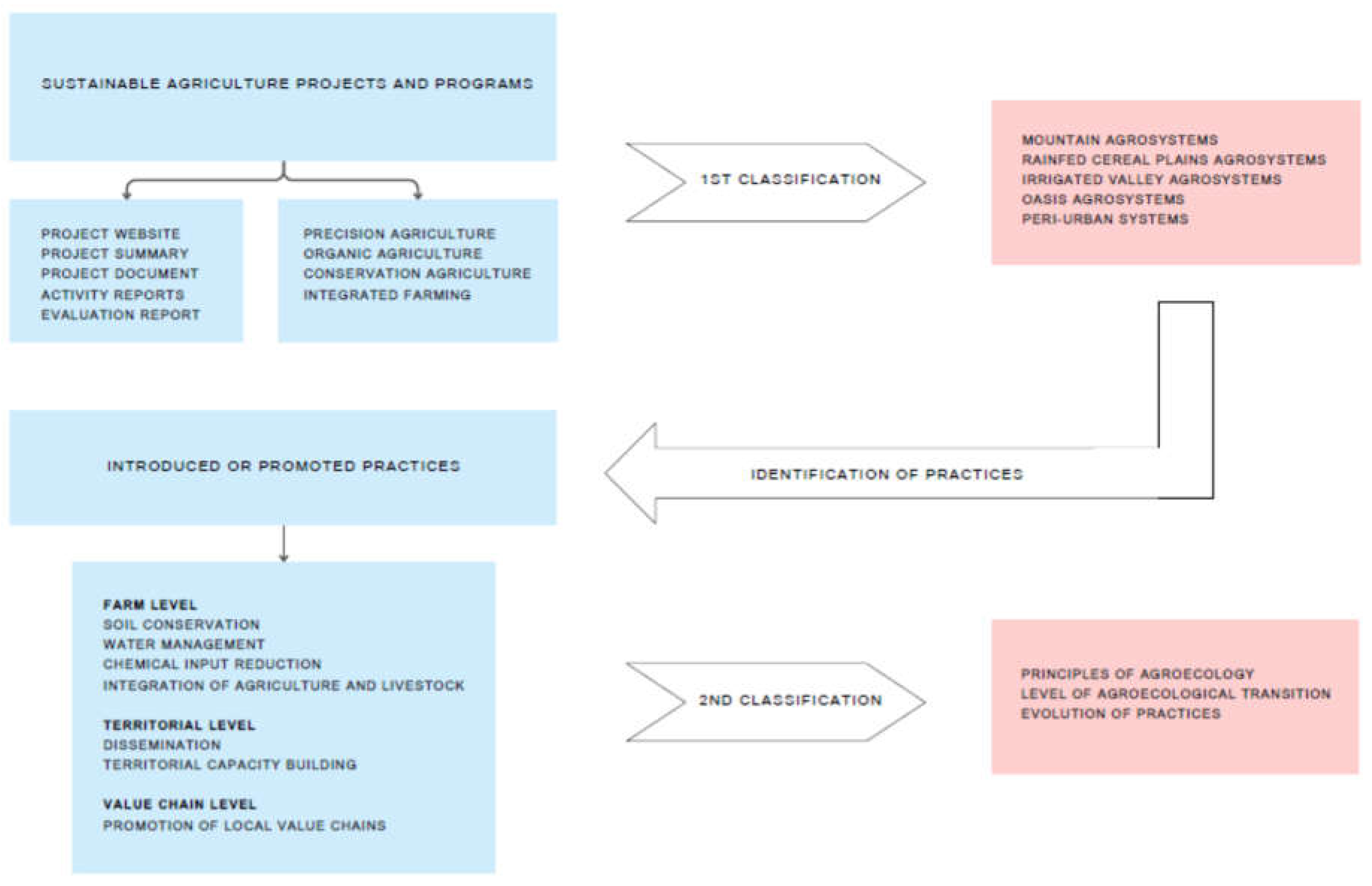
Table 1.
Principles (HLPE) and elements (FAO) of agroecology, and their scales of application.
| HLPE Principles (2019) | FAO Elements (2018) | Scales |
| Improve resource efficiency | ||
| 1. Recycling involves prioritising the use of local renewable resources, as well as closing nutrient and biomass resource cycles as much as possible. | Recycling | FI, FA |
| 2. Reduction of inputs: Reduce or eliminate dependence on purchased inputs and increase self-sufficiency. | Efficiency | FA, FO |
| Building resilience | ||
| 3. Soil health. Securing and improving soil health and functioning to improve plant growth, in particular through the management of organic matter and improve the biological activity of the soil. | FIE | |
| 4. Animal health. Ensuring the health and welfare of animals. | FI, FA | |
| 5. Biodiversity: Maintaining and enhancing biodiversity is important for maintaining species diversity, functional diversity, and genetic resources. This makes it possible to maintain the biodiversity of the agroecosystem in time and space, at different scales from the field to the farm and up to the landscape | (Part of) Diversity | FI, FA |
| 6. Synergy: Synergy involves the enhancement of positive ecological interactions, synergy, integration and complementarity between elements of agroecosystems such as animals, crops, trees, soil and water. | Synergy | FI, FA |
| 7. Diversification: It is important to diversify the sources of income of smallholder farmers to ensure their financial independence and provide them with new opportunities to meet consumer demand. It will also allow them to benefit from additional opportunities to generate value. | (Part of) Diversity | FA, FO |
| Ensuring fairness/social responsibility | ||
| 8. Co-creation: Improving collaboration and equality in knowledge sharing by involving local farmers and exchanges with scientific experts to foster local innovation. | Co-creation | FA, FO |
| 9. Social values and diets: Promote food systems that respect the culture, identity, tradition, social and gender equity of local communities, thereby providing healthy, varied, seasonally and culturally appropriate diets. | Social and human valuesFood culture and traditions. | FA, FO |
| 10. Connectivity: Promoting proximity and trust between producers and consumers by promoting fair distribution and short networks, and by reintegrating food systems into local economies. | Circular Economy and Solidarity | FA |
| 11. Justice: Supporting just and sustainable livelihoods for all actors in food systems, especially smallholder food producers, through fair trade, fair employment, and the fair treatment of intellectual property rights. | Lead, Governance | FA, FO |
| 12. Land and Natural Resource Governance: Strengthen institutions to improve the sustainable management of natural and genetic resources, including recognition and support for family farmers, smallholders, and peasant food producers. | Lead, Governance | FA, FO |
| 13. Participation: Encourage social organization and increased participation of food producers and consumers to support decentralized governance and local adaptive management of agriculture and food systems | Lead, Governance | FO |
Clef / Keys: Scale of application: FI = field; FA = farm, agroecosystem; FO = food system. Source: From (Wezel et al., 2020).
Table 3.
Projects by agrosystem.
| Sustainable agriculture projects (number of projects identified) | Total | |||||
| Rainfed Total cereal plains | Mountain | Oasis | Peri-urban | Nile valley and other irrigated areas (excluding oases) | Cross-cutting projects | |
| 13 | 3 | 21 | 12 | 19 | 21 | 88 |
| 1 | In this paper, we will not consider the distinction between transformation and transition. According to (Hölscher et al., 2018), "Both concepts provide nuanced perspectives on how to describe, interpret and support desirable radical and non-linear societal change." Hölscher points out that the socio-political dimension of change is more present in approaches discussing transformation than in the currents of transition. |
| 2 | The term agroecosystem can be thought simply as an agricultural field, farm or region. It describes a coherent agricultural unit, the boundaries of which include aspects normally outside the primary agricultural interests of productivity and profitability including environmental, biological, economic and sociological processes (Brym and Reeve, 2016). |
| 3 | Le Velly (2017) cites a series of scientific publications produced between 1997 and 2005 that define the conventional food system as "combining (i) rationalized and standardized production methods, detached from the constraints of natural environments and heavily using chemical inputs, (ii) globalized marketing circuits, (iii) sectors dominated by large agro-supply companies, agri-food and distribution and (iv) consumption patterns that are not very concerned and/or aware of the conditions of production and marketing (Le Velly, 2017). |
| 4 | Fall armyworm (Spodoptera frugiperda) is a pest that can feed on more than 80 crop species. It can lead to reduced yields of major cereal crops, pulses, vegetable crops and cotton. |
| 5 | Practices using solar energy (especially for pumping), but also hydroponics and aquaponics, although present in some projects, were not ultimately retained as agroecological practices. The case of solar energy in particular would deserve more analysis, from the notion of multiscale agroecological practices combination. |
Disclaimer/Publisher’s Note: The statements, opinions and data contained in all publications are solely those of the individual author(s) and contributor(s) and not of MDPI and/or the editor(s). MDPI and/or the editor(s) disclaim responsibility for any injury to people or property resulting from any ideas, methods, instructions or products referred to in the content. |
© 2024 by the authors. Licensee MDPI, Basel, Switzerland. This article is an open access article distributed under the terms and conditions of the Creative Commons Attribution (CC BY) license (http://creativecommons.org/licenses/by/4.0/).
Copyright: This open access article is published under a Creative Commons CC BY 4.0 license, which permit the free download, distribution, and reuse, provided that the author and preprint are cited in any reuse.


