

Submitted:
11 November 2024
Posted:
14 November 2024
You are already at the latest version
Abstract
Early on oxides were ruled out from superconductivity, since these are typically large band gap insulators. Nevertheless a rather small number of them were found to be superconducting with transition temperatures up to 14 K and a remarkable low carrier density. This was the starting point of K. Alex Müller (KAM) to get interested in superconductivity in oxides. Step by step he advanced in the research in oxides and finally discovered together with J. Georg Bednorz high-temperature superconductivity (HTSC) in the perovskite type compound Ba-La-Cu-O. Even though inspired from specific and clear ideas in his search, he added new impact in the understanding of HTSC for many years after receipt of the Nobel prize for this discovery.
Keywords:
perovskite oxides
; Jahn-Teller effect
; polarons
; high-temperature cuprate superconductors
1. Introduction
The first oxide which exhibits superconductivity was already discovered in 1964, namely reduced SrTiO3 (STO), which becomes superconducting at = 0.3 K [1]. At this time this was a remarkable observation which caused novel theoretical interpretations well beyond BCS theory [2]. Especially the soft transverse optic mode of STO was supposed to play a crucial role for the pairing mechanism. New interest in doped STO arose only recently when more attention was paid to the ultralow carrier density in this compound. Soon after STO superconductivity was reported in 1964 in the tungsten bronze NaxWO3 with = 0.5 K [3]. In 1973 LiTi2O4 was discovered with = 13.7 K followed by the BaPb1−xBixO3 in 1975 with = 13 K [4]. In 1980 Nb doped SrTiO3 with a maximum of = 0.8 K was observed which is the first two-gap superconductor [5]. Like in the BaPb1−xBixO3 system, adopts a dome like dependence on x, respectively Nb, now well known from the cuprate high-temperature superconductors (HTS’s). What is remarkable about these oxide is the fact that the electron (hole) concentration is only . This is almost one order of magnitude smaller than in a normal (superconducting) metal. While this fact has long been overlooked, recently it has attracted a lot of attention where many new interpretations have been offered [6].
Following, however, KAM’s strategy, he concluded that if the density of states in these oxides is so low, then the pairing interaction must be extremely large in order to achieve the observed superconducting transition temperatures. In conventional weak coupling BCS theory the formula for is [7]:
where is the electron concentration per elementary cell at the Fermi edge, is the electron-electron interaction, which must be attractive to obtain superconductivity. Then one notices that the product must exhibit a certain order of magnitude to obtain a finite transition temperature . This requires for the oxides that if the electron concentration is small, the interaction must be very strong to achieve these large values of . This leads directly to the question:
What is so special about oxides? Why holes instead of electrons?
The oxygen ion and also the heavier chalcogenide ions in their doubly negatively charged state are peculiar as compared to almost all other ions, since they are unstable as free ions.
In simple oxides like MgO, CaO, SrO, the oxygen ion polarizability depends linearly on the volume V of the oxygen ion, in tetrahedrally coordinated oxides this dependence is enhanced to a dependence. In anisotropic configurations as realized in spinels and ferroelectric perovskite oxides [8]. In addition, it is a strong function of temperature and pressure. These properties are a consequence of the fact that the outer 2p-electrons of O2− tend to delocalize and hybridize with nearest neighbor transition metal d-states. The degree of hybridization can be triggered through the dynamics thereby leading to a "dynamical covalency" [9]. The oxygen ion cannot be assigned to a fixed rigid ionic radius but instead space increments have to be introduced which can be related to hybridization degrees of freedom.
Quantum mechanical calculation of the oxygen ion polarizability within the Watson sphere model [10], where the free O2− ion is surrounded by a homogeneously charged sphere show that upon varying the radius of this sphere, the oxygen ion polarizability can be obtained as a function of its volume (Figure 1) [11].
Apparently, the wave function does not shift rigidly with increasing , but forms increments which tend to overlap with the coordinating transition metal ions. This is best exemplified by looking at the difference charge density (Figure 2) where charge is depleted in the intermediate regions.
The consequences of this unusual behavior are: O1− is a bound state, O2− is resonant and unstable. Therefore, electron doping is impossible in oxides, hole doping is the only possibility to dope oxides, thus leading to hole superconductivity [13]!! Alternatives are that strong anharmonicity dominates oxides with tendencies to lattice and electronic instabilities! Besides of the above extraordinary role of the oxygen for hole doped superconductivity, KAM was inspired by his friend Harry Thomas to consider Jahn-Teller (JT) ions to play another special role [14]. While primarily starting with nickelates, the missing success in the search for HTSC lead to cuprates [15]. By assuming an electron to be located at a certain lattice site, two of the ligands move in and the other two move out: the energy is lowered. The same is true for the reversed case and a second minimum appears. The energy gain is the Jahn-Teller stabilization energy (Figure 3).
The ground-state energy for the Jahn-Teller polaron is then given by:
with the effective mass being enlarged as compared to the bare electronic mass. Limiting cases of this simplified model yield the relevant physics of the problem as outlined above, namely where t is the hopping integral. The distortion due to the coupling to the electronic motion is small and is almost unaffected, i.e., free-electron-like. With increasing JT energy, the distortion increases, and for an isolated JT molecular complex results. The competition between localization and itineracy is thus an inherent property of the JT polaron problem. Combining both of the above, namely oxygen ion polarizability and instability and JT ions limits the search for HTSC to rather few systems, namely nickelates and cuprates. In addition, for both of these oxide compounds, very much alike to ferroelectric type perovskite oxides, it is known that it is almost impossible to grow them without any defects or in perfect stoichiometry. One of the prototypical perovskites, SrTiO3 (STO) changes its properties completely upon replacing almost homoeopathic amounts of Sr by Ca. The same holds for introducing very small dopings of Nb. This implies that intrinsic heterogeneity governs the ground state character. Similarly, also cuprate HTS’s are non homogeneous and superconductivity is only observed in a limited doping region. Typically they are grown as ceramics and single crystals are difficult to achieve. This leads to the conclusion that perovskite oxides including cuprates are non-uniform and this structural diverseness is essential for their physical properties.
2. Isotope Effects
For BCS type superconductors the prediction of an isotope effect on was a hallmark to highlight the role of the electron-phonon coupling. With a few exceptions an isotope effect has always been observed in conventional superconductors. That is why also cuprate HTS’s have been readily tested for the isotope effect. The first oxygen (16O/18O) isotope effect (OIE) experiments were carried out on Ba2YCu3O7 and Ba2EuCu3O7 samples at optimum doping and only a very tiny OIE on () was found [16]. The conclusions from this experiment were drawn almost immediately after this report, namely that the missing effects must be interpreted in terms of a novel pairing mechanism beyond electron-phonon interaction. Since the undoped parent compounds of cuprate HTS’s are all antiferromagnets (AFM), the proximity between HTSC and antiferromagnetism was taken as evidence that magnetic fluctuations are the origin for the hole pairing in cuprates (see, e.g., Ref. [17]). Even though a number of further isotope experiments on various doping levels were carried out subsequently where isotope effects were observed [18,19,20], the first results [16] dominated the scene. However, a breakthrough result was achieved by the Stuttgart [21] and Zurich [22,23] groups almost simultaneously, when they concentrated on the question, which oxygen ions in optimally doped YBa2Cu3Ox (YBCO) systems are responsible to the OIE [site-selective oxygen isotope effect (SOIE)]. In the structure of YBCO there are three different oxygen lattice positions: plane (p), apex (a), and chain (c). The Zurich group applied a two-step oxygen-exchange process in order to prepare partially substituted 16O/18O YBa2Cu3O6+x samples required for SOIE investigations [23]. As a result, quite opposite to expectations, namely the apex oxygen ions (a) should exhibit the largest OIE [22], it were the (p) oxygen ions being mainly responsible for the total OIE [23]. In order to demonstrate that this finding also holds in the underdoped region, additional SOIE studies were performed for Y1−xPrxBa2Cu3O7−δ () [24,25], and the results are summarized in (Figure 4). It is obvious from the figure that at all doping levels the main contribution to the total OIE arises from the (p) oxygen ions.
This was verified in various experiments, but also through a rather unconventional strategy, where the OIE on the magnetic penetration depth (superfluid density ) was investigated using various experimental techniques [magnetization, magnetic torque, muon-spin rotation (SR)] [26]. As an example of such a study, the results of the OIE on the in-plane superfluid density observed for single-crystal La2−xSrxCuO4 using magnetic torque is depicted in Figure 5 [27], where a pronouned doping dependent OIE on the in-plane superfluid density [] is evident. Even though within BCS theory no OIE on the penetrations depth (superfluid density) is expected, these experiments were done under the assumption that a bi-polaronic mechanism would support an OIE on the penetration depth (superfluid density) with a site specific result. This was indeed observed in a SOIE study of the in-plane magnetic penetration depth in Y0.6Pr0.4Ba2Cu3O7−δ by means of SR [25]. Consistent with the SOIE on (see Figure 4) also the one on was largest for oxygen atoms in the CuO2 planes (p), whereas the one on the (ac) lattice positions was present, but much smaller. These unexpected and amazing results demonstrate clearly that two different structural components of the cuprate HTS systems play different roles in the respective physics supporting the viewpoint of two order parameters and heterogeneity as essential ingredients, which will be addressed in more detail below.
3. Essential Ingredients for High-Temperature Superconductivity: Heterogeneities and Mixed-Order Parameters in Cuprate Superconductors
Clear experimental evidence for intrinsic heterogeneity in the cuprates has been given by extended X-ray absorption fine structure (EXAFS) spectroscopy and pair distribution function analysis, where a stripe-like ordering of these regions has been detected [28]. Charge-rich areas and the fully symmetric undistorted charge-poor regions have been observed. Very intriguing demonstrations of their existence have been provided by the group of A. Bianconi where clear correlations between oxygen rich regions and charge density wave (CDW) puddles have been detected [29].
Opposite to a s-wave BCS superconductor and the conclusions obtained from the OIE experiments, the missing OIE at optimum doping readily led to the assumption that cuprate HTS’s are governed by a single d-wave order parameter. This was supported by in-plane phase-coherent tunneling experiments (see, e.g., Refs. [30,31,32]) and a number of other experimental studies. In contrast, Sun et al. [33] performed a tunneling experiment along the c-axis of optimally doped YBa2Cu3O7−δ (YBCO) which is consistent with a pure s-wave order parameter. Furthermore, in a nuclear magnetic resonance (NMR) experiment the temperature dependence of the NMR spin relaxation time in different YBCO compounds was investigated [34]. The experimental results lie in between the theoretical calculations for a s- and a d-wave superconductor [35], however closer to the d-wave one. Based on these and other experimental findings as well as theoretical considerations, KAM proposed that cuprate superconductors must have a mixed -wave order parameter that reflects the intrinsic inhomogeneities (hole-rich and hole-poor stripe-like regions) in these systems [36,37,38].
In order to test the proposed concept of KAM we performed detailed muon-spin rotation (SR) experiments. SR is extremely sensitive to detect any kind of local and global magnetic signatures in magnetic systems, including superconductors. In particular, SR is a powerful tool to explore the pairing symmetry (s, d, ) of a cuprate HTS in the bulk of a single-crystal sample. This is exemplified by measuring the temperature dependence of the magnetic penetration depths , , and along the principal crystallographic axes a, b, and c. The University of Zurich group has conducted such studies on three different cuprate HTS’s revealing consistent and generic results [39,40,41]. As an example, the results of such a SR study for single-crystal YBa2Cu3O7−δ are displayed in Figure 6, where the temperature dependences of the SR relaxation rates , , and are plotted [40]. Note that as well as exhibit a characteristic "up-turn" at low temperature. This is the signature of a coupled -wave order parameter in the CuO2 plane with a dominant d-wave order parameter () and a small s-wave contribution () [40,42]. However, is in accordance with a pure s-wave order parameter. While this experiment does not only highlight the capabilities of SR, it also provides clear evidence of the coexistence of two order parameters in cuprate HTS’s with major contributions of the d-wave order parameter in the a- and b-direction whereas along the c-direction the s-wave order parameter is realized in agreement with the c-axis tunneling results [33] mentioned above.
Of course also other experiments have confirmed the intrinsic heterogeneity of cuprate HTS’s and the two-component character of the condensate. Only few examples are given here: As already mentioned above early on after performing the first NMR experiments Bulut and Scalapino [35] analyzed these in terms of a purely electronic model based on spin fluctuations and concluded that a d-wave only approach was unable to reproduce the experimental data. Some years later it was shown that by using a mixed -wave order parameter a very satisfactory description of the experiments could be achieved [43]. Furthermore, scanning tunneling microscope (STM) spectroscopy demonstrated that the electron tunneling process in STM is essentially incoherent. These observations are favored by the s-wave pairing mechanism. However, the conductance curves were found to be substantially smeared in comparison with the conventional excitation spectra predicted in BCS (isotropic s-wave) superconductors, suggesting the anisotropy of the gap functions in cuprate HTS’s [44]. NMR experiments were able to disclose that the observed NMR shifts stem from two components and provide clear evidence for intrinsic heterogeneity [45,46]. Studies of the nonlinear conductivity in cuprate HTS’s indentified that intrinsic and universal superconducting gap inhomogeneity is highly relevant to understanding the superconducting properties of the cuprates [47]. Theoretically, a similar conclusion for the coexistence of -wave superconductivity was reached by using a quantum Monte Carlo approach [48]. Another ansatz was based on the slave boson approach for a two band model, where again coexistence regions of channels were considered [49]. Of course a number of related models exist, but this is beyond the scope of the article.
4. Theoretical Understanding
The simplest and most transparent model for understanding the above findings is provided by a two-band model where one band has mainly s-electron character whereas the second one constitutes the d-electron states. Interactions between both types of carriers are the important ingredient for two-band superconductivity. The Hamiltonian H reads [50]:
with
where , c, , d are electron creation and annihilation operators with spin and momentum k. is the kinetic energy with hopping integrals and (i =1,2) are the intraband pairing interactions. The term represents the interband pairing interaction where electrons are pairwise exchanged between the two bands.
The gap equations are self-consistently derived and are given by:
Numerical solutions of the above equations yield the dependence of the gaps as a function of the chemical potential (Figure 7), i.e. doping and the interband interaction term . The dome like dependence of the coupled gaps reproduces very well the in the cuprate HTS’s observed dependence of as a function of doping. In addition, the figure clarifies that plays a central role for the magnitude of and the gaps which increase nonlinearly with . In all cases the d-wave gap (squares) is the dominant one whereas the s-wave gap (circles) is almost 60% smaller than the d-gap.
In order to bring these results in contact with experimental data the average gap values have been plotted as functions of and compared data for Y1−xCaxBa2Cu3O7−δ in Figure 8 [51].
Apparently, good agreement between experiment and theory is given when taking two bands with inter- and intraband interactions into account. A special effect of using this approach is the fact, that can significantly be enhanced by the interband coupling term even if the intraband couplings exhibit rather moderate values (Figure 9).
This has early on been highlighted in the papers by Suhl, Matthias, and Walker [52] and Moskalenko [53] that even independent of the sign of the interband coupling enhancements of as compared to single band approaches a la BCS occur. As can be seen in Figure 9b, even in the case of both intraband interactions being too small to induce superconductivity, moderate values of of the order of 0.5 lead to superconductivity at for mixed symmetry order parameters and for symmetry order parameters.
5. Isotope Effects in a Multiband Polaron Approach
Polaron formation takes place, if the coupling between the electrons (holes) and the lattice is neither too strong nor too weak as has been outlined above. The mediate strength coupling between holes (electrons) and lattice vibrations (displacements) has two coupled and inseparable consequences, namely, the hole (electron) kinetic energy is slowed down, since it carries a lattice cloud, and the lattice energy is shifted caused by the hole (electron) drag. One without the other is not possible. The easiest ansatz is here the Lang-Firsov approximation [54], which takes both renormalizations simultaneously into account. For the renormalized electron creation and annihilation operators this yields [54]:
where is the normalized crystal momentum. For the lattice Hamiltonian the following renormalizations hold [54]:
with
and
with
The nearest , second nearest neighbor , and interplanar hopping integrals are modified through the interaction with the lattice. Within this approach an isotope effect on may arise from either of the hopping integrals, or from different combinations of them. Interestingly, the OIE on stemming from yields the wrong trend, whereas the combined action of and follow the experimental data (see Figure 10).
This result allows to draw conclusions on the involved lattice displacements, namely those where oxygen atoms displace towards the neighboring Cu ions are irrelevant (Figure 11, left), whereas a Jahn-Teller type mode (Figure 11, right) supports the observed OIE (see Figure 10) when combined with a c-axis displacement.
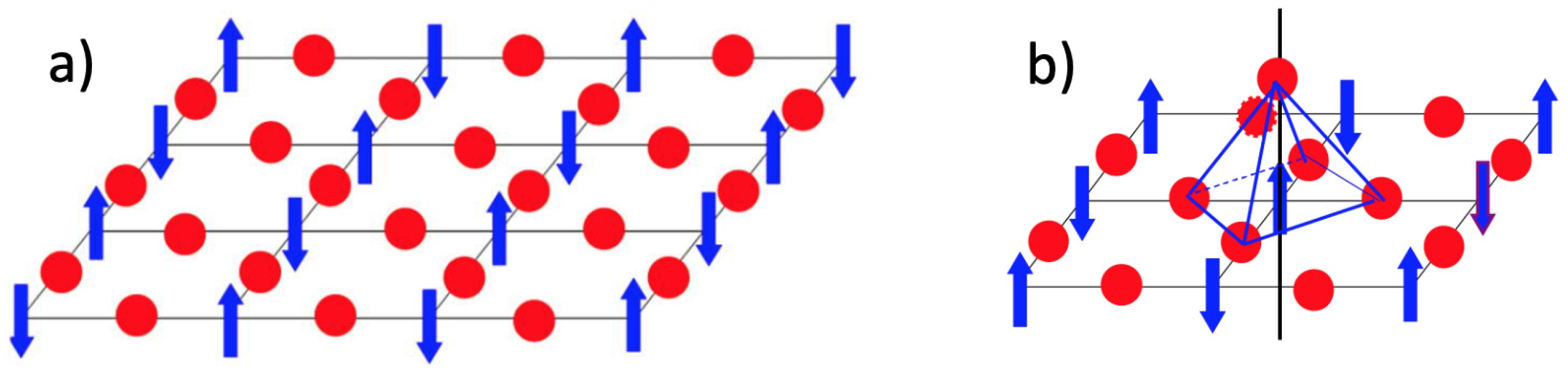
Very shortly also the lattice response (Eq. 8) is mentioned which shows some unconventional signatures caused by the polaronic coupling (Figure 12). This is best exemplified through the Debye-Waller factor which at high temperatures T appears to be conventional, i.e., decreasing steadily with decreasing T. However, around the so-called stripe temperature a rapid increase sets in signaling polaron coherence followed by a sudden drop near and another increase below . The drop at is a consequence of the zero line nodes of the d-wave component of the order parameter whereas the following increase stems from the s-wave component. This finding supports the two-component character and the coexistence of an s-wave and a d-wave order parameter. Upon inspecting the structure of a cuprate HTS, a possible assignment of them can be made in terms of the antiferromagnetic spin alignment in the planes and an out-of-plane almost ferroelectric type polar component (see Figure 13).
6. Conclusions and Outlook for Further Search for High-Temperature Superconductivity
A reasonable undertaking to discover novel superconductors would be to look or transition metal oxides or chalcogenides wherethe metal ion should be a JT active one with the tendency to valence instability, thus ensuringthat the ground state is intrinsically heterogeneous. In combination with the unconventional largepolarizability of oxygen, respectively chalcogen ions, fluctuating charge transfer is enabled, "dynamical covalency", which enhances the charge-lattice coupling locally and allows for unusual lattice anomalies in conjunction with possible pairing instabilities. The electron-lattice interaction is not the conventional BCS electron-phonon interaction, which is long-range, but a local one outside the Born-Oppenheimer approximation. This leads to unconventional isotope effects, which are typically overlooked or even ignored in purely electronic or spin-fluctuation-based pairing scenarios. Furthermore, combined order parameters are a consequence that not only leads to agreement with puzzling experiments, but also accounts for the complexity in the electronic structure of cuprates, often avoided in strongly simplified alternative procedures. As pairing glue we have identified (bi-) polaron formation, the starting point for the discovery of high-temperarure superconductivity.
Author Contributions
Both authors (ABH and HK) have contributed equally to this work.
Funding
This research received no external funding.
Acknowledgments
We acknowledge very gratefully the support and many fruitful and highlighting discussions with K.A. Müller for many years.
Conflicts of Interest
The authors declare no conflict of interest.
References
- Schooley, J.F.; Hosler, W.R.; Cohen, Marvin L. Superconductivity in Semiconducting SrTiO3. Phys. Rev. Lett. 1964, 12, 474–475. [Google Scholar] [CrossRef]
- Appel, J. Soft-Mode Superconductivity in SrTiO3-x. Phys. Rev. 1969, 180, 508–516. [Google Scholar] [CrossRef]
- Raub, Ch.J.; Sweedler, A.R.; Jensen, M.A.; Broadston, S.; Matthias, B.T. Superconductivity of Sodium Tungsten Bronzes. Phys. Rev. Lett. 1964, 13, 746–747. [Google Scholar] [CrossRef]
- Sleight, A.W.; Gillson, J.L.; Bierstedt, P.E. High-temperature superconductivity in the BaPb1-xBixO3 systems. Solid State Commun. 1975, 17, 27–28. [Google Scholar] [CrossRef]
- Binnig, G.; Baratoff, A.; Hoenig, H.E.; Bednorz, J.G. Two-band superconductivity in Nb-doped SrTiO3. Phys. Rev. Lett. 1980, 45, 1352–1355. [Google Scholar] [CrossRef]
- Gastiasoro, Maria N. ; Ruhman, Jonathan; Fernandes, Rafael M. Superconductivity in dilute SrTiO3: A review. Annals of Physics 2020, 417, 168107. [Google Scholar] [CrossRef]
- Bardeen, J.; Cooper, L.N.; Schrieffer, J.R. Theory of Superconductivity. Phys. Rev. B 1957, 108, 1175–1204. [Google Scholar] [CrossRef]
- Tessman, Jack. R.; Kahn, A.H.; Shockley William. Electronic Polarizabilities of Ions in Crystals. Phys. Rev. 1953, 92, 890–895. [Google Scholar] [CrossRef]
- Bilz, H.; Buttner, H.; Bussmann-Holder, A.; Vogl, P. Phonon anomalies in ferroelectrics and superconductors. Ferroelectrics 1987, 73, 493–500. [Google Scholar] [CrossRef]
- Watson, Richard E. Analytic Hartree-Fock Solutions for O=. Phys. Rev. 1958, 111, 1108–1110. [Google Scholar] [CrossRef]
- Bussmann, A.; Bilz, H.; Roenspiess, R.; Schwarz, K. Oxygen polarizability in ferroelectric phase transitions. Ferroelectrics, :1.
- Bussmann-Holder Annette. The polarizability model for ferroelectricity in perovskite oxides. J. Phys: Condens. Matter 2012, 24, 273202. [Google Scholar]
- Hirsch, Jorge E. Superconductivity begins with H. World Scientific (New Jersey, London, Singapore).
- Höck, K.-H.; Nickisch, H.; Thomas, H. Jahn-Teller effect in itinerant electron systems: the Jahn-Teller polaron. Helv. Phys. Acta 1983, 56, 237–243. [Google Scholar]
- Bednorz, J.G.; Müller, K.A. Possible High Tc Superconductivity in the Ba-La-Cu-O System. Z. Phys. B - Condensed Matter 1986, 64, 189–193. [Google Scholar] [CrossRef]
- Batlogg, B. : Cava, R.J.; Jayaraman, A.; van Dover, R.B.; Kourouklis, G.A.; Sunshine, S.; Murphy, D.W.; Rupp, L.W.; Chen, H.S.; White, A.; Short, K.T.; Mujsce, A.M.; Rietman, E.A. Isotope Effect in the High-Tc Superconductors Ba2YCu3O7 and Ba2EuCu3O7. Phys. Rev. Lett. 1987, 58, 2333–2336. [Google Scholar] [CrossRef] [PubMed]
- Moriya, Toru; Takahashi, Yoshinori; Ueda, Kazuo. Antiferromagnetic Spin Fluctuations and Superconductivity in Two-Dimensional Metals - A Possible Model for High Tc Oxides. J. Phys. Soc. Jpn. 1990, 59, 2905–2915. [Google Scholar] [CrossRef]
- Crawford, M.K.; Farneth, W.E.; McCarron, E.M.; Harlow, R.L.; Moudden, A.H. Oxygen Isotope Effect and Structural Phase Transitions in La2CuO4-Based Superconductors. Science 1990, 250, 1390–1394. [Google Scholar] [CrossRef]
- Franck, J.P.; Jung, J.; Mohamed, A.K.; Gygax, S.; Sproule, G.I. Observation of an oxygen isotope effect in superconducting (Y1-xPrx)Ba2Cu3O7-δ. Phys. Rev. B 1991, 44, 5318–5321. [Google Scholar] [CrossRef]
- Franck, JP. Experimental studies of the isotope effect in high temperature superconductors. In Physical properties of high temperature superconductors IV, Ginsberg, D.M., Ed.; World Scientific: Singapore, 1994; pp. 189–293. [Google Scholar]
- Cardona, M.; Liu, R.; Thomsen, C.; Kress, W.; Schönherr, E.; Bauer, M.; Genzel, L.; König, W. Effect of isotopic substitution of oxygen on Tc and the phonon frequencies of high Tc superconductors. Solid State Commun. 1988, 76, 789–793. [Google Scholar] [CrossRef]
- Müller, K. A. On the oxygen isotope effect and apex anharmonicity in high-Tc cuprates. Z. Phys. B - Condensed Matter 1990, 80, 193–201. [Google Scholar] [CrossRef]
- Zech, D.; Keller, H.; Conder, K.; Kaldis, E.; Liarokapis, E.; Poulakis, N.; Müller, K.A. Site-selective oxygen isotope effect in optimally doped YBa2Cu3O6+x. Nature (London) 1994, 371, 681–683. [Google Scholar] [CrossRef]
- Zhao, G.M.; Ager III, J.W.; Morris, D.E. Site dependence of large oxygen isotope effect in Y0.7Pr0.3Ba2Cu3O6.97. Phys. Rev. B 1996, 54, 14982–14985. [Google Scholar] [CrossRef] [PubMed]
- Khasanov, R.; Shengelaya, A.; Morenzoni, E.; Angst, M.; Conder, K.; Savić, I.M.; Lampakis, D.; Liarokapis, E.; Tatsi, A.; Keller, H. Site-selective oxygen isotope effect on the magnetic field penetration depth in underdoped Y0.6Pr0.4Ba2Cu3O7-δ. Phys. Rev. B 2003, 68, 220506. [Google Scholar] [CrossRef]
- Keller, H. Unconventional Isotope Effects in Cuprate Superconductors. In Superconductivity in Complex Systems; Müller, K.A., Bussmann-Holder, A., Eds.; Structure and Bonding 114, Springer: Berlin, Heidelberg, New York, 2005; pp. 143–169. [Google Scholar]
- Hofer, J.; Conder, K.; Sasagawa, T.; Zhao, G.M.; Willemin, M.; Keller, H.; Kishio, K. Oxygen-isotope effect on the in-plane penetration depth in underdoped La2-xSrxCuO4 single crystals. Phys. Rev. Lett. 2000, 84, 4192–4195. [Google Scholar] [CrossRef] [PubMed]
- Bianconi, A.; Saini, N.L.; Lanzara, A.; Missori, M.; Rossetti, T.; Oyanagi, H.; Yamaguchi, H.; Oka, K.; Ito, T. Determination of the Local Lattice Distortions in the CuO2 Plane of La1.85Sr0.15CuO4. Phys. Rev. Lett. 1996, 76, 3412–3415. [Google Scholar] [CrossRef] [PubMed]
- Campi, G.; Bianconi, A.; Poccia, N.; Bianconi, G.; Barba, L.; Arrighetti, G.; Innocenti, D.; Karpinski, J.; Zhigadlo, N.D.; Kazakov, S.M.; Burghammer, M.; v. Zimmermann, M.; Sprung, M.; Ricci, A. Inhomogeneity of charge-density-wave order and quenched disorder in a high-Tc superconductor. Nature (London) 2015, 525, 359–362. [Google Scholar] [CrossRef] [PubMed]
- Wollman, D.A.; Van Harlingen, D.J.; Lee, W.C.; Ginsberg, D.M.; Leggett, A.J. Experimental determination of the superconducting pairing state in YBCO from the phase coherence of YBCO-Pb dc SQUIDs. Phys. Rev. Lett. 1993, 71, 2134–2137. [Google Scholar] [CrossRef]
- Tsuei, C.C.; Kirtley, J.R.; Chi, C.C.; Yu-Jahnes, Lock See; Gupta, A. ; Shaw, T.; Sun, J.Z.; Ketchen, M.B. Pairing Symmetry and Flux Quantization in a Tricrystal Superconducting Ring of YBa2Cu3O7-δ. Phys. Rev. Lett. 1994, 73, 593–596. [Google Scholar] [CrossRef]
- Brawner, D.A.; Ott, H.R. Evidence for an unconventional superconducting order parameter in YBa2Cu3O6.9. Phys. Rev. B 1994, 50, 6530. [Google Scholar] [CrossRef]
- Sun, A.G.; Gajewski, D.A.; Maple, M.B.; Dynes, R.C. Observation of Josephson pair tunneling between a high-Tc cuprate (YBa2Cu3O7-δ) and a conventional superconductor (Pb). Phys. Rev. Lett. 1994, 72, 2267–2270. [Google Scholar] [CrossRef]
- Stern, R.; Mali, M.; Roos, J.; Brinkmann, D. Spin pseudogap and interplane coupling in Y2Ba4Cu7O15: A 63 Cu nuclear spin-spin relaxation study. Phys. Rev. B 1995, 51, 15478–15483. [Google Scholar] [CrossRef]
- Bulut, N.; Scalapino, D.J. Calculation of the transverse nuclear relaxation rate for YBa2Cu3O7 in the superconducting state. Phys. Rev. Lett. 1991, 67, 2898–2901. [Google Scholar] [CrossRef] [PubMed]
- Müller, K. Alex. Possible coexistence of s- and d-wave condensates in copper oxide superconductors. Nature (London) 1995, 377, 133–135. [Google Scholar] [CrossRef]
- Müller, K.A.; Keller, H. s and d Wave Symmetry Components in High-Temperature Cuprate Superconductors. In High-Tc Superconductivity 1996: Ten Years after the Discovery; Kaldis, E., Liarokapis, E., Müller, K.A., Eds.; Kluwer Academic Publishers: Dordrecht/Boston/London, The Netherlands, 1997; pp. 7–29. [Google Scholar]
- Müller, K.A. On the macroscopic s- and d-wave symmetry in cuprate superconductors. Phil. Mag. Lett. 2002, 82, 279–288. [Google Scholar] [CrossRef]
- Khasanov, R.; Shengelaya, A.; Maisuradze, A.; La Mattina, F.; Bussmann-Holder, A.; Keller, H.; Müller, K.A. Experimental evidence for two gaps in the high-temperature La1.83Sr0.17CuO4 superconductor. Phys. Rev. Lett. 2007, 98, 057007–1. [Google Scholar] [CrossRef] [PubMed]
- Khasanov, R.; Strässle, S.; Di Castro, D.; Masui, T.; Miyasaka, S; Tajima, S. ; Bussmann-Holder, A.; Keller, H. Multiple gap symmetries for the order parameter of cuprate superconductors from penetration depth measurements. Phys. Rev. Lett. 2007, 99, 237601–1. [Google Scholar] [CrossRef] [PubMed]
- Khasanov, R.; Shengelaya, A.; Karpinski, J.; Bussmann-Holder, A.; Keller, H.; Müller, K.A. s-wave symmetry along the c-axis and s+d in-plane superconductivity in bulk YBa2Cu4O8. J. Supercond. Nov. Magn. 2008, 21, 81–85. [Google Scholar] [CrossRef]
- Bussmann-Holder, A.; Khasanov, R.; Shengelaya, A.; Maisuradze, A.; La Mattina, F.; Keller, H.; Müller, K.A. Mixed order parameter symmetries in cuprate superconductors. Europhys. Lett. 2007, 77, 27002. [Google Scholar] [CrossRef]
- Bussmann-Holder, A. Evidence for s+d Wave Pairing in Copper Oxide Superconductors from an Analysis of NMR and NQR Data. J. Supercond. Nov. Magn. 2012, 25, 155–157. [Google Scholar] [CrossRef]
- Hasegawa, T.; Nantoh, M.; Heike, S.; Takagi, S.; Ogino, M.; Kawasaki, M.; Koinuma, H.; . Kitazawa, K. Scanning tunneling spectroscopy on high Tc superconductors. J. Phys. Chem. Solids 1993, 54, 1351–1357. [Google Scholar] [CrossRef]
- Haase, J.; Slichter, C.P.; Williams, G.V.M. Evidence for two electronic components in high-temperature superconductivity from NMR. J. Phys.: Condens. Matter 2009, 21, 455702. [Google Scholar] [CrossRef]
- Bandur, Daniel; Nachtigal, Jakob; Lee, Abigail; Tsankov, Stefan; Haase, Jürgen. Cuprate universal electronic spin response and the pseudogap from NMR. arXiv:2309.11874v3 [cond-mat.supr-con] 3 Mar 2024, arXiv:2309.11874v3 [cond-mat.supr-con] 3 Mar 2024.
- Pelc, Damian; Vuc̆ković, Marija; Grbić, Mihael S.; Poz̆ek, Miroslav; Yu, Guichuan; Sasagawa, Takao; Greven, Martin; Baris̆ić, Neven. Emergence of superconductivity in the cuprates via a universal percolation process. Nat. Commun. 4327.
- Li, Q.P.; Koltenbah, B.E.C.; Joynt, Robert. Mixed s-wave and d-wave superconductivity in high- TC systems. Phys. Rev. B 1993, 48, 437–455. [Google Scholar] [CrossRef] [PubMed]
- Reyes, Daniel; Continentino, Mucio A. ; Thomas, Christopher; Lacroix, Claudine. s-and d-wave superconductivity in a two-band model. Annals of Physics 2016, 373, 257–272. [Google Scholar]
- Micnas, R.; Robaszkiewicz, S.; Bussmann-Holder, A. Two-Component Scenarios for Non-Conventional (Exotic) Superconductors. In Superconductivity in Complex Systems; Müller, K.A., Bussmann-Holder, A., Eds.; Structure and Bonding 114, Springer: Berlin/Heidelberg, Germany, 2005; pp. 13–69. [Google Scholar]
- Bussmann-Holder, A.; Keller, H. Polaron formation as origin of unconventional isotope effects in cuprate superconductors. Eur. Phys. J. B 2005, 44, 487–490. [Google Scholar] [CrossRef]
- Suhl, H.; Matthias, B.T.; Walker, L.R. Bardeen-Cooper-Schrieffer Theory of Superconductivity in the Case of Overlapping Bands. Phys. Rev. Lett. 1959, 3, 552–555. [Google Scholar] [CrossRef]
- Moskalenko, V. Superconductivity in metals with overlapping energy bands. Fiz. Met. Metalloved. 1959, 8, 2518–2529. [Google Scholar]
- Lang, I.G.; Firsov, Y.A. Kinetic Theory of Semiconductors with Low Mobility. Zh. Eksp. Teor. Fiz. 1962, 43, 1843–1860. [Google Scholar]
- Keller, H.; Bussmann-Holder, A.; Müller, K.A. Jahn-Teller physics and high-Tc superconductivity. Materials Today 2008, 11, 38–46. [Google Scholar] [CrossRef]
- Oyanagi, H.; Zhang, C.; Tsukada, A.; Naito, M. Lattice instability in high temperature superconducting cuprates probed by x-ray absorption. J. Phys. Conf. Ser. 2008, 108, 012038. [Google Scholar] [CrossRef]
- Bussmann-Holder, A.; Keller, H.; Bishop, A.R.; Simon, A.; Müller, K.A. Polaron coherence as origin of the pseudogap phase in high temperature superconducting cuprates. J. Supercond. Nov. Magn. 2008, 21, 353–357. [Google Scholar] [CrossRef]
Figure 1.
Oxygen ion O2−p-wave function as a function of its radius as defined by the Watson sphere radius (after Ref. [11]).
Figure 1.
Oxygen ion O2−p-wave function as a function of its radius as defined by the Watson sphere radius (after Ref. [11]).
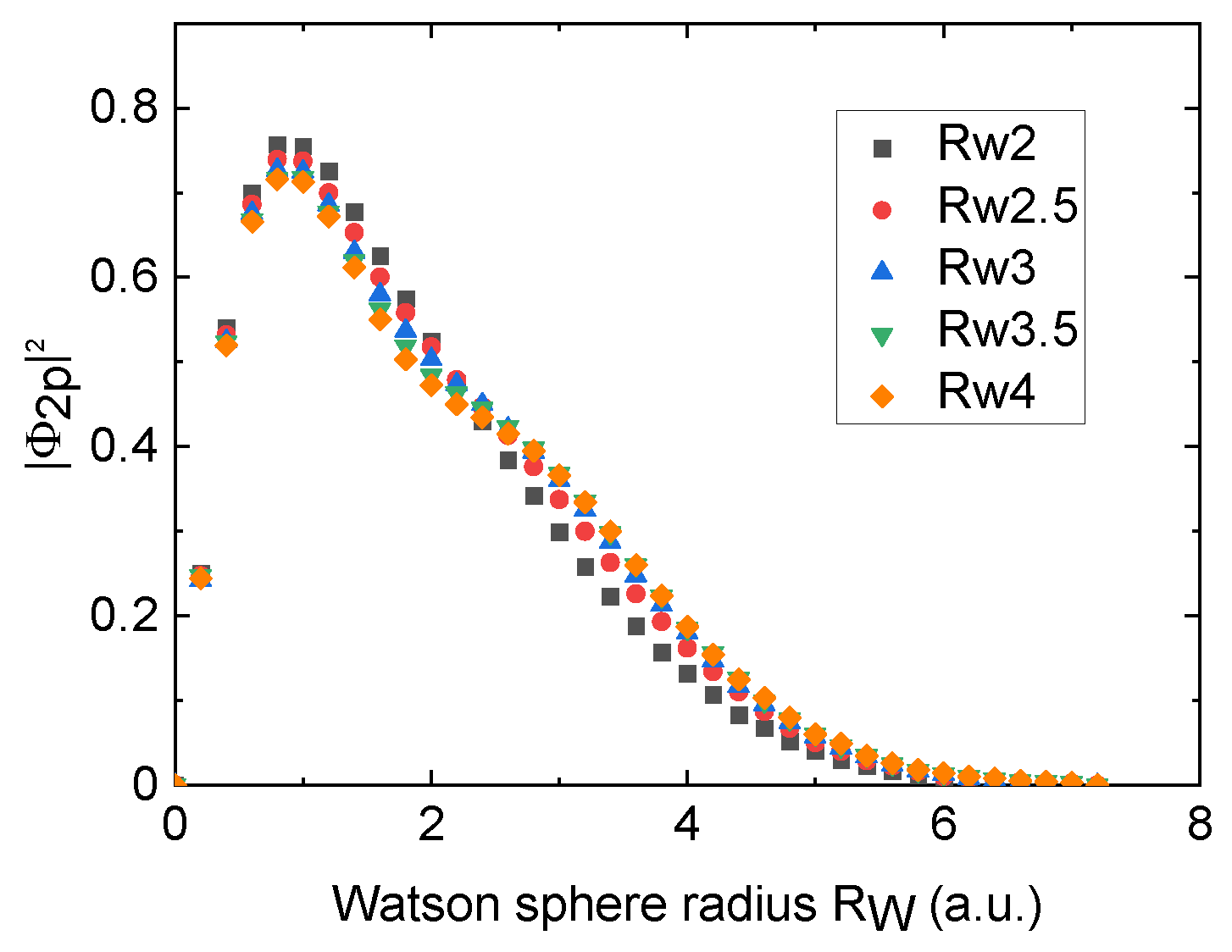
Figure 2.
Difference in the oxygen ion charge density for various radii differences as given in the figure (after Ref. [12]).
Figure 2.
Difference in the oxygen ion charge density for various radii differences as given in the figure (after Ref. [12]).
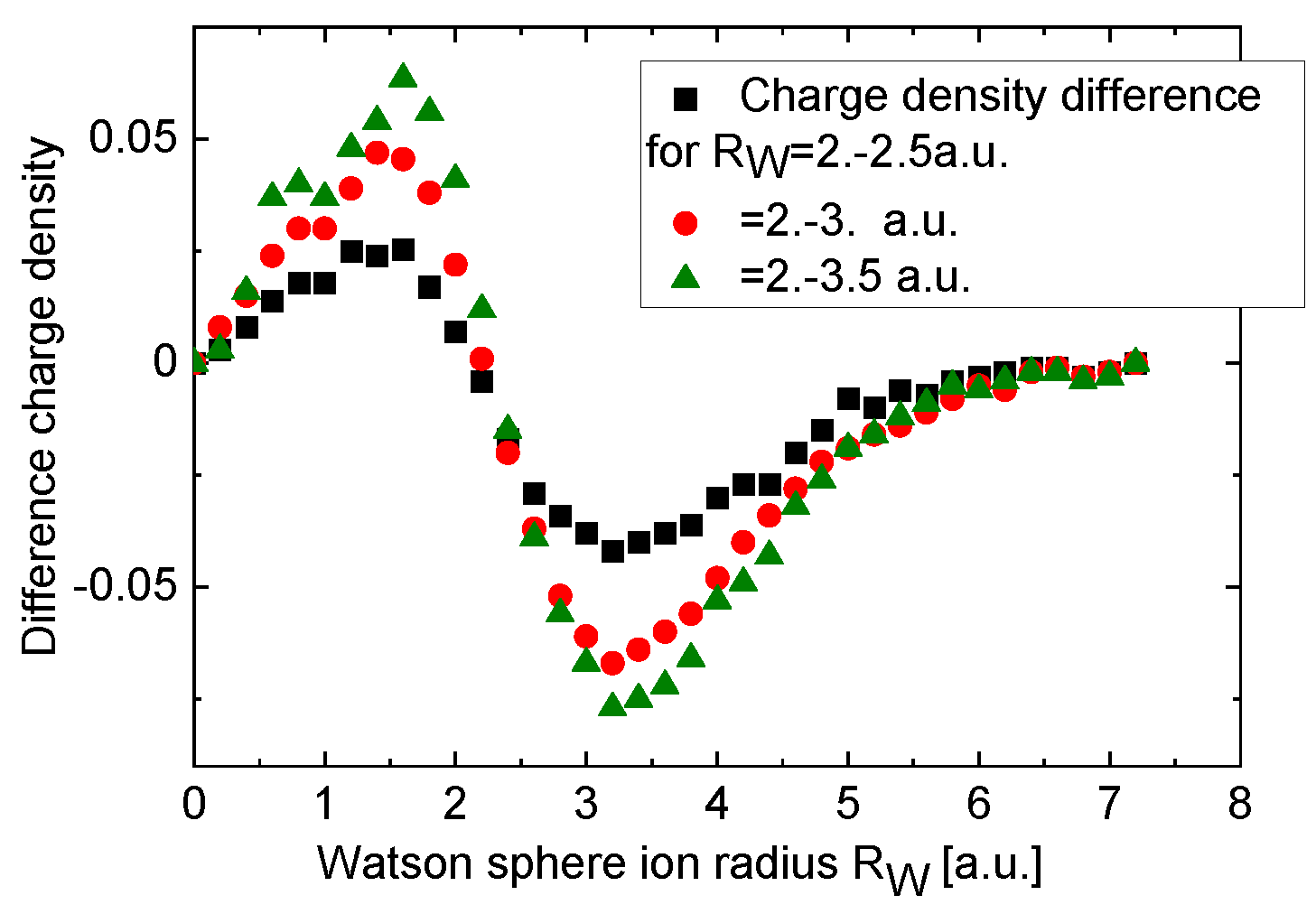
Figure 3.
Ground state energy of the Jahn-Teller polaron with ionic displacements where the energy gain as compared to the undistorted configuration is given by the red arrow (after Ref. [14]).
Figure 3.
Ground state energy of the Jahn-Teller polaron with ionic displacements where the energy gain as compared to the undistorted configuration is given by the red arrow (after Ref. [14]).
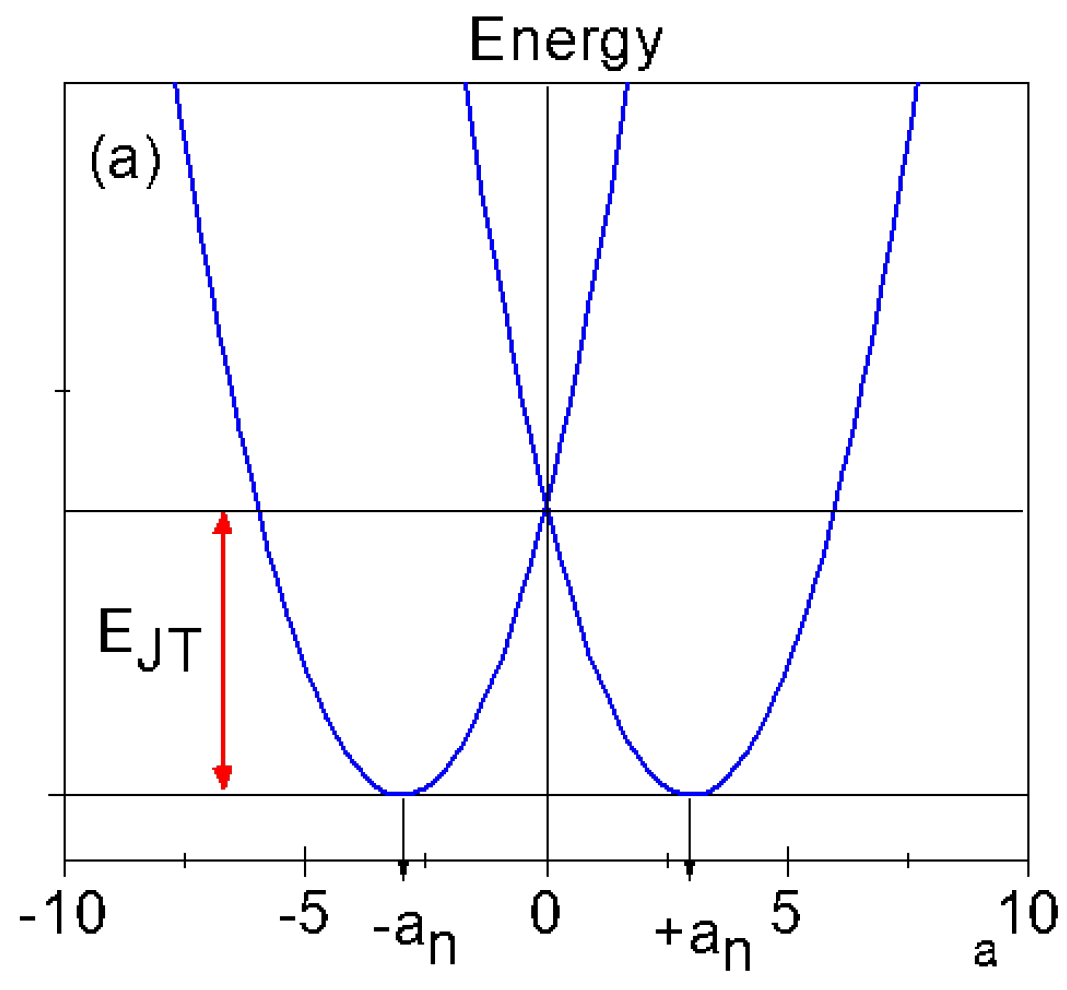
Figure 4.
The OIE coefficients (red circles), (blue diamonds), and (green diamonds) as a function of for Y1−xPrxBa2Cu3O7−δ (t = total: all oxygen sites, p: planar oxygen sites, ac: apex and chain oxygen sites). All lines are guides to the eye (after Ref. [26]).
Figure 4.
The OIE coefficients (red circles), (blue diamonds), and (green diamonds) as a function of for Y1−xPrxBa2Cu3O7−δ (t = total: all oxygen sites, p: planar oxygen sites, ac: apex and chain oxygen sites). All lines are guides to the eye (after Ref. [26]).
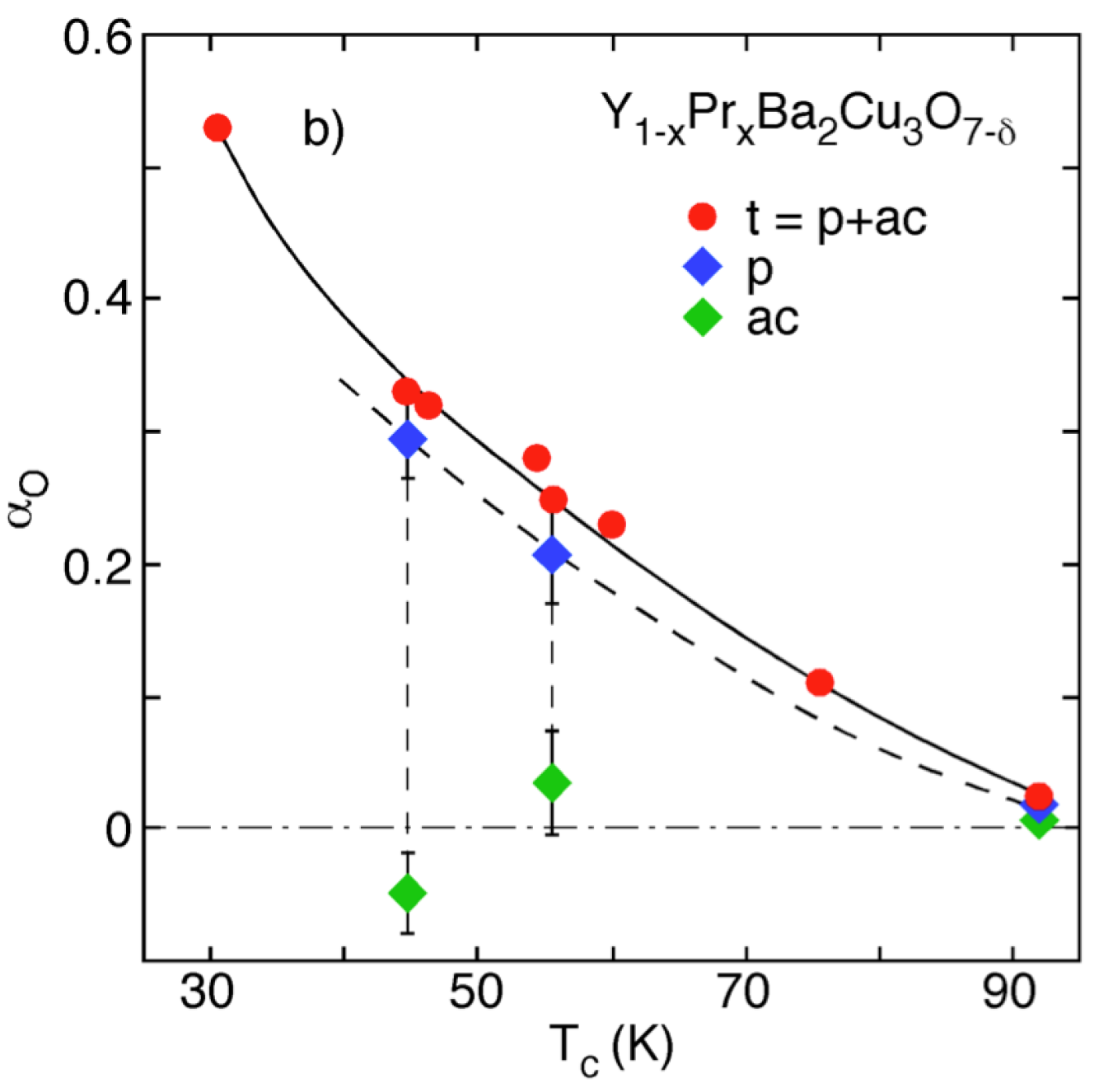
Figure 5.
Temperature dependence of the in-plane superfluid density for single-cystal La2−xSrxCuO4 extracted from magnetic torque meaurements: a) ; b) . For more details see [27] (from Ref. [27]).
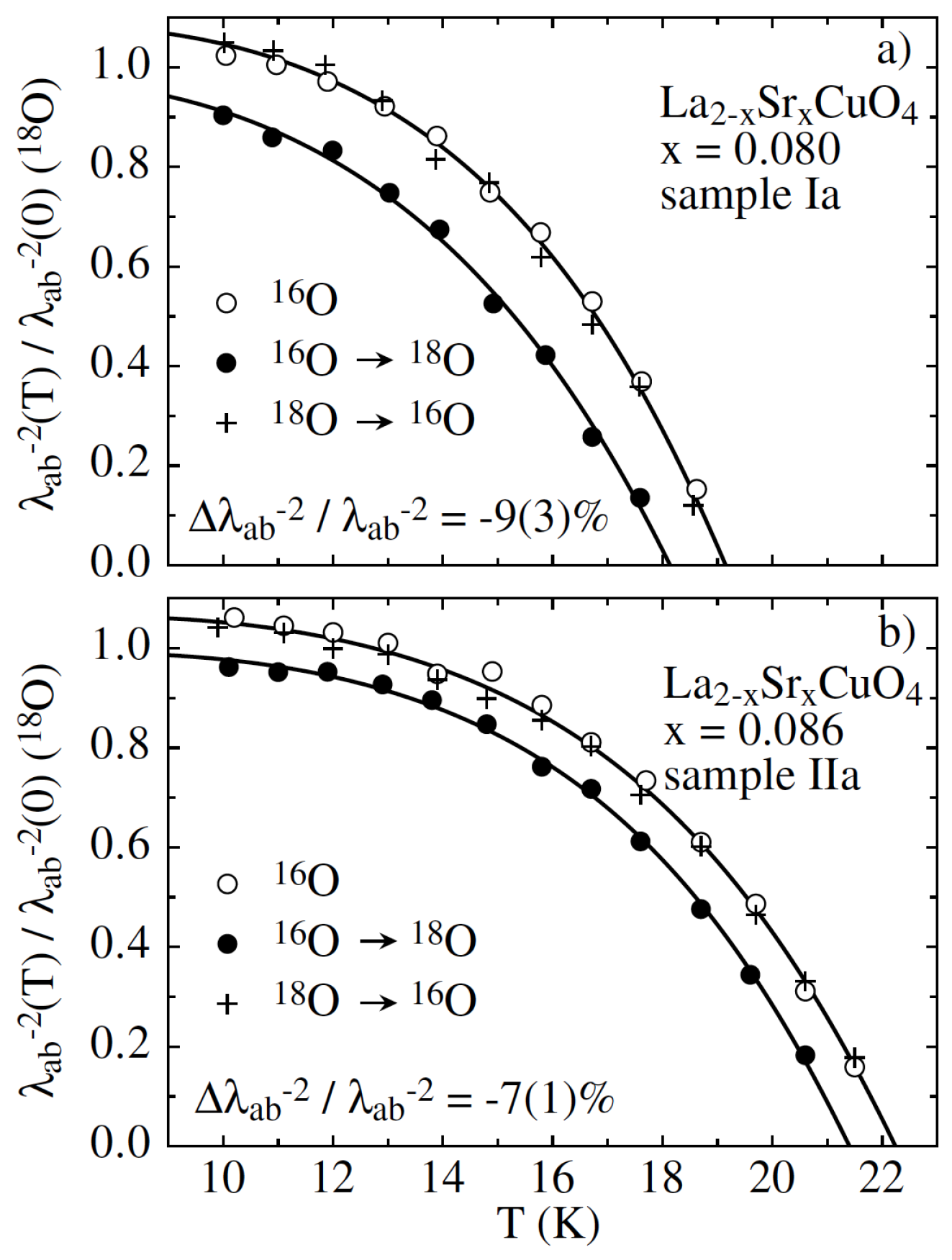
Figure 6.
The SR relaxation rates (superfluid densities) , , and as a function of temperature measured along the three crystallographic directions a, b, and c (from top to bottom) for single-crystal YBa2Cu3O7−δ. In the figures the extracted gap values are given together with their respective weights . For a power law fit was used corresponding to a BCS type temperature dependence (after Ref [40]).
Figure 6.
The SR relaxation rates (superfluid densities) , , and as a function of temperature measured along the three crystallographic directions a, b, and c (from top to bottom) for single-crystal YBa2Cu3O7−δ. In the figures the extracted gap values are given together with their respective weights . For a power law fit was used corresponding to a BCS type temperature dependence (after Ref [40]).
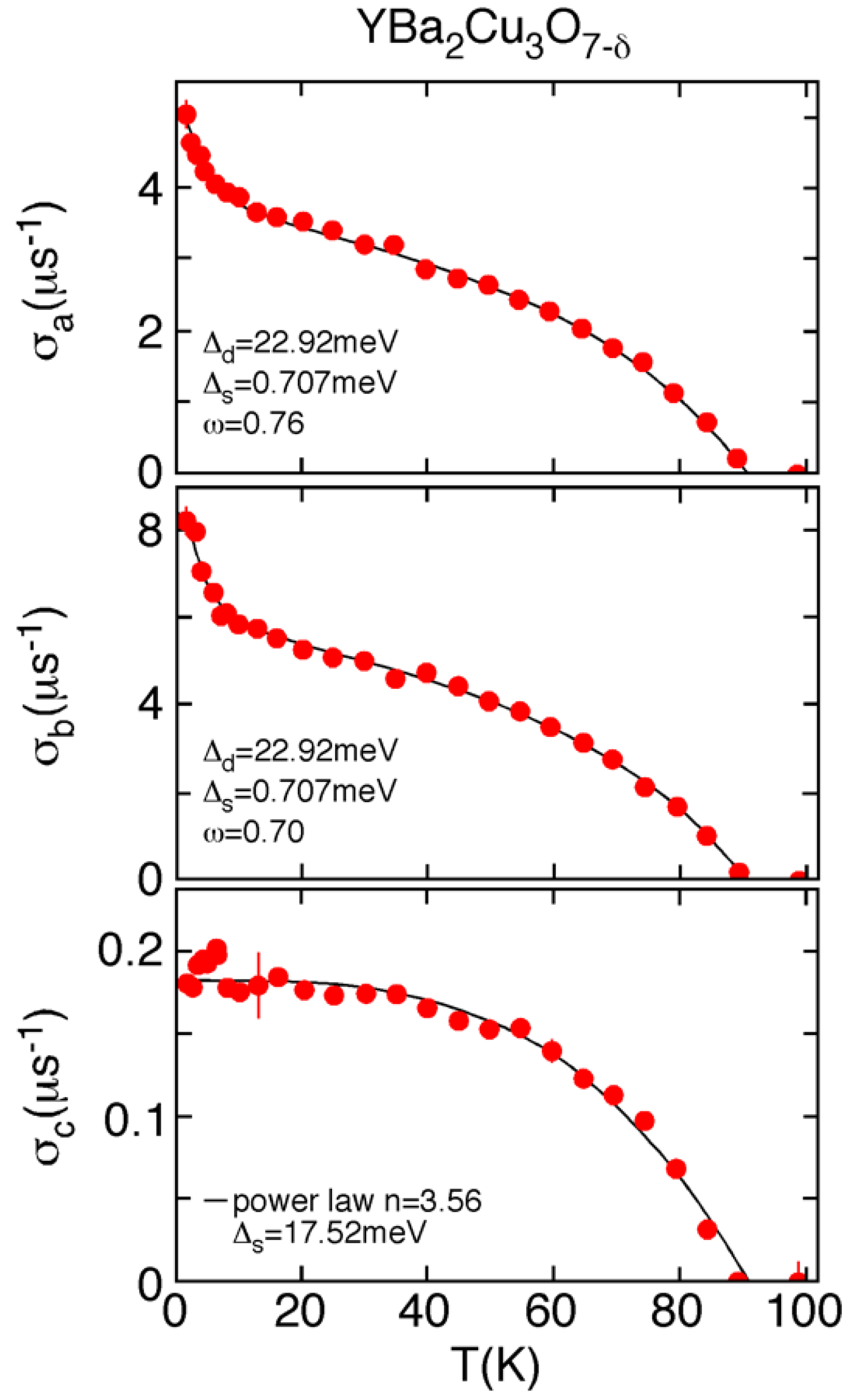
Figure 7.
Dependence of the coupled gaps on the chemical potential for different coupling constants as indicated in the figure (after Ref. [50]).
Figure 7.
Dependence of the coupled gaps on the chemical potential for different coupling constants as indicated in the figure (after Ref. [50]).
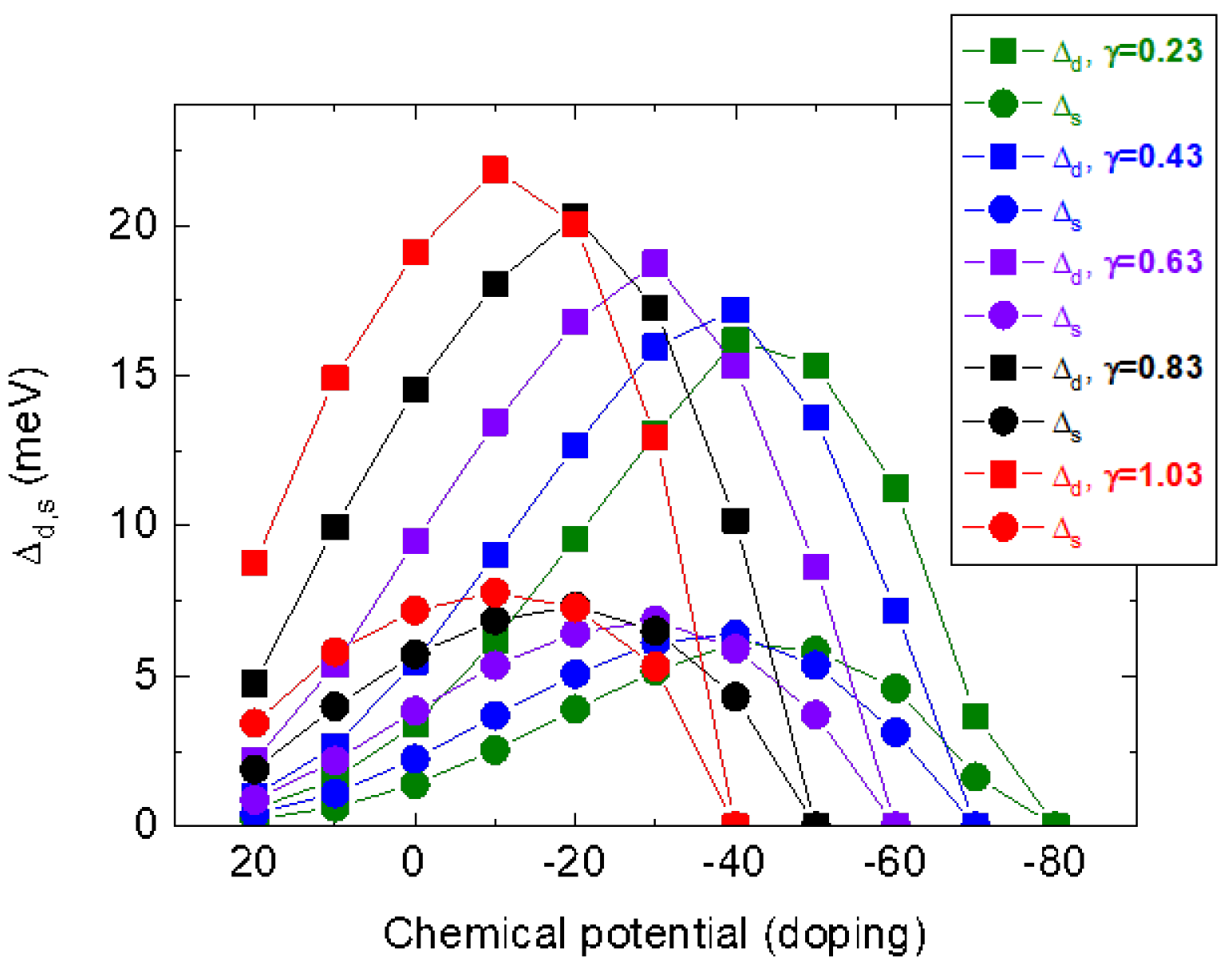
Figure 8.
Dependence of the average gap value as a function of . The red, green, and blue square symbols stem from calculations for different values of as indicated in the figure. The black circles with bars are experimental data points for Y1−xCaxBa2Cu3O7−δ (from Ref. [51]).
Figure 8.
Dependence of the average gap value as a function of . The red, green, and blue square symbols stem from calculations for different values of as indicated in the figure. The black circles with bars are experimental data points for Y1−xCaxBa2Cu3O7−δ (from Ref. [51]).
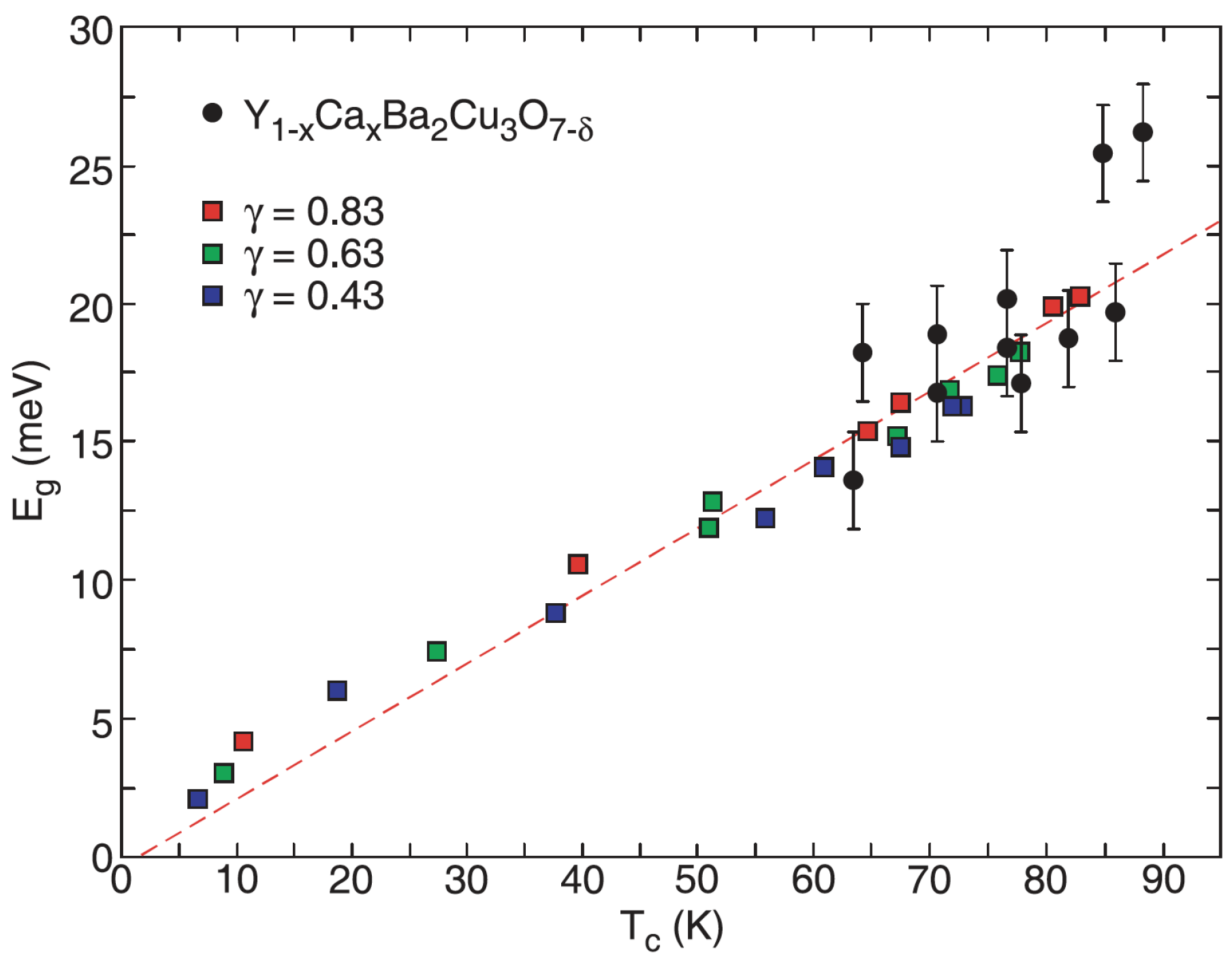
Figure 9.
a) Self-consistently derived coupled gaps and as a function of temperature T for interband coupling . b) as a function of for coupled gaps (blue) and (green) (after Ref. [50]).
Figure 9.
a) Self-consistently derived coupled gaps and as a function of temperature T for interband coupling . b) as a function of for coupled gaps (blue) and (green) (after Ref. [50]).
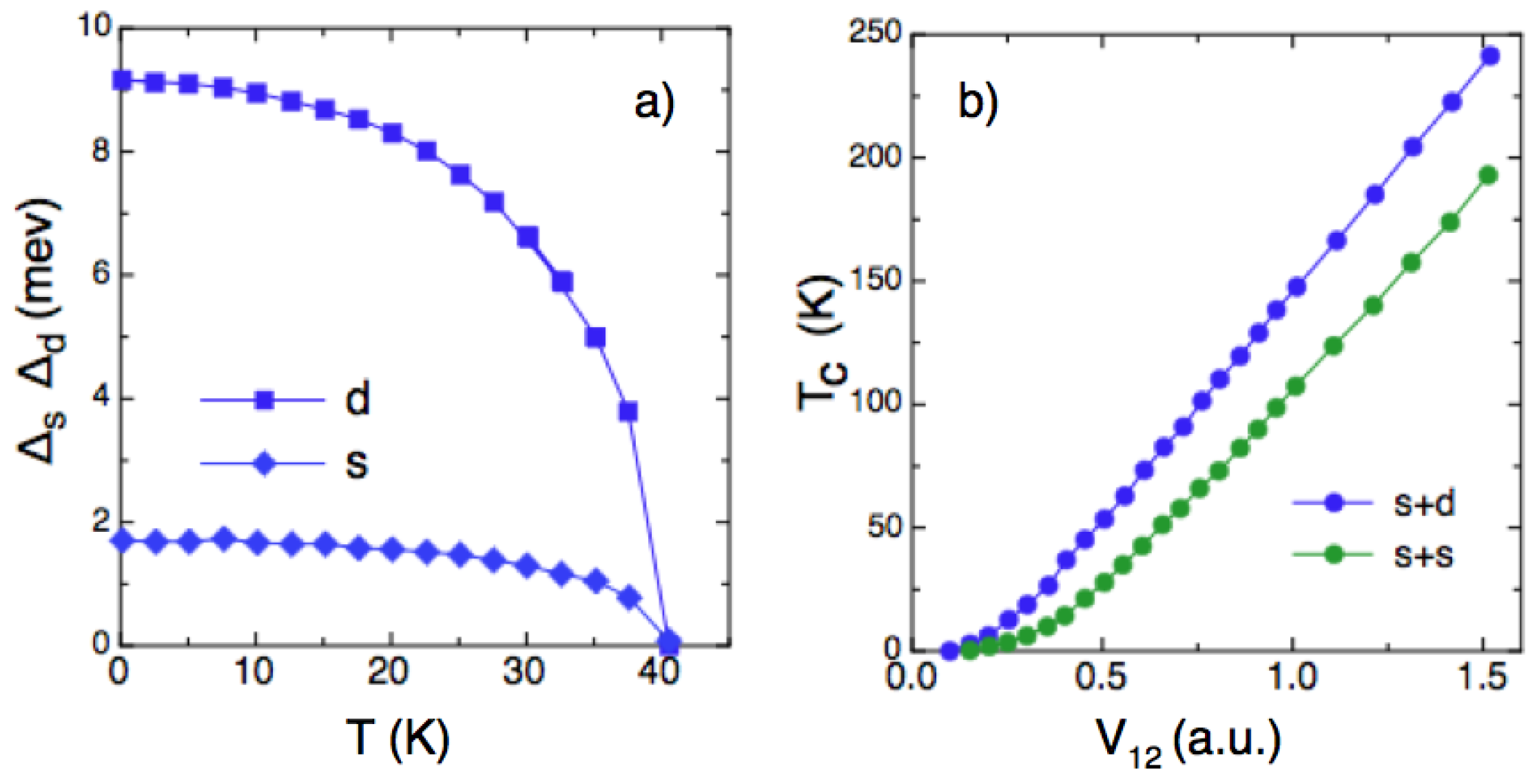
Figure 10.
OIE exponent for various families of cuprate HTS’s as a function of where corresponds to the maximum in a given family of cuprates. The red, blue, and green symbols are measured values for for the given families as indicated in the figure. The dashed black line is a guide to the eye, the dashed violet line and symbols show the calculated isotope effect stemming from the renormalization of , [], where the black dashed line and the black stars refer to the one related to [] (from Ref. [55]).
Figure 10.
OIE exponent for various families of cuprate HTS’s as a function of where corresponds to the maximum in a given family of cuprates. The red, blue, and green symbols are measured values for for the given families as indicated in the figure. The dashed black line is a guide to the eye, the dashed violet line and symbols show the calculated isotope effect stemming from the renormalization of , [], where the black dashed line and the black stars refer to the one related to [] (from Ref. [55]).
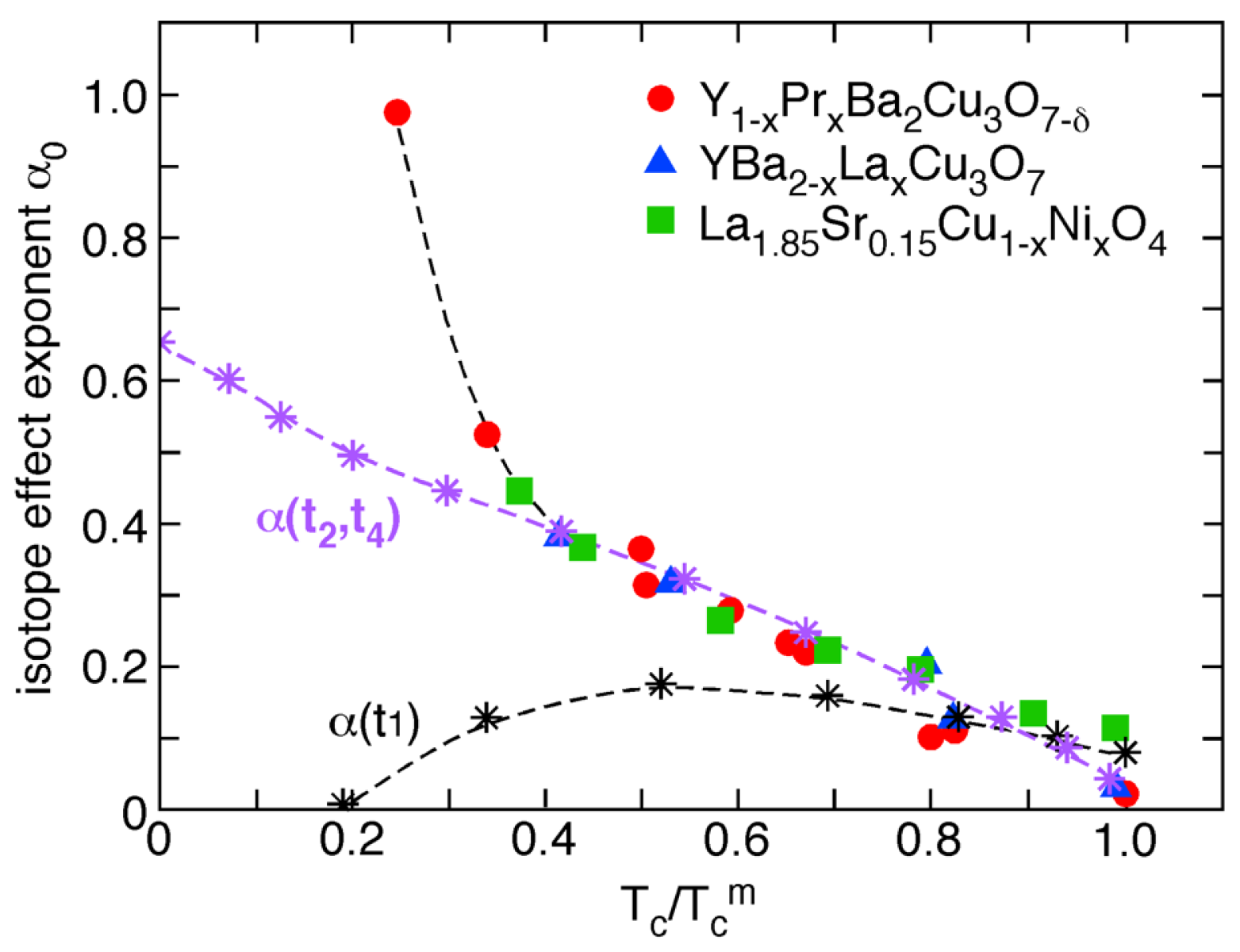
Figure 11.
The copper-oxygen plane where green arrows refer to the Cu ions whereas blue circles stand for the oxygen ion. (left panel) The displacement pattern of the oxygen ions related to the electronic hopping integral . (right panel) The displacement pattern of the oxygen ions related to the electronic hopping integral . The one involving which is relevant to describe the OIE on (see Figure 10) is not shown, since it is out-of-plane (from Ref. [55]).
Figure 11.
The copper-oxygen plane where green arrows refer to the Cu ions whereas blue circles stand for the oxygen ion. (left panel) The displacement pattern of the oxygen ions related to the electronic hopping integral . (right panel) The displacement pattern of the oxygen ions related to the electronic hopping integral . The one involving which is relevant to describe the OIE on (see Figure 10) is not shown, since it is out-of-plane (from Ref. [55]).
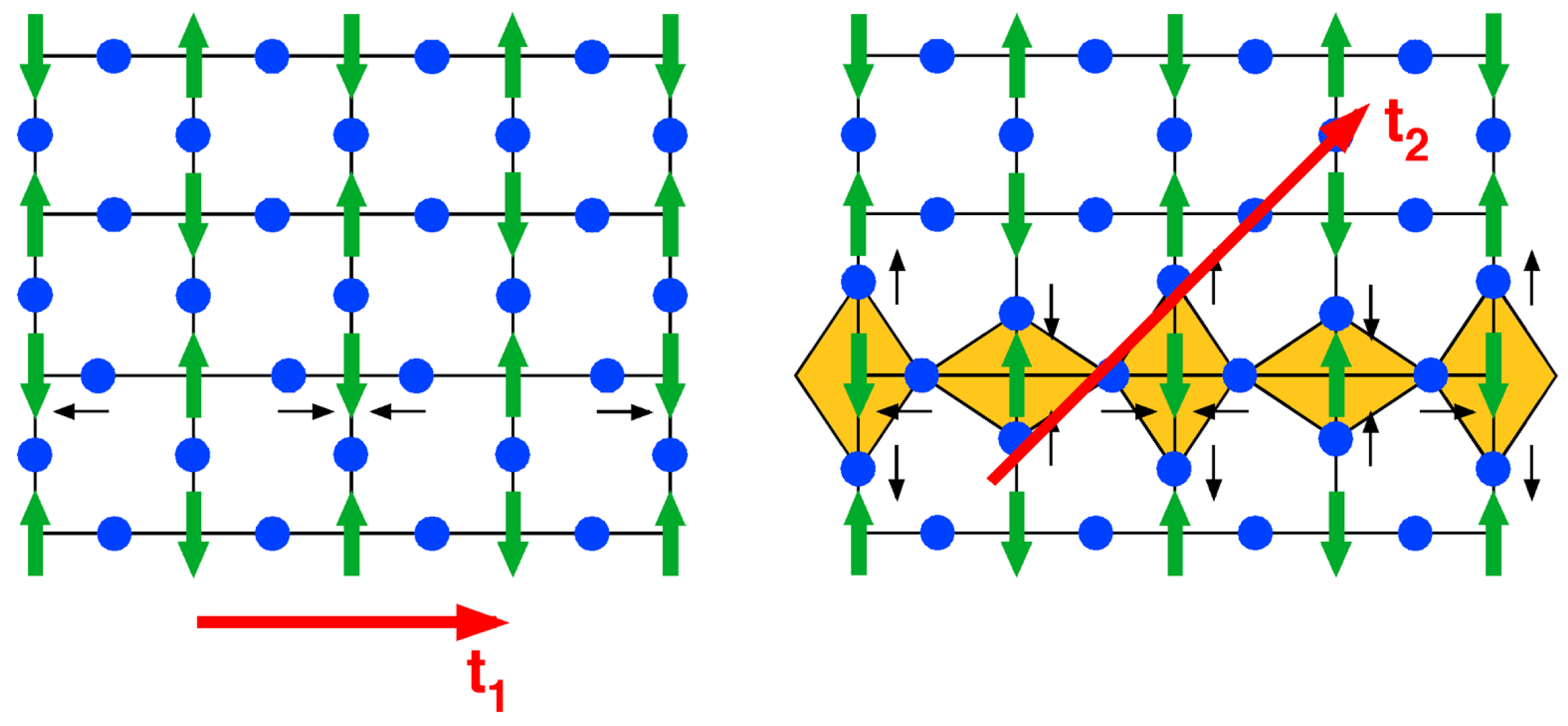
Figure 12.
The calculated temperature dependence of the mean-square displacement (Debye-Waller factor) of the relative Cu-O displacement squared in the presence of the renormalized electronic hopping integrals and (full line and circles). The open circles refer to , the full ones to . The dashed line is the result for the case that polaronic effects are not involved. In the inset experimental EXAFS data for La1.85Sr0.15CuO4 [56] are shown (from Ref. [57]).
Figure 12.
The calculated temperature dependence of the mean-square displacement (Debye-Waller factor) of the relative Cu-O displacement squared in the presence of the renormalized electronic hopping integrals and (full line and circles). The open circles refer to , the full ones to . The dashed line is the result for the case that polaronic effects are not involved. In the inset experimental EXAFS data for La1.85Sr0.15CuO4 [56] are shown (from Ref. [57]).
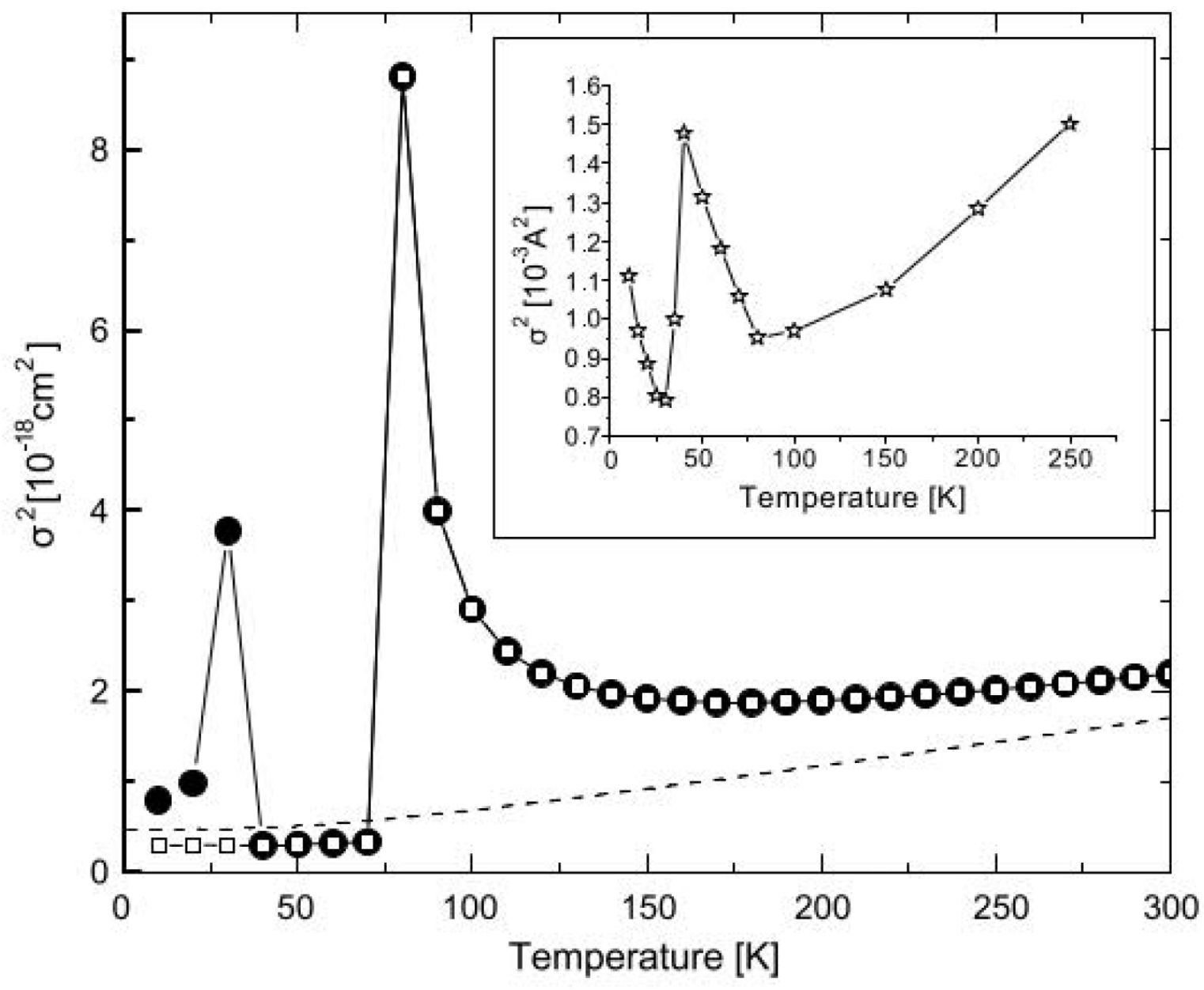
Figure 13.
(a) In-plane antiferromagnet spin component. (b) Out-of-plane ferroelectric component. Both are uncoupled in the underdoped case.
Figure 13.
(a) In-plane antiferromagnet spin component. (b) Out-of-plane ferroelectric component. Both are uncoupled in the underdoped case.
Disclaimer/Publisher’s Note: The statements, opinions and data contained in all publications are solely those of the individual author(s) and contributor(s) and not of MDPI and/or the editor(s). MDPI and/or the editor(s) disclaim responsibility for any injury to people or property resulting from any ideas, methods, instructions or products referred to in the content. |
© 2024 by the authors. Licensee MDPI, Basel, Switzerland. This article is an open access article distributed under the terms and conditions of the Creative Commons Attribution (CC BY) license (http://creativecommons.org/licenses/by/4.0/).
Copyright: This open access article is published under a Creative Commons CC BY 4.0 license, which permit the free download, distribution, and reuse, provided that the author and preprint are cited in any reuse.


