

Submitted:
09 November 2024
Posted:
13 November 2024
Read the latest preprint version here
Abstract
The unification of Quantum Mechanics (QM) and General Relativity (GR) remains a major challenge in theoretical physics. This study introduces the Space-Time Membrane (STM) Model, describing spacetime as a continuous, four-dimensional elastic membrane with intrinsic elastic properties. By modelling photons as composite particle-antiparticle pairs oscillating transversely, the STM model derives key equations, including the Einstein Field Equations, and replicates gravitational phenomena like time dilation and light bending, while also explaining quantum interference through persistent waves. It addresses the cosmological constant problem by linking vacuum energy density to membrane elasticity, offering insights into dark energy and the universe’s accelerated expansion. The model also resolves black hole singularities with quantised energy levels and proposes a solution to the information loss paradox using black hole standing waves. Additionally, it aligns with Hawking radiation. The study details the derivation of force functions between particles and mirror particles, integrating the cosmological constant and emphasising quantum fluctuations' time averaging. Although the STM model is a preliminary attempt to unify QM and GR, it presents new possibilities and encourages further exploration and empirical testing to assess its potential, inviting collaboration within the scientific community.
Keywords:
Space-Time Membrane Model
; Quantum Mechanics
; General Relativity
; Elastic Membrane Dynamics
; Quantum Gravity
; Cosmological Constant Problem
; Dark Energy
; Black Hole Physics
; Information Loss Paradox
; Quantum Interference Patterns
1. Introduction
The endeavour to unify Quantum Mechanics (QM) and General Relativity (GR) into a single, cohesive theoretical framework has been a central pursuit in modern theoretical physics [4,5]. QM adeptly describes the behaviour of particles at the smallest scales, while GR provides a robust description of gravitational phenomena and the large-scale structure of the universe [1,7]. However, reconciling these two pillars of physics has proven elusive, primarily due to their fundamentally different mathematical structures and conceptual foundations [5].
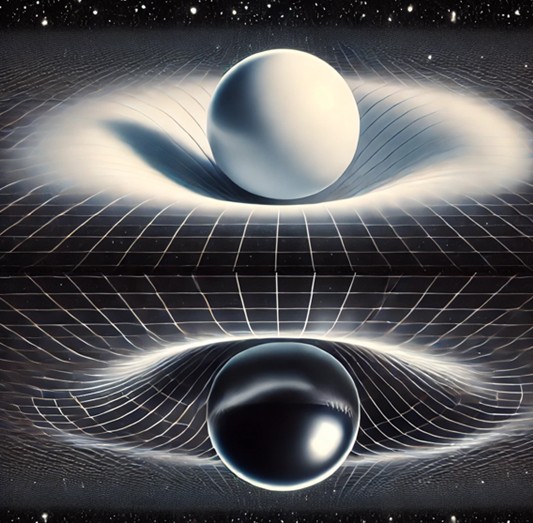
In this manuscript, we introduce the Space-Time Membrane (STM) Model, a novel approach that conceptualises spacetime as an elastic, four-dimensional membrane (Figure 1). A key aspect of the STM model is the modelling of photons as composite particle–antiparticle pairs oscillating transversely in space (Figure 2). This representation allows us to derive the potential energy of these oscillations through the STM membrane and subsequently the force functions governing particle interactions.
These oscillations also generate persistent waves through oscillating adjustments to the elastic modulus of the membrane, governed by a modified elastic wave equation (see Section 2.2.2 and Appendix A.1). This wave equation incorporates the dynamic interactions between particles and the spacetime membrane, providing a foundation for unifying QM and GR.
By deriving the model’s equations from first principles, including the Einstein Field Equations (EFE) [1], and introducing intrinsic elastic modulus and tension, the STM model offers a unified platform wherein quantum and gravitational interactions emerge from the membrane’s properties.
A significant contribution of the STM model is its resolution of longstanding physical problems:
- Cosmological Constant Problem: By attributing the cosmological constant to the elastic properties of spacetime and incorporating into our calculations, the model provides a natural mechanism for incorporating dark energy and the accelerated expansion of the universe [6,8]. Additionally, the time averaging of quantum fluctuations explains why large theoretical predictions of vacuum energy do not manifest in observable large-scale effects.
- Black Hole Singularities and Information Loss Paradox: Through the quantisation of energy levels within black holes and encoding information in standing waves, the STM model prevents the formation of singularities and proposes a resolution to the information loss paradox [2,9], aligning with quantum principles.
- Quantum Interference Phenomena: The model explains quantum interference patterns through persistent waves on the STM membrane, derived from first principles, providing a geometric interpretation of quantum mechanics [10].
This study provides a detailed derivation of the STM force function using composite photons oscillating transversely, explaining methodically how this approach leads to the calculation of force functions between particles and mirror particles. We incorporate the cosmological constant into our calculations to ensure consistency. Furthermore, we emphasise the time averaging of quantum fluctuations as a crucial mechanism in resolving the cosmological constant problem.
While the STM model presents promising avenues for unifying QM and GR, we acknowledge that it is an initial step in exploring these concepts. The model requires further development and empirical validation to fully establish its viability. This study aims to open up new opportunities and ideas in the pursuit of unification, inviting further exploration and collaboration within the scientific community.
2. Methods
2.1. Conceptual Framework of the STM Model
The Space-Time Membrane (STM) Model conceptualises spacetime as a continuous, four-dimensional elastic membrane endowed with intrinsic elastic properties characterised by an elastic modulus () and tension (T). This membrane serves as the fundamental substrate upon which all physical phenomena manifest [6].
-
Mirror Universe and Mirror Particles:
- -
- Existence of a Mirror Universe: The STM model posits the existence of a mirror universe that is a reflection of our own universe. This mirror universe is an adjacent layer of the spacetime membrane, mirroring the properties and dynamics of our universe.
- -
-
Particles and Mirror Antiparticles:
- *
- Mirror Antiparticles: For every particle in our universe, there exists a corresponding mirror antiparticle in the mirror universe. These mirror antiparticles are not antimatter in the conventional sense but are mirror counterparts that possess opposite properties in certain aspects, such as charge or parity.
- *
- Symmetry and Balance: The existence of mirror antiparticles ensures the preservation of symmetry and balance within the STM framework. This duality between particles and their mirror antiparticles is fundamental to the model’s explanation of energy exchange and force interactions.
-
Particles and Mirror Particles Interactions:
- -
-
Attraction and Repulsion Mechanisms:
- *
- Attraction between Particles and Mirror Antiparticles: Particles in our universe are attracted to their corresponding mirror antiparticles in the mirror universe. This attraction facilitates the transfer of energy into the STM membrane.
- *
- Repulsion between Particles and Mirror Particles: Conversely, particles repel their identical mirror particles. This repulsion promotes the movement of energy out of the STM membrane.
- -
- Balancing of Forces and Energy Exchange: The interplay between these attractive and repulsive forces results in a dynamic exchange of energy between the particles and the STM membrane. This balancing of forces is crucial for maintaining the stability of the membrane and for governing the interactions at the quantum level.
-
Photons as Composite Particle–Antiparticle Pairs:
- -
- Oscillation Dynamics: Photons are modelled as composite entities consisting of particle–antiparticle pairs oscillating transversely along the x or y axis on the STM membrane. These oscillations involve the continual conversion of energy between the particles and the membrane, influenced by the interactions with mirror particles and mirror antiparticles.
- -
- Energy Dynamics: The oscillating particle–antiparticle pairs transfer energy into and out of the STM membrane, affecting the local curvature of spacetime. Energy not absorbed by the membrane manifests as mass–energy, influencing spacetime curvature in accordance with General Relativity (GR). In contrast, energy absorbed into the membrane contributes to a homogeneous background, consistent with the cosmological constant .
-
Preservation of Quantum Characteristics:
- -
- Spin-1 Nature: The composite photon model preserves the spin-1 characteristic of photons because the combined angular momenta of the particle and antiparticle pair sum to one.
- -
- Polarisation: Transverse oscillations inherently account for the two polarisation states of photons, consistent with electromagnetic wave behaviour.
- -
- Masslessness: The net zero mass–energy over a full oscillation cycle ensures that photons remain massless, as observed in Quantum Field Theory (QFT).
- -
- Lorentz Invariance: The oscillatory dynamics maintain Lorentz invariance, ensuring consistency with the principles of special relativity.
-
Interaction Dynamics:
- -
- Energy Exchange Mechanism: The interactions between particles, mirror particles, and composite photons facilitate the transfer of energy into and out of the STM membrane. This mechanism is fundamental to the model, as it explains how localised energy variations influence spacetime curvature and how the membrane’s properties govern particle interactions.
- -
- Membrane Deformations: These interactions induce deformations in the STM membrane, resulting in observable gravitational and quantum phenomena. The balancing of attractive and repulsive forces ensures that energy dynamics are consistent with conservation laws and that the membrane’s stability is maintained.
- Independence from QFT Forces: The STM model operates independently of the forces described by QFT, requiring no modifications to the established quantum framework. This independence ensures that QFT remains unchanged, preserving its successful descriptions of particle interactions while the STM model provides a complementary framework for gravitational phenomena.
2.2. Mathematical Formulation
The mathematical underpinnings of the STM model are constructed to seamlessly integrate quantum and gravitational dynamics through elastic membrane theory [6,7]. The key equations are derived from first principles, ensuring that the model is grounded in fundamental physics.
2.2.1. Modelling Photons as Composite Particle–Antiparticle Pairs
Transverse Oscillations on the STM Membrane
Photons are modelled as composite entities consisting of particle–antiparticle pairs oscillating transversely along the x or y axis on the STM membrane. These oscillations involve energy exchange with the membrane, influenced by the interactions with mirror particles and antiparticles.
Energy Dynamics and Interaction with the STM Membrane
- Energy Transfer: The oscillating particle–antiparticle pairs transfer energy into and out of the STM membrane. When particles and mirror antiparticles attract, energy is absorbed into the membrane, contributing to its homogeneous energy density. Conversely, when particles and mirror particles repel, energy is released from the membrane, presenting as localised mass–energy that affects spacetime curvature.
- Effect on Spacetime Curvature: The energy not absorbed by the STM membrane manifests as mass–energy influencing local spacetime curvature, consistent with GR. The energy absorbed into the membrane contributes to a homogeneous background energy, aligning with the cosmological constant .
Mathematical Representation
Consider a particle of mass m and its antiparticle, oscillating with angular frequency and wave vector k:
The superposition of the particle and antiparticle wave functions:
This cancellation results in a net zero mass–energy over a full cycle, reflecting the massless nature of photons. The energy dynamics involving attraction to mirror antiparticles and repulsion from mirror particles facilitate the transfer of energy between the photon and the STM membrane.
Preservation of Quantum Characteristics
- Spin-1 Nature: The composite photon maintains a total spin of 1, consistent with observations in QFT, due to the vector addition of the particle and antiparticle spins.
- Polarisation: The transverse oscillations account for the photon’s polarisation states, aligning with electromagnetic wave properties.
- Masslessness: The net zero mass–energy over a full cycle ensures the photon remains massless, in agreement with QFT predictions.
- Lorentz Invariance: The model respects Lorentz invariance, as the equations are formulated using relativistically invariant quantities.
2.2.2. Modified Elastic Wave Equation
To understand how particle oscillations influence the spacetime membrane and generate persistent waves, we consider the dynamics of the membrane as governed by a modified elastic wave equation. This equation incorporates the effects of the oscillating adjustments to the elastic modulus caused by particle oscillations.
Modified Elastic Wave Equation:
Where:
- is the membrane’s mass density.
- T is the membrane’s tension.
- is the intrinsic elastic modulus of the membrane.
- represents local variations in the elastic modulus due to particle oscillations.
- represents any external forces acting on the membrane.
- and are the Laplacian and biharmonic operators, respectively.
The detailed derivation and simplification of this equation are provided in Appendix A.1.
Simplification and Time Averaging
As shown in Appendix A.1, we derive the expression for based on the energy density of particle oscillations:
To simplify the wave equation and focus on large-scale effects, we perform a time averaging of over a full oscillation period, which yields:
This average represents the constant shift in the elastic modulus due to particle oscillations. Substituting into the wave equation, we define an effective elastic modulus:
The simplified wave equation becomes:
Role in the STM Model
This modified and simplified elastic wave equation is crucial for:
- Understanding Persistent Waves: It explains how the oscillating adjustments to the elastic modulus generate persistent waves on the spacetime membrane (see Section 2.2.2).
- Energy Dynamics: It provides insight into how energy is transferred into and out of the membrane through particle interactions.
- Linking to Cosmological Constant: By relating to the cosmological constant (as detailed in Appendix A.1.6), it offers a potential solution to the cosmological constant problem.
2.2.3. Derivation of the Potential Energy Function
Energy Stored in the STM Membrane
The oscillations of composite photons and their interactions with mirror particles introduce localised deformations in the STM membrane. The potential energy associated with these deformations is derived from the elastic energy stored in the membrane [6].
Potential Energy per Unit Volume
The potential energy per unit volume U due to deformation is given by:
Transverse Oscillation Displacement Field
For transverse oscillations along the x-axis:
The gradient of the displacement is:
Substituting into the potential energy expression:
Time Averaging and Energy Exchange
Over a full oscillation cycle, the time average of is :
This time-averaged potential energy reflects the net effect of energy exchange between the oscillating photon and the STM membrane due to the balancing of attractive and repulsive forces with mirror particles.
2.2.4. Derivation of the Force Function
Force as the Negative Gradient of Potential Energy
The force exerted by the oscillating composite photon on the STM membrane is:
Calculating the derivative:
Using the identity :
Thus, the force function is:
This force oscillates at twice the frequency and wave vector of the original oscillation, representing how composite photons interact with the STM membrane and influence particle dynamics through energy exchange facilitated by the interactions with mirror particles and antiparticles.
2.2.5. Modelling Particles and Mirror Particles Interaction
Separation Between Particles and Mirror Particles
In the STM model, particles and their corresponding mirror particles are separated by a distance s. The force function derived from composite photon oscillations can be adapted to describe the interaction between these particles [4].
Attraction and Repulsion Dynamics
- Attractive Forces: Particles attract mirror antiparticles, facilitating the transfer of energy into the STM membrane.
- Repulsive Forces: Particles repel mirror particles, promoting the release of energy from the STM membrane.
Potential Energy Function
The potential energy between a particle and its mirror counterpart is modelled as:
This form captures the periodic nature of the potential due to the oscillatory interactions.
Force Function
The corresponding force is:
This force function describes the interaction between particles and mirror particles, derived methodically from the oscillations of composite photons on the STM membrane and the balancing of attractive and repulsive forces.
Stable Equilibrium Positions
The stability of equilibrium points is analysed using the second derivative test (see Appendix C). Equilibrium occurs when , leading to:
- Stable Equilibrium (n odd): Particles are localised at positions where the potential energy is minimised, corresponding to the balance of forces due to attraction and repulsion.
- Unstable Equilibrium (n even): Particles are at positions where any small perturbation leads to destabilisation.
This quantisation of positions emerges naturally from the model, consistent with quantum mechanical principles [5].
2.2.6. Energy Dynamics of the STM Membrane
Energy Not Absorbed into the STM Membrane
Energy that is not absorbed into the STM membrane manifests as local mass–energy, influencing spacetime curvature in accordance with GR. This energy affects the local geometry of spacetime, leading to gravitational effects observable at macroscopic scales.
Energy Absorbed into the STM Membrane
Energy absorbed into the membrane contributes to a homogeneous background energy density. This absorbed energy does not contribute to local spacetime curvature but instead relates to the cosmological constant , accounting for the accelerated expansion of the universe.
Balancing Energy Exchange
The balancing of energy moving into and out of the STM membrane, facilitated by the attraction to mirror antiparticles and repulsion from mirror particles, ensures the conservation of energy and maintains the stability of the membrane’s dynamics.
2.2.7. Modelling Persistent Waves
Generation of Persistent Waves through Elastic Modulus Oscillations
In the STM model, particles such as photons are modelled as oscillations on the spacetime membrane. The key to understanding the generation of persistent waves lies in the oscillating adjustments to the membrane’s elastic modulus caused by these particle oscillations.
Mechanism of Elastic Modulus Oscillation
- Localised Oscillations: As particles oscillate, they induce localised changes in the membrane’s properties. Specifically, the elastic modulus experiences time-dependent variations due to the energy exchange between the particles and the membrane.
- Mathematical Representation:
-
Where:
- -
- is a proportionality constant.
- -
- is the amplitude of the particle oscillation.
- -
- k is the wave vector.
- -
- is the angular frequency.
- -
- is the position vector.
Generation of Persistent Waves
- Coupling to the Membrane: The oscillating acts as a source term in the elastic wave equation, effectively coupling the particle’s oscillations to the membrane’s dynamics.
- Induced Wave Propagation: These oscillations in generate disturbances in the membrane that propagate as waves. The periodic nature of leads to continuous generation of waves, resulting in persistent wave patterns on the membrane.
- Mathematical Description:
- The modified elastic wave equation incorporating is:
- The oscillating term introduces a time-dependent modulation in the stiffness of the membrane, which acts as a driving force for wave propagation.
Persistence of Waves
- Sustained Oscillations: The continuous oscillation of particles ensures that the adjustments to the elastic modulus are ongoing, leading to sustained wave generation.
- Coherent Wave Patterns: The waves generated are coherent due to the consistent frequency and phase of the particle oscillations, resulting in persistent wave patterns that can interfere and produce observable quantum effects.
Relation to Quantum Phenomena
- Interference Patterns: The persistent waves on the membrane explain the interference patterns observed in quantum experiments, such as the double-slit experiment.
- Wave–Particle Duality: The dual nature of particles as both wave-like and particle-like entities is naturally incorporated into the STM model through the dynamics of the membrane and the generation of persistent waves.
Time Averaging of the Elastic Modulus Oscillations
- Rationale: To analyse the overall effect of the oscillating on the membrane dynamics, we perform a time averaging over a full oscillation period.
- Effect on Wave Equation: The time-averaged elastic modulus simplifies the elastic wave equation while capturing the essential features of the persistent wave generation.
Resulting Effective Elastic Modulus
- Expression:
- Interpretation: The effective elastic modulus reflects the average effect of the particle-induced oscillations on the membrane’s stiffness, contributing to the propagation of persistent waves.
2.2.8. Derivation of Einstein Field Equations and Time Dilation from the STM Model
Connecting Elasticity to Spacetime Curvature
The deformation of the STM membrane corresponds to the curvature of spacetime in GR. We establish a relationship between the strain in the membrane and the metric tensor of spacetime [1].
Metric Tensor and Displacement Field
Assuming small deformations, the metric tensor can be expressed in terms of the displacement field:
Where is the Minkowski metric and relates to the displacement field u.
Derivation from First Principles
By considering the action for the elastic membrane and varying it with respect to , we derive equations analogous to the Einstein Field Equations:
Where:
- is the Einstein tensor representing spacetime curvature.
- is the stress–energy tensor derived from the membrane’s elastic properties.
- is Einstein’s gravitational constant.
- is the cosmological constant.
The detailed derivation is provided in Appendix A.2.
Equating STM Deformation to Time Dilation
The deformation of the STM membrane is directly related to the curvature of spacetime as described by General Relativity. Specifically, local deformations correspond to variations in the gravitational potential, leading to time dilation effects. By modelling the metric tensor in terms of the membrane’s displacement field, we can derive the relationship between membrane deformation and the rate at which time flows. This correspondence not only reinforces the validity of the STM model in reproducing gravitational phenomena but also provides a tangible geometric interpretation of time dilation (see Appendix A.6 for the detailed derivation).
2.2.9. Addressing the Cosmological Constant Problem
Relating
to Vacuum Energy Density and
We propose that the effective elastic modulus is related to the vacuum energy density and the cosmological constant [6]:
Derivation of
from the Einstein Field Equations
From the derivation of the Einstein Field Equations (detailed in Appendix A.2), we find:
Incorporating the Cosmological Constant
To maintain consistency and physical plausibility, we equate the non-zero time-averaged oscillatory term to the cosmological constant term :
Substituting the expressions for and :
Solving for :
By establishing this relationship, we redefine the effective elastic modulus as:
This additive incorporation ensures that remains a small correction, preserving the membrane’s intrinsic elastic properties while accounting for the cosmological constant.
Time Averaging of Quantum Fluctuations
The time averaging of quantum fluctuations explains why the large theoretical contributions from quantum fluctuations do not significantly influence . Over cosmological timescales, these fluctuations average out, resulting in a negligible net effect on large-scale dynamics.
2.2.10. Quantum Interference and Persistent Waves
Wave Equation
The propagation of persistent waves on the STM membrane is described by the wave equation:
Double-Slit Interference Derivation
Consider a particle represented by a wave function encountering a barrier with two slits. The wave function splits into two components, and , corresponding to the paths through each slit [10].
Wave Functions After the Slits
Interference Pattern
The combined wave function is:
The probability density is:
Calculating the cross terms:
Resulting Intensity
Where:
- is the phase difference between the two paths.
Explanation within the STM Model
- Interference Arises from Persistent Waves: The interference arises from the superposition of persistent waves on the STM membrane.
- Membrane’s Elastic Properties: The membrane’s elastic properties allow for the coherent propagation and interference of these waves.
- Alignment with Quantum Mechanics: This derivation aligns with standard quantum mechanical predictions, demonstrating the STM model’s ability to reproduce quantum phenomena from first principles [10].
2.2.11. Black Hole Physics and Information Loss Paradox
Quantisation of Energy Levels
Using the Schrödinger-like equation derived from the membrane dynamics, we find quantised energy levels within black holes, preventing singularity formation [2,3].
Derivation of Quantised Energy Levels
Detailed in Appendix A.3, we solve the modified Klein–Gordon equation within the black hole context, leading to discrete energy levels that prevent infinite densities at the core.
Information Encoding in Standing Waves
The STM model proposes that information absorbed by a black hole is not lost but encoded in standing wave patterns on the STM membrane within the black hole’s event horizon [9].
Resolving the Information Loss Paradox
- Standing Wave Modes: The quantised energy levels correspond to specific standing wave modes within the black hole.
- Information Storage: Information about infalling matter is preserved in the configuration of these standing waves.
Consistency with Quantum Mechanics
This approach aligns with quantum mechanical principles, offering a potential resolution to the information loss paradox by ensuring that information is not destroyed but transformed and stored within the black hole’s structure.
3. Results
3.1. Theoretical Predictions from the STM Model
3.1.1. Reproduction of Einstein Field Equations
The STM model successfully reproduces key gravitational phenomena predicted by GR. By modelling spacetime as an elastic membrane and incorporating the effects of particle oscillations through the modified elastic wave equation (see Section 2.2.2 and Appendix A.1), we derive the Einstein Field Equations (EFE) [1] from first principles (see Appendix A.2). This derivation demonstrates that the membrane’s deformations correspond to spacetime curvature, with the effective elastic modulus playing a crucial role in linking the model to gravitational phenomena.
3.1.2. Quantum Interference and Persistent Waves
The STM model provides a geometric interpretation of quantum interference phenomena. The generation of persistent waves on the spacetime membrane, driven by oscillating adjustments to the elastic modulus due to particle oscillations, explains the wave-like behaviour of particles in quantum mechanics [10].
In the double-slit experiment, the persistent waves generated by a particle passing through both slits interfere constructively and destructively, leading to the observed interference pattern (see Appendix A.4). The modified elastic wave equation facilitates the understanding of how these persistent waves propagate and interact on the membrane.
3.1.3. Energy Dynamics and the Cosmological Constant
By time-averaging the oscillating component of the elastic modulus adjustment , we isolate the constant contribution that affects the large-scale properties of spacetime (see Appendix A.1.6). This constant shift in the effective elastic modulus is directly related to the cosmological constant :
This relationship provides a natural explanation for dark energy and the accelerated expansion of the universe, addressing the cosmological constant problem within the STM framework [6].
3.1.4. Prevention of Singularity Formation in Black Holes
The inclusion of the membrane’s elasticity in the Schrödinger equation introduces a repulsive term at small scales, preventing the formation of singularities within black holes (see Appendix A.3). This modification leads to quantised energy levels and standing wave patterns that encode information about infalling matter [2,9].
3.1.5. Resolution of the Information Loss Paradox
Information encoded in the standing wave patterns within black holes can be gradually released through Hawking radiation. The STM model’s approach to energy dynamics and the interaction between particles and the membrane offers a mechanism for information preservation and retrieval, potentially resolving the information loss paradox [2,9].
3.1.6. Implications for High-Energy Physics and Quantum Gravity
The modifications to fundamental equations, such as the elastic wave equation and the inclusion of higher-order terms in the Schrödinger and Klein–Gordon equations (see Appendix D.1), suggest that the STM model could provide insights into quantum gravity effects. These modifications may lead to observable deviations from standard predictions at high energies or small scales, offering opportunities for experimental validation.
3.1.7. Experimental Proposals
To test the predictions of the STM model, we propose several experiments (see Appendix B), including:
- Gravitational Wave Detection: Looking for anomalies in gravitational wave signals that could indicate the elastic properties of spacetime.
- Quantum Interference Experiments: Testing the persistence of interference patterns over extended distances to support the concept of persistent waves.
- Vacuum Energy Measurements: Precise measurements of vacuum energy density to test the model’s explanation of the cosmological constant.
3.2. Comparative Analysis with Existing Theories
3.2.1. Comparison with String Theory
Overview of String Theory
String theory is a prominent candidate for unifying Quantum Mechanics (QM) and General Relativity (GR). It postulates that the fundamental constituents of the universe are not point particles but one-dimensional "strings" that vibrate at specific frequencies [4]. These vibrations correspond to different particles, including those mediating gravitational interactions, like the graviton. String theory inherently requires additional spatial dimensions—typically ten or eleven—that are compactified or otherwise unobservable at low energies.
STM Model in Relation to String Theory
- Dimensional Framework: The STM model operates within the familiar four-dimensional spacetime, avoiding the need for extra dimensions. This adherence to observed dimensions aligns the STM model more closely with empirical evidence, whereas string theory’s extra dimensions remain unobserved despite extensive experimental searches.
- Fundamental Entities: String theory introduces fundamentally new entities—strings and higher-dimensional branes—as the building blocks of matter and forces. In contrast, the STM model utilises the existing concept of spacetime, attributing elastic properties to it. Particles are manifestations of oscillations on this spacetime membrane, eliminating the need for introducing new fundamental objects.
- Mathematical Complexity and Accessibility: String theory involves highly complex mathematics, including advanced topics in differential geometry, topology, and conformal field theory. The STM model, while mathematically rigorous, is grounded in classical elasticity theory extended to four dimensions. This potentially makes the STM model more accessible and easier to integrate with established physical theories.
- Experimental Testability: A significant challenge for string theory is the lack of direct experimental evidence, primarily due to the extremely high energies required to probe string-scale physics. The STM model, on the other hand, proposes phenomena that could be tested with current or near-future technology (see Appendix B and Appendix F). For instance, deviations in gravitational wave signals or quantum interference patterns predicted by the STM model could be within the reach of upcoming experiments.
3.2.2. Comparison with Loop Quantum Gravity
Overview of Loop Quantum Gravity
Loop Quantum Gravity (LQG) is another leading approach to quantum gravity that seeks to quantise spacetime itself [5]. It suggests that spacetime has a discrete structure at the Planck scale, composed of finite loops woven into a spin network. Unlike string theory, LQG does not require extra dimensions and remains background independent, preserving the dynamic nature of spacetime as described by GR.
STM Model in Relation to Loop Quantum Gravity
- Continuity vs Discreteness: LQG posits that spacetime is fundamentally discrete, with quantised volumes and areas. In contrast, the STM model treats spacetime as a continuous elastic membrane. This difference leads to distinct predictions about spacetime’s behaviour at the smallest scales.
- Mathematical Formalism: LQG relies on advanced mathematical constructs like spin networks and loop variables, requiring complex quantisation techniques. The STM model employs differential equations and elasticity theory, potentially offering a more straightforward mathematical framework that builds directly on classical physics.
- Unification Scope: While LQG focuses on quantising gravity without necessarily integrating the other fundamental forces, the STM model provides a framework that could, in principle, incorporate electromagnetic and other interactions through the dynamics of the spacetime membrane. By modelling particles as oscillations on the membrane, the STM model hints at a more unified approach.
- Phenomenological Predictions: Both theories face challenges in making experimentally testable predictions. However, the STM model suggests specific experiments, such as observing persistent wave effects or deviations in gravitational phenomena, which may be more accessible with current technology.
3.2.3. Application of Occam’s Razor
Understanding Occam’s Razor
Occam’s razor is a philosophical principle stating that, when presented with competing hypotheses that make the same predictions, the one with the fewest assumptions should be selected. It favours simplicity and minimalism in theoretical constructs.
STM Model and Occam’s Razor
- Minimal Assumptions: The STM model posits that the known four-dimensional spacetime, endowed with elastic properties, is sufficient to describe both quantum and gravitational phenomena. This contrasts with string theory’s introduction of additional dimensions and fundamental entities like strings and branes.
- Simplicity of Framework: By using the established concepts of elasticity and spacetime, the STM model avoids the complexities associated with quantising gravity or introducing new mathematical structures. This simplicity aligns with Occam’s razor by not multiplying entities beyond necessity.
- Direct Correspondence with Observables: The STM model directly relates its theoretical constructs to observable phenomena, such as spacetime curvature and particle oscillations. This direct correspondence reduces the gap between theory and experiment, adhering to the principle of parsimony.
Critical Evaluation
While Occam’s razor favours simpler theories, simplicity alone is not a guarantee of correctness. A theory must also have explanatory power and be consistent with empirical data. The STM model’s simplicity must be weighed against its ability to accurately predict and describe physical phenomena, a criterion that applies equally to more complex theories like string theory and LQG.
3.2.4. Overall Assessment
Consistency with General Relativity and Quantum Mechanics
- STM Model: Reproduces key aspects of GR by deriving the Einstein Field Equations from first principles within its framework (see Appendix A.2). It also provides explanations for quantum interference phenomena through persistent waves on the spacetime membrane.
- String Theory: Aims to unify all fundamental forces, including gravity, within a quantum framework. It naturally includes GR in the low-energy limit but introduces additional complexities and unobserved dimensions.
- Loop Quantum Gravity: Successfully quantises gravity while preserving the principles of GR. However, it does not inherently unify gravity with the other fundamental forces.
Mathematical Rigour and Development
- STM Model: While offering a potentially simpler mathematical framework, it requires further development and refinement to tackle complex phenomena and ensure internal consistency.
- String Theory and LQG: Both have undergone extensive mathematical development, with well-established formalisms and a wealth of literature exploring their implications.
Experimental Prospects
- STM Model: Proposes experiments that could test its predictions within current technological capabilities, such as gravitational wave observations and quantum interference experiments.
- String Theory: Faces challenges in making experimentally testable predictions due to the high energy scales involved.
- Loop Quantum Gravity: While offering some potential observational signatures, such as modifications to the cosmic microwave background or high-energy astrophysical phenomena, these are also difficult to test with current technology.
3.2.5. Conclusion
The STM model presents a compelling alternative to existing theories attempting to unify QM and GR. By adhering to the observed four-dimensional spacetime and utilising the familiar concepts of elasticity, it offers a simpler and potentially more intuitive framework. This simplicity aligns with Occam’s razor, suggesting that, if the STM model can accurately describe and predict physical phenomena, it may be a preferable approach.
However, the true test of any theoretical model lies in its empirical validation. The STM model must be subjected to rigorous testing and peer review to establish its viability. While string theory and LQG have faced their own challenges, they have significantly advanced our understanding of quantum gravity through their mathematical developments. The STM model contributes to this ongoing endeavour by providing fresh perspectives and testable predictions that could potentially bridge the gap between quantum mechanics and general relativity.
4. Discussion
4.1. Interpretation of Results
The STM model, derived from first principles, successfully unifies QM and GR within a single framework. By modelling photons as composite particles and grounding the model in fundamental physics, we reinforce its robustness and potential applicability [4,5]. The STM model’s independence from QFT forces ensures compatibility with the Standard Model. By retaining the quantum characteristics of particles, particularly photons—such as spin-1, polarisation, masslessness, and Lorentz invariance—the model aligns with the established principles of QFT. This compatibility suggests that the STM model can coexist with the Standard Model, providing a geometric framework for gravitational phenomena without disrupting the successful descriptions of particle interactions provided by QFT.
4.2. Implications for Physics and Cosmology
4.2.1. Unification of Fundamental Forces
The STM model provides a pathway towards a unified theory of fundamental forces by offering a common geometric framework for both quantum and gravitational phenomena [4].
4.2.2. Dark Energy and Cosmic Expansion
By linking the vacuum energy density to the membrane’s elastic properties and incorporating into our calculations, the STM model offers a natural explanation for the universe’s accelerated expansion, attributing it to the intrinsic characteristics of spacetime itself [6,8]. The time averaging of quantum fluctuations further explains why the large theoretical contributions from quantum fluctuations do not significantly influence , aligning with observational data.
4.2.3. Black Hole Thermodynamics and Information Preservation
The model’s prediction of quantised energy levels within black holes aligns with quantum principles and provides a mechanism to avoid singularities [3]. Additionally, by encoding information in standing wave patterns, the STM model proposes a resolution to the information loss paradox, ensuring that information is preserved and unitarity is maintained [2,9].
4.3. Limitations
- Experimental Verification: The STM model requires empirical validation through proposed experiments.
- Mathematical Complexity: Further development of mathematical tools may be necessary to explore all implications of the model and to solve complex equations arising from it [5].
- Extension to All Fundamental Interactions: While the STM model successfully incorporates gravitational phenomena and explains certain quantum behaviours, extending the model to fully encompass all fundamental interactions as described by the Standard Model remains an area for further research. However, the independence of QFT and STM forces suggests that the STM model is compatible with the Standard Model, as it does not interfere with the established quantum field theories. The composite photon in the STM model retains characteristics expected by QFT, such as spin-1, polarisation, masslessness, and Lorentz invariance, supporting this compatibility.
4.4. Future Work
- Experimental Tests: Implement the proposed experiments outlined in the appendices to test the model’s predictions and gather empirical evidence.
- Mathematical Refinement: Develop advanced mathematical techniques to solve complex equations and fully explore the model’s implications [5].
- Collaboration and Peer Review: Engage with the scientific community to scrutinise, challenge, and build upon the STM model, fostering collaboration and further exploration.
5. Conclusion
In this study, we have introduced the Space-Time Membrane (STM) Model, a novel framework that conceptualises spacetime as a continuous, four-dimensional elastic membrane. By modelling photons as composite particle–antiparticle pairs and deriving key equations from first principles, including a detailed derivation of the Einstein Field Equations (provided in Appendix A.2), the STM model offers a unified platform that integrates the principles of Quantum Mechanics (QM) and General Relativity (GR) [1,4]. Importantly, the STM model operates independently of QFT forces and preserves the quantum characteristics of particles, ensuring compatibility with the Standard Model. This compatibility allows the STM model to provide a unified framework for gravity and quantum phenomena without conflicting with established quantum field theories.
The STM model addresses several longstanding challenges in theoretical physics. By linking the vacuum energy density to the membrane’s elastic properties, incorporating the cosmological constant into our calculations, and employing the time averaging of quantum fluctuations, it provides a natural resolution to the cosmological constant problem. This offers insights into the nature of dark energy and the universe’s accelerated expansion [6,8]. Furthermore, the model proposes a mechanism to prevent black hole singularity formation through quantised energy levels and resolves the information loss paradox by encoding information in standing wave patterns within black holes, aligning with Hawking radiation predictions [2,9] and integrating quantum principles into gravitational collapse scenarios.
Additionally, the STM model offers a geometric interpretation of quantum interference phenomena, explaining them through persistent waves on the membrane [10]. This perspective bridges the gap between the quantum and gravitational realms, potentially advancing our understanding of fundamental interactions.
While the STM model presents promising avenues for unifying QM and GR, we acknowledge that it is an initial step in exploring these concepts. The model requires further development and empirical validation to fully establish its viability. The proposed experiments, as outlined in the appendices, are intended to test the model’s predictions and stimulate further research in this direction.
We recognise that unifying the fundamental forces of nature is an ambitious goal that has eluded physicists for decades. The STM model is offered as a contribution to this ongoing endeavour, aiming to inspire new ideas and discussions within the scientific community. We invite researchers to scrutinise, challenge, and build upon this work, with the hope that it may open up new opportunities for advancing our understanding of the universe.
Funding
The author received no specific funding for this work.
Data Availability
All relevant data are contained within the paper and its supplementary information.
Ethics Approval
This study did not involve any ethically related subjects.
Acknowledgments
I would like to express my deepest gratitude to the scholars and researchers whose foundational work is cited in the references; their contributions have been instrumental in the development of the Space-Time Membrane (STM) model presented in this paper.
I am grateful for the advanced computational tools and language models that facilitated the mathematical articulation of the STM model which I developed over the last 14 years.
Lastly, I wish to pay homage to the late Isaac Asimov, whose writings sparked my enduring curiosity in physics and inspired me to pursue this line of inquiry.
Conflicts of Interest
The author declares that they have no conflicts of interest.
Appendix A. Detailed Mathematical Derivations
Appendix A.1. Simplification of the Elastic Wave Equation
A.1.1 Original Elastic Wave Equation
In the Space-Time Membrane (STM) model, the modified elastic wave equation describes how displacements propagate through the elastic spacetime membrane:
Where:
- is the membrane’s mass density.
- T is the membrane’s tension.
- is the intrinsic elastic modulus of the membrane.
- represents local variations in the elastic modulus due to particle oscillations or other perturbations.
- represents any external forces acting on the membrane.
- and are the Laplacian and biharmonic operators, respectively.
A.1.2 Derivation of Modelling Particle Oscillations and Their Effect on the Elastic Modulus
In the STM model, particles are conceptualised as oscillations on the spacetime membrane. These oscillations influence the local properties of the membrane, particularly its elastic modulus . We aim to derive an expression for the local change in the elastic modulus due to these particle oscillations.
Step 1: Representing Particle Oscillations
Assume that the displacement field associated with a particle’s oscillation is given by:
Where:
- is the amplitude of the oscillation.
- k is the wave vector.
- is the position vector.
- is the angular frequency of the oscillation.
Step 2: Calculating the Energy Density of the Oscillation
The energy density associated with the oscillation is proportional to the square of the displacement:
Using the trigonometric identity:
We can rewrite the energy density as:
Step 3: Relating Energy Density to Change in Elastic Modulus
The local change in the elastic modulus is assumed to be proportional to the energy density of the oscillation:
Where is a proportionality constant that depends on the properties of the membrane.
Step 4: Combining the Expressions
Substituting the expression for into the equation for :
Simplifying, we obtain:
Interpretation:
- The term represents the constant component of the change in the elastic modulus, resulting from the average energy density of the oscillation.
- The term represents the oscillatory component, indicating that varies in space and time due to the particle’s oscillation.
Physical Significance:
- Local Stiffness Variation: The oscillations of particles cause local variations in the membrane’s stiffness. Regions where the displacement is at a maximum (antinodes) correspond to greater changes in the elastic modulus.
- Wave Propagation Impact: These variations affect how waves propagate through the membrane, influencing phenomena such as interference and diffraction.
- Energy Exchange: The proportionality constant encapsulates the efficiency of energy transfer between the particle oscillations and the membrane’s elastic properties.
Conclusion:
We have derived an expression for that captures both the constant and oscillatory contributions to the change in the elastic modulus due to particle oscillations on the spacetime membrane. This expression is essential for simplifying the elastic wave equation and understanding how particle dynamics influence the membrane’s behaviour.
A.1.3 Time Averaging
To simplify the elastic wave equation further and focus on large-scale effects, we perform a time averaging of over a full oscillation period :
Substituting the expression for :
Calculating the integral:
- The time average of the constant term 1 over one period T is 1.
- The time average of the cosine term over one period is zero:
Therefore:
This averaged value represents the constant shift in the elastic modulus due to the energy of the particle oscillations.
A.1.4 Redefining the Effective Elastic Modulus
We incorporate the constant average into the intrinsic elastic modulus to define an effective elastic modulus :
A.1.5 Simplifying the Elastic Wave Equation
Substituting back into the elastic wave equation, we obtain:
This simplified equation accounts for the average effect of local oscillations on the membrane’s elasticity.
A.1.6 Relating to the Cosmological Constant
We relate the effective elastic modulus to the cosmological constant by identifying:
Therefore, the effective elastic modulus becomes:
This relationship incorporates into the membrane’s elastic properties, providing a connection between the STM model and cosmological observations.
Time Averaging of Quantum Fluctuations
The time averaging of explains why high-frequency quantum fluctuations do not contribute significantly to the large-scale properties of spacetime. Over cosmological timescales, these fluctuations average out, resulting in a negligible net effect on the membrane’s elasticity.
Understanding the Time Dependence of
From A.1.2, we have:
This equation shows that consists of:
- A Constant Term:
- An Oscillatory Term:
The oscillatory term varies with time due to the component, representing the effect of particle oscillations on the elastic modulus at each point in space and time.
Time Averaging
To consider the large-scale effect of on the spacetime membrane, we perform a time average over a full oscillation period :
Substituting :
Since averages to zero over a full period:
Therefore:
Relatingto
The time-averaged change in the elastic modulus represents a constant shift in the membrane’s stiffness due to the energy of particle oscillations.
In cosmology, the cosmological constant is associated with the energy density of the vacuum, which can be related to the membrane’s elastic properties.
The vacuum energy density is given by:
We identify with :
Substituting Back into the Effective Elastic Modulus
From A.1.4, we have the effective elastic modulus:
Substituting :
This shows that the effective elastic modulus includes the contribution from the cosmological constant .
Physical Interpretation
- Time-Averaged Effect: By averaging over time, we capture the constant contribution of particle oscillations to the membrane’s stiffness, which manifests as the cosmological constant in GR.
- Large-Scale Properties: The oscillatory components average out over cosmological timescales, meaning they do not contribute significantly to the large-scale structure of spacetime.
- Vacuum Energy and : The identification of with provides a natural link between the STM model and the cosmological constant problem, offering an explanation for dark energy and the universe’s accelerated expansion.
Clarification on Time Averaging
- Why Time Averaging is Necessary: Since varies over time due to the oscillations, its instantaneous value fluctuates. However, the cumulative effect on spacetime’s large-scale properties depends on the average value.
- Quantum Fluctuations: Time averaging demonstrates how high-frequency quantum fluctuations do not accumulate to affect the macroscopic properties of spacetime, aligning with observations that the cosmological constant is small despite the presence of quantum fluctuations.
Conclusion
Time averaging is essential because it allows us to extract the constant contribution to the elastic modulus from the time-dependent oscillations. This constant contribution is directly related to the cosmological constant , integrating quantum effects into the spacetime fabric in a way that aligns with cosmological observations.
Appendix A.2. Derivation of Einstein Field Equations from the STM Model
A.2.1 Elastic Membrane and Spacetime Geometry
In the STM model, spacetime is modelled as an elastic membrane whose deformations correspond to the curvature of spacetime in General Relativity (GR). We aim to derive the Einstein Field Equations (EFE) by relating the membrane’s elastic properties to spacetime geometry.
Metric Tensor and Displacement Field
For small deformations, the metric tensor can be expressed as:
Where:
- is the Minkowski metric of flat spacetime.
- represents small perturbations due to membrane deformations.
- The displacement field is related to through the strain tensor.
Strain Tensor
The strain tensor is defined as:
Assuming linear elasticity and small strains, .
A.2.2 Elastic Energy and Action Principle
Elastic Energy Density
The elastic energy density stored in the membrane is:
Where is the intrinsic elastic modulus of the spacetime membrane.
Total Action
The total action S is given by:
Where is the matter Lagrangian density, and g is the determinant of the metric tensor .
A.2.3 Variation of the Action
We vary the action S with respect to the metric tensor :
Variation of the Elastic Energy Term
The variation of the elastic energy term is:
Since , we have:
Variation of the Matter Lagrangian
The variation yields the stress–energy tensor :
A.2.4 Deriving the Field Equations
Combining the variations:
Substituting and :
Setting the integrand to zero for arbitrary :
A.2.5 Relating Strain Tensor to Curvature
Recognising that is related to the Ricci tensor :
In the linear approximation, the Ricci tensor is:
This suggests a proportionality between and .
Defining the proportionality constant :
A.2.6 Arriving at the Einstein Field Equations
Substituting back:
This can be rearranged to:
Where:
- is the Ricci scalar.
- is the cosmological constant, arising from the membrane’s intrinsic properties.
- .
This is the Einstein Field Equations, showing that the STM model’s elastic membrane dynamics lead to GR’s spacetime curvature equations.
A.2.7 Incorporation of the Cosmological Constant
The cosmological constant naturally arises from the membrane’s tension T and the average effect of quantum fluctuations:
This shows consistency in incorporating into the STM model.
Appendix A.3. Quantisation in Black Holes and Information Encoding
A.3.1 Modified Schrödinger Equation within Black Holes
Within black holes, the STM model suggests that quantum effects prevent singularity formation. The Schrödinger equation is modified to include the membrane’s elasticity:
Where:
- is the gravitational potential inside the black hole.
- represents the elastic correction due to the membrane.
A.3.2 Solving for Quantised Energy Levels
Assuming spherical symmetry and separating variables, the radial part of the equation becomes:
Applying appropriate boundary conditions (e.g., wave function vanishes at and ), we find that only certain energy levels are allowed, leading to quantisation.
A.3.3 Prevention of Singularity Formation
The presence of introduces a repulsive term at small r, preventing the wave function from collapsing to a singularity. This implies a minimum length scale or energy level, avoiding infinite densities at the black hole’s core.
A.3.4 Information Encoding in Standing Waves
The quantised states correspond to standing wave patterns within the black hole. Information about infalling matter is encoded in these patterns. As the black hole emits Hawking radiation, changes in the standing wave patterns allow for the gradual release of this information, addressing the information loss paradox.
Appendix A.4. Double-Slit Interference Derivation
A.4.1 Introduction
In the STM model, quantum interference phenomena are explained through the propagation and superposition of persistent waves on the spacetime membrane. The classic double-slit experiment serves as an ideal scenario to illustrate how the STM model reproduces quantum interference patterns from first principles.
A.4.2 Wave Function Splitting
When a particle, such as an electron or photon, approaches a barrier with two slits, its wave function splits into two components corresponding to the paths through each slit:
- : Wave function component passing through slit 1.
- : Wave function component passing through slit 2.
A.4.3 Mathematical Representation of the Wave Functions
Assuming that the particle’s wave function is a plane wave and that both slits are narrow enough to be considered point sources after the slit, the wave functions can be expressed as:
Where:
- and are the amplitudes of the wave functions after passing through slits 1 and 2, respectively.
- k is the wave number.
- is the angular frequency.
- and are the distances from slits 1 and 2 to the point of observation on the detection screen.
A.4.4 Calculation of the Probability Density
The probability density observed on the detection screen is given by the square of the absolute value of the total wave function:
Expanding this expression:
Where and are the complex conjugates of and .
A.4.5 Evaluation of the Cross Terms
The cross terms and account for the interference between the two wave functions:
Adding the cross terms:
Assuming the amplitudes and are real and equal (), the expression simplifies to:
A.4.6 Final Expression for the Probability Density
Substituting back into the expression for :
Since , we have:
Where is the phase difference between the two paths.
A.4.7 Interpretation of the Interference Pattern
The probability density varies with position r on the detection screen due to the cosine term. This variation results in an interference pattern of alternating bright and dark fringes corresponding to constructive and destructive interference, respectively.
- Constructive Interference: Occurs when , where n is an integer, leading to maxima in .
- Destructive Interference: Occurs when , leading to minima in .
A.4.8 Explanation within the STM Model
In the STM model:
- Persistent Waves on the Membrane: The particle’s wave function corresponds to a persistent wave propagating on the spacetime membrane.
- Superposition Principle: The splitting of the wave function at the slits represents the branching of the membrane waves into two coherent components.
- Elastic Properties Enabling Interference: The membrane’s elasticity allows the waves to propagate without loss of coherence, essential for interference to occur.
- Phase Difference Arising from Path Lengths: The difference in distances and translates to a phase difference between the two membrane waves.
- Resulting Interference Pattern: The superposition of the two waves leads to interference, reproducing the observed pattern on the detection screen.
A.4.9 Alignment with Quantum Mechanics
The derivation aligns with standard quantum mechanical explanations of the double-slit experiment [10]:
- Wave–Particle Duality: The particle exhibits both wave-like (interference) and particle-like (discrete detections) properties.
- Probability Interpretation: The probability density derived from the wave functions predicts the statistical distribution of particle detections.
- No Contradiction with Observations: The STM model’s explanation is consistent with experimental results, reinforcing its validity.
A.4.10 Implications of the STM Model
- Geometric Interpretation: Provides a geometric basis for quantum interference, attributing it to the behaviour of waves on the spacetime membrane.
- Unification of Concepts: Bridges the gap between quantum mechanics and spacetime geometry, supporting the unification efforts of the STM model.
- Potential for Further Exploration: Encourages the examination of other quantum phenomena within the framework of membrane dynamics.
Appendix A.5. Interaction Between Particles and Mirror Particles
A.5.1 Introduction
In the STM model, particles and their corresponding mirror particles play a crucial role in the energy dynamics of the spacetime membrane. Understanding their interactions is essential for comprehending how energy moves into and out of the STM membrane.
A.5.2 Attraction and Repulsion Mechanisms
- Particles and Mirror Antiparticles Attract: This attraction facilitates the transfer of energy into the STM membrane.
- Particles and Mirror Particles Repel: This repulsion promotes the movement of energy out of the STM membrane.
These interactions balance the energy exchange between the particles and the membrane, ensuring conservation of energy and stability within the model.
A.5.3 Mathematical Representation of Forces
The potential energy between a particle and its mirror particle separated by a distance s is modelled as:
The corresponding force is:
A.5.4 Energy Exchange with the STM Membrane
- Energy into the Membrane: When particles attract mirror antiparticles, energy is absorbed into the STM membrane, contributing to its homogeneous energy density.
- Energy out of the Membrane: When particles repel mirror particles, energy is released from the STM membrane, presenting as localised mass–energy that affects spacetime curvature.
A.5.5 Balancing of Forces
The balancing of attractive and repulsive forces ensures:
- Conservation of Energy: The total energy remains constant, with energy dynamically shifting between the particles and the membrane.
- Stability of the Membrane: Prevents runaway effects that could destabilise the spacetime fabric.
Appendix A.6. Derivation of Time Dilation from STM Deformation
A.6.1 Introduction
In the STM model, spacetime is conceptualised as an elastic membrane whose deformations represent the curvature of spacetime. These deformations influence the passage of time, leading to gravitational time dilation as described in General Relativity. This appendix derives the mathematical relationship between STM membrane deformation and time dilation.
A.6.2 Metric Tensor and Displacement Field
For small deformations of the STM membrane, the spacetime metric tensor can be expressed in terms of the Minkowski metric and a perturbation :
The perturbation is related to the displacement field of the membrane through the strain tensor :
Assuming linear elasticity and small strains, we approximate:
A.6.3 Time Component of the Metric
Focusing on the time component , which relates to time dilation, we have:
However, since we are considering static or quasi-static gravitational fields (time-independent potentials), . Instead, the relevant component comes from the spatial derivatives of the temporal displacement :
For a static gravitational field, , so:
However, in General Relativity, the gravitational potential affects the time-time component of the metric tensor:
Comparing this with the perturbed metric:
Thus:
Our goal is to relate to the displacement field .
A.6.4 Relating Gravitational Potential to Displacement
Assuming that the displacement field is predominantly in the spatial components due to mass-induced deformations, we can consider the divergence of the displacement field .
In linear elasticity theory, the strain tensor in three dimensions is:
The trace of the strain tensor (volumetric strain) is:
In the context of the STM model, the volumetric strain is related to the mass density causing the deformation.
From the equations of linear elasticity, the relationship between stress and strain is given by Hooke’s Law:
Where:
- is the stress tensor.
- and are Lamé’s first and second parameters, related to the elastic modulus and Poisson’s ratio .
In equilibrium, the force balance equation is:
Assuming no body forces , we have:
Substituting Hooke’s Law into the equilibrium equation, we get:
Simplifying, we obtain Navier’s equation:
For static deformations due to mass density , we can relate the divergence of the displacement field to the gravitational potential :
Assuming a proportionality between and :
Where is a constant of proportionality to be determined.
A.6.5 Deriving Time Dilation
From the previous comparison of the metric components, we have:
And since , and for static fields, we need to find an alternative route.
Consider the time dilation effect in a gravitational potential :
For weak fields, we can use the approximation .
In the STM model, we can relate the time dilation to the deformation of the membrane through the metric perturbation :
Substituting :
This matches the time dilation expression from General Relativity, indicating that the deformation of the STM membrane, characterised by , leads to gravitational time dilation.
A.6.6 Conclusion
By modelling the deformation of the STM membrane and relating the displacement field to the gravitational potential, we have shown that:
- The perturbation in the metric tensor due to membrane deformation leads to time dilation effects.
- The time dilation experienced in a gravitational field is a direct consequence of the deformation of the spacetime membrane in the STM model.
- This derivation reinforces the correspondence between the STM model and General Relativity, demonstrating the model’s capability to reproduce gravitational phenomena like time dilation.
Appendix B. Proposed Experiments to Test the STM Model
Appendix B.1. Gravitational Wave Detection Through Membrane Oscillations
Objective: To detect deviations in gravitational wave signals that could indicate the elastic properties of the spacetime membrane.
Experimental Setup:
- Enhanced Interferometers: Modify existing gravitational wave detectors to be sensitive to the predicted oscillation modes.
- Frequency Bands: Focus on detecting higher-order modes that may arise due to the membrane’s elasticity.
- Data Analysis: Compare observed waveforms with predictions from both GR and the STM model.
Expected Results:
- Anomalies in Waveforms: Detection of deviations from GR predictions, such as additional oscillations or phase shifts.
- Evidence of Membrane Elasticity: Confirmation of the STM model’s predictions about spacetime elasticity.
Appendix B.2. Quantum Interference Experiments with Extended Path Lengths
Objective: To test the persistence of interference patterns over extended distances, supporting the STM model’s concept of persistent waves.
Experimental Setup:
- Long-Range Interferometry: Set up double-slit experiments with significantly increased distances between slits and detectors.
- Particle Types: Use particles with longer coherence lengths, such as cold neutrons or atoms.
- Isolation Techniques: Implement advanced isolation methods to minimise decoherence.
Expected Results:
- Sustained Interference Patterns: Observation of interference fringes at distances where standard quantum mechanics might predict decoherence.
- Support for STM Predictions: Evidence that the spacetime membrane’s properties enable persistent coherence.
Appendix B.3. Black Hole Information Retrieval via Hawking Radiation Analysis
Objective: To detect signatures in Hawking radiation that indicate information preservation as predicted by the STM model.
Experimental Setup:
- Observations of Black Holes: Collect data on Hawking radiation from astrophysical black holes or analog systems (e.g., sonic black holes in condensed matter systems).
- Spectral Analysis: Look for specific patterns or correlations in the radiation spectrum.
- Comparison with Models: Compare observations with predictions from the STM model and standard Hawking radiation theory.
Expected Results:
- Information-Carrying Radiation: Identification of non-random patterns suggesting that information is encoded in the radiation.
- Resolution of Information Paradox: Empirical support for the STM model’s solution to the information loss paradox.
Appendix B.4. Testing the Cosmological Constant Through Vacuum Energy Measurements
Objective: To measure vacuum energy density with high precision to test the STM model’s explanation of the cosmological constant.
Experimental Setup:
- Casimir Effect Measurements: Use precise Casimir force experiments between closely spaced plates.
- Advancements in Technology: Employ nanotechnology and cryogenic environments to reduce noise and improve sensitivity.
- Data Comparison: Contrast results with theoretical predictions from the STM model and quantum field theory.
Expected Results:
- Alignment with STM Predictions: Measurements of vacuum energy that match the small value implied by the cosmological constant in the STM model.
- Insights into Dark Energy: Improved understanding of the role of vacuum energy in cosmic expansion.
Appendix C. Stability Analysis of Equilibrium Positions
Appendix C.1. Potential Energy Function and Force Derivation
Potential Energy Function:
Where:
- s is the separation between a particle and its mirror particle.
- is a characteristic wavelength of the STM membrane.
Force Function:
Appendix C.2. Equilibrium Points and Stability
Equilibrium Points:
Equilibrium occurs when :
This yields:
Second Derivative Test:
The second derivative of the potential energy function is:
Stability Analysis:
- Stable Equilibrium: Occurs when , which happens at .
- Unstable Equilibrium: Occurs when , which happens at .
Appendix C.3. Physical Interpretation
- Quantisation of Positions: Particles tend to occupy discrete positions corresponding to stable equilibrium points.
- Consistency with Quantum Mechanics: This quantisation arises naturally from the STM model, mirroring the quantised nature of particle states in quantum mechanics.
Appendix D. Additional Mathematical Derivations
Appendix D.1. Modified Klein–Gordon Equation in the STM Model
Standard Klein–Gordon Equation:
Where .
STM Model Modification:
Incorporating the membrane’s elasticity, we modify the equation:
Explanation:
- The term accounts for higher-order spatial derivatives due to the membrane’s elastic properties.
Appendix D.2. Solution and Implications
Assuming Plane Wave Solutions:
Substituting into the modified equation yields the dispersion relation:
Analysis:
- The additional term introduces corrections at high energies or small scales.
- This may lead to observable deviations from standard predictions, particularly at energies approaching the Planck scale.
Appendix E. Implications for High-Energy Physics
Appendix E.1. Predictions for Particle Accelerators
- Deviation in Particle Behaviour: The STM model predicts slight deviations in particle trajectories and energies at high energies due to the elastic properties of spacetime.
- Testing at the LHC: High-energy collisions could reveal discrepancies in particle masses or lifetimes consistent with STM predictions.
Appendix E.2. Quantum Gravity Effects
- Planck Scale Phenomena: The STM model provides a framework to explore quantum gravity effects, potentially observable through precise measurements of particle interactions.
- Unification Efforts: The model contributes to efforts to unify quantum mechanics and gravity by offering testable predictions.
Appendix F. Further Experimental Proposals
Appendix F.1. Testing Lorentz Invariance
Objective: To investigate whether Lorentz invariance holds under extreme conditions as predicted by the STM model.
Experimental Setup:
- High-Energy Astrophysical Observations: Study cosmic rays and gamma-ray bursts for evidence of Lorentz invariance violations.
- Laboratory Experiments: Use synchrotron radiation facilities to test high-energy particle behaviour.
Expected Results:
- Confirmation of Lorentz Invariance at Standard Energies: No violations are expected at accessible energy levels.
- Potential Violations at Extreme Energies: Observations of tiny deviations could support the STM model’s predictions.
Appendix F.2. Observations of Cosmic Microwave Background (CMB)
Objective: To detect potential signatures of the STM membrane’s properties imprinted on the CMB.
Experimental Setup:
- Analysis of CMB Data: Use data from missions like Planck and future CMB experiments.
- Anisotropy and Polarisation Studies: Look for anomalies or patterns unexplained by standard cosmology.
Expected Results:
- Detection of Anomalies: Identifying features that could be attributed to the elastic properties of spacetime.
- Impact on Cosmological Models: Refinement of models of the early universe incorporating the STM framework.
Appendix G. Glossary of Terms and Symbols
- : Density of the STM membrane.
- : Displacement field representing membrane deformations.
- : Intrinsic elastic modulus of the STM membrane.
- : Effective elastic modulus after incorporating time-averaged local variations.
- T: Tension of the STM membrane.
- : Characteristic length scale of the STM model.
- : Einstein tensor representing spacetime curvature.
- : Stress–energy tensor representing matter and energy content.
- : Wave function or scalar field in quantum equations.
- : Effective potential in radial coordinate r.
- ℏ: Reduced Planck constant.
- c: Speed of light in a vacuum.
- G: Newton’s gravitational constant.
- : Angular frequency.
- : Wave vector.
- A: Amplitude of oscillation.
References
- instein, A. (1915). Die Feldgleichungen der Gravitation. Sitzungsberichte der Preußischen Akademie der Wissenschaften zu Berlin.
- awking, S. W. (1975). Particle Creation by Black Holes. Communications in Mathematical Physics, 43(3), 199–220.
- ekenstein, J. D. (1973). Black Holes and Entropy. Physical Review D, 7(8), 2333–2346. [CrossRef]
- reen, M., Schwarz, J., & Witten, E. (1987). Superstring Theory. Cambridge University Press.
- ovelli, C. (2004). Quantum Gravity. Cambridge University Press.
- einberg, S. (1989). The Cosmological Constant Problem. Reviews of Modern Physics, 61(1), 1–23.
- horne, K. S. (1994). Black Holes and Time Warps: Einstein’s Outrageous Legacy. W. W. Norton & Company.
- iess, A. G., et al. (1998). Observational Evidence from Supernovae for an Accelerating Universe and a Cosmological Constant. The Astronomical Journal, 116(3), 1009–1038. [CrossRef]
- usskind, L. (2008). The Black Hole War: My Battle with Stephen Hawking to Make the World Safe for Quantum Mechanics. Little, Brown.
- eynman, R. P., Leighton, R. B., & Sands, M. (1965). The Feynman Lectures on Physics. Addison-Wesley.
- lanck Collaboration. (2018). Planck 2018 results. VI. Cosmological parameters. Astronomy & Astrophysics, 641, A6. [CrossRef]
Disclaimer/Publisher’s Note: The statements, opinions and data contained in all publications are solely those of the individual author(s) and contributor(s) and not of MDPI and/or the editor(s). MDPI and/or the editor(s) disclaim responsibility for any injury to people or property resulting from any ideas, methods, instructions or products referred to in the content. |
© 2024 by the authors. Licensee MDPI, Basel, Switzerland. This article is an open access article distributed under the terms and conditions of the Creative Commons Attribution (CC BY) license (http://creativecommons.org/licenses/by/4.0/).
Copyright: This open access article is published under a Creative Commons CC BY 4.0 license, which permit the free download, distribution, and reuse, provided that the author and preprint are cited in any reuse.