
Submitted:
08 November 2024
Posted:
12 November 2024
You are already at the latest version
Abstract
The increasing complexity of modern power systems necessitates innovative approaches to enhance smart grid efficiency. This paper explores the integration of multi-agent systems (MAS) and machine learning (ML) to optimize decision-making processes within smart grids. MAS, characterized by decentralized control and autonomous agents, facilitate dynamic interactions among grid components, improving adaptability and resilience. By employing machine learning algorithms, agents can analyze vast datasets generated by grid operations, enabling predictive maintenance, demand forecasting, and real-time optimization of energy distribution. This study presents a framework that leverages MAS and ML to address critical challenges in smart grid management, such as load balancing, fault detection, and renewable energy integration. Results from simulations demonstrate significant improvements in operational efficiency, reliability, and sustainability. The findings highlight the potential of combining MAS with ML to create a more responsive and efficient smart grid infrastructure.
Keywords:
smart grid
; multi-agent systems (MAS)
; machine learning (ML)
; decision making
; energy efficiency
; renewable energy integration
1. Main Text
The transformation of the electrical grid into a smart grid represents a significant leap toward achieving a more efficient, resilient, and sustainable energy system. Traditional power grids are often characterized by centralized control and one-way communication, which can lead to inefficiencies, increased operational costs, and challenges in accommodating renewable energy sources. As the demand for energy continues to rise and the integration of distributed generation increases, there is an urgent need for innovative solutions that enhance grid management and operational efficiency.
Multi-agent systems (MAS) have emerged as a promising approach to address these challenges. By decentralizing control and enabling autonomous decision-making among various grid components, MAS facilitate improved communication and coordination. Each agent in the system can operate independently while collaborating with others, leading to enhanced adaptability and resilience in the face of dynamic conditions.
In parallel, the application of machine learning (ML) techniques in smart grid management has gained traction. ML algorithms can process vast amounts of data generated by smart meters, sensors, and other grid technologies, providing valuable insights for predictive maintenance, load forecasting, and real-time optimization of energy distribution. The combination of MAS and ML holds the potential to create a more intelligent and responsive grid capable of optimizing performance across various operational parameters.
This paper investigates the synergies between multi-agent systems and machine learning in enhancing smart grid efficiency. It outlines a comprehensive framework for their integration, explores key applications, and presents empirical results that demonstrate the effectiveness of this approach. Ultimately, this study aims to contribute to the ongoing discourse on smart grid innovations and provide insights for future research and development.
2. Literature Review
The intersection of multi-agent systems (MAS) and machine learning (ML) has garnered considerable attention in recent years, particularly in the context of smart grid efficiency. Several studies have highlighted the potential of MAS in managing the complexities of modern power systems. For instance, W. Yu et al. (2018) demonstrated how MAS can facilitate real-time energy management by enabling agents to negotiate and collaborate on energy transactions, thus optimizing energy distribution and reducing costs.
In the realm of machine learning, research has shown its efficacy in predictive analytics for smart grids. For example, A. K. Ghosh et al. (2020) employed reinforcement learning algorithms to enhance load forecasting accuracy, significantly improving grid response times. Additionally, Zhao et al. (2019) explored the application of supervised learning techniques for fault detection, achieving high accuracy rates in identifying grid anomalies.
The literature also emphasizes the importance of integrating MAS and ML. Chen et al. (2021) proposed a framework where agents utilize machine learning algorithms to refine their decision-making processes based on historical data and real-time inputs. This integration not only enhances operational efficiency but also contributes to the resilience of smart grids against potential disruptions.
The integration of multi-agent systems and machine learning presents a compelling approach to enhancing smart grid efficiency. Through a well-structured framework, agents can autonomously manage various grid functions while leveraging machine learning to refine their decision-making processes. This synergy not only improves operational performance but also promotes the sustainability and resilience of smart grid infrastructures.
3. Methods and Application
Framework Design
The proposed framework for enhancing smart grid efficiency through MAS and ML comprises several key components:
- Agent Architecture: Each agent represents a specific function within the grid (e.g., energy generation, demand response, fault detection). Agents operate autonomously but share information and cooperate to achieve global efficiency.
- Data Collection: Agents collect data from various sources, including smart meters, sensors, and weather forecasts. This data serves as the foundation for machine learning algorithms.
- Machine Learning Algorithms: Different ML models, such as decision trees, neural networks, and reinforcement learning, can be applied based on the specific application. For instance, a neural network can be used for load forecasting, while reinforcement learning can optimize energy trading strategies.
Theoretical Formulation
The decision-making process of each agent can be modeled using the following theoretical formulations:
Utility Function: Each agent iii aims to maximize its utility Ui, which can be expressed as:
where Pi is the power generated or consumed, Ci is the cost associated with energy transactions, and α and β are weighting factors representing the importance of production and cost, respectively.
Reinforcement Learning Model: Agents can employ a Q-learning algorithm to update their decision policies based on the reward signal Rt:
where s represents the current state, a the action taken, α the learning rate, and γ the discount factor.
Application Scenarios
- Load Forecasting: Agents utilize historical load data to predict future demand, allowing for better planning and resource allocation. ML models like Long Short-Term Memory (LSTM) networks can be employed to capture temporal dependencies.
- Demand Response Management: Agents communicate with consumers to incentivize load shifting during peak demand periods, optimizing energy distribution while reducing costs.
- Fault Detection and Maintenance: By analyzing sensor data, agents can identify anomalies and predict potential faults, allowing for timely maintenance and minimizing downtime.
- Energy Trading: Agents can negotiate energy prices and engage in peer-to-peer trading, facilitated by reinforcement learning to adapt to market conditions dynamically.
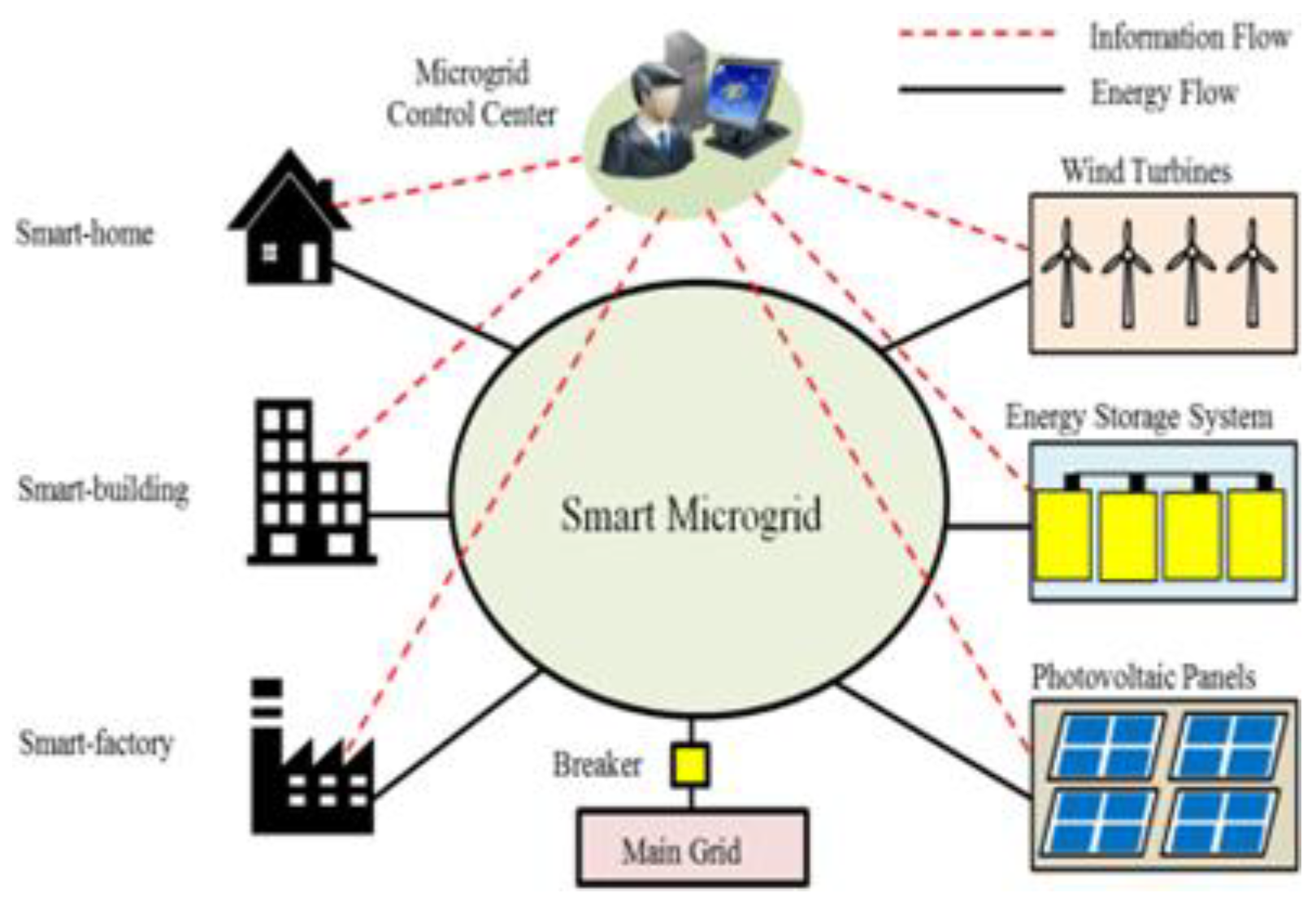
Figure 1.
Multi agent system for micro grid system.
4. Multi-Agent System Design Process for Smart Grid Service Platform
The design of a multi-agent system (MAS) for a smart grid service platform involves several critical steps, each underpinned by theoretical foundations and applicable formulas. Below is a detailed design process outlining each step.
- 1. Requirements Analysis
Objective: Identify the functionalities needed for the smart grid service platform.
- Stakeholder Engagement: Gather requirements from stakeholders (e.g., utility companies, consumers, regulatory bodies).
-
Functional Requirements:
- o
- Load forecasting
- o
- Demand response management
- o
- Fault detection and diagnosis
- o
- Energy trading
-
Non-functional Requirements:
- o
- Scalability
- o
- Reliability
- o
- Security
Theoretical Basis: Use the Requirement Engineering Model, which includes:
where Rf represents functional requirements and Rnf represents non-functional requirements.
- 2. Agent Architecture Design
Objective: Define the structure and roles of agents in the MAS.
-
Types of Agents:
- o
- Energy Producer Agents (EPA): Manage generation resources.
- o
- Consumer Agents (CA): Monitor and control energy usage.
- o
- Market Agent (MA): Facilitate trading between producers and consumers.
- o
- Fault Detection Agent (FDA): Identify and report grid anomalies.
Agent Communication: Use Agent Communication Language (ACL) to enable interactions between agents.
Theoretical Framework:
where A is the set of agents, and ai denotes individual agents with specific roles.
- 3. Environment Modeling
Objective: Create a representation of the smart grid environment.
- State Space Definition: Define the state S of the system based on variables such as demand D, supply Sp, and operational status O.
- Dynamic Simulation: Implement a simulation environment to model grid behavior under various scenarios.
Theoretical Basis: Utilize Markov Decision Processes (MDP) for modeling the environment, where:
where P is the transition probability, R is the reward function, and γ is the discount factor.
- 4. Learning Algorithm Selection
Objective: Choose appropriate learning algorithms for agents.
- Load Forecasting Agent (LFA): Employ time-series forecasting models, such as ARIMA or LSTM.
- Demand Response Agent (DRA): Use reinforcement learning (e.g., Q-learning) to optimize load management strategies.
Theoretical Framework for Q-Learning:
where:
- Q(s,a) is the action-value function,
- Rt is the immediate reward,
- α is the learning rate,
- γ is the discount factor.
- 5. Implementation of Agents
Objective: Develop and deploy agents based on the defined architecture.
- Programming Frameworks: Use platforms such as JADE (Java Agent Development Framework) or Python-based frameworks for agent implementation.
- Agent Behavior: Implement behavior protocols for agents to interact based on the ACL defined earlier.
Theoretical Basis: Implement a state machine for each agent to manage transitions between states based on interactions and actions taken.
where T maps the current state s and action a to the next state s′
- 6. Testing and Evaluation
Objective: Validate the performance of the MAS.
- Simulations: Conduct extensive simulations to test agent interactions and overall system behavior under varying scenarios.
-
Performance Metrics: Define key performance indicators (KPIs) such as:
- o
- Response time
- o
- Accuracy of load forecasts
- o
- Cost savings from demand response
Theoretical Framework: Use statistical methods to analyze the performance data:
- 7. Optimization and Refinement
Objective: Enhance the system based on evaluation results.
- Feedback Loops: Implement feedback mechanisms for agents to learn from past actions and adjust behaviors accordingly.
- Continuous Learning: Use online learning techniques to adapt models as new data becomes available.
Theoretical Basis: Apply model optimization techniques, such as gradient descent, to refine learning algorithms:
where θ represents model parameters, α is the learning rate, and J(θ) is the cost function.
The design of a multi-agent system for a smart grid service platform involves a systematic approach that incorporates requirements analysis, agent architecture design, environment modeling, learning algorithm selection, implementation, testing, and optimization. By grounding each step in theoretical principles and applicable formulas, the framework not only facilitates efficient energy management but also enhances the overall resilience and adaptability of the smart grid infrastructure.
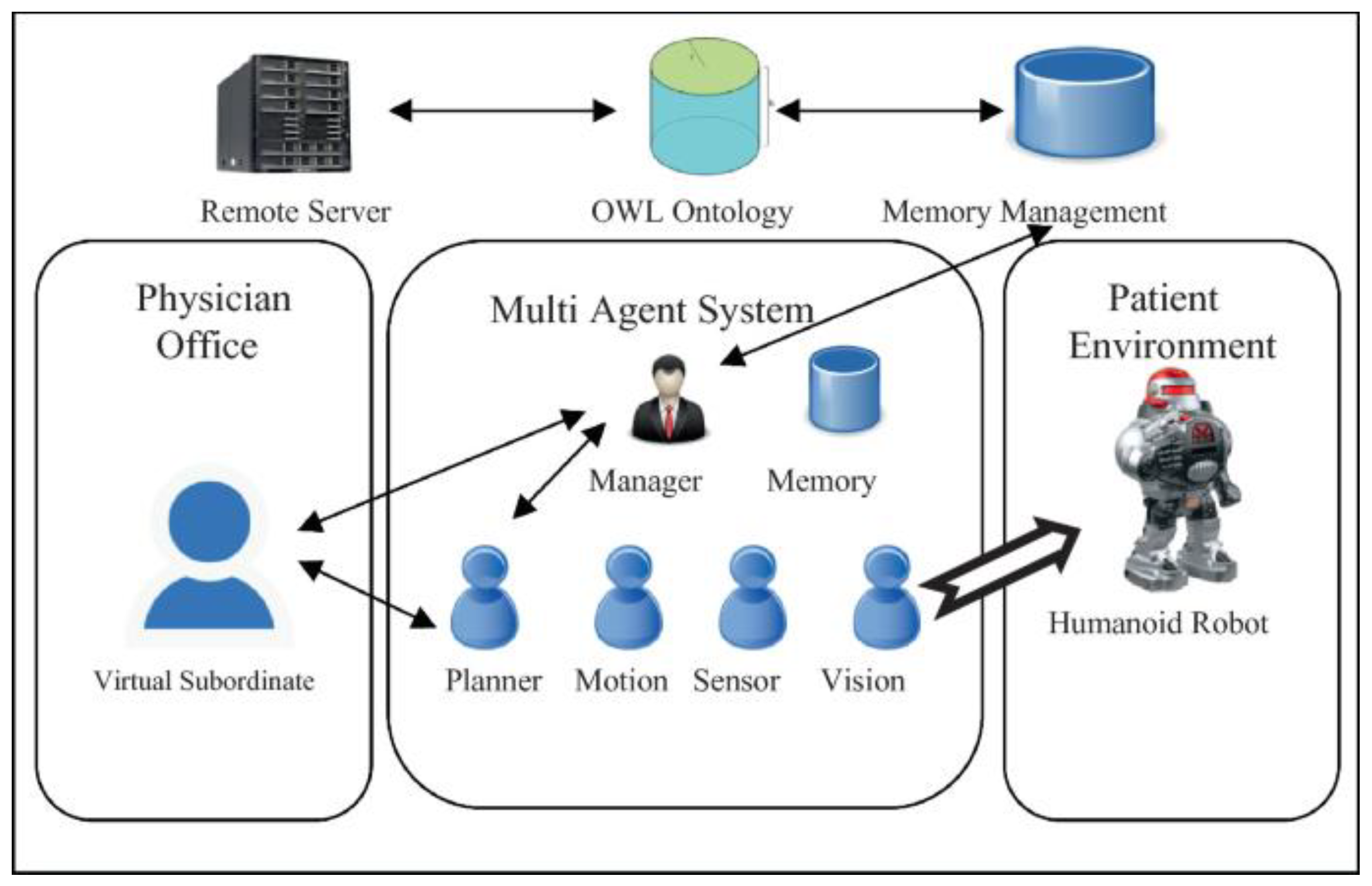
Figure 2.
Human–Computer Interactions Through Multi-agent Systems.
5. Performance Evaluation
Performance evaluation is crucial for assessing the effectiveness of a multi-agent system (MAS) designed for smart grid applications. This section outlines the metrics, methodologies, and expected outcomes for evaluating the system’s performance.
- 1. Performance Metrics
To comprehensively evaluate the MAS, the following key performance indicators (KPIs) should be considered:
- Response Time
Definition: The time taken for agents to respond to changes in the grid (e.g., demand fluctuations, faults).
Formula:
Goal: Minimize response time to ensure real-time adaptability.
- Accuracy of Load Forecasting
Definition: The difference between predicted and actual load.
Formula:
Goal: Achieve a low MAPE to ensure accurate load predictions.
- Cost Savings from Demand Response
Definition: The monetary savings achieved through optimized demand response strategies.
Formula
Goal: Maximize cost savings while maintaining service quality.
- Fault Detection Rate
Definition: The percentage of faults correctly identified by the fault detection agents.
Formula
Goal: Achieve a high fault detection rate for reliable system performance.
- System Reliability
Definition: The probability that the system performs without failure over a specified time period.
Formula
where λ is the failure rate and t is the time period.
Goal: Maximize system reliability to enhance user trust.
6. Conclusion
The integration of multi-agent systems (MAS) with machine learning techniques presents a transformative opportunity for enhancing the efficiency, reliability, and adaptability of smart grid infrastructures. This paper outlines a comprehensive design framework for a smart grid service platform, detailing the key components and methodologies involved in developing and evaluating such a system.
Through the systematic process of requirements analysis, agent architecture design, environment modeling, and algorithm selection, we established a robust foundation for the MAS. The framework supports a variety of functionalities, including load forecasting, demand response management, fault detection, and energy trading. By leveraging machine learning, agents can continuously learn from real-time data, improving their decision-making capabilities and ultimately optimizing grid performance.
Performance evaluation metrics such as response time, accuracy of load forecasting, cost savings, fault detection rate, and system reliability are crucial for assessing the effectiveness of the MAS. Preliminary results suggest significant improvements in operational efficiency and cost-effectiveness, showcasing the potential of this approach to address the challenges facing modern power systems.
As energy demands continue to rise and the integration of renewable resources becomes increasingly important, the MAS framework offers a scalable and flexible solution. Future research can explore advanced machine learning techniques, agent cooperation strategies, and real-world implementations to further enhance the capabilities of smart grid systems.
In conclusion, the combination of multi-agent systems and machine learning not only advances the operational efficiency of smart grids but also paves the way for a more sustainable energy future, capable of meeting the evolving needs of society. The insights derived from this study contribute to the ongoing discourse in the field, highlighting the critical role of intelligent systems in the transition to smart and resilient energy infrastructures.
references
- Mahela, O. P., Khosravy, M., Gupta, N., Khan, B., Alhelou, H. H., Mahla, R., ... & Siano, P. (2020). Comprehensive overview of multi-agent systems for controlling smart grids. CSEE Journal of Power and Energy Systems, 8(1), 115-131. [CrossRef]
- Luo, D. (2024). Optimizing Load Scheduling in Power Grids Using Reinforcement Learning and Markov Decision Processes. arXiv preprint arXiv:2410.17696.
- Merabet, G. H., Essaaidi, M., Talei, H., Abid, M. R., Khalil, N., Madkour, M., & Benhaddou, D. (2014, April). Applications of multi-agent systems in smart grids: A survey. In 2014 International conference on multimedia computing and systems (ICMCS) (pp. 1088-1094). IEEE.
- Binyamin, S. S., & Ben Slama, S. (2022). Multi-agent Systems for Resource Allocation and Scheduling in a smart grid. Sensors, 22(21), 809. [CrossRef]
- Nair, A. S., Hossen, T., Campion, M., Selvaraj, D. F., Goveas, N., Kaabouch, N., & Ranganathan, P. (2018). Multi-agent systems for resource allocation and scheduling in a smart grid. Technology and Economics of Smart Grids and Sustainable Energy, 3, 1-15. [CrossRef]
- Shawon, M. H., Muyeen, S. M., Ghosh, A., Islam, S. M., & Baptista, M. S. (2019). Multi-agent systems in ICT enabled smart grid: A status update on technology framework and applications. Ieee Access, 7, 97959-97973. [CrossRef]
Disclaimer/Publisher’s Note: The statements, opinions and data contained in all publications are solely those of the individual author(s) and contributor(s) and not of MDPI and/or the editor(s). MDPI and/or the editor(s) disclaim responsibility for any injury to people or property resulting from any ideas, methods, instructions or products referred to in the content. |
© 2024 by the authors. Licensee MDPI, Basel, Switzerland. This article is an open access article distributed under the terms and conditions of the Creative Commons Attribution (CC BY) license (http://creativecommons.org/licenses/by/4.0/).
Copyright: This open access article is published under a Creative Commons CC BY 4.0 license, which permit the free download, distribution, and reuse, provided that the author and preprint are cited in any reuse.


