

Submitted:
29 October 2024
Posted:
30 October 2024
You are already at the latest version
Abstract
The paper presents the results of experiments on measuring cross sections for the neutron transfer channels 9Be(3He,α)8Begs,3.03 in the reaction of the 3He (30 MeV) ions with the 9Be target. To describe the angular distributions, we use the Distorted Wave Born Approximation (DWBA) method (FRESCO code). The results of the theoretical analysis are in agreement with the experimental data. In addition, we perform calculations based on the solution of the time-dependent Schrödinger equation (TDSE) for the weakly bound neutron of the 9Be nucleus. The TDSE approach allows us to determine the dynamics of the neutron transfer process and calculate the probabilities for the transfer and removal of the neutron of the 9Be nucleus in the 3He+9Be reaction.
Keywords:
neutron transfer
; DWBA method
; FRESCO code
; TDSE approach
1. Introduction
Among stable weakly bound nuclei, the 9Be nucleus is of great interest. It has a Borromean structure in the ground state [1,2,3,4,5] and is typically represented as a system of two α-clusters and a neutron [6,7,8]. For instance, the (α+n+α) structure of the 9Be nucleus was considered in [9,10] using Feynman path integrals. Experimental works [7,11,12] on the cluster channels of the decay of the nucleus 9Ве are also in favor of the (α+n+α) structure. However, with some probability, the nucleus 9Ве can be in a state corresponding to a two-particle structure, as evidenced by the results of experimental works [13,14], where it was shown that the nucleus 9Ве can decay through the two-particle channels 9Ве→n+8Be or 9Ве→α+5Не. Because the 9Be nucleus is stable, it is much easier to be investigated compared to other Borromean nuclei.
Structural features of light nuclei are manifested in nucleon transfer reactions [15,16,17,18,19], for example, in the angular distributions of reaction products. The structure of the light nuclei d, 3He, and α is well known, and thus they are often employed to induce direct reactions, either as beams or as targets [15,16,17,18,19].
The process of the neutron transfer in a reaction with the 9Be nucleus is interesting due to the fact that the low binding energies of the neutron (1.666 MeV) and α-particle (2.462 MeV) should influence the dynamics and mechanism of the transfer. The interaction of deuterons and alpha particles with 9Be at an energy of 10-30 MeV/nucleon has been studied taking into account its cluster structure in [20,21]. The interaction potential for the colliding nuclei was constructed within the framework of the double folding model using a three-body wave function. Calculations with the double folding potential carried out within the optical model (OM) and Distorted Wave Born Approximation (DWBA) method provided good agreement between the theoretical cross sections and the experimental data.
In our previous works [16,17,18,19,20,21], we performed experimental and theoretical studies of the angular distributions of the products of nucleon and cluster transfer in the reactions d+9Be [17,20,21], 3He+9Be [16,18], and 6Li+9Be [19]. The obtained data were analyzed using the OM, the coupled reaction channel (CRC) method, and the DWBA method. The analysis of the experimental data showed the sensitivity of the cross sections to the potential parameters in the exit channels. In works of other authors [22,23,24], experimental data on the neutron transfer in the 9Be(3He, α)8Be reaction channel were also analyzed within the DWBA method.
This paper presents a study of the neutron transfer process in the 9Be(3He,α)8Be reaction channel. To describe the mechanism and dynamics this process, the data are analyzed using the DWBA method [25,26,27] and the time-dependent Schrödinger equation (TDSE) approach [28,29,30,31]. A direct comparison of the theoretical description of the neutron transfer process (in our case, in the d+9Be reaction) within the framework of the stationary (DWBA) and time-dependent approaches (TDSE) is the challenge that we intend to tackle in this work. Each approach has its own advantages and disadvantages, but if used together, they complement each other. For this purpose, in the TDSE calculations, we used the values of the potential parameters obtained in the DWBA calculations for the 3He+9Be entrance channel and for the initial neutron wave functions. The TDSE approach allows for both qualitative (reaction dynamics) and quantitative analysis of the neutron transfer process (probabilities of neutron transfer and neutron removal, reaction channel cross sections) [32,33,34].
The study of the dynamics and mechanisms of nuclear reactions with the 9Be nucleus is also important for applied research. For example, 9Be can be used as a structural material for the thermonuclear reactors [35,36], and the mechanisms of the 3He+9Be reaction must be taken into account when designing a reactor structure and modeling the processes of burning of a dense hot plasma with the d+3He combination of nuclei in a metal 9Be cylindrical liner [36]. 9Be can also be used as a target for neutron sources due to the large cross section of the 9Be(p,n) reaction [37,38].
2. Experiment
The experiment was performed on the U-120M cyclotron of the Nuclear Physics Institute, Řež, Czech Republic [39]. The ions of the 3He beam (30 MeV) were incident on a self-supporting 9Be foil target (2 mg/cm2, 99%). Carbon and oxygen contaminations of the target were not observed in energy spectra. The average beam current was 10-20 nA [18,40].
To identify reaction products, energy loss ∆E and residual energy Er were measured by four telescopes (∆E-E method). Each telescope consisted of three silicon-lithium detectors with thicknesses of 10 µm (∆E1), 100 µm (∆E2), and 3 mm (Er) and was protected by a 5 mm thick Cu–Pb collimator and a circular hole of 3 mm diameter [18,40]. The energy resolution of the detectors was ∼ 150–200 keV (FWHM). The telescopes were located at a distance of ∼ 25 cm from the target and could be rotated around it in the angular range of θlab = 7–63° with a step of 1–2°.
A typical example of a two-dimensional identification matrix obtained at an angle of θlab = 16° is shown in Figure 1a. It can be seen that A and Z of detected particles were unambiguously identified. The corresponding excitation energy spectrum of the 8Be nucleus, which is a complementary product to the detected 4He nucleus, is shown in Figure 1b. The first peak corresponds to the 0+ ground state of 8Be; the second peak is the 2+ excited state. Thus, these two peaks confirm the corresponding reaction channels with the neutron transfer from 9Be to 3He. Thus, the used technique allowed us to measure the energy of the products, identify reaction channels, and obtain their corresponding differential angular distributions.
The outlined region in the ΔE2-Er plot [Figure 1a] was used to obtain the excitation energy plot [Figure 1b]. It can be seen that the 0+ ground state of 8Be and the 2+ excited state are clearly separated. However, other reaction channels may contribute to the excitation energy plot in Figure 1b, in particular, breakup of 8Be, because it can undergo breakup with alpha particle emission. In the peak of the 0+ ground state, the contribution of the background is insignificant. In the peak of the 2+ excited state, the contribution of the background, mainly associated with the breakup process ⁸Be→⁴He+⁴He with the threshold energy of –0.0918 MeV, is less than 15%; the contribution from the breakup of 9Be is not present. To obtain the angular distributions presented in the next section, the background contribution was subtracted.
3. DWBA Calculations
Experimental differential cross sections for neutron transfer in 9Be(3He,α)8Begs,3.03 reaction channels are shown in Figure 2. To describe the experimental data, we used the prior formalism of the DWBA amplitude [25,26] and the FRESCO code [27]. For calculating the cross sections of neutron (n) transfer reaction A+b→a+B (A=a+n, B=b+n), the formalism of the DWBA method requires the potentials of the entrance and exit channels, the spectroscopic amplitudes Sx for the neutron in the systems A=a+n and B=b+n, and the potentials for calculating the neutron wave functions within the shell model.
The values of the spectroscopic amplitudes Sx = 0.791 for 9Be=8Be+n and Sx = –0.741 for 4He=3He+n were taken from our previous work [18]. The neutron wave functions were calculated within the shell model using the potential in the Woods-Saxon form with geometric parameters R = 1.25A1/3 fm (radius) and a = 0.65 fm (diffuseness); the potential depths were adjusted to reproduce binding energies of a neutron.
As a starting point for searching for the optical potential U for the entrance and exit channels, we took the parameter sets from [18] (Table 1). These potential parameters have been successfully used to describe a large number of experimental data on the nucleon and cluster transfer channels in the 3He+9Be reaction. The potential U is defined as
where VC(r) is the Coulomb potential, Zp and Zt are the charges of the projectile and target, respectively; VV,W are the depths of the real and imaginary parts of the potential, respectively; RV,W, rV,W, and aV,W are their corresponding geometric parameters; Ap and At are the mass numbers of the projectile and target nuclei, respectively.
As can be seen from Figure 2, curves DWBA-1 calculated using the entrance and exit channel potentials with the parameters from [18] differ slightly from the experimental data for the 9Be(3He,α)8Begs reaction channel, but underestimate the data on the 9Be(3He,α)8Be3.03 reaction channel in the angular range of 30–90°. Such a discrepancy between the DWBA calculations and the experimental data can be eliminated either by varying the values of the spectroscopic amplitudes or by reducing the depth VW of the imaginary part of the exit channel potential [41,42]. We chose the second option, because the values of the spectroscopic amplitudes were obtained in [18] within the framework of the shell model calculations. Therefore, for better description of the experimental data, we reduced the depth VW of the imaginary part of the exit channel potential (curves DWBA-2), i.e., VW was obtained by fitting to the neutron transfer data. For the core-core potential (3He+8Be), we used the parameters of the entrance channel potential. The parameters of the optical potential (1) obtained for the entrance and exit channels are presented in Table 1.
The potential parameters for the exit channel α+8Be were obtained through a χ² minimization procedure based on the experimental data for the same reaction channel 3He(9Be,α)8Be with fixed spectroscopic amplitudes and potential parameters for the entrance channel, i.e., the elastic scattering channel 3He+9Be. It was found that the parameters of the fitted potential have unusually low values rV = 0.252 fm and aW = 0.34 fm; however, they are similar to those found for the α+8Be system in Ref. [43].
The discrepancy between the calculated differential cross sections and the experimental data for the 9Be(3He,α)8Begs reaction channel around the scattering angle of 55° in Figure 2a may be attributed to the following factors:
- (i)
- (ii)
- Because of its α-cluster structure, the 9Be nucleus has a large deformation, while in this study it was treated as spherical for simplicity [44].
- (iii)
- It is possible that channel coupling effects are present, as observed in Refs [17,45]. Indeed, the waves with different neutron transfer configurations, originating from multiple channels (e.g., from the ground state and the first excited state), may either cancel each other out or amplify one another; their interference may be taken into account.
Accounting for these factors could lead to an improved theoretical description of the experimental data, but goes beyond the scope of this work.
4. Formalism of the TDSE Approach
The theoretical approach is based on the numerical solution of the time-dependent Schrödinger equation [28,29,30,31]
where is the wave function of the neutron with mass m; are the centers of nuclei moving along classical trajectories; V1, V2 are the potentials of interaction of the neutron with the projectile and target nuclei; are the potentials of spin-orbit interaction of the neutron with the cores.
As mentioned above, the neutron wave function at the initial moment of time was determined in the shell model with the parameters obtained in Section 3 and providing the energy of the single-particle level 1p3/2 equal to the experimental value of the neutron separation energy (1.66 MeV) for the 9Be nucleus [46]. The shape of the 9Be nucleus was considered as spherical [28,29,30], because taking into account the deformation of 9Be [47] requires more complex calculations, which will be a subject of a separate theoretical work in the future. In addition, it should be noted that taking into account the deformation of weakly bound nuclei in the calculations within the TDSE approach does not have a strong effect on the resulting probabilities and cross sections of transfer reaction channels [28,29]. One of the reasons is that the wave functions calculated in the shell model for deformed and spherical nuclei have similar spatial extents due to the low binding energy of an outer neutron in such nuclei [48].
The wave function of the neutron with the projection mj of the total momentum at the initial moment of time can be written as
where and are the components of the spinor wave function for the spin projections 1/2 and –1/2, respectively; m is the mass of a neutron; is the velocity of the target nucleus in the center of mass system [28,29,30]. Evolution of the probability density is calculated as
For the neutron from the single-particle level 1p3/2 of the 9Be nucleus, the values of mj are –3/2, –1/2, 1/2, and 3/2.
The probability of the neutron transfer is determined as
where are the amplitudes of the probabilities of populating the unoccupied single-particle neutron levels [30]. The final probability of the neutron transfer is determined at time t, when the nuclei are already far away from each other, in our calculations, at distances more than 30 fm:
The calculated probabilities were approximated by the exponential function
with fitting parameters a0 and b0 [26].
The probability of the removal of the neutron is determined as
where c(t) is the amplitude of the probability of conservation of the neutron in the initial state at time t [30]. Similar to the probability of the neutron transfer (11), the final probability of the neutron removal is determined at time t, when the nuclei are already far away from each other:
The calculated probabilities were approximated by the sum of two exponential functions:
with fitting parameters a1, b1, a2, b2 [26].
The numerical solution of equation (4) was performed on a spatial grid of dimensions 96×60×105 fm3 (x×y×z) with the collision plane xOz and a grid step 0.3 fm [28,29,30]. We used the dimensionless time scale τ=t/t0, where s, =1 fm. The dimensionless time step was ∆τ = 0.1. The calculations were carried out using the heterogeneous computing cluster HybriLIT [49] of the Laboratory of Information Technologies, Joint Institute for Nuclear Research.
5. Results and Discussion
Evolution of the probability density (6) in dimensionless time τ for the neutron from the single-particle level 1p3/2 of the 9Be nucleus during the collision of 3He+9Be at an energy of Elab = 30 MeV (Ec.m. = 22.5 MeV) with the impact parameter b = 6 fm (the distance of the closest approach Rmin = 6.12 fm) and b = 8 fm (Rmin = 8.23 fm) is presented Figure 3 and Figure 4, respectively. The transition of the neutron probability density begins when the distance between the centers of the nuclei decreases to 9-10 fm [Figure 3a and Figure 4a]. As can be seen from Figure 3b and Figure 4b, the relative velocity of the nuclei is high enough that the flux of the neutron probability density lags behind the motion of the two nuclei and is shifted relative to the imaginary line connecting their centers. A more intense rearrangement of the probability density occurs at small distances between the projectile and target. As the distance between the nuclei increases, the neutron transfer is accompanied by the neutron transition to the continuum [Figure 3c and Figure 4c] [34]. In Figure 3c and Figure 4c, the neutron is emitted at a large angle to the direction of motion of the projectile nucleus, which indicates the manifestation of the so-called towing mode at energies above 5 MeV/nucleon [34,50,51].
According to the shell model, the 3He nucleus has only one single-particle level 1s1/2 that can be occupied by the neutron transferred from the single-particle level 1p3/2 of the 9Be nucleus. The spherically symmetric shape of the part of the neutron probability density transferred to the 3He projectile nucleus in Figure 3d and Figure 4d indicates the population of the state 1s1/2 in 3He, which is consistent with the shell model.
The obtained dependencies of the probability (11,) (12) on the distance Rmin of the closest approach of the centers of the nuclei are shown in Figure 5a; the values of the fitting parameters are a0=0.696 and b0=0.515 fm-1.
The obtained dependencies of the probability (15), (16) on the distance Rmin of the closest approach of the centers of the nuclei are shown in Figure 5b; the values of the fitting parameters are a1=1.178, b1=0.362 fm-1, a2=–2.08, b2=0.011 fm-1. The first exponential function describes a rapid decrease of the probability at the values of Rmin, not greatly exceeding the Coulomb barrier radius, the second corresponds to a slow decrease at larger values and gives the main contribution at Rmin more than 9 fm. The rapid decrease of the probability is due to a sharp decrease of the probability of the neutron transfer with the increasing impact parameter.
In the TDSE approach, the cross sections for the transfer and removal of the weakly bound neutron of the 9Be nucleus were calculated by integrating over the impact parameter b [29,31]
where bmin is the impact parameter corresponding to the trajectory, when the projectile is still captured by the target. In our calculations, we used bmin corresponding to the distance of the closest approach Rmin = RC + d, where RC = 5.6 fm is the Coulomb barrier radius, d = 0.4 fm is the diffuse region, therefore Rmin = 6 fm.
The comparison of the integrated cross sections σtr for the reaction channel 9Be(3He,α)8Begs obtained within the DWBA method (FRESCO code) and within the TDSE approach is presented in Table 2. It can be seen that the calculations in both models give close values. Taking into account that the differential cross sections obtained within the DWBA method are slightly below the experimental points in the region of angles around 55°, it can be concluded that the cross sections obtained within the TDSE approach are closer to the experimental data.
The integrated cross section σtr for the reaction channel 9Be(3He,α)8Be3.03 obtained within the DWBA method is also presented in Table 2. The cross section value for this reaction channel is approximately twice as high as that for 9Be(3He,α)8Begs, which is consistent with the measured energy spectrum [Figure 1b], where the number of events for 8Be3.03 is approximately twice as high as that for 8Begs.
Table 2 also includes the integrated cross section σrem for the removal of the weakly bound neutron of the 9Be nucleus obtained within the TDSE approach. According to (13), σrem = 315.690 mb includes the neutron transfer cross section σtr = 0.740 mb in the reaction channel 9Be(3He,α)8Begs and the cross section for the transition of the neutron into the continuum. It can be seen that the neutron transfer cross section σtr makes an insignificant contribution to the neutron removal cross section σrem.
6. Conclusions
The angular distributions for the neutron transfer channels 9Be(3He,α)8Begs,3.03 in the reaction of the 3He (30 MeV) ions with the 9Be target were measured. The experimental data were described by the DWBA method (FRESCO code). The results of the theoretical description are in agreement with the experimental data.
The parameters of the potentials for the 3He+9Be entrance channel and for the shell model obtained from the DWBA calculations were successfully used in the description of dynamics of the reaction channel 9Be(3He,α)8Begs within the TDSE approach. It has been shown that the neutron transfer process begins when the nuclei approach each other at a distance of 9-10 fm between the centers of the nuclei and the transfer process is accompanied by transition of the neutron to the continuum. In addition, the neutron can be emitted at a large angle to the direction of motion of the projectile nucleus, which indicates the manifestation of the towing mode.
The neutron transfer cross section does not make a significant contribution to the cross section for the removal of the weakly bound neutron of the 9Be nucleus. Calculations of the cross section for the reaction channel 9Be(3He,α)8Begs in the TDSE approach and DWBA method give close values.
Author Contributions
Conceptualization, A.A., E.A., M.N. and K.M.; methodology, T.I.; software, A.A. and E.A.; validation, A.A., S.L. and M.N.; formal analysis, M.N. and K.D.; investigation, A.A., T.I., B.U., K.D., A.K., S.L. and K.M.; resources, K.M. and T.Zh.; data curation, T.I., K.M. and T.Zh.; writing—original draft preparation, K.M.; writing—review and editing, K.O., A.A. and M.N.; visualization, E.A. and B.U.; supervision, A.A.; project administration, K.M.; funding acquisition, T.Zh., K.D. and K.M. All authors have read and agreed to the published version of the manuscript.
Funding
This research was funded by the SCIENCE COMMITTEE OF THE MINISTRY OF SCIENCE AND HIGHER EDUCATION OF THE REPUBLIC OF KAZAKHSTAN, grant number AP14870958.
Data Availability Statement
All data obtained during the study are included in this paper. For any questions regarding the data in the paper, you can contact the corresponding authors.
Acknowledgments
We would like to express our gratitude to the team of the U-120M cyclotron, Nuclear Physics Institute, Řež, Czech Republic for the opportunity to conduct the experiment. We also thank the team of the HybriLIT computing cluster for the opportunity of using its resources.
Conflicts of Interest
The authors declare no conflicts of interest.
References
- Villanueva, G. , Moro A.M., Casal J., Lei Jin. Neutron-transfer induced breakup of the Borromean nucleus 9Be. Phys. Lett. B 2024, 855, 138766. [Google Scholar] [CrossRef]
- Fulton, B.R. , Cowin R.L., Woolliscroft R.J. et al. Exclusive breakup measurements for 9Be. Phys. Rev. C 2004, 70, 047602. [Google Scholar] [CrossRef]
- Prezado Y., Borge M.J.G., Diget C.Aa. et al. Low-lying resonance states in the 9Be continuum. Phys. Lett. B 2005, 618, 43–50. Phys. Lett. B. [CrossRef]
- Álvarez-Rodríguez R., Jensen A.S., Garrido E., Fedorov D.V. Structure and three-body decay of 9Be resonances. Phys. Rev. C 2010, 82, 034001. [CrossRef]
- Soukeras V., Sgouros O., Pakou A. et al. Global study of 9Be+p at 2.72A MeV. Phys. Rev. C 2020, 102, 064622. [CrossRef]
- Von Oertzen, W. , Freer M., Kanada En’yo Y. Nuclear clusters and nuclear molecules. Phys. Rep. 2006, 432, 43–113. [Google Scholar] [CrossRef]
- Freer, M. The clustered nucleus–cluster structures in stable and unstable nuclei. Rep. Prog. Phys. 2007, 70, 2149. [Google Scholar] [CrossRef]
- Samarin, V.V. Study of spatial structures in α-cluster nuclei. Eur. Phys. J. A 2022, 58, 117. [Google Scholar] [CrossRef]
- Bazhin A.S., Samarin V.V. Study of the Structure of the 9Be Nucleus in the Alpha-Cluster Model by the Method of Hyperspherical Functions. Bulletin of the Russian Academy of Sciences: Physics 2024, 88, 1177–1184. [CrossRef]
- Rakityansky, S.A. Wave function of 9Be in the three-body (ααn) model. Phys. Rev. C 2024, 110, 024001. [Google Scholar] [CrossRef]
- Tilley D.R., Kelley J.N., Godwin J.L. et al. Energy levels of light nuclei A = 8,9,10. Nucl. Phys. A 2004, 745, 155. [CrossRef]
- Nyman, G. , Azuma R.E., Hansen P.G. The beta decay of 9Li to levels in 9Be: A new look. Nucl. Phys. A 1990, 510, 189–208. [CrossRef]
- Keeley, N. , Alamanos N., Rusek K., Kemper K.W. Generation of a repulsive dynamic polarization potential by transfer couplings. Phys. Rev. C 2005, 71, 014611. [Google Scholar] [CrossRef]
- Pandit, S.K. , Jha V., Mahata K., Santra S. et al. Investigation of cluster structure of 9Be from high precision elastic scattering data. Phys. Rev. C 2011, 84, 031601. [Google Scholar] [CrossRef]
- Saduyev N., Nassurlla M., Burtebayev N. et al. Scattering and One Neutron Pick-Up Reaction on a 10B Target with Deuterons at an Energy of 14.5 MeV. Physics 2024, 6, 1098–1110. [CrossRef]
- Lukyanov S.M., Harakeh M.N., Naumenko M.A. et al. Cluster Structure of 9Be from 3He+9Be Reaction. J. Phys. Conf. Ser. 2016, 724, 012031. [CrossRef]
- Urazbekov B.A., Denikin A.S., Lukyanov S.M. et al. Clusterization and strong coupled-channels effects in deuteron interaction with 9Be nuclei. J. Phys. G Nucl. Part. Phys. 2019, 46, 105110. [CrossRef]
- Urazbekov B.A., Issatayev T., Lukyanov S.M. et al. Reactions induced by 30 MeV 3He beam on 9Be: cluster transfer reactions. Chin. Phys. C 2024, 48, 014001. [CrossRef]
- Azhibekov A.K., Lukyanov S.M., Penionzhkevich Yu.E. et al. Study of one-step and two-step neutron transfer in the reaction 6Li + 9Be. Chin. Phys. C 2024, 48, 114101. [CrossRef]
- Urazbekov, B.A. , Denikin A.S., Sakhiev S.K. et al. Manifestation of the cluster structure of the 9Be nucleus in direct nuclear reactions. Bull. Russ. Acad. Sci. Phys. 2016, 80, 247–251. [Google Scholar] [CrossRef]
- Urazbekov, B.A. , Denikin A.S., Sakhiev S.K. et al. Studying the reactions of deuteron interaction with 9Be nuclei at low energies. Bull. Russ. Acad. Sci. Phys. 2017, 81, 690–694. [Google Scholar] [CrossRef]
- Bilwes B., Bilwes R., Ferrero J.L. et al. Mechanism of the 9Be(3He, α)8Be(0) reaction and isoscalar giant resonances of 12C. J. Phys. France 1978, 39, 805–814. [CrossRef]
- Karban O., Basak A.K., England J.B.A. et al. The j-dependence of (3He, d) and (3He, α) reaction analysing powers in the 1p shell. Nucl. Phys. A 1976, 269, 312–326. [CrossRef]
- Moazed C., Holmgren H.D. Angular correlations for the reaction 9Be(3He, α)8Be (16.92) → α+α. Phys. Rev. 1968, 166, 977. [CrossRef]
- Satchler G. R. Direct Nuclear Reactions; Oxford University Press: New York, USA, 1983; 833 p.
- Taylor, J.R. Scattering Theory: The Quantum Theory of Nonrelativistic Collisions. Dover Publications: New York, USA, 2006; 512 p.
- Thompson, I.J. Thompson I.J. Coupled reaction channels calculations in nuclear physics. Computer Physics Reports 1988, 7, 167–212. Fresco Coupled Reaction Channels Calculations. Available online: https://www.fresco.org.uk/ (accessed on 10 September 2024). [CrossRef]
- Azhibekov A.K., Samarin V.V., Kuterbekov K.A. Time-dependent calculations for neutron transfer and nuclear breakup processes in 11Li+9Be and 11Li+12C reactions at low energy. Chin. J. Phys. 2020, 65, 292–299. [CrossRef]
- Azhibekov A.K., Samarin V.V. Time-dependent description of reactions with weakly bound 11Li and 11Be nuclei. Bull. Russ. Acad. Sci.: Phys. 2022, 86(9), 1092–1098. [CrossRef]
- Azhibekov A.K., Lukyanov S.M., Shakhov A.V. et al. Neutron transfer in the 48Ca + 197Au reaction. Eur. Phys. J. A 2023, 59, 278. [CrossRef]
- Samarin, V.V. Time-dependent description of incomplete fusion of nuclei and cluster and nucleon-transfer reactions. Phys. Atom. Nucl. 2018, 81, 486–496. [Google Scholar] [CrossRef]
- Valiolda, D. Valiolda D., Janseitov D., Melezhik V. Investigation of low-lying resonances in breakup of halo nuclei within the time-dependent approach. Eur. Phys. J. A 2022, 58, 34. [CrossRef]
- Samarin V.V., Naumenko M. A. Study of nucleon-transfer processes in low-energy reactions of helium isotopes with 197Au Nuclei. Phys. Atom. Nucl. 2022, 85, 880–889. [CrossRef]
- Lima V., Scarpaci J.A., Lacroix D. et al. Nuclear break-up of 11Be. Nucl. Phys. A 2007, 795, 1-18. [CrossRef]
- Kukulin V.I., Voronchev V.T. Pinch-based thermonuclear D3He fusion driven by a femtosecond laser. Phys. Atom. Nucl. 2010, 73,1376–1383. [CrossRef]
- Seksembayev Zh., Kukulin V., Sakhiyev S. Study of a dense hot plasma’s burning in Z-pinch devices with inertial magnetic confinement. Phys. Scr. 2018, 93, 085602. [CrossRef]
- Sgouros, O. , Soukeras V., Pakou A. Low energy proton induced reactions with weakly bound nuclei for application purposes. Eur. Phys. J. A 2021, 57, 125. [Google Scholar] [CrossRef]
- Tun, Z. , Yamani Z., Huang X., Li G., Hartling K., Horn D. Liquid-lithium-cooled beryllium target as the p-to-n converter. Nucl. Instrum. Methods Phys. Res. A 2024, 1064, 169459. [Google Scholar] [CrossRef]
- Cyclotron U-120M. Available online: https://www.ujf.cas.cz/en/departments/department-of-accelerators/cyclotron/ (accessed on 10 September 2024).
- Janseitov D.M., Lukyanov S.M., Mendibayev K. et al. Investigation of the elastic and inelastic scattering of 3He from 9Be in the energy range 30-60 MeV. Int. J. Mod. Phys. E 2018, 27, 1850089. [CrossRef]
- Micek S., Rebel H., Gils H.J. et al. Single nucleon transfer reactions in 6Li+6Li collisions at 156 MeV. Z. Phys. A – Atomic Nuclei 1987, 328, 467–473. [CrossRef]
- Ruby L., Pyle R.V., Wong Yu.-Ch. Cross Sections for 6Li(6Li,5He)7Be, 6Li(d,n)7Be, and 19F(6Li,p)24Na. Nucl. Sci. Eng. 1979, 71, 280-286. [CrossRef]
- Cuong, D.C.; et al. Coupled-reaction-channel study of the 12C(α,8Be) reaction and the 8Be+8Be optical potential. Phys. Rev. C 2020, 102, 024622. [Google Scholar] [CrossRef]
- Sundholm D., Olsen J. Large MCHF calculations on the hyperfine structure of Be(3PO): the nuclear quadrupole moment of 9Be. Chemical Physics Letters 1991, 177, 91-97. [CrossRef]
- Harakeh M.N, Van Popta J., Saha A., Siemssen R.H. Strong coupled-channels effects in the 9Be(α, t)10B reaction. Nucl. Phys. A 1980, 344, 15-40. [CrossRef]
- Wang M., Audi G., Wapstra A.H. et al. The AME 2012 atomic mass evaluation (II), Tables, graphs and references. Chin. Phys. C 2012, 36, 1603. [CrossRef]
- Chart of nucleus shape and size parameters. Available online: http://cdfe.sinp.msu.ru/services/radchart/radmain.html (accessed on 10 September 2024).
- Azhibekov, A.K. , Samarin V.V., Kuterbekov K.A., Naumenko M.A. Shell model calculations for deformed Li isotopes. Eurasian j. phys. funct. mater. 2019, 3, 307–318. [Google Scholar] [CrossRef]
- Heterogeneous platform «HybriLIT». Available online: http://hlit.jinr.ru/ (accessed on 10 September 2024).
- Scarpaci J.A., Beaumel D., Blumenfeld Y. et al. A new phenomenon in heavy ion inelastic scattering: the towing mode. Phys. Lett. B 1998, 428, 241–247. [CrossRef]
- Lacroix D., Scarpaci J.A., Chomaz Ph. Theoretical description of the towing mode through a time-dependent quantum calculation. Nucl. Phys. A 1999, 658, 273–281. [CrossRef]
Figure 1.
(a) A typical example of a two-dimensional identification matrix obtained in the reaction 3He+9Be at Elab = 30 MeV and θlab = 16°. (b) The corresponding excitation energy spectrum of the 8Be nucleus; blue curve shows the background.
Figure 1.
(a) A typical example of a two-dimensional identification matrix obtained in the reaction 3He+9Be at Elab = 30 MeV and θlab = 16°. (b) The corresponding excitation energy spectrum of the 8Be nucleus; blue curve shows the background.
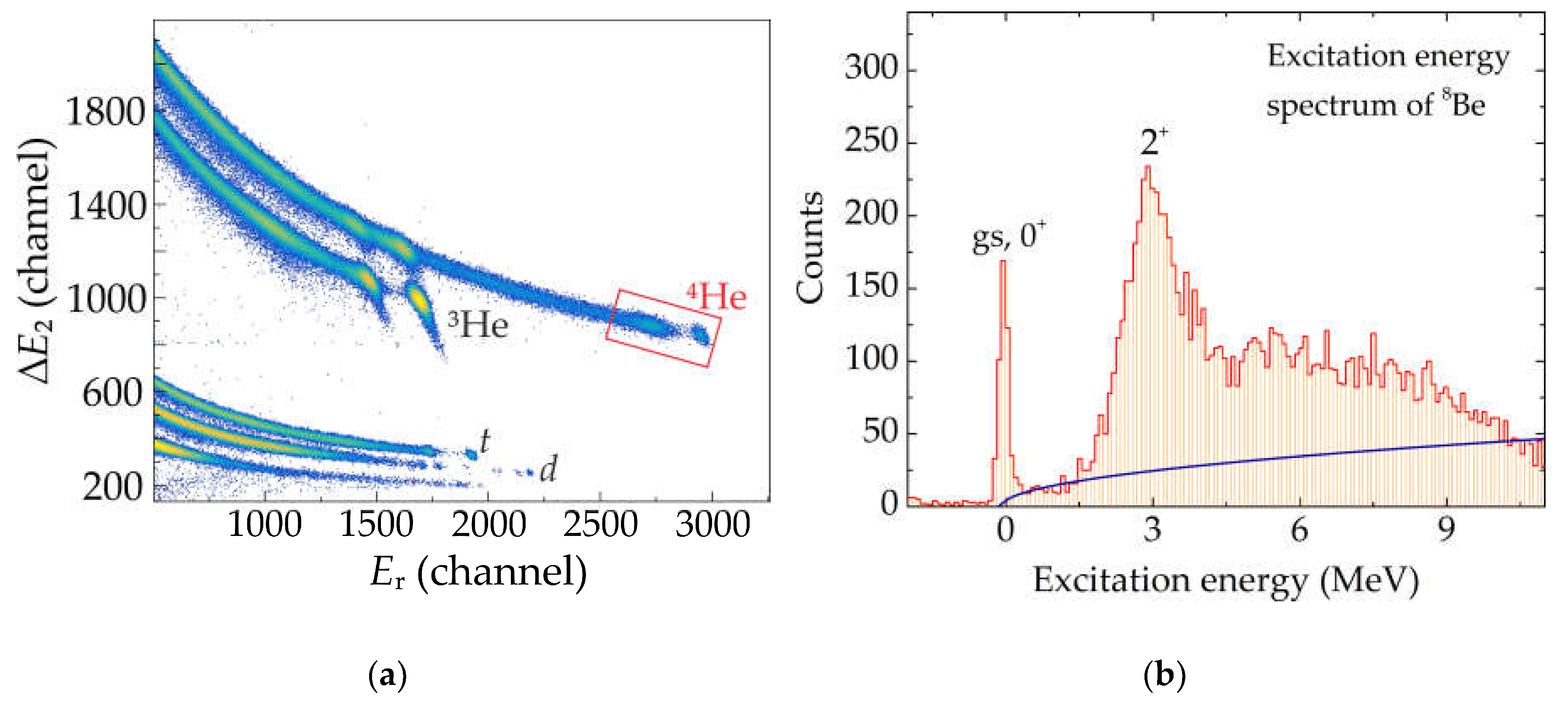
Figure 2.
Experimental angular distributions (circles) for the reaction channels (a) 9Be(3He,α)8Begs and (b) 9Be(3He,α)8Be3.03 in comparison with the results of calculations (curves) in the center of mass frame: DWBA-2 (with the potential parameters from [12]) and DWBA-1 (with the reduced depth of the imaginary part of the exit channel potential).
Figure 2.
Experimental angular distributions (circles) for the reaction channels (a) 9Be(3He,α)8Begs and (b) 9Be(3He,α)8Be3.03 in comparison with the results of calculations (curves) in the center of mass frame: DWBA-2 (with the potential parameters from [12]) and DWBA-1 (with the reduced depth of the imaginary part of the exit channel potential).
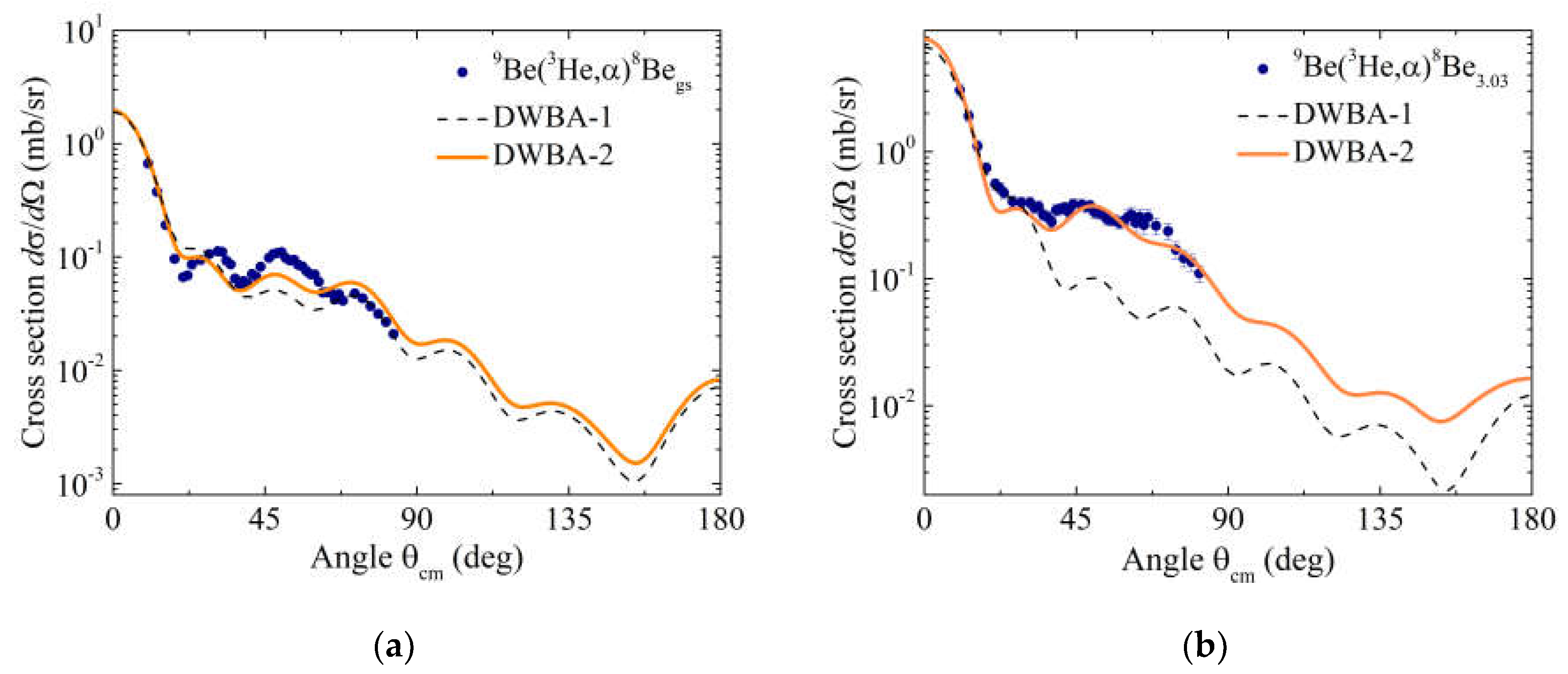
Figure 3.
Evolution of the probability density (logarithmic scale; x and z are the coordinates in the collision plane) in dimensionless time τ [(a), (b), (c), (d)] for the neutron from the single-particle level 1p3/2 of the 9Be nucleus during the collision of 3He+9Be at an energy of Elab = 30 MeV (Ec.m. = 22.5 MeV) with the impact parameter b = 6 fm (the distance of the closest approach Rmin = 6.12 fm).
Figure 3.
Evolution of the probability density (logarithmic scale; x and z are the coordinates in the collision plane) in dimensionless time τ [(a), (b), (c), (d)] for the neutron from the single-particle level 1p3/2 of the 9Be nucleus during the collision of 3He+9Be at an energy of Elab = 30 MeV (Ec.m. = 22.5 MeV) with the impact parameter b = 6 fm (the distance of the closest approach Rmin = 6.12 fm).
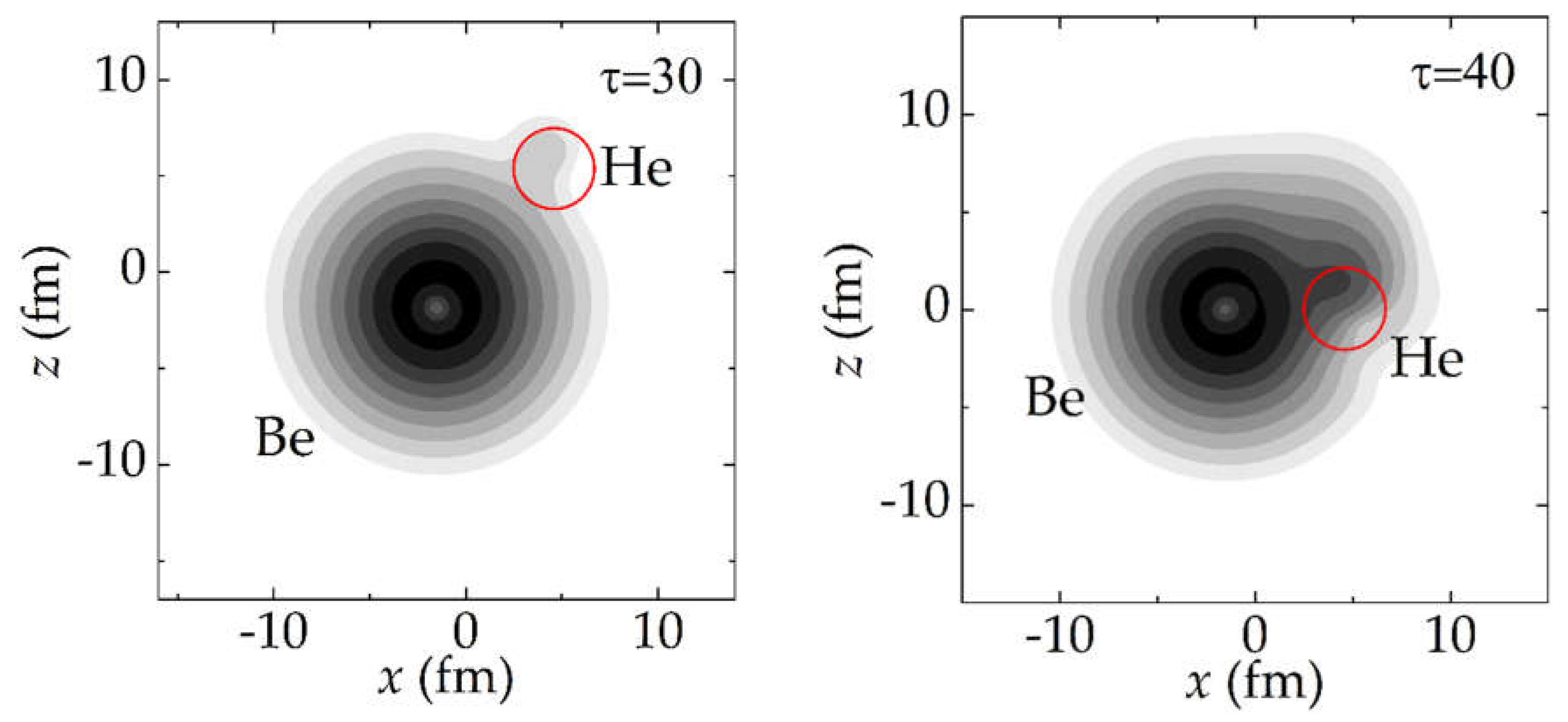
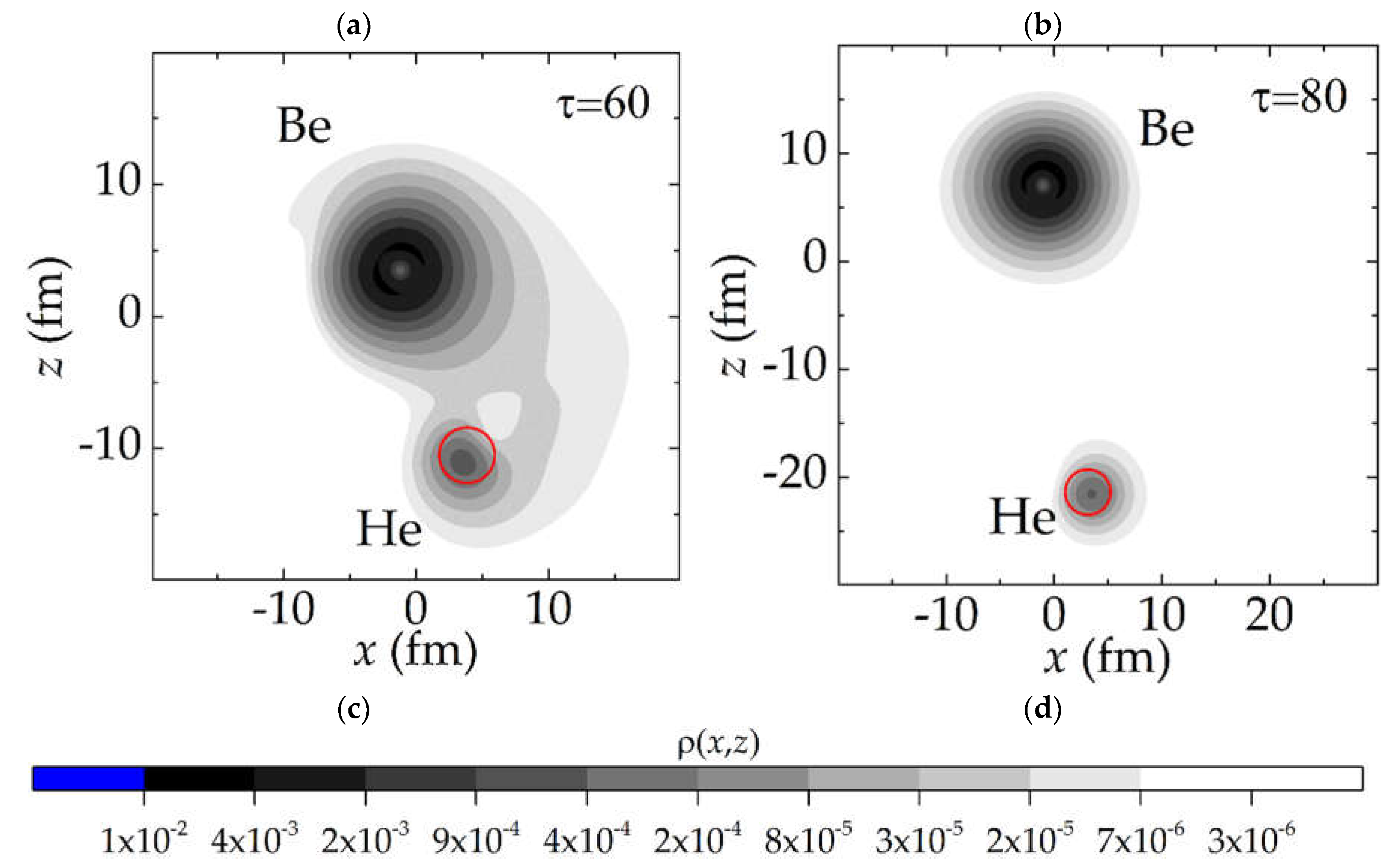
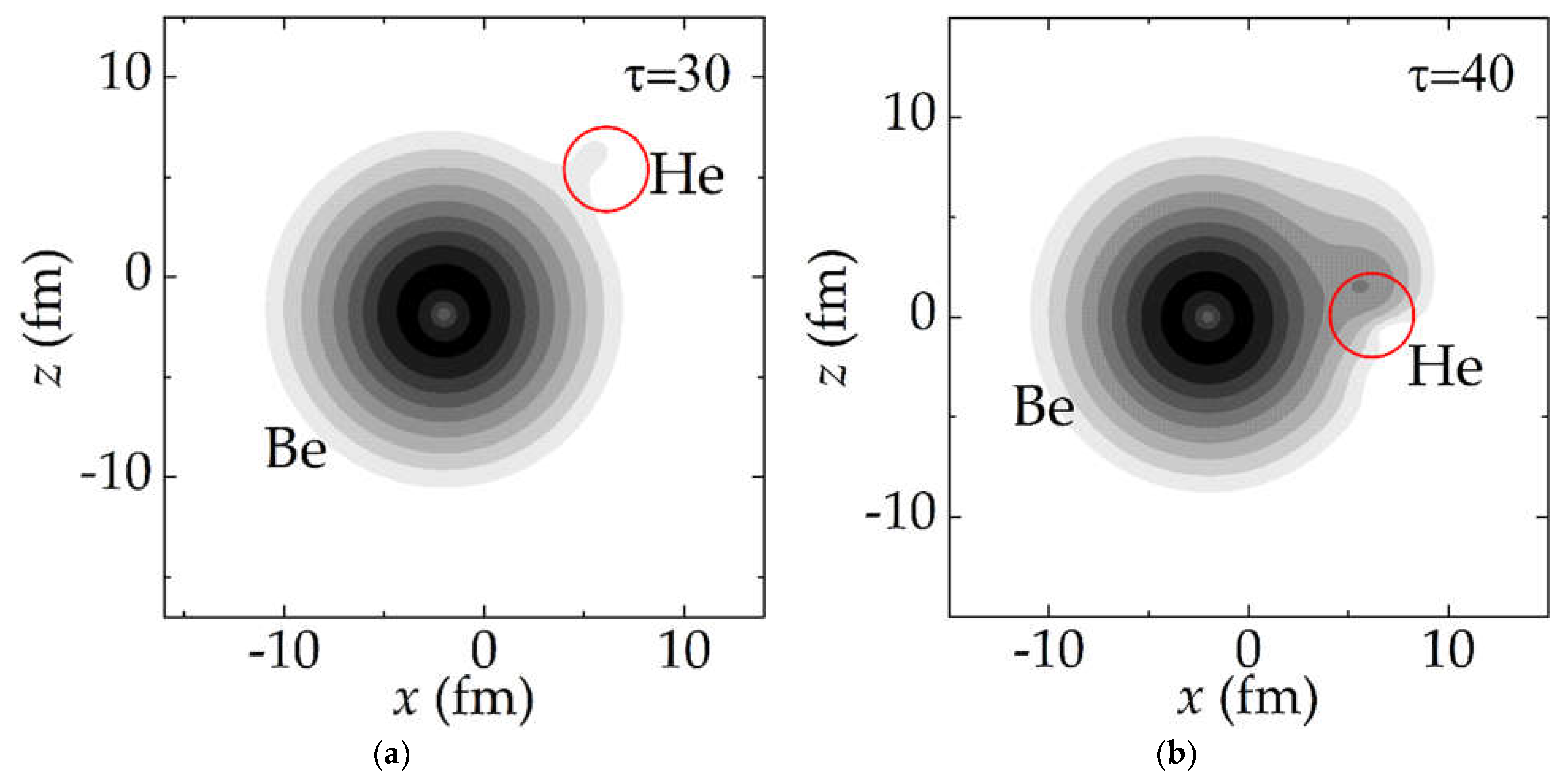
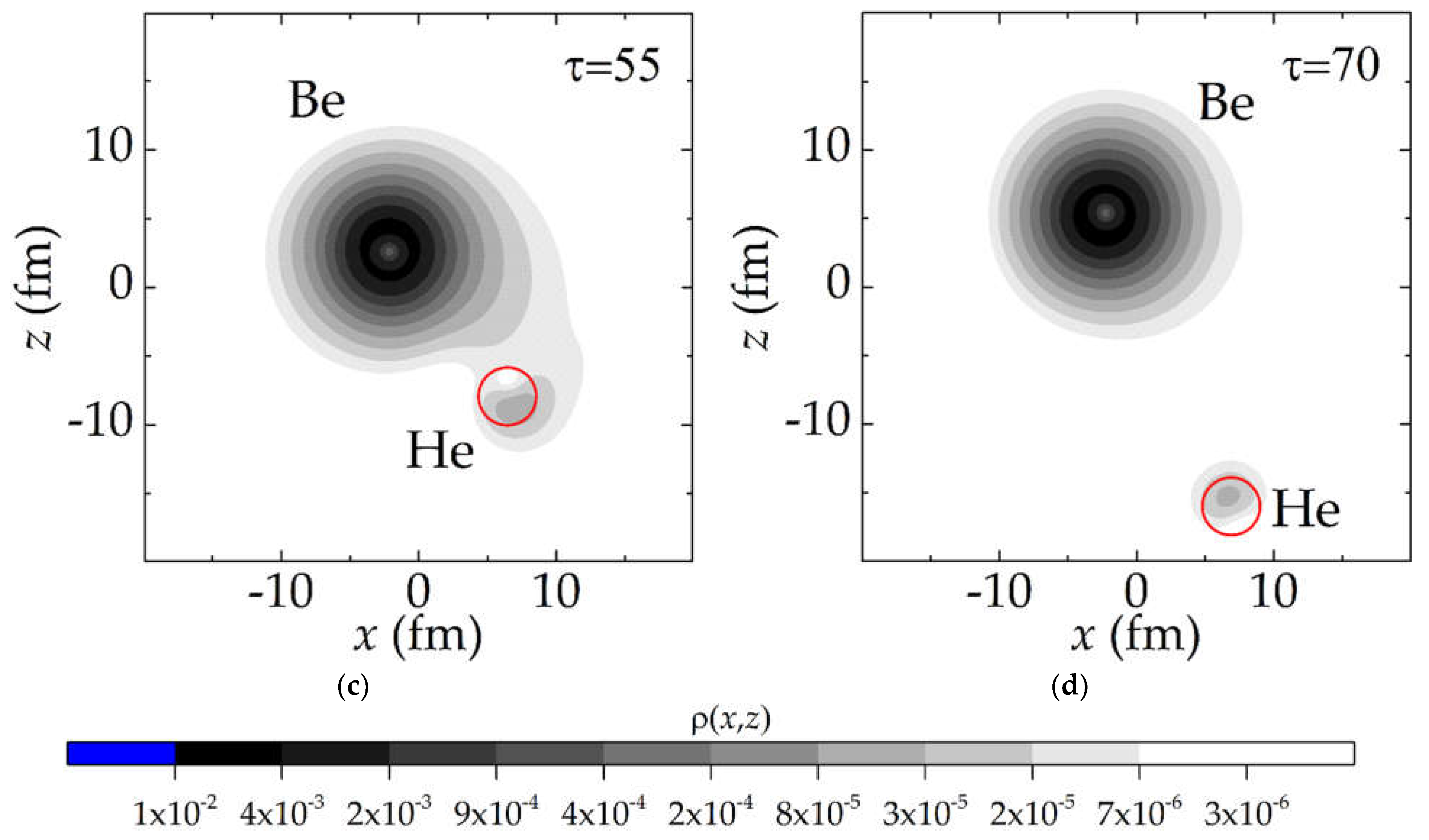
Figure 5.
(a) The final neutron transfer probability : circles are the result of calculations by (11); line is the result of approximation (12). (b) The final neutron removal probability : circles are the result of calculations by (15); solid curve is the result of approximation (16); dashed and dash-dotted lines are the respective contributions of the exponential functions with a1, b1, and a2, b2 to approximation (16).
Figure 5.
(a) The final neutron transfer probability : circles are the result of calculations by (11); line is the result of approximation (12). (b) The final neutron removal probability : circles are the result of calculations by (15); solid curve is the result of approximation (16); dashed and dash-dotted lines are the respective contributions of the exponential functions with a1, b1, and a2, b2 to approximation (16).
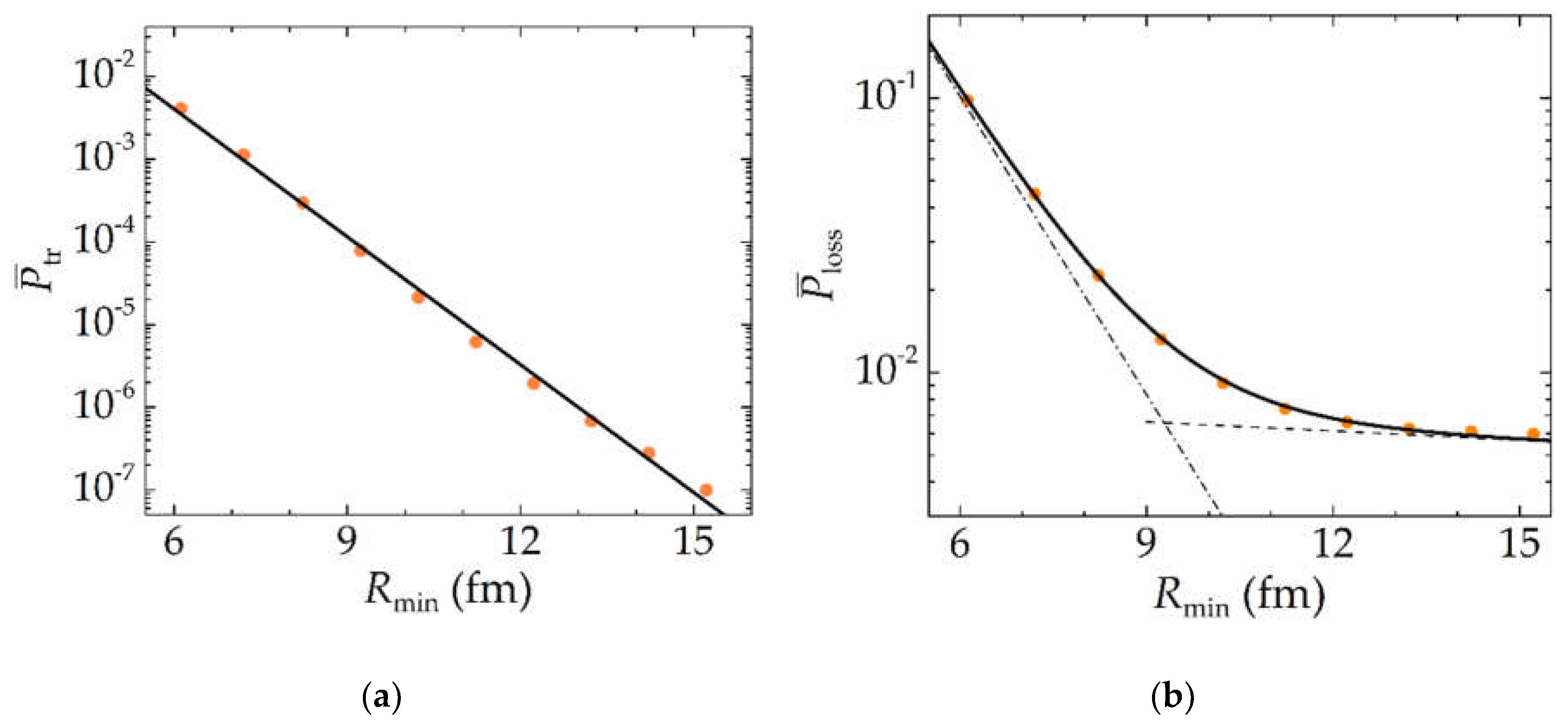

Table 1.
Parameters of the optical potential (1) used in DWBA calculations for the specified entrance and exit channels [18].
Table 1.
Parameters of the optical potential (1) used in DWBA calculations for the specified entrance and exit channels [18].
| Reaction channel |
VV (MeV) |
rV (fm) |
aV (fm) |
VW (MeV) |
rW (fm) |
aW (fm) |
rC (fm) |
|---|---|---|---|---|---|---|---|
| 3He+9Be | 103.9 | 0.7 | 0.777 | 23.81 | 0.854 | 0.817 | 0.767 |
| α+8Begs | 121.0 | 0.252 | 1.010 | 17.0 (14.9 1) | 1.38 | 0.34 | 0.724 |
| α+8Be3.03 | 121.0 | 0.252 | 1.010 | 17.0 (8.70 1) | 1.38 | 0.34 | 0.724 |
1 The values obtained in this work.
Table 2.
Calculated cross sections.
| Reaction channel | 9Be(3He,α)8Begs | 9Be(3He,α)8Begs | 9Be(3He,α)8Be3.03 | 9Be+3He→8Begs |
|---|---|---|---|---|
| Cross section (mb) |
σtr (gs, DWBA) 0.594 |
σtr (gs, TDSE) 0.740 |
σtr (3.03, DWBA) 1.375 |
σrem (TDSE) 315.690 |
Disclaimer/Publisher’s Note: The statements, opinions and data contained in all publications are solely those of the individual author(s) and contributor(s) and not of MDPI and/or the editor(s). MDPI and/or the editor(s) disclaim responsibility for any injury to people or property resulting from any ideas, methods, instructions or products referred to in the content. |
© 2024 by the authors. Licensee MDPI, Basel, Switzerland. This article is an open access article distributed under the terms and conditions of the Creative Commons Attribution (CC BY) license (http://creativecommons.org/licenses/by/4.0/).
Copyright: This open access article is published under a Creative Commons CC BY 4.0 license, which permit the free download, distribution, and reuse, provided that the author and preprint are cited in any reuse.


