

Submitted:
19 March 2025
Posted:
21 March 2025
You are already at the latest version
Abstract
The potential correlation between the ordinary muon capture (OMC) on 136Ba and 0νββ decay of 136Xe is explored. For this we have computed 0νββ-decay amplitudes for intermediate states in 136Cs below 1 MeV of excitation and for angular-momentum values J ≤ 5 by using the proton-neutron quasiparticle random-phase approximation (pnQRPA) and nuclear shell model (NSM). We compare these amplitudes with the corresponding OMC rates, computed in a previous Universe article (Universe 2023, 9, 270) for the same energy and angular-momentum ranges. The obtained results suggest that an extension of the present analysis to a wider energy and angular-momentum region could be highly beneficial for probing the 0νββ-decay nuclear matrix elements using experimental data on OMC rates to intermediate states of 0νββ decays.
Keywords:
double beta decay of Xe-136
; nuclear matrix elements
; muon capture on Ba-136
; muon-capture rates
1. Introduction
The theoretical study of the hypothesized rare neutrinoless double beta () decay is a challenging, yet among the most promising avenues of searches of physics beyond the standard model [1,2,3,4,5]. The complexity in the study of decay stems from the involvement of nuclear-structure effects/correlations from low to high momentum-exchange scales ( MeV) and nuclear states of high energy and/or multipolarity (). Experimental nuclear-structure data at medium and high momentum scales is seldom available and is almost entirely uncharted territory, making it difficult for nuclear models and hence the computed nuclear matrix elements (NMEs) to be improved upon being tuned to such data. Given that decay has not been measured, accurate nuclear modeling of this process for various -decay candidates is essential for determining the sensitivity of experiments designed to detect this rare decay [6]. There are significant discrepancies in the -decay NMEs computed in various nuclear-model frameworks [1], and imperfect nuclear-structure calculations demand the use of an effective value of the axial vector coupling () [5,6,7,8]. Discrepancies in -decay NMEs across nuclear models and uncertainty in the value of propagate in the 2nd and 4th power, respectively, to the computed/predicted half-lives.
Ordinary muon capture (OMC) is a seemingly miraculous process in that it is the only known practical way to systematically investigate the nuclear structure experimentally at momentum scales relevant to the physics of decay [9,10,11,12]. OMC can also populate all the nuclear states that are intermediate states of the odd-odd nucleus, via which the decay proceeds [9,10,11,12]. This means that OMC can and is used to access decay amplitudes of one leg, involving either the daughter or the mother nucleus of the "two-step" rare transition, depending on whether is of or /EC type, respectively [9,10,11,12,13]. Involvement of common decay amplitudes in this way for the computed OMC NMEs/rates and -decay NMEs leads us to look for connections between the two. Towards both ends of computing more accurate -decay NMEs and determination of , the OMC process is a gift from nature as it can help address both of these goals. The study of OMC is the best-known way to test the fitness of nuclear models and improve their accuracy, by closely tuning them to experimental data for computing physically relevant OMC NMEs. Tuning the nuclear models this way makes them optimized to compute -decay amplitudes and ultimately NMEs due to similar nuclear and weak-interaction contributions involved in the two processes [10,11,12,14]. As an example, OMC can give us access to the value of the particle-particle interaction parameter () in the pnQRPA (proton-neutron quasiparticle random-phase approximation) framework [10,11,12], and and/or the effective value of the pseudoscalar coupling () [15,16,17,18,19,20,21,22,23,24,25,26,27,28,29] at momentum scales relevant for decay.
Only in the recent past, major experimental efforts have been made to leverage OMC to illuminate further the mystery of decay, by measuring (partial) OMC rates as being done in present state-of-the-art experiments such as the MONUMENT experiment [30]. Such experiments will make available invaluable experimental constraints for grounding the theoretical modeling of OMC processes, and offering a tangible map for the improvement of nuclear models, leading the way to more accurate computed OMC/-decay NMEs.
The connection of having common decay amplitudes in the computed NMEs of the two processes prompted the search for the potential correlations and trends between -decay NMEs and OMC rates/NMEs as presented in References [10,11,12,31]. Such connections can be used to determine the accuracy of the computed -decay NMEs. In Reference [31], average OMC NMEs and -decay NMEs for key -decay candidates including 136Xe (the focus of this work) were compared in the framework of pnQRPA, and systematic correspondences were observed between the two. The NMEs were compared in order to minimize the kinematic and phase-space effects in the anticipated correlations. Given the trends observed in Reference [31], we anticipate seeing this correspondence map to correspondences between OMC rates and -decay NMEs. Evidence for such a connection is foreshadowed from trends between OMC rates and -decay NMEs as presented in References [10,11,12]. Correlations between OMC rates and -decay NMEs are of high interest as this can be a direct bridge between experimental OMC rates and theoretical -decay NMEs.
The focus of this work is to further elucidate this bridge in the context of decaying 136Xe, using for the first time the pnQRPA and nuclear shell model (NSM) together in OMC and non-closure formalisms. We compute the -decay amplitudes in the above frameworks and compare them with results obtained for the OMC rates of 136Ba, as presented in Reference [32], using the same nuclear models. In using different nuclear models, one can see if the potential correlations are model-independent and follow the similarities and differences in the trends that emerge.
2. Theory
2.1. Nuclear-Model Calculations
In the present work we adopt the nuclear shell model (NSM) and the proton-neutron quasiparticle random-phase approximation (pnQRPA) [33] as the basic nuclear-model frameworks. We compute the wave functions of the states of the odd-odd nucleus 136Cs by using these models in order to access the -decay amplitudes in a non-closure approach and compare them with the corresponding OMC rates computed in Reference [32]. In both the OMC and calculations we use the phenomenological NSM (sm-phen) and pnQRPA (qrpa-phen) approach, with the relevant parameters defined in Table 1 of Reference [32]. As in [32], the decay amplitudes are computed for states with excitation energy MeV, an energy range relevant to present-day MONUMENT experiment [30].
2.2. Ordinary Muon Capture (OMC)
The OMC is a well-studied nuclear process, both experimentally and theoretically [9]. In this work we compare our calculated -decay amplitudes with the OMC rates of Reference [32]. The OMC formalism of Reference [32] is an extended Morita-Fujii formalism described in detail in [34,35]. Lately, the use of realistic muon wave functions has been implemented [36], and up-to-date computations for OMC rates of 136Ba have been presented in Reference [32]. We refer readers to these results as we use them for the purposes of this work. For completeness, we present here some key relations for computing the OMC rates, where OMC of 136Ba proceeds as:
where a negative muon () is captured by the ground state of 136Ba, leading to final states in 136Cs. At the same time, a muon neutrino () is emitted. The general expression of the OMC rate is given as:
where the momentum exchange q is expressed as
Here, is the final-state spin-parity, M is the average nucleon mass, A is the nuclear mass number, and () is the rest mass of the muon (electron). The threshold energy is given by
where and are the masses of the initial and final nuclei, and is the excitation energy of the final nuclear state, in our case of 136Cs. The rate function P contains the NMEs, phase-space factors, and combinations of weak couplings (axial-vector), (induced pseudoscalar), and (induced weak-magnetism), with and being the anomalous magnetic moments of the proton and neutron, respectively.
2.3. Decay
The computational scheme used here is presented in detail in Reference [37]. We present here key relations. Assuming light Majorana neutrino exchange [4,37], the inverse half-life can be written as
where is the phase-space factor for the final-state leptons, is the axial vector coupling constant, is the effective neutrino mass, and is the nuclear matrix element (NME). The NME can be decomposed as:
where , , and are the Gamow-Teller, Fermi, and Tensor components of the NME, respectively, and is the vector coupling constant. Contribution from various multipoles constituting all the intermediate transitions is given as :
where , and are the contributions from all the states i of an the intermediate multipole . Each multipole contribution is, in turn, decomposed in terms of the two-particle transition matrix elements and one-body transition densities. In the pnQRPA calculations the two-particle transition matrix element reads
where label the pnQRPA solutions for a given multipole , starting from the final () and initial () nuclei, and denote the proton and neutron single-particle quantum numbers. The operator contains the neutrino potentials, the characteristic two-particle operators for the different K components, and short-range correlation effects. The quantities and are the corresponding decay amplitudes and is an overlap factor connecting the two branches of pnQRPA solutions for the 136Cs wave functions.
In the NSM calculations we use one unique set of states in 136Cs so that the sum over in Equation (8) is replaced by a sum over a single state number k and the overlap factor is not needed.
3. Results and Discussion
In order to compare the OMC rates and -decay amplitudes for states in a meaningful way, we consider the following physical assumptions: both quantities depend on the energy (), multipolarity (), and nuclear-structure content of the (virtual) states being populated in the process. In the case of OMC rates, phase-space factors contribute directly to OMC rates. For -decay NMEs, the dependence of neutrino potentials on energy, affects the concerned decay amplitudes. For our analysis, we can assume the energy dependence to be a constant for all the states since their energy is MeV. Therefore, our analysis simplifies, and we attribute the observed trends in OMC rates and -decay amplitudes to multipolarity () and nuclear-structure content of states. We see effects of such dependencies in the computed -decay amplitudes presented in Table 1 and Table 2 for the aforementioned computational scheme in Section 2.1.
Computed OMC rates for individual states can be found in Reference [32]. In order to smooth out the variations of the OMC rates and -decay amplitudes from one individual state to the other, we study the combined contribution to a given multipole , an effective strategy already implemented in Reference [31]. Another important consideration is that given that the nuclear-structure calculations are not perfect, we only consider the trends within the same nuclear model. So for the purposes of this paper, we look at trends in pnQRPA (qrpa-phen) and NSM (sm-phen) results independently. In Table 3, the cumulative OMC rates OMC() and amplitude contributions to () for multipole are given, and also plotted in Figure 1 and Figure 2.
In the figures positive and negative multipoles are plotted separately for clarity, and the quantities are scaled appropriately for optimal comparison. As seen from the plots in Figure 1 and Figure 2, regular variations between the quantities are observed. The variation of OMC rates () and () look roughly "mirror reflection" of each other, both in the context of pnQRPA, and NSM. Further conclusions cannot be made given the limited number of states and multipolarity, but the results look promising, giving impetus to a larger-scale study involving a larger set of states for each multipolarity, and covering a larger range of multipolarities, possibly to the Gamow-Teller giant resonance region in the case of the pnQRPA.
4. Conclusions
Correlations between the ordinary muon capture (OMC) on 136Ba and decay of 136Xe were searched for using -decay intermediate states in 136Cs below 1 MeV of excitation and for angular-momentum values . We computed -decay amplitudes through these intermediate states by using the proton-neutron quasiparticle random-phase approximation (pnQRPA) and nuclear shell model (NSM). Comparison with a corresponding earlier OMC calculation suggests that there are "mirror type of" correlations between the -decay amplitudes and the OMC rates. These correlations suggest that an extension of the present analysis to a wider energy and angular-momentum region could lead to a practical way to probe the -decay nuclear matrix elements using experimental data on OMC rates to intermediate states of decays.
Author Contributions
Calculation of -decay amplitudes using NSM, figures, primary analyses, writing the first draft, A.A.; NSM calculations, preparation of calculation input files for NSM (used by A.A.), V.K.; original idea of the project, computing -decay amplitudes using pnQRPA, coordination and supervision of the computations and analyses, finalizing the text of the draft, J.S.
Funding
A.A. and J.S. acknowledge support from project PNRR-I8/C9-CF264, Contract No. 760100/23.5.2023 of the Romanian Ministry of Research, Innovation and Digitization (the NEPTUN project). V.K. acknowledges financial support from ’GEFP’ IoE BHU fellowship (R/Dev/D/IoE/2024-25/GEFP/76559), and SERB Project (File No. EEQ/2023/000157), Govt. of India.
Data Availability Statement
Not applicable
Acknowledgments
We acknowledge grants of computer capacity from the Finnish Grid and Cloud Infrastructure (persistent identifier urn:nbn:fi:research-infras-2016072533 ), the support by CSC – IT Center for Science, Finland, for the generous computational resources.
Conflicts of Interest
The authors declare no conflicts of interest.
References
- Agostini, M.; Benato, G.; Detwiler, J.A.; Menéndez, J.; Vissani, F. Toward the discovery of matter creation with neutrinoless ββ decay. Rev. Mod. Phys. 2023, 95, 025002. [Google Scholar] [CrossRef]
- Blaum, K.; Eliseev, S.; Danevich, F.A.; Tretyak, V.I.; Kovalenko, S.; Krivoruchenko, M.I.; Novikov, Y.N.; Suhonen, J. Neutrinoless double-electron capture. Rev. Mod. Phys. 2020, 92, 045007. [Google Scholar]
- Engel, J.; Menéndez, J. Status and future of nuclear matrix elements for neutrinoless double-beta decay: a review. Reports on Progress in Physics 2017, 80, 046301. [Google Scholar] [CrossRef] [PubMed]
- Suhonen, J.; Civitarese, O. Weak-interaction and nuclear-structure aspects of nuclear double beta decay. Physics Reports 1998, 300, 123–214. [Google Scholar] [CrossRef]
- Ejiri, H.; Suhonen, J.; Zuber, K. Neutrino–nuclear responses for astro-neutrinos, single beta decays and double beta decays. Physics Reports 2019, 797, 1. [Google Scholar]
- Suhonen, J. Impact of the quenching of gA on the sensitivity of 0νββ experiments. Phys. Rev. C 2017, 96, 055501. [Google Scholar]
- Suhonen, J.T. Value of the Axial-Vector Coupling Strength in β and ββ Decays: A Review. Frontiers in Physics 2017, 5, 55. [Google Scholar]
- Suhonen, J.; Kostensalo, J. Double β Decay and the Axial Strength. Frontiers in Physics 2019, 7, 29. [Google Scholar]
- Measday, D. The nuclear physics of muon capture. Physics Reports 2001, 354, 243–409. [Google Scholar] [CrossRef]
- Kortelainen, M.; Suhonen, J. Ordinary muon capture as a probe of virtual transitions of ββ decay. Europhysics Letters 2002, 58, 666. [Google Scholar] [CrossRef]
- Kortelainen, M.; Suhonen, J. Microscopic study of muon-capture transitions in nuclei involved in double-beta-decay processes. Nuclear Physics A 2003, 713, 501–521. [Google Scholar] [CrossRef]
- Kortelainen, M.; Suhonen, J. Nuclear muon capture as a powerful probe of double-beta decays in light nuclei. Journal of Physics G: Nuclear and Particle Physics 2004, 30, 2003. [Google Scholar] [CrossRef]
- Jokiniemi, L.; Suhonen, J.; Kotila, J. Comparative analysis of nuclear matrix elements of 0νβ+β+ decay and muon capture in 106Cd. Frontiers in Physics 2021, 9, 652536. [Google Scholar]
- Šimkovic, F.; Pantis, G.; Vergados, J.D.; Faessler, A. Additional nucleon current contributions to neutrinoless double β decay. Phys. Rev. C 1999, 60, 055502. [Google Scholar] [CrossRef]
- Kolbe, E.; Langanke, K.; Vogel, P. Muon capture, continuum random phase approximation, and in-medium renormalization of the axial-vector coupling constant. Phys. Rev. C 1994, 50, 2576–2581. [Google Scholar] [CrossRef]
- Johnson, B.L.; Gorringe, T.P.; Armstrong, D.S.; Bauer, J.; Hasinoff, M.D.; Kovash, M.A.; Measday, D.F.; Moftah, B.A.; Porter, R.; Wright, D.H. Observables in muon capture on 23Na and the effective weak couplings g˜a and g˜p. Phys. Rev. C 1996, 54, 2714–2731. [Google Scholar] [CrossRef]
- Gorringe, T.P.; Armstrong, D.S.; Arole, S.; Boleman, M.; Gete, E.; Kuzmin, V.; Moftah, B.A.; Sedlar, R.; Stocki, T.J.; Tetereva, T. Measurement of partial muon capture rates in 1s-0d shell nuclei. Phys. Rev. C 1999, 60, 055501. [Google Scholar] [CrossRef]
- Siiskonen, T.; Suhonen, J.; Hjorth-Jensen, M. Shell-model effective operators for muon capture in 20Ne. Journal of Physics G: Nuclear and Particle Physics 1999, 25, L55. [Google Scholar] [CrossRef]
- Siiskonen, T.; Hjorth-Jensen, M.; Suhonen, J. Renormalization of the weak hadronic current in the nuclear medium. Phys. Rev. C 2001, 63, 055501. [Google Scholar] [CrossRef]
- Auerbach, N.; Brown, B.A. Weak interaction rates involving 12C, 14N, and 16O. Phys. Rev. C 2002, 65, 024322. [Google Scholar] [CrossRef]
- Gorringe, T.P.; Johnson, B.L.; Armstrong, D.S.; Bauer, J.; Kovash, M.A.; Hasinoff, M.D.; Measday, D.F.; Moftah, B.A.; Porter, R.; Wright, D.H. Hyperfine effect in μ- capture on 23Na and gp/ga. Phys. Rev. Lett. 1994, 72, 3472–3475. [Google Scholar] [CrossRef] [PubMed]
- Jonkmans, G.; Ahmad, S.; Armstrong, D.S.; Azuelos, G.; Bertl, W.; Blecher, M.; Chen, C.Q.; Depommier, P.; Doyle, B.C.; von Egidy, T.; et al. Radiative Muon Capture on Hydrogen and the Induced Pseudoscalar Coupling. Phys. Rev. Lett. 1996, 77, 4512–4515. [Google Scholar] [CrossRef] [PubMed]
- Gazit, D. Muon capture on 3He and the weak structure of the nucleon. Physics Letters B 2008, 666, 472–476. [Google Scholar] [CrossRef]
- Marcucci, L.E.; Kievsky, A.; Rosati, S.; Schiavilla, R.; Viviani, M. Chiral Effective Field Theory Predictions for Muon Capture on Deuteron and 3He. Phys. Rev. Lett. 2012, 108, 052502. [Google Scholar] [CrossRef]
- Brudanin, V.; Egorov, V.; Filipova, T.; Kachalkin, A.; Kovalenko, V.; Salamatin, A.; Shitov, Y.; Štekl, I.; Vassiliev, S.; Vorobel, V.; et al. Measurement of the induced pseudoscalar form factor in the capture of polarized muons by Si nuclei. Nuclear Physics A 1995, 587, 577–595. [Google Scholar] [CrossRef]
- Siiskonen, T.; Suhonen, J.; Kuz’min, V.; Tetereva, T. Shell-model study of partial muon-capture rates in light nuclei. Nuclear Physics A 1998, 635, 446–469. [Google Scholar] [CrossRef]
- Siiskonen, T.; Suhonen, J.; Kuz’min, V.; Tetereva, T. Shell-model study of partial muon-capture rates in light nuclei. Nuclear Physics A 1999, 651, 437–438. [Google Scholar] [CrossRef]
- Siiskonen, T.; Suhonen, J.; Hjorth-Jensen, M. Towards the solution of the CP/CA anomaly in shell-model calculations of muon capture. Phys. Rev. C 1999, 59, R1839–R1843. [Google Scholar] [CrossRef]
- Gorringe, T.; Fearing, H.W. Induced pseudoscalar coupling of the proton weak interaction. Rev. Mod. Phys. 2003, 76, 31–91. [Google Scholar] [CrossRef]
- Araujo, G.R. , Bajpai D., B.L.e.a. The Monument experiment: ordinary muon capture studies for 0νββ decay. Eur. Phys. J. C 2024, 84, 1188. [Google Scholar] [CrossRef]
- Jokiniemi, L.; Suhonen, J. Comparative analysis of muon-capture and 0νββ-decay matrix elements. Phys. Rev. C 2020, 102, 024303. [Google Scholar] [CrossRef]
- Gimeno, P.; Jokiniemi, L.; Kotila, J.; Ramalho, M.; Suhonen, J. Ordinary Muon Capture on 136Ba: Comparative Study Using the Shell Model and pnQRPA. Universe 2023, 9. [Google Scholar] [CrossRef]
- Suhonen, J. From Nucleons to Nucleus: Concepts of Microscopic Nuclear Theory; Springer Berlin, Heidelberg, 2007.
- Jokiniemi, L.; Suhonen, J.; Ejiri, H.; Hashim, I. Pinning down the strength function for ordinary muon capture on 100Mo. Physics Letters B 2019, 794, 143–147. [Google Scholar] [CrossRef]
- Jokiniemi, L.; Suhonen, J. Muon-capture strength functions in intermediate nuclei of 0νββ decays. Phys. Rev. C 2019, 100, 014619. [Google Scholar] [CrossRef]
- Jokiniemi, L.; Miyagi, T.; Stroberg, S.R.; Holt, J.D.; Kotila, J.; Suhonen, J. Ab initio calculation of muon capture on 24Mg. Phys. Rev. C 2023, 107, 014327. [Google Scholar] [CrossRef]
- Hyvärinen, J.; Suhonen, J. Nuclear matrix elements for 0νββ decays with light or heavy Majorana-neutrino exchange. Phys. Rev. C 2015, 91, 024613. [Google Scholar] [CrossRef]
Figure 1.
Cumulative -decay amplitudes and OMC rates for states computed using pnQRPA (qrpa-phen). The decay amplitudes and OMC rates have been scaled appropriately for optimal comparison.
Figure 1.
Cumulative -decay amplitudes and OMC rates for states computed using pnQRPA (qrpa-phen). The decay amplitudes and OMC rates have been scaled appropriately for optimal comparison.
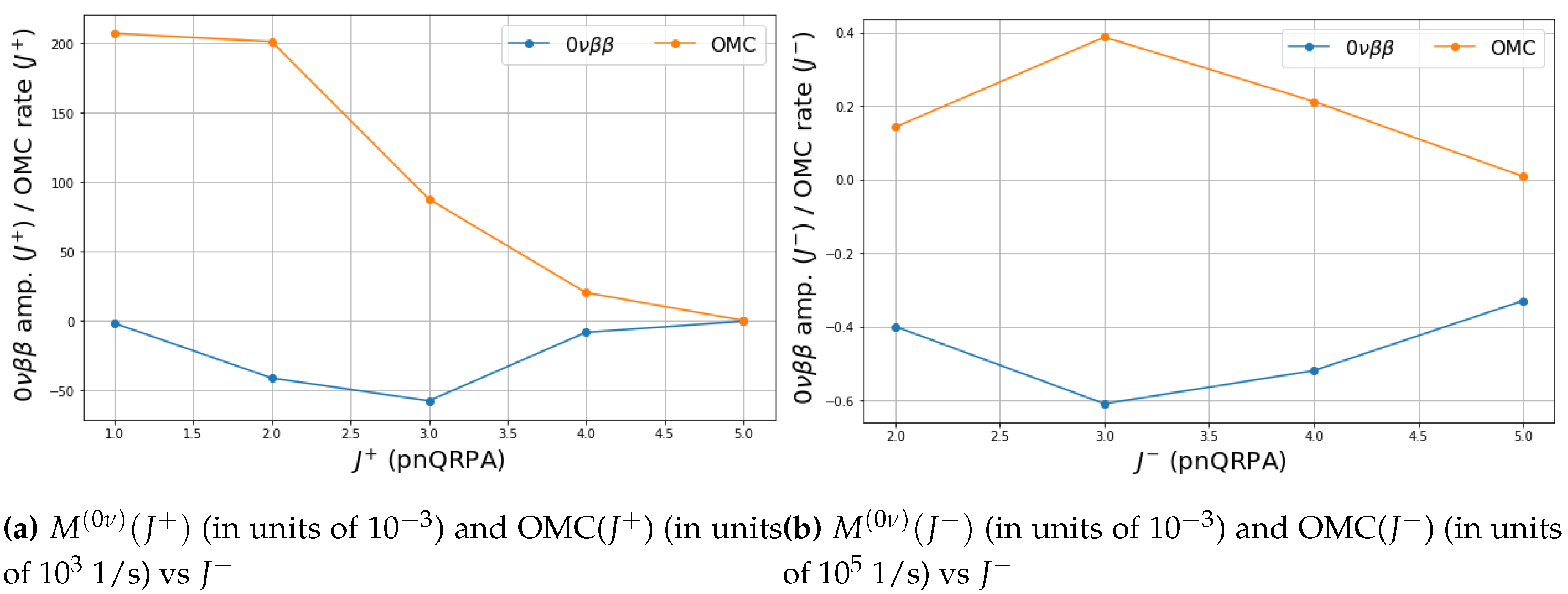
Figure 2.
Cumulative -decay amplitudes and OMC rates for states computed using NSM (sm-phen). The decay amplitudes and OMC rates have been scaled appropriately for optimal comparison.
Figure 2.
Cumulative -decay amplitudes and OMC rates for states computed using NSM (sm-phen). The decay amplitudes and OMC rates have been scaled appropriately for optimal comparison.
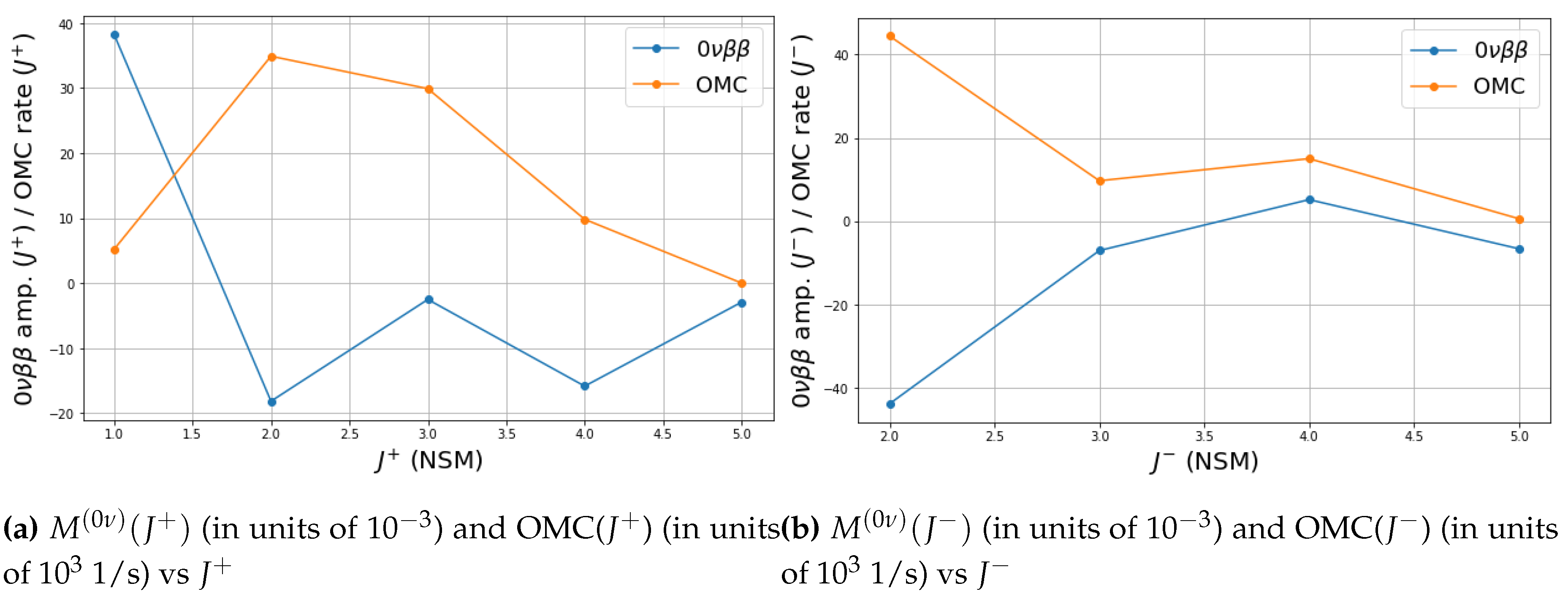

Table 1.
Phenomenological pnQRPA-computed -decay amplitudes of the NMEs of Equation (6). The amplitudes are given in units of .
Table 1.
Phenomenological pnQRPA-computed -decay amplitudes of the NMEs of Equation (6). The amplitudes are given in units of .
| [keV] | |||||
| 0 | 0 | -0.18 | 0.040 | -0.14 | |
| 102 | 0 | -0.28 | 0.037 | -0.24 | |
| 120 | 0.20 | -0.13 | -0.034 | -0.46 | |
| 154 | 0.07 | -0.02 | -0.006 | -0.13 | |
| 193 | 0 | -1.61 | 0.021 | -1.59 | |
| 203 | 4.96 | -0.32 | -0.13 | -7.65 | |
| 264 | 0 | -51.6 | 16.3 | -35.2 | |
| 281 | 0 | -10.1 | 0.88 | -9.20 | |
| 338 | 0 | -9.46 | -3.27 | -12.7 | |
| 367 | 0.01 | -0.16 | -0.0041 | -0.22 | |
| 458 | 0.02 | -0.16 | -0.0060 | -0.25 | |
| 494 | -0.007 | -0.24 | -0.089 | -0.32 | |
| 515 | 0.03 | -0.11 | -0.050 | -0.21 | |
| 558 | 0 | -0.42 | 0.068 | -0.35 | |
| 561 | 5.29 | -24.5 | -8.22 | -40.4 | |
| 637 | 0.07 | -0.01 | -0.004 | -0.12 | |
| 695 | 0 | -0.24 | 0.084 | -0.16 | |
| 704 | 0 | -0.49 | 0.097 | -0.40 | |
| 926 | 0.23 | -0.02 | -0.008 | -0.36 |
Table 2.
Phenomenological NSM-computed -decay amplitudes of the NMEs of Equation (6). The amplitudes are given in units of .
Table 2.
Phenomenological NSM-computed -decay amplitudes of the NMEs of Equation (6). The amplitudes are given in units of .
| [keV] | |||||
| 0 | 0 | -4.355 | 1.411 | -2.944 | |
| 23 | 0 | -5.695 | 1.445 | -4.250 | |
| 39 | 1.230 | -0.153 | -0.058 | -1.633 | |
| 83 | 6.993 | -5.160 | -1.433 | -14.677 | |
| 181 | 0 | -2.269 | -0.555 | -2.824 | |
| 224 | 0.894 | -4.481 | -1.748 | -7.262 | |
| 244 | 0 | -1.647 | -0.059 | -1.706 | |
| 323 | 1.989 | -2.575 | -1.019 | -5.895 | |
| 498 | 2.582 | -3.525 | -1.578 | -8.088 | |
| 517 | 0 | 6.540 | -0.289 | 6.251 | |
| 522 | 0.723 | -2.483 | -1.048 | -4.366 | |
| 545 | 0.379 | -4.893 | -1.701 | -7.033 | |
| 545 | 0 | 33.820 | -1.602 | 32.218 | |
| 547 | 0 | 5.565 | 0.589 | 6.154 | |
| 615 | -1.426 | 2.804 | 0.780 | 5.232 | |
| 670 | 1.313 | -0.511 | -0.210 | -2.239 | |
| 752 | 0 | 6.066 | -0.064 | 6.003 | |
| 760 | 0 | -1.281 | 0.309 | -0.972 | |
| 803 | 0.290 | -0.889 | -0.251 | -1.475 | |
| 885 | 0.082 | -0.108 | -0.044 | -0.248 | |
| 1016 | 0 | -44.144 | 0.371 | -43.772 |
Table 3.
Cumulative -decay amplitudes () and OMC rates OMC() for multipoles . OMC rates and the decay amplitudes are given units of 1/s and , respectively.
Table 3.
Cumulative -decay amplitudes () and OMC rates OMC() for multipoles . OMC rates and the decay amplitudes are given units of 1/s and , respectively.
| qrpa-phen | sm-phen | |||
|---|---|---|---|---|
| () | OMC() | () | OMC() | |
| -0.14 | 0.50 | -2.944 | 0.0 | |
| -8.10 | 20.4 | -15.864 | 9.8 | |
| -57.4 | 87.8 | -2.529 | 29.9 | |
| -41.0 | 201.1 | -18.182 | 34.9 | |
| -1.59 | 206.9 | 38.221 | 5.2 | |
| -0.33 | 0.80 | -6.605 | 0.6 | |
| -0.52 | 21.2 | 5.182 | 15.0 | |
| -0.61 | 38.7 | -7.033 | 9.7 | |
| -0.40 | 14.2 | -43.772 | 44.4 | |
Disclaimer/Publisher’s Note: The statements, opinions and data contained in all publications are solely those of the individual author(s) and contributor(s) and not of MDPI and/or the editor(s). MDPI and/or the editor(s) disclaim responsibility for any injury to people or property resulting from any ideas, methods, instructions or products referred to in the content. |
© 2025 by the authors. Licensee MDPI, Basel, Switzerland. This article is an open access article distributed under the terms and conditions of the Creative Commons Attribution (CC BY) license (http://creativecommons.org/licenses/by/4.0/).
Copyright: This open access article is published under a Creative Commons CC BY 4.0 license, which permit the free download, distribution, and reuse, provided that the author and preprint are cited in any reuse.


