

Submitted:
03 October 2024
Posted:
04 October 2024
You are already at the latest version
Abstract
In Europe, non-residential building stock built before building energy codes consumes more energy and resources than new buildings. Existing educational buildings comprise 17% of this outdated stock. These buildings can be retrofitted to create a conducive learning environment that can improve students’ comfort. Facade renovation has become the first choice for elevating the building performance of the education stock because it is less expensive than other alternatives. This study develops a methodology to optimize facade renovation solutions including: 1) preparation, 2) simulations of the simplified model using local shading, and 3) modelling realistic optimized facade design. This study evaluates visual comfort by considering multiple-dimensional metrics such as useful daylight illuminance (UDI), annual sunlight exposure (ASE), illuminance uniformity and the daylighting factor. The methodology was first applied to improve the facade proposal “Roof to Façade” in the project Waste-based Intelligent Solar Control Devices for Envelope Refurbishment (WiSeR) and simulations with the software DesignBuilder to design tile system facades. The results illustrate that implementing these solutions could efficiently improve indoor visual comfort by considering multiple daylight metrics. Moreover, for a constant gaps surface, the facade distribution with staggered gaps performs better in terms of the daylighting factor, solar gains and uniformity than more continuously connected gaps.
Keywords:
visual comfort
; simple to realistic method
; envelope renovation
; daylight metrics
; facade system
; educational stocks
1. Introduction
Human progress and development have led to environmental issues such as air pollution, global warming, ocean acidification and the urban heat island effect, among others [1]. One of the most serious problems that urgently needs to be resolved is that of carbon emissions. In March 2007, the European Council adopted a commitment to cut 20% of 1990 greenhouse gases by 2020. This reduction was extendable to 30% if other developed countries assumed a similar objective [2]. In the European Union, final energy consumption reached 324.7 Mtoe in the residential sector, 782.1 Mtoe in transport and 840.4 Mtoe in the energy industries in 2021 [3]. As the Official Journal of the European Union reported, the entire European Union now faces challenges due to a shortage of energy and reliance on energy imports. Energy efficiency is considered to be a powerful solution to these problems [4].
The construction industry is responsible for a high percentage of these environmental issues: between 30-40% [5]. For example, over 40% of global energy use comes from buildings, and buildings account for 30% of global greenhouse gas emissions [6]. Within the European Union, almost 30% of buildings are over 50 years old, and 70% run at a lower energy efficiency [7]. Non-residential building stock that was constructed before the introduction of building energy codes and has low building performance consumes more energy and resources than new buildings. Innovation in indoor thermal comfort is still lacking in such buildings [8]. Educational buildings account for 17% of this stock and require considerable costs for maintenance every year [9].
In most countries, the percentage of construction waste out of total landfilled solid waste is typically stable at approximately 25% to 40% [10]. Regarding the adoption of more sustainable construction materials, in 2020, the European Commission launched a circular economy action plan to reduce pressure on natural resources and ensure less waste [11].
In this context, refurbishment of schools plays a significant role in the reduction of energy consumption and carbon emissions and could contribute to the circular economy. Previous studies indicate that renovating the envelope of school buildings can significantly improve energy performance [12]. The underlying reason for this is that facades work as the “skin” of a building, separating the interior from the outside environment. Prior studies have noted that a retrofitted envelope could cut carbon dioxide emissions and improve energy flexibility for the grid [13]. Some research showed that highly targeted envelope solutions could save up to 54% of energy consumption [14]. Another study indicated that even some simple retrofit strategies could lead to a 33% drop in energy consumption [15]. Further research indicates that for buildings with low energy efficiency, the best option is to combine facade retrofitting with replacement of the heating system [16]. However, due to the high cost of changing a heating system and implementing a new one, facade renovation has become the first choice for elevating the building performance of the education stock. Furthermore, building exterior walls with high-energy performance can reduce the dependence on heating and cooling systems and decrease energy consumption. Hence, considering the typology of endemic climates in Spain, many studies have illustrated that envelope renovation is a cost-effective way to meet the requirements of building performance improvement [17].
The renovation of educational buildings should not only improve building energy performance, but also consider the needs and comfort requirements of users, especially students [18]. This is because indoor environments are crucial for pupils. After all, they spend more than 30% of their time inside schools. Based on the literature, children are distinct from adults in metabolic rate and they have limited adaptive behavior [19]. The retrofitting of existing educational buildings could help to create a conducive learning environment that improves students’ performance. Infiltration rate and indoor thermal comfort affect students’ memory and attention [20]. Furthermore, children are more sensitive to the indoor environment than adolescents [21]. Therefore, it is crucial to consider both students’ and education staff’s adaptations to spaces for learning activities. In addition, logically children’s visual perception has a huge influence on their comfort and health [22]. In the past 30 years, indoor environmental quality has been researched continuously worldwide. Studies have examined quality with and without windows [23], window size [24], distribution of seats [25], the color temperature of classroom lighting [26], natural elements [27, 28], type of lighting [29], visual preferences of children [30] and a structural model for visual comfort [31]. The openings of educational buildings depend on multiple factors [32], such as global environmental requirements, pedagogical movements and specific standards for the educational building phase [33].
Regarding the above, the use of waste-based shading devices to convert construction waste into new design facades is a sustainable method for introducing a circular economy in architecture [34]. Recycled construction materials are not only beneficial for promoting the circular economy, but also environmentally friendly. Recent evidence suggests that the industrial by-product gypsum could be recycled and reused in construction and building materials [35]. In addition, prefabricated panels with recycled PET materials could be seen as sustainable materials for construction [36]. Some researchers evaluated the feasibility of recycling waste slurry into building materials [10]. Another study indicates that recycled aggregate materials could replace natural aggregate, depending on the conditions, purpose and engineering project [37]. Moreover, general construction and demolition waste (CDW) can be applied in the construction industry [38].
This research paper is framed within the project Waste-based Intelligent Solar Control Devices for Envelope Refurbishment (WiSeR) [39], which develops advanced shading devices built using recycled materials [17]. The paper describes a novel method for optimizing the indoor visual comfort of shading devices in the refurbishment of school buildings. This method is validated by applying it to patterns of WiSeR shading devices on a selected free-running educational building.
2. Methodology
This project follows a methodology with three phases as presented in Figure 1.
The first phase starts with choosing the weather data, assessing parameters and preparing the model. The second phase optimizes the model following a simplified strategy and the third phase optimizes the model following a more realistic approach. This research method moves from simplified to more complex and realistic, to achieve the research objectives.
2.1. First Phase: Preparation
The preparation phase has two main steps: S1.1) the selection of weather data and evaluation parameters and S1.2) the preparation of the model. The assessment parameters include the evaluation parameters for indoor visual comfort and daylight metrics. This study mainly adopts UNE-EN 12464-1 [40], which establishes light and lighting, and lighting of workplaces, as the indoor visual comfort evaluation standard for the target classrooms. In addition, the data obtained from the CIBSE Lighting Guide (LG10-2014) [41] are used, as this is the supplementary standard of UNE-EN 12464-1 for the daylighting factor. The model is prepared by defining the target building and then studying its energy performance. To achieve this, the tool DesignBuilder [42] is used to obtain a general overview of the energy performance of the building, including temperature, solar gains and daylight.
2.2. Second Phase: Simplification of the Optimisation Model
The second phase applies louvres as local shading to explore and determine the values of parameters of louvres on indoor energy performance. This phase has four main steps: S2.1) study of the parameters of the chosen shading alternative, S2.2) study of the distance between louvres and the facade, S2.3) analysis of the angle of the blades and S2.4) study of the slat spacing. To conclude, this phase compares the simulation results of distinct values of the same type of parameters, while other parameters remain unchanged.
Step S2.1 obtains the basic parameters of the chosen shading alternative, including the number of tiles, slat spacing, angle, length and distance from the new facade to the exterior wall. This step keeps the simplified model parameters consistent with the actual model parameters.
Step S.2.2 studies and determines the distance from the facade to the louvres. The experiment related to the distance from the louvres to the exterior wall aims to explore the impact of distances from the facade to the louvres on the indoor daylighting and thermal performance of the selected classroom. As previously stated, to evaluate the indoor illuminance level, data obtained from the CIBSE Lighting Guide (LG10-2014) are used, as this is the reference standard for the daylighting factor. This guide states that a daylighting factor below 2 means insufficient indoor lighting. If the lighting factor is over 5, it proves that artificial light is unnecessary but may cause glare and overheating [41].
Step S2.3 studies and determines the angle of the blades. It involves modelling and simulations of different degrees of angles of louvres: 0 degrees, 30 degrees, 45 degrees and 60 degrees, with the values of slat spacing selected. These values are selected from the available system of defaults for blinds, ranging from 0 to 60 degrees.
Finally, step S2.4 determines the slat spacing. First, various values of slat spacing are selected, making the number of slats for each slat spacing different. The wider the louvre blade spacing, the fewer blades are required. This is also suitable for the tile system. Then, simulations are undertaken for each corresponding case.
2.3. Third Phase: More Realistic Optimization
The main purpose of the third phase is to further optimize the design plan based on the previous phase. This phase consists of three steps. The first step is to determine the proper visual field and lay the foundation for the subsequent design. Since the target classroom users are students aged 10 to 12 and teachers, the first step is to study the average height of these two groups of people. Next, it is crucial to explore the height and width of the visual fields, which correspond to the tile system, of these two groups in two states: standing and sitting. Subsequently, the results can be used to obtain an average value that is suitable for the general situation. Then, the authors can design a special version of the tile system facade according to this result. In the second step, the selected classroom from the school is analyzed. The general process is similar to that described in the first step. However, the feature that varies most between the first step and the second step is that the selected classroom is analyzed based on realistic situations. That is, the main focus of concern is how teachers and students perform their activities in the classroom and what the occupancy of each part of the room is. Once the analysis is completed, two patterns should be designed for the classroom. Finally, the last part simulates each design pattern and compares the results.
Step S3.1 determines the proper visual field for the view outside. As mentioned previously, the aim of this part is mainly to focus on indoor human activities. This is because the design of a facade for a classroom requires a consideration of indoor illuminance and must provide a comfortable reading and studying atmosphere. It is also necessary to consider how teachers and students look through windows, based on the space they use. To investigate this, the authors needed to study the average heights and view fields for the users. This step also determines the visual dimensions. According to the Spanish standard UNE-EN 17037:2020+A1 [43] concerning daylight in buildings, the assessment of the width of view outside varies based on the most remote point of the area used in the interior space and the width of the exterior facade between two interior walls.
Step S3.2 optimizes the facade according to the real situation in the selected classroom. The objective of this part is to optimize the facade by introducing the previous visual field analysis in the design project for the classroom. The optimization of the classroom includes three sub-steps: 1. study of the classroom according to the use of space and occupancy, 2. conclusions of the visual field based on real situations, 3. design of the new tile system facade of the classroom.
Finally, Step S3.3 involves building real scale models and running simulations for each design pattern from the pre-step. This step aims to build design models according to the improved design patterns corresponding to the chosen shading alternatives and then make simulations about daylighting in DesignBuilder [42]. The data that are obtained would work as comparative statistics to compare with that of the classroom without any local shading.
3. Results and Discussion
This section presents and discusses the results of the nine steps of the methodology previously presented in Figure 1, from S1.1 to S3.3.
3.1. First Step of the Preparation (S1.1)
In this step, climate data was collected using Spanish Weather for Energy Calculation (SWEC) files [44], to ensure the accuracy of the original data. This study chose the newer TMYx data with values from 2007 to 2021 [45]. This choice was made because the newer database can illustrate the general weather conditions during this period and even shows a trend for future weather. Evaluating the building performance with this database enables the authors to gain an overview to assess the impact of the new design facades on the previous building.
The adopted UNE-EN 12464-1 [40] standard specifies various requirements of lighting related to different types of educational premises. The standard for educational buildings was chosen as the reference criteria because the target building is a primary school. The illuminance that should be maintained in classrooms of general school buildings is 500 lux. However, the illuminance that should be maintained in classrooms of young children is 300 lux. As a result, the authors consider the range of maintained illuminance from 300 lux to 500 lux as acceptable. Another index that is indicated in the document is unified glare rating (UGR), which refers to artificial lighting and therefore is not included in this study. In addition, the adopted CIBSE Lighting Guide (LG10-2014) [41] indicates that a daylighting factor below 2 means insufficient indoor lighting. If the lighting factor is over 5, it proves that artificial lighting is not needed but glare and overheating may occur.
As the real daytime illuminance on the working plane is sophisticated and changes according to seasonal variation and weather conditions, it is quite difficult to assess daylight illuminance using only one metric. For this reason, the study introduces multiple-dimensional metrics to evaluate the illuminance level on the working plane without artificial lighting. It uses different parameters in each of the two aforementioned phases (see Figure 1). The second phase, which is the simplification of the optimization model, primarily studies the illuminance, daylighting factor and illuminance uniformity considering the time-consuming factor. The third phase, to compare the daylight illuminance level on the working plane of the target classroom before and after integration with the new design facade patterns, analyzes the following four important daylight metrics: useful daylight illuminance (UDI), annual sunlight exposure (ASE), illuminance uniformity and daylighting factor respectively. Notably, UDI provides a general overview of the illuminance level of the target classrooms during the entire year [46], while the ASE describes the percentage of space that receives too much direct sunlight for 250 occupied hours per year, to contribute to avoiding glare. Furthermore, the daylighting factor serves as a complementary parameter that provides the direct illuminance distribution of daylight across the working plane.
3.2. Second Step of the Preparation (S1.2)
This project chose Bellvitge school as the target building because it is the real reference building for the cluster BCN.C2 [47]. Hence, it is the closest to the cluster centroid and was validated by checking the results against the annual energy consumption. By choosing this school, the results can be upscaled to the entire BCN.C2 cluster. Step S1.2, preparation of the model, runs the whole year simulation by Design-Builder software and identifies possible potential problems and design simulations that may effectively resolve the issues. According to previous studies [48], the school applies central heating with water radiators, using natural gas to maintain warmth during winter. However, there is no cooling system or mechanical ventilation for summer. Domestic hot water is supplied to the kitchen, changing rooms and the entire third floor. In addition, the window aperture is 45 degrees by sliding, and natural ventilation is set from 22 to 23 hours. Table 10 in Appendix A shows the monthly temperature and heat gains of Bellvitge school to date.
This project focuses on the classroom of Bellvitge school with the worst performance, according to the teaching team. This classroom is on the third floor facing south. Figure 2 shows the classroom location (a), the interior view (b) and the floor plan (c).
Table 1 depicts the current lighting performance of the studied classroom.
Figure 3 concerning the distribution of UDI hours and Figure 4 on the daylighting factor show a generally similar trend. That is, the area surrounding the glazing of the playground side could receive high direct sunlight with high daylighting factors that lead to fewer useful daylighting illuminance hours per year. In addition, the most suitable UDI hours belong to the middle area of the working plane. All things considered, although the classroom could receive sufficient illuminance on a working plane, there are still some issues such as glare, high solar gains and overheating, which shaped the simulation models to provide a user-based solution.
3.3. Study of the Parameters of the Alternative “Roof to Facade” (S.2.1)
Before using the local shading installed in the DesignBuilder to determine the proper parameters for the following optimization, it is crucial to investigate the original metrics of the chosen shading alternative. This is the “Roof to Facade” proposal, because it was the most sustainable waste-based alternative for the case study [17]. According to the design [50], the distance from the facade to the alternative is 5 cm, the angles of the tiles are 0 degrees with concave faces down to the ground, and the slat spacing between two tiles is 21 cm. In addition to these metrics, the width of the tiles is 5 cm.
3.4. Distance from the Louvres to the Exterior Wall (S.2.2)
According to the practical operability and cost calculations [32], three values were adopted: 5, 7 and 10 cm, as presented in Figure 5.
Under the conditions of keeping other parameters unchanged and similar to the original design (“Roof to Façade”), the authors simulated the daylighting and thermal performance of the classroom with blinds at these three distances. Subsequently, all the results were compared with those of the simulation of the classroom without louvres. Notably, the distance for the original design of “Roof to Facade” is 5 cm. Moreover, 7 cm is the limit for using the previous hanging material, and 10 cm means switching to longer hanging material, which might increase the cost calculations [50].
Figure 6 reveals that these blinds could dramatically decrease the maximum indoor daylighting factor and control the average indoor factor in a reasonable range. Compared to the maximum indoor daylighting of the classroom without louvres at 14.482, all three types of louvres could decrease the maximum daylighting by more than threefold, with figures of 4.265 for 5 cm, 4.454 for 7 cm and 4.315 for 10 cm. In addition, the chart illustrated that the average indoor daylighting level of the classroom with blinds at the three distances was within normal limits. The classroom with blinds at 10 cm had the highest average daylighting factor of 2.110, compared to 2.067 for 5 cm and 2.081 for 7 cm. Moreover, the results showed the effect of louvres on indoor operative temperature and solar gains through exterior windows. Significantly decreased solar gains were observed in the scenario with louvres compared with the scenario without any local shading. The mean score for reduced solar gains was 23.71 kW. However, the difference among the results of the classroom with louvres at various distances to the exterior wall was irrelevant. The graphs in Figure 6 also illustrate that there was a nuance between the scenario without blinds and the one with louvres.
From the simulation results of the first experiment (see Table 2), this project can conclude that the effect of adding blinds at different distances to the exterior wall could vary indoor illuminance, operative temperature and solar gains through windows. In this case, the effect on operative temperature and solar gains varied little among the three proposed plans. As a result, it is reasonable to compare the daylighting illuminance, daylighting factor and uniformity to determine a proper value according to needs. The simulation results of the classroom with louvres at a distance of 10 cm from the exterior wall represented a better indoor illuminance level than that of 5 cm and 7 cm in average daylighting factor and illuminance uniformity. Although the louvres at a distance of 10 cm performed slightly better in average daylighting factor, the difference between the louvres at a distance of 10 cm and 7 cm was minimum. All things considered, the 7 cm distance from the new facade to the exterior wall was chosen.
Figure 7 and Figure 8 show the illuminance of the classroom with the shading devices separated 7 cm from the facade plane. This distribution is similar to the cases of separating shading by 5 and 10 cm [32]. Therefore, the illuminance study did not alter the performance of the three distances and 7 cm was chosen for the following steps.
3.5. Angle of Blades (S2.3)
A statistical analysis of the data showed that changes in the angle of the blinds could greatly affect indoor illumination and solar gains from exterior windows, while the impact on indoor operative temperature was not obvious. Importantly, the results highlighted that the ability of the blinds to resist solar radiation would increase as the blade degree increases. One key finding of this experiment was that louvres with blinds at 0 degrees showed the best energy-building performance in the daylighting factor. Not only did they provide an acceptable average daylighting level, but they also controlled the maximum daylighting factor under 5. This means there would not be any glare problems in the classroom. The simulation results of classrooms with integrated louvres and other degrees of blades illustrated that they were not able to reach the average indoor illuminance standard, although they could decrease the solar gains. Table 3 and Table 4 reveal the building performance regarding the temperature, heat gain and indoor illuminance of these classrooms with installed louvres at the different blade angles of 0°, 15°, 30°, 45° and 60° respectively. In conclusion, considering the indoor illuminance and solar gains, the louvres at 0 degrees were a good option to provide sufficient indoor illuminance and avoid glare problems and overheating. These results are aligned with related former studies [51].
3.6. Slat Spacing (S2.4)
Considering the dimensions of the existing windows, a total of three values of slat spacing were selected, with different numbers of slats for each spacing: 9 slats each 15 cm, 8 slats each 17 cm, and 7 slats each 21 cm. The results of this experiment (see Table 5) indicated the relationship between the slat spacing of louvres and indoor energy performance.
Table 5 and Table 6 show that louvres with slat spacing ranging from 15 cm, 17 cm and 21 cm could affect the indoor operative temperature, solar gains and indoor illuminance, compared with the classroom without louvres. However, blinds with different slat spacing had different effects on indoor thermal environment parameters. The parameter that was affected most was indoor illumination, followed by solar gains and finally operating temperature.
During the experiment, it became apparent that slat spacing at 21 cm could meet the standard requirements for indoor illuminance, with an average daylighting factor of 2.08. The maximum daylighting factor of louvres with a slat spacing of 21 cm was 4.45. The data consistently demonstrated a trend that as the measurement of slat spacing rose, the solar gains from exterior windows would also grow. The results of the statistical tests suggested that the slat spacing of louvres at 21 cm was able to provide a satisfactory indoor thermal performance and illuminance simultaneously.
3.7. Determining the Visual Dimensions (S3.1)
According to a previous study on the heights of Spanish schoolchildren, the mean height of girls aged from 10 to 12 is 147 cm while that of boys is 146 cm [52], as depicted in Figure 9. What is more, the heights of male and female teachers are 176 cm and 162 cm [53]. Thus, four situations may occur depending on the type of use and user: sitting and standing positions for adult and children. With this, a rough visual field was obtained, which enabled users to have good visual contact with the exterior in a standard room.
In the case of the selected classroom, the distance between the most remote point of the utilized area of the interior space and the facade is 5.65 m and the width of the exterior facade between two interior walls is 9.40 m. As a result, the width view for each opening is roughly 2.20 m (see Figure 10). In addition, the respective sum of the view openings’ dimension must be a minimum of 1.0 m x 1.25 m, namely 1.25 square meters [43].
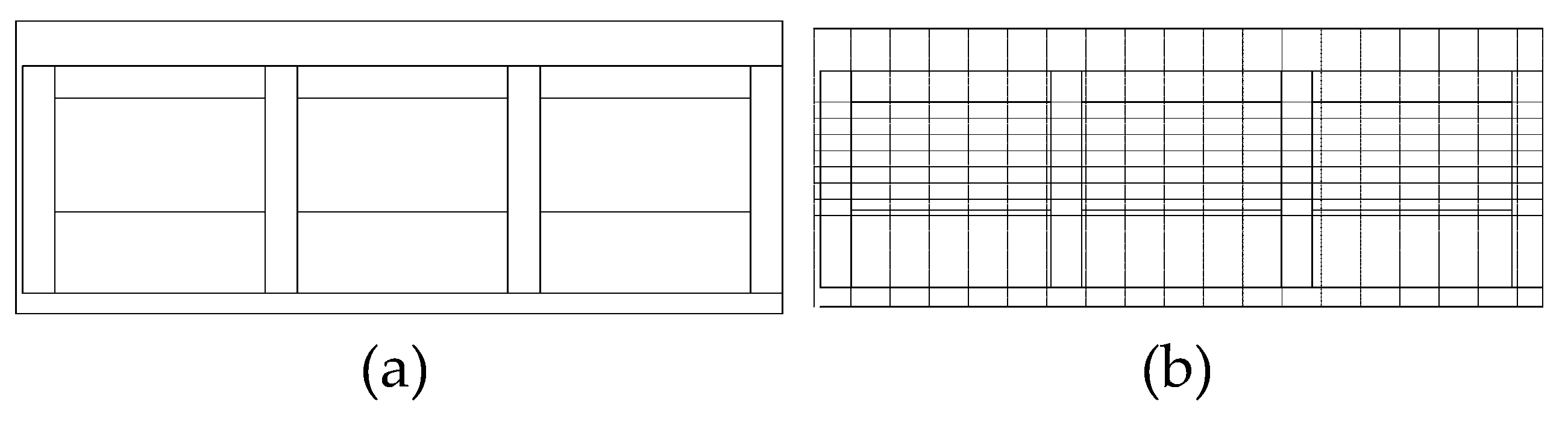
The optimized facade is designed not only to improve indoor visual comfort but also to have a proper visual field for both teachers and students. This analysis aimed to determine a visual field that ensures that people acting in a typical classroom of different ages could have a good view through the gap area in four specific types of situations (see Figure 11). The analysis of these four situations provided the four common areas that coincided with each position as depicted in Figure 12. These values are considered to be the depth of the gap area of the recycled tile system facade, which is 390 mm for the standing students, 400 mm for the sitting students, 420 mm for the standing teacher and 300 mm for the sitting teachers. To satisfy all the situations, 420 mm was selected for the depth of the gap area of the recycled tile system facade for the following design. To facilitate the design process, the recycled tile system was considered to be a huge grid with rectangles of 210 mm x 510 mm, as presented in Figure 18 in Appendix B.
3.8. Results of Design Patterns for the Selected Classroom (S3.2)
This step involved optimizing the façade by incorporating the previous visual field analysis in the design project for the selected type of classrooms. The following subsections present the results from the aforementioned three sub-steps.
3.8.1. Space and Occupancy (SS3.2.1) and Visual Field (SS3.2.2)
In the school, a typical traditional classroom is divided into spaces for two main uses: one for sending a message (mostly used by a teacher) and the other for receiving it (mostly used by students). Generally, the three windows coincide with the three parts of the interior spaces (Figure 13 [a]). As a result, the main idea is to examine three sections for each zone (see Figure 13 [b-d]) to determine the best gap width for the new façade (see Figure 14).
3.8.2. Design Proposal for the Classroom (SS3.2.3)
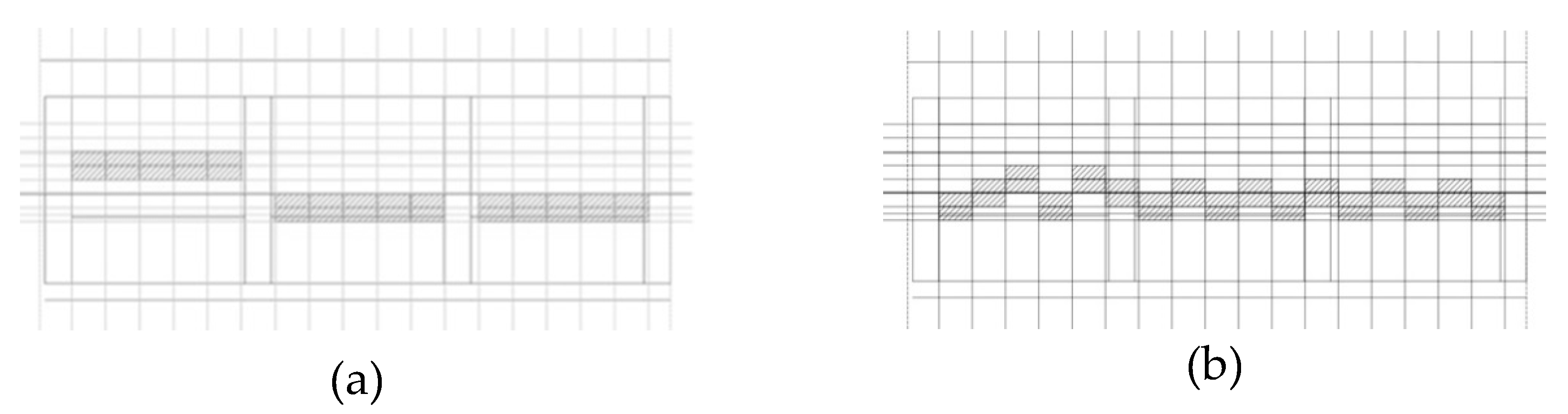
Considering the frequent uses of the classroom, two types of tile system facades were designed and modelled based on the analysis below (see Figure 15 and Figure 19 in Appendix C). One is a continuous gap, the other is a system with staggered gaps. One factor to consider is that the total surface gap area is 3.21 square meters, and the width view for each opening is 2.60 m. Both of these measurements meet the requirements of Spanish standard UNE-EN 17037:2020+A1, with 1.25 square meters and 2.20 m respectively [43].
3.9. Simulation Results of the Optimized Project for the Selected Classroom (S3.3)
Table 7 shows the simulation results for the indoor energy performance of the selected classroom integrated with designs 1 and 2, which are based on an analysis and reflections on the comfort visual field related to the users’ characteristics and behaviors. Considering the operative temperature in June and January, the difference between these two plans is below 1℃. The change in solar gains from exterior windows is more obvious. For instance, the tile system created with design 2 could efficiently decrease the solar gain from 170.38 kWh to 157.31 kWh in June and design 1 could decrease the solar gains from 170.38 kWh to 156.95 kWh. One factor to bear in mind is that the solar gains of the classroom with design 2 decreased from 570.90 kWh to 394.18 kWh, while design 1 decreased to 378.65 kWh in January. This means that design 2 is bound to benefit the heating in winter. In addition, both design patterns control the average daylighting factor in the proper range. However, there are some points whose values are over 5 in the simulation result of pattern 1, and this may cause an overheating problem in summer. The results demonstrate that design 2 performs well on the daylighting factor, as its maximum value is controlled to 4.775.
As expected, the illuminance uniformity was greater in design 2 than in design 1, which had better evenness.
As presented in the Stats-scatters (see Figure 16 and Figure 17), most of the illuminance value of design 1 is concentrated between 150 lux to 300 lux, while that of design 2 is between 150 lux to 250 lux. In addition, the highest illuminance value is centered on the area close to the outside window in both designs of facade patterns. Moreover, the simulations illustrate that the distribution of illuminance in the working plane is closely connected to the design gap of the plan. In the plots for design 1, the maximum illuminance decreased gradually from the teacher’s area to the student’s area. Regarding the illuminance, both designs have a similar performance, although design 1 has a slightly wider area of over 500 lux. This difference could imply glare issues or additional energy savings, considering CIBSE [41]. However, it would satisfy Spanish standards [43].
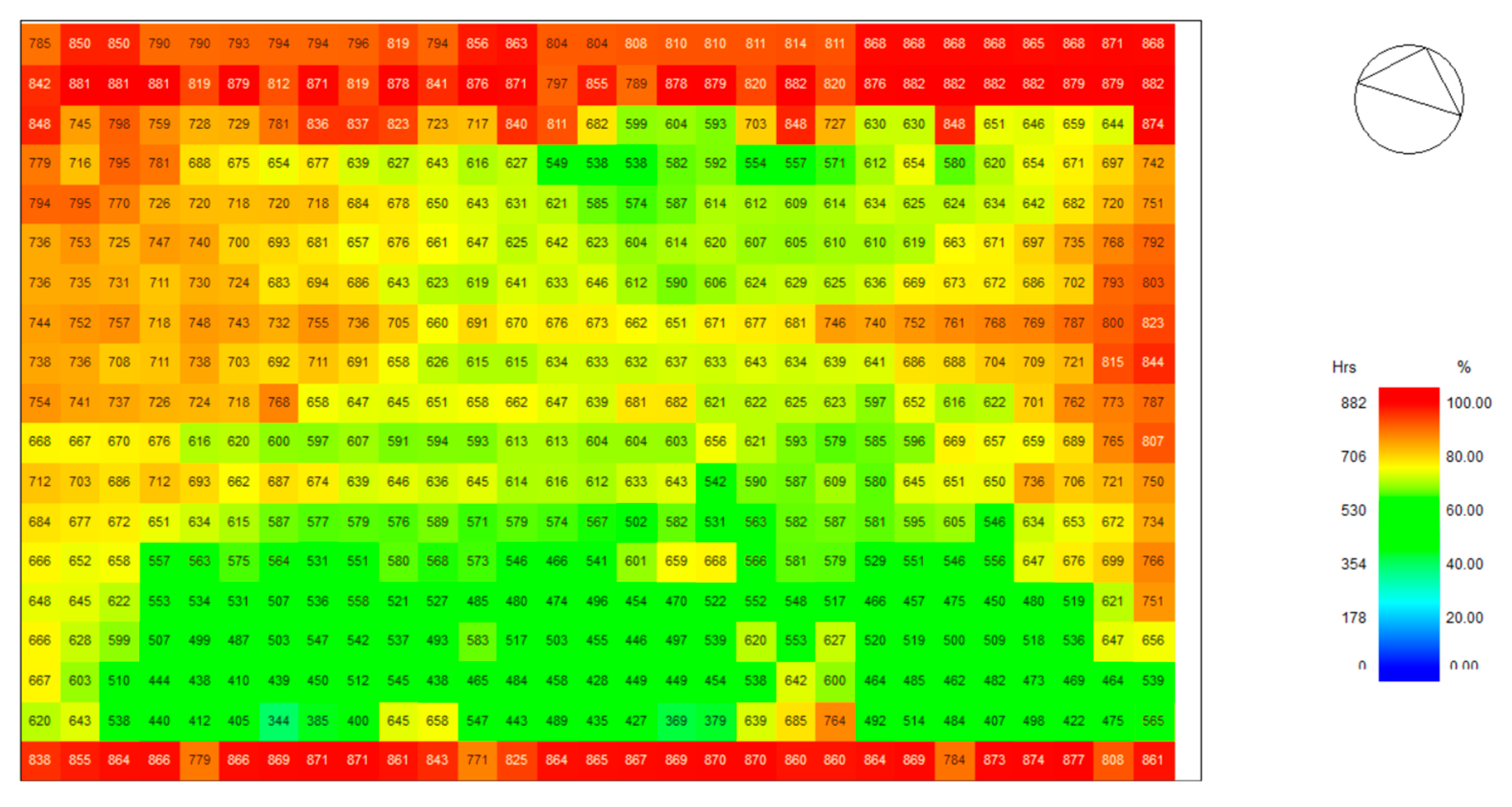
The results of the percentage of useful daylight illuminance area (see Table 8) show a dramatic increase from 51% to 97% for both designs, compared to the classroom without integrating shading. It is clear that the use of shades enhances the visual conditions throughout the day, with a higher and uniform distribution of satisfactory time, as confirmed in the graphs of the States-scatter of UDI hours presented in Figure 15 and Figure 16. In addition, the distribution of UDI hours of both designs, presented in Figure 20 and Figure 21 in Appendix D, is confirmed. Both designs can efficiently decrease the percentage of areas with unmet requirements in a decent range to below 10%. These designs show only a minimum of 1.64% regarding ASE, as depicted in Table 8.
To sum up, both designs improve the UDI hours similarly and reduce the ASE area for which requirements are not met to below 10%, in a decent range. However, design 2 performs slightly better, mainly in the daylighting factor, solar gains level and illuminance distribution. However, artificial lighting will be required according to Spanish standards [43].
3.10. General Discussion
The objectives and parameters used in this study are in line with those in [54,55] but there is a difference in the view analysis evaluation.
The results and discussion show that the waste-based shading devices improve the daylight comfort of the classrooms because they can efficiently decrease the average daylight factor of the working plane in an acceptable range, while reducing glare and overheating problems. In addition, the study shows that the useful daylight illuminance area could also improve up to 97% considering 50% working time. This reinforces previous studies that analyzed other shading methods [56].
The difference between designs 1 and 2 is less than it would be if all the gaps in pattern 2 were at the lowest level. However, the distribution of the gaps follows the visual field of the occupant of each sector, including that of the teacher and the children.
The installation of shading is bound to limit the solar gains in winter, which could be a disadvantage that results in more energy consumption for heating. According to previous related studies [57], this increase is relatively low. For example, for the Bellvitge school it is approximately 1% or 1500 kWh/year. This could be resolved by considering movable shading as a solution, as pointed out in previous related research.
4. Conclusions
The application of the proposed methodology was successfully validated for the specific case study. Therefore, it is expected to be applicable to other cases, considering the characteristics of each classroom and school. The findings demonstrate the feasibility of designing waste-based facades by considering indoor illuminance and daylighting levels.
The results indicate that an optimized tile system facade could significantly improve the indoor visual comfort of the selected classroom and avoid overheating problems, which answers the initial research project question.
Considering the simplified model and the analysis of the three relative parameters of the louvres, the most suitable parameters used in the realistic model and simulation are 7 cm of distance from the new facade to the exterior wall, blade degrees at 0, and slat spacing at 21 cm. Specifically:
- Classroom-installed louvres at a distance to the exterior wall ranging from 5 to 10 cm could efficiently limit the incident solar lighting, while the other parameters of louvres remain unchanged (angle of blades, slat spacing). Louvres that have different angles of blades and slat spacing have limited influence on operative temperature but affect the radiant temperature to some extent.
- For louvres with angles from 0 to 60 degrees, as the shutter blades’ angle gradually rises, the shutter’s ability to block light and solar radiation increases, to form a non-linear increasing trend. When the distance to the wall is 7 cm and the vertical spacing is 21 cm, maintaining the angle of the blades at 0 degrees best meets the requirement for indoor comfortable illuminance, while avoiding overheating and glare.
- Louvres with slat spacing from 16 cm to 21 cm have a limited effect on the operative temperature, while other parameters of the louvres remain unchanged (distance from louvres to the exterior wall, angle of blades). A number of blades greater than 7 could lead to insufficient indoor daylighting, while the other parameters remain the same, as in the original “Roof to Façade” project (distance from louvres to the exterior wall, angle of blades). Thus, 21 cm is suitable for the realistic model.
A comparison of the simulation results shows that both patterns offer similar improvements in the UDI hours, and contribute to greater evenness of the distribution. Nevertheless, design 2, with staggered gaps, performs better in daylighting factor, solar gains and uniformity.
In consequence, future studies should include a) validation of the relationship between the design of gaps in a shading system and indoor comfort, including distribution of indoor illuminance, daylight factor, and ASE areas; b) modelling and simulation of further optimized facade designs materials and colors of the shading; c) an investigation of the indoor ventilation and d) an improvement in it under different designs of roof-tile facades. Both the aforementioned achievements and the future research steps aim to improve the indoor comfortable illuminance and provide a better visual field for the users.
Author Contributions
All authors have contributed to conceptualization and methodology; X.M: validation, formal analysis, investigation, data curation, writing—original draft preparation, visualization. S.O and O.P. writing—review and editing, supervision. OP: funding acquisition. All authors have read and agreed to the published version of the manuscript.
Funding
This research was funded by the “Waste-based Intelligent Solar-control-devices for Envelope Refurbishment” WISER project supported by “Ecological Transition and Digital Transition Projects” of the Spanish Ministry of Science and Innovation (MICINN), with reference TED2021-130155B-I00 and funded by MCIN/AEI/10.13039/501100011033 as well as the European Union “NextGenerationEU”/PRTR for the information provided.
Institutional Review Board Statement
Not applicable.
Data Availability Statement
The data presented in this study are available on request from the corresponding author.
Acknowledgments
The authors thank the teaching team of Bellvitge school and the municipality of Hospitalet de Llobregat.
Conflicts of Interest
The authors declare no conflicts of interest.
Appendix A

Table 10.
Monthly environmental energy simulation results of temperature and solar gains.
| Magnitude | Monthly | |||||||||||
| Jan | Feb | Mar | Apr | May | Jun | July | Aug | Sep | Oct | Nov | Dec | |
| Operative Temperature(℃) | 15.84 | 17.08 | 17.98 | 18.78 | 21.03 | 24.83 | 27.64 | 26.54 | 25.61 | 23.89 | 19.96 | 16.44 |
| Glazing(KWh) | -683.96 | -619.44 | -678.62 | -273.85 | -215.96 | -135.96 | -83.03 | -82.27 | -299.18 | -612.28 | -630.87 | -515.66 |
| Computer+Equip(KWh) | 17.22 | 17.40 | 20.26 | 14.42 | 19.25 | 13.86 | 8.64 | 8.64 | 14.93 | 19.75 | 18.46 | 15.07 |
| Internal Natural Vent.(KWh) | -30.01 | -24.65 | -13.62 | 5.66 | 14.44 | 14.89 | 18.33 | 12.85 | 5.34 | -7.37 | -24.22 | -21.93 |
| Walls(KWh) | -137.69 | -149.69 | -185.07 | -103.63 | -104.51 | -64.06 | -17.80 | -16.78 | -76.13 | -136.25 | -142.45 | -111.85 |
| Floors(int)(KWh) | -87.81 | -88.74 | -74.46 | -28.90 | -26.72 | -17.12 | -24.21 | -24.08 | -22.64 | -58.36 | -85.89 | -57.27 |
| Roofs(KWh) | -119.29 | -112.04 | -111.39 | -27.95 | -36.67 | -0.83 | 28.75 | 10.28 | -13.26 | -64.13 | -102.18 | -72.37 |
| Artificial Lighting(KWh) | 3.35 | 1.49 | 0.76 | 0.00 | 0.00 | 0.00 | 0.00 | 0.00 | 0.00 | 0.43 | 5.03 | 3.00 |
| Solar Gains(KWh) | 583.76 | 563.17 | 613.06 | 259.45 | 279.09 | 176.62 | 45.52 | 54.02 | 288.56 | 586.49 | 546.29 | 411.77 |
Appendix B
Figure 18.
Design grid based on the façade structure (a) and the recycled tile system (b).
Appendix C
Figure 19.
Designed patterns for the classroom: design 1 (a) and design 2 (b).
Appendix D
Figure 20.
Distribution of UDI hours of the studied classroom with design 1.
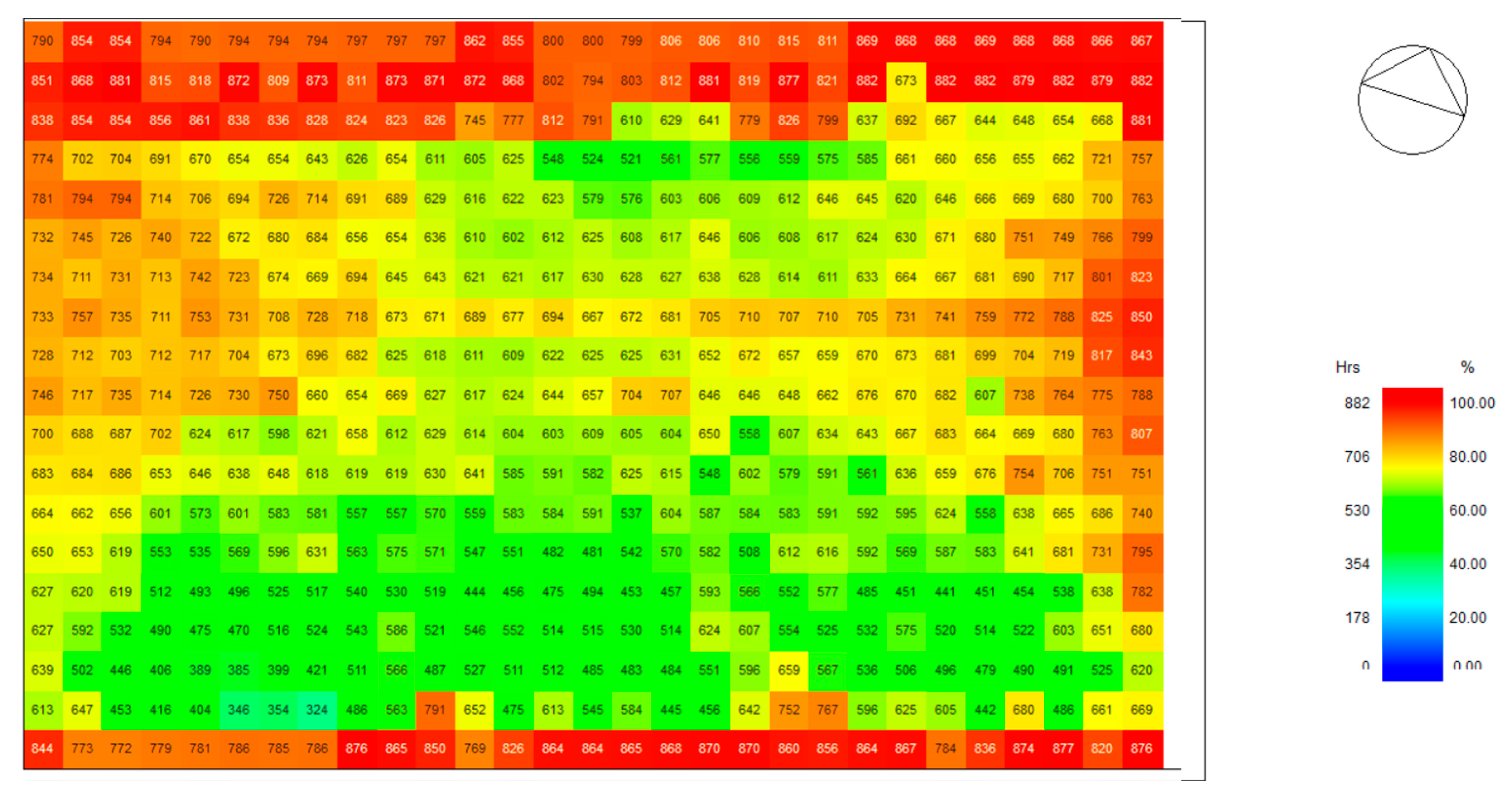
Figure 21.
Distribution of UDI hours of the studied classroom with design 2.
References
- O. US EPA, ‘Climate Change Impacts on the Built Environment’. Accessed: Jul. 14, 2023. [Online]. Available: https://www.epa.gov/climateimpacts/climate-change-impacts-built-environment.
- S. Zahiri and H. Altan, ‘The Effect of Passive Design Strategies on Thermal Performance of Female Secondary School Buildings during Warm Season in a Hot and Dry Climate’, Front. Built Environ., vol. 2, 2016, Accessed: Jul. 17, 2023. [Online]. Available: https://www.frontiersin.org/articles/10.3389/fbuil.2016.00003.
- ‘EU energy in figures’, 2023.
- Directive 2012/27/EU of the European Parliament and of the Council of 25 October 2012 on energy efficiency, amending Directives 2009/125/EC and 2010/30/EU and repealing Directives 2004/8/EC and 2006/32/EC Text with EEA relevance, vol. 315. 2012. Accessed: Jun. 30, 2024. [Online]. Available: http://data.europa.eu/eli/dir/2012/27/oj/eng.
- S. Habibi, O. P. Valladares, and D. M. Peña, ‘Sustainability performance by ten representative intelligent Façade technologies: A systematic review’, Sustain. Energy Technol. Assess., vol. 52, p. 102001, Aug. 2022. [CrossRef]
- A. Atmaca, ‘Life cycle assessment and cost analysis of residential buildings in south east of Turkey: part 1—review and methodology’, Int. J. Life Cycle Assess., vol. 21, no. 6, pp. 831–846, Jun. 2016. [CrossRef]
- C. Zhang, M. Hu, B. Laclau, T. Garnesson, X. Yang, and A. Tukker, ‘Energy-carbon-investment payback analysis of prefabricated envelope-cladding system for building energy renovation: Cases in Spain, the Netherlands, and Sweden’, Renew. Sustain. Energy Rev., vol. 145, p. 111077, Jul. 2021. [CrossRef]
- M. Economidou, ‘Energy performance requirements for buildings in Europe’.
- D. Österreicher and S. Geissler, ‘Refurbishment in Educational Buildings – Methodological Approach for High Performance Integrated School Refurbishment Actions’, Energy Procedia, vol. 96, pp. 375–385, Sep. 2016. [CrossRef]
- Y. Zhang, J. Liu, M. Cheng, Y. Li, J. Huang, and Z. Jing, ‘Hydrothermal solidification of underground construction wastes into building materials: Waste slurry recycling, industrial application and evaluation’, J. Clean. Prod., vol. 426, p. 139091, Nov. 2023. [CrossRef]
- ‘Circular economy action plan - European Commission’. Accessed: Jul. 13, 2024. [Online]. Available: https://environment.ec.europa.eu/strategy/circular-economy-action-plan_en.
- J. Sierra-Pérez, B. Rodríguez-Soria, J. Boschmonart-Rives, and X. Gabarrell, ‘Integrated life cycle assessment and thermodynamic simulation of a public building’s envelope renovation: Conventional vs. Passivhaus proposal’, Appl. Energy, vol. 212, pp. 1510–1521, Feb. 2018. [CrossRef]
- A. Bruck, S. Diaz Ruano, and H. Auer, ‘Values and implications of building envelope retrofitting for residential Positive Energy Districts’, Energy Build., vol. 275, p. 112493, Nov. 2022. [CrossRef]
- H. Ali and R. Hashlamun, ‘Envelope retrofitting strategies for public school buildings in Jordan’, J. Build. Eng., vol. 25, p. 100819, Sep. 2019. [CrossRef]
- I. El-Darwish and M. Gomaa, ‘Retrofitting strategy for building envelopes to achieve energy efficiency’, Alex. Eng. J., vol. 56, no. 4, pp. 579–589, Dec. 2017. [CrossRef]
- A. Galimshina et al., ‘What is the optimal robust environmental and cost-effective solution for building renovation? Not the usual one’, Energy Build., vol. 251, p. 111329, Nov. 2021. [CrossRef]
- T. Masseck, O. París-Viviana, S. Habibi, and O. Pons-Valladares, ‘Integrated sustainability assessment of construction waste-based shading devices for the refurbishment of obsolete educational public building stock’, J. Build. Eng., vol. 87, p. 109024, Jun. 2024. [CrossRef]
- P. Aparicio-Ruiz, E. Barbadilla-Martín, J. Guadix, and J. Muñuzuri, ‘A field study on adaptive thermal comfort in Spanish primary classrooms during summer season’, Build. Environ., vol. 203, p. 108089, Oct. 2021. [CrossRef]
- B. Yang, T. Olofsson, F. Wang, and W. Lu, ‘Thermal comfort in primary school classrooms: A case study under subarctic climate area of Sweden’, Build. Environ., vol. 135, pp. 237–245, May 2018. [CrossRef]
- F. C. Barbosa, V. P. de Freitas, and M. Almeida, ‘School building experimental characterization in Mediterranean climate regarding comfort, indoor air quality and energy consumption’, Energy Build., vol. 212, p. 109782, Apr. 2020. [CrossRef]
- C. F. Bearer, ‘Environmental Health Hazards: How Children Are Different from Adults’, Future Child., vol. 5, no. 2, pp. 11–26, 1995. [CrossRef]
- X. Meng, M. Zhang, and M. Wang, ‘Effects of school indoor visual environment on children’s health outcomes: A systematic review’, Health Place, vol. 83, p. 103021, Sep. 2023. [CrossRef]
- R. Küller and C. Lindsten, ‘Health and behavior of children in classrooms with and without windows’, J. Environ. Psychol., vol. 12, no. 4, pp. 305–317, Dec. 1992. [CrossRef]
- R. H. Matsuoka, ‘Student performance and high school landscapes: Examining the links’, Landsc. Urban Plan., vol. 97, no. 4, pp. 273–282, Sep. 2010. [CrossRef]
- V. Tobia, S. Sacchi, V. Cerina, S. Manca, and F. Fornara, ‘The influence of classroom seating arrangement on children’s cognitive processes in primary school: the role of individual variables’, Curr. Psychol., vol. 41, no. 9, pp. 6522–6533, Sep. 2022. [CrossRef]
- O. Keis, H. Helbig, J. Streb, and K. Hille, ‘Influence of blue-enriched classroom lighting on students׳ cognitive performance’, Trends Neurosci. Educ., vol. 3, no. 3, pp. 86–92, Sep. 2014. [CrossRef]
- P. Lindemann-Matthies, D. Benkowitz, and F. Hellinger, ‘Associations between the naturalness of window and interior classroom views, subjective well-being of primary school children and their performance in an attention and concentration test’, Landsc. Urban Plan., vol. 214, p. 104146, Oct. 2021. [CrossRef]
- K.-T. Han, ‘Influence of Limitedly Visible Leafy Indoor Plants on the Psychology, Behavior, and Health of Students at a Junior High School in Taiwan’, Environ. Behav., vol. 41, no. 5, pp. 658–692, Sep. 2009. [CrossRef]
- ‘Morrow: The impact of fluorescent and LED lighting... - Google Académico’. Accessed: Jun. 30, 2024. [Online]. Available: https://scholar.google.com/scholar_lookup?title=The%20impact%20of%20fluorescent%20and%20led%20lighting%20on%20students%20attitudes%20and%20behavior%20in%20the%20classroom&publication_year=2018&author=B.L.%20Morrow&author=S.M.%20Kanakri.
- N. G. Vásquez, M. L. Felippe, F. O. R. Pereira, and A. Kuhnen, ‘Luminous and visual preferences of young children in their classrooms: Curtain use, artificial lighting and window views’, Build. Environ., vol. 152, pp. 59–73, Apr. 2019. [CrossRef]
- M. Fakhari, V. Vahabi, and R. Fayaz, ‘A study on the factors simultaneously affecting visual comfort in classrooms: A structural equation modeling approach’, Energy Build., vol. 249, p. 111232, Oct. 2021. [CrossRef]
- X. Mo, ‘Analysis and simulation-based design of indoor visual comfort: an optimization of waste - based shadings for refurbishment in Spain’, Bachelor thesis, Universitat Politècnica de Catalunya, 2024. Accessed: Jul. 17, 2024. [Online]. Available: https://upcommons.upc.edu/handle/2117/411862.
- Criteris per a la construcció de centres públics d’ensenyament. Vol. 2. Barcelona : Generalitat de Catalunya. Departament d’Ensenyament. Direcció General de Centres Docents. 1993.
- O. Pons, S. Habibi, and D. Peña, ‘Sustainability Assessment of Household Waste Based Solar Control Devices for Workshops in Primary Schools’, Sustainability, vol. 10, no. 11, Art. no. 11, Nov. 2018. [CrossRef]
- Z.-Y. Jiang, X.-P. Sun, Y.-Q. Luo, X.-L. Fu, A. Xu, and Y.-Z. Bi, ‘Recycling, reusing and environmental safety of industrial by-product gypsum in construction and building materials’, Constr. Build. Mater., vol. 432, p. 136609, Jun. 2024. [CrossRef]
- S. Cavagnoli, C. Fabiani, F. F. de Albuquerque Landi, and A. L. Pisello, ‘Advancing sustainable construction through comprehensive analysis of thermal, acoustic, and environmental properties in prefabricated panels with recycled PET materials’, Energy Build., vol. 312, p. 114218, Jun. 2024. [CrossRef]
- Y. (Shanko) A. Abera, ‘Performance of concrete materials containing recycled aggregate from construction and demolition waste’, Results Mater., vol. 14, p. 100278, Jun. 2022. [CrossRef]
- M. Yadav and S. Sinha, ‘Waste to wealth: Overview of waste and recycled materials in construction industry’, Mater. Today Proc., vol. 65, pp. 2042–2052, Jan. 2022. [CrossRef]
- ‘Home’. Accessed: Jun. 13, 2024. [Online]. Available: https://wiser.upc.edu/iniciiniciohome/home.
- ‘UNE-EN 12464-1:2022 Luz e iluminación. Iluminación de los luga...’ Accessed: Apr. 17, 2024. [Online]. Available: https://www.une.org/encuentra-tu-norma/busca-tu-norma/norma?c=N0068596.
- ‘Lighting Guide LG 10 Daylighting - a guide for designers, Chartered Institution of Building Services Engineers - Publication Index | NBS’. Accessed: Feb. 25, 2024. [Online]. Available: https://www.thenbs.com/PublicationIndex/documents/details?Pub=CIBSE&DocID=309114.
- ‘DesignBuilder Software Ltd. - Home’. Accessed: Sep. 04, 2024. [Online]. Available: https://designbuilder.co.uk/.
- ‘UNE-EN 17037:2020+A1:2022 Iluminación natural de los edificios’. Accessed: Jun. 01, 2024. [Online]. Available: https://www.une.org/encuentra-tu-norma/busca-tu-norma/norma?c=norma-une-en-17037-2020-a1-2022-n0070152.
- ‘EnergyPlus’. Accessed: Jul. 13, 2024. [Online]. Available: https://energyplus.net/weather/sources#SWEC.
- ‘\climatewebsite\WMO_Region_6_Europe\ESP_Spain’. Accessed: Jul. 13, 2024. [Online]. Available: https://climate.onebuilding.org/WMO_Region_6_Europe/ESP_Spain/index.html#IDCT_Catalonia-.
- A. Nabil and J. Mardaljevic, ‘Useful daylight illuminance: a new paradigm for assessing daylight in buildings’, Light. Res. Technol., vol. 37, no. 1, pp. 41–57, Mar. 2005. [CrossRef]
- L. Hidalgo and M. Gabriela, ‘Passive mosaic energy optimization: toward free-running school buildings’, Doctoral thesis, Universitat Politècnica de Catalunya, 2022. [CrossRef]
- C. Díaz-López, A. Serrano-Jiménez, K. Verichev, and Á. Barrios-Padura, ‘Passive cooling strategies to optimise sustainability and environmental ergonomics in Mediterranean schools based on a critical review’, Build. Environ., vol. 221, p. 109297, Aug. 2022. [CrossRef]
- G. Ledesma, J. Nikolic, and O. Pons-Valladares, ‘Co-simulation for thermodynamic coupling of crops in buildings. Case study of free-running schools in Quito, Ecuador’, Build. Environ., vol. 207, p. 108407, 2022. [CrossRef]
- Wiser, ‘Wiser Courses’. Accessed: Feb. 22, 2024. [Online]. Available: https://wiser.upc.edu/iniciiniciohome/home/courses.
- J. Liu et al., ‘Geometrical optimization of solar venetian blinds in residential buildings to improve the economic costs of the building and the visual comfort of the residents using the NSGA-II algorithm’, Int. Commun. Heat Mass Transf., vol. 157, p. 107723, Sep. 2024. [CrossRef]
- Marrodán M., D.; et al., ‘Predicting percentage body fat through waist-to-height ratio (WtHR) in Spanish schoolchildren’, Public Health Nutr., vol. 17, no. 4, pp. 870–876, Apr. 2014. [CrossRef]
- A. Rodriguez-Martinez et al., ‘Height and body-mass index trajectories of school-aged children and adolescents from 1985 to 2019 in 200 countries and territories: a pooled analysis of 2181 population-based studies with 65 million participants’, The Lancet, vol. 396, no. 10261, pp. 1511–1524, Nov. 2020. [CrossRef]
- R. P. Khidmat, H. Fukuda, Kustiani, B. Paramita, M. Qingsong, and A. Hariyadi, ‘Investigation into the daylight performance of expanded-metal shading through parametric design and multi-objective optimisation in Japan’, J. Build. Eng., vol. 51, p. 104241, Jul. 2022. [CrossRef]
- L. Huang, K. Zou, X. Zhang, and S. Zhao, ‘Effects of Non-Uniform Perforated Solar Screen on Daylighting and Visual Comfort Performance’, J. Build. Eng., p. 110684, Sep. 2024. [CrossRef]
- Y. Fan, J. Xue, H. Zheng, and D. Lai, ‘Draw to shade: A personalized daylighting regulation method through user-involved paintings for enhanced indoor visual comfort and aesthetics experience’, J. Build. Eng., vol. 80, p. 108014, Dec. 2023. [CrossRef]
- T. Masseck, O. París-Viviana, S. Habibi, and O. Pons-Valladares, ‘Integrated sustainability assessment of construction waste-based shading devices for the refurbishment of obsolete educational public building stock’, J. Build. Eng., vol. 87, p. 109024, Jun. 2024. [CrossRef]
Figure 1.
The framework of the methodology followed in this project. In light grey, S3.2 has three sub-steps and in dark grey S3.3 has two sub-steps.
Figure 1.
The framework of the methodology followed in this project. In light grey, S3.2 has three sub-steps and in dark grey S3.3 has two sub-steps.
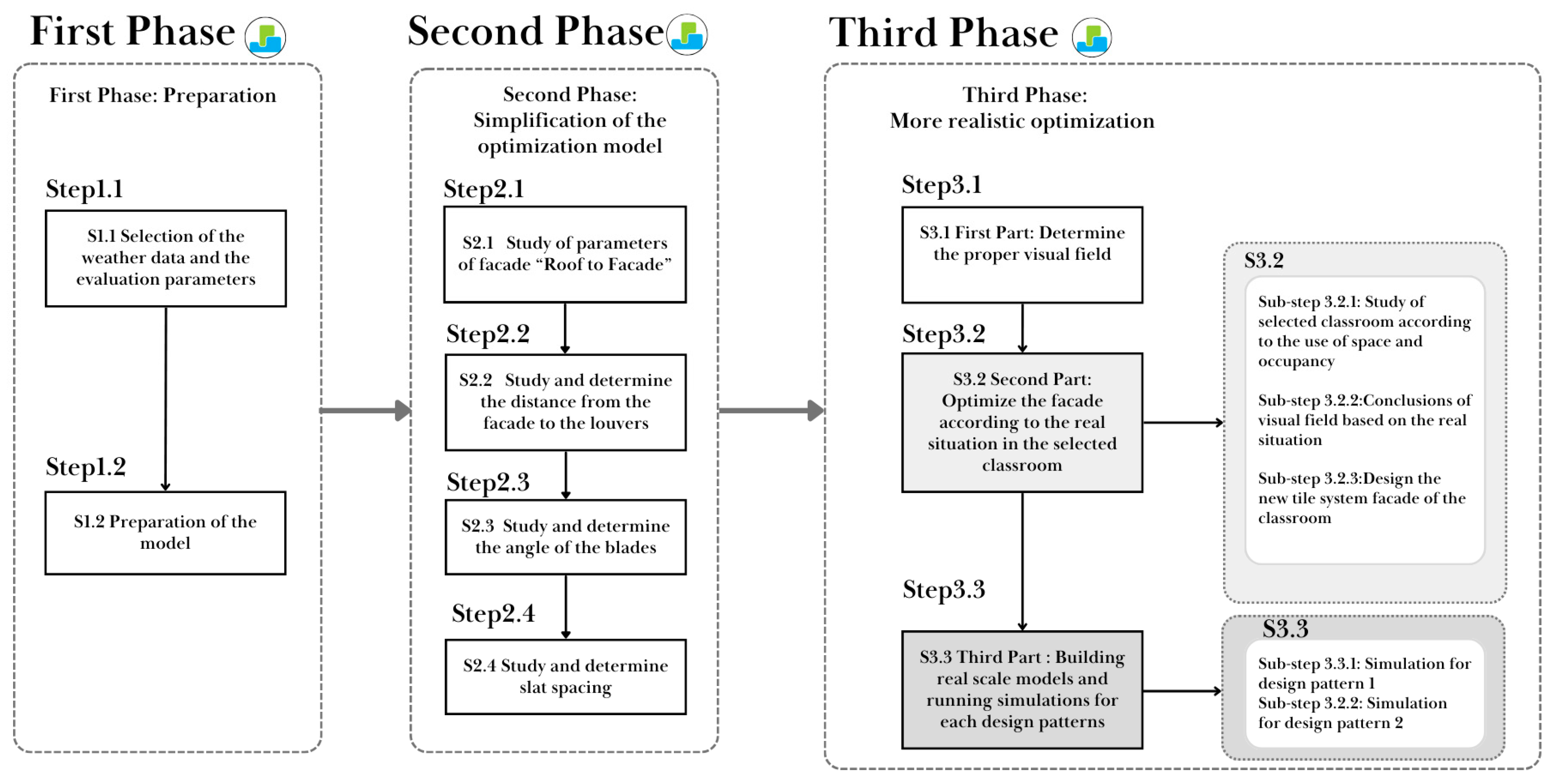
Figure 2.
Studied classroom location in the school (a), interior view (b) and a floor plan (c).
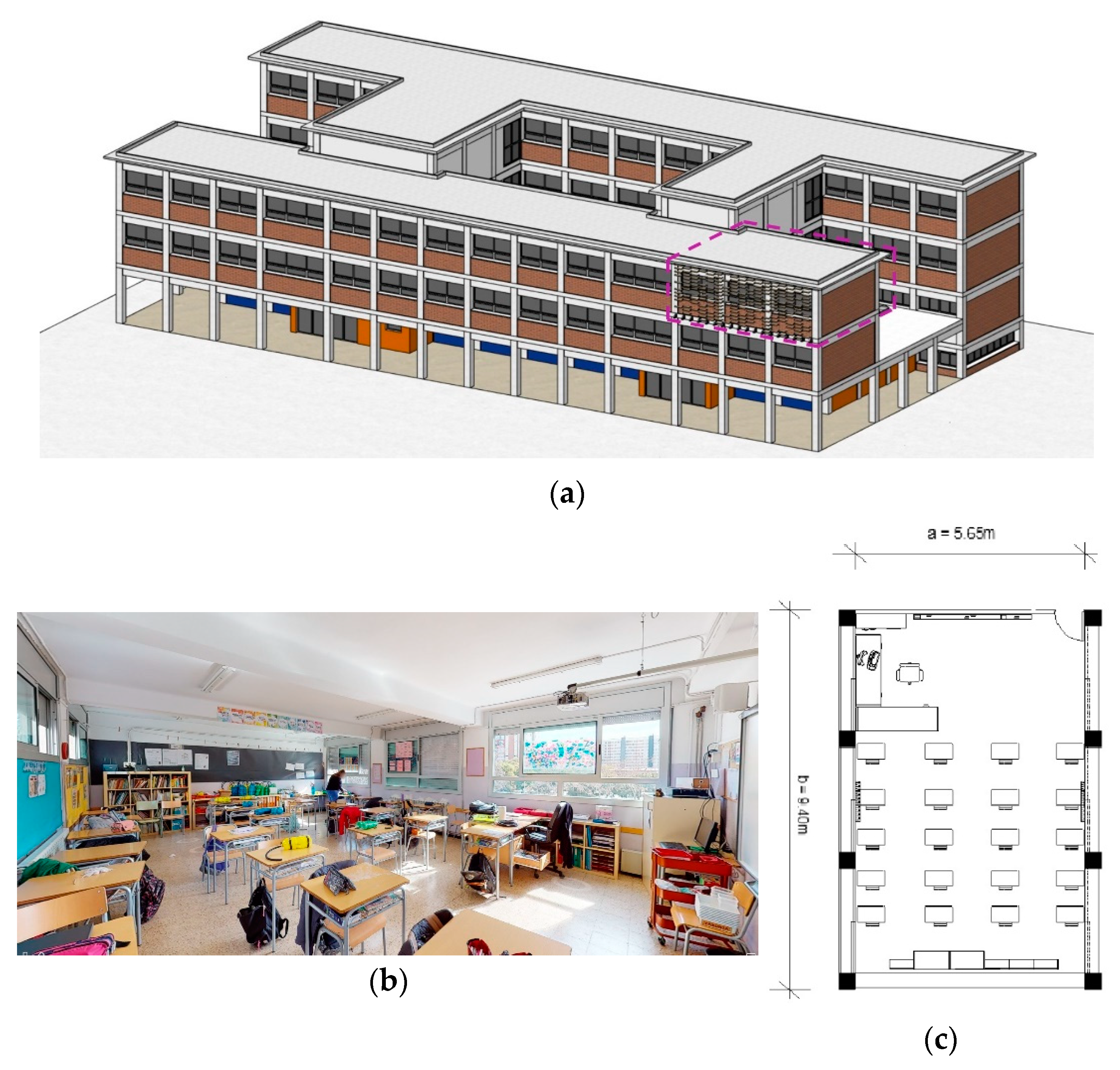
Figure 3.
Distribution of UDI hours of the studied classroom.
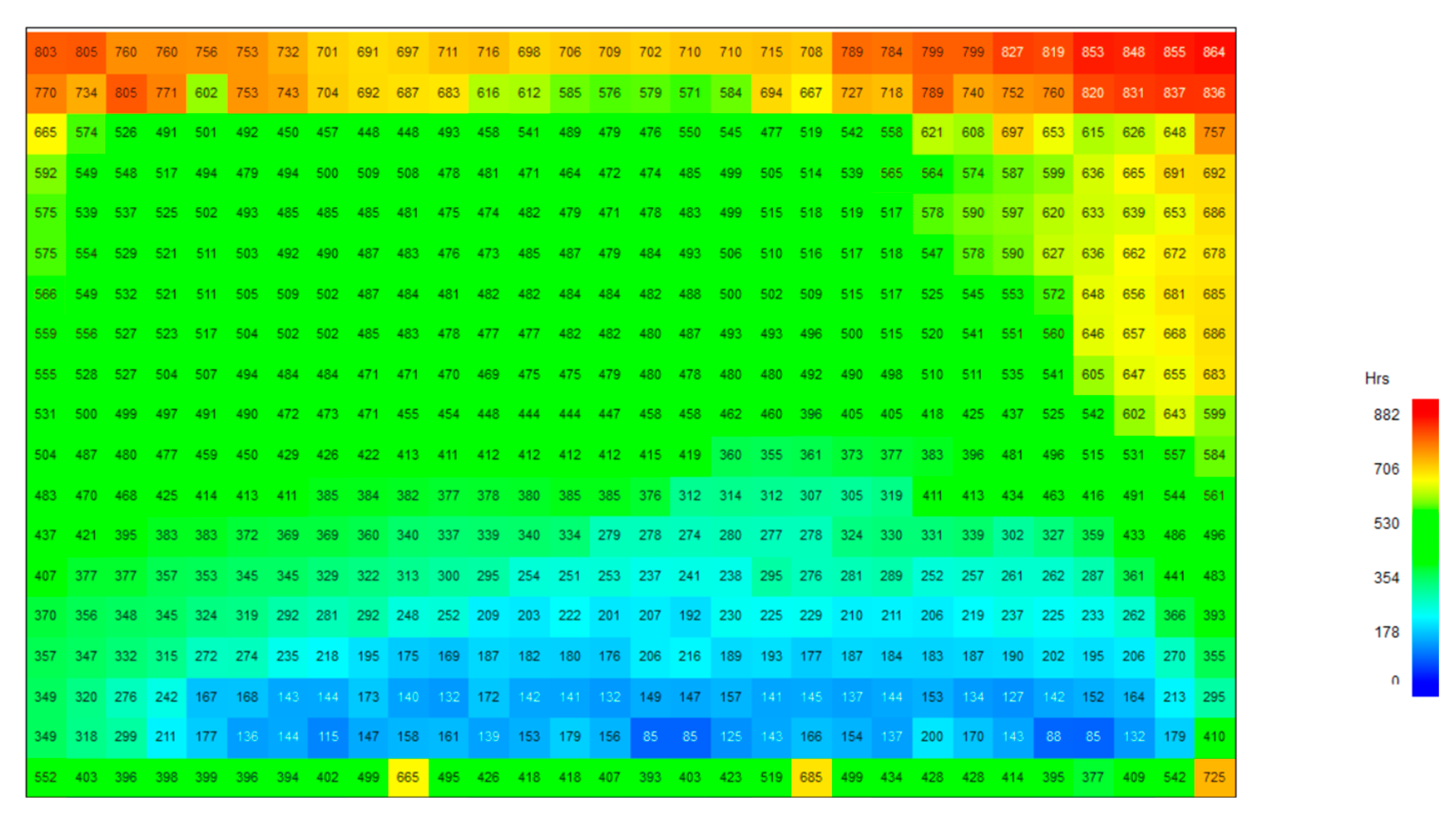
Figure 4.
Distribution of the daylighting factor of the studied classroom.
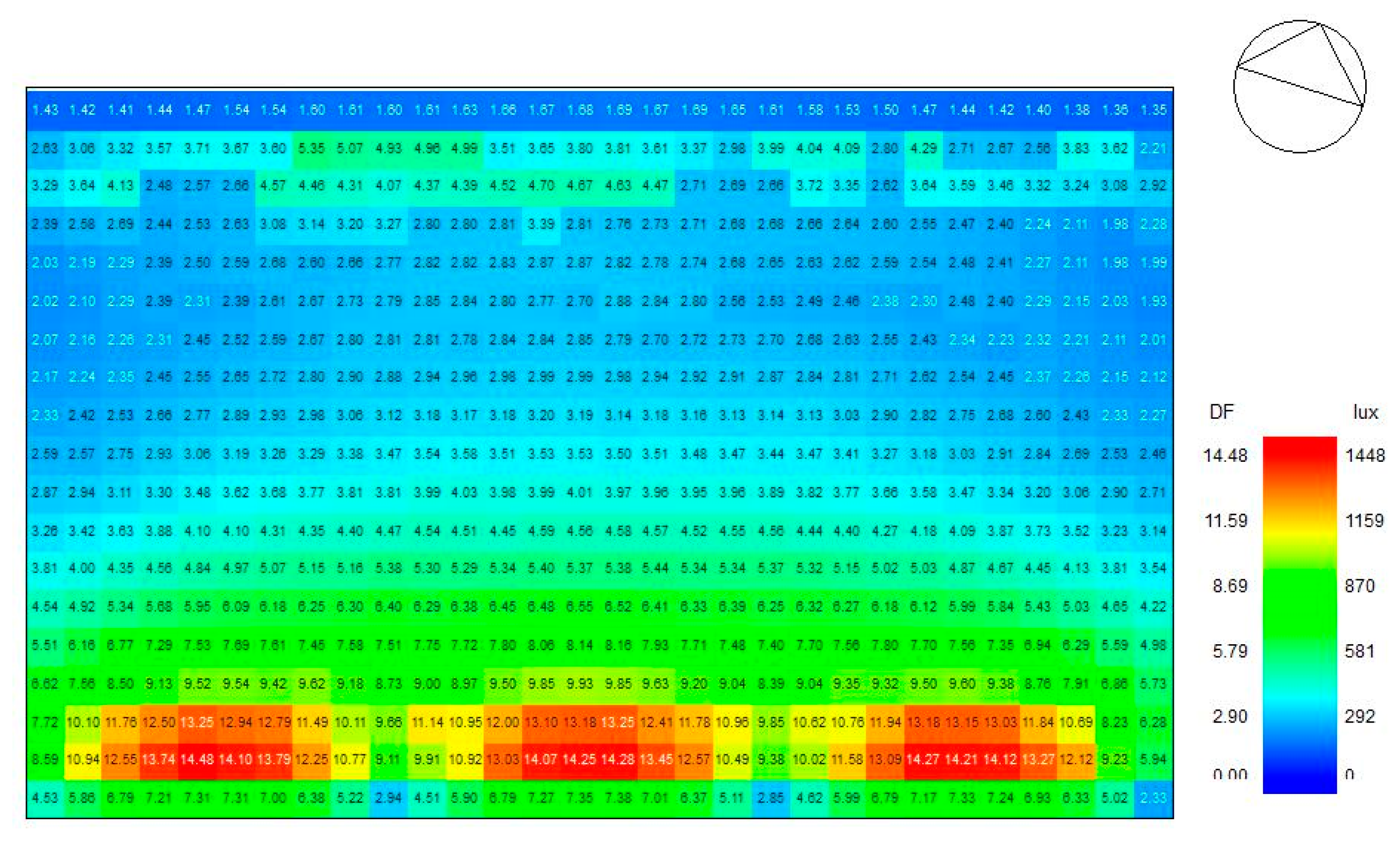
Figure 5.
General section of the classroom and sections of tile system separated from the exterior wall 5 (b), 7 (c) and 10 (d) cm.
Figure 5.
General section of the classroom and sections of tile system separated from the exterior wall 5 (b), 7 (c) and 10 (d) cm.
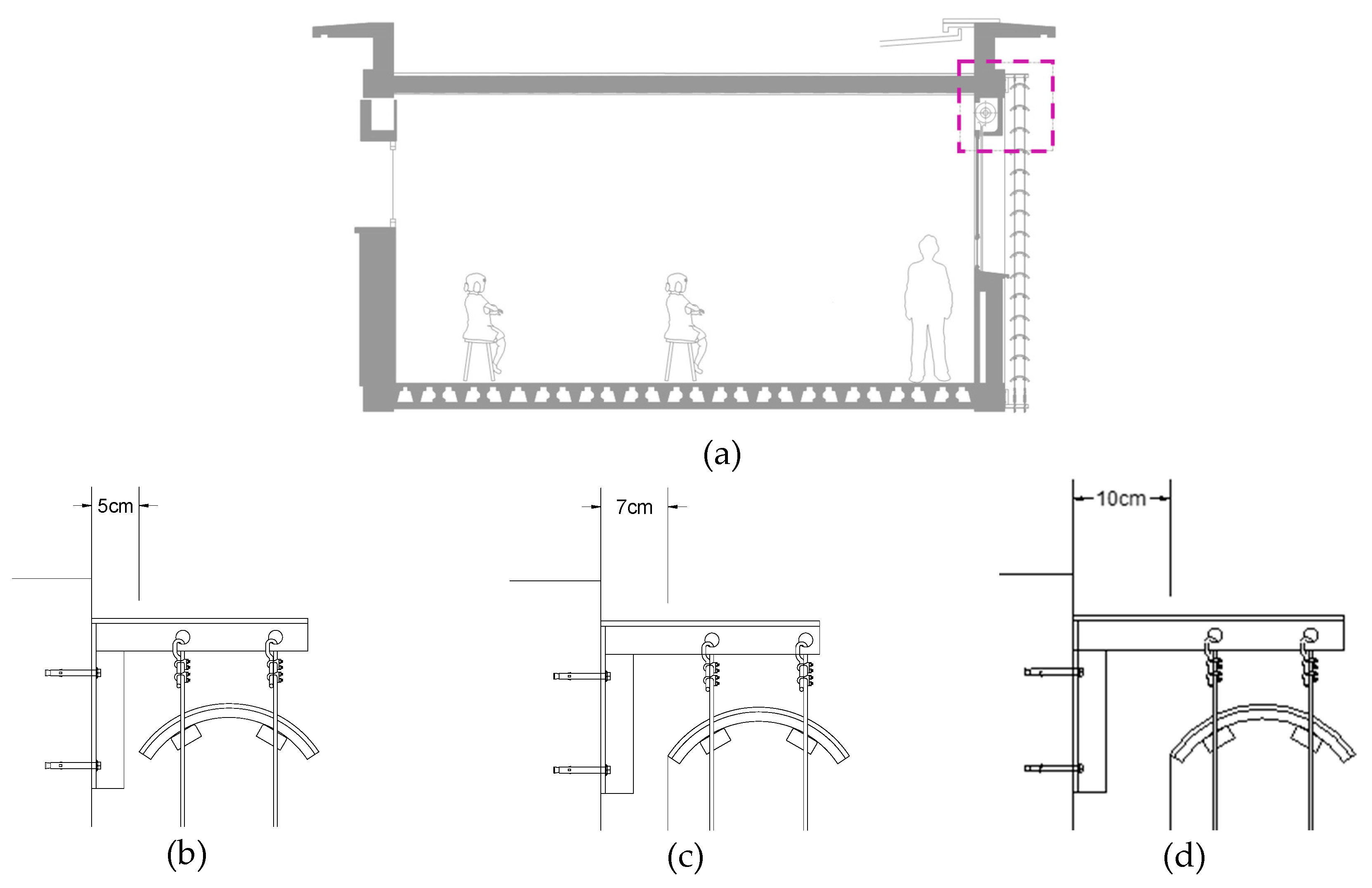
Figure 6.
Daylighting factor (a), solar gains and operative temperature (b) of the classroom. Simulation results in June.
Figure 6.
Daylighting factor (a), solar gains and operative temperature (b) of the classroom. Simulation results in June.
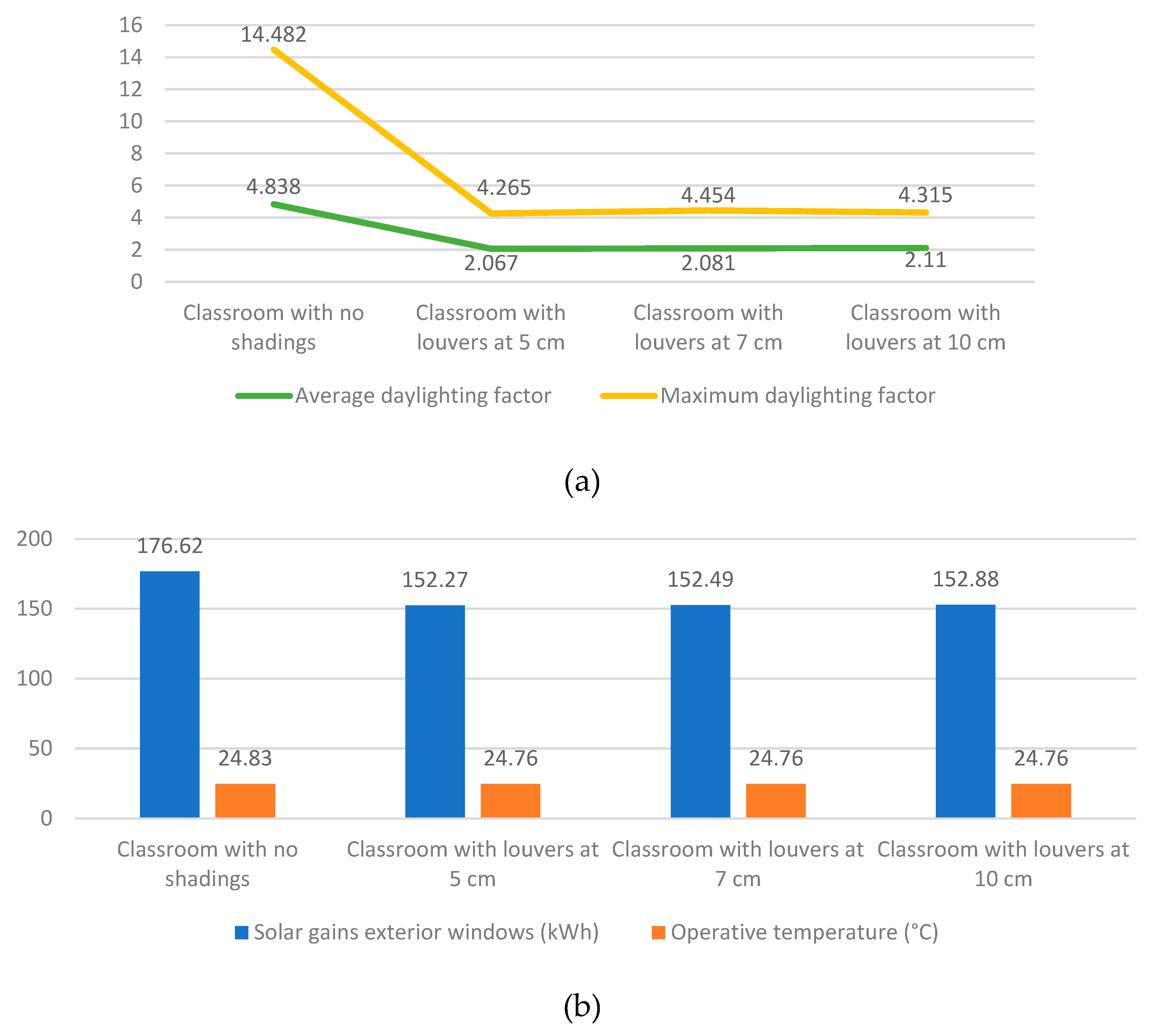
Figure 7.
States-scatter of illuminance considering the classroom width (X) in the case of louvres separated 7 cm from the facade plane (see Figure 5).
Figure 7.
States-scatter of illuminance considering the classroom width (X) in the case of louvres separated 7 cm from the facade plane (see Figure 5).
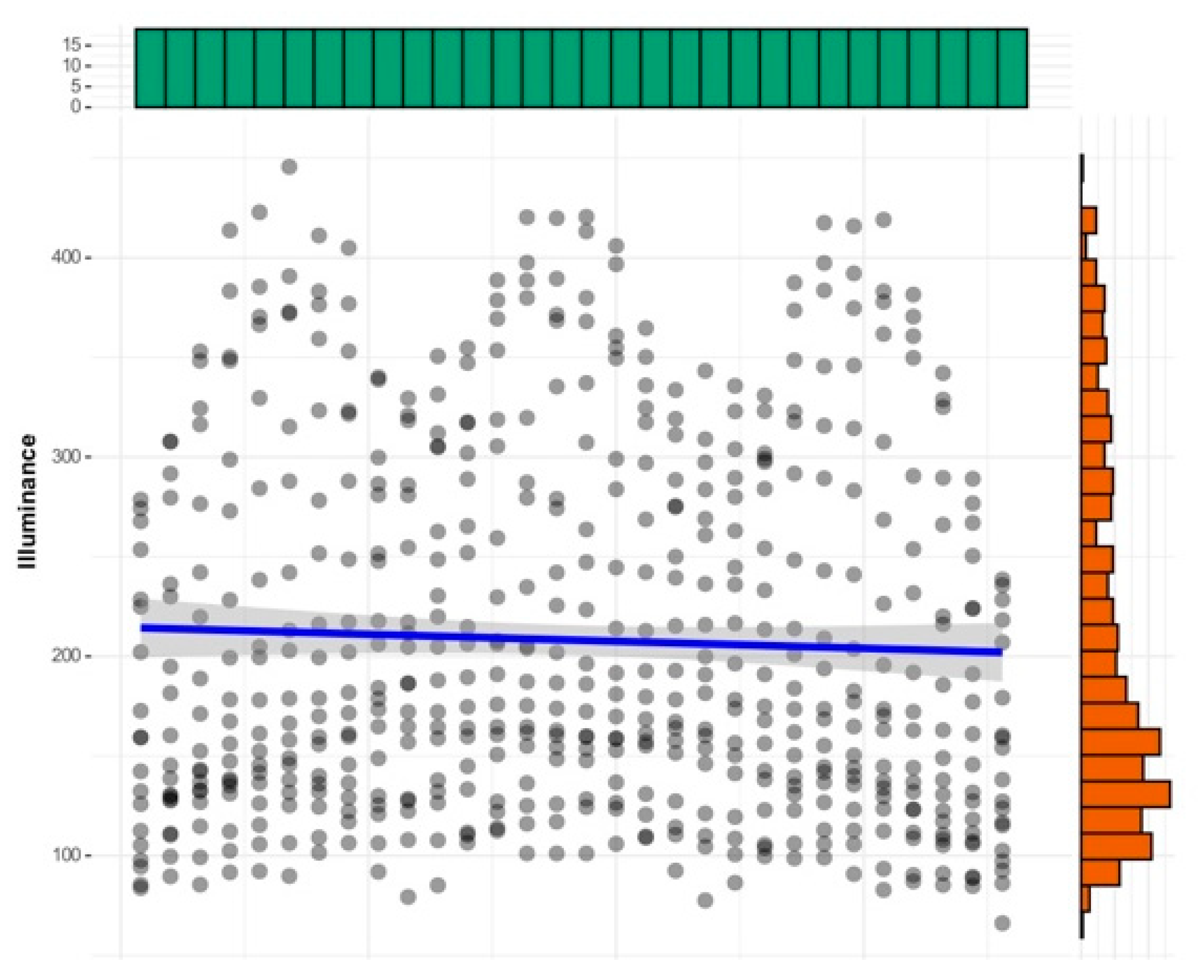
Figure 8.
States-scatter of illuminance considering the classroom width (Y) in the case of louvres separated 7 cm from the facade plane (see Figure 5).
Figure 8.
States-scatter of illuminance considering the classroom width (Y) in the case of louvres separated 7 cm from the facade plane (see Figure 5).
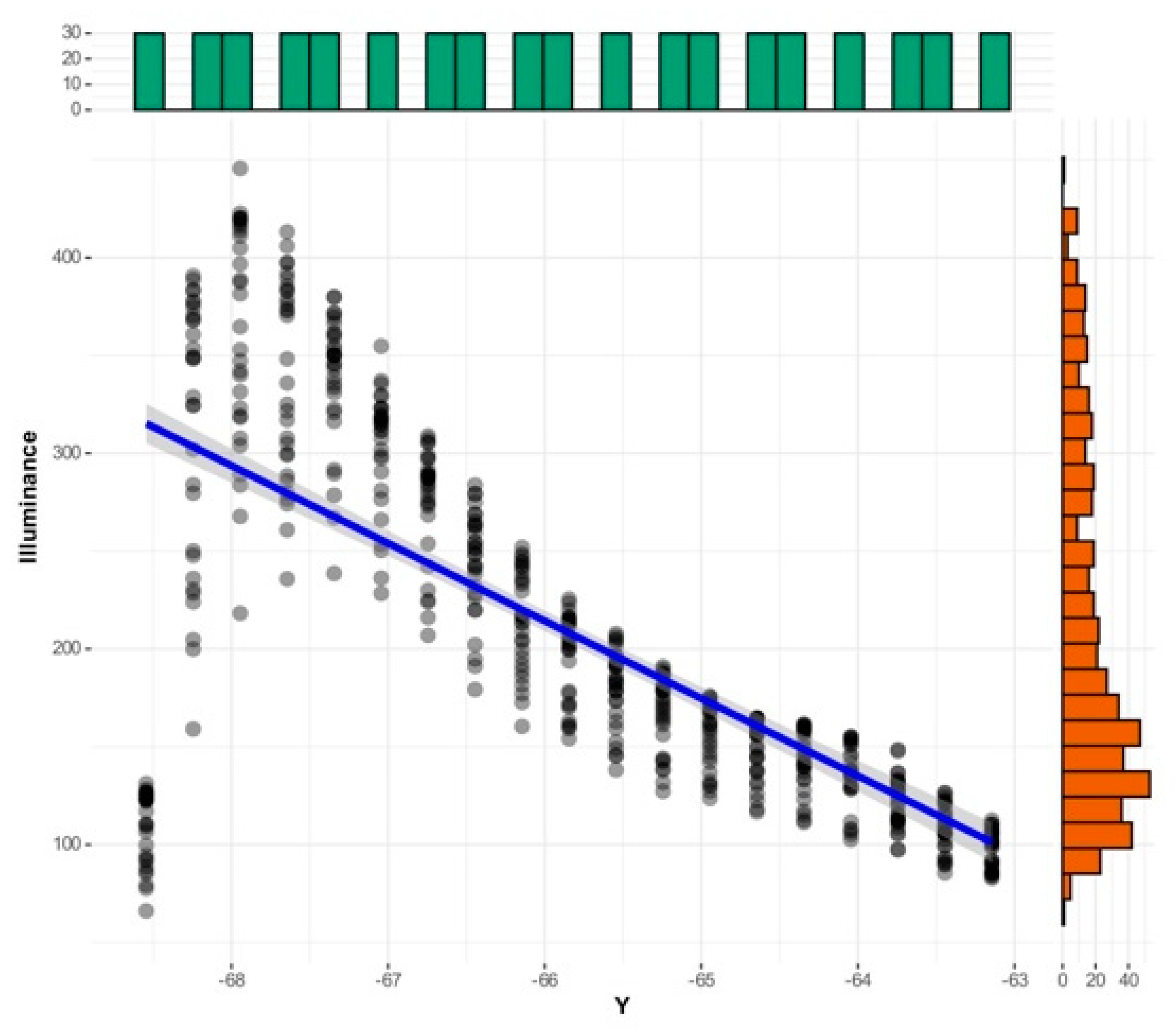
Figure 9.
The heights of Spanish people based on previous studies [52]. From left to right: average height of an adult Spanish male and female, a boy 10-12 years, a girl 10-12 years and children 10-12 years.
Figure 9.
The heights of Spanish people based on previous studies [52]. From left to right: average height of an adult Spanish male and female, a boy 10-12 years, a girl 10-12 years and children 10-12 years.
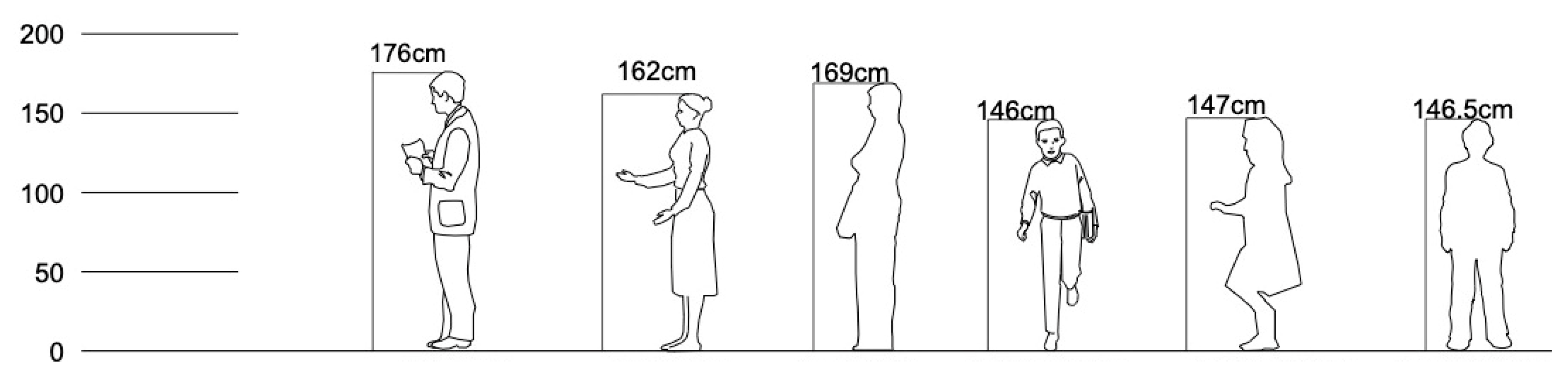
Figure 10.
Diagram to define the width of the view out, prepared by the authors from Figure C2 in [43]. Variables a and b are the width and length of the classroom respectively, see Figure 2 (c).
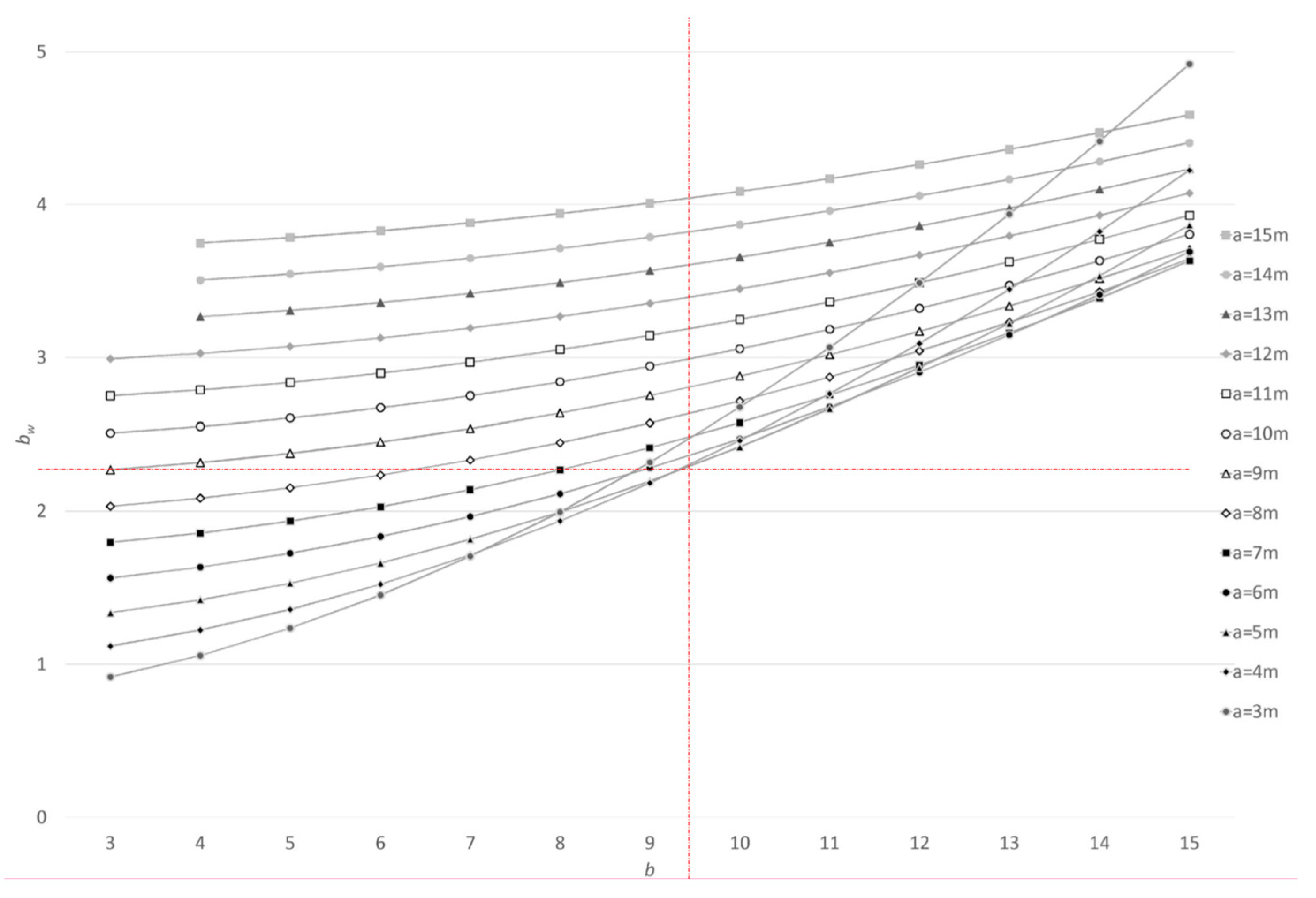
Figure 11.
Analysis of the view area of standing children (a), sitting children (b), standing teachers (c) and sitting teachers (d).
Figure 11.
Analysis of the view area of standing children (a), sitting children (b), standing teachers (c) and sitting teachers (d).
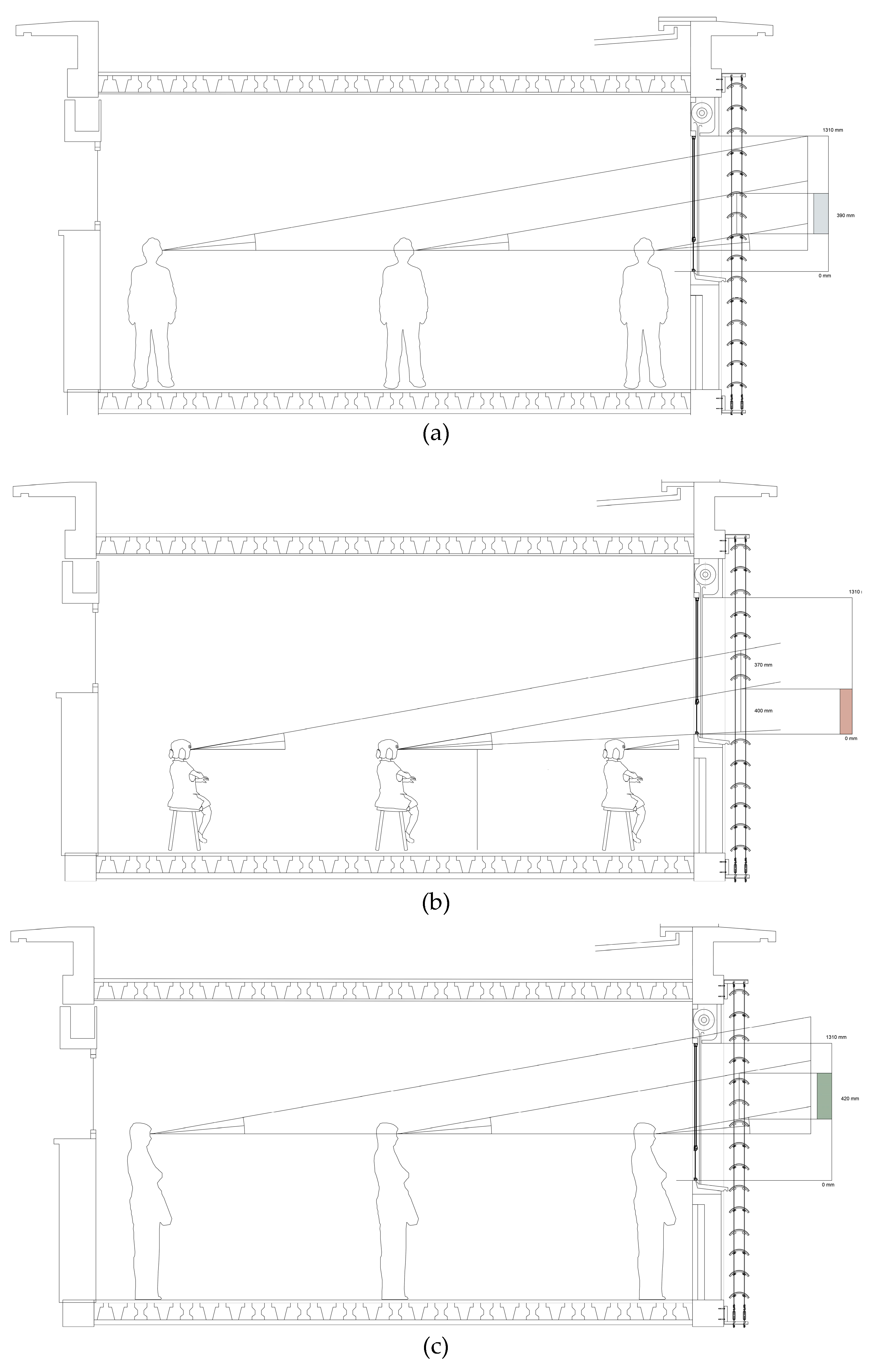
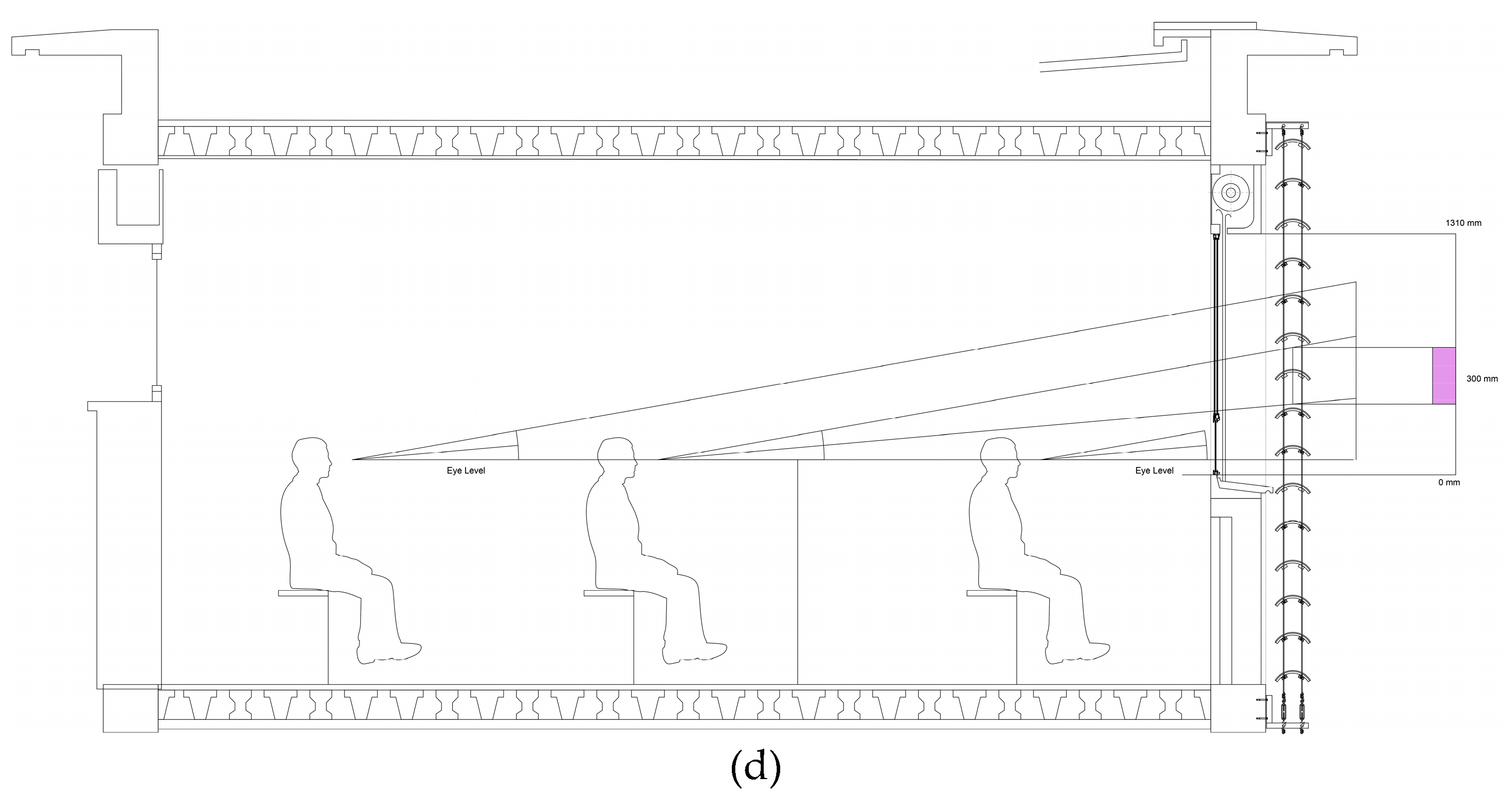
Figure 12.
Four common visual fields for the recycled tile system. This figure summarizes the analysis of the view area in Figure 11.
Figure 12.
Four common visual fields for the recycled tile system. This figure summarizes the analysis of the view area in Figure 11.
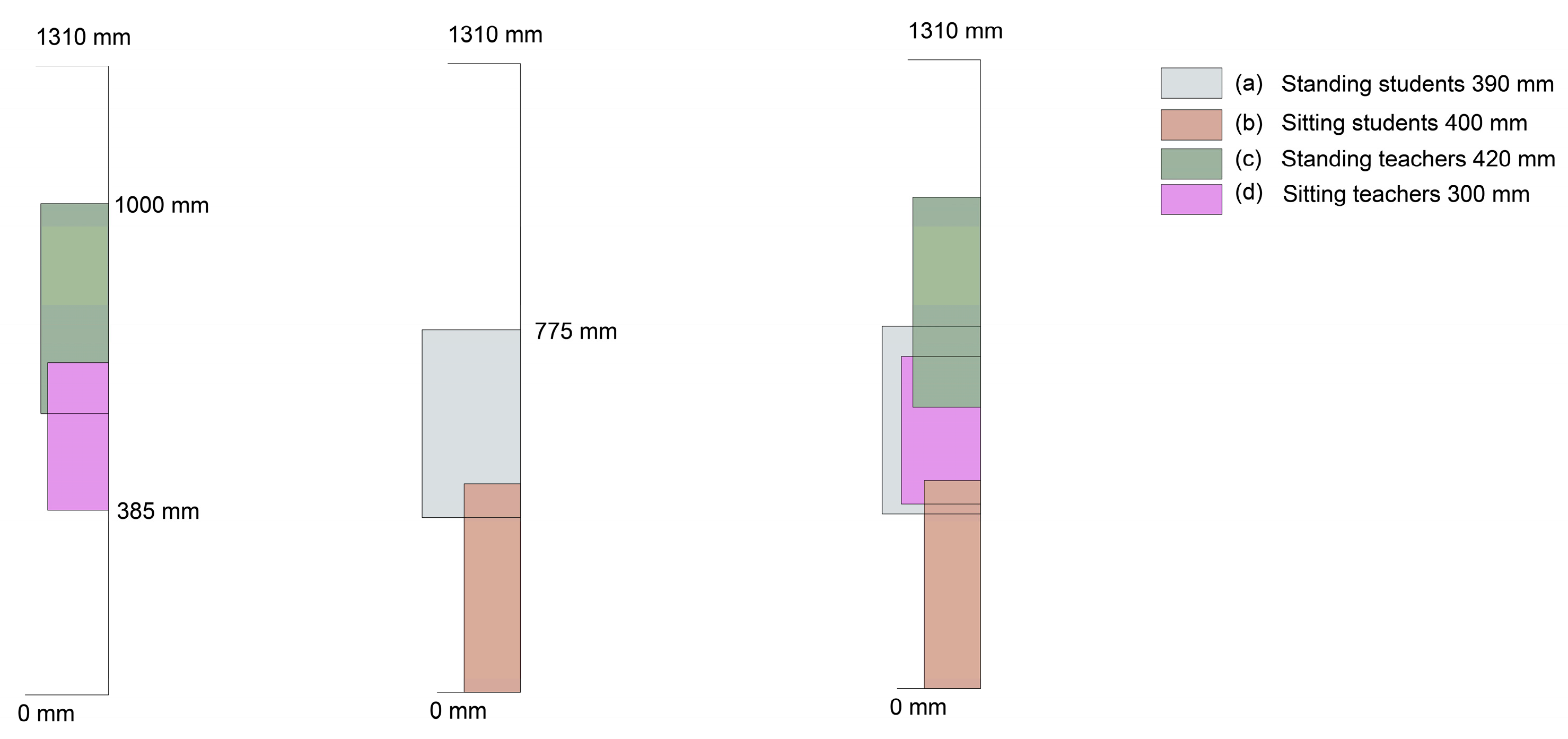
Figure 13.
Three main sections showing the three main parts of the studied classroom.
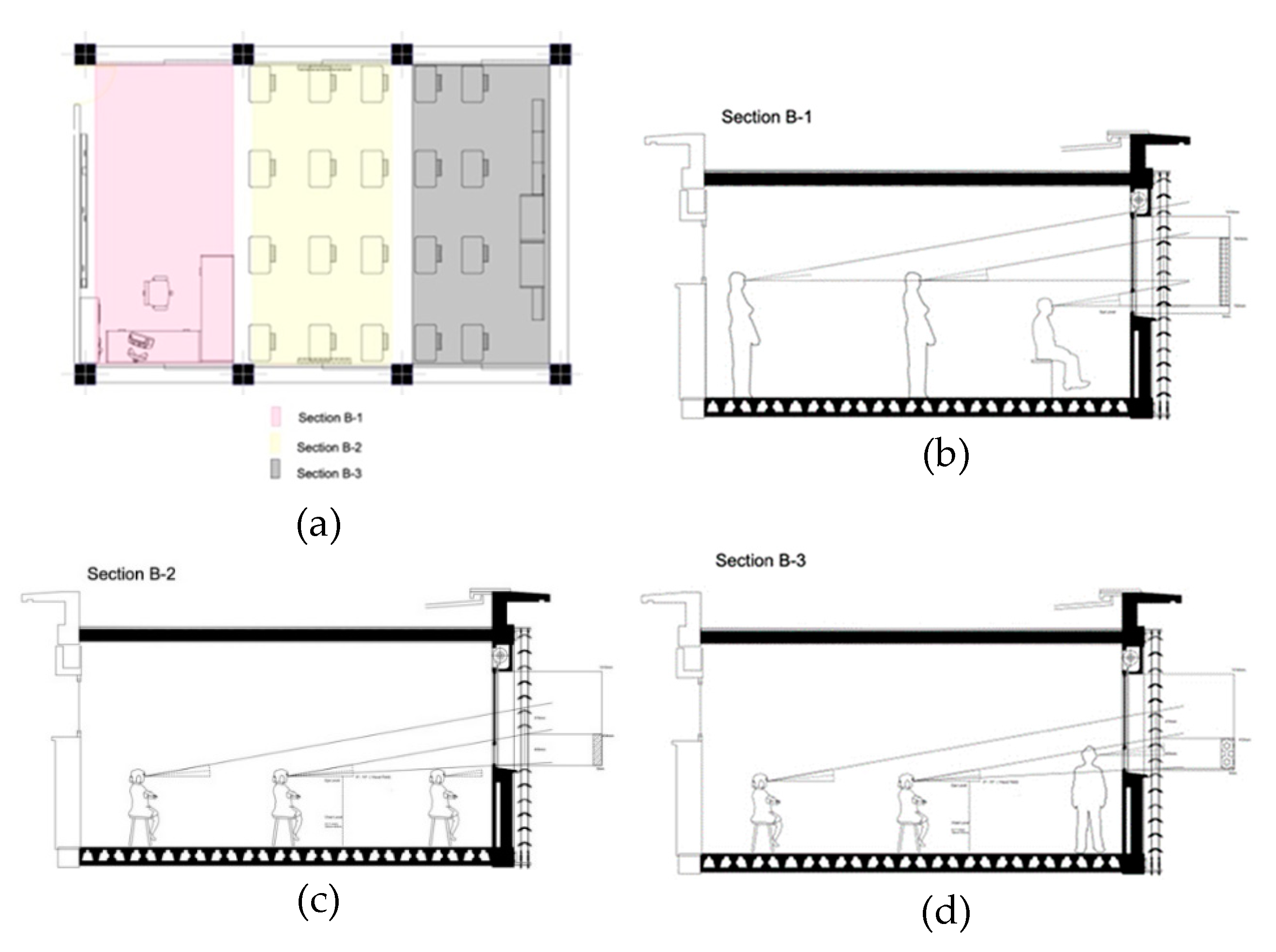
Figure 14.
Gap area for the three zones of the studied classroom.
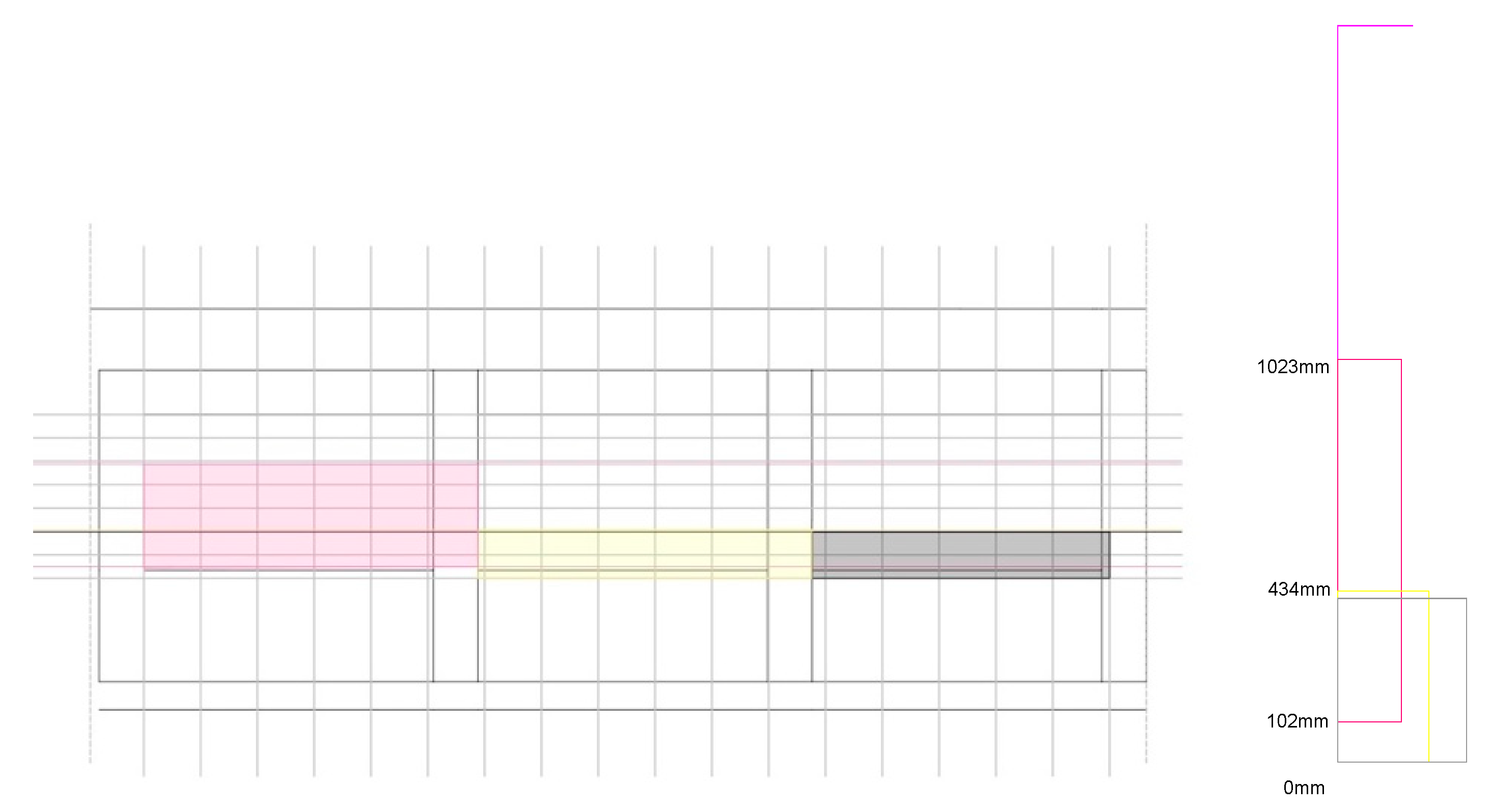
Figure 15.
Models following the designed patterns for the classroom: design 1 (a) and design 2 (b).
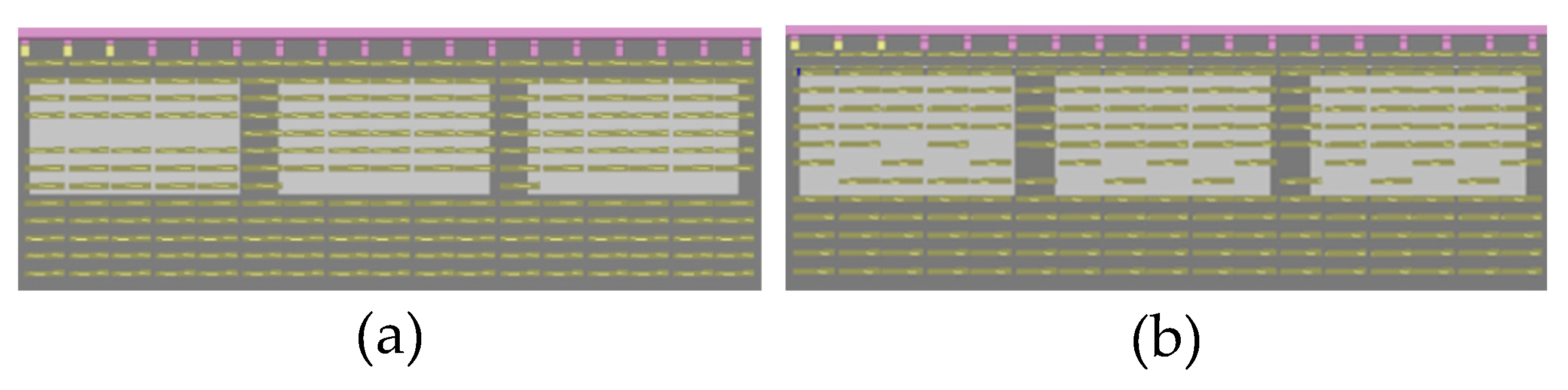
Figure 16.
States-scatter of illuminance considering the classroom width (X) of design 1.
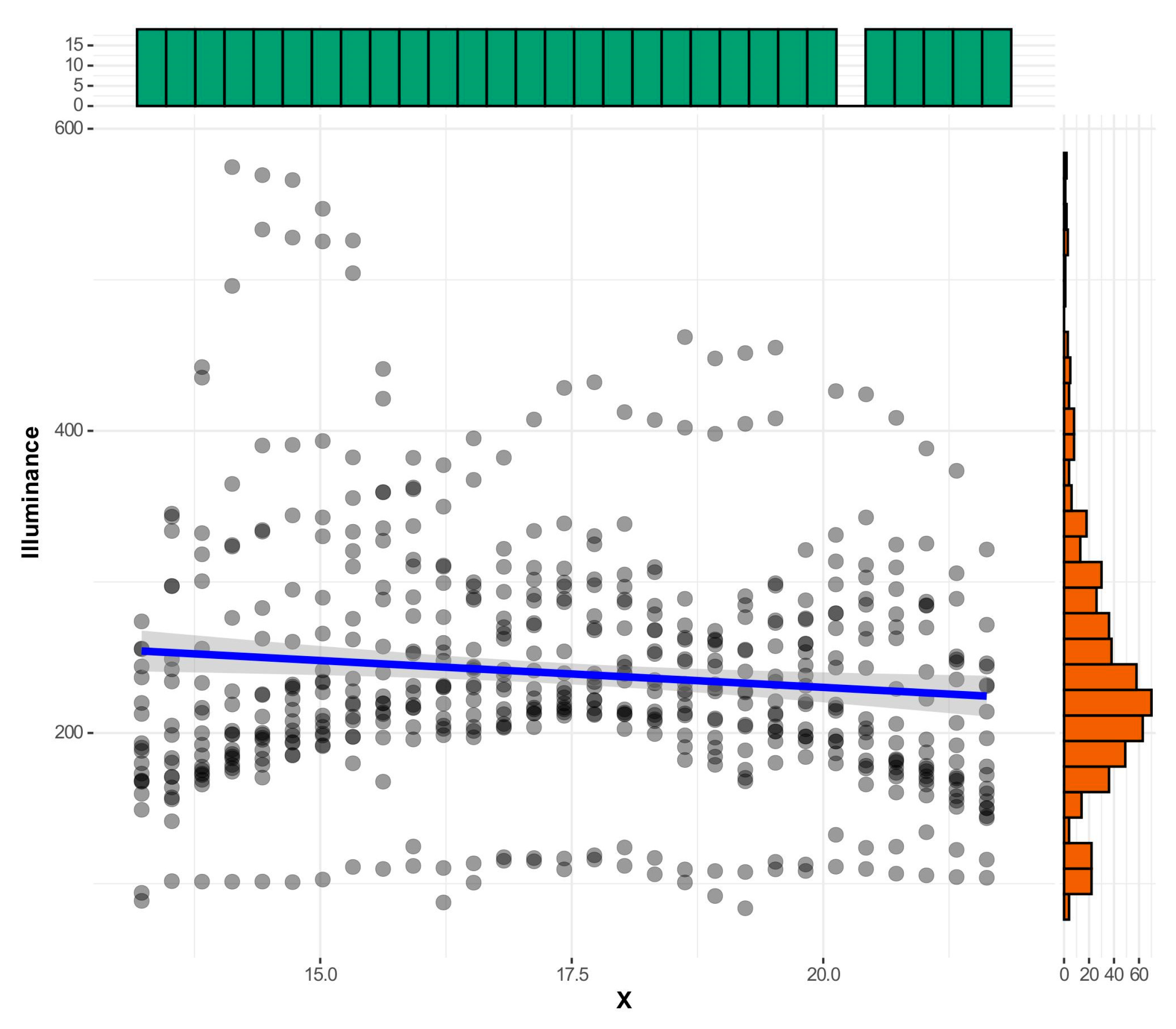
Figure 17.
States-scatter of illuminance considering the classroom width (X) of design 2.
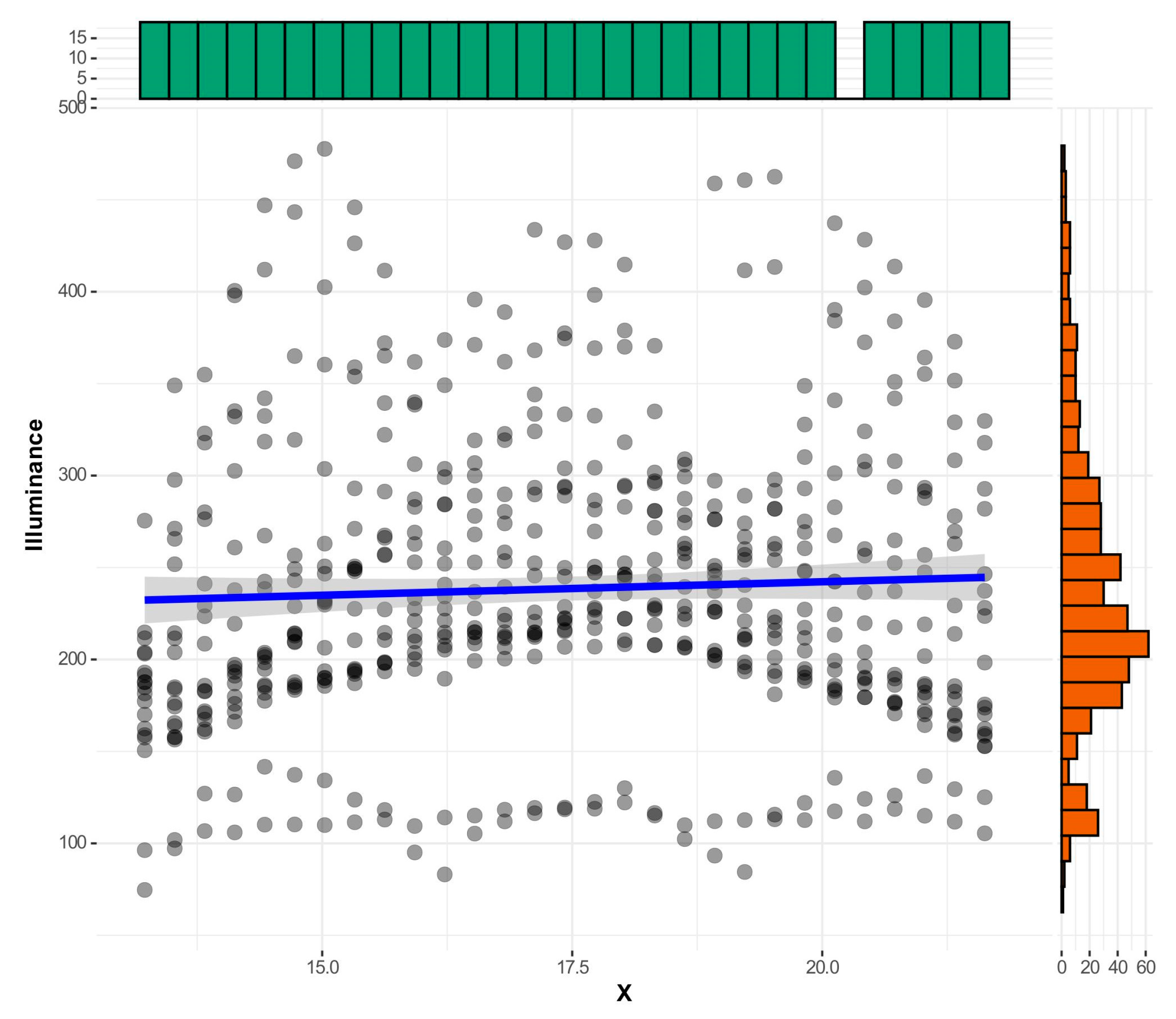
Table 1.
Evaluation of daylight metrics on the working plane of the studied classroom.
| UDI 100-2000lux area percentage |
ASE area | Average illuminance (lux) | Daylighting factor (max) | Daylighting factor (min) | Illuminance uniformity (min/max) | |
|---|---|---|---|---|---|---|
| 50% Wt | 80% Wt | |||||
| 57% | 7% | 31.58% | 484 | 14.48 | 1.351 | 0.093 |
Legend: Wt means working time, which is from 9.00 to 16.30 in the Bellvitge school [49].
Table 2.
Daylighting factor results related to distance from the louvres to the exterior wall.
| Daylighting data | Distance from the louvres to the exterior wall | |||
|---|---|---|---|---|
| No blinds | 5 cm | 7cm | 10 cm | |
| Average daylighting factor | 4.838 | 2.067 | 2.081 | 2.110 |
| Maximum daylighting factor | 14.482 | 4.265 | 4.454 | 4.315 |
| Illuminance uniformity (min/max) | 0.093 | 0.177 | 0.148 | 0.185 |
Legend: Underlined values do not meet standards (CIBSE).
Table 3.
Daylighting metrics in June with specific angles of blades.
| Daylighting data | Angle of blades | |||||
|---|---|---|---|---|---|---|
| No blinds | 0° | 15° | 30° | 45° | 60° | |
| Average daylighting factor | 4.838 | 2.081 | 1.399 | 0.955 | 0.683 | 0.462 |
| Maximum daylighting factor | 14.482 | 4.454 | 2.809 | 1.973 | 1.374 | 1.081 |
| Uniformity (min/max) | 0.093 | 0.148 | 0.217 | 0.195 | 0.206 | 0.172 |
Legend: Underlined values do not meet the standards (CIBSE).
Table 4.
Temperature and heat gains in June with specific angles of blades.
| Temperature and heat gains | Angle of blades | |||||
|---|---|---|---|---|---|---|
| No blinds | 0° | 15° | 30° | 45° | 60° | |
| Operative temperature(℃) | 24.83 | 24.76 | 24.74 | 24.73 | 24.74 | 24.71 |
| Solar gains(kWh) | 176.62 | 152.49 | 142.52 | 134.59 | 128.71 | 124.75 |
Table 5.
Temperature and heat gains in June with specific slat spacing.
| Temperature and heat gains | Slat spacing of louvres | |||
|---|---|---|---|---|
| No blinds | 15 cm | 17 cm | 21 cm | |
| Operative temperature(℃) | 24.83 | 24.76 | 24.76 | 24.76 |
| Solar gains(kWh) | 176.62 | 148.18 | 149.94 | 152.49 |
Table 6.
Daylighting factor in June with specific slat spacing.
| Daylighting data | Slat spacing | |||
|---|---|---|---|---|
| No blinds | 15 cm | 17 cm | 21 cm | |
| Average daylighting factor | 4.838 | 1.440 | 1.688 | 2.081 |
| Maximum daylighting factor | 14.482 | 2.653 | 3.171 | 4.454 |
| Illuminance uniformity (min/max) | 0.093 | 0.192 | 0.175 | 0.148 |
Legend: Underlined values do not meet standards (CIBSE).
Table 7.
Indoor energy performance of both designs and the classroom without shading.
| Indoor energy performance | |||||||
|---|---|---|---|---|---|---|---|
| Operative temperature June(℃) | Operative temperature January(℃) | Solar gains June(kWh) | Solar gains January(kWh) | Average daylighting factor | Maximum daylighting factor | Illuminance uniformity (min/max) | |
| Design 1 | 24.74 | 14.36 | 156.95 | 378.65 | 2.392 | 5.744 | 0.146 |
| Design 2 | 24.74 | 14.42 | 157.31 | 394.18 | 2.384 | 4.775 | 0.156 |
| No shading | 24.83 | 15.13 | 170.38 | 570.90 | 5.032 | 14.630 | 0.096 |
Legend: underlined values do not meet standards.
Table 8.
Results of UDI, ASE, and average illuminance.
| UDI area percentage | ASE area | Average illuminance (lux) | |||
|---|---|---|---|---|---|
| 50% Wt | 80% Wt | ||||
| Design 1 | 97% | 33% | 7.80% | 239 | |
| Design 2 | 97% | 33% | 9.44% | 238 | |
| No shading | 51% | 4% | 32.85% | 503 | |
Legend: Wt means working time.
Disclaimer/Publisher’s Note: The statements, opinions and data contained in all publications are solely those of the individual author(s) and contributor(s) and not of MDPI and/or the editor(s). MDPI and/or the editor(s) disclaim responsibility for any injury to people or property resulting from any ideas, methods, instructions or products referred to in the content. |
© 2024 by the authors. Licensee MDPI, Basel, Switzerland. This article is an open access article distributed under the terms and conditions of the Creative Commons Attribution (CC BY) license (http://creativecommons.org/licenses/by/4.0/).
Copyright: This open access article is published under a Creative Commons CC BY 4.0 license, which permit the free download, distribution, and reuse, provided that the author and preprint are cited in any reuse.


