
Submitted:
06 May 2023
Posted:
08 May 2023
You are already at the latest version
Abstract
According to architectural standards, the common proportion of a rectangular-shaped classroom is the shallow proportion, which has a longer external room facade versus the perpendicular internal sides. Even in the Kingdom of Saudi Arabia (KSA), the same proportion is used in school projects. Environmentally, this proportion is logical when considering the role of adequate natural lighting for classroom visual functions, which could be more easily achieved if its longest side is the external one. But, the environmental efficiency of any architectural space cannot be only judged according to a single human comfort achievement, especially with the diverse environmental characteristics of places around the world. This diversity can show a defect in other human comfort achievements or other environmental issues in different ways when achieving a certain function in a unified way. A holistic study should be done for any common architectural shape or proportion to ensure their priority among other options in achieving maximum green architectural principles for a specific location before confirming and using it. The manuscript compares a rectangular classroom of different external/internal wall proportions to search for their preference to be used in Taif city schools in KSA. The compared case studies have different window variations and similarities to include their effect too. According to the overall green principles assessment, the results showed that the common proportion of classrooms didn’t give the higher green credits, which alerts us that the traditional rectangular classroom proportion is not always optimum for all regions including Taif city in KSA.
Keywords:
Classroom
; Taif City
; Visual Comfort
; Thermal Comfort
; Acoustical Comfort
; holistic environmental assessment
; Green Building Rating Systems
1. Introduction
Students in primary schools spend the majority of their time in the same classroom. Promoting the students' achievement and engagement is a considerable issue. The classroom has the most influence on student progress and learning success rather than other school spaces. Evidence-based classroom design can maximize education outcomes for students. Improving student achievement is vital for countries' development. Scientific research showed that the physical classroom environment influences student academic achievement, learning, and motivation. It was also proved that the natural aspects of the physical environment are a priority even with the evolution of artificial alternatives. Geometric classroom form, size, and proportion control the internal environment quality and affect academic performance and the student’s behavior and attitudes [1,2,3,4,5,6,7,8,9,10,11.
Peter Barrett et al. assessed 153 classrooms in 27 schools to set the main classroom features affecting the academic learning progress of the occupying students. Physical characteristics variation of classrooms explained 16% of the different learning achievements for about four thousand students over a year. The main effect was for the naturalness design factors for about half of the impact on learning. The naturalness presents the built environment factors required for physical comfort including light, sound, temperature, air quality, and link to nature. Moving an average student from the least to the most effective classroom made 1.3 sub-levels progress a year [1,3]. Sapna Cheryan et al. outlined the most important classroom design aspects that can influence students’ ability to learn effectively. They found that inadequate lighting and heating, noise, and poor air quality hinder student achievement [4]. Vicente López-Chao et al. made a report on 583 primary school students in Galicia (Spain) to explore the effect of learning spaces’ indoor environmental features on mathematics and art performance, such as ventilation, room size, views, and place attachment. They found a direct influence shown in the academic performance reduction per thermal comfort reduction [9].
Anxiao Zhang et al. discussed the geometry role of classrooms in China on the annual total energy use and summer thermal discomfort time. They discussed parameters such as orientation, shape, room depth, and window-to-wall ratio. For their study, they used the DesignBuilder program and a questionnaire for students’ subjective preferences. Results showed that the shallow classrooms had a higher energy consumption and lower thermal comfort than the deeper classrooms. Besides, the best window-to-wall ratio WWR solutions varied for different room depths. It was 30%, 40%, 50%, and 60% for 6m, 8m, 10m, and 12m classroom depths. This meant that the deeper rooms needed higher WWR to save energy and promote the students' thermal comfort. Expanding the size of the window compensated for the additional demand for artificial lighting caused incrementally by the room depth. More artificial lighting cause higher energy consumption and more internal heat gain. Larger windows also helped encourage indoor ventilation which decreased the summer discomfort time. Thus, the study concluded that the deep classrooms with 8m depth had more potential to achieve both thermal and energy improvement over other alternatives [10]. Moses Waithanji Ngware et al. focused on the seating positions and arrangements that influence learning differentials. The study was made for primary classrooms in Kenya during the four years 2002 to 2005. The results showed that between 5% and 27% more learning was gained by sitting in the front row of a classroom versus other rows that are further from the board wall [11].
Teachers are also affected by classroom geometry. They have to make important decisions on how to organize the classroom to set order, engage students, and extract their collaboration, which is a serious challenge for teachers and a main reason for teachers’ job dissatisfaction in all countries. Thus, classroom management relays on its architectural decisions. Managing the classroom was the most common problem and the most influential factor in teachers’ decision to stay in their first year’s profession. Gremmen et al. showed that the classroom shape and size determine the seating arrangements, thus the number of students that can sit close to the teacher and can be exposed to them. It can also control the students' interactions during the school day, the students’ relationships, and their positive and negative behaviors in the classroom due to students' influence on each other. The study found that the classroom design affected both the academic development and social functioning of students due to their physical distance from each other and their teacher [5].
The growing interest in Green Architecture helped to judge buildings environmentally according to their rules and principles. The success of buildings being green is related to the utmost achieved environmental functions at their satisfied levels. One of the main assessment fields of green buildings is indoor environmental quality, which includes functions such as the users’ thermal, visual, and acoustical comfort [12,13]. A.Shamseldin et al. emphasized the importance of determining the influence of different affecting variables on the different environmental functions before assessing them; to ensure their achievement to their maximum time without conflict [14]. Another study was carried on a classroom case study in Taif City to find the relation between two contradictory functions achievement, which are the thermal and visual comfort functions after applying some windows' previous recommendations, and the study resulted that the visual comfort was inadequate and that the recommendations should be adjusted to comply with both functions [15].
General classroom proportions according to standards were put after several studies for the common inquiries of schools and their users. But no doubt that such a character could or should be changed under different climatic conditions and natural variables. The common rectangular classroom proportion is the shallow classroom, which means having its long side as its external facade. This proportion promotes the use of natural light as a great concern in educational buildings [6,16,17]. Rectangular classrooms in KSA adhere to this proportion as shown in the different schools' prototype plans and designs related to the local ministry of education [8,18–24]. But that common practice should be under test after the revolution of Green Building Rating Systems (GBRSs) to ensure that such a practice is the best for the overall environmental functions related to Green Architecture, not only for a specific one. In this manuscript, a rectangular classroom in Taif City, KSA was chosen as a case study to find the effect of its external/internal walls ratio on its indoor environmental quality functions and their related effect on the users. Two main GBRSs were chosen to test the classroom case studies, which are the local KSA system; Mostadam, and the most widely famous system; Leadership in Energy and Environmental Design (LEED). The results showed that the best choice for holistic environmental function achievement in Taif City is not the common classroom proportion. Several case studies with deep proportions gave more overall environmental function achievement values than shallow ones. The Ministry of Education in KSA is then encouraged to find the best rectangular dimensions to be adopted before constructing any other schools; to ensure tracing them to Green Architecture principles, and to ensure they would be more successful when assessed environmentally. Taking into consideration that the better indoor environmental achievement, the better students’ academic achievement, which are the schools' main concerns. As long as each location has its special characteristics, then the study results could vary for other locations even in KSA.
2. Methods
An analytical comparison was carried on for eight case studies that have different and similar aspects. These case studies represent rectangular classrooms with different external/internal walls ratio in some of these cases, different WWRs in some cases, and different window dimensions in some cases. To complete the comparison, simulation programs, and tools were used. For example, The DesignBuilder software was used for the thermal simulation of the case studies. DIAlux evo software was used to predict indoor light level performance according to space and location characteristics. The climate consultant software was used to get some basic thermal information about Taif City. Some online tools were also used, such as the Internal Noise Calculator to estimate internal noise levels. The Center of the Thermal Environment (CBE) tool to determine the compliance of thermal results with the required assessment principles. A sun path diagram tool (GAISMA tool) to determine the sun angles in Taif City. Finally, a subjective method was used to cover the users’ preferences for the rectangular classroom proportion in some of Taif City’s primary schools, by the use of a questionnaire. Taif City, KSA was chosen for the case studies, where the population is relatively young. 87% of students attend public schools out of 7.7 million students [7]. Taif City has a special local climate in KSA due to its location at 1700 m above sea level. It is characterized by a warm to moderate climate during spring and autumn, annoying and hot summer with an average temperature in the mid-30s during the daytime, and a moderate to cold winter [21,25]. The heat gain amount of occupants in classrooms focuses on the thermal comfort problem in the summertime while neglecting the other seasons’ effect. According to the Psychometric chart, the climate consultant software showed that 67% of total hours in a year rely on the comfort zone, even after the use of only passive and natural solutions. Hours that are out of the comfort zone are mainly during the summertime, which also could be minimized after neglecting the non-occupied summer vacation of schools [15,25].
3. Common Rectangular Classroom External/Internal Walls Ratio in KSA
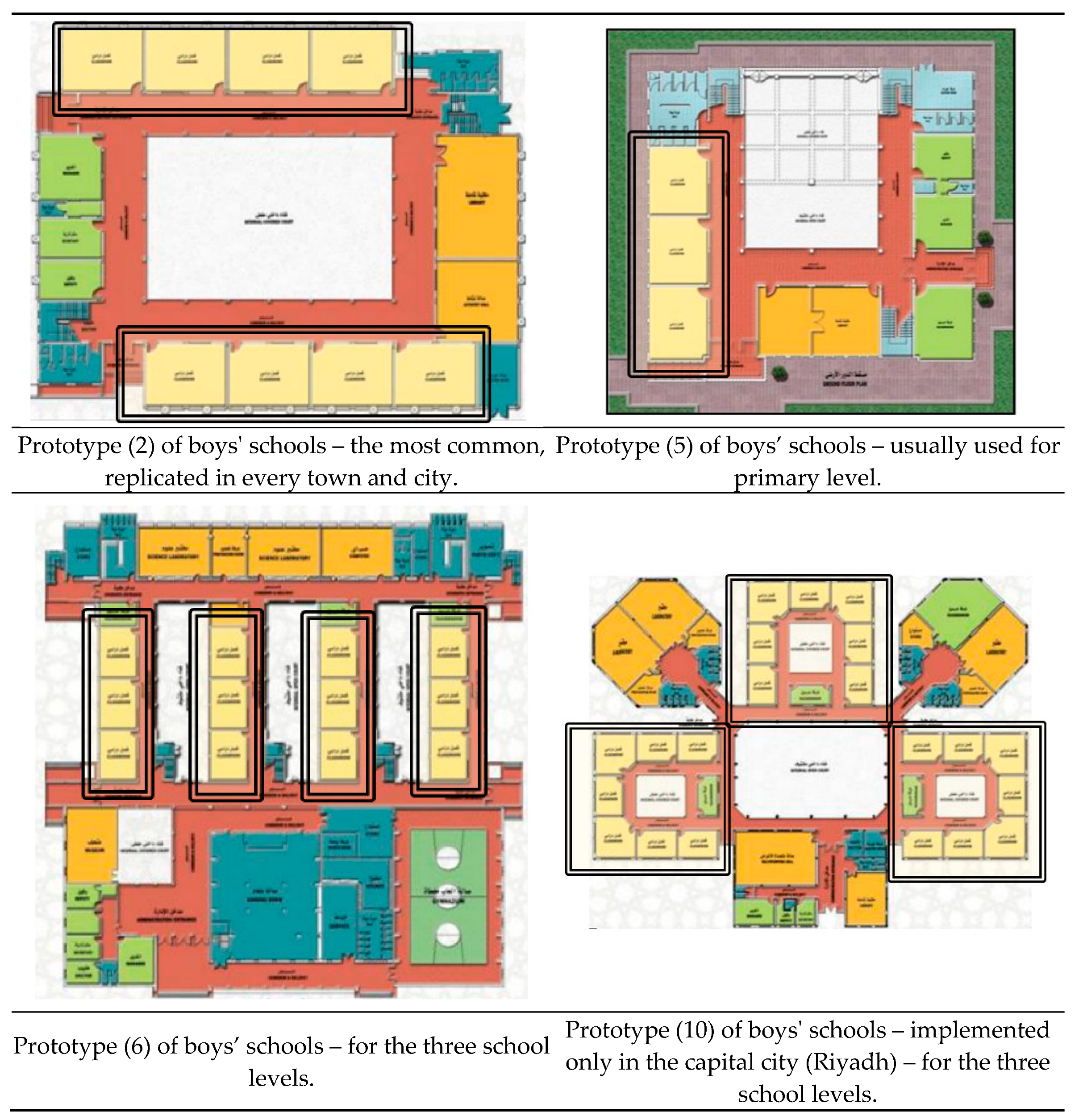
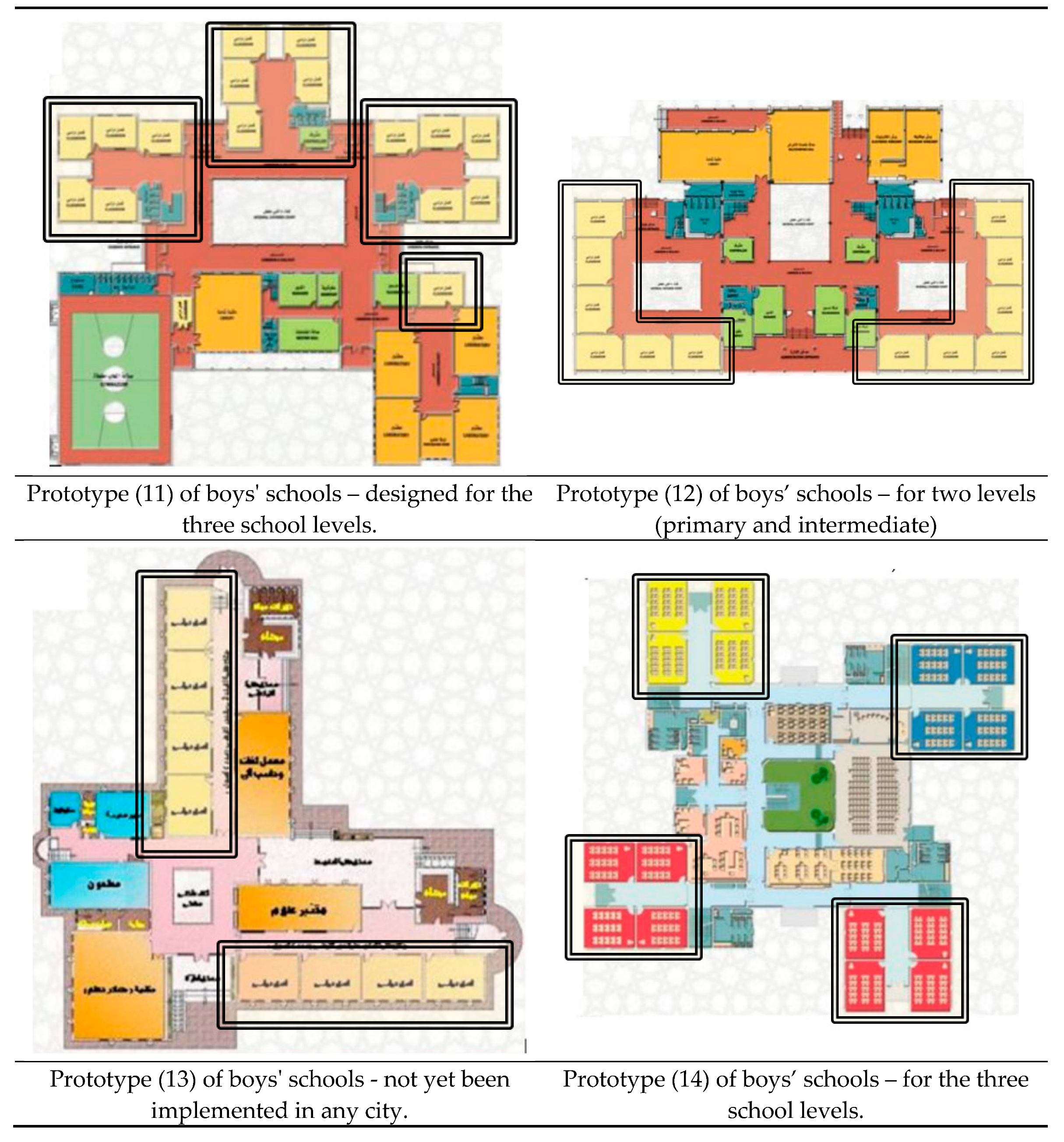
Classroom capacity controls the shape and seating arrangement. In general, the design guidelines for a 24-classroom student's capacity in the architectural standards prefer the avoidance of deep rectangles. The commonly used ratio is 2:3 or 3:4 width to length, and the length is exposed to the external facade [16,26]. Classrooms of 24 students capacity is common in KSA primary schools, and the common shape is the rectangle. KSA has fourteen prototype school building designs, which are replicated in all cities and towns. These prototypes follow the common schools' external/internal walls proportion. Similarly, the common prototype classroom in KSA has a ratio of width to length that is around 1: 1.15 and 1:1.55 while its height is usually 3.5m, according to the Ministry of Education [8,18–23]. Table 1 presents 8 school prototypes that are generalized among KSA cities and shows the common plan dimensions of classrooms in KSA. The argument in this manuscript is regarding the eligibility of applying the common proportion for rectangular classrooms in Taif City, KSA after considering its specific characteristics.

Table 1.
Eight KSA schools prototype plans with determination boxes around the classrooms to notice their common proportion. Source: Ministry of Education, [18].
Table 1.
Eight KSA schools prototype plans with determination boxes around the classrooms to notice their common proportion. Source: Ministry of Education, [18].
4. Indoor Environmental Functions in Classrooms
Students spend most of their time at school, and its physical environment elements have an evident effect on students’ learning and behavior. So, whatever the chosen classroom shape and dimensions, minimal adequacy levels of physical environment elements should be guaranteed [2,4,5]. It is important to emphasize the importance of Windows' presence, as recent studies found that its presence was positively related to student engagement [27]. Recent research emphasized the outdoor values and their effect on the student's anxiety levels, behavior, and mood. Besides the obvious effect on the student's health and well-being in windowless classrooms. There was an obvious declaration that no artificial systems could replace fresh air and sunlight. These researches were well-conducted studies that could be reliable, dependable long-lasting, and difficult to alter [1,3,6]. For all designers, reducing the conflict that arises from meeting the various environmental functions is an important objective. For example, it can be difficult to maintain both thermal and visual comfort in an interior building space while using the same window for both functions. Since their requirements can differ and even be in conflict. To achieve multiple functions that are incompatible with each other, building designers may choose available technologies that may be employed to resolve such a conflict. Designers should use graduate solutions from simple to more technological ways to guarantee the achievement of the majority of environmental functions over the longest durations of time. The building indoor environmental functions related to human needs are as follows: physical, chemical, psychological, and radiological balance. When a person maintains a balanced thermal, visual, and acoustical conditions; he is physically comfortable and can perform tasks without stress. To achieve the balance of chemical, psychological, and radiological needs, building should provide natural ventilation and linking to nature [14,28]. All these functions are presented in the following sections regarding classrooms.
4.1. Visual Comfort
Schools should be situated to take advantage of the best visual conditions as follows.
- Angles of sight: Visual comfort in a classroom is related to the ability to distinguish the details and see the objects from a specific distance. The visual field is the field that could be seen without turning the head and moving eyes. Direct factors for visual comfort after neglecting the light aspects, are the viewing distance and the viewing angle. Poor eyesight produces difficulties in making relations between experiences as the mind cannot realize things that are not received by the senses. Eye contact is the most important factor in contact formation among people, which students and teachers need regularly. The shape and seating arrangement of classrooms, no matter the size should ensure the students' and teachers' connection besides the connection to visual and audible presented material. This could be achieved by ensuring sight lines according to visual angles from the student seating to the board wall without any obstacles [8,26,29].
- Brightness: Both quality and quantity of light was found to have the highest impact on overall students’ progress among other design parameters. The highest quantity of natural and artificial light was found to improve students’ outcomes as long as there are no direct sunlight. Both natural and artificial light is important to achieve the internal required sufficient brightness [1,3,6]. Natural lighting is scientifically agreed to be preferable, as students exposed to more natural light performed better. Natural light via large windows was found to be associated with optimum learning results in elementary schools. For example, it had a notable influence on the science and reading vocabulary test scores. Students in classrooms with larger amounts of daylight and biggest windows were also found to progress approximately 20% faster in math and reading test scores [1,3,4,24]. An important issue is also preventing the shadows that decrease the achieved brightness, for example, natural light should be on the student's left side because most students write with their right hand, and thus, light coming over their right shoulder would be blocked by their arm [6]. Artificial lighting with high quality may provide a natural light alternative. Besides, the controllability of lighting is important for both teacher and student outcomes [1,3,17,27].
- Glare Avoidance: Natural sources of light in classrooms could be the sky, direct sunlight, and the adjacent buildings’ bright walls, but too much direct sunlight in classrooms causes a glaring problem, especially with the widespread use of interactive whiteboards and computer projection. It could cause excessive brightness and disturb the recommended balance of brightness. [6] Thus, students could not benefit from the window size on the learning progress, unless its orientation avoids the risk of glare. Reflected light on the board is solved by blacking out windows for a distance of 1 m from the board, inclining the boards with a 5-degree tilt, and preventing the occurrence of windows behind the teacher, as his face will be darker than the surroundings [17,27].
- Light temperate color: Natural light regulate the sleep/wake cycles. It reinforces the circadian rhythms. Besides, natural light facilitates the sense of physical and mental comfort due to its soft and diffused quality and its fine changes in value and color. Bright daylight is a powerful mood enhancer, an activator of mental performance, and an excellent depression treatment [1,15,17,24].
4.2. Thermal Comfort
Some studies concluded that temperature was related to 12% of the student’s achievement improvement. A study showed that the effect of temperature on student achievement was a 16% increment [27]. For students 10 to 12 years old the performance and speed of two numerical and two language tests were significantly exceeded after applying thermal comfort by reducing the temperature from 25o C to 20o C and increasing ventilation rates. Students also performed better where the temperature was easy to control. Inappropriate learning thermal comfort also results in negative teacher outcomes [1]. School time is usually at the peak of solar heat gain during the daytime and middle daylight hours. The most affected are the students near the windows that can be more exposed to the hot or cold external surfaces and their surroundings [6]. For better student achievement and task performance, the temperature range should be within 21o – 28o C which differs according to each region -even in the same country-. It also differs among seasons, the type of activity being performed, heat source, humidity, the density of occupancy, and individual needs and preferences [2,3]. High airspeed that doesn’t affect papers to move was shown to be preferred by students; either by opening windows and doors or by turning on ceiling fans [2,27]. Any thermal comfort treatments should consider adequate ventilation, but heating systems that recycle the indoor air without introducing new air are not accepted if affecting the overall air quality. Thermal control is also emphasized [27].
4.3. Acoustical Comfort
External and internal noise levels in classrooms should be in optimal conditions for understanding speech. The classroom should provide good quality conditions for the reception of desirable sounds for the academic and psychosocial achievement of students. It can affect students’ outcomes by missing or misinterpreting their teachers, feeling disruptive, distracting or distressing students, feeling annoyance, and having less patience. Architectural acoustics deals with the provision of both outdoor noise transmission for a satisfactory acoustic environment and good internal acoustics level for good hearing conditions. The poor signal-to-noise ratio which compares the teacher’s voice to background noise should be high [6,27]. Reverberation time (RT) has a significant effect on speech perception and short-term memory of spoken items. It is measured by how long the sound echoes in the room. RT and the speech transmission index (STI) are frequently suggested as ways to gauge how effectively students listen in a classroom [1,3,27]. It was found that students performed seriously worse on a reading comprehension test after exposure to aircraft or road traffic noise than without noise [4,17,27,30].
4.4. Ventilation
For optimum learning thermal conditions, natural ventilation should be combined with other thermal treatments. But natural ventilation has another important role regarding Indoor Air Quality (IAQ) that is related to students’ health and well-being, thus better learning progress and less absenteeism. It was found that the student’s attention is slower when the air exchange rate is low and the carbon dioxide (CO2) level is high. Low air quality affects student attendance and teachers’ quality to teach [1,4]. A study showed that raising ventilation rates led to more accurate responses and more acceleration for a picture memory, color word vigilance, choice reaction, and word recognition. Health difficulties caused by poor IAQ and excess CO2 include drowsiness and inattention, dizziness, headaches, asthma or allergic reactions, and asthmatic symptoms. Although CO2 is not considered a pollutant, it is an indicator of ventilation rates. IAQ is also related to the presence or absence of dirt, and hygiene and can reduce unpleasant odors [2,7,27]. Generally, children are the most affected by all types of pollutants because of their high metabolic and breathing rates. Ventilation could be achieved under different conditions with a large classroom volume with big window sizes at different heights [1]. Opening the windows in the circulation area is a solution if external windows are not applicable or to help cross ventilation. Controlled ventilation allows the users to effectively ventilate the classroom under different conditions [3].
4.5. Linking to Nature
Any psychological need loss leads to mental balance loss. Students in primary schools usually have a relatively fixed learning space for most of their time, linking to nature helps the students not to get bored and monotonous easily. Their mental attention increases when they are surrounded by more natural environments. Linking to Nature encourages the students’ creative process of writing, improves their interest in problem-solving, promotes social interaction, enhances imaginative play, improves physical and cognitive development, supports weak learning success, and promotes empathy [1,3,27,31]. Thus, placing windows that students can easily see in and out, and have the effect of inviting the outdoors to the inside is an important consideration in learning progress. This creates links between students and the natural environment outside the learning space and helps them to rest their eyes at times. Looking out the window needs only soft attention, therefore it is easy for students to focus on their work. Natural variation is required and enhanced due to environmental conditions changing over days and seasons. Students scored 7% to 18% higher on standard assessments when exposed to external views [24]. Clerestory windows that are placed above eye level may preserve the level of natural light while reducing the possibility of distraction, but they also can cause switched patterns of light and shade, and shadow lines can cause visual barriers thus distress for some students [6,27]. Classrooms that can view nature such as gardens, ponds, plants, and grass preferable, and window sills should be below students’ eye level with no obstructions such as window displays and furniture. Window maintenance for a good visual link between the indoors and nature outdoors is desired [1,3].
5. Proposed Case Studies
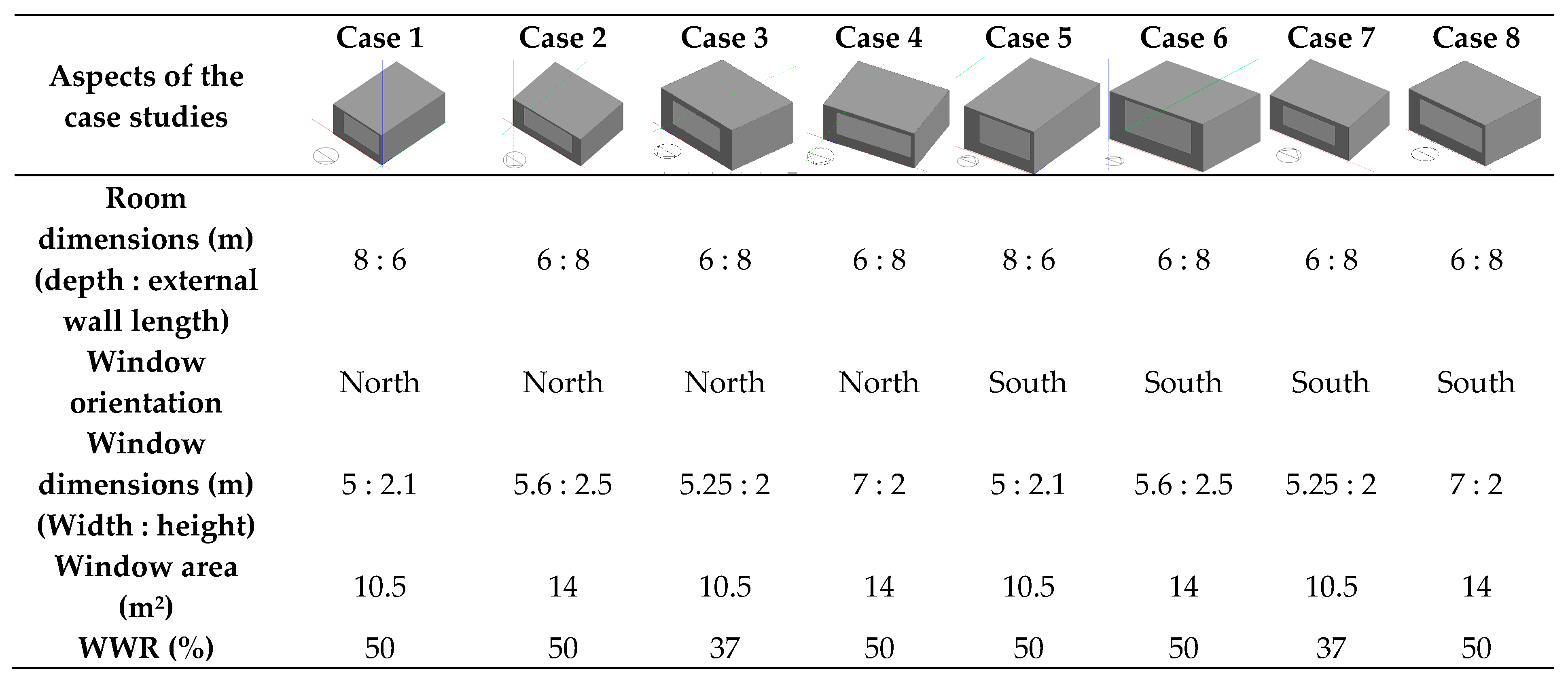
In Taif, students spend approximately seven working hours per day for five days a week for about 12 years at school. This time includes additional time to rest, pray, and eat. Thus, the case studies shall follow the maximum comfort properties regarding the architectural standards and codes. They will also follow the simplest architectural elements and solutions, such as having a single window opening with no shading to minimize the variety of effects of the case studies on their performance. Taking into consideration that other classroom properties can give advantages to the required environmental functions achievements, such as the help of more natural light and ventilation abilities if having more than an external wall or skylights, and the help of better sight lines if the classroom shape angles and flooring levels help the seating arrangement to have a better view to the board. According to architectural standards, the maximum number of students in a class is 32, but the case studies contain 24 students according to the most common in KSA [16,21]. Table 2 shows the similarities and differences of the case studies related to the room and windows dimension, ratio, and orientation, where all cases have the same area, cases 1 and 5 have different external/internal wall ratios versus other cases, cases 1, 2, 3, and 4 are oriented towards North, cases 5, 6, 7, and 8 are oriented towards South, case 1, 3, 5, and 7 have the same window area, case 1, 2, 4, 5, 6 and 7 have the same WWR, and case 1, 2, 5, and 6 have the same window height which is the maximum available height. In the following, the case-studies properties as simulated are presented.
Table 2.
Case studies aspects related to dimensions and ratios.
5.1. Architectural Properties
Case studies are rectangular classrooms with a single external wall. The openings are a window on the external wall and a door on the opposite-facing wall. Both the ceiling and the floor are flat. The distance between the board wall and the students at the back did not exceed the maximum of 9 m according to standards (six times the screen height). All case studies area are 6 * 8 m2 with a clear height of 3.5. Thus, the minimum classroom guidelines were achieved, as the standard minimum area is 2 m2/student, and the volume is 6 m3/student. The minimum standard height is 3 m which can be reduced only by a construction element, while in the case studies, 3.5 m is used as in most KSA schools. The door width is the minimum, which is 1 m. The minimum adjacent single-loaded corridor width is 1.25 m for up to 180 people as also determined by standards. Other case study properties were also taken according to standards, such as the first raw seating distance from the board’s wall (at least two times the screen height), the board dimension, the door position, and the minimum writing surface dimensions [16,26].
According to standards, the classroom depth is a maximum of 7.20 m if the windows are all on one side. [16] But this dimension was not commented on for two case studies, as this dimension is the one that this manuscript discusses its effect on the achievement of the overall classroom’s internal environmental functions. Thus, this dimension was overtaken in cases 1 and 5.
5.2. Natural Light Properties
The natural light properties according to different local and international codes were achieved in the case studies. For example, the window-to-wall ratios (WWRs) are about 40% for some cases and extended to 50% in other cases. In all cases, the window glazing has a solar factor (g-value) of 35% and a light transmittance (t-value) of 40%, the windows’ sill is 1m, and all windows start at least 1 m far from the board’s wall to avoid glare. In some cases, windows extended up to about 20 cm from the ceiling, which is slightly more than that allowed [6,15,32,33]. Regarding orientation, the North is preferable to reduce the penetration of direct sunlight while receiving adequate natural lighting. It has the most uniform daylight all year around and rarely suffers from glare discomfort. The West window orientation allows sun rays after the school day, while the East window orientation allows sun rays directly at the early time of the day. Thus, West and East-oriented glazing may not receive abundant daylight although they have a low risk of glare during normal times of occupation. Therefore, case studies excluded West and East-orientated glazing and used North and South-orientated glazing despite the possibility of glare occurrence from the South, which could be later on reduced by the use of shading devices to control the degree of sunlight penetration [1,3,17]. Moreover, a study on two classroom prototypes in Jeddah, KSA showed that West and East orientations will lead to inefficient spreading of daylight and more contrast in daylight distribution, which appears in darkness on some of the surfaces and excessive intensities on others [18,23,24].
To improve ambient lighting, reflectance levels of paints, laminates, and other finish materials should be carefully chosen. According to the WELL Building Standard that Mostadam relies on for light features. The Light Reflectance Values (LRV) for building materials in learning areas for ceilings should have at least an average of 0.8 for 80% of surface area, at least an average of 0.7 for 50%for vertical surfaces area, and at least an average of 0.5 for 50% of the furniture surface area. Thus, the simulated LRV of the case studies was 80% for ceilings and 70% for walls. The exterior coating was chosen to be the soft white color of 73% reflective factor according to the LEED and WELL standards. [15,26,34,35].
5.3. Thermal Properties
Common classroom windows in KSA use a single clear glazing layer [18,23], thus it was used for the examined classrooms even if they were inefficient in reducing the heat gain through the windows. Another type of glass such as double or low-E glazing can be then recommended to replace the proposed one to gain more thermal and energy efficiency. A study on different KSA microclimates zones found that the classrooms' worst orientations were the South and the East in terms of gaining the maximum amount of heat, noting that the south-facing classrooms are the most receiving of solar radiation, [23] but on the other hand, the thermal comfort issue could be solved by several ways that make a bad thermal orientation acceptable, but bad daylight orientation not. Thus the south orientation was included in the case studies with a possibility of having thermal recommendations, while the East orientation was excluded as previously mentioned for its light properties problems. According to a previous study, a 35% WWR for a southern window was recommended for a classroom in Taif city to achieve visual comfort, with a thermal solution such as a horizontal light shelf during the summer season. Another study recommended a WWR of 20% at the southern facade or 35% at the northern facade to achieve only the thermal comfort of a classroom for the moderate climate region, to which Taif City belongs. In both studies, the North and South directions were adopted, and the East and West were excluded [15,23].
The classroom construction materials were chosen according to the SBC 601 for non-residential buildings for Taif City, which has a DD of 2200. In that code for the unconditioned classroom with glazed openings greater than 25% and less than 40% and also for a classroom with glazed openings greater than 40% and less than 50% above grade wall area; the following aspects were common: The thermal resistance (R-value) of masonry walls is 1.937 m2·K/W as required in the code [33], which was achieved using four layers starting from outside to inside: cement plaster 2cm, polyurethane board 1.5 cm, masonry brick 25cm, and cement plaster 2cm. The same R-value could be achieved by any other layers without affecting the results. According to a recent study, the optimum thicknesses of the thermal insulations should differ between the south, north, east, and west directions of classrooms in KSA to differentiate the walls' R-value [21]. But a unified R-value for all wall directions was applied as set in the SBC code, which is the main reference in this manuscript. As applied in the case studies, and according to a study for a classroom in Taif city, the thermal insulation was found to be preferably applied to the outer surface of the external walls rather than the inner or the middle of the external walls, especially for the southern-facing classrooms [21]. According to SBC 601, the roof R-value is 3.346 m2·K/W, and the floor R-value is 1.585 m2·K/W as both were assumed to be made of concrete with continuous insulation.
No shading considerations were used. Thus, according to the SBC 601 for non-residential buildings for Taif city for projection factor (PF) of shadings less than 0.25, the required U-factor is 2.839 W/m²K for the glazed area. On the other hand, the required Solar Heat Gain Factor (SHGC) is 0.4 for both WWR proposed areas. [33] The chosen window to achieve these values is a double clear glass 6 mm with 6 mm air, and aluminum frame and dividers, with thermal breaks.
5.4. Acoustical Properties
According to codes, classrooms should be orientated away from busy roads and external noise sources such as the playground and traffic, thus, the case studies were assumed in a quiet zone with a buffer distance with trees and shrubs. The corridor that the classrooms open through can work also as a buffer zone[2,3,17,27]. According to standards and the World Health Organization, Noise Reducing Coefficient (NRC) was set between 0.65 and 0.85, the minimum sound transmission class (STC) was set to 50, and the reverberation time (RT) was set between 0.6 and 0.7 seconds [6,26,30,36].
5.6. Ventilation Properties
In three secondary public schools in Jeddah, KSA, a study was conducted on the CO2 concentration levels in 12 classrooms using three different types of Air Conditioning (AC). The reported levels of CO2 concentration surpassed the 1,000 ppm limit in all of the investigated classrooms and for all AC types. This limit is advised by the American National Standards Institute (ANSI) and the American Society of Heating, Refrigerating and Air-Conditioning Engineers (ASHRAE) Standards [7]. To avoid such an effect, natural ventilation in the case studies was applied, and large windows were used to promote fresh air. The case studies’ height was set to 3.5 m to help a better air quality, as the larger the classroom volume the less CO2 levels, although adequate ventilation is still necessary. According to Taif, the best-prevailing wind orientation is toward the North, which is one of the two directions of the case studies [2,3,6].
5.7. Outdoor Linkage Properties
5.8. Energy Use Properties
In all case studies, all inputs were according to the classrooms' default aspects in the used simulation program as long as compatible with the SBC. The interior lighting power was set according to SBC 601 and equal to 15.1 w/m2 for classrooms [12,33,37]. Fluorescent lamps with electronic ballast type were chosen, to minimize flicker. [3] Natural ventilation was only allowed. Conditioners or fans can improve air quality if only natural ventilation is problematic, thus, the use of mechanical ventilation for heating and cooling in the simulation program was neglected to concentrate passive solutions. Different studies done on KSA classrooms encourage the usage of natural systems and cross ventilation, and confirm that KSA has no heating demand even in winter [20,21,38].
6. Verification References for the Environmental Functions Achievement of the Case Studies
It should be noticed that conflicts of physical environmental requirements could occur at different times. For example, inserting more daylight into classrooms through large window areas may be useful, but could cause glare and increase solar heat gain, and too large a window size to achieve air circulation can also cause overheating [2,3,4,14,27]. Thus, the best case study is the one which could achieve the maximum environmental functions with less conflict among them. To verify and ensure the holistic achievement of the environmental physical functions for the proposed case studies, reliable and proper verification references to the KSA schools should be suggested to be used. These references were chosen from the GBRSs used to environmentally assess buildings. Only two of them were chosen to be the most reliable in their results. These references are:
- Mostadam Rating System for non-residential buildings, which is the environmental rating building system of different building types rather than residential in KSA. It relies on several important standards such as the Saudi Building Code SBC (the Architectural part (SBC 201)) and the WELL Standard that relates the building features to health and well-being. It complies with the KSA’s legislation, local aspects, and geographical priorities [15,25,32].
- The Leadership in Energy and Environmental Design (LEED), which is considered the most efficient and well-known GBRS globally, with a significant contribution to environmental buildings assessment among the KSA. It relies basically on the well-known ASHRAE standards [15].
- Any additional references that do not affect the previous two references, and can add any missing detail, such as the preferable angle of view in a classroom.
7. The Accomplishment of the Environmental Functions in the Case Studies
In the following, the accomplishment of the different internal physical environmental functions is checked for the different case studies according to the verification references.
7.1. Visual Comfort Accomplishment
7.1.1. Angles of sight Accomplishment
The case studies have two different external/internal wall ratios, cases 1 and 5 have their longer sides perpendicular to the external wall, while all other cases have longer sides as their external wall. The distance from the board may cause poor viewing and is related to the student’s abilities. In general, different sizes of symbols, letters, and numbers can be read and measured from a distance of 6.10 m, and When using a whiteboard with a reading distance of more than 8 m it is recommended to use markers of up to 1 cm to allow readability [29,39]. This issue may give credit to cases 1 and 5 versus other cases. But, because the distance was not more than 8m from the farthest student to the board for all cases, they were all considered even regarding that issue.
As previously mentioned, the angle of viewing the board properly without turning the head and moving eyes is an important issue to obtain visual comfort [26,29]. Thus, cases 1 and 5 have a problem related to the viewing angle because the board wall is on their wide side. But, the viewing angle to the board could be achieved and solved more easily by depending on the furnishing. It could be achieved by the use of fixed students’ desks with proper angles to view the board, or flexible furnishing with marks, patterns, or signs on the floor to show the proper required angles that they should follow, without having to fix them to allow furniture flexibility. Classroom seating arrangements to improve visibility and connectivity between students and the board and teachers can also contribute to better cooperative and helping behavior among students.
To check the ability of students to view the board comfortably, especially from the far sides, the proper viewing angles should be determined. Several studies were done to determine the comfortable viewing angles of the eyes as follows:
- 45o from the eye center: Some studies determined that the maximal value of visual discomfort appeared in the horizontal viewing angle of more than 45 or -45 degrees from the center of the eyes, such as in the CEN European Daylight Standard (EN 17037) [40].
- 60o from the eye center: Some studies determined that the best text realization is within plus and minus 10 degrees from the central axis of the eyes. Then within plus and minus 15 degrees, the horizontal eye rotation can take place, thus the maximum eye viewing angle is 25 degrees from both sides. Students sit at far sides from the board, their neck has to rotate over proportionally to read the text on the board or screen. Rotation of the neck up to 35 degrees does not cause any physical exertion, but more than that leads to intense neck stress and growing pressure on muscles and joints. Therefore, in classrooms, physical complaints could be prevented if the students' vision of to board takes on the maximum viewing angle of 35 plus or minus 25 degrees [39].
Figure 1 and Figure 2 show the seating arrangement that helps achieve the proper visual angles to the board for the two different cases’ ratios according to the viewing angles of 45o and 60o from the eye center. Note that both classroom ratios needed slightly tilted desks toward the board for the sides’ seated students by 10o for the shallower classrooms and by 20o for the deeper classrooms.
7.1.2. Brightness Levels and Glare Avoidance Accomplishment
The achievement of the required brightness of the classroom is a very important assessment item for schools in the different GBRSs [13,15,24]. According to LEED, the natural illuminance level should be between 300 and 3,000 lux between 9 a.m. and 3 p.m. at appropriate work plane height, for at least 75% of the floor area. This range is due to the need for artificial light if the illuminance level was below 300 lux, and the occurrence of visual discomfort or risk of glare if the illuminance level was above 3000 lux. Measurements should be taken in regularly occupied months according to a specific table presented in the LEED scheme [13]. According to Mostadam, the daylight illuminance should be at least 300 lux for 75% of the occupied area, and according to the SBC 201, the minimum net glazed area shall not be less than 8 % of the floor area of the room [8,24,32,41].
The eight classroom case studies were simulated by the DIAlux evo software to determine their light-level performance. The location data was set according to Taif city location details with the help of the climate consultant software tool. According to Taif’s sun path diagram, the simulated days were chosen to present the lowest and highest sun elevations, which are 21 of December and 21 of June. 21 December presents the lowest sun elevation angle day, and 21 June presents the highest sun elevation angle day [15,42,43,44]. Besides, 21 February was simulated for all cases to check the LEED requirements. According to LEED, a day in February or October months should be simulated to take a second measurement of daylight illuminance levels, if the first measurement is taken in June [13]. The Lux levels were calculated as set in Mostadam for a clear sky at 0.75 m above the floor, and the artificial light was excluded from the calculations [32]. Table 3 shows the simulation results of the case studies and Table 4 presents the accomplishment of the required brightness levels and glare avoidance according to LEED and Mostadam requirements for the eight case studies.
7.2. Thermal Comfort Accomplishment
According to LEED and Mostadam, thermal modeling should be carried out to evaluate comfort levels using Predicted Mean Vote (PMV) and Predicted Percentage Dissatisfied (PPD) Methods following ISO 7730:2005. PMV should range between 0.5 and -0.5 and the PPD should be less than 10 [13,32,46]. According to previous research in KSA, there is no need for warming in winter. The coldest month in Taif is January and the average air temperature in winter (°C) is 18, thus all thermal comfort accomplishments focused on the cooling demands [20,21,42]. The DesignBuilder software was used to get the thermal characteristics of the eight case studies. It should be noted that the case studies had already complied with the local code SBC requirements, which Mostadam relies on in its assessment. The simulation results were then used to calculate both PMV and PPD by the use of a webpage calculator. Some input data were also gathered from the climate consultant software tool. Although there are several webpages to calculate the PMV and PPD, the Center of Built Environment (CBE) Thermal Comfort Tool Version 2.4.3, is the main one used, which relies on ASHRAE-55 - 2020 [47,48]. Then a manual check was done using basic PMV and PPD equations depending on the simulation inputs. The cloth insulation Icl (clo) was determined 0.50 in summer, and the rate of metabolic energy production rate (Watt/m²) was determined as 58.2 for classrooms. The rate of effective mechanical work (Watt/m²) was determined 0 for normal activity [46,48,49,50,51,52,53]. According to Taif's climate characteristics, the average airspeed was determined to be 4 m/s in June and 3.2 m/s in September with local control [42]. The inputs were determined within the maximum school occupancy duration (from 6:00 am to 4:00 pm), which means that the air temperature ta (°C) was calculated within this duration. The school period in Taif usually starts in September and ends in June, thus any results related to July and August were neglected even if they include the peak temperature values as in cases 1, 2, and 3. In general, the warmest month in Taif City is June but sometimes the peak appears in July [37,42].
7.3. Acoustical Comfort Accomplishment
According to Mostadam, the internal acceptable noise levels should be at least 35 dBA [32]. According to LEED, for learning Spaces less than 566 cubic meters, the confirmation of acoustical comfort achievement depends on the area of specific types of sound-absorbent finishes to be equal or exceed the total ceiling area of the room, or to confirm through calculations that the room meets reverberation time (RT) between 0.6 and 0.7 seconds, according to ANSI Standard 12.60 -2010 Part 1 [6,13]. It should be noted that the RT is affected by the room shape and that it is easier for the teachers to be heard when the students' seating arrangement helps them to be closer to the teacher (as in cases 1 and 5) [3]. When an RT calculator was used, all case studies gave a result of 0.6 sec after assuming to cover the ceiling area by affective absorbing materials as required to LEED [54]. Thus there could not be any comparison among them regarding the LEED ranges.
For Mostadam required noise level, an internal noise calculator tool that can estimate the noise level based on inputs such as the reverberation time (proposed 0.6 as previously calculated), the external noise level (was proposed to be 60 dB), the sound reduction of the external wall and its area, the sound reduction of the openings and their areas, and the room length, width, and height. Calculations were done after assuming that the sound reduction of the external wall and the openings were unified among all cases. These values were set to make case 1 a base-case, to compare other cases to it. These values make case 1 at the maximum internal ambient noise levels according to Mostadam (35 dBA). The results of the internal noise levels, if case 1 was a base case, are shown in Table 7 [55].
7.4. Ventilation Accomplishment
According to Mostadam based on SBC 501 requirements, the minimum operable area outdoor shall not be less than 8% of the space floor area being ventilated and not less than 2.3 m2. [32] According to LEED based on ANSI/ASHRAE Standard 62.1, the maximum level of CO2 levels is 1500 ppm practically or 1000 ppm theoretically. The minimum acceptable air ventilation rate is 15 cubic feet of fresh air per minute (cfm) per person for the dilution and removal of obnoxious substances from the air in classrooms [6,7,13]. Because of the hot climate of most cities in KSA, windows in classrooms may stay closed almost all the time, which may cause high levels of pollutants and CO2 concentration as recorded in several studies on school air quality in KSA. On the other hand, Taif City has the advantage of the ability to achieve thermal comfort naturally without relying on mechanical ventilation [42]. Thus, the case studies were assumed to keep the windows open as previously mentioned and proposed in the thermal comfort calculations with the capability of local control. According to previous studies conclusions on KSA classrooms, the CO2 levels are low and with no effect as long as no mechanical systems were installed [7,56]. So, the requirements of LEED were excluded, and only the requirements of Mostadam that relate to the ventilation accomplishment by the openings area are checked. Table 8 shows this relation.
7.5. Linking to Nature Accomplishment
Both LEED and Mostadam determined the linking to nature achievement by having a minimum of 75% of the occupied floor area have a direct line of sight to the outside through vision glazing. Some other requirements in LEED are related to the outside features, which in the case studies could all be assumed to be achieved [13,32]. When applying the viewing angles on all case studies with their wide windows; they achieve the required range easily. Noting that the horizontal viewing field angles are at least 60o at the left and the right from the eye center and that the vertical viewing field angles are at least 25o above the horizon (elevation angle) and 35o below it (depression angle) [39,57]. On the other hand, other studies regarding vertical vision set a relation that connects the eye focus on far objects and muscular relief provision that minimizes strain risks by the distance from the window. Such as a study that defined the Observer Landscape Distance (OLD) which is a value to quantify the distance of the window view landscape from the occupant. These studies resulted that people are more satisfied when urban features are viewed far away from the occupants. The European Standard EN 17037, and the Society of Light and Lighting (SLL) guide also recommend that the minimum distance to view out should exceed or be equal to 6m. Quality of view is categorized as “sufficient”, “good” and “excellent” for an outside distance of view ≥ 6 m, 20 m, and 50 m, respectively, and provides satisfactory design targets. Unwanted visual discomfort symptoms, eyestrain, and visual fatigue can occur when occupants are focussing on objects close to their visual field at short viewing distances between the observer and the visual stimulus [40,58]. Table 9 shows the vertical viewing angles achievement for the different case studies and their relation to Mostadam and LEED requirements and also shows the ratio of occupants that have a distance ≥ 6 m from the window, thus guaranteeing visual satisfaction.
8. Users' Preferences of Rectangular Classroom External/internal Wall Ratio
As previously mentioned in the Introduction section, the classroom shape, size, and proportion affects directly the students’ educational quality, performance and achievement, working efficiency, and the teachers’ ability to educate [10]. Thus, the manuscript covered besides the architectural physical needs of the students, the physiological side too. A questionnaire was used to determine the classroom users' preference between the two proposed classrooms' external/internal wall ratios. Users' preferences were determined according to the effect of different ratios on the internal relations such as the students' arrangement and distance from the board, etc. A questionnaire was done for the students from the fourth and sixth grades of three different schools in Taif City, this questionnaire was given to the students, their teachers, and their parents. The classrooms of these students were in the range of 24 students capacity. 74 students answered the questionnaire, 55 of their parents, and 11 teachers. The main questionnaire questions were about the preferences of the students' seating concerning the board’s wall and their expectations of the effect on the student’s academic and social development. The results can be shown in the following figures (Figure 4, Figure 5 and Figure 6). Table 10 summarizes all charts and presents the users' preference percentage regarding the two proposed external/internal wall ratios of a rectangular classroom in Taif City.
9. Discussion
Architectural spaces are reaction products. Architects could consider changing the usual design of classrooms if they found a good reason to do so, such as a better impact on the users. So, if users already desire a certain classroom proportion, thus, architects may study its effect on its functions; to decide either to take it or to leave it. If the alternative composition gives the same or higher performance for the overall architectural values, thus, the new composition should be considered and applied. This manuscript searches the common rectangular classrooms proportion to find whether it is the best way to design a rectangular classroom in Taif City, KSA through the effect on the classroom environmental functions. The gained results from the previous sections can be analyzed and discussed as follows:
Regarding students' angles of sight, all cases were able to accomplish the required angles of sight to the board by controlling the way of seating and furnishing. But the cases that used wider external wall cases had an advantage over the opposite ratio cases. The wall-side seats needed a 20o rotation angle for the shallower external wall cases toward the board versus only 10o for the wider external wall cases for a sight angle of 45o from the eye center.
Regarding brightness levels, the achievement was found to be accepted in all cases, as shown in Table 4. But several points could be noticed, such as that the window area and WWR were the key elements of the internal minimum brightness level, and that both characteristics are important to improve its achievement. Although cases 1, 3, 5, and 7 have the same window area, cases 1 and 5 had more brightness levels because their WWRs were larger. Thus, even though cases 1 and 5 have a shallower external wall, they gave better results with a larger WWR regarding the minimum brightness level. It is noted that the Southern windows' orientation cases easily exceeded the minimum brightness requirement levels versus the Northern ones. It is also noted that the ability to exceed the maximum brightness level as set in LEED was high in most cases with Southern windows, which causes them to suffer a high risk of glare. Among southern window cases, only case 5 hadn’t reached the level of 3000 lux in its internal space, which means that a classroom in Taif City with a shallower external wall may have an advantage over a wider one regarding the avoidance of glare effects if oriented towards the South. The larger the windows’ area and WWR, the higher the risk of glare toward the South. Thus although WWR and windows’ area could be increased with the increment of the external wall, which may give cases of wider external walls an added visual advantage if used, they also may cause a risk of glare for southern-oriented cases.
Regarding thermal comfort, although passive solutions were the only ones used, all cases were close to Mostadam and LEED requirements achievement, which could be due to the generally acceptable climatic aspects of Taif city over the year. [42] Although all case studies were built according to SBC recommendations, only two cases, which are cases 1 and 5 achieved the thermal requirements in both summer-occupied months, as shown in Table 6. This may be due to their shallower external walls that helped to reduce the solar heat gain to the internal spaces through their exposed walls to the sun radiation. It should be noted that KSA had a great emphasis on the thermal comfort achievement in the internal spaces versus other human comforts, which could be noticed from the high corresponding points in Mostadam given when achieving it in comparison to other comfort items and in comparison to other rating systems. This could be due to the high energy consumption in KSA toward achieving internal thermal comfort if not achieved naturally [32,33]. It also should be noted that natural ventilation is allowed with local control, which is of good value in Taif City, helps thermal comfort achievement, and allowed cases 1 and 5 to succeed. This ventilation should be considered to be allowed above the working area of students; to avoid uncomfortable paper movement within their work area. Cases 3 and 7 achieved the required thermal comfort levels in only one summer month and failed in the other, which could be due to their wider external walls. Besides case 7 could add a reason for failing in June because of the southern orientation of its window, which raise its exposure to direct sun radiation. Other cases had failed in both summer-occupied months, which could be due to their wider external walls combined with high WWR, or due to these reasons besides the southern-oriented windows.
Regarding acoustical comfort, all cases can achieve the required Mostadam and LEED requirements when using proper acoustical materials with proper areas. But no doubt that the closer the students are to their teacher the better the sound arrival to them. A slight difference in the noise level was shown in Table 7 when comparing cases 1 and 5 with other cases. This comparison gave a slight advantage to these cases that have a shallower external wall versus other cases, which could be due to the possible central and closer place of the teacher to more students in these cases.
Regarding the ventilation function, Taif city climate conditions allow natural ventilation, which could be with local control and away from the students' work area as previously mentioned. So, the occurrence of high CO2 levels is unexpected, and the ventilation assessment relied mainly on the window area. Only 8% of the space floor area is required to be operable, which can be achieved easily with the high windows percentages to the floor area as previously mentioned in Table 8.
Regarding the linking to nature, all case studies could easily accomplish the horizontal and vertical viewing angles to comply with Mostadam and LEED requirements; due to their wide windows and WWR. If all cases are built in the same location and site, their external environment aspects are unified. Thus, it could be assumed that all required features related to the external environment in Mostadam and LEED are achieved. A satisfying distance to link the students to the outdoors is the basis of this assessment. when comparing cases 1 and 5 regarding the ability to have visual satisfaction for occupants with a distance ≥ 6 m from the window, 25% of students are been guaranteed to achieve such satisfaction, as shown in Table 9. This may give these cases an advantage over other cases regarding that issue.
Regarding the users’ preferences, which reflect a physiological side of the users' comfort, deeper board wall cases presented the preferable rectangular classroom proportion case, as shown in Table 10. This result was according to an applied questionnaire. They preferred the choices that support the longer board wall, which automatically supports the shallower external wall cases. In the preferred proportion, students may easily perform numerous tasks that they can do better if they were near the board, such as viewing the board, listening to teachers, and reading or copying from the board or any material placed at a near distance. These near tasks are performed for more than half of the school day. Thus, not only children with reduced vision prefer to be seated in a front desk position for better visibility, but also most other students. It is also noted that students may prefer being far from windows, which agrees with the viewing satisfaction results and may be due to their fear of exposure to thermal or visual discomfort if windows are not treated properly. This result is compatible with previous study results in Kenya that linked the seat position to the study gain and learning achievement in primary school classrooms and showed that improving learning outcomes is positively and significantly impacted by front-row seats [11].
Regarding energy conservation, which should be in focus as long as dealing with environmental issues, all case studies were proposed to reduce the reliance on artificial energy versus natural ones. Although shallower external wall cases may need artificial lighting more times than the other cases, they may need less artificial cooling times. Both natural and artificial energy features could be combined to reach the required levels with less energy consumption. Thermal devices with thermostatic control and mechanical ventilation can help the adjustment of the internal thermal environment when needed. Lighting control is very important too, especially since lighting preferences vary according to the time of the day, the activity, and the individual student requirements. Window shielding control devices and shade control could positively affect both thermal and lighting conservation, especially when the control is done by proper supervision [1,6,27].
10. Results
The manuscript argument was regarding the better External/Internal walls ratio of rectangular classrooms in Taif City, KSA based on environmental assessment. As the assessment relied mainly on Mostadam and LEED rating systems to verify the effect on the indoor environmental functions of the proposed case studies. Thus, the assessment can use the credits of the related items in LEED and Mostadam to set a point scheme for the assessment of this manuscript. Table 11 shows the available points of the related Indoor Environmental Quality (EQ) items in LEED and the related Health and Comfort (HC) items in Mostadam when achieved. In Table 12 the average of the assessment points of the previous assessment systems was put to be used to assess the case studies. Some other items were added, such as the viewing angles item and physiological comfort (users preferences) item, because none of them have a separate assessment item in LEED and Mostadam, but they are both very important in the environmental assessment of the classroom.
Table 13 shows the assessment of the eight case studies according to the proposed assessment points in Table 12. The gained points relied on the manuscript findings and discussion as follows:
- For the angles of sight item, if cases except 1 and 5 earn a 90% achievement, then, cases 1 and 5 can earn 80%.
- For the brightness levels and glare avoidance item, cases 2, 4, and 5 earn 2 points because more than 90% of their floor area is within the required ranges, while other cases earn 1 point because the required level covers between 90% and 75% of the floor area.
- For the thermal comfort item, cases 1 and 5 are the only cases achieving points.
- For the acoustical comfort item, if cases 1 and 5 earn the total achieved points, then the other cases could earn 90% of them.
- For the ventilation item, all cases can earn total points.
- For the linking to nature item, cases 1 and 5 may have a slight advantage over other cases, because 25% of the students guarantee a satisfied distance, thus other cases could have a 75% of their earned points.
- For the users’ preferences, cases 1 and 5 could gain 69% of the total points of the assessment item, while other cases could gain 31% of it, which represents the ratio of users’ preferences as shown in Table 10.
From the previous table, it is obvious that the cases that presented a classroom with a shallower external wall gained more points regarding the achievement of the overall indoor environmental functions in Taif City. Thus, the common classroom design and application that presents a wider external wall should be changed following Taif City's characteristics. Similarly, other form standards that affect environmental functions related to spatial variables may be checked for their efficiency. This study needs more applications to find the best ratio values and dimensions, the manuscript aimed to find out if the commonly followed classroom ratio can fail or not if examined in different circumstances, especially with the recent holistic environmental approach of assessment. Each country has different physical environmental characteristics that affect the architectural values and production, these characteristics can vary even within the same country regions according to the country’s different climatic zones. Generalizing any recommendations of a specific region that are related to building environmental functions is not accepted.
11. Conclusions
Some of the rooted-in-mind formations of certain spaces may lead to impeding thinking of the preference for other alternatives that could lead to more advantages. Scientific evidence suggests considering the unusual ratio of rectangular classrooms to have an advantage over the usual one in Taif City, KSA. A shallower external wall classroom contra the common classroom standard design and application in KSA but was more environmentally effective. In the manuscript, and for a rectangular classroom, several case studies were proposed to represent the common and uncommon ratio designs with some varieties and similarities of windows dimension, WWR, and orientation among them. Simulation programs and calculations were carried on to compare these case studies regarding internal environmental functions starting with visual comfort, thermal comfort, acoustical comfort, ventilation, and liking to nature. All these functions are important with different proportions for different building functions. The comparison used Mostadam and LEED rating systems, as the local and widest environmental systems, to set the required ranges for the previous function. The manuscript also focused on the users’ preferences which add a physiological comfort function and is related to the academic students’ performance and achievement. All results were then discussed to determine the final findings in a holistic assessment of the case studies. Proposed assessment items and related points were also based basically on Mostadam and LEED. The assessment results of the case studies showed that the cases with shallower external walls versus the classroom with wider external walls were more environmental efficiently. They gained more points than other cases, which means that they are better at achieving more periods of classroom environmental functions, and less conflict among them. The final result is that no common architectural standard should be restricted unless examined according to the circumstances that affect its related functions. It is recommended to find the best classroom design for Taif City that can be different from any other place even in KSA. And it is also recommended to reconsider the architectural design with all related internal functions not only the most important for a certain building type. Recent building assessments should have a holistic view, especially for environmental issues.
Funding
This research received no external funding.
Conflicts of Interest
The authors declare no conflict of interest.
References
- Barrett, P. Davies F., Zhang Y., Barrett L.: The impact of classroom design on pupils ’ learning : Final results of a holistic , multi-level analysis Building and Environment, 89, pp. 118–133 (2015). [CrossRef]
- Widiastuti, K. , Susilo M.J., Nurfinaputri H.S.: How classroom design impacts for student learning comfort: Architect perspective on designing classrooms 9, pp. 469–477 (2020). [CrossRef]
- Barrett, P. Zhang Y., Davies F., Barrett L.: Clever classrooms : Summary report of the HEAD project, Manchester, (2015).
- Cheryan, S. , Ziegler S.A., Plaut V.C., Meltzoff A.N.: Designing Classrooms to Maximize Student Achievement Education, 1, pp. 4–12 (2014).
- Gremmen, M. , van den Berg Y.H.M., Segers E., Cillessen A.H.N.: Considerations for Classroom Seating Arrangements and the Role of Teacher Characteristics and Beliefs Social Psychology of Education, 19, pp. 749–774 (2016). [CrossRef]
- Baker, L. A History of School Design and its Indoor Environmental Standards , 1900 to Today, , Washington, (2012).
- Alama, A. , Sabbagh M.: Indoor Air Quality Assessment Inside Secondary Public Classrooms in Jeddah, Saudi Arabia Journal of Engg, 10, pp. 28–43 (2022). [CrossRef]
- Qahtan, A.M. Daylight Illuminance in Classrooms Adjacent to Covered and Uncovered Courtyards Under the Clear Sky of Najran City , Saudi Arabia Emirates Journal for Engineering Research (EJER), 24, (2019).
- López-Chao, V. Lorenzo A.A., Saorín J.L., Torre-Cantero J.D. La, Melián-Díaz D.: Classroom Indoor Environment Assessment through Architectural Analysis for the Design of Efficient Schools Sustainability, 12, (2020). [CrossRef]
- Zhang, A. Bokel R., Dobbelsteen A. van den, Sun Y., Huang Q., Zhang Q.: The Effect of Geometry Parameters on Energy and Thermal Performance of School Buildings in Cold Climates of China Sustainability, 9, (2017). [CrossRef]
- Ngware, M.W. , Ciera J., Musyoka P.K., Oketch M.: The Influence of Classroom Seating Position on Student Learning Gains in Primary Schools in Kenya Creative Education, 04, pp. 705–712 (2013). [CrossRef]
- Shamseldin, A. Proposed Role of the Local Saudi Building Codes in Assessing the Energy Performance of Buildings in KSA’s GBRS Ain Shams Engineering Journal, In press, (2022). [CrossRef]
- USGBC: LEED v4 for Building Design and Construction. https://greenguard.org/uploads/images/LEEDv4forBuildingDesignandConstructionBallotVersion.pdf, (2019).
- Shamseldin, A.K.M. Assessment of Minimizing the Environmental Functions Conflict in Buildings Journal of Building Construction and Planning Research, 4, pp. 119–129 (2016). [CrossRef]
- Shamseldin, A. , Alwetaishi M., Alzaed A.: Visual Comfort Achievement In Compliance With Thermal Comfort Recommendations In Educational Buildings In Taif City, KSA International Conference of Women in Data Science at Taif University (WiDSTaif ). IEEE, Taif, Saudi Arabia (2021).
- Neufert, E. , Neufert P. Neufert Architect’s Data, Willey-Blackwell, Wiesbaden, Germany, (2012).
- Shrestha, H.D. , Pribadi K.S., Lim E. Handbook of Typical School Design (General) 2 Classrooms and 3 Classrooms, Save the Children, (2009).
- Alwetaishi, M. Human Thermal Comfort and Building Performance of Schools in Hot and Humid Climate with a Particular Reference to Saudi Arabia, Jeddah, (2015).
- Alwetaishi, M. , Alzaed A., Sonetti G., Shrahily R., Jalil L.: Investigation of school building microclimate using advanced energy equipment: Case study Environmental Engineering Research, 23, pp. 10–20 (2018). [CrossRef]
- Alwetaishi, M. , Balabel A. Numerical Study of Micro-Climatically Responsive School Building design in Saudi Arabia Journal of King Saud University - Engineering Sciences, (2017). [CrossRef]
- Alwetaishi, M. , Taki A.: Investigation into Energy Performance of a School Building in a Hot Climate : Optimum of Window-to-Wall Ratio Indoor and Built Environment, 29, pp. 24–39 (2020). [CrossRef]
- Alwetaishi, M. , Gadi M. Toward sustainable school building design: A case study in hot and humid climate Cogent Engineering, 5, (2018). [CrossRef]
- Alwetaishi, M. Impact of Glazing to Wall Ratio in Various Climatic Regions: A Case Study Journal of King Saud University - Engineering Sciences, 31, pp. 6–18 (2019). [CrossRef]
- Alama, A.M.S. , Sabbagh M.: Comparing Daylight Distribution Between Two Classroom Prototypes In Jeddah Public Schools 86th Research World International Conference. , Jeddah, Saudi Arabia (2020).
- Shamseldin, A. , Balabel A., Alwetaishi M., Abdelhafiz A., Issa U., Sharaky I., Al-Surf M., Al-Harthi M.: Adjustment of the indoor environmental quality assessment field for Taif city-Saudi Arabia Sustainability (Switzerland), 12, pp. 1–27 (2020). [CrossRef]
- University Planning D. and C., Classroom management committee: Classroom and Lecture Hall Design Guidelines. https://updc.uconn.edu/wp-content/uploads/sites/1525/2020/09/Appendix-VI-Classroom-Design-Standards-August-2020.pdf, (2020).
- Wall, G. The impact of physical design on student outcomes, NewZealand Government, (2016).
- Shamseldin, A. Adaptation Opportunities for Balconies to Achieve Continuity of Their Environmental Functions Alexandria Engineering Journal, 67, pp. 287–299 (2022). [CrossRef]
- Kızılaslan, A. Teaching students with visual impairment, Nova Science Publisher, (2020).
- Recalde, J.M. , Palau R., Márquez M.: How Classroom Acoustics Influence Students and Teachers: A Systematic Literature Review Journal of Technology and Science Education, 11, pp. 245–259 (2021). [CrossRef]
- Shamseldin, A.K.M. Considering coexistence with Nature in the Environmental Assessment of Buildings Housing and Building National Research Center, 14, pp. 243–254 (2018). [CrossRef]
- KSA-Ministry of Housing, Sustainable-Building Institute, Saudi-Real Estate Institute: Mostadam Rating System: Commercial Buildings-D+C Manual. https://www.mostadam.sa/uploads/2019/10/5dab64efa9e86.pdf, (2019).
- Saudi Building Code National Committee: Saudi Energy Consevation Code-Non-residential: SBC 601-AR. https://www.sbc.gov.sa/resources/PdfPreview/web/viewer.html?avx=p_601a&type=0, (2018).
- WELL: The WELL Building Standard v2 with Q1 2019 Addenda. https://resources.wellcertified.com/articles/your-guide-to-the-q1-2019-addenda/, (2019).
- International WELL Building Institute: https://standard.wellcertified.com/light/surface-design.
- Pelegrin-Garcia, D. , Brunskog J.: Classroom Acoustics Design Guidelines Based on the Optimization of Speaker Conditions European Conference on Noise Control (Euronoise). pp. 61–66. European Acoustics Association, Prague (2012).
- Shamseldin, A.K.M. DesignBuilder v7. https://designbuilder.co.uk/download/release-software, (2023).
- Alwetaishi, M. , Gadi M., Issa U.H.: Reliance of building energy in various climatic regions using multi criteria International Journal of Sustainable Built Environment, 6, pp. 555–564 (2017).
- van der Zanden, P. Readability in Classrooms. https://homepage.tudelft.nl/9c41c/Readability_in_classrooms.pdf, (2014).
- VELUX Group: CEN European Daylight Standard (EN 17037). https://velcdn.azureedge.net/~/media/marketing/ee/professional/28mai2019 seminar/veluxen17037tallinn28052019.pdf, (2019).
- The Saudi building code national committee: The Saudi building code-general (SBC 201). https://www.sbc.gov.sa/En/BuildingCode/Pages/SBC_201E.aspx, (2020). 2020.
- Shamseldin, A.K.M. Climate Consultant 6.0, (2023).
- Kamis, A.S. Future Domestic Water Demand for Jeddah City MOUNTAIN RESEARCH AND DEVELOPMENT, 12, pp. 93–103 (2018). [CrossRef]
- GAISMA: https://www.gaisma.com/en/location/at-taif.html,.
- Shamseldin, A.K.M. : DIAlux evo software. https://www.dialux.com/en-GB/download, (2022).
- American Society of Heating Refrigerating and Air-Conditioning Engineers Standards Committee: ASHRAE Standard - Thermal Environmental Conditions for Human Occupancy. https://arco-hvac.ir/wp-content/uploads/2015/11/ASHRAE-55-2010.pdf, (2010). 2010.
- Tartarini, F. , Schiavon S., Cheung T., Hoyt T.: CBE Thermal Comfort Tool : online tool for thermal comfort calculations and visualizations. SoftwareX 12, 100563, (2023). [CrossRef]
- Gao, C. : Calucation of Predicted mean Vote (PMV),and Predicted Percentage Dissatisfied (PPD). https://www.eat.lth.se/fileadmin/eat/Termisk_miljoe/PMV-PPD.html.
- Kuklane, K. , Toma R.: Common Clothing Area Factor Estimation Equations are Inaccurate for Highly Insulating (Icl>2 clo) and Non-Western Loose-Fitting Clothing Ensembles Industrial Health, 59, pp. 107–116 (2021). [CrossRef]
- Dyvia, H.A. , Arif C.: Analysis of Thermal Comfort with Predicted Mean Vote (PMV) Index Using Artificial Neural Network in ISCEE 2020 (ed.) IOP Conf. Series: Earth and Environmental Science 622 (2021) 012019. IOP Publishing (2021). [CrossRef]
- Ekici, C. A Review of Thermal Comfort and Method of Using Fanger’s PMV Equation 5th International Symposium on Measurement, Analysis and Modelling of Human Functions, ISHF 2013. pp. 61–64, Vancouver, CANADA (2013).
- da Silva, M.C.G. Spreadsheets for the Calculation of Thermal Comfort Indices PMV and PPD, (2014).
- Cakó, B. , Zoltán E.S., Girán J., Medvegy G., Miklós M.E., Nyers Á., Grozdics A.T., Kisander Z., Bagdán V., Borsos Á. An Efficient Method to Compute Thermal Parameters of the Comfort Map Using a Decreased Number of Measurements Energies, 14, (2021). [CrossRef]
- Szyk, B. : Reverberation Time Calculator. https://www.omnicalculator.com/physics/reverberation-time#how-to-use-the-reverberation-time-calculator.
- WKC Group Environment consultants: Internal Noise Calculator. https://www.wkcgroup.com/tools-room/internal-noise-calculator/.
- El-Sharkawy, M.F.M. Study the Indoor Air Quality Level Inside Governmental Elementary Schools of Dammam City in Saudi Arabia International Journal of Environmental Health Engineering, 3, (2014).
- Su, S. , Gu S., Zhao Y., Chen Z., Wang H., Yang W.: Human Ocularc Physiological Characteristics Based Adaptive Console Design IEEE Access, 8, pp. 109596–109607 (2020).
- Kent, M. , Schiavon S. Evaluation of the Effect of Landscape Distance Seen in Window Views on Visual Satisfaction Building and Environment, 183, (2020). [CrossRef]
Figure 1.
Seating arrangement to accomplish visual comfort angles for cases 1 and 5. (a) if considering the visual comfort angle 60o from the eye center; (b) if considering it 45o, noting that the side desks were rotated by 20o toward the board.
Figure 1.
Seating arrangement to accomplish visual comfort angles for cases 1 and 5. (a) if considering the visual comfort angle 60o from the eye center; (b) if considering it 45o, noting that the side desks were rotated by 20o toward the board.
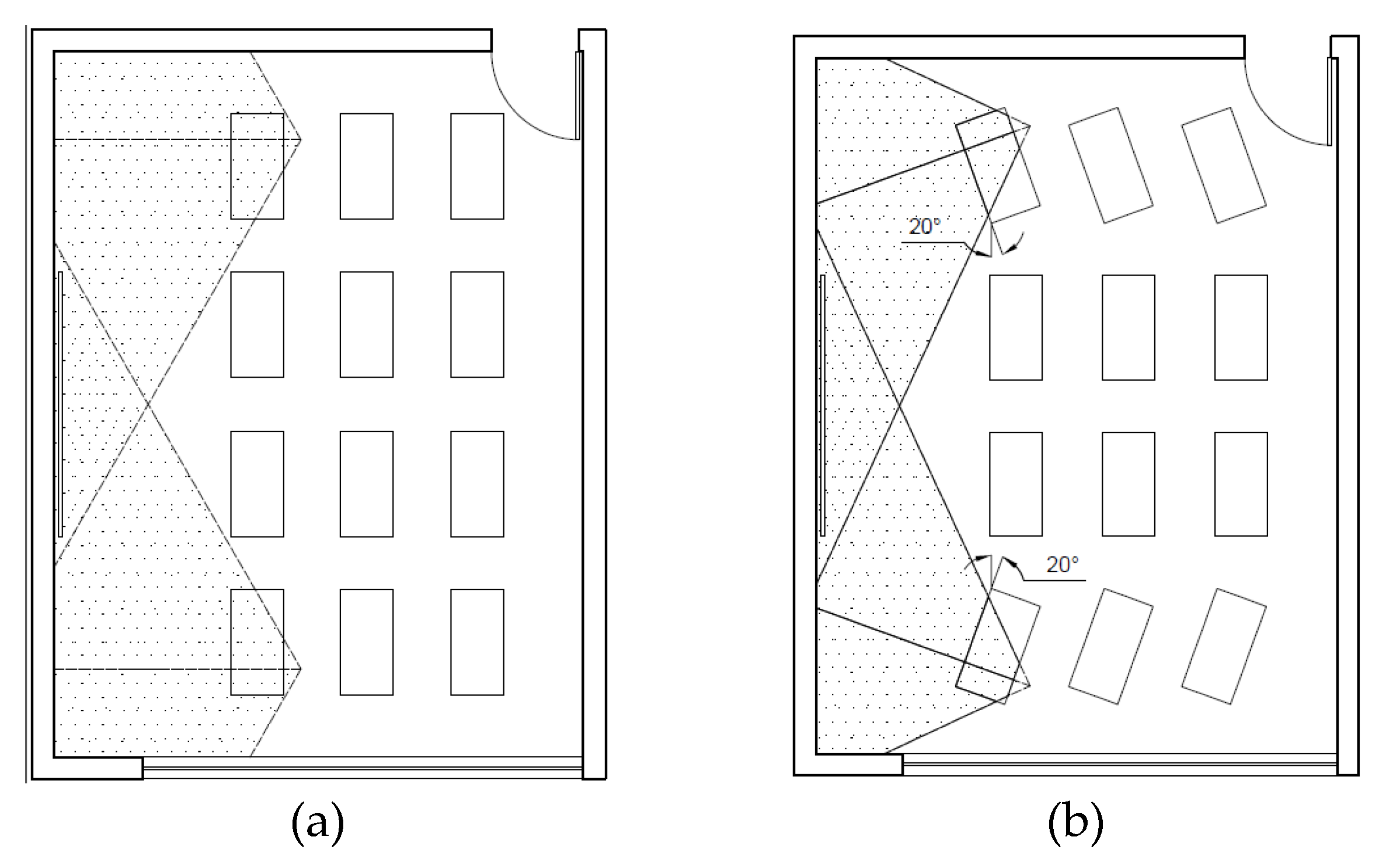
Figure 2.
Seating arrangement to accomplish visual comfort angles for cases 2, 3, 4, 6, 7, and 8. (a) if considering the visual comfort angle 60o from the eye center; (b) if considering it 45o, noting that the side desks were rotated by 10o toward the board.
Figure 2.
Seating arrangement to accomplish visual comfort angles for cases 2, 3, 4, 6, 7, and 8. (a) if considering the visual comfort angle 60o from the eye center; (b) if considering it 45o, noting that the side desks were rotated by 10o toward the board.
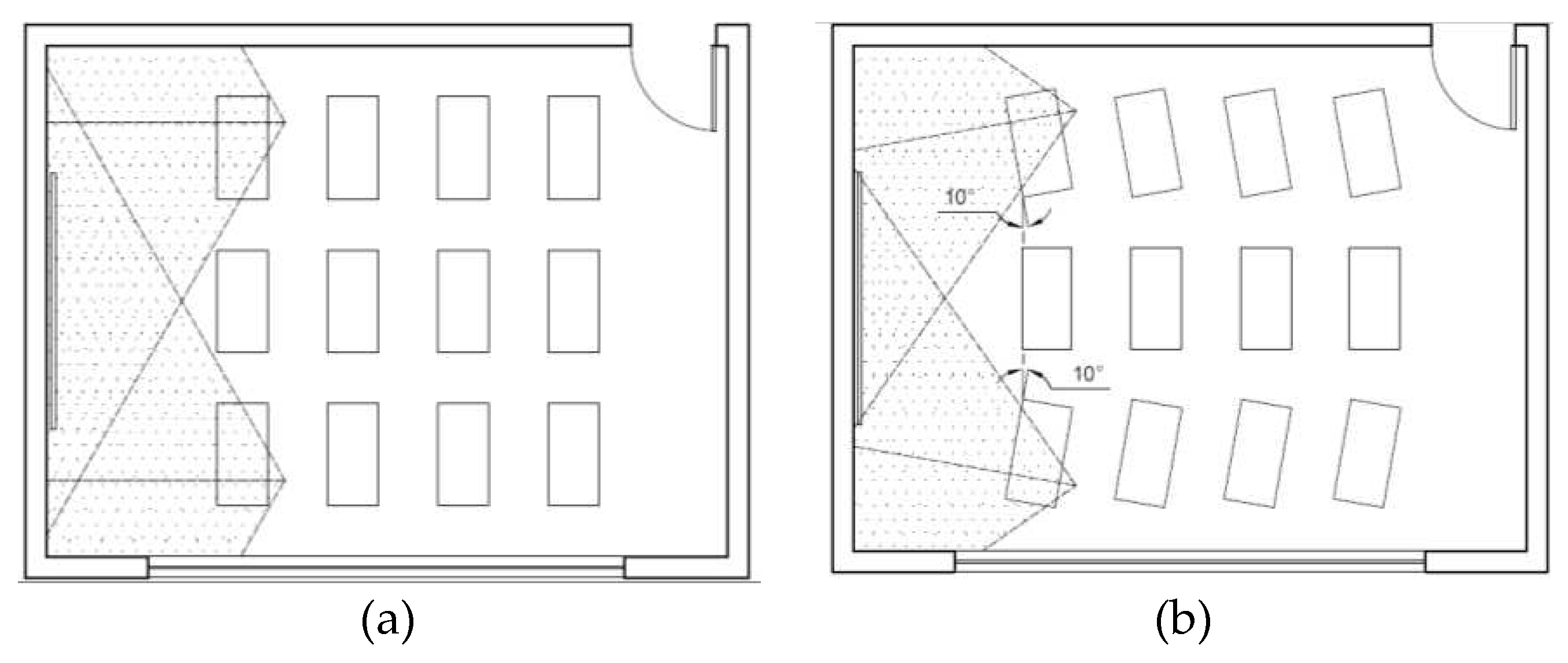
Figure 3.
Screenshots from the CBE Thermal Comfort tool to calculate the PMV and PPD for case 1 according to the inputs gathered from the DesignBuilder program and climate consultant tool; (a) in June; (b) in September [47].
Figure 3.
Screenshots from the CBE Thermal Comfort tool to calculate the PMV and PPD for case 1 according to the inputs gathered from the DesignBuilder program and climate consultant tool; (a) in June; (b) in September [47].
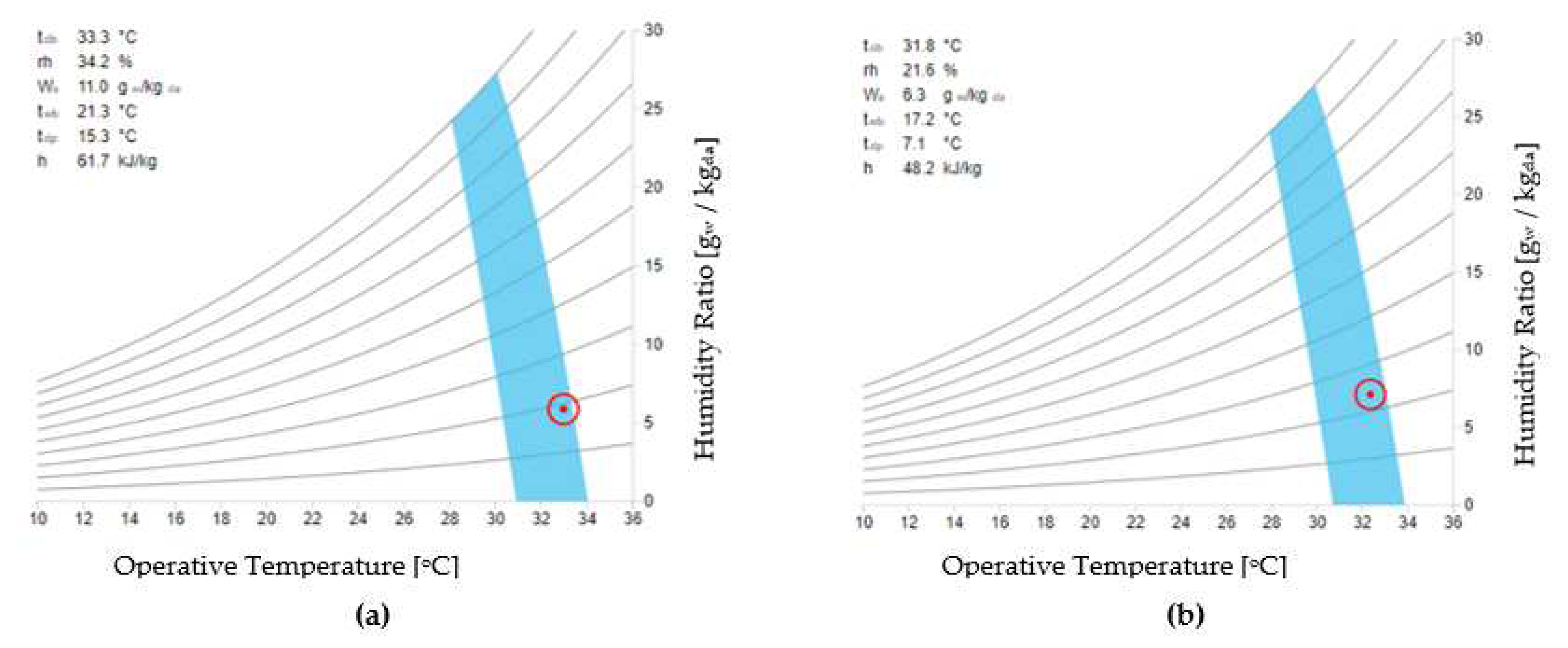
Figure 4.
Questionnaire results of the students’ and parents’ preferences to sit regarding the board wall in the classroom; (a) through rows; (b) through columns.
Figure 4.
Questionnaire results of the students’ and parents’ preferences to sit regarding the board wall in the classroom; (a) through rows; (b) through columns.
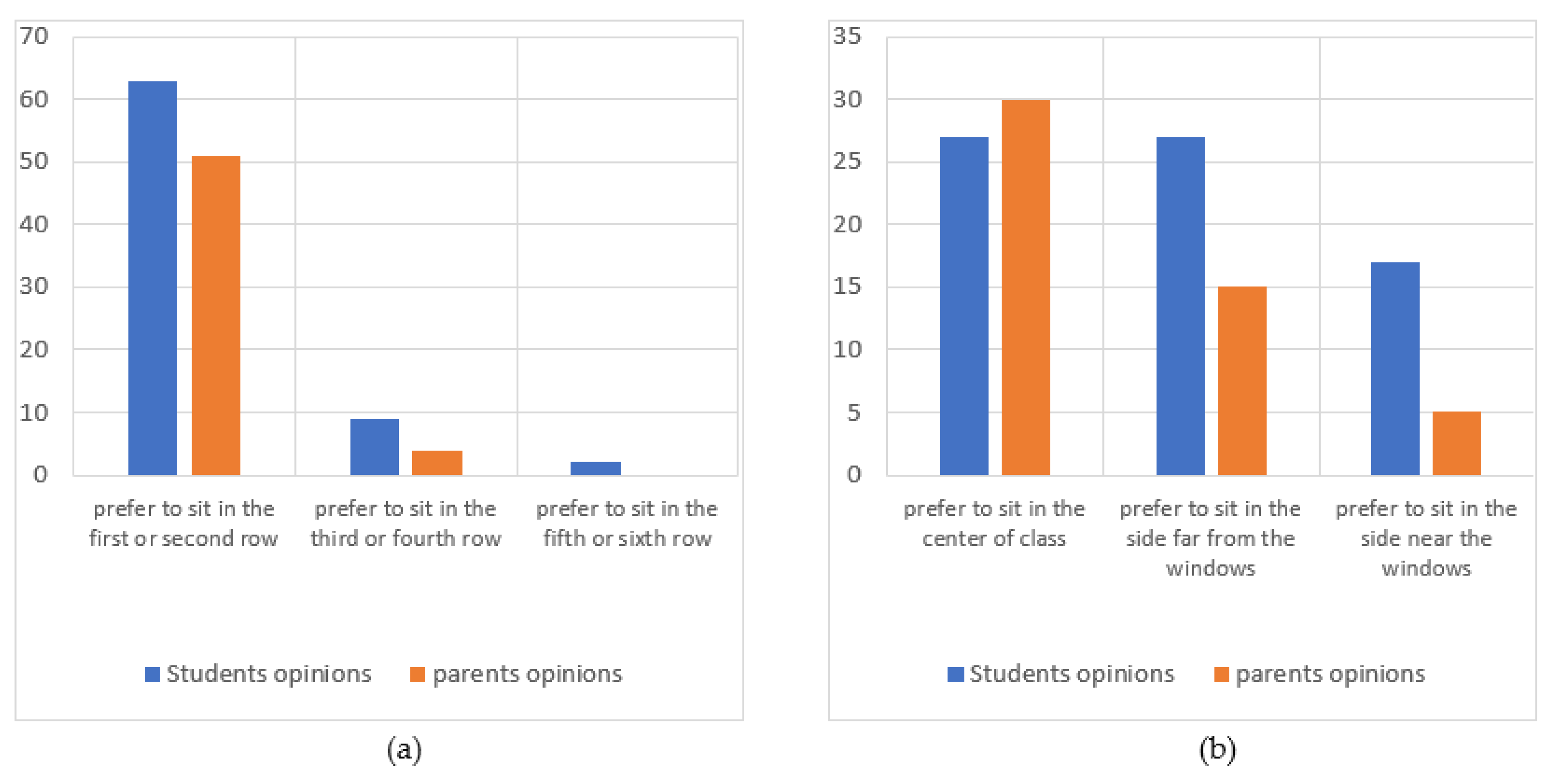
Figure 5.
Questionnaire results of the students, parents, and teachers' opinions on the effect of students’ proximity to the board wall; (a) on their academic achievement; (b) on their class engagement.
Figure 5.
Questionnaire results of the students, parents, and teachers' opinions on the effect of students’ proximity to the board wall; (a) on their academic achievement; (b) on their class engagement.
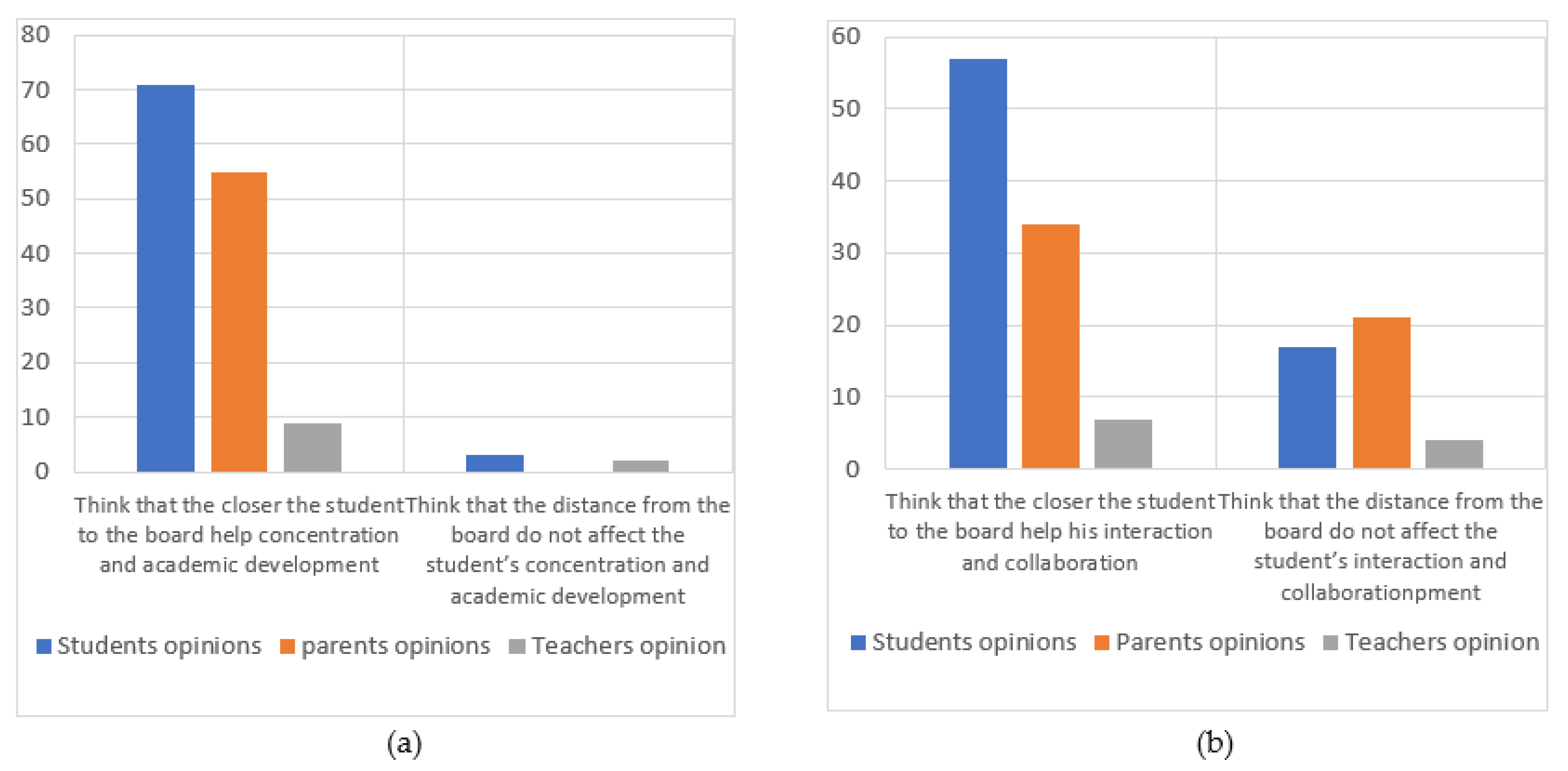
Figure 6.
Questionnaire results of the students, parents, and teachers' opinions on the effect of students’ proximity to the board wall; (a) on their social development; (b) on the preferable rectangular classroom proportions.
Figure 6.
Questionnaire results of the students, parents, and teachers' opinions on the effect of students’ proximity to the board wall; (a) on their social development; (b) on the preferable rectangular classroom proportions.
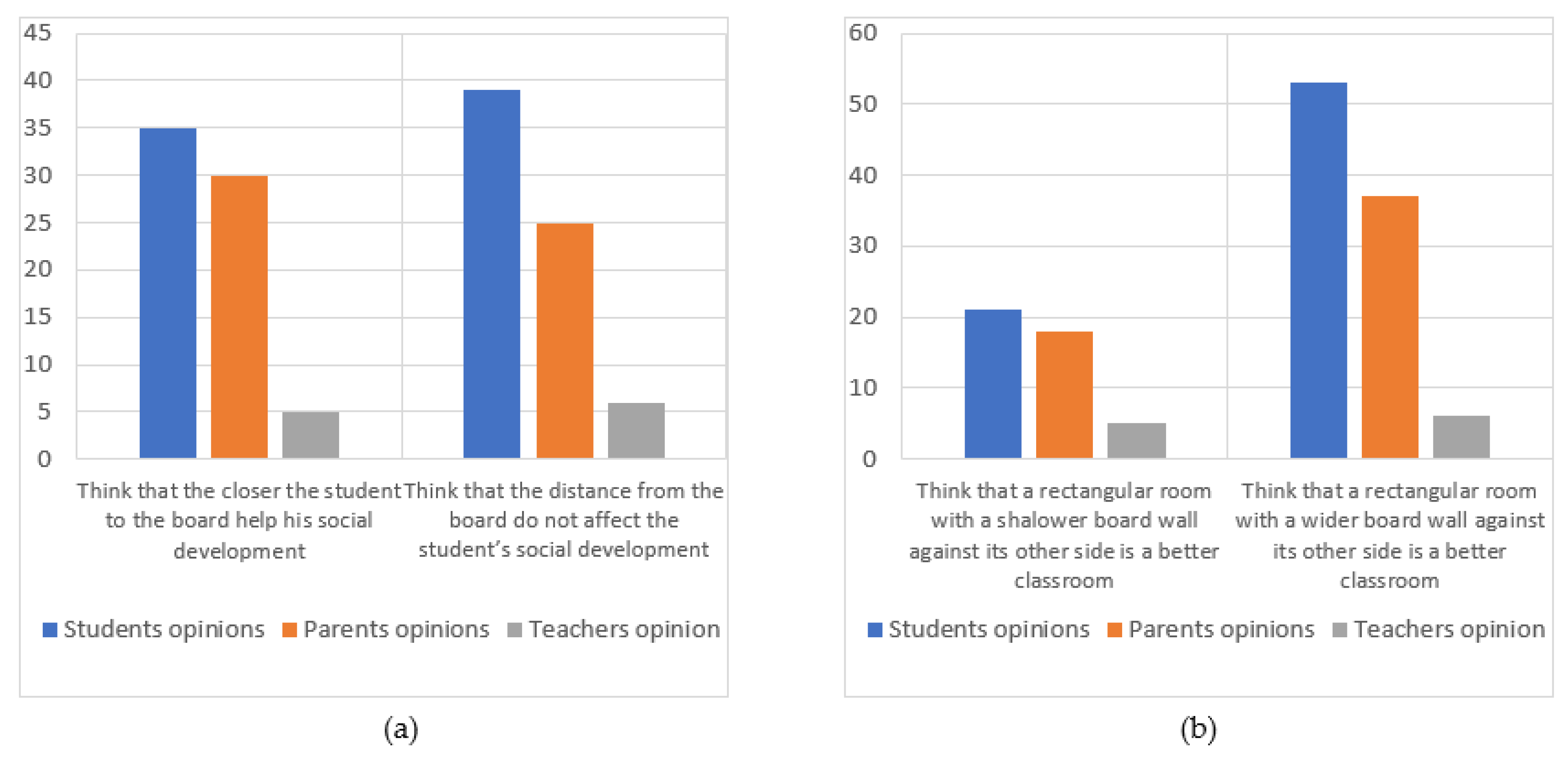
Table 3.
Illuminance levels simulation results of the case studies according to DIAlux evo software [45]. Note: The North direction is always upward.
Table 3.
Illuminance levels simulation results of the case studies according to DIAlux evo software [45]. Note: The North direction is always upward.
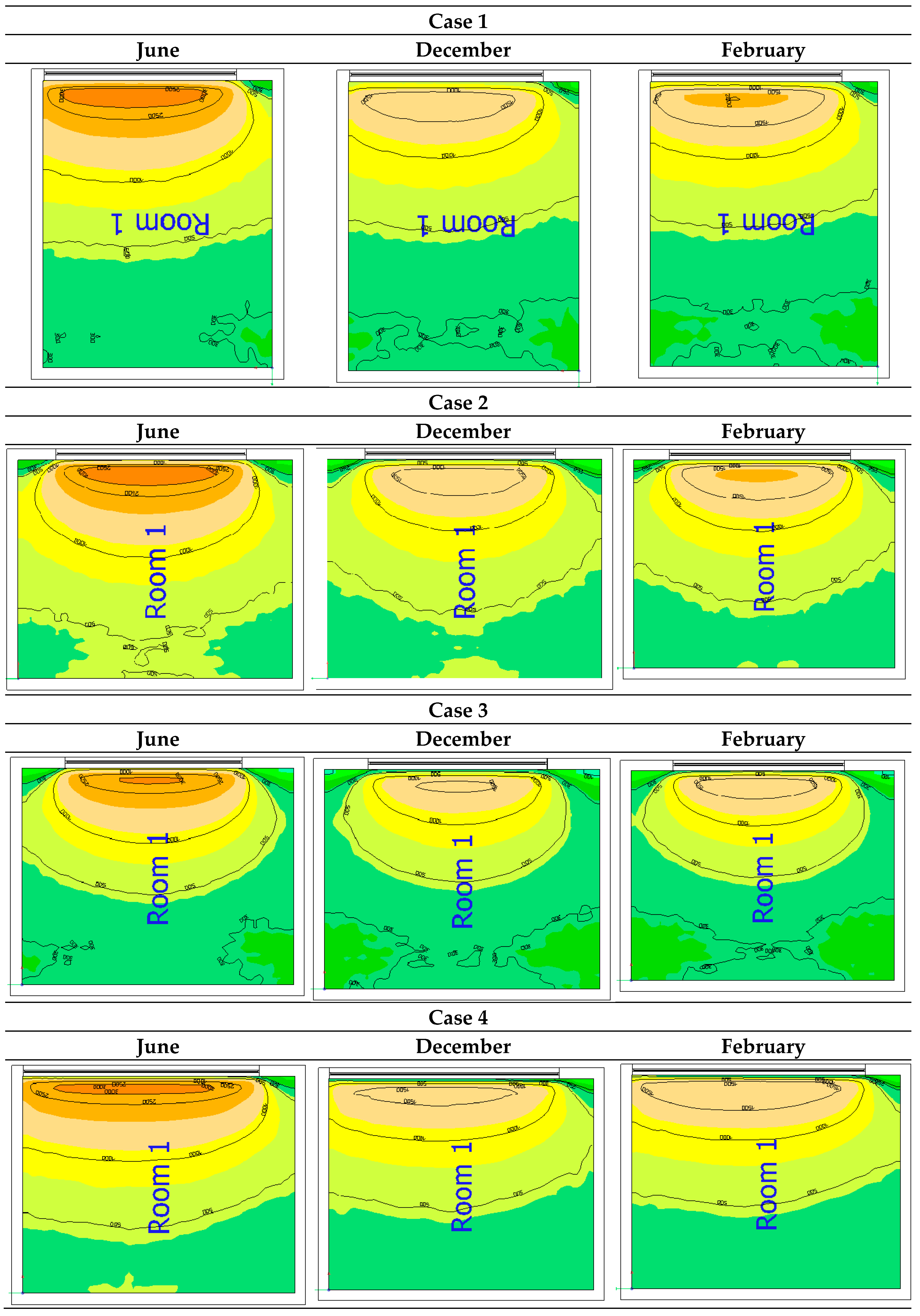
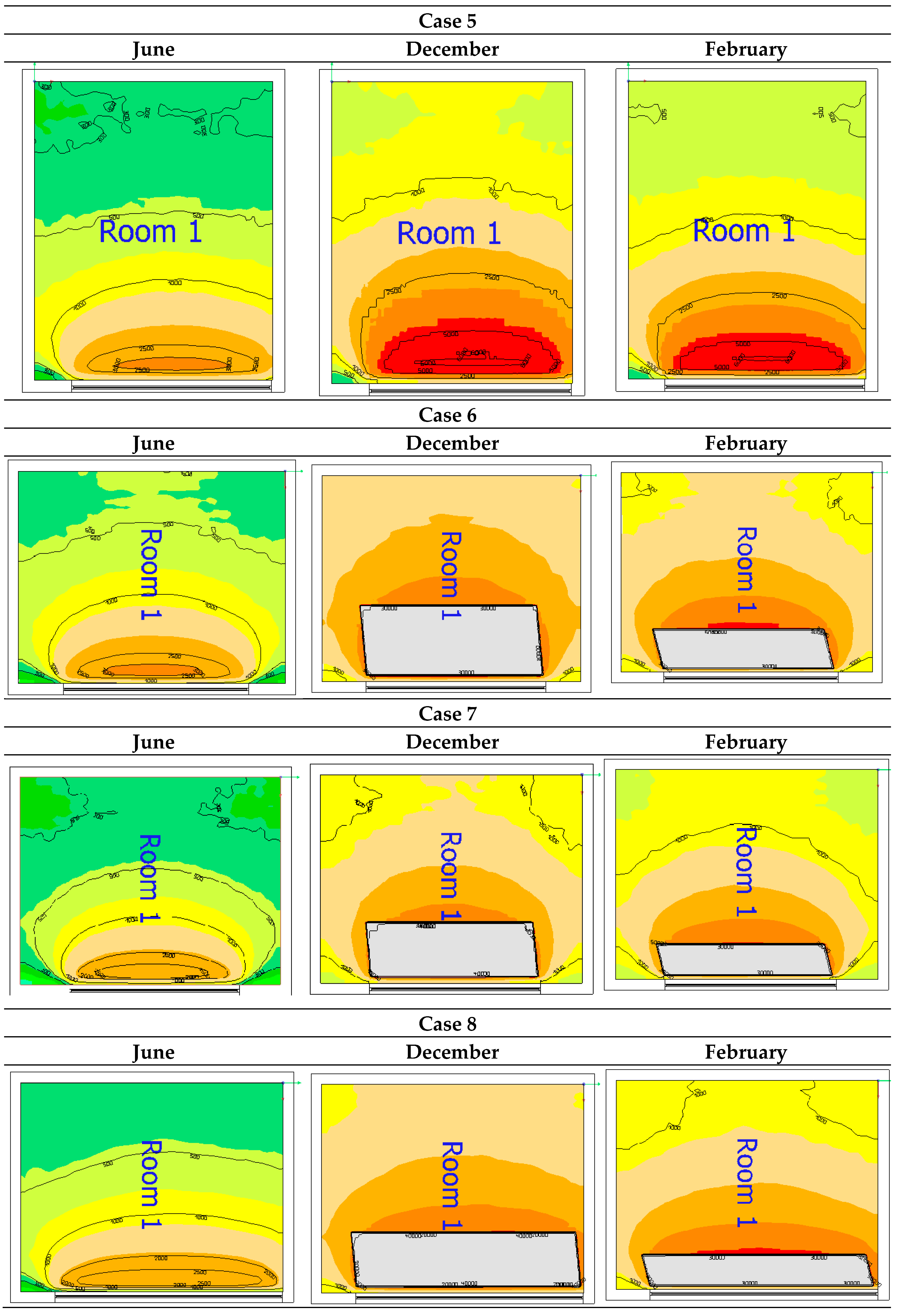
Table 4.
Achievement of brightness levels and glare avoidance according to LEED and Mostadam required ranges for the classroom case studies.
Table 4.
Achievement of brightness levels and glare avoidance according to LEED and Mostadam required ranges for the classroom case studies.
| Case No | % of the occupied area with daylight illuminance less than 300 lux (insufficient) | % of the occupied area with daylight illuminance of more than 3000 lux (risk of glare) | Acheivment of Mostadam and LEED ranges | ||||
|---|---|---|---|---|---|---|---|
| June | December | February | June | December | February | ||
| Case 1 | 5.6% | 16% | 20.6% | 0% | 0% | 0% | √ |
| Case 2 | 0.6% | 0.9% | 0.7% | 0% | 0% | 0% | √ |
| Case 3 | 14.6% | 24.6% | 20.7% | 0% | 0% | 0% | √ |
| Case 4 | 0.5% | 1% | 0.7% | 0% | 0% | 0% | √ |
| Case 5 | 9.7% | 0% | 0% | 0% | 0% | 0% | √ |
| Case 6 | 0.7% | 0% | 0% | 0% | 23% | 13.4% | √ |
| Case 7 | 14.2% | 0% | 0% | 0% | 9.9% | 8.8% | √ |
| Case 8 | 0.3% | 0% | 0% | 0% | 21.6% | 15.2% | √ |
Table 5.
Basic thermal characteristics of the classroom case studies during summer months and using the DesignBuilder software [37].
Table 5.
Basic thermal characteristics of the classroom case studies during summer months and using the DesignBuilder software [37].
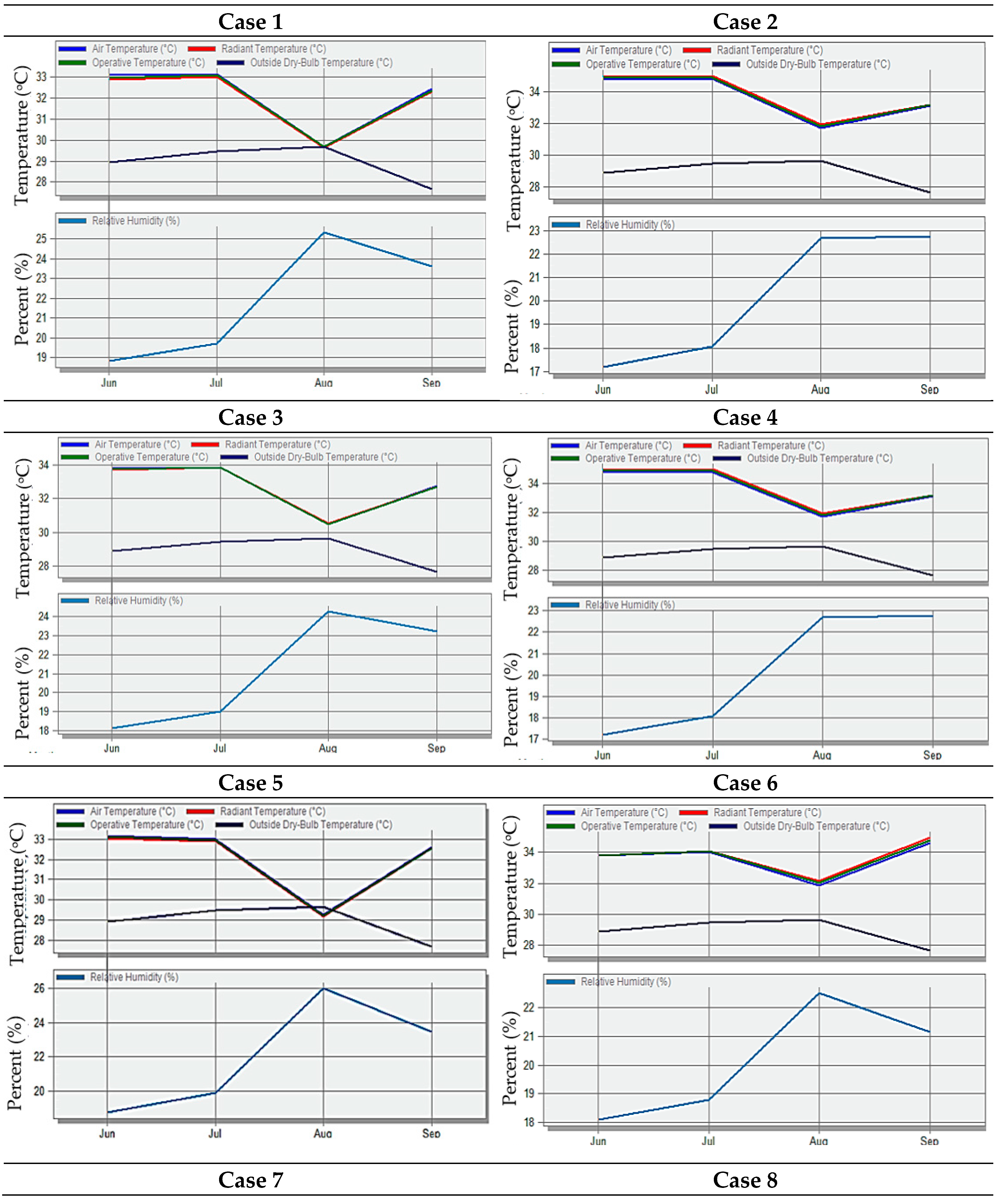
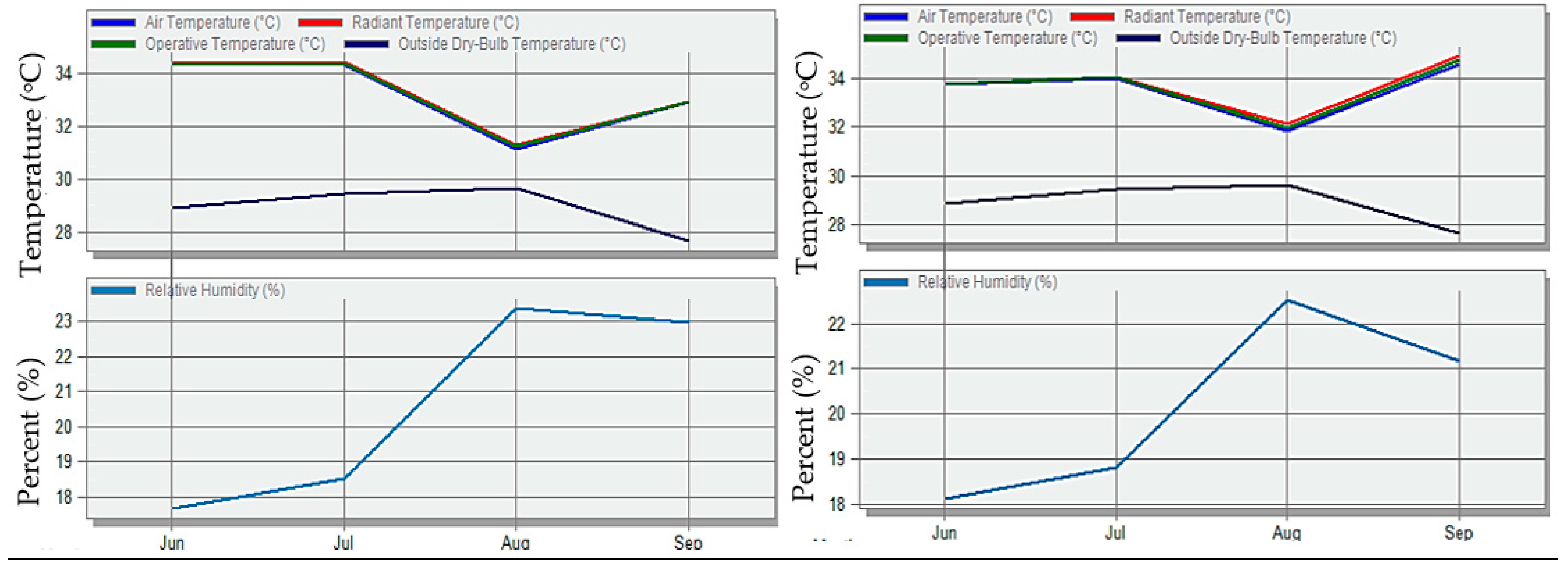
Table 6.
Illuminance levels simulation results of the case studies according to DIAlux evo software [47].
Table 6.
Illuminance levels simulation results of the case studies according to DIAlux evo software [47].
| Case No. | Occupied Summer Months | Inputs | Outputs | Acheivment of Mostadam and LEED ranges | ||
|---|---|---|---|---|---|---|
| Operative temperature top (°C) | Relative Humidity rh (%) | PMV | PPD (%) | |||
| Case 1 | June | 32.97 | 18.84 | 0.37 | 8 | √ |
| September | 32.35 | 23.61 | 0.27 | 7 | √ | |
| Case 2 | June | 34.87 | 17.21 | 0.99 | 26 | X |
| September | 33.61 | 22.73 | 0.69 | 15 | X | |
| Case 3 | June | 33.74 | 18.16 | 0.62 | 13 | X |
| September | 32.72 | 23.21 | 0.39 | 8 | √ | |
| Case 4 | June | 34.85 | 17.23 | 0.98 | 25 | X |
| September | 33.14 | 22.75 | 0.53 | 11 | X | |
| Case 5 | June | 32.81 | 17.02 | 0.50 | 10 | √ |
| September | 32.40 | 23.47 | 0.47 | 10 | √ | |
| Case 6 | June | 33.79 | 18.11 | 0.63 | 13 | X |
| September | 34.77 | 21.15 | 1.06 | 29 | X | |
| Case 7 | June | 34.33 | 17.69 | 0.81 | 19 | X |
| September | 32.92 | 22.97 | 0.46 | 9 | √ | |
| Case 8 | June | 33.77 | 18.13 | 0.63 | 13 | X |
| September | 34.75 | 21.18 | 1.06 | 29 | X | |
Table 7.
Internal noise levels related to Mostadam required ranges for the classroom case studies after assuming case 1 as a base case [55].
Table 7.
Internal noise levels related to Mostadam required ranges for the classroom case studies after assuming case 1 as a base case [55].
| Case No. | The internal ambient noise level | Acheivment of Mostadam ranges if (case 1) is a basecase |
|---|---|---|
| Cases 1 and 5 | 35 | √ |
| Cases 2, 4, 6 and 8 | 36.5 | X |
| Cases 3 and 7 | 36.1 | X |
Table 8.
Ventilation accomplishment for the classroom case studies and their relation to Mostadam required range.
Table 8.
Ventilation accomplishment for the classroom case studies and their relation to Mostadam required range.
| Case No. | % of the window to the floor area | Acheivment of Mostadam range (> 8%) |
|---|---|---|
| Cases 1, 3, 5, and 7 | 21.9 | √ |
| Cases 2, 4, 6 and 8 | 29.2 | √ |
Table 9.
Linking to nature accomplishment results concerning Mostadam and LEED required ranges and satisfactory viewing distance achievement.
Table 9.
Linking to nature accomplishment results concerning Mostadam and LEED required ranges and satisfactory viewing distance achievement.
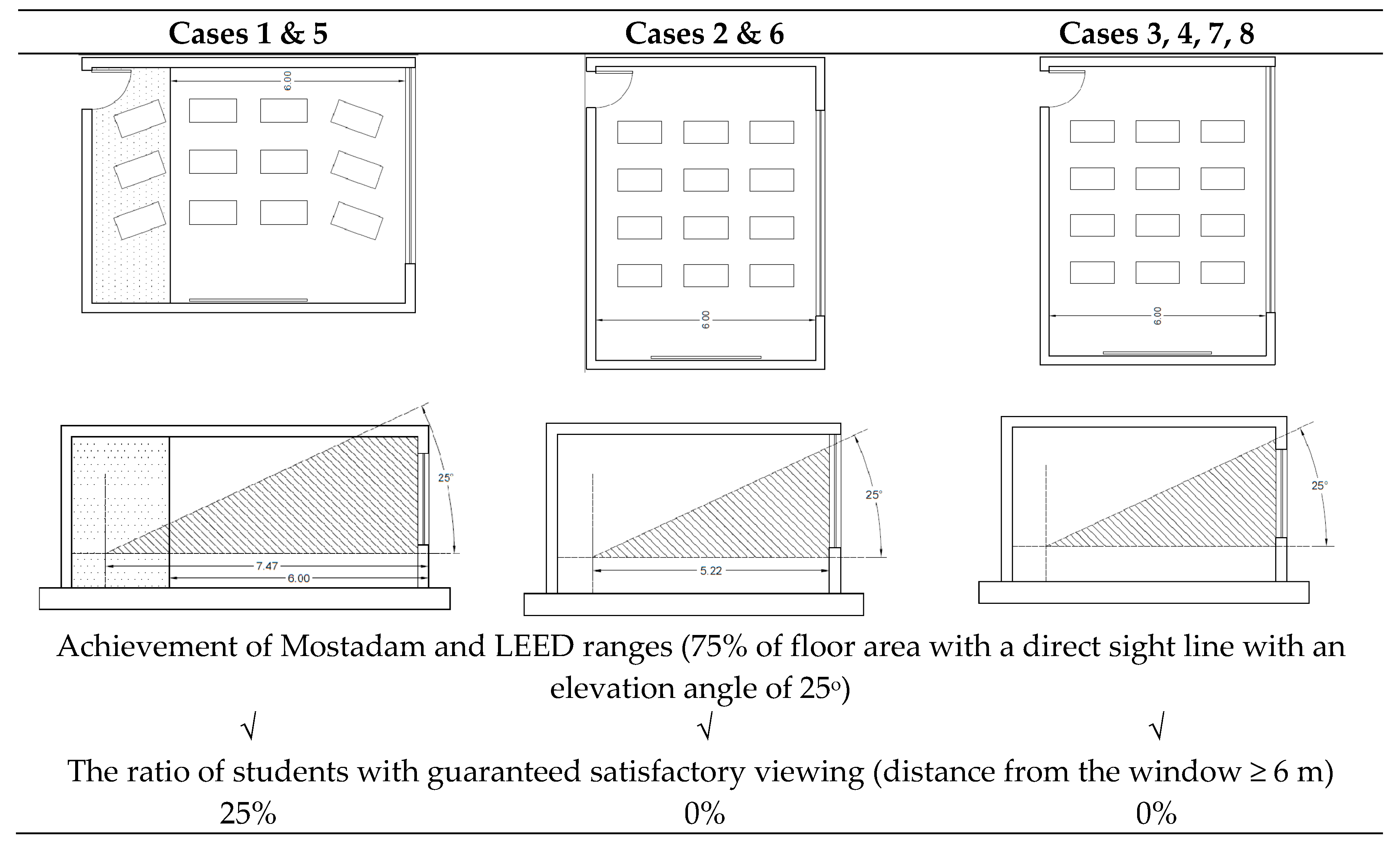
Table 10.
Users’ external/internal wall ratio preferences for a rectangular classroom in Taif City related to the case studies.
Table 10.
Users’ external/internal wall ratio preferences for a rectangular classroom in Taif City related to the case studies.
| Case No. | % of users’ preference |
|---|---|
| Case 1, 5 | 69% |
| Cases 2, 3, 4, 6, 7 and 8 | 31% |
Table 11.
LEED and Mostadam related items to the indoor environmental physical functions used to assess the case studies, and their corresponding achievement points.
Table 11.
LEED and Mostadam related items to the indoor environmental physical functions used to assess the case studies, and their corresponding achievement points.
| Indoor Environmental Physical Functions | LEED related items | Corresponding points | Mostadam related items | Corresponding points |
|---|---|---|---|---|
| Visual Comfort | EQ Credit: daylight (option 3) | 3 (illuminance levels > 90% of floor area) | HC-07 Daylight and Views (Daylight item) | 1 |
| 2 (illuminance levels > 75% of floor area) | ||||
| Thermal Comfort | EQ Credit: thermal comfort | 1 | HC-02 Indoor Thermal Comfort | 3 |
| Acoustical Comfort | Acoustic Performance | 1 | HC-09 Acoustics | 2 |
| Ventilation | Indoor Air Quality Assessment | 2 | HC-03 Ventilation | 1 |
| Linking to Nature | Quality Views | 1 | HC-07 Daylight and Views (views item) | 1 |
Table 12.
Proposed assessment items and their corresponding points based mainly on LEED and Mostadam systems to assess the case studies.
Table 12.
Proposed assessment items and their corresponding points based mainly on LEED and Mostadam systems to assess the case studies.
| Indoor Environmental Functions | Corresponding points | ||
|---|---|---|---|
| physical | Visual Comfort | Angles of sight | 1 |
| Brightness levels and glare avoidance | 2 (illuminance levels > 90% of floor area) | ||
| 1 (illuminance levels > 75% of floor area) | |||
| Thermal comfort | 2 | ||
| Acoustical Comfort | 1.5 | ||
| Ventilation | 1.5 | ||
| Linking to nature | 1 | ||
| physiological | users preferences | 2 | |
Table 13.
Case studies assessment according to the proposed assessment items and points regarding the achievement of the indoor environmental functions.
Table 13.
Case studies assessment according to the proposed assessment items and points regarding the achievement of the indoor environmental functions.
| Assessment item | Case-studies | |||||||
|---|---|---|---|---|---|---|---|---|
| Case 1 | Case 2 | Case 3 | Case 4 | Case 5 | Case 6 | Case 7 | Case 8 | |
| Angles of sight (1 point) |
0.8 | 0.9 | 0.9 | 0.9 | 0.8 | 0.9 | 0.9 | 0.9 |
| Brightness levels and glare avoidance (1-2 points) |
1 | 2 | 1 | 2 | 2 | 1 | 1 | 1 |
| Thermal comfort (2 points) |
2 | 0 | 0 | 0 | 2 | 0 | 0 | 0 |
| Acoustical Comfort (1.5 points) |
1.5 | 1.35 | 1.35 | 1.35 | 1.5 | 1.35 | 1.35 | 1.35 |
| Ventilation (1.5 points) |
1.5 | 1.5 | 1.5 | 1.5 | 1.5 | 1.5 | 1.5 | 1.5 |
| Linking to nature (1 point) |
1 | 0.75 | 0.75 | 0.75 | 1 | 0.75 | 0.75 | 0.75 |
| users preferences (2 points) |
1.38 | 0.62 | 0.62 | 0.62 | 1.38 | 0.62 | 0.62 | 0.62 |
| Total points / 11 | 9.18 | 7.12 | 6.12 | 7.12 | 10.18 | 6.12 | 6.12 | 6.12 |
Disclaimer/Publisher’s Note: The statements, opinions and data contained in all publications are solely those of the individual author(s) and contributor(s) and not of MDPI and/or the editor(s). MDPI and/or the editor(s) disclaim responsibility for any injury to people or property resulting from any ideas, methods, instructions or products referred to in the content. |
© 2023 by the authors. Licensee MDPI, Basel, Switzerland. This article is an open access article distributed under the terms and conditions of the Creative Commons Attribution (CC BY) license (http://creativecommons.org/licenses/by/4.0/).
Copyright: This open access article is published under a Creative Commons CC BY 4.0 license, which permit the free download, distribution, and reuse, provided that the author and preprint are cited in any reuse.


