

Submitted:
02 October 2024
Posted:
02 October 2024
You are already at the latest version
Abstract
There are increasing needs for models of public garden with low-maintenance, and environmental stress to plant due to climate change is growing. Therefore, the demand for developing new plant varieties based on native plants as garden materials against climate change has increased fairly. Many plants in the family Poaceae are applied for various purposes such as food crops, fodder grasses, ornamental plants, or medical plants. Also, native plants have some economic and ecological benefits, and the utilization of native plants is positive in a garden. However, there are some difficulties in Poaceae breeding researches and utilization of wild native plants for breeding. To overcome these problems, model plants can be utilized in breeding researches of Poaceae plant species. In this study, to explore the possibility of utilizing Korean native Poaceae plants as model plants and for breeding new cultivars, the candidate species were selected from the Korean Plant Names Index (KPNI). A total of 3 Korean native plants in the family Poaceae including Brachypodium sylvaticum, Setaria viridis, and Zoysia japonica were selected, and their properties and their genome information were compared with the representative model plants, Arabidopsis thaliana and Brachypodium distachyon. The modern research status of B. sylvaticum, S. viridis and Z. japonica has been summarized, and the genome size, life cycle, and other characteristics of these model plants have been compared and discussed. Application of these newly selected candidate plants in breeding research would build a foundation for breeding of native Poaceae plants in Korea against the new climate regime.
Keywords:
garden plants
; model plants
; molecular breeding
; native plants
; Poaceae
; ornamental plants
1. Introduction
Role of gardens is expanding for biodiversity conservation as rapid urban expansion, and there are increasing needs for models of public garden with low-maintenance [1,2]. Native plants can be used as garden materials for effective maintenance, because they are good materials for gardens, restoration, and erosion control [3,4]. Recently, environmental stress to plant due to climate change is growing, and to cope with its brunt, plant breeding is valuable [5,6]. Therefore, the demand for developing new plant varieties based on native plants as garden materials against climate change has increased fairly.
Many plants in the family Poaceae are applied as food crops, fodder grasses, ornamental plants, or medical plants [7]. Souza et al. [8] described the capability of native Poaceae plants for usage as garden materials. Moreover, Dunster [9] insisted that Poaceae must be used for not solely for ornamental but multi-functions in the age of climate change. However, some plant species in the family Poaceae are polyploid or have large and complicated genomes which make difficulties for breeding researches [10]. To overcome this problem, model plants, which have a lot of advantages such as short lifecycle and small genome size [11,12], can be utilized in breeding researches of Poaceae plant species.
Model plants are extensively researched in plant science or agriculture [11,13]. Arabidopsis thaliana has been widely applied as a model plant from 1980s [14]. However, Arabidopsis is a dicotyledon in the family Brassicaceae, which is not advisable in some areas as a model plant of principal plants in the family Poaceae [15,16]. Brachypodium distachyon, which is distributed in the Mediterranean region, has been broadly investigated from the late 2000s by researchers and breeders on cereal crops notably wheat and barley which are valuable crops in the tribe Triticeae [17]. However, B. distachyon is not native in Korea so that it is not suitable to utilize as garden materials in Korea.
B. sylvaticum and Setaria viridis have been lately proposed as model plants in the family Poaceae [18]. B. sylvaticum can be utilized as a model plant for perennial grasses [19]. S. viridis has a potentiality to be applied as a model plant for C4 photosynthesis exploration [20]. Both B. sylvaticum and S. viridis are native in Korea so that they are suitable to utilize as not only model plants but also garden materials in Korea.
Zoysia japonica, which is perennial C4 grass, is the most popular warm-season turfgrass in Korea [21,22]. The reference genome of Z. japonica and Z. matrella was assembled and available [23]. Also, transgenic Z. japonica accessions were obtained by genetic transformation method [24]. Therefore, Z. japonica has not referred as a model plant yet, but it seems that Z. japonica can also be used as a model plant for perennial C4 plants as well as a garden material.
In this study, to explore the possibility of utilizing Korean native Poaceae plants as model plants and for breeding new cultivars, the candidate species were selected from the Korean Plant Names Index (KPNI). The modern research status of B. sylvaticum, S. viridis and Z. japonica has been summarized, and the genome size, life cycle, and other characteristics of these model plants have been compared.
2. Materials and Methods
The list of the Poaceae plant species was download from the KPNI (http://www.nature.go.kr/kpni/). The scientific names of all plant were modified to delete information about authority, subspecies, or variety with leaving only the genus name and the species name. In the ‘Classification’ column, only ‘Species’ was selected while ‘Variety’, ‘Subspecies’, ‘Horticultural cultivar’, and ‘Cultivar’ were unchecked so that the list was filtered (Supplementary Table S1). From the Published Plant Genomes (https://www.plabipd.de/), the plants in which the reference genome was assembled were investigated. Based on the cladogram of the flowering plant menu, the list of the Poaceae plants in which the reference genome was assembled was created, and their genome size were investigated (Supplementary Table S2). Finally, the Poaceae plants in which the reference genome was assembled were selected from the list of the Poaceae plants registered in the KPNI, and the characteristics including life cycle, and photosynthetic type were investigated (Table 1). The life cycles of the selected plants were investigated from the Korean Biodiversity Information System (http://www.nature.go.kr/) and the USDA PLANTS Database (https://plants.usda.gov/). The photosynthetic types of the selected plants were investigated from the previous researches.
Small genome size is one of criteria for model plants [11]. The genome sizes of Brachypodium distachyon, which is the model plant for monocots but not native in Korea, and rice (Oryza sativa), which is the representatively cultivated crop but not native in Korea, are 270 Mbps and 430 Mbps, respectively. In this point, the Korean native plant species with genome size smaller than that of rice (O. sativa) were selected for candidate model plants. The current research states of the candidate model species were investigated. The candidate model plants were compared with the representative model plants, Arabidopsis thaliana and Brachypodium distachyon, and the properties of these plant were analyzed (Table 2). Also, based on the Phytozome 13 (https://phytozome-next.jgi.doe.gov/), the genomes of the 2 representative model plants and the 2 newly suggested model plants were summarized (Table 3). For each plant species, two versions of genomes were selected and compared. Because it had no genome information in the Phytozome 13, it was hard to analyze Zoysia japonica directly with the other 4 plants. Therefore, based on other researches [23,25], the genome of Zoysia japonica was analyzed separately with those of other species in the genus Zoysia such as Z. matrella and Z. pacifica which are cultivated plants in Korea (Table 4).
3. Results
Of the 494 Poaceae plants registered in the KPNI, the 352 plants were registered as species (Supplementary Table S1), and finally the 38 plants of them were analyzed in this study (Table 1). The number of the Korean native plants were 14, and the number of both the cultivated plants and the exotic plants were 12, respectively. The number of the plants with the genome sizes less than 1 Gbps was 16. The number of the annual plants was 20 whereas the number of the perennial plants was 18. The number of the C3 plants was 16 whereas the number of the C4 plants was 22. The plants, whose genome sizes were less than the genome size of rice (O. sativa), were selected, and a total of 5 plants were selected. Of them, the 3 plants (Brachypodium sylvaticum, Setaria viridis, and Zoysia japonica) were native plants in Korea, whereas the 2 plants (Z. matrella and Z. pacifica) were cultivated plants in Korea.
The 3 Korean native plants were selected as the candidate model plants, and the properties of them and the 2 representative model plants (Arabidopsis thaliana and Brachypodium distachyon) were analyzed (Table 2). A. thaliana was eudicots in the family Brassicaceae whereas the others were monocots in the family Poaceae. A. thaliana, B. distachyon, and S. viridis were annual but B. sylvaticum and Z. japonica were perennial. A. thaliana, B. distachyon, and B. sylvaticum were C3 plants whereas S. viridis and Z. japonica were C4 plants. Both A. thaliana and B. distachyon were diploids with 10 chromosomes, but both B. sylvaticum and S. viridis were diploids with 18 chromosomes. Also, Z. japonica was a tetraploid with 40 chromosomes. Except for B. distachyon, the others were native plants in Korea.
The Information of the genomes of the 4 plants (A. thaliana, B. distachyon, B. sylvaticum, and S. viridis) was obtained from the Phytozome 13 and their reference publications (Table 3). Within the same species, assembled genome sizes sometimes varied depending on the genome version but were approximately same. The genome size of A. thaliana was the smallest, followed by B. distachyon, B. sylvaticum, and S. viridis. Compared to A. thaliana and S. viridis, B. distachyon and B. sylvaticum showed relatively high differences in the number of contigs between the genome versions. No constant trend was found in the protein-coding transcripts and the protein-coding genes.
The genome of Z. japonica was analyzed based on other researches (Table 4). There were large differences of the genomes of Z. japonica between Yang et al. [25] and Tanaka et al. [23]. Yang et al. [25] used the PacBio long-read sequencing so that their average length and maximum length were longer than those of Tanaka et al. [23]. Also, Tanaka et al. [23] estimated the genome sizes of Z. japonica, Z. matrella, and Z. pacifica by flow cytometry as 390 Mbps, 380 Mbps, and 370 Mbps, respectively. The obtained genome sizes of Z. matrella and Z. pacifica were larger than the estimated genome sizes, but the obtained genome size of Z. japonica was smaller than the estimated genome size.
4. Discussion
Plants in the family Poaceae can be utilized for various uses [7]. However, most plant breeders focus on cereal crops such as rice, wheat, and maize, and only few researchers perform a breeding program for ornamental purposes [26]. Ornamental grasses in the family Poaceae are utilized in garden formation for landscaping, and gardens are economically important in climate change acclimatization and extenuation [27,28]. Also, native plants have some economic and ecological benefits, and the utilization of native plants is positive in a garden [29,30].
Nowadays, breeders can use genomic resources such as reference genomes for molecular breeding of crop improvement [31]. A lot of species persists uncharted even though thousands of genomes have been explored [32]. Due to the recent technological development, various sequencing methods have developed and their cost have been cheaper than before [33]. However, assembly of the reference genome is still a costly, energy demanding, and protracted task [34]. Furthermore, due to insufficient information, there are difficulties in utilization of wild plants for breeding [35]. Information obtained from model plants can be hypothesized to the target species of breeding, making the researcher easy to conduct research on studies of those plant species [36]. Therefore, building a foundation through researches using model plants may play an important role in the breeding of wild native plants which have not yet been explored.
In this study, to explore the possibility of utilizing Korean native plants in the family Poaceae for breeding new cultivars and as model plants and garden materials, the candidate species were explored from the KPNI. A total of 3 Korean native plants in the family Poaceae including Brachypodium sylvaticum, Setaria viridis, and Zoysia japonica were selected, and their properties and their genome information were compared with the representative model plants, Arabidopsis thaliana and Brachypodium distachyon.
Brachypodium distachyon was first suggested as a model plant for cereals and forage grasses at 2001 [37]. B. distachyon is an annual C3 grass and distributed in the Mediterranean region (Figure 1A). In Japan, a country geographically close to Korea, B. distachyon was first discovered from the Shimizu Port in 1953, and it is classified as a naturalized plant [38,39]. In Korea, B. distachyon has been used in researches since the late 2000s [40,41]. However, the discovery of B. distachyon in the wilds of Korea has not been reported for over a decade. According to the Köppen-Geiger classification system, B. distachyon distributes on Bsh, Csa, Csb/Bsk, and Cfa/Cfb regions [42]. Also, most parts of Japan belong to Cfa [43], so that B. distachyon can survive in Japan. However, most of the Korean Peninsula shows Dwa climate, and Cfa is mainly observed in some southern regions including Wando and Jeju [44,45]. Actually, in some island regions of the southern part of the Korean Peninsula mainly Jeju Island, there are some plants not distributed in the Korean Peninsula but distributed in China, Japan, and Taiwan [46]. Therefore, B. distachyon would be able to adapt naturally and survive only to some southern regions of Korea, and it is inevitable to artificially cultivate with cost and effort to utilize B. distachyon as a garden material in most regions of Korea.
Unlike B. distachyon, B. sylvaticum is a perennial C3 grass and native in Korea (Figure 1B). Both B. sylvaticum and B. distachyon are plants in the genus Brachypodium of the subfamily Pooideae so that they are genetically close to each other [47]. Genetically close species can be utilized for breeding with a hybridization and an introgression [48]. The first version of the reference genome of B. distachyon was announced at 2010 [49], by comparison, the reference genome of B. sylvaticum was recently reported [50]. Steinwand et al. [19] suggested B. sylvaticum as a model plant for perennial grasses. Also, according to Kim [51], B. sylvaticum was one of potential candidates for ornamental grasses and it was applied from abroad but not in Korea. Therefore, B. sylvaticum can be utilized as not only a model plant for perennial C3 grasses but also a garden material in Korea.
In the genus Brachypodium of the subfamily Pooideae, there is no species which is native or cultivated in Korea apart from B. sylvaticum. In the subfamily Pooideae, there are many significant C3 perennial grasses such as bentgrasses (Agrostis spp.), bluegrasses (Poa spp.), fescues (Festuca spp.), and ryegrasses (Lolium spp.), applied as turf in temperate zones [52]. Except for annual cereal crops such as wheat, barley, and oat, and their relatives, only few plants for a perennial turf in the subfamily Pooideae such as Poa pratensis and Lolium perenne have been studied for the reference genome assembly [53,54]. Therefore, B. sylvaticum can be utilized as a model plant for the perennial cool season grasses whose reference genome have not been reported such as bentgrasses (Agrostis spp.) and fescues (Festuca spp.) in Korea.
S. viridis is an annual C4 grass in the subfamily Panicoideae, which included many economically valuable C4 species such as maize, sorghum, and sugarcane [55]. Brutnell et al. [20] suggested S. viridis as a model plant for C4 photosynthesis. The reference genomes of S. viridis were first reported at 2020 [56,57]. Therefore, compared to B. distachyon, S. viridis were received attention relatively later as a model plant. However, S. viridis can be transformed with the floral-dip method which has not been reported in B. distachyon yet [58]. As a result, S. viridis is used for genome editing research such as CRISPR/Cas9 [59]. Additionally, various researches on the C4 photosynthesis using S. viridis as a model plant were conducted [60,61]. Therefore, S. viridis is highly valuable to conduct breeding research on the family Poaceae apart from B. distachyon.
In the genus Setaria, some species were applied as garden materials. S. italica, which is cultivated for food or forage in Korea, was planted and analyzed for composition and utilization in garden [62]. Also, according to Frey and Moretti [63], 4 species in the genus Setaria, (S. italica, S. pumila, S. verticillata, and S. viridis) could be discovered in urban gardens. Additionally, in the subfamily Panicoideae, the genus Paspalum and the genus Axonopus are applied for lawns [64]. Apart from S. viridis, the reference genomes of S. italica and Paspalum notatum have been reported [65,66], but those of S. pumila, S. verticillata, and carpet grasses (Axonopus spp.) have not been reported yet. Also, S. viridis has a smaller genome than S. italica [57,67]. Therefore, S. viridis can be utilized as a model plant for the annual C4 grass for garden materials.
Z. japonica is a widely used turfgrass and distributed in East Asia including Korea, Japan, and China [68,69]. The genomes of Z. japonica were reported by Tanaka et al. [23] and Yang et al. [25]. However, there were large differences between the two genomes, therefore, further researches should be required to improve an accuracy (Table 4). Also, considering the errors in Z. japonica, the estimated genome sizes of the other species, Z. matrella and Z. pacifica, could be uncertain as well. Therefore, genome assemblies of both Z. matrella and Z. pacifica using other accessions would be required to estimate more accurate genome sizes of both species. Also, it would be inevitable to artificially cultivate with cost and effort to utilize Z. matrella and Z. pacifica, which are not native but cultivated in Korea, as garden materials in Korea.
B. distachyon, B. sylvaticum, and S. viridis were reported as model plants for annual C3 grasses, perennial C3 grasses, and annual C4 grasses, respectively, whereas a model plant for perennial C4 grasses has not been reported. The genus Zoysia, which is consisted of 11 species, is a perennial C4 grass in the subfamily Chloridoideae and native in the western Pacific Rim and Indian Ocean [69,70]. Z. japonica, Z. matrella, and Z. pacifica have been utilized as turf and ornate grasses [68]. Also, their genome sizes were relatively small [23], so that one species in the genus Zoysia, which are perennial C4 grasses, can be utilized as a model plant for perennial C4 grasses. However, compared to B. sylvaticum and S. viridis, plants in the genus Zoysia were less studied, probably because they are not native in Europe or America. Additionally, plants in the genus Zoysia were allotetraploids but Flavell [71] presented diploid genetics as one of characteristics of model plants. Therefore, Zoysia species are suitable as garden materials but can be unsuitable as model plants. For an appearance of a model plant for perennial C4 grasses, a discovery of a diploid perennial C4 species with a small genome size would be necessary.
5. Conclusions
In summary, three candidate plants were selected for model plants for breeding garden materials in Korean native Poaceae plants. Brachypodium sylvaticum and Setaria viridis are used as model plants for perennial C3 grasses and annual C4 grasses, respectively, so that they would be also utilized in breeding research for garden materials. Zoysia japonica cannot be a model plant for perennial C4 grasses but it is studied and applied for various horticultural purposes. Application of these newly selected candidate plants in breeding research would build a foundation for breeding of native Poaceae plants in Korea and contribute to garden industry in Korea. Also, further research is required for breeding and utilization of native plants in preparation for the new climate regime.
Supplementary Materials
The following supporting information can be downloaded at the website of this paper posted on Preprints.org.
Author Contributions
For research articles with several authors, a short paragraph specifying their individual contributions must be provided. The following statements should be used “Conceptualization, X.X. and Y.Y.; methodology, X.X.; software, X.X.; validation, X.X., Y.Y. and Z.Z.; formal analysis, X.X.; investigation, X.X.; resources, X.X.; data curation, X.X.; writing—original draft preparation, X.X.; writing—review and editing, X.X.; visualization, X.X.; supervision, X.X.; project administration, X.X.; funding acquisition, Y.Y. All authors have read and agreed to the published version of the manuscript.” Please turn to the CRediT taxonomy for the term explanation. Authorship must be limited to those who have contributed substantially to the work reported.
Funding
This work was supported by the Korea National Arboretum of the Korea Forest Service (Development of Breeding Models for Native Garden Plants in the New Climate Regime, KNA 1-5-1-24-1).
Data Availability Statement
We encourage all authors of articles published in MDPI journals to share their research data. In this section, please provide details regarding where data supporting reported results can be found, including links to publicly archived datasets analyzed or generated during the study. Where no new data were created, or where data is unavailable due to privacy or ethical restrictions, a statement is still required. Suggested Data Availability Statements are available in section “MDPI Research Data Policies” at https://www.mdpi.com/ethics.
Acknowledgments
In this section, you can acknowledge any support given which is not covered by the author contribution or funding sections. This may include administrative and technical support, or donations in kind (e.g., materials used for experiments).
Conflicts of Interest
The authors declare no conflict of interest.
References
- Goddard, M.A.; Dougill, A.J.; Benton, T.G. Scaling up from gardens: Biodiversity conservation in urban environments. Trends in Ecology & Evolution 2010, 25, 90–98. [Google Scholar] [CrossRef]
- Yang, L.; Ye, W. Landscape design of garden plants based on green and low-carbon energy under the background of big data. Energy Reports 2022, 8, 13399–13408. [Google Scholar] [CrossRef]
- Basey, A.C.; Fant, J.B.; Kramer, A.T. Producing native plant materials for restoration: 10 rules to collect and maintain genetic diversity. Native Plants Journal 2015, 16, 37–53. [Google Scholar] [CrossRef]
- Kruckeberg, A.R.; Chalker-Scott, L. Gardening with Native Plants of the Pacific Northwest, 3rd ed.; University of Washington Press, 2019. [Google Scholar]
- Mareri, L.; Parrotta, L.; Cai, G. Environmental Stress and Plants. International Journal of Molecular Sciences 2022, 23, 5416. [Google Scholar] [CrossRef] [PubMed]
- Xiong, W.; Reynolds, M.; Xu, Y. Climate change challenges plant breeding. Current Opinion in Plant Biology 2022, 70, 102308. [Google Scholar] [CrossRef]
- Gupta, A.; Ranjan, R. Grasses as an Immense Source of Pharmacologically Active Medicinal Properties: An Overview. In Proceedings of the Proceedings of the Indian National Science Academy, 2020; pp. 1323–1329.
- Souza, F.H.D.d.; Gusmão, M.R.; Cavallari, M.M.; Barioni Jr, W. Characterization of the potential of native grasses for use as lawns. Ornamental Horticulture 2020, 26, 109–120. [Google Scholar] [CrossRef]
- Dunster, K. Beyond Turf and Lawn: Poaceae in This Age of Climate Change. In Grasses-Benefits, Diversities and Functional Roles; Almusaed, A., Al-Samaraee, S.M.S., Eds.; IntechOpen, 2017; pp. 87–118. [Google Scholar]
- Aitken, K.S.; McNeil, M.D.; Berkman, P.J.; Hermann, S.; Kilian, A.; Bundock, P.C.; Li, J. Comparative mapping in the Poaceae family reveals translocations in the complex polyploid genome of sugarcane. BMC Plant Biology 2014, 14, 1–15. [Google Scholar] [CrossRef]
- Ray, S.; Satya, P.; Sharma, L.; Roy, S.; Bera, A.; Santra, S.; Ghosh, S. Model Plants in Genomics. In Plant Genomics for Sustainable Agriculture; Singh, R.L., Mondal, S., Parihar, A., Singh, P.K., Eds.; Springer Nature Singapore: Singapore, 2022; pp. 241–264. [Google Scholar]
- Gaut, B.S. Evolutionary dynamics of grass genomes. New Phytologist 2002, 154, 15–28. [Google Scholar] [CrossRef]
- Zhdanov, O.; Blatt, M.R.; Cammarano, A.; Zare-Behtash, H.; Busse, A. A new perspective on mechanical characterisation of Arabidopsis stems through vibration tests. Journal of the Mechanical Behavior of Biomedical Materials 2020, 112, 104041. [Google Scholar] [CrossRef]
- Meinke, D.W.; Cherry, J.M.; Dean, C.; Rounsley, S.D.; Koornneef, M. Arabidopsis thaliana: A Model Plant for Genome Analysis. Science 1998, 282, 662–682. [Google Scholar] [CrossRef]
- Kellogg, E.A. Evolutionary History of the Grasses. Plant Physiology 2001, 125, 1198–1205. [Google Scholar] [CrossRef] [PubMed]
- Raissig, M.T.; Woods, D.P. Chapter Two - The wild grass Brachypodium distachyon as a developmental model system. In Current Topics in Developmental Biology; Goldstein, B., Srivastava, M., Eds.; Academic Press, 2022; Volume 147, pp. 33–71. [Google Scholar]
- Scholthof, K.-B.G.; Irigoyen, S.; Catalan, P.; Mandadi, K.K. Brachypodium: A Monocot Grass Model Genus for Plant Biology. The Plant Cell 2018, 30, 1673–1694. [Google Scholar] [CrossRef] [PubMed]
- Brutnell, T.P.; Bennetzen, J.L.; Vogel, J.P. Brachypodium distachyon and Setaria viridis: Model Genetic Systems for the Grasses. Annual Review of Plant Biology 2015, 66, 465–485. [Google Scholar] [CrossRef] [PubMed]
- Steinwand, M.A.; Young, H.A.; Bragg, J.N.; Tobias, C.M.; Vogel, J.P. Brachypodium sylvaticum, a Model for Perennial Grasses: Transformation and Inbred Line Development. PLoS ONE 2013, 8, e75180. [Google Scholar] [CrossRef] [PubMed]
- Brutnell, T.P.; Wang, L.; Swartwood, K.; Goldschmidt, A.; Jackson, D.; Zhu, X.-G.; Kellogg, E.; Van Eck, J. Setaria viridis: A Model for C4 Photosynthesis. The Plant Cell 2010, 22, 2537–2544. [Google Scholar] [CrossRef]
- Cai, H.-w.; Inoue, M.; Yuyama, N.; Takahashi, W.; Hirata, M.; Sasaki, T. Isolation, characterization and mapping of simple sequence repeat markers in zoysiagrass (Zoysia spp.). Theoretical and Applied Genetics 2005, 112, 158–166. [Google Scholar] [CrossRef]
- Sun, H.-J.; Song, I.-J.; Bae, T.-W.; Lee, H.-Y. Recent developments in biotechnological improvement of Zoysia japonica Steud. Journal of Plant Biotechnology 2010, 37, 400–407. [Google Scholar] [CrossRef]
- Tanaka, H.; Hirakawa, H.; Kosugi, S.; Nakayama, S.; Ono, A.; Watanabe, A.; Hashiguchi, M.; Gondo, T.; Ishigaki, G.; Muguerza, M. Sequencing and comparative analyses of the genomes of zoysiagrasses. DNA Research 2016, 23, 171–180. [Google Scholar] [CrossRef]
- Muguerza, M.B.; Gondo, T.; Ishigaki, G.; Shimamoto, Y.; Umami, N.; Nitthaisong, P.; Rahman, M.M.; Akashi, R. Tissue Culture and Somatic Embryogenesis in Warm-Season Grasses—Current Status and Its Applications: A Review. Plants 2022, 11, 1263. [Google Scholar] [CrossRef]
- Yang, D.-H.; Jeong, O.-C.; Sun, H.-J.; Kang, H.-G.; Lee, H.-Y. Genome analysis of Zoysia japonica ‘Yaji’ cultivar using PacBio long-read sequencing. Plant Biotechnology Reports 2023, 17, 275–283. [Google Scholar] [CrossRef]
- Baenziger, P.S. Plant breeding training in the US. HortScience 2006, 41, 40. [Google Scholar] [CrossRef]
- Tomaškin, J.; Tomaškinová, J.; Kizeková, M. Ornamental grasses as part of public green, their ecosystem services and use in vegetative arrangements in urban environment. Thaiszia. J Bot Košice 2015, 25, 1–13. [Google Scholar]
- Pamukcu-Albers, P.; Ugolini, F.; La Rosa, D.; Grădinaru, S.R.; Azevedo, J.C.; Wu, J. Building green infrastructure to enhance urban resilience to climate change and pandemics. Landscape Ecology 2021, 36, 665–673. [Google Scholar] [CrossRef] [PubMed]
- Helfand, G.E.; Park, J.S.; Nassauer, J.I.; Kosek, S. The economics of native plants in residential landscape designs. Landscape and Urban Planning 2006, 78, 229–240. [Google Scholar] [CrossRef]
- Gillis, A.J.; Swim, J.K. Adding native plants to home landscapes: The roles of attitudes, social norms, and situational strength. Journal of Environmental Psychology 2020, 72, 101519. [Google Scholar] [CrossRef]
- Ribaut, J.-M.; de Vicente, M.; Delannay, X. Molecular breeding in developing countries: Challenges and perspectives. Current Opinion in Plant Biology 2010, 13, 213–218. [Google Scholar] [CrossRef]
- Kersey, P.J. Plant genome sequences: Past, present, future. Current Opinion in Plant Biology 2019, 48, 1–8. [Google Scholar] [CrossRef]
- Van Dijk, E.L.; Auger, H.; Jaszczyszyn, Y.; Thermes, C. Ten years of next-generation sequencing technology. Trends in Genetics 2014, 30, 418–426. [Google Scholar] [CrossRef]
- Rice, E.S.; Green, R.E. New Approaches for Genome Assembly and Scaffolding. Annual Review of Animal Biosciences 2019, 7, 17–40. [Google Scholar] [CrossRef]
- Sano, Y. Constraints in Using Wild Relatives in Breeding: Lack of Basic Knowledge on Crop Gene Pools. In International Crop Science I; 1993; pp. 437–443.
- Cesarino, I.; Dello Ioio, R.; Kirschner, G.K.; Ogden, M.S.; Picard, K.L.; Rast-Somssich, M.I.; Somssich, M. Plant science’s next top models. Annals of Botany 2020, 126, 1–23. [Google Scholar] [CrossRef]
- Draper, J.; Mur, L.A.; Jenkins, G.; Ghosh-Biswas, G.C.; Bablak, P.; Hasterok, R.; Routledge, A.P. Brachypodium distachyon. A New Model System for Functional Genomics in Grasses. Plant Physiology 2001, 127, 1539–1555. [Google Scholar] [CrossRef] [PubMed]
- Osada, T. Nihon kika shokubutsu zukan: Illustrated Japanese alien plants; Hokuryukan: Japan, 1972. [Google Scholar]
- Makino, T.; Ohashi, H.; Murata, J.; Iwatsuki, K. Shin Makino Nihon shokubutsu zukan: New Makino’s Illustrated Flora of Japan; Hokuryukan: Japan, 2008. [Google Scholar]
- Jeon, W.B.; Lee, M.B.; Kim, D.Y.; Hong, M.J.; Lee, Y.J.; Seo, Y.W. Efficient Phosphinothricin Mediated Selection of Callus Derived from Brachypodium Mature Seed. Korean Journal of Breeding Science 2010, 42, 351–356. [Google Scholar]
- Hong, S.-Y.; Seo, P.J.; Yang, M.-S.; Xiang, F.; Park, C.-M. Exploring valid reference genes for gene expression studies in Brachypodium distachyon by real-time PCR. BMC Plant Biology 2008, 8, 112. [Google Scholar] [CrossRef] [PubMed]
- Mayer, B.F.; Bertrand, A.; Charron, J.-B. Treatment Analogous to Seasonal Change Demonstrates the Integration of Cold Responses in Brachypodium distachyon. Plant Physiology 2020, 182, 1022–1038. [Google Scholar] [CrossRef]
- Takada, A.; Kodera, S.; Suzuki, K.; Nemoto, M.; Egawa, R.; Takizawa, H.; Hirata, A. Estimation of the number of heat illness patients in eight metropolitan prefectures of Japan: Correlation with ambient temperature and computed thermophysiological responses. Frontiers in Public Health 2023, 11, 1061135. [Google Scholar] [CrossRef]
- Lee, J.; Lim, J.; Lee, J.; Park, J.; Won, M. Ground-Based NDVI Network: Early Validation Practice with Sentinel-2 in South Korea. Sensors 2024, 24, 1892. [Google Scholar] [CrossRef]
- Park, I.-K.; Shin, Y.; Baek, H.-J.; Kim, J.; Kim, D.-I.; Seok, M.; Oh, Y.; Park, D. Establishment potential across South Korea for two gecko species, Gekko japonicus and G. swinhonis, adapted to different climates. NeoBiota 2024, 93, 39–62. [Google Scholar] [CrossRef]
- Im, H.T. Plant geographical study for the plant of Cheju. Korean Journal of Plant Taxonomy 1992, 22, 219–234. [Google Scholar] [CrossRef]
- Catalan, P.; López-Álvarez, D.; Díaz-Pérez, A.; Sancho, R.; López-Herránz, M.L. Phylogeny and Evolution of the Genus Brachypodium. Genetics and Genomics of Brachypodium 2016, 9–38. [Google Scholar] [CrossRef]
- Felber, F.; Kozlowski, G.; Arrigo, N.; Guadagnuolo, R. Genetic and Ecological Consequences of Transgene Flow to the Wild Flora. In Green Gene Technology: Research in an Area of Social Conflict; Fiechter, A., Sautter, C., Eds.; Springer Berlin Heidelberg: Berlin, Heidelberg, 2007; pp. 173–205. [Google Scholar]
- The_International_Brachypodium_Initiative. Genome sequencing and analysis of the model grass Brachypodium distachyon. Nature 2010, 463, 763–768. [Google Scholar] [CrossRef]
- Lei, L.; Gordon, S.P.; Liu, L.; Sade, N.; Lovell, J.T.; Rubio Wilhelmi, M.D.M.; Singan, V.; Sreedasyam, A.; Hestrin, R.; Phillips, J. The reference genome and abiotic stress responses of the model perennial grass Brachypodium sylvaticum. G3: Genes, Genomes, Genetics 2024, 14, jkad245. [Google Scholar] [CrossRef] [PubMed]
- Kim, J. The Current State and Characteristics of Ornamental Grasses in South Korea. Journal of the Korean Institute of Landscape Architecture 2021, 49, 151–162. [Google Scholar] [CrossRef]
- Moser, L.E.; Hoveland, C.S. Cool-Season Grass Overview. In Cool-Season Forage Grasses; 1996; pp. 1–14.
- Phillips, A.R.; Seetharam, A.S.; Albert, P.S.; AuBuchon-Elder, T.; Birchler, J.A.; Buckler, E.S.; Gillespie, L.J.; Hufford, M.B.; Llaca, V.; Romay, M.C. A happy accident: A novel turfgrass reference genome. G3: Genes, Genomes, Genetics 2023, 13, jkad073. [Google Scholar] [CrossRef] [PubMed]
- Frei, D.; Veekman, E.; Grogg, D.; Stoffel-Studer, I.; Morishima, A.; Shimizu-Inatsugi, R.; Yates, S.; Shimizu, K.K.; Frey, J.E.; Studer, B.; et al. Ultralong Oxford Nanopore Reads Enable the Development of a Reference-Grade Perennial Ryegrass Genome Assembly. Genome Biology and Evolution 2021, 13. [Google Scholar] [CrossRef]
- Li, P.; Brutnell, T.P. Setaria viridis and Setaria italica, model genetic systems for the Panicoid grasses. Journal of Experimental Botany 2011, 62, 3031–3037. [Google Scholar] [CrossRef]
- Mamidi, S.; Healey, A.; Huang, P.; Grimwood, J.; Jenkins, J.; Barry, K.; Sreedasyam, A.; Shu, S.; Lovell, J.T.; Feldman, M. A genome resource for green millet Setaria viridis enables discovery of agronomically valuable loci. Nature Biotechnology 2020, 38, 1203–1210. [Google Scholar] [CrossRef]
- Thielen, P.M.; Pendleton, A.L.; Player, R.A.; Bowden, K.V.; Lawton, T.J.; Wisecaver, J.H. Reference Genome for the Highly Transformable Setaria viridis ME034V. G3: Genes, Genomes, Genetics 2020, 10, 3467–3478. [Google Scholar] [CrossRef]
- Martins, P.K.; Nakayama, T.J.; Ribeiro, A.P.; da Cunha, B.A.D.B.; Nepomuceno, A.L.; Harmon, F.G.; Kobayashi, A.K.; Molinari, H.B.C. Setaria viridis floral-dip: A simple and rapid Agrobacterium-mediated transformation method. Biotechnology Reports 2015, 6, 61–63. [Google Scholar] [CrossRef]
- Weiss, T.; Wang, C.; Kang, X.; Zhao, H.; Elena Gamo, M.; Starker, C.G.; Crisp, P.A.; Zhou, P.; Springer, N.M.; Voytas, D.F. Optimization of multiplexed CRISPR/Cas9 system for highly efficient genome editing in Setaria viridis. The Plant Journal 2020, 104, 828–838. [Google Scholar] [CrossRef]
- Anderson, C.M.; Mattoon, E.M.; Zhang, N.; Becker, E.; McHargue, W.; Yang, J.; Patel, D.; Dautermann, O.; McAdam, S.A.; Tarin, T. High light and temperature reduce photosynthetic efficiency through different mechanisms in the C4 model Setaria viridis. Communications Biology 2021, 4, 1092. [Google Scholar] [CrossRef]
- Danila, F.R.; Thakur, V.; Chatterjee, J.; Bala, S.; Coe, R.A.; Acebron, K.; Furbank, R.T.; von Caemmerer, S.; Quick, W.P. Bundle sheath suberisation is required for C4 photosynthesis in a Setaria viridis mutant. Communications Biology 2021, 4, 254. [Google Scholar] [CrossRef] [PubMed]
- Hong, I.K.; Yun, H.K.; Lee, S.M.; Jung, Y.B.; Lee, M.R. Composition and Utilization of Urban Garden Space Using the Planting System Design Process. Journal of People, Plants, and Environment 2020, 23, 615–624. [Google Scholar] [CrossRef]
- Frey, D.; Moretti, M. A comprehensive dataset on cultivated and spontaneously growing vascular plants in urban gardens. Data in Brief 2019, 25, 103982. [Google Scholar] [CrossRef] [PubMed]
- de Oliveira Maximino, J.V.; Machado, M.A.S.; Mittelmann, A.; da Cunha Pinheiro, E.; da Silva Pires, E.; Longaray, M.B.; de Souza, F.H.D.; Stumpf, E.R.T. Potential of grass seed production for new lawns. Ornamental Horticulture 2017, 23, 200–206. [Google Scholar] [CrossRef]
- Zhang, G.; Liu, X.; Quan, Z.; Cheng, S.; Xu, X.; Pan, S.; Xie, M.; Zeng, P.; Yue, Z.; Wang, W. Genome sequence of foxtail millet (Setaria italica) provides insights into grass evolution and biofuel potential. Nature Biotechnology 2012, 30, 549–554. [Google Scholar] [CrossRef]
- Yan, Z.; Liu, H.; Chen, Y.; Sun, J.; Ma, L.; Wang, A.; Miao, F.; Cong, L.; Song, H.; Yin, X. High-quality chromosome-scale de novo assembly of the Paspalum notatum ‘Flugge’ genome. BMC Genomics 2022, 23, 293. [Google Scholar] [CrossRef]
- Doust, A.N.; Kellogg, E.A.; Devos, K.M.; Bennetzen, J.L. Foxtail millet: A Sequence-Driven Grass Model System. Plant Physiology 2009, 149, 137–141. [Google Scholar] [CrossRef]
- Loch, D.S.; Ebina, M.; Choi, J.S.; Han, L. Ecological Implications of Zoysia Species, Distribution, and Adaptation for Management and Use of Zoysiagrasses. International Turfgrass Society Research Journal 2017, 13, 11–25. [Google Scholar] [CrossRef]
- Tsuruta, S.-i.; Kobayashi, M.; Ebina, M. Zoysia. In Wild Crop Relatives: Genomic and Breeding Resources: Millets and Grasses, Kole, C., Ed.; Springer Berlin Heidelberg: Berlin, Heidelberg, 2011; pp. 297–309. [Google Scholar]
- Magni, S.; Pompeiano, A.; Gaetani, M.; Caturegli, L.; Grossi, N.; Minelli, A.; Volterrani, M. Zoysiagrass (Zoysia spp. Willd.) for European lawns: A review. Italian Journal of Agronomy 2017, 12. [Google Scholar] [CrossRef]
- Flavell, R. Role of Model Plant Species. In Plant Genomics: Methods and Protocols; Gustafson, J.P., Langridge, P., Somers, D.J., Eds.; Humana Press: Totowa, NJ, 2009; pp. 1–18. [Google Scholar]
- Antonielli, M.; Pasqualini, S.; Batini, P.; Ederli, L.; Massacci, A.; Loreto, F. Physiological and anatomical characterisation of Phragmites australis leaves. Aquatic Botany 2002, 72, 55–66. [Google Scholar] [CrossRef]
- Yang, H.; Li, X.; Yu, D.; Liu, G.; Luo, L. Anatomical Characteristics of C4 and C3 Photosynthetic-pathway Poaceae Plants in Hainan. Chinese Bulletin of Botany 2011, 46, 456–469. [Google Scholar] [CrossRef]
- Kobayashi, T.; Okamoto, K.; Hori, Y. Differences in Field Gas Exchange and Water Relations Between a C3 Dicot (Plantago Asiatica) and a C4 Monocot (Eleusine Indica). Photosynthetica 1999, 37, 123–130. [Google Scholar] [CrossRef]
- Carmo-Silva, A.E.; Soares, A.S.; Marques da Silva, J.; Bernardes da Silva, A.; Keys, A.J.; Arrabaça, M.C. Photosynthetic responses of three C4 grasses of different metabolic subtypes to water deficit. Functional Plant Biology 2007, 34, 204–213. [Google Scholar] [CrossRef] [PubMed]
- Waller, S.; Lewis, J. Occurrence of C3 and C4 Photosynthetic Pathways in North American Grasses. Journal of Range Management 1979, 32, 12–28. [Google Scholar] [CrossRef]
- Covshoff, S.; Szecowka, M.; Hughes, T.E.; Smith-Unna, R.; Kelly, S.; Bailey, K.J.; Sage, T.L.; Pachebat, J.A.; Leegood, R.; Hibberd, J.M. C4 Photosynthesis in the Rice Paddy: Insights from the Noxious Weed Echinochloa glabrescens. Plant Physiology 2015, 170, 57–73. [Google Scholar] [CrossRef]
- Barden, L.S. Invasion of Microstegium vimineum (Poaceae), An Exotic, Annual, Shade-Tolerant, C4 Grass, into a North Carolina Floodplain. The American Midland Naturalist 1987, 118, 40–45. [Google Scholar] [CrossRef]
- Hodgson, R.J.; Liddicoat, C.; Cando-Dumancela, C.; Fickling, N.W.; Peddle, S.D.; Ramesh, S.; Breed, M.F. Increasing aridity strengthens the core bacterial rhizosphere associations in the pan-palaeotropical C4 grass, Themeda triandra. Applied Soil Ecology 2024, 201, 105514. [Google Scholar] [CrossRef]
- Hager, H.A.; Ryan, G.D.; Kovacs, H.M.; Newman, J.A. Effects of elevated CO2 on photosynthetic traits of native and invasive C3 and C4 grasses. BMC Ecology 2016, 16, 28. [Google Scholar] [CrossRef]
- Bianconi, M.E.; Hackel, J.; Vorontsova, M.S.; Alberti, A.; Arthan, W.; Burke, S.V.; Duvall, M.R.; Kellogg, E.A.; Lavergne, S.; McKain, M.R.; et al. Continued Adaptation of C4 Photosynthesis After an Initial Burst of Changes in the Andropogoneae Grasses. Systematic Biology 2019, 69, 445–461. [Google Scholar] [CrossRef]
- Beard, J.B. Origin, Biogeographical Migrations and Diversifications of Turfgrasses; Michigan State University Press: East Lansing, MI, USA, 2012. [Google Scholar]
- Prendergast, H.D.V.; Hattersley, P.W.; Stone, N.E.; Lazarides, M. C4 acid decarboxylation type in Eragrostis (Poaceae) patterns of variation in chloroplast position, ultrastructure and geographical distribution. Plant, Cell & Environment 1986, 9, 333–344. [Google Scholar] [CrossRef]
- Chauvel, B.; Munier-Jolain, N.; Letouzé, A.; Grandgirard, D. Developmental patterns of leaves and tillers in a black-grass population (Alopecurus myosuroides Huds.). Agronomie 2000, 20, 247–257. [Google Scholar] [CrossRef]
- Lamesch, P.; Berardini, T.Z.; Li, D.; Swarbreck, D.; Wilks, C.; Sasidharan, R.; Muller, R.; Dreher, K.; Alexander, D.L.; Garcia-Hernandez, M.; et al. The Arabidopsis Information Resource (TAIR): Improved gene annotation and new tools. Nucleic Acids Research 2011, 40, D1202–D1210. [Google Scholar] [CrossRef] [PubMed]
- Cheng, C.-Y.; Krishnakumar, V.; Chan, A.P.; Thibaud-Nissen, F.; Schobel, S.; Town, C.D. Araport11: A complete reannotation of the Arabidopsis thaliana reference genome. The Plant Journal 2017, 89, 789–804. [Google Scholar] [CrossRef] [PubMed]
Figure 1.
Geographic distributions of B. distachyon (A) and B. sylvaticum (B). Bright gray indicates native regions, and dark gray indicates introduced regions.
Figure 1.
Geographic distributions of B. distachyon (A) and B. sylvaticum (B). Bright gray indicates native regions, and dark gray indicates introduced regions.
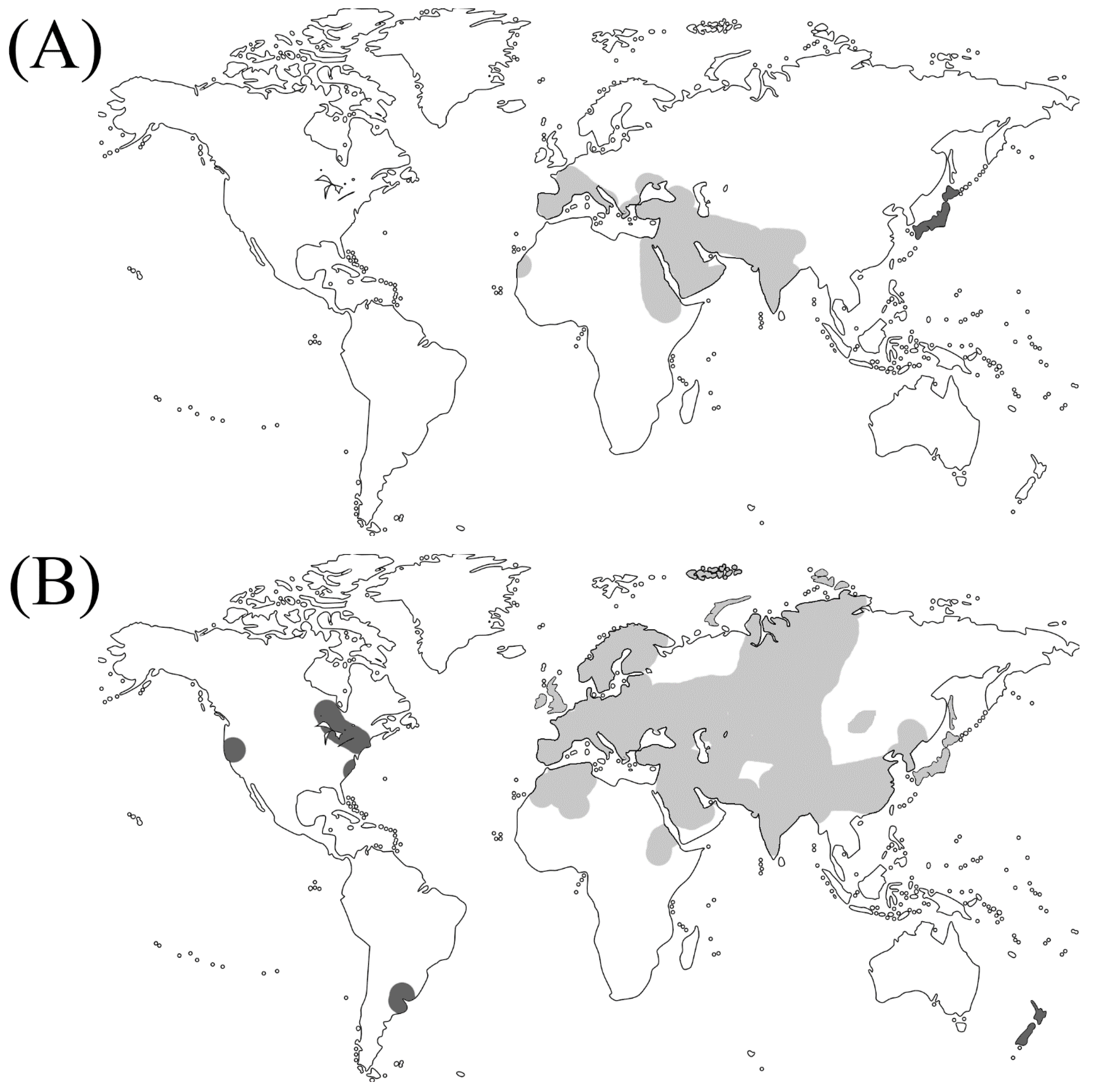

Table 1.
Characteristics of 38 plant species in the family Poaceae selected from the KPNI.
| Plant category | Subfamily | Scientific name | Genome size (Mbps) | Life cyclez | Photosynthetic Type |
|---|---|---|---|---|---|
| Native | Arundinoideae | Phragmites australis | 1,200 | P | C3 [72] |
| Native | Chloridoideae | Leptochloa chinensis | 460 | A | C4 [73] |
| Native | Chloridoideae | Eleusine indica | 590 | A | C4 [74] |
| Native | Chloridoideae | Cynodon dactylon | 1,020 | P | C4 [75] |
| Native | Chloridoideae | Zoysia japonica | 390 | P | C4 [75] |
| Native | Oryzoideae | Zizania latifolia | 1,800 | P | C3 [73] |
| Native | Panicoideae | Setaria viridis | 400 | A | C4 [76] |
| Native | Panicoideae | Echinochloa oryzoides | 1,000 | A | C4 [77] |
| Native | Panicoideae | Microstegium vimineum | 1,300 | A | C4 [78] |
| Native | Panicoideae | Echinochloa crus-galli | 1,400 | A | C4 [77] |
| Native | Panicoideae | Themeda triandra | 840 | P | C4 [79] |
| Native | Panicoideae | Miscanthus sinensis | 2,500 | P | C4 [73] |
| Native | Pooideae | Poa annua | 1,800 | A | C3 [76] |
| Native | Pooideae | Brachypodium sylvaticum | 360 | P | C3 [80] |
| Cultivated | Bambusoideae | Phyllostachys edulis | 2,080 | P | C3 [81] |
| Cultivated | Chloridoideae | Zoysia matrella | 380 | P | C4 [82] |
| Cultivated | Chloridoideae | Zoysia pacifica | 370 | P | C4 [82] |
| Cultivated | Oryzoideae | Oryza sativa | 430 | A | C3 [76] |
| Cultivated | Panicoideae | Panicum miliaceum | 920 | A | C4 [76] |
| Cultivated | Panicoideae | Sorghum bicolor | 820 | A | C4 [76] |
| Cultivated | Panicoideae | Coix lacryma-jobi | 1,560 | A | C4 [76] |
| Cultivated | Panicoideae | Zea mays | 2,300 | A | C4 [76] |
| Cultivated | Panicoideae | Setaria italica | 490 | A | C4 [76] |
| Cultivated | Pooideae | Avena sativa | 4,000 | A | C3 [76] |
| Cultivated | Pooideae | Triticum aestivum | 17,000 | A | C3 [76] |
| Cultivated | Pooideae | Hordeum vulgare | 5,100 | A | C3 [76] |
| Exotic | Chloridoideae | Eragrostis curvula | 660 | P | C4 [83] |
| Exotic | Panicoideae | Saccharum spontaneum | 3,360 | P | C4 [76] |
| Exotic | Panicoideae | Paspalum notatum | 550 | P | C4 [76] |
| Exotic | Panicoideae | Eremochloa ophiuroides | 800 | P | C4 [76] |
| Exotic | Panicoideae | Panicum virgatum | 1,200 | P | C4 [76] |
| Exotic | Pooideae | Lolium rigidum | 2,400 | A | C3 [76] |
| Exotic | Pooideae | Poa pratensis | 3,500 | P | C3 [76] |
| Exotic | Pooideae | Alopecurus myosuroides | 3,500 | A | C3 [84] |
| Exotic | Pooideae | Lolium multiflorum | 600 | A | C3 [76] |
| Exotic | Pooideae | Poa trivialis | 1,350 | P | C3 [76] |
| Exotic | Pooideae | Bromus tectorum | 2,500 | A | C3 [76] |
| Exotic | Pooideae | Lolium perenne | 2,000 | P | C3 [76] |
z P: perennial; A: annual.
Table 2.
Basic information about the 2 representative model plants and the 3 candidate model plants.
Table 2.
Basic information about the 2 representative model plants and the 3 candidate model plants.
| Arabidopsis thaliana | Brachypodium distachyon | Brachypodium sylvaticum |
Setaria viridis |
Zoysia japonica | |
|---|---|---|---|---|---|
| Common name | mouseear cress |
purple false brome | slender false brome | green bristlegrass | Korean lawngrass |
| Cotyledon | Eudicots | Monocots | Monocots | Monocots | Monocots |
| Order | Brassicales | Poales | Poales | Poales | Poales |
| Family | Brassicaceae | Poaceae | Poaceae | Poaceae | Poaceae |
| Tribe | Camelineae | Brachypodieae | Brachypodieae | Paniceae | Zoysieae |
| Genus | Arabidopsis | Brachypodium | Brachypodium | Setaria | Zoysia |
| Life cycle | Annual | Annual | Perennial | Annual | Perennial |
| Photosynthetic type | C3 | C3 | C3 | C4 | C4 |
| Chromosome number | 2n = 2x = 10 | 2n = 2x = 10 | 2n = 2x = 18 | 2n = 2x = 18 | 2n = 4x = 40 |
| Native in Korea | Y | N | Y | Y | Y |
Table 3.
Comparison of the reference genomes data of the 4 model plants from the Phytozome 13.
| Arabidopsis thaliana | Brachypodium distachyon | Brachypodium sylvaticum | Setaria viridis | |||||
|---|---|---|---|---|---|---|---|---|
| Genomeversion | TAIR10 | Araport11 | v2.1 | v3.2 | v1.1 | v2.1 | v2.1 | v4.1 |
| Source | TAIR | TAIR | JGI | JGI | JGI | JGI | JGI | JGI |
| Accession | Col-0 | Col-0 | Bd21 | Bd21 | Ain-1 | Ain-1 | A10.1 | A10 |
| Assembled genome size | 119,667,750 | 119,667,750 | 271,997,306 | 271,163,419 | 358,283,154 | 360,731,464 | 395,731,502 | 397,277,387 |
| No. ofcontigs | 169 | 169 | 485 | 34 | 1,117 | 14 | 75 | 39 |
| Protein-codingtranscripts | 35,386 | 48,456 | 42,868 | 56,847 | 50,263 | 54,423 | 52,459 | 50,526 |
| Protein-codinggenes | 27,416 | 27,655 | 31,694 | 32,439 | 36,927 | 31,643 | 38,334 | 29,807 |
| Reference publication | Lamesch et al. [85] | Cheng et al. [86] | Lei et al. [50] | Mamidi et al. [56] | ||||
Table 4.
Comparison of the reference genomes data of Zoysia species.
| Zoysia japonica | Zoysia matrella | Zoysia pacifica | ||
|---|---|---|---|---|
| Accession | Yaji | Nagirizaki | Wakaba | Zanpa |
| Estimated genome size | 421 Mbps | 390 Mbps | 380 Mbps | 370 Mbps |
| Genome version | unknown | ZJN_r1.1 | ZMW_r1.0 | ZPZ_r1.0 |
| Source | unreleased | Zoysia Genome Database | Zoysia Genome Database | Zoysia Genome Database |
| Number of sequences | 1,350 | 11,786 | 13,609 | 11,428 |
| Total length | 373,429,196 | 334,384,427 | 563,438,595 | 397,009,957 |
| Average length | 276,614 | 28,371 | 41,402 | 34,740 |
| Max. length | 17,601,860 | 8,501,895 | 1,041,506 | 1,506,652 |
| Min. length | unknown | 500 | 500 | 500 |
| N50 length | 3,962,554 | 2,370,062 | 108,897 | 111,449 |
| Number of predicted genes | 50,140 | 59,271 | 95,079 | 65,252 |
| Reference publication | Yang et al. [25] | Tanaka et al. [23] | Tanaka et al. [23] | Tanaka et al. [23] |
Disclaimer/Publisher’s Note: The statements, opinions and data contained in all publications are solely those of the individual author(s) and contributor(s) and not of MDPI and/or the editor(s). MDPI and/or the editor(s) disclaim responsibility for any injury to people or property resulting from any ideas, methods, instructions or products referred to in the content. |
© 2024 by the authors. Licensee MDPI, Basel, Switzerland. This article is an open access article distributed under the terms and conditions of the Creative Commons Attribution (CC BY) license (http://creativecommons.org/licenses/by/4.0/).
Copyright: This open access article is published under a Creative Commons CC BY 4.0 license, which permit the free download, distribution, and reuse, provided that the author and preprint are cited in any reuse.


