

Submitted:
06 March 2025
Posted:
06 March 2025
You are already at the latest version
Abstract
Accurately understanding the morphological descriptions of plants by ancient people more than 1,000 years ago, and determining the plant species that people described, is of great value in understanding the natural geographic distribution of plant taxa, the var-iation of plant taxa, and climate change. The variation on the plant group and the climate at that time is critical for understanding the change of combination of plant taxa and the climate and the impact of human activity. However, there is limited research in this area. More studies have focused on plant taxa from billions of years ago or money millions of years ago. Research on the plants and flora of this period is limited. And little was known about climates prior to the millennium. In this study, the special text was selected, and the plant names, plants' morphological features were gathered and plant taxonomy were carried out. The study identified 3 species of gymnosperms, namely Pinaceae and Cu-pressaceae, one species of Tamaricaceae monocotyledon, and 19 species of dicotyledons. However, three plant groups could only be identified to the level of genus. In our study, we reconstruct the climate of 1.475 millennia ago through plant textual research and woody plant coexistence analysis in the western section of Henan Province in eastern Asia, in the middle and lower reaches of the Yellow River. The results showed that the mean temperature of the coldest month was around 1.3°C higher than that in modern times, the mean temperature of the warmest month and mean annual temperatures were lower than the corresponding modern values 1.475 millennia ago, implying that tem-peratures in the Luoyang region were slightly lower with a respective mild change at the time, which was supported by other studies of the same period. At the same time, the study concluded that 1.475 millennia ago, the ancient Luoyang region, located in the interior of central East Asia, had high temperatures and rainfall in the summer and low temperatures in the winter, but the mean annual precipitation, the hottest seasonal pre-cipitation, and the coldest seasonal precipitation were all higher than those in the modern Luoyang region. Despite East Asia's predominantly monsoonal climate, the water con-tent of air currents was significantly higher than it is today. This study provides high-resolution plant and climate background information for rebuilding the ecological environment in East Asia.
Keywords:
Woody plant
; plant textual research
; coexistence analysis
; climate reconstruction
; Luoyang
1. Introduction
Climate change has long been acknowledged as a major cause of biodiversity change, as well as historical and cultural developments [1,2]. High-quality paleoclimate reconstructions can provide a clear climatic context for comparing and forecasting climate change trends and their impacts, particularly in the last 2000 years, when China experienced a rapidly growing population, expanding and intensifying agriculture, cultural diffusion, and climate fluctuations but lacked a fossil record of climate [3,4]. Some research implied that the climate was 2.5°C cooler than it is now before 1500-1000, while others suggested that it was warming [4,5,6]. One key explanation for these inconsistencies, if not contradicting conclusions, was the scarcity of solid quantitative climate reconstructions, particularly in China’s cultural heartland.
Climate influences plant distribution, assemblages, and morphological features [7,8]. The distribution of modern plants, which are commonly used to quantitatively study paleoenvironmental and paleoclimatic features, such as endemic species climate analysis, coexistence approach (CA), leaf phase analysis, and correlation between plant stomatal parameters and palaeoatmospheric CO2 concentration changes, can reflect plant climate tolerance [9,10]. One of the plant estimating climate approaches is the Mutual Climatic Range (MCR), which estimates the range of climatic parameters that plants may coexist with by analyzing the species assemblages within the plant community. MCR has been frequently used to reconstruct climate parameters from faunal, spores and pollen, and plant macrofossil assemblages since the Quaternary [6,11]. Notably, the “Coexistence Approach” (CA) use the MCR in conjunction with the nearest living relative (NLR) principle to calculate the maximal climate tolerance of the fossil taxonomic unit NLR based on reconstruction of climatic factors since the Cenozoic [9].
The quantitative reconstruction of the MCR paleoclimate requires the study and identification of all components of the palaeobotanical assemblage. Natural evidence of changes in various types of climatic environments, such as tree rings, stalagmites, ice cores, and lake sediments, is typically recorded at long ages and relatively short time intervals [12], making quantitative studies of specific historical periods in the recent past difficult. Empirical research is required to better comprehend the Holocene flora. Although China’s long history and continuous, well-preserved written records, as well as the accumulating archaeological finds, provide a unique opportunity to verify detailed plant-climate information across a wide geographic range [2], there are yet no appropriate quantitative analyses using these historical data sources.
Henan Province, located in China’s central plain, was ruled by the Wei-Jin-North and South dynasties about 1500 years ago, during which time there was social turmoil, numerous regime changes, and the establishment of temple gardens, which substantially expanded plant species diversity, particularly in the western city of Luoyang [13]. Luoyang is located in a transition zone between semi-humid and semi-arid climates, and is heavily influenced by the North Atlantic movement. According to studies, a chaotic period of low climate stability occurred between 280 and 1230 years ago, during which a rich biodiversity flourished despite extreme climate swings [14,15]. However, quantitative paleoclimate data flora for most of the Cenozoic in China are mostly unavailable, and climate change remains unquantifiable.
A literature survey and the mutual climate range method (MCR) were used in this study to create a quantitative reconstruction of the flora of the Luoyang region. Historical documents from 1475 years ago were examined, the recorded woody plants of the Luoyang region were settled, the respective survival environments of these woody plants were drawn, the climate of the ancient Luoyang region with simultaneous survival of these woody plants was counted using the mutual climate range approach, and the coexistence analysis were used to discuss the climate evolution of China’s western Henan region 1475 years ago.
2. Materials and Methods
2.1. Study Site
Yang Xuanzhi, a Chinese official and literati during the Northern Wei Dynasty. He served as an official in Luoyang from 528 to 530 A.D. More than 10 years later, from 543 to 547 A.D., after rushing back to Luoyang and traveling through the city, Yang Xuanzhi completed a comprehensive notebook documenting the city of Luoyang at that time, named as the “Buddhist Temples in Luoyang”. Modern archaeological research had concluded that the site of the ancient city of Luoyang of the Han and Wei Dynasty, located at 15 km east of Luoyang City, Henan Province, is the Luoyang City of the Han and Wei dynasties as recorded in the Luoyang Galanji [16].
The site studied in this paper is the ancient city of Luoyang of the Han and Wei Dynasty, located in eastern China, in the middle and lower reaches of the Yellow River, 15 km east of the modern city of Luoyang (E 112.45942°, N 34.62426°), which was the capital of seven Chinese dynasties from the 1st to the 6th century AD. As a capital or important city, the ancient city of Luoyang of the Han and Wei Dynasty was used for more than 1,600 years from the establishment of the city in Zhou Dynasty till the beginning of the Tang Dynasty. Archaeological research has revealed that the ancient city of Luoyang of the Han and Wei Dynasty reached its maximum during the Northern Wei Dynasty (386-534 AD), and was divided into a triple city circle of palace, inner city, and outer city, covering an area of 100 square kilometers, making it the largest capital city in ancient China, nine times larger than Constantinople, the capital of the Byzantine Empire, and 8.2 times larger than the city of Baghdad, built in 800 AD [17,18,19] (Figure 1).
2.2. Research Objects and the Time
In the book of “Buddhist Temples in Luoyang”, 23 species of woody plants were recorded in Luoyang City during the Northern Wei Dynasty, 1475 years ago. These woody plants and the climate of Luoyang before 1475 years ago are the researching objects in this study.
The flora ingredients of the Luoyang area in this period were clearly recorded in the book of Buddhist Temples in Luoyang. The study revealed that a total of 23 species of woody plants were described in the book, among which five species of woody plants were not native to Luoyang, namely, apricot, wine tree, noodle wood, oxalis, and dog bone. In addition, there are 18 species of herbs as well as vines and one species of fungus described in the book.
Other records related to woody plants in the Luoyang area have also been studied. Due to the long period of time, there is very little information available for reference. Even for the wooden coffins found in the archaeological excavations in the Luoyang area, the source of the selected materials could not be identified as coming from the local area of Luoyang. It is believed that the choice of material for the coffins was more from the density properties of the wood and the ritual properties given by man [19,20,21,22].
2.3. Taxonomic Study
2.4. Climatic Analysis
In order to reconstruct the local climatic environment using the distribution data of the flora, Mosbrugger and Utescher [27] used the method of the co-existence approach for their research work and gradually built up the Palaeoflora database in the course of continuous practice. This database contains more than 800 fossil plant taxa, extant nearest relative taxa of fossil plants and their climatic elements distributed in Europe. This information is appropriate for analyzing the climate of continental Europe, but less appropriate for analyzing the climate of Asia. Fortunately, the Chinese have constructed a distribution and climate database Atlas of the Distribution of Woody Plants in China based on native plants. With the exclusion of anthropogenic perturbations, i.e., exotic plants, the climate data of the pre-1475 Luoyang area can be derived by bringing the native plant data into this database, deriving the climate data based on different woody plants, and calculating the coexistence intervals among them[10,27,28,29,30] (Figure 3).
3. Results
3.1. Taxonomic Work on Plants
According to the records, the study found that 23 types of woody plants existed in the Han and Wei Luoyang city area 1475 years ago. The study identified 3 species of gymnosperms, namely Pinaceae and Cupressaceae, one species of Tamaricaceae monocotyledon, and 19 species of dicotyledons. However, three plant groups could only be identified to the level of genus. As is shown in Table 1, Figure 2, and Table 2.
3.2. Climatic Analysis
Climatic information regarding the ancient city of Luoyang during the Han and Wei dynasties was compiled by combining records from the Atlas of Woody Plant in China, Distribution and Climate. The collated plant taxa of the area was used as a basis for this. To make a comparison, some typical cities in East Asia were selected and compared with the ancient city of Luoyang during the Han and Wei dynasties. This is depicted in Figure 3, Figure 4, and Figure 5.
3.3. Comparison of Temperature Parameters
Based on quantitative calculations of meteorological data, the meteorological values of the ancient Luoyang of Han and Wei dynasties are not the same as those of modern Luoyang. In the section on temperature, although the mean temperature of the coldest month (MTCM) in the ancient city of Luoyang in the Han and Wei dynasties (2.1°C) was slightly higher than that in the modern city of Luoyang (0. 8°C), the mean annual temperature (MAT) (14.3°C) and the mean temperature of the warmest month (MTWM) (25.3°C) in the ancient city of Luoyang of the Han and Wei dynasties were lower than those in the modern city of Luoyang (14.3°C and 27°C respectively, Figure 4 and Figure 5).
Comparative analysis showed that there were two locations with the same value of 14.3°C as the MAT of the ancient city of Luoyang in Han and Wei dynasties. One was in Hanzhong, Shaanxi Province, and the other was in Fangxian, Anhui Province. Only, Hanzhong is more southward in latitude (1.58°) and more westward in longitude (5.45°) than the ancient city of Luoyang in Han and Wei dynasties. Fangxian was farther south in latitude (2.56°) and west in longitude (1.72°) than the ancient city in Luoyang of Han and Wei dynasties. Meanwhile, although the mean annual temperature of these two cities is the same as that of the ancient city of Luoyang in Han and Wei dynasties, their mean coldest and mean hottest monthly temperatures were different from those of the ancient city of Luoyang of Han and Wei dynasties.
The study results yielded a coldest Mean Temperature of Coldest Month (MTCM) of 2.1°C for the ancient city of Luoyang of the Han and Wei dynasties, which was higher than that of the modern Luoyang region (0.8°C). There are three modern cities that are very close to the coldest monthly mean in the region. The MTCM of Huoshan City in Anhui province was the same as that of the ancient city of Luoyang of the Han and Wei dynasties, however, it was about 3.7194° east and 3.3180° south to that of the of Luoyang of the Han and Wei dynasties. The other two cities are Xinyang in Henan Province and Nanjing in Jiangsu Province, with a 2°C MTCM for the both. Meanwhile, Xinyang City was 1.4626° east and 2.5801 south to that of the ancient city of Luoyang of the Han and Wei dynasties. Nanjing city was 6.1675° east and 2.6689° south to that of the ancient city of Luoyang of the Han and Wei dynasties. (Map: Huoshan, Xinyang, Nanjing) (Figure 4, 5)
The Mean Temperature of Warmest Month (MTWM) of the ancient city of Luoyang of the Han and Wei dynasties was 25.3°C, which was lower than that of the modern Luoyang region (1.7°C). Comparison disclosed that there was only 0.1 degree difference on the MTWM between that of Fangxian in Hubei Province and the ancient city of Luoyang of the Han and Wei dynasties. However, Fangxian was about 2.56° south and 1.72° west to the ancient city of Luoyang of the Han and Wei dynasties. At the same time, the MTWM of Chengdu in Sichuan Province was about 0.3degree higher than that of the ancient city of Luoyang of the Han and Wei dynasties, however, Chengdu was about 3.96° south and 8.39° west to the ancient city of Luoyang of the Han and Wei dynasties. (Fangxian, Chengdu)
Quantitative calculations showed that the humid of the ancient city of Luoyang of the Han and Wei dynasties was slight larger than that of modern Luoyang City, just because the three value of the Annual Precipitation (AP, 1051 mm), the Precipitation of the Coldest Quarter (PCQ, 84 mm) and the Precipitation of the Warmest Quarter (PWQ, 472 mm) are all larger than those of modern Luoyang City (599.5mm, 36.7 mm and 300.5 mm respectively). (Figure 4, 5)
The annual precipitation (AP) of the ancient city of Luoyang in the Han and Wei dynasties was almost twice than that of modern Luoyang City, while the AP of Nanjing City (1070.9 mm) was quite close to that of the ancient city of Luoyang in the Han and Wei dynasties. However, Nanjing was about 6.1675° east and 2.6689° south to the ancient city of Luoyang of the Han and Wei dynasties. At the same time, the AP of Nanchong city in Sichuan province was about (954.9-1051) less to the ancient city of Luoyang in the Han and Wei dynasties, however, Nanchong was (30.84-34.62426) south and (106.12-112.45942) west to the ancient city of Luoyang in the Han and Wei dynasties (Map: Nanjing and Nanchong) (Figure 4, 5)
The precipitation of coldest quarter (PCQ) of the ancient city of Luoyang in the Han and Wei dynasties (84 mm) was larger than that of modern Luoyang City (36.7 mm). The nearest value was that in Haikou, Hainan Province (83.3 mm), however, Haikou was about 2.2849° west and 14.7169° south to the ancient city of Luoyang in the Han and Wei dynasties. (Map: Haikou) (Figure 4, 5) The precipitation of warmest quarter (PWQ) of the ancient City of Luoyang in the Han and Wei dynasties (472mm) was larger than that of modern Luoyang City (300.5 mm). Comparison showed that the value of Laoting in Hebei Province was just the same as that of the ancient city of Luoyang of the Han and Wei dynasties. However, Laoting was about 6.284° east and 4.6983° north to the ancient city of Luoyang of the Han and Wei dynasties. At the same time, the PWQ of Xuzhou was slightly less (3.2mm) to that of the ancient city of Luoyang in the Han and Wei dynasties, however, Xuzhou is 0.47° south and 4.65° east to the ancient city of Luoyang in the Han and Wei dynasties. Meanwhile, the PWQ of Chengdu was slightly larger (6.2mm) to that of the ancient City in Luoyang of the Han and Wei dynasties, however, Chengdu is 3.96° south and 8.39° west to the ancient city in Luoyang of the Han and Wei dynasties. (Map: Laoting, Xuzhou, Chengdu) (Figure 4, 5) In general, result showed that the temperature of Luoyang area 1.475 millennia ago was slightly cooler than that in the mean value and the warmest months, while the temperatures in the cold season are slightly warmer than modern values in the Luoyang area. At the same time, result also showed that the humid in that area 1.475 millennia ago was significantly larger than modern values, hint that the area was wetter 1.475 millennia ago than it is in modern times.
In general, result showed that the temperature of Luoyang area 1.475 millennia ago was slightly cooler than that in the mean value and the warmest months, while the temperatures in the cold season are slightly warmer than modern values in the Luoyang area. At the same time, result also showed that the humid in that area 1.475 millennia ago was significantly larger than modern values, hint that the area was wetter 1.475 millennia ago than it is in modern times.
4. Discussion
4.1. Climate in East Asia in the 6th Century AD
Earlier research concluded that around the sixth century A.D., China experienced 19 exceptionally cold winters. This figure indicated that the climate in China in the sixth century A.D. was colder than it is today [31]. Studies of Greenlandic plant remained in Europe and tree chronology in California supported the idea that the temperature in Europe and North America, like that in China, cooled in the sixth century A.D. [32]. It has been proposed that the Eskimos’ southward attack on the ancient Scandinavians in Greenland during the same period as China’s North and South dynasties, and the resulting destruction of native settlements on that island, were influenced in part by the cooling of the climate at that time [33,34]. It has been proposed that the Chinese climate had gone through three cold and dry eras since 2000a. The second cold period, the cold period of the Wei-Jin-North and South dynasties, occurred between the early A.D. 600a A.D., when research estimated that the mean annual temperature was 2-4°C lower than that of modern times [35]. Another study indicated that after the warm climate of the Qin and Han dynasties, China entered a 400-year cold period known as the Qin-Han-North-South dynasty phase, which was 0.5°C colder than our current winter temperatures. The coldest period during this time was the midst of the Northern and Southern dynasties, when the temperature was around 1.3°C lower than it is now [36]. The analysis in this paper concluded that before 1475, the mean annual temperature and the mean temperature of the Warmest Month in the ancient Luoyang region were lower than those in the present Luoyang region, indicating that the region was in a cold phase. The study indicated that climate change in China reached a low point about 440-530 A.D. during the Wei-Jin and North-South dynasties, with the coldest period (481-510 A.D.) when the mean temperature in the winter half of the year was around 1.2°C lower than in modern times. The period between 460 and 520 was relatively wet in terms of dry and wet variations. Only the 221-580 AD monsoon region in east-central China was the driest since the Qin and Han dynasties on a scale of the previous 2000 years [37]. The study in this paper concluded that, at the time of the authors’ writing of the Luoyang book, the flora responded to a climate in which both the mean temperature of the hottest month and the mean annual temperature that were lower than the corresponding modern values, despite the fact that the mean temperature of the coldest month was about 1.2°C higher than the modern one, indicating that the temperature of the Luoyang region was relatively low at the time, and this result was consistent with earlier studies [37].
4.2. Circumstantial Evidence of the Climate in East Asia in the 6th Century AD
Seven eras of wild elephant activity were discovered in China’s Jianghuai Valley from the second half of the fifth century to the first half of the sixth century. The size of the group of the wild elephant sightings ranged from solitary roaming to herd appearances. According to the History of the South Dynasty, hundreds of wild elephants emerged in Dangtu, Anhui Province, in 552 AD, trampling buildings and causing havoc. Some research have revealed that wild elephants, who presently occupy China’s tropical jungles, could reach the Huaihe River basin (N 36°-31°) using Asian elephant trails (Elephas maximus Linnaeus) without the effect of human activities [38]. It has also been proposed that the presence of wild elephants in the Jianghuai region shows that local temperatures were not lower than they are now [39]. However, numerous research revealed that there was no required link between the arrival of wild elephants and warm and cold temperatures, and that the presence of wild elephants did not imply that the local temperature is higher [40]. The study in this paper contends that the presence of wild elephants in Dangtu (E118.48°, N31.55°) in the Jianghuai region should at the very least indicate that precipitation in the region is relatively high, as a humid environment is more likely to provide plant food for wild elephant survival. The linear distance between Dangtu in Anhui and the Han Dynasty city of Luoyang is less than 400 km both in the plain area, hence the conclusion that the annual precipitation in the Luoyang area projected in this research significantly greater than that in modern times is likewise ruled out. This finding is further corroborated by research on Longguan Lake sediments [41] and data from Jianghuai Plain stratigraphic sections [42].
4.3. Climate Discussions in East Asia Over the Past 1.475 Millennia
The East Asian monsoon is currently thought to be the primary driver of climatic change in East Asia [43,44], with research indicated that it dates back to the late Oligocene/early Miocene [45]. According to the study, warm and humid air currents from the Pacific and Indian Oceans transported substantial volumes of precipitation to the interior of East Asia during the summer, resulting in hot and wet summers in most places. Dry and cold air currents from Siberia lead East Asia’s winter climate to be dry and chilly [46,47]. Before 1475, the ancient Luoyang region, located in the interior of central East Asia, had high temperatures and rainy summers and low temperatures and little rainfall in winter, but the numerical performance of the mean annual precipitation, the hottest seasonal precipitation, and the coldest seasonal precipitation was higher than that of the modern Luoyang region, indicating that the water content in the airflow was much higher. Despite East Asia’s largely monsoonal climate, the low was substantially higher than in the current age before 1475. This condition could be caused by one of two factors. One possibility is that before 1475, the total annual mean temperature in East Asia was slightly higher than in modern times, leading the water content in atmospheric clouds to be higher than in modern times. This hypothesis is incongruous with the fact that the annual mean temperature in the Luoyang region before 1475 calculated in this study was lower than the contemporary value. It is also possible that the water content of the atmosphere was higher in East Asia before to 1475, or that clouds were more effective at retaining water. The ground may have been better covered by green vegetation, such as forests, and the water vapor content dissipated into the atmosphere via plant leaves was higher, causing precipitation in the region to be higher [48,49]. Only when human society evolved and the forest was converted to cultivation, many woody plants that had thrived for millions of years were cut down for human construction or burial. Deforestation of woody plants that lasted thousands of years destroyed surface plants, weakened the water retention effect of forests, and gradually reduced the amount of water vapor provided to the atmosphere, causing precipitation in the area to gradually decrease despite an increase in the mean annual temperature, and desertification of some northern areas. This is also validated by the Tongwancheng site investigation [45].
5. Conclusions
The mean temperature of the coldest month in Luoyang 1.475 millennia ago was around 1.3°C higher than that in modern times. The mean temperature of the warmest month and the mean annual temperatures in Luoyang 1.475 millennia ago were lower than the corresponding modern values 1.475 millennia ago. The ancient Luoyang region had high temperatures and rainfall in the summer and low temperatures in winter, but the mean annual precipitation, the hottest seasonal precipitation, and the coldest seasonal precipitation were all higher than those in the modern Luoyang region.A high-resolution example on rebuilding the ecological environment in East Asia in 1.475 millennia ago was carried out.
Author Contributions
conceptualization, H.M. Liu investigation and writing, H.J. Song and F. Duan data analysis, L. Sheng Proofreading Ancient Documents. All authors have read and agreed to the published version of the manuscript.
Funding
This research was funded by the Beijing Government (2024)
Institutional Review Board Statement
Not applicable.
Informed Consent Statement
Not applicable.
Data Availability Statement
All data are available in section “MDPI Research Data Policies” at https://www.mdpi.com/ethics.
Conflicts of Interest
The authors declare no conflicts of interest.
References
- Thuiller, W.; Lavorel, S.; Araújo, M. B.; Sykes, M. T.; Prentice, I. C. Climate change threats to plant diversity in Europe. P Natl Acad Sci USA 2005, 102, 8245–8250. [Google Scholar] [CrossRef] [PubMed]
- Teng, S. Q. N.; Xu, C.; Teng, L. C.; Svenning, J. C. Long-term effects of cultural filtering on megafauna species distributions across China. P Natl Acad Sci USA 2020, 117, 486–493. [Google Scholar] [CrossRef] [PubMed]
- Jiang, S. W.; Zhou, X.; Sachs, J. P.; Luo, W. H.; Tu, L. Y.; Liu, X. Q.; Zeng, L. Y.; Peng, S. Z.; Yan, Q.; Liu, F.; Zheng, J. Q.; Zhang, J. Z.; Shen, Y. N. Central eastern China hydrological changes and ENSO-like variability over the past 1800 yr. Geology 2021, 49, 1386–1390. [Google Scholar] [CrossRef]
- Zhang, C.; Zhao, C.; Zhou, A. F.; Zhang, H. X.; Liu, W. G.; Feng, X. P.; Sun, X. S.; Yan, T. L.; Leng, C. C.; Shen, J.; Chen, F. H. Quantification of temperature and precipitation changes in northern China during the “5000-year” Chinese History. Quaternary Sci Rev 2021, 255, 255. [Google Scholar] [CrossRef]
- Xia, K.; Su, T.; Liu, Y. S.; Xing, Y. W.; Jacques, F. M. B.; Zhou, Z. K. Quantitative climate reconstructions of the late Miocene Xiaolongtan megaflora from Yunnan, southwest China. Palaeogeogr Palaeocl 2009, 276, 80–86. [Google Scholar] [CrossRef]
- Yao, Y. F.; Bruch, A. A.; Mosbrugger, V.; Li, C. S. Quantitative reconstruction of Miocene climate patterns and evolution in Southern China based on plant fossils. Palaeogeogr Palaeocl 2011, 304, 291–307. [Google Scholar] [CrossRef]
- Zheng, J. Y.; Wen, Y. J.; Fang, X. Q. Changes of climate and land cover in the middle and lower reaches of the Yellow River over the past 2000 years. Res sci 2020, 42, 3–19. [Google Scholar] [CrossRef]
- Wang, Q. J.; Ma, F. J.; dong, J. L.; Liu, C. H.; Liu, S.; Sun, B. N. New costapalmate palm leaves from the Oligocene Ningming Formation of Guangxi, China, and their biogeographic and palaeoclimatic implications. Hist biol 2017, 29, 594–606. [Google Scholar] [CrossRef]
- Mosbrugger, V.; Utescher, T. The coexistence approach — a method for quantitative reconstructions of Tertiary terrestrial palaeoclimate data using plant fossils. Palaeogeogr Palaeocl 1997, 134, 61–86. [Google Scholar] [CrossRef]
- Li, C. S.; Wang, Y. F.; Sun, Q. G. The Quantitative Reconstruction of Palaeoenvironments and Palaeoclimates Based on Plants. Chin Bul Bot 2003, 20, 430–438. [Google Scholar]
- Moine, O.; Antoine;, P.; Hatté, C.; Landais, A.; Mathieu, J.; Prud’homme, C.; Rousseau, D.-D., The impact of Last Glacial climate variability in west-European loess revealed by radiocarbon dating of fossil earthworm granules. P Natl Acad Sci USA 2017, 114, 6209-6214.
- Folland, C. K.; Rayner, N. A.; Brown, S. J.; Smith, T. M.; Shen, S. S. P.; Parker, D. E.; Macadam, I.; Jones, P. D.; Jones, R. N.; Nicholls, N.; Sexton, D. M. H. Global temperature change and its uncertainties since 1861. Geophys Res Lett 2001, 28. [Google Scholar] [CrossRef]
- Wang, J. J.; Hu, K.; Lu, P.; Mo, D. W.; Jin, Y. X.; Lü, J. Q. Difference and its palaeoclimate reason of settlement evolution between Yulin area of Shaanxi Province and Luoyang area of Henan Province around 44 Ka BP. J Palaeogeog-English 2015, 17, 841–850. [Google Scholar]
- Wang, J. X.; Wang, W. T.; Bai, Y. H. Changes of natural environment in the middle and lower reaches of the Yellow River and its causes. Acta Agro Jiangxi 2007, 19, 106–107. [Google Scholar]
- Zhao, Q. H.; Ma, L. J.; Liu, Q.; Ding, S. Y.; Tang, Q.; Lu, X. l. Plant species diversity and its response to environmental factors in typical river riparian zone in the middle and lower reaches of Yellow River. Chin J Eco 2015, 34, 1325–1331. [Google Scholar]
- Nie, X. Y.; Sang, Y. F. , The ancient city of Luoyang and the Han-Wei dynasty.; Zhengzhou Ancient Books Publishing House: Zhengzhou, 2019. [Google Scholar]
- Yang, Z. L.; Mao, Y. G. , Archaeological Integration of Luoyang: Qin, Han, Wei, Jin and North and South Dynasties.; Beijing Library Press: Beijing, 2007. [Google Scholar]
- Yang, Z. L.; Han, S. P. , Archaeological Integration of Luoyang: Sui, Tang, Five Dynasty and Song.; Beijing Library Press: Beijing, 2005. [Google Scholar]
- Luoyang Archaeological Working Group, I. o. A. Chinese Academy of Sciences, Luoyang, Preliminary Survey of Luoyang City in Han and Wei Dynasty. Archaeology 1973, 4, 198–208. [Google Scholar]
- Wang, X. R. A few questions about the historic relics of Shang Dynasty in Yanshi and the Erlitou site. Archaeology 1996, 5, 51–60. [Google Scholar]
- Yuan, S. W. Formation and Evolution of the Inner and Outer Coffin System. The Journal of Nankai University (Philosophy, Literature and Social Science Edition) 2014, 3, 94–101. [Google Scholar]
- Zhang, X. F., The history of Chinese tomes. Guangling Press: Yangzhou, 2009; p 1-598.
- Gao, M. Q.; Lu, L. D., Ancient Chinese Names of Plants. Elephant Press: zhengzhou, 2006; p 1-547.
- Liu, H. M.; Xia, X. F.; Li, Y. M.; Wang, L. L. Original Plants of “Algae” and Its Corresponding Plants in Historical Books and Records of China. Chin Agric Sci Bull 2017, 33, 143–146. [Google Scholar]
- Liu, H. M.; Zhao, Y.; Xia, X. F.; Li, Y. M. Original Plants of Celery and Its Corresponding Plant. Chin Agric Sci Bull 2016, 32, 199–204. [Google Scholar]
- Liu, H. M.; Chang, L.; Xia, X. F.; Wang, L. L.; Han, D.; Zhong, B.; Li, Y. M. Research on the Original Plants of Scallion and Its Corresponding Plants. Chin Agric Sci Bull 2015, 31, 47–53. [Google Scholar]
- Mosbrugger, V.; Utescher, T. The coexistence approach—a method for quantitative reconstructions of Tertiary terrestrial palaeoclimate data using plant fossils. Palaeogeogr Palaeocl 1997, 134, 61–86. [Google Scholar] [CrossRef]
- Jacques, F. M. B.; Shi, G.; Wang, W. Reconstruction of Neogene zonal vegetation in South China using the Integrated Plant Record (IPR) analysis. Palaeogeogr Palaeocl 2011, 307, 272–284. [Google Scholar] [CrossRef]
- Utescher, T.; Bruch, A. A.; Erdei, B.; François, L.; Ivanov, D.; Jacques, F. M. B.; Kern, A. K.; Liu, Y. S.; Mosbrugger, V.; Spicer, R. A. The coexistence approach—theoretical background and practical considerations of using plant fossils for climate quantification. Palaeogeogr Palaeocl 2014, 410, 58–73. [Google Scholar] [CrossRef]
- Wang, S. Z.; Yue, H. B.; Yue, Z. W. High-resolution ecological reconstruction in the Yin and Shang dynasties. Cult Relics Southern China 2016, 2, 148–157. [Google Scholar]
- Zhu, K. Z., Fluctuations of world climate in historical times. Acta Meteor Sin, 1962, 31, 275-287.
- Lamb, H. H., Climate: present, past and future - v. 1: Fundamentals and climate now.- v. 2: Climatic history and the future. Palaeogeogr Palaeocl 1979, 26, 364-365.
- Hinsch, B. Climatic change and history In China. J Asia Hist 1988, 22, 131–159. [Google Scholar]
- Bryson, R. A.; Murray, T. J. Climates of hunger: mankind and the world’s changing weather. University of Wisconsin Press 1979. [Google Scholar]
- Wang, H. C. The relationship between the migrating south of the nomadic nationalities in north china and the climatic changes. Sci Gelgra Sin 1996, 16, 274–279. [Google Scholar]
- Wu, L. h. The impact of climate change on ancient chinese agriculture in historical period. Chin Agric Infor 2014, 9, 175–176. [Google Scholar]
- Ge, Q. S. , Climate change in China through the dynasties.; Science Press: Beijing, 2010. [Google Scholar]
- Gong, G.; Zhang, P.; Zhang, J. On the changes of the climatic zones and the developments of the distributive areas of living beings in China during the historical periods. Chin Histl Geo 1987, 1, 1–10. [Google Scholar]
- Mou, C. X. Study on the climate in the North and South Dynasties. J Zhejiang Meteor 1987, 8, 5–9. [Google Scholar]
- Man, Z. M., Studies on climate change in China’s historical period. Shandong Education Press: Jinan, 2009; p 1-504.
- Wu, R. J.; Tong, G. B. Vegetation and climatic quantitative reconstruction of Longgan Lake since the past 3000year. Mar Geol & Quat Geol 1997, 17, 53–61. [Google Scholar]
- Qu, W. C.; Wu, R. J.; Yang, X. D.; Wang, S. M.; Wu, Y. H.; Xue, B.; Tong, G. W. The Palaeoenvironmental and Palaeoclimatic Changes of Longgan Lake since the Past 3000 Years. J Lake Sci 1998, 10, 37–44. [Google Scholar]
- Jones, P. D.; Mann, M. E. Climate over Past Millennia. Rev Geophys 2004, 42. [Google Scholar] [CrossRef]
- Mann, M. E. Climate Over the Past Two Millennia. Annu Rev Earth Pl Sc 2007, 35, 111–136. [Google Scholar] [CrossRef]
- Sun, T. X.; Wang, Y. F.; Hou, Y. J.; Du, N. Q.; Li, C. S. Historical natural landscape of Tongwancheng area in northern Shaanxi Province and migration rate of Mau Us Desert. J Palaeogeog-English 2004, 6, 363–371. [Google Scholar]
- Chowdary, J. S.; Hu, K.; Srinivas, G.; Kosaka, Y.; Wang, L.; Rao, K. K. The Eurasian Jet Streams as Conduits for East Asian Monsoon Variability(Review). Curr Clim Change Rep 2019, 5, 233–244. [Google Scholar] [CrossRef]
- Chen, W.; Wang, L.; Feng, J.; Wen, Z. P.; Ma., T. J.; Yang, X. Q.; Wang, C. H., Recent Progress in Studies of the Variabilities and Mechanisms of the East Asian Monsoon in a Changing Climate. Adv Atmos Sci 2019, 36, 887-901.
- Running, S. W.; Coughlan, J. C. A general model of forest ecosystem processes for regional applications I. Hydrologic balance, canopy gas exchange and primary production processes. Ecol Model 1988, 42, 125–154. [Google Scholar] [CrossRef]
- Ciruzzi, D. M.; Loheide, S. P. Groundwater subsidizes tree growth and transpiration in sandy humid forests. Ecohydrology 2021, 14, 1–14. [Google Scholar] [CrossRef]
Figure 1.
Study site in this paper. The position of the Former City of Luoyang of Han and Wei Dynasty (▲) and modern Luoyang City (■).
Figure 1.
Study site in this paper. The position of the Former City of Luoyang of Han and Wei Dynasty (▲) and modern Luoyang City (■).
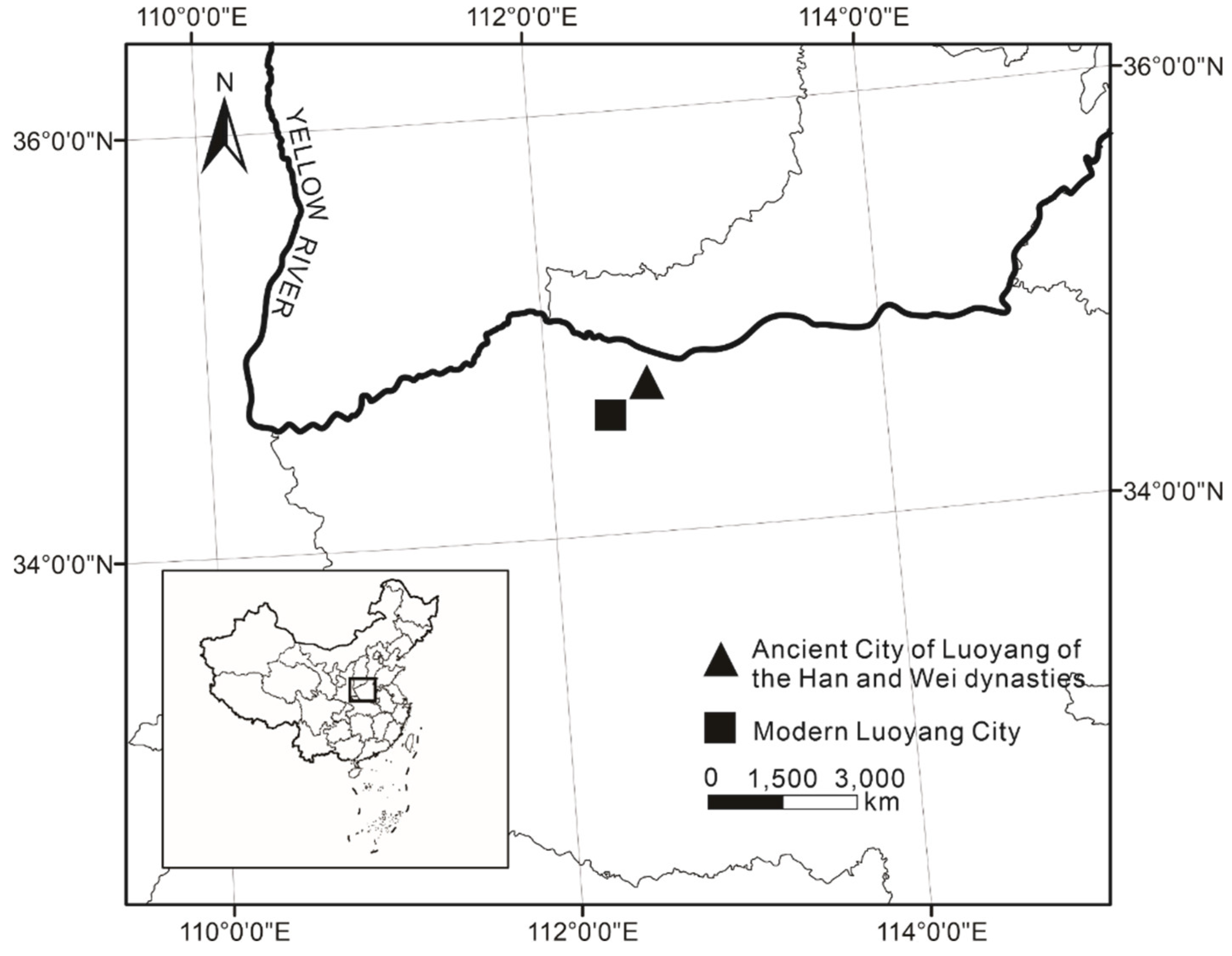
Figure 2.
Line drawings for the woody plants painted in the book of Buddhist Temples in Luoyang. (A) Flowers of ’Huai’ painted in ’Essentials of the Pharmacopoeia Ranked according to Nature and Efficacity (Imperially Commissioned)’. (B) Fruits of “Huai” painted in ’Universal Encyclopaedia’. (C) Leaves of “Huai” painted in “Universal Encyclopaedia”. (D) Inflorescences of ’Mulberry (Sang)’ painted in ’Illustrated Study of the Creatures (Plants a and Animals) in the ’Book of Odes’‘. (E) Leaf of ’Mulberry (Sang)’ painted in ’Illustrated Study of the Creatures (Plants a and Animals) in the ’Book of Odes’‘. (F) Leaves of ’Toon (Chun)’ painted in the ’Universal Encyclopaedia’. (G) Fruit of ’Jujube (Zao)’ painted in the ’Explanation on the Metals, Rocks, Insects, Grass and Woods’. (H) Leaf of ’Jujube (Zao)’ painted in the ’Explanation on the Metals, Rocks, Insects, Grass and Woods’. (I) Leaf of ’Chinese Catalpa (Qiu)’ painted in ’The Great Pharmacopoeia’. (J) Leaf of ’Tung (Tong)’ painted in the ’Illustrated Study of the Creatures (Plants a and Animals) in the ’Book of Odes’‘. (K) Flower of ’Tung (Tong)’ painted in the ’Illustrated Study of the Creatures (Plants a and Animals) in the ’Book of Odes’‘. (L) Flower of ’Peach (Tao)’ painted in the ’Illustrated Study of the Creatures (Plants a and Animals) in the ’Book of Odes’‘. (M) Leaf of ’Peach (Tao)’ painted in the ’Illustrated Study of the Creatures (Plants a and Animals) in the ’Book of Odes’‘. (N) Fruit of ’Peach (Tao)’ painted in ’Complete book for the appreciation of flora and fauna’. (O) Leaf of ’Elm (Yu)’ painted in the ’Illustrated Study of the Creatures (Plants a and Animals) in the ’Book of Odes’‘. (P) Leaf of ’Pear Tree (Li)(02)’ painted in the ’Essentials of the Pharmacopoeia Ranked according to Nature and Efficacity (Imperially Commissioned)’. (Q) Fruit of ’Pear Tree (Li)(02)’ painted in the ’Essentials of the Pharmacopoeia Ranked according to Nature and Efficacity (Imperially Commissioned)’. (R) Fruit of ’Chinese Wolfberry (Qi)’ painted in the Explanation on the Metals, Rocks, Insects, Grass and Woods. (S) Leaf of ’Chinese Wolfberry (Qi)’ painted in the Explanation on the Metals, Rocks, Insects, Grass and Woods. (T) Leaf of “Nane Tree (Nai)” painted in the “Essentials of the Pharmacopoeia Ranked according to Nature and Efficacity (Imperially Commissioned)”. (U) Fruit of “Nane Tree (Nai)” painted in the “Essentials of the Pharmacopoeia Ranked according to Nature and Efficacity (Imperially Commissioned)”. (V) Flower of ’Nane Tree (Nai)’ painted in the Complete book for the appreciation of flora and fauna.
Figure 2.
Line drawings for the woody plants painted in the book of Buddhist Temples in Luoyang. (A) Flowers of ’Huai’ painted in ’Essentials of the Pharmacopoeia Ranked according to Nature and Efficacity (Imperially Commissioned)’. (B) Fruits of “Huai” painted in ’Universal Encyclopaedia’. (C) Leaves of “Huai” painted in “Universal Encyclopaedia”. (D) Inflorescences of ’Mulberry (Sang)’ painted in ’Illustrated Study of the Creatures (Plants a and Animals) in the ’Book of Odes’‘. (E) Leaf of ’Mulberry (Sang)’ painted in ’Illustrated Study of the Creatures (Plants a and Animals) in the ’Book of Odes’‘. (F) Leaves of ’Toon (Chun)’ painted in the ’Universal Encyclopaedia’. (G) Fruit of ’Jujube (Zao)’ painted in the ’Explanation on the Metals, Rocks, Insects, Grass and Woods’. (H) Leaf of ’Jujube (Zao)’ painted in the ’Explanation on the Metals, Rocks, Insects, Grass and Woods’. (I) Leaf of ’Chinese Catalpa (Qiu)’ painted in ’The Great Pharmacopoeia’. (J) Leaf of ’Tung (Tong)’ painted in the ’Illustrated Study of the Creatures (Plants a and Animals) in the ’Book of Odes’‘. (K) Flower of ’Tung (Tong)’ painted in the ’Illustrated Study of the Creatures (Plants a and Animals) in the ’Book of Odes’‘. (L) Flower of ’Peach (Tao)’ painted in the ’Illustrated Study of the Creatures (Plants a and Animals) in the ’Book of Odes’‘. (M) Leaf of ’Peach (Tao)’ painted in the ’Illustrated Study of the Creatures (Plants a and Animals) in the ’Book of Odes’‘. (N) Fruit of ’Peach (Tao)’ painted in ’Complete book for the appreciation of flora and fauna’. (O) Leaf of ’Elm (Yu)’ painted in the ’Illustrated Study of the Creatures (Plants a and Animals) in the ’Book of Odes’‘. (P) Leaf of ’Pear Tree (Li)(02)’ painted in the ’Essentials of the Pharmacopoeia Ranked according to Nature and Efficacity (Imperially Commissioned)’. (Q) Fruit of ’Pear Tree (Li)(02)’ painted in the ’Essentials of the Pharmacopoeia Ranked according to Nature and Efficacity (Imperially Commissioned)’. (R) Fruit of ’Chinese Wolfberry (Qi)’ painted in the Explanation on the Metals, Rocks, Insects, Grass and Woods. (S) Leaf of ’Chinese Wolfberry (Qi)’ painted in the Explanation on the Metals, Rocks, Insects, Grass and Woods. (T) Leaf of “Nane Tree (Nai)” painted in the “Essentials of the Pharmacopoeia Ranked according to Nature and Efficacity (Imperially Commissioned)”. (U) Fruit of “Nane Tree (Nai)” painted in the “Essentials of the Pharmacopoeia Ranked according to Nature and Efficacity (Imperially Commissioned)”. (V) Flower of ’Nane Tree (Nai)’ painted in the Complete book for the appreciation of flora and fauna.
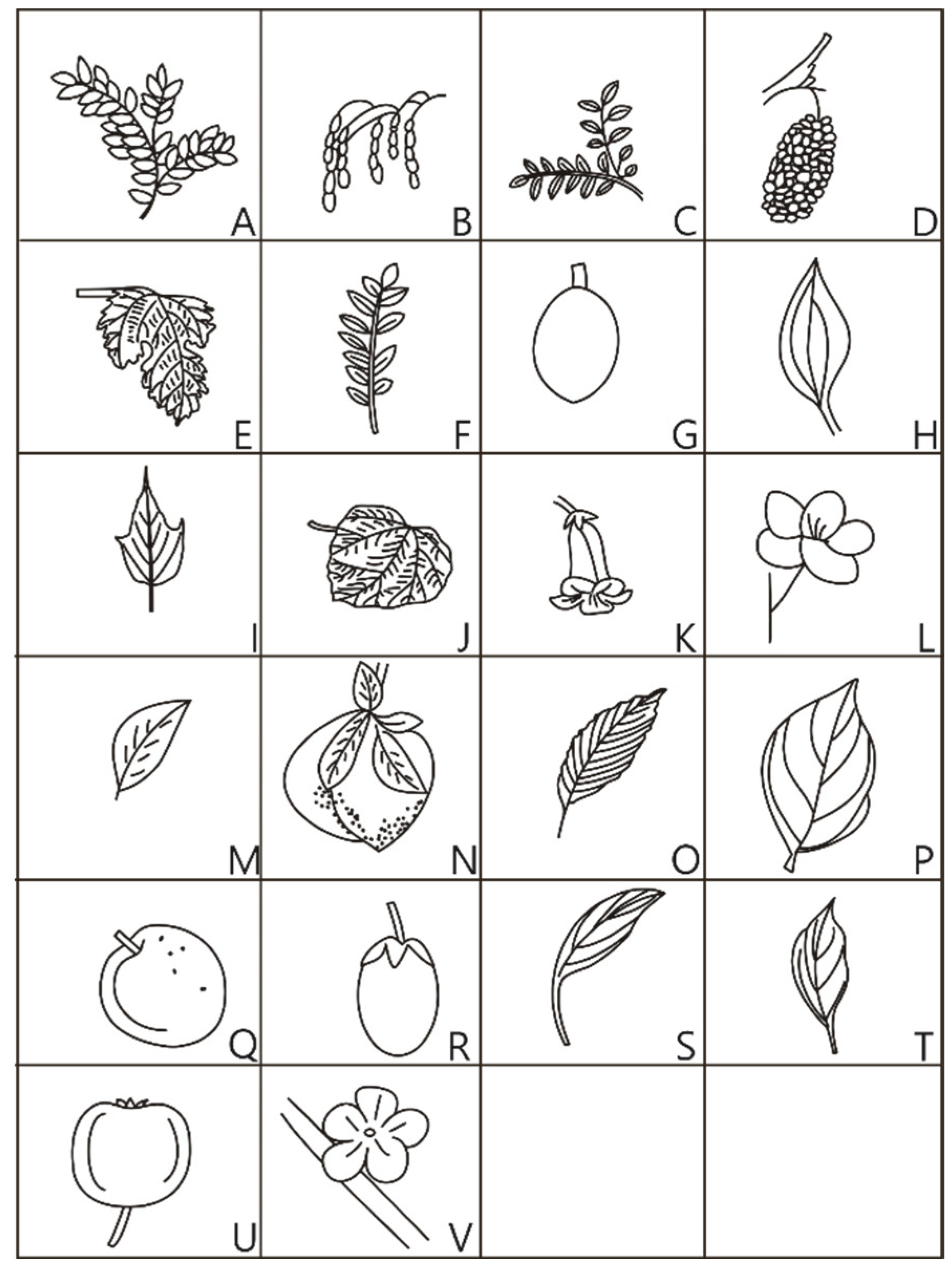
Figure 3.
Analysis of coexistence of woody plants in the book of “Buddhist Temples in Luoyang”.
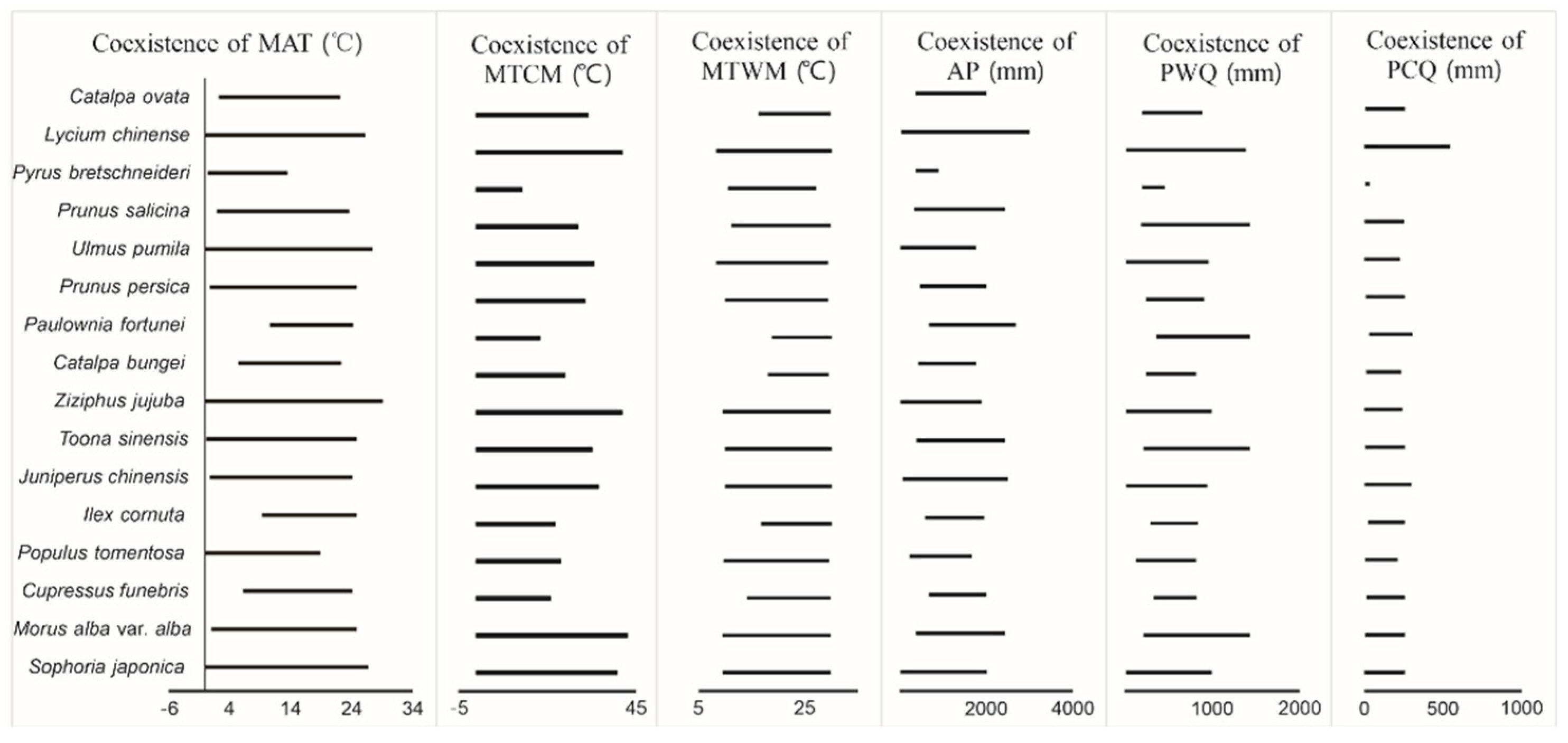
Figure 4.
The address of the position of Luoyang, Former city of Luoyang of the Han and Wei Dynasty, and other typical cities compared in this paper. 1 Hanzhong, 2 Fangxian, 3 Huoshan, 4 Xinyang, 5 Nanjing, 6 Chengdu, 7 Nanchong, 8 Haikou, 9 Laoting, 10 Xuzhou.
Figure 4.
The address of the position of Luoyang, Former city of Luoyang of the Han and Wei Dynasty, and other typical cities compared in this paper. 1 Hanzhong, 2 Fangxian, 3 Huoshan, 4 Xinyang, 5 Nanjing, 6 Chengdu, 7 Nanchong, 8 Haikou, 9 Laoting, 10 Xuzhou.
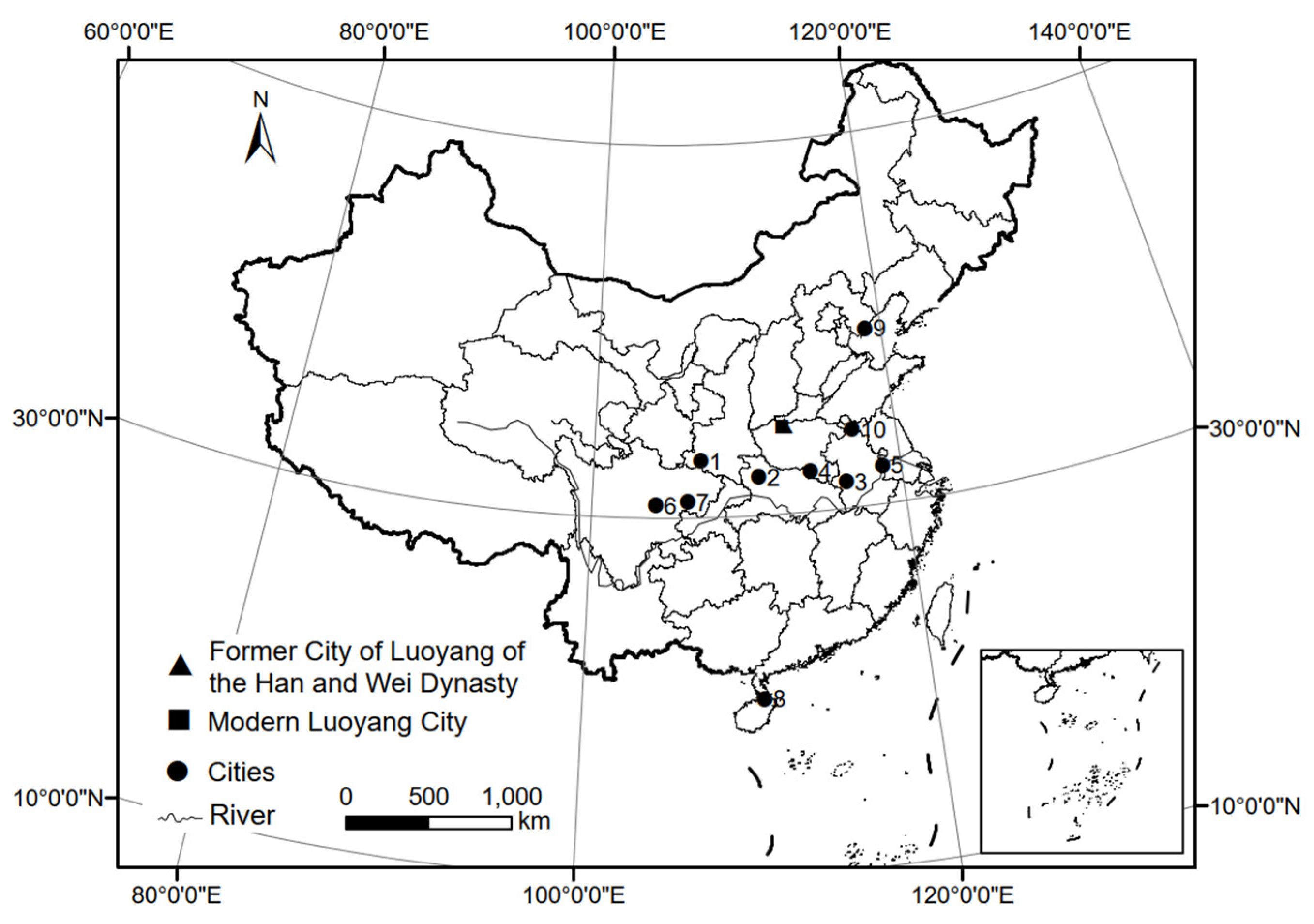
Figure 5.
Comparative analysis of climate factors in different cities.
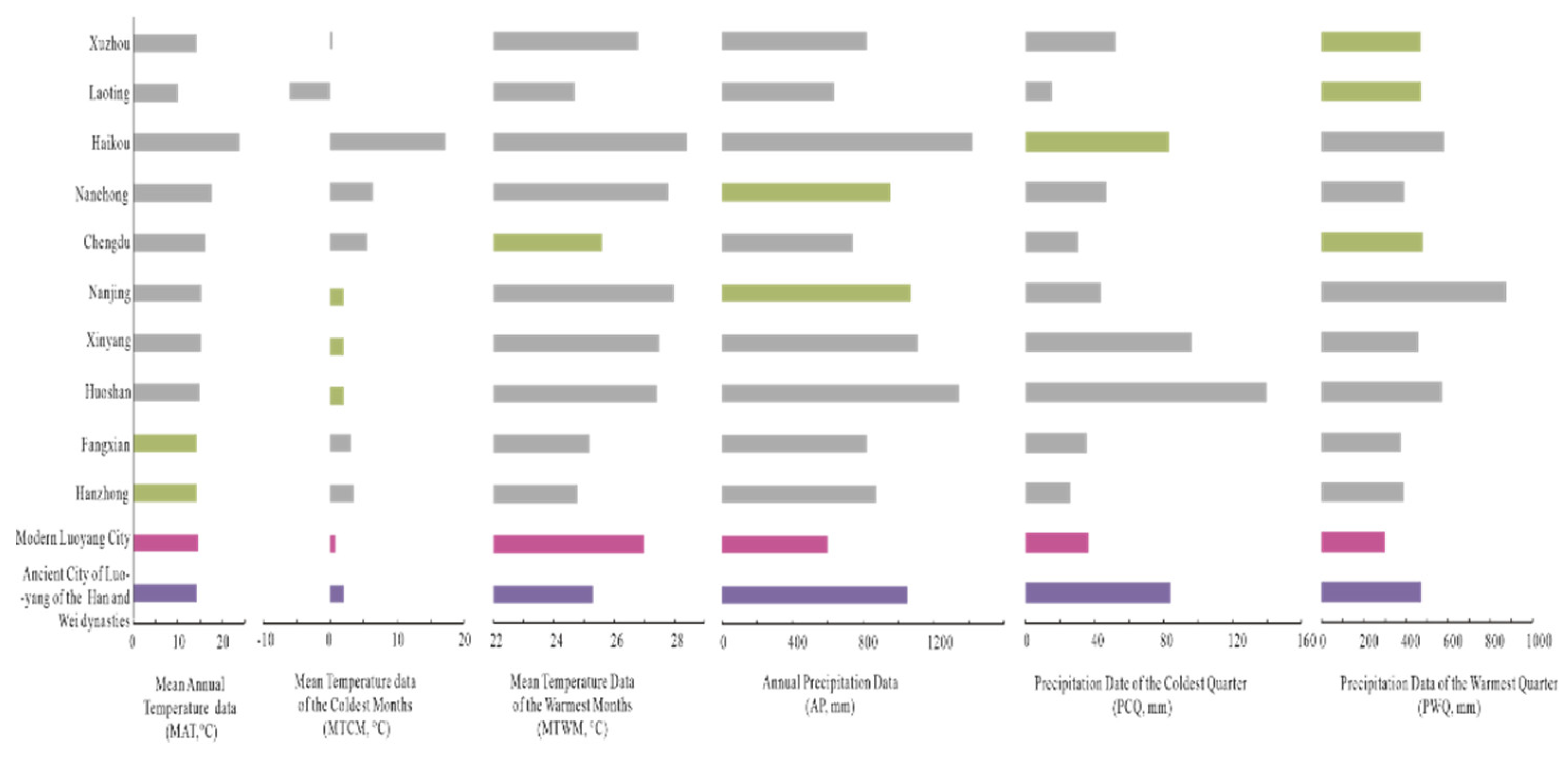

Table 1.
Taxonomy on the woody plants in the book of Buddhist Temples in Luoyang.
| Ancient names of plants | Names of modern taxa | Scientific Names | Plant Features | Figures |
| Pine(松) | Pines | Pinus sp. | Stem surface splitting into patches needle-shaped leaves.Flowers unisexual, monoecious.Bearing fruit in autumn.Seed maturation period 1-2 years. | |
| Huai(槐) | Pagoda Tree | Styphnolobium japonicum (L.) Schott | Leaf opening at day and closing at night. Leaflets ovate-oblong or ovate-lanceolate opposite.Flowers small, yellow, florets forming panicles.Legume.3-6 seeds/fruit | Figure 2A, 2B, 2C |
| Sang(桑) | Mulberry | Morus alba var. alba Linn. | Leaves large as palms, blade margin serrate, sometimes notched, apex acuminate. Polygamous fruit, ovate-ellipsoid | Figure 2D, 2E |
| Bai(柏) | Cypress | Cupressus funebris Endl | Flowers very small and contain a lot of pollen. The fruit forms a globular fruit that dehiscences at maturity and contains several seeds. Seed size like wheat seeds | |
| Cheng(柽) | Tamarisk | Tamarix sp./Myricaria sp. | Stem surface red. Tiny leaves. Inflorescence spike-like, flesh-red, about 10 cm in length | |
| Zhi(枳) | Trifolia Orange | Cirtus sp. | Deciduous shrub or small tree with thick thorns on the stem, compound leaves, white flowers Fruit small spherical with sour taste | |
| Yang | Poplar | Populus tomentosa Carr. | Deciduous trees. Leaves long and broadly shaped. Dioecious, with spikes of flowers in spring. Seeds with flocculent hairs at the tip | |
| Niu Jin Shu / Beef Tendon Tree | Vaccinium | Vaccinium bracteatum Thunb. | Stem surface with red coloration. Leaves resembling apricot leaves but pointed, light-colored. The flowers are like neem and the stamens are white. stem juice can be used to make dark rice. | |
| Gou Gu /Dog Bone Trss | Ilex | Ilex cornuta Lindl. et Paxt. | Woody plants, shrubs or small trees. Surface of the stem with longitudinal furrows. Leaves ovate or ovate-lanceolate, margin with 1-3 pairs of sinuate spines. Spines ca. 3 mm in length | |
| Jiu Tree / Liquor Tree | Cocos | Cocos nucifera L. | Plants tall, tree-like. Stems stout, with annular leaf scars. Leaves pinnatisect. Inflorescences axillary, much branched; spathe fusiform, thickly woody. Fruit ovoid or subglobose, containing liquid nutrients inside. | |
| Mian Mu / Flour Wood | Arenga | Arenga westerhoutii Griffith | The part outside the pith is very hard and the pith can be processed to make starch. | |
| Gua | Sabina | Juniperus chinensis L. | Evergreen shrubs, stems erect. Leaf dimorphism, with both spiny and scaly leaves. Fruits subglobose. | |
| Chun | Toon | Toona sinensis (A. Juss.) Roem. | Deciduous trees, about ten meters tall. Compound leaves, red in young, sweet and edible. Little White Flower. Fruits were capsule, red at maturity | Figure 2F |
| Zao | Jujibe | Ziziphus jujuba Mill | woody stem . Leaf ovate-elliptic, apically obtuse, or with small apices, basally ternately veined . Fruit rectangular or oblong-ovoid, red at maturity. | Figure 2G, 2H |
| Qiu | Chinese Catalpa | Catalpa bungei C.A. Mey. | Deciduous trees Stem straight, ascending, branched at high. Leaves resembling sycamore leaves but thin and small, tri-tipped or penta pointed. Flowers small, corolla partly white. Fruit narrowly ellipsoid. | Figure 2I |
| Tong / Tung | Paulownia | Paulownia fortunei (Seem.) Hemsl. | Deciduous trees, up to 10 m. Bark Rough, with slightly white in color. Leaves rounded and large, palmately divided, with long stalks. Flowers labiate, purple or white, mainly white, in large panicles, calyx yellow-brown. Fruits were capsule, 6-10 cm length | Figure 2J, 2K |
| Tao | Peach Tree | Prunus persica L. | Deciduous sub-trees, more than 3 m tall. Leaf long oval. Flower at spring, and fruit mature in Summer. Drupe broadly ovoid, densely pubescent; drupe firmly woody; seeds compressed ovate-cordate. | Figure 2L, 2M, 2N |
| Yu | Elm | Ulmus pumila L. | First grows elm pods, then leaves. Elm pods. Samara suborbicular, white at maturity, many samara densely arranged together. | Figure 2O |
| Li(李)(01) | Plum tree | Prunus salicina Lindl. | Deciduous trees. Leaves ovate, apical, denticulate. Flowers white, with five petals. Fruits with a lot of water, large and round, skin with fine points. | Figure 2P, 2Q |
| Nai | Nane Tree | Malus pumila Mill. | Perennial trees, with woody stems. Leaves broadly ovate, apex acute. Red and white flowers with five petals. Fruit depressed globose, calyx depressed, sepals persistent, petiole thick and short. | Fig, 2T, 2U, 2V |
| Li(梨)(02) | Pear Tree | Pyrus bretschneideri Rehd. | Deciduous trees. Leaves elliptic-obovate. Flowers white, with five petals. Fruit rounded | |
| Qi | Chinese Wolfberry | Lycium chinense Miller | Deciduous small shrubs. Leaves long elliptic, alternate. Small red and purple flowers in June and July, flowers borne in leaf axils. Fruit red, ovoid and pointed, slightly elongated, like a date pit. | Figure 2R, 2S |
| Zi | Catalpa | Catalpa ovata G. Don | Deciduous trees, straight stem, branched in high places . Ovate-oblong, or triangular-ovate. Flowers small, purple-red. Fruit linear. |
Table 2.
Simplified table on the ancient and scientific names of the woody plants in the book of Buddhist Temples in Luoyang.
Table 2.
Simplified table on the ancient and scientific names of the woody plants in the book of Buddhist Temples in Luoyang.
| Ancient names of plants | Scientific Names for the plants |
| Pine Tree | Pinus sp. |
| Huai | Styphnolobium japonicum (L.) Schott |
| Sang | Morus alba var. alba Linn. |
| Bai | Cupressus funebris Endl |
| Cheng | Tamarix sp./Myricaria sp. |
| Zhi | Cirtus sp. |
| Yang | Populus tomentosa Carr. |
| Niu Jin Shu / Beef Tendon Tree | Vaccinium bracteatum Thunb. |
| Gou Gu /Dog Bone Tree | Ilex cornuta Lindl. et Paxt. |
| Jiu Tree / Liquor Tree | Cocos nucifera L. |
| Mian Mu / Flour Wood | Arenga westerhoutii Griffith |
| Gua | Juniperus chinensis L. |
| Chun | Toona sinensis (A. Juss.) Roem. |
| Zao | Ziziphus jujuba Mill |
| Qiu | Catalpa bungei C.A. Mey. |
| Tong / Tung | Paulownia fortunei (Seem.) Hemsl. |
| Tao | Prunus persica L. |
| Yu | Ulmus pumila L. |
| Li (01) | Prunus salicina Lindl. |
| Nai | Malus pumila Mill. |
| Li(02) | Pyrus bretschneideri Rehd. |
| Qi | Lycium chinense Miller |
| Zi | Catalpa ovata G. Don |
Disclaimer/Publisher’s Note: The statements, opinions and data contained in all publications are solely those of the individual author(s) and contributor(s) and not of MDPI and/or the editor(s). MDPI and/or the editor(s) disclaim responsibility for any injury to people or property resulting from any ideas, methods, instructions or products referred to in the content. |
© 2025 by the authors. Licensee MDPI, Basel, Switzerland. This article is an open access article distributed under the terms and conditions of the Creative Commons Attribution (CC BY) license (http://creativecommons.org/licenses/by/4.0/).
Copyright: This open access article is published under a Creative Commons CC BY 4.0 license, which permit the free download, distribution, and reuse, provided that the author and preprint are cited in any reuse.


