

Submitted:
27 December 2024
Posted:
30 December 2024
You are already at the latest version
Abstract
This study explores the evolving plant knowledge in the Alpine Southern Occitan area, an ecologically rich and culturally resilient region, by analyzing temporal and cultural shifts in botanical use across multiple decades. Drawing on ethnobotanical data from the Maira Valley (1970, 2022), Stura Valley (2004), and Grana Valley (2011), this research examines changes in the identification and utilization of plant taxa, reflecting the region's shifting ecological, socio-economic, and cultural landscapes. A total of 308 botanical taxa were recorded, with significant variation in plant families across the studies. The most prominent families, such as Asteraceae and Lamiaceae, remarkably declined in later collected data (2022), reflecting the erosion of traditional ecological knowledge (TEK), while other families, like Brassicaceae and Amaranthaceae, emerged more frequently, possibly due to changing cultural or economic factors. A notable shift in plant part utilization was also observed, with medicinal uses predominating in earlier studies, and a gradual shift toward the use of fruits, fodder, and food plants in more recent years. Logistic regression models identified altitude as a key determinant of plant diversity, with higher altitudes (600-1,600 masl) supporting greater botanical variety. Additionally, participant age was positively correlated with the richness of plant knowledge, suggesting that older generations preserve more diverse ethnobotanical knowledge. This study highlights the dynamic relationship between local ecological systems and cultural practices, illustrating the resilience and transformation of plant knowledge in response to socio-economic pressures and environmental changes in the Alpine Southern Occitan region.
Keywords:
cultural landscape
; ecological drivers
; ethnobotany
; mountain communities
; plant resource
; traditional ecological knowledge
1. Introduction
Traditional ecological knowledge (TEK) is vital for local communities and their well-being. TEK has been a focal point of research within the ethnobiological field, and recent developments have witnessed a shift towards a diachronic approach that emphasizes the historical evolution of these corpora of knowledge [1]. The Alpine Southern Occitan area, nestled between the western Alps and the borderlands of Italy and France, represents a unique convergence of cultural and ecological characteristics [2]. Known for its breathtaking landscapes, this region is defined by a rich history of localized agricultural practices, traditional ecological knowledge (TEK), and close-knit communities that have adapted to the region’s challenging environment [3,4,5]. At altitudes ranging from 600 to 3,000 meters, the area is characterized by a distinct climate marked by moderate to cold temperatures and significant seasonal variation in precipitation [2,6]. This ecological diversity has shaped a wealth of botanical knowledge passed down through generations, contributing to the local identity of the region’s inhabitants. Over the years, however, this knowledge has been increasingly threatened by various factors, including socio-economic shifts, migration, changing environmental conditions, and land use alterations. These influences collectively contribute to the erosion or transformation of TEK, making it essential to examine the broader context of these changes in understanding the region’s ecological knowledge dynamics [7,8].
Traditional Ecological Knowledge (TEK) refers to the body of knowledge, practices, and beliefs about the relationship of living beings (humans, animals, and plants) with their environment [9]. This knowledge system was once integral to daily life in the Alpine Southern Occitan area, influencing everything from agricultural practices to health, spirituality, and social organization [10].However, the erosion of TEK has become a critical issue as the region faces a phenomenon known as the "Hysteresis Effect" the idea that once knowledge systems are lost, they may be difficult or impossible to recover, even when conditions for its re-establishment return [11]. This effect is compounded by the social and economic transformations the region has experienced in recent decades, which have led to the displacement or disappearance of key cultural practices and the disintegration of long-standing knowledge systems [12,13].
Several factors influence the persistence or decline of TEK in this region, and these factors are often interconnected. Climate change, particularly shifts in temperature and precipitation patterns, plays a pivotal role in altering plant ecosystems, which in turn influences the knowledge that local communities maintain about these plants [9,14]. Increases in average temperatures, changing precipitation patterns, and the unpredictability of seasonal weather can directly affect the availability of plant species that were once integral to the region’s agricultural and medicinal practices[7,15]. This, in combination with altitude, may further exacerbate the decline or transformation of plant-based knowledge. Higher altitudes experience more pronounced changes in climate, with species adapted to specific temperature and moisture conditions potentially becoming rarer or migrating, altering the local flora and the knowledge tied to it [6,16,17].
In addition to environmental factors, land use changes and the reduction of agricultural activity have contributed significantly to the erosion of traditional knowledge [18]. Over the decades, farming practices have been reduced or altered due to economic pressures, population decline, and the mechanization of agriculture, leading to a shift in how people interact with the land. This shift also has implications for the cultivated or harvested plants, which are no longer as deeply integrated into daily life. As land abandonment increases, particularly in high-altitude areas once used for traditional agro-pastoralism, the continuity of TEK is disrupted [19]. A recent study has documented that temporal shifts in plant usage have occurred in neighbouring Alpine Ubaye and Bellino Valleys [20]. The study suggests that this shift reflects broader cultural, ecological, and socio-economic changes, underscoring the importance of preserving biodiversity and traditional knowledge amidst ongoing environmental and societal shifts.
Cultural Factors such as modernization, changes in economic levels, and the effects of migration also shape the way knowledge is passed down. As younger generations leave for urban centers in search of better education and job opportunities, the transmission of traditional knowledge becomes less consistent [21]. The influx of new residents, including migrants, seasonal workers, and tourists, further complicates the local knowledge landscape, introducing new plant knowledge, practices, and cultural exchanges, but also contributing to the dilution of TEK held by long-established inhabitants.
Notably, few studies have addressed the risk factors influencing the decline or transformation of ethnobotanical knowledge over extended periods. While some global studies are tracking these changes, very few have examined the long-term effects (over 50 years) on ethnobotanical taxa in such detail.
These studies are critical, as they provide insight into the resilience of traditional plant knowledge systems and the broader ecological and cultural shifts that affect them. These rare longitudinal studies highlight how risk factors such as climate change, land use modifications, migration, and socio-economic transitions can significantly alter the presence, utilization, and transmission of local plant knowledge across generations.
This study aims to explore the interrelation between the loss of traditional ecological knowledge (TEK) and the emergence of new forms of ecological and cultural knowledge over time in the Alpine Southern Occitan area. By examining historical and contemporary data on local plant knowledge, this research seeks to understand the mechanisms through which knowledge is lost, adapted, or revitalized. Through a multi-generational lens, the study will assess how changing economic, social, and environmental conditions influence knowledge systems and how communities negotiate their relationship with their natural environment.
2. Results
2.1. Wild Plants Across the Southern Occitan Alps
In the studies analyzed, a total of 308 botanical taxa were identified in the study area ( Maria , Grana, and Stura valleys), 112 in the Rovera (1982) study [22], 90 in Musset and Dore (2004) [23], 86 and 20 in our collected data in 2011 and 2022, respectively. These recent collected data reveal different trends in plant family usage, with 50 families identified in Rovera et al., 1982[22] 38 in Musset and Dore, 2004 [23], 43 and 15 in our collected data in 2011 and 2022, respectively.
Table 1 presents the usage of plant parts across four studies Rovera et al. (1982), Musset and Dore (2004), unpublished data of our research group collected in 2011 and 2022 highlighting the temporal shifts in botanical taxa and family utilization. The most prominent families identified in Rovera (1982) include Asteraceae, Lamiaceae, Rosaceae, Apiaceae, Violaceae, Amaryllidaceae, Fabaceae, Malvaceae, Oleaceae, Ranunculaceae, and Urticaceae. Musset and Dore (2004) follow a similar pattern with the frequent appearance of Asteraceae, Lamiaceae, Rosaceae, Apiaceae, Pinaceae, Fabaceae, and Polygonaceae. Our collected data in 2011, highlight families such as Asteraceae, Lamiaceae, Brassicaceae, Liliaceae, Apiaceae, Campanulaceae, and Rosaceae. On the other hand, our collected data in 2022 narrows significantly, with only Asteraceae and Lamiaceae remaining as the most prominent families.
This shift reflects the changing ecological and cultural roles of plants over time. Families such as Asteraceae and Lamiaceae have maintained a continuous presence across all studies, but with notable decline, particularly in the more recent data. For instance, Asteraceae was cited with 17 species in 1982 and 14 in 2004, but only 3 species were recorded by 2022. Similarly, Lamiaceae decreased from 12 species in 1982 to just 2 species in the latest Data .
Conversely, certain families such as Brassicaceae and Amaranthaceae emerge with increasing frequency in the later studies, indicating a shift in plant use, potentially driven by socio-economic factors such as migration and urbanization. The category of "Others," encompassing less frequently cited families, has also sharply declined from 48 species in 1982 to just 3 in 2022 indicating a narrowing of plant diversity within local knowledge systems (Figure 1).
The results presented in Figure 2 demonstrate significant variation in the documented plant species across different temporal contexts, reflecting changes in both the number and frequency of ethnobotanical knowledge over time. Earlier studies, such as Rovera (1982) and Musset and Dore (2004), record a wide range of species, with Rovera alone documenting 51 species and Musset and Dore contributing 34. These studies highlight frequently cited plants such as Achillea millefolium , Artemisia absinthium., and Calendula officinalis, which represent long-standing staples of traditional practices.
In contrast, more recent collected data , such as (2022) and (2011), report fewer species, with 2022 data listing only 3 species and data (2011) documenting 44. Notable among the recent additions are Allium ursinum and Silybum marianum, which appear with increasing frequency, suggesting their growing prominence due to changing ecological or cultural factors. However, despite this overall reduction in diversity, some species, such as Pimpinella anisum and Sambucus nigra, persist across all four studies, reflecting their sustained importance in ethnobotanical traditions.
Frequency analysis reveals that some species, like Pimpinella anisum., appear in up to 11 combinations of studies, demonstrating their widespread and enduring utility. Others, like Melissa officinalis, are mentioned in only 1 combination, highlighting their more specialized or localized relevance. This fluctuation in frequency underscores the dynamic nature of ethnobotanical knowledge, where cultural preferences, environmental changes, and practical needs shape the prominence of certain species over time.
2.2. Shifts in Traditional Plant Knowledge, Usage, and Biodiversity Across Data Sites in the Southern Occitan Alps
The results of the Data revealed notable shifts in plant utilization over time. In Rovera's (1982) Data , the majority of plant parts used were medicinal (88.1%), with fruits (8.9%) and flowers (3.0%) being utilized less frequently. This indicates a primary focus on medicinal applications during this period. By contrast, Musset and Dore (2004) showed a more balanced distribution, with 42.0% of plant parts used for medicinal purposes, 37.5% for fruits, and 20.5% for flowers. This shift suggests a growing emphasis on fruits and flowers alongside medicinal uses. Our collected data in (2011) marks a return to a medicinal-centric approach, with 74.4% of plant parts used for medicinal purposes, and fruits and flowers representing smaller proportions (16.7% and 9.0%, respectively). Finally, our data (2022) highlights a significant increase in the use of fruits, which accounted for 50.0% of the plant parts, followed by medicinal use (42.9%) and flowers (7.1%). This recent trend points to a shift towards greater utilization of fruits, likely reflecting changes in cultural practices or available plant resources. These temporal shifts in plant part usage underscore the evolving roles of plant species, influenced by ecological, cultural, and socio-economic factors over the decades.
Overall, these findings indicate a notable shift in plant part usage over time. While past studies, particularly from Rovera (1982), focused heavily on medicinal species, more recent data, especially the data (2011) and collected data in (2022), show an increasing trend in the use of plants for fodder and food purposes. This shift may reflect changing agricultural practices, environmental conditions, and evolving cultural preferences in the use of plant species. The overall trend suggests that, while medicinal uses remain important, there has been a marked increase in the functional diversity of plants, particularly in terms of their role in animal husbandry and food resources. This shift is indicative of broader changes in socio-economic and ecological contexts over the years.
The reason for the medicinal plant decrease is twofold: a. Medicinal plants were especially needed and used in times in which public health care was less capillary (see the high number of wild medicinal taxa in Data published in 1982); b. medicinal species were collected in ecological areas insisting in spread and robust forestry and shepherding activities; these activities have basically disappeared nowadays.
The opposite trend of wild food plants collection could be instead explicable with the huge interest that in the past two decades foraging has (re-)gained in the Data area and in all Northern Italy, possibly bringing also new food plant-centred practices.
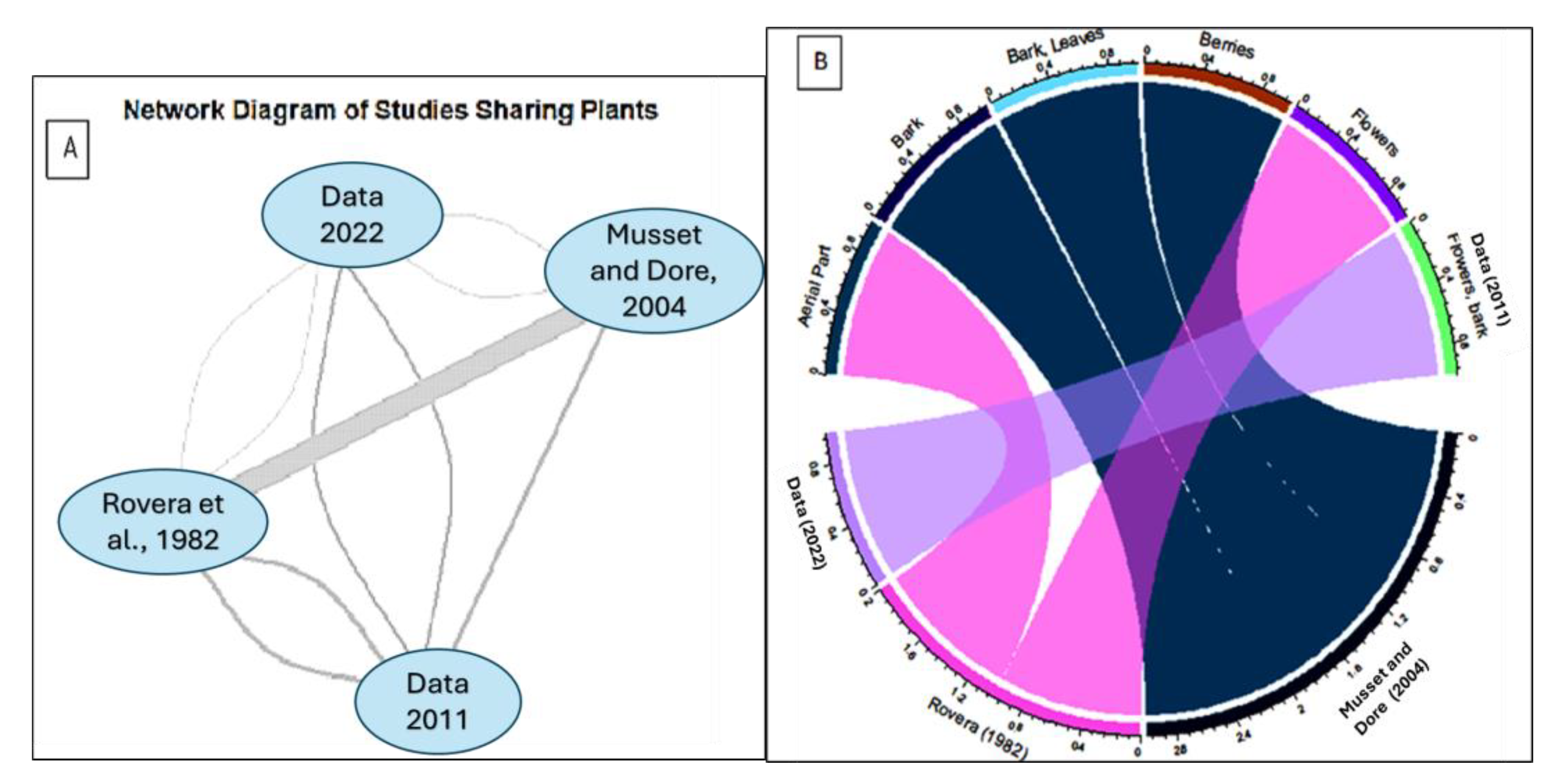
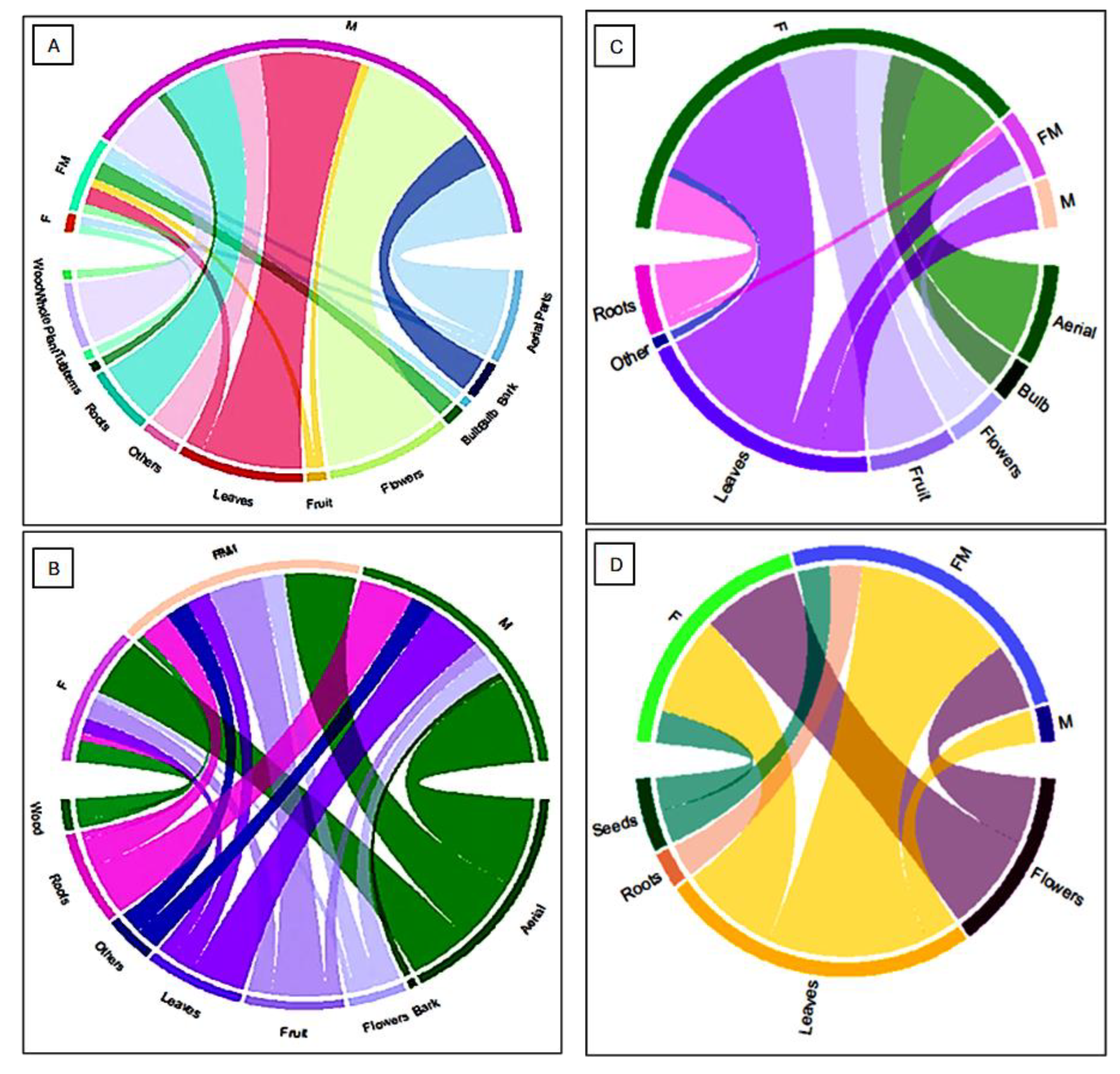
Figure 4.
(A)The interconnectedness of plant studies and the overlap in plant parts examined across different studies, (B) The chord diagram confirms the dynamic interplay between all the studies over time.
Figure 4.
(A)The interconnectedness of plant studies and the overlap in plant parts examined across different studies, (B) The chord diagram confirms the dynamic interplay between all the studies over time.
Figure 5.
The chord diagram between all the usage and used parts in each data over time (A) Rovera (1982), (B) Musset and Dore (2004), (C) our collected data (2011), and (D) data (2022).
Figure 5.
The chord diagram between all the usage and used parts in each data over time (A) Rovera (1982), (B) Musset and Dore (2004), (C) our collected data (2011), and (D) data (2022).
The network diagram reveals that the collected data in 2022 Data shares plant parts with Musset and Dore 2004, Rovera 1982, and data 2011. Similarly, Musset and Dore 2004 and Rovera 1982 also share plant parts with our collected data in 2011. This interconnectedness suggests potential connection based on the same region area and mountain community among these studies, especially the same ecosystems and per consequence that will confirm their variation based on risk factors. The chord diagram confirms the dynamic interplay between the studies over time, despite their focus on the same region and valleys.
Earlier studies, such as Rovera et al., (1982), may have prioritized more traditional plant uses, focusing on parts like Bark and Flowers. In contrast, more recent studies, like our collected datr in 2022 and 2011, seem to explore a broader range of plant parts, potentially reflecting evolving research interests and methodologies.
Understanding these shifts and overlaps is crucial for a comprehensive understanding of plant use and ecology in the region. The chord diagrams provide a visual representation of the overlap in plant parts used for medicinal and food purposes across different studies. The thickness of the ribbons connecting the plant parts indicates the extent of overlap. For instance, the significant overlap between "Bark" and "Leaves" in both diagrams suggests that these plant parts are commonly used for both medicinal and food purposes. This finding aligns with traditional knowledge systems where various plant parts are utilized for diverse applications. Similarly, the overlap between "Flowers" and "Fruit" indicates that these reproductive plant parts are often used in both culinary and medicinal practices. This overlap could be attributed to their potential medicinal properties, such as anti-inflammatory or antioxidant effects.
On the other hand, plant parts like "Wood" and "Roots" show less overlap with other categories, suggesting a more specialized use in either medicine or food. This could be due to their structural properties or specific chemical compounds that limit their versatility.
When analyzing the data separately and connecting it with the tier conditions, the different aspects of the interconnection between the plant parts and their uses become more apparent.
Diagram A, representing Rovera et al., (1982), reveals a more pronounced overlap between "Bark" and "Leaves," indicating a strong association of these plant parts with both medicinal and food applications. Additionally, the overlap between "Flowers" and "Fruit" is significant, suggesting their versatile use in various cultural practices.
Diagram B, which corresponds to Musset and Dore (2004), shows a more balanced distribution of overlap across different plant parts. While "Flowers" and "Bark" still exhibit a notable overlap, other plant parts like "Leaves" and "Fruit" show a more moderate level of overlap. This implies a potentially wider range of plant parts used for both medicinal and food purposes in the context represented by this Data . The Chord Diagram C, based on our collected data (2011), further highlights the overlap between medicinal and food uses of different plant parts. It illustrates a diverse range of plant parts utilized for various purposes, showing how cultural practices have expanded the number of plant parts used for different applications.
Finally, Chord Diagram D, representing our collected data (2022), offers insights into the continued use and overlap of plant parts, with some newer trends emerging in the overlap patterns. Like Diagram C, it reflects a broad utilization of plant parts but with some shift in preferences based on more recent ecological or cultural influences. Each diagram illustrates the evolving relationship between plant parts and their medicinal and food uses, emphasizing the dynamic and interconnected nature of ethnobotanical knowledge across different time periods.
2.3. Patterns, Similarities, and Knowledge Dynamics: A Comparative Analysis Through Heatmaps, Dendrograms, and Principal Component Analysis (PCA)
Notable clusters include families such as Apiaceae and Asteraceae, which exhibit significant overlap, while families like Liliaceae and Rubiaceae appear more distinct with lower similarity, as indicated by darker hues (Figure 6). Figure 6 emphasizes compositional relationships and biodiversity patterns, providing insights into ecological associations and the distinctiveness of certain plant families. The diagonal symmetry confirms the consistency of the Jaccard Index in reflecting these relationships.
The dendrograms on the sides of the heatmap represent the hierarchical clustering of the data sets. Similar data sets are grouped, forming clusters. The height of the branches in the dendrogram reflects the similarity between the clusters.
Overall, the heatmap provides a visual representation of the relationships between the data sets, allowing you to identify groups of similar data sets and understand the patterns of similarity and dissimilarity.
The dendrogram (Figure 7) illustrates the hierarchical clustering of four studies, revealing distinct patterns of similarity and dissimilarity. Data A (Rovera et al., 1982) emerges as the most unique, forming an independent cluster. Data B (Musset and Dore 2004) shares some similarities with A but also exhibits distinct characteristics, placing it in a separate cluster. In contrast, Studies C (Data 2011) and D (Data 2022) demonstrate a high degree of similarity, forming a closely related cluster. This suggests that the latter two studies' data may share common botanical taxa focus or families and ecosystem factors, differentiating them from the earlier studies and that was confirmed by the PCA analysis.
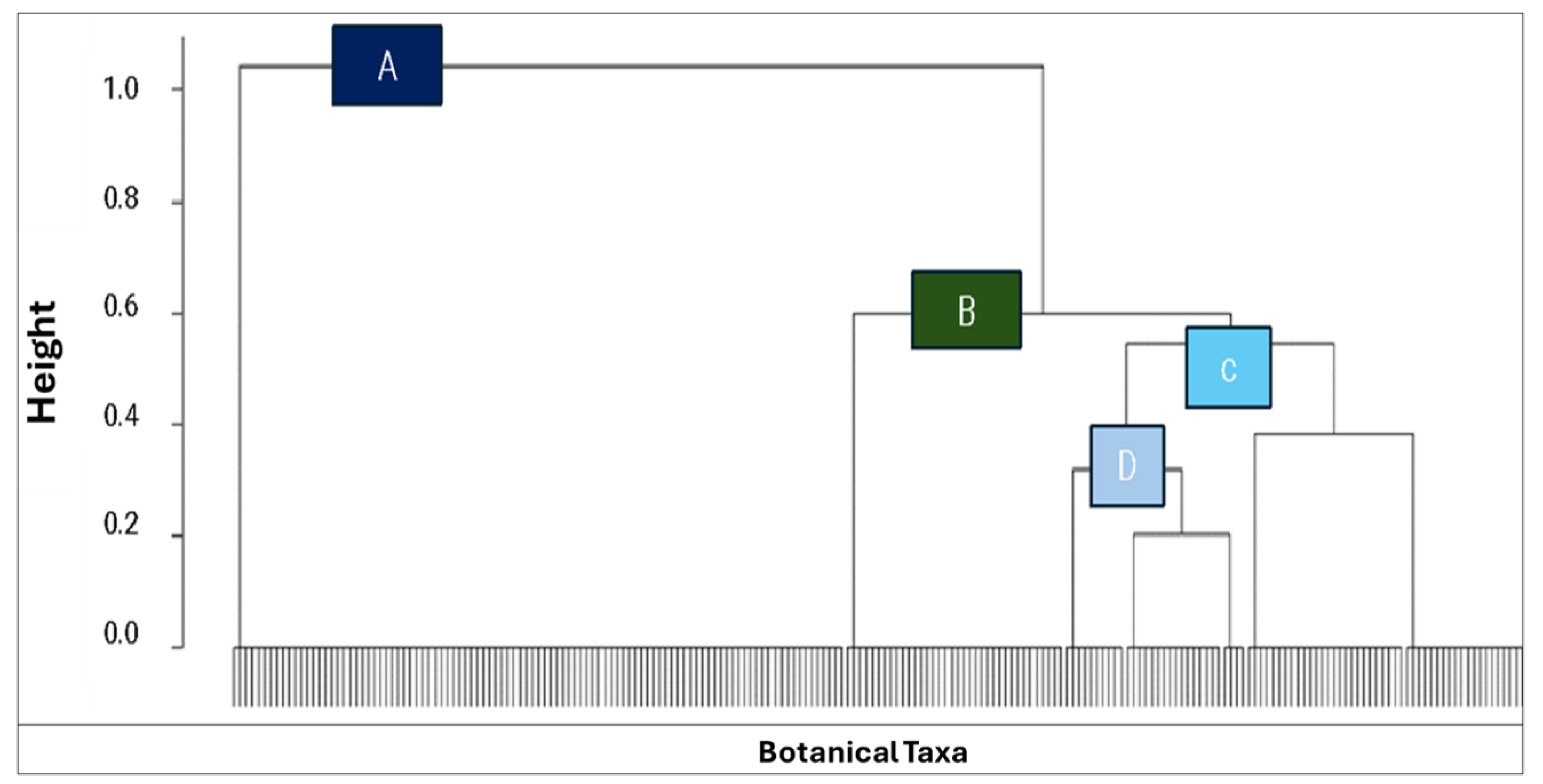
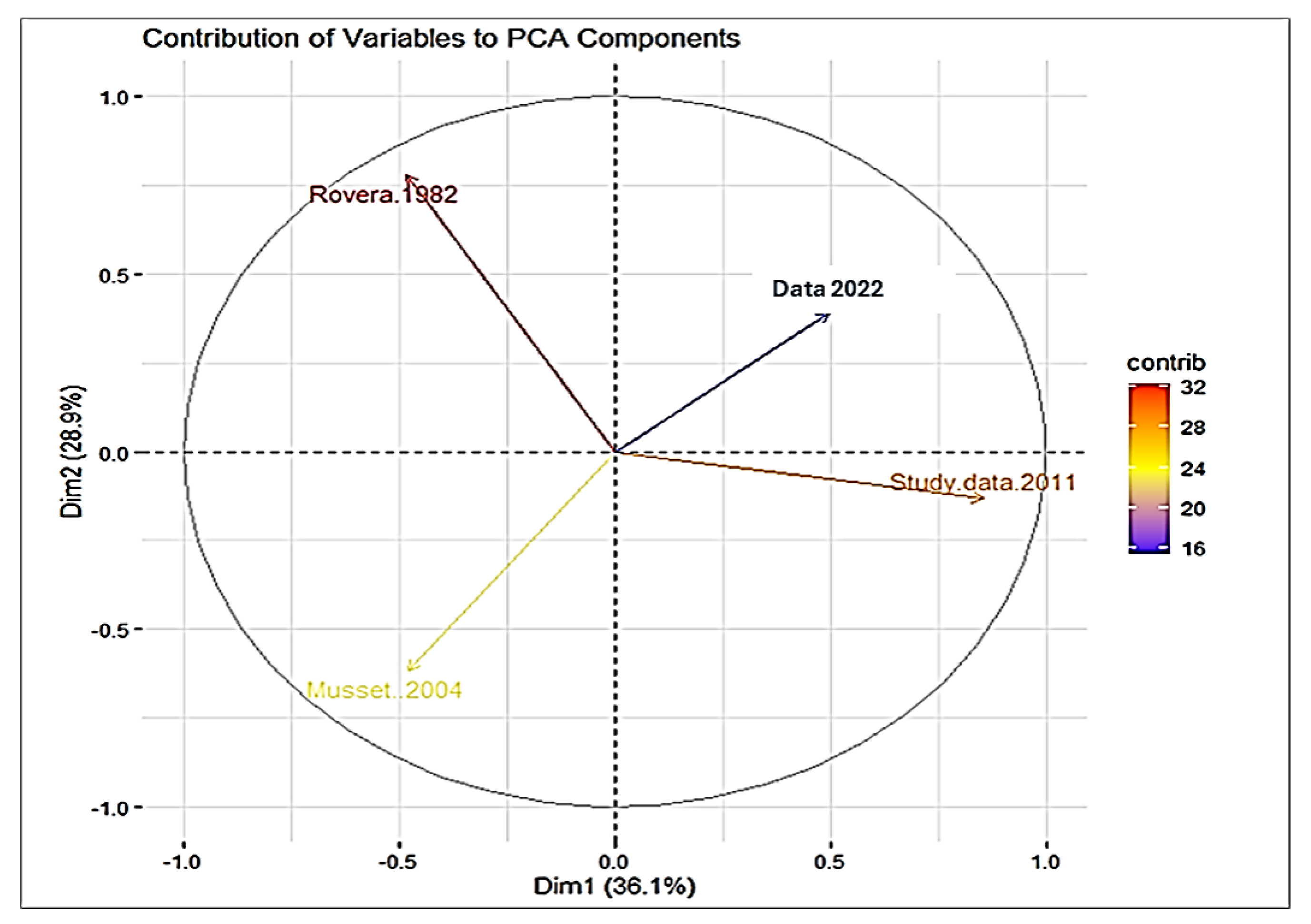
Figure 7.
A dendrogram is a tree-like diagram used to visualize hierarchical relationships between data studies labeled (A) Rovera et al., (1982), (B) Musset and Dore (2004), (C)Our data (2011), and (D) Our data (2022).
Figure 7.
A dendrogram is a tree-like diagram used to visualize hierarchical relationships between data studies labeled (A) Rovera et al., (1982), (B) Musset and Dore (2004), (C)Our data (2011), and (D) Our data (2022).
Figure 8.
The biplot visualizes the relationships between the four studies based on their contribution to the principal components. The studies can be clustered into two groups: Cluster 1 comprising Rovera 1982 and Musset and Dore 2004, and Cluster 2 including Data Data 2011 and Stellato 2022.
Figure 8.
The biplot visualizes the relationships between the four studies based on their contribution to the principal components. The studies can be clustered into two groups: Cluster 1 comprising Rovera 1982 and Musset and Dore 2004, and Cluster 2 including Data Data 2011 and Stellato 2022.
The first principal component (PC1) separates these clusters, indicating that it captures the primary source of variation between the studies. Rovera etal., (1982) and Musset and Dore (2004) exhibit similar patterns of variation, In contrast, our collected data 2011 and 2022 demonstrate distinct patterns.
The length of the arrows in the biplot represents the contribution of each Data to the principal components. Rovera et al., (1982) has a greater influence on the overall variation in the data. By analyzing the biplot, we can gain insights into the similarities and differences between the studies and identify potential trends or patterns in their research.
2.4. Factors Influencing Botanical Diversity: Insights from Logistic Regression Analysis
To understand and complete our version of the results a logistic model was developed.

Table 2.
The logistic regression model was used to analyze the influence of various explanatory variables on the number of botanical taxa observed in different conditions.
Table 2.
The logistic regression model was used to analyze the influence of various explanatory variables on the number of botanical taxa observed in different conditions.
| Explanatory Variables | Category | Coefficients | Odds Ratios | Std. Error | P-value |
|---|---|---|---|---|---|
| Altitude (m) | 600-1600 | 0.8 | 2.22 | 0.3 | 0.002 |
| 1600-2400 | 0.45 | 1.57 | 0.25 | 0.048 | |
| 2400–3031 | 0.1 | 1.11 | 0.32 | 0.724 | |
| Temperature Average (°C) | 5 to 12°C | 0.3 | 1.35 | 0.28 | 0.223 |
| 7 to 13°C | -0.1 | 0.9 | 0.27 | 0.74 | |
| Precipitation Average (mm) | 1400-1600 | -0.2 | 0.82 | 0.31 | 0.511 |
| 1200-1400 | -0.5 | 0.61 | 0.35 | 0.151 | |
| Age Range (years) | 71-75 | 0.85 | 2.34 | 0.3 | 0.004 |
| 30-80 | 0.15 | 1.16 | 0.22 | 0.441 | |
| Data Source | Interviews | 0.6 | 1.82 | 0.35 | 0.09 |
| Herbarium | 0.25 | 1.28 | 0.4 | 0.517 |
The results revealed that altitude was a significant predictor, with the 600-1600 m range showing the strongest effect (odds ratio = 2.22, p = 0.002). This supports the findings of Rovera et al., (1982), where the highest number of taxa (112) was observed under similar altitude conditions. The temperature categories (5 to 12°C and 7 to 13°C) did not show a significant influence on botanical diversity, with P-values above 0.05, suggesting that temperature may have a weaker effect than altitude in shaping plant diversity. Precipitation was also not a significant factor, with P-values of 0.511 and 0.151 for the 1400-1600 mm and 1200-1400 mm categories, respectively. The age range of participants showed a significant effect, with individuals in the 71-75 years category reporting a higher number of botanical taxa (odds ratio = 2.34, p = 0.004), indicating that older participants may possess more knowledge about the local flora. Finally, data sources showed a marginal effect, with interviews being slightly more informative (odds ratio = 1.82, p = 0.090) compared to herbarium data, although this result was not statistically significant at the 0.05 level. These findings underscore the importance of altitude and age in understanding the diversity of botanical taxa, while also highlighting the relative influence of direct interviews over other data sources in capturing plant diversity.
3. Discussion
3.1. Resilience and Change Wild Plants in the Southern Occitan Alps
The analysis of ethnobotanical data from the Alpine Southern Occitan area reveals a notable reduction in plant species diversity over the past few decades. When comparing the four studies spanning from 1982 to 2022, it is evident that the number of documented taxa has decreased significantly. While the Rovera et al., (1982) and Musset and Dore (2004) studies cataloged a wide variety of species, including many medicinal plants such as Achillea millefolium and Artemisia absinthium, the later studies (particularly our collected data in 2022) show a marked decline in the number of species reported.
As noted, there has been a dramatic decrease in the number of wild herbs actively used in the region. Herbs such as Achillea, Artemisia, Veronica, and Viola species, which were once key components of local diets and medicinal practices, have seen their usage diminish significantly. These species are now considered uncommon, and in many cases, are no longer present in the local herbal market. This decline can be linked to the diminishing number of people who still engage with the natural environment daily [24,25]. The role of these herbs, which once had medicinal and culinary applications, is now largely forgotten or relegated to anecdotal references in older generations. The shift away from traditional ecological practices has led to the loss of a deep knowledge base surrounding these plants, which had once been part of the fabric of daily life [10,16].
Another significant trend revealed by the results is the changing emphasis on different plant parts over time. The earlier studies, such as [22] Rovera et al., (1982), show a strong emphasis on the medicinal uses of plants, with flowers, leaves, and roots being the most commonly used parts. However, in more recent collected data, such as data 2011 and (2022), the focus has shifted towards food-related uses, particularly fruits. This shift reflects changing dietary patterns in the region, where wild food sources have become more central to local consumption [26,27]. The increased use of fruits, such as those from Rubus and Malus species, mirrors broader trends in the local food culture, likely influenced by shifts in agriculture, food security concerns, and a growing preference for locally sourced, seasonal foods [28,29]. This change is especially notable in our collected data in (2022), where fruits comprise 50% of plant part usage. This suggests that while medicinal plant use declines, plant species that contribute to food security and nutritional needs are becoming more significant in the cultural practices of the region.
3.2. Ecological and Socio-Economic Drivers of Plant Knowledge and Diversity
The role of ecological factors in shaping plant knowledge and diversity was also explored. One key finding is the strong relationship between altitude and plant diversity. The studies consistently show that higher altitudes are associated with greater plant diversity, particularly for medicinal and food-related species. This result aligns with Rovera’s (1982) findings, which reported the highest diversity of plants at altitudes between 600 and 1600 masl. The environmental conditions of these higher altitudes likely foster a wider range of plant species, providing diverse resources for the local population [30]. Interestingly, the analysis revealed no significant correlation between plant diversity and temperature or precipitation categories, suggesting that altitude is a more significant factor in shaping plant diversity than climate alone [31]. This finding emphasizes the unique ecological conditions of the Alpine Southern Occitan region, where altitude appears to be a key determinant of both plant diversity and the extent of traditional plant knowledge.
The socio-economic changes in the region have played a major role in altering plant use patterns. The decrease in medicinal plant knowledge can be seen as part of a broader trend toward modernization and the decline of traditional farming and foraging practices [32]. The younger generations in the region are less likely to engage in traditional agricultural practices and are more reliant on commercial food systems, which has contributed to the shift away from wild plant usage [18,30]. The increased use of certain plant families, such as Brassicaceae and Amaranthaceae, suggests that external factors, including changes in food security and agricultural practices, have influenced plant selection. These shifts could also reflect global food trends or the introduction of new crops that have displaced older, more traditional plants [33]. The reduction in the use of some plant families, such as Asteraceae, further points to the impact of external agricultural policies, migration, and urbanization on local plant knowledge systems [34].
Despite this decline, there remains an opportunity to revitalize the use of these herbs, particularly in innovative food and beverage sectors. The use of wild herbs such as Achillea (Yarrow), Artemisia (Wormwood), Veronica (Speedwell), and Viola (Violet) could play a significant role in the development of novel food products. These herbs, which are not yet widely available on the herbal market, hold untapped potential for sustainable, innovative food and beverage applications [35,36]. They could be incorporated into health-conscious, eco-friendly products that align with current trends towards natural and local ingredients. Exploring the culinary and medicinal potential of these plants could reinvigorate interest in traditional plant knowledge, offering both ecological and economic benefits by reintroducing these species into contemporary markets [37].
The revival of interest in these plants could also help bridge the knowledge gap created by the loss of TEK. By integrating these herbs into modern products, there is an opportunity to reconnect people with their environmental heritage, fostering a renewed relationship with local plants [24,38]. This process could help combat the Hysteresis Effect by reintegrating forgotten knowledge into the cultural landscape, even in the absence of daily engagement with nature. These plants, once critical to rural livelihoods, could once again play a role in the ecological and cultural revitalization of the region.
The findings from this Data provide valuable insights into the changing relationship between local communities and their plant resources. As plant knowledge continues to decline, there is an urgent need for efforts to preserve traditional ecological knowledge, especially through community-based initiatives. Future research should focus on revitalizing plant knowledge by engaging local communities in documentation and education programs that emphasize the importance of wild plants for both cultural and ecological sustainability. Longitudinal studies that explore the relationship between socio-economic shifts, environmental changes, and plant knowledge would be valuable in further understanding the factors contributing to the erosion of TEK. Furthermore, research that includes a broader range of ecological zones and socio-economic contexts could provide a more comprehensive view of the forces driving these shifts across the region.
3.3. Limitations of the Data
This Data is limited by several factors. First, the geographical scope is focused on specific mountain areas, which may not fully represent the diversity of plant knowledge in other regions. The historical context of plant use is also challenging, as the decline of traditional practices over decades may have led to gaps in knowledge. Additionally, participant memory and subjective interpretations of plant usage could influence the accuracy of the data. The Data does not extensively explore other factors, such as environmental changes or agricultural practices, that might affect herb use. Finally, cultural shifts and the adoption of modern alternatives may have influenced the decline in traditional plant knowledge. Future research should address these limitations by broadening the scope, including younger generations, and exploring additional ecological and socio-economic factors.
4. Materials and Methods
4.1. Data Area
The Alpine Southern Occitan Area (Maria, Stura, and Grana valleys), nestled between the western Alps and the borderlands of Italy and France (Figure 9), is a region steeped in a rich history of both ecological and cultural significance [39]. This area has long been home to communities that have developed unique agricultural and medicinal practices suited to the challenging alpine environment. At altitudes ranging from 600 to 3000 meters, the region is defined by a distinct climate, marked by moderate to cold temperatures and significant seasonal variations in precipitation, creating a diverse range of ecological zones [10]. These varying altitudes have resulted in an exceptional variety of plant species, many of which are deeply embedded in the traditional practices of the local communities. The history of the region is characterized by a longstanding reliance on farming, pastoralism, and local plant knowledge, which has shaped both the cultural and ecological landscapes. Over time, these communities have developed intricate systems of ecological knowledge that integrate plant use with the broader cultural and spiritual practices of the region.
The region’s people, traditionally organized in small, close-knit communities, have a strong sense of identity rooted in the land they cultivate and the ecological resources they manage. This connection to the land is reflected in the way traditional knowledge has been passed down through generations, often through familial lines and communal teachings. The transmission of knowledge was primarily oral, with elders passing down plant-based wisdom related to medicinal, culinary, and agricultural practices. This knowledge was not only practical but deeply tied to local cosmologies and worldviews, which held a spiritual and ethical connection to nature [10,40]. For instance, certain plants were considered sacred, and their use was governed by strict cultural protocols that ensured sustainable harvesting and respect for the natural world. However, the interplay between ecological conditions, such as the region’s altitude and climate, and cultural practices has been increasingly disrupted by socio-economic shifts. The pressures of modernization, economic changes, and out-migration have altered the way younger generations relate to traditional practices, with many abandoning them in favor of urban life and more standardized agricultural techniques.
4.2. Fieldwork and Data Collection
For this comparative Data , the fieldwork spans several decades, from 1982 to 2022, and includes both historical and contemporary data on local plant knowledge. The data collection process has involved interviewing individuals from a range of professions, including farmers, restaurateurs, and workers in the tourism industry (Table 3). These interviews have captured the changing dynamics of plant use and ecological knowledge, shedding light on how the local plant knowledge system has evolved in response to broader socio-economic and environmental shifts.
In addition to interviews, field observations have been conducted to record plant species in the wild, with an emphasis on how climate change and land use alterations have impacted plant distribution and abundance at different altitudes (Figure 10) will give a view on this altitude and the natural landscape. These observations allow for an in-depth understanding of how ecological changes, such as shifts in temperature or precipitation patterns, influence local plant knowledge and practices. Moreover, the influx of migrants into the region has brought new plant knowledge and altered traditional practices, further complicating the region’s ethnobotanical landscape. Plant specimens had been collected, identified, and deposited in a recognized herbarium during previous ethnobotanical fieldwork conducted by some of the authors in the contiguous areas of the Western Alps [10,40]. Verbal consent was always obtained from the Data participants, following the Code of Ethics of the Interantioanl Society of Ethnobiology [41].
4.3. Data Analysis
The analysis of the collected data will be conducted using both SAS 9.4 and R v4.4.2 to explore the relationships between ecological and cultural factors influencing plant knowledge and its transmission. Statistical techniques such as PCA (Principal Component Analysis) will be used to reduce the complexity of the data and identify key ecological and cultural variables that explain variations in plant knowledge across the region. Cluster analysis will also be employed to group plant species based on their cultural and ecological significance, revealing patterns in how these species are used and shared among different communities. In addition, Redundancy Analysis (RDA) will be utilized to examine the relationship between ecological factors such as temperature, precipitation, altitude, and plant species distribution. This will allow the Data to assess how environmental conditions influence the preservation or loss of traditional plant knowledge.
Furthermore, A logistic regression model was applied to assess the relationship between botanical taxa presence and various ecological and socio-economic factors. The explanatory variables included altitude, temperature, precipitation, age range, and data source. The botanical taxa data were treated as a binary outcome, indicating the presence or absence of species in different environmental conditions. The model results suggest that age range and altitude are significant predictors of botanical taxa presence.
The general form of the logistic regression model is:
Where:
- p is the probability of the event occurring (e.g., presence of a botanical taxa).
- β0 is the intercept (constant term).
- βi are the coefficients for each explanatory variable.
- Xi are the explanatory variables (altitude, temperature, precipitation, age range, and data source).
Based on our variables the model equation can be written as:
Logit(p)=β0+β1xAltitude1+β2xAltitude2+β3xAltitude3+β4xTemperature1+β5xTemperature2+β6xPrecipitation1+β7xPrecipitation2+β8xAge1+β9xAge2+β10xData Source1+β11xData Source2
Where:
- Altitude1, Altitude2, and Altitude are the dummy variables for the three levels of Altitude (600-1,600m, 1600-2,400m, and 2,400–3,031m).
- Temperature1 and Temperature are the dummy variables for the two levels of Temperature Average (5 to 12°C and 7 to 13°C).
- Precipitation 1 and Precipitation 2 are the dummy variables for the two levels of Precipitation Average (1400-1600mm and 1200-1400mm).
- Age1and Age2 are the dummy variables for the two levels of Age Range (71-75 years and 30-80 years).
- Data Source has two levels: Interviews and Herbarium. Substituting the Coefficients
These analyses will help reveal how both ecological changes and cultural transformations contribute to the erosion or revitalization of TEK in the region.
The collected data will also be examined through frequency analysis to track patterns in plant species use across different altitudinal zones and over time, highlighting how knowledge is retained, lost, or adapted in response to changing circumstances. Additionally, Venn diagrams will be used to represent the overlap between plant species used in various cultural contexts and ecological zones, offering a visual representation of shared or distinct knowledge systems.
5. Conclusions
In conclusion, the dramatic decline in the use of wild herbs in the Alpine Southern Occitan region highlights the broader loss of traditional ecological knowledge due to the disappearance of daily engagement with nature. The application of the Hysteresis Effect theory underscores the difficulty of reversing this trend once it has set in, but also points to potential pathways for recovery, particularly through the innovative use of rare plants like Achillea, Artemisia, Veronica, and Viola. While the plants remain in the landscape, their cultural and practical significance has waned, but by reintroducing them into modern food and beverage markets, we may be able to revive interest and knowledge, creating a more sustainable and culturally aware future.
Author Contributions
M.A.: conceptualization, methodology, data curation, visualization, formal analysis, and writing original draft preparation. N.S.: conceptualization, methodology, review, and editing. A.P.: supervision, conceptualization, methodology, funding, review, and editing. All authors have read and agreed to the published version of the manuscript.
Funding
This publication is part of the project NODES which has received funding from the MUR-M4C2 1.5 of PNRR funded by the European Union-NextGenerationEU (Grant agreement no. ECS00000036).
Data Availability Statement
The data that support the findings of this Data are presented in the article.
Ethics statement and consent to participate: The International Society of Ethnobiology Code of Ethics was strictly followed, and informed consent was always obtained from each participant before interviews.
Acknowledgments
We thank the local communities for sharing their previous LEK and some former UNISG students who collected in the field some of the data presented in this analysis: Eva Fachino, Andrea Masino, Giulia Mattalia, Federico Mina, Martina Spreafico, Irene Stellato.
Conflicts of Interest
The authors declare no conflict of interest.
References
- Sulaiman, N.; Zocchi, D.M.; Borrello, M.T.; Mattalia, G.; Antoniazzi, L.; Berlinghof, S.E.; Bewick, A.; Häfliger, I.; Schembs, M.; Torri, L.; et al. Traditional Knowledge Evolution over Half of a Century: Local Herbal Resources and Their Changes in the Upper Susa Valley of Northwest Italy. Plants 2024, 13, 43. [Google Scholar] [CrossRef] [PubMed]
- Re, A.; Avanza, G. ICH in the South-Western Alps. Empowering Communities through Youth Education on Nature and Cultural Practices.; 2020.
- Burns, R.K. The Circum-Alpine Culture Area: A Preliminary View. Anthropol. Q. 1963, 36, 130. [Google Scholar] [CrossRef]
- Abdullah, A.; Khan, S.M. Traditional Ecological Knowledge Sustains Due to Poverty and Lack of Choices Rather than Thinking about the Environment. J. Ethnobiol. Ethnomedicine 2023, 19, 65. [Google Scholar] [CrossRef] [PubMed]
- Albuquerque, U.P.; Cantalice, A.S.; Oliveira, D.V.; Oliveira, E.S.; dos Santos, E.B.; dos Santos, F.I.R.; Soldati, G.T.; da Silva Lima, I.; Silva, J.V.M.; Abreu, M.B.; et al. Why Is Traditional Ecological Knowledge (TEK) Maintained? An Answer to Hartel et al. (2023). Biodivers. Conserv. 2024, 33, 859–866. [Google Scholar] [CrossRef]
- Abildtrup, J.; Audsley, E.; Fekete-Farkas, M.; Giupponi, C.; Gylling, M.; Rosato, P.; Rounsevell, M. Socio-Economic Scenario Development for the Assessment of Climate Change Impacts on Agricultural Land Use: A Pairwise Comparison Approach. Environ. Sci. Policy 2006, 9, 101–115. [Google Scholar] [CrossRef]
- Al Hatmi, S.; Lupton, D.A. Documenting the Most Widely Utilized Plants and the Potential Threats Facing Ethnobotanical Practices in the Western Hajar Mountains, Sultanate of Oman. J. Arid Environ. 2021, 189, 104484. [Google Scholar] [CrossRef]
- Greenfield, D.E. Traditional Ecological Knowledge (TEK): A Comprehensive Guide. Available online: https://sigmaearth.com/traditional-ecological-knowledge-tek-a-comprehensive-guide/ (accessed on 12 June 2024).
- Casi, C.; Guttorm, H.; Virtanen, P. Traditional Ecological Knowledge. Situating Sustain. Handb. Contexts Concepts 2021. [Google Scholar]
- Pieroni, A.; Giusti, M.E. Alpine Ethnobotany in Italy: Traditional Knowledge of Gastronomic and Medicinal Plants among the Occitans of the Upper Varaita Valley, Piedmont. J. Ethnobiol. Ethnomedicine 2009, 5, 32. [Google Scholar] [CrossRef]
- Lyver, P.O.; Timoti, P.; Davis, T.; Tylianakis, J.M. Biocultural Hysteresis Inhibits Adaptation to Environmental Change. Trends Ecol. Evol. 2019, 34, 771–780. [Google Scholar] [CrossRef]
- Pieroni, A. Traditional Uses of Wild Food Plants, Medicinal Plants, and Domestic Remedies in Albanian, Aromanian and Macedonian Villages in South-Eastern Albania. J. Herb. Med. 2017. [Google Scholar] [CrossRef]
- Pearson, J.; Jackson, G.; McNamara, K.E. Climate-Driven Losses to Knowledge Systems and Cultural Heritage: A Literature Review Exploring the Impacts on Indigenous and Local Cultures. Anthr. Rev. 2023, 10, 343–366. [Google Scholar] [CrossRef]
- Oteros-Rozas, E.; Ontillera-Sánchez, R.; Sanosa, P.; Gómez-Baggethun, E.; Reyes-García, V.; González, J.A. Traditional Ecological Knowledge among Transhumant Pastoralists in Mediterranean Spain. In Proceedings of the Ecology and Society; 2013; Vol. 18, p. art33.
- Albuquerque, U.P.; Maroyi, A.; Ladio, A.H.; Pieroni, A.; Abbasi, A.M.; Toledo, B.A.; Dahdouh-Guebas, F.; Hallwass, G.; Soldati, G.T.; Odonne, G.; et al. Advancing Ethnobiology for the Ecological Transition and a More Inclusive and Just World: A Comprehensive Framework for the next 20 Years. J. Ethnobiol. Ethnomedicine 2024, 20, 18. [Google Scholar] [CrossRef] [PubMed]
- Harisha, R.P. TRADITIONAL ECOLOGICAL KNOWLEDGE (TEK) AND ITS IMPORTANCE IN SOUTH INDIA: PERSPECIVE FROM LOCAL COMMUNITIES. Appl. Ecol. Environ. Res. 2016, 14, 311–326. [Google Scholar] [CrossRef]
- Abbass, K.; Qasim, M.Z.; Song, H.; Murshed, M.; Mahmood, H.; Younis, I. A Review of the Global Climate Change Impacts, Adaptation, and Sustainable Mitigation Measures. Environ. Sci. Pollut. Res. 2022, 29, 42539–42559. [Google Scholar] [CrossRef]
- Tattoni, C.; Ianni, E.; Geneletti, D.; Zatelli, P.; Ciolli, M. Landscape Changes, Traditional Ecological Knowledge and Future Scenarios in the Alps: A Holistic Ecological Approach. Sci. Total Environ. 2016, 579. [Google Scholar] [CrossRef]
- Singh, R.; Sharma, R.K.; Babu, S.; Bhatnagar, Y.V. Traditional Ecological Knowledge and Contemporary Changes in the Agro-Pastoral System of Upper Spiti Landscape, Indian Trans-Himalayas. Pastoralism 2020, 10, 15. [Google Scholar] [CrossRef]
- Alrhmoun, M. Old Plants for New Food Products? The Diachronic Human Ecology of Wild Herbs in the Western Alps. Press 2024. [Google Scholar] [CrossRef]
- Furusawa; Furusawa, T. Changing Ethnobotanical Knowledge.; Springer Singapore: Singapore, 2016; pp. 111–126. [Google Scholar]
- Rovera, L. ; Lomagno Caramello; Lomagno P.A.; Piervtton, R. La Fitoterapia Popolare Nella Valle Maira. Corso di laurea in scienze naturali., Università degli studi di Torino, Facoltà di Scienze MFN, 1982.
- Musset, D.; Dore, D. La Mauve et l’erba Bianca. Une Introduction Aux Enquêtes Ethnobotaniques Suivie de l’inventaire Des Plantes Utiles Dans La Vallée de La Stura. Un’introduzione Alle Indagini Etnobotaniche Seguita Dall’inventario Delle Piante Utili Nella Valle Della Stura. 2004. [Google Scholar]
- Turner, K.L. “Where Our Women Used to Get the Food”: Cumulative Effects and Loss of Ethnobotanical Knowledge and Practice; Case Data from Coastal British ColumbiaThis Paper Was Submitted for the Special Issue on Ethnobotany, Inspired by the Ethnobotany Symposium Organized by Alain Cuerrier, Montreal Botanical Garden, and Held in Montreal at the 2006 Annual Meeting of the Canadian Botanical Association. In Proceedings of the Botany; February 2008; Vol. 86; pp. 103–115. [Google Scholar]
- Sulaiman, N.; Aziz, M.A.; Stryamets, N.; Mattalia, G.; Zocchi, D.M.; Ahmed, H.M.; Manduzai, A.K.; Shah, A.A.; Faiz, A.; Sõukand, R.; et al. The Importance of Becoming Tamed: Wild Food Plants as Possible Novel Crops in Selected Food-Insecure Regions. Horticulturae 2023, 9, 171. [Google Scholar] [CrossRef]
- Soon, J.M. Changing Trends in Dietary Pattern and Implications to Food and Nutrition Security in Association of Southeast Asian Nations (ASEAN). Int. J. Nutr. Food Sci. 2014, 3, 259. [Google Scholar] [CrossRef]
- Pieroni, A.; Sulaiman, N.; Sõukand, R. Chorta (Wild Greens) in Central Crete: The Bio-Cultural Heritage of a Hidden and Resilient Ingredient of the Mediterranean Diet. Biology 2022, 11, 673. [Google Scholar] [CrossRef]
- Menendez-Baceta, G.; Pardo-de-Santayana, M.; Aceituno-Mata, L.; Tardío, J.; Reyes-García, V. Trends in Wild Food Plants Uses in Gorbeialdea (Basque Country). Appetite 2017, 112, 9–16. [Google Scholar] [CrossRef] [PubMed]
- Zarbà, C.; Allegra, V.; Silvio Zarbà, A.; Zocco, G. ; 1 Department Agriculture, Food and Environment (Di3A), University of Catania, Catania, Italy; 2 Agronomist: Research collaborator Di3A, Catania, Italy Wild Leafy Plants Market Survey in Sicily: From Local Culture to Food Sustainability. AIMS Agric. Food 2019, 4, 534–546. [Google Scholar] [CrossRef]
- Ohsawa, T.; Ide, Y. Global Patterns of Genetic Variation in Plant Species along Vertical and Horizontal Gradients on Mountains. Glob. Ecol. Biogeogr. 2008, 17, 152–163. [Google Scholar] [CrossRef]
- Li, T.; Xiong, Q.; Luo, P.; Zhang, Y.; Gu, X.; Lin, B. Direct and Indirect Effects of Environmental Factors, Spatial Constraints, and Functional Traits on Shaping the Plant Diversity of Montane Forests. Ecol. Evol. 2020, 10, 557–568. [Google Scholar] [CrossRef] [PubMed]
- Xiaobo, Z.; Huang, F.; Hao, L.; Zhao, J.; Mao, H.; Zhang, J.; Ren, S. The Socio-Economic Importance of Wild Vegetable Resources and Their Conservation: A Case Data from China. Kew Bull. 2010, 65, 577–582. [Google Scholar] [CrossRef]
- Martin, A.R.; Cadotte, M.W.; Isaac, M.E.; Milla, R.; Vile, D.; Violle, C. Regional and Global Shifts in Crop Diversity through the Anthropocene. PLOS ONE 2019, 14, e0209788. [Google Scholar] [CrossRef]
- Hurrell, J.A.; Puentes, J.P. Medicinal and Aromatic Species of Asteraceae Commercialized in the Conurbation Buenos Aires-La Plata (Argentina). In Proceedings of the Ethnobiology and Conservation; September 1 2013; Vol. 2. [Google Scholar]
- Jaeger, S.; Giacalone, D. Barriers to Consumption of Plant-Based Beverages: A Comparison of Product Users and Non-Users on Emotional, Conceptual, Situational, Conative and Psychographic Variables. FOOD Res. Int. 2021, 144. [Google Scholar] [CrossRef]
- Maleš, I.; Pedisić, S.; Zorić, Z.; Elez-Garofulić, I.; Repajić, M.; You, L.; Vladimir-Knežević, S.; Butorac, D.; Dragović-Uzelac, V. The Medicinal and Aromatic Plants as Ingredients in Functional Beverage Production. J. Funct. Foods 2022, 96, 105210. [Google Scholar] [CrossRef]
- Ahad, L.; Hassan, M.; Amjad, M.S.; Mir, R.A.; Vitasović-Kosić, I.; Bussmann, R.W.; Binish, Z. Ethnobotanical Insights into Medicinal and Culinary Plant Use: The Dwindling Traditional Heritage of the Dard Ethnic Group in the Gurez Region of the Kashmir Valley, India. Plants 2023, 12, 3599. [Google Scholar] [CrossRef]
- Friday, C.; Scasta, J.D. Eastern Shoshone and Northern Arapaho Traditional Ecological Knowledge (TEK) and Ethnobotany for Wind River Reservation Rangelands. Ethnobiol. Lett. 2020, 11, 14–24. [Google Scholar] [CrossRef]
- De Rossi, A.; Mascino, L. Valades Ousitanes, Architettura e Rigenerazione. In Proceedings of the ARCHALP; August 7 2020; Vol. 2020. [Google Scholar]
- Mattalia, G.; Quave, C.L.; Pieroni, A. Traditional Uses of Wild Food and Medicinal Plants among Brigasc, Kyé, and Provençal Communities on the Western Italian Alps. Genet. Resour. Crop Evol. 2013, 60, 587–603. [Google Scholar] [CrossRef]
- ISE (International Society of Ethnobiology) The ISE Code of Ethics. Available online: https://www.ethnobiology.net/what-we-do/core-programs/ise-ethics-program/code-of-ethics/ (accessed on 15 November 2024).
Figure 1.
Number of reported botanical Plants in the past and present studies in the Data area.
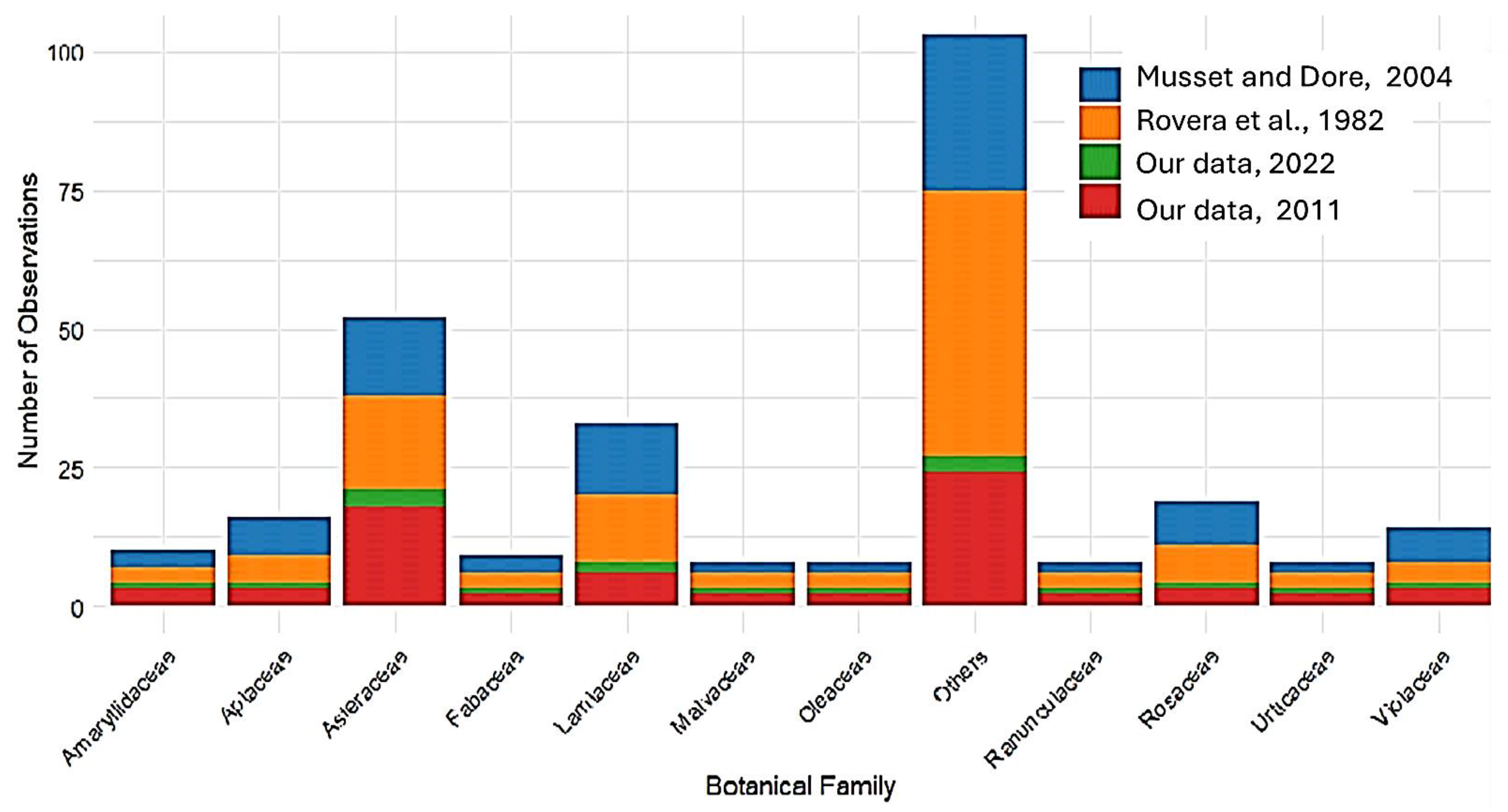
Figure 2.
Genera overlapping within the present Data and previous studies conducted in the region from 1970 to 2022.
Figure 2.
Genera overlapping within the present Data and previous studies conducted in the region from 1970 to 2022.
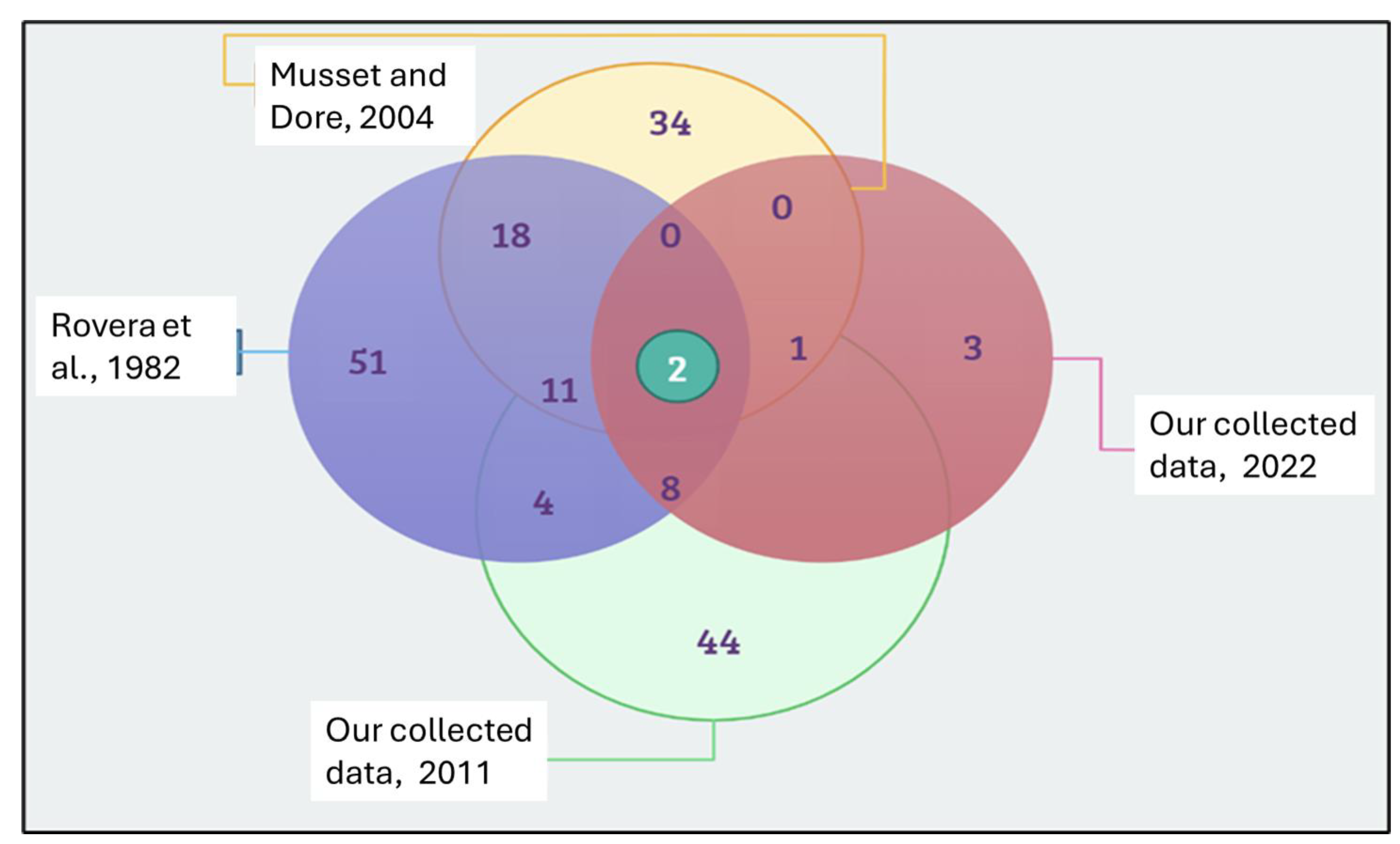
Figure 3.
The distribution of plant part usage (flowers, fruits, and medicinal parts) across the studies and our collected data (Rovera 1982, Musset and Dore 2004, our collected data in 2011, and 2022).
Figure 3.
The distribution of plant part usage (flowers, fruits, and medicinal parts) across the studies and our collected data (Rovera 1982, Musset and Dore 2004, our collected data in 2011, and 2022).
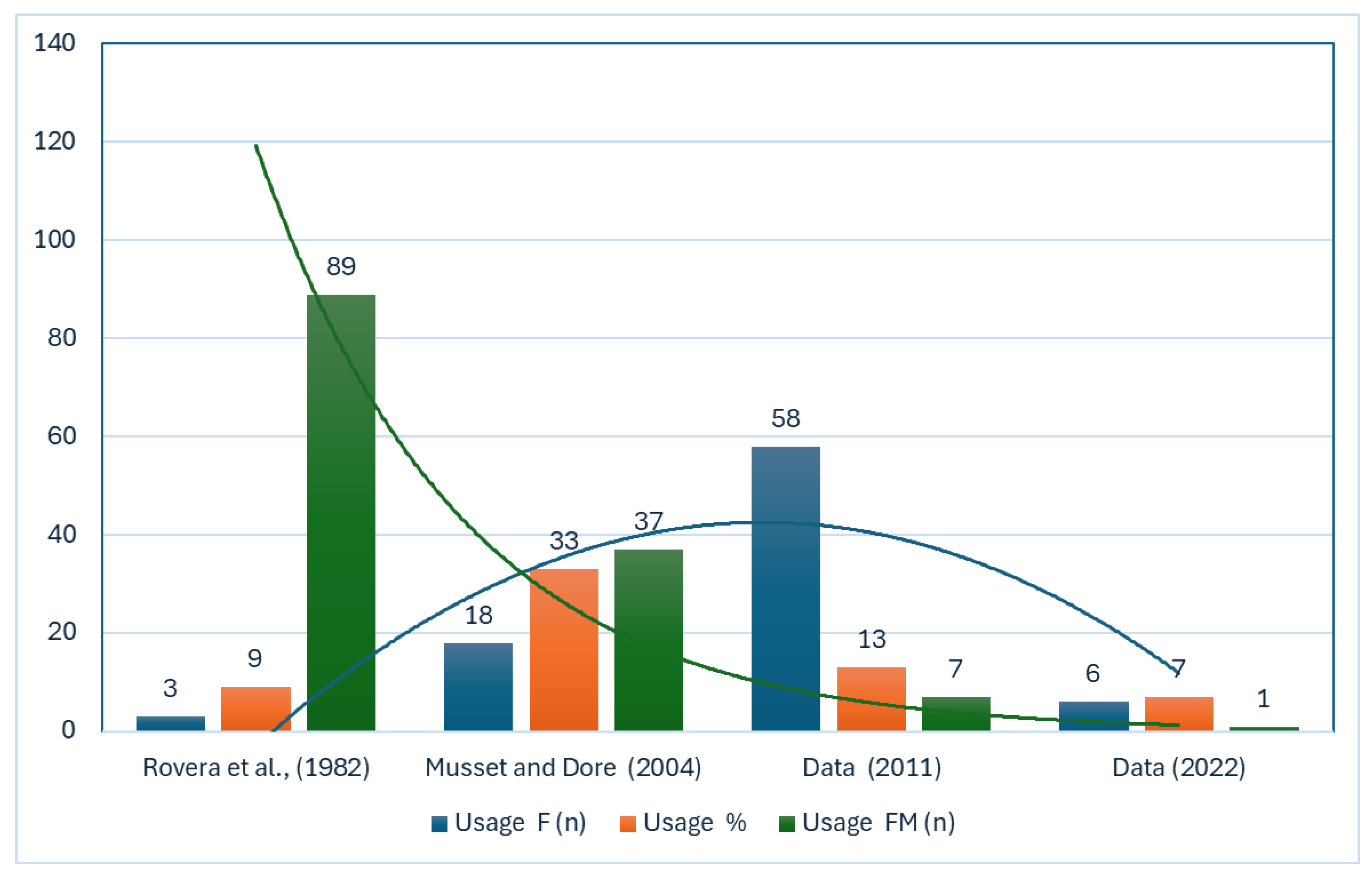
Figure 6.
The heatmap illustrates the Jaccard Index, measuring the similarity between plant species compositions across various families. Values range from 0 (no overlap) to 1 (complete similarity), represented by a gradient from dark blue (low similarity) to cyan (high similarity). The hierarchical clustering on both axes highlights groups of plant families with shared characteristics, as shown by closely aligned branches in the dendrogram.
Figure 6.
The heatmap illustrates the Jaccard Index, measuring the similarity between plant species compositions across various families. Values range from 0 (no overlap) to 1 (complete similarity), represented by a gradient from dark blue (low similarity) to cyan (high similarity). The hierarchical clustering on both axes highlights groups of plant families with shared characteristics, as shown by closely aligned branches in the dendrogram.
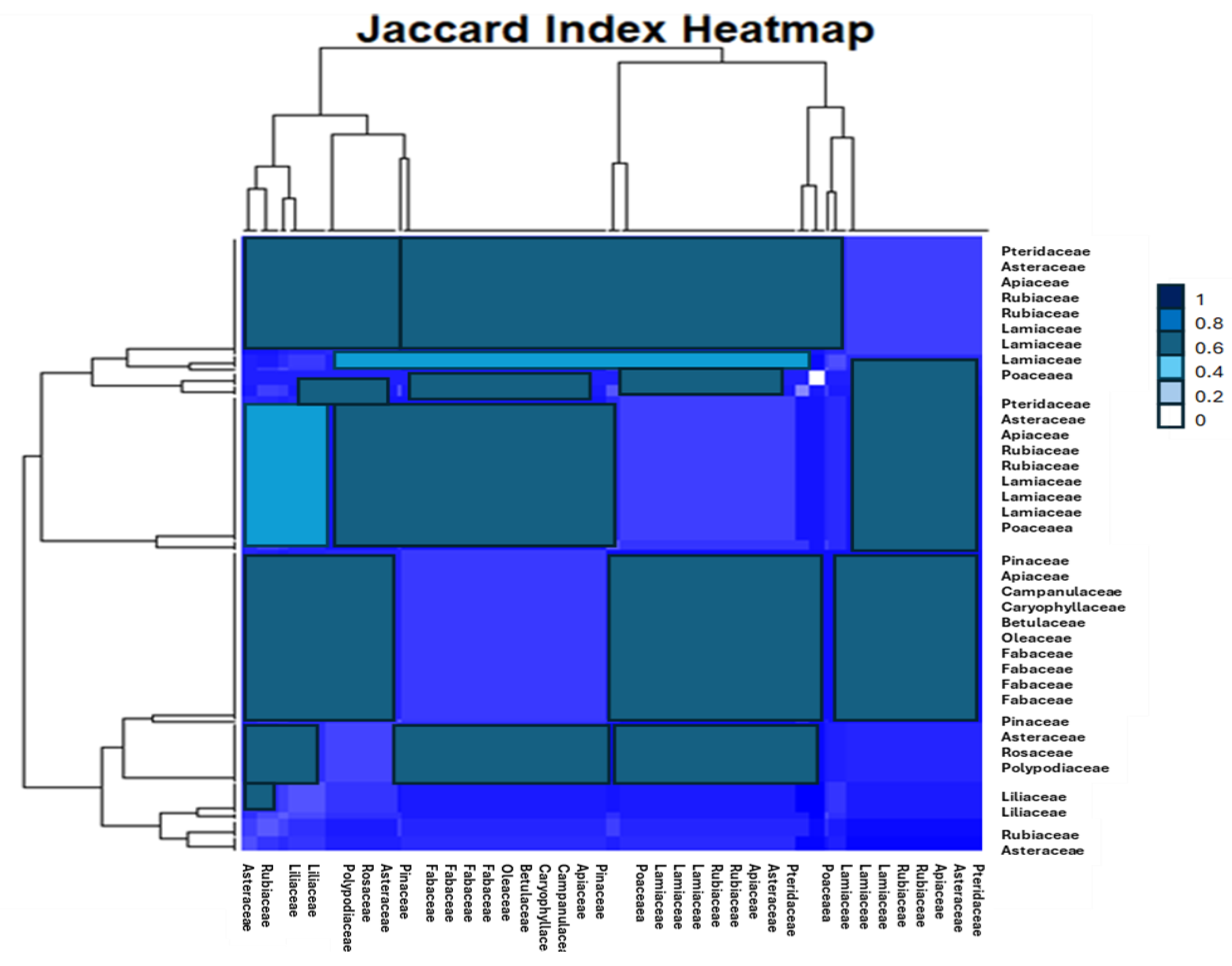
Figure 9.
Map of the Data area within the map of Italy. Red underlining of villages refers to the locations of the Data participants.
Figure 9.
Map of the Data area within the map of Italy. Red underlining of villages refers to the locations of the Data participants.
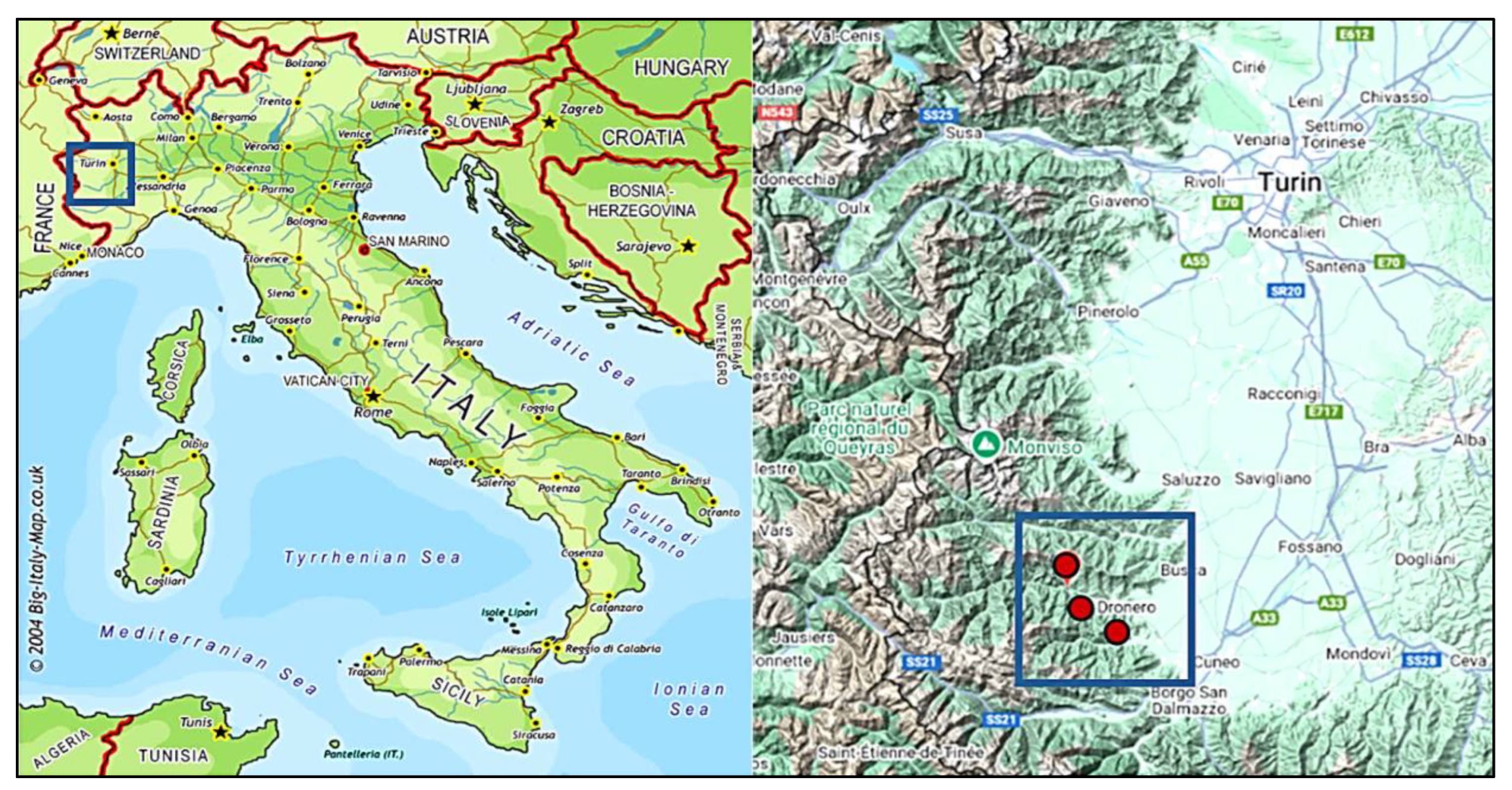
Figure 10.
Natural landscape in the Valle Grana (A) and Maria (B) (Foto: Site Valley Maria, Italy).
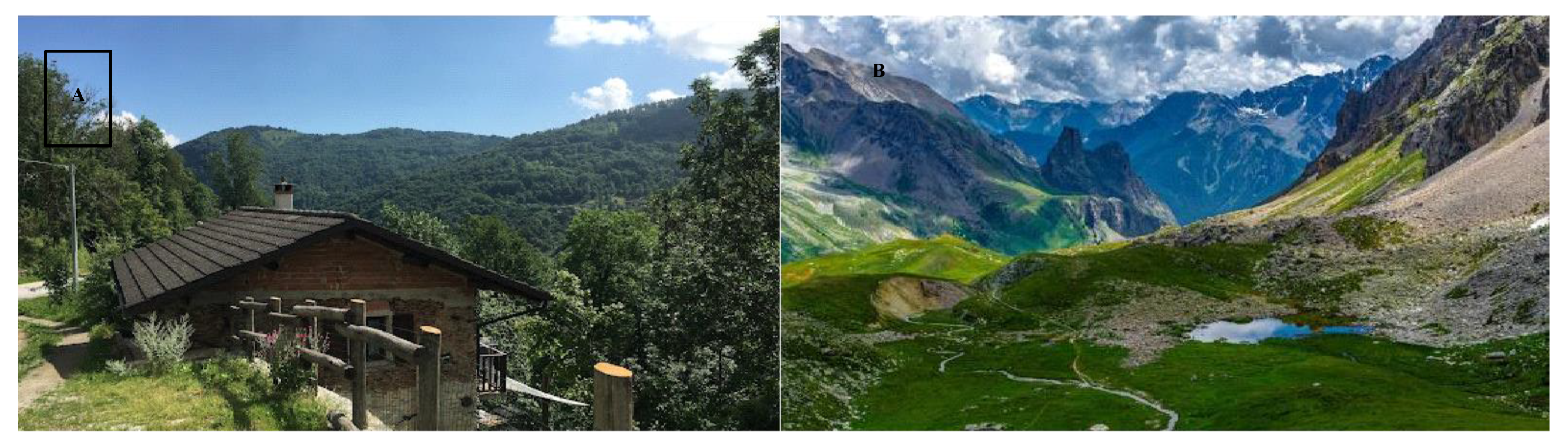
Table 1.
Plant species used for food and medicinal purposes in the Maria, Grana. And Stura Valleys.
| Botanical Taxa | Family | Rovera (1982) | Musset and Dore (2004) | Data (2011) | Data 2022 | Part Used | Usage | Methods of preparations and Usage | Data Reference | |
|---|---|---|---|---|---|---|---|---|---|---|
| Abies alba Mill. | Pinaceae | 1 | 1 | 0 | 0 | Wood | F | Timber, ornamental purposes | Musset and Dore(2004) | |
| 0 | 0 | 0 | 0 | Sap | M | The sap can be used in tinctures or syrups for respiratory issues or as a topical antiseptic. | Rovera (1982) | |||
| Abies grandis (Douglas ex D.Don) Lindl. | Pinaceae | 0 | 1 | 0 | 0 | Wood | F | Timber, ornamental purposes | Musset and Dore (2004) | |
| Abies nordmanniana (Steven) Spach | Pinaceae | 0 | 1 | 0 | 0 | Wood | F | Timber, ornamental purposes | Musset and Dore (2004) | |
| Acacia spp. | Fabaceae | 0 | 0 | 0 | 1 | Flowers, bark | F | Used in fritters, omelets, and as flavoring. Only white or pink flowers used. | Stellato (2022) | |
| Achillea herba-rotta All. | Asteraceae | 1 | 0 | 0 | 0 | Aerial Part | M | Decoction or tea. Drink 1-2 cups per day. | Rovera (1982) | |
| Achillea millefolium L. | Asteraceae | 1 | 1 | 1 | 0 | Flowers, Leaves | M | Herbal remedy, anti-inflammatory | Musset and Dore (2004) | |
| Aconitum napellus L. | Ranunculaceae | 1 | 1 | 0 | 0 | Roots, Leaves | M | Medicinal uses, toxicity | Musset and Dore (2004) | |
| Adiantum capillus-veneris L. | Pteridaceae | 0 | 1 | 0 | 0 | Leaves | M | Treats respiratory issues | Musset and Dore (2004) | |
| Aesculus hippocastanum L. | Sapindaceae | 0 | 1 | 0 | 0 | Seeds | M | Medicinal (for circulation) | Musset and Dore (2004) | |
| Agrimonia eupatoria L. | Rosaceae | 0 | 0 | 1 | 0 | Leaves | F | Herbal teas and infusions | Data (2011) | |
| Alliaria petiolata (M.Bieb.) Cavara & Grande | Brassicaceae | 0 | 0 | 0 | 1 | Leaves, flowers, roots | FM | Used as broccoletti or in pasta. Seeds used to make a mustard-like sauce. | Data (2022) | |
| Allium cepa L. | Amaryllidaceae | 1 | 0 | 0 | 0 | Bulb | FM | Raw or cooked as food; used in folk medicine for colds, coughs, and as an antibacterial. | Rovera (1982) | |
| Allium porrum L. | Amaryllidaceae | 1 | 0 | 0 | 0 | Leaves, bulbs | FM | Consumed as a vegetable in cooking; also used in herbal teas for its medicinal properties. | Rovera (1982) | |
| Allium sativum L. | Amaryllidaceae | 1 | 0 | 0 | 0 | Bulb | FM | Eaten raw or cooked, or used in oils or tinctures for its antibacterial, antiviral, and cardiovascular benefits. | Rovera (1982) | |
| Allium schoenoprasum L. | Alliaceae | 0 | 0 | 1 | 0 | Leaves | F | Food for cows, milk becomes more bitter | Data (2011) | |
| Continued Table 1. | ||||||||||
| Allium ursinum L. | Liliaceae | 0 | 0 | 1 | 1 | Leaves, bulbs | FM | Used for flavoring vegetables, salads, or dishes with fish. Flowers also used in dishes.Treats insomnia, respiratory and cardiac disorders. | Data (2011) | |
| Alopecurus pratensis L. | Poaceae | 0 | 0 | 1 | 0 | Leaves and flowers | F | Used to make better cheese | Data (2011) | |
| Anemone vulgaris Miller | Ranunculaceae | 1 | 0 | 0 | 0 | Aerial parts | M | Decoction, drink 1 small glass before meals | Rovera (1982) | |
| Angelica archangelica L. | Apiaceae | 1 | 0 | 0 | 0 | Roots, leaves | M | Used in tinctures or teas to treat digestive issues, respiratory conditions, and as a mild sedative. | Rovera (1982) | |
| Angelica sylvestris L. | Apiaceae | 0 | 1 | 0 | 0 | Roots, Leaves | M | Herbal remedy, digestive aid | Musset (2004) | |
| Antennaria dioica (L.) Gaertner | Asteraceae | 1 | 0 | 0 | 0 | Herb | M | Made into an infusion or poultice for treating wounds or as a diuretic. | Rovera (1982) | |
| Apium graveolens L. | Apiaceae | 1 | 1 | 0 | 0 | Leaves, Stems | FM | Used in cooking soups, or salads and herbal medicine for digestive health and as a mild sedative. | Musset and Dore (2004) | |
| Arctium lappa L. | Asteraceae | 1 | 1 | 1 | 0 | Roots, Seeds | M | Herbal remedy for skin, detoxification; Root is used in decoctions or teas for detoxification, skin health, and as an anti-inflammatory. | Musset and Dore (2004) | |
| Arctostaphylos uva-ursi (L.) Spreng. | Ericaceae | 0 | 1 | 0 | 0 | Leaves | M | Urinary health, antiseptic | Musset and Dore (2004) | |
| Armoracia rusticana G.Gaertn., B.Mey. & Scherb. | Brassicaceae | 0 | 0 | 1 | 0 | Leaves | F | Liqueur | Data (2011) | |
| Arnica montana L. | Asteraceae | 1 | 0 | 0 | 0 | Flowers, roots | M | Applied topically in ointments or tinctures for bruises, sprains, and inflammatory pain. | Rovera (1982) | |
| Artemisia absinthium L. | Asteraceae | 1 | 1 | 1 | 0 | Leaves, Flowers | FM | Alcoholic beverage, or teas to treat digestive issuesappetite stimulation, and parasitic infections. | Musset and Dore (2004) | |
| Artemisia genipi Stechm. | Asteraceae | 1 | 1 | 0 | 0 | Flowers, Leaves | F | Liqueur production | Musset and Dore (2004) | |
| 0 | 0 | 0 | 0 | Leaves, flowers | M | Used in herbal liqueurs or teas for digestive support, appetite regulation, and as a stimulant. | Rovera (1982) | |||
| Artemisia glacialis L. | Asteraceae | 0 | 0 | 1 | 0 | Flowers and stems | F | Liqueur | Data (2011) | |
|
ContinuedTable 1. |
||||||||||
| Artemisia umbelliformis Lam. | Asteraceae | 1 | 0 | 0 | 0 | Aerial parts | M | Infusion: A pinch of plant per cup of water. Drink during the day, avoid overuse. | Rovera (1982) | |
| Artemisia vulgaris L. | Asteraceae | 0 | 1 | 0 | 0 | Leaves, Flowers | FM | Digestive aid, medicinal herb | Musset and Dore (2004) | |
| Aruncus dioicus (Walter) Fernald | Rosaceae | 0 | 0 | 1 | 0 | Shoots | F | Sprouts preserved in oil or in omelets. | Data (2011) | |
| Asparagus acutifolius L. | Liliaceae | 0 | 0 | 1 | 0 | Leaves and stem | F | Boiled and eaten in salad. | Data (2011) | |
| Atropa belladonna L. | Solanaceae | 0 | 1 | 0 | 0 | Roots, Leaves, Berries | M | Historical medicinal use (toxic) | Musset and Dore (2004) | |
| Barbarea vulgaris W.T.Aiton | Brassicaceae | 0 | 0 | 1 | 0 | Leaves | M | Used as a diuretic. | Data (2011) | |
| Borago officinalis L. | Boraginaceae | 0 | 0 | 1 | 0 | Flowers | F | Cooked and used in omelets. | Data (2011) | |
| Brassica oleracea L. | Brassicaceae | 1 | 0 | 0 | 0 | Leaves | M | Heated leaves with an iron or in the oven, then applied to the affected area. Apply 2-3 times a day. | Rovera (1982) | |
| Bunium bulbocastanum L. | Apiaceae | 0 | 0 | 1 | 0 | Bulb | F | Used as a substitute for potatoes with milk (or cream) and flour to make cakes, then baked in the oven. Or roasted on a hot stone. Also dried for the winter. | Data (2011) | |
| Clinopodium nepeta (L.) Kuntze | Lamiaceae | 1 | 0 | 0 | 0 | Whole plant (flowering) | M | Infusion: A pinch of dried leaves per cup of water. Use compresses as needed. | Rovera (1982) | |
| Calendula arvensis L. | Asteraceae | 0 | 1 | 0 | 0 | Flowers | FM | Medicinal uses, skin care | Musset and Dore (2004) | |
| Calendula officinalis L. | Asteraceae | 1 | 1 | 1 | 0 | M | Skin care, anti-inflammatory | Musset and Dore (2004) | ||
| 0 | 0 | 0 | 0 | Flowers | F | Soups and medicinal uses as an emollient. | Data (2011) | |||
| 0 | 0 | 0 | 0 | M | Infusion: 1-2 flowers in 1 liter of water. Apply as a compress or wash. | Rovera (1982) | ||||
| Campanula rapunculus L. | Campanulaceae | 0 | 0 | 1 | 0 | Leaves and flowers | F | A liqueur called "Sanvoran" is made from it, typical of the Occitan region. | Data (2011) | |
| Capsella bursa-pastoris Medik. | Brassicaceae | 0 | 0 | 1 | 0 | Leaves | F | Salads. | Data (2011) | |
| Carlina acaulis L. | Asteraceae | 0 | 1 | 0 | 0 | Roots | M | Medicinal purposes | Musset and Dore (2004) | |
| Continued Table 1. | ||||||||||
| Carlina vulgaris L. | Asteraceae | 1 | 0 | 0 | 0 | Aerial parts | M | Infusion: 1 tablespoon per cup of water. Drink after meals. | Rovera (1982) | |
| Carum carvi L. | Apiaceae | 0 | 1 | 0 | 0 | Seeds | FM | Culinary uses, digestive aid | Musset and Dore (2004) | |
| Castanea sativa Mill. | Fagaceae | 0 | 1 | 1 | 0 | Nuts, Wood, Fruits | F | Edible nuts, timber, Roasted or boiled, sweet or salty. | Musset and Dore (2004) | |
| Celtis australis L. | Ulmaceae | 0 | 0 | 1 | 0 | Seeds | F | Oil | Data (2011) | |
| Centaurea cyanus L. | Asteraceae | 1 | 0 | 0 | 0 | Flowers | M | Infusion: Flowers in water. Use as an eyewash or compress. | Rovera (1982) | |
| Cetraria islandica (L.) Ach. | Caryophyllaceae | 1 | 0 | 0 | 0 | Thallus, Lichen (tallo) | M | Decoction, drink 1 glass per day | Rovera (1982) | |
| Chelidonium majus L. | Papaveraceae | 1 | 0 | 0 | 0 | Latex, root | M | Apply latex topically to affected areas or use decoction of root (10 cm in 1 liter of water). Drink a small cup before meals. | Rovera (1982) | |
| Chenopodium bonus-henricus L. | Amaranthaceae | 1 | 0 | 1 | 1 | Leaves, stems | FM | Often boiled and mixed with other vegetables. Used in a casserole with Melissa. Cooked in agnolotti, raw in gnocchi. Grows well on slopes. | Stellato (2022) | |
| Chrysojasminum odoratissimum (L.) Banfi | Oleaceae | 1 | 0 | 0 | 0 | Leaves | M | Decoction: 4-5 leaves in 2 liters of water for 30 minutes | Rovera (1982) | |
| Cicerbita alpina Wallr. | Asteraceae | 0 | 0 | 1 | 0 | Leaves | F | Used in salads. | Data (2011) | |
| Cichorium intybus L. | Asteraceae | 1 | 0 | 1 | 1 | Roots, Leaves | F | Poor man's coffee, used as an antidote against worms, also in salads. | Data (2011) | |
| Cinchona calisaya Wedd. | Rubiaceae | 1 | 0 | 0 | 0 | Root | M | Decoction, drink 1 small glass after meals | Rovera (1982) | |
| Cinnamomum verum J.Presl | Lauraceae | 1 | 0 | 0 | 0 | Bark | M | Infusion: 1 liter of water, 1 tsp thyme, 2 of burdock root, left overnight. Drink 1 cup after every meal. | Rovera (1982) | |
| Citrus limon (L.) Osbeck | Rutaceae | 1 | 0 | 0 | 0 | Fruit | FM | Fresh juice, drink the juice of 1/2 lemon daily | Rovera (1982) | |
| Cornus sanguinea L. | Cornaceae | 0 | 0 | 1 | 0 | Seeds | F | Oil | Data (2011) | |
| Corylus avellana L. | Betulaceae | 0 | 0 | 1 | 0 | Fruits | F | Oil | Data (2011) | |
| Crataegus monogyna Jacq. | Rosaceae | 1 | 0 | 0 | 0 | Flower buds with leaves | M | Decoction. Drink after meals. | Rovera (1982) | |
| Cynodon dactylon (L.) Pers. | Poaceae | 1 | 0 | 0 | 0 | Entire plant | M | Decoction or infusion. Drink after meals or as needed. | Rovera (1982) | |
| Continued Table 1. | ||||||||||
| Diplotaxis tenuifolia (L.) DC. | Brassicaceae | 0 | 0 | 1 | 1 | Leaves | F | Used raw and cooked in meats, fish, and cheeses. Flower buds used in pasta sauce with anchovies. | Data (2011) | |
| Dryopteris filix-mas (L.) Schott | Dryopteridaceae | 0 | 1 | 0 | 0 | Rhizomes, Leaves | M | Traditionally used in herbal remedies | Musset and Dore (2004) | |
| Echium vulgare L. | Boraginaceae | 1 | 0 | 0 | 0 | Flowers | M | Decoction, drink 1 glass per day | Rovera (1982) | |
| Equisetum arvense L. | Equisetaceae | 0 | 0 | 1 | 0 | Stem | F | Salads | Data (2011) | |
| Equisetum spp. | Equisetaceae | 1 | 0 | 0 | 0 | Aerial parts | M | Decoction, drink 1 glass per day | Rovera (1982) | |
| Festuca rubra L. | Poaceaea | 0 | 0 | 1 | 0 | Leaves and flowers | F | Used to improve cheese quality. | Data (2011) | |
| Foeniculum vulgare Mill. | Apiaceae | 0 | 0 | 1 | 0 | Leaves | F | Used to flavor dishes and drinks, or also to make liqueurs. | Data (2011) | |
| Fragaria vesca L. | Rosaceae | 1 | 0 | 0 | 0 | Leaves | M | Infusion: A handful of dried leaves in 1/2 liter of water | Rovera (1982) | |
| Fraxinus excelsior L. | Oleaceae | 1 | 0 | 1 | 0 | Leaves | M | Leaves used as diuretics and sudorifics. | Data (2011) | |
| Fumana ericoides (Cav.) Gand. | Cistaceae | 1 | 0 | 0 | 0 | Flowers | M | Infusion: 5-6 flowers in 1/2 liter of water | Rovera (1982) | |
| Galium album Mill. | Rubiaceae | 1 | 0 | 0 | 0 | Flowers | M | Infusion: A pinch of flowers in water | Rovera (1982) | |
| Gentiana acaulis L. | Gentianaceae | 1 | 0 | 0 | 0 | Flowers | M | Maceration: 20 flowers in 1 liter of red wine for 10 days | Rovera (1982) | |
| Gentiana lutea L. | Genzianaceae | 1 | 0 | 1 | 1 | Flowers, Roots | F | Root used after being washed, cut, and dried, commonly used in liqueurs and aromatic wines.Food for cows, milk becomes more bitter, but it’s also used for making liqueurs | Data (2011) | |
| 0 | 0 | 0 | 0 | M | Decoction: 1.5 liters of water and 15 pieces of root (4-5 cm) | Rovera (1982) | ||||
| Gentiana acaulis L. | Genzianaceae | 0 | 0 | 1 | 0 | Flowers | F | Food for cows, milk becomes more bitter, also used in liqueurs | Data (2011) | |
| Glycyrrhiza glabra L. | Fabaceae | 0 | 1 | 0 | 0 | Roots | FM | Used as a sweetener and in herbal medicine | Musset and Dore (2004) | |
| Hedera helix L. | Araliaceae | 1 | 0 | 0 | 0 | Leaves | M | Decoction: 10-15 leaves in 1 liter of water | Rovera (1982) | |
| Helianthus spp. | Asteraceae | 0 | 0 | 1 | 0 | Tuber | F | Eaten raw. | Data (2011) | |
| Hylotelephium telephium (L.) H.Ohba | Crassulaceae | 1 | 0 | 0 | 0 | Aerial parts (Flowers) | M | Infuso: 1 tablespoon dried plant in ½ liter of water | Rovera (1982) | |
|
ContinuedTable 1. |
||||||||||
| Humulus lupulus L. | Cannabaceae | 0 | 0 | 1 | 0 | Leaves, Flowers | F | Digestive liqueurs made from the flowers, the sprouts are used in soups, omelets, and as a side dish for polenta. | Data (2011) | |
| Hypericum perforatum L. | Hypericaceae | 1 | 0 | 0 | 0 | Whole plant | M | For colds, apply to the burned area several times a day | Rovera (1982) | |
| Hyssopus officinalis L. | Asteraceae | 0 | 0 | 1 | 0 | Leaves | M | Perfumes and medicines for the lungs are made from it. | Data (2011) | |
| Juglans regia L. | Juglandaceae | 1 | 0 | 1 | 0 | Fruit | F | Oil | Data (2011) | |
| 0 | 0 | 0 | 0 | Leaves | M | Decoction: 2-3 handfuls of leaves in 5-6 liters of water | Rovera (1982) | |||
| Juniperus communis L. | Cupressaceae | 1 | 0 | 1 | 1 | Berries, Roots | F | Used in cheese refining, and roots for liqueur production. | Data (2011) | |
| 0 | 0 | 0 | 0 | F | Berries used in meats, game, pork, rabbit, vegetables, pickled mushrooms. Used in liquor making, especially gin. | Stellato (2022) | ||||
| 0 | 0 | 0 | 0 | FM | Decoction (5-7 berries), soaking in wine or water, or consumed raw after meals | Rovera (1982) | ||||
| Laburnum anagyroides Medik. | Fabaceae | 1 | 0 | 0 | 0 | Bark, young branches | M | Decoction: 50 cm of dry bark in 1 liter of water; young branches ground with vinegar for poultices | Rovera (1982) | |
| Lactuca perennis L. | Asteraceae | 0 | 1 | 0 | 0 | Leaves | FM | Edible, medicinal uses | Musset and Dore (2004) | |
| Lactuca serriola L. | Asteraceae | 0 | 0 | 1 | 0 | Leaves | F | Salads and soups. Used as a laxative. | Data (2011) | |
| Lactuca virosa Thunb. | Asteraceae | 0 | 0 | 0 | 1 | Leaves, stem | F | Tender leaves used in salads. Rosettes used in creams, soups, and mashed potatoes. | Stellato (2022) | |
| Lamium album L. | Lamiaceae | 1 | 0 | 1 | 0 | Leaves | M | Decoction or used for inflammation in the genital tract | Rovera (1982) | |
| Lamium purpureum L. | Lamiaceae | 1 | 0 | 0 | 0 | Aerial parts | M | Used externally for treating wounds and inflammations | Rovera (1982) | |
| Lapsana communis L. | Asteraceae | 0 | 0 | 1 | 0 | Leaves | F | Soups and omelets. | Data (2011) | |
| Larix decidua (L.) Mill. | Pinaceae | 1 | 1 | 0 | 0 | Wood, Resin | FM | Timber, ornamental. Applied to abscesses to promote maturation | Rovera (1982) | |
| Lathyrus oleraceus Lam. | Fabaceae | 0 | 0 | 1 | 0 | Fruits | F | Edible but also a bit poisonous. | Data (2011) | |
| Lathyrus sativus L. (Grass Pea) | Fabaceae | 1 | 0 | 0 | 0 | Dry plant (flowering) | M | Secondary use to expel the placenta. | Rovera (1982) | |
|
ContinuedTable 1. |
||||||||||
| Lathyrus tuberosus L. | Fabaceaea | 0 | 0 | 1 | 0 | Tubers and leaves | F | Leaves in salads. Tubers in soups or salads once cooked. It was also called "hunger herb" because it was used during times of extreme famine. Otherwise, it was eaten only by cows. | Data (2011) | |
| Laurus nobilis L. | Lauraceae | 0 | 1 | 0 | 0 | Leaves | FM | Culinary uses, anti-inflammatory | Musset and Dore (2004) | |
| Lavandula angustifolia Mill. | Lamiaceae | 1 | 1 | 0 | 0 | Flowers, Leaves | M | Aromatherapy, skin care | Musset and Dore (2004) | |
| Lavandula stoechas L. | Lamiaceae | 0 | 0 | 1 | 0 | Flowers | F | Ornamental, honey | Data (2011) | |
| Leontopodium nivale subsp. alpinum (Cass.) Greuter | Asteraceae | 1 | 0 | 0 | 0 | Whole plant | M | Decoction: 3-4 flowers in 1 liter of water | Rovera (1982) | |
| Levisticum officinale W.D.J.Koch | Apiaceae | 0 | 0 | 1 | 0 | Stems and leaves | F | In summer, only the leaves are used, while in spring, the stem is also used. Used chopped on Castelmagno cheese cubes. | Data (2011) | |
| Lilium martagon var. martagon | Liliaceae | 0 | 0 | 1 | 0 | Bulb | F | Salads. | Data (2011) | |
| Linum usitatissimum L. | Linaceae | 0 | 1 | 0 | 0 | Seeds, Fiber | F | Fiber production, oil extraction | Musset (2004) | |
| Lupinus angustifolius L. | Fabaceaea | 0 | 0 | 1 | 0 | Fruits | F | Used as a substitute for fava beans, after being thoroughly washed to remove toxic substances. | Data (2011) | |
| Lythrum salicaria L. | Lythraceae | 0 | 1 | 0 | 0 | Flowers, Roots | M | Ornamental, urinary health | Musset and Dore (2004) | |
| Malva alcea L. | Malvaceae | 1 | 0 | 0 | 0 | Inflorescences, roots | M | Decoction: 1 handful in 1 liter of water; compresses applied to the legs | Rovera (1982) | |
| Malva pusilla Sm. | Malvaceae | 1 | 0 | 0 | 0 | Aerial parts, flowers | M | Decoction or infusion; 5-6 flowers in water or 1 plant in 2-3 liters | Rovera (1982) | |
| Malva sylvestris L. | Malvaceae | 1 | 1 | 1 | 1 | Leaves, Flowers | FM | Soothing digestive, skin care | Musset and Dore (2004) | |
| 0 | 0 | 0 | 0 | Leaves, flowers, and roots | FM | Raw in salads, cooked as an antispasmodic for the intestines. Roots against indigestion. Also used as a refreshing agent. Once boiled, it was used for inflammations. | Data (2011) | |||
| 0 | 0 | 0 | 0 | Leaves, flowers | FM | Paired with herbs for fillings or omelets. Buds pickled in vinegar as a condiment.Used for cough, bronchitis, and digestive issues. In the past, used in soups for children or elderly with stomach or bronchitis issues. | Stellato (2022) | |||
| Continued Table 1. | ||||||||||
| 0 | 0 | 0 | 0 | Entire plant, leaves | M | Decoction: Used for inflammation, gargles, or anti-inflammatory purposes | Rovera (1982) | |||
| Marrubium vulgare L. | Lamiaceae | 1 | 1 | 0 | 0 | Leaves, Flowers | M | Respiratory health, cough remedy | Musset (2004) | |
| 0 | 0 | 0 | 0 | Entire plant | M | Decoction: 1 plant in 5 cups of water | Rovera (1982) | |||
| Matricaria chamomilla | Asteraceae | 1 | 1 | 0 | 0 | Flowers | M | Known for its calming properties | Musset and Dore (2004); Rovera (1982) | |
| Matricaria recutita L. | Asteraceae | 0 | 0 | 1 | 0 | Flowers | FM | Infusions | Data (2011) | |
| Melilotus officinalis (L.) Lam. | Fabaceae | 1 | 1 | 0 | 0 | Leaves | M | Infusion: 3-4 leaves in 1 liter of water | Rovera (1982) | |
| 0 | 0 | 0 | 0 | Flowers, Leaves | M | Blood circulation, agricultural use | Musset and Dore (2004) | |||
| Melissa officinalis L. | Lamiaceae | 0 | 1 | 1 | 1 | Leaves | FM | Calming, digestive aid | Musset and Dore (2004) | |
| 0 | 0 | 0 | 0 | F | Used to give the characteristic flavor in salads. | Data (2011) | ||||
| 0 | 0 | 0 | 0 | FM | Used raw in salads, soups, omelets. Commonly used in liquors and as an aromatic ingredient.Used for depression, kidney colic, insomnia, and insect bites. | Stellato (2022) | ||||
| Mentha × rotundifolia (L.) Huds. | Labiateae | 0 | 0 | 1 | 0 | Leaves | F | Used to flavor dishes and drinks. | Data (2011) | |
| Mentha aquatica L. | Lamiaceae | 1 | 0 | 0 | 0 | Leaves | FM | Infusion: 3-4 leaves per cup of water | Rovera (1982) | |
| Mentha piperita L. | Lamiaceae | 1 | 0 | 0 | 0 | Leaves | FM | Decoction or infusion, used for digestion and colic relief | Rovera (1982) | |
| Mentha spp. | Lamiaceae | 0 | 1 | 0 | 0 | Leaves, Flowers | FM | Digestive aid, culinary uses | Musset and Dore (2004) | |
| Mespilus germanica (L.) Kuntze | Rosaceae | 0 | 1 | 0 | 0 | Fruit | F | Edible fruit, ornamental | Musset and Dore (2004) | |
| Muscari botryoides (L.) Mill. | Liliaceae | 0 | 0 | 1 | 0 | Bulb | F | The bulb is roasted and dried for the winter. | Data (2011) | |
| Myosotis spp. | Boraginaceae | 0 | 1 | 0 | 0 | Flowers | F | Symbolic uses, ornamental | Musset and Dore (2004) | |
| Nasturtium officinale R.Br. | Brassicaceae | 1 | 1 | 1 | 0 | Aerial parts | FM | Likely consumed raw or prepared as an infusion for diuretic or digestive benefits | Rovera (1982) | |
| Continued Table 1. | ||||||||||
| 0 | 0 | 0 | 0 | Leaves, Stems | FM | Culinary uses, detoxification | Musset and Dore (2004) | |||
| 0 | 0 | 0 | 0 | Leaves | M | Salads, decoctions, hair growth | Data (2011) | |||
| Nepeta cataria L. | Lamiaceae | 0 | 1 | 0 | 0 | Leaves, Flowers | M | Cat attraction, medicinal uses | Musset and Dore (2004) | |
| Ocimum basilicum L. | Lamiaceae | 0 | 1 | 0 | 0 | Leaves | FM | Culinary uses, digestive aid | Musset and Dore (2004) | |
| Olea europaea L. | Oleaceae | 1 | 1 | 0 | 0 | Fruit | F | Olive oil production, culinary uses | Musset and Dore (2004) | |
| 0 | 0 | 0 | 0 | Leaves, oil | M | Used for treating burns, likely as oil or leaf extracts | Rovera (1982) | |||
| Onopordon acanthium L. | Asteraceae | 0 | 0 | 1 | 0 | Seeds | F | Oil | Data (2011) | |
| Origanum vulgare L. | Lamiaceae | 1 | 1 | 1 | 0 | Leaves, Flowers | FM | Culinary uses, medicinal uses | Musset and Dore (2004) | |
| 0 | 0 | 0 | 0 | Leaves | F | Used to flavor dishes and drinks. | Data (2011) | |||
| 0 | 0 | 0 | 0 | Flowers | M | Decoction, 2-3 times a day for knee application | Rovera (1982) | |||
| Oxalis acetosella L. | Oxalidaceae | 0 | 0 | 0 | 1 | Leaves, flowers | M | Leaves and stems used in soups, roasts, or to make a lemonade-like drink. Astringent, diuretic, blood purifier. Used for gastric issues, liver congestion, nephritis, skin rashes, and worms. | Stellato (2022) | |
| Papaver rhoeas L. | Papaveraceae | 0 | 1 | 1 | 0 | Flowers | M | Soothing, medicinal | Musset and Dore (2004) | |
| 0 | 0 | 0 | 0 | Leaves | F | Baked to make green pies. Or in salads. | Data (2011) | |||
| Parietaria judaica L. | Urticaceae | 0 | 1 | 0 | 0 | Leaves, Stems | M | Respiratory health, herbal remedy | Musset and Dore (2004) | |
| Parietaria officinalis L. | Urticaceae | 1 | 0 | 1 | 0 | Leaves | M | Poultice of chopped leaves; infusion with a handful of leaves in 1 liter of water | Rovera (1982) | |
| 0 | 0 | 0 | 0 | Leaves and bulb | FM | Salads, soups, omelets. The juice was used as a diuretic and detoxifier for the urinary tract. Bulbs were eaten after being boiled twice to remove the bitter taste, then fried in slices or roasted. | Data (2011) | |||
| Pastinaca sativa L. | Apiaceae | 0 | 1 | 0 | 0 | Roots | FM | Culinary uses, medicinal uses | Musset and Dore (2004) | |
| Petroselinum crispum (Mill.) Fuss | Apiaceae | 1 | 1 | 0 | 0 | Aerial parts | F | Infusion: 2 umbels in one cup of water | Rovera (1982) | |
| Continued Table 1. | ||||||||||
| 0 | 0 | 0 | 0 | Leaves | FM | Culinary uses, digestive aid | Musset and Dore (2004) | |||
| Peucedanum ostruthium W.D.J.Koch | Apiaceae | 1 | 1 | 0 | 0 | Roots | M | Roots must be crushed and prepared as a decoction. | Rovera (1982); Musset and Dore (2004) | |
| Phyteuma orbiculare L. | Campanulaceae | 0 | 0 | 1 | 0 | Leaves, inflorescences, and roots | F | Cooked and then used in omelets, roots are consumed in salads. | Data (2011) | |
| Phyteuma ovatum Honck. | Campanulaceae | 0 | 0 | 1 | 0 | Leaves, inflorescences, and roots | F | Oil is made from it, or it is eaten toasted. | Data (2011) | |
| Pimpinella anisum L. | Apiaceae | 1 | 1 | 1 | 1 | Seeds, Leaves | FM | Used for flavoring and medicinal purposes | Musset and Dore (2004) | |
| 0 | 0 | 0 | 0 | Leaves | M | Eaten with snails. The flowers are rarely used because they are laxative. | Data (2011) | |||
| 0 | 0 | 0 | 0 | Umbels | FM | Infusion: 2 leaves or umbels in a cup of water | Rovera (1982) | |||
| 0 | 0 | 0 | 0 | Seeds, leaves | F | Fresh leaves used in soups, cheeses, and cooked vegetables. | Stellato (2022) | |||
| Pinus cembra L. | Pinaceae | 0 | 1 | 1 | 0 | Timber, Nuts | F | Used for timber and nuts | Musset and Dore (2004) | |
| 0 | 0 | 0 | 0 | Seeds | F | Salads with the leaves and dried rhizome as a digestive. | Data (2011) | |||
| Pinus sylvestris L. | Pinaceae | 0 | 1 | 0 | 0 | Timber, Resin | F | Used for timber and resin | Musset and Dore (2004) | |
| Plantago lanceolata L. | Plantaginaceae | 1 | 0 | 0 | 0 | Leaves | M | Decoction or poultice for wounds and respiratory relief | Rovera (1982) | |
| Plantago major L. | Plantaginaceae | 0 | 1 | 0 | 0 | Leaves, Seeds | M | Common herb for medicinal uses | Musset and Dore (2004) | |
| 0 | 0 | 0 | 0 | Basal leaves | M | Decoction: 2-3 roots in one cup of water; One cup in the evening | Rovera (1982) | |||
| Plantago sp. | Plantaginaceae | 0 | 0 | 1 | 0 | Leaves | M | Used against pimples. | Data (2011) | |
| Poa pratensis L. | Poaceaea | 0 | 0 | 1 | 0 | Flowers and leaves | F | Used to make better cheese. | Data (2011) | |
| Polygala spp. | Polygalaceae | 0 | 1 | 0 | 0 | Roots, Leaves | M | Used in traditional medicine | Musset and Dore (2004) | |
| Polygonum bistorta Samp. | Poligonaceae | 0 | 0 | 1 | 0 | Leaves | M | The leaves are used to make a powerful medicine for hemorrhoids. | Data (2011) | |
| Continued Table 1. | ||||||||||
| Polypodium vulgare L. | Polypodiaceae | 1 | 0 | 0 | 0 | Root | M | Decoction: a handful of root in 1 liter of water; Drink several times during the day | Rovera (1982) | |
| Polyporus officinalis (Vill.) Fr. | Polyporaceae | 1 | 0 | 0 | 0 | Fungi | M | Decoction: Drink 1-2 cups per day. | Rovera (1982) | |
| Portulaca oleracea L. | Portulacaceae | 0 | 1 | 0 | 0 | Leaves, Seeds | FM | Edible herb used in salads and for medicinal properties | Musset and Dore (2004) | |
| Primula veris L. | Primulaceae | 1 | 0 | 1 | 0 | Buds and leaves | FM | Used in potato flan, soups with other herbs, or in omelets. Also used as diuretics and detoxifiers. Buds pickled or with sugar. | Data (2011) | |
| 0 | 0 | 0 | 0 | Flowers & Leaves | M | Decotto: Use flowers and leaves. | Rovera (1982) | |||
| Primula vulgaris Huds. | Primulaceae | 0 | 1 | 0 | 0 | Flowers, Leaves | FM | Used ornamentally and for medicinal teas | Musset and Dore (2004) | |
| Prunus avium (L.) L. | Rosaceae | 1 | 1 | 0 | 0 | Fruit | F | Produces edible fruit | Musset and Dore (2004) | |
| 0 | 0 | 0 | 0 | Stems | M | - | Rovera (1982) | |||
| Prunus cerasus L. | Rosaceae | 1 | 0 | 0 | 0 | Stems | M | - | Rovera (1982) | |
| Prunus spinosa L. | Rosaceae | 0 | 1 | 0 | 0 | Berries | FM | Used in jams and liqueurs | Musset and Dore (2004) | |
| Pulmonaria officinalis L. | Boraginaceae | 1 | 0 | 0 | 1 | Leaves, flowers | FM | Leaves used in fried dishes, fillings, pies, ravioli. Emollient, rich in vitamins A and C. | Stellato (2022) | |
| 0 | 0 | 0 | 0 | Leaves | M | - | Rovera (1982) | |||
| Quercus robur L. | Fagaceae | 1 | 0 | 0 | 0 | Bark | M | Decoction, drink 1 small glass after meals | Rovera (1982) | |
| Ranunculus acris L. | Ranunculaceae | 1 | 1 | 0 | 0 | Flowers, Leaves | M | Toxic plant often found in meadows | Musset and Dore (2004) | |
| 0 | 0 | 0 | 0 | Bulb (sliced) | M | Decoction: 5-6 fruits in 4 liters of water; Decoction 4-5 times a day | Rovera (1982) | |||
| Rheum rhabarbarum L. | Polygonaceae | 0 | 1 | 0 | 0 | Stems, Roots | F | Used in cooking and desserts | Musset and Dore (2004) | |
| Ribes rubrum L. | Grossulariaceae | 0 | 1 | 0 | 0 | Fruit | F | Used in jams and desserts | Musset and Dore (2004) | |
| Rorippa spp. | Brassicaceae | 0 | 1 | 0 | 0 | Leaves, Stems | FM | Culinary uses, medicinal uses | Musset and Dore (2004) | |
| Rosa canina L. | Rosaceae | 1 | 1 | 0 | 0 | Fruit, Flowers | FM | Used for medicinal purposes and in jams | Musset and Dore (2004) | |
| 0 | 0 | 0 | 0 | Fruit | M | Decoction: 5-6 leaves per cup of water; Drink 2-3 times a day | Rovera (1982) | |||
|
Continued Table 1. |
||||||||||
| Rosa canina L. | Rosaceae | 0 | 0 | 1 | 0 | Fruits | F | Used to make sauces. Or toasted as a tea substitute. | Data (2011) | |
| Rosa moschata Herrm. | Rosaceae | 0 | 1 | 0 | 0 | Flowers | F | Known for its fragrant flowers | Musset and Dore (2004) | |
| Rosmarinus officinalis L. | Lamiaceae | 1 | 1 | 0 | 0 | Leaves, Flowers | FM | Fragrant herb used in cooking and medicine | Musset and Dore (2004) | |
| 0 | 0 | 0 | 0 | Leaves | M | Decoction: 7-8 cm of twigs in 1 liter of water; Drink 3 times a day | Rovera (1982) | |||
| Rubus fruticosus L. | Rosaceae | 1 | 1 | 0 | 0 | Fruit, Leaves | F | Known for its berries (blackberries) | Musset and Dore (2004) | |
| 0 | 0 | 0 | 0 | Leaves | M | Decoction: 2-3 leaves per cup of water; Drink 3 times a day | Rovera (1982) | |||
| Rubus idaeus L. | Rosaceae | 0 | 1 | 0 | 0 | Fruit | F | Edible fruit commonly used in jams and desserts | Musset and Dore (2004) | |
| Rumex acetosa L. | Polygonaceae | 0 | 1 | 1 | 0 | Leaves, Roots | FM | A sour leafy plant often used in salads | Musset and Dore (2004) | |
| Rumex alpinus L. | Polygaceae | 0 | 0 | 1 | 0 | Rhizome and leaves | F | Baked with or without rice, seasoned with butter, cheese, and eggs to make green pies, a holiday dish. | Data (2011) | |
| Rumex crispus L. | Polygonaceae | 1 | 0 | 0 | 0 | Root | M | Decoction: 6-7 cm of root in 3 glasses of water; Drink 1 small glass in the morning | Rovera (1982) | |
| Rumex obtusifolius L. | Polygonaceae | 1 | 0 | 0 | 0 | Leaves | M | Decoction: 4-5 leaves in 1 liter of water on an empty stomach; Drink 1 glass in the morning on an empty stomach for 15 days | Rovera (1982) | |
| Rumex patientia L. | Polygonaceae | 0 | 1 | 0 | 0 | Leaves, Roots | M | Wild herb with medicinal properties | Musset and Dore (2004) | |
| Ruta graveolens L. | Rutaceae | 1 | 0 | 1 | 1 | Leaves | F | Grappa | Data (2011) | |
| 0 | 0 | 0 | 0 | Leaves, flowers | F | Used in salads or with herbs to balance strong flavors. Stems used like broccoli, boiled and seasoned. | Stellato (2022) | |||
| 0 | 0 | 0 | 0 | Leaves | M | Grappa preparation, drink 1 small glass after meals | Rovera (1982) | |||
| Salix alba L. | Salicaceae | 0 | 1 | 0 | 0 | Bark | M | Used for its bark's medicinal properties | Musset and Dore (2004) | |
| Salix spp. | Salicaceae | 1 | 1 | 0 | 0 | Leaves | M | Crushed leaves used as toothpaste; Apply 2 times a day | Rovera (1982) | |
| 0 | 0 | 0 | 0 | Bark, Leaves | M | Known for its use in herbal medicine | Musset and Dore (2004) | |||
| Salvia officinalis L. | Lamiaceae | 1 | 0 | 0 | 1 | Leaves | M | Decoction: 1⁄2 umbrella in 1⁄2 liter of water; Drink 1 small cup in the morning | Rovera (1982) | |
| Continued Table 1. | ||||||||||
| 0 | 0 | 0 | 0 | Leaves, flowers | FM | Flowers fried in batter, used in sauces or soups. Used in a hot drink with lemon for digestion. | Stellato (2022) | |||
| Salvia pratensis L. | Lamiaceae | 0 | 0 | 1 | 0 | Leaves | F | Omelets, salads, soups. Dried flowers used as flour to make bread. Also animal feed. | Data (2011) | |
| Sambucus nigra L. | Adoxaceae | 1 | 1 | 1 | 0 | Berries, Flowers | M | Immune boosting, cold remedy | Musset and Dore (2004) | |
| 0 | 0 | 0 | 0 | Leaves and flowers | FM | Soups, salads, omelets. Preparation of elderberry wine. Jam is made, which has a laxative effect. Flowers are fried in batter. A liqueur is also made. | Data (2011) | |||
| 0 | 0 | 0 | 0 | Fruits | M | Wine made by pressing berries; Vulnerary (wound healing) | Rovera (1982) | |||
| Sanguisorba minor Scop. | Rosaceae | 1 | 0 | 0 | 0 | Flowers | M | Decotto: a handful of flowers in 1 liter of water | Rovera (1982) | |
| Santolina chamaecyparissus L. | Asteraceae | 0 | 1 | 0 | 0 | Leaves, Flowers | FM | Known for its aromatic leaves used in herbal remedies | Musset and Dore (2004) | |
| Saponaria officinalis L. | Caryophyllaceae | 0 | 1 | 0 | 0 | Roots, Leaves | M | Used traditionally to make soap | Musset and Dore (2004) | |
| Satureja hortensis L. | Lamiaceae | 0 | 1 | 0 | 0 | Leaves | F | A culinary herb used for flavoring dishes | Musset and Dore (2004) | |
| Satureja montana L. | Labiateae | 1 | 0 | 1 | 1 | Leaves | F | Adds flavor to food. | Data (2011) | |
| 0 | 0 | 0 | 0 | Aerial parts (Flowers) | M | Infuso: 1 tablespoon dried plant in ½ liter of water | Rovera (1982) | |||
| 0 | 0 | 0 | 0 | Leaves, flowers | F | Used with eggs, legumes, vegetables. Often added to minestrone or savory pudding in Piedmont. | Stellato (2022) | |||
| Silene vulgaris (Moench) Garcke | Cariofillaceae | 0 | 0 | 1 | 0 | Flowers and flowers | FM | Liqueurs, soups from cooked flowers, and green omelets baked in the oven. | Data (2011) | |
| Silybum marianum (L.) Gaertn. | Asteraceae | 0 | 0 | 1 | 1 | Flowers and fruits | F | Cooked leaves used as a liver detoxifier. | Data (2011) | |
| 0 | 0 | 0 | 0 | Seeds, leaves, flowers | FM | Tender central shoots used raw in salads. Flower receptacles can be boiled or used like artichokes. | Stellato (2022) | |||
| Solanum dulcamara L. | Solanaceae | 1 | 1 | 0 | 0 | Stems, Leaves | M | Known for its toxic and medicinal uses | Musset (2004) | |
| 0 | 0 | 0 | 0 | Stem | M | Decotto: 10 cm of stem in a cup of water | Rovera (1982) | |||
| Continued Table 1. | ||||||||||
| Solanum tuberosum L. | Solanaceae | 1 | 0 | 0 | 0 | Tuber | F | Infuso: 1 leaf per cup of water | Rovera (1982) | |
| Sorbus aucuparia L. | Rosaceae | 0 | 1 | 0 | 0 | Berries, Leaves | FM | Known for its berries and use in medicinal syrups | Musset and Dore (2004) | |
| Stellaria media (L.) Vill. | Caryophyllaceae | 0 | 0 | 1 | 0 | Leaves | F | Liqueur | Data (2011) | |
| Tanacetum balsamita L. | Asteraceae | 0 | 0 | 1 | 0 | Leaves | F | Used in omelets. | Data (2011) | |
| Tanacetum vulgare L. | Asteraceae | 1 | 1 | 1 | 0 | Flowers, Leaves | M | Known for its medicinal use | Musset and Dore (2004) | |
| 0 | 0 | 0 | 0 | Leaves and flowers, roots | FM | Salads, condensed, coffee, leaves cooked in butter, soup with herbs, and raw in salad. Used against jaundice and gallstones. Buds were pickled and used as capers. Roots toasted as a coffee substitute. A liqueur is also made from the leaves. | Data (2011) | |||
| 0 | 0 | 0 | 0 | Flowers | M | Decoction: 1 liter of water, 2-3 flowers of tansy, 1 sprig of wormwood, boiled for 30 mins. | Rovera (1982) | |||
| Taraxacum officinale F.H.Wigg. | Asteraceae | 1 | 1 | 1 | 0 | Roots, Leaves, Flowers | M | Often used in herbal remedies | Musset (2004) | |
| 0 | 0 | 0 | 0 | Leaves | FM | Teas, infusions, digestion, gnocchi, cheese refining, and green cakes baked in the oven. | Data (2011) | |||
| 0 | 0 | 0 | 0 | Leaves | M | Infuso: 1 plant in 1 glass of water | Rovera (1982) | |||
| Teucrium chamaedrys L. | Lamiaceae | 1 | 1 | 0 | 0 | Leaves, Flowers | M | A medicinal plant | Musset (2004) | |
| 0 | 0 | 0 | 0 | Aerial parts | M | Decotto: 1 glass of water with a pinch of plant | Rovera (1982) | |||
| Teucrium montanum L. | Lamiaceae | 0 | 1 | 0 | 0 | Leaves, Flowers | M | Used for its medicinal qualities | Musset and Dore (2004) | |
| Thymus serpyllum L. | Lamiaceae | 1 | 1 | 1 | 0 | Leaves | FM | Salads, teas, and infusions to eliminate intestinal gas and facilitate bile flow | Data (2011) | |
| 0 | 0 | 0 | 0 | Leaves, Flowers | FM | Used for its aromatic and medicinal properties | Musset and Dore (2004) | |||
| 0 | 0 | 0 | 0 | Aerial parts | M | Decotto: handful in 1 liter of water | Rovera (1982) | |||
| Thymus vulgaris L. | Lamiaceae | 0 | 1 | 0 | 0 | Leaves, Flowers | FM | Commonly used in cooking and herbal medicine | Musset and Dore (2004) | |
| Tilia cordata Mill. | Tiliaceae | 1 | 1 | 1 | 0 | Flowers, Leaves | M | Known for its calming tea | Musset and Dore (2004) | |
| 0 | 0 | 0 | 0 | Flowers | F | Used to flavor dishes. | Data (2011) | |||
| Continued Table 1. | ||||||||||
| 0 | 0 | 0 | 0 | Flowers | M | Infuso: 1 teaspoon per cup of water | Rovera (1982) | |||
| Tragopogon pratensis L. | Asteraceae | 0 | 0 | 1 | 0 | Leaves and roots | FM | Sprouts and leaves used as vegetables, cooked or raw. Especially in soups. Used in green cakes baked in the oven. Roots eaten cooked. Used (unconsciously) against diabetes. | Data (2011) | |
| Trifolium pratense L. | Fabaceae | 0 | 1 | 1 | 0 | Flowers, Leaves | FM | Used in teas and for its medicinal properties | Musset and Dore (2004) | |
| 0 | 0 | 0 | 0 | Leaves | F | The bulb is roasted and dried for the winter. | Data (2011) | |||
| Tulipa sylvestri L. | Liliaceae | 0 | 0 | 1 | 0 | Bulb | F | Paired with roe deer, in sweets, or as a concentrate. | Data (2011) | |
| Tussilago farfara L. | Asteraceae | 1 | 1 | 0 | 0 | Leaves, Flowers | M | Used for cough and respiratory issues | Musset and Dore (2004) | |
| 0 | 0 | 0 | 0 | Flowers | M | Infuso: pinch per cup of water | Rovera (1982) | |||
| Ulmus minor Mill. | Ulmaceae | 1 | 0 | 0 | 0 | Bark | M | Decotto: 4-6 plants in 2 liters of water, boil for 4-5 hours | Rovera (1982) | |
| Urtica dioica L. | Urticaceae | 1 | 1 | 1 | 1 | Leaves, Roots | FM | Known for its nutritional and medicinal benefits | Musset and Dore (2004) | |
| 0 | 0 | 0 | 0 | Fruits | FM | Used in omelets after being well-cooked or in soups, or even as shampoo. | Data (2011) | |||
| 0 | 0 | 0 | 0 | Leaves, roots | FM | Used in risotto and ravioli, collected when young and succulent. Diuretic and anti-inflammatory properties. | Stellato (2022) | |||
| 0 | 0 | 0 | 0 | Whole plant | M | Decotto: handful of leaves in 1% water | Rovera (1982) | |||
| Urtica urens L. | Urticaceae | 1 | 0 | 0 | 0 | Whole plant | M | Decoction | Rovera (1982) | |
| Urena lobata subsp. lobata | Parmeliaceae | 1 | 0 | 0 | 0 | Thallus | M | Decoction | Rovera (1982) | |
| Vaccinium myrtillus L. | Ericaceae | 1 | 1 | 1 | 0 | Berries, Leaves | FM | A plant with medicinal and edible uses | Musset and Dore (2004) | |
| 0 | 0 | 0 | 0 | Fruit | F | Wine: fruit with abundant sugar, left in the sun or oven | Rovera (1982) | |||
| 0 | 0 | 0 | 0 | Leaves | F | Paired with venison, in desserts or as a concentrate | Data (2011) | |||
| Valerianella locusta L. | Valerianaceae | 0 | 0 | 1 | 0 | Leaves | F | Salads | Data (2011) | |
| Veratrum album L. | Liliaceae | 1 | 0 | 0 | 0 | Whole plant | M | Not specified. | Rovera (1982) | |
| Continued Table 1. | ||||||||||
| Verbascum lychnitis L. | Scrophulariaceae | 1 | 0 | 0 | 0 | Leaves, Seeds and flowers | M | Decoction: one leaf per cup of water | Rovera (1982) | |
| Verbascum thapsus L. | Scrophulariaceae | 1 | 1 | 0 | 0 | Flowers, Leaves | M | Traditionally used in herbal remedies | Musset and Dore (2004) | |
| 0 | 0 | 0 | 0 | Flowers | M | Infusion: one teaspoon of dried flowers in a cup of water | Rovera (1982) | |||
| Verbena officinalis L. | Verbenaceae | 1 | 1 | 0 | 0 | Flowers, Leaves | M | Used for its medicinal properties | Musset and Dore (2004) | |
| 1 | 0 | 1 | 0 | Aerial parts | M | Infusion | Rovera (1982) | |||
| Veronica longifolia subsp. longifolia | Scrofulariaceae | 0 | 0 | 0 | 0 | Leaves | FM | Teas and infusions | Data (2011) | |
| 0 | 0 | 0 | 0 | Aerial parts | M | Wine infusion, drink 1 small glass in the morning | Rovera (1982) | |||
| Veronica beccabunga L. | Scrophulariaceae | 0 | 0 | 1 | 0 | Leaves and flowers | F | Salads | Data (2011) | |
| Viola alba Besser | Violaceae | 1 | 0 | 0 | 0 | Flowers | M | Infusion: 2-3 flowers per cup of water, drink during the headache. | Rovera (1982) | |
| Viola biflora L. | Violaceae | 1 | 0 | 0 | 0 | Flowers | M | Infusion: Drink during the headache. | Rovera (1982) | |
| Viola odorata L. | Violaceae | 1 | 0 | 0 | 1 | Flowers, leaves | F | Used for decoration, in fritters, and in soups. Use caution as it can cause nausea. | Stellato (2022) | |
| 0 | 0 | 0 | 0 | Flowers and Leaves | M | Decoction: 5-6 plants in 1 liter of water, cook for 2-3 minutes. Drink after meals for astringent, small cup in the morning on an empty stomach for laxative. | Rovera (1982) | |||
| Viola tricolor L. | Violaceae | 1 | 1 | 0 | 0 | Flowers | FM | Used for decorative and medicinal purposes | Musset and Dore (2004) | |
| 0 | 0 | 0 | 0 | Flowers | M | Infusion: 2-3 plants per cup of water. Drink 2-3 small cups during the day. | Rovera (1982) | |||
| Viscum album L. | Santalaceae | 1 | 1 | 0 | 0 | Berries, Leaves | M | Used in traditional medicine and rituals | Musset and Dore (2004) | |
| 0 | 0 | 0 | 0 | Leaves and Fruit | M | Infusion: A pinch of flowers per cup of water. Drink 2-3 cups during the day. | Rovera (1982) | |||
| Vitis vinifera L. | Vitaceae | 1 | 0 | 0 | 0 | Fruit | M | Decoction: 7-8 leaves in 1/2 liter of water. Drink small cup in the morning. | Rovera (1982) | |
| Zea mays L. | Poaceae | 1 | 0 | 0 | 0 | Stigmas | M | Decoction: 150 gr. of stigmas in 1 liter of water. Drink 3-4 small cups during the day. | Rovera (1982) | |
Table 3.
Ethnobotanical data overview: Socio-Ecological contexts and methodological approaches across studies and our collected data.
Table 3.
Ethnobotanical data overview: Socio-Ecological contexts and methodological approaches across studies and our collected data.
| Data | Year | Location | Altitude (m) | Temperature Average (°C) | Precipitation Average (mm) | Age Range | Number of Participants | Data Source | Social and Economic Context |
|---|---|---|---|---|---|---|---|---|---|
| Rovera (1982) | 1982 | Val Maria | 600-1600 | 5 to 10 | 1300-1500 | 71-75 | Not determined | Direct conversation with locals, isolated area | Isolated economy and social conditions |
| Musset and Dore (2004) | 2004 | Valle Stura | 630–3031 | 5 to 12 | 1400-1600 | Various (30-80) | 24 individuals with diverse professions and roles | Interviews, herbariums, recipe books | Social/economic context needed |
| Our data from (2011) |
2011 | Valle Grana | 600-2400 | 7 to 13 | 1200-1400 | Various (25-75) | 20 individuals with diverse professions and roles (e.g., farmers, drivers, herbarium) | Herbarium, Indigenous and Allochthonous Quotes | Multiple generations across various professions (including merchants, restaurateurs, holidaymakers, and others) |
| Our data from 2022 | 2022 | Val Maira (Municipalities of Marmora, Dronero, and Acceglio, specifically the hamlet of Chiappera) | 600-1600 | 8 to 13 | 1300-1500 | Various (25-75) | 16 individuals, 3 dining establishments, and a culinary expert who has collaborated with local restaurants | Direct interviews, remote data collection, herbarium, and recipe books | Local economy is based on tourism, seasonal workers |
Disclaimer/Publisher’s Note: The statements, opinions and data contained in all publications are solely those of the individual author(s) and contributor(s) and not of MDPI and/or the editor(s). MDPI and/or the editor(s) disclaim responsibility for any injury to people or property resulting from any ideas, methods, instructions or products referred to in the content. |
© 2024 by the authors. Licensee MDPI, Basel, Switzerland. This article is an open access article distributed under the terms and conditions of the Creative Commons Attribution (CC BY) license (http://creativecommons.org/licenses/by/4.0/).
Copyright: This open access article is published under a Creative Commons CC BY 4.0 license, which permit the free download, distribution, and reuse, provided that the author and preprint are cited in any reuse.


