

Submitted:
01 February 2024
Posted:
02 February 2024
You are already at the latest version
Abstract
A single paragraph of about 200 words maximum. For research articles, abstracts should give a pertinent overview of the work. We strongly encourage authors to use the following style of structured abstracts, but without headings: (1) Background: Place the question addressed in a broad context and highlight the purpose of the study; (2) Methods: briefly describe the main methods or treatments applied; (3) Results: summarize the article’s main findings; (4) Conclusions: indicate the main conclusions or interpretations. The abstract should be an objective representation of the article and it must not contain results that are not presented and substantiated in the main text and should not exaggerate the main conclusions.
Keywords:
biodiversity
; biological invasions
; floristic list
; herbarium
; IAS
; Italian regions
; species distribution
1. Introduction
The growing issue of biological invasions by plant species is gaining increasing global resonance, with significant impacts on multiple fronts for humanity [1,2]. One of the crucial aspects in understanding this phenomenon is the identification and mapping of alien species present in specific geographic contexts. In this regard, recent research provides important contributions to our understanding of the dynamics of alien plants’ spread [3]. In the recent years there has been a remarkable growth in studies on alien flora in numerous nations, especially where until now not much consideration had been considered the issue [4,5]. In the analysis of this phenomenon, recent scientific literature [6] emphasizes the urgency of understanding not only the presence of alien plant taxa, but also the interactions they establish with native flora. The integrated approach to alien plant taxa management, also highlighted by recent contributions on alien flora in Calabria [7], reveals the need for evidence-based strategies to mitigate negative impacts and promote sustainable coexistence between species native and allochthonous species.
Although Mediterranean basin habitats are apparently the most resistant to plant species invasion [8], this is, however, gradually increasing [9]. While there is a lack of a general pattern in the attributes of alien flora invading regions with climatic similarities, as these are largely dependent on local conditions [10], it is undeniable that climate change and invasive species are increasingly endangering the Mediterranean seagrass communities [11]. In freshwater ecosystems, native species become more susceptible to increased invasion of submerged macrophytes and eutrophication, with high invasion under high-nutrient conditions likely to result in a shift in macrophyte dominance patterns [12]. However, invasive plant taxa also establish themselves in almost all types of terrestrial environments [13], leading them to different changes [14,15,16]. It is important to remember that not all introduced plants become invasive [17,18], but the ability to become invasive should not be underestimated, both for casual and naturalized taxa [19]. Some alien species are often introduced into urban green spaces, but numerous studies have shown that they have more advantages than disadvantages compared to native species [20].
In addition to periodic collective works, checklists have also been produced worldwide at the regional [21] or national [22] level to better highlight the temporal changes that are occurring locally. Even in Italy, knowledge of alien flora in different regions has increased significantly in less than a decade [23,24,25,26,27,28,29,30,31,32,33,34,35,36,37,38,39,40]. In addition, much importance is also given to those species that do not yet have high priority status as IAS of main concern in Italy and other European countries and that could pose a threat to the national flora [41,42].
The overall aim of this study is to expand knowledge of the Italian allochthonous vascular flora. The specific objectives of this research are:
(a) report new taxa for Italy and Europe;
(b) to update the distribution of already known taxa and their occurrence status at regional, national, or continental levels;
(c) make a synthesis of the current knowledge of allochthonous flora in Italy;
(d) to analyze the floristic similarities among the 20 administrative regions of Italy regarding allochthonous flora.
(e) to analyze the increase of alien taxa in Italy from 2010 to 2023 and their influence on Italian floristic composition.
2. Results and Discussion
The floristic data in the present work are the result of field and herbarium researches carried out in twelve Italian regions: Basilicata, Calabria, Campania, Lazio, Liguria, Molise, Puglia, Sardegna, Sicilia, Toscana, Umbria, and Trentino Alto Adige.
In this study, 106 alien taxa are considered (Supplemental Material S1). A summary of the data collected is shown in Table 1. Specifically, 89 first records, 27 changes of status, and 1 extinction are reported for the regions surveyed for a total of 117 new records.
Table 2 shows the invasiveness status of the new alien taxa presented in this paper. Most reports concern Calabria, for which 39 casual, 6 naturalized, and 3 invasive taxa are reported. An important contribution is also made by the two island regions, where 12 casual, 1 naturalized and 4 invasive taxa are reported for Sardegna and 12 casual and 3 naturalized taxa for Sicilia. It is noteworthy that 11 status changes from Naturalized to Invasive are reported for some of the regions surveyed. Five of these taxa are also considered invasive for the first time for Italy: Leucaena leucocephala (Lam.) de Wit subsp. glabrata (Rose) Zárate (Calabria), Bidens aurea (Aiton) Sherff (Sardegna), Jaborosa integrifolia Lam. (Sardegna), Melia azedarach L. (Calabria), Polanisia dodecandra (L.) DC. subsp. trachysperma (Torr. & A.Gray) Iltis (Toscana). There are 23 new records of naturalized taxa, including 7 first regional records, while the other 16 are status changes; two of these taxa are considered for the first time as Naturalized for Italy: Lantana montevidensis (Spreng.) Briq. (Calabria) e Paspalum exaltatum J.Presl (Liguria). Significant is the contingent of casual taxa recorded for the various regions surveyed in this study: in fact, there are 81 records attributable to 78 taxa.
2.1. Floristic list
Following is the detailed floristic list of the 106 alien taxa reported in this paper for the 12 Italian regions surveyed.
1. Acacia dealbata Link
Fabaceae – Neophyte – South East Australia and Tasmania – Scapose phanerophyte
First record for Puglia (naturalized)
Specimen: 17 August 2023, in località Chianche Lisce, Vico del Gargano (Foggia province), 41.904593°N, 15.940482°E, uncultivated olive grove, 461 m a.s.l., leg. et det. D. Bonsanto, N. Biscotti (FI).
Note. Along the Italian Adriatic belt, the species was until now reported only for Friuli Venezia Giulia [43]. It is a new alien from Puglia. Observed a very dense stand with uneven-aged individuals in an uncultivated olive grove.
2. Acalypha australis L.
Euphorbiaceae – Neophyte – South East China, Japan and Philippines – Scapose therophyte
First record for Calabria (casual)
Change of status for Sicilia: from casual alien to naturalized alien (naturalized)
Specimina: 5 May 2020, Via dell’Università, Reggio Calabria (Metropolitan City of Reggio Calabria), roadside/sidewalk, 38.121260° N-15.661054°E, 73 m a.s.l., leg. et det. V.L.A. Laface (REGGIO); 20 July 2021, tra via Vincenzo de Grazia e Piazza Giuseppe Garibaldi, Catanzaro (Catanzaro province), in a planter, 38.908692°N-16.589143°E, 341 m a.s.l., leg. A. Capuano, det. A. Capuano, G. Caruso (REGGIO, Herb. Capuano); 9 October 2022, Copanello Lido, Stalettì (Catanzaro province), flowerbed along the road close to the beach, 38.7665555°N-16.5668071°E, 4 m a.s.l., leg. A. Capuano, det. A. Capuano, G. Caruso (REGGIO, Herb. Capuano); 2 November 2022, Corso Giuseppe Mazzini, Catanzaro (Catanzaro province), pavement crack, 38.9084028°N-16.5904173°E, 343 m a.s.l., leg. A. Capuano, det. A. Capuano, G. Caruso (REGGIO, Herb. Capuano); 4 January 2023, Via Progresso, Catanzaro Lido Catanzaro (Catanzaro province), in a planter, 38.820846°N-16.613908, 4 m a.s.l., leg. A. Capuano, det. A. Capuano, G. Caruso (REGGIO, Herb. Capuano).
Observata: 27 June 2023, Pollara, Isola di Salina (Aeolian Islands) (Metropolitan City of Messina), irrigated crop, 38.578118°N-14.807360°E, 62 m a.s.l., obs. A. Crisafulli, R.M. Picone; 6 November 23, strada Statale 113, Barcellona Pozzo di Gotto (Metropolitan City of Messina), damp uncultivated, 38.159953°N-15.242206°E; 45 m a.s.l., obs. A. Crisafulli; 6 November 2023, vivai Ryolo, Barcellona Pozzo di Gotto (Metropolitan City of Messina), as a weed inside the nursery outside of the pots, 38.161626°N-15.240982°E; 40 m a.s.l., obs. A. Crisafulli.
Note. Acalypha australis is known as an introduced species in several countries across the world, where it has been found mainly in disturbed and anthropized areas [3,44,45,46,47]. In Italy it has been reported for several northern Italian regions and for Lazio as casual or naturalized [43]. It was recently reported for Sicilia as a casual alien [27]. This species is easily distinguished from the similar Asian taxon Acalypha indica L. (which has been erroneously first reported to Italy by Zanotti [48] instead of A. australis, as indicated in [27] by bigger female bracts (more than 0.5 cm) and from the North American taxon Acalypha virginica L. by ovate-cordate female bracts with crenate-denticulate margin instead of deeply lobed [45,47,49].
The spread of this species is probably favored by nursery substrates, from which seeds or small seedlings can be dispersed [50]. In most of the recorded localities plants growing both inside and outside pots with ornamentals have been observed. It is possible that this species could spread in the future especially in disturbed sites and green areas, for example conveyed by substrate movements, arrangement of new planters and flowerbeds and other human activities.
In Sicilia the species has certainly been found in two locations in the Metropolitan City of Messina; the first individuals were observed in a garden on the island of Salina, but botanical investigations conducted in the Messina area have made it possible to trace the nursery from which it probably originally spread and in which this annual alien species has been spreading abundantly by seed for over three years. Currently, the species behaves like a weed, growing out of the pots in hundreds of specimens. New individuals grow not far away along a roadside in a damp anthropized area.
3. Acalypha virginica L.
Euphorbiaceae – Neophyte – East Central U.S.A .– Scapose therophyte
First record for Sardegna (casual)
Change of status for Campania: from casual alien to naturalized alien (naturalized)
Specimina: 22 October 2022, Sa Mitza de su Truncu, Sardara (Sud Sardegna province), agricultural and rural habitats: fallow lands on wet and altered soils, rubble, 39.608956°N-08.821064°E, 125 m a.s.l., leg. et det. F. Mascia, G. Bacchetta, G. Calvia (CAG); 06 June 2021, Colli Aminei, Napoli (Metropolitan City of Napoli), cultivated areas and roadsides, 40.871227°N-14.223320°E, 240 m a.s.l., leg.: R. Motti, det. R. Motti, C. Villano, AS001 (PORUN).
Note. Acalypha virginica is a therophyte native to north America, reported as invasive, naturalized or casual alien in some Italian regions. This species is reported as invasive alien in Liguria, Lombardia, Veneto and Friuli Venezia Giulia; as naturalized alien in Piemonte, Trentino Alto Adige, Emilia Romagna, Toscana and Puglia; casual alien in Campania and Calabria [43].
In Campania, this species was reported only for the city of Napoli [51] without geographic references. Here we report three established populations, observed over the years, located in cultivated areas and roadsides in the Colli Aminei area and Camaldoli hill in the city of Napoli. Based on our observations we propose the status of “naturalized” in Campania for this species.
In Sardegna, several individuals of this species grow on disturbed soil, roadsides, and dumps, likely introduced through nursery and agricultural activities (e.g., contaminated growing substrates or infested phytocells).
4. Achillea filipendulina Lam.
Asteraceae – Neophyte – South West Asia – Scapose hemicryptophyte
First record for Calabria (casual)
Specimen: 08 August 2022, Contrada Gornelle, Reggio Calabria (Metropolitan City of Reggio Calabria), border of a chestnut forest, 38.144874°N-15.817743°E, 1295 m a.s.l., leg. et det. V.L.A. Laface (REGGIO).
Note. The species was found at the side of a mountain road and has several individuals that have been renewed year by year since 2020 (V.L.A. Laface personal observation). In Italy, the species is reported in Emilia-Romagna as naturalized, while in Lombardia, Marche, Piemonte, Sardegna, and Veneto as casual [43], recently reported for Toscana according to Galasso et al. [39].
5. Actinidia deliciosa (A.Chev.) C.F.Liang & A.R.Ferguson
Actinidiaceae – Neophyte – China – Climbing phanerophyte
First record for Calabria (casual)
Specimen: 13 May 2023, Via Provinciale, Melia di Scilla (Metropolitan City of Reggio Calabria), roadside scarp with Castanea sativa Mill., 38.237156°N-15.734642°E, 582 m a.s.l., leg. et det. V.L.A. Laface, G. Mazzacuva (REGGIO).
Note. Actinidia deliciosa is cultivated worldwide for fruit production [52]. The observed individual grows in a slope climbing on chestnut trees; its origin is unknown, as there are no cultivated plants in the area. In Italy it is reported to be casual, especially in the northern and central regions bordering the Tyrrhenian Sea [43].
6. Aeonium arboreum (L.) Webb & Berthel.
Crassulaceae – Archaeophyte – Canary Is., Morocco – Nanophanerophyte
First record for Puglia (casual)
Specimen: 23 February 2022, Peschici (Foggia province), at the village entrance, in ledges on vertical rock, 41.919412°N-15.920386°E, 114 m a.s.l., leg. et det. D. Bonsanto, N. Biscotti (Herb. Bonsanto).
Note. In Italy this species is reported especially in the Tyrrhenian regions [43]. It is a new alien from Puglia. Only one specimen was found in a small pocket of soil on a vertical rock face near the town of Peschici. Probably escaped cultivation in pots.
7. Agave angustifolia Haw. subsp. angustifolia
Asparagaceae – Neophyte – Central America and Mexico – Rosulate hemicryptophyte
First record for Calabria (casual)
Specimen: 27 June 2022, Pellaro, Reggio Calabria (Metropolitan City of Reggio Calabria), sandy beach, 38.015869°N-15.635070°E, 4 m a.s.l., leg. et det. C.M. Musarella (REGGIO).
Observata: 27 June 2022, Pellaro, Reggio Calabria, (Metropolitan City of Reggio Calabria), sandy beach, 38.015420°N- 15.635246°E, 4 m a.s.l. obs. C.M. Musarella; 10 July 2022, Pellaro, Reggio Calabria (Metropolitan City of Reggio Calabria), sandy beach, 38.015869°N-15.635070°E, 4 m a.s.l., obs. C.M. Musarella; 17 July 2022, Pellaro, Reggio Calabria (Metropolitan City of Reggio Calabria), sandy beach, 38.015869°N-15.635070°E, 4 m a.s.l., obs. C.M. Musarella; 05 August 2022, Pellaro, Reggio Calabria (Metropolitan City of Reggio Calabria), sandy beach, 38.015869°N-15.635070°E, 4 m a.s.l., obs. C.M. Musarella.
Note. The specimen here reported of Agave angustifolia subsp. angustifolia was observed and collected on a sandy beach where several private villas have a garden in front of the sea, outside of which they grow thorny plants to avoid bathers stopping. A coastal storm probably removed an adult individual and relocated him lying a few meters from the shoreline, in a higher position. Here the plant continued to vegetate until it flowered and bore fruit, without giving rise to new shoots at the base. To date this species is reported only for Sicilia and Puglia, representing the second record for the Italian peninsula [43].
8. Agave attenuata Salm-Dyck subsp. attenuata
Asparagaceae – Neophyte – Mexico – Caespitose phanerophyte
First record for Calabria (casual)
Observata: 20 November 2022, Bocale II, Reggio Calabria (Metropolitan City of Reggio Calabria), scarp roadside, 37.992759°N-15.648316°E, 22 m a.s.l., obs. et det. V.L.A. Laface, C.M. Musarella; 05 May 2021, Catona, Reggio Calabria (Metropolitan City of Reggio Calabria), roadside, 38.174053°N-15.649314°E, 23 m a.s.l., obs. V.L.A. Laface.
Note. The individuals observed grow in the proximity of abusive dumps of inert and garden pruning waste material, probably deriving from waste cuttings from nearby gardens: in fact, A. attenuata subsp. attenuata is commonly used as an ornamental species. The areas where the observed individuals grow are not easily accessible, so they were definitely not planted there, nor currently cultivated. In Italy, it is reported as naturalized in Sardegna and casual in Lazio and Sicilia [43].
9. Allium cepa L. [≡Porrum cepa (L.) Rchb.]
Amaryllidaceae – Archaeophyte – Turkmenistan (Culton) – Bulbose geophyte
First record for Sicilia (casual)
Specimen: 25 May 2020, Via Castello di Roccella, Campofelice di Roccella (Metropolitan City of Palermo), roadside, 37.999087°N–13.884798°E, 5 m a.s.l., leg. G. Domina, det. G. Domina, E. Di Gristina, G. Barone (SAF100131).
Note. Culton domesticated from Allium vavilovii Popov & Vved., widely used as a food plant. Two individuals have been found along a road, probably coming from nearby cultivated plants. Allium cepa is present throughout Italy as a casual alien and not reported only for Valle d’Aosta, Trentino-Alto Adige, Liguria and Puglia [43].
10. Allium tuberosum Rottler ex Spreng.
Amaryllidaceae – Neophyte – East Asia – Bulbose geophyte
First record for Sardegna (casual)
Specimen: 15 April 2023, Valle di Palabanda, Cagliari (Metropolitan City of Cagliari), synanthropic habitats, 39.223038°N-09.112260E, 38 m a.s.l., leg. et det. F. Mascia, G. Calvia, G. Bacchetta (CAG).
Note. Several spontaneously growing individuals were found in the Palabanda valley (Hortus Botanicus Karalitanus, Cagliari), likely introduced through weed seeds present in the topsoil. This species has previously been reported for several Italian regions, as naturalized in Emilia-Romagna, Marche, Toscana, Veneto, Umbria and as casual in Friuli Venezia Giulia, Lazio, Lombardia, Trentino-Alto Adige and Sicilia [43].
11. Amaranthus emarginatus Salzm. ex Uline & W.L.Bray subsp. emarginatus [≡ A. blitum L. subsp. emarginatus (Salzm. ex Uline & W.L.Bray) Carretero, Muñoz Garm. & J.Pedrol]
Amaranthaceae – Neophyte – South America – Scapose therophyte
Change of status for Campania: from casual to naturalized (naturalized)
Specimen: 04 October 2023, Trincerone (via Pietro da Eboli), Salerno (Salerno province), pavings, 40.679395°N-14.767170°E, 30 m a.s.l., leg. et det. E. Del Guacchio, Herb. Del Guacchio n. 7851 (NAP, barcode NAP0002648).
Note. Reported for several Italian regions as casual or naturalized [43], A. emarginatus subsp. emarginatus is rare or more probably overlooked in Campania [51]. These authors reported a specimen from the same population indicated here: its self-replacement by seeds for more than ten years allows us to regard this taxon as naturalized in Campania.
12. Amorpha fruticosa L.
Fabaceae – Neophyte – North America – Caespitose phanerophyte
Change of status for Umbria: from naturalized to invasive (invasive)
Specimen: 30 August 2022, Ciconia, Orvieto (Terni province), riparian vegetation, 42.724275°N- 12.140929°E, 108 m a.s.l., leg. et det. T. Fiaschi, C. Angiolini (SIENA).
Note. Abundant populations of Amorpha fruticosa were found on the Tiber river, colonizing gravel beds. This species is recorded as an invasive alien in most of north and central Italy, and it is naturalized in all of the Italian regions except Valle d’Aosta, where it is a casual alien [43].
13. Annona cherimola Mill.
Annonaceae – Neophyte – South America – Scapose phanerophyte
First record for Sicilia (casual)
Specimen: 09 August 2023, Contrada Solfarelli, Campofelice di Roccella (Metropolitan City of Palermo), Citrus grove, 37.992941°N–13.880864°E, 10 m a.s.l., leg. G. Domina, det. G. Domina, E. Di Gristina, G. Barone (SAF100133).
Note. Annona cherimola is used as a food plant. Several individuals of different ages have been found in an irrigated Citrus groove nearby adult fruiting plants. The species is present in Italy as a casual alien only in Calabria [43].
14. Anredera cordifolia (Ten.) Steenis
Basellaceae – Neophyte – South America – Rhizomatose geophyte
Change of status for Campania: from naturalized to invasive (invasive)
Specimen: 16 October 2023, Ischia Porto, via Baldassarre Cossa, Ischia (Metropolitan City of Napoli), hedges, 40.741746°N-13.936464°E, 12 m a.s.l., leg. R. Vallariello, R. Scotti, det. E. Del Guacchio, Herb. Del Guacchio n. 7852 (NAP, barcode NAP0002649).
Note. The new locality is the first for Ischia island, where A. cordifolia is to be regarded as a casual alien by now. Nevertheless, this finding confirms the invasiveness of the plant, apparently relying only on vegetative propagules in south Italy [53]. For the introduction and spontaneization of this species in Campania, as well as its diffusion throughout the mild zones of the region, see [51]. Due to its rapidity of diffusion, the species fully meets the definition of invasive species proposed by Pyšek et al. [54]. Furthermore, the local impact of A. cordifolia, especially on native vegetation, is impressive, especially when it covers trees with its rapid growth [55]. For these reasons, we believe that the invasive status is more appropriate for this species, as already proposed for other Italian regions (Toscana, Sicilia) [43].
15. Araujia sericifera Brot.
Apocynaceae – Neophyte – South America – Climbing phanerophyte
First record for Basilicata (casual)
Change of status for Calabria: from casual to naturalized (naturalized)
Specimina: 10 July 2023, old town of Scalea (Cosenza province), roadside rainwater drainage, 39.818145°N -15.791227°E, 59 m a.s.l., leg. et det. Fascetti S., Potenza G., Rosati L. (HLUC); 20 July 2023, Via Fiumicello, S. Maria del Cedro (Cosenza province), water drainage ditch at the edge of the vegetable gardens, 39.742617°N-15.81662°E, 5 m a.s.l., leg. et det. Fascetti S., Potenza G., Rosati L. (HLUC); 02 July 2023, old town of Maratea (Potenza province), roadside rainwater drainage, 39.992612°N-15.720666°E, 317 m a.s.l., leg. et det. Fascetti S., Potenza G., Rosati L. (HLUC).
Note. Araujia sericifera is a liana native to central-east South America. The species has been reported in the flora of almost all Italian regions as a casual or naturalized alien [43] and in recent years it showed a rapid expansion moving from the status of casual to naturalized and invasive how it occurred for example in Lazio and in Campania regions [56,57]. In the territory of these reports the species was introduced about 10 years ago for ornamental purposes. The report for Basilicata fills a gap in the distribution of the species which therefore results in geographical continuity with the neighboring regions [56,58,59].
16. Asparagus setaceus (Kunth) Jessop
Asparagaceae – Neophyte – East South Africa – Climbing phanerophyte
First record for Basilicata (casual)
Specimen: 10 May 2023, Campus Universitario, Potenza (Potenza province), abandoned orchard, 40.647515°N—15.807614°E, 710 m a.s.l., leg. et det. Fascetti S., Potenza G., Rosati L. (HLUC).
Note. Asparagus setaceus is commonly used as an ornamental plant. It spreads in wild environments having probably escaped cultivation in surrounding gardens. In the above localities, it was found in an abandoned orchard. It is present in southern regions as naturalized in Calabria [57], Campania and Sicilia, whereas it is casual in Lazio, Puglia, Sardegna, Trentino-Alto Adige [43].
17. Bauhinia purpurea L. [≡Phanera purpurea (L.) Benth.]
Fabaceae – Neophyte – South Asia – Scapose phanerophyte
First record for Italy (casual)
Specimen: 09 August 2023, Via Salvatore Spinuzza, Palermo (Metropolitan City of Palermo), interstices of the sidewalks and pots, 38.121363°N–13.359845°E, 30 m a.s.l., leg. E. Di Gristina, det. E. Di Gristina, G. Domina (SAF100132).
Note. Bauhinia purpurea is used for ornamental purposes due both for the attractive flowers and for its decorative foliage. Some individuals have been found in the interstices of the sidewalks and in the pots, probably coming from nearby adult fruiting plants. This is the first report for Italy. The native range of the species is Indian Subcontinent to Myanmar [60]. Bauhinia purpurea is reported as introduced for South-East Asia, West Australia, Queensland, Iraq, Central and South Africa, Central and South America. In addition to the report for Italy, the species has not been reported in other countries of the European continent [60].
18. Bauhinia variegata L.
Fabaceae – Neophyte – South Asia – Scapose phanerophyte
First record for Europe (casual)
Specimen: 20 July 2023, Sant’Agata li Battiati (Metropolitan City of Catania), roadside, 37.56469°N-15,08221°E, 345 m a.s.l., leg. S. Cambria, G. Tavilla, det. S. Cambria (CAT).
Note. According to POWO, the native range of Bauhinia variegata is Indian Subcontinent to China (S. Yunnan) [60]. While conducting field surveys in Sicilia, several individuals were observed growing along the roadside of urban environments in Catania and Palermo. This represents the first record for Italy and Europe and it is considered as a casual alien species. It is likely that these plants escaped from private gardens. It is commonly grown as an ornamental tree in tropical and subtropical regions. This species has seeds that are dispersed by wind, allowing them to easily escape cultivation and establish in several habitats [61]. Its seeds can remain viable for over a year, making it difficult to manage [62]. Additionally, it has become an invasive species in the south United States, South Africa, Canary Islands, and East Australia [63,64].
19. Begonia Semperflorens Cultorum Group
Begoniaceae – Neophyte – South America – Bulbose geophyte
First record for Calabria (casual)
Specimen: 24 August 2023, Zungri (Vibo Valentia province), roadside, 38.653036°N-15.985563°E, 541 m a.s.l., leg. et det. V.L.A. Laface (REGGIO).
Note. This represents a complex of horticultural hybrids derived by South American species [43]. The observed individual grows between the asphalt and the wall, born from seeds from nearby houses. In Italy, the species is reported as casual only in Campania [65].
20. Bidens aurea (Aiton) Sherff
Asteraceae – Neophyte – North Central America – Scapose hemicryptophyte
Extinct for Puglia
Change of status for Sardegna and for Italy: from naturalized to invasive (invasive)
Specimina: 27 October 2016, a ovest del paese, all’inizio della strada per San Marco in Lamis, San Nicandro Garganico (Foggia province), roadside, 41.823250°N-15.549489°E, 250 m a.s.l., leg. et det. R.P. Wagensommer (FI, Herb. R.P. Wagensommer); 22 July 2023, near the wastewater treatment plant, Sadali Sud Sardegna province (SU), wet meadows and uncultivated fields, 39.816503°N-09.277872°E, 703 m a.s.l., leg. et det. F. Mascia, L. Podda, G. Bacchetta (CAG).
Observatum: 10 July 2022, Padru ‘èciu, Sardara (Sud Sardegna province), Roadside and wet uncultivated fields, 39.608914°N-08.821092°E, 125 m a.s.l., leg. et det. F. Mascia, L. Podda, G. Bacchetta.
Note. Bidens aurea was recently indicated as naturalized alien in Puglia, based on a report from a site in which it was collected 30 years before (San Nicandro Garganico, presso San Giuseppe) [25]. In 2022, we could not find the species in the same site. Considering that the small occurring site has been transformed by paving works, B. aurea must be considered as an extinct alien species in Puglia.
In Sardegna, a population of numerous individuals was found within an area of approximately one hundred square meters (Sadali, Sud Sardegna province). Moreover, we also observed several individuals along roadsides and in damp uncultivated fields (Sardara, Sud Sardegna province).
21. Bothriochloa laguroides (DC.) Herter
Poaceae – Neophyte – America – Caespitose hemicryptophyte
First record for Calabria (casual)
Specimen: 18 August 2022, Villa Comunale di Scalea (Cosenza province), mowed meadow, 39.814178N-15.787827E, 4 m a.s.l., leg. A. Stinca, M. Ravo, det. A. Stinca, IT 8344 (Herbarium Austroitalicum).
Note. Bothriochloa laguroides, native to America, was reported as naturalized alien in Liguria and Campania [43]. At the Scalea site, B. laguroides had never been found until the date of the present finding. The collected specimens were growing in a dry mowed meadow characterized by many synanthropic and exotic species, such as Paspalum notatum Flüggé.
22. Bougainvillea spectabilis Willd.
Nyctaginaceae – Neophyte – Brazil – Climbing phanerophyte
First record for Calabria (casual)
Specimen: 27 July 2023, Collina di Pentimele, Reggio Calabria (Metropolitan City of Reggio Calabria), on the sandy ridges of the hill, 38.130804°N-15.664297°E, 186 m a.s.l., leg. et det. V.L.A. Laface (REGGIO).
Note. Some individuals of Bougainvillea spectabilis were observed from pruning material from a nearby sports center (shooting range), where the plant grows for ornamental purposes on fence nets. In Italy it is reported as casual in Abruzzo and Sardegna [43].
23. Broussonetia papyrifera (L.) Vent.
Moraceae – Neophyte – East South Asia – Caespitose phanerophyte
Change of status for Toscana: from naturalized to invasive (invasive)
Observatum: 09 August 2023, Via del Masso, Poggibonsi, Siena province, Ruderal habitats, 43.464763°N-11.143293°E, 102 m a.s.l., obs. T. Fiaschi.
Note. Broussonetia papyrifera is widespread in ruderal sites, spreading by vegetative reproduction. Besides Toscana, it was recently considered an invasive alien in the neighboring Lazio region [37]. Broussonetia papyrifera is present in all Italian regions except Valle d’Aosta. The species is invasive in many regions of north Italy and mainly naturalized in the rest of the country [43].
24. Canna glauca L.
Cannaceae – Neophyte – America – Rhizomatose geophyte
First record for Calabria (casual)
Specimen: 04 July 2022, Gasponi, Drapia (Vibo Valentia province), roadside, 38.662431°N-15.906258°E, 250 m a.s.l., leg. G. Mei, F. Di Laura, det. G. Mei, A. Stinca (Herbarium Austroitalicum).
Note. Some individuals of different ages and sizes of C. glauca, of which only one with flowers and fruit, emerged from the cracks of the road shoulder and the spaces between the prefabricated concrete components of the road ditch immediately before the bridge that connects Gasponi to Drapia. This species is reported only for Emilia Romagna and Sicilia as casual [43]: therefore, this is the second report for the Italian Peninsula and the second for South Italy.
25. Catalpa speciosa Teas
Bignoniaceae – Neophyte –U.S.A.– Scapose phanerophyte
First record for Toscana (naturalized)
Specimen: 21 June 2019, Selvapiana, Rufina (Metropolitan City of Firenze), riparian forest, 43.803679°N-11.469294°E, 100 m a.s.l., leg. et det. L. Pinzani (FI).
Note. Catalpa speciosa is an ornamental species native to North America. In Italy it has been already recorded as naturalize in Piemonte and as casual in Lombardia [43]. In the site, the species forms a small population with mature trees already present at the time of the find (2019) along the left bank of the Sieve River. Over 4 years of observation the species has shown a gradual trend of expansion, and a few isolated specimens are already spreading in a nearby Quercus cerris L. woodland.
26. Cedrus atlantica (Endl.) G.Manetti ex Carrière
Pinaceae – Neophyte – Algeria and Morocco – Scapose phanerophyte
Change of status for Toscana: from casual to naturalized (naturalized)
Observatum: 29 May 2021, Monte Luco, Gaiole in Chianti, Siena province, artificial plantations, 43.440859°N-11.505792°E, 745 m a.s.l., obs. T. Fiaschi, E. Fanfarillo.
Note. Under a plantation established for reforestation purposes, we found abundant juveniles up to 1m tall of C. atlantica, suggesting that the species is naturalized in the area. The taxon is recorded in most Italian regions, but till now it was considered naturalized only in Sardegna [43].
27. Cedrus deodara (Roxb.) G.Don
Pinaceae – Neophyte – Central Asia – Scapose phanerophyte
First record for Lazio (casual)
Specimina: 16 February 2020, near casa di preghiera S. Luca, Guarcino, Frosinone province, along a pathway in the wood, 41.806101°N-13.324319°E, 737 m a.s.l., leg. et det. E. Fanfarillo (SIENA); 07 August 2023, near casa di preghiera S. Luca, Guarcino, Frosinone province, along a pathway in the wood, 41.806101°N-13.324319°E, 737 m a.s.l., leg. et det. E. Fanfarillo (SIENA).
Note. One young individual of C. deodara, approximately 2m tall, was found along a pathway in a deciduous wood. Cedrus deodara was till now recorded as a casual alien in several regions of north and peninsular Italy and in Sardegna, while it is a naturalized alien in Lombardia [43].
28. Cenchrus longispinus (Hack.) Fernald
Poaceae – Neophyte – Central and North America – Scapose therophyte
First record for Calabria (invasive)
Specimina: 30 September 2023, Spiaggia di Praia a Mare, Praia a Mare (Cosenza province), sandy beach dunes, 39.880544°N-15.785276°E, 3 m a.s.l., leg. et det. V.L.A. Laface (REGGIO); 30 September 2023, Spiaggia di Praia a Mare, Praia a Mare (Cosenza province), sandy beach dunes, 39.882124°N-15.785047°E, 4 m a.s.l., leg. et det. V.L.A. Laface (REGGIO); 30 September 2023, Spiaggia di Praia a Mare, Praia a Mare (Cosenza province), sandy beach dunes, 39.886534°N-15.783776°E, 5 m a.s.l., leg. et det. V.L.A. Laface (REGGIO).
Note. Cenchrus longispinus has been observed on the sandy dunes of the Praia a Mare, on the Thyrrenian side of the Province of Cosenza. It has invasive behavior, occupying not only all the dunes for many kilometers, but also the flower beds and pavements nearby. The fruits have hooks that allow them to cling easily and firmly to animals and fabrics, but also to the skin itself, which allows them to be carried unintentionally for very long distances. It is reported throughout Italy as invasive except in Sardegna, Umbria, Trentino, Valle d’Aosta and Calabria [43].
29. Cenchrus purpurascens Thunb. [≡ Cenchrus compressus (R.Br.) Morrone; Panicum alopecuroides L.]
Poaceae – Neophyte – East Asia, Indonesia, Malaysia and Australia – Caespitose hemicryptophyte
First record for Campania (casual)
Specimen: 04 October 2022, Viale Unità d’Italia, Salerno (Salerno province), lawns, 40.677163°N-14.775137°E, 15 m a.s.l., leg. et det. E. Del Guacchio, Herb. Del Guacchio n. 7854 (NAP, barcode NAP0002650).
Note. Recently introduced as an ornamental grass, C. purpurascens escapes from flowerbeds and colonizes lawns and paving cracks. It spreads by means of hypogeal stolons and seeds. The species has been identified by the key in [66]. Until today, this species has been known only for a few central-north Italians regions [43]: therefore, this is the first record for Campania and South Italy.
30. Chamaecyparis lawsoniana (A.Murray) Parl.
Cupressaceae – Neophyte – California and Oregon – Scapose phanerophyte
First record for Calabria (casual)
Specimen: 14 August 2023, Gambarie, Santo Stefano in Aspromonte (Metropolitan City of Reggio Calabria), in a crack of a fence wall, 38.167825°N-15.834611°E, 1310 m a.s.l., leg. et det. C.M. Musarella (REGGIO).
Observatum: 14 August 2023, Gambarie, Santo Stefano in Aspromonte (Metropolitan City of Reggio Calabria), in a crack of a fence wall, 38.167374°N-15.835001°E, 1314 m a.s.l., leg. et det. C.M. Musarella.
Note. Chamaecyparis lawsoniana is a species native to some states of the U.S.A. [60], cultivated for ornamental and reforestation purposes in Italy, where it is reported as casual in various regions of the central-north peninsula and in Sardegna [43]. Both specimens reported here grow in the cracks of various fence walls surrounding private villas where this plant is mainly grown for hedges. This is the first report for Calabria and South Italy.
31. Cicer arietinum L. subsp. arietinum
Fabaceae – Archaeophyte – Iran, Iraq and Turkey (Culton) – Scapose therophyte
First record for Sicilia (casual)
Specimen: 18 April 2018, Contrada Giuranella, Agrigento (Agrigento province), uncultivated land, 37.345555°N–13.543885°E, 240 m a.s.l., leg. G. Domina, det. G. Domina, E. Di Gristina, G. Barone (SAF100129).
Note. Culton domesticated from C. arietinum subsp. reticulatum (Ladiz.) Moreno & Cubero ex Del Guacchio & P.Caputo, widely used as a food plant. Some individuals have been found in uncultivated land, where the plant was presumably grown in previous years. Cicer arietinum subsp. reticulatum is present throughout Italy as a casual alien and not reported only for Valle d’Aosta, Liguria, Basilicata and Calabria [43].
32. Citrullus amarus Schrad.
Cucurbitaceae – Neophyte – South Africa – Scapose therophyte
First record for Italy (casual)
Specimen: 24 August 2021, Fundali, Siddi (Sud Sardegna province), agricultural and rural habitats, 39.669803°N-08.894621°E, 165 m a.s.l., leg. et det. F. Mascia, G. Calvia, G. Bacchetta (CAG).
Note. Some individuals of Citrullus amarus were discovered on abandoned fields of Siddi. In Sardegna, this species was likely extensively cultivated in the past for traditional food and medicinal purposes (e.g., sub Zidra [67]). Citrullus amarus is native to South Africa and is widely cultivated throughout the Mediterranean region, particularly in North African Mediterranean countries [68].
33. Citrus ×limon (L.) Osbeck
Rutaceae – Archaeophyte – China – Scapose phanerophyte
First record for Puglia (casual)
Observatum: 26 April 2020, Paura, Polignano a Mare (Metropolitan City of Bari), shrub vegetation, 40.998418°N-17.212255°E, 6 m a.s.l., obs. et det. E.V. Perrino.
Note. Citrus ×limon is a cultigen derived from artificial hybrids: the hybrid formula is C. maxima × C. medica × C. reticulata. It is a tree and grows primarily in the subtropical biome. It is used to treat unspecified medicinal disorders, has environmental uses, as animal food and a medicine and for fuel and food [60]. The individual observed is in a good state of conservation, without particular pathologies, it is tall about 3 meters and in the future, it could suffer the probable closure of the sclerophyllous vegetation. In Italy, Citrus ×limon occurs only in Sardegna and Campania as casual [43].
34. Clerodendrum trichotomum Thunb.
Lamiaceae – Neophyte – South East Asia – Scapose phanerophyte
First record for Calabria (casual)
Specimen: 16 August 2023, Caredia-Lacco Strada Provinciale 3, Reggio Calabria (Metropolitan City of Reggio Calabria), 37.955560°N-15.796405°E, 125 m a.s.l., leg. C.M. Musarella, det. V.L.A. Laface, C.M. Musarella, G. Spampinato (REGGIO).
Note. Although C. trichotomum is widely used and studied for its numerous medicinal properties [69,70,71], in Italy it has been introduced and is used for ornamental purposes. Already reported as casual in several Italian regions [43], the collected specimen was found together with other well-developed and vigorous plants, probably originating from an older individual along the SP3 Provincial Road.
35. Coleus scutellarioides (L.) Benth. [≡Calchas scutellarioides (L.) P.V.Heath; Majana scutellariodes (L.) Kuntze; Ocimum scutellarioides L.; Solenostemon scutellarioides (L.) Codd]
Lamiaceae – Neophyte – East Asia, Indonesia, Malaysia and Australia (Culton) – Scapose hemicryptophyte
First record for Basilicata (casual)
First record for Sicilia (casual)
Specimina: 02 June 2023, old town of Maratea, Maratea, Potenza province, roadside rainwater drainage, 39.992612°N-15.720666°E, 317 m a.s.l., leg. et det. Fascetti S., Potenza G., Rosati L. (HLUC); 23 February 2023, Via Archirafi, Palermo (Metropolitan City of Palermo), base of a wall, 38.112358°N-13.371282°E, 20 m a.s.l., leg. et det. G. Domina, A. Stinca, G. Barone (SAF100126).
Note. Coleus scutellarioides is a culton originated from plants introduced from Southeast Asia, where it is widely and traditionally used for medicinal purposes and it is used for ornamental purposes due to its highly decorative variegated and multicolored leaves [60]. The species was first introduced into Europe from Java in 1851 by a Dutch horticulturist. The diffusion as an ornamental plant increased considerably in the 1980s following the selection of cultivars with very colored and variously shaped leaves. It was reported as casual both in Lombardia [72] and more recently in Calabria [57]. Some plants, probably spread by seeds from urban green flowerbeds, were observed in the old town of Maratea (Basilicata).
In Sicilia, one individual was found at the base of a wall, probably coming from nearby adult fruiting plants.
36. Cucumis melo L. subsp. melo
Cucurbitaceae – Archaeophyte – Paleotropical – Scapose therophyte
First record for Calabria (casual)
Specimina: 3 October 2022, Lungomare Italo Falcomatà, Reggio Calabria (Metropolitan City of Reggio Calabria), on the beach at the base of seafront’s wall, 38.110069°N-15.642998°E, 1m a.s.l., leg. A. Capuano, det. A. Capuano, G. Caruso (REGGIO, Herb. Capuano); 7 September 2022, Via dei Tre Mulini, Reggio Calabria (Metropolitan City of Reggio Calabria), coming out of a rainwater drainage grate, 38.119686°N-15.662074°E, 68m a.s.l., leg. C.M. Musarella, det. V.L.A. Laface, C.M. Musarella, G. Spampinato (REGGIO).
Note. Cucumis melo is considered one of the most important horticultural crops in the world. It is probably native to Asia [73] or Africa [74]. Cucumis melo shows a good resistance to variable soil saline concentrations and it is often grown along the Mediterranean coasts due to the warm climate [75]. A small group of flowering plants has been observed on a sandy beach a few meters from the sea, along with halophilous native species such as Cakile maritima Scop. subsp. maritima, Crithmum maritimum L., Salsola sp. and the alien Solanum lycopersicum L. In the first stand seeds could have been probably dispersed through food wastes. At the second stand, a single plant emerged from a rainwater drainage grate, probably as a result of seed dispersal from the balconies of various apartments occurring along the street.
37. Cycas revoluta Thunb.
Cycadaceae – Neophyte – China, Japan and Taiwan – Scapose phanerophyte
First record for Calabria and for South Italy (casual)
Specimen: 14 August 2023, Reggio Calabria (Metropolitan City of Reggio Calabria), inside a water drainage channel along the A2 motorway junction, towards Salerno, 38.125055°N-15.653074°E, 13 m a.s.l., leg. et det. C.M. Musarella (REGGIO).
Note. Cycas revoluta is one the most ornamental trees cultivated both in pots or in the field. Only one individual was found with just a leaf sprouted under a water tank abandoned in a water drainage channel. The emerging leaf was collected with some difficulty, but easily allowed taxon recognition. The young individual probably formed from an adventitious shoot thrown from one of the many apartments that line the motorway junction and on whose balconies and terraces various adult plants in pots are grown. Cycas revoluta was recently recorded for the first time for Italy as casual [76]: this is the second record for the Italian Peninsula and the first for South Italy and for Calabria.
38. Cytisus prolifer L.f. subsp. prolifer [≡ Chamaecytisus proliferus (L.f.) Link subsp. proliferus]
Fabaceae – Neophyte – Canary Islands – Caespitose phanerophyte
First record for Italy (casual)
Specimen: 02 June 2022, Tanca di Nissa, Capoterra (Metropolitan City of Cagliari), uncultivated fields and side of paths, 39.161539°N-09.003089°E, 4 m a.s.l., leg. et det. F. Mascia, L. Podda, G. Bacchetta (CAG).
Note. Dozens of individuals of C. prolifer subsp. prolifer, varying in age, have been found in uncultivated areas and trail margins, often in association with Medicago arborea L. It is hypothesized that they were historically introduced as fodder plants. Notably, experimental grasslands were established at the discovery site since the early decades of the 19th century [77]. While experimental cultivation of C. prolifer subsp. prolifer for forage purposes was documented in Lipari [78], there was no evidence of successful reproduction and naturalization. The taxon, originary from the Canary Islands [79] was not documented in previous scientific works across continental Europe and Mediterranean islands [54]. On the contrary, Cytisus prolifer is introduced into Australia, California, East Tropical Africa, Hawaii, India, Jawa, New Zealand [60] and it is considered an invasive plant in California, Australia and New Zealand [80].
39. Dahlia imperialisRoezl ex Ortgies
Asteraceae – Neophyte – Mexico, Central America and Colombia – Caespitose phanerophyte
First record for Calabria (casual)
Specimen: 25 July 2022, Diminniti, Reggio Calabria (Metropolitan City of Reggio Calabria), at the border of a chestnut grove, 38.165821°N-15.713256°E, 616 m a.s.l., leg. et det. V.L.A. Laface (REGGIO).
Note. Dahlia imperialis is a native American species cultivated in much of the world for ornamental purposes [60]. The individual appears as a small tree with many suckers; numerous seedlings have been observed in the nearby area. Dahlia imperialis is present in Italy as a casual, exclusively in Liguria [43].
40. Danaë racemosa (L.) Moench
Asparagaceae – Neophyte – West Asia – Rhizomatose geophyte
First record for Sicilia (casual)
Specimen: 20 July 2023, Sant’Agata li Battiati (Metropolitan City of Catania), roadside, 37.56469°N-15.08221°E, 345 m a.s.l., leg. S. Cambria, G. Tavilla, det. S. Cambria (CAT).
Note. According to the [43], D. racemosa occurs as casual species in Emilia-Romagna, Friuli Venezia Giulia, Lazio, Liguria, Lombardia, Trentino-Alto Adige, Toscana, Veneto. During fieldwork in Sicilia, it was observed in the territory of Sant’Agata li Battiati (Metropolitan City of Catania) along the roadside. This is the first record of the species being classified as a causal alien species for Sicilia.
41. Diospyros lotus L.
Ebenaceae – Neophyte – Asia – Scapose phanerophyte
First record for Sicilia (casual)
Specimen: 23 September 2023, Contrada Nespola, Milo (Metropolitan City of Catania), Quercus congesta and Acer obtusatum forest, 37.725839°N-15.112519°E, 765 m a.s.l., leg. et det. Minissale (CAT).
Note. Diospyros lotus was until now known as naturalized throughout north and central Italy [43], while it is missing in the more southern regions and islands, probably also due to the less favorable climatic conditions. The discovery in Sicilia concerns a single specimen on the edge of a dense forest dominated by Quercus congesta C.Presl (=Quercus pubescens Willd. subsp. pubescens) and Acer obtusatum Waldst. & Kit. ex Willd. subsp. aetnense (Tineo ex Strobl) C. Brullo & Brullo [=Acer opalus Mill. subsp. obtusatum (Waldst. & Kit. ex Willd.) Gams)]. It is a moderately sized individual capable of bearing fruit.
42. Diospyros virginiana L.
Ebenaceae – Neophyte – East Central U.S.A. – Scapose phanerophyte
First record for Sicilia (naturalized)
Specimina: 24 April 2018, Contrada Telegrafo Vecchio, Catania (Metropolitan City of Catania), nitrophilous grassland, 37.502458°N-15.039219°E, 155 m a.s.l., leg. et det. P. Minissale (CAT); 21 September 2023, Lungo Viale Marco Polo, San Giovanni La Punta (Metropolitan City of Catania), roadside/sidewalk, 37.576631°N-15.103428°E, 335 m a.s.l., leg. et det. P. Minissale (CAT); 19 April 2023, Contrada Licciardello, Acireale (Metropolitan City of Catania), nitrophilous ruderal vegetation, 37.616178°N-15.151703°E, 218 m a.s.l., leg. et det. P. Minissale (CAT); 19 August 2023, Caselle, Milo (Metropolitan City of Catania), at the edge of cultivated area, 37.720311°N-15.104775°E, 820 m a.s.l., leg. et det. P. Minissale (CAT); 21 September 2023, Macchia di Giarre lungo strada regionale n.75, Giarre (Metropolitan City of Catania), roadside/sidewalk, 37.711786°N-15.156103°E, 230 m a.s.l., leg. et det. P. Minissale (CAT); 24 September 2023, Poggiofelice, Zafferana Etnea (Metropolitan City of Catania), nitrophilous ruderal vegetation, 37.668047°N-15.099144°E, 550 m a.s.l., leg. et det. P. Minissale (CAT).
Note. Diospyros virginiana has previously been reported only once for Italy by [27] who reported it for the island of Elba (Toscana), where the species has naturalized. Diospyros virginiana in Sicilia has been observed in various locations on Etna and on the south-west outskirts of Catania where it sometimes forms small but dense populations in habitats such as abandoned crop areas, on the edges of cultivated fields, roadsides, demonstrating a good propagation capacity from root shoots and perhaps from seeds. The species bears fruit regularly and was probably introduced as a rootstock for Diospyros kaki Thunb. Regarding the Diospyros genus in Sicilia, Spadaro and Raimondo [81] had reported a case of spontaneization of D. kaki in the province of Agrigento.
43. Drosanthemum floribundum (Haw.) Schwantes
Aizoaceae – Neophyte – Cape Provinces – Succulent chamaephyte
First record for Calabria (casual)
Specimen: 25 May 2023, Via Caserma, Reggio Calabria (Metropolitan City of Reggio Calabria), stone boundary wall, 38.118485°N-15.660423°E, 62 m a.s.l., leg. et det. V.L.A. Laface (REGGIO).
Note. Drosanthemum floribundum is an ornamental species native to the Cape Provinces, expanding itself in many countries due to its use in gardening, vigorous flowering, groundcover character and replacement of Carpobrotus sp. [82]. It easily reproduces vegetatively, producing long stolons [83,84], hence the vernacular name ‘Jupiter’s beard’ [85], which produce adventitious roots at each internode, generating new individuals very easily. The individual observed probably came from some plants grown as ornamentals hanging from the balconies above.
44. Dysphania pumilio (R. Br.) Mosyakin & Clemants [≡ Chenopodium pumilio R. Br.]
Amaranthaceae – Neophyte – Australia and Tasmania – Scapose therophyte
First record for Calabria (casual)
Specimen: 7 October 2022, Feo di Vito, Reggio Calabria (Metropolitan City of Reggio Calabria), near the Department of AGRARIA, patch of Ampelodesmos mauritanicus garigue by the roadside, 38.120983°N-15.669562°E, 118 m a.s.l., leg. A. Capuano, det. A. Capuano, G. Caruso (REGGIO, Herb. Capuano).
Note. A population of Dysphania pumilio covering a surface exceeding 100 m2 has been found on a patch of grassland, mainly composed by Ampelodesmos mauritanicus (Poir.) T.Durand & Schinz and scattered specimens of Euphorbia rigida M.Bieb. Dysphania pumilio, native to Australia, is known as noxious weed in several countries all over the world [86,87,88,89,90]. In Italy it was found for the first time in Milan (Lombardia) in 1939 [91].
45. Euphorbia pulcherrima Willd. ex Klotzsch
Euphorbiaceae – Neophyte – Mexico and Guatemala – Nanophanerophyte
First record for Calabria (casual)
Specimina: 13 June 2023, Rosalì, Reggio Calabria (Metropolitan City of Reggio Calabria), citrus grove, bordering the Fiumara wall, 38.201173°N-15.674730°E, 103 m a.s.l., leg. et det. V.L.A. Laface (REGGIO); 23 November 2022, Gallico Superiore, Reggio Calabria (Metropolitan City of Reggio Calabria), citrus grove abandoned for several years, 38.171266°N-15.672696°E, 115 m a.s.l., leg. et det. V.L.A. Laface (REGGIO); 20 August 2022, Madonna del Rosario, Archi, Reggio Calabria (Metropolitan City of Reggio Calabria), unauthorised dumping of waste materials, 38.161348°N-15.662690°E, 42 m a.s.l., leg. et det. V.L.A. Laface (REGGIO); 25 January 2022, Sbarre, Reggio di Calabria (Metropolitan City of Reggio Calabria), synanthropic and ruderal vegetation for the recovery of highly altered and disturbed environments, 38.088493°N-15.643763°E, 21 m a.s.l., leg. G. Mei, G. Posillipo, det. G. Mei (Herbarium Mei).
Observatum: 01 January 2023, Pentimele, Reggio Calabria (Metropolitan City of Reggio Calabria), unauthorized dumping of inert materials, 38.166476°N-15.657660°E, 26 m a.s.l., obs. V.L.A. Laface.
Note. The individuals of Euphorbia pulcherrima observed are always single and have numerous large suckers, probably from pruning waste from neighboring gardens, where the species is commonly cultivated as an ornamental plant. The species has been observed mainly in areas occupied by landfills, where various types of waste are abandoned, including pruning waste and debris. In Italy, this species is reported as a casual alien, exclusively for Campania and Lazio [92,93].
46. Euphorbia serpens Kunth subsp. serpens
Euphorbiaceae – Neophyte – America – Reptant therophyte
First record for Calabria (casual)
Specimina: 27 August 2022, di fronte la chiesa di San Giuseppe, borgo di Chianalea, Scilla (Metropolitan City of Reggio Calabria), in a planter, 38.253789°N-15.722254°E, 4 m a.s.l., leg. C. Corazza, A. Capuano, det. A. Capuano, G. Caruso (REGGIO, Herb. Capuano); 15 September 2022, via Casalotto, Reggio Calabria (Metropolitan City of Reggio Calabria), sidewalk curb, 38.123036°N-15.658633°E, 34 m a.s.l., leg. A. Capuano, det. A. Capuano, G. Caruso (REGGIO, Herb. Capuano); 27 September 2022, viale della Libertà, Reggio Calabria (Metropolitan City of Reggio Calabria), sidewalk cracks, 38.121203°N-15.654302°E, 23 m a.s.l., leg. A. Capuano, det. A. Capuano, G. Caruso (REGGIO, Herb. Capuano); 30 September 2022, parcheggio della Facoltà di Ingegneria, Reggio Calabria (Metropolitan City of Reggio Calabria), pavement cracks, 38.120300°N-15.666330°E, 81 m a.s.l., leg. A. Capuano, det. A. Capuano, G. Caruso (REGGIO, Herb. Capuano); 03 October 2022, Feo di Vito, cortile della Facoltà di Agraria, Reggio Calabria (Metropolitan City of Reggio Calabria), pavement cracks, 38.120776°N-15.668376°E, 138 m a.s.l., leg. A. Capuano, det. A. Capuano, G. Caruso (REGGIO, Herb. Capuano).
Note. Euphorbia serpens has been reported as introduced weed in disturbed sites in many European countries [94,95,96]. Seeds could have been transported accidentally, for example favored by nursery substrates [97]. In all the surveyed sites we observed scattered populations, each composed of few individuals, which showed a good adaptation to the highly stressful conditions of the urban environment. The collected material has been ascribed to the nominal subspecies (reported for many Italian regions as naturalized according to the [43], differently from subsp. fissistipula (Thell.) Verloove & Lambinon, on the basis of connate stipules.
47. Evansia japonica (Thunb.) Klatt [≡ Iris japonica Thunb.]
Iridaceae – Neophyte – South East Asia – Rhizomatose geophyte
First record for Calabria (casual)
Specimen: 13 May 2023, argine del torrente Arvo in loc. Ramundo, San Giovanni in Fiore (Cosenza province), humid watershed, 39.260385°N-16.586031°E, 1230 m a.s.l., leg. W. Fratto, A. Capuano, G. Caruso, det. A. Capuano, G. Caruso (REGGIO, Herb. Capuano).
Note. The Calabrian stand of E. japonica, a taxon already known for other Italian regions as casual or naturalized alien [43], could spread in the surroundings due to the availability of similar habitats and affecting native herbaceous riparian and forest communities.
48. Fatsia japonica (Thunb.) Decne. & Planch.
Araliaceae – Neophyte – Japan and Korea – Caespitose phanerophyte
First record for Calabria (casual)
Specimen: 22 May 2023, Catona, Reggio Calabria (Metropolitan City of Reggio Calabria), abandoned garden among some Rubus ulmifolius plants, 38.188639°N-15.646719°E, 21 m a.s.l., leg. et det. V.L.A. Laface (REGGIO).
Note. Asiatic species commonly cultivated as an ornamental, the observed individual of F. japonica is probably generated from pruning waste from nearby villas. In Italy, F. japonica is reported for Liguria, Sardegna and Toscana as casual [43].
49. Fragaria ananassa Rozier [≡Fragaria chiloensis (L.) Mill. var. ananassa (Rozier) Ser.; Potentilla ananassa (Rozier) Mabb.]
Rosaceae – Neophyte – North America (Culton) – Reptant hemicryptophyte
First record for Sicilia (casual)
Observatum: 09 June 2023, Mercato delle Pulci, Palermo (Metropolitan City of Palermo), interstices of the sidewalks, 38.1147874°N–13.3521088°E, 40 m a.s.l., obs. E. Di Gristina.
Note. Fragaria ananassa is a fixed hybrid between F. chiloensis (L.) Mill. × F. virginiana Mill. and it is widely used as a food plant. Some mature individuals have been found in the interstices of the sidewalks, probably coming from nearby adult fruiting plants. Fragaria ananassa is recorded in Italy as a casual alien in Piemonte, Lombardia, Veneto, Emilia-Romagna and Marche [43].
50. Gaillardia ×grandiflora Van Houtte
Asteraceae – Neophyte – Artificial hybrid (Culton) – Scapose hemicryptophyte
First record for Calabria (casual)
Specimen: 13 June 2020, Località Torre, San Ferdinando (Metropolitan City of Reggio Calabria), in the central cavity of a small concrete road that runs through the houses, 38.496924°N-15.921121°E, 5 m a.s.l., leg. S.M. Postiglione, det. V.L.A. Laface, C.M. Musarella, G. Spampinato (REGGIO).
Note. Gaillardia ×grandiflora has beautiful flowers and for this reason it is commonly used as an ornamental plant [98] and it is well adapted to Mediterranean climate habitats [99]. The individuals observed are derived from seeds of cultivated plants. In Italy it is reported in Abruzzo, Emilia-Romagna and Lombardia as a casual alien [43].
51. Gazania ×splendens Hend. & Andr.Hend.
Asteraceae – Neophyte – Artificial hybrid (Culton)– Scapose hemicryptophyte
First record for Sardegna (naturalized)
Specimen: 03 January 2023, between Residence Don Diego P. Don Diego ayre, Loiri Porto San Paolo (Sassari province), coastal habitats and Mediterranean shrubs, 40.875820°N-09.654050°E, 15 m a.s.l., leg. et det. G. Calvia, G. Bacchetta, L. Podda (Herb. Calvia, CAG).
Note. Hundreds of individuals of Gazania ×splendens are thriving in grasslands and Mediterranean shrublands along a stretch of coastal countryside within the municipality of Porto San Paolo (north-east Sardegna). These plants may have originated from cultivation at a nearby tourist residence and are rapidly spreading within the natural environments of the surrounding areas. A similar situation has been observed along the south-west coast of Sardegna, specifically in the locality of Su Portu ‘e Su Trigu (Sant’Anna Arresi, Sud Sardegna province), where the taxon has proliferated in grasslands, scrublands, sandy, and rocky areas near the coast. In this case as well, it has escaped from neighboring villas.
52. Gibasis pellucida (M.Martens & Galeotti) D.R.Hunt
Commelinaceae – Neophyte – Central America and Mexico – Scapose therophyte
First record for Calabria (casual)
Specimen: 18 October 2022, Contrada Lacco, Ortì Inferiore, Reggio Calabria (Metropolitan City of Reggio Calabria), water drainage, 38.147419°N-15.711679°E, 608 m a.s.l., leg. et det. V.L.A. Laface (REGGIO).
Note. According to some scholars (i.e.,: [100]), G. pellucida is a hygrophilous species; indeed, the individuals collected grow along a drainage channel of a fountain where the water flows and at the level of the internodes they formed adventitious roots [100]. According to Portal to the Flora of Italy [43], in Italy this species is reported as casual exclusively in Veneto and there is recorded by mistake in Trentino-Alto Adige.
53. Glycine max (L.) Merr. subsp. max
Fabaceae – Neophyte – Central and East Asia – Scapose therophyte
First record for Campania (casual)
Specimen: 25 May 2023, Valle d’Ansanto, Benevento, Benevento province, roadside, 40.969739°N-15.104946°E, 450 m a.s.l., leg. R. Motti, C. Villano, det. R. Motti, C. Villano, AS002 (PORUN).
Note. Glycine max (soybean) is a species largely cultivated mainly in central-north Italy. This species is reported as a casual alien in Piemonte, Lombardia, Veneto, Emilia Romagna, Marche and Umbria [43]. Therefore, our recent findings in the Ansanto Valley, in Avellino province, are the first in Campania and concern a few plants spread by seed, probably escaped cultivation.
54. Grevillea robusta A.Cunn. ex R.Br.
Proteaceae – Neophyte – East Australia – Scapose phanerophyte
First record for Calabria (casual)
Specimen: 11 November 2021, quartiere Sant’Anna, Reggio Calabria (Metropolitan City of Reggio Calabria), roadside/sidewalk, 38.101910°N-15.643621°E, 23 m a.s.l., leg. et det. V.L.A. Laface (REGGIO).
Note. Numerous seedlings of G. robusta were observed along the roadside and on the sidewalks of the city center where several adult plants (3/4 years old) grow in the more open surrounding areas without city cleaning interventions. All the individuals observed derive from seeds of very large plants, used as street trees along the main road. In Italy is reported as a casual alien in Campania, Lazio and Sicilia [43].
55. Helianthus tuberosus L.
Asteraceae – Neophyte – North America – Bulbose geophyte
Change of status for Sardegna: from naturalized to invasive (invasive)
Specimen: 30 September 2022, Rio Funtanedda, Sceas, Escalaplano (Sud Sardegna province), Rivers and streams, 39.608565°N-09.349807°E, 204 m a.s.l., leg. et det. L. Podda, F. Mascia, G. Bacchetta (CAG).
Note. Helianthus tuberosus is currently invasive along numerous watercourses and channels of Sardegna. Its presence has been observed in various locations, including Arzachena (Sassari province), Rio Bucchilalgu [Perfugas (Sassari province)]; Bulzi (Sassari province), Macomer (Nuoro province); Sarcidano [Isili, Serri, Mandas (Sud Sardegna province)]; Marmilla; Mandrolisai; and Escalaplano (Sud Sardegna province) along Rio Funtanedda for several kilometers.
56. Impatiens balsamina L.
Balsaminaceae – Neophyte – India and Sri Lanka – Scapose therophyte
First record for Calabria (casual)
Specimina: 11 October 2021, Ortì Inferiore, Reggio Calabria (Metropolitan City of Reggio Calabria), water drainage channel at roadside, 38.145783°N-15.714397°E, 392 m a.s.l., leg. et det. V.L.A. Laface (REGGIO); 30 October 2021, Pietrastorta, Reggio Calabria (Metropolitan City of Reggio Calabria), water drainage channel at roadside, 38.120976°N-15.690248°E, 634 m a.s.l., leg. et det. V.L.A. Laface (REGGIO).
Note. Impatiens balsamina is native to south Asia and it is an annual plant commonly known as “garden balsam” or “rose balsam”. It is used in Indian traditional medicine for various diseases and physiological conditions [101]. In Italy it is cultivated as an ornamental plant, for its autumn flowering. The plants found in drainage channels originated from seeds coming from nearby villas.
57. Isatis tinctoria L. subsp. tinctoria
Brassicaceae – Archaeophyte – East Europe and Turkey – Biennial hemicryptophyte
Change of status for Puglia: from invasive to naturalized (naturalized)
Specimina: 11 May 2002, at Santuario San Matteo, San Marco in Lamis (Foggia province), rocky scrubland, 41.709278°N-15.659162° E, 700 m a.s.l., leg. et det. B. Schreiber (MJG); 01 May 2019, a ovest del paese, sulla strada per San Giovanni Rotondo, Manfredonia (Foggia province), roadside, 41.639955°N-15.880871°E, 70 m a.s.l., leg. et det. R.P. Wagensommer (Herb. R.P. Wagensommer); 01 May 2019, Posta Padovano, San Giovanni Rotondo (Foggia province), roadside 41.712297°N-15.764253°E, 610 m a.s.l., leg. et det. R.P. Wagensommer (Herb. R.P. Wagensommer).
Observata: 4 July 2020, Santa Maria di Pulsano, Monte Sant’Angelo (Foggia province), rocky vegetation, 41.674028°N-15.909410°E, 395 m a.s.l., obs. E.V. Perrino; 28 May 2020, Bosco Difesa Grande, Gravina in Puglia (Metropolitan City of Bari), uncultivated, 40.749207°N-16.375085°E, 381 m a.s.l., leg. et det. E.V. Perrino; 29 May 2020, Bosco Scoparella, Ruvo di Puglia (Metropolitan City of Bari), Garrigue, 41.015204°N-16.424678°E, 370 m a.s.l., obs. E.V. Perrino.
Note. Isatis tinctoria subsp. tinctoria is reported as an invasive archaeophyte in Puglia [43]. However, this taxon was never recorded in the relevant literature on semi-natural grassland vegetation in Puglia (e.g., [102,103]) or was recorded as a companion species in single relevés (e.g., [104], a single occurrence in a garrigue in the province of Taranto). In addition, our (R.P.W., E.V.P., and P. Medagli in verb.) surveys throughout the Apulian region allow us to state that the status reported in Portal to the Flora of Italy [43] was erroneous, and that actually the species is naturalized in Puglia.
58. Jaborosa integrifolia Lam.
Solanaceae –Neophyte – South America – Rhizomatose geophyte
Change of status for Sardegna and for Italy: from naturalized to invasive (invasive)
Specimina: 12 July 2023, Via Porto Botte, San Giovanni Suergiu, Sud Sardegna province (SU), Meadows along the cycle path, 39.115238°N-08.520295°E, 34 m a.s.l., leg. et det. G. Bacchetta, G. Calvia, F. Mascia (Herb. Calvia, CAG); 27 July 2023, Batteria Boggio, Pula (Metropolitan City of Cagliari), fallow land, meadows and roadsides, 38.999333°N-09.023535°E, 21 m a.s.l., leg. et det. G. Bacchetta, G. Calvia, F. Mascia (Herb. Calvia, CAG).
Note. In Sardegna, J. integrifolia was recently categorized as naturalized [36]. However, in certain areas of the south-west part of the island, it is increasingly displaying a significant invasive potential. In the town of San Giovanni Suergiu (Sud Sardegna province), this taxon rapidly colonizes abandoned pastures, meadows adjacent to the cycle path, as well as uncultivated lands and roadsides. Moreover, close to Nora (Pula, Metropolitan City of Cagliari), the taxon is also spreading to neighboring localities from Batteria Boggio, where it was previously reported. A detailed analysis has revealed a more widespread presence.
59. Jacaranda mimosifolia D.Don
Bignoniaceae – Neophyte – South America – Scapose phanerophyte
First record for Calabria (casual)
Specimina: 11 November 2021, quartiere Sant’Anna, Reggio Calabria (Metropolitan City of Reggio Calabria), roadside/sidewalk, 38.101913°N-15.643644°E, 24 m a.s.l., leg. et det. V.L.A. Laface (REGGIO); 15 June 2022, Dipartimento di “Agraria”, Feo di Vito, Reggio Calabria (Metropolitan City of Reggio Calabria), in a wall in the balcony of the Department of “Agraria”, 38.120835°N-15.668006°E, 138 m a.s.l., leg. et det. V.L.A. Laface (REGGIO); 20 February 2022, Via Argine Sinistro Calopinace, Reggio Calabria (Metropolitan City of Reggio Calabria), retaining wall of the Calopinace fiumara, 38.101249°N-15.635796°E, 10 m a.s.l., leg. et det. C.M. Musarella (REGGIO).
Observatum: 11 February 2023, Fiumara Calopinace, Reggio Calabria (Metropolitan City of Reggio Calabria), river bed, 38.101204°N-15.637219°E, 13 m a.s.l., obs. V.L.A. Laface.
Note. Jacaranda mimosifolia is reported as casual in Sardegna, Sicilia and Campania [43], there is an herbarium specimen for the region of Puglia at the Herbarium Centrale Italicum (H.C.I.) in Firenze [105]. The many individuals observed grow near mature plants cultivated for street trees.
60. Kerria japonica (L.) DC.
Rosaceae – Neophyte – China, Japan and Korea – Caespitose phanerophyte
First record for Calabria (casual)
Specimen: 28 August 2022, Località Case Adamo, Melia di San Roberto (Metropolitan City of Reggio Calabria), roadside, 38.230997°N-15.742205°E, 636 m a.s.l., leg. et det. V.L.A. Laface (REGGIO).
Note. Kerria japonica, commonly called “Japan rose” [106], is an endemic species of China and Japan; it has been widely cultivated and used as an ornamental plant both in Europe and in the USA for decades, especially in parks and gardens [107]. According to the Portal to the Flora of Italy [43], the species is present only in the north regions of Italy, except Liguria and Valle d’Aosta: this is the first record for south Italy.
61. Lampranthus roseus (Willd.) Schwantes
Aizoaceae – Neophyte – Cape Province – Succulent chamaephyte
First record for Calabria (casual)
Specimen: 14 May 2021, Ortì Inferiore, Reggio Calabria (Metropolitan City of Reggio Calabria), roadside, 38.145668°N-15.715387°E, 638 m a.s.l., leg. et det. V.L.A. Laface (REGGIO).
Note. Lampranthus roseus is cultivated for ornamental purposes [108]. The collected individual was growing in a crack between the wall and the road where it probably originated from seeds coming from plants grown on nearby balconies. In Italy the species is reported as casual in Campania, Puglia, Sardegna and Toscana [43].
62. Lantana montevidensis (Spreng.) Briq.
Verbenaceae – Neophyte – South America – Nanophanerophyte
First record for Basilicata (casual)
Change of status for Calabria and for Italy: from casual to naturalized (naturalized)
Specimina: 12 April 2022, SS 18 near road junction, Tortora, Cosenza province, abandoned rest area at the road junction, 39.922464°N—15.770852°E, 21 m a.s.l., leg. et det. Fascetti S., Potenza G., Rosati L. (HLUC); 05 June 2022, Cirella, Diamante, Cosenza province, vegetation behind the dunes, 39.71792°N–15.809932°E, 6 m a.s.l., leg. et det. Fascetti S., Potenza G., Rosati L. (HLUC); 12 July 2023, Via Santa Venere, Fiumicello, Maratea, Potenza province, road slope, 39.99511°N–15.703677°E, 55 m a.s.l., leg. et det. Fascetti S., Potenza G., Rosati L. (HLUC).
Note. Lantana montevidensis is considered highly invasive in south USA, Hawaii and Australia [109] because it is rapidly replacing the pasture’s native plants on shallow and dry and stony soils. This species resists prolonged periods of heat and drought and in recent years it has been observed propagating along the southern Tyrrhenian coast together with L. camara on roadsides and in urban green areas of the coast. It was reported as a casual alien in Calabria [110], Sardegna [111] and Liguria regions [112].
63. Leucaena leucocephala (Lam.) de Wit subsp. glabrata (Rose) Zárate
Fabaceae – Neophyte – Central America and Mexico – Scapose phanerophyte
Change of status for Calabria and for Italy: from naturalized to invasive (invasive)
Observata: 3 October 2022, Lungomare di Reggio Calabria (Metropolitan City of Reggio Calabria), seedlings and small trees on the beach and pavement cracks, 38.1121531°N-15.6460564°E, 2 m a.s.l., obs. A. Capuano; 23 March 2023, Via Graziella, poco sotto la Facoltà di Ingegneria, Reggio Calabria (Metropolitan City of Reggio Calabria), uncultivated vegetation by the road, 38.1219683°N-15.6648376°E, 59 m a.s.l., obs. A. Capuano; 14 July 2023, Pellaro, Reggio Calabria (Metropolitan City of Reggio Calabria), in the cracks in the sidewalks and flower beds all around the back of the sports hall, 38.025719°N-15.649426°E, 3 m a.s.l., obs. C.M. Musarella; 14 July 2023, Pantanello di Pellaro, Reggio Calabria (Metropolitan City of Reggio Calabria), along the railway’s crushed stone embankment, 38.033020°N-15.656272°E, 9 m a.s.l., obs. C.M. Musarella; 14 July 2023, Pantanello di Pellaro, Reggio Calabria (Metropolitan City of Reggio Calabria), roadside, 38.033964°N-15.656604°E, 7 m a.s.l., obs. C.M. Musarella; 14 July 2023, Pantanello di Pellaro, Reggio Calabria (Metropolitan City of Reggio Calabria), along the railway’s crushed stone embankment, 38.034559°N-15.656758°E, 8 m a.s.l., obs. C.M. Musarella; 14 July 2023, Pantanello di Pellaro, Reggio Calabria (Metropolitan City of Reggio Calabria), along the railway’s crushed stone embankment, 38.040114°N-15.657898°E, 8 m a.s.l., obs. C.M. Musarella; 14 July 2023, San Leo di Pellaro, Reggio Calabria (Metropolitan City of Reggio Calabria), roadside, 38.044224°N-15.655798°E, 11 m a.s.l., obs. C.M. Musarella; 14 July 2023, Pellaro, Reggio Calabria (Metropolitan City of Reggio Calabria), roadside, 38.036398°N-15.659248°E, 15 m a.s.l., obs. C.M. Musarella; 14 July 2023, Gallina, Reggio Calabria (Metropolitan City of Reggio Calabria), roadside, 38.086178°N-15.680670°E, 243 m a.s.l., obs. C.M. Musarella; 14 July 2023, Gallina, Reggio Calabria (Metropolitan City of Reggio Calabria), roadside, 38.086037°N-15.680701°E, 243 m a.s.l., obs. C.M. Musarella; 12 August 2023, Pellaro, Reggio Calabria (Metropolitan City of Reggio Calabria), roadside, 38.032297°N-15.657437°E, 14 m a.s.l., obs. C.M. Musarella; 12 August 2023, Ravagnese, Reggio Calabria (Metropolitan City of Reggio Calabria), on the asphalt in the central reservation of State Road 106 (SS 106), 38.062000°N-15.662231°E, 41 m a.s.l., obs. C.M. Musarella; 12 August 2023, Pellaro, Reggio Calabria (Metropolitan City of Reggio Calabria), roadside, 38.033117°N-15.657929°E, 19 m a.s.l., obs. C.M. Musarella; 12 August 2023, Pellaro, Reggio Calabria (Metropolitan City of Reggio Calabria), roadside, 38.033117°N-15.657929°E, 19 m a.s.l., obs. C.M. Musarella; 12 August 2023, Pellaro, Reggio Calabria (Metropolitan City of Reggio Calabria), roadside, 38.036442°N-15.659249°E, 15 m a.s.l., obs. C.M. Musarella; 12 August 2023, Pellaro, Reggio Calabria (Metropolitan City of Reggio Calabria), roadside, 38.037198°N-15.659309°E, 20 m a.s.l., obs. C.M. Musarella; 12 August 2023, Ravagnese, Reggio Calabria (Metropolitan City of Reggio Calabria), roadside along the highway connection to the airport, 38.073388°N- 15.655525°E, 20 m a.s.l., obs. C.M. Musarella; 13 August 2023, Quartiere Lume, Pellaro, Reggio Calabria (Metropolitan City of Reggio Calabria), roadside, 38.018663°N-15.651368°E, 29 m a.s.l., obs. C.M. Musarella; 11 November 2023, along the State Road 106 (SS 106) at the bridge over Ponzo creek, Santa Caterina dello Ionio (Catanzaro province), riparian vegetation along the water course, 38.5605390°N-16.5699725°E, 9 m a.s.l., obs. A. Capuano, G. Montepaone, G. Caruso; 13 November 2023, rotatoria nei pressi dell’aeroporto di Lamezia Terme, Bellafemmina (Catanzaro province), scrubland along the road, 38.9117072°N-16.2564866°E, 14 m a.s.l., obs. A. Capuano.
Note. The native range of Leucaena leucocephala subsp. glabrata is Mexico to Honduras [60], reported for Italy only in some regions as casual or naturalized [43]. This plant was first reported as casual for Calabria region (only in the Metropolitan City of Reggio Calabria) and continental Italy by Musarella et al. [58]. It was later reported as naturalized for the region by Stinca et al. [57], because many adults at different growth stages, with different inflorescences and mature fruits, were found in new and old localities also in other Calabrian provinces and all producing many seedlings. This taxon continues to spread rapidly along city roadsides, highways and railways, as well as in cracks of the sidewalks, germinating easily from the many scattered seeds. The finding of new adult individuals, apparently having an age more of 10 years, and juveniles widespread near and far from them at already known sites and in new localities in the provinces of Reggio Calabria and Catanzaro, justifies properly considering L. leucocephala subsp. glabrata as an invasive for the region and, then, for Italy.
64. Lobelia erinus L. [≡Dortmanna erinus (L.) Kuntze, ≡Rapuntium erinus (L.) Mill.]
Campanulaceae – Neophyte – Central e South Africa – Scapose therophyte
First record for Calabria (casual)
First record for Molise (casual)
Specimen: 23 June 2023, Largo San Domenico, Isernia, Isernia province, roadside/sidewalk, 41.593600°N-14.229586°E, 455 m a.s.l., leg. et det. E. Bajona (FI).
Observata: 01 May 2020, Ortì Superiore, Reggio Calabria (Metropolitan City of Reggio Calabria), abandoned field and roadside, 38.150949°N-15.730260°E, 665 m a.s.l., obs. V.L.A. Laface; 15 May 2020, Pellaro, Reggio Calabria (Metropolitan City of Reggio Calabria), in a crack of a wall, 38.021617°N-15.647807°E, 14 m a.s.l., obs. C.M. Musarella.
Note. Nice species introduced in Europe as an ornamental plant with several varieties, Lobelia erinus easily spreads in urban environments where it is found as a casual species [43]. The observed specimen in Pellaro growth developed well in a crack of a wall during its flowering period. Both observata individuals above reported probably come from the neighboring house, where this species is commonly cultivated.
65. Lycium barbarum L.
Solanaceae – Neophyte – China – Nanophanerophyte
First record for Calabria (casual)
Specimen: 20 January 2022, contrada Capperi, Badolato (Catanzaro province), synanthropic recovery vegetation of highly altered and disturbed environments, 38.560739°N-16.571149°E, 10 m a.s.l., leg. et det. G. Mei (Herbarium Mei).
Note. A flowering individual of L. barbarum was found in the center of the fiumara not far from a horticultural area where a well-developed plant with flowers and fruit was observed.
66. Melia azedarach L.
Meliaceae – Neophyte – South Asia, Malaisia, Indonesia and Australia – Scapose phanerophyte
Change of status for Calabria and for Italy: from naturalized to invasive (invasive)
Specimina: 28 July 2021, Copanello di Stalettì by the mouth of Alessi river (Catanzaro province), amongst windbreak hedges along the road, 38.7692208°N-16.5673852°E, 3 m a.s.l., leg. A. Capuano, det. A. Capuano, G. Caruso (REGGIO); 8 August 2022, Gagliano old town along Via Filippo Smaldone, Catanzaro, roadside and sidewalk crubs along with Lantana camara s.l., 38.920968°N-16.561711°E, 377 m a.s.l., leg. A. Capuano, det. A. Capuano, G. Caruso (REGGIO); 12 August 2022, Via Biagio Miraglia, Catanzaro, roadside at the base of a wall, 38.910854°N-16.569096°E, 313 m a.s.l., leg. A. Capuano, det. A. Capuano, G. Caruso (REGGIO); 18 October 2023, quartiere Mater Domini, Catanzaro, roadside at the base of a retaining wall, 38.914335°N-16.567521°E, 352 m a.s.l., leg. A. Capuano, det. A. Capuano, G. Caruso (REGGIO); 6 December 2023, Squillace Lido along the State Road 106 (SS 106) (Catanzaro province), roadside amongst herbaceous vegetation, 38.782136°N-16.570572°E, 9 m a.s.l., leg. et det. A. Capuano, G. Caruso.
Observata: 17 September 2022, Reggio Calabria (Metropolitan City of Reggio Calabria), on the asphalt in the central reservation of State Road 106 (SS 106), 38.096185°N-15.659083°E, 89 m a.s.l., obs. C.M. Musarella; 17 September 2022, Reggio Calabria (Metropolitan City of Reggio Calabria), on the asphalt in the central reservation of State Road 106 (SS 106), 38.109437°N-15.660942°E, 93 m a.s.l., obs. C.M. Musarella; 17 September 2022, Reggio Calabria (Metropolitan City of Reggio Calabria), in several cracks of the walksides, 38.116145°N- 15.658228°E, 51 m a.s.l., obs. C.M. Musarella; 25 June 2022, Fiumara di Melito, Melito di Porto Salvo (Metropolitan City of Reggio Calabria), at the edge of the Fiumara, 37.925015°N-15.759500°E, 27 m a.s.l., obs. V.L.A. Laface; 08 September 2022, Straci, Condofuri Marina, Condofuri (Metropolitan City of Reggio Calabria), roadside, 37.922739°N-15.840596°E, 13 m a.s.l., obs. V.L.A. Laface; 15 October 2022, Pellaro, along the State Road 106 (SS 106), Reggio Calabria (Metropolitan City of Reggio Calabria), roadside, 38.034957°N-15.658482°E, 15 m a.s.l., obs. V.L.A. Laface; 12 January 2023, Via Demetrio Tripepi, Reggio Calabria (Metropolitan City of Reggio Calabria), roadside and sidewalk, 38.114564°N-15.652050°E, 32 m a.s.l., obs. V.L.A. Laface; 23 February 2023, Gallico Superiore, Reggio Calabria (Metropolitan City of Reggio Calabria), citrus grove abandoned for several years, 38.171052°N-15.672567°E, 108 m a.s.l., obs. V.L.A. Laface; 23 February 2023, ponte fra Sambatello e San Giovanni di Sambatello, Reggio Calabria (Metropolitan City of Reggio Calabria), at the edge of an abandoned citrus grove, 38.175321°N-15.685524°E, 182 m a.s.l., obs. V.L.A. Laface; 06 May 2023, Autostrada del Mediterraneo (A2), Reggio Calabria (Metropolitan City of Reggio Calabria), roadside, 38.109333°N-15.660776°E, 93 m a.s.l., obs. V.L.A. Laface; 13 August 2023, Quartiere Lume, Pellaro, Reggio Calabria (Metropolitan City of Reggio Calabria), coming out of a rainwater drainage grate, 38.018702°N-15.651399°E, 28 m a.s.l., obs. C.M. Musarella; 22 August 2023, Archi Carmine, Reggio Calabria (Metropolitan City of Reggio Calabria), roadside, 38.156424°N-15.665198°E, 50 m a.s.l., obs. V.L.A. Laface.
Note. Melia azedarach, introduced as an ornamental species, is commonly cultivated as street tree throughout the region. It was firstly reported in Calabria (Cosenza Province) as a casual alien species in 2015 [113] and subsequently considered naturalized in 2021 [57]. In recent years, it has been noticed that spontaneous seedlings observed in previous years have quickly and successfully colonized numerous suburban and urban areas, spreading mainly in disturbed roadside habitats and urban open spaces, but have also been observed along some fiumaras heavily disturbed by human activities and roadsides. This species is very well adapted to the Mediterranean climate [114]; in fact, in South Africa it is considered a highly invasive species with extremely rapid growth, listed as one of the top ten invasive plants in terms of the area in which it grows [115]. Melia azedarach is considered, moreover, one of the most important exotic plants transforming natural habitats [116]. The finding of new adult individuals, apparently having an age more of 10 years, and juveniles widespread near and far from them at already known sites and in new localities in the provinces of Reggio Calabria, justifies properly considering M. azedarach as invasive for the region and, then, for Italy.
67. Moeroris tenella (Roxb.) R.W.Bouman [=Phyllanthus tenellus Roxb.]
Phyllanthaceae – Neophyte – East Africa and Madagascar – Scapose therophyte
First record for Sardegna (casual)
Specimen: 30 August 2022, Valle di Palabanda, Cagliari (Metropolitan City of Cagliari), wet and shady synanthropic habitats, 39.221480°N-09.110308°E, 43 m a.s.l., leg. et det. L. Podda, G. Bacchetta, G. Calvia (CAG).
Note. Many individuals of Moeroris tenella were discovered as weeds in various ornamental plant pots within the Hortus Botanicus Karalitanus (University of Cagliari). Subsequently, scattered plants were observed in neighboring sites of the Palabanda Valley (Cagliari) in open fields, particularly in damp and shaded environments. Moeroris tenella was previously documented in only three other regions of Italy: Liguria and Calabria as casual occurrences, and in Sicilia as naturalized, as reported by the Portal to the Flora of Italy [43].
68. Momordica charantia L.
Cucurbitaceae – Neophyte – Paleotropical – Scandense therophyte
First record for Sardegna (casual)
Specimen: 28 May 2022, Tanca Manna, Capoterra (Metropolitan City of Cagliari), agricultural and rural habitats, 39.173267°N-09.001946°E, 6 m a.s.l., leg. et det. F. Mascia, L. Podda, G. Bacchetta (CAG).
Note. Momordica charantia is an Asian plant cultivated for food purposes and rarely escaped to cultivation in Emilia Romagna and Lazio, as previously observed by Alessandrini e Montanari [117] and Lucchese [118]. A few individuals escaped to cultivation were found along roadsides and hedges in the colluvial area of Tanca Manna, in Capoterra (Cagliari).
69. Myoporum laetum G. Forst. [≡Myoporum pubescens G. Forst.]
Scrophulariaceae – Neophyte – New Zealand – Caespitose phanerophyte
First record for Sicilia (casual)
Specimen: 12 April 2023, Contrada Oliastrello, Ustica (Metropolitan City of Palermo), base of a wall, 38.711301°N–13.190106°E, 70 m a.s.l., leg. G. Domina, det. G. Domina, E. Di Gristina, G. Barone (SAF100127).
Note. Myoporum laetum is used for ornamental purposes. One individual was found at the base of a wall, probably coming from nearby adult fruiting plants. The species is present in Italy as a naturalized alien in Sardegna, while in the past was reported by mistake for Puglia and Toscana [43].
70. Nassella neesiana (Trin. & Rupr.) Barkworth [≡ Stipa neesiana Trin. & Rupr.; – Stipa mucronata auct. Fl. Ital., non Kunth; – Nassella mucronata auct. Fl. Ital., non (Kunth) R.W.Pohl; – Stipa setigera auct. Fl. Ital., non J.Presl]
Poaceae – Neophyte – South America – Caespitose hemicryptophyte
Change of status for Liguria: from casual to naturalized (naturalized)
Specimina: 27 June 2023, Lerca, Via al Golf, Cogoleto (Metropolitan City of Genova), barren meadow, 44.405316°N–8.642843°E, 129 m a.s.l., SE, leg. G. Galasso, det. E. Banfi, G. Galasso (MSNM barcodes MSNM52533, MSNM52534, MSNM52535).
Note. Nassella neesiana was observed abundant also in Chiappino (Municipality of Cogoleto). The species is known to be alien in the USA (Alabama), Europe (Great Britain, Germany, Italy, Iberian and Balkan Peninsula), South Africa, east Australia, Tasmania, New Zealand [60]. In Italy, it is currently naturalized in Lazio and Toscana and casual in Calabria, Emilia-Romagna, Liguria and Veneto (Portal to the Flora of Italy, 2023). Now it must be considered definitely naturalized in Liguria as well, where it has greatly spread compared to the previous indication by Verloove et al. [119].
71. Nerium oleander L. subsp. oleander cultivar ‘Pink Beauty’
Apocynaceae – Neophyte – Mediterranean basin and South Asia (Culton) – Caespitose phanerophytes
First record for Puglia (casual)
Observata: 30 May 2020, Torre d’Orta, Monopoli, Bari (Metropolitan City of Bari), shrub vegetation, 40.967844°N-17.265433°E, 22 m a.s.l., obs. E.V. Perrino; 30 May 2020, a est di Torre Incina, Monopoli, Bari (Metropolitan City of Bari), uncultivated, 40.976742°N-17.260776E, 7 m a.s.l., obs. E.V. Perrino.
Note. In Puglia it is an alien taxon because it does not grow in its typical environment as in other regions of south Italy, such as Calabria where, with some species of the genus Tamarix, it forms a protected habitat along the river. In Puglia this taxon has escaped cultivation as an ornamental cultivar: in fact, it is observed in different environments from its ecology. The observata above reported refer to “Pink Beauty” cultivar that is one of the most widespread varieties on the market and widely used in Puglia not only in public gardens but also along the highways. It has a simple pink flower with a diameter of about 6 cm. It was observed in two coastal places in the municipalities of Monopoli (Metropolitan City of Bari) in two different vegetation contexts: within shrub plant community with high coverage of Pistacia lentiscus at Torre d’Orta, and near Torre Incina in uncultivated vegetation with sub-nitrophilous species.
72. Ocimum basilicum L.
Lamiaceae – Archaeophyte – South East Asia, Malaisia, Indonesia and Australia – Scapose therophyte
First record for Calabria (casual)
Specimina: 06 August 2022, old town, Verbicaro (Cosenza province), roadside/sidewalk, 4400966.68 N 33S 578110.54 E, 421 m a.s.l., leg. et det. Fascetti S., Potenza G., Rosati L. (HLUC); 27 September 2023, Via Salita Melissari, Reggio Calabria (Metropolitan City of Reggio Calabria), roadside, 38.120114°N-15.660167°E, 52 m a.s.l., leg. et det. V.L.A. Laface, G. Mazzacuva (REGGIO); 20 September 2023, Via Provinciale, Mosorrofa, Reggio Calabria (Metropolitan City of Reggio Calabria), roadside, 38.097063°N-15.718405°E, 397 m a.s.l., leg. et det. V.L.A. Laface, G. Mazzacuva (REGGIO).
Note. Ocimum basilicum is universally cultivated as an annual herbaceous plant originating from the Asian continent and it is used as a culinary herb [120]. The species has been reported in the alien flora of many Italian regions as a casual [43]. It is a synanthropic species occasionally found in various types of environments such as rural and ruderal [118,121,122] and riverbeds [32,123]. The individuals observed grew in a ruderal environment and originated from plants grown nearby.
73. Oenothera gaura W.L.Wagner & Hoch
Onagraceae – Neophyte – North America – Biennial hemicryptophyte
First record for Sardegna (casual)
Specimen: 03 August 2023, Margine Rosso, Quartu S. Elena (Metropolitan City of Cagliari), coastal habitats, 39.228301°N-09.228600°E, 0 m a.s.l., leg. et det. G. Bacchetta, G. Calvia, L. Podda (CAG).
Note. Several individuals of O. gaura were found in the locality of Margine Rosso in Quartu S. Elena town, along a roadside and on sandy places, probably escaped from the gardens.
74. Oenothera stucchii Soldano
Onagraceae – Neophyte – Artificial hybrid (Culton) – Biennial hemicryptophyte
First record for Puglia (naturalized)
Specimina: 14 August 2019, in località Istmo di Varano, Ischitella (Foggia province), ambiente sabbioso nel retroduna, 41.919483°N, 15.792990°E, 0 m a.s.l., leg. et det. D. Bonsanto, N. Biscotti (FI, Herb. Biscotti, Herb. Bonsanto); 14 August 2019, in località Capojale, Cagnano Varano (Foggia province), terreno sabbioso, 41.911308°N, 15.683642°E, 0 m a.s.l., leg. et det. D. Bonsanto, N. Biscotti (FI, Herb. Biscotti, Herb. Bonsanto).
Note. In Italy, O. stucchii is reported as naturalized or invasive for many regions, but not in Puglia [43]. Very dense populations are found in the sandy shoreline of Isola Varano, and in the backdune near a crop in the Capojale area. Observation of the stands makes it possible to state that the species is spreading very rapidly.
75. Paspalum exaltatum J.Presl
Poaceae – Neophyte – South America – Caespitose hemicryptophyte
Change of status for Liguria and for Italy: from casual to naturalized (naturalized)
Specimina: 27 June 2023, Via Ronco, Chiappino, Cogoleto (Metropolitan City of Genova), roadside, 44.394140°N–8.640292°E, 111 m a.s.l., E, leg. G. Galasso, det. E. Banfi, G. Galasso (MSNM barcodes MSNM52545, MSNM52546, MSNM52547, MSNM52548).
Note. Currently, P. exaltatum is present extra-patriam only in Italy (Liguria), where in recent decades it has demonstrated an ability to expand robustly on the edges of the road in question starting from the report by Verloove & Reynders [124] and presumably elsewhere in the same territory.
76. Perilla frutescens (L.) Britton [≡ Ocimum frutescens L.]
Lamiaceae – Neophyte – East and South Asia – Scapose therophyte
First record for Calabria (casual)
Specimina: 01 October 2021, Viale della Libertà, Motta San Giovanni (Metropolitan City of Reggio Calabria), roadside, 38.000528°N-15.689403°E, 416 m a.s.l., leg. et det. V.L.A. Laface (REGGIO); 19 September 2022, Via dei Tre Mulini, Reggio Calabria (Metropolitan City of Reggio Calabria), roadside and cracks in the wall, 38.120766°N-15.660292°E, 59 m a.s.l., leg. et det. V.L.A. Laface (REGGIO); 09 July 2022, Patarriti, Motta San Giovanni (Metropolitan City of Reggio Calabria), roadside, 38.031496°N-15.695109°E, 413 m a.s.l., leg. et det. V.L.A. Laface (REGGIO); 26 September 2022, via dei Tre Mulini, Reggio Calabria (Metropolitan City of Reggio Calabria), by the roadside at the base of a wall, 38.120790°N-15.660222°E, 55 m a.s.l., leg. A. Capuano, det. A. Capuano, G. Caruso (REGGIO, Herbarium Capuano).
Note. The individuals of P. frutescens observed in the cracks in a wall and in drainage channels probably come from plants grown on the nearby balconies and gardens. Perilla frutescens is widely cultivated, especially in its native area for medical, culinary, and ornamental purposes [125,126]. Based on the morphology and color of the leaves, the material collected can be referred to the var. crispa (Bentham) Deane ex Bailey [125].
77. Persicaria capitata (Buch.-Ham. ex D.Don.) H.Gross
Polygonaceae – Neophyte – South Asia – Reptant hemicryptophyte
First record for Basilicata (casual)
Change of status for Calabria from casual to naturalized (naturalized)
Specimina: 02 June 2023, old town, Località S. Biagio, Maratea (Potenza province), cracks in the walls of ancient abandoned houses, 39.993142°N - 15.720169°E, 312 m a.s.l., leg. et det. Fascetti S., Potenza G., Rosati L. (HLUC); 30 March 2023, old town of Scalea (Cosenza province), cracks in stone walls, 39.81591°N - 15.791199°E, 24 m a.s.l., leg. et det. Fascetti S., Potenza G., Rosati L. (HLUC); 20 July 2023, Carcere dell’Impresa, S. Maria del Cedro (Cosenza province), stone paving in a garden, 39.745625°N - 15.821596°E, 30 m a.s.l., leg. det. Fascetti S., Potenza G., Rosati L. (HLUC).
Note. Persicaria capitata was reported in many peninsular regions, in Sicilia and in Sardegna [43]. In particular, this species was known as naturalized in Campania [127] and as casual in Puglia [128] and in Calabria [110]. Therefore, with this new finding, the last three regions stand in territorial continuity with Basilicata, where P. capitata occurs in urban and ruderal environments on rocky or debris substrates, as in neighboring regions.
78. Persicaria senegalensis (Meisn.) Soják
Polygonaceae – Neophyte – Africa, Madagascar and Arabian Peninsula – Scapose therophyte
First record for Continental Europe (naturalized)
Specimina: 05 September 2023, Saline Joniche, Montebello Jonico (Metropolitan City of Reggio Calabria), drainage for water at the roadside, 37.940408°N-15.708912°E, 12 m a.s.l., leg. V.L.A. Laface, G. Mazzacuva, det. V.L.A. Laface, G. Mazzacuva, C.M. Musarella (REGGIO); 27 October 2023, Saline Joniche, Montebello Jonico (Metropolitan City of Reggio Calabria), beach, 37.939389°N-15.707500°E, 1 m a.s.l., leg. G. Mazzacuva, det. V.L.A. Laface, G. Mazzacuva (REGGIO).
Note. The numerous individuals of P. senegalensis observed grow inside a water drainage channel, where the flow is constant: the population also occupies a big part of the beach below. The species was reported for the first time in Europe in Crete Island [129] and in Italy only in the Pantelleria Island [130]: therefore, this is the first report for continental Europe. Persicaria senegalensis is a species that attracts particular attention because it has a very high reproductive capacity, both gamic and agamic, which allows it to rapidly colonize very large areas near water.
79. Petroselinum crispum (Mill.) Fuss
Apiaceae – Archaeophyte – Algeria, Greece, Morocco and Yugoslavia – Biennial hemicryptophyte
Change of status for Puglia: from casual to naturalized (naturalized)
Specimen: 10 August 2023, località Chianche Lisce, Vico del Gargano (Foggia province), incolto, 41.904593°N, 15.940482°E, 461 m a.s.l., leg. et det. D. Bonsanto, N. Biscotti (FI, Herb. Bonsanto).
Note. The sample reported of P. crispum comes from dense and widespread populations in an uncultivated olive grove. This species is reported for all Italian regions except Valle d’Aosta. It is listed as a casual alien for Puglia, as for most other regions, except Sardegna and Trentino Alto Adige, where it is considered naturalized [43]: however, considering our observations, in the reported site it is naturalized.
80. Phoenix canariensis H.Wildpret
Arecaceae – Neophyte – Canary Is. – Scapose phanerophyte
Change of status for Calabria: from casual to naturalized (naturalized)
Specimina: 2 July 2021, Copanello di Stalettì by the mouth of Alessi river (Catanzaro province), amongst windbreak hedges along the road, 38.7692208°N-16.5673852°E, 3 m a.s.l., leg. A. Capuano, det. A. Capuano, G. Caruso (REGGIO); 2 July 2021, Villaggio Cala Verde, Copanello Lido, Stalettì (Catanzaro province), amongst hedges, 38.7682246°N-16.5662948°E, 2 m a.s.l., leg. A. Capuano, det. A. Capuano, G. Caruso (REGGIO); 2 September 2022, Via Alfonso Frangipane, Catanzaro, on a wall along with Cupressus sempervirens L., 38.9126182°N-16.5713592°E, 338 m a.s.l., leg. A. Capuano, det. A. Capuano, G. Caruso (REGGIO); 9 October 2022, green area in front of Mater Domini church, Catanzaro, amongst hedges, 38.916498°N-16.568390°E, 374 m a.s.l., leg. A. Capuano, det. A. Capuano, G. Caruso (REGGIO); 07 April 2023, scogliera di Cirella, Diamante (Cosenza province), pockets of debris on rocks, 39.927421°N - 15.76467°E, 7 m a.s.l., leg. et det. Fascetti S., Potenza G. (HLUC); 30 September 2023, Via Antonio Lombardi, Catanzaro, slope with Arundo plinii Turra, 38.902475°E-16.580901°N, 294 m a.s.l., leg. A. Capuano, det. A. Capuano, G. Caruso (REGGIO); 30 September 2023, Via Luigi Pascali, Catanzaro, roadside, 38.9147383°N-16.5898245°E, 358 m a.s.l., leg. A. Capuano, det. A. Capuano, G. Caruso (REGGIO); 5 October 2023, Viale Tommaso Campanella, Catanzaro, under some trees and bushes by the road, 38.909163°N-16.573642°E, 314 m a.s.l., leg. A. Capuano, det. A. Capuano, G. Caruso (REGGIO); 7 October 2023, Viale Isonzo, Catanzaro, uncultivated field by the road, 38.8604340°N-16.6050880°E, 63 m a.s.l., leg. R. Ritrovato, A. Capuano, det. A. Capuano, G. Caruso (REGGIO); 7 October 2023, along viale Isonzo by the Fiumarella river embankment, Catanzaro, 38.841286°N-16.610401°E, 31 m a.s.l., leg. R. Ritrovato, A. Capuano, det. A. Capuano, G. Caruso (REGGIO).
Observata: 28 June 2018, Vasche di Cassiodoro, ZSC Scogliera di Stalettì, Stalettì (Catanzaro province), in the crevices of the rocks, 38.761117°N-16.571154°E, 4 m a.s.l., E, obs. C.M. Musarella, G. Spampinato; 28 July 2021, Copanello Lido, Stalettì (Catanzaro province), undergrowth of Pinus pinea L. plantation, 38.767783°N-16.562679°E, 12 m a.s.l., obs. A. Capuano; 30 December 2021, Caminia, Stalettì (Catanzaro province), drainage channel along with Parthenocissus tricuspidata (Siebold & Zucc.) Planch., 38.7459877°N-16.5559636°E, 64 m a.s.l., obs. A. Capuano; 30 September 2022, between Agraria and Ingegneria University Departments, Reggio Calabria, drainage channel in a mixed alien-native plant community, 38.119728°N-15.666827°E, 87 m a.s.l., obs. A. Capuano; 10 October 2022, Brancaleone Marina, Brancaleone (Metropolitan City of Reggio Calabria), abandoned field, 37.951786°N-16.089709°E, 9 m a.s.l., obs. V.L.A. Laface; 23 October 2022, Fiumara Calopinace, argine Dx, Reggio Calabria (Metropolitan City of Reggio Calabria), at the edge of the Fiumara bed, 38.101682°N-15.644444°E, 29 m a.s.l., obs. V.L.A. Laface; 29 November 2022, entrance road of Lamezia Terme Airport (Catanzaro province), roadside at the base of Pinus pinea L. trees, 38.9091132°N-16.2543556°E, 10 m, obs. A. Capuano, G. Caruso; 29 November 2022, entrance road of Lamezia Terme Airport (Catanzaro province), roadside at the base of Juglans regia L. tree and amongst Rubus ulmifolius Schott shrubland in the nearby field, 38.9108580°N-16.2519688°E, 10 m a.s.l., obs. A. Capuano, G. Caruso; 29 November 2022, along the State Road 18 (SS 18), Lamezia Terme (Catanzaro province), under some trees by the roadside 38.9108124°N-16.2603866°E, 20 m a.s.l., obs. A. Capuano, G. Caruso; 12 January 2023, escarpment between via Piave and the Ferrovie della Calabria station, Catanzaro, Robinia pseudoacacia scrubland, 38.9135041°N-16.5845657°E, 350 m a.s.l., obs. A. Capuano, G. Caruso; 10 March 2023, Praia a Mare (Cosenza province), in the crevices of Platanus trees, 39.896568°N-15.780784°E, 7 m a.s.l., E, obs. V.L.A. Laface, C.M. Musarella, G. Spampinato; 17 September 2023, Roccelletta di Borgia by the mouth of Corace river (Catanzaro province), on the edge of Eucalyptus plantation, 38.812594°N-16.602852°E, 2 m a.s.l., obs. A. Capuano, G. Caruso; 17 September 2023, Montepaone Lido by the mouth of Beltrame river (Catanzaro province), amongst psammophilous communities, 38.707480°N-16.534393°E, 2 m a.s.l., obs. A. Capuano, G. Caruso; 30 September 2023, by the roundabout along Via Gioacchino da Fiore, Catanzaro, slope along with Vitis rupestris Scheele, 38.905082°N-16.577862°E, 300 m a.s.l., obs. A. Capuano, G. Caruso.
Note. Phoenix canariensis was reported as naturalized for Calabria region by Galasso et al. (2018a) but recently it changed status from naturalized to casual [58]. In the Diamante site, the species is present with seven young specimens of different ages, coming from zoochorous dissemination of the seeds of the palm trees grown in the nearby gardens. In addition, new observations were made in different parts of the Calabria region. For this reason, we now consider that P. canariensis could be considered as naturalized.
Phoenix canariensis, native to the Canary Islands, has become a popular ornamental plant in Europe, in the Mediterranean area and also in Australia, California and Florida, where it has been largely cultivated as garden or landscape species in public and private spaces [131,132]. It is a dioecious plant which can produce up to 30.000 dates per year, resulting in a great source of fresh food for the wild avifauna especially in urban environments, both in its native area and outside of its natural range [133,134]. Its abundant fruiting, often conveyed by zoochory, led this palm to spread extensively outside of cultivation, bringing it to develop in a wide range of habitats, from man-made to natural environments often far away from the mother plants. Phoenix canariensis was reported as naturalized for Calabria region by Galasso et al. [27] but recently it changed status from naturalized to casual [58]. In the last years, new observations have been made in different parts of the Calabria region, especially in the Catanzaro province. For this reason, we now consider that P. canariensis could be treated as naturalized. In the surveyed stands, P. canariensis has shown a great adaptability in terms of habitats and substrates: we observed populations developing on different soil typologies, from sandy or rocky spots on the coastline to clayey slopes or alluvial sites in the immediate inland. Although several stands host young and non-fruiting plants (at least for the moment), we also found mature specimens actively fruiting and disseminating in the surroundings. Also, some new seedlings were developing very far away from the putatively naturalized mother plants. It can be stated that P. canariensis is well-established in Calabria and further investigations across different areas of the region will reveal new stands. Moreover, the increasing global rising temperatures will help subtropical floristic elements to find better conditions for their development. Although in these last years several cultivated plants have been decimated by the Asian palm weevil Rhynchophorus ferrugineus (Dryophthoridae), it is expected that the spread of new seedlings and the stabilization of new populations could affect much more native communities in the future, especially in natural environments as already reported for other Italian regions [135,136].
81. Phyllostachys aurea Carrière ex Rivière & C.Rivière
Poaceae – Neophyte – China and Vietnam – Caespitose phanerophyte
First record for Basilicata (casual)
First record for Trentino-Alto Adige (casual)
Change of status for Puglia: from casual to naturalized (naturalized)
Specimen: 19 August 2023, Rotonda (Potenza province), roadside and road, 39.927305°N-16.046336°E, 722 m a.s.l., leg. V.L.A. Laface, A. Mammoliti, det. V.L.A. Laface (REGGIO); 11 March 2020, San Nicola, Vico del Gargano (Foggia province), torrent margin, 41.912349°N-15.950736°E, 160 m a.s.l., leg. N. Biscotti, D. Bonsanto, det. N. Biscotti, D. Bonsanto (FI); 27 August 2020, Valle del Melaino, Vico del Gargano (Foggia province), torrent margin, 41.880536°N-15.950339°E, 30 m a.s.l., leg. D. Bonsanto, N. Biscotti, det. D. Bonsanto, N. Biscotti (Herb. D. Bonsanto); 26 July 2023, Strada Statale 693 dei Laghi di Lesina e Varano, Ischitella (Foggia province) torrent margin, 41.905430°N-15.875414°E, 46 m a.s.l., leg. D. Bonsanto, N. Biscotti, det. D. Bonsanto, N. Biscotti (Herb. D. Bonsanto).
Observatum: 23 July 2023, industrial area, Lavis (Trento province), roadside, 46.146332°N-11.089351°E, 72 m a.s.l., obs. R. Motti.
Note. Phyllostachys aurea is recorded as a casual or naturalized alien in many Italian regions, while it shows a distribution gap only in Trentino Alto Adige, Marche, Basilicata and Sardegna [43]. In Basilicata, the collected specimen of this species, cultivated for ornamental purposes, probably comes from a small population, which acts as a hedge in a nearby villa. A small population was also observed in an uncultivated area between the motorway and an industrial area in Trentino Alto Adige and this finding is the first for the region.
82. Physalis peruviana L.
Solanaceae – Neophyte – Bolivia and Brazil – Scapose hemicryptophyte
First record for Basilicata (casual)
Specimen: 02 July 2023, Fosso del Gallitello, Potenza (Potenza province), riverbank, 40.637734°N - 15.783321°E, 696 m a.s.l., leg. et det. Fascetti S., Potenza G., Rosati L. (HLUC).
Note. Physalis peruviana is an herbaceous perennial species, which has been very widely introduced across the world from South America as a cultivated plant for its fruit, as a medicinal plant, and as an ornamental. It is reported as a casual alien in several regions and as naturalized in Sicilia [43]. In south Italy recorded as casual previously from Puglia, Sicilia and Calabria regions [27,111,137]. It is classified as an invasive plant at the global level [138]. The species grows wild on sandy soil in fallow fields [28,111], river banks and e lake shores [28]. The plants regularly develop flowers and fruits.
83. Pinus elliottii Engelm.
Pinaceae – Neophyte – South East U.S.A. – Scapose phanerophyte
First record for Europe (casual)
Specimen: 15 October 2022, Scala mala, Putifigari (Sassari province), Forestry habitats, 40.587875°N-08.423305°E, 121 m a.s.l., leg. et det. F. Mascia, G. Calvia, G. Bacchetta (CAG).
Note. In the past, Pinus elliottii has been used for reforestation and public greening in some places on the Sardegna island. Renewal phenomena are sporadically observed with plants of all age classes. In the mentioned site, several plants have been observed on roadsides, originating from some nearby roadside tree plantations. According to Euro+Med plantbase [79], the species is not recorded in Europe even as casual alien, while it is considered naturalized in some parts of Argentina, Australia, Hawaii, New Caledonia, South Africa, and Zimbabwe [139,140,141].
84. Polanisia dodecandra (L.) DC. subsp. trachysperma (Torr. & A.Gray) Iltis
Cleomaceae – Neophyte – North America – Scapose therophyte
Change of status for Toscana and for Italy: from naturalized to invasive (invasive)
First record for Umbria (naturalized)
Specimina: 04 August 2022, Strada comunale di Lancaia, Pomarance (Pisa province), gravel beds, 43.312550°N-10.910470°E, 110 m a.s.l., leg. et det. T. Fiaschi, C. Angiolini (SIENA); 30 August 2022, under Ponte Sandro Pertini, Orvieto (Terni province), gravel beds, 42.729798°N-12.126354°E, 110 m a.s.l., leg. et det. T. Fiaschi, C. Angiolini (SIENA).
Note. Polanisia dodecandra subsp. trachysperma abundantly colonizes a stretch of the Tiber river, where it invades the EU habitat 3250, threatening the endemic Santolina etrusca (Lacaita) Marchi & D’Amato as previously highlighted in nearby areas [143,144]. This taxon is reported for only a few Italian regions: it is considered naturalized in Toscana, Lombardia, Piemonte and Emilia Romagna, and a casual alien in Lazio and Liguria [43]. Very abundant populations (thousands of individuals) were found on the bed of the Possera stream, near the confluence with the Cecina river. Its presence in the area was already known, as reported by Selvi & Bettini [145]. The species is also present on the Trasubbie stream as reported by Frignani et al. [146] and on the Merse river as reported by Landi et al. [147].
85. Portulacaria afra Jacq.
Didiereaceae – Neophyte – Kenya, Monzambique and South Africa – Succulent phanerophyte
First record for peninsular Italy (casual)
Specimen: 14 August 2023, Reggio Calabria (Metropolitan City of Reggio Calabria), inside the water drainage channel along the A2 motorway junction, towards Salerno, 38.125144N-15.653063E, 13 m a.s.l., leg. C.M. Musarella, det. V.L.A. Laface, C.M. Musarella, G. Spampinato (REGGIO).
Note. Several individuals of Portulacaria afra were found in a water drainage channel, among other several alien species. They were probably formed from leaves and broken twigs of plants grown on the balconies and terraces of the many apartments that line the motorway junction.
86. Punica granatum L.
Lythraceae – Archaeophyte – West Asia – Scapose phanerophyte
Change of status for Calabria: from casual to naturalized (naturalized)
Specimina: 07 March 2018, bank of Fiume Noce, Tortora (Cosenza province), edge of path in abandoned orchards and olive groves, 39.927421°N- 15.76467°E, 8 m a.s.l., leg. et det. Fascetti S., Potenza G., Rosati L. (HLUC); 15 June 2020, bank of Fiume Abatemarco, S. Maria del Cedro (Cosenza province), edge abandoned orchards, 39.757361°N - 15.847366°E, 58 m a.s.l., leg. et det. Fascetti S., Potenza G., Rosati L. (HLUC); 05 July 2021, Via del Mare, Marcellina (Cosenza province), edge of path in abandoned orchards and olive groves, 39.757361°N - 15.847366°E, 15 m a.s.l., leg. et det. Fascetti S., Potenza G., Rosati L. (HLUC).
Note. Punica granatum is reported for the region as a casual alien, but without precise location. It is present in all Italian regions as naturalized or casual, except in Toscana where it is considered a dubious alien [43]. In north-west Calabria the species is traditionally cultivated in mixed orchards with fig, olive and almond trees. Through zoological seed dispersal, it easily spreads to nearby moist soils at the edges of abandoned fields, forming dense hedges. A similar situation occurs in south-East Sicilia [148].
87. Reynoutria ×bohemica Chrtek & Chrtková [≡ Fallopia bohemica (Chrtek & Chrtková) J.P.Bailey; ≡ Polygonum bohemicum (Chrtek & Chrtková) Zika & Jacobson = Reynoutria japonica Houtt. × Reynoutria sachalinensis (F.Schmidt) Nakai]
Polygonaceae – Neophyte – Japan – Rhizomatose geophyte
Change of status for Liguria: from casual to naturalized (naturalized)
Specimina: 23 June 2005, strada tra Sciarborasca e Lerca (Via di Valverde), Cogoleto (Metropolitan City of Genova), impluvium, downstream side, ruderal margin, 44.407394°N–8.631026°E, 179 m a.s.l., S, leg. et det. F. Verloove 6006 (FI, LG); 29 August 2007, ibidem, leg. et det. G. Galasso (MSNM Nos. MSNM43249, MSNM43250, MSNM43251, MSNM43252, MSNM43253, MSNM43254); 27 June 2023, tra Sciarborasca e Lerca, Via Colombo (strada SP78), Cogoleto (Metropolitan City of Genova), just downstream of the road, grassy escarpment, 44.406885°N–8.630824°E, 169 m a.s.l., SE, leg. G. Galasso, det. G. Galasso, E. Banfi (MSNM barcodes MSNM52537, MSNM52538, MSNM52539, MSNM52540).
Note. The same population observed in 2005 and 2007 [119] has been maintained by expanding along the slope.
88. Robinia pseudoacacia L.
Fabaceae – Neophyte – East South U.S.A. – Scapose phanerophyte
Change of status for Sardegna from naturalized to invasive (invasive)
Observatum: 31 July 2023, Aradoni, Belvì (Nuoro province), forestry habitats, 39.974433°N-09.187147°E, 602 m a.s.l., leg. et det. G. Bacchetta, G. Calvia, F. Mascia.
Note. Robinia pseudoacacia is a North American tree that has become a naturalized or invasive species in most European countries [79]. In Sardegna, in recent years, the species has become invasive in deciduous forests, particularly in the Sarcidano and Barbagia subsectors. The most affected habitats include riparian woodlands dominated by alder [Alnus glutinosa (L.) Gaertn.] and oak forests primarily composed of Quercus dalechampii Ten. and Q. ichnusae Mossa, Bacch. & Brullo (both species now included under Quercus pubescens Willd. subsp. pubescens). In other parts of Sardegna, R. pseudoacacia is mainly confined to the edges of roadsides and railroads.
89. Ruellia simplex C. Wright
Acanthaceae – Neophyte – America – Nanophanerophyte
First record for Calabria (casual)
Specimen: 9 September 2022, via Argine Destro Calopinace, Reggio Calabria (Metropolitan City of Reggio Calabria), ruderal site along the road, 38.101381°N-15.638202°E, 15 m a.s.l., leg. A. Capuano, det. A. Capuano, G. Caruso (REGGIO, Herb. Capuano).
Observata: 30 October 2023, Condera, Reggio Calabria (Metropolitan City of Reggio Calabria), abandoned area of the city cemetery, 38.106861°N-15.662997°E, 129 m a.s.l., obs. V.L.A. Laface.
Note. Ruellia simplex has been reported to Italy only for Sardegna, Puglia, Lazio [23,93,149] and recently for Sicilia [38]. We observed a small population along the roadside, in a ruderal site where other alien species (such as Cenchrus setaceus (Forssk.) Morrone, Amaranthus viridis L. and Salvia ×floriferior Dolat. & Ziel.) occur. Seeds or plant fragments could have dispersed from individuals cultivated in neighboring areas. Ruellia simplex is considered an invasive species in the south-east USA, Australia and Pacific archipelagos [150].
90. Salvia ×floriferior Dolat. & Ziel. [≡ Salvia abrotanoides (Kar.) Sytsma × Salvia yangii B.T.Drew ]
Lamiaceae – Neophyte – Artificial hybrid (Culton) – Scapose hemicryptophyte
First record for Calabria (casual)
Specimen: 9 September 2022, via Argine Destro Calopinace, Reggio Calabria (Metropolitan City of Reggio Calabria), ruderal site along the road, 38.101379°N-15.638146°E, 15 m a.s.l., leg. A. Capuano, det. A. Capuano, G. Caruso (REGGIO, Herb. Capuano).
Note. The genus Perovskia (Kar.) J.B.Walker, B.T.Drew & J.G.González, later reduced at the subgeneric rank and included into Salvia [151], counts about 8 species distributed over arid regions of Asia [125], whose identification and nomenclature are complicated by several hybrids and cultivars selected by gardeners. Considering the morphological features of leaves, different from the supposed parental species, the collected material has been ascribed to the hybrid S. abrotanoides × S. yangii according to Galasso et al. [25] and Dolatowski et Zieliński [152]. The nomenclatural combination we report here is in accordance with IPNI [153]. Plants found in this first Calabrian site probably have been originated by material cultivated in the surroundings.
91. Soehrensia spachiana (Lem.) Schlumpb.
Cactaceae – Neophyte – Argentina and Bolivia – Succulent chamaephyte
First record for Calabria (casual)
Specimina: 21 April 2022, Condofuri Marina, Condofuri (Metropolitan City of Reggio Calabria), synanthropic recovery vegetation of highly altered and disturbed environments, 37.928505°N-15.886612°E, 8 m a.s.l., leg. et det. G. Mei (Herbarium Mei); 25 January 2022, Via Sbarre, Reggio Calabria (Metropolitan City of Reggio Calabria), synanthropic and ruderal vegetation for the recovery of highly altered and disturbed environments, 38.088493°N-15.643762°E, 21 m a.s.l., leg. G. Mei, G. Posillipo, det. G. Mei (Herbarium Mei).
Note. A partially rotting adult individual and a couple of young individuals of S. spachiana were found near a large pile of waste and disused objects inside a former prairie now overgrown with tall grass, outside the perimeter wall of a camping. The species was found in a disused area, completely incorporated into an urban area and colonized by synanthropic vegetation. In addition to the oldest individual most likely deriving from an old house plant disused and thrown away in the area, other individuals of different ages and sizes are observed below, given the arrangement probably deriving from root shoots of the older specimen.
92. Solanum pseudocapsicum L.
Solanaceae – Neophyte – South America – Nanophanerophyte
First record for Calabria (casual)
Specimen: 05 May 2022, Catona, Reggio Calabria (Metropolitan City of Reggio Calabria), synanthropic recovery vegetation of highly altered and disturbed environments, 38.199610°N-15.654890°E, 78 m a.s.l., leg. G. Mei, L. Manti, det. G. Mei (Herbarium Mei).
Note. A couple of individuals of S. pseudocapsicum of different ages and sizes, of which only one with flowers and fruits still present, were found inside a fiumara, on the edge of an illegal landfill bordered on three sides by reeds in Arundo donax L. and on one side by flooded section of the fiumara.
93. Sorghum bicolor (L.) Moench subsp. bicolor
Poaceae – Archaeophyte – Central Africa – Scapose therophyte
First record for Calabria (casual)
Specimina: 10 July 2023, Borgata Sant’Elia, Montebello Jonico (Metropolitan City of Reggio Calabria), unauthorized landfill with storage of waste materials, 37.926750°N-15.740278°E, 3 m a.s.l., leg. G. Mazzacuva, det. V.L.A. Laface, G. Mazzacuva (REGGIO); 01 November 2023, Gallico, Reggio Calabria (Metropolitan City of Reggio Calabria), roadside, 38.171306°N-15.663694°E, 60 m a.s.l., leg. G. Mazzacuva, det. V.L.A. Laface, G. Mazzacuva (REGGIO).
Note. Sorghum bicolor is the fifth most produced cereal in the world and it is a source of nutrients and bioactive compounds for the human diet [154]. It is also used as an efficient biomass accumulator and has potential use as a cellulosic biofuel [155]. In Italy, it is now reported in all regions except Molise, Liguria and Valle d’Aosta [43].
94. Sorghum halepense (L.) Pers.
Poaceae – Archaeophyte – North Africa, Arabian Peninsula and Central South Asia – Rhizomatose geophyte
Change of status for Umbria: from casual to invasive (invasive)
Observatum: 18 September 2022, Via Trasimeno I, Castiglione del Lago (Perugia province), riparian vegetation, fields, ruderal sites, 43.166853°N-12.015372°E, 259 m a.s.l., obs. E. Fanfarillo.
Note. Sorghum halepense is widespread in fields, shores and ruderal sites in the area, so that it should be considered invasive for Umbria like in most of Italian regions [43,156].
95. Spinacia oleracea L. subsp. oleracea
Amaranthaceae – Archaeophyte – Kazakhstan, Turkmenistan and Uzbekistan (Culton) – Scapose therophyte
First record for Sicilia (casual)
Specimen: 25 April 2017, Contrada Giuranella, Agrigento, roadside, 37.345555°N–13.543885°E, 240 m a.s.l., leg. G. Domina, det. G. Domina, E. Di Gristina, G. Barone (SAF100128).
Note. Spinacia oleracea subsp. oleracea is a culton domesticated from Spinacia oleracea subsp. turkestanica (Iljin) Del Guacchio & P. Caputo, widely used as a food plant. Some individuals have been found along a farm road, along the fields where the plant is cultivated. Spinacia oleracea subsp. oleracea is present in Italy as a casual alien in Lombardia, Veneto, Emilia-Romagna, Toscana, Marche, Umbria, Lazio, Abruzzo and Sardegna [43].
96. Stenotaphrum secundatum (Walter) Kuntze
Poaceae – Neophyte – Central and South America, East U.S.A., Central West Africa – Rhizomatose geophyte
Change of status for Sicilia: from casual to naturalized (naturalized)
Specimen: 20 July 2023, Sant’Agata li Battiati (Metropolitan City of Catania), roadside, 37.56469°N-15.08221°E, 345 m a.s.l., leg. S. Cambria, G. Tavilla, det. S. Cambria (CAT).
Note. According to the Portal to the Flora of Italy [43], S. secundatum can be found as a casual species in Basilicata, Calabria, Campania, Liguria, Puglia, Sardegna and Sicilia. Moreover, it has only been observed as naturalized in Toscana at present. Our recent research in Sicilia has revealed that this species is gradually spreading and becoming naturalized in various areas of the island. Hence, it is crucial to update the status of this species to naturalized.
97. Styphnolobium japonicum (L.) Schott [≡Sophora japonica L.]
Fabaceae – Neophyte – China – Scapose phanerophyte
First record for Calabria (casual)
Specimen: 14 August 2022, Pellaro, Reggio Calabria (Metropolitan City of Reggio Calabria), in a crack of a small artificial water flow basin along the road, 38.014814°N-15.637740°E, 15 m a.s.l., leg. C.M. Musarella, det. V.L.A. Laface, C.M. Musarella, G. Spampinato (REGGIO).
Observata: 11 october 2022, Reggio Calabria (Metropolitan City of Reggio Calabria), in the cracks in the sidewalks close to adult individuals, 38.119990°N-15.654580°E, 29 m a.s.l., obs. C.M. Musarella; 11 october 2022, Reggio Calabria (Metropolitan City of Reggio Calabria), in the cracks in the sidewalks close to adult individuals, 38.117361°N-15.656277°E, 36 m a.s.l., obs. C.M. Musarella.
Note. Styphnolobium japonicum was already reported as a casual species in several Italian regions [43]. The collected specimen was found with two other juveniles probably coming from an adult tree located not far away, found together with other alien species. Other juveniles and seedlings were observed in some streets of the Reggio Calabria city, close to adult individuals planted along the same streets.
98. Tecoma stans (L.) Juss. ex Kunth
Bignoniaceae – Neophyte – America – Caespitose phanerophyte
First record for Sardegna (casual)
Specimen: 20 August 2023, Rio Concias, S. Sperate (Sud Sardegna province), synanthropic habitats, 39.357839°N-09.004965°E, 37 m a.s.l., leg. et det. L. Podda, F. Mascia, G. Bacchetta (CAG).
Note. A few individuals of T. stans were found along the artificial riverbanks of Rio Concias (S. Sperate, Sud Sardegna province), probably escaped from confining gardens. In Italy, this species is only documented in Calabria, where it was first reported in Europe [157].
99. Tradescantia pallida (Rose) D.R.Hunt
Commelinaceae – Neophyte – Mexico – Rhizomatose geophyte
First record for Basilicata (casual)
Specimen: 25 June 2023, Contrada Molino Rosa, Lauria (Potenza province), road slope, 40.050966°N -15.820988°E, 412 m a.s.l., leg. et det. Fascetti S., Potenza G., Rosati L. (HLUC).
Note. Tradescantia pallida was reported recently as casual of synanthropic and urbanized environments in the neighboring regions of central-south Italy [34,65,110]. The species is widespread as an ornamental plant and it could potentially become naturalized due to its lively vegetative reproduction.
100. Triticum aestivum L. subsp. spelta (L.) Thell.
Poaceae – Archaeophyte – Transcaucasus – Scapose therophyte
First record for Sardegna (casual)
Specimen: 19 July 2021, Strovina, Sanluri (Sud Sardegna province), agricultural and rural habitats, 39.524342°N-08.842611°E, 56 m a.s.l., leg. et det. F. Mascia, L. Podda, G. Bacchetta (CAG).
Note. Triticum aestivum subsp. spelta is occasionally cultivated in Sardegna. Several individuals were found as weeds in the cultivated fields of durum and bread wheat. This taxon is only reported for Campania as casual [51].
101. Triticum turgidum L. subsp. dicoccon (Schrank ex Schübl.) Thell.
Poaceae – Archaeophyte – Turkey – Scapose therophyte
First record for Sardegna (casual)
Specimen: 25 June 2021, Sa Piedadi, San Gavino Monreale (Sud Sardegna province), agricultural and rural habitats, 39.554330°N-08.749300°E, 50 m a.s.l., leg. et det. F. Mascia, G. Calvia, G. Bacchetta (CAG).
Note. Triticum turgidum subsp. dicoccon is increasingly cultivated in Sardegna and is commonly found as a weed in durum wheat cultivation. This taxon is documented as casual in other three regions of Italy: Campania [92], Lombardia [50] and Toscana [158].
102. Ulmus pumila L.
Ulmaceae – Neophyte – Central Asia – Caespitose phanerophyte
First record for Umbria (casual)
Specimen: 23 December 2022, Orvieto Scalo, Orvieto (Terni province), ruderal habitats, 42.715318°N-12.146131°E, 111 m a.s.l., leg. et det. E. Fanfarillo (SIENA).
Note. Few individuals of U. pumila were found at the bottom of a wall. This species is currently spreading in central Italy, where it is widely naturalized [35,57]. This species is naturalized as well in many regions of north Italy and in Puglia, while it is considered invasive in Piemonte and Valle d’Aosta [43] and casual in Calabria [7].
103. Vicia lens (L.) Coss. & Germ. subsp. lens [≡Ervum lens L.]
Fabaceae – Archaeophyte – South West Asia (Culton) – Scapose therophyte
First record for Sicilia (casual)
Specimen: 12 April 2023, Punta Gorgo Salato, Ustica (Metropolitan City of Palermo), uncultivated land, 38.720035°N–13.180388°E, 10 m a.s.l., leg. G. Domina, det. G. Domina, E. Di Gristina, G. Barone (SAF100130).
Note. Culton domesticated from Vicia lens subsp. orientalis (Boiss.) Galasso, Banfi, Bartolucci & J.-M.Tison, V. lens subsp. lens is widely used as a food plant. Some individuals have been found in uncultivated land, where the plant was presumably grown in previous years. This taxon is present throughout Italy as a casual alien and not reported only for Valle d’Aosta, Veneto, Molise, Basilicata and Calabria [43].
104. Vitis riparia Michx.
Vitaceae – Neophyte – North America – Climbing phanerophyte
First record for Umbria (casual)
Specimen: 3 June 2023, Casalina, Deruta (Perugia province), riparian vegetation, 42.953506°N- 12.395102°E, 162 m a.s.l., leg. et det. T. Fiaschi (SIENA).
Note. Vitis riparia grows within riparian vegetation along the Tiber river. It is present in 10 Italian regions and it is considered invasive in Piemonte, Lombardia, Toscana, Marche and Abruzzo [43].
105. Yucca gigantea Lem.
Asparagaceae – Neophyte – Central America and Mexico – Caespitose phanerophyte
First record for Sardegna (casual)
Specimen: 13 April 2022, Stani Saliu, Sestu (Metropolitan City of Cagliari), agricultural and rural habitats, 39.330941°N-09.091606°E, 52 m a.s.l., leg. et det. L. Podda, A. Lallai, G. Calvia (CAG).
Note. Some individuals of Y. gigantea close to Stani Saliu pond (Sestu, Metropolitan City of Cagliari) probably developed from waste material. Other individuals, always in small groups, were observed near S. Gilla and Molentargius wetlands (Cagliari).
106. Zinnia elegans Jacq.
Asteraceae – Neophyte – Central America and Mexico – Scapose therophyte
First record for Calabria (casual)
Specimina: 21 November 2021, Strada Provinciale 6, Fiumara (Metropolitan City of Reggio Calabria), roadside, 38.209645°N-15.690341°E, 155 m a.s.l., leg. et det. V.L.A. Laface (REGGIO); 30 October 2021, Strada Provinciale Archi-Ortì, Ortì Inferiore, Reggio Calabria (Metropolitan City of Reggio Calabria), roadside, 38.147913°N-15.708878°E, 606 m a.s.l., leg. et det. V.L.A. Laface (REGGIO); 19 September 2021, Amendolea, Condofuri (Metropolitan City of Reggio Calabria), roadside, 37.988167°N-15.893037°E, 163 m a.s.l., leg. et det. V.L.A. Laface (REGGIO); 26 September 2021, Villamesa di Calanna, Calanna (Metropolitan City of Reggio Calabria), roadside, 38.198231°N-15.714790°E, 436 m a.s.l., leg. et det. V.L.A. Laface (REGGIO).
2.2. Italian alien flora update
The current amount of the Italian alien flora [43] of 1,659 specific and subspecific taxa (excluding taxa reported by mistake, doubtful species, data deficient, historical records, and extinct) is updated to 1,666 thanks to the new records presented in this study. Of the seven new records for Italian alien flora, two are new for Europe (Bauhinia variegata L., Pinus elliottii Engelm.), one for continental Europe (Persicaria senegalensis (Meisn.) Soják), three for Italy (Bauhinia purpurea L., Citrullus amarus Schrad., Cytisus prolifer L.f. subsp. prolifer) and one for the Italian Peninsula (Portulacaria afra Jacq.).
The current amount of the Italian flora (native + alien, excluding the taxa reported by mistake, doubtful species, data deficient, historical records and extinct) including the new records reported in this study is 9,303 taxa.
Comparing the contributions of various Italian authors [27,43,57,159,160,161] over the past 15 years with the data provided by this study, there is a steady increase in allochthonous taxa (Table 3, Figure 1).
A steady increase in alien taxa is observed in all Italian regions, which in some, such as Trentino Alto Adige and Sardegna, is over 200%. The average percentage increase for Italian regions is more than 100% (Table 4).
The percentage of alien flora in the various regions (Degree of floristic pollution) varies between 7.6% in Valle d’Aosta, to 23.5% in Lombardia and Trentino Alto Adige, with an average value for the Italian territory of 19.9% (Table 4).
This value is not really significant for the area surveyed unless the surface is taken into account, thus assessing the density of alien taxa, which is highest in regions of north Italy such as Liguria (0.73), Trentino Alto Adige (0.72), Friuli Venezia Giulia (0.71), Veneto and Lombardia (0.68), while it is minimal for southern regions such as Basilicata (0.60) and Puglia (0.61) (Figure 2).
The analysis of the life forms of the 106 alien taxa added to the Italian flora in this contribution shows that the largest percentage is represented by phanerophytes with 38%, followed by therophytes with 25%, and hemicryptophytes with 18%, with the other life forms having smaller percentages (Figure 3). The predominance of phanerophytes is most probably due to the fact that these are mostly species introduced for ornamental purposes as Bauhinia variegata L., Pinus elliottii Engelm., Bauhinia purpurea L., Styphnolobium japonicum (L.) Schott, Chamaecyparis lawsoniana (A.Murray) Parl., Jacaranda mimosifolia D.Dono, for agronomic interest as Punica granatum L., Annona cherimola Mill., Actinidia deliciosa (A.Chev.) C.F.Liang & A.R.Ferguson, Diospyrus lotus L., Diospyrus virginiana L. or forestry Cedrus atlantica (Endl.) G.Manetti ex Carrière. Therophytes were partly accidentally introduced as Euphorbia serpens Kunth subsp. serpens, Cenchrus longispinus (Hack.) Fernald, Moeroris tenella (Roxb.) R.W.Bouman some are of agronomic interest that have escaped cultivation such as Cucumis melo L. subsp. melo, Cicer arietinum L. subsp. arietinum, Sorghum bicolor (L.) Moench subsp. bicolor, Spinacia oleracea L. subsp. oleracea, Triticum aestivum L. subsp. spelta (L.) Thell., Triticum turgidum L. subsp. dicoccon (Schrank ex Schübl.) Thell., Vicia lens (L.) Coss. & Germ. subsp. lens, Ocimum basilicum L., others were introduced for ornamental purposes such as Gibasis pellucida (M.Martens & Galeotti) D.R.Hunt, Impatiens balsamina L., Lobelia erinus L., Perilla frutescens (L.) Britton, Zinnia elegans Jacq.
3. Materials and Methods
Newly introduced alien plants in the Italian and European territories and changes in the invasiveness status of species already present in the territory were considered here, in accordance with Pyšek et al. [54]. The samples collected and examined are deposited in the following public herbaria registered in the Index Herbariorum (according to Thiers [162]: herbarium of the Mediterranean University of Reggio Calabria (Italy) (REGGIO); central herbarium of Firenze (FI); Herbarium of Johannes Gutenberg-Universität in Mainz (Germany) (MJG); Herbarium of Catania University of Catania (Italy) (CAT); Herbarium of University of Naples, Federico II in Portici, Herb. Austroitalicum (Italy) (IT); Napoli (Italy) (PORUN); Milan Natural History Museum (Italy) (MSNM); University of Liège (Belgium); Herbarium Lucanum in University of Basilicata, Potenza (Italy) (HLUC); Herbarium of University of Siena (Italy) (SIENA); Herbarium of Department of Agricultural and Forest Sciences, Palermo (Italy) (SAF); Herbarium of University of Napoli, Federico II, Napoli (Italy) (NAP); Herbarium of University of Messina (Italy) (MS); Herbarium of University of Cagliari (Italy) (CAG). Moreover, some private collections are considered: Herbarium R.P. Wagensommer; Herb. Mei; Herb. Del Guacchio; Herb. Capuano; Herb. Calvia; Herb. N. Biscotti; Herb. D. Bonsanto.
The floristic list of the taxa is reported in alphabetical order and follows the updated nomenclature and regional distribution of the checklist of the Italian vascular flora available on the “Portal to the Flora of Italy” [43], referable to the checklist of the flora alien to Italy [27] and subsequent updates [28,29,30,31,32,33,34,35,36,37,38,39].
The collected taxa were identified in accordance with the Flora d’Italia [163,164,165,166], Flora Europaea [167,168,169,170,171], Flora of North America [172], Flora of China [173].
The following information are provided for each taxon: updated scientific name, basionym (if present) and most relevant synonyms obtained from consultation of the sites “Portal to the Flora of Italy” [43] and IPNI [153]; family and biological form according to Flora d’Italia [166] [also available at IPFI: Index Plantarum of Acta Plantarum [175]]; the range of origin according to POWO [60] and EPPO [176](2023), period of introduction in Italy (i.e., archaeophyte or neophyte) according to “Portal to the Flora of Italy” [43], the invasiveness status (according to [54]) and whether the species is reported for the first time at regional, Italian or European level or whether a change of status has occurred.
For each taxon reported, the place of discovery and if the sample is a specimen or more specimina (with deposited herbarium specimen or specimina), observatum or more observata (species observed growing in the wild) are also indicated. The following specific information on the collection or observation site(s) are also included: toponym (according to the “Geoportale Nazionale” [177], locality, municipality, province or metropolitan city, geographical coordinates N and E (datum WGS84, UTM) and altitude. Moreover, the growing environment(s), date of collection/observation, collector(s) (legit: leg.), observer(s) (observavit: obs.), author(s) of the identification (determinavit: det.). If the observer and the author of the identification are the same person, only “obs.” is reported. If they are different persons, “obs.” and “det.’’ are reported.
In order to carry out a comparison across Italian regions, the percentage increase of alien taxa from 2010 to the present was evaluated, taking all Italian regions into consideration. To this end, the works carried out by several authors [27,43,57,159,160,161] were considered and compared with the new data presented in this study. In addition, two indices were calculated: the Degree of floristic pollution (%), expressing the percentage of alien taxa in the total flora of the area (native+alien taxa, excluding those reported by mistake, doubtful species, data deficient, historical records, and extinct) and the Density alien taxa, expressing the ratio of the natural logarithm of the number of alien taxa to the natural logarithm of the surface of the examined area (Ln N. alien taxa/Ln Km²). For the surfaces of Italian administrative regions, reference is made to updated ISTAT data [178].
4. Conclusions
As many as 106 new taxa between first reports, status changes and extinctions for 11 of Italy’s 20 administrative regions represent a significant increase in the number of alien species known to date for the Italian territory. Some of them also represent novelties for Italian and European territory. This study confirms the constant increase of alien species in the flora of the Italian territory: a common trend on a global scale. These results should further warn against biological invasions that still do not find a sufficient barrier to stop their advance. Floristic studies and field researches such as this one and the others considered in this paper for the Italian territory demonstrate once again how knowledge of flora is a basic tool for biodiversity preservation.
Supplementary Materials
The following supporting information can be downloaded at the website of this paper posted on Preprints.org, Table S1: Record list of new alien taxa for Italian flora.
Author Contributions
Conceptualization, Carmelo Maria Musarella and Valentina Lucia Astrid Laface; Data curation, Carmelo Maria Musarella, Valentina Lucia Astrid Laface and Giovanni Spampinato; Formal analysis, Carmelo Maria Musarella, Valentina Lucia Astrid Laface and Giovanni Spampinato; Investigation, Carmelo Maria Musarella, Valentina Lucia Astrid Laface, Claudia Angiolini, Gianluigi Bacchetta, Enrico Bajona, Enrico Banfi, Giulio Barone, Nello Biscotti, Daniele Bonsanto, Giacomo Calvia, Salvatore Cambria, Alberto Capuano, Giuseppe Caruso, Alessandro Crisafulli, Emanuele Del Guacchio, Emilio Di Gristina, Gianniantonio Domina, Emanuele Fanfarillo, Simonetta Fascetti, Tiberio Fiaschi, Gabriele Galasso, Francesco Mascia, Giuliana Mazzacuva, Giacomo Mei, Pietro Minissale, Riccardo Motti, Enrico Perrino, Rosa Maria Picone, Lorenzo Pinzani, Lina Podda, Giovanna Potenza, Leonardo Rosati, Adriano Stinca, Gianmarco Tavilla, Clizia Villano, Robert Philipp Wagensommer and Giovanni Spampinato; Methodology, Carmelo Maria Musarella, Valentina Lucia Astrid Laface and Giovanni Spampinato; Project administration, Carmelo Maria Musarella; Resources, Carmelo Maria Musarella, Valentina Lucia Astrid Laface and Giovanni Spampinato; Supervision, Carmelo Maria Musarella, Valentina Lucia Astrid Laface and Giovanni Spampinato; Validation, Carmelo Maria Musarella and Valentina Lucia Astrid Laface; Visualization, Carmelo Maria Musarella and Valentina Lucia Astrid Laface; Writing – original draft, Carmelo Maria Musarella, Valentina Lucia Astrid Laface, Claudia Angiolini, Gianluigi Bacchetta, Enrico Bajona, Enrico Banfi, Giulio Barone, Nello Biscotti, Daniele Bonsanto, Giacomo Calvia, Salvatore Cambria, Alberto Capuano, Giuseppe Caruso, Alessandro Crisafulli, Emanuele Del Guacchio, Emilio Di Gristina, Gianniantonio Domina, Emanuele Fanfarillo, Simonetta Fascetti, Tiberio Fiaschi, Gabriele Galasso, Giacomo Mei, Pietro Minissale, Riccardo Motti, Enrico Perrino, Rosa Maria Picone, Lorenzo Pinzani, Lina Podda, Giovanna Potenza, Adriano Stinca, Gianmarco Tavilla, Clizia Villano, Robert Philipp Wagensommer and Giovanni Spampinato; Writing – review & editing, Carmelo Maria Musarella, Valentina Lucia Astrid Laface, Claudia Angiolini, Gianluigi Bacchetta, Enrico Bajona, Enrico Banfi, Giulio Barone, Nello Biscotti, Daniele Bonsanto, Giacomo Calvia, Salvatore Cambria, Giuseppe Caruso, Emanuele Del Guacchio, Emilio Di Gristina, Gianniantonio Domina, Simonetta Fascetti, Tiberio Fiaschi, Gabriele Galasso, Pietro Minissale, Riccardo Motti, Enrico Perrino, Rosa Maria Picone, Lorenzo Pinzani, Lina Podda, Giovanna Potenza, Adriano Stinca, Gianmarco Tavilla, Robert Philipp Wagensommer and Giovanni Spampinato.
Funding
Part of this research carried out in some areas of the Calabrian territory (C.M.M., V.L.A.L., G.S.) was financed by the project “SISTEMA CARTA NATURA”. Part of this research carried out in some areas of the Sicilian territory (P.M.) was financed by the project “INTERREG V-A ITALIA-MALTA 2014-2020 Axis III – Objective 3.1 FAST – Fight Alien Species Transborder” CUP: E99C20000160005.
Conflicts of Interest
The authors declare no conflicts of interest.
References
- IPBES. Global assessment report of the intergovernmental science-policy platform on biodiversity and ecosystem services; Brondízio, E.S., Settele, J., Díaz, S., Ngo, H.T., Eds.; IPBES Secretariat: Bonn, Germany, 2019. [Google Scholar]
- Haubrock, P.J.; Cuthbert, R.N.; Tricarico, E.; Diagne, C.; Courchamp, F.; Gozlan, R.E. The Recorded Economic Costs of Alien Invasive Species in Italy. NeoBiota 2021, 67, 247–266. [Google Scholar] [CrossRef]
- Abdiyeva, R.T.; Litvinskaya, S.A. New locations and distribution of the alien species Acalypha australis L. (Euforbiaceae) in Azerbaijan. Plant & Fungal Research 2021, 4, 19–25. [Google Scholar]
- Borokini, I.; Kortz, A.R.; Anibaba, Q.A.; Witt, A.; Aigbokhan, E.I.; Hejda, M.; Pyšek, P. Alien Flora of Nigeria: Taxonomy, Biogeography, Habitats, and Ecological Impacts. Biological Invasions 2023, 25, 3677–3696. [Google Scholar] [CrossRef]
- Sohrabi, S.; Naqinezhad, A.; Kortz, A.R.; Hejda, M.; Gherekhloo, J.; Eskandar, Z.; Pergl, J.; Brundu, G.; Pyšek, P. Alien Flora of Iran: Species Status, Introduction Dynamics, Habitats and Pathways. Biological Invasions 2023, 25, 1359–1371. [Google Scholar] [CrossRef]
- Pyšek, P.; Hulme, P.E.; Simberloff, D.; Bacher, S.; Blackburn, T.M.; Carlton, J.T.; Dawson, W.; Essl, F.; Foxcroft, L.C.; Genovesi, P.; et al. Scientists’ Warning on Invasive Alien Species. Biological Reviews 2020, 95, 1511–1534. [Google Scholar] [CrossRef] [PubMed]
- Capuano, A.; Caruso, G. New records for the alien vascular flora of Calabria (S-Italy). Research Journal of Ecology and Environmental Sciences 2023, 3, 1–35. [Google Scholar] [CrossRef]
- Arianoutsou, M.; Delipetrou, P.; Vilà, M.; Dimitrakopoulos, P.G.; Celesti-Grapow, L.; Wardell-Johnson, G.; Henderson, L.; Fuentes, N.; Ugarte-Mendes, E.; Rundel, P.W. Comparative Patterns of Plant Invasions in the Mediterranean Biome. PLOS ONE 2013, 8, e79174. [Google Scholar] [CrossRef] [PubMed]
- Celesti-Grapow, L.; Ricotta, C. Plant Invasion as an Emerging Challenge for the Conservation of Heritage Sites: The Spread of Ornamental Trees on Ancient Monuments in Rome, Italy. Biological Invasions 2020, 23, 1191–1206. [Google Scholar] [CrossRef]
- Elorza, M.S.; Bernardo, F.G.; Oliván, A.S.; Iglesias, L. Invasiveness of Alien Vascular Plants in Six Arid Zones of Europe, Africa and America. Lazaroa 2010, 31, 109–126. [Google Scholar] [CrossRef]
- Beca-Carretero, P.; Winters, G.; Teichberg, M.; Procaccini, G.; Schneekloth, F.; Zambrano, R.H.; Chiquillo, K.L.; Reuters, H. Climate Change and the Presence of Invasive Species Will Threaten the Persistence of the Mediterranean Seagrass Community. Science of the Total Environment 2024, 910, 168675. [Google Scholar] [CrossRef]
- Peng, Q.; Huo, B.; Yang, H.; Xu, Z.; Mao, H.; Yang, S.; Dai, Y.; Li, Z.; Deng, X. Increased Invasion of Submerged Macrophytes Makes Native Species More Susceptible to Eutrophication in Freshwater Ecosystems. Science of the Total Environment 2024, 909, 168658. [Google Scholar] [CrossRef] [PubMed]
- Simberloff, D.; Martin, J.; Genovesi, P.; Maris, V.; Wardle, D.A.; Aronson, J.; Courchamp, F.; Galil, B.S.; García-Berthou, E.; Pascal, M.; et al. Impacts of Biological Invasions: What’s What and the Way Forward. Trends Ecol. Evol. 2013, 28, 58–66. [Google Scholar] [CrossRef] [PubMed]
- Callaway, R.M.; Aschehoug, E.T. Invasive Plants versus Their New and Old Neighbors: A Mechanism for Exotic Invasion. Science 2000, 290, 521–523. [Google Scholar] [CrossRef] [PubMed]
- Pearson, D.E. Invasive Plant Architecture Alters Trophic Interactions by Changing Predator Abundance and Behavior. Oecologia 2008, 159, 549–558. [Google Scholar] [CrossRef] [PubMed]
- Wolkovich, E.M.; Bolger, D.T.; Holway, D.A. Complex Responses to Invasive Grass Litter by Ground Arthropods in a Mediterranean Scrub Ecosystem. Oecologia 2009, 161, 697–708. [Google Scholar] [CrossRef] [PubMed]
- Williamson, M.; Fitter, A.H. The Varying Success of Invaders. Ecology 1996, 77, 1661–1666. [Google Scholar] [CrossRef]
- Jeschke, J.M.; Pyšek, P. Tens Rule. In CABI eBooks; 2018; pp. 124–132. [Google Scholar]
- Seebens, H.; Blackburn, T.M.; Dyer, E.E.; Genovesi, P.; Hulme, P.E.; Jeschke, J.M.; Pagad, S.; Pyšek, P.; Winter, M.; Arianoutsou, M.; et al. No Saturation in the Accumulation of Alien Species Worldwide. Nature Communications 2017, 8. [Google Scholar] [CrossRef]
- De Carvalho, C.A.; Raposo, M.; Gomes, C.J.P.; Matos, R. Native or Exotic: A Bibliographical Review of the Debate on Ecological Science Methodologies: Valuable Lessons for Urban Green Space Design. Land 2022, 11, 1201. [Google Scholar] [CrossRef]
- Spampinato, G.; Laface, V.; Posillipo, G.; Ortiz, A.C.; Quinto-Canas, R.; Musarella, C.M. Alien Flora in Calabria (Southern Italy): An Updated Checklist. Biological Invasions 2022, 24, 2323–2334. [Google Scholar] [CrossRef]
- Ugarte, E.; De Souza E Lira, F.; Fuentes, N.; Klotz, S. Vascular Alien Flora, Chile. Check List 2011, 7, 365. [Google Scholar] [CrossRef]
- Galasso, G.; Domina, G.; Adorni, M.; Ardenghi, N.M.G.; Banfi, E.; Bedini, G.; Bertolli, A.; Brundu, G.; Calbi, M.; Cecchi, L.; et al. Notulae to the Italian Alien Vascular Flora: 1. Informatore Botanico Italiano 2016, 1, 17–37. [Google Scholar] [CrossRef]
- Galasso, G.; Domina, G.; Ardenghi, N.M.G.; Arrigoni, P.; Banfi, E.; Bartolucci, F.; Bonari, G.; Buccomino, G.; Ciaschetti, G.; Conti, F.; et al. Notulae to the Italian Alien Vascular Flora: 2. Italian Botanist 2016, 2, 55–71. [Google Scholar] [CrossRef]
- Galasso, G.; Domina, G.; Ardenghi, N.M.G.; Assini, S.; Banfi, E.; Bartolucci, F.; Bigagli, V.; Bonari, G.; Bonivento, E.; Cauzzi, P.; et al. Notulae to the Italian Alien Vascular Flora: 3. Italian Botanist 2017, 3, 49–71. [Google Scholar] [CrossRef]
- Galasso, G.; Domina, G.; Bonari, G.; Buono, S.; Chianese, G.; Cortesi, G.; Frangini, G.; Iamonico, D.; Olivieri, N.; Peruzzi, L.; et al. Notulae to the Italian Alien Vascular Flora: 4. Italian Botanist 2017, 4, 33–41. [Google Scholar] [CrossRef]
- Galasso, G.; Conti, F.; Peruzzi, L.; Ardenghi, N.M.G.; Banfi, E.; Celesti-Grapow, L.; Albano, A.; Alessandrini, A.; Bacchetta, G.; Ballelli, S.; et al. An Updated Checklist of the Vascular Flora Alien to Italy. Plant Biosystems 2018, 152, 556–592. [Google Scholar] [CrossRef]
- Galasso, G.; Domina, G.; Adorni, M.; Ardenghi, N.M.G.; Bonari, G.; Buono, S.; Cancellieri, L.; Chianese, G.; Ferretti, G.; Fiaschi, T.; et al. Notulae to the Italian Alien Vascular Flora: 5. Italian Botanist 2018, 5, 45–56. [Google Scholar] [CrossRef]
- Galasso, G.; Domina, G.; Alessandrini, A.; Ardenghi, N.M.G.; Bacchetta, G.; Ballelli, S.; Bartolucci, F.; Brundu, G.; Buono, S.; Busnardo, G.; et al. Notulae to the Italian Alien Vascular Flora: 6. Italian Botanist 2018, 6, 65–90. [Google Scholar] [CrossRef]
- Galasso, G.; Domina, G.; Ardenghi, N.M.G.; Aristarchi, C.; Bacchetta, G.; Bartolucci, F.; Bonari, G.; Bouvet, D.; Brundu, G.; Buono, S.; et al. Notulae to the Italian Alien Vascular Flora: 7. Italian Botanist 2019, 7, 157–182. [Google Scholar] [CrossRef]
- Galasso, G.; Domina, G.; Andreatta, S.; Angiolini, C.; Ardenghi, N.M.G.; Aristarchi, C.; Arnoul, M.; Azzella, M.M.; Bacchetta, G.; Bartolucci, F.; et al. Notulae to the Italian Alien Vascular Flora: 8. Italian Botanist 2019, 8, 63–93. [Google Scholar] [CrossRef]
- Galasso, G.; Domina, G.; Adorni, M.; Angiolini, C.; Apruzzese, M.; Ardenghi, N.M.G.; Assini, S.; Aversa, M.; Bacchetta, G.; Banfi, E.; et al. Notulae to the Italian Alien Vascular Flora: 9. Italian Botanist 2020, 9, 71–86. [Google Scholar] [CrossRef]
- Galasso, G.; Domina, G.; Azzaro, D.; Bagella, S.; Barone, G.; Bartolucci, F.; Bianco, M.; Bolzani, P.; Bonari, G.; Boscutti, F.; et al. Notulae to the Italian Alien Vascular Flora: 10. Italian Botanist 2020, 10, 57–71. [Google Scholar] [CrossRef]
- Galasso, G.; Domina, G.; Andreatta, S.; Argenti, E.; Bacchetta, G.; Bagella, S.; Banfi, E.; Barberis, D.; Bardi, S.; Barone, G.; et al. Notulae to the Italian Alien Vascular Flora: 11. Italian Botanist 2021, 11, 93–119. [Google Scholar] [CrossRef]
- Galasso, G.; Domina, G.; Angiolini, C.; Bacchetta, G.; Banfi, E.; Barberis, D.; Bardi, S.; Bartolucci, F.; Bonari, G.; Bovio, M.; et al. Notulae to the Italian Alien Vascular Flora: 12. Italian Botanist 2021, 12, 105–121. [Google Scholar] [CrossRef]
- Galasso, G.; Domina, G.; Angiolini, C.; Azzaro, D.; Bacchetta, G.; Banfi, E.; Barberis, D.; Barone, G.; Bartolucci, F.; Bertolli, A.; et al. Notulae to the Italian Alien Vascular Flora: 13. Italian Botanist 2022, 13, 27–44. [Google Scholar] [CrossRef]
- Galasso, G.; Domina, G.; Andreatta, S.; Argenti, C.; Astuti, G.; Bacaro, G.; Bacchetta, G.; Bagella, S.; Banfi, E.; Barberis, D.; et al. Notulae to the Italian Alien Vascular Flora: 14. Italian Botanist 2022, 14, 99–118. [Google Scholar] [CrossRef]
- Galasso, G.; Domina, G.; Argenti, C.; Bajona, E.; Banfi, E.; Barberis, D.; Barone, G.; Bartolucci, F.; Biscotti, N.; Bonali, F.; et al. Notulae to the Italian Alien Vascular Flora: 15. Italian Botanist 2023, 15, 77–89. [Google Scholar] [CrossRef]
- Galasso, G.; Domina, G.; Adorni, M.; Angiolini, C.; Baccheschi, L.; Bacchetta, G.; Barone, G.; Bartolucci, F.; Calvia, G.; Costantini, S.; et al. Notulae to the Italian Alien Vascular Flora: 16. Italian Botanist 2023, 16, 73–87. [Google Scholar] [CrossRef]
- Cambria, S.; Azzaro, D.; Caldarella, O.; Aleo, M.; Bazan, G.; Guarino, R.; Torre, G.; Cristaudo, A.; Ilardi, V.; La Rosa, A.; et al. New Data on Native and Alien Vascular Flora of Sicily (Italy): New Findings and Updates. Plants 2023, 12, 1743. [Google Scholar] [CrossRef]
- Forte, T.G.W.; Brundu, G.; Celesti-Grapow, L.; Siniscalco, C.; Barni, E. Prunus Serotina in Italy: A Challenging Candidate for the National List of Priority Invasive Alien Species. Plant Biosystems 2019, 153, 900–904. [Google Scholar] [CrossRef]
- Raposo, M.; Gomes, C.J.P.; Nunes, L.J.R. Evaluation of Species Invasiveness: A Case Study with Acacia Dealbata Link. on the Slopes of Cabeça (Seia-Portugal). Sustainability 2021, 13, 11233. [Google Scholar] [CrossRef]
- Portale Della Flora d’Italia - Portal to the Flora of Italy. Available online: https://dryades.units.it/floritaly/ (accessed on 30 December 2023).
- Duman, H. Acalypha (Euphorbiaceae): A New Genus Record for Turkey. Phytologia Balcanica 2009. [Google Scholar]
- Levin, G.A. Acalypha. In: Flora of North America Editorial Committee. eds. Flora of North America North of Mexico [Online]. 22+ vols. New York and Oxford. 1993-2023. Available online: http://beta.floranorthamerica.org (accessed on 18 July 2023).
- Mangili, S.; Schoenenberger, N.; Frey, D. Ritrovamento Di Tre Specie Vegetali Nuove per La Svizzera e Di Un Taxon Raro Considerato Regionalmente Scomparso. Bollettino Della Società Ticinese Di Scienze Naturali 2016, 104, 29–36. [Google Scholar]
- Petrova, A. On the Identity and Distribution of the Alien Acalypha Species (Euphorbiaceae) in Bulgaria. Phytologia Balcanica 2017, 23, 31–34. [Google Scholar]
- Zanotti, E. Flora Della Pianura Bresciana Centro-Occidentale v Aggiornamento. Natura Bresciana: Annuario Del Museo Civico Di Storia Naturale Di Brescia 2007, 157–162. [Google Scholar]
- Qui, H.; Gilbert, M.G. Acalypha. In Flora of China; Wu, Z.Y., Raven, P.H., Hong, D.Y., Eds.; Science Press: Beijing; Missouri Botanical Garden Press: St. Louis, 2008; Volume 11, pp. 168–251. [Google Scholar]
- Banfi, E.; Galasso, G. La Flora Esotica Lombarda. Museo di Storia Naturale di Milano. Regione Lombardia, 2010. 273 pp. + DVD.
- Del Guacchio, E.; La Valva, V. The Non-Native Vascular Flora of Campania (Southern Italy). Plant Biosystems 2017, 152, 767–779. [Google Scholar] [CrossRef]
- Shastri, K.V.; Bhatia, V.; Parikh, P.R.; Chaphekar, V.N. Actinidia deliciosa: A review. International Journal of Pharmaceutical Sciences and Research 2012, 3, 3543. [Google Scholar]
- Guarino, C.; La Valva, V.; Menale, B.; Ravenna, P. Sistematica ed ecologia di Anredera cordifolia (Ten.) Steen. (Basellaceae), specie sudamericana spontaneizzata nel Napoletano. Delpinoa 1996, 33−34, 67–76. [Google Scholar]
- Pyšek, P.; Richardson, D.M.; Rejmánek, M.; Webster, G.L.; Williamson, M.; Kirschner, J. Alien Plants in Checklists and Floras: Towards Better Communication between Taxonomists and Ecologists. TAXON 2004, 53, 131–143. [Google Scholar] [CrossRef]
- La Valva, V.; Del Guacchio, E. Campania. In: Celesti-Grapow, L.; Pretto, F.; Carli, E.; Blasi, C. editors. 2010. Flora vascolare alloctona e invasiva delle regioni d’Italia. Roma: Casa Editrice Università La Sapienza, pp. 119-122.
- Stinca, A.; D’Auria, G.; Salerno, G.; Motti, R. Ulteriori integrazioni alla flora vascolare aliena della Campania (Sud Italia). Informatore Botanico Italiano 2013, 45, 71–81. [Google Scholar]
- Stinca, A.; Musarella, C.M.; Rosati, L.; Laface, V.L.A.; Licht, W.; Fanfarillo, E.; Wagensommer, R.P.; Galasso, G.; Fascetti, S.; Esposito, A.; et al. Italian Vascular Flora: New Findings, Updates and Exploration of Floristic Similarities between Regions. Diversity 2021, 13, 600. [Google Scholar] [CrossRef]
- Musarella, C.M.; Stinca, A.; Cano-Ortíz, A.; Laface, V.; Petrilli, R.; Esposito, A.; Spampinato, G. New data on the alien vascular flora of Calabria (Southern Italy). Annali Di Botanica 2020, 10, 55–66. [Google Scholar] [CrossRef]
- ActaPlantarum Notes: Noterella 0051, 2011.
- POWO “Plants of the World Online. Facilitated by the Royal Botanic Gardens, Kew. Published on the Internet; http://www.plantsoftheworldonline.org Retrieved 02 August 2023.
- Connor, K.F. Bauhinia variegata. In Tropical Tree Seed Manual; Agriculture Handbook 721; Vozzo, J. A., Ed.; USDA Forest Service: Washington, 2002. [Google Scholar]
- Smith, R.L. Invasive alien plant species of The Bahamas and biodiversity management. Masters of Environmental Science Thesis, Miami University , Oxford, Ohio, USA, 2010. [Google Scholar]
- Weber, E. Invasive Plant Species of the World (2nd ed.). A reference guide to environmental weeds. Wallingon & Boston, 2017.
- Verloove, F.; Salas-Pascual, M.; Marrero Rodríguez, Á. New Records of Alien Plants for the Flora of Gran Canaria (Canary Islands, Spain). Flora Mediterranea 2018, 28. [Google Scholar] [CrossRef]
- Del Guacchio, E.; De Natale, A.; Stinca, A. Notes to the non-native flora of Campania (southern Italy). Atti della Società Toscana di Scienze Naturali, Memorie, Serie B 2020, 127, 39–49. [Google Scholar] [CrossRef]
- Veldkamp, J.F. A Revision of Cenchrus Incl. Pennisetum (Gramineae) in Malesia with Some General Nomenclatural Notes. Blumea 2014, 59, 59–75. [Google Scholar] [CrossRef]
- Manca dell’Arca, A. Agricoltura di Sardegna. Napoli, Vincenzo Orsino. 1780, 326p.
- Renner, S.S.; Sousa, A.; Chomicki, G. Chromosome Numbers, Sudanese Wild Forms, and Classification of the Watermelon Genus Citrullus, with 50 Names Allocated to Seven Biological Species. TAXON 2017, 66, 1393–1405. [Google Scholar] [CrossRef]
- Choi, M.J.; Kim, Y.R. Anti-Allergic Effect of Fermented Extracts of Medicinal Plants Andrographis paniculata, Salvia plebeia R. Br., Canavalia gladiata, Eleuthorococcus senticosus, Ulmus davidiana var. japonica, and Clerodendrum trichotomum Thunb. ex Murray. Microbiol. Biotechnol. Lett 2022, 50, 512–521. [Google Scholar] [CrossRef]
- Jang, M.; Oh, J.M.; Ko, H.-C.; Kim, J.-W.; Baek, S.; Jin, Y.J.; Hur, S.; Kim, S.-J. Clerodendrum Trichotomum Extract Improves Metabolic Derangements in High Fructose Diet-Fed Rats. Animal Cells and Systems 2021, 25, 396–404. [Google Scholar] [CrossRef]
- Ahn, DK. Illustrated book of Korean medicinal herbs, 6th Ed p. 323. Seoul, Korea: Kyo-Hak Publishing Co., 2003.
- Celesti-Grapow, L.; Alessandrini, A.; Arrigoni, P.V.; Banfi, E.; Bernardo, L.; Bovio, M.; Brundu, G.; Cagiotti, M.R.; Camarda, I.; Carli, E.; et al. Inventory of the Non-native Flora of Italy. Plant Biosystems 2009, 143, 386–430. [Google Scholar] [CrossRef]
- Renner, S.S.; Schaefer, H.; Kocyan, A. Phylogenetics of Cucumis (Cucurbitaceae): Cucumber (C. sativus) belongs in an Asian/Australian clade far from melon (C. melo). BMC Evol Biol, 2007, 7, 58. BMC Evol Biol 2007, 7, 58. [Google Scholar] [CrossRef]
- Kerje, T.; Grum, M. The origin of melon, Cucumis melo: a review of the literature. Acta Hortic. 2000, 510, 37–44. [Google Scholar] [CrossRef]
- Tedeschi, A.; Riccardi, M.; Menenti, M. Melon crops (Cucumis melo L., cv. Tendral) grown in a Mediterranean environment under saline-sodic conditions: Part II Growth analysis. Agricultural Water Management 2011, 98, 1339–1348. [Google Scholar] [CrossRef]
- Galasso, G. Notulae 567–571. In: Galasso G., Banfi E. (Eds) Notulae ad plantas advenas Longobardiae spectantes: 10 (567–673). Pagine Botaniche 2023, 44–45, 157–160. [Google Scholar]
- Cherchi Paba, F. Evoluzione storica dell’attività industriale, agricola, caccia e pesca in Sardegna. Regione Autonoma della Sardegna, II, Cagliari, 1974.
- Troia, A. Sulla coltivazione di Cytisus proliferus L. fil. (Fabaceae, Genisteae) a Lipari (Isole Eolie, Sicilia). Breve nota. Naturalista sicil. 1995; XIX, 309–311. [Google Scholar]
- Euro+Med (2006-): Euro+Med PlantBase - the information resource for Euro-Mediterranean plant diversity. Published on the Internet http://ww2.bgbm.org/EuroPlusMed/. (accessed on 10 July 2023).
- CAL IPC 2023. California Invasive Plant Council. Cytisus proliferus L.f. Published on the Internet. Available online: https://www.cal-ipc.org/plants/profile/cytisus-proliferus-profile/ (accessed on 28 November 2023).
- Spadaro, V.; Raimondo, F.M. Principi Di Spontaneizzazione Di Diospyros Kaki (Ebenaceae) in Sicilia. Quaderni Di Botanica Ambientale E Applicata 2011, 22, 117–118. [Google Scholar]
- Cordingley, S.; Petherick, C. Vegetation Management Plan: Henley South&West Beach Dune Reserve. City of Charles Sturt, Australia, 2005.
- Martínez-Veiga, E.; Rodríguez-Buján, I. Drosanthemum floribundum a small potential invader. In: I International Young Researchers Conference on Invasive Species, 2021, p. 29.
- Sakhraoui, N.; Boughendjioua, H.; Smith, G. F.; Essl, F. Drosanthemum floribundum (Haw.) Schwantes: first record as a naturalized species in Algeria. Bradleya, 2023; 41, 230–233. [Google Scholar]
- Acta Plantarum, “Drosanthemum floribundum (Haw.) Schwantes. Available online: https://www.actaplantarum.org/flora/flora_info.php?id=8535&nnn=Drosanthemum%20floribundum (accessed on 30 December 2023).
- Grozeva, N. Chenopodium pumilio (Chenopodiaceae): a new species to the Bulgarian flora. Phytologia Balcanica 2007, 13, 331–334. [Google Scholar]
- Witosławski, P. The New Locality of Chenopodium Pumilio R. Br. in Poland. Folia Biologica et Oecologica 2007, 5, 43–50. [Google Scholar] [CrossRef]
- Frey, D.; Selldorf, P.; Persico, A.; Breunig, T.; Schoenenberger, N. Origine, introduzione e grado di naturalizzazione di nove nuove specie vegetali per la Svizzera. Bollettino della Società Ticinese di Scienze Naturali 2015, 27–36. [Google Scholar]
- Sukhorukov, A.; Glazkova, E.; Shilnikov, D.; Shvanova, V. Three new alien Chenopodiaceae species in the flora of Russia. Turczaninowia 2021, 24, 75–87. [Google Scholar] [CrossRef]
- Uotila, P.; Sukhorukov, A.P.; Bobon, N.; McDonald, J.; Krinitsina, A.A.; Kadereit, G. Phylogeny, biogeography and systematics of Dysphanieae (Amaranthaceae). Taxon 2021, 70, 526–551. [Google Scholar] [CrossRef]
- Ardenghi, N. Le raccolte di Luigi Ceroni (1883-1951) all’ex scalo merci ferroviario di Milano Porta Sempione (Lombardia, Italia). Pagine Botaniche 2014, 37, 3–23. [Google Scholar]
- Del Guacchio, E. Integrazioni, aggiornamenti e note alla flora esotica della Campania. Informatore Botanico Italiano 2015, 47, 147–154. [Google Scholar]
- Iamonico, D. Biodiversity in Urban Areas: The Extraordinary Case of Appia Antica Regional Park (Rome, Italy). Plants 2022, 11, 2122. [Google Scholar] [CrossRef] [PubMed]
- Wolf, M.; Király, G. Euphorbia serpens (Euphorbiaceae), a new alien species in Hungary. Acta Botanica Hungarica 2014. [Google Scholar] [CrossRef]
- Petrova, A. Amaranthus viridis and Euphorbia serpens, new alien species records for the flora of Bulgaria. Comptes rendus de l’Académie bulgare des sciences: sciences mathématiques et naturelles 2018, 71.
- Sîrbu, C.; Tone, I. New records in the alien flora of Romania: Euphorbia serpens and E. glyptosperma. Journal of Plant Development 2018, 25, 135–144. [Google Scholar] [CrossRef]
- Von Raab-Straube, E.; Raus, T. Euro+Med-Checklist Notulae, 5. Willdenowia 2015, 45, 449–464. [Google Scholar] [CrossRef]
- Süle, G.; Miholcsa, Z.; Molnár, C.; Kovács-Hostyánszki, A.; Fenesi, A.; Bauer, N.; Szigeti, V. Escape from the Garden: Spreading, Effects and Traits of a New Risky Invasive Ornamental Plant (Gaillardia Aristata Pursh). NeoBiota 2023, 83, 43–69. [Google Scholar] [CrossRef]
- Randall, R.P. A global compendium of weeds (3rd edn.). Perth, Western Australia, 2017, 3654 pp.
- Rosen, D.; Faden, R.B. Gibasis pellucida (Commelinaceae), a new and potentially weedy genus and species for Texas. SIDA, Contributions to Botany. 2005, 21, 1931–1934. [Google Scholar]
- Meenu, B.; Neeraja, E. D.; Greeshma, R.; Alexeyena, V. Impatiens balsamina: an overview. Journal of Chemical and Pharmaceutical Research 2015, 7, 16–21. [Google Scholar]
- Forte, L.; Perrino, E.V.; Terzi, M. Le Praterie a Stipa Austroitalica Martinovsky Ssp. Austroitalica Dell’Alta Murgia (Puglia) e Della Murgia Materana (Basilicata). Fitosociologia 2005, 42, 83–103. [Google Scholar]
- Di Pietro, R.; Tomaselli, V. A new Sesleria Juncifolia Association from South-Eastern Italy and Its Position in the Amphi-Adriatic Biogeographical Context. Acta Botanica Croatica 2014, 73, 178–214. [Google Scholar] [CrossRef]
- Biondi, E.; Guerra, V. Vegetazione e paesaggio vegetale delle gravine dell’arco jonico. Fitosociologia 2008, 45 (1 suppl. 1), 57–125. [Google Scholar]
- Natural History Museum Botanical Section “F. Parlatore”. Available at http://parlatore.msn.unifi.it/hci_italy_web.html. [Accessed: 13/02/2023]. 2023.
- GBIF.org (2023), GBIF Kerria japonica (L.) DC. Available online: https://www.gbif.org/species/5371450 (accessed on 08 November 2023).
- Gümüş, C.; Solmaz, E. Kerria japonica (L.) DC. (Canarian Rose) Species Overview. Bartın University International Journal of Natural and Applied Sciences 2022, 5, 78–85. [Google Scholar] [CrossRef]
- Lubbe, C.S.; Siebert, S.; Cilliers, S.S. Floristic Analysis of Domestic Gardens in the Tlokwe City Municipality, South Africa. Bothalia 2011, 41, 351–361. [Google Scholar] [CrossRef]
- Parsons, W.W.T.; Cuthbertson, E.E.G. Noxious Weeds of Australia. Csiro Publishing, Canberra, 2001, 534-536.
- Stinca, A.; Chianese, G.; D’Auria, G.; Caputo, P.; Fascetti, S.; Perrino, E.V.; Rosati, L.; Salerno, G.; Santangelo, A. New Alien Vascular Species for the Flora of Southern Italy. Webbia 2017, 72, 295–301. [Google Scholar] [CrossRef]
- Rosati, L.; Fascetti, S.; Romano, V.A.; Potenza, G.; Lapenna, M.R.; Capano, A.; Nicoletti, P.; Farris, E.; de Lange, P.J.; Del Vico, E.; et al. New Chorological Data for the Italian Vascular Flora. Diversity 2020, 12, 22. [Google Scholar] [CrossRef]
- Acta Plantarum 43418, 2012. https://www.actaplantarum.org/forum/viewtopic.php?t=43418.
- Stinca, A.; Olivieri, N. 271. Melia azedarach L. (Meliaceae). Informatore Botanico Italiano 2015, 47, 85. [Google Scholar]
- Rivas-Martínez, S.; Rivas-Saenz, S.; Penas, A. (2002). Worldwide bioclimatic classification system. Kerkwerve, The Netherlands: Backhuys Pub.
- Van Wilgen, B.W.; Wilson, J.R. (eds) The status of biological invasions and their management in South Africa in 2017. South African National Biodiversity Institute, Kirstenbosch, 2018.
- Bhatt, A.; Gairola, S.; Govender, Y.; De Moura Souza-Filho, P.R. The Invasive Melia Azedarach in Durban (South Africa): Impacts on Tree Community Structure. Folia Geobotanica 2021, 56, 139–147. [Google Scholar] [CrossRef]
- Alessandrini, A., Montanari, S., Eds.; Rassegna di segnalazioni notevoli riguardanti la Regione Emilia-Romagna comparse nel forum Acta Plantarum. Acta Plantarum Notes 2017, 5, 36–55. [Google Scholar]
- Lucchese, F. Atlante Della Flora Vascolare Del Lazio: Cartografia, Ecologia e Biogeografia. Vol. 1, Parte Generale e Flora Alloctona; Regione. Lazio, Direzione Capitale Naturale, Parchi e Aree Protette: Roma, Italy, 2017. [Google Scholar]
- Verloove, F.; Banfi, E.; Galasso, G. Notulae: 1358-1363. In Conti, F.; Nepi, C.; Peruzzi L.; Scoppola A., Eds. Notulae alla checklist della flora vascolare italiana: 4 (1311-1419). Informatore Botanico Italiano 2007, 39, 418–420. [Google Scholar]
- Balakrishnan, P.; Ramalingam, P.S.; Suganthi, P.; Ranganathan, B.; Gimbun, J.; Shanmugam, K. A Comprehensive Review on Ocimum basilicum. Journal of Natural Remedies 2018, 18, 71–85. [Google Scholar] [CrossRef]
- Celesti-Grapow, L.; Capotorti, G.; Del Vico, E.; Lattanzi, E.; Tilia, A.; Blasi, C. The vascular flora of Rome. Plant Biosystems 2013, 147, 1059–1087. [Google Scholar] [CrossRef]
- Podda, L.; Lazzeri, V.; García-Berlanga, O.M.; Bacchetta, G. The Checklist of the Sardinian Alien Flora: An Update. Not Bot Horti Agrobo 2012, 40, 14. [Google Scholar] [CrossRef]
- Acta Plantarum Notes 123046, 2021.
- Verloove, F.; Reynders, M. Studies in the genus Paspalum (Paniceae, Poaceae) in Europe – 2. The Quadrifaria group. Willdenowia 2007, 37, 423–430. [Google Scholar] [CrossRef]
- Li, X.-W.; Hedge, I.C. Lamiaceae. In: Wu, Z.Y.; Raven, P.H.; Hong, D.Y. (eds.) Flora of China. Science Press. Beijing, Missouri Botanical Garden Press, St. Louis, 1994, 17, 50-302.
- Tropicos.org (ed.). Perilla frutescens. Flora of Pakistan. Missouri Botanical Garden. 2023. Available online: http://www.tropicos.org/Name/23000162 (accessed on 8 July 2023).
- Stinca, A.; D’Auria, G.; Motti, R. Integrazioni alla flora aliena della Campania (Sud Italia). Informatore Botanico Italiano 2012, 44, 287–293. [Google Scholar]
- Olivieri, N. Notula 273. Informatore Botanico Italiano 2015, 47, 77–90. [Google Scholar]
- Akeroyd, J.R. Two overlooked species of Polygonum from SE Europe. In: Flora Europaea: Notulae systematicae ad Floram Europaeam spectantes. Series 2. No. 1. Chater A. O. (ed.). Botanical Journal of the Linnean Society, London 1988, 95, 251–257. [Google Scholar]
- Galasso, G.; Montoleone, E.; Federico, C. Persicaria senegalensis (Polygonaceae), entità nuova per la flora italiana, e chiave di identificazione delle specie del genere Persicaria in Italia. Natural History Sciences 2014, 1, 12–18. [Google Scholar] [CrossRef]
- Zona, S. Phoenix. In: Flora of North America Editorial Committee. eds. Flora of North America North of Mexico [Online]. 22+ vols. New York and Oxford, 2000. 1993-2023. Available online: http://beta.floranorthamerica.org (accessed on 27 November 2023).
- Spennemann, D. Canary Date Palms (Phoenix canariensis) as ornamental plants. The first thirty years of the horticultural trade. Huntia; a yearbook of botanical and horticultural bibliography 2019, 17, 79–102. [Google Scholar]
- Spennemann, D. The contribution of the Canary Island date palm (Phoenix canariensis) to the winter diet of frugivores in novel ecosystems. European Journal of Ecology 2019, 5, 27–37. [Google Scholar] [CrossRef]
- Spennemann, D. Consumption of Canary Island Date Palm Phoenix canariensis drupes by Pied Currawongs Strepera graculina. Australian Field Ornithology 2020, 37, 201–211. [Google Scholar] [CrossRef]
- Stinca, A.; D’Auria, G.; Motti, R. Sullo status invasivo di Bidens bipinnata, Phoenix canariensis, Pistia stratiotes e Tradescantia fluminensis in Campania (Sud Italia). Informatore Botanico Italiano 2012, 44, 295–299. [Google Scholar]
- Garzia, M.; Iacobelli, L.; Scalici, M.; Fanelli, G.; D’Angeli, A.; Gregori, G.; Guidobaldi, G.; Marengo, L. Aliens come from the edge: a distribution pattern of focal alien plants in a small coastal reserve, 2019, 7. 113-119.
- Buono, V. Noterella 198: Physalis peruviana L. In: Acta Plantarum Notes 4: 167. ArabaFenice, Boves (CN).
- Global Invasive Species Database (2023). Available online: http://www.iucngisd.org/gisd/search (accessed on 14 September 2023).
- Mackee, H.S. Catalogue des plantes introduites et cultivées en Nouvelle-Calédonie. Muséum Natural d’Historie, Paris, 1994.
- Palgrave, M.C. Trees of Southern Africa. Cape Town: Struik Publishers, 2002, 1212 pp.
- Imada, C.T. (2012) Hawaiian native and naturalized vascular plants checklist. Bishop Museum Technical Report 60, 381 pp.
- Cantero, J.J.; Barboza, G.E.; Chiarini, F.E.; Deanna, R.; Espinar, L.A.; Giorgis, M.A.; Núñez, C.O.; Bernardello, G. Novedades Para La Flora De La Argentina. Boletín De La Sociedad Argentina De Botánica 2016, 51, 183–207. [Google Scholar] [CrossRef]
- Angiolini, C.; Landi, M.; Boddi, M.; Frignani, F. La vegetazione dell’alveo fluviale del sito d’importanza regionale torrente Trasubbie (Grosseto, Toscana meridionale). Atti della Società Toscana di Scienze Naturali, Memorie, Serie B 2005, 112, 127–151. [Google Scholar]
- Biondi, E.; Blasi, C.; Burrascano, S.; Casavecchia, S.; Copiz, R.; Del Vico, E.; Zivkovic, L. Manuale Italiano di interpretazione degli habitat della Direttiva 92/43/CEE. In Manuale on line. 2009.
- Selvi, F.; Bettini, D. The flora of Monterufoli-Caselli in Val di Cecina (Tuscany): a protected area of relevant botanical interest. Webbia 2004, 59, 349–393. [Google Scholar] [CrossRef]
- Frignani, F.; Landi, M.; Angiolini, C.; Boddi, M.; Selvi, F. Floristic richness and phytogeography of the “Torrente Trasubbie” nature reserve (S. Tuscany, Italy). Flora Mediterranea 2007, 17, 65–96. [Google Scholar]
- Landi, M.; Angiolini, C.; De Dominicis, V. Analisi fitosociologica dei fiumi della Toscana meridionale: il tratto medio-basso del Merse (Italia centrale). Stud. Bot. 2002, 21, 37–88. [Google Scholar]
- Minissale, P.; Sciandrello, S.; Spampinato, G. Analisi della biodiversità vegetale e relativa cartografia della Riserva Naturale Orientata “Pantalica, Valle dell’Anapo e Torrente Cava Grande” (Sicilia sud-orientale). Quaderni di Botanica Ambientale e Applicata 2007, 18, 145–207. [Google Scholar]
- Lazzeri, V.; Sammartino, F.; Campus, G.; Caredda, A.; Mascia, F.; Mazzoncini, V.; Testa, N.; Gestri, G. Note floristiche tosco-sarde II: novità regionali e locali e considerazioni tassonomiche per le regioni Sardegna e Toscana. Annali del Museo Civico di Rovereto, sezione Archeologia, Storia e Scienze Naturali 2015, 30, 331–368. [Google Scholar]
- Freyre, R. Breeding for sterility in invasive ornamental plants. Acta Hortic. 2016, 1140, 71–76. [Google Scholar] [CrossRef]
- Drew, B.T.; González-Gallegos, J.G.; Xiang, C.-L.; Kriebel, R.; Drummond, C.P.; Walker, J.B.; Sytsma, K.J. Salvia united: The greatest good for the greatest number. Taxon 2017, 66, 133–145. [Google Scholar] [CrossRef]
- Dolatowski, J.; Zieliński, J. New taxa and changes in nomenclature published in the recent 13th edition of the “Dendrologia” textbook. Rocznik Polskiego Towarzystwa Dendrologicznego 2021, 69, 97–99. [Google Scholar]
- IPNI (2023). International Plant Names Index. Published on the Internet http://www.ipni.org, The Royal Botanic Gardens, Kew, Harvard University Herbaria & Libraries and Australian National Herb. [Retrieved 30 December 2023].
- De Morais Cardoso, L.; Pinheiro, S.S.; Martino, H.S.D.; Pinheiro-Sant’Ana, H.M. Sorghum (Sorghum bicolor L.): Nutrients, Bioactive Compounds, and Potential Impact on Human Health. Critical Reviews in Food Science and Nutrition 2015, 57, 372–390. [Google Scholar] [CrossRef] [PubMed]
- Paterson, A.; Bowers, J.; Bruggmann, R. The Sorghum bicolor genome and the diversification of grasses. Nature 2009, 457, 551–556. [Google Scholar] [CrossRef] [PubMed]
- Fanfarillo, E.; Zangari, G.; Küzmič, F.; Fiaschi, T.; Bonari, G.; Angiolini, C. Summer roadside vegetation dominated by Sorghum halepense in peninsular Italy: survey and classification. Rendiconti Lincei. Scienze Fisiche e Naturali 2022, 33, 93–104. [Google Scholar] [CrossRef]
- Laface, V.L.A.; Musarella, C.M.; Cano Ortiz, A.; Quinto Canas, R.; Cannavò, S.; Spampinato, G. Three New Alien Taxa for Europe and a Chorological Update on the Alien Vascular Flora of Calabria (Southern Italy). Plants 2020, 9, 1181. [Google Scholar] [CrossRef]
- Arrigoni, P.V. Flora analitica della Toscana, Vol. 3. Edizioni Polistampa, Firenze 2018; 533 pp.
- Celesti-Grapow, L.; Pretto, F.; Carli, E.; Blasi, C. (Eds.) Flora vascolare alloctona e invasiva delle regioni d’Italia. Casa Editrice Università La Sapienza, Roma, 2010; 208pp.
- Bartolucci, F.; Galasso, G.; Peruzzi, L.; Conti, F. Report 2020 on plant biodiversity in Italy: native and alien vascular flora. Natural History Sciences 2021, 8, 41–54. [Google Scholar] [CrossRef]
- Bartolucci, F.; Galasso, G.; Peruzzi, L.; Conti, F. Report 2021 on plant biodiversity in Italy: native and alien vascular flora. Natural History Sciences 2023, 10, 51–56. [Google Scholar] [CrossRef]
- Thiers, B.; Index Herbariorum: A Global Directory of Public Herbaria and Associated Sta. New York Botanical Garden’s Virtual Herbarium. 2019. Available online: http://sweetgum.nybg.org/science/ih/ (accessed on 02 August 2023).
- Pignatti, S.; Guarino, R.; La Rosa, M. Flora d’Italia 1; Edagricole: Bologna, Italy, 2017a.
- Pignatti, S.; Guarino, R.; La Rosa, M. Flora d’Italia 2; Edagricole: Bologna, Italy, 2017b.
- Pignatti, S.; Guarino, R.; La Rosa, M. Flora d’Italia 3; Edagricole: Bologna, Italy, 2018. [Google Scholar]
- Pignatti, S.; Guarino, R.; La Rosa, M. Flora d’Italia 4; Edagricole: Bologna, Italy, 2019. [Google Scholar]
- Tutin, T.G.; Burges, N.A.; Chater, A.O.; Edmondson, J.R.; Heywood, V.H.; Moore, D.M.; Valentine, D.H.; Walters, S.M.; Webb, D.A. (Eds.) Flora Europaea 1, 2nd ed.; Cambridge University Press: Cambridge, UK, 1993. [Google Scholar]
- Tutin, T.G.; Heywood, V.H.; Burges, N.A.; Moore, D.M.; Valentin, E.D.H.; Walters, S.M.; Webb, D.A. (Eds.) Flora Europaea 5; Cambridge University Press: Cambridge, UK, 1980. [Google Scholar]
- Tutin, T.G.; Heywood, V.H.; Burges, N.A.; Moore, D.M.; Valentine, D.H.; Walters, S.M.; Webb, D.A. (Eds.) Flora Europaea 2; Cambridge University Press: Cambridge, UK, 1968. [Google Scholar]
- Tutin, T.G.; Heywood, V.H.; Burges, N.A.; Moore, D.M.; Valentine, D.H.; Walters, S.M.; Webb, D.A. (Eds.) Flora Europaea 3; Cambridge University Press: Cambridge, UK, 1972. [Google Scholar]
- Tutin, T.G.; Heywood, V.H.; Burges, N.A.; Moore, D.M.; Valentine, D.H.; Walters, S.M.; Webb, D.A. (Eds.) Flora Europaea 4; Cambridge University Press: Cambridge, UK, 1976. [Google Scholar]
- Flora of North America. Available online: http://www.efloras.org/flora_page.aspx?flora_id=1 (accessed on 02 August 2023).
- Flora of China. Available online: http://www.efloras.org/flora_page.aspx?flora_id=2 (accessed on 30 December 2023).
- Raunkiaer, C. The life-forms of plants and statistical plant geography; Clarendon Press: Oxford, UK, 1934. [Google Scholar]
- IPFI: Index Plantarum”. Available online: https://www.actaplantarum.org/flora/flora.php (accessed on 30 December 2023).
- EPPO (2023) Available online:. Available online: https://www.eppo.int/ (accessed on 30 December 2023).
- Geoportale Nazionale (2023). Available online: http://www.pcn.minambiente.it/viewer/ (accessed on 30 December 2023).
- ISTAT. 2023. Available online: https://www.istat.it/ (accessed on 30 December 2023).
Figure 1.
Increase in the number of alien taxa, for the 12 Italian regions surveyed with this study, from 2010 to present. (BAS: Basilicata; CAL: Calabria; CAM: Campania; LAZ: Lazio; LIG: Liguria; MOL: Molise; PUG: Puglia; SAR: Sardegna; SIC: Sicilia; TOS: Toscana; TAA: Trentino-Alto Adige; UMB: Umbria).
Figure 1.
Increase in the number of alien taxa, for the 12 Italian regions surveyed with this study, from 2010 to present. (BAS: Basilicata; CAL: Calabria; CAM: Campania; LAZ: Lazio; LIG: Liguria; MOL: Molise; PUG: Puglia; SAR: Sardegna; SIC: Sicilia; TOS: Toscana; TAA: Trentino-Alto Adige; UMB: Umbria).
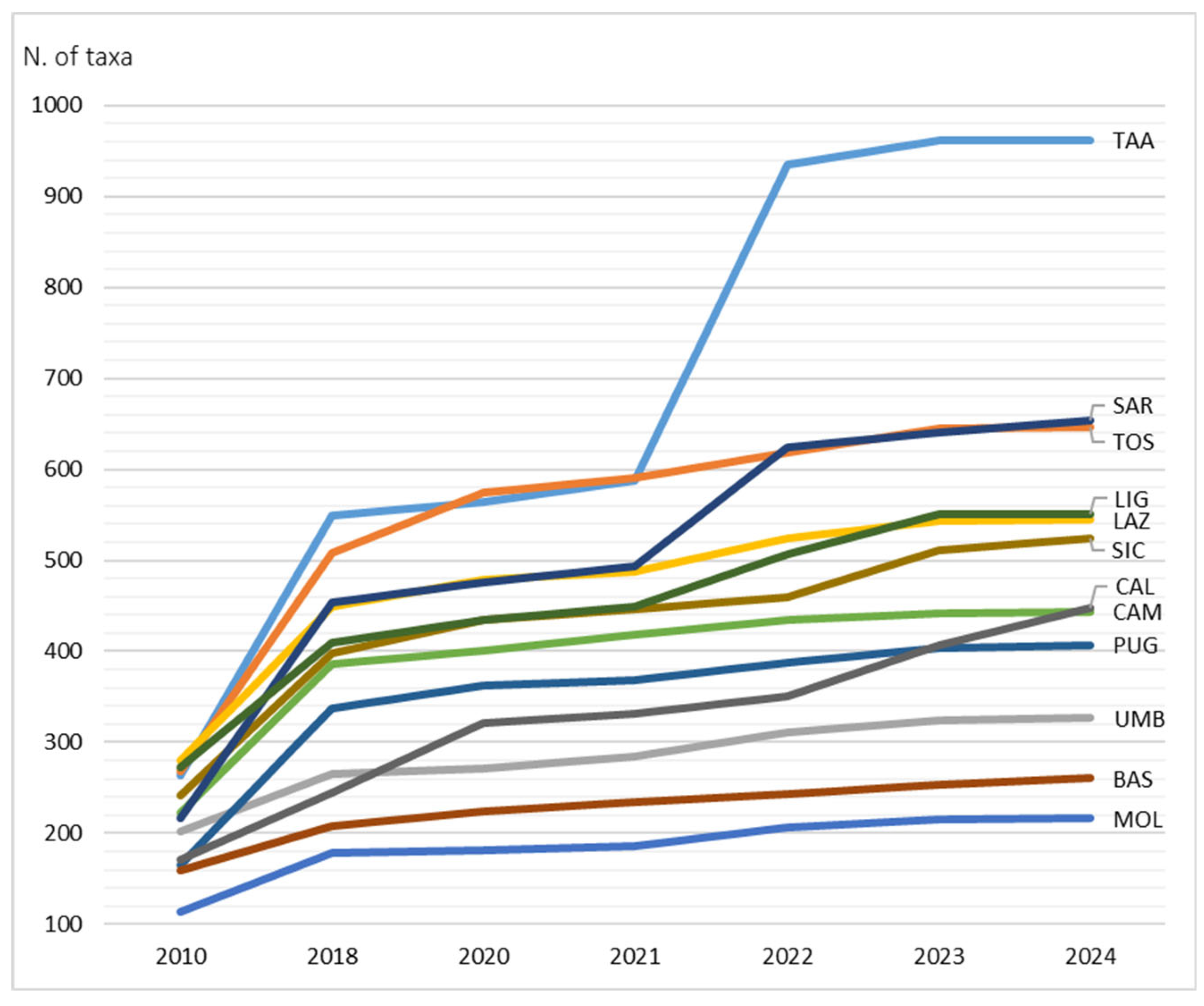
Figure 2.
Density of alien taxa (Ln N. taxa/Ln Km²) for the italian regions (ABR: Abruzzo; BAS: Basilicata; CAL: Calabria; CAM: Campania; EMR: Emilia-Romagna; FVG: Friuli Venezia Giulia; LAZ: Lazio; LIG: Liguria; LOM: Lombardia; MAR: Marche; MOL: Molise; PIE: Piemonte; PUG: Puglia; SAR: Sardegna; SIC: Sicilia; TOS: Toscana; TAA: Trentino-Alto Adige; UMB: Umbria; VDA: Valle d’Aosta; VEN: Veneto).
Figure 2.
Density of alien taxa (Ln N. taxa/Ln Km²) for the italian regions (ABR: Abruzzo; BAS: Basilicata; CAL: Calabria; CAM: Campania; EMR: Emilia-Romagna; FVG: Friuli Venezia Giulia; LAZ: Lazio; LIG: Liguria; LOM: Lombardia; MAR: Marche; MOL: Molise; PIE: Piemonte; PUG: Puglia; SAR: Sardegna; SIC: Sicilia; TOS: Toscana; TAA: Trentino-Alto Adige; UMB: Umbria; VDA: Valle d’Aosta; VEN: Veneto).
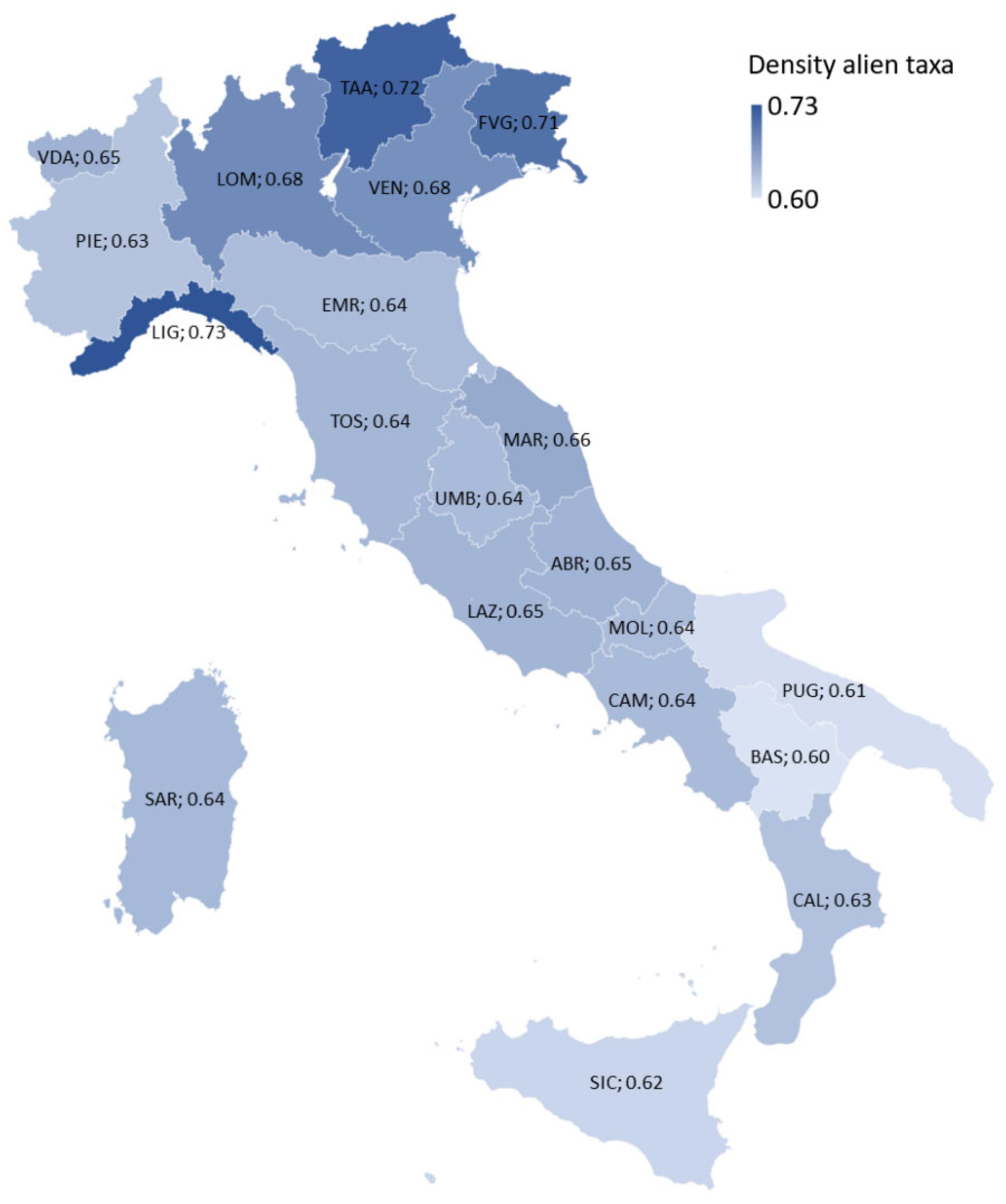
Figure 3.
Life forms spectrum of update alien species (Ch: Chamaephyte; G: Geophyte; H: Hemicryptophyte; NP: Nanophanerophyte; P: Phanerophyte; T: Therophyte).
Figure 3.
Life forms spectrum of update alien species (Ch: Chamaephyte; G: Geophyte; H: Hemicryptophyte; NP: Nanophanerophyte; P: Phanerophyte; T: Therophyte).
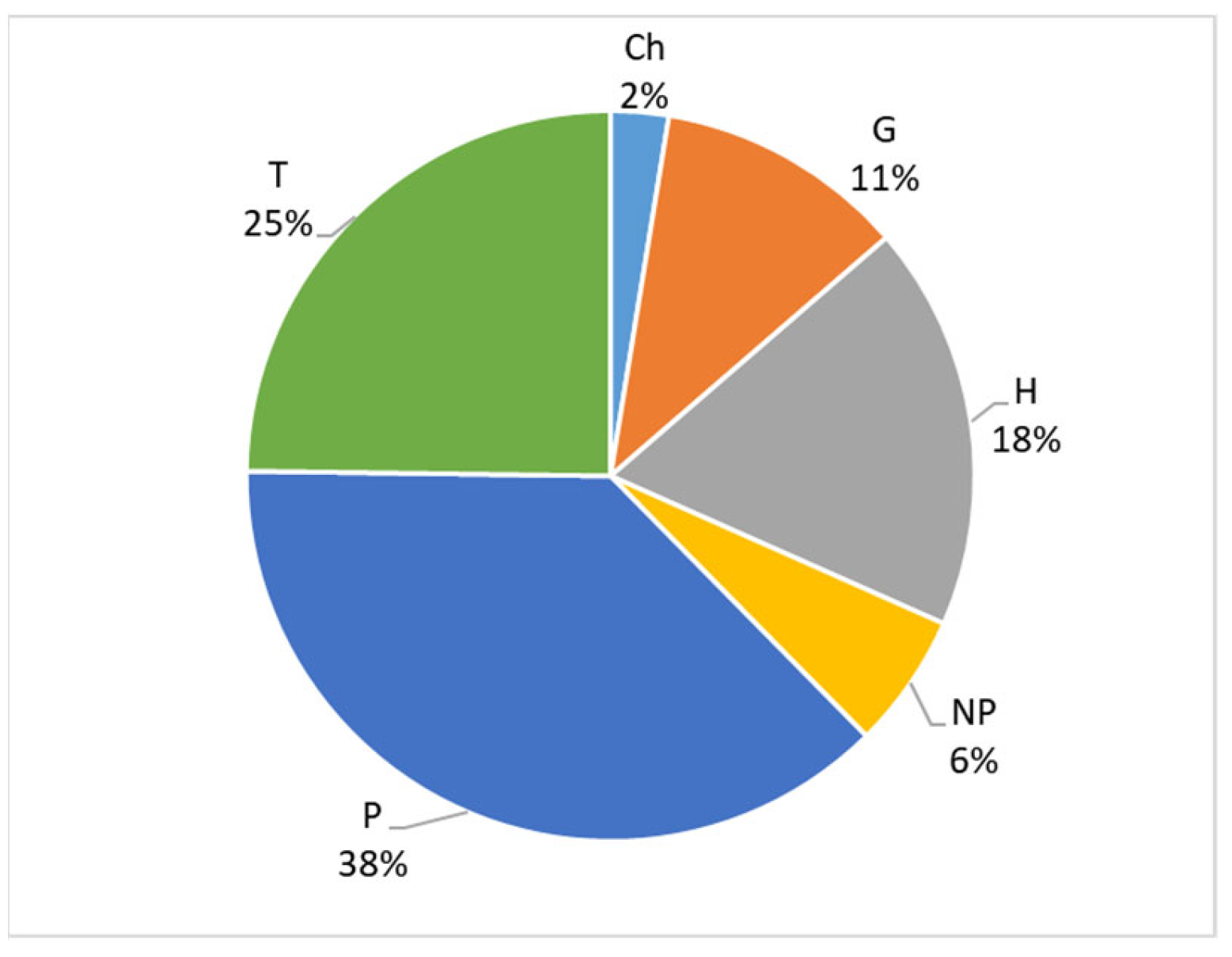

Table 1.
New floristic records of alien taxa for the 12 Italian regions surveyed.
| Italian regions | Change of status | Extinct | First record | Total |
|---|---|---|---|---|
| Basilicata | 8 | 8 | ||
| Calabria | 7 | 41 | 48 | |
| Campania | 3 | 2 | 5 | |
| Lazio | 1 | 1 | ||
| Liguria | 3 | 3 | ||
| Molise | 1 | 1 | ||
| Puglia | 3 | 1 | 5 | 9 |
| Sardegna | 4 | 13 | 17 | |
| Sicilia | 2 | 13 | 15 | |
| Trentino Alto Adige | 1 | 1 | ||
| Toscana | 3 | 1 | 4 | |
| Umbria | 2 | 3 | 5 | |
| Total records | 27 | 1 | 89 | 117 |
Table 2.
Invasive status of the alien taxa recorded for the 12 Italian regions surveyed.
| Italian regions | CAS | NAT | INV | EX |
|---|---|---|---|---|
| Basilicata | 8 | |||
| Calabria | 39 | 6 | 3 | |
| Campania | 2 | 2 | 1 | |
| Lazio | 1 | |||
| Liguria | 3 | |||
| Molise | 1 | |||
| Puglia | 3 | 5 | 1 | |
| Sardegna | 12 | 1 | 4 | |
| Sicilia | 12 | 3 | ||
| Trentino Alto Adige | 1 | |||
| Toscana | 2 | 2 | ||
| Umbria | 2 | 1 | 2 | |
| Total records | 81 | 23 | 12 | 1 |
Table 3.
Consistency of alien flora from 2010 to present for the 12 Italian regions surveyed with this study. In detail, the works consulted and the reference year of the data considered: Celesti Grapow et al. [159]: 2010; Galasso et al. [27]: 2018; Bartolucci et al. [160]: 2020; Bartolucci et al. [161]: 2021; Stinca et al. [57]; Portal to the Flora of Italy [43]: 2023; data updated with the present study: 2024.
Table 3.
Consistency of alien flora from 2010 to present for the 12 Italian regions surveyed with this study. In detail, the works consulted and the reference year of the data considered: Celesti Grapow et al. [159]: 2010; Galasso et al. [27]: 2018; Bartolucci et al. [160]: 2020; Bartolucci et al. [161]: 2021; Stinca et al. [57]; Portal to the Flora of Italy [43]: 2023; data updated with the present study: 2024.
| Italian regions | 2010 | 2018 | 2020 | 2021 | 2022 | 2023 | 2024 |
|---|---|---|---|---|---|---|---|
| Trentino Alto Adige | 264 | 549 | 564 | 588 | 935 | 961 | 962 |
| Toscana | 268 | 508 | 574 | 590 | 618 | 645 | 646 |
| Umbria | 202 | 265 | 271 | 284 | 311 | 324 | 327 |
| Lazio | 280 | 450 | 479 | 487 | 525 | 544 | 545 |
| Molise | 114 | 178 | 182 | 186 | 206 | 215 | 216 |
| Campania | 222 | 386 | 400 | 419 | 435 | 442 | 444 |
| Puglia | 165 | 337 | 362 | 368 | 387 | 404 | 407 |
| Basilicata | 160 | 208 | 224 | 235 | 243 | 253 | 261 |
| Calabria | 171 | 244 | 321 | 332 | 350 | 407 | 448 |
| Sicilia | 242 | 398 | 434 | 447 | 460 | 511 | 524 |
| Sardegna | 216 | 453 | 476 | 494 | 625 | 641 | 654 |
| Liguria | 273 | 409 | 435 | 449 | 506 | 551 | 551 |
Table 4.
Surface, percentage increase of alien taxa, degree of floristic pollution, and density of alien taxa in the 20 regions of Italy.
Table 4.
Surface, percentage increase of alien taxa, degree of floristic pollution, and density of alien taxa in the 20 regions of Italy.
| Italian regions | Surface (km²) | Increase alien taxa from 2010 to 2024 (%) | Degree of floristic pollution (%) | Density alien taxa (Ln N. taxa/Ln Km²) |
|---|---|---|---|---|
| Abruzzo | 10,831.50 | 89.3 | 11.3 | 0.65 |
| Basilicata | 10,073.11 | 63.1 | 9.1 | 0.60 |
| Calabria | 15,221.61 | 162.0 | 14.2 | 0.63 |
| Campania | 13,670.60 | 100.0 | 13.5 | 0.64 |
| Emilia-Romagna | 22,501.43 | 101.0 | 17.8 | 0.64 |
| Friuli Venezia Giulia | 7,932.48 | 81.8 | 15.8 | 0.71 |
| Lazio | 17,231.72 | 94.6 | 15.2 | 0.65 |
| Liguria | 5,416.15 | 101.8 | 15.4 | 0.73 |
| Lombardia | 23,863.10 | 83.6 | 23.5 | 0.68 |
| Marche | 9,344.29 | 66.8 | 13.6 | 0.66 |
| Molise | 4,460.44 | 89.5 | 8.6 | 0.64 |
| Piemonte | 25,386.70 | 88.9 | 16.0 | 0.63 |
| Puglia | 19,540.52 | 146.7 | 13.7 | 0.61 |
| Sardegna | 24,099.45 | 202.8 | 22.1 | 0.64 |
| Sicilia | 25,832.55 | 116.5 | 16.1 | 0.62 |
| Toscana | 22,987.44 | 264.4 | 15.7 | 0.64 |
| Trentino-Alto Adige | 13,604.72 | 141.0 | 23.5 | 0.72 |
| Umbria | 8,464.22 | 61.9 | 12.1 | 0.64 |
| Valle d’Aosta | 3,260.85 | 128.9 | 7.6 | 0.65 |
| Veneto | 18,345.37 | 115.3 | 19.7 | 0.68 |
| ITALY | 302,073 | 73.4 | 19.9 | 0.59 |
Disclaimer/Publisher’s Note: The statements, opinions and data contained in all publications are solely those of the individual author(s) and contributor(s) and not of MDPI and/or the editor(s). MDPI and/or the editor(s) disclaim responsibility for any injury to people or property resulting from any ideas, methods, instructions or products referred to in the content. |
© 2024 by the authors. Licensee MDPI, Basel, Switzerland. This article is an open access article distributed under the terms and conditions of the Creative Commons Attribution (CC BY) license (http://creativecommons.org/licenses/by/4.0/).
Copyright: This open access article is published under a Creative Commons CC BY 4.0 license, which permit the free download, distribution, and reuse, provided that the author and preprint are cited in any reuse.


