

Submitted:
25 September 2024
Posted:
29 September 2024
You are already at the latest version
Abstract
The transport sector is heavily relying on the use of fossil fuels that are causing major environmental concerns. Solutions relying on the direct or indirect use of electricity, through e-fuels production, are emerging to power the transport sector. To ensure environmental benefits over this transition, an accurate estimation of the impact of the use of electricity is needed. This work presents a temporal analysis of carbon intensity of e-fuels using grid electricity in countries members of the European Network of Transmission System Operators (ENTSO-E). It also provides an estimation of the potential load factor for to produce low-carbon e-fuels according to the European Union legislative framework. This was achieved, building on top of the existing EcoDynElec tool, by developing EcoDynElec_xr a python tool enabling, with an hourly time resolution, the calculation, visualisation and the analysis of the historical time-series of electricity mix from the ENTSO-E. The results highlight that, in 2023, a minority of European countries were reaching low carbon intensity of electricity that enables the use of grid electricity for green electrolytic hydrogen production. The methodological hypothesis to consider the consumed electricity mix instead of the production mix, and the considered time step, are of paramount importance and drastically impact the potential load factor of green hydrogen production. The developed tool and calculated data are released under an open-source license to ensure transparency, results reproducibility, reuse on newer data, or for other purposes.
Keywords:
electricity impact
; e-fuels
; carbon intensity
; ENTSO-E time-series
; temporal analysis
; EcoDynElec_x
1. Introduction
The transport sector relies heavily on the use of fossil fuels. In 2022, more than 95% of the final energy used in the transport sector was still sourced from fossil fuel globally [1]. If this relative share decreased to some extent in the last decades, the absolute amount of fuel used in transport followed a continuous growth, with the exception of the period of the COVID crisis when transport demand was largely reduced by governmental measures [2]. As a consequence, the direct greenhouse gas (GHG) emissions of the transport increased from 5.0 GtCO2eq in 1990 to 8.7 GtCO2eq in 2019 [3]. This accounts for 23% of global energy-related greenhouse gas emissions and more than a third when including the impacts of transport infrastructure [3]. In the European Union (EU), the transportation sector is currently the single sector with a growing trend in GHG emissions [4]. Increasing the use of renewable and low-carbon energy sources in transport is thus becoming essential to achieve our EU carbon neutrality goals.
Beside the GHG emissions, fossil fuels are also responsible of environmental impacts from their extraction to their final use in internal combustion engines with local pollutant emissions. Solutions relying on the direct or indirect use of electricity are investigated and emerging as alternatives to power the transport sector, and electricity is expected to play an increasing role in the future of the transport sector [2,3], due to both:
- direct use of electricity in battery electric vehicles, electric trains or other trolley vehicles,
- indirect use of electricity to produce fuels requiring a high amount of electricity as an input such as hydrogen or hydrogen derived fuel (the so-called e-fuels or electro-fuels).
Transport solutions directly using electricity are already being largely deployed and expanding, while solutions relying on an indirect use of electricity, through the use of e-fuels, are at lower commercial readiness level [5]. Several e-fuels or electro-fuel pathways, also referred to as Power-to-Liquid (PtL), are candidates for the production of synthetic fuels, using hydrogen produced through water electrolysis [6,7,8]. Despite some technological and non-technological barriers for deployment, such electro-fuel pathways are promising options for fuel synthesis using electricity enabling the achievement of high GHG emission savings when using low carbon electricity [5,9] and appear to be essential to meet the EU climate targets of the transport sector [10,11].
- The European Legislative Framework
In order to facilitate the emergence of a hydrogen economy and a low-carbon hydrogen industrial ecosystem, the EU has developed a comprehensive legislative framework through the Renewable Energy Directive (RED) that promotes the use of renewable energy sources across the EU economy. The Renewable Energy Directive (EU) 2023/2413 (the so-called RED III) has increased the ambition level for the use of renewable energy in the EU and for the use of renewables in transport by 2030. Member States have the possibility to choose between either a binding target of 14.5% reduction of greenhouse gas intensity in transport from the use of renewables or a binding share of at least 29% of renewables in the final consumption of energy in the transport sector. The Directive also sets a binding combined sub-target of 5.5% for the use of advanced biofuels and renewable fuels of non-biological origin (i.e., renewable hydrogen or derived synthetic fuels) to be used in the transport sector. Within this target, there is a minimum requirement of a share of 1% of Renewable Fuels of Non-Biological Origin (RFNBOs) in the energy supplied to the transport sector in 2030.
Directive 2018/2001 (RED II) defined RFNBOs as fuels produced from renewable energy and requires greenhouse gas emissions savings from their use of at least 70 % compared to the fossil fuel comparator of 94 gCO2eq/MJ. Two delegated regulations on RFNBOs set out the detailed rules for their production and the methodology for calculating emissions’ savings: EU 2023/1184 and EU 2023/1185. The corresponding framework is represented in Figure 1, and introduce the three essential pillars aiming at ensuring that the hydrogen is effectively produced from low-carbon electricity:
- Additionality: the aim is to stimulate the deployment of new renewable electricity generation capacities and avoid competition with other renewable electricity uses.
- Temporal correlation: the aim is that RFNBOs production takes place at times when it supports the integration of renewable electricity sources production into the electricity system.
- Geographical correlation: the aim is that RFNBOs production takes place in grid areas where renewable electricity is available.
Those criteria for RFNBO production make sense from a GHG emissions perspective by using additional electricity when and where it is available. The regulation EU 2023/1184 proposed a flexible application of the criterion on temporal correlation in the initial phase. From 1 January 2030, the temporal correlation condition requires the production of the RFNBOs during the same one-hour period as the renewable electricity production. Until 1 January 2030, the temporal correlation condition is shall be considered complied with if the RFNBOs is produced during the same calendar month as the renewable electricity. The Regulation EU 2023/1185 sets the methodology to assess and calculate lifecycle GHG emissions savings.
These two regulations are part of a wider context where hydrogen and derived fuels are expected to become one of the main pillars of the EU decarbonisation strategy as a clean solution for mobility, power generation and industrial applications, according to the European Green Deal (EGD) [13]. In order to promote renewable hydrogen production, the European Commission adopted “A hydrogen strategy for a climate-neutral Europe” in 2020 [14], by setting targets for the installation of at least 6 GW of electrolysers powered by renewables in the EU by 2024 and 40 GW by 2030. The EU also recently proposed the REPowerEU plan [15] for rapidly reducing EU’s dependence on fossil fuels by accelerating the green energy transition. RePower EU considers renewable hydrogen as key to replace natural gas, coal and oil in hard to decarbonise industries and transport. Thus, hydrogen can be used to replace fossil-based hydrogen for transport and industrial processes and new industrial products, such as green fertilisers and steel. REPowerEU proposed a target of producing 10 Mt of hydrogen using electrolysis within the EU, which we expect to be equivalent to 60 to 70 GW of electrolysis capacity that have to be installed in the EU by 2030; another 10 Mt of renewable hydrogen will have to be imported by the EU in 2030, according to REPower EU. Hydrogen can be used to produce liquid synthetic kerosene or other synthetic fuels to decarbonise aviation and maritime sectors, in addition to other uses.
Need
While technological solutions are emerging, the European legislative framework in place requires to save at least 70% of GHG emissions to avoid a simple shift of the transport-related pollution from fossil-based internal combustion engines to power plants generating the electricity used for e-fuel production. Even though electric, hydrogen or e-fuels vehicles are sometimes promoted as zero emission or climate neutral, the production of both vehicles and the energy used to power them is not burden-free. This is why performing a Life-Cycle Analysis (LCA), a systemic analysis [16], is necessary to ensure that the environmental impact is effectively reduced and not simply shifted to another stage of the system or another environmental impact.
Many LCA of electric, hydrogen or e-fuelled vehicles already exists. Reviews and meta-analyses based on those numerous publications highlight how determinant the impact of electricity used is on the environmental footprint [17,18,19]. Alongside, other papers focused on assessing the impact of the electricity consumed and not produced. Few papers provide details on the carbon intensity of used electricity, such as Scarlat et al.[20] that considers annual data for electricity production and trade and provides carbon intensities of electricity produced and consumed as well. The study from Tranberg et al. [21] makes use of hourly data for carbon accounting and confirms that the carbon intensity of electricity consumed in a country can significantly differ from the carbon intensity of the produced electricity. While studies regularly neglect greenhouse gas emissions associated with e-fuels when produced from renewable electricity, other studies [20] considers combustion emissions, upstream and downstream emissions, but also the emissions from the manufacture of equipment, e.g., including GHG emissions from renewable electricity. Thus, there is an essential need for an integrated method, consistent with the existing European legislative framework, to provide an accurate estimation of the environmental impact of the electricity used to power the transport sector, at the right time resolution, to correctly inform decision-making [22,23].
Purpose
The purpose of this paper is not to conduct another LCA to be added to the already abundant literature, but to propose an integrated method, with the associated Python tool, to assess the carbon intensity of electricity used, directly or indirectly, in the transportation sector. This method relies on ENTSO-E data to provide a comprehensive and retrospective analysis of the historical carbon intensity of produced and consumed electricity with an hourly time resolution for each member coutry of the ENTSO-E. The consumed electricity is calculated using the exchange data between countries and the tracking algorithm presented by Tranberg et al. [21] and implemented in the Ecodynelec tool [24]. Building on top of it, we developed EcoDynElec_xr that contains some improvements over its previous version to make its use easier, less prone to mistakes and more efficient. The section Material & Methods details step-by-step the approach followed, relying on that improved tool, to calculate time-series of carbon footprint of electricity. The obtained time-series of carbon intensities are then used to retrospectively propose a statistical analysis of the potential load factor of hydrogen or derived fuels under the European Union’s legislative framework. Those results are presented and discussed for e-hydrogen as it is a necessary intermediary step for other e-fuels that can be derived from it, but the discussion can be generalised to those e-fuels as mentioned in the section Results & Discussion. This results section discusses the importance of key methodological assumptions, such as considering the production or consumption electricity mix and the chosen time scale for the analysis. Finally, the section Conclusion & Perspective outlines the conditions for producing low-carbon e-fuels and their impact on economic performance. It emphasizes the importance of considering the outcomes of this work in future studies related to the environmental footprint of e-fuels or LCA of other electro-intensive products that require accurate and dynamic assessments of electricity impacts.
2. Material & Methods
2.1. Methodological Framework Overview
Figure 2 represents the approach to assess the greenhouse gas emissions from e-fuels production. The e-fuel can be e-H2, the simplest form of e-fuel, or any synthetic fuel derived from it. As the last steps are optional, dashed arrows are used on Figure 2. When an e-fuel is derived from H2, the GHG emissions are calculated as GHG emissions from H2 production and from all other required inputs, such as carbon dioxide captured and used, or the energy required for the final transformation, etc. However, the scope of this paper covers H2 production only, while the GHG emissions from all other potential e-fuels can be calculated by expanding the boundaries to cover all subsequent conversion steps. Although the additional transformation steps induce additional emissions and losses, the effects and trends observed with H2 production can be generalised to other e-fuels, since carbon intensity of electricity has the highest impact on their production.
The GHG emissions of hydrogen are calculated from the GHG emissions associated to electricity used for hydrogen production. The amount of electricity consumed is directly calculated considering the efficiency of water electrolysis. The thermodynamic limit for dissociating water at room temperature through electrolysis is around 40 kWh/kgH2. For low temperature electrolysis, around 50 to 55 kWh of electricity are needed to produce 1 kg of hydrogen. The typical electrolysis efficiency is ranging from about 60% for PEM electrolysers to 65 % for alkaline electrolysers [25,26,27]. Considering the potential future improvements in terms of efficiency, this value of 65% is considered by default in the later calculations in this paper. One can easily adjust this parameter in the code and generated all the graph considering another electrolyser efficiency.
As previous studies highlighted that the carbon intensity of H2 is dominated by the impact of electricity used and the impact of the equipment and infrastructure can be neglected, only emissions related to the use of electricity for H2 production are considered in the scope of this work. In this paper, the carbon intensity of electricity is calculated as the electricity mix multiplied by emission factors of each electricity source. While emission factors exclude emissions related to equipment and infrastructure, they include both combustion emissions and upstream emissions related to fuel supply (extraction, transport and refining for fossil fuels and enrichment for nuclear fuel).
The calculations were made for the production mix of each country member of ENTSO-E, at one hour resolution, using the ENTSO-E production data, and then for the tracked consumption mix calculated based on the production and exchange ENTSO-E data. The most recent ENTSO-E data, for the last available year 2023 were used. Using the tracking algorithm [21] implemented in the EcoDynElec tool [24], it is possible to obtain the tracked electricity consumption mix. The algorithm was reimplemented in the developed EcoDynElec_xr in a more readable way, less prone to mistake. With the assumption that H2 electrolysis uses high voltage electricity, the calculations considered only losses occurring in the high voltage transport grid, based on the grid loss data sourced from the EUROSTAT dataset NRG_CB_E. The tool also enables to include the grid distribution losses on top of the transport losses, which would make sense in the case electrolyser is connected at a lower voltage grid. The use of the EUROSTAT data enables the calculation of average annual grid losses, which is a simplification in the calculation of hourly carbon intensity of electricity.
The emission factors per unit of electricity produced were calculated considering the power plant efficiency, for each country and each type of fuel input based on EUROSTAT dataset NRG_BAL_C, that determines the amount of primary energy needed for produced electricity. The most recent available EUROSTAT data, corresponding to the year 2022, were used. This enables the calculation of the average annual plant efficiency, thus assumed to be constant over the year, which is another simplification in the calculations. Indeed, the efficiency varies over the year, especially for plants generating both heat and power if the heat is not or less used during the warm season.
Following the approach presented in Figure 2, it is possible to calculate the carbon intensity with a time resolution of one hour. For some graphics, the data were later resampled at a daily time resolution, only for displaying reasons. Also, in order to test the sensitivity of the assessed carbon intensity, calculations were also done by down-sampling the hourly data with a lower time resolution.
2.2. Methodological Implementation and Execution
This subsection presents the steps involved in the calculation of time-series of the carbon intensity of electricity produced and consumed. Some graphics, corresponding only to the input data are presented in this section to help the reader to visualise and understands the steps of the method. Graphics corresponding to the output data of this work are presented and discussed in the Results section. The structure of this section is strongly linked to the one of the Jupyter Notebook that the reader can refer to reproduce the work, or use for other purposes. The whole code is available on github.
For this work, a new python library, named EcoDynElec_xr has been developed and implemented the tracking algorithm behind [21]. It relies on the previous library EcoDynElec [24] to download the ENTSO-E data. Even though this EcoDynElec tool was developed in the context of electricity consumption in buildings, the tool is not sector specific and its application to the transport sector is relevant. The EcoDynElec_xr tool enables the calculation and analysis of the historical time-series of electricity mix published by the European Network of Transmission System Operators (ENTSO-E). Making use of this tool, we downloaded, calculated and visualised time-series of carbon footprint for both the electricity produced and consumed in each country member of the ENTSO-E with an hourly time-resolution. Then, a new data structure is used to make the code more efficient and readable by the use of xarray datasets structure and their label explicit dimensions. Such a structure is fully adapted to manipulate the multidimensional data with explicit names for all dimensions. The tracking mix algorithm involved in the calculation has also been completely re-implemented using the pandas dataframe structure to allow data manipulation using explicit index and column names instead of numbered indexes that are more prone to mistakes and less readable. Some grouping and visualisation features were added to allow data quality checks and results analysis. Finally, a part of the previous code specific to Switzerland was removed to keep ENSTO-E as the only source of electricity data and avoid mixing data of heterogeneous quality.
Downloading the ENTSO-E Data
The first step consists of downloading the ENTSO-E data. The European Union Member States must provide Information related to electricity generation, load, transmission and balancing for publication through the ENTSO-E Transparency Platform, according to the Regulation (EU) 543/2013 on submission and publication of data in electricity markets. Data on the production, trade and consumption of electricity was downloaded for the year 2023. This task can be done manually or using the EcoDynElec library as done in the Jupyter Notebook. More information can be found here. The user needs to create an account to access to the ENTSO-E platform and get a token to download the data. The username and password have to be indicated in the settings.py file. As this download can take a significant amount of time, if data already exist, the tool ask a confirmation before downloading them again. The user simply needs to reply “yes” or “y” when the confirmation is asked.
Formatting the Downloaded Data
When downloaded, data are contained in large csv files. Those files, corresponding to a one month period, are weighing around 160 Mb for the generation data and 80 Mb for the exchange data. One of the reasons why those files are so big is because they also contain data at the bidding zone level that we are not making any use of at the moment. The EcoDynElec_xr tool has some functions to extract, format and save the data in nicely structured and labelled xarray dataset. Once formatted, data can be loaded and accessed much faster than from the csv. The manipulation of the data is also facilitated and the user can filter data by country, energy type and datetime that are the 3 dimensions for the generation data. A similar function exists for the exchange data and data can be filtered based on exporting countries, importing countries and datetime.
Checking Data Quality & Missing Values
Figure 3 represents heatmaps of the ratio of missing data in the previously downloaded and formatted data. The table of country codes and corresponding country names can be found in Annex A. With the exception of production data for the United Kingdom that left the European Union, the overall quality of data is really good, with only few missing data. In many situations, some data seems to be missing but it simply did not exist, for example the exchange data between United Kingdom (GB) and Denmark (DK). Indeed, looking at the time-series, we see some data for the end of December but no data before that date. In that case, the reason is that GB and DK inaugurated their first electric connection the so-called Viking Link. The same situation happens for France and offshore wind production. In France, the first offshore wind power plant entered in operation in June 2023, so there is no data before that date, in that case the data is not missing as it did not exist. More graphics can be found in the Jupyter Notebook. By default, if there are missing values for less than two hours, the values are filled with linearly interpolated values.
Visualising Data
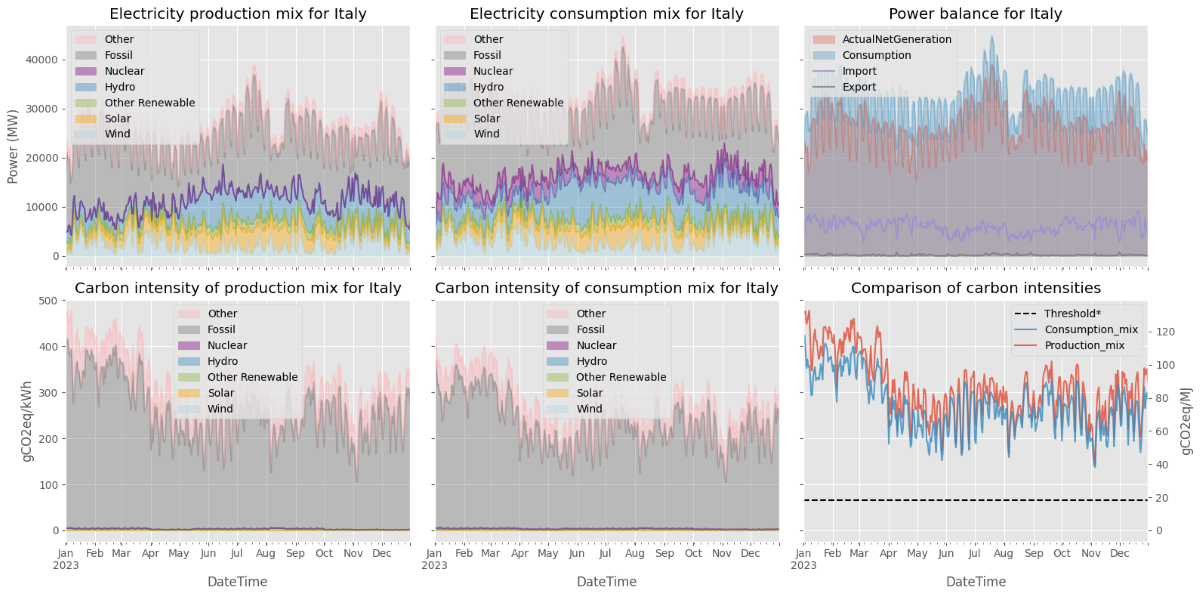
For exemplification, Figure 4 shows the generation and exchange time-series for Italy. To represent this data in a visible way, data have been resampled to the daily mean values before being plotted. The type of electricity was grouped in a reduced number of categories, as the initial dataset has up to 20 energy categories. Those grouping functions were added to the EcoDynElec_xr tool in order to make graphs more readable by limiting the number of categories. However, the user is free to generate the same plot with the ungrouped data, or can change categories by modifying the grouping dictionary in the energy_grouping.py file. Figure 4 also shows the exchanges data for Italy with the same resampling at the daily time step. Looking at the scale of the y-axis, data highlights that Italy is importing significant amount of electricity mainly from its northern neighbours and is marginally exporting electricity.
At that stage, we can combine generation and exchange data together to get the consumption data. However, we cannot yet assess the nature of the electricity imported or exported, so we cannot know the nature of the electricity mix consumed. To do so, we need to run the tracking algorithm as explained below, but it is first needed to identify countries directly exchanging electricity between them.
Neighbours Identification
Before running the tracking algorithm, we need information about the neighbour countries that exchange electricity. The previous EcoDynElec tool contained a file giving for each country member of the ENTSO-E the list of its electrical neighbours. The new EcoDynElec_xr automatically identifies the electrical neighbours by using the ENTSO-E exchange data. We were thus able to notice, for instance, that UK and DK recently inaugurated a first electrical connection. Such a feature makes the tools adaptable to deal with the creation of new electrical connection without the need to update the file with the list of its electrical neighbours.
In 2023, ENTSO-E covered 35 countries that were exchanging electricity between themselves, but some countries also exchanged electricity with countries outside the ENTSO-E area. The Figure 5 presents the share of electricity exchanged with external neighbours as related to the total electricity production of ENTSO-E members. Export and import from neighbours of ENTSO-E countries represent around half a percent of the ENTSO-E production. Also, we can see that exchanges are rather balanced as the net import values are even lower with an order of magnitude of one per thousand (0.1%) only. In the calculation, the external countries are considered as one country producing its electricity from gas. This hypothesis can be modified, but the impact is globally negligible. It can, at most, have a local impact on the carbon intensity of small neighbouring countries heavily relying on import but a detailed analysis shows that only Georgia, Lithuania, Montenegro, Kosovo and Latvia have more than 5% of their consumption sourced from outside ENTSO-E, and the countries they are importing electricity from have an average carbon footprint not much different from the carbon footprint of gas electricity.
Tracking the Electricity Mix
This step represents the mathematical heart of the program. From the existing EcoDynElec tool, the mathematics is strictly unchanged, but the code was re-implemented to use explicit names to access and manipulate data instead of index numbers that are less readable and more prone to mistakes. Solving this mathematical problem of countries directly and indirectly importing electricity consists in inverting the Leontieff matrix of an input-output problem [21,24]. This is done using the existing function from the scipy library, instead of using the previously implemented algorithm. More information can be found on the existing EcoDynElec documentation.
This function, called track_mix, has four parameters offering the possibility to consider the net production or not, the net exchange between countries or not and the considered time step and the grid loss. Setting net production to True, which is the default value, the tool subtracts the electricity consumed by the production plant from its gross production. Setting net exchange to False, means you can export to and import from a same country at a give moment in time. If the user prefers net_trade, he/she should set this parameter to True. A last parameter enables to ignore the grid losses, or consider the losses occurring on the transport grid only, or with the distribution losses as well. Losses values are sourced from the EUROSTAT dataset NRB_CB_E that are automatically downloaded by running the notebook EUROSTAT.ipynb.
It is important to note that once calculated, we can estimate the nature of the electricity that is consumed in countries (if it has been produced with fossil, nuclear or renewable, depending on grouping) we can also know countries of production for each of the considered time steps. It is also important to note that those values result from a model that may differ from the reality that is obviously more complex. This model aims at giving the best possible and reasonable estimates of the reality, but the reality may differ considering the real impedance of electric connection between countries.
The underlying assumption of the model is that when given country A exchanges electricity with a country B, there is no preference over the nature of the electricity exchanged: the country A cannot claim specifically exporting electricity from coal power plants exclusively, even if the power plant is closer to the border. Exchanges correspond to the mix of countries A and B. Their mix takes into account that country B may have itself exchanged electricity with another country C, which maybe itself exchanged with a country D, and so on. The second aspect is that there is no differentiation with the mix exported between neighbours: if a country A exports electricity with the countries B and C, the electricity mix exported is identical. The country A cannot claim to export hydroelectricity to country B and coal electricity to country C, even if power plants may be closer or with more direct electrical connections. Those assumptions even though reasonable may differ from the reality where it could be, in theory, possible that a power plant is turned on to export the production to a determined country, or that the limited transport capacity makes that the mix exported to different countries would depend on the plant location, etc. Thus, the obtained results can be considered as the best possible estimate of the reality, but the user must be aware that those values are the outcome of a model with the specific assumptions above mentioned.
Calculating the Impact of Electricity Mix
At this stage of the calculation, we can track which type of electricity is consumed in a country and in which country the electricity has been produced. To get an estimation of the carbon intensity, we now simply need to multiply the electricity mix by the emission factor that depends on the type of electricity, which also depends on the production country. Such multiplication is easy to be operated using the xarray datastructure: the only condition is to ensure that the name of countries and the origin of electricity types are identical as well as the dimension names. Having conversion efficiency depending on the type of electricity is obviously necessary, but having it also depending on the production country is very relevant when significant differences between countries occur. In the context of the European legislative framework, emission factors have to be calculated following a specific method that would account for the combustion emissions and for the upstream emissions. To do so, we have some emission factors per type of fuel input but those values correspond to the emissions per unit of primary energy and not per final energy produced. To convert the tracked electricity data into the primary energy, we need to calculate the efficiency per type of electricity and per country. In a standard LCA approach, emission factors could be obtained using ecoinvent database. Even if the present work focuses on the carbon intensity, it is possible to do the calculation for other impact categories relating, for instance to the emissions of particulate matter.
Those efficiency values are calculated using the Eurostat API (application programming interface). The corresponding code can be found in the notebook Eurostat.ipynb. There are specific assumptions for cogeneration allocation: the allocation of the primary energy for electricity production and for heat was made by considering alternative heat production with average efficiencies of 85%. More details can be found in [20]. Data for the year 2022 from Eurostat statistics are used as the most recent available data, whereas ENTSO-E data were already available for the year 2023. However, we expect this to have a very low impact on the results, since the changes of electricity conversion efficiency are low at the scale of a country from one year to another. Efficiency values were calculated from the IEA data for the countries having no available data for each type of power plant and fuel input. The calculated efficiencies are represented on Figure 6 that shows high variations that are due to diverse conditions in different countries for different energy sources.
Once those efficiencies by fuel input and by country are calculated, we can easily calculate the amount of primary energy consumed. This primary energy data then has to be multiplied by the emission factors represented in Figure 7 to obtain the emissions resulting for electricity production for each source. Those emission factors include the emissions of the greenhouse gases: carbon dioxide (CO2), methane (CH4) and nitrous oxide (N2O). These emissions are converted into carbon dioxide equivalent emissions using the Global Warming Potential (GWP) relative to CO2 over the 100-year time horizon, as recommended in the IPCC Fourth Assessment Report [3].
Statistical Analysis Under a Regulatory Limit
Once multiplied by the emission factor, we obtain time-series of the carbon intensity of electricity produced or consumed in every country member of the ENTSO-E.
In order to assess the number of hours an electrolyser could operate in each country to produce low-carbon hydrogen, as specific in the case 2b in Figure 1, we simply test when the time-series values are below this limit of 18.3 gCO2eq/MJ (66.0 g CO2eq/kWh) of electricity produced. This value corresponds to the threshold to reduce by 70% the GHG intensity in comparison to the 94 g CO2eq/MJ fuel from the fossil fuel comparator when assuming an efficiency for the electrolyser of 65%. The results obtained are presented and discussed in the next section.
3. Results & Discussion
This section discusses the results obtained following the method previously described. The temporal variability of carbon intensity of electricity has been calculated using one hour time series and then the carbon intensity of hydrogen produced through water electrolysis using grid electricity. For further analysis, the carbon intensity of hydrogen has been calculated at different time steps, in line with timing operation of electrolyser and electricity production or consumption, to assess the impact on carbon intensity of e-hydrogen.
3.1. Time-Series of the Electricity Mix and Their Carbon Footprint
Time-series of the electricity mix and their carbon intensity have been produced for all countries member of the ENTSO-E. This covers 35 countries, including all Member States of the European Union except Malta and Cyprus that do not belong or provided data to the ENTSO-E. In the year 2023, Ukraine was not a member of the ENSTO-E as the country joined ENTSO-E in December 2023. Figure 8 presents the electricity dashboard for Italy, Germany and Austria, that were chosen for illustrating more interesting and dissimilar cases. Fot the other countries, figures are available on the following github repository. For displaying purposes only, data represented on figures were resampled using the daily mean for a better readability of the graph, but all data were calculated with an hourly resolution. The various subplots present:
- the production mix of electricity in the country. Energy categories were grouped to limit the number of energy categories to represent. Except the grouping, those data directly comes from the ENTSO-E data and do not involve any modelling or calculation.
- the consumption mix of electricity. Those data are the outcome of the tracking algorithm. They correspond to the output of a model assuming no preference in direction and energy type in exchanges between countries (i.e., countries are always exchanging electricity corresponding to their domestic mix).
- the power balance is also represented.
- the carbon intensity, per unit of electricity, of the production electricity mix. To ease the readability, the same colours are used as for the above graph.
- the carbon intensity of the consumption electricity mix, per unit of electricity.
- the comparison of the carbon intensity of the production and consumption electricity mix, as well as the limit for the used grid electricity to produce low-carbon hydrogen. For the last three graphs, the left axis gives the values in gCO2eq/kWh while the right axis gives the values in gCO2eq/MJ of electricity.
The Figure 8 shows that, for instance, Italy consumes nuclear electricity, whereas Italy is not producing nuclear electricity. This is because Italy is importing significant amount of electricity from France and Switzerland where nuclear is significant in the national electricity mix of those countries. The graph for Italy shows that, all along the year, Italy is importing electricity to satisfy a demand that is higher than the national production. In August, the electricity demand is reduced, and imports are at the lowest level. Looking at the previous graph, it also corresponds to the moment when the consumption of nuclear electricity is also at the lowest level.
The Figure 8 also shows that the consumption mix of Germany includes a share of nuclear and hydroelectricity that contribute to the reduction of its carbon intensity. It is also interesting to note that there is seasonality in electricity exchange. Germany is globally exporting electricity to neighbours in winter, when the electricity production is more relying on fossil fuels and has a higher carbon intensity, and globally importing during the summer, which enables to reduce the use of fossil fuel plants. Those aspects explain why the consumption mix in Germany has a slightly lower carbon intensity than its production mix. Even if the share of renewables is high during some times, the remaining share of electricity produced from fossils prevents from reaching the 18 gCO2eq/MJ limit.
Austria was chosen for illustration purposes since, in comparison to Italy or Germany, its electricity mix is sometimes reaching the threshold. The Figure 8 shows that, in the absence of production from fossil fuel, the carbon intensity of the electricity production mix in Austria is very low. However, in winter when the electricity consumption increases, Austria become a net importer of electricity with high carbon intensity. During those periods, this imported consumption of fossil electricity leads to a significant increase of the carbon intensity. As a result, most of the time, the carbon intensity of electricity production is below the threshold, but it is above the threshold most of the time when considering the electricity consumption.
Annual averaged carbon intensities are presented for all countries members of ENTSO-E in subsection 3.2. The statistics on the numbers of hours below the threshold are presented and discussed for all countries in subsection 3.3. The carbon intensity of the consumption mix is calculated and displayed for various time step calculation. The effect of the calculation time step is discussed in subsection 3.4.
3.2. Annual Averaged Carbon Intensity of the Electricity Mix and e-H2
Figure 9A. presents the annual averaged carbon intensity of electricity by countries. This annual average is calculated after having calculated, for each hour of the year, the corresponding carbon intensity following the method previously described. The black dashed line corresponds to the threshold for the carbon intensity of electricity used enabling to save 70% of GHG emissions of e-hydrogen, assuming a 65% electrolysis efficiency, compared to the fossil fuel comparator value represented by a red dashed line on Figure 9B. Countries are sorted by the carbon intensity of their consumption mix. Only a few countries have an average annual carbon intensity satisfying this criterion. We can also see that some countries, such as Denmark, have a consumption mix cleaner than the production mix, due to the import of cleaner electricity. On the other hand, some countries have consumption mix with a higher carbon intensity.
Figure 9B. presents the carbon intensity of e-hydrogen production using grid electricity (at high voltage) in each ENTSO-E country. The blue dashed line represents the value calculated for the production of e-H2 in the EU27 with the exemption of Cyprus and Malta that are not providing data to ENTSO-E. The red and blue dashed lines are extremely close meaning that producing e-H2 with the electricity mix of the EU27 does not save any GHG emissions in 2023 compared to the fossil fuel comparator. Over the 34 countries member of ENTSO-E, 5 would have been able to produce, averaged over the whole year, e-H2 complying with the 70% GHG emission threshold, 13 would still reach a lower carbon intensity than the fossil fuel comparator without reaching the 70% savings, and 16 would produce e-H2with a higher carbon intensity than fossil fuels. Such a result is expected as long as a significant share of electricity is produced by burning fossil fuels, which is used to produce a fuel with significant losses for its production.
3.3. Statistical Analysis of Potential Load Factor of Low-carbon H2
As presented in the introduction, the European legislative framework sets a threshold for the use of grid electricity for hydrogen production through water electrolysis achieving a GHG emission reduction of at least 70%. Assuming an electrolysis efficiency of 65%, the corresponding limit for the carbon intensity of electricity used is 18.3 gCO2eq/MJ of electricity. Relying on the previously presented carbon intensity time-series, we retrospectively calculated the potential load factor that could be achieved while respecting this limit for the year 2023 (e.g. how many hours can the electrolysis operate in a year to produce low carbon hydrogen), which is shown in Figure 10. To reveal the impact of the produced versus consumed electricity, this figure show the impact of the type of electricity considered in the calculations on the load factor. We first see that many countries are never are able to reach the limit. For the countries able to reach this limit, many are reaching it for a limited number of hours per year. There are finally a low number of countries having the carbon intensity of the production mix below this limit for an important number of hours a year. However, when looking at the consumption mix and not the production mix, the potential load factor is reduced for most of them: Luxembourg being an extreme case because the carbon intensity of the production mix, mainly relying on hydropower, is often below the limit, whereas the consumption mix, involving significant import of fossil based electricity, is rarely lower. Denmark and Finland are the only countries performing better with their consumption mix due to imports of low carbon electricity from Sweden and Norway.
3.4. Influence of the Considered Time Resolution
Figure 11 presents time-series e-H2carbon intensity in Austria. Those time-series are calculated and represented for a daily, weekly and monthly time resolution. It highlights the importance of the time resolution when comparing average value to a threeshold as but it can be observed that when the monthly value is just above the threshold as in August, some weekly or daily values can be lower than the threshold, and the contrary can be observed in June.
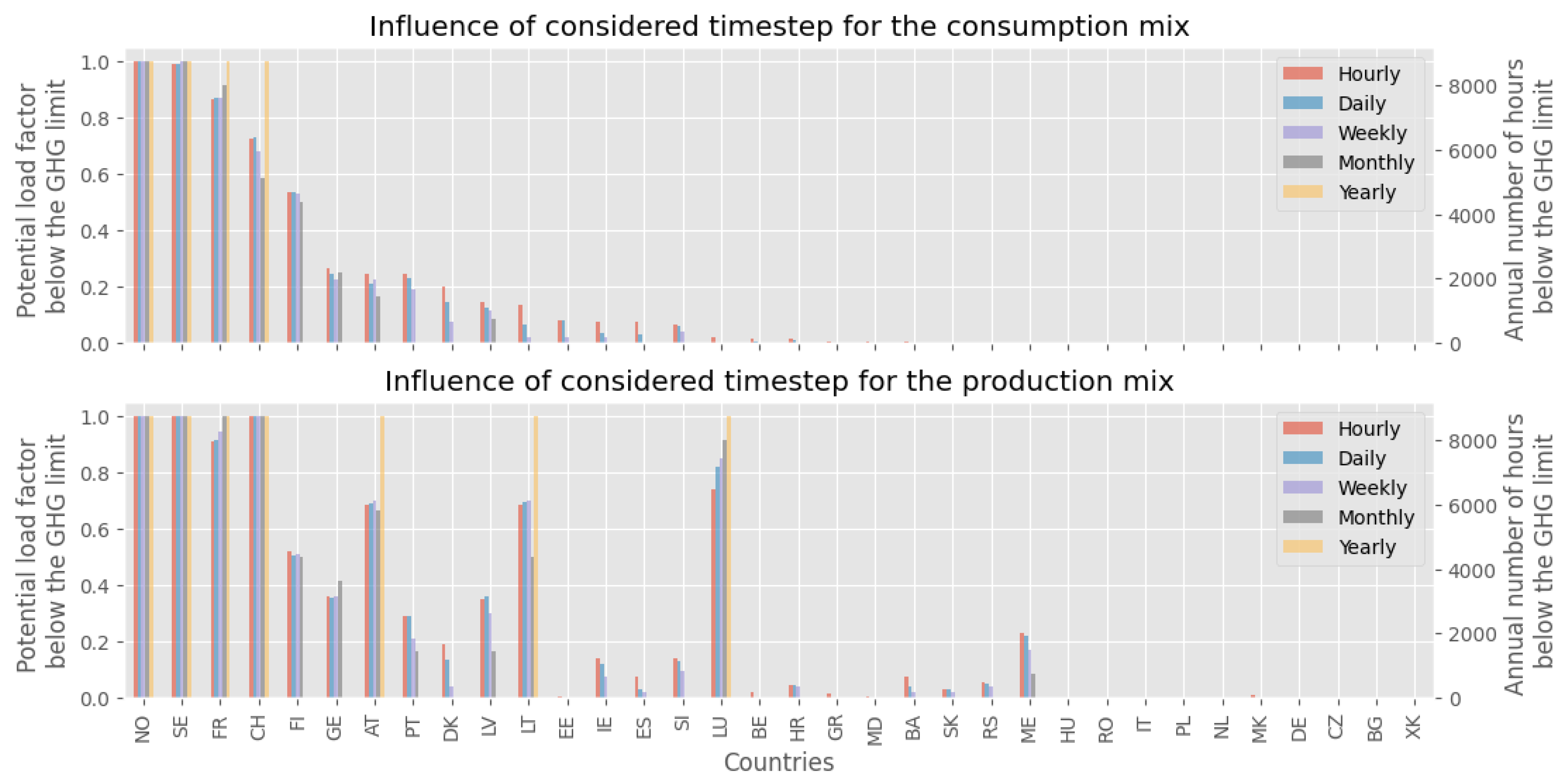
Figure 12 presents the potential load factor of low carbon hydrogen production considering both the production and consumption mix for the different time steps: from annual values to hourly values. When considering an annual time step, the potential load factor is 0 or 1 depending on the annual average and if it is above the limit or not. The potential load factor is slightly affected by the considered time step. Indeed, as exemplified for Austria on Figure 11 , with a monthly time step, if the monthly carbon intensity is above the limit, it is possible that within this month, there are some weeks, days or hours for which the carbon intensity is lower than the limit. On the other hand, we can have a monthly intensity below the limit, and within this period some weeks, days or hours over the limit.
The larger the time step is, the higher the risk of including periods of time where the electricity is sourced from high carbon intensity sources. Having a time step as low as an hourly one strongly limits this risk. A larger time step may facilitate the running of an e-fuel power plant, but Figure 12 also shows that, for most countries, when looking at the consumption mix, the shorter the time step is, the higher the potential load factor is, as every single hour below the limit can be captured.
4. Conclusion & Perspective
E-fuels, either hydrogen or fuels derived from it, can be produced with a low-carbon intensity. The condition is to use electricity only when its carbon intensity is low enough, which significantly affects the potential operational load factor of an electrolysis unit. A reduced load factor means a reduced number of hours when low carbon fuels can be produced or a reduced operation power, or a combination of both. Thus, per unit of power capacity of electrolysis installed, this limits both the amount of hydrogen that can be produced and makes reaching the economic viability more challenging. In that perspective, additional sources of income than the fuel production itself may help. For instance, e-fuels could play a role in balancing the grid as storage, which could provide potential income for the provision of ancillary services to the grid. Indeed, even though combining environmental and economic performance is challenging, this is a necessary step to ensure a sustainable production of e-fuels.
Making use of ENTSO-E data, we showed that exchanges of electricity between countries have the potential to dramatically change the carbon intensity of the national electricity mix. Some countries may have a carbon intensity of their production mix low enough to produce low-carbon e-fuels under the European legislative framework, but they may depend at some moments on electricity imports with a higher carbon intensity, which would result in an increase of the carbon intensity of their consumption mix above the limit.
Another key parameter for the carbon intensity of e-fuels, whether hydrogen or derived fuels, is the considered temporal resolution. When considering an annual or monthly average of the carbon intensity, the country satisfies or not the criteria of having an electricity carbon intensity low enough to produce low-carbon e-fuel over that period. But with a finer time resolution, at some moment of that period, the carbon intensity of electricity maybe low enough to be used, even if on average over the period is not, or the opposite. The risk of having a time step not fine enough is using electricity when the production is not sourced from low-carbon sources.
Regarding the limits of this study, it is important to mention that a word with massive electrolytic hydrogen production would require a massive amount of electricity and would involve major changes to the electricity mix to produce the expected low-carbon e-fuels. It would then become necessary to apply the proposed methods on prospective scenarios. This represents an interesting perspective, but that would require prospective production and exchange time series between the considered territories, data the authors never found published in the scientific literature. Finally, the developed python tool, EcoDynElec_xr is released under an open-source license to ensure transparency, results reproducibility, reuse on data more recent than 2023 when they will be available, or reuse in other applications where a fine and dynamic assessment of electricity impact is needed. The contents are the sole responsibility of the authors and can under no circumstances be regarded as reflecting the position of the European Commission. This research received no external funding. The authors declare no conflicts of interest.
Appendix A Country Codes and Corresponding Country Names
The Table A1 indicates the country codes and corresponding country names.

Table A1.
Country codes and corresponding country names
| ISO2 | Country name |
|---|---|
| AT | Austria |
| BA | Bosnia and Herzegovina |
| BE | Belgium |
| BG | Bulgaria |
| CH | Switzerland |
| CZ | Czechia |
| DE | Germany |
| DK | Denmark |
| EE | Estonia |
| ES | Spain |
| FI | Finland |
| FR | France |
| GB | United Kingdom |
| GE | Georgia |
| GR | Greece |
| HR | Croatia |
| HU | Hungary |
| IE | Ireland |
| IT | Italy |
| LT | Lithuania |
| LU | Luxembourg |
| LV | Latvia |
| MD | Moldova, Republic of |
| ME | Montenegro |
| MK | North Macedonia |
| NL | Netherlands |
| NO | Norway |
| PL | Poland |
| PT | Portugal |
| RO | Romania |
| RS | Serbia |
| SE | Sweden |
| SI | Slovenia |
| SK | Slovakia |
| XK | Kosovo |
References
- IEA. Energy consumption in transport by fuel in the Net Zero Scenario, 1975-2030 – Charts – Data & Statistics, 2024.
- IEA. The Role of E-fuels in Decarbonising Transport 2024.
- Transport. In Climate Change 2022 - Mitigation of Climate Change, 1 ed.; Intergovernmental Panel On Climate Change (Ipcc)., Ed.; Cambridge University Press, 2023; pp. 1049–1160. [CrossRef]
- Earl, T. The state of the European Transport in 2024. An overview of the EU’s largest climate problem, 2024.
- Commission, E.; Action, D.G.f.C.; Hill, N.; Amaral, S.; Morgan-Price, S.; Nokes, T.; Bates, J.; Helms, H.; Fehrenbach, H.; Biemann, K.; Abdalla, N.; Jöhrens, J.; Cotton, E.; German, L.; Harris, A.; Haye, S.; Sim, C.; Bauen, A.; Ziem-Milojevic, S. Determining the environmental impacts of conventional and alternatively fuelled vehicles through LCA – Final report; Publications Office of the European Union, 2020. [CrossRef]
- Daiyan, R.; MacGill, I.; Amal, R. Opportunities and Challenges for Renewable Power-to-X. ACS Energy Letters 2020, 5, 3843–3847, Publisher: American Chemical Society. [Google Scholar] [CrossRef]
- Dieterich, V.; Buttler, A.; Hanel, A.; Spliethoff, H.; Fendt, S. Power-to-liquid via synthesis of methanol, DME or Fischer-Tropsch-fuels: a review. Energy & Environmental Science 2020, 13, 3207–3252, Publisher: The Royal Society of Chemistry. [Google Scholar] [CrossRef]
- Nemmour, A.; Inayat, A.; Janajreh, I.; Ghenai, C. Green hydrogen-based E-fuels (E-methane, E-methanol, E-ammonia) to support clean energy transition: A literature review. International Journal of Hydrogen Energy 2023, 48, 29011–29033. [Google Scholar] [CrossRef]
- Prussi, M.; Laveneziana, L.; Testa, L.; Chiaramonti, D. Comparing e-Fuels and Electrification for Decarbonization of Heavy-Duty Transports. Energies 2022, 15, 8075. [Google Scholar] [CrossRef]
- Malins, C. What role is there for electrofuel technologies in European transport’s low carbon future?, 2017.
- Siegemund, S.; Trommler, M.; Kolb, O.; Zinnecker, V.; Schmidt, P.; Weindorf, W.; Zittel, W.; Raksha, T.; Zerhusen, J. The potential of electricity based fuels for low emission transport emission in the EU, 2027.
- Besseau, R.; Bouter, A.; Hurtig, O.; Arrigoni, A.; Buffi, M.; Scarlat, N. Variation in the GHG emissions from electrolytic hydrogen production in a flexible energy system within the EU legislation framework, 2023.
- Commission, E.; Research, D.G.f.; Innovation. European Green Deal – Research & innovation call; Publications Office of the European Union, 2021. [CrossRef]
- Commission, E. A hydrogen strategy for a climate-neutral Europe, 2020.
- Commission, E.; Communication, D.G.f. REPowerEU Actions; Publications Office of the European Union, 2022. [CrossRef]
- Bruhn, S.; Sacchi, R.; Cimpan, C.; Birkved, M. Ten questions concerning prospective LCA for decision support for the built environment. Building and Environment 2023, 242, 110535. [Google Scholar] [CrossRef]
- Dillman, K.J.; Arnadóttir, A.; Heinonen, J.; Czepkiewicz, M.; Davíðsdóttir, B. Review and Meta-Analysis of EVs: Embodied Emissions and Environmental Breakeven. Sustainability 2020, 12, 9390. [Google Scholar] [CrossRef]
- Marmiroli, B.; Messagie, M.; Dotelli, G.; Van Mierlo, J. Electricity Generation in LCA of Electric Vehicles: A Review. Applied Sciences 2018, 8, 1384, Number: 8 Publisher: Multidisciplinary Digital Publishing Institute. [Google Scholar] [CrossRef]
- Wilkinson, J.; Mays, T.; McManus, M. Review and meta-analysis of recent life cycle assessments of hydrogen production. Cleaner Environmental Systems 2023, 9, 100116. [Google Scholar] [CrossRef]
- Scarlat, N.; Prussi, M.; Padella, M. Quantification of the carbon intensity of electricity produced and used in Europe. Applied Energy 2022, 305, 117901. [Google Scholar] [CrossRef]
- Tranberg, B.; Corradi, O.; Lajoie, B.; Gibon, T.; Staffell, I.; Andresen, G.B. Real-time carbon accounting method for the European electricity markets. Energy Strategy Reviews 2019, 26, 100367. [Google Scholar] [CrossRef]
- Ricks, W.; Xu, Q.; Jenkins, J.D. Minimizing emissions from grid-based hydrogen production in the United States. Environmental Research Letters 2023, 18, 014025, Publisher: IOP Publishing. [Google Scholar] [CrossRef]
- Zeyen, E.; Riepin, I.; Brown, T. Temporal regulation of renewable supply for electrolytic hydrogen. Environmental Research Letters 2024, 19, 024034, Publisher: IOP Publishing. [Google Scholar] [CrossRef]
- Lédée, F.; Padey, P.; Goulouti, K.; Lasvaux, S.; Beloin-Saint-Pierre, D. EcoDynElec: Open Python package to create historical profiles of environmental impacts from regional electricity mixes. SoftwareX 2023, 23, 101485. [Google Scholar] [CrossRef]
- Grahn, M.; Malmgren, E.; Korberg, A.D.; Taljegard, M.; Anderson, J.E.; Brynolf, S.; Hansson, J.; Skov, I.R.; Wallington, T.J. Review of electrofuel feasibility—cost and environmental impact 2022. [CrossRef]
- Buttler, A.; Spliethoff, H. Current status of water electrolysis for energy storage, grid balancing and sector coupling via power-to-gas and power-to-liquids: A review. Renewable and Sustainable Energy Reviews 2018, 82, 2440–2454. [Google Scholar] [CrossRef]
- Bolard, J.; Dolci, F.; Gryc, K.; Eynard, U.; Georgakaki, A.; Letout, S.; Kuokkanen, A.; Mountraki, A.; Ince, E.; Shtjefni, D. Clean Energy Technology Observatory: Water Electrolysis and Hydrogen in the European Union - 2023 Status Report on Technology Development, Trends, Value Chains and Markets 2023. ISBN: 978-92-68-08426-7 (online) Place: Luxembourg (Netherlands) Publisher: Publications Office of the European Union. [CrossRef]
Figure 1.
Legislative European framework for low-carbon hydrogen production [12]
Figure 1.
Legislative European framework for low-carbon hydrogen production [12]
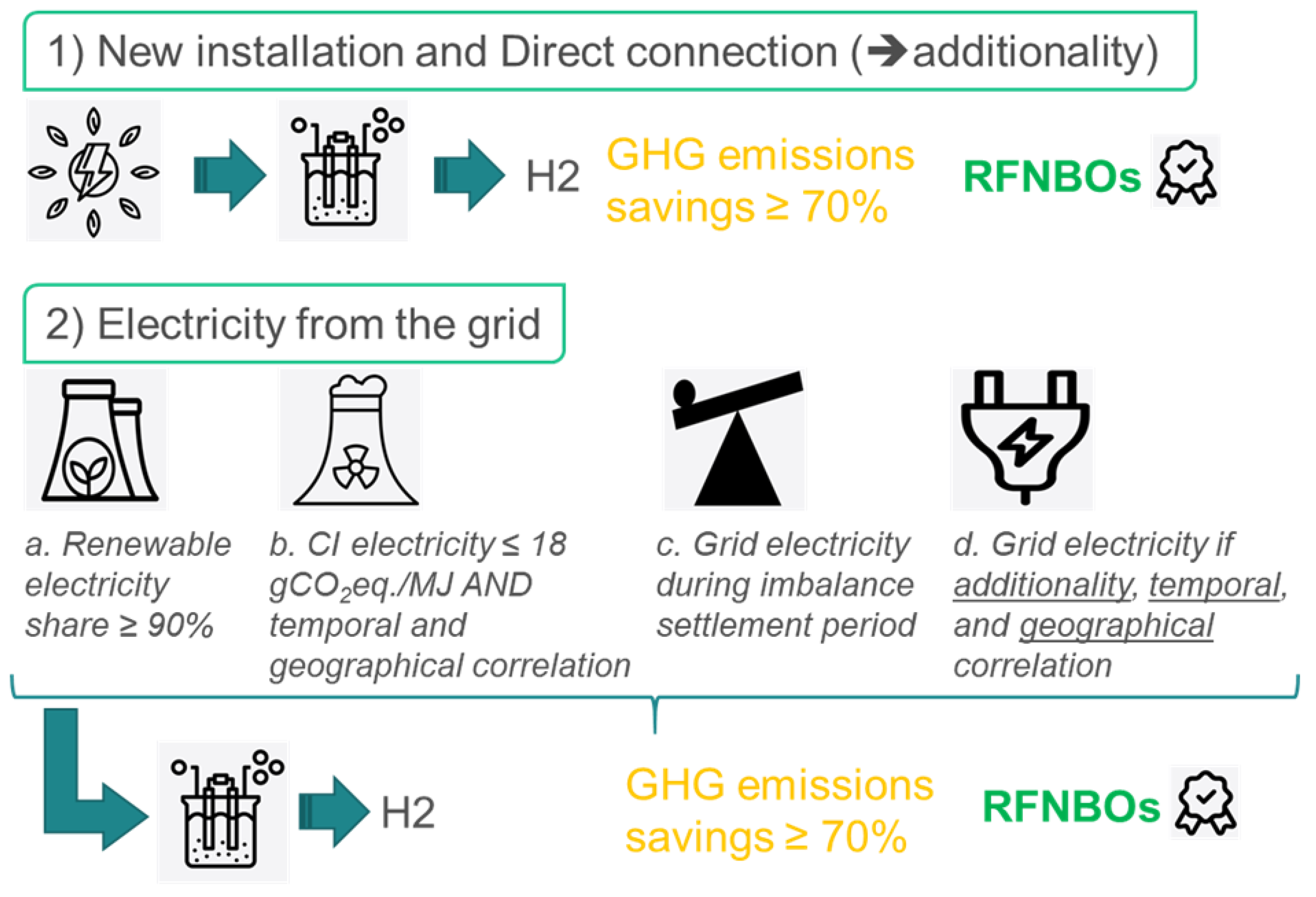
Figure 2.
Approach for assessing carbon intensity of hydrogen production
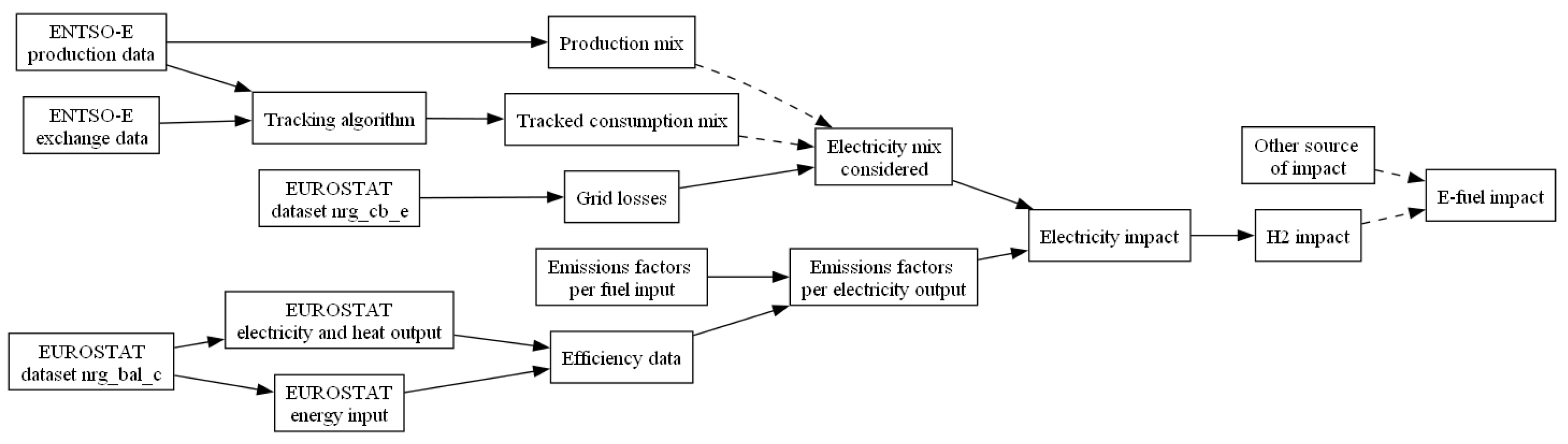
Figure 3.
Heat map of missing data respectively for generation and exchange data
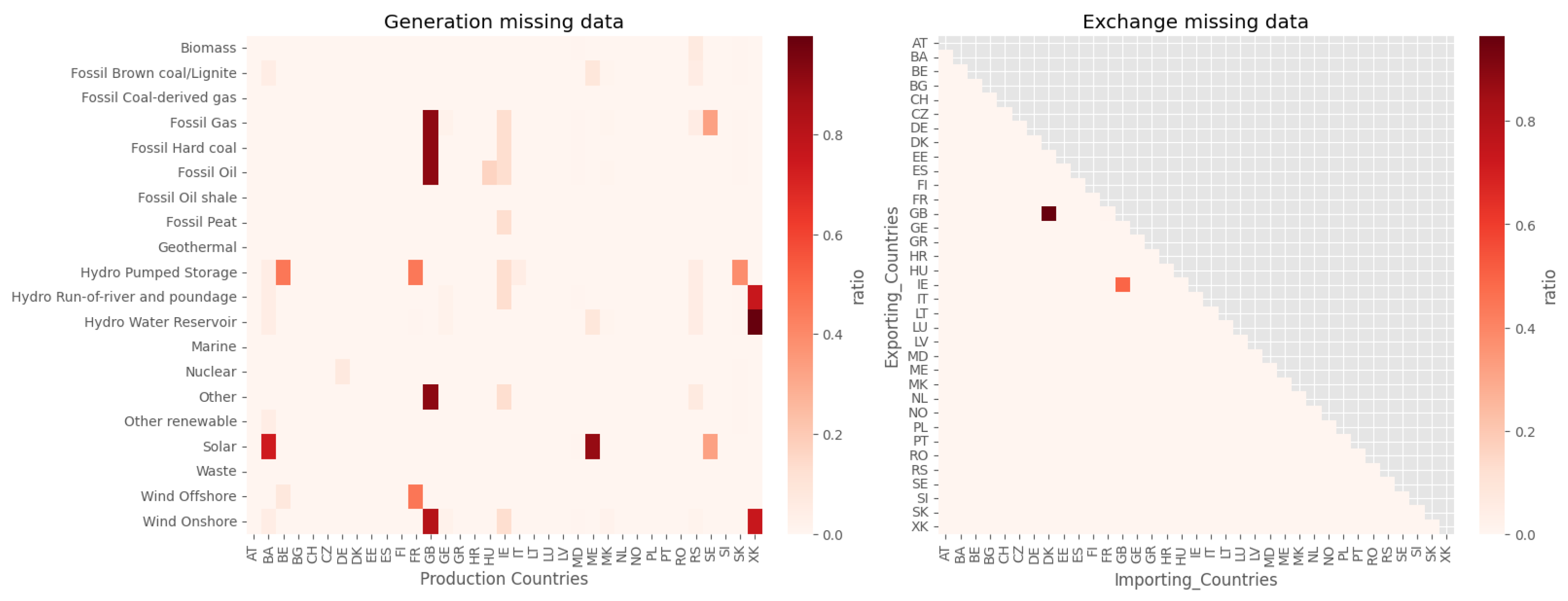
Figure 4.
Generation and exchange data for Italy
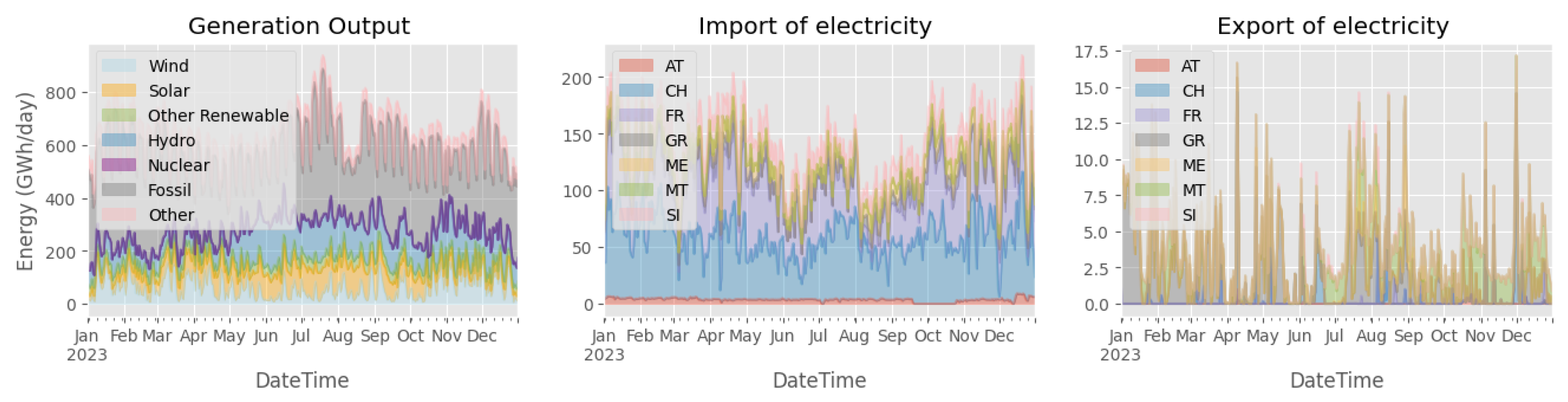
Figure 5.
Electricity exchange between ENTSO-E countries and external neighbours
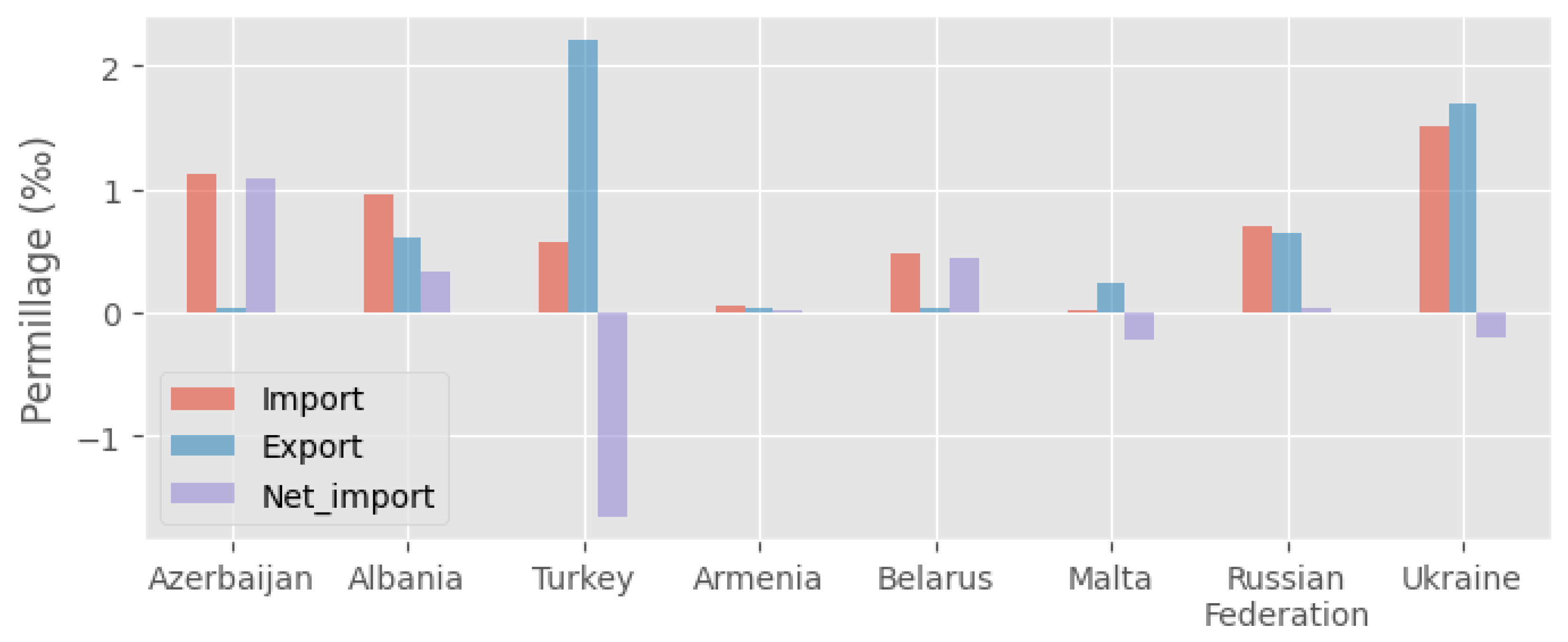
Figure 6.
Distribution of national energy efficiency by energy sources
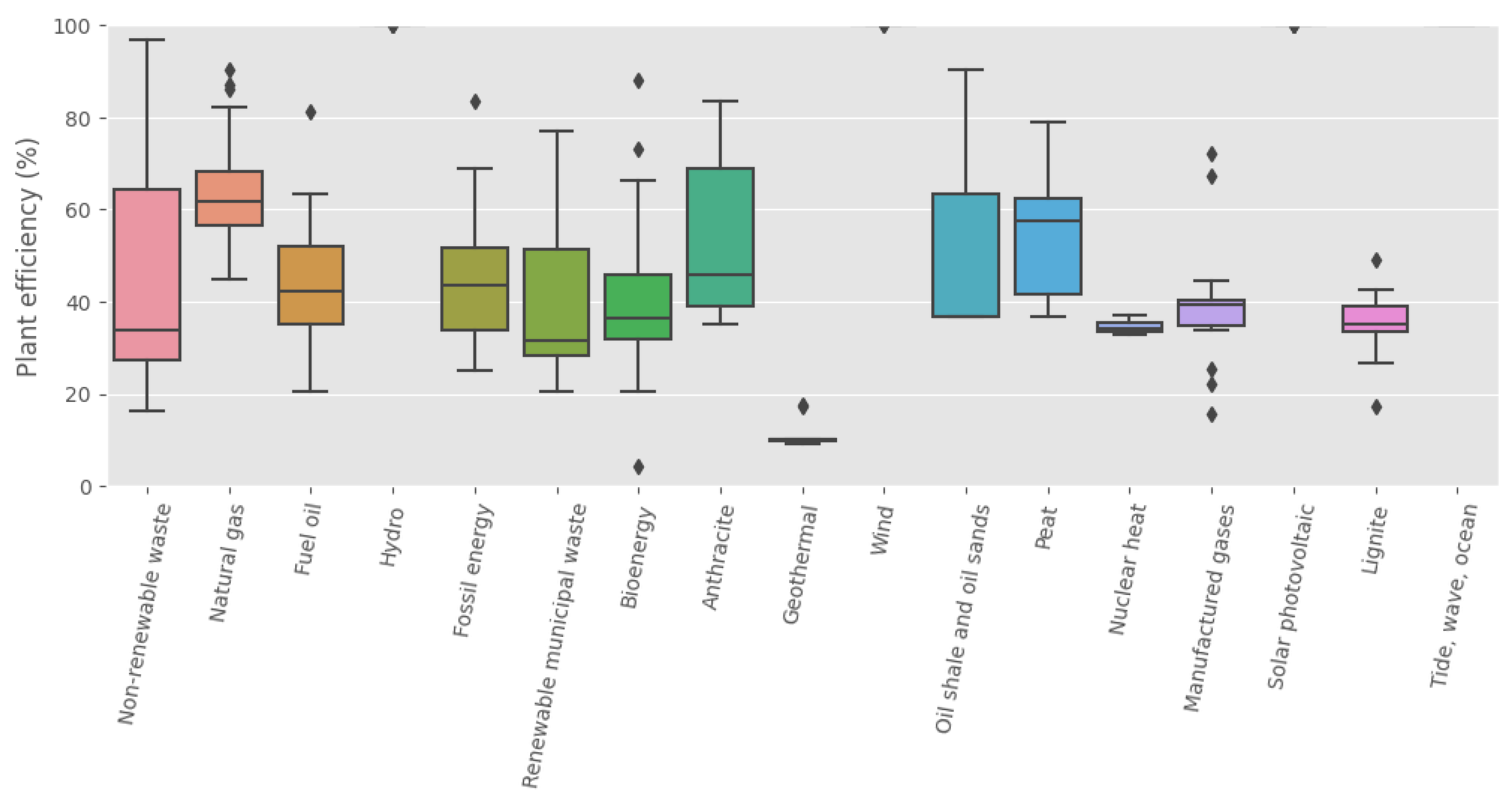
Figure 7.
Carbon intensity by electricity sources
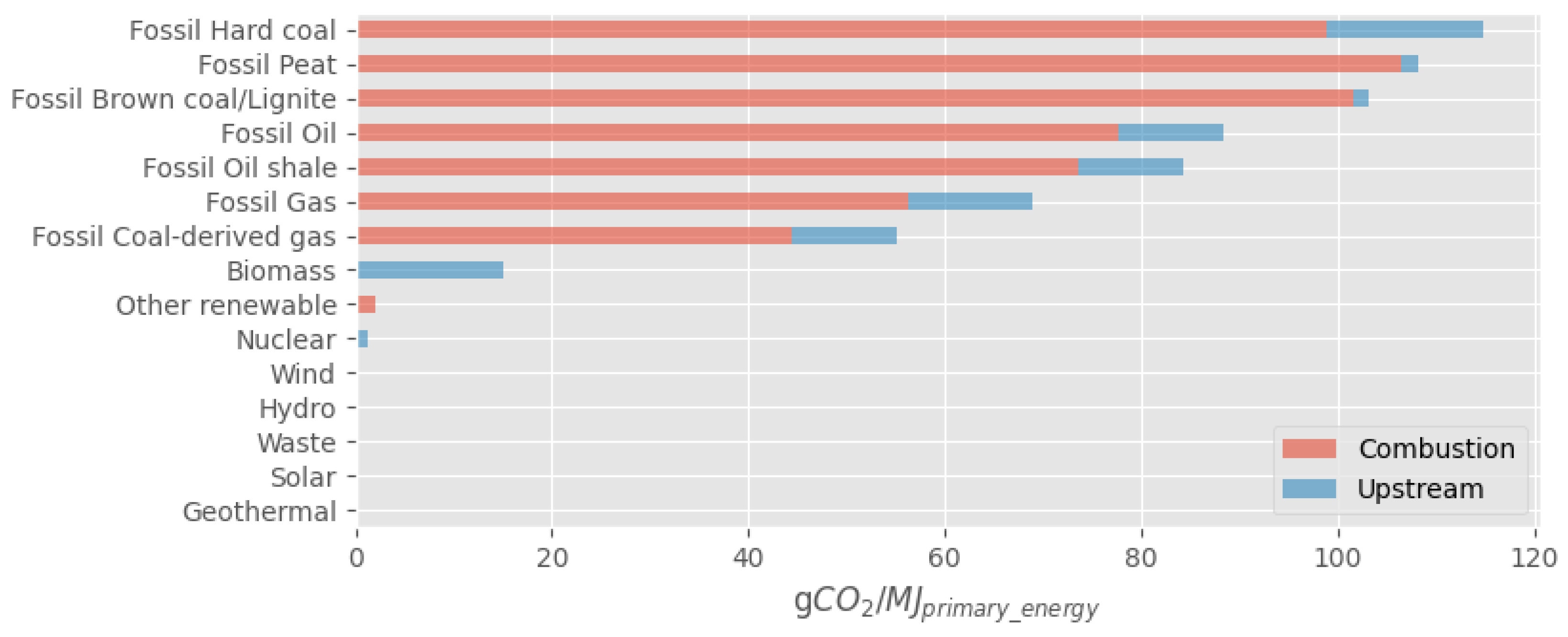
Figure 8.
Dashboard of electricity mix and carbon intensities for selected cases
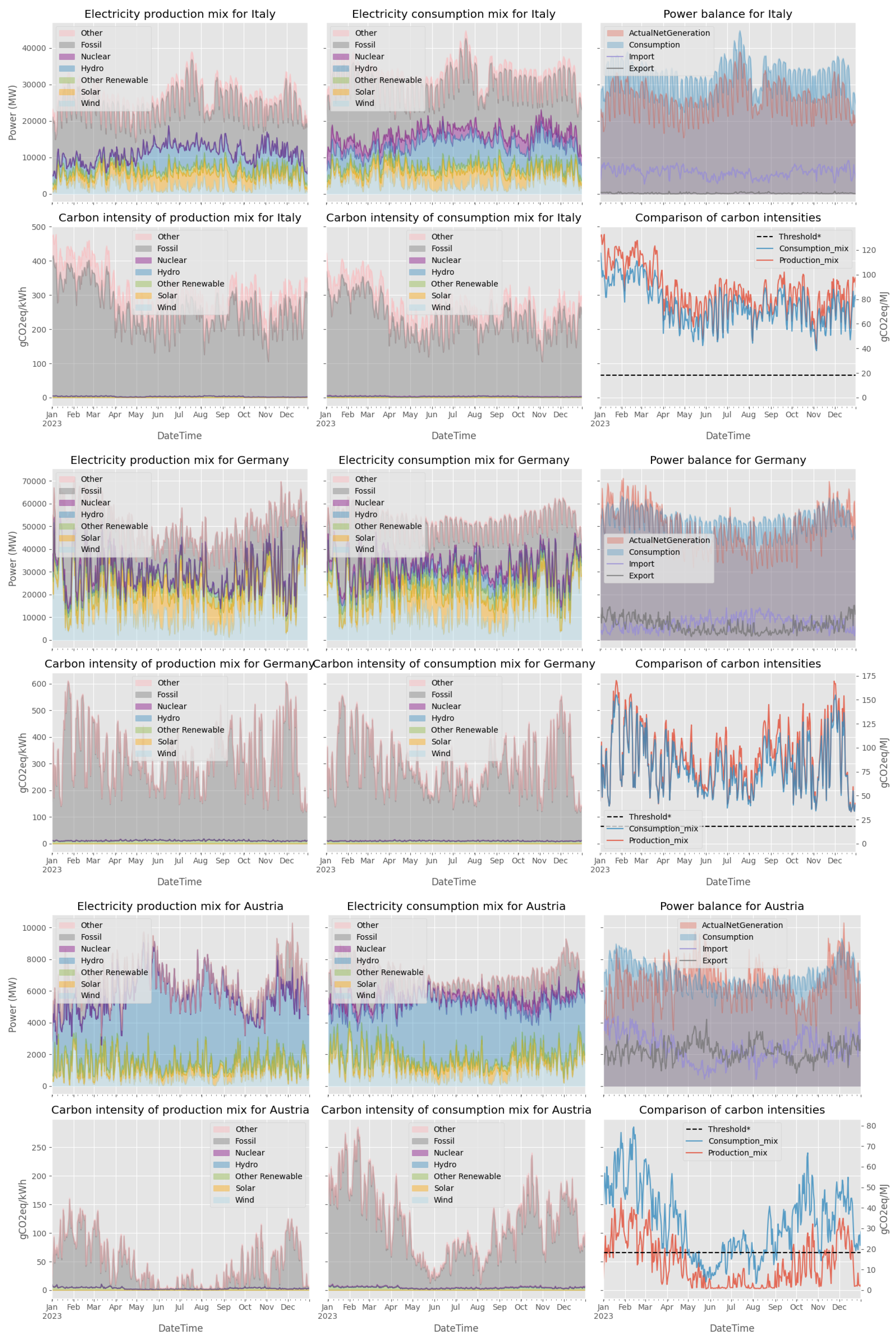
Figure 9.
Annual averaged carbon footprint by countries
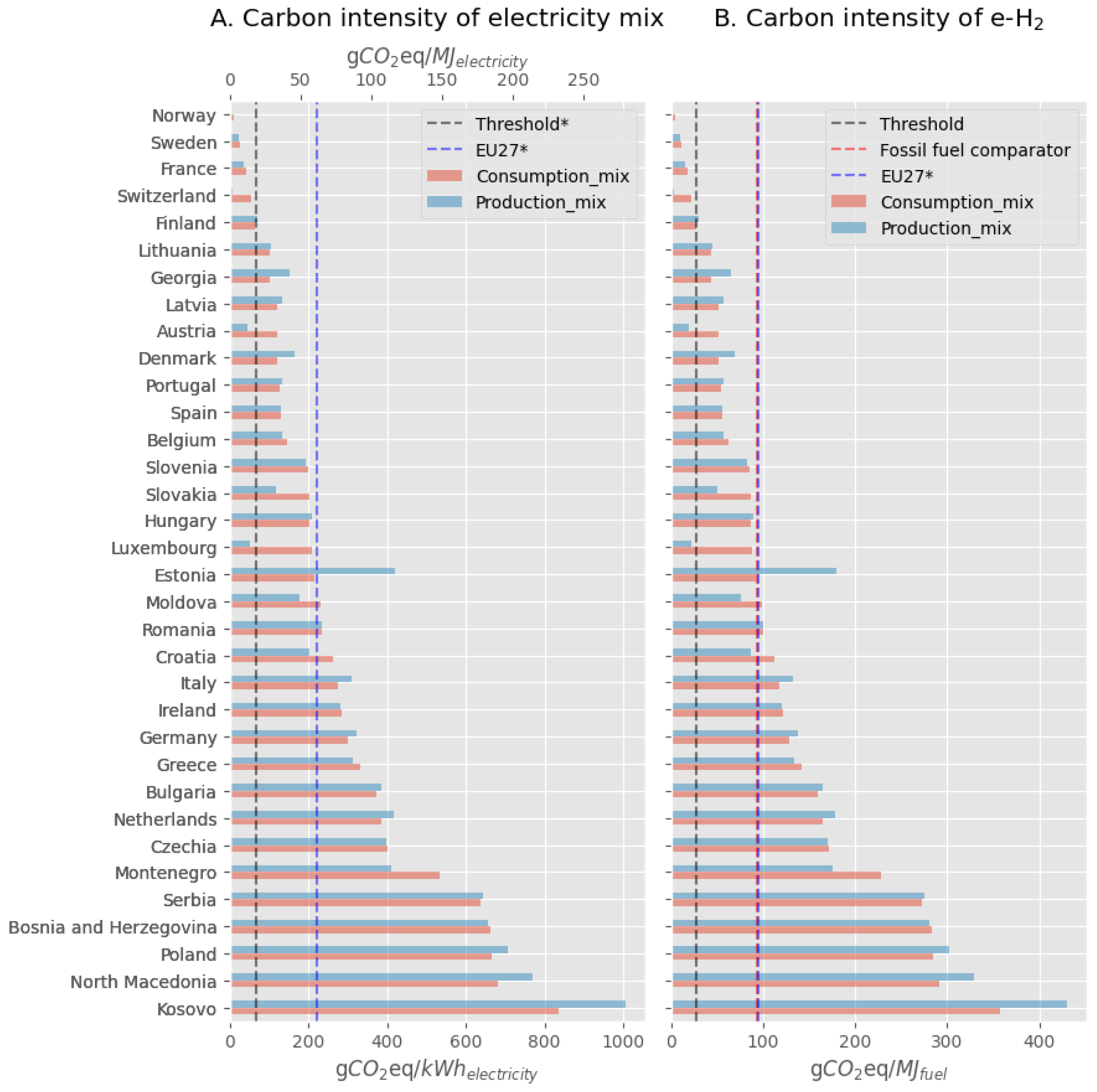
Figure 10.
Percentage of hours where the hydrogen carbon intensity would be below the low carbon hydrogen threshold. Threshold values correspond to 70% savings of GHG emissions compared to the fossil fuel comparator. A 65% efficiency for the electrolysis is assumed and Malta and Cyprus are excluded of the EU27 value due to absence of data.
Figure 10.
Percentage of hours where the hydrogen carbon intensity would be below the low carbon hydrogen threshold. Threshold values correspond to 70% savings of GHG emissions compared to the fossil fuel comparator. A 65% efficiency for the electrolysis is assumed and Malta and Cyprus are excluded of the EU27 value due to absence of data.
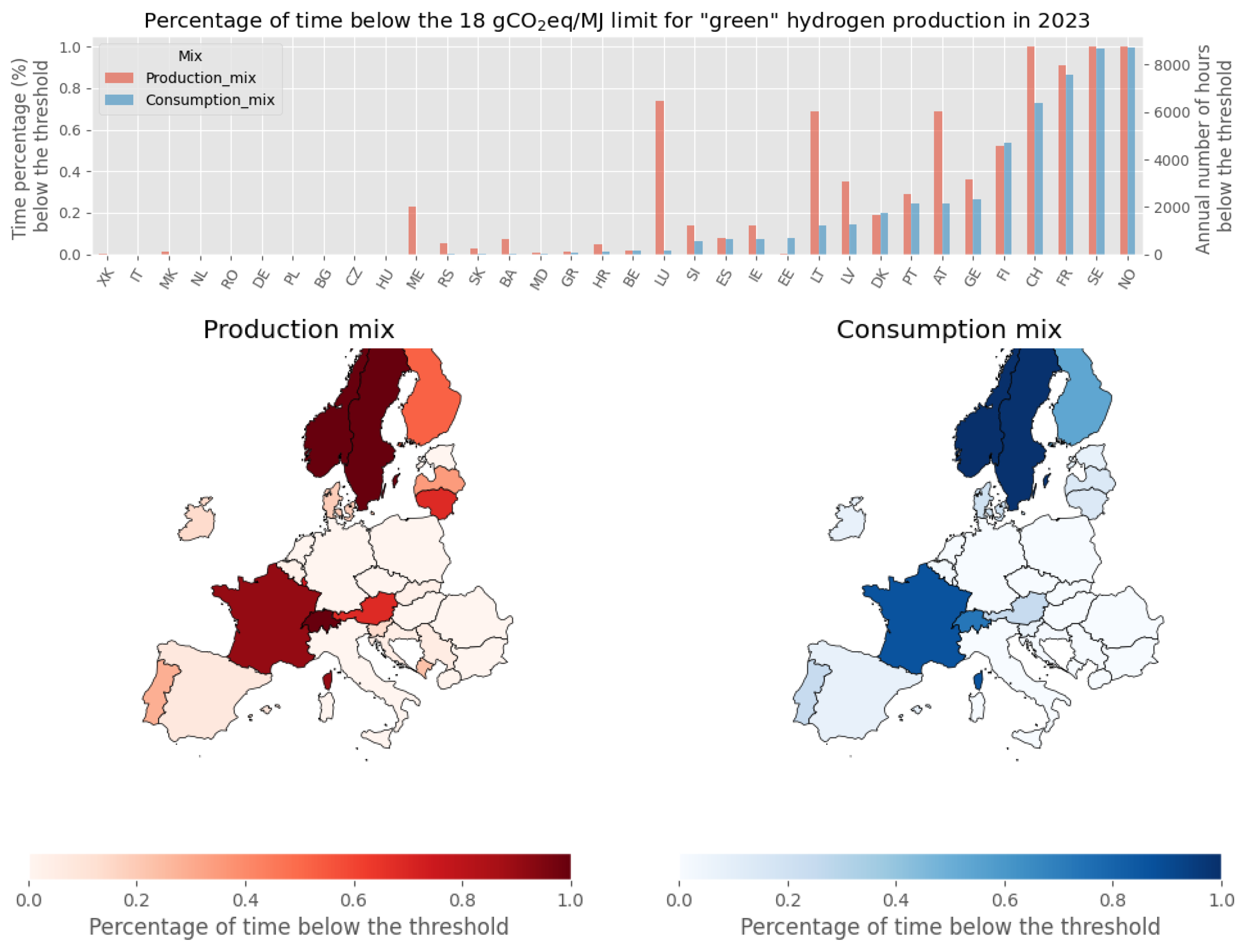
Figure 11.
Time series of e-H2 carbon intensity in Austria
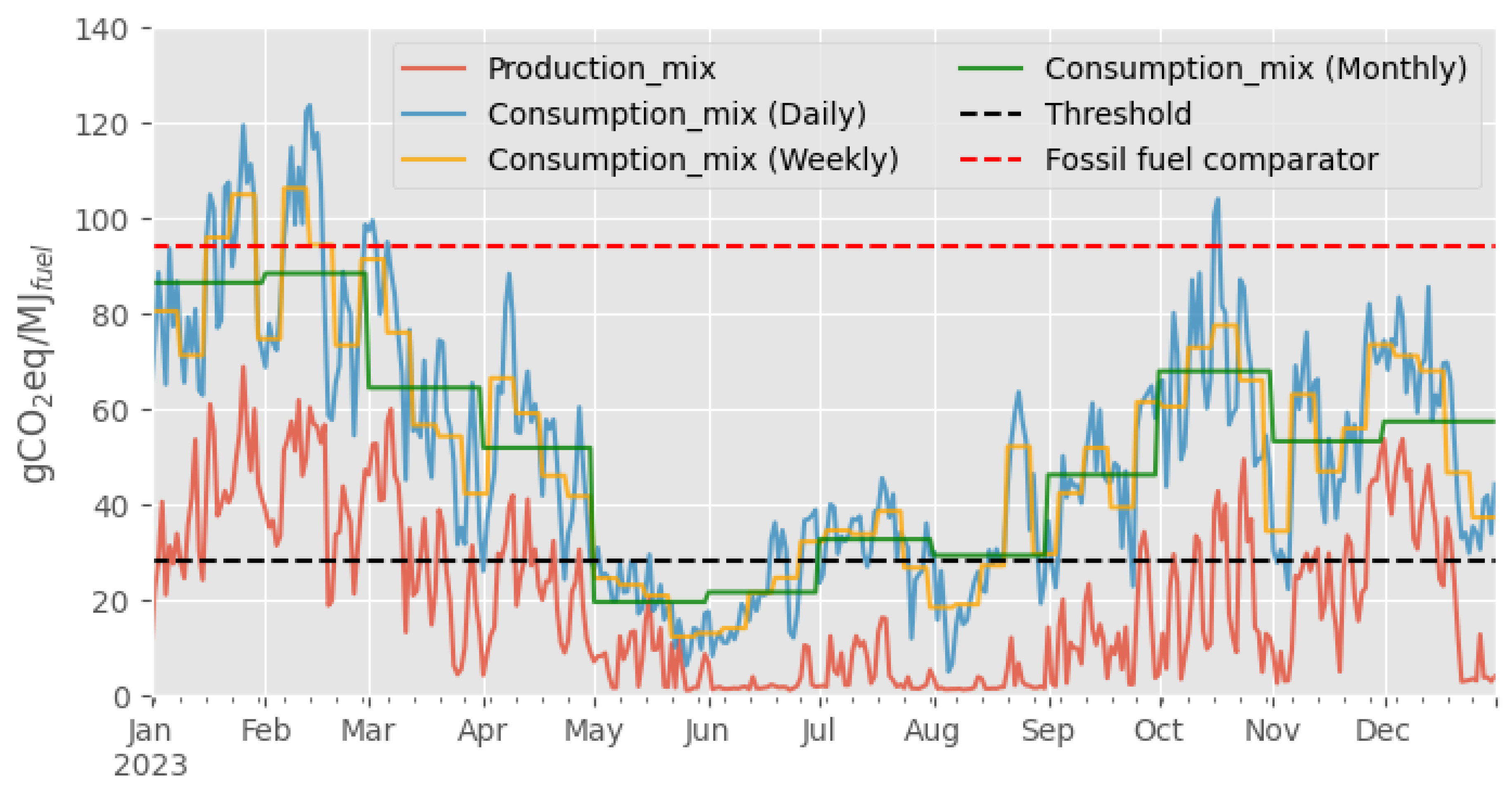
Figure 12.
Influence of the considered time step on potential load factor for low-carbon e-fuel production
Figure 12.
Influence of the considered time step on potential load factor for low-carbon e-fuel production
Disclaimer/Publisher’s Note: The statements, opinions and data contained in all publications are solely those of the individual author(s) and contributor(s) and not of MDPI and/or the editor(s). MDPI and/or the editor(s) disclaim responsibility for any injury to people or property resulting from any ideas, methods, instructions or products referred to in the content. |
© 2024 by the authors. Licensee MDPI, Basel, Switzerland. This article is an open access article distributed under the terms and conditions of the Creative Commons Attribution (CC BY) license (http://creativecommons.org/licenses/by/4.0/).
Copyright: This open access article is published under a Creative Commons CC BY 4.0 license, which permit the free download, distribution, and reuse, provided that the author and preprint are cited in any reuse.


