

Submitted:
24 September 2024
Posted:
24 September 2024
You are already at the latest version
Abstract
In the standard model (SM) and general relative theory (GR) based on the 4-D Minkowski space, the graviton and photon are massless. In that case, two particles with the positive masses are attracted to each other by the gravitational (graviton) waves. The origin of the attractive gravitational force is not understood in terms of SM and GR. In the present work, the 3-D quantized space model (TQSM) based on the 4-D Euclidean space is applied to explain the attractive gravitational force. The repulsive Coulomb force between two particles with the positive charges is explained by using the destructive interference of the electric waves emitted from two particles. Therefore, the destructive interference of the gravitational (graviton) waves emitted from two particles with the positive masses should make the repulsive gravitational force (Fr). The observance of the attractive gravitational force (Fg) indicates the non-zero graviton mass because the attractive gravitational force can be explained if the gravitational (graviton) waves are the oscillating mass waves. The masses lost during the destructive interference of the gravitational (graviton) waves are converted to the gamma rays. These induced gamma rays make the new attractive force (Fa). The observed attractive gravitational force (Fg) should be originated by the equation of Fg = Fa – Fr > 0. This can explain the reason why the gravitational force (Fg) between the elementary particles is so weak when compared with the Coulomb forces. The properties of elementary particles in terms of the TQSM model are analyzed by the wave mechanics of G, E and M waves of the 3-D quantized photon space. The G wave is the time fluctuations along the (absolute) time axis and E (electric) and M (magnetic) waves are the space fluctuations along the space axes. The elementary particles exist as the particle forms with the constant (rest) masses (m) at the low speed. The elementary particles at the high speed have the (particle) wave forms with the oscillating masses or the particle forms with the relativistic masses (gm). The graviton has the very small mass moving with the very high-speed close to the light speed of c. This means that most of the gravitons exist as the graviton wave forms. The particle waves are coupled with the photon waves (2EM, gamma rays) because of the energy conservation. It is concluded that the gravitational waves are the coupled oscillating forms (GEM waves) of the graviton waves and photon waves. The existence of the wave forms for the particles can explain the double slit experiment for the electron beams. And the attractiveness of the dark matter, weak and strong forces is explained by the virtual two boson processes with the TC symmetry and total energy conservation. All elementary bosons and neutrinos are considered as the wave forms with the high speed close to the light speed of c. Because of the charge and energy conservations, only the neutrino oscillations and dark matter (baston) oscillations are allowed.
Keywords:
TQSM model
; gravitational force
; wave forms of the particles
; massive graviton
; time fluctuations (G)
; space fluctuations (E
; M
; 2EM)
; oscillating mass waves
; boson forces
; neutrino oscillations
; dartk matter oscillations
; TC symmetry and energy conservation
1. Introduction
In the standard model, the time is relative and intertwined with the space according to the special and general relative theories based on the 4-D Minkowski space. Therefore, the universe is described as the spacetime. The Coulomb force between two charges and the gravitational force between two masses are transferred through the electric fields (E) and gravitational fields (G), respectively. In general relativity, the spacetime is warped by the existence of the masses but not by the existence of the electric charges. The gravitational waves are made by the warped spacetime in terms of the general relativity. Of course, the matters with the electric charges are massive. And the massive neutrinos are observed. And the force carrying bosons of gravitons and photons are proposed. In the general relative theory, the graviton with the light velocity is massless. Therefore, the graviton with the spin of 2 is massless like the photon with the spin of 1. This means that the gravitational waves with the photon velocity is similar to the electromagnetic waves (γ rays). The gravitational force between two matters with the positive masses is attractive. But the Coulomb force between two matters with the same charge signs is repulsive. When compared with the repulsive Coulomb force between the particles with the same charges, it is thought that the gravitational force between two positive masses should be repulsive. Therefore, it is strange that the gravitational force is attractive. The origin of the attractive gravitational force has not been clearly explained even though the gravitational attractive force is explained by the warping of the space-time due to the massive particles in terms of the general relative theory. The further study on the origin of the attractive gravitational force is required in terms of the standard model. Also, the gluons between the quarks have the zero mass like the photon. Therefore, three kinds of photon-like massless bosons are the photons for the electromagnetic force, gravitons for the gravitational force and gluons for the strong force. If the graviton is massive, the new quantum gravitational theory is required [1,2,3,4,5,6,7,8,9,10,11,12,13,14,15,16,17,18,19,20,21,22,23,24,25,26,27,28,29,30,31,32,33,34,35,36]. Also, if the gluons have the nonzero mass, the new concept of the gluons should be introduced for the strong force. And it needs to be noted that the W and Z bosons for the weak forces are the virtual particles with the heavy masses which are made from the quantum vacuum fluctuations allowed by the uncertainty principle. Also, it needs to be noted that the energy non-conservation is allowed within the vary fast time period by the uncertainty principle. However, if the energy should be always conserved in all physical processes including the vacuum fluctuations, the energy non-conservation of the heavy W and Z boson production for the weak force should be clearly explained even though the masses can be given to the W and Z bosons by the, so called, Higgs mechanism in terms of the standard model (SM) [37].
In the present work, the reason why the gravitational force is attractive is explained in terms of the 3-D quantized space model (TQSM) [38] as shown in Figure 1, Figure 2 and Figure 3. The particles have the particle forms with the constant rest masses (m) at the low speed of v → 0 and the particle forms are changed to the wave forms with the oscillating mass waves at the high speed of v → c in Figure 1. The details about the origin of the attractive gravitational force and the wave mechanics of the elementary particles are discussed in the present work. The present work is written in terms of the 3-D quantized space model (TQSM) which is based on the 4-D Euclidean space in Figure 2 and Figure 3. Then the absolute time axis is the 4th axis in Figure 2 and Figure 3. The relative time axis is the varying 4-D distance line depending on the particle velocity. Our universe is defined as the 3-D quantized space (the photon space) which is the 3-D space volume with the very small (absolute) time width in Figure 2. The attractive force means that the 3-D space distance between two matters is decreased and the 3-D space fluctuations between two matters are increased. The repulsive force means that the 3-D space distance between two matters is increased and the 3-D space fluctuations between two matters are decreased. The absolute time (ct) and 3-D photon space in Figure 2 and Figure 3 are not entangled in the 4-D Euclidean space in terms of the 3-D quantized space model and the relative time (corresponding to ctl in the present work) and 3-D space are entangled in the 4-D Minkowski space in terms of the general relative theory in Figure 3. Note that the present work is based only on the 4-D Euclidean space with the absolute time (ct) in Figure 2 and Figure 3.
2. Particle Forms and Wave Forms of the Particles in Terms of the TQSM Model
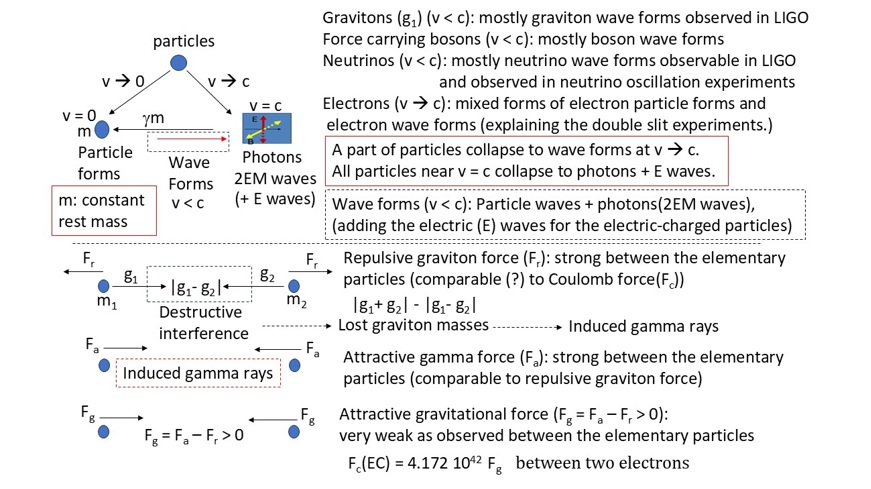
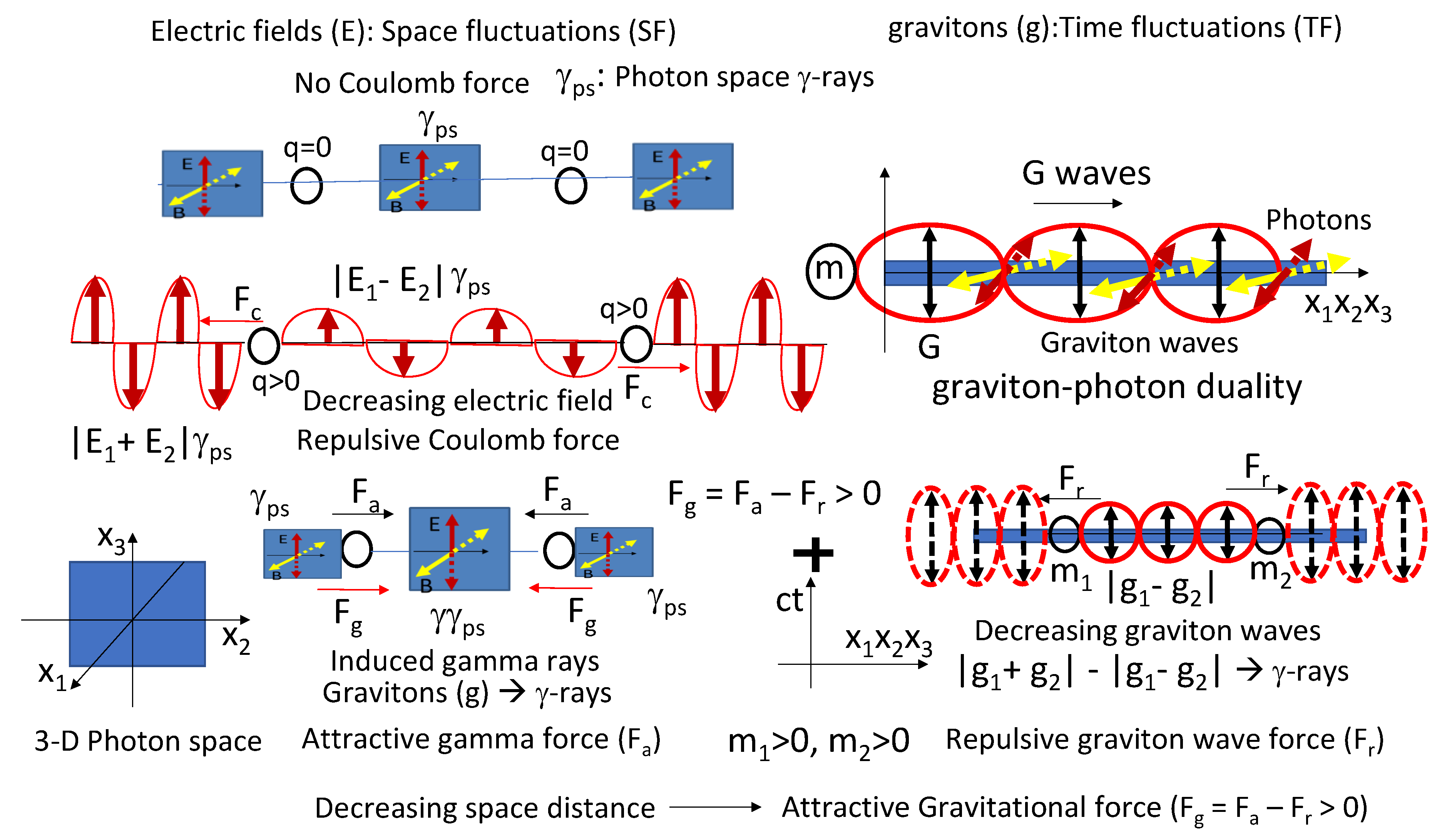
The electric field (E) and magnetic field (M or B) are the space fluctuations along the space axes in Figure 2. And the gamma rays (photons) are the electromagnetic waves (2EM) that are the space fluctuations in Figure 2, Figure 4 and Figure 5. In Figure 5, the electric field and magnetic field are related to the Coulomb force and magnetic force, respectively. The gravitational waves are made of the gravitons in Figure 4 and Figure 5. The gravitons are massive from the time fluctuations. From the present 3-D quantized space model, the 3-D quantized photon space can be warped along the (absolute) time axis. This warped photon space along the time axis is connected to the gravitational waves in Figure 4 and Figure 5. The gravitational waves are originated from the time fluctuations. Therefore, in terms of the 3-D quantized space model, two space fluctuations of the electric and magnetic waves and one time fluctuation of the gravitational waves exist in Figure 2 and Figure 5. The gravitons exist as the particle forms at the low speed of v → 0 and as the wave forms at the high speed of v → c. The gravitons as the particle form have the constant rest masses (m) and relativistic masses (gm). Because the gravitons move at the high speed close to the photon speed of c, the gravitons with the particle forms are converted to the wave form with the wave speed of v < c at the high speed of v → c in Figure 1. This graviton wave has the oscillating mass. The oscillating masses are coupled with the gamma rays (2EM waves) because of the energy conservation in Figure 4 and Figure 5. The gravitational waves consist of the graviton waves and 2EM waves. The gravitational force between two positive masses should be repulsive like the Coulomb force between two positive charges is repulsive in Figure 1, Figure 6 and Figure 7. Two gravitational waves (graviton waves, g in Figure 1 and Figure 6) from the two masses have the destructive interference that decreases the strength of the gravitational waves between two masses. This decreased gravitational waves increase the space distance between two masses. Therefore, the gravitational force is repulsive when considering only the graviton waves of g in Figure 1 and Figure 6. This repulsive gravitational force (Fr) obtained from the time fluctuations is consistent with the repulsive Coulomb force obtained from the space fluctuations. In the real word, the gravitational force (Fg) between two positive masses is attractive. This means that there is the induced attractive force (Fa) which changes the repulsive force to the attractive force. This induced attractive force (Fa) should be obtained from the space fluctuations of the induced gamma rays in Figure 1, Figure 6 and Figure 7. Then Fg = Fa – Fr > 0. The induced gamma rays between two masses are created from the lost massive gravitons of the decreased gravitational waves between two masses from the energy conservation in Figure 1 and Figure 6. Therefore, the gravitational waves (G waves) between two matters consist of the repulsive graviton waves (gw) and the attractive induced photon waves(pw). The photon waves include the 2EM waves due to the oscillating graviton waves and induced gamma rays due to the decreasing graviton waves in Figure 1, Figure 4 and Figure 6. The strength of the repulsive gravitational force (Fr) could be comparable to the strength of the repulsive Coulomb force for the elementary particles. But the very weak strength of the attractive gravitational force (Fg) when compared with the strong strength of the repulsive Coulomb force for the elementary particles is originated from the very weak strength of the force difference of Fg = Fa – Fr > 0.
The gravitational force between two positive masses is attractive unlike the Coulomb force between two positive charges is repulsive in Figure 1 and Figure 6 and 7. In Figure 7, several contents are summarized. This means that the space distance between two matters is decreased. The space fluctuations between two matters should be increased in order to decrease the space distance between two matters. The only remaining space fluctuations are the gamma rays (2EM waves) if the electric waves and magnetic waves are excluded. Therefore, the gamma rays between two matters are increased in case of the gravitational forces. Then the space distance between two matters is decreased by the increased space fluctuations of the gamma rays in case of the attractive gravitational force. These gamma rays induced by the gravitational waves are called as the induced gamma rays in the present work in Figure 1, Figure 6 and Figure 7. The attractive gravitational force can be explained by the induced gamma rays (2EM waves). How the gamma rays can be induced by the gravitational force between two matters is explained in the present work in terms of the 3-D quantized space model.
In terms of the 3-D quantized space model, the two kinds of photon space fluctuations such as the electric fields (E) and magnetic fields (B or M) take place in Figure 2. The photons with the E = 0 and B = 0 (or M = 0) can be described as the 2EM waves with E=0 and B=0. The gravitational waves (G) with the massive gravitons (g) are the time fluctuations along the absolute time axis. Our universe has the E, M and G waves in Figure 2. Therefore, our universe is explained as the 3-D quantized space model. All forces are made based on the background photon spaces ((2EM)ps = γps) in Figure 6. Attractive and repulsive forces mean the decreasing and increasing, respectively, of the photon space distance between two particles in Figure 6 and Figure 7. If the photon space distance is decreasing between two particles, the photon space fluctuations between two particles should be increasing for the attractive force. If the photon space distance is increasing between two particles, the photon space fluctuations between two particles should be decreasing for the repulsive force. The Coulomb force (Fc) is made through the E+ γps = Eγps waves. The E field between two particles is equal to the |E1-E2| field for the repulsive Coulomb force. The E field between two particles is equal to the |E1+E2| field for the attractive Coulomb force. The graviton (g) wave between two particles is equal to the |g1-g2| wave from the destructive interference. The gravitational force (Fr) corresponding to the |g1-g2| wave obtained from the destructive interference is repulsive like the Coulomb force corresponding to the |E1-E2| field obtained from the destructive interference is repulsive. Therefore, the graviton (g) wave is decreasing by |g1-g2| and Δg = |g1+g2|-|g1-g2| is lost in Figure 6. The lost gravitons of Δg should be converted to the photons (γ-rays) because of the energy conservation. These induced gamma rays are increasing between two particles. The space distance between two particles is decreased because the induced gamma rays are increasing. The gravitational force (Fa) corresponding to the induced gamma rays is attractive. Because the observed gravitational force (Fg) between two particles is attractive, the strength of the attractive force (Fa) is bigger than the strength of the repulsive force (Fr). Therefore, Fg = Fa – Fr > 0. Therefore, γ+ γps = γγps for the induced gamma rays in Figure 6. The same principle of the induced gamma rays can be applied to the massive force carrying bosons of the dark matter force, weak force and strong force. Therefore, all forces made through the massive bosons are attractive. Basically, all forces including the electromagnetic forces are transferred by the background gamma rays (γps) of the photon space. In Figure 7, several physics terms are summarized for the readers.
Also, in Figure 8, the particles have two shapes of particle forms at the low speed of v→0 and wave forms at the high speed of v→ c. At the particle form, the particle has the constant rest mass while moving with the speed of v < c. At the wave form, the particle has the oscillating rest mass while moving with the speed of v < c. Then, the oscillating mass is coupled with the oscillating 2EM waves (photons, gamma rays). The particles have the more possibility to be changed from the particle forms to wave forms as the particle speed is increasing and closer to the light speed of c. After the particle forms are changed to the wave forms, the particles with the wave forms move with the speed of v < c because the photons are coupled to the oscillating particle mass waves. The gravitational waves and electric waves are emitted from the surface fluctuations of the charged particles with the particle forms in Figure 8. The gravitational waves and electric waves emitted from the surface fluctuations of the charged particles with the particle forms in Figure 8 are much smaller than the particle waves and electric waves of the charged fermions with the wave forms in Figure 9. It is because the graviton mass is much smaller than the elementary fermion masses. The particle forms and wave forms of the particles are, for the first time, discussed for the elementary fermions, elementary bosons, photons and massive gravitons in the present work in Figure 8, Figure 9, Figure 10 and Figure 11.
Traditional neutrino oscillations in terms of the standard model come from the lepton flavor mixing of the three elementary neutrinos with the zero electric charges [37,39,40,41,42]. Traditional neutrino oscillations in terms of the standard model are not allowed in terms of the 3-D quantized space model (TQSM) because of the lepton charge conservation. In Figure 9 and Figure 10, the neutrino oscillations in terms of the 3-D quantized space model (TQSM) come from the lepton flavor changing of the three neutrinos with the wave forms under the condition of the lepton charge conservation. Also, the dark matter oscillations are allowed.
Double slit experiments in terms of the 3-D quantized space model (TQSM) can be explained by the interference of the elementary fermions with the wave forms. The electrons with the light masses can have the wave forms at the relatively slow velocity of 0.4c as observed at the double slit experiments.
3. Origins of the Coulomb and Gravitational Forces
In Figure 2, the 1-D quantized space, 2-D quantized space, 3-D quantized space and 4-D quantized space are shown based on the n-D Euclidean spaces. Only the G wave exists on the 1-D quantized space. On the 2-D quantized space, the E and G waves exist. On the 3-D quantized space, the E, B and G waves exist. On the 4-D quantized space, the E, B, A and G waves exist. Our universe has the E, B and G waves. Therefore, our universe corresponds to the 3-D quantized space. In Figure 3, the standard model based on the 4-D Minkowski space and relative time and the 3-D quantized space model based on the 4-D Euclidean space and absolute time are compared. In the standard model, only the matter universe with the positive energy and positive relative time is proposed from the big bang in Figure 3. In the 3-D quantized space model, the matter universe with the positive energy and positive absolute time, and the partner antimatter universe with the negative energy and negative absolute time are created from the big bang. In terms of the 3-D quantized space model, the special and general relative theories based on the relative time in the 4-D Minkowski space should be revised to the new theories based on the absolute time in the 4-D Euclidean space.
In Figure 4, the new concept of the graviton is introduced. In the low-speed limit of v→0, the graviton moves as the entity of the particle form with the speed of v. But in the high-speed limit of v→ c, the particle form of the graviton is collapsed to the wave form with the speed of v < c. In the wave form, the graviton waves have the changing and oscillating mass wave form. Because of the energy conservation, the photon waves should be coupled to the graviton waves in Figure 4. The summed energy of the graviton waves and photon waves should be conserved. This indicates that the gravitational waves consist of the graviton waves (gw) and the photon waves (pw) in Figure 4. It is called as the graviton-photon wave duality of GEM waves. The gravitons exist as the gravitational wave forms with the high speed of v → c but not as the particle form with the low speed of v → 0. In Figure 5, the magnetic waves (B), electric waves (E), 2EM waves (photons), GEM waves, graviton waves (G or gw) and boson waves (Bw) are compared with the particle form of the elementary fermions. The force carrying bosons are the virtual particles with the very high speed close to the light speed of c. Therefore, it is proposed that most of these bosons exist as the boson wave forms with the high speed of v → c. In Figure 6, Coulomb force between two charges with the same signs is repulsive. The gravitational force (Fr) between two masses through the gravitational waves (g waves) is repulsive like the Coulomb force between two charges with the same signs is repulsive. This repulsive gravitational force (Fr) is comparable with the repulsive Coulomb force for the charged elementary particles. But the destructive interference of the gravitational waves (g waves) emitted from two masses emit the induced gamma rays because of the energy conservation. The reduced gravitons turn into the induced gamma rays. The induced gamma rays between two masses increase the space fluctuations between two masses. Therefore, the space distance between two masses is decreased. This force (Fa) is attractive. The difference of Fa and Fr is observed as the attractive gravitational force of Fg = Fa – Fr >0 experimentally. This can explain the reason why the strength of the attractive gravitational force (Fg) is so much weaker than the Coulomb force for the charged elementary particles. In Figure 7, several physical contents used in the present work are defined for the readers.
In Figure 8, Figure 9, Figure 10 and Figure 11, the particle forms and wave forms of the elementary fermions are described. The particles have two shapes of particle forms at the low speed of v → 0 and wave forms at the high speed of v → c. At the particle form, the particle has the constant rest mass while moving with the speed of v → 0. At the wave form, the particle has the oscillating rest mass while moving with the speed of v → c. Then, the oscillating mass is coupled with the oscillating 2EM waves (photons, gamma rays). This is called as the particle-wave duality of the GEM waves in Figure 5 in the present work. The particles have the more possibility to be changed from the particle forms to wave forms as the particle speed is increasing and closer to the light speed of c. After the particle forms are changed to the wave forms, the particles with the wave forms move with the high speed of v → c. The gravitational waves and electric waves are emitted from the surface fluctuations of the charged particles with the particle forms. The gravitational waves and electric waves emitted from the surface fluctuations of the charged particles with the particle forms are much smaller than the particle waves and electric waves of the charged particles with the wave forms. In Figure 8, the gravitational waves and electric waves are emitted from the surface fluctuations of the particles at the particle forms. The gravitational waves and electric waves are connected with the gravitational force and Coulomb force, respectively. And, in Figure 8, the pair annihilation and pair creation of the particle and anti-particle are shown. Because the photons have no electric field (E) and no magnetic field (B), the photons are defined as the 2EM waves. The 2EM waves have no electric fields (E) and no magnetic fields (B). But the EM waves have the nonzero E field (E) and nonzero magnetic field (B). Of course, the photons have no gravitational field (G) because the photons have zero rest masses. The gravitational waves consist of the graviton waves and photon waves because of the energy conservation in Figure 4, Figure 5 and Figure 8.
In Figure 8, 9 and 10, the fermion waves including the electron waves are shown. In Figure 9, it is thought that the electron beams have the more wave forms as the speed of the electrons is closer to the photon speed of c. The electron beams have the combined wave forms of the electron waves, photon waves and electric waves. These combined wave forms are proved at the double slit experiments. In other words, the wave interference patterns of the electron beams passing through the double slits are originated from the combined wave forms of the electron waves, photon waves and electric waves.
In Figure 9, particle forms and wave forms of the elementary fermions including the lepton charges are described. Neutrinos have the zero electric charges of EC = 0 and non-zero lepton charges of LC = -2/3 for the electron neutrino, LC = -5/3 for the muon neutrino and LC = 8/3 for the tau neutrino. This means that the neutrino oscillations take place by changing the lepton charges as shown in Figure 9 and Figure 10. Note that the neutrinos have the very light masses with the high speed of v → c. Therefore, the neutrinos have the wave forms but not the particle forms. The dark matters (bastons) have only the electric charges of EC = -2/3 for B1, EC = -5/3 for B2 and EC = -8/3 for B3. The dark matter oscillations take place by changing the electric charges as shown in Figure 10. But the oscillations of other elementary particles are prohibited because of the charge conservation.
In Figure 11, the elementary boson waves are shown with the massive graviton waves. The gravitons exist always as the wave forms with the high speed of v → c but not as the particle forms with the speed of v → 0. The gravitons have the graviton-photon duality of the GEM waves as the wave form. The gravitational waves are made up of the graviton waves and photon waves. Because the graviton mass is very small, the graviton waves can be produced from the surface fluctuations of the particles. The elementary force carrying bosons are shown in Figure 11. The elementary bosons are proposed as the magnetic monopole with the negative magnetic charges. Anyway, the boson waves with the high speed of v → c are compared with the graviton waves. Because the elementary bosons have the large masses, the elementary bosons with the positive energy are proposed to be created from the pair production of the boson with the positive energy and anti-boson with the negative energy from the nothing because of the energy conservation. In Figure 12, several physical contents are summarized for the readers. In Figure 13, the surface fluctuations of the particles are described to explain the electric waves, photons and gravitational waves. In Figure 5 and Figure 13, the electric waves, magnetic waves, gravitational waves, GEM waves and 2EM waves are compared. It is not possible to observe the rest mass of the graviton because the gravitons always exist as the wave forms. The rest mass of the graviton is determined indirectly by the mass energy (E) – particle radius (x) relation equation of the particles as shown in Figure 14. The E-x equation obtained from the observed mass energy and radius of the proton is E = 12.2047 1038 x2 in Figure 14. The calculated rest mass (m) of the graviton (g(0,0,0)) is 3.1872 10-31 eV/c2 at the Planck radius. The calculated radii of the elementary particles including quarks and leptons are shown in Figure 14. In Figure 15, photons and gravitons are explained as the space fluctuations and time fluctuations, respectively.
In Figure 16, Coulomb force and gravitational force are compared. The electric wave is the space fluctuations and the graviton wave is the time fluctuations in Figure 15. The Coulomb force is attractive between two charges with the different signs because the space fluctuations are increased by the |E1+E2| relation between two charges. The Coulomb force is repulsive between two charges with the same signs because the space fluctuations are decreased by the |E1-E2| relation between two charges. The gravitational force (Fr) between two particles with the same positive signs is repulsive because the time fluctuations due to the gravitons are decreased by the |g1-g2| relation between two masses. But the decreased number (|g1+g2| - |g1-g2|) of the gravitons between two particles are converted to the gamma rays because of the energy conservation. Because this induced gamma rays are increased between two particles, the corresponding force (Fa) is attractive. The observed gravitational force is attractive from the equation of Fg = Fa – Fr > 0. The observed gravitational field (G) corresponds to the gravitational force of Fg. This could explain the reason why the observed gravitational force between two elementary charged particles is so weak when compared with the Coulomb force between two elementary charged particles in Figure 1 and Figure 16. In Figure 17 and Figure 18, the attractive Coulomb force and repulsive Coulomb force are explained. In Figure 18, the attractive gravitational force and repulsive Coulomb force are compared. In Figure 19, the attractive gravitational force and attractive boson force are compared. The attractive gravitational force is long range force and the attractive boson force is short range force. Therefore, the attractive boson forces correspond to the dark matter force bosons, weak force bosons and strong force bosons in Figure 19.
These heavy bosons are the force carrying bosons with the short ranges. These heavy bosons can be created from the pair creation of the boson and anti-boson with the TC symmetry as explained in section 4 but the very light gravitons are created from the surface fluctuations of the particles.
In Figure 20 and Figure 21, the gravitational force, Coulomb force and boson force are compared. In Figure 22, it is shown that the total number of the elementary fermions in our universe is 39 by the charge assignment rule. Based on the charge assignment rule, The elementary fermions and elementary bosons in terms of the 3-D quantized space model are shown in Figure 22 and Figure 23, respectively. In Figure 22, the three dark matters called as the batsons, 9 leptons and 27 quarks are proposed by the three dimensional quantized space model. In Figure 23, the three dark matter bosons, 9 weak force bosons and 27 strong force bosons are proposed by the three dimensional quantized space model. The present three dimensional quantized space model can be considered as the extended standard model. These elementary particles are moving on the corresponding photon spaces.
4. Virtual Two Boson Processes for DM, Weak and Strong Forces
Several examples of the weak interactions in terms of the standard model are shown in Figure 24 and Figure 25. The Z and W bosons are created as the virtual one boson processes. Note that only the electric charges are considered in the standard model. In these cases, the total energy is not conserved. The virtual bosons are created and disappeared within the very short time period allowed by the uncertainty principle. But if the total energy should be conserved in every physical processes including the virtual processes allowed by the uncertainty principle, these virtual one boson processes cannot take place. Therefore, in Figure 26, Figure 27, Figure 28 and Figure 29, the virtual two boson processes are introduced in terms of the 3-D quantized space model. The virtual two bosons are created and destroyed by the energy fluctuations of the positive energy (E) and negative energy (-E) along the time axis. These energy fluctuations are originated from the fluctuations of the time momentum of Pt = E/c along the absolute time (ct) axis. The two boson processes have the TC = Tc symmetry in Figure 26. These virtual bosons are shown as the elementary bosons in Figure 23. Note that all elementary bosons are massive in Figure 23. These bosons exist during the very short time period with the high speed of v → c. Therefore, these virtual bosons exist as the wave forms which play the roles of the force carrying bosons. The bosons forces are the dark matter force bosons, weak force bosuns and strong force bosons in Figure 23. The boson forces are the attractive forces between two positive masses as explained in Figure 19, Figure 20, Figure 21 and Figure 26. The strong force between two quarks is shown in Figure 27. The mixing of the strong force and weak force is shown in Figure 28. The weak force between two leptons is shown in Figure 29. In Figure 28, the mixed interactions between the quark and lepton are explained. Masses of all particles including the gravitons and photons are compared along with the universe evolution in Figure 30.
In Figure 30, the mass energies (E) are expressed as the function of the particle radii (x) in Figure 14. And in Figure 30, the particle force ranges (xr) are expressed as the function of the mass energies (E) of the particles according to the uncertainty principle. In Figure 31, the properties of the elementary fermions and elementary bosons are shown. And the 10-D Euclidean spaces in Figure 31 are required to have the electric charges, lepton charges and color charges of the elementary particles in Figure 22 and Figure 23 in terms of the 3-D quantized spaced model. The 3 dark matters (bastons), 9 leptons and 27 quarks in Figure 22 are expressed as the charges of (EC), (EC,LC) and (EC,LC,CC), respectively. Note that the observed Higgs boson (scalar boson in Figure 31) is reinterpreted as one of the 2 boson states in Figure 31. The further study is needed.
5. Summary
The wave mechanics of the elementary particles are applied to the gravitational force and Coulomb force in terms of the 3-D quantized space model. Our universe is based on the 3-D quantized photon space. The 3-D quantized photon space have three fluctuations of the gravitational wave (G) along the absolute time (ct) axis, and electric (E) and magnetic (M) waves along the two space axes. All elementary particles are based on these three fluctuations. The flat photon space includes the 2EM waves (gamma rays). The massive particles are the warped shapes of the photon space along the absolute time (ct) axis. The warped photon space has the non-zero rest mass. The elementary particles have the particle forms with the constant rest masses at the low speed. But the elementary particles have the wave forms with the oscillating rest masses at the high speed. These particle wave forms have the high speed of v → c. Double slit experiments in terms of the 3-D quantized space model (TQSM) can be explained by the interference of the elementary fermions with the wave forms. The electrons with the very light masses have the wave forms at the relatively slow velocity of 0.4c as observed at the double slit experiments.
In the present work, the elementary particles have two forms of the particle forms at the low speed and wave forms at the high speed. For example, the gravitons exist only as the graviton waves but not the graviton particles because the gravitons as the particle forms are converted to the wave forms at the very high speed of v → c. The graviton waves have the high speed of v → c. The graviton waves are the oscillating rest mass waves. Therefore, the 2EM waves (gamma rays) are coupled to the graviton waves because of the energy conservation. Therefore, the gravitational waves consist of the graviton waves and 2EM waves. In the present work, the gamma rays (photons) are defined as the 2EM waves. The gravitational force (Fr) between two masses through these gravitational waves is repulsive like the Coulomb force between two charges with the same signs through the electric waves is repulsive. These repulsive forces are explained in terms of the wave mechanics as explained in Figure 1 and Figure 31. But the gravitational waves are different from the electric waves. The destructive interference takes place between two masses for the repulsive gravitational force and between two charges for the repulsive Coulomb force. The gravitational waves are the oscillating mass waves and the electric waves are the energy waves with the zero rest masses. Therefore, the graviton masses are lost between two particles by the destructive interference of the graviton waves. The lost graviton masses should be converted to the gamma rays. These gamma rays are called as the induced gamma rays which make the attractive gravitational force (Fa). The repulsive gravitational force (Fr) by the graviton waves and the attractive gravitational force (Fa) by the induced gamma rays are competing. The observed gravitational force (Fg) is attractive. This implies that the observed attractive gravitational force (Fg) is expressed as Fg = Fa – Fr > 0. This can explain the reason why the strength of the observed attractive gravitational force (Fa) for the elementary particles is very weak compared with the strength of the Coulomb forces for the elementary particles in Figure 1 and Figure 32.
All particles have two forms of the particle forms at the low speed of v → 0 and the wave forms at the high speed of v → c. Therefore, the electrons could have the mixed states of the particle forms and wave forms at the high speed as the speed of the electrons are closer to the light speed. At the very high speed, most of the electrons can have the wave forms. Therefore, the electron beams with the high speed can have the electron wave forms coupled to the 2EM waves. And because the electrons are negatively charged, the electric waves are coupled to the electron waves. Therefore, the electron beams have the combined GEM wave forms including the electron waves, 2EM waves and electric waves. The interference patterns of the electron beams through the double slits are originated from the interference patterns of the combined GEM wave forms.
The oscillations between three neutrinos are explained by the lepton charge conservation. Also, the oscillations between three dark matters (bastons) are caused by the electric charge conservation. The oscillations between all other elementary fermions are not allowed because of the non-conservation of the electric charges, lepton charges and color charges.
In the present work, the origins of the repulsive or attractive Coulomb forces, attractive gravitational forces, attractive boson forces are, for the first time, explained by using the G, E and M wave mechanics of the particles in terms of the 3-D quantized space model. The origins and properties of the elementary particles shown in Figure 22, Figure 23 and Figure 30 are explained in Figure 31 in terms of the 3-D quantized space model (TQSM)) [38].
References
- L. Lami, J. S. Pedernales, and M. B. Plenio, Phys. Rev. X 14, 021022 (2024).
- A. Rocci and T. V. Riet, arXiv:2403.14008v1 (2024).
- K. Max, M. Platscher, and J. Smirnov, arXiv:1703.07785v2 (2017).
- G. Tobar, S. K. Manikandan , T. Beitel and I. Pikovski, Nat. Commun. 15, 7229 (2024).
- C. de Rham, Living Rev. Relativity 17, 7 (2014).
- L. Blanchet, Living Rev. Relativity 27, 4 (2024).
- J. Oppenheim, Phys. Rev. X 13, 041040 (2023).
- D. Castelvecchi, Nature 530, 19337 (2016). [CrossRef]
- D. Castelvecchi, Nature 530, 261 (2016).
- R. Lieu, MNRAS 531, 1630 (2024).
- A. Sheta and Y. Levin, arXiv: 2406.01758v1 (2024).
- M. R. Mosbech et al., Phys. Rev. D 108, 043512 (2023).
- R. Y. Wen et al., JCAP 03, 045 (2024).
- E. Benedetto, C. Corda and I. Licata, arXiv:2405.08024 (2024).
- S. Bose, et al., Phys. Rev. Lett. 119, 240401 (2017).
- C. Marletto and V. Vedral, Phys. Rev. Lett. 119, 240402 (2017).
- S J Clark and R W Tucker, Class. Quantum Grav. 17, 4125 (2000).
- A. P. Sobolev, Foundations of Physics 52, 3 (2022).
- A. Rocci et al., EPJ H 49, 7 (2024).
- P. Xu, et al., Science 366, 132 (2019).
- J. Oppenheim et al., Nature Commun. 14, 7910 (2023).
- L. Lami, J. S. Pedernales, and M. B. Plenio, Phys. Rev. X 14, 021022 (2024).
- E. Palmerduca and H. Qin, arXiv:2404.11696 (2024).
- S. Bhattacharya, A. L. Miller and A. Ray, arXiv:2403.13886 (2024).
- W. Hu, K. Nakayama, V. Takhistov and Y. Tang, Phys. Lett. B 856, 138958 (2024).
- S. Kryhin and V. Sudhir, arXiv:2309.09105 (2023).
- T. M. Fuchs et al., Sci. Adv. 10, 2949 (2024).
- M. W. Winkler and K. Freese, arXiv:2401.13729 (2024).
- D. Saha et al., Universe 10, 44 (2024).
- A. D. Dolgov, L. A. Panasenko and V. A. Bochko, Universe 10, 7 (2024).
- S. T. Hong, Y. W. Kim and Y. J. Park, Universe 9, 486 (2023).
- A. D. Dolgov, L. A. Panasenko and V. A. Bochko, Universe 10, 1 (2024).
- A. D. Felice, S. Kumar, S. Mukohyama and R. C. Nunes, JCAP 4, 013 (2024).
- C. Choi, J. Magallanes, M. Gurgenidze and T. Kahniashvili, arXiv:2312.03932 (2023).
- H. Geng, arXiv:2312.13336 (2023).
- J. Ghiglieri, M. Laine, J. Schütte-Engel and E. Speranza, JCAP 04, 062 (2024).
- D. Saikumar, arXiv:2404.03666 (2024).
- J.K. Hwang, Mod. Phys. Lett. A 32, 1730023 (2017).
- J. A. Formaggio, D. I. Kaiser, M. M. Murskyj, and T. E. Weiss, Phys. Rev. Lett. 117, 050402 (2016).
- S. Shalgar, arXiv:2408.06422v1 (2024).
- M. G. Aartsen et al. (IceCube Collaboration), Phys. Rev. Lett. 114, 171102 (2015).
- K. Abe et al. (Super-Kamiokande Collaboration), Phys. Rev. D 104, 122002 (2021).
Figure 1.
Particle and wave forms of the massive particles and gravitational force are newly defined.
Figure 1.
Particle and wave forms of the massive particles and gravitational force are newly defined.
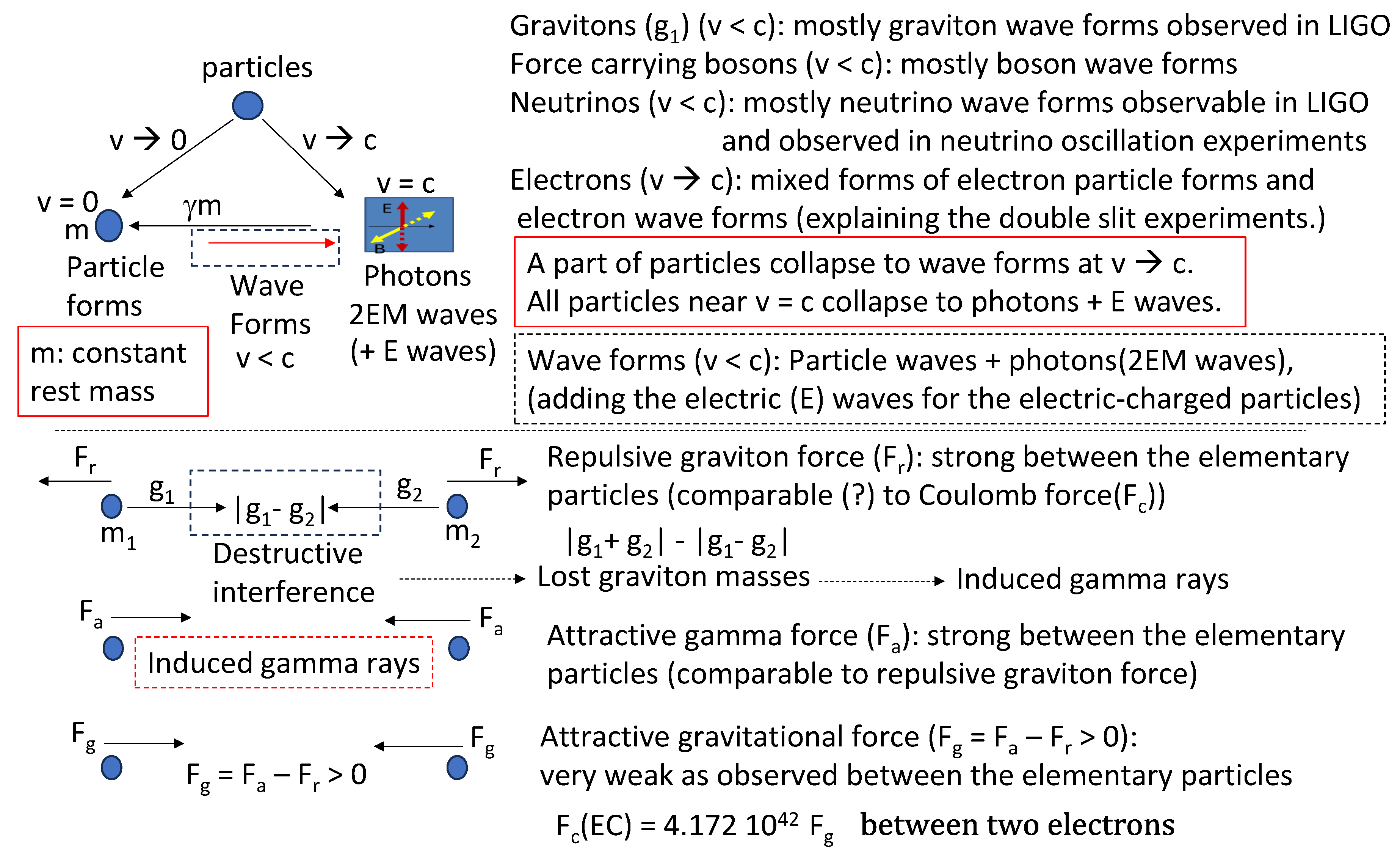
Figure 2.
The space fluctuations (E and M waves) and time fluctuations (G waves) of the 3-D quantized photon space based on 4-D Euclidean space are explained.
Figure 2.
The space fluctuations (E and M waves) and time fluctuations (G waves) of the 3-D quantized photon space based on 4-D Euclidean space are explained.
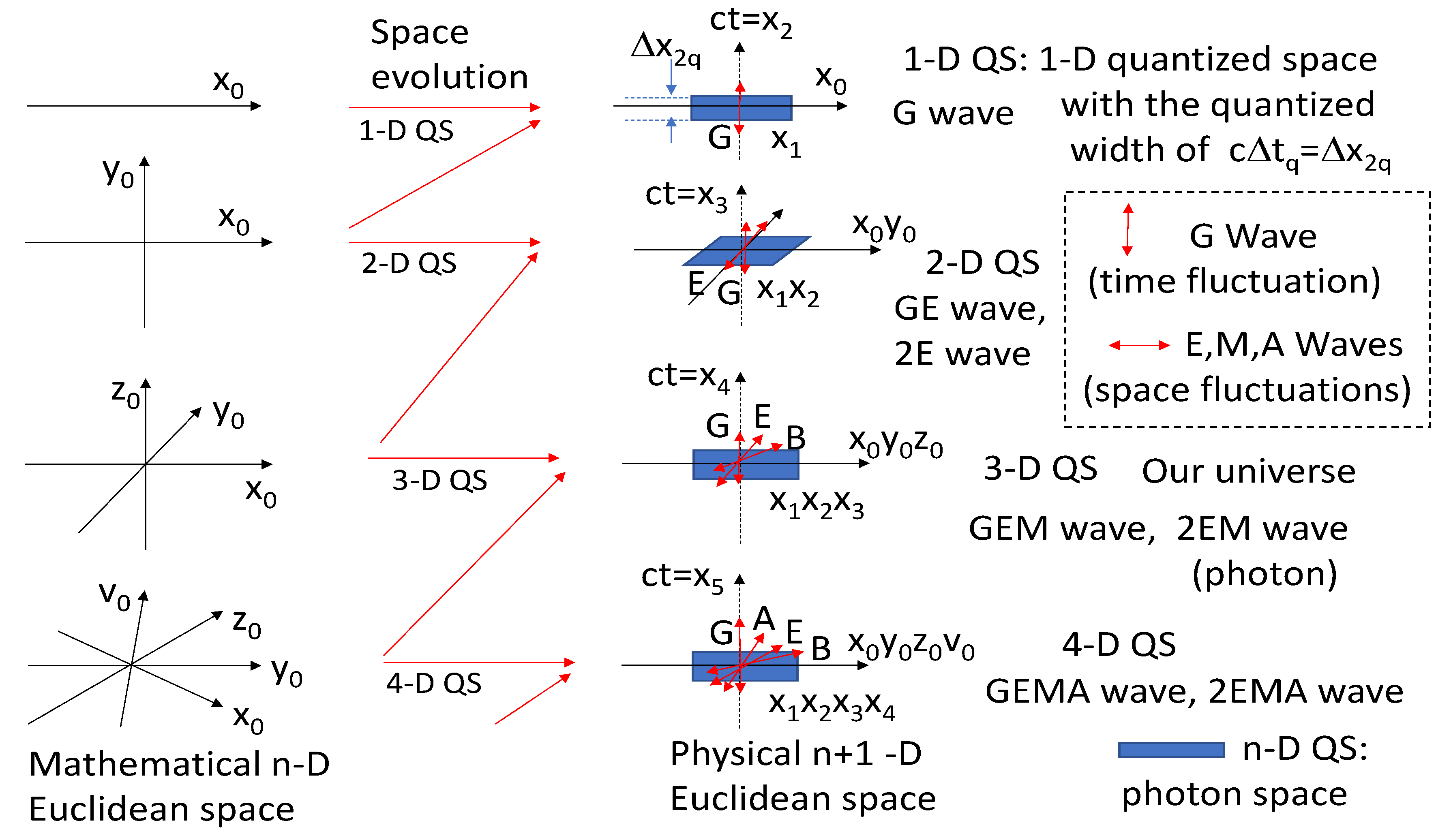
Figure 3.
Positive E and negative E universes have the 4-D P4 = TCP = TcP symmetry based on the TQSM model. Our universe is the matter universe with the positive E.
Figure 3.
Positive E and negative E universes have the 4-D P4 = TCP = TcP symmetry based on the TQSM model. Our universe is the matter universe with the positive E.
Figure 4.
From the energy conservation, the graviton waves and the photons (2EM waves) are coupled as the GEM waves with the graviton and photon wave duality.
Figure 4.
From the energy conservation, the graviton waves and the photons (2EM waves) are coupled as the GEM waves with the graviton and photon wave duality.
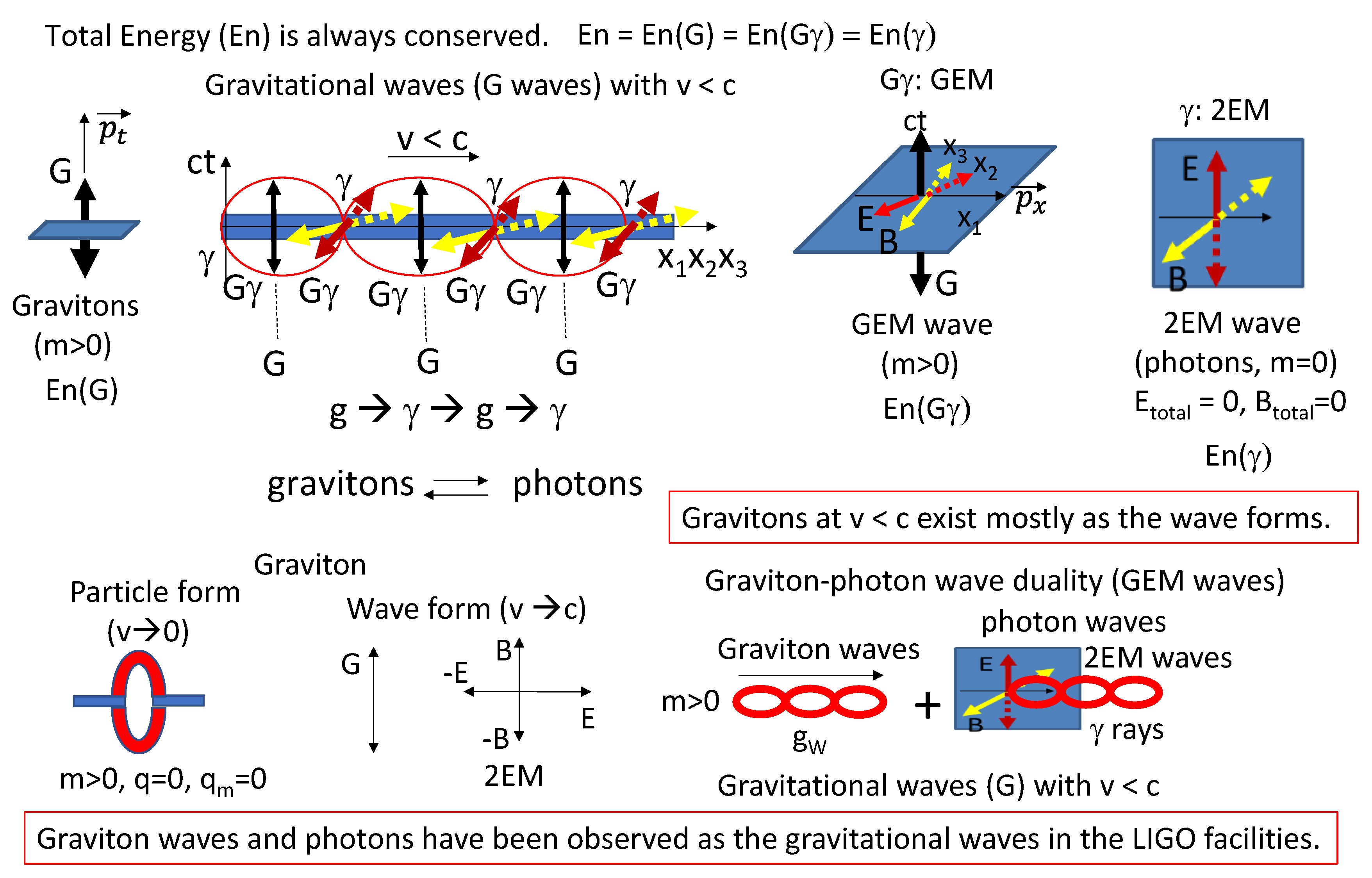
Figure 5.
Particle waves of the fermions, gravitons and bosons are compared with the photon (2EM) waves, GEM waves, E waves and M waves.
Figure 5.
Particle waves of the fermions, gravitons and bosons are compared with the photon (2EM) waves, GEM waves, E waves and M waves.
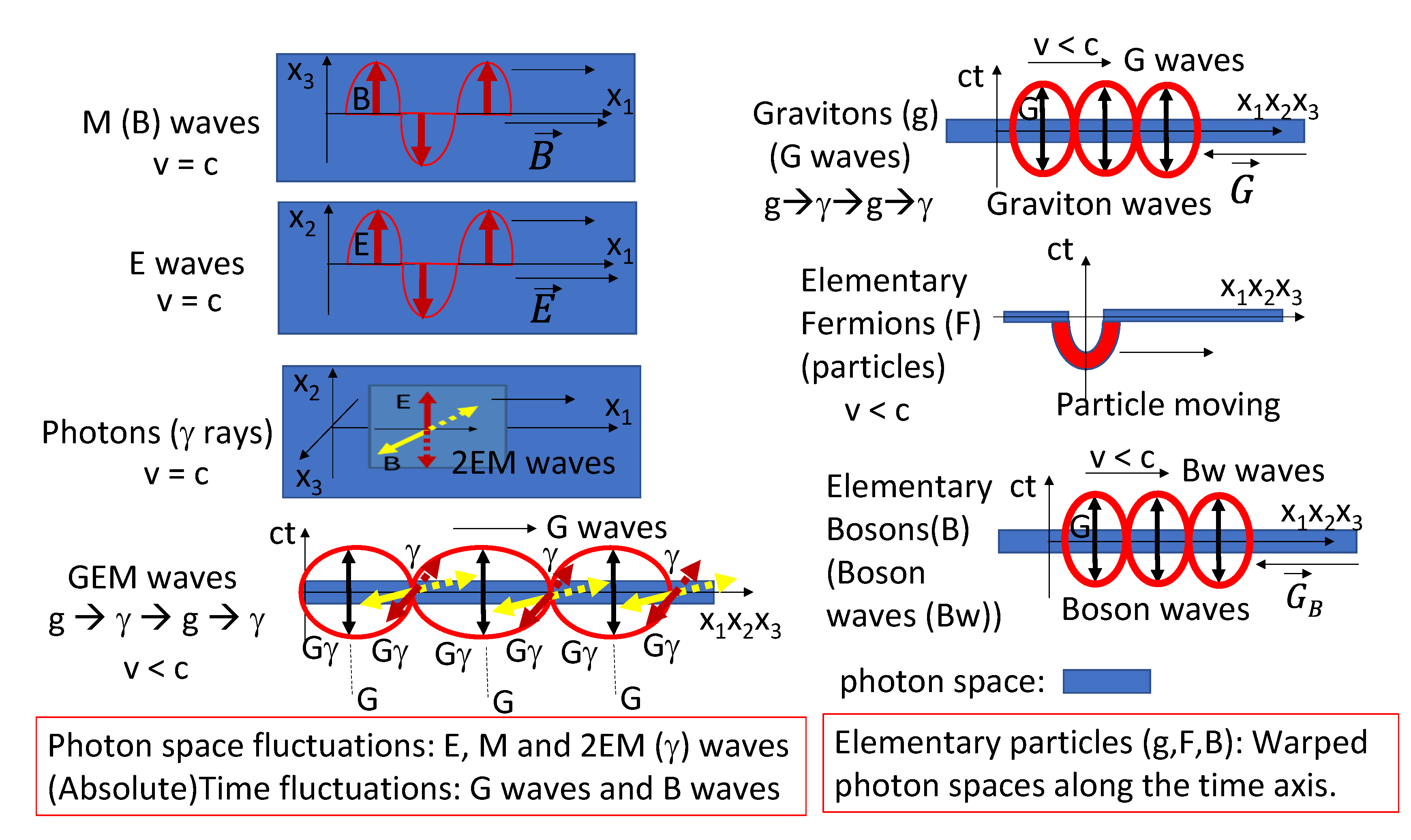
Figure 6.
Coulomb force and gravitational force are compared by using the space fluctuations and time fluctuations on the background photon space.
Figure 6.
Coulomb force and gravitational force are compared by using the space fluctuations and time fluctuations on the background photon space.
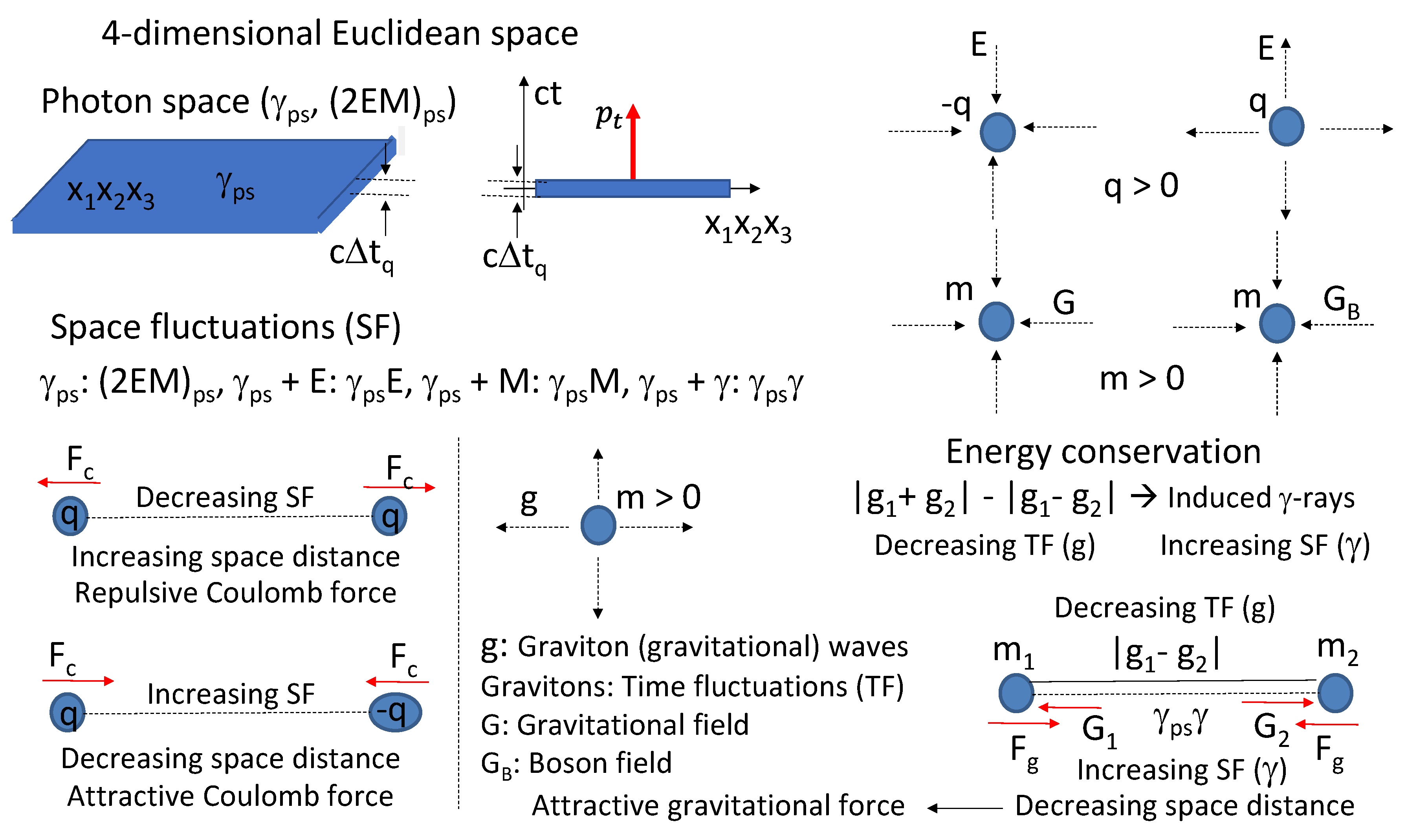
Figure 7.
Several terms are summarized. And photon space fluctuations between two masses are explained.
Figure 7.
Several terms are summarized. And photon space fluctuations between two masses are explained.
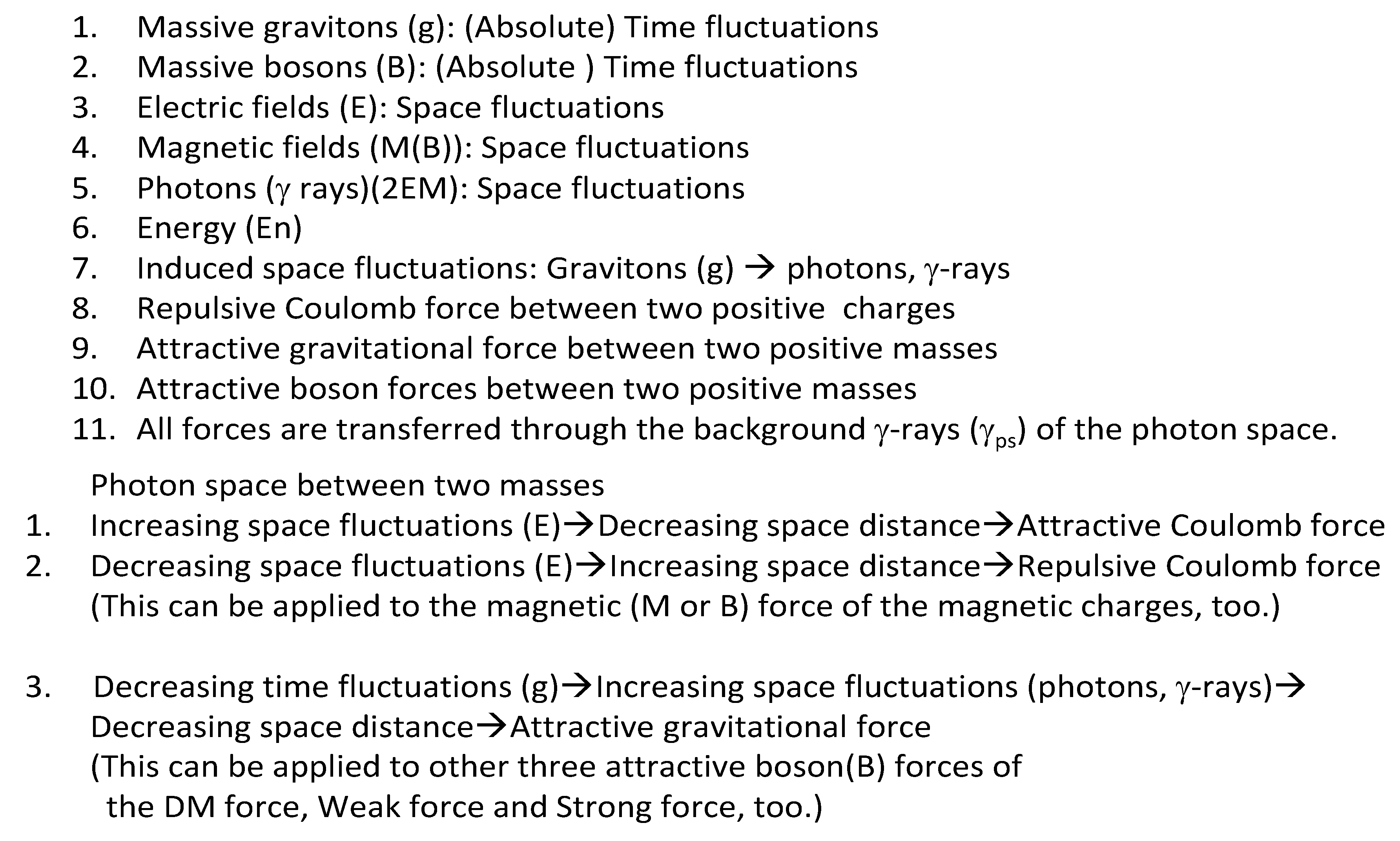
Figure 8.
The E waves and gravitational waves emitted from the fermions are shown. And the pair annihilation of the particle and antiparticle is explained.
Figure 8.
The E waves and gravitational waves emitted from the fermions are shown. And the pair annihilation of the particle and antiparticle is explained.
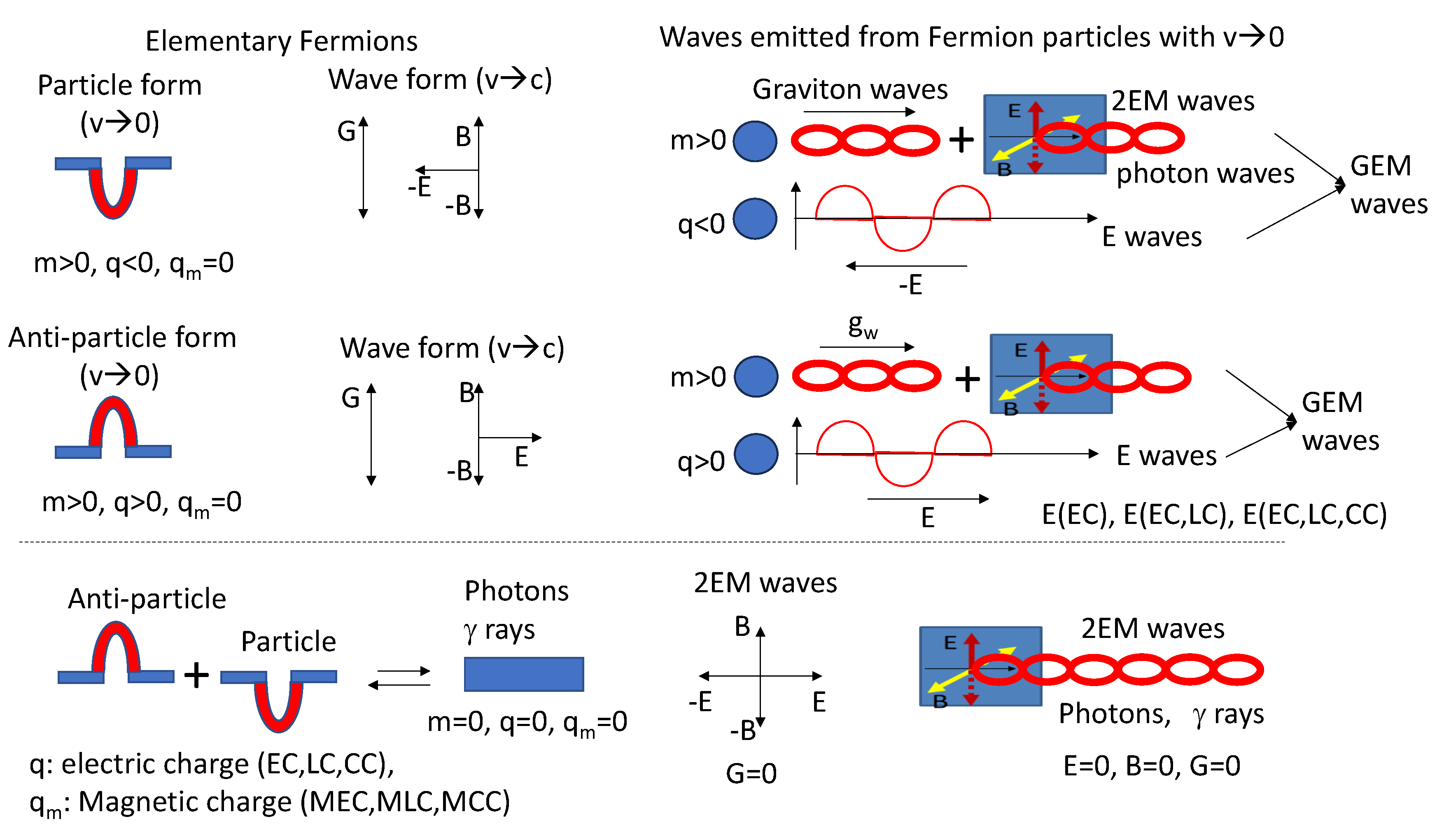
Figure 9.
The particle waves of the fermions are shown. The wave forms of the neutrinos are explained.
Figure 9.
The particle waves of the fermions are shown. The wave forms of the neutrinos are explained.
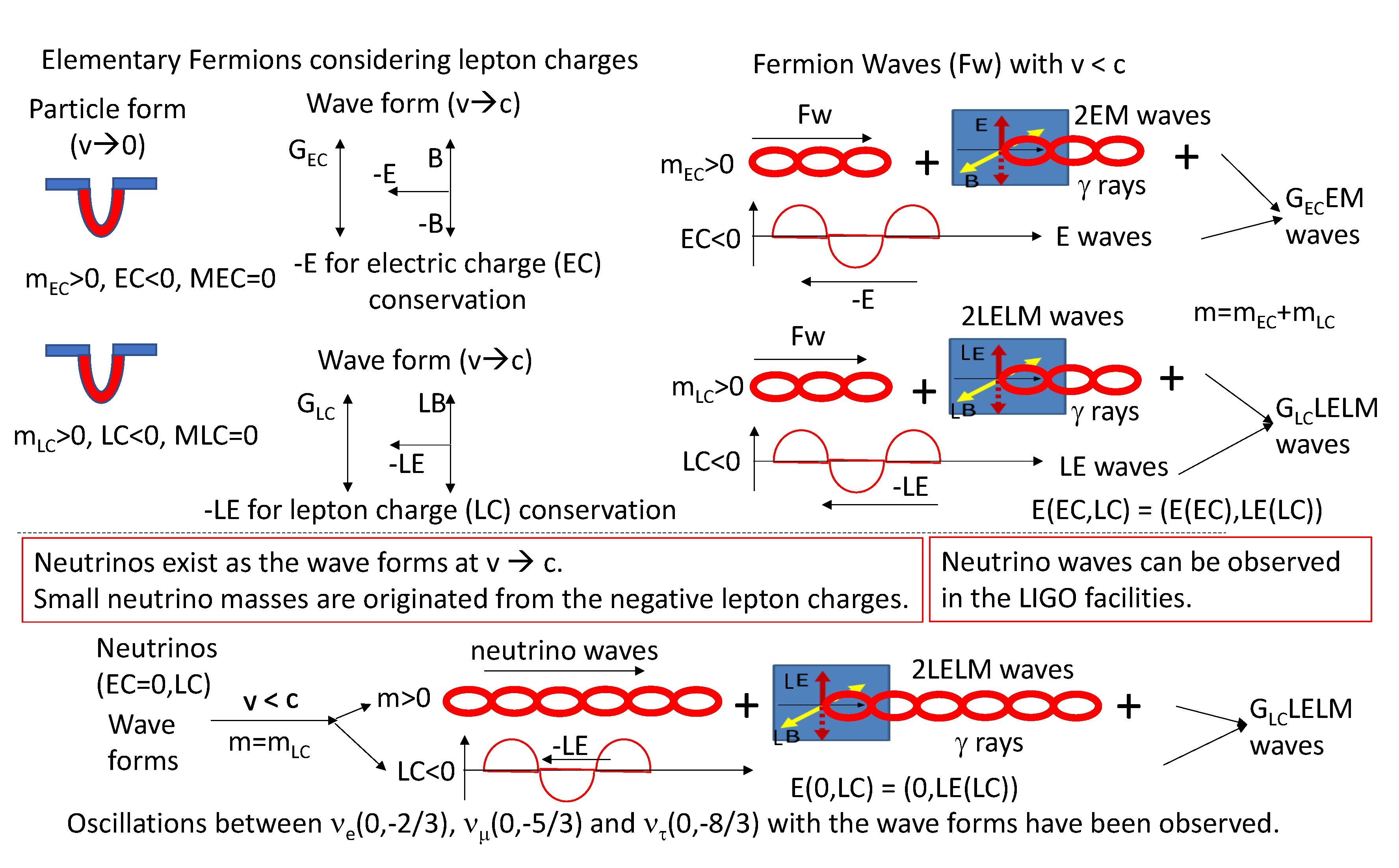
Figure 10.
Particle and wave forms of the dark matters are shown. The oscillations of neutrinos and dark matters are compared.
Figure 10.
Particle and wave forms of the dark matters are shown. The oscillations of neutrinos and dark matters are compared.
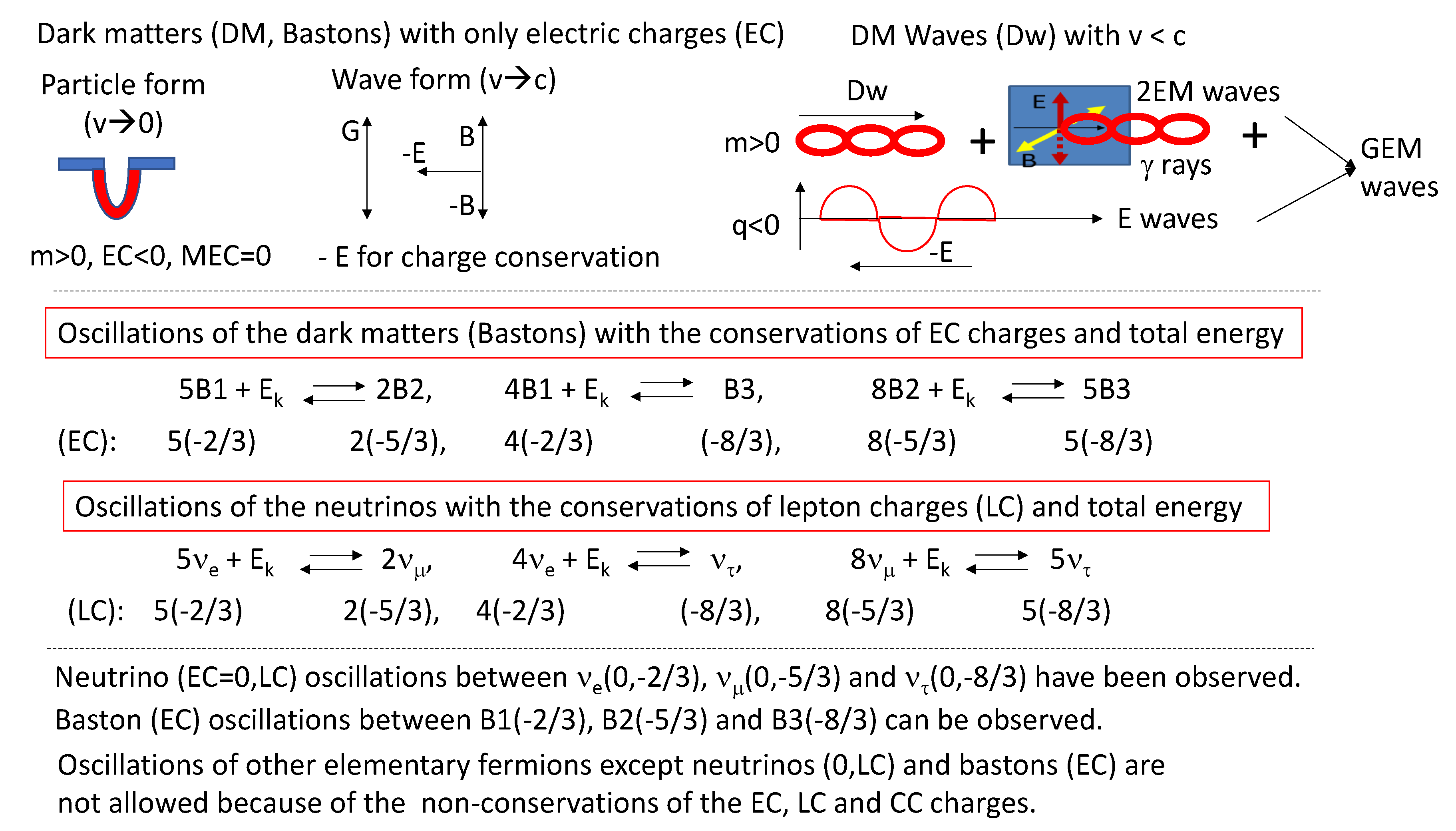
Figure 11.
Boson waves for the boson force and graviton waves for the gravitational force are explained.
Figure 11.
Boson waves for the boson force and graviton waves for the gravitational force are explained.
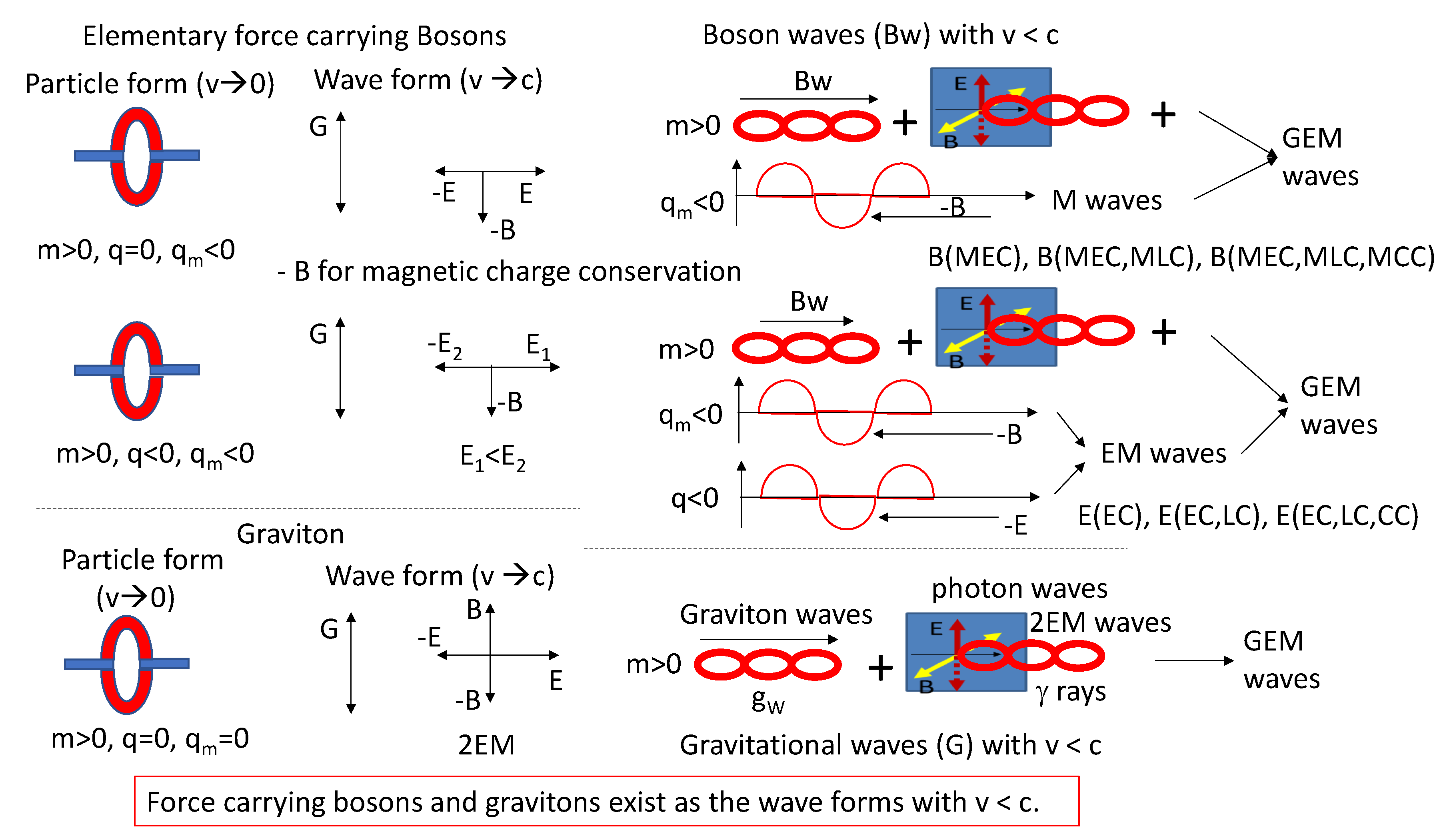
Figure 12.
Pair annihilations of the fermion and anti-fermion to photon and the pair annihilation of the boson and anti-boson to the graviton are explained.
Figure 12.
Pair annihilations of the fermion and anti-fermion to photon and the pair annihilation of the boson and anti-boson to the graviton are explained.
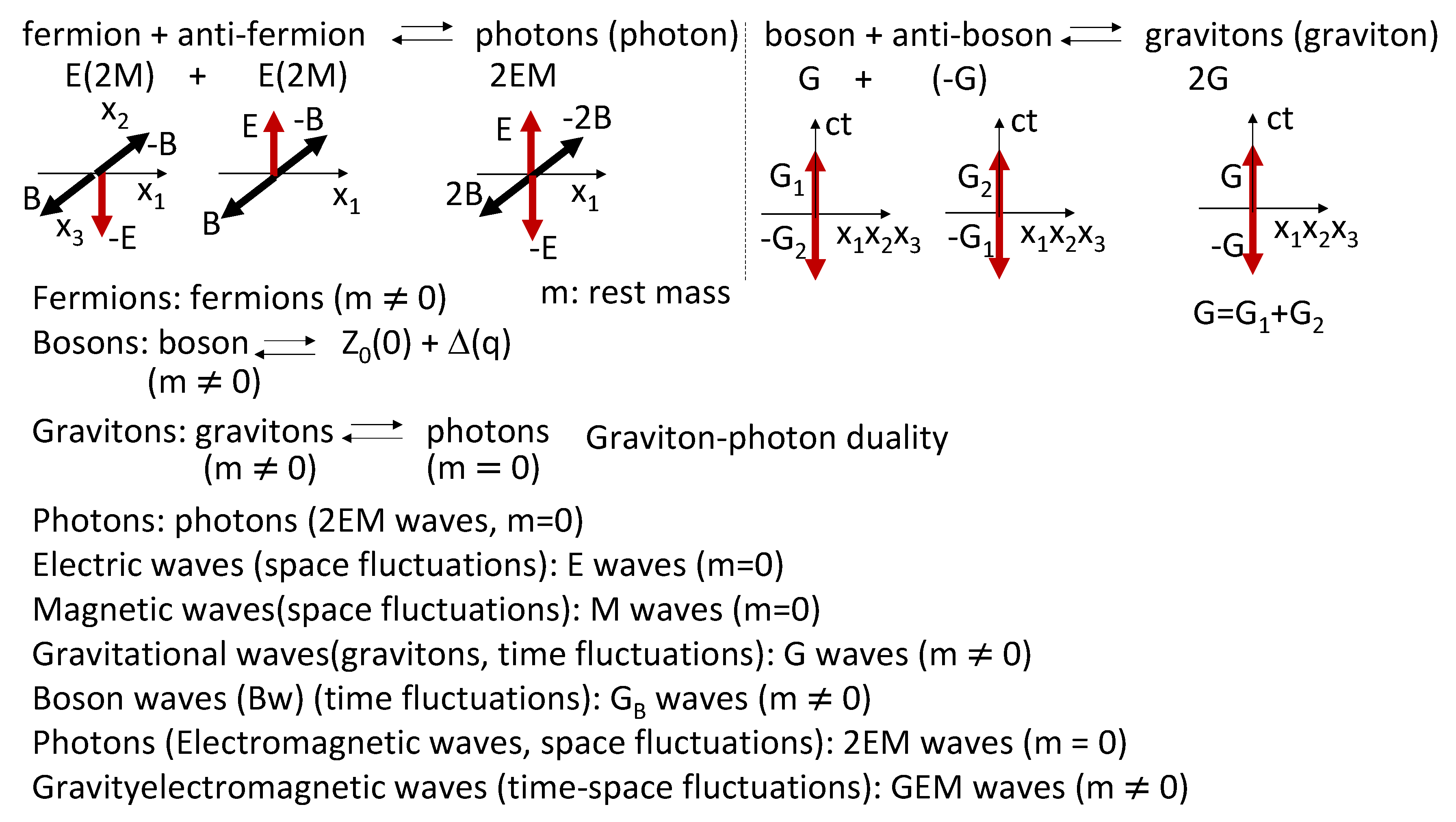
Figure 13.
The surface fluctuations of the charged particle are explained.
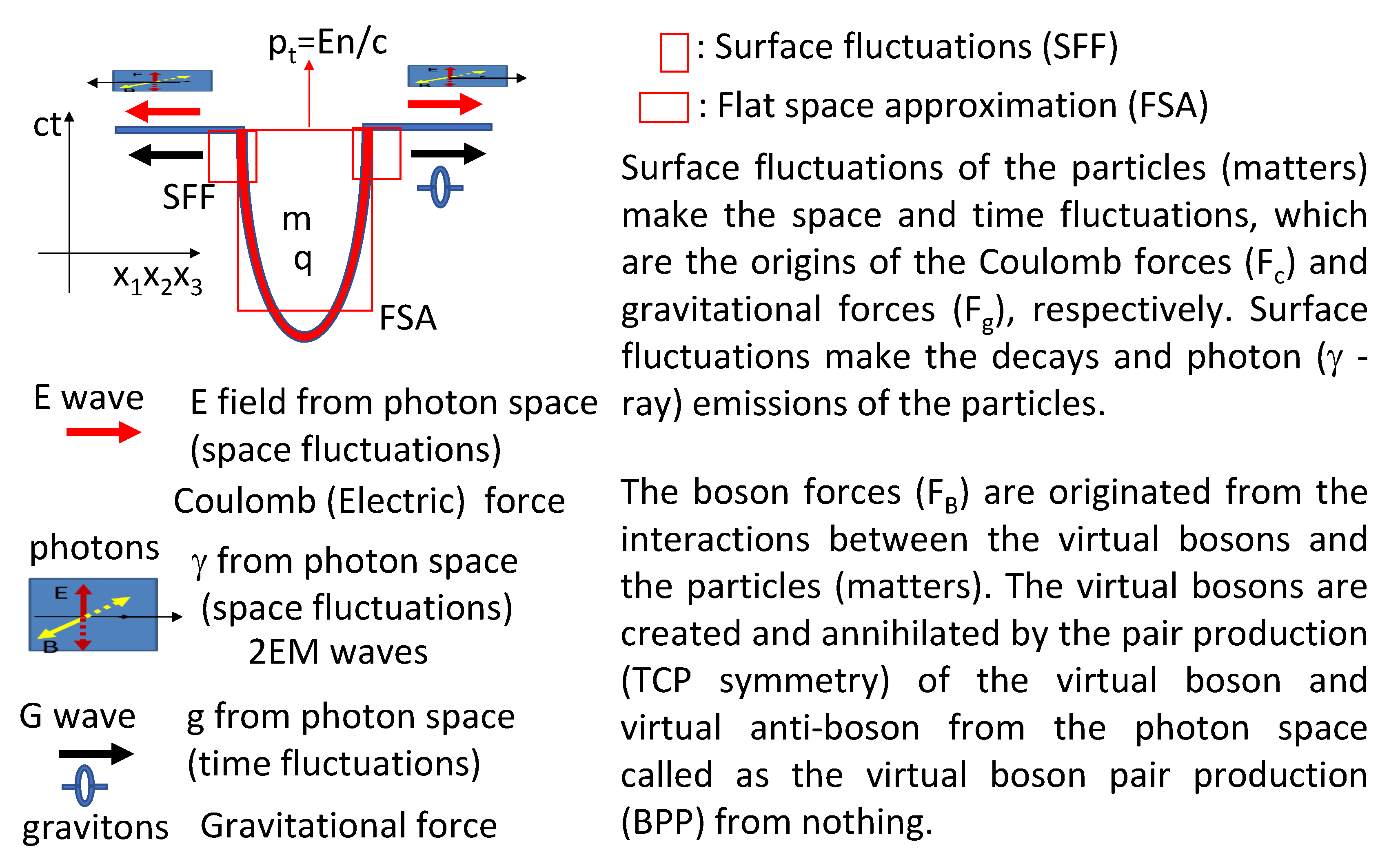
Figure 14.
The graviton mass which means the smallest mass of the graviton is derived.
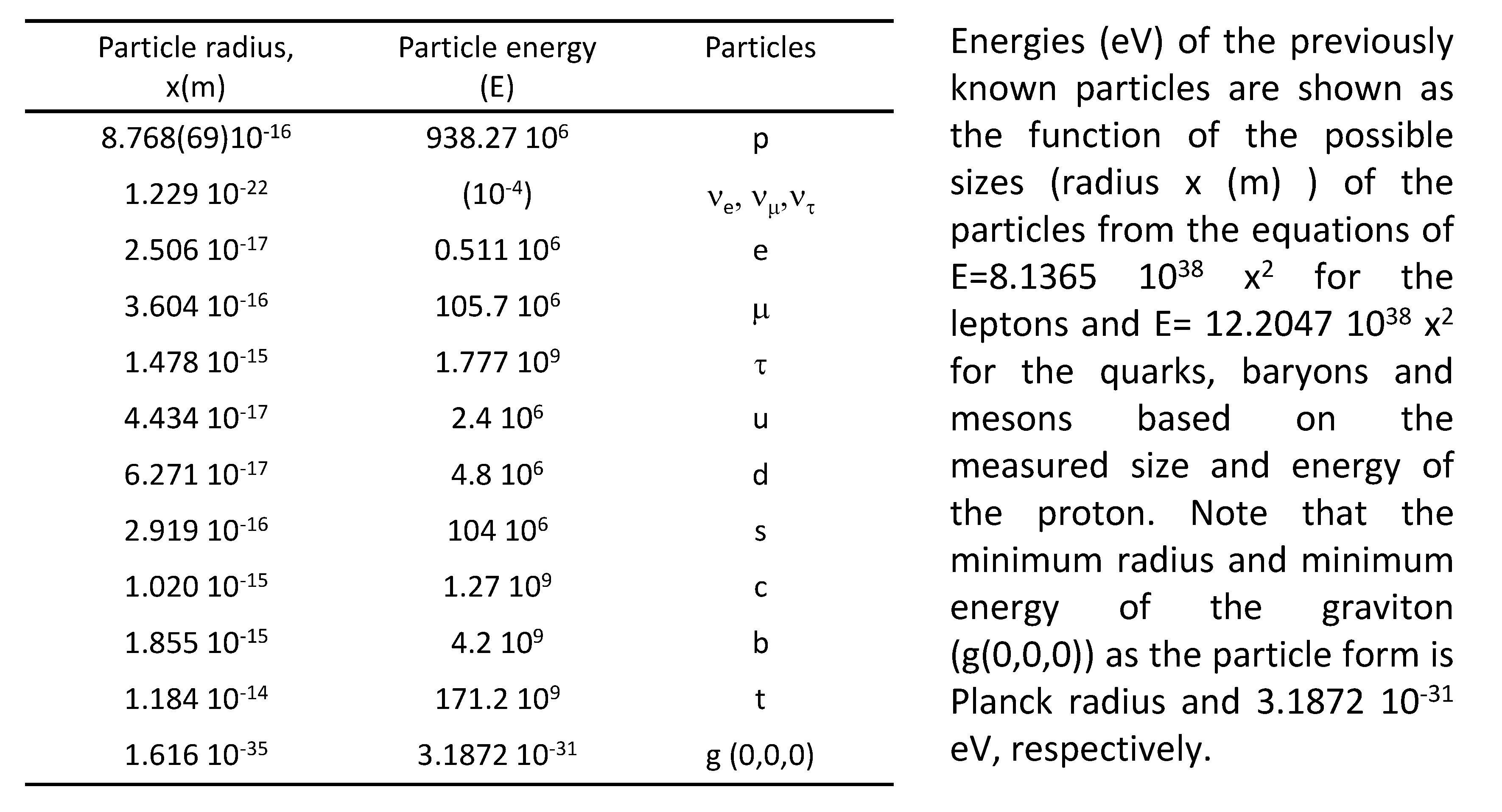
Figure 15.
The E wave, M wave, G wave, GEM wave and 2EM wave are compared.
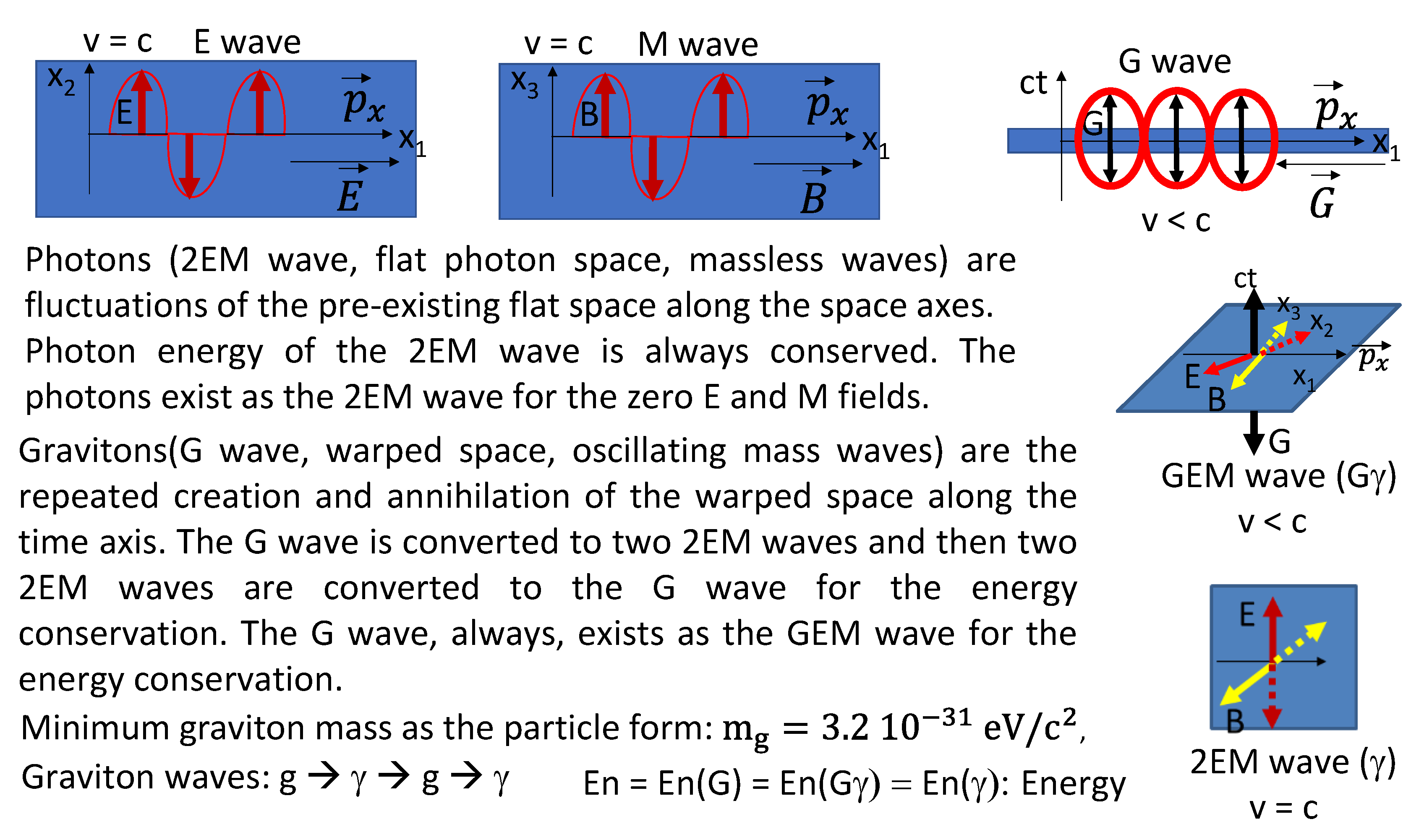
Figure 16.
Coulomb force and gravitational force are described.
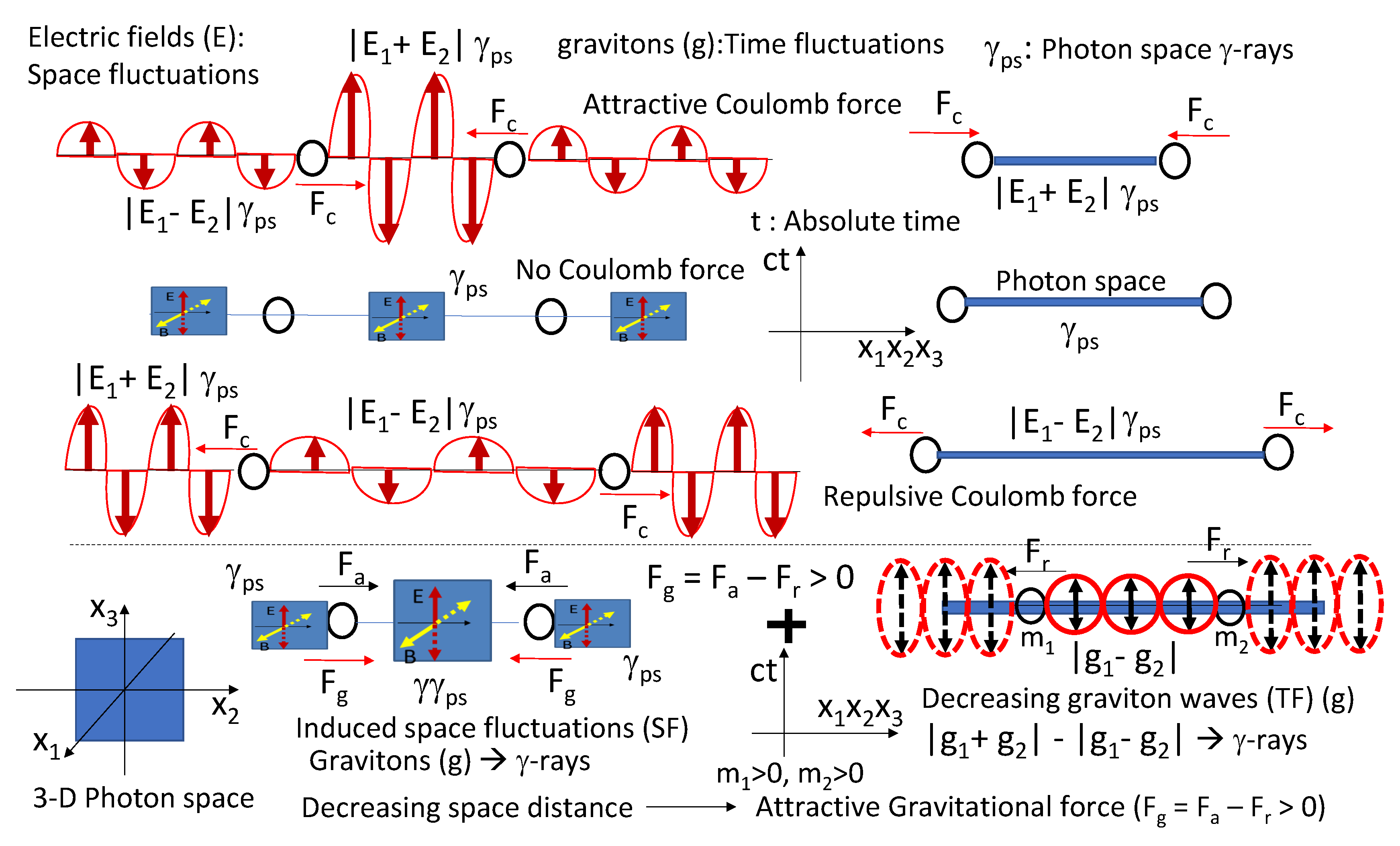
Figure 17.
Coulomb force is explained in terms of the wave mechanics.
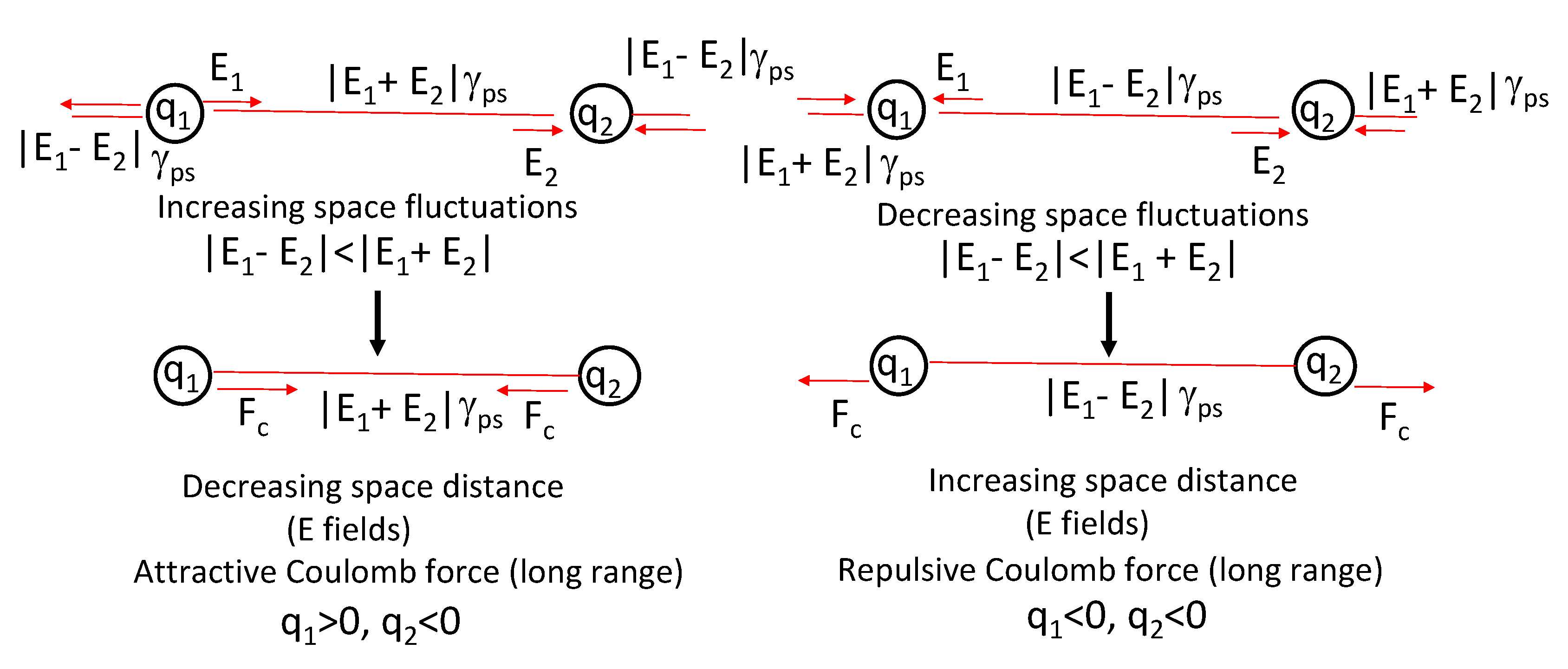
Figure 18.
The gravitational force is explained in terms of the wave mechanics.
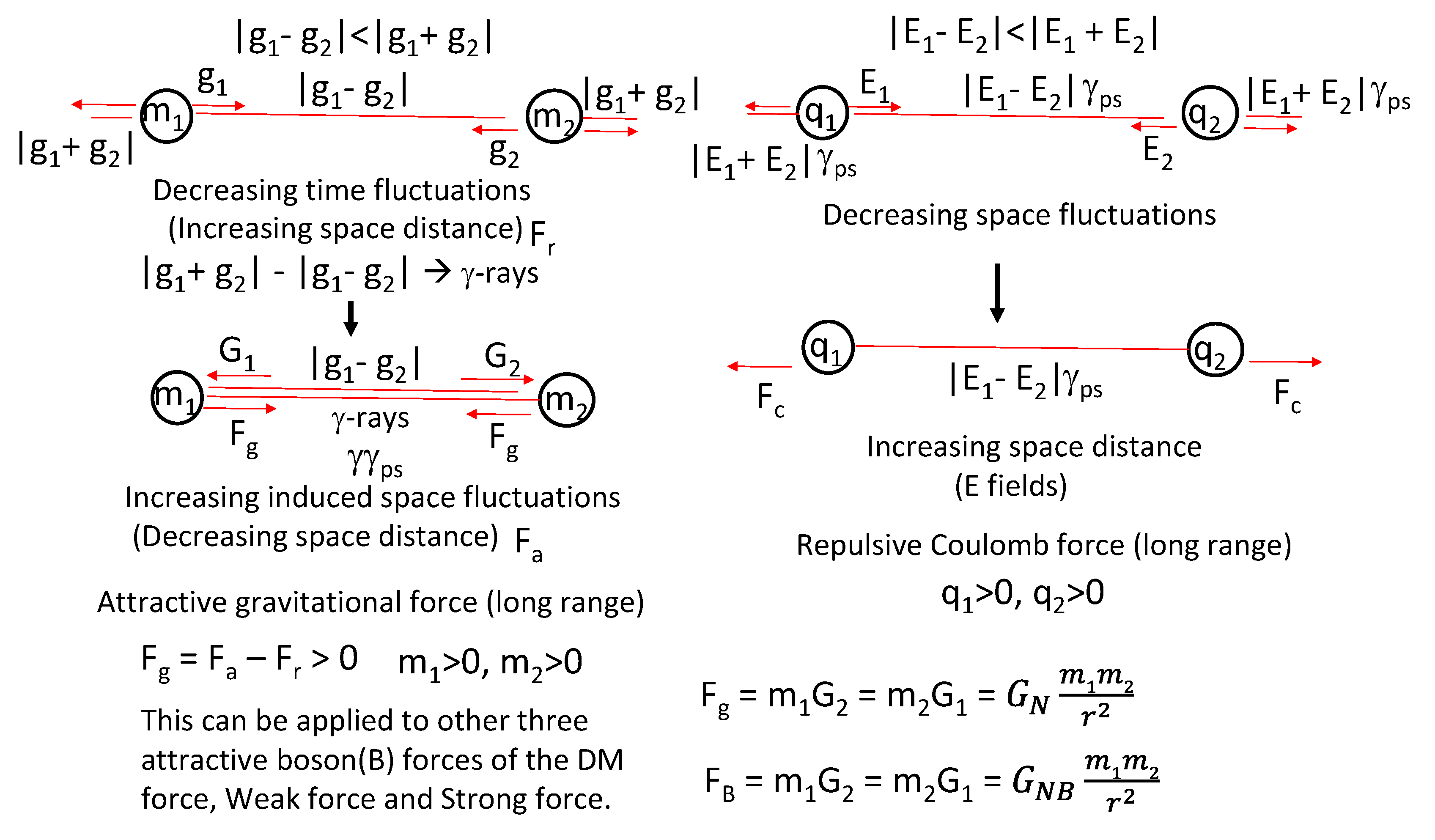
Figure 19.
The boson force is explained in terms of the wave mechanics.
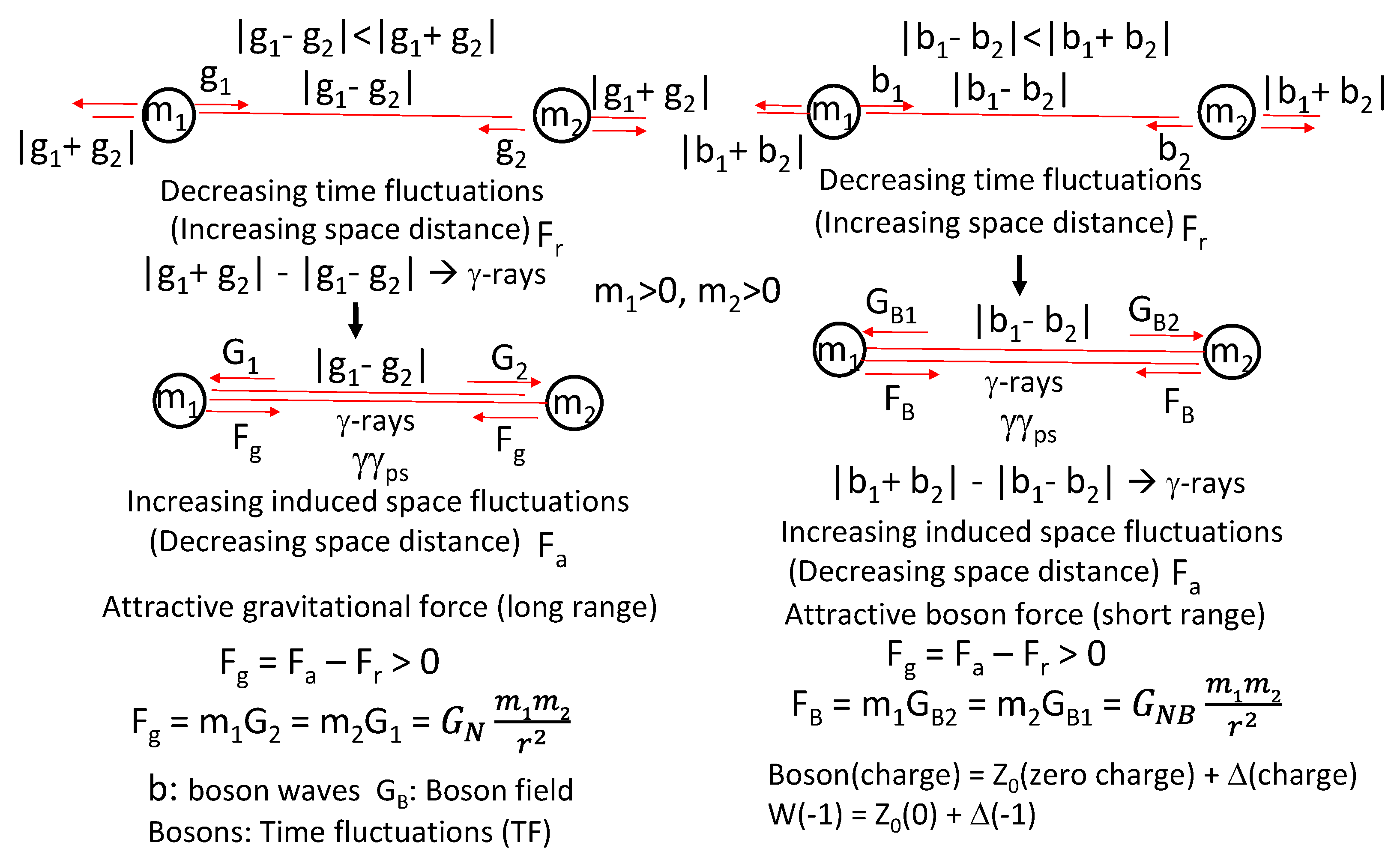
Figure 20.
The boson force, gravitational and Coulomb forces are compared.
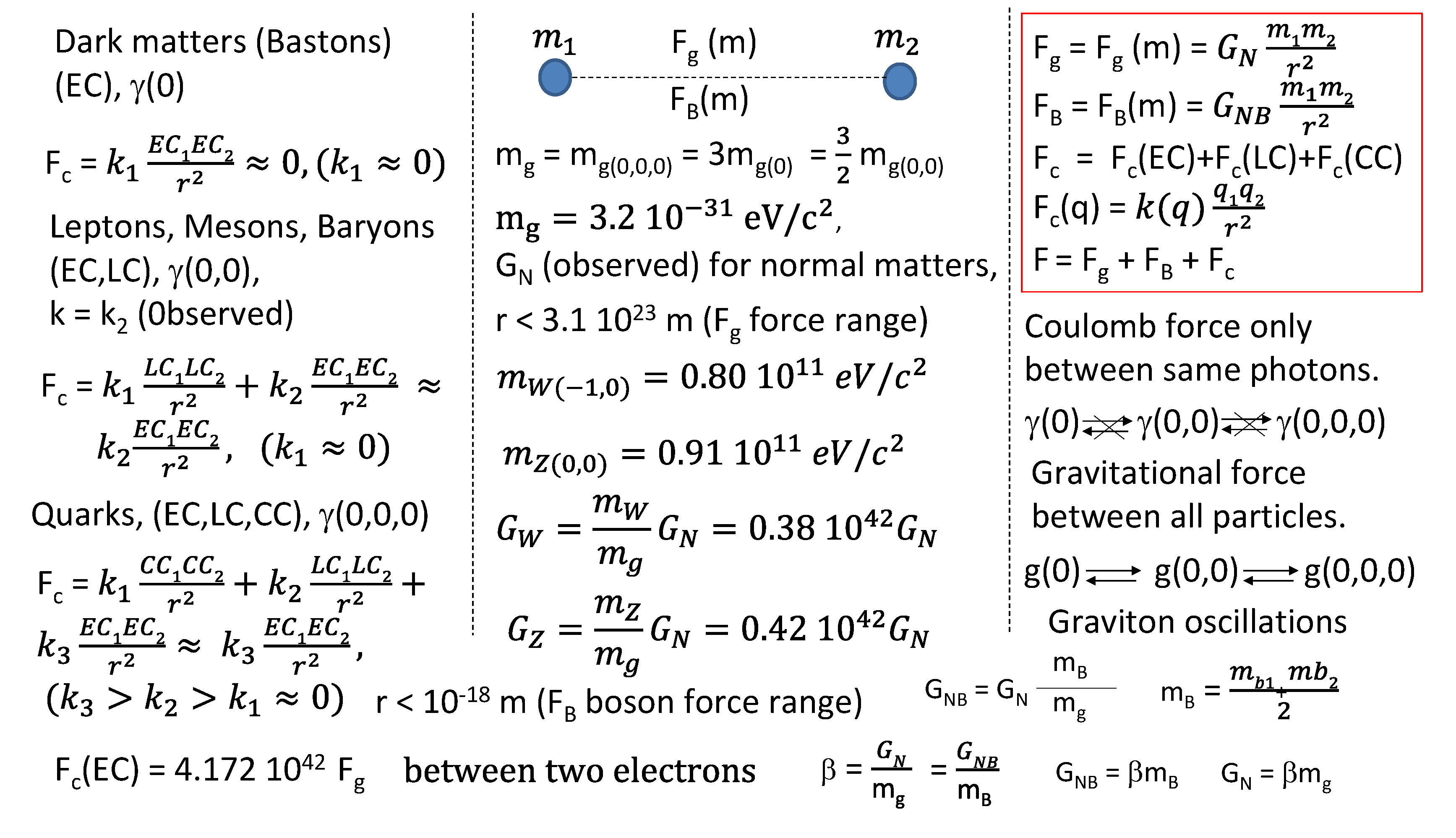
Figure 21.
The gravitational force constants are compared.
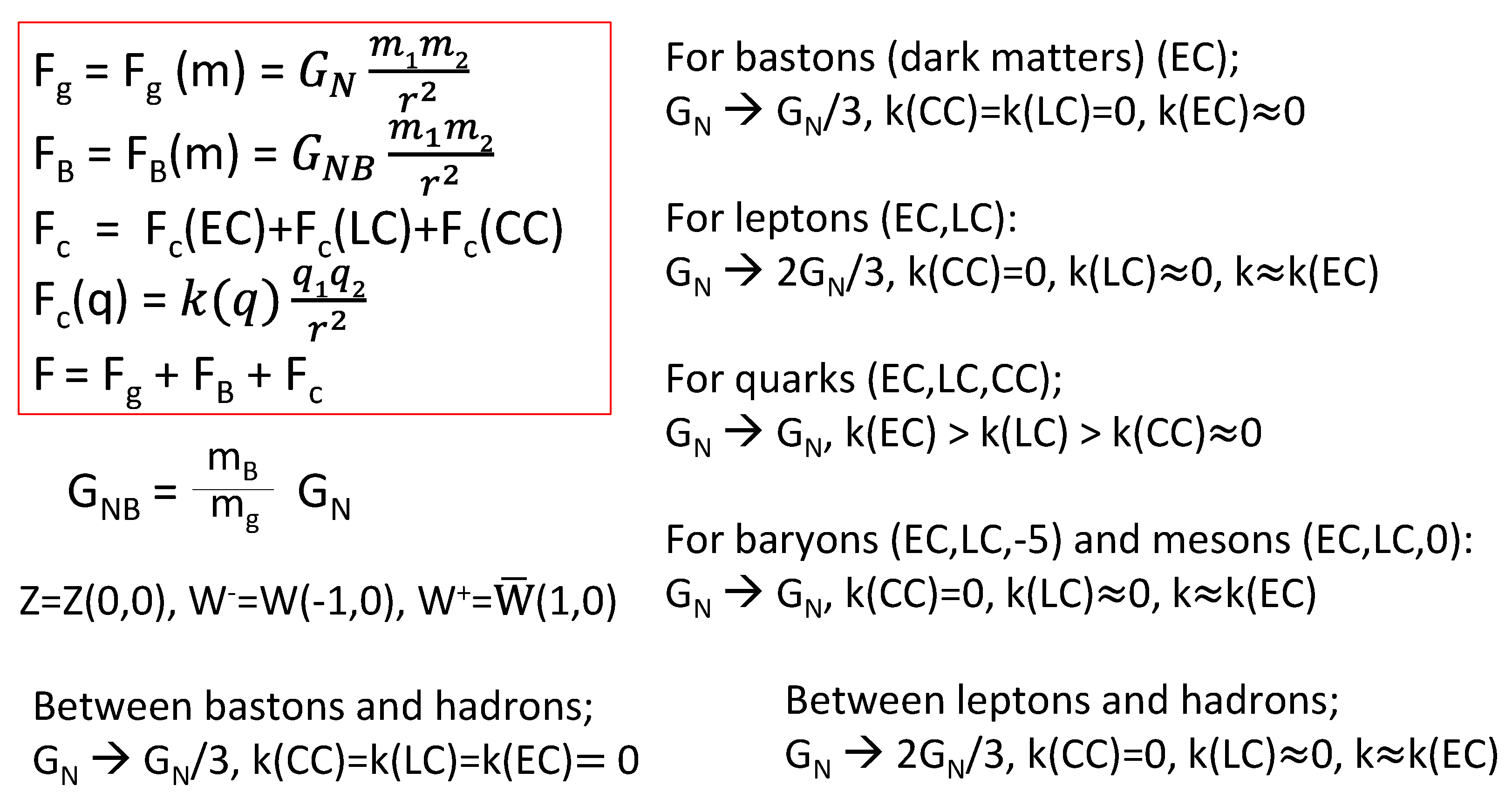
Figure 22.
The elementary fermions with the quantized charges are shown.
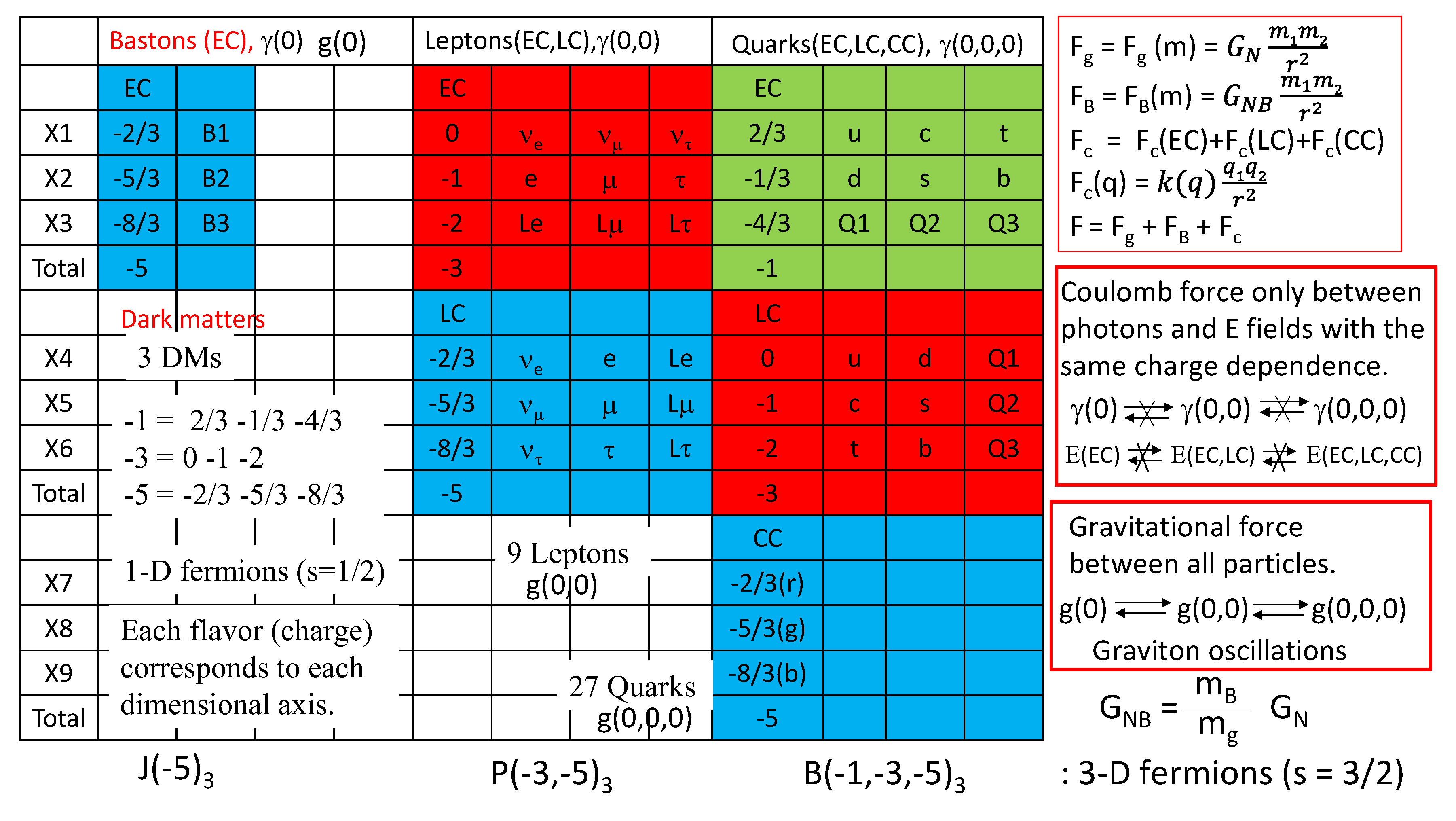
Figure 23.
The elementary bosons and their quantized charges are shown.
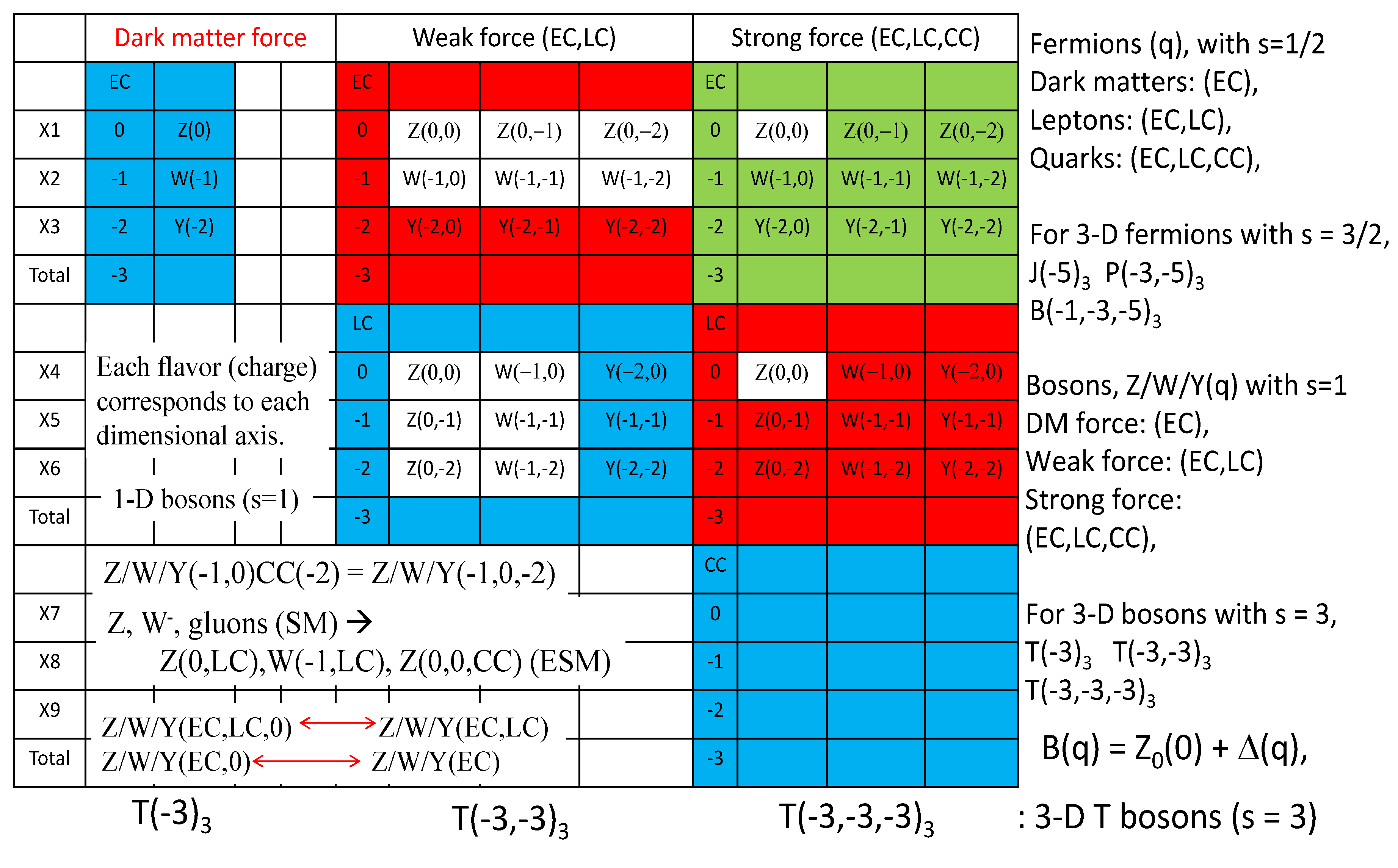
Figure 24.
Virtual one boson processes in terms of the standard model are shown.
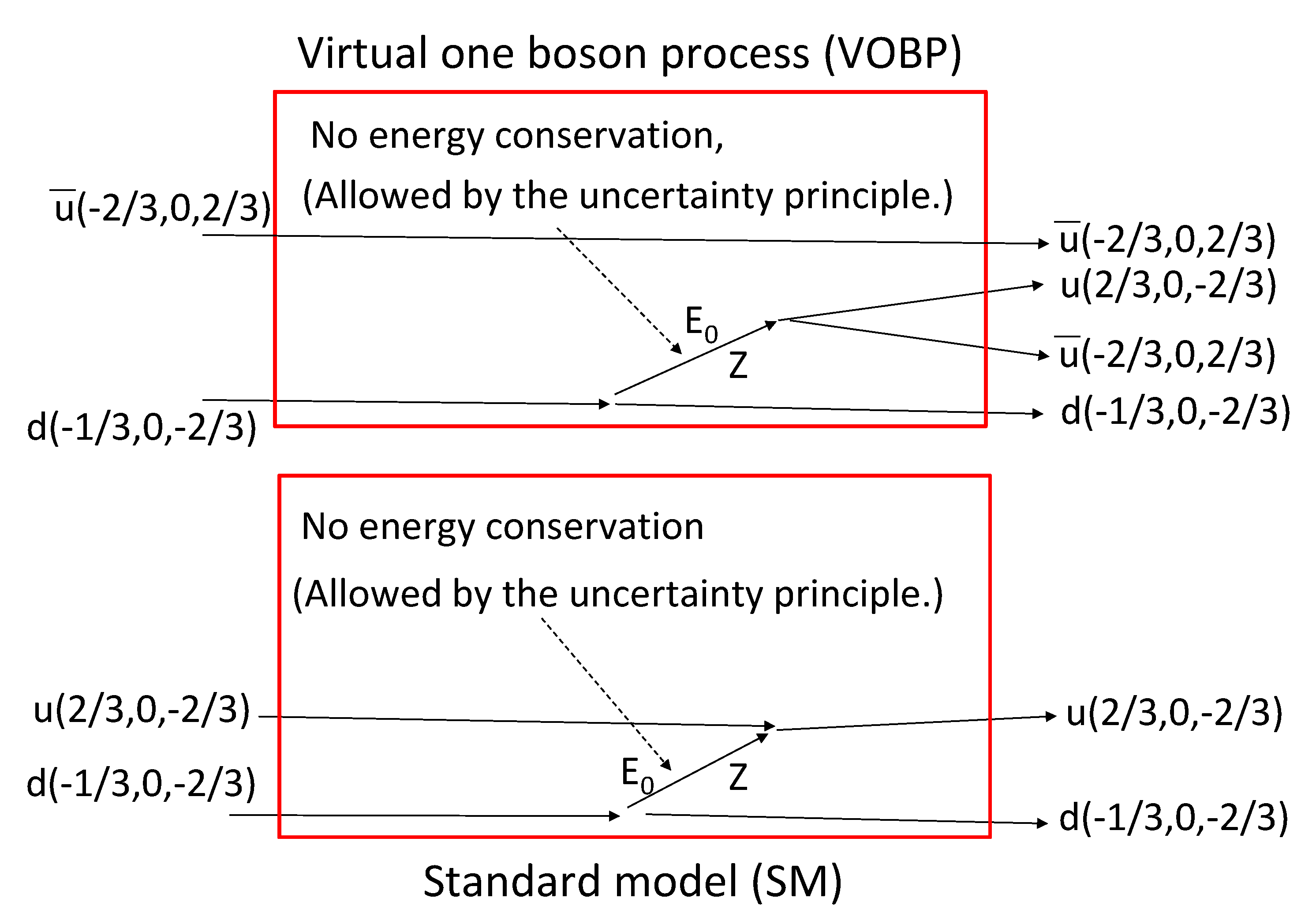
Figure 25.
Virtual one boson processes in terms of the standard model are shown.
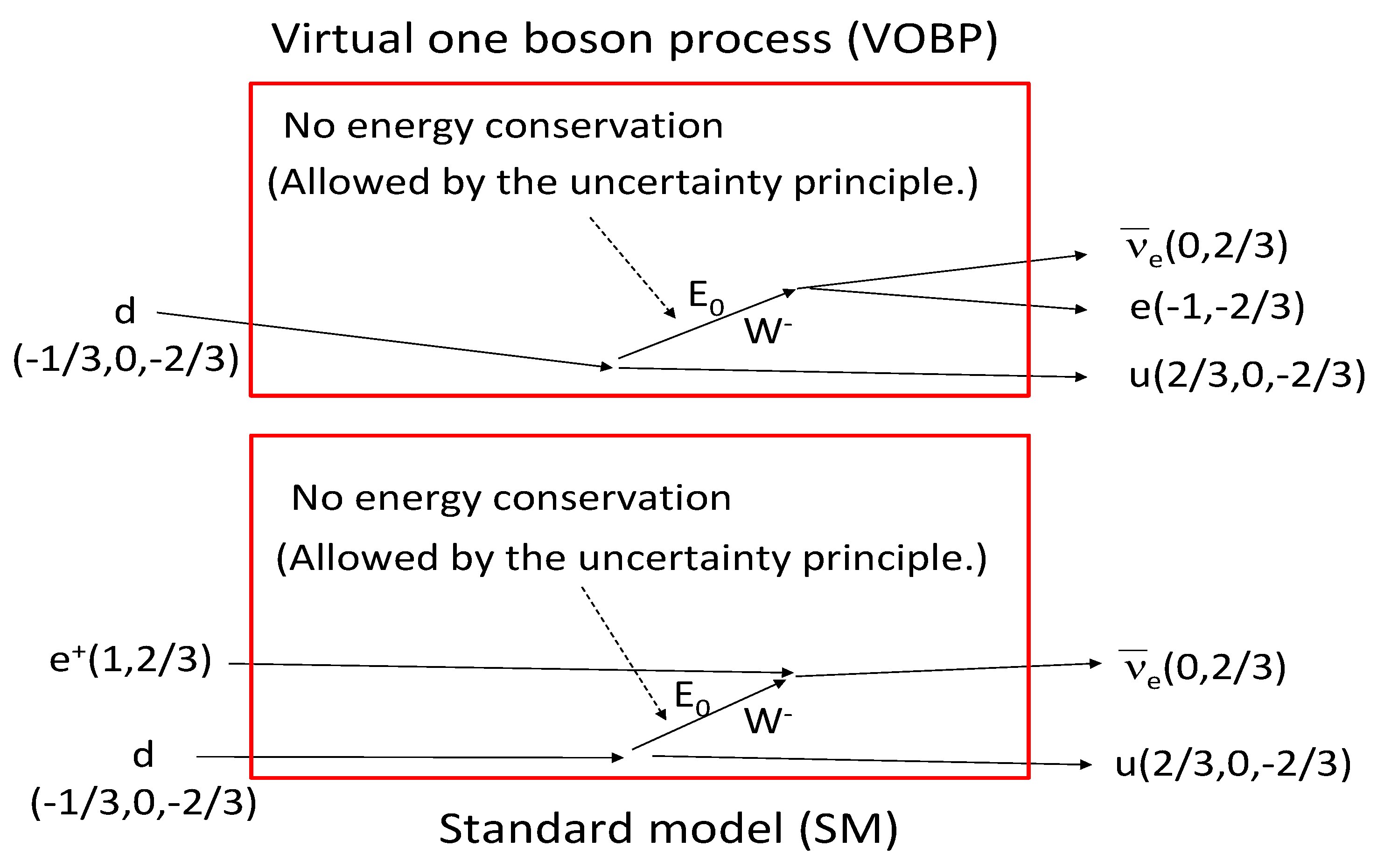
Figure 26.
Force carrying bosons with the TC symmetry are created from nothing.
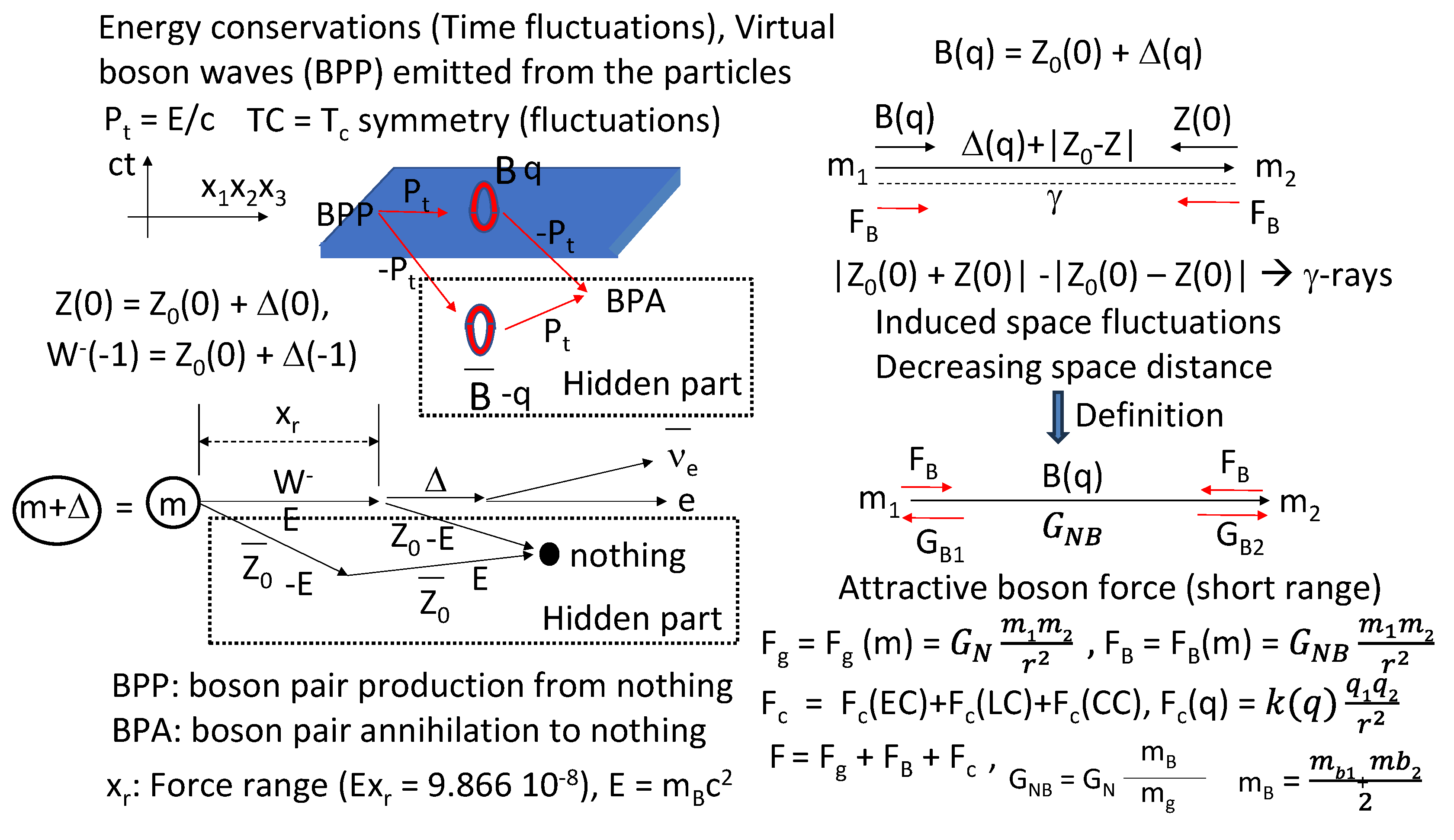
Figure 27.
Virtual two boson processes in terms of TQSM model are shown.
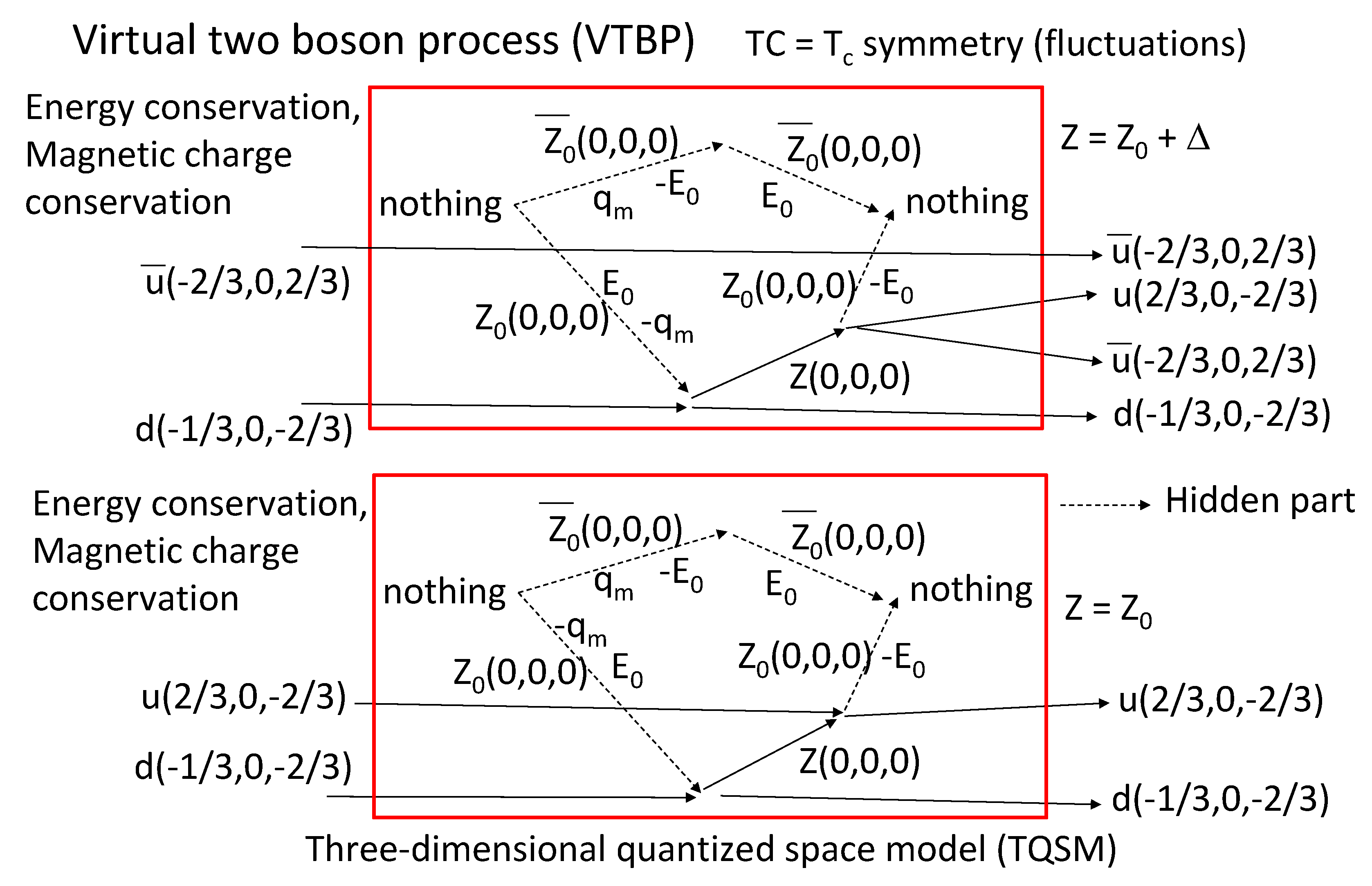
Figure 28.
Virtual two boson processes in terms of TQSM model are shown.
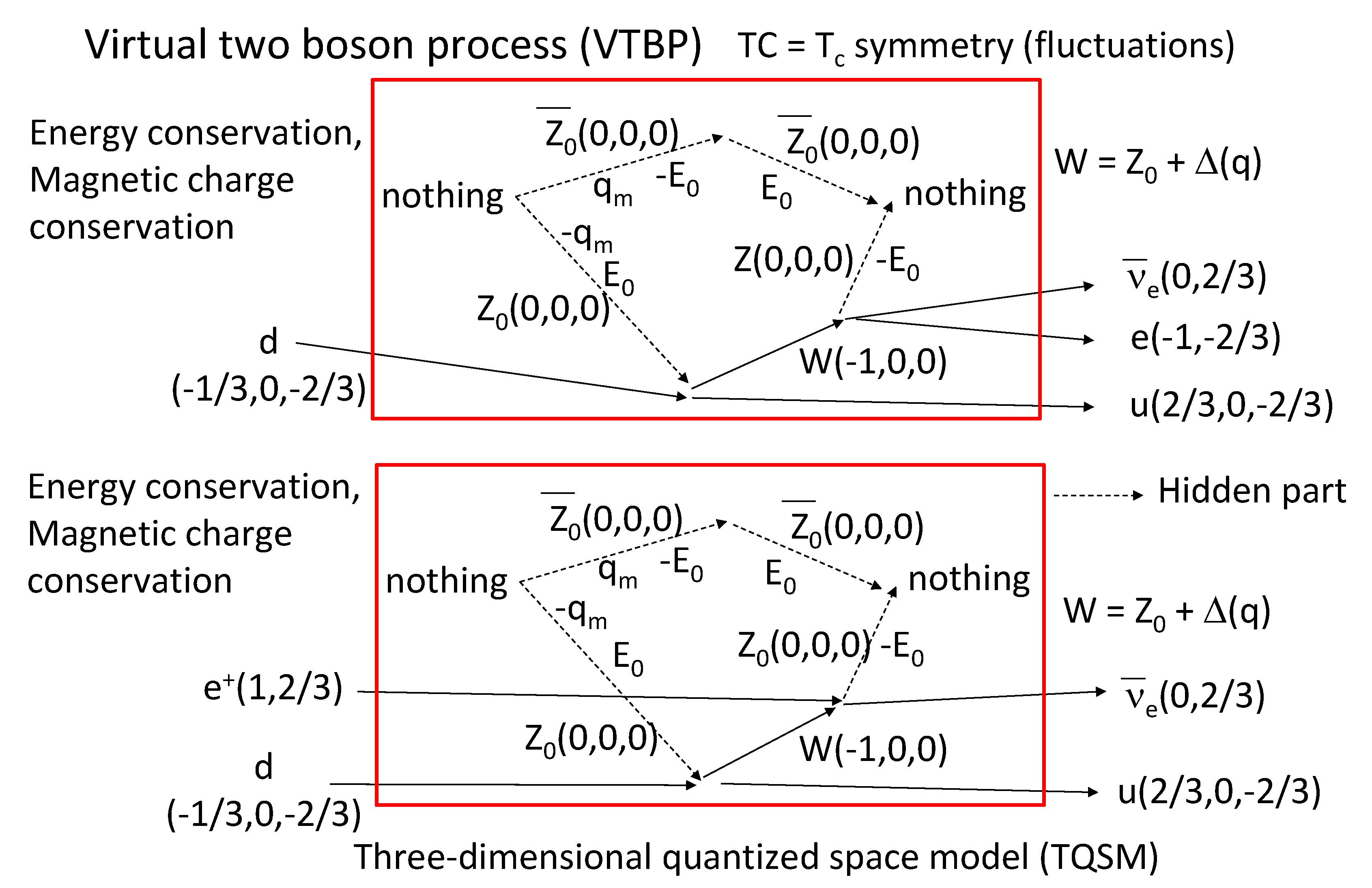
Figure 29.
Virtual two boson processes in terms of TQSM model are shown.
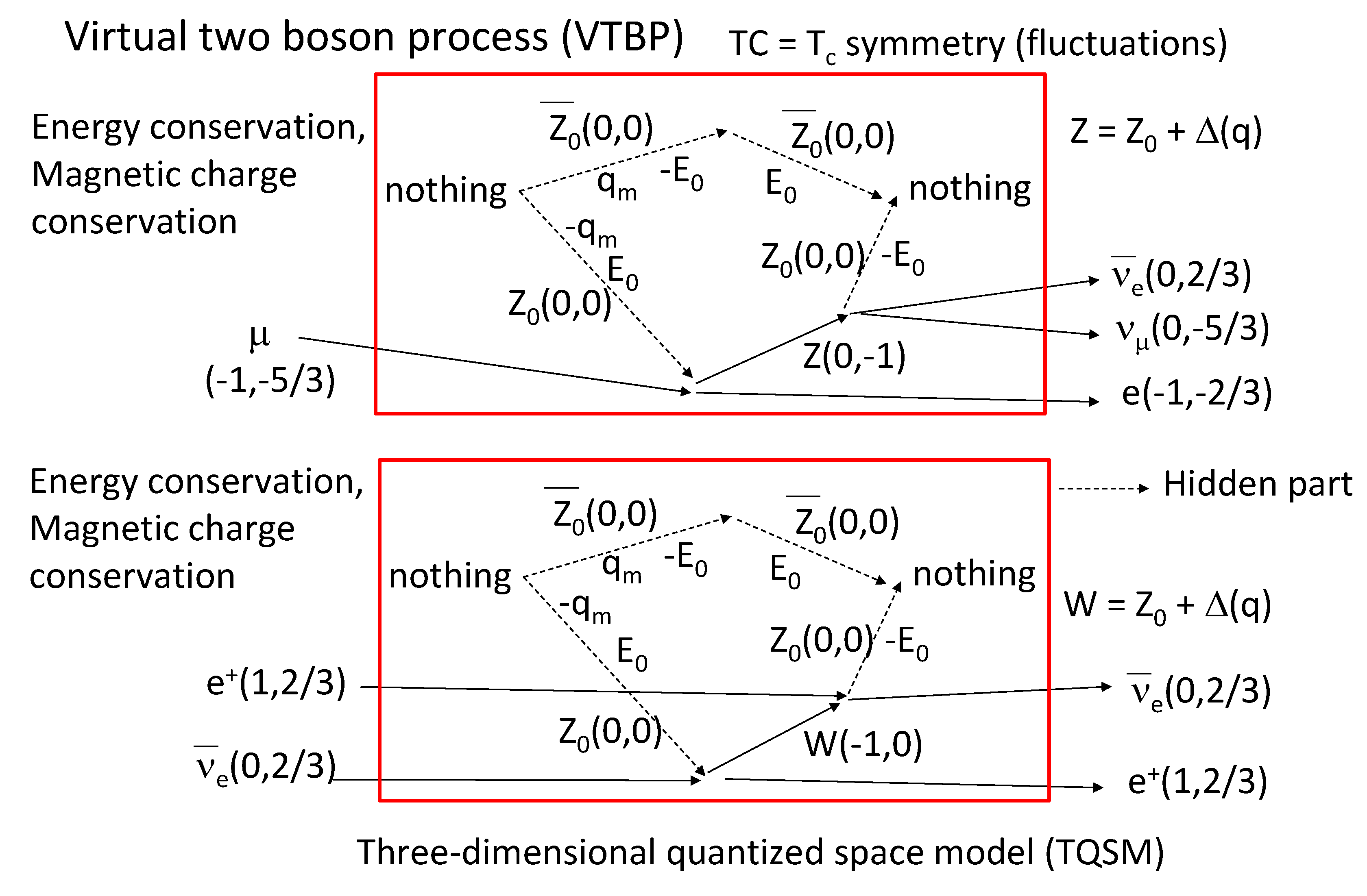
Figure 30.
Elementary particles are compared with the universe evolution.
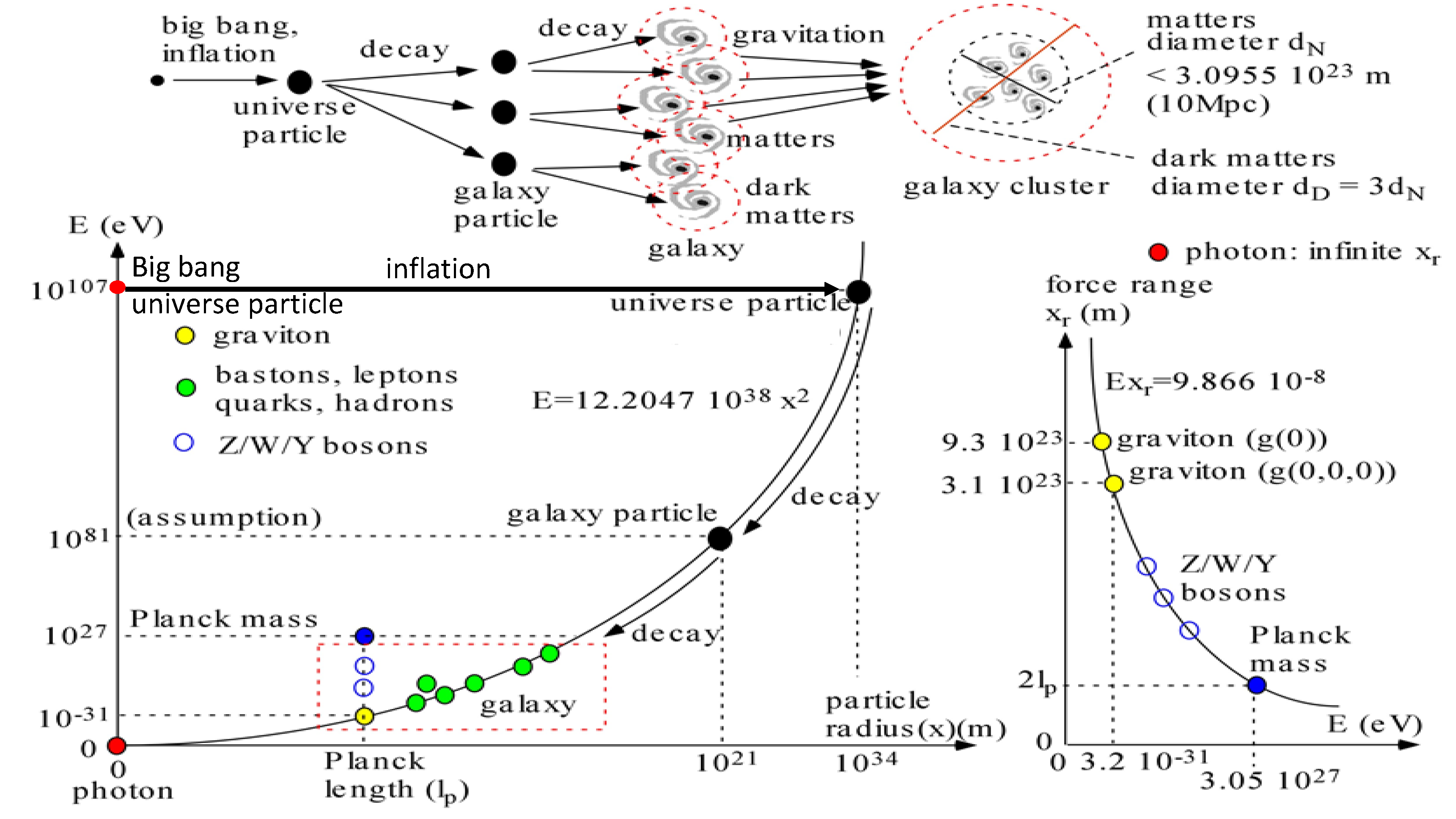
Figure 31.
The origins and properties of the elementary particles shown in Figs. 22, 23 and 30 are explained in terms of the 3-D quantized space model (TQSM)) [38].
Figure 31.
The origins and properties of the elementary particles shown in Figs. 22, 23 and 30 are explained in terms of the 3-D quantized space model (TQSM)) [38].
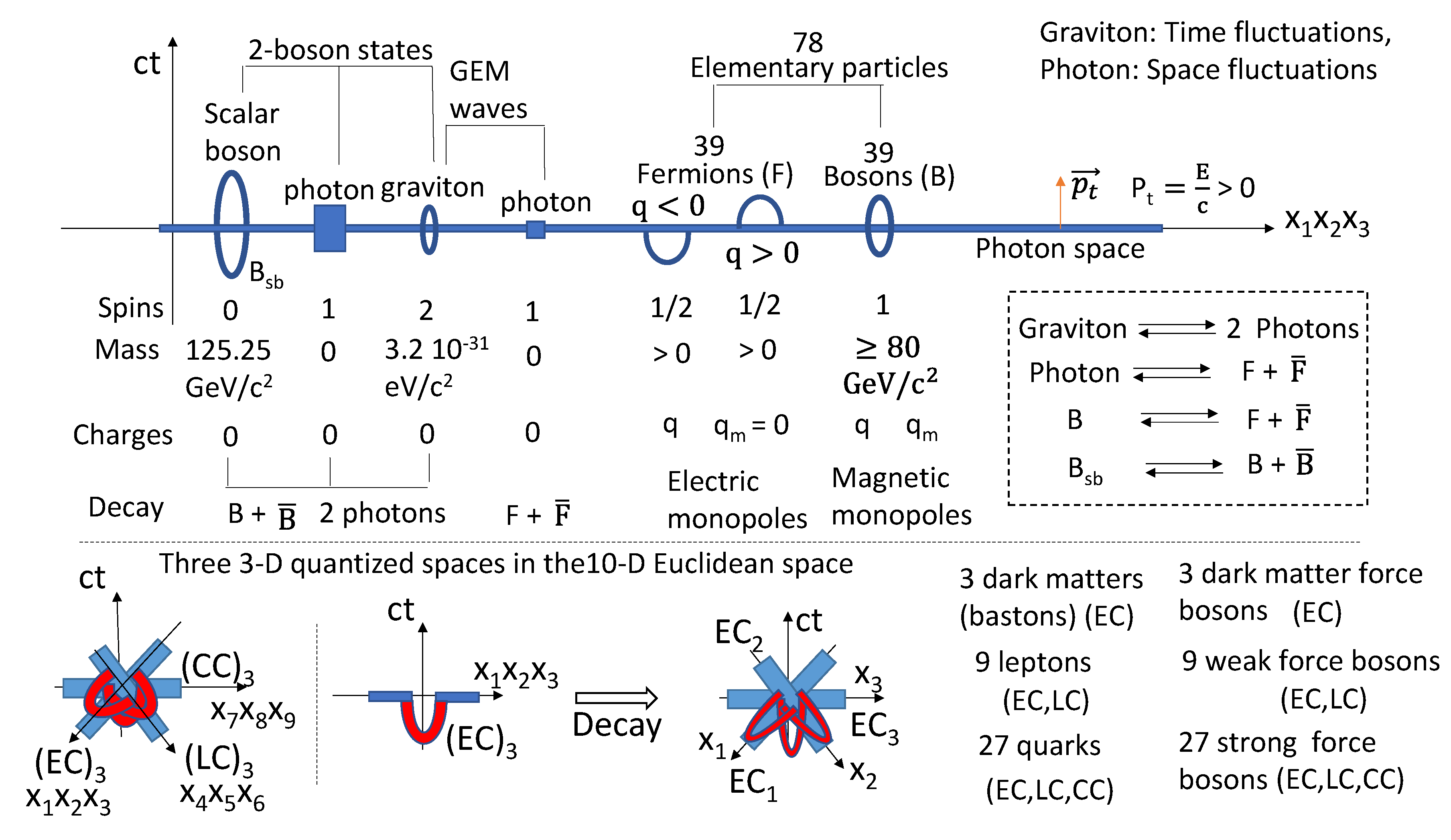
Figure 32.
The Coulomb forces and gravitational forces are compared.
Disclaimer/Publisher’s Note: The statements, opinions and data contained in all publications are solely those of the individual author(s) and contributor(s) and not of MDPI and/or the editor(s). MDPI and/or the editor(s) disclaim responsibility for any injury to people or property resulting from any ideas, methods, instructions or products referred to in the content. |
© 2024 by the authors. Licensee MDPI, Basel, Switzerland. This article is an open access article distributed under the terms and conditions of the Creative Commons Attribution (CC BY) license (http://creativecommons.org/licenses/by/4.0/).
Copyright: This open access article is published under a Creative Commons CC BY 4.0 license, which permit the free download, distribution, and reuse, provided that the author and preprint are cited in any reuse.


