

Submitted:
23 September 2024
Posted:
24 September 2024
You are already at the latest version
Abstract
In recent years, there has been a significant demand for Instructional Design (ID) professionals due to the rise of remote work, increased reliance on digital learning solutions for professional development, and the integration of digital technologies in formal and informal learning spaces. However, practical and authentic personalized courses are unavailable for professionals who want to transition into the field. This study addresses the gaps in most of the available ID courses and details the design of an Instructional Design Skill-Strength Assessment System (IDSSAS) that evaluates gaps in users' skills and offers them courses and mentors to help them bridge them in preparation for work as an ID in the corporate space. Employing a User-Centered Design (UCD) approach, the system prioritizes personalization, real-world application, and practical skills that better position them to be more employable, a significant improvement over the mostly available traditional, theory-focused ID training programs. IDSSAS, which is integrable with any Learning Management System (LMS) or Learning Experience Platform (LXP), was developed with Storyline 360, and it offers personalized learning and feedback as well as provides users with the agency to choose a mentor that is best aligned with their area of interest. The design was grounded in Self-Determination Theory (SDT) and incorporates design features like a progress bar, feedback loop, challenges, social interaction, and agency to support students' motivation and promote Autonomy, Relatedness, and Competence. IDSSAS, in its manual and present automated form, has been successfully used to mentor some transitioning ID professionals globally who are now gainfully employed.
Keywords:
instructional design (ID)
; competency development
; motivation
; user-centered design (UCD)
1.0 Introduction
Teachers, education graduates, and other professionals who want to transition into the field of Instructional Design (ID) to work in the corporate world are faced with the challenge of getting suitable, adaptive, and personalized ID training that can cater to their peculiar needs. They mostly use one-size-fits-all courses that are usually not practical enough to equip them with the required skills for a successful transition. This problem has been compounded by the COVID-19 pandemic, which essentially created the “Instructional Design boom” and put the field on the map (Hobson, 2023). The transitioning group I mentioned above and those who are already in the field by ‘accident’ mostly only have access to courses highlighting topics like learning theories, ID frameworks, and some informal ID learning affordances that are usually not enough to get them a job. In fact, some of the institutions offering them have been tagged ‘fake ID academies’ by some Learning and Development industry leaders as they are filled with empty promises (North, 2021).
While the above are problems, the root cause of the difficulty is the lack of awareness by teachers, education graduates, and other transitioning professionals on what they need to learn and where to get the best of training that could help them meet their skill needs. While there are many transferable skills teachers have, they still need to learn a lot more for a successful transition into Instructional Design (Peck, 2024). In addition to learning experience design skills, Instructional Designers must stay abreast of new technologies like graphics programs, authoring tools, mobile learning, podcasting, and interactive media (Evolving Educator, 2014). This practical experience in the use of the technologies is then used to meet their expectations of designing training for people.
To address this perennial problem, I developed an interactive computer-based Instructional Design Skill-Strength Assessment System (IDSSAS) that assesses the strengths and gaps in professional skill sets and offers them courses tailored to their needs and a mentor to support their skill development in order to make them more employable. To make the journey seamless, I enrich the system with motivation affordances and give them feedback on their responses while using the interactive computer-based system. Also, relevant practical courses, templates, mentoring, tutorials, and training that can help them fill the identified gaps are provided to them. With the pieces of knowledge and mentoring opportunities, the candidates are better equipped with practical ID skills, have greater self-efficacy, and competence that makes them hirable as Instructional Designers for corporate learning (Mohammed, 2022).
2.0 Literature Review
2.1. Instructional Design Competency Development
The term Instructional Design (ID) refers to the systematic and professional planning and implementation of education or training (Merrill, 2002). According to Reiser (2001), the field of instructional design encompasses the analysis of learning and performance problems and the design, development, implementation, evaluation, and management of instructional and non-instructional processes and resources intended to improve learning and performance in a variety of settings, particularly educational institutions and the workplace (Smith & Ragan, 2005). The primary goal of instructional design is to ensure that educational interventions are engaging, effective, and aligned with learners’ needs as well as institutional goals.
IDs use learning theory and a systematic approach to create material, learning activities, training, and other solutions to improve the teaching and learning process (Abuhassna & Alnawajha, 2023). The key competencies required for an Instructional Designer are diverse and multifaceted. They include a strong understanding of learning theories, proficiency in designing instructional materials, and the ability to apply various instructional design models such as ADDIE (Analysis, Design, Development, Implementation, and Evaluation) and Gagné’s Nine Events of Instruction. Additionally, Instructional Designers are better proficient in the use of e-learning authoring tools, media production, and Learning Management System (LMS) or Learning Experience Platform (LXP). Soft skills are as important for Instructional Designers as some of the more technical instructional design skills on this list. In fact, 69.3% of hiring professionals look at communication as a crucial skill when evaluating a candidate (Peck, 2024).
The importance of competency development in instructional design is especially significant in light of the rapidly evolving landscape of educational technologies and methodologies. As digital learning platforms advance and online and blended learning becomes increasingly prevalent, Instructional Designers must continually update their skills to remain relevant and effective in their roles. Competency development is, therefore, essential for enabling Instructional Designers to leverage new technologies, design innovative learning experiences, and meet the diverse needs of contemporary learners (Reiser & Dempsey, 2017).
2.2. Adult Motivation in Learning
Motivational theories explain the behavior of adults in learning environments. The primacy of motivation emphasizes that cognition, emotion, agency, and other psychological processes exist to serve motivation (Baumeister, 2016). There are several motivations for adults to engage in learning. These may include the relevance of learning to their real-life situations and what is useful for them (Knowles, Holton, and Swanson, 2012). According to them, adults are motivated to learn by internal and external factors. Some adults are motivated by external factors such as better jobs, promotions, higher salaries, etc., while others utilize internal factors like the desire for increased job satisfaction, self-esteem, quality of life, etc., among other things.
For Knowles et al. (2012), “the most potent motivators are internal pressures” (p. 67), otherwise known as intrinsic motivation. Internal motives are hard to recognize because they are not visible motives that can be perceived or observed tangibly (Pintrich, Schunk, & Meece, 2007). For example, social motivations are the active stimuli that generate the inner desire for learning. Some adult learners join classes to meet people, perhaps because of their sense of isolation and loneliness. Others are motivated to learn because they love the intellectual activity involved with gaining new knowledge and skills. Something inside them makes them have a strong desire to learn (Gom, 2009, in Aljohani & Alajlan, 2020).
Intrinsic motivation refers to actions that are driven by internal rewards. The motivation to engage in a behavior arises from within because of the inherent satisfaction of the activity rather than the desire for a reward or specific outcome. Task motivation is its own reward and doesn’t depend on explicit rewards or other external constraints (Pintrich, Schunk, & Meece, 2007). In contrast, external motivation refers to behavior that makes learners act not because they are interested in the learning but for some benefits of external compensation (Gonzalez-DeHass, Willems, & Holbein, 2005), for example, money, grades, and honor, social or family pressures, and the threat of punishment. Compliments, appreciation, and acknowledgments are all sources of extrinsic motivation (Nas, 2016). All of these, combined with some other motivation theories inform the design of this strength-assessment system.
Below are the specific adult learning and motivational theories, and how they were included in the experience:
2.2.1. Adult Learning Theory
According to Malcom Knowles, adult learners differ from children in many ways. Adults need to know “why” they should learn, are driven by internal motives (“what’s-in-it-for-me”), their readiness to learn comes from perceiving the relevance of the knowledge (learn best when knowledge has immediate value for them), are self-directed individuals who want to take charge of the learning journey, learn by doing, and learn better when connections are made to their previous wealth of experience.
To ensure the conformity of this learning experience with the adult learning theory, I have used some of its affordances in the following ways:
- Clearly stating the purpose of the awareness creation system and the values it offers them.
- Reawaken their intrinsic motivation by showing them ‘what is in it for them’ and getting them curious and challenged by painting them a beautiful picture of what it feels like to be an ID in the corporate world through the welcome video.
- Making the content of the experience relevant to them. This is why the audience of this experience is clearly defined and was limited to them.
- Give them control over the learning experience by making it self-paced and individualized.
- Include practical exercises that ensure they learn by doing through mentoring, peer interactions, and solving relevant case studies and scenarios.
- Make connections and build on their wealth of experience through the content of the experience.
- Use scenarios and case studies poscourse completion to put them in context of the job, and many more.
2.2.2. Engineering Motivation into IDSSAS System
This system was grounded on the Self-Determination Theory (SDT), which proposes that for one to be motivated and to function at an optimal level, a set of psychological needs must be supported (Deci & Ryan, 2000). These needs are Relatedness, Competence, and Autonomy. When these are satisfied, self-motivation and mental health are enhanced and when they are thwarted, motivation and well-being are diminished.
It was designed to give users autonomy and a sense of ownership and choice by making the experience self-paced and providing agency in social interaction channels. Provide relatedness by providing opportunities for social interactions with peers and mentors. Also, the principle of competence was integrated by providing the feeling of being able to do something or perform Instructional Design tasks.
I used the Self-Regulation Theory by providing opportunities for reflection in peer and mentor interactions while also engineering persistence and control through the welcome video and feedback provided. Baumeister and Vohs (2007) define self-regulation as the self’s capacity for altering behaviors. It greatly increases the flexibility and adaptability of human behavior, enabling people to adjust their actions to a remarkably broad range of social and situational demands.
Intrinsic and extrinsic motivation were also engineered into the system. Intrinsic motivation refers to actions that are driven by internal rewards. The motivation to engage in a behavior arises from within because of the inherent satisfaction of the activity rather than the desire for a reward or specific outcome. Lepper & Henderlong (2000) explains how the 4Cs of intrinsic motivation (Challenge, Curiosity, Control, and Context) can be harnessed for better motivation.
The gains of intrinsic motivation were also explored by challenging the users in various ways and assigning tasks at a gradual difficulty level from very easy to very difficult (scenarios and case studies after completing courses and mentoring). I used the students’ own personal experiences and aroused their curiosity through the wording of the video script, used fantasy/imagination as a strategy to stimulate their thinking power beyond the current conditions, give them control over their learning, and make the content very relevant to their context and need of a job.
On the other hand, extrinsic motivation, a type of motivation that is driven by external reward or punishment, was also included. This type of motivation makes people perform a task or behavior to attain an external reward or avoid a punishment, such as studying for a good grade, working for a paycheck or salary increment, earning social recognition, getting promoted at work, or exercising to win a prize. While adults are not solely motivated by extrinsic motivation, they most times are when it offers them what they desire or need. As stated by Lepper & Henderlong (2000), extrinsic motivation can make a difference when initial interest in a task is low and there is a need to reinforce mastery or competence. However, it was advised that it should not be used superfluously to promote engagement as it could undermine subsequent intrinsic interest.
Here is how I used extrinsic motivation in this learning experience:
- The goal to be achieved from the learning experience was clearly stated from the onset of the experience to condition their mind at a target to reach.
- I provided personalized encouragement at every point necessary (but not superfluously).
- Facilitated Peer-Based recognition by offering them a badge for awareness and competence.
- Used a progression bar to drive them to complete the sections.
- Provide assessment feedback and use praise that rewards effort and improvement.
- Offer support through email and calls to the users. My contact details are provided to them to ensure they are not deterred by any difficulty they may encounter during the experience.
- Provided them with established mentors who were mostly professionals, who also transitioned into the field, to show them transitioning to the field can be done successfully.
Due to the importance of a growth mindset — the belief that intellectual ability can be developed (Yeager & Dweck,2020), I used the introductory video and the feedback the system gives the users while using it to charge them to remain resilient in the quest to learn the nitty-gritty of corporate instructional design. The word ‘yet’ is used to tell them failure is not an end but a means to an end. A growth mindset is a belief that one’s ability is malleable and can improve with effort and challenge. Growth mindset was reinforced with praise for work ethic and effort.
Learning self-efficacy was also engineered in this system. Self-efficacy is the belief that the learners believe in their own capacity to execute their behaviors to achieve certain goals (Bandura, 1977). I promoted the user’s self-efficacy in this experience by validating their previous experience and skills; and assuring them that they are enough and can do it through the short welcome video and through feedback and guiding instructions.
Another theory that is engineered is the Situated Learning Matrix. Situated learning is a theory of learning that emphasizes the importance of context and social interactions in the learning process. According to this theory, learning is not just the acquisition of abstract knowledge or skills, but it is instead a process of active participation in the world. Situated Learning Matrix Experience (SLME) has the following components: Goals, Interpretation, Feedback, Explanation, Practice, Social Interaction (Mentoring, Sharing, Debriefing) (Gee, J. P., 2008). I ensured the learning contents are contextual and authentic by ensuring relevance to my global audience. Also, opportunities to engage in practice and apprenticeship are provided via the presentation of real-life case studies or scenarios, peer and mentoring interactions.
2.3. Mentoring in Professional Development
Mentoring is an essential aspect of professional development, particularly in instructional design, where continuous learning is vital. It is described as a learning and development partnership between someone with vast experience and someone who wants to learn. Mentorship is said to incorporate psychosocial support, career guidance, role modeling, and communication (DeMaria, 2020). Research indicates that mentoring significantly enhances career development by expanding professional networks, providing career advice, and increasing job satisfaction. Mentees often experience greater confidence and motivation, leading to higher levels of engagement and retention in the profession (Eby et al., 2013). Moreover, mentoring facilitates the application of new technologies and methodologies, helping Instructional Designers stay current in an ever-evolving field (Reiser & Dempsey, 2018).
In the context of instructional design competency development, mentoring provides a platform for ongoing professional growth. As Instructional Designers navigate the complexities of evolving educational technologies and methodologies, mentors can offer guidance on how to apply new tools and techniques effectively. This continuous learning process ensures that Instructional Designers remain at the forefront of the field and are capable of creating innovative and effective educational solutions (Reiser & Dempsey, 2018).
Overall, mentoring is a powerful tool for professional development, offering benefits that extend beyond skill acquisition to include career advancement, soft skills development, and increased job satisfaction. As such, mentoring should be considered a key strategy in the professional development of Instructional Designers.
2.4. User-Centered Design (UCD)
User-Centered Design (UCD) is a design philosophy and process that places the user at the center of the design and development process. UCD aims to create products, systems, and services that are highly usable and effective by prioritizing the needs, preferences, and limitations of the end users throughout the design cycle (Norman, 2013).
In the context of instructional design, UCD is particularly significant as it ensures that educational materials and learning environments are designed with the learner’s needs in mind. By applying UCD principles, Instructional Designers can create more effective and engaging learning experiences that accommodate diverse learner preferences and improve overall learning outcomes (Smith & Ragan, 2005).
While UCD provides significant benefits, there are challenges in its implementation, such as balancing user needs with design constraints, managing diverse user feedback, and ensuring that design changes are feasible and practical (Carroll, 2000). Addressing these challenges requires a thoughtful and adaptive approach, ensuring that the design process remains flexible and responsive to user needs.
In summary, User-Centered Design is a crucial approach in creating effective instructional materials and learning environments. By focusing on the needs and feedback of users throughout the design process, Instructional Designers can enhance usability, engagement, and learning outcomes.
3.0 ID Strength Assessment System Design
3.1. Overview of the Interactive Computer-Based Design
Instructional Design Skill-Strength Assessment System (IDSSAS) is an interactive computer-based system for workplace Instructional Design created with Articulate Storyline 360 — a slide-based authoring tool for creating interactive eLearning content for any device. It was used to create the IDSSAS because of its capability to offer personalized, gamified, and individualized learning experiences for learners as well as feedback based on their choices. The IDSSAS is designed to assess and strengthen Instructional Design (ID) skill-gaps for education graduate students, teachers, and professionals from other fields who want to transition to the field of corporate ID. It is an improvement on the alpha version of the product which was created as an Intelligent Tutoring System — a system that imitates human tutors and aims to provide immediate and customized instruction or feedback to learners.
This beta version has ditched all the demotivating components in the earlier version and included some relevant intrinsic and extrinsic motivational affordances, engineered Autonomy, Relatedness, and Competence of the Self-Determination Theory (SDT) as well as provide access to mentors. The system is designed to be deployed through a Learning Management System (LMS) or Learning Experience Platform (LXP) to manage the learning experience and gather data about the engagement, assessment, and completion metrics. It offers a personalized and individualized learning experience to users as well as feedback based on their responses to a survey and performance post-mentoring.
Motivation dimensions included are:
- Individual’s intrinsic motivation as our users want to be corporate IDs.
- Extrinsic motivation affordances like instant feedback, progression, badges, and the possibility of eventually getting the desired job.
- Protégé effect through access to mentors.
- Self-Determination Theory (SDT) through Relatedness, Competence, and Autonomy to make some choices.
- Growth mindset and self-efficacy.
3.2. Design Method and Approach
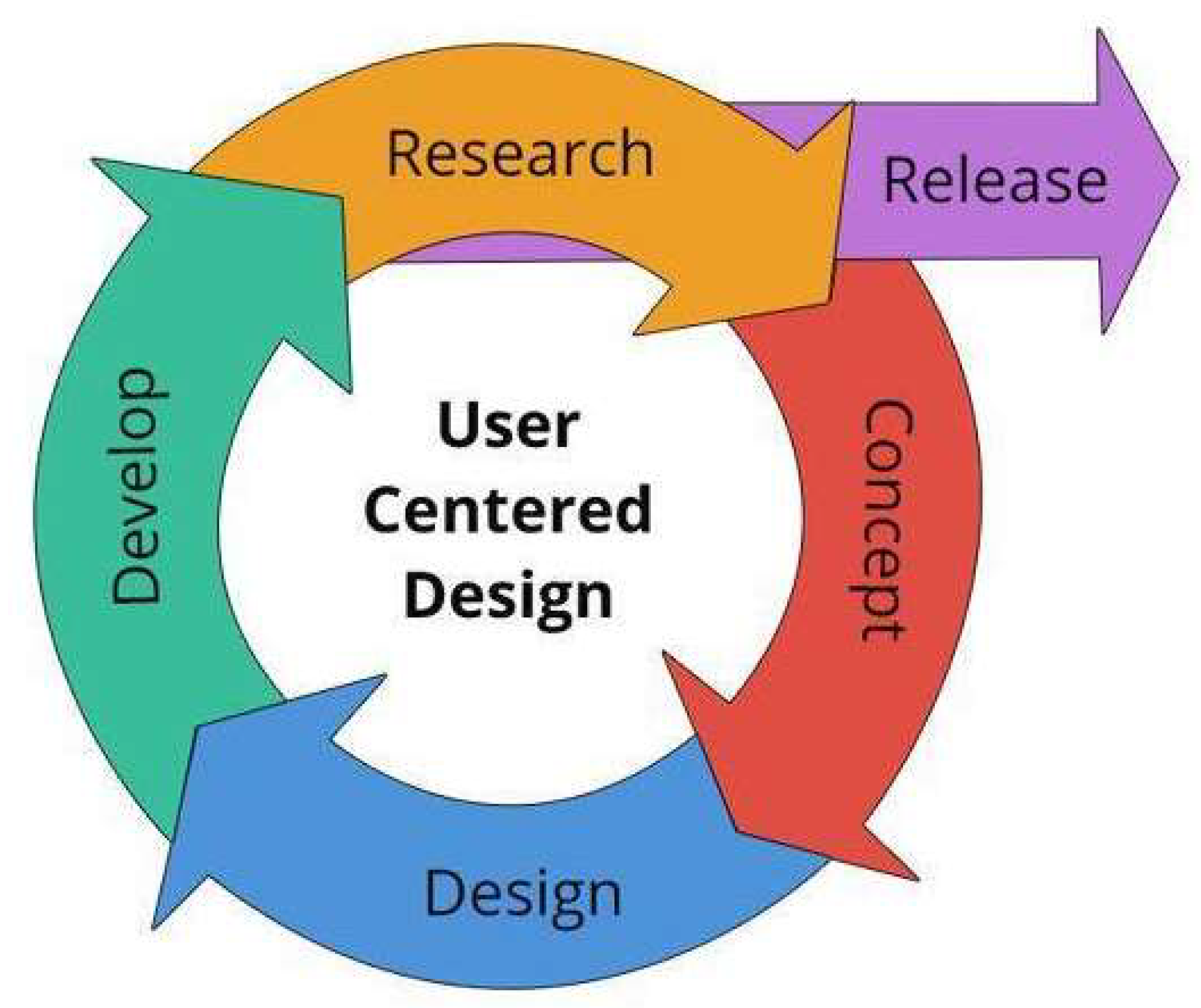
I have used the User-Centered Design (UCD) technique to design this experience due to the peculiar nature of my audience. UCD is an iterative design process that allows designers to focus on the users and their needs in each phase of the design process. This design technique places the users at the center throughout the design process to create highly usable and accessible products for them. Here is a description of what I did in the five recommended stages:
Figure 1.
User-Centered Design (UCD) Cycle.
3.2.1. Research
Two streams of research were conducted for the system. The data that informs this skill-strength assessment system dates back to 2018 and was gathered from interviews and the skill-strength assessment of transitioning professionals. Other sources include interviews with graduate students of Education, ID professionals, Learning Design faculties, career development experts, and personal experience as a teacher who transitioned to Instructional Design. Some of these data sources were allowed to review the alpha version of the new interactive ID mentoring product. All of these were evaluated to decide the best approach for the design of the Beta version of this product and its contents. After the design and development phase, I conducted the second research — Beta-testing (user-testing) by showing the improved product to some potential audience. This feedback was used to improve the system.
3.2.2. Concept
Based on the findings of the research, I ran my prototype and product through some of the users to get their perspectives. Their feedback in the two tests were incorporated and used to improve the ID system. This gave me a greater level of confidence in the relevance of the product as the needs of the users and preferences were incorporated into my final product.
3.2.3. Design
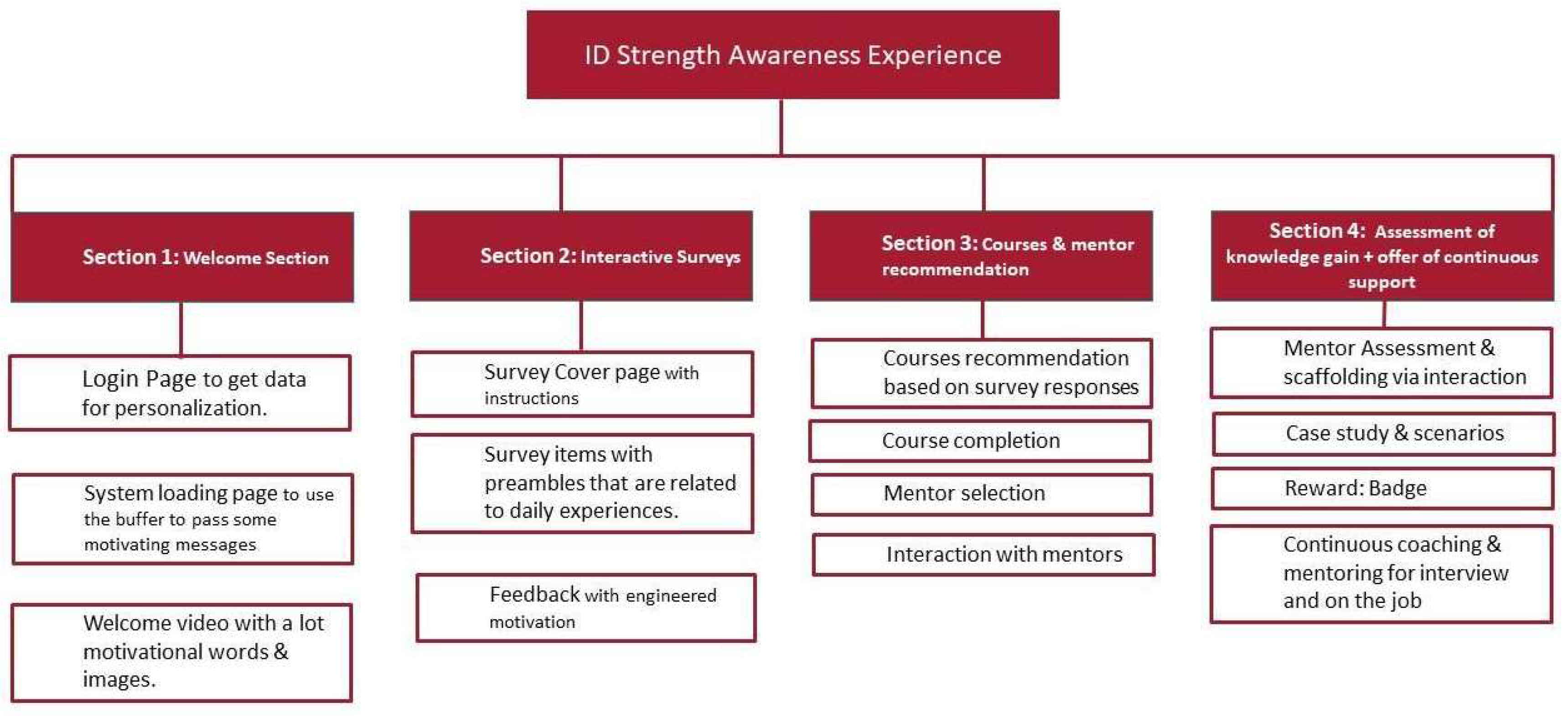
Based on the stages above, I designed the experience with the engineered motivation affordances mentioned above. Below is the summary of the ‘flow’:
- Cover & login page: Allows the users to log in. This is an attempt to personalize the experience.

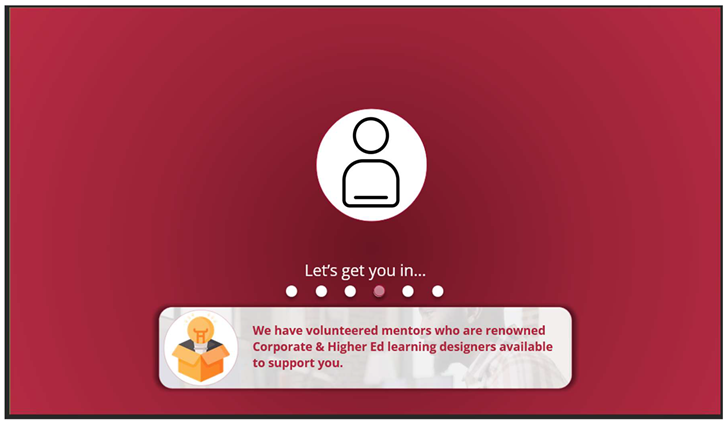
- Loading buffer: While the page loads, more motivational texts are displayed under a moving buffer to encourage users and break the ice.
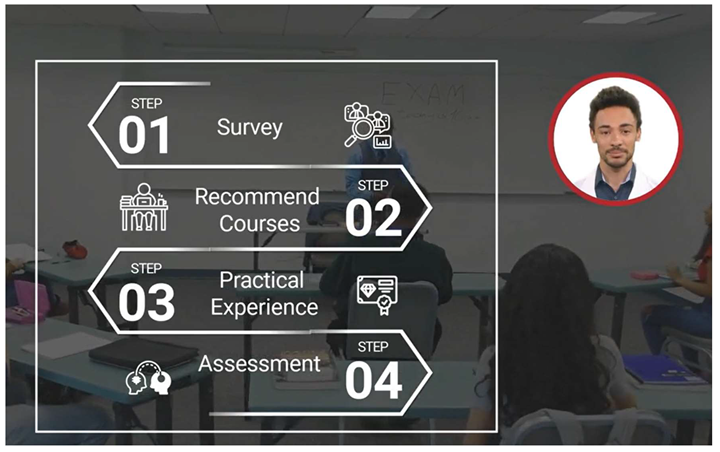
- Welcome video: A video further breaking the ice and making the system more appealing to the users by validating the experience they bring into the system, sharing its importance and selling the field of Corporate Instructional Design to them. This video provides a brief on what to expect while also motivating them.
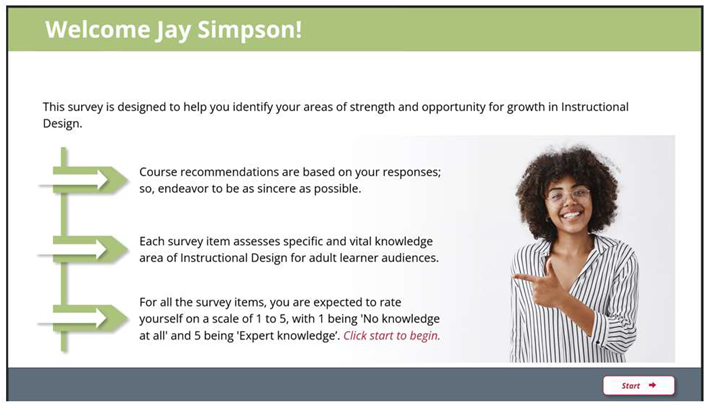
- Survey cover page: This page provides a personalized welcome message to the users and provides a summarized guidance about the survey.
- Present the interactive survey items one after the other.
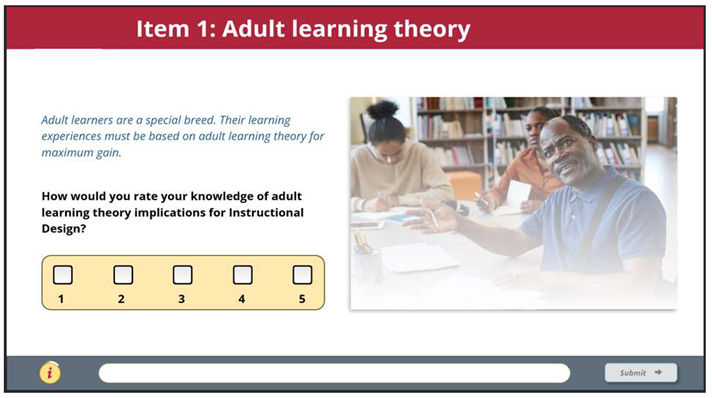
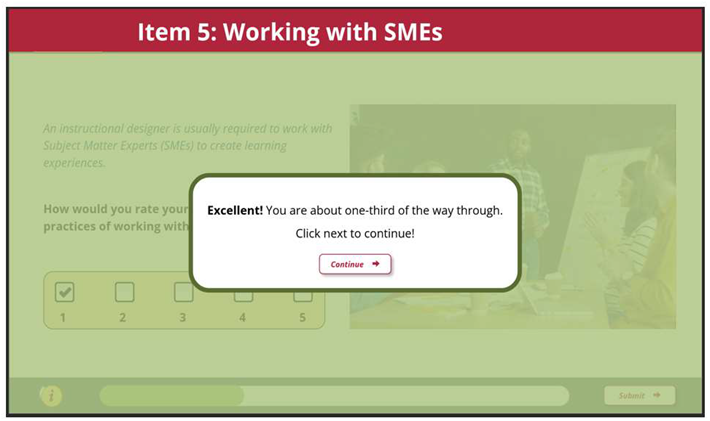
- Recommend courses based on the responses provided.
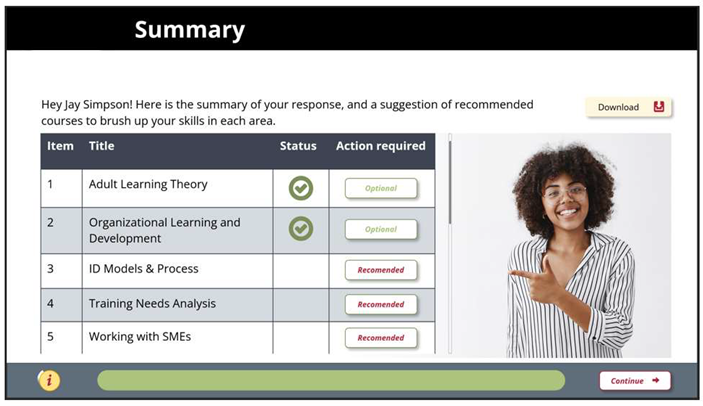
- Mentor selection page
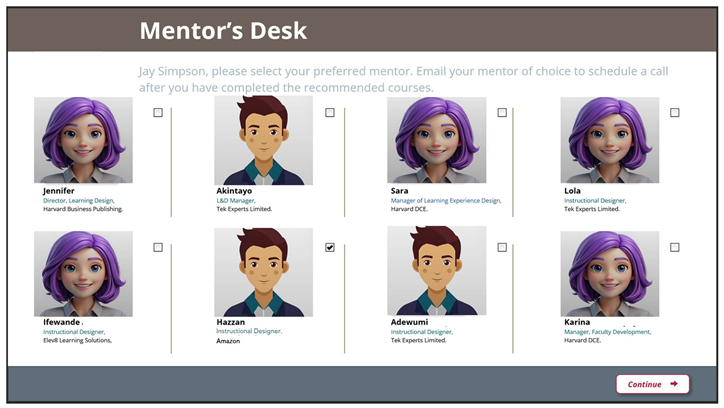
- Interaction with mentors and fellow users after some courses are completed. This is done via physical or virtual meetings with mentors and interactions with peers via a discussion forum. Both the mentors and mentee are provided guides on their responsibilities during the mentoring process.
- Present some scenarios, case studies,and mock projects after completing all courses and meeting with a mentor at least twice to evaluate the progress made by the users — what they have learned and gaps they have filled.

- A reward based on completion, performance, and skill mastery (Golden, Silver or Bronze Badge was used as rewards for performance in assessment after they have completed the courses). This can be shared on social media if they choose to.
- Offer of continuous coaching and mentoring for interviews and on the job by myself and other experienced IDs.
3.2.4. Develop
This is the stage where I created the actual interactive experience using the design based on the needs of the audience and an improved experience flow with motivational affordances. The interactive and motivating experience was created using Articulate 360 as it allows for personalization and provision of feedback based on individual responses provided. The welcome video incorporated into the interactive experience was made with Synthesia – a generative AI system for video creation.
Research 2: After developing the beta experience, I conducted user-testing with three potential users in my target audience and some learning science and motivation experts. The findings from it were used to improve the system for better engagement and user experience.
Product release or launch: The product is launched to the targeted user group after I have incorporated all feedback. After the launch, there is continuous monitoring and evaluation for an even more satisfying user experience.
Figure 2.
Learning experience flow chart.
4.0 Overall Assessment
Strengths and limits in terms of motivation and learning and suggestions for improving its further design.
4.1. Strengths
The system has several strengths. Firstly, it addresses the educational problem of providing suitable, adaptive, and personalized ID training that caters to the peculiar needs of teachers and education graduates who are transitioning to the corporate world to work as Instructional Designers. Secondly, the system is enriched with motivation affordances that enhance learners’ intrinsic and extrinsic motivation, such as instant feedback, progression, badges, access to mentors, and opportunities to make choices.
Furthermore, the system aligns with Self-Determination Theory (SDT) through Relatedness, Competence, and Autonomy by promoting a sense of competence, autonomy, and connection with others. The system also incorporates growth mindset and self-efficacy which can improve learners’ confidence in their ability to acquire and apply new skills. Finally, it was deployed through a Learning Management System, which facilitates data gathering of learners’ footprints and learning experiences.
4.2. Limits
Despite its strengths, the system has some limitations. First, the system assumes that the users have intrinsic motivation, are self-driven and interested in specializing in corporate Instructional Design, because they said they are. This may not be the case for all users as some might only see it as an option.
The ID system also relies on the availability of mentors, which may be limited, inconsistent, and non-responsive at times. The reliance on Learning Management Systems or Learning Experience Platforms may limit access for learners who lack access to technology or are not comfortable using such systems. Despite its various offerings, there is a need for users to stay abreast of new technologies and keep learning strategies for better results. Also, the system is yet to be integrated with the mentoring process and the practical assessment which are submitted through a third-party LMS or LXP technology.
4.3. Suggestions for Improving Future Design
To improve the system further design, the following suggestions are recommended:
- Conduct a broader needs assessment to determine the specific needs and interests of learners before designing the system.
- Integrate all the components of the system into one.
- Improve the motivation affordances of the system.
- Provide more opportunities for learners to collaborate and learn from one another, either through online discussion forums, group projects, or peer mentoring.
- Develop offline materials, such as printed manuals or guides, to cater to learners who may not have access to technology or the Internet.
- Increase practice to ensure learners are equipped with both practical experience and theoretical knowledge.
- Conduct regular evaluations of the system to identify areas for improvement, by considering learners’ feedback and needs.
5.0 Conclusion
In conclusion, this paper has outlined the design and development process of an interactive computer-based system that is aimed at enhancing instructional design (ID) skills for transitioning teachers, graduate students, and professionals who desire to work in corporate organizations. The system integrates advanced motivational affordances and feedback mechanisms to address the deficiencies of traditional, theory-focused training programs. By incorporating intrinsic and extrinsic motivators, access to mentors, and elements of Self-Determination Theory (SDT), the system provides a more engaging and practical learning experience. The application of a User-Centered Design (UCD) approach ensures that the system meets the specific needs of its targeted users, offering personalized learning paths and immediate feedback to support skill development.
The beta version of this system represents a significant improvement over the previous version, incorporating user feedback to enhance usability and relevance. The integration of motivational elements such as progression tracking, badges, and mentoring opportunities contributes to increased user engagement and efficacy, fostering a more adaptive learning environment.
Ultimately, this interactive system aims to bridge the gap between theoretical knowledge and practical application, equipping transitioning professionals with the necessary skills to transition effectively into corporate instructional design roles. The continuous feedback and iterative design process employed in this project not only addresses the current limitations but also sets a foundation for future enhancements and refinements. By addressing the specific needs and challenges faced by users, this system stands to make a meaningful impact on the field of instructional design, promoting both professional growth and career readiness.
References
- Abuhassna, H.; Alnawajha, S. Instructional design made easy! Instructional design models, categories, frameworks, educational context, and recommendations for future work. European Journal of Investigation in Health, Psychology and Education 2023, 13, 715–735. [Google Scholar] [CrossRef]
- Aljohani, O.H.; Alajlan, S.M. Motivating adult learners to learn at adult-education schools in Saudi Arabia. Adult Learning 2020, 31, 150–160. [Google Scholar] [CrossRef]
- Baumeister, R.F. Toward a general theory of motivation: Problems, challenges, opportunities, and the big picture. Motivation and Emotion 2016, 40, 1–10. [Google Scholar] [CrossRef]
- Carroll, J.M. Making use: Scenario-based design of human-computer interactions; MIT Press: location, 2000. [Google Scholar]
- DeMaria, A.N. Mentorship. Journal of Cardiovascular Computed Tomography 2020, 14, 451–452. [Google Scholar] [CrossRef]
- Eby, L.T.; Allen, T.D.; Evans, S.C.; Ng, T.; DuBois, D.L. Does mentoring matter? A multidisciplinary meta-analysis comparing mentored and non-mentored individuals. Journal of Vocational Behavior 2013, 83, 106–120. [Google Scholar] [CrossRef] [PubMed]
- Evolving Educators. Teachers vs Instructional Designer. 2014. Available online: https://evolvingeducator.wordpress.com/2014/07/21/teacher-vs-instructional-designer/#:~:text=Three%20major%20differences%20between%20a,%2C%20podcasting%2C%20and%20interactive%20media (accessed on 1 May 2024).
- Gee, J.P. Learning and games. In The ecology of games: Connecting youth, games, and learning; Salen, K., Ed.; Massachusetts Institute of Technology Press: location, 2008; pp. 21–40. [Google Scholar]
- Hobson, L. So you want to become an Instructional Designer. DrLukeHobson.com. Retrieved September 14 2023, 2024. Available online: https://drlukehobson.com/blog1/so-you-want-to-become-an-instructional-designer (accessed on 1 May 2024).
- Lepper, M.R.; Henderlong, J. Turning “play” into “work” and “work” into “play”: 25 years of research on intrinsic versus extrinsic motivation. In Intrinsic and extrinsic motivation: The search for optimal motivation and performance; Sansone, C., Harackiewicz, J.M., Eds.; Academic Press, Inc.: San Diego, CA, USA, 2000; pp. 257–307. [Google Scholar]
- Merrill, M.D. First principles of instruction. Educational Technology Research and Development 2002, 50, 43–59. [Google Scholar] [CrossRef]
- Mohammed, H. (2018 – 2022). Personal Instructional Design Mentoring Experience. Unpublished.
- North, C. North, C. (2021). Fake Instructional Design Academy. Available online: https://www.linkedin.com/feed/update/urn:li:activity:6881591025048129536?updateEntityUrn=urn%3Ali%3Afs_feedUpdate%3A%28V2%2Curn%3Ali%3Aactivity%3A6881591025048129536%29 (accessed on 1 May 2024).
- Norman, D.A. (2013). The design of everyday things (Revised and expanded ed.). Basic Books.
- Peck, D. (2024). From teacher to Instructional Designer: A guide to career transition. Devlin Peck. Available online: https://www.devlinpeck.com/content/teacher-to-instructional-designer (accessed on 1 May 2024).
- Peck, D. (2024). The top 15 instructional design skills you need in 2024. Devlin Peck. Available online: https://www.devlinpeck.com/content/instructional-design-skills (accessed on 1 May 2024).
- Reiser, R.A. A history of instructional design and technology: Part I: A history of instructional media. Educational Technology Research and Development 2001, 49, 53–64. [Google Scholar] [CrossRef]
- Reiser, R.A.; Dempsey, J.V. Trends and issues in instructional design and technology, 4th ed.; Pearson: location, 2018. [Google Scholar]
- Ryan, R.M.; Deci, E.L. Self-determination theory and the facilitation of intrinsic motivation, social development, and well-being. American Psychologist 2000, 55, 68–78. [Google Scholar] [CrossRef] [PubMed]
- Smith, P.L.; Ragan, T.J. Instructional design, 3rd ed.; Wiley: location, 2005. [Google Scholar]
- Yeager, D.S.; Dweck, C.S. What can be learned from growth mindset controversies? American Psychologist 2020, 75, 1269–1284. [Google Scholar] [CrossRef] [PubMed]
Disclaimer/Publisher’s Note: The statements, opinions and data contained in all publications are solely those of the individual author(s) and contributor(s) and not of MDPI and/or the editor(s). MDPI and/or the editor(s) disclaim responsibility for any injury to people or property resulting from any ideas, methods, instructions or products referred to in the content. |
© 2024 by the authors. Licensee MDPI, Basel, Switzerland. This article is an open access article distributed under the terms and conditions of the Creative Commons Attribution (CC BY) license (http://creativecommons.org/licenses/by/4.0/).
Copyright: This open access article is published under a Creative Commons CC BY 4.0 license, which permit the free download, distribution, and reuse, provided that the author and preprint are cited in any reuse.


