
Submitted:
17 September 2024
Posted:
17 September 2024
You are already at the latest version
Abstract
While various studies have explored the integration of sustainability in the construction sector of Tanzania, particularly in areas like energy efficiency and green building practices, there remains a significant gap in understanding the specific barriers to the selection of sustainable building materials (SBMs) in residential projects. This research intends to bridge this gap by identifying and analyzing the critical barriers that hinder the effective selection of SBMs in Tanzania's residential building projects. By employing qualitative interviews with experts from regulatory bodies, public developers, and academic researchers, the study provides a comprehensive overview of the barriers. To ensure the collection of relevant and insightful data, the study involved the selection of participants based on specific criteria tailored to each category of experts. To be able to analyze qualitatively the data collected, this study employed Atlas.ti and MS Excel software. The findings revealed six categories of critical barriers affecting the selection of SBMs for residential building projects in Tanzania were identified and analyzed: (1) Regulatory and Policy Barriers (2) Financial Barriers (3) Knowledge and Awareness Barriers (4) Technical Barriers (5) Market and Supply Chain Issues (6) Cultural and Social Barriers. Moreover, the lack of awareness and limited knowledge issue were as equally importantly voiced as regulatory and policy barriers to affect the effective selection of sustainable materials in Tanzania. This study underscores the need for targeted policy interventions that address the lack of awareness, financial difficulties, and the absence of comprehensive regulatory frameworks to promote the selection of sustainable materials.
Keywords:
Sustainable Building Materials
; Residential Building Projects
; Barriers to Selection
; Tanzania Construction Industry
1. Introduction
Globally, the construction industry stands as one of the leading carbon-emitting sectors [1], significantly contributing to greenhouse gas emissions and resource consumption. Also, the construction industry has a substantial impact on the natural environment, economy, and society, directly and indirectly affecting environmental sustainability [2]. [3] claims that traditional building practices, characterized by the use of conventional materials, hugely affect the environmental imbalance, leading to significant resource depletion and emissions. To mitigate these detrimental effects, the adoption of Sustainable Building Materials (SBMs) has been advocated as a crucial step toward minimizing environmental impact [4]. SBMs, known for their recyclability and minimal environmental footprint, offer a pathway to sustainable construction practices [5]. However, despite the evident benefits of SBMs, their widespread adoption in building projects remains limited, particularly in developing countries [6].
The persistence of traditional building practices, coupled with a lack of awareness and understanding of sustainability aspects, hinders the transition to SBMs ([7]; [8]. In the context of Tanzania, a developing country in East Africa, the green building (GB) agenda is significantly affected by a lack of theoretical and contextual understanding of the factors influencing green building adoption [9]. Although Tanzania’s construction policy of 2003 acknowledges certain factors hindering the adoption of green buildings—such as persisting traditional building practices, lack of awareness, and technological skills—it lacks a clear definition of green buildings and rarely enforces this agenda [10].
Similar challenges equally affect the adoption and utilization of SBMs, as the later are the key components of green buildings. Limited knowledge about the benefits of alternative building materials leads to a higher preference for Western-made materials, perceived as signs of wealth and modernization, thus reducing the usability of locally sourced sustainable materials [11]. Furthermore, the situation of Tanzania in regard to sustainable construction does not differ much from the rest of many other developing countries, where the upfront costs of sustainable building materials are believed to pose serious challenges against the proper integration of green buildings aspect and utilization of sustainable buildings materials in the construction practices compared to their counterparts of developed countries. [12] indicates that, in addition to the general challenges associated with sustainable design and construction, factors such as poverty, fear of change, weak governance, and environmental issues hinder sustainable housing in African countries.
While various studies have explored sustainability in Tanzania, particularly in areas like energy efficiency and green building practices, there remains a significant gap in understanding the specific barriers to the selection of sustainable building materials (SBMs) in residential projects. Despite the growing awareness of sustainability’s importance, the utilization of SBMs in Tanzania’s construction sector remains limited. The key obstacles—ranging from economic and market constraints to cultural and knowledge-based factors—are not well-documented or analyzed in the existing literature. This research aims to bridge this gap by identifying and analyzing the critical barriers that hinder the effective selection of SBMs in Tanzania's residential building projects.
Understanding all these barriers in the context of Tanzania's construction industry is crucial for stakeholders to effectively mitigate their effects and advance the adoption of green buildings and sustainable building materials. This study aims to identify and analyze the key barriers to the effective selection of sustainable materials in residential building projects in Tanzania. Through in-depth interviews with experts from regulatory bodies, academic researchers, and public developers, the study aims to gather valuable insights and offer a comprehensive overview of these barriers. At the end, he findings of this study will be useful in enhancing awareness, propose policy recommendations, and contribute to the expansion of the knowledge body related to barriers in the context of a developing country like Tanzania.
2. Literature Review
2.1. Critical Barriers to Selection of SBMs
[13] assert that with growing concerns for the environment and climate change, there has been a focus on the way new structures are commissioned and built; particularly in their use of energy and resources. Similarly, [14] claim that the usage of building materials has a substantial impact on the environment, mainly because of the large quantity of non-renewable resources with the potential to deprive future generations of their use. According to [15], the utilization of sustainable building materials has been identified as an important strategy in the design of buildings as the sustainability imperative keeps gaining momentum in the construction industry.
Despite the recognized benefits of sustainable building materials, various barriers hinder the widespread adoption of these materials. These barriers are not only prevalent in developed regions, but are often more pronounced in developing countries due to additional economic, technical, and regulatory challenges. To begin with, one of the most significant barriers to the selection of SBMs is the cost implication. According to [16], sustainable building materials often have higher upfront costs compared to conventional materials. This cost difference can be a major deterrent for builders and developers, especially those operating on tight budgets or in competitive markets where immediate financial returns are prioritized. According to [17], the higher initial investment required for SBMs can discourage their adoption, particularly when stakeholders are focused on short-term financial outcomes.
Another critical barrier is the lack of awareness and knowledge about SBMs. According to [18], many stakeholders, including developers, contractors, and clients, are either unaware of the availability of sustainable materials or do not fully understand their benefits. This knowledge gap often leads to a preference for conventional materials, which are more familiar and widely used. [19] highlight that this lack of awareness is a significant obstacle to the adoption of SBMs, as it prevents stakeholders from making informed decisions that prioritize sustainability.
The technical and performance uncertainties is also another contributor to the reluctance to adopt SBMs. [20] argues that concerns about the durability, reliability, and overall performance of sustainable materials can make stakeholders hesitant to use them in projects. Some may perceive these materials as untested or experimental, leading to resistance against their use. [21] note that such technical uncertainties are a major barrier, particularly in large-scale projects where the stakes are high.
Various authors found that the supply chain limitations could further complicate the adoption of SBMs. In many regions, the supply chains for sustainable materials are underdeveloped, leading to inconsistent availability and logistical challenges [16]; [22]. This unreliability makes it difficult for builders to source the necessary materials in the quantities required, further discouraging their use. [23] observe that the limited availability of SBMs is a significant barrier, particularly in developing countries where local production is often insufficient.
Most surprisingly, regulatory and policy barriers also play a crucial role. According to [20]; [24] In many regions, building codes and regulations do not support or encourage the use of sustainable materials. The absence of supportive policies and incentives can make it difficult for SBMs to compete with conventional materials, which are often cheaper and more readily available. [19] emphasize that without strong regulatory frameworks, the transition to sustainable construction practices is likely to remain slow.
On the other hand, in the context of developing countries, these barriers are often exacerbated by additional challenges such as economic, limited knowledge and awareness, and lack of strong policies and building codes constrains. Economic constraints are more pronounced, as the higher upfront costs of SBMs are a more significant obstacle in regions with lower levels of economic development [25]; [26]. Builders and developers in these areas are more likely to prioritize cost savings over sustainability, given the tighter budget constraints. [27] highlight that economic barriers are particularly challenging in developing countries, where financial resources are limited. (Eze et al., 2023a) indicates that when stakeholders—such as architects, engineers, builders, and clients—are not adequately informed about the benefits, availability, and application of SBMs, they tend to rely on conventional materials that they are more familiar with. Speaking of the developing world, many SBMs are not produced locally in developing countries, leading to reliance on imports. [29] indicates that this dependence on external sources increases costs and logistical challenges, further hindering the adoption of sustainable materials. [29] report that in countries like Burkina Faso, the lack of local production of green building materials has forced locals to develop their own supply chains, often at significant expense. Lastly, it has been established that the cultural and market preferences in developing countries often favor conventional materials and construction methods ([30]. [24] indicates that these preferences are reinforced by cultural norms and the existing market structure, making it difficult for SBMs to gain acceptance. Similarly, [31] discuss how entrenched preferences for conventional materials are a significant barrier to the adoption of SBMs, particularly in regions where sustainable alternatives are not yet widely recognized or trusted.
[15] notes that despite the growing awareness of this aspect in developing nations, significant barriers still prevent this 'new style' of architectural practice from becoming the norm. Table 1 presents the major barriers affecting the selection of sustainable building materials in developing countries, as identified in previous studies.
Developing countries are working hard to achieve the development of green buildings despite the barriers such as urbanization and growing environmental concerns. It is suggested that these barriers can be overcome by stakeholders in a strategic and collaborative manner in order to improve the incorporation of SBMs in the future building projects and in making existing buildings green [43].
2.2. Contextual Challenges
Tanzania faces similar challenges described in (2.1) like the rest of the developing world, particularly the Sub-Saharan part of Africa. [44] claim there to be no clear government policies and regulations mandating the application of green building practices in building development in Tanzania. This lack of policy support and enforcement regulations can further be explained by the fact that Tanzania relies on adopted foreign building standards and certification systems such as LEED v4.1 and Green Mark 2017 [44], to assess the environmental compliance of construction activities and building materials [9]. UNEP (2009) states that the absence of strong policies and regulatory frameworks is frequently linked to low levels of awareness and knowledge among stakeholders in the construction industry. [45] found that in regions with robust environmental policies, there is generally higher awareness and knowledge about sustainable building materials. The challenge of limited awareness and knowledge of SBMs in Tanzania can further be attributed to lack of comprehensive tools/data to compare different material alternative. For instance, the price list of materials lastly published by the National Construction Council in 2019 [46], provides only information about the conventional materials. This list, which is widely referenced by builders, developers, and policymakers, exclusively features conventional materials, thereby neglecting the growing array of sustainable alternatives. In addition, [45] noted that without standardized metrics and comparison tools, builders and developers struggle to make informed decisions. By establishing for instance, a central database that include SBMs and launching educational initiatives, the NCC can drive the adoption of sustainable practices. This alignment with global trends would not only foster socio-economic development but also ensure environmental sustainability, positioning Tanzania’s construction industry for a competitive future.
3. Methodology
3.1. Study Approach
Previous studies employed either quantitative or mixed methods to contribute to the knowledge of issues affecting sustainable building materials (SBMs) in developing countries ([33]; [47]; [15]; this study employs a qualitative research design to understand the complex and multifaceted issues hampering the effective selection of sustainable materials for residential building projects in the context of Tanzania. [48] assert that interviews allow for a deep exploration of participants' thoughts, feelings, and experiences, providing a nuanced understanding of the research topic. Also, [49] add that interviews enable researchers to gather data within the context in which it occurs, capturing the richness and complexity of participants' lived experiences. Conducted within the context of Tanzania, a developing country with unique sustainability challenges and opportunities; this research, therefore, will help to uncover the specific barriers faced in this setting and suggest measures for the way forward. The target participants included experts from regulatory bodies, academic researchers, and professionals from public developers who were purposively selected due to their expertise, participation, and connections to sustainable materials in Tanzania.
To ensure the collection of relevant and insightful data, the study involved the selection of participants based on specific criteria tailored to different categories of experts [50]. Experts from regulatory bodies were selected based on their involvement in assessing applications or perform inspectional compliance with sustainable construction practices and their established collaboration with stakeholders on sustainability-focused projects. These participants were drawn from the National Environment Management Council (NEMC), Tanzania Green Building Council (TGBC), and Tanzania National Construction Council (NCC), with at least an expert representing each institution. The suitable academic researchers were identified online using a systematic approach based on their specialization in sustainability in construction and having at least one research article published on sustainable materials or green buildings within the past decade (2015-2023). This criterion ensured that the data obtained reflected current practices and knowledge-based perspectives. Ten academic researchers met these criteria, providing a robust academic viewpoint on the barriers to sustainable material selection. Lastly, for the category of developers, the criteria included being a public housing entity with a vision focusing on sustainable/green solutions, having an online presence with core information about the company and its projects, being mandated to develop organized residential projects, and having an ongoing or recently completed mass residential development within the last five years. This approach ensured a dynamic and current context for the study. The National Housing Corporation (NHC), Tanzania Building Agency (TBA), and Watumishi Housing Investments (WHI) met these criteria, thus representing the developer perspective in the study. In total, this study interviewed 16 participants.
The data collection process involved conducting semi-structured interviews with each expert, either in person or through online platforms, depending on their location and availability. As observed by [51], semi-structured interviews offer the flexibility to explore new areas, potentially revealing unexpected dimensions of topics. The interviews, which lasted between 30 to 60 minutes, were guided by a set of open-ended questions designed to elicit detailed responses about the challenges and considerations in sustainable material selection. Pilot interviews were conducted with a small subset of participants to refine the interview guide and ensure the questions were clear and effective in capturing the desired information.
To be able to analyze qualitatively the data collected from interviews with experts, this study employed Atlas.ti software [52]. This process was effective because not only Atlas.ti simplifies the organization and categorization of data through the coding of themes, it also improves the analysis of interviews with detailed accuracy [52]. [53] add that Atlas.ti enables the creation and synchronization of networks of codes, improving the visualization of connections between themes and aiding in the discovery of important insights and connections. To simplify the process, the analysis followed the widely recognized six steps of thematic data analysis as provided by [52]. Step 1- Familiarization with the Data: This stage involved reading and re-reading interview transcripts in order to get an overall understanding of the data; Step 2- Generating Initial Codes: This stage involved assigning codes to significant segments of text. This involved labeling segments of transcribed data that appear relevant to the research questions and objectives; Step 3- Creating Categories/Themes: At this stage, codes were grouped into broader themes that represent the data more comprehensively. It involved sorting the different codes into themes and gathering all the data relevant to each potential theme; Step 4- Reviewing Themes: At this step, themes were reviewed at the level of the coded data and at the level of the entire data set for accuracy purpose. This step involved checking if the themes work in relation to the coded extracts and the entire data set, generating a thematic map of the analysis; Step 5- Refining Themes: This step dealt with refining each theme to identify the essence of what each theme is about. Step 6- Writing the Report: This final stage involved writing up the analysis, including the themes and supporting data extracts.
In order to ensure a robust, comprehensive, and contextually relevant analysis that captures both established and new barriers to the effective selection of SBMs for residential building projects in Tanzania, a hybrid approach was adopted for this study. [54] revealed that the combined approach helps to ensure that the voices of the participants are valued, while simultaneously allowing for more theory-led analysis. Moreover, in their study [55] admit that a hybrid approach not only assists in identifying the most basic element of the raw data as asserted by [56], but also in flexibly discovering both descriptive meanings and interpretive meanings that appear interesting and relevant to the research agenda. Furthermore, [55] concluded that this approach allows participants to express themselves and explicitly draw upon theoretical frameworks that strongly articulate the unit of data and best facilitate a close-up analysis of the phenomenon. For this study, this approaches enabled researchers to capture context-specific insights and barriers that might not be present in the literature but are critical in Tanzania’s context; allowed to test existing theories and frameworks within the specific context of Tanzania; and provided the roadmap for the analysis, ensuring that no key aspects highlighted in the literature is overlooked.
4. Results and discussion
4.1. Main Barriers to the Effective Use of SBMs in Building Projects
- Regulatory and Policy Barriers: The absence of supportive policies and enforcement mechanisms is a major barrier to effective selection of SBMs in Tanzania. To no surprise in the context of a developing country like Tanzania, all the participants share the view about this prevalent problem. Experts highlighted the need for stronger government intervention, clearer regulations, and enforcement mechanisms that promote sustainable practices. They added that the lack of policy support and regulatory frameworks hinders heavily the effective utilization of sustainability construction materials and makes consumers less concerned about the whole aspect. Respondents A, G, and H respectively quoted:
“There are no strong incentives from the government to encourage the use of sustainable materials. I see that as the non-motivating factor especially to developers who are primarily concerned with maximizing profits on their investments” (Participant A1).
“The current regulations are not robust enough to support sustainable building practices. If serious measures are not put in places by the Government, I don’t see how citizens will have interests in this new trend” (Participant R2)
“We need better policy support and enforcement mechanisms to ensure compliance with sustainability standards in material selection. Otherwise, research work will cumulate with less impact if there is no firm intervention of the legal side” (Participant A4)
These findings on regulatory and policy barriers align closely with those of previous studies in other developing countries, such as Burkina Faso and Nigeria. [29] report that government-related barriers hampering the adoption of SBMs in Burkina Faso include the lack of effective government programs and policies focused on green construction, inadequate tax incentives, and the absence of local green building rating systems. These authors proposed recommendations including adapting international rating systems to local conditions and needs, and exploring new green technologies that could be successfully applied at the local scale to promote green design and green materials. They also urged the government to develop policies incorporating training and incentives for stakeholders.
[33] found that the lack of building codes and regulations, insufficient research funding for green building materials and technologies, and the absence of a standard green building tool are significant barriers to the adoption of SBMs. They added that while effective regulations and funding are crucial for the introduction and sustainability of green building materials, their absence inhibits the adoption and innovative use of these materials. Lastly, [33] recommended the findings of [7], who proposed strict adherence to codes and regulations as one of the measures for improving the use of SBMs in construction industry.
- 2.
- Financial Barriers: The high costs associated with sustainable materials, driven by transportation expenses, extra costs of construction and labor, and the need for mass production, are other major obstacles. Other participants linked these barriers to the lack of funding options and support. It was added addressing these financial challenges through subsidies, grants, or incentives from the Government or non-governmental organizations, as well as investing in mass production in proximity areas to reduce transportation costs, could make sustainable materials more accessible. Quoting respondents A4 and A5;
“Sustainable materials are often more expensive, which discourages their use. If may be we (in Tanzania) could imitate some developed countries how they encouraged this agenda in its early days through incentives such as tax cuts, I believe this would boost the motivation of the consumers” (Participant A4)
“The transportation costs for sustainable materials are very high, which adds to the overall expense. For instance, some Dar Es Salaam residents believe that it would be cheaper to use China’s tiles instead of natural cladding stones from Mbeya due to transport additional costs. You can observe how the increased processing sites of these natural cladding stones in Dar Es Salaam has positively affected their proportional use” (Participant A4)
“In order to meet the growing significance, I think people need to integrate the scaling up production to bring down the costs of these materials. On the other side, the innovative ways of constructing these materials result to extra labor costs and time. It is important to rely on certain optimization principles such as collaborative purchasing and bulk buying and effective project management to reduce these extra costs” (Participant A5)
These results align with broader trends observed in previous similar studies which addressed this prevalent issue in both in developed and developing countries. The key similarities in these financial issues affecting the effective selection of sustainable building materials include: the high initial costs of sustainable materials, the need for government intervention in the form of incentives to support the use of sustainable building materials (SBMs), the need for funding options and the higher costs associated with importing materials, and the low market demand and lack of client knowledge [6]; [9]; [33]; [29].
On the other hand, there are crucial differences that are noted in the current studies compared to previous literature. Firstly, while this study highlights the specific impact of high transportation costs on the affordability of sustainable materials and suggests increasing local production as a solution, [29] mention higher costs due to imports but do not focus on local production solutions. Secondly, while this study recommends practical strategies such as collaborative purchasing, bulk buying, and effective project management to reduce high costs of SBMs, there lack the specific strategies for cost optimization in previous studies knowledge [6]; [9]; [33].
- 3.
- Knowledge and Awareness Barriers: Lack of awareness and limited knowledge issue was as equally importantly voiced as regulatory and policy barriers against the effective selection of sustainable materials in Tanzania. This explains its scale of effects to the target end users as well as the reason why the majority of interviewees rated low the aspect of SBMs. The lack of awareness extends beyond benefits to a fundamental unfamiliarity with what constitutes sustainable materials. Participants believe this critical issue is sustained by the lack or limited educational campaigns, integration of sustainability concepts in academic curricula, and industry training programs that could help bridge these gaps and promoting the benefits of utilizing the SBMs. Quoting some important insights:
“Many people don't even know what sustainable materials are, let alone the regular citizens, even building professionals whose university education related to construction and good years of working experience. We need more educational programs about sustainability in construction within industry entities” (Participant A2)
“There is a strong need for an increased Industry-Academia link up because you (researchers) keep producing research works on this matter and yet few occasions are arranged to update the industry professionals. Having such opportunities would elaborate the knowledge of professionals about emerging technologies such as the crucial need for utilization of SMBs among others” (Participant A3)
“You are the first building professional to ask me about these materials (SBMs). In our regular functions in this institution, we normally are moved by the market trend which generally encompass the conventional materials instead of SBMs.” (Participant R3)
“There is a lack of inclusion of this subject in the academic curriculum specifically during college degree. If changes are to happen, that side has to be given serious consideration. Various building professionals graduate colleges with negligible knowledge on the critical aspects of sustainable/green buildings and green materials/sustainable materials” (Participant D1, and R1)
These insightful findings obtained in the context of Tanzania, highly correspond to those from previous similar studies in developing countries but less likely in developed world. [33] argue that knowledge gained through education would help to improve the awareness of sustainable materials and this could by extension impact the adoption level of the materials. [18] indicate that the lack of information about which material options would be more or less sustainable, have a major effect on decision making process. Later, [15] added that where there is limited awareness or expertise and information about sustainable materials, building professionals choose to carry on with conventional materials as a safety measure. Expanding on these barriers, [22] introduced limited knowledge and awareness in form of lack of demonstration projects. They said that the presence of the later would allow building professionals to compare the workability of each material and make an informed decision of its suitability. On the other hand, while conducting interviews, one participant doubted the interests behind research efforts that are not impact-oriented and expressed concern about the unwillingness of experts in sustainable building materials (SBMs) to share their knowledge. Quoting him:
“Some experts in innovative materials come here seeking collaboration. We agree because our company lacks sufficient expertise in this area and therefore cannot rush to take investment risks. We make a deal to provide our land and other resources for free so they can build a prototype project. If it works, we proceed with the business. Unfortunately, all of them vanish and never return because they want fast money before providing a working demonstration to the investor that it can really work.” (Participant D2)
Emphasizing on the linkup between limited awareness and knowledge and lack of regulatory frameworks, [45] observed that in regions with robust environmental policies, there is generally higher awareness and knowledge about sustainable building materials. He added that without standardized metrics and comparison tools, builders and developers struggle to make informed decisions. As in Tanzania, the price list of materials published by the National Construction Council (NCC), plays a significant role in reinforcing the low awareness and knowledge of sustainable building materials (SBMs). This list [46], which is widely referenced by builders, developers, and policymakers, exclusively features conventional materials, thereby neglecting the growing array of sustainable alternatives. [15] asserts that the lack of inclusion of criteria reflecting sustainability advantages or disadvantages of different building material options means building professionals have little reason for choosing a material over another. The same author continued that in situation where information on sustainable material is not available, they carry on with conventional materials they are familiar with. [6] noted that the absence of a central database on SBMs, which could assist the designers and builders in making the appropriate material selection and use, also affects their use in building projects. To address this challenge, the Government intervention is essential through the establishment and enforcement of appropriate regulations and policies that ensure the effective implementation. Moreover, efforts such as inclusion in the mission and inclusion of regulatory bodies, would practically boost the consideration and integration of sustainable materials in building projects in the practice.
- 4.
- Technical Barriers: The lack of technical expertise among construction professionals is a critical barrier, as highlighted by various participants, who mentioned that many in the industry are not well-trained in sustainable materials, leading to reluctance in their use. The effects of these technical barriers extend to a lack of skilled local manpower to carry out the actual construction tasks. In some scenarios, building owners commit to using sustainable building materials (SBMs) but are disappointed by the poor quality and aesthetics delivered, leaving them disillusioned and unwilling to use SBMs in the future. The supporting quotes are given below:
“There are concerns about the quality and reliability of some sustainable materials. In one of our mass housing development in the past, we decided to utilize compressed stabilized earth blocks (CSEB), also known as hydraulically compressed earth blocks (HCEB). In this experience, we were disappointed how some units absorbed moisture, affecting the structures. This issue can likely be attributed to the fact that CSEB require specialized skills and training, and that was our test project. Consequently, the institution has since been reluctant to take more risks with other housing developments” (Participant D3)
“The lack of technical expertise among construction professionals is a critical barrier, many in the industry are not well-trained in sustainable materials, leading to reluctance in their use.” (Participant D1)
The insights provided by “Participant D3” contradicts the impressive outcome from the project of Primary School Tanouan Ibi, in Mali [57]. The goal was to realize an affordable but sustainable building, fitting well into the landscape and being linked to local construction methods. The school was built by local, newly trained masons using hydraulically compressed earth blocks (HCEB). The end-result of this decision was the building that withstand the extreme climate of hot sunlight and heavy rainfall much better than the traditional clay buildings and provide an even more comfortable interior climate [57]. For Tanzania, this is a very good example to learn from in terms of enhancing technical skills of local workers through educational programs about sustainable materials ahead of their utilization.
On the other hand, there are literature in both developed and developing nations that support these findings about other technical barriers. [6] revealed that the lack of training or skill development on the use of sustainable materials is a significant barrier to their usage in building projects in Australia. They add that due to a lack of knowledge and expertise, most builders do not consider the sustainability requirements of general building construction projects. [33] assert though efforts are being made to embrace sustainability in its entirety, the availability of experts on GB is still a deal breaker. They continued that the situation is further aggravated by the lack of training programs for locals on the use of green building materials (GBMs) and the inadequate understanding of the sustainability concept major drawback. As a recommendation, the need for referral projects as well as increasing training programs are more important in order to guide builders about the practical skills that are necessary to handle any unique way of utilizing the SBMs.
- 5.
- Market and Supply Chain Issues: Unreliable supply chains seem to disrupt construction timelines and budgets, echoing the broader industry concerns about the robustness of supply chains for sustainable materials. This observation is associated to market limitations due to insufficient demand and economies of scale keep prices high and limit the adoption of sustainable materials. The less accessible and available at the market the SMBs are, the more building professionals discouraged to use them. Furthermore, stakeholders who are not prepared to give up the profits in the existing supply chain of conventional materials as well as the wide spread of raw materials for the most common materials, are additional causes affecting the market transition. The supporting quotes are given below:
“The supply chain for sustainable materials is not well developed, leading to their limited availability. The inconsistency in supply and the lack of established distribution network affect the reliability of sourcing these materials, further discouraging their use” (Participant A4 and D2)
“The abundance of raw materials used to manufacture popular conventional materials such as cement, concrete blocks, etc., is another important barrier. So, the consumers are reluctant to embrace new market alternatives while the beneficiaries of existing supply chain aren’t ready to lose their gains in trade of conventional materials”
These results are consistent with [23] who observed that in developing countries, limited or lack of access to green building materials and technologies has a major impact on the adoption of green building practices, especially when the developing country has to import them. [29] report that in the case of Burkina Faso, lack of access to green building materials have led locals to develop their own supply chains instead of waiting for suppliers or the government to supply them. Lastly, the potential financial losses involved in the shift towards the alternative market [31], the well-established and advantageous supply chain of conventional materials [58]; lack of policy support and market incentives [59]; and the widespread availability at lower cost of conventional materials [60] are significant barriers that are supported by previous literature as obstacles to effective utilization of sustainable materials.
To overcome market and supply chain challenges, it is crucial to incentivize local production and distribution of sustainable materials through targeted government policies, such as tax breaks and subsidies. Strengthening the supply chain infrastructure, coupled with raising awareness among industry professionals about the benefits and viability of sustainable materials, will ensure consistent availability and encourage wider adoption across Tanzania.
- 6.
- Cultural and Social Barriers: Many stakeholders have strong attachments to conventional materials and construction methods. In many developing countries, like Tanzania, the preference for conventional materials over sustainable ones is often regarded as a sign of wealth and conformity to Western standards. This preference, however, reflects a surprising mentality, as the local sustainable materials (known as alternative materials) that are ignored today were once favored by African ancestors who understood their importance and heavily relied on them in regular building activities. This resistance to change hinders the adoption and utilization of new, sustainable materials, as people are often more comfortable with familiar practices. Builders and craftsmen who have been using conventional materials for years may be reluctant to adopt new materials that require different techniques or tools. On the other side, the lack of community engagement in the decision-making process can lead to resistance. When communities are not involved or consulted, they may feel isolated and less likely to support the use of sustainable building materials (SBMs). This is particularly true in cultures where specific materials are preferred for their symbolic meanings or traditional significance. Here are the supporting quotes:
“There is a cultural resistance to change and a preference for conventional materials, as if we don’t like our local stuff at all. By this, I point to degree at which these locally sourced materials we ignore today that were once preferred by our ancestors. I believe this mentality is often tied to perceptions of wealth and a desire to align with Western construction practices. The mindset that sustainable materials are inferior or less prestigious can be traced back to a colonial legacy where Western methods and materials were promoted as superior. This cultural resistance hampers the progress towards more sustainable building practices, as people are reluctant to shift away from what they have always known and trusted” (Participant A5, D1, and D2)
“In many of our communities, the sustainable building materials (SBMs) are still viewed with skepticism. This doubt is partly due to a lack of familiarity and trust in these new materials, as well as a fear of the unknown. Moreover, there is slow evolution of social attitudes which can be attributed to insufficient community engagement in the decision-making process. So, the communities are less likely to support this trend when they are not actively involved or consulted about the benefits and uses of SBMs.” (Participant R2)
The results of this study align with some past findings while differing from others. Let's start with the similarities. [61] noted that stakeholders often resist adopting new sustainable practices due to a lack of trust in unfamiliar materials. [45] highlights that eco-friendly or sustainable materials are often perceived as inferior to conventional materials. He attributes this mindset to a historical and cultural bias toward traditional construction practices, particularly in developing regions where conventional methods are deeply rooted, and alternative materials are not yet fully understood or appreciated. This attitude can be associated with what other authors describe as resistance to change. [62] assert that societal resistance to new innovations can be seen in many fields, emphasizing the need for training stakeholders to embrace sustainability measures.
[29] noted resistance to new green technologies over traditional building technologies, often due to fears of liability and litigation, as well as a lack of knowledge about the benefits and properties of green materials and technologies. [6] argue that without sustained effort and policy push from the government and active involvement of other stakeholders, such as material suppliers, both clients and contractors may resist incorporating sustainable materials in building projects. Additionally, the lack of community engagement in the implementation of emerging concepts like sustainability tends to face resistance. This is because people focus more on the solutions sustainability offers rather than allowing participatory approaches to increase the acceptance and success of sustainable initiatives [63]. [64] confirmed that stakeholder participation can enhance the quality of environmental decisions by considering more comprehensive information inputs.
The Bangre Veenem school complex in Burkina Faso, is very good example that achieving sustainable construction in developing nations is possible if we choose to rely on locally sourced materials (alternative materials) in developing green building projects. The [65] reports that before building the school, the designer (Faus) came to speak with the traditional authorities to obtain permission to build and to find out if there were sacred places that are sometimes not obvious or visible to people who don’t know them. This resulted to community strong support because the designer managed to minimize material transportation and used the territory’s own materials. This illustrative project stands to challenge Tanzanian stakeholders, particularly developers cooperates, to often consider engaging with the community ahead of development initiations in order to minimize risks on investments as well as to produce socially acceptable houses.
From the findings and discussions above, Figure 1 is produced to graphically represent the identified themes and barriers affecting the effective selection of sustainable materials for residential building projects in Tanzania.
4.2. Study Limitations
Despite achieving the objectives, this study acknowledges some limitations. The interviews were conducted with experts from regulatory bodies, public developers, and academic researchers. Future studies could consider insights from other industry players such as private developers and material suppliers or even employ a different data collection method such as survey questionnaire and case studies. Second, the categorization of identified barriers could as well affect the generalization of the results because of the context of analysis. Consequently, further research could focus on other geographical contexts to allow possible comparisons.
5. Conclusions
This study identified and analyzed the key barriers to the effective selection of sustainable materials in residential building projects in Tanzania. Through the analysis with Atlas.ti, this study was able to identify 6 themes/major categories of barriers hampering the effective selection of sustainable materials in residential buildings projects in Tanzania. Moreover, major constructs for each category of barriers were synthesized as well. They are as follows: (1) Regulatory and Policy Barriers: Lack of supportive policies, Lack of enforcement mechanisms, and Weak and inadequate Regulations (2) Financial Barriers: High initial cost, Lack of financial incentives, and Unclear return on investment (3) Knowledge and Awareness Barriers: Limited familiarity and educational programs, Lack of demonstration projects, and Absence of centralized information and standardization (4) Technical Barriers: Lack of technical expertise, Quality and performance issues, and Lack of training programs (5) Market and Supply Chain Issues: Unreliable supply chain, Limited market demand, and Limited availability of materials (6) Cultural and Social Barriers: Preference for conventional materials, Community resistance to change, and Lack of community engagement. Lack of awareness and limited knowledge issue were as equally importantly voiced as regulatory and policy barriers to affect the effective selection of sustainable materials in Tanzania. This aligns with the claim that in regions with weak environmental policies, there is generally lower awareness and knowledge about sustainable building materials. Previous literature adds that, without standardized metrics and information tools, stakeholders struggle to make informed decisions. To address this, it is crucial to promote the integration of sustainable materials in building projects through increased awareness, education, and training on green building practices. Also, the government intervention is essential, with the establishment and enforcement of appropriate regulations and policies to ensure effective implementation.
The findings of this study on barriers to the effective selection of sustainable materials for residential building projects in Tanzania have several critical implications for policymakers, industry professionals, and researchers. The study underscores the need for targeted policy interventions that address the lack of awareness and financial incentives such as tax cut, as well as the absence of comprehensive regulatory frameworks promoting sustainable construction practices. By integrating sustainability specifications into building codes and encouraging the use of centralized database, policymakers can enhance the utilization of sustainable materials in the construction industry. For industry professionals, understanding the identified barriers—such as economic, technical, and policy-related obstacles—can lead to more informed decision-making and a greater willingness to incorporate sustainable materials into building projects. This shift could not only reduce the environmental impact of construction activities but also improve community engagement, ultimately benefiting corporate clients and the broader economy of Tanzania. Lastly, this study contributes to the global discourse on sustainable materials utilization by expanding the body of knowledge related to barriers in the context of a developing country like Tanzania. Future research should build on these findings by exploring region-specific challenges and developing localized strategies to overcome these barriers, thereby promoting sustainable construction practices on a broader scale.
Acknowledgments
This research is funded by the Intra-Africa Mobility Scheme of the European Union in partnership with the African Union under the Africa Sustainable Infrastructure Mobility (ASIM). Opinions and conclusions are those of the authors and are not necessarily attributable to ASIM.
References
- L. Huang, G. Krigsvoll, F. Johansen, Y. Liu, and X. Zhang, “Carbon emission of global construction sector,” Renew. Sustain. Energy Rev., vol. 81, pp. 1906–1916, Jan. 2018, doi: 10.1016/j.rser.2017.06.001.
- K. Govindan, K. Madan Shankar, and D. Kannan, “Sustainable material selection for construction industry – A hybrid multi criteria decision making approach,” Renew. Sustain. Energy Rev., vol. 55, pp. 1274–1288, Mar. 2016, doi: 10.1016/j.rser.2015.07.100.
- S. Mehra, M. Singh, G. Sharma, S. Kumar, Navishi, and P. Chadha, “Impact of Construction Material on Environment,” in Ecological and Health Effects of Building Materials, J. A. Malik and S. Marathe, Eds., Cham: Springer International Publishing, 2022, pp. 427–442. doi: 10.1007/978-3-030-76073-1_22.
- E. Eze, U. Asibuodu, S. Egwunatum, and I. Awodele, “Green Building Materials Products and Service Market in the Construction Industry,” J. Eng. Proj. Prod. Manag., vol. 11, pp. 89–101, May 2021, doi: 10.2478/jeppm-2021-0010.
- O. Ikechukwu and U. Iwuagwu Ben, “Traditional Building Materials as a Sustainable Resource and Material for Low Cost Housing in Nigeria Advantages, Challenges and the Way Forward,” Int. J. Res. Chem. Metall. Civ. Eng., 2016, doi: 10.15242/IJRCMCE.U0716311.
- S. Gounder, A. Hasan, A. Shrestha, and A. Elmualim, “Barriers to the use of sustainable materials in Australian building projects,” Eng. Constr. Archit. Manag., vol. 30, no. 1, pp. 189–209, Jan. 2021, doi: 10.1108/ECAM-10-2020-0854.
- D. O. Aghimien, C. O. Aigbavboa, and W. D. Thwala, “Microscoping the challenges of sustainable construction in developing countries,” J. Eng. Des. Technol., vol. 17, no. 6, pp. 1110–1128, Jan. 2019, doi: 10.1108/JEDT-01-2019-0002.
- A. H. Mohsin and D. S. Ellk, “IDENTIFYING BARRIERS TO THE USE OF SUSTAINABLE BUILDING MATERIALS IN BUILDING CONSTRUCTION,” J. Eng. Sustain. Dev., vol. 22, no. 2, pp. 107–115, Mar. 2018, doi: 10.31272/jeasd.2018.2.87.
- F. V. Mushi, H. Nguluma, and J. Kihila, “Factors influencing adoption of green buildings in Tanzania: a qualitative case study,” Int. J. Build. Pathol. Adapt., vol. ahead-of-print, no. ahead-of-print, Jan. 2023, doi: 10.1108/IJBPA-11-2022-0173.
- H. V. Marwa, “Factors hindering the adoption of sustainable design and construction practices : the case of office building development in Dar es Salaam, Tanzania,” doctoralThesis, 2016. doi: 10.18419/opus-9149.
- R. Makenya and H. M. Nguluma, “Selection of Building Materials towards Sustainable Building Construction in Urban Tanzania,” Int. J. Sci. Res. IJSR, 2015, Accessed: Aug. 29, 2024. [Online]. Available: https://www.ijsr.net/.
- O. S. Dosumu, “Perceived Effects of Prevalent Errors in Contract Documents on Construction Projects,” Constr. Econ. Build., vol. 18, no. 1, Art. no. 1, Mar. 2018, doi: 10.5130/AJCEB.v18i1.5663.
- C. Hayles and T. Kooloos, “The challenges and opportunities for sustainable building practices,” pp. 16–18, Feb. 2008.
- G. John, D. Clements-Croome, and G. Jeronimidis, “Sustainable building solutions: a review of lessons from the natural world,” Build. Environ., vol. 40, no. 3, pp. 319–328, Mar. 2005, doi: 10.1016/j.buildenv.2004.05.011.
- P. O. Akadiri, “Understanding barriers affecting the selection of sustainable materials in building projects,” J. Build. Eng., vol. 4, pp. 86–93, Dec. 2015, doi: 10.1016/j.jobe.2015.08.006.
- E. Kissi, M. Abdulai Sadick, and D. Y. Agyemang, “Drivers militating against the pricing of sustainable construction materials: The Ghanaian quantity surveyors perspective,” Case Stud. Constr. Mater., vol. 8, pp. 507–516, Jun. 2018, doi: 10.1016/j.cscm.2018.04.003.
- M. Osmani and A. O’Reilly, “Feasibility of zero carbon homes in England by 2016: A house builder’s perspective,” Build. Environ., vol. 44, no. 9, pp. 1917–1924, Sep. 2009, doi: 10.1016/j.buildenv.2009.01.005.
- P. O. Akadiri and P. O. Olomolaiye, “Development of sustainable assessment criteria for building materials selection,” Eng. Constr. Archit. Manag., vol. 19, no. 6, pp. 666–687, Jan. 2012, doi: 10.1108/09699981211277568.
- J. Zuo, B. Read, S. Pullen, and Q. Shi, “Achieving carbon neutrality in commercial building developments – Perceptions of the construction industry,” Habitat Int., vol. 36, no. 2, pp. 278–286, Apr. 2012, doi: 10.1016/j.habitatint.2011.10.010.
- H. Bon-Gang and T. Jac-See, “Green building project management: obstacles and solutions for sustainable development - Hwang - 2012 - Sustainable Development - Wiley Online Library.” Accessed: Aug. 29, 2024. [Online]. Available: https://onlinelibrary.wiley.com/doi/abs/10.1002/sd.492.
- A. Baldwin, C.-S. Poon, L.-Y. Shen, S. Austin, and I. Wong, “Designing out waste in high-rise residential buildings: Analysis of precasting methods and traditional construction,” Renew. Energy, vol. 34, no. 9, pp. 2067–2073, Sep. 2009, doi: 10.1016/j.renene.2009.02.008.
- C. Melissa, Md. A. Nasid Masrom, and S. Said Yasin, “Selection of Low-Carbon Building Materials in Construction Projects: Construction Professionals’ Perspectives.” Accessed: Aug. 29, 2024. [Online]. Available: https://www.mdpi.com/2075-5309/12/4/486.
- B. Aktas and B. Ozorhon, “Green Building Certification Process of Existing Buildings in Developing Countries: Cases from Turkey,” J. Manag. Eng., vol. 31, p. 05015002, Feb. 2015, doi: 10.1061/(ASCE)ME.1943-5479.0000358.
- P. O. Akadiri and O. F. Olusanjo, “Empirical analysis of the determinants of environmentally sustainable practices in the UK construction industry,” Constr. Innov., vol. 13, no. 4, pp. 352–373, Jan. 2013, doi: 10.1108/CI-05-2012-0025.
- M. Addy, E. Adinyira, J. C. Danku, and F. Dadzoe, “Impediments to the development of the green building market in sub-Saharan Africa: the case of Ghana,” Smart Sustain. Built Environ., vol. 10, no. 2, pp. 193–207, Jan. 2020, doi: 10.1108/SASBE-12-2019-0170.
- M. Samari, N. Ghodrati, R. Esmaeilifar, P. Olfat, and M. W. M. Shafiei, “The Investigation of the Barriers in Developing Green Building in Malaysia,” Mod. Appl. Sci., vol. 7, no. 2, Art. no. 2, Jan. 2013, doi: 10.5539/mas.v7n2p1.
- X. Xie, Y. Lu, and Z. Gou, “Green Building Pro-Environment Behaviors: Are Green Users Also Green Buyers?,” Sustainability, vol. 9, no. 10, Art. no. 10, Oct. 2017, doi: 10.3390/su9101703.
- E. C. Eze, O. Sofolahan, and O. G. Omoboye, “Assessment of barriers to the adoption of sustainable building materials (SBM) in the construction industry of a developing country,” Front. Eng. Built Environ., vol. 3, no. 3, pp. 153–166, Jan. 2023, doi: 10.1108/FEBE-07-2022-0029.
- G. A. Nikyema and V. Y. Blouin, “Barriers to the adoption of green building materials and technologies in developing countries: The case of Burkina Faso,” IOP Conf. Ser. Earth Environ. Sci., vol. 410, no. 1, p. 012079, Jan. 2020, doi: 10.1088/1755-1315/410/1/012079.
- U. G. Y. Abeysundara, S. Babel, and S. Gheewala, “A matrix in life cycle perspective for selecting sustainable materials for buildings in Sri Lanka,” Build. Environ., vol. 44, no. 5, pp. 997–1004, May 2009, doi: 10.1016/j.buildenv.2008.07.005.
- G. Y. Qi, L. Y. Shen, S. X. Zeng, and O. J. Jorge, “The drivers for contractors’ green innovation: an industry perspective,” J. Clean. Prod., vol. 18, no. 14, pp. 1358–1365, Sep. 2010, doi: 10.1016/j.jclepro.2010.04.017.
- G. Ofori and H. L. Kien, “Translating Singapore architects’ environmental awareness into decision making,” Build. Res. Inf., vol. 32, no. 1, pp. 27–37, Jan. 2004, doi: 10.1080/09613210210132928.
- C. E. Eze, O. Sofolahan, and O. G. Omoboye, “Assessment of barriers to the adoption of sustainable building materials (SBM) in the construction industry of a developing country,” Front. Eng. Built Environ., vol. 3, no. 3, pp. 153–166, Jan. 2023, doi: 10.1108/FEBE-07-2022-0029.
- I. A. Umar, J. J. Lembi, and L. C. Emechebe, “Assessment of Awareness of Architects on Sustainable Building Materials in Minna, Nigeria,” Am. J. Constr. Build. Mater., vol. 5, no. 2, Art. no. 2, Jul. 2021, doi: 10.11648/j.ajcbm.20210502.12.
- O. O. Ugwu, M. M. Kumaraswamy, A. Wong, and S. T. Ng, “Sustainability appraisal in infrastructure projects (SUSAIP): Part 1. Development of indicators and computational methods,” Autom. Constr., vol. 15, no. 2, pp. 239–251, Mar. 2006, doi: 10.1016/j.autcon.2005.05.006.
- D. I. Ikediashi, S. O. Ogunlana, M. G. Oladokun, and T. Adewuyi, “Assessing the level of commitment and barriers to sustainable facilities management practice: A case of Nigeria,” Int. J. Sustain. Built Environ., vol. 1, no. 2, pp. 167–176, Dec. 2012, doi: 10.1016/j.ijsbe.2013.06.002.
- International Finance Corporation, “Green Bond Impact Report: FINANCIAL YEAR 2019,” International Finance Corporation, 2019.
- Dosumu and C. Aigbavboa, Sustainable Design and Construction in Africa: A System Dynamics Approach. London: Routledge, 2018. doi: 10.1201/9781351212205.
- B. R. Prakash and B. Pavan, “Role of Contractors in Green Industrial Projects: An overview of difficulties challenged in green documentation,” Int. J. Emerg. Technol. Adv. Eng., vol. 3, no. 10, Oct. 2013.
- T. Häkkinen and K. Belloni, “Barriers and drivers for sustainable building,” Build. Res. Inf., vol. 39, no. 3, pp. 239–255, Jun. 2011, doi: 10.1080/09613218.2011.561948.
- R. J. Marsh, A. Brent, and I. H. de Kock, “An integrative review of the potential barriers to and drivers of adopting and implementing sustainable construction in south africa,” Jan. 2020, doi: 10.25455/wgtn.15172719.v1.
- E. C. Akcay, “Barriers to Undertaking Green Building Projects in Developing Countries: A Turkish Perspective,” Buildings, vol. 13, no. 4, Art. no. 4, Apr. 2023, doi: 10.3390/buildings13040841.
- UN Habitat, “Sustainable Housing for Sustainable Cities , A policy framework for developing cities.” Accessed: Sep. 02, 2024. [Online]. Available: https://unhabitat.org/sustainable-housing-for-sustainable-cities-a-policy-framework-for-developing-cities.
- S. Nkini, E. Nuyts, G. Kassenga, O. Swai, and G. Verbeeck, “Towards More Green Buildings in Tanzania: Knowledge of Stakeholders on Green Building Design Features, Triggers and Pathways for Uptake,” Sustainability, vol. 16, no. 7, Art. no. 7, Jan. 2024, doi: 10.3390/su16072963.
- C. J. Kibert, “Sustainable Construction: Green Building Design and Delivery, 4th Edition | Wiley,” Wiley.com. Accessed: Aug. 29, 2024. [Online]. Available: https://www.wiley.com/en-be/Sustainable+Construction%3A+Green+Building+Design+and+Delivery%2C+4th+Edition-p-9781119055327.
- National Construction Council, “BASIC PRICE LIST OF CONSTRUCTION RESOUCES FOR IRINGA, LINDI, MBEYA, KATAVI, MTWARA, RUVUMA, RUKWA AND SONGWE REGIONS,” Aug. 2019.
- L. A. Saba, “Barriers and Aspirations for Sustainable Local Building Materials Selections in Nigeria,” 2017.
- J. H. Rubin and S. I. Rubin, Qualitative Interviewing (2nd ed.): The Art of Hearing Data. SAGE Publications, Inc., 2005. doi: 10.4135/9781452226651.
- C. Marshall and G. B. Rossman, Designing Qualitative Research. SAGE, 2006.
- S. W. Creswell, Research Design: Qualitative, Quantitative, and Mixed Methods Approaches. SAGE Publications, 2003.
- W. G. Axinn and L. D. Pearce, Mixed Method Data Collection Strategies. in New Perspectives on Anthropological and Social Demography. Cambridge: Cambridge University Press, 2006. doi: 10.1017/CBO9780511617898.
- V. Braun and V. Clarke, “Using thematic analysis in psychology,” Qual. Res. Psychol., vol. 3, no. 2, pp. 77–101, Jan. 2006, doi: 10.1191/1478088706qp063oa.
- R. S. Herbst, S. T. Frizzarini, and G. M. Herbst, “ATLAS.ti®️ in qualitative research: Expanding horizons in oral history analysis,” Seven Ed., pp. 974–994, Jun. 2024.
- K. Proudfoot, “Inductive/Deductive Hybrid Thematic Analysis in Mixed Methods Research,” J. Mix. Methods Res., vol. 17, no. 3, pp. 308–326, Jul. 2023, doi: 10.1177/15586898221126816.
- W. Xu and K. Zammit, “Applying Thematic Analysis to Education: A Hybrid Approach to Interpreting Data in Practitioner Research,” Int. J. Qual. Methods, vol. 19, Apr. 2020, doi: 10.1177/1609406920918810.
- R. E. Boyatzis, Transforming qualitative information: Thematic analysis and code development. in Transforming qualitative information: Thematic analysis and code development. Thousand Oaks, CA, US: Sage Publications, Inc, 1998, pp. xvi, 184.
- LEVS, “Inspired by local building tradition, Primary School Tanouan Ibi.” Accessed: Aug. 29, 2024. [Online]. Available: https://www.levs.
- E. Siems, S. Seuring, and L. Schilling, “Stakeholder roles in sustainable supply chain management: a literature review,” J. Bus. Econ., vol. 93, no. 4, pp. 747–775, May 2023, doi: 10.1007/s11573-022-01117-5.
- C. Bai and A. Satir, “Barriers for green supplier development programs in manufacturing industry,” Resour. Conserv. Recycl., vol. 158, p. 104756, Jul. 2020, doi: 10.1016/j.resconrec.2020.104756.
- J. Nilimaa, “Smart materials and technologies for sustainable concrete construction,” Dev. Built Environ., vol. 15, p. 100177, Oct. 2023, doi: 10.1016/j.dibe.2023.100177.
- T. Chakhovich and T. Virtanen, “Accountability for sustainability – An institutional entrepreneur as the representative of future stakeholders,” Crit. Perspect. Account., vol. 91, p. 102399, Mar. 2023, doi: 10.1016/j.cpa.2021.102399.
- A. F. Kineber, A. E. Oke, A. Alyanbaawi, A. S. Abubakar, and M. M. Hamed, “Exploring the Cloud Computing Implementation Drivers for Sustainable Construction Projects—A Structural Equation Modeling Approach,” Sustainability, vol. 14, no. 22, Art. no. 22, Jan. 2022, doi: 10.3390/su142214789.
- J. N. Pretty, “Participatory learning for sustainable agriculture,” World Dev., vol. 23, no. 8, pp. 1247–1263, Aug. 1995, doi: 10.1016/0305-750X(95)00046-F.
- R. G. Reed and S. J. Wilkinson, “The increasing importance of sustainability for building ownership,” J. Corp. Real Estate, vol. 7, no. 4, pp. 339–350, Jan. 2005, doi: 10.1108/14630010510700831.
- È. B. in B. Faso, “‘We don’t need air con’: how Burkina Faso builds schools that stay cool in 40C heat,” the Guardian. Accessed: Aug. 29, 2024. [Online]. Available: https://www.theguardian.com/environment/2024/feb/29/we-dont-need-air-con-how-burkina-faso-builds-schools-that-stay-cool-in-40c-heat.
Figure 1.
Barriers to the effective selection of sustainable materials in residential building projects.
Figure 1.
Barriers to the effective selection of sustainable materials in residential building projects.
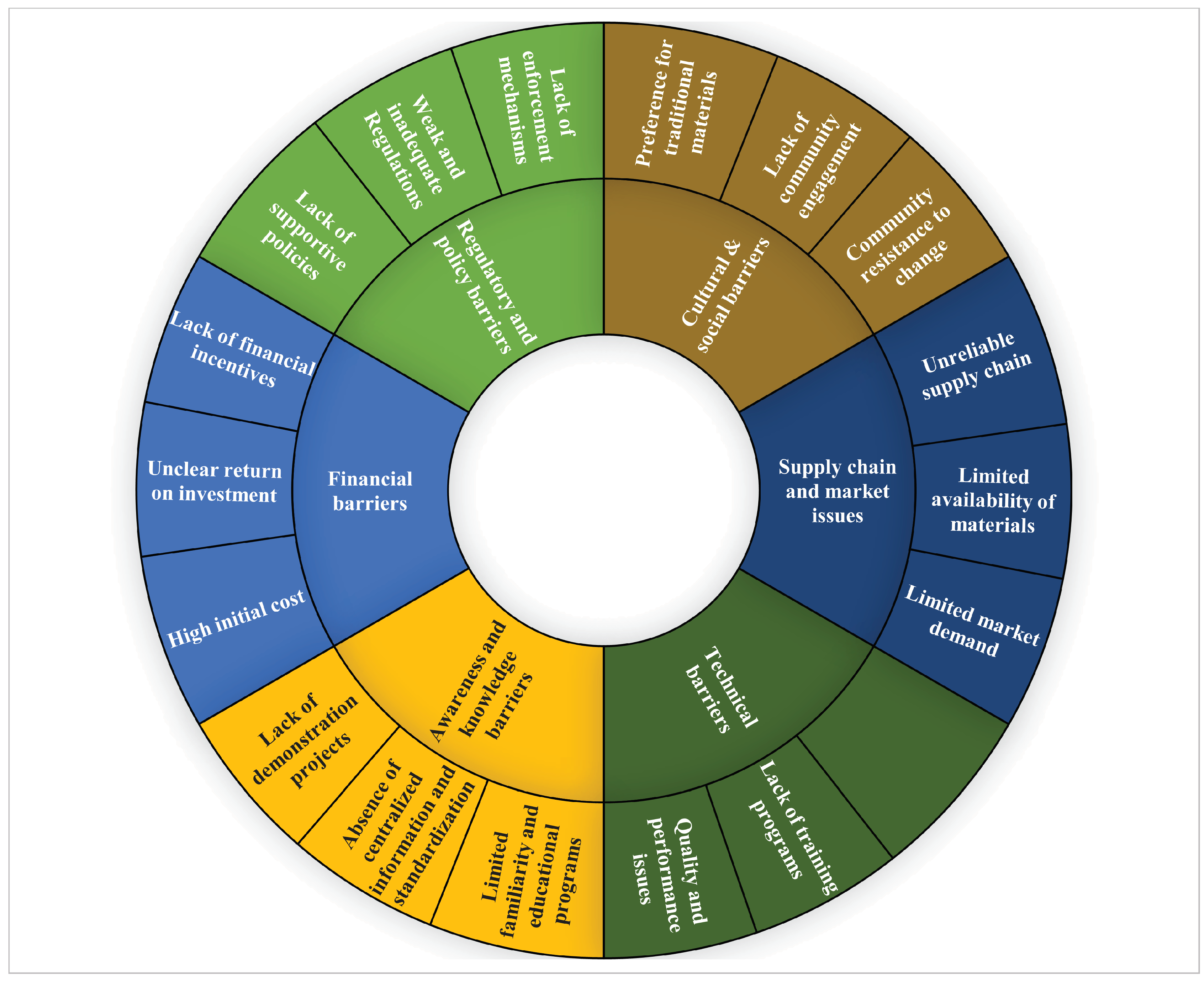

Table 1.
Barriers to selection of SBMs.
| S/N | Barriers | Key Reference |
|---|---|---|
| B1 | Lack of awareness and knowledge among stakeholders | [32]; (Eze et al., 2023b); [34] |
| B2 | Lack of exemplar project | [32] |
| B3 | Shortage of skills and labor | [32], [35] |
| B4 | Lack of comprehensive tools/data to compare different material alternatives | [18], [36] |
| B5 | Perception of higher cost being incurred | [25]; [16]; [37]; [26] |
| B6 | Perception that sustainable materials are low in quality | [11], (Dosumu & Aigbavboa, 2018) |
| B7 | The perception of poor aesthetics | [30]; [24] |
| B8 | Fear of change from conventional practices | [39]; [11] |
| B9 | Lack of government policies promoting the use of sustainable material | (Eze et al., 2023a); [15] |
| B10 | Limited availability and accessibility of SBMs | [29]; [15]; [22] |
| B11 | Possible project delays | [15]; [39] |
| B12 | Uncertainty in liability of final work | [39]; (Eze et al., 2023) |
| B13 | Fear of maintenance issues | [8]; [18] |
| B14 | Lack of integration in academic curriculum | [40]; [25] |
| B15 | Market demand/Low value | (Eze et al., 2023b); [41]; [40]; [42]; [29] |
Disclaimer/Publisher’s Note: The statements, opinions and data contained in all publications are solely those of the individual author(s) and contributor(s) and not of MDPI and/or the editor(s). MDPI and/or the editor(s) disclaim responsibility for any injury to people or property resulting from any ideas, methods, instructions or products referred to in the content. |
© 2024 by the authors. Licensee MDPI, Basel, Switzerland. This article is an open access article distributed under the terms and conditions of the Creative Commons Attribution (CC BY) license (http://creativecommons.org/licenses/by/4.0/).
Copyright: This open access article is published under a Creative Commons CC BY 4.0 license, which permit the free download, distribution, and reuse, provided that the author and preprint are cited in any reuse.