
Submitted:
30 October 2025
Posted:
31 October 2025
You are already at the latest version
Abstract
The construction industry in Iran is growing rapidly, resulting in adverse impacts on sustainable development and in particular the environment. In other parts of the world, to address these adverse impacts, the principles of the green building are applied. However, after interviewing the experts in the construction industry, it was concluded that the implementation of the green building practices is not going well. In this context, the question which this study is trying to address is why there is no construction project which implements the green building practices. Thus, the goal of this study is to assess the challenges and obstacles in implementing the green building practices based on experts’ opinions, executive and legislator institutions in the construction industry and present strategies to overcome the challenges. The difference between this study and the previous studies in this area in Iran, is that this study discovers the challenges and obstacles in implementing the green building practices in Iran with a qualitative approach, involves a wider level of analysis, and presents the solutions from the governmental point of view. This study employed the semi-structured interviews with the experts of the construction industry and used the open, axial, and selective coding techniques to analyze the findings. Eventually, 18 challenges are found encompassing two challenges related to the society, four challenges related to executive institutions and 12 challenges related to Legislator Institutions. Also, 19 solutions are extracted from the interviews with the experts including seven short-term solutions, two medium-term solutions and 10 long-term solutions. Among these solutions one solution is related to the society, two solutions are related to executive institutions, and 16 solutions are related to the Legislator Institutions.
Keywords:
green building
; Iranian construction industry
; challenges
; solutions
1. Introduction
Today, as a result of the overexploitation of environmental resources, the consequent environmental degradation, and the growing prevalence of economic and social inequality, the concept of sustainable development has emerged in international forums.
Sustainable development is a process through which people meet their needs and improve their standard of living without depleting the resources that belong to future generations or squandering future capital to satisfy immediate demands. It should be noted that the main reason for the growing emphasis on sustainable development policies lies in the limited availability of resources in contrast to the unlimited needs and desires of humankind. (Sotoudeh, 2016)
Ultimately, sustainable development aims to improve the well-being of the present generation while safeguarding the interests of future generations. It strives to achieve three fundamental objectives: environmental sustainability, social sustainability, and economic sustainability (Darko & P. C. Chan,2016)
Various industries play a role in achieving sustainable development goals, among which the construction industry has a particularly significant impact (Cupido, Baetz, Pujari, & Chidiac, 2016). In this sector, sustainable building development addresses not only the environmental impacts of buildings—such as energy consumption—but also their social impacts, including the health and well-being of occupants, and economic impacts, such as the life cycle cost of buildings. However, attaining sustainable development requires coordinated efforts from all stakeholders, with the construction sector in particular bearing a critical responsibility (Darko & P. C. Chan, 2016). Consequently, the concept of green building has emerged in the construction industry, representing an effective approach to implementing the principles of sustainable development in the built environment (Darko, P. C. Chan, Huo, & Owusu-Manu, 2019)
At present, buildings in Iran suffer from deficiencies in spatial quality and technical standards. Moreover, the rapid expansion of construction without adherence to fundamental principles has resulted in substantial consumption of natural resources, particularly fossil fuels, which in turn contributes to greenhouse gas emissions. Therefore, the need for green buildings in Iran’s construction industry is both evident and urgent.
However, the findings of the researcher’s preliminary interviews with experts in the Iranian construction industry indicate that, despite ongoing efforts, buildings that have fully implemented green building principles remain scarce, and the overall application of these principles in Iran is far from satisfactory. Accordingly, what remains to be explored is why, to date, no project with the full characteristics of a green building has been realized in Iran; in other words, why the existing efforts and research have yet to be translated into practice.
Therefore, in light of the absence of green buildings in Iran’s construction industry, the ultimate aim of this study is to identify the challenges and barriers to implementing green buildings—drawing on the perspectives of experts, executive agencies, and legislative bodies—and to propose strategies for overcoming them.
In fact, what sets this study apart from previous research conducted in Iran is its qualitative approach to identifying the obstacles and challenges of implementing green building principles at the industry level. Compared to earlier studies, it adopts a broader level of analysis and, moreover, proposes solutions from a governance perspective.
2. Literature Review
2.1. The Importance and Benefits of Green Buildings
A green building is generally defined as a structure designed with consideration for its impacts on the natural environment and human health, aiming to minimize adverse effects. Accordingly, the implementation of green building practices delivers numerous environmental, economic, and social benefits to the construction industry. These include reducing CO2 emissions and other pollutants, protecting ecosystems, utilizing renewable natural resources, improving health, comfort, and well-being, alleviating poverty, fostering economic growth, increasing rental income, and lowering healthcare costs—all of which contribute to mitigating global warming and climate change. Such benefits demonstrate that green buildings provide an opportunity for the construction industry to actively support sustainable development (Darko, Zhang, & P. C. Chan, 2017). In fact, green buildings use essential resources such as energy, water, materials, and land more efficiently than conventional buildings that are constructed solely in compliance with building codes (P. C. Chan, Darko, Ameyaw, & Owusu-Manu, 2016).
Ultimately, green or sustainable buildings can be regarded as an instrumental approach within the construction industry to achieve environmental, social, and economic sustainability. Accordingly, green building has emerged as a contemporary construction paradigm that pursues sustainability objectives aimed at protecting ecosystems and safeguarding human health. This approach appears to be more compatible with global energy consumption patterns and other environmental challenges, and therefore is increasingly recognized as a new trend in development. Nevertheless, the adoption of green building has not been straightforward in many parts of the world, owing to various challenges (Darko & P. C. Chan, 2016).
2.2. Identified Challenges in the Implementation of Green Buildings
The limited number of green building projects developed each year reflects the slow progress in the adoption of green buildings. Since green building is still regarded as an innovation, expanding the number of early adopters requires considerable time, and the existing barriers further exacerbate this challenge (Nguyen, Skitmore, Gray, Zhang, & Olanipekun, 2017). The barriers reported in the literature are broadly summarized in Table 1.
2.3. Proposed Solutions to Address Green Building Challenges
In this section, potential actions derived from the literature review are proposed to address each of the major challenges identified in the previous section, as summarized in Table 2.
2.4. Key Proposed Solution: Establishing a Green Building Council and Developing an Evaluation System
Today, organizations known as Green Building Councils, dedicated to the implementation and promotion of green buildings, are expanding in various parts of the world. Typically, these councils operate as non-governmental organizations (NGOs); however, in some cases, they may also be established as government-affiliated institutions (Sedlacek & Maier, 2012).
A review of these organizations reveals that they pursue diverse objectives through a set of similar yet fragmented activities. Since they all share the mission of facilitating the global transformation of the construction industry toward sustainability through market mechanisms, their operations can be broadly categorized into three main areas:
- Promoting sustainable construction by raising awareness of sustainability issues in the construction industry.
- Enacting green building regulations, standards, and policies that support green buildings and sustainable development more broadly.
- Identifying best practices through the application of green building rating systems (Sedlacek & Maier, 2012).
It should be noted that the evaluation and ranking of green buildings require the development of a standardized assessment and rating system. Such a system would serve as a reference framework to guide buildings in implementing green principles and, ultimately, in determining their ranking. In addition, the presence of qualified evaluators is essential to provide the necessary guidance and conduct reliable assessments alongside the rating system (Krizmane, Slihte, & Borodinecs, 2016).
In this regard, leading countries in the field of green building have developed assessment systems, the first of which was the Building Research Establishment Environmental Assessment Method (BREEAM1), introduced in the United Kingdom in 1990. Since then, numerous organizations worldwide have developed and implemented sustainable building rating systems. The World Green Building Council highlights several of these on its homepage, including Green Star in Australia, New Zealand, and South Africa; CASBEE 2 in Japan; LEED 3 in the United States and Canada; and BREEAM and DGNB4 (the German Green Rating System) in Europe.
Although these systems differ in their assessment methods and criteria, most follow a broadly similar procedure. When a building is submitted for evaluation, a certified assessor reviews its planned or actual performance according to the rating system. The results are then submitted to the relevant certification body, which verifies the assessment through peer review and, if successful, issues certification. Moreover, national Green Building Councils (GBCs) are expected to align with green rating systems and, in many cases, function as certification bodies. For instance, the largest rating system, LEED, is managed by the U.S. Green Building Council, while DGNB is administered by the German Green Building Council.
In addition, various other rating systems are in use around the world (Sedlacek & Maier, 2012). Notable examples include the Green Mark Scheme in Singapore, the Hong Kong Building Environmental Assessment Method (HKBEAM), and the French HQE5 Environmental Assessment Method. Collectively, these systems are designed to determine whether a building meets the standards of a green building (Zhao, Zuo, Wu, & Huang, 2019)
Each green building rating system differs, and every country must develop systems that are best suited to its specific market conditions. Consequently, there is significant potential for future research to design high-quality rating systems for green buildings in countries that have either not yet established such systems or are still in the process of developing them. The World Green Building Council (WorldGBC) supports this initiative and, to this end, has introduced the Guidelines for Quality Assurance of Green Building Assessment Tools. This framework is intended to guide the development of new, emerging, and established rating tools to ensure that their implementation remains robust, transparent, and sufficiently standardized (Darko, P. C. Chan, Huo, & Owusu-Manu, 2019).
3. Methodology
Every scientific study must follow a well-designed plan in which the nature, characteristics, and all measures, activities, and procedures undertaken during the research process are clearly defined. It is evident that conducting a scientific study—particularly one with a broad scope, substantial workload, and wide dimensions—is not feasible without a systematic or executive plan (Hafeznia, 2012).
Accordingly, this study is applied in terms of purpose, descriptive–exploratory in nature, and qualitative in approach, employing the Strauss and Corbin method. The research strategy is based on qualitative interviews. The data were collected through interviews with experts in green building within the Iranian construction industry. A snowball sampling method was used to select subsequent interviewees, resulting in a total of 13 participants: six from relevant government organizations, two from public organizations, two from private organizations, and three from NGOs active in the field of green building. Each interview lasted, on average, one hour. The interviews were conducted in a semi-structured format, using a specific interview protocol tailored to each of the government, public, private, and NGO groups. For data analysis, the three coding stages—open, axial, and selective—were applied concurrently, following the Strauss and Corbin method.
4. Results
4.1. Current Status of Implementing Green Building Principles in the Iranian Construction Industry
To provide a clear and comprehensive explanation of the current situation, it is first necessary to outline the proper process for implementing green buildings. In countries such as Iran, where the primary authority and influence rest with governmental institutions rather than the private sector or NGOs, the Green Building Council should operate under government supervision. Based on expert opinions (see Figure 1), the process should begin with the formulation and approval of mandatory regulations mandating green construction and establishing a Green Building Council.
According to the executive regulations of these laws, the Green Building Council should be established as an official body composed of experts from the Ministry of Roads and Urban Development, Ministry of Energy, Ministry of Oil, Ministry of Industry, Mine and Trade, Housing Foundation, academic faculty from universities and scientific associations, the Environmental Protection Organization, the Engineering Organization, and municipalities. This council would be responsible for preparing a program and roadmap toward achieving green construction, implementing public information and awareness campaigns for both society and implementers, and identifying best practices through the use of green building assessment systems.
For purposes of guidance, supervision, and reporting to the council in relation to awarding certification levels for buildings, certified assessors—approved by the council and trained in the use of the assessment system—should operate under the oversight of insurance companies. Initially, government and public buildings should be required to comply with the guidelines of the green building assessment system, while for other types of buildings participation should be encouraged on a voluntary basis. Over time, as public and professional awareness increases and as deficiencies in the plans and assessment system are resolved, these guidelines should gradually become mandatory for all buildings.
Based on the explanations provided, the current status of implementing green building principles in the Iranian construction industry is summarized in Table 3.
4.2. Coding of Qualitative Findings
4.2.1. Open Coding
4.2.1.1. Identified Challenges
The identified challenges encompass all organizations and institutions involved in Iran, including governmental, public, private, and non-governmental bodies. At a broader level, the challenges in implementing green building principles can be grouped into three main categories:
- Society: This category includes the general public, the educated community in fields related to construction, and professionals in associations and councils active in green building, who advocate for the right to access green buildings.
- Executive Institutions: This group comprises owners (employers), contractors, and consultants specializing in either green or conventional construction.
- Legislator Institutions: This category refers to the governing authorities in the country, responsible for policymaking, legislation, and formalizing the laws and duties associated with the implementation of green building principles.
As summarized in Table 4, each challenge is assigned a code along with its origin. These codes are intended solely for identification purposes, and their order does not imply any hierarchy of importance.
4.2.1.2. Expert-Proposed Suggested Solutions
This section presents the proposed solutions derived from the content analysis of the interviews. These solutions are classified into three main categories: short-term, medium-term, and long-term. In this study, short-term solutions are those that can be implemented within a relatively brief period (approximately one year), and their effects may be either temporary or permanent. The importance of such solutions lies in their ability to serve as interim measures until more fundamental solutions are put into practice—in other words, they function as a pain reliever until the main treatment becomes effective.
Medium-term solutions, as the term suggests, require a longer period (between two and four years) and more preparation for implementation and effectiveness compared to short-term solutions. Long-term solutions, on the other hand, must be embedded within a strategic plan and require more than four years for full implementation.
In addition to this broad categorization, there is also a more detailed classification based on the responsible entities, namely Society, Executive Institutions, and Legislator Institutions. Accordingly, the solutions are distinguished both by their implementation timeframe and by the entity responsible for their execution, as outlined in Table 5, Table 6, and Table 7.
4.2.2. Axial Coding
In this research, and based on the interviews conducted, the core phenomenon was identified as the “Transition to Green Building”, since it provides the conceptual framework that underpins the research process. All categories extracted in this study are linked to this central phenomenon.
To illustrate this, the current status of the construction industry in Iran was first examined. As shown in the descriptive pattern of the current situation (Figure 2), given the existing contextual and intervening conditions, the strategies adopted by society, executive institutions, and legislator institutions remain ineffective. Consequently, the outcome has been the lack of serious commitment to implementing green buildings.
Conversely, if contextual and intervening conditions are improved, the strategies adopted would become more effective. This is illustrated in the theoretical model of the desired situation (Figure 3), which demonstrates that with reforms in economic, cultural, and policy frameworks, as well as the establishment of proper institutional support and monitoring mechanisms, the proposed strategies could lead to a stronger commitment to the implementation of green buildings.
4.2.3. Selective Coding
Factors such as Iran’s commitment to the Paris Agreement to reduce greenhouse gas emissions—in which buildings play a critical role—public dissatisfaction with the poor spatial quality and technical standards of buildings and the resulting serious economic and social damages, the unregulated growth of buildings in metropolitan areas without regard to context and sustainable development, the significant reduction of building lifespan to nearly one-third of that in advanced countries, and similar issues have created the need to transform current buildings into green buildings (i.e., transition to green buildings).
In the current situation, several contextual factors are at play, including low energy prices, economic weaknesses and challenges, the limitation of the Environmental Protection Organization’s responsibilities to areas outside cities, and weaknesses in foreign policy stemming from macro-level policies. Additionally, industry-specific policies have contributed to problems such as the incorrect valuation of buildings, lack of specialization in the construction sector, and weaknesses in monitoring and supervision systems.
At the same time, intervening conditions—such as superficial and transitory laws, lack of government motivation and support, and the absence of a credible and official green building evaluation system (stemming from green building-specific policies)—have influenced the emergence of certain strategies adopted by society, executive institutions, and Legislator Institutions.
Within society, these strategies manifest as a lack of prioritization of sustainability issues (as of the absence of an appropriate cultural context) and insufficient attention to acquiring knowledge and awareness about green buildings. Within executive institutions, they include neglecting post-occupancy responsibilities, resistance to adopting and implementing green principles, failure to acquire specialized expertise in design and construction, and the lack of practical green building projects. Within legislator institutions, they include poor cooperation and interaction among different organizations and institutions, failure to implement knowledge management practices, and the absence of reliable and updated databases. The outcome of such strategies has been the lack of serious commitment to implementing green buildings, which is evident today.
By contrast, under desired conditions, several contextual factors would need to change. These include adjusting energy prices to reflect real values, improving economic conditions, expanding the responsibilities of the Environmental Protection Organization, and fostering an appropriate cultural and social context (arising from general policies). Industry-specific policies would require professionalization of the construction sector, further privatization of the industry, and the establishment of rigorous monitoring mechanisms. Green building-specific policies would involve enacting mandatory regulations and introducing green building education into university curricula.
Similarly, changes in intervening conditions would be necessary, such as mandatory compliance with existing green building regulations by government and public buildings, adoption of international assessment systems and best practices from leading countries, utilization of experiences from global leaders in green building, and refinement and transparency of the evaluation system developed by the Research Center of the Ministry of Roads, Housing, and Urban Development.
These improved contextual and intervening conditions can facilitate strategies such as collaboration between professors, students, and specialists from the community; revitalization of traditional Iranian architecture adapted to current conditions by consultants and designers; and development of practical projects by executive institutions. Legislator institutions, on their part, could establish think tanks across all relevant organizations to identify and address problems, implement awareness-raising programs on green buildings, and form specialized working groups. Collectively, such strategies would ultimately foster a strong commitment to the implementation of green buildings.
5. Conclusion
The present study seeks to identify the challenges and obstacles to implementing green buildings in Iran’s construction industry—based on the perspectives of experts, executive institutions, and legislator institutions—and to propose solutions to address them.
The first finding concerns the assessment of the current status of green building in Iran. Since no binding and specific legislation on green buildings or the establishment of a Green Building Council has yet been enacted, each organization and institution has followed its own process and program independently. Consequently, the necessary cooperation for establishing a formal and unified council has not materialized. As a result, the plans, guidelines, and standards that should have been developed within such a council are absent, and subsequent steps have therefore not been implemented. Thus, to date, no green building in Iran has progressed to the stage of full implementation and operation.
The second and third findings relate to identifying the reasons behind the lack of widespread and comprehensive implementation of green building principles in Iran’s construction industry, as well as proposing solutions to promote their advancement. Importantly, this study distinguishes between a descriptive pattern of the current situation, which illustrates how ineffective strategies emerge under unfavorable contextual and intervening conditions, and a theoretical model of the desired situation, which demonstrates how improved conditions can enable effective strategies and stronger commitment to green building implementation. Presenting both perspectives side by side not only clarifies the current barriers but also provides a conceptual roadmap for achieving sustainable development in Iran’s construction industry.
Finally, the identified challenges and the proposed solutions were aligned and mapped against each other. Table 8, Table 9, and Table 10 present these relationships in detail, showing how specific solutions can address the corresponding barriers within society, executive institutions, and legislator institutions.
Data Availability Statement
The data that support the findings of this study are not publicly available as of confidentiality agreements with participants. De-identified expert data may be obtained from the corresponding author upon reasonable request.
Acknowledgments
The authors would like to acknowledge the use of AI-based language assistance (ChatGPT, developed by Open AI) for supporting the translation of the original Persian draft into English. All final revisions, interpretations, and validations were conducted by the authors to ensure academic accuracy and integrity.
References
- Hafeznia, M. An introduction to research methodology in the humanities (Revised edition with additions); In Persian; SAMT (Organization for Researching and Composing University Humanities Books): Tehran, 2012; pp. 1–21. [Google Scholar]
- Sotoudeh, Sh. Leadership in environmental design and energy (Iran Green Building Council); In Persian; Aseman Negar: Isfahan, 2016; pp. 1–10. [Google Scholar]
- Darko, A.; Chan, P.C.; Huo, A.; Owusu-Manu, X.D.-G. A scientometric analysis and visualization of global green building research. In Building and Environment; 2019; pp. pp 501–511. [Google Scholar]
- Ding, Z.; Fan, Z.; Tam, W.Y.; Bian, V.; Li, Y.S.; Illankoon, S.; Moon, I.S. Green building evaluation system implementation. In Building and Environment; 2018; pp. pp 32–40. [Google Scholar]
- Khodadadzadeh, T. Green building project management: obstacles and solutions for sustainable development. In Journal of Project Management; 2016; pp. pp 21–26. [Google Scholar]
- Krizmane, M.; Slihtea, S.; Borod, A. Key criteria across existing sustainable building rating tools. In Energy Procedia; 2016; pp. pp 94–99. [Google Scholar]
- Chan, P. C.; Darko, A.A.; Ameyaw, E.; Owusu-Manu, E.D.-G. Barriers Affecting the Adoption of Green Building Technologies. Journal of Management in Engineering 2016, pp 1–12. [Google Scholar] [CrossRef]
- Chuen Chan, A. P.; Darko, A.; Ameyaw, E. E. Strategies for Promoting Green Building Technologies Adoption in the Construction Industry—An International Study; Sustainability, 2017; pp. pp 1–18. [Google Scholar]
- Cupido, A.; Baetz, B.; Pujari, A.; Chidiac, S. EVALUATING INSTITUTIONAL GREEN BUILDING POLICIES: A Mixed-Methods Approach. In Journal of Green Building; 2010; pp. pp 115–131. [Google Scholar]
- Darko, A.; Zhang, C.; Chan, P.C.A. Drivers for green building: A review of empirical studies. In Habitat International; 2017; pp. pp 34–49. [Google Scholar]
- Darko, A.; Chan, P. C. A. Review of Barriers to Green Building Adoption. In Sustainable Development; 2016; pp. pp 1–13. [Google Scholar]
- Dinga, Z.; Fana, Z.; Tamb, W.Y.; Biana, V.; Lia, Y.S.; Illankoon, S.; Moond, I.S. Green building evaluation system implementation. In Building and Environment; 2018; pp. pp 32–40. [Google Scholar]
- Esa, M. b.; Marhani, M.; Yaman, R.; Hassan, A. A.; Hanisah, N.; Rashid, N.; Adnan, H. Obstacles in Implementing Green Building Projects in Malaysia. Australian Journal of Basic and Applied Sciences 2011, pp 1806–1812. [Google Scholar]
- Komurlu, R.; Kalkan Ceceloglu, D.; Arditi, D. Exploring the Barriers to Managing Green Building Construction Projects and Proposed Solutions. Sustainability 2024, 16(13), 5374. [Google Scholar] [CrossRef]
- Nguyen, H.-T.; Skitmore, M.; Gray, M.; Zhang, X.; Olanipekun, A. O. Will green building development take off? An exploratory study of barriers to green building in Vietnam. In Resources, Conservation & Recycling; 2017; pp. pp 8–20. [Google Scholar]
- Onuoha, I. J.; Aliagha, G. U.; Abdul Rahman, M. S. Modelling the effects of green building incentives and green building skills on supply factors affecting green commercial property investment. In Renewable and Sustainable Energy Reviews; 2018; pp. pp 814–823. [Google Scholar]
- Santana, W. B.; Alves, T. C. L.; Oliveira, J. A.; Alves, D. C. O. Barriers to the adoption of Green Building Labels in Brazil: A validated interpretative structural modeling approach. Journal of Cleaner Production 2023, 412, 137358. [Google Scholar] [CrossRef]
- Sedlacek, S.; Maier, G. Can green building councils serve as third party governance institutions? An economic and institutional analysis. In Energy Policy; 2012; pp. pp 479–487. [Google Scholar]
- Zhang, L.; Wu, J.; Liu, H. Turning green into gold: A review on the economics of green buildings. In Journal of Cleaner Production; 2018; pp. pp 2234–2245. [Google Scholar]
- Zhao, X.; Zuo, J.; Wu, G.; Huang, C. A bibliometric review of green building research 2000–2016. In Architectural Science Review; 2019; pp. pp 74–88. [Google Scholar]
| 1 | Building Research Establishment Environmental Assessment Method |
| 2 | Comprehensive Assessment System for Built Environment Efficiency |
| 3 | Leadership in Energy and Environmental Design |
| 4 | Deutsche Gesellschaft fur Nachhaltiges Bauen e.V. |
| 5 | Haute Qualité Environnementale (High Quality Environmental standard) |
Figure 1.
Implementation Process.
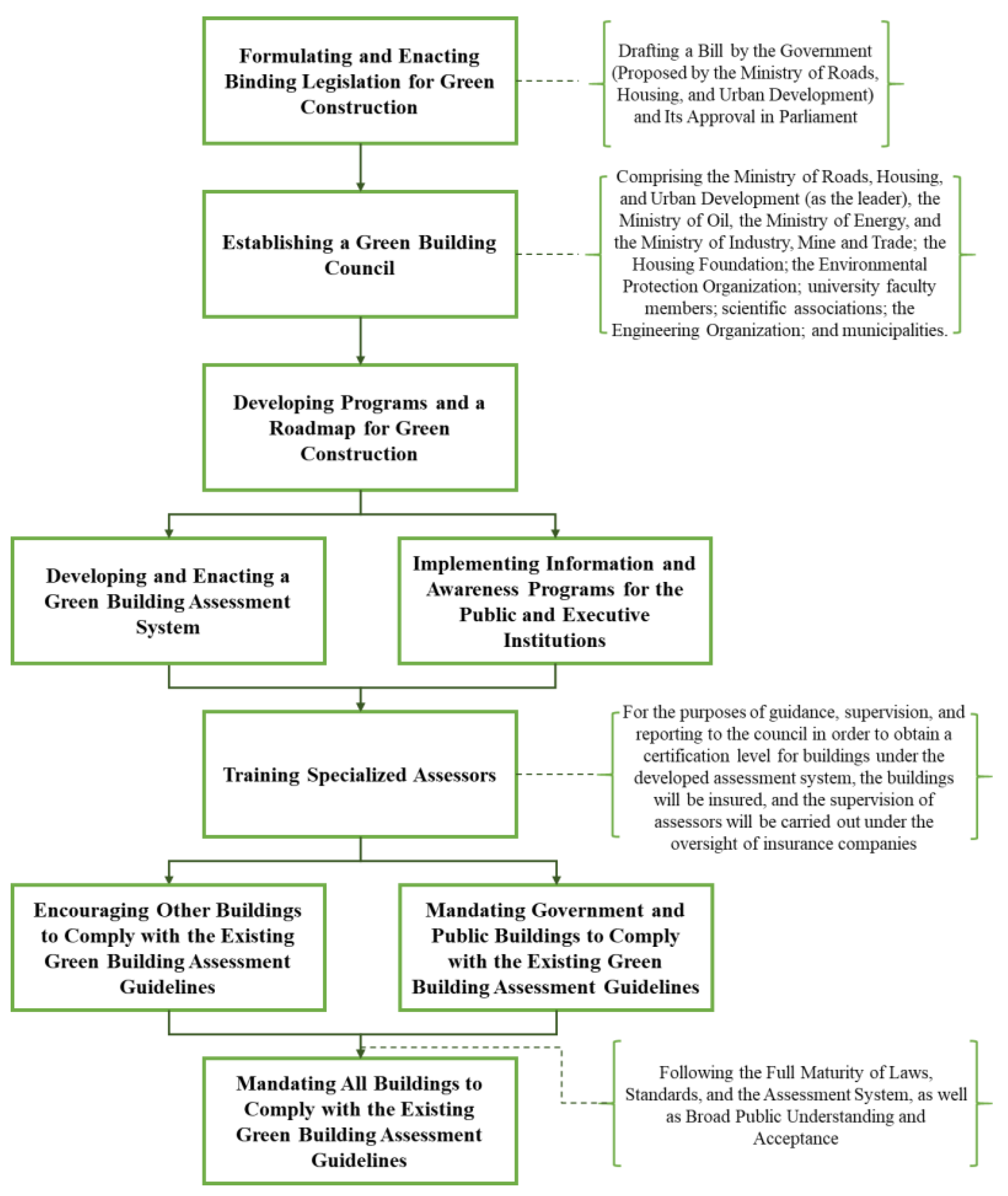
Figure 2.
Descriptive Pattern of the Current Situation.
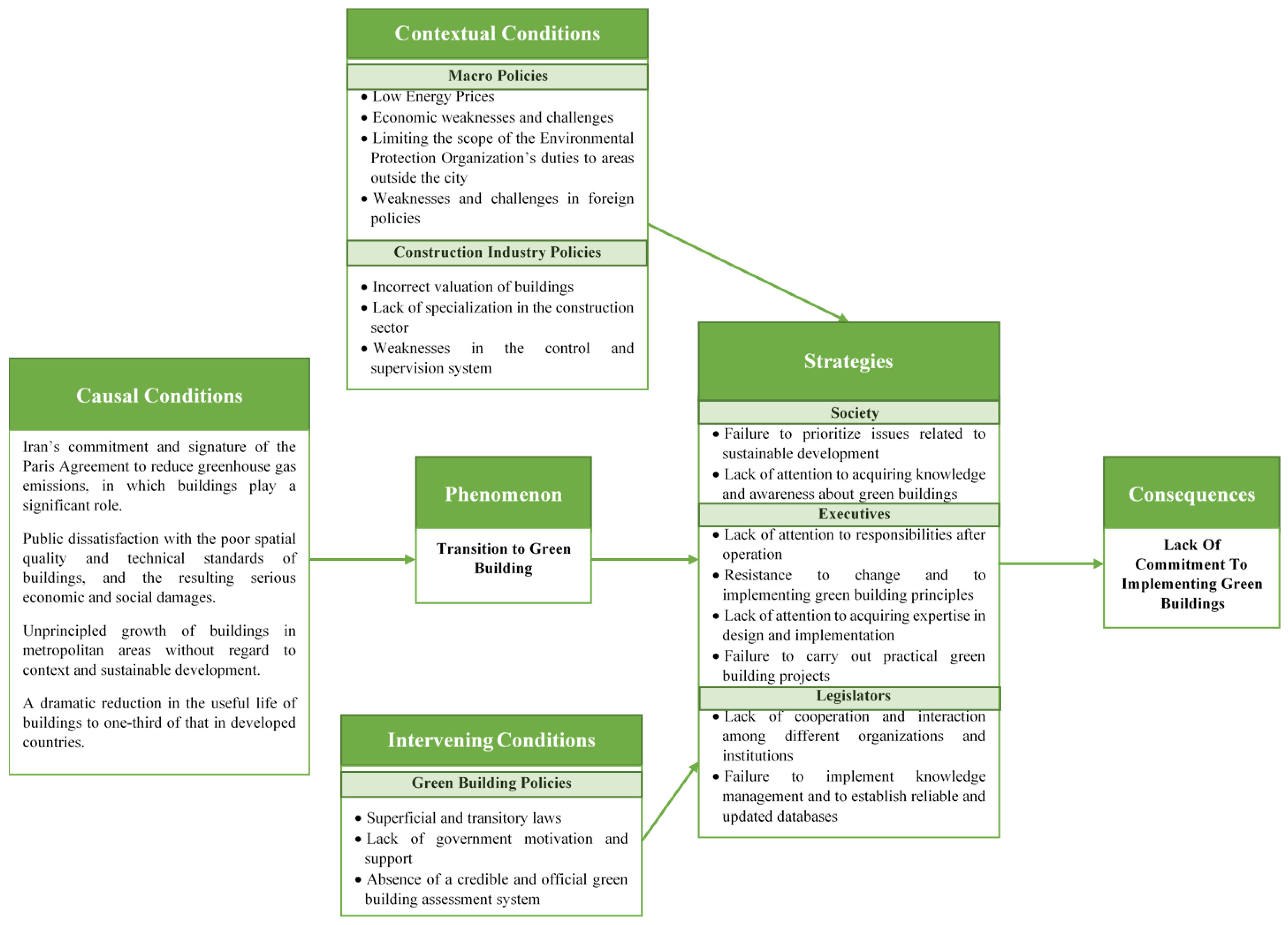
Figure 3.
Theoretical Model of the Desired Situation.
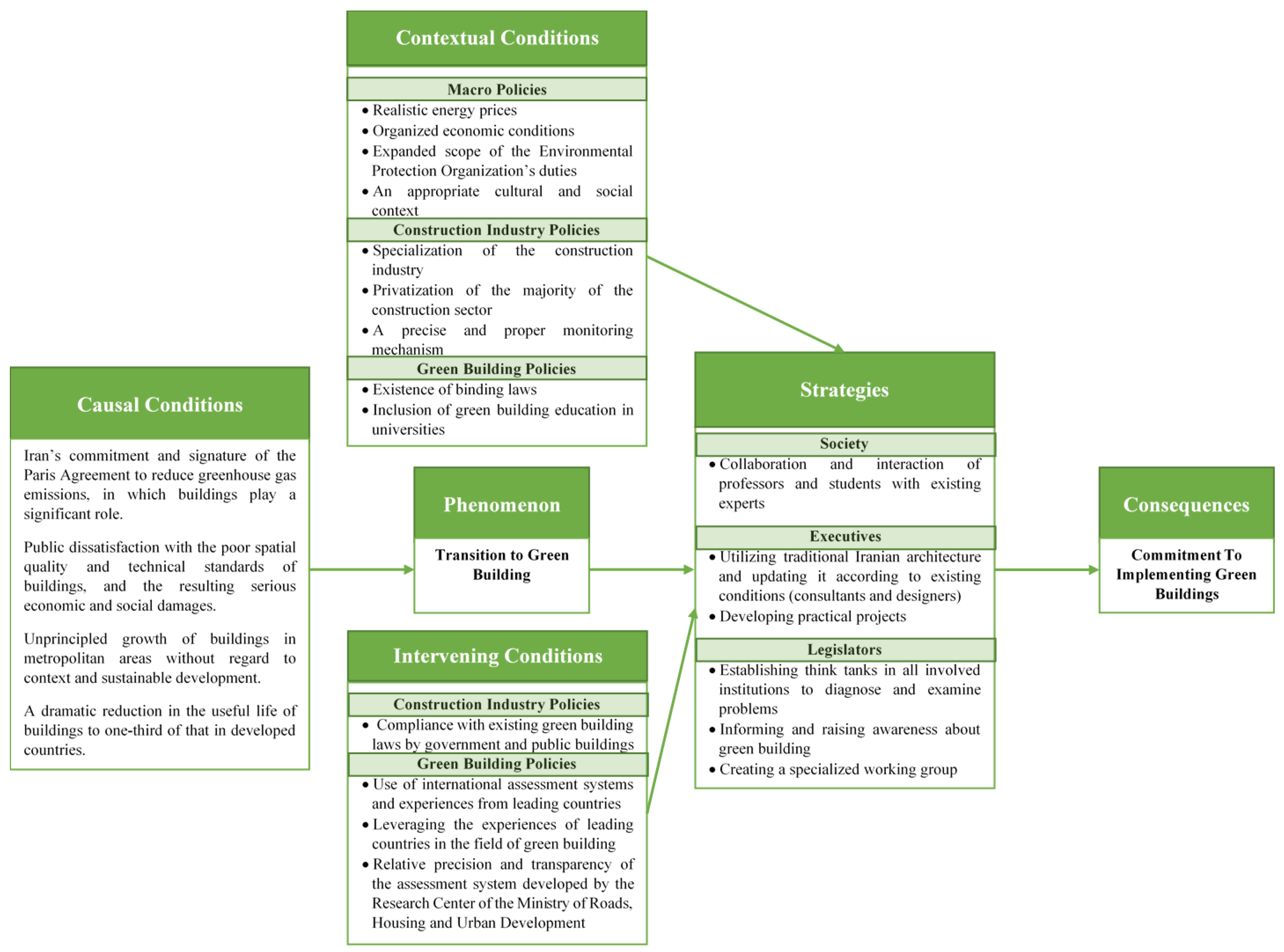

Table 1.
Identified Challenges in the Literature Review.
| Origin of the Challenge | Challenge Code | Challenge Description | References |
| Society | 1 | Weakness in Economic Issues | (P. C. Chan, Darko, E. Ameyaw, & Owusu-Manu, 2016) |
| 2 | Weakness in Culture and Attitude | (P. C. Chan, Darko, E. Ameyaw, & Owusu-Manu, 2016) (Sedlacek & Maier, 2012) (Darko & P. C. Chan, 2016) (Nguyen, Skitmore, Gray, Zhang, & Olanipekun, 2017) |
|
| 3 | Lack of Credible Research | (P. C. Chan, Darko, E. Ameyaw, & Owusu-Manu, 2016) (Zhang, Wu, & Liu, 2018) (Darko, Zhang, & P.C. Chan, 2017) (Darko & P. C. Chan, 2016) (Nguyen, Skitmore, Gray, Zhang, & Olanipekun, 2017) |
|
| Executive Institutions | 4 | Weakness in Economic Issues | (P. C. Chan, Darko, E. Ameyaw, & Owusu-Manu, 2016) (Khodadadzadeh, 2016) (Zhang, Wu, & Liu, 2018) (Darko & P. C. Chan, 2016) (Nguyen, Skitmore, Gray, Zhang, & Olanipekun, 2017) (Darko, Zhang, & P.C. Chan, 2017) (P. C. Chan, Darko, E. Ameyaw, & Owusu-Manu, 2016) (Wylliam Bessa Santana, 2023) |
| 5 | Lack of Expertise and Skills | (P. C. Chan, Darko, E. Ameyaw, & Owusu-Manu, 2016) (Onuoha, Aliagha, & Abdul Rahman, 2018) (Esa, et al., 2011) |
|
| 6 | Resistance to Change and to the Implementation of Green Building Principles | (P. C. Chan, Darko, E. Ameyaw, & Owusu-Manu, 2016) (Esa, et al., 2011) (Nguyen, Skitmore, Gray, Zhang, & Olanipekun, 2017) |
|
| 7 | Lack of Practical Projects | (P. C. Chan, Darko, E. Ameyaw, & Owusu-Manu, 2016) (Wylliam Bessa Santana, 2023) |
|
| 8 | Lack of Awareness | (Nguyen, Skitmore, Gray, Zhang, & Olanipekun, 2017) (P. C. Chan, Darko, E. Ameyaw, & Owusu-Manu, 2016) (Zhang, Wu, & Liu, 2018) (Darko, Zhang, & P.C. Chan, 2017) (Esa, et al., 2011) (Darko & P. C. Chan, 2016) (Wylliam Bessa Santana, 2023) (Komurlu, Kalkan Ceceloglu, & Arditi, 2024) |
|
| Legislators | 9 | Lack of Motivation and Government Support | (P. C. Chan, Darko, E. Ameyaw, & Owusu-Manu, 2016) (Nguyen, Skitmore, Gray, Zhang, & Olanipekun, 2017) (Darko & P. C. Chan, 2016) (Ding, et al., 2018) (Komurlu, Kalkan Ceceloglu, & Arditi, 2024) |
| 10 | Lack of a Valid Evaluation System | (P. C. Chan, Darko, E. Ameyaw, & Owusu-Manu, 2016) |
Table 2.
Proposed Solutions to Address the Challenges Identified in the Literature Review.
| Responsible Entity for Implementation | Solution Code | Solution Description | References |
| Executive Institutions | 1 | Developing Practical Examples | (Cupido, Baetz, Pujari, & Chidiac, 2010) (Onuoha, Aliagha, & Abdul Rahman, 2018) |
| 2 | Emphasis on Social Responsibility | (Darko, Zhang, & P.C. Chan, 2017) | |
| Legislators | 3 | Establishing Mandatory Regulations | (Chuen Chan, Darko, & Ameyaw, 2017) (Ding, et al., 2018) (Darko & P. C. Chan, 2016) (Darko, Zhang, & P.C. Chan, 2017) (Komurlu, Kalkan Ceceloglu, & Arditi, 2024) |
| 4 | Developing a Rigorous and Credible Evaluation System | (Ding, et al., 2018) | |
| 5 | Cooperation among Government, Public, and Private Institutions and Organizations | (Ding, et al., 2018) (Darko & P. C. Chan, 2016) |
|
| 6 | Government Support and Endorsement | (Darko & P. C. Chan, 2016) (P. C. Chan, Darko, E. Ameyaw, & Owusu-Manu, 2016) (Darko, Zhang, & P.C. Chan, 2017) (Komurlu, Kalkan Ceceloglu, & Arditi, 2024) |
|
| 7 | Information Dissemination and Awareness-Raising about Green Buildings | (Chuen Chan, Darko, & Ameyaw, 2017) (Darko, Zhang, & P.C. Chan, 2017) (Komurlu, Kalkan Ceceloglu, & Arditi, 2024) |
|
| 8 | Support for Research and Development | (Darko & P. C. Chan, 2016) | |
| 9 | Improving Market Mechanisms for Green Buildings | (Ding, et al., 2018) |
Table 3.
Current Status of Green Building Implementation in Iran.
| Stages of the Principled Process for Implementing Green Buildings | Current Status | Description |
| Formulating and Enacting Binding Legislation for Green Construction | Limited | There are certain environmental and energy-related laws that can only partially achieve some of the objectives of green buildings. These include Paragraph (z) of Article (38) of the Sixth Five-Year Economic, Social, and Cultural Development Plan of the Islamic Republic of Iran (2017–2021), Article (18) of the Energy Consumption Reform Act, the National Building Regulations (Chapter 19), and the Third Five-Year Development Plan of Tehran (2019–2023). |
| Establishing a Green Building Council | Limited | Since no binding and specific law on green buildings or the establishment of a Green Building Council has yet been enacted, each organization and institution has pursued its own process and program independently. As a result, the necessary cooperation to establish an official and unified council has not taken place, and naturally, the plans, guidelines, and standards that should have been developed within such a council do not exist. Consequently, subsequent stages have not been implemented, and to date no green building in Iran has reached the stage of implementation and operation |
| Developing a Program and Roadmap for Green Construction | × | _ |
| Implementing Information and Awareness Programs for the Community and Practitioners Developing and Enacting a Green Building Assessment System | × | _ |
| Training Specialized Evaluators | × | _ |
| Mandating Government and Public Buildings to Comply with the Existing Guidelines of the Assessment System | × | _ |
| Encouraging Other Buildings to Comply with the Existing Guidelines of the Assessment System | ||
| Mandating All Buildings to Comply with the Existing Guidelines of the Assessment System | × | _ |
Table 4.
Identified Challenges in the Implementation of Green Buildings in Iran.
| Origin of the Challenge | Challenge Code | Challenge Description | |
| Society | 1 | Lack of Knowledge and Awareness | |
| 2 | Lack of Appropriate Cultural Context | ||
| Executive Institutions | 3 | Resistance of Executive Institutions to Change and to the Implementation of Green Building Principles | |
| 4 | Lack of Specialists and Skilled Professionals in the Design and Implementation of Green Building Principles | ||
| 5 | Lack of Attention to Post-Occupancy Responsibilities | ||
| 6 | Lack of Practical Projects | ||
| Legislators | General Policies | 7 | Low Energy Prices |
| 8 | Economic Weaknesses and Challenges | ||
| 9 | Weaknesses and Challenges in Foreign Policies | ||
| 10 | Limiting the Scope of Environmental Responsibilities to Areas Outside the City | ||
| 11 | Lack of Knowledge Management and Absence of Reliable and Updated Databases | ||
| 12 | Lack of Cooperation and Interaction among Various Organizations and Institutions | ||
| Policies Related to the Construction Industry | 13 | Challenges in Market Management (Incorrect Valuation of Buildings) | |
| 14 | Challenges in Market Management (Lack of Expertise in the Construction Sector) | ||
| 15 | Weakness in the Control and Supervision System | ||
| Green Building Policies | 16 | Superficial and Transitory Laws | |
| 17 | Lack of Government Motivation and Support | ||
| 18 | Absence of a Credible and Official Green Building Assessment System | ||
Table 5.
Proposed Short-Term Solutions Suggested by Experts.
| Short-Term Solutions | Responsible Entity for Implementation | ||
| Society | Executives | Legislators | |
| Collaboration and Interaction between Professors, Students, and Existing Experts |
Main: Professors and Students Contributor: Experts in Associations and Councils |
Contributor: Ministry of Science and Research | |
| Utilizing Traditional Iranian Architecture and Updating It to Current Conditions | Main: Consultants and Designers Group | ||
| Establishing Think Tanks within All Involved Institutions to Diagnose and Address Problems | Contributor: Green Building Associations and Councils | Contributor: Consulting and Contracting Companies |
Main: Ministry of Roads, Housing, and Urban Development Contributor: Environmental Protection Organization, Ministry of Energy, Engineering Organization, Municipality |
| Information Dissemination and Awareness-Raising about Green Buildings | Contributor: Experts in Associations and Councils |
Main: Ministry of Roads, Housing, and Urban Development Contributor: National Radio and Television Organization |
|
| Leveraging the Experiences of Leading Countries in Green Building | Contributor: Experts in Universities, Associations, and Councils | Main: Research Center of the Ministry of Roads, Housing, and Urban Development | |
| Applying International Assessment Systems and Best Practices from Leading Countries | Contributor: Experts in Associations and Councils | Contributor: Consultants and Designers Group |
Main: Ministry of Roads, Housing, and Urban Development Contributor: Engineering Organization and Municipality |
| Requiring Government and Public Buildings to Comply with Existing Green Building Regulations |
Main: Ministry of Roads, Housing, and Urban Development Contributor: Other Ministries and Governmental and Public Institutions |
||
Table 6.
Proposed Medium-Term Solutions Suggested by Experts.
| Medium-Term Solutions | Responsible Entity for Implementation | ||
| Society | Executives | Legislators | |
| Developing Practical Projects | Main: Group of Designers and Contractors Specializing in Green Buildings | ||
| Refining and Clarifying the Evaluation System Developed by the Research Center of the Ministry of Roads, Housing, and Urban Development | Contributor: Experts in Universities, Associations, and Councils | Main: Research Center of the Ministry of Roads, Housing, and Urban Development | |
Table 7.
Proposed Long-Term Solutions Suggested by Experts.
| Long-Term Solutions | Responsible Entity for Implementation | ||
| Society | Executives | Legislators | |
| Establishing a Suitable Cultural and Social Context | Main: Ministry of Education | ||
| Integrating Green Building Education into University Curricula | Main: Ministry of Science and Research | ||
| Improving Economic Conditions | Main: Government | ||
| Expanding the Scope of the Environmental Protection Organization’s Responsibilities | Main: Government | ||
| Adjusting Energy Prices to Reflect Real Values | Main: Government | ||
| Establishing Mandatory Regulations | Main: Government and Parliament | ||
| Creating a Specialized Working Group | Contributor: Experts in Universities, Associations, and Councils |
Main: Ministry of Roads, Housing, and Urban Development Contributor: Ministry of Energy, Ministry of Industry, Mine and Trade, Ministry of Interior, Housing Foundation, Environmental Protection Organization, Municipality |
|
| Professionalizing the Construction Industry |
Main: Ministry of Roads, Housing, and Urban Development Contributor: Municipality |
||
| Further Privatization of the Construction Industry | Main: Government | ||
| Reforming the Monitoring Mechanism | Main: Government | ||
Table 8.
Relationship between Challenges of Society and Proposed Solutions.
| Challenge Description | Proposed Solutions | Solution Category |
| Lack of Knowledge and Awareness | Collaboration and Interaction between Professors, Students, and Existing Experts | Short-Term |
| Information Dissemination and Awareness-Raising about Green Building | Short-Term | |
| Integrating Green Building Education into University Curricula | Long-Term | |
| Lack of Appropriate Cultural Context | Information Dissemination and Awareness-Raising about Green Building | Short-Term |
| Establishing a Suitable Cultural and Social Context | Long-Term |
Table 9.
Relationship Between Challenges of Executive Institutions and Proposed Solutions.
| Challenge Description | Proposed Solutions | Solution Category |
| Resistance of Executive Institutions to Change | Information Dissemination and Awareness-Raising about Green Buildings | Short-Term |
| Requiring Government and Public Buildings to Comply with Existing Green Building Regulations | Short-Term | |
| Refining and Clarifying the Evaluation System Developed by the Research Center of the Ministry of Roads, Housing, and Urban Development | Medium-Term | |
| Developing Practical Projects | Medium-Term | |
| Improving Economic Conditions | Long-Term | |
| Adjusting Energy Prices to Reflect Real Values | Long-Term | |
| Further Privatization of the Construction Industry | Long-Term | |
| Reforming the Monitoring Mechanism | Long-Term | |
| Lack of Specialists and Skilled Professionals | Collaboration and Interaction between Professors, Students, and Existing Experts | Short-Term |
| Information Dissemination and Awareness-Raising about Green Buildings | Short-Term | |
| Developing Practical Projects | Medium-Term | |
| Integrating Green Building Education into University Curricula | Long-Term | |
| Lack of Attention to Post-Occupancy Responsibilities | Reforming the Monitoring Mechanism | Long-Term |
| Lack of Practical Projects | Utilizing Traditional Iranian Architecture and Updating It to Current Conditions | Short-Term |
| Requiring Government and Public Buildings to Comply with Existing Green Building Regulations | Short-Term | |
| Refining and Clarifying the Evaluation System Developed by the Research Center of the Ministry of Roads, Housing, and Urban Development | Medium-Term | |
| Developing Practical Projects | Medium-Term |
Table 10.
Relationship between Challenges of Legislator Institutions and Proposed Solutions.
| Challenge Description | Proposed Solutions | Solution Category |
| Low Energy Prices | Adjusting Energy Prices to Reflect Real Values | Long-Term |
| Economic Weaknesses and Challenges | Improving Economic Conditions | Long-Term |
| Weaknesses and Challenges in Foreign Policies | Leveraging the Experiences of Leading Countries in Green Building | Short-Term |
| Applying International Assessment Systems and Best Practices from Leading Countries | Short-Term | |
| Improving Economic Conditions | Long-Term | |
| Limiting the Scope of Environmental Responsibilities to Areas Outside the City | Expanding the Scope of the Environmental Protection Organization’s Responsibilities | Long-Term |
| Lack of Knowledge Management and Absence of Reliable and Updated Databases | Utilizing Traditional Iranian Architecture and Updating It to Current Conditions | Short-Term |
| Leveraging the Experiences of Leading Countries in Green Building | Short-Term | |
| Creating a Specialized Working Group | Long-Term | |
| Lack of Cooperation and Interaction among Various Organizations and Institutions | Establishing Think Tanks within All Involved Institutions to Diagnose and Address Problems | Short-Term |
| Establishing Mandatory Regulations | Long-Term | |
| Creating a Specialized Working Group | Long-Term | |
| Incorrect Valuation of Buildings | Further Privatization of the Construction Industry | Long-Term |
| Professionalizing the Construction Industry | Long-Term | |
| Lack of Expertise in the Construction Sector | Professionalizing the Construction Industry | Long-Term |
| Weakness in the Control and Supervision System | Reforming the Monitoring Mechanism | Long-Term |
| Superficial and Transitory Laws | Establishing Mandatory Regulations | Long-Term |
| Lack of Government Motivation and Support | Requiring Government and Public Buildings to Comply with Existing Green Building Regulations | Short-Term |
| Refining and Clarifying the Evaluation System Developed by the Research Center of the Ministry of Roads, Housing, and Urban Development | Medium-Term | |
| Establishing Mandatory Regulations | Long-Term | |
| Creating a Specialized Working Group | Long-Term | |
| Absence of a Credible and Official Green Building Assessment System | Applying International Assessment Systems and Best Practices from Leading Countries | Short-Term |
| Refining and Clarifying the Evaluation System Developed by the Research Center of the Ministry of Roads, Housing, and Urban Development | Medium-Term | |
| Creating a Specialized Working Group | Long-Term |
Disclaimer/Publisher’s Note: The statements, opinions and data contained in all publications are solely those of the individual author(s) and contributor(s) and not of MDPI and/or the editor(s). MDPI and/or the editor(s) disclaim responsibility for any injury to people or property resulting from any ideas, methods, instructions or products referred to in the content. |
© 2025 by the authors. Licensee MDPI, Basel, Switzerland. This article is an open access article distributed under the terms and conditions of the Creative Commons Attribution (CC BY) license (http://creativecommons.org/licenses/by/4.0/).
Copyright: This open access article is published under a Creative Commons CC BY 4.0 license, which permit the free download, distribution, and reuse, provided that the author and preprint are cited in any reuse.


