

Submitted:
02 September 2024
Posted:
03 September 2024
You are already at the latest version
Abstract
This research investigates the energy consumption of buildings managed by traditional Building Management Systems (BMS) and proposes the integration of Internet of Things (IoT) technology to enhance energy efficiency. Conventional BMS often suffer from significant energy wastage and safety hazards due to sensor failures or malfunctions. These issues arise when building systems continue to operate under unknown conditions while the BMS is offline, leading to increased energy consumption and operational risks. The study demonstrates that integrating IoT systems with existing BMS can substantially improve energy efficiency in smart buildings. The research involved designing a system architecture prototype, performing MATLAB simulations, and real-life case study which revealed that IoT devices are effective in reducing energy waste, particularly in Heating, Ventilation, and Air Conditioning (HVAC) systems and lighting. Additionally, an auxiliary bypass system was incorporated in parallel with the IoT system to enhance reliability in the event of IoT system failures. Preliminary findings indicate that the integration of IoT systems with traditional BMS significantly boosts energy efficiency and safety in smart buildings. This integration offers a promising solution for advancing energy management practices and policies, thereby improving both operational performance and sustainability in building management.
Keywords:
Internet of Things (IoT)
; Building Energy efficiency
; Building Management System (BMS)
; MATLAB simulation model
; Auxiliary bypass system
; BMS Reliability
; Smart buildings
1. Introduction
For centuries, urbanization has driven people to cities for economic opportunities, healthcare, and education, significantly increasing water and energy consumption. In developed countries, urban buildings account for about 30% of national energy use due to building operations [1]. Modern buildings typically use Building Management Systems (BMS) for comfort, security, and energy management. The integration of the Internet of Things (IoT) with BMS in smart buildings can reduce energy wastage and enhance overall building performance and occupant safety [2,3,4]. BMS is a computer-aided control system that manages electrical and mechanical appliances in modern buildings, such as HVAC systems, lighting, and fire safety equipment. By centralizing control and employing automated monitoring and control functions, BMS optimizes building operations, enhancing energy efficiency, occupant comfort, and safety. Smart building automation, which integrates with an IoT platform, communicates with users or building staff in real-time, making it more efficient, high-performing, and safer than conventional systems. Building subsystems include electrical, HVAC, fire alarm, water leak detection, plumbing, access control, CCTV, smart parking, and lighting control. These subsystems use communication devices, software, and technologies like sensors (motion, CO2, humidity), actuators, smart meters, thermostats, heat and smoke detectors, IP cameras, PLCs, wireless sensors, and BMS systems [5,6,7]. They support energy and water savings, surveillance, public announcements, and healthy room conditions. They also detect false alarms and ensure fire safety and emergency evacuation, performing tasks like lift homing, fire damper shutdown, pressurized fan triggering, and access door opening in real-time [8,9].
IoT utilizes technologies such as wireless sensors, actuators, communication devices, integration software, data storage, and analytics platforms to gather, monitor, control, and analyze data for improved efficiency, productivity, and decision-making. It connects industrial equipment, plants, and the internet, enabling communication and control. IoT significantly optimizes industrial operations, enhancing efficiency, productivity, safety, and real-time monitoring. Integrating IoT with BMS in smart buildings offers significant improvements: real-time energy and water usage monitoring, enhanced security, predictive maintenance, improved indoor air quality, optimized space utilization, effective waste management, asset tracking, and automated emergency response plans [10,11]. Despite challenges such as interoperability, cybersecurity, cost, and device reliability, implementing fail-safe designs will make smart building automation systems more intelligent and reliable, avoiding single points of failure and increasing efficiency, operational cost savings, and performance.
In the existing BMS system of smart buildings, there is a possibility of energy wastage and safety hazards in the event of BMS failure or conventional sensor malfunctions. These two events are known to waste energy and expose the building operations to hazards as a result of building operations continuing in an unknown state while the BMS system is offline. Hence this research aims to formally define the situation, propose a solution, and test the proposed solutions.
The rest of the paper is organized as follows. Section 2 addresses background information on BMS systems and IoT. Section 3 presents a comprehensive review of relevant literature. Section 4 models the BMS and IoT integration system. Section 5 describes a case study of building load profile under different failure scenarios. Section 6 presents analysis of results. Section 7 discusses results, and finally Section 8 concludes the paper.
2. Research Background
Energy management is a primary focus for IoT applications in smart buildings. By deploying sensors and actuators through IoT networks, building managers can monitor real-time data on energy usage and environmental conditions. This information serves as a crucial resource for enhancing building energy management systems.
Energy consumption within a building is influenced by a variety of factors. The impact on energy use can be direct or indirect. Common examples include:
- HVAC Systems: Heating, ventilation, and air conditioning systems significantly contribute to a building’s energy consumption, especially in extreme temperatures. Optimizing HVAC performance through efficient equipment, proper insulation, and smart control techniques can greatly reduce energy use.
- Lighting: Lighting accounts for a substantial portion of a building’s energy use. Energy-efficient lighting fixtures, such as LEDs, along with daylight harvesting and motion sensors, can help minimize energy consumption.
- Water Heating: Heating water for domestic and other uses can increase energy consumption. Energy-efficient water heaters, insulated hot water pipes, and water-saving practices can help reduce energy use.
- Appliances and Equipment: Energy consumption by refrigerators, computers, printers, and other devices is significant. Choosing energy-efficient appliances and implementing power management methods can minimize energy wastage.
- Elevators and Escalators: Vertical transportation systems consume considerable energy, especially in high rise buildings with heavy traffic. Implementing energy-efficient elevators and promoting stairway use can partially reduce energy consumption.
- Plug Loads: Devices such as computers, chargers, and office equipment, known as plug loads, contribute to energy consumption. Managing these with energy-efficient devices can reduce overall energy use.
- Ventilation Systems: Providing fresh air and maintaining indoor air quality through ventilation systems requires energy. Using energy-efficient ventilation equipment and control strategies can minimize energy use without compromising air quality.
- Building Envelope: The building envelope-walls, windows, roofs, and insulation affect energy use by influencing heat transfer and air leakage. Improving insulation, installing high-performance windows, and sealing air leaks can reduce energy wastage.
- Renewable Energy Systems: On-grid or hybrid renewable energy systems, such as photovoltaic panels, can directly reduce reliance on traditional energy sources and grid electricity.
- Water Consumption: While not directly related to energy, water consumption affects energy use, particularly in water heating and pumping. Water-saving fixtures and leak detection systems can help reduce water consumption, which in turn affects energy use.
Addressing these factors and adopting energy-efficient technologies and strategies can significantly reduce a building’s energy consumption and environmental impact. Over the years, substantial case studies have focused on direct and indirect energy-saving measures.
A variety of IoT technologies, including wireless protocols such as Zigbee, LoRaWAN, NB-IoT, Bluetooth Low Energy (BLE), Wi-Fi, Thread, and Z-Wave, along with platforms like Arduino and Raspberry Pi, and cloud technologies have led to innovative methods for conserving energy in buildings.
3. Related Work
The following section will focus on review of literature on recent advancements in energy consumption control for smart buildings.
The application of sensor technology in energy consumption analysis has recently led to the development of energy audits in smart buildings, as introduced by [12]. These audits are designed to identify energy consumption patterns and plan for efficiency improvements. By employing advanced sensor technologies, this research gathers critical data necessary for modern smart building energy management. Such information enables comprehensive energy analysis, which is instrumental in assessing and mitigating environmental impacts while also reducing energy costs. The practice of energy audits in smart buildings holds the potential to significantly enhance energy efficiency, yielding substantial environmental benefits and cost savings over time.
Aliev et al. [13] investigated recent advancements in fault detection and diagnosis by integrating IoT sensor platforms with Advanced Fault Detection and Diagnosis (AFDD) systems. Their work focuses on monitoring Fan Coil Unit (FCU) conditions and detecting faults. By combining Building Information Modelling (BIM) with Internet of Things (IoT) technologies in a 3D model using Autodesk Forge, this approach facilitates facility state tracking and predictive maintenance. Data from fault detection systems, coupled with Artificial Intelligence (AI) and Machine Learning (ML) tools, supports the integration of decision support systems with real-time data, visually highlighting building facility failures for managers and operators. This enhances the management and maintenance of facilities, leading to more efficient operations.
Hsiao et al. [14] proposed a cloud-based data analytics approach applied to building management systems to optimize energy consumption. This model involves installing IoT-based integrated circuit boards on home sockets to enable real-time data collection on household power usage. The collected data is uploaded to a server for secure storage and remote access, reducing costs, minimizing data loss risks, and enhancing system reliability. The platform conducts power flow analysis to understand user behaviors and supports personalized energy management, ultimately promoting energy efficiency.
Chenyan et al. [1] aimed to enhance sensor capabilities and optimize data handling for smarter energy management and control. In their research, they utilized sensors to collect real-time energy consumption data within buildings, which is then standardized with IoT protocols and sent to a central server for aggregation and analysis. Intelligent algorithms within the server analyze this data to inform decision-making, and control information derived from these decisions is transmitted to equipment terminals, enabling intelligent and automatic management of the building’s energy system. They implemented the Internet of Building Energy Systems (iBES), which operates across six layers: perception, network transmission, information aggregation, data analysis, decision-making, and information output.
De Freitas Melo et al. [15] proposed minimizing water and energy waste in large urban buildings through an IoT-based solution. Their study modeled smart water heating schemes using IoT technology to address inefficiencies in traditional water heating systems, such as thermal losses and water waste due to long pipe distances. The IoT-based solution, implemented with a cloud-based Asterisk IPBX, demonstrated significant water and energy savings in a multifamily building in Brazil. The results of this approach include reduced water consumption and improved system efficiency, offering a practical solution for urban smart buildings.
As wireless sensor technologies become increasingly prevalent, Zigbee technology has been employed to facilitate communication between IoT devices in smart building systems [16]. Zigbee’s low power consumption and mesh networking capabilities make it ideal for battery-operated devices with extended battery life and minimal replacements. By integrating various devices such as thermostats, occupancy sensors, lighting controls, and smart plugs, Zigbee enables comprehensive control and automation of building operations. When combined with JHipster web applications and Ionic mobile apps, this setup creates cost-effective, small-scale Building Management Systems (BMS) for domestic use. The result is a sustainable solution that addresses the challenges of urbanization and population growth by monitoring and analyzing energy consumption, providing insights for future predictions, and supporting energy conservation through dynamic power adjustment, water consumption monitoring, and real-time data analysis.
In recent years, IoT-based smart home automation systems with metering capabilities have gained attention due to their low cost and user-friendly platforms for device control and monitoring. These systems often employ low-cost platforms such as Arduino and Raspberry Pi, with built-in Wi-Fi [17], and are commonly used in energy research and security control [18,19,20]. The system components typically include an Arduino Pro Mini microcontroller, a Wi-Fi module, relays, and an LCD for real-time data display. Users interact with a website that allows remote management of devices, adjustment of settings such as fan speed, and access to meter readings and billing information online. This results in reduced reliance on manual readings, enhanced transparency in energy consumption, improved control over electricity usage, prevention of billing discrepancies, detection of unauthorized usage, and the ability for industrial users to monitor and comply with power factor regulations [21].
Raju et al. [22] focused on conserving energy in buildings by automating appliances and monitoring energy usage through advanced technologies such as IoT and machine learning. Their approach involves using sensors and actuators connected to an Arduino board to ensure efficient electricity use, while a Bluetooth-controlled Android app, developed using MIT App Inventor, allows users to control appliances locally. The system enables users to monitor and manage their energy consumption, with machine learning predicting energy loads to optimize usage, aiming for at least a 10% reduction in energy consumption. The system includes DC and AC load control, with sensors tracking environmental factors. By continuously monitoring energy use, the system raises awareness and encourages more responsible energy consumption. The result is an IoT-powered energy management system that not only conserves energy but also supports more sustainable building operations, offering both economic and environmental benefits.
Research on IoT-based smart home automation systems using Arduino UNO and Raspberry Pi boards for building energy control has gained popularity due to the cost-effectiveness and user-friendly nature of these platforms. Rathore and Sundaram [23] utilized these boards for reading data from sensors, such as temperature and humidity, and executing control algorithms to manage energy consumption effectively. The collected data is transmitted to the ThingSpeak platform, where it is aggregated and visualized. Raspberry Pi, serving as a central processing unit running energy management software and facilitating communication with ThingSpeak and other connected devices, was employed in the work of Somani et al. [8]. The outcome is a scalable and flexible platform that enhances the efficiency of building energy control and monitoring.
In addition to Arduino and Raspberry Pi boards, hardware components such as ESP8266 microcontrollers [24], ESP8266 Wi-Fi modules [25], and NodeMCU modules are increasingly used in building automation to enable wireless communication and facilitate device connectivity and control in industrial settings. These components provide the necessary wireless infrastructure to support IoT devices and leverage Raspberry Pi as a domestic-scale server [8]. As IoT and wireless sensor technologies continue to evolve, these components, along with an expanding array of hardware and software options, simplify and enhance the automation process. The result is an improved and more accessible approach to industrial IoT automation, offering greater flexibility and control over connected devices.
The application of IoT technology in electrical distribution systems has gained traction due to advancements in communication technologies, which have surpassed the limitations of conventional methods such as 2G and 4G, which are inadequate for low-power wide-area data transmission. The method involves adopting newer IoT technologies such as LoRa and NB-IoT, which are now leading solutions for low-power wide-area communication. These technologies offer optimal performance for transmitting data from devices within the distribution network. LoRa, with its unlicensed spectrum, provides lower costs, while NB-IoT, with its licensed bands, offers higher data rates. The choice between LoRa and NB-IoT depends on the specific application needs, with LoRa being preferred for private networks and cost-sensitive scenarios. The result is a more efficient and cost-effective communication system for power distribution, supported by various wireless technologies like LoRa, NB-IoT, Sigfox, and LTE-M. This ensures effective fault location and highlights the importance of selecting the right technology for optimal power network deployment [26].
Al Sultan and Suleiman et al. [27] conducted an analysis and simulation of the existing building services of the scientific department building at the College of Electronics Engineering, Ninevah University, in Mosul, Iraq, to effectively manage, monitor, and control electrical operations. Their method involves using interconnected devices in IoT applications, which communicate using lightweight protocols.
The integration of IoT in building energy management offers significant advantages, but also presents challenges. The primary benefit lies in its effectiveness in detecting and addressing energy waste through continuous monitoring and control. IoT devices help identify potential inefficiencies, enabling timely interventions. Furthermore, IoT systems ensure accurate, automated maintenance of optimal environmental conditions, reducing unnecessary maintenance and enhancing productivity by creating a comfortable working environment.
However, the challenges include security and privacy concerns, particularly in multi-tenant buildings where data confidentiality may be at risk. System congestion due to high sensor usage can lead to operational bottlenecks. Transitioning from traditional Building Energy Management Systems (BEMS) to IoT technology involves significant costs related to equipment, sensors, cloud infrastructure, construction, and workforce training. Comprehensive integration across diverse systems can be difficult, and reliability issues may arise in resource-constrained environments, leading to potential device failures or connectivity problems [28].
Another challenge is the absence of established standard protocols for different layers of IoT communication, as noted by standardization organizations such as IEEE, IETF, and ITU. Establishing these protocols is crucial to ensure that devices can interact reliably and efficiently across various platforms and systems. The result would be a more efficient and reliable approach to managing energy usage and promoting green energy practices.
The review of existing literature highlights the absence of a comprehensive solution for addressing energy wastage and safety risks caused by failures in Building Management Systems (BMS) or faulty sensors. This underscores the need for ongoing research to develop more effective solutions and improve building management for energy savings.
4. IoT–BMS Integration Model
Below is the formal definition of the problem for smart building Failure conditions that formulates the energy wastage occurring due to sensors or BMS failure.
4.1. The Problem Definition
In smart buildings, identifying and addressing energy wastage due to sensor errors or Building Management System (BMS) failures is crucial for enhancing energy efficiency. The energy consumption of each appliance or system is directly influenced by the operational status of its controlling sensors, whether they are functioning normally or experiencing a failure.
The total peak energy consumption (Etotal) of a building is generally the sum of the energy consumed by all Mechanical and Electrical (M&E) systems, which can be expressed by the following equation:
where:
- Etotal is the total peak energy consumption over time (measured in kWh or MWh).
- Ei represents the peak energy consumption of the ith sensor-controlled M&E appliance (e.g., Air Conditioning and Mechanical Ventilation (ACMV), Fan Coil Units (FCU), lighting).
- n is the total number of sensor-controlled M&E appliances.
Equation (1) sums the energy consumption across all M&E systems, where each system contributes to the total energy consumption. However, in a BMS-controlled building, the energy consumption (Ei) of each M&E system is more accurately determined by the sensor’s functional status. The refined equation accounting for sensor status is given in Equation (2).
where:
- Fi is a binary variable indicating the sensor’s function status: 1 for normal operation, 0 for power-saving mode.
- Ewaste is the total wasted energy due to sensor failures.
The total wasted energy Ewaste depends on the sensor’s functioning as follows:
When a sensor fails (Fi = 1), the system remains ON, leading to maximum energy wastage during power-saving mode. Conversely, when the sensor operates normally (Fi=0), the system is OFF, resulting in zero energy wastage. Equation (3) provides a more accurate calculation of the building’s total peak energy consumption, accounting for the impact of sensor functionality on the energy use of various M&E systems. The total energy waste is the sum of the energy consumed by systems that remain ON due to sensor failures.
4.2. The IoT-BMS Integration model
The proposed IoT-BMS integration model is described through a framework that details the operation of the IoT subsystem in conjunction with the existing BMS sub-system. The IoT subsystem is composed of IoT sensors, an IoT gateway, and IoT actu-ators, while the BMS subsystem comprises existing sensors, BMS actuators, and BMS software. Both subsystems are interconnected via a shared power supply and communication bus. The failure events and consequences associated with the BMS subsystem were modelled in Section 4.1. In the proposed integration model, the IoT subsystem interfaces with the shared supply and communication bus through an optocoupler or relay, as illustrated in Figure 1. Beyond the core components of the IoT subsystem, the model incorporates a contingency mode designed to manage potential IoT device malfunctions. The model’s comprehensive energy-saving strategy is detailed in the sub-sequent section.
- IoT Sensors and Actuators: When preset thresholds are reached, IoT sensors will wirelessly transmit control signals to the associated IoT end-device actuators. These actuators will subsequently manage the relay outputs connected between the control panel and appliances such as fan coil units (FCUs), fans, and high bay lights.
- Backup System for Conventional Sensor Failures: In the event of a failure or malfunction of conventional sensors that leads to BMS failure and appliances operating in an abnormal state, the IoT actuators will take over to control and turn off the appliances, thereby providing a complementary system. This functionality is illustrated in the system architecture presented in Figure 1.
- Contingency Mode: Furthermore, a bypass device will be installed in parallel with the relay controlled by the IoT system, serving as a contingency mode in case of any IoT device malfunction. The system architecture for the prototype is depicted in Figure 4.
4.3. Simulation model of the IoT-BMS Integration
Simulation models of the existing Building Management System (BMS) and the integrated IoT-BMS system were developed within the MATLAB environment to rigorously test and evaluate the proposed improvements. The current BMS system, depicted in Figure 2, lacks mechanisms for detecting and responding to failures, whether they occur in the sensors or within the BMS software itself. To simulate a sensor failure, a threshold temperature of 25°C was established, and a value exceeding this threshold (> 25°C) was introduced during the simulation. Figure 2 illustrates a scenario where the corridor temperature sensor in a building malfunctions, displaying a temperature above 25°C, while the actual corridor temperature remains below 25°C. The simulation results demonstrate that the Fan Coil Unit (FCU) continues to operate, failing to deactivate even after the target temperature of 25°C has been achieved, thus negating the activation of the power-saving ECO mode and leading to unnecessary energy consumption. Furthermore, the simulation reveals that the system does not signal the magnetic contactor, as indicated by the red indicator light, highlighting a critical deficiency in the system’s fault detection and response capabilities.
Figure 3 presents the simulation model for the integration of the IoT subsystem with the existing BMS system. In this model, the IoT subsystem interfaces with the BMS from Figure 2 via an optocoupler/relay. The simulation of a BMS failure scenario, as described in Figure 2, is repeated, but with the IoT subsystem integrated. In this scenario, the IoT sensor detects the threshold condition and activates the relay, as evidenced by the green indicator during the simulation shown in Figure 3. This action prevents the Fan Coil Unit (FCU) from operating, thereby triggering the power-saving mode, as indicated by the green signal. This occurs despite the magnetic contactor, controlled by the faulty sensor, failing to deactivate the FCU circuit.
The contingency mode is simulated to evaluate the resilience of the integrated system, particularly its ability to manually bypass the IoT subsystem in the event of a failure. In a scenario where the IoT sensor malfunctions—such as when the room temperature exceeds 25°C, but the sensor fails to correctly detect this and does not signal the magnetic contactor to activate the Fan Coil Unit (FCU)—the system will display a green indicator (normally open), demonstrating its reliability in run mode. Figure 4 illustrates the IoT sensor failure scenario. In this case, the bypass system, indicated by the red signal in the simulation, will manually take over, ensuring that the system continues to operate in contingency mode despite any IoT device malfunction.
Figure 4.
MATLAB simulation of IoT-BMS integration model bypass mode during IoT sensor failure
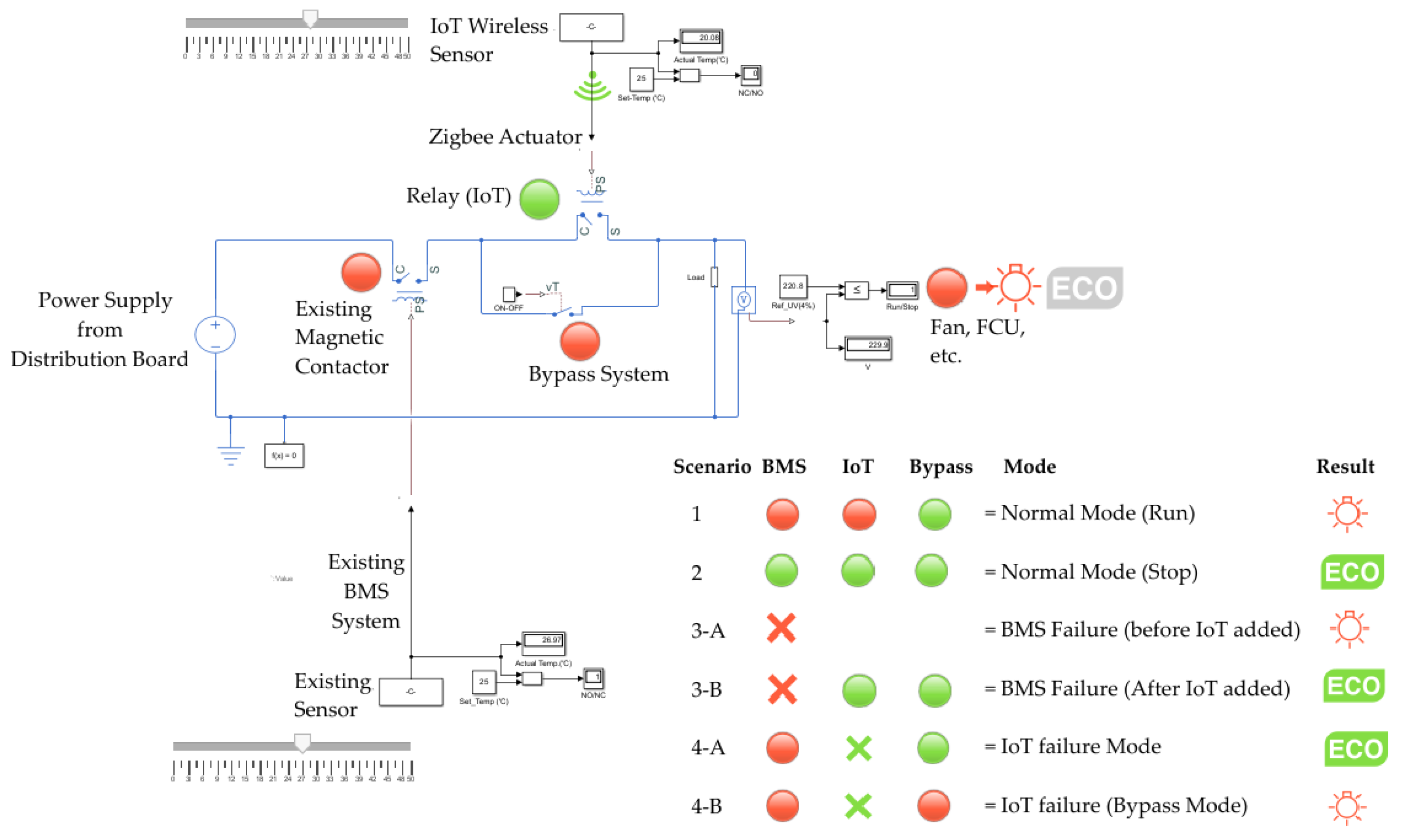
The simulated failure events presented in the preceding sections illustrate the robustness of the proposed IoT-BMS integration model, demonstrating that the reliability and efficiency of the Building Management System (BMS) can be substantially enhanced. This integration ensures sustained energy savings even in the event of sensor or system failures. The simulation results suggest that incorporating an IoT subsystem into the existing BMS can significantly reduce power consumption and optimize building operations.
5. Case Study: Building Load Profile during Single Sensor Failure
In this case study, the proposed framework is evaluated using real-world building power consumption data over varying time periods. The raw datasets used encompass electrical energy consumption data from 1910 residential buildings and 1919 non-residential buildings in the United States and China, sourced from [29]. A statistical analysis of the datasets reveals that building loads typically peak around 10 a.m., reaching 92% of full capacity, and decrease to below 20% of full capacity during the night. This baseline energy consumption is largely attributed to the continuous operation of security lighting, cleaning and maintenance activities, server rooms, and IT equipment in non-residential buildings, along with refrigerators and freezers in residential buildings.
In this study, assuming a building full load capacity of 1000 kVA, a hypothetical scenario is considered where a sensor or building management system (BMS) malfunction in a corridor prevents the activation of power-saving modes for the corridor’s fan coil units (FCUs) and lighting, which represent less than 5% of the peak load. Failures in power-saving modes, often caused by sensor malfunctions, are critical in building management. However, these issues may not be immediately apparent or reported, particularly in commercial and non-residential buildings. Typically, it is the end-users, rather than visitors or occupants, who detect these issues and report them to building management. Since sensor malfunctions are not as critical as failures in fire or smoke detectors, they are frequently excluded from routine maintenance checklists. The delay in detecting and repairing these issues can result from procedural steps such as emailing, cost approval, and contractor coordination, potentially extending the resolution time from half a day to over a week. This study examines the impact of motion sensor failures of varying durations (4 hours, 8 hours, 12 hours, and 24 hours).
In the first scenario simulating 4 hours sensor failure, the malfunction of the existing corridor temperature sensor occurs at 10:00 PM and is repaired by 2:00 AM the following day, resulting in a total failure duration of 4 hours before the system returns to normal operation. Given a full load capacity of 1000 kVA and assuming a power factor of 0.8, the corresponding full load in kilowatts (kW) is 800 kW. Considering that the peak load is 92% of the full load, this results in a peak load of 736 kW. Consequently, 5% of this peak load amounts to 36.8 kW, representing the power consumption affected by the sensor malfunction. In the second scenario, a malfunction in the existing corridor motion sensor occurs at 10:00 AM and is resolved by 6:00 PM the same day, resulting in an 8-hour failure period before the system resumes normal operation. In the third scenario, the motion sensor error occurs at midnight (12:00 AM) and is repaired by noon (12:00 PM) the same day, leading to a 12-hour interruption before the system is restored. In the fourth and final scenario, the sensor malfunction occurs at noon (12:00 PM) and is repaired by noon (12:00 PM) the following day, with the system returning to normal operation afterward.
The results of the above scenarios are presented in the accompanying graphs in the results and analysis section, which illustrates the linear relationship between the duration of the malfunction and the corresponding energy consumption.
6. Results and Analysis
As anticipated, energy consumption increases proportionally with the duration, confirming the direct impact of prolonged malfunctions on overall energy usage. This analysis underscores the critical importance of timely detection and correction of mal-functions within building management systems to mitigate excessive energy consumption. If repairs extend beyond a single day, the failure of power-saving modes could lead to energy consumption exceeding 1 MWh (1000 kWh). This scenario highlights the urgent need for rapid response to system malfunctions to prevent significant energy waste and ensure the efficient operation of building management systems. However, addressing such issues within a single working day or just a few hours is often impractical, necessitating the exploration of more effective alternatives.
Figure 5 illustrates the normal operation energy consumption as well as 4 hours fault-condition operation energy cost as a percentage of peak load. The highlighted region shows the energy saving acheived through the IoT integration.
Figure 6 illustrates the normal operation energy consumption as well as 8 hours fault-condition operation energy cost as a percentage of peak load. The highlighted region shows the energy saving acheived through the IoT integration.
In Figure 7, the normal operation energy consumption and 12 hours fault-condition operation energy cost as a percentage of peak load are shown. The highlighted region shows the energy saving acheived through the IoT integration.
Figure 8 illustrates the normal operation energy consumption compared to 24 hours fault-condition operation energy cost as a percentage of peak load. The acheived energy saving through the IoT integration is highlighted.
The energy consumption associated with the peak load power of 36.8 kW was analyzed across four specific durations: 4 hours, 8 hours, 12 hours, and 24 hours. The findings are as follows:
- For a duration of 4 hours, the wasted energy consumption totals 147.2 kWh.
- For a duration of 8 hours, the wasted energy consumption is 294.4 kWh.
- For a duration of 12 hours, the wasted energy consumption is 441.6 kWh.
- For a duration of 24 hours, the wasted energy consumption amounts to 883.2 kWh.
As demonstrated in the analysis of various sensor failure durations, significant energy savings can be realized. Given that repairs may take anywhere from one day to a week, the proposed solution has the potential to save 883.2 kWh over the course of a single day and up to 6.18 MWh over the span of a week. Table 1 further summarizes the total anticipated energy savings achieviable for an entire weeked by the proposed system.
7. Discussion
This study presents and evaluates the integration of an Internet of Things (IoT) system into the existing Building Management System (BMS), as elaborated in Section 4.3. The proposed solution effectively mitigates issues related to BMS failures and sensor malfunctions. In commercial and non-residential buildings, such issues often remain unnoticed or unreported in the initial stages. Typically, end-users identify and report these problems to building management, resulting in a time lag between the occurrence of a failure and its detection, which can range from a day to a week. Consequently, a single temperature sensor malfunction can lead to substantial increases in energy consumption, estimated to range from 883 kWh to 6.1 MWh over the course of one day to one week.
8. Conclusion
This research demonstrates that integrating Internet of Things (IoT) systems with existing Building Management Systems (BMS) can significantly enhance energy efficiency in smart buildings. The study involved designing a system architecture prototype, conducting MATLAB simulations, and found that IoT devices can effectively reduce energy waste, particularly in systems such as Heating, Ventilation, and Air Conditioning (HVAC) and lighting.
Additionally, the research introduces a backup bypass system to ensure system reliability in the event of IoT system failure. The findings indicate that integrating IoT with BMS not only reduces energy consumption but also strengthens energy security. This integration contributes to energy conservation and reduces the carbon footprint, presenting a promising solution for future energy management and environmental sustainability in smart buildings which is further validated through a real-world case study.
Author Contributions
Conceptualization, Validation, Formal Analysis, Investigation, Resources, Review and Edit, Supervision, Project Administration by H.S.; Methodology, Visualization, Software, H.S. and T.T; Data curation, writing—original draft preparation, T.T; Both authors have read and agreed to the published version of the manuscript.
Funding
This research received no external fundin.
Data Availability Statement
Data are contained within the article.
Conflicts of Interest
The authors declare no conflicts of interest.
Abbreviations
The following abbreviations are used in this manuscript:
| BMS | Building Management System |
| IoT | Internet of Things |
| AFDD | Advanced Fault Detection and Diagnosis |
| ACMV | Air Conditioning and Mechanical Ventilation |
| FCU | Fan Coil Unit |
| M&E | Mechanical and Electrical |
| BIM | Building Information Modelling |
References
- Chenyan, L.; Jing, N.; Hui-Wei, S. Research of Carbon Emission Reduction on the Green Building Based on the Internet of Things. In Proceedings of the 2019 International Conference on Smart Grid and Electrical Automation (ICSGEA), Xiangtan, China, Aug. 2019; pp. 83–87. [Google Scholar]
- Sidid, S.; Gaur, S. Smart grid building automation based on Internet of Things. In Proceedings of the 2017 Innovations in Power and Advanced Computing Technologies (i-PACT), Vellore, India, Apr. 2017; pp. 1–4. [Google Scholar]
- Verma, N.; Jain, A. Energy Efficient Building Automation System. In Proceedings of the 2019 2nd International Conference on Power Energy, Environment and Intelligent Control (PEEIC), Greater Noida, India, Oct. 2019; pp. 27–32. [Google Scholar]
- Stamatescu, G.; Stamatescu, I.; Arghira, N.; Fagarasan, I. Cybersecurity Perspectives for Smart Building Automation Systems. In Proceedings of the 12th International Conference on Electronics, Computers and Artificial Intelligence (ECAI), Bucharest, Romania, Jun. 2020; pp. 1–5. [Google Scholar]
- Debauche, O.; Mahmoudi, S.; Moussaoui, Y. Internet of Things Learning: a Practical Case for Smart Building Automation. In Proceedings of the 5th International Conference on Cloud Computing and Artificial Intelligence: Technologies and Applications (CloudTech), Marrakesh, Morocco, 2020; pp. 1–8. [Google Scholar]
- Hayduk, G.; Kwasnowski, P.; Mikos, Z. Building management system architecture for large building automation systems. In Proceedings of the 17th International Carpathian Control Conference (ICCC), High Tatras, Slovakia, May 2016; pp. 232–235. [Google Scholar]
- Khanchuea, K.; Siripokarpirom, R. A Multi-Protocol IoT Gateway and WiFi/BLE Sensor Nodes for Smart Home and Building Automation: Design and Implementation. In Proceedings of the 10th International Conference on Computing and Communications Technologies (ICCCT), Bangkok, Thailand, Mar. 2019; pp. 1–6. [Google Scholar]
- Somani, S.; Solunke, P.; Oke, S.; Medhi, P.; Laturkar, P. P. IoT Based Smart Security and Home Automation. In Proceedings of the Fourth International Conference on Computing Communication Control and Automation (ICCUBEA), Pune, India, Aug. 2018; pp. 1–4. [Google Scholar]
- Bhutta, E. M. Application of Smart Energy Technologies in Building Sector – Future Prospects. In Proceedings of the 2017 International Conference on Energy Conservation and Efficiency (ICECE), Stony Brook, NY, Nov. 2017; pp. 1–6. [Google Scholar]
- Schrom, H.; Schwartze, J.; Diekmann, S. Building Automation by an Intelligent Embedded Infrastructure: Combining Medical, Smart Energy, Smart Environment and Heating. In Proceedings of the 2017 International Smart Cities Conference (ISC2), Wuxi, China, 2017; pp. 1–4. [Google Scholar]
- Jain, M.; Kaushik, N.; Jayavel, K. Building automation and energy control using IoT - Smart campus. In Proceedings of the 2nd International Conference on Computing and Communications Technologies (ICCCT), Chennai, India, Feb. 2017; pp. 353–359. [Google Scholar]
- Tee, B. T.; Lim, S. C. J.; Siew, P. W.; Lee, M. F. Application of Sensor Technology for Energy Consumption Analysis: A Case Study in a Smart Office Building. In Proceedings of the 2023 IEEE International Conference on Industrial Engineering and Engineering Management (IEEM), Singapore, Singapore, Dec. 2023; pp. 0913–0917. [Google Scholar]
- Aliev, K.; Antonelli, D.; Bruno, G.; Piantanida, P.; Villa, V. Building system diagnostics through a network of smart local sensors. In Proceedings of the 6th South-East Europe Design Automation, Computer Engineering, Computer Networks and Social Media Conference (SEEDA-CECNSM), Preveza, Greece, Sep. 2021; pp. 1–6. [Google Scholar]
- Hsiao, T. C.; Chen, T. L.; Kang, T. C.; Wu, T. Y. The Implementation of Smart Home Power Management: Integration of Internet of Things and Cloud Computing. In Proceedings of the 2019 IEEE Eurasia Conference on Biomedical Engineering, Healthcare and Sustainability (ECBIOS), Okinawa, Japan, May 2019; pp. 21–23. [Google Scholar]
- De Freitas Melo, D.; De Souza Lage, E.; Rocha, A. V.; De Jesus Cardoso, B. Improving the consumption and water heating efficiency in smart buildings. In Proceedings of the 13th International Conference and Expo on Emerging Technologies for a Smarter World (CEWIT), Stony Brook, NY, Nov. 2017; pp. 1–6. [Google Scholar]
- Masrani, E.; Patel, D.; Khatri, M.; Martis, E.; Gaur, N. Smart Living Solution to Optimize Building Systems for Efficient Energy Usage and Prediction. In Proceedings of the 2023 International Conference on Communication System, Computing and IT Applications (CSCITA), Mumbai, India, Mar. 2023; pp. 204–208. [Google Scholar]
- De Las Morenas, J.; Da Silva, C. M.; Barbosa, J.; Leitao, P. Low Cost Integration of IoT Technologies for Building Automation. In Proceedings of the IECON 2019 - 45th Annual Conference of the IEEE Industrial Electronics Society, Lisbon, Portugal, Oct. 2019; pp. 2548–2553. [Google Scholar]
- Raju, L.; Adhil, M.; Logeshwaran, S.; Sanjana, M.; Praveena, V. K. IoT Based Advanced Building Automation and Energy Management. In Proceedings of the 2022 IEEE World Conference on Applied Intelligence and Computing (AIC), Sonbhadra, India, Jun. 2022; pp. 478–481. [Google Scholar]
- Abhishek, A. S.; Bhasker, M.; Ponraj, A. S. IoT Based Control System for Home Automation. In Proceedings of the 2021 IEEE 2nd International Conference on Technology, Engineering, Management for Societal Impact using Marketing, Entrepreneurship and Talent (TEMSMET), Pune, India, Dec. 2021; pp. 1–5.
- Nirmala, A. P.; Asha, V.; Chandra, P.; Priya, H.; Raj, S. IoT Based Secure Smart Home Automation System. In Proceedings of the 2022 IEEE Delhi Section Conference (DELCON), New Delhi, India, Feb. 2022; pp. 1–7. [Google Scholar]
- Mahmud, S.; Ahmed, S.; Shikder, K. A Smart Home Automation and Metering System using Internet of Things (IoT). In Proceedings of the 2019 International Conference on Robotics, Electrical and Signal Processing Techniques (ICREST), Dhaka, Bangladesh, Jan. 2019; pp. 451–454. [Google Scholar]
- Raju, L.; Praveena, V.K, Sai Akash, Vaishnavi, V.; Bharathraj, V. Building Energy Management and Conservation using Internet of Things. In Proceedings of the 2022 International Conference on Sustainable Computing and Data Communication Systems (ICSCDS), Erode, India, Apr. 2022; pp. 970–974.
- Rathore, A.; Sundaram, S. Building Energy Management Through Load Control Using Internet of Things. In Proceedings of the 2021 Innovations in Power and Advanced Computing Technologies (i-PACT), Kuala Lumpur, Malaysia, Nov. 2021; pp. 1–06. [Google Scholar]
- Kodali, R. K.; Yerroju, S. Energy Efficient Home Automation Using IoT. In Proceedings of the 2018 International Conference on Communication, Computing and Internet of Things (IC3IoT), Chennai, India, Feb. 2018; pp. 151–154. [Google Scholar]
- Arulprakash, N. M. P.; Ayyannan, M.; Pokhariyal, N. M. R.; Maranan, R. Intelligent Smart Home Automation System using Internet of Things. In Proceedings of the 7th International Conference on I-SMAC (IoT in Social, Mobile, Analytics and Cloud) (I-SMAC), Kirtipur, Nepal, Oct. 2023; pp. 31–36.
- Tang, J.; Li, J.; Zhong, A.; Xiong, B.; Bian, X.; Li, Y. Application of LoRa and NB-IoT in Ubiquitous Power Internet of Things: A Case Study of Fault Indicator in Electricity Distribution Network. In Proceedings of the 4th International Conference on Intelligent Green Building and Smart Grid (IGBSG), Hubei, Yichang, China, Sep. 2019; pp. 380–383. [Google Scholar]
- Al Sultan, O. K. T.; Suleiman, A. R. Simulation of IoT Web-based Standard Smart Building Using Packet Tracer. In Proceedings of the 7th International Engineering Conference “Research & Innovation amid Global Pandemic" (IEC), Erbil, Iraq, Feb. 2021; pp. 48–53.
- Naqbi, A. A.; Alyieliely, S. S.; Talib, M. A.; Nasir, Q.; Bettayeb, M.; Ghenai, C. Energy Reduction in Building Energy Management Systems Using the Internet of Things: Systematic Literature Review. In Proceedings of the 2021 International Symposium on Networks, Computers and Communications (ISNCC), Dubai, United Arab Emirates, Oct. 2021; pp. 1–7. [Google Scholar]
- Liu, X.; Ding, Y.; Tang, H.; Xiao, F. A data mining-based framework for the identification of daily electricity usage patterns and anomaly detection in building electricity consumption data. In Energy and Buildings, 231, 2021,110601–110622. [CrossRef]
Figure 1.
The IoT-BMS Integration System Architecture.
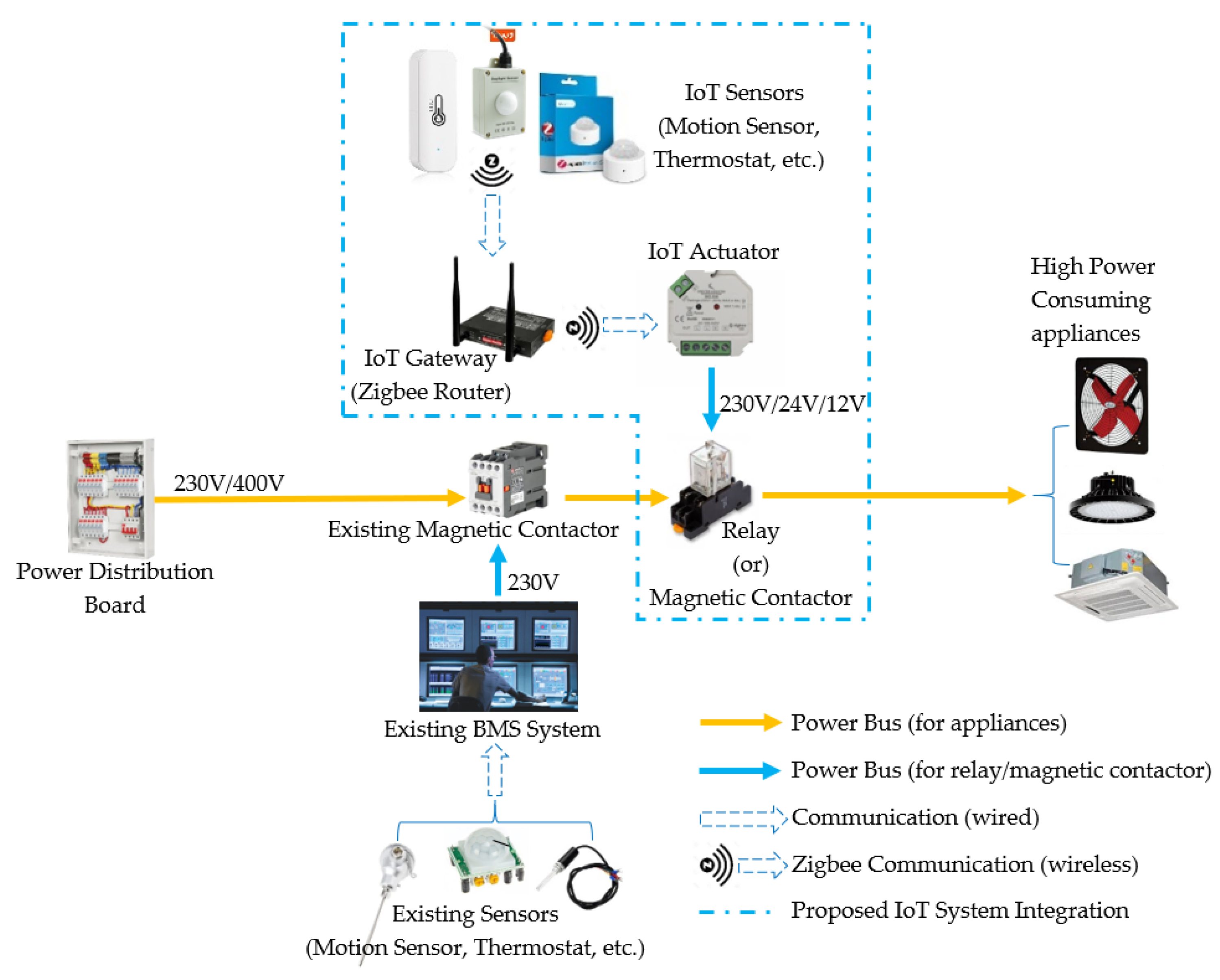
Figure 2.
MATLAB simulation of existing sensor failure in BMS only System.
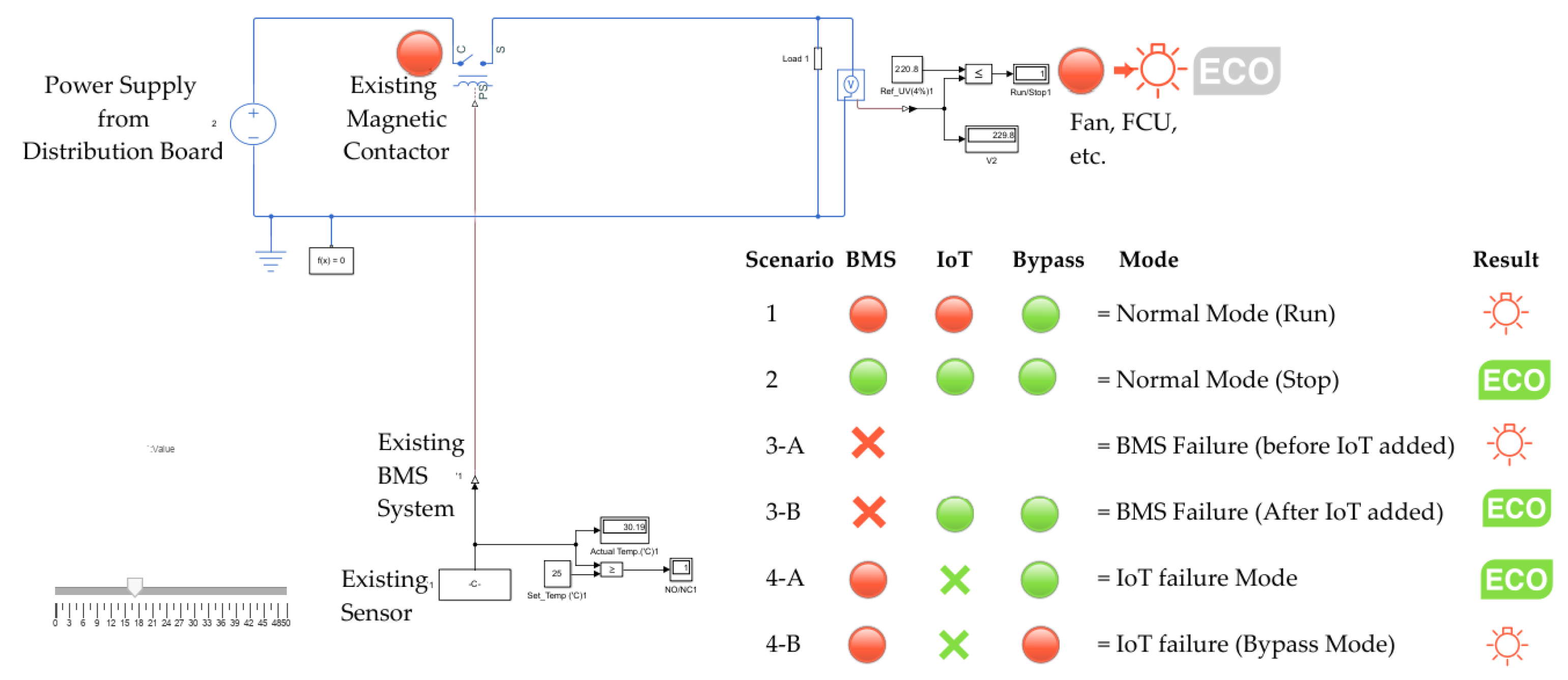
Figure 3.
MATLAB simulation of IoT-BMS integration system during existing sensor failure.
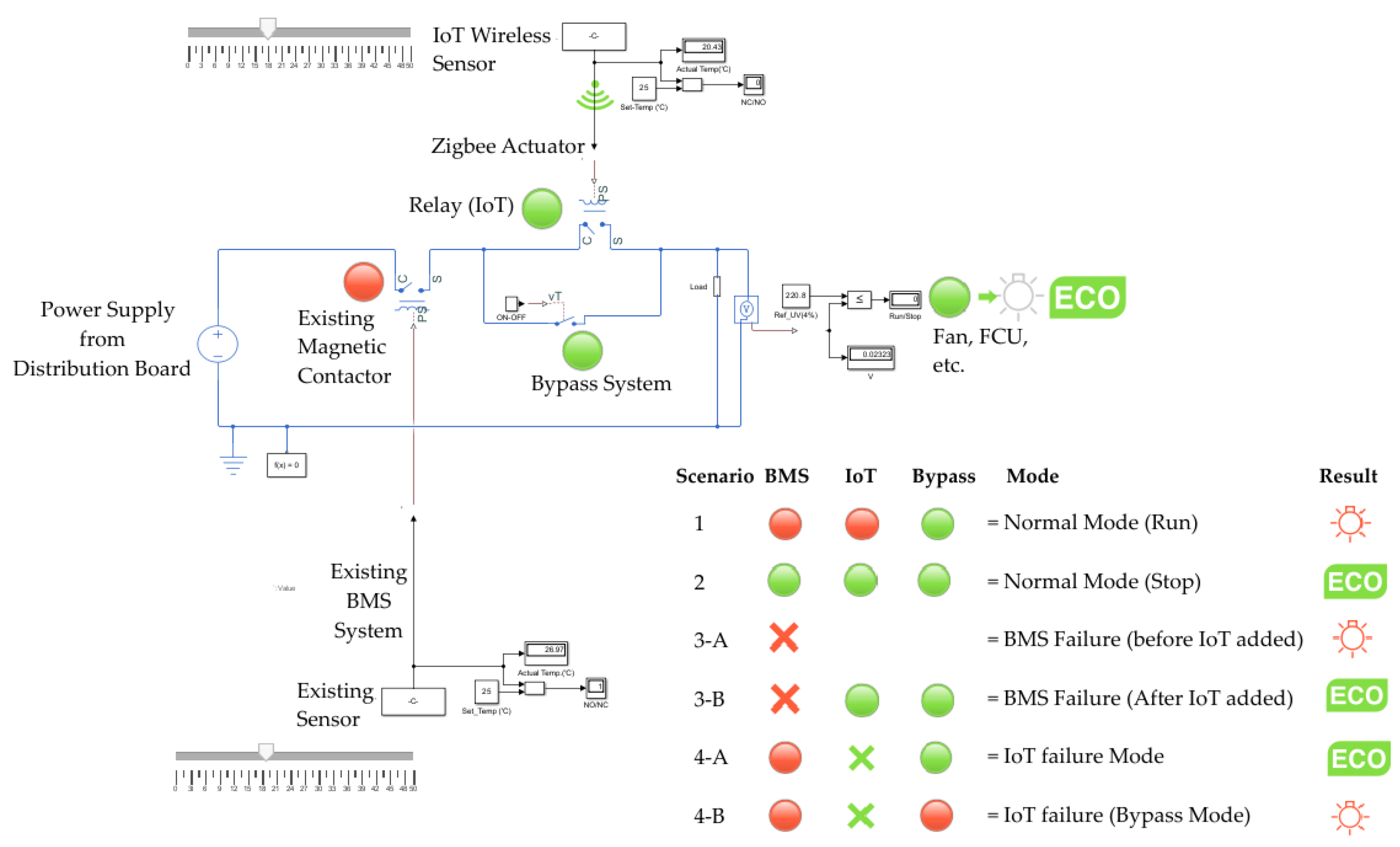
Figure 5.
Building load profile during an existing corridor temperature sensor failure for 4 hours .
Figure 5.
Building load profile during an existing corridor temperature sensor failure for 4 hours .
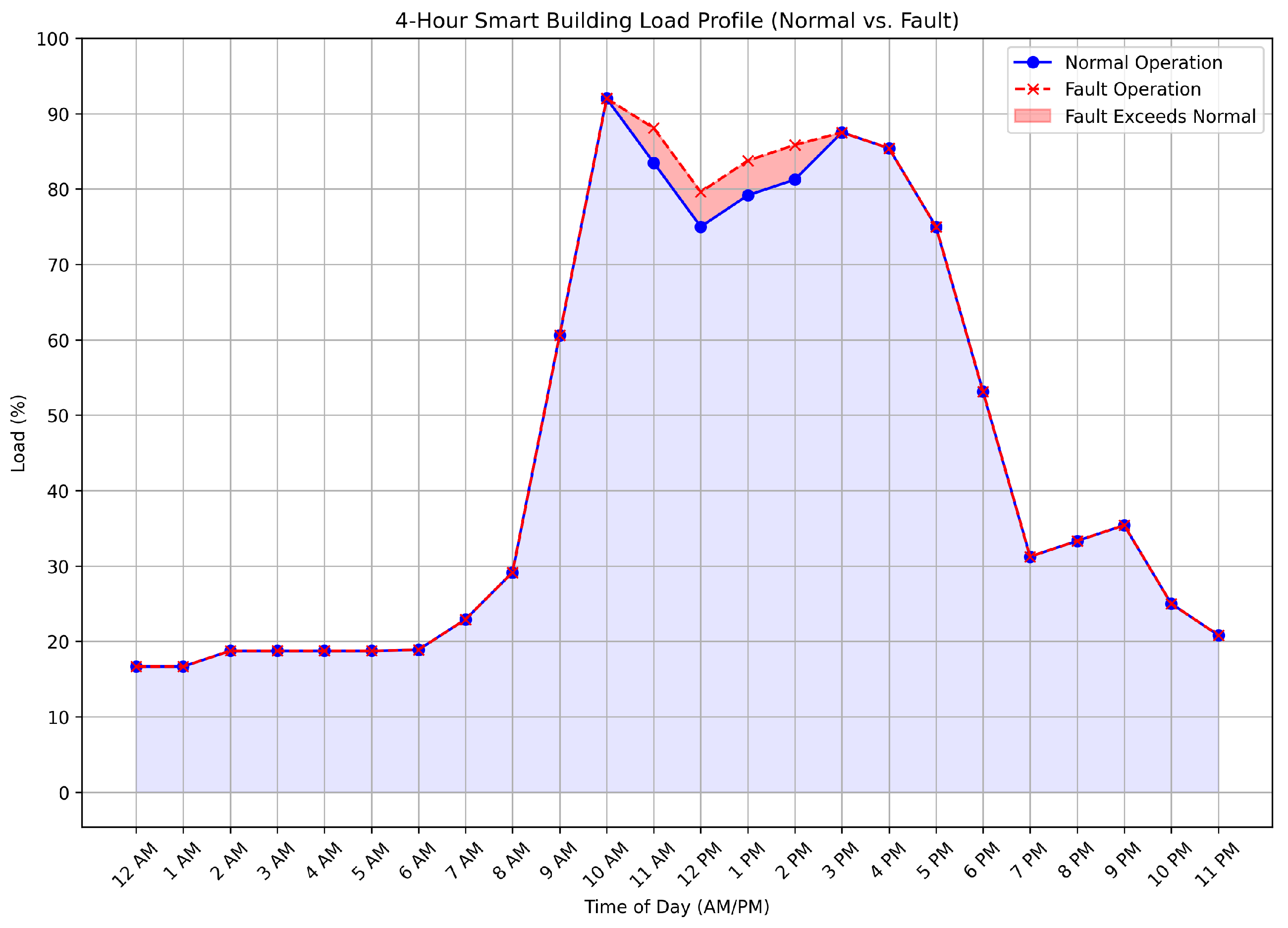
Figure 6.
Building load profile during an existing corridor motion sensor failure for 8 hours.
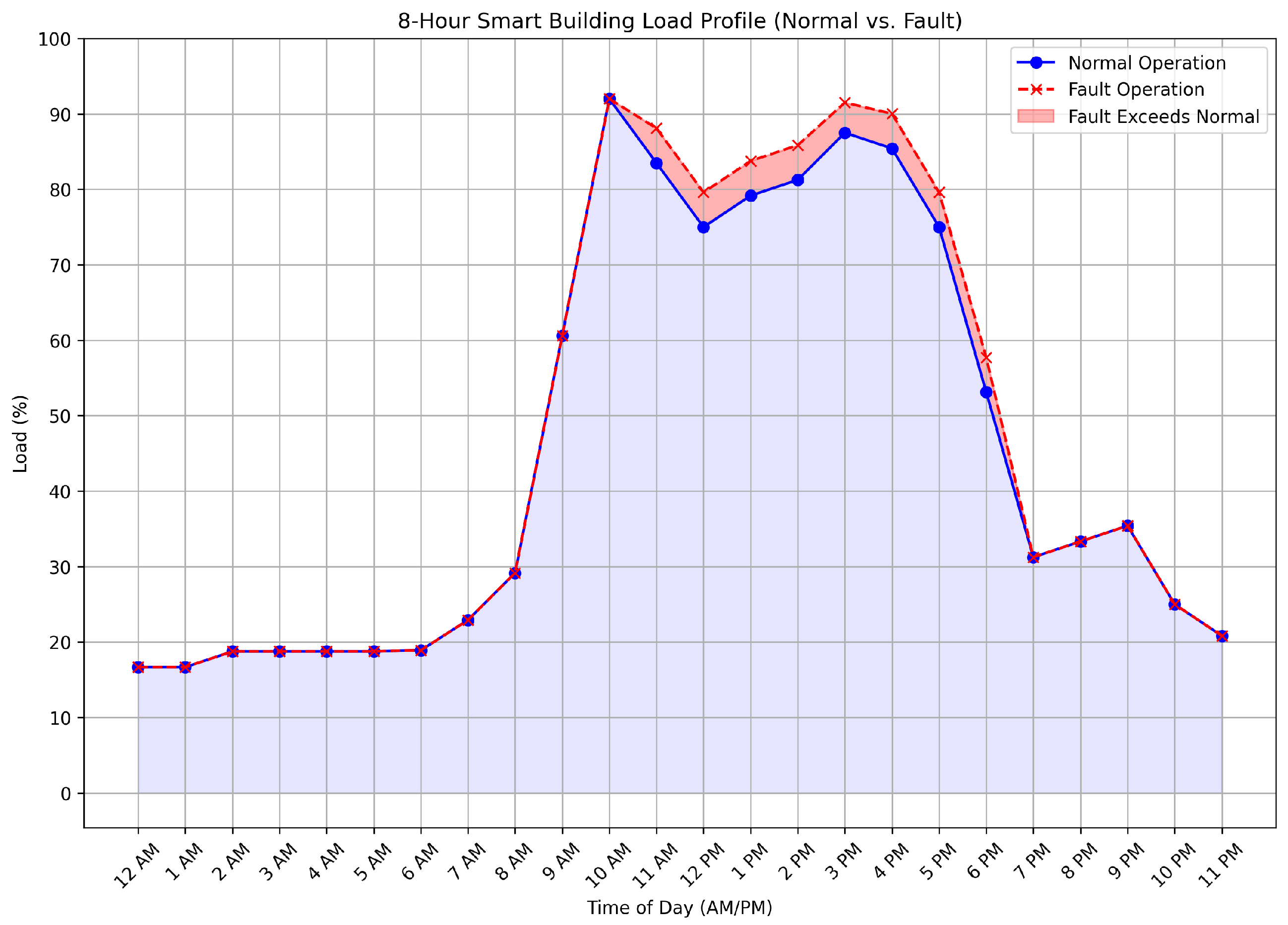
Figure 7.
Building load profile during an existing corridor motion sensor failure for 12 hours .
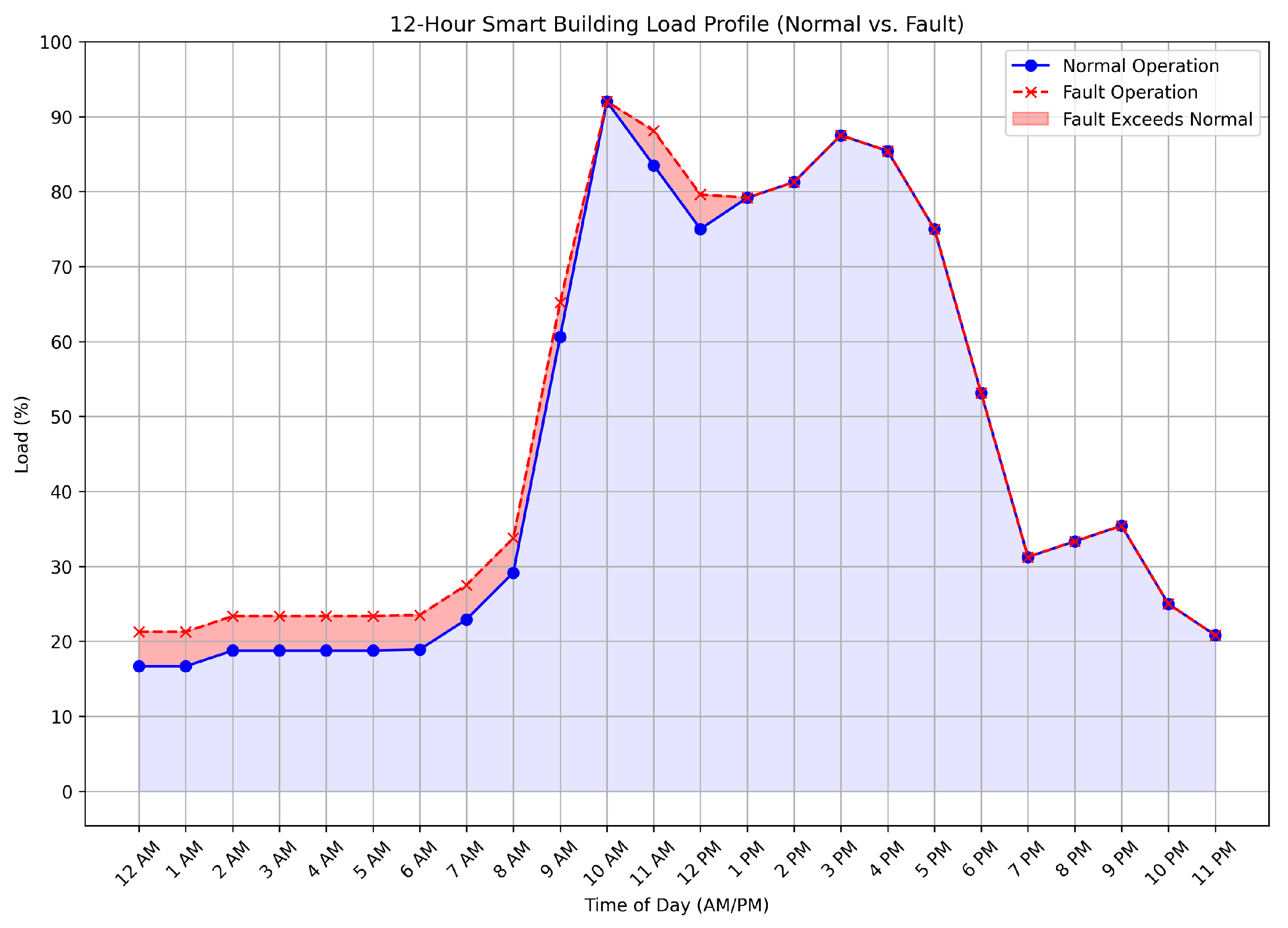
Figure 8.
Building load profile during an existing corridor motion sensor failure for 24 hours.
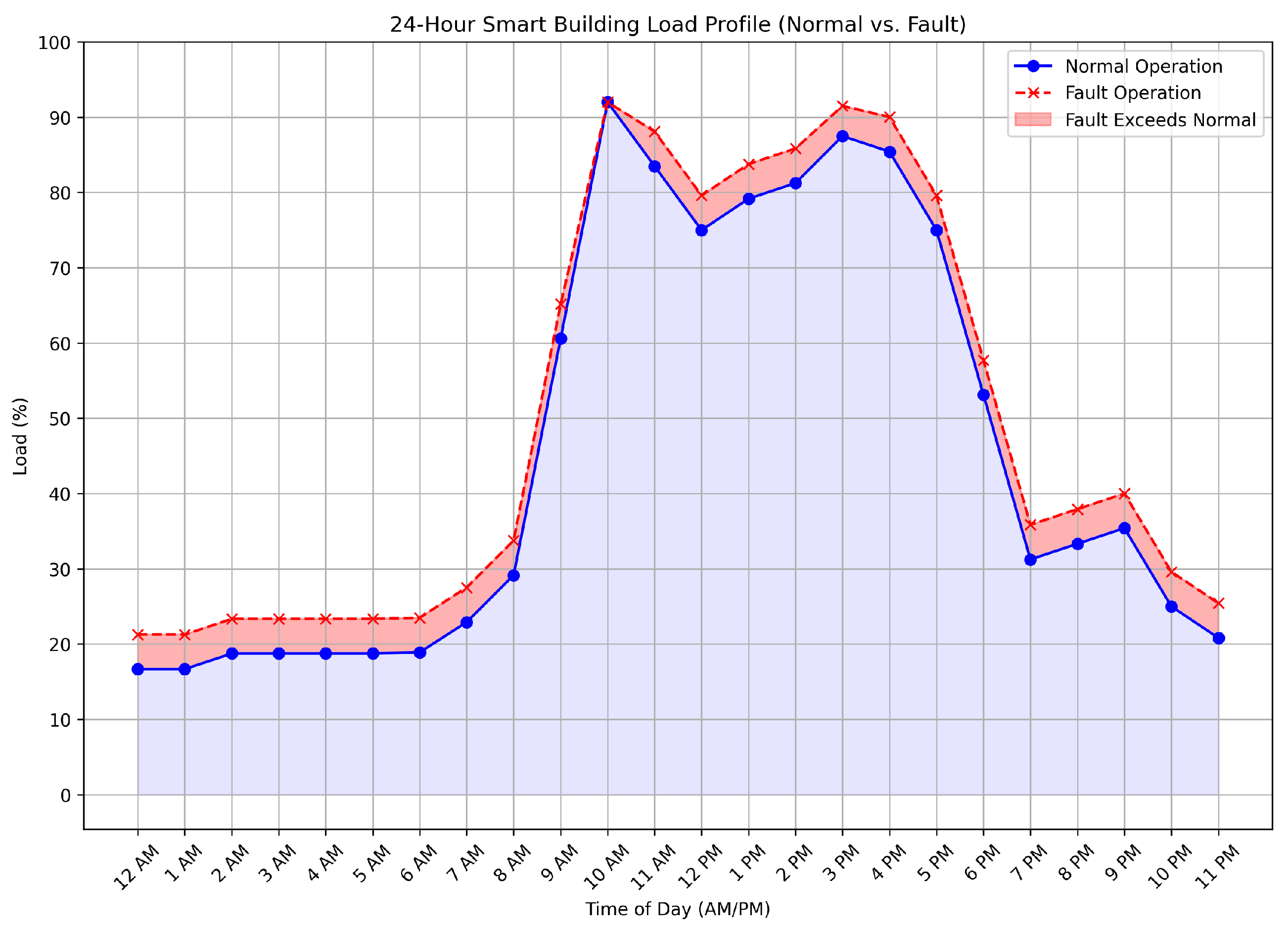

Table 1.
Estimated energy savings over time upon sensor failure duration.
| No | Sensor Failure duration (hours | IoT-BMS integration energy savings (KWh) | Remarks |
|---|---|---|---|
| 1 | 4 | 147 | 1/6 day |
| 2 | 8 | 294 | 1/3 day |
| 3 | 12 | 442 | 1/2 day |
| 4 | 24 | 883 | 1 day |
| 5 | 48 | 1766 | 2 day |
| 6 | 72 | 2650 | 3 day |
| 7 | 96 | 3533 | 4 day |
| 8 | 120 | 4416 | 5 day |
| 9 | 144 | 5299 | 6 day |
| 10 | 168 | 6182 | 1 week |
Disclaimer/Publisher’s Note: The statements, opinions and data contained in all publications are solely those of the individual author(s) and contributor(s) and not of MDPI and/or the editor(s). MDPI and/or the editor(s) disclaim responsibility for any injury to people or property resulting from any ideas, methods, instructions or products referred to in the content. |
© 2024 by the authors. Licensee MDPI, Basel, Switzerland. This article is an open access article distributed under the terms and conditions of the Creative Commons Attribution (CC BY) license (http://creativecommons.org/licenses/by/4.0/).
Copyright: This open access article is published under a Creative Commons CC BY 4.0 license, which permit the free download, distribution, and reuse, provided that the author and preprint are cited in any reuse.