

Submitted:
29 August 2024
Posted:
30 August 2024
You are already at the latest version
Abstract
Recently, neglected and underutilized species (NUS) have deservedly come to the forefront of scientific interest because they can contribute to the human nutrition, due to the content of bio-active substances such as antioxidants. Despite the great diversity and rich tradition in use of Philippine NUS, the nutritional properties of many edible plants remain unexplored. The main objective of this study was to evaluate various parts of eleven NUS fruits and vegetables traditionally consumed in the Philippines, namely Allaeanthus luzonicus, Canarium ovatum, Dillenia philippinensis, Ficus pseudopalma, Flacourtia indica, Flacourtia inermis, Garcinia intermedia, Heliotropium arboreum, Posoqueria latifolia, Stelechocarpus burahol and Sterculia quadrifida for their total phenolic content (TPC) and in vitro antioxidant activity (DPPH and ORAC assays). The strongest antioxidant activity obtained in both assays were inflorescence of A. luzonicus (DPPH IC50 = 91.0 μg/mL, ORAC IC50 = 37.9 μg/mL) and fruit of S. burahol (DPPH IC50 = 253.7 μg/mL, ORAC IC50 = 32.2 μg/mL). These two species also had the highest TPC (202.1 and 133.0 µg GAE/mg extract, respectively). For all samples tested, the strong correlation was found between TPC and antioxidant activity. Based on our results, A. luzonicus and S. burahol have a promising potential as novel antioxidant rich food.
Keywords:
kepel fruit
; non-communicable diseases
; free radicals’ inhibitors
; birch flower
1. Introduction
It is well known that oxidative stress is involved in the development of various human non-communicable diseases (NCDs), such as cardiovascular conditions and cancer, the incidence of which has been on the rise in recent years [1]. In the Philippines, NCDs account for 68% of all deaths and the probability of premature death (before the age of 70) from one of the four main NCDs (cardiovascular diseases, cancer, chronic respiratory disease, and diabetes) is 29% [2]. Several studies have shown that plant-based diet can reduce the risk of the development of NCDs [3]. This is likely due to the high content of various biologically active compounds collectively called antioxidants, that can inhibit or prevent oxidative injury to vulnerable molecules in living systems. Antioxidants operate on variety of levels, e.g. they can bind with reactive oxygen species and neutralize them. They also act as scavengers by preventing cell and tissue damage from free radicals or help with adaptation to oxidative stress. Several preclinical and clinical studies have already proven the effectiveness of antioxidants in the management of different NCDs, mainly due to their anti-aging, anti-cancer, anti-diabetic, anti-inflammatory, and hepato-, and neuroprotective effects [4,5]. Vitamins, carotenoids, and phenols are the most well-known natural antioxidants [6]. Phenolic compounds are mainly biosynthesized through the shikimic acid pathway from phenylalanine or tyrosine and the hydroxyl group on the benzene ring is responsible for their antioxidant properties [7]. In recent years, many scientific studies have confirmed the strong antioxidant effect of some phenolic compounds, as reviewed by San Miguel-Chávez [8]. Among them, especially flavonoids are highlighted as the most potent plant antioxidants, together with tannins, chalcones, coumarins, and phenolic acids. Several synthetic antioxidants are available today that have certain advantages, mainly their stability. However, consumers have a stronger preference for natural antioxidants especially due to their lower side effects and natural way of their origin [5,8,9].
Neglected and underutilized species (NUS) have been used for centuries for food and other purposes, but their use and importance have diminished over time. Currently, only a fraction of the possible edible species is consumed worldwide, and much of it remains underutilized despite their immense potential. However, with the changing demand for plant and crop traits, NUS are considered as potential future food crops that can contribute to improve nutrition, dietary diversity, and human health. In addition to the NUS ability to boost the diet, their benefits also lie in their environmental friendliness and resistance to harsh conditions and diseases [10]. Among all, no other crops are so positively perceived by society as fruits and vegetables. They are undisputable components of a healthy human diet containing various kind of antioxidants. It is already known that their increased daily intake may reduce the risk of NCD development, which is the number one cause of death worldwide [11]. Given this fact, the WHO recommended consuming at least 400 g of fruit and vegetables to prevent NCDs, whereby fruit should represent one third (meaning approximately 140 g) [12]. However, the most of the world's population is well below this threshold, especially in less developed countries. In recent years, the term "superfruits" has emerged and is receiving increasing attention as a marketing strategy to promote NUS with extraordinary health benefits, precisely in conjunction with their high antioxidant activity. Among the most well-known superfruits rich in antioxidants are the acai berry (Euterpe oleracea Mart.) or the goji berry (Lycium chinense Mill.), whose various products are now popular worldwide [13,14]. However, there are still a huge number of lesser-known fruits and vegetables, which antioxidant potency has not been evaluated yet.
The Philippines, consisting of more than 7000 islets, is probably the most biologically diverse country in the world with the endemism rate of plants estimated to be 39%; however, for certain taxa, it can be even higher [15,16]. Although it is home to an incredible range of species, rice and cereals comprise almost half of the total one-day per capita food intake, while fruits and vegetables lag behind [17]. Furthermore, fruit consumption in the Philippines has declined significantly over the past twenty-five years, from 188 g in 1996 to 93 g in 2021, far below the recommended daily intake of fruit, and ranking them 42nd within the group of 165 countries in terms of fruit consumption per capita in 2021 [18]. Low fruit and vegetable intake can be linked, among other things, to a lack of knowledge about their benefits and recommended daily intake, but also to socio-economic factors and the high price of imported crops [19]. The situation could be improved by increased awareness of locally available species and their inclusion in the daily diet. Nowadays, several local NUS crops and their products are already well established in Philippine markets, e.g. purple yam (Dioscorea alata L.; also known as ube), a root vegetable rich in essential vitamins and minerals and excellent source of phenolics antioxidants (mainly anthocyanins) [20], or pili nut (Canarium ovatum Engl.) which fruit pulp and seed are edible and contain a considerable amount of essential nutrients, antioxidants, and unsaturated fatty acids [21]. Despite their probably nutritional, health, economic and ecological importance, many Philippine plant species remains NUS as result of the lack of comprehensive botanical investigation and systematic scientific studies of their nutritional, biological and chemical properties. Moreover, due to massive deforestation many species are often threatened with extinction, which can have an adverse effect not only on the ecosystem but also on human well-being [22,23]. Thus, the main aim of the present study was to provide a comprehensive overview of the antioxidant potential and total phenolic content (TPC) of selected underutilized tree species traditionally consumed as a fruit or vegetable in the Philippines. By uncovering the antioxidant activity and phenolic content of these NUS, we aim to not only enrich the knowledge on biological effects and chemical composition of Philippine traditional fruits and vegetables, but also raise awareness about their health beneficial properties.
2. Materials and Methods
2.1. Plant Materials
Based on traditional uses of fruits and vegetables in Filipino cuisine [24,25,26,27], 11 tree species (Figure 1) have been chosen for the evaluation of their antioxidant potential and TPC. The plant samples were collected in May 2017, in 5 collection sites, namely the garden of the Institute of Plant Breeding (IPB) of the University of the Philippines Los Banos (UPLB), Dr. Coronel Fruit Conservation Farm, the Mount Makiling Forest (all Laguna province), Sambawan Island (Biliran province); and on the markets in Metropolitan Manila province. Fresh plant material was air-dried in shady place for several days and then stored in paper backs until the use. Plant samples were identified and authenticated by local expert Dr. Pablito M. Magdalita from the IPB UPLB, and ethnobotany experts, Prof. Ladislav Kokoska, and Dr. Johana Rondevaldova, from the Faculty of Tropical AgriSciences of the Czech University of Life Sciences, Prague (CZU), using the handbook “Important and Underutilized Edible Fruits of the Philippines” [24]. Voucher specimens are deposited in the herbarium of the Department of Botany and Plant Physiology of the Faculty of Agrobiology, Food and Natural Resources of the CZU. The Ethnobotanical data including scientific names of the species, family, local name, plant part tested, voucher specimen number, and traditional edible use are summarized in Table 1. The complete scientific names and authorities have been checked in Plants of the World Online [28].
2.2. Chemicals and Reagents
2,2’-azobis(2-methylpropionamidine) dihydrochloride (AAPH), 2,2-diphenyl-1-picrylhydrazyl (DPPH), (±)-6-hydroxy-2,5,7,8-tetramethylchromane-2-carboxylic acid (Trolox), fluorescein sodium salt (FL), and gallic acid were purchased from Sigma-Aldrich (Prague, Czech Republic). Dimethyl sulfoxide (DMSO), Folin-Ciocalteu reagent, and methanol were bought from Penta (Prague, Czech Republic). Na2CO3 and KH2PO4 salts were obtained from Erba Lachema (Brno, Czech Republic), while K2HPO4 was from Lach-Ner (Neratovice, Czech Republic).
2.3. Preparation of Extracts
Air-dried plant material was grounded to fine powder using electric mills GM100 (Retsch, Germany) and Tissue Lyser II. (Retsch, Germany) and 1 g of powder was extracted in 30 mL of 100 % methanol and left for 24 h to shake in a GFL3005 shaker (Burgwedel, Germany). Subsequently, the extract was filtered and concentrated to dryness by Rotary evaporator R-200 (Büchi, Switzerland) in a vacuum at 40 °C. Dry residue was dissolved in DMSO to a stock concentration of 51,200 µg/mL and stored at -20 °C until further analyses. In total, 12 extracts were prepared and the yield of dry residues is part of Table 2.
2.4. Antioxidant Activity Evaluation
Confirming antioxidant activity by more than one method can offer a more complete evaluation of the total antioxidant capacity of individual plants [29]. Thus, we examined antioxidant activity by two methods varying based on the mode of action, the DPPH representing electron atom transfer reaction and oxygen radical absorbance capacity (ORAC) representing hydrogen transfer assay [30]. Trolox was used as a positive control for both assays. Results were calculated by Gen 5 software (BioTek, Winooski, USA) and expressed as mean values of half maximal inhibitory concentration (IC50) with standard deviation (±SD) in µg/ml.
2.4.1. DPPH Assay
The method based on Sharma and Bhat [31] was used to assess of extracts’ ability to inhibit DPPH radical. A two-fold serial dilution of each extract and Trolox was performed in methanol via automatized pipetting platform Freedom Evo 100, equipped with a four-channel liquid handling arm (Tecan, Mannedorf, Switzerland) in 96- well microtiter plates. Subsequently, 75 µL of methanol and 25 µL of 1 mM methanol solution of DPPH was added into each tested well of microtiter plate to create a final volume of 200 µL. The final tested concentrations ranged from 0.125 to 256 µg/mL. Plates were incubated for 30 min in the dark at room temperature, and then absorbance was measured spectrophotometrically at 517 nm using Cytation 3 Multimode Reader (BioTek,Winooski, USA).
2.4.2. ORAC Assay
The method previously described by Ou et al. [32] and slightly modified by Tauchen et al. [33] and Rondevaldova et al. [34] was used for the evaluation of the ability of the extracts to protect FL from AAPH degradation. Two-fold serial dilution of each extract was prepared in phosphate buffer (75 mM, pH 7.0) in black 96-well microtiter plates using the automated pipetting platform Freedom EVO 100, equipped with a four-channel liquid handling arm (Tecan, Mannedorf, Switzerland). Afterwards, 150 µL of FL (48 nM) was added to each well (except for the outer wells of the plate that were filled with 200 µl of distilled water for better thermal mass stability and not used for evaluation). After 10 min of incubation at 37 °C in Memmert Incubator IF110plus (Memmert, Schwabach, Germany), the reaction was started by adding of 25 µL of freshly prepared AAPH (153 mM). Control (FL with AAPH in phosphate buffer) and blank (FL in phosphate buffer) were part of each microtiter plate. Plates were subsequently incubated for 90 minutes, and the fluorescence changes were measured by Cytation 3 Multimode Reader (BioTek, Winooski, USA) with excitation and emission wavelengths set at 485 and 528 nm, respectively.
2.5. Determination of TPC
To estimate TPC, a slightly modified method previously described by Singleton et al. [35] was used. The method was adjusted for 96-well microtiter plates. Initially 100 µl of each extract was mixed with 25 µl of pure Folin-Ciocalteu reagent and submitted to orbital shaking at approximately 500 rpm for 10 min. The reaction was started by adding 75 µl of 12% Na2CO3. The plates were kept in the dark for 2 h at 37 °C. Absorbance was measured at 700 nm by Cytation 3 Multimode Reader using Gen5 software (BioTek Instruments, Winooski, USA). Fourteen concentration levels of gallic acid (two-fold dilution in the range from 0.015625 to 126 µg/ml) were used to create the standard calibration curve. The results were expressed as mean values ± SD as gallic acid equivalents (µg GAE/mg extract).
2.6. Statistics and Calculations
All experiments were performed as three independent tests each carried out in triplicate. Linear correlation coefficients (r) between DPPH, ORAC and TPC were established using Pearson product-moment correlation in Microsoft Excel 365 (Microsoft, Redmond, WA, USA). The degree of the correlation was interpreted using the guide of Evans [36] as follows (for the absolute value of r): 0-0.19 very weak, 0.20–0.39 weak, 0.40–0.59 moderate, 0.60–0.79 strong, 0.80-1 very strong. The mean values of each analysis (DPPH, ORAC, and TPC) for each plant species were visualized as a heatmap using Euclidean distance for clustering with pheatmap v 1.0.12 in R [37].
3. Results
In total, twelve extracts prepared from eleven NUS of edible trees of the Philippines were evaluated for their antioxidant potential by two different assays (DPPH and ORAC). Moreover, as phenolics are often strongly associated with antioxidant potential, TPC was also determined. To the best of our knowledge, this is the first report on any antioxidant activity and TPC of Allaeanthus luzonicus inflorescences, Canarium ovatum seeds, Ficus pseudopalma leaves, F. pseudopalma pulp with seeds, Garcinia intermedia fruits, Heliotropium arboreum leaves, Posoqueria latifolia arils, and Sterculia quadrifida seeds. Antioxidant activity represented by values of IC50 and contents of total phenolics determined for tested parts of NUS of edible trees of the Philippines are shown in the Table 2.
In both antioxidant assays, the most active extracts were A. luzonicus inflorescence (IC50 for DPPH and ORAC at 253.7 µg/ml and 32.2 µg/ml, respectively) and Stelechocarpus burahol fruit (IC50 for DPPH and ORAC at 91.0 µg/ml and 37.9 µg/ml, respectively). These two species were also highest in respective TPCs (133.0 and 202.1 µg GAE/mg extract) while the other samples showed much lower TPC values ranging from 16.1 to 55.6 µg GAE/mg extract. No other species could inhibit DPPH even at the highest concentration tested (256 µg/ml). A moderate antioxidant effect was exhibited by F. pseudopalma leaves, F. pseudopalma pulp with seeds, P. latifolia arils, and S. quadrifida seeds in the ORAC assay, with IC50 ranging from 106.7 to 166.7 µg/ml, whereas other species showed only weak or no effect (IC50≥203.7 µg/ml). In accordance with the widely accepted view that phenolics are highly active antioxidants, we found a very strong correlation between ORAC and TPC, and DPPH and TPC (r=0.920 and r=0.825, respectively, both significant at p<0.05).
Based on the results of DPPH and ORAC assays and TPC analysis, the heatmap visualizes the hierarchical clustering of antioxidant properties in plant species studied, highlighting the differences in antioxidant properties among the NUS of edible trees of the Philippines and providing a visual representation of their potential health benefits (Figure 2). The dendrogram groups the species into two major clusters: one with generally higher antioxidant effects, including A. luzonicus and S. burahol, and a second including all the other species tested showing lower antioxidant properties. S. burahol exhibits high values across all three assessments, indicating its strong antioxidant potential and high phenolic content. A. luzonicus shows high ORAC but low DPPH values, with medium TPC. Species present in the first subcluster of the second cluster such as Ficus pseudopalma (both pulp with seeds and leaves), Flacourtia indica, P. latifolia, and S. quadrifida, display moderate values for ORAC, while having no activity in DPPH and low levels of TPC, suggesting that other compounds than phenolics could be responsible for their antioxidant effect. Species occurring in the second subcluster of the second cluster, including C. ovatum, Dillenia philippinensis, G. intermedia, H. arboreum, and Flacourtia inermis, generally exhibit almost no antioxidant potential with very low TPC.
4. Discussion
Among all NUS tested in this study, the fruit of S. burahol, a tree commonly known as kepel that is naturally found and cultivated in South-East Asia, produced the most potent antioxidant properties. Ripe fruit with juicy pulp is eaten fresh and used in traditional medicine as a diuretic or to prevent kidney inflammation. Interestingly, its consumption gives a pleasant fragrance to body excretions such as urine and sweat [27]. Several studies have already evaluated the antioxidant activity of S. burahol, but to the best of our knowledge, this is the first study conducted using ORAC assay. Herlina et al. [38] reported strong inhibitory activity of the fruit methanol extract on DPPH with IC50 7.5 µg/ml and TPC of 58.3 µg GAE, which is in accordance with our study showing also quite strong ability to inhibit DPPH radical corresponding with one of the highest TPC from all tested samples. Similarly, Sundari et al. [39] observed that ethyl acetate and methanol extracts obtained from fruit flesh of this species produced very strong antioxidant effect against DPPH (IC50 19.3 and 12.0 µg/ml, respectively). Subsequent chemical analysis revealed that one of the main constituents is epigallocatechin gallate, a polyphenolic antioxidant naturally occurring in tea. Moreover, the study of Ismail et al. [40] confirmed the beneficial effect of S. burahol fruit extract in vivo on oxidative stress in the serum, liver, heart and brain of high-fat diet-fed rats.
A. luzonicus, an endemic tree of the Philippines naturally occurring in lowland thickets and forests, is the species that showed the second strongest antioxidant properties among all samples tested in this study. Its inflorescences are consumed as a favorite indigenous vegetable mainly in Northern Philippines in various traditional Filipino dishes such as 'pinakbet' (vegetable stew) or 'bulanglang' (vegetable soup) [41]. According to Antonio and Galacgac [42], this species is seasonal in availability with distinct flowering season from June to March; however, off-season varieties producing flowers in other months also exist. The genus Allaeanthus contains only four accepted species and is very closely related to the genus Broussonetia; moreover, A. luzonicus is more commonly known by the synonym Broussonetia luzonica [28,43]. In the present study, the antioxidant potential of its inflorescences was analyzed for the first time and the results showed interesting antioxidant potential in both DPPH and ORAC assays. On the other hand, there are several studies focused on the antioxidant activity of other species from genus Broussonetia, as reviewed by Wang et al. [44]. For example, Sun et al. [45] described B. papyrifera fruits as a promising species to prevent oxidation and its antioxidant activity was positively correlated with their TPC. Previous phytochemical investigation of species in genus Broussonetia revealed that B. kazinoki, B. papyrifera, and B. zeylanica contain alkaloids and phenols, mainly phenolic acids and flavonoids (many of them are prenylated) belonging to the diphenylpropane, chalcone, flavan, flavanone, flavone, flavonol, and aurone classes [46]. Some of these compounds such as 3,4-dihydroxybenzoic acid, dihydroconiferyl alcohol, ferulic acid, and curculigoside C have demonstrated ability to inhibit DPPH with IC50 ranging between 39.5-65.6 μM [47].
In the contrast to our findings, D. philippinensis, F. indica and F. inermis showed antioxidative properties in previous studies. For example, Barcelo [48] mentioned D. philippinensis fruit as the most active out of 31 edible wild fruits from Benguet province, Philippines. On the other hand, he detected one of the lowest TPC, being in accordance with our results. The difference in results of antioxidant activity between the present study and the study of Barcelo can be caused by fruit processing before evaluation, as in our study we evaluated methanol extract prepared from air-dried plant material, however, Barcelo extracted fresh samples directly. Several previous studies rate various Flacourtia species quite positively for their antioxidant properties. For example, Alakolanga et al. [49] showed moderate antioxidant activity of F. inermis in the DPPH assay with an IC50 value of 66.2 µg/ml. Similarly, Perera et al. [50] reported an IC50 for DPPH assay of 89 µg/ml and TPC of 8.1 mg GAE/g for fruit of F. indica. In addition, Selim et al. [51] found that F. indica fruit extract can significantly prevent kidney dysfunction in rats caused by oxidative stress. Ripe fruits of F. indica and F. inermis have previously been identified as rich sources of phenolic antioxidants such as quercetin, rutin, and esculin [49]. However, our study showed no antioxidant activity of these two species in the DPPH assay and only weak activity for ORAC, along with relatively low TPC content. These differences are probably due to the different method of processing the plant material (fresh fruit vs. extract prepared from dried plant material) or different extraction solvents used (ethanol vs. methanol).
Despite the recognized importance of NUS for food and nutrition security, biodiversity conservation, and environmental and socioeconomic benefits, these crops are still not sufficiently utilized in agricultural systems [52]. Incorporating underutilized tree species with antioxidant properties, such as A. luzonicus and S. burahol, into agroforestry systems in the Philippines, can bring many benefits, as they will contribute to the healthy diets of local populations, and will increase sustainability of agricultural production in the region [10]. S. burahol is already well established on some plantations in Indonesia, especially on the island of Java. However, its cultivation remains limited to home gardens in the Philippines [53]. A. luzonicus is an indigenous tree that thrives all around the Philippines, but it is consumed only in some parts of Luzon Island [42]. Therefore, appropriate production and processing technologies should be developed for successful introduction of antioxidant-rich food products derived from A. luzonicus and S. burahol to the market in the Philippines.
5. Conclusions
In conclusion, this study comprehensively evaluates the antioxidant potential and TPC of extracts from eleven NUS of edible trees from the Philippines, many of which were analyzed here for the first time. Our findings reveal significant differences in antioxidant activity among species, with the inflorescence of A. luzonicus and the fruits of S. burahol showing the highest antioxidant potential in both DPPH and ORAC assays and the highest TPC values. These results underline the potential of these species, especially A. luzonicus and S. burahol, as promising sources of natural antioxidants. The strong correlation between TPC and antioxidant activity in tested species supports the widely held view that phenolic compounds are key contributors to antioxidant properties. This study increases the knowledge of the antioxidant potential of Philippine NUS, and highlights their potential health benefits. Further research should be focused on the detailed determination of nutritional composition of A. luzonicus and S. burahol, especially on the isolation and characterization of specific bioactive compounds responsible for their antioxidant activity, but also on the verification of their safety profile regarding the possible content of antinutrients. In the future, the key findings of this study could lead to the discovery of new antioxidants and development of novel food and agricultural products with antioxidant properties.
Author Contributions
Conceptualization, J.R. and L.K.; methodology, J.R. and J.Ta.; investigation, J.R., J. Ta., J.Tu., and A.M.; resources, E.T., and P.M.; writing—original draft preparation, J.R.; writing—review and editing, J.R., J. Ta., J. Tu., A.M., P.M., E.T., and L.K.; visualization, J.R. and A.M.; supervision, L.K.; funding acquisition, L.K. All authors have read and agreed to the published version of the manuscript.
Funding
This research was funded by the Internal Grant Agency of the Faculty of Tropical AgriSciences (IGA 20243109).
Data Availability Statement
Data underlying this article is available in the article.
Conflicts of Interest
The authors declare no conflicts of interest.
References
- Halliwell, B; Gutteridge, J. M.C. Free radicals in biology and medicine, 4th ed.; Oxford University Press: New York, USA, 2007. [Google Scholar]
- World Health Organization. Prevention and control of noncommunicable diseases in the Philippines: The case for investment, World Health Organization: Geneve, Switzerland, 2019.
- Clem, J.; Barthel, B. A look at plant-based diets. Mo Med 2021, 111, PMC8210981. [Google Scholar]
- Arias, A.; Feijoo, G.; Moreira, M.T. Exploring the potential of antioxidants from fruits and vegetables and strategies for their recovery. Innov Food Sci Emerg 2022, 77, 102974. [Google Scholar] [CrossRef]
- Ayoka, T.O.; Ezema, B.E.; Eze, C.N.; Nnadi, C.O. Antioxidants for the prevention and treatment of non-communicable diseases. J Explor Res Pharm 2022, 7, 179–189. [Google Scholar] [CrossRef]
- Arshiya, S. The antioxidant effect of certain fruits: A review. J Pharm Sci & Res 2013, 5, 265–268. [Google Scholar]
- Zeb, A. Concept, mechanism, and applications of phenolic antioxidants in foods: A review. J Food Biochem 2020, 44. [Google Scholar] [CrossRef] [PubMed]
- San Miguel-Chavez, R. Phenolic antioxidant capacity: A review. In Phenolic Compounds - Biological Activity; Soto-Hernandez, M., Palma-Tenango, M., Garcia-Mateos, R., Eds.; IntechOpen Limited: London, United Kingdom, 2017. [Google Scholar] [CrossRef]
- Gulcin, I. Antioxidant activity of food constituents: An overview. Arch Toxicol 2011, 86, 345–391. [Google Scholar] [CrossRef]
- Talucder, M.S.A.; Ruba, U.B.; Robi, A.S. Potentiality of neglected and underutilized species (NUS) as a future resilient food: A systematic review. J Agric Food Res 2024, 16, 101116. [Google Scholar] [CrossRef]
- Increasing fruit and vegetable consumption to reduce the risk of noncommunicable diseases. Available online: https://www.who.int/tools/elena/interventions/fruit-vegetables-ncds (accessed on 20 June 2024).
- World Health Organization. Fruit and vegetables for health: report of the joint FAO/WHO workshop on fruit and vegetables for health, 1-3 September 2004, Kobe, Japan. World Health Organization: Geneve, Switzerland, 2005.
- Chang, S.K.; Alasalvar, C.; Shahidi, F. Superfruits: Phytochemicals, antioxidant efficacies, and health effects - A comprehensive review. Crit Rev Food Sci Nutr 2019, 59, 1580–1604. [Google Scholar] [CrossRef] [PubMed]
- Liu, J.; Xu, D.; Chen, S.; Yuan, F.; Mao, L.; Gao, Y. Superfruits in China: Bioactive phytochemicals and their potential health benefits – A review. Food Sci Nutr 2021, 9, 6892–6902. [Google Scholar] [CrossRef]
- Lasco, R.D.; Pulhin, F.B. Forest land use change in the Philippines and climate change mitigation. Mitig Adapt Strat Gl 2000, 5, PP–81. [Google Scholar] [CrossRef]
- Langenberger, G.; Martin, K.; Sauerborn, J. Vascular plant species inventory of a Philippine lowland rain forest and its conservation value. In Forest Diversity and Management, 1st ed.; Hawksworth, D.L., Bull, A.T., Eds.; Springer: New York, USA, 2006; pp. 211–241. [Google Scholar]
- Capanzana, M.V. Fruits and vegetables for health: The health and nutrition situation of the Philippines. In Proceedings of the Fruits and Vegetables for Health Workshop: Enhancing Production and Consumption of Safe and High-Quality Fruits and Vegetables, Pacific Hall Convention and Exhibition Center (COEX), Seoul, South Korea, 15-16 August 2006. [Google Scholar]
- Fruit consumption per capita in Philippines. Available online: https://www.helgilibrary.com/indicators/fruit-consumption-per-capita/philippines/ (accessed on 22 June 2024).
- Gonzales, G.N.; Barrion, A.S.A.; Lanorio, M.C.L. Knowledge and consumption of fruits and vegetables of selected public and private senior high school students in Imus city, Cavite. Acta Med Philipp 2024, 58, 69–79. [Google Scholar]
- Chandrasekara, A.; Kumar, T.J. Roots and tuber crops as functional foods: A review on phytochemical constituents and their potential health benefits. Int J Food Sci. 2016, Article ID 3631647.
- Endonela, L.E.; Gentallan, R.Jr.P.; Timog, E.B.S.; Bartolome, M.C.B.; Altoveros, N.C.; Borromeo, T.H.; Alercia, A.; Lopez, F.; Cerutti, A.L. Key Descriptors for Pili Nut (Canarium ovatum Engl.); UPLB and FAO: Rome, Italy, 2023. [Google Scholar]
- Adla, K.; Dejan, K.; Neira, D.; Dragana, S. Degradation of ecosystems and loss of ecosystem services. In One Health, 1st ed.; Prata, J.C., Ribeiro, A.I., Rocha-Santos, T., Eds.; Academic Press: Cambridge, USA, 2022; pp. 281–327. [Google Scholar]
- Salvi, J; Katewa, S.S. A review: Underutilized wild edible plants as a potential source of alternative nutrition. Int J Botany Stud 2016, 1(4), pp. 32-36.
- Coronel, R.E. Important and Underutilized Edible Fruits of the Philippines, 1st ed.; University of Philippines Los Banos Foundation Incorporated: Los Banos, Philippines. 2011. 283 pp.
- Siemonsma, J.S.; Piluek, K. Plant Resources of South East Asia 8: Vegetables, 1st ed.; Pudoc Scientific Publishers: Wageningen, the Netherlands. 1993. 413 pp.
- Magdalita, P.M.; San Pascual, A.O.; Dizon, E.I.; Coronel, R.E. Phenotypic evaluation of neglected and underutilized fruit species in the Philippines and their potential uses. In Proceedings of the Regional workshop “Promotion of neglected and underutilized indigenous crop species (NUS) for food security and nutrition in Southeast Asia and the EU”, Battambang, Cambodia, 20-22 July 2016. [Google Scholar]
- Verheij, E.W.M.; Coronel, R.E. Plant Resources of South East Asia 2: Edible Fruits and Nuts, 1st ed.; Pudoc Scientific Publishers: Wageningen, the Netherlands. 1991. 446 pp.
- Plants of the World Online. Available online: http://www.plantsoftheworldonline.org (accessed on 1 August 2024).
- Tabart, J.; Kevers, C.; Pincemail, J.; Defraigne, J.-O.; Dommes, J. Comparative antioxidant capacities of phenolic compounds measured by various tests. Food Chem 2009, 113, 1226–1233. [Google Scholar] [CrossRef]
- MacDonald-Wicks, L.K.; Wood, L.G.; Garg, M.L. Methodology for the determination of biological antioxidant capacity in vitro: a review. J Sci Food Agric 2006, 86, 2046–2056. [Google Scholar] [CrossRef]
- Sharma, O.P.; Bhat, T.K. DPPH antioxidant assay revisited. Food Chem 2009, 113, 1202–1205. [Google Scholar] [CrossRef]
- Ou, B.; Hampsch-Woodill, M.; Prior, R.L. Development and validation of an improved oxygen radical absorbance capacity assay using fluorescein as the fluorescent probe. J Agr Food Chem 2001, 49, pp.4619–4626. [Google Scholar] [CrossRef] [PubMed]
- Tauchen, J.; Huml, L.; Bortl, L.; Doskocil, I.; Jarosova, V.; Marsik, P.; Frankova, A.; Clavo Peralta, Z.M.; Chuspe Zans, M.E.; Havlik, J.; Lapcik, O. Screening of medicinal plants traditionally used in Peruvian Amazon for in vitro antioxidant and anticancer potential. Nat Prod Res 2019, 33 (Supplementary material), pp.2718–2721. [Google Scholar] [CrossRef]
- Rondevaldova, J.; Novy, P.; Tauchen, J.; Drabek, O.; Kotikova, Z.; Dajcl, J.; Mascellani, A.; Chrun, R.; Nguon, S.; Kokoska, L. Determination of antioxidants, minerals and vitamins in Cambodian underutilized fruits and vegetables. J Food Meas Charact 2023, 17, 716–731. [Google Scholar] [CrossRef]
- Singleton, V.L.; Orthofer, R.; Lamuela-Raventos, R.M. Analysis of total phenols and other oxidation substrates and antioxidants by means of Folin Ciocalteu reagent. Method Enzymol 1998, 299, 152–178. [Google Scholar]
- Evans, J.D. Straightforward statistics for the behavioral sciences, 1st ed.; Brooks/Cole Publishing: Pacific Grove, USA. 1995. 624 pp.
- Pheatmap: Pretty Heatmaps. Available online: https://cran.r-project.org/web/packages/pheatmap/index.html (accessed on 16 July 2024).
- Herlina, N.; Riyanto, S.; Martono, S.; Rohman, A. Antioxidant activities, phenolic and flavonoid contents of methanolic extract of Stelechocarpus burahol fruit and its fractions. Dhaka Univ J Pharm Sci 2018, 17(2), pp. 153-159.
- Sundari, D.; Handayani, D.S.; Suryanti, V. Chemical compositions, antioxidant and antibacterial activities of kepel (Stelechocarpus burahol) fruit flesh and peel extracts. Biodiversitas 2023, 24, 4668–4675. [Google Scholar] [CrossRef]
- Ismail, N.A.; Yosanto, A.N.; Jamil, N.A. Kepel (Stelechocarpus burahol) synbiotic supplementation improves oxidative stress in high-fat diet-fed rats. J Kerman Univ Med Sci 2023, 30, 10–16. [Google Scholar] [CrossRef]
- Casuga, F.P.; Castillo, A.L.; Tolentino Corpuz, M.J.-A. GC–MS analysis of bioactive compounds present in different extracts of an endemic plant Broussonetia luzonica (Blanco) (Moraceae) leaves. Asian Pac J Trop Biomed 2016, 6, 957–961. [Google Scholar] [CrossRef]
- Antonio, M.A.; Galacgac, E.S. Documentation of the phenocalendar of Allaeanthus luzonicus (Blanco) Fern.-Vill. (family Moraceae) to sustain its utilization. In Plant Diversity in Biocultural Landscapes, 1st ed.; Ramamoorthy, S., Buot, Jr., I.E., Rajasekaran, C., Eds.; Springer: New York, USA, 2023; pp. 469–493. [Google Scholar]
- Kyeong-Won, Y.; Muyeol, K. Taxonomic study of Broussonetia (Moraceae) in Korea. Korean J Plant Tax 2009, 39, 80–85. [Google Scholar]
- Wang, G.W.; Huang, B.K.; Qin, L.P. The genus Broussonetia: A review of its phytochemistry and pharmacology. Phytother Res 2012, 26, 1–10. [Google Scholar] [CrossRef]
- Sun, J.; Liu, S.-F.; Zhang, C.-S.; Yu, L.-N.; Zhu, F.; Yang, Q.-L. Chemical composition and antioxidant activities of Broussonetia papyrifera fruits. Plos One 2012, 7 (2): e32021. [Google Scholar] [CrossRef]
- Lee, D.; Kinghorn, A.D. Bioactive compounds from the genus Broussonetia. St Nat Prod Chem 2003, 28, pp–3-33. [Google Scholar]
- Zhou, X.-J.; Mei, R.-Q.; Zhang, L.; Lu, Q.; Zhao, J.; Adebayo, A.H.; Cheng, Y.-X. Antioxidant phenolics from Broussonetia papyrifera fruits. J Asian Nat Prod Res 2010, 12, 399–406. [Google Scholar] [CrossRef]
- Barcelo, R. Phytochemical screening and antioxidant activity of edible wild fruits in Benguet, Cordillera administrative region, Philippines. Electron J Biol 2015, 11, 80–89. [Google Scholar]
- Alakolanga, A.G.A.W.; Savitri Kumar, N.; Jayasinghe, L.; Fujimoto, Y. Antioxidant property and α-glucosidase, α-amylase and lipase inhibiting activities of Flacourtia inermis fruits: characterization of malic acid as an inhibitor of the enzymes. J Food Sci Tech 2015, 52, 8383–8388. [Google Scholar] [CrossRef] [PubMed]
- Perera, S.; Silva, A.B.G.; Amarathunga, Y.; De Silva, S.; Jayatissa, R; Gamage, A. ; Merah, O.; Madhujith, T. Nutritional composition and antioxidant activity of selected underutilized fruits grown in Sri Lanka. Agronomy 2022, 12 (5), 1073. [Google Scholar] [CrossRef]
- Selim, S.; Akter, N.; Nayan, S.I.; Chowdury, F.I.; Saffoon, N.; Khan, F.; Ahmed, K.S.; Ahmed, M.I.; Hossain, M.M.; Alam, M.A. Flacourtia indica fruit extract modulated antioxidant gene expression, prevented oxidative stress and ameliorated kidney dysfunction in isoprenaline administered rats. Biochem Biophy Reports 2021, 26, 101012. [Google Scholar] [CrossRef]
- Knez, M.; Ranic, M.; Gurinovic, M. Underutilized plants increase biodiversity, improve food and nutrition security, reduce malnutrition, and enhance human health and well-being. Let’s put them back on the plate! Nutr Rev 2024, 82, 1111–1124. [Google Scholar] [CrossRef] [PubMed]
- Lim, T.K. Stelechocarpus burahol. In Edible Medicinal and Non-Medicinal Plants, 1st ed.; Lim, T.K., Ed.; Springer: Dordrecht, The Netherlands, 2012; pp. 227–230. [Google Scholar]
Figure 1.
Photographs of collected neglected and underutilized edible tree species of the Philippines. Footnotes: A: Allaeanthus luzonicus inflorescence, B: Canarium ovatum seed, C: Dillenia philippinensis fruit pulp, D: Ficus pseudopalma leaves, E: Ficus pseudopalma fruit, F: Flacourtia indica fruit, G: Flacourtia inermis fruit, H: Garcinia intermedia fruit, I: Heliotropium arboreum leaf, J: Posoqueria latifolia fruit, K: Stelechocarpus burahol fruit, L: Sterculia quadrifida fruit with seeds.
Figure 1.
Photographs of collected neglected and underutilized edible tree species of the Philippines. Footnotes: A: Allaeanthus luzonicus inflorescence, B: Canarium ovatum seed, C: Dillenia philippinensis fruit pulp, D: Ficus pseudopalma leaves, E: Ficus pseudopalma fruit, F: Flacourtia indica fruit, G: Flacourtia inermis fruit, H: Garcinia intermedia fruit, I: Heliotropium arboreum leaf, J: Posoqueria latifolia fruit, K: Stelechocarpus burahol fruit, L: Sterculia quadrifida fruit with seeds.
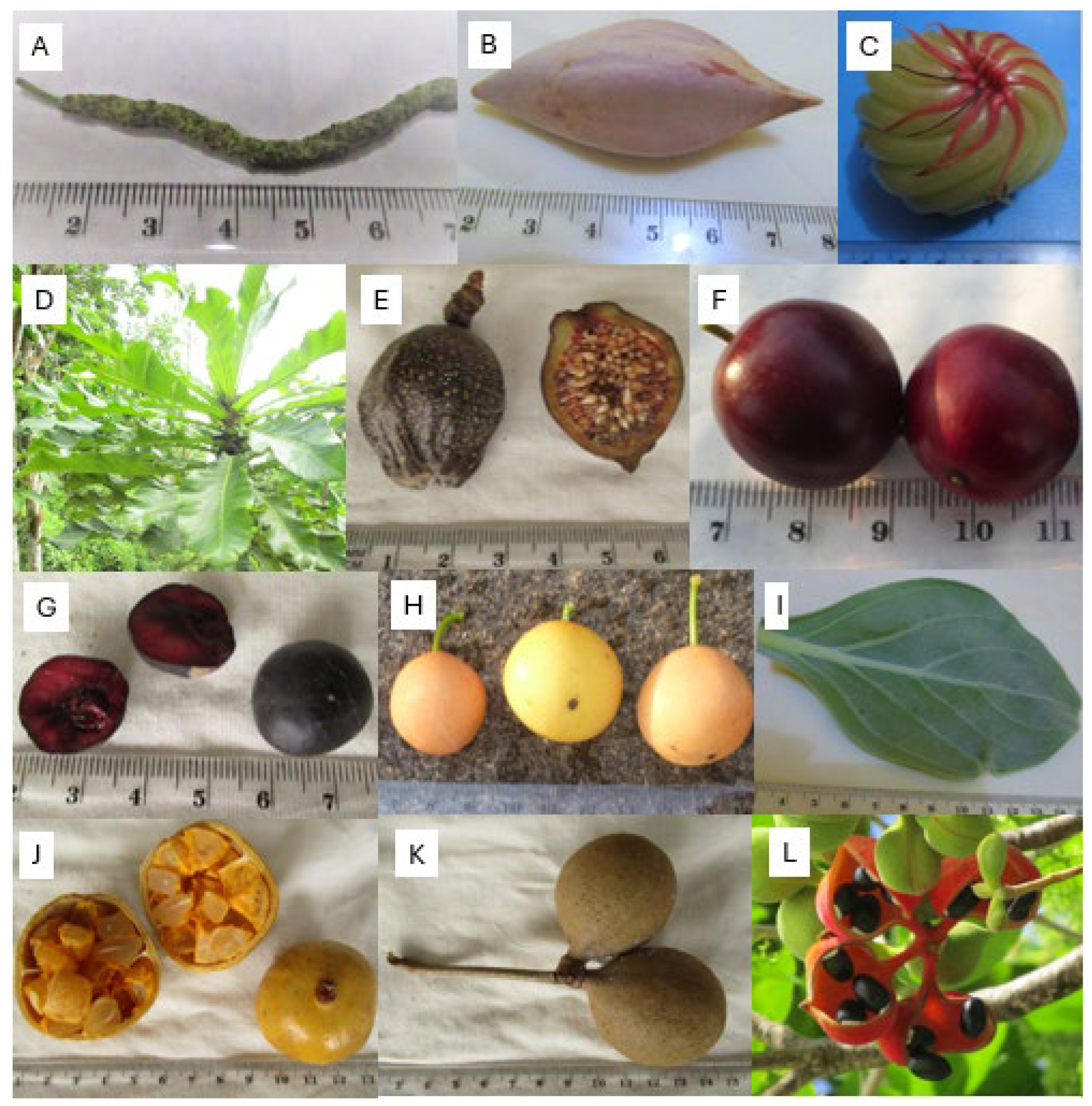
Figure 2.
Hierarchical clustering of antioxidant activities in various plant species. The color gradient represents the intensity of antioxidant activity and total phenolic content. DPPH: 2,2-diphenyl-1-picrylhydrazyl; GAE: gallic acid equivalent; IC50: half maximal inhibitory concentration; ORAC: oxygen radical absorbance capacity; TPC: total phenolic content.
Figure 2.
Hierarchical clustering of antioxidant activities in various plant species. The color gradient represents the intensity of antioxidant activity and total phenolic content. DPPH: 2,2-diphenyl-1-picrylhydrazyl; GAE: gallic acid equivalent; IC50: half maximal inhibitory concentration; ORAC: oxygen radical absorbance capacity; TPC: total phenolic content.
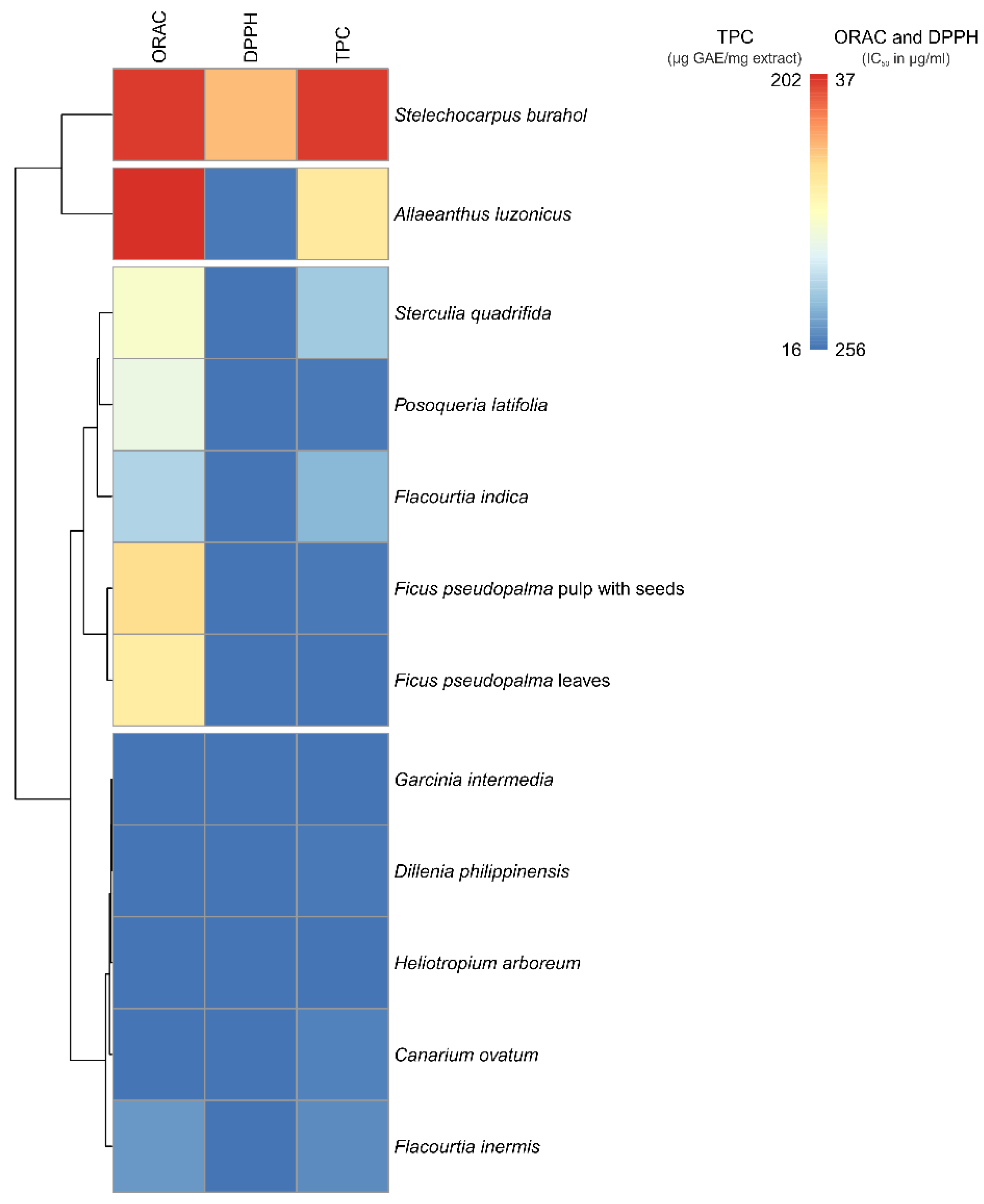

Table 1.
Ethnobotanical data on neglected and underutilized edible tree species of the Philippines.
| Scientific name of the species |
Family | Local name | VSN | Collection site | Plant part used | Traditional edible uses references |
|---|---|---|---|---|---|---|
| Allaeanthus luzonicus (Blanco) Fern.-Vill., syn. Broussonetia luzonica (Blanco) Burr. | Moraceae | Baeg, himbabao |
NA | Market in Manila, Metropolitan Manila Province | inflorescence | Inflorescence is cooked and eaten as vegetable 24,25 |
| Canarium ovatum Engl. | Burseraceae | Pili | NA | Garden of the Institute of Plant Breeding, Los Banos, Laguna Province | seed | Seeds are eaten as nuts 24,26 |
| Dillenia philippinensis Rolfe | Dilleniaceae | Katmon | 02492KBFR8 | Mount Makiling Forest, Los Banos, Laguna Province | fruit pulp | Fruit is acid and eaten raw as fruit or used as souring agent 24,26 |
| Ficus pseudopalma Blanco | Moraceae | Niog-niogan | 02493KBFR9 | Dr. Coronel Fruit Conservation Farm, Los Banos, Laguna Province | young leaves | Young leaves eaten as vegetable, raw or cooked 24,26 |
| fruit pulp with seeds | Fruit eaten raw or cooked, taste like rhubarb 24,26 | |||||
| Flacourtia indica (Burm.f.) Merr. | Salicaceae | Kakai, palutan |
02494KBFRA | Garden of the Institute of Plant Breeding, Los Banos, Laguna Province | whole fruit | Tasty fruits eaten fresh or processed into jellies and jams 24,27 |
| Flacourtia inermis Roxb. | Salicaceae | Lovi-lovi, batoko plum |
02495KBFRB | Garden of the Institute of Plant Breeding, Los Banos, Laguna Province | whole fruit | Acidic fruits eaten fresh or processed into jellies and jams 24,26,27 |
| Garcinia intermedia (Pittier) Hammel | Clusiaceae | Berba, waika plum |
02496KBFRC | Garden of the Institute of Plant Breeding, Los Banos, Laguna Province | fruit pulp | Fruit eaten raw, with sweet to sour taste, or processed into jams, jellies and drinks 24 |
| Heliotropium arboreum (Blanco) Mabb., syn. Argusia argentea (L.f.) Heine | Boraginaceae | Kapal-kapal, salakapo | 02511KBFR0 | Sambawan Island beach, Biliran Province | leaves | Leaves with parsley-like taste, eaten as vegetable raw in salads or cooked 25 |
| Posoqueria latifolia (Rudge) Schult. | Rubiaceae | Not known | 02502KBFR0 | Dr. Coronel Fruit Conservation Farm, Los Banos, Laguna Province | fruit pulp | Fleshy raw aril eaten as fruit 24 |
| Stelechocarpus burahol (Blume) Hook.f. & Thomson | Annonaceae | Kepel | 02499KBFRF | Dr. Coronel Fruit Conservation Farm, Los Banos, Laguna Province | fruit pulp | Fruit pulp is eaten as fresh fruit 24 |
| Sterculia quadrifida R.Br. | Malvaceae | Red-fruited kurrajong | 02519KBFR8 | Sambawan Island beach, Biliran Islands province | seeds | Seeds are eaten raw or roasted as nuts 24 |
NA: not available; VSN: voucher specimen number.
Table 2.
Antioxidant activity and total phenolic content of neglected and underutilized edible tree species of the Philippines.
Table 2.
Antioxidant activity and total phenolic content of neglected and underutilized edible tree species of the Philippines.
| Species | Extraction yield (%) | Antioxidant assay /mean IC50 ± SD (µg/ml) | TPC (µg GAE/mg extract) | |
|---|---|---|---|---|
| DPPH | ORAC | |||
| Allaeanthus luzonicus | 12.0 | 253.7±13.1 | 32.2±12.9 | 133.0±4.6 |
| Canarium ovatum | 10.2 | >256 | >256 | 23.2±4.1 |
| Dillenia philippinensis | 21.5 | >256 | >256 | 18.2±1.7 |
| Ficus pseudopalma leaves | 7.8 | >256 | 122.2±8.1 | 16.1±0.7 |
| F. pseudopalma pulp with seeds | 7.2 | >256 | 106.7±25.2 | 18.6±0.9 |
| Flacourtia indica | 57.5 | >256 | 203.7±25.4 | 45.9±1.1 |
| Flacourtia inermis | 38.1 | >256 | 236.6±14.6 | 25.6±1.0 |
| Garcinia intermedia | 26.1 | >256 | >256 | 17.8±1.9 |
| Heliotropium arboreum | 11.1 | >256 | >256 | 16.7±4.1 |
| Posoqueria latifolia | 20.1 | >256 | 166.7±21.9 | 19.6±0.8 |
| Stelechocarpus burahol | 12.3 | 91.0±12.6 | 37.9±8.7 | 202.1±6.7 |
| Sterculia quadrifida | 13.1 | >256 | 152.3±9.4 | 55.6±2.4 |
| Trolox | 9.2±2.5 | 7.9±1.2 | ||
Footnotes: DPPH: 2,2-diphenyl-1-picrylhydrazyl; GAE: gallic acid equivalent; IC50: half maximal inhibitory concentration; ORAC: oxygen radical absorbance capacity; SD: standard deviation; TPC: total phenolic content.
Disclaimer/Publisher’s Note: The statements, opinions and data contained in all publications are solely those of the individual author(s) and contributor(s) and not of MDPI and/or the editor(s). MDPI and/or the editor(s) disclaim responsibility for any injury to people or property resulting from any ideas, methods, instructions or products referred to in the content. |
© 2024 by the authors. Licensee MDPI, Basel, Switzerland. This article is an open access article distributed under the terms and conditions of the Creative Commons Attribution (CC BY) license (http://creativecommons.org/licenses/by/4.0/).
Copyright: This open access article is published under a Creative Commons CC BY 4.0 license, which permit the free download, distribution, and reuse, provided that the author and preprint are cited in any reuse.


