

Submitted:
28 August 2024
Posted:
29 August 2024
You are already at the latest version
Abstract
This study explored the correlation between concentrations of phenolic compounds (phenols, tannins, and flavonoids) and the versatility of woody medicinal plants in the Caatinga, a seasonally dry forest region in Brazil. We examined whether these compounds influence the versatility of plants used by populations, given their known therapeutic properties. Plants were categorized as high or low versatility based on their relative importance (RI) values at the regional level. Samples collected in Catimbau National Park, Pernambuco, were analyzed using colorimetric methods: Folin-Ciocalteu reagent for total phenols, casein precipitation for tannins, and aluminum chloride complexation for flavonoids. Contrary to expectations, no significant differences in phenolic compound concentrations were found between the high and low versatility groups. Higher levels of total phenols and tannins were observed in Myracrodruon urundeuva and Anadenanthera colubrina, both highly versatile species. However, less versatile species, such as Mimosa tenuiflora and Schinopsis brasiliensis, also showed high levels. Flavonoid content, notably lower than phenols and tannins, did not show significant variation between groups. Although phenolic compounds contribute to the therapeutic properties of medicinal plants, their concentration alone does not determine the versatility of plants in the Caatinga. Versatility is more likely influenced by ecological conditions, cultural practices, and species availability. This study highlights the need to integrate multiple perspectives in ethnopharmacological research.
Keywords:
Phytochemistry
; Tannins
; Seasonal dry forests
; Ethnobotany
; Ethnopharmacology
; Medicinal plants
; Phenols
; Flavonoids
; Plant chemicals
; Woody Plants
1. Introduction
Contemporary research has underscored the significance of secondary metabolites produced by plants, including alkaloids, tannins, flavonoids, terpenoids, saponins, steroids, and coumarins. These compounds exhibit diverse pharmacological activities, such as anti-inflammatory, antioxidant, healing, antimicrobial, and antifungal properties [1,2]. They play a critical role as therapeutic agents and significantly influence the selection and utilization of medicinal plants [3,4].
Plants synthesize these chemical compounds as part of their physiology, which is essential for completing their life cycle in different environments. Depending on the species and environmental conditions, plants may increase the production of secondary metabolites as an adaptive response or defend against biotic and abiotic challenges, such as herbivory, pathogen attacks, drought stress, poor soil fertility, or salinity [5,6,7].
Ethnobotanical interest, particularly in the phytochemical and ethnopharmacological aspects, has grown, driven by local knowledge [8,9]. The Caatinga region, characterized by its seasonality and irregular, concentrated precipitation, provides edaphoclimatic conditions conducive to the synthesis of secondary metabolites, especially phenolics, such as tannins and flavonoids.
These compounds have been identified in numerous plants commonly used in local medicinal practices in the Caatinga [10,11,12,13], and studies have indicated a significant correlation between these compounds and the therapeutic activities attributed to medicinal species [14,15,16,17,18].
The medicinal importance of a plant is often evaluated based on its versatility, which is defined as its range of therapeutic applications. This versatility can be quantified using the Relative Importance Index (RI), which reflects the therapeutic value and cultural significance [19,20,21]. A systematic review assessing the RI of 385 species of woody medicinal plants (angiosperms) in Caatinga highlighted substantial agreement between high RI values and the popular use of these plants [22], underscoring the importance of this metric in identifying plants with potential for bioprospecting [23,24,25].
In Caatinga, phenolic compounds are notably prevalent in plants and have been linked to the therapeutic properties of several significant medicinal species [8,24]. The concentrations of these compounds may influence the versatility of medicinal species, suggesting that more versatile species may exhibit higher concentrations of phenolic compounds. However, to date, no studies have explored this potential correlation.
Therefore, this study aimed to investigate whether the content of phenolic compounds (phenols, tannins, and flavonoids) influences the versatility of woody medicinal plants used by the Caatinga population, as assessed through RI. This hypothesis posits that more versatile woody plants tend to possess higher concentrations of these compounds. This pioneering study provides valuable insights into the phytochemistry and ethnopharmacology of medicinal plants in the Caatinga region.
2. Results
Our hypothesis was completely refuted, as no differences were observed in the clustering of the data according to the multivariate analysis of the principal components (Figure 1).
In addition, there were no significant differences in the total amounts of phenols, tannins, and flavonoids among the plant groups (Figure 2). The amount of phenols in the group with greater versatility was 66.547 ± 37.955 mg TAE/100 g DM, whereas that in the group with less versatility was 56.440 ± 40.427 mg TAE/100 g DM (Figure 2A).
A similar pattern was observed for total tannins between the plant groups. No significant differences were found in the average tannin content, with the amount in the most versatile group being 57.586 ± 32.600 mg TAE/100 g DM, whereas in the least versatile group, the average total tannin content was 51.760 ± 36.506 mg TAE/100g DM (Figure 2B). The same trend was observed for flavonoids. The average value found for the group with greater versatility was 0.756 ± 0.303 mg RE/100 g DM, whereas in the group with less versatility, it was 0.644 ± 0.357 mg RE/100 g DM (Figure 2C). The details of the statistical analyses are presented in Table 1.
The total amounts of the phenols, tannins, and flavonoids are listed in Table 2. Among the most versatile plants, Anadenanthera colubrina exhibited the highest total phenol content (127.122 mg TAE/100 g DM). This was the third species listed according to its relative importance value (RI = 1.69). In contrast, Myracrodruon urundeuva, the species with the highest relative importance value on the list (IR—1.94), presented 116.423 mg TAE/100 g DM, which had RI (Table 2).
In contrast, among the least versatile plants, Mimosa tenuiflora, ranked twelfth due to its assigned RI value (RI = 0.74), showed a high total phenol content (122.428 mg TAE/100 g DM), similar to A. colubrina. Additionally, Schinopsis brasiliensis (RI = 0.62), also listed among the least versatile species according to its RI value, exhibited a total phenol content of 109.924 mg TAE/100 g DM, which is comparable to that of M. urundeuva, which is considered more versatile. Similar patterns were observed for the tannin levels. Among the most versatile plants, A. colubrina and Libidibia ferrea (third and second positions according to RI values) exhibited 122.052 mg and 81.741 mg TAE/100 g DM), respectively. In contrast, among the least versatile plants, S. brasiliensis and M. tenuiflora (fourteenth and twelfth positions according to RI values) exhibited 104.082 mg and 99.549 mg TAE/100 g DM, respectively (Table 2).
The species with the highest levels of flavonoids within the most versatile group were Ximenia americana (RI = 0.37) and M. urundeuva (1.129 and 1.005 mg RE/100 g DM, respectively). Similarly, in the less versatile group, S. brasiliensis and M. tenuiflora exhibited 1.452 mg and 1.115 mg RE/100 g DM, respectively, which were comparable to those found in the more versatile species (Table 2).
3. Discussion
The initial hypothesis of this study, based on previous research [13,14,15,26], suggests that more versatile medicinal plants in the Caatinga would have higher concentrations of phenolic compounds. Contrary to this expectation, our results did not reveal significant differences in phenolic compound concentrations between plants with different versatility indices (RI). This discrepancy between the initial hypothesis and observed results may reflect the complexity and variability inherent in the relationship between chemical composition and therapeutic use of plants.
This finding is consistent with the observations of [27], who also did not find a direct correlation between tannin concentration and the use value of plants. These collective findings underscore the importance of considering multiple factors, including cultural and ecological aspects, in the selection and utilization of medicinal plants, surpassing simplistic analyses that focus solely on their chemical composition.
RI methodology has previously been validated for the popular uses of species, with plants presenting higher IRs showing documented pharmacological activities [22,23]. This pattern was reaffirmed by consulting literature on the phytochemistry and biological activity of each species. However, the primary objective of this study was to ascertain whether species with greater versatility (higher RI values) would exhibit higher concentrations of phenolic compounds, a hypothesis that is not supported by our findings.
One potential explanation for this inconsistency could be that previous studies primarily examined whether the therapeutic activities attributed to significant species were associated with the presence of phenolic compounds in local contexts [12,13]. We anticipated the replication or confirmation of this pattern on a regional scale, based on an updated list of RI values for medicinal species in the Caatinga region [28]. However, laboratory analyses to quantify the phenolic compounds did not substantiate this expectation. This unexpected result underscores the complexity of the relationship between chemical composition and therapeutic use of plants, indicating the necessity for more comprehensive research approaches in this domain.
The relevance of the Relative Importance Index (RI) was highlighted as an effective tool for identifying medicinal plants with potential biological activities [22]. However, they also noted that the results obtained through this index may exhibit considerable variations, particularly when compared across different scales, whether local or broader. This observation is corroborated by [13], who emphasized that RI values can be influenced by the specific context of the medical system or community where the research was conducted. For instance, local studies revealed that plants utilized for healing and anti-inflammatory treatments are associated with higher tannin concentrations, according to laboratory analyses conducted by [11]. This suggests that expanding the scale of the study may explain the results of our study.
Other variables may also explain why our initial hypothesis was not confirmed. According to [13], in addition to the presence of secondary metabolites that indicate the chemical efficacy of plants, the specific characteristics of each location must be considered. These characteristics directly influence how local communities access and utilize medicinal resources, including the availability of species.
It was observed that in two communities in the Caatinga, the use value of medicinal plants may be more related to usage frequency than to the geographic dominance of the species [29]. This suggests that the incorporation of a species into the local medical system may be influenced more by its accessibility than its abundance. Simultaneously, these authors highlighted that the preference for certain species can also be shaped by cultural influences, indicating that the most abundant species are not always the most valued.
These findings contributed to the elucidation of the results of our study. For example, we observed that Anadenanthera colubrina, which presented the highest levels of total phenols and tannins, had an RI of 1.69, ranking third in RI value (Table 2). Interestingly, species such as Mimosa tenuiflora (RI = 0.74) and Schinopsis brasiliensis (RI = 0.62), despite belonging to a group with less versatility, exhibited concentrations of phenols and tannins nearly 90% higher than the average of this group, values comparable to those found in A. colubrina and Myracrodruon urundeuva, which belong to the group with greater versatility (Table 2). In a previous study, when investigating the relationship between tannin and flavonoid levels and the therapeutic indications of plants in a Caatinga community, a higher tannin content was found in M. tenuiflora, which is associated with antimicrobial activities [24].
These findings suggest that although associations between phenolic compounds and plant medicinal versatility exist, this relationship is complex and can be influenced by numerous factors, including cultural aspects and species accessibility. Thus, they challenged our initial assumptions and pointed to the necessity for a more nuanced approach to the study of medicinal plants.
Plants in the Caatinga region synthesize phenolic compounds in response to ecogeographic conditions [8]. According to our findings, synthesizing these compounds, regardless of their quantity, in conjunction with species availability, can influence the versatility of medicinal plants. Moreover, the perception of efficacy is a critical criterion in the selection of medicinal plants [30], where efficacy can be perceived through continuous species use and symptom improvement observation, irrespective of the levels of compounds produced.
The case of Ziziphus joazeiro illustrates this point. Although it belongs to the group of most versatile plants, it contains low levels of phenolic compounds (Table 2). Previous studies have suggested that the pharmacological properties of Z. joazeiro can be attributed to saponin synthesis [9,31,32]. Thus, a plant can be considered highly versatile even if the compounds responsible for its therapeutic activity belong to another class. Conversely, Byrsonima gardneriana, a less versatile species according to its RI (0.21), exhibited high levels of total phenols and tannins, similar to those of A. colubrina (Table 2).
Similarly, no significant difference was observed in flavonoid content between the more and less versatile plants. Flavonoids are widely distributed in species of the Fabaceae family, and are known for their antimicrobial and antioxidant activities [33]. In the two groups studied, the levels of flavonoids found in peels were approximately 80% lower than those of phenols and tannins. This pattern is supported by [11], who concluded that the indication for anti-inflammatory activities was not directly related to flavonoid content when analyzing flavonoid content in different plant groups according to local use.
The study of woody medicinal plants from the Caatinga highlights is an important aspect of the chemical ecology of plants, and different types of compounds are synthesized according to environmental conditions. Flavonoids, typically produced in smaller quantities by plants, tend to be more concentrated in the leaves, and species from arid and semi-arid ecosystems, such as the Caatinga, prioritize the production of high-molecular-weight compounds, such as tannins [34]. In this ecosystem, tannic compounds are predominant with significant pharmacological attributes, to the detriment of other equally pharmacologically active compounds, such as flavonoids [11], which is in line with our findings.
This pioneering study investigated the influence of phenolic compound levels (total phenols, tannins, and flavonoids) on the versatility of wood medicinal plants from Caatinga. Among the most versatile species, X. americana and M. urundeuva exhibited the highest flavonoid contents. Interestingly, the less versatile species, S. brasiliensis and M. tenuiflora also exhibited high levels of these compounds (Table 2). Previous studies have identified flavonoids in medicinal plants from the Caatinga, both in the leaves and bark [10,13].
According to [35], flavonoids are compounds with low molecular weight and high biological activity, such as alkaloids and terpenoids, whereas tannins and saponins, with high molecular weight, tend to have lower biological activity. Therefore, even at low concentrations, flavonoids may be responsible for the biological activity of medicinal species, whereas tannins require greater quantities to exert such activity.
4. Materials and Methods
4.1. Selection of Species for Study
To investigate whether the concentration of phenolic compounds explains versatility, we utilized a list of medicinal tree species from the Caatinga, as published by [28]. This study calculated the Relative Importance Index (RI) for 147 species, including woody species, palm trees, and cacti used medicinally in the Caatinga. RI values ranging from 0 to 2 indicate species versatility, with values closer to 2 indicating higher versatility for medicinal use [19].
The RI values from this study were employed to determine the listed species’ Conservation Priority Index (CPI) [28]. Consequently, we selected 20 woody plant species from this list to conduct phytochemical analyses, focusing on quantifying the total phenols, tannins, and flavonoids. Among these, the ten most versatile species, with RI values closest to 2, were chosen for analysis (Table 3).
4.2. Collection of Plant Material
Samples of the listed species (Table 3) were collected within the Catimbau National Park (8°24′00″ “ to 8°36′35” S; 37°0′30” to 37°1′40”″ W) within the permanent study plots of the PELD Catimbau Project (Long-Term Ecological Project) (see https://www.peldcatimbau.org/). This Park, located in Pernambuco, Northeast Brazil, features a hot, semi-arid climate (BSh, according to the Köppen classification) [36].
Established in 2012, the park comprises 13 rural communities: Túnel, Açude Velho, Dor de dente, Muquém, Breus, Igrejinha, Batinga, Serra Branca, Malhador, Cumbre, and Quiridalho [37]. Testimonial material from the permanent plots is deposited in the UFP and IPA herbaria. Indigenous populations and surrounding rural communities sustain a subsistence relationship with the region’s flora, engaging in activities such as hunting, logging, collecting firewood, and utilizing plant resources [38].
Samples consisted of stem bark, which is the primary resource used for therapeutic extracts because of its perennial nature [39]. A minimum of three individuals of each species were selected, spaced 3–5 m apart. Bark samples were collected from each individual, forming a composite sample of 500 g. Bark samples were collected in a standardized manner at breast height (approximately 1.30 m above the ground level) from all individuals of the species.
The samples were placed in labeled paper bags and dried in an oven with forced air circulation at 25 °C. Subsequently, they were processed in the Plant Physiology Laboratory (UFPE) using a Willey knife mill (R-TE-650/1, Tecnal) to obtain a powder.
4.3. Preparation of Crude Extract for Phytochemical Analysis
Bark powder (500 mg) from each species was extracted in 50 mL beakers containing 25 mL of 80% methanol (v/v). The mixture was gently boiled on a hot plate (TE-0851, Tecnal, Männedorf, Switzerland) for 30 min. Extracts were filtered using qualitative filter paper (Unifil 80 g/m2) in 50 mL volumetric flasks. The residues were washed with an additional 25 mL of 80% (v/v) methanol solvent, filtered again, and the final volume of the flask was adjusted with the same solvent [40]. Extractions for each species were conducted in triplicate for subsequent analysis of total phenols, tannins, and flavonoids.
4.4. Determination of the Total Phenolic (TPC) and Total Tannin Content (TTC)
The total phenolic content (TPC) was determined using the Folin-Ciocalteu method [40]. Aliquots of extracts (0.125–0.25 mL) were pipetted into 25 mL volumetric flasks. Subsequently, 1.25 mL of 10% (v/v) Folin-Ciocalteu reagent and 7.5% (w/v) aqueous sodium carbonate solution (2.5 mL) were added. The final volume of the flasks was filled with deionized water and the samples were left to react in the dark for 30 min. The absorbance was measured at 760 nm using a spectrophotometer (Genesys 10S, Thermo Fisher Scientific, Waltham, MA, USA).
Total tannin content (TTC) was quantified using the residual phenol content obtained via the casein precipitation method, followed by the Folin-Ciocalteu method with some modifications [40]. Aliquots of the extracts (6 mL) were pipetted into Erlenmeyer flasks containing 1 g casein powder and 12 mL deionized water. The samples were mechanically stirred for 3 h at room temperature and were protected from light. After filtration, aliquots of the resulting solution were used to quantify residual phenols via the Folin-Ciocalteu method.
The amount of TTC was determined by comparing the total and residual phenols. The quantification of TPC and TTC was estimated using the calibration curve obtained by preparing a standard solution of tannic acid (0.1 mg/mL). The TPC and TTC were expressed in milligrams of tannic acid equivalents per gram of dry matter (mg TAE/100 g DM) [40].
4.5. Determination of Total Flavonoid Contents (TFC)
Total flavonoid content (TFC) was determined according to the method of [40]. Aliquots of the extracts (1 mL) were pipetted into 25 mL volumetric flasks. Then, 0.6 mL of glacial acetic acid and 10 mL of 20% (v/v) methanolic pyridine solution were then added, followed by 2.5 mL of 5% (w/v) methanolic aluminum chloride solution. The final volume of each flask was filled with deionized water and shaken appropriately. The reaction was performed in the dark for 30 min, and the absorbance was measured at 420 nm using a spectrophotometer.
TFC was estimated using the calibration curve obtained with the preparation of the standard rutin solution (0.5 mg/mL). The amount of TFC was expressed in milligrams of rutin equivalents per gram of dry matter (mg RE/100 g DM) [40].
4.6. Data Analysis
Species were divided into two groups based on RI values:
Data were analyzed for normality using the Shapiro-Wilk test and homoscedasticity using the Bartlett test. Subsequently, an Analysis of Variance (ANOVA) was conducted to compare the average levels of each compound class (total phenols, tannins, and flavonoids) between the two groups of plants (high and low RI). Statistical analyses were performed using the R software at a significance level of 5% (p < 0.05).
Principal component analysis (PCA) was performed to verify possible clusters. Data were transformed (logarithm) for standardization owing to different scale magnitudes. The level of importance of each PC was determined using the Broken-stick method, where eigenvalues exceeding the expected values were kept for interpretation. Analyses were performed using software OriginPRO 2018.
5. Conclusions
The results suggest that the levels of total phenols, tannins, and flavonoids are not decisive in defining the versatility of woody medicinal plants from the Caatinga. The versatility of a species is influenced more by the context of the local medical system and the dynamics of each community, considering the set of available species. In the Caatinga, these species exhibited wide variation in their relative importance values, contributing to an equitable distribution between groups of greater and lesser versatility.
This resulted in the absence of significant differences in the quantification of these compounds between the two groups. Furthermore, other factors, such as chemical diversity encompassing compounds other than phenolics and cultural influences, can play fundamental roles in determining the versatility of a species.
Supplementary Materials
The following supporting information can be downloaded at the website of this paper posted on Preprints.org.
Author Contributions
M.M.A.S: Data curation, methodology, writing—original draft preparation, visualization, investigation, and writing. U.P.A: conceptualization, methodology, supervision, validation, writing, review, and editing. M.T.d.O: methodology, supervision, and validation. A.F.M.d.O: Methodology, supervision, and validation.
Funding
This research was funded in part by the INCT Ethnobiology, Bioprospecting, and Nature Conservation, certified by CNPq, with financial support from FACEPE (Foundation for Support to Science and Technology of the State of Pernambuco—Grant number: APQ-0562-2.01/17).
Data Availability Statement
We encourage all authors of articles published in MDPI journals to share their research data. In this section, please provide details regarding where data supporting reported results can be found, including links to publicly archived datasets analyzed or generated during the study. Where no new data were created, or where data is unavailable due to privacy or ethical restrictions, a statement is still required. Suggested Data Availability Statements are available in section “MDPI Research Data Policies” at https://www.mdpi.com/ethics.
Acknowledgments
The authors would like to thank the PELD Catimbau project for providing access to the collection area, the Plant Physiology Laboratory at UFPE for providing the laboratory to carry out phytochemical analyses, the Applied Ecology and Phytochemistry Laboratory at UFPE for providing support materials for carrying out phytochemical analyses, and Me. Aníbal Silva Cantalice for assistance in conducting the statistical analyses.
Conflicts of Interest
The authors declare no conflicts of interest.
References
- Velu, G.; Palanichamy, V.; Rajan, A.P. Phytochemical and Pharmacological Importance of Plant Secondary Metabolites in Modern Medicine. Bioorganic Phase in Natural Food: An Overview 2018, 135–156. [CrossRef]
- Durazzo, A.; Lucarini, M.; Souto, E.B.; Cicala, C.; Caiazzo, E.; Izzo, A.A.; Novellino, E.; Santini, A. Polyphenols: A Concise Overview on the Chemistry, Occurrence, and Human Health. Phytotherapy Research 2019, 33, 2221–2243. [CrossRef]
- Hussein, R.A.; El-Anssary, A.A.; Hussein, R.A.; El-Anssary, A.A. Plants Secondary Metabolites: The Key Drivers of the Pharmacological Actions of Medicinal Plants. Herbal Medicine 2018. [CrossRef]
- Süntar, I. Importance of Ethnopharmacological Studies in Drug Discovery: Role of Medicinal Plants. Phytochemistry Reviews 2020, 19, 1199–1209. [CrossRef]
- Yang, L.; Wen, K.S.; Ruan, X.; Zhao, Y.X.; Wei, F.; Wang, Q. Response of Plant Secondary Metabolites to Environmental Factors. Molecules 2018, Vol. 23, Page 762 2018, 23, 762. [CrossRef]
- Isah, T.; Isah, T. Stress and Defense Responses in Plant Secondary Metabolites Production. Biol Res 2019, 52, 39. [CrossRef]
- Pant, P.; Pandey, S.; Dall’Acqua, S. The Influence of Environmental Conditions on Secondary Metabolites in Medicinal Plants: A Literature Review. Chem Biodivers 2021, 18, e2100345. [CrossRef]
- Albuquerque, U.P.; Ramos, M.A.; Melo, J.G. New Strategies for Drug Discovery in Tropical Forests Based on Ethnobotanical and Chemical Ecological Studies. J Ethnopharmacol 2012, 140, 197–201. [CrossRef]
- Albuquerque, U.P.; de Brito, A.L.; do Nascimento, A.L.B.; de Oliveira, A.F.M.; Quixabeira, C.M.T.; de Queiroz Dias, D.; Lira, E.C.; Silva, F.S.; de Araújo Delmondes, G.; Coutinho, H.D.M. Medicinal Plants and Animals of an Important Seasonal Dry Forest in Brazil. Ethnobiology & Conservation 2020, 9.
- De Almeida, C.F.C.B.R.; De Lima E Silva, T.C.; De Amorim, E.L.C.; Maia, M.B.D.S.; De Albuquerque, U.P. Life Strategy and Chemical Composition as Predictors of the Selection of Medicinal Plants from the Caatinga (Northeast Brazil). J Arid Environ 2005, 62, 127–142. [CrossRef]
- de Sousa Araújo, T.A.; Alencar, N.L.; de Amorim, E.L.C.; de Albuquerque, U.P. A New Approach to Study Medicinal Plants with Tannins and Flavonoids Contents from the Local Knowledge. J Ethnopharmacol 2008, 120, 72–80. [CrossRef]
- Alencar, N.L.; Araújo, T.A. de S.; de Amorim, E.L.C.; de Albuquerque, U.P. Can the Apparency Hypothesis Explain the Selection of Medicinal Plants in an Area of Caatinga Vegetation? A Chemical Perspective. Acta Bot Brasilica 2009, 23, 911–911. [CrossRef]
- De Almeida, C.D.F.C.B.R.; Cavalcanti De Amorim, E.L.; De Albuquerque, U.P. Insights into the Search for New Drugs from Traditional Knowledge: An Ethnobotanical and Chemical–Ecological Perspective. http://dx‐doi.ez16.periodicos.capes.gov.br/10.3109/13880209.2010.551777 2011, 49, 864–873. [CrossRef]
- Monteiro, J.M.; Albuquerque, U.P.; Lins Neto, E.M.F.; Araújo, E.L.; Albuquerque, M.M.; Amorim, E.L.C. The Effects of Seasonal Climate Changes in the Caatinga on Tannin Levels in Myracrodruon Urundeuva (Engl.) Fr. All. and Anadenanthera Colubrina (Vell.) Brenan. Revista Brasileira de Farmacognosia 2006, 16, 338–344. [CrossRef]
- Monteiro, J.M.; Albuquerque, U.P. De; Lins-Neto, E.M.D.F.; Araújo, E.L. De; Amorim, E.L.C. De Use Patterns and Knowledge of Medicinal Species among Two Rural Communities in Brazil’s Semi-Arid Northeastern Region. J Ethnopharmacol 2006, 105, 173–186. [CrossRef]
- José, T.; Sobrinho, S.P.; Peixoto Sobrinho, T.J.S.; Castro, V.T.N.A.; Saraiva, A.M.; Almeida, D.M.; Tavares, E.A.; Amorim, E.L.C. Phenolic Content and Antioxidant Capacity of Four Cnidoscolus Species (Euphorbiaceae) Used as Ethnopharmacologicals in Caatinga, Brazil. Article in African Journal of Pharmacy and Pharmacology 2011, 5, 2310–2316. [CrossRef]
- Chaves, T.P.; Santana, C.P.; Véras, G.; Brandão, D.O.; Felismino, D.C.; Cláudia, A.; Medeiros, D.; De, D.M.; Trovão, B.M. Seasonal Variation in the Production of Secondary Metabolites and Antimicrobial Activity of Two Plant Species Used in Brazilian Traditional Medicine. Afr J Biotechnol 2013, 12, 847–853. [CrossRef]
- Amorim, E.L.C. de; Cruz, P.; Filho, J.V.; Silva, I.C.; Costa, U.; Oliveira, J.; Medeiros, M.S.; Diniz, M.; Machado, K.; Xavier, A.C.; et al. Brazilian Caatinga: Phenolic Contents, Industrial and Therapeutic Applications. 2021. [CrossRef]
- Author, A.; Bennett, B.C.; Prance, G.T. Introduced Plants in the Indigenous Pharmacopoeia of Northern South. Botany 54, 90–102.
- da Silva, A.C.O.; de Albuquerque, U.P. Woody Medicinal Plants of the Caatinga in the State of Pernambuco (Northeast Brazil). Acta Bot Brasilica 2005, 19, 17–26. [CrossRef]
- Biol Sci, B.J.; dos Santos Souza, A.; Paula Braz de Souza, A.; Farias Paiva de Lucena, R. Relative Importance of Medicinal Plants in the Semi-Arid Region of Paraíba: A Case Study in the Municipality of Congo (Paraíba, Northeast Brazil). Brazilian Journal of Biological Sciences 2016, 83–96. [CrossRef]
- de Albuquerque, U.P.; de Medeiros, P.M.; de Almeida, A.L.S.; Monteiro, J.M.; de Freitas Lins Neto, E.M.; de Melo, J.G.; dos Santos, J.P. Medicinal Plants of the Caatinga (Semi-Arid) Vegetation of NE Brazil: A Quantitative Approach. J Ethnopharmacol 2007, 114, 325–354. [CrossRef]
- Cartaxo, S.L.; de Almeida Souza, M.M.; de Albuquerque, U.P. Medicinal Plants with Bioprospecting Potential Used in Semi-Arid Northeastern Brazil. J Ethnopharmacol 2010, 131, 326–342. [CrossRef]
- Siqueira, C.F.D.Q.; Cabral, D.L.V.; Peixoto Sobrinho, T.J.D.S.; De Amorim, E.L.C.; De Melo, J.G.; Araújo, T.A.D.S.; De Albuquerque, U.P. Levels of Tannins and Flavonoids in Medicinal Plants: Evaluating Bioprospecting Strategies. Evidence-Based Complementary and Alternative Medicine 2012, 2012, 434782. [CrossRef]
- Ribeiro, D.A.; Macêdo, D.G.; Oliveira, L.G.S.; Saraiva, M.E.; Oliveira, S.F.; Souza, M.M.A.; Menezes, I.R.A. Potencial Terapêutico e Uso de Plantas Medicinais Em Uma Área de Caatinga No Estado Do Ceará, Nordeste Do Brasil. Revista Brasileira de Plantas Medicinais 2014, 16, 912–930. [CrossRef]
- Júnior, W.S.F.; Ladio, A.H.; Albuquerque, U.P. De Resilience and Adaptation in the Use of Medicinal Plants with Suspected Anti-Inflammatory Activity in the Brazilian Northeast. J Ethnopharmacol 2011, 138, 238–252. [CrossRef]
- Monteiro, J.M.; de Souza, J.S.N.; Lins Neto, E.M.F.; Scopel, K.; Trindade, E.F. Does Total Tannin Content Explain the Use Value of Spontaneous Medicinal Plants from the Brazilian Semi-Arid Region? Revista Brasileira de Farmacognosia 2014, 24, 116–123. [CrossRef]
- Campos, J.L.A.; Albuquerque, U.P. Indicators of Conservation Priorities for Medicinal Plants from Seasonal Dry Forests of Northeastern Brazil. Ecol Indic 2021, 121, 106993. [CrossRef]
- de Lucena, R.F.P.; Araújo, E. de L.; de Albuquerque, U.P. Does the Local Availability of Woody Caatinga Plants (Northeastern Brazil) Explain Their Use Value? Econ Bot 2007, 61, 347–361. [CrossRef]
- De Medeiros, P.M.; Ladio, A.H.; Albuquerque, U.P. Local Criteria for Medicinal Plant Selection. Evolutionary Ethnobiology 2015, 149–162. [CrossRef]
- Cosmo Andrade, J.; da Silva, A.R.P.; Audilene Freitas, M.; de Azevedo Ramos, B.; Sampaio Freitas, T.; de Assis G. dos Santos, F.; Leite-Andrade, M.C.; Nunes, M.; Relison Tintino, S.; da Silva, M.V.; et al. Control of Bacterial and Fungal Biofilms by Natural Products of Ziziphus Joazeiro Mart. (Rhamnaceae). Comp Immunol Microbiol Infect Dis 2019, 65, 226–233. [CrossRef]
- Andrade, J.C.; Silva, A.R.P.; Santos, A.T.L.; Freitas, M.A.; Carneiro, J.N.P.; Gonçalo, M.I.P.; de Souza, A.; Freitas, T.S.; Ribeiro, P.R.V.; Brito, E.S.; et al. UPLC-MS-ESI-QTOF Characterization and Evaluation of the Antibacterial and Modulatory Antibiotic Activity of Ziziphus Joazeiro Mart. Aqueous Extracts. South African Journal of Botany 2019, 123, 105–112. [CrossRef]
- Wink, M. Evolution of Secondary Metabolites in Legumes (Fabaceae). South African Journal of Botany 2013, 89, 164–175. [CrossRef]
- Gottlieb, O.R. Evolucao Quimica Vegetal. Cienc Cult 1987, 39, 357–360.
- Feeny, P. Chapter One PLANT APPARENCY AND CHEMICAL DEFENSE.
- Alvares, C.A.; Stape, J.L.; Sentelhas, P.C.; Leonardo, J.; Gonçalves, M.; Sparovek, G. Köppen’s Climate Classification Map for Brazil.. [CrossRef]
- Laurentino, M.; de Lima Araújo, E.; Ramos, M.A.; Cavalcanti, M.C.B.T.; Gonçalves, P.H.S.; Albuquerque, U.P. Socioeconomic and Ecological Indicators in Willingness to Accept Compensation for the Conservation of Medicinal Plants in a Tropical Dry Forest. Environ Dev Sustain 2022, 24, 4471–4489. [CrossRef]
- Rito, K.F.; Arroyo-Rodríguez, V.; Queiroz, R.T.; Leal, I.R.; Tabarelli, M. Precipitation Mediates the Effect of Human Disturbance on the Brazilian Caatinga Vegetation. Journal of Ecology 2017, 105, 828–838. [CrossRef]
- de Albuquerque, U.P. Re-Examining Hypotheses Concerning the Use and Knowledge of Medicinal Plants: A Study in the Caatinga Vegetation of NE Brazil. J Ethnobiol Ethnomed 2006, 2, 1–10. [CrossRef]
- Amorim, E.L.C. de; Castro, V.T.N. de A. de; Melo, J.G. de; Corrêa, A.J.C.; Sobrinho, T.J. da S.P.; Amorim, E.L.C. de; Castro, V.T.N. de A. de; Melo, J.G. de; Corrêa, A.J.C.; Sobrinho, T.J. da S.P. Standard Operating Procedures (SOP) for the Spectrophotometric Determination of Phenolic Compounds Contained in Plant Samples. Latest Research into Quality Control 2012. [CrossRef]
Figure 1.
Principal component analysis (PCA) based on the entire data set of phenols, tannins and flavonoids, in groups of woody medicinal plants in relation to versatility (high and low RI), collected in the Catimbau National Park, Brazil (n = 3/species).
Figure 1.
Principal component analysis (PCA) based on the entire data set of phenols, tannins and flavonoids, in groups of woody medicinal plants in relation to versatility (high and low RI), collected in the Catimbau National Park, Brazil (n = 3/species).
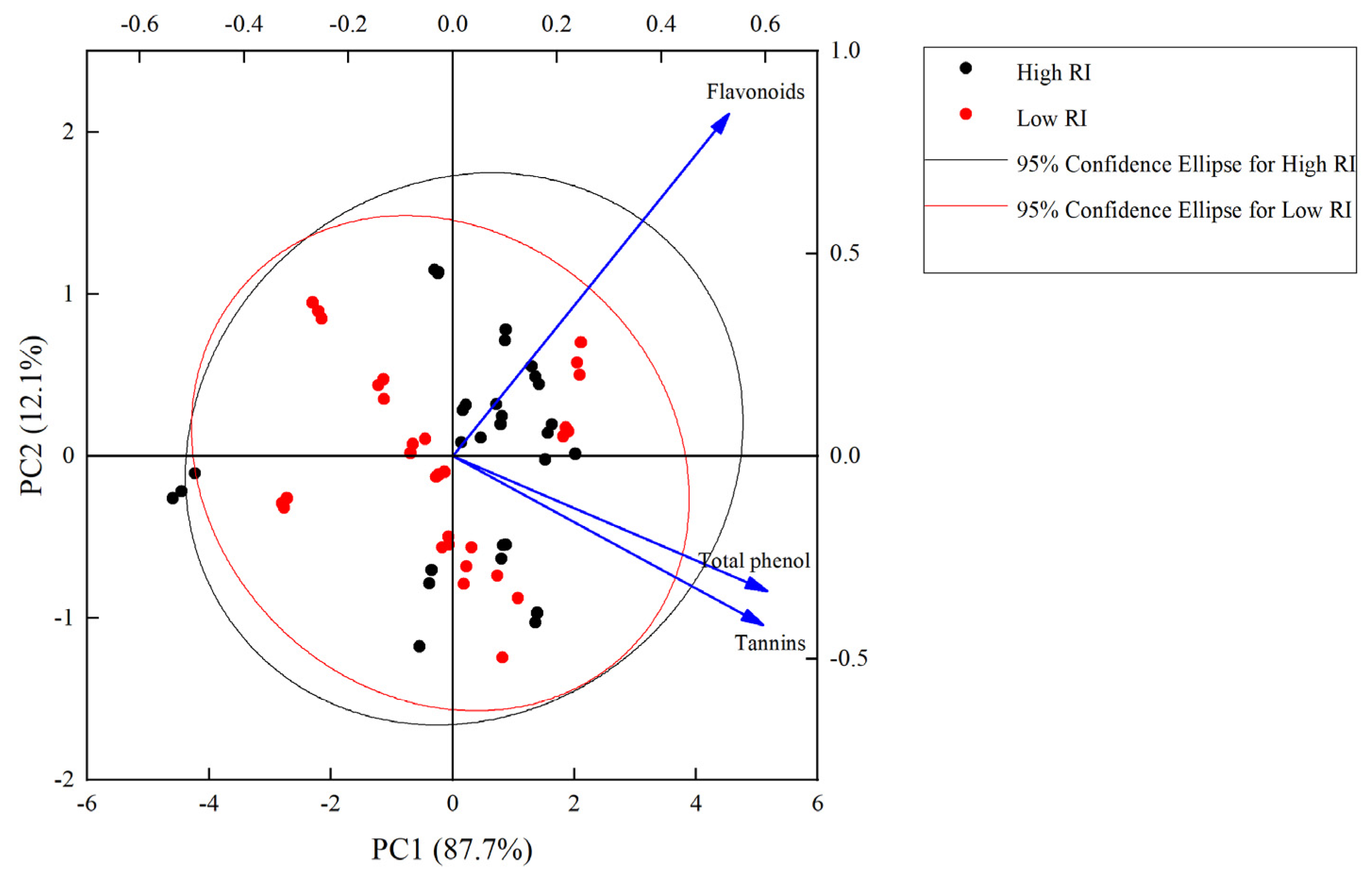
Figure 2.
Average content of total phenols (A), tannins (B) and flavonoids (C), in groups of woody medicinal plants in relation to versatility (high and low RI), collected in the Catimbau National Park, Brazil.
Figure 2.
Average content of total phenols (A), tannins (B) and flavonoids (C), in groups of woody medicinal plants in relation to versatility (high and low RI), collected in the Catimbau National Park, Brazil.
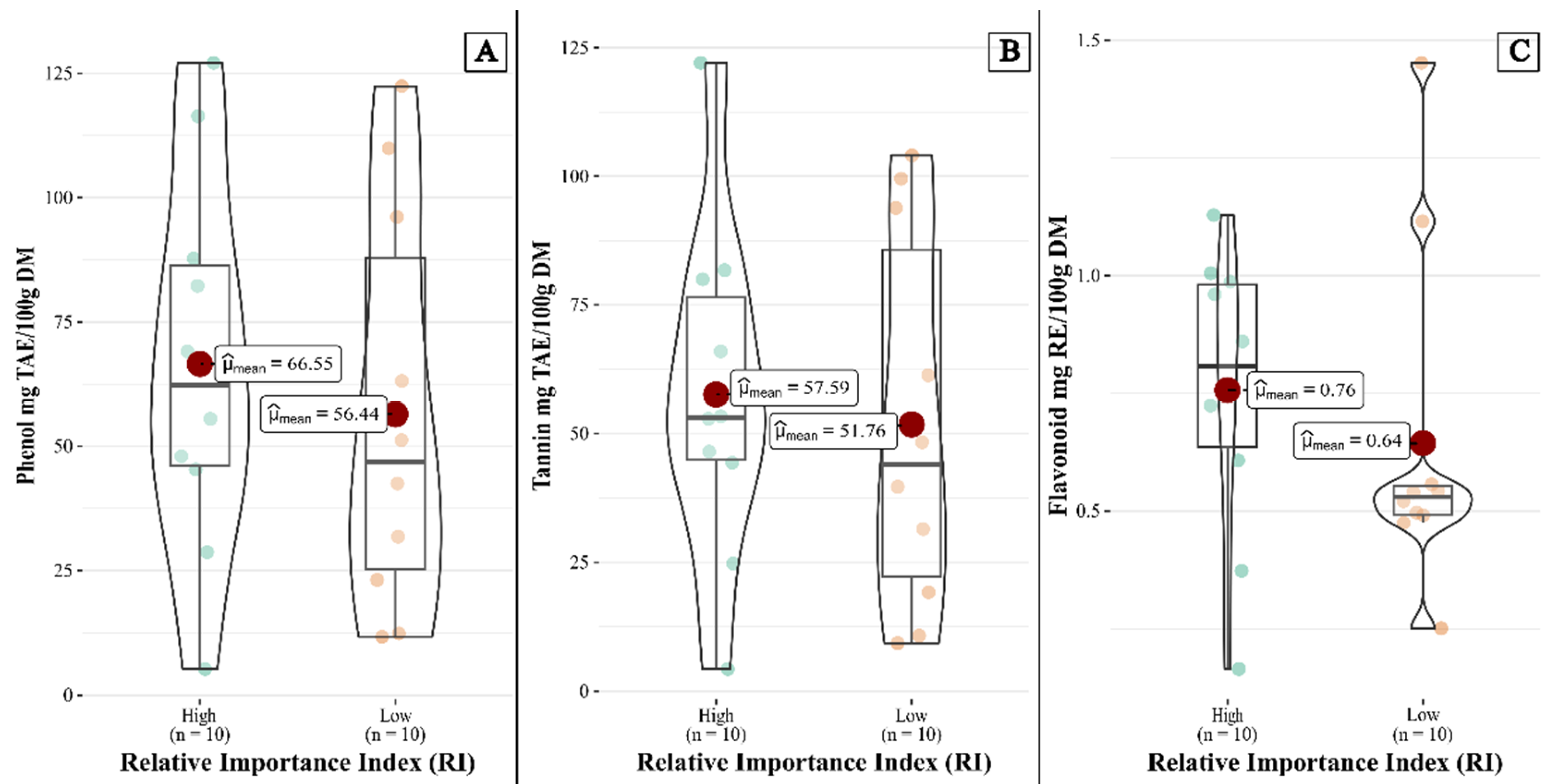

Table 1.
Average content of phenolic compounds (total phenols, tannins and flavonoids) followed by standard deviation (SD) along with p-value (ANOVA) in the groups of most versatile (high RI) and least versatile (low RI) woody medicinal plants collected in National Park do Catimbau, PE—Brazil.
Table 1.
Average content of phenolic compounds (total phenols, tannins and flavonoids) followed by standard deviation (SD) along with p-value (ANOVA) in the groups of most versatile (high RI) and least versatile (low RI) woody medicinal plants collected in National Park do Catimbau, PE—Brazil.
| Phenolic content | RI | Mean (± SD) | p (< 0.05) |
| Total phenols (mg TAE/100g DM) | Hight | 66.547 ± 37.955 | 0.5715 |
| Low | 56.440 ± 40.427 | ||
| Tannins (mg TAE/100g DM) | Hight | 57.586 ± 32.600 | 0.711 |
| Low | 51.760 ± 36.506 | ||
| Flavonoids (mg RE/100g DM) | Hight | 0.756 ± 0.303 | 0.457 |
| Low | 0.644 ± 0.357 |
(n = 3/species).
Table 2.
Average content of phenolic compounds (total phenols, tannins and flavonoids) with standard deviation, quantified in woody medicinal plants listed as more versatile (RI > 1) and less versatile (RI < 1), collected in the Catimbau National Park, PE—Brazil.
Table 2.
Average content of phenolic compounds (total phenols, tannins and flavonoids) with standard deviation, quantified in woody medicinal plants listed as more versatile (RI > 1) and less versatile (RI < 1), collected in the Catimbau National Park, PE—Brazil.
| Species | RI | Total phenols (mg TAE/100g DM) | Tannins (mg TAE/100g DM) | Flavonoids (mg RE/100g DM) |
| Myracrodruon urundeuva | 1.94 | 116.423 ± 0.799 | 79.965 ± 1.832 | 1.005 ± 0.064 |
| Libidibia ferrea | 1.74 | 82.278 ± 0.921 | 81.741 ± 0.696 | 0.607 ± 0.018 |
| Anadenanthera colubrina | 1.69 | 127.122 ± 0.504 | 122.052 ± 0.488 | 0.756 ± 0.298 |
| Ximenia americana | 1.37 | 87.762 ± 3.393 | 65.960 ± 3.840 | 1.129 ± 0.010 |
| Handroanthus impetiginosus | 1.27 | 28.725 ± 0.475 | 24.786 ± 0.593 | 0.960 ± 0.006 |
| Anacardium occidentale | 1.26 | 69.062 ± 2.165 | 53.342 ± 2.943 | 0.860 ± 0.016 |
| Ziziphus joazeiro | 1.23 | 5.238 ± 0.199 | 4.295 ± 0.439 | 0.164 ± 0.015 |
| Hymenaea courbaril | 1.22 | 55.498 ± 0.577 | 52.884 ± 0.656 | 0.987 ± 0.211 |
| Sideroxylon obtusifolium | 1.18 | 48.000 ± 1.172 | 46.496 ± 1.395 | 0.373 ± 0.051 |
| Poincianella pyramidalis | 1.09 | 45.358 ± 1.038 | 44.340 ± 1.192 | 0.724 ± 0.047 |
| Aspidosperma pyrifolium | 0.92 | 23.151 ± 19.201 | 19.201 ± 0.626 | 0.540 ± 0.015 |
| Mimosa tenuiflora | 0.74 | 122.428 ± 3.022 | 99.549 ± 0.999 | 1.115 ± 0.023 |
| Commiphora leptophloeos | 0.72 | 31.837 ± 1.722 | 31.482 ± 1.772 | 0.542 ± 0.029 |
| Schinopsis brasiliensis | 0.62 | 109.924 ± 3.299 | 104.082 ± 3.282 | 1.452 ± 0.073 |
| Senegalia bahiensis | 0.36 | 11.727 ± 0.506 | 9.323 ± 0.601 | 0.496 ± 0.001 |
| Peltogyne pauciflora | 0.29 | 51.223 ± 1.278 | 48.343 ± 1.120 | 0.475 ± 0.014 |
| Piptadenia stipulacea | 0.21 | 12.385 ± 0.204 | 10.782 ± 0.164 | 0.251 ± 0.005 |
| Byrsonima gardneriana | 0.21 | 96.116 ± 12.011 | 93.856 ± 10.786 | 0.520 ± 0.064 |
| Erythroxylum revolutum | 0.15 | 42.498 ± 1.352 | 39.668 ± 1.281 | 0.556 ± 0.014 |
| Pityrocarpa moniliformis | 0.14 | 63.116 ± 0.517 | 61.310 ± 0.539 | 0.491 ± 0.034 |
(n = 3/species).
Table 3.
List of woody medicinal plants from the Caatinga selected according to Relative Importance (RI) values, calculated by Campos and Albuquerque (2021) [28].
Table 3.
List of woody medicinal plants from the Caatinga selected according to Relative Importance (RI) values, calculated by Campos and Albuquerque (2021) [28].
| Family | Species | Popular name | Relative Importance Index (RI) |
| Anacardiaceae | Myracrodruon urundeuva Allemão | Aroeira | 1.94 |
| Fabaceae | Libidibia ferrea (Mart. ex Tul.) L.P.Queiroz | Pau-ferro | 1.74 |
| Fabaceae | Anadenanthera colubrina (Vell.) Brenan | Angico | 1.69 |
| Olacaceae | Ximenia americana L. | Ameixa-da-praia | 1.37 |
| Bignoniaceae | Handroanthus impetiginosus (Mart. ex DC.) Mattos | Ipê-roxo | 1.27 |
| Anacardiaceae | Anacardium occidentale L. | Cajueiro | 1.26 |
| Rhamnaceae | Ziziphus joazeiro Mart. | Juazeiro | 1.23 |
| Fabaceae | Hymenaea courbaril L. | Jatobá | 1.22 |
| Sapotaceae | Sideroxylon obtusifolium (Roem. & Schult.) T.D.Penn. | Quixaba | 1.18 |
| Fabaceae | Poincianella pyramidalis (Tul.) L.P.Queiroz | Caatingueira | 1.09 |
| Apocynaceae | Aspidosperma pyrifolium Mart. | Pereiro | 0.92 |
| Fabaceae | Mimosa tenuiflora (Willd.) Poir. | Jurema preta | 0.74 |
| Burseraceae | Commiphora leptophloeos (Mart.) J.B. Gillett | Amburana-de-cambão | 0.72 |
| Anacardiaceae | Schinopsis brasiliensis Engl. | Baraúna | 0.62 |
| Fabaceae | Senegalia bahiensis (Benth.) Seigler & Ebinger | Calumbi | 0.36 |
| Fabaceae | Peltogyne pauciflora Benth. | Pau-de morro | 0.29 |
| Fabaceae | Piptadenia stipulacea (Benth.) Ducke | Jurema branca | 0.21 |
| Malpighiaceae | Byrsonima gardneriana A.Juss. | Murici | 0.21 |
| Erythroxylaceae | Erythroxylum revolutum Mart. | Quebra-facão | 0.15 |
| Fabaceae | Pityrocarpa moniliformis (Benth.) Luckow & R.W. Jobson | Catanduva | 0.14 |
Disclaimer/Publisher’s Note: The statements, opinions and data contained in all publications are solely those of the individual author(s) and contributor(s) and not of MDPI and/or the editor(s). MDPI and/or the editor(s) disclaim responsibility for any injury to people or property resulting from any ideas, methods, instructions or products referred to in the content. |
© 2024 by the authors. Licensee MDPI, Basel, Switzerland. This article is an open access article distributed under the terms and conditions of the Creative Commons Attribution (CC BY) license (http://creativecommons.org/licenses/by/4.0/).
Copyright: This open access article is published under a Creative Commons CC BY 4.0 license, which permit the free download, distribution, and reuse, provided that the author and preprint are cited in any reuse.


