

Submitted:
07 August 2024
Posted:
08 August 2024
You are already at the latest version
Abstract
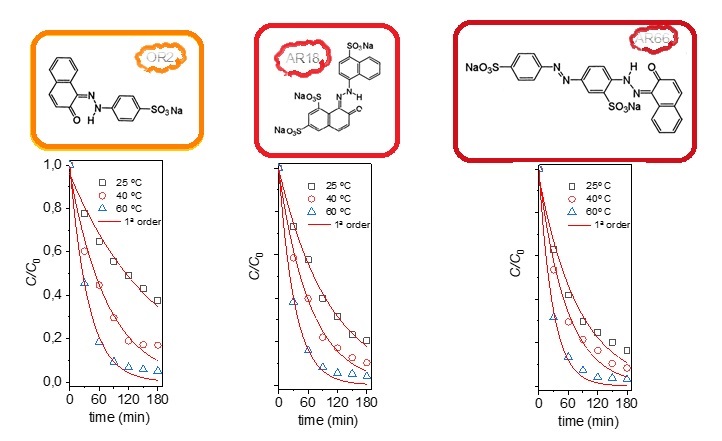
Textile wastewater containing dyes pose significant environmental hazards. Advanced oxidative processes, especially the heterogeneous photo-Fenton process, are effective in degrading a wide range of contaminants due to high conversion rates and ease of catalyst recovery. This study evaluates the photocatalytic degradation of azo dyes Acid Red 18 (AR18), Acid Red 66 (AR66) and Orange 2 (OR2) using magnetite as a catalyst. The magnetic catalyst was synthesized via a hydrothermal process at 150°C. Experiments were conducted at room temperature, investigating the effect of catalyst dosage, pH, and initial concentrations of H2O2 and AR18 dye. Kinetic and thermodynamic studies were performed at 25, 40 and 60°C for the three azo dyes (AR18, AR66 and OR2) and the effect of the dye structures on the photocatalytic efficiency was investigated. At 25 °C for 0.33 mmol.L-1 of dyes at pH 3.0, using 1.4 g.L-1 of catalyst and 60 mg.L-1 of H2O2 under a UV radiation of 16.7 mW.cm-2 the catalyst showed a 62,3% degradation for AR18, 79.6% for AR66, and 83.8% for OR2 in 180 minutes of reaction. The oxidation of azo dyes under these conditions is spontaneous and endothermic. The pseudo-first order kinetic constants indicated a strong temperature dependence with an order of reactivity of the type: OR2 > AR66 > AR18, which is associated to the characteristics of molecular complexity (size, steric hindrance, aromatic conjugation), electrostatic repulsion and the nature of the acid-base interactions on the catalytic surface.
Keywords:
heterogeneous photo-Fenton-like
; magnetite
; degradation
; azo dyes
; molecular effects
1. Introduction
Due to environmental concerns, the global demand for lesser consumption of water and lowers discharge of industrial and domestic wastewater is a major challenge to environmental sustainability [1,2]. An important example is the consumption of excessive amounts of water and synthetic dyes by textile industrial processes, which constitutes harmful effects on human health and ecosystems, resulting in a huge amount of non-biodegradable organic compounds in the environment [2,3,4]. In this respect, hazardous wastewater treatment processes for removing organic pollutants are required to overcome their excess and improve the discharged water quality.
Efficient processes for rapid removal of organic contaminants, such the use of advanced oxidation processes (AOPs), have become ubiquitous in remediation methods for clean-up of wastewater by organic contaminants degradation to mitigate their adverse consequences on the environment [5,6]. Moreover, the state-of-the-art in AOPs process shows the chemical oxidation of dyes through in situ generation of highly reactive oxygen species e.g., hydroxyl radicals (●OH), superoxide radicals (O2●−) and singlet oxygen (1O2) by mechanistic routes of photocatalysis, ozonation, electrocatalysis, oxidation by Fenton reaction, and Fenton-like processes [7,8,9,10,11]. One of the promising route for dyes degradation is the Fenton photocatalytic process, which has outstanding advantages for textile wastewater removal with rapid reaction rate and time [7,12,13]. Especially, the use of iron based catalysts in Fenton-like processes gives photogenerated electrons to rise the Fe3+/Fe2+ conversion rate, while light is used for decolorization of dyes contaminants [13,14].
One of the difficulties associated with the utilization of the benchmark photo-Fenton catalysts such as α-Fe2O3, Fe3O4 and FeOOH among other iron-based oxides, is a high photogenerated electron-hole pair complexation rate, being considered to be a crucial factor that influences the low accessibility of the active sites and the light absorption efficiency of the catalytic performance in these processes [15,16,17,18]. It is acknowledged that the current state of Fe2+ ions present in magnetite is not yet sufficient to reliably assign H2O2 gives the aforesaid hydroxyl and hydroperoxyl radical (HO2●) and/or superoxide radical anions to allow the oxidation of Fe2+ to Fe3+ along with the consumption of ●OH radicals by the proper Fe2+ ion addressing high efficiencies to oxidize the organic pollutants [19].
On the other hand, it should be noted than use of magnetite as catalysts allow to reduce the unit operation and accelerate the recovery of the magnetic catalyst which makes wastewater treatment more inexpensive. The improvement of magnetite properties seems to be very promising for obtaining a highly stable catalyst during reactions for oxidative degradation of dyes at circumneutral pH [15,16,17,18].
Therefore, it is considered important to understand the magnetite properties to optimize the catalyst activity in heterogeneous photo-Fenton-like process for the oxidation of azo dyes, however, the effect of functional groups present in the dye molecule on the heterogeneous phase oxidation has been little explored in the literature. In the present study, the degradation kinetic and thermodynamic, the H2O2 and pollutant concentrations, pH, the catalyst amount and the relationship between the structures of the dyes and their photocatalytic characteristics were examined for the degradation de azo compounds e.g., Acid Red 18 (AR18), Acid Red 66 (AR66), and Orange 2 (OR2) on magnetite.
2. Results and Discussion
2.1. Heterogeneous Photo-Fenton-Like Reaction
Figure 1 shows the AR 18 azo dye photodegradation performances over the Fe3O4 catalyst. The effects of catalyst dosage in Fenton-like reaction on the degradation efficiency of AR 18 azo dye compared with other reaction systems are investigated.
Preliminary catalytic runs to analyze the catalyst dosage variations on the efficient degradation of AR 18 over magnetite catalyst are shown in Figure 1a. It may be noted that the AR18 degradation slight increase from 58 to 88% from catalyst dosage of 0.5 to 1.4 g.L-1, when using an initial AR 18 of ca. 60 mg.L-1 within 120 min, but that of 2.0 g.L-1 is slightly decreases achieving 83%. The enhancement in degradation efficiency may be attributed to the combined effects of direct oxidation by UV light (photolytic mechanism) and the contribution of this radiation to the formation of ●OH radicals via decomposition of H2O2 in an aqueous medium (photochemical mechanism) and/or on the surface of the catalyst (photocatalytic mechanism), according to equations 1 to 3. On the other hand, the slight reduction in catalytic activity for a dosage of 2.0 g.L-1 may be associated with difficulty in penetrating light into the reaction medium due to the amount of catalyst in suspension. Nevertheless, such a rapid drop in the percentage degradation is not reflected in any alteration of the magnetite structure.
Blank runs conducted with 60 mg.L-1 of AR 18 at pH 3.0 in 120 min using magnetite as catalyst reveal that the use of H2O2 and UV radiation alone results a degradation of the azo dye of less than 10%. Due to the absence of the catalyst, H2O2 and UV irradiation offer limitations to the reaction occurrence, where the AR18degradation is meaningless. Even though the photochemical process using UV/H2O2 without a catalyst may affect AR18 degradation with ~ 80% for 60 mg.L-1 and ~ 45% for 200 mg.L-1 (Figure 1b), the activity is comparatively modest for a Fenton-like process in the presence of magnetite with maximum degradation of 95%, under the conditions used here.
Based on the abovementioned results, the catalyst dosage is set at 1.4 g.L-1 in the presence of H2O2/UV, which is suitable to undertake a systematic study of the AR18 azo dye photodegradation over the Fe3O4 as a catalyst. The effects of various Fenton-like reaction parameters on the AR 18 azo dye degradation efficiency are evaluated (Figure 2).
The influence of pH for Fenton and Fenton-like reaction as a parameter to elucidate the availability of Fe2+ to decompose H2O2 and generate the hydroxyl radicals in Fenton and Fenton-like reaction over iron-based catalysts with optimum pH in the range of 2.5-4.0 is evaluated [20,21,22].
The degradation efficiencies at the different pH tested are related to the zeta potential on the magnetite surface, which were + 8.4 mV at pH = 3.0, -6.26 mV at pH = 6.0 and -21.7 mV at pH = 8.0. The AR18 solution has an initial pH of 6 and under this condition the degradation efficiency is only 7.5% in 30 min of reaction, while a conversion of 32% can be achieved at pH = 3.0 for the same reaction time. After 60 min, the degradation efficiency improves and activities around 20% are only observed at natural pH (6.0) and slightly alkaline pH (8.0). On the contrary, at pH = 3.0 the degradation efficiency increases up to 60.3%. In 120 min, degradation efficiencies were 88% in acidic medium and approximately 39% and 38% at pHs = 6.0 and 8.0, respectively (Figure 2a). At pH 8.0 the magnetite catalyst is observed to be stable and there is no significant change in the degradation efficiency compared to that observed at almost neutral pH (pH = 6.0). In general, at pH values close to 3.5, azo dye molecules are effectively degraded by ●OH radicals through the decomposition of H2O2 on the catalytic surface of magnetite [11]. Furthermore, the oxidation potential of the ●OH /H2O redox couple is greater at acidic pH values, which favors the degradation efficiency. At higher pH values (alkaline medium), the oxidizing effect decreases due to the reactions between ●OH radicals and H2O2) [11,23]. Additionally, in an alkaline medium, the photocatalytic treatment of Acid Red 18 on WO3 microspheres decorated with goethite showed a 16% reduction in degradation when the pH was increased from 1.89 to 9.64. This behavior was attributed to electronic repulsion between the anionic dye molecule and the -OH groups attached to the catalyst surface, as can also be related in this study [24].
Because of the initial H2O2 concertation greatly affects the AR18 degradation under acidic conditions [22], to understand the photocatalytic trend, a wide range of H2O2 concentrations should be considered. Figure 2b illustrates that the degradation of the azo dye increased linearly from 42.1 to 94.1% with H2O2 concentration increment in the range of 10-60 mg.L-1 within 120 min. With further initial H2O2 up to 100 mg.L-1, the degradation efficiency diminished between 2.2% e 9.4%. This might seem counterintuitive, because larger amounts of H2O2 would likely generate more •OH radicals to degrade the azo dye, However, with an excess of H2O2, the rate of •OH recombination increases (•OH + •OH → H2O2) and the parallel reaction of •OH consumption by H2O2 is favored to form HO2• or O2- (H2O2 + •OH → H2O + HO2•), which are less reactive species than •OH [25,26].
In addition, it is commonly accepted that the effect of azo dye concentration on Fenton and Fenton-like oxidations is limited at higher concentrations of AR18 due to the effective hydroxyl radicals formation on the magnetite catalyst [11,22,27]. Accordingly, Figure 2c shows a quite impressive almost complete AR18 degradation efficiency for a concentration below 80 mg.L-1. As expected, the azo dye concentration between 150 and 200 mg.L-1 gives only 76.1% and 51.5% suggesting that Fe2+ species of magnetite can still be present, but its availability might be low, which may be related to the adsorption on the catalyst surface of several intermediate products formed during the oxidative process, including aromatic compounds, naphthalenes and their hydroxylated and nitrified derivatives, naphtodiols and phthalic acid derivatives [28]. Hence, with the chosen magnetite catalyst loading, 200 mg.L-1 was used for further kinetic and thermodynamics studies of AR18, AR16 and OR2.
The requirement for a stable catalyst in the Fenton-like reaction can be understood based on the recycling experiments. Figure 2d indicates that there are six cycles of consecutive uses of magnetite without any loss of degradation efficiency. At the end of the reaction, a steady state plateau about 90-94% is reached for the initial AR18 concentration of 60 mg.L-1, at pH of 3.0 in 120 min, with no Fe species leaching as determined by AAS chemical analyses. These results are comparable to those in literature reports on spinel isostructural ferrite-based catalysts [11,29,30].
2.2. Kinetic and Thermodynamic of Degradation
According to the findings, reaction kinetics plays an important role in determining the rate of Fenton photocatalytic degradation processes [11,29].
The pseudo-first-order model was applied for the AR18, AR66 and OR2 azo des with similar structures. Figure 3 depicts the effect of reaction temperature in the range of 25–60 ◦C. At 25oC,all azo dyes undergo higher degradation efficiency in shorter reaction time owing to elevated dye concentrations, evidencing a major collision rate between azo dyes and •OH radicals. With increasing of reaction temperature from 40 to 60 ◦C, an increment in reaction rate is observable for all azo dyes, at short reaction times. As the reaction proceeds, the degradation efficiency caused by the decreased collision rate between azo dyes intermediate compounds and hydroxyl radicals. In agreement, increased temperatures favor major collisions between the dye and OH radicals. In agreement, increased temperatures favor higher collisions between dye and OH radicals, although the rate is not affected with respect to the change in temperature within the range of longer reaction times [13,31,32]. The degradation of azo dyes follows the order: OR2 > AR66 > AR18, with the azo dye OR2 reacting with better efficiency at the three temperatures investigated.
The Arrhenius plots for the photo-Fenton degradation of azo dyes are depicted in Figure 4. The k1 (min-1) and Ea (kJ.mol-1) parameters are given in Table 1. The Arrhenius plots of the natural logarithm of k1 is linearly correlated with the reaction temperature, as shown in Figure 4.
Photodegradation of the azo dyes on the magnetite surface is relied upon to improve the degradation efficiency. The examined kinetic data show a high correlation coefficient of 0.97 with a good fitting between calculated and experimental values suggesting that the Fenton-like process follows first order kinetics. In addition, the reaction rates of color removal and degradation efficiencies increase with increasing temperature, with the Fenton oxidation reaction being suitable. In fact, the activation energy of AR18 is 36.2 kJ.mol-1, comparable with the degradation efficiency of Fe-based catalysts on Acid Red 18 azo dye in other studies [21,29,31,32,33,34]. For OR2, the calculated activation energy is 25.3 kJ.mol-1, comparable with literature reports on magnetite-based catalysts [35,36,37,38]. These values indicate that the photocatalytic Fenton reaction rate can be controlled by the intrinsic kinetics at the surface of the magnetite catalyst.
The parameter determination of Gibbs (ΔG), entropy (ΔS) and enthalpy (ΔH) for the AR18, AR66 and OR2 photodegradation, based on the van't Hoff equation in Figure 5. The obtained data are summarized in Table 2.
The entalphy (ΔH) values obtained for the AR18, AR66 and OR2 azo dye are all similar to those of [39] , in the case of Acid Red 27. The ΔS values for AR18, AR66 and OR2 are 0.196, 0.157 and 0.158 kJ.mol-1.K-1, respectively, suggesting that the reaction is more spontaneous with increasing temperature [40]. The ΔG values for the OR2 degradation in the range of temperatures investigated are higher than those found for AR66 and AR18, which corroborates with the degradation order and the reaction kinetics (OR2 > AR66 > AR18).
This behavior can be explained in terms of molecular effects related to the polar group natures, possible steric hindrance and, to some extent, to the type of the aromatic ring conjugation in the azo dye structure. OR2 and AR18 are hydroxyl azo aqueous species forming hydrazones (o-ortho and/or p-para), while AR 66 is typically an aminoazo dye where azo tautomeric arrangements predominate [41], despite the formation of the o-hydrazone in another molecular region.
Particularly, the OR2 azo dye occurs as an o-hydrazone (Figure 6a) without perturbation of the sulphonate group (-SO3-), which is p-substituted in the phenyl (ph), while in AR18 (Figure 6b), the o-hydrazone is protected or hindered by -SO3- at positions 2 and 4 of the naphtyl (naph) group adjacent to the azo bond, and there is a third -SO3- p-substituted group in the second naphtyl group of the molecule. Thus, the high number of sulphonyl groups in AR18 inhibits by electrostatic repulsion the •OH attack and the other reactive oxygen species (ROS) and reduce the steric hindrance and the accessibility the oxidizing radicals (•OH, 1O2, O2•-, HO2•) to the azo groups and aromatic azo rings [42]. Under these conditions, OR2 is easily degraded by ROS generated on the Fe3O4 (≡Fe3+) surface catalyst of AR18, as observed in the direct photodegradation of these dyes by UV irradiation in a rotating disk photoreactor [43]. In this direct photolysis, a pseudo-first order constant ratio for Orange 2 and Acid Red 18 (k1 OR2/k1 AR18) was 1.97, which is similar (~ 2.17) to that found in this work for photocatalytic degradation on synthesized magnetite. For AR66, the k1 (min-1) is between the k1 for OR2 and AR18, which can be explained in function of the minor steric hindrance and electrostatic repulsion generated from two structural sulphonate situated in position 2 of the o-hydrazone and another p-substituted in the phenyl group associated with the second azo group of the molecule (Figure 6c). Besides, the conjugation of the rings increment in the disulphonate (AR66) type: naph-azo-ph-azo-ph is more favorable to photoconversions than the naph-azo-naph conjugation present in AR18 (trisulphonate).
Based on the hard/soft acid/base (HSAB) of Pearson theory [44]; Fe3+ is typically a strong strength Lewis acid (HA) with high affinity for strong strength Lewis (HB), giving ionic interactions for base HA/HB complex interactions. On the other hand, azo dyes can be characterized as soft bases (SB) with a basic character decreasing with increasing carbonic chain length, which generates a diffuse electron distribution. Thereby, the minor molecular complexities (MC) and topological polar surface area (PSA) in the OR2 (MC = 529, PSA = 111 Å) and AR18 (MC = 958, PSA = 201 Å) in comparison with that of AR18 (MC = 1080, PSA = 242 Å) (data obtained from Pubchem databases) can favor the catalytic surface interactions, promoting the heterogeneous mechanistic oxidation. In this order, the polar covalent interaction features in the conjugated Fe3+//OR2 complex are stronger than in than the Fe3+//AR18 base system, whereas the Fe3+//AR66 conjugated par appears as an intermediate character.
When considering the catalyst participation in the processes, it is important to figure out the position and nature of the two active iron species on the surface (≡Fe3+ and/or ≡Fe2+) in contact with the reactive functional groups (-N=N-, -SO3-, -C=C-) of the excited dye molecule (dye*). The heterogeneous photo-Fenton process is described by the following equations (Eq.1 to 6), being the •OH generation due to the H2O2 direct photolysis at 180-340 nm (photochemistry reaction, Eq. 2) and iron cations (photocatalytic reactions, Eq. 3 and 4) [3,15,45].
dye + hλ → dye*
H2O2 + hλ → 2 •OH
≡Fe3+ + H2O2 + hλ → ≡Fe2+ + •OH + H+
≡Fe2+ + H2O2 → ≡Fe3+ + •OH + -OH
≡Fe2+ + H2O2 → ≡Fe3+-OH + -OH
dye* (organic) +•OH → products
Magnetite synthesized is a magnetic mixture of hematite (α-Fe2O3), maghemite (γ-Fe2O3) and goethite (α-FeOOH) having about 70% of Fe3O4 and 30% of the aforesaid phases [46]. Such composition is non-stoichiometric and is abundant in iron species that act favorably in the •OH radical formation. Figure 7 show a comparison of the AR 18 degradation using various iron oxides with different Fe3+/Fe2+ molar ratios, for instance, wüstite (FeO, Fe3+/Fe2+= 0), goethite (FeOOH, Fe3+/Fe2+= ꝏ), hematite (Fe2O3, Fe3+/Fe2+= ꝏ) and magnetite (Fe3O4, Fe3+/Fe2+= 4) prepared in this study.
At 25 oC, the initial concentration of 60 mg.L-1 of the dye is not a limiting factor for the catalytic activity of the various iron oxides (Figure 10), as observed for example at the concentration of 200 mg.L-1 (0.33 mmol.L-1) of Acid Red 18, where the maximum degradation was 62.3% (Figure 1b). The similar degradations indicate similar mechanistic considerations for catalytic surface, despite the oxy (hydroxide) nature of goethite, the major Fe3+ proportion seem to contribute to a slight higher oxidation to that of FeO, possessing only Fe2+ sites. In photo-Fenton systems with high Fe2+ concentrations under acidic conditions, Fe2+ exists in the Fe(OH)2+ form, which determines a lower •OH radical generation and the decrease of the degradation rate [49].
2.3. Treated Solution Characterization
Figure 8 shows the UV-Vis spectra of the OR2 azo dye treatment, after the heterogeneous photo-Fenton reaction over the synthesized Fe3O4. The structural iron reacts with H2O2 giving rise to •OH radicals, which attacks the azo (-N=N-) groups producing an effective solution decolorization in 90 min of photocatalytic reaction. The UV decolorization at 230 nm and 310 nm is related to the benzene, naphthalene ring as shown in literature reports, although these bands have a much lower and slower intensity than the chromophore band positioned at 505 nm. These behaviors are similar to those observed in the degradation of the azo dyes Reactive Black 5 [50] and Orange 2 [51], indicating a high decolorization of the OR2 accompanied by a relative concentration of the residual compounds after the oxidative reactions. Regarding the chemical oxygen demand (COD) before and after the photo-Fenton reaction, only a reduction of 29.7% in chemical oxidation of organic matter, which is similar to the COD of 27% found in the degradation of the dye Acid Red 73 by heterogeneous photo-Fenton process [52]. These results reveal the need for long reaction times or harsh treatment conditions aiming the mineralization of the refractory compounds produced.
2.4. Spent Magnetite Characterization
The fresh magnetite characterizations are given in our previous reports [46]. XPS spectra of fresh and spent magnetite after the poto-Fenton-like reaction are shown in Figure.9. The XPS spectrum of fresh Fe3O4 (Figure 9a) is depicted with the main spin-orbit split peaks located at 710.2 and 724.9 eV (Table 3) for the doublet Fe 2p3/2 - Fe5/2, respectively. These doublet peaks arise along with their shake-up satellites typically confirming that the magnetite has Fe species in both divalent Fe3+ and Fe2+ states [53]. Accordingly, the peak at about 710.8 eV is assigned to the Fe3+ ions in octahedral sites whereas that located at 723.9 eV indicates the presence of the Fe2+ species [54].
The recorded O 1s core level has three different oxygen species and a major contribution at 529.6 eV corresponds to 63%, due to the existence of lattice oxygens from the Fe-O bonds in Fe3O4,as previously detected in the literature [55]. This contribution is accompained by two other weak components near 531.0 eV (29%) from OH groups of physisorbed water molecules and 532.7 eV (8.0%) agreeing well with carbon bonded to oxygen species e.g., C–O and C=O [46,54].
Moreover, Fe3+/Fe2+ atomic composition obtained from area ratio between the peak at 711.2 and 710 eV is 2.3 (Table 3) suggests the distribution of Fe3+ and Fe2+ ions between the different sites of magnetite, which has highly oxidized surface [46]. The C 1s core level appears with binding energies ascribed to –C=C– and adventitious carbon as the dominant peak at 284.7 eV (82%) along with peaks at C–OH at 286.0 eV (12%) and C–C=O– at 288.3 eV (6%), in agreement with the findings [53,54,55,56].
These species arises from the incomplete organic precursors removal, even after the calcination of the solid.
In particular, the S 2p core level appears only for Fe3O4/R66, having binding energy at 168.1 eV due to S-O groups [46]. Additionally, the detected sulfates species on the surface of magnetite after AR66 Fenton-like reaction would contribute to the physisorption of the Fe active sites on magnetite providing a low performance of the solid with using the AR66 dye.
The atomic concentration percentages of Fe, C and O in fresh Fe3O4 are 29.3, 56.5 and 14.4%. Comparison with the atomic concentrations of the components of the two dyes show values of C: 41.5%, O: 45.7%, Fe: 12.6% and C: 37.5%, O: 51.6%, Fe: 10.8%, S: 0.18% for Fe3O4/AR18 and Fe3O4/AR66 with deviations within the limits of precision and accuracy of the XPS technique.
3. Materials and Methods
3.1. Materials
Pure Acid Red 18 (C20H11N2Na3O10S3, 604.48 g.mol-1) azo dye was purchased from Acros Organics. Orange 2 (C16H11N2NaO4S, 85%, 350.32 g.mol-1) and Acid Red 66 (C22H14N4Na2O7S2, 55%, 566.48 g.mol-1) azo dyes were obtained from Sigma-Aldrich. All azo dyes reagents were used without further purification. The hydrogen peroxide solution (H2O2, 30 wt. %) was purchased from Êxodo Científica. Prior to the use, the content of H2O2 was evaluated by permanganate method [58]. The sulfuric acid (H2SO4, 98%) was obtained from Vetec. Deionized water was used in all experiments.
3.2. Catalyst Synhesis and Characterizations
Fe3O4 consisting primarily of a Fe3+/Fe2+ molar ratio of 4 and was synthesized by a coprecipitation method, as found elsewhere [46,59]. The zeta potential and the particle size distributions at pH of 3.0, 6.0 and 8.0 were performed in a Zetasizer Nano S apparatus form Malvern.
The surface compositions and valence state of the elements present in the spent samples used at distinct reaction conditions were determined by X-ray photoelectron spectroscopy (XPS). XPS spectra were obtained on a PHI Versa-Probe II Scanning XPS Microprobe from Physical Electronics. The incident radiation was generated by the Al Kα X-ray source, operating at 1486.6 eV and 15 kV. The spectra were calibrated using the binding energy peak of C 1s at 284.8 eV from adventitious carbon.
3.3. Heterogeneous Photo-Fenton-Like Oxidation
The photocatalytic activity of the magnetite was conducted in a borosilicate reactor (height of ca. 13 cm; diameter of 6.5 cm) with a capacity of about 45 mL coupled to a circulating water jacket to maintain solution temperature. A UV-C Philips TUV PL-S 7W/2P model lamp of ca. 7.1 W was positioned to the reaction reactor. The aforesaid lamp generated UV irradiation at 254 nm with a radiation intensity (IL) of ca. 16.7 mW.cm-2.
Typically for photo-Fenton-like batch experiments, the reaction was initiated by introducing the H2O2 solution along of the azo dyes to the reaction system. Then, air flow at a 180 ± 20 mL.min-1 rate was introduced in the system, which was used to have a homogeneous solution. The abovementioned suspension was exposed to UV-C lamp and aliquots were withdrawn to determine the concentration of the azo dyes solution by a UV-Vis spectrophotometer. When using Acid Red 18 (AR18) as reactant, the pH, initial concentration of H2O2 and an initial concentration of the AR18 azo dye were evaluated at 25 oC. Other azo dyes such as AR66 and OR2 having an initial concentration of ca. 0.33 mmol.L-1 were also examined. The calibration curve of each azo dye was set at 505, 510 and 485 nm for AR18, AR66 and OR2, respectively, using a Thermo Fisher UV-Vis Genesys 10 S spectrophotometer. Iron concentrations in solution were estimated by atomic absorption spectrophotometry using a Thermo Scientific AAS iCE 3000 equipment.
The effects of initial concentration azo dye, H2O2 initial concentration, catalyst dosage, pH besides kinetic and thermodynamic parameters were evaluated. Besides, initial dosage of catalyst was taken from literature reports [51,60].
The photo-Fenton catalytic degradation percentage was measured, as follows (Eq. 7):
where: C0 (mmol.L-1) and Ct (mmol.L-1) are the initial and final azo dyes concentrations at a given period, respectively.
To understand the Acid Red 18 azo dye at 25, 40 and 60 °C degradation kinetics, the pseudo-first-order kinetic model were used, according to the equation 8 [34]:
where: C0 is the initial concentration of AR18 (mmol.L-1), C is the AR18 concentration (mmol.L-1) at a certain reaction time t (min) and k1 (min-1) is the rate constant for pseudo-first-order reaction.
The activation energy (Ea, kJ.mol-1) of the AR18, AR66 and OR2 l studied azo dyes was determined by the Arrhenius equation (Eq. 9), as reported in a previous [40]:
where: A is the Arrhenius constant, k1 is the rate constant for pseudo-first-order reaction, T is the absolute (K) and R is the universal constant of the gases (8.314 J.mol-1.K-1).
The variations of free Gibbs energy (ΔG), entropy (ΔS) and enthalphy (ΔH) themodynamics were determined according to the van’t Hoff equations [61].
where: ke is the equilibrium constant and CAe and CSe are the degraded and remained azo dyes concentrations in the equilibrium, respectively.
4. Conclusions
The synthesized magnetite showed high photocatalytic efficiency for the degradation of dyes AR18, AR66 and OR2 under optimal conditions of 1.4 g.L-1 of catalyst, 60 mg.L-1 of H2O2, pH = 3.0 and radiation intensity of 16.7 mW.cm-2. The material showed no decrease in catalytic activity after six consecutive reaction cycles, confirming its high stability, as observed by the XPS results. The kinetics were typically first order while the reactional thermodynamics confirmed spontaneous and endothermic degradation processes. Among the dyes, the OR2 molecule was the most easily degraded due to its lower structural complexity, lower steric hindrances and lower electrostatic repulsion with reactive oxygen species on the catalyst surface. This study showed the promising nature of photo-Fenton technology using magnetite as a catalyst in the treatment of aqueous solutions contaminated with azo dyes, also allowing to discuss and explain the effect of some chemical characteristics of the target molecule on the performance of oxidative degradation.
Author Contributions
Conceptualization, formal analysis, R.S.A.; methodology, J.A.S.R, J.F.A.; investigation, R.S.A; methodology, B.C.B.S.; writing—original draft preparation, writing—review and editing, funding acquisition, A. C. O., R.S.A. and E.R.-C.
Funding
The authors acknowledge the financial support from the Ministerio de Ciencia e Innovación, Spain (Grant TED2021-130756B-C31 MCIN/AEI/10.13039/501100011033 ) and “ERDF A way of making Europe” by the European Union NextGenerationEU/PRTR.
Data Availability Statement
The data presented in this study are available upon request from the corresponding authors.
Acknowledgments
J.A.S.R acknowledges the financial support for his master scholarship from the Conselho Nacional de Desenvolvimento Científico Tecnologico (CNPq), Brazil. Jose Vitor do carmo is grateful acknowledged by his contributions in this manuscript.
Conflicts of Interest
The authors declare no conflicts of interest.
References
- Chen, Z.; Yan, Y.; Lu, C.; Lin, X.; Fu, Z.; Shi, W.; Guo, F. Photocatalytic self-Fenton system of g-C3N4-Based for degradation of emerging contaminants: a review of advances and prospects. Molecules 2023, 28, 5916. [Google Scholar] [CrossRef]
- Zhang, Z.; Bai, Z.; Yu, S.; Meng, X.; Xiao, S. Photo-Fenton efficient degradation of organic pollutants over S-scheme ZnO@NH2-MIL-88B heterojunction established for electron transfer channel. Chem. Eng. Sci. 2024, 288, 119789. [Google Scholar] [CrossRef]
- Magomedova, A.; Isaev, A.; Orudzhev, F.; Sobola, D.; Murtazali, R.; Rabadanova, A.; Shabanov, N.S.; Zhu, M.; Emirov, R.; Gadzhimagomedov, S.; Alikhanov, N.; Kasinathan, K. Magnetically separable mixed-phase α/γ-Fe2O3 catalyst for photo-Fenton-like oxidation of Rhodamine B. Catalysts 2023, 13, 872. [Google Scholar] [CrossRef]
- Nchimi Nono, K.; Vahl, A.; Terraschke, H. Towards high-performance photo-Fenton degradation of organic pollutants with magnetite-silver composites: synthesis, catalytic reactions and in situ insights. Nanomaterials 2024, 14, 849. [Google Scholar] [CrossRef]
- Feijoo, S.; González-Rodríguez, J.; Fernández, L.; Vázquez-Vázquez, C.; Feijoo, G.; Moreira, M.T. Fenton and photo-Fenton nanocatalysts revisited from the perspective of life cycle assessment. Catalysts 2020, 10, 23. [Google Scholar] [CrossRef]
- Ismail, G.A.; Sakai, H. Review on effect of different type of dyes on advanced oxidation processes (AOPs) for textile color removal. Chemosphere 2022, 291, 132906. [Google Scholar] [CrossRef]
- Dong, C.; Fang, W.; Yi, Q.; Zhang, J. A comprehensive review on reactive oxygen species (ROS) in advanced oxidation processes (AOPs). Chemosphere 2022, 308, 136205. [Google Scholar] [CrossRef] [PubMed]
- Mahbub, P.; Duke, M. Scalability of advanced oxidation processes (AOPs) in industrial applications: a review. J. Environ. Manag. 2023, 345, 118861. [Google Scholar] [CrossRef] [PubMed]
- Vorontsov, A.V. Advancing Fenton and photo-Fenton water treatment through the catalyst design. J. Hazard. Mater. 2019, 372, 103–112. [Google Scholar] [CrossRef]
- Li, N.; He, X.; Ye, J.; Dai, H.; Peng, W.; Cheng, Z.; Yan, B.; Chen, G.; Wang, S. H2O2 activation and contaminants removal in heterogeneous Fenton-like systems. J. Hazard. Mater. 2023, 458, 131926. [Google Scholar] [CrossRef]
- Unal, B.O.; Bilici, Z.; Ugur, N.; Isik, Z.; Harputlu, E.; Dizge, N.; Ocakoglu, K. Adsorption and Fenton oxidation of azo dyes by magnetite nanoparticles deposited on a glass substrate. J. Water Process Eng. 2019, 32, 100897. [Google Scholar] [CrossRef]
- Tunç, S.; Gürkan, T.; Duman, O. On-line spectrophotometric method for the determination of optimum operation parameters on the decolorization of Acid Red 66 and Direct Blue 71 from aqueous solution by Fenton process. Chem. Eng. J. 2012, 181–182, 431–442. [Google Scholar] [CrossRef]
- Rubeenaa, K.K.; Reddy PH, P.; Laiju, A.R.; Nidheesh, P.V. Iron impregnated biochars as heterogeneous Fenton catalyst for the degradation of Acid Red 1 dye. J. Environ. Manag. 2018, 226, 320–332. [Google Scholar] [CrossRef]
- Sharma, M.; Tyagi, V.V.; Chopra, K.; Kothari, R.; Singh, H.M.; Pandey, A.K. Advancement in solar energy-based technologies for sustainable treatment of textile wastewater: reuse, recovery and current perspectives. J. Water Process Eng. 2023, 56, 104241. [Google Scholar] [CrossRef]
- Rusevova, K.; Kopinke, F.D.; Georgi, A. Nano-sized magnetic iron oxides as catalysts for heterogeneous Fenton-like reactions-influence of Fe(II)/Fe(III) ratio on catalytic performance. J. Hazard. Mater. 2012, 241-242, 433–440. [Google Scholar] [CrossRef]
- Minella, M.; Marchetti, G.; De Laurentiis, E.; Malandrino, M.; Maurino, V.; Minero, C.; Vione, D.; Hanna, K. Photo-Fenton oxidation of phenol with magnetite as iron source. Appl. Catal. B Environ. 2014, 154–155, 102–109. [Google Scholar] [CrossRef]
- Xia, P.; Zhang, H.; Ye, Z. Recent advances in the application of natural iron and clay minerals in heterogeneous electro-Fenton process. Curr. Opin. Electrochem. 2024, 46, 101495. [Google Scholar] [CrossRef]
- Muzenda, C.; Arotiba, O.A. Improved magnetite nanoparticle immobilization on a carbon felt cathode in the heterogeneous electro-Fenton degradation of Aspirin in wastewater. ACS Omega 2022, 7, 19261–19269. [Google Scholar] [CrossRef] [PubMed]
- Yan, J.; Yang, L.; Qian, L.; Han, L.; Chen, M. Nano-magnetite supported by biochar pyrolyzed at different temperatures as hydrogen peroxide activator: synthesis mechanism and the effects on ethylbenzene removal. Environ. Pollut. 2020, 261, 114020. [Google Scholar] [CrossRef] [PubMed]
- Kang, Y.W.; Hwang, K.Y. Effects of reaction conditions on the oxidation efficiency in the Fenton process. Water Res. 2000, 34, 2786–2790. [Google Scholar] [CrossRef]
- Barbusiński, K.; Majewski, J. Discoloration of azo dye Acid Red 18 by Fenton reagent in the presence of iron powder. Pol. J. Environ. Stud. 2003, 12, 151–155. [Google Scholar]
- Malakootian, M.; Moridi, A. Efficiency of electro-Fenton process in removing Acid Red 18 dye from aqueous solutions. Process Saf. Environ. Prot. 2017, 111, 138–144. [Google Scholar] [CrossRef]
- Hassani, A.; Karaca, C.; Karaca, S.; Khataee, A.; Açisli, Ö.; Yilmaz, B. Enhanced removal of Basic Violet 10 by heterogeneous sono-Fenton process using magnetite nanoparticles. Ultrason. Sonochem. 2018, 42, 390–402. [Google Scholar] [CrossRef] [PubMed]
- Wei, J.; Shen, W. FeOOH quantum dot decorated flower-like WO3 microspheres for visible light driven photo-Fenton degradation of Methylene Blue and Acid Red-18. Colloids Surf. A Physicochem. Eng. Asp. 2022, 643, 128754. [Google Scholar] [CrossRef]
- Kulštáková, A. Removal of pharmaceutical micropollutants from real wastewater matrices by means of photochemical advanced oxidation processes – a review J. Water Process Eng. 2023, 53, 103727. [Google Scholar] [CrossRef]
- Bergendahl, J.A.; Thies, T.P. Fenton's oxidation of MTBE with zero-valent iron. Water Res. 2004, 38, 327–334. [Google Scholar] [CrossRef] [PubMed]
- Azizi, A.; Moghaddam MR, A.; Maknoon, R.; Kowsari, E. Investigation of enhanced Fenton process (EFP) in color and COD removal of wastewater containing Acid Red 18 by response surface methodology: evaluation of EFP as post treatment. Desalination Water Treat. 2015, 57, 1944–3994. [Google Scholar] [CrossRef]
- Garcia-Segura, S.; Brillas, E. Combustion of textile monoazo, diazo and triazo dyes by solar photoelectro-Fenton: Decolorization, kinetics and degradation routes. Applied Catalysis B: Environmental, 2016, 181, 681–691. [Google Scholar] [CrossRef]
- Gharaghani, M.A.; Dehdarirad, A.; Mahdizadeh, H.; Hashemi, H.; Nasiri, A.; Samaei, M.R.; Mohammadpour, A. Photocatalytic degradation of Acid Red 18 by synthesized AgCoFe2O4@Ch/AC: Recyclable, environmentally friendly, chemically stable, and cost-effective magnetic nano hybrid catalyst. Int. J. Biol. Macromol. 2024, 269, 131897. [Google Scholar] [CrossRef]
- Vázquez-Vélez, E.; Martínez, H.; Castillo, F. Degradation of Acid Red 1 catalyzed by peroxidase activity of iron oxide nanoparticles and detected by SERS. Nanomaterials 2021, 11, 3044. [Google Scholar] [CrossRef]
- Ara, A.; Khattak, R.; Khan, M.S.; Begum, B.; Khan, S.; Han, C. Synthesis, characterization, and solar photo-activation of chitosan-modified nickel magnetite bio-composite for degradation of recalcitrant organic pollutants in water. Catalysts 2022, 12, 983. [Google Scholar] [CrossRef]
- Hassan, H.; Hameed, B.H. Oxidative decolorization of Acid Red 1 solutions by Fe-zeolite Y type catalyst. Desalination 2011, 276, 45–52. [Google Scholar] [CrossRef]
- Zare, M.R.; Mengelizadeh, N.; Aghdavodian, G.; Zare, F.; Ansari, Z.; Hashemi, F.; Moradalizadeh, S. Adsorption of Acid Red 18 from aqueous solutions by GO-COFe2O4: Adsorption kinetic and isotherms, adsorption mechanism and adsorbent regeneration. Desalination Water Treat. 2024, 317, 100219. [Google Scholar] [CrossRef]
- Santana, C.S.; Ramos MD, N.; Velloso CC, V.; Aguiar, A. Kinetic evaluation of dye decolorization by Fenton processes in the presence of 3-Hydroxyanthranilic Acid. Int. J. Environ. Res. Public Health 2019, 16, 1602. [Google Scholar] [CrossRef] [PubMed]
- Liang, X.; Zhong, Y.; Zhu, S.; Zhu, J.; Yuan, P.; He, H.; Zhang, J. The decolorization of Acid Orange II in non-homogeneous Fenton reaction catalyzed by natural vanadium–titanium magnetite. J. Hazard. Mater. 2010, 181, 112–120. [Google Scholar] [CrossRef] [PubMed]
- Zhao, Q.; Zhang, C.; Tong, X.; Zou, Y.; Li, Y.; Wei, F. Fe3O4-NPs/orange peel composite as magnetic heterogeneous Fenton-like catalyst towards high-efficiency degradation of methyl orange. Water Sci. Technol. 2021, 84, 159–171. [Google Scholar] [CrossRef] [PubMed]
- Nguyen, X.S.; Ngo, K.D. The role of metal-doped into magnetite catalysts for the photo-Fenton degradation of organic pollutants. J. Surf. Eng. Mater. Adv. Technol. 2018, 8. [Google Scholar] [CrossRef]
- Choe, Y.J.; Kim, J.; Byun, J.Y.; Kim, S.H. An electro-Fenton system with magnetite coated stainless steel mesh as cathode. Catal. Today 2021, 359, 16–22. [Google Scholar] [CrossRef]
- Abou-Gamra, Z.M. Kinetic and thermodynamic study for Fenton-like oxidation of Amaranth Red dye. Adv. Chem. Eng. Sci. 2014, 4, 285–291. [Google Scholar] [CrossRef]
- Shuchi, S.B.; Suhan, M.B.K.; Humayun, S.B.; Haque, M.E.; Islam, M.S. Heat-activated potassium persulfate treatment of Sudan Black B dye: Degradation kinetic and thermodynamic studies. J. Water Process Eng. 2021, 39, 101690. [Google Scholar] [CrossRef]
- Ball, P.; Nicholls, C.H. Azo-hydrazone tautomerism of hydroxyazo compounds-a review. Dyes Pigm. 1982, 3, 5–26. [Google Scholar] [CrossRef]
- Omura, T.; Kayane, Y.; Tezuka, Y. Design of chlorine-fast reactive dyes: Part 1: The role of sulphonate groups and optimization of their positions in an arylazonaphthol system. Dyes Pigm. 1992, 20, 227–246. [Google Scholar] [CrossRef]
- Zhang, G.; Zhang, S. Quantitative structure-activity relationship in the photodegradation of azo dyes. J. of Environmental Sci. 2020, 90, 41–50. [Google Scholar] [CrossRef] [PubMed]
- Pearson, R.G. Hard and soft acids and bases. J. Am. Chem. Soc. 1963, 85, 3533–3539. [Google Scholar] [CrossRef]
- Dai, H.; Xu, S.; Chen, J.; Miao, X.; Zhu, J. Oxalate enhanced degradation of Orange II in heterogeneous UV-Fenton system catalyzed by Fe3O4@g-Fe2O3 composite. Chemosphere 2018, 199, 147–153. [Google Scholar] [CrossRef]
- Paz, C.B.; Araújo, R.S.; Oton, L.F.; Oliveira, A.C.; Soares, J.M.; Medeiros, S.N.; Rodríguez-Castellón, E.; Rodríguez-Aguado, E. Acid Red 66 dye removal from aqueous solution by Fe/C-based composites: Adsorption, kinetics and thermodynamic studies. Mater. 2020, 13, 1107. [Google Scholar] [CrossRef]
- Gurushankar, K.; Chinnaiah, K.; Kannan, K.; Gohulkumar, M.; Periyasamy, P. Synthesis and characterization of FeO nanoparticles by hydrothermal method. Rasayan J. Chem. 2021, 14, 1985–1989. [Google Scholar] [CrossRef]
- Martina, M.R.; Zoli, L.; Sani, E. Synthesis and characterization of goethite (α-FeOOH) magnetic nanofluids. Int. J. Thermofluids 2022, 15, 100169. [Google Scholar] [CrossRef]
- Abo-Farha, S.A. Comparative study of oxidation of some azo dyes by different advanced oxidation processes: Fenton, Fenton-Like, photo-Fenton and photo-Fenton-like. J. Am. Sci. 2010, 6, 128–142. [Google Scholar]
- Lucas, M.S.; Algarra, M.; Jiménez-Jiménez, J.; Rodríguez-Castellón, E.; Peres, J.A. Catalytic activity of porous phosphate heterostructures-Fe towards Reactive Black 5 degradation. Int. J. Photoenergy 2013, 2013, 1–6. [Google Scholar] [CrossRef]
- Chen, K.; Wang, G.; Li, W.; Wan, D.; Hu, Q.; Lu, L. Application of response surface methodology for optimization of Orange II removal by heterogeneous Fenton-like process using Fe3O4 nanoparticles. Chin. Chem. Lett. 2014, 25, 1455–1460. [Google Scholar] [CrossRef]
- Fu, F.; Wang, Q.; Tang, B. Effective degradation of C.I. Acid Red 73 by advanced Fenton process. J. Hazard. Mater. 2010, 174, 17–22. [Google Scholar] [CrossRef] [PubMed]
- Faria, A.J.M.; Silva, A.N.; Oliveira, A.C.; do Carmo, J.V.C.; Saraiva, G.D.; Juca, R.F.; Morales, M.A.; Lang, R.; Jiménez, J.J.; Rodríguez-Castellón, E. Catalytic performances of the nano FeCo solids for biofuel additives production: Incorporation of promoters effects on the stability of the catalysts. Energy & Fuels 2023, 37, 22–17328. [Google Scholar] [CrossRef]
- Rajan, A.; Sharma, M.; Sahu, N.S. Assessing magnetic and inductive thermal properties of various surfactants functionalised Fe3O4 nanoparticles for hyperthermia. Sci. Rep. 2020, 10, 15045. [Google Scholar] [CrossRef] [PubMed]
- Zhong, Y.; Yu, L.; Chen, Z.-F.; He, H.; Ye, F.; Cheng, G.; Zha, Q. Microwave-assisted synthesis of Fe3O4 nanocrystals with predominantly exposed facets and their heterogeneous UVA/Fenton catalytic activity. ACS Appl. Mater. Interfaces 2017, 9, 29203–29212. [Google Scholar] [CrossRef] [PubMed]
- Ai, Q.; Yuan, Z.; Huang, R.; Yang, C.; Jiang, G.; Xiong, J.; Huang, Z.; Yuan, S. One-pot co-precipitation synthesis of Fe3O4 nanoparticles embedded in 3D carbonaceous matrix as anode for lithium ion batteries. J. Mater. Sci. 2019, 54, 4212–4224. [Google Scholar] [CrossRef]
- Yamashita, T.; Hayes, P. Analysis of XPS spectra of Fe2+ and Fe3+ ions in oxide materials. Appl. Surf. Sci. 2008, 254, 2441–2449. [Google Scholar] [CrossRef]
- Klassen, N.V.; Marchington, D.; McGowan, H.C.E. H2O2 determination by the I3- method and by KMnO4 titration. Analytical Chem. 1994, 66, 2921–2925. [Google Scholar] [CrossRef]
- Liu, X.; Zhao, T.; Liu, P.; Cui, P.; Hu, P. Manufacture of nano graphite oxides derived from aqueous glucose solutions and in-situ synthesis of magnetite graphite oxide composites. Mater. Chem. Phys. 2015, 153, 202–208. [Google Scholar] [CrossRef]
- Quiñones-Murillo, D.H.; Ariza-Reyes, A.A.; Ardila-Vélez, L.J. Some kinetic and synergistic considerations on the oxidation of the azo compound Ponceau 4R by solar–mediated heterogeneous photocatalytic ozonation. Desalin. Water Treat. 2019, 170, 61–74. [Google Scholar] [CrossRef]
- Hashemian, S. Fenton-like oxidation of Malachite Green Solutions: Kinetic and thermodynamic study. J. Chem. 2013, 2013, 1–7. [Google Scholar] [CrossRef]
Figure 1.
Effects of the AR18 degradation at 25 °C with IL = 16.7 mW.cm-2. (a) initial catalyst dosage using a C0(AR18) of ca. 60 mg.L-1, C0(H2O2) of ca. 30 mg.L-1 at a pH of 3.0 during 120 min of reaction time. (b) Blank runs of the degradation of the AR18 over magnetite in distinct reaction conditions. C0(Fe3O4) = 1.4 g.L-1, C0(AR18) = 60 mg.L-1, C0(H2O2) = 60 mg.L-1, IL = 16.7 mW.cm-2, and a pH of 3.0 at 120 min.
Figure 1.
Effects of the AR18 degradation at 25 °C with IL = 16.7 mW.cm-2. (a) initial catalyst dosage using a C0(AR18) of ca. 60 mg.L-1, C0(H2O2) of ca. 30 mg.L-1 at a pH of 3.0 during 120 min of reaction time. (b) Blank runs of the degradation of the AR18 over magnetite in distinct reaction conditions. C0(Fe3O4) = 1.4 g.L-1, C0(AR18) = 60 mg.L-1, C0(H2O2) = 60 mg.L-1, IL = 16.7 mW.cm-2, and a pH of 3.0 at 120 min.
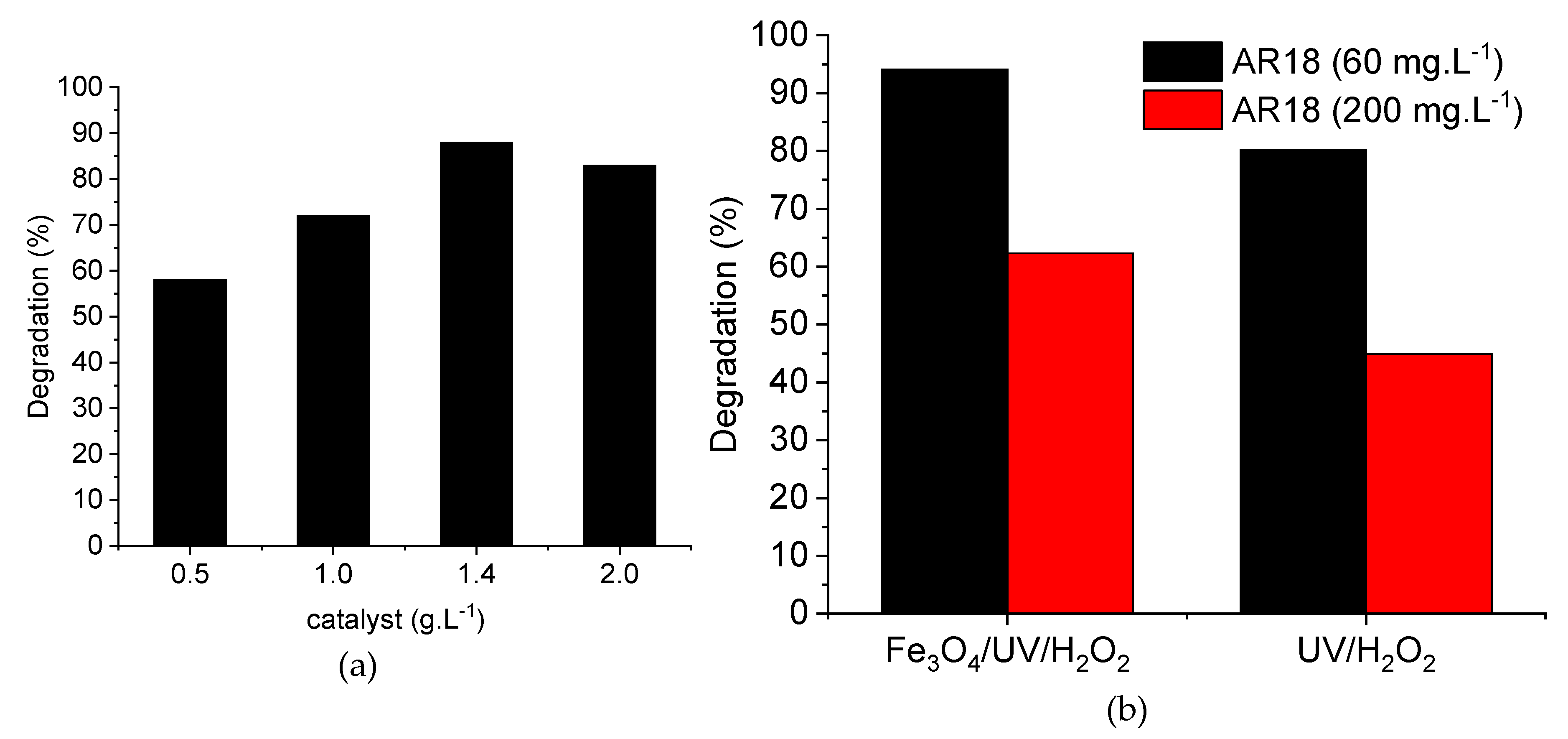
Figure 2.
(a) Influence of the pH with an initial catalyst dosage C0(Fe3O4) of 1.4 g.L-1 at a fixed condition of C0(AR18) = 60 mg.L-1, C0(H2O2) equal to 30 mg.L-1 within 120 min. (b) Influence of the initial H2O2 concentration using C0(Fe3O4) of 1.4 g.L-1, C0(AR18) of about 60 mg.L-1 at a pH of 3.0 in 120 min. (c) C0(AR18) effects with a C0(Fe3O4) of 1.4 g.L-1, C0(H2O2) of 60 mg.L-1, a pH of 3.0 and 120 min.(d) Reuse of the Fe3O4 at 25 °C after photo-Fenton reaction using a 1.4 g.L-1, C0(AR18) of 60 mg.L-1, C0(H2O2) = 60 mg.L-1, IL = 16.7 mW.cm-2, at a pH of 3.0 and t = 120 min.
Figure 2.
(a) Influence of the pH with an initial catalyst dosage C0(Fe3O4) of 1.4 g.L-1 at a fixed condition of C0(AR18) = 60 mg.L-1, C0(H2O2) equal to 30 mg.L-1 within 120 min. (b) Influence of the initial H2O2 concentration using C0(Fe3O4) of 1.4 g.L-1, C0(AR18) of about 60 mg.L-1 at a pH of 3.0 in 120 min. (c) C0(AR18) effects with a C0(Fe3O4) of 1.4 g.L-1, C0(H2O2) of 60 mg.L-1, a pH of 3.0 and 120 min.(d) Reuse of the Fe3O4 at 25 °C after photo-Fenton reaction using a 1.4 g.L-1, C0(AR18) of 60 mg.L-1, C0(H2O2) = 60 mg.L-1, IL = 16.7 mW.cm-2, at a pH of 3.0 and t = 120 min.
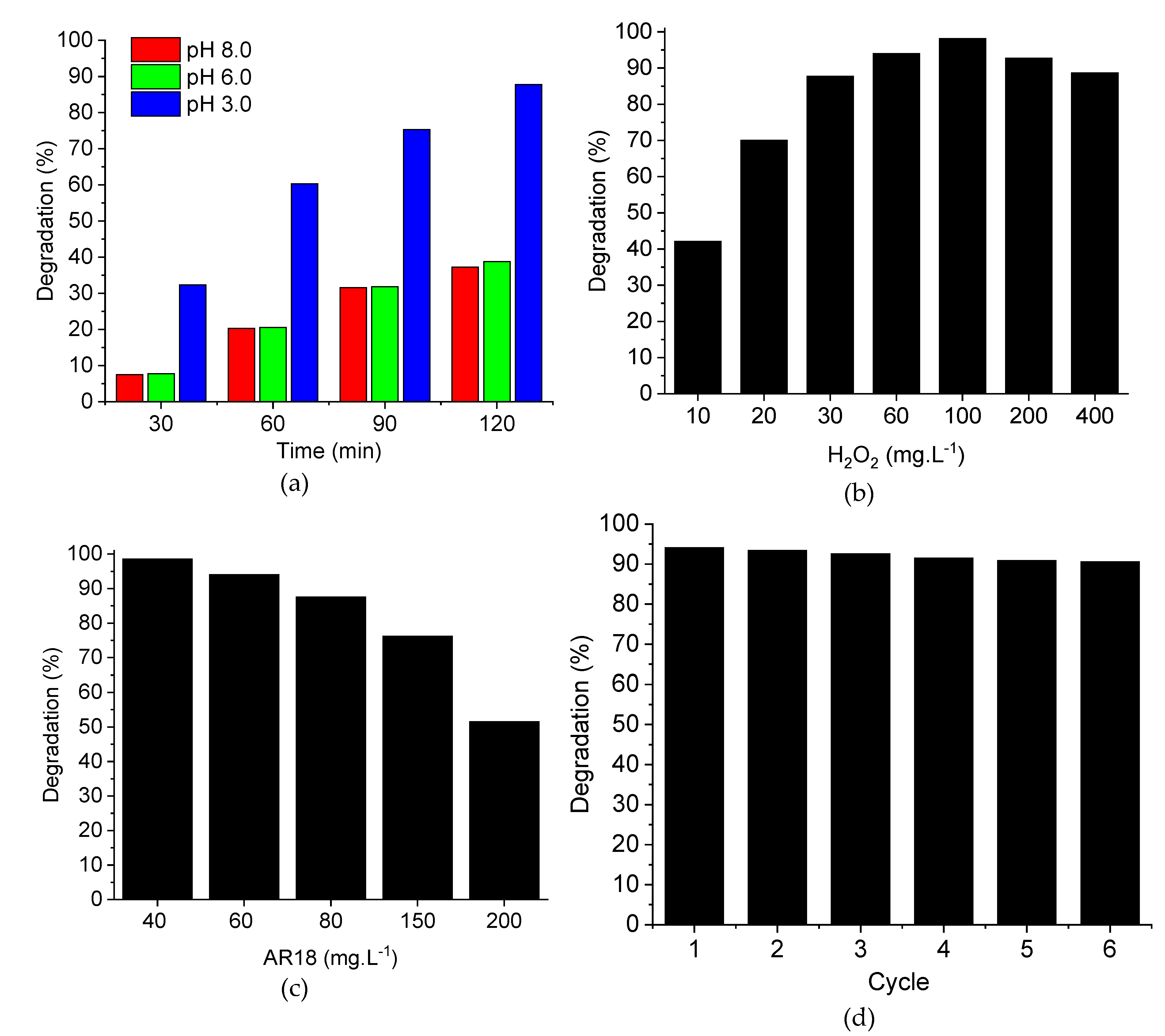
Figure 3.
Degradation of AR18, AR66 and OR2 in a photo-Fenton-like process in function of time. Reaction conditions: C0(Fe3O4) = 1.4 g.L-1, C0(dye) = 0.33 mmol.L-1, C0(H2O2) = 60 mg.L-1, IL = 16.7 mW.cm-2 and a pH of ca. 3.0.
Figure 3.
Degradation of AR18, AR66 and OR2 in a photo-Fenton-like process in function of time. Reaction conditions: C0(Fe3O4) = 1.4 g.L-1, C0(dye) = 0.33 mmol.L-1, C0(H2O2) = 60 mg.L-1, IL = 16.7 mW.cm-2 and a pH of ca. 3.0.
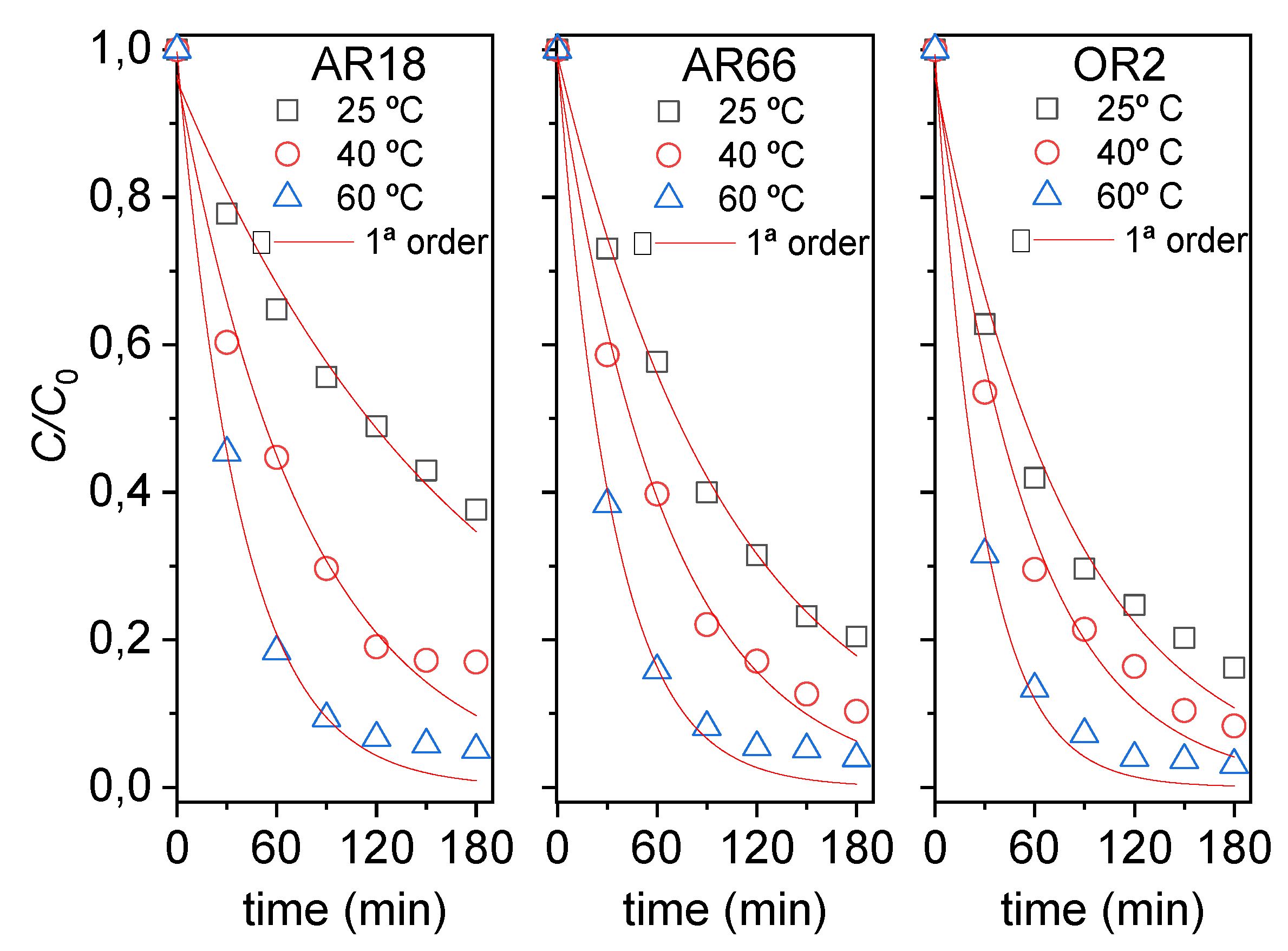
Figure 4.
Arrhenius plots for photo-Fenton degradation of the AR18, AR66 and OR2. C0(Fe3O4) = 1.4 g.L-1, C0(dye) = 0.33 mmol.L-1, C0(H2O2) = 60 mg.L-1, IL = 16.7 mW.cm-2 and a pH of ca. 3.0.
Figure 4.
Arrhenius plots for photo-Fenton degradation of the AR18, AR66 and OR2. C0(Fe3O4) = 1.4 g.L-1, C0(dye) = 0.33 mmol.L-1, C0(H2O2) = 60 mg.L-1, IL = 16.7 mW.cm-2 and a pH of ca. 3.0.
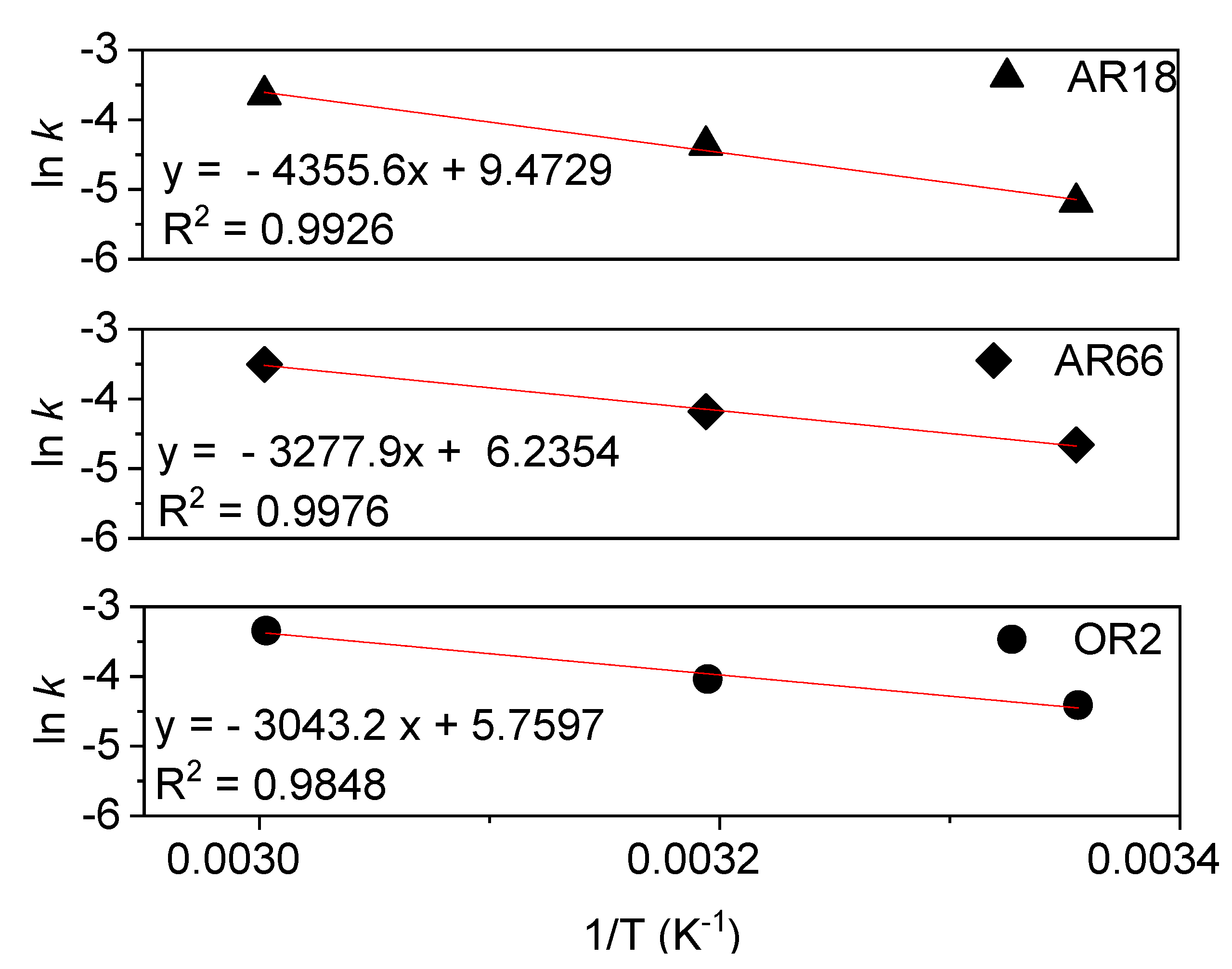
Figure 5.
The van’t Hoff plots for the photo-Fenton degradation of AR18, AR66 and OR2. C0(Fe3O4) = 1.4 g.L-1, C0(dye) = 0.33 mmol.L-1, C0(H2O2) = 60 mg.L-1, IL = 16.7 mW.cm-2 and a pH of ca. 3.0.
Figure 5.
The van’t Hoff plots for the photo-Fenton degradation of AR18, AR66 and OR2. C0(Fe3O4) = 1.4 g.L-1, C0(dye) = 0.33 mmol.L-1, C0(H2O2) = 60 mg.L-1, IL = 16.7 mW.cm-2 and a pH of ca. 3.0.
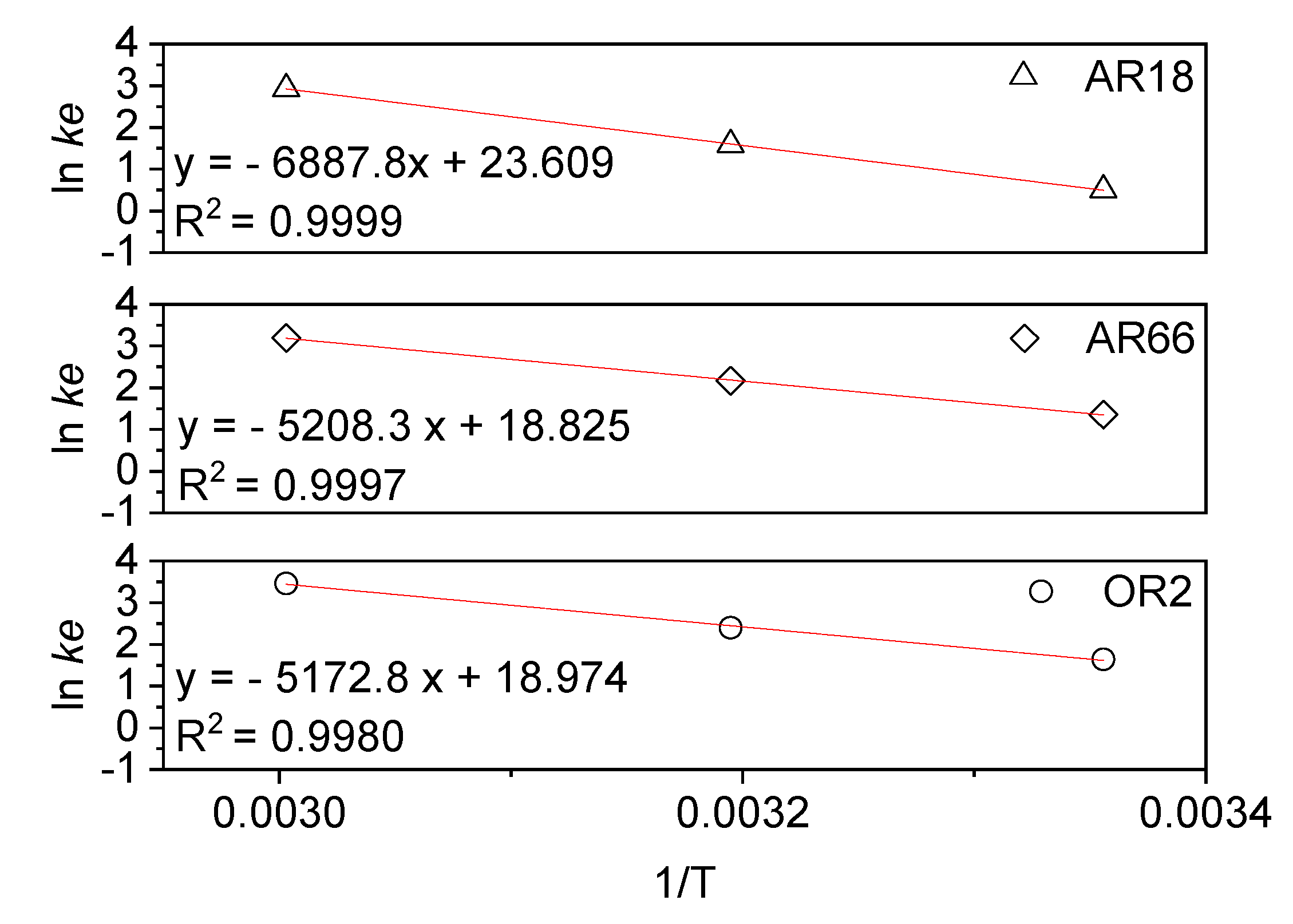
Figure 6.
Azo dye structures in a study adapted from worlddyevariety.com.
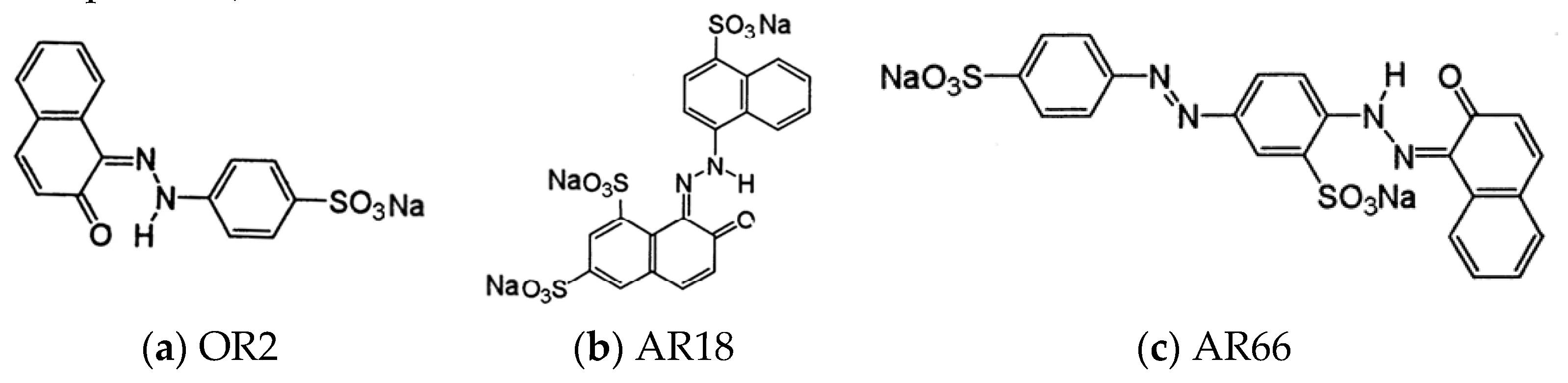
Figure 7.
Comparison of the degradation efficiency of the AR18 azo dye at 25 °C over distinct iron catalysts via photo-Fenton process. Catalyst dosage of 1.4 g.L-1, C0(AR18) = 60 mg.L-1, C0(H2O2) = 60 mg.L-1, IL = 16.7 mW.cm-2, and a pH of 3.0 at t = 180 min. aSynthesized according to [47], bSynthesized according to [48], cCommercial (Sigma-Aldrich) and dsynthesized in this work.
Figure 7.
Comparison of the degradation efficiency of the AR18 azo dye at 25 °C over distinct iron catalysts via photo-Fenton process. Catalyst dosage of 1.4 g.L-1, C0(AR18) = 60 mg.L-1, C0(H2O2) = 60 mg.L-1, IL = 16.7 mW.cm-2, and a pH of 3.0 at t = 180 min. aSynthesized according to [47], bSynthesized according to [48], cCommercial (Sigma-Aldrich) and dsynthesized in this work.
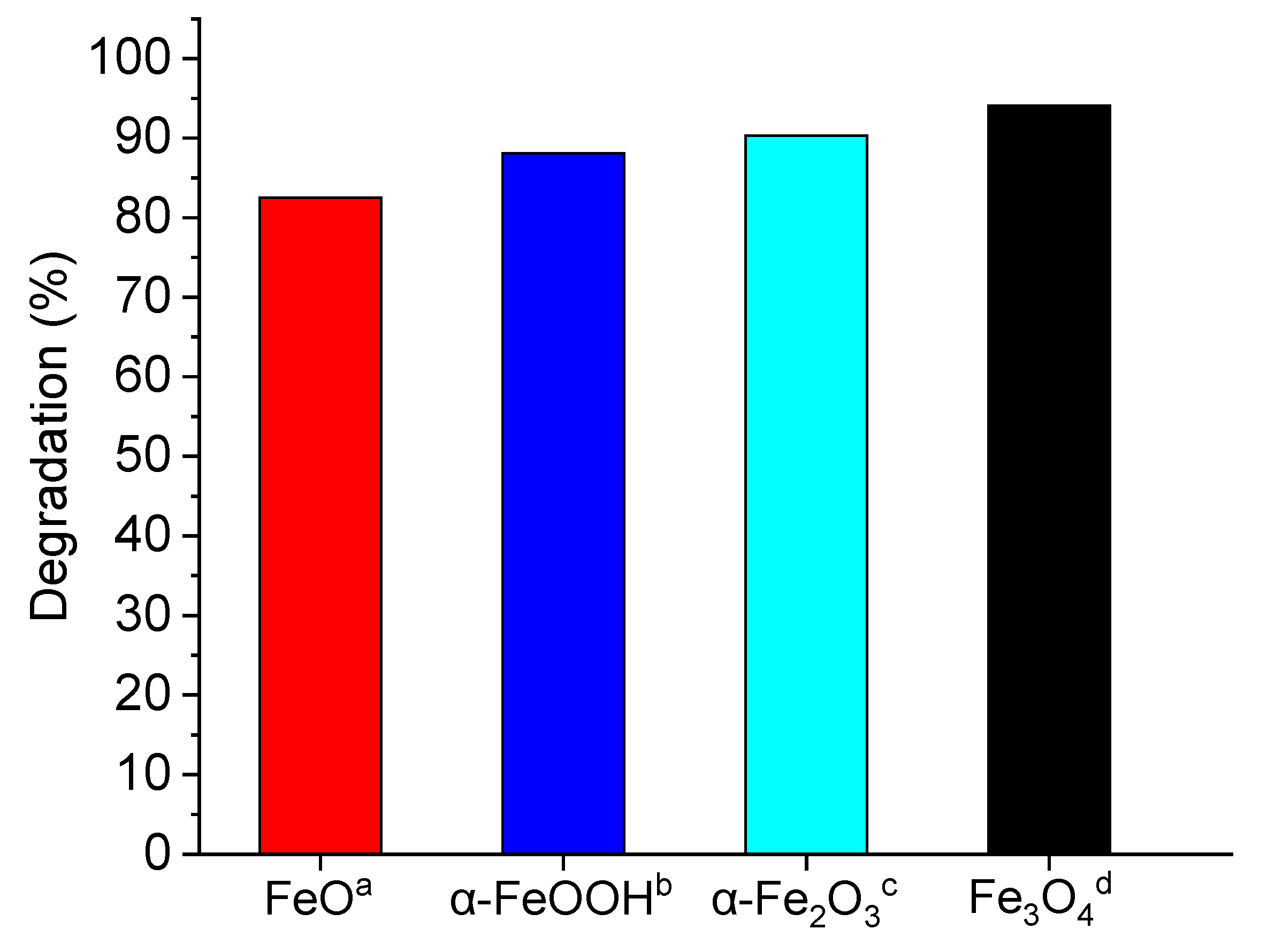
Figure 8.
UV–Vis spectra of Orange 2 as a function of reaction time for OR2 at 60 °C in photo-Fenton-like processes. Catalyst dosage of 1.4 g.L-1, C0(dye) = 0.33 mmol.L-1, C0(H2O2) = 60 mg.L-1, IL = 16.7 mW.cm-2 at a pH of 3.0.
Figure 8.
UV–Vis spectra of Orange 2 as a function of reaction time for OR2 at 60 °C in photo-Fenton-like processes. Catalyst dosage of 1.4 g.L-1, C0(dye) = 0.33 mmol.L-1, C0(H2O2) = 60 mg.L-1, IL = 16.7 mW.cm-2 at a pH of 3.0.
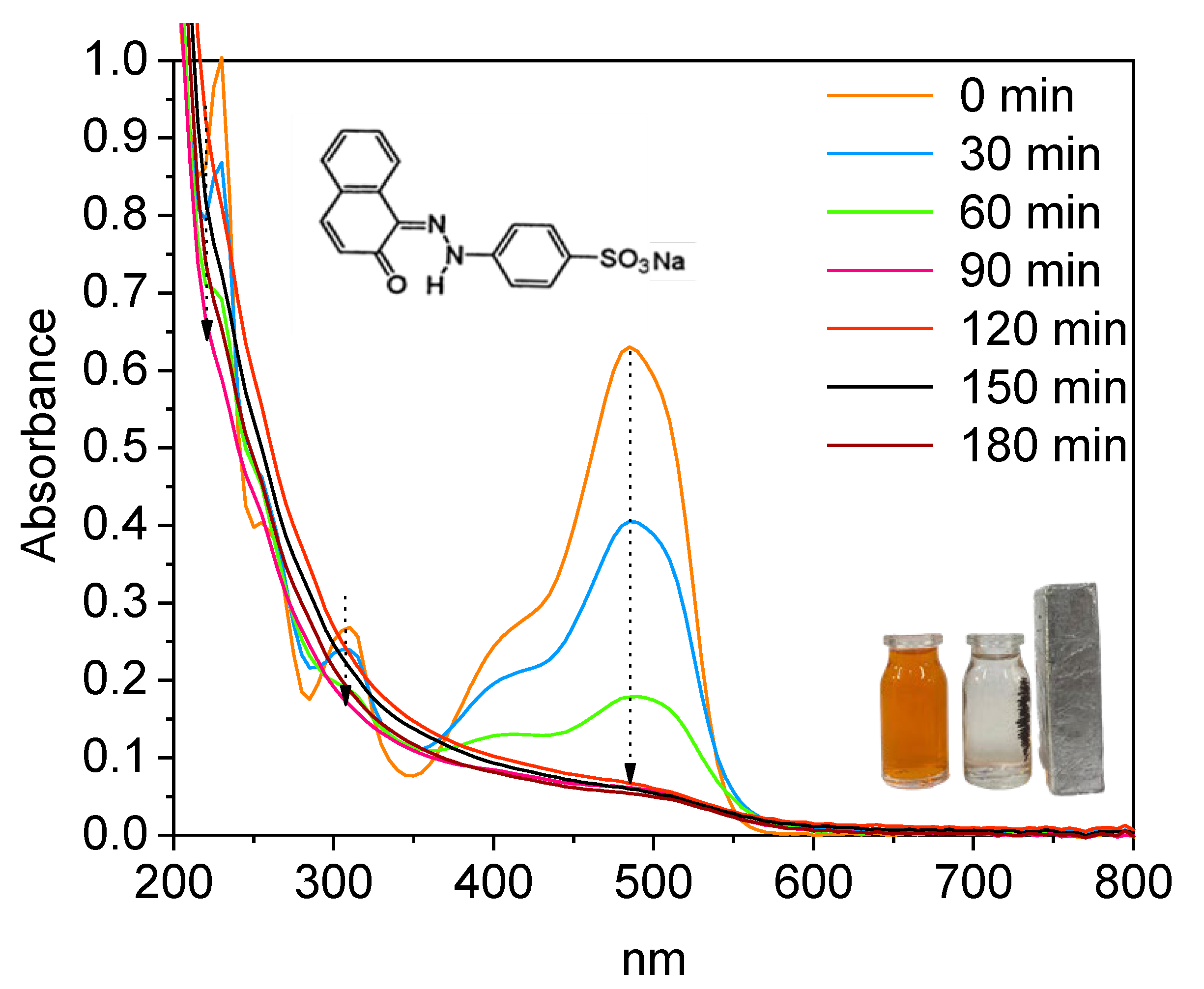
Figure 9.
XPS spectra of Fe 2p core levels for magnetite. (a) fresh Fe3O4, and after photo-Fenton-like reaction with (b) AR18 and (c) AR 66. Reaction conditions: Catalyst dosage of 1.4 g.L-1, C0(dye) = 0.33 mmol.L-1, C0(H2O2) = 60 mg.L-1, IL = 16.7 mW.cm-2 at a pH of 3.0 at 60 °C.
Figure 9.
XPS spectra of Fe 2p core levels for magnetite. (a) fresh Fe3O4, and after photo-Fenton-like reaction with (b) AR18 and (c) AR 66. Reaction conditions: Catalyst dosage of 1.4 g.L-1, C0(dye) = 0.33 mmol.L-1, C0(H2O2) = 60 mg.L-1, IL = 16.7 mW.cm-2 at a pH of 3.0 at 60 °C.
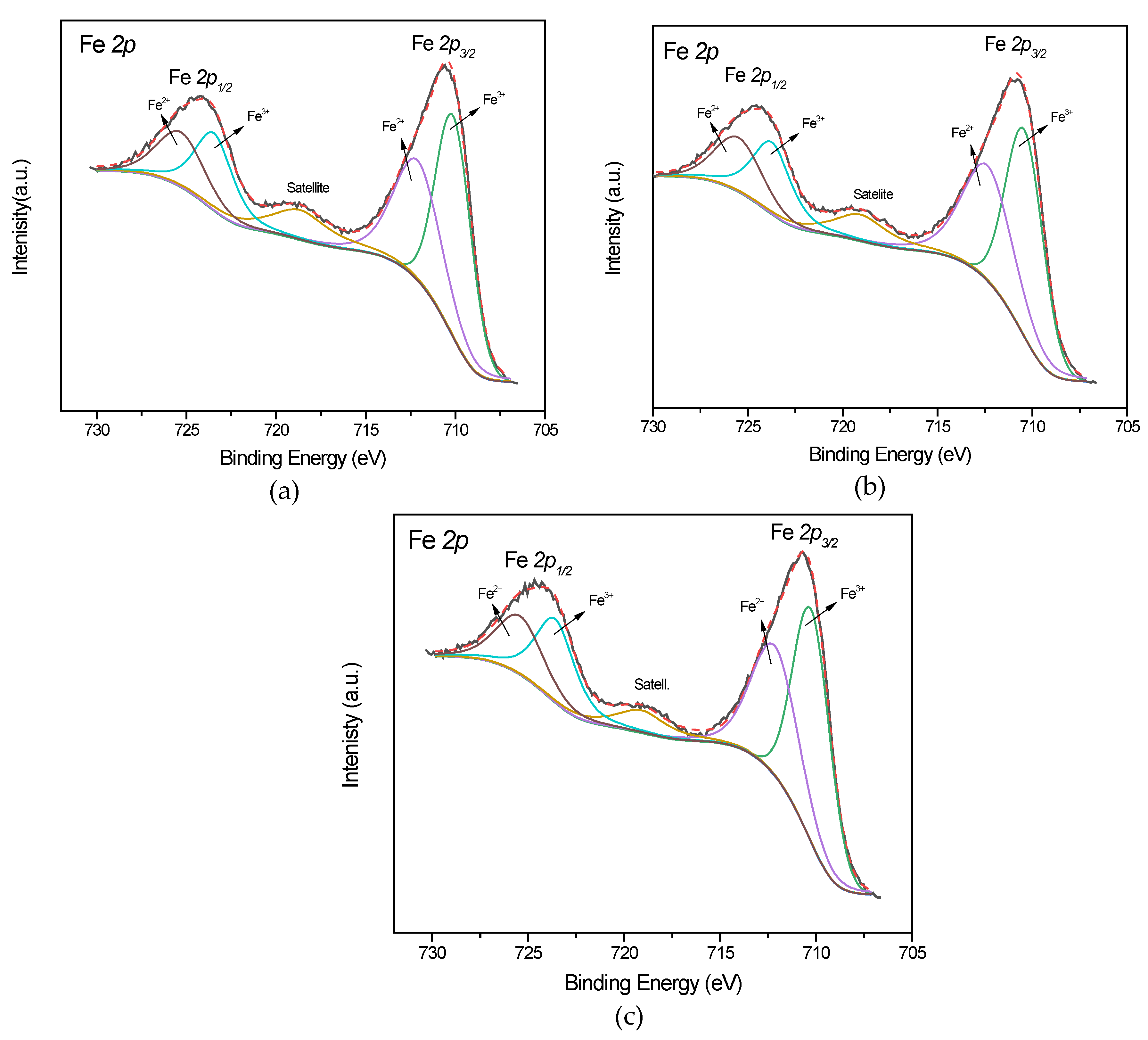

Table 1.
Pseudo first order rate constant and activation energy for AR18, AR66 and OR2 degradation via photo-Fenton process. C0(Fe3O4) = 1.4 g.L-1, C0(dye) = 0.33 mmol.L-1, C0(H2O2) = 60 mg.L-1, IL = 16.7 mW.cm-2 and a pH of ca. 3.0.
Table 1.
Pseudo first order rate constant and activation energy for AR18, AR66 and OR2 degradation via photo-Fenton process. C0(Fe3O4) = 1.4 g.L-1, C0(dye) = 0.33 mmol.L-1, C0(H2O2) = 60 mg.L-1, IL = 16.7 mW.cm-2 and a pH of ca. 3.0.
| T (°C) | AR18 | AR66 | OR2 | ||||||
|
k1 (min-1) |
R2 |
Ea (kJ.mol-1) |
k1 (min-1) |
R2 |
Ea (kJ.mol-1) |
k1 (min-1) |
R2 |
Ea (kJ.mol-1) |
|
| 25 | 0.0056 | 0.980 | 36.2 | 0.0095 | 0.997 | 27.2 | 0.0122 | 0.979 | 25.3 |
| 40 | 0.0127 | 0.981 | 0.0153 | 0.992 | 0.0176 | 0.986 | |||
| 60 | 0.0262 | 0.994 | 0.0301 | 0.994 | 0.0353 | 0.994 | |||
Table 2.
Thermodynamic parameters for AR18, AR66 and OR2 azo dye photo-Fenton degradation. C0(Fe3O4) = 1.4 g.L-1, C0(dye) = 0.33 mmol.L-1, C0(H2O2) = 60 mg.L-1, IL = 16.7 mW.cm-2 at a pH of 3.0.
Table 2.
Thermodynamic parameters for AR18, AR66 and OR2 azo dye photo-Fenton degradation. C0(Fe3O4) = 1.4 g.L-1, C0(dye) = 0.33 mmol.L-1, C0(H2O2) = 60 mg.L-1, IL = 16.7 mW.cm-2 at a pH of 3.0.
| T (°C) | ΔH (kJ.mol-1) | ΔS (kJ.mol-1K-1) | ΔG (kJ.mol-1) |
|---|---|---|---|
| AR18 | |||
| 25 | 57.3 | 0.196 | -1.25 |
| 40 | -4.13 | ||
| 60 | -8.12 | ||
| AR66 | |||
| 25 | 43.3 | 0.157 | -3.37 |
| 40 | -5.64 | ||
| 60 | -8.84 | ||
| OR2 | |||
| 25 | 43.1 | 0.158 | -4.07 |
| 40 | -6.25 | ||
| 60 | -9.58 | ||
Table 3.
XPS parameters of the fresh and spent magnetite after reaction with AR 18 and AR 66 dyes. Reaction conditions: Catalyst dosage of 1.4 g.L-1, C0(dye) = 0.33 mmol.L-1, C0(H2O2) = 60 mg.L-1, IL = 16.7 mW.cm-2 at a pH of 3.0 at 60 °C .
Table 3.
XPS parameters of the fresh and spent magnetite after reaction with AR 18 and AR 66 dyes. Reaction conditions: Catalyst dosage of 1.4 g.L-1, C0(dye) = 0.33 mmol.L-1, C0(H2O2) = 60 mg.L-1, IL = 16.7 mW.cm-2 at a pH of 3.0 at 60 °C .
| Sample | Binding energy (eV) | |||||||
|---|---|---|---|---|---|---|---|---|
| Fe 2p3/2 | Fe 2p1/2 | C 1s | O 1s | S 2p | Fe3+/Fe2+ ratio | |||
| Fe3O4 [46] | 710.0 (18) |
724.9 (17) |
284.7(82) 286.0(12) 288.3(6) | 529.6(63) 531.0(29) 532.7(8) | 2.3 | |||
| Fe3O4/AR18 | 710.3 (17) |
724.8 (23) |
284.8(80) 285.3(12) 288.5(8) | 529.9(63) 531.4(28) 532.7(9) | 2.6 | |||
| Fe3O4/AR66 | 710.2 (19) |
724.7 (21) |
284.8(81) 285.3(13) 288.6(6) | 529.8(56) 531.4(28) 532.8(16) | 168.1 | 2.4 | ||
Disclaimer/Publisher’s Note: The statements, opinions and data contained in all publications are solely those of the individual author(s) and contributor(s) and not of MDPI and/or the editor(s). MDPI and/or the editor(s) disclaim responsibility for any injury to people or property resulting from any ideas, methods, instructions or products referred to in the content. |
© 2024 by the authors. Licensee MDPI, Basel, Switzerland. This article is an open access article distributed under the terms and conditions of the Creative Commons Attribution (CC BY) license (http://creativecommons.org/licenses/by/4.0/).
Copyright: This open access article is published under a Creative Commons CC BY 4.0 license, which permit the free download, distribution, and reuse, provided that the author and preprint are cited in any reuse.


