
Submitted:
02 July 2024
Posted:
03 July 2024
You are already at the latest version
Abstract
College students play an important role in higher education and future social life. Research has a significant impact on college students' self-efficacy. Taking college students in Chengdu, China as an example, this study adopts the fuzzy-set qualitative comparative analysis (fsQCA) method, comprehensively incorporating various influencing factors such as demographic characteristics, physical exercise behavior, and life satisfaction. From the perspective of physical exercise behavior and life satisfaction, an asymmetric causal model that affects college students' high self-efficacy is constructed. The research results support the main principles of complexity theory, confirming the heterogeneity and complexity of the antecedent conditions for high self-efficacy among college students. Nineteen causal condition combinations that can promote high self-efficacy among college students are obtained. This study conducts exploratory research on the introduction of complexity theory analysis into the study of college students' physical exercise, life satisfaction, and self-efficacy. It also provides a decision-making reference path for improving the life satisfaction, physical exercise behavior, and self-efficacy of college students.
Keywords:
college students
; exercise behavior
; life satisfaction
; self-efficacy
; complexity theory
Introduction
Health is an inevitable requirement for promoting the comprehensive development of individuals and an important condition for social and economic development. As the main body of the university, the physical and mental health of college students plays an irreplaceable role in their own development and social progress. Therefore, all parties should work together to provide favorable conditions for college students to participate in physical exercise[1]. College life is a crucial transitional stage from adolescence to adulthood, and the formation and maintenance of healthy behaviors during this period can have a significant impact on adulthood[2]. However, the status of physical exercise among college students at this stage is not optimistic. Data from many countries around the world indicate that about 3/4 of adolescents lack sufficient physical activity. According to the survey on the status of nationwide fitness activities in China, only 14.7% of residents aged 20-69 regularly exercise [3].
There are numerous studies focusing on the correlation between college students' physical exercise behavior, life satisfaction, and self-efficacy. A review of previous research reveals that most of them explored the relationship between physical exercise behavior and various internal psychological factors such as exercise self-efficacy, physical exercise cognition, and life satisfaction from the individual's internal level. Research indicates that self-efficacy refers to the belief in one's ability to complete tasks and achieve desired results, and this theory is a relatively successful one in the field of exercise behavior. Sallis pointed out that self-efficacy is a variable most closely related to physical exercise behavior[4]. Exercise intervention studies that increase self-efficacy regulatory components have been successful[5]. Attitude towards physical exercise refers to the comprehensive manifestation of individuals' cognitive evaluation, emotional experience, and behavioral intention in sports activities[6]. It is an essential psychological factor for individuals to persist in participating in sports activities, and the physical exercise attitude of college students has a positive impact on their physical health[7]. The level of self-efficacy not only determines an individual's life attitude when facing challenges during development, but also determines the degree of development of human potential by influencing individuals' choice of different activities [8]. With the rapid development of science and technology and the continuous improvement of material standards, modern college students' lifestyles have undergone significant changes compared to the past, and the physical and mental health of college students has become a hot topic of social concern. In recent years, college students' flexibility has declined, and the overweight rate has increased from 3.3% to 4.6%, while the obesity rate has increased from 5.1% to 8.2%, indicating that their physical health status is not optimistic[9]. College students' academic performance, living conditions, and employment are all influenced by their self-efficacy[10]. Participating in physical exercise activities can improve problem-solving ability, perseverance, unyielding fighting spirit, good control ability, and self-confidence. At the same time, recognition from parents, friends, and classmates can also enhance self-efficacy[11].
Life satisfaction, as an important indicator to examine an individual's living conditions, reflects the quality of an individual's recent life. With the rise of the information era, more and more college students have become "netizens," and their time spent participating in sports activities has gradually decreased, leading to a series of problems such as declining physical fitness and lack of self-confidence. Some college students have mental health issues, experiencing occasional or frequent anxiety, depression, hostility, and even suicidal psychological symptoms[12]. Varying degrees of personal psychological pressure affect college students' level of life satisfaction. Studies have shown that different forms of physical exercise can have a positive effect on individuals' psychological and physical well-being, enhancing their psychological and physical qualities, thereby gradually increasing their satisfaction with life[13].
Currently, most studies discuss the relationship between these three factors from a linear perspective. However, the formation of college students' self-efficacy is a very complex psychological process that is influenced by complex interactions from multiple factors, including individuals, groups, and society. To explore the specific formation and influencing mechanisms of this complex process, this article will analyze the internal structure and relationship between college students' physical exercise behavior, life satisfaction, and self-efficacy. Utilizing complexity theory and a new fuzzy-set qualitative comparative analysis (fsQCA) for empirical research, this article aims to supplement relevant theories on the relationship between physical exercise behavior, life satisfaction, and self-efficacy.
2. Related Theories and Model Construction
2.1. Physical Exercise Behavior
Physical exercise behavior is a unique social activity that emerges and develops along with people's diverse needs for sports. Many scholars have defined the concept of physical exercise behavior based on its goals and patterns. New definitions have been proposed by scholars according to the various functions of physical exercise. In his research on physical exercise and physical health, Lotan defined physical exercise as physical activity that is directly related to physical health and well-being[14]. Vieira, on the other hand, defined physical exercise in his study on its impact on cardiorespiratory endurance as physical activity that can improve an individual's cardiorespiratory endurance and enhance their health level [15].
In terms of sports psychology, numerous clinical and animal studies have shown that physical exercise has a significant positive effect on cognitive function. Particularly, aerobic exercise can influence the development of children's cognitive abilities and, consequently, their self-control abilities[16]. The study found that regular physical exercise can significantly improve children's self-control and reduce impulsivity. Scholar Blumenthal analyzed the effectiveness of standard medication combined with aerobic exercise in elderly patients with severe depression and found that physical exercise can be an alternative to antidepressant medication for treating depression (Blumenthal et al., 1999). In the field of sports science, DeSire et al. used a controlled experimental method to explore the effectiveness of physical exercise in treating patients with knee osteoarthritis[17].
Zhang and Ren surveyed 123 university students, listing activities such as sports, study, and socializing, and inquired about their positive emotions in different environments[18]. The results showed that physical exercise was the primary source of positive emotions. Ji Liu found that appropriate physical exercise for adolescents can generate more "pleasure." Additionally, exercise has a significant impact on the executive function of the brain[19]. Chen conducted a study on overweight children and found that a single 40-minute session of moderate-intensity exercise had the most significant improvement on their executive function[20]. Scholar Mao Yongming's research on the physical fitness of adolescents revealed that those who engage in long-term physical exercise have far superior endurance, speed, strength, and flexibility compared to the average person, as well as superior cardiopulmonary function, neural regulation, and respiratory function [21].
2.2. Life Satisfaction
The concept of "life" was first proposed by Shin and Johnson, who understood life satisfaction as an individual's evaluation of their living situation, reflecting in their thoughts whether certain things are developing according to their own wishes during daily activities [22]. Neal Kruase added his own perspective on life satisfaction, arguing that it is highly subjective because he proposed that the main factor in judging life satisfaction is the individual's recent feelings[23].
Man's research indicated that family members and peers can affect adolescents' life satisfaction. In daily interactions, evaluations from schoolmates tend to have a deeper impact than those from parents, but this phenomenon is not constant and occurs more frequently during adolescence. While focusing on family education, it is also necessary to pay attention to adolescents' status and interpersonal relationships in school life [24]. Huebner divided life satisfaction into two aspects: overall satisfaction and specific satisfaction in specific life domains. He believed that friendship, school, family, living environment, and self are considered the most important areas in young people's lives. When focusing on college students' life satisfaction, one cannot only consider one aspect. Therefore, in investigating life satisfaction, these five dimensions need to be taken into account, and lacking any one of them will lead to inaccurate measurement of life satisfaction[25]. McCullough et al. found that experiences in adolescents' lives have the greatest impact on their life satisfaction, and the cumulative effect of multiple events is more significant than a single event. Adolescents should pay attention to all aspects of life and not lose confidence due to temporary failures, which can affect their quality of life. They should approach future events with a developmental perspective[26]. Gilman et al. conducted an environmental experiment study on adolescents and found that their overall life satisfaction after the study was higher than before[27]. He et al. studied life satisfaction from a medical perspective and found a close relationship between the structure and function of the brain and life satisfaction[28].
2.3. Self-Efficacy
The concept of self-efficacy was first introduced by American scholar Bandura, who believed that self-efficacy refers to an individual's confidence and ability to solve difficulties or problems when faced with them[29]. His research showed that individuals have different requirements for their abilities when facing different environments and problems, resulting in varying degrees of confidence, and thus self-efficacy manifests itself in varying degrees in different industries and environments.
In 1988, Conger, Jay viewed self-efficacy as an expectation of effectiveness, arguing that this expectation is a predictive behavior of whether people can successfully complete certain tasks and achieve certain results. The expectation of effectiveness accumulates continuously in life, and only when a person is sufficiently excellent and confident will this expectation exhibit positive effects[30]. The famous German psychologist Schwarzer believes that self-efficacy is a specific spiritual belief that does not change with changes in an individual's environment. This is what some scholars refer to as general self-efficacy, which can be applied to various scenarios[31]. Zhang Jiping et al. argue that as a motivational factor, self-efficacy not only affects college students when facing difficulties, making choices, setting goals, and completing tasks, but also affects their emotional state in the classroom[32]. Scholars like Zeng Runxi have shown that individuals with higher levels of self-efficacy are more willing to use the internet to search for health information, engage in more frequent search behaviors, and their self-efficacy affects their personal thinking and behavior[33]. Research indicates that improving college students' self-efficacy can improve their depression, and the theory of self-efficacy has also been enriched[34].
2.4. Model Construction
The influencing factors of college students' self-efficacy are diverse and complex. Therefore, a causal relationship model is first constructed between college students' demographic characteristics, physical exercise behavior, life satisfaction, and self-efficacy (Figure 1). The dimensions of physical exercise behavior include four latent variables: Exercise motivation, Individual factors, Social environment, and Physical education. Life satisfaction is represented by five latent variables: Family satisfaction, School satisfaction, Freedom satisfaction, Environment satisfaction, Academic satisfaction, and Friendship satisfaction. Additionally, there is a correlation between self-efficacy and demographic characteristics[35], so five demographic variables: Gender, Birthplace, Age, Only child, and Subject are included in the model for complexity analysis. Model A1 represents the causal relationship between college students' life satisfaction and self-efficacy. Model B1's precondition is the causal relationship between physical exercise behavior and self-efficacy. Model C1's precondition is the causal relationship between demographic characteristics and self-efficacy. Model D1's precondition is the causal relationship between life satisfaction, physical exercise behavior, and self-efficacy. Model E1's precondition is the causal relationship between physical exercise behavior, demographic characteristics, and self-efficacy.
3. Research Design and Methodology
3.1. Research Area
Chengdu, a significant central city in western China, enjoys the reputation of "the Land of Abundance" and is among the first batch of national historical and cultural cities. It is the birthplace of ancient Shu civilization, a nationally designated historical and cultural city, and China's best tourist city. With nearly 60 universities, including world-renowned institutions such as Sichuan University, University of Electronic Science and Technology of China, Southwest Jiaotong University, and the only sports university in Southwest China, Chengdu provides a diverse range of options for studying college students' physical exercise behavior, life satisfaction, and self-efficacy. Based on this, this study takes college students in Chengdu as a case to explore the relationship between their physical exercise behavior, life satisfaction, and self-efficacy.
3.2. Measurement Tools
This study employs a questionnaire to measure the required content. The questionnaire is divided into three main parts: The first part focuses on college students' physical exercise behavior and life satisfaction, measuring key variables involved in the study. It includes four latent variables related to physical exercise behavior: Exercise motivation, Individual factors, Social environment, and Physical education. For life satisfaction, five latent variables are considered: Family satisfaction, School satisfaction, Freedom satisfaction, Environment satisfaction, Academic satisfaction, and Friendship satisfaction. Respondents are asked to rate their agreement with each variable. The first and second parts primarily utilize a Likert 5-point scale. The third part collects demographic information about the respondents, including gender, age, subject area, and other factors.
The measurement indicators for physical exercise behavior, life satisfaction, and self-efficacy in the first and second parts are primarily based on previous qualitative research by Ma Aimin and Liang Xiao [35]. The life satisfaction scale is adapted from the research of Han Huijun, Wang Yanan, and others [36] (Table 1).
3.3. Data Acquisition
To ensure the recovery rate and validity of the questionnaire data, the research team conducted research in various universities in Chengdu through the participation of college student volunteers. In July 2023, the research team established online and offline friendships through the Chengdu University Student Games, laying a stable foundation for work contacts in the early stage and conducting preliminary research and analysis. The formal research lasted from mid-July to early September 2023. Based on the QQ group of Chengdu University Student Games involved in the research, the research team adopted the methods of inviting participants to participate in the survey, random sampling in probability sampling, and snowball sampling through mutual invitations among Chengdu University Student Games. Combined with field research, a total of 550 questionnaires were distributed, 545 were recovered, and 533 were valid, with an effective rate of 98.1%. Among them, 221 paper questionnaires were sent out, 213 were recovered, 211 were valid, with an effective rate of 99.1%. 329 online questionnaires were sent out, 325 were recovered, and 322 were valid, with an effective rate of 99.1%.
Among the respondents, 60.4% were male and 39.6% were female. From the perspective of subject distribution, 47.5% of the respondents were liberal arts, 36.4% were arts, and 16.1% were science. From the perspective of grade distribution, 2.4% were from the fourth year, 15.8% were from the third year, 73% were from the second year, and 8.8% were from the first year. From the perspective of the respondents' birthplace, 37.3% were from urban areas and 62.7% were from rural areas. 28.7% were only children, and 71.3% were non-only children.
3.4. Research Methodology
The primary method adopted in this study is Fuzzy-set Qualitative Comparative Analysis (fsQCA), and the selected data analysis software is fsQCA3.0. QCA is a new analytical technique based on Boolean algebra to achieve comparative principles, combining the advantages of quantitative and qualitative analysis, suitable for case analysis or quantitative analysis of small, medium, and large samples. It has broad application prospects in sociology, management, and other fields [37].
Calibration and the calculation of truth tables are two crucial steps in fsQCA. In this study, we first took the average of continuous variables such as college students' physical exercise behavior, life satisfaction, and self-efficacy involved in the research. Then, according to Ragin's suggested continuous assignment scheme [38], we set 95% as complete membership, 5% as complete non-membership, and 50% as the crossover point, and calibrated the data accordingly. Since the questionnaire in this study uses the Likert 5-point scale for data measurement, 1 was set as the complete non-membership threshold, 5 as the complete membership threshold, and 3 as the crossover point. For the three binary variables of gender, birthplace, and whether the respondent is an only child, there are no cross-fuzy points and belong to the crisp set. Therefore, we adopted Ragin's standard of 0.05 to calibrate male, urban, and yes, and 0.95 to calibrate female, rural, and no[39].In the process of constructing the truth table, it is first refined according to two standard: one is frequency , where a minimum frequency of 2 is generally adopted for medium to large samples; the other is consistency, with a recommended threshold value of greater than or equal to 0.8. To predict the self-efficacy of college students, this study set the frequency cut-off value to 2 and the acceptable consistency threshold to 0.8.
4. Result Analysis
4.1. Data Analysis and Model Validation
Data analysis and model validation primarily consist of five parts: exploratory factor analysis, confirmatory factor analysis, counterfactual case analysis, fsQCA correlation analysis, and predictive validity analysis.
4.2. Exploratory Factor Analysis
The overall Cronbach's α of the questionnaire is 0.946, with a KMO value of 0.931. The Bartlett's test of sphericity is significant at p=0.000, indicating that the reliability and validity tests have been passed, making it suitable for factor analysis. Since all 11 dimensions of variables in this study's model, including exercise behavior, life satisfaction, and self-efficacy, are original constructs that have not been tested by scholars, we have conducted specific analyses. For exercise behavior, using principal component analysis and varimax rotation in SPSS 25.0, the factor analysis was first based on eigenvalues greater than 1. The results showed that the Cronbach's α coefficients of the four common factors were all greater than 0.7, with a cumulative variance explanation rate of 86.377%. Additionally, all factor loading values of the scale's measurement items were greater than 0.5, fully demonstrating the scientific nature of the research data. Similarly, life satisfaction and self-efficacy were analyzed sequentially. Six common factors were extracted from the life satisfaction variable, with a cumulative variance contribution rate of 85.235%. The cumulative variance contribution rates of all three variables are relatively high, indicating that most of the information from the original variables has been retained after the factor transformation (Table 2).
4.3. Confirmatory Factor Analysis
A confirmatory factor analysis was conducted on the data using Smartpls software, revealing that the composite reliability (CR) values were all distributed between 0.7 and 0.9, exceeding the recommended threshold of 0.7, indicating a high level of measurement reliability [40]. As can be seen from Table 3, the average variance extracted (AVE) values of all latent variables are between 0.5 and 0.8, exceeding the standard value of 0.5. Furthermore, the square root of the AVE value of each latent variable is greater than the correlation coefficient of other latent variables, indicating good discriminant validity among the latent variables in this study. Additionally, the χ2/df ratio was 3.230 (recommended value χ2/df < 5), GFI = 0.867 (recommended value GFI > 0.8), NFI = 0.909 (recommended value NFI > 0.9), CFI = 0.919 (recommended value CFI > 0.9), and RMSEA = 0.091 (recommended value RMSEA < 0.1), suggesting that the overall model fit is satisfactory [41].
4.4. Counterfactual Case Analysis
Pappas and Papatheodorou's research indicates that counterfactual analysis is necessary to illustrate the existence of positive or negative relationships, or even the absence of a relationship, within the same dataset [42]. Table 4 presents positive and negative counterfactual cases between freedom satisfaction and self-efficacy. It is evident that there are counterfactual cases in the relationship between freedom satisfaction and self-efficacy, where high freedom satisfaction leads to low self-efficacy (8 cases), while low freedom satisfaction can also result in high self-efficacy (15 cases). Therefore, there exists an asymmetric relationship between the variables involved in this study, necessitating the use of fsQCA methodology to further analyze their asymmetric relationships.
4.5. fsQCA Analysis
In the process of fsQCA analysis, it is first necessary to detect whether a single antecedent variable is a necessary condition for the outcome variable. When the consistency score of a single antecedent variable is greater than 0.9, it can be considered a necessary condition for the outcome. The fsQCA necessary condition analysis revealed that five necessary conditions for the formation of college students' self-efficacy include exercise motivation, social environment, environmental satisfaction, physical education, and freedom satisfaction, all with consistency scores greater than 0.9. However, the occurrence of these five necessary conditions does not guarantee the emergence of college students' self-efficacy. In reality, single necessary conditions for outcomes are common, while single sufficient conditions that can lead to outcomes are typically nonexistent. Therefore, a sufficient analysis of the combination of antecedent conditions needs to be conducted through fsQCA to provide sufficient and consistent configuration conditions for predicting college students' self-efficacy.
Table 5 shows the results of using the fsQCA method to predict and analyze high self-efficacy among college students. This analysis covers six life satisfaction variables, four exercise behavior variables, and five demographic variables. By constructing five complex causal models, a total of 29 combinations of antecedent conditions for high-level college students' self-efficacy were obtained. The research results show that the five complex causal model solutions achieved the standards defined by Ragin [43] in terms of consistency and coverage (consistency > 0.75, coverage > 0.20). XY plots are used to visually present the causal combination relationships in the models, showing the relationship between X and Y. This study selected causal combination paths A3 and B5 with higher consistency from the five models to create XY plots (see Figure 2). It can be seen from the figures that there is an asymmetric relationship between the two condition combinations X and the corresponding outcome Y, sufficient but not necessary relationship. This means that both condition combinations X are sufficient conditions for the corresponding outcome Y, but they are not necessarily the only factors explaining outcome Y.
4.6. Predictive Validity Analysis.
Despite the good model fit, the predictive results cannot be proven on different datasets, thus necessitating a predictive validity analysis. Firstly, SPSS is utilized to calculate variables for the original sample, followed by the use of EXCL for screening and dividing it into two subsamples. An fSQCA analysis is then conducted on asymmetric relationships modeling in Subsample 1. Subsequently, Subsample 2 is utilized to analyze the causal combinations of the simulated result conditions (high self-efficacy). The predictive validity results of high self-efficacy are presented in Table 6, with six dimensions of life satisfaction and exercise behavior serving as causal antecedents. The causal combinations analyzed in the hypothetical model using Subsample 1 are identical to the fsQCA results of the overall sample (Model B1 in Table 5). Then, Subsample 2 is employed to test causal combinations 1 and 2 from Subsample 1. Based on the two XY plots (Figure 3) of the model in Subsample 2, similar asymmetric relationships are obtained, demonstrating the capability of the proposed hypothetical configuration model to predict result conditions across different datasets.
4.7. Application of Complexity Theory
This study examines the complex configuration model affecting college students' self-efficacy based on complexity theory and evaluates the fsQCA analysis results according to the principles proposed by Woodside[44]. According to Principle 1, a simple factor condition may be necessary, but it is not sufficient for a high score in predicting the outcome. Principle 2 states that a complex causal combination involving two or more factor conditions is sufficient for a high score in predicting the outcome. Meanwhile, Principle 3 indicates that a causal combination is not a necessary condition for a high score in predicting the outcome. Principle 4 suggests that the impact of a certain factor condition on the outcome score depends on the presence of other factors in the causal combination. Finally, Principle 5 posits that a particular causal combination represents only a partial rather than a complete view of the cases, and the coverage of any single causal combination should be less than 1.00. As shown in Table 4, no single variable can fully explain the high level of self-efficacy among college students, which aligns with Principle 1. Furthermore, different combinations of antecedent variables can lead to improved self-efficacy among college students, such as models A1, B3, and C5 in Table 4, supporting Principle 2. Additionally, the high self-efficacy of college students with high levels is not explained by a single causal combination, endorsing Principle 3. Moreover, the sense of accomplishment exists in combinations B1, B3, and E3, but the impact of physical education on the self-efficacy of college students with high levels varies from positive to negative. Simultaneously, physical education does not appear in combinations D5, E3, and E6, indicating that its predictive effect on the self-efficacy of college students with high levels depends on other antecedent conditions, explaining the existence of counterfactual cases and the heterogeneity of college students' self-efficacy, thus supporting Principle 4. Additionally, the fsQCA analysis results in Table 4 show that the coverage of all condition combinations is less than 1.00, fulfilling Principle 5.
4.8. fsQCA Analysis Results
This section presents a fuzzy-set qualitative comparative analysis (FsQCA) based on Ragin's (2008) research. For the solution coverage, a value greater than 0.5 is considered satisfactory, while less than 0.2 is negligible. Similarly, for solution consistency, a value greater than 0.75 is satisfactory, and less than 0.7 is negligible. Table 6 demonstrates the FsQCA predictive analysis of high self-efficacy among university students, revealing five configuration model solutions with satisfactory levels of coverage and consistency (see Table 5).Using life satisfaction as an analytical indicator, Model A incorporates six variables related to life satisfaction and identifies five condition combinations. It achieves an overall coverage of 0.942 and an overall consistency of 0.858. Among these combinations, A4 (~friendship satisfaction * school satisfaction * family satisfaction * freedom satisfaction) exhibits the highest consistency level (0.926), indicating that university students with high satisfaction in school, family, and freedom are more likely to perceive high self-efficacy.
Model B explores the impact of four variables on high-level self-efficacy, resulting in four condition combinations. It achieves an overall coverage of 0.678 and an overall consistency of 0.903. Among them, B2 (exercise motivation * individual factors) exhibits the highest consistency level (0.895), suggesting that university students with high exercise motivation and individual factors are most likely to perceive high self-efficacy.Model C focuses on five demographic factors that influence high-level self-efficacy, resulting in four condition combinations. It achieves an overall coverage of 0.606 and an overall consistency of 0.876. Among them, C4 (~place of origin * only child * grade) exhibits the highest consistency level (0.885), indicating that rural only children in higher grades are most likely to perceive high self-efficacy.Model D includes four exercise behavior variables and five life satisfaction variables, resulting in three complex causal combination paths for high self-efficacy. It achieves an overall coverage of 0.946 and an overall consistency of 0.835. Among them, combination path D8 (exercise motivation * individual factors * social environment *~physical education * friendship satisfaction * ~school satisfaction * family satisfaction * environmental satisfaction * freedom satisfaction) exhibits the highest consistency level of 0.987, indicating that high exercise motivation, individual factors, social environment, low physical education, high friendship satisfaction, low school satisfaction, high family satisfaction, high environmental satisfaction, and high freedom satisfaction are most conducive to perceiving high self-efficacy.Model E comprises four exercise behavior variables and five demographic characteristics, resulting in three complex causal combination paths for high self-efficacy. It achieves an overall coverage of 0.894 and an overall consistency of 0.874. Among them, combination path E2 (~gender *~ place of origin * discipline * grade * exercise motivation * ~individual factors *~ social environment * physical education) exhibits the highest consistency level of 0.913, suggesting that male rural upper-level liberal arts students with high exercise motivation, low individual factors, local social environment, and high physical education are most likely to perceive high self-efficacy.
5. Conclusion and Discussion
5.1. Conclusion
Based on the relevant research results of "the relationship between college students' physical exercise behavior, life satisfaction, and self-efficacy," an asymmetric influence model of college students' self-efficacy antecedent variables was constructed using complexity theory. Through fuzzy-set qualitative comparative analysis (fsQCA), a series of causal combinations that influence college students' self-efficacy were predicted. Under the premise of high reliability and validity of measurement variables and good model fitting, the five causal models constructed by fsQCA results included 19 causal combinations, all satisfying the requirements of consistency (>0.6) and coverage (>0.2), indicating high credibility. Cross-tabulation analysis revealed that there were counterexamples when predicting college students' self-efficacy from the perspective of exercise behavior and life satisfaction, indicating an asymmetric relationship between the predicted result conditions (self-efficacy) and the preceding causal conditions. Therefore, the analysis using the fsQCA method had a high degree of fit. The fsQCA results showed that the antecedent conditions for high self-efficacy were heterogeneous and complex, meaning that the same antecedent condition could have negative, positive, or no effect in different predicted causal combinations, indicating a certain interaction between the antecedent conditions for high-level self-efficacy, presenting a complex influence mechanism and relationship.
By synthesizing the five models, it was found that college students' exercise motivation, individual factors, family satisfaction, freedom satisfaction, grade, and perception of life satisfaction appeared most frequently in high-prediction causal combinations, which can be considered important conditions for achieving high self-efficacy. Perception of exercise behavior had a positive correlation, suggesting that perception of physical exercise behavior was a core condition, with individual factors having the most significant influence. Among the perceptions of life satisfaction, college students' perception of freedom satisfaction and family satisfaction had the most significant impacts. Additionally, college students' exercise motivation and income levels at different stages were also important conditions for achieving high prediction values. Therefore, to better enhance college students' self-efficacy, emphasis can be placed on promoting college students' participation in sports activities to enhance their perception of exercise behavior and life satisfaction, and strengthening their perception of self-efficacy.
5.2. Discussion
5.2.1. Theoretical Significance
Current academic research on college students' exercise and satisfaction has been conducted to a certain extent, but there are relatively few studies focusing on the impact of college students' exercise behavior and life satisfaction on their self-efficacy. Research on the influence mechanism of physical exercise and life satisfaction on college students' self-efficacy is even more scarce. This study, based on complexity theory, constructs a complex causal model exploring the impact of college students' physical exercise behavior, life satisfaction, and self-efficacy perception. It comprehensively considers the combination and connection between different antecedent conditions, expanding the theoretical analysis channels for traditional measurement variables such as physical exercise behavior, life satisfaction, and self-efficacy. Secondly, the study employs the fuzzy-set qualitative comparative analysis (fsQCA) method to explore asymmetric models, providing a more comprehensive analysis based on existing quantitative and qualitative foundations. The study finds that each causal combination in the model is sufficient for the result. Additionally, XY graphs also indicate an asymmetric relationship between antecedent combinations and result conditions, meaning that the causal conditions leading to high prediction results are not identical. This is an important aspect that traditional symmetric methods cannot study[45].
5.2.2. Practical Implications
This study analyzes the antecedent conditions and their combinations that influence college students' self-efficacy. Based on the current perception presented by different causal combinations, it provides some practical suggestions for physical education to enhance college students' self-efficacy from the perspective of physical exercise. This article argues that the development of college students' physical education should be based on their self-efficacy, combining physical exercise behavior and life satisfaction perception as important antecedent conditions for high self-efficacy. This can enhance college students' autonomous learning and creativity, fully exhibit their self-spirit, improve their satisfaction with life, and strengthen their cognition of physical exercise. It is also relevant to the development of sports society, physical education, and the enhancement of self-efficacy perception. Cultivating good exercise habits in college students, improving their physical fitness, and promoting mental health can make students recognize the importance of physical exercise in enhancing self-efficacy and life satisfaction, achieving the qualitative and scientific nature of relevant theoretical research on the relationship between physical exercise, self-efficacy, and life satisfaction.
Author Contributions
Conceptualization, J.G. and Y.Y.; Data curation, J.G. and D.Z.; Formal analysis, J.G. and D.Z.; Investigation, J.G. and Y.F.; Methodology, Y.F., J.G. and Y.Y.; Project administration, J.G., Y.F. and Y.Z.; Supervision, D.Z.; Writing-original draft, J.G., Y.Z. and D.Z.; Writing-review &editing, J.G., Y.Y. and Y.F. All authors have read and agreed to the published version of the manuscript.
Funding
This research is funded by the Key Research Base for Humanities and Social Sciences of Higher Education Institutions in Sichuan Province [Grant No. HSWL24Y12] and the Key Research Base for Philosophy and Social Sciences in Sichuan Province[Grant No. WRF202441].
Institutional Review Board Statement
Not applicable.
Informed Consent Statement
Informed consent was obtained from all subjects involved in the study.
Data Availability Statement
Not applicable.
Conflicts of Interest
The authors declare no conflict of interest.
References
- Zou, Y. d. "Research on Promotion Strategies of Physical Literacy for College Students from the Perspective of 'Healthy China 2030'" [J]. Contemporary Sports Technology 2022, 12, 1–4. [Google Scholar]
- W, G. P. Research on the Cultivation Mode of Adolescents' Physical Exercise Habits" [J]. Sports World (Academic Edition) 2019, 9s. [Google Scholar]
- World Health Organization. Global action plan on physical activity 2018-2030:more active people for a healthier world[R].Gen;ve; World Health Organization, 2018. [Google Scholar]
- Sallis, S. J. , Hovell, M. F.Determinants of exercise behavior[J].Exercise&Sport Sciences Reviews,1990,18(1):307-330.
- Mcauley, E. , Courneya, K. S., Rudolph, D. Enhancing exercise adherence in middle-aged males and females[J]. Preventive Medicine 1994, 23, 498–506. [Google Scholar] [CrossRef] [PubMed]
- X, L. , Zhao D. P., Yan, J. H. "Research on the Relationship between Adolescents' Attitude and Behavior towards Physical Exercise" [J]. Journal of Tianjin University of Sport 2009, 24, 72–74. [Google Scholar]
- Fu, D. "Investigation and Correlation Analysis of College Students' Sports Attitude and Physical Health" [J]. Journal of Beijing University of Sport 2014, 37, 76–103.
- Gao, S. C. "Review of Self-efficacy Theory" [J]. Psychological Development and Education 2000, 60–63. [Google Scholar]
- Ma, S. , Shao, Y. X. "Physical Health Status of College Students in Zhejiang Province from 2007 to 2014" [J]. Chinese Journal of School Health 2018, 39, 262–264. [Google Scholar]
- Xie, C. N. "Analysis of the Current Situation of College Students' Self-efficacy" [J]. Journal of Jiamusi Vocational Institute, 2019,182(01): 213-214.
- Kong, L. Y. , Wang, J., Song, S. M, Zhu, L. J. "The Impact of Adolescent Physical Exercise on Self-efficacy: The Mediating Role of Self-esteem" [J]. Liaoning Sports Science and Technology 2020, 42, 58–62. [Google Scholar]
- Gong, G. F. , Wei, Z. T., Wang, Y. N. "Analysis of the Current Situation of College Students' Mental Health" [J]. School Party Construction and Ideological Education 2012, 97–98. [Google Scholar]
- Yang, J. , Ji, L., Tian, S. L "Experimental Research on Promoting Adolescents' Mental Health through Different Exercise Methods" [J]. Journal of Wuhan Institute of Physical Education 2005, 80–83. [Google Scholar]
- Shin, D. C. , Johnson, D. M.Avowed happiness as an overall assessment of the quality of life[J]. Social Indicators research 1978, 475–492. [Google Scholar] [CrossRef]
- Neal, K.Stressful events and life satisfaetion among elderly men and women[J]. Journal of Gerontolongy 19911, 46, 584–42.
- Man, P.The influence of peers and parents on youth life satisfaction in Hong Kong.Social indicators research,1991,24(3):347-365.
- Huebner, E S. Preliminary development and validation of a multidimensional life satisfaction scale for children. Psychological Assessment 1994, 6, 149–158. [Google Scholar] [CrossRef]
- Mc, C. G. , Huebner, E. S., Laughlin, J. Life events,self-consept,and adolescents'positivesubjective well-being. Psychology in the Schools 2000, 37, 281–290. [Google Scholar]
- Gilman, R. , Handwerk, M. L.Changes in life satisfaction as a function of stay in a residential setting. Residential Treatment for Children and Youth 2001, 18, 47–65. [Google Scholar] [CrossRef]
- He, M. , Pan, N. F., Liu, Y. "Neural Mechanisms of Life Satisfaction: Evidence from Magnetic Resonance Imaging" [J]. Magnetic Resonance Imaging 2022, 13, 99–105. [Google Scholar]
- Bandura Self-efficacy in changing societies[M]. New York:Cambridge University Press, 1995.
- Jay, A., Rabindra, N. The Empowerment Process:Integrating Theory andPractice[J]. The Academy of Management Review 1988, 471. [Google Scholar]
- Schwarzer, R., Babler, J., Kwiatek, P. The assessment of optimistic self-beliefs:comparisons of the German,Spanish,and Chinese versions of the general self-efficacyscale.Applied Psychology. An International Reviews 1997, 46, 69–88. [Google Scholar]
- Zhang, J. P., Ma, H. L., Deng, K. The Level of College Students' Classroom Engagement from the Perspective of Self-efficacy Theory: Theoretical Examination, Existing Problems, and Promotion Strategies. Journal of China Three Gorges University (Humanities and Social Sciences Edition) 2022, 44, 86–92. [Google Scholar]
- Zeng, R. X., Li, Y . "Meta-analysis of the Relationship between Self-efficacy and Online Health Information Search" [J/OL]. Advances in Psychological Science: 1-17 [2023-02-07].
- Zhang, P., Zhang, L. G., Xu, Ting. T. Hope Group Intervention to Improve Depression Symptoms among College Students: The Mediating Role of Self-efficacy. Chinese Journal of Health Psychology, 1-14 [2023-02-07]. 2023. [Google Scholar]
- Watson, D.,Clark, I.. Negative affectivity:the disposition to experience negative affective state[J]. Psychological Bulletin 1984, 96, 465–49. [Google Scholar] [CrossRef]
- Wang, Y. N., Wang, T. T., Qin, S. The Mediating Effect of Self-efficacy in College Students' Health Literacy and Depressive Symptoms. Chinese Journal of Health Education 2023, 39, 596–600+627. [Google Scholar] [CrossRef]
- Ma, A. M (2016). "The Impact of Physical Health Assessment on College Students' Exercise Behavior" [J]. Chinese Journal of Health Education 2016, 32, 726–728. [CrossRef]
- Liang, X. Research on Physical Exercise Behavior of College Students [J]. Education Review 2015, 102–104. [Google Scholar]
- Duan Qingting. A Study on the Relationship between College Students' Participation in Sports and Subjective Well-being [J]. Journal of Guangzhou Sport University 2012, 32, 97–100. [CrossRef]
- Ragin, C. C. Redesigning Social Inquiry: Fuzzy Sets and Beyond [M]. Chicago: University of Chicago Press 2008, 44-70, 91. [Google Scholar]
- Ragin, C. C. Fuzzy-set Social Science[M]. Chicago: University of Chicago Press 2000, 120, 89. [Google Scholar]
- Hervas-Oliver, J. L., Sempere-Ripoll, F., Arribas, I. Asymmetric modeling of organizational innovation[J]. Journal of Business Research 2015, 68, 2654–2662. [Google Scholar] [CrossRef]
- Fornell, C., Larcker, D. F. Evaluating structural equation models with unobservable variables and measurement error[J]. Journal of Marketing Research 1981, 18, 39–50. [Google Scholar] [CrossRef]
- Doll, W. J., Xia, W., Torkzadeh, G. A confirmatory factor analysis of the end-user computing satisfaction instrument[J]. MIS Quarterly 1994, 453–461. [Google Scholar]
- BAI, K., GUO, S. w. An empirical study on the impact of symbiotic image of tourist attractions on tourists’willingness to revisit and word-of-mouth effect: A case study of Qujiang and Tang cultural theme scenic spots in Xi’an [J]. Tourism Tribune 2010, 25, 53–58. [Google Scholar]
- Bai, S. Z., Wei, S., Wang, Z. X. Study on the impact of tourism ritual perception on revisiting intention from the micro perspective[J]. Business Research 2021, 15–23. [Google Scholar]
- Pappas, N., Papatheodorou, A. Tourism and the refugee crisis in Greece: Perceptions and decision-making of accommodation pro-viders[J]. Tourism Management 2017, 63, 31–41. [Google Scholar] [CrossRef]
- Zhang, W. G., Wang, Y. H. Which factors affect the industrial upgrading? The research based on the qualitative comparative analysis method (QCA)[J]. Journal of Beijing Normal University (Social Sciences Edition) 2018, 132–142. [Google Scholar]
- Dul, J. Identifying single necessary conditions with NCA and fsQCA[J]. Journal of Business Research 2016, 69, 1516–1523. [CrossRef]
- Ragin, C. C . Redesigning Social Inquiry: Fuzzy Sets and Beyond [M]. Chicago: University of Chicago Press 2008, 44-70, 91. [Google Scholar]
- Woodside, A. G. Embrace·perform·model: Complexity theory, contrarian case analysis, and multiple realities[J]. Journal of Business Research 2014, 67, 2495–2503. [Google Scholar] [CrossRef]
- Ragin, C. C. Redesigning Social Inquiry: Fuzzy Sets and Beyond Chicago: University of Chicago Press,2008, 44-70; 91.
- Khoshkam, M., Marzuki, A., Almulali, U. Society lemographic; effects on Anzali wetland tourism development[J]. Tourism Management 2016, 54, 96–106. [Google Scholar] [CrossRef]
Figure 1.
Complex impact model of self-efficacy.
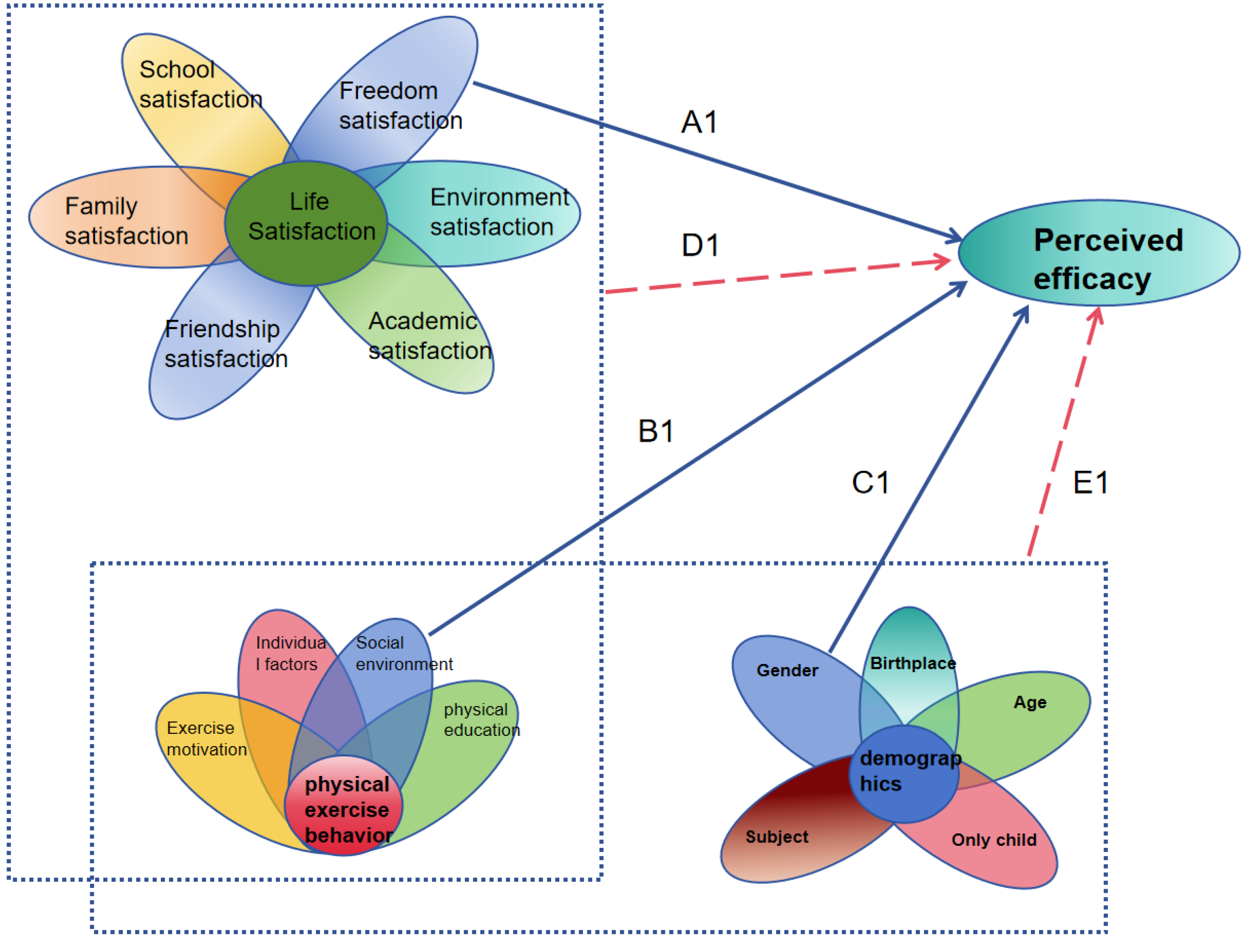
Figure 2.
Plot diagrams showing the causal algorithm.
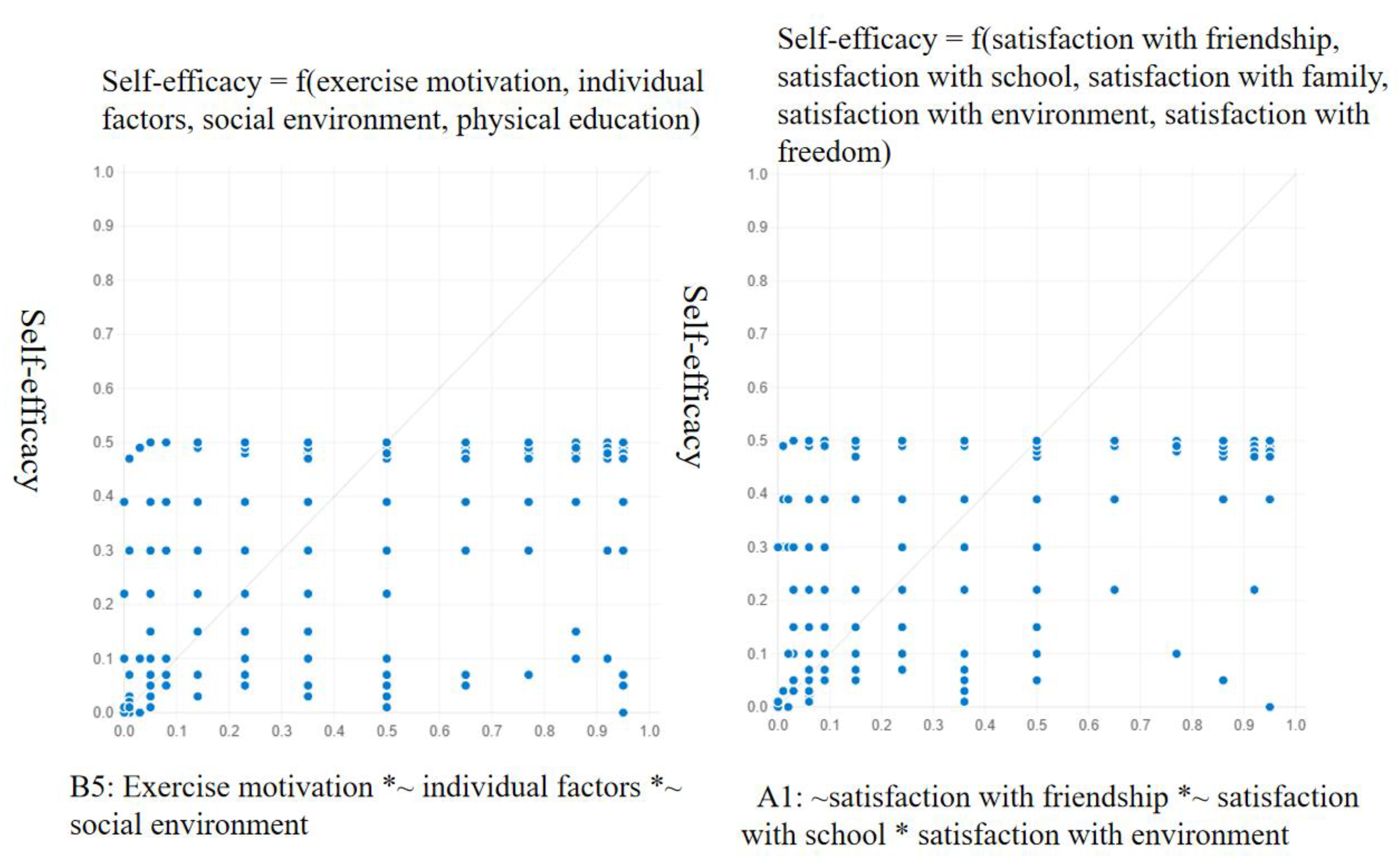
Figure 3.
Plot diagrams showing the causal algorithm.
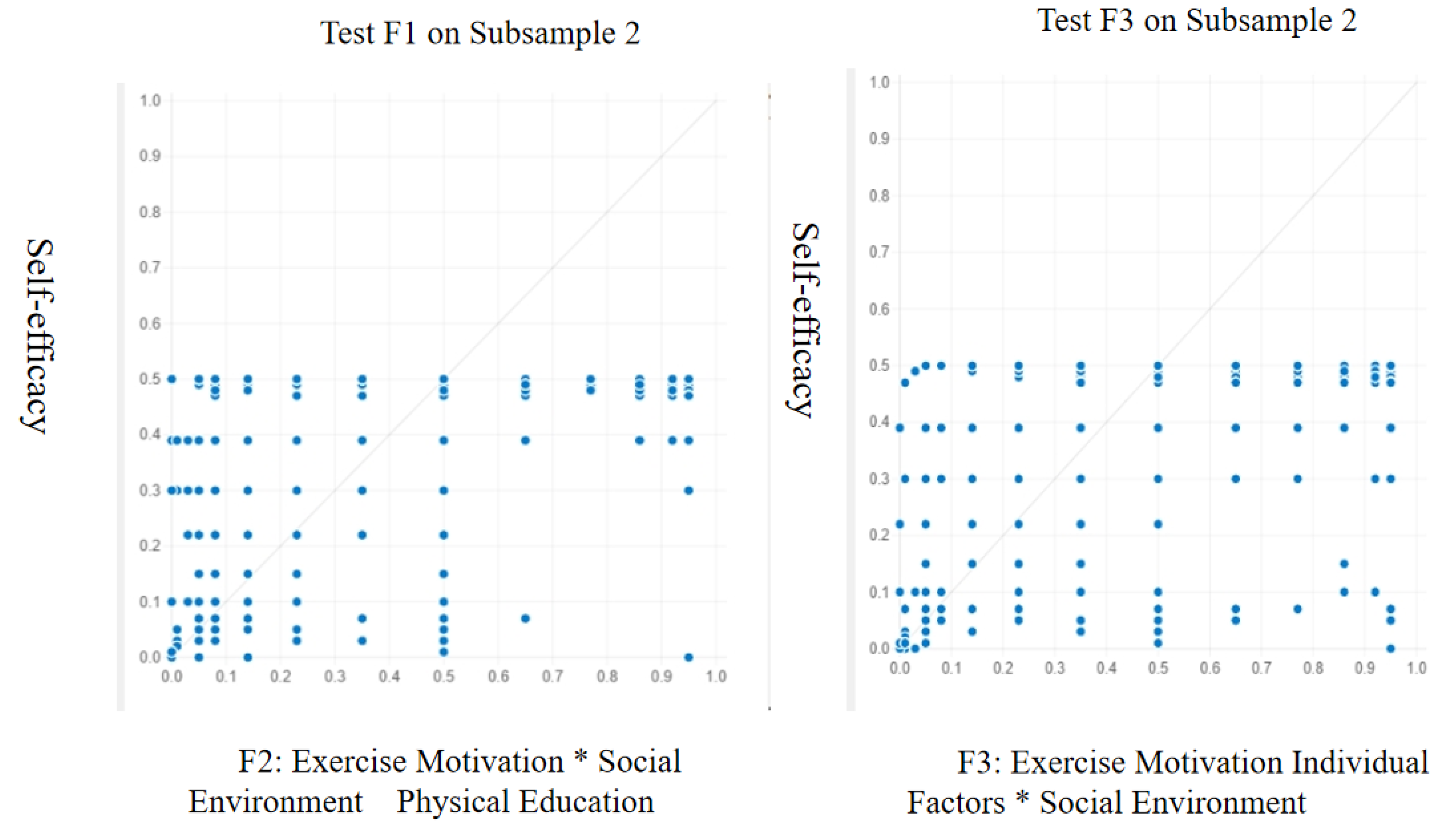

Table 1.
Variables and measurement items.
| Latent variable |
ltem of measurement | Latent variable |
ltem of measurement |
|---|---|---|---|
| Exercise Motivation | A1 I want to have a strong body | Friendship Satisfaction | E1 My friends are all very nice to me |
| A2 I want to maintain physical and mental health | E2 If I need help,my friends will definitely help me | ||
| A3 I want to maintain or improve my body shape | E3 I have enough friends | ||
| A4 I want to participate in entertaining activities | E4 My friends are all amazing | ||
| A5 I want to maintain a pleasant mood | E5 My friends all respect me | ||
| Individual Factors | B1 I have actively learned some sports skills before | School Satisfaction | F1 I enjoy staying in school |
| B2 I have devoted considerable effort to physical exercise and sports activities. | F2 School is really fun | ||
| B3 I work hard in physical education classes | F3 I am happy to participate in various school activities | ||
| B4 I have spent a lot of money on physical exercise | F4 I am eager to go to school | ||
| B5 I have sufficient resources for physical exercise | Family Satisfaction | G1:I often do interesting things together with my parents. | |
| Social Environment | C1 My collective often organizes everyone to exercise | G2 I enjoy spending time with my parents | |
| C2 My collective often organizes sports competitions | G3 My family is better than most other families | ||
| C3 The sports venues I need are far away | G4 I am happy to stay at home with my family | ||
| C4 Sports facilities are not convenient to use | G5 My family can get along harmoniously | ||
| C5 Study and work make me have little free time|Environmental Satisfaction | Environmental Satisfaction | I1:There are many unsatisfactory things around me in my living environment. | |
| Physical Education | D1 The sports skills learned in physical education class can be applied to daily physical exercise | I2 Basically,I can do things according to my own wishes | |
| D2 The sports knowledge learned in physical education class is useful for daily physical exercise | I3 I am satisfied with my academic status | ||
| D3 Through physical education class,I have a deeper understanding of the importance of physical exercise | I4 If I need help,my friends will all help me | ||
| D4 My physical education teacher has a high level of sports skills | I5 Most of the time,I like my parents'way of educating | ||
| D5 My physical education teacher uses good teaching methods | Freedom Satisfaction | J1 The social security in the place where I live is good | |
| Self-Efficacy | Q1 If I try my best,I can always solve problems | J2 Basically,I have the freedom to make my own choices | |
| Q2 Even if others oppose me,I still have ways to achieve what I want | J3 Compared with most classmates,I have a more comprehensive development in school | ||
| Q3 It is easy for me to adhere to ideals and achieve goals | J4 My friends are very nice to me | ||
| Q4 I am confident that I can effectively deal with any unexpected events | J5 My family gets along very harmoniously | ||
| Q5 With my intelligence,I can definitely cope with unexpected events | Academic Satisfaction | K1 I can do what I like in my spare time | |
| Q6 If I put in the necessary effort,I can solve most of the problems | K2 Compared to my classmates,I am[missing content] | ||
| Q7:I can face difficulties calmly because I trust myself to handle problems. | K3:I have a lot of authority among my peers. |
Table 2.
Exploratory factor analysis (N=533).
| Variable | Factors | Items | Factor loadings | Eigenvalue | Explained variance | Cronbach’s α |
|---|---|---|---|---|---|---|
| physical exercise behavior | Exercise motivation | A1 A2 A3 A4 A5 |
0.735 | 4.10 | 45.08 | 0.954 |
| Individual factors | B1 B2 B3 B4 B5 |
0.815 | 3.99 | 38.09 | 0.865 | |
| Social environment | C1 C2 C3 C4 C5 |
0.858 | 4.04 | 29.76 | 0.835 | |
| physical education | D1 D2 D3 D4 D5 |
0.837 | 3.85 | 32.34 | 0.920 | |
| KMO=0.912 Bartlett’s=8405.304 df=87 Sig.=0.000 Overall Cronbach's α = 0.915, Overall Explained Variance = 86.377% | ||||||
| Life Satisfaction | Friendship satisfaction | E1 E2 E3 E4 E5 |
0.876 | 3.92 | 56.87 | 0.860 |
| School satisfaction | F1 F2 F3 F4 |
0.907 | 3.65 | 43.01 | 0.752 | |
| Family satisfaction | G1 G2 G3 G4 G5 |
0.901 | 4.01 | 32.89 | 0.850 | |
| Environment satisfaction |
I1 I2 I3 I4 I5 |
0.861 | 3.04 | 54.98 | 0.749 | |
| Freedom satisfaction |
J1 J2 J3 J4 J5 |
0.830 | 4.00 | 43.77 | 0.850 | |
| Academic satisfaction | K1 K2 K3 |
0.819 | 3.98 | 28.07 | 0.942 | |
KMO=0.909. Bartlett’s=8623.108 df=113 Sig.=0.000. Overall Cronbach's α=0.882 Overall Explained Variance=85.235%.
Table 3.
Discriminant validity table.
| Variable | Individual Factors | Physical Education | Friendship Satisfaction | Academic Satisfaction | School Satisfaction | Family Satisfaction | Environmental Satisfaction | Social Environment | Self-Efficacy | Freedom Satisfaction | Exercise Motivation |
|---|---|---|---|---|---|---|---|---|---|---|---|
| Individual Factors | 0.920 | ||||||||||
| Physical Education | 0.827 | 0.937 | |||||||||
| Friendship Satisfaction | 0.808 | 0.909 | 0.891 | ||||||||
| Academic Satisfaction | 0.735 | 0.808 | 0.829 | 0.929 | |||||||
| School Satisfaction | 0.827 | 0.854 | 0.913 | 0.837 | 0.900 | ||||||
| Family Satisfaction | 0.828 | 0.830 | 0.868 | 0.856 | 0.931 | 0.928 | |||||
| Environmental Satisfaction | 0.781 | 0.801 | 0.835 | 0.856 | 0.875 | 0.901 | 0.916 | ||||
| Social Environment | 0.898 | 0.830 | 0.845 | 0.781 | 0.869 | 0.863 | 0.815 | 0.912 | |||
| Self-Efficacy | 0.762 | 0.746 | 0.793 | 0.860 | 0.834 | 0.851 | 0.829 | 0.812 | 0.877 | ||
| Freedom Satisfaction | 0.743 | 0.781 | 0.829 | 0.904 | 0.845 | 0.858 | 0.906 | 0.784 | 0.870 | 0.913 | |
| Exercise Motivation | 0.852 | 0.748 | 0.766 | 0.700 | 0.791 | 0.775 | 0.734 | 0.824 | 0.736 | 0.713 | 0.901 |
| (CR) | 0.882 | 0.774 | 0.770 | 0.881 | 0.867 | 0.846 | 0.863 | 0.779 | 0.896 | 0.887 | 0.908 |
| AVE | 0.918 | 0.838 | 0.902 | 0.916 | 0.861 | 0.907 | 0.814 | 0.905 | 0.889 | 0.778 | 0.885 |
Table 4.
Reverse Case Analysis Table of Freedom Satisfaction vs. Self-Efficacy.
| / | Self-Efficacy | Total | ||||||
|---|---|---|---|---|---|---|---|---|
| Strongly Disagree | Disagree | Neutral | Agree | Strongly Agree | ||||
| Freedom Satisfaction | Strongly Disagree | Count | 4 | 0 | 3 | 1 | 1 | 5 |
| Percentage of Total | 44.9% | 0.0% | 29.6% | 14.3% | 13.3% | 100.0% | ||
| Disagree | Count | 0 | 0 | 1 | 0 | 0 | 3 | |
| Percentage of Total | 0.0% | 0.0% | 100.0% | 0.0% | 0.0% | 100.0% | ||
| Neutral | Count | 0 | 0 | 35 | 12 | 3 | 55 | |
| Percentage of Total | 0.0% | 0.0% | 77.3% | 29.8% | 3.8% | 100.0% | ||
| Agree | Count | 0 | 1 | 3 | 50 | 17 | 79 | |
| Percentage of Total | 0.0% | 0.3% | 8.2% | 73.3% | 11.5% | 100.0% | ||
| Strongly Agree | Count | 2 | 1 | 5 | 33 | 187 | 179 | |
| Percentage of Total | 0.0% | 0.0% | 3.3% | 11.3% | 85.4% | 100.0% | ||
| Total | Count | 4 | 2 | 53 | 105 | 208 | 321 | |
| Percentage of Total | 1.1% | 0.6% | 16.5% | 31.6% | 56.0% | 100.0% | ||
Table 5.
Predicting combinations of precursor conditions for high levels of self-efficacy among college students.
Table 5.
Predicting combinations of precursor conditions for high levels of self-efficacy among college students.
| Models for predicting high score of outcomes | Raw coverage | Unique coverage | Consistency |
| Model A: Self-Efficacy = f(Friendship Satisfaction, School Satisfaction, Family Satisfaction, Environmental Satisfaction, Freedom Satisfaction) | |||
| A1: ~Friendship Satisfaction * School Satisfaction * Environmental Satisfaction | 0.588 | 0.007 | 0.908 |
| A2: ~School Satisfaction * Environmental Satisfaction * Freedom Satisfaction | 0.854 | 0.002 | 0.917 |
| A3: Friendship Satisfaction * ~School Satisfaction * ~Environmental Satisfaction * ~Freedom Satisfaction | 0.475 | 0.019 | 0.909 |
| A4: ~Friendship Satisfaction * School Satisfaction * Family Satisfaction * Freedom Satisfaction | 0.516 | 0.013 | 0.926 |
| A5: ~School Satisfaction * Family Satisfaction * Environmental Satisfaction | 0.857 | 0.001 | 0.920 |
| Coverage for solution: 0.942 Consistency for solution: 0.858 | |||
| Model B: Self-Efficacy = f(Exercise Motivation, Individual Factors, Social Environment, Physical Education) | |||
| B1: Exercise Motivation * ~Physical Education | 0.572 | 0.067 | 0.795 |
| B2: Exercise Motivation * Individual Factors | 0.471 | .008 | 0.895 |
| B3: ~Exercise Motivation * Social Environment | 0.513 | 0.028 | 0.890 |
| B4: Exercise Motivation * Individual Factors * Social Environment | 0.500 | 0.006 | 0.828 |
| Coverage for solution: 0.678 Consistency for solution: 0.903 | |||
| Model C: Self-Efficacy = f(Gender, Birthplace, Only Child, Subject, Grade) | |||
| C1: ~Gender * Only Child * Subject | 0.219 | 0.020 | 0.857 |
| C2: Gender * Only Child * Subject * Grade | 0.374 | 0.062 | 0.827 |
| C3: Only Child * ~Subject * Grade | 0.318 | 0.025 | 0.854 |
| C4: ~Birthplace * Only Child * Grade | 0.215 | 0.035 | 0.885 |
| Coverage for solution: 0.606 Consistency for solution: 0.876 | |||
| Model D: Self-Efficacy = f(Exercise Motivation, Individual Factors, Social Environment, Physical Education, Friendship Satisfaction, School Satisfaction, Family Satisfaction, Environmental Satisfaction, Freedom Satisfaction, Academic Satisfaction) | |||
| D1: Exercise Motivation * ~Physical Education * ~Friendship Satisfaction * ~School Satisfaction * ~Family Satisfaction * ~Environmental Satisfaction * ~Freedom Satisfaction * ~Academic Satisfaction | 0.461 | 0.019 | 0.825 |
| D2: Exercise Motivation * Individual Factors * Social Environment * ~School Satisfaction * Family Satisfaction * Environmental Satisfaction * Freedom Satisfaction * Academic Satisfaction | 0.717 | 0.153 | 0.942 |
| D8: Exercise Motivation * Individual Factors * Social Environment * Physical Education * Friendship Satisfaction * School Satisfaction * Family Satisfaction * Environmental Satisfaction * Freedom Satisfaction | 0.400 | 0.008 | 0.987 |
| Coverage for solution: 0.946 Consistency for solution: 0.835 | |||
| Model E: Self-Efficacy = f(Gender, Birthplace, Only Child, Subject, Grade, Exercise Motivation, Individual Factors, Social Environment, Physical Education) | |||
| E1: ~Birthplace * Subject * Grade * Exercise Motivation * Individual Factors * Social Environment * Physical Education | 0.297 | 0.039 | 0.909 |
| E2: Gender * ~Birthplace * ~Subject * Grade * Exercise Motivation * ~Individual Factors * Social Environment * Physical Education | 0.181 | 0.013 | 0.913 |
| E7: Gender * Birthplace * Only Child * ~Subject * ~Grade * ~Individual Factors * Social Environment * Physical Education | 0.169 | 0.002 | 0.842 |
| Coverage for solution: 0.894 Consistency for solution: 0.874 |
Note: In Boolean algebra logic operations, "" is used to represent the set relationship of "and" or "intersection," and "~" is used to represent the set relationship of "not" or "complement negation." For example, AB represents the occurrence of both conditional variables A and B, while ~A represents the non-occurrence or absence of conditional variable A.
Table 6.
Results of predictive validity.
| Models for predicting high score of outcomes | Raw coverage | Unique coverage | Consistency |
| Model F: Self-Efficacy = f(Exercise Motivation, Individual Factors, Social Environment, Physical Education) | |||
| F1: ~Exercise Motivation * Individual Factors * Physical Education | 0.471 | 0.008 | 0.895 |
| F2: ~Exercise Motivation * Social Environment *~ Physical Education | 0.513 | 0.028 | 0.890 |
| F3: Exercise Motivation * Individual Factors *~ Social Environment | 0.500 | 0.006 | 0.828 |
| Coverage for solution:1 Consistency for solution: 0.832 |
Disclaimer/Publisher’s Note: The statements, opinions and data contained in all publications are solely those of the individual author(s) and contributor(s) and not of MDPI and/or the editor(s). MDPI and/or the editor(s) disclaim responsibility for any injury to people or property resulting from any ideas, methods, instructions or products referred to in the content. |
© 2024 by the authors. Licensee MDPI, Basel, Switzerland. This article is an open access article distributed under the terms and conditions of the Creative Commons Attribution (CC BY) license (http://creativecommons.org/licenses/by/4.0/).
Copyright: This open access article is published under a Creative Commons CC BY 4.0 license, which permit the free download, distribution, and reuse, provided that the author and preprint are cited in any reuse.


