
Submitted:
21 June 2024
Posted:
21 June 2024
You are already at the latest version
Abstract
Objective: To explore the functions that physical activity (PA), life satisfaction, and self-efficacy have in the process of coping with anxiety among Chinese college students, and to explore the mediating role of life satisfaction and self-efficacy in this process.
Methods: Participants were 358 college students (186 males, 172 females, mean age 20.88, SD=±1.80). Psychosocial tests including the Physical Activity Rating Scale (PARS-3), College Student Life Satisfaction Scale (CSLSS), General Self-Efficacy Scale (GSES), and Generalized Anxiety Disorder Scale (GAD-7) were completed. Correlations between variables were calculated using Pearson's test. The mediation model was tested using the SPSS 26.0 PROCESS macro and regression bootstrap.
Results: Physical activity showed a negative correlation with anxiety (β= -0.1617, p < 0.001), life satisfaction and self-efficacy played a role in the relationship between physical activity and anxiety, and, more importantly, physical activity affected anxiety through the parallel mediating effects of life satisfaction and self-efficacy, with a total mediating effect of 55.34%.
Conclusion: By increasing college students' participation in physical activity, it helps to promote the growth of their life satisfaction and self-efficacy, which is the key to reducing anxiety and promoting college students' mental health.
Keywords:
Anxiety
; negative emotions
; self-efficacy
; life satisfaction
; physical activity
1. Introduction
Negative emotions significantly contribute to mental disorders, with anxiety and depression being the most prevalent, ultimately becoming primary causes of the global mental health burden [1]. The expression pathways of anxiety-specific symptoms vary among individuals. Anxiety, defined as the anticipation of a future threat, manifests mainly as episodic or persistent anxiety, tension, or panic, often accompanied by muscle tension, restlessness, fatigue, difficulty concentrating, irritability, and sleep disturbances [2]. Studies estimate the global prevalence of anxiety disorders at 7.3% [3]. Adolescence and early adulthood are critical periods for the onset of anxiety, which often emerges during childhood and adolescence and develops into disorders [4]. Social factors such as societal development, increasing competition, and educational reforms have exacerbated anxiety and depression among college students. A lack of physical exercise, leading to obesity and other issues [5], further diminishes life satisfaction and self-efficacy, worsening mental health conditions [6]. As society places greater emphasis on mental health, the anxiety experienced by college students is gaining increasing attention in China and worldwide. In recent years, the role of physical activity in alleviating anxiety has garnered significant scholarly attention in studies exploring the relationship between physical exercise and anxiety [7,8].
Physical activity, defined as engaging in exercises of specific frequency, intensity, and duration, has been shown through theoretical models and empirical studies to have a protective effect on mental health. Participation in physical activity can markedly improve negative emotions caused by stress or other factors, reduce anxiety sensitivity, and consequently diminish anxiety levels [9,10]. Conversely, engaging in physical activity stimulates the production of endorphins and other substances in the body, enhancing an individual’s sense of excitement. Additionally, the socialization and collaboration involved in exercise can significantly improve self-efficacy, providing a positive experience and increasing life satisfaction, thereby effectively reducing negative emotions such as anxiety [11]. The 2018 report by the American Sports Guide Information Council emphasizes that physical activity can alleviate anxiety [12], and evidence-based studies corroborate that it is an effective, safe, and low-cost method for anxiety relief [13]. Therefore, physical activity plays a crucial role in reducing anxiety. Studies indicate that the college population faces increasing stress and anxiety, suggesting that physical activity may be an effective intervention to mitigate their anxiety levels [14].
Life satisfaction significantly influences anxiety. It is a subjective judgment about one’s quality of life, involving a comparison between an individual’s standard of living and their own expectations [15]. By measuring the alignment between their current life, expected life, and actual life, it reflects a person’s psychological well-being. Recent studies have increasingly confirmed the crucial role that life satisfaction plays in predicting mental health issues. Scholars analyzing the relationship between life satisfaction and various mental disorders have found that it is associated not only with depression, suicidal tendencies, alcohol dependence, and drug addiction but also significantly correlated with anxiety disorders [16]. Furthermore, life satisfaction is associated with anxiety and mood disorders, with lower life satisfaction linked to poor psychological states [17]. Physical activity also influences life satisfaction, with numerous studies demonstrating that engaging in physical exercise enhances individual life satisfaction. Additionally, improving self-efficacy is recognized as an effective method for alleviating anxiety. Self-efficacy, the confidence in one’s ability to perform tasks with the skills one possesses, is influenced not only by personal abilities and skills but also by emotional state and past experiences. Physical activity has been shown to increase self-efficacy, thereby reducing anxiety [18,19].
Many studies have examined the dangers of anxiety, the factors influencing it, and ways to alleviate it. Participation in physical exercise, improving self-efficacy, and increasing life satisfaction have been shown to effectively reduce anxiety, confirming the association between these factors [20,21]. However, there is a lack of research specifically exploring the impact of physical activity on anxiety reduction among college populations. In positive psychology, life satisfaction and self-efficacy are significant variables. Related studies highlight their role in anxiety alleviation, providing a basis for further research. This report aims to investigate the relationship between physical activity and anxiety among college students. It proposes a structural equation model to analyze the mediating roles of self-efficacy and life satisfaction, offering theoretical and empirical evidence to reduce anxiety in college students and improve our understanding of the psychological mechanisms involved.
2. Theoretical Foundations and Hypotheses
2.1. Physical Activity and Anxiety
Any bodily movement executed by the skeletal musculature, necessitating an expenditure of energy, encompassing both formal physical exertion and routine activities like ambulation, labor, and domestic chores, is defined as physical exercise. Drawing upon the tenets of the Emotional Effects Theory and the Social Withdrawal Theory, physical activity exhibits ameliorative and therapeutic potential for mental health afflictions such as depression and anxiety. Research has elucidated that sedentariness constitutes the primary etiological factor for numerous chronic ailments, with deleterious alterations in mood and anxiety attributed to physical inactivity [22]. A study examining the correlation between daily exercise habits and anxiety levels revealed that a cohort of 1661 adults diagnosed with anxiety disorders exhibited significant amelioration in anxiety symptoms following interventions involving physical activity; furthermore, heightened levels of physical activity corresponded to diminished anxiety levels [23]. Hence, predicated upon both theoretical frameworks and empirical evidence, we posit Hypothesis 1: Physical activity exerts a negative influence on anxiety.
2.2. The Mediating Role of Life Satisfaction
Life satisfaction emerges as a focal point within contemporary positive psychology research. It denotes an individual’s subjective assessment of their overall quality of life, serving as a comprehensive metric for appraising one’s well-being. With the ongoing advancement of positive psychology, there is a growing recognition that enhancing life satisfaction constitutes a pivotal avenue for fostering both physical and mental health development. Within the framework of exercise psychology theory, physical activity emerges as a potent means to augment life satisfaction. Empirical investigations have revealed a link between life satisfaction and anxiety. Notably, interventions aimed at enhancing happiness, optimism, and sleep quality among older adults have been shown to elevate life satisfaction, consequently attenuating levels of depression and anxiety [24]. Furthermore, a study encompassing 1662 college students corroborated a negative correlation between life satisfaction and anxiety, with heightened life satisfaction correlating with diminished anxiety levels [25]. Thus, drawing upon the findings of prior research and the prevailing phenomena, we posit Hypothesis 2: Life satisfaction may serve as a mediating factor in the relationship between physical activity and anxiety.
2.3. Mediating Role of Self-Efficacy
Self-efficacy stands as a pivotal determinant shaping an individual’s perceived capacity to engage in a specific behavior prior to its execution. Previous scholarly inquiries have elucidated self-efficacy’s role in ameliorating adverse emotional states among adolescents and its correlation with life satisfaction. While fewer investigations have directly explored self-efficacy’s predictive capacity regarding life satisfaction, Moksnes’ study unveiled a noteworthy impact of self-efficacy on adolescents’ life satisfaction [26]. Furthermore, evidence suggests that engagement in physical activity not only directly enhances life satisfaction but also augments it indirectly by bolstering individuals’ self-efficacy and mental resilience. This underscores the mediating function of self-efficacy in this process [27]. Consequently, we posit Hypothesis 3: Self-efficacy may serve as a mediating factor in the relationship between physical activity and anxiety.
2.4. The Effect of Gender in the Relationship between Physical Activity and Anxiety
The mediating variable has been employed to elucidate the impact of physical activity on anxiety, yet it may lack sufficient explanatory power regarding the variation of this effect across different contexts. Consequently, drawing upon social role theory and other pertinent empirical studies, we introduced gender as a moderating variable to more effectively explore the effects of physical activity on anxiety in diverse scenarios. According to the social theory of gender roles, individuals are ascribed different roles and responsibilities through socialization, resulting in gender differences in their future development [28]. Furthermore, boys and girls exhibit varying levels of anxiety when confronted with challenges or problems in school life, with some studies indicating that boys experience significantly lower levels of anxiety compared to girls [29]. At the university level, students demonstrate different degrees of socialization, and research has confirmed that girls, and not just boys, are more prone to anxiety and more likely to express it [30]. Additionally, male students are more inclined than female students to engage in physical activity at university, potentially making it easier for them to alleviate anxiety through such activities. Conversely, female students might receive some level of support from their peers. Ultimately, synthesizing previous studies and grounded in social role theory, this study incorporated gender as a moderating variable in constructing a parallel mediation model to investigate the effects of physical activity on anxiety and its mechanisms. Specifically, this study first considered the mediating roles of life satisfaction and self-efficacy in the relationship between physical activity and anxiety, then examined the moderating role of gender on these mediating pathways, aiming to provide empirical support and theoretical guidance for college students’ participation in physical activity to mitigate anxiety.
3. Materials and Methods
3.1. Participants
Drawing upon prior research and considering the disparities in experimental and variable designs from this study [31], alongside the estimation of the ex-ante sample size utilizing G-power software, with parameters set as f = 0.25, α = 0.05, and power (1-β) = 0.95, the requisite sample size for this investigation was determined to be 210 individuals [32]. Subsequently, employing a randomized convenience sampling technique, 400 school personnel hailing from two universities in Chengdu City, Sichuan Province, situated in central China, were enlisted for participation in this study. Recruitment was conducted through face-to-face offline classroom interactions and online questionnaire dissemination. Prospective participants were briefed on the study’s objectives and given the opportunity to express their interest in participation. Upon providing written informed consent, participants were tasked with completing a comprehensive questionnaire aimed at gathering pertinent demographic data and facilitating subsequent follow-up procedures. The questionnaire distribution and collection spanned from March 2024 to May 2024. Subsequently, after identifying and excluding 42 invalid questionnaires characterized by rapid completion, irregular responses, and logical inconsistencies, the final sample comprised validly completed questionnaires from 358 participants (186 males, and 172 females), with a mean age of 20.88 years and a standard deviation of ±1.80. The questionnaire achieved an effective return rate of 85.9%. Details regarding survey participation are delineated in Table 1. It is hereby affirmed that this study adhered to the principles outlined in the 1964 Declaration of Helsinki and its subsequent revisions. Additionally, we attest that the research methodologies employed received approval from the Ethics Committee of the School of Athletic Training, Chengdu Institute of Physical Education and Sports, and that informed consent was obtained from all participating individuals.
3.2. Measurement Instruments
3.2.1. Physical Activity Rating Scale (PARS-3)
In this study, we employed the Physical Activity Rating Scale, revised by Liang Deqing [33]. This scale evaluates participants’ physical activity levels based on the intensity, frequency, and duration of their physical activity engagement, categorizing individual activity levels across five tiers, assessed on a scale from 1 to 5. The total physical activity score is calculated as follows: exercise intensity × (exercise duration - 1) × exercise frequency, with scores ranging from 0 to 100 points. A higher score corresponds to a greater level of physical activity, with scores ≤19 indicating minimal activity, scores between 20 and 42 indicative of moderate activity, and scores ≥43 suggestive of substantial activity. In this study, the Cronbach’s α coefficient for this scale was calculated to be 0.816.
3.2.2. College Student Life Satisfaction Scale (CSLSS)
In this study, we utilized the College Students’ Life Satisfaction Scale (CSLSS), revised by Wang Yuzhong [34]. This scale comprises six sections, encompassing objective satisfaction items (e.g., academic performance, social relationships, etc.) and subjective satisfaction items (e.g., overall life satisfaction, etc.). Responses are provided on a 5-point Likert scale, ranging from “very satisfied” to “very dissatisfied.” The CSLSS exhibits strong internal consistency, as evidenced by its overall Cronbach’s α coefficient of 0.894.
3.2.3. General Self-Efficacy Scale (GSES)
In this study, we employed the General Self-Efficacy Scale (GSES), developed by Schwarzer [35]. This scale comprises ten items rated on a 5-point Likert scale, ranging from “very satisfied” to “very dissatisfied.” A higher total score signifies greater self-efficacy, while lower scores denote lower self-efficacy levels. The GSES demonstrated high internal consistency in this study, as indicated by its overall Cronbach’s α coefficient of 0.959.
3.2.4. Generalized Anxiety Disorder Scale (GAD-7)
For this study, the Generalized Anxiety Disorder Scale (GAD-7) developed by Spitzer et al. in 2006 was selected [36]. This self-report questionnaire assesses the severity of generalized anxiety disorder symptoms. Chinese scholars have translated and tested the reliability of the scale, demonstrating good internal consistency within the Chinese population [37]. Participants were queried about the frequency of experiencing seven symptoms of generalized anxiety disorder over the past two weeks. Responses were rated on a 4-point scale ranging from “not at all” to “almost every day,” with total scores ranging from 0 to 21. Cut-off values of 5, 10, and 15 were established for mild, moderate, and severe anxiety, respectively. The GAD-7 exhibited high internal consistency in this study, with a Cronbach’s α coefficient of 0.953.
3.3. Statistical Analysis
Data analysis was conducted using the SPSS software package (version 26.0). Categorical variables were represented as frequencies (n) and percentages (%). Gender was analyzed using analysis of covariance (ANOVA), independent samples, and rank sum ratio tests. The Kolmogorov test and normal distribution test were employed to assess differences in physical activity, life satisfaction, self-efficacy, and anxiety. Cohen’s or Pearson’s r correlation coefficients were computed for parametric and nonparametric tests, respectively. To explore the potential mediating roles of life satisfaction and self-efficacy between physical activity and anxiety, Model 4 in the SPSS PROCESS 4.0 plug-in developed by Hayes was utilized for analysis [38]. In this model, physical activity served as the independent variable, while life satisfaction and self-efficacy were considered as mediating variables, and anxiety served as the dependent variable (see Figure 1). Additionally, age and gender were included as covariates to investigate their impact on this process. This analysis facilitated the prediction of the mediating effects of life satisfaction and self-efficacy in the relationship between physical activity and anxiety. The mediation hypothesis was tested using the bias-corrected bootstrap method on a sample of 5000, with confidence intervals (95%) calculated. Significance was considered when the confidence interval did not exceed zero.
4. Results
4.1. Common Method Bias
The relevant data underwent the Harman one-way test, the KMO test, and Bartlett’s sphericity test. The KMO value was 0.966, and Bartlett’s value was 9372.716 with 703 degrees of freedom, yielding a p-value < 0.001. These results suggest that the data are conducive to factor analysis, with all variables rotated. Exploratory factor analysis revealed four factors with eigenvalues exceeding 1, collectively explaining a maximum factor variance of 39.62% (<40%). Consequently, these findings indicate the absence of common method bias in the study. To assess potential multicollinearity among variables, anxiety was standardized as the dependent variable, while physical activity, life satisfaction, and self-efficacy served as independent variables for covariate diagnosis. The tolerance values for each variable (0.773, 0.763,and 0.776) exceeded 0.1, and the variance inflation factor (VIF) values (1.293, 1.311,and 1.288) were <5. Thus, it can be inferred that the data in this study did not exhibit multicollinearity issues, rendering them suitable for further mediation effect testing.
4.2. Correlation Analysis of Physical Activity, Life Satisfaction, Self-Efficacy and Anxiety
Based on the findings presented in Table 2, physical activity demonstrates a significant positive correlation with both life satisfaction and self-efficacy. Conversely, anxiety exhibits a significant negative correlation with physical activity, life satisfaction, and self-efficacy. These correlations suggest meaningful associations among the variables, implying that life satisfaction and self-efficacy may play influential roles in the relationship between physical activity and anxiety. This provides a rationale for conducting further tests to explore their mediating effects. As for the model fit indices, chi-square values, root mean square error of approximation (RMSEA) values, and comparative fit indices (CFI) were reported (df = 1.095, RMSEA = 0.016, CFI = 0.993, and GFI = 0.807), indicating a good fit of the model and suitability for additional mediation analysis.
4.3. Parallel Mediation Analysis of Subjective Well-Being and Self-Efficacy
The analysis of mediated effects was conducted through bootstrap procedures employing Model 4 within Process 4.0, an SPSS macro add-in crafted by Hayes. This model was specifically tailored to examine the mediated effects, employing gender and age as covariates. The independent variable under scrutiny was physical activity, while life satisfaction and self-efficacy served as mediators, with anxiety as the dependent variable and gender and age as covariates. Within this investigation, the sample replication consisted of 5000 cases, and the standard confidence interval was set at 95% [39]. The outcomes of the regression analysis are delineated in Table 3. Initially, physical activity exhibited a direct positive association with both life satisfaction and self-efficacy. Furthermore, a negative correlation between physical activity and anxiety was observed (β = −0.1617, p < 0.001), thus confirming Hypothesis 1: physical activity may exert a negative impact on anxiety. Subsequently, the findings indicate that life satisfaction demonstrated an inverse relationship with anxiety (β = −0.2476, p < 0.001), and similarly, self-efficacy exhibited a negative association with anxiety (β = −0.2856, p < 0.001).
Table 4 reveals that 55.34% of the overall mediated effect in the mediation analysis, with a 95% confidence interval CI [−0.2621, −0.1419], does not encompass 0, suggesting that the parallel mediation model incorporating life satisfaction and physical activity as mediating variables is upheld. Moreover, three paths of influence are evident in the impact of physical activity on anxiety. These paths include Path 1: the direct effect of physical activity on anxiety (β = −0.1617); Path 2: the mediating effect of life satisfaction between physical activity and anxiety (β = −0.0957, accounting for 26.43% of the effect share); and Path 3: the mediating effect of self-efficacy between physical activity and anxiety (β = −0.1047, constituting 28.91% of the effect share). The 95% confidence intervals for these three paths do not include zero, signifying that physical activity, life satisfaction, and self-efficacy can individually influence anxiety. Concurrently, life satisfaction and self-efficacy serve as parallel mediators in the relationship between physical activity and college students’ anxiety, thus corroborating Hypothesis H2: life satisfaction mediates the relationship between physical activity and anxiety, and Hypothesis H3: self-efficacy mediates the relationship between physical activity and anxiety.
4.4. Moderating Effect of Gender
Subsequently, a moderated mediation analysis was conducted using PROCESS Model 7. The results revealed that the interaction between physical activity and gender in predicting anxiety was not significant after controlling for grade level and education. Further analysis of the mediation effects under different moderated variables also yielded no significant results. Therefore, the findings indicated that there was no significant moderating effect, suggesting no substantial gender difference in the mediating effects of life satisfaction and self-efficacy.
In summary, this study verified the inhibitory effect of physical activity on college students’ anxiety, in which life satisfaction and self-efficacy played a mediating effect respectively, but gender did not produce a significant moderating effect.
5. Discussion
The study explored the impact of life satisfaction and self-efficacy on anxiety among college students in western China, as well as the association between physical activity and college students’ anxiety, thereby confirming hypotheses 1, 2, and 3. Furthermore, the study elucidated that college students enhance their life satisfaction and self-efficacy through engagement in physical activity, consequently mitigating their anxiety. This finding offers valuable insights for the development of future mental health intervention programs aimed at alleviating anxiety among college students (see Figure 2).
5.1. Direct Effect of Physical Activity on Anxiety
The findings of this study indicate that college students who engage in physical activity experience a reduction in anxiety levels, thus validating Hypothesis 1. This outcome aligns with Herring’s research [40], further corroborating the anxiety-relieving effects of physical activity. The negative predictive impact of physical activity on college students’ anxiety remained significant even after accounting for mediating variables. Physical activity holds a crucial role in the daily lives of college students, offering opportunities for enhancing physical health, subjective well-being, and social engagement. Conversely, insufficient physical activity stands as a significant contributor to chronic diseases. In accordance with the neural hypothesis, sustained and regular physical activity is postulated to mitigate the prevalence of negative emotions by enhancing the expression of neurotrophic factors in the brain and diminishing the stress response [41]. Concurrently, according to the self-determination theory, individuals’ persistent commitment to physical activity, attainment of exercise objectives, and overcoming associated challenges can serve as psychological buffers, fostering positive emotional experiences [42]. Drawing upon the outcomes of this study and prior research, it is inferred that physical exercise can effectively alleviate anxiety and foster the enhancement of college students’ psychological well-being.
5.2. Mediating Role of Life Satisfaction
The findings of this study reveal a robust correlation between life satisfaction, physical activity, and anxiety. Path analysis elucidates that life satisfaction exerts a significant mediating influence on the relationship between physical activity and anxiety. It is established that life satisfaction is inversely associated with anxiety, wherein heightened life satisfaction corresponds to lower levels of anxiety [39]. Individuals with elevated life satisfaction tend to embrace a more active lifestyle and adopt positive health behaviors and coping mechanisms when confronted with mental health challenges such as anxiety [43]. Meanwhile, significant disparities in life satisfaction and anxiety levels during physical exercise were observed among college students with varying educational backgrounds, grades, and genders. Additionally, our study found that physical activity can effectively enhance individual life satisfaction and diminish anxiety levels by elevating the level of life satisfaction. Furthermore, some research has explored the capacity of physical activity to bolster individuals’ mental resilience, thereby augmenting their life satisfaction. Certain studies have indicated a correlation between an individual’s life satisfaction and their overall quality of life, with heightened life satisfaction facilitating more effective coping with negative emotions, thus enhancing overall quality of life [44]. The present study investigated the role of physical activity in mitigating anxiety by bolstering life satisfaction among college students. Maintaining healthy physical activity habits among this demographic can effectively heighten their life satisfaction and alleviate anxiety levels.
5.3. Mediating Role of Self-Efficacy
The study findings indicated a robust correlation between self-efficacy, physical activity, and anxiety. Path analysis utilizing self-efficacy as a mediation model demonstrated that self-efficacy mediated the association between physical activity and anxiety, exerting a significant impact. As per the mediation effect analysis, physical activity not only inversely predicts anxiety among college students but also indirectly influences anxiety levels by bolstering self-efficacy, thus confirming Hypothesis H3. Furthermore, symptoms of anxiety partially elucidate the reciprocal relationship between physical activity and self-efficacy, with the magnitude of this correlation suggesting that heightened anxiety levels may stem from insufficient physical activity and diminished self-efficacy. According to the resource depletion theory, college students exposed to higher daily stressors experience greater emotional and physical depletion, thereby impacting their self-efficacy and engagement in physical activity to varying extents [45]. Low self-efficacy can precipitate negative emotions such as low self-esteem and timidity among college students, consequently elevating anxiety levels [46]. Given the inherent connection and mediating role of self-efficacy between physical activity and anxiety, short-term moderate- to high-intensity physical activity can yield immediate mood enhancements [47]. This prompt mood elevation can positively influence an individual’s self-efficacy, thereby alleviating anxiety among college students.
5.4. Parallel Mediating Role of Life Satisfaction and Self-Efficacy
The preceding studies demonstrate a robust correlation between physical activity and anxiety. Furthermore, anxiety levels are influenced by life satisfaction and self-efficacy, prompting further investigation into the relationship among these four variables. Parallel mediation modeling between physical activity and anxiety, incorporating life satisfaction and self-efficacy as mediator variables, revealed that these factors not only serve as individual mediators but also concurrently assume parallel mediating roles in the model presentation. Notably, prior research has not reported the capacity for these factors to concurrently serve as parallel mediators. Behaviorists posit that anxiety stems from reinforcement and conditioning [48,49]. Enhancing self-efficacy can aid college students in surmounting the fear of the unknown [50], while physical exercise not only enhances college students’ self-efficacy but also fosters their life satisfaction, thereby potentially diminishing the manifestation of anxiety symptoms [51]. Cognitivism contends that anxiety arises from the tendency of individuals to overestimate the peril of a situation and underestimate their ability to cope with it [52]. In essence, higher levels of self-efficacy and life satisfaction prompt individuals to adopt positive and adaptive responses to future events, thereby contributing to anxiety reduction. Physical activity emerges as one of the most effective means of fostering these phenomena.
6. Research Limitations and Future Perspectives
The principal contribution of this study lies in further elucidating the mechanism underlying the relationship between physical activity and anxiety among Chinese college students. It sheds light on the pivotal roles of life satisfaction and self-efficacy in this relationship, thereby enriching the body of research on the correlation between participation in physical activity and anxiety within the college student demographic. However, there are certain limitations to this study.
Firstly, its cross-sectional design restricts the ability to infer causality between physical activity and anxiety. Future scholars could validate the mediating roles of life satisfaction and self-efficacy through longitudinal studies and consider the diversity among college students in terms of majors and places of residence.
Secondly, due to data constraints, we selected life satisfaction and self-efficacy as mediating variables, potentially leading to biased findings. Subsequent researchers could corroborate the outcomes of this study by conducting scale tests on life satisfaction and self-efficacy.
Lastly, our study solely examined two mediating variables. There may exist additional mediating variables between physical activity and anxiety, prompting future investigations to incorporate more specific mediating factors such as subjective well-being and lifestyle.
7. Conclusions
The findings of this study demonstrate that physical exercise exerts both a direct and an indirect influence on college students’ anxiety. Indirectly, it impacts anxiety symptoms through its effects on life satisfaction and self-efficacy. Concurrently, physical exercise enhances college students’ life satisfaction and self-efficacy, thereby mitigating anxiety symptoms. In today’s era of prioritizing individual health, these findings serve as a reminder to society and educational institutions to prioritize the physical well-being of college students. Allocating opportunities for participation in physical exercise can contribute to enhancing the mental health of college students to a considerable extent.
List of Abbreviations
| Physical Activity | (PA) |
| Life Satisfaction | (LS) |
| Physical Activity Rating Scale | (PARS-3) |
| College Student Life Satisfaction Scale | (CSLSS) |
| General Self-Efficacy Scale | (GSES) |
| Generalized Anxiety Disorder Scale | (GAD-7) |
Authors’ contributions
Jiaxin Deng was responsible for analyzing the data and writing and revising it in English; Tong Wang and Weicheng Li were responsible for collecting, organizing and analyzing the experimental data. Y. Liu was responsible for conceptualizing the manuscript, reviewing and revising the manuscript. All authors have read and agreed to the published version of the manuscript.
Funding
This work was supported by the Chengdu Sport University Research and Innovation Team, grant no.CXTD201801. This work was supported by the Chinese National Social Science Foundation, grant no. 22XTY013.
Institutional Review Board Statement
We hereby certify that this study was conducted in accordance with the 1964 Declaration of Helsinki and its subsequent amendments, and we confirm that the methods used in this study were approved by the Ethics Committee of the School of Sports Training, Chengdu Sports University, in addition to confirming that informed consent was obtained from all participating subjects.
Informed Consent Statement
The participants voluntarily and fully consented to the processing of relevant data information for this research project.
Data Availability Statement
The raw data supporting the conclusions of this article will be made available by the authors without undue reservation.
Conflicts of Interest
The authors of this article undertake that there is no conflict of interest between them or with their institution.
References
- Steel, Z.; Marnane, C.; Iranpour, C.; Chey, T.; Jackson, J.; Patel, V.; Silove, D. The global prevalence of common mental disorders : a systematic review and meta-analysis 1980-2013. Int J Epidemiol 2014, 43, 476–493. [Google Scholar] [CrossRef] [PubMed]
- Rezaei, S.; Gharepapagh, E.; Rashidi, F.; Cattarinussi, G.; Moghaddam, H.S.; Di Camillo, F.; Schiena, G.; Sambataro, F.; Brambilla, P.; Delvecchio, G. Machine learning applied to functional magnetic resonance imaging in anxiety disorders. J Affect Disorders 2023, 342, 54–62. [Google Scholar] [CrossRef]
- Baxter, A.J.; Scott, K.M.; Vos, T.; Whiteford, H.A. Global prevalence of anxiety disorders: a systematic review and meta-regression. Psychol Med 2013, 43, 897–910. [Google Scholar] [CrossRef] [PubMed]
- Beesdo-Baum, K.; Knappe, S. Developmental Epidemiology of Anxiety Disorders. Child Adol Psych Cl 2012, 21, 457. [Google Scholar] [CrossRef] [PubMed]
- WHO World Health Organization. Physical activity: key facts; 2018. Available from. https://www.who.int/news-room/fact-sheets/detail/physical-activity (accessed on 2024-6-4).
- Anderson, R.J.; Brice, S. The mood-enhancing benefits of exercise: Memory biases augment the effect. Psychol Sport Exerc 2011, 12, 79–82. [Google Scholar] [CrossRef]
- Biddle, S.J.H.; Ciaccioni, S.; Thomas, G.; Vergeer, I. Physical activity and mental health in children and adolescents: An updated review of reviews and an analysis of causality. Psychol Sport Exerc 2019, 42, 146–155. [Google Scholar] [CrossRef]
- Dale, L.P.; Vanderloo, L.; Moore, S.; Faulkner, G. Physical activity and depression, anxiety, and self-esteem in children and youth: An umbrella systematic review. Ment Health Phys Act 2019, 16, 66–79. [Google Scholar] [CrossRef]
- Gondoh, Y.; Sensui, H.; Kinomura, S.; Fukuda, H.; Fujimoto, T.; Masud, M.; Nagamatsu, T.; Tamaki, H.; Takekura, H. Effects of aerobic exercise training on brain structure and psychological well-being in young adults. J Sport Med Phys Fit 2009, 49, 129–135. [Google Scholar]
- Mekonen, T.; Chan, G.C.K.; Connor, J.P.; Hides, L.; Leung, J. Estimating the global treatment rates for depression: A systematic review and meta-analysis. J Affect Disorders 2021, 295, 1234–1242. [Google Scholar] [CrossRef]
- Yang F; Wu Beilei; Wang Fubaihui. A study on the effects of physical activity on the level of depression in Chinese older adults. China Sports Science and Technology 2023, 59, 38–43. [Google Scholar]
- Pate, R.R. The Report of the US Physical Activity Guidelines Advisory Committee: Important Findings for Employers. Am J Health Promot 2019, 33, 313–314. [Google Scholar] [CrossRef]
- Mammen, G.; Faulkner, G. Physical Activity and the Prevention of Depression A Systematic Review of Prospective Studies. Am J Prev Med 2013, 45, 649–657. [Google Scholar] [CrossRef]
- Kayani, S.; Kiyani, T.; Wang, J.; Sanchez, M.L.Z.; Kayani, S.; Qurban, H. Physical Activity and Academic Performance : The Mediating Effect of Self-Esteem and Depression. Sustainability 2018, 10, 3633. [Google Scholar] [CrossRef]
- Schutz, E.; Sailer, U.; Nima, A.A.; Rosenberg, P.; Arnten, A.A.; Archer, T.; Garcia, D. The affective profiles in the USA: happiness, depression, life satisfaction, and happiness-increasing strategies. Peerj 2013, 1. [Google Scholar] [CrossRef]
- Fergusson, D.M.; McLeod, G.F.H.; Horwood, L.J.; Swain, N.R.; Chapple, S.; Poulton, R. Life satisfaction and mental health problems (18 to 35 years). Psychol Med 2015, 45, 2427–2436. [Google Scholar] [CrossRef]
- Lombardo, P.; Jones, W.; Wang, L.; Shen, X.; Goldner, E.M. The fundamental association between mental health and life satisfaction: results from successive waves of a Canadian national survey. Bmc Public Health 2018, 18. [Google Scholar] [CrossRef]
- Liu, C. Research on the influence of college students ‘ participation in sports activities on their sense of inferiority based on self-esteem and general self-efficacy. Front Psychol 2022, 13. [Google Scholar] [CrossRef]
- Wang, K.; Li, Y.; Zhang, T.; Luo, J. The Relationship among College Students ‘ Physical Exercise, Self-Efficacy, Emotional Intelligence, and Subjective Well-Being. INTERNATIONAL JOURNAL OF ENVIRONMENTAL RESEARCH AND PUBLIC HEALTH 2022, 19. [Google Scholar] [CrossRef]
- Andreatta, M.; Pauli, P. Learning mechanisms underlying threat absence and threat relief: Influences of trait anxiety. Neurobiol Learn Mem 2017, 145, 105–113. [Google Scholar] [CrossRef]
- Stroehle, A. Physical activity, exercise, depression and anxiety disorders. J Neural Transm 2009, 116, 777–784. [Google Scholar] [CrossRef]
- Booth, F.W.; Roberts, C.K.; Laye, M.J. Lack of Exercise Is a Major Cause of Chronic Diseases. Compr Physiol 2012, 2, 1143–1211. [Google Scholar] [CrossRef]
- Pereira-Payo, D.; Denche-Zamorano, A.; Mayordomo-Pinilla, N.; Franco-Garcia, J.M.; Castillo-Paredes, A.; Garcia-Gordillo, M.A.; Rojo-Ramos, J.; Barrios-Fernandez, S. Higher physical activity level and perceived social support is associated with less psychological distress in people with anxiety. Peerj 2023, 11. [Google Scholar] [CrossRef]
- Ma, H.; Zhao, M.; Liu, Y.; Wei, P. Network analysis of depression and anxiety symptoms and their associations with life satisfaction among Chinese hypertensive older adults: a cross-sectional study. Front Public Health 2024, 12. [Google Scholar] [CrossRef]
- Luo, L.; Yuan, J.; Bi, S.; Wang, Y.; Cao, Y.; Wen, S.; Ding, L.; Tang, K. The impact of emerging adulthood characteristics on college students’ anxiety: the mediating role of life satisfaction and Internet addiction. Curr Psychol 2024. [Google Scholar] [CrossRef]
- Moksnes, U.K.; Eilertsen, M.B.; Ringdal, R.; Bjornsen, H.N.; Rannestad, T. Life satisfaction in association with self-efficacy and stressor experience in adolescents - self-efficacy as a potential moderator. Scand J Caring Sci 2019, 33, 222–230. [Google Scholar] [CrossRef]
- Deng, J.; Liu, Y.; Chen, R.; Wang, Y. The Relationship between Physical Activity and Life Satisfaction among University Students in China: The Mediating Role of Self-Efficacy and Resilience. Behav Sci. 2023, 13, 889. [Google Scholar] [CrossRef]
- Yoder, J.D. The Social Psychology of Gender : How Power and Intimacy Shape Gender Relations. Fem Psychol 2011, 21, 289–291. [Google Scholar] [CrossRef]
- Xie, F.; Xin, Z.; Chen, X.; Zhang, L. Gender Difference of Chinese High School Students ‘ Math Anxiety : The Effects of Self-Esteem, Test Anxiety and General Anxiety. Sex Roles 2019, 81, 235–244. [Google Scholar] [CrossRef]
- Barros, C.; Sacau-Fontenla, A. New Insights on the Mediating Role of Emotional Intelligence and Social Support on University Students ‘ Mental Health during COVID-19 Pandemic : Gender Matters. INTERNATIONAL JOURNAL OF ENVIRONMENTAL RESEARCH AND PUBLIC HEALTH 2021, 18. [Google Scholar] [CrossRef]
- Villafaina, S.; Tapia-Serrano, M.A.; Vaquero-Solis, M.; Leon-Llamas, J.L.; Sanchez-Miguel, P.A. The Role of Physical Activity in the Relationship between Satisfaction with Life and Health-Related Quality of Life in School-Age Adolescents. Behav Sci. 2021, 11, 121. [Google Scholar] [CrossRef]
- Schoemann, A.M.; Boulton, A.J.; Short, S.D. Determining Power and Sample Size for Simple and Complex Mediation Models. Soc Psychol Pers Sci 2017, 8, 379–386. [Google Scholar] [CrossRef]
- Liang, D.-Q. Stress level of college students and its relationship with physical activity. Chinese Journal of Mental Health 1994, 5–6. [Google Scholar]
- Wang, Y.C.; Shih, S.H. . “Development of the College Student Life Satisfaction Scale (CSLSS). Chinese Science of Behavioral Medicine 2003, 84–86. [Google Scholar]
- Schwarzer, R.; Mueller, J.; Greenglass, E. Assessment of perceived general self-efficacy on the internet: Data collection in cyberspace. Anxiety, Stress, & Coping 1999, 12, 145–161. [Google Scholar] [CrossRef]
- Spitzer, R.L.; Kroenke, K.; Williams, J.B.; Lowe, B. A brief measure for assessing generalized anxiety disorder: the GAD-7. Arch Intern Med 2006, 166, 1092–1097. [Google Scholar] [CrossRef]
- Tian, J.; Yu, H.; Austin, L. The Effect of Physical Activity on Anxiety : The Mediating Role of Subjective Well-Being and the Moderating Role of Gender. Psychol Res Behav Ma 2022, 15, 3167–3178. [Google Scholar] [CrossRef] [PubMed]
- Hayes. Introduction to mediation, moderation, and conditional process analysis. Guilford Press: 2013; p. 2: Press, 2013.
- Beutel, M.E.; Glaesmer, H.; Wiltink, J.; Marian, H.; Braehler, E. Life satisfaction, anxiety, depression and resilience across the life span of men. Aging Male 2010, 13, 32–39. [Google Scholar] [CrossRef]
- Herring, M.P.; Gordon, B.R.; McDowell, C.P.; Quinn, L.M.; Lyons, M. Physical activity and analogue anxiety disorder symptoms and status : Mediating influence of social physique anxiety. J Affect Disorders 2021, 282, 511–516. [Google Scholar] [CrossRef]
- Berk, M. Neuroprogression : pathways to progressive brain changes in bipolar disorder. Int J Neuropsychoph 2009, 12, 441–445. [Google Scholar] [CrossRef]
- Lubans, D.R.; Plotnikoff, R.C.; Lubans, N.J. Review : A systematic review of the impact of physical activity programmes on social and emotional well-being in at-risk youth. Child Adol Ment H-Uk 2012, 17, 2–13. [Google Scholar] [CrossRef]
- Moral-Garcia, J.E.; Jimenez, A.; Cabaco, A.S.; Jimenez-Eguizabal, A. The Role of Physical Activity and School Physical Education in Enhancing School Satisfaction and Life Satisfaction. INTERNATIONAL JOURNAL OF ENVIRONMENTAL RESEARCH AND PUBLIC HEALTH 2021, 18. [Google Scholar] [CrossRef]
- Mei, S.; Qin, Z.; Yang, Y.; Gao, T.; Ren, H.; Hu, Y.; Cao, R.; Liang, L.; Li, C.; Tong, Q. Influence of Life Satisfaction on Quality of Life : Mediating Roles of Depression and Anxiety Among Cardiovascular Disease Patients. Clin Nurs Res 2021, 30, 215–224. [Google Scholar] [CrossRef]
- Cheng, B.H.; McCarthy, J.M. Understanding the Dark and Bright Sides of Anxiety: A Theory of Workplace Anxiety. J Appl Psychol 2018, 103, 537–560. [Google Scholar] [CrossRef]
- Hatzigeorgiadis, A.; Zourbanos, N.; Mpoumpaki, S.; Theodorakis, Y. Mechanisms underlying the self-talk-performance relationship: The effects of motivational self-talk on self-confidence and anxiety. Psychol Sport Exerc 2009, 10, 186–192. [Google Scholar] [CrossRef]
- Zhu, Y.; Jiang, C.; Yang, Y.; Dzierzewski, J.M.M.; Spruyt, K.; Zhang, B.; Huang, M.; Ge, H.; Rong, Y.; Ola, B.A. , et al. Depression and Anxiety Mediate the Association between Sleep Quality and Self-Rated Health in Healthcare Students. Behav Sci. 2023, 13, 82. [Google Scholar] [CrossRef]
- Kim, J.J.; Jung, M.W. Fear paradigms : The times they are a-changin ‘. Curr Opin Behav Sci 2018, 24, 38–43. [Google Scholar] [CrossRef]
- Mercader-Rubio, I.; Angel, N.G.; Silva, S.; Moisao, A.; Brito-Costa, S. Relationships between somatic anxiety, cognitive anxiety, self-efficacy, and emotional intelligence levels in university physical education students. Front Psychol 2023, 13. [Google Scholar] [CrossRef]
- Hoffman, B. “ I think I can, but I’m afraid to try “: The role of self-efficacy beliefs and mathematics anxiety in mathematics problem-solving efficiency. Learn Individ Differ 2010, 20, 276–283. [Google Scholar] [CrossRef]
- Stefan, L.; Sporis, G.; Kristicevic, T.; Knjaz, D. Associations between sleep quality and its domains and insufficient physical activity in a large sample of Croatian young adults : a cross-sectional study. Bmj Open 2018, 8. [Google Scholar] [CrossRef]
- Crisp. Social psychology. Routledge: 2011; p.
Figure 1.
Hypothetical model of this study.
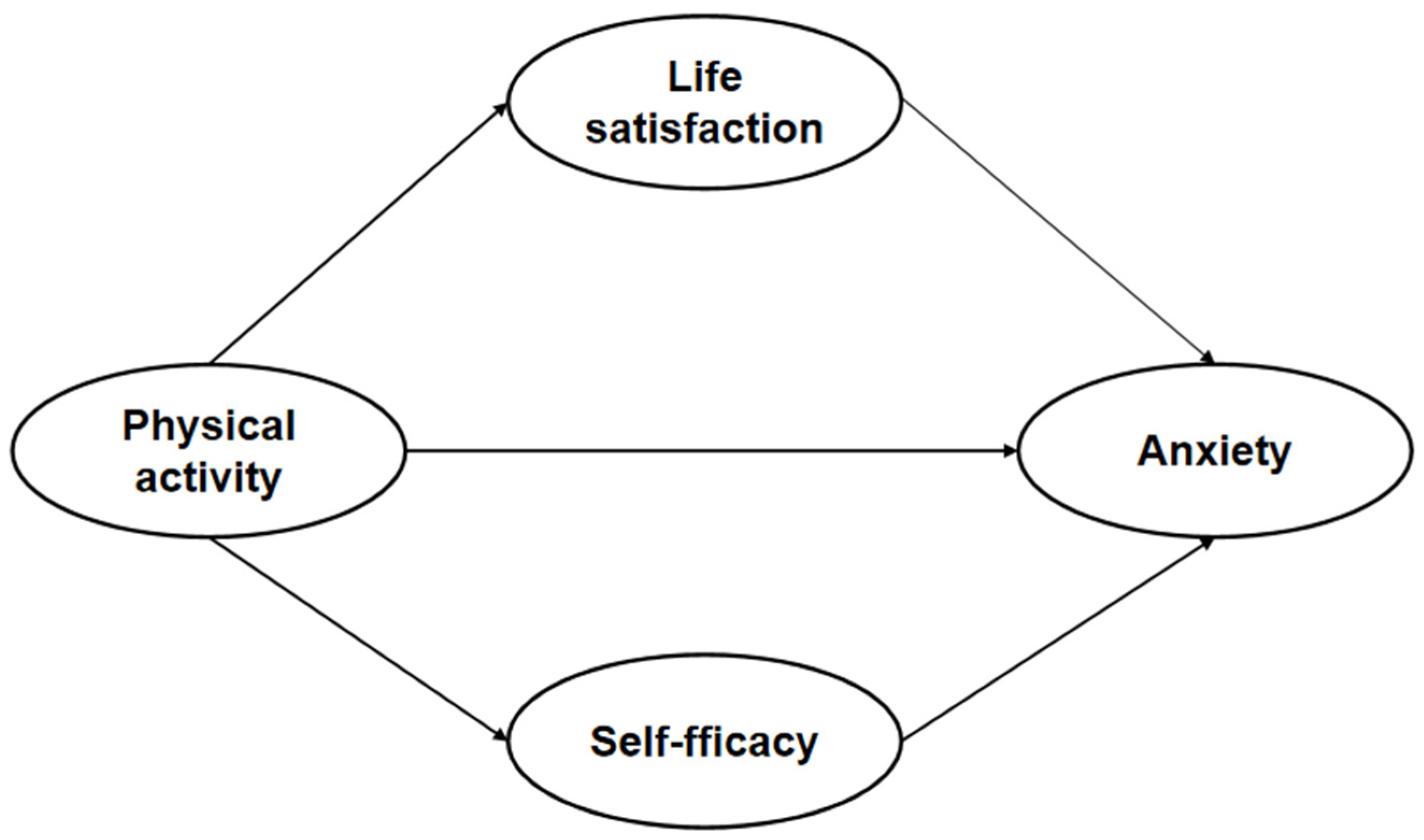
Figure 2.
Parallel mediation model of life satisfaction and self-efficacy in physical activity and anxiety. *** p < 0.001.
Figure 2.
Parallel mediation model of life satisfaction and self-efficacy in physical activity and anxiety. *** p < 0.001.
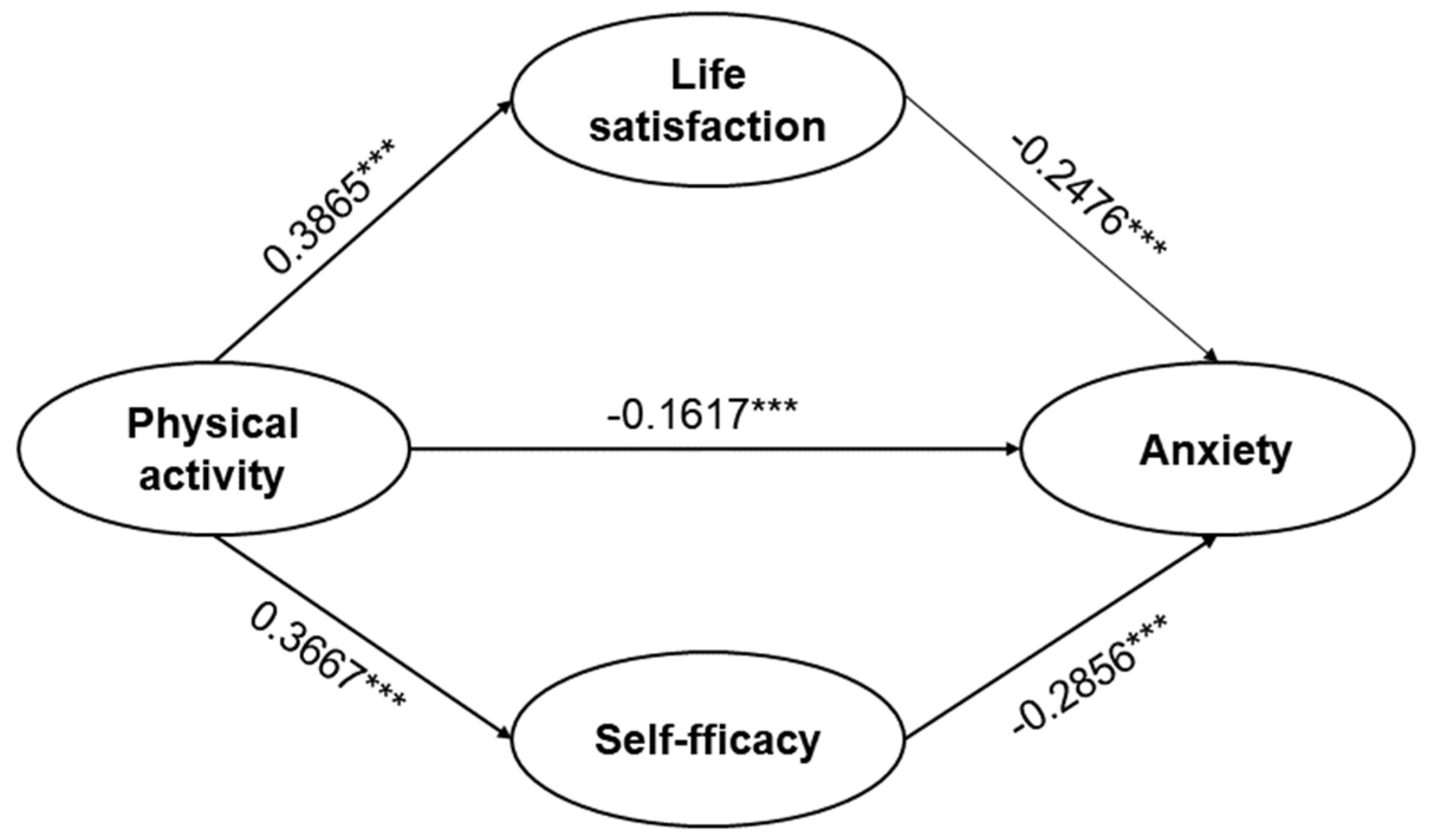

Table 1.
Descriptive statistics (n = 358).
| Projects | Categories | Cases | Percentage |
|---|---|---|---|
| Gender | Male | 186 | 51.96% |
| Female | 172 | 48.04% | |
| Age | 19 | 70 | 19.55% |
| 20 | 93 | 25.98% | |
| 21 | 108 | 30.17% | |
| 22 | 56 | 15.64% | |
| student’s degree | >23 | 31 | 8.66% |
| Undergraduate | 302 | 84.36% | |
| Bachelor’s degree | 48 | 13.41% | |
| PhD | 8 | 2.23% |
Table 2.
Correlation analysis of physical activity, life satisfaction, self-efficacy and anxiety among college students (n = 358).
Table 2.
Correlation analysis of physical activity, life satisfaction, self-efficacy and anxiety among college students (n = 358).
| Variables | Mean (M) | Standard Deviation (SD) | 1 | 2 | 3 | 4 |
|---|---|---|---|---|---|---|
| Physical activity | 24.80 | 9.85 | 1 | |||
| Life satisfaction | 3.55 | 1.05 | 0.408 ** | 1 | ||
| Self-efficacy | 3.56 | 1.02 | 0.389 ** | 0.404 ** | 1 | |
| Anxiety | 40.38 | 11.33 | −0.389 ** | −0.440 ** | −0.458 ** | 1 |
** p < 0.01.
Table 3.
Regression analysis of the parallel mediation model of physical activity on anxiety(n = 358).
Table 3.
Regression analysis of the parallel mediation model of physical activity on anxiety(n = 358).
| Overall fit index | Significance of regression coefficients | |||||
|---|---|---|---|---|---|---|
| Outcome Variables | Predictor variables | R | R2 | F | β | t |
| Life satisfaction | Physical activity | 0.4076 | 0.1662 | 70.943 | 0.3865 | 8.4228 *** |
| Self-efficacy | Physical activity | 0.3895 | 0.1517 | 63.6624 | 0.3667 | 7.9789 *** |
| Life satisfaction | ||||||
| Anxiety | Physical activity | 0.5576 | 0.3109 | 53.2311 | −0.1617 | −3.4614 *** |
| Life satisfaction | −0.2476 | −4.9928 *** | ||||
| Self-efficacy | −0.2856 | −5.7680 *** | ||||
*** p < 0.001.
Table 4.
Parallel mediation tests of life satisfaction and self-efficacy on physical activity and anxiety(n = 358).
Table 4.
Parallel mediation tests of life satisfaction and self-efficacy on physical activity and anxiety(n = 358).
| Effect | Boot SE | Boot LLCI | Boot ULCI | Proportion of effect | |
|---|---|---|---|---|---|
| Aggregate effect | −0.3621 | 0.0455 | −0.4515 | −0.2727 | |
| Total direct effect | −0.1617 | 0.0467 | −0.2535 | −0.0698 | 45.66% |
| Total indirect effect | −0.2004 | 0.0307 | −0.2621 | −0.1419 | 55.34% |
| Path 1: Physical activity → life satisfaction → anxiety | −0.0957 | 0.0232 | −0.1437 | −0.0524 | 26.43% |
| Path 2: Physical activity → self-efficacy → anxiety | −0.1047 | 0.0222 | −0.1501 | −0.0634 | 28.91% |
| Contrasting indirect effects (1–2) | 0.009 | 0.0335 | −0.0582 | 0.0747 |
Disclaimer/Publisher’s Note: The statements, opinions and data contained in all publications are solely those of the individual author(s) and contributor(s) and not of MDPI and/or the editor(s). MDPI and/or the editor(s) disclaim responsibility for any injury to people or property resulting from any ideas, methods, instructions or products referred to in the content. |
© 2024 by the authors. Licensee MDPI, Basel, Switzerland. This article is an open access article distributed under the terms and conditions of the Creative Commons Attribution (CC BY) license (http://creativecommons.org/licenses/by/4.0/).
Copyright: This open access article is published under a Creative Commons CC BY 4.0 license, which permit the free download, distribution, and reuse, provided that the author and preprint are cited in any reuse.


