

Submitted:
17 June 2024
Posted:
19 June 2024
You are already at the latest version
Abstract
Coastal environments are complex systems that are influenced by a combination of natural processes and human activities. Scientific interest in the effects of coastal erosion/accretion and climatic change-related processes greatly increased in recent decades due to the growing human development along coastal areas. This paper investigates the state and evolution of beach-dune systems for the 1977-2001 and 2001-2019 periods of the Mediterranean coast of Andalusia (Spain) using two different proxies: the dune toe line, which was used to track foredunes evolution, and the high-water line, which was used to assess shoreline evolution. Results showed a general erosional behavior of the studied beach-dune systems and identified cases where the main trend was altered through human interventions. In the 1977-2001 period, 54% of foredunes showed erosion, 24% accretion and 22% stability while and 34% of shorelines showed erosion, 40% accretion and 34% stability. In the 2001-2019 period, 42% of foredunes showed erosion, 28% accretion and 30% stability, and 40% of shorelines showed erosion, 34% accretion and 26% stability. Combining the evolution classes of each proxy (dune toe/shoreline) allows the behavior of both shoreline proxies to be assed together and provides insights additional to those derive from the use of a single proxy. In this regard, Erosion/Erosion (EE) was the most frequent behavior, with 25% and 27% in the first and second periods respectively, and Accretion/Accretion (AA), with 17% in both periods. Erosion of foredunes combined with stability or accretion of the shoreline (ES and EA) were the most common pairings in the first period, while stability of dunes combined with accretion of the shoreline (SA) and Stability/Stability (SS) dominated in the second period. The results obtained provide additional insights on the nature and drivers of coastal change that aid local coastal managers and administrations in understanding erosion processes. The method can be applied at other areas around the world where a similar data base is available.
Keywords:
coastal erosion
; change rates
; dune toe line
; high-water line
; coastal management
1. Introduction
Coastal environments are complex systems that are influenced by many interrelated physical, chemical and biological processes [1,2,3]. In developed coastal areas, human pressure represents an added threat to valuable natural environments [4,5,6,7] and, at many places, the risk of coastal erosion/flooding represents a severe problem for human settlements [8,9,10].
Scientific studies on coastal erosion/accretion processes have proliferated during recent decades as a result of the increased human interest related to coastal developments and infrastructure [11,12,13,14] and the effects of climatic change-related processes [15,16,17] such as sea level rise, increased height of extreme waves or changes in the frequency and intensity of storms [6,7,18,19,20,21,22,23,24,25,26].
Many different proxies are used for shoreline change analysis depending on the particular coast study and its environment, the availability of data sources and the aim and expected outcomes of the study [27,28], and several studies have compared different proxies in coastal evolution studies (e.g. [27,29,30,31]. The various shoreline proxies used to determine sandy beach evolution [32,33] only capture the dynamics of a certain portion of the coastal area [34]. The use of more than one indicator is recommended by many authors [28,35,36,37] as each proxy captures different processes in different areas of the coastal system, providing a more nuanced picture of the morphodynamic behavior and processes in a given area.
An appropriate time scale approach is also necessary to avoid associated errors, e.g. errors in the definition and extraction procedures [27,28]. Depending on the purpose of the study, different time scales can be selected, e.g., if the aim of the study is the observation of interannual changes, the analysis of shorter time periods can be sufficient, but if the aim is to predict future shoreline trends, larger time periods (>60 years) are needed [38,39].
The dry beach represents a buffer zone that absorbs, reflects and dissipates energy delivered by waves to the shore specially during storm events, protecting in this way the areas behind it from the impact of erosion and flooding [40] and, therefore, dry beach characteristics have to be taken into consideration in coastal sensitivity determination [41]. In addition, foredunes are one of the most relevant coastal ecosystems that work as natural defenses able to reduce flood sensitivity/vulnerability [42,43,44], as they often protect large sections of low-lying coasts against flooding during extreme storms [45,46,47]. Therefore their maintenance/emplacement has been considered as an effective coastal protection measure that is included among possible “Disaster Risk Reduction” (DRR) strategies in several European directives [43,48,49,50,51]. Many authors agree that the temporal natural variations of sediment supply and wind regime are among the most important factors controlling the natural beach-dune system relationship [52,53,54,55,56]. Human impacts on the beach-dune system arise from urbanization and decreases in sediment supplies (by, for example, construction of dam and coastal protection structures [53,57,58,59,60,61,62].
Irrespective of tidal range, beach and dune responses to erosion processes are different [27]: dune erosion can be very fast and episodic, and recovery can occur over several years; beach erosion is more dynamic and variable (interannual cycles of erosion/accretion) and recovery can be fast, i.e. days/weeks [63,64].
This paper investigates the evolution of the beach-dune systems of the Mediterranean coast of Andalusia (Spain) in the medium-term (between 10 and 60 years, [38]), using two different proxies: the dune toe was used to determine foredune evolution and the high-water line was used to assess shoreline evolution. The results obtained for each proxy where then combined to obtain different beach-dune systems states, i.e. from “Erosive” and “Mixed” to “Accretion” states. The results obtained provide enhanced information for coastal managers and administrations to properly understand and deal with contemporary erosion processes. The method used in this investigation can be applied at other areas around the world where a similar data base is available.
2. Geographical Setting
The 564 km-long Mediterranean coast of Andalusia is located in southern Spain and administratively belongs to Cádiz, Málaga, Granada and Almería provinces (Figure 1). It has a rectilinear E-W orientation, with two NE-SW facing sectors located at its western and eastern ends.
The coast is micro-tidal (tidal range <0.2 m) and is mainly composed of beaches of medium to coarse dark sand and/or pebbles. Foredunes are especially well developed in Cádiz and Almería provinces and extend along ca. 76 km of coastline [58,66,67,68].
The Betic Range, a tectonically active mountain chain that, at places, reaches to >2000 m elevation close to the coast, determines coastal orography and morphology, forming cliffs, embayments and promontories. Several small coastal plains are present at the mouth of short rivers and seasonal streams.
Large coastal towns include Málaga (>500,000 inhabitants), Marbella (150,000 inhabitants), Fuengirola (80,000) and Torremolinos (70,000). Málaga has the most densest coastal occupation in Andalusia due to the development of national and international tourism [69,70]. Along the coast there are several marinas and the main commercial port is located at Málaga [53,60,71].
The coast of Málaga province is one of the most heavily developed coastal stretches in Europe. Tourist infrastructure development during the 1960s, without any rational spatial planning, resulted in a large population increase and transformation of the coastal landscape. Although urban developments have produced economic benefits, the environmental impacts in some cases are irreversible and the coastal sediment budget has been altered in most of the sandy sectors [70,71,72].
Cádiz, Málaga and Granada have a Mediterranean climate with “Humid and Subhumid” and “Tempered Dry-subhumid” areas, with average annual temperatures from 15 ºC to 19 ºC and annual rainfall between 600 and 1000 mm [73]. Almería Province has a semi-arid Mediterranean climate with sparse episodes of rain (<200 mm/year in some places, [73]), and average annual temperature of 21 ºC, reaching 26 ºC in summer [74].
The coast is generally exposed to winds blowing from E to W and from NNE to SW in the easternmost part of Andalusia, with minimum and maximum velocities ranging from 0.4 to 9.0 m/s [75]. The wave climate and storm energy are very variable as the coast of Málaga, Granada and (partially) Almería provinces are exposed both to western and eastern storms, and the easternmost area of Almería province is primarily exposed to eastern storms [65,75].
Waves show a clear seasonal behavior with storm conditions being recorded during winter (November–March) [72,75,76], and significant wave heights reach 4.73 m during extreme storms [75]. A storm characterization for the study area [75] using the Energy Flux parameter, classified storm events into five classes, from weak (Class I) to extreme (Class V). The most energetic coast is between Málaga and Almería provinces, [75].
3. Materials and Methods
Material and methods used in this work are summarized in Figure 2.
3.1. GIS Project Creation
In this paper, aerial orthophotos from 1977, 2001 and 2019 were used to digitize and extract shoreline and foredune proxies. The orthophotos were obtained from the Web Map Services (WMS) (https://www.juntadeandalucia.es/medioambiente/portal/acceso-rediam/geoportal/servicios-ogc/web-map-service-wms, accessed in March 2023) developed by the Regional Government according to Open Geospatial Consortium interoperability standards. All information was presented in projected coordinate system ETRS89 UTM zone 30N (Reference System EPSG: 25830). The spatial resolution of the orthophotos was 0.5 m for 1977 and 2001 (black and white) orthophotos and 0.35 m for 2019 orthophoto (color). In order to reduce uncertainty related to storm impacts and recovery sequences which could affect the decision of using the selected orthophotos, displacement distances and rates were also calculated for intermediate periods between the selected photographs [77]. Results showed a constant trend confirming the validity of data obtained using the three aforementioned orthophotos. Further, according to [38] the influences of short-term fluctuations, e.g. the effects of high energy storm events, are minimized in the medium-term coastal studies and this is the case of this paper that investigates 24 and 18 year intervals.
The two proxies selected in this study were the high-water line (HWL) for the shoreline and the dune toe line for foredunes [27,78]. The HWL, also called wet/dry line, is identified by a change in the color of the sand. This line corresponds to the last tide mark that does not change very much in the micro-tidal Mediterranean Andalusia coast. The dune toe line was selected as it represents the line that separates the backshore from the shoreward limit of foredunes and can be determined in the orthophotos by a change in color between bare sand and vegetation. The dune proxy was digitized for foredunes > 100 meters in length.
3.2. Change Rate Calculations
Corrections of the shoreline position were carried out according to wave run-up and tidal conditions using the relation of the total uncertainty (σT):
Such total uncertainty combines digitization errors and the photo characteristics (Moore, 2000), i.e. the digitalizing error (σd), accuracy linked to pixel size (σp), ortho-rectification error (σr), image co-registration error (σco), and onshore definition and position determination, i.e. wave run-up (σwr) and tidal conditions (σtd).
The uncertainty of the position of dune toe was calculated according to the first four parameters of equation (1).
The coastline was divided into different coastal sectors each of which corresponded to a single beach-dune system. Change rates of the two proxies were then calculated using the same baselines and transects to be able to pair the data at each point.
The Shoreline Change Envelope (SCE), the Net Shoreline Movement (NSM) and the End Point Rate (EPR) were calculated for two periods, i.e. 1977 – 2001 and 2001 – 2019, using the DSAS extension of ArcGIS 10.6 that takes into account the uncertainty of each proxy using equation (1), [79]. The SCE method deals with shoreline variability at each transect taking into account the maximum spatial recorded displacement, regardless of the time span over which it was recorded; The NSM is associated with the dates of only two shorelines and it reports the distance between the oldest and youngest shorelines, i.e. 1977 and 2019, for each transect although this movement may be not the maximum shoreline displacement; the EPR is calculated by dividing the distance of shoreline movement by the time elapsed between the oldest and the most recent shoreline. Baselines were digitized parallel to the shoreline and the spacing of transects (25 m) was determined in accordance with the regional scope of this paper.
A total of 53 beach-dune systems were observed for the 1977 – 2001 period and 38 for the 2001 – 2019 period, i.e. 15 systems disappeared during the second study period essentially because of urban development [67]. Thus, in this paper, erosion/accretion rates were calculated for the 38 beach-dune systems that were observed during the two study periods. The evolution of these systems was not affected by beach nourishment programs that were only carried out at urban beaches and these lack dunes.
3.3. Statistical Analysis
The same categories of change were selected for both shoreline and dune proxies (Table 1). Values between +0.2 and -0.2 m/year were considered to indicate “stability conditions” within the expected seasonal shoreline variability of the investigated shoreline [77].
A total of 3234 transects were measured among the 38 beach-dune systems. During the study period, foredunes eroded, accreted or/and migrated laterally, and the number of transects varied in each study period. As the aim of this work is to determine the behavior of foredunes and the shoreline in front of them and associated relationships, only transects that intersected both the shoreline and the dune toe, were considered. This resulted in 2731 transects for the 1977 – 2001 period and 2654 transects for the 2001 – 2019 period.
The evolution classes obtained for each proxy were then combined, obtaining 9 combinations of evolution states of the beach-dune systems:
- Accretion/Accretion (AA): accretion classes were observed at the same transects for both shoreline and dune proxies.
- Accretion/Erosion (AE): accretion was obtained for the dune proxy and erosion for the shoreline.
- Accretion/Stability (AS): accretion was obtained for the dune proxy and stability for the shoreline.
- Erosion/Erosion (EE): erosion classes were obtained for both shoreline and dune proxies.
- Erosion/Accretion (EA): erosion was obtained of the dune proxy and accretion for the shoreline.
- Erosion/Stability (ES): erosion was obtained for the dune proxy and stability for the shoreline.
- Stability/Stability (SS): stability class was obtained for both dune and shoreline proxies.
- Stability/Accretion (SA): stability was obtained for the dune proxy and accretion for the shoreline in the same transect.
- Stability/Erosion (SE): stability was obtained for the dune proxy and erosion for the shoreline.
4. Results
Trends of transects used to determine shoreline and foredune evolution are summarized in Figure 3. Regarding foredune behavior in the first period (1977 – 2001) 24% (644 transects) of transects showed accretion, 22% (603 transects) stability and 54% (1484 transects) erosion. In the second period, i.e. 2001 – 2019, 28% (755 transects) of transects showed accretion, 30% (786 transects) showed stability, and 42% (1113 transects) showed erosion.
Concerning shoreline evolution for the first period (1977 – 2001), 40% (1082 transects) of transects showed accretion, 26% (715 transects) stability and 34% (934 transects) erosion (Figure 3A). In the second period (i.e. 2001 – 2019), 34% (902 transects) of the studied transects showed accretion, 26% (702 transects) showed stability, and 40% (1050 transects) showed erosion (Figure 3B).
Evolution rates for foredunes and the shoreline were paired, and combinations of evolution classes of each proxy were determined to analyze their behavior in the 1977-2001 and 2001-2019 periods (Figure 4).
As shown in Figure 4, there is a weak positive correlation between data: the behavior of the two proxies was similar but the intrinsic higher variability of the shoreline compared to the dune toe (Figure 3) makes the relation statistically weak. The bar graph shows that the EE combination of classes clearly dominates (Figure 4).
A general trend of the distribution of the different types of combinations of foredunes and shoreline evolution is presented in Table 2.
The dominant combinations of evolution classes were EE and AA for both periods (Figure 4;Table 3). Specifically, there were two areas in Almeria province, i.e. Punta Entinas-El Sabinar and Cabo de Gata, where this category occurred in association with other “minority” combinations (see Discussion).
Slight differences were evident between the 1977-2001 and 2001-2019 periods. EE and AA trends were very similar for the two periods while the other combinations showed more variability. Erosion of foredunes coincident with accretion (EA) or stability (ES) of the shoreline were quite frequent classes in the first period, but in the second period stability of the foredunes was more commonly associated with shoreline accretion (SA) or stability (SS) (Figure 4).
These results suggest that dunes are better indicators of coastal erosion/accretion trend because of their lower magnitude of variability compared to the shoreline, as also observed by several authors, e.g. Pollard et al. (2020). With this in mind a classification of the evolution state of each beach-dune system was developed based on the combined evolution of the shoreline and dune proxies (Table 3).
Approximately half of the beach-dune systems recorded an “Erosion” state for both periods and, from the first to the second studied period, there was a slight reduction in extent of the “Erosion” state and a slight increase of the “Mixed” and “Accretion” states (Figure 5).
5. Discussion
5.1. Spatial and Temporal Distribution of Evolution Classes
Generally, dune and shoreline proxies recorded an eroding trend (Figure 3), a behavior that was also reported by several authors and mainly attributed to the emplacement of dams that reduced sediment input to beach-dune systems [62,80,81,82,83] and the effect of coastal urbanization, i.e. land occupation and the implementation of coastal protection structures [58,60,67,77]. Accretion was usually observed up-drift of structures and natural promontories, as well as at pocket beaches and in areas directly affected by coastal protection structures [84,85,86,87,88]. At few places, accretion was also observed at the mouth of seasonal streams. According to the definition used in this paper, Stability did not represent no change in dune toe or the shoreline, but morphological changes within the range of seasonal changes and it was usually observed between erosion and accretion areas [89].
Dune erosion was the most frequent class during both periods but showed lower values during the second period during which accretion and stability slightly increased in frequency (Figure 3), possibly influenced by changes in management policies in Spain after implementation of the Coastal Act in 1988. In the 60s and 70s, prior to the Spanish Coastal Act, rapid coastal development prioritized tourism and urbanization of the coastal area leading to development of the back-beach [60,71] and a decrease and/or destruction of foredunes, especially in Malaga province [57,58,60,67,71,83,90,91,92].
The increase of accretion and stability classes of foredunes in the 2001-2019 period might reflect the implementation of management and restoration measures [58,90,93], e.g. the establishment of protected areas such as Punta-Entinas and Laguna de Adra in Almería [94] or Cabo de Gata [95] that restrict public access to particular areas, or the development of specific management plans for dune conservation [96].
The distribution of shoreline evolution classes showed no important changes during the period investigated, although erosion was slightly more widespread in the 2001-2019 period compared to 1977-2001 (Figure 3).
5.2. Beach-Dune System Behavior
This large spatial scale study obtained a great amount of data that indicates marked spatial variability. This reflects the heterogeneity of the Mediterranean coast of Andalusia and the distribution of areas influenced by human activities. Furthermore, shoreline and foredunes have different behavior and erosional/accretional processes affect them in different ways:
- Dune erosion or disappearance may be linked to natural processes and/or human activities [59,67,68,97] and usually occurs very quickly. Foredune recovery requires months to years depending on sediment availability, the accommodation space, the colonization and growth of appropriate vegetation and wind conditions [55,56,59,68,98,99,100,101].
In general, the shoreline and foredunes showed the same trend. For example, accretion of both proxies was recorded after the enlargement of the port of Algeciras (Cádiz province) up-drift of the structure (Figure 6A). The opposite behavior, i.e. erosion recorded by both proxies, was observed at the Guadalhorce river mouth (Málaga, Málaga province) (Figure 6B) mainly due to the critical reduction of the river sediment supplies [62,82,91]. The areas accreted/eroded in the 2001-2019 period at the mentioned study sites is presented in Figure 7: in the first example, foredunes recorded a mean accretion rate of 3.40 m/year, creating an area of over 18600 m2 in front of the existing foredunes, and the shoreline advanced at a mean rate of 4.23 m/year, forming over 21000 m2 of new beach area in front of the remnant foredunes (Figure 6A); in the second example, a mean value of -1.30 m/year was recorded for the evolution of the dunes, i.e. the loss of over 19600 m2 in front of the previous dune toe line and the shoreline registered a mean rate of -1.78 m/year, i.e. the loss of over 26000 m2 in front of the remnant foredunes (Figure 6B).
The most frequent combination of classes were EE and AA in both periods followed by EA and ES in the 1977 – 2001 period and SA and SS in the 2001 – 2019 period (Figure 4). In places a clear spatial trend was observed alongshore with EA and ES areas located between EE and AA areas, e.g. at Punta Entinas-El Sabinar (Figure 7). This is a large protected natural area where the system is accommodating to a new equilibrium because the natural coastal processes that favor erosion of sandy cuspate forelands and sedimentation in adjacent areas [8]. In this case an EE combination was observed on the shoreline salient and AA at both sides of it where the eroded sediment eroded had accumulated, i.e. the salient constitutes a divergent fixed limit [84,86]. The areas in between showed dune erosion and beach accretion (EA) or stability (ES) reflecting a changing trend.
At several places a change was noted between the first and second study periods. In some instances, this was due to new coastal protection structures. For example, at Playa del Perdigal and Garrucha in Almería province EA and ES combinations in the 1977-2001 period were replaced by an EE combination in the 2001-2019 period. The change was caused by the emplacement of 5 groins that caused down-drift erosion (Figure 8A). In the second period, the behavior of this sector changed after enlargement of the port of Garrucha. Up-drift of the port, EA combination recorded during the first studied period, switched to the AA combination in the second period (Figure 8B).
Changes attributed to natural processes were also recorded [4,5,18,22]. For example, the Artola foredunes (Málaga province) have a complex dynamics behavior [102]. The area is characterized by an alternation of easterly and westerly winds and high-energy storm events that approach from the east generating an eastward directed littoral transport. The trend described by previous authors was reflected in the findings reported here: in the first period, EE and ES combinations were generally observed and AA combination was recorded close to the port, which had been enlarged in 1980 (Figure 9A). In the second period, SA and SS combinations prevailed (Figure 9B). The welding of nearshore bar at this sites [102], reflects the changes observed in this paper.
5.3. Considerations for Coastal Management
A combination of different shoreline proxies provides more information about the whole coastal system evolution as each proxy is able to capture certain, specific processes [28,35,36]. The use of a combination of shoreline and dunes proxies provides an opportunity for better understanding of beach-dune system behavior and the establishment of sound management measures and plans.
The combination of evolution classes calculated for the shoreline and foredunes reflects the state of each beach-dune system (Table 3) and prompts a range of potential management responses:
- Erosion states represent systems that present different level of degradation and need management measures;
- Mixed states represent systems with diverse levels of variability or stability conditions, which can shift to an erosion state in the short/medium term. These systems need to be monitored to full comprehend their present and future behavior;
- Accretion states represent systems in a good state of health, and they do not need management measures in the short/medium term.
The methodology developed in this paper represents a useful tool to determine areas that need more attention. at both local and regional scale. As an example, because the dominance of the “Erosion” category in the 2001-2019 interval indicates that great proportion of the beach-dune systems in the Mediterranean coast of Andalusia need some kind of management measures to avoid future erosion problems. It also identifies the particular areas where the problem exists.
Pranzini et al. [103] presented a review of the protection strategies carried out in Europe, concluding that there is no single solution to coastal problems but rather a range of practical possibilities. Many methods exist for beach and dunes restoration (e.g. [104,105]).
As an example, the area of the Gualdalhorce river delta (Málaga province), which presents an “Erosion” state, is affected by several groins that stop longshore transport and cause up-drift accretion and down-drift erosion. A solution could be a sediment bypass from the accreting to the erosion areas and the emplacement of fences and planting of endemic vegetation for foredune stabilization.
6. Conclusions
In this paper the evolution of 38 beach-dune systems was investigated using two different proxies: the dune toe line for foredune evolution and the high-water line for the shoreline position changes. Evolution rates were calculated for the 1977 – 2001 and 2001 – 2019 periods. Results were compared obtaining a general erosional behavior of both proxies along the studied coast and a relevant variability for the shoreline versus the foredunes.
Evolution classes of foredunes and beach changes were paired obtaining 9 combinations of classes: Erosion/Erosion (EE) was the most frequent and was recorded by 25% and 27% of the transects in the first and second periods respectively, and Accretion/Accretion (AA) that was represented 17% of the total cases observed in both periods. Changes in the evolution trend of the beach-dune systems were also found especially in areas where human interventions occurred between the first and the second periods.
The use of different proxies to monitor coastal change is frequently recommended, as each proxy provides different information about the system and can capture different processes. In this case, the shoreline proxy reflected very well medium-term changes due to its great variability and the dune proxy better reflected long-term changes, e.g. the impact of high energy storms. The dune proxy did not capture the effects of short fair-weather conditions due to the slow dune recovery capacity since they need several months/years of fair weather conditions to recover.
The classification used to reflect the state of the beach-dune systems resulted in a useful application tool for coastal management purposes since it makes easy to recognize areas that need more attention; furthermore, its periodic updating could help to verify whether the measures are working or not at a short-medium term.
Future research could be devoted to fully understand the behavior and/or evolution of the beach-dune systems investigated. The enlargement of the temporal resolution used in this paper would allow a better understanding of beach-dune system variability at different spatial scales, e.g. from months and seasons to years.
Author Contributions
Methodology, R.M. and G.A.; formal analysis, R.M.; data curation, R.M. and B.G.; writing—original draft preparation, R.M. and B.G.; writing—review and editing, G.A., G.M. and A.C; supervision, G.A, G.M and A.C.
Funding
This research received no external funding.
Acknowledgments
This work is a contribution to the Andalusia Research Group PAI RNM-373 and to the PROPLAYAS network. The first author R.M. is supported by the Margarita Salas Grant funded by the European Union – Next Generation-EU and Universities Ministry (Spain) (ref. 2021-067/PN/MS-RECUAL/CD). G.M. is supported by the RETURN Extended Partnership funded by the European Union – Next Generation-EU (National Recovery and Resilience Plan – NRRP, Mission 4, Component 2, Investment 1.3 – D.D. 1243 2/8/2022, PE0000005).
Conflicts of Interest
The authors declare no conflicts of interest.
References
- Elliott, M.; Burdon, D.; Atkins, J.P.; Borja, A.; Cormier, R.; de Jonge, V.N.; Turner, R.K. “And DPSIR Begat DAPSI(W)R(M)!” - A Unifying Framework for Marine Environmental Management. Marine Pollution Bulletin 2017, 118, 27–40. [Google Scholar] [CrossRef] [PubMed]
- Patricio, P.; Elliott, M.; Mazik, K.; Papadopoulou, K.-N.; Smith, J.S. DPSIR—Two Decades of Trying to Develop a Unifying Framework for Marine Environmental Management? Frontiers in Marine Science 2016, 3, 177. [Google Scholar] [CrossRef]
- Rizzo, A.; Anfuso, G. Coastal Dynamic and Evolution: Case Studies from Different Sites around the World. Water 2020, 12, 2829. [Google Scholar] [CrossRef]
- Cooper, J.A.G.; O’Connor, M.C.; McIvor, S. Coastal Defences versus Coastal Ecosystems: A Regional Appraisal. Marine Policy 2020, 111, 102332. [Google Scholar] [CrossRef]
- Cooper, J.A.G.; Alonso, I. Natural and Anthropic Coasts: Challenges for Coastal Management in Spain. Journal of Coastal Research SI 2006, 48, 1–7. [Google Scholar]
- Mentaschi, L.; Vousdoukas, M.I.; Pekel, J.-F.; Voukouvalas, E.; Feyen, L. Global Long-Term Observations of Coastal Erosion and Accretion. Scientific Reports 2018, 8, 12876. [Google Scholar] [CrossRef] [PubMed]
- Vousdoukas, M.I.; Ranasinghe, R.; Mentaschi, L.; Plomaritis, T.A.; Athanasiou, P.; Luijendijk, A.; Feyen, L. Sandy Coastlines under Threat of Erosion. Nature Climate Change 2020, 10, 260–263. [Google Scholar] [CrossRef]
- Bird, E. Coastal Geomorphology: An Introduction; John Wiley & Sons, 2011.
- Cooper, J.A.G.; Lemckert, C. Extreme Sea-Level Rise and Adaptation Options for Coastal Resort Cities: A Qualitative Assessment from the Gold Coast, Australia. Ocean & Coastal Management 2012, 64, 1–14. [Google Scholar] [CrossRef]
- Rangel-Buitrago, N.; Anfuso, G.; Williams, A.T. Coastal Erosion along the Caribbean Coast of Colombia: Magnitudes, Causes and Management. Ocean & Coastal Management 2015, 114, 129–144. [Google Scholar] [CrossRef]
- Phillips, M.R.; Jones, A.L. Erosion and Tourism Infrastructure in the Coastal Zone: Problems, Consequences and Management. Tourism Management 2006, 27, 517–524. [Google Scholar] [CrossRef]
- Sanò, M.; Jiménez, J.A.; Medina, R.; Stanica, A.; Sanchez-Arcilla, A.; Trumbic, I. The Role of Coastal Setbacks in the Context of Coastal Erosion and Climate Change. Ocean & Coastal Management 2011, 54, 943–950. [Google Scholar] [CrossRef]
- Silva, R.; Martínez, M.L.; Hesp, P.A.; Catalan, P.; Osorio, A.F.; Martell, R.; Fossati, M.; Miot da Silva, G.; Mariño-Tapia, I.; Pereira, P.; et al. Present and Future Challenges of Coastal Erosion in Latin America. Journal of Coastal Research 2014, 71, 1–16. [Google Scholar] [CrossRef]
- World Tourism Organization International Tourism Highlights, 2023 Edition – The Impact of COVID-19 on Tourism (2020–2022); UNWTO, 2023; ISBN 978-92-844-2497-9.
- Aguilera, M.; Muñoz-Perez, J.J.; Contreras, A.; Contreras, A.; Lopez, P.; Jigena, B. Increase in the Erosion Rate Due to the Impact of Climate Change on Sea Level Rise: Victoria Beach, a Case Study. Journal of Marine Science and Engineering 2022, 10, 1912. [Google Scholar] [CrossRef]
- <italic>Disappearing Destinations: Climate Change and Future Challenges for Coastal Tourism</italic>; Jones, A.L., Phillips, M.R., Eds.; CABI: Wallingford, Oxfordshire; Cambridge, MA, 2011; ISBN 978-1-84593-548-1.
- Masselink, G.; Russell, P.; Rennie, A.; Brooks, S.; Spencer, T. Impacts of Climate Change on Coastal Geomorphology and Coastal Erosion Relevant to the Coastal and Marine Environment around the UK. MCCIP Science Review 2020. [CrossRef]
- Anfuso, G.; Loureiro, C.; Taaouati, M.; Smyth, T.A.G.; Jackson, D.W.T. Spatial Variability of Beach Impact from Post-Tropical Cyclone Katia (2011) on Northern Ireland’s North Coast. Water 2020, 12, 1380. [Google Scholar] [CrossRef]
- Bacon, S.; Carter, D.J.T. Wave Climate Changes in the North Atlantic and North Sea. International Journal of Climatology 1991, 11, 545–558. [Google Scholar] [CrossRef]
- Cid, A.; Menéndez, M.; Castanedo, S.; Abascal, A.J.; Méndez, F.J.; Medina, R. Long-Term Changes in the Frequency, Intensity and Duration of Extreme Storm Surge Events in Southern Europe. Clim Dyn 2016, 46, 1503–1516. [Google Scholar] [CrossRef]
- Dupuis, H.; Michel, D.; Sottolichio, A. Wave Climate Evolution in the Bay of Biscay over Two Decades. Journal of Marine Systems 2006, 63, 105–114. [Google Scholar] [CrossRef]
- Komar, P.D.; Allan, J.C. Increasing Hurricane-Generated Wave Heights along the U.S. East Coast and Their Climate Controls. J Coast Res 2008, 242, 479–488. [Google Scholar] [CrossRef]
- Meyer-Arendt, K.J. Grand Isle, Louisiana: A Historic US Gulf Coast Resort Adapts to Hurricanes, Subsidence and Sea Level Rise. In Disappearing Destinations: Climate Change and Future Challenges for Coastal Tourism; Jones, A., Phillips, M., Eds.; CAB International: Wallingford, Oxfordshire OX, UK, 2011; pp. 203–217. ISBN 978-1-84593-548-1. [Google Scholar]
- Nguyen, T.T.X.; Bonetti, J.; Rogers, K.; Woodroffe, C.D. Indicator-Based Assessment of Climate-Change Impacts on Coasts: A Review of Concepts, Methodological Approaches and Vulnerability Indices. Ocean Coast Manage 2016, 123, 18–43. [Google Scholar] [CrossRef]
- Soomere, T. Extremes and Decadal Variations of the Northern Baltic Sea Wave Conditions. In Extreme Ocean Waves; Pelinovsky, E., Kharif, C., Eds.; Springer Netherlands: Dordrecht, 2008; pp. 139–157. ISBN 978-1-4020-8313-6. [Google Scholar]
- Wolf, J.; Woolf, D.; Bricheno, L. Impacts of Climate Change on Storms and Waves Relevant to the Coastal and Marine Environment around the UK. MCCIP Science Review 2020. [CrossRef]
- Boak, E.H.; Turner, I.L. Shoreline Definition and Detection: A Review. Journal of Coastal Research 2005, 214, 688–703. [Google Scholar] [CrossRef]
- Pollard, J.A.; Spencer, T.; Brooks, S.M.; Christie, E.K.; Möller, I. Understanding Spatio-Temporal Barrier Dynamics through the Use of Multiple Shoreline Proxies. Geomorphology 2020, 354, 107058. [Google Scholar] [CrossRef]
- Díaz-Cuevas, P.; Prieto-Campos, A.; Fraile-Jurado, P.; Ojeda-Zújar, J.; Álvarez-Francoso, J.I. Shoreline “Proxies” Evaluation for Mid-Term Erosion Rates Calculation in Mesotidal and Microtidal Beaches (Andalusia, Spain). Journal of Coastal Research SI 2020, 95, 1062–1066. [Google Scholar] [CrossRef]
- Moore, L.J.; Ruggiero, P.; List, J.H. Comparing Mean High Water and High Water Line Shorelines: Should Proxy-Datum Offsets Be Incorporated into Shoreline Change Analysis? Journal of Coastal Research 2006, 224, 894–905. [Google Scholar] [CrossRef]
- Ruggiero, P.; Kaminsky, G.M.; Gelfenbaum, G. Linking Proxy-Based and Datum-Based Shorelines on a High-Energy Coastline: Implications for Shoreline Change Analyses. Journal of Coastal Research 2003, 57–82. [Google Scholar]
- Durán, R.; Guillén, J.; Ruiz, A.; Jiménez, J.A.; Sagristà, E. Morphological Changes, Beach Inundation and Overwash Caused by an Extreme Storm on a Low-Lying Embayed Beach Bounded by a Dune System (NW Mediterranean). Geomorphology 2016, 274, 129–142. [Google Scholar] [CrossRef]
- Farris, A.S.; List, J.H. Shoreline Change as a Proxy for Subaerial Beach Volume Change. Journal of Coastal Research 2007, 23, 740–748. [Google Scholar] [CrossRef]
- Cowell, P.J.; Stive, M.J.F.; Niedoroda, A.W.; De Vriend, H.J.; Swift, D.J.P.; Kaminsky, G.M.; Capobianco, M. The Coastal-Tract (Part 1): A Conceptual Approach to Aggregated Modeling of Low-Order Coastal Change. Journal of Coastal Research 2003, 19, 812–827. [Google Scholar]
- Cenci, L.; Disperati, L.; Persichillo, M.G.; Oliveira, E.R.; Alves, F.L.; Phillips, M.R. Integrating Remote Sensing and GIS Techniques for Monitoring and Modeling Shoreline Evolution to Support Coastal Risk Management. GIScience & Remote Sensing 2018, 55, 355–375. [Google Scholar] [CrossRef]
- Eamer, J.B.R.; Didier, D.; Kehler, D.; Manning, I.; Colville, D.; Manson, G.; Jagot, A.; Kostylev, V.E. Multi-Decadal Coastal Evolution of a North Atlantic Shel-Edge Vegetated Sand Island - Sable Island, Canada. Canadian Journal of Earth Sciences 2022, 59, 812–825. [Google Scholar] [CrossRef]
- Saye, S.E.; van der Wal, D.; Pye, K.; Blott, S.J. Beach-Dune Morphological Relationships and Erosion/Accretion: An Investigation at Five Sites in England and Wales Using LIDAR Data. Geomorphology 2005, 72, 128–155. [Google Scholar] [CrossRef]
- Crowell, M.; Leatherman, S.P.; Buckley, M.K. Shoreline Change Analysis: Long Term versus Short Term Data. Shore Beach 1993, 61, 13–20. [Google Scholar]
- Leatherman, S.P. Shoreline Mapping: A Comparison of Techniques. Shore Beach 1983, 51, 28–33. [Google Scholar]
- Anthony, E.J. Beach Erosion. In Encyclopedia of Coastal Science; Finkl, C.W., Makowski, C., Eds.; Springer International Publishing, 2017.
- Rangel-Buitrago, N.; Anfuso, G. Risk Assessment of Storms in Coastal Zones: Case Studies from Cartagena (Colombia) and Cadiz (Spain); Springer, 2015.
- Duarte, C.M.; Losada, I.J.; Hendriks, I.E.; Mazarrasa, I.; Marbà, N. The Role of Coastal Plant Communities for Climate Change Mitigation and Adaptation. Nature Climate Change 2013, 3, 961–968. [Google Scholar] [CrossRef]
- Fernández-Montblanc, T.; Duo, E.; Ciavola, P. Dune Reconstruction and Revegetation as a Potential Measure to Decrease Coastal Erosion and Flooding under Extreme Storm Conditions. Ocean Coast Manage 2020, 188, 105075. [Google Scholar] [CrossRef]
- Pagán, J.I.; López, I.; Bañón, L.; Aragonés, L. Consequences of Anthropic Actions in Cullera Bay (Spain). Journal of Marine Science and Engineering 2020, 8, 240. [Google Scholar] [CrossRef]
- Bochev-Van der Burgh, L.; Wijnberg, K.M.; Hulscher, S.J. Decadal-Scale Morphologic Variability of Managed Coastal Dunes. Coastal engineering 2011, 58, 927–936. [Google Scholar] [CrossRef]
- European Environmental Agency The Changing Faces of Europe’s Coastal Areas; Office for Official Publications of the European Communities, 2006.
- Nicholls, R.J.; Wong, P.P.; Burkett, V.; Codignotto, J.; Hay, J.; McLean, R.; Ragoonaden, S.; Woodroffe, C.D.; Abuodha, P.; Arblaster, J.; et al. Coastal Systems and Low-Lying Areas. 2007.
- European Union Directive 2011/92/EU of the European Parliament and of the Council of 13 December 2011 on the Assessment of the Effects of Certain Public and Private Projects on the Environment. Available online: https://eur-lex.europa.eu/legal-content/en/TXT/?uri=CELEX:32011L0092.
- European Union Directive 2009/147/EC on the Conservation of Wild Birds. Available online: https://eur-lex.europa.eu/legal-content/EN/TXT/?uri=CELEX%3A32009L0147.
- European Union Directive 2001/42/EC on the Assessment of the Effects of Certain Plans and Programmes on the Environment. Available online: https://eur-lex.europa.eu/legal-content/EN/ALL/?uri=CELEX%3A32001L0042.
- European Union Directive 92/43/EEC of 21 May 1992 on the Conservation of Natural Habitats and of Wild Fauna and Flora. Available online: https://eur-lex.europa.eu/legal-content/EN/TXT/?uri=celex%3A31992L0043.
- Hesp, P.A. Foredune Formation in Southeast Australia. In Coastal Geomorphology in Australia; Thom, B.G., Ed.; Academic Press: London, UK, 1984; pp. 69–97 ISBN 0-12-687880-3.
- Manno, G.; Anfuso, G.; Messina, E.; Williams, A.T.; Suffo, M.; Liguori, V. Decadal Evolution of Coastline Armouring along the Mediterranean Andalusia Littoral (South of Spain). Ocean & coastal management 2016, 124, 84–99. [Google Scholar]
- Martínez, M.L.; Psuty, N.P.; Lubke, R.A. A Perspective on Coastal Dunes. In Coastal Dunes; Martínez, M.L., Psuty, N.P., Eds.; Springer Berlin Heidelberg: Berlin, Heidelberg, 2008; Vol. 171, pp. 3–10 ISBN 978-3-540-74001-8.
- Nordstrom, K.F. Reestablishing Naturally Functioning Dunes on Developed Coasts. Environmental Management 2000, 25, 37–51. [Google Scholar] [CrossRef] [PubMed]
- Psuty, N.P. The Coastal Foredune: A Morphological Basis for Regional Coastal Dune Development. In Coastal Dunes; Martínez, M.L., Psuty, N.P., Eds.; Ecological Studies; Springer Berlin Heidelberg: Berlin, Heidelberg, 2008; Vol. 171, pp. 11–27 ISBN 978-3-540-74001-8.
- Díez-Garretas, B.; Comino, O.; Asensi, A. Cambios Espacio-Temporales (1956-2013) de Ecosistemas Costeros En El Sur de La Península Ibérica (España). Mediterranean Botany 2019, 40, 111–119. [Google Scholar] [CrossRef]
- Gómez Zotano, J. La Degradación de Dunas Litorales En Andalucía: Aproximación Geohistórica y Multiescalar. INGEO 2014. [Google Scholar] [CrossRef]
- Hesp, P. Foredunes and Blowouts: Initiation, Geomorphology and Dynamics. Geomorphology 2002, 48, 245–268. [Google Scholar] [CrossRef]
- Malvárez García, G.; Pollard, J.; Dominguez Rodriguez, R. Origins, Management, and Measurement of Stress on the Coast of Southern Spain. Coastal Management 2000, 28, 215–234. [Google Scholar] [CrossRef]
- Pranzini, E. Airborne LIDAR Survey Applied to the Analysis of the Historical Evolution of the Arno River Delta (Italy). Journal of Coastal Research <bold>2007</bold>, SI-50, 400–409.
- Prieto, A.; Ojeda, J.; Rodríguez, S.; Gracia, J.; Del Río, L. Procesos Erosivos (Tasas de Erosión) En Los Deltas Mediterráneos Andaluces: Herramientas de Análisis Espacial (DSAS) y Evolución Temporal (Servicios OGC). In Proceedings of the Tecnologías de la Información Geográfica en el Contexto del Cambio Global, Proceedings of the XV Congreso NAcional de Tecnologías de la Información Geográfica, Madrid, Spain; 2012; pp. 19–21.
- Carter, B. (R W.G.) Coastal Environments: An Introduction to the Physical, Ecological, and Cultural Systems of Coastlines; Academic Press: San Diego CA, USA, 1988; ISBN 978-0-12-161855-1. [Google Scholar]
- Doody, J.P. Sand Dune Conservation, Management and Restoration; Coastal research library; Springer: Dordrecht New York, 2013; ISBN 978-94-007-4731-9. [Google Scholar]
- Molina, R.; Manno, G.; Lo Re, C.; Anfuso, G.; Ciraolo, G. A Methodological Approach to Determine Sound Response Modalities to Coastal Erosion Processes in Mediterranean Andalusia (Spain). JMSE 2020, 8, 154. [Google Scholar] [CrossRef]
- Gracia Prieto, F.J.; Sanjaume Saumell, E.; Hernández, L.; Hernández, A.I.; Flor, G.; Gómez-Serrano, M.Á. Dunas Marítimas y Continentales. In Bases ecológicas preliminares para la conservación de los tipos de hábitat de interés comunitario en España; Ministerio de Medio Ambiente, y Medio Rural y Marino: Madrid, Spain, 2009; p. 106 ISBN 978-84-491-0911-9.
- Molina, R.; Manno, G.; Lo Re, C.; Anfuso, G. Dune Systems’ Characterization and Evolution in the Andalusia Mediterranean Coast (Spain). Water 2020, 12, 2094. [Google Scholar] [CrossRef]
- Sanjaume Saumell, E.; Gracia Prieto, F.J. Las dunas en España; Sociedad Española de Geomorfología.; Encuadernaciones Martínez: Puerto Real (Cádiz), 2011; ISBN 978-84-615-3780-8. [Google Scholar]
- DGPC Actuaciones En La Costa 1988-1990; MOPV: Madrid, Spain, 1991; p. 307.
- Malvárez, G.C. The History of Shoreline Stabilization on the Spanish Costa Del Sol. In Pitfalls of Shoreline Stabilization; Cooper, J.A.G., Pilkey, O.H., Eds.; Springer Netherlands: Dordrecht, 2012; Vol. 3, pp. 235–249 ISBN 978-94-007-4122-5.
- Malvárez García, G.; Pollard, J.; Rodríguez, R.D. The Planning and Practice of Coastal Zone Management in Southern Spain. Journal of Sustainable Tourism 2003, 11, 204–223. [Google Scholar] [CrossRef]
- Guisado, E.; Malvárez, G.C.; Navas, F. Morphodynamic Environments of the Costa Del Sol, Spain. Journal of Coastal Research 2013, 65, 500–505. [Google Scholar] [CrossRef]
- Gómez-Zotano, J.; Alcántara-Manzanares, J.; Olmedo-Cobo, J.A.; Martínez-Ibarra, E. La Sistematización Del Clima Mediterráneo: Identificación, Clasificación y Caracterización Climática de Andalucía (España). Revista de geografía Norte Grande 2015, 161–180. [CrossRef]
- Chica Ruiz, J.A.; Barragán Muñoz, J.M. Estado y tendencia de los servicios de los ecosistemas litorales de Andalucía. 2011. [Google Scholar] [CrossRef]
- Molina, R.; Manno, G.; Lo Re, C.; Anfuso, G.; Ciraolo, G. Storm Energy Flux Characterization along the Mediterranean Coast of Andalusia (Spain). Water 2019, 11, 509. [Google Scholar] [CrossRef]
- Pita López, M.F. Capítulo Cuarto: El Clima De Andalucía. Geografía de Andalucía 2003, 137–173.
- Molina, R.; Anfuso, G.; Manno, G.; Gracia Prieto, F.J. The Mediterranean Coast of Andalusia (Spain): Medium-Term Evolution and Impacts of Coastal Structures. Sustainability 2019, 11, 3539. [Google Scholar] [CrossRef]
- Pajak, M.J.; Leatherman, S. Journal of Coastal Research. The high water line as shoreline indicator 2002, 18, 329–337. [Google Scholar]
- Himmelstoss, E.A.; Henderson, R.E.; Kratzmann, M.G.; Farris, A.S. Digital Shoreline Analysis System (DSAS) Version 5.0 User Guide; U.S. Geological Survey: Reston, Virginia, 2018. [Google Scholar]
- Del Río, J.L.; Malvárez, G.; Navas, F. Aportes sedimentarios fluviales en el sistema litoral y su importancia para la gestión de costas: el caso de la Ensenada de Marbella. Geotemas 2015, 15, 165–168. [Google Scholar]
- Gómez-Pina, G.; Muñoz-Perez, J.J.; Ramírez, J.L.; Ley, C. Sand Dune Management Problems and Techniques, Spain. Journal of Coastal Research 2002, 36, 325–332. [Google Scholar] [CrossRef]
- Senciales González, J.M.; Malvárez, G. La Desembocadura Del Río Vélez (Provincia de Málaga, España). Evolución Reciente de Un Delta de Comportamiento Mediterráneo. Rev. C. & G. 2003, 17, 47–61. [Google Scholar]
- Viciana Martínez-Lage, A. La costa de Almería: Desarrollo socio‐económico y degradación físico‐ambiental (1957–2007). Parallelo 37°19 2007, 149–183.
- Anfuso, G.; Martínez-del-Pozo, J.Á.; Rangel-Buitrago, N. Morphological Cells in the Ragusa Littoral (Sicily, Italy). Journal of Coastal Conservation 2013, 17, 369–377. [Google Scholar] [CrossRef]
- Anfuso, G.; Martínez-del-Pozo, J.Á.; Rangel-Buitrago, N. Bad Practice in Erosion Management: The Southern Sicily Case Study. In Pitfalls of Shoreline Stabilization; Cooper, J.A.G., Pilkey, O.H., Eds.; Springer Netherlands: Dordrecht, 2012; Vol. 3, pp. 215–233 ISBN 978-94-007-4122-5.
- Bray, M.J.; Carter, D.J.; Hooke, J.M. Littoral Cell Definition and Budgets for Central Southern England. Journal of Coastal Research 1995, 11, 381–400. [Google Scholar]
- Dugan, J.; Airoldi, L.; Chapman, M.; Walker, S.; Schlacher, T.; Wolanski, E.; McLusky, D. Estuarine and Coastal Structures: Environmental Effects, a Focus on Shore and Nearshore Structures. In Treatise on Estuarine and Coastal Science; Wolanski, E., McLusky, D., Eds.; Academic Press, 2011; Vol. 8, pp. 17–41.
- Wiggins, M.; Scott, T.; Masselink, G.; Russell, P.; Valiente, N.G. Regionally-Coherent Embayment Rotation: Behavioural Response to Bi-Directional Waves and Atmospheric Forcing. J. Mar. Sci. Eng. 2019, 7, 116. [Google Scholar] [CrossRef]
- Pranzini, E.; Williams, A.T. The Equilibrium Concept, Or…(Mis)Concept in Beaches. Geosciences 2021, 11, 59. [Google Scholar] [CrossRef]
- Bardají, T.; Zazo, C.; Lario, C.; Goy, J.L.; Cabero, A.; Dabrio, A.; Silva, P.G. Las dunas costeras del presente y último interglaciar en Málaga, Almería y Murcia. 2011, pp. 331–357.
- Bayo Martinez, A. Tratamiento técnico del borde litoral almeriense. In Proceedings of the Actas de las Jornadas sobre el litoral de Almería: caracterización, ordenación y gestión de un espacio geográfico celebradas en Almería, 20 a 24 de Mayo de 1997; Almería, May 1999; pp. 207–232.
- Castaño Camero, N.; Arteaga Cardineau, C.; Gómez Zotano, J. Erosión en la playa del “Saladillo – Matas Verdes” (Estepona, Málaga): Situación actual y causas potenciales. IX Jornadas de Geomorfología Litoral (Menorca) 2017, 17, 59–62. [Google Scholar]
- MITECO Actuaciones En La Costa Available online:. Available online: https://www.miteco.gob.es/es/costas/temas/proteccion-costa/actuaciones-proteccion-costa.html (accessed on 20 April 2023).
- Junta de Andalucía Ley 2/1989, de 18 de julio, por la que se aprueba el Inventario de Espacios Naturales Protegidos de Andalucía y se establecen medidas adicionales para su protección; 1989.
- Junta de Andalucía Decreto núm. 314/1987 de Consejería de Presidencia, de 23 diciembre. Declaración de parque natural al Cabo de Gata-Nijar; 1995.
- Junta de Andalucía Acuerdo de Consejería de Medio Ambiente, de 13 marzo 2012. Aprueba los planes de recuperación y conservación de determinadas especies silvestres y hábitats protegidos; 2012.
- Ley Vega de Seoane, C.; Gallego Fernández, J.B.; Vidal Pascual, C. ; Direccion General de Costas Manual de restauración de dunas costeras; Direccion General de Costas: Madrid, 2009; ISBN 978-84-8320-409-2. [Google Scholar]
- Anfuso, G.; Dominguez, L.; Gracia, F. Short and Medium-Term Evolution of a Coastal Sector in Cadiz, SW Spain. Catena 2007, 70, 229–242. [Google Scholar] [CrossRef]
- Castelle, B.; Bujan, S.; Ferreira, S.; Dodet, G. Foredune Morphological Changes and Beach Recovery from the Extreme 2013/2014 Winter at a High-Energy Sandy Coast. Marine Geology 2017, 385, 41–55. [Google Scholar] [CrossRef]
- Jackson, D.W.T.; Costas, S.; González-Villanueva, R.; Cooper, J.A.G. A Global ‘Greening’ of Coastal Dunes: An Integrated Consequence of Climate Change? Global and Planetary Change 2019, 182, 103026. [Google Scholar] [CrossRef]
- Martínez, M.L.; Psuty, N.P. Coastal Dunes: Ecology and Conservation; 2004; ISBN 978-3-540-74002-5.
- Malvárez, G.; Navas, F.; Guisado-Pintado, E.; Jackson, D.W.T. Morphodynamic Interactions of Continental Shelf, Beach and Dunes: The Cabopino Dune System in Southern Mediterranean Spain. Earth Surf. Process. Landforms 2019, 44, 1647–1658. [Google Scholar] [CrossRef]
- Pranzini, E.; Wetzel, L.; Williams, A. Aspects of Coastal Erosion and Protection in Europe. Journal of Coastal Conservation 2015, 19, 445–459. [Google Scholar] [CrossRef]
- Martínez, M.L.; Gallego Fernández, J.B.; Hesp, P.A. Restoration of Coastal Dunes; Springer series on Environmental Management; Springer-Verlag: Berlin, 2013. [Google Scholar]
- Nordstrom, K.F. Beach and Dune Restoration; Cambridge University Press, 2021.
Figure 1.
Location of the study area with storm waves roses obtained in previous works in four points of the ERA5 re-analysis data grid [65].
Figure 1.
Location of the study area with storm waves roses obtained in previous works in four points of the ERA5 re-analysis data grid [65].
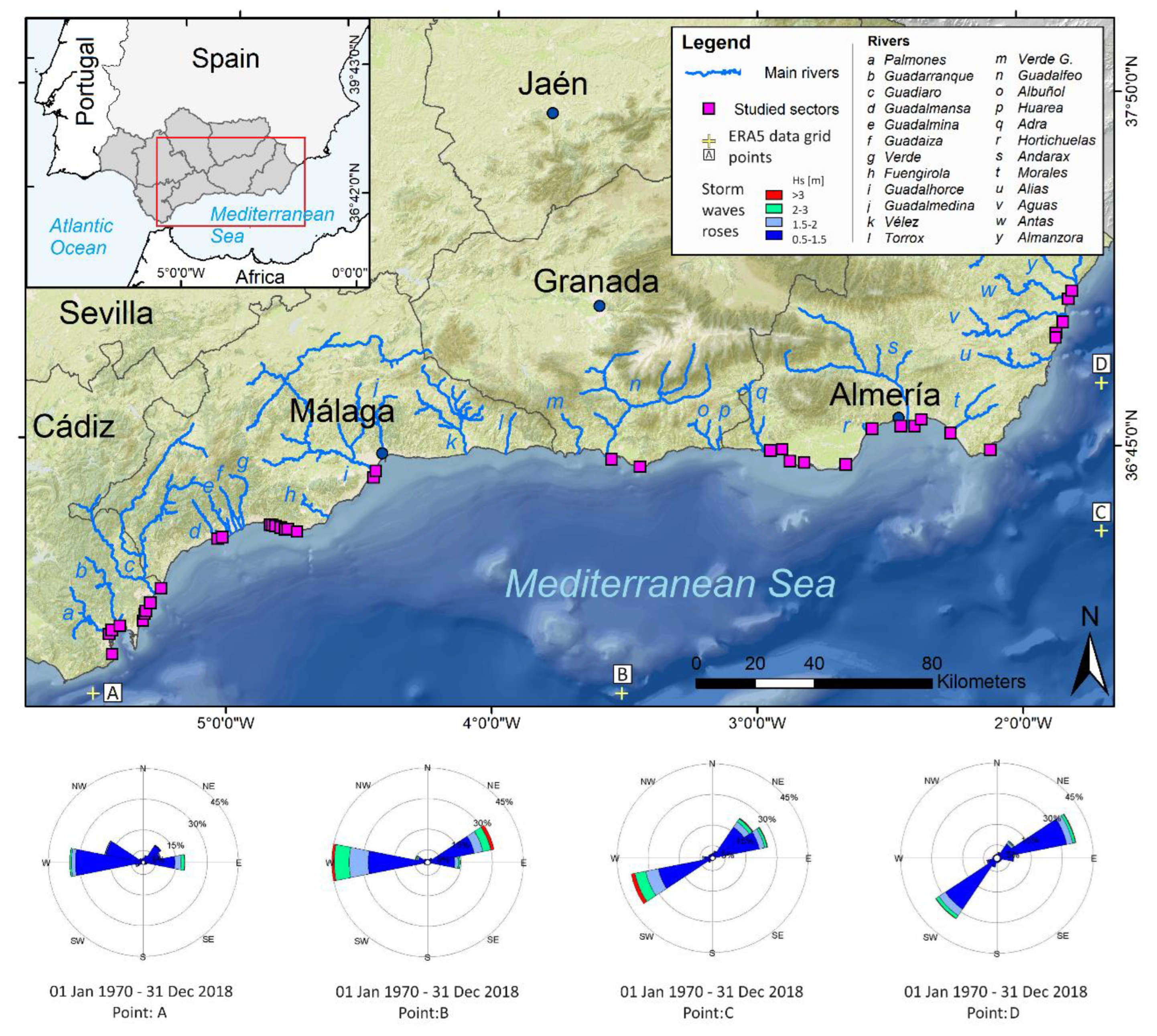
Figure 2.
Flow chart of the material and methods used in this work.
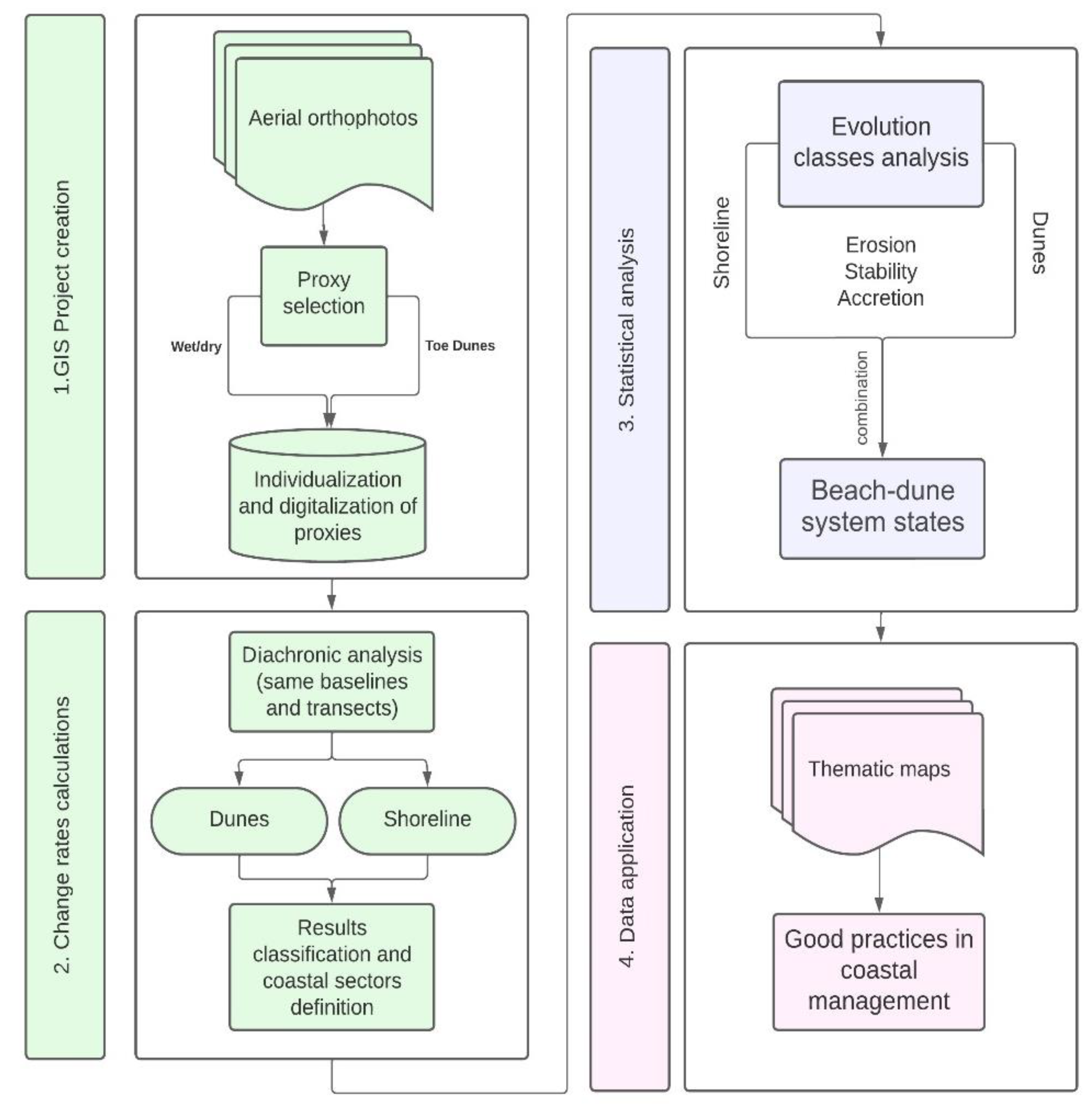
Figure 3.
Rates of change of beach and foredune proxies for the 1977-2001 (A) and 2001-2019 (B) periods. Pie charts (upper figures) represent the percentages of change rates for foredunes and shorelines. Bar graph (lower figures) present the number of transects recording erosion, stability and accretion per each studied proxies, i.e. dune toe in the case of foredunes and the wet-dry line for the shoreline.
Figure 3.
Rates of change of beach and foredune proxies for the 1977-2001 (A) and 2001-2019 (B) periods. Pie charts (upper figures) represent the percentages of change rates for foredunes and shorelines. Bar graph (lower figures) present the number of transects recording erosion, stability and accretion per each studied proxies, i.e. dune toe in the case of foredunes and the wet-dry line for the shoreline.
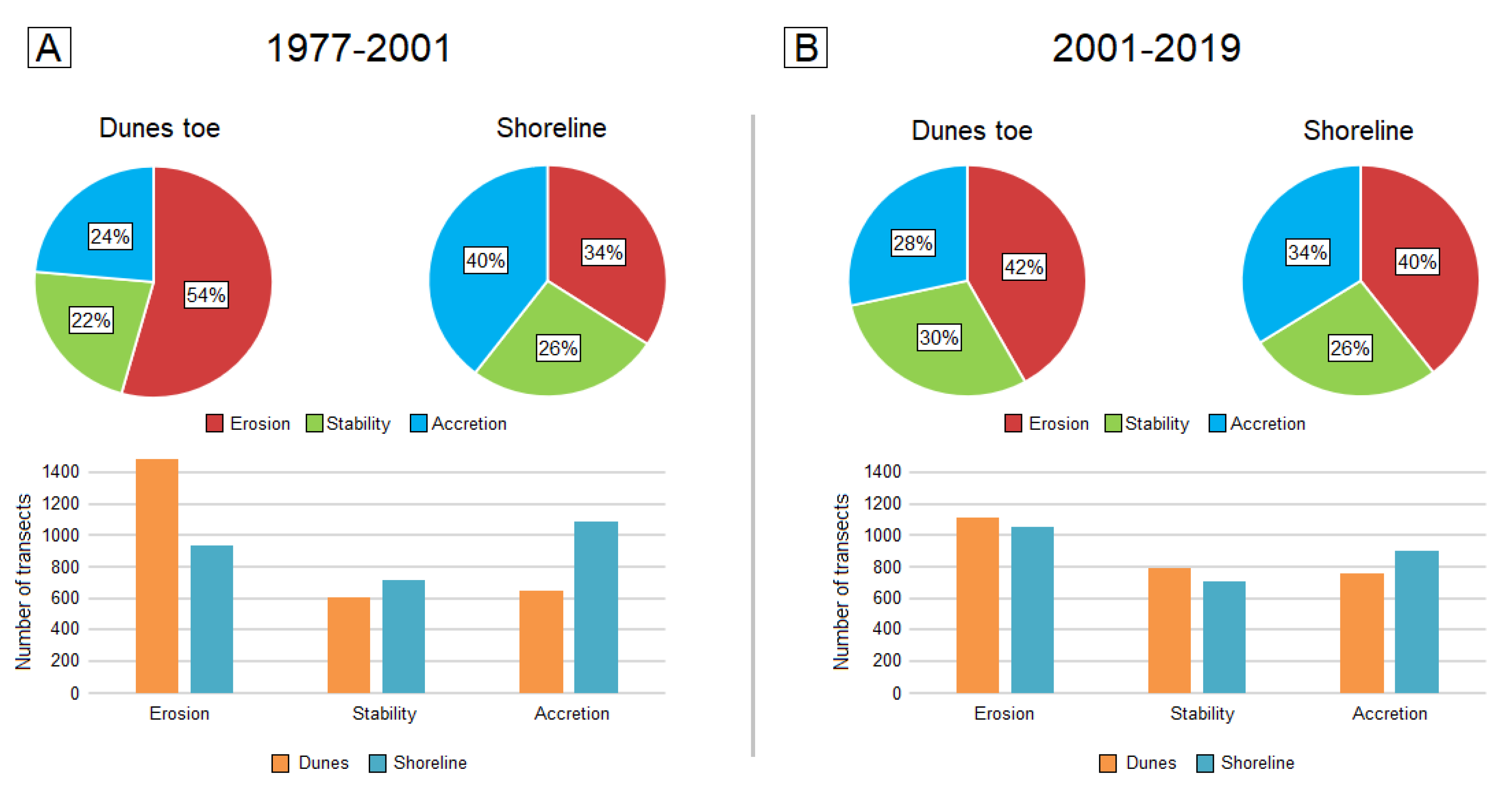
Figure 4.
Foredune evolution classes vs. shoreline evolution classes for the 1977-2001 (A) and 2001-2019 (B) periods. Scatter charts (upper figures) present evolution classes at each studied period and the dotted line represents the linear regression line. Bar graphs (lower figures) show the frequency of each combination of classes: the first letter indicates the class of evolution for the dunes and the second letter the class of the shoreline evolution. E: Erosion, A: Accretion, and S: Stability. Red dotted line represents 10% of the data, only combinations of classes over this threshold were considered to describe most common observed cases.
Figure 4.
Foredune evolution classes vs. shoreline evolution classes for the 1977-2001 (A) and 2001-2019 (B) periods. Scatter charts (upper figures) present evolution classes at each studied period and the dotted line represents the linear regression line. Bar graphs (lower figures) show the frequency of each combination of classes: the first letter indicates the class of evolution for the dunes and the second letter the class of the shoreline evolution. E: Erosion, A: Accretion, and S: Stability. Red dotted line represents 10% of the data, only combinations of classes over this threshold were considered to describe most common observed cases.
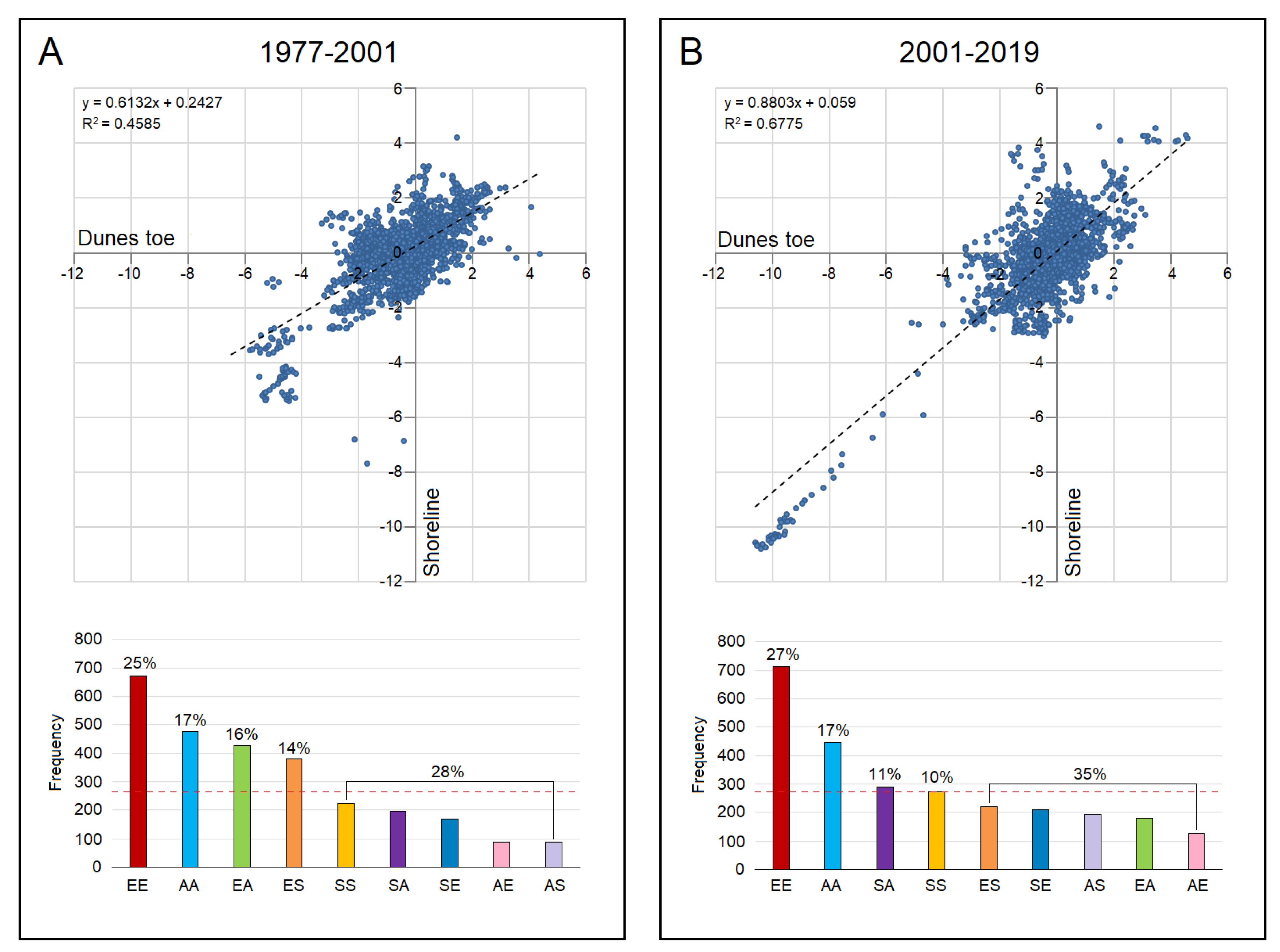
Figure 5.
State of the beach-dune systems investigated for each studied period.
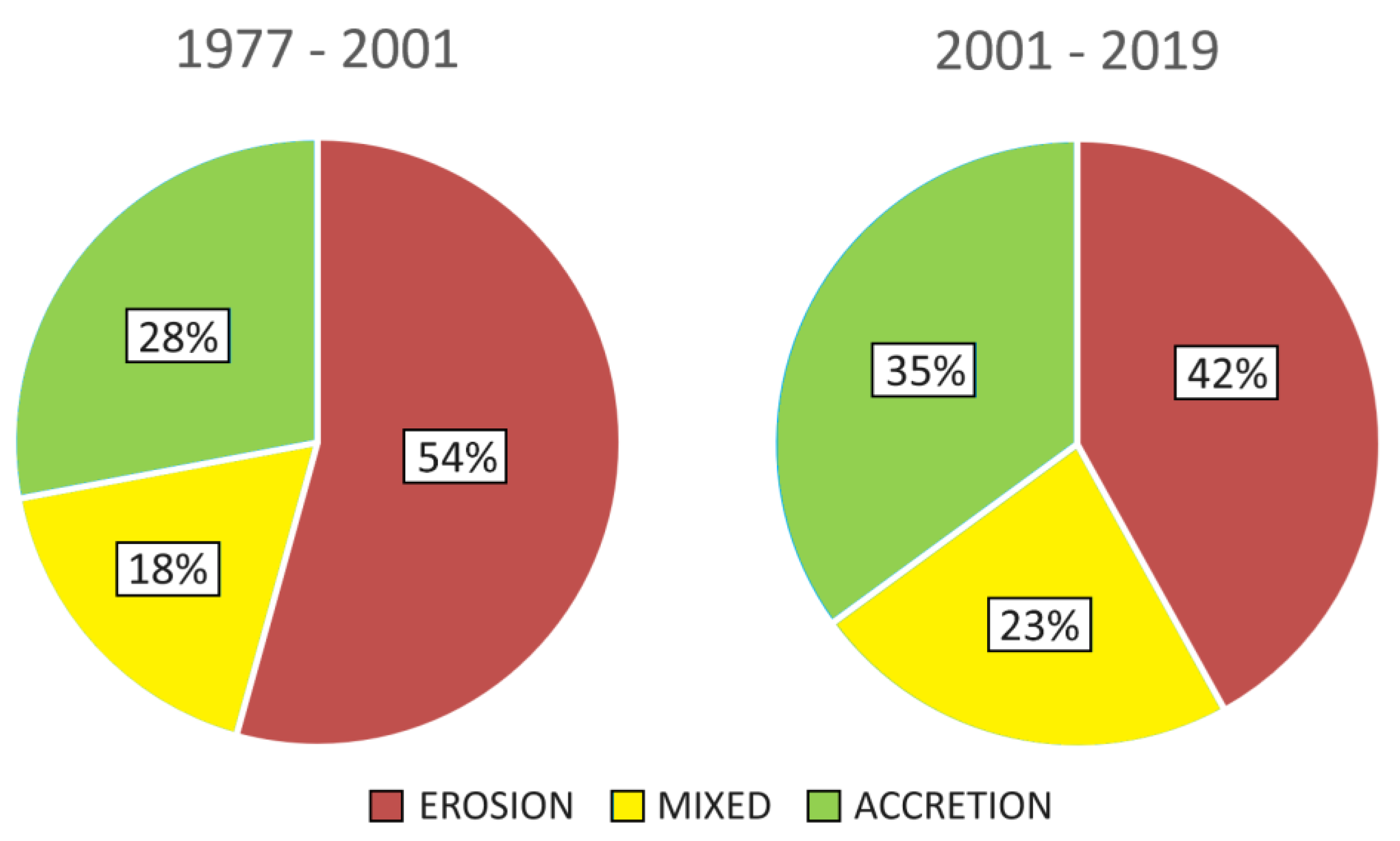
Figure 6.
Dunes and shoreline proxies presented the same behavior at A) El Rinconcillo Beach in Cádiz province, and in B) La Misericordia Beach in Málaga province. Colored areas correspond to erosion/accretion areas in the 2001-2019 period and the previous lines correspond to the 2001 lines. The 2019 orthophoto is shown in the figure.
Figure 6.
Dunes and shoreline proxies presented the same behavior at A) El Rinconcillo Beach in Cádiz province, and in B) La Misericordia Beach in Málaga province. Colored areas correspond to erosion/accretion areas in the 2001-2019 period and the previous lines correspond to the 2001 lines. The 2019 orthophoto is shown in the figure.
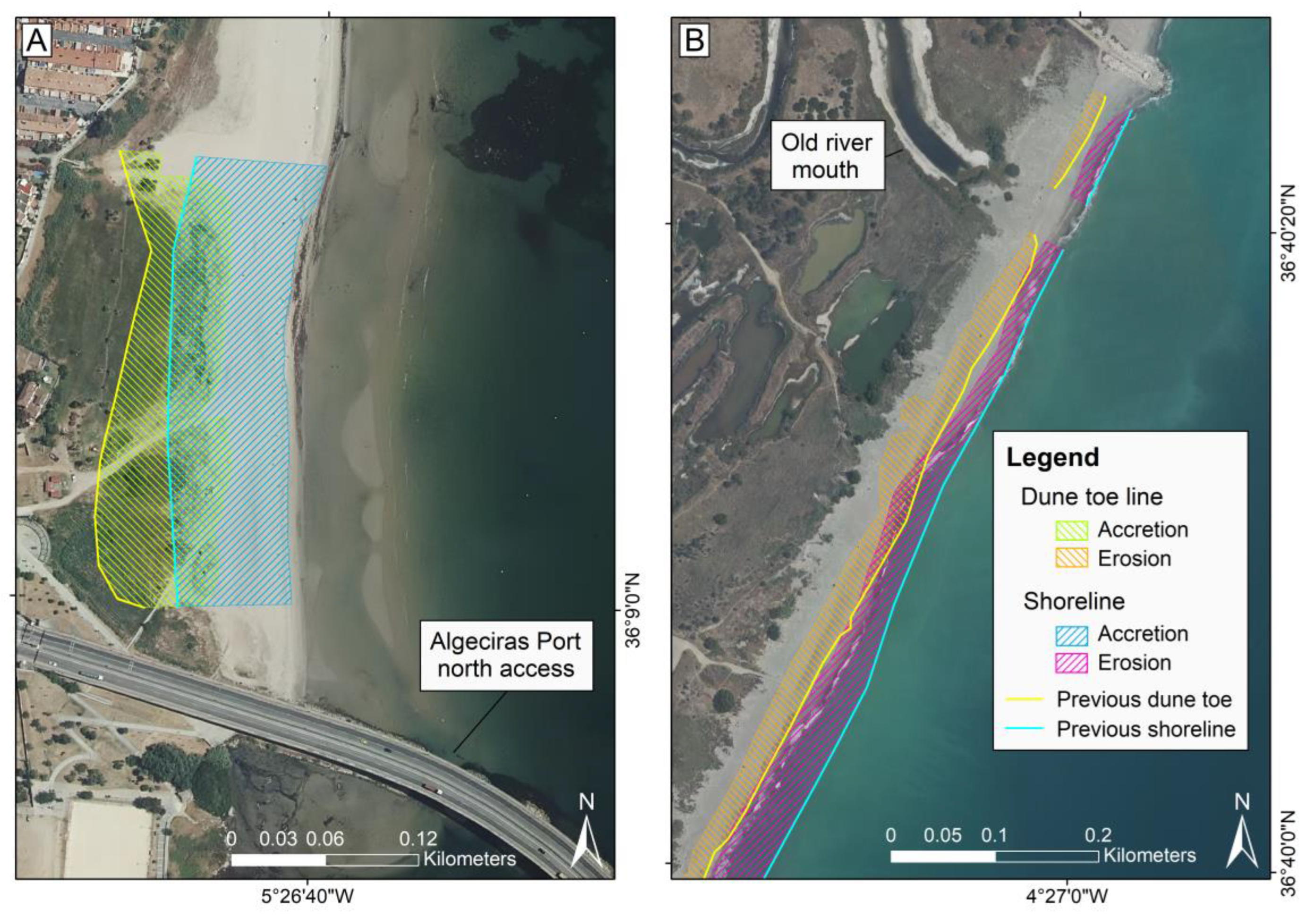
Figure 7.
Combinations of dune erosion with accretion or stability of the shoreline (EA and ES) were found in the area of Punta Entinas-El Sabinar in Almeria province, interspersed between areas with accretion or erosion of both proxies (A) with details presented in (B) and (C). The 2001 orthophoto is shown in the figure.
Figure 7.
Combinations of dune erosion with accretion or stability of the shoreline (EA and ES) were found in the area of Punta Entinas-El Sabinar in Almeria province, interspersed between areas with accretion or erosion of both proxies (A) with details presented in (B) and (C). The 2001 orthophoto is shown in the figure.
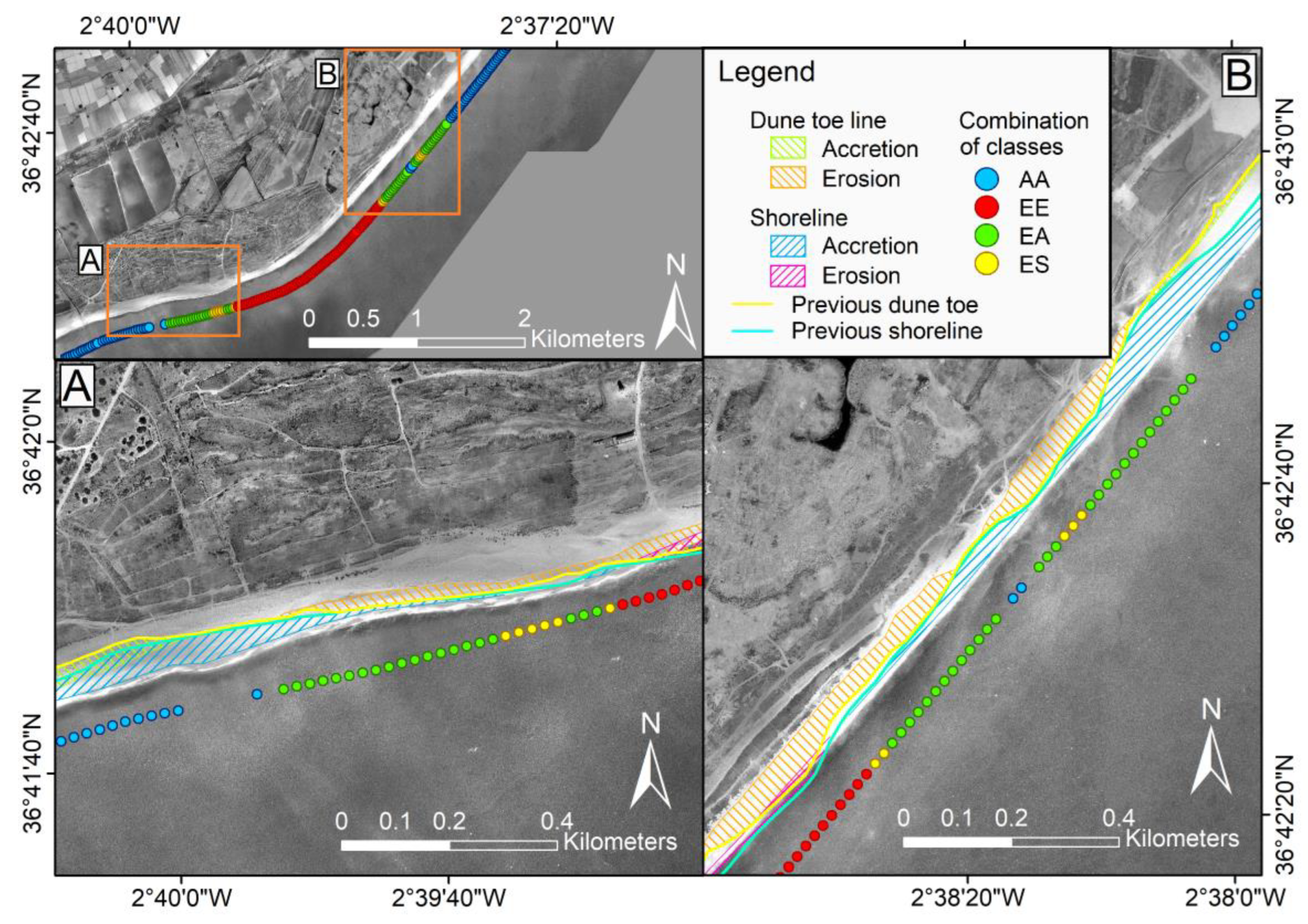
Figure 8.
Changes of beach-dunes systems trends recorded at specific places and linked to the effect of coastal structures. A) Playa del Perdigal; B) Garrucha.
Figure 8.
Changes of beach-dunes systems trends recorded at specific places and linked to the effect of coastal structures. A) Playa del Perdigal; B) Garrucha.
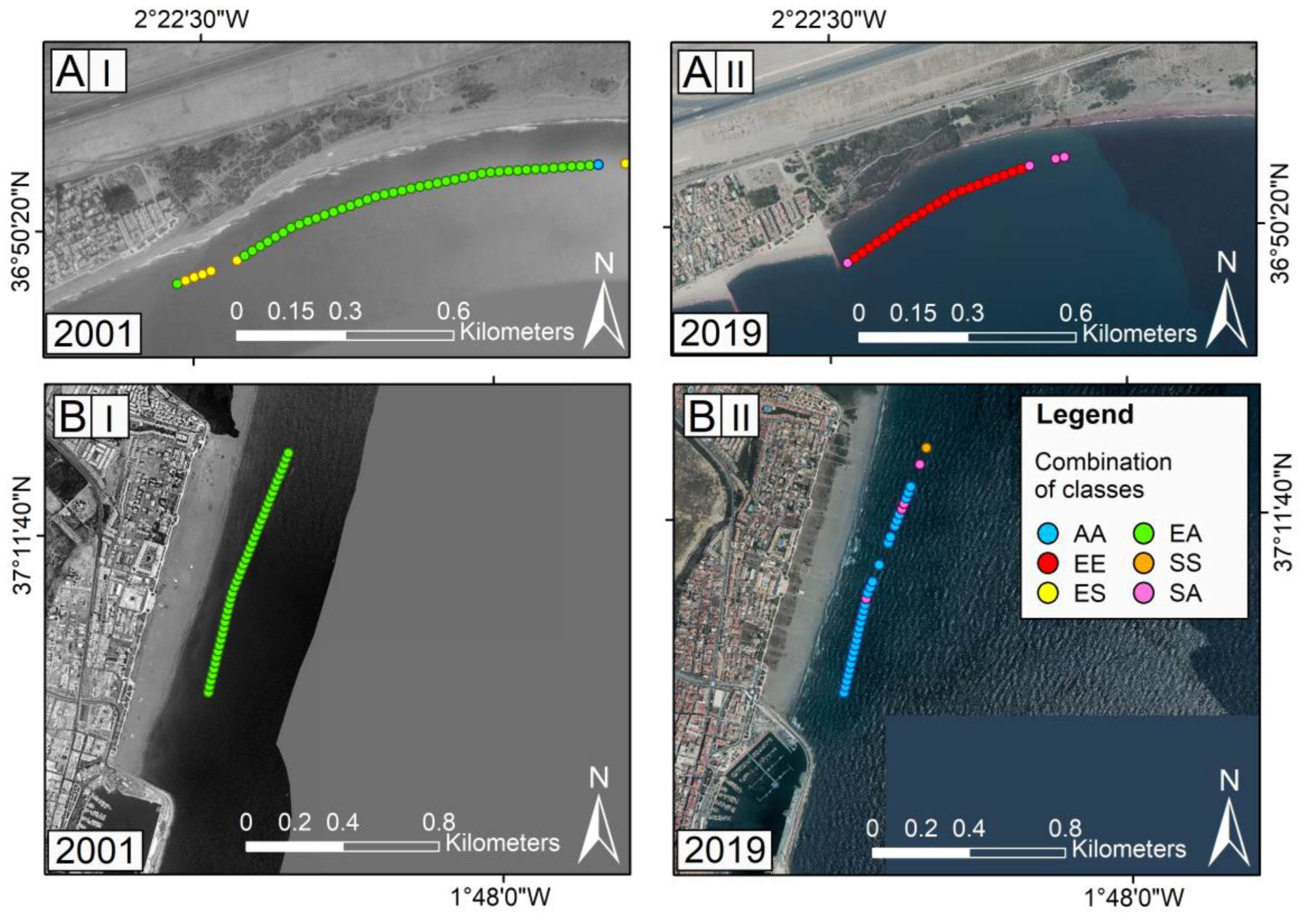
Figure 9.
Changes in the evolution trend at the Artola beach-dune system, in Málaga province. (A) 1977 – 2001 period and (B) 2001 – 2019 period.
Figure 9.
Changes in the evolution trend at the Artola beach-dune system, in Málaga province. (A) 1977 – 2001 period and (B) 2001 – 2019 period.
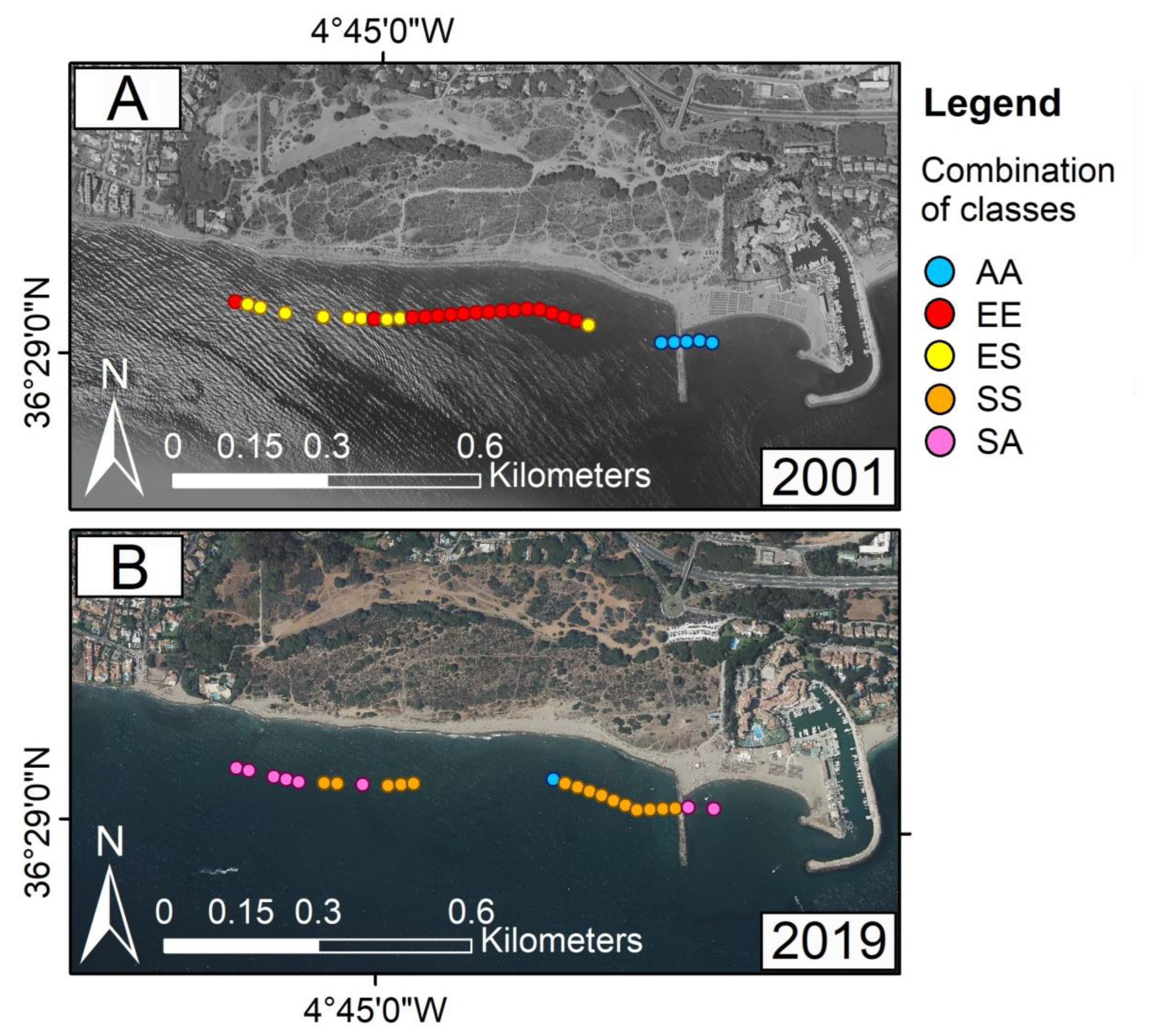

Table 1.
Definition of the considered evolution classes.
| Class | m/year |
|---|---|
| Accretion | > +0,2 |
| Stability | > -0,2; ≤ +0,2 |
| Erosion | < -0,2 |
Table 2.
This is a table. Tables should be placed in the main text near to the first time they are cited.
Table 2.
This is a table. Tables should be placed in the main text near to the first time they are cited.
| Combinations of Classes | Brief Description |
|---|---|
| EE | Dominant in both periods, it occurred in both natural and urbanized areas (35% in both periods), in areas down-drift of coastal structures and at river/delta mouths (24% in 1977 – 2001 and 30% in 2001 – 2019) and natural promontories (41% in 1977 – 2001 and not observed in 2001 – 2019), and down-drift of anthropic structures as groins and ports (29% in 2001 – 2019 and not observed in 1977 – 2001). |
| AA | Widespread in both periods, this class was observed in natural areas that act as sinks for sediment eroded from adjacent areas (56% in 1997 – 2001 and 45% in 2001 – 2019), in areas up-drift of anthropic structures such as groins and ports (15% in 1977 – 2001 and 30% in 2001 – 2019), in artificially altered areas (19% in 1977 – 2001 and 20% in 2001 – 2019). |
| EA | Most common in the 1977-2001 period, this pairing was mostly observed interspersed with other combinations of classes such as ES and AA at human altered areas (29%), in areas up- and down-drift of anthropic structures (27%), river mouths (23%), rocks and natural promontories (18%) and at pocket beaches (3%). This combination of classes is especially common in two large (mostly) natural areas in Almeria province (see Discussion). |
| ES | Relevant in the 1977-2001 period, this was mostly observed interspersed with other combinations of classes as EA and EE in areas down-drift of river mouths (50%), anthropic structures (12%), and natural promontories (5%) and, in less frequently, up-drift of them (12%), at pocket beaches (12%) and at human-altered areas as described in AA case (10%). This combination of classes is especially prevalent in two large (mostly) natural areas in Almeria province (see Discussion). |
| SS | Relevant in the 2001-2019 period, this pairing was mostly observed interspersed with other combinations of classes such as AA and SA in natural protected areas (52%), and with EE in areas down-drift of river mouths (28%) and anthropic structures (16%). |
| SA | Important in the 2001-2019 period, this situation was mostly observed interspersed with other combinations of classes such as AA and SS in natural protected areas (51%), down-drift of river mouths and structures (20%) and, less frequently, up-drift of them (17%). |
Table 3.
Classification of the state of the beach-dune system considering the combination of erosion/accretion/stability classes recorded for shoreline and foredunes.
Table 3.
Classification of the state of the beach-dune system considering the combination of erosion/accretion/stability classes recorded for shoreline and foredunes.
| State of the System | Combination of Evolution Classes | Conditions of the Beach-Dune system |
|---|---|---|
| Erosion | EE | Severe degradation. Both proxies present erosion indicating a severe deterioration of the beach-dune system. |
| ES | Degradation. This is a signal of deterioration of the system as dunes experience erosion and the beach is stable. | |
| EA | Moderate degradation. This is a signal of moderate deterioration of the system as dunes present erosion and the beach is accreting. | |
| Mixed | SS | Stable. Both proxies present stability indicating no significative changes of the beach-dune system. |
| SE | Very variable. Changes may be expected as the dunes, that are not already receiving sediment, will probably register a future loss of sediment if beach erosion continues. | |
| AE | Variable. Minor changes are expected in the system as the dunes may stop growing or register a loss of sediment if beach erosion continues. | |
| Accretion | AA | Good healthy conditions. The system presents very good health as both proxies indicate accretion. |
| AS | Healthy. The system is in healthy condition as dunes are accreting and shoreline registers stability. | |
| SA | Moderately healthy. The system indicates moderately healthy conditions as dunes register stability and the shoreline presents accretion. |
Disclaimer/Publisher’s Note: The statements, opinions and data contained in all publications are solely those of the individual author(s) and contributor(s) and not of MDPI and/or the editor(s). MDPI and/or the editor(s) disclaim responsibility for any injury to people or property resulting from any ideas, methods, instructions or products referred to in the content. |
© 2024 by the authors. Licensee MDPI, Basel, Switzerland. This article is an open access article distributed under the terms and conditions of the Creative Commons Attribution (CC BY) license (http://creativecommons.org/licenses/by/4.0/).
Copyright: This open access article is published under a Creative Commons CC BY 4.0 license, which permit the free download, distribution, and reuse, provided that the author and preprint are cited in any reuse.


