

Submitted:
09 June 2024
Posted:
12 June 2024
You are already at the latest version
Abstract
Delivering effective messages is critical to creating a more sustainable and resilient culture. The explosion of social media has enhanced information access but has often reinforced and polar-ized pre-existing viewpoints and norms. In contrast, digital signs are an “in your face in your space” technology that has the potential to deliver common content to a diverse local audience. Environmental Dashboard (ED) is a communications platform and set of content applications that combines information on current environmental conditions, real-time resource consumption, positive actions being taken by community members, and a community calendar. We conducted a longitudinal study to assess whether ED content delivered via digital signs in public locations would result in desirable psychological changes within a community. Participants completed surveys in six designated signage locations prior to installation (N = 174) and following two years of continuous exposure (N = 133). We observed: increases in pro-environmental social norms among people of color (a demographic emphasized); enhanced awareness of and sense of connection with the local community and ecology; increased self-reported electricity conservation; and increased perception of youth engagement (another demographic emphasized). Changes were mediated by exposure to digital signage. These findings support the hypothesis that content delivered through digital signs can strengthen pro-environmental and pro-social culture within communities.
Keywords:
digital signage
; environmental communication
; environmental justice
; pro-environmental behavior
; pro-environmental norms
; race
; systems thinking
; youth
1. Introduction
Addressing the challenge of climate change and other systemic threats requires multidimensional approaches to positively shifting social, economic, and environmental systems. The large-scale changes necessary to effectively mitigate, adapt, and foster resilience require psychological and cultural shifts, some of which must be initiated at very local scales. Unfortunately, dominant media within industrialized societies generally contribute to the problem; on balance, media messaging (advertising in particular) encourages and enhances unsustainable levels of resource consumption, obscures the impacts of this consumption, and does little to promote attitudes and behaviors that promote whole community sustainability and resilience. It is important to recognize that the marketing of this unsustainable behavior is based on very well-researched and established psychological principles of persuasion [1]. Fortunately, these same psychological principles can be harnessed to promote more sustainable behavior. Digital signs are a widely used marketing technology designed to influence thought and behavior [2]. In this paper, we report on research designed to assess the impact of using digital signs installed in communities to deliver pro-environmental and pro-community messaging using psychological principles.
1.1. Why Use Digital Signs in the Age of Social Media?
Promoting a sustainable and resilient culture demands that we effectively communicate messages “beyond the choir”. The communications ecosystem that we inhabit in the early 21st century provides both opportunities and constraints for achieving this goal. Most people on our planet now have a highly sophisticated two-way communication device in their pockets that delivers text, audio, and imagery on demand through a variety of applications; the co-evolution of phone technology and social media over the last two decades has fundamentally transformed information access and flow, creating unique conditions for sharing information and building social norms that influence and amplify thought and behavior. It is, indeed, exciting that each of us now has the capacity to instantly and continuously connect with the full diversity of people, information, and ideas generated across the globe. The good news is that social media has been widely used to promote pro-environmental messaging [3,4]. On the other hand, the general pattern of social media behavior that has emerged is characterized by highly selective access to information that tends to reinforce prior conceptions of reality and amplify pre-existing viewpoints and norms rather than advancing a sense of belonging to a local community [5,6,7]. Furthermore, since the default behavior tends to be unsustainable, this social media ecosystem often limits the individual’s capacity to experience and contribute to novel pro-environmental and pro-social social norms that they are not actively seeking. Further, the ease of connecting to online virtual communities can sometimes distract us from engaging with the communities we physically inhabit. In the end, the current media landscape may do as much to separate people from their local environment and local community as it does to foster deeper social, economic, and environmental connection and belonging.
Digital signage is distinct from information delivered through phones and internet-based social media in that the viewer has limited control over the messaging they encounter, and this messaging is received within spaces they physically inhabit. Indeed, this form of content delivery is explicitly designed to be “in your space, in your face” in the places people live, travel, work, shop and play. People experiencing digital signage can certainly attempt to tune out content. Nevertheless, research indicates that even when people are not conscious of receiving messages, words and images we experience in our environment play a powerful role in priming thought and behavior [8,9]. The ubiquity of digital signage in public places is a testament to the fact that advertisers are successfully using it to deliver messaging that sells their products and services. In contrast to social media, digital signage is important precisely because it delivers messages to local audience members who are not actively seeking this content. This is obviously quite useful to advertisers who wish to get the public to consider products and services that they might not otherwise have in their minds. However, the technology likewise provides a unique opportunity to display messages designed to promote pro-environmental and pro-social thought and behavior.
The effectiveness of digital signs combined with falling costs of deployment have resulted in increased use in shopping malls, airports, condominiums campuses and other public spaces [10]. Indeed, the global market for digital signs has more than doubled since 2014 [11]. Although digital signs are widely used to deliver both commercial and non-commercial information [12], research on the impact of digital signage tends to focus on their use for customer engagement and sales [10,13]. Beyond commerce, several studies have explored how digital signage can be used to: promote positive public health behavior [14], provide emergency alert information [15], and encourage more sustainable purchasing practices [16]. Even when used principally for advertising, research indicates that viewers prefer content that also includes community announcements [17]. Given their increasing ubiquity and demonstrated effectiveness, digital signs present a promising opportunity for those interested in promoting sustainability and resilience in communities.
1.2. Environmental Dashboard
Environmental Dashboard (ED) is a communication platform and set of content applications designed to engage, educate, motivate and empower people to shift towards more sustainable and resilient mindsets and behaviors [18]. The community dashboards that are generated with ED technology use a variety of communications conduits including digital signage, phone apps, and content embedded on websites. In this field study, we evaluated the combined impact of four distinct ED applications displayed in sequence on digital signage: Building Dashboard, Citywide Dashboard, Community Voices and Community Calendar. These applications and prior research on the effects of each are described below. Online versions of the applications can be viewed through several websites (e.g. www.environmentaldashboard.org, www.midtowncleveland.org/events/).
1.2.1. Community Voices
Perceptions of what other community members are doing are among the most powerful factors motivating individual decision-making [1,19,20]. Community Voices (CV) is a social marketing software application that combines images and words drawn from interviews and documents (Figure 1, [20]). The goal of CV is to celebrate the positive thought and action that already exists in a community and thereby foster norms that move a community towards ecological, economic, and social sustainability. CV is based on the recognition that most people are already engaged in at least some sort of pro-environmental thought and action in their daily lives that can serve as the basis for developing positive social norms. Yet many sustainable behaviors that people take in their personal, professional and civic lives are not readily visible to other community members [20]. CV is designed to make this thought and action visible and known to other community members. CV also explicitly embraces diversity in all forms. This serves to highlight and leverage the unique history and character of a particular community, foster pride in accomplishments, and encourage further aspiration.
In all existing implementations, CV content is organized into iconographically branded categories that leverage what has been learned from social psychology and marketing research to shift community perception [21]. Six content categories were used in this study:
- Neighbors features quotes and images of community members who are, through their personal examples, promoting sustainable actions in their homes, backyards, gardens, neighborhoods, etc.
- Heritage includes images and words reflective of a community’s legacy of stewardship and engagement on sustainability-related issues. A key goal of this category is to help viewers understand how the environmental, social, and economic challenges (as well as leadership opportunities) faced today are connected to historical challenges and opportunities that the community has faced and addressed in the past.
- Our Downtown includes positive thoughts, commitments, and actions of those who own, work, and shop in local businesses. One goal of this category is to encourage community members to recognize the value of supporting the local economy.
- Natural [community’s name] (e.g. “Natural Oberlin”) includes images and words that relate to the natural and cultivated beauty of a community. In this category, images and words emphasize community members interacting with and appreciating the natural world. The goal is to reinforce interconnectivity and people’s sense of pride and belonging to ecological place.
- Serving Community features the sustainability-related work and accomplishments of community organizations, public schools and city government workers.
- Next Generation features words, photographs and often artwork by and about children in a community. This category recognizes children as important agents of change who are not often provided with a public platform to share their thoughts, ideas, and hopes with the larger community.
The Community Voices application has been operational in the City of Oberlin OH since 2015 and has been implemented in organizations and neighborhoods in Cleveland since 2018. The methods and principles used to develop CV content have been described in detail elsewhere [20,21].
Prior research has demonstrated the effectiveness of CV in altering social norms. In a series of controlled online studies [20], participants watched a slideshow of Community Voices content designed to prime, celebrate and empower a variety of pro-environmental and pro-community thought and action. These studies revealed that even brief exposure to these messages resulted in significant increases in social norm perception, concern about environmental issues, commitment to action, and optimism. These results suggest that this approach to messaging is potentially valuable for stimulating cultural change.
1.2.2. Citywide Dashboard
Systems thinking is the capacity to situate individual decision-making in a community and systems context and develop a deeper understanding of relationships, interdependencies, causal chains of impact, and responsibility [22]. Enhancing systems thinking is thought to be key to promoting sustainability, resilience and climate action [23,24,25,26]. The Citywide Dashboard (CWD) application is explicitly designed to promote systems thinking. CWD is a conceptual representation of a community that is animated with real-time electricity and water flows and environmental conditions in entire communities or organizations (Figure 2 [22]). The CWD conceptualization of system dynamics is designed to make community members more aware of resource consumption, waste production, environmental conditions, and environmental implications of community-level choices. CWD consists of animations and gauges depicting current rates of water flowing through pipes and electrons flowing down power lines. It also depicts components of municipal infrastructure that are important to daily life but largely invisible (power plants, water treatment plants, etc.). These are intended to emphasize how decisions made in homes and workplaces are reflected in citywide levels of consumption and environmental conditions. ‘Empathetic characters’ are associated with messages (text) above an animated landscape and are intended to generate a stronger sense of empathy; ‘Flash the Energy Squirrel’ (associated with energy) and ‘Wally Walleye’ (associated with water) provide a narrative designed to contextualize electricity consumption and water flows and quality. A house depicted in the front and center of the animation exists to suggest to viewers that decisions made by individuals in the home and workplace affect system dynamics. Essentially, system dynamics that typically go unnoticed are represented in a visual form that is designed to be accessible and engaging to a non-technical audience ranging from pre-school children to adults [22].
A series of prior studies explored how online exposure to CWD, ranging in duration from a few minutes to multiple exposures over a week, affected various measures of systems thinking and awareness [22]. This controlled research found that exposure enhanced: perceptions of ecological embeddedness, connectedness to nature, and perceptions of responsibility and impact (causal extent) among those who were initially low in connectedness to nature. Even brief exposure to CWD expanded perceptions of causality [22].
1.2.3. Building Dashboard
The Building Dashboard application of ED tracks and communicates patterns of water and energy use within monitored buildings and groups of buildings in a way that is designed to be easily interpretable, engaging, and emotionally resonant to a non-technical audience. The data are animated -- they essentially play through the patterns of resource use for the last day with empathetic character gauges (Flash the Energy Squirrel and Wally Walleye) exhibiting dynamic behavior in response to current levels of resource consumption relative to typical use at a given time of day (Figure 3).
Multiple studies have been conducted on the impact of Building Dashboard. For example, one controlled study examined the impacts of classroom use in primary education [27]. In this study, several classes of 4th and 5th grade students engaged in electrical circuit lessons that did or did not have students viewing data on electricity and water use in their school using Building Dashboard. Use of Building Dashboard in these lessons significantly enhanced both content-related systems thinking skills and content retention [27]. Several studies have demonstrated that, when combined with resource reduction competitions, Building Dashboards can result in significant reductions in water and electricity use [28,29].
1.2.4. Community Calendar
The Community Calendar application within ED provides a crowd-sourced venue through which individuals and organizations can easily share and promote events and announcements with an entire community. The application is designed to encourage engagement in all aspects of civic life and to foster community identity, self-reliance, and resilience. Any community member who wishes to post content uses a simple web interface to enter an event or announcement description, details (e.g. date, time, location, event type, sponsor) and upload artwork. Submitted content is vetted by designated administrators who are prompted to approve new content when it has been submitted. This ensures that content meets posted community standards before it is automatically formatted for public display on the web, phone app and digital signage. A study has not yet been completed to assess the impact of the calendar in isolation of other dashboard applications.
1.3. The Current Research: Oberlin Implementation
The Environmental Dashboard concept was initially developed with grant support from the U.S. EPA’s “People Prosperity and the Planet” program and later the Great Lakes Protection Fund and a variety of other funders. From the start, the goal was to develop and test technology that could be deployed in other communities and organizations. The City of Oberlin and Oberlin College were used as testing grounds for development.
Oberlin is about 35 miles southwest of Cleveland Ohio. According to 2023 US Census data, Oberlin has a population of 7,700 that is: 58% female, 73% white, 13% Black, 6% Hispanic, and 4% Asian (retrieved 5/24/24 from www.census.gov/quickfacts/fact/table/,oberlincityohio,US). Agriculture is the dominant land use in the surrounding township, but Oberlin itself is home to Oberlin College, and has a regional Air Traffic Control facility, light industry, and a range of downtown businesses. Oberlin also has a K-12 school district that serves the city and surrounding township. Although racial diversity tends to be low in surrounding communities, Oberlin was a stop (sometimes final) on the Underground Railroad, and Oberlin College was the first interracial college in the US (1833). As a result, Oberlin’s population is more diverse than surrounding communities with demographics similar to more urban areas. Politically Oberlin trends liberal, has been supportive of environmental initiatives, and prides itself on leadership. For example, Oberlin was the first City in NE Ohio to formally establish carbon neutrality as a policy goal, the first to adopt a formal Climate Action Plan (created in 2011 and currently in its fourth revision), and the first to complete a climate vulnerability assessment (2021). Oberlin already has a strong sense of community identity. One goal of implementing an Environmental Dashboard in this pilot community was to amplify and accelerate a positive shift toward sustainability and resilience. The City of Oberlin financially supports its Environmental Dashboard system as a communication tool to promote implementation of its climate action plan.
At the time ED applications were first being developed, it was already clear that demographics of environmental concern, activism, and representation were complicated in the U.S. In 2010 the Yale Center for Climate Communication and George Mason University released a study that documented this complexity [30]. Specifically, the report concluded that, on the one hand, the leadership and messaging of the environmental and climate change movement were dominated by upper- and middle-class White Americans. At that point, it was commonly assumed that upper- and middle-class Whites were the group most concerned with climate change. On the other hand, it was clear that the impacts of climate change and environmental degradation were likely to be disproportionately experienced by poor people and racial minorities. Furthermore, in contrast to movement leadership, polling reported in this study documented that Hispanics/Latinos, African Americans and people identifying as other non-White races and ethnicities already exhibited significantly greater concern regarding climate change and greater support than Whites for policies to address climate action, even if these policies might result in higher taxes [30]. Subsequent polling has documented increasing demographic differences. As just one example, 2019 polling by the Yale Center for Climate Communication found that the percentage of those expressing alarm or concern regarding global warming differed among: Hispanics/Latinos (69%), African Americans (57%) and Whites (49%) [31]. Willingness to “definitely” or “probably” join a campaign to influence elected officials to address global warming likewise differed for Hispanics/Latinos (37%), African Americans (36%) and Whites (22%) [31]. Separate polling by other organizations has found similar results [32]. But at the same time, environmental organizations lack diversity in staffing and often this has been reflected in a lack of diversity in perspectives and messaging [33].
Considering both perceptions and polling, the faculty and community leaders involved in implementing the Community Voices component of ED (including African Americans) were mindful that content on the digital signs should not reinforce stereotypes of the environmental movement. Our goal was to ensure that the diverse voices interested in environmental solutions were represented in CV content. We wanted all community members to see people they perceived as “like them” represented on the signs. A very intentional effort was therefore made to ensure that the people interviewed and depicted represented the full diversity of the community. Indeed, we intentionally slightly over-represented African American members of the community in images and quotes relative to community demographics in the content we initially developed. As indicated by the content categories described above, a strong emphasis was also placed on creating content that addressed economic and social sustainability and environmental sustainability.
During the summer of 2014, eleven signs were installed in locations around the Oberlin community to display the ED content described above in rotation. The locations included a coffee shop, a social service agency/food pantry, a retirement community, a general store, a daycare center, a public library, the local cable co-operative, a newly renovated hotel, and the lobbies of the three public school buildings in Oberlin. Locations were selected in consultation with a group of local community leaders based on centrality, high traffic, diversity of potential audiences, and potential to capture audience attention.
Hypotheses related to impact of individual ED applications, in isolation from each other, were tested in more controlled research as described above. The goal of the present study was to assess whether ED content displayed in combination on digital signage in public locations would result in measurable shifts in attitudes, beliefs and perceptions of adult members of a community. We conducted surveys before and two years after these screens were installed. We sought to address three major research questions:
- Were changes in pro-environmental and pro-social norms and thought evident after the installation of digital signs with content designed to accomplish these changes?
- If so, what evidence exists that these changes resulted from content delivered via digital signs?
- Did changes differ by race?
Specific hypotheses related to these questions are described in the method section that follows.
2. Materials and Methods
This study deployed a between-subjects longitudinal design. Participants were recruited in digital signage locations before (Time 1) and 2 years after (Time 2) digital signs were installed.
2.1. Screen Content and Exposure
Most of the content displayed was identical among the different sign installations in Oberlin. However, each digital sign included unique “location-specific content” which consisted of 2-5 slides that welcomed observers to the host organization where the sign was installed and provided information about that organization (such as mission, services, and hours of operation). The Public Library and the four schools were the only locations that included real-time metering of electricity and water use and so these were the only locations that included the Building Dashboard ED application that displayed this information (Figure 3). A different study examined certain aspects of the impact of digital signs in a K-12 school environment [27]. The present study was explicitly designed to assess the impact of content on adults and so the assessment described here was not conducted in the school locations. Because only one of the sign locations where survey data was collected for this study included Building Dashboard content, the survey questions were not explicitly designed to assess the impact of this application. However, since Oberlin is a small community, survey participants almost certainly experienced repeated exposure to content from all applications on multiple digital signs over the study period. Many residents of this community who responded to the survey were likely exposed to the digital signage nearly daily.
2.2. Procedures and Participants
Approval from Oberlin College’s Institutional Review Board (IRB) for the experimental protocols used in this study was received prior to any data collection. The full Time 1 and Time 2 surveys were identical in their assessment of psychological measures and demographics. We added eight additional questions to the Time 2 survey designed to measure exposure to the digital signs, interest in the different ED content applications displayed on the signs as well as two open-ended questions. Both surveys are available as supplementary material (S1). Participants for the Time 1 survey were recruited near the eight non-school locations in the Oberlin community where digital signs were to be installed (N = 174). The Time 2 survey was conducted in the same locations and using the same methods two years after the screens were installed (N = 133).
Research assistants stationed themselves at tables with seats and computers and asked passersby if they were willing to participate in the survey. Potential participants were told that the survey would take approximately ten minutes to complete and would investigate how Oberlin residents think about the community and the environment. The signs were not mentioned during recruitment. As an incentive, participants were offered the opportunity to either enter a raffle for a $50 gift certificate to local businesses or have the research team donate $3 to a local non-profit on the participant’s behalf. Since the study goal was to investigate the impact of the technology on community members, participants were also asked if they lived or worked close to Oberlin and/or visited Oberlin regularly; if they answered no, they were thanked, but not invited to participate. Because we were focused on the City community, we also excluded Oberlin College students; residents who worked for Oberlin College were allowed to participate. In the general store and coffee shop locations the screens were to be installed in a window facing the sidewalk. In these locations, participants were recruited on the sidewalk outside the store. In all other locations, where the signs were installed inside the host organization, researchers were stationed inside the facilities themselves. Eligible and willing participants took the online Time 1 and Time 2 surveys on laptops provided by the researchers. At the beginning of the survey, all participants certified that they were at least 18 years old, and they provided informed consent.
On each survey participants provided information on their gender (Male, Female, Other) and race (7 choices, including “Mixed Race” and “Other”). If participants resided in Oberlin, they were asked how long they had lived in Oberlin (“Tenure”) on a seven-point scale (1 = Less than one year, 7 = more than 20 years). The location at which the survey was conducted was also recorded. Participants were asked to provide their name and email address if they wished to enter the raffle. We assumed that there would be some overlap among people who participated in Time 1 and Time 2 surveys. We did not, however, track individual identities or pair data from Time 1 to Time 2 to measure change within subjects.
We sought a sample of adult community members that was spread across digital signage installation locations and that provided reasonable representation of the overall demographics of the City of Oberlin (excluding those under 18). Of the total sample obtained, the distribution of survey participants from the different locations was as follows: coffee shop (14% of survey participants), social service agency/food pantry (13%), retirement community (24%), general store (25%), daycare center (8%), hotel (1%) and public library (16%). Across both samples of those who indicated their gender (N = 289), 38% identified as male, 61% as female, and 1% as something else. Of those who indicated their race (N = 291), 78% identified as White only, with the rest identifying as mixed race or some other race. We operationally defined non-Whites as people of color (POC). Comparing to data on Oberlin residents from the 2014 American Community Survey (Census.gov), the survey sample was ethnically representative of Oberlin’s population (χ2(1)= .08, p = .778), but overrepresented women (χ2(1)= 6.45, p = .011) relative to expected values. 87% of our survey participants lived in Oberlin (rather than simply being employed or regularly visiting Oberlin); of those 30% had lived in Oberlin for more than 20 years.
2.3. Survey Measures: Dependent Variables
The research team developed survey questions that were targeted to assess specific types of thoughts and behaviors that we believed were likely to be affected by ED application content featured on all eight screens. Specifically, different questions focused on content associated with the experience of viewing Citywide Dashboard and Community Voices applications, which were displayed on all signs. To improve measurement reliability, multiple survey questions (between 2 - 10) were developed to assess each of the psychological attributes described below. We used exploratory factor analyses to evaluate whether each a priori grouping did in fact load on a single factor (all did). Four sets of questions were targeted to measure psychological attributes that we thought would be particularly impacted by viewing Community Voices content; three were targeted to measure the impact of Citywide Dashboard content.
2.3.1. Community Voices Measures
Salience of CV Content: Salience is a measure of how important, top of mind or striking something is. Questions were designed to assess the salience of the Community Voices content in each of the six categories of content featured (and described above). Specifically, on a seven-point scale (1 = Never, 7 = Daily), participants responded to the question, “How often do you spend time thinking about”: “Oberlin’s youth”, “Oberlin’s history”, “Oberlin’s businesses”, “Oberlin’s natural spaces”, “Your neighborhood”. Results from these questions were averaged to generate a single Salience of CV scale that had good reliability (alpha = .81). We hypothesized that the salience of CV would increase from Time 1 to Time 2 because of exposure (H1). We also hypothesized that this effect would be stronger for POC because CV content focused on lifting up the voices of people of color (H2).
Norm Perception related to pro-environmental and pro-community commitment: Norms are a measure of the extent to which people perceive that other people within a group are engaging in a particular thought or action. On a six-point Likert scale (1 = Not at all committed, 6 = Very committed), participants rated different groups of community members based on their perceived “degree of commitment to environment and community”. Specifically, they assessed: “Your neighbors”, “City Workers”, “People working for community organizations”, “Oberlin College”, “Religious organizations” and “The City of Oberlin”. Over the two-year period, the CV application displayed people from each of these groups expressing pro-environmental and pro-community sentiments and/or engaging in positive action. Results from these questions were averaged to generate a single norm perception scale that was highly reliable, alpha = .90. We hypothesized that norm perception would increase from Time 1 to Time 2 as a result of exposure to the digital signage (H3). We also hypothesized that this effect would be stronger for POC because CV content focused on lifting up the voices of people of color (H4).
Positive Community Perception: On a six-point Likert scale (1 = Strongly Disagree, 6 = Strongly Agree), survey participants rated whether they agreed with six positively valanced statements about the Oberlin community:
- “Other People in Oberlin are doing things to make the environment and community in Oberlin better”
- “I think the community and environment in Oberlin will be better in the future”
- “I can do things to make the environment and community in Oberlin better”
- “Oberlin has lots of natural beauty”
- “We can build on Oberlin's past history to improve the community and environment”
- “Adults in Oberlin know what youth are doing to improve environment and community”
The CV application displayed content explicitly designed to enhance each of these perceptions. Results were averaged to generate a single positive community perception scale that had good reliability (alpha = .75). We hypothesized that positive community perception would increase from Time 1 to Time 2 (H5).
Perception of Youth Engagement: The “Next generation” content category of CV featured images and quotes highlighting youth action and interest. On a six-point Likert scale (1 = Not at all, 6 = A large amount), participants responded to two questions about youth and sustainability: “How aware are you about what youth think about environmental issues?“ and “How influenced are you by what youth think about environmental issues?”. These 2 items were averaged together and had good reliability (alpha = .80). We hypothesized that perception of youth engagement would increase from Time 1 to Time 2 (H6).
2.3.2. Citywide Dashboard Measures
Citywide Water and Electricity Salience: On a six-point Likert scale (1 = Not at all, 6 = A large amount), survey participants responded to four questions (2 each for water and electricity respectively) designed to measure the extent to which participants thought about the resources depicted on Citywide Dashboard:
- “Do you think about the amount of water the town of Oberlin uses?”
- “Do you think about where the water you use comes from?”
- “Do you think about the amount of electricity the town of Oberlin uses?”
- “Do you think about where the electricity you use comes from?”
All four items were averaged together into a scale with good reliability (alpha = .82). We hypothesized that CWD salience would increase from Time 1 to Time 2 as a result of exposure (H7).
Water and Electricity Conservation and Impact: On a six-point Likert scale (1 = Not at all, 6 = A large amount), participants responded to 4 questions (2 each for water and electricity respectively) designed to measure the extent to which they tried to conserve water and electricity, and the perceived impact that their use has on the environment:
- “How much do you try to use less water?”
- “When you use water, does it affect the environment?”
- “How much do you try to use less electricity?”
- “When you use electricity, does it affect the environment?”
Because of an error in the survey, these questions were not displayed to the first 103 participants at Time 1; for these questions we have reduced sample size for Time 1 (N = 71). Conservation efforts and perceived environmental impact of resource use are conceptually different from each other. However, we found that these two measures correlated strongly with each other (for water conservation and impact r = .542, for electricity conservation and impact r = .632, p’s < .001). We therefore chose to combine conservation and impact measures. Both subscales had acceptable reliability. For water conservation and impact alpha = .702, and for electricity alpha = .772. We hypothesized that water (H8) and electricity (H9) conservation and impact would increase from Time 1 to Time 2 as a result of exposure.
Perceived Impacts on Local Systems: On a six-point Likert scale (1 = Not at all, 6 = A large amount), participants responded to six questions designed to gauge how cognizant they were of connections between individual decision-making and the systemic impacts of this decision making:
- “When you spend money in Oberlin, how much does it affect other people in Oberlin?”
- “When other people spend money in Oberlin, how much does it affect you?”
- “When you are a good citizen, how much does it affect other people?”
- “When other people are good citizens, how much does it affect you?”
- “When you take care of nature in Oberlin, how much does it affect other people?”
- “When other people take care of nature in Oberlin, how much does it affect you?”
All six items were averaged together into a highly reliable scale (alpha = .89). We hypothesized that perceived impacts on local systems would increase from Time 1 to Time 2 as a result of exposure (H10).
2.3.3. Other ED Applications
To keep the survey as short as possible, we did not design survey questions that explicitly measured the impact of either the events calendar or Building Dashboard applications. Since applications were featured together in a rotating sequence on digital signs, it is likely that these two applications exerted influence on responses to the variables targeted to assess Community Voices and Citywide Dashboard applications. For example, those viewing the digital sign in the Oberlin Public Library or the schools would have seen real-time data visualizations of electricity and water use in these facilities through the Building Dashboard application. We would expect this exposure to enhance most of the CWD measures. The Community Calendar likely also influenced norm perceptions and perceived impacts on local systems. Since the explicit goal of this study was to measure the combined effects of pro-environmental and pro-community content, we do not view combined impacts as problematic.
2.3.4. Levels of Interest and Feelings Towards Host Organizations
At Time 2 we asked eight additional questions. We asked survey respondents, “How interested are you in the different content featured on the public display screens?” On a six-point scale ranging from “Not at all” to “A large amount”, respondents separately rated their interest in Building Dashboard, Community Voices and the Calendar.
We also provided respondents with two additional open-ended questions in the Time 2 survey, “Feel free to share comments on content you have found interesting or content that could be added that would make the display more valuable or interesting to you”, and “How does the presence of the screen make you feel about the organization or business in which it is installed? For example, does it change your perception of or desire to support the organization?”.
2.3.5. ED Exposure
At Time 2, participants were asked two questions about how they interacted with digital signs. First, on a six-point scale ranging from “Less than once per month” to “Daily or more”, participants were asked to self-report on how often they recalled seeing the digital signage at each of the eight locations. Second, on a seven-point scale ranging from “Less than 1 second” to “More than a minute”, participants were asked to self-report on how long they thought that they typically viewed the digital signage before looking away. We hypothesized that amount of exposure (measured by both frequency and length) would mediate the changes over time in our main dependent variables (H11).
3. Results
Below we present descriptive statistics, evaluations of change over time, and mediation analyses. We hypothesized that all dependent variables would increase from Time 1 to Time 2 H1, H3, H5-H10). We also hypothesized that Community Voices-related content would be more impactful on POC than on White participants (H2, H4). To test these hypotheses, we ran a series of 2 (Time) by 2 (Race) univariate analyses of variance (ANOVAs). To test the hypothesis that the effects of Time on our dependent variables would be mediated by exposure to ED (H11), we ran mediation analyses. Data and metadata from this study are available for other researchers here..
3.1. Exposure and Interest
For our Time 2 participants, the modal number of screens viewed at least once a month or more during the study period was 2 (M = 2.692, SD = 2.154). Considering only the screen that each survey respondent reported viewing most often, participants reported seeing it a bit more often than once per week. On average, respondents reported looking at the digital signs for approximately 5 seconds before looking away each time they passed.
Time 2 participants’ interest in the four different ED applications did not differ from the midpoint of 3.5 (p’s >.11 except for Citywide Dashboard, which was marginally above the midpoint, t(121) = 1.757, p = .081). There were no significant differences in interest among Citywide Dashboard (M = 3.73, SD = 1.619), Building Dashboard (M = 3.44, SD = 1.708), Community Voices (M = 3.48, SD =1.552), or Community Calendar M = 3.77, SD = 1.661); F(2.673, 304.749) = 2.361, p = .079.
3.2. Evaluating Change Over Time
Table 1 shows the means and standard deviations for all dependent variables at Time 1 and Time 2, as well as the results of the 2 (Time) by 2 (Race) univariate analyses of variance (ANOVAs). The main effect of Time evaluates whether each dependent variable increased over time (H1, H3, H5-H10). The interaction evaluates whether race moderated changes over time (H2, H4). As presented in the table, the means of six of our eight measures increased significantly from Time 1 to Time 2. Additionally, consistent with H2 and H4, two significant interactions between Time and Race were observed: Community Voices Salience and Norm Perceptions. In both cases, pairwise comparisons revealed that while scores rose significantly for the POC group (CV salience: t(56) = 3.51, p = .001; Norms: t(63) = 2.70, p = .01;) from 2014 to 2016, no such change was observed for White participants (p’s > .50). These interactions are depicted in Figure 1 and Figure 2. There was no effect of Time on Positive Community Perceptions or Water Conservation and Impact. There were no significant main effects of race.
3.3. Mediation Analyses
Mediation analysis is a statistical tool used to evaluate whether correlational results are consistent with a causal hypothesis [34]. Specifically, mediation analysis evaluates whether the changes observed in one dependent variable can be explained by another.
If exposure to ED digital signage content explains the increases in psychological measures, we observed from Time 1 to Time 2, we would expect that the effect of Time would be mediated by exposure to ED. We asked participants at Time 2 to self-report how frequently they saw the screen in each of the sign locations (Frequency of Exposure) and how long they looked at the signs (Length of Exposure). We set Time 1 participants’ scores to 0 on both variables, as they had no exposure prior to the installation of the signs. Correlations between the Exposure variables and the dependent variables appear in Table 2. Most of our dependent variables correlated significantly with the ED Exposure variables; Positive Community Perception and Perceptions of Youth Engagement were the only dependent variables that were not significantly correlated with either frequence of exposure or length of exposure (though Perceptions of Youth Engagement was marginally correlated with both, p's < .10).
We also ran two sets of mediation analyses evaluating whether exposure to ED mediated the effect of Time on the dependent variables that showed significant change. We tested mediation using Hayes’s Macro PROCESS bootstrapping method [35] with bias-corrected 95% confidence intervals from 5000 bootstrapped samples. PROCESS can also evaluate moderation and moderated mediation, which is essential because some of the effects reported above were moderated by race (Figure 4 and Figure 5). Mediation is supported when there is a significant indirect effect (the independent variable impacts the dependent variable through the mediator); an effect is considered significant only if its bias corrected 95% confidence interval (CI) excludes zero.
As in the analyses above, we included Race (White vs POC) and Time. Frequency of exposure and Length of Exposure, in turn, were designated as the mediating variables. For the two variables that were moderated by race (Community Voices Salience and Norms) we tested for moderated mediation using model number 7 in PROCESS. There was no evidence of moderated mediation; Exposure mediated the relationship between independent variables and dependent variables for both White and POC participants. Table 3 reports simple mediation analyses for Frequency of Exposure (using model number 4 in PROCESS) for all dependent variables that showed a significant change over time; race is included as a covariate. Only Salience of CV Category Content and Citywide Water and Electricity Salience were mediated by Length of Exposure.
Frequency of exposure mediated the effect of Time on most but not all our dependent variables that showed a significant change over time. Changes in Perception of Youth Engagement and Electricity Conservation and Impact were not mediated by frequency of exposure to ED. Observed changes over time in Community Voices Salience, Norm Perception, Citywide Water and Electricity Salience, and Perceived Impacts on Local Systems were all mediated by the frequency of exposure to ED.
3.4. Open-Ended Questions on Interest and Feelings Towards Organizations that Hosted Digital Signs
We asked two open-ended questions on the Time 2 survey. The first question was, “Feel free to share comments on content you have found interesting or content that could be added that would make the display more valuable or interesting to you”. We received only 9 responses. The complete set of coherent responses was:
- “The infographic style animations make it easier to ingest the information”
- “Monitors use energy, and I don't think they change people's behaviors”
- “I like that black history [is represented; it] is very important to our past in Oberlin”
- “Job postings”
- “Include info on where to vote in this City”
- “I would like to see comparative data on energy use in surrounding communities”
- “I like the public voices and the amount of involvement of children”
- “More pictures of natural beauty found in Oberlin”
- “Update Community Voices more often, keep it fresh”
There was a more consistent pattern in responses to the second open-ended question, “How does the presence of the screen make you feel about the organization or business in which it is installed? For example, does it change your perception of or desire to support the organization?” There were essentially two clear categories of responses. Of those who responded, 35 indicated that they saw the presence of the signs as an indication of a positive commitment to community on the part of the host organizations as exemplified by “It makes me think they are engaged in trying to make the community a better place and I want to support them”. In contrast, 13 of the responses were consistent with the response “It doesn't really affect my perceptions of the organization”.
4. Discussion
Bolstering sustainability and resilience within communities requires cultural change. Bringing about that culture change requires communication that engages, educates, motivates, and empowers community members to participate. Through prior research we were able to test several applications of the Environmental Dashboard communications platform in isolation from each other and in controlled experimental settings. Controlled research of this kind is important validation. However, the acid test of any approach to community-focused communication is to assess its impact in the field -- in the context and at the scale of whole communities. The great challenge of community-level assessment is control; there are inevitably many concurrent local and global events and initiatives taking place that might influence the thoughts and behaviors of community members. This makes it difficult to causally link changes observed in thought and behavior of community members to a particular communication strategy that has been employed.
We endeavored to design an experiment that was well-targeted to assess the impact of pro-environmental and pro-community communications content delivered on digital signs within a community. The questions we developed for our survey were carefully matched to content delivered on the signs. Analysis of Time 1 and Time 2 surveys revealed significant changes in perceptions and norms of community members over a two-year period during which content was delivered to eleven digital signs in a small community. While our experimental design does not allow us to definitively conclude that the communications content caused these changes, we can say that changes observed were largely consistent with the results of prior experiments and with the intended and hypothesized impacts of content delivered to the signs.
To summarize, we observed significant increases between our Time 1 and Time 2 surveys on six of the eight variables we measured (Table 1). For variables designed to measure the impact of the Community Voices application, we observed significant increases in Salience of CV Category Content, Norm Perception, and Perception of Youth Engagement. We did not observe significant changes in Positive Community Perception. We note that Time 1 responses were quite high already, potentially indicating a ceiling effect.
Consistent with our hypotheses and our efforts to represent POC on CV, the changes observed in Community Voices Salience and Norms Perception were moderated by race; it was primarily POC who increased from Time 1 to Time 2 (Table 1, Figure 4 and Figure 5). Indeed, we intentionally over-represented images and quotes from African Americans in developing Community Voices content because we sought to overcome stereotypes and preconceptions about who is concerned and engaged with environmental issues [33]. Our findings provide evidence that these stereotypes and perceptions may be overcome through effective communication strategies.
For variables targeted to measure the impact of Citywide Dashboard, we observed significant increases in Citywide Water and Electricity Salience, Perceived Impacts on Local Systems, and Electricity Conservation and Impact. We did not observe changes in Water Conservation and Impact. One explanation for this could be that water is quite plentiful in Northeast Ohio, where the study was conducted. Participants may not feel much urgency around water conservation as a result.
Effects of Citywide Dashboard were not moderated by race; we saw increases for all participants. This was as expected as there was no feature of the Citywide Dashboard application that clearly related to race. Indeed, the choice to use cartoon animal characters to narrate Citywide Dashboard was driven in part by a goal of eliminating race and gender as interpretational factors; everyone can presumably identify equally well with a cute non-gendered squirrel and fish. The fact that we observed no racial differences is consistent with this design intent.
The correlations and mediation analyses we conducted provide additional evidence of a causal linkage between content delivered on the signs and cultural changes observed. Specifically, both the frequency and the amount of time participants reported observing content on the digital signs were correlated with most of our dependent variables. Those who reported looking at the screen more often also reported thinking about ED content more. More specifically, the frequency with which community members reported viewing the sign content mediated the observed changes over time in Salience of CV Category Content, Norm Perception, Citywide Water and Electricity Salience, and Perceived Impacts on Local Systems (Table 2). The changes over time observed for Perceptions of Youth Engagement and Electricity Conservation and Impact were not mediated by either Exposure variable, for reasons that are unclear to us.
A contemporaneous study conducted by our research team [36] provides additional support for a causal interpretation of the results of the present study. In 2012 and 2016 we collected data on pro-environmental thought and action from the same community (Oberlin, OH) and from a control community (Berea, OH) to evaluate changes in sustainability culture at the whole-community level. The two studies used different recruitment methods: participants in the “Small-Town Survey” were randomly selected from a mailing list and recruited by mail, while participants in the study reported here were recruited face-to-face at digital signage locations. The two surveys did not have questions in common, so a direct comparison of results is not possible. However, despite both surveys’ focus on pro-environmental thought and action, the overall results of the two surveys are quite different. Among participants recruited by mail, we observed very few increases in pro-environmental thought and behavior across a wide range of domains, including energy and water (recycling was a notable exception). As reported above, the data collected from people in digital signage locations showed significant increases on multiple variables. The Small-Town Survey results suggest that there was not a community-wide increase in pro-environmental thought and action in Oberlin (or in the control community of Berea) during the period of this study. Yet an increase was observed among people who frequent digital signage locations. This further supports the hypothesis that content delivered to the digital signage was responsible for the observed changes.
An additional finding from our study that merits attention relates to the amount of exposure to the screens. While study participants reported rather limited exposure to the screens, exposure was still correlated with our psychological measures, and we saw predicted changes that were mediated by exposure. Survey respondents reported viewing the digital sign that they viewed most frequently a bit more than once a week and for an average of 5 seconds each time they viewed the screen. This self-reported exposure may or may not be accurate – few people are making a strong mental note of whether they are noticing or casually looking at an electronic screen in their day-to-day life. It seems highly likely that people are subconsciously viewing the screens and therefore underreporting exposure. It is also true that ED content delivered to the signs was explicitly designed to communicate information with only brief exposure. This effect is supported by controlled research conducted on both Community Voices and Citywide Dashboard which reveals that very brief exposure can result in significant changes in norm perception [20] and systems thinking [22] respectively. The notion that brief and subconscious exposure can have significant impacts on thought is also consistent with the literature on priming, which suggests that people are often not aware of the extent to which they are influenced by information in their environment that they are not consciously absorbing [1,8,9]. Most of us do not think we are being influenced by advertisements on digital signs and billboards that surround us, but advertisers clearly understand that this messaging has a powerful and pervasive influence on our purchasing behavior.
The broad conclusion that might be drawn from this study is that digital signage provides promising opportunities for communicating messages that advance sustainability and resilience in communities. Since this study was completed, the ED technology has been employed in several new organizations and communities. Of note are two collaborations in the City of Cleveland. Beginning in 2018 we initiated a permanent “Cleveland Environmental Dashboard” exhibit in Great Lakes Science Center, a regional science museum. With a range of non-profit and governmental Cleveland partners we developed Citywide Dashboard, Building Dashboard and Community Voices content for two digital signs included in this exhibit that specifically focus on the Cleveland Metro Region (www.greatscience.com/explore/exhibits/environmental-dashboard). We see this museum as a particularly important venue for communicating environmental messaging to a broad audience because museums in general rank second only to friends and family as trustworthy sources of information. Museums rank significantly higher than scientists, NGOs generally, news organizations, the government, and corporations and business [37]. We have ongoing research to assess the impact of this exhibit on museum visitors.
As a second project in Cleveland, we are collaborating with MidTown Cleveland Inc, a community development corporation, to promote sustainable development in a region of the City of Cleveland that includes Cleveland’s Asia Town and parts of the Hough, an historically African American community. Our goal with “MidTown Community Dashboard” has been to reproduce the essential programming elements of the Oberlin Dashboard in this majority minority neighborhood, with digital signs installed in multiple locations. As with the study reported here, we initiated a baseline survey in the MidTown community and intend to follow up with a second survey following two or more years of exposure.
In a related project, we are currently developing Community Voices content that explicitly focuses on the constellation of actions that diverse groups of people across the Cleveland Metro Region are taking to advance climate mitigation, adaptation, and resilience. This project is designed to address an important gap between concern and perception. Polling by the Yale Program for Climate Change and Communication reveals that Ohio residents are concerned about and desire action on climate change: 69% of Ohio residents believe climate change is happening; 59% believe it is already affecting local weather; 58% think citizens should do more to address climate change [38]. However, North Americans routinely underestimate the concern of others by 21% and support for policies that address climate change by 29% [39]. Since social norms are such a critical factor influencing behavior [1], it is likely that the erroneous perception of lack of concern or action on the part of others presents a serious barrier to broader climate action. A key hypothesis in this thread of our current work is that simply making specific climate positive thoughts and actions that are already taking place more evident will serve to motivate and empower broader action within the population. We have already begun to deliver this content on both Oberlin and Cleveland digital sign installations. We are currently designing online studies to assess whether this content alters fear, hope, norm perception and motivation and intention to act. We look forward to reporting on this research soon.
The global market for digital signage has more than doubled in the last decade [11]. Many of the organizations that host screens -- particularly educational, governmental, and other non-profit entities -- have an explicit desire or at least an openness to the inclusion of pro-environmental and pro-community messaging. Even when digital signs are installed principally for advertising, prior work suggests that signs are better received when they include community-focused content [17]. The results of the open-ended questions on our survey make clear that the presence of digital signs promoting pro-environmental and pro-community messaging promotes positive feelings towards the host organization. If digital signs can in fact bolster sustainability and resilience through cultural change, many key questions for future practitioners and researchers present themselves. How important is it that sign content be hyper-localized? What are the best ways of developing content? What business models might best support expansion of the technology in ways that do not also promote counterproductive increases in material and energy consumption?
5. Conclusions
Environmental Dashboard (ED) is a communications technology designed to support communities’ efforts to create a cultural shift towards sustainability and resilience. Both controlled experiments [20,22] and this longitudinal field study provide evidence that ED content has its intended effects. While this study is correlational, its results are consistent with experiments that did establish a causal relationship. Notably, pro-environmental changes were observed despite the noisy nature of a field experiment and the limited amount of exposure to ED that participants reported. This was in contrast to a similar survey [36] conducted during the same time period in the same community, which found no such shifts among a sample recruited via different means.
We conclude that pro-environmental and pro-community content delivered via digital signs is a promising tool to help communities reach their sustainability, climate change, and resilience goals. This approach has the advantage of being easily scalable, given the ubiquity of digital signs. It also has the capacity to represent and give voice to diverse perspectives in a community, creating a platform for those who have traditionally been left out of the environmental movement. This increases the chance that communities can create a united – but diverse – front in the struggle to mitigate and adapt to climate change.
Author Contributions
Conceptualization, J.P. and C.M.F; methodology, J.P. and C.M.F; statistical analysis, C.M.F.; data curation, C.M.F.; writing—original draft preparation, J.P. and C.M.F; writing—review and editing, J.P. and C.M.F; project administration, J.P; funding acquisition, J.P. All authors have read and agreed to the published version of the manuscript.
Funding
This research was conducted with grant support from the Great Lakes Protection Fund grant #901, "Implementing Real-Time Resource Use Feedback to Motivate and Empower Conservation.".
Institutional Review Board Statement
This study was conducted according to the guidelines of the Declaration of Helsinki and approved by the Institutional Review Board of Oberlin College (IRB #S14PCF/EJP/ERS-02 approved June 15, 2014; IRB #S16PCF/EJP/ERS-01 approved May 23, 2016).
Informed Consent Statement
Informed consent was obtained from all subjects involved in the study.
Data Availability Statement
The data presented in this study and copies of the surveys used are publicly available at [linkforpeerreviewonly].
Acknowledgments
Funding from the Great Lakes Protection Fund supported development of Environmental Dashboard applications with the goal of creating communications approaches that would be transferable to communities throughout the Great Lakes region. Md Rumi Shammin was a co-PI on this grant and contributed to the research described in this paper. Several groups of Oberlin College students played a central role in recruiting and assisting community participants in Time 1 and Time 2 surveys. We are indebted to their critical contribution.
Conflicts of Interest
The funders had no role in the design of the study; in the collection, analyses, or interpretation of data; in the writing of the manuscript; or in the decision to publish the results. In 2018, after this research was conducted, John Petersen founded Community Hub, a software company designed to make Environmental Dashboard applications available to other organizations and businesses. He now has a financial interest in the successful application of this technology. CMF declares no conflict of interest.
References
- Cialdini, R.B. Influence, New and Expanded: The Psychology of Persuasion; HarperCollins: New York, 2021.
- Kelsen, K. Unleashing the power of digital signage: Content strategies for the 5th screen; Taylor & Francis: 70 Blanchard Road, Suite 402, Burlington, MA 01803, 2010.
- Alsaad, A.; Alam, M.M.; Lutfi, A. A sensemaking perspective on the association between social media engagement and pro-environment behavioural intention. Technology in Society 2023, 72. [CrossRef]
- Dekoninck, H.; Schmuck, D. The Mobilizing Power of Influencers for Pro-Environmental Behavior Intentions and Political Participation. Environmental Communication-a Journal of Nature and Culture 2022, 16, 458-472. [CrossRef]
- Cinelli, M.; Morales, G.D.F.; Galeazzi, A.; Quattrociocchi, W.; Starnini, M. The echo chamber effect on social media. Proceedings of the National Academy of Sciences of the United States of America 2021, 118. [CrossRef]
- Kossowska, M.; Klodkowski, P.; Siewierska-Chmaj, A.; Guinote, A.; Kessels, U.; Moyano, M.; Stromback, J. Internet-based micro-identities as a driver of societal disintegration. Humanities & Social Sciences Communications 2023, 10. [CrossRef]
- Lewandowsky, S.; Pomerantsev, P. Technology and democracy: a paradox wrapped in a contradiction inside an irony. Memory, mind & media 2022, 1. [CrossRef]
- Janiszewski, C.; Wyer, R.S., Jr. Content and process priming: A review. Journal of Consumer Psychology 2014, 24, 96-118. [CrossRef]
- Weingarten, E.; Chen, Q.; McAdams, M.; Yi, J.; Hepler, J.; Albarracin, D. From Primed Concepts to Action: A Meta-Analysis of the Behavioral Effects of Incidentally Presented Words. Psychological Bulletin 2016, 142, 472-497. [CrossRef]
- Davies, N.; Clinch, S.; Alt, F. Pervasive Displays: Understanding the Future of Digital Signage; ACM Digital Library: 2014; p. 128.
- Lee, H.; Cho, C.H. An empirical investigation on the antecedents of consumers' cognitions of and attitudes towards digital signage advertising. Int. J. Advert. 2019, 38, 97-115. [CrossRef]
- Sandkuhl, K.; Smirnov, A.; Shilov, N.; Wissotzki, M. Targeted Digital Signage: Technologies, Approaches and Experiences. In Proceedings of the 18th International Conference on Next Generation Teletraffic and Wired/Wireless Advanced Networks and Systems (NEW2AN) / 11th Conference on Internet of Things and Smart Spaces (ruSMART), St Petersburg, RUSSIA, Aug 27-29, 2018; pp. 77-88.
- van de Sanden, S.; Willems, K.; Brengman, M. How do consumers process digital display ads in-store? The effect of location, content, and goal relevance. J. Retail. Consum. Serv. 2020, 56, 12. [CrossRef]
- Larsson, L.S. The Montana Radon Study: Social Marketing via Digital Signage Technology for Reaching Families in the Waiting Room. Am. J. Public Health 2015, 105, 779-785. [CrossRef]
- Huh, M.; Hyun, W.; Kim, S.; Park, J.; Ieee. Standard Development Considerations of Common Alerting Service for Digital Signage. In Proceedings of the 17th IEEE INTERNATIONAL CONFERENCE ON ADVANCED COMMUNICATIONS TECHNOLOGY (ICACT), Global IT Res Inst (GiRI), PyeonhChang, SOUTH AFRICA, Jul 01-03, 2015; pp. 81-84.
- Jäger, A.K.; Weber, A. Increasing sustainable consumption: message framing and in-store technology. Int. J. Retail Distrib. Manag. 2020, 48, 803-824. [CrossRef]
- Newman, A.; Dennis, C.; Wright, L.; King, T. Shoppers' Experiences of Digital Signage: A Cross-National Qualitative Study. JDCTA 2010, 4, 50-57. [CrossRef]
- Petersen, J.E.; Frantz, C.; Shammin, R. Using sociotechnical feedback to engage, educate, motivate and empower environmental thought and action. Solutions 2014, 5, 79-87.
- Frantz, C.M. To create serious movement on climate change, we must dispel the myth of indifference Comment. Nature Communications 2022, 13. [CrossRef]
- Frantz, C.M.; Petersen, J.; Lucaites, K. Novel approach to delivering pro-environmental messages significantly shifts norms and motivation, but children are not more effective spokespeople than adults. Plos One 2021, 16. [CrossRef]
- Petersen, J.E.; Rosenberg Daneri, D.; Frantz, C.; Shammin, M.R. Environmental Dashboards: Fostering Pro-environmental and Pro-community Thought and Action Through Feedback. In Handbook of Theory and Practice of Sustainable Development in Higher Education; World Sustainability Series; 2017; pp. 149-168.
- Petersen, J.E.; Frantz, C.M.; Tincknell, E.; Canning, C. An Animated Visual Representation of Real-Time Resource Flows Through a Community Enhances Systems Thinking. Systems Research and Behavioral Science 2018, 35, 718-737. [CrossRef]
- Ballew, M.T.; Goldberg, M.H.; Rosenthal, S.A.; Gustafson, A.; Leiserowitz, A. Systems thinking as a pathway to global warming beliefs and attitudes through an ecological worldview. Proceedings of the National Academy of Sciences of the United States of America 2019, 116, 8214-8219. [CrossRef]
- Kioupi, V.; Voulvoulis, N. Education for Sustainable Development: A Systemic Framework for Connecting the SDGs to Educational Outcomes. Sustainability 2019, 11. [CrossRef]
- Williams, A.; Kennedy, S.; Philipp, F.; Whiteman, G. Systems thinking: A review of sustainability management research. Journal of Cleaner Production 2017, 148, 866-881. [CrossRef]
- Abson, D.J.; Fischer, J.; Leventon, J.; Newig, J.; Schomerus, T.; Vilsmaier, U.; von Wehrden, H.; Abernethy, P.; Ives, C.D.; Jager, N.W.; et al. Leverage points for sustainability transformation. Ambio 2017, 46, 30-39. [CrossRef]
- Clark, S.; Petersen, J.E.; Frantz, C.M.; Roose, D.; Ginn, J.; Rosenberg Daneri, D. Teaching systems thinking to 4th and 5th graders using Environmental Dashboard display technology. PLoS One 2017, 12, e0176322. [CrossRef]
- Petersen, J.E.; Frantz, C.M.; Shammin, M.R.; Yanisch, T.M.; Tincknell, E.; Myers, N. Electricity and Water Conservation on College and University Campuses in Response to National Competitions among Dormitories: Quantifying Relationships between Behavior, Conservation Strategies and Psychological Metrics. PLoS One 2015, 10, e0144070. [CrossRef]
- Petersen, J.E.; Shunturov, V.; Janda, K.; Platt, G.; Weinberger, K. Dormitory residents reduce electricity consumption when exposed to real-time visual feedback and incentives. International Journal of Sustainability in Higher Education 2007, 8, 16-33. [CrossRef]
- Leiserowitz, A.; Akerlof, K. Race, ethnicity and public responses to climate change; Yale University and George Mason University, Yale Project on Climate Change: New Haven, CT, 2010.
- Ballew, M.; Maibach, E.; Kotcher, J.; Bergquist, P.; Rosenthal, S.; Marlon, J.; Leiserowitz, A. Which racial/ethnic groups care most about climate change?; Yale University and George Mason University, Yale Program on Climate Change Communication: New Haven, CT, 2020.
- Donoghoe, M.; Lall, J.; Perry, A.M. Black voters are more concerned about climate change than the national average, with implications for policy and messaging; Brookings Institute: Washington, DC, 2023.
- Walter, H. Examining the relationship between environmental justice and the lack of diversity in environmental organizations. Richmond Public Interest Law Review 2022, 25, 219-240.
- Preacher, K.J.; Hayes, A.F. SPSS and SAS procedures for estimating indirect effects in simple mediation models. Behavior Research Methods Instruments & Computers 2004, 36, 717-731. [CrossRef]
- Hayes, A.F. Introduction to mediation, moderation, and conditional process analysis: A regression-based approach; The Guilford Press: New York, NY, 2013.
- Frantz, C.M.; Ezimora, I.; Petersen, J.E.; Edminster, A.; Md.R., S.; Chi, Y. Measuring social dimensions of sustainability at the community level: An illustrative but cautionary tale. Sustainability 2024, 16. [CrossRef]
- Wilkening, S. Museums and trust; American Alliance of Museums: 2021; p. 56.
- YCCC. Yale Climate Opinion Maps 2023 for Ohio. Available online: https://climatecommunication.yale.edu/visualizations-data/ycom-us/ (accessed on 6/1/24).
- Sparkman, G.; Geiger, N.; Weber, E.U. Americans experience a false social reality by underestimating popular climate policy support by nearly half. Nature Communications 2022, 13. [CrossRef]
Figure 1.
Screenshots of four Community Voices slides from the Oberlin implementation representing content from four of the categories. Content displayed on the screen at any given time is randomly selected (based on probabilities) from a repository containing many hundreds of slides.
Figure 1.
Screenshots of four Community Voices slides from the Oberlin implementation representing content from four of the categories. Content displayed on the screen at any given time is randomly selected (based on probabilities) from a repository containing many hundreds of slides.
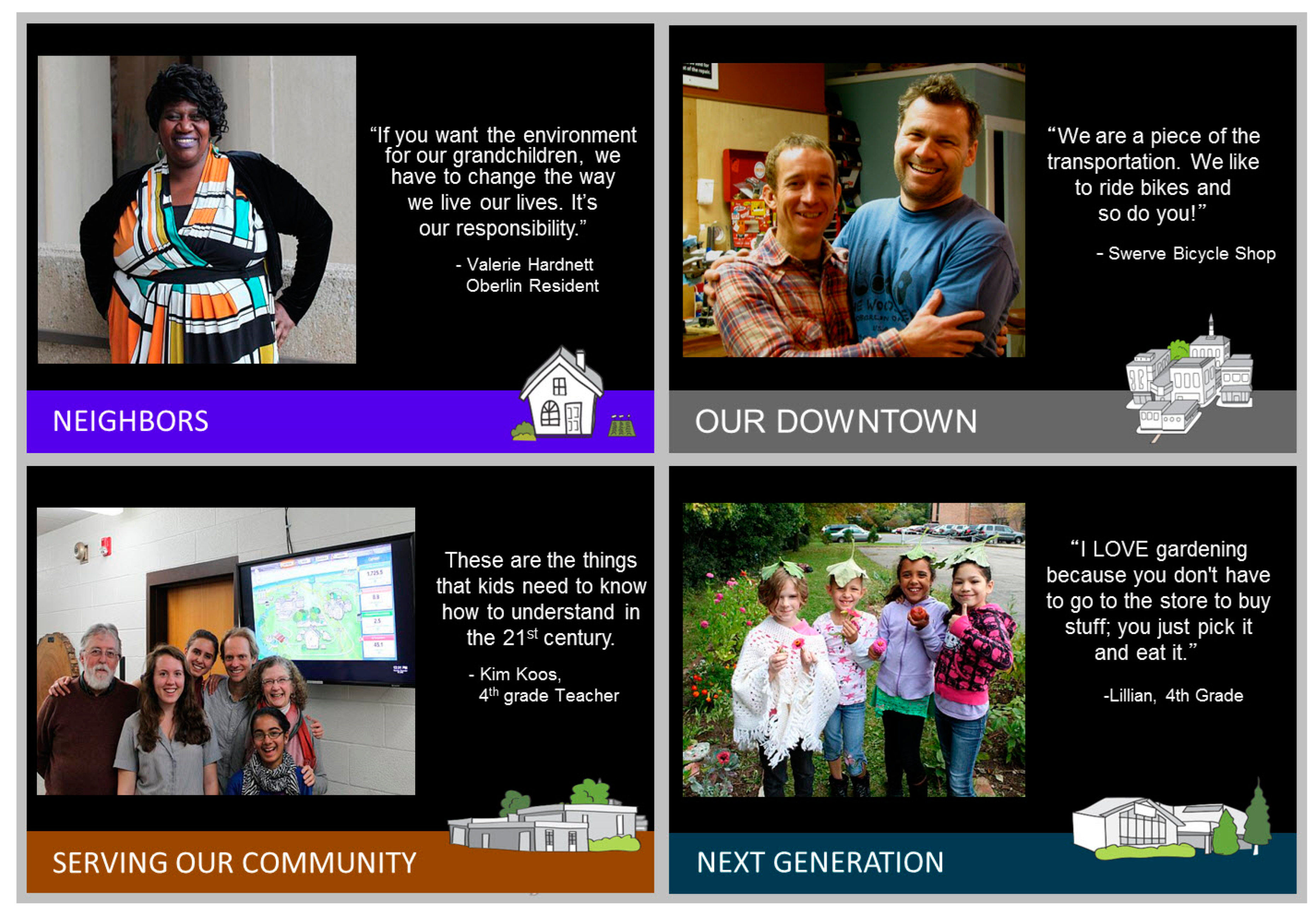
Figure 2.
Screenshot of the Citywide Dashboard (CWD) for Oberlin OH. The goal is to situate individual decision-making in a community and systems context [after, 22].
Figure 2.
Screenshot of the Citywide Dashboard (CWD) for Oberlin OH. The goal is to situate individual decision-making in a community and systems context [after, 22].
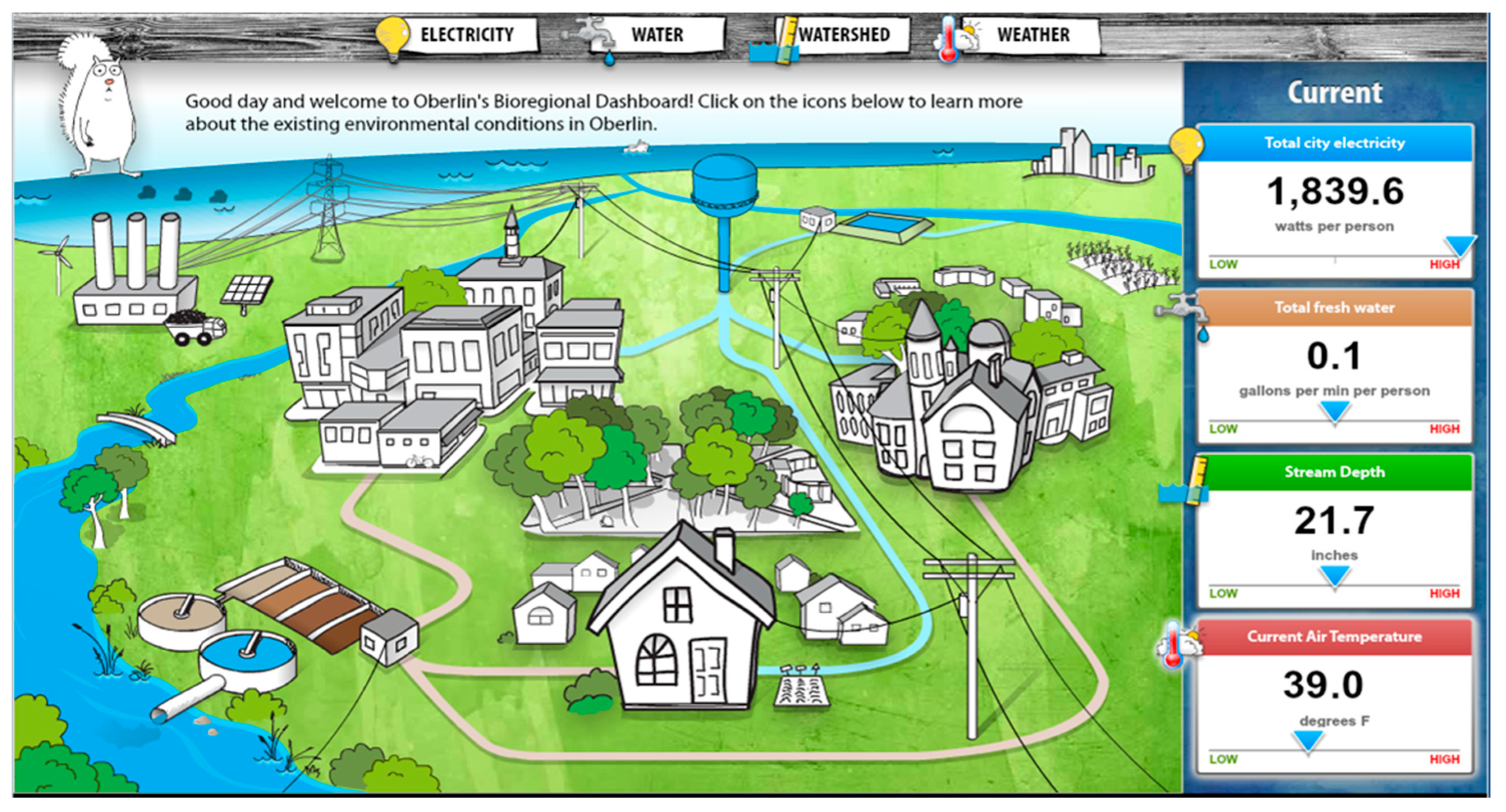
Figure 3.
Building Dashboard application. Flash the Energy Squirrel responds dynamically to current values of electricity use as the pattern of use plays over a day.
Figure 3.
Building Dashboard application. Flash the Energy Squirrel responds dynamically to current values of electricity use as the pattern of use plays over a day.
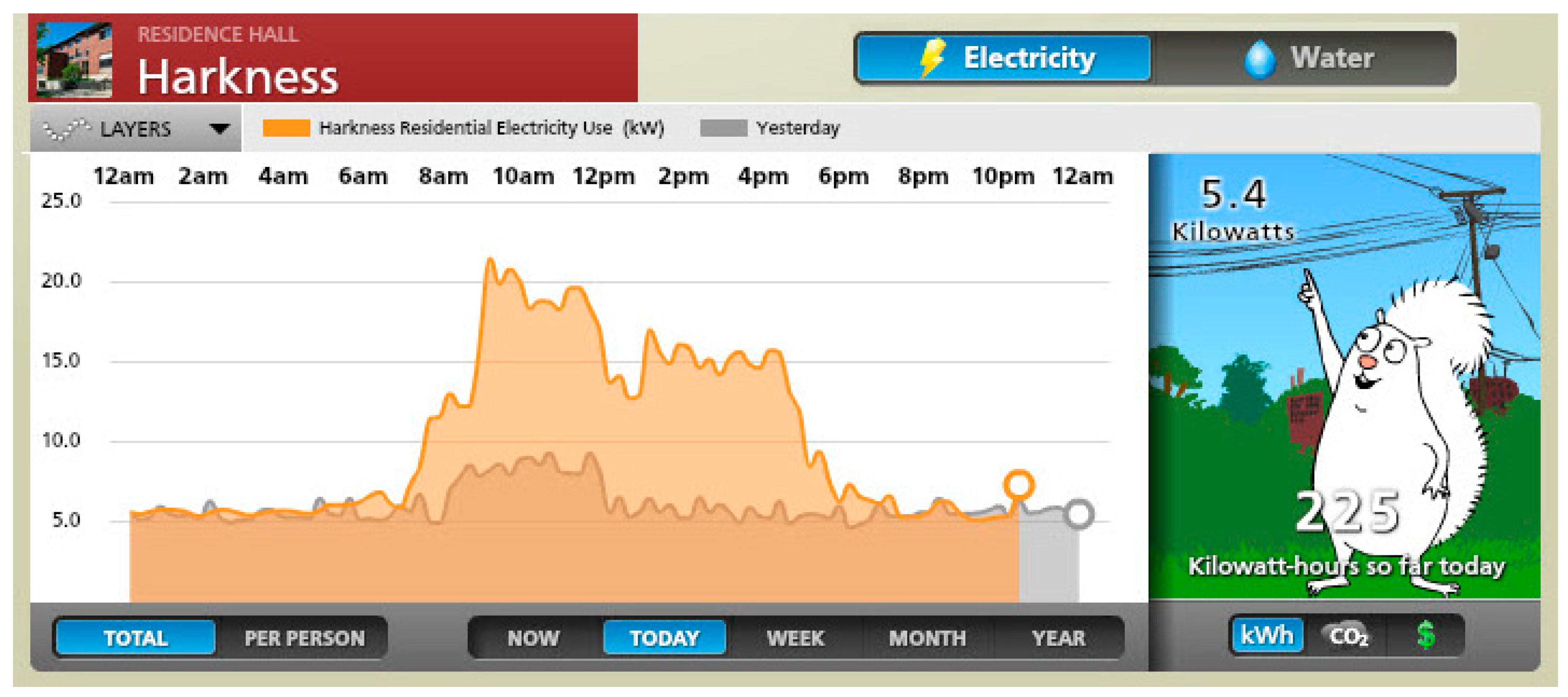
Figure 4.
Change in Community Voices Salience from Time 1 to Time 2, separated by Race.
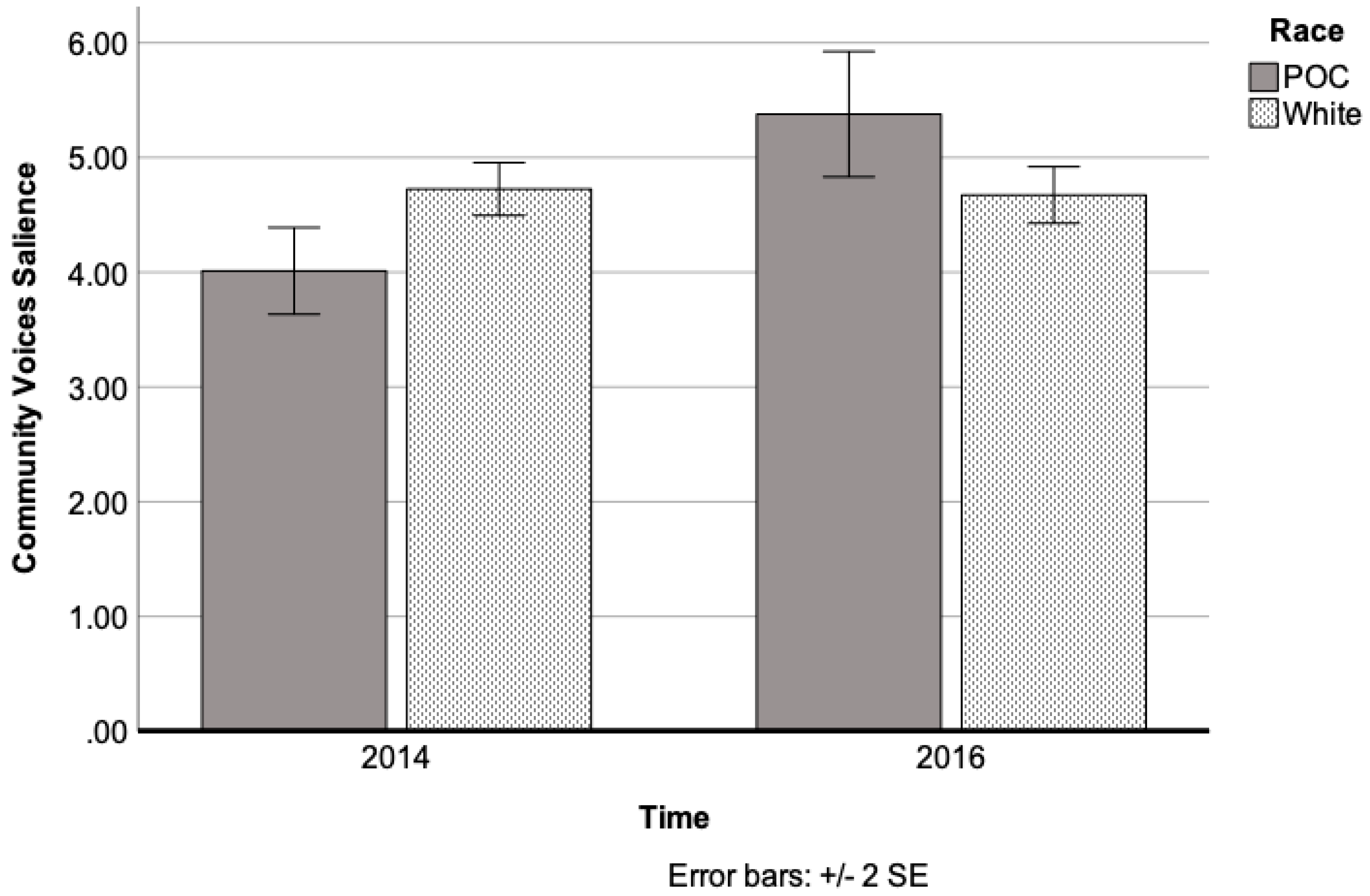
Figure 5.
Change in Norm Perceptions from Time 1 to Time 2, separated by Race.
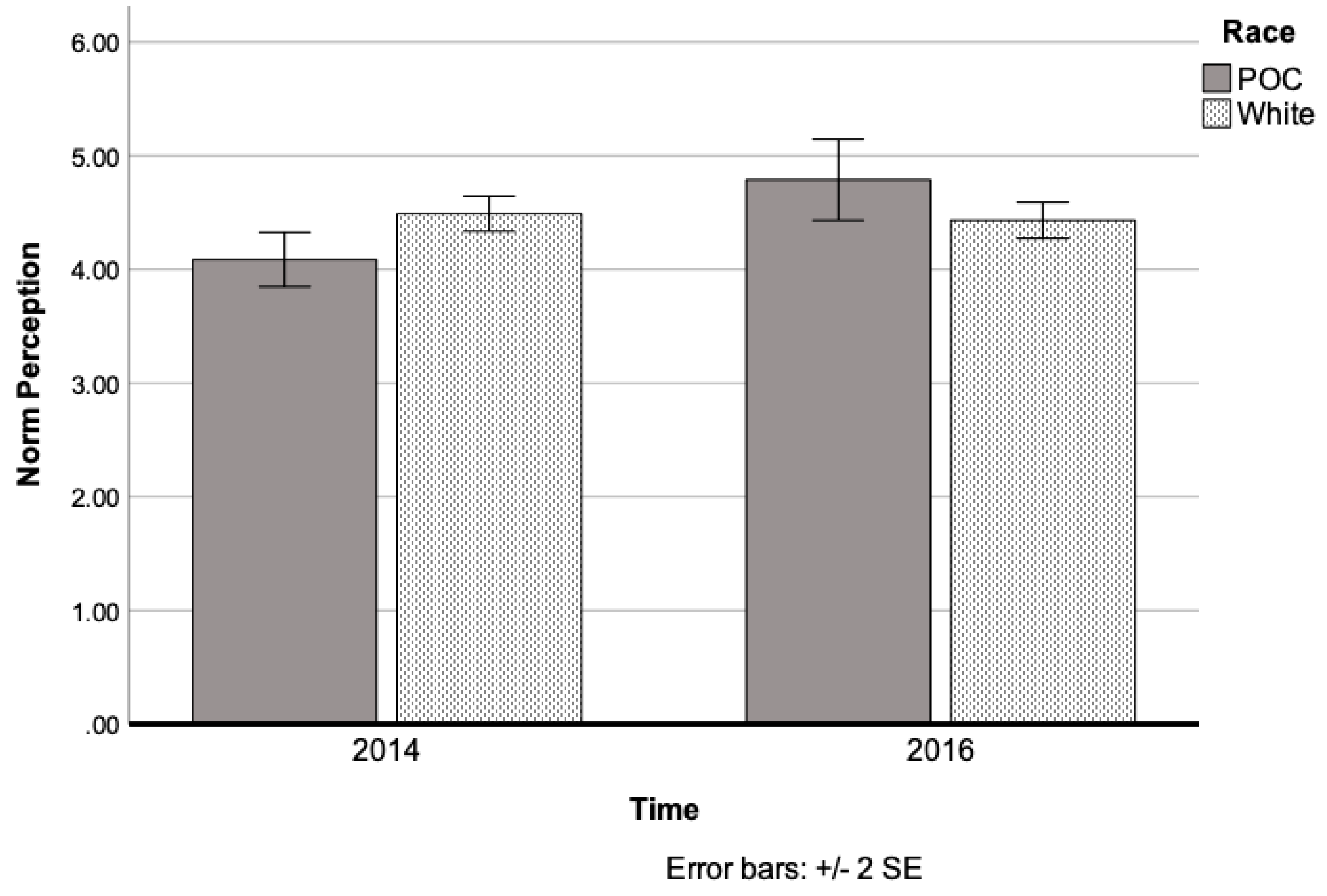

Table 1.
Change in variables designed to assess impact of digital signs.
| ED Component | Scale | Mean T1 (SD) | Mean T2 (SD) | F Time |
Partial Eta Squared Time |
F Time*Race |
Partial Eta squared Time*Race |
|---|---|---|---|---|---|---|---|
| CV | Salience of CV Category Content | 4.53 (1.36) | 4.79 (1.18) | 12.41*** | .04 | 14.48*** | .05 |
| Positive Community Perception | 4.76 (0.64) | 4.81 (0.76) | 1.08 | 0 | 1.28 | 0 | |
| Norm Perception | 4.37 (.85) | 4.49 (.65) | 7.08** | .03 | 9.87** | .04 | |
| Perception of Youth Engagement | 3.40 (1.38) | 3.71 (1.28) | 6.19* | .02 | 2.52 | .01 | |
| CWD | Citywide Water and Electricity Salience | 3.26 (1.50) | 3.80 (1.26) | 8.74** | .03 | 0.31 | 0 |
| Perceived Impacts on Local Systems | 4.37 (1.12) | 4.62 (0.83) | 5.69* | .02 | 2.37 | .01 | |
| Water Conservation and Impact | 4.48 (1.09) | 4.67 (1.06) | 1.88 | .01 | 0.8 | 0 | |
| Electricity Conservation and Impact | 3.70 (1.39) | 5.01 (0.85) | 49.32*** | .21 | 0.26 | 0 |
*Denotes significance levels: * p < .05, ** p <.01, *** p < .001.
Table 2.
Correlations between self-reported exposure to ED display and dependent variables.
| Frequency of Exposure | Length of Exposure | |
|---|---|---|
| 3Salience of CV Category Content | .193** | .156*** |
| Norm Perception | .162* | .115* |
| Positive Community Perception | .06 | .07 |
| Perception of Youth Engagement | .104 | .103 |
| Citywide Water and Electricity Salience | .218** | .220** |
| Water Conservation and Impact | .088 | .187** |
| Electricity Conservation and Impact | .297** | .374** |
| Perceived Impacts on Local Systems | .156** | .149** |
* Denotes significance level * p < .05. ** p < ..01
Table 3.
Bootstrapped indirect effect estimates of Time on dependent variables mediated through Frequency of Exposure to ED.
Table 3.
Bootstrapped indirect effect estimates of Time on dependent variables mediated through Frequency of Exposure to ED.
| Mediator: Frequency of Exposure | |||
|---|---|---|---|
| Dependent Variable | B | SE | CI |
| Salience of CV Category Content | 0.507* | 0.126 | .247, .742 |
| Norm Perception | 0.236* | 0.074 | .095, .385 |
| Perception of Youth Engagement | 0.124 | 0.122 | -.121, .363 |
| Citywide Water and Electricity Salience | 0.344* | 0.123 | .098, .585 |
| Electricity Conservation and Impact | 0.034 | 0.091 | -.155, .203 |
| Perceived Impacts on Local Systems | 0.222* | 0.085 | .051, .391 |
* Denotes a significant indirect relationship (p < 0.05), indicating that the effect of Time is mediated by ED exposure. B = regression weight of the indirect effect, SE = standard error, CI = confidence interval.
Disclaimer/Publisher’s Note: The statements, opinions and data contained in all publications are solely those of the individual author(s) and contributor(s) and not of MDPI and/or the editor(s). MDPI and/or the editor(s) disclaim responsibility for any injury to people or property resulting from any ideas, methods, instructions or products referred to in the content. |
© 2024 by the authors. Licensee MDPI, Basel, Switzerland. This article is an open access article distributed under the terms and conditions of the Creative Commons Attribution (CC BY) license (http://creativecommons.org/licenses/by/4.0/).
Copyright: This open access article is published under a Creative Commons CC BY 4.0 license, which permit the free download, distribution, and reuse, provided that the author and preprint are cited in any reuse.


