

Submitted:
13 September 2024
Posted:
16 September 2024
You are already at the latest version
Abstract
Global biodiversity loss and climate change highlight the importance of environmental knowledge and behavior in the population at large. Americans gain environmental knowledge almost exclusively from sources outside of formal schooling, and increasingly, the internet and social networking sites (SNS) are the preferred sources of that specific, just-in-time learning. The North Carolina Native Plant Forum is a regionally specific Facebook group focused on environmental education with over 80,000 members. This case study used 14 forum member interviews and analysis of the Facebook site itself to explore the Native Plant Forum and its users through the lens of the Technologies for Pro-Environmental Actions Model (TPAM). These data revealed a process of information seeking, sharing experiences, obsession, and pro-environmental intentions leading to the planting of native plant species that host and support pollinators and wildlife. Users of the forum expressed how much they learned from the Facebook group and particularly valued the photographs shared daily by other forum members of their native planting projects. The ability of social networking sites to support and incentivize pro-environmental knowledge and behaviors is a critical area of research for adapting environmental education to a new information age and for combating multiple overlapping environmental crises.
Keywords:
pro-environmental behavior
; social media
; environmental education
; Facebook
1. Introduction
Environmental crises such as the changing climate and global loss of biodiversity threaten our ability to sustain individuals’ ways of life on Earth. A sixth mass extinction event is currently being triggered by habitat loss,1 and the same study finds that in the last 200 years, the spread of exotic species has caused one out of four insect species to become extinct . Americans have noticed and recently ranked environmental concerns at the top of their national priority list.2 However, less than 12% of Americans possess the basic environmental literacy necessary to address these complex problems.3 Americans, on average, receive a majority of their environmental knowledge (95%) from media (books, television, and the Internet), with the internet and social networking sites comprising a growing portion of this media ecosystem.4 Interestingly, 56% of Americans born after 1996 and 20% born before 1960 interact with climate change information on social media regularly,5 and there are a projected 1.8 billion users of Facebook groups every month.4 Researchers and policy-makers have called for more research into the impacts of environmental education and social media on conservation goals.6,7 Further, more needs to be understood about the power of social media to influence pro-environmental behaviors.8
The North Carolina Native Plant Forum (NCNPF) is a public Facebook group concentrated on environmental education, particularly around native plants, pollinators, and wildlife. Planting native species and removing exotics is a well-studied pro-environmental behavior (PEB) with wide-ranging local and global impacts on wildlife, climate, and biodiversity.9 This study aimed to understand the role of one education-oriented Facebook group on the pro-environmental behaviors of its users. The research questions for this study included:
- How do users of the NCNPF arrive at their landscaping decisions and what factors influence their adoption of native landscaping?
- How does the NCNPF influence its users in their native and exotic landscaping choices?
This study utilized a case study approach along with the Technologies for Pro-Environmental Action Model (TPAM) to explore how the NCNPF interacted with the users of that forum to trigger and sustain pro-environmental behaviors in the form of native planting. In addition to analysis of the forum itself, interviews with forum users were utilized to elucidate the processes and factors involved in carrying out these specific pro-environmental behaviors.
2. Literature Review
2.1. Native Plants
Native plants have evolved over the millennia through intricate interactions with native pollinators and wildlife, creating unique relationships between those plants and the animals around them.10 Unfortunately, in a typical urban and suburban setting, more than 90% of the area is covered by exotic plants that may not host and feed wildlife.10 Previous research has revealed that a minimum of 70% native species is necessary for nesting bird survival.11 Planting native species and removing exotics is a well-known and understood pro-environmental behavior with wide-ranging local and global impacts on wildlife, climate, and biodiversity.12,13 For example, the collapse of the Monarch butterfly population due to the conversion of milkweed fields in North America (to corn and soybean monoculture) exemplifies the global impact that reductions in native plant populations can have on the environment.14
2.2. Pro-Environmental Behavior and Intention
PEB is a conscious action taken by individuals to lessen the negative impact of human activities on the environment or to enhance the quality of the environment.15 Pro-environmental intention (PEI) is the desire or aim to engage in PEB. Studies show that when individuals have the opportunity to experience educational content or programming it often results in the promotion of PEI but converting PEI to PEB often requires more than just educational efforts.16 The gap between intention and behavior is a complex social and psychological phenomenon at the center of research efforts on promoting PEBs.17
There are many theories that have attempted to explain PEB and though compelling studies exist overall results have been mixed. For example, the Theory of Planned Behavior, and the Norm Activation Theory, both discount the role of education or media use in growing PEB.18,19 Other models downplay the influence of experiences such as early family life or feedback from others.20 Interestingly, researchers have expanded models such as the Theory of Planned Behavior to include additional external and psychological factors that may influence PEB.21
Models showing the factors and influences on PEB may vary, but all models focus on both internal and external influences, such as the belief that non-human species are sentient,22 as well as, general nature connectedness,23 various barriers to the behavior,8 education/knowledge,24 self-efficacy,25 and personal and social norms.26,27
2.3. Social Networking Sites (SNSs)
Social Networking Sites (SNSs) have a broad audience and provide users with valuable information and social exchange. Almost two billion people use Facebook groups monthly,4 and Facebook is just one of several prominent social networking sites. The Pew Research Center for the People and the Press found that SNSs can be communities of like-minded peers and a space to ask questions, provide answers, and build self-confidence, ultimately facilitating behavior changes.5 Robelia and colleague’s 2011 study of a climate change-oriented Facebook page found that its users were more informed about climate change than those not using the page.7 Additionally this same study found that users’ PEBs increased after a month of using the group.
In general, evidence has supported the role of social media in influencing PEBs.28,29,30 For example, Shah and colleagues found that increased exposure to information related to climate change on social media contributed to climate-related pro-environmental behaviors.31 Other studies report that social media increases environmentally friendly purchases.32,33 Research has also shown that sustainability-themed conversations on social media reinforce pro-environmental behaviors.34,35 Additionally, instead of passively receiving messages from websites, individuals in a social media setting actively participate in online dialogue.4 A study conducted across Canada, France, the UK, and the United States (US) found that social media engagement is the most consistent predictor of environmental activism.34 However, there are studies that fail to show the influence of SNSs on PEBs, especially those that are performed in the private sphere, where social norms have less influence.27,36,37,38 A study of food waste interventions by a supermarket in the UK found that a Facebook campaign was no worse or better at changing consumer food waste behavior than a newsletter.38 Private-sphere PEBs are less susceptible to social norms because they are performed in private, so the social aspect of SNSs may be less powerful in these circumstances.24
2.4. Models of PEB
Differing models of PEBs are reflected in the literature, and each has benefits depending on the exact behavior and context under scrutiny. Shah and colleagues (2021) used a model that included SNS usage, self-efficacy, and threat assessment (fear of personal impacts) and found that all three were positively correlated with PEBs.31 In another study, Liu and Li (2021) revealed that media exposure to environmental messages, perceived personal responsibility, and environmental concern were correlated with PEB, but self-efficacy was not.39 A 2020 study found that “satisfaction with governmental environmental protection” is a significant variable and further finds that SNS use has variable results.40
Norm Activation Theory is commonly used to understand PEB.26 Norm Activation Theory posits that awareness of consequences (similar to threat perception) leads to feelings of personal responsibility (or guilt), thus predicting PEB.26 This model includes social media engagement, threat assessment, and personal norms as factors leading to PEB but does not consider self-efficacy.26 The Theory of Planned Behavior is another popular model for predicting PEB which includes extensive cognitive factors like control beliefs and normative and behavioral beliefs but does not deal directly with “the gap”, or converting PEI to PEB, and so it leaves out factors like education, self-efficacy, and feedback.41
The Technologies for Pro-Environmental Actions Model (TPAM), is a theoretical framework and model specific to social media’s impact on PEB which serves as the theoretical lens for this case study.42 This framework incorporates all salient factors in social media’s influence on PEB. The TPAM posits that social media sites like Facebook provide informational, relational, and experiential functions that align with the ways people arrive at PEBs.42 This functionality can be strategically used to generate personal, social, and contextual pathways to PEB. In this way, the TPAM model offers a flexible theoretical framework for PEB that can accommodate all relevant factors in a specific context.42
Informational functions of Facebook include the ease of finding and disseminating textual, photographic and videographic information online and the structures in place to ensure the accuracy of the information (usually in the form of moderators). Relational functions of Facebook include comments, shares, likes and other interpersonal interactions that expand social networks and forge community connections. The experiential functions of Facebook include gathering and sharing information, connecting with in-person events, and watching modeled behavior by other users. The users of SNSs, according to the TPAM, then forge various pathways to pro-environmental behaviors, including personal, social, and contextual avenues.43 These pathways involve the various factors or antecedents of PEBs. Personal pathways involve nature connectedness and enacting personal values/norms, convenience, and hedonic gratification (i.e., socializing, relaxing). Social pathways include social status and social norms. Contextual pathways include place attachment, a sense of community, or a feeling of belonging; Figure 1 summarizes the TPAM.
2.5. Factors Leading to PEB
The TPAM model utilizes broad categories to capture the full range of PEB antecedents, which can be personal, social, or contextual.42 This model is more general and, therefore, more inclusive of the factors contributing to an individual’s various PEBs.
2.5.1. Personal
Research has linked a substantial list of personal traits to PEB. These include demographic variables like age, socio-economic status, and gender,34,43,44,45,46 attention span,31 dimensions of personal identity and personal norms (as in environmentalism or conscientiousness),47 knowledge,26,36,48 one’s connection with nature,49,50,51 personality,45 place attachment,52,53 and general well-being.43,54,55 All of these factors have been linked to the development of PEBs.
2.5.1.1. Knowledge
An individual’s education level is strongly and regularly associated with increased levels of PEI and PEB.24,48,56 More specifically, levels of an individual’s environmental knowledge correlate to pro-environmental intention (PEI), but not to pro-environmental behavior due to the complex social, personal and contextual factors that influence the gap between intention and behavior.57,58,59 These subtle and sometimes unconscious factors in determining behavior can manifest in different ways. Social networking sites’ (SNSs) social functionality has been associated with obsessive and compulsive social media use,60 and the process of interest and learning itself can have similar impacts on the intensity of the experience of learning.61
2.5.1.2. Nature Connectedness
Studies have indicated that a feeling of connection or empathy with nature, usually resulting from positive early experiences outdoors, is highly correlated with pro-environmental behaviors,23 and with indices of human well-being and local biodiversity.62 There is also alarming evidence of a decline in nature connection, especially in the United States and other highly-developed countries.62,63,64 One study from 2009 found that nature-relatedness was also strongly correlated with other personal traits like extroversion, neuroticism (negative correlation), consideration of the future, and a love of animals. Interestingly, a recent study by Ng finds that nature connection can be developed through photographic and videographic representations of nature in social media and that this “Nature 2.0 connection” is similar to classic nature connection in terms of predicting PEB.49
2.5.1.3. Self-efficacy
Self-efficacy is defined as confidence in one's ability to complete a specific action.65 Self-efficacy bridges the gap and determines whether intent becomes action better than any other factor.66 This is particularly important in PEB because many studies show a resignation in the face of global environmental crises and a gap between environmental intention and action. A survey of Lithuanian citizens revealed that, on average, respondents disagreed with the idea that their behavior could make a difference.67 Kim and Choi (2005) found that American consumers’ choices were directly influenced by this efficacy, or belief in one’s ability to do something, in this case, help the planet.25 Self-efficacy can be built in several ways, including witnessing modeled behavior, successful attempts, and positive talk.68 Studies suggest that SNSs like Facebook are particularly useful for increasing self-efficacy due to the ability to share photos and experiences and offer feedback and reinforcements.65,69,70 For example, a 2012 study of 179 North Carolina residents found that the anticipation of neighbors’ negative feedback reduced interest in native landscaping as opposed to turf grass.71
2.5.1.4. Personal Norms
An individual’s norms are their personally held beliefs,27 and researchers consistently find these beliefs or norms to have significant impacts on an individual’s PEB.26,28,72 If an individual holds a personal norm that they should always recycle, that is a powerful predictor of that person’s recycling behavior. This differs from an individual’s environmental attitude in that a norm is more consistent over time and a more reliable predictor than attitude. Norm Activation Theory, for example, posits that personal norms result in PEB when the individual feels personal responsibility and is aware of the consequences of acting and not acting.19
2.5.2. Social
Although personal norms and other personal characteristics have proven impacts on PEB, they are not the only ones. Social antecedents to PEB include culture,34,55 social norms,73,74,75 role modeling behavior,7,76,77 and a sense of belonging.52 Of these PEB antecedents, social norms show the most consistent influence on behavior.
2.5.2.1. Social Norms
The unwritten social rules that govern our actions based on the acceptable behaviors of others are called social norms.19 Heidbreder et al. (2019) conducted a study on plastic consumption and findings revealed that social norms were the single most influential factor in an individual’s behavior.78 These norms are, of course, variable between individuals, countries, and cultures. Additional findings included that certain nationalities evaluated consumer packaging primarily based on recyclability, and others evaluated based on the origin of the packaging,78 leading to different behavioral outcomes. Another study in China explored the effects of a culturally specific social norm called “Zhongyong Thinking” on PEB.55 This culturally held value or norm is an expression of balance. The study of the unity of man and nature in traditional Chinese culture finds that an individual’s identification with Zhongyong thinking is highly correlated with PEB and with increased social media use.55
2.5.2.2. Role Modeling Behavior
When an individual, like a social media user or influencer models PEB, studies show that this modeling behavior influences the PEBs of media consumers.7,76,77 Other studies suggest that social media influencers are most successful when the PEB is aligned with the modeler’s persona.79
2.5.3. Contextual
According to the TPAM model, contextual contributors to PEB are specific features of each PEB and community, like rules, regulations and other logistic factors.42 Two important contextual antecedents of PEB are place attachment and a sense of belonging.52,53 Unlike personal and social antecedents to PEB, contextual factors are those where people interact with places and things.
2.5.3.1. Place Attachment
An individual’s emotional link to their place of residence, or the human-land relationship, is at the heart of place attachment’s ability to inspire PEBs.53 In a study of 550 Chinese residents, researchers found that an individual’s place attachment was significantly correlated to PEB, even when demographic variables were controlled for. This study further found that using social media instead of traditional media sources amplified place attachment’s influence on PEB.53
2.5.3.2. Sense of Belonging
Existing research has linked a sense of belonging to increased PEBs.52,80 This sense of belonging is created by factors like immersion in the community of practice, influence within the online community, and simple community membership.52 This same research also found that online and offline interventions to increase a sense of belonging in a community increase PEBs.
3. Materials and Methods
This study utilized an evaluative case study qualitative approach.81 The research questions for this study are “how” questions that seek detailed and nuanced answers about the process of PEB development through SNSs. This study focused on generation of a nuanced understanding of the NCNPF, a clearly bounded system with defined users, which is the main characteristic of case study, according to the constructivist approach advanced by Merriam.82 The case study approach chosen is evaluative because it provides the first contextual evaluation of the TPAM framework in a real-world case. Merriam (1998) describes an evaluative case study as using “description, explanation, and judgment as to the processes and outcomes in the bounded case system”.82 Data sources included interviews and forum posts. One of the characteristics of all qualitative research is that the researcher is the instrument,81 and so a brief description of my personal relationship with the study is appropriate in order to increase the reliability of the results.
3.1. Theoretical Framework
The TPAM framework is the theoretical framework employed in this study. It argues that when using SNSs as tools for the promotion of PEB, the technological functions should match and enhance the pathways to PEB.42 For instance, previous studies have shown that social norms are strong predictors of PEB, so social media that enhances the impact or perception of social norms will increase PEBs.42 In the NCNPF, group norms like “we don’t praise exotic species” are enforced by moderators and reinforced by group members on a daily basis. These special functions of SNSs make them useful tools for encouraging PEBs. The TPAM categorizes SNSs in terms of their informational, relational and experiential capacities. For example, Twitter and Facebook both rate as high in informational and relational functionality, but Twitter rates as moderate in experiential capacity, while Facebook rates highly.
3.2. Sampling
The initial sample was a purposive sampling of the forum’s administrator, John. A call for participants was released within the forum providing study background details . Interested group users clicked on a link to a Google form where they could schedule Zoom interviews. Zoom interviews were chosen as the mode for interviews due to high COVID-19 infection rates at the time of the interviews and because Forum users are spread across North Carolina, making in-person interviews inconvenient. 22 interviews with Forum users were scheduled. After interviews 13 – 15 revealed no further categories or insights saturation was reached and interviews were concluded. One interview failed to record and was removed from the study, five interviewees were no-shows, and three interviews were canceled after saturation was reached, resulting in 14 finalized interview transcripts for analysis.
3.3. Interviews
A total of 15 semi-structured interviews were conducted. The initial interview protocol is included in Appendix A. The questions’ order and wording changed moderately during the study, and those changes are noted in research memos after each interview. Otter.ai was used to transcribe the Zoom interviews. I subsequently listened to each recording and cleaned the transcript. Interview #2 failed to record due to technical errors. I recreated the transcript directly after the interview, but after initial coding, I decided not to use that interview due to the generality of my recreation.
3.4. Coding
Initial coding was segment-by-segment and inductive to “remain open to as much information from the data as possible” to enhance the study’s reliability and validity and to help bracket my own experiences in the Forum.84 After initially coding each interview transcript, focused coding was used to group codes into categories and themes. Code frequencies, overlaps, patterns, gaps, and comparisons between codes were examined and the number of codes were reduced by combining, splitting, and removing codes from the analysis where necessary. Data were analyzed iteratively and continuously during data collection. The codebook is included in Appendix B.
3.5. Content Analysis
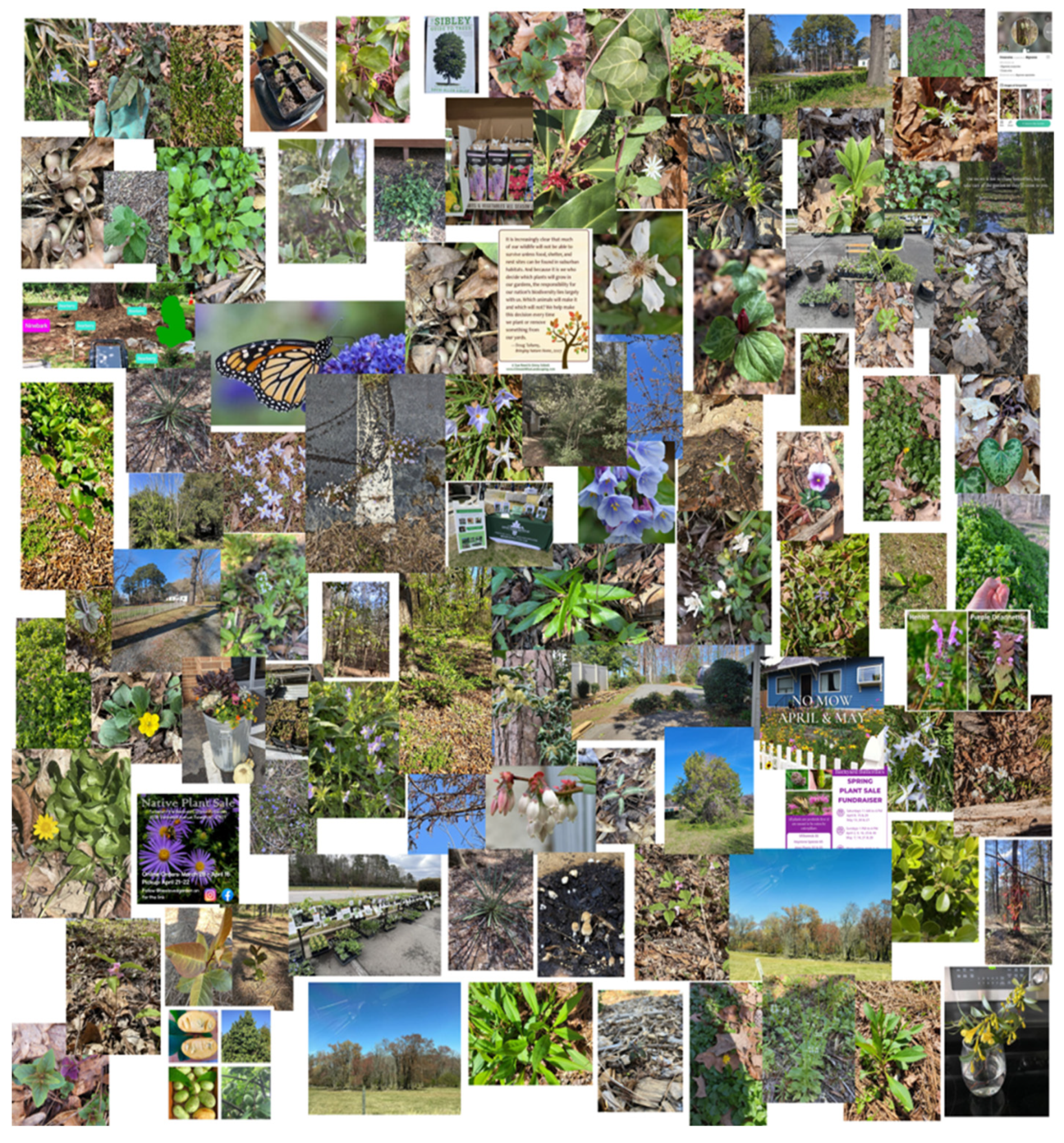
To enhance the reliability of the research, a second source of data was collected and analyzed. Collecting data from multiple sources is typical of case study research and the forum itself is a rich source of information about the functioning of the site.84 The Facebook forum is made of user-generated content and the social interactions around that content. 100 posts to the NCNPF were analyzed during three days in March 2023. Previous experience as a user and moderator of the NCNPF made the collection of 100 posts seem reasonable in capturing the vast array of post types for the forum, which adds to the ease of analysis. A priori codes concerning online conversations were adapted from Learning in the Wild in order to characterize the discourse on the Facebook site.85 Learning in the wild refers to “informal learning [that] takes place outside traditional educational environments, based on crowdsourced interest in just-in-time answering of posted questions”.85 The codebook is included in Appendix B. Ten posts (10%) with their associated comments and reactions were coded by the author and three other analysts using the a priori code book. The intercoder agreement was 92%, based on the number of agreements/total number of codes.86 The remaining posts were then coded to describe the conversations happening during a typical spring day on the forum. The photos posted by users in those 100 posts were collected, and that collage is included in Appendix C.
4. Results
This section may be divided by subheadings. It should provide a concise and precise description of the experimental results, their interpretation, as well as the experimental conclusions that can be drawn.
Research Question #1: How do users of the NCNPF arrive at their landscaping decisions? What factors influence their adoption of native landscaping?
NCNPF participants were asked in interviews about their decision-making regarding landscaping and the factors which influence their adoption of native landscaping. While all participants named environmental benefits as a driver of their interest in native planting, these beliefs were accompanied by a diverse set of precursory interests and experiences that led them to their practice. These factors and decisions are organized as Personal, Social, and Contextual, as promoted by the TPAM model of PEB.
4.1. Personal Factors
Studies of PEB have generally found that pro-environmental attitudes, beliefs, and personal norms are reliable predictors of all kinds of PEB.8 Forum users were asked about their environmental attitudes and norms. All 14 interviewees uniformly displayed pro-environmental attitudes, although not all described themselves that way. Susan said, “I’m definitely an environmentalist. And I feel like it’s our sacred duty to leave the Earth better than we found it”. (Susan, Interview #5) Even those who did not self-identify as environmentalists described themselves as “religious recyclers” (Roy, Interview #4) and reducing plastic use in their own lives (Callie, Interview #6). This is consistent with previous literature that finds that a positive environmental attitude is a precursor of PEB.68 In interviews with Roy and Callie, they indicated that their non-environmentalist identities were framed more politically and in relation to family members than to PEI or PEB. Callie explained, “I would say I'm middle-of-the-road environmentalist. I grew up in a rural hunting community, so I recycle, and I try to take my bags to the grocery store, but I wouldn't say that I am a level 10 environmentalist” (Interview #6).
Participants were asked to expand on their environmental values and how those impact their PEBs. Four participants, like Amy, expressed frustration with the impacts of PEBs in general, stating: “so we do the recycling, even though I know that it’s just going into the landfill” (Amy, Interview #8), but native landscaping gives these participants a feeling of making a difference, as described by Kim,
I'm one person, and all these things that I'm doing don't even extend the life of the planet one nanosecond. You know, it's until billions of people get in on this, that we're going to make any difference, and so my little 4000 square-foot lot has over 200 native plants on it now. And in the end, that is my way. And these native plants spread, and I can give them to neighbors, and I've, you know, planted things for people… I've been honestly sort of maintaining a panic level for about 30 years. So this is the first time I think that I feel like I'm really making a difference, way beyond recycling and way beyond reducing and reusing. (Kim, interview #7)
Susan, who teaches occasional classes on native plants, explained that “couples who come to my class, it’s the woman who’s like, I heard this is good for butterflies, and it’s the man who’s like, she wants to ruin my grass” (Susan, Interview #5). Kris explained the phenomenon, “there’s a little bit of lawn, my husband is a good sport, and I’ve been slowly reducing the lawn space.” While the male compulsion for lawns was a surprise finding, gardening for wildlife was not. The benefits to butterflies, pollinators, and wildlife were universally valued among all 14 participants like Callie, who described her mountain mint patch enthusiastically.
You start getting some native plants going, and they will come. I mean, I was out there now, probably a week or so ago. I have mountain mint growing out there, and mountain mint draws in every pollinator in the world, practically. But it wasn't just the pollinators on the mountain mint. It was butterflies. It was a big beetle flying by. It was, you know grasshoppers in the grass!” (Callie, Interview #6)
Another precursor to native planting that emerged from the interviews was family gardening. Nine of the participants (64%) reported that spending time gardening with family members was an important precursor to their native planting decisions. Susan explained, “I spent a huge portion of my early childhood just wandering behind my dad as he walked in the gardens, you know?” (Susan, Interview #5). Barbara, another participant, also described gardening with her grandmother as a child.
My grandmother who I used to stay with in the summers was also a gardener, but her gardening was tending to the things that just were naturally in her landscape, and that included the creek bed stuff and that probably had more of an impact now that I'm thinking about it because she really appreciated every plant. (Barbara, Interview #3)
Amy, on the other hand, got her family gardening inspiration from her son “after my son was born and I started to do a lot more with him outside and got a little more, you know, into the weeds with native plants.” (Amy, Interview #8, emphasis added)
Informal education was also a precursor for eleven of the participants. Barbara explained, “I became aware of the botanical gardens’ native plant studies program and leaped into that” (Barbara, Interview #3). Several interviewees singled out a North Carolina extension agent as crucial to their native planting enthusiasm.
I got interested in honeybees and I decided to take the Honeybee class that's offered through Chatham County and Debbie Roos was in charge of that year. And she, you know, she had a bunch of speakers, but she presented on native plants and how they could help not only honeybees, but native bees, and she kind of just opened up this window that I hadn't really been aware of. (Barbara, Interview #3)
Mary singled out the NCNPF as her primary educational resource, “I have learned a ton of information from the native plant forum. It is, to me, one of the better native plant fora” (Mary, Interview #11). Interestingly, none of the interviewees talked about formal education except for Roy, who said, “I started out getting a degree in landscape architecture from WVU, but I didn’t learn anything there about native plants. It was all just well, a lot of European and Asian influence in the whole landscape architecture philosophy” (Roy, Interview #4). Participants mentioned several non-formal sources of information beyond the NCNPF that they used, including the NC State Native Plant Toolbox, the North Carolina Botanical Garden, Doug Tallamy’s books and lectures, the Lady Bird Johnson Wildflower Center, and the Facebook page Milk the Weed.
One of this study's emergent findings is the theme of obsession. Despite not being asked, seven (50%) of the interviewees described their learning about native plants as obsessive. Clara (Interview #2) said “I’m like, hooked, and the whole family is sick of listening to me.” Cassie (Interview #6) said, “I've spent the last three years planting pretty intensively, ripping stuff out and replacing it with the good stuff and planting, planting, planting.” Lyn (Interview #9) reflected, “I don't even remember how I stumbled on the Facebook group. You know, I think again, I just kind of went down the rabbit hole and you know, just lead you from one place to another and now I’m obsessed.” Mary (Interview #11) said “I Just started noticing all these plants that were just they looked out of place. And so I started researching them and then that's when I went down the rabbit hole and the rabbit hole just got bigger and bigger and bigger and I just kept going down and down and down and down and down.”
It could be that the information intensity of native gardening is partially responsible for these feelings of going down rabbit holes and into the weeds or the immersive nature of social networking sites.
4.2. Social
The social nature of social networking sites (SNSs) and constructivist learning generally means that social factors play a significant role in promoting PEB. Some scholars, in fact, attribute PEBs chiefly to social norms,26,27,28 and status-seeking.87,88
4.2.1. Social norms and home-owners associations.
Four participants describe receiving positive feedback from neighbors, friends, and people on the NCNPF. One participant shared, “The neighbors encourage you, you know, by saying ‘oh my god, that’s so pretty’, you know, ‘I love what you’ve done,’ and so that’s very encouraging” (Kim, Interview #7). Kim describes her first post to the NCNPF, saying “there were close to 300 responses on that thing, and it’s been over a year, but it’s still just very encouraging” (Kim, Interview #7). However, not all of the socioemotional feedback is positive. The topic of homeowner’s associations (HOAs) came up frequently among participants (6), with one participant sharing, “And so I've taken out most of the non-native stuff without any HOA approval. And they've recently hired a compliance coordinator who goes around now checking neighbors, so my time to be reviewed is in two weeks, and I know that I'm in trouble” (Kim, Interview #7). The whole goal for the HOA is very manicured Asian plants” (Lynn, Interview #9). HOAs represent evident social norms that can include real consequences to the homeowner.
4.2.2. Self-efficacy
Part of encouraging PEBs is increasing the self-efficacy of the person (or group) with pro-environmental intent, and peer modeling is one proven way to increase self-efficacy.66 The NCNPF excels at peer modeling as users post photographs of their native plant projects, “definitely when people share the things they're doing like with, you know, with beds or creating spaces. I always learned something about, if not actual structural something, then in design like these plants look really beautiful.” (Barbara, Interview #3) She added, "I really love when people share, you know, it's like you get a good range of ways to think about things before you just jump in and do it and then live with the mistake.”
The most common post on the NCNPF is plant identification, and despite some repetition, six of the participants reported feeling more confident in their landscaping with some identification skills. Cara (Interview #2) said “Initially, I was just going to try to figure out like my trees, like, what are my trees? And now I have every single plant and weed on my third of an acre identified.” Barbara (Interview #3) said
I've gotten better at identifying things. Without having to kinda like go through a couple of, you know, either reminding myself by looking at a book or something. I mean, I think just cause there are so many posts on there that are asking for identification…just learning it by reading it over and over and seeing the picture with that name, and you know, so I love that it's kind of like its own little educational piece.
Mary (Interview #11) described how, in her role as a moderator on the site, she helps forum users increase their self-efficacy by directing them to good resources for plant identification.
...if anybody has a hard time trying to identify a plant, I help identify the plant. This is what I've done for years. I give them the botanical name, and then a couple of the common names, and then usually I attach the NC toolbox information to that post so that they can then go to that and read all the information that that toolbox comes up so that's how I like to answer people's questions on that page is ‘alright, this is what this plant is, here's where you can find more information about it.’ And then when everybody's been answering and they're, they're like wrong, I'm like, no, no, no, it's not that it's this and then I again, I always provide a link, even if it's to the USDA website.
Participants describe their native planting journeys, starting with childhood role models who gardened, spent time outdoors, or were activists, continuing through moves, marriages, children, changing politics, and at the far end of the self-efficacy spectrum, five of the participants described becoming advocates for native plants themselves. Susan, who occasionally teaches plant classes, described being an advocate.
I run into people who have been in one of my classes at one point, and they did tell me that I changed their lives. That's amazing. It is, because it's like that little seed that you get to plant. I mean, who knows what they're going to take from that journey and what they're going to be open to learning about and like, yeah, and the ripples. (Susan, Interview #5)
These participants shared the personal and social factors that led them to replace their exotic plants with native ones, but there are still more contributing factors, and these fall into the category of context.
4.3. Contextual
Contextual precursors to pro-environmental behavior (PEB) are those antecedents of PEB where the forum user interacts with a place or thing rather than other people. The interviewees mentioned several types of contextual antecedents to PEB.
4.3.1. Property
The most common precursor for the participants was the purchase or acquisition of property. Thirteen interviewees mentioned property acquisition as a necessary step for their native planting. Mary said that landscaping was “just something I taught myself when I moved out of the house and started getting my own houses” (Mary, Interview #11), and Roy remembered “we moved here a year ago, we bought some undeveloped property, so as we develop it, we want to use, of course, natives” (Roy, Interview #4) This precursor makes a great deal of sense since it’s challenging to landscape without access to property. This also has demographic and equity implications that will be discussed below.
4.3.2. Related Interests
Another precursor that emerged from the interviews was related to interests. Eleven participants reported that some related interest brought their attention to native plants. The most common, of course, is gardening. Barbara, for example, said, “I’ve always, since I was little, been interested in gardening” (Barbara, Interview #3). Other related interests that brought native plants to participants’ attention include photography, Cherokee herbalism and plant lore, beekeeping, Roy’s landscape architecture, and homeschooling children. Of Cherokee herbalism, one participant shared, “I have gotten very interested in Cherokee folk wisdom about native plants I love being in the forest and knowing that some of these plants have been here for eons and the stories that they have to tell about the places where they are (Clara, Interview #2). These insights support the finding of precursory interests in PEB and highlight the connection to history that participants named as both a driver and a benefit to their gardening practices.
4.3.3. Aesthetics
The final commonly cited contextual value was aesthetics. Twelve participants talked about how the beauty of the plants and pollinators drove them to this PEB. Clara summed it up when she was enthused about the aesthetics of her native plants: “You know they’re going to be really beautiful, unique and different” (Clara, Interview #2). Roy described a future native plant project:
I like to see the aesthetics of it you know, like I said, prairies are probably my favorite. I would love to have a nice basically a prairie on the hillside, you know, a hillsides of forbs, flowering forbs and grasses, probably a little too dry for sedges or most sedges, but yeah. (Roy, Interview #4)
The varied stories told by these 14 NCNPF users reveal common threads of family, nature connectedness, frustrated environmental values, lifelong informal learning and pro-environmental behaviors. Table 1 summarizes the findings by category. The interviews also reveal a wide range of interests, reasons, and preferences among these users. The next research question in this study concentrates on the role of the Facebook forum in encouraging PEB.
4.4. Research Question #2: How does the NCNPF Influence its users in their native planting choices?
The NCNPF is a fast-paced fire hose of information, particularly in the spring when plants emerge from winter dormancy, and gardeners pick up their trowels. During the content sampling period (March 17th - 20th, 2023), users generated over 120 individual (approved) posts in three days, 830 comments, and more than 2700 likes. In order to answer question #2, the study utilized a priori codes from Learning in the Wild, originally designed to analyze Reddit posts.85 Figure 2 shows a typical user post that uses Facebook’s relational (in a social context, norms), experiential (modeled behavior, experimentation), and informational pathways to PEB by seeking and providing information, increasing self-efficacy through modeling behavior, and reinforcing social norms.
Out of the 100 posts sampled, twenty-nine percent demonstrated pro-environmental behavior, including removing invasive species and planting native species. Another 48% of posts revealed a pro-environmental intention (including purchasing plants, landscape planning, and seeking exotic eradication advice). An example from the forum is shown in Figure 3. This example seeks information to help remove this nandina (an exotic invasive that spreads quickly into surrounding wildlands and can kill birds). The original post demonstrates pro-environmental intention (PEI) and information seeking. Subsequent information-providing in the comments demonstrates PEB, and this modeling helps other users form experiential pathways to the behavior by envisioning doing this on their property and increasing their self-efficacy. Overall, three-quarters of the posts in the sample demonstrated either a pro-environmental behavior or intention. In his interview, John reflected on the impact of the NCNPF on PEBs:
I've had a readership or viewership of more than 1.2 million people every 60 days. So, I'm finally reaching 1% of all the households in North Carolina. And when I learned about them being sold out in like one or two weeks for this whole Bradford pear tree program, I thought, I'm probably actually having some measurable impacts on what's being sold in greenhouses and what people are planting and, and then I was just like, you know, this is the most important thing that I've ever been a part of, for that reason, because of these marginal decisions that people are making all across the state about what to do with their money and time. (Jim, interview #1, February 24, 2023).
The primary goal of the NCNPF is to educate, and the forum posts reflect that goal. Figure 3 shows the composition of the sampled forum posts. Sixty-seven percent of posts seek information, and an additional 19% provide information. Of the two-thirds of posts seeking information, 41% seek to identify one or several specific plants, while the remaining 26% ask for guidance in technique, placement, watering, etc.
Forum users often express how much they learn from the NCNPF, like the post in Figure 4. This post also demonstrates pro-environmental behaviors and intentions. Within a few weeks, this user joined and was checking PEBs off her list. They also express the common emergent theme of becoming obsessed with native plants.
5. Discussion
Most posts to the NCNPF are informational, seeking or providing information specific to native and exotic plants, but information is just one of the ways that the NCNPF encourages PEB in its users. Figure 6 shows that in addition to informational functions, Facebook facilitates relational (or social) and experiential learning. Figure 5 shows how the TPAM framework applies to the themes and categories identified in this study from both the interviews and content analysis.
The TPAM framework rates Facebook top among social networking sites in terms of the informational, relational and experiential functionality inherent in the platform (Ballew et al., 2015),42 which makes Facebook an ideal case to apply to the TPAM framework. Functions like real-time plant identification, and expert landscaping and wildlife information make up the informational part of Facebook’s functionality. Social relationships, norms, feedback, likes, shares and comments are part of the relational functions of SNSs, and experiential functions include increasing self-efficacy through role-modeled behavior and other users’ experiences.
The bottom half of Figure 5 shows how the user then employs that SNS functionality to behave pro-environmentally. The main findings from the interviews align with the existing literature in that self-efficacy, personal and social norms, nature connectedness, and hedonic values like aesthetics are echoed in existing studies of PEB and its antecedents.8,89,90
Participants discussed the “precursors” or things that triggered or led up to their native planting. All of them described pro-environmental values and at least one of the other precursors listed (family gardening time, purchasing property, or related interests). More proximally to the PEB, participants described the NCNPF and other informal educational resources as being anywhere from slightly important to extremely important in performing the PEB. Some interviewees relied more heavily on the NCNPF than others, and most used a combination of resources. One of the outstanding attributes of the NCNPF is that pictures and information are displayed during users’ Facebook scrolling, usually daily, providing identification, norms, peer modeling of behaviors, and positive social feedback.
Participants talked about relational factors as being quite significant. For some, inspiration came from looking at photos and others’ projects on the NCNPF. For others, this inspiration came from an extension agent of Orange County, NC, who maintains a native pollinator display garden. Some mentioned hearing from scientist and author Doug Tallamy for the first time as their primary inspiration. Interviewees also described their rising self-efficacy or confidence as coming from other NCNPF members’ stories and pictures (seeing the behavior modeled), from their experimentation, and feedback. This is similar to previous research on self-efficacy’s central role in pro-environmental behaviors.34,69
SNSs are not necessary for this conversion of PEI to PEB. However, as this and prior studies suggest,91-94 SNSs have a combination of visuals, shared experiences, relevant just-in-time knowledge, and built-in feedback mechanisms that make them powerful tools for promoting PEB.
Other insights from the interviews include the obsessive nature of learning and planting, the downsides of homeowner’s associations, frustration with common PEBs like recycling, and the fact that becoming an advocate for native plants is part of the process. Literature on interest indicates that deep interest (or obsession) in a subject is a part of the natural learning process.61 Interest re-engages the learner over time, indicating value in the knowledge.95 Several interviewees also indicated that they have lots of spare time due to disability or children leaving the house, which could lead to developing new interests. Homeowner’s associations are often intended to provide a distinct atmosphere in a residential area, but participants expressed frustration that that atmosphere often includes exotic invasive plants with few wildlife benefits, even in “green communities”.
Various scholarly frameworks and models have been presented and tested with widely varying predictive capacities for PEBs. For example, one study found that environmental knowledge was not a factor in promoting the reuse of hotel towels.57 However, this is a relatively low-information and private-sphere PEB, while choosing and growing native plants is information-heavy and occurs in public view. Different PEBs will require different processes and different models. This may argue that a universal model needs to be more generalized to accommodate different PEBs in different cultural contexts. If this is the case, more studies like this should be undertaken to explore the range of influencing factors on PEB across cultural contexts and specific PEBs. The TPAM model is a practical and general lens through which to view the NCNPF. Its categories are broad enough to apply to the different social networking sites and differing types of PEBs.
6. Limitations
While the authors have worked to bracket their personal beliefs and experiences, triangulate data through multiple data sources, and view the process holistically, the conclusions drawn here are limited. One limitation is the sampling methodology used. Due to the large number of forum users and their enthusiasm for talking about plants, the interview sampling period was fewer than 24 hours. The selected participants were the first ones there and were all long-time forum users, and talking to beginners might have brought additional insights.
This study may also have limited transferability to other PEBs and other contexts. As seen in the literature review, previous studies have yielded widely varying findings, and part of the cause is undoubtedly the wide range of PEBs and cultural contexts in which they are formed. The NCNPF and, therefore, this study is limited to Facebook Groups and to North Carolina, which is a strength of the forum but a limitation for the generalizability of my findings to other contexts.
Further research in this area should include quantitative surveys of the NCNPF users to get a less fine-grained but more holistic view of the user community. Further research should also examine socioeconomic equity not just in terms of a person’s ability to plant native plants on private property but also the impact of disability status and retirement on the ability to perform PEBs.
7. Implications
The conflicting findings concerning PEB in previous research are consistent with variability in the characteristics of PEB. A recent study presented empirical support for the unequal influence of social norms on private and public sphere PEB.96 Pro-environmental behaviors can take fundamentally different forms, whether in the public sphere, such as reusable shopping bags, or in the private sphere, such as household recycling behaviors. PEBs can also be easy (switch to LED lightbulbs) or complex (consistently reducing plastic use). In the NCNPF, the desired PEB is relatively high effort, and requires a high level of information. Commonly researched PEBs, like recycling, are low-effort, occur in the private sphere, and require relatively little knowledge. These differences fundamentally change the process of encouraging specific PEBs. While more research is necessary to detail these differences, this research makes a case for the value of social networking sites and environmental knowledge in encouraging high-effort public-sphere PEBs like gardening with native plants. Because environmental education is largely absent from formal education, informal educational resources like the NCNPF are crucial to creating an environmentally literate citizenry who can make landscaping choices with the appropriate education and support.
Environmental educators and activists commonly struggle with the best ways to provide just-in-time environmental information and encourage PEBs. While there is still much to learn about social media’s power to impact PEI and PEB, this study adds to the growing evidence that social networking sites are a useful technology for developing and maintaining complex pro-environmental behaviors in the adult population. Social networking sites like Facebook Groups offer engaging pathways to PEBs, and this research helps to identify the aspects of a successful intervention. Social media that helps to encourage PEBs will be place-based, well-moderated to eliminate misinformation, reinforce social and personal norms, highlight role-modeled behaviors, and provide a sense of belonging and community.
Funding
This research received no external funding.
Institutional Review Board Statement
The study was conducted in accordance with the Declaration of Helsinki, and approved by the Institutional Review Board of North Carolina State University (protocol code 25991, July 12, 2023).
Informed Consent Statement
Informed consent was obtained from all subjects involved in the study.
Data Availability Statement
Interview transcripts are available upon request.
Appendix A
Interview Protocol
Interview Protocol - Native Plants Forum– Semi-structured
Interviewee: 15 users of the NCNPF forum to be recruited
Interviewer: Sera Harold
Time: 30 – 45 minutes by Zoom
Place: Zoom
Thank you for agreeing to participate in this interview. I am studying the way adults use social media for environmental education. I am interested in your experiences with the NC Native Plants Forum, specifically its impacts and engagement. I will use the interview transcript to frame a possible larger study in the future. Your confidentiality is of utmost importance to me, and I will anonymize your data.
Questions:
- Tell me about yourself and how you got interested in native plants.
- Are you generally an environmentalist? What other environmental actions do you take?
- Tell me about your land. How big is it, and how much exotic eradication/native planting have you done?
- Tell me about one native plants project you undertook. What factors led up to this project?
- What are some things you have learned from the NCNPF?
- How does the NCNPF influence your landscaping choices?
- What frustrates you about using the NCNPF?
Appendix B
Code Book
| tag | description | number of highlights |
| precursor | Something that had to happen leading up to NP PEB. Includes buying property, family gardening, assessing a threat, environmentalism and related interests. |
51 |
| precursor.property | the precursor of property purchase | 15 |
| precursor.first | first native plant experience | 11 |
| low-maintenance | Participants describe native plants as low-maintenance. This is said as a reason that native planting matters. The plants require less water, less work and less time. |
26 |
| word of mouth | Participants describe gaining information about the NPF or plants, from a friend or family member. Includes informal EE like extension agent, botanical garden tour |
34 |
| raising confidence | displays or discusses an increase in self-efficacy. This includes IDing plants, finding plant sources, sharing experiences, learning new information, experimenting, becoming an advocate | 86 |
| NPF | North Carolina Native Plant Forum on Facebook. Code indicates that the participant is commenting on the forum's users, content, interactions or rules. |
80 |
| finding suppliers | Participants mention finding NP suppliers through NPF as a limitation to their PEB, or as a crucial step in the process that is aided by the NPF |
20 |
| related interest | a related interest that brings the interviewee to native plants | 24 |
| natural history | Participants describe the natural history of plants as a reason for their interest, outside of environmental reasons. stories of land and plants and people |
7 |
| frustration.misinformation | Participants describe frustration with the NCNPF because of misinformation in the forum. This usually involves users guessing incorrectly at Plant ID, or providing spurious advice for planting, maintaining, removal, or care of plants. |
8 |
| frustration.repitition | Some participants noted frustration with the NCNPF because users post the same posts over and over, usually ID requests. This causes lots of repetition. Not included are participants who find the repetition useful. |
1 |
| environmentalism | generally how environmental is the person? A participant discusses their overall environmentalism and how it relates to their planting choices. Includes self-reports of recycling, plastic reduction and taking your own bags to the grocery store. |
55 |
| PEB | pro-environmental behavior. Includes planting natives, removing exotics, recycling, reducing plastic (after the merging with non-plant PEB. | 130 |
| materials | Participants list important educational materials they have used, includes books, websites, facebook groups |
42 |
| becoming advocate | the person describes becoming an advocate in their communities for native plants. This can include plant swaps, demo gardens, lobbying HOAs, or sharing information formally or informally. | 44 |
| learning | Participants describe integrating new information into their cognitive conception | 63 |
| why it matters | Also described as "values". Participants, when asked why NP mattered to them, list climate change, pollinators, wildlife, ecosystems, and others. |
34 |
| family gardening | the interviewees describe the influence of family members' gardening interests on them. Influential family members can be parents, guardians, uncles, aunts, grandparents, children or grandchildren. | 19 |
| wildlife | Participants describe the importance of wildlife in their planting choices. Includes negative wildlife interactions as with deer eating landscaping. |
38 |
| pollinators | Participants mention pollinators as a reason they feel native planting is important, or something they learned. Pollinators include bees, wasps, butterflies, moths, birds, etc. |
33 |
| Identifying plants | a learning step that is prerequisite for planting native and removing exotics. Includes participants who describe using NCNPF for plant id or for determining its native status. |
40 |
| sharing experiences | Participants describe getting information, inspiration and satisfaction from sharing their NP experiences on the forum and seeing others' experiences, especially with photos. Doesn't include comments, likes and emojis. |
47 |
| gauging public attitude | Participants report being sensitive to the general public's attention to and attitude towards native plants. Includes instances of noticing positive and negative attitudes. Includes HOAs. | 31 |
| aesthetics | what matters to interviewee. Participant discussed the aesthetic value of native plants or exotic plants |
35 |
| passion/obsession | expressed by interviewees about native plants. Participants describe a fierce passion and obsession developing as they learned and experimented with native plants. Interviewees use words like down the rabbit hole, into the weeds, totally obsessed. |
36 |
| hoping | Participants describe finding hope in the impacts of native planting and in the large community building around it. Its included in both the category of social feedback, and why it matters. | 22 |
| assessing a threat | A participant discusses threats to themselves, to humans, to the environment from climate change, exotic plants, biodiversity collapse and others. |
29 |
| using fb for good | Participants describe value of the NCNPF as a way to make facebook a positive experience with learning opportunities and cool pictures. Includes comparisons with political arguments on facebook. | 8 |
| overriding PEB intent for convenience | Participants describe various failures to perform PEB as attributable to convenience | 22 |
Appendix C
Image Collage
References
- Fonseca, C.R. The silent mass extinction of insect herbivores in biodiversity hotspots. Conserv Biol. 2009, 23, 1507–1515. [Google Scholar] [CrossRef] [PubMed]
- Atske, S. As economic concerns recede, environmental protection rises on the public’s policy agenda. Pew Research Center - U.S. Politics & Policy. February 13, 2020. Accessed September 7, 2023. https://www.pewresearch.org/politics/2020/02/13/as-economic-concerns-recede-environmental-protection-rises-on-the-publics-policy-agenda/.
- Four in five parents want schools to teach about climate change. Ipsos. April 22, 2019. Accessed November 4, 2023. https://www.ipsos.com/en-us/news-polls/four-five-parents-want-schools-teach-about-climate-change-04-22-2019.
- TheGovLab. The Power of Virtual Communities. TheGovLab; 2021:21. https://virtual-communities.thegovlab.org/.
- Pew Research Center. Gen Z, Millennials more active than older generations addressing climate change on- and offline _ Pew Research Center.pdf. May 24, 2021. Accessed March 24, 2023. https://www.pewresearch.org/science/2021/05/26/gen-z-millennials-stand-out-for-climatechange-activism-social-media-engagement-with-issue/ps_2021-05-26_climate-andgenerations_00-01/.
- Potter, G. Environmental education for the 21st century: Where do we go now? J Environ Educ. 2009, 41, 22–33. [Google Scholar] [CrossRef]
- Robelia, B.A.; Greenhow, C.; Burton, L. Environmental learning in online social networks: Adopting environmentally responsible behaviors. Environ Educ Res. 2011, 17, 553–575. [Google Scholar] [CrossRef]
- Grilli, G.; Curtis, J. Encouraging pro-environmental behaviours: A review of methods and approaches. Renew Sustain Energy Rev, 2021; 135, 110039. [Google Scholar] [CrossRef]
- Audubon. Why Native Plants Matter. 2023. Accessed April 11, 2023. https://www.audubon.org/content/why-native-plants-matter#:~:text=Native%20plants%20provide%20nectar%20for,for%20all%20forms%20of%20wildlife.
- Tallamy, D.W. The Nature of Oaks: The Rich Ecology of Our Most Essential Native Trees. Timber Press; 2021.
- Narango, D.L.; Tallamy, D.W.; Marra, P.P. Nonnative plants reduce population growth of an insectivorous bird. Proc Natl Acad Sci. 2018, 115, 11549–11554. [Google Scholar] [CrossRef]
- Beaury, E.M.; Patrick, M.; Bradley, B.A. Invaders for sale: the ongoing spread of invasive species by the plant trade industry. Front Ecol Environ. 2021, 19, 550–556. [Google Scholar] [CrossRef]
- Early, R.; Bradley, B.A.; Dukes, J.S. , et al. Global threats from invasive alien species in the twenty-first century and national response capacities. Nat Commun. 2016, 7, 12485. [Google Scholar] [CrossRef]
- Belsky, J.; Joshi, N.K. Assessing role of major drivers in recent decline of monarch butterfly population in north america. Front Environ Sci 2018, 6, 86. [Google Scholar] [CrossRef]
- Sawitri, D.R.; Hadiyanto, H.; Hadi, S.P. Pro-environmental behavior from a socialcognitive theory perspective. Procedia Environ Sci 2015, 23, 27–33. [Google Scholar] [CrossRef]
- Wesley Schultz, P.; Zelezny, L. Values as predictors of environmental attitudes: Evidence for consistency across 14 countries. J Environ Psychol. 1999, 19, 255–265. [Google Scholar] [CrossRef]
- Kollmuss, A.; Agyeman, J. Mind the gap: Why do people act environmentally and what are the barriers to pro-environmental behavior? Environ Educ Res. 2002, 8, 239–260. [Google Scholar] [CrossRef]
- Ajzen, I. The theory of planned behavior. Organ Behav Hum Decis Process. 1991, 50, 179–211. [Google Scholar] [CrossRef]
- Schwartz, S.H. Normative influences on altruism. In: Advances in Experimental Social Psychology. Vol 10. Elsevier; 1977:221-279.
- Eccles, J.S.; Wigfield, A. From expectancy-value theory to situated expectancy-value theory: A developmental, social cognitive, and sociocultural perspective on motivation. Contemp Educ Psychol 2020, 61, 101859. [Google Scholar] [CrossRef]
- Karimi, S.; Liobikienė, G.; Saadi, H.; Sepahvand, F. The influence of media usage on iranian students’ pro-environmental behaviors: An application of the extended theory of planned behavior. Sustainability. 2021, 13, 8299. [Google Scholar] [CrossRef]
- Williams, M.O.; Whitmarsh, L.; Haddock, G.; Mac Giolla Chríost, D. A grounded theory of pro-nature behaviour: From moral concern to sustained action. Sustainability. 2021, 13, 8944. [Google Scholar] [CrossRef]
- Hughes, J.; Richardson, M.; Lumber, R. Evaluating connection to nature and the relationship with conservation behaviour in children. J Nat Conserv. 2018, 45, 11–19. [Google Scholar] [CrossRef]
- Liobikienė, G.; Poškus, M.S. The importance of environmental knowledge for private and public sphere pro-environmental behavior: Modifying the Value-Belief-Norm Theory. Sustainability. 2019, 11, 3324. [Google Scholar] [CrossRef]
- Kim, Y.; Choi, S.M. Antecedents of green purchase behavior: An examination of collectivism, environmental concern, and PCE. Advances in consumer research, 32, p.592.
- Han, W.; Wang, Y.; Scott, M. Social media activation of pro-environmental personal norms: an exploration of informational, normative and emotional linkages to personal norm activation. J Travel Tour Mark. 2021, 38, 568–581. [Google Scholar] [CrossRef]
- Hynes, N.; Wilson, J. I do it, but don’t tell anyone! Personal values, personal and social norms: Can social media play a role in changing pro-environmental behaviours? Technol Forecast Soc Change 2016, 111, 349–359. [Google Scholar] [CrossRef]
- Borg, K. Media and social norms: Exploring the relationship between media and plastic avoidance social norms. Environ Commun. 2022, 16, 371–387. [Google Scholar] [CrossRef]
- Luck, E.; Ginanti, A. Online environmental citizenship: Blogs, green marketing and consumer sentiment in the 21st century. Electron Green J. 2013, 1. [Google Scholar] [CrossRef]
- Zhang, B.; Hu, X.; Gu, M. Promote pro-environmental behaviour through social media: An empirical study based on Ant Forest. Environ Sci Policy 2022, 137, 216–227. [Google Scholar] [CrossRef]
- Shah, Z.; Wei, L.; Ghani, U. The use of social networking sites and pro-environmental behaviors: A mediation and moderation model. Int J Environ Res Public Health. 2021, 18, 1805. [Google Scholar] [CrossRef] [PubMed]
- Goh, K.Y.; Heng, C.S.; Lin, Z. Social media brand community and consumer behavior: Quantifying the relative impact of user-and marketer-generated content. Inf Syst Res. 2013, 24, 88–107. [Google Scholar] [CrossRef]
- Pittman, M.; Read, G.L.; Chen, J. Changing attitudes on social media: Effects of fear and information in green advertising on non-green consumers. J Curr Issues Res Advert. 2021, 42, 175–196. [Google Scholar] [CrossRef]
- Boulianne, S.; Ohme, J. Pathways to environmental activism in four countries: social media, environmental concern, and political efficacy. J Youth Stud. 2022, 25, 771–792. [Google Scholar] [CrossRef]
- Sujata, M.; Khor, K.S.; Ramayah, T.; Teoh, A.P. The role of social media on recycling behaviour. Sustain Prod Consum 2019, 20, 365–374. [Google Scholar] [CrossRef]
- Baba-Nalikant, M.; Syed-Mohamad, S.; Husin, M.; Abdullah, N.; Saleh, M.; Rahim, A. A zero-waste campus framework: Perceptions and practices of university campus community in Malaysia. RECYCLING 2023, 8. [Google Scholar] [CrossRef]
- Carattini, S.; Gillingham, K.; Meng, X.; Yoeli, E. Peer-to-peer solar and social rewards: Evidence from a field experiment. J Econ Behav Organ. 2024, 219, 340–370. [Google Scholar] [CrossRef]
- Young, C.W.; Russell, S.V.; Robinson, C.A.; Chintakayala, P.K. Sustainable retailing – Influencing consumer behaviour on food waste. Bus Strategy Environ. 2018, 27, 1–15. [Google Scholar] [CrossRef]
- Liu, Y.; Li, X. Pro-environmental behavior predicted by media exposure, SNS involvement, and cognitive and normative factors. Environ Commun. 2021, 15, 954–968. [Google Scholar] [CrossRef]
- Zhang, X.; Zhong, Z.J. Extending media system dependency theory to informational media use and environmentalism: A cross-national study. Telemat Inform 2020, 50, 101378. [Google Scholar] [CrossRef]
- Yuriev, A.; Dahmen, M.; Paillé, P.; Boiral, O.; Guillaumie, L. Pro-environmental behaviors through the lens of the theory of planned behavior: A scoping review. Resour Conserv Recycl 2020, 155, 104660. [Google Scholar] [CrossRef]
- Ballew, M.; Omoto, A.; Winter, P. Using Web 2.0 and social media technologies to foster proenvironmental action. Sustainability. 2015, 7, 10620–10648. [Google Scholar] [CrossRef]
- De Rock, B.; Henaff, F.L. Walk the talk: Measuring green preferences with social media data. In: ULB -- Universite Libre de Bruxelles, Working Papers ECARES: 2023-17; 2023:61 p. https://proxying.lib.ncsu.edu/index.php?url=https://search.ebscohost.com/login.aspx?direct=true&db=ecn&AN=2076911&site=ehost-live&scope=site.
- Dekoninck, H.; Schmuck, D. The mobilizing power of influencers for pro-environmental behavior intentions and political participation. Environ Commun. 2022, 16, 458–472. [Google Scholar] [CrossRef]
- Gallivan, N.P. “What Happens next Is up to You:” Encouraging Americans’ Engagement in and Communication about the Issue of Climate Change. University of Iowa; 2016.
- Shen, M.; Lu, Y.; Kua, H.W.; Cui, Q. Eco-feedback delivering methods and psychological attributes shaping household energy consumption: Evidence from intervention program in Hangzhou, China. J Clean Prod 2020, 265, 121755. [Google Scholar] [CrossRef]
- Domalewska, D. A longitudinal analysis of the creation of environmental identity and attitudes towards energy sustainability using the framework of identity theory and big data analysis. Energies. 2021, 14, 647. [Google Scholar] [CrossRef]
- Abdullah, N.; Yaacob, N.; Ab Samat, R.; Ismail, A. Knowledge, readiness and barriers of street food hawkers to support the single-use plastic reduction program in northeast Malaysia. Int J Environ Res Public Health. 2022, 19. [Google Scholar] [CrossRef]
- Ng, Y. Uses and gratifications of and exposure to nature 2.0 and associated interdependence with nature and pro-environmental behavior. Soc Sci Comput Rev. 2022, 40, 61–76. [Google Scholar] [CrossRef]
- Wu, J.; Otsuka, Y. Pro-climate behaviour and the influence of learning sources on it in Chinese adolescents. Int Res Geogr Environ Educ. 2021, 30, 24–38. [Google Scholar] [CrossRef]
- Zhamaliveva, S.; Giosan, C.; Opariuc-Dan, C. Relationship between Instagram users’ information-sharing behavior and nature relatedness. Romanian J Appl Psychol, Published online June 19, 2023. [CrossRef]
- Dini, M.; Curina, I.; Francioni, B.; Hegner, S.; Cioppi, M. Tourists’ satisfaction and sense of belonging in adopting responsible behaviors: the role of on-site and social media involvement in cultural tourism. TQM J. 2023, 35, 388–410. [Google Scholar] [CrossRef]
- Xu, J.; Han, R. The Influence of place attachment on pro-environmental behaviors: The moderating effect of social media. Int J Environ Res Public Health 2019, 16. [Google Scholar] [CrossRef] [PubMed]
- Jaini, A.; Quoquab, F.; Mohammad, J.; Hussin, N. “I buy green products, do you…?” The moderating effect of eWOM on green purchase behavior in Malaysian cosmetics industry. Int J Pharm Healthc Mark. 2020, 14, 89–112. [Google Scholar] [CrossRef]
- Zhang, N.; Li, D. Mind the Gap: How Zhongyong thinking affects the effectiveness of media use on pro-environmental behaviours in China. Environ Commun- J Nat Cult. 2023, 17, 437–451. [Google Scholar] [CrossRef]
- Geiger, S.M.; Geiger, M.; Wilhelm, O. Environment-specific vs. general knowledge and their role in pro-environmental behavior. Front Psychol 2019, 10, 718. [Google Scholar] [CrossRef]
- Bolderdijk, J.W.; Gorsira, M.; Keizer, K.; Steg, L. Values determine the (in)effectiveness of informational interventions in promoting pro-environmental behavior. Ozakinci G, ed. PLoS ONE. 2013, 8, e83911. [Google Scholar] [CrossRef]
- Gatersleben, B.; Murtagh, N.; Abrahamse, W. Values, identity and pro-environmental behaviour. Contemp Soc Sci. 2014, 9, 374–392. [Google Scholar] [CrossRef]
- Lange, F.; Dewitte, S. Measuring pro-environmental behavior: Review and recommendations. J Environ Psychol. 2019, 63, 92–100. [Google Scholar] [CrossRef]
- Aladwani, A.M.; Almarzouq, M. Understanding compulsive social media use: The premise of complementing self-conceptions mismatch with technology. Comput Hum Behav. 2016, 60, 575–581. [Google Scholar] [CrossRef]
- Yeh, Y.c.; Chu, L.H. The mediating role of self-regulation on harmonious passion, obsessive passion, and knowledge management in e-learning. Educ Technol Res Dev. 2018, 66, 615–637. [Google Scholar] [CrossRef]
- Richardson, M.; Hamlin, I.; Elliott, L.R.; White, M.P. Country-level factors in a failing relationship with nature: Nature connectedness as a key metric for a sustainable future. Ambio. 2022, 51, 2201–2213. [Google Scholar] [CrossRef]
- Driessnack, M. Children and nature-deficit disorder. J Spec Pediatr Nurs. 2009, 14, 73–75. [Google Scholar] [CrossRef] [PubMed]
- Rosa, C.D.; Profice, C.C.; Collado, S. Nature experiences and adults’ self-reported pro-environmental behaviors: The role of connectedness to nature and childhood nature experiences. Front Psychol. 2018, 9, 1055. [Google Scholar] [CrossRef] [PubMed]
- Bandura, A. Self-efficacy: Toward a unifying theory of behavioral change. Psychol Rev. 1977, 84, 191–215. [Google Scholar] [CrossRef]
- Bandura, A. Social cognitive theory of mass communication. Media Psychol. 2002, 3, 265–299. [Google Scholar] [CrossRef]
- Trivedi, R.H.; Patel, J.D.; Acharya, N. Causality analysis of media influence on environmental attitude, intention and behaviors leading to green purchasing. J Clean Prod 2018, 196, 11–22. [Google Scholar] [CrossRef]
- Blackmore, C.; Vitali, J.; Ainscough, L.; Langfield, T.; Colthorpe, K. A review of self-regulated learning and self-efficacy: The key to tertiary transition in science, technology, engineering and mathematics (STEM). Int J High Educ. 2021, 10, 169. [Google Scholar] [CrossRef]
- Huang, H. Media use, environmental beliefs, self-efficacy, and pro-environmental behavior. J Bus Res. 2016, 69, 2206–2212. [Google Scholar] [CrossRef]
- Jugert, P.; Greenaway, K.H.; Barth, M.; Büchner, R.; Eisentraut, S.; Fritsche, I. Collective efficacy increases pro-environmental intentions through increasing self-efficacy. J Environ Psychol 2016, 48, 12–23. [Google Scholar] [CrossRef]
- Peterson, M.N.; Thurmond, B.; Mchale, M.; Rodriguez, S.; Bondell, H.D.; Cook, M. Predicting native plant landscaping preferences in urban areas. Spec Issue Third Glob Conf Renew Energy Energy Effic Desert Reg - GCREEDER 2011. 2012, 5, 70–76. [Google Scholar] [CrossRef]
- Kumar, A.; Pandey, M. Social media and impact of altruistic motivation, egoistic motivation, subjective norms, and EWOM toward green consumption behavior: An empirical investigation. SUSTAINABILITY 2023, 15. [Google Scholar] [CrossRef]
- Kolodko, J.; Schmidtke, K.; Readl, D.; Vlaev, I. #LetsUnlitterUK: A demonstration and evaluation of the Behavior Change Wheel methodology. PLOS ONE. 2021, 16. [Google Scholar] [CrossRef]
- Noubar, H.; Holagh, S.; Sadri, A. Identifying factors affecting green consumer purchase behavior on e-commerce websites. TALTECH J Eur Stud. 2023, 13, 40–62. [Google Scholar] [CrossRef]
- Quan, L.; Koo, B.; Han, H. Exploring the factors that influence customers’ willingness to switch from traditional hotels to green hotels. J TRAVEL Tour Mark. 2023, 40, 185–202. [Google Scholar] [CrossRef]
- Irimiás, A.R.; Volo, S. Food discourse: ethics and aesthetics on Instagram. Br Food J. 2023, 125, 34–44. [Google Scholar] [CrossRef]
- Sofio, I. How Does Climate Change Content on Social Media Influence Individual Pro-Environmental Behaviors? Doctoral dissertation, University of Colorado at Boulder; 2020.
- Heidbreder, L.M.; Bablok, I.; Drews, S.; Menzel, C. Tackling the plastic problem: A review on perceptions, behaviors, and interventions. Sci Total Environ. 2019, 668, 1077–1093. [Google Scholar] [CrossRef] [PubMed]
- Boerman, S.C.; Meijers, M.H.C.; Zwart, W. The importance of influencer-message congruence when employing Greenfluencers to promote pro-environmental behavior. Environ Commun. 2022, 16, 920–941. [Google Scholar] [CrossRef]
- Tellhed, U.; Bäckström, M.; Björklund, F. Will I fit in and do well? The importance of social belongingness and self-efficacy for explaining gender differences in interest in STEM and HEED majors. Sex Roles. 2017, 77, 86–96. [Google Scholar] [CrossRef] [PubMed]
- Mertens, D.M. Research and Evaluation in Education and Psychology: Integrating Diversity with Quantitative, Qualitative, and Mixed Methods. Fifth Edition. SAGE; 2020.
- Merriam, S.B. Qualitative Research and Case Study Applications in Education. Rev. and expanded. Jossey-Bass Publishers; 1998.
- Charmaz, K. Constructing Grounded Theory. 2nd edition. Sage; 2014. https://www.google.com/books/edition/Constructing_Grounded_Theory/v_GGAwAAQBAJ?hl=en&gbpv=1&dq=charmaz%20kathy&pg=PR4&printsec=frontcover.
- Merriam, S.B.; Tisdell, E.J. Qualitative Research: A Guide to Design and Implementation. Fourth edition. Jossey-Bass; 2016.
- Haythornthwaite, C.; Kumar, P.; Gruzd, A.; Gilbert, S.; Esteve del Valle, M.; Paulin, D. Learning in the wild: Coding for learning and practice on Reddit. Learn Media Technol. 2018, 43, 219–235. [Google Scholar] [CrossRef]
- MacPhail, C.; Khoza, N.; Abler, L.; Ranganathan, M. Process guidelines for establishing Intercoder Reliability in qualitative studies. Qual Res. 2016, 16, 198–212. [Google Scholar] [CrossRef]
- Eiseman, D.L. The Path to High Status Is Paved with Litter : A Netnography of Status Competition among Litterati. 2016. https://proxying.lib.ncsu.edu/index.php?url=https://search.ebscohost.com/login.aspx?direct=true&db=ddu&AN=8CDD79066EC6F162&site=ehost-live&scope=site.
- Soule, C.; Sekhon, T. Signaling nothing: Motivating the masses with status signals that encourage anti-consumption. J MACROMARKETING. 2022, 42, 308–325. [Google Scholar] [CrossRef]
- Abrahamse, W. Encouraging Pro-Environmental Behaviour: What Works, What Doesn’t, and Why. Academic Press; 2019.
- Ballantyne, R.R.; Packer, J.M. Teaching and learning in environmental education: Developing environmental conceptions. J Environ Educ. 1996, 27, 25–32. [Google Scholar] [CrossRef]
- Allison, C.; Winkler, A.C.; Childs, A.R.; Muller, C.; Potts, W.M. Can social media platforms be used to foster improved environmental behaviour in recreational fisheries? Fish Res. 2023, 258, 106544. [Google Scholar] [CrossRef]
- Chung, C.H.; Chiu, D.K.W.; Ho, K.K.W.; Au, C.H. Applying social media to environmental education: is it more impactful than traditional media? Inf Discov Deliv. 2020, 48, 255–266. [Google Scholar] [CrossRef]
- Han, R.; Xu, J. A comparative study of the role of interpersonal communication, traditional media and social media in pro-environmental behavior: A China-based study. Int J Environ Res Public Health. 2020, 17. [Google Scholar] [CrossRef] [PubMed]
- Li, P.; Noor, S. A study on the influence of social media on college students’ pro-environmental behavior. EURASIAN J Educ Res. 2022, 108–132. [Google Scholar] [CrossRef]
- Renninger, K.A.; Hidi, S.E. The Power of Interest for Motivation and Engagement. 1st ed. Routledge; 2015. [CrossRef]
- Hansmann, R.; Binder, C.R. Determinants of different types of positive environmental behaviors: An analysis of public and private sphere actions. Sustainability. 2020, 12, 8547. [Google Scholar] [CrossRef]
Figure 1.
TPAM Framework Adapted from Ballew et al., 2015.42.
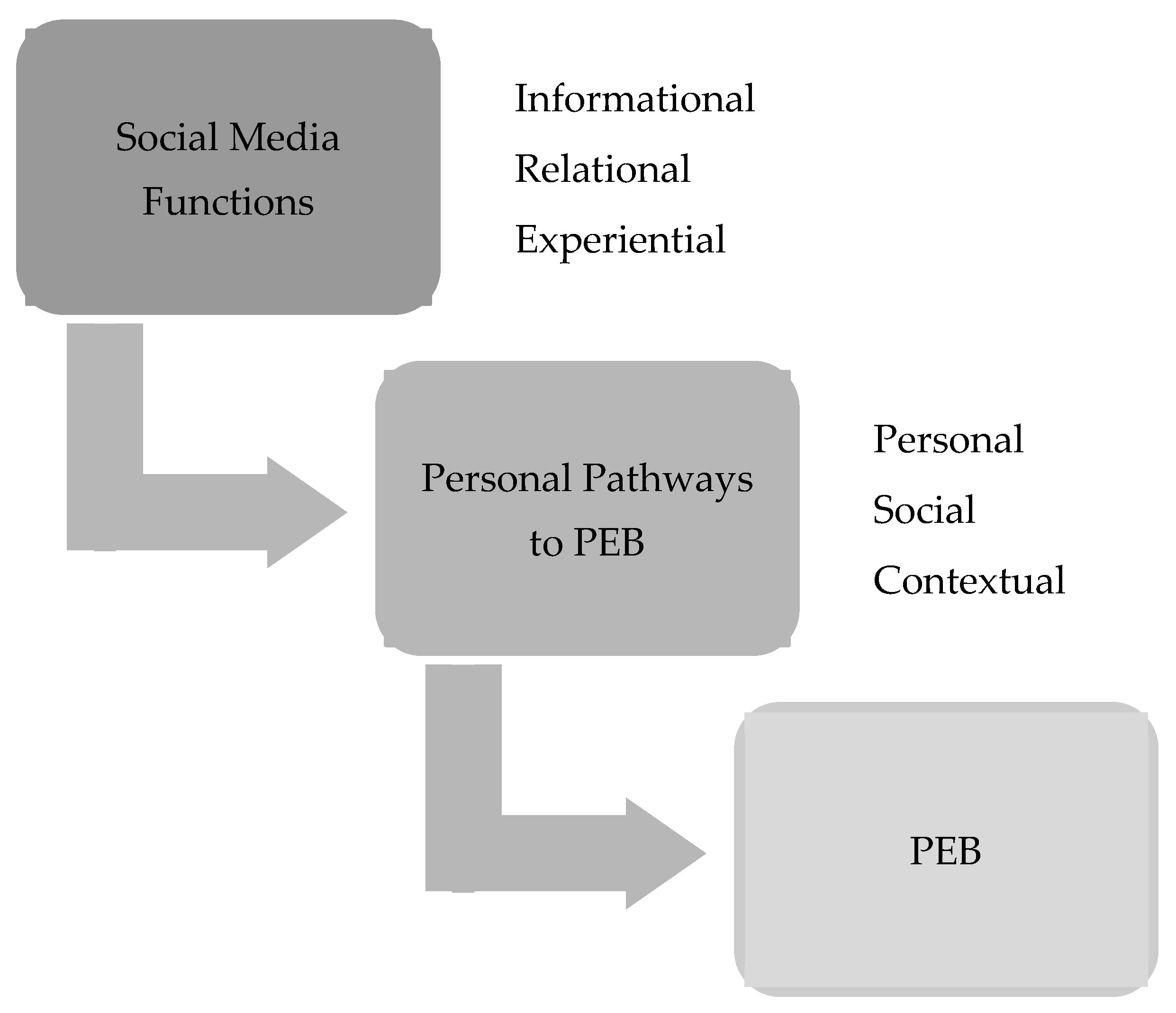
Figure 2.
An example of a typical user post on the NCNPF.
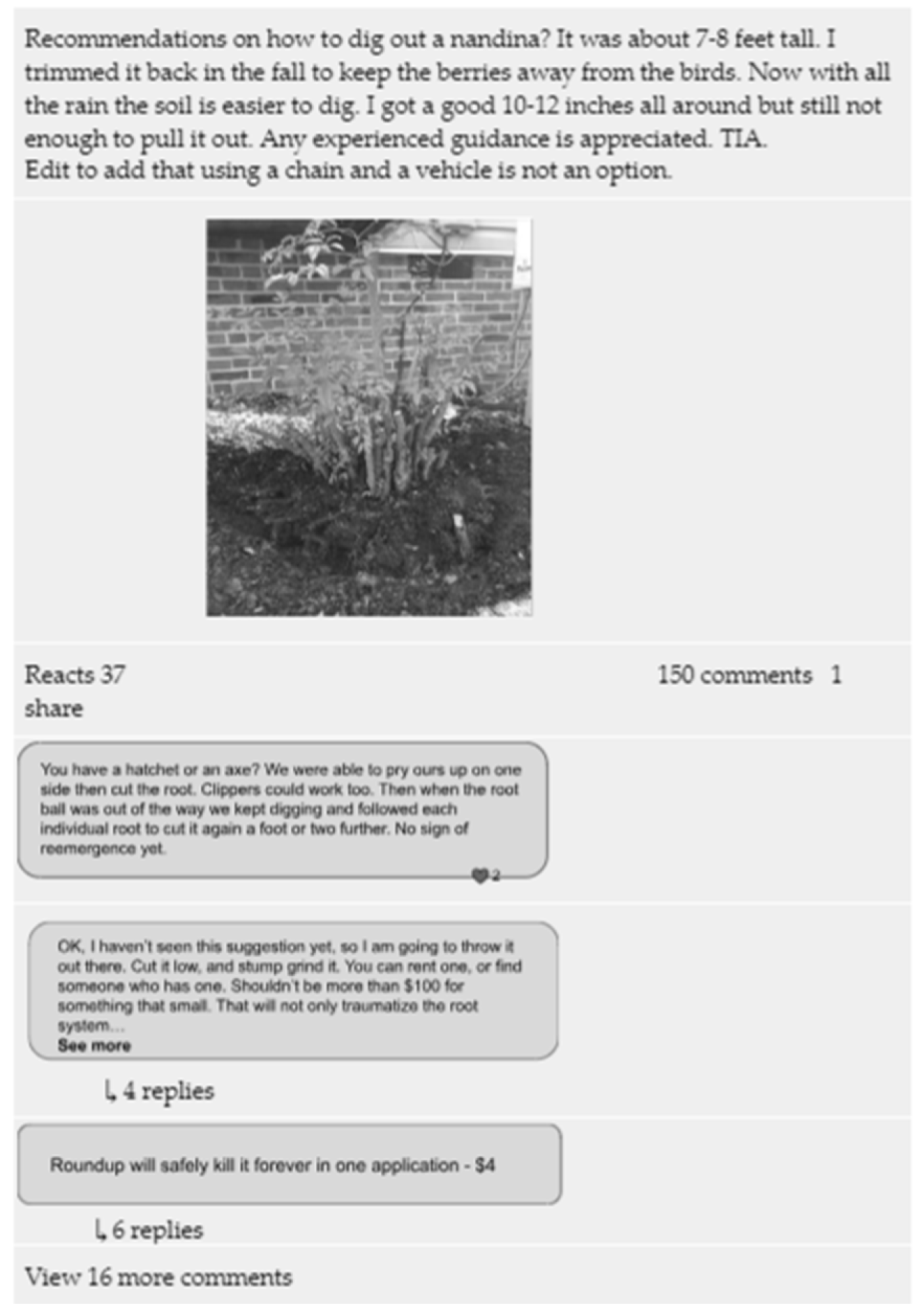
Figure 3.
Post categories in the NCNPF.
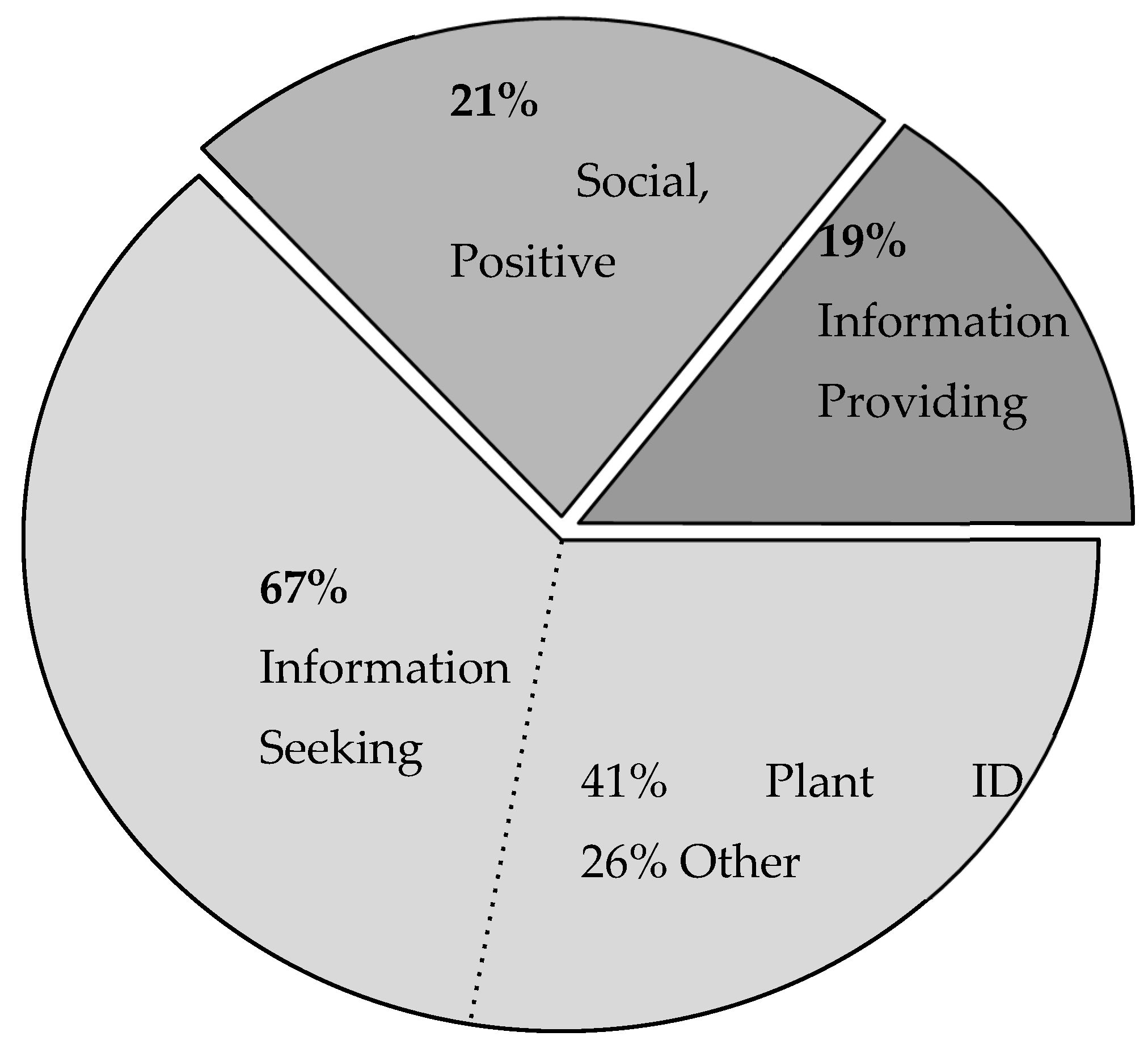
Figure 4.
User post demonstrating PEBs.
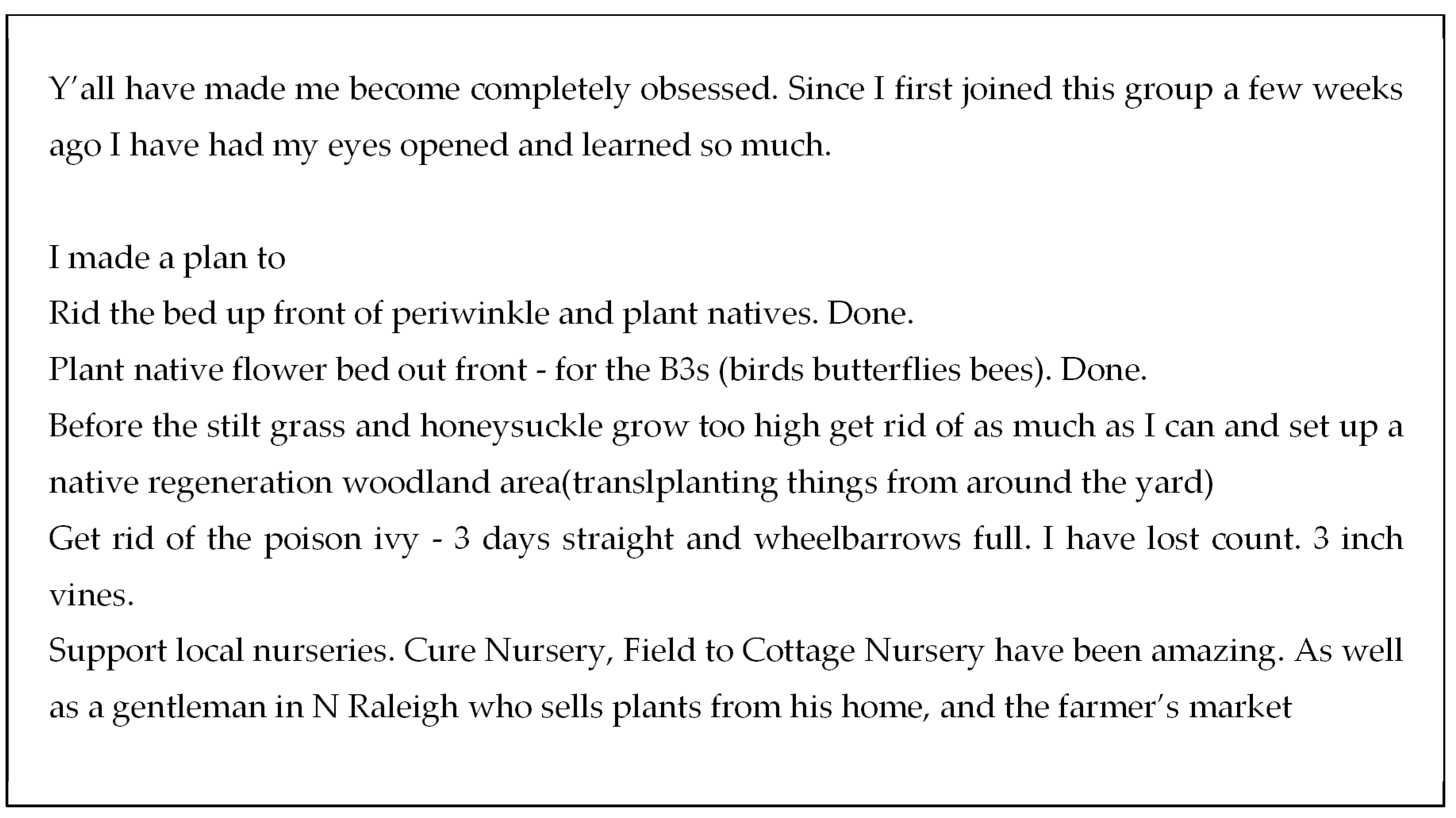
Figure 5.
Applying the TPAM model to the NCNPF.
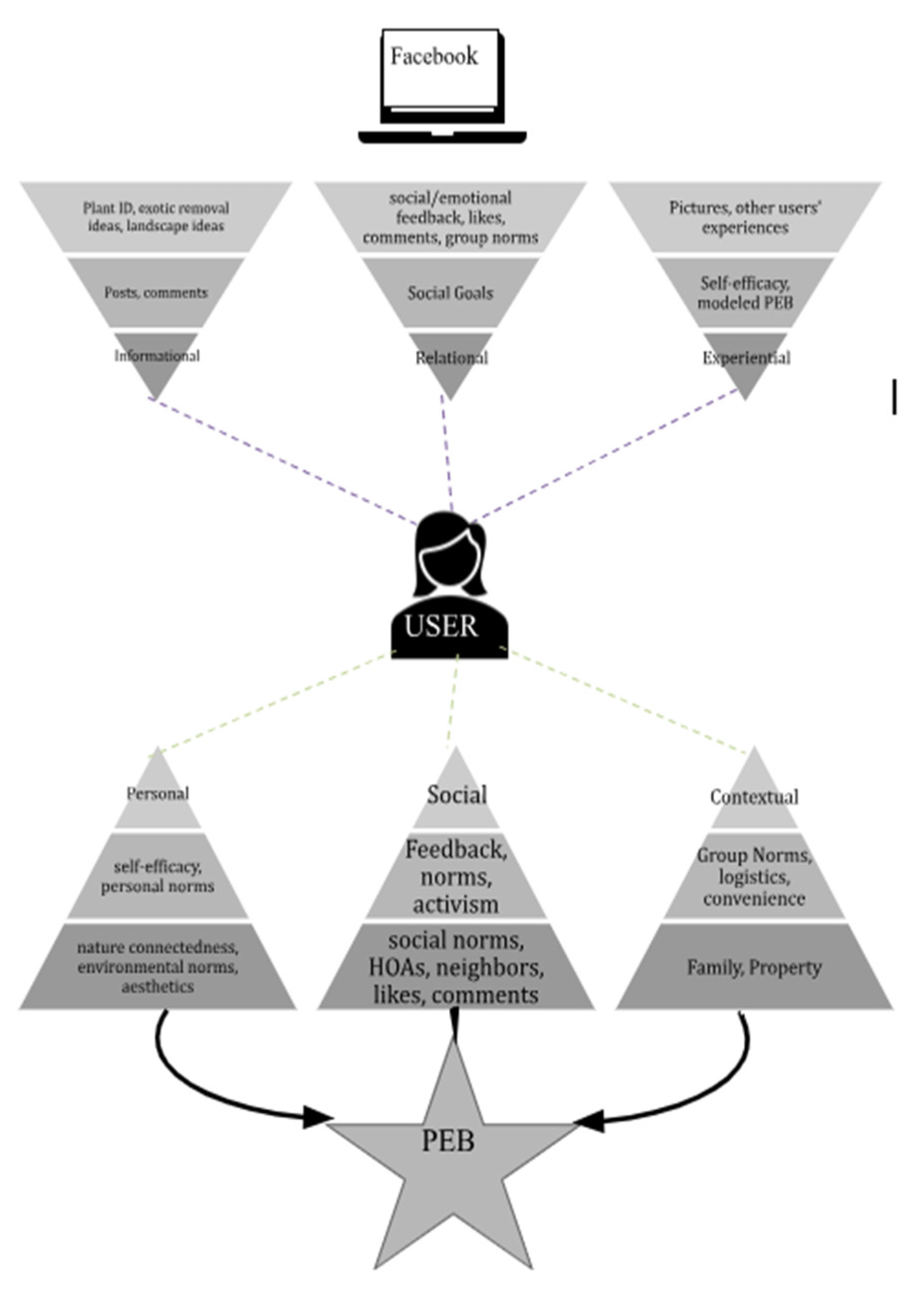

Table 1.
A Description of Emergent Categories.
| Precursor | Values | Inspiration | Social/Emotional Feedback | Raised Confidence | |
|---|---|---|---|---|---|
| Description | An event, attitude, or behavior that precedes the PEB. This includes PEI, family gardening, property purchase and related interests | Personally held beliefs that contribute to PEI and PEB, including wildlife, hope, and aesthetics | An event, book, photo, website, or person who triggers PEI. In this study, a state extension agent was often mentioned as an inspiration for native planting. | Verbal, in-person, or virtual feedback (can be in the form of Facebook likes and comments on the PEB or experienced feelings like guilt or joy. | an increase in an individual’s belief that they can accomplish a PEB. Often comes from experience, experiences of others, modeled behavior, and learning. |
| Connections | Personal and contextual pathways lead to PEB | Social and personal pathways to PEB | Social and Personal pathways to PEB | Social pathway to PEBs. | Personal, social, and contextual pathways lead to more PEB. |
Disclaimer/Publisher’s Note: The statements, opinions and data contained in all publications are solely those of the individual author(s) and contributor(s) and not of MDPI and/or the editor(s). MDPI and/or the editor(s) disclaim responsibility for any injury to people or property resulting from any ideas, methods, instructions or products referred to in the content. |
© 2024 by the authors. Licensee MDPI, Basel, Switzerland. This article is an open access article distributed under the terms and conditions of the Creative Commons Attribution (CC BY) license (http://creativecommons.org/licenses/by/4.0/).
Copyright: This open access article is published under a Creative Commons CC BY 4.0 license, which permit the free download, distribution, and reuse, provided that the author and preprint are cited in any reuse.


