

Submitted:
23 May 2024
Posted:
24 May 2024
You are already at the latest version
Abstract
Literature indicates scarcity of cross-national research on the association between physical fighting and bullying victimisation among adolescents, and the moderating role of perceived social support and education spending on this association. Using multilevel binary logistic regression, this study examined the association of physical fighting with traditional bullying and cyberbullying victimisation, with public education spending and perceived social support from families and teachers as moderators. Country-level data were combined with 2017/18 Health Behaviour in School-aged Children (HBSC) survey data from 162,792 adolescents (11-, 13- and 15-year-olds) in 27 European countries. Results showed that physical fighting was positively and significantly associated with cyberbullying and traditional bullying victimisation. These results signify that physical fighting is a robust predictor of bullying victimisation. The findings demonstrate that perceived social support and education spending buffered the association of physical fighting with traditional bullying and cyberbullying victimisation. The findings imply that social support not only prevents adolescents from engaging in physical fights, but also reduces the risk of bullying victimisation. Accordingly, to deter adolescents from engaging in physical violence and reduce the risk of bullying victimisation, there is need to fully comprehend the influence of physical fighting on bullying victimisation, and the moderating role of social support.
Keywords:
Cyberbullying
; Perceived social support
; Physical fighting
; Education spending
; Traditional bullying
; Victimisation
1. Introduction
Bullying victimisation is defined and operationalized differently by scholars. However, three elements that reoccur are repetition, harm, and unequal power [1,2]. The term “traditional bullying victimization” in this study is defined as repeated aggression and intentional harm or disturbance experienced by the less powerful person or group through negative verbal or psychological, physical and relational actions perpetrated by a more powerful person or group [3,4,5]. With recent innovations in technologies, cyberbullying victimisation has become so prevalent resulting from the intense and frequent use of internet, social media and other digital platforms by adolescents across countries [6,7,8]. Cyberbullying victimisation is defined as “exposure to diverse types of repeated aggression and harm (i.e., psychological and relational harm) through electronic media, including rumors or gossips sent via e-mails, hurtful text messages, unpleasant photos or videos posted/disseminated on social media platforms, and exclusion from online communities or social networks” [6] (pp. 457-458). Bullying victimisation is a serious public health and social concern that is not only associated with adverse consequences for children, but also the health and economic costs for nations across the globe [2,9]. Previous studies have shown that bullying victimisation is strongly associated with mental health outcomes, such as depression and anxiety [10,11,12]. Bullying victimisation is also associated with health risk behaviours, including physical fighting and alcohol use [13,14], school absenteeism and poor academic performance [15,16]. Evidence suggests that estimates of prevalence ranged from 22.4% in Peru to 44.6% in Dominican Republic in the Americas; 29.6% in Saudi Arabia to 42.2% in Morocco in Eastern Mediterranean; 9.3% in South Korea to 64.8% in the Philippines in Southeast Asian and Pacific region; and 12.2% in the Netherlands to 36.2% in the Russian Republic in Europe, suggesting rates of traditional bullying and cyberbullying victimisation are high globally [17].
The microsystem of the social-ecological model postulates that adolescents’ experiences of peer bullying victimisation are influenced by risky lifestyle factors (such as physical violence) within the family, peer, school and community contexts [9,18,19]. Consistent with the social-ecological framework (Bronfenbrenner, 1979; Hong et al., 2014). Consistent with the social-ecological theoretical perspective (Bronfenbrenner, 1979; Hong et al., 2014), prior research has shown that violent behaviours (such as physical fights) are associated with victimisation by traditional bullying and cyberbullying [22,23,24]. Specifically, previous studies have indicated that physical fighting is a peer risky lifestyle factor (i.e., situational-level risk factors) for bullying victimisation [16,25]. So, adolescents who are more involved in physical fighting are more likely to be victims of bullying [16,25,26]. One possible explanation for the association of physical fighting with bullying victimisation is that poor peer relationships (such as unhealthy and weak peer relationships) might lead to adolescents’ involvement in physical fights which may also increase the risk of bullying victimisation [27]. Literature also suggests that higher rates of physical fighting are associated with higher odds of victimisation because adolescents might not have social skills needed to build and sustain relationships with other peers [28]. Besides, research offers an explanation that adolescents who are exposed to physical attacks are more likely to be involved in physical fighting and be at higher risk of bullying victimisation since adolescents might resort to using their social skills and strategies to cope with aggressive behaviours [16,24,29]. Furthermore, evidence suggests that aggressive behaviors may be more prevalent in more hierarchical social contexts as the desire for power and dominance is a central motivating factor that fuels bullying behaviors [30,31]. It is also plausible that friends with greater normative beliefs about aggression and violent behaviours (i.e., adolescents with positive attitudes towards violence and aggression, or group norms that promote physical violence as way of resolving disputes) maybe more likely to encourage other adolescents to be involved in violent and aggressive behaviours, such as physical fighting and bullying victimisation (Burton et al., 2013; Lim & Ang, 2009). However, reviewed literature indicates that far less cross-national research [26,34,35] has focused on the association between physical fighting and victimisation by traditional bullying and cyberbullying. Most of the previous studies that have tested the influence of physical fighting on bullying victimisation used single-country studies as opposed to multilevel cross-national analyses [16,23,24,25]. Moreover, there is a paucity of cross-national studies that used the 2017/18 Health Behaviour School-aged Children (HBSC) data to examine the association between physical fighting and bullying victimisation in Europe [26]. Therefore, the present study sought to employ multilevel cross-national study to examine how physical fighting is associated with both forms of bullying victimisation in 27 European countries.
The social-ecological model posits that different dimensions of contextual-level protective factors (such as perceived family and teacher social support) moderate the association between physical health risk behaviours (e.g., physical violence) and bullying victimisation risk among adolescents in societies [36,37]. Existing studies have employed the microsystem of the social-ecological model on multidimensional perceived social support to examine the association of health risk behaviours and bullying victimisation [21,38,39]. Perceived social support refers to the extent to which individuals believe that they can receive support (i.e.., information, assistance and resources) from different sources in their social environment (i.e., families, peers or friends and teachers, particularly when they need help), leading them to believe that they are cared for, esteemed or valued, loved and belong to a large social network with mutual obligation [40]. Social support involves instrumental support (e.g., material assistance or financial aid), informational support (e.g., knowledge and skills), emotional support (e.g., empathy, caring, reassurance or encouragement, and trust) and appraisal social support (e.g., evaluative feedback or information) [41,42]. Prior research has indicated that family social support appears to offer substantial protection for adolescents from the risks of involving in delinquent lifestyles (such as physical fighting) and subsequent risk of bullying victimisation by physical violence [54,55]. Adolescents who report high family social support are less likely to engage in physical violence [54,55,56] and alcohol use [21,54,56], and thus be at lower risk of being victimised by cyberbullying [18] and traditional bullying [21]. Extant literature provides explanations for the eventuating effects of family support in the associations between adolescent risky lifestyle behaviours and bullying victimisation suggesting that not only do family members provide material and financial assistance, but also emotional and informational support that enables adolescents to become resilient and cope with experiences of problems associated with aggressive and violent victimisation, such as offline and cybervictimization [57,58]. Additionally, evidence indicates that high levels of family social support, such as parental monitoring of adolescents, positive parental involvement in socialising children, parenting styles, sibling support, positive adolescent-parent relations and effective communication are associated with reduced odds of bullying victimisation [18,21,59,60,61]. Despite that many single-country studies have examined the association between physical fighting and bullying victimisation, there is a dearth of multilevel cross-national studies that have tested the attenuating effects of family social support on the association between physical fighting and victimisation by cyberbullying and traditional bullying in adolescents by using a large sample from the 2017/18 Health Behaviour in School-aged Children (HBSC) across-national level. Therefore, this study aimed to examine the moderating effects of family social support in such associations across 27 countries in Europe.
Previous studies also suggest that high perception of teacher social support decreases the frequency and intensity of school physical violence (i.e., decreased rates of adolescents’ involvement in physical fights) and reduces the risk of bullying victimisation [62,63,64]. It is possible that teachers who possess the necessary knowledge, confidence, adequate skills and negative attitudes towards school violence and bullying (i.e., actively stand against aggression), are more likely to appropriately intervene [65,66,67,68]. Teacher support through direct intervention (such as teachers’ actions, including stopping aggression, protecting the victims, punishing and holding the aggressors accountable) leads to decreased rates of physical fighting and reduced risks of bullying victimisation [69,70,71]. Consequently, effective ways of intervening in bullying and physical fighting, and teacher use of appropriate practices may lead to strong social bonds and trust in teachers. Moreover, students who feel protected by teachers (i.e., cared for and accepted by teachers) are more likely to seek help as they believe teachers are helpful and will take action (i.e., effectively deal with conflict) once they report physical fighting and adolescent bullying victimisation [62,70,72,73]. Although previous studies have affirmed the attenuating effects of teacher social support on association between physical health risk behaviours (e.g., physical fights) and bullying victimisation, most of these studies were single-country analyses as opposed to multilevel cross-national analyses [74,75,76]. Thus, until now, less cross-national research has used the Health Behaviour in School-aged Children (HBSC) data to examine the moderating effects of perceived teacher social support on association between physical fighting and victimisation by both traditional and cyberbullying across countries in Europe. Therefore, the present study sought to use the 2017/18 HBSC data to examine attenuating effects of perceived teacher social support on the main effect of physical fighting on the two forms of bullying victimisation across 27 European countries.
The Social support theory postulates that higher levels of macro-level social support (e.g., public spending on education) are associated with lower rates of victimisation among individuals [46,77]. Consistent with social support theory, research indicates that country-level social support (e.g., percent of GDP spent on public education) offers instrumental and expressive social support that acts as a buffer to prevent individuals from engaging in criminal acts and protect people from any forms of victimisation [46,78]. Thus, contexts or societies with adequate resources for preventing and addressing aggression, violence and criminal offending are more likely to have lower rates of crime and victimisation [68]. Extant literature suggests that societies which provide adequate access to resources (such as education, health care and social welfare services) have been found to have resources at their disposal to address deviant behaviours and victimisation [66]. Consequently, supportive and well organised countries (politically, economically, socially, and culturally) are more likely to have lower rates of victimisation compared to socially disorganized and less supportive societies [42]. It is likely that societies promote and embrace shared values and beliefs that foster mutual trust, reciprocity, social cohesion and social support for everyone, as well as promote social control for aggressive behaviours and attitudes towards criminal offending and victimisation of others. Additionally, literature indicates that higher levels of social support may increase family efficacy and promote better parenting styles or practices [80,81].
However, until now, literature indicates a dearth of cross-national studies that have examined how public education expenditure (i.e., the proxy indicator of country-level social support) moderates the links between physical fighting and victimisation by traditional bullying and cyberbullying at cross-national context. Besides, the extent to which public education expenditure moderates the association of physical fighting with traditional bullying and cyberbullying victimisation across countries in not yet clarified. Thus, this study is important as it does not only offer an explanation of the buffering effects of country-level social support (i.e., education spending) on these associations, but also provides information and empirical evidence that can inform school bullying prevention and intervention strategies, as well as societal-level interventions that would address school violence among adolescents across European countries. Accordingly, multilevel cross-national research is needed to employ the social-ecological model to expansively examine the moderating effects of proxy indicator of macro-level social support (i.e., public education expenditure) on the associations of physical fighting with victimisation by traditional bullying and cyberbullying using data from the 2014 and 2018 Health Behavior in School-aged Children (HBSC) survey combined with country level data from 27 countries (particularly countries in Western and Eastern European cultures). Thus, the current study examines the buffering effects of public education expenditure on the associations of physical fighting with traditional bullying and cyberbullying victimisation using data from the Health Behavior in School-aged Children (HBSC) from 27 Western and Eastern European countries to fill the research gap. Prior cross-national studies have demonstrated the importance of proxy measures of macro-level social support (e.g., education spending) for promoting and enhancing intellectual and social development, especially among children [82,83]. Furthermore, empirical research has confirmed that educational support measures promote shared values and beliefs that foster social cohesion, as well as promote social control for aggressive behaviours and attitudes towards offending and victimisation of others [42]. Besides, education-related support measures are essential for helping youth build social, emotional, and academic skills, as well as for developing interpersonal and coping skills, and maintaining connection to the community [46,84].
2. The Current Study
To date, reviewed literature indicates that a handful of cross-national studies have focused on physical health risk behaviours l(e.g., physical fighting) and bullying victimisation among adolescents [26,34,35,85]. Most often, cross-national studies have paid little to no attention to how physical fighting influences traditional bulllying and cyberbullying vimctimisation across European countries. To that effect, very little is known about how physical fighting predicts both forms of bullying victimisation across-national context. Furthermore, prior research suggests that individuals who receive high levels of social support are less likely to engage in risky lifestyle behaviours (e.g., physical fights) and be at lower risk of victimisation, compared with those who receive low levels of social support [34,86,87,88]. However, literature suggests that the influence of social support on rates of victimisation is to a certain degree is contingent on the form or facet of social support and how it interacts with risk factors to affect rates of victimisation [78]. Accordingly, it is not largely known how each form of perceived social support (i.e., family and teacher social support) moderates the association of physical fighting with traditional bullying and cyberbullying victimisation across European countries. Moreover, to date, it is not yet well known how public education spending (i.e., proxy country-level social support) moderates the association of physical fighting with traditional bullying and cyberbullying victimisation at cross-national level. This leads to a question of whether perceived social support and public education spending buffer the effects of physical fighting on traditional bullying and cyberbullying victimisation in 27 European countries (i.e., Albania, Austria, Belgium, Bulgaria, Czech Republic, Germany, Estonia, Spain, France, Croatia, Hungary, Ireland, Israel, Iceland, Italy, Luxembourg, Moldova, Malta, Netherlands, Portugal, Romania, Russia, Ukraine, Sweden, Slovenia, Slovakia, and the United Kingdom). Consequently, the present study examines the association between physical fighting and victimisation by traditional bullying and cyberbullying among adolescents, and the moderating roles of perceived social support and education spending in these associations 27 countries in Europe. It was hypothesized that physical fighting influences traditional bullying and cyberbullying victimisation among adolescents at cross-national level. Besides, it was predicted that perceived social support would moderate the association between physical fighting and victimisation by traditional bullying and cyberbullying.
3. Materials and Methods
3.1. Data Sources and Study Design
The present study combined country data with the 2017/18 Health Behaviour in School-aged Children (HBSC) Survey data. Self-Report HBSC data were collected from nationally representative samples of 11-, 13- and 15-year-old adolescents using a standardised research protocol in 47 European and North American countries [79]. Cluster sampling was used to select adolescents from school classes or whole school in each country. Each HBSC participating country subjected the survey procedures and standardised self-report questionnaires to research ethics review. The analytic sample was based on 162792 adolescents (80181: 49.3% boys and 82611: 50.7% girls; mean age of 13.49 years; standard deviation = 1.62) from 27 countries. The study includes only HBSC data from 27 countries that had complete cases regarding key variables on physical fighting, perceived social support, traditional bullying and cyberbullying victimisation, as well as education spending (i.e., proxy country-level social support) and gross domestic product (GDP) per capita. A multilevel quantitative cross-national research approach was used to examine individual- and country-level data [91,92].
3.2. Measures
3.2.1. Dependent Variables
Traditional bullying victimisation was measured on a 5-point Likert scale using a single item [79]. The adolescents were asked, “How often have you been bullied at school in the past couple of months?” The responses to the item ranged from 1 = “I have not been bullied at school in the past couple of months,” 2 = “It has only happened once or twice,” 3 = “2 or 3 times a month,” 4 = “About once a week,” and 5 = “Several times a week. The responses 1 and 2 were scored as 0 (not been bullied) and the responses 3 to 5 were recoded as 1 (been bullied) in line with previous studies [9,93,94]. Cyberbullying victimisation was measured using a single item on a 5-point Likert scale [79]. The adolescents were asked: “How often have you been cyberbullied (i.e., someone sent mean instant messages, email or text messages about you; wall postings; created a website making fun of you; posted unflattering or inappropriate pictures of you online without permission or shared them with others in the past couple of months)?” The responses ranged from 1 = “Haven’t,” 2 = “once or twice,” 3 = “2 or 3 times per month,” 4 = “once a week,” and 5 = “several times a week.” In line with previous studies [94,95,96]. the responses 1 and 2 were recoded as 0 (not been cyberbullied) and the responses 3 to 5 were scored as 1 (been cyberbullied).
3.2.2. Individual-Level Independent Variable(s)
Physical fighting was measured using a single item based on a 5-point Likert scale. The adolescents were asked: “During the past 12 months, how many times were you in a physical fight?” The responses ranged from 1 = “none” to 5 = “four times or more” [79]. The responses were dichotomised [26,97], resulting in a dummy variable (0 = “not involved in physical fighting,” 1 = “involved in physical fighting”).
3.2.3. Perceived Social Support
Family social support was measured as subscales of the Multidimensional Scale of Perceived Social Support [79]. Four items (my family really tries to help me; get the emotional help and support I need from my family; I can talk about my problems with my family; and my family is willing to help me make decisions; α = 0.94) were used to assess family social support. All the four items were measured on a 7-point Likert scale, with response choices ranging from: “1 = Very strongly disagree” to “7 = Very strongly agree.” In the present study, values from the 4 items were computed to obtain a composite score, with low scores indicating low social support and high scores denoting high social support. Teacher social support was measured by three-items (I feel that my teachers accept me as I am; I feel that my teachers care about me as a person; and I feel a lot of trust in my teachers; α = 0.83). The response options were captured on a 5-point Likert scale as follows: “5 = Strongly agree, 4 = Agree, 3 = Neither agree nor disagree, 2 = Disagree, and 1 = Strongly disagree.” In the present study, the response options were reverse coded (i.e., changed from positively ordered to negatively ordered pattern) and ranged from: “1 = Strongly disagree, 2 = Disagree, 3 = Neither agree nor disagree, 4 = Agree, and 5 = Strongly agree” (i.e., 1 = low social support to 5 = high social support). Then, all the values from the 3 items were computed to obtain a composite score, with low scores indicating low social support and high scores indicating high social support. The scales have been validated and used to conduct research using various samples involving adolescents [90,98].
3.2.4. Individual-Level Control Variables
Gender variable was measured as a dummy variable (0 = male, 1 = female) based 2017-18 HBSC scale [90,98]. Age was measured as a categorical variable (11-year-olds, 13-year-olds and 15-year-olds). Based on HBSC family affluence (FAS) scale [87], family affluence was assessed using six-items measuring family affluence (i.e., cars, computers, bedrooms, bathrooms, dishwashers and vacation/holiday). All the values from the 6 items were recoded and computed to obtain an index variable (sum score), with the high values indicating most affluent and low values indicating least affluent [99,100,101].
3.2.5. Country-Level Social Support
Public education spending was measured as a proxy country-level social support based on a proportion of the gross domestic product that each country invests in provision of public education [89,102,103]. The indicator is a proxy measure of macro-level social support since investment in education signifies measures of “decommodification” [93]. The data were obtained from OECD databases [94].
3.2.6. Country-Level Control Variable(s)
3.3. Statistical Analyses
The current study used SPSS version 29 to conduct all the statistical analyses. Taking into account the hierarchical clustering of adolescents within schools and nesting of schools across countries, three-level multilevel mixed-effects binary logistic regression models were estimated to examine the association between physical fighting and victimisation by traditional bullying and cyberbullying, and the moderating effects of perceived social support and public education spending on such associations [91,107,108]. The current study estimated six models for each outcome variable: a) Model 1 (empty or intercept-only model); b) Model 2 had individual-level predictors; c) Model 3 had individual-level predictors and covariates; d) Model 4 added family social support and interactions of family social support with physical fighting; e) Model 5 included teacher social support and interactions of teacher social support with physical fighting; f) Model 6 added public education spending, GDP per capita, and interactions of public education spending with physical fighting. The study specified school level in the regression models to account for a design effect of school cluster, although there were not any hypotheses tested at level-2 [26,92,109]. To examine the moderating effects of perceived social support and public education spending on the association between physical fighting and victimisation by traditional bullying and cyberbullying, the study employed SPSS PROCESS Macro 4.2 [99]. Simple slope analyses were also conducted to interpret the moderation effects.
4. Results
4.1. Descriptive Analyses of Sample Characteristics
Table 1 shows the descriptive statistics. The weighted frequency of traditional bullying victimisation was 28.8%, while the prevalence of cyberbullying victimisation was 16.9% for the whole sample.
4.2. Relationship between Physical Fighting and Victimisation by Traditional Bullying and Cyberbullying, and the Moderating Role of Perceived Social Support and public education spending in these Relationships
This study examined whether adolescents who engage in physical fighting are more likely to be victims of traditional bullying and cyberbullying, compared with those who do not engage in physical fights at cross-national levels, adjusting for covariates (i.e., age, family affluence and gender) as shown in Table 2 and Table 3 below. As can be seen in the null model in Table 2, the coefficients (β = 0.25, p < 0.001; β = 0.07, p < 0.001) indicated that the intercept variance varied between schools and countries, respectively. Thus, the results suggest a statistically significant variance in the probability of being victimised by traditional bullying among adolescents who engage in physical fighting across schools and countries. The intraclass correlation (ICC) indicated that around 3% of traditional bullying victimisation variance was explained across schools, whereas about 1% of traditional bullying victimisation variance was explained across countries (see null model 1 in Table 2). To that effect, the results suggest that about 3% and 1% of variability in traditional bullying victimisation lies between schools and countries, respectively. Additionally, the coefficients (β = 0.19, p < 0.001; β = 0.07, p < 0.001) in the null model in Table 3 indicated that the intercept variance varied across schools and countries, respectively. These results suggest a statistically significant variance in the probability of being victimised by cyberbullying among adolescents who engage in physical fighting. The ICC showed that about 2% of cyberbullying victimisation variance was explained across schools, whereas around 1% of cyberbullying victimisation variance was explained across countries (see null model 1 in Table 3). The results suggest that about 2% and 1% of variability in cyberbullying victimisation lies between schools and countries, respectively.
Model 2 in Table 2 showed that physical fighting had statistically significant positive effect on traditional bullying victimisation (OR = 2.48; 95% CI = 2.42-2.54; p < 0.001), controlling for the main effects of individual-level covariates (age category, gender and family affluence). These results suggest that physical fighting multiplies by 2.48 times the probability of being victimised by traditional bullying among adolescents who engage in physical fights compared to those who do not engage in physical fights. The results demonstrate that there is a greater risk of being bullied among adolescents in societies with higher of rates of physical fighting than those in societies with lower rates of physical fighting. Similarly, the results in Model 2 in Table 3 indicated that physical fighting was a positive and significant predictor of cyberbullying victimisation (OR = 3.28; 95% CI = 3.19-3.38; p < 0.001), adjusting for the effects of covariates. The results suggest that the odds ratio that adolescents who engage in physical fighting would be victimised by cyberbullying increased by 3.28 times, compared to those who did not engage in physical fighting. Broadly, these results suggest that adolescents who engage in physical fighting are more likely to be at high risk of cyberbullying victimisation, compared with those who do not engage in physical fighting.
Consistent with the study hypothesis, Models 3, 4 and 5 in Table 2 indicated that physical fighting remained a significant predictor of traditional bullying victimisation after the inclusion of a moderator and an interaction were added to the model (OR = 3.35; 95% CI = 3.20-3.52; p < 0.001); (OR = 3.00; 95% CI = 2.89-3.10; p < 0.001); and (OR = 2.43; 95% CI = 2.36-2.50; p < 0.001). Besides, the inclusion of a moderator and an interaction in the model revealed that the main effect of physical fighting on cyberbullying victimisation was still statistically significant (OR = 4.90; 95% CI = 4.65-5.17; p < 0.001); (OR = 3.85; 95% CI = 3.69-4.01; p < 0.001); and (OR = 3.12; 95% CI = 3.02-3.22; p < 0.001) as shown in Models 3, 4 and 5 in Table 3, confirming the study hypothesis.
In addition, this study aimed to examine whether family social support would moderate the association of physical fighting with victimisation by traditional bullying and cyberbullying. The results showed that family social support moderated the association of physical fighting with victimisation by traditional bullying (OR = 0.63; 95% CI = 0.59-0.66; p < 0.001) and cyberbullying (OR = 0.51; 95% CI = 0.48-0.54; p < 0.001) as shown in Table 2 and Table 3. As can be seen in Figure 1 and Figure 2 below, the slopes of the lines indicated that the association of physical fighting with victimisation by traditional bullying and cyberbullying was weaker for adolescents who reported more family social support (1 SD above the mean) compared to adolescents who reported less family social support (1 SD below the mean), confirming the research hypothesis. The top blue line representing adolescents with less family social support is much steeper than the bottom red line for those with more family social support, indicating the stronger effect of physical fighting on victimisation by traditional bullying and cyberbullying for adolescents with less family social support.
Additionally, the current study sought to examine how teacher social support moderates the association of physical fighting with victimisation by traditional bullying and cyberbullying among adolescents. The results indicated that the association of physical fighting with victimisation by traditional bullying (OR = 0.70; 95% CI = 0.67-0.73; p < 0.001) and cyberbullying (OR = 0.65; 95% CI = 0.61-0.68; p < 0.001) was moderated by teacher social support, as can be seen in Table 2 and Table 3. As shown in Figure 3 and Figure 4 below, the slopes of the lines showed that the relationship between physical fighting and victimisation by traditional bullying and cyberbullying was significantly weaker for adolescents with high teacher social support (1 SD above the mean) compared to adolescents with low social support from teachers (1 SD below the mean), supporting the research hypothesis. These results show that the top blue line for adolescents who reported lower teacher social support is much steeper than the bottom red line for those who reported higher teacher social support, indicating the stronger effect of physical fighting on cyberbullying victimisation for adolescents with lower teacher social support.
Furthermore, this study aimed to examine how public education spending would moderate the association of physical fighting with victimisation by traditional bullying and cyberbullying. The results in Table 3 showed that public education spending did not moderate the association between physical fighting cyberbullying victimisation (OR = 0.98; 95% CI = 0.92-1.05; p > 0.05). However, the results showed that public education spending moderated the association between physical fighting and traditional bullying victimisation (OR = 0.91; 95% CI = 0.87-0.97; p < 0.001), as shown in Table 2. As can be seen in Figure 5 below, the slopes of the lines indicated that the association of physical fighting with victimisation by traditional bullying and cyberbullying was weaker for adolescents in countries with more public education spending (1 SD above the mean) compared to adolescents in countries less public education spending (1 SD below the mean), supporting the study hypothesis. The top blue line representing adolescents in countries with less education spending is much steeper than the bottom red line for those in countries with more education spending, indicating the stronger effect of physical fighting on victimisation by traditional bullying and cyberbullying for adolescents with less public education spending.
5. Discussion
Using nationally representative samples of adolescents in 27 European countries, the present cross-national HBSC study examined how physical fighting influences victimisation by traditional bullying and cyberbullying. The findings showed that physical fighting was positively and significantly associated with traditional bullying and cyberbullying victimisation. In line with findings from existing research [111,112], the findings of this study suggest that the risk of being victimised by cyberbullying and traditional bullying increased with adolescents’ involvement in physical fights. These findings provide empirical support for the microsystem of the social-ecological model [76,113], suggesting that physical fighting is a situational-level risk factor that exposes adolescents to high risk of bullying victimisation. As posited by the social-ecological model, adolescents’ involvement in risky lifestyle behaviours (e.g., school violence) creates a context for peer victimisation within the social environments, such as the peer and school contexts [59,114]. Consistent with the research hypothesis, the findings of the current study suggest that adolescents who are exposed to physical attacks are more likely to be involved in physical fighting and be at higher risk of of traditional bullying and cyberbullying victimisation, compared to those who do not engage in physical fights. As suggested by Cho [104], adolescents who frequently engage in physical fighting would be more likely to be at high risk of bullying victimisation because they would be exposed to perpetrators of violence within their peer group and rival peer groups in the absence of adults to protect adolescents against risks of victimisation. Moreover, it is likely that delinquent peers with greater normative beliefs about aggression and violence (i.e., adolescents with positive attitudes towards violence and aggression, or group norms that promote physical violence as way of resolving disputes) may be more likely to encourage other adolescents to be involved in physical fights and bullying [32,33].
Taken together, the present study demonstrates that higher rates of physical fighting are associated with greater odds of traditional bullying and cyberbullying victimisation across 27 European countries. These findings are supported by findings from prior research [105] suggesting that higher rates of violence (e.g., physical fights) and aggression (e.g., bullying) are associated with greater probabilities of victimisation in societies (e.g., Eastern European countries, including Russia and Ukraine) with high levels of power distance and hierarchy (i.e., high use of coercion, authoritarian attitudes, low levels of interpersonal trust and cooperation). It is likely that adolescent violent and aggressive behaviors are more prevalent in more hierarchical social contexts since the desire for power and dominance is a central motivating factor that fuels violent and aggressive behaviors [30,31]. As Chaux and associates [106] contend, adolescents who live in societies in which violence is usually justified as a rightful way to actualize socio-economic and political goals, are more likely to engage in violence and be at high risk of victimisation. Children in contexts of higher levels of political and community violence might learn such belief and apply it to their own relationships, resulting in higher levels of violence and aggression, such as bullying in society [117,118]. Another possible explanation is that the inequality of opportunity in cultures characterized by power distance and hierarchy may lead to feelings of frustration from those with less power, and as a result, this may lead to higher levels of aggression and competitions for power and social dominance [116,119].
The present study examined whether each type of perceived social support (i.e., family and teacher support) moderates the association between physical fighting and victimisation by traditional bullying and cyberbullying among adolescents across 27 European countries. Supporting the research hypothesis, the findings showed that higher perceived family social support significantly attenuated the association between physical fighting and victimisation by traditional bullying and cyberbullying. Accordingly, the findings demonstrate that the influence of physical fighting on both forms of bullying victimisation was weaker for adolescents who reported high family social support compared to adolescents who reported low family social support. Consistent with findings from previous studies on moderating role of family social support [54,56], the present findings show that perceived family social support was associated with decreased rates of physical fighting which in turn led to reduced odds of bullying victimisation among adolescents. These findings provide support for the social-ecological model [21,37] indicating that family environments rich with social support (i.e., support from guardians and siblings) appear to serve as a significant buffer for adolescents against exposure to physical violence (i.e., physical fights) and bullying victimisation. In line with findings from a recent study [109], the current findings suggest that family social support is considered as a fundamental protective factor for adolescents against experiences of school violence and bullying victimisation. Compared to peer and teacher support, family social support offers substantial support because it can provide protection for adolescents against risky lifestyle behaviours and stressful experiences, including physical violence and bullying victimisation across several contexts and divergent adolescent health outcomes during adolescence [120,121,122]. Furthermore, adolescents spend their time in family environments with parents or guardians and other family members who have potential to provide appropriate support for the divergent needs of adolescents [121,123,124].
Overall, consistent with the study hypothesis, this study found that adolescents who report high family social support are less likely to engage in physical fighting and thus be at lower risk of victimisation by both traditional and cyberbullying. These findings suggest that high family social support reduces the probability of physical fighting, which in turn reduces the odds of bullying victimisation among adolescents. In congruent with findings from prior research [7], the current findings indicate that high social support from all family members (such as caregivers and siblings) reduces the susceptibility of adolescents to bullying victimisation by preventing adolescents from engaging in physical violence. It is likely that higher levels of family monitoring of adolescents’ lifestyles (e.g., involvement in physical fights) and their whereabouts, timely discipline and family guidance for adolescents provided by family support would buffer adolescents against adverse experiences and enhance their well-being [7]. Besides, family cohesion and connectedness through supportive members, strong bonds or warm parental-child relationships and mutual trust tend to enhance family support in buffering against exposure to risky situations (such as physical fighting) and victmisation [121,125,126]. Moreover, it is possible that warm and supportive family relationships enable adolescents to confide in their family members (e.g., parents and siblings) and discuss with them their experiences of school violence and aggressive behaviours, and subsequently their families provide guidance on to how to deal with physical fighting and bullying victimisation [57,123]. Adolescents with high levels of family support (sufficient and appropriate parental monitoring, and positive family relationships) may feel loved, cared for and protected and might be more likely to report physical violence and bullying or seek help from families when they experience bullying victimisation [116].
Consistent with findings from existing research [51], the current findings showed that teacher social support was a substantial protective factor for physical fighting and victimisation by cyberbullying and traditional bullying. These findings suggest that social support from teachers offered adolescents significant protection from the detrimental influences of physical fighting on traditional bullying and cyberbullying victimisation. It is likely that teachers play an important role in building positive and supportive relationships with students to deal with school violence and bullying [62,63,128]. Thus, adolescents who perceive positive and caring relationships with teachers and feel trust in teachers and more teacher support are more likely to report bullying and school violence (i.e., physical fights) to teachers, compared to those who perceive distrust in teachers and low teacher support [129,130]. For this reason, students who feel protected by teachers (i.e., cared for and accepted by teachers) are more likely to seek help as they believe teachers are helpful and will take action (i.e., effectively deal with conflict) once they report physical fighting and adolescent bullying [62,70,72]. The current findings are consistent with the microsystem of the socio-ecological framework [131,132], wherein teacher social support within the school environment plays an important influence on adolescent violent behaviors and bullying experiences. It is possible that victims of bullying will feel helpless or lack the ability to deal with the situation, and are therefore at higher risk of exposure to physical fights and bullying victimisation [64,133]. To that effect, teachers are the most likely people to support them to handle school violence and bullying situations in schools [53].
Supporting the study hypothesis, the study found that adolescents who reported high teacher social support were less likely to engage in physical fights as well as be less likely to be victims of cyberbullying and traditional bullying, compared with those who reported low social support. These findings suggest that high teacher social support prevents adolescents from engaging in physical fights which in turn leads to decreased risks of cyberbullying and traditional bullying victimisation. In line with findings from previous research [51], the findings of the present study confirm the role of teacher support in intervention and prevention of school violence and bullying within the microsystem of the social-ecological context (i.e., school context). As echoed by Stankovic and colleagues [52], high perception of teacher social support decreases the frequency and intensity of school physical violence (i.e., decreased rates of adolescents’ involvement in physical fights) and reduces the risk of bullying victimisation. Teachers’ responses that are perceived by students as disapproving physical violence and bullying behaviours demonstrate to students that teachers are interested in dealing with aggression and caring for students’ wellbeing [73,134]. So, effective ways of intervening in bullying and physical fighting, and teacher use of appropriate practices may lead to strong social bonds and trust in teachers and reduced odds of bullying [59]. It is likely that teachers who possess the necessary knowledge, confidence, adequate skills and negative attitudes towards school violence and bullying (i.e., actively stand against aggression), are more likely to appropriately intervene [65,66,68]. Besides, teachers who perceive physical fights and bullying as serious issues are more likely to intervene in school violence and bullying situations [60]. Accordingly, teacher support through direct intervention (such as teachers’ actions, including stopping aggression, protecting the victims, punishing and holding the aggressors accountable) might lead to decreased rates of physical fighting and reduced risks of bullying victimisation [63,69,135].
The study also examined whether public education spending (i.e., proxy country-level social support) would moderate the association of physical fighting with traditional bullying and cyberbullying victimisation across countries. Inconsistent with the research hypothesis, education spending did not moderate the association between physical fighting and cyberbullying victimisation. However, supporting the study hypothesis, the findings indicated that education spending moderated the influence of physical fighting on traditional bullying and cyberbullying victimisation. These findings suggested that the effect of physical fighting on traditional bullying victimisation is weaker for adolescents in countries with high education expenditure than those in countries with low education expenditure. These findings are consistent with findings from previous studies suggesting that high levels of country-level social support (such as substantial public expenditures on education) are associated with reduced rates of individual’s involvement in deviant acts and decreased odds of victimisation [26,46,79]. One potential explanation is that social support would lower the rates of deviant acts and victimisation by mitigating the effects of risk factors on deviant acts and victimisation [42]. It is also plausible that social investment in education would not only create opportunities for adolescents to be enlightened on risks of engaging in delinquent activities (such as physical fights) and being victimised, but also equip them with social skills to deal with risks of victimisation. Besides, it is possible that adequate social support through expenditure on education would help in devising intervention and preventative mechanisms that would help adolescents refrain from risky lifestyles victimisation, as well as address risks of victimisation [46,77]. Consequently, social support can serve as both a coping mechanism and preventative or protective strategy that would reduce the likelihood of victimisation in societies [42]. That is, social support can serve as a buffer to prevent individuals from engaging in unlawful acts and protect people from any forms of victimisation [46,77,78]. To that effect, contexts with adequate resources for preventing and addressing aggression, violence and other misbehaviour are more likely to have lower rates of deviant behaviours and victimisation [68]. Another possible explanation is that social support (e.g., through educational programmes) in schools and societies at large might promote and embrace shared values and beliefs that foster mutual trust, reciprocity, social cohesion and social support for everyone, as well as promote social control for aggressive behaviours and attitudes towards deviant behaviours and victimisation of others [46,77].
5.1. Strengths and Limitations of the Study
The strengths of this study are based on examining country data and 2017/18 Health Behaviour in School-aged Children (HBSC) survey data, utilization of large nationally representative samples of adolescents, and conducting mixed-effects multilevel analyses by taking into account hierarchical clustering of adolescents in schools and nesting of schools across countries [80]. However, the study had the following limitations. First, the study did not provide any casual explanations as it relied on cross-sectional data from the 2017/18 Health Behaviour in School-aged Children (HBSC) survey [26,35]. Hence, future longitudinal studies might be beneficial to provide causal interpretations. Second, the HBSC surveys use self-reported measures which may not provide a clear picture about the nature and frequency of youth risky lifestyle behaviours, such as physical fighting [43]. Accordingly, future studies should also collect data using teacher- and parental-report questionnaires to provide a clear picture of the influence of physical violence on bullying victimisation, and the moderating role of social support in such relationships.
6. Conclusion
The findings of this study demonstrate that higher rates of physical fighting are associated with greater odds of cyberbullying and traditional bullying victimisation among adolescents across 27 European societies. Consequently, the findings signify that adolescents who frequently engage in physical fighting are more likely to be at high risk of traditional bullying and cyberbullying victimisation than peers who do not engage in physical fights. Furthermore, the findings underlie that perceived social support (i.e., i.e., support from families and teachers) and public education spending can play an important role in protecting adolescents against the association of physical fighting with traditional bullying and cyberbullying victimisation. Thus, understating the protective effects of social support on the main effect of physical fighting on bullying victimisation might help in devising bullying prevention and intervention strategies to protect adolescents against the detrimental influence of physical violence on peer bullying victimisation in adolescence.
Author Contributions
Conceptualisation, P.C., M.C., K.C.N., I.M.K., A.T.M. and B.N.; Methodology, P.C., M.C., K.C.N., I.M.K. and A.T.M.; Format Analysis, P.C., B.N. and A.T.M.; Writing-Original Draft Preparation, P.C., M.C. and K.C.N.; Writing-Review and Editing, P.C., M.C., K.C.N., I.M.K., A.T.M. and B.N.
Funding
This study did not receive any external funding. All research activities, including data collection, analysis, and publication, were supported solely by the resources available to the authors. No external grants or financial assistance were sought or obtained for this study.
Institutional Review Board Statement
This was a secondary study that relied on existing databases, specifically the Health Behaviour in School-Aged Children (HBSC) 2017-2018 dataset. Consequently, the study was not subjected to institutional ethical review, as it utilized publicly available data without involving new data collection from human subjects.
Data Availability Statement
The current study used the 2017/18 Health Behaviour in School-aged Children (HBSC) data which are available on request from the University of Bergen website: https://www.uib.no/en/hbscdata.
Acknowledgements
The authors wish to express their deepest appreciation to Atle Jastad (the Data Bank Manager, University of Bergen) for providing the 2017/18 HBSC dataset.
Conflicts of Interest
The authors declare no conflict of interest.
References
- Stassen Berger, K. Update on Bullying at School: Science Forgotten? Dev. Rev. 2007, 27, 90–126. [Google Scholar] [CrossRef]
- Wolke, D.; Lereya, S.T. Long-Term Effects of Bullying. Arch. Dis. Child. 2015, 100, 879–885. [Google Scholar] [CrossRef] [PubMed]
- Gladden, R.M.; Vivolo-Kantor, A.M.; Hamburger, M.E.; Lumpkin, C.D. Bullying Surveillance among Youths : Uniform Definitions for Public Health and Recommended Data Elements, Version 1.0. Centers for Disease Control and Prevention and the United States Department of Education: Atlanta, GA, 2014. https://stacks.cdc.gov/view/cdc/21596.
- Olweus, D. The Olweus Bully/Victim Questionnaire. Br. J. Educ. Psychol. J. Educ. Heal. 1993, No. January 1996, 0–12. [Google Scholar] [CrossRef]
- Olweus, D. The Revised Olweus Bully/Victim Questionnaire. University of Bergen: Bergen, 1996. [CrossRef]
- Lee, J.; Abell, N.; Holmes, J.L. Validation of Measures of Cyberbullying Perpetration and Victimization in Emerging Adulthood. Res. Soc. Work Pract. 2017, 27, 456–467. [Google Scholar] [CrossRef]
- Lee, J.; Roh, B.R.; Yang, K.E. Exploring the Association between Social Support and Patterns of Bullying Victimization among School-Aged Adolescents. Child. Youth Serv. Rev. 2022, 136, 106418. [Google Scholar] [CrossRef]
- Menesini, E.; Spiel, C. Introduction: Cyberbullying: Development, Consequences, Risk and Protective Factors. European Journal of Developmental Psychology. Taylor & Francis: Menesini, Ersilia: Department of Psychology, University of Florence, Via S. Salvi 12, Firenze, Italy, 50135, ersilia.menesini@unifi.it 2012, pp 163–167. [CrossRef]
- Hong, J.S.; Lee, J.; Espelage, D.L.; Hunter, S.C.; Patton, D.U.; Rivers, T. Understanding the Correlates of Face-to-Face and Cyberbullying Victimization among u.s. Adolescents: A Social-Ecological Analysis. Violence Vict. 2016, 31, 638–663. [Google Scholar] [CrossRef]
- Sampasa-Kanyinga, H.; Lalande, K.; Colman, I. Cyberbullying Victimisation and Internalising and Externalising Problems among Adolescents: The Moderating Role of Parent-Child Relationship and Child’s Sex. Epidemiol. Psychiatr. Sci. 2018. [Google Scholar] [CrossRef] [PubMed]
- Schoeler, T.; Duncan, L.; Cecil, C.M.; Ploubidis, G.B. Supplemental Material for Quasi-Experimental Evidence on Short- and Long-Term Consequences of Bullying Victimization: A Meta-Analysis. Psychol. Bull. 2018, 144, 1229–1246. [Google Scholar] [CrossRef] [PubMed]
- Skilbred-Fjeld, S.; Reme, S.E.; Mossige, S. Cyberbullying Involvement and Mental Health Problems among Late Adolescents. Cyberpsychology 2020, 14. [Google Scholar] [CrossRef]
- Keith, S. How Do Traditional Bullying and Cyberbullying Victimization Affect Fear and Coping among Students? An Application of General Strain Theory. Am. J. Crim. Justice 2018, 43, 67–84. [Google Scholar] [CrossRef]
- Putra, G.N.E.; Dendup, T. Health and Behavioural Outcomes of Bullying Victimisation among Indonesian Adolescent Students: Findings from the 2015 Global School-Based Student Health Survey. Psychol. Heal. Med. 2020, 27, 513–527. [Google Scholar] [CrossRef] [PubMed]
- Seo, Hye-Jin, Young-eun Jung, Moon-Doo Kim, W. -M. B. Factors Associated with Sexually Transmitted Infections among Korean Adolescents. J. Korean Acad. Community Heal. Nurs. 2017, 28, 431–439. [Google Scholar] [CrossRef]
- Tan, L.A.; Ganapathy, S.S.; Sooryanarayana, R.; Hasim, M.H.; Saminathan, T.A.; Mohamad Anuar, M.F.; Ahmad, F.H.; Abd Razak, M.A.; Rosman, A. Bullying Victimization Among School-Going Adolescents in Malaysia: Prevalence and Associated Factors. Asia-Pacific J. Public Heal. 2019, 31 (8_suppl), 18S–29S. [Google Scholar] [CrossRef] [PubMed]
- Hosozawa, M.; Bann, D.; Fink, E.; Elsden, E.; Baba, S.; Iso, H.; Patalay, P. Bullying Victimisation in Adolescence: Prevalence and Inequalities by Gender, Socioeconomic Status and Academic Performance across 71 Countries. eClinicalMedicine 2021, 41, 101142. [Google Scholar] [CrossRef] [PubMed]
- Cho, S.; Lee, H.; Peguero, A.A.; Park, S. Social-Ecological Correlates of Cyberbullying Victimization and Perpetration among African American Youth: Negative Binomial and Zero-Inflated Negative Binomial Analyses. Child. Youth Serv. Rev. 2019, 101, 50–60. [Google Scholar] [CrossRef]
- Rodkin, P.C.; Espelage, D.L.; Hanish, L.D. A Relational Framework for Understanding Bullying: Developmental Antecedents and Outcomes. Am. Psychol. 2015, 70, 311–321. [Google Scholar] [CrossRef]
- Bronfenbrenner, U. The Ecology of Human Development. Harvard University Press: Cambridge, Massachusetts, 1979.
- Hong, J.S.; Davis, J.P.; Sterzing, P.R.; Yoon, J.; Choi, S.; Smith, D.C. A Conceptual Framework for Understanding the Association between School Bullying Victimization and Substance Misuse. Am. J. Orthopsychiatry 2014, 84, 696–710. [Google Scholar] [CrossRef] [PubMed]
- da Silva, R.A.; de Azevedo Cardoso, T.; Jansen, K.; de Mattos Souza, L.D.; Vanila Godoy, R.; Sica Cruzeiro, A.L.; Lessa Horta, B.; Pinheiro, R.T. Bullying and Associated Factors in Adolescents Aged 11 to 15 Years. Trends Psychiatry Psychother. 2012, 34, 19–24. [Google Scholar] [CrossRef] [PubMed]
- Mazaba-Liwewe, M.; Rudatskira, E.; Babaniyi, O.; Siziya, S.; Mulenga, D.; Muula, A. Correlates of Bullying Victimization among School-Going Adolescents in Algeria: Results from the 2011 Global School-Based Health Survey. Int. J. Med. Public Heal. 2014, 4, 407. [Google Scholar] [CrossRef]
- Pengpid, S.; Peltzer, K. Bullying and Its Associated Factors among School-Aged Adolescents in Thailand. Sci. World J. 2013, 2013, 1–7. [Google Scholar] [CrossRef]
- Sabramani, V.; Idris, I.B.; Ismail, H.; Nadarajaw, T.; Zakaria, E.; Kamaluddin, M.R. Bullying and Its Associated Individual, Peer, Family and School Factors: Evidence from Malaysian National Secondary School Students. Int. J. Environ. Res. Public Health 2021, 18, 1–28. [Google Scholar] [CrossRef] [PubMed]
- Deryol, R.; Wilcox, P.; Stone, S. Individual Risk, Country-Level Social Support, and Bullying and Cyberbullying Victimization Among Youths: A Cross-National Study. J. Interpers. Violence 2021, 37, (17–18). [Google Scholar] [CrossRef] [PubMed]
- Wolke, D.; Samara, M.M. Bullied by Siblings: Association with Peer Victimisation and Behaviour Problems in Israeli Lower Secondary School Children. J. Child Psychol. Psychiatry Allied Discip. 2004, 45, 1015–1029. [Google Scholar] [CrossRef] [PubMed]
- Swearer, S.M.; Espelage, D.L.; Vaillancourt, T.; Hymel, S. What Can Be Done About School Bullying?: Linking Research to Educational Practice. Educ. Res. 2010, 39, 38–47. [Google Scholar] [CrossRef]
- Gage, J.C.; Overpeck, M.D.; Nansel, T.R.; Kogan, M.D. Peer Activity in the Evenings and Participation in Aggressive and Problem Behaviors. J. Adolesc. Heal. 2005, 37, 517.e7–517e14. [Google Scholar] [CrossRef] [PubMed]
- Saarento, S.; Garandeau, C.F.; Salmivalli, C. Classroom- and School-Level Contributions to Bullying and Victimization : A Review. 2014, No. July. [CrossRef]
- Smokowski, P.R.; Evans, C.B.R. Bullying and Victimization Across the Lifespan: Playground Politics and Power. 2019. https://www.proquest.com/docview/2251239281?accountid=15870.
- Burton, K.A.; Florell, D.; Wygant, D.B. The Role of Peer Attachment and Normative Beliefs about Aggression on Traditional Bullying and Cyberbullying. Psychol. Sch. 2013, 50, 103–115. [Google Scholar] [CrossRef]
- Lim, S.H.; Ang, R.P. Relationship between Boys’ Normative Beliefs about Aggression and Their Physical, Verbal, and Indirect Aggressive Behaviors. Adolescence 2009, 44, 635–650. [Google Scholar] [PubMed]
- Cho, S.; Wooldredge, J. Lifestyles, Informal Controls, and Youth Victimization Risk in South Korea and the United States. J. Child Fam. Stud. 2018, 27, 1358–1371. [Google Scholar] [CrossRef]
- Li, Q.; Luo, Y.; Hao, Z.; Smith, B.; Guo, Y.; Tyrone, C. Risk Factors of Cyberbullying Perpetration Among School-Aged Children Across 41 Countries: A Perspective of Routine Activity Theory. Int. J. Bullying Prev. 2021, 3, 168–180. [Google Scholar] [CrossRef]
- Noret, N.; Hunter, S.C.; Rasmussen, S. The Role of Perceived Social Support in the Relationship Between Being Bullied and Mental Health Difficulties in Adolescents. School Ment. Health 2020, 12, 156–168. [Google Scholar] [CrossRef]
- Vannucci, A.; Fagle, T.R.; Simpson, E.G.; Ohannessian, C.M.C. Perceived Family and Friend Support Moderate Pathways From Peer Victimization to Substance Use in Early-Adolescent Girls and Boys: A Moderated-Mediation Analysis. J. Early Adolesc. 2021, 41, 128–166. [Google Scholar] [CrossRef]
- Espelage, D.L.; De La Rue, L. School Bullying: Its Nature and Ecology. Int. J. Adolesc. Med. Health 2012, 24, 3–10. [Google Scholar] [CrossRef] [PubMed]
- Espelage, D.L.; Swearer, S.M. Expanding the Social-Ecological Framework of Bullying among Youth: Lessons Learned from the Past and Directions for the Future. In Bullying in North American Schools, Second Edition (Pp. 24-31). Taylor and Francis. Https://Doi.Org/10.4324/9780203842898. 2011. [CrossRef]
- Cohen, S.; Wills, T.A. Stress, Social Support, and the Buffering Hypothesis. Psychol. Bull. 1985, 98, 310–357. [Google Scholar] [CrossRef] [PubMed]
- Lin, N. “Conceptualizing Social Support.” In N. Lin, A. Dean, and W. Edsel (Eds.), Social Support, Life Events, and Depression, Pp. 17-30. Orlando: Aca- Demic Press. In Social Support, Life Events, and Depression; 1986; pp 17–30. [CrossRef]
- Cullen, F.T. Social, Support as an Organizing Concept for Criminology: Presidential, Address to the Academy of Criminal, Justice Sciences. Justice Q. 1994, 11, 527–559. [Google Scholar] [CrossRef]
- Šmigelskas, K.; Vaičiūnas, T.; Lukoševičiūtė, J.; Malinowska-Cieślik, M.; Melkumova, M.; Movsesyan, E.; Zaborskis, A. Sufficient Social Support as a Possible Preventive Factor against Fighting and Bullying in School Children. Int. J. Environ. Res. Public Health 2018, 15, 1–15. [Google Scholar] [CrossRef] [PubMed]
- Taliaferro, L.A.; Doty, J.L.; Gower, A.L.; Querna, K.; Rovito, M.J. Profiles of Risk and Protection for Violence and Bullying Perpetration Among Adolescent Boys. J. Sch. Health 2020, 90, 212–223. [Google Scholar] [CrossRef] [PubMed]
- Espelage, D.L.; Low, S.; Rao, M.A.; Hong, J.S.; Little, T.D. Family Violence, Bullying, Fighting, and Substance Use among Adolescents: A Longitudinal Mediational Model. J. Res. Adolesc. 2014, 24, 337–349. [Google Scholar] [CrossRef]
- Bowes, L.; Maughan, B.; Caspi, A.; Moffitt, T.E.; Arseneault, L. Families Promote Emotional and Behavioural Resilience to Bullying: Evidence of an Environmental Effect. J. Child Psychol. Psychiatry Allied Discip. 2010, 51, 809–817. [Google Scholar] [CrossRef] [PubMed]
- Rothon, C.; Head, J.; Klineberg, E.; Stansfeld, S. Can Social Support Protect Bullied Adolescents from Adverse Outcomes? A Prospective Study on the Effects of Bullying on the Educational Achievement and Mental Health of Adolescents at Secondary Schools in East London. J. Adolesc. 2011, 34, 579–588. [Google Scholar] [CrossRef]
- Hong, J.S.; Garbarino, J. Risk and Protective Factors for Homophobic Bullying in Schools: An Application of the Social-Ecological Framework. Educ. Psychol. Rev. 2012, 24, 271–285. [Google Scholar] [CrossRef]
- Shetgiri, R.; Lin, H.; Flores, G. Trends in Risk and Protective Factors for Child Bullying Perpetration in the United States. Child Psychiatry Hum. Dev. 2013, 44, 89–104. [Google Scholar] [CrossRef] [PubMed]
- Wang, J.; Iannotti, R.J.; Nansel, T.R. School Bullying Among Adolescents in the United States: Physical, Verbal, Relational, and Cyber. J. Adolesc. Heal. 2009, 45, 368–375. [Google Scholar] [CrossRef] [PubMed]
- Reyes Rodríguez, A.C.; Vera Noriega, J.A.; Valdés Cuervo, A.A. Teaching Practices, School Support and Bullying. World J. Educ. 2017, 7, 50. [Google Scholar] [CrossRef]
- Stankovic, S.; Santric-milicevic, M.; Nikolic, D.; Bjelica, N.; Babic, U. The Association between Participation in Fights and Bullying and the Perception of School, Teachers, and Peers among School-Age Children in Serbia. Children 2022, 9. [Google Scholar] [CrossRef] [PubMed]
- Zeng, L.H.; Hao, Y.; Hong, J.C.; Ye, J.N. The Relationship between Teacher Support and Bullying in Schools: The Mediating Role of Emotional Self-Efficacy. Curr. Psychol. 2022, 42, 31853–31862. [Google Scholar] [CrossRef]
- Begotti, T.; Tirassa, M.; Maran, D.A. Pre-Service Teachers’ Intervention in School Bullying Episodes with Special Education Needs Students: A Research in Italian and Greek Samples. Int. J. Environ. Res. Public Health 2018, 15, 1–13. [Google Scholar] [CrossRef] [PubMed]
- Frisén, A.; Hasselblad, T.; Holmqvist, K. What Actually Makes Bullying Stop? Reports from Former Victims. J. Adolesc. 2012, 35, 981–990. [Google Scholar] [CrossRef] [PubMed]
- Williford, A.; Depaolis, K.J. Predictors of Cyberbullying Intervention among Elementary School Staff: The Moderating Effect of Staff Status. Psychol. Sch. 2016, 53, 1032–1044. [Google Scholar] [CrossRef]
- Yoon, J.; Bauman, S. Teachers: A Critical But Overlooked Component of Bullying Prevention and Intervention. Theory Pract. 2014, 53, 308–314. [Google Scholar] [CrossRef]
- Burger, C.; Strohmeier, D.; Spröber, N.; Bauman, S.; Rigby, K. How Teachers Respond to School Bullying: An Examination of Self-Reported Intervention Strategy Use, Moderator Effects, and Concurrent Use of Multiple Strategies. Teach. Teach. Educ. 2015, 51, 191–202. [Google Scholar] [CrossRef]
- Rigby, K. How Teachers Address Cases of Bullying in Schools: A Comparison of Five Reactive Approaches. Educ. Psychol. Pract. 2014, 30, 409–419. [Google Scholar] [CrossRef]
- Veenstra, R.; Lindenberg, S.; Huitsing, G.; Sainio, M.; Salmivalli, C. The Role of Teachers in Bullying: The Relation between Antibullying Attitudes, Efficacy, and Efforts to Reduce Bullying. J. Educ. Psychol. 2014, 106, 1135–1143. [Google Scholar] [CrossRef]
- Di Stasio, M.R.; Savage, R.; Burgos, G. Social Comparison, Competition and Teacher–Student Relationships in Junior High School Classrooms Predicts Bullying and Victimization. J. Adolesc. 2016, 53, 207–216. [Google Scholar] [CrossRef] [PubMed]
- Flaspohler, P.D.; Elfstrom, J.L.; Vanderzee, K.L.; Sink, H.E.; Birchmeier, Z. Stand by Me: The Effects of Peer and Teacher Support in Mitigating the Impact of Bullying on Quality of Life. Psychol. Sch. 2009, 46, 636–649. [Google Scholar] [CrossRef]
- Eşkisu, M. The Relationship between Bullying, Family Functions, Perceived Social Support among High School Students. Procedia - Soc. Behav. Sci. 2014, 159, 492–496. [Google Scholar] [CrossRef]
- Espelage, D.L.; Hong, J.S.; Rao, M.A.; Thornberg, R. Understanding Ecological Factors Associated with Bullying across the Elementary to Middle School Transition in the United States. Violence Vict. 2015, 30, 470–487. [Google Scholar] [CrossRef] [PubMed]
- Hong, J.S.; Espelage, D.L. A Review of Research on Bullying and Peer Victimization in School: An Ecological System Analysis. Aggress. Violent Behav. 2012, 17, 311–322. [Google Scholar] [CrossRef]
- Chamlin, M.B. , Cochran, J.K. Social Altruism and Crime. Criminology 1997, 35, 203–226. [Google Scholar] [CrossRef]
- Chouhy, C. Social Support and Crime. In Krohn M., Hendrix N., Penly Hall G., Lizotte A., Eds.; Handbook on Crime and Deviance: Handbooks of Sociology and Social Research; Marvin D. Krohn Nicole Hendrix Gina Penly Hall Alan J. Lizotte Editors, Ed.; Springer Nature Switzerland AG: Cham, 2019; pp 213–241. [CrossRef]
- Chamlin, M.B.; Cochran, J.K. Social Altruism and Crime. Criminology 1997, 35, 203–226. [Google Scholar] [CrossRef]
- Loeber, R.; Stouthamer-Loeber, M. Family Factors as Correlates and Predictors of Juvenile Conduct Problems and Delinquency; 1986; Vol. 7. [CrossRef]
- Wright, J.P.; Cullen, F.T.; Miller, J.T. Family Social Capital and Delinquent Involvement. J. Crim. Justice 2001, 29, 1–9. [Google Scholar] [CrossRef]
- Currie, E. Crime and Punishment in America. New York: Owl Books.; Owl books; Picador, 1998.
- Yoshikawa, H. Prevention as Cumulative Protection: Effects of Early Family Support and Education on Chronic Delinquency and Its Risks. Psychol. Bull. 1994, 115, 28–54. [Google Scholar] [CrossRef]
- Cullen, F.T.; Wright, J.P.; Chamlin, M.B. Social Support and Social Reform: A Progressive Crime Control Agenda. Crime Delinq. 1999, 45, 188–207. [Google Scholar] [CrossRef]
- Podaná, Z. Violent Victimization of Youth from a Cross-National Perspective: An Analysis Inspired by Routine Activity Theory. Int. Rev. Vict. 2017, 23, 325–340. [Google Scholar] [CrossRef]
- Azimi, A.M.; Daigle, L.E. Violent Victimization: The Role of Social Support and Risky Lifestyle. Violence Vict. 2020, 35, 20–38. [Google Scholar] [CrossRef] [PubMed]
- Biswas, T.; Scott, J.G.; Munir, K.; Thomas, H.J.; Huda, M.M.; Hasan, M.M.; David de Vries, T.; Baxter, J.; Mamun, A.A. Global Variation in the Prevalence of Bullying Victimisation amongst Adolescents: Role of Peer and Parental Supports. EClinicalMedicine 2020, 20, 100276. [Google Scholar] [CrossRef] [PubMed]
- Brezina, T.; Azimi, A.M. Social Support, Loyalty to Delinquent Peers, and Offending: An Elaboration and Test of the Differential Social Support Hypothesis. Deviant Behav. 2018, 39, 648–663. [Google Scholar] [CrossRef]
- Altheimer, I. Social Support, Ethnic Heterogeneity, and Homicide: A Cross-National Approach. J. Crim. Justice 2008, 36, 103–114. [Google Scholar] [CrossRef]
- Inchley, J.; Currie, D.; Cosma, A.; Samdal, O. Health Behaviour in School-Aged Children (HBSC) Study Protocol: Background, Methodology and Mandatory Items for the 2017/18 Survey; Child and Adolescent Health Research Unit, University of St Andrews: St Andrews, 2018.
- Heck, R.H.; Thomas, S.L. An Introduction to Multilevel Modeling Techniques: MLM and SEM Approaches; Routledge/Taylor & Francis Group: New York, 2020. [Google Scholar] [CrossRef]
- Vazsonyi, A.T.; Javakhishvili, M.; Ksinan, A.J. Routine Activities and Adolescent Deviance across 28 Cultures. J. Crim. Justice 2018, 57, 56–66. [Google Scholar] [CrossRef]
- Due, P.; Merlo, J.; Harel-Fisch, Y.; Damsgaard, M.T.; Holstein, B.E.; Hetland, J.; Currie, C.; Gabhainn, S.N.; De Matos, M.G.; Lynch, J. Socioeconomic Inequality in Exposure to Bullying during Adolescence: A Comparative, Cross-Sectional, Multilevel Study in 35 Countries. Am. J. Public Health 2009, 99, 907–914. [Google Scholar] [CrossRef]
- Solberg, M.E.; Olweus, D. Prevalence Estimation of School Bullying with the Olweus Bully/Victim Questionnaire. Aggress. Behav. 2003, 29, 239–268. [Google Scholar] [CrossRef]
- Craig, W.; Harel-Fisch, Y.; Fogel-Grinvald, H.; Dostaler, S.; Hetland, J.; Simons-Morton, B.; Molcho, M.; de Matos, M.G.; Overpeck, M.; Due, P.; Pickett, W.; Mazur, J.; Favresse, D.; Leveque, A.; Pickett, W.; Aasvee, K.; Varnai, D.; Harel, Y.; Korn, L.; Villerusa, A.; Ramos Valverde, P.; Scheidt, P.; Boyce, W.; Holstein, B.; Vollebergh, W.; Samdal, O.; van der Sluijs, W.; Katreniakova, Z.; Nansel, T. A Cross-National Profile of Bullying and Victimization among Adolescents in 40 Countries. Int. J. Public Health 2009, 54 (Suppl. 2), 216–224. [Google Scholar] [CrossRef] [PubMed]
- Hellfeldt, K.; Laura, L. Cyberbullying and Psychological Well-Being in Young Adolescence- The Potential Protective Mediation Effects of Social Support. Int. J. Environ. Res. Public Health 2019, 17, 45. [Google Scholar] [CrossRef] [PubMed]
- Guo, S. Cyberbullying and Delinquency in Adolescence: The Potential Mediating Effects of Social Attachment and Delinquent Peer Association. J. Interpers. Violence 2021, 37, 1–18. [Google Scholar] [CrossRef]
- Currie, C.; Inchley, J.; Molcho, M.; Lenzi, M.; Veselska, Z.; Wild, F. Health Behaviour in School-Aged Children (HBSC) Study Protocol: Background, Methodology and Mandatory Items for the 2013/14 Survey. Child and Adolescent Health Research Unit, University of St Andrews: St Andrews, 2014. http://www.hbsc.
- Cosma, A.; Bjereld, Y.; Elgar, F.J.; Richardson, C.; Bilz, L.; Craig, W.; Augustine, L.; Molcho, M.; Malinowska-cie, M.; Walsh, S.D. Gender Differences in Bullying Reflect Societal Gender Inequality : A Multilevel Study With Adolescents in 46 Countries. J. Adolesc. Heal. 2022, 71, 601–608. [Google Scholar] [CrossRef]
- Lucas-Molina, B.; Perez-albeniz, A.; Solbes-Canales, IreneBullying, C. and M. H. T. R. of S. C. as a S. P. F.; Ortuño Sierra, J.; Fonseca-Pedrero, E. Bullying, Cyberbullying and Mental Health: The Role of Student Connectedness as a School Protective Factor. Psychosoc. Interv. 2021, 31, 33–41. [Google Scholar] [CrossRef] [PubMed]
- Stevens, G.W.J.M.; Boer, M.; Titzmann, P.F.; Cosma, A.; Walsh, S.D. Immigration Status and Bullying Victimization: Associations across National and School Contexts. J. Appl. Dev. Psychol. 2020, 66. [Google Scholar] [CrossRef]
- Adema, W.; Ladaique, M. How Expensive Is the Welfare State? Gross and Net Indicators in the OECD Social Expenditure Database (SOCX): OECD Social, Employment and Migration Working Papers. OECD Social, Employment and Migration …. Organisation for Economic Co-operation and Development (OECD): Paris, 2009, pp 1–97.
- Pratt, T.C.; Godsey, T.W. Social Support, Inequality, and Homicide: A Cross-National Test of an Integrated Theoretical Model. Criminology 2003, 41, 611–644. [Google Scholar] [CrossRef]
- O’Connell, P.J. The Three Worlds of Welfare Capitalism. By Gosta Esping-Anderson. Soc. Forces 1991, 70, 532–534. [Google Scholar] [CrossRef]
- Organisation for Economic Co-operation and Development (OECD). Health spending (indicator). doi: 10.1787/8643de7e-en (Accessed on 14 November 2022) https://data.oecd.org/healthres/health-spending.htm.
- United Nations Development Programme. Beyond Income, beyond Averages, beyond Today: Inequalities in Human Development in the 21st Century; United Nations Development Programme (UNDP): Geneva, 2019.
- Hox, J.J. Multilevel Analysis: Techniques and Applications, Second Ed.; Lawrence Erlbaum Associates Publishers: New Jersey, 2010.
- Snijders, T.A.B.; Bosker, R.J. Multilevel Analysis: An Introduction to Basic and Advanced Multilevel Modeling; Sage Publications: London,; SAGE Publications, 2012.
- Elgar, F.J.; Craig, W.; Boyce, W.; Morgan, A.; Vella-Zarb, R. Income Inequality and School Bullying: Multilevel Study of Adolescents in 37 Countries. J. Adolesc. Heal. 2009, 45, 351–359. [Google Scholar] [CrossRef] [PubMed]
- Hayes, A.F. Introduction to Mediation, Moderation, and Condiotional Process Analysis: A Regression-Based Approach (3rd Ed.); The Guilford Press: New York, 2022.
- Chacon, M.; Raj, A. The Association Between Bullying Victimization and Fighting in School Among US High School Students. J. Interpers. Violence 2022, 37, NP20793–NP20815. [Google Scholar] [CrossRef]
- Peltzer, K.; Pengpid, S. Prevalence of Bullying Victimisation and Associated Factors among In-School Adolescents in Mozambique. J. Psychol. Africa 2020, 30, 64–68. [Google Scholar] [CrossRef]
- Espelage, D.L.; Basile, K.C.; Leemis, R.W.; Hipp, T.N.; Davis, J.P. Longitudinal Examination of the Bullying-Sexual Violence Pathway across Early to Late Adolescence: Implicating Homophobic Name-Calling. J. Youth Adolesc. 2018, 47, 1880–1893. [Google Scholar] [CrossRef] [PubMed]
- Ostrov, J.M.; Perry, K.J.; Eiden, R.D.; Nickerson, A.B.; Schuetze, P.; Godleski, S.A.; Shisler, S. Development of Bullying and Victimization: An Examination of Risk and Protective Factors in a High-Risk Sample. J. Interpers. Violence 2022, 37, 5958–5984. [Google Scholar] [CrossRef] [PubMed]
- Cho, S. Self-Control, Risky Lifestyles, and Bullying Victimization Among Korean Youth: Estimating a Second-Order Latent Growth Model. J. Child Fam. Stud. 2019, 28, 2131–2144. [Google Scholar] [CrossRef]
- Bergeron, N.; Schneider, B.H. Explaining Cross-National Differences in PeerDirected Aggression: A Quantitative Synthesis. Aggress. Behav. 2005, 31, 116–137. [Google Scholar] [CrossRef]
- Chaux, E.; Molano, A.; Podlesky, P. Socio-Economic, Socio-Political and Socio-Emotional Variables Explaining School Bullying: A Country-Wide Multilevel Analysis. Aggress. Behav. 2009, 35, 520–529. [Google Scholar] [CrossRef] [PubMed]
- Espelage, D.L.; Bosworth, K.; Simon, T.R. Examining the Social Context of Bullying Behaviors in Early Adolescence. J. Couns. Dev. 2000, 78, 326–333. [Google Scholar] [CrossRef]
- Hofstede, G. Culture’s Consequences: Interna- Tional Differences in Work-Related Values. Beverly Hills: Sage Publications.; Cross Cultural Research and Methodology; SAGE Publications, 1980.
- Hong, J.S.; Lee, E.B.; Peguero, A.A.; Robinson, L.E.; Wachs, S.; Wright, M.F. Exploring Risks Associated With Bullying Perpetration Among Hispanic/Latino Adolescents: Are They Similar for Foreign-Born and U.S.-Born? Hisp. J. Behav. Sci. 2022, 43, 365–387. [Google Scholar] [CrossRef]
- Mann, M.J.; Kristjansson, A.L.; Sigfusdottir, I.D.; Smith, M.L. The Role of Community, Family, Peer, and School Factors in Group Bullying: Implications for School-Based Intervention. J. Sch. Health 2015, 85, 477–486. [Google Scholar] [CrossRef]
- Wills, T.A.; Resko, J.A.; Ainette, M.G.; Mendoza, D. Role of Parent Support and Peer Support in Adolescent Substance Use : A Test of Mediated Effects. Psychol. Addict. Behav. 2004, 18, 122–134. [Google Scholar] [CrossRef]
- Harmelen, A. Van; Gibson, J.L.; Clair, M.C.S.; Owens, M.; Brodbeck, J.; Dunn, V.; Lewis, G.; Croudace, T.; Jones, P.B.; Kievit, R.A.; Goodyer, I.M. Friendships and Family Support Reduce Subsequent Depressive Symptoms in At-Risk Adolescents. PLoS One 2016, 11, 1–20. [Google Scholar] [CrossRef] [PubMed]
- Shaheen, A.M.; Hamdan, K.M.; Albqoor, M.; Othman, A.K.; Amre, H.M.; Hazeem, M.N.A. Perceived Social Support from Family and Friends and Bullying Victimization among Adolescents. Child. Youth Serv. Rev. 2019, 107, 104503. [Google Scholar] [CrossRef]
- Cluver, L.; Bowes, L.; Gardner, F. Child Abuse & Neglect Risk and Protective Factors for Bullying Victimization among AIDS-Affected and Vulnerable Children in South Africa ଝ. Child Abuse Negl. 2010, 34, 793–803. [Google Scholar] [CrossRef] [PubMed]
- Rivera, M.P.; Depaulo, D. The Role of Family Support and Parental Monitoring as Mediators in Mexican American Adolescent Drinking. Subst. Use Misuse 2013, 48, 1577–1588. [Google Scholar] [CrossRef] [PubMed]
- Unnever, J.D.; Cornell, D.G. Middle School Victims of Bullying: Who Reports Being Bullied? Aggress. Behav. 2004, 30, 373–388. [Google Scholar] [CrossRef]
- Rigby, K.; Bagshaw, D. Prospects of Adolescent Students Collaborating with Teachers in Addressing Issues of Bullying and Conflict in Schools. Educ. Psychol. 2003, 23, 535–546. [Google Scholar] [CrossRef]
- Espelage, D.; Polanin, J.; Low, S. Teacher and Staff Perceptions of School Environment as Predictors of Student Aggression, Victimization, and Willingness to Intervene in Bullying Situations. Sch. Psychol. Q. 2014, 29. [Google Scholar] [CrossRef] [PubMed]
- Mucherah, W.; Finch, H.; White, T.; Thomas, K. The Relationship of School Climate, Teacher Defending and Friends on Students’ Perceptions of Bullying in High School. J. Adolesc. 2018, 62, 128–139. [Google Scholar] [CrossRef] [PubMed]
- Pössel, P.; Burton, S.M.; Cauley, B.; Sawyer, M.G.; Spence, S.H.; Sheffield, J. Associations between Social Support from Family, Friends, and Teachers and Depressive Symptoms in Adolescents. J. Youth Adolesc. 2018, 47, 398–412. [Google Scholar] [CrossRef]
- Swearer, S.M.; Espelage, D.L.; Koenig, B.; Berry, B.; Collins, A.; Lembeck, P. A Socio-Ecological Model for Bullying Prevention and Intervention in Early Adolescence. In Handbook of school violence and school safety: International research and practice, 2nd ed.; Routledge/Taylor & Francis Group: New York, NY, US, 2012; pp 333–355.
- Yoon, D.; Shipe, S.L.; Park, J.; Yoon, M. Bulling Patterns and Their Associations with Child Maltreatment and Adolescent Psychosocial Problems. Child. Youth Serv. Rev. 2021, 129, 106178. [Google Scholar] [CrossRef]
- Boulton, M.J.; Murphy, D.; Lloyd, J.; Besling, S.; Coote, J.; Lewis, J.; Perrin, R.; Walsh, L. Helping Counts: Predicting Children’s Intentions to Disclose Being Bullied to Teachers from Prior Social Support Experiences. Br. Educ. Res. J. 2013, 39, 209–221. [Google Scholar] [CrossRef]
- Marshall, A.; Yarber, W.L.; Sherwood-Laughlin, C.M.; Gray, M.L.; Estell, D.B. Coping and Survival Skills: The Role School Personnel Play Regarding Support for Bullied Sexual Minority-Oriented Youth. J. Sch. Health 2015, 85, 334–340. [Google Scholar] [CrossRef]
Figure 1.
Slopes for moderated association of physical fighting with predicted mean probability of traditional bullying victimisation at low and high (mean ± 1 SD) family social support.
Figure 1.
Slopes for moderated association of physical fighting with predicted mean probability of traditional bullying victimisation at low and high (mean ± 1 SD) family social support.
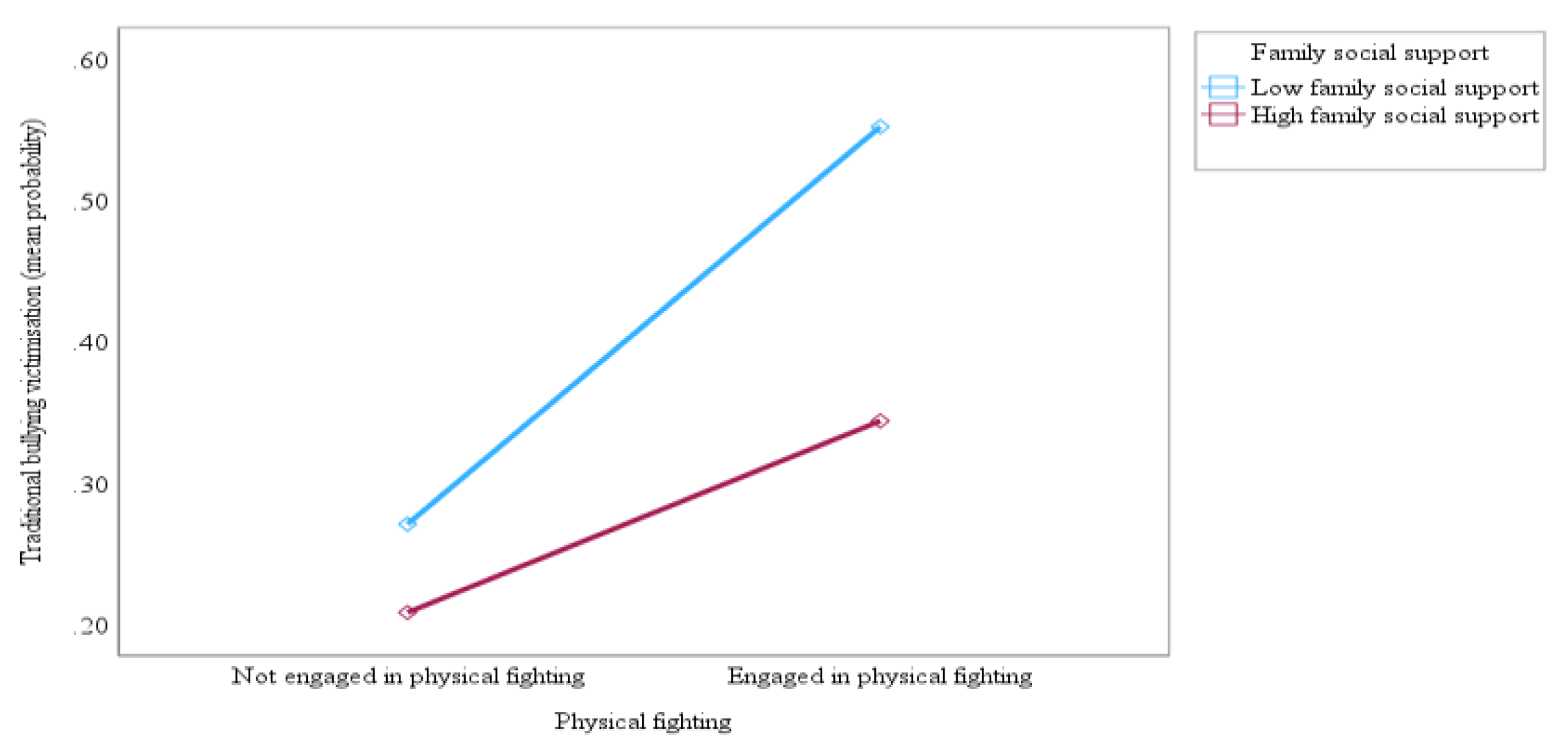
Figure 2.
Slopes for moderated association of physical fighting with predicted mean probability of cyberbullying victimisation at low and high (mean ± 1 SD) family social support.
Figure 2.
Slopes for moderated association of physical fighting with predicted mean probability of cyberbullying victimisation at low and high (mean ± 1 SD) family social support.
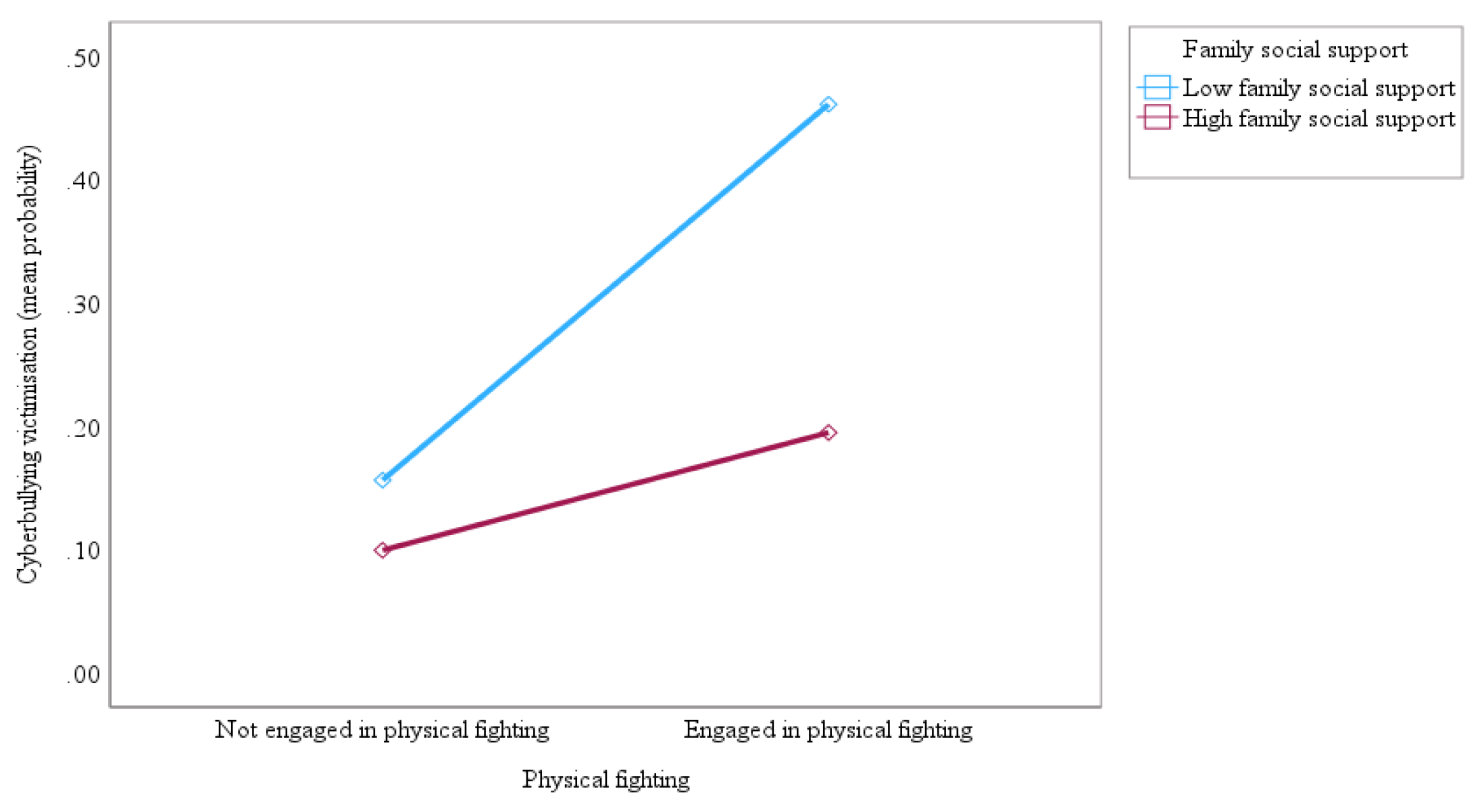
Figure 3.
Slopes for moderated association of physical fighting with predicted mean probability of traditional bullying victimisation at low and high (mean ± 1 SD) teacher social support.
Figure 3.
Slopes for moderated association of physical fighting with predicted mean probability of traditional bullying victimisation at low and high (mean ± 1 SD) teacher social support.
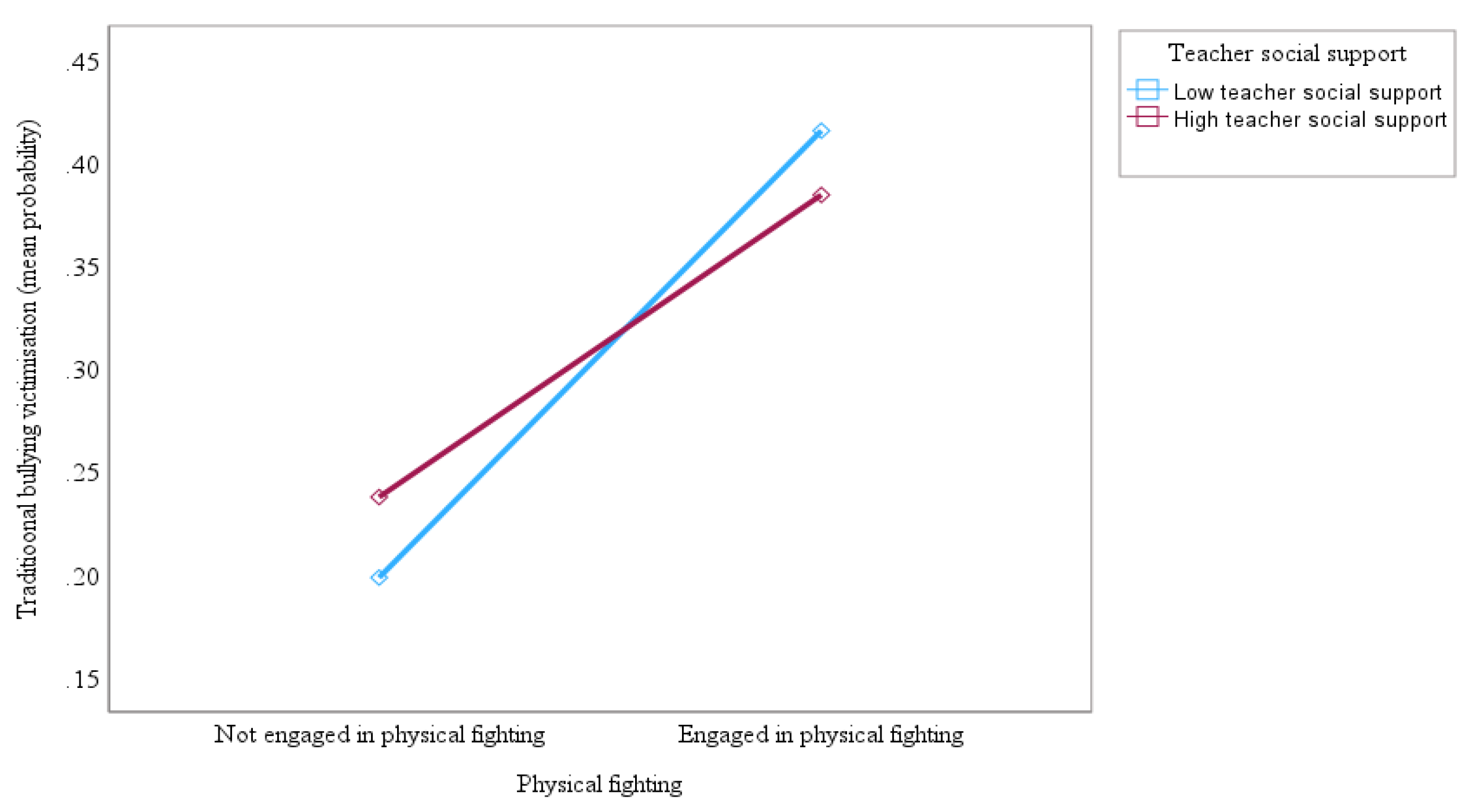
Figure 4.
Slopes for moderated association of physical fighting with predicted mean probability of cyberbullying victimisation at low and high (mean ± 1 SD) teacher social support.
Figure 4.
Slopes for moderated association of physical fighting with predicted mean probability of cyberbullying victimisation at low and high (mean ± 1 SD) teacher social support.
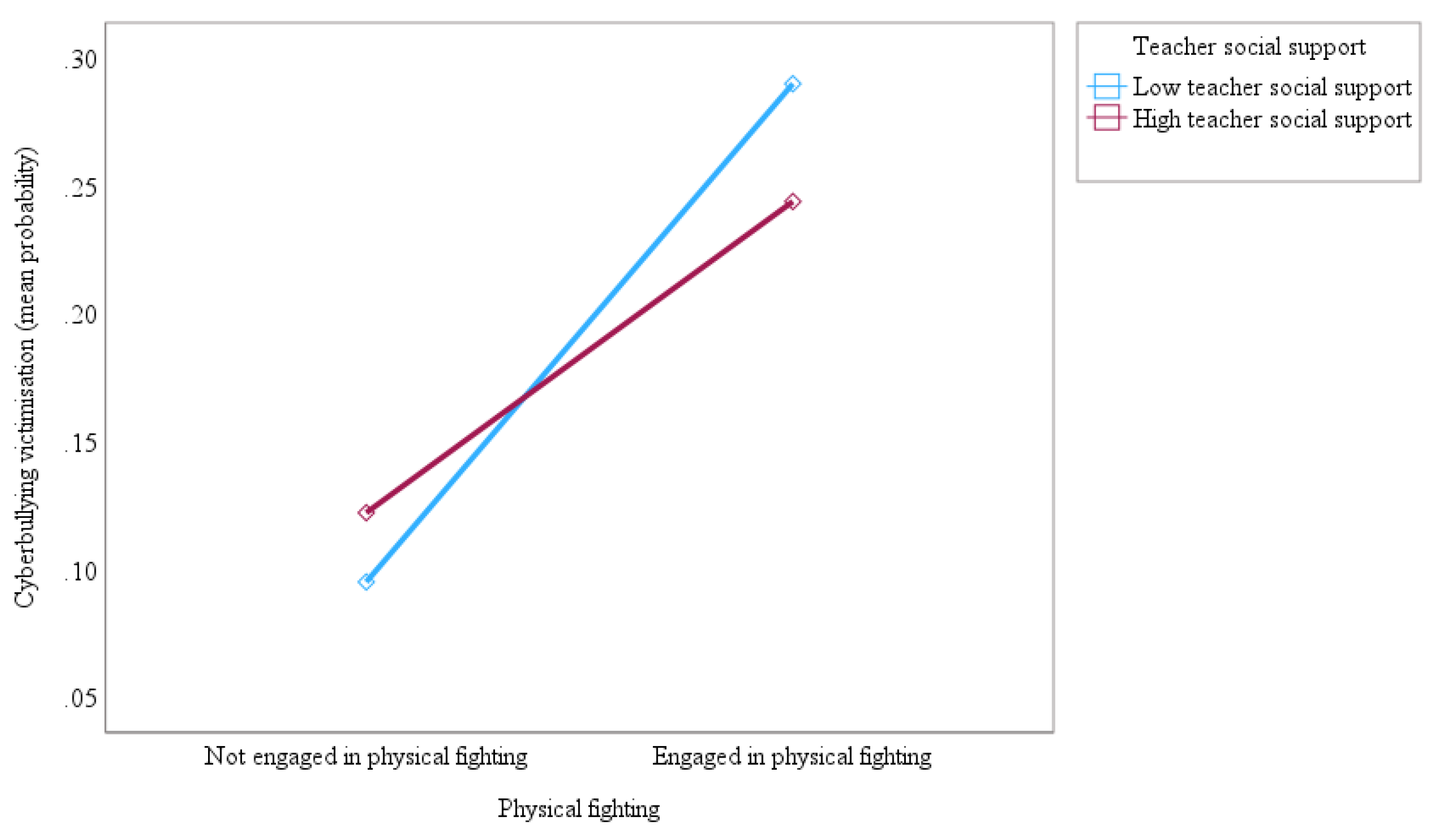
Figure 5.
Slopes for moderated association of physical fighting with predicted mean probability of traditional bullying victimisation at low and high (mean ± 1 SD) public education spending.
Figure 5.
Slopes for moderated association of physical fighting with predicted mean probability of traditional bullying victimisation at low and high (mean ± 1 SD) public education spending.
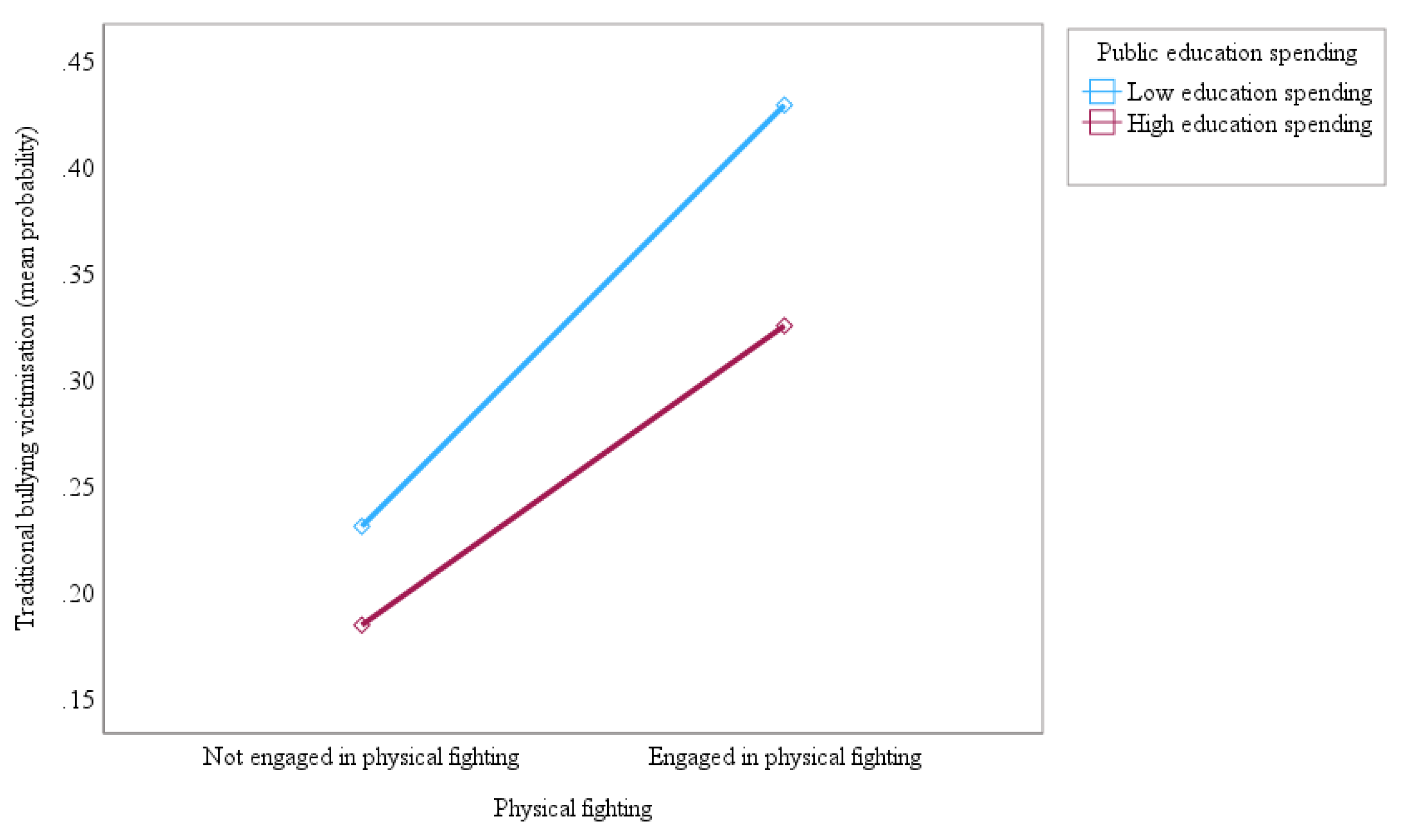

Table 1.
Descriptive statistics on key variables.
| Individual-level variables (n = 162,792), HBSC Survey 2017-2018 | n | % |
| Gender | ||
| Male | 80181 | 49.3 |
| Female | 82611 | 50.7 |
| Age group | ||
| 11 years | 54291 | 33.3 |
| 13 years | 57295 | 35.2 |
| 15 years | 51206 | 31.5 |
| Traditional bullying victimisation | ||
| Bullied | 46819 | 28.8 |
| Never bullied | 115973 | 71.2 |
| Cyberbullying victimisation | ||
| Cyberbullied | 27456 | 16.9 |
| Never cyberbullied | 135336 | 83.1 |
| Physical fighting -past 12 months | ||
| Engaged in physical fighting | 36602 | 22.5 |
| Never engaged in physical fighting | 126190 | 77.5 |
| Mean | Std. deviation | |
| Age | 13.49 | 1.62 |
| Family affluence | 14.17 | 2.63 |
| Family social support | 22.48 | 6.89 |
| Teacher social support | 6.63 | 2.77 |
| Country-level variables (n = 27) | ||
| Gross domestic product per capita (US$) | 35552.01 | 15050.50 |
| Education spending | 8.48 | 1.77 |
Table 2.
Multilevel Binary Logistic Regression Models Predicting the Association of Physical Fighting with Traditional Bullying Victimisation, and the Moderating Role of Perceived Social Support and Health Care Spending.
Table 2.
Multilevel Binary Logistic Regression Models Predicting the Association of Physical Fighting with Traditional Bullying Victimisation, and the Moderating Role of Perceived Social Support and Health Care Spending.
| Null (Empty) Model 1 | Model 2 | Model 3 | Model 4 | Model 5 | |
| Variable | OR (95% CI) | OR (95% CI) | OR (95% CI) | OR (95% CI) | OR (95% CI) |
| Age (reference: 11-year-olds) | 1.00 (1.00-1.00) | 1.00 (1.00-1.00) | 1.00 (1.00-1.00) | 1.00 (1.00-1.00) | |
| 13-year-olds | 0.90*** (0.87-0.92) | 0.89*** (0.87-0.92) | 0.88*** (0.85-0.91) | 0.88*** (0.85-0.90) | |
| 15-year-olds | 0.70*** (0.67-0.72) | 0.68*** (0.66-0.71) | 0.67*** (0.65-0.69) | 0.66*** (0.64-0.69) | |
| Gender (reference: male) | 1.20*** (1.17-1.23) | 1.18*** (1.15-1.20) | 1.19*** (1.16-1.22) | 1.18*** (1.15-1.21) | |
| Family affluence | 1.40*** (1.37-1.44) | 1.35*** (1.32-1.39) | 1.40*** (1.36-1.43) | 0.96*** (0.96-0.97) | |
| Physical fighting | 2.48*** (2.42-2.54) | 3.35*** (3.20-3.52) | 3.00*** (2.89-3.10) | 2.43*** (2.36-2.50) | |
| Family social support (FSS) | 0.72*** (0.69-0.75) | 0.56*** (0.55-0.58) | |||
| Teacher social support (TSS) | 1.30*** (1.26-1.34) | 1.08*** (1.06-1.11) | |||
| FSS x Physical fighting | 0.63*** (0.59-0.66) | ||||
| TSS x Physical fighting | 0.70*** (0.67-0.73) | ||||
| GDP per capita | 0.90*** (0.89-0.91) | ||||
| Education spending | 0.87*** (0.83-0.91) | ||||
| Education spending x Physical fighting | 0.91*** (0.87-0.97) | ||||
| Random variances | |||||
| Country | 0.07 | 0.07 | 0.08 | 0.06 | 0.06 |
| School | 0.25 | 0.22 | 0.20 | 0.22 | 0.18 |
| Intraclass correlations (ICC) | |||||
| Country | 0.01 | 0.01 | 0.02 | 0.01 | 0.01 |
| School | 0.04 | 0.04 | 0.04 | 0.04 | 0.04 |
| Goodness-of-fit | |||||
| AIC | 742213.89 | 738703.30 | 740613.35 | 739302.27 | 741436.08 |
| BIC | 742233.89 | 738723.30 | 740633.35 | 739322.27 | 741456.08 |
Note: OR = odds ratio; CI = confidence interval; AIC = Akaike Information Criterion; BIC = Bayesian Information Criterion; GDP = gross domestic product. Models were adjusted for compositional characteristics (age, gender and family affluence) and country-level covariate (GDP per capita). ***p < 0.001; **p < 0.01; *p < 0.05
Table 3.
Multilevel Binary Logistic Regression Models Predicting the Association of Physical Fighting with Cyberbullying Victimisation, and the Moderating Role of Perceived Social Support and Education Spending.
Table 3.
Multilevel Binary Logistic Regression Models Predicting the Association of Physical Fighting with Cyberbullying Victimisation, and the Moderating Role of Perceived Social Support and Education Spending.
| Null (Empty) Model 1 | Model 2 | Model 3 | Model 4 | Model 5 | |
| Variable | OR (95% CI) | OR (95% CI) | OR (95% CI) | OR (95% CI) | OR (95% CI) |
| Age (reference: 11-year-olds) | 1.00 (1.00-1.00) | 1.00 (1.00-1.00) | 1.00 (1.00-1.00) | 1.00 (1.00-1.00) | |
| 13-year-olds | 1.01 (0.98-1.05) | 1.00*** (0.97-1.04) | 1.01 (0.97-1.04) | 1.01 (0.98-1.05) | |
| 15-year-olds | 0.93*** (0.89-0.96) | 0.91*** (0.87-0.94) | 0.91*** (0.87-0.94) | 0.92*** (0.88-0.95) | |
| Gender (reference: male) | 1.46*** (1.42-1.51) | 1.43*** (1.39-1.47) | 1.44*** (1.40-1.48) | 1.45*** (1.41-1.49) | |
| Family affluence | 1.42*** (1.37-1.46) | 1.34*** (1.30-1.38) | 1.34*** (1.30-1.38) | 0.97*** (0.97-0.98) | |
| Physical fighting | 3.28*** (3.19-3.38) | 4.90*** (4.65-5.17) | 3.85*** (3.69-4.01) | 3.12*** (3.02-3.22) | |
| Family social support (FSS) | 0.61*** (0.58-0.64) | 0.41*** (0.40-0.42) | |||
| Teacher social support (TSS) | 1.23*** (1.18-1.28) | 0.95*** (0.92-0.98) | |||
| FSS x Physical fighting | 0.51*** (0.48-0.54) | ||||
| TSS x Physical fighting | 0.65*** (0.61-0.68) | ||||
| GDP per capita | 0.91*** (0.89-0.93) | ||||
| Education spending | 0.81*** (0.76-0.86) | ||||
| Education spending x Physical fighting | 0.98 (0.92-1.05) | ||||
| Random variances | |||||
| Country | 0.07 | 0.08 | 0.11 | 0.11 | 0.08 |
| School | 0.19 | 0.22 | 0.18 | 0.18 | 0.16 |
| Intraclass correlations (ICC) | |||||
| Country | 0.01 | 0.01 | 0.01 | 0.02 | 0.01 |
| School | 0.02 | 0.03 | 0.03 | 0.03 | 0.02 |
| Goodness-of-fit | |||||
| AIC | 823369.47 | 807625.93 | 812125.66 | 816890.07 | 816503.97 |
| BIC | 823389.47 | 807645.93 | 812145.66 | 816910.07 | 816523.97 |
Note: OR = odds ratio; CI = confidence interval; AIC = Akaike Information Criterion; BIC = Bayesian Information Criterion; GDP = gross domestic product. Models were adjusted for compositional characteristics (age, gender and family affluence) and country-level covariate (GDP per capita). ***p < 0.001; **p < 0.01; *p < 0.05
Disclaimer/Publisher’s Note: The statements, opinions and data contained in all publications are solely those of the individual author(s) and contributor(s) and not of MDPI and/or the editor(s). MDPI and/or the editor(s) disclaim responsibility for any injury to people or property resulting from any ideas, methods, instructions or products referred to in the content. |
© 2024 by the authors. Licensee MDPI, Basel, Switzerland. This article is an open access article distributed under the terms and conditions of the Creative Commons Attribution (CC BY) license (https://creativecommons.org/licenses/by/4.0/).
Copyright: This open access article is published under a Creative Commons CC BY 4.0 license, which permit the free download, distribution, and reuse, provided that the author and preprint are cited in any reuse.


