

Submitted:
09 May 2024
Posted:
10 May 2024
You are already at the latest version
Abstract
Living systems are intricate repositories of biomolecules, where the interactions between these molecules play an important role in maintaining homeostasis. Interruptions in these interactions can lead to diseases, underscoring the significance of biomolecular interactions and their molecular basis. HUGENICS (Human Genetic Database) is a comprehensive biological database that focuses on molecular interactions between human and microbial proteins, particularly emphasizing protein-protein interactions (PPIs). This database offers insights into disease pathways by elucidating the interplay between microbial surface/secretory proteins and human disease-related proteins. This white paper highlights the significance, scope, and potential applications of HUGENICS in advancing biomedical research and improving human health.
Keywords:
Human Protein
; Microbial protein
; Disease Pathways
; Human-Microbial Interaction.
Introduction
Biomolecules are indispensable components in living organisms that have a significant role in diverse biological processes. Proteins, carbohydrates, lipids, and nucleic acids, etc. in living organisms contribute to their Structural Support (Proteins form the structural framework of muscles, skin, hair, and nails, while carbohydrates and lipids contribute to cell membranes and provide insulation and protection), Energy Storage and Metabolism (Carbohydrates are broken down into glucose, which is the primary energy source for cells. Lipids, stored in adipose tissue, provide long-term energy storage and insulation. Proteins can also be metabolized into amino acids, which are subsequently converted into energy when needed), Information Storage, and Transmission, Enzymatic Catalysis (digestion, energy production, and detoxification), Cellular Communication and signal transduction (Nucleic acids such as DNA and RNA, serves as repositories and transmitters of genetic data. DNA carries the inherited directives that determine the traits of an organism, while RNA plays a crucial role in gene expression, protein synthesis, and regulation of cellular processes), Regulation of Biological Processes (Expression of genes, differentiation of cells, progression of the cell cycle, and apoptosis), Immunity, Defense, and Transportation (as carrier/medium of essential compounds like oxygen), etc. The interaction between these biomolecules results in various cellular functions in maintaining homeostasis (internal, physical, and chemical balancing of the body) [1,2]. They act together in a complex network to regulate and facilitate the chemical reactions necessary for life. Thus, the interactions between biomolecules are tightly regulated, and any disruption in these interactions can result in diseases or disorders. Therefore, knowledge at the molecular level of these interactions is crucial for developing new therapies and improving human health.
Figure 1.
Graphical representation of Human and Microbial Protein-Protein Interactions.
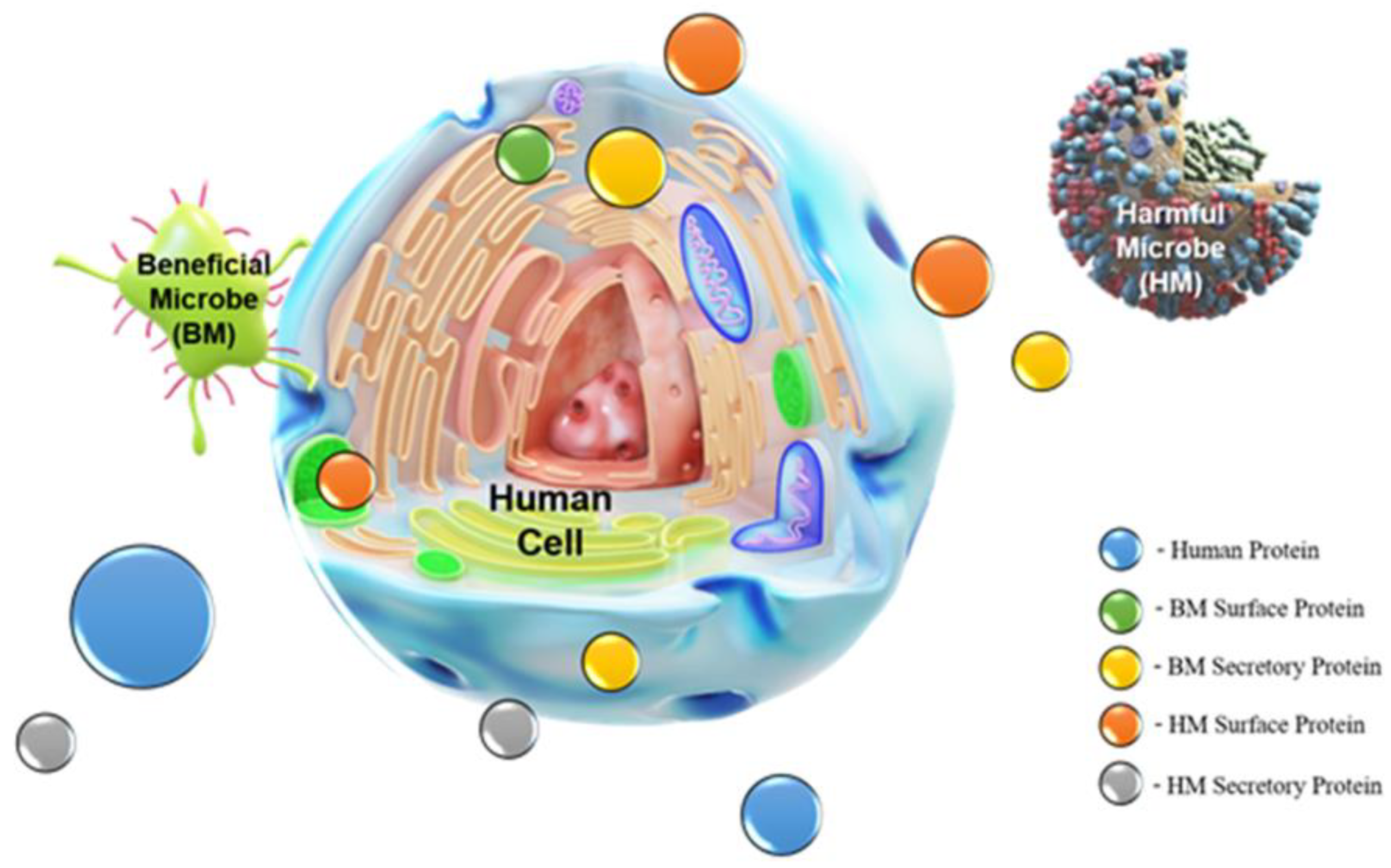
HUGENICS is a comprehensive biological database incorporating molecular interaction data between human and microbial proteins. This intricate database provides a keen understanding of the dynamics of protein-protein interactions (PPIs) that are essential for maintaining homeostasis and implicated in various diseases. By elucidating the interplay between the two sets of proteins, particularly surface and secretory proteins in microbes and human disease-related proteins, HUGENICS offers valuable insights into disease pathways, paving the way for innovative therapeutic interventions. This white paper elucidates the significance, scope, and potential applications of HUGENICS in advancing biomedical research and improving human health.
HUGENICS - Human-Microbial Protein-Protein Interaction (PPI) Database.
HUGENICS, as the name implies, serves as a biological data repository on the interactions between human and microbial proteins at the molecular level. Additionally, the database includes comprehensive information on the molecular pathways and mechanisms associated with these proteins. Proteins are essential for sustaining life. The human body contains over 100,000 distinct proteins, each performing various vital functions.
Microorganisms (microbes) are minute microscopic life forms that are not visible through the naked eye or without the aid of a microscope. They can be categorized into different groups according to their characteristics, including origin, structure, and function. Among these, Bacteria, Archaea, Viruses, Fungi, Protozoa, Parasites, etc. are the most prevalent microorganisms, and produce various proteins that play crucial roles in their survival, interaction with the environment, and interaction with other organisms. They can cause human diseases [3]. The most likely way that microbes can communicate with humans is through their surface or secretory proteins [4]. Secretory proteins are any proteins that are released by cells and originate from endocrine or exocrine cells. The category encompasses antimicrobial peptides, hormones, enzymes, and toxins. These proteins are produced in the endoplasmic reticulum. Whereas the surface proteins are adhered to the surfaces of the self-assembling biological forms, including whole microbial cells or their subcellular structures. Surface proteins are commonly found in various infectious pathogens such as gram-positive bacteria, playing pivotal roles in their survival and pathogenicity [5]. Secretory and surface proteins are particularly important as they are involved in communication, nutrient acquisition, defense, and pathogenesis. So, it is important to explore the relationship between the surface/ secretory proteins of both beneficial and pathogenic microorganisms, and proteins in humans.
Protein-protein interactions (PPIs) play a significant role in many cellular functions, and their dysregulation has been connected to various diseases such as cancer, neurodegenerative, immune, cardiovascular, endocrine, metabolism, and infectious diseases [6]. In the context of infectious diseases, PPIs are especially important because many pathogens rely on host PPIs to establish and maintain infection. One of the key strategies for studying pathogenic diseases is to identify and disrupt critical PPIs involved in the disease process. For example, many viruses interact with host proteins to facilitate their entry into cells, replicate, and evade the host immune response. By identifying and disrupting these PPIs, researchers can potentially block the virus's ability to infect cells and cause disease [7].
Thus HUGENICS intends to provide a broad understanding of potential interactions between human proteins involved in significant disease pathways such as cancer, infectious, immune, neurodegenerative, liver, kidney, cardiovascular, endocrine, and metabolic diseases and the surface/secretory microbial proteins.
Significance and Applications of HUGENICS:
HUGENICS holds immense significance in multiple domains including biomedical research, precision/personalized medicine, infectious disease management, drug discovery, and development
- Advancing Biomedical Research: By understanding the complex interaction network of human and microbial proteins, the database provides a robust platform to explore mechanisms, identify therapeutic targets, and develop innovative interventions.
- Precision/Personalized Medicine: The molecular-level knowledge of the disease pathways provided by the database facilitates the development of personalized therapeutic strategies for individual patients, thereby enhancing treatment efficacy and minimizing side effects.
- Infectious Disease Management: In the case of infectious diseases, HUGENICS offers valuable insights into the molecular mechanisms employed by pathogens to invade host cells, evade immune surveillance, and enact infections. By focusing on critical PPIs identified through the database, novel antiviral and antibacterial therapies can be developed, strengthening the defense against emerging infectious threats.
- Drug Discovery and Development: HUGENICS serves as a rich repository of potential drug targets, accelerating the identification and optimization of small molecule inhibitors, biologics, and other therapeutics. It accelerates the drug development process by targeting the most significant PPIs in disease pathways and accelerating the translation of research results into practical clinical applications.
Conclusion
HUGENICS represents a paradigm shift in our understanding of the intricate relationship between human and microbial proteins. By offering a comprehensive repository of molecular interaction data and sophisticated analysis tools, HUGENICS empowers researchers and clinicians to unravel disease mechanisms, discover novel therapeutic targets, and advance precision medicine initiatives. As we continue to navigate the complex landscape of human-microbe interactions, HUGENICS stands poised to drive innovation, accelerate drug discovery, and ultimately improve human health outcomes.
References
- The Molecular Composition of Cells - The Cell - NCBI Bookshelf [Internet]. [cited 2024 May 3]. Available from: https://www.ncbi.nlm.nih.gov/books/NBK9879/.
- Minchin S, Lodge J. Understanding biochemistry: structure and function of nucleic acids. Essays Biochem [Internet]. 2019 [cited 2024 May 3];63:433–56. [CrossRef]
- In brief: What are microbes? - InformedHealth.org - NCBI Bookshelf [Internet]. [cited 2024 May 3]. Available from: https://www.ncbi.nlm.nih.gov/books/NBK279387/.
- Green ER, Mecsas J. Bacterial Secretion Systems: An Overview. Microbiol Spectr [Internet]. 2016 Jan 29 [cited 2024 May 3];4(1). Available from: https://journals.asm.org/journal/spectrum.
- Barlowe CK, Miller EA. Secretory Protein Biogenesis and Traffic in the Early Secretory Pathway. Genetics [Internet]. 2013 [cited 2024 May 3];193(2):383. Available from: /pmc/articles/PMC3567731/.
- Dunn BS, Awasthi S, Yi SS, Sahni N. Protein–Protein Interaction Networks in Human Disease. RSC Drug Discov Ser [Internet]. 2020 Dec 14 [cited 2024 May 3];2021-January(78):25–48. Available from: https://books.rsc.org/books/edited-volume/765/chapter/491847/Protein-Protein-Interaction-Networks-in-Human.
- Singer M. Pathogen-pathogen interaction: A syndemic model of complex biosocial processes in disease. Virulence [Internet]. 2010 [cited 2024 May 3];1(1):10–8. Available from: https://www.tandfonline.com/action/journalInformation?journalCode=kvir20.
Disclaimer/Publisher’s Note: The statements, opinions and data contained in all publications are solely those of the individual author(s) and contributor(s) and not of MDPI and/or the editor(s). MDPI and/or the editor(s) disclaim responsibility for any injury to people or property resulting from any ideas, methods, instructions or products referred to in the content. |
© 2024 by the authors. Licensee MDPI, Basel, Switzerland. This article is an open access article distributed under the terms and conditions of the Creative Commons Attribution (CC BY) license (http://creativecommons.org/licenses/by/4.0/).
Copyright: This open access article is published under a Creative Commons CC BY 4.0 license, which permit the free download, distribution, and reuse, provided that the author and preprint are cited in any reuse.


