

Submitted:
02 May 2024
Posted:
06 May 2024
You are already at the latest version
Abstract
The state of Oaxaca, Mexico obtained the “Pluma” designation of origin in 2022 and has stood out for the production of specialty coffee. Within its process, roasting is one of the stages that contributes to the physical, chemical and sensory quality of the coffee bean. Therefore, the microstructure and elemental chemical composition of special medium-roasted Coffea arabica L beans from six locations with this denomination were analyzed using Scanning Electron Microscopy. The average values of roughness Rz (25.93±2.69-34.18±1.15 and 13.85±1.66-21.85±6.63) and Ra (5.20±0.47- 8.27±0.82 and 6.55±0.94-11.53±1.65) were obtained at 400 and 2000x, respectively. The roasted Coffea arabica L. beans from MAP and HUA are the ones with the greatest roughness and both are located at a lower altitude compared to the rest. PLU and PTO roasted beans showed the highest physical and structural integrity. In all grains, 6C (66.48-81.14%), 8O (18.86-28.69%) and only 20Ca (4.5%) were found on the outside. This research constitutes a standard of authenticity and microstructural and elemental quality of Coffea arabica L. beans with designation of origin "Pluma".
Keywords:
Coffea arabica L
; microstructure
; elemental composition
; roasted medium
; “Pluma”
1. Introduction
Coffee is one of the most popular and consumed beverages in the world, which has stimulant effects determined by its composition in the green bean and by post-harvest stages [1,2]. Coffea arabica and canephora are the two most widely cultivated commercial species in the world [3]. However, arabica accounts for more than 60% of the world’s coffee production [4]. In the Mexican Republic, the states with the highest production are Chiapas, Veracruz, Puebla and Oaxaca, the latter having obtained the denomination of origin “Pluma” [5] and in which producers have dedicated themselves to the search for alternatives to add value to their product, as is the case of specialty coffee influenced by factors such as geographical origin, climate, species, harvesting methods, processing and storage [6,7].
Roasting has been studied to assess its effect on quality [8,9] on the physical and chemical composition of the grain [8,10,11,12,13,14,15,16], in order to know its effect on the microstructure of the same [17,18] to analyze the properties of the milled grain for other uses [19] and for the analysis of green grains, characterization of metabolites, synthesis of nanoparticles [20] and coffee processing residues by Scanning Electron Microscopy (SEM) [21,22,23], a technique widely used for morphological analysis, quality analysis in food and various materials [24,25]. The objective of this study is to analyze specialty Coffea arabica L. beans with the “Pluma” designation of origin recently granted to the State of Oaxaca, Mexico with a medium roasting degree, which is commonly used in that state to obtain preliminary information on the microstructure and elemental chemical composition of these beans that can be considered reference values of authenticity and quality.
2. Materials and Methods
2.1. Samples of specialty Coffea arabica L. with denomination of origin “Pluma”
Six samples of 100g of Coffea arabica L. beans were obtained, which were previously roasted at 170-180 °C/12 to 15 min to obtain a medium roast, which is commonly used by producers in the State of Oaxaca [26] of the 2021 harvest, specialty [5] from MAP, HUA, PTO, TEO, PLU and AGL, localities belonging to the growing area with denomination of origin “Pluma” Oaxaca (Table 1).
2.2. SEM analysis of Coffea arabica L. grains
The grains were spread out on a clean white surface in order to select a representative grain from each of the samples. For the external analysis (surface), images were taken of the expanded side of the grain and for the analysis of the inner part, the grain was cut by the middle along the grain. They were placed under a Thermo Fisher Scientific Phenom Pro X Scanning Electron Microscope (SEM) equipped with a solid state EDS (Energy Dispersive X-ray Spectroscopy) electron detector used to detect chemical elements and a BSD Full detector (backscattered electron detector) at 10 kV of acceleration [27]. The analyses were performed at 400 and 2000 magnifications to obtain the three-dimensional profilometry, morphology and elemental chemical composition in these grains.
2.3. Statistical analysis
The data obtained from the analyses on the roasted beans of Coffea arabica L. were processed in Excel (Microsoft Mondo 2016) with an analysis of variance and a Tukey HSD test to know the significant difference between means with a significance level of α=0.05.
3. Results and Discussion
Figure 1 shows the micrographs of specialty medium roasted Coffea arabica L. beans with the designation of origin “Pluma” at 400 x and 2000 x and the Table 2 shows that at 400x and 2000x the roughness values Rz and Ra (µm) are higher in the samples from San Mateo Piñas and at 2000x it is the second after Huatulco, both with the lowest altitude (masl) with respect to the rest. The Tukey test showed that the MAP grains at 400x are statistically different p (<005) in roughness with respect to the others; however, at 2000x differences in roughness were observed in the TEO and AGL samples.
This roughness is due to the geographical origin and climatic conditions, to the influence of roasting on the porosity and quality of the grain structure [10] and because both samples come from localities with the highest environmental humidity.
Figure 2 shows images of the exterior (surface) of the bean and the interior (middle) in which it can be seen that the samples of Coffea arabica L., medium roasted from Pluma Hidalgo and San Miguel del Puerto are the ones that present less visible porosity as well as cracks, which indicates that they are the samples that presented greater physical and structural integrity, additionally it also refers to an adequate post-harvest handling and other operations of the roasted coffee elaboration process, unlike the samples from San Mateo Piñas and Huatulco, which in their surface or exterior presented greater roughness.
However, the images of the interior longitudinal cut indicate that through this analysis of this part of the bean all the samples are different. Previous studies indicate that the physical characteristics of coffee beans depend on certain factors, such as the geographic location of the coffee growing areas, geographic characteristics and the chemical composition of the bean [28,29,30,31] as well as the roasting to which the kernels are subjected, which influences the integrity of the cell membranes of the kernels [18].
These results are consistent with the fact that the analysis of cellular ultrastructures of coffee beans can be related to quality loss during bean processing [31] since in roasting water gradually evaporates as heat is transferred to the bean and the internal cell structure is dislocated and irreversibly damaged, exposing certain chemical components and when these are added in the coffee plant they influence the final quality of Coffea arabica L. beans as well as the beverage [32].
Table 3 shows the elemental chemical composition of the surface and middle part of Coffea arabica L. beans, highlighting 6 C,8 O and7 N in most of the beans; however, in the external part of the bean,20 Ca was found in the sample from AGL, an element that has been considered as a discriminant element for coffee producing regions [33].
It is known that coffee beans are mainly composed of type II arabinogalactans and galactomannans [34], so the majority composition in percentage of Carbon is due to these two polysaccharides, additionally it may also be due to the differences the altitudes (1000-1820 masl) of the Coffea arabica L. coffee plantations where the samples were obtained [35] as well as the flowering, harvesting periods and climatic conditions of the coffee plantations [36].
4. Conclusions
The roasted Coffea arabica L. beans from MAP and HUA were the most rough and both were located at lower altitudes than the rest. PLU and PTO showed the greatest physical and structural integrity. In all the beans 6C (66.48-81.14%), 8O (18.86-28.69%) was found on the exterior, with the exception of AGL where 20Ca (4.5%) was detected, which could be a discriminating element to determine the authenticity of the coffee. While in the interior (middle), in addition to 6C and 8O, 7N was found in the samples from MAP (13.26%), PTO (15.04%), TEO (12.01%) and AGL (10.06%).
The surface roughness values obtained could be used as preliminary quality parameters for the identification of medium and specialty roasted Coffea arabica L. beans geographically located in the “Pluma” denomination of origin zone.
Author Contributions
Conceptualization, J.J. and L.R.; investigation, J.J.,L.R., E.A., A.P., M.S. and I.G., methodology, J.J.; software, L.R.; writing—original draft preparation, J.J.,L.R. and E.A.; visualization, L.R. and E.A.; supervision, J.J. and L.R. All authors have read and agreed to the published version of the manuscript.”.
Funding
“This research received no external funding”.
Data Availability Statement
The original contributions presented in the study are included in the article further inquiries can be directed to the corresponding authors.
Acknowledgments
To the producers of coffee with denomination of origin “Pluma”, Oaxaca, to the DEPI of the Technological Institute of Oaxaca and to CONAHCYT for the maintenance grant number 2020-0000626-02NACF-18710.
Conflicts of Interest
“The authors declare no conflicts of interest.”
References
- A. C. Ceoromila et al., “Effect of ground and roasted parameters on both the microstructure of arabica coffee beans and coffee infusion,” no. December, 2020. [CrossRef]
- T. Klingel, J. I. Kremer, V. Gottstein, and T. R. De Rezende, “A Review of Co ff ee By-Products Including Leaf ,” Foods, vol. 9, pp. 1–20, 2020.
- T. Lu, Y. Sun, Y. Huang, and X. Chen, “Effects of roasting on the chemical compositions, color, aroma, microstructure, and the kinetics of changes in coffee pulp,” J. Food Sci., vol. 88, no. 4, pp. 1430–1444, 2023. [CrossRef]
- Mihailova, B. Liebisch, M. D. Islam, J. M. Carstensen, A. Cannavan, and S. D. Kelly, “The use of multispectral imaging for the discrimination of Arabica and Robusta coffee beans,” Food Chem. X, vol. 14, no. May, p. 100325, 2022. [CrossRef]
- NOM, NOM-255-SE. 2022, pp. 1–25.
- T. Dippong, M. Dan, M. H. Kovacs, E. D. Kovacs, E. A. Levei, and O. Cadar, “Analysis of Volatile Compounds, Composition, and Thermal Behavior of Coffee Beans According to Variety and Roasting Intensity,” Foods, vol. 11, no. 19, 2022. [CrossRef]
- T. Juárez González, Y. I. Maldonado Astudillo, R. González Mateos, M. O. Ramírez Sucre, P. Álvarez Fitz, and R. Salazar, “Caracterización fisicoquímica y sensorial de café de la montaña de Guerrero,” Rev. Mex. Ciencias Agrícolas, vol. 12, no. 6, pp. 1057–1069, 2021. [CrossRef]
- S. Jung, S. Gu, S. H. Lee, and Y. Jeong, “Effect of roasting degree on the antioxidant properties of espresso and drip coffee extracted from coffea arabica cv. Java,” Appl. Sci., vol. 11, no. 15, 2021. [CrossRef]
- S. Suárez Cunza, E. Alfaro Pillihuaman, and E. G. Ramírez Roca, “ACTIVIDAD ANTIOXIDANTE, POLIFENOLES Y FLAVONOIDES DE Coffea arabica de CINCO REGIONES PERUANAS,” Rev. la Soc. Química del Perú, vol. 86, no. 4, pp. 343–354, 2021. [CrossRef]
- T. Toci, D. A. Azevedo, and A. Farah, “Effect of roasting speed on the volatile composition of coffees with different cup quality,” Food Res. Int., vol. 137, no. April, 2020. [CrossRef]
- J. A. Jiménez-Mendoza, N. F. Santos-Sánchez, A. D. Pérez-Santiago, M. A. Sánchez-Medina, D. Matías-Pérez, and I. A. García-Montalvo, “Preliminary Analysis of Unsaturated Fatty Acid Profiles of Coffea arabica L., in Samples with a Denomination of Origin and Speciality of Oaxaca, Mexico,” J. Oleo Sci., vol. 72, no. 2, pp. 153–160, 2023. [CrossRef]
- F. Sarghini, E. Fasano, A. De Vivo, and M. C. Tricarico, “Influence of roasting process in six coffee Arabica cultivars: Analysis of volatile components profiles,” Chem. Eng. Trans., vol. 75, no. December 2018, pp. 295–300, 2019. [CrossRef]
- K. Król, M. Gantner, A. Tatarak, and E. Hallmann, “The content of polyphenols in coffee beans as roasting, origin and storage effect,” Eur. Food Res. Technol., vol. 246, no. 1, pp. 33–39, 2020. [CrossRef]
- M. Ormaza, F. O. Díaz, and B. A. Rojano, “Effect of coffee aging (coffea arabica l. Var. Castillo) on the composition of total phenols, flavonoids, chlorogenic acid and antioxidant activity,” Inf. Tecnol., vol. 29, no. 3, pp. 187–196, 2018. [CrossRef]
- M. Bolka and S. Emire, “Effects of coffee roasting technologies on cup quality and bioactive compounds of specialty coffee beans,” Food Sci. Nutr., vol. 8, no. 11, pp. 6120–6130, Nov. 2020. [CrossRef]
- E. Nakilcioğlu-Taş and S. Ötleş, “Physical characterization of arabica ground coffee with different roasting degrees,” An. Acad. Bras. Cienc., vol. 91, no. 2, pp. 1–15, 2019. [CrossRef]
- F. M. Borém, P. D. de Oliveira, E. P. Isquierdo, G. da S. Giomo, R. Saath, and R. A. Cardoso, “Borem, F. M. al.,” Coffee Sci., vol. 8, no. 2, pp. 218–225, 2013.
- D. N. Raba, D. R. Chambre, D. M. Copolovici, C. Moldovan, and L. O. Copolovici, “The influence of high-temperature heating on composition and thermo-oxidative stability of the oil extracted from Arabica coffee beans,” PLoS ONE, vol. 13, no. 7, pp. 1–13, 2018. [CrossRef]
- Y. Chen, R. Guo, F. Ma, H. Zhou, M. Zhang, and Q. Ma, “Effect of Coffee Grounds/Coffee Ground Biochar on Cement Hydration and Adsorption Properties,” Materials (Basel)., vol. 17, no. 4, p. 907, 2024. [CrossRef]
- L. Gao, S. Mei, H. Ma, and X. Chen, “Ultrasonics Sonochemistry Ultrasound-assisted green synthesis of gold nanoparticles using citrus peel extract and their enhanced anti-inflammatory activity,” Ultrason. Sonochem., vol. 83, p. 105940, 2022. [CrossRef]
- M. Rodrigues da Silva et al., “Metabolite characterization of fifteen by-products of the coffee production chain: From farm to factory,” Food Chem., vol. 369, no. August 2021, 2022. [CrossRef]
- W. Dong, K. Cheng, R. Hu, Z. Chu, J. Zhao, and Y. Long, “Effect of microwave vacuum drying on the drying characteristics, color, microstructure, and antioxidant activity of green coffee beans,” Molecules, vol. 23, no. 5, 2018. [CrossRef]
- Mariem Fersi, R. Hajji, K. Mbarki, I. Louati, and N. J. A. H. R. Hachicha, “Spectroscopic and microscopic characterization of humic acids from composts made by co-composting of green waste, spent coffee,” Environ. Technol., 2024. [CrossRef]
- E. Afonso, S. National, P. Tiemblo, and S. National, “La perfilometría óptica como técnica de caracterización topográfica no destructiva y sin contacto,” no. July, 2020.
- L. H. Robledo-Taboada, J. F. Jiménez-Jarquín, M. Flores-Castañeda, A. Méndez-Blas, J. Barranco-Cisneros, and S. Camacho-López, “Single-step femtosecond laser-induced formation of coexisting microstructures in silicon,” Bull. Mater. Sci., vol. 46, no. 2, 2023. [CrossRef]
- G. Canseco, Traditional Aromatic Coffee. Oaxaca, México, 2020.
- R. Feria-Reyes et al., “Pine Bark as a Potential Source of Condensed Tannin: Analysis through Fourier Transform Infrared Spectroscopy (FTIR), Scanning Electron Microscopy (SEM), and Energy Dispersive X-ray (EDX),” Forests, vol. 14, no. 7, 2023. [CrossRef]
- S. Oestreich-Janzen, Caracterización físico-química y sensorial de dos variedades de café (Coffea arabica) del occidente de Honduras, no. March. Elsevier Inc., 2013.
- N. Cordoba, M. Fernandez-Alduenda, F. L. Moreno, and Y. Ruiz, “Coffee extraction: A review of parameters and their influence on the physicochemical characteristics and flavour of coffee brews,” Trends Food Sci. Technol., vol. 96, pp. 45–60, 2020. [CrossRef]
- G. A. L. Torres, L. V Zezzo, R. Greco, and P. P. Coltri, “Exposure To Climate Risk : A Case Study For Coffee Farming In The Region Of Alta Mogiana , São Paulo,” vol. 94, pp. 1–21, 2022. [CrossRef]
- L. P. Figueiredo, F. M. Borém, M. R. Almeida, L. F. C. de Oliveira, A. P. de C. Alves, and C. M. dos Santos, “Raman spectroscopy for the differentiation of Arabic coffee genotypes,” Food Chem., vol. 288, no. January, pp. 262–267, 2019. [CrossRef]
- J. M. Clemente, H. E. P. Martinez, A. W. Pedrosa, Y. Poltronieri Neves, P. R. Cecon, and J. L. Jifon, “Boron, copper, and zinc affect the productivity, cup quality, and chemical compounds in coffee beans,” J. Food Qual., vol. 2018, 2018. [CrossRef]
- F. Vezzulli, M. C. Fontanella, G. M. Beone, and M. Lambri, “Specialty and high-quality coffee : Discrimination through elemental and ICP-MS / MS of origin , species , and variety,” no. November 2022, 2023. [CrossRef]
- L. H. Reichembach, G. K. Kaminski, J. B. Baron Maurer, and C. L. Oliveira Petkowicz, “Fractionation and characterization of cell wall polysaccharides from coffee (Coffea arabica L.) pulp,” Carbohydr. Polym., vol. 327, 2024, [Online]. [CrossRef]
- J. Sim, C. Mcgoverin, I. Oey, R. Frew, and B. Kebede, “Near-infrared reflectance spectroscopy accurately predicted isotope and elemental compositions for origin traceability of coffee,” Food Chem., vol. 427, no. June, p. 136695, 2023. [CrossRef]
- J. Árvay et al., “Concentration of Micro- and Macro-Elements in Green and Roasted Coffee : Influence of Roasting Degree and Risk Assessment for the Consumers,” 2018.
Figure 1.
Micrographs of medium roasted Coffea arabica L. beans with specialty and “Pluma” denomination of origin at 400 x and 2000 x. MAP: San Mateo Piñas, HUA: Huatulco, MPT: San Miguel del Puerto, TEO: Teojomulco, PLU: Pluma Hidalgo and AGL: San Agustín Loxicha. Source: Own elaboration.
Figure 1.
Micrographs of medium roasted Coffea arabica L. beans with specialty and “Pluma” denomination of origin at 400 x and 2000 x. MAP: San Mateo Piñas, HUA: Huatulco, MPT: San Miguel del Puerto, TEO: Teojomulco, PLU: Pluma Hidalgo and AGL: San Agustín Loxicha. Source: Own elaboration.
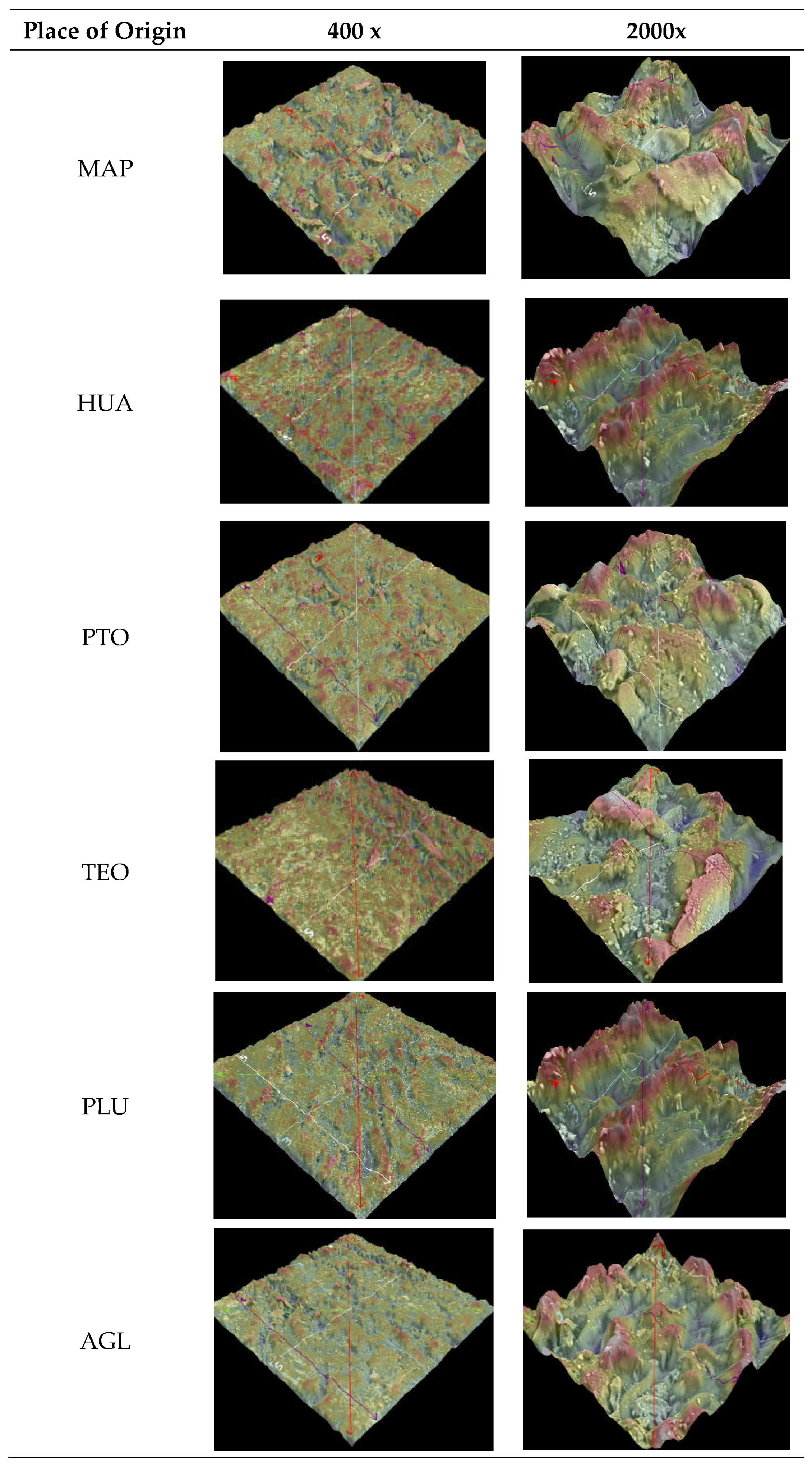
Figure 2.
Surface and middle cut of medium roasted Coffea arabica L. beans, specialty and with denomination of origin “Pluma”, Oaxaca. MAP: San Mateo Piñas, HUA: Huatulco, MPT: San Miguel del Puerto, TEO: Teojomulco, PLU: Pluma Hidalgo and AGL: San Agustín Loxicha. Source: Own elaboration.
Figure 2.
Surface and middle cut of medium roasted Coffea arabica L. beans, specialty and with denomination of origin “Pluma”, Oaxaca. MAP: San Mateo Piñas, HUA: Huatulco, MPT: San Miguel del Puerto, TEO: Teojomulco, PLU: Pluma Hidalgo and AGL: San Agustín Loxicha. Source: Own elaboration.
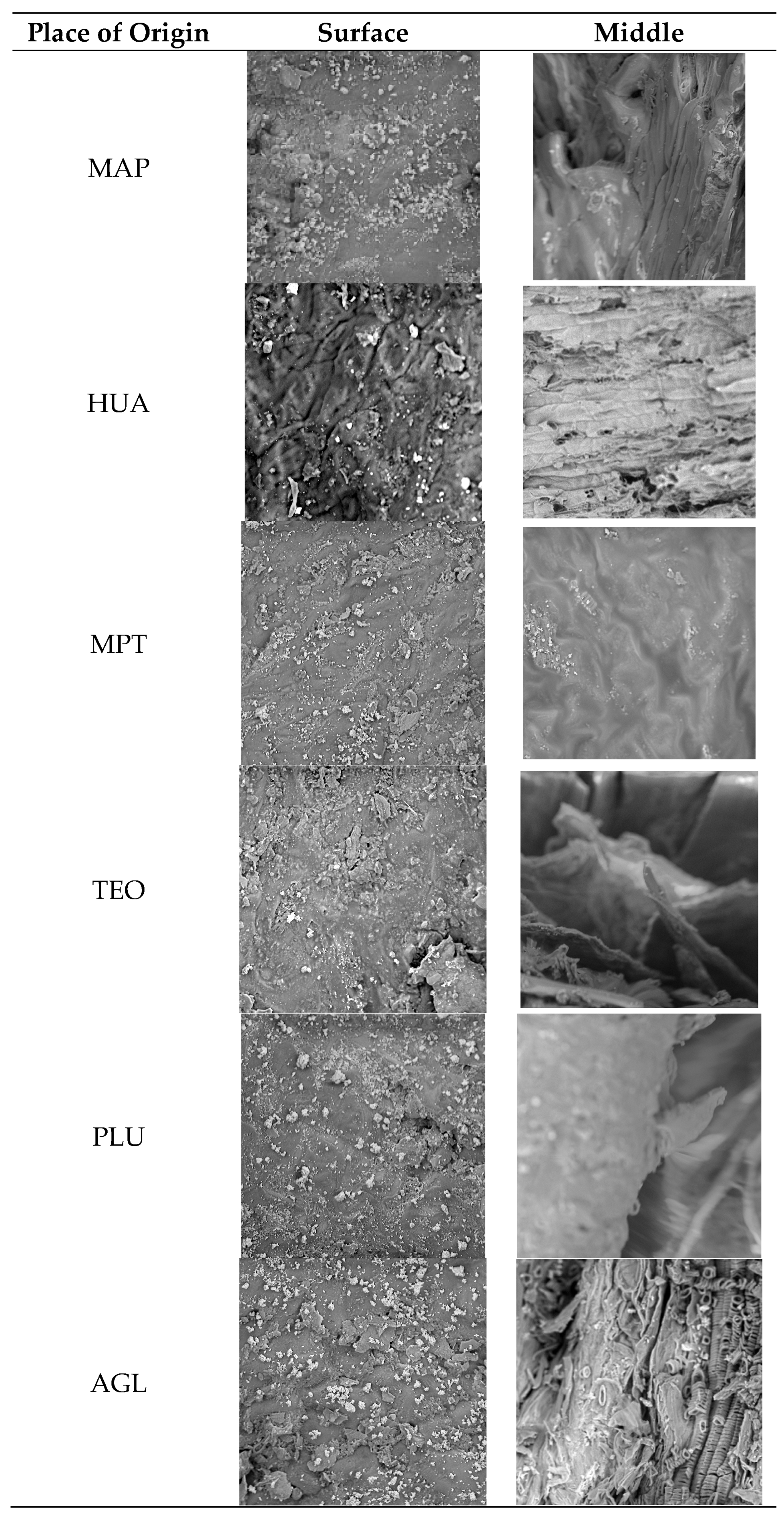

Table 1.
Origin of samples of Coffea arabica L. roasted medium of specialty with “Pluma” denomination of origin.
Table 1.
Origin of samples of Coffea arabica L. roasted medium of specialty with “Pluma” denomination of origin.
| Place of Origin | Coffee grain samples | Altitude (masl) | Location |
|---|---|---|---|
| MAP |  |
1000 | Coordinates 96°20’ west longitude, 16°00’ north latitude. Bordered on the north by the municipality of San Marcial Ozolotepec and Santiago Xanica; on the south by Pluma Hidalgo and Santa Maria Huatulco; on the east by Pluma Hidalgo and San Pedro el Alto; on the west by San Miguel del Puerto. |
| HUA |  |
1058 | Coordinates: 15°50’ north latitude and 96°19’ west longitude. Bordered on the south by the Pacific Ocean; on the north by San Miguel del Puerto and San Mateo Piñas; on the southeast by San Miguel del Puerto; on the west by San Pedro Pochutla and Pluma Hidalgo. |
| PTO |  |
1149 | Coordinates: 96°10’ west longitude, 15°55’ north latitude. Bordered on the north by Santiago Xanica; on the south by the Pacific Ocean; on the east by San Pedro Huamelula and San Carlos Yautepec; on the west by Santa María Huatulco. |
| TEO |  |
1200 | Coordinates 16°35’ north latitude and 97°13’ west longitude. It is bordered on the north by Santiago Xochiltepec, on the east by San Lorenzo Texmelucan; on the west by Santa María Zaniza and Zenzontepec; on the southwest by San Jacinto Tlacotepec; on the south by Santiago Minas. |
| PLU |  |
1343 | Coordinates 96°25’ west longitude, 15°55’ north latitude. It borders with Huatulco Bays and is located east of the State of Oaxaca. |
| AGL |  |
1820 | Coordinates 16°01’ north latitude and 96°37’ west longitude. It is bordered to the north by the municipality of San Pedro el Alto; to the south by San Agustín Loxicha; to the east by Pluma Hidalgo; to the west by San Agustín Loxicha. Its approximate distance to the state capital is 180 kilometers. |
MAP: San Mateo Piñas, HUA: Huatulco, MPT: San Miguel del Puerto, TEO: Teojomulco, PLU: Pluma Hidalgo and AGL: San Agustín Loxicha. Source: Own elaboration.
Table 2.
Average values of Rz and Ra in grains of Coffea arabica L. at 400 and 2000 x.
| Rz (µm) | Ra (µm) | |||
|---|---|---|---|---|
| Place of Origin | 400 x | 2000 x | 400 x | 2000 x |
| MAP | 34.18±1.15a | 19.86±2.48a | 8.27±0.82a | 8.38±1.68a |
| HUA | 26.62±2.31b | 21.85±6.63a | 5.75±0.46b | 11.53±1.65a |
| PTO | 25.93±2.69b | 16.33±2.33a | 5.20±0.47b | 6.55±0.94ab |
| TEO | 27.54±5.31b | 13.85±1.66ab | 6.16±1.83b | 7.22±2.17ab |
| PLU | 26.43±0.37b | 21.02±0.64a | 5.55±0.48b | 10.94±0.53a |
| AGL | 26.53±3.13b | 18.26±3.47ab | 5.73±0.28b | 7.58±0.87ab |
MAP: San Mateo Piñas, HUA: Huatulco, MPT: San Miguel del Puerto, TEO: Teojomulco, PLU: Pluma Hidalgo and AGL: San Agustín Loxicha. Source: Own elaboration.
Table 3.
Elemental chemical composition (%) of the surface and middle (inner part) of Coffea arabica L. beans.
Table 3.
Elemental chemical composition (%) of the surface and middle (inner part) of Coffea arabica L. beans.
| Place of Origin | Surface | Middle | ||||
|---|---|---|---|---|---|---|
| 6C | 8O | 20Ca | 6C | 8O | 7N | |
| MAP | 75.54 | 23.58 | ND | 54.17 | 32.57 | 13.26 |
| HUA | 78.97 | 21.03 | ND | 55.65 | 44.45 | ND |
| PTO | 77.17 | 22.63 | ND | 67.91 | 17.05 | 15.04 |
| TEO | 81.14 | 18.86 | ND | 57.18 | 30.82 | 12.01 |
| PLU | 73.06 | 26.27 | ND | 76.55 | 23.33 | ND |
| AGL | 66.48 | 28.69 | 4.5 | 54.29 | 35.65 | 10.06 |
MAP: San Mateo Piñas, HUA: Huatulco, MPT: San Miguel del Puerto, TEO: Teojomulco, PLU: Pluma Hidalgo and AGL: San Agustín Loxicha. ND: No Detected. Source: Own elaboration.
Disclaimer/Publisher’s Note: The statements, opinions and data contained in all publications are solely those of the individual author(s) and contributor(s) and not of MDPI and/or the editor(s). MDPI and/or the editor(s) disclaim responsibility for any injury to people or property resulting from any ideas, methods, instructions or products referred to in the content. |
© 2024 by the authors. Licensee MDPI, Basel, Switzerland. This article is an open access article distributed under the terms and conditions of the Creative Commons Attribution (CC BY) license (http://creativecommons.org/licenses/by/4.0/).
Copyright: This open access article is published under a Creative Commons CC BY 4.0 license, which permit the free download, distribution, and reuse, provided that the author and preprint are cited in any reuse.


