
Submitted:
19 April 2024
Posted:
22 April 2024
You are already at the latest version
Abstract
A spatial turn is increasingly being recognised across education, the humanities and social sciences to critique Western Cartesian assumptions treating space as either empty or a diametric opposition bringing dualistic splits between reason/emotion, and mind/body. Bacon’s vision of human subjugation of nature as a tool for human progress is examined as a diametric spatial projection, where humans are above and apart from nature, in a mirror image inverted symmetry of above/below hierarchy and side-by-side assumed separation as diametric space.
Building on an interdisciplinary synthesis between an aspect of the structural anthropology of Lévi-Strauss, De Beauvoir’s othering and Bronfenbrenner’s social-ecological systems in psychology, allied with a Heideggerian critique of being as needing a mode of ‘being alongside the world’, a shift in experiential and conceptual space is proposed in this conceptual review article for education. This shift is towards a framework of concentric spatial systems of sustainability. Concentric relational spaces of assumed connection and relative openness and away from diametric spaces of splitting and closure have been developed recently for sustainability concerns regarding inclusion in education. This article goes further to interrogate systems of concentric relational space for belonging with and encountering the natural world for environmental sustainability.
Keywords:
nature
; othering
; hierarchy
; concentric space
; diametric space
; inclusion
; descartes
; western ethnocentrism
1. Introduction
In stark contrast to Schopenhauer’s nineteenth century account of humanity as a ‘frail vessel’ [1] caught up within the storms of nature, Bacon’s seventeenth century framework placed humanity above and apart from nature. This is a distinctive situating of humanity in relational space with regard to the natural world. It is a spatial frame of experience and understanding that requires reconfiguration.
Humanity’s relation to nature requires reconceptualisation in terms of relational space. Different modes of spatial experience underpinning being human, different ways of being, project contrasting spaces onto nature. Traditional Western Cartesian conceptions of space tend to treat space in two ways, as either an ‘empty’, homogenous ‘nonentity’ [2] or as a diametric dualistic splitting between mind and body, reason and emotion. Alternatives to these spatial projections of ways to be with nature are needed and a specific alternative relational space is being proposed in this conceptual review article, namely, concentric space.
The fabric of relational space is more fundamental than what is being related, than the objects or entities to be related. Space is for current purposes being treated as a dynamic medium shaping different boundaries of connection and separation, openness and closure, as contrasting systems of relation. Space is not treated as mere metaphor but as active system conditions shaping real world system processes impacting on nature and sustainable systems.
Western traditions of thought tend to relegate space to a realm of mere metaphor lacking causal relevance in system trajectories [3]. This Western prejudice rendering space lifeless and inert in its system impact requires challenge. Space needs to be treated as itself being a system, a system of relations. Viewed as a system, space is to be interrogated as a key supporting condition, a sustaining condition for systems, including human systems of experience and action. Space as a sustaining condition is also to be understood as a malleable sustaining condition, one that can bring change to system trajectories. Relational space as a sustaining condition is a horizon of understanding that is key for system sustainability. Sustainable systems require and presuppose distinctive spatial framing conditions that are being brought to the fore in this conceptual review.
2. The Concentric Spatial Turn Building from the Initial Spatial Turn for Education, the Humanities and Social Sciences
An initial spatial turn has been proposed in recent decades in education, the humanities and social sciences. As a wider conception than simply space as place [4], this spatial turn draws on discourses of power, surveillance and dividing practices emanating from Lefebvre [5] and Foucault [6]. This initial spatial turn is recognised by Ferrare & Apple’s critical education studies [7] as being a nascent phenomenon ripe for further interpretation. seeking understandings of ‘spatial processes in education [;] we not only need these “new” theories, but we also need to employ methodological tools that “think” spatially’ . Robertson’s [8] recognition that sociology of education is replete with spatial understandings and metaphors, but weak analytically and theoretically in accounting for the difference that space makes, can be extended to wider spheres. A spatial turn has also been identified recently in hermeneutics [9] interrogating meaning and interpretation in texts, including a view of space as a prelinguistic system of relations rather than simply operating within a system of language [10].
Lefebvre’s [5] contribution to this initial crossdisciplinary spatial turn distinguishes physical, mental and social space, a physical and mental distinction that retains Cartesian residues. Lefebvre’s concerns, employing the terminology of lived space, develop an important focus on affective dimensions to spatial experience, which has been particularly influential in postmodern geography [4,11]. However, there is a need to go beyond what is still largely a variant of a Cartesian split between body, mind and emotion as perceived, conceived and lived space; lived space also is emphasised as being social by Lefebvre, with an emphasis on images and symbols. This lived space is one layer of a phenomenological questioning. A further wave of concern with space is not simply with space as a content of lived experience but as a shaper of this lived experience, as a dynamic structural interaction mediating experience and agency within experience. This is an interrogation through space and not simply of space [3,12]. It does not treat space, as structure and content of experience, as radically distinct, such as form and content. Space is not only a unit of analysis but also a methodology to reconstruct ‘seeming immutable forms’ of space [13].
There is a need to investigate connective potentials in space for education through ‘new spaces of engagement wherein adult–child relations get reconfigured’ [14] and recognise space as ‘a powerful project of segregation’ [15]. Cross recognises that, ‘more attention needs to be made to the places within the school that facilitate or inhibit social interactions related to ERI (Ethnic/Racial Identity) development.’ [16]. There is an urgent need to move away from seeing educational systems as diametric spaces that serve to block, divide and distance and toward dynamic, connective, and relational spaces through networks, connections, and flows [3,17]. While such concerns with spaces of belonging also extend to third level education contexts and also draw on the work of Lefebvre and Foucault [18], a further wave of an interdisciplinary spatial turn similarly focuses on connective relational spaces but does so from somewhat distinct theoretical vantage points from this first initial spatial turn.
This second wave for a spatial turn for education, the humanities and social sciences has been proposed more recently [19], as a concentric spatial turn for deep system transformation for equitable inclusive systems. Focusing on promotion of concentric spatial systems and challenge to diametric oppositional split spatial systems, it draws centrally on amplification of this key contrast initially highlighted in Lévi-Strauss’ structural anthropology.
Building from Bronfenbrenner’s [20] influential ecological systems framework of concentric nested systems within which the individual is immersed, there is a growing interest in the features of concentric space, structures and systems. This emerging interdisciplinary interest in concentric space operates across domains including developmental and educational psychology, structural anthropology, education, geography, continental philosophy pertaining to phenomenology and hermeneutics, archaeological phenomenology and cultural theory.
Concentric spatial systems as a challenge to diametric system spaces has been recently examined with regard to the sustainability issue of inclusion as part of the UN Sustainable Development Goal 4 on equitable and inclusive education, combined with SDG 1 No Poverty [19]. Concentric spaces of inclusion are pertinent to accounts of relational space for a positive school climate [21,22], for supportive social and relational spaces for migrants [23], for school transitions[24] and for inclusion in education more generally, as well as to challenge Western ethnocentric space [3]. This recent growing concern with concentric spatial structures extends to sustainable urban development regarding urban densification in Indonesia [25], and with interconnection and belongingness in a Saudi Arabian context [26], whereas concentric structures are interrogated as part of a spatial justice focus in a Chinese context [27], albeit here as an apparent manifestation of a mismatch in access to health services. A recurrent theme is with concentric space as spaces of belonging, whether in urban communities or schools, as part of a wider engagement with spaces of belonging and interactive spatial networks of flow [3,17]. These concentric spaces of belonging are focused however primarily on the individual’s emotional and social sense of belonging, as well as that of wider groups. The concentric spatial concerns do not yet extend to a relational space of belonging in and with nature. Belongingness as a mode of concentric space requires amplification for this mode of being in and with nature.
Before doing so, there is a need to develop precision about the interpretative framework for understanding concentric spatial systems, to underpin this proposed concentric spatial turn for promoting sustainable systems. It is to be highlighted that concentric spatial concerns have engaged with a conception of space as being unconscious [26], including as a projection of space [28]. For example, Alnaim & Noaime’s framework examines ‘architectural phenomenology’ with a focus on unconscious dimensions pertaining to belonging and identity, ‘these organizational processes are deeply ingrained in the minds of the inhabitants, manifesting themselves both consciously and sub-consciously’ [26]. This offers direct resonance with other accounts of a concentric spatial turn [28].
However, it is notable that despite Bronfenbrenner’s [20] acknowledgment of phenomenological domains for individual experience in a system, he did not take the extra step of treating individual experience as itself being a concentric space in systemic terms [3].
2.1. Concentric Space as an Ancient and Cross-Cultural Structure
Against this backdrop of recent research interest, it is clear from a range of sources that concentric space is an ancient and cross-cultural structure. Regarding the Lower Mississippi Valley, Lévi-Strauss [29] states:
We are therefore dealing with a type of [concentric] structure which in America extends far back into antiquity, and whose later analogues were to be found in preConquest Peru and Bolivia and...in the social structure of the Sioux in North America and of the Ge and related tribes in South America…This latter structure however was not simply bipolar but ‘forming six concentric octagonal figures.
Many other illustrative examples are evident. Research with the Bradshaw Foundation has observed the Lindili Site Rock art of Central Western Africa. Located 8km south of the cultural area of Kongo Boumba, more than twenty figures are engraved on its rock surfaces. They comprise of circles including a chain of eleven concentric circles, together with meandering lines. The Kongo Boumba sites with their numerous concentric circles are motifs that can also be found in the decorations of the ceramics of the Okanda tradition in the same area, from the second century BC; almost all motifs in the the Kongo Boumba art are circles, spirals, concentric circles, lines of circles arranged chain-like, and dissected circles [30]. Nichols [31] describes a Druidic grove at Woodhenge, near Stonehenge, in England, the concentric structured ‘house of the Great Mother’, ‘structured as a temple’, where ‘by the orientation one could read it that the midsummer sun was to enter the secret cells – the inner circles – of the moon’.
Excavations of the Stone Age settlement site and ruin of the stone cist grave of the Early Metal Age in Kasekula, Estonia, reveal concentric structures [24] Moreover, 3,000-year-old ring-graves in Muuksi, Vohma and Kasekula, Estonia, have a concentric structure [32]. This concentric structure contrasts with the later graves from the third to fifth centuries in Jaagupi, Estonia, which have a diametric spatial structure [33]. From the twelfth century at Kaku, in Saaremaa, Estonia, the circular, concentric structure of the burials vanishes [33]. The well-known Chinese yin/yang symbol combines an interplay between concentric and diametric spaces [34], against the background of a prior concentric structured ancient Egg myth concerning the origins of the world [35]. One of the earliest painted examples of a concentric mandala known to exist in Japan is the Womb World mandala or Garbhadhatu (Taizo¯kai), in Kyoto, from the second half of the ninth century [36].
Concentric structures are acknowledged in aspects of ancient Greek thought. A conception of concentric space is evident in Plato’s Timaeus, while Kerenyi [37] highlights frescoes in ancient Cretan art as interwoven spirals and ‘a classical picture of this procession which originally led by way of concentric circles …’ . In Western culture, such a concentric spatial structure influenced Dante, via Plato, for the spatial background in his Paradiso.
2.2. Emerging Research Towards the Concentric Spatial Turn
Bronfenbrenner’s well-known ecological systems framework assumes concentric structured spaces as nested systems of relation, with the ‘ecological environment… topologically as a nested arrangement of concentric structures, each contained within the next’ [20]. However, this largely static concentric spatial understanding of early and even later Bronfenbrenner did not engage with cross-cultural understandings of concentric spatial structures and systems interrogated in more detail by structural anthropologist Lévi-Strauss. Lévi-Strauss [29] cites a range of cross-cultural observations of concentric structures of a number of anthropologists. These include: the village plan of Omarakana in the Trobriand Islands, published by Malinowski; the Baduj of western Java and the Negri-Sembilan of the Malay peninsula, observed by de Jong; the village of the Winnebago tribe observed by Radin and an archaeological finding in the Lower Mississippi Valley.
The structural relation of diametric spatial opposition has also been observed cross-culturally, by Lévi-Strauss [38] noting that examples of diametric dualism ‘abound’, citing specific tribes in North and South America. Everyday cross-cultural oppositions between ‘good’ and ‘bad’, ‘above’ and ‘below’ are structured in a diametric oppositional way. A diametric spatial structure is one where a circle is split in half by a line which is its diameter or where a square or rectangle is similarly divided into two equal halves (see Figure 1). In a concentric spatial structure, one circle is inscribed in another larger circle (or square); in pure form, the circles share a common central point (see Figure 2), a co-centre.
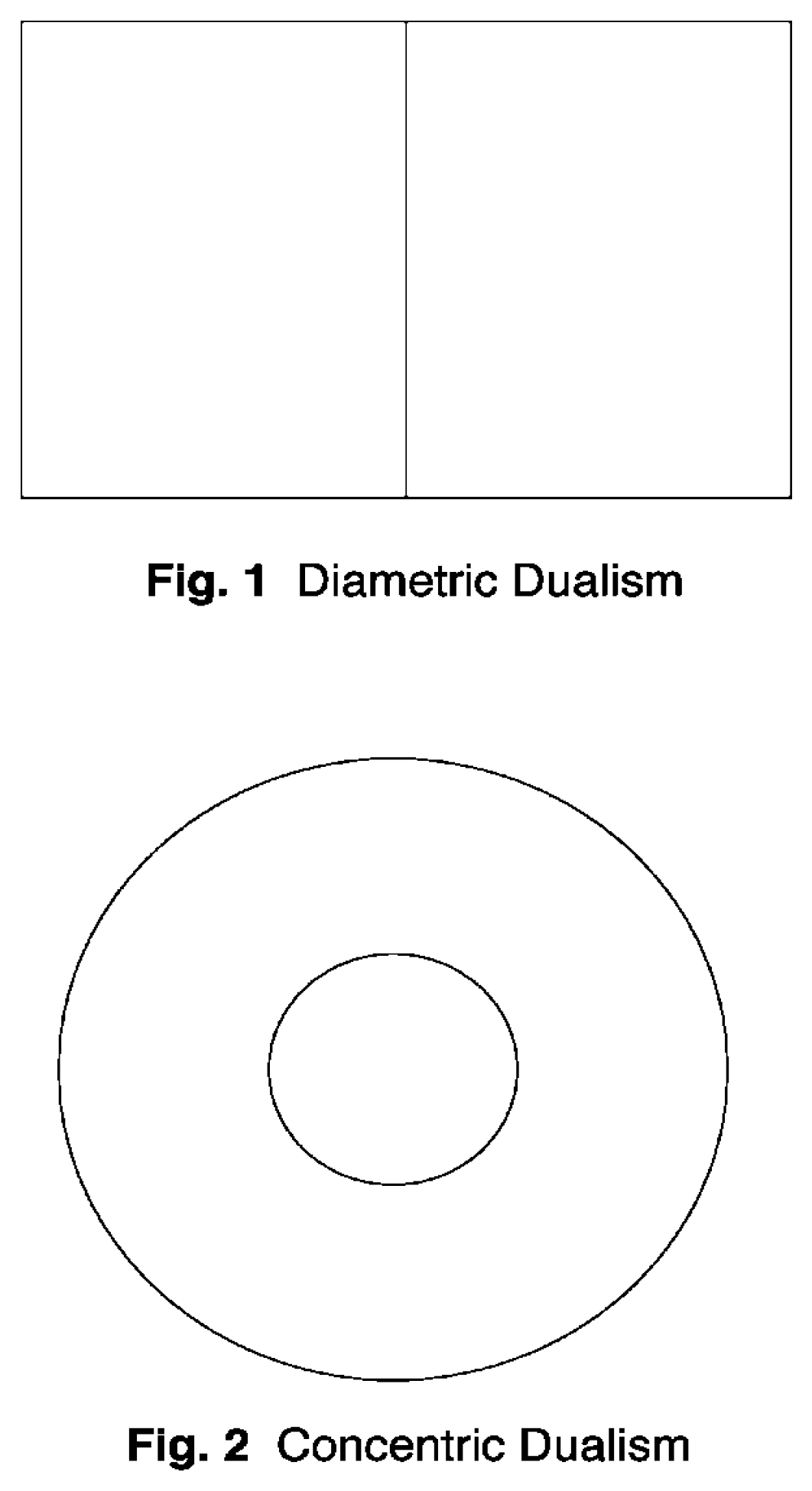
Whereas Bronfenbrenner neglected the system blockage of diametric spatial splitting [3], Lévi-Strauss’ structural anthropology offers a key reference point for alternative spaces to diametric oppositions.
3. Key Contrasts between Diametric and Concentric Spatial Systems of Relation
A key insight of Lévi-Strauss is that diametric and concentric spaces are systems in ‘functional relation’ [38]. In other words, they are in interactive tension, where increase in one brings decrease in the other. Building on structuralist insights, meaning arises for both spaces through their mutual contrasts rather than simply treating each space in isolation from the other. Lévi-Strauss identified two key contrasts between these different spaces, regarding closure/openness and symmetries, though he neglected a key axis of contrasts between these spaces in terms of connection and separation.
3.1. Diametric Space as Assumed Separation between its Poles: Concentric Space as Assumed Connection between its Poles
A fundamental contrast overlooked by Lévi-Strauss is nevertheless to be identified by treating diametric and concentric structures as geometric spaces. It is geometrically evident that the inner and outer poles of concentric structures are more fundamentally attached to each other than diametric structures. Both concentric poles coexist in the same space around a common centre so that the outer circle overlaps the space of the inner one. The outer circle surrounds and contains the inner circle. The opposite that is within the outer circle or shape cannot detach itself from being within this outer shape. Although the outer circle or shape can move in the direction of greater detachment from the inner circle, it cannot fully detach itself from the inner circle (even if the inner circle becomes an increasingly smaller proportion of the outer). A concentric relation assumes connection between its parts and any separation is on the basis of assumed connection, whereas diametric opposition assumes separation and any connection between the parts is on the basis of this assumed separation [3]. Concentric space offers a relation that allows for distinction between an inner and outer pole, while retaining an underlying connection.
A diametric spatial opposition assumes separation between both its poles. In the words of Bachelard, pertinent to diametric space, ‘simple geometrical opposition becomes tinged with aggressivity’ [39]. The juxtaposition of diametric oppositional space is a less proximate relation between both poles than in concentric spatial relation. Concentric space is a fundamental spatial structure of inclusion relative to a diametric spatial structure of exclusion.
A relevant related argument here for concentric spaces pertinent to sustainable development has recently been provided in the context of design of connective urban spaces in Saudi Arabia. Concentric spaces in urban design were understood as offering a model of distinct layers of power, together with a basic commonality of connection for a shared communal identity fostered in physical spatial terms. Alnaim & Noaime’s [26] account of concentric space drawing on urban morphology, architectural phenomenology and sociological studies recognises that ‘The significance of these hellas in the towns lie in their capacity to spatially define different social groups across extended periods of time’. This social function of space and symbolic power is a hallmark elsewhere of sociological, psychological and anthropological readings of domestic space [40,41] as well as community spaces in Columbia [42]. This fusion of physical and social space is taken a notable step further, however, by Alnaim & Noaime’s identification of concentric spatial structures as key to issues of social belonging and connection, ‘the spatial order…ensure[s] that the community remains cohesive and united, with a strong sense of belonging and shared responsibility’, ‘a stable spatial organisation closely tied to the social structure and interconnected circles within the Najdi community’ [26]. The key insight here is of concentric space as offering an assumed interconnection
Such fundamental spatial frames in terms of separation and connection can be further understood through spatial distinctions in the early Heidegger’s phenomenology [43], where projection was a central concept [44]. Separation as remoteness is not something measurable in terms of objective spatial distances of objectively present entities, as Heidegger [43] explicates:
‘The table stands “by” [“be”] the door’ or ‘the chair “touches” [“beruhrt”] the wall’. Taken strictly, ‘touching’ is never what we are talking about in such cases, not because accurate reexamination will always eventually establish that there is a space between he chair and the wall, but because in principle the chair can never touch the wall, even if the space between them should be equal to zero. If the chair could touch the wall, this would presuppose that the wall is the sort of thing ‘for’ which a chair would be encounterable. An entity present-at-hand within the world can be touched by another entity only if by its very nature the latter entity has being-in as its own kind of being …
Relations between solid objects in space are diametric, as there is a basic assumed separation between each object as an object. Both objects exclude each other from occupying the same space. This assumed separation means they are not ‘encounterable’; encountering overcomes the remoteness of assumed separation and is a concentric possibility of being-in-the-world.
Heidegger [43] explicitly equates the ‘touch’ of encountering with the mode of being-alongside. For Heidegger, entities such as a table, chair cannot even potentially be encounterable. Heidegger challenges the primacy of ‘side-by-side-ness’ or the separation built into two entities in order for them to be ‘side-by-side’. He overcomes a diametric relation between being and ‘world’ in his description of ‘being-alongside’ the world, ‘There is no such thing as the ‘side-by-side-ness’ of an entity called ‘Dasein’ with another entity called ‘world’’. Diametric space is where both parts are side-by-side. For a mode of ‘being-alongside’ the world, a different mode of assumed connection is needed, which is not a diametric ‘side-by-side’ relation. Concentric space expresses a ‘being-alongside’ model of relatedness, where one pole dwells within and alongside the other, surrounded and in assumed connection. The smaller, inner pole within concentric space is far from being a relegated space in relation to the larger pole. Rather it dwells centrally within the other larger pole, immersed within it inextricably, in complementary fashion. Concentric spatialization offers a phenomenological structural relation which overcomes the remoteness and non-involvement within diametric space. It offers a spatial relation, where one pole is ‘in’ the other, and hence, is a being-in. ‘Being-alongside’ is founded upon ‘being-in’ for Heidegger [43].
This relational space of assumed connection as a being alongside is expressed also in Canadian indigenous people’s frame of reference as a ‘walking alongside’ others [45] This spatial system of connection and separation is resonant also with the Renaissance thinker, Casanus who recognised that separation and connection are part of a wider relation to each other [46], that is being understood here in spatial systemic terms of interplay between concentric and diametric spaces, as dynamic process movements, as well as more static positional structures. In the words of Cassirer on Cusanus, 'consciousness of difference implies the mediation of difference' [46]. Concentric space allows for difference mediated through connection, with distinction sustained around a common centre, being-alongside each other. Diametric space is a more extreme difference based on sharp separation.
3.2. Diametric Space as Mirror Image Inverted Symmetry
Lévi-Strauss [38] explicitly relates diametric structures to mirror image inversions between both diametric poles. He describes ‘symmetrical inversions’ in Mandan and Hidatsa myths:
these myths are diametrically opposed. . . . In the Mandan version . . . two earth women who are not sisters go to heaven to become sisters-in-law by marrying celestial brothers. One who belongs to the Mandan tribe, separates from an ogre, Sun, with the help of a string which enables her to come back down to her village. In revenge, Sun places his legitimate son at the head of the enemies of the Mandan, upon whom he declares war. In the Hidatsa version . . . everything is exactly reversed. Two celestial brothers come down to earth to be conceived by human beings and born as children. Sun’s sister, an ogress, is joined with an earthborn character by means of a string. She makes him her adopted son and puts him at the head of the enemies of the Hidatsa. [38] .
A mirror image is not identical but rather a left–right inversion. Concentric structures of relation are not a symmetry as inversion. Rather, they offer a different symmetry as unity, where the line or axis of symmetry brings the same pole rather than a mirror image pole in diametric structures. The diametric good/bad opposition also underlies myths such as those of the Shuswap, which treats the owl as a cannibalistic monster, in contrast to the Kutenai, which treats the owl as a benefactor [38]. Diametric spatial mirror image inversions include those such as good/bad, powerful/ powerless, active/passive, love/hate, sacred/profane, us/them, normal/other, win/lose, success/failure, above/below
Diametric oppositional space underpins a mode of othering that divides the world into us versus them. Said’s Orientalism asks ‘whether there is any way of avoiding the hostility expressed by the division, say, of men into “us” (Westerners) and “they” (Orientals)’ [47] . Resonant with and prior to Said’s concerns pertaining to ethnicity, De Beauvoir’s [48] conception of othering in The Second Sex sought to challenge a view of women as other, defined predominantly in relation to men. This diametric oppositional space underpinning othering is directly derived from the crosscultural anthropological work of Levi-Strauss on contrasts between diametric and concentric structured systems pertaining to physical and social structures, including myths. De Beauvoir explicitly drew on early versions of Levi-Strauss’ work in treating othering as a category prior to gender.
De Beauvoir’s (1949/1989) Second Sex explicitly treats the category of the other as primordial and as preceding the duality of the sexes. In doing so, she directly cites the proofs of Lévi-Strauss’ (1947) Elementary Structures of Kinship [49], on the passage from a state of nature to a state of culture as contrasted with the other, as a duality of opposition – in effect, diametric spatial opposition:
Passage from the state of Nature to the state of Culture is marked by man’s ability to view biological relations as a series of contrasts; duality, alternation, opposition and symmetry, whether under definite or vague forms, constitute not so much phenomena to be explained as fundamental and immediately given data of social reality. (Cited in de Beauvoir 1949/1989, p.17)
The duality of diametric spatial opposition is the precondition for the very conception of the other, and this goes beyond gender-based terms, as de Beauvoir explicitly recognises. Alnaim & Noaime [26] draw on Said’s concerns with us/them othering and this can be supplemented by recognition that De Beauvoir’s earlier framework of othering explicitly drew on Lévi-Strauss’ crosscultural understandings.
3.2. Diametric Space as Relative Closure and NonInteraction with Background: Concentric Space as Relative Openness and Interaction with Background
Lévi-Strauss argues that self-sufficiency and a split relation to the outside environment is a general quality of diametric systems: ‘In a diametric system . . . virgin land constitutes an irrelevant element; the moieties are defined by their opposition to each other, and the apparent symmetry of their closed structure creates the illusion of a closed system’ [29]. While this makes sense for the immediate example given for social structures, it is not yet clear if non-self-sufficiency and orientation to the outside environment is a general quality of concentric as opposed to diametric relation, as Lévi-Strauss [29] claims:
[In concentric relation] the system is not self-sufficient, and its frame of reference is always the environment. The opposition between cleared ground (central circle) and waste land (peripheral circle) demands a third element, brush or forest – that is, virgin land – which circumscribes the binary whole while at the same time extending it, since cleared land is to waste land as waste land is to virgin land.
Lévi-Strauss rejects closure for concentric structures, implying that the spatially oriented relation of the background to both poles is governed by the spatial relation within the dualism itself, i.e., ‘cleared land is to waste land as waste land is to [background] virgin land’. The mode of spatial relation to the background is not extraneous to the respective modes of relation within the poles themselves. Thus, as the concentric poles are in assumed connection to each other, they are also in assumed connection to the background; and this assumed connection to the background resists closure within the concentric structure. In contrast, diametric structures’ relation to their own poles is one of assumed separation, which then maintains an assumed separation with the background [3,12].
Alnaim & Noaime [26] foreground the axis of openness and closure in relation to space, when observing that ‘Najdi neighbourhoods characterized by open spaces and wide streets may suggest that the community is more open to the outside, whereas areas with tightly clustered buildings and narrow streets typically signify a more secluded community setting’. Likewise, Massey adopts an emphasis on space with regard to systems of relative closure and openness.
Diametric oppositional space is a more closed one in relation to background environment; this apparently closed system is less permeable with more rigid boundaries that exclude interaction with background. In contrast, Lévi-Strauss highlighted that concentric spatial systems are more fluid and open, interacting dynamically with background.
4. Developing a Concentric Space of Belonging with Nature, Being-Alongside the Natural World to Challenge Bacon’s Diametric Spatial Projection of Human’s Apart, Side-by-Side and Above the Natural World
The early Heidegger’s phenomenology searches for fundamental structures of experience. These include a spatial focus that contrasts a mode of side by sideness with one of being alongside the world. The first spatial mode of juxtaposed, split space is contrasted with a spatial relation of assumed connection between self and world. Diametric spaces of experience underpin the assumed separation of side by side modes of experience, and concentric spaces of experience underlie the assumed connection between self and world of concentric space, where both surround a common centre.
This raises the question of how human beings’ relations to nature, between self and nature have become constructed as side by side spatial modes of diametric assumed separation. An obvious starting point for this diametric oppositional stance and mode of being between humanity and nature is Bacon’s seventeenth century account of the need to subjugate nature.
For Bacon in the Novum Organon [50], ‘Let the human race recover that right over nature which belongs to it by divine bequest’ Aph. 59. Humans are situated within a diametric spatial backdrop regarding nature, a mirror image inverted symmetry where humans are over and nature is under. Whether treating Bacon as a utilitarian or pragmatist [51] or both, it is clear that nature is understood by him in instrumental terms as being a tool for use, for the promotion of the common good, for practical use. Bacon’s new science for this era was to attain new knowledge and control over nature.
Heidegger highlights that the German word for object is Gegenstand, literally meaning a standing against [44]. Diametric oppositional space is such a standing against in both its poles. In other words, diametric oppositional space is a key supporting, framing condition for objectification, for reification. A diametric spatial mode of being supports the rendering of nature as a reified entity, as an object, a tool for use. This is a second key feature of Bacon’s approach to nature, as part of an early Modern expansionism of human powers and ambit of dominion. Understanding of Bacon’s diametric spatial framing between humanity and nature is applicable even if one acknowledges with some commentators that Bacon’s goals for such use of nature was for the betterment of the human condition and that he was not simply a utilitarian thinker focusing on the wellbeing of the majority. Even if one does not reduce Bacon to Bentham’s later utilitarianism, the nature as subjugation and nature as tool features of Bacon’s thought are thoroughly saturated with diametric spatial assumptions regarding the relational space between nature and humanity
It is this reification process of standing against nature to render it an object that again bears the hallmarks of diametric space, where one pole stands against the other. The twin clustering of hierarchal mastery over nature and the othering of nature as object apart, as object for use, rest on preconditions of diametric space both as mirror image inversion between above/below and the assumed separation between two diametric spatial poles juxtaposed in mutual opposition.
The diametric spatial mode of experience and conceptual framing of Bacon’s position in relation to nature operates, firstly, with regard to the mirror image inverted symmetry of above versus below in its placing of nature below humanity, as a resource for domination and subjugation. In concentric space, the outer pole surrounds the inner one. Such a concentric relational space between humanity and nature recognises nature as surrounding humans in assumed connection. Moreover, the mutual embedding of both concentric poles around a common centre places humanity as part of nature around a common centre, rather than in a diametric Baconian spatial opposition of apartness from nature. A concentric relational space treats nature as an extension of humanity and humanity as an extension of nature in a mutual encountering. It challenges a diametric spatial abstraction of humans from the natural world into a realm of aboveness, sought by Bacon.
A distinction has been made between treating Bacon’s imperialism over nature as a domination that is not equivalent to Western colonialism, whether in Spanish or English formulations [51]. Bacon’s diametric spatial presuppositions for his imperialist position over nature, for humanity’s privileged knowing through science, can suspend the question as to whether this imperialism is to be distinguished from colonialism.
While Bacon’s account has clearly played a key role in this diametric oppositional space of othering between humanity and nature, it is important to situate his thought as part of a longer Western conceptual tradition. The diametric spatial framing of nature in Western culture did not begin with Bacon. Bacon's hierarchical conception of humanity in relation to nature operated against the backdrop of a Christian and neoPlatonic conception of a graduated cosmos from the invisible to the visible [46] In such a vein, the visible natural world is viewed as a lower level than the invisible abstract Platonic forms of ideas. This is not to state that more concentric spatial understandings were outside view in Western traditional understandings, as for example, during the time of the Renaissance Cusanus explicitly conceptualised in concentric spatial terms of a circling around its own centre [46].
It is to be emphasised that a prior diametric spatial oppositional split into nature and culture itself has been traced in structural anthropology to ancient Rome, building on Lévi-Strauss’ work. Descola’s [52] cross-cultural anthropological review highlights the constructedness of this diametric opposition:
This Roman landscape , together with all of the values associated with it that colonization had introduced around cities as far away as the banks of the Rhine and in Britain, was the landscape that introduced the notion of a polarity between the wild and the domesticated that we still recognize today. This opposition is neither an objective representation of the properties of things nor an expression of a timeless human nature
The ramifications of this for opening spaces in schools requires amplification.
Descola [52] further challenges the Western bias of this split between nature and culture, ‘In China, India and Japan, it is hard to discover any dichotomy of ‘wild’ and ‘domesticated’ comparable to that which the Western world has forged’. This challenge to a diametric opposition between nature and culture, builds on Lévi-Strauss’ cross-cultural contrasts and functional interplay between diametric and concentric structures in social and physical structures, as well as myths.
It is to be acknowledged that 17th Century French gardens displayed a proclivity for geometrical spaces that can be construed as part of an orientation towards human domination over nature through imposition of external forms over natural wilderness [53]. A different view of gardens emerged in England to challenge French classicism and its geometrical landscapes [53]. While it is tempting to locate Lévi-Strauss’ geometrically oriented contrasts between concentric and diametric structures as part of this French tradition seeking a geometric order of mind over nature, as Platonic ideal forms [54], the crosscultural observations of these fundamental spaces derive from much wider anthropological sources than Lévi-Strauss. Moreover, his structuralist epistemological commitments to seeking Kantian or Cartesian [55] mental structures can be broadened significantly to treat them as phenomenological projected structures and as psychoanalytical projected spaces [3,12,28], pertinent also to the lived experiences of individuals. Phenomenological concerns with structures and processes of experience goes well beyond the confines of structuralism. The relevance of concentric and diametric spatial systems can go far beyond Lévi-Strauss’ framework drawn by analogy from linguistics. The proposed interdisciplinary concentric spatial turn pertaining to relational spaces mediating between humanity and nature seeks to bring to the fore these contrasting experiential spatial systems of relation, as part of a rebalancing of emphasis away from diametric spatial modes of experience.
5. Interpretative Methodological Issues for Uncovering Contrasts between Concentric and Diametric Space
5.1. Concentric and Diametric Spaces as Malleable Sustaining Conditions in Systems
Relegation of space to the metaphorical removes its referential claims to real work impacts in causal system trajectories [3]. An acceleration of focus on spatial understandings builds on Rutter’s key point regarding neglect of silent contingent conditions in developmental psychology. Rutter [56] argues that change to background supporting conditions has been frequently overlooked within developmental psychology:
It is commonly but wrongly assumed that a significant main effect in a multivariate analysis means that that variable has an effect on its own. It does not. What it means is that there is a significant main effect for that variable, after other variables have been taken into account: that is not tantamount to an effect in the absence of all other variables.
Space is such a silent background contingent condition. Rutter basically challenges the assumption in developmental psychology that causes take place in a vacuum. A similar concern has been raised with ‘an “analysis of variance mentality”’ in psychology ‘in which it is believed that variables contributing to outcomes make independent contributions to such outcomes’ [57]. This ignores key system background factors. Rutter’s position here on the tendency to ignore necessary background or even simply supportive conditions for the cause to ‘work’ is resonant with Mill’s [58] challenge to a diametric split between causal and non-causal states:
It is seldom if ever between a consequent and a single antecedent that this invariable sequence subsists. It is usually between a consequent and the sum of several antecedents the concurrence of all of them being requisite to produce, that is, to be certain of being followed by the consequent.
Mill noted that very often one antecedent is termed the cause, with the other antecedents being conditions. Intervention models that ‘work’ causally have hidden contingent conditions, without which the more obvious causal elements could not have occurred, just as striking a billiard ball to hit another presupposes the condition of gravitation. Causes necessarily operate within a background of supporting conditions that are structured sources of the cause’s efficacy.
Bronfenbrenner’s ecological systems focus is one that requires interpretation in terms of its recognition of such nested systems as background conditions. Bronfenbrenner and Evans [59] seek ‘to improve our understanding of the conditions and processes that shape human development’. This offers some role for supporting conditions for causal trajectories. It is unclear if conditions are to be contrasted with processes here, as processes may be supporting conditions for causal trajectories. The search for background supporting conditions is not omitted from later Bronfenbrenner, but it is given less emphasis than the foregrounded, mechanistic-sounding ‘engines of development’ [59] of proximal processes. That proximal processes rely on background supporting conditions is left underdeveloped in Bronfenbrenner’s work.
5.2. Distinguishing Concentric and Diametric Spaces as Structures Versus Functions
Alnaim & Noaime’s [26] focus is more on cultural norms of space. A further level of analysis of space can understand these concentric and diametric spatial contrasts in cross-cultural terms as fundamental projections of experience. Alnaim & Noaime’s concentric structured model of micro-meso and macro levels of Single Hella Level (sub-collective community), Neighbourhood level (Collective Community) and the Built Environment (Social Structure) is interpreted as a ‘spatial hierarchy’ [26]. Whereas Alnaim & Noaime 2024 interpret concentric spatial organisation as being a ‘spatial hierarchy’, a framework that encompasses the mirror image inverted symmetrical dimension of Lévi-Strauss’ diametric space of above/below would recognise that diametric space is a much sharper hierarchy than that of concentric spatial relations. Concentric space offers a relation of distinction and difference as part of a wider assumed connection; this distinction is not a monistic fusion that does not differentiate between the concentric poles [12]. Alnaim & Noaime’s [26] approach aptly highlights these differences including power decision making ambits within the concentric spatial arrangement in this specific cultural context.
This invites further interrogation of a distinction between structure and function in relation to concentric and diametric structures that Lévi-Strauss recognised in only rudimentary terms. Caton [60] aptly suggests that Lévi-Strauss never clarified the difference between questions of reference and questions of function. Issues of reference are largely external to a structuralist framework [61]. A related point here is the need to distinguish more static positional empirical accounts of concentric and diametric structures from these spaces as dynamic processes, from the dynamic functional contrasts between these spaces. In other words, a physical manifestation of concentric space as a structure may not serve a concentric spatial function of assumed connection and relative openness. Thus, it needs to be acknowledged that a concentric physical structure can serve a diametric spatial function of exclusion as a fortress of assumed separation from background, such as Alnaim & Noaime’s recognition that ‘…if Najdi towns were established within walls for security purposes’ [26].
Likewise in a psychological account of concentric structure, emotional distance has been construed in terms of eight concentric circles across a large number of countries [62]. This emotional distance questioning rates relationships from very far to very close, including family members, relatives and various social role categories. While this at least interprets emotions cross-culturally in spatial terms, the conception of concentric space in Georgas et al. [62] is one of assumed separation between the circles rather than their common mutual overlap through a common centre. This understanding of concentric structures does not encompass the geometric co-centre hallmark of concentric space.
The current examination of geometrical properties of space in relative terms of differences between concentric and diametric spaces does not deny that historical empirical examples of concentric structures have interpreted such space in hierarchical terms. Other examples of how meanings are associated with empirical features of concentric structures treated in isolation that are to be contrasted with a more fundamental questioning of concentric space in relation to diametric space, include the attribution of an outer concentric ring to Moslem religion in Dante’s Divine Comedy. This is aptly criticized by Said:
‘“Maometto” – Mohammed – turns up in canto 28 of the Inferno. He is located in the eighth of the nine circles of Hell … Mohammed thus belongs to a rigid hierarchy of evils, in the category of what Dante calls seminator di scandalo e di scisma’ [47]
Dante’s Inferno, with nine circles of hell bringing increasingly serious sins, is a hierarchical imposition onto concentric structures of relation. This is not only Dante’s space as different levels but also a feudal conception of social structure in hierarchical terms. Concentric structures can be interpreted diametrically as split levels between each of the circles, rather than treating them as mutually overlapping a common space through a shared centre. Strictly, i.e., geometrically, concentric space is co-centric; in other words, the concentric circles share a mutually overlapping, embedded space through a common centre.
This association of outer layers of concentric structured space with a loss of power due to distance from the centre is one given some support by Lévi-Strauss [29] where he draws this conclusion from empirical observation of given concentric societal spatial arrangements, ‘the opposition is, with regard to social and/or religious prestige, necessarily unequal’. He provides the following rationale for his conclusion, ‘In the case of concentric structures, the inequality may be taken for granted, since the two elements are, so to speak, arranged with respect to the same point of reference – the center – to which one of the circles is closer than the other’ [29]. In a jurisprudential context, analysing legal conventions founding law, Marmor [63] draws on a similar association, ‘the image I suggest is a division of labour taking place in concentric circles: the closer one is to the centre, the greater effect one has on what the convention is – and vice versa’. These interpretations of particular examples of concentric structures are a) not a necessary entailment of concentric space relative to diametric space. They also b) thwart the connectivity in a concentric relation, as they treat the inner concentric circle as exclusionary of what is in the outer concentric layers – rather than the outer circle as also occupying the space of the inner circle.
Spatial structure and function may not be empirically synchronized. Diametric structure may or may not fulfil a diametric spatial function, concentric structure may or may not fulfil a concentric spatial function. In the examples of concentric structures as defensive walls and fortress, it is the structural feature rather than the spatial feature of the concentric relation than is being foregrounded. The spatial feature is connective around a common centre, even if the structures can serve a diametric spatial function of exclusion.
It is important to distinguish geometrical features of the contrasts between concentric and diametric spaces from simply historical empirical examples where one space is treated in isolation rather than in relative terms of interactive contrasts with the other space. Thus, the recent association of concentric structures of space with a ‘mismatch’ of ‘accessibility’ [27], as exclusion and lack of access to health services is not one that treats concentric space in terms of function or its functional interaction with diametric space. For Zhao, Shao, Li & Shen ‘The results showed a concentric pattern ranging from reasonable allocation at the city center to lagging allocation, advanced allocation and then reasonable allocation from the city center towards the outer areas’ [27]. This is not to deny a key point of Zhao, Shao, Li & Shen that ‘spatial justice’ [27] is an important lens in understanding access to vital health services.
Fundamental geometrical contrasts in function between concentric and diametric spaces as a directional relation of difference, are not simply manifested in positional terms as everyday objects. Thus, Bachelard’s [39] example of a concentric object, a snail’s shell, or even shell-symbolism is not a basis for inferences about relative differences between concentric and diametric spatial relations. It is not the surface feature of objects or entities that is the basis for fundamental spatial inferences but rather the relational differences encountered between concentric and diametric spaces – structures of relation in relation.
The structuralist tenet that meaning does not reside in a single term but that it resides in contrasts needs to be applied to treat concentric and diametric space not as isolated terms but as dynamic terms of contrast, in mutual interactive tension in any given system.
The inner concentric pole is treated here by Dante, Lévi-Strauss and Marmor, as more like a fortress abstracted and excised from a common space than as a common space embedded in assumed connection for each of its surrounding layers. It displaces the geometric feature of a concentric space of assumed connection into a hierarchy. These examples offer a cautionary note regarding structural positional inferences based on concentric space for culturally meaningful associations that may overlook the key fundamental directional functional roles of concentric and diametric spaces in relation. Lévi-Strauss’ key insight here is that these spaces are in ‘functional relation’ [38] (italics added) of directional tension and not simply structural positional relation. Lévi-Strauss understated the dynamic role of concentric and diametric spaces as system movements. In doing so, he did not fully clarify the positional/directional dimensions to these spaces, the empirical/geometric tensions and the structure/function differences in levels of description and explanation in any given system and cultural context. This is not to oppose the empirical to the geometric but rather to interrogate these levels in terms of a combination of both positional structure and directional function.
5.3. Beyond Static Versus Dynamic Oppositions for Space to Treating Space as Both Positional and Directional Movement
It is notable that while Lévi-Strauss did not draw a sharp contrast between a static/dynamic opposition for these structures of relation, Massey has given emphasis to the importance of a static/dynamic contrast for space. Whereas Massey does not directly engage with diametric or concentric spaces and hence does not associate stasis or dynamism in particular with either space, Alnaim & Noaime associate concentric space with stability [26]. Alnaim & Noaime refer to concentric spatial structures as key to ‘the spatial order…ensure[s] that the community remains cohesive and united’ , ‘a stable spatial organisation closely tied to the social structure and interconnected circles within the Najdi community’ [26]. This stability association may make sense in a given sociohistorical context but it is not a fundamental feature of concentric space. The key insight here is of concentric space as offering an assumed interconnection rather than the association of concentric space with stability over change. Rather, the greater closure to background of diametric space relative to the more open interactive concentric space, recognised by Lévi-Strauss, invites an association of diametric space with a rigidity to change, if not stability as such.
Any association of concentric and diametric spaces as system conditions for sustainability is not to invite a simple relation between sustainability and stability or stasis in a system. The interplay between concentric and diametric spaces as background system conditions offers a realm of malleability for a system. Stasis/change is not a particular feature of concentric spatial processes over diametric ones. While Massey [4] gives emphasis to the dynamic/static opposition for space, the proposed concentric spatial turn framework treats both concentric and diametric spaces as positional structures and dynamic processes.
5.4. A Concentric Spatial Turn as Broader Than Structuralism through Incorporating Phenomenology and Causal Reference in Systems
The epistemological commitments underlying Lévi-Strauss’ crosscultural observations of concentric and diametric structures require modification for developing sustainable spatial systems for human interaction with the natural world . Lévi-Strauss’ reliance on an analogy between the structure of myths and that of structural linguistics has been strongly questioned[60]. While his epistemology is drawn from linguistics, this does not require that the cross-cultural observations of concentric and diametric structures, and their relative differences, be confined to examination only from a paradigm drawn from linguistics. Arguably, it was the very cage of this paradigm that prevented Lévi-Strauss from expanding upon the proposed phenomenological and referential relevance of these structures. This is not to detract from Lévi-Strauss’ key structuralist insight that the meanings of these concentric and diametric spaces are not in these treated as single terms but in their interactive relation and tension of differences. It bears reiteration that oncentric and diametric spaces are structures of difference, and structures of relation in mutual relation [3,12].
Different levels of description of relevance for interrogation of diametric and concentric spaces includes those of language through spatial metaphors and in thought as direct conceptualisations of space, including but by no means being exclusive to space as place. Indirectly spatial concepts such as closure, proximity, distance, hierarchy, belonging, as well as a recurrent affinity with a structuralist uncovering of polarities (between for example, weak/strong, domination/obedience, stability/instability, continuity/discontinuity, presence/absence) are further sites of relevance. A further spatial level of interrogation examines the frame, namely, framing conditions for representations, background horizons of understanding as an assumption structure for thought.
The standard criticisms of Lévi-Strauss’ structuralist anthropology, such as in cultural anthropology’s emphasis on individuals’ meanings and experiences [64], can be understood as different levels of description, while highlighting the flexibility of concentric and diametric spaces to bridge these different levels. Concentric and diametric spatial systems can be understood as being both a domain of relevance for empirical examination and as a methodology, a process of interpretation [3]. These spatial frameworks of questioning can apply at different levels of description, from language, physical places, perceptions, cognitions and emotions, to a further background assumption structure level of spatial frames, social imaginaries, projections and horizons of understanding.
6. Discussion
This conceptual review offers a synthesis in spatial terms between an amplification of Lévi-Strauss’ diametric and concentric spatial systems, Bacon’s subjugation of nature, De Beauvoir’s othering, and Heidegger’s being alongside the world. Building on aspects of these arguments elsewhere [3,12,28], it recognises the need for a broadening of Bronfenbrenner’s concentric social-ecological systems framework in psychology and education, as part of a sustainable systems focus on relational space between humanity and nature. Bronfenbrenner not only overlooked Lévi-Strauss’ work decades earlier on concentric structured systems, he did not identify the diametric spatial counterpole to concentric systems. Thus, Bronfenbrenner did not sufficiently interrogate system splits and oppositions, as system blockages and resistances. Moreover, while Bronfenbrenner did commit to exploring individual phenomenology within the concentric nested systems, he did not treat experience itself as a system or as a system in spatial terms [3].
This conceptual review regarding concentric space, interrogating space as a system and pertaining to issues of sustainability, has sought to remedy the neglect in rigorous conceptualisation of concentric space across various disciplines. Leading sociological and philosophical accounts that have engaged with dualism and directly with Lévi-Strauss’ work, such as Bourdieu’s Berber House [41], Kearney’s interrogation of othering in Strangers, Gods and Monsters [65] and Jameson’s Valences of the Dialectic [66] all give recognition to diametric opposition if not always explicitly as spaces, while overlooking concentric spaces as dualisms and systems. Each of these treat dualism overwhelmingly in diametric spatial terms without recognition of concentric space. Likewise, Massey’s leading geographical conceptualisation of space has tended to overlook concentric spatial systems.
In drawing out a framework of key geometrical contrasts between concentric and diametric spaces, building on Lévi-Strauss’ important insight that these spaces are in ‘functional relation’ [38] of dynamic tension, a traditional Western Cartesian view of space as either empty nonentity or as mere metaphor outside real world impacts has been challenged. A more crossculturally relevant space has been sought as concentric space, in its interaction with diametric space, as key system conditions underpinning real world events and systems, as well as individual phenomenology, where individual experience is treated as a system, a system of interactions between concentric and diametric spaces of relation. The argument for these spaces as occurring at unconscious levels has been made elsewhere [28], and is resonant with the recent sustainability concerns with concentric space [26].
Conclusion
Concentric spatial systems in their dynamic functional interaction with diametric spatial systems offer a spatial turn for interdisciplinary interrogation of fundamental modes of experience and understanding as malleable conditions framing the relation of humanity to the natural world. This ancient and crosscultural concentric space and human capacity to experience the world in concentric spatial terms urgently requires increased attention from the vantage point of promoting sustainable systems of the future. The Baconian vision of human subjugation of nature as a tool for human progress rests on a diametric spatial projection, where humans are above and apart from nature, in a mirror image inverted symmetry of above/below hierarchy and side-by-side assumed separation as diametric space. Human’s contrasting mode of being and relation with nature, through concentric spaces of belonging with nature, alongside the natural world, is a capacity for experience that has been neglected, especially in Western traditions of understanding. A spatial shift is needed to move from nature as other to encountering nature. The task of education for developing concentric modes of assumed connection and relative openness to encounter the natural world, as part of the education of experience and not simply mind as Cartesian selfconsciousness, is an urgent one. To adapt Illich’s [67] words, the education system needs to challenge the schooling down to size of human capacity for experience, to reconfigure our modes of experience towards concentric spaces of being and not simply support the imbalance and domination of diametric spaces of experience and understanding.
A concentric spatial turn accepts the structuralist tenet that meaning resides in contrasts, such as the contrasting tensions between diametric and concentric spatial systems. However, it seeks to extend concentric and diametric structures of relation to wider domains of relevance such as the phenomenology of individual's experiences and voices, and beyond structuralist commitments. This spatial framework seeks a concretisation of Massey's [4] concerns with openness/closure, opposition, separation/connection, static/dynamic features of space into crossculturally observed systems that cluster these features as diametric and concentric spaces in dynamic mutual tension and interplay. In doing so, it treats these contrasts as sites for agency in socio-historical material systems, with system malleability as movement between these capacities for framing spatial conditions.
Future Directions
There is a clear need to break down Roman colonialist and Cartesian diametric spatial divisions between nature and culture in schools and education spaces more broadly, as part of a focus on promoting concentric social, relational and educational spaces of belonging with the natural world. This needs to embrace an expanded concern with outdoor education, as well as school gardens [68] and student’s responsibilities for animals and plants in schools [69]. Yet while a focus on promoting concentric spaces of attunement with the natural world needs to embrace school and urban design issues, these issues for a concentric spatial turn go further than a focus on space as place.
A concentric spatial turn also requires engagement with individuals’ relational spaces, both spaces within and in relation to other people and the natural world. The experiential capacity for a broadening beyond diametric oppositional spaces of experience needs to be addressed for an education of the future. This othering of nature through diametric spatial conditions of experience, based on a Baconian legacy of apartness and aboveness of the human condition concerning nature, requires challenge through identification and fostering the flow of assumed connection and relative openness of concentric spatial modes of experience. These are multiple and multifarious, rather than being compressed into simply one or two manifestations of concentric spatial modes of experience. While concentric and diametric spaces are arguably primordial spaces of experience, recognition of their ancient roots in human experience is not to understand primordiality in terms of the ancient past as a nostalgia for origins; there are much wider conceptions of primordiality than a past based focus, ones that focus on primordiality as a capacity for unity within fundamental modes of experience [28]. A concentric spatial turn for human experience needs to be a sustainable system of experiential expansion and not merely a monistic obliteration of boundaries [12] that is unsustainable and radically imbalanced in the experiential system.
A broadening of experience through concentric spatial conditions for human experience and an educational rebalancing from diametric spatial condition of experience also requires further interrogation of a basic othering as diametric space in experience, namely, the othering of self through selfconsciousness. Selfconsciousness is a spatial process of reification of the self as a standing against (Gegenstand), rendering the self as an object. There is a need to foster children, young people and adults’ capacities to be rather than simply to be an object for oneself as selfconsciousness, in a selfconscious and arguably increasingly reified and reifying hyperselfconscious global culture. Fundamental spatial experiential shifts are needed for human being, to be alongside the natural world in a sustainable way.
References
- Schopenhauer, A. (1859/2010). The world as will and representation (Vol. I., Trans. J. Norman, A. Welchman, & C. Janaway). Cambridge: Cambridge University Press, p.379.
- Descartes, R. (1954). Descartes: Philosophical writings. Trans. E. Anscombe & P.T. Geach. London: Nelson, p.200.
- Downes, P. (2020a). Reconstructing agency in developmental and educational psychology: Inclusive Systems as Concentric Space. New York/London/New Delhi: Routledge.
- Massey, D. (2005). For space. London: Sage Publications.
- Lefebvre, H. (1991). The production of space. Oxford: Blackwell.
- Foucault, M. (1986). Of Other Spaces. Diacritics 16 (1) 22–27.
- Ferrare, J. J., & Apple, M. W. (2010). Spatializing critical education: Progress and cautions. Critical Studies in Education, 51, 209–221, p.216.
- Robertson, S. (2009). ‘Spatialising’ the Sociology of Education: Stand-points, Entry-points, Vantage-points. In S. Ball, M. Apple and L. Gandin (eds), Handbook of Sociology of Education, London and New York: Routledge.
- Vendra, M.C. & Furia, P. Introduction – Ricœur and the Problem of Space. Perspectives on a Ricœurian “Spatial Turn”. Ricœur Studies 2021, 12((2)), 1–7.
- Downes, P. At the Threshold of Ricoeur’s Concerns in La Métaphore Vive: A Spatial Discourse of Diametric and Concentric Structures of Relation Building on Lévi-Strauss. Ricoeur Studies/Etudes Ricoeuriennes 2016, 7 (2), 146–163. [Google Scholar] [CrossRef]
- Soja, E. W. (1996). Thirdspace: Journeys to Los Angeles and other real-and-imagined places. Oxford: Wiley-Blackwell.
- Downes, P. (2020b). Concentric Space as a Life Principle Beyond Schopenhauer, Nietzsche and Ricoeur: Inclusion of the Other. New York/London/New Delhi: Routledge.
- Brand, A. L. The duality of space: The built world of Du Bois’ double-consciousness. Environment and Planning D: Society and Space 2018, 36(1), 3–22, p.7.
- Mannion, G. Going spatial, going relational: Why ‘listening to children’ and children’s participation needs reframing. Discourse: Studies in the Cultural Politics of Education 2007, 28, 405–420, p.410. [Google Scholar] [CrossRef]
- Armstrong, F. (2007). Disability, education and space: Some critical reflections. In K. Gulson & C. Symes (Eds.), Spatial theories of education: Policy and geography matters (pp. 95–110). New York: Routledge, p.107.
- Cross, W. E. Jr. Ecological factors in human development. Child Development 2017, 88(3), 767–769, p.768. [Google Scholar] [CrossRef] [PubMed]
- Larsen, M.A., Beech, J. Spatial theorizing in comparative and international education research. Comparative Education Review 2014, 58 (2), 191–214.
- Wong, B. Exploring the spatial belonging of students in higher education. Studies in Higher Education 2024, 49(3), 546–558. [Google Scholar] [CrossRef]
- Downes, P., Li, G., Van Praag, L. & Lamb, S. (Eds.) (2024). The Routledge International Handbook of Equity and Inclusion in Education. London: Routledge.
- Bronfenbrenner, U. (1979). The ecology of human development. Boston: Harvard University Press, p.22.
- Cefai, C. Downes, P. Cavioni.,V. (2021). A formative, inclusive, whole school approach to the assessment of social and emotional education in the EU. Luxembourg: Publications Office of the European Union/EU bookshop.
- European Commission, European Education and Training Expert Panel (2019). Issue paper on Inclusion and citizenship. Brussels: Education and Training ET 2020.
- Downes, P., Anderson, J., Behtoui, A., Van Praag, L. (Eds.), (2024). Promoting Inclusive Systems for Migrants in Education. London: Routledge.
- Downes, P., Anderson, J., Nairz-Wirth E. Conclusion: Developing conceptual understandings of transitions and policy implications. European Journal of Education 2018, 53, 541–556. [CrossRef]
- Permana, A. S., Er, E., Aziz, N. A., & Ho, C. S. Three Sustainability Advantages of Urban Densification in a Concentric Urban Form: Evidence from Bandung City, Indonesia. International Journal of Built Environment and Sustainability 2015, 2(3). [CrossRef]
- Alnaim, M.M.; Noaime, E. (2024). Spatial Dynamics and Social Order in Traditional Towns of Saudi Arabia’s Nadji Region: The Role of Neighborhood Clustering in Urban Morphology and Decision-Making Processes. Sustainability 16, 2830. p.6, p.12, p.14, p.19, p.11.
- Zhao, D., Shao, L., Li, J., & Shen, L. (2024). Spatial-performance evaluation of primary health care: Evidence from Xi’an, China. Sustainability, 16, 2838, p.1, p.12.
- Downes, P. (2012). The Primordial Dance: Diametric and Concentric Spaces in the Unconscious World. Oxford/Bern: Peter Lang.
- Lévi-Strauss, C. (1963). Structural anthropology: Vol. 1. Trans. C. Jacobsen & B. Grundfest Schoepf. Allen Lane: Penguin, p.148., p.152, pp.139-140.
- Oslisy, R. (1996). The rock art of Gabon: Techniques, themes and estimation of its age by cultural association. In G. Pwiti, R.C. Soper (eds), Aspects of African archaeology: Papers from the 10th Congress of the PanAfrican Association for Prehistory and Related Studies, 361–70. Zimbabwe: University of Zimbabwe Publications.
- Nichols, R. (1990). The book of druidry. J. Matthews & P. Carr-Gorman (eds). London: Thorsons.
- Kriiska, A., Lougas, L. and Saluaar, U. (1997). Archaeological excavations of the Stone Age settlement site and ruin of the stone cist grave of the Early Metal Age in Kasekula. In U. Tamla (ed.), Archaeological field works in Estonia. Tallinn: Muinsuskaitseinspektsioon.
- Mandel, M. (1984). Minevikult tanapaevani. Estonia: Eesti raanat.
- Downes, P. (2011). Concentric and diametric structures in yin/yang and the mandala symbol: A new wave of Eastern frames for psychology.Psychology and Developing Societies, 23 (1), 121-153.
- Wilhelm, H. (1977). Heaven, earth and man in the Book of Changes. University of Washington Press.
- Leidy, D. P. (2008). The art of Buddhism: An introduction to its history and meaning. Boston: Shambhala Publications.
- Kerenyi, C. (1976). Dionysos: Archetypal image of indestructible life. New Jersey: Princeton University Press, p.95-96.
- Lévi-Strauss, C. (1973). Structural anthropology: Vol. 2. Trans. M. Layton, 1977. Allen Lane: Penguin Books, p.73, p.247, p.250, p.261.
- Bachelard, G. (1964). The poetics of space. Boston: Beacon Press, 1994, p.212, p. 116.
- Giorgi, S., Padiglione, V., & Pontevorco, C. Appropriations: Dynamics of domestic space negotiations in Italian middleclass working families. Culture and Psychology 2007, 13, 147–178.
- Bourdieu, P. (1970). The Berber house or the world reversed. Social Science Information, 9(2), 151-170.
- Streicker, J. (1997). Spatial reconfigurations, imagined geographies and social conflicts in Cartagena, Columbia. Cultural Anthropology, 12, 109–28.
- Heidegger, M. (1927). Being and time. Trans. J. MacQuarrie & E. Robinson, 1962. Oxford: Basil Blackwell, p.81-82.
- Heidegger, M. (1927a/1982). The basic problems of phenomenology. Trans. Albert Hofstadter Bloomington: Indiana University Press.
- Young, L., Vernon J. Linklater, V.J. and Pushor, D (2024). Walking Alongside: A Relational Conceptualization of Indigenous Parent Knowledge. In Downes, P., Li, G., Van Praag, L. & Lamb, S. (Eds.) (2024). The Routledge International Handbook of Equity and Inclusion in Education. London: Routledge.
- Cassirer, E. (1927/2020). The individual and the cosmos in Renaissance philosophy. Trans. M.Domandi. New York: Angelico Press, p.22, p.39, p.9, p.16, p.28.
- Said, E.W. (1978). Orientalism. London: Routledge & Kegan Paul, p.45, p.68.
- Beauvoir, de S. (1949). The second sex. New York: Vintage, 1989.
- Lévi-Strauss, C. (1969). The elementary structures of kinship. Boston: Beacon Press.
- Bacon, F. (1620). Novum Organon, Aph. 59.
- Scalercio, M. (2018). Dominating nature and colonialism. Francis Bacon’s view of Europe and the New World. History of European Ideas, 44(8), 1076–1091.
- Descola, P. (2005/2013). Beyond nature and culture. University of Chicago Press, p.54, p.45.
- Montuschi, E. (2010). Order of man, order of nature: Francis Bacon’s idea of a ‘dominion’ over nature. Paper presented at the workshop ‘The Governance of Nature’, LSE 27/28 October 2010.
- Passmore, J. (1974). Man’s Responsibility for Nature, London: Duckworth,.
- D’Aquili, E. (1975). The influence of Jung on the work of Claude Lévi-Strauss. Journal of the History of the Behavioral Sciences, 11, 41–8.
- Rutter, M. (1985). Resilience in the face of adversity. British Journal of Psychiatry, 147, 598–611, p.601.
- Gottlieb, G., & Halpern, C. T. (2002). A relational view of causality in normal and abnormal development. Development and Psychopathology, 14, 421–435.
- Mill, J.S. (1872). A system of logic. In R.F. McRae (ed.), Collected Works, Vol. VII, Books I, II, III. Toronto: University of Toronto Press, 1973, p.327.
- Bronfenbrenner, U.; Evans, G. W. Developmental science in the 21st century: Emerging questions, theoretical models, research designs and empirical findings. Social Development 2000, 9(1), 115–125, p. 118. [Google Scholar] [CrossRef]
- Caton, S.C. (1987). Contributions of Roman Jakobsen. Annual Review of Anthropology, 16, 223–60.
- Ricoeur, P. (2006). Memory, History Forgetting. University of Chicago Press.
- Georgas, J., Mylonas, K., Bafiti, T., Poortinga, Y. H., Kag˘ itibas¸i, C., Orung, S., et al. (2001). Functional relationships in the nuclear and extended family: A 16-culture study. International Journal of Psychology, 36, 289–300.
- Marmor, A. (2001). Legal conventionalism. In J. Coleman (ed.), Hart’s postscript: Essays on the Postscript to the Concept of Law,193–218. Oxford: Oxford University Press p. 210.
- Geertz, C. (1973). Thick description: Toward an interpretive theory of culture. The interpretation of cultures: Selected essays. New York: Basic Books, pp. 3–30.
- Kearney, R. (2003). Strangers, Gods and Monsters: Interpreting otherness. London & New York: Routledge.
- Jameson, F. (2009). Valences of the dialectic. London: Verso.
- Illich, I. (1971). Deschooling society. New York: Harper and Row.
- Brady, S (2022). A Reconceptualisation of Froebel’s Approach to Nature to Examine the Perceived Impact of Children’s Participation in a School Garden on their Social and Emotional Development in a DEIS Band 1 Primary School. M.Ed Thesis, DCU Institute of Education, Educational Disadvantage Centre.
- Gilligan, C. & Downes, P. (2022). Reconfiguring Relational Space: A Qualitative Study of the Benefits of Caring for Hens for the Socio-Emotional Development of 5 – 9-year-old Children in an Urban Junior School context of High Socio-Economic Exclusion. Journal of Adventure Education & Outdoor Learning,22 (2) 148-164.
Disclaimer/Publisher’s Note: The statements, opinions and data contained in all publications are solely those of the individual author(s) and contributor(s) and not of MDPI and/or the editor(s). MDPI and/or the editor(s) disclaim responsibility for any injury to people or property resulting from any ideas, methods, instructions or products referred to in the content. |
© 2024 by the authors. Licensee MDPI, Basel, Switzerland. This article is an open access article distributed under the terms and conditions of the Creative Commons Attribution (CC BY) license (http://creativecommons.org/licenses/by/4.0/).
Copyright: This open access article is published under a Creative Commons CC BY 4.0 license, which permit the free download, distribution, and reuse, provided that the author and preprint are cited in any reuse.