
Submitted:
06 May 2025
Posted:
07 May 2025
You are already at the latest version
Abstract
This study explores the convergence between science education and environmental education through the lens of planetary health, proposing a paradigmatic shift from positivist understand-ings of science toward a sociocultural, ethical, and poetic perspective of knowledge. Utilizing a deductive, two-phase content analysis of seven foundational texts, we examine how planetary health discourse frames science, knowledge, and education. In the first phase, we analyze episte-mological dimensions—such as the conception of science, knowledge systems, and communica-tion—while the second phase identifies practical strategies for fostering transformative educa-tion. Our findings highlight a transition away from fragmented, technocratic models toward transdisciplinary, decolonial, and narrative-based approaches that emphasize knowledge co-production, emotional engagement, and community participation. To address persistent im-plementation gaps—such as limited policy integration and data interoperability—we propose an expanded set of educational principles grounded in planetary health. These principles promote epistemic plurality, place-based identity, environmental ethics, and intergenerational responsi-bility. Drawing from environmental humanities and critical pedagogy, the study also values mythical, symbolic, and cultural forms of knowledge alongside scientific and technical ones. This work reinterprets and expands the original proposal from Science, Culture, and Environmental Education: A Proposal for Educators, situating it within the contemporary planetary health frame-work to support socio-ecological resilience and transformative learning.
Keywords:
Science
; environmental education
; pedagogical scenarios
; sociocultural perspective
; planetary health education
1. Introduction
Human beings construct their knowledge based on the education they receive and the experiences they live within the context of their social practice, which involves the recognition and validation of certain forms of knowledge through hegemonic discourses. In the field of science education, particularly from the paradigms concerning the nature of science, there has been extensive debate about the role of scientific knowledge in social practices. This has led to proposals aimed at the critical appropriation of scientific knowledge. Among them, the “dialogue of knowledges” stands out, promoting the integration of scientific knowledge with other forms of knowledge, such as mythical-religious, symbolic, technical, philosophical, and social.
However, the current context—marked by political, ecological, and social crises occurring simultaneously, what Morin & Kern have called a polycrisis [1]—alongside the rise of scientific denialism and the proliferation of fake news [2], has led to significant setbacks in progress toward socio-environmental justice. In response, various resistance initiatives have emerged to sustain the fight against global challenges such as climate change. Nevertheless, many of these proposals remain fragmented and disconnected from diverse ways of knowing, which can result in well-intentioned but ultimately harmful solutions for key areas like biodiversity and local sociocultural systems.
In this scenario, it is pertinent to analyze the emerging framework of planetary health, understood as an integrative perspective that recognizes the interdependence between human health, ecosystems, and social systems. Based on this framework, we ask: what is its place within the field of environmental education? Does it represent a new paradigm that redefines its foundations, or does it constitute a specialization within already existing educational frameworks? From the perspective of Thomas Kuhn’s theory of scientific revolutions [3], we ask whether planetary health education is shaping a structural transformation of the environmental education field or whether it is presented as a thematic extension of its classical postulates.
Based on these reflections, and recognizing the social and collective nature of knowledge production, we understand that knowledges are constructed within epistemic communities that share ideas, concepts, and representations of the world. Consequently, we regard environmental education as a constantly evolving field, in dialogue with sustainability, science education, and, more recently, with the principles of planetary health. We believe that the latter requires overcoming fragmented views and promoting transdisciplinary approaches that integrate diverse knowledges.
Within this scenario, it becomes essential to revisit and reinterpret theoretical frameworks that support an integrated understanding of the connections among culture, knowledge, and the environment. In particular, we draw on the proposal by Mejía-Cáceres and Zambrano (2018), who advocate for an epistemological and pedagogical reconfiguration of environmental education [4]. These authors propose a shift from a positivist conception of scientific knowledge toward a sociocultural perspective that integrates ethical, symbolic, and poetic dimensions in the human-environment relationship. In this view, teaching is understood as a process of cultural formation [5] and learning as a form of cultural appropriation [6] and a culture conceived as a system of meanings and symbols that organizes social interaction [7].
It is from this proposal that the central research question of this study emerges: How can the perspective of planetary health complement the principles of environmental education from a cultural standpoint?
This question guides the analysis presented in this article and allows us to explore the intersections between these two perspectives in the pursuit of a more ethical, critical, and transformative education.
Accordingly, we understand environmental education as a dynamic and evolving field, in constant dialogue with sustainability, science education, and more recently, with the framework of planetary health. The articulation of these approaches invites us to overcome fragmented views and move toward transdisciplinary, culturally situated educational proposals committed to socio-environmental justice.
2. Theoretical Framework
2.1. Epistemological and Pedagogical Foundations of Environmental Education: Integrating Sustainability, Planetary Health, and Science Education
In the field of environmental education and sustainability, three fundamental levels of epistemological discussion can be identified, each essential to underpin any educational proposal in this area:
First Level: Conceptual Definition and Delimitation
This level concerns the understanding and differentiation of terms such as environmental education, education for sustainability, and environmental and sustainability education. These notions are neither equivalent nor interchangeable, as they respond to diverse historical trajectories, political interests, and theoretical foundations. Authors such as Sauvé (2005) have identified up to fifteen strands within environmental education—ecological or conservationist, naturalist, ethical, critical, ecofeminist, holistic, popular education, ecological citizenship, and others—each with its own vision of the environment and of educational action [8]. While critical environmental education is aimed at transforming social structures and building ecological citizenships [9,10,11], Education for Sustainable Development (ESD) represents UNESCO’s initiative to address the pressing issues confronting our world. It equips individuals with the understanding, abilities, principles, mindsets, and practices needed to act in environmentally sound, economically viable, and socially equitable ways, encouraging informed, responsible decisions that contribute to a more hopeful future for all [12,13]. However, ESD has been criticized by Mora (2009) and by Guimarães and Vasconcellos (2006), among other authors, for advancing a technocratic vision that subordinates environmental concerns to economic growth and reinforces capitalist ideology [14,15].
Thus, clarifying the conceptual framework is the first step toward an epistemologically rigorous discussion.
Second Level: Taking a Stance
Adopting a specific stance—such as identifying one’s approach as “environmental education” rather than “education for sustainability” or “environmental and sustainable environmental”—is not merely an act of labeling, but a conscious acceptance of a set of ethical, political, and epistemological commitments that guide every aspect of educational practice. In our study, we explicitly embrace critical environmental education, understood as an approach dedicated to transforming social structures and fostering ecological citizenship, and situate it within a cultural perspective.
This choice entails embracing an emancipatory and decolonial ethic, grounded in the premise that environmental knowledges are shaped by power relations, historical memories, and diverse worldviews related to the environment, religion, history, and social and cultural class [16]. Critical environmental education asserts its ethical–political–pedagogical dimension [17] by amplifying the voices of historically marginalized and subaltern groups, recognizing their narratives, practices, and cosmologies as legitimate resources for rethinking our relationship with the territory.
Moreover, from this stance we foreground the political dimension of culture, viewing culture not merely as content to be delivered but as a space of symbolic and political contestation. In this sense, education itself becomes a social practice and a forum for debating and reimagining conceptions of the world, humanity, and society in relation to the environment [18]. Within this context, the dialogue of knowledges—which integrates technical and scientific knowledges with mythical-religious, symbolic, and community knowledges—becomes the central tool for fostering collective empowerment and transformative action in local settings [19].
Finally, we adopt a situated epistemological perspective, rejecting scientistic neutrality and privileging a sociocultural view of knowledge in which every form of knowing is the product of concrete social and historical practices [20]. In this way, teaching is configured as a process of cultural formation in which community images, narratives, and metaphors coexist with scientific methodology, creating a genuinely transdisciplinary learning environment.
By embracing this dual commitment—critical and cultural—our approach seeks not only to co-construct knowledge with students about environmental issues but also to develop capacities for self-critique, political imagination, and symbolic creativity. In this way, critical environmental education, articulated with a cultural perspective, projects itself as an engine for socio-environmental justice and the construction of more equitable and sustainable futures.
Third Level: Conception of the Nature of Science
This level is crucial because it shapes not only the content we include in curricula but also our very understanding of what “science” is and how scientific knowledge is produced.
The traditional view, rooted in Auguste Comte’s positivism, holds that science is objective, universal, and neutral— possessing a distinct epistemological status that renders it independent of social influences. Comte [20] rejected metaphysics and advocated a “unified science” based solely on observable phenomena and immutable laws, envisioning scientific knowledge as an instrument for mastering nature and society. Under this positivist framework, scientific training focuses on:
- Selecting and prioritizing variables according to relevance criteria.
- Controlling and predicting experimental outcomes.
- Organizing and clarifying data sequences.
These competencies reinforce an instrumental conception of nature and legitimize a scientific–industrial elite that sustains capitalism by treating the environment as a mere economic resource.
In critical contrast, we understand science as a socially situated cultural production. Its development and validation depend on intellectual traditions, institutions, historical memories, and collective representations. From this perspective:
- Objectivity is not the absence of values but the product of social negotiations and communal consensus
- Scientific observation is mediated by prior experiences, expectations, and theoretical frameworks.
- Theories and laws hold validity within specific historical contexts and are revised rather than discarded in light of anomalies.
Thus, science becomes a dynamic activity embedded in social networks: its evolution owes as much to dialogues among imaginaries, political interests, and worldviews as to the accumulation of facts
Why Debating This Conception Matters for Environmental and Sustainability Education and Planetary Health
Assuming a context-free, “objective” science promotes an instrumental view of nature that strips socio-environmental issues of their political and cultural roots. This perspective privileges technocratic, data-only solutions over local values and equity. For instance, policies that prioritize economic growth without considering environmental justice can exacerbate inequalities and overlook the needs of marginalized communities. Debating this conception matters for environmental education and planetary health because it shapes environmental knowledge, defines pedagogical strategies, and influences how complexity is addressed in real-world problems.
Under a positivist paradigm, teaching often centers on transmitting facts and controlled experiments, limiting the development of students’ critical and participatory competencies. Embracing a situated epistemology encourages participatory methods—such as community case studies, dialogues of knowledges, and local action projects—that align with planetary health’s transdisciplinary and inclusive ethos. These approaches foster critical thinking and empower students to engage actively with real-world environmental challenges.
Planetary health demands understanding coupled, dynamic interactions among ecosystems, societies, and economies. A rigid, scientistic view fragments knowledge into isolated disciplines, hindering holistic approaches to complex issues. Recognizing science as socially situated allows for the integration of ecological, health, cultural, and ethical knowledges to tackle issues—like climate change or zoonotic diseases—holistically. This integrated approach is essential for developing effective and equitable solutions to global health challenges.
When students perceive science as contestable and dependent on social consensus, they are better prepared to engage in public debates on environmental and health policies. This perspective reduces expert-citizen distrust and counters misinformation and denialism. By understanding the social dimensions of scientific knowledge, students can critically assess information sources and contribute meaningfully to policy discussions.
In today’s polarized and populist political climate—where “infodemics” fragment knowledge and fuel distrust in science—educators and students need tools to identify and overcome ideological biases. For example, in the United States, recent political shifts have brought to power administrations that actively promote censorship in science. After the return of the Donald Trump administration in 2025, there have been documented efforts to suppress or avoid the use of more than 300 terms across various federal agencies and public documents. Terms such as “climate change,” “evidence-based,” and “gender” were among those targeted. This systematic linguistic control signaled more than political preference—it represented an attempt to reshape scientific discourse by restricting what could be publicly acknowledged, studied, or taught. Such censorship undermines the integrity of science, distorts public understanding, and weakens the capacity of education to foster informed, critical engagement with environmental and health challenges. Confronting these tactics is crucial for defending the role of science in democratic societies and for advancing planetary health grounded in equity and transparency.
In sum, embedding an epistemological reflection on the nature of science within environmental education and planetary health programs is not a mere theoretical exercise but a vital prerequisite for preparing critical agents capable of transforming the interplay between science, society, and nature toward a more just and sustainable future.
2.2. Implications for Education
Sociocultural perspectives view science not merely as a collection of objective facts but Sociocultural perspectives frame science not as a neutral collection of objective facts, but as a socially embedded discourse shaped by community practices, cultural values, and historical contexts. This view redefines education as a participatory and transformative process, where learners engage in the co-construction of knowledge by drawing on their lived experiences and cultural backgrounds to interpret and address real-world problems [22,23,24].
Pedagogies informed by this perspective emphasize dialogue, critical reflexivity, and the meaningful integration of local or traditional knowledge systems with scientific understanding. For instance, studies in environmental education have shown that when indigenous ecological knowledge is incorporated alongside scientific concepts, students develop a more holistic and ethically grounded understanding of socio-environmental issues [25,26].
The shift from positivist to sociocultural paradigms calls for a reconfiguration of teaching strategies. Educators are encouraged to move beyond transmissive models and instead foster inclusive, dialogic spaces that validate students’ diverse identities and knowledge systems. This approach not only enhances engagement and critical thinking but also aligns science education with broader goals of environmental justice and planetary health [27,28]
By adopting a sociocultural framework, educational systems can better address contemporary challenges—such as climate change, inequality, and public health—by nurturing learners who are critically aware, culturally responsive, and capable of linking science to everyday life. This paradigm shift makes education a key site for empowering transformative action and fostering more sustainable and equitable futures.
2.3. Planetary Health Education: An Emerging Paradigm or an Emerging Field?
The concept of Planetary Health has emerged as a transformative and interdisciplinary response to the urgent need to address the interconnected crises of environmental degradation, climate change, biodiversity loss, and their direct and indirect effects on human health. As these challenges intensify, there is growing recognition that traditional health and environmental education paradigms are insufficient for preparing learners to navigate and respond to the complexities of the Anthropocene [29,30].
An essential dimension of this shift is the reinterpretation of sustainability. Traditionally associated with environmental conservation and resource management, sustainability now carries a more integrated meaning—one that includes human health and social equity. In this broader definition, sustainability is not only about preserving natural resources for future generations but also about ensuring that current and future populations can live in environments that promote good health and well-being. Planetary Health Education, therefore, emphasizes the idea of sustainable well-being, where the health of the planet and that of human societies are inextricably linked.
Planetary Health Education builds upon and complements environmental education rather than replacing it. It represents a paradigm shift—reconceptualizing human health as deeply entangled with the health of natural systems. This emerging framework promotes a systems-thinking approach, positioning ecological integrity as foundational to human well-being [31]. From this perspective, public health is inseparable from planetary boundaries. Issues like air pollution, deforestation, zoonotic disease transmission, and water insecurity are not only environmental concerns but also critical public health challenges, disproportionately affecting vulnerable populations and exacerbating global health inequities [32,33].
This evolution does not signify a break from environmental and sustainability education—particularly its critical strands—but rather a continuation and amplification of its core principles in response to escalating global crises. Critical environmental education has long emphasized the socio-political dimensions of ecological issues, urging learners to interrogate systems of power, inequality, and unsustainable development. Planetary Health Education builds on this foundation [34,35] by explicitly linking ecological degradation to human health outcomes, underscoring the interdependence of environmental, social, and health systems. It encourages students to examine how systemic drivers—such as extractivism, consumerism, and policy neglect—not only damage ecosystems but also compromise human well-being, particularly among the most vulnerable. Moreover, it invites learners to engage with the moral, cultural, and socio-political dimensions of ecological decline, fostering a more ethically grounded and critical engagement with planetary challenges.
This educational orientation demands a transformation in curriculum design across both K–12 and higher education. Learners are called to grapple with complex challenges such as environmental justice, global health disparities, climate resilience, and planetary governance. Education in this field promotes not only scientific literacy but also civic agency, empathy, and ethical reasoning. It equips students to analyze how environmental problems are experienced unequally across regions, generations, and social groups—and how solutions must center equity, sustainability, and intergenerational responsibility [28,36].
Finally, Planetary Health Education also encourages exploration of the public health consequences of environmental degradation, such as the spread of infectious diseases linked to climate change or the impacts of extreme weather events on food security and nutrition. This approach challenges students to recognize that today’s environmental crises are also public health emergencies, and that addressing them requires integrated, systemic solutions that prioritize both ecological integrity and human health [37].
An Emerging Paradigm or Specialized Focus?
The central question remains: Does Planetary Health Education represent a new paradigm, or is it a specialized evolution within the broader landscape of Environmental and Sustainability Education (ESE)? According to Thomas Kuhn’s theory of scientific revolutions [3], a paradigm shift occurs when a prevailing theoretical framework is fundamentally replaced by a new one that offers a more comprehensive and coherent understanding of reality.
From this perspective, Planetary Health Education does not yet constitute a Kuhnian paradigm shift. It does not fully replace Environmental and Sustainability Education but rather builds upon it. Planetary Health Education extends ESE by explicitly integrating human health, social equity, and the concept of planetary boundaries into environmental discourse. These additions enhance the explanatory power and urgency of ESE in the face of global crises, but they do not render the previous framework obsolete.
Instead, Planetary Health Education can be seen as part of a broader evolutionary transformation within education—one that deepens and reorients existing principles in response to new global challenges. It retains strong conceptual and methodological ties to critical strands of ESE, especially those that emphasize socio-political analysis, systems thinking, and sustainability. The novelty of the planetary health perspective lies in its explicit recognition of the interdependence between ecological systems and human health outcomes, but it remains embedded in the larger tradition of environmental and sustainability education.
In Kuhnian terms, then, Planetary Health Education is not a revolutionary replacement but a complementary and integrative development—a sign of paradigm enrichment rather than paradigm displacement. Whether it will eventually evolve into a distinct, dominant framework depends on how it reshapes educational theory and practice in the coming years.
In this context, our study is positioned within this ongoing transformation, recognizing that Planetary Health Education enriches—rather than replaces—Environmental and Sustainability Education. It creates space for new dialogues and intersections, particularly those that consider cultural, ethical, and epistemological dimensions often underrepresented in mainstream educational approaches. Now, with a deeper understanding of the planetary health perspective, we return to the central research question guiding this study: How can the perspective of planetary health complement the principles of environmental education from a cultural standpoint? This question invites a critical exploration of how diverse knowledge systems—including Indigenous and traditional perspectives—can inform and strengthen the discourse on planetary health, ultimately fostering more inclusive, culturally grounded, and transformative educational practices.
From Epistemological Reconfiguration to Guiding Principles
This study builds on the epistemological and pedagogical reconfiguration of environmental education put forward by Mejía-Cáceres and Zambrano (2018) [4], which moves beyond a positivist view of science to embrace a sociocultural approach that weaves ethical, symbolic and poetic dimensions into the human–environment relationship. To translate this vision into concrete guidance, the authors carried out a four-stage qualitative process. First, they constructed a conceptual framework for the social appropriation of science by selecting and analyzing key articles on “social appropriation of science” and “science and technology” from the OPAC (Univ. del Valle) and Celsius (Univ. Autónoma de Occidente) catalogs, extracting core epistemological elements, discursive strategies and cultural significations. Next, they reviewed both national and international environmental education proposals to identify recurring practices and conceptual emphases across diverse theoretical currents. In the third stage—dialectical triangulation—they cross-analyzed findings from the first two phases to distill the shared elements that would become the foundation of their guiding principles. Finally, they designed a proposal aligned with Colombia’s legal framework (Decrees 1860 and 1743 of 1994; National EE Policy), organizing those principles into a coherent set and defining institutional scenarios and actions for their implementation.
From this rigorous process emerged four interrelated needs—establishing a shared conceptual basis; recognizing the diversity of existing environmental education approaches; forging symbolic ties between identity, culture and nature; and generating strategies for communication, participation and knowledge management—which in turn gave rise to four guiding principles. First is the recognition of the Self, the Other and the Oikos, grounded in an environmental ethics and value system expressed through poetic and aesthetic mediums. Second, the recognition of Territory, drawing on place-theory to deepen learners’ attachments to local ecologies. Third, the empowerment of Diverse Knowledges, fostering critical dialogue between scientific, Indigenous and local knowledges. And fourth, the establishment of relationships between Identity, Culture and Nature via symbolic practices that make these connections visible and meaningful. This richly cultural and ethically sensitive framework not only bridges reflection and transformative action but also invites us to explore how it can be complemented by the Planetary Health perspective—thereby reinforcing socio-ecological interdependence and guiding educational practices that attend to the lived realities of health, vulnerability and care in the Anthropocene.
3. Methodology
For this study, we adapted the two–phase content analysis procedure originally outlined for developing environmental education principles [4], reframing it as a deductive analysis applied to six key texts in planetary health.
Phase I. Identification of Epistemological Foundations
In the first phase, each document was systematically reviewed to extract the conceptual elements related to the social appropriation of science. From this reading, we established Category 1: Epistemological Aspects, which was subdivided into the following codes: conception of science, representation of knowledge, stance toward “True Science”, science–technology relationship, social appropriation of science, communication, education.
Phase II. Detection of Strategies and Methodologies
In the second phase, we re–examined the same corpus to identify the didactic strategies and methodologies that support the social appropriation of science. This yielded Category 2: Practical Proposals, with these codes: identified problems, consequences, proposed activities, strategies to consider, conventional notions.
Although Mejía and Zambrano’s (2018) original study derived codes inductively, in our current work the codes were defined a priori, thus transforming the approach into a deductive one and allowing us to directly assess each text against our established conceptual framework.
Corpus Selection
We purposefully selected six representative works on planetary health, encompassing foundational concepts and practical interventions [36,37,38,39,40,41,42].
This design ensures a rigorous mapping of both the theoretical underpinnings and the practical proposals for fostering the social appropriation of science in planetary health, with each text fragment explicitly linked to the corresponding code.
3. Results
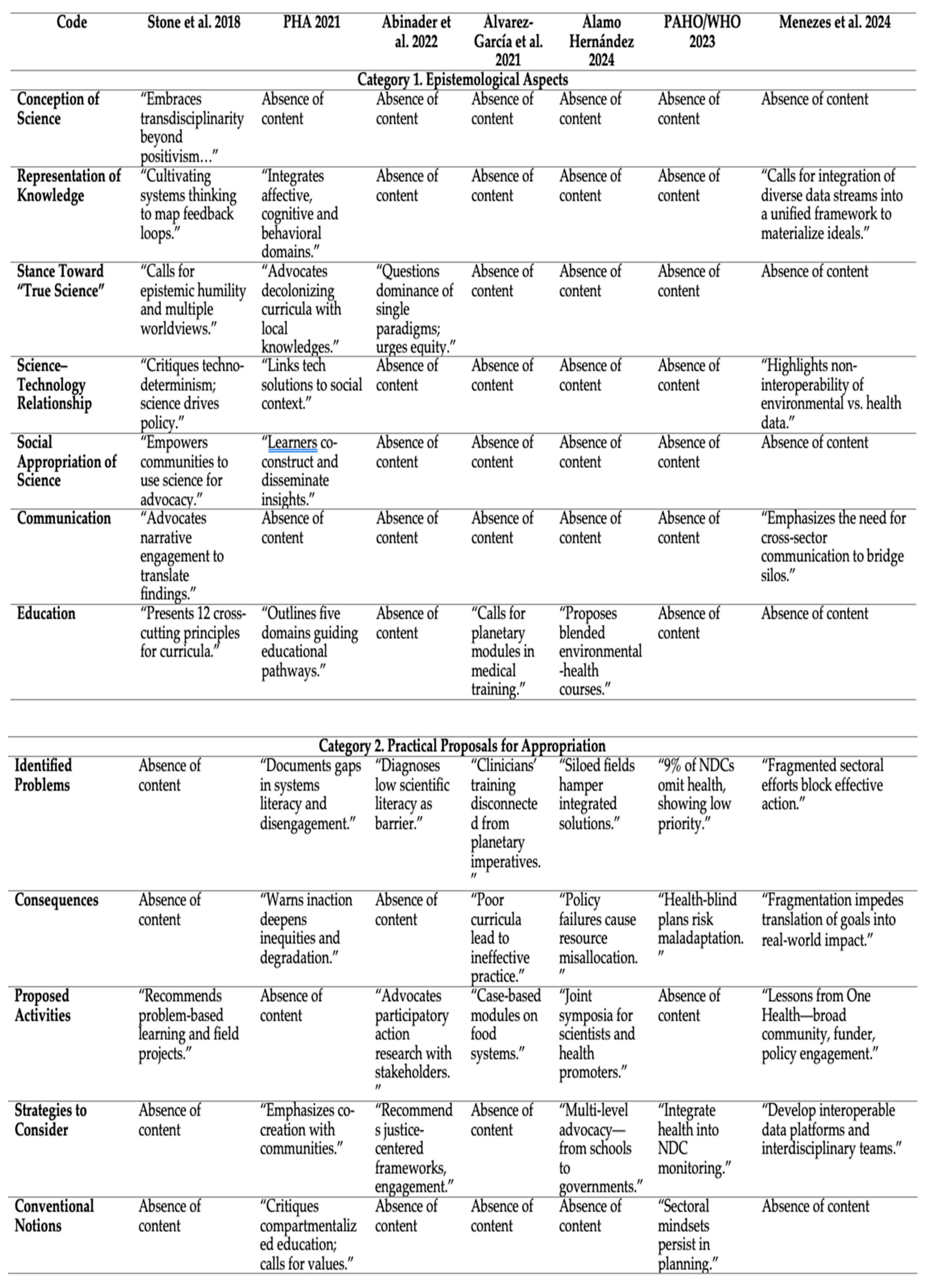
Table 1 below links each source document to its principal finding regarding the social appropriation of science within the field of planetary health. This matrix systematically compares seven key texts using two overarching categories—Epistemological Aspects and Practical Proposals for Appropriation—and their associated analytical codes. Each source is evaluated for its explicit treatment of concepts such as “Conception of Science” or “Identified Problems,” with illustrative excerpts showing how these ideas are articulated. Where no discussion is found for a given code, the cell is marked as “Absence of content,” enabling the identification of gaps and divergences within the literature. By aligning foundational works, the matrix provides a comprehensive snapshot of the current discourse on how science is epistemologically framed and socially operationalized in planetary health education and practice.
The analysis reveals a clear paradigm shift in planetary health education, away from fragmented, technocratic models toward transdisciplinary, decolonial, and experiential approaches. For example, Stone et al. (2018) propose twelve cross-cutting principles that integrate environmental, social, and Indigenous knowledge into participatory, narrative-driven curricula. This conceptual shift is further advanced by the Planetary Health Alliance, which offers a framework of five interconnected domains—Nature Connection; The Anthropocene and Health; Systems Thinking; Equity and Justice; and Movement Building—that support co-creative, transformative learning processes [36]. Similarly, Abinader et al. (2022) emphasize the need for epistemic equity, calling for a critical examination of dominant scientific paradigms and the active inclusion of traditionally marginalized voices as both an ethical imperative and a methodological foundation. Across the literature, there is a shared emphasis on strengthening the social appropriation of scientific knowledge through narrative strategies, knowledge co-production, and community engagement.
However, these conceptual developments are not yet fully matched by practical advancements. Critical gaps persist in the alignment between educational frameworks, public policy, and technical systems. Álamo Hernández (2024) and PAHO/WHO (2023) highlight that up to 9% of national climate plans explicitly omit the health dimension, revealing structural disconnections between sectors and underscoring the urgent need for cross-cutting health indicators. In addition, Menezes et al. (2024) identify key obstacles to data interoperability between environmental and health systems, which hinder coordinated and effective action. These authors advocate for the development of multisectoral communication platforms and pragmatic technical solutions to support informed decision-making. Together, these findings illustrate that while the conceptual discourse on planetary health is well developed, a persistent gap remains between theory and practice—one that demands urgent attention in terms of policy, governance, and technological innovation.
3.2. Principles for Environmental and Sustainability Education from a Planetary Health Perspective
Following a detailed content analysis of the original principles proposed for environmental education—rooted in critical pedagogy, ethics, and socio-cultural theory—a need emerged to enhance and complement this foundation with frameworks that address current global challenges and complexities. Drawing from recent advances in the Planetary Health paradigm [29,41], sustainability science [42,43], and education for sustainable development [44], we propose an updated and expanded set of guiding principles. These new articulations seek to integrate overlooked dimensions such as health-ecosystem feedback loops, equity and resilience, governance, transdisciplinarity, and future-oriented thinking. The aim is to deepen the transformative potential of environmental education and to support learners in developing competencies for socio-ecological resilience, justice, and intergenerational responsibility.
3.2.1. Recognition of the Self, the Other, and Oikos from an Environmental Ethics and Value System, Through the Use of Poetics and Aesthetics:
This principle expands the recognition of identity and relationality through three interconnected dimensions: the self, the other, and the environment (oikos). It emphasizes integral well-being (mental, emotional, and physical) as foundational for ecological awareness and planetary responsibility. It calls for cultivating a values framework based on empathy, reciprocity, solidarity, and recognition—particularly toward historically marginalized groups and non-human life [4,41]. This understanding is enriched by the planetary health perspective, which highlights the bidirectional feedbacks between human health and ecosystem integrity [29]. The principle proposes an ethics of dwelling (ethos) in which internal and external homes are co-constituted, fostering cognitive, affective, and behavioral engagement with nature as an extension of the self. It also embraces poetic and aesthetic dimensions of environmental education as powerful means for cultivating affective bonds with the world and for nurturing ecological sensitivity through narrative, symbolism, and imagination [45].
3.2.2. Recognition of Territory and the Theory of Place for Sustainability
This principle establishes, at the level of the self, that the body is conceived as a territory and a set of places of worship [4]. In accordance with the ancestral concept of the unity of life, the intrinsic emotional connection with the earth and nature is recognized [41]. At the level of the other and the oikos, place manifests as a collective and individual practice, contributing to the formation of shared, particular, and unique identities. Furthermore, place is defined by its identifying, relational, and historical character, transcending its physical characteristics to encompass spiritual dimensions through energy and dynamic forces. However, these dynamics are increasingly affected by the Anthropocene (2021), with significant biopsychosocial implications [41].
3.2.3. Enhancement of Different Types of Knowledge for Socio-Environmental Justice
This principle, initially conceived from the dialogue of knowledges and a critical education with the purpose of transforming and humanizing the world, requires transcending the ‘banking’ concept of education proposed by Freire. It proposes an education grounded in values such as love, humility, trust, autonomy, and responsibility, which recognizes culture as a repository of valuable knowledge. Within this framework, scientific knowledge opens itself to dialogue with other forms of knowing. By integrating the approach of Mejía-Zambrano (2018), which links science education with environmental education, with the frameworks of Prescott and Lancet, focused on health education, it is complemented by the ‘narrative-based process’ strategy. This strategy, according to Prescott et al., promotes dialogue between traditional knowledge, sciences, and the power of language. The Lancet proposal, for its part, provides a historical perspective, recognizing and reclaiming historically marginalized and ignored knowledges and perspectives. This allows, for example, addressing the construction of scientific concepts not only from a perspective of the nature of sciences, but also from a critical standpoint. Likewise, the principle of inequality and inequity is incorporated, which allows discussing concepts such as marginalization, vulnerability, and resilience, as well as factors such as geographical and temporal scale, socioeconomic factors, and the political and cultural context [36,40].
Building on Freirean pedagogy and the dialogue of knowledges, this principle calls for recognition of epistemic plurality, cultural wisdom, and knowledge justice. It challenges the monoculture of scientific rationalism by incorporating local, Indigenous, and experiential knowledge systems in dialogue with science [4]. It also addresses structural injustices by acknowledging the historical exclusion of certain groups and the unequal distribution of environmental risks [38]. Strategies like narrative-based education [41] and critical pedagogies for health [37,38] empower learners to deconstruct dominant paradigms and engage with complexity through inclusive, pluralistic, and decolonial approaches to knowledge-making.
3.2.4. Education and Communication for Transformation
Transformative education requires both rational and emotional engagement. This principle elevates communication and aesthetic experiences—including art, storytelling, and poetics—as essential vehicles for fostering ecological sensitivity and critical reflection [45]. These methodologies help learners develop emotional literacy and moral imagination, which are crucial for nurturing ecological empathy and values-based action. Multimodal communication strategies also enable transdisciplinary dialogue and broaden participation across age groups and cultural contexts. The inclusion of eco-aesthetics contributes to the deconstruction of mechanistic worldviews by supporting the re-enchantment of nature and fostering deeper affective and sensorial connections with the more-than-human world. [46,47,48]. This aesthetic dimension opens up pathways for planetary responsibility through felt, embodied, and imaginative engagement.
3.2.5. Governance and Policy for Planetary Health
Education for planetary health must equip learners with civic literacy and an understanding of how institutional systems shape socio-ecological outcomes. This principle highlights the role of transparent, inclusive, and ethical governance in promoting health equity and environmental sustainability [29,49]. It supports the concept of environmental stewardship and recognizes nature as a subject of rights, drawing from ecocentric legal movements [50,51]. Learners are invited to understand political processes, participate in policy design, and advocate for systemic changes that support intergenerational well-being and environmental justice.
3.2.6. Community Mobilization and Advocacy for Planetary Health
Social transformation is rooted in collective agency. This principle affirms the importance of community mobilization, civic participation, and grassroots advocacy to confront environmental injustice and drive policy change [52]. It positions education as a tool not only for awareness but for organizing action. Linking knowledge with agency, the principle draws from traditions of ecofeminism, decolonial ecology, and popular education to foster empowered, resilient, and interdependent communities capable of resisting extractive models and co-creating sustainable alternatives.
3.2.7. Systems Thinking and Transdisciplinary Collaboration
Planetary challenges are interconnected and require integrated responses. This principle promotes systems thinking as a core educational competency that enables learners to identify feedback loops, thresholds, and cross-scale interactions within socio-ecological systems [53]. It encourages transdisciplinary collaboration across sciences, humanities, policy, and community knowledge to develop holistic, context-sensitive solutions. This approach recognizes complexity not as a barrier but as an opportunity to foster creativity, collective intelligence, and resilience [43,54].
3.2.8. Future-Oriented Decision-Making and Adaptive Strategies
In the context of accelerating global environmental change, education must prepare learners for long-term, anticipatory, and adaptive thinking. This principle emphasizes futures literacy—the capacity to use the future as a lens for rethinking the present [55]—and the development of adaptive capacity, defined as the ability to respond to disruption with innovation and resilience [56,57]. Scenario-based learning, backcasting, and design thinking are among the pedagogical tools that foster imagination, ethical deliberation, and strategic action. The principle also engages with intergenerational justice, encouraging learners to recognize the long-term consequences of today’s decisions on future life forms and generations [58]. It challenges short-termism and fosters critical consciousness of the narratives that drive unsustainable practices. Learners are empowered to envision regenerative futures and to take part in shaping them.
4. Conclusions
This research, guided by the question “How can the perspective of planetary health complement the principles of environmental education from a cultural standpoint?”, leads to the following conclusions:
a. On the complementarity between planetary health and environmental education through a cultural lens: The incorporation of the planetary health perspective into environmental education enriches the cultural approach by recognizing the interconnection between human health, ecosystem health, and territorial knowledge systems. This integrative vision fosters an ethic of care that links individual and collective well-being with respect for biocultural diversity. Critical environmental education is strengthened by integrating dimensions such as recognition of the other and of the oikos, the aesthetics and poetics of dwelling, and territorial rootedness. These elements align with the principles of planetary health, which promote socio-ecological resilience and intergenerational justice.
b. In relation to pedagogical and methodological principles: Planetary health contributes a transdisciplinary perspective that complements the methodologies of environmental education by introducing strategies such as systems thinking, futures-based learning, transformative communication, and community mobilization. These tools foster a critical understanding of context and support collective action. The need for an education grounded in values such as empathy, solidarity, and respect for difference is reaffirmed—one that acknowledges and dignifies cultural and identity-based knowledge systems, with the dialogue of knowledges serving as a central axis of educational practice.
c. Concerning knowledge and epistemic justice: The planetary health perspective facilitates progress toward a decolonizing approach to environmental education, one that not only challenges the dominant technocratic paradigm but also brings visibility to the contributions of Indigenous, peasant, Afro-descendant, and popular knowledge systems. The importance of moving beyond reproductive educational models is emphasized, promoting instead learning processes that encourage the collective construction of knowledge, critical reflection on structural inequalities, and the strengthening of local capacities in response to the challenges of the Anthropocene.
Integrating the planetary health perspective into environmental education from a cultural standpoint not only expands its transformative potential but also enables a more just, sensitive, inclusive, and life-centered educational approach. This framework calls for a profound reconfiguration of educational practices, orienting them toward the construction of sustainable, equitable, and culturally diverse futures.
Funding
Not applicable.
Institutional Review Board Statement
Not applicable.
Informed Consent Statement
Not applicable.
Data Availability Statement
The data presented in this study are available on request from the corresponding author.
Conflicts of Interest
The authors declare no conflict of interest.
References
- Morin, E.; Kern, B. Terre-Patrie; Publisher: Seuil, 1993; pp. 224.
- Harman, J.; Lorandos, D.; Sherry, A.; Kaufman, M. Danger of Misinformation and Science Denial: Background, Modern Examples, Future Action. Journal of Social Issues. 2025, 81. [Google Scholar] [CrossRef]
- Khun, T.S. (1970). The structure of scientific revolutions (2nd ed., enlarged). University of Chicago Press.
- Mejia-Caceres, M.A.; Zambrano, A. (2018). Ciencia, Cultura y Educación Ambiental: Una propuesta para los educadores. Programa Editorial Universidad del Valle. Cali: Colombia.
- Spindler, G. (1987). Education and cultural process: Anthropological approaches (2nd ed.). Waveland Press.
- Wolcott, H.F. (1991). Propriospect and the acquisition of culture. In M. C. Albright & A. K. Bock (Eds.), The acquisition of culture (pp. 187–212). University Press of America.
- Geertz C, (1973). The Interpretation of culure. New York: Basic Books.
- Sauvè, L. (2005). Uma Cartografia das Correntes em Educação Ambiental. In: SATO, M.; Carvalho, I. (Eds.). Educação ambiental. Porto Alegre: Artmed.
- Robert B. Stevenson , Arjen E. J. Wals , Joe E. Heimlich , and Ellen Field.
- Costa, C.A.; Loureiro, C.F. Educação Ambiental crítica e conflitos ambientais: reflexões à luz da América Latina. E-curriculum. 2024, 22, 1–24. [Google Scholar] [CrossRef]
- Florencio da Silva, R.; Torres-Rivera, A.D.; Alves Pereira, V.; Regis Cardoso, L.; Becerra, M.J. Critical Environmental Education in Latin America from a Socio-Environmental Perspective: Identity, Territory, and Social Innovation. Sustainability 2023, 15, 9410. [Google Scholar] [CrossRef]
- Unesco, (2025). Education for sustainable development. UNESCO Institute for Statistics. Retrieved from https://uis.unesco.org/en/glossary-term/education-sustainable-development.
- Sterling, S. (2001). Sustainable education: Re-visioning learning and change. Green Books.
- Mora, W. Educación ambiental y educación para el desarrollo sostenible ante la crisis planetaria: demandas a los procesos formativos del profesorado. Tecne, Episteme y Didaxis. 2009, 26. [Google Scholar] [CrossRef]
- Guimarães, M.; Vasconcellos, M. Relações entre Educação Ambiental e Educação em Ciências na Complementaridade dos Espaços Formais e Não Formais de Educação. Educar 2006, 27, 147–162. [Google Scholar] [CrossRef]
- Castro, B.; Bomfim, A. (2011). A “Teoria do fazer” em Educação Ambiental Crítica: Uma Reflexão Costruída em Contraposição à Educação Ambiental Conservadora. Atas do VIII ENPEC: Encontro Nacional de Pesquisa em Educação em Ciências.
- Carvalho, I. (2004). Educação Ambiental Crítica: Nomes e Endereçamentos da Educação. In: Identidades da Educação Ambiental Brasileira. Brasilia: Ministério do Meio Ambiente.
- Tozoni Reis, M. (2004). Educação Ambiental: Natureza, Razão e História. Campinas, SP: Autores Associados.
- Freire paulo- dialogue.
- Giroux, H. (1985).Teorías de la Reproducción y la Resistencia en la Nueva Sociología de la Educación: un Análisis Crítico. Cuadernos Políticos, n. 44, p. 36–65.
- Comte, A (1842) Curso de Filosofia positiva. Paris: Bachelier libraire pour les mathematiques.
- Vygotsky, L.S. (1978). Mind in society: The development of higher psychological processes. Harvard University Press.
- Nasir, N.S.; Rosebery, A.S.; Warren, B.; Lee, C.D. (2006). Learning as a cultural process: Achieving equity through diversity. In The Cambridge Handbook of the Learning Sciences.
- Calabrese Barton, A.; Tan, E. We Be Burnin’! Agency, Identity, and Science Learning. Journal of the Learning Sciences 2010, 19, 187–229. [Google Scholar] [CrossRef]
- Bang, M.; Marin, A. Nature–Culture Constructs in Science Learning: Human/ Non-Human Agency and Intentionality. Journal of Research in Science Teaching. 2015, 52, 430–544. [Google Scholar] [CrossRef]
- Aikenhead, G.S.; Michell, H. (2011). Bridging cultures: Indigenous and scientific ways of knowing nature. Pearson.
- Gruenewald, D.A. The best of both worlds: A critical pedagogy of place. Educational Researcher 2003, 32, 3–12. [Google Scholar] [CrossRef]
- UNESCO. (2021). Reimagining our futures together: A new social contract for education. UNESCO Publishing.
- Whitmee, S.; et al. Safeguarding human health in the Anthropocene epoch: Report of The Rockefeller Foundation–Lancet Commission on planetary health. The Lancet 2015, 386, 1973–2028. [Google Scholar] [CrossRef]
- Horton, R.; Lo, S. Planetary health: A new science for exceptional action. The Lancet 2015, 386, 1921–1922. [Google Scholar] [CrossRef]
- Myers, S.S.; Frumkin, H. (2020). Planetary Health: Protecting Nature to Protect Ourselves. Island Press.
- Rockström, J.; et al. A safe operating space for humanity. Nature 2009, 461, 472–475. [Google Scholar] [CrossRef] [PubMed]
- Romanello, M.; et al. The 2021 report of the Lancet Countdown on health and climate change: code red for a healthy future. The Lancet 2021, 398, 1619–1662. [Google Scholar] [CrossRef]
- Myers, S.S. Planetary health: Protecting human health on a rapidly changing planet. The BMJ 2017, 358, j3392. [Google Scholar] [CrossRef]
- Parkes, M.W.; Buse, C.G.; Allison, S. Towards an educational praxis for planetary health: A call for transformative, inclusive, and integrative approaches for learning and relearning in the Anthropocene. The Lancet Planetary Health 2023, 7, e77–e85. [Google Scholar] [CrossRef]
- Guzman, C.; Potter, T. (2021) – Framework for Planetary Health Education. Planetary Health Alliance.
- Stone, S.B.; Myers, S.S.; Golden, C.D. Cross-cutting principles for planetary health education. The Lancet Planetary Health 2018, 2, e192–e193. [Google Scholar] [CrossRef]
- Abinader, R.; Rasheed, M.; Khan, M.; Ruff, T. Navigating fundamental tensions towards a decolonial relational vision of planetary health. The Lancet Planetary Health 2022, 6, e860–e862. [Google Scholar] [CrossRef]
- Álvarez-García, C.; López-Medina, I.M.; Sanz-Martos, S.; Álvarez-Nieto, C. Salud planetaria: Educación para una atención sanitaria sostenible. Educación Médica 2021, 22, 352–357, https://doi.org/10.1016/j.edumed.2021.08.001Álamo Hernández, U. (2024). Salud y cambio climático: Análisis de los planes nacionales de acción climática en América Latina. ResearchGate. [Google Scholar] [CrossRef]
- Pan American Health Organization (PAHO)/World Health Organization (WHO). (2023). Planetary health: Integrating climate and health into national policies in the Americas. https://www.paho.org/en/documents/planetary-health-2023.
- Prescott, S.L.; et al. The Microbiome and the Origins of Health and Disease. Lancet Planetary Health 2018, 2, e356–e365. [Google Scholar]
- Rockström, J.; et al. Planetary Boundaries. Nature 2009, 461, 472–475. [Google Scholar] [CrossRef]
- Folke, C.; et al. Our Future in the Anthropocene Biosphere. Ambio 2021, 50, 834–869. [Google Scholar] [CrossRef]
- UNESCO (2017). Education for Sustainable Development Goals: Learning Objectives.
- Lin, W.; Chang, Y.C.; Chen, P.F. Environmental aesthetics and professional development for university teachers in China. Humanit Soc Sci Commun 2023, 10. [Google Scholar] [CrossRef]
- Weber, A. (2013). Enlivenment: Towards a poetics for the Anthropocene. Heinrich Böll Foundation. https://www.boell.de/en/content/enlivenment-towards-poetics-anthropocene.
- Abram, D. (1996). The spell of the sensuous: Perception and language in a more-than-human world. New York: Pantheon Books.
- Kagan, S. (2011). Art and sustainability: Connecting patterns for a culture of complexity. Bielefeld: Transcript Verlag.
- Raworth, K. (2017). Doughnut Economics: Seven Ways to Think Like a 21st-Century Economist. Chelsea Green.
- Cullinan, C. (2011). Wild law: A manifesto for earth justice. Green Books.
- Kauffman, C.; Martin, P. Constructing rights of nature norms in the US, Ecuador, and New Zealand. Global Environmental Politics 2017, 18, 43–61. [Google Scholar] [CrossRef]
- O’Neil, D.; Fullilove, R. Mobilizing community health workers to achieve environmental justice and healthcare sustainability. J Public Health Policy. Epub 2024 Jul 5. 2024, 45, 588–591. [Google Scholar] [CrossRef] [PubMed]
- Capra, F.; Luisi, P.L. (2014). The Systems View of Life. Cambridge University Press.
- Sterling, S. Transformative Learning and Sustainability. Journal of Education for Sustainable Development 2010, 4, 17–37. [Google Scholar]
- Miller, R. Learning, the Future, and Complexity. European Journal of Education 2015, 50, 513–527. [Google Scholar] [CrossRef]
- Walker, B.; et al. Resilience, Adaptability and Transformability. Ecology and Society 2004, 9, 5. [Google Scholar] [CrossRef]
- IPCC (2022). Sixth Assessment Report: Impacts, Adaptation, and Vulnerability.
- Gardiner, S.M. (2011). A Perfect Moral Storm: The Ethical Tragedy of Climate Change. Oxford University Press.

Table 1.
Epistemological Dimensions and Practical Strategies for the Social Appropriation of Science in Planetary Health.
Table 1.
Epistemological Dimensions and Practical Strategies for the Social Appropriation of Science in Planetary Health.
 |
| 1 Epistemological Dimensions and Practical Strategies for the Social Appropriation of Science in Planetary Health. |
Disclaimer/Publisher’s Note: The statements, opinions and data contained in all publications are solely those of the individual author(s) and contributor(s) and not of MDPI and/or the editor(s). MDPI and/or the editor(s) disclaim responsibility for any injury to people or property resulting from any ideas, methods, instructions or products referred to in the content. |
© 2025 by the authors. Licensee MDPI, Basel, Switzerland. This article is an open access article distributed under the terms and conditions of the Creative Commons Attribution (CC BY) license (http://creativecommons.org/licenses/by/4.0/).
Copyright: This open access article is published under a Creative Commons CC BY 4.0 license, which permit the free download, distribution, and reuse, provided that the author and preprint are cited in any reuse.


