1. Introduction
As rightly pointed out by Stohr (2013), effective teaching is crucial for fostering understanding and igniting passion. Love and care for nature are essential sentiments, particularly in the current era. Sustainability should be a global commitment addressed by all segments of society. While economic development relies on research and innovation, it often raises a threat to the environment. Our environment faces myriad challenges due to unpredictable changes, exacerbated by our inability to compromise between expansion and conservation. Pollution, climate change, biodiversity loss, and the greenhouse effect are leading to devastating consequences, necessitating urgent action. Altering lifestyles also poses risks to environmental stability. Preserving natural resources and our planet is paramount, requiring concerted efforts from practitioners, governments, and international forums. Higher Education institutes play a pivotal role in this endeavor as bastions of knowledge and research.
Education serves as the cornerstone in managing the present without hampering the future. It empowers individuals to devise solutions to communal problems, fostering awareness and responsive behavior (Chapman & Sharma, 2001). Education imbues individuals with emotional and mental fortitude, instilling a sense of social responsibility. The educational system shapes citizens’ futures, enabling them to contribute meaningfully to society. Higher education must tackle climate literacy, clean water, sanitation, and other environmental concerns. It nurtures young minds to devise innovative solutions to face environment-related challenges, fostering curiosity and passion. Youth must be well-informed and vigilant about adopting sustainable lifestyles. Higher education can prepare them by imparting environmentally friendly practices and instilling a sense of responsibility (Heyl et al., 2015).
Higher education institutions must integrate environmental and sustainability concepts into their curriculum. This would equip youth with the necessary knowledge and skills by offering courses and programs related to the environment, ethics, and social responsibility. Extracurricular activities further boost students’ confidence and engagement, enhancing their ability to tackle environmental challenges (Puri et al., 2021). Education begins at home and continues throughout the process of socialization. Reliable media and appropriate content can foster environmental consciousness, starting from primary schools (Sulistyawati et al., 2018).
Environmental education instills essential skills and attitudes in students, facilitating their engagement with environmental issues, and making it part of the curriculum and extra-curricular activities, leading to sustainable development (Laiphrakpam et al., 2019). The first intergovernmental conference on environmental education, held in 1977, outlined five key objectives that remain relevant today. These include fostering awareness, imparting knowledge, nurturing positive attitudes, enhancing skills, and encouraging active participation. Environmental education seeks to create awareness, accountability, and a sustainable mindset within communities. Environmental education is precious for society and inculcates knowledge, values, and a sustainable attitude to resolve environmental problems (Nyika and Mwema, 2021). Therefore, every individual must receive an environmental education through organized input to manage the natural environment and our eco-system sustainably (Mubita et. al. 2022)
However, sustaining environmental education requires ongoing encouragement to ensure its long-term impact (Johnson & Cincera, 2015). By sharing experiences, volunteering, and exploring cultural aspects, experiential learning and community engagement can enhance students’ understanding of community and societal engagement (Onion, Wongchantra, & Bunnaen, 2021). Intrinsic motivation and disposition are pivotal in driving environmental conservation efforts (Suarlin & Ali, 2020). Education and self-motivated behavior are pivotal in fostering a positive attitude towards the environment. Numerous students actively engage in university-level initiatives voluntarily, driven by their education, internal motivation, and dedication to environmental causes. Environmental education is crucial in enhancing awareness of sustainable lifestyles and responsible consumption patterns (Zsóka et al., 2013). Similarly, research can play a crucial role in enhancing environmental education and motivating sustainability efforts. Through research, various sustainability and environmental issues can be addressed, and practical solutions can be developed. Higher education institutions equip students with a global perspective on environmental issues and sustainability while also fostering ethics, justice, attitudes, and values conducive to sustainability. By integrating environmental education into academic and non-academic settings, higher education prepares individuals to balance and enhance their environmental efficiency effectively. Incorporating environmental education into educational systems is essential to instill positive behavioral changes in young minds toward local and global communities. Formal integration of environmental education into the curriculum, informal training programs, and extracurricular activities can foster a culture of sustainability and environmental stewardship among the youth (Adam, 2007; Erdogan & Usak, 2009). By equipping students with the knowledge, skills, and values needed to address environmental challenges, higher education can contribute significantly to building a sustainable and environmentally friendly society.
The current study examines the impact of curriculum, extracurricular activities, and community engagement on environmental education, sustainability, and well-being while also considering the mediating role of the undergraduates’ awareness level.
2. Literature Review
2.1. Education for Sustainable Development (ESD)
The 2030 Agenda for Sustainable Development, established during the United Nations Sustainable Development Summit in 2015, was endorsed by world leaders to address the social, economic, and environmental dimensions of sustainable development. Education for Sustainable Development (ESD) focuses on fostering sustainable learning and development in higher education to enhance students’ decision-making abilities (Sopian et al., 2022). It adopts an integrated educational framework that aims to incorporate sustainable development principles, values, and practices into all aspects of teaching and learning within the higher education ecosystem.
ESD emphasizes the integration of sustainable development principles and practices into the higher education system. Numerous research studies and reports have explored the effectiveness of ESD initiatives, their impact on learners, and best practices for integrating sustainability into educational curricula (Stibbe & Redman, 2020). Structural changes in experiential learning provided by educational institutions should aim to strengthen the empathic connection to real-life realities for stakeholders within the higher education ecosystem. This necessitates structural adjustments in both formal and informal education systems to foster cognitive and socioemotional learning environments that facilitate impactful community and citizenship education. Thus, the impact of the ESD framework extends beyond conventional education methods. It represents a comprehensive and transformative approach to education, equipping individuals with the knowledge and skills necessary to contribute to building a sustainable and resilient future for the planet and its inhabitants.
2.2. The Integration of ESD in Higher Education
In higher education systems, integrating the concept of sustainable development (SD) through a practical-oriented approach to higher education can enhance its impact (Carrillo, 2004). Sterling (2004) suggested a model for integration, emphasizing the depth of ideas incorporated into existing systems and connecting students’ minds between courses and sustainable development. Appel et al. (2004) focused on technical and economic programs impacting the greening of higher education ecosystems and the challenge of integrating sustainability into the curriculum, necessitating a complete redesign of education based on sustainability principles to promote active and lifelong learning (Dieleman & Turpin-Marion, 2006). Aktas et al. emphasized the need for higher education institutions (HEIs) to effectively integrate sustainable development into the curriculum, promoting and sharing ideas with future generations. Recent trends show extensive research on integrating sustainability into HEIs and embedding sustainable development into academic syllabi, enhancing teaching and learning, community engagement, and industry-engaged research (Leal et al., 2018). However, limited academic research has targeted students’ awareness levels toward ESD and/or sustainable development in HEIs. Petegem et al. (2018) focused on understanding students’ perceptions of sustainability in business management/marketing programs. Molderez et al. (2018) discussed students’ awareness of the effectiveness of learning activities in fostering sustainability competencies. Wyness et al. (2018) examined students’ awareness of the significance of Problem-Based Learning (PBL) in embracing sustainability. Estrada et al. (2017) explored college-going students’ knowledge, skills, attitudes, and perceptions about sustainable education and environmental health. Namestovski et al. (2017) conducted a longitudinal study to educate students about environmental embracement. Alonso et al. (2015) demonstrated how sustainable education impacted students’ learning outcomes in various disciplines, institutions, and countries. Cebrian et al. (2015) focused on the attitudes and perceptions of students and teachers involved in educating about sustainable development competencies. Various researchers have advocated for integrating SD into HEI courses and curriculums to enhance students’ awareness levels, introducing competency-based teaching and implementation processes of Sustainable Development Goals (SDGs) through community engagement (Dlouha et al., 2018). Hindley et al. (2017) identified a gap in the literature regarding the role of work-based learning in education for Sustainable Development and emphasized the urgent need for climate literacy. However, the availability of scientific research associated with ESD is limited, indicating a gap in the literature that requires attention through academic contribution (Nishimura, 2018). The insufficiency of studies in these areas has restricted researchers’ capacity to provide research-based transferable insights (Evans, 2017). Wiek et al. (2017) highlighted the necessity of developing processes for integrating sustainability into the curriculum. Sahakian (2018) underscored the need to acquire relevant information within academic programs and embed sustainability education through extra-curricular activities to raise awareness and leverage sustainability integration in education. Thus, the authors argue that there is significant potential to focus research on methods, frameworks, and approaches related to teaching, research, community outreach, stakeholder engagement, and collaboration at local, regional, national, and international levels (Perdue et al., 2018). Thus, we hypothesize that:
Hypothesis 1a : There is a positive and significant relationship between curriculum and students’ awareness levels.
Hypothesis 1b: There is a positive and significant relationship between extracurricular activities and students’ awareness levels.
Hypothesis 1c: There is a positive and significant relationship between community engagement and students’ awareness levels.
Hypothesis 2a: There is a positive and significant relationship between students’ awareness levels and Environmental and Sustainability Education.
Hypothesis 2b: There is a positive and significant relationship between students’ awareness levels and Well-Being.
2.3. Environmental and Sustainability Education & Well-Being
Environmental education (EE) involves cross-curricula promotion of global awareness, sustainable living, and active citizenship through a structured implementation process of environmental curriculum in the higher education ecosystem from the elementary school to post-graduate levels. The need of the hour is to transform the behavior of society to contribute to the conservation of the environment and transition to a cleaner environment (Vita et al., 2019). This is possible only if all educators agree on environmental issues and fears. There has to be collaborative knowledge building. (Mauri et al., 2006 ). The role of students in creating a significant impact on the future environment by the inclusion of sustainability problems in education (Waas, 2011). Sustainability awareness is positively correlated with self-awareness and contributes to environmental education
(Saptaji et al., 2020). Sustainability awareness contributes to the preparation of students for sustainable development (Rini & Nuroso, 2022; Saptaji et al., 2020). Ongoing awareness initiatives need to be developed in the learning environment to transform individuals’ confidence level and help them contribute towards tackling environmental and sustainability issues (Amin et al., 2023; Hidayat, 2023). Thus, sustainability awareness helps in tackling and resolving environmental problems effectively (Shamdas, 2023) and helps higher educational institutions in providing active learning to the youth in protecting the environment through effective stakeholder participation. Thus, Universities play an important role in enhancing the idea of sustainability by incorporating innovative teaching strategies (Chuvieco, 2018). Also, the role of creativity and innovation in resolving environmental concerns cannot be ignored, which is gaining much importance. (Brem et.al., 2020) Understanding students’ attitudes and behaviors toward the environment and the need to develop effective strategies to affect this behavior is crucial in enhancing the quality of learning and development (Whitley, 2018).
Thus, we hypothesize that:
Hypothesis 3: Awareness mediates the relationships between curriculum, extracurricular activities, community engagement, and both Environmental and Sustainability Education as well as Well-Being.
Hypothesis 4: Awareness mediates the relationships between curriculum, extracurricular activities, community engagement, and Environmental and Sustainability Education, as well as Well-Being.
3. Methodology
To efficiently meet the research’s objective, the researchers employed a semi-structured and self-administered questionnaire (Appendix A). Data was collected from a higher education academic Institute in Riyadh, Saudi Arabia. The survey involved questions on the impact of curriculum, extracurricular activities, community engagement, awareness level, students’ behavior, participation and intention, environmental education, sustainability, and well-being. The data was collected using Google Forms. A total no. of 374 responses were received. Further, incomplete questionnaires or missing information were excluded from further analysis leaving a final 353 responses.
4. Analysis and Results
We analyzed the data using Smart-Partial Least Square (PLS) version 4.0.9.6 software (Ringle et al., 2022) for variance-based structural equation modeling (SEM), including its CB-SEM. This method thoroughly examined the measurement model, covering indicator loadings, composite reliability (CR), convergent and discriminant validity, and structural model analysis (Magno et al., 2022).
In terms of age distribution, the majority of participating undergraduate students (58.9%) were 20 years old, followed by 21 years (26.6%), with the remaining 14.5% falling between 23 and 25 years old.
4.1. Measurement Model
Before conducting hypothesis testing, CFA was performed to test measurement model fit and confirm the proposed six-factor theoretical model. The proposed model was compared with a one-factor, two-factor, and four-factor model (refer to
Table 1). Comparing the results, our proposed five-factor model exhibited a good fit, yielding Chi-square value (CMIN)=24407.53, Degree of freedom (df)=3073.000, CMIN/df=7.940, Comparative fit index (CFI)=0.923, Goodness of fit (GFI)=0.884, Tucker-Lewis’s index (TLI)=0.713, Root means square approximation (RMSEA)=0.041 and Standardized root mean square residual (SRMR)= 0.069. According to Bentler (1990), the obtained model fit indices of TLI, CFI ≥ .95, GFI ≥ 0.9, RMSEA ≤ 06, and SRMR ≤ 0.10 indicate a good fit.
Table 2 provides a comprehensive analysis of the reliability and validity of the data collected in a study focused on understanding the awareness levels of undergraduates regarding environmental education, sustainability, and well-being. The latent constructs measured in the study encompass curriculum, extracurricular activities, community engagement, awareness, environmental education and sustainability, and well-being, representing the key areas of interest. The assessment includes measures to ensure the accuracy and consistency of the data. Firstly, Cronbach’s alpha values are used to assess the internal consistency of the data, ensuring that all items within a section of the survey effectively measure the same underlying concept. Secondly, the study examines convergent validity through Average Variance Extracted (AVE) values, which indicate the degree to which items measuring the same construct are related to each other. Additionally, Variance Inflation Factor (VIF) values are employed to assess multicollinearity, determining whether there is redundancy or overlap between the variables being measured. Further, results reveal that VIF values range from 1.093 to 1.192, indicating low multicollinearity well below the accepted threshold. Cronbach’s alpha values for all constructs range from 0.711 to 0.841, indicating good internal consistency. Moreover, AVE values meet or exceed the threshold of 0.5 for all constructs, affirming satisfactory convergent validity. Thus, the findings establish the credibility of the study’s results.
Further, the data were assessed for discriminant validity using the HTMT ratio of correlations based on the multitrait-multimethod matrix (Franke & Sarstedt, 2019), with a critical threshold of 0.9. Discriminant validity examines whether latent constructs within a model are distinguishable from one another by comparing the ratio of correlations between constructs that theoretically should have lower correlations (heterotrait) to correlations between items measuring the same construct (monotrait).
Table 3 presents the computed HTMT values for latent constructs. When the HTMT value falls significantly below the 0.9 threshold, it suggests that the latent constructs are adequately distinct. In the provided table, all HTMT values are below the 0.9 threshold, confirming the discriminant validity of the model. This indicates that all constructs are distinguishable and not excessively correlated, supporting the model’s validity and suitability for further analysis.
Table 4 shows the descriptive statistics of latent variables, including mean and standard deviation (SD). The mean values for the study parameters ranged from 1.53 to 2.49, indicating a diverse but centered response spectrum.
Further, the proposed hypothesis was tested using regression analysis. As shown in
Table 5 and
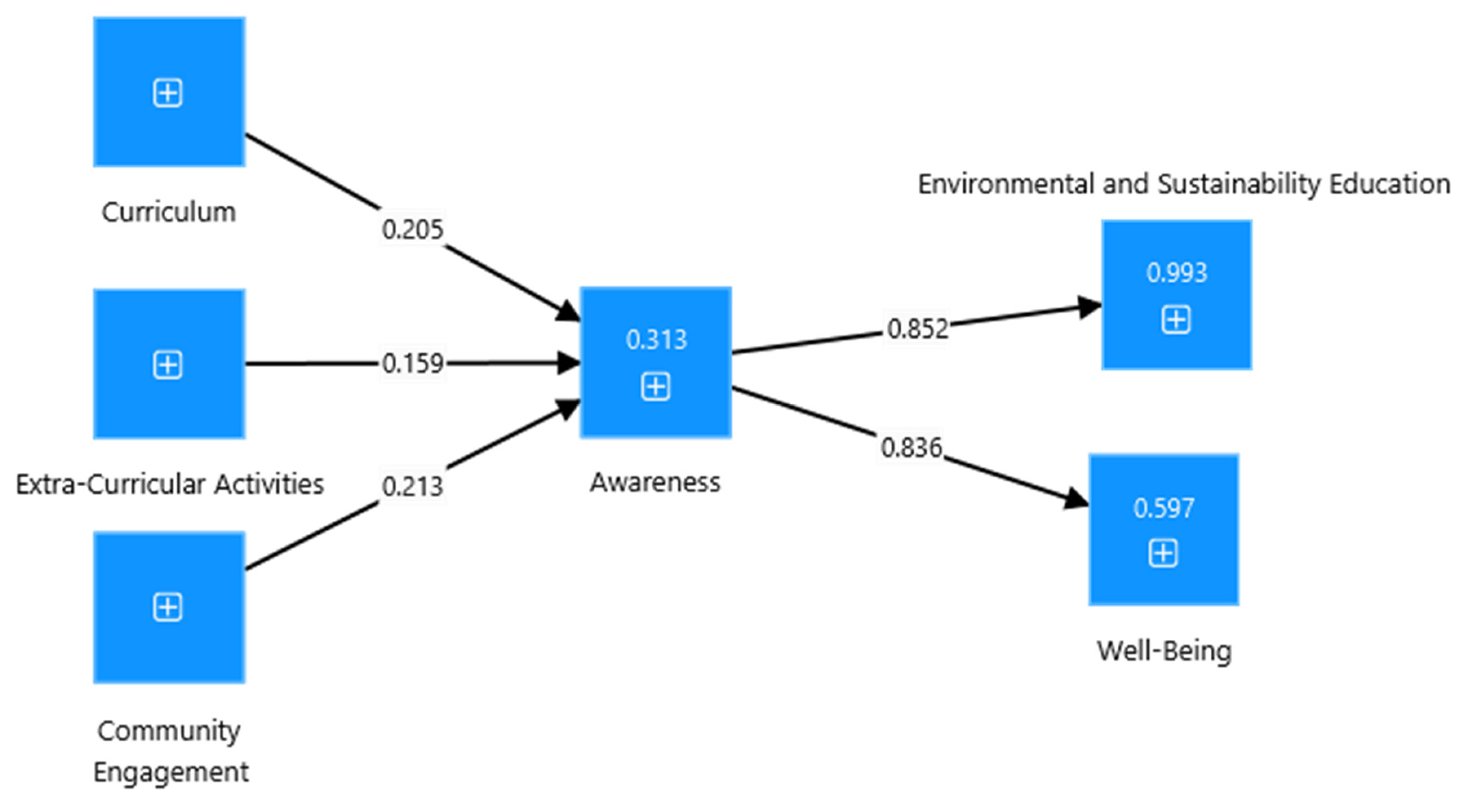
Figure 1, the analysis explores the intricate relationships among key variables, highlighting the direct and indirect relationships (mediation). Firstly, the results highlight the positive direct impact of curriculum on awareness (β = 0.205, p < 0.001), which indicates that a well-structured curriculum significantly contributes to raising awareness levels among individuals. This supports our hypothesis 1a. This supports the idea that a strong academic framework can effectively increase the student’s awareness level with respect to environmental education. Extra-curricular activities positively impact awareness (β = 0.186, p = 0.000), indicating that engaging students in activities beyond the formal curriculum will enhance their awareness levels. This supports our hypothesis 1b. This highlights the holistic role of both academic and extracurricular activities in shaping students’ awareness quotient. Further, community engagement has a significant and positive impact on awareness (β = 0.213, p < 0.000), supporting our hypothesis 1c. This suggests that engaging students actively in community-serving activities such as social initiatives, volunteering, and social projects positively influences their awareness levels and broadens their perspectives concerning environmental education. Thus, students become more attuned to the issues and challenges within the environment they live. The above results emphasize community involvement’s importance in fostering awareness, highlighting the social dimension’s impact on individual consciousness. Further, the awareness level of students has a positive and significant direct effect on environmental and sustainability education (β = 0.852, p < 0.000) and well-being (β = 0.836, p < 0.001), thus supporting hypotheses 2a and 2b. This suggests that an individual’s level of awareness significantly shapes their commitment to environmental sustainability and overall well-being.
4.2. Mediation Analysis
We conducted a mediational analysis, with awareness serving as the mediator. We explored the effects of various factors on students’ awareness levels and how these levels, in turn, influence environmental education, sustainability, and well-being (
Table 6). It was found that student awareness plays a crucial role as a mediator between the curriculum provided by institutions and both environmental education and sustainability (β = 0.174, p = 0.000) and students’ well-being (β = 0.171, p = 0.000). These results supported our initial hypotheses and highlighted the positive impact of curriculum on raising students’ awareness, enhancing their understanding of environmental issues, and contributing to their overall well-being.
Furthermore, the study revealed that extracurricular activities also significantly impact students’ awareness levels, mediating between these activities and environmental education (β = 0.135, p = 0.001) and well-being (β = 0.133, p = 0.002). This emphasizes the crucial role of extracurricular activities in nurturing students’ awareness, which positively influences their environmental consciousness and well-being. Moreover, the results indicated that students’ awareness levels mediate the relationship between institutions’ community engagement efforts and environmental education and sustainability with a substantial positive effect (β = 0.181, p = 0.000). Similarly, the results supported the idea that community engagement efforts impact students’ well-being by increasing awareness levels (β = 0.178, p = 0.000). Thus, the above results support our hypotheses 3 and 4 and highlight the key role of awareness in mediating the relationships between key educational components and outcomes, emphasizing the critical influence of curriculum, extracurricular activities, and community engagement on students’ awareness levels, environmental education, sustainability, and well-being.
Thus, these results suggest that incorporating educational elements such as curriculum, extracurricular activities, and community engagement can effectively enhance environmental education, sustainability, and well-being awareness levels. Therefore, fostering these educational strategies may lead to a more informed and sustainable approach toward promoting environmental education and well-being among individuals or communities.
5. Discussion and Conclusion
The current study aimed to investigate the perceptions of undergraduate female students from a higher education institution in Saudi Arabia regarding their understanding of environmental and sustainability education and their well-being, by testing a comprehensive model integrating these principles within the higher education ecosystem. Our findings highlight the critical role of curriculum, extracurricular activities, and community engagement practices in enhancing students’ awareness levels, thereby significantly impacting their understanding and efforts related to environmental education, sustainability, and well-being. These results validate the study’s credibility and bolster the robustness of the proposed working model for enhancing environmental education and outreach among undergraduates in higher education. The acceptance of the proposed hypothesis sheds light on the positive impacts that curriculum, extracurricular activities, and community engagements exert on students’ awareness levels. This underscores how a well-structured curriculum significantly heightens awareness levels, demonstrating the pivotal role of active engagement strategies alongside formal education. Moreover, the holistic influence of both academic and extracurricular experiences in shaping awareness toward community engagements underscores the social dimension’s impact on individual consciousness.
The results shed light on the positive influence of curriculum in enhancing students’ awareness, fostering their understanding of environmental issues, and contributing to their overall well-being. This underscores the significance of a well-structured curriculum in imparting knowledge and shaping attitudes and behaviors toward sustainability. Extracurricular activities emerged as significant influencers of students’ awareness levels, serving as the mediator between these activities and environmental and sustainability education. This emphasizes the invaluable role of extracurricular activities in nurturing students’ awareness, which positively impacts their environmental consciousness and well-being. The findings suggest that universities should invest in diverse extracurricular programs focused on sustainability to complement formal education and enhance students’ overall learning experience. Furthermore, students’ awareness levels were found to mediate the relationship between institutions’ community engagement efforts and environmental and sustainability education. This supports the idea that community engagement efforts positively impact students’ well-being through increasing students’ awareness levels. It emphasizes the importance of universities’ involvement in community engagement activities to promote sustainability initiatives and contribute to students’ holistic development. These findings have significant implications for higher education institutions, policymakers, and community organizers, emphasizing the need for a comprehensive approach that integrates curriculum, extracurricular activities, and community engagement to foster student environmental awareness and sustainability. By recognizing the interplay between these factors, institutions can effectively promote environmental education and sustainability while enhancing students’ well-being and fostering a culture of sustainability within the campus and beyond.
In summary, our study statistically confirms the critical role of awareness in mediating the relationships between key educational components and outcomes, critically influencing curriculum, extracurricular activities, and community engagement, as well as environmental education, sustainability, and well-being. These findings underscore the significance of incorporating educational elements such as curriculum, extracurricular activities, and community engagement to enhance environmental education, sustainability, and well-being awareness levels. This leads to a more informed and sustainable approach toward promoting environmental education and well-being among individuals and communities, equipping youth with the requisite knowledge and skills for navigating environmental education and sustainability challenges.
6. Implications
The findings revealed that providing proactive environmental education to undergraduates in their Higher educational institutions through curriculum integration, extra-curricular activities, and community engagements with the mediating effects of behavior, awareness, and participation contributes towards mitigating environmental degradation and promoting sustainable education and the well-being of the youth. The economic development of a nation advances through the effective and ongoing partnerships and collaboration of industry and academic institutions in effectively contributing towards responsible behaviour among the youths and their orientation towards solving environmental problems. There is a need to incorporate environmental education and sustainability in the curriculum of higher educational institutions, which shall enhance the awareness, behaviour, and participation of youth in decision-making related to environmental issues. Institutions can make environmental education campaigns more impactful by going beyond theory and embracing innovative, practical approaches. Voluntary initiatives like UNPRME contribute towards sustainability education that focuses on transforming the quality of education, training, and guidance students receive from their institutions that impact their behaviour through environmental management training and learning. Thus, all higher educational programs should focus on institutionalizing environmental education and sustainability in the curriculum to strategize a sense of responsibility among the youth towards achieving sustainable development on an ongoing basis and equip them with a better quality of life in a sustainable and safe environment. Institutions can make environmental education campaigns more impactful by going beyond theory and embracing innovative, practical approaches. By fostering environmental awareness among students and integrating it into broader societal initiatives, educational institutions can play a crucial role in shaping a generation committed to sustainability and well-being. By encouraging and embracing a culture of creativity and innovation, policymakers can think of new ways to back these initiatives. Community organizers should partner with young minds for a more energized and effective impact of these movements.
References
- Adam Z., M. (2007). Kiunga Conservation and Development Project. Environmental Education and Awareness Report, July-June, 2007.
- Aktas, C.B.; Whelan, R.; Stoffer, H.; Todd, E.; Kern, C.L. Developing a university-wide course on sustainability: a critical evaluation of planning and implementation. J. Clean. Prod. 2015, 106, 216–221. [Google Scholar] [CrossRef]
- Alonso-Almeida, M.D.; Marimon, F.; Casani, F.; Rodriguez-Pomeda, J. Diffusion of sustainability commentary in universities: Current situation and future perspectives. J. Clean. Prod. 2015, 106, 144–154. [Google Scholar] [CrossRef]
- Amin, A.M.; Majid, I.; Hujjatusnaini, N.; Adiansyah, R. Correlation between the Character and Self-Efficacy of Pre-service Biology Teachers. J. Penelit. Pendidik. IPA 2023, 9, 5157–5162. [Google Scholar] [CrossRef]
- Brem, A.; Puente-Diaz, R.; Agogué, M. Creativity and innovation: State of the art and future perspectives for research. Int. J. Innov. Manag. 2016, 20, 1602001. [Google Scholar] [CrossRef]
- Caniglia, G.; Luederitz, C.; Groß, M.; Muhr, M.; John, B.; Keeler, L.W.; von Wehrden, H.; Laubichler, M.; Wiek, A.; Lang, D. Transnational collaboration for sustainability in higher education: Lessons from a systematic review. J. Clean. Prod. 2017, 168, 764–779. [Google Scholar] [CrossRef]
- from a systematic review. J. Clean. Prod. 2017, 168, 764–779.
- Cebrián, G.; Grace, M.; Humphris, D. Academic staff engagement in education for sustainable development. J. Clean. Prod. 2015, 106, 79–86. [Google Scholar] [CrossRef]
- Chapman, D.; Sharma, K. Environmental Attitudes and Behavior of Primary and Secondary Students in Asian Cities: An Overview Strategy for Implementing an Eco-schools Programme. Environmentalist 2001, 21, 265–272. [Google Scholar] [CrossRef]
- Chuvieco, E.; Burgui-Burgui, M.; Da Silva, E.V.; Hussein, K.; Alkaabi, K. Factors affecting environmental sustainability habits of university students: Intercomparison analysis in three countries (Spain, Brazil and UAE). J. Clean. Prod. 2018, 198, 1372–1380. [Google Scholar] [CrossRef]
- Dlouhá, J.; Henderson, L.; Kapitulčinová, D.; Mader, C. Sustainability-oriented higher education networks: Characteristics and achievements in the context of the UN DESD. J. Clean. Prod. 2018, 172, 4263–4276. [Google Scholar] [CrossRef]
- Erdoğ, *!!! REPLACE !!!*; an, M.; Uş, *!!! REPLACE !!!*; ak, M. Curricular and extra-curricular activities for developing environmental awareness of young students: A case from turkey. Odgojne Znanosti-Educational Sciences 2009, 11, 73–85. [Google Scholar]
- Estrada-Vidal, L.I.; Tójar-Hurtado, J.-C. College Student Knowledge and Attitudes Related to Sustainability Education and Environmental Health. Procedia - Soc. Behav. Sci. 2017, 237, 386–392. [Google Scholar] [CrossRef]
- Evans, N. (.; Stevenson, R.B.; Lasen, M.; Ferreira, J.-A.; Davis, J. Approaches to embedding sustainability in teacher education: A synthesis of the literature. Teach. Teach. Educ. 2017, 63, 405–417. [Google Scholar] [CrossRef]
- Fien, J. , & Tilbury, D. (2002). The global challenge of sustainability. Educ. Sustain. Responding to Glob. Chall., vol. 1.
- Hidayat, S.; Leksono, S.M.; Jamaludin, U.; Shintawati, S. Ethno Pedagogy Approach in Preparing Science Learning in The Society 5.0 Era. J. Penelit. Pendidik. IPA 2023, 9, 309–314. [Google Scholar] [CrossRef]
- Heyl, M.; Díaz, E.M.; Cifuentes, L. Environmental attitudes and behaviors of college students: a case study conducted at a chilean university. Rev. Latinoam. de Psicol. 2013, 45, 487–500. [Google Scholar] [CrossRef]
- Johnson, B.; Činčera, J. Examining the Relationship between Environmental Attitudes and Behaviour in Education Programmes. 2015, 12, 97–111. [CrossRef]
- Kapitulčinová, D.; AtKisson, A.; Perdue, J.; Will, M. Towards integrated sustainability in higher education – Mapping the use of the Accelerator toolset in all dimensions of university practice. J. Clean. Prod. 2018, 172, 4367–4382. [Google Scholar] [CrossRef]
- Laiphrakpam, M. , Aroonsrimorakot, S., & Shanker, A. R. (2019). Environmental education and awareness among students in India, Japan, and Thailand for sustainable development. Interdisciplinary Research Review, 14(2), 48-53.
- Lambrechts, W.; Ghijsen, P.W.T.; Jacques, A.; Walravens, H.; Van Liedekerke, L.; Van Petegem, P. Sustainability segmentation of business students: Toward self-regulated development of critical and interpretational competences in a post-truth era. J. Clean. Prod. 2018, 202, 561–570. [Google Scholar] [CrossRef]
- Leal, F.; Raath, W.; Lazzarini, S.; Vargas, B.; Souza, D.V.; An, L.; Anholon, R.; Quelhas, O.L.G.; Haddad, R.; Klavins, M.; et al. The role of transformation in learning and education for sustainability. J. Clean. Prod. 2018, 199, 286–295. [Google Scholar] [CrossRef]
- Major, L.; Namestovski. ; Horák, R.; Bagány,.; Krekić, V.P. Teach it to sustain it! Environmental attitudes of Hungarian teacher training students in Serbia. J. Clean. Prod. 2017, 154, 255–268. [Google Scholar] [CrossRef]
- Åhlberg, M.; Kaasinen, A.; Kaivola, T.; Houtsonen, L. Collaborative knowledge building to promote in-service teacher training in environmental education. J. Inf. Technol. Teach. Educ. 2001, 10, 227–240. [Google Scholar] [CrossRef]
- Mintz, K.; Tal, T. Sustainability in higher education courses: Multiple learning outcomes. Stud. Educ. Evaluation 2014, 41, 113–123. [Google Scholar] [CrossRef]
- Molderez, I.; Fonseca, E. The efficacy of real-world experiences and service learning for fostering competences for sustainable development in higher education. J. Clean. Prod. 2018, 172, 4397–4410. [Google Scholar] [CrossRef]
- Mubita, K. , Milupi, I., Monde, P. N., & Simooya, S. M. (2022). Understanding Environmental Education: Conceptualization, Definitions, History and Application. Journal of Lexicography and Terminology (Online ISSN 2664-0899. Print ISSN 2517-9306)., 6(2), 116-127.
- Nishimura, E.K.; Malheiros, T.F. Inclusion of Sustainability in Higher Education Institutions: A Comparative Study of Sao Carlos School of Engineering—University of Sao Paulo and the Leuphana University of Lüneburg. In Towards Green University Managements; Springer: Cham, Switzerland, 2018; pp. 409–426. [Google Scholar]
- Nyika, J. M. , & Mwema, F. M. (2021). Environmental Education and Its Effects on Environmental Sustainability. In Handbook of Research on Environmental Education Strategies for Addressing Climate Change and Sustainability (pp. 182-199): IGI Global. [CrossRef]
- Ongon, S.; Wongchantra, P.; Bunnaen, W. The Effect of Integrated Instructional Activities of Environmental Education by Using Community - Based Learning and Active Learning. J. Curric. Teach. 2021, 10, 42. [Google Scholar] [CrossRef]
- Puri, K.; Vel, A.S.; Manoharan, N.; James, R.A.; Joshi, R. Environment education in India: challenges and opportunities. Holist. Approach Environ. 2021, 11, 122–127. [Google Scholar] [CrossRef]
- Ramos, T.B.; Montano, M.; Melo, J.J.; Souza, M.P.; Lemos, C.C.; Domingues, A.R.; Polido, A. Strategic Environmental Evaluation in higher education: Portuguese and Brazilian cases. J. Clean. Prod. 2015, 106, 222–228. [Google Scholar] [CrossRef]
- Rini, N.W.; Nuroso, H. Profil Sustainability Awareness Siswa SMA/SMK pada Materi Suhu dan Energi. J. Sains dan Pendidik. Fis. 2022, 18, 68–76. [Google Scholar] [CrossRef]
- Sahakian, M.; Seyfang, G. A sustainable consumption teaching review: From building competencies to transformative learning. J. Clean. Prod. 2018, 198, 231–241. [Google Scholar] [CrossRef]
- Samuelsson et al., 2019 ; Taiwo et al., 2022).
- Shamdas, G. Relationship between Academic Self-Efficacy and Cognitive Learning Outcomes of High School Students in Biology Subjects through Problem-Based Learning Model. J. Penelit. Pendidik. IPA 2023, 9, 5466–5473. [Google Scholar] [CrossRef]
- Saptaji, A.H.; Chandra, D.T.; Fany, A.; Wijaya, C. Pengembangan Instrumen untuk Mengukur Sustainability Awareness Siswa SMA Pada Materi Suhu dan Kalor. Prosiding Seminar Nasional Fisika 2020, 1, 11–21. [Google Scholar]
- Stohr, W. Coloring a Green Generation: The Law and Policy of Nationally-Mandated Environmental Education and Social Value Formation at the Primary and Secondary Academic Levels. The Journal of Law and Education 2013, 42, 1–110. [Google Scholar]
- Suarlin, S. ve Ali, M. I. (2020). The effect of environmental education learning on students at university. International Journal of Environment, Engineering & Education, 2(3), 49-56. [CrossRef]
- Sulistyawati, S.; Mulasari, S.A.; Sukesi, T.W. Assessment of Knowledge regarding Climate Change and Health among Adolescents in Yogyakarta, Indonesia. Journal of Environmental and Public Health, 2018.Vita, G.; Hertwich, E.G.; Stadler, K.; Wood, R. Connecting global emissions to fundamental human needs and their satisfaction. Environmental Research Letters. 2019, 14, 014002.
- Waas, T.; Hugé, J.; Verbruggen, A.; Wright, T. Sustainable Development: A Bird’s Eye View. Sustainability 2011, 3, 1637–1661. [Google Scholar] [CrossRef]
- Wall, T.; Hindley, A.; Hunt, T.; Peach, J.; Preston, M.; Hartley, C.; Fairbank, A. Work-based learning as a catalyst for sustainability: a review and prospects. High. Educ. Ski. Work. Learn. 2017, 7, 211–224. [Google Scholar] [CrossRef]
- Whitley, C.T.; Takahashi, B.; Zwickle, A.; Besley, J.C.; Lertpratchya, A.P. Sustainability behaviors among college students: an application of the VBN theory. Environ. Educ. Res. 2018, 24, 245–262. [Google Scholar] [CrossRef]
- Wyness, L.; Dalton, F. The value of problem-based learning in learning for sustainability: Undergraduate accounting student perspectives. J. Account. Educ. 2018, 45, 1–19. [Google Scholar] [CrossRef]
|
Disclaimer/Publisher’s Note: The statements, opinions and data contained in all publications are solely those of the individual author(s) and contributor(s) and not of MDPI and/or the editor(s). MDPI and/or the editor(s) disclaim responsibility for any injury to people or property resulting from any ideas, methods, instructions or products referred to in the content. |
© 2024 by the authors. Licensee MDPI, Basel, Switzerland. This article is an open access article distributed under the terms and conditions of the Creative Commons Attribution (CC BY) license (http://creativecommons.org/licenses/by/4.0/).