

Submitted:
09 April 2024
Posted:
11 April 2024
You are already at the latest version
Abstract
The spatial segregation is a characteristic of Latin American cities, resulting in distinct dynamics of social inclusion and exclusion at both spatial and identity levels. Then, specific green spaces may convert into appreciated and contested territories, where various actors negotiate their uses and regulations. Considering a case-study in a green icon of the metropolitan city of Santiago de Chile, the main objective of the present study was to describe and comprehend the uses and meanings of the Quebrada Macul park among different social groups over the past two decades. We employed qualitative methods including six in-depth interviews with key informants (social and ecological leaders, historical neighbors, and park workers), five participant observations in the park, and statistical analysis of visitors. Results reveal that (1) the transition of being a popularly used hill to a metropolitan park rises tensions between public and private statuses of place; (2) conflicts emerge regarding who uses the space and how, reflecting power dynamics among different social groups; (3) the park, beyond being a public space, holds significant identity value for its historical residents, both for those who fought for its recovery and those who have lived closely, so processes of forgetfulness might be resentful. We conclude on enduring meanings of the park associated with the struggle for the place among different groups, highlighting the role of memory for the social integration of groups among natural spaces.
Keywords:
micro-segregation
; green areas
; meanings of place
; place identity
; urban change
1. Introduction
Social phenomena are intrinsically linked to specific locations, demanding a spatial analysis that incorporates factors like the scale of places and metrics for social proximity and distance (Logan, 2012 [1]). These are essential for understanding segregation, which is essentially about the spatial separation between individuals and groups (Logan, 2012 [1]). Specifically, 'micro-segregation' sheds light on how sociospatial fragmentation and social stratifications are mirrored on a smaller scale than that of neighborhoods, employing a micro-spatial lens (Maloutas & Karadimitriou, 2022 [2]). Recent research has delved into the nuances of residential micro-segregation (i) within affluent neighborhoods, examining the implications of residential closeness on social control and distancing practices (Pfirsch, 2023 [3]), (ii) its impact on social capital at sub-neighborhood levels (Calderón-Figueroa, 2024 [4]), and (iii) its subtle manifestations even in areas perceived positively by their residents (Vámos, Kagy & Novak, 2023 [5]). However, when considering micro-segregation in the dynamics of public space usage, a different set of challenges emerges. It becomes imperative to decipher how individuals negotiate not just their living spaces but also their interaction with the city's public areas. Over two decades ago, John Dixon (2001 [6]) advocated for a shift beyond viewing spaces merely as containers, emphasizing the significance of spatial practices in facilitating intergroup contact and daily interactions among socially diverse city groups.
Santiago de Chile is frequently cited as a city experiencing marked segregation (Sabatini, Cáceres & Cerda, 2001 [7]), yet it also engages in debates over how to measure and conceptualize urban segregation amidst its culturally varied neighborhoods (Garretón et al., 2020 [8]; Fuentes, Truffello & Flores, 2022 [9]; Ruiz-Tagle & López, 2014 [10]). The social-mix agenda has significantly shaped desegregation policies, albeit with limited impact (Ruiz-Tagle & Romano, 2019 [11]). Despite these discussions, there remains a gap in the Chilean research landscape regarding the comprehensive exploration of micro-segregation and its psychosocial interaction processes. This paper aims to explore the dynamics of micro-segregation, particularly focusing on how it influences the process of attributing meanings and the utilization of public spaces, using a public park in the Peñalolén Municipality of Santiago as a case study. This South-Western urban area is noted for its distinctive patterns of neighborhood-level segregation (Álvarez, 2008 [12]; Mardones Arévalo, 2009 [13]; Garretón et al., 2020 (8]). Micro-segregation is employed as a foundational concept to unravel how the negotiation of space utilization and the process of meaning-making are intricately linked with historical inequalities among local social groups.
Urban Segregation and the Dynamics of Micro-Segregation
Research on urban segregation reveals that the delineation of physical spaces within a city can reflect and influence the social and economic dynamics within that territory. Latin American cities, in particular, display stark contrasts, with enclaves of affluence adjacent to zones marked by poverty, environmental decay, and significant inequality. Socio-spatial segregation, deeply entrenched in systemic injustice, often results from urbanization processes that disproportionately allocate public resources and reinforce structural socioeconomic disparities (Musset and Peixoto, 2016 [14]). The impact extends beyond geographic divisions, influencing the dynamics of inclusion and exclusion at both broad urban and nuanced microecological levels, affecting how individuals and groups interact within seemingly homogeneous spaces (Dixon, 2001 [6]; Bettencourt, Dixon & Castro, 2019 [15]).
Segregation not only fragments social groups and spaces but also hampers positive intergroup contact, posing challenges to social integration. Such patterns persist in various contexts, where, regardless of the setting, groups differentiated by ethnicity, religion, socioeconomic status, or gender tend to self-segregate, engaging primarily within their own circles. This self-isolation reinforces social exclusion, erecting barriers and widening the distances between groups, thus stifling opportunities for communication, particularly in contexts rife with entrenched intergroup disparities or social inequalities (Bettencourt, et.al. 2019 [15]; Dixon et.al., 2019 [16]; McKeown & Dixon, 2017 [17]). For instance, Dixon et al. (2019) [16] illustrate how mobility practices within religious communities in Belfast contribute to maintaining high levels of (micro) segregation, limiting the shared use of spaces and thoroughfares by opposing groups.
The dynamics within highly segregated urban environments manifest in how spaces are used and traversed. Dixon et al. (2022) [18] synthesize this relationship into three key points: firstly, places can act as arenas for expressing and contesting collective meanings, values, and symbols tied to identity; secondly, our sense of belonging extends beyond personal feelings, intertwining with historical experiences of intergroup processes and shared perceptions of who is entitled to inhabit certain spaces; thirdly, identification with or emotional connection to 'our space' often entails conflicting processes of disassociation and emotional detachment from 'their space.' Thus, communities anchor their identities within their territories, which in turn have been shaped by a history of segregation and inequitable distribution, influencing both the utilization of these spaces and the identity processes they engender (Musset & Peixoto, 2016 [14]).
From this understanding, it is clear that the use and significance ascribed to spaces are shaped by the groups that frequent them and their collective experiences within these places. Therefore, a place is recognized as the culmination of both individual construction and collective meanings, continuously shaped by those who inhabit and those who are excluded from it due to prevailing inequalities.
The affective bond between people and places
Building on the discussion of urban segregation, it's essential to explore the affective-identity bond between individuals and their environments. Altman and Low (1992) [19] conceptualize a place as not just a physical location but as a space imbued with diverse meanings through personal, group, or cultural engagements. This dynamic interplay, as outlined by Altman & Rogoff (1987) [20] and further elaborated by Gifford, Steg, & Reser (2011) [21], posits that the relationship between individuals and their surroundings is a reciprocal one, where both entities exert influence upon each other. This intricate relationship underscores the challenge in disentangling the psychological facets of an individual from the environmental context, highlighting the intertwined nature of material, economic, cultural, and social elements of any given space (Winkel, Saegert & Evans, 2009 [22]).
The interaction with a place fosters the development of place identity, a concept deeply connected to one's sense of belonging and the unique experiences elicited by various environments (Hay, 1998 [23]; Hernández, Martín, Ruiz & Hidalgo, 2010 [24]). Proshansky (1978) [25] and others have articulated how this aspect of personal identity is shaped by our physical surroundings, providing continuity and distinctiveness to our existence. This cognitive framework underpins the formation of self-concept, personality structure, and overall identity (Proshansky, Fabian & Kaminoff, 1983 [26]). Concurrently, place attachment represents the emotional dimension of our connection to specific environments, denoting a desire to form a lasting bond with a particular place (Altman & Low, 1992 [19]; Fullilove, 1996 [27]; Giuliani, 2003 [28]; Vidal, Valera & Peró, 2010 [29]). These concepts play a pivotal role in shaping our interactions within physical spaces, ensuring that as we coexist within a given locale, our identities become intertwined with its physical landscapes (Speller, Lyons & Twigger-Ross, 2002 [30]; Valera, 1997 [31]; Vidal & Pol, 2005 [32]).
Research has underscored the benefits of developing a strong place attachment, including better adaptation to one's environment, enhanced psychological stability, and contributions to social well-being (Scannell & Gifford, 2017 [33]; Rowles, 1990 [34]; Rollero & Piccoli, 2010 [35]). This process, influenced by various scales of attachment, also emphasizes the role of local memory, regional, and national identities in forging these bonds (Lewicka, 2008 [36]). Furthermore, studies have shown that place attachment can vary with the length of residency, with longer-term residents, particularly homeowners, exhibiting stronger attachments (Brown, Perkins & Brown, 2003 [37]; Nielsen-Pincus, Hall, Force & Wulfhorst, 2010 [38]; Comstock, Dickinson, Marshall, Soobader, Turbin, Buchenau, & Litt, 2010 [39]).
Gifford (2014) [40] highlights how the physical characteristics of a city, along with the personal attributes of its residents, shape perceptions of the urban environment, influencing community behaviors and interactions. This interplay significantly impacts how citizens engage with their public spaces, suggesting that the unequal distribution of high-quality urban environments can adversely affect residents in less affluent areas, perpetuating cycles of segregation (Beck, 2009 [41]). Bailey, Kearns, and Livingston (2012) [42] found that individuals from marginalized city sectors exhibit lower levels of place attachment, primarily due to negative perceptions of social cohesion within their neighborhoods. This indicates that in segregated contexts, the underdevelopment of place attachment can have detrimental effects on social relations, reinforcing the exclusion and spatial demarcation among different social groups (McKeown & Dixon, 2017 [17]; Livingston, Bailey & Kearns, 2010 [43]).
In summary, the concepts of place identity and place attachment are crucial for understanding the intricate relationship between individuals and their environments. They offer insights into how urban spaces are utilized and experienced, further illuminating the challenges posed by urban segregation and the importance of equitable access to communal spaces. However, recent critiques have challenged the depoliticized view of person-place relationships predominant in environmental psychology, advocating for a consideration of the historical and political processes that influence the delineation and use of urban spaces by power-holding entities (Di Masso et al., 2008 [44]; Manzo, 2005 [45]; Pinto de Carvalho & Cornejo, 2018 [46])
Identity and Segregation of Urban Spaces: Emerging Controversies Over Public and Green Areas
Following the exploration of the affective-identity bond between people and places, it becomes imperative to delve into how public spaces serve as focal points for observing urban segregation—a phenomenon that has historically partitioned cities into unequal segments (Nightingale, 2012 [47]). In less affluent neighborhoods, this segregation is manifested through increased social, economic, and racial disparities, often exacerbated by the privatization of communal spaces (Toolis, 2017 [48]). Such conditions have sparked community efforts to reclaim or retain control over urban areas, leading to significant discourse among social groups with varying stances on spatial entitlements (Di Masso & Dixon, 2015 [49]).
Some scholars have emphasized that conflicts over space often reflect deeper struggles over identity and belonging, posing the critical question: Who is deemed worthy of controlling public spaces, and on what grounds? (Di Masso, 2012 [50]). While these battles are grounded in the psychological ties, individuals form with their environment, they are also deeply entangled with broader political, economic, and cultural processes that shape the power dynamics within urban territories (Devine-Wright, 2009 [51]; Cresswell, 2004 [52]; Di Masso, 2012 [50]; Gieryn, 2000 [53]). Such conflicts underscore a collective resistance against dominant narratives that seek to redefine spatial norms and limits, championing the social constructions and emotional bonds that communities establish with their environments.
The issue of access to green spaces within urban settings further accentuates the segregation debate. The expansion of urban areas has led to disparities in access to greenery, disproportionately affecting low-income and minority groups who find themselves in areas devoid of such vital spaces (Mayen Huerta, 2022 [54]; Kephart, 2022 [55]; Saporito & Casey, 2015 [56]). Observations of increased congestion in parks within socioeconomically segregated areas contrast starkly with the experiences of more affluent communities (Sister, Wolch, & Wilson, 2009 [57]). This disparity prompts a reevaluation of the role governmental bodies play in developing and distributing green spaces to mitigate segregation and foster inclusivity, as highlighted by recent research underscoring the importance of vegetated areas in facilitating social connections and enhancing community wellbeing (Bazrafshan, Tabrizi, Bauer & Kienast, 2021 [58]; Callaghan, McCombe, Harrold, McMeel, Mills, Moore-Cherry & Cullen, 2020 [59]; Jabbar, Yusoff & Shafie, 2022 [60]; Reyes-Riveros, Altamirano, De la Barra, Rozas-Vásquez, Vieli & Meli, 2021 [61]).
Thus, green spaces emerge as critical arenas for understanding and addressing urban segregation and micro-segregation, revealing the complex interplay of intergroup dynamics, spatial disputes, and the quest for equitable access to nature. Recognizing and addressing the political and social narratives surrounding the allocation and use of such spaces are crucial for exploring the psychological dimensions of place attachment and identity. These efforts contribute to a broader understanding of how communal ties and memories associated with physical spaces can influence collective actions aimed at overcoming urban segregation and fostering a more inclusive cityscape.
2. Research Context
Santiago de Chile, mirroring other Latin American metropolitan areas, is characterized by pronounced residential and non-residential segregation, marked territorial inequality, and spatial fragmentation. This segregation is intricately linked to the city's vastness and its socio-economic divides, prompting scholars to suggest area-based desegregation policies and diversity in land use as crucial strategies for urban planners aiming to foster social integration (Agostini et al., 2016 [62]; Marchant Santiago et al., 2022 [63]; Fuentes et.al, 2022 [9]; De Mattos, Fuentes & Link, 2014 [64]; Garretón et al., 2020 [8]). The Peñalolén district, situated in the southwestern part of Santiago, exemplifies unique patterns of segregation, showcasing small-scale divisions between affluent and less affluent groups and instances of micro-segregation, such as the enclosure of upscale residential areas (Álvarez, 2008 [12]; Mardones Arévalo, 2009 [13]; Garretón et al., 2020 [8]). This district-level segregation, coupled with personal narratives, underscores the critical nature of segregation from both a broad and individual perspective (Krellenberg et al., 2011 [66]; Vásquez et al., 2009 [67]; Salgado, 2013 [68]).
Quebrada Macul park, nestled in the Peñalolén district, offers a compelling case for analysis. Originally a free natural area, it was transformed into a public park in 2006, following local opposition to privatization plans. The park has since become a symbol of environmental and social significance, bridging the gap between different social groups and fostering a sense of community amidst ongoing urban transformations (Beyá Marshall, 2019 [69]). This study aims to explore the diverse uses and meanings attributed to Quebrada Macul over the past two decades, hypothesizing its role as a territorial icon that promotes unity and intergroup contact.
Area of Study
Quebrada Macul Park is located on the southeastern corner of the urban area of Peñalolén municipality, close to the “newer Peñalolén” neighborhood ["Peñalolén Nuevo”], following a creek that goes for several kilometers in an eastern direction towards the Andes Mountains (Figure 1). The park is a natural area conformed mainly by sclerophyll and xerophytic native vegetation on higher areas and a mix of native and exotic vegetation in areas close to the urban zone. Infrastructure is very basic, consisting mostly of trekking paths, lookout spots, and information boards. Several natural ponds in the creek lower area are used for recreational bathing during the summer season.
The park has been visited by an average of 147.390 visitors each year during the 2021-2023 period, coming from the 34 municipalities conforming the conurbation known as Greater Santiago, but also from visitors coming from other regions of Chile. Nevertheless, the larger proportion of visitors comes from nearby municipalities, particularly from Peñalolén (Figure 2a). Indeed, while La Florida municipality shares the lower boundary of the park and has a total population 50% larger than Peñalolén, visitors from Peñalolén more than doubled those from La Florida. In relative terms, the number of visitors coming from Peñalolén during the last three years represents more than 36% of the total population of the municipality (Figure 2b).
As Quebrada Macul Park attracts visitors from all Greater Santiago municipalities, it can be seen as a metropolitan-scale recreational area, providing free and open access to the mountains for residents of the whole city, independently of their socio-economic status or financial capacity. Furthermore, data indicates that the majority of visitors originate from municipalities adjacent to Peñalolén areas, which are economically less affluent compared to those located in the western part of Santiago (compare Figure 2b,c). This is key in a city like Santiago, where residential segregation and economic inequalities are still a relevant problem, both at the city (Figure 2c) and municipal (Figure 2d) level. Indeed, Peñalolén resembles the level of segregation of the city level, showing contrasting clusters of areas of low vulnerability spatially separated from those of high vulnerability (Figure 2d).
3. Materials and Methods
- Research approach
This study employs a qualitative case-study approach to delve into the intricate relationships within our research phenomenon without aiming for widespread generalization (Goertz, 2012 [70]). This method allows for an in-depth exploration of theoretical connections found in literature, facilitating analytical and case-to-case generalizations to enhance understanding of similar scenarios in future research (Treharne & Riggs, 2015 [71]). Drawing inspiration from ethnographic methodologies, we anticipate that this approach could foster theoretical generalizations about contested natural spaces in Latin American cities, aligning with Burawoy's concept of ‘multi-case ethnography’ (2009) [72].
To gather comprehensive insights, we conducted six detailed interviews averaging 1 hour and 28 minutes each with key informants who provided narratives on the park's history, its significance to various social groups, and its role in shaping collective identity. The inclusion criteria ensured participants were legally adult, had knowledge of Quebrada Macul's history, and had diverse active roles at any point in the park's lifecycle. This purposive sampling method (Patton, 2002 [73]; Hernández Sampieri et al., 2014 [74]) yielded a diverse group of informants: two political activists, one ecological activist leader, two long-term residents, and a park employee—all of whom have deep-rooted connections to the park, having lived nearby and frequented it since childhood.
Additionally, five participant observations were conducted, varying in duration from 3.5 to 6.5 hours, to capture a broad spectrum of visitor interactions across different times and days. This strategy aimed to observe a range of social activities within their natural context (Kawulich, 2005 [75]) – see Figure 3a,b. Observations were meticulously documented by at least two research team members, who noted the socio-spatial environment, group behaviors, and the utilization of space, while also gathering demographic data from willing participants. This approach ensured the preservation of the setting's authenticity and participant confidentiality.
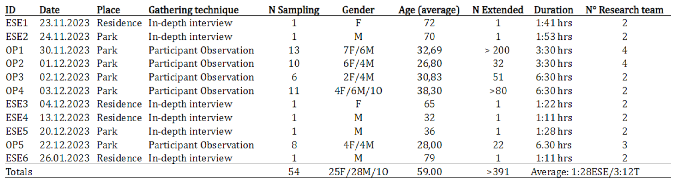
For data analysis, we applied a thematic analysis method as outlined by Guest et al. (2012) [76] and further refined by Braun & Clarke (2019) [77] as codebook thematic analysis, incorporating triangulation with peer coders to bolster the study's methodological robustness (Treharne & Riggs, 2015 [71]). This analytical phase aimed to merge various data types, supporting our 'place-assemblage' methodological framework, which is crucial for examining socially contested public spaces (Di Masso & Dixon, 2015 [49]). The comprehensive sample for this research, including interviewees, observation participants, and survey respondents, is detailed in Table 1, offering a holistic view of the study's empirical foundation.
In the final phase of our research, we engaged in quantitative analyses utilizing secondary data provided by the Municipality, which enabled a detailed characterization of park visitors in 2021. Employing frequency analyses in Excel with the municipal data, we delineated the distribution of visitors by their district of residence over the previous three years. This analysis encompassed a comprehensive sample size of 162,133 visitors, who, on average, were 33.08 years old (standard deviation = 10.45 years, with ages ranging from 10 to 99 years old). Any data entries suggesting implausible ages (greater than 150 years or less than 0 years) were meticulously removed from the final dataset to ensure accuracy.
This study was conducted under the auspices of the Ethics Committee of Universidad Adolfo Ibáñez, adhering strictly to the confidentiality and voluntary participation of all involved, in line with the ethical principles for human research as outlined in the Belmont Report. This ethical oversight guaranteed that all stages of the research were conducted with the highest standards of integrity and respect for the participants’ privacy and autonomy.
3. Results
3.1. From the mountain hill to the public park: history of an intergroup conflict
In the exploration of the transformation from a mountain hill to a public park, a crucial theme emerged from interviews with key informants: the persistent tension between labeling a space as private or public. Throughout the 20th century, the inhabitants of the Peñalolén district cherished Quebrada Macul as a communal treasure, a haven for summer leisure, spa-like relaxation, and the unfettered celebration of national holidays, thanks to its open accessibility to all local residents.
“People said ‘let’s go up and stay there’, 'I used to date up there’, said people. I remember popular eateries -’fondas’- that were done in the hill. There were a lot, a lot of people saying that the hill belonged to them”.(Javiera, 65 years old, parr. 84)
"We used to come with my uncles during the summer. I was five and a half, almost six years old. And I am 79 years old, so we have been coming here for a little while now...".(Bernardita, 79 years old, parr. 6)
Yet, the unregulated access to the hill, purportedly in defense of its status as a public space, gave rise to damaging behaviors. Activities such as using trees for bonfires and modifying the riverbed to construct makeshift pools escalated the risk of forest fires among other adverse impacts. The situation escalated in 2003 when a proposal was introduced to privatize the park for educational and recreational aims, directly confronting the community's long-standing tradition of unrestricted use. This shift not only challenged local customs but also illustrates how changes in the management of communal spaces can intensify conflicts between public access and private interests.
“I told him [another social leader from the neighborhood] ‘there is an already approved project and, from the study I have been doing, I understand it means that the Quebrada Macul that people have been using for years will be closed [privatized]’. ‘I had no idea about this’ [he told me]”.(Darío, 72 years old, parr. 23)
The narrative of the park brought to the fore a pivotal issue: a venture aimed at transforming the hillside into a domain for a university, event center, and tourist destinations, a millionaire project planned without consulting the longtime inhabitants of the area. Ecological activists unearthed that this initiative had bypassed standard public policy protocols, leaving local governing bodies in the dark about the intended privatization of this verdant expanse. Furthermore, this situation highlights the private ownership of the park and the landowner's authority to sell or alter its traditional use. Once again, the privilege of excluding long-term residents is underscored, illustrating the power dynamics inherent in processes of inclusion and exclusion.
This revelation set in motion a series of negotiations among diverse social factions, alongside a concerted political campaign to gather signatures from the community, leading to a unified stand against the privatization effort. Such a movement galvanized social leader, who invested their efforts wholeheartedly into the campaign, pledging to restore the hill to its communal status. This struggle underscored a deeper tension where the contest over space mirrors the broader battle for inclusion and equitable access in urban development processes.
“We met social leaders because an ecological activist came to the Community Union –a social organization of neighbors- to ask for help to recover the Quebrada Macul. I had some beautiful photos of the place, so he asked me to please come with him to the meeting. [...] We spent a long time at the fairs sharing this [information], so people would realize that they had to fight for the hill. [...] After our victory, our leader talked to the owner, and other processes started from there".(Javiera, 65 years old, parr. 84)
During this period, the district was in the midst of a mayoral election campaign. The fight for the hill's preservation emerged as a central theme for one of the candidates, aligning his platform with the community's fervent desire to protect their beloved space. This candidate's successful election in 2005 marked a significant turning point. Under the guidance of the newly elected mayor, prominent figures from the community were invited to play a pivotal role in the efforts to recover the Quebrada Macul park. Below, Figure 4 illustrates the comprehensive negotiation process that ultimately led to the successful reclamation of the area by its rightful and resolute stewards, the community.
After extensive negotiations and shifts in power dynamics, Quebrada Macul hill evolved from an informally used natural space to an officially recognized public park, maintaining its free access for everyone. This transformation, however, introduced an element of environmental conservation that led to the enclosure of the area, enhancement of pathways, and the hiring of park rangers to educate visitors on preventing environmental damage. This new phase in the park's management was met with mixed reactions from the community, as indicated in our interviews:
“We liked to come [to the hill] at night, and spend the night, have a barbecue and then come down the next day. But if we entered there [the official entrance of the park after 2005] they would not let us; so, we entered the hill through unofficial routes. One day a park ranger told us: ‘hey guys, you have to go to the official entrance to register yourselves’ [...]: a friend went down to register and that was the first sign that the park was been protected. For us, [and] I think [for] many people in Peñalolén, we started [...] changing the concept”.(Miguel, 36 years old, parr. 70)
“It was super complicated to work with them, because of the bonfires, the people camping [in] the Guayacán sector, when we went patrolling rounds, it was easy to find 20, 30 tents, neighbors camping for a month, two months, camping the whole season. It was a hard but fun work, some people were very welcoming, whereas others less so”.(Miguel, 36 years old, parr. 22)
Miguel's interview sheds light on the tension arising from the prohibition of certain traditional activities within Quebrada Macul, sparking conflict among established residents nostalgic for the past and resistant to new norms. His unique perspective, transitioning from a frequent park visitor in his youth to a park ranger, underscores the complexities encountered. The enforcement of rules against customary practices like overnight camping and barbecues has stirred discord within the community, underscoring a larger narrative of urban segregation. This scenario illustrates a rift between enduring customs and contemporary management and conservation policies, reflecting broader disputes over space usage and regulatory changes.
The integration of the private Universidad Adolfo Ibáñez, often called ‘the white elephant,’ in allusion to its high economic status and disruptive architecture, added another layer to the narrative, symbolizing the clash between affluent, educated classes and the local community's interests:
“[And what the building of the University provoked among neighbors?] Rejection, yes, like the association with the destruction of the hill, like how ugly it looks there. I think the same thing happened when we saw the first gates up here because we are [were] so used to going to the hill without anybody telling us anything".(Miguel, 36 years old, parr. 278-280)
Whether directly or indirectly, the urban recovery project focused on Quebrada Macul sparked conflicts among various social groups. The questions raised about 'acquired rights' and the sense of ownership that long-time residents had over the hill, illustrates the complex interplay between community traditions and environmental stewardship.
3.2. There is no unity without memory: from struggle to oblivion
The preservation of Quebrada Macul as a public park intertwines with the local identity, where informants reflect on the hill's role within the community's social fabric, emphasizing its significance against the backdrop of segregation dynamics. Some informants describe the hill as "the heart of Peñalolén," signifying a core element of the commune's identity and what defines its residents:
“[The Quebrada Macul] is everything for the people of Peñalolén. I believe that if tomorrow the hill disappears, it will not be Peñalolén. The first thing you do in the morning after it rains, you go out and see if [the hill] is snowed or not, or if it is going to rain because the sky is closing, [and] the hill is closing. It tells us what's going to happen... It's everything! It gives us the day, it gives us the time, it gives us everything”.(Javiera, 65 years old, parr. 211)
“We, as [people from] Peñalolén, are used to leaving the house and looking at the hill, it is something that is above us. [...] There are many people from Peñalolén who do not know the park either, they may have grown old and never visited the Quebrada Macul. But they like the hill!”.(Miguel, 36 years old, parr. 82)
The Quebrada Macul thus emerges as a symbolic-material space central to Peñalolén's identity, crafting collective meanings of belonging and landscape. The hill, observed daily by residents, becomes a unifying element in their spatial experience, shaping their identity in relation to their environment and their perspective within it.
Within this setting, both social and ecological leaders, alongside longtime residents, share a profound connection to the ravine and the hill, deeply intertwined with their sense of identity. The battle to preserve Quebrada Macul is more than just a physical contest; it's intricately linked with the identity of those involved, weaving through their biographical narratives.
“It is the only thing for the complete community, the Peñalolino -people from Peñalolén- without its creek stops being Peñalolino, and many people was saying ‘how can they not let me enter?’. I tell you I am 65 years old, when I was 50, 48 years old, I was like my son when I started to fight for the Quebrada Macul. And there were people who were 70 years old and said ‘mijita, you have to fight for that’, so I said, ‘why am I going to fight for it?’. And people said ‘[because] we went picking blackberries in the fields, up there by the hill’, and all the people had something to do with the place, some practice related".(Javiera, 65 years old, parr. 237)
“[What does all this place mean to you?] My life itself. And every day it hurts that every day you see more and more damage. So really, if I could not let anyone in here and take care of this like gold, it would be... Because it really is a very beautiful part and it is being damaged all the time and ending up being the responsibility of the people who sometimes come here, which is not all of them, and most of them are more harmful”.(José, 79 years old, parr. 356-360)
The case of José (79 years old), a long-term resident, is particularly noteworthy as he describes the Quebrada Macul as an integral part of his identity. Furthermore, he views people from outside as potential threats, particularly in relation to the urbanization process. On the other hand, Bernardita, aged 72, draws a poignant contrast between Quebrada Macul and Villa Grimaldi—a site entrenched in the memory of political imprisonment and torture during the dictatorship era. This comparison illuminates the complex relationship between public spaces and historical trauma:
“During the dictatorship, they wouldn't even let us talk to the neighbor across the street. We had a very bad time, we had a very bad time [...]. Although it is also very important because thanks to this we started to get together, we started to spread the word, because we could not continue with the situation that we were in”.
“Look, the Quebrada Macul is like the reverse of the Villa Grimaldi [...]. The Villa Grimaldi is pain, death, and the Quebrada Macul is recreation, relaxation, enjoyment, being out in the fresh air. It is the opposite”.(Bernardita, 72 years old, parr. 69 / 192-194)
This comparison underscores a link between the political context of Peñalolén's emergence and the significance attributed to Quebrada Macul. Bernardita’s reflections reveal the hill’s role in fostering a sense of unity and resilience among Peñalolén residents, contrasting sharply with the oppressive history symbolized by Villa Grimaldi. Her narrative suggests that Quebrada Macul, during times of political strife, emerged as a sanctuary that bolstered community cohesion and served as a bastion against the forces of political trauma and exclusion.
The mobilizations of 2006, steeped in deep emotional significance, are recalled by community leaders with a sense of poignant nostalgia, highlighting apprehensions that the newer generations may not share the intense bond with the park's history and the efforts invested in its restoration. This sentiment of disconnection, as echoed by the leaders and evidenced through our interviews, signals a notable generational transition in how the park's importance is perceived and remembered.
“[Does your daughter go to the park Quebrada Macul?] No, no. She has no idea. ‘It's pretty and everything -she tells me-, you may like it mom, but I'm not going because I'm not interested in it'. So, I see those attitudes. I see it in my own people”.(Javiera, 65 years old, parr. 155)
“We have been losing the memory, I don't know how to explain it, sensations related to the park seem lost, for the same reason that I explained before: generational changes”.
“I believe that with all the [recent] massification, they have been losing the local communities in this role of identity of the park”.(Miguel, 36 years old, parr. 158 / 178)
“[What key agents do you think have been important to the history of the creek?] The park rangers".(Hernán, 32 years old, parr. 218)
The palpable depth of emotion expressed by those who engaged in the campaign to save Quebrada Macul, coupled with their prevailing nostalgia, underscores a profound connection to the park's history. This sentiment arises from the belief that the once robust collective effort has been diluted by a gradual lapse in memory. Participants observe a weakening in the social cohesion as the narratives of struggle and solidarity, vital in redefining the park's identity, risk being overlooked by subsequent generations.
This situation poses pivotal inquiries: How do the historical conflicts between different social factions, along with the dynamic interplay of personal and collective identities shaped by the activism for the park, impact the contemporary significance and utilization of Quebrada Macul? To what degree do the park's day-to-day engagements either reinforce or alter the socio-political cleavages that have marked its recent past?
3.3. More contemporary forms of unity in the park: public usages today
Quebrada Macul has evolved from its origins as a simple ravine in Peñalolén to become a park of metropolitan renown. As shown above in Fig 2, the geographical distribution of visitors over the past three years illustrates that the park now attracts guests from across the entire Metropolitan Region and beyond. This shift is highlighted by a marked increase in visitors from various parts of Santiago and other regions, attracted not just for leisure but also by the park's rich biodiversity, although mostly representing people from Peñalolén and nearby areas, excluding the wealthier western neighborhoods. This change signifies a departure from its earlier identity as merely a local spot, reflecting a broader public usage and appreciation that transcends its original communal boundaries.
The park's status as a cherished green oasis in an urban setting is underscored by being ‘connecting with nature’ the central theme that visitors referred to as the motivation to visit (to have an idea, 15/48 of our interviewees gave this as their principal motivation to visit the park, namely, around one third of the total of interviewed people during participant observations), followed by ‘disconnect from the city’ as the second central theme (12/48 of our interviewees gave this as their principal motivation to visit the park, namely, around a quarter of the total of interviewed people during participant observations). This qualitative data highlights the park’s role as a sanctuary amidst the concrete landscape. The social dimension of the park is also evident, with 'spending time with friends' (7/48) and 'with family' (4/48) emerging as significant motivations, mentioned five and four times respectively, affirming the park’s role as a cornerstone for community gatherings. The emergence of activities such as sports and trekking reflect the park's evolving allure, attracting a wide array of visitors seeking diverse experiences (Field Notes, PO13).
The swell in visitors from across the Metropolitan Region denotes a shift in the park's role from a local to a metropolitan amenity, potentially diluting its historical narrative yet simultaneously creating new platforms for social interactions. Throughout our observations, the park's diverse use by various groups was evident. Notably, school groups utilized the park for their year-end activities, with a teacher highlighting Quebrada Macul's accessibility and educational value as primary reasons for their selection (Field Notes, PO1), although there was limited engagement between children from different schools. We also documented a group of approximately 30 adults from Peñalolén's public health service, catering to chronic disease patients (Field Notes, PO1). On a similar note, a group of young people was seen enjoying the park for its social and natural appeal (Field Notes, PO1).
As mentioned, the notion of 'escaping the city' was a recurring motif across all participant observations. Visitors consistently described their time in Quebrada Macul as stepping into a different world, one that offers respite from the urban rush of Santiago. This feeling of retreat from the city's bustle is more than just a physical distance—it represents a mental and emotional sanctuary for urban dwellers. Hernán, a 32-year-old visitor, encapsulated this sentiment by sharing his transformative experience within the park’s natural embrace, suggesting that the park’s environment allows for a temporary dissolution of the city’s invisible yet pervasive boundaries.
“So, and we, at least when I go there, I share with the kids, "kids, if you are going to get into the waterfall, focus your mind. Be thankful you're here, be thankful you're underwater," and that's how we do it. We go underwater and we always ask for something from nature, to give us focus, to give us energy to be able to rethink ideas as I said, to be able to make decisions correctly and not in a crazy way. To get here from the city and they can have a clearer vision of what they need to do. In other words, if they have the shit or the muddy in certain things, everything has a solution. Or if they're sad or something, life goes on; They have to keep fighting.”
“On a psychological level, yes, it's an escape. So, if [the hill] is not there, I think it would have a significant psychological impact on people. There's no hill, there's no water”.(parr. 246 / 397)
The waterfall area, particularly bustling on a Sunday with approximately 100 visitors engaged in a variety of leisure activities, like bathing, sunbathing, and talking. Despite the presence of large groups and an apparent blurring of boundaries, social interactions predominantly occurred within established circles (Field Notes, PO4).
While previously formed relationships often dominate the interaction patterns within the park, its environment does encourage the creation of diverse social groups. The formation of socially heterogeneous groups for park visits represents a new form of communal engagement within the park's space. One example of this is the initiative of an interviewee to create a WhatsApp group for members of a sports club, bringing together a diverse mix of 8 adults and 3 children from various districts of Santiago for group outings to the park, illustrates the capacity of parks to serve as venues that encourage the formation of new relationships across established social divides (Field Notes, PO4). This is complemented by another group observed who met exclusively to visit the park through Facebook, despite members not knowing each other beforehand (Field Notes, PO4). One of our interviewees also mentioned initiating various groups to visit the park, coordinating through WhatsApp or other platforms, with participants hailing from different districts across the city (Field Notes, PO3).
"[And they suddenly meet right there on the hill?] Sure, 'and –they ask- when do we go up again?' 'When we can!' [he replies]. So you create a WhatsApp group, it's all different nowadays. And we're already on our way!"(Hernán, 32 years old, parr. 392-393).
The evolving significance of Quebrada Macul indicates a shift from its historical context of political activism to a contemporary focus on environmental stewardship, a sentiment that resonates strongly with the new generation. The park is now celebrated as an urban retreat, providing a vital connection to nature amidst the cityscape. This change has welcomed a new cohort of visitors to the park, who, while differing from past activists in their relationship with the ravine, they share a commitment to cultivating and maintaining the park's ecological and communal integrity.
These new guardians of the park prioritize environmental preservation and education, seeking to embed these values within the community, particularly among the youth. One informant passionately argues for the integration of environmental education into the school curriculum, underscoring the necessity of nurturing a sense of environmental responsibility from a young age:
“I would like them [authorities] to add the specific branch of environmental education to the curriculum in schools. I think this is a struggle for all environmental educators, a permanent struggle [...]. It is very shocking that they [still] talk about the polar bear or that they talk about the giraffe, the rhinoceros, whereas in Chile we have a good [different] fauna. In schools, I think that this is the important change for the new generations”.(Miguel, 36 years old, parr. 248)
This educational initiative can be seen as crucial for ensuring the continued protection of green spaces within urban confines, helping to mitigate the effects of urban segregation by fostering equitable access to natural resources and sustainable practices. The modifications at Quebrada Macul, with an aim to enhance safety and environmental preservation, have generated varied responses. A discernible continuity of struggle is observed among those deeply connected to the park's legacy, now channeled into a commitment to environmental stewardship—a contemporary reflection of the historical effort to retain the hill for the Peñalolén populace. This enduring dispute underscores a tension between traditional public access rights and the imposition of new rules that limit activities once freely enjoyed, such as barbecuing in the ravine. Park rangers, the enforcers of these new policies, face some resistance as they guide visitors towards sustainable practices. Although the initial resistance to these changes is gradually waning, a sense of nostalgia for the past freedoms of the park remains palpable among those who recall the days of fewer restrictions.
As Quebrada Macul evolves, it is increasingly serving as a hub for a multitude of interactions, bringing together groups and individuals from across the spectrum. This transformation has positioned the park as a communal crossroads where the usual barriers of social and geographical segregation become less pronounced, fostering a space where diverse demographics converge. The park's ability to provide escape and leisure, is a testament to its value as a public space, standing in contrast to the segregated nature of urban environments where such tranquil refuges are often unequally distributed.
At its core, the park has served as a vivid representation of the broader discussions surrounding micro-segregation, oscillating between private and public ownership. Initially, disputes centered around landowners, municipal authorities, and the local populace. More recently, the discourse surrounding the park has evolved into a debate on the permissibility of various activities, contrasting newly implemented conservation-oriented regulations with established freedoms. Our research did not reveal segregation explicitly based on economic status or residential location within the city. However, it was observed that while intergroup interactions are often initiated outside the park—via social media or through connections like sports clubs and health organizations—within the park, these groups predominantly engage in their activities, showing limited interaction with others despite the fluidity of social boundaries.
The appeal of Quebrada Macul, attracting people from different districts and backgrounds, offers a precious opportunity for fostering desegregation, particularly within urban areas. The park's transition from a battleground of social activism to a hub for environmental learning mirrors a shift in community engagement and priorities, indicating that despite the evolution of the struggle, the park continues to play a pivotal role in shaping the community's identity and shared experiences. These developments underscore the ongoing struggle for equitable access to green spaces in urban areas, reflecting a microcosm of larger societal debates on segregation, community rights, and the evolving relationship between urban dwellers and their environment.
The dynamic between individual stories and collective efforts to safeguard Quebrada Macul amplifies the conversation on urban segregation, casting the right to public spaces as a critical arena for asserting community identity and advocating for social equality. These stories underscore the importance of memory in galvanizing and uniting community actions, marking an essential component in the fight against urban segregation. This underlines the imperative for sustained involvement and advocacy to maintain public spaces against the forces of privatization and segregation-driven urban planning, highlighting the crucial role of public green spaces in the broader discourse on equitable urban development.
4. Discussion
The findings of this research illuminate the contentious dynamics of public-private negotiations over spaces, often culminating in significant conflicts among diverse social groups, particularly within the realms of segregation and micro-segregation. In the specific context of Peñalolén, a district characterized by its socioeconomically diverse population, affluent landowners initiated a substantial redevelopment project aimed at transforming the hills into a complex for the upper class, including a university, an event center, and upscale housing. This action was counteracted by the concerted efforts of social and ecological leaders, who volunteered their time to champion the collective cause of preserving the Quebrada Macul ravine for community access, effectively halting the privatization process. Such conflicts highlight the underlying power struggles over spatial occupation, where the battle for physical space simultaneously represents a contest over symbolic control and the assertion of rights by different groups (Di Masso & Dixon, 2015 [49]). The successful prevention of privatization by socially and ecologically minded leaders exemplifies a collective triumph. This event captures the essence of the struggle for spatial justice, as the community's efforts to reclaim the ravine also served as a bid for social empowerment, resonating with the concept that place struggle are replacing traditional class struggles as posited by Lussault (2015) [78].
This disparity prompts a reevaluation of the role governmental bodies play in developing and distributing green spaces to mitigate segregation and foster inclusivity. Recent research underscores the importance of vegetated areas in facilitating social connections and enhancing community well-being, positioning green spaces as essential components in the fight against urban segregation (Bazrafshan, Tabrizi, Bauer & Kienast, 2021 [58]; Callaghan, McCombe, Harrold, McMeel, Mills, Moore-Cherry & Cullen, 2020 [59]; Jabbar, Yusoff & Shafie, 2022 [60]; Reyes-Riveros, Altamirano, De la Barra, Rozas-Vásquez, Vieli & Meli, 2021 [61]). Thus, green spaces are identified as crucial arenas for understanding and addressing urban segregation and micro-segregation, revealing the complex interplay of intergroup dynamics, spatial disputes, and the quest for equitable access to nature.
Further exploration reveals that the challenges of urban planning in Chile, notably the loss of natural ecosystems and the adverse impact of urban sprawl on biodiversity, are intricately linked to the dynamics of social group interactions and psychosocial processes, sometimes leading to re-segregation and territorial stigma (Fernández & De La Barrera, 2018 [79]; Pinto de Carvalho et al., 2023 [80]; Angelcos et al., 2020 [81]). Recognizing and addressing the political and social narratives surrounding the allocation and use of such spaces are crucial for exploring the psychological dimensions of place attachment and identity. These efforts contribute to a broader understanding of how communal ties and memories associated with physical spaces can influence collective actions aimed at overcoming urban segregation and fostering a more inclusive cityscape.
Despite these complexities, the findings of this study reveal a nuanced tension underlying the efforts to preserve Quebrada Macul: a balance between safeguarding the environmental integrity of the space and accommodating its traditional uses by the community. This balance is complicated by the differing power dynamics introduced by environmental education initiatives, which, while beneficial, introduce new paradigms of rights and responsibilities. These initiatives favor environmental rights, potentially at the expense of the 'acquired rights' of the original inhabitants, who have historically engaged with the space in ways now deemed unsustainable. In the current case of Quebrada Macul’s park, these processes could hint at a subtle form of segregation, where the park's accessibility and offerings may appeal differentially to various social strata and demographics, potentially influencing the types of interactions and experiences within its bounds. These phenomena underscore a complex interplay between the need for ecological conservation and the recognition of the traditional community's historical and social ties to the land. The challenge lies in navigating these power disparities, ensuring that environmental education does not inadvertently disenfranchise the very people who have been the stewards of Quebrada Macul, but rather integrates their lived experiences and rights into a holistic approach to environmental stewardship.
In summary, Quebrada Macul's history encapsulates ongoing conflicts over its identity, oscillating between being a communal refuge and a target for privatization. This struggle reflects larger patterns of urban gentrification and the displacement of traditional communities, raising concerns over inclusivity and the right to the city for all residents, regardless of social standing. Through this lens, the park's narrative offers critical insights into the struggles for social equity, environmental stewardship, and the right to the city in the face of ongoing urban development and segregation, emphasizing the vital role of public green spaces in the broader discourse on equitable urban development.
5. Conclusions
The evolution of Quebrada Macul from a hill freely enjoyed by the community to a regulated metropolitan park exemplifies the complexities inherent in managing urban public spaces. The introduction of environmental conservation measures, while instrumental for the park's sustainability, has prompted a reevaluation of community traditions and practices. Some mourn the loss of unregulated access, indicative of a broader socio-political discourse on the right to public spaces.
The narratives from the community members reveal a deep-seated identification with Quebrada Macul, transcending its physicality to embody the collective memory and identity of Peñalolén's residents. The park has been, and continues to be, central to their way of life, shaping their sense of self and community.
The battle for the park has spurred a wave of activism within Peñalolén, rooted in the community leaders' personal histories and broader socio-political dynamics. The park's story is a microcosm of the city's struggles, reflecting power dynamics, social inequalities, and the resilience of a community in the face of attempts to reshape their environment. The park's narrative continues to be a testament to the community's determination to maintain their social and environmental heritage.
6. Patents
Author Contributions
The research team contributed as an integrated team to each part of this manuscript. Specifically: Conceptualization, Ana Rosenbluth, Teresa Ropert, and Matías Villalobos; methodology, Teresa Ropert, Yerko Molina and Vicente Rivera; formal analysis, Ana Rosenbluth, Teresa Ropert, Vicente Rivera, Matías Villalobos, Yerko Molina, and Ignacio Fernández; investigation, Ana Rosenbluth, Teresa Ropert, Vicente Rivera, Matías Villalobos, Yerko Molina, and Ignacio Fernández; writing—review and editing, Ana Rosenbluth, Teresa Ropert, Vicente Rivera, Matías Villalobos and Yerko Molina. All authors have read and agreed to the published version of the manuscript.
Funding
This research received no external funding, and the APC was funded by Universidad Adolfo Ibáñez.
Data Availability Statement
Every transcript of in-depth interviews can be provided if the corresponding author is reached; the audio files will not be provided for ethical reasons (confidentiality). Also, field notes and guidelines for participant observation can also be provided. The quantitative database is property of a public institution, so its delivery cannot be committed if requested: the authors undertake they will try to.
Acknowledgments
We thank the Escuela de Psicología from Universidad Adolfo Ibáñez for their support in conducting the study and for the review and validation by their Ethics Committee; we thank the Municipality of Peñalolén for facilitating access to official documents and key informants; we thank the administration of the park Quebrada Macul for their warm welcome and willingness to participate in the study; and finally, we thank our participants who kindly gave us their time and valuable life stories.
Conflicts of Interest
The authors declare no conflicts of interest.
References
- Logan, John. Making a Place for Space: Spatial Thinking in Social Science. Annual review of sociology. 2012, 38. [CrossRef]
- Maloutas, T. , & Karadimitriou, N. (2022). Chapter 1: Introduction to Vertical Cities: urban micro-segregation, housing markets and social reproduction. In Vertical Cities. Cheltenham, UK: Edward Elgar Publishing. [CrossRef]
- Pfirsch, T. Controlling the Proximity of the Poor: Patterns of Micro-Segregation in Naples’ Upper-Class Areas. Land. 2023, 12, 2005. [Google Scholar] [CrossRef]
- Calderón-Figueroa, F. (2024). Residential Micro-Segregation and Social Capital in Lima, Peru. Land 13. [CrossRef]
- 5. Vámos R, Nagy G, Kovács Z. (2023). The Construction of the Visible and Invisible Boundaries of Microsegregation: A Case Study from Szeged, Hungary. Land 12,. [CrossRef]
- Dixon, J. Contact and boundaries: ‘Locating’ the social psychology of intergroup relations. Theory & Psychology 2001, 11, 587–608. [Google Scholar] [CrossRef]
- Sabatini, Francisco, Cáceres, Gonzalo, & Cerda, Jorge. Segregación residencial en las principales ciudades chilenas: Tendencias de las tres últimas décadas y posibles cursos de acción. EURE (Santiago) 2001, 27, 21–42. [Google Scholar] [CrossRef]
- Garretón, M.; Basauri, A. & Valenzuela, L. (2020). Exploring the correlation between city size and residential segregation: comparing Chilean cities with spatially unbiased indexes. Environment & Urbanization, 32 (2): 569-588. [CrossRef]
- Fuentes, L.; Truffello, R. & Flores, M. Impact of land use diversity on daytime social segregation patterns in Santiago de Chile. Buildings 2022, 12, 149. [Google Scholar] [CrossRef]
- Ruiz-Tagle, J. & López M, E.. El estudio de la segregación residencial en Santiago de Chile: revisión crítica de algunos problemas metodológicos y conceptuales. EURE (Santiago) 2014, 40, 25–48. [Google Scholar] [CrossRef]
- Ruiz-Tagle, J. & Romano, S. (2019). Mezcla social e integración urbana: Aproximaciones teóricas y discusión del caso chileno. Revista INVI, 34.
- Álvarez Rojas, A. M. (2008). La segmentación económica del espacio: la comunidad ecológica y la toma de Peñalolén. Revista Eure, XXXIV (101): 121.136.
- Mardones Arévalo, R. ¡No en mi patio trasero! El caso de la comunidad ecológica de Peñalolén. Íconos: Revista de Ciencias Sociales, 2009; 34, 139–149. [Google Scholar] [CrossRef]
- Musset, A. , & Peixoto Faria, T. de J. (2016). Justicia, conflictos socio-espaciales, resistencia. Rescate histórico y construcción de las identidades en las ciudades latinoamericanas. Revista Geografares, julio – diciembre. ISSN 2175-3709.
- Bettencourt, Leonor; Dixon, John & Castro, Paula Understanding how and why spatial segregation endures: A systematic review of recent research on intergroup relations at a micro-ecological scale. Social Psychological Bulletin 2019, 14, E33482.
- Dixon, J. , Tredoux, C. , Davies, G., Huck, J., Hocking, B., Sturgeon, B., Whyatt, D., Jarman, N., & Bryan, D. Parallel lives: Intergroup contact, threat and the segregation of everyday activity spaces. Journal of Personality and Social Psychology 2019, 118, 457–480. [Google Scholar] [CrossRef]
- McKeown, S. , & Dixon, J. The ‘contact hypothesis’: Critical reflections and future directions. Social and Personality Psychology Compass 2017, 11, [e12295]. [Google Scholar] [CrossRef]
- Dixon, J. , Sturgeon, B., Huck, J., Hocking, B., Jarman, N., Bryan, D., Whyatt, D., Davies, G., & Tredoux, C. (2022). Navigating the divided city: Place identity and the time-geography of segregation. Journal of Environmental Psychology, 84. Doi.org/10.1016/j.jenvp.2022. [CrossRef]
- Altman, L. , & Low, S. (1992). Place attachment: A conceptual inquiry. In I. Altman, & S. M. Low (Eds.), Place Attachment (pp. 1–12). New York: Plenum Press.
- Altman, L. , & Rogoff, B. (1987). World views in psychology: Trait, interactional, organismic, and transactional perspectives. In D. Stokols & I. Altman (Eds.), Handbook of environmental psychology (Vol. 1, pp. 1–40). Wiley.
- Gifford, R. , Steg, L., & Reser, J. P. (2011). Environmental psychology. In P. Martin, F. M. Cheung, M. C. Knowles, M. Kyrios, L. Littlefield, J.B Overmier, & J.M. Prieto (Eds.), The IAAP handbook of applied psychology (pp. 440-470). Blackwell.
- Winkel, G. , Saegert, S., & Evans, G. W. An ecological perspective on theory, methods, and analysis in environmental psychology: Advances and challenges. Journal of Environmental Psychology 2009, 29, 318–328. [Google Scholar] [CrossRef]
- Hay, R. Sense of place in developmental context. Journal of Environmental Psychology 1998, 18, 5–29. [Google Scholar] [CrossRef]
- Hernández, B. , Martín, A. M., Ruiz, C., & Hidalgo, M. C. The role of place identity and place attachment in breaking environmental protection laws. Journal of Environmental Psychology 2010, 30, 281–288. [Google Scholar] [CrossRef]
- Proshansky, H. M. The city and self-identity. Environment and Behavior 1978, 10, 147–169. [Google Scholar] [CrossRef]
- Proshansky, H. M. , Fabian, A. , & Kaminoff, R. Place-identity: physical world socialisation of the self. Journal of Environmental Psychology. 1983, 3, 57–83. [Google Scholar]
- Fullilove, M. Psychiatric implications of displacement: contributions from the psychology of place. American Journal of Psychiatry. 1996, 153, 1516–1523. [Google Scholar] [PubMed]
- Giuliani, M. V. (2003) Theory of attachment and place attachment. In M. Bonnes, T. Lee, & M. Bonaiuto (Eds.), Psychological Theories for Environmental Issues (pp. 137–170). Aldershot: Ashgate.
- Vidal, T. , Valera, S. , & Peró, M. Place attachment, place identity and residential mobility in undergraduate students. PsyEcology, 2010, 1, 353–369. [Google Scholar] [CrossRef]
- Speller, G. , Lyons, E. & Twigger-Ross, C. L. A community in transition: The relationship between spatial change and identity processes. Social Psychological Review. 2002, 4, 39–58. [Google Scholar]
- Valera, S A study of the relationship between symbolic urban space and social identity processes. International Journal of Social Psychology 1997, 12, 17–30. [CrossRef]
- Vidal, T. , & Pol, E. La apropiación del espacio: una propuesta teórica para comprender la vinculación entre las personas y los lugares. Anuario de Psicología 2005, 36, 281–297. [Google Scholar] [CrossRef]
- Scannell, L. , & Gifford, R. The experienced psychological benefits of place attachment. Journal of Environmental Psychology 2017, 51, 256–269. [Google Scholar] [CrossRef]
- Rowles, G. D. Place attachment among small town elderly. Journal of Rural Community Psychology 1990, 11, 103–120. [Google Scholar]
- Rollero, C. , & Piccoli, N. D. Does place attachment affect social well-being? European Review of Applied Psychology 2010, 60, 233–238. [Google Scholar] [CrossRef]
- Lewicka, M. Place attachment, place identity, and place memory: Restoring the forgotten city past. Journal of Environmental Psychology 2008, 28, 209–231. [Google Scholar] [CrossRef]
- Brown, B. , Perkins, D. , Brown, G. Place Attachment in a Revitalizing Neighborhood: Individual and Block Levels of Analysis. Journal of Environmental Psychology 2003, 23, 259–71. [Google Scholar]
- Nielsen-Pincus, M. , Hall, T. , Force, J. E., & Wulfhorst, J. D. Sociodemographic effects on place bonding. Journal of Environmental Psychology 2010, 30, 443–454. [Google Scholar] [CrossRef]
- Comstock, N. , Dickinson, L. M., Marshall, J. A., Soobader, M. J., Turbin, M. S., Buchenau, M., & Litt, J. S. Neighborhood attachment and its correlates: Exploring neighborhood conditions, collective efficacy, and gardening. Journal of Environmental Psychology 2010, 30, 435–442. [Google Scholar] [CrossRef]
- Gifford, R. Environmental Psychology Matters. Annual Review of Psychology 2014, 65, 541–79. [Google Scholar] [CrossRef] [PubMed]
- Beck, H. Linking the quality of public spaces to quality of life. Journal of Place Management and Development 2009, 2, 240–248, Kearns and Livingston (2012). [Google Scholar] [CrossRef]
- Bailey, N. , Kearns, A., & Livingston, M. (2012). Place attachment in deprived neighbourhoods: The impacts of population turnover and social mix. Housing Studies, 27, 208-231. [CrossRef]
- Livingston, M. , Bailey, N., & Kearns, A. (2010). Neighbourhood attachment in deprived areas: Evidence from the north of England. Journal of Housing and the Built Environment, 25, 409–427. [CrossRef]
- Di Masso, A. , Vidal, T. , & Pol, E. La construcción desplazada de los vínculos persona lugar: una revisión teórica. Anuario de Psicología 2008, 39, 371–385. [Google Scholar]
- Manzo, L. For better or worse: Exploring multiple dimensions of place meaning. Journal of Environmental Psychology 2005, 25, 67–86. [Google Scholar] [CrossRef]
- Pinto de Carvalho, L. , & Cornejo, M. (2018). Por una aproximación crítica al apego al lugar: Una revisión en contextos de vulneración del derecho a una vivienda adecuada. Athenea Digital, 18, 1-39. [CrossRef]
- Nightingale, C. H. (2012). Segregation: A global history of divided cities. University of Chicago Press.
- Toolis, E. E. (2017). Theorizing Critical Placemaking as a Tool for Reclaiming Public Space. American Journal of Community Psychology, 2017, 59, 184–199. [Google Scholar] [CrossRef]
- Di Masso, A. & Dixon, J. More than words: Place, discourse and the struggle over public space in Barcelona. Qualitative Research in Psychology 2015, 12, 45–60. [Google Scholar] [CrossRef]
- Di Masso, A. Grounding citizenship: Toward a political psychology of public space. Political Psychology 2012, 33, 123–143. [Google Scholar] [CrossRef]
- Devine-Wright, P. Rethinking NIMBYism: The role of place attachment and place identity in explaining place-protective action. Journal of Community & Applied Social Psychology, 2009, 19, 426–441. [Google Scholar] [CrossRef]
- 52. Cresswell, Tim (204). Place. A short introduction.
- Gieryn, T. F. A space for place in sociology. Annual Review of Sociology 2000, 26, 463–496. [Google Scholar] [CrossRef]
- Mayen Huerta, C. Rethinking the distribution of urban green spaces in Mexico City: Lessons from the COVID-19 outbreak. Urban Forestry & Urban Greening 2022, 70, 127525. [Google Scholar] [CrossRef]
- Kephart, L. How racial residential segregation structures access and exposure to greenness and green space: A review. Environmental Justice 2022, 15, 204–213. [Google Scholar] [CrossRef]
- Saporito, S. , & Casey, D. Are there relationships among racial segregation, economic isolation, and proximity to green space? Human Ecology Review, 2015, 21, 113–132, http://www.jstor.org/stable/24875135. [Google Scholar]
- Sister, C. , Wolch, J. , & Wilson, J. Got green? Addressing environmental justice in park provision. GeoJournal, 2009, 75, 229–248. [Google Scholar] [CrossRef]
- Bazrafshan, M. , Tabrizi, A. M., Bauer, N., & Kienast, F. Place attachment through interaction with urban parks: A cross-cultural study. Urban Forestry & Urban Greening, 2021, 61, 127103. [Google Scholar] [CrossRef]
- Callaghan, A. , McCombe, G. , Harrold, A., McMeel, C., Mills, G., Moore-Cherry, N., & Cullen, W. The impact of green spaces on mental health in urban settings: a scoping review. Journal of Mental Health, 2020, 30, 179–193. [Google Scholar] [CrossRef]
- Jabbar, M. , Yusoff, M. M., & Shafie, A. Assessing the role of urban green spaces for human well-being: A systematic review. GeoJournal, 2022, 87, 4405–4423. [Google Scholar] [CrossRef]
- Reyes-Riveros, R. , Altamirano, A. , De La Barrera, F., Rozas-Vásquez, D., Vieli, L., & Meli, P. Linking public urban green spaces and human well-being: A systematic review. Urban Forestry & Urban Greening, 2021, 61, 127105. [Google Scholar] [CrossRef]
- Agostini, C.; Hojman, D.; Román, A. & Valenzuela, L. Segregación residencial de ingresos en el Gran Santiago, 1992-2002: una estimación robusta. Revista Eure, 2016, 42, 159–184. [Google Scholar] [CrossRef]
- Marchant Santiago, C.; Sánchez Acuña, R. & Monje Hernández, Y. (2022). Long-term features of cities in Latin America and the Caribbeans. In: J. M. González; C. Irarrázaval & R. C. Lois-González (Eds.). The Routledge Hanbook of urban studies in Latin America and the Caribbeans. Cities, urban processes, and policies.
- De Mattos, C.; Fuentes, L. & Link, F. Tendencias recientes del crecimiento metropolitano en Santiago de Chile: ¿Hacia una nueva geografía urbana? INVI 2014, 29, 193–219. [Google Scholar] [CrossRef]
- Krellenberg, K.; Höfer, R. & Welz, J. Dinámicas recientes y relaciones entre las estructuras urbanas y socioeconómicas en Santiago de Chile: el caso de Peñalolén. Revista de Geografía Norte Grande, 2011, 48, 107–131. [Google Scholar]
- Vásquez, A. & Salgado, M. Desigualdades socioeconómicas y distribución inequitativa de los riesgos ambientales en las comunas de Peñalolén y San Pedro de la Paz. Una perspectiva de justicia ambiental. Revista de Geografía Norte Grande, 2009, 43, 95–110. [Google Scholar]
- Salgado, M. Desigualdades urbanas en Peñalolén (Chile). La mirada de los niños. Bulletin de l’Institut Francais d’Études Andines, 2013, 42, 525–544. [Google Scholar] [CrossRef]
- Beyá Marshall, R. (2019). Prácticas de apropiación y significados atribuidos al paisaje fluvial en riesgo y su incidencia en la vulnerabilidad ante desastres socio-naturales. Caso de estudio: el Parque Natural Quebrada de Macul. [Tesis para obtener el grado académico de Magíster en Asentamientos Humanos y Medio Ambiente, Instituto de Estudios Urbanos y Territoriales, Pontificia Universidad Católica de Chile]. https://estudiosurbanos.uc.cl/wp-content/uploads/2020/04/TESIS-RBM.pdf.
- Goertz, G. (2012). Case studies, causal mechanisms, and selecting cases. Kroc Institute for International Peace Studies, University of Notre Dame, pp. 1–25.
- Treharne, G. , & Riggs, D. (2015). Ensuring Quality in Qualitative Research. In, P. Rohleder & A. Lyons (Eds.). Qualitative Research in Clinical and Health Psychology (pp. 57-73). Red Globe Press.
- Burawoy, M. (2009). The extended case method. Four countries, four decades, four great transformations, and one theoretical tradition. University of California Press.
- Patton, M. Q. (2002). Qualitative research & evaluation methods. Thousand Oaks, CA: Sage.
- Hernández Sampieri, R.; Fernández Collado, C. & Baptista Lucio, P. (2014). Muestreo en la investigación cualitativa. En: Hernández Sampieri, R.; Fernández Collado, C. & Baptista Lucio, P. (Eds.). Metodología de la investigación. Capítulo 13, pp. 382–393, 6ta Edición. McGraw Hill / Interamericana Editores.
- Kawulich, B. La observación participante como método de recolección de datos. Qualitative Social Research [On-line Journal] 2005, 6. Art. 43. http://nbn-resolvingde/urn:nbn:de:0114-fqs0502430. [Google Scholar]
- Guest, G.; MacQueen, K. M. & Namey, E. E. (2012). Applied Thematic Analysis. SAGE Publications. USA: Washington DC.
- Braun, V. & Clarke. V. Reflecting on reflexive thematic analysis. Qualitative Research in Sport, Exercice and Health 2019, 11, 589–597. [Google Scholar] [CrossRef]
- Lussault, M. (2015). El hombre espacial. La construcción social del espacio humano. Amorrortu Editores. Buenos Aires, Argentina.
- Fernández, I. C. , De la Barrera, F., Figueroa, J., & Lazzoni, I. (2018). Biodiversidad urbana, servicios ecosistémicos y planificación ecológica: un enfoque desde la ecología del paisaje. Biodiversidad Urbana en Chile: Estado del arte y los desafíos futuros, U: Santiago.
- Pinto de Carvalho, L.; Berroeta, H.; Silva Peñaloza, E. & Tironi Rodó, E. Entramando cuerpos, hogares y territorios: exploraciones sobre el deshacer hogar de mujeres chaiteninas. Revista INVI, First edition. Santiago: Universidad Central de Chile, 113-146. [CrossRef]
- Angelcos, N.; Campos, L. ; Ropert, T & Sharim, D. (2020). De protagonistas a denegados: el doble trauma en un caso de relocalización post-incendio en Valparaíso, Chile. Scripta Nova, XXIV (636). [CrossRef]
| 1 | Photographs were taken carefully attending confidentiality, not showing any identifiable face except researchers in the field – see Photograph 1. |
| 2 | N Sampling corresponds to people directly interviewed by the research team, whereas N Extended represents an approximation of people observed in the place, considering counting each group. For big groups, we considered an average of 30 people or more. |
| 3 | PO meaning Participant Observation a indicated in Table 1 (page 6) and the parragraph’s number were data was coded. |
Figure 1.
Area of study showing the six main neighborhoods encompassing the municipality of Peñalolén and the Quebrada Macul Park located on the southeastern corner of the Municipality.
Figure 1.
Area of study showing the six main neighborhoods encompassing the municipality of Peñalolén and the Quebrada Macul Park located on the southeastern corner of the Municipality.
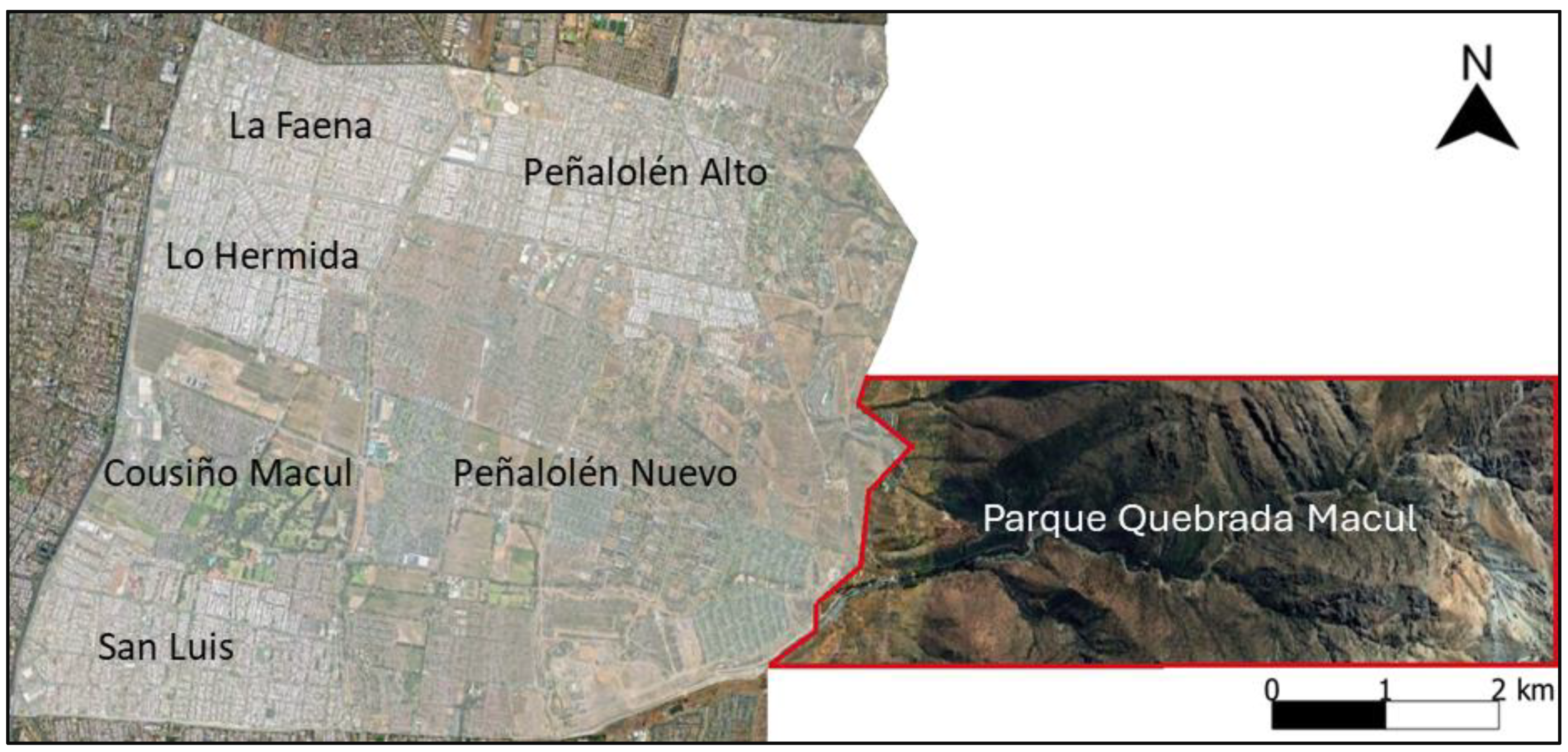
Figure 2.
Additional characteristics of the study area. Figures represent: (a) proportion of the total number of visitors by municipality conforming the Greater Santiago area; (b) proportion of the total population of each municipality represented by the respective number of visitors coming from those municipalities; (c) Percentage of people living in each municipality categorized in poverty conditions by the Casen 2017 national survey multidimensional index; (d) Vulnerability index at the block level for the municipality of Peñalolén based on the Chilean 2017 Census data. Visitors’ data for figures (a,b) was provided by the Municipality of Peñalolén.
Figure 2.
Additional characteristics of the study area. Figures represent: (a) proportion of the total number of visitors by municipality conforming the Greater Santiago area; (b) proportion of the total population of each municipality represented by the respective number of visitors coming from those municipalities; (c) Percentage of people living in each municipality categorized in poverty conditions by the Casen 2017 national survey multidimensional index; (d) Vulnerability index at the block level for the municipality of Peñalolén based on the Chilean 2017 Census data. Visitors’ data for figures (a,b) was provided by the Municipality of Peñalolén.
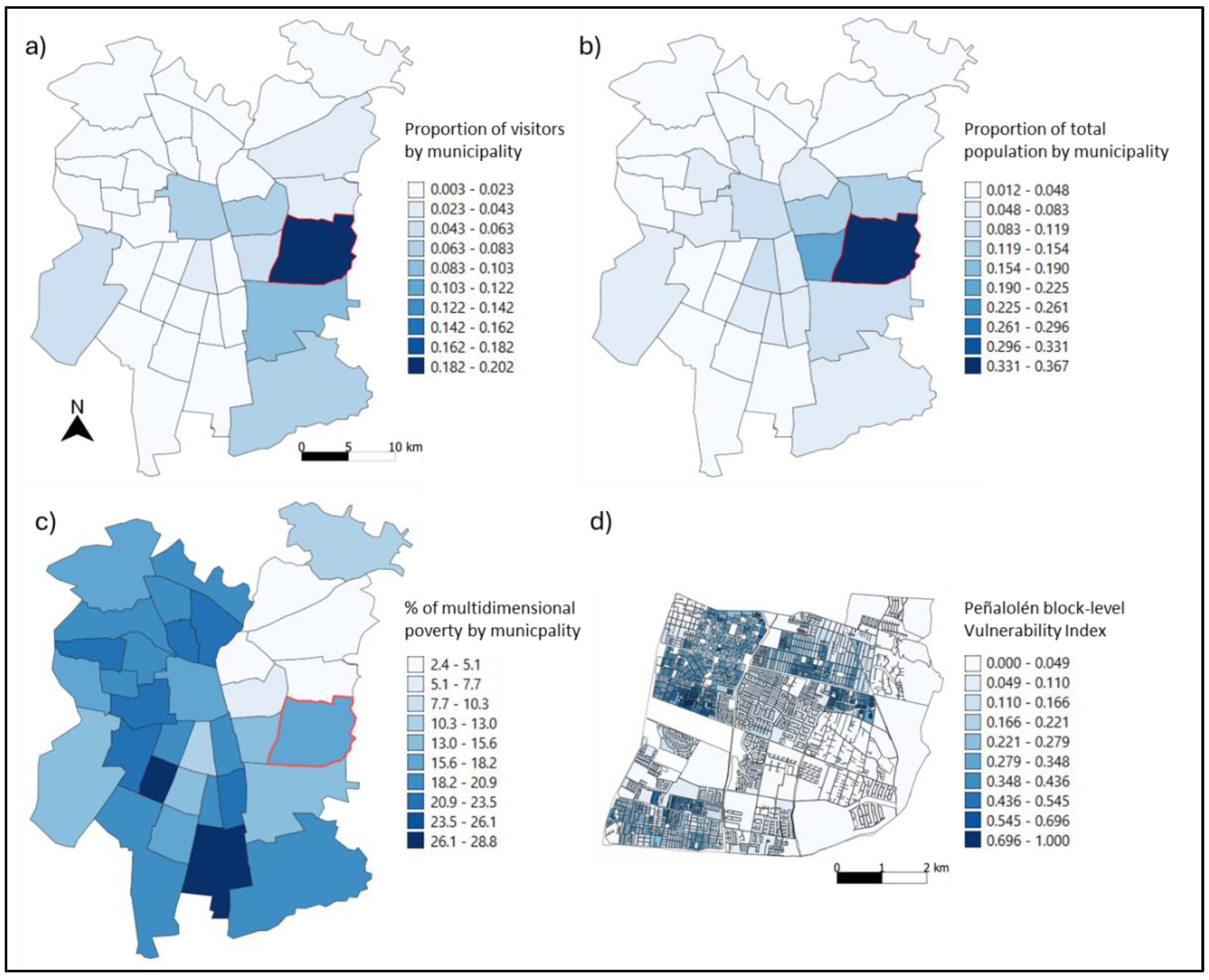
Figure 3.
(a,b) Photographs of participant observations in the Quebrada Macul Park1.
Figure 3.
(a,b) Photographs of participant observations in the Quebrada Macul Park1.
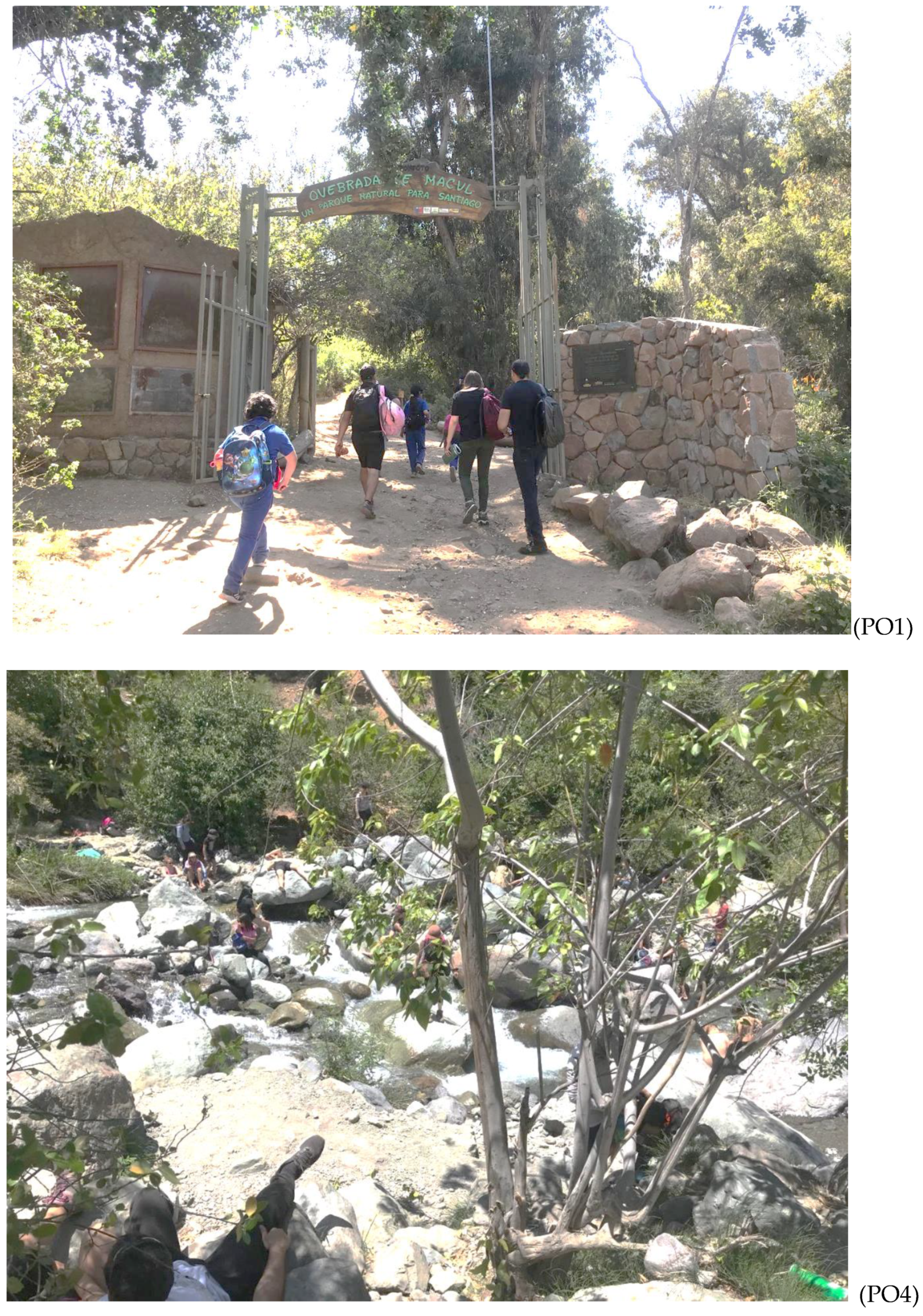
Figure 4.
Summary of events leading to the recovery process of the Park Quebrada Macul.
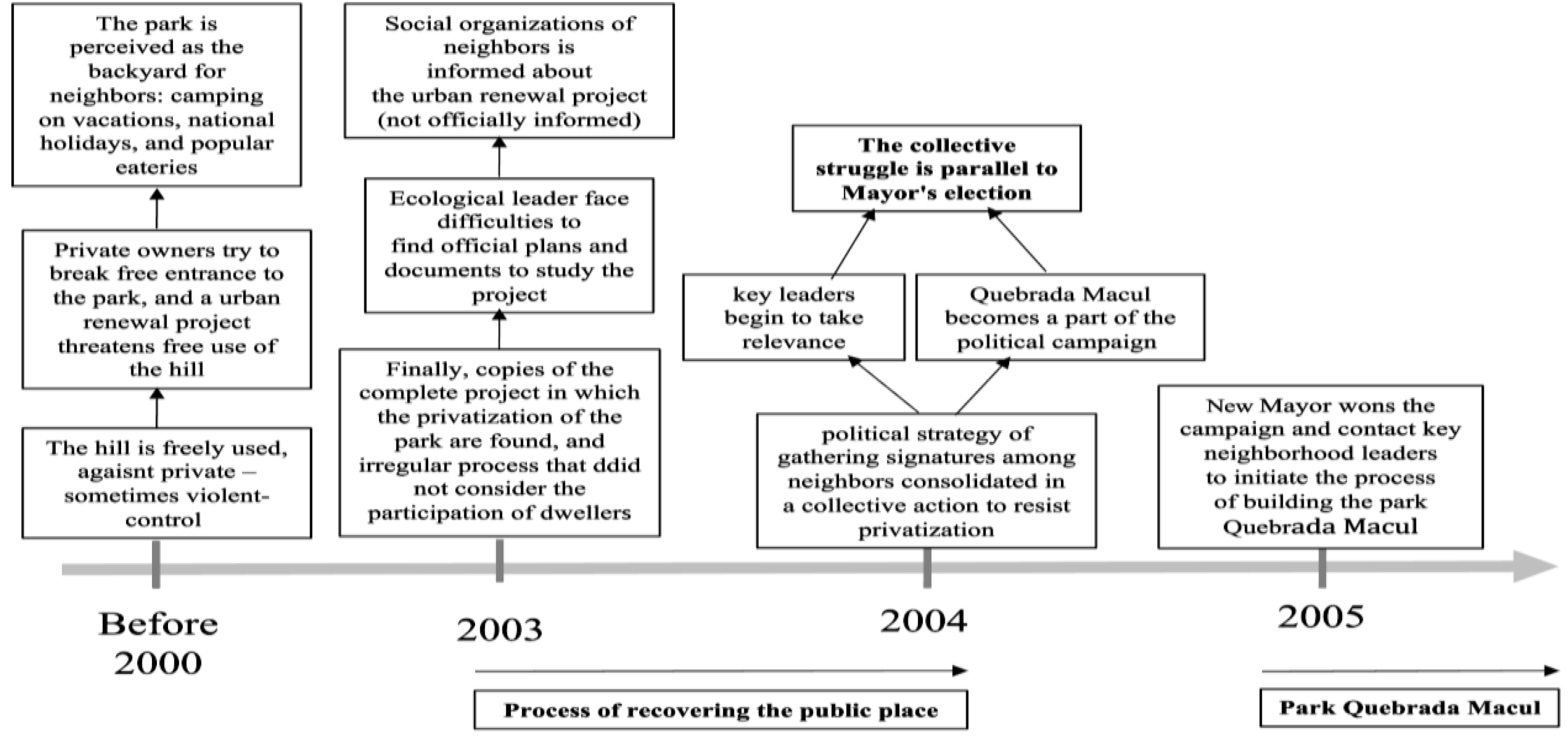

Table 1.
Summary of qualitative participants in the research, considering the gathering technique2
Table 1.
Summary of qualitative participants in the research, considering the gathering technique2
Disclaimer/Publisher’s Note: The statements, opinions and data contained in all publications are solely those of the individual author(s) and contributor(s) and not of MDPI and/or the editor(s). MDPI and/or the editor(s) disclaim responsibility for any injury to people or property resulting from any ideas, methods, instructions or products referred to in the content. |
© 2024 by the authors. Licensee MDPI, Basel, Switzerland. This article is an open access article distributed under the terms and conditions of the Creative Commons Attribution (CC BY) license (https://creativecommons.org/licenses/by/4.0/).
Copyright: This open access article is published under a Creative Commons CC BY 4.0 license, which permit the free download, distribution, and reuse, provided that the author and preprint are cited in any reuse.


