

Submitted:
14 October 2024
Posted:
15 October 2024
You are already at the latest version
Abstract
Chile is experiencing a twofold housing crisis provoked by the market and the state. On the market side, re-commodification of the housing market limits the access of those on low incomes; on the state side, exhaustion of the housing subsidies system (voucherism) due to low quality and peripheral social housing reflect an inability to deliver. In this context, self-built settlements (SBS) have skyrocketed to levels unseen since the 1980s and result in the spatial concentration of vulnerable Chilean and immigrant families in small and dense areas without limited access to urban services. This paper analyses how common resources are produced and managed in recent SBS in Santiago, through a socio-spatial analysis of a peripheral industrial brownfield occupied since 2015. The possibilities and channels of integration (housing, jobs, education) for families are differentiated by nationality, citizenship status and political leverage; however, common resources are valued and used transversally. Amidst partial efforts from the state to deliver welfare, lack of information and distrust from SBS neighbours towards institutions, and even to their own representatives, are problems that reinforce marginalisation. Self-managed organisations contribute to commoning, supporting children’s access to education and try to appropriate the community spaces co-produced with NGOs, neighbours and researchers.
Keywords:
marginalisation
; self-built settlements
; commons
; self-managed education
1. Introduction: Market and State Constraints
Chile’s current housing crisis is a result of the convergence of interests between state and market around macroeconomic growth and trickle-down economics. In 2001, the reform of the capital markets enabled all real estate companies to access the stock exchange market, thus diversifying its shareholders, who built an ethos exclusively oriented towards investment profit [1]. Insurance and pensions fund companies (AFPs) were also allowed in real estate operations through new financial instruments [1,2], reinforcing the idea of housing production as the creation of profitable assets. Despite the 2008 financial crisis, speculation and buy-to-rent deepened urban inequalities increasing housing prices. Financialisation and investification are the main features of a consolidated restrictive market [3,4], which made Chile one the most expensive countries in Latin America to buy a housing unit in US$ per m2 [5,6].
On the other hand, since the 1980s the state has played a subsidiary role towards the market, enabling real estate businesses and offering residual housing subsidies to focalized groups. Chile has no state-developed housing offer, price regulations for any type of tenancy nor protected areas for social housing, the latter being produced by a private sector fuelled by demand-side voucher subsidies. However, subsidies have decreased in intake, mainly due to absorption by the market through rising prices [7], social housing production has diminished since 2005 [8] and new residential projects are still in outskirts and even rural districts outside metropolitan areas [9]. There is a persistence of physical and symbolic barriers that could not overturn hierarchical spatial arrangements in the city, with limited socioeconomic mix of social integration residential projects (DS116-DS19), where low-income families live next to low-middle class only. The low percentage of families that still used subsidies to access housing, move within or close their neighbourhoods of origin, in order to preserve networks and location, even when peripheral [7,10].
In the light of market and state constrains, during the 2010s an increasing number of families without any access to housing opportunities resorted to self-built settlements (SBS hereafter), inhabited by a diversity of Chilean and immigrant families with an interest both in location and networking to access resources. New SBS express the attempts of low-income families to return to the centre, a process which reinforces the compact and diffuse or ‘compfuse’ character of Latin American cities [11], especially where informal and illegal urban land markets are part of the housing production structure [12]. Popular urbanisation, understood as “an urban strategy through which urban territories are produced, transformed and appropriated by the people” [13] (p.653) infills pericentral vacant land plots and expands the suburbs, subdividing and self-building dense and organized settlements, reshaping Santiago as in the 20th century, when politicisation of SBS gave way to an array of formalisation processes.
Unlike the 1960s, new SBS suffer the consequences of the contradictory role of the state (absence, negligence, selective criminalisation, formalisation) and the development of informal land and housing markets which spatially organize the SBS. The state experiences a double crisis: of regulatory capacities (the formal/informal) and of financing housing, urban services and infrastructure. Thus, the provision of basic services and infrastructure is outsourced to a network of private companies, NGOs and self-managed actors, whom, as we will see, enable the production of common spaces and resources. Following Ostrom [14], we understand commons as the shared resources appropriated by people outside the dominion of the state or the market, through the practice of ‘commoning’, defined as the collective capture and management of a shared resource and beyond, to be understood as a “self-organising and self-governing form of collective action” [14] (p.25).
The formerly mentioned constraints and inequalities in access to housing are some of the reasons behind the political turmoil that began with the protests in October 2019, interrupted by the COVID-19 pandemic in 2020, and deepen by the subsequent economic crisis. A staggering 1,100 SBS nationwide are now home to over 72,000 families (more than 200,000 people) [15]. Recent immigration flows to Chile have added complexity to the crisis, as foreign residents grew from 200.000 (1.2% of the population) in 2002 to 1.5 million in 2019 (7.8% of the total) [16,17] and constitute 30% of the population in SBS [15]. These immigrants are mainly Latin-Americans attracted by Chile’s macroeconomic growth and pushed by political crises in countries such as Venezuela or Haiti [17,18]. Due to their vulnerability and irregular citizenship status, these families have trouble integrating into the host society through the formal channels: housing system, labour market and education opportunities. Housing needs are solved through the self-built; work opportunities can be more or less formal, depending on the individual legal status, and education opportunities are scarce, particularly for immigrant children. COVID-19 meant the closure of schools (although the children in many immigrant families were not enrolled). Keeping up with online classes and homework depended on e-learning requirements, which became barriers within the SBS, partially provided with electricity and without access to internet other than via their own mobile phones.
Aiming to understand how families face marginalisation from the housing system and attempt to produce and manage common resources to solve needs such as education access, this paper aimed at answering the following research question: How does the production of commons occur and what are the actors involved in the process of commoning? In doing so, this paper addresses the formalisation process and self-managed education initiatives as opportunities to produce urban commons. Recent contributions to the theory of commons have explored the relationship with informality to broaden the availability of resources, primarily urban land, and to understand the self-contradictory role of the state [19,20,21]. Additionally, the definition of commons itself has been extended beyond the physical space to include immaterial common resources such as “social and cultural values and anything that contributes to the material, social and cultural sustenance of communities” [22] (p.440) and the commons as an activity rather than as a product [23]. Our case study shows that SBS are territories where material commons are disputed, while the immaterial commons (education) develop a capacity to transcend territorial boundaries.
The structure of the paper is follows: first, we offer an overview of our theoretical approach, considering historical, institutional, and contextual dimensions, understanding the territorial conflicts within SBS from a political economy perspective. Next, we describe our research methodology and methods. We propose an engaged research framework to understand our case study, which involved activities within the SBS communities divided into two main stages: interviewing and territorial interventions. Following that, we present our findings, with an emphasis on commoning amidst formalisation, networking and self-managed educational initiatives for building immaterial commons. Finally, we discuss and conclude posing challenges for further research.
2. Theoretical Approach
This paper adopts a historical, institutional and contextual approach framed on the Marxian thought and the political economy critique of capitalism; we argue that institutionally-led marginalisation (ILM) can explain the conflictive appropriation of commons, mainly due to the state’s type of governance of SBS located in its own urban land.
2.1. Historical Perspective
In Chilean cities, segregation as spatial concentration has been conditioned mostly by class or socioeconomic belonging [24,25,26]. Santiago, the capital city, experienced a rapid process of urbanisation after the 1929 crisis, as large numbers of unemployed people from rural areas and mining cities were pushed to the capital, but the economy had no capacity to absorb these [27,28]. SBS were a crucial driver of the urban growth, and the 1940 census recorded a nationwide majority of urban population (53%) for the first time, with Santiago concentrating 1.2 million [29,30]. The period from 1939 to 1973 witnessed efforts of modernisation and social housing provision coexisting with illegal land occupation that extended the city. Endeavours to contain the ‘informal’ city are present in the Intercommunal Regulatory Plan of Santiago [PRIS, 1960] with the Americo Vespucio ring-road as urban boundary. However, the pattern of popular urbanisation persisted via SBS, with state-led housing production on urbanized lots that followed the pattern drawn by SBS, allowing the cycle of occupation/self-building to consolidate and be formalized afterwards [11].
Popular occupation via SBS extended urban boundaries and reframed normative and political relationships but has been theoretically neglected due to its ‘informal’ character. Self-built housing is usually understood as a failure of market or state provision; however, “informal spaces and practices do not exist in an institutional vacuum, in the complete absence of the state. If they can be seen as (partial) areas of exception from ordinary public control, nonetheless such exceptional status is the intimate product of the sovereignty of the state (and a constitutive feature of its power), and not the sign of its absence” [31] (p.51). Our case study reflects the state’s management of SBS located in urban land of its own property, which is selective and partial in delivering housing solutions to its neighbours. The Ministry of Housing (MINVU) gives subsidies, mostly to Chilean families logged in the social register (RSH) that comply with specific conditions, being extremely focalized and neglecting undocumented immigrants, homeless people and individual homes, since Chile has followed a familistic welfare approach to deliver social policies and subsidies since the 1980s [32].
Often, land occupations in Latin American cities are subject of legal dispute, territorial conflict, or threatened by new private or state-driven developments which eventually result in the direct or indirect displacement of the residents [33]. SBS have become a strategy to overcome the lack of capacity or willingness of the state in addressing the housing shortage. When self-construction entails the illegal occupation or purchase of land, it may be reclaimed by occupiers, particulars or the state, resulting in the coexistence of legal and illegal practices for an indefinite time [3,34]. Our case study shows SBS organized within an illegal land market managed by recognisable groups that subdivide land plots, and sell land and housing units, thus creating small parcels of territorial power. Here is where commoning practices become complex and, as we will see, reflect power relations and a differentiated relationship with the state depending on the agency of certain individuals and groups.
2.2. Institutionalism
During the dictatorship (1973-1990), the state was transformed via neoliberal reforms, and the socio-spatial structure of Santiago was reorganized. SBS were destroyed by the army and families were relocated to the outskirts [26,35]. A series of class-based segregation processes (i.e., 1980s municipal reform) were driven by the state and implemented through violence and ‘social cleansing’1, also aiming to decentralize the state and give local autonomy to mayors, although this reinforced territorial inequalities and created new ones (municipalities without funding for public services). Housing policies became focused on low-income families through subsidies materialized in vouchers to access housing (mostly for ownership) in the market. The subsidiary role of the state created the conditions for profit of companies producing social housing, segregating poor families both spatially and socioeconomically [36,37]. Despite the massive production of social housing during the 1980s-1990s, there was criticism on its quality, size and location [38,39], and SBS reappeared in the late 1990s [1,7].
After the incorporation of Chile into the OECD in 2010, the state followed recommendations to diversify housing policies, promoting rental, mixed-tenure and social integration housing, attempting to decrease segregation, overcrowding and informality [40,41]. Nevertheless, new subsidies have had a low uptake due to the scarcity of affordable units in the market, null public offer or price regulations [7,42,43]. Distrust towards institutions grows in SBS as there is a perception that receiving a subsidy will exclude them from future state benefits, reinforcing marginalisation, which is here basically understood as the lack of participation in social life, specifically in the labour market, housing and educational system.
The theory of marginality is a pertinent framework to conceptualize SBS and urban poverty in Chile, for the particularity of this Latin American-coined concept has been recovered to understand cultural dimensions of marginalisation and new structural features of the state in late neoliberalism [44]. Marginalisation has been institutionally produced, for the dictatorship created new peripheral districts for the poor (Figure 1), reinforcing the class-based segregation pattern of the city (Figure 2), where state action via municipal governments to provide housing and urban services is partial, selective and poorly managed due to under-resourced institutions. Ostrom’s neoinstitutionalist approach is complemented with debates on informality, for the urban commons are resources co-produced through “entanglements between informalities and formal institutions of spatial planning influencing the maintenance of the urban commons” [45] (p.713). Informality is an inherent feature of urban production in Chilean cities, and the resurgence of SBS sheds light on how institutions manage the urban space and provide or strip communities from the right to housing, education and other mechanisms of integration.
The institutionalist perspective is crucial for understanding the response to SBS, for “the factors that make the quality of local resources and opportunities dependent on the socioeconomic status of its residents are related to neoliberal policies of municipal devolution, segmented services, and targeted resources” [48] (p.37). Municipal reform and devolution in the late 1980s are institutional changes that produced the effects of the state inscribed into space [49]. Marginalisation and informal (self-managed) economies are not reproduced by the concentration of the poor itself but due to the spatialisation of the ‘informal’ from institutions at different scales of governance: focalized housing solutions from central government, partial provision of urban services from municipalities, omission and abandonment, criminalisation, among other governance practices that allows us to define our case study as one of institutionally-led marginalisation (ILM).
2.3. Contextual Approach
In the 1970s, structuralist perspectives of Marxian scholars such as Henri Lefebvre and David Harvey undertook behavioural approaches to address individuals’ experiences of housing as an expression of capitalism and institutions producing segregation and marginalisation in everyday life. Through their critiques, the city was considered a significant theoretical object via humanist and determinist visions. The humanist strand, to which we adhere, is represented by Lefebvre and the production of space. (Social) space is a (social) product, and this means that “the space thus produced also serves as a tool of thought and of action; that in addition to being a means of production it is also a means of control, and hence, of domination, of power. Yet that, as such, it escapes in part from those who would make use of it” [50] (p.26).
Spatial forms are the result of specific relations of production, but as they contribute to reproduce domination, they also become an autonomous source of socio-spatial interactions and an input to build a different mode of production. The extent to which such counterprojects can be co-produced and pushed to authorities to take them into account, is gauge of real democracy [50] (p.420). The idea of socio-spatial dialectic is shared and deepened by Harvey, who considers it a dynamic that allows informal practices to be raw material of a social movement for the right to the city, thus becoming the social and spatial revindication of marginalized groups. Ananya Roy highlights the complexity of informality and its potential to express itself as “a mode of production of space defined by the territorial logic of deregulation” [19] (p.8). Chilean scholars [1,51,52] have addressed some of the institutional features of marginalisation and the social production of space to unveil popular agency in low-income neighbourhoods. In the case of SBS, we will discuss the ways in which marginalized communities influence the state institutions to manage common resources.
In the light of the above, marginalisation is a contextual phenomenon that depends on historical, institutional and recent social features territorially produced. Marginalisation is institutionally produced since the dictatorship labelled SBS as “pockets of territorial concentration of urban poverty” [53] (p.2), a narrative reinforced in the 1990s by the democratic governments, which served to turn SBS into governable territories to respond to the political demand for housing. Informality is categorized as poverty, so the state’s power and authority homogenize and depoliticize SBS [53]. However, SBS’ population in recent years shows a heterogeneous composition and motivations regarding their residential experiences, which impacts on the type of territorial appropriation. On the other hand, the capacity of governing SBS is at stake, since the lack of urban services and infrastructure has been normalized in many Chilean cities, but it is precisely the neglect by the state that sets the conditions for the self-management of urban needs and, as we will show, for spatial struggles and conflict.
ILM produces the self-built, but this opens the possibility of turning scarce public goods into commons when communities have cohesion enough to collectively manage them. Commoning is a process which entails social relationships and practices that allow the management of specific resources, in this case community spaces, but also knowledge and social practices such as education when these have been captured by capitalism: “if state-supplied public goods either decline or become a mere vehicle for private accumulation (as is happening to education), and if the state withdraws from their provision, then there is only one possible response, which is for populations to self-organize to provide their own commons” [54] (p.87). Self-managed initiatives, especially those focused on migrant children, will demonstrate some of the social innovation capacities beyond the conflictive territorial organisation of SBS.
3. Materials and Methods
Our research methods were adapted to the dynamic socio-spatial reality of the SBS, considering housing needs and access to education as the main problems for the community, especially in the context of COVID-19. The pandemic caused delays and restrictions in our fieldwork, and participatory observation activities had to adapt to the confinement measures established by the government between July and September 2021. Despite this, we tested an Engaged Research approach, following the contributions of recent Chilean scholars working on SBS and community empowerment, who have redefined the role of researchers “as both observers and catalysers, working directly with communities as trainers, designers, facilitators and analysts” [55] (p.4). This approach aims to avoid academic extractivism and to co-produce commons. One of the advantages is our territorial belonging to Maipu (south-west suburban municipality of Santiago), since both authors grew up in the district and are part of the same social class as the SBS community. This helped to avoid a paternalistic research practice, or the idea of us doing assistentialisme in the name of the state or other institutions.
The project can be divided into two main stages: interviewing and territorial intervention. First, we conducted two structured interviews with local and central government actors – Maipu municipality and MINVU’s territorial department for SBS – to find out how housing and urban needs are being addressed by the state. This was followed by four structured interviews with representatives of each of the four SBS in the area, to understand territorial organisation, conflicts, and type of governance. Lastly, we conducted 15 structured interviews with dwellers about their experiences of accessing housing in the area, and the education needs of their children. During the second stage, we organized three assemblies (Figure 3) to discuss the right to the city, listen to community needs and experiences, and plan territorial interventions. We avoided taking leadership positions and our role was of notetakers of the assembly. We complemented the assemblies with participatory observation in the process of formalisation of some SBS led by the local authorities, companies that provide basic services (electricity, sewerage), and housing movements that have leverage to secure housing solutions in one SBS. Due to ethical considerations, the research study refrained from using the actual names of the participants. The study adhered to the guidelines of the research ethics committee at University College London. Informed consent was obtained from the participants.
Some outcomes of the assemblies and demands from community can be seen in Figure 3. However, while community members were highly involved in the assemblies, their participation in actual work on the common areas was limited.
Following the assemblies, the project established networking to coordinate the community’s needs with an NGO working on housing ‘Techo’ (created in 1997 by the company of Jesus of the Catholic church and the Pontificia Universidad Catolica de Chile) and in education with PAM (Proyecto Amar Migrar). PAM is a self-managed organisation aiming to provide educational support to children and adolescents, aiming to reduce social and educational inequality gaps particularly affecting low-income Chilean and migrant children. The project is staffed by 87 volunteers who teach Spanish, mathematics, develop art sessions and fieldtrips to museums, parks and nature areas, among many other activities, all of them self-funded and organized.
Networking with NGOs included housing grassroots movements, as well as individuals such as teachers and activists who have worked with the community sharing information about state benefits, training for job opportunities, among other support. As result, we developed three territorial interventions to co-produce commons: building a soup kitchen, tactical urbanism (painting crosswalks, speed bumps, and street signs to protect children), and a puppet crafting education workshop (see Figure 4) Overall, avoiding leadership but coordinating efforts to produce commons via networking allowed us to get deeper insights into the territorial development of the SBS and inform our methods and research strategies for the following stages.
3.1. Data Analysis
Interviews were analysed through a thematic analysis (TA) [56] based on a hybrid coding method that started with deductive coding but also including an inductive approach [57]. This allowed for flexibility in identifying themes and patterns that emerged from the data and the participants themselves. The initial interviews and social activities promoted the development of shared ideas that turned into social demands raised in the assemblies, understood as moments of co-production of knowledge, which were the basis for the territorial interventions. Thematic analysis has a relationship with grounded theory [58] which is pertinent for our novel case of study, as it focuses on pattern-based analysis and bottom-up research practices for theory-building on the informal / self-managed urban commoning. It also shares links with interpretative phenomenology and discourse analysis, the latter being the method for analysing the interviews with state authorities. Territorial interventions provided new information on conflicts and the use of commons as a mobilising tool when different groups of interest attempted to control specific areas of the SBS.
3.2. Case of Study: Recent SBS in Maipu, Santiago de Chile
Our case study covers an area of three recent SBS in Maipu, Santiago, Chile (see Figure 5 and Figure 6): Campamento2 Fe y Esperanza (FE), Campamento Luna de Haiti (LH), and Campamento Latinoamericano (CL). A fourth SBS is occupied by a housing grassroots movement called Movimiento de Pobladores Vivienda Digna (Decent Housing or DH hereafter) and it is a temporary occupation while the state provides them of social housing for their members. The area is crossed by an urban highway and a cargo train railway, and the land plot belongs to the state (Ministry of National Assets). The expansion of SBS since 2015 takes advantage of the public infrastructure against which some of the houses are built. The same applies for basic services such as electricity and water, initially obtained from the public infrastructure by the neighbours.
The explosive growth of SBS in a context of a restrictive market and insufficient housing policies, the paucity of academic scholarship and even the criminalisation of what is still derogatively labelled ‘informality’ (we opt for self-built and self-managed) call for an engaged research approach that allows us to get insights from the community itself and support the development of common resources. The focus is on Chilean and immigrant families who face marginalisation in housing and education, by looking at their possibilities of access to housing (whether formal through subsidies, or via illegal land and housing markets) and education services for children (schools, self-managed support for children within the SBS). We attempted to answer the following research question: How does the production of commons occur and what are the actors involved in the process of commoning?
4. Results: Commoning Amidst Formalisation
Following Figure 6, it is possible to see the three SBS in the area and the two additional land plots in the north side of the area of study, which have been transferred from the Ministry of Housing in 2018 for a residential project to be managed between the municipality of Maipu and DH. The DH plot is occupied by a small SBS managed by ten families, while the construction of their social housing project for a total of 176 families begins, whereas the DH 2nd area is still being processed to be authorized for them as well. The south border between DH and FE has been subject to dispute, with the police intervening to secure the occupation of the area by DH. DH has gained leverage due to their political strength and the integration of some of their members as municipal workers, where they can push further for housing solutions. According to their speakers, dwellers of the LH and FE SBS have been invited to participate in DH, but they are:
“… looking for assistance, expecting to be given things, and lacking a political culture of collaboration. Some of them have criminal records of domestic violence, and the violence that gangs who deal with public land provoke make it impossible to work with them politically. We do not want to reproduce the marginality in which the state has condemned us to live all this time. Do you get it? And if we do not do it, nobody will do it for us.” [DH representative, 2021]
DH mostly focuses on securing their land plots and working politically as a housing movement, without more involvement with the other SBS after their past experiences. They inform the municipality of safety conflicts, drug dealing or fights when affects them.
In the southern borders of DH areas, Luna de Haiti (LH) is a gridlocked SBS located in the triangular-shaped land plot between the DH plots and FE, as seen in Figure 6. Initially occupied by a Chilean-Peruvian family who unlawfully subdivided and sold small land plots to Haitian families, most of them undocumented, LH is now exclusively inhabited by Haitians who work mostly in self-managed activities within the SBS area (hairdressing, construction, liquor or grocery stores) or as small merchants in street markets or around the Maipu Square subway station, located less than 2 km to the north of the SBS area. Only a few of them have formal jobs as cleaning personnel or in production lines in the food factories surrounding the area (Fruna, Nestle). LH has received some attention from the municipality due to the particular vulnerability of the families living there, as lockdowns meant interrupting school for children and the loss of jobs among the adults. LH representatives mention that the municipality was aggressive towards them in the summer (January-February) of 2020: “The municipality came and threatened us, giving us only three days to leave with our children. We had no money, not even 10,000 pesos (£10) to rent a room” [LH representative, 2021].
However, once the pandemic started in March 2020, they were left alone. The only support was in the form of blankets and coal delivered to them during winter 2020 (a risky fuel since all housing units are built of wood and other inflammable light materials) and a round of tests and some personal protective equipment to prevent the spread of COVID-19. Unfortunately, due to budget cuts from the new municipal government, the free service of doctors was cancelled. Regarding housing, they recognize that living in an SBS was the only option due to increasing rent prices, and since they cannot access social housing for not being Chilean or having citizen rights, many Haitians get to know about LH via WhatsApp groups. Most of the 72 families living in LH have children, and as opportunities are scarce, mobility is high and many Haitians leave the SBS due to difficulties integrating in society, mainly through work: “you already know, you live in a country that is not yours, if we do not have a job for one day we cannot feed our families, this is what happens (…) some of us have their paperwork outdated so they cannot find a job” [LH representative, 2021].
Despite the difficulties, when asked for housing or education solutions, some express interest in formalising the SBS and staying in Maipu, for they feel they belong to the area after living in it for 5-6 years and building up community ties. They trust their neighbours (also Haitians), and children have friends and supporting networks. In this case, self-segregation and the enclosure of the SBS (with a metal fence) have worked as assets to promote community cohesion. LH received another wave of support in late 2020, when Techo built a community hut for Spanish lessons and other workshops. It is, in fact, in this community space where PAM started working. Their members are university students from Maipu, motivated by solidarity, without any institutional support or political agenda. Techo and PAM have collaborated in turning the community hut into a working and studying space, with a small library built by volunteers and donations.
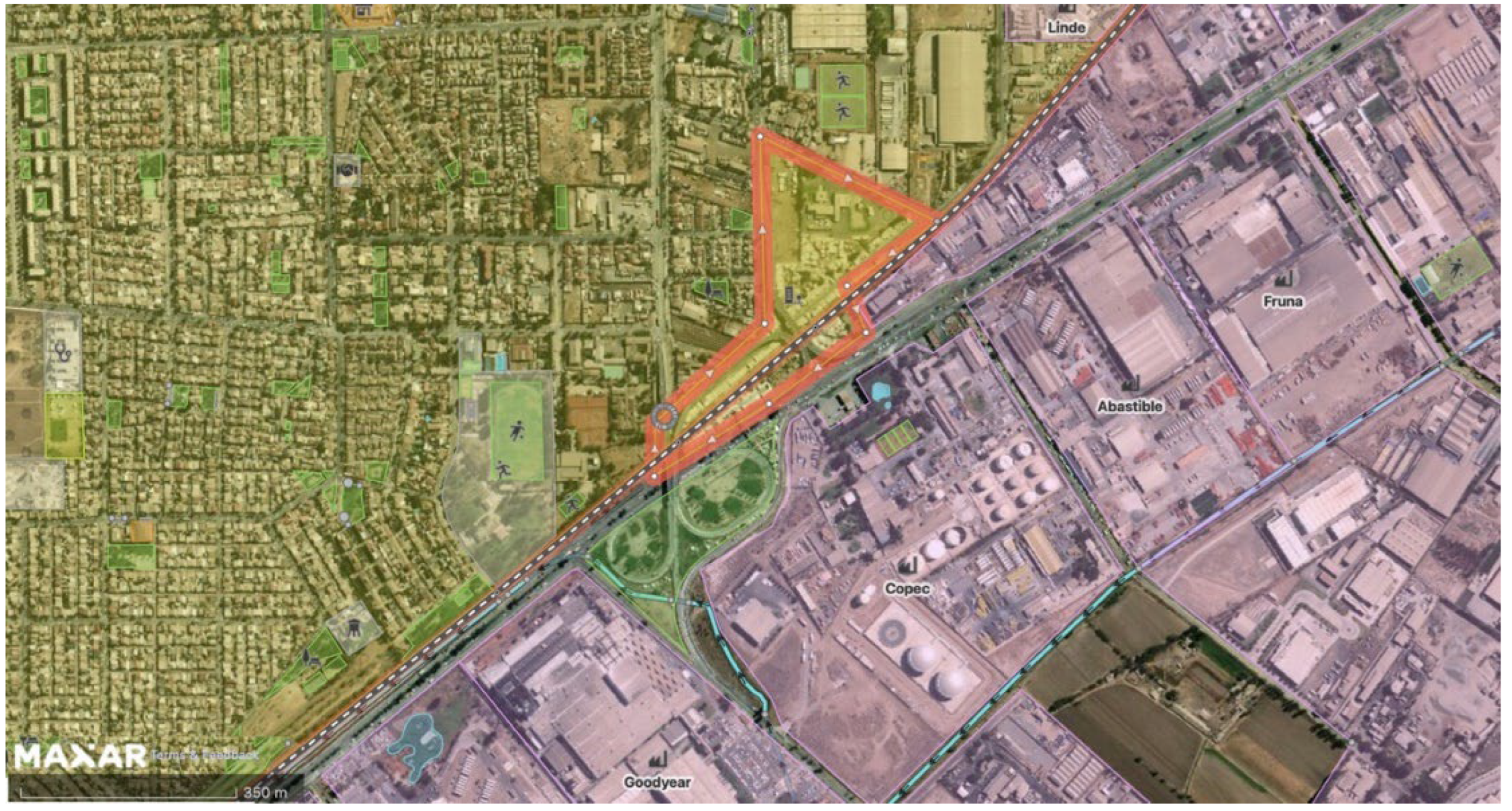
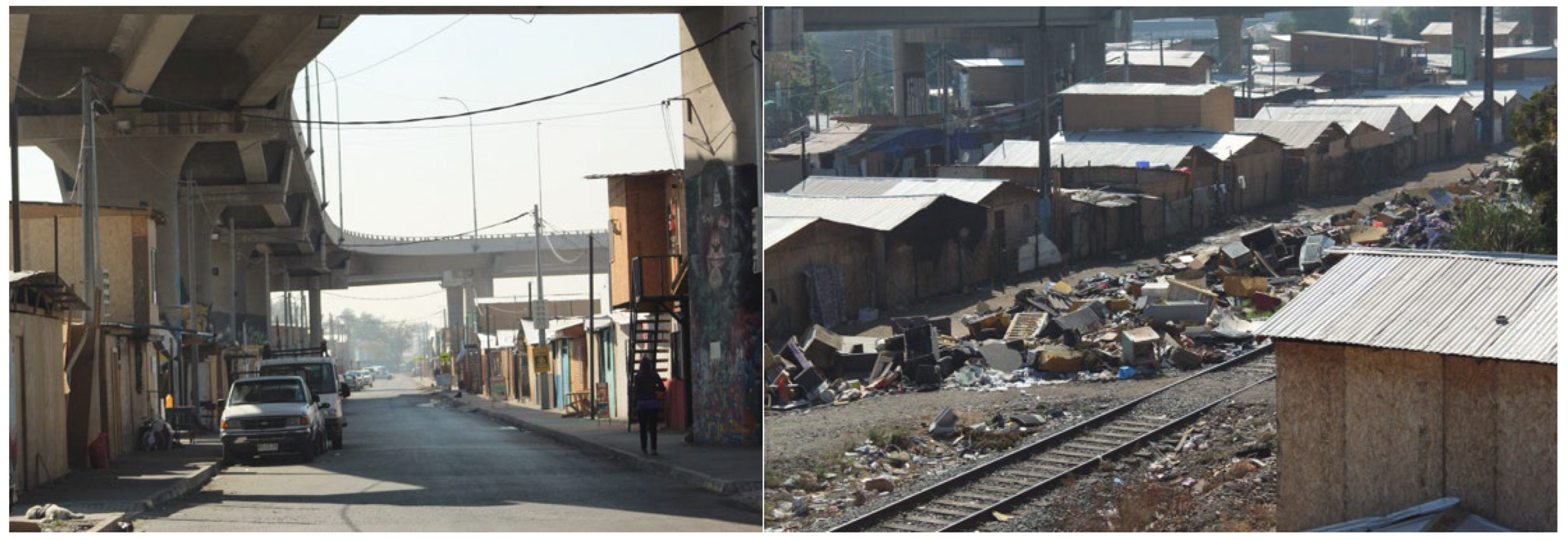
If common resources have been an asset for LH, in the case of Fe y Esperanza (FE) (Figure 8) they have produced conflict and territorial disputes. This is the largest SBS, and its south-west borders are diffuse since occupation is ongoing, so the borders seen in Figure 7 are already outdated. This SBS started the occupation in 2015, and there are at least two recognisable groups illegally dealing urban land and housing units, attracting mainly low-income and homeless immigrants and Chileans. It is important to note that the study case area is situated in a junction of industrial and residential areas (Figure 7), with an axis of an urban highway crossing (southern border of CL SBS), which, according to the PRC (communal regulatory planning) zoning, is oriented to public/green spaces [59]. Mostly decorative, since these gardens are enclosed by the highway roundabouts, gangs are also appropriating this plot to deal in.
The southern end of the SBS area belongs to Campamento Latinoamericano (CL), which keeps growing towards the public transport affectation area, and southwest along the railway. It is the most recent expansion of the SBS area, without any formal services or community spaces, so basic services area illegally grabbed by individuals. This strip is inhabited by an estimated 190 migrant families, with only three Chilean families, and it has not been registered by MINVU, local government or NGOs.
Since all electricity and water was unlawfully grabbed, the private companies that deliver these services approached the municipality to formalize urban services in the recognized SBS, so FE and LH were integrated, and CL excluded. The municipal authorities have also managed to get housing solutions for a small population of FE SBS only, and in a different location of Maipu: “There will be a project in which 220 housing units will be built. Out of these, 110 units will be allotted to the SBS, while the remaining 110 will be assigned to families living in co-residence [overcrowding]. Additionally, 20 of the 110 houses are reserved for residents of the FE SBS, which are the ones eligible to apply.” [Municipality of Maipu, 2022]
FE inhabitants are around 200 families and growing, and the housing programme offers solutions for only 10% of its dwellers, and the rest are not considered. The Ministry of Housing and the municipality act selectively to ensure some state presence is visible, but the territorial distribution of the area is becoming unmanageable. CL grows without formalisation or measures to stop the occupation of the highway’s surrounding area. The ones being formalized through services, FE and LH, also receive occasional visits from local authorities, and the police intervene only when gangs confront each other with violence. The lack of social organisation reduces the possibility of developing political leverage as DH did, and there is distrust to SBS representatives from the neighbours, as some of them are also involved in dealing in urban land or housing units. In any case, most of the families that decide to leave resort to reproduce the scam with newcomers in order to get some of their money back.
In light of this conflictive situation, some families appeal to the commons for social integration while living in SBS. This is relevant to discuss how to improve urban governance by legitimising self-managed practices such as the soup kitchen, education support and the defence of the community spaces which would allow the neighbours to organise a housing committee. The formalisation process affected commoning practices from self-managed initiatives of education and community development: in the case of LH, positively due to their previous bonding. In FE, despite the efforts in building the soup kitchen and contributing to the community area, this space became subject to dispute between the gangs. The good participation in assemblies did not translate into collaboration in the territorial interventions, and most of the activities only involved children and young volunteers as well as SBS representatives and researchers.
The development of community and belonging increases when many uses are given to a single area such as the community hub in LH. However, conflicts persist, and despite some efforts from the state to conduct cadastres or deliver some information on housing subsidies, disinformation among dwellers and distrust of institutions, and even towards SBS representatives, are problems that reinforce their marginalisation. NGOs and self-managed organisations cover duties not performed by the state and contribute to commoning, specifically supporting children’s access to education and appropriating the community spaces built as part of the formalisation process, but the creation of housing committees or a broader movement for housing is far from existing among neighbours.
5. Discussion
The research aimed to explore the socio-spatial reality of self-built settlements and understand the process of commoning within these communities. The findings of our engaged approach shed light on the complex dynamics of commoning and the actors’ roles in SBS.
5.1. Production of Commons in SBS
We can say that the production of commons occurs in a conflictive and differentiated way according to the capacities of organisation and leverage of each SBS regarding the state. After initial individual and spontaneous actions of land grabbing and self-building, the SBS is typically organized following leaderships that emerge to respond to the need to manage the informal market of urban land and housing units within the SBS, and to redistribute any support they might receive from institutions or individuals. Subsequently, relations with the local authorities (Maipu municipality) are developed to find housing solutions or at least to formalize basic urban services. The formalisation process starts with a cadastre of SBS inhabitants, the creation of a housing committee and the register of a leadership as president of the SBS community for municipal records.
5.2. Partnerships and Challenges
Partnerships with the state are diverse, according to the organisation of each SBS. The DH movement represents a fruitful link as they have a political movement for housing created by Chileans or foreign families logged in the state’s social register (RSH). They have sufficient leverage to secure a formal social housing solution in the areas they claimed for themselves (DH plots 1 and 2, as seen in Figure 6) and they manage as a small SBS inhabited by families that protect the area from others who might want to occupy it.
In the case of LH, there is no leverage due to lack of political organisation, and since most of the dwellers are undocumented or have an irregular citizen status, there are no housing solutions offered to them. However, the enclosed geography of the SBS and exclusive concentration of vulnerable Haitian families has allowed them to be supported by Techo, and the use of the community hub goes beyond the Spanish lessons, and PAM helps with activities, including murals, gardening and other expressions of spatial appropriation.
For FE, the situation is more complex, for their representatives are involved in dealing land and housing units while they also formally represent the SBS. As a result, there are dwellers who side with the representatives by giving them support or favours in exchange for better deals to get a house, protection and municipal benefits that are delivered to the representatives’ houses. However, and due to the expansion of the SBS towards the southwest, other groups interested in controlling the business appear to dispute the control of the urban land. Rivalries translate into conflicts in which groups cut the public electricity or water supply. Due to these conflicts and potential danger to the community, the private companies have formalized electricity and water services, claiming the need to prevent fires and further conflicts, and to secure the users as consumers. However, this has meant their loss as commons. FE suffered further conflicts after the delivery of the community hut by Techo, for the land plot where it is located at the heart of the SBS, and so it is attractive for grabbing and further self-build or selling.
Lastly, CL has no direct relationship with the state since it has not been registered by MINVU or the municipality and has no clear spatial borders. Its lack of housing committee and representation means the absence of the state or other institutions. As a result, urban services are not formal and families survive without them, or by grabbing them from the public service when possible, in an individual fashion. All of this means the total absence of common areas or resources, and it is difficult to envisage these being built, considering this SBS occupies the public transport area (pedestrian walkways, railway siding, bus stops and urban highway gardens).
5.3. Involvement of Techo and PAM
As per the main actors involved in commoning, we recognize Techo and PAM as the most relevant. Techo intervenes in SBS registered by MINVU, starting with mapping, a cadastre of the inhabitants, and meetings with their representatives to help creating housing committees. During this process they identify a plot for a potential community area and bring in volunteers to build a hub, organize activities and workshops for the neighbours. Techo helps maintaining and improving the common areas, which in the case of LH is the community hut and a front yard, and in the case of FE is the hub, urban garden and playground area for children. According to one of the construction workers of Techo, the hub called ‘Techo para Aprender’ (roof for learning) is mostly used for children, or by women when organising a housing committee or simply sorting out the donations (clothes, food) for their families, and as a place of encounter it allows socialisation.
Education activities are mainly organized by PAM, and by networking with researchers, co-produced activities were conducted to reinforce the use of the commons (urban gardening, soup kitchen, educational workshops) and to encourage community belonging and safety of children (tactical urbanism) as seen in Figure 4. PAM works as an independent organisation and only makes use of public space. Its founding members emphasize its efforts to avoid territorial struggles and the violence of the gangs. They say that working with children faces little to no rejection, since it is clearly a benefit for them and their families. As PAM frequently visits the SBS and organizes diverse activities, there is an understanding that they take care of children’s education beyond school support, and with the intention to improve their quality of life when they garden, paint, or celebrate a holiday together. PAM contributes to the reimagination of education as a set of immaterial common resources and the commons as an activity rather than as a product [23,60]. Thus, there is a potential to develop new ways of community organisation even with few resources; as Harvey claims, “the political recognition that the commons can be produced, protected, and used for social benefit becomes a framework for resisting capitalist power and rethinking the politics of an anti-capitalist transition” [54] (p.87).
5.4. Education as an Immaterial Common
Our case study shows that SBS are territories where material commons are disputed, while the immaterial commons (education) develop some capacity to transcend territorial boundaries, as the children that participate are not just from LH but from the other SBS. Commons are thus not only the material but also the immaterial effects of human activity, which capital has historically become increasingly adept at marketising [60]. In this sense, Harvey’s notion of education as a common resource highlights the need to appropriate, protect, and enhance education for the benefit of all [61]. Thus, in SBS where communities have the tools to develop self-managed education and organize themselves, there is potential for fruitful relationships and the redefinition of spaces. Immaterial common resources such as “social and cultural values and anything that contributes to the material, social and cultural sustenance of communities” [22] (p.440) and networking with PAM opened possibilities for further commoning in the absence of political empowerment, as:
Education becomes a common when social forces appropriate, protect, and enhance it for mutual benefit (…) The struggle to appropriate the public spaces and public goods in the city for a common purpose is ongoing. But in order to protect the common it is often vital to protect the flow of public goods that underpin the qualities of the common. As neoliberal politics diminishes the financing of public goods, so it diminishes the available common, forcing social groups to find other ways to support that common (education, for example). [54] (p.73)
In this vein and according to Freire’s perspective, education should be a means of empowering individuals and promoting their full participation in society [62]. In this study, education should be used to fight marginalisation from within SBS and to strengthen commoning through urban formalisation and education. Freire’s concepts of critical consciousness and participatory democracy can be used in education for urban commons to help communities understand and manage their collective resources, and work together to develop more equitable cities. Freire viewed education “as a vital tool for social transformation and believed in empowering people to understand their own reality as a critical step towards freedom” [62] (p.81). In the context of urban commons, Freire’s ideas about the co-production of knowledge can be applied to access resources for the analysis of this problem which might allow communities to understand, produce and self-manage their shared resources. By involving community members in the creation of knowledge, they can develop a deeper understanding of the issues they face and work together to find solutions. This collaborative approach can also build trust and solidarity within the community, creating a foundation for collective action in SBS. Both Harvey and Freire view education as a means for social transformation and recognize its role as a catalyst for individual and collective agency in bringing about social change. By empowering individuals through education and challenging dominant power structures, both perspectives highlight the transformative potential of education.
6. Conclusions
SBS are spaces where material and immaterial commons are created. In this study, the commons include social relations and the production of common values, sustenance and artefacts created through interaction and cooperation. Commoning in SBS produces spaces in which to be together, outside the realm of marketisation and individual ownership [60]. Commons are embedded in a specific human practice of collectively gathering what the land provides and sharing in its manifold tools, fodder and fuel. During our research, the use of common areas was particularly appreciated by children and women, as the former find places to play and interact, and the latter have a safe space to reach their representatives, gathering clothes, food or other resources they need. However, reappropriation of the space only happens in cases such as LH, where community is more developed due to scale and ethnonational background.
Our study shows that networking around educational needs of children means building territorial practices that contribute to social capital as a common resource and outcome, useful to face the dynamics of privatisation and separation that characterizes neoliberal urban societies [63]. Avoiding leadership ourselves but coordinating efforts to produce commons via networking allowed us to gain deeper insights from the territorial development of the SBS. Therefore, one of the alternatives, or rather modes of resistance, is the idea of commons and commoning as a way of providing local social innovation. From our project we can see how SBS challenge the state and deepen the double crisis of regulation (since they grow unmanageably) and of financing urban services (in charge of private companies). The belated response and partial coverage of basic services intensifies some territorial conflicts over what they consider ‘their plots’.
In further research, we can highlight the potential to identify and strengthen the links between researchers and self-managed organisations in other SBS, aiming to get institutional support whether from the public or private sector, improve housing and education policies or short-term programmes to address the multiple problems SBS face in Chile, one of the most urgent being control over the resources they co-produce. An engaged research approach allows us to practice networking and commoning from the ground. The state, both by negligence and inaction (CL), selectivity (housing for DH movement) or partial reach of their programmes (housing only for a few neighbours of FE), leads the marginalisation of the majority (LH, CL), and the invisibilisation of vulnerable migrants who are also criminalized. The state, in light of defunded municipalities, can coordinate the networking of actors, producing urban space within the SBS. Regulatory endeavours should follow the social dynamics of SBS, and the positive inputs such as PAM and individuals dedicating their time and resources to empower the community on their right to housing and access to education. Further research is needed to investigate how material or immaterial commons are relevant to create community and belonging, so the struggle against marginalisation leads to programmes that integrate them via education and housing solutions.
Funding
Please add: This research was funded by University College London’s Grand Challenges Doctoral Students’ Small Grants, 2021-22, AY 2020-21 GC Doc Students’ small grant.
Data Availability Statement
The original contributions presented in the study are included in the article/Supplementary Material, further inquiries can be directed to the corresponding author/s.
Acknowledgments
We acknowledge the contributions of neighbours of the self-built settlements visited and part of our cases of study, of individual activists that aim to co-produce commons and improve the quality of life of the dwellers, and especially of Proyecto Amar Migrar (PAM) and its volunteers for sharing their work and experience in Chilean and migrant children’s education and development.
Conflicts of Interest
The authors declare no conflicts of interest. The funders had no role in the design of the study; in the collection, analyses, or interpretation of data; in the writing of the manuscript; or in the decision to publish the results.
| 1 | Social cleansing refers to the act of targeting and eliminating certain individuals within a society who are deemed “undesirable” based on their social group. This includes but is not restricted to people who are homeless, involved in criminal activities, street children, and the elderly. |
| 2 |
Campamento is a word referred to a military outpost during a territorial occupation. In the 1960s, the Chilean left-wing coined the term as a metaphor to envision self-built settlements as part of an urban guerrilla, in which rural migrants coming to big cities have to face the incapacity of the state to address housing and job needs. They would self-built and self-organize the campamento community to build socialism from the ground. SBS are also known as tomas (occupation), poblaciones callampas (mushroom neighbourhoods, which had a minimum formalisation) but campamento is the less derogative term in Chilean Spanish and recovers the capacity of its inhabitants to develop political agency. |
References
- Vergara-Perucich, F.; Aguirre, C.; Encinas, F.; Truffello, R.; Ladrón de Guevara, F. Contribución a la crítica de la economía política de la vivienda en Chile. RIL Editores, Santiago de Chile, 2020.
- Gasic, I. Mercado del suelo urbano y reserva financiera de terrenos para producción de vivienda en el Área Metropolitana de Santiago. Revista de Geografia Norte Grande, 2020. Volume 76: 71-94.
- Rolnik, R. La Guerra de los lugares. La colonización de la tierra y la vivienda en la era de las finanzas. LOM, Santiago de Chile, 2017.
- Fuentes, L. Desigualdad territorial en Santiago de Chile. Una estructura urbana instrumental para la acumulación del capital. In Seminario Gobierno Metropolitano. Bogotá-Santiago: dos miradas, un fenómeno urbano, IEUT, PUC, 2020. Retrieved from: https://www.youtube.com/watch?v=KEEJTIeZAng.
- Cooperativa. Región Metropolitana: Más de la mitad de las familias no puede acceder a viviendas nuevas, 2018. Press note. Retrieved from: https://www.cooperativa.cl/noticias/pais/vivienda/region-metropolitana-mas-de-la-mitad-de-las-familias-no-puede-acceder-a/2018-08-16/165336.html.
- RIAL Di Tella-Navent. Relevamiento Inmobiliario de America Latina. Informe Centro de Investigacion en Finanzas, Universidad Torcuato Di Tella and Navent Real Estate, Marzo 2022. Retrieved from: https://www.utdt.edu/ver_contenido.php?id_contenido=17165&id_item_menu=24981.
- Urrutia, J. et. al. Estrategias de co-residencia. Tipologías de vivienda informal para familias extensas, FAU, Universidad de Chile, 2019.
- Ruiz-Tagle, J. Las razones tras el deficit habitacional. Press note, in: https://estudiosurbanos.uc.cl/emol-javier-ruiz-tagle-comenta-las-consecuencias-del-alza-de-campamentos-en-chile/.
- Borsdorf, A.; Hidalgo, R. New dimensions of social exclusion in Latin America: From gated communities to gated cities, the case of Santiago de Chile. Land Use Policy, 2010. No25, pp.153-160. [CrossRef]
- Razmilic, S. Arrendar o arrendar: primeros resultados del nuevo subsidio al arriendo. Propuestas de Política Publica CEP, No6, March 2015.
- Abramo, P. La ciudad com-fusa: mercado y producción de la estructura urbana en las grandes metrópolis latinoamericanas. EURE, 2012, Vol.38,. No114, pp.35-69. issn digital 0717-6236.
- Van Den Broeck, P.; Sadiq, A.; Hiergens, I.; Quintana, M.; Verschure, H.; Moulaert, F. Communities, land and social innovation. Land Taking and Land Making in an Urbanising World. Edward Elgar Publishing, 2020. ISBN 9781788973779 (eBook).
- Streule, M. Popular urbanization: conceptualizing urbanization processes beyond informality. International Journal of Urban and Regional Research, 2020. [CrossRef]
- Ostrom, E. Governing the Commons: The Evolution of Institutions for Collective Action. Cambridge University Press, UK, 1990.
- MINVU. Catastro Nacional de Campamentos 2022. Retrieved from: https://www.minvu.gob.cl/noticia/noticias/minvu-presenta-el-catastro-nacional-de-campamentos-2022/.
- INE, Instituto Nacional de Estadísticas. Departamento de Extranjería y Migración, DEM (2020) Estimación de personas extranjeras residentes en Chile al 31 de diciembre de 2019, Santiago, Chile. Retrieved from https://www.extranjeria.gob.cl/media/2020/03/Estimaci%C3%B3n-Poblaci%C3%B3n-Extranjera-en-Chile-al-31-Diciembre-2019.pdf.
- SJM. Servicio Jesuita a Migrantes. Migracion en Chile. Anuario 2019. Un analisis multisectorial, 2020. Retrieved from: https://www.migracionenchile.cl/publicaciones.
- Pardo, A.; Reyes, M. Acercamientos multidisciplinarios a experiencias de segregación, migración y marginación en contextos Latinoamericanos. Universidad de Guanajuato, Mexico, 2020.
- Roy, A. Strangely familiar: planning and the worlds of insurgence and informality. Planning Theory, 2009, Vol.8, N.1, p.7–11. [CrossRef]
- Haid, C.; Hilbrandt, H. Urban informality and the state: Geographical translations and conceptual alliances. International Journal of Urban and Regional Research, 2019, 43(3), 551–562. [CrossRef]
- Chiodelli, F. Moving beyond informality-of-need and informality-of-desire: Insights from a southern (European) perspective. Planning Theory, 2021, p.-19. [CrossRef]
- Leitner, H., & Sheppard, E. From Kampungs to Condos? Contested accumulations through displacement in Jakarta. Environment and Planning A: Economy and Space, 2018, 50(2), 437–456. [CrossRef]
- Stavrides, S. Common Space: The City as Commons. Zed Books, London, UK, 2016.
- Sabatini, F.; Caceres, G; Cerda, J. Segregación residencial en las principales ciudades chilenas: Tendencias de las tres últimas décadas y posibles cursos de acción. EURE, 2001, Vol. 28, No82, pp.21-42.
- Duhau, E. La division social del espacio metropolitano. Una propuesta de analisis. Nueva Sociedad, 2013, No24, ISSN: 0251-3552.
- Garreton, M. City profile: Actually existing neoliberalism in Greater Santiago. Cities, 2017, Vol.65, pp.32–50, May 2017. http://dx.doi.org/10.1016/j.cities.2017.02.005. [CrossRef]
- Hidalgo, R. El papel de las leyes de fomento de la edificacion obrera y de la caja de la habitacion en la politica de vivienda social en Chile, 1931-1952. INVI, 2000 Vol.15, No 39, pp. 92-120.
- Galetovic, A. Santiago: donde estamos y hacia donde vamos. CEP, Santiago de cHile, 2006. ISBN 956-7015-39-2.
- Pinto, J. Los censos chilenos del siglo XX. Ediciones PEDCH / Universidad de Los Lagos y Ediciones Universidad de La Frontera, Temuco, Chile, 2010.
- INE. Censo 2017. Datos historicos de censo, y estimaciones y proyecciones de la poblacion de Chile 1992-2050. Retrieved from: http://www.censo2017.cl.
- Esposito, E.; Chiodelli, F. Juggling the formal and the informal: The regulatory environment of the illegal access to public housing in Naples. Geoforum, 2020, Vol. 113, 50-59. [CrossRef]
- Ramm, A.; Salinas, V. Beyond the Second Demographic Transition: Cohabitation in Chile. Journal of comparative family studies, 2019, Vol.50, No1. [CrossRef]
- Lukas. Las nuevas periferias urbanas: territorios en disputa. En Imilan, W.; Larenas, J.; Carrasco, G.; Rivera, S. ¿Hacia dónde va la Vivienda en Chile? Nuevos desafíos en el hábitat residencial. FAU, Universidad de Chile, 2017.
- De Sousa, B. Epistemologies of the South. Justice against epistimicide. Routledge, 2016. ISBN 978-1-317-25685-4 (eBook).
- Gurovich, A. Una ciudad interminable: La Pintana. Revista CA, 1989, No 57, 32–35.
- Bresciani, L. El principal segregador es el mercado de suelo y ahí se necesita Estado. Press note, 2020. Retrieved from: https://www-latercera-com.cdn.ampproject.org/c/s/www.latercera.com/la-tercera-domingo/noticia/luis-eduardo-bresciani-el-principal-segregador-es-el-mercado-de-suelo-y-ahi-se-necesita-estado/ZBT7UBALWFFS7LUYTIESBISADE/?outputType=amp.
- Hidalgo, R.; Santana, L.; Link, F. New neoliberal public housing policies: between centrality discourse and peripheralization practices in Santiago, Chile, Housing Studies, 2018. [CrossRef]
- Ducci, M. Chile: The Dark Side of a Successful Housing Policy. In J. S. Tulchin and A. Garland. (Eds.) Social development in Latin America: The politics of reform (pp.149–173). Boulder, CO: Lynne Rienner, 2000.
- Rodríguez, A.; Sugranyes, A. Los con techo. Un desafío para la política de vivienda social Santiago de Chile. Ediciones SUR, Santiago de Chile, 2005. Obtenido desde: http://www.sitiosur.cl/r.php?id=81.
- OECD. Redefining “urban”. A new way to measure metropolitan areas. OECD, 2012. [CrossRef]
- IADB. Busco casa en arriendo. Promover el alquiler tiene sentido. Andrés G. Blanco, Vicente, Fretes Cibils, Andrés F. Muñoz. BID, 2014. Retrieved from: https://publications.iadb.org/bitstream/handle/11319/6730/FMM_Book_Busco_casa_en_arriendo.pdf?sequence=1.
- Martinez, C. “Chao Suegra”: El subsidio de arriendo y los efectos en la movilidad y localización residencial de sus beneficiados en el Sistema Urbano Metropolitano de Santiago (2014-2015). MSc Thesis, Pontificia Universidad Catolica de Chile, Santiago de Chile, 2015.
- Larrain, C.; Razmilic, S. Precios de vivienda: quien tiene la razon? Puntos de referencia, septiembre 2019, No 518, Centro de Estudios Publicos (CEP), Santiago de Chile.
- Ruiz-Tagle, J.; Alvarez, M.; Labbe, G. (eds.) Marginalidad urbana y efectos institucionales. Sociedad, Estado y territorio en latinoamérica a comienzos del siglo XXI. RIL Editores, Santiago de Chile, 2022.
- Pikner, T.; Willman, K.; Jokinen, A. Urban commoning as a vehicle between government institutions and informality: collective gardening practices in Tampere and Narva. International Journal of Urban and Regional Research. 2020. [CrossRef]
- Cocina, C. Housing as Urbanism: The role of Housing Policies in Reducing Urban Inequalities. Thesis submitted for the degree of PhD Development Planning, DPU, UCL, London, U, 2017.
- Greene, M.; Vera, J.; Valenzuela, L. Santiago: Proyecto Urbano. Ediciones ARQ Santiago de Chile, 2011 ISBN: 9 978-956-14-1205-7.
- Ruiz-Tagle, J. La segregacion y la integracion en la sociologia urbana: revision de enfoques y aproximaciones criticas para las politicas publicas. INVI, 2016, Vol. 31 (87): 9-57.
- Wacquant, L. Urban outcasts: A comparative sociology of advanced marginality. Polity Press, Cambridge, UK, 2008.
- Lefebvre, H. The production of space. Blackwell, UK, 1991.
- Ruiz-Tagle, J.; Romano, S. Mezcla social e integracion urbana: aproximaciones teoricas y discusion del caso chileno. INVI, 2019, Vol. 34, No 95: 45-69.
- Garreton, M.; Basauri, A.; Valenzuela, L. Exploring the correlation between city size and residential segregation: comparing Chilean cities with spatially unbiased indexes. Environment and urbanisation, 2020. [CrossRef]
- Abufhele, V. La política de la pobreza y el gobierno de los asentamientos informales en Chile. EURE, 2019, Vol.45, No 135, pp.49-69, ISSN 0717-6236.
- Harvey, D. Rebel Cities. From the right to the city to the urban revolution. Verso, NY, USA, 2012.
- Vergara-Perucich, F.; Arias, M. Bread for advancing the right to the city: academia, grassroots groups and the first cooperative bakery in a Chilean informal settlement. Environment & Urbanization, 2019, Vol. 31(2), 533-551.
- Braun, V.; Clarke, V. Using thematic analysis in psychology. Qualitative Research in Psychology, 2006, Vol.3, No 2, pp.77–101.
- Fereday, J.; Muir-Cochrane, E. Demonstrating rigor using thematic analysis: a hybrid approach of inductive and deductive and theme development. International Journal of Qualitative Methods, 2008, Vol.5, No 1:80-92. [CrossRef]
- Glaser, B. y Strauss, A. The Discovery of Grounded Theory: Strategies for Qualitative Research. Routledge, New York, USA, 2017. [CrossRef]
- BCN. Plan Regulador Comunal de Maipu (PRC. Decreto 6383, Noviembre de 2004). Retrieved from: https://www.bcn.cl/leychile/navegar?i=232606&f=2017-09-15.
- Timmermann, M. Education and the concept of commons. A pedagogical reinterpretation, Educational Philosophy and Theory, 2019, 51:4, 445-455. [CrossRef]
- Harvey D. The New Imperialism. Oxford University Press, UK, 2003.
- Freire, P. Pedagogy of the Oppressed. Seabury Press, New York, USA, 1970.
- Stavrides, S. Reclaiming the City as Commons. Learning from Latin American Housing Movements. Built Environment, 2020, Volume 46, Number 1, pp. 139-153(15). [CrossRef]
Figure 1.
Eradications of SBS in Santiago de Chile 1979-1985 [35,46]. Grey dots show SBS occupation and red dots show the destiny of the families expelled.
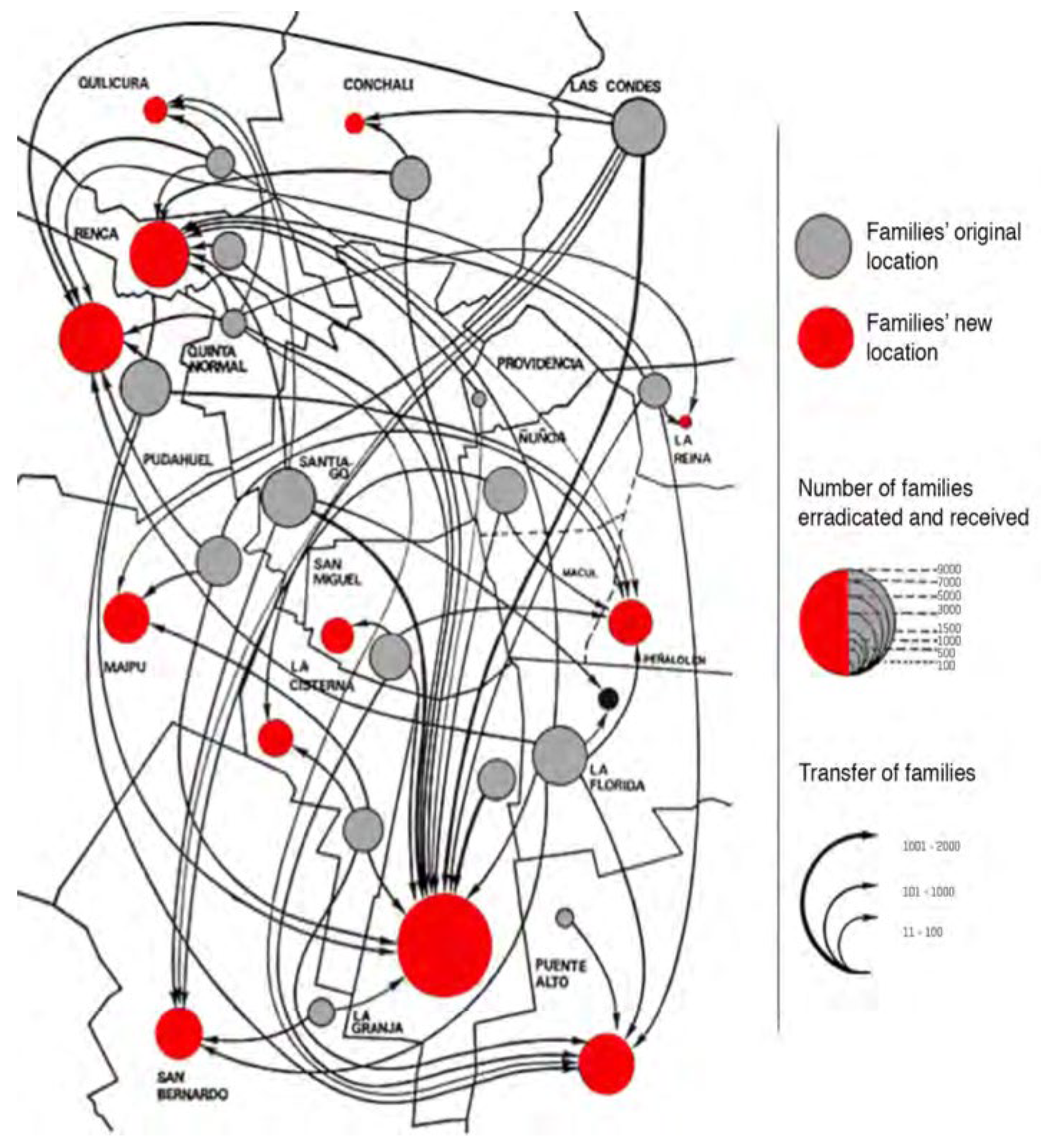
Figure 2.
Predominant social class and supply services in Santiago [47] (darker tones in the north-east show high-income [ABC1 and C2] groups while low-income [D and E]) groups are concentrated elsewhere. Services such as supermarkets and street markets are more abundant in the centre and northeast of the city.
Figure 2.
Predominant social class and supply services in Santiago [47] (darker tones in the north-east show high-income [ABC1 and C2] groups while low-income [D and E]) groups are concentrated elsewhere. Services such as supermarkets and street markets are more abundant in the centre and northeast of the city.
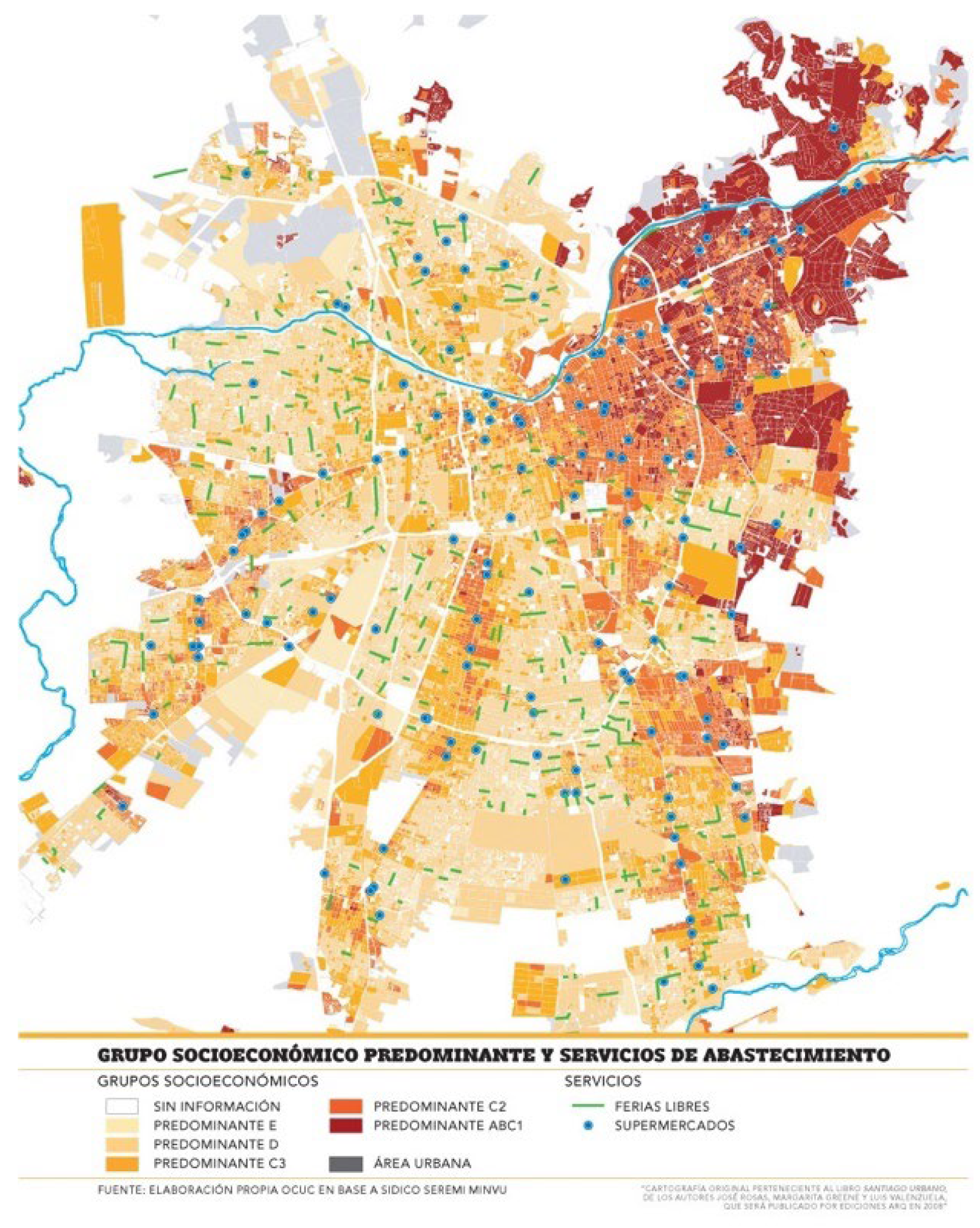
Figure 3.
Assemblies and demands from community.
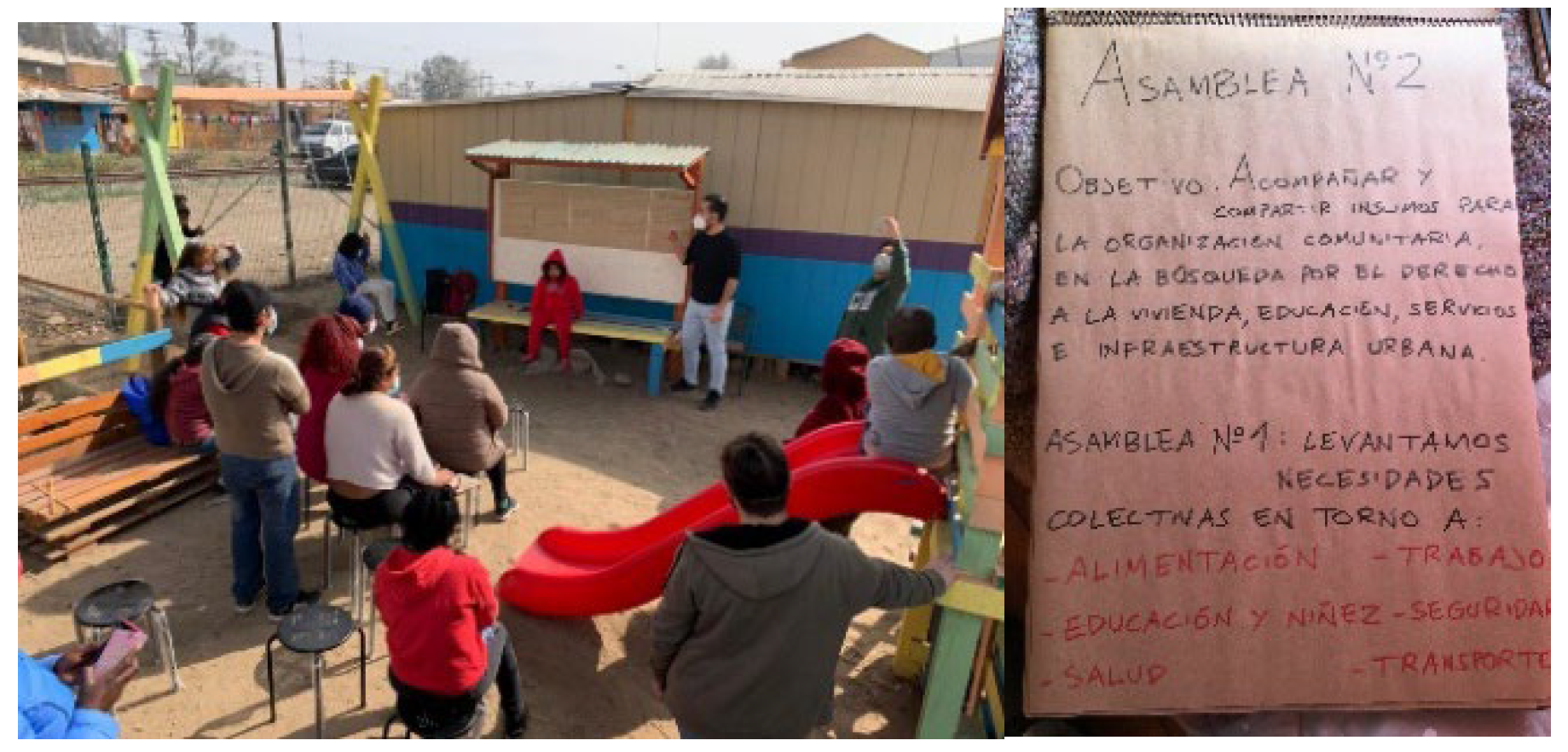
Figure 4.
Activities carried out by researchers with the community. Figure 4a, tactical urbanism intervention, Figure 4b, soup kitchen building process, Figure 4c. Education workshop with puppets. Figure 4d, final new co-produced cocina comunitaria (soup kitchen room).
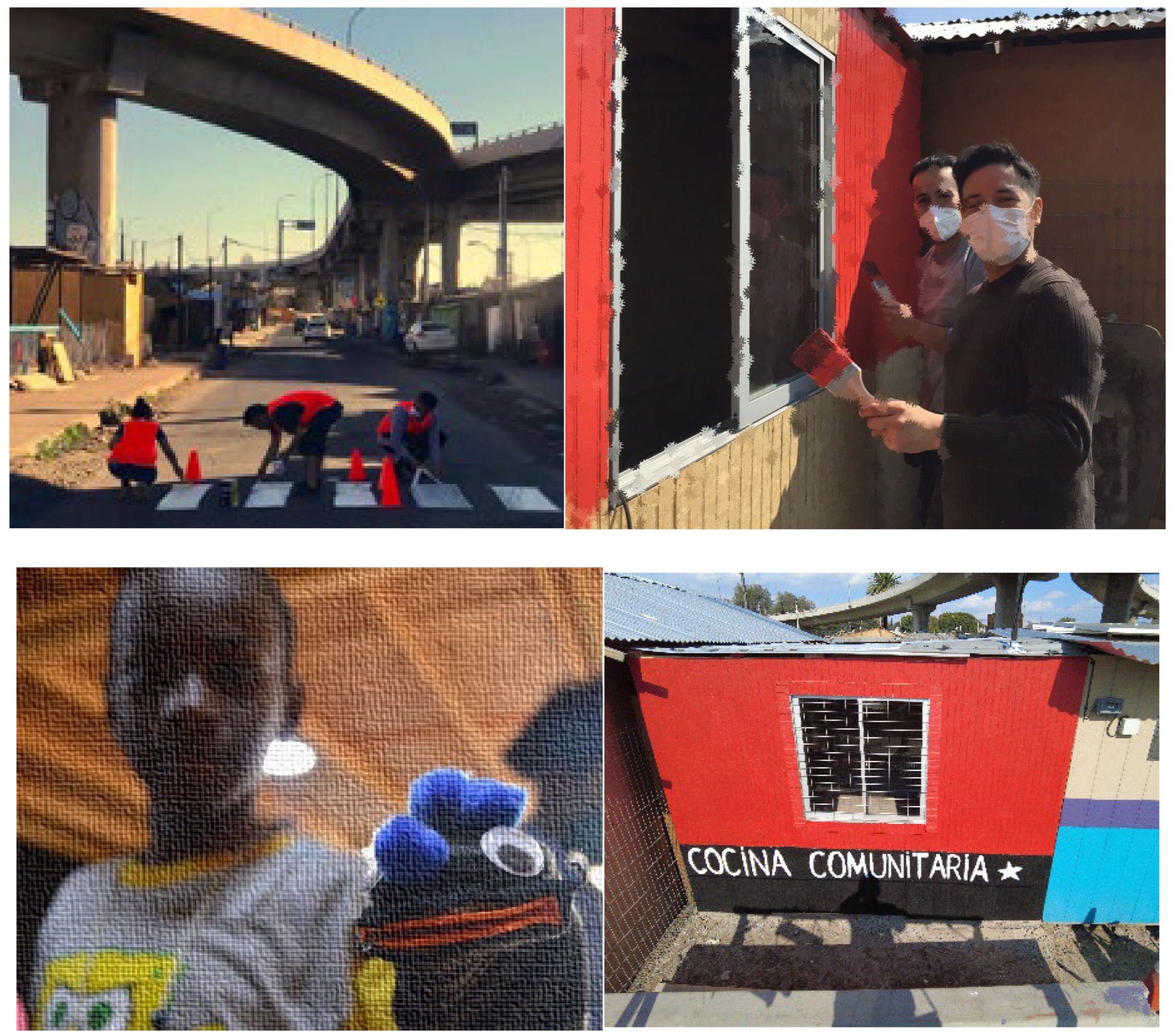
Figure 5.
Santiago and the southwest municipality of Maipu (SBS area framed in green).
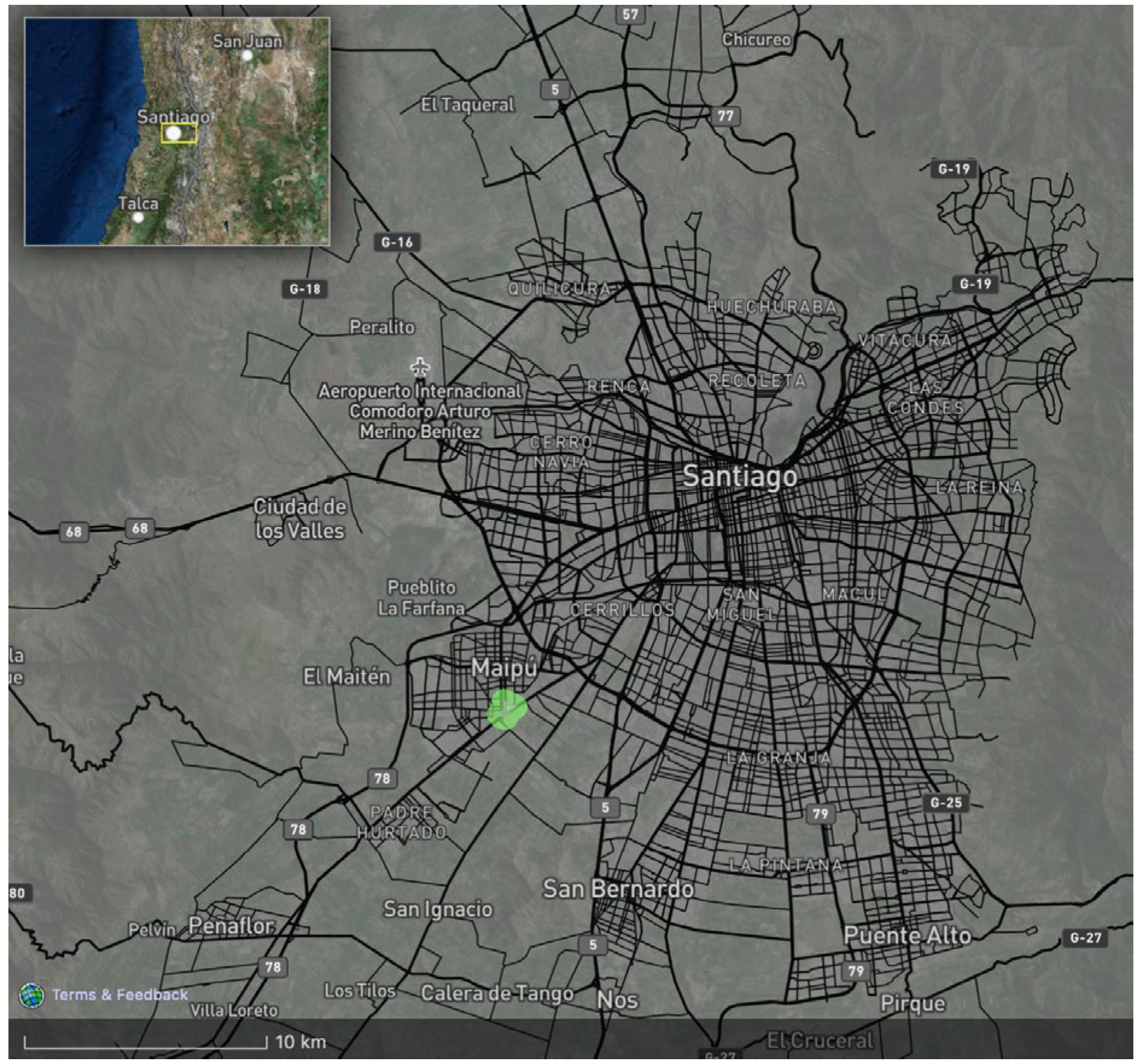
Figure 6.
Land plots occupied by different SBS (Fe y Esperanza outlined in red).
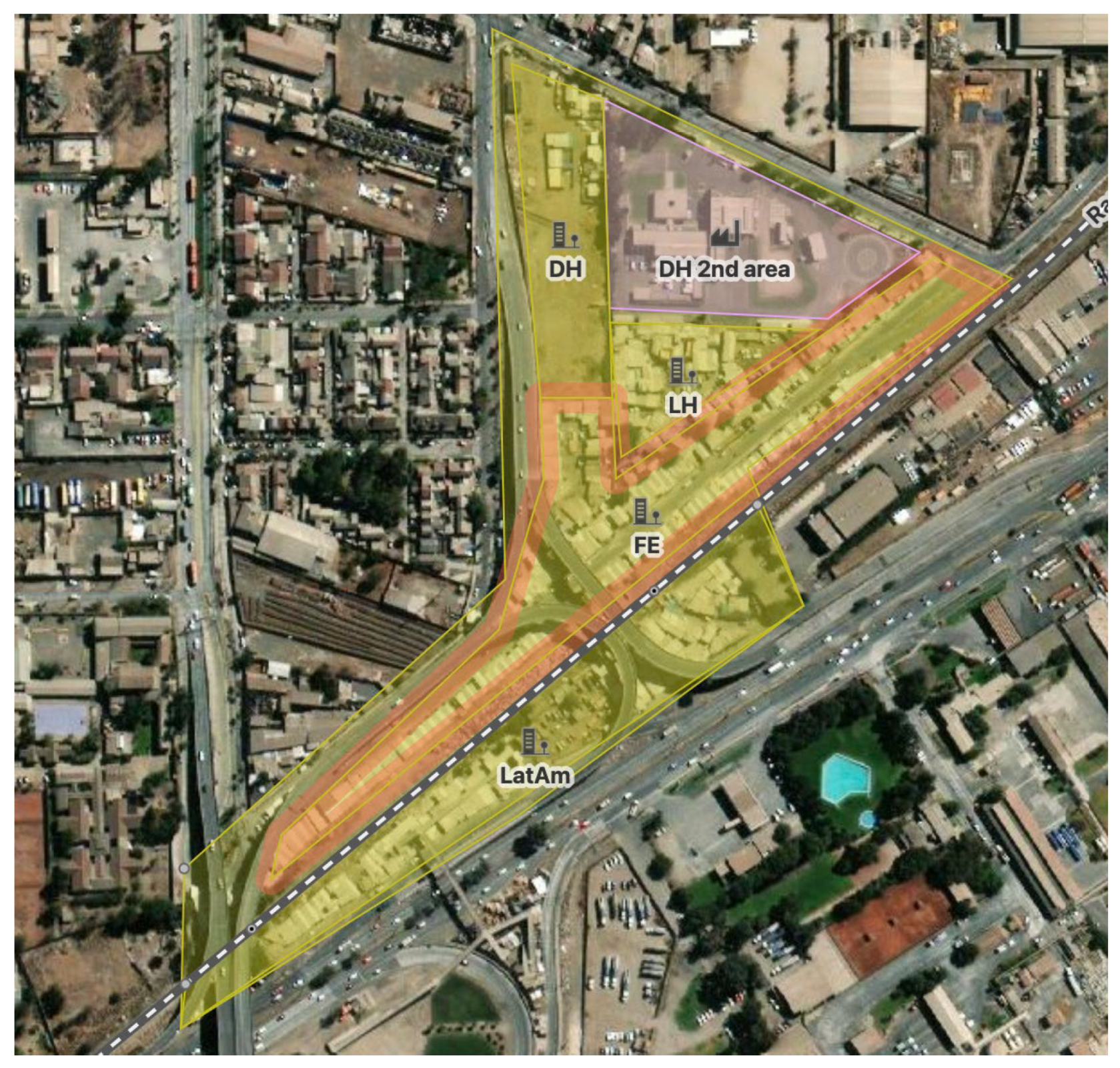
Figure 7.
Land uses in the SBS area. (Source: authors).
Disclaimer/Publisher’s Note: The statements, opinions and data contained in all publications are solely those of the individual author(s) and contributor(s) and not of MDPI and/or the editor(s). MDPI and/or the editor(s) disclaim responsibility for any injury to people or property resulting from any ideas, methods, instructions or products referred to in the content. |
© 2024 by the authors. Licensee MDPI, Basel, Switzerland. This article is an open access article distributed under the terms and conditions of the Creative Commons Attribution (CC BY) license (https://creativecommons.org/licenses/by/4.0/).
Copyright: This open access article is published under a Creative Commons CC BY 4.0 license, which permit the free download, distribution, and reuse, provided that the author and preprint are cited in any reuse.


