

Submitted:
29 February 2024
Posted:
29 February 2024
Read the latest preprint version here
Abstract
The new observations, including both the fastest star and the circular velocity curve of the Milky Way, should imply that the mass of the center of the Milky Way is almost 1011 times the mass of the Sun.
Keywords:
Fastest star
; circular velocity curve of the Milky Way
; mass of the center of galaxy
; Newtonian theory of orbit perturbation
The galactic rotation curve has been observed and studied for a long time [1,2,3]. Because of the advancement of the technology, now, the observation of the velocity of the orbit of the stars in our galaxy is more accurate and precision in a larger area [4,5,6,7,8,9]. In 2020, the fastest star in the Milky Way was observed [4,5,6]. The S62 has the shortest known stable orbit around the supermassive black hole in the center of our Galaxy to date. It is with and a periapse velocity of approximately 10% of the speed of light [4]. It is contradicted with the galactic rotation curve in which the largest velocity is at the distance of R≈6.5kpc from the center of the galaxy. In 2023, in R∼6 – 27.5 kpc, 33 335 stars are selected as disc stars for circular velocity curve, it was observed that a significantly faster decline in the circular velocity curve compared to the inner parts [7]. An analogous decline was observed in [8,9]. It is contradicted with the previous observation for the galactic rotation curve in which the out parts could be larger or no decline. Therefore, new understanding is needed for the new observations.
Here, we emphasize, the current theory for the orbit of the star/stellar around the center of the galaxy was misled by the Poincaré’s equation for Three-body problem. For the convenience of the readers, we copy our previous sentence here [10]:
Newton established the theory of orbit in 1660s. But, Newton’s theory has not been completely understood till now. As soon as comparing Poincaré’s equation of Three-body problem with Newtonian orbital perturbation theory, we shall know what is the problem in current understanding about Newtonian theory of gravity. The Sun-Earth-Moon system is the oldest Three-Body problem. It is clear, the orbits about it was well resolved by Newton. But, there is a famous old problems: calculating with , the attractive force of the Sun on the Moon is almost 2.2 times that of the Earth, but the orbit of the Moon around the Earth cannot be broken off by the Sun. It is clear, as Poincaré’s equation for Three-body problem is applied on the solar system, the orbits in it should be broken off in a short time. We think, this is the crucial evidence to show that the Poincaré’s equation for Three-body problem is wrong. And, the triple star system and multiple star systems, including Six-star system, [11,12] were observed. The orbit in these systems are stable and certain.
The Poincaré’s equation for Three-body problem is very strange. First, no orbit of the celestial body is chaotic. A broken orbit also is predictable. So, Poincaré’s equation cannot be related with any real orbit. Second, the orbits of the typical Three-body system, such as the Sun-Earth-Moon system and Sun-Pluto-Charon system, are stable. Poincaré’s equation is invalid to understand these orbits. Third, Poincaré’s equation is invalid to design an artificial orbit. It is very clear, the Poincaré’s equation is nonsense in understanding any real orbit. Additionally, the relationship between the Poincaré’s equation and other theory is very weak. If there was not Poincaré’s equation, the celestial dynamics could not be affected. But, very unfortunately, Poincaré’s equation is the mainstream understanding about Newtonian theory of gravity. It results in that, the current theory of orbit about the galaxy is questioned.
Applying the Poincaré’s equation to the N-body problem, there is the Poisson equation: , M=∭ρdV, . Therefore, the Poisson equation is also wrong in studying celestial orbit. Consequently, the formula, , where M(R) is the sum of all the mass in the radius of R, is wrong.
In the Newtonian theory of gravity, [10] the radius and velocity of the orbit of all the stars/stellar in a galaxy is only determined with
where, is only the mass of the center of the galaxy.
For the S62, as and a periapse velocity of approximately 10% of the speed of light, [4] approximately under the condition of that the orbit of S62 is a circle, it could be easily known that the radius of the orbit is almost . From , we know, there should be . From the velocity of the orbit of the Sun around the center of the Milky Way, it could be concluded that the mass of the center of the Milky Way need be . In consideration of the circular velocity curve of the Milky Way [7,8,9], we intend to believe that the mass of the center of the Milky Way should be . But, it need be noted that the measurement about all of these observations are not accurate enough. More accurate and precision measurement is needed to have a more accurate mass for the center of the Milky Way.
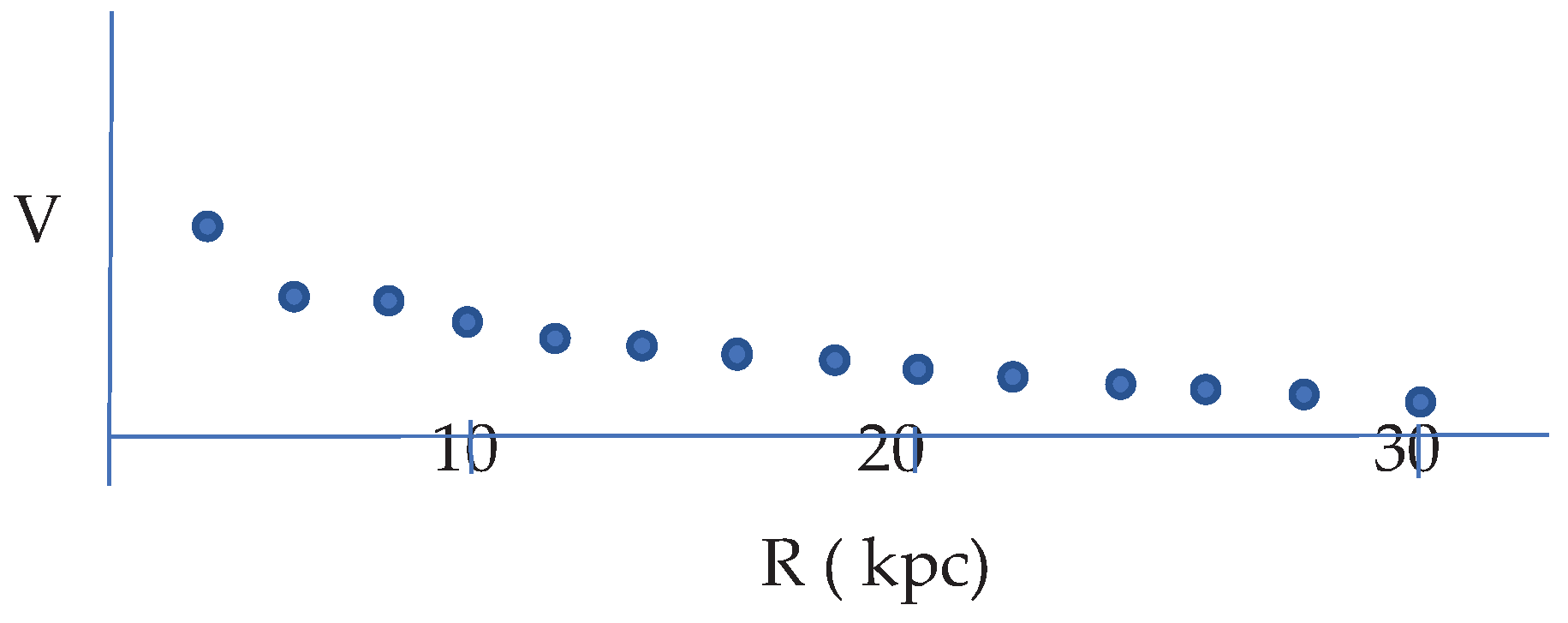
We noted that, is a very big mass. Currently, it is thought that the mass of the center of the Milky Way is [13,14] and the total mass of the Milky Way is [15] But, an orbit with the periapse velocity of approximately 10% of the speed of light and cannot be formed by the mass that only is From the , the complete figure for the circular velocity curve of the Milky Way for could be shown with the Figure 1.
It is noted that, in the Newtonian theory of gravity, besides the center of the galaxy, other stars/stellar also has actions on the orbit. Because all stars/stellar are orbiting around the center of the galaxy [10,17], just as the planets are orbiting around the Sun. And, only the Newtonian theory of orbit perturbation is valid to understand the celestial orbit [10,16]. Therefore, the orbit of a star around the center in a galaxy only can be described with the Newtonian theory of orbit perturbation:
Where c and s denote the center of the galaxy and the star, is the perturbation of other stars on this star, . From Eq. (2) we know, (for convenience, assuming that the orbit is a circle,) the radius and velocity of an orbit is determined with Eq.(1) while it is perturbed by other stars/stellar with . But, the perturbations are so little that the radius and velocity of the orbit can be determined with Eq.(1). And, as the perturbation is large, the orbit shall be broken of. So, to know the velocity of the orbit for our purpose, the perturbation need not be considered. Therefore, although the Figure 1 is only an approximation to the real orbit, it is useful to know the velocity of an orbit.
Conclusion and discussions: We emphasize, the observation of the fastest orbits [4,5,6,7] around the center of the Milky Way is very significant for understanding the mass of the center. The mass of the center of the Milky Way can be accurately observed by measuring the velocity of the orbit of one single star around the center in the radius of . In the Figure 1, it is shown that, theoretically, the velocity of any one single star in the radius of is larger than the largest velocity calculated in the galactic rotation curve with as R≈6.5kpc.
The mass of the center of the Milky Way is one of the important factors about the structure and origin of the galaxy. Therefore, a new understanding is needed for the possible new mass of the center. But, factually, new understanding is needed in more general area. As I know, first, the Poincaré’s equation with the Poisson equation need be excluded from the theory of the galaxy. We have had no evidence to show that the Poincaré’s equation with the Poisson equation is valid to the orbit in the galaxy or any other orbit. It is only a misunderstanding about the Newtonian theory of gravity [10]. Therefore, we need return to the Newtonian theory. Second, the gravitational field is with a very tremendous energy and energy density. It is omitted in current theory of gravity while it should be very important to judge the dark energy [18,19]. Third, a galaxy is always moving. Then, how is this galaxy moving? Is it with an orbit around a larger object? These problems showed that our knowledge about the galaxy is poor. We need new knowledge about it from new observation.
References
- Y. Yoon, C. Park, H. Chung and K., Zhang, Rotation Curves of Galaxies and Their Dependence on Morphology and Stellar Mass. ApJ 2021, 922, 249. [CrossRef]
- S. S. McGaugh, F. Lelli and J.M.Schombert, Radial Acceleration Relation in Rotationally Supported Galaxies. Physical Review Letters 2016, 117, 201101, arxiv: 1609.05917. [Google Scholar] [CrossRef] [PubMed]
- S. S. McGaugh, The Third Law of Galactic Rotation. Galaxies 2014, 2, 601–622. [Google Scholar] [CrossRef]
- F. Peißker, A. Eckart and M. Parsa, S62 on a 9.9 yr Orbit around SgrA*. ApJ 2020, 889, 61. [Google Scholar] [CrossRef]
- F. Peißker, A. F. Peißker, A. Eckart, M. Zajaček and S. Britzen, Observation of S4716‐ A star with a 4 year orbit around Sgr A*.
- F. Peißker, A. F. Peißker, A. Eckart, M. Zajaček, S. Britzen, B. Ali and M. Parsa, S62 and S4711: Indications of a Population of Faint Fast-moving Stars inside the S2 Orbit—S4711 on a 7.6yr Orbit around Sgr A*.
- X. Ou, A. Eilers, L. Necib and A. Frebel, The dark matter profile of the Milky Way inferred from its circular velocity curve. MNRAS 2024, 528, 693–710. [Google Scholar] [CrossRef]
- Eilers, et al, The Circular Velocity Curve of the Milky Way from 5 to 25 kpc. ApJ 2019, 871, 120. [CrossRef]
- P. Mróz, et al, Rotation Curve of the Milky Way from Classical Cepheids. ApJL 2019, 870, L10. [CrossRef]
- Y. Zhu, Interaction of Gravitational Field and Orbit in Sun-planet-moon system [v1] | Preprints. [CrossRef]
- J. Kazmierczak, Discovery Alert: First Six‐Star System Where All Six Stars Undergo Eclipses (2021).
- L. Boyle and M. Cuntz, Orbital Stability of Planet-hosting Triple-star Systems according to Hill: Applications to Alpha Centauri and 16 Cygni. Res. Notes AAS 2021, 5, 285. [CrossRef]
- R. Genzel, F. Eisenhauer and S. Gillessen, The Galactic Center Massive Black Hole and Nuclear Star Cluster. Reviews of Modern Physics 2010, 82.4, 3121–3195. [Google Scholar] [CrossRef]
- S. Issaoun, M. D. Johnson, L. Blackburn, C. D. Brinkerink, et al, The Size, Shape, and Scattering of Sagittarius A* at 86 GHz: First VLBI with ALMA. Astrophysical Journal 2019, 871.1.
- M. J. Reid, K.M. Menten, X.W. Zheng, A. Brunthaler, L. Moscadelli, Y. Xu, et al. Trigonometric Parallaxes of Massive Star-Forming Regions. VI. Galactic Structure, Fundamental Parameters, and Noncircular Motions. The Astrophysical Journal 2009, 700, 137–148. [Google Scholar] [CrossRef]
- Y. Zhu,(PDF) The speed of gravity: An observation on galaxy motions (researchgate.
- J. Bekenstein, Physics Crunch: Time to Discard Relativity? NewScientist 2013, 217, 42. [Google Scholar]
- Y. Zhu, Gravitational Field and Mass [v2] | Preprints. [CrossRef]
- Y. Zhu, Relativistic Mass of Gravitational Field [v1] | Preprints. [CrossRef]
Figure 1.
The calculated circular velocity curve of the Milky Way. The observed largest V is approximately 10% of the speed of light. As the velocity of the Sun is almost 220km/s. In a rough standard, the Figure is approximately accordant with the observations of the fastest orbits [4,5,6] and the circular velocity curve of the Milky Way [7,8,9].
Figure 1.
The calculated circular velocity curve of the Milky Way. The observed largest V is approximately 10% of the speed of light. As the velocity of the Sun is almost 220km/s. In a rough standard, the Figure is approximately accordant with the observations of the fastest orbits [4,5,6] and the circular velocity curve of the Milky Way [7,8,9].
Disclaimer/Publisher’s Note: The statements, opinions and data contained in all publications are solely those of the individual author(s) and contributor(s) and not of MDPI and/or the editor(s). MDPI and/or the editor(s) disclaim responsibility for any injury to people or property resulting from any ideas, methods, instructions or products referred to in the content. |
© 2024 by the authors. Licensee MDPI, Basel, Switzerland. This article is an open access article distributed under the terms and conditions of the Creative Commons Attribution (CC BY) license (http://creativecommons.org/licenses/by/4.0/).
Copyright: This open access article is published under a Creative Commons CC BY 4.0 license, which permit the free download, distribution, and reuse, provided that the author and preprint are cited in any reuse.